1. Introduction
Food insecurity is increasingly recognized as a multidimensional phenomenon encompassing economic, nutritional, social, and psychological dimensions. It refers not only to the lack of sufficient food but also to the inability to access culturally appropriate, safe, and adequate food in socially acceptable ways [
1]. This condition often intersects with broader forms of deprivation, affecting individuals’ dignity, autonomy, and participation in everyday social life, deeply investigated by qualitative approaches that provided crucial insights into the lived experience of food insecurity, highlighting its social, cultural, and psychological dimensions, as well as territorial specificities that are often not captured by quantitative indicators [
2,
3]. As such, food insecurity has been linked not only to material scarcity but also to emotional distress, social exclusion, and long-term adverse health outcomes [
4,
5,
6]. The economic crises of 2008 and 2012 have significantly expanded the population exposed to food insecurity over the past decade, leading to a growing demand for support services. This demand has been increasingly met by food assistance initiatives—such as food banks, soup kitchens, and community-based programs—that have emerged to fill the gap left by the dismantling of state welfare mechanisms [
7,
8]. These assistance-based initiatives have become even more critical during and after the COVID-19 pandemic and recent geopolitical and socio-economic crises, which have in turn driven up the prices of key commodities, including wheat and vegetable oil [
9,
10].
From a theoretical perspective, the growing role of food assistance systems can be interpreted within broader transformations of welfare states. In particular, scholarship on welfare regimes [
11] highlights how different institutional configurations shape the balance between state provision, market mechanisms, and third-sector interventions. Within this framework, the expansion of food aid in high-income countries has often been associated with processes of welfare retrenchment and the increasing delegation of social protection functions to charitable organizations. At the same time, critical food studies have problematized the rise in food banking and assistance-based responses. Authors such as Poppendieck [
12] have described this trend as a form of “depoliticization” of hunger, whereby structural causes of food insecurity are reframed as issues to be addressed through voluntary and charitable action rather than through rights-based public policies. This perspective highlights an inherent tension between food assistance and state responsibility, raising questions about the extent to which food assistance systems mitigate or, conversely, institutionalize forms of deprivation. Building on these contributions, this study does not treat food assistance as a neutral response mechanism but rather as a component of evolving welfare configurations, whose spatial organization may reflect both social needs and institutional capacities.
Recent contributions on food environments, spatial justice, and territorial capabilities further suggest that food insecurity should be understood not only as a household-level condition but also as the outcome of uneven territorial infrastructures. Place-based approaches emphasize that access to food and welfare services is shaped by the spatial distribution of organizations, mobility conditions, local institutional capacity, and urban-rural relations. This perspective is relevant for food assistance systems because the same level of social need may generate different outcomes depending on the density, accessibility, and diversification of local provision networks. Recent work on rural food environments and urban bias has similarly shown that productive territories may still experience infrastructural deficits and unequal access to adequate food, reinforcing the need to interpret food assistance through a territorial and systemic lens [
13].
In many European countries, food price inflation continues to erode household purchasing power, making food expenditure increasingly unaffordable [
14,
15]. One of the clearest indicators of this trend is the rising number of individuals receiving food assistance from third-sector organizations, whose operations are supported by the Fund for European Aid to the Most Deprived (FEAD) [
9]. Italy, the EU member state selected as the case study for this paper, is no exception: according to data from the Ministry of Labor and Social Policies, in 2023 approximately 2.9 million people—equivalent to 4.9% of the population—received food aid. This figure remains significantly higher than pre-pandemic levels, when in 2019 only 3.4% of the population accessed food assistance. The sharpest increase occurred between 2019 and 2021, when the proportion rose by 1.56 percentage points due to the effects of the pandemic. Although there was a slight decline between 2021 and 2023 (approximately −0.12%), the overall number of recipients remains high and structurally significant, reflecting ongoing barriers to economic access to food exacerbated by inflation and global crises.
At the same time, the infrastructure of the national food assistance distribution network has undergone significant transformations in Italy. The Ministry of Labor and Social Policies and the Ministry of Agriculture, Food and Forestry are jointly responsible for coordinating the procurement of food, which is selected according to nationally agreed nutritional guidelines. The operational management of food distribution is entrusted to AGEA (the Agency for Agricultural Disbursements), which delivers supplies to accredited Lead Partner Organizations (LPOs). These LPOs—mainly large charitable entities operating at the national level—oversee the logistics of food storage and distribution, working in close collaboration with Territorial Partner Organizations (TPOs). While LPOs manage coordination and supply chains, TPOs are responsible for the final delivery of food aid and often provide additional social support services.
In this study, the terms “food insecurity” and “food assistance” are used with distinct meanings. Food insecurity refers to a condition of constrained or uncertain access to adequate food, while food assistance denotes the set of institutional and third-sector interventions aimed at addressing such conditions. The analysis focuses on the latter as an observable proxy of system-level dynamics. Adopting food assistance as a proxy for food insecurity requires careful conceptual consideration. While the number of beneficiaries and the structure of food assistance systems provide valuable insights into material deprivation, they do not capture the full extent of food insecurity. First, food assistance primarily reflects the most severe and visible forms of need, excluding individuals and households who experience food insecurity but do not seek or cannot access support. Second, access to food aid is mediated by organizational availability, eligibility criteria, and social stigma, introducing potential access bias. Third, food assistance data partly reflect supply-side capacity, meaning that higher levels of provision may indicate stronger organizational infrastructures rather than higher underlying need. For these reasons, the indicators used in this study should not be interpreted as direct measures of food insecurity, but rather as system-level proxies that capture the interaction between demand for support and the institutional capacity to respond.
This perspective allows for the analysis of territorial inequalities not only in terms of deprivation, but also in terms of welfare infrastructure and service provision.
Given these developments, it is essential to strengthen the capacity for data collection, monitoring, and analysis in the field of food assistance. Having access to timely, reliable, and structured information is crucial for understanding ongoing dynamics, assessing the effectiveness of distribution networks, and formulating evidence-based policy responses. In this context, the present study adopts an operational approach to food insecurity, using indicators derived from the Information System for the Fund for European Aid to the Most Deprived (SIFEAD) administrative data. Despite these indicators are unidimensional, they offer a preliminary and more informed reading of food insecurity from the perspective of food assistance systems, which are playing an increasingly central role within national welfare. In many cases, they risk becoming the only form of response available to citizens experiencing food poverty, in the absence of a comprehensive and strategic national framework capable of addressing the root causes of the phenomenon [
16].
In this regard, the present study seeks to fill a gap in the literature on food insecurity measurement by adopting the perspective of the food assistance system. Most existing tools—such as caloric adequacy, dietary diversity indices, and experience-based scales like the Food Insecurity Experience Scale (FIES) [
17] or the Household Food Insecurity Access Scale (HFIAS) [
18]—primarily focus on the access dimension and subjective perception of food insecurity [
19]. Moreover, their implementation often relies on microdata, household-level surveys, and culturally validated instruments, which are not always available or standardized at national or sub-national levels [
20]. In the European context, indicators included in harmonized surveys (e.g., European Union—Statistics on Income and Living Conditions, EU-SILC) offer only a partial understanding of the full spectrum of food-related hardships [
21].
In recent years, efforts have been made to broaden the analytical toolkit. Some studies have proposed approaches based on food expenditure shares, poverty thresholds, or regional benchmarks of the cost of a healthy diet [
22,
23]. However, these approaches still face limitations in terms of scalability and comprehensiveness: For instance, Secondi et al. [
22] proposed and applied a composite indicator of food poverty (the Multidimensional Food Poverty Index—MFPI), which does not capture all relevant dimensions of the phenomenon, assigns equal weight to each variable arbitrarily and without statistical validation, and includes several proxy variables drawn from the EU-SILC survey that were not originally designed to measure food poverty directly.
To contextualize the contribution of this study within the existing body of research, a structured literature search was conducted using the Scopus database, which was selected for its broad coverage of peer-reviewed journals in the fields of social policy, food systems, and welfare studies. Although the present work does not aim to provide a full systematic review or meta-analysis, the search and selection process was designed to follow the logic and transparency standards commonly adopted in systematic literature reviews.
The search targeted publications addressing food assistance, food insecurity, and European welfare interventions, with a specific focus on EU-level programs. Search strings combined keywords related to food insecurity and food aid (e.g., “food insecurity”, “food poverty”, “food assistance”, “food aid”) with terms referring to European policy instruments (e.g., “European Union”, “FEAD”, “Fund for European Aid to the Most Deprived”), using Boolean operators to maximize recall while maintaining thematic relevance. Only peer-reviewed journal articles were considered. The initial query returned a limited number of records. After the removal of duplicates, titles and abstracts were screened to assess relevance with respect to three predefined inclusion criteria: (i) explicit reference to European food assistance schemes; (ii) substantive engagement with food insecurity, food poverty, or food assistance systems as an analytical focus; and (iii) relevance to policy design, governance, or empirical assessment of food assistance. Studies focusing exclusively on food nutrition without reference to access or deprivation, non-European contexts or focused on FAO’s approach were excluded at this stage.
The final sample consists of a small number of studies published between 2016 and 2025, reflecting the relatively recent institutionalization of FEAD and the limited academic attention devoted to its implementation.
The selected literature is highly skewed toward qualitative and institutional analyses, primarily examining governance arrangements, implementation challenges, and the role of third-sector actors within European food assistance systems [
24,
25,
26]. Quantitative contributions are extremely scarce. To the best of our knowledge, only one recent study adopts a comparative empirical perspective across Member States, relying on descriptive information from national implementation reports rather than administrative microdata [
27]. No existing work exploits sub-national SIFEAD administrative data to construct territorially disaggregated indicators capable of capturing demand intensity, organizational coverage, or functional diversification within countries.
This structured review process highlights a clear empirical and methodological gap in the literature. While previous studies have contributed important insights into the institutional and political dimensions of European food assistance, they have not engaged with the spatial heterogeneity and infrastructural capacity of food assistance systems at the local level. The present study addresses this gap by mobilizing original administrative data from the Italian SIFEAD database and by proposing a set of operational indicators that allow for a province-level, system-oriented analysis of food insecurity through the lens of food assistance provision. Specifically:
The Food Aid Index (FAI) measures the intensity of demand for food support;
The Land Coverage Index (LCI) quantifies the territorial density of food aid organizations relative to demand;
The Food Aid Diversification Index (FDI) captures the functional complexity of intervention strategies implemented at the provincial level.
These indicators are not intended to capture all dimensions of food insecurity. Rather, they offer a complementary, system-level lens to assess the capacity of local welfare infrastructures to respond to challenges related to food access. Their use addresses a significant gap in both the academic literature and public policy: the lack of spatially disaggregated tools for monitoring the performance and resilience of food assistance networks in Italy. By shifting the analytical focus from individuals to systems, this study explores how organizational density, distributive equity, and service diversification may mediate the impact of structural poverty on food access. In doing so, it proposes a new interpretive framework for the geography of food insecurity—one that accounts not only for need, but also for institutional response capacity. The conceptualization of the three indices can also be linked to established multidimensional frameworks of food insecurity, such as the FAO’s four pillars: availability, access, utilization, and stability. In this perspective, the Food Aid Index (FAI) primarily reflects constraints in economic access to food, as proxied by the intensity of demand for assistance. The Land Coverage Index (LCI) relates to the spatial availability and accessibility of food aid services across territories. Finally, the Food Aid Diversification Index (FDI) captures aspects of utilization and adequacy, as a more diversified set of intervention channels may better respond to heterogeneous needs and improve the quality and appropriateness of support. While these indices do not fully operationalize the four pillars, they provide a partial and system-oriented approximation of key dimensions of food insecurity.
Building on this framework, the study pursues two exploratory objectives. First, it aims to describe the territorial configuration of food assistance systems in Italy by measuring the intensity of observed demand, the density of organizational coverage, and the diversification of intervention channels at the provincial level. Second, it aims to identify potential mismatches between observed demand and local response capacity, with particular attention to persistent spatial inequalities and North–South disparities. The analysis is not designed to draw causal claims, but to provide a system-oriented empirical framework for comparing local food assistance infrastructures and supporting place-based policy discussion. In this sense, the contribution of the paper is both methodological and policy-oriented: it proposes operational indicators that can be replicated in other national contexts and offers an exploratory tool for territorial monitoring in the transition from emergency food aid to more structured welfare governance.
The rest of the paper is structured as follows.
Section 2 describes the main aspects of the methodology for data collection and indexes’ construction.
Section 3 presents and discusses the results of the analyses carried out. In
Section 4 some concluding remarks are drawn and a range of potential uses of the proposed approach are described.
2. Methodology of Data Collection and Indexes’ Construction
The three indices introduced in this study focus on capturing critical dimensions of food assistance systems: demand intensity, organizational density, and functional diversification. These dimensions are not only analytically relevant but also policy-relevant, as they reflect core aspects of how food assistance networks are configured and deployed across territories. Understanding the intensity of demand (FAI) is essential in gauging the pressure exerted on welfare infrastructures and identifying spatial inequalities in access to basic food support [
28]. Organizational density (LCI) serves as a proxy for territorial coverage and service accessibility—two key variables in evaluating the capacity of welfare networks to ensure minimum social protection [
29]. Functional diversification (FDI), meanwhile, provides insight into the adaptability and responsiveness of local systems in addressing heterogeneous and evolving needs, as highlighted by recent studies on hybrid food assistance models [
7]. By shedding light on these three structural dimensions, the proposed indicators offer a novel system-level lens for interpreting the geography of food insecurity—not solely in terms of need, but in terms of institutional and organizational response. Drawing on SIFEAD administrative data and the operational dynamics of third-sector food distribution, this approach contributes to a growing body of literature that emphasizes the importance of monitoring welfare capacity and infrastructural resilience in contexts of chronic food deprivation [
9,
16]. All indicators are constructed using raw administrative data and are expressed as ratios in order to ensure comparability across provinces and over time. No additional data standardization procedures were applied, as the normalization by population size and number of beneficiaries already controls for differences in territorial scale. The Food Aid Index (FAI) operationalizes local demand for assistance as the ratio between the number of beneficiaries and the resident population in each province. This indicator is therefore used both as a direct measure of demand intensity and as a reference variable in the construction of the other indices. The Land Coverage Index (LCI) measures organizational presence and is defined as the number of Territorial Partner Organizations (TPOs) operating in a given province per 1000 beneficiaries. Organizational presence is thus proxied by the number of active organizations, rather than by staff size or service hours, due to data availability constraints and to ensure consistency across territories. The Food Aid Diversification Index (FDI) is based on the number of distinct Channels of Intervention (CoI) activated within each province. The five types of intervention (food parcel distribution, home delivery, soup kitchens, street units, and social emporia) are treated with equal weight. This choice reflects an analytical focus on the presence and variety of service typologies rather than on their relative intensity, for which comparable data are not systematically available.
The study was conducted through the quantitative analysis of data from the Italian SIFEAD administrative database. The dataset includes disaggregated information at regional, provincial, and municipal levels for the period 2019–2023. The 2023 observations used in this study derive from the same SIFEAD administrative source as the previous years; no extrapolated values were used in the construction of the three indicators. The dataset was subjected to consistency checks and aggregation procedures prior to analysis. Municipal-level data were aggregated at the provincial level to ensure robustness and to reduce the impact of local reporting anomalies. Observations with missing or inconsistent values were limited and were excluded when they did not meet minimum reliability criteria. No imputation procedures were applied, in order to preserve the integrity of the administrative data. All variables used for index construction are derived directly from the SIFEAD database, following the operational definitions adopted within the FEAD framework. The dataset provides information on the demographic composition of beneficiaries, the characteristics of local and national food assistance organizations and their Channels of Intervention (CoI), and the quantity and typology of food products to be delivered. The dataset contains 3380 municipal observations recorded by TPOs. The analysis was conducted at the provincial level because not all municipalities provide these services and because some municipalities report disproportionately high numbers of beneficiaries compared with the resident population, especially where users may include non-registered individuals, migrants, homeless people, or people accessing services outside their municipality of residence. The observation units were therefore aggregated into 106 of the 107 Italian provinces, excluding Aosta Valley, for which no users were registered. References to regional patterns are intended solely as descriptive interpretations of spatial trends and do not imply any aggregation of the data at the regional level.
The analytical workflow involved four main steps: data cleaning, provincial aggregation, indicator construction, and exploratory spatial analysis. Municipal records were checked for missing or inconsistent values in the number of beneficiaries, Territorial Partner Organizations, and Channels of Intervention. The three indicators were then computed using harmonized formulas for each year, and the resulting provincial dataset was used to produce descriptive statistics, maps, moving-base indices, correlation matrices, caterpillar plots, and BCG matrices. Aggregate provincial data and the analytical workflow can be made available upon reasonable request, in line with data access restrictions associated with the administrative source.
The analysis relies on a single administrative data source (SIFEAD), which represents the most comprehensive and systematically collected dataset currently available on food assistance in Italy. While the use of a single data source does not allow for triangulation with alternative datasets, it ensures a high degree of internal consistency and comparability across territories and over time. The choice is therefore justified by the exploratory and system-oriented nature of the study, which aims to analyze structural patterns within the food assistance network rather than to reconstruct individual-level experiences. It is important to acknowledge that the SIFEAD data are derived from administrative records collected by Territorial Partner Organizations, and may therefore be affected by variations in reporting practices, organizational capacity, and data completeness across provinces. However, the dataset is compiled within a standardized national framework defined by FEAD operational guidelines, which ensures a baseline level of consistency in data collection procedures. While some degree of heterogeneity cannot be entirely excluded, the use of aggregated provincial-level indicators helps to mitigate local reporting biases and allows for meaningful cross-regional comparisons. Nonetheless, results should be interpreted with caution, particularly in cases where extreme values may reflect differences in reporting intensity as well as underlying structural conditions.
Data from the first group (demographic information of the sample) allowed the definition of the FAI which is the ratio of total beneficiaries weighted on the number of total residents for each province. It is expressed in percentage. OIPA already used this index in its annual report on food insecurity in order to study the phenomenon both at regional and local level, comparing values for Italian regions and within the 15 districts composing the city of Rome [
30]. This analysis allows the measurement of assistance level, identifying the number of actual beneficiaries every 100 inhabitants. The use of the resident population as the denominator may introduce potential discrepancies between the population officially registered and the population actually served by food assistance systems. In particular, beneficiaries may include non-registered individuals, temporary residents, or people accessing services outside their municipality or province of residence. However, the use of official population data ensures consistency and comparability across territories and over time, representing the most reliable baseline available at the national level. While this choice may lead to a partial mismatch between demand and population size, it remains a standard approach in territorial analyses and allows for the identification of relative differences in assistance intensity.
To build the LCI, which represents the ratio between the number of food assistance organizations and the number of beneficiaries, the second group of data has been used (organizations’ generalities and CoI). This analysis has allowed the measurement of assistance distribution, identifying the actual number of food aid organizations per 1000 beneficiaries. The multiplier was included to improve the interpretation and readability of the results. It is important to note that the LCI treats organizations as homogeneous units, while actually they may differ significantly in terms of size, resources, and service capacity. Due to data limitations, it was not possible to account for these differences through weighted measures (e.g., number of volunteers, budget, or service hours). Therefore, the LCI should be interpreted as a proxy for the spatial presence of organizations rather than as a direct measure of service capacity. Despite this limitation, the number of active organizations remains a meaningful indicator of territorial coverage, particularly in a comparative perspective.
The FDI uses the information related to the CoI carried out by each province’s organizations to evaluate the number and typology of the implemented food services. So far, CoI present in the Italian solidarity supply chain are: food package delivery; home delivery; soup kitchens; street units; social emporium. The index is the ratio between the active number of CoI weighted on the number of beneficiaries, multiplied by 1000 to improve the interpretation and readability of the results. Similarly to the LCI, the FDI is based on a simple count of the active channels of intervention and does not account for differences in service intensity, resource allocation, or scale of operations across intervention types. For example, soup kitchens and social emporia may require substantially more resources than food parcel distribution or street units. The decision to assign equal weight to each intervention type reflects the objective of capturing the diversity of service provision rather than its intensity. As such, the FDI should be interpreted as an indicator of functional variety rather than depth or effectiveness of intervention.
The three indices are conceptually interrelated but do not imply a causal sequence. Rather, they capture complementary dimensions of local food assistance systems. The FAI reflects the intensity of demand for support, while the LCI and FDI capture different aspects of supply-side capacity—respectively, the territorial distribution of organizations and the diversity of intervention strategies. Together, these dimensions define a structural relationship between demand pressure and institutional response, allowing for the identification of potential mismatches between needs and service provision. While the FAI and LCI are simple ratio-based indicators, the FDI is based on the count of five types of CoI, each of which is assigned equal weight. This choice reflects the exploratory objective of capturing the diversity of available service typologies rather than their relative scale, intensity, or resource requirements, for which comparable data are not available within the SIFEAD database. It is worth noting that alternative weighting schemes could assign greater importance to specific intervention types and may therefore affect the results of the subsequent exploratory analysis. However, such weighting schemes would require normative assumptions regarding the relative importance of different forms of assistance. For this reason, equal weighting was adopted as a transparent and theoretically neutral solution.
Methods for Exploratory Data Analysis
To analyze the indicators described above, this study adopts an exclusively exploratory approach aimed at providing a comprehensive evaluation, both cross-sectional and longitudinal, of the condition of Italian provinces over the period 2019–2023. In the initial phase, univariate descriptive statistics were employed for each year to offer a preliminary interpretation of inequality conditions using consolidated measures in exploratory data analysis. These analyses were complemented by graphical representations through histograms and boxplots, also disaggregated by year. To investigate the temporal dimension of territorial dynamics, moving-base indices and percentage variations were calculated. Let
be the vector of the three simple indicators previously described, where the generic element
represents the vector of values of the
-th indicator for the
-th provinces, with
and
. The moving-base indices are calculated, for each province and each indicator, as follows:
where
denotes the value of the
-th index for the
-th province at time
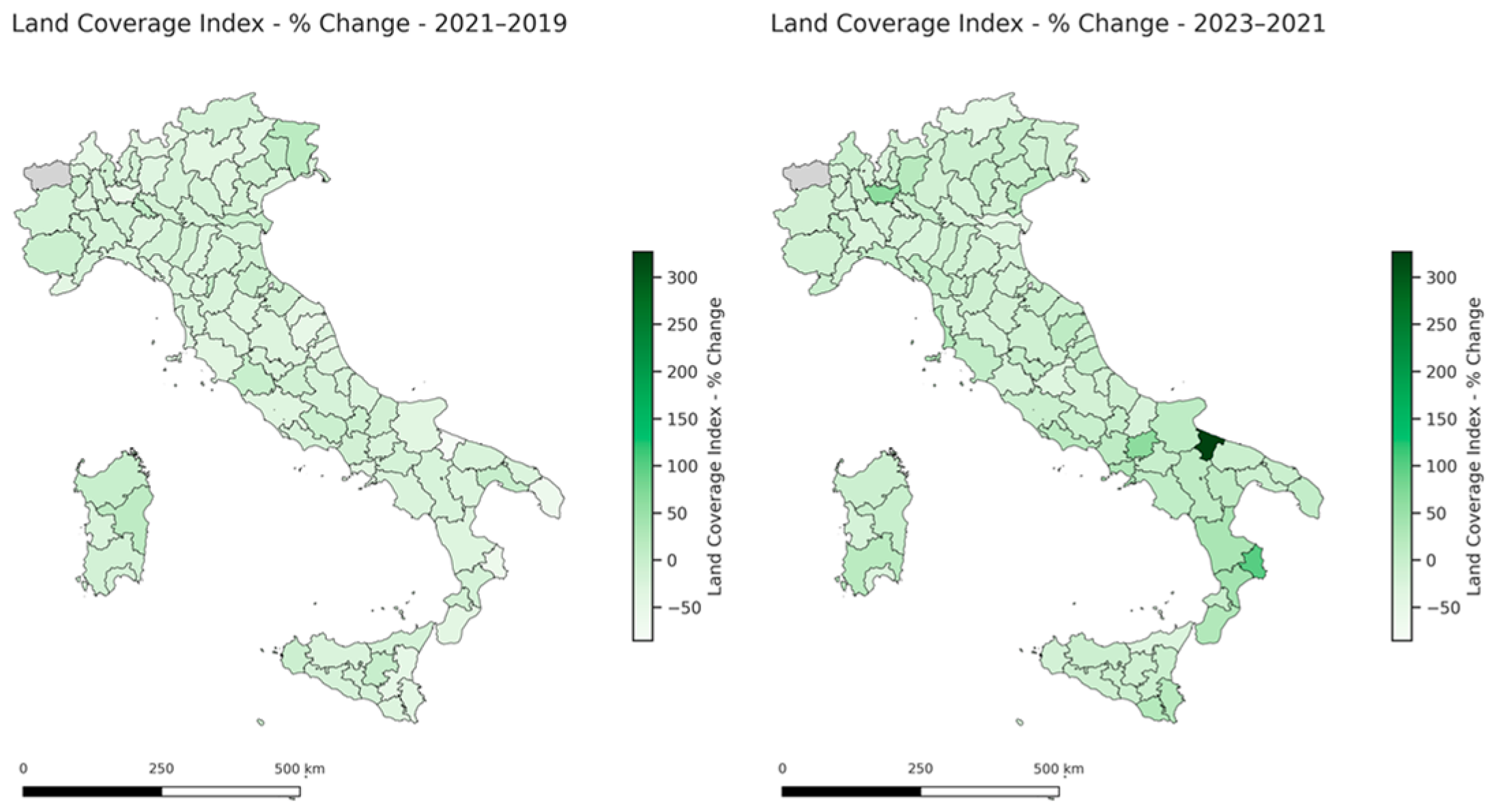
. Choropleth maps were used to visually display the relative evolution of the phenomenon over time, offering a synthetic yet informative overview of the territorial trajectories for each indicator. To capture changes over longer time intervals, additional maps were produced illustrating the percentage variation in the three indicators across two specific periods (2019–2021 and 2021–2023), according to the following formula:
In parallel, bivariate analyses were conducted between the pairs FAI–FDI and FAI–LCI for each year, using correlation coefficients and scatterplots to explore potential relationships between the intensity of demand for food assistance and the structural and territorial dimensions of supply. Given that FDI and LCI are positively correlated by construction, analytical attention was focused on their respective associations with FAI.
Consistent with the exploratory approach, a Boston Consulting Group (BCG) matrix was constructed for each year, applied to the FAI–FDI and FAI–LCI pairs. As suggested by Gorb et al. [
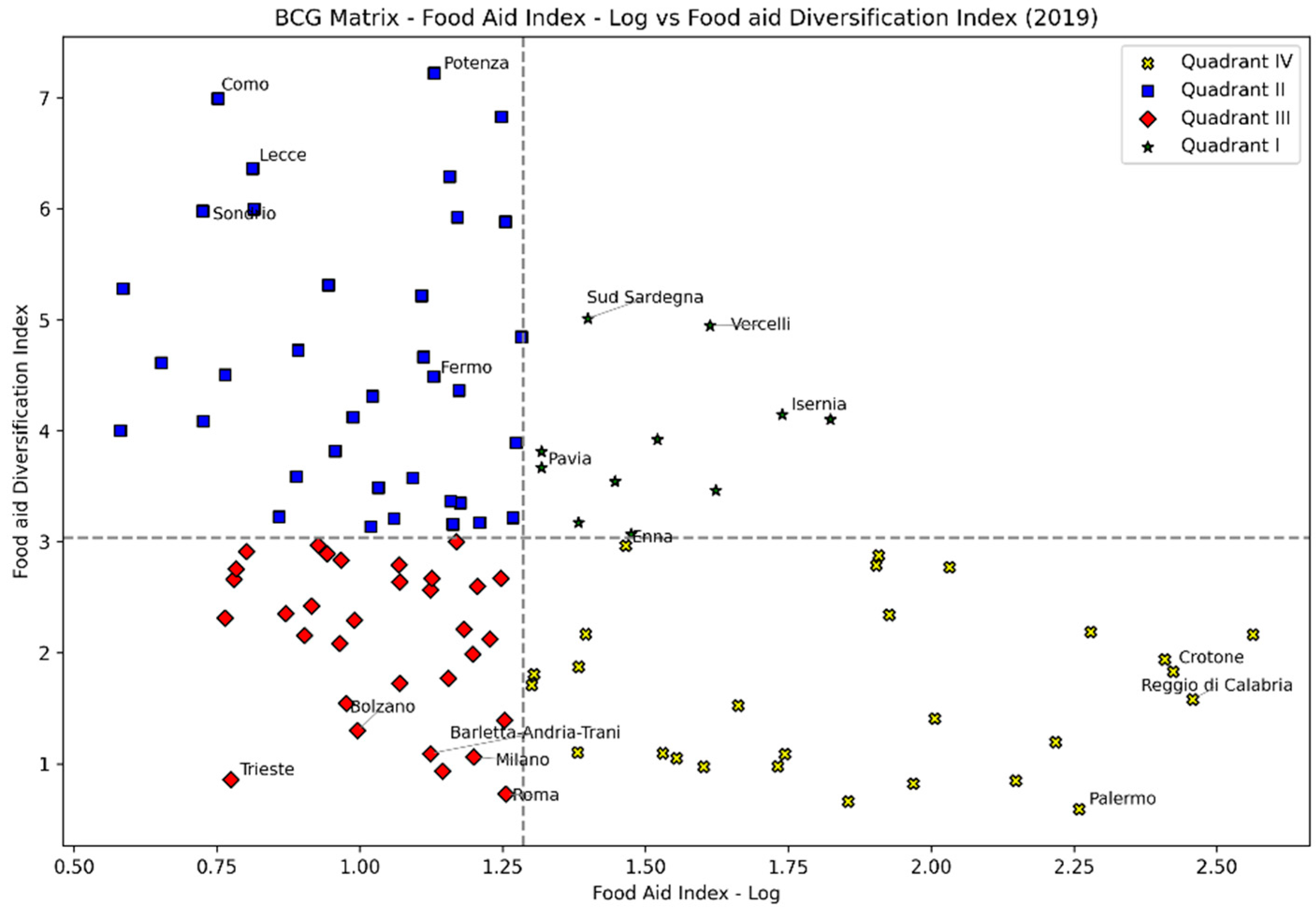
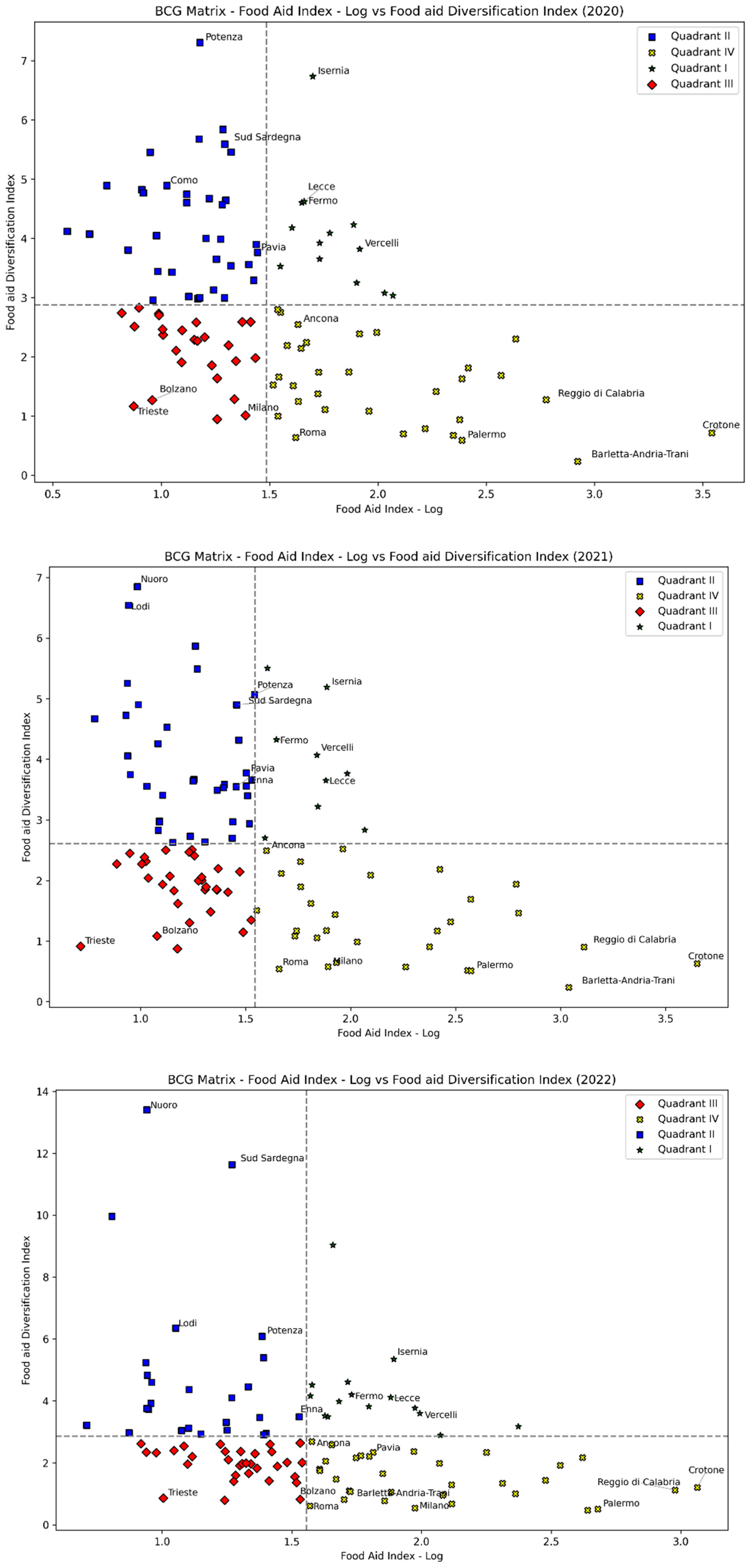
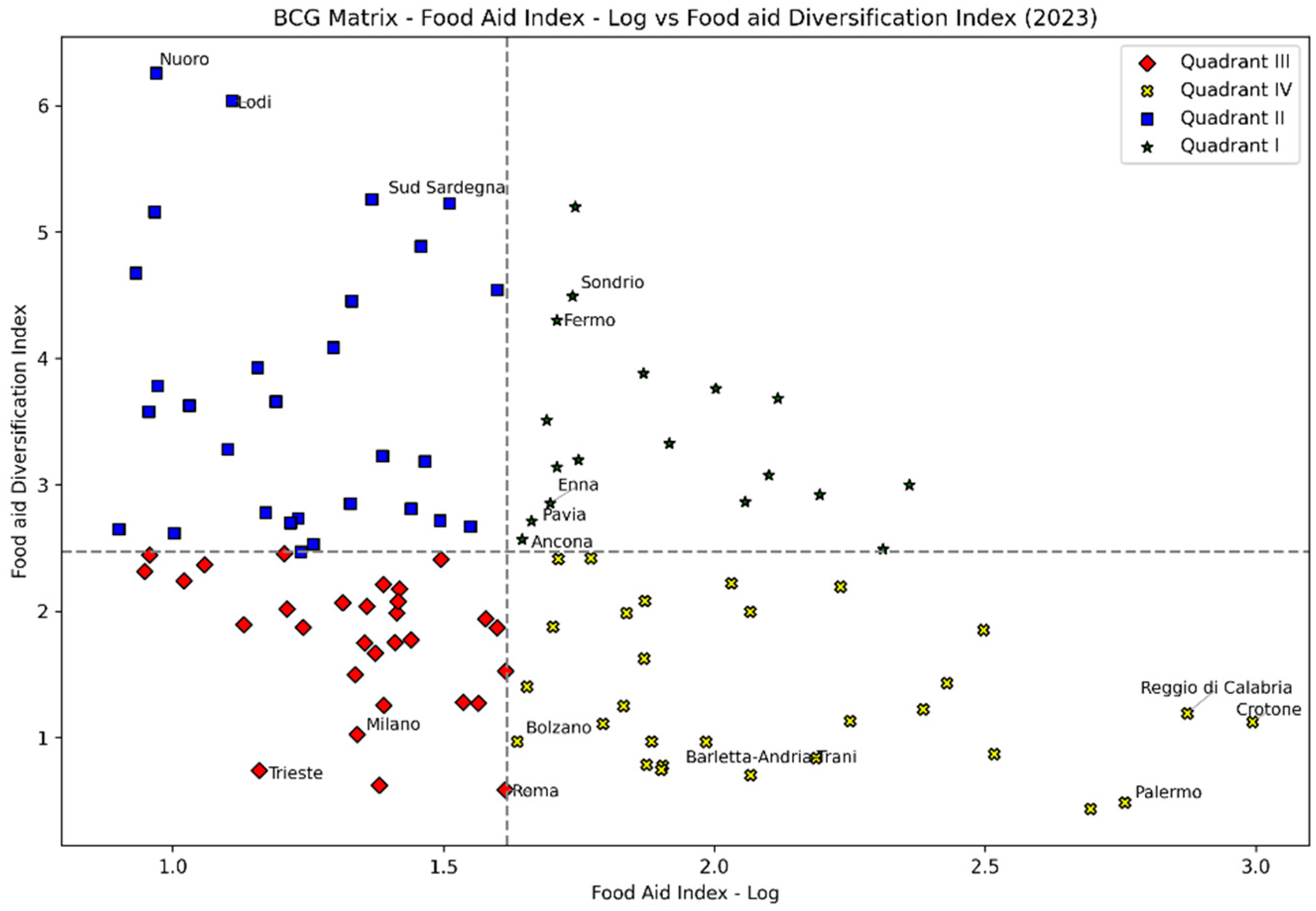
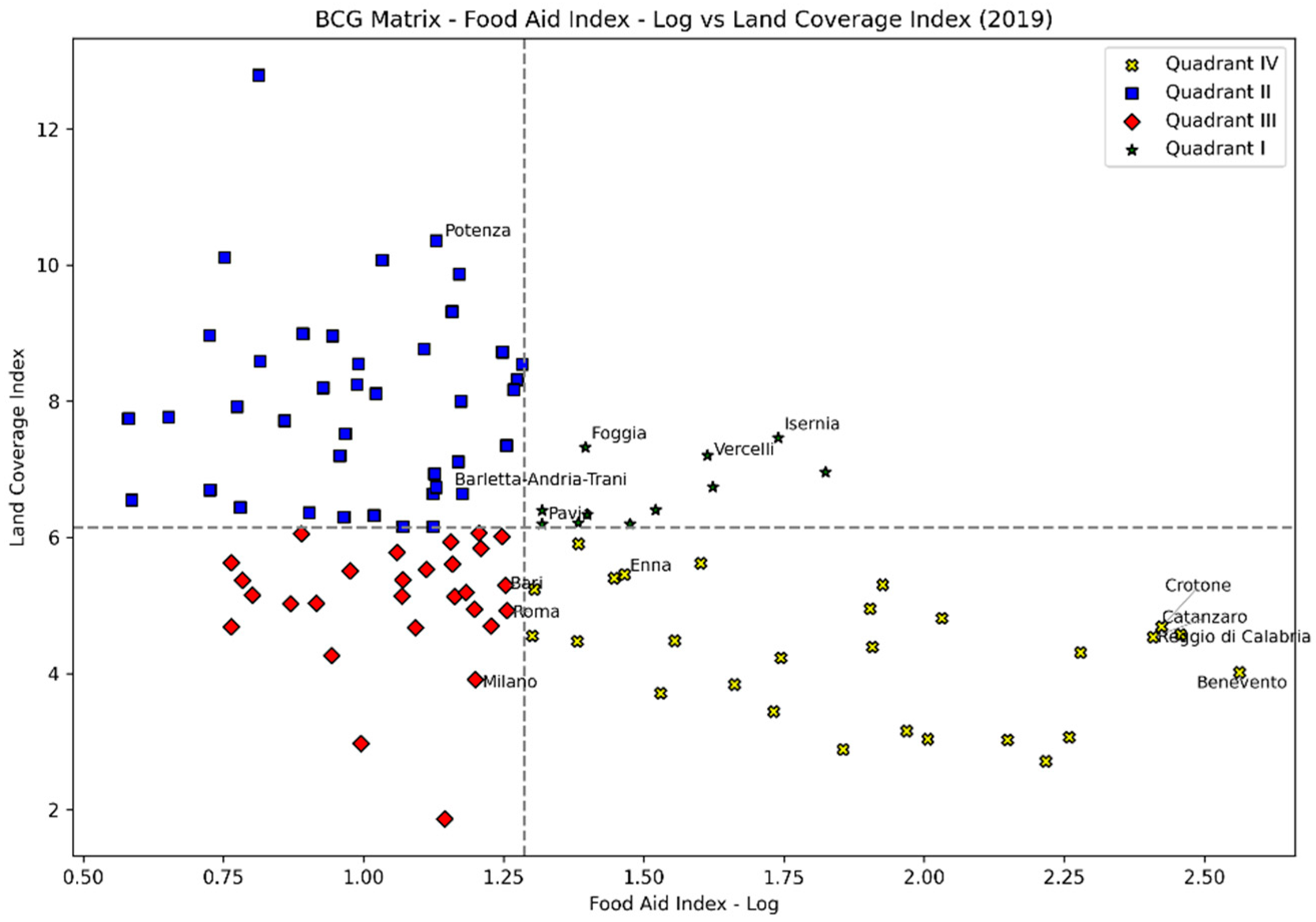
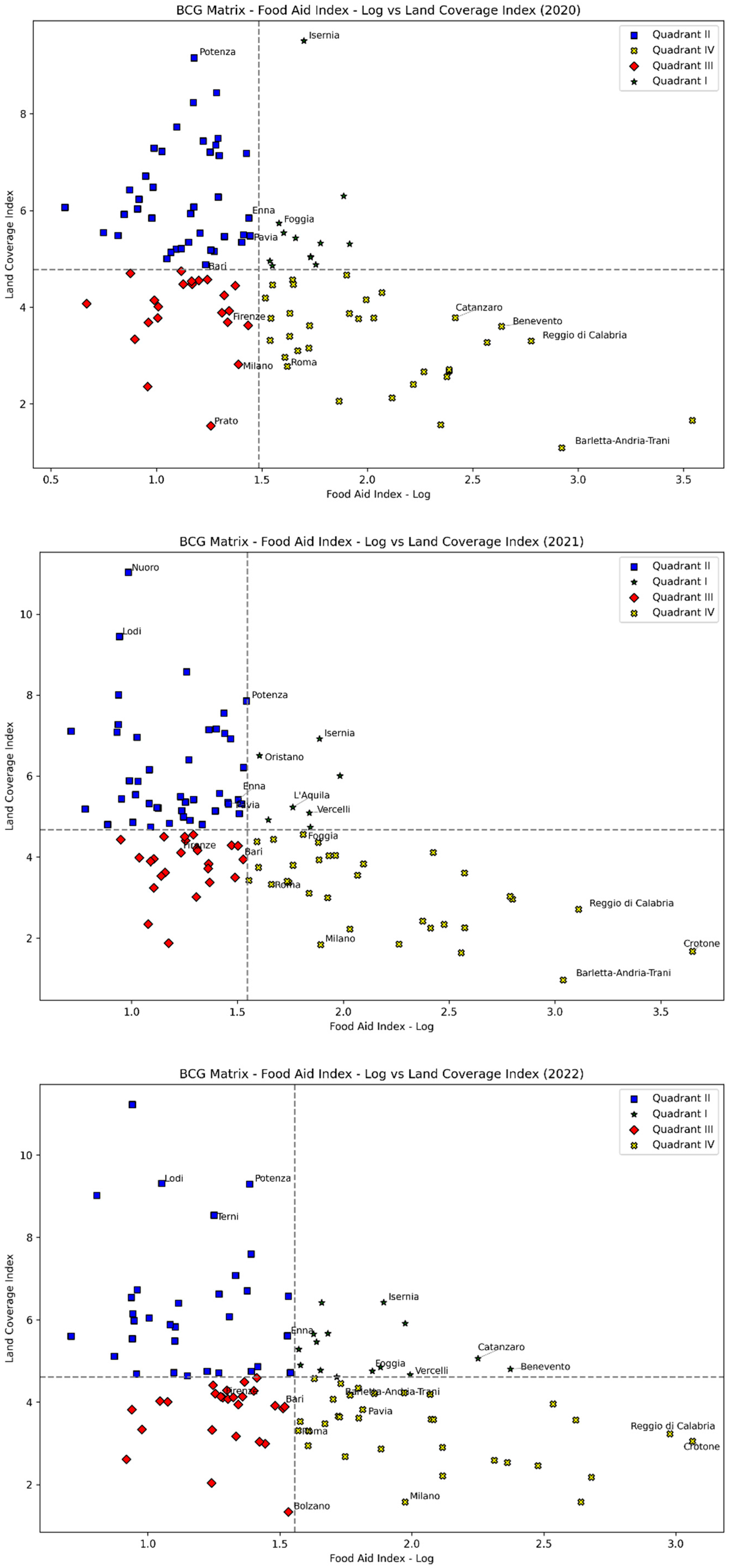
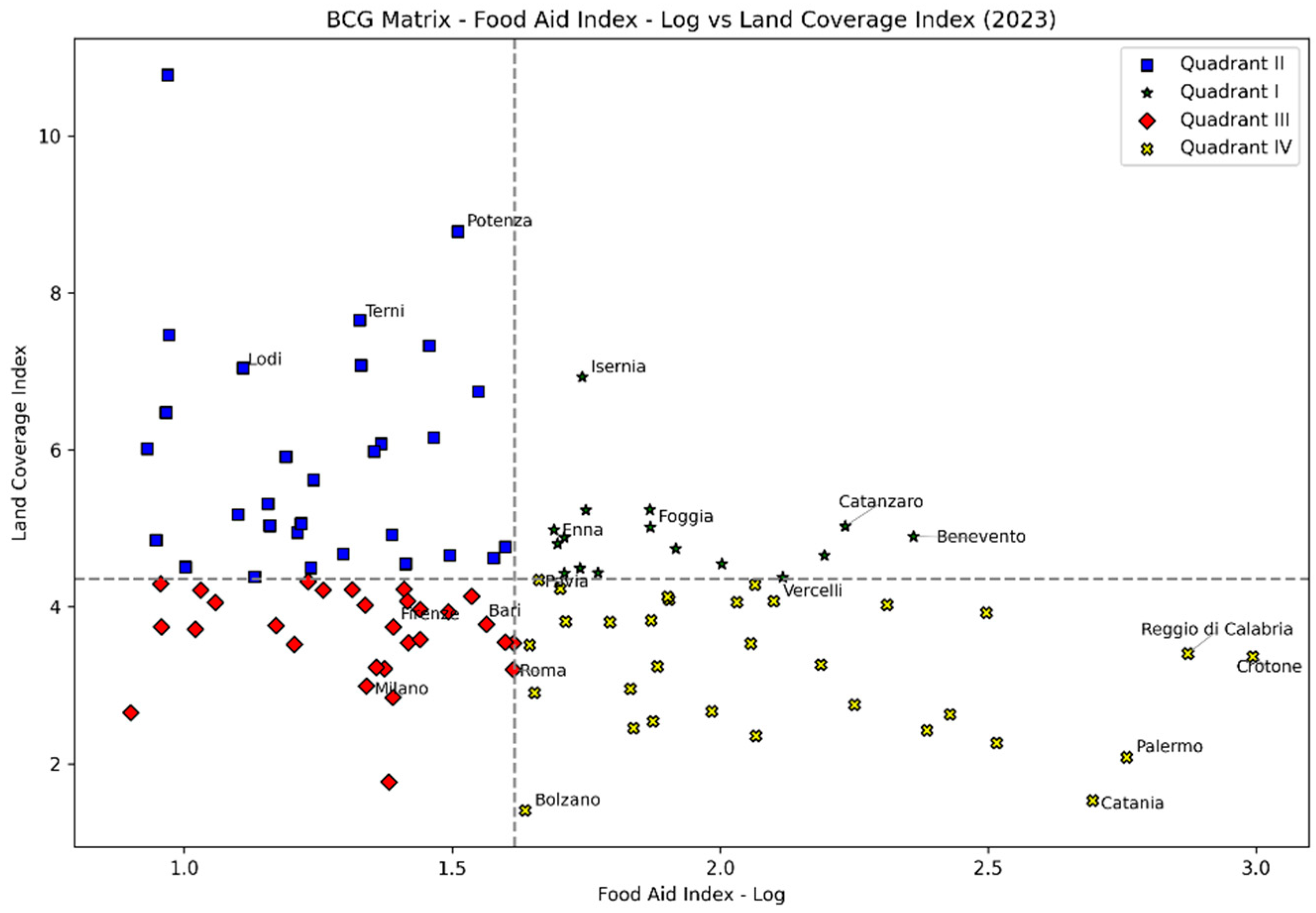
31], the BCG matrix, although originally developed in corporate strategy contexts, can be adapted to territorial analyses by enabling a classification of provinces based on two key dimensions. In this application, the logarithmic transformation of the FAI, log(FAI), is adopted to account for the strong positive skewness of its distribution, reduce the influence of extreme values, and improve the interpretability of the graphical representation by allowing a more balanced visualization of provincial differences. The log(FAI) is placed on the horizontal axis, reflecting the pressure of demand for food assistance while the vertical axis alternatively represents FDI or LCI, indicating the functional capacity and territorial coverage of interventions, respectively. Provinces are assigned to quadrants based on their position relative to the annual national average values of the two indices, which are used as threshold values to distinguish between “high” and “low” levels along each dimension. The use of annual national averages reflects the objective of the BCG matrix as a cross-sectional benchmarking tool, aimed at comparing each province to the national context in a given year. Because the BCG matrix is constructed using the log-transformed FAI values, the threshold is calculated as the annual national average of the transformed distribution. Alternative threshold definitions, e.g., quantile-based or dispersion-based, were not adopted, as they would imply a different analytical objective, namely a distribution-based classification rather than a benchmark-oriented interpretation and could lead to different quadrant allocations. This results in four interpretive quadrants relative to the annual national average values of the indices: (i) Leader (Quadrant I): provinces characterized by high levels of both log(FAI) and FDI/LCI, representing high-priority areas where strong demand is met by a well-articulated response system; (ii) Standard (Quadrant III): provinces with relatively low levels of both demand and structural capacity; (iii) Specialized (Quadrant II): provinces with low demand pressure but potentially activatable intervention capacity; (iv) Critical areas (Quadrant IV): territories with high demand and limited intervention infrastructure.
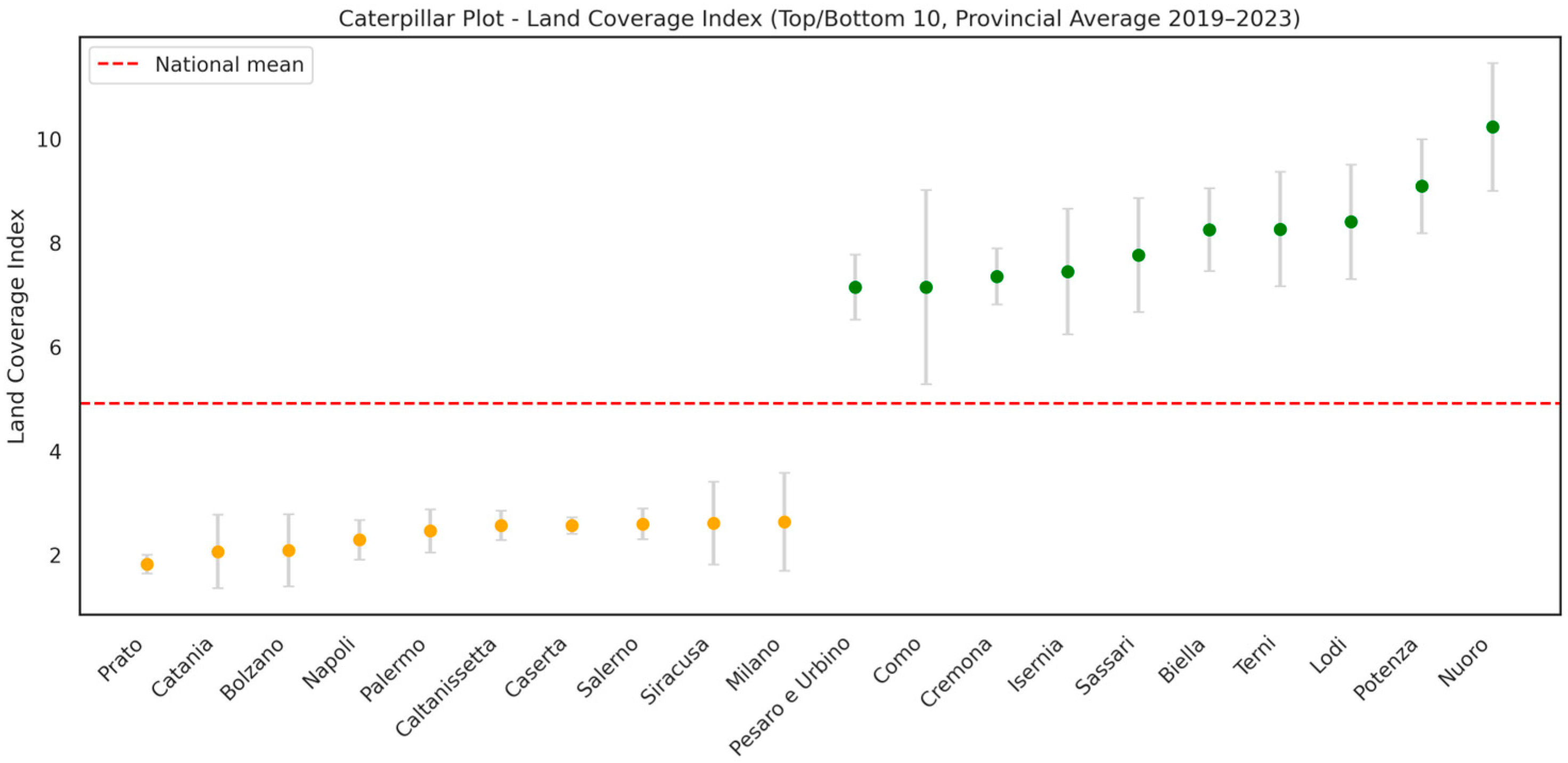
To complete the exploratory analysis, caterpillar plots were also produced for each indicator to compare provincial average performances over the 2019–2023 period. These plots visually represent, for each province, the mean and standard deviation of the indicator in question, with territorial units ordered in ascending order. The national baseline is included as a reference, allowing for immediate identification of provinces performing above or below the average. The use of caterpillar plots is particularly effective in concisely and rigorously illustrating territorial dispersion and performance heterogeneity, highlighting both systematic deviations and within-region variability. This approach strengthens the comparative dimension of the analysis, enabling a transversal reading of the data.
The study period (2019–2023) includes both the COVID-19 emergency phase and the subsequent recovery period. While the analysis does not aim to isolate causal effects of the pandemic, temporal variations in the indicators are interpreted in light of these contextual dynamics. A more formal causal analysis would require different methodological approaches and is beyond the scope of the present exploratory study.
3. Results
3.1. Cross-Sectional Descriptive Analysis
3.1.1. Food Aid Index
The FAI constitutes the most direct indicator of observed food assistance intensity and social need pressure at the territorial level. Across the 2019–2023 period, the index displays a markedly uneven and right-skewed distribution, revealing persistent territorial disparities in the demand for food assistance. The national average increased from 4.06% in 2019 to 5.67% in 2021, reflecting the impact of the COVID-19 crisis, and remained substantially unchanged in 2023 (5.66%), suggesting that the effects of the pandemic did not fully return to pre-crisis levels. The years 2020 and 2021 were characterized not only by a rise in average values but also by increased territorial heterogeneity, as reflected in the growing dispersion of the index across provinces. In 2021, for example, Crotone recorded an exceptionally high value (38.45%), while provinces such as Trieste (2.04%) and Mantova (2.18%) remained well below the national average. Although a partial stabilization emerged in 2022–2023, with lower variability compared to the pandemic peak, substantial territorial imbalances persisted. In 2023, Crotone (19.95%), Reggio Calabria (17.68%), and Palermo (15.76%) continued to exhibit some of the highest levels of food assistance intensity, whereas northern provinces such as Gorizia (2.46%), Savona (2.54%), and Monza-Brianza (2.60%) remained at the opposite end of the distribution. These findings indicate that food assistance demand is not randomly distributed across territories but reflects enduring structural inequalities, with strong and persistent interprovincial polarization.
Due to the high degree of distributional asymmetry, characterized by a heavy right tail and numerous outliers, it was necessary to apply a logarithmic transformation to the indicator in order to achieve a more symmetric distribution and mitigate the influence of extreme observations. The analysis of log(FAI) reveals a significant reduction in dispersion: in 2023, the interquartile range narrows, the standard deviation decreases, and the number of visible outliers is substantially reduced. While interprovincial differences remain notable, they are less distortive for subsequent bivariate analyses.
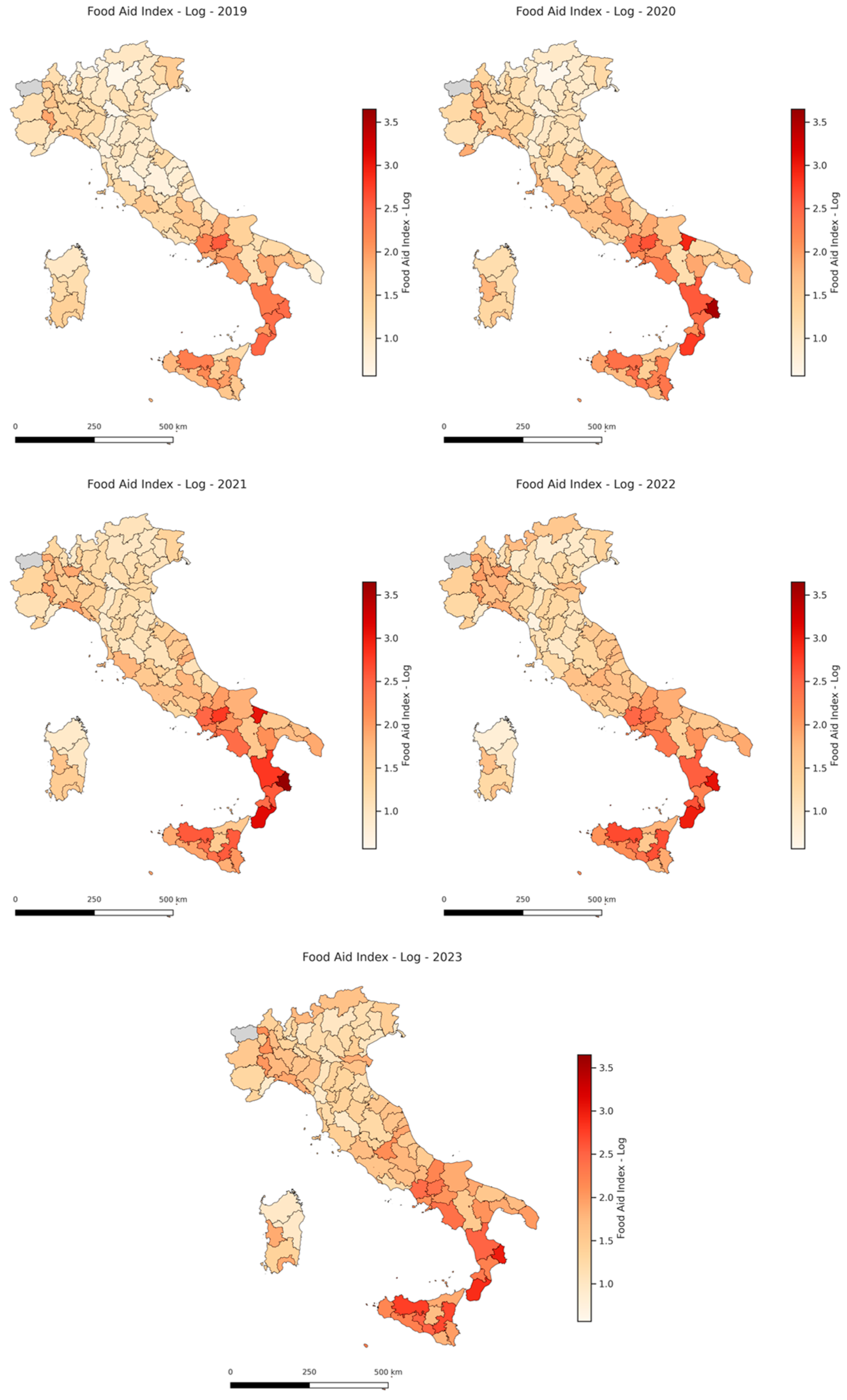
The cartographic analysis (
Figure 1) further confirms the existence of a structural territorial divide, with systematically higher FAI values concentrated in Southern Italy and selected island provinces. In 2023, provinces such as Crotone (2.99), Reggio Calabria (2.87), Palermo, Catania, Caltanissetta, Cosenza, and Caserta emerged as recurrent high-intensity areas, whereas provinces including Gorizia, Savona, Siena, Monza-Brianza, and Bergamo recorded some of the lowest values in the country. The spatial distribution also reveals substantial differences between geographically adjacent territories. For example, the gap between Genoa and neighboring Savona approaches one logarithmic unit, while the comparison between Catanzaro and Crotone highlights markedly different levels of food assistance intensity within the same regional context. These patterns suggest that food assistance demand and system pressure are highly localized phenomena and should therefore be examined through a disaggregated provincial lens rather than broader regional aggregates.
These data highlight not only the magnitude of the phenomenon but also the potential structural weakness of the food support system, which currently relies heavily on the third sector and volunteer networks. To respond effectively to this growing pressure, it is essential that local institutions adopt integrated policies to combat food poverty, strengthening collaboration between public authorities and third-sector organizations to ensure more stable and systemic coordination.
3.1.2. Land Coverage Index
The LCI measures organizational presence relative to the number of beneficiaries and therefore provides an indication of territorial coverage. Over the period considered, the index shows a general decline, with the national average decreasing from 6.14 organizations per 1000 beneficiaries in 2019 to 4.36 in 2023. Compared to the FAI, the distribution is less dispersed, suggesting a more homogeneous territorial distribution of organizational resources. Nevertheless, persistent spatial imbalances emerge across provinces. Throughout the period, provinces such as Nuoro, Potenza, Terni, Lodi, and Isernia repeatedly recorded some of the highest levels of organizational coverage, while Catania, Prato, Bolzano, Napoli, and Palermo consistently ranked among the weakest cases. In 2023, for example, Nuoro reached a value of 10.76 organizations per 1000 beneficiaries, compared with only 1.53 in Catania and 1.77 in Prato. These findings suggest that areas experiencing stronger observed demand for food assistance are not always matched by a proportionally dense organizational infrastructure, highlighting persistent territorial disparities in the capacity of local assistance networks.
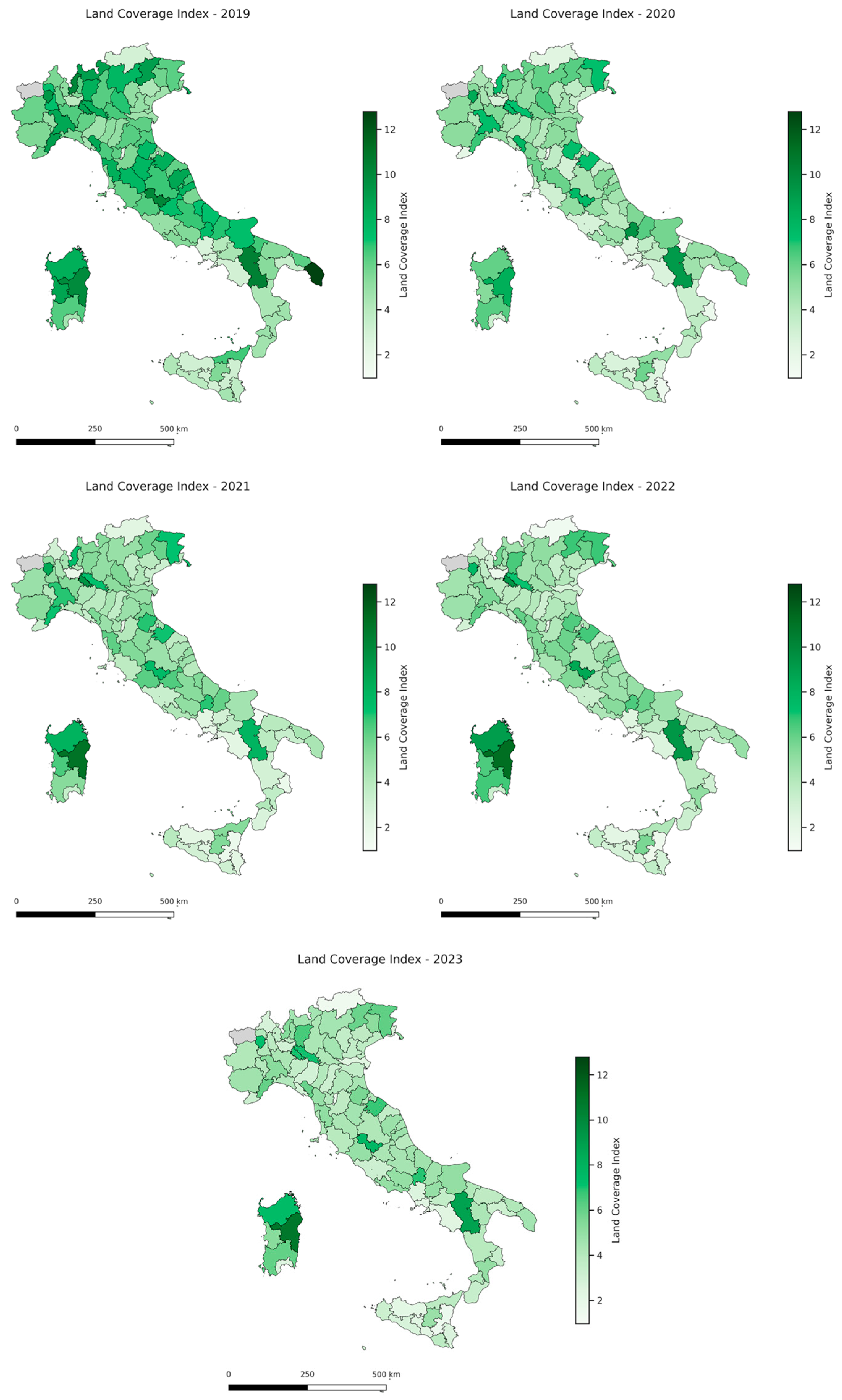
The spatial analysis (
Figure 2) reveals a marked improvement in several provinces of Sardinia and Central Italy, particularly in Umbria and Molise, with steadily increasing values over time. In contrast, provinces in Southern Italy, especially Calabria and Sicily, consistently exhibit low index values, pointing to persistent structural challenges. In the North-East (e.g., Veneto, Friuli-Venezia Giulia), an increase was observed between 2020 and 2021, followed by a period of stabilization. The North-West shows average to low values, with no significant variation throughout the observation period.
The coverage of food assistance needs in Italy is currently ensured by approximately 10,000 Local Partner Organizations. On average, the years with the highest levels of coverage were 2019 and 2020, when food assistance services were heavily supported by extraordinary and emergency funding, including European, national, and regional resources, as well as private donations. Implementing nationally coordinated strategic public policies that structurally invest in both preventive and corrective welfare measures would strengthen the third sector and ensure greater continuity and resilience in its interventions.
3.1.3. Food Aid Diversification Index
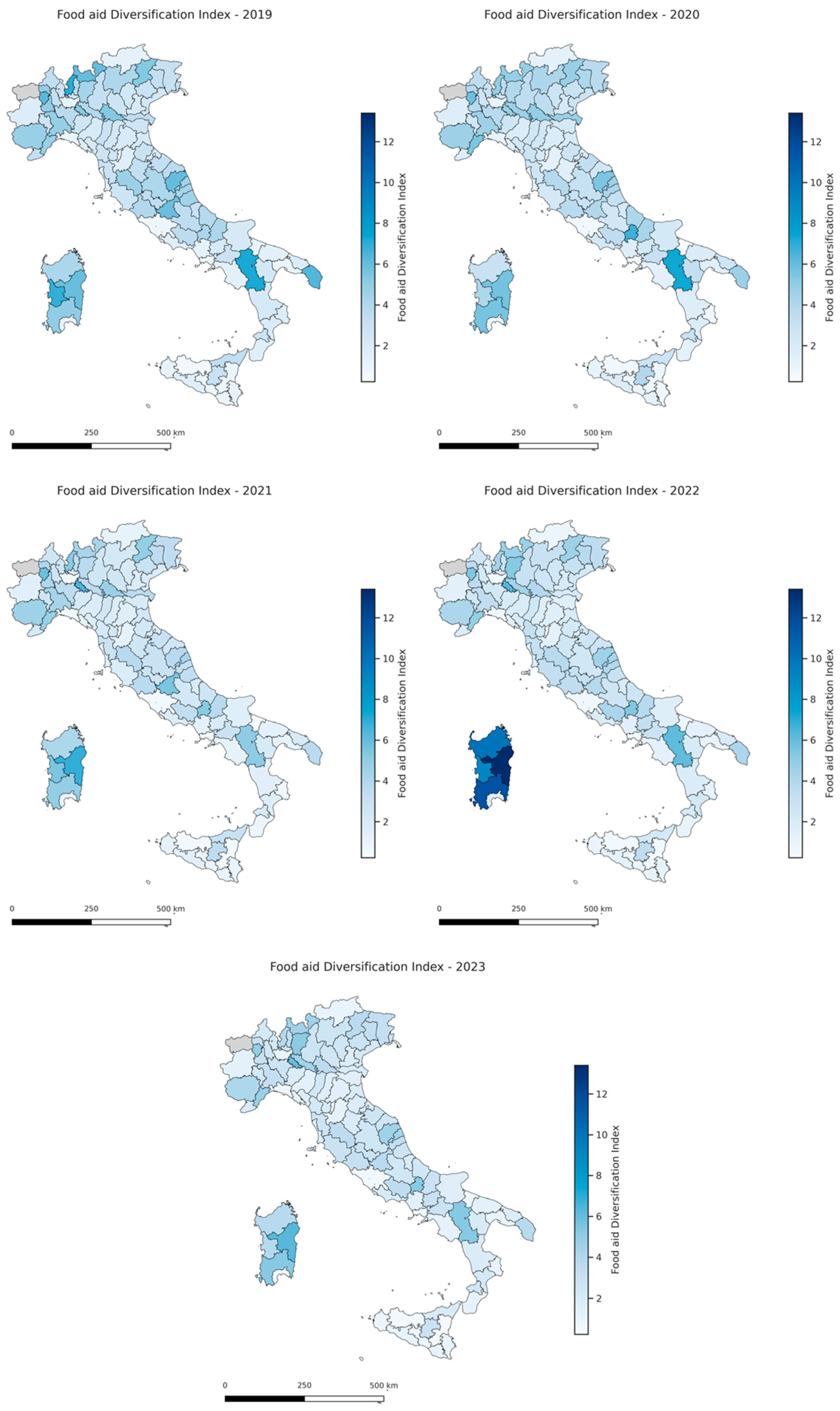
The FDI captures the functional variety of local food assistance systems by measuring the number of active Channels of Intervention (CoI) per 1000 beneficiaries. As such, it provides an indication of the capacity of local organizations to respond to diverse needs through a range of services, including food parcels, soup kitchens, social grocery stores, home deliveries, and street units. Over the period considered, the index displays marked territorial heterogeneity alongside a gradual decline in the national average, from 3.03 in 2019 to 2.47 in 2023. This trend suggests that the diversification of intervention models did not expand uniformly following the pandemic and, in many areas, may have become increasingly concentrated around a limited set of services. Throughout the period, provinces such as Nuoro, Lodi, Sud Sardegna, Potenza, and Oristano consistently exhibited relatively articulated intervention systems, while large metropolitan and Southern provinces including Roma, Palermo, Napoli, and Catania remained characterized by low levels of diversification. In 2023, for example, Nuoro recorded a value of 6.27, compared with only 0.44 in Catania, 0.48 in Palermo, and 0.59 in Roma. As shown in
Figure 3, service diversification is unevenly distributed and does not necessarily correspond to the intensity of local demand. Provinces with more articulated intervention networks appear to benefit from stronger local coordination and more consolidated organizational infrastructures, whereas several high-demand territories continue to rely on a narrow set of assistance channels. These findings suggest that diversification should be interpreted as a dimension of local welfare capacity rather than as a direct measure of food insecurity, highlighting a persistent gap between the variety of services available and the heterogeneity of beneficiary needs.
The persistence of such imbalances may have significant implications for the effectiveness and sustainability of food assistance interventions, underscoring the need for greater harmonization and strategic planning of support services at the sub-national level. To strengthen the resilience and adaptive capacity of the food assistance system, it is essential to promote greater diversification of interventions, particularly in structurally weaker areas. This includes incentivizing the training of operators and volunteers to support the development of more effective and multidimensional service designs, ideally in synergy with public social services. Regional calls for proposals or municipal funding could be directed toward the activation of new services, such as solidarity grocery stores or community kitchens. Moreover, public institutions could play a key role in fostering collaboration among various organizations, including religious entities, NGOs, and social cooperatives, by encouraging the sharing of infrastructure, facilities, and expertise, thereby enabling the coordinated implementation of multiple CoI.
While the descriptive results highlight substantial territorial disparities, these patterns can be plausibly interpreted considering broader socio-economic and institutional differences across Italian provinces. High values of food assistance intensity, such as those observed in several Southern provinces, are likely associated with higher levels of structural poverty, labor market fragility, and limited access to formal welfare provision. Conversely, provinces exhibiting lower demand and higher levels of organizational coverage or diversification, such as Isernia or Lodi, may reflect stronger local welfare infrastructures, more effective coordination among third-sector actors, or lower underlying levels of deprivation. In some cases, these patterns may also be influenced by the historical presence of well-established charitable networks or by proactive local policy initiatives. These interpretations should be understood as contextual hypotheses rather than causal explanations, as the present study does not include control variables or econometric modeling. Nevertheless, they provide a useful framework for situating the observed spatial patterns within the broader geography of socio-economic inequalities in Italy.
3.2. Longitudinal Analysis
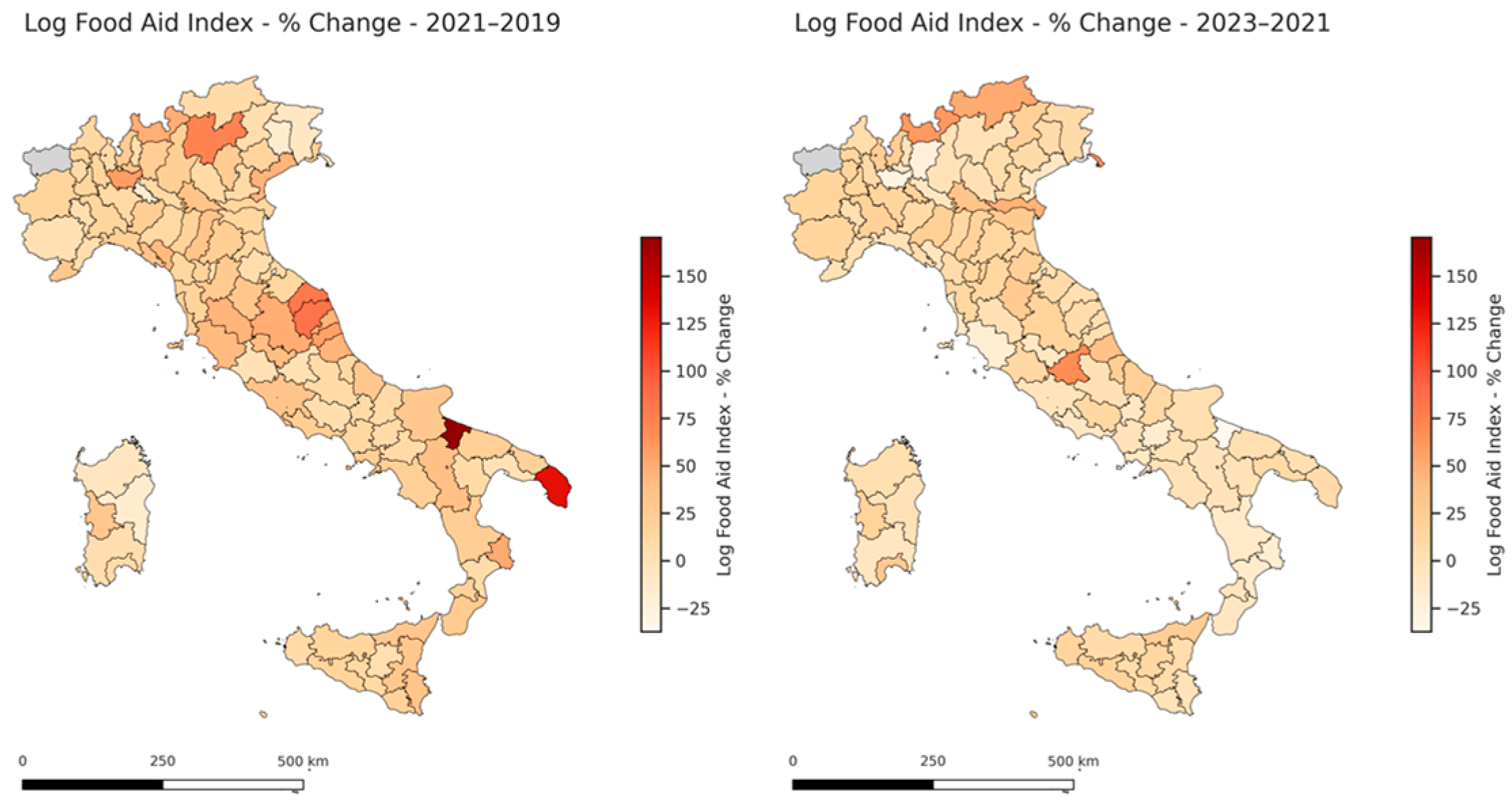
The longitudinal analysis of the FAI, based on yearly variations and moving-base indices, provides further insight into the evolution of food assistance demand across Italian provinces over the 2019–2023 period. The results reveal a clear two-phase trajectory. As shown in
Figure 4, between 2019 and 2021 the indicator increased in almost all provinces, reflecting the widespread effects of the COVID-19 crisis on economic vulnerability and food assistance needs. The national average variation was approximately +22.34%, although substantial territorial differences emerged. Particularly pronounced increases were recorded in Barletta-Andria-Trani (+170.37%), Lecce (+131.61%), Macerata (+84.38%), and Ancona (+79.00%), highlighting the uneven intensity with which the pandemic affected local assistance systems.
The subsequent period (2021–2023) was characterized by a partial stabilization of the indicator and a general slowdown in growth. Nevertheless, territorial trajectories became increasingly differentiated. While some provinces continued to experience significant increases in food assistance intensity, including Rieti (+66.59%), Trieste (+62.45%), Sondrio (+60.51%), and Bolzano (+51.82%), others registered substantial declines, such as Barletta-Andria-Trani (−37.41%), Gorizia (−33.93%), Milano (−29.20%), and Bergamo (−22.99%). These contrasting dynamics suggest that, after the initial emergency phase, the evolution of food assistance demand became progressively shaped by local socioeconomic conditions and territorial characteristics. Overall, the longitudinal evidence points to a transition from a phase of generalized, crisis-driven growth to a more heterogeneous and territorially differentiated configuration of food assistance needs across Italian provinces.
Annual moving-base indices corroborate this interpretation. The strongest FAI increase occurred between 2019 and 2020, followed by progressively smaller changes in subsequent years. By 2023, the national average still increased modestly, but growth was concentrated in a smaller number of provinces. This pattern suggests that the emergency peak was followed by stabilization rather than a full return to pre-pandemic conditions.
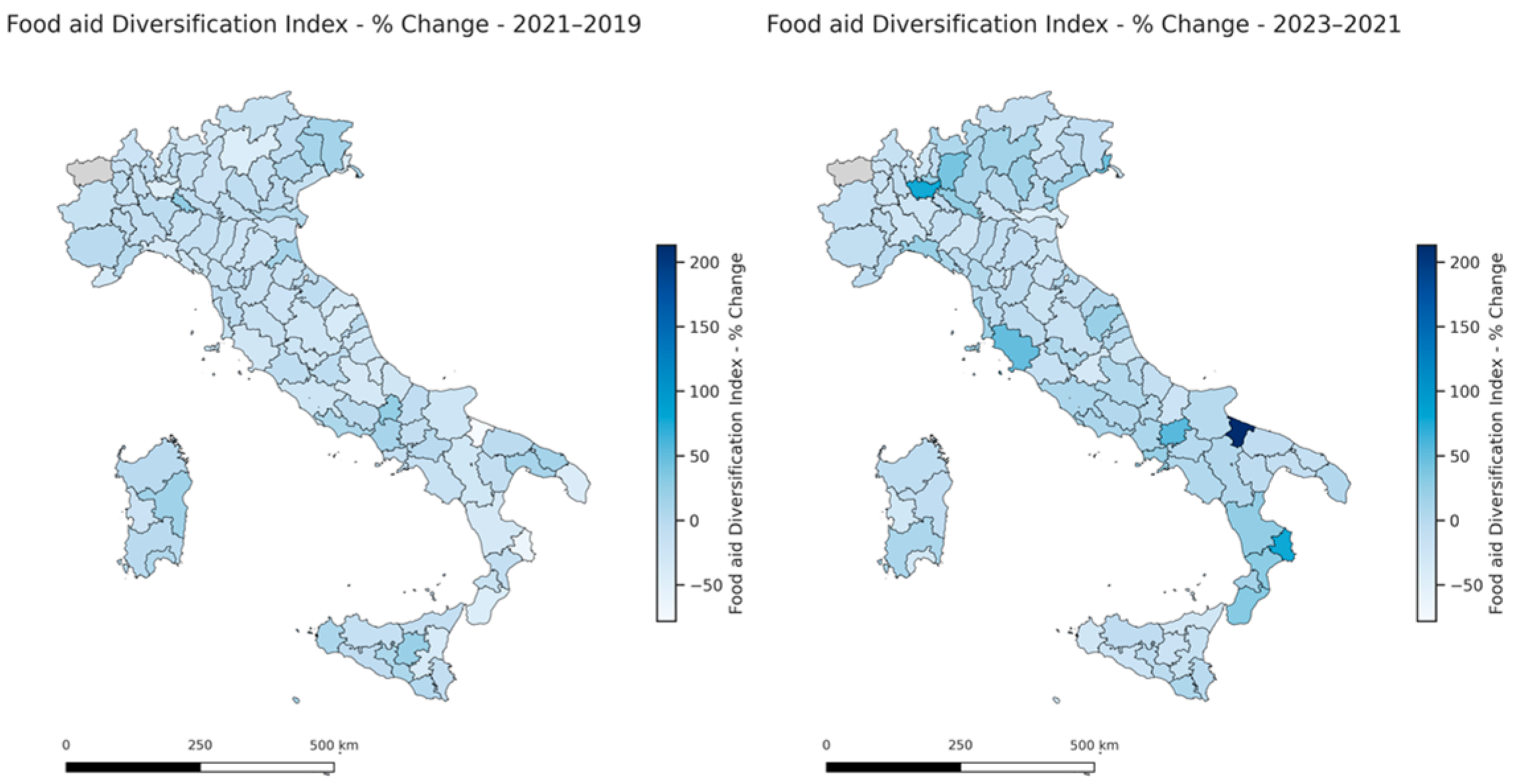
The FDI also shows a biphasic dynamic. As shown in
Figure 5, the 2019–2021 period was marked by contraction, suggesting that the initial emergency phase may have reduced the diversity of interventions or concentrated provision around more basic channels. The 2021–2023 period shows partial recovery in several provinces, but this recovery was uneven and did not eliminate the structural gap between diversified and weakly diversified territories.
Moving-base indices confirm that the rebound in diversification was concentrated in selected areas rather than generalized across the country. The national pattern in 2023 points to stabilization, with local improvements in some provinces but continued weakness in others. This reinforces the need to interpret diversification as a territorially embedded capacity rather than as an automatic response to rising demand.
The LCI followed a similar sequence. As shown in
Figure 6, the 2019–2021 biennium was characterized by a decline in organizational coverage relative to beneficiaries, while the 2021–2023 period shows only partial recovery. The provinces most affected by the initial contraction were often those with high demand pressure, suggesting that organizational density did not always expand in line with the increased number of beneficiaries.
The annual moving-base analysis provides a more detailed perspective on the short-term dynamics of organizational coverage over the study period. The 2020–2019 interval was characterized by a widespread contraction, with a national average variation of −5.92%. Some provinces experienced particularly sharp declines, most notably Barletta-Andria-Trani (−83.56%) and Crotone (−64.59%), reflecting the uneven capacity of local assistance systems to respond during the early stages of the pandemic. The subsequent 2021–2020 period showed signs of stabilization, although the national average remained slightly negative (−1.31%).
The most significant expansion occurred between 2021 and 2022, when organizational coverage strengthened considerably across several territories. Particularly remarkable increases were observed in Barletta-Andria-Trani (+421.05%), Crotone (+181.94%), and Benevento (+158.58%), suggesting a phase of rapid organizational adjustment and consolidation following the acute stages of the crisis. However, this recovery was not sustained uniformly. The 2023–2022 period marked a new phase of deceleration, with the national average declining to −3.54% and some provinces, such as Parma (−26.43%), recording substantial contractions.
Overall, the longitudinal evidence highlights a highly uneven process of territorial adaptation. After an initial phase of contraction and a subsequent period of organizational strengthening, growth slowed again after 2022, revealing persistent disparities in the capacity of local food assistance systems to respond to changing levels of social need.
3.3. Provincial Variability
Caterpillar plots provide a synthetic comparison of provincial performances based on the five-year average calculated for the period 2019–2023. By displaying both deviations from the national average and the associated uncertainty intervals, these plots allow the identification of persistent territorial disparities as well as differences in interannual stability. The length of the uncertainty bars is particularly informative, as it highlights provinces characterized by greater variability over time, suggesting potential discontinuities in local implementation patterns.
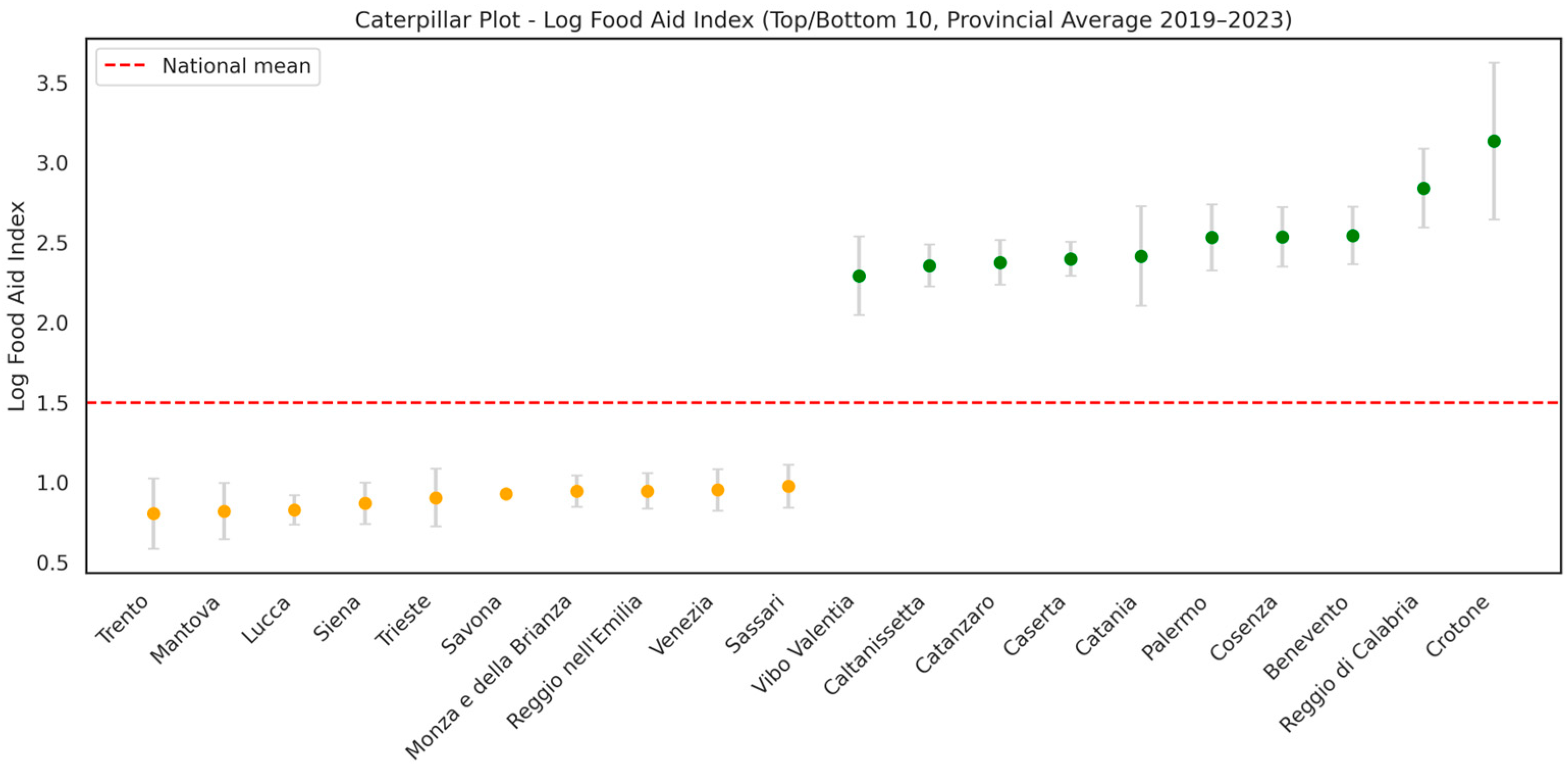
As shown in
Figure 7, the five-year mean of log(FAI) confirms a highly polarized geography of observed food assistance demand. Southern provinces such as Crotone, Reggio Calabria, and Benevento consistently record values well above the national average, while several Northern and Central provinces, including Trento, Mantova, Lucca, and Siena, remain at the lower end of the distribution. This pattern reinforces the existence of a persistent territorial divide, with food assistance intensity concentrated in specific areas of Southern Italy and the Islands rather than being evenly distributed across the country. Importantly, these disparities are not driven by isolated annual outliers but remain visible throughout the entire observation period.
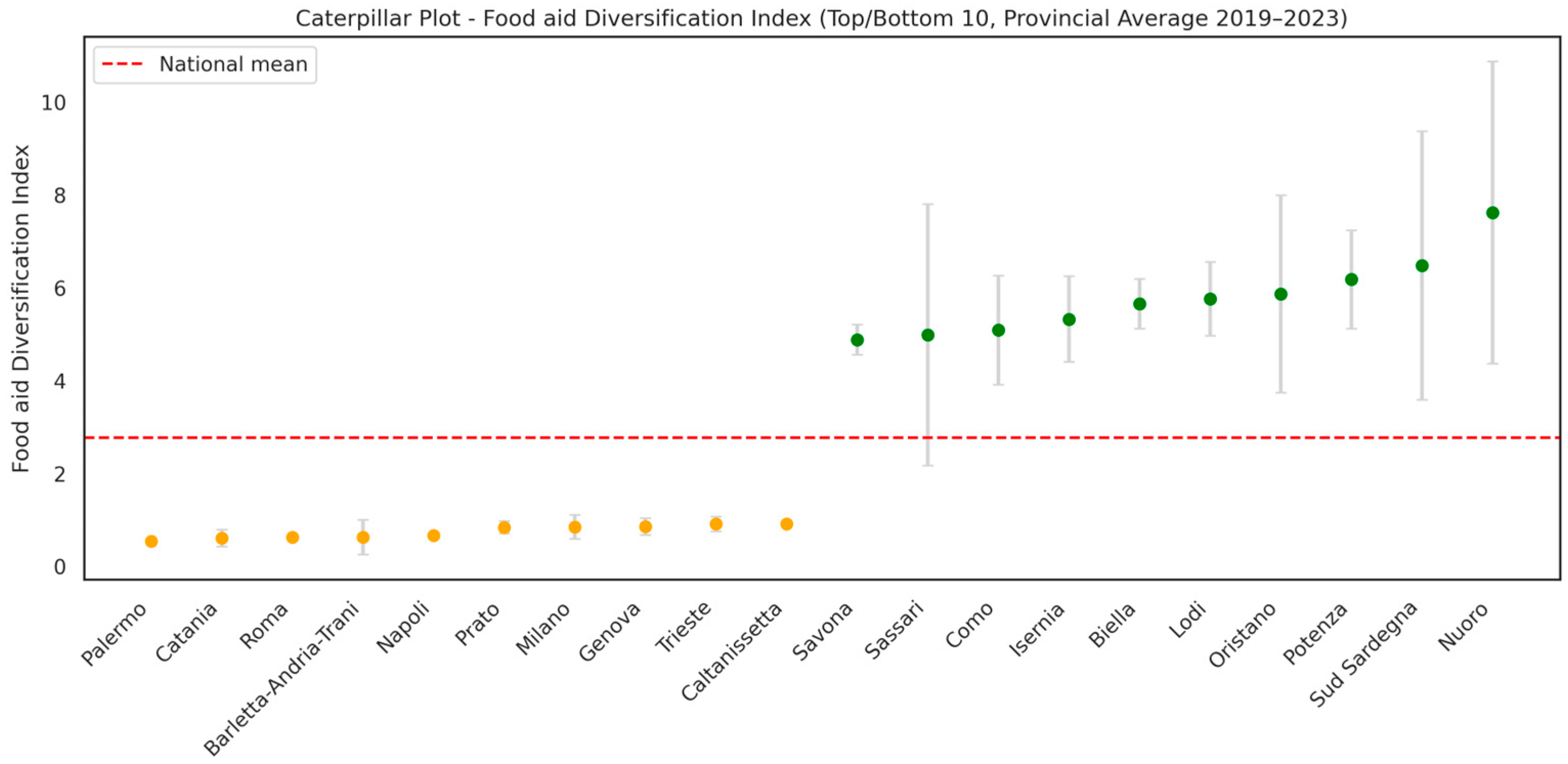
As shown in
Figure 8, for the FDI the caterpillar plot reveals substantial differences in the average level of service diversification across provinces. Territories such as Nuoro, Sud Sardegna, Potenza, Lodi, and Oristano exhibit the most articulated intervention systems, whereas Palermo, Catania, Roma, Barletta-Andria-Trani, and Napoli occupy the lower end of the distribution. The persistence of these patterns over time suggests that functional diversification remains concentrated in a relatively small number of local systems, while several high-demand territories continue to rely on a more limited range of intervention channels. This finding further supports the interpretation of diversification as a dimension of local welfare capacity rather than a direct reflection of the intensity of food assistance demand.
As shown in
Figure 9, for the LCI the caterpillar plot reveals substantial differences in organizational coverage across Italian provinces. The indicator exhibits considerable territorial variability, with provincial averages ranging from values close to 2 organizations per 1000 beneficiaries to levels exceeding 10 in the most structurally equipped territories. Provinces such as Nuoro, Potenza, Lodi, Terni, Biella, Sassari, and Isernia consistently record the highest levels of organizational coverage, while Prato, Catania, Bolzano, Napoli, and Palermo remain well below the national average. These patterns point to persistent disparities in the territorial capacity of local assistance networks to provide widespread organizational coverage. Consistent with the results of the bivariate analyses, provinces characterized by lower organizational coverage often coincide with areas exhibiting relatively high levels of food assistance intensity. Although this relationship should not be interpreted as causal, it suggests the existence of a recurring mismatch between the spatial distribution of organizational resources and the concentration of social needs.
3.4. Bivariate Analysis: Correlation and Boston Consulting Group Matrices
To further investigate the association between the log(FAI), adopted as the principal indicator, and the other two indices, LCI and FDI, annual linear correlations between the variables were examined using correlation matrices. The correlation matrices consistently reveal a negative association between log(FAI) and each of the other two indices. Specifically, the correlation coefficient between log(FAI) and LCI ranges from −0.41 (2023) to −0.56 (2021), while that between log(FAI) and FDI varies between −0.36 (2022) and −0.45 (2021). These values indicate a consistent inverse association between food aid intensity and both territorial coverage and intervention diversification at the provincial level. However, these results should be interpreted as purely descriptive and do not imply any causal relationship or underlying structural dependence. The moderate magnitude of the correlation coefficients suggests that the observed patterns may be influenced by multiple contextual factors and potentially non-linear dynamics that are not explicitly considered. The temporal variation in correlation values, such as the stronger association observed in 2021, can be tentatively interpreted considering contextual dynamics, including the reorganization of food assistance systems during the pandemic. For instance, emergency responses may have led to increased demand being managed through more centralized or less diversified intervention strategies. These interpretations remain illustrative and are intended solely to support the reading of the observed patterns, rather than to establish explanatory mechanisms.
As mentioned above, the use of BCG matrices allows for the joint examination of the intensity of food assistance, measured by the log(FAI), and the structural complexity of interventions, measured through the FDI. Each province is assigned to one of the four quadrants relative to the annual national average values of the two indices (see
Table 1). The use of annual national averages as thresholds reflects the objective of the BCG matrix as a cross-sectional bivariate benchmarking tool, aimed at comparing each province to the national context in a given year. Alternative threshold definitions were not adopted, as they would imply a different analytical objective, namely a distribution-based classification rather than a benchmark-oriented interpretation.
As shown in
Figure 10, in 2019 the thresholds used for positioning provinces in the BCG matrix were 1.29 for log(FAI) and 3.03 for FDI. Approximately 25.5% of provinces (27 out of 106) fell into Quadrant IV, indicating a mismatch between high demand and structural weakness. Among these, Reggio Calabria (log(FAI) = 2.46, FDI = 1.58) and Palermo (log(FAI) = 2.26, FDI = 0.59) represent two among the most critical cases, with low intervention diversification despite high food aid intensity. Only 10.4% of provinces fell into Quadrant I, signifying high pressure accompanied by a structurally diversified response. Notable cases include Vercelli (log(FAI) = 1.61, FDI = 4.95), Sud Sardegna (log(FAI) = 1.40, FDI = 5.01), and Isernia (log(FAI) = 1.74, FDI = 4.15). In 2020, the log(FAI) threshold rose to 1.49, reflecting a general increase in demand (national average up by 15.5% compared to 2019), while the FDI threshold dropped to 2.88, indicating an approximate 5% contraction in the average number of intervention types. Quadrant IV expanded to include 32 provinces (30.2%), pointing to a systemic deterioration in local resilience. Palermo, Crotone, and Reggio Calabria are again included, with log(FAI) values above 2.7 and FDI values below 1.3. In contrast, Isernia (log(FAI) = 1.70, FDI = 6.73), Lecce (log(FAI) = 1.66, FDI = 4.62), and Fermo (log(FAI) = 1.65, FDI = 4.60) positioned themselves in Quadrant I, indicating an integrated response to the pandemic peak. In 2021, the mean log(FAI) increased further to 1.55, while the FDI threshold declined again to 2.61. Thirty provinces (28.30%) were located in Quadrant IV, including once more Crotone, Reggio Calabria, and Barletta-Andria-Trani, areas of persistent structural vulnerability. Quadrant I contracted to 8.49% of provinces, with consistent presences such as Isernia, Fermo, Vercelli, Lecce, and Campobasso, all showing FDI values above 3.7 and log(FAI) values between 1.6 and 2.0. Relative density in Quadrants II and III remained stable, though a slight shift was observed toward Quadrant II (low log(FAI), high FDI), with provinces such as Nuoro and Lodi moving toward a model of structured provision in the absence of emergency. In 2022, the log(FAI) threshold remained stable at 1.56, while the FDI threshold rose slightly to 2.86, suggesting a phase of partial structural recovery. Quadrant IV remained the most populated, with 33 provinces (31.13%), including Crotone, Reggio Calabria, and Palermo, all recording log(FAI) values above 2.6 and FDI values below 1.2. Quadrant I showed notable improvements: Oristano, Isernia, and Sondrio displayed the strongest combined performance, with log(FAI) below 1.9 and FDI above 4.6, emerging as integrated response models. In 2023, the log(FAI) threshold reached 1.62, the highest level in the five-year series, while the FDI threshold declined to 2.48, reflecting selective restructuring in some areas and persistent structural deficiencies in others. Quadrant IV remained the most populated, with 29 provinces (24.53%), again including Crotone, Reggio Calabria, and Palermo, all with log(FAI) values above 2.7 and FDI values below 1.2. Quadrant I expanded to include Enna, Ancona, and Pavia, while Isernia, Sondrio, Fermo, and Oristano continued to consolidate their roles as institutional and organizational best-practice clusters, with log(FAI) values below 1.9 and FDI values above 3.8.
As shown in
Figure 10, the evolution of the BCG matrices from 2019 to 2023 documents a trend of increasing polarization within the national system: well-structured provinces have continued to strengthen their organizational capacity (Quadrant I), while historically weak areas have maintained or even worsened their vulnerability status (Quadrant IV). From a policy perspective, this highlights the urgency of selective, targeted interventions in provinces persistently located in critical quadrants and the opportunity to scale up consolidated best practices from the most performant contexts.
As shown in
Figure 11, in 2019 the reference thresholds were 1.29 for log(FAI) and 6.14 for the Land Coverage Index (LCI). Quadrant IV, indicative of high food assistance demand combined with a weakly distributed support network, included provinces such as Benevento (log(FAI) = 2.56, LCI = 4.02), Reggio Calabria (log(FAI) = 2.46, LCI = 4.58), Crotone (log(FAI) = 2.42, LCI = 4.68), and Catanzaro (log(FAI) = 2.41, LCI = 4.53). These values illustrate a profile of systemic vulnerability, where infrastructural deficits exacerbate the intensity of need. Quadrant I featured provinces such as Isernia, Vercelli, and Foggia, with log(FAI) values below 1.74 and LCI values above 7.20, indicating that, despite relevant levels of demand, these provinces maintained territorial coverage levels at or above the national average. In 2020, a general increase in log(FAI) raised the threshold to 1.49, while the LCI threshold dropped to 4.77. Critical provinces in Quadrant IV multiplied, particularly in the South and island regions. Crotone (log(FAI) = 3.54, LCI = 1.66) and Barletta-Andria-Trani (log(FAI) = 2.92, LCI = 1.09) are emblematic cases of intense need paired with low infrastructural diffusion. Conversely, provinces such as Potenza (log(FAI) = 1.18, LCI = 9.16) were positioned in Quadrant II, reflecting high coverage in the absence of strong demand. Among the most virtuous provinces were Isernia (log(FAI) = 1.70, LCI = 9.51) and Campobasso (log(FAI) = 1.89, LCI = 6.30). In 2021, thresholds rose to 1.55 for log(FAI) and decreased to 4.67 for LCI. Quadrant IV remained densely populated, with Crotone, Reggio Calabria, and Barletta-Andria-Trani again among the least resilient areas, all showing log(FAI) values above 3.0 and LCI values below 2.8. Isernia and Campobasso remained solidly in Quadrant I, joined by L’Aquila and Fermo, which transitioned from Quadrant IV to positions slightly above the national means for both indicators. In 2022, the thresholds were 1.56 for log(FAI) and 4.61 for LCI. Concentration in Quadrant IV remained stable, with Crotone and Reggio Calabria still among the most imbalanced provinces in terms of intensity versus coverage. Quadrant I saw increased representation, with Isernia, Catanzaro, Benevento and Foggia reporting log(FAI) values below 2 and LCI values above 5.6. A noteworthy trend was the growing number of provinces in Quadrant II, including Potenza, Lodi, and Terni, which showed advanced distribution models even in the absence of significant pressure. Pescara, meanwhile, aligned closely with national averages on both indicators. In 2023, thresholds reached 1.62 for log(FAI)—the highest in the five-year time series—and 4.35 for LCI, reflecting selective restructuring in some areas and persistent deficiencies in others. While the number of Quadrant IV provinces remained stable, their composition changed. Reggio Calabria, Crotone, Catania, and Palermo exemplified persistent criticality, with log(FAI) values above 2.6 and LCI values below 3.5. In contrast, Isernia reaffirmed its status as a model case, suggesting high coverage and moderate demand. The log(FAI)–LCI cross-analysis reveals a persistent territorial dualism between Northern and Southern Italy. Southern provinces are predominantly concentrated in Quadrant IV, reflecting a structural combination of high demand and weak networks, whereas many Northern provinces appear in Quadrants I and II, benefitting from greater organizational and infrastructural capacity. These findings underscore the need for targeted interventions in provinces persistently located in critical quadrants, with priority given to infrastructure strengthening in fragile areas and consolidation of best practices in more resilient contexts. As such, the BCG matrices serve as useful descriptive tools for supporting policy interpretation.
The observed territorial differences also highlight the importance of place-based characteristics in shaping food assistance dynamics. Factors such as population density, urban–rural structure, geographic accessibility, and the spatial distribution of vulnerable populations may significantly influence both the demand for food aid and the capacity to deliver services. For instance, home delivery interventions may be particularly relevant in rural or sparsely populated areas, where physical access to distribution points is limited, while soup kitchens and social emporia may be more effective in urban contexts characterized by higher population density and more concentrated forms of deprivation. Similarly, island regions or peripheral territories may face additional logistical constraints that affect both coverage and diversification. Although these aspects are not directly measured in the present analysis, they represent an important avenue for future research and for the design of territorially differentiated policy interventions. It is important to emphasize that the findings presented in this section are based on an exploratory analytical approach. As such, the observed relationships should not be interpreted as evidence of causal mechanisms, but rather as indicative patterns that highlight potential associations between demand for food assistance and the structural characteristics of local welfare systems. Further research incorporating additional variables and inferential methods would be necessary to test these relationships more rigorously.
4. Discussion
The findings of this study can be interpreted in light of broader debates on welfare regimes and the evolving role of food assistance systems. In line with welfare regime theory, the observed territorial disparities suggest that food aid provision is not only a response to social need but also reflects different institutional configurations and capacities across regions. In particular, the concentration of high demand and limited organizational coverage in several Southern provinces is consistent with patterns of fragmented welfare provision and greater reliance on third-sector actors in Italy. This aligns with critical perspectives that interpret the expansion of food assistance as a partial substitution for formal social protection mechanisms. At the same time, the variability observed in organizational density and service diversification supports the view that food assistance systems are not uniform, but rather embedded in local governance arrangements, social capital, and institutional coordination. This reinforces the need to analyze food insecurity not only as an individual condition, but as a territorially structured phenomenon. Rather than measuring food insecurity directly, the indicators developed in this study capture the interaction between social need and institutional response. This perspective allows for the identification of territorial imbalances in both demand and provision but requires careful interpretation when drawing broader conclusions about food insecurity. It is important to emphasize that the present study adopts an exploratory and system-oriented approach. As such, it does not aim to establish causal relationships between socio-economic variables and food assistance dynamics. Rather, it seeks to identify spatial patterns and structural configurations that may inform further investigation. Questions related to statistical significance, causal drivers, or the impact of specific policy interventions require different methodological approaches and additional data sources, which fall beyond the scope of this analysis. These aspects represent important directions for future research.
The Italian case also contributes to the broader European debate on EU-funded food assistance. Comparative research on FEAD shows that Member States use EU-funded food aid differently and that its relevance for the most deprived varies according to national welfare arrangements and targeting mechanisms [
27]. The present analysis adds a sub-national perspective to this debate: even within a single national framework, food assistance capacity is unevenly distributed across territories. This suggests that the effectiveness of European food aid should be assessed not only at the national level, but also through local infrastructures, organizational density, and the capacity of public and third-sector actors to coordinate provision.
This study has explored the territorial dynamics of food aid in Italy by analyzing administrative data from 106 provinces across a five-year period, using three novel indicators: the Food Aid Index (FAI), the Land Coverage Index (LCI), and the Food Aid Diversification Index (FDI). Together, these indices offer a multidimensional picture of local welfare infrastructure, capturing the intensity of demand, the spatial density of supporting organizations, and the functional complexity of interventions. The results reveal a persistent and growing territorial polarization in the provision and organization of food aid. Correlation analyses show a systematic negative relationship between log(FAI) and both LCI and FDI, suggesting that provinces experiencing greater food aid pressure often lack robust support networks and diversified intervention strategies. Scatter plots visually confirm this trend and point to a concentration of vulnerabilities in Southern Italy, particularly in provinces like Reggio Calabria, Crotone, and Palermo, which consistently exhibit high levels of food assistance demand coupled with low organizational coverage and limited intervention diversification.
The application of Boston Consulting Group (BCG) matrices provides a complementary perspective on these findings, allowing for a comparative bivariate analysis of provincial conditions based on the interaction between demand intensity and system capacity. Over the 2019–2023 period, Quadrant IV, the most critical category, indicating high demand and potential weak structural capacity, remained densely populated, particularly in Southern regions. These provinces may be structurally fragile and have shown little improvement despite national policy responses to the pandemic. In contrast, a smaller group of provinces, most notably Isernia, Fermo, Oristano, and Sondrio, have consistently occupied Quadrant I, suggesting integrated and resilient food assistance systems capable of responding effectively to demand pressure through well-diffused and diversified interventions.
These results underscore several critical dynamics. First, the structural weakness of food assistance systems in high-need areas reveals a potential mismatch between demand and supply. Second, the modest and declining correlations suggest that improvements in coverage and diversification have not consistently kept pace with the growth in assistance needs, especially after the pandemic emergency. Third, the visual and statistical patterns emphasize the risk of dual welfare trajectories, whereby Northern and selected Central provinces consolidate good practices, while Southern territories remain trapped in under-resourced and overly centralized models of provision.
A further interpretative caution concerns the relationship between observed demand and organizational capacity. high FAI values may reflect intense demand for food assistance, but observed demand is itself mediated by the availability, accessibility, and visibility of local services. Conversely, low recorded demand should not automatically be interpreted as low underlying need, since weak organizational infrastructures may reduce the capacity to identify, register, and serve food-insecure households. This introduces a potential measurement bias, since observed demand may not directly reflect underlying need across territories, that is “territories with limited provision may under-record need, while territories with stronger networks may make deprivation more visible through higher take-up rates”. For this reason, policy recommendations based on critical quadrants should not be interpreted as mechanically derived from FAI values alone, but should be combined with additional local evidence, including poverty indicators, social service data, and qualitative assessments of unmet need.
The identification of different territorial configurations suggests the need for differentiated policy strategies, tailored to specific local conditions. In areas characterized by high demand and low organizational coverage, priority should be given to strengthening the local infrastructure of food assistance. This may include targeted funding mechanisms to support the establishment of new organizations, incentives for inter-organizational coordination, and capacity-building programs aimed at improving service delivery. In contrast, in areas with high demand but relatively developed organizational networks, policy efforts should focus on improving the diversification and quality of services. This could involve supporting the transition from emergency-based interventions (e.g., food parcels) to more structured forms of assistance, such as social emporia or integrated service provision combining food aid with social support. From a governance perspective, these interventions require stronger coordination between third-sector organizations and public actors, including municipalities, social services, and health authorities. Public institutions can play a key role in facilitating data sharing, co-programming interventions, and ensuring more equitable territorial coverage. However, the ability to combine relatively high demand with robust structural responses of some provinces should be systematically studied and possibly scaled through inter-provincial cooperation, knowledge exchange platforms, and targeted replication funding. These provinces can serve as innovation hubs in the broader effort to build a more cohesive, resilient, and equitable food aid system in Italy. These considerations are also relevant in the context of broader European and national policy frameworks, such as the European FEAD program and emerging strategies on food systems and social inclusion. Aligning food assistance policies with these frameworks could enhance their effectiveness and ensure greater coherence between emergency responses and long-term social protection objectives. It should be noted, however, that the interpretation of demand indicators may be affected by measurement limitations, including potential access bias and variations in registration practices. As a result, policy recommendations should be formulated with caution, ensuring that interventions are based on a comprehensive assessment of local conditions rather than solely on observed levels of food assistance demand.
Ultimately, while food aid remains a crucial safety net in times of crisis, it cannot substitute for long-term social protection. Strengthening food assistance networks must go hand-in-hand with structural anti-poverty policies that reduce reliance on charitable provisioning in the first place. This requires moving beyond emergency logic toward integrated food security governance, grounded in the recognition of the right to adequate and dignified food access for all.
From a normative perspective, the territorial expansion of food assistance raises a critical policy dilemma. Third-sector organizations provide an essential safety net and often compensate for gaps in formal welfare provision. However, when food assistance becomes a structural response to poverty, there is a risk of normalizing charitable provision as a substitute for rights-based social protection. The uneven territorial capacity documented in this study reinforces this concern: reliance on voluntary and third-sector infrastructures may reproduce inequalities between territories with strong civic and organizational resources and territories where such resources are weaker.
5. Limitations and Future Research
This study presents several limitations that should be acknowledged.
Within the Italian system of policies to combat food poverty, the FEAD-based aid system is certainly the most important pillar, even if it manages to intercept only those individuals who access formal support systems, thus excluding hidden or unmet needs. Furthermore, access to food aid is mediated by organizational availability, eligibility criteria and social stigma, potentially introducing a selection bias. Consequently, the analysis needs to be interpreted more accurately as a method to investigate the policy response and its effectiveness to food insecurity rather than as an analysis of the state of this phenomenon. Secondly, the analysis relies on a single administrative data source (SIFEAD). While this ensures internal consistency and comparability across territories, it does not allow for triangulation with alternative datasets. Future research could integrate these data with survey-based measures such as EU-SILC or FIES to better capture the multidimensional nature of food insecurity. Third, the choice to aggregate data at the provincial level represents a trade-off between robustness and spatial granularity. While aggregation reduces the influence of local reporting variability and improves comparability, it may mask intra-provincial inequalities and localized patterns of service provision. Further analyses at finer spatial scales could provide additional insights into territorial dynamics. Finally, the quantitative and exploratory nature of the study limits the ability to capture qualitative and place-based dimensions of food insecurity, such as lived experiences, spatial accessibility, and urban–rural differences. While the study emphasizes territorial heterogeneity, it relies on quantitative indicators that may not fully capture the spatial and place-based dimensions of food insecurity, including aspects related to urban form, land use, and accessibility. As such, the results should not be interpreted as fully exhaustive representations of territorial dynamics, but rather as a structured approximation based on available administrative data. Combining administrative data with qualitative or mixed-method approaches could provide deeper insights into the territorial and experiential dimensions of food insecurity, particularly in provinces exhibiting atypical or high-performing configurations. Future research could build on the present analysis by integrating administrative data from food assistance systems with complementary data sources and methodological approaches. Linking FEAD data with survey-based indicators such as EU-SILC or national statistics (e.g., ISTAT) would allow for a more comprehensive assessment of food insecurity, combining system-level dynamics with socio-economic determinants. Finally, comparative analyses across European countries could further contextualize the Italian case within broader welfare regimes, contributing to the identification of common patterns and institutional differences in the organization of food assistance systems.




 ,
,