1. Introduction
With rapid socioeconomic development, biodiversity loss, resource scarcity, and ecological degradation have become increasingly prominent. As the foundation of regional social–ecological systems, ecosystems are often highly sensitive to emerging ecological risks [
1,
2]. In this context, the theoretical and practical importance of ecological resilience has become increasingly evident. Ecological resilience refers to the capacity of an ecosystem to resist external disturbances, adapt to change, and recover or reorganize when external pressures drive it away from a reference state [
3,
4]. Therefore, scientifically characterizing ecological resilience is important not only for identifying spatial differences in regional ecosystem functional status, but also for providing theoretical and methodological support for ecological governance, spatial optimization, and differentiated management.
Holling introduced the concept of “resilience” into ecosystem research in 1973 [
3], challenging traditional resource management approaches that viewed ecosystems as maintaining a single stable state and shifting research attention toward the long-term persistence of ecosystems under disturbance. In this study, ecological resilience refers to the capacity to maintain core ecological functions and functional continuity. This capacity is commonly described through three mechanisms: resistance based on intrinsic functional structure, adaptability through adjustment to changing conditions, and recovery driven by internal regulatory processes [
5,
6]. Based on this conceptual understanding, the three-dimensional resilience paradigm [
4], and the methodological applications and indicator selections of previous studies [
7,
8,
9,
10], this study focuses on ecological management needs at the basin–provincial scale and develops an ecological management zoning analytical framework from an ecological resilience perspective, using resistance, adaptability, and recovery as three complementary dimensions.
From a governance perspective, ecological resilience provides an important basis for ecological management zoning because it reveals how ecosystems respond to, adapt to, and recover from external changes and pressures. Integrated ecological management zoning has been widely applied at multiple scales, including natural basins and provincial, municipal, and county-level administrative units [
11,
12,
13,
14,
15,
16,
17]. Existing studies have explored ecological management zoning from the perspectives of ecological risk, ecological security patterns, and ecosystem service supply–demand relationships, using approaches such as multi-criteria decision-making, spatial clustering, and scenario simulation [
18,
19,
20,
21,
22,
23,
24,
25,
26,
27,
28,
29,
30,
31,
32,
33,
34,
35,
36,
37,
38,
39,
40,
41]. However, two key gaps remain. First, many zoning frameworks focus more on static spatial patterns, while insufficiently representing resilience mechanisms such as resistance to external pressures, adaptation to environmental change, and maintenance of recovery potential. Second, although zoning results are sensitive to trade-offs among multiple indicators, differences in decision-making under different risk preferences are often not explicitly incorporated. Overall, few studies have integrated basin-scale ecological processes and provincial-level management needs within a coherent and reproducible analytical workflow. Therefore, it is necessary to develop a consistent and reproducible framework that incorporates an ecological resilience perspective into ecological management zoning and enhances the ability of different ecological dimensions to represent regional ecological differences. Accordingly, this study treats ecological resilience as a governance perspective, operationalizes resilience through quantifiable indicators of resistance, adaptability, and recovery, and uses multidimensional integrated analysis to characterize regional ecological features in support of ecological management zoning.
The Yellow River Basin in Shanxi Province has the dual attributes of basin-scale ecological processes and provincial-level administrative management, and plays an irreplaceable role in regional high-quality development. In the Chinese policy context, “high-quality development” emphasizes the coordinated improvement of economic growth, resource utilization, ecological protection, and social sustainability, rather than a single focus on rapid economic growth. The region is not only an important national energy base, but also a core ecological security barrier and a key soil and water conservation functional area in North China, as well as an important birthplace of Chinese civilization [
42]. In 2022, the Plan for Ecological Protection and High-Quality Development of the Yellow River Basin in Shanxi Province further elevated “structural optimization and spatial reconstruction” to a strategic priority, highlighting the practical need to coordinate ecological protection and development at the provincial level. Meanwhile, as a typical resource-dependent region, the area has long faced sharp tensions between high-quality development and ecological protection, with prominent problems such as soil erosion, intensive coal resource development, and human–land conflicts. These unique characteristics—namely the close coupling between basin-scale ecological processes and provincial management needs, together with the coexistence of ecological vulnerability and development urgency—make this region a typical case for examining the scientific issue of integrating basin-scale ecological processes with provincial-level management demands. Therefore, this study selects this region as the research object and develops a systematic and reproducible governance framework to conduct ecological management zoning from an ecological resilience perspective, providing scientific support for ecological protection, spatial optimization, and coordinated sustainable governance.
This study argues that characterizing ecological resilience through the three dimensions of resistance, adaptability, and recovery can more effectively identify spatial differences among ecological functional areas and improve the responsiveness of ecological management zoning to complex ecological problems. The main innovation of this study lies in constructing an ecological management zoning framework for a basin–provincial compound scale from an ecological resilience perspective. Specifically, ecological resistance is characterized by the Ecosystem Service Index (ESI) selected from the OWA-based multi-scenario simulation; ecological adaptability is represented by landscape indices; and ecological recovery is assessed using an ecological recovery model based on land-use recovery coefficients. Through the integrated analysis of these three dimensions, this study identifies resilience-related characteristics of different ecological functional areas in the Yellow River Basin in Shanxi Province, delineates ecological management zones, and proposes governance strategies suitable for different zones.
2. Materials and Methods
2.1. Study Area
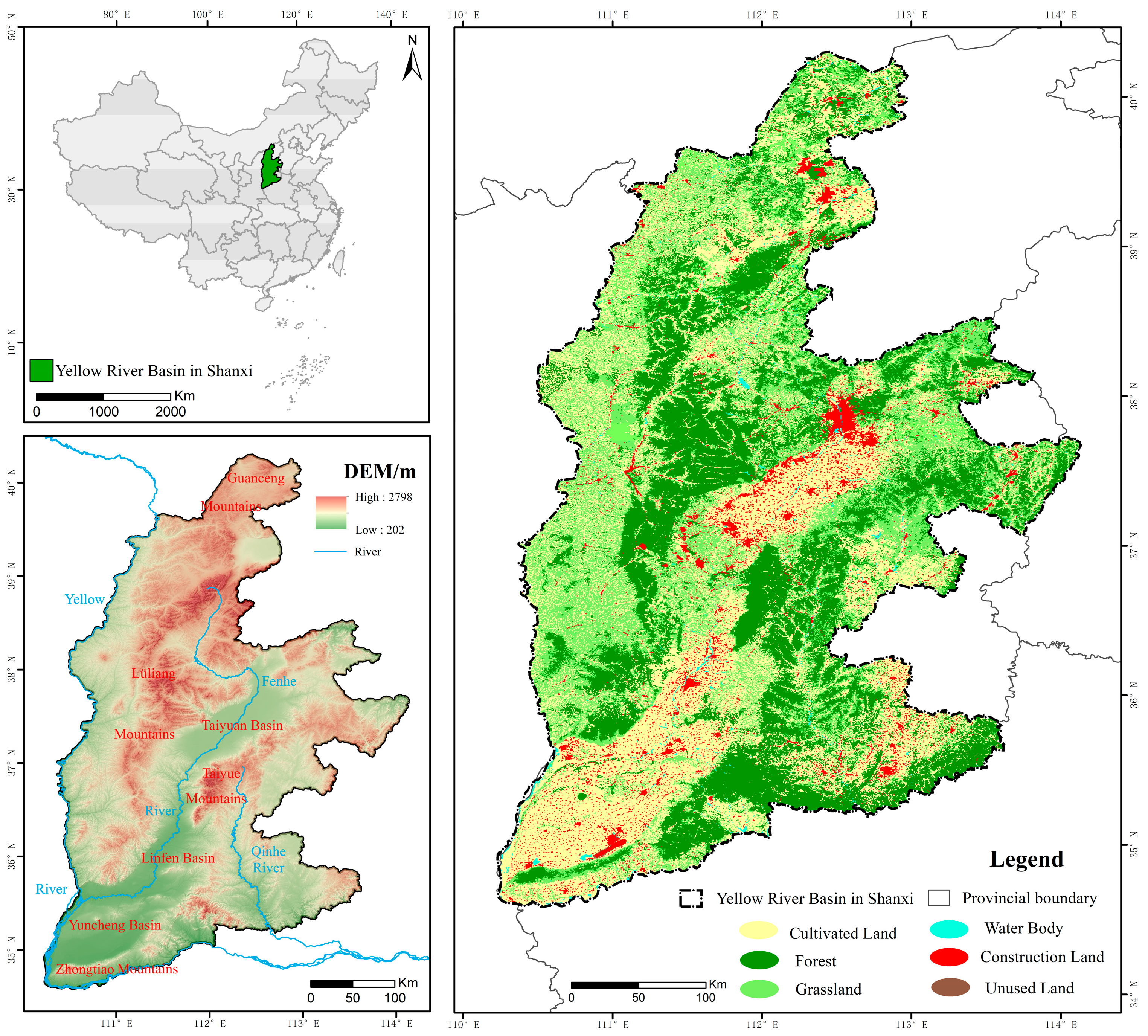
The Yellow River Basin in Shanxi Province, located in the middle reaches of the Yellow River and on the eastern edge of the Loess Plateau, spans 110°14′22″–113°32′44″ E and 34°35′40″–40°41′37″ N. It covers approximately 114,600 km
2, accounting for 73.10% of Shanxi Province’s total area (
Figure 1). The region encompasses 11 cities and 86 counties (or districts), with a total population exceeding 25 million. It is characterized by a temperate continental monsoon climate, with hot, rainy summers; cold, dry winters; and distinct seasonal variation. The terrain is diverse: the Lüliang Mountains extend north–south along the western edge, the Taiyue and Zhongtiao Mountains dominate the southeast, and three central basins (Taiyuan, Linfen, and Yuncheng) through which the Fenhe River flows from north to south, are arranged sequentially, forming the distinctive “three mountains enclosing three basins” topographic pattern. In recent years, the Yellow River Basin in Shanxi Province has been prioritized in national and regional development strategies because of its significant economic contributions, despite challenges such as ecological fragility and structural imbalances [
43].
2.2. Data Sources and Preprocessing
The data used in this study include land use data, evapotranspiration data, soil data, meteorological data, Digital Elevation Model (DEM) data, administrative boundaries of China, the Yellow River Basin boundary, and watershed distribution data. Land use data, administrative boundaries, the Yellow River Basin boundary, and watershed distribution data were obtained from the Resource and Environment Science and Data Center of the Chinese Academy of Sciences (
http://www.resdc.cn/ (accessed on 28 May 2026)). Evapotranspiration data, soil data, and meteorological data were sourced from the National Earth System Science Data Center (
http://www.geodata.cn/ (accessed on 28 May 2026)), the Harmonized World Soil Database (HWSD), and the China Meteorological Data Service Center (
https://data.cma.cn/ (accessed on 28 May 2026)), respectively. DEM data (90 m resolution) were acquired from the Geospatial Data Cloud (
http://www.gscloud.cn/ (accessed on 28 May 2026)). NDVI data were obtained from the National Tibetan Plateau Data Center (
https://data.tpdc.ac.cn (accessed on 28 May 2026)). Land-use data for 2010, 2015, and 2020 were standardized into six consistent categories: cultivated land, forest, grassland, water body, construction land, and unused land.
To ensure consistency and comparability among datasets from different sources during spatial analysis, all raster datasets were uniformly preprocessed in ArcGIS 10.7 (Esri Inc., Redlands, CA, USA) and resampled to a spatial resolution of 50 m. During the analytical stage, all spatial data were projected using the CGCS2000_3_Degree_GK_Zone_38 coordinate system to ensure the accuracy of distance, area, and landscape pattern calculations. For visualization purposes, the final maps were displayed using the GCS_WGS_1984 geographic coordinate system. Continuous variables (e.g., climate data) were resampled using bilinear interpolation, whereas categorical variables (e.g., land-use types) were resampled using the nearest neighbor method to avoid distortion of category information. This study used 2010, 2015, and 2020 as the main temporal nodes for analysis, and dynamic datasets such as land-use, precipitation, and NDVI data corresponding to each respective year were adopted to improve the comparability of evaluation results across different time periods.
2.3. Research Framework
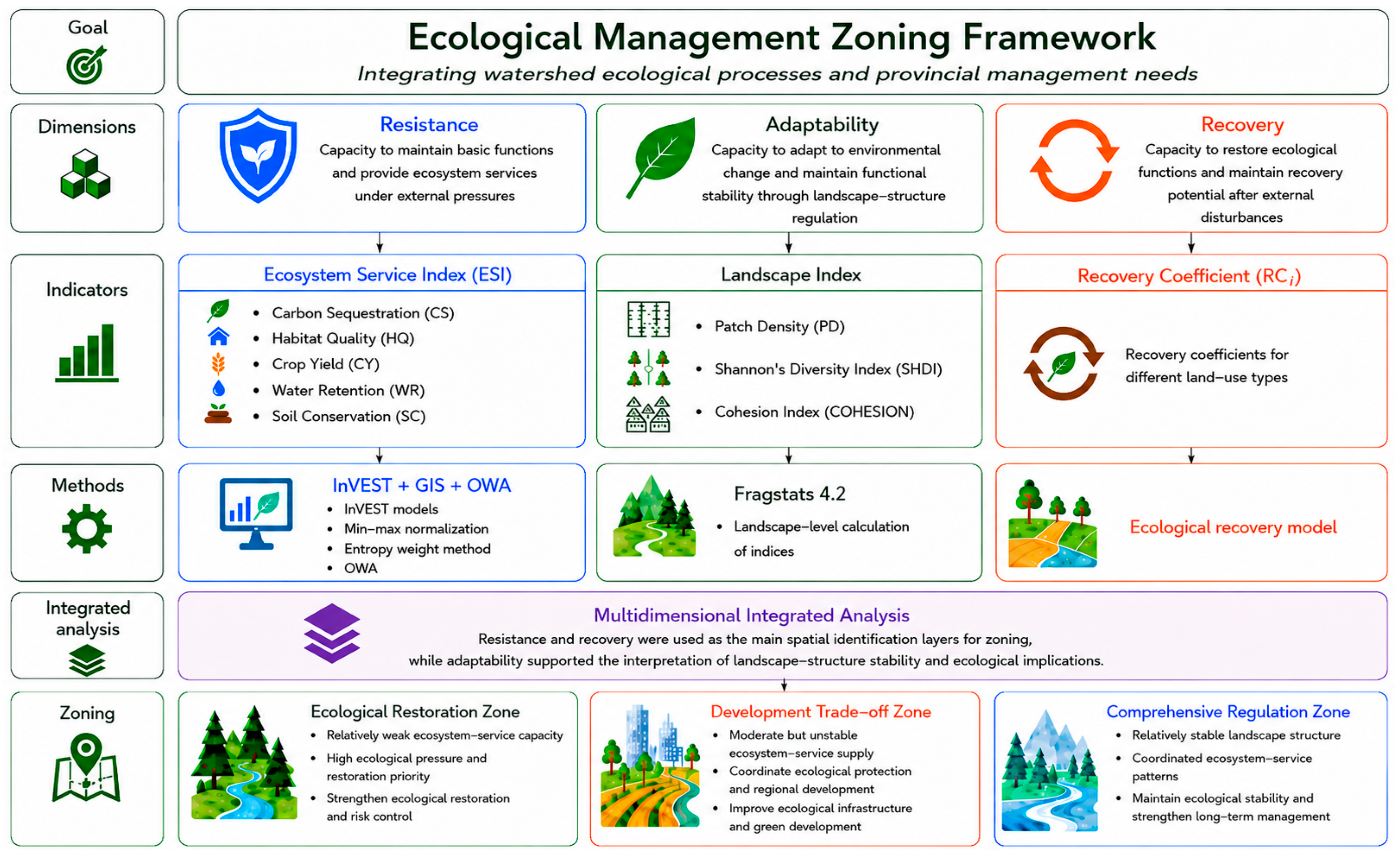
This study constructed an ecological management zoning framework from an ecological resilience perspective to integrate watershed ecological processes with provincial management needs (
Figure 2). The framework is organized around three complementary dimensions: ecological resistance, ecological adaptability, and ecological recovery. Ecological resistance reflects the capacity of ecosystems to maintain basic functions and provide ecosystem services under external pressures. In this study, it was represented by the Ecosystem Service Index (ESI), which was constructed from five ecosystem services quantified using InVEST 3.13.0 (The Natural Capital Project, Stanford University, Stanford, CA, USA) and GIS-based methods. After min–max normalization and entropy-weighted aggregation, a representative scenario was selected through OWA-based multi-scenario simulation for ecological resistance assessment. Ecological adaptability reflects the capacity of ecosystems to adapt to environmental change and maintain functional stability through landscape-structure regulation. It was characterized using the Landscape Index, including Patch Density (PD), Shannon Diversity Index (SHDI), and Cohesion Index (COHESION), which were calculated at the landscape level using Fragstats 4.2. Ecological recovery represents the capacity of ecosystems to restore ecological functions and maintain recovery potential after external disturbances. It was assessed using an ecological recovery model based on Recovery Coefficients (RC
i) assigned to different land-use types. Through multidimensional integrated analysis, the framework jointly interprets ecological functional basis, landscape-structure stability, and recovery potential, thereby supporting the identification of spatial differences in ecological characteristics. Based on this framework, the study area was further divided into three ecological management zones: Ecological Restoration Zone, Development Trade-off Zone, and Comprehensive Regulation Zone, providing a basis for differentiated ecological governance and sustainable regional development.
2.4. Ecological Resistance Assessment
Ecological resistance reflects the capacity of ecosystems to maintain basic functions and provide ecosystem services under external pressures. Higher ecosystem service supply capacity generally indicates a stronger ability of ecosystems to maintain functional stability when facing external disturbances and can therefore be used to characterize ecological resistance [
44,
45]. According to the strategic requirements of the Plan for Ecological Protection and High-Quality Development of the Yellow River Basin in Shanxi Province regarding ecological security barrier construction, soil and water conservation enhancement, water resource protection, agricultural production security, and green low-carbon development, and considering ecosystem types and data availability in the study area, this study selected five key ecosystem services: CS, HQ, CY, WR, and SC. These ecosystem services were quantified using InVEST and crop-yield models [
46], and an integrated ecosystem service assessment result was derived through normalization and entropy-weighted aggregation.
On this basis, to incorporate the influence of different risk preferences on the integrated evaluation of ecosystem services, this study combined GIS with the Ordered Weighted Averaging (OWA) method to generate ecosystem service scenarios under different risk conditions. A representative scenario was subsequently selected to construct the Ecosystem Service Index (ESI), which was used to characterize ecological resistance in the Yellow River Basin in Shanxi Province.
2.4.1. Integrated Ecosystem Service Assessment
In this study, InVEST was used to quantify four ecosystem services: CS, HQ, WR, and SC. InVEST was selected because of its strong data compatibility and scalability, as well as its ability to effectively link land-use change with ecosystem-service dynamics [
47]. Specifically, CS was quantified using the Carbon Storage and Sequestration model of InVEST, WR was estimated based on the Water Yield model, SC was calculated using the Sediment Delivery Ratio (SDR) model, and HQ was assessed using the Habitat Quality model. CY was estimated in GIS based on NDVI and statistical crop-yield data. The calculation formulas and variable descriptions for the five ecosystem service indicators are presented in
Table 1.
To make the indicators comparable, all ecosystem service indicators were normalized to the range of [0, 1] using min–max normalization. The entropy weight method was then used to determine the criterion weights of the five ecosystem services. To ensure temporal comparability, entropy weights were first calculated separately for 2010, 2015, and 2020, and the average weights across the three years were used as the final criterion weights. The final weights of CS, HQ, CY, WR, and SC were 0.0666, 0.2016, 0.1471, 0.1848, and 0.3999, respectively. Based on these weights, the normalized indicators were weighted and aggregated to obtain the integrated ecosystem service assessment results.
To further identify the spatial clustering characteristics of ecosystem services, the Getis–Ord Gi* statistic in ArcGIS was used to detect cold spots and hot spots of ecosystem services. Based on the significance levels of the Gi* Z-score, the results were classified into seven categories: extremely significant cold spots, significant cold spots, cold spots, non-significant areas, hot spots, significant hot spots, and extremely significant hot spots. A positive Gi* Z-score indicates spatial clustering of high ecosystem service values, whereas a negative Gi* Z-score indicates spatial clustering of low ecosystem service values.
2.4.2. OWA-Based Multi-Scenario Simulation
The Ordered Weighted Averaging (OWA) operator, introduced by Yager in 1988, is widely used in multi-attribute decision-making. Its core principle is to rank indicator values and assign positional weights according to their ranks [
48]. OWA can integrate the objective attributes of spatial units with subjective decision-making preferences, thereby facilitating the comparison of spatial outcomes under different management priorities and risk attitudes [
16].
In this study, the five ecosystem services considered in the Integrated Ecosystem Service Assessment may exhibit trade-off or synergistic relationships under different ecological management objectives. To better reflect the influence of decision preferences and risk attitudes on ecosystem service aggregation, the OWA operator was combined with GIS to generate scenario-specific ecosystem service assessment results under different risk coefficients. A representative scenario was subsequently selected as the Ecosystem Service Index (ESI) for ecological resistance assessment. Specifically, the standardized ecosystem service indicators were aggregated using composite (criterion) weights and positional (order) weights under different risk coefficients to produce evaluation results for each scenario. The OWA calculation formula is as follows:
In this equation,
denotes the normalized criterion layer of indicator
i, and
n is the number of indicators.
denotes the composite (criterion) weight, and
denotes the positional (order) weight, where
∈ [0, 1], and
.
In the equation, α represents the decision risk coefficient;
denotes the grade of importance for a given indicator, determined based on the magnitude of the indicator value; and
indicates the importance value assigned to indicators after ranking based on composite weights, where the highest value is 1, and the lowest value corresponds to n. As the risk coefficient
α increases from 0 to infinity, the decision-making attitude transitions from highly optimistic to highly pessimistic. When
α = 1, it reflects an unbiased approach to the integrated management of different ecosystem services. For
α > 1, layers with lower attribute values receive higher weights, signifying that the decision-maker prioritizes services with lower values. This represents a management model that emphasizes the protection or restoration of “weaker” ecosystem services.
In this equation, represents the balance degree of indicator-weight distribution under different risk scenarios.
2.5. Ecological Adaptability Assessment
Ecological adaptability refers to the capacity of regional ecosystems to adapt to environmental change and maintain functional stability through landscape-structure regulation. It is closely associated with landscape structural stability, connectivity, and spatial heterogeneity. Following relevant studies [
49,
50,
51], this study selected three landscape indices—Patch Density (PD), Shannon’s Diversity Index (SHDI), and Patch Cohesion Index (COHESION)—to characterize ecological adaptability in the study area. Specifically, PD was used to reflect the degree of landscape fragmentation, SHDI represented the diversity of landscape-type composition and area distribution, and COHESION reflected the aggregation degree and structural connectivity of landscape patches. In general, a higher PD value indicates a larger number of patches per unit area and, therefore, a higher degree of landscape fragmentation; a higher SHDI value indicates richer landscape-type composition and a more balanced area distribution, suggesting greater landscape diversity; and a higher COHESION value indicates stronger aggregation and structural connectivity among patches of the same type, reflecting better overall landscape connectivity. Therefore, in the ecological adaptability analysis, PD was treated as a negative indicator, whereas SHDI and COHESION were treated as positive indicators. Based on 50 m land-use raster data, the three landscape indices were calculated at the landscape level using Fragstats 4.2 (University of Massachusetts Amherst, Amherst, MA, USA), and ecological adaptability in the study area was comprehensively analyzed based on these indices. The calculation formulas and variable definitions of the landscape indices are presented in
Table 2.
2.6. Ecological Recovery Assessment
In this study, ecological recovery refers to the capacity of regional ecosystems to restore ecological functions and maintain recovery potential after external disturbances, reflecting their self-regulatory capacity. Generally, land-use types closer to natural states tend to exhibit stronger ecological recovery potential under external disturbances, whereas land-use types subject to intensive human activities usually show relatively weaker recovery capacity. Following Peng et al. [
52], recovery coefficients (
) for different land-use types were determined based on previous studies, regional characteristics, and expert knowledge, with values ranging from 0 to 1 (
Table 3). Ecological land-use types, including forests, grasslands, and water bodies, generally exhibit relatively high recovery potential, whereas construction land tends to show relatively low recovery capacity.
In the general formulation of the recovery model, ecological recovery can be calculated for a given spatial analysis unit by weighting the recovery coefficient of each land-use type according to its area proportion within that unit. In this study, land-use vector polygons were first used as the basic units for coefficient assignment. Each polygon was assigned the recovery coefficient corresponding to its land-use category, and its polygon-level ecological recovery value was calculated as the product of its area proportion and the assigned recovery coefficient, corresponding to the term
Ai ×
RCi in Equation (15). At this stage, no summation was performed for individual polygons. For the annual summary, the ecological recovery values of all land-use polygons within the study area were summed according to Equation (15) to obtain the mean ecological recovery of the study area. For spatial representation and consistency with other raster-based analyses, the polygon-based recovery results were then converted into 50 m raster data. The formula is as follows:
where
denotes ecological recovery;
is the area proportion of land use type
i within a given spatial unit;
is the recovery coefficient assigned to land use type
i; and n is the number of land use types.
For spatial representation and temporal comparison, the valid raster-cell values of ecological recovery from 2010, 2015, and 2020 were pooled to derive a unified value distribution. The Natural Breaks method was then applied to this pooled ecological recovery dataset to determine the class thresholds for five levels. Subsequently, the same thresholds were applied to the ecological recovery layer of each year, thereby establishing a consistent five-level classification scheme: low, relatively low, medium, relatively high, and high. This process transformed land-use-based recovery coefficients into comparable spatial recovery patterns for the Yellow River Basin in Shanxi Province while maintaining consistency with the core calculation logic of the model, and provided a basis for subsequent ecological management zoning.
2.7. Ecological Management Zoning Based on Ecological Resilience
To comprehensively characterize regional ecological features in terms of maintaining ecological functions, regulating landscape structure, and sustaining recovery potential, this study constructed an ecological management zoning framework based on three dimensions: resistance, adaptability, and recovery. Specifically, ecological resistance and ecological recovery were used as the main spatial identification layers for zoning, whereas ecological adaptability, derived from landscape-level indices, was used to support the interpretation of overall landscape-structure stability and its ecological implications. In the zoning procedure, the Ecosystem Service Index (ESI) under Scenario 3 was used as the spatial layer of ecological resistance, while the ecological recovery assessment result was used as the spatial layer of ecological recovery. To generate the zoning assessment layer, the ecological resistance layer and ecological recovery layer were first spatially overlaid and added on a cell-by-cell basis. The overlay result was then standardized using min–max normalization to reduce the influence of differences in indicator ranges. The formula is as follows:
where
Z denotes the standardized zoning assessment layer,
denotes the Ecosystem Service Index under Scenario 3, representing ecological resistance, and
ER denotes ecological recovery. The Natural Breaks method was then used to classify the standardized results into three intervals: 0–0.25, 0.25–0.62, and 0.62–1.
To enhance the management interpretability and practical applicability of the zoning results, the standardized integrated zoning assessment result was classified into low, medium, and high levels, corresponding to Ecological Restoration Zones, Development Trade-off Zones, and Comprehensive Regulation Zones, respectively. These three zones summarize the major differences among ecological functional basis, recovery potential, and development pressure in the study area. Low-value areas indicate relatively insufficient ecosystem-service maintenance capacity and recovery potential, emphasizing ecological restoration and risk control. Medium-value areas represent transitional conditions in ecological function and recovery potential, highlighting the need to coordinate ecological protection and regional development. High-value areas indicate a relatively strong ecological functional basis and higher recovery potential, emphasizing the maintenance of ecological security patterns and comprehensive regulation. Meanwhile, the three-zone scheme integrates watershed-scale ecological processes with provincial-level management needs and facilitates alignment with the spatial governance orientations of the Ecological Function Zoning of Shanxi Province and the Plan for Ecological Protection and High-Quality Development of the Yellow River Basin in Shanxi Province. For example, areas with high integrated zoning assessment results correspond well to the ecological security barriers of the Lüliang Mountains and the Taiyue–Zhongtiao Mountains proposed in the planning documents. Some areas in the central basins mostly show medium-level integrated assessment results, which are consistent with the trade-off management needs among agricultural production security, urban development agglomeration, and ecological protection. In contrast, low-value clusters in the south-central part of the basin, especially the Yuncheng Basin and surrounding areas with intensive agricultural development, correspond to the planning requirements for farmland ecological protection and restoration, as well as ecological risk control. Through these steps, this study translates multidimensional ecological characteristics from the perspective of ecological resilience into interpretable, reproducible, and policy-relevant ecological management zoning results, thereby supporting differentiated ecological governance and regional sustainable development.
3. Results and Analysis
3.1. Ecological Resistance Assessment Results
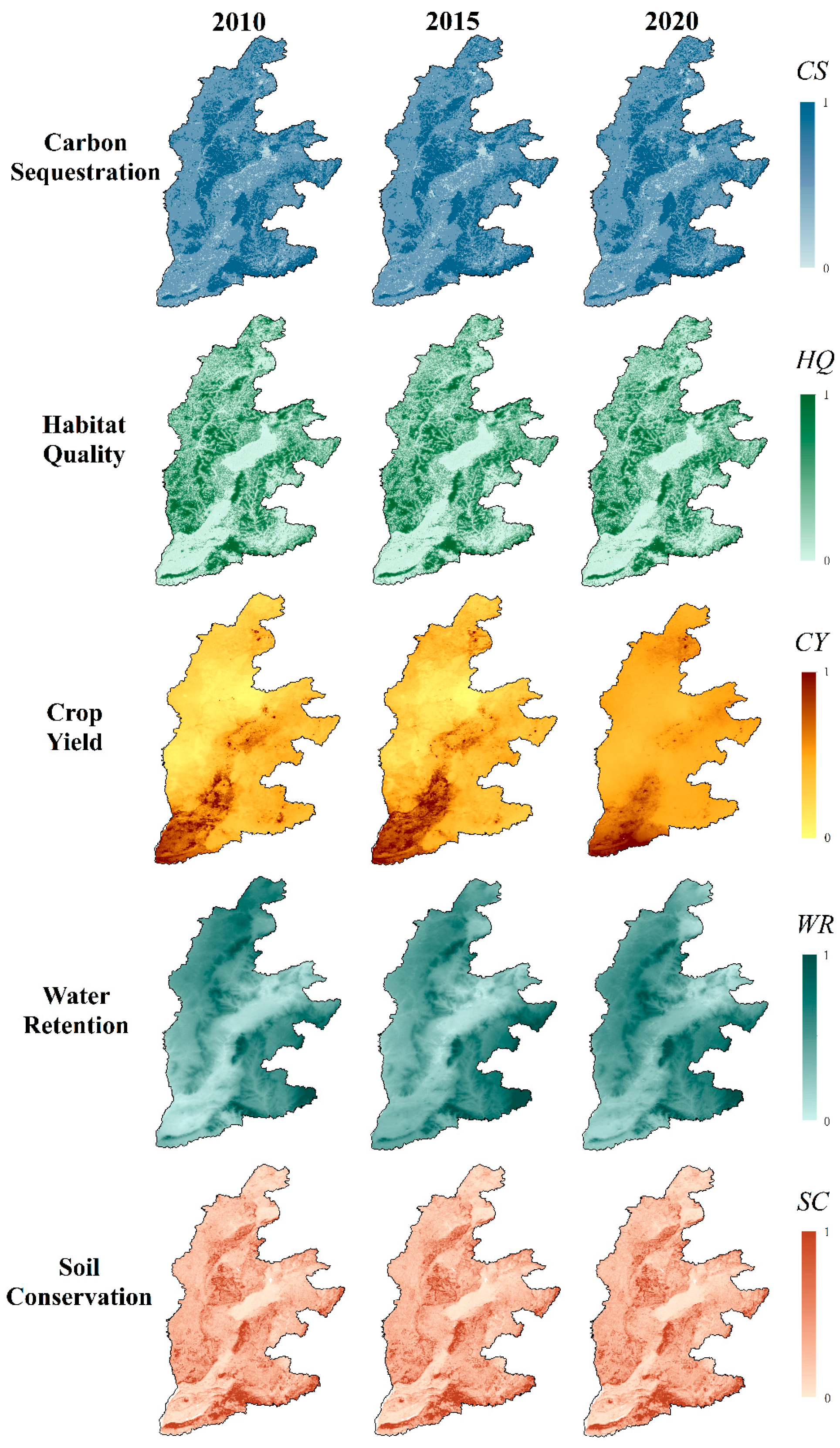
During 2010–2020, the five ecosystem services in the Yellow River Basin in Shanxi Province showed relatively small overall changes, indicating that ecosystem service conditions remained generally stable during the study period (
Figure 3). The mean value of CS increased from 0.61 in 2010 to 0.64 in 2020, representing an increase of 4.92%. High-value areas were mainly concentrated in the Lüliang Mountains and the Qinhe River Basin, whereas low-value areas were primarily distributed in the central basins. The mean value of HQ decreased from 0.69 in 2010 to 0.66 in 2020, representing a decline of 4.35%. High-value areas were mainly distributed in the Lüliang, Taiyue, and Zhongtiao Mountains, whereas low-value areas were concentrated in the Fenhe River Valley and the central basins. The mean value of CY decreased from 0.36 in 2010 to 0.34 in 2020, representing a decline of 5.56%. High-value areas were mainly concentrated in the central and southern basins, and their spatial distribution gradually shifted toward the south-central basin areas by 2020. The mean value of WR increased from 0.41 in 2010 to 0.46 in 2020, representing an increase of 12.20%. High-value areas were mainly distributed in the Lüliang, Taiyue, and Zhongtiao Mountains, whereas low-value areas were mainly concentrated in the central basins. The mean value of SC decreased from 0.61 in 2010 to 0.52 in 2020, representing a decline of 14.75%.
In terms of spatial changes, the overall patterns of the five ecosystem services remained relatively stable, although local differences were evident. HQ weakened around Shuozhou City in 2020, which may indicate that habitat conditions in this area were affected by land development and intensified human activities. CY decreased markedly in the central basins, suggesting a decline in food production capacity in areas strongly influenced by urbanization and land-use change. In contrast, WR increased noticeably in mountainous areas such as the Lüliang and Taiyue Mountains, indicating an improvement in the water retention function of mountainous ecological spaces. By comparison, the spatial patterns of CS and SC changed only slightly, with high-value areas remaining mainly distributed in mountainous regions with relatively favorable ecological conditions. This suggests that the spatial differentiation pattern of ecosystem services in the study area exhibited a certain degree of stability.
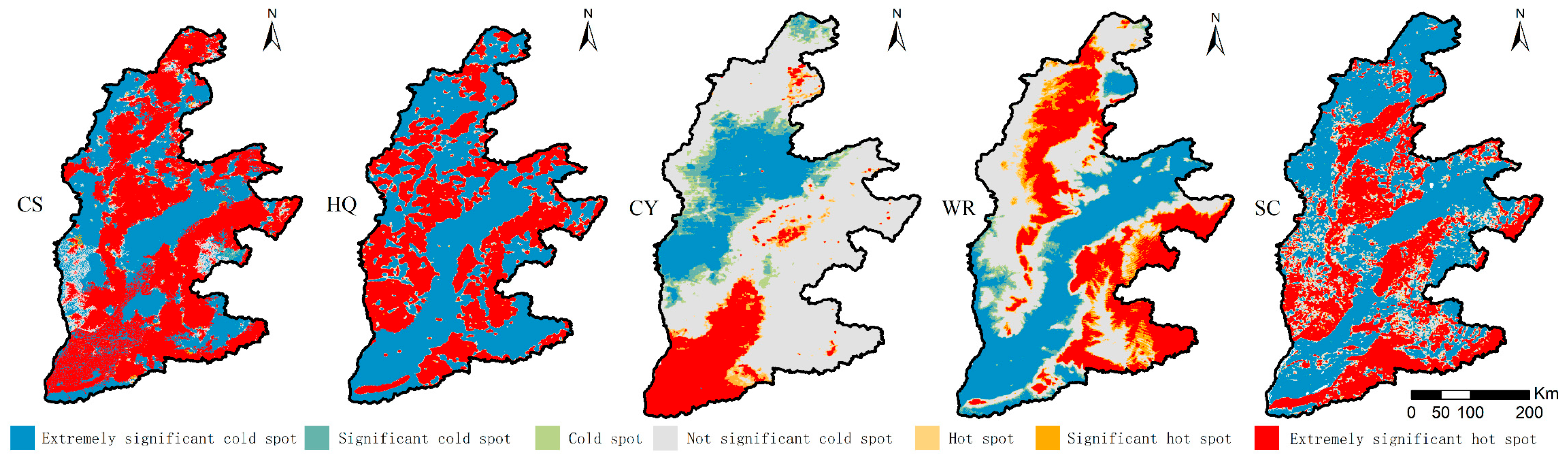
Cold- and hot-spot analysis showed that the five ecosystem services exhibited clearly differentiated spatial clustering patterns (
Figure 4). The cold- and hot-spot patterns of CS, HQ, and SC were highly similar, with extremely significant hot spots and extremely significant cold spots dominating the spatial distribution and largely characterizing the main high- and low-value clusters of these three ecosystem services in the study area. Specifically, extremely significant hot spots were mainly distributed in the Lüliang, Taiyue, and Zhongtiao Mountains, as well as in some southern mountainous areas, whereas extremely significant cold spots were primarily concentrated in the central basins and areas with relatively intensive human activities. In contrast, CY hot spots were mainly concentrated in the southern basin areas with favorable agricultural production conditions, while cold spots were mostly distributed in the northwestern mountainous areas, indicating that crop production was more dependent on flat terrain, concentrated cultivated land, and favorable agricultural development conditions. The cold- and hot-spot pattern of WR showed a more pronounced spatial gradient than the other services, with interlaced cold and hot clusters and more diverse significance levels. This indicates that WR is closely associated with topographic relief, vegetation cover, and precipitation conditions. Overall, the cold- and hot-spot patterns of ecosystem services corresponded well to the “mountain–basin” geomorphological differentiation, vegetation cover, and intensity of human activities in the Yellow River Basin in Shanxi Province. Notably, the Fenhe River Valley, where urbanization and agricultural development are relatively concentrated, contained a relatively high proportion of cold spots, accounting for 41.30% of the total cold-spot area, further indicating that the central basins represent key areas of low-value ecosystem service clustering in the study area.
After standardization, the five ecosystem services were ranked in descending order according to their mean values and denoted as w1–w5, corresponding to CS, HQ, CY, WR, and SC, respectively. The OWA–GIS coupled model was then used to simulate ecosystem service assessment results under different risk scenarios. Based on different risk coefficients, positional weights were calculated for each scenario and used to generate scenario-specific ecosystem service assessment results. The specific positional weights are presented in
Table 4.
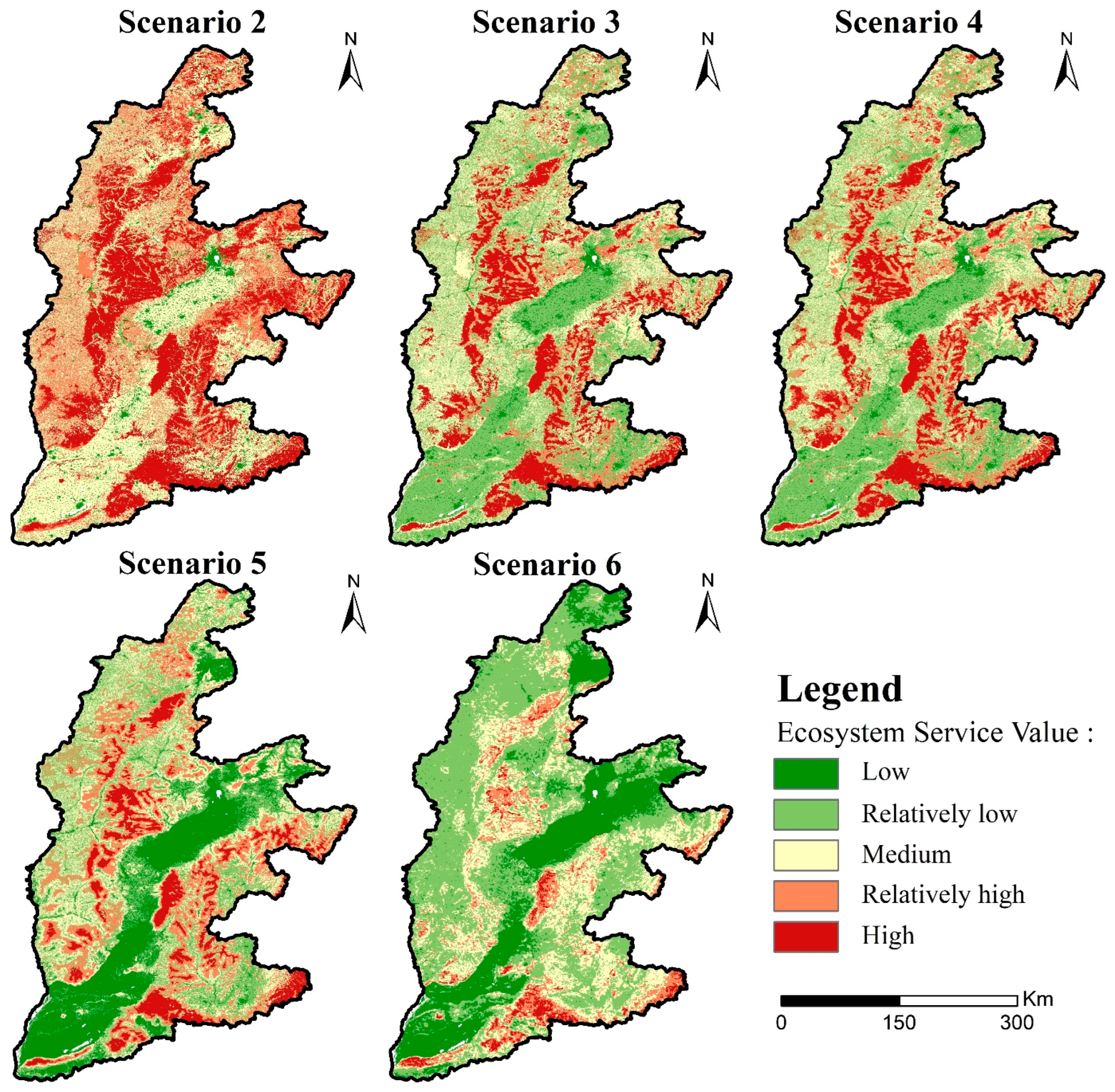
During preliminary testing, when the risk coefficient α = 0.0001 (approaching 0) and α = 10,000 (approaching infinity), the study area exhibited two extreme spatial patterns: high-value aggregation and low-value aggregation, respectively. As α increased, low-value areas became slightly more concentrated in the central basins and around Shuozhou City, whereas the area of high-value regions slightly decreased. After excluding the two extreme scenarios, the five intermediate scenarios (Scenarios 2–6) were retained and classified into five levels—high, relatively high, moderate, relatively low, and low—using the Natural Breaks method (
Figure 5).
A comparison of the positional weights and spatial distribution patterns of ecosystem services under different scenarios showed that, as α increased, the positional weights gradually shifted from high-supply ecosystem services to low-supply ecosystem services. Scenario 2 placed strong emphasis on high-supply ecosystem services, with CS receiving the dominant weight. However, its relatively low trade-off value indicates an unbalanced weight allocation structure. Therefore, this scenario may overemphasize existing high-value ecosystem service areas while insufficiently reflecting the balance among multiple ecosystem services. Scenario 3 still assigned relatively high weights to high-value services such as CS, HQ, and CY, but its weight distribution was more balanced than that of Scenario 2; thus, it was more suitable for representing ecological resistance. In contrast, Scenario 5 and Scenario 6 gradually increased the weights assigned to low-value ecosystem services. This weighting pattern reflects an intervention-oriented management preference that focuses more on improving weaker ecosystem services, but it may also weaken the representation of existing high-value ecological functional areas. In particular, Scenario 6 showed a highly concentrated weight on the lowest-ranked service, together with a very low trade-off value, indicating a strong bias and a pattern close to the extreme scenario. From the perspective of spatial distribution, Scenario 2 was generally characterized by a larger proportion of high and relatively high value areas, whereas Scenario 6 showed a marked expansion of low and relatively low value areas. This further indicates that these two scenarios tend to emphasize the maintenance of high-value ecosystem services and the prioritization of low-value ecosystem services, respectively.
In OWA, the trade-off value reflects the balance of positional weight allocation among different ecosystem services; a higher trade-off value indicates a more even distribution of weights across services [
53]. Although Scenario 4 had the highest trade-off value because equal weights were assigned to all ecosystem services, this fully balanced weighting scheme may reduce the emphasis on dominant high-value ecosystem services in the study area. In contrast, Scenario 3 maintained a relatively high trade-off level while still assigning comparatively higher weights to high-value ecosystem services. Therefore, considering both the representation of spatial heterogeneity in ecosystem services and the balance of weight allocation, Scenario 3 was ultimately selected as the representative scenario for subsequent ecological resistance analysis.
3.2. Ecological Adaptability Assessment Results
From 2010 to 2020, PD, SHDI, and COHESION showed only slight temporal variations (
Table 5). The minor fluctuation in PD indicates that landscape fragmentation remained generally stable. SHDI increased slightly from 1.264 to 1.276, suggesting a modest increase in landscape diversity and evenness. COHESION remained consistently high, above 99.8, indicating strong landscape connectivity throughout the study period. Overall, these landscape metrics suggest that ecological adaptability in the study area was mainly characterized by the stability of landscape structure rather than by pronounced temporal change.
3.3. Ecological Recovery Assessment Results
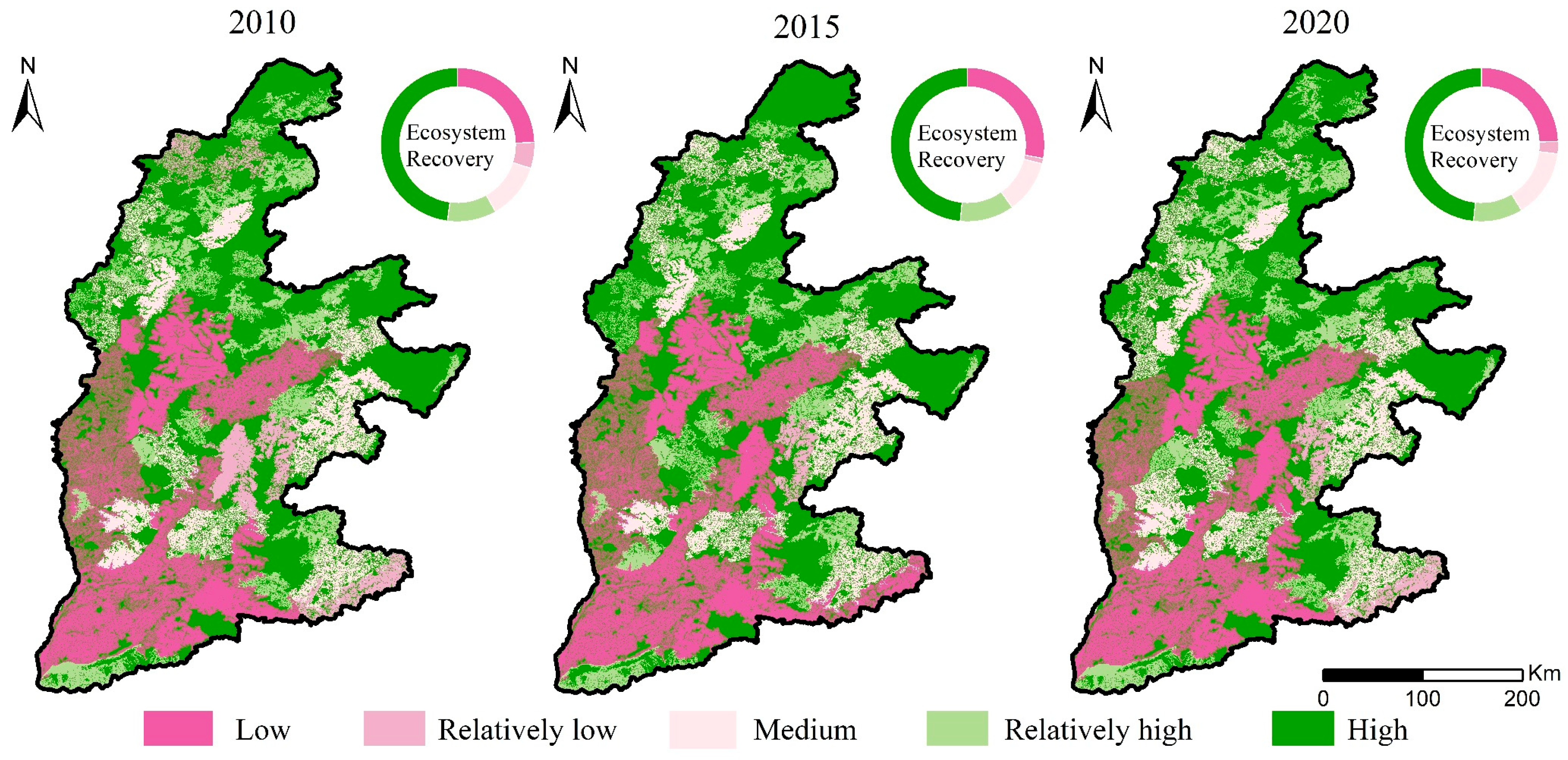
From 2010 to 2020, ecological recovery in the Yellow River Basin in Shanxi Province exhibited pronounced spatial heterogeneity (
Figure 6). Spatially, ecological recovery gradually formed a pattern characterized by relatively low values in the central–western region and relatively high values in the northern and eastern regions. Low-recovery areas were mainly concentrated in the Taiyuan Basin and Yuncheng Basin, whereas relatively high-recovery areas were primarily distributed in the northern Lüliang Mountains and along parts of the Qinhe River.
Over time, the proportion of low-recovery areas decreased slightly, while some relatively high-recovery areas showed localized expansion. Temporally, the mean ecological recovery decreased from 0.254 in 2010 to 0.242 in 2015 and further to 0.237 in 2020, indicating a gradual decline in the overall ecological recovery potential of the region during the study period. This pattern may be associated with land-use changes, such as reductions in cultivated land and forestland and the expansion of construction land, as well as pressures from soil erosion and human disturbance. Overall, the results indicate the coexistence of spatial redistribution and localized decline in recovery potential from 2010 to 2020.
3.4. Ecological Management Zoning Results
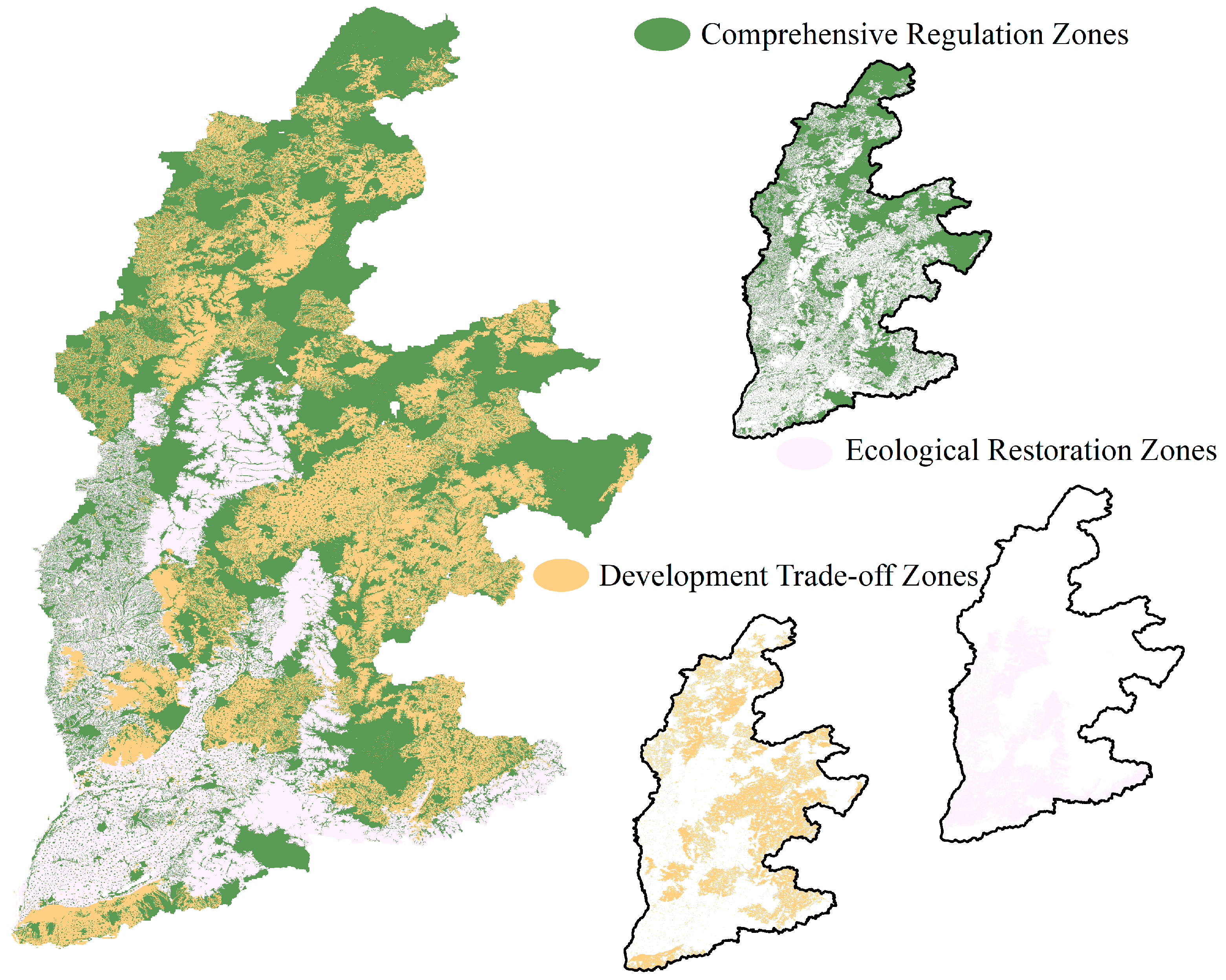
Based on the standardized integrated zoning assessment result, and with subsequent reference to the Ecological Function Zoning of Shanxi Province and the Plan for Ecological Protection and High-Quality Development of the Yellow River Basin in Shanxi Province for policy interpretation and validation, the study basin was divided into three ecological management zones: Ecological Restoration Zones, Development Trade-off Zones, and Comprehensive Regulation Zones (
Figure 7).
Ecological Restoration Zones account for 24.41% of the study area and are mainly distributed in areas with high urbanization intensity and concentrated human activities, with notable clusters in the Yuncheng Basin and the southern Lüliang Mountains. The dominant land-use types are cropland and built-up land. Due to intensive land development and relatively weak ecosystem-service supply capacity, these areas face relatively high ecological pressure and therefore require priority ecological restoration and ecological-risk control. Ecological management should focus on strengthening ecological protection and promoting green transformation, including cleaner production, low-carbon industrial development, and the sustainable use of energy resources.
Development Trade-off Zones account for 29.99% of the basin and are mainly concentrated in the central basins and the northern Lüliang Mountains. These areas exhibit moderate but relatively unstable ecosystem-service supply and are characterized by increasing pressure from both ecological protection and socioeconomic development. Therefore, this zone emphasizes balancing ecological restoration with economic development. Ecological management should focus on ecological restoration, infrastructure improvement, and the promotion of green agriculture and nature-based management strategies to reduce further ecological degradation.
Comprehensive Regulation Zones account for 45.60% of the basin and are widely distributed across multiple counties, with smaller clusters in the northern Lüliang Mountains and the Qinhe River Basin. These areas generally exhibit relatively stable landscape structure and comparatively coordinated ecosystem-service patterns, including many ecologically important areas such as forest parks and scenic regions with relatively high biodiversity. Therefore, this zone mainly emphasizes maintaining ecological stability and coordinating long-term ecological protection with regional development. Ecological management should prioritize maintaining existing ecological conditions, strengthening ecological security functions, and improving the coordinated management of ecosystem services and regional development.
4. Discussion
Rather than simplifying ecological resilience into a single composite index, this study interpreted ecological characteristics in the Yellow River Basin in Shanxi Province from three dimensions—ecological resistance, ecological adaptability, and ecological recovery—thereby supporting ecological management zoning. The results showed clear spatial differences in ecosystem-service supply capacity and ecological recovery potential across the study area. High-value ecosystem-service areas were mainly distributed in mountainous regions with favorable ecological conditions, such as the Lüliang, Taiyue, and Zhongtiao Mountains, whereas low-value areas were primarily concentrated in the central basins and areas with higher urbanization intensity. This spatial pattern corresponded well to the topographic conditions, vegetation cover, and intensity of human activities in the study area. Although the area of low-recovery zones decreased and that of high-recovery zones increased, the mean ecological recovery showed an overall declining trend, indicating an uneven change in recovery potential across the region. This may be related to the conversion of some medium-recovery areas into low-recovery areas and the relatively large decline in recovery capacity in certain local areas. In addition, the landscape metrics showed only minor changes, suggesting that the overall landscape structure of the study area remained relatively stable during the study period. However, stability in landscape pattern does not necessarily imply stability in land-use intensity; rather, it mainly indicates limited changes in regional landscape connectivity and overall spatial structure.
Based on the integrated interpretation of ecological resistance, ecological adaptability, and ecological recovery, the Yellow River Basin in Shanxi Province was divided into three ecological management zones: Ecological Restoration Zones, Development Trade-off Zones, and Comprehensive Regulation Zones. Ecological Restoration Zones were mainly distributed in areas with higher urbanization intensity and stronger human activities, where ecosystem-service supply capacity was relatively weak; therefore, ecological restoration and ecological-risk control should be prioritized. Development Trade-off Zones had moderate but relatively unstable ecosystem-service supply, and management should focus on coordinating ecological protection with regional development. Comprehensive Regulation Zones generally had better ecological foundations, and management should emphasize maintaining the existing ecological security pattern and ecosystem stability. Notably, some areas with relatively high ecological functions appeared as small, discrete patches across county boundaries. During the analysis, this study attempted to conduct ecological management zoning statistics at the county scale; however, the results showed clear differences between the ecological characteristics of some spatial units and county-level mean values, making it difficult to capture local spatial heterogeneity in ecological functions. This indicates a mismatch between the spatial scale of ecological processes and the scale of administrative management. Future ecological management should therefore strengthen cross-regional collaborative governance and avoid relying solely on administrative boundaries for conservation and restoration.
Compared with zoning approaches based only on a single ecosystem service or static spatial patterns, this study interpreted regional ecological characteristics from the three dimensions of ecological resistance, ecological adaptability, and ecological recovery, thereby improving, to some extent, the ability of ecological management zoning to identify regional ecological differences. The OWA scenario simulation further introduced comparisons of ecosystem-service aggregation results under different risk preferences, helping to identify spatial response differences under different ecological management orientations. However, the ecological management zoning results may still be affected by OWA risk scenarios, indicator weights, and spatial classification methods, and different parameter settings may lead to certain differences in zoning outcomes. Therefore, the results should be regarded as an integrated reference for regional ecological management rather than as absolutely fixed spatial boundaries.
This study still has several limitations. First, the ecosystem-service assessment results were affected by the accuracy of land-use data, model parameter settings, and spatial resolution. Second, ecological adaptability was mainly characterized using landscape metrics. Because the landscape metrics changed only slightly during the study period, they were more suitable for reflecting the overall stability of regional landscape structure and were therefore not further used as dominant spatial zoning indicators in an integrated spatial overlay analysis. In addition, the OWA scenario simulation still involved a certain degree of subjectivity, and ecological management zoning results may vary under different risk preferences. Future studies should further incorporate multi-source dynamic data, cross-scale ecological process analysis, and sensitivity analysis to improve the stability and applicability of ecological management zoning results.
5. Conclusions
In the context of high-quality development, the Yellow River Basin in Shanxi Province undertakes multiple tasks, including ecological protection, resource-based economic transformation, and coordinated regional development. However, it still faces practical pressures such as ecological fragility, severe soil erosion, strong water-resource constraints, a heavy industrial structure, and imbalanced and uncoordinated development. From the perspective of ecological resilience, this study constructed an ecological management zoning framework based on three dimensions: ecological resistance, ecological adaptability, and ecological recovery. This framework was used to identify differences in ecological functional foundations and recovery potential across different areas, while incorporating landscape-structure stability characteristics to provide a basis for differentiated ecological governance.
From the perspective of ecological resistance, the five ecosystem services in the study area changed only modestly from 2010 to 2020, indicating a relatively stable ecosystem-service supply pattern. High-value areas were mainly concentrated in mountainous regions with favorable ecological conditions, such as the Lüliang, Taiyue, and Zhongtiao Mountains, whereas low-value areas were mainly distributed in the central basins and areas with higher urbanization intensity. This suggests that ecosystem-service supply capacity is closely related to topographic conditions, vegetation cover, and the intensity of human activities. The OWA scenario simulation results showed that different risk preferences affected the aggregation results of ecosystem services and their spatial expression. Among them, Scenario 3 maintained the continuity of high-value areas while effectively reflecting the spatial differences in ecosystem services across the study area; therefore, it was selected as the representative scenario for ecological resistance analysis.
From the perspective of ecological adaptability, landscape metrics such as PD, SHDI, and COHESION showed only minor fluctuations during the study period, indicating that the overall landscape structure of the study area remained relatively stable. The slight increase in SHDI reflected a certain adjustment in landscape diversity, while COHESION remained at a high level, suggesting strong overall landscape connectivity. The slight fluctuation in PD indicated limited changes in landscape fragmentation. Therefore, ecological adaptability in this study was mainly reflected by the stability and connectivity of regional landscape structure, providing supplementary landscape-pattern information for ecological management zoning.
From the perspective of ecological recovery, recovery potential showed clear spatial differentiation, with relatively low values in the central–western region and relatively high values in the northern and eastern regions. Although some relatively high-recovery areas showed localized expansion, the mean ecological recovery decreased from 0.254 in 2010 to 0.237 in 2020, indicating the coexistence of spatial redistribution and localized decline in recovery potential. This suggests that relying on a single ecological indicator is insufficient to comprehensively reveal regional ecological conditions. Instead, an integrated interpretation of ecological resistance, ecological adaptability, and ecological recovery is more useful for identifying ecological management needs across different areas.
Based on the above analysis, the Yellow River Basin in Shanxi Province was divided into three ecological management zones: Ecological Restoration Zones, Development Trade-off Zones, and Comprehensive Regulation Zones. Ecological Restoration Zones should prioritize ecological restoration, ecological risk control, and green transformation. Development Trade-off Zones should coordinate ecological protection and regional development, while strengthening ecological infrastructure and green agricultural support. Comprehensive Regulation Zones should maintain the existing ecological security pattern and strengthen the stable supply and long-term protection of ecosystem services. Overall, multidimensional ecological management zoning from the perspective of ecological resilience helps translate differences in ecological function maintenance, landscape-structure stability, and recovery potential into more operational spatial governance units, thereby providing scientific support for ecological protection, spatial optimization, and coordinated high-quality development in the Yellow River Basin in Shanxi Province.