Review

Reconstruction and Drivers of Change in Historical Land Use Intensity in China: A Review and Prospect

1
School of Public Administration, China University of Geosciences, Wuhan 430074, China
2
Hubei Key Laboratory of Environment and Culture in Yangtze Regions, China University of Geosciences, Wuhan 430074, China
3
China College of Resources and Environment, Shanxi University of Finance and Economics, Taiyuan 030006, China
4
Key Laboratory of Land Surface Pattern and Simulation, Institute of Geographic Sciences and Natural Resources Research, Chinese Academy of Sciences, Beijing 100101, China
*
Author to whom correspondence should be addressed.
Land 2026, 15(5), 891; https://doi.org/10.3390/land15050891
Submission received: 22 April 2026 / Revised: 17 May 2026 / Accepted: 19 May 2026 / Published: 21 May 2026
(This article belongs to the Topic Large-Scale and Long-Term Land Use and Land Cover Mapping)

Abstract

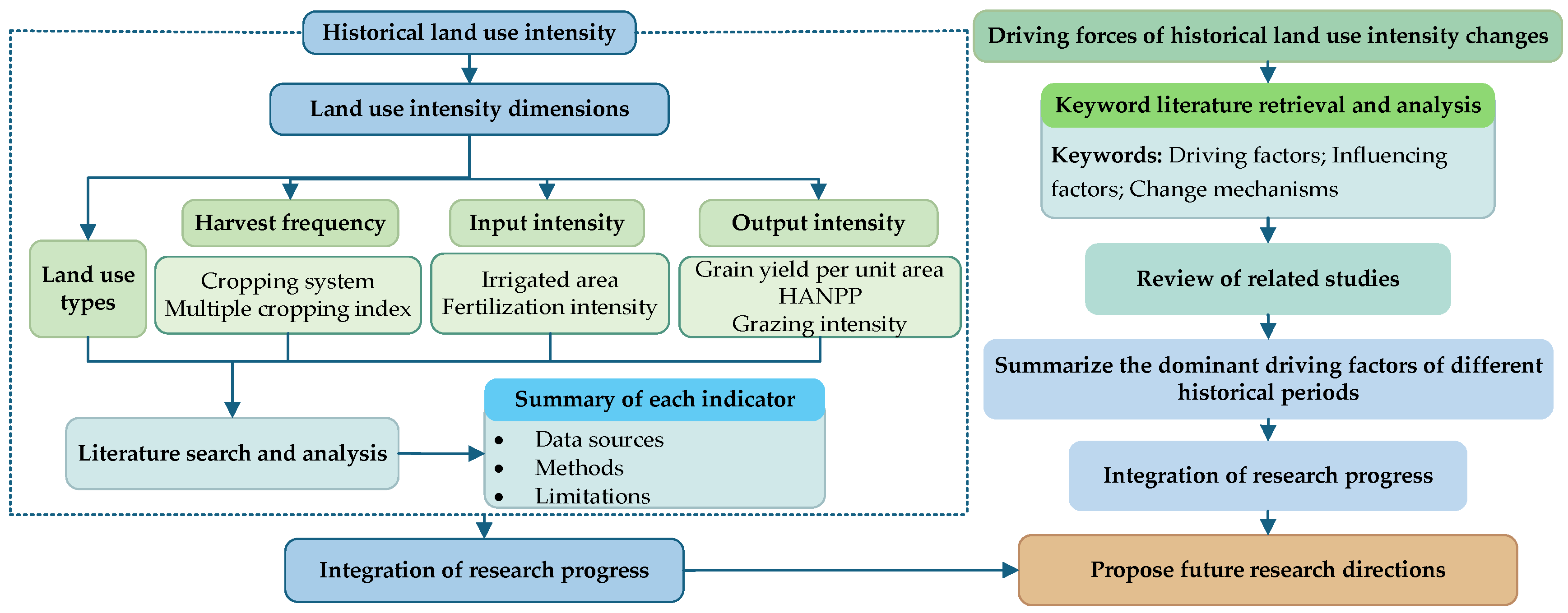
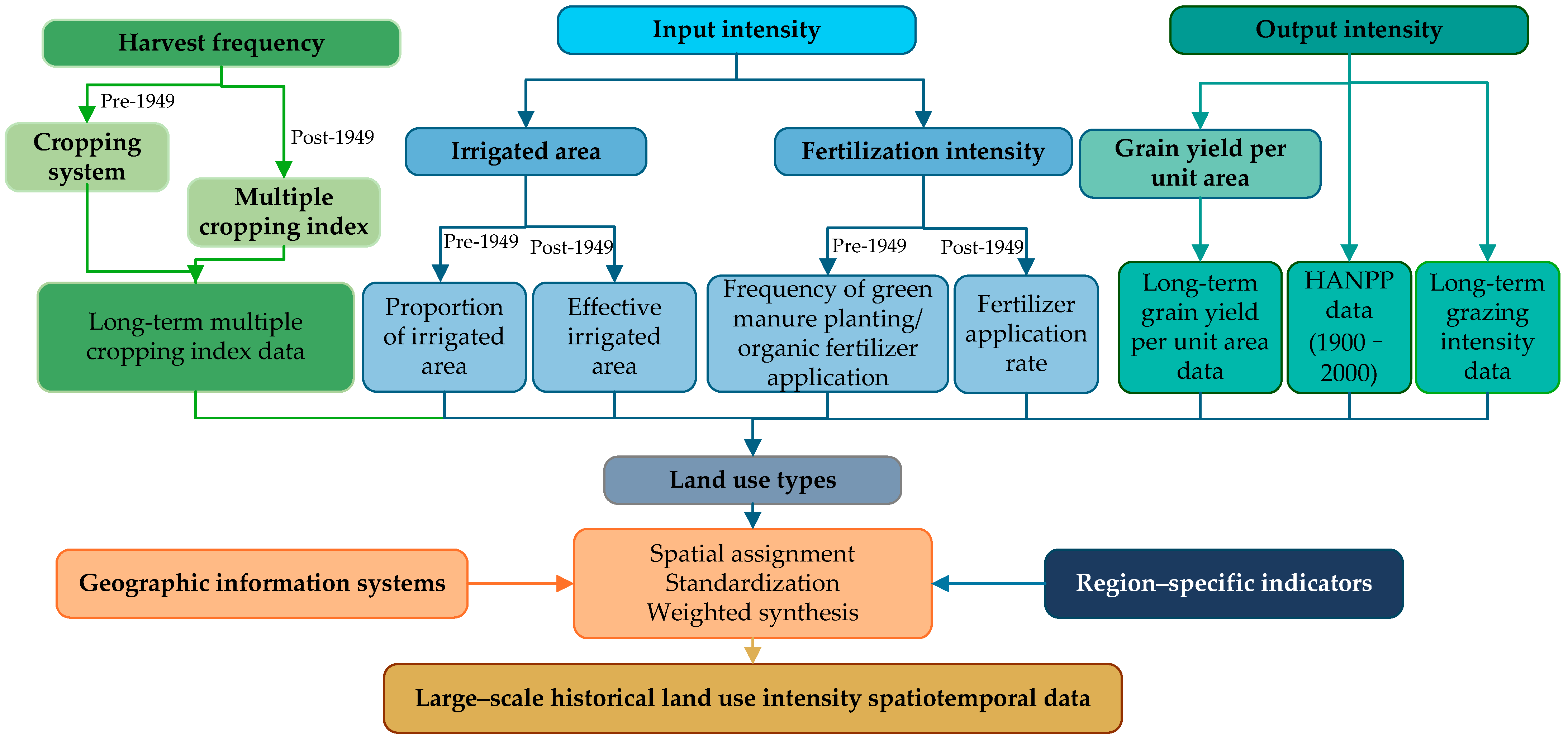
Reconstructing historical land use intensity and analyzing its driving forces are crucial for understanding the impacts of human activities on the environment. This review systematically assesses the research on reconstructing historical land use intensity in China, focusing on four dimensions: land use type, harvest frequency, input intensity, and output intensity. The analysis reveals significant imbalances in the development of these dimensions, with reconstruction methods for land use types being the most mature, while quantitative methods for input intensity remain the weakest. The approaches are generally evolving from qualitative to quantitative analysis. Furthermore, studies on the driving forces behind intensity changes are predominantly qualitative, lacking integrated quantitative analyses of multiple factors. To overcome these limitations, the paper proposes that future research should integrate multi-source proxy indicators to construct a comprehensive, multi-dimensional assessment system. This would enable the spatiotemporal reconstruction of land use intensity and facilitate quantitative analysis of its driving forces using spatial data analysis and machine learning methods.
Keywords: China; historical; land use; land use intensity; harvest frequency; input intensity; output intensity; driving mechanism China; historical; land use; land use intensity; harvest frequency; input intensity; output intensity; driving mechanism