Article

Building Park Cities: Pathways to Enhance Urban Ecological Resilience in the Urbanization Process


by
Yi Lu
1,*,
Kebei Liu
1 and
Rui Li
2
1
Institute for Disaster Management and Reconstruction, Sichuan University, Chengdu 610207, China
2
Business School, Sichuan University, Chengdu 610064, China
*
Author to whom correspondence should be addressed.
Land 2026, 15(5), 886; https://doi.org/10.3390/land15050886 (registering DOI)
Submission received: 17 April 2026 / Revised: 10 May 2026 / Accepted: 18 May 2026 / Published: 20 May 2026
(This article belongs to the Topic Advances in Urban Resilience for Sustainable Futures)

Abstract

Under the global sustainable development agenda, urban ecological resilience serves as a key indicator of park city. This study established a framework of “Retrospective Evaluation–Prospective Simulation–Zoning Control”. The study chose Chengdu and analyzed land-use changes occurring at three-year intervals from 1999 to 2023. A defense–adaptability–recovery framework was applied to assess urban ecological resilience (UER). The study further simulated land use and urban ecological resilience patterns for 2035 under three scenarios, including natural development, ecological conservation, and park city development scenarios. Finally, it coupled UER with land development intensity to delineate ecological zones and propose differentiated strategies. The results showed that (1) historical UER declined then rose, with low UER concentrated in built-up areas and relatively low UER accounting for the largest share. (2) The park city development scenario yielded the highest UER, but showed limited improvement in existing low-resilience built-up areas. (3) Zoning patterns across scenarios were highly similar, dominated by Potential Development Zones. This study identifies the optimal scenario for enhancing UER and offers zoning strategies that can inform park city development in other cities.

1. Introduction

Rapid urbanization worldwide drives economic and social development, but also causes severe ecological challenges [1], including heatwaves, floods, the urban heat island effect [2], habitat degradation, and the loss of ecosystem services [3]. These “urban ills” are now worldwide barriers to human well-being and sustainable development [4]. There is an urgent need to explore a new urban development model that balances human–nature coexistence, economic growth and ecological conservation [5]. To address this challenge, the United Nations 2030 Agenda for Sustainable Development has charted a course for urban development, with urban ecological resilience and sustainable land management emerging as core topics of the post-2030 agenda. As one of the world’s most rapidly urbanizing countries [6], China has entered a phase of high-quality development [7]. The goal of building “the Beautiful China Initiative” by 2035 has been established.
The concept of the park city has emerged in response to current needs and has given rise to a broad international academic network. Developed countries such as the United States and Germany began research into the park city concept at an early stage, and have established major research themes, including urban ecology, ecosystem services and environmental justice [8,9,10,11,12,13]. China, as a country that has vigorously promoted the development of park cities in recent years, first proposed the concept in Chengdu [14], after which it was rapidly rolled out across the nation [15]. More than 70 cities, including Shanghai and Shenzhen, have adopted it and established a solid foundation. Unlike green cities and resilient cities, which integrate ecological conservation into urban development, the park city approach prioritizes ecological conservation above all else [16,17]. Its core objective is to foster an urban form where people, the city, the environment, and industries are integrated in harmony. This concept expands upon theories like the garden city [18] and engages in Sustainable Cities and Communities (SDG 11). It is a new development pathway distilled from China and offers a sustainable urban development model for the world [19]. Hong [18] focused on improving planning methods for green space systems based on the theory of park cities. Zeng [16] assessed the impact of park city development on air quality. Among these, ecological restoration has become a leading international research focus in recent years [15], reflecting the global academic community’s growing attention to the restoration of urban ecosystems and the enhancement of resilience. Research in developed countries has moved beyond local case studies to explore in depth the material, cultural and social benefits of ecosystems [20,21]. However, quantitative research on the ecological conservation principles of park cities remains scarce. Scientific policy planning still requires further support from data, methodologies and empirical evidence. Against this international backdrop, this study introduced the concept of urban ecological resilience to conduct a quantitative assessment of park cities.
In the 1970s, ecosystem resilience was first introduced by Holling [22]. By integrating the concept of resilient cities, the concept of urban ecological resilience has emerged. It refers to the ability of urban ecosystems to absorb, resist, adapt, and recover from disturbance [23]. This concept not only profoundly influences urban sustainable development but also occupies a pivotal position in the global sustainable development agenda [24]. As a crucial dimension of urban development, urban ecological construction faces frequent disturbance from factors such as natural disasters and human activities amid rapid urbanization [25]. Zhang [26] found that rapid urbanization reduces urban ecological resilience and weakens cities’ ability to mitigate and withstand disasters. Xu [27] suggested that urban greening positively affects the urban ecological resilience. As a new direction for urban development [15], the park city is also affected by external disturbances [18]. Bai [15] pointed out that the development of park cities in China faces three major challenges, including spatial patterns, ecological functions and human settlements. These challenges correspond directly to the disturbances and shocks that the urban ecological resilience of park cities is designed to address. Specifically, the spatial pattern challenge relates to land-use conversion driven by urbanization, the ecological function challenge involves the degradation of ecosystem services, climate change such as heatwaves and air pollution [9,13], and the human settlement challenge reflects the pressures of population concentration and the expansion of built-up areas. These external factors all impact urban ecological resilience. The park city prioritizes ecological value by optimizing the ecological environment through land use [28]. This enhances ecosystem resilience to disturbance and promotes sustainable development [19]. An ecosystem’s capacity to preserve structural and functional stability is measured by urban ecological resilience. This provides a basis for realizing ecological value and informing spatial planning. Therefore, this study introduces the concept of urban ecological resilience, systematically assesses it in the context of park cities, reveals its spatiotemporal evolution, and proposes enhancement strategies.
Research on urban ecological resilience is primarily conducted within the framework of urban resilience, with different theoretical frameworks developed to address specific objectives [29]. There have been studies adopting an ecological perspective to examine system states and thresholds, focusing on tipping points [30]. While some studies have been focusing on the driving factors of urban ecological resilience, employing methods such as GeoDetector and machine learning [31], a growing number of studies have been constructing indicator systems to systematically assess urban ecological resilience levels and analyze their spatiotemporal variations, including perspectives on urban composition and the concept of urban ecological resilience [32]. Liang [33] adopted a socio-ecological indicator system to avoid the limitations of a single ecological perspective. Feng [34] focused on the vulnerability–sensitivity–self-organization framework. Lan [35] developed the resistance–adaptability–resilience (RAR) framework and further built the driving–resistance–adaptability–resilience (DRAR) evaluation system. These frameworks serve different research domains and objectives. However, resilience-building in park cities focuses not only on ecosystem self-sustainability but also on integrating system adaptation and reorganization to achieve sustainable development. The resistance–adaptability–resilience framework [36,37], grounded in the concept of ecological resilience, comprehensively covers the entire process by which ecosystems respond to disturbance. It not only serves the core of ecological resilience theory but also aligns with the essence of park cities. Therefore, this study adopts the defense–adaptability–recovery indicator assessment framework.
As the physical foundation of ecosystems, land-use change directly shapes the spatiotemporal variation in urban ecological resilience. The concept of the park city, which emphasizes a people-centered approach and the creation of livable spaces, is inextricably linked to land-use planning [15]. The realization of such livable spaces fundamentally depends on the stability and functionality of the urban ecosystem. Consequently, evaluating the target system for the urban ecological resilience of park cities, namely, the urban ecosystem based on land cover, is crucial for assessing whether the development of park cities effectively achieves its core objectives. Wu [38] used the PLUS model to simulate future land use under three scenarios, including SSP1-2.6, SSP2-4.5, and SSP5-8.5, and calculated ecological resilience. Cai [39] also applied the PLUS model to simulate future land use in energy zones and calculated ecological resilience, finding that the ecological conservation scenario is the most critical path in enhancing urban ecological resilience. Overall, the PLUS model [40], which integrates LEAS and CARS, can be used to simulate land-use changes. It effectively simulates the dynamic evolution of various land-use patches under different policies, providing support for the simulation of the three scenarios in this study, including natural development, ecological conservation, and park city development scenarios.
The land development intensity measures the extent of land development and utilization, specifically focusing on the ratio of built-up area to total land area [41]. Tan [42] argued that the proportion of impervious surfaces is a determinant of land development intensity. Referring to the “National Major Function Area Planning”, this study uses the proportion of impervious surfaces to total land area as the indicator of land development intensity. This indicator typically exhibits a negative correlation with urban ecological resilience, as excessive land development disrupts ecological balance and stability [43,44]. Balancing land development with ecological protection is essential. Refined ecological management and optimized spatial planning can be achieved through ecological zoning [45], providing a basis for building ecological resilience in park cities.
This study establishes a theoretical framework “Retrospective Evaluation–Prospective Simulation–Zoning Control” to support planning practices for park cities. It applies the defense–adaptability–recovery assessment framework to quantify urban ecological resilience (UER). The PLUS model was used to simulate land-use patterns for 2035 under different scenarios and assess UER. Finally, it delineates differentiated ecological spatial control zones for Chengdu. This framework addresses three core questions in park city development. (1) What is the historical trajectory of UER? (2) What will future UER look like under different scenarios? (3) How can precise spatial regulation be implemented? The aim is to provide direct scientific evidence and decision-making support for the high-quality development of Chengdu Park City Demonstration Zone.

2. Research Framework and Selection of Indices

2.1. Research Framework

Ecology serves as both the spatial foundation and functional carrier of park city development [18]. Restoring and protecting ecosystems enhances UER [46]. Conversely, improving UER supports the sustainable development of park cities. Research on park cities has shifted from the static concept of ecological urban development to that of dynamic ecological restoration and sustainable cities [15]. This evolution reflects the recognition that enhancing the UER of park cities is a long-term, dynamic process [31]. It requires tracing historical patterns of evolution, forecasting future trends under different policies to optimize spatial layouts, and translating assessment results into differentiated governance strategies to guide practice. A single assessment of the current status is insufficient to meet these systemic demands. Therefore, this study constructs a theoretical framework of “Retrospective Evaluation–Prospective Simulation–Zoning Control” (Figure 1). Retrospective Evaluation traces the evolution of UER of park cities through nine key time points (1999–2023), analyzing the characteristics of changes in land use and UER to capture their historical dynamics. Prospective Simulation predicts the spatial patterns and evolutionary trends of park city resilience under different scenarios, specifically natural development, ecological conservation and park city development scenarios. It simulates competitive land-use transitions and evaluates future UER. Finally, the Zoning Control component translates the assessment and simulation results into spatial governance strategies, offering differentiated management directions and policy recommendations. This analytical framework provides a systematic research approach for assessing and optimizing UER in park cities. It incorporates the temporal dimension, which is crucial to advancing research on park cities [15,46], ensuring that the assessment of UER is neither static nor one-dimensional, but rather captures both historical evolution and future trajectories.

2.2. Selection of Indices

Ecological defense (ED) refers to the ability of urban systems to withstand internal and external shocks while maintaining structural and functional stability [37]. It constitutes the core of UER. Ecosystem service value forms the foundation of this resilience, as it directly quantifies the system’s contribution to human well-being [47]. Therefore, ecosystem service value is used to assess ED. Ecological recovery (ER) refers to the ability of urban ecosystems to self-repair and restore their original functions after suffering natural and human-induced disturbances. Ecological elasticity is a key indicator of ecosystem resilience following disturbance [48]. It characterizes the speed and capacity of the system to return to a stable state after disturbance. This index directly reflects ecosystem health and stability. A higher coefficient value indicates stronger self-repair capacity and faster recovery from disturbance. And the environmental quality index (EQI) is currently the primary method used to measure ecological and environmental quality. It quantitatively reflects the overall status of ecological and environmental quality in a given region across different time periods, comprehensively reflecting the baseline condition of the ecosystem, a condition that determines the system’s ability to adapt to changing conditions [49]. A higher EQI indicates a healthier and more stable ecosystem, implying a greater capacity to adapt to environmental changes and disturbances. Therefore, the EQI has been selected as the indicator for assessing the ecological adaptability (EA) [50]. The indicators are shown in Table 1.

3. Materials and Methods

3.1. Study Area

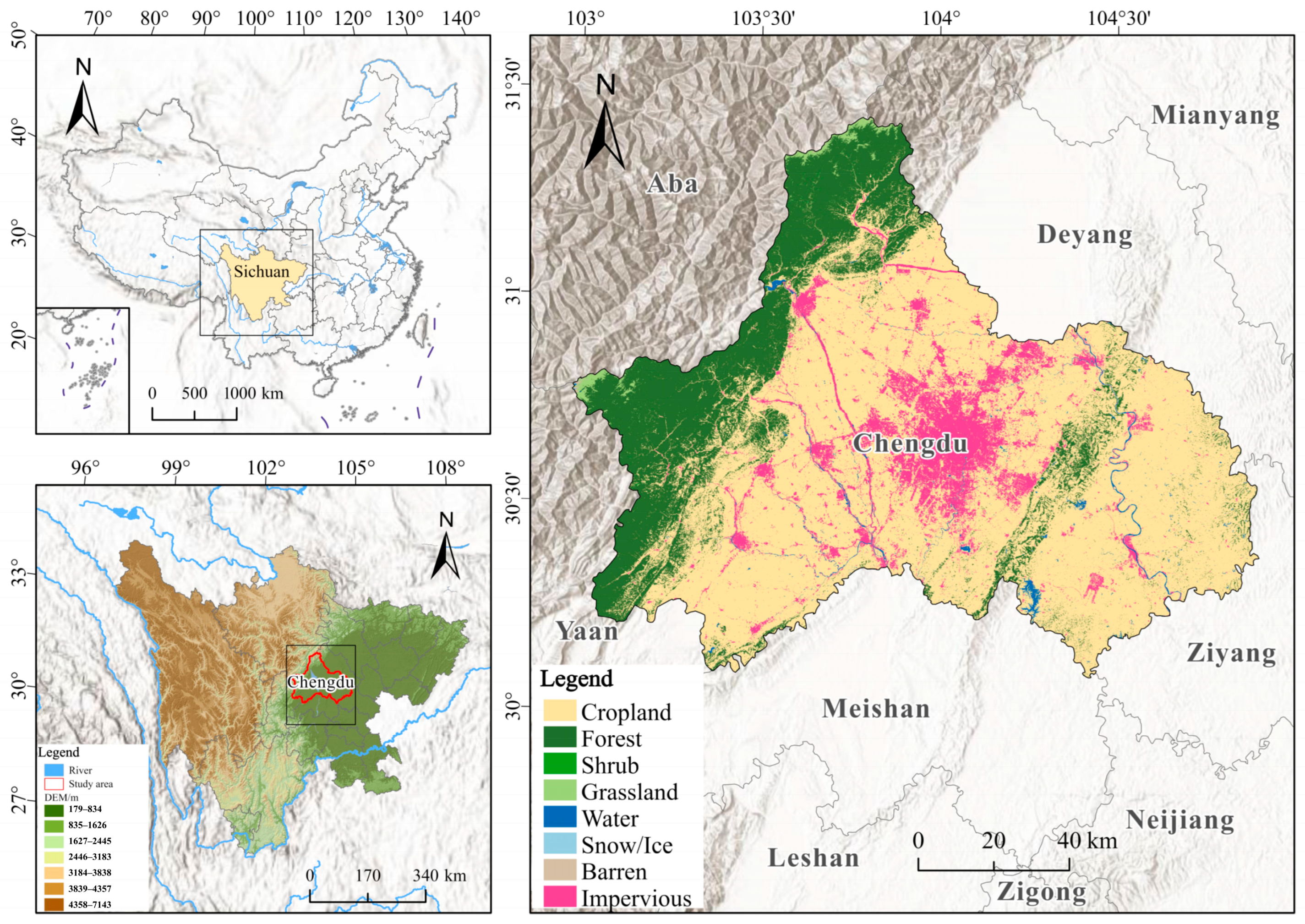
Chengdu is located in the western part of the Sichuan Basin (102°54′–104°53′ E, 30°05′–31°26′ N) (Figure 2). It is a core city in Southwest China, serving as the capital of Sichuan Province and a national central city. As the birthplace and pilot demonstration zone of China’s park city concept [19], Chengdu first proposed the concept in 2018. The concept was subsequently incorporated into the “Urban master plan of Chengdu (2016–2030 years)” and elevated to a national strategic positioning for the city. Chengdu features a unique natural backdrop described as “A Park City Blessed with Snow Mountains” alongside a massive population and economic scale. It is also a typical highly urbanized region in western China, with highly dense construction land in the central urban area [51]. Its land-use structure has largely taken shape, and traditional ecological conservation strategies alone cannot effectively enhance its urban ecological resilience. Therefore, Chengdu offers valuable implications for the sustainable development of densely populated megacities in China and worldwide [52].
Using Chengdu as a case study to conduct an in-depth exploration of changes in urban ecological resilience in rapidly urbanizing regions not only holds practical significance for Chengdu’s development as a park city, but also provides important theoretical insights and practical guidance for similar cities seeking to promote harmony between humans and nature.

3.2. Data Resources

The research data in this paper are mainly land-use data, the data for calculating UER and the driving factor data needed for the PLUS model. The specific research data are shown in Table 2.
This study used land-use data to calculate a land-use transition matrix, which was then combined with data on cropland area, yield, and agricultural product prices to estimate UER. The results were then spatially visualized. The study divided the urban area into 1 km × 1 km grid cells, extracted the land area of each grid cell using ArcGIS 10.6, and calculated the land development index and UER. The PLUS model used land-use data, natural factors (e.g., temperature and precipitation), and social factors (e.g., population and GDP). For GDP data, nighttime light images from the 1 km × 1 km DMSP-OLS NLTS product (2000–2013) were combined with the gridded LandScan population dataset (2008) to spatially disaggregate provincial GDP (2000–2013) to the pixel level. The decomposed GDP time-series data were then smoothed using the Holt–Winters method to obtain GDP values for the 1 km × 1 km grid cells in 2020.

3.3. Urban Ecological Resilience

Ecosystem service value in Chengdu was estimated by Costanza [55] and modified by Xie [56]. First, based on the value of equivalence factors and the conclusion that the value of a single equivalence factor is 1/7 of the grain value per unit area [57], we calculated the standard economic value equivalence coefficient for ecosystem services, specifically the unit equivalence factor value E t , using data from the Chengdu Statistical Yearbook and the National Compendium of Agricultural Product Costs and Benefits and Income Data. Subsequently, based on China’s Consumer Price Index (CPI) data from the China Statistical Yearbook, we introduced the cumulative CPI adjustment factor C P I t [58] to obtain the adjusted value E t . Using the cumulative CPI index value for 1979 as a reference, the economic value for each year was converted to the economic value for 2023 to account for inflation. Subsequently, the economic service value equivalents for various ecosystem services across different land-use types were calculated based on the Chinese Ecosystem Service Equivalence Table per Unit Area (Table 3).
The calculation formula for E D is as follows, which was determined with reference to Costanza [55], Xie [56], Hu [57] and Li [58]:
E D = E S V = i = 1 n A i × V C i
V C i = j = 1 k E C j × E t
E t = 1 7 × Q t M t
E t = E t × C P I t
where E D is the ecological defense characterized by the E S V function. i is land-use type. j is the type of ecosystem services. A i is the area of land-use type i . V C i is the ecosystem services value per unit area of land-use type i . E C j is the ecosystem services equivalent value per unit area of land-use type j . k is the number of ecosystem service types. E t is the value for unit equivalent factor. E t is the corrected value for unit equivalent factor. Q t is the total output value of major food crops in the year t . M t is the cultivation area of main grain crops in the year t . C P I t is the cumulative CPI index adjustment factor for year t .
ER used in this study was selected based on Peng [48]. In accordance with the definition of recovery, the values for shrubland and grassland were set to fall between those of cropland and forest (Table 4).
The calculation formula for E R is as follows, which was determined with reference to Peng [48]:
E R = E E = i = 1 n A i × R C i
where E R is the ecological recovery characterized by ecological elasticity ( E E ). A i is the area of land-use type i . R C i is the coefficient of ecological recovery of land-use type i . n is the number of land-use types.
Using the environment quality index [50] as an indicator of EA (Table 5).
The calculation formula for E A is as follows, which was determined with reference to Liu [50]:
E A = E Q I = i = 1 n A i A k R i
where E A is the ecological adaptability characterized by environment quality index ( E Q I ). A i is the area of land-use type i . R i is the coefficient of ecological adaptability of land-use type i . n is the number of land-use types.
Since ED, EA, and ER were calculated using different units, the results were normalized to the range [0, 1] before calculating UER. Following Ebert [59], multiplicative arithmetic was adopted to fully account for intrinsic correlations between indicators and better reflect their interactions [60].
The normalized formula is as follows, which was determined with reference to Zhang [60]:
X = X X min X max X min
where X is the normalized indicator value, dimensionless, ranging from [0, 1]. X is the original value of the indicator. X max is the maximum value of the indicator across all evaluation units. X min is the minimum value of the indicator across all evaluation units. E D , E A , and E R are all positive indicators. Larger values indicate stronger ecological resilience. So the positive indicator normalization formula is applied to all three.
The calculation formula for U E R is as follows, which was determined with reference to Ebert [59] and Zhang [60]:
U E R = E D × E R × E A 3
where U E R is the urban ecological resilience. E D is the ecological defense. E R is the ecological recovery. E A is the ecological adaptability.

3.4. Land-Use Change Simulation Based on the PLUS Model

To assess potential future changes in UER under Chengdu’s park city development goals, it is essential to scientifically predict its spatially explicit evolution. This study employs the PLUS model to simulate Chengdu’s land-use pattern in 2035. This land-use pattern constitutes the spatially explicit component of the urban ecosystem, determines the capacity to deliver ecological processes and services, and serves as a key driver of UER. The PLUS model is a patch-generating model specifically designed to simulate land-use changes. By integrating the LEAS and CARS modules, it offers higher simulation accuracy compared to existing CA models [40]. The LEAS module employs a random forest algorithm to conduct in-depth analysis of land-use data from two time periods, identifying the spatial development probabilities of various land-use types and the specific drivers of their expansion. The CARS module combines random seed generation with a threshold-decreasing mechanism to dynamically simulate the automatic generation of land-use patches across time and space, constrained by the development probabilities of each land-use type [61].

3.4.1. Driving Factors

Based on the above analysis, nine driving factors were chosen for simulating land use in 2035 (Table 2), taking into account their availability, accuracy, and scientific validity [40,62].

3.4.2. Parameter Settings

The neighborhood weight parameter indicates the expansion intensity of a land cover class, with a range of 0 to 1. The closer the value is to 1, the stronger the expansion capacity of that land cover class, and the less likely it is to be converted into other land cover classes. Cropland, forest, shrub, grassland, water, snow/ice, barren and impervious were set to 0.7, 0.4, 0.3, 0.3, 0.2, 0.1, 0.1, 0.9 [63]. The parameters of the CARS model are as follows. The neighborhood size was set to 3. The number of parallel threads was set to 20. The patch generation threshold was set to 0.9. The expansion coefficient was set to 0.1. The percentage of seeds was set to 0.0001 [63].

3.4.3. Accuracy Verification

This paper utilized the Markov chain module of the PLUS model to forecast land-use figures for 2020 and employed the CARS module of the PLUS model to predict the spatial distribution for 2020. With regard to the forecast land-use structure, this study utilizes the Markov chain module [64] of the PLUS model to forecast the demand for different land-use types in 2020 and compares these figures with the actual land-use figures for 2000. The error rates for the three major land categories, cropland, forest and impervious, were −0.351330%, −0.456927% and 0.604017% respectively, all within 0.61%. The error rate for water was 0.268188%, which is also highly accurate. For land categories with smaller area proportions, such as grassland, barren, shrub and snow/ice, the absolute values of the error ratios did not exceed 0.05%, indicating satisfactory prediction results. Overall, the absolute values of the error ratios for all eight land categories were less than 0.61%, demonstrating that the Markov chain model provides highly accurate predictions of land-use quantities for 2020 and can effectively support the spatial simulation of the PLUS model (Table 6) [40]. From a spatial perspective, an analysis of the spatial overlay between the 2020 land-use simulation results and actual data, using statistical validation methods, yielded a Kappa coefficient of 0.77 and an overall accuracy of 88%. Both indicators exceeded the statistical significance threshold of 0.75 [65]. The FoM coefficient was 0.29. Relevant studies have shown that a higher FoM coefficient indicates a better model [66]. The validation results indicate that the PLUS model demonstrates good simulation validity in terms of both quantitative and spatial pattern reconstruction and is suitable for the predictive analysis of future land-use trends in the study area by 2035 [64].

3.4.4. Multi-Scenario Settings

To investigate land-use changes in Chengdu under different development objectives, this study conducted a detailed simulation of the competition and conversion processes among various land-use categories, particularly key resilient land types such as impervious surfaces and forest, under different policy constraints. We established three scenarios, including natural development, ecological conservation, and park city development scenarios. From the perspectives of development, security, and ecology, the study predicted Chengdu’s land-use spatial pattern for 2035 [67,68]. When conducting multi-scenario land-use simulations with the PLUS model, scenarios were primarily configured by adjusting the land-use conversion cost matrices and the demand for each land type in the target year [69].
The land-use transition matrix defines the constraints governing whether land can be converted between different land-use categories in the PLUS model. A value of ‘1’ indicates that conversion is permitted, and a value of ‘0’ indicates that it is prohibited [70]. The three scenarios were defined as follows. Under the natural development scenario, the conversion of water into certain land-use categories was restricted, as water is unlikely to naturally transition into other land-use categories. This served as a baseline without policy intervention [70], designed to reveal the ecological risks associated with the inertial expansion of urbanization. Under the ecological protection scenario, conversion of forest and grassland into other land categories was prohibited to simulate the ecology-first policy orientation [71,72]. The park city development scenario, building upon the ecological protection framework, further restricted the conversion of arable land into water, snow/ice, and barren land, permitting the conversion of barren land into ecological land such as forest, shrubland and grassland. This reflects the integrated management of ecological and productive spaces under the park city’s philosophy of ecology-first and green development. The transition matrix set is as shown in Table 7. Land demands are as shown in Table 8.
Under the ecological conservation scenario, to safeguard regional ecological security and in accordance with the study area’s land development policies, areas that have a significant impact on the ecological environment, such as forest, grassland, and water, should be strictly protected, and large-scale development and utilization of these areas should be prohibited. Accordingly, ecological conservation areas were designated as restricted conversion zones. When forecasting land-use demand, the probability of converting forest land and grassland into impervious surfaces was reduced by 20%, and that of converting water into impervious surfaces was reduced by 30%. Under the park city development scenario, drawing on Chengdu’s “Regulations on the Construction of a Beautiful and Livable Park City” and relevant ecological and farmland protection policies, ecological protection zones and cropland with a slope of less than 6% were designated as restricted conversion zones. The probability of conversion from forest, shrub, grassland, and cropland to impervious surfaces was reduced by 60%, 30%, 30%, and 20%, respectively, while the probability of conversion from barren land to forest was increased by 30%.

3.5. Zoning Control

This study employed a four-quadrant model to explore the relationship between these two factors. Based on Z-score-adjusted UER and land development intensity [73], four quadrants were defined and represented distinct ecological zones. The “high resilience–low development intensity” quadrant constituted an Ecological Conservation Zone, where intact ecological foundations formed the core of the regional ecological security framework. The “high resilience–high development intensity” quadrant served as an Optimization and Enhancement Zone, maintaining a high level of UER despite high development intensity and serving as a model for resilience-building in high-density urban areas. The “low resilience–low development intensity” quadrant was a Potential Development Zone, possessing the spatial capacity and potential for ecological restoration and resilience enhancement. And the “low resilience–high development intensity” quadrant was a Priority Remediation Zone, where ecological space was squeezed by urban development and thus requires comprehensive remediation. By identifying regional conditions through ecological zoning and formulating corresponding ecological management strategies, this approach provided feasible spatial action guidelines for the planning, construction, and management of park cities.
The formula for land-use intensity is as follows, which was determined with reference to Huang [43] and Tan [44]:
L D I = A i m p e r v i o u s A t o t a l × 100 %
where L D I represents the land development intensity, A i m p e r v i o u s represents the area of impervious surfaces within the grid, and A t o t a l is the area of a single grid.
The standardization formula is as follows, which was determined with reference to Huang [47]:
μ = 1 n i = 1 n x i
σ = 1 n i = 1 n x i μ 2
Z = X μ σ
where x i represents the U E R and land development intensity values of the i th grid, X denotes the standardized U E R and land development intensity values for each grid, μ is the mean of the study area, σ is the standard deviation for the study area, and n is the total number of grids.

4. Results

4.1. Spatiotemporal Changes in Land Use from 1999 to 2023

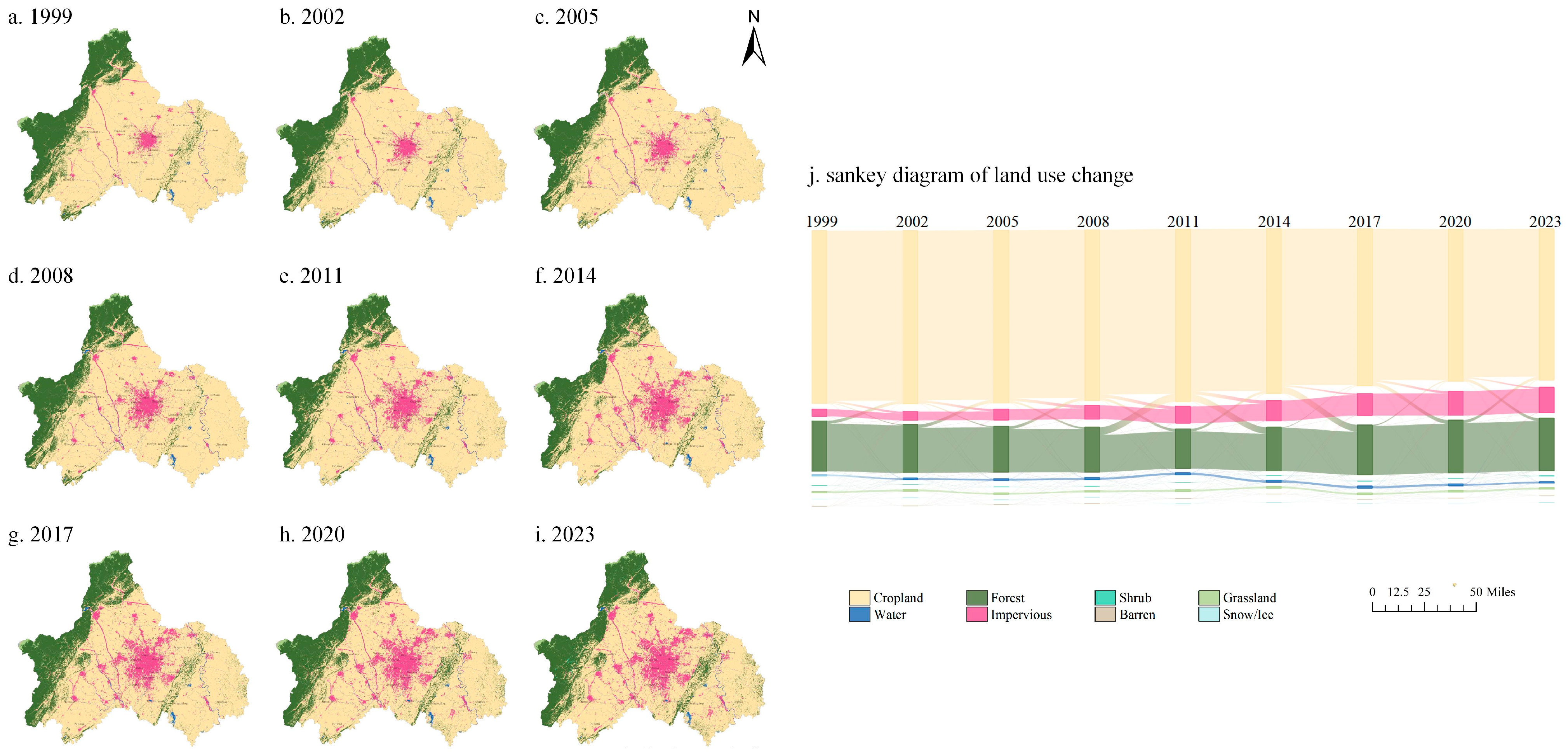
As shown in Figure 3, cropland and forest dominated Chengdu’s land-use structure throughout the study period, together accounting for over 87% of the total study area. Between 1999 and 2023, rapid urbanization drove farmland conversion, reducing cropland area from 10,593.60 km2 to 9275.09 km2, a reduction of 12.45%. However, the rate of decline has gradually slowed. This decline reflects the dynamic interplay between urban expansion and cropland protection policies. This trend was also evident in the rapid expansion of impervious surfaces, which grew from 431.39 km2 to 1577.66 km2, representing a 265.72% increase over the 24-year period. The most significant expansion occurred in the central urban area of Chengdu, radiating outward from the city center. Owing to initiatives such as the “Grain for Green” program, and driven by park city goals that promoted the valorization of ecological assets, the total area of forest and grassland has increased. Meanwhile, shrubland has exhibited a consistent upward trend, primarily concentrated in the Longquan Mountains.

4.2. Spatiotemporal Changes in UER from 1999 to 2023

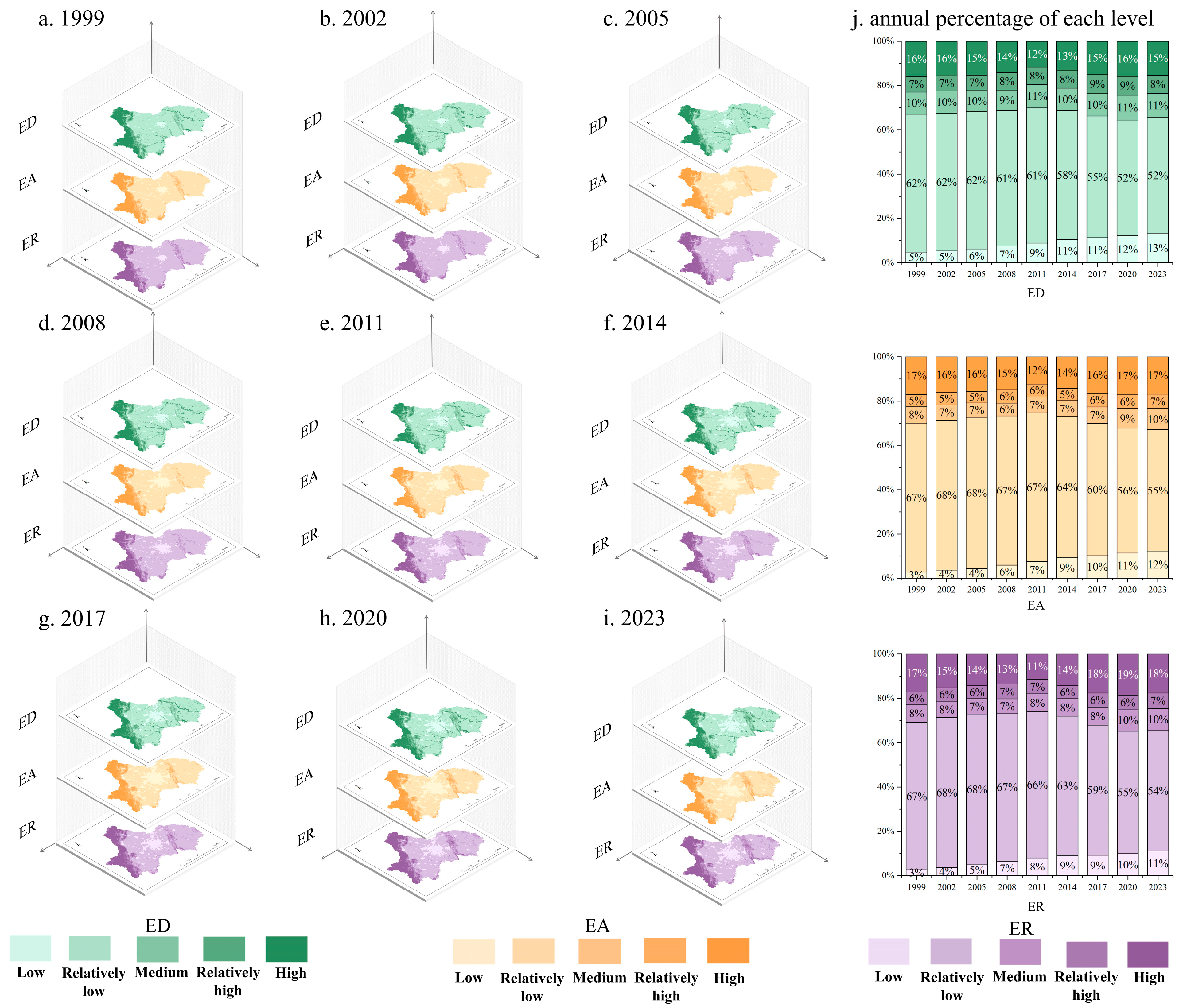
Based on the eight land-use types and the adjusted value coefficients, this study calculated the total value of ecosystem services for the period 1999–2023. The proportion of relatively low ED was the highest and showed a decreasing trend. The share of low ED increased from 5% to 13%, while other categories remained largely stable. Spatially, ED exhibited a distinct pattern, which was high in the western region, and low in the central and eastern areas. Higher ED areas were concentrated in the western Longmen Mountains and eastern Longquan Mountains. These zones are dominated by forest and other ecological land types, characterized by minimal human disturbance, high vegetation coverage, and a favorable ecological environment. In the central region, low ED values were concentrated in built-up areas, where population density is high.
EA showed the highest proportion of relatively low levels, with a decreasing trend. The proportion of low EA has been rising year by year, while high values first decreased and then increased. Spatially, EA followed a pattern of high values in the west and low values in the central region. Due to the urbanization process, the expansion of towns in the central region led to an increase in the area of low EA. Chengdu issued the “Chengdu 12th Five-Year Plan for Environmental Protection” in 2011. During this period, the ecological and environmental quality of the study area improved.
The proportion of areas with low ER remained the highest, with the share of relatively low ER increasing, while the share of high ER first decreased and then increased. The proportions of other categories have remained largely stable. Spatially, ER also exhibited a distribution pattern characterized by high ER in the west and low ER in the central region. Between 1999 and 2008, high ER areas in the Longquan Mountains contracted, but subsequently expanded slowly. In the central region, areas of high ER extended outward from the city center (Figure 4).
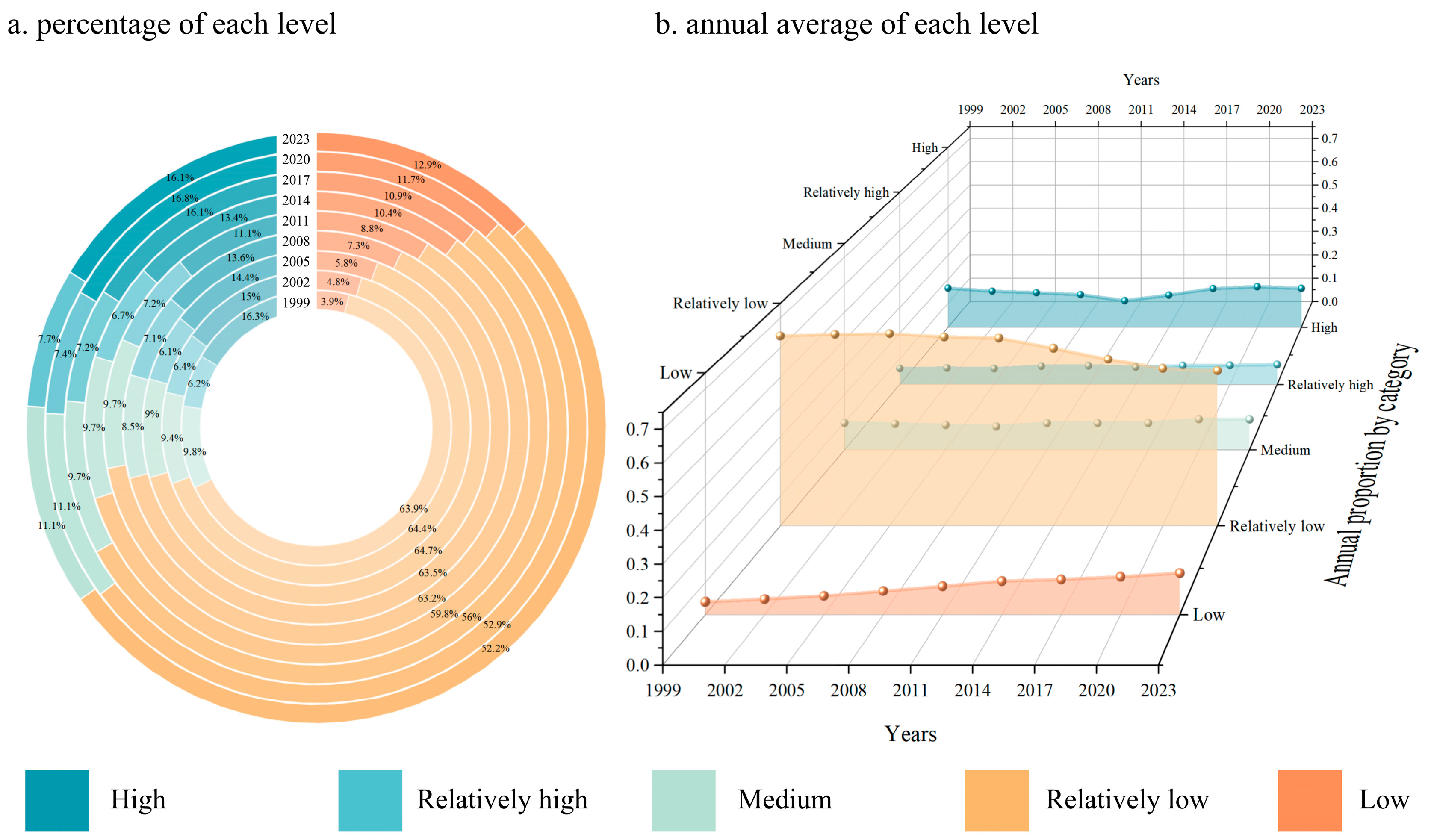
Using 1999 as the baseline and applying the natural breaks (Jenks) method to classify UER into five levels, the mean UER from 1999 to 2023 first decreased and then increased. Between 1999 and 2011, UER declined cumulatively by 11.81%. This was primarily due to the rapid urbanization during this period, which led to the large-scale encroachment on ecological land, thereby undermining the resilience and recovery capacity of ecosystems. Between 2011 and 2023, it increased cumulatively by 11.84%. This was primarily due to the elevation of ecological civilization to a national strategy and the introduction of the park city concept, which have effectively enhanced UER. In terms of areal composition, UER was predominantly characterized by a relatively low level, which consistently accounted for over 50% of the total area (Figure 5). During the study period, the proportion of areas with low UER showed a gradual increase, from 3.92% to 12.89%. The proportion of areas with relatively low UER first stabilized and then gradually decreased, falling from 63.90% to 52.23%, a decrease of 18.25%. The proportions of areas with medium and relatively high UER both rose by 13.27% and 24.37%, respectively, demonstrating the positive impact of environmental protection policies on enhancing UER. The proportion of areas with high UER first decreased and then increased. The area decreased by 31.70% between 1999 and 2011 and increased by 45.50% between 2011 and 2023. This was attributable to the implementation of subsequent ecological restoration projects and the restoration of ecological connectivity.
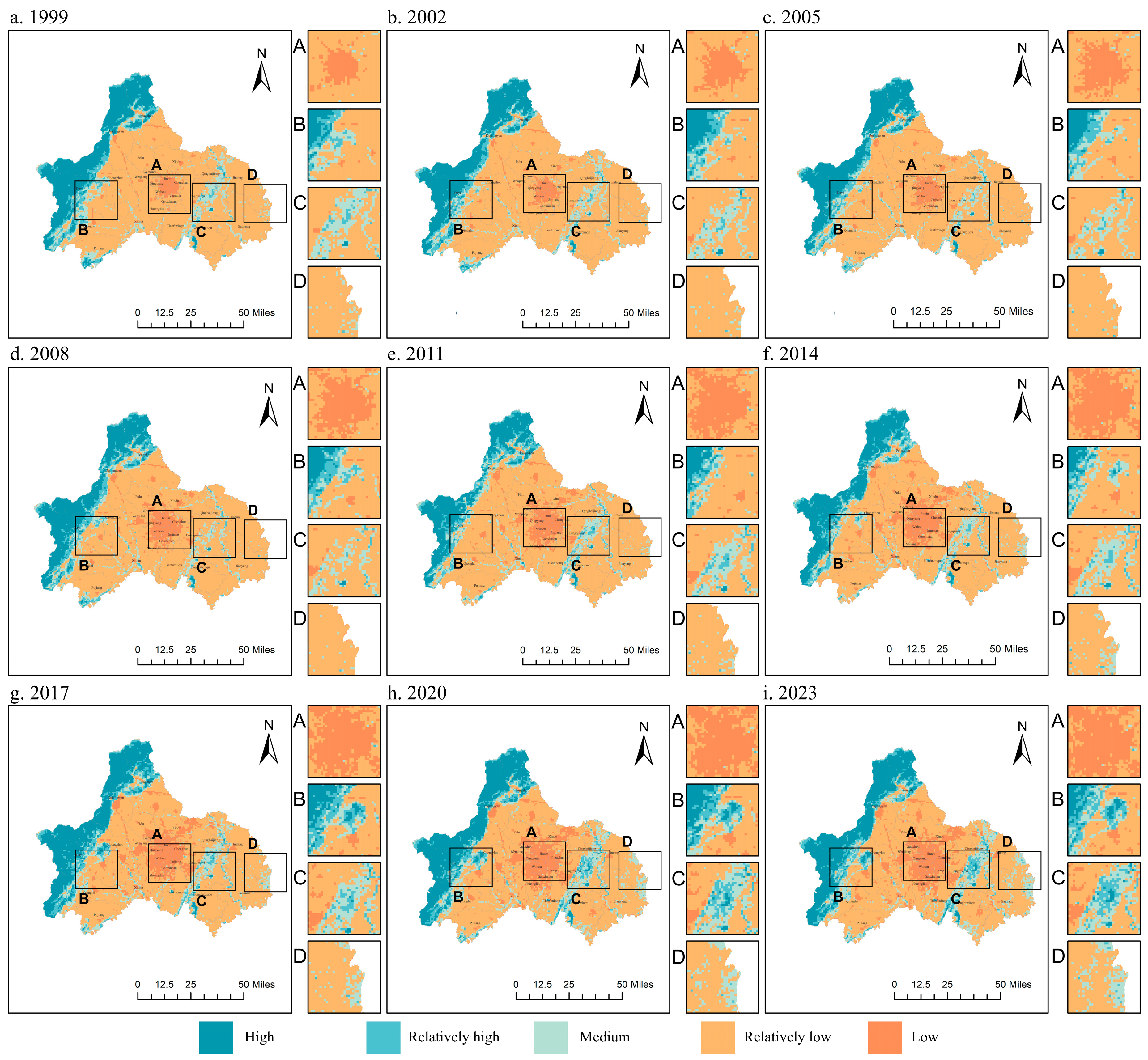
Spatially, low UER was primarily distributed within the central urban area of Chengdu, expanding outward from the city center over time (Figure 6). This expansion can be attributed to urbanization-driven conversion of extensive cropland to impervious surfaces, which diminished UER. UER in Chongzhou and Dayi counties has increased progressively over time. This increase is primarily attributable to their proximity to the Longmen Mountains and their designation as part of the “National Key Ecological Function Zones” and the “Giant Panda National Park”. Consequently, large-scale industrial development and urban construction have been strictly restricted. Concurrent efforts to protect and restore traditional western Sichuan courtyard villages have strengthened ecological resilience structures and biodiversity. High UER areas were primarily distributed in the Longquan Mountains, with their spatial extent expanding annually. This is because Chengdu’s “Eastward Expansion” strategy has elevated the ecological status of the Longquan Mountains, strictly controlling development, implementing vegetation restoration, increasing ecological land, and enhancing ecosystem quality and stability. UER increased across southeastern Jintang County and northeastern Jianyang City. This trend is primarily attributable to their location east of the Chengdu Longquan Mountains Urban Forest Park, where they benefited from its spillover effects.

4.3. Land-Use Changes Under Different Scenarios by 2035

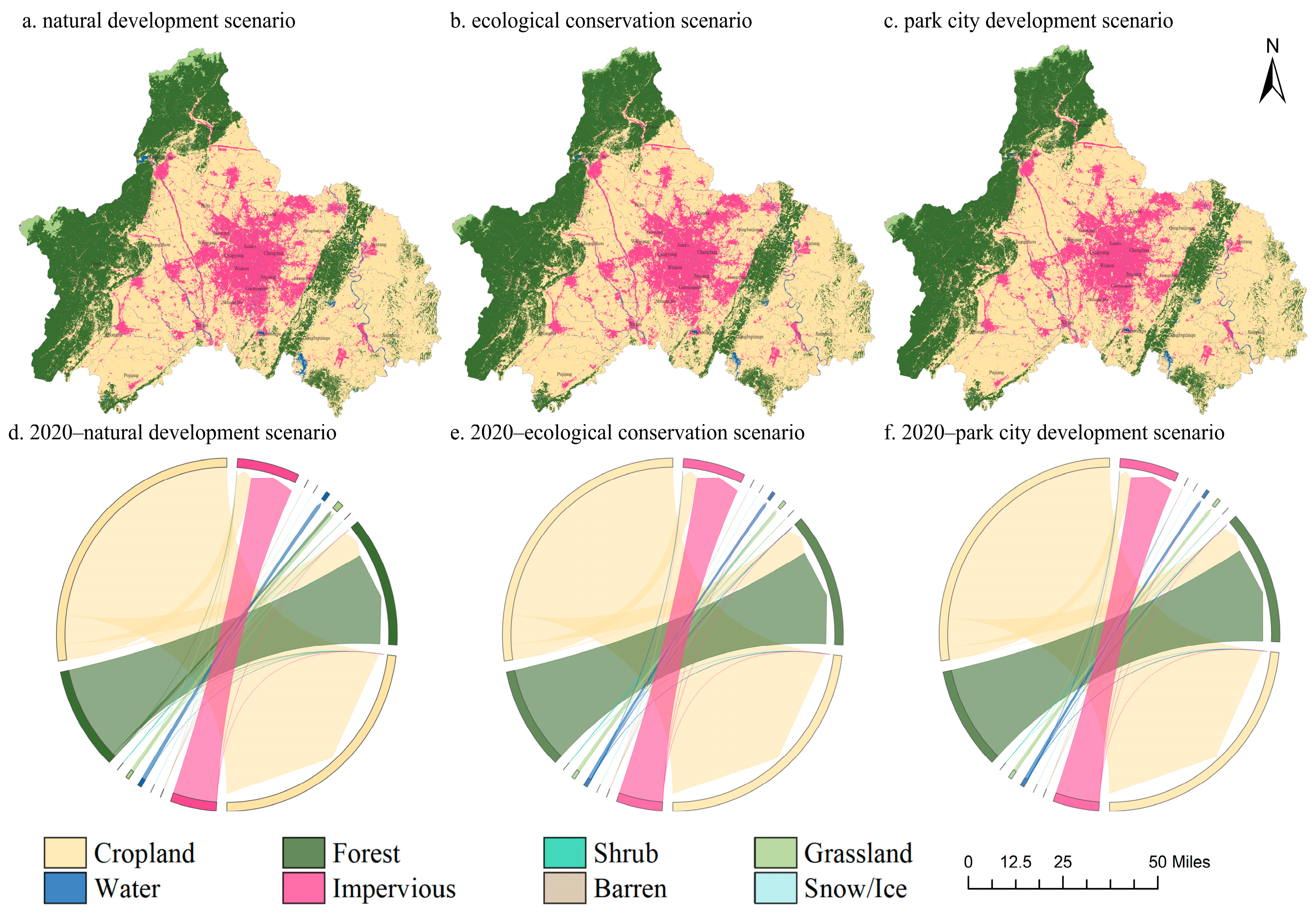
Based on land-use simulations for the natural development scenario in 2035 using the PLUS model, land-use changes in the study area between 2020 and 2035 were primarily concentrated among cropland, forest, and impervious surfaces (Figure 7). Cropland experienced substantial losses, with 935.75 km2 converting to forest and 531.85 km2 converting to impervious surfaces. Spatially, impervious surfaces expanded outward from the built-up area of Chengdu, encroaching on cropland. Urbanization remained the dominant driver of land-use change, while forest expansion was concentrated primarily in the Longquan Mountains area.
Under the ecological conservation scenario, cropland continued to decline. Specifically, 524.04 km2 of cropland converted to construction land, while 948.69 km2 transitioned to forest. Spatially, impervious surfaces continued to expand outward from the built-up area of Chengdu. Compared to the natural development scenario, forest expansion remained concentrated primarily in the Longquan Mountains region but occurred on a larger scale.
Under the park city development scenario, the total area of cropland continued to decline, with 959.31 km2 converting to forest and 421.63 km2 converting to construction land. However, compared to the ecological conservation scenario, cropland has increased while impervious surfaces have decreased. This indicates that park city development policies have effectively curbed the uncontrolled expansion of impervious surfaces. Spatially, impervious surfaces continued to expand outward from the central urban area. However, compared to the ecological conservation scenario, this expansion was somewhat mitigated at the edges of the built-up area. Forest expansion remained concentrated in the Longquan Mountains area, with no significant changes compared to the ecological conservation scenario. Under this scenario, land-use changes were more aligned with the future development of park cities than those under a single ecological conservation approach. This suggests that park city policies can effectively regulate land use and yield greater comprehensive benefits than traditional ecological conservation strategies.

4.4. Simulation of UER Under Different Scenarios by 2035

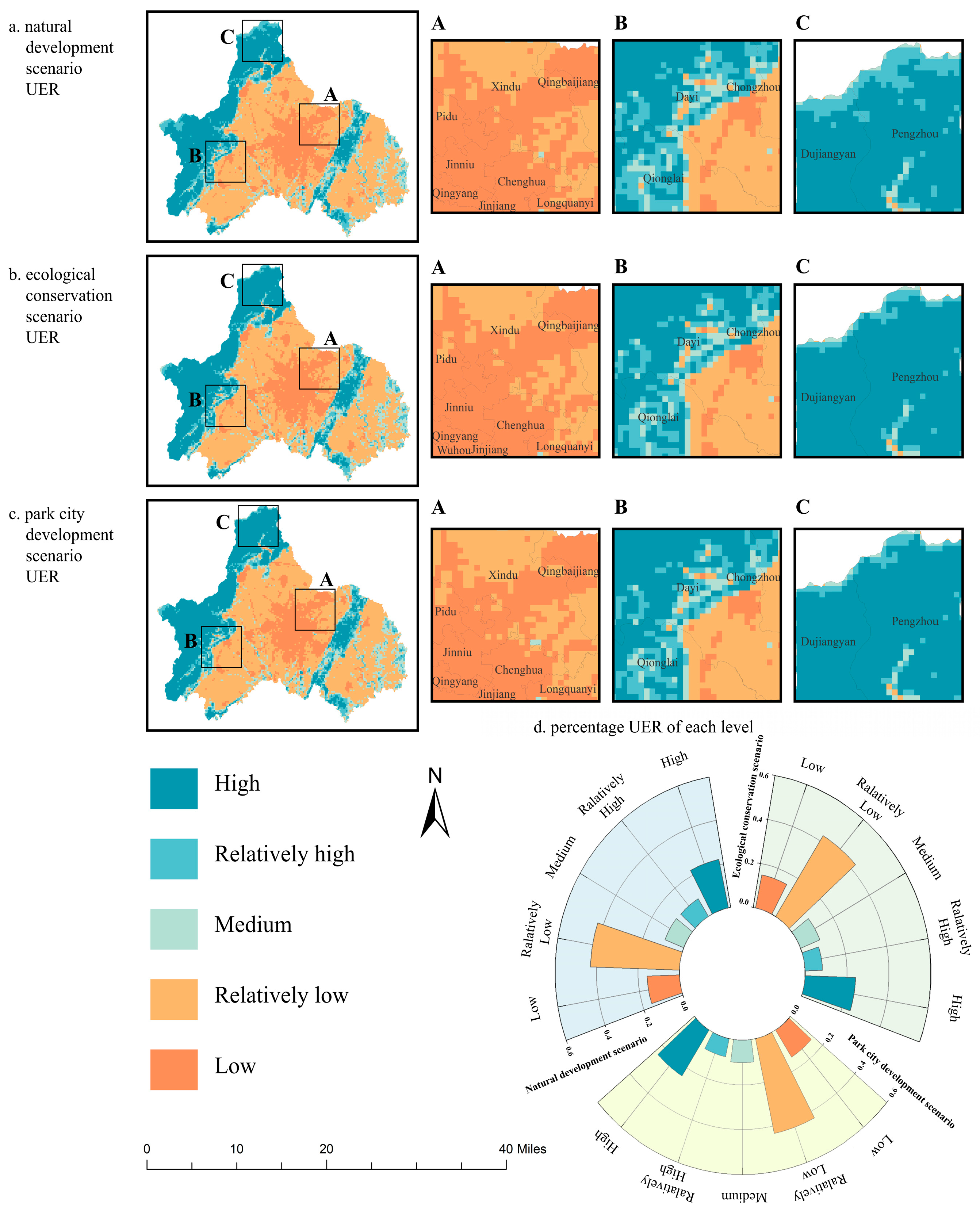
As shown in Figure 8, under the natural development scenario, relatively low UER areas were the highest in 2035, accounting for 42.87%, followed by areas with relatively high UER, which account for 22.40%. The average UER was 0.239, a 13.29% increase relative to 2023. Spatially, low UER areas were primarily distributed within built-up areas, radiating outward from the central urban district. Under the ecological protection scenario, relatively low UER accounted for the largest proportion (42.72%), followed by the high UER (24.12%). The mean UER was 0.248, a 17.67% increase compared to 2023. Spatially, the distribution of low and relatively low values resembled that under the natural development scenario. However, relatively high UER increased substantially in the western and northern Longmen Mountains. Under the park city development scenario, the proportion of low values was 14.25%, the lowest among the three scenarios, indicating that this scenario effectively improved the low UER. Conversely, high UER accounted for 24.27%, the highest among the three scenarios. Furthermore, the average UER under the park city development scenario was the highest at 0.251, further demonstrating that park city policies can enhance UER to a certain extent.

4.5. Ecological Zoning Under Different Scenarios by 2035

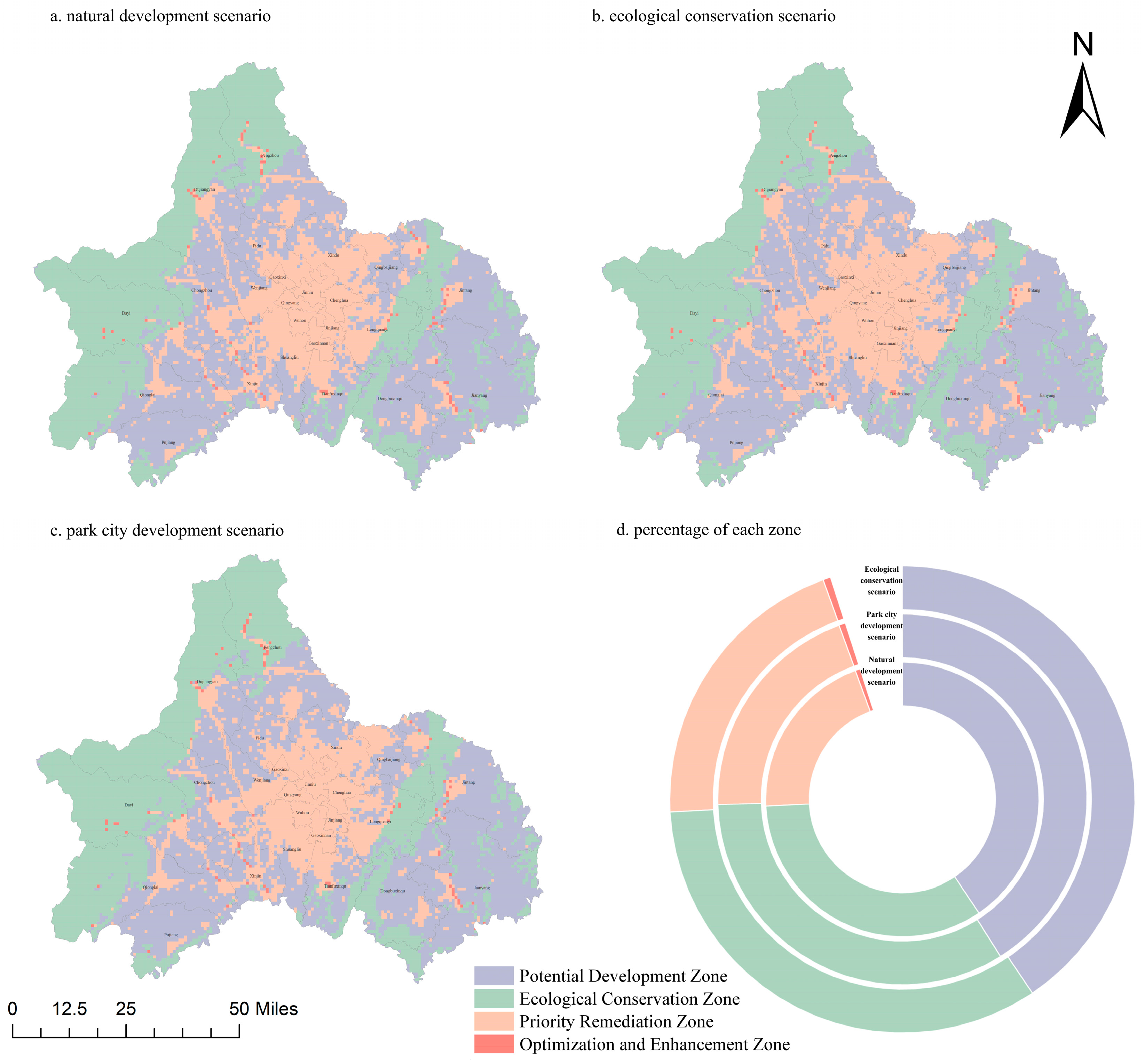
Under the natural development scenario, the Potential Development Zone accounted for the largest proportion at 42.65%, followed by the Ecological Conservation Zone at 35.44%, and the Optimization and Enhancement Zone accounted for the smallest proportion, at only 0.63%. The spatial distributions of the ecological conservation scenario and the park city development scenario were broadly similar, albeit with some differences. Under the ecological conservation scenario, the area proportions of the Potential Development Zone and the Ecological Conservation Zone were similar to those in the natural development scenario, at 42.70% and 35.33%, respectively. However, the Optimization and Enhancement Zone contracted 10.73%. Under the park city development scenario, the Potential Development Zone accounted for 43.25%, the highest proportion among the three scenarios, indicating that this scenario better balanced ecological conservation and construction development. Meanwhile, the Optimization and Enhancement Zone expanded by 8.48% relative to the Ecological Conservation Scenario, suggesting that this scenario more effectively promoted functional enhancement on the basis of ecological conservation (Figure 9). Spatially, Potential Development Zones are concentrated in cropland, with low resilience and low intensity. Ecological Conservation Zones are located in the Longquan and Longmen Mountains, dominated by ecological land with high resilience and low intensity. Optimization and Enhancement Zones are scattered at the interface between built-up land and cropland. Their high resilience derives from semi-natural farmland ecosystems rather than large natural patches, resulting in lower ecological integrity and an upper limit on resilience, making contiguous high-resilience patches difficult to form.

5. Discussion

5.1. The Historical Trajectory of UER in the Park City

The greater the UER, the better an ecosystem is able to maintain its key functions in the face of external pressures such as urbanization, thereby achieving sustainable development [74]. This study found that between 1999 and 2023, UER first declined and then increased, with areas of low resilience concentrated in high-intensity construction zones that continued to expand. In the early phase (1999–2011), extensive urbanization led to the encroachment of ecological land, exacerbated habitat fragmentation and disrupted ecological processes, thereby reducing UER and causing a continuous decline in ecological sustainability. In the later period (2011–2023), as ecological civilization construction was elevated to a national strategy and the concept of the park city was proposed, ecological restoration projects were implemented in Chengdu. The construction of the “Two Mountains” ecological barrier and the Longquan Mountain Urban Forest Park effectively curbed the loss of ecological land and enhanced UER. This finding is consistent with the research by Zhang [26], confirming that rapid urbanization reduces UER through landscape fragmentation. However, urbanization itself does not necessarily reduce UER or undermine ecological sustainability. The key lies in the model of urbanization [75].
Consequently, traditional ecological conservation measures are no longer sufficient to bring about effective improvements in existing low-resilience built-up areas. Currently, Chengdu is actively implementing the “Five Greens Nourish the City” initiative to build the park city. We should focus on precise ecological restoration and promote nature-based solutions, such as restoring ecological spaces and enhancing resilience through sponge city initiatives, the creation of pocket parks and small green spaces, and vertical greening, and integrating blue and green spaces through urban renewal [76,77].

5.2. Optimization Pathways for UER in Park City Under Multi-Scenario Simulations

Based on the results of multi-scenario simulations to 2035, the park city development scenario represented a relatively optimal pathway for enhancing UER. Under the natural development scenario, the simulations demonstrated that without policy intervention, the inertial expansion of urbanization led to an overall decline in UER, primarily manifested in the spread of low-resilience built-up areas. This finding underscores the necessity and urgency of proactive ecological policies.
Under the ecological conservation scenario, protecting ecological land to enhance UER demonstrates that ecological priority is an effective spatial strategy for maximizing ecological benefits in the development of the park city. However, relying solely on ecological conservation measures cannot significantly enhance the UER of the park city.
Among three scenarios, the park city development scenario achieved the greatest improvement in UER. By integrating ecosystem and farmland protection while coordinating the spatial layout of ecological, agricultural, and urban areas, this approach proves to be a relatively effective strategy. It demonstrates that the park city development model is the optimal solution for enhancing UER and promoting sustainable development. However, the simulation results also indicate that even though the park city development scenario yields the greatest improvements, fundamental improvements in the current low-resilience built-up areas remain limited. This further highlights the need to implement more proactive and refined ecological interventions within the city while maintaining macro-level ecological baseline controls.

5.3. Convergence in Ecological Zoning of Park City

Policies under the park city development scenario still effectively increased the area of the Optimization and Enhancement Zone. At the same time, this scenario saw the greatest improvement in UER and a more balanced land-use structure. Overall, the park city policies represent the optimal solution within the scenarios defined in this study, effectively coordinating the three key objectives of ecological conservation, urban development and resilience enhancement. Although the park city development scenario performed best, the ecological zoning patterns across the three scenarios were highly similar. This convergence is influenced by historical urbanization trends. The high-density built-up land pattern formed over the past two decades has become spatially entrenched as low UER areas, and the 15-year policy simulation period is insufficient to completely reverse this deep-seated structure. Consequently, for Priority Remediation Zones, a ring-shaped ecological belt should be established on the outskirts of the built-up area, small-scale green spaces should be created, and soil improvement and vegetation restoration should be carried out on sites such as idle construction sites. For Optimization and Enhancement Zones, demonstration areas should be established, integrating high-end industries such as science and technology innovation into ecological spaces to achieve the conversion of ecological value. For Potential Development Zones, a full-cycle mechanism comprising “pre-development assessment, in-construction management and post-completion monitoring” should be established. In Ecological Conservation Zones, construction and development must be strictly controlled, and adaptive restoration should be initiated immediately in areas at risk of degradation.
As a megacity, Chengdu has seen a significant enhancement in its UER following the introduction of the park city concept. Its development experience can serve as a direct reference for developing nations undergoing rapid urbanization, thereby facilitating sustainable development [78]. Its zoned governance policies can offer practical experience to similar cities exploring eco-priority and green development. For instance, certain cities in the United States, Germany and the United Kingdom are currently focusing on ecosystem services, ecological environments, and the sustainability of urban development and nature in park city construction [79,80]. Different cities can adapt these approaches for local application based on their own stage of urbanization and development objectives.

5.4. Shortcomings and Prospects

This study focuses on the ecological dimension of park cities and constructs an evaluation framework based on defense, adaptability and recovery. However, as UER is essentially a socio-ecological concept, this study has the following limitations. Firstly, it does not incorporate social dimension indicators, such as public participation, community organizational capacity and emergency response efficiency. These factors play a significant buffering role when disturbances occur. Second, economic factors, such as industrial structure, fiscal capacity and ecological compensation mechanisms, have not been considered. These factors directly influence the sustainability of ecological conservation policies. Third, the negative impact of urbanization on UER has been identified; the pathways and regulatory mechanisms of specific policy instruments, such as the red line for arable land protection and ecological compensation, have not been analyzed in depth. Fourth, with regard to data sources, land-use data with a resolution of 30 m is unable to capture small-scale ecological changes within urban areas. Furthermore, the spatial resolutions of some driving factors are not entirely consistent, and some are obtained through interpolation. And in terms of model assumptions, fixed values were used for the elasticity coefficients of each land-use type and the environmental quality index, without taking into account their dynamic changes.
Given the aforementioned limitations, future research should explore the following areas in greater depth. Firstly, integrating socio-economic indicators, such as public participation, community organizational capacity and emergency response efficiency, with economic indicators, such as industrial structure, fiscal capacity and ecological compensation mechanisms. A comprehensive socio-ecological resilience assessment framework should be established to provide a more holistic portrayal of the resilience levels of park cities. Furthermore, by combining quantitative policy analysis methods, the regulatory mechanisms of policy instruments, such as the red line for arable land protection and ecological compensation, on UER should be thoroughly analyzed. Thirdly, higher-resolution remote sensing data should be utilized, and time-series-based dynamic parameters, including time-series adjustments to the elasticity coefficient and the environmental quality index, should be incorporated.

6. Conclusions

This study established a framework comprising “Retrospective Evaluation–Prospective Simulation–Zoning Control” integrating UER, dynamic land-use simulation, and spatial control strategies to provide a replicable technical approach for research on park city. Concurrently, based on a study of Chengdu, a national model park city, the research reveals a U-shaped trajectory of UER, which first declined and then rose. Low UER areas were primarily concentrated in the central urban district and expanded outward. The findings further identify urban expansion as a key driver of UER dynamics. Among different scenarios, the park city development scenario represents the optimal pathway for enhancing UER, and its ecological zoning outcomes align most closely with park city development. This contributes evidence on UER changes under rapid urbanization and enhances understanding of spatial pattern dynamics in park city development. However, the convergence of ecological zoning indicates that the ecological spatial pattern of the park city is influenced by historical development, and the regulatory capacity of macro-policies is limited in the short term. Regardless of the macro-development path adopted, the Priority Remediation Zone remains a critical challenge that Chengdu must overcome in building its park city. By identifying four types of zones and proposing corresponding recommendations, this study provides a spatial planning framework and zoning management strategies for Chengdu Park City, offering valuable insights for other rapidly urbanizing regions seeking to transition toward park city development.

Author Contributions

Conceptualization, Y.L.; Data curation, K.L.; Formal analysis, Y.L. and K.L.; Funding acquisition, Y.L.; Investigation, K.L. and R.L.; Methodology, Y.L. and K.L.; Resources, Y.L. and K.L.; Software, K.L.; Supervision, Y.L.; Visualization, K.L.; Writing—original draft, Y.L. and K.L.; Writing—review and editing, Y.L., K.L. and R.L. All authors have read and agreed to the published version of the manuscript.

Funding

This research was funded by the Major Bidding Program of National Social Science Foundation of China [grant number No. 22&ZD142], and the Civilization Mutual Learning and Global Governance Research Program of Sichuan University. The APC was funded by the Corresponding Author.

Data Availability Statement

Data will be made available on request.

Acknowledgments

We would like to express our sincere gratitude to the reviewers for their insightful comments and constructive feedback, which have greatly contributed to improving the quality of this paper. We also extend our thanks to all colleagues who supported us during the research process. Without their assistance, this work would not have been possible.

Conflicts of Interest

The authors declare that they have no conflicts of interest.

Abbreviations

The following abbreviations are used in this manuscript:
UERUrban ecological resilience
EDEcological defense
EAEcological adaptability
EREcological recovery
ESVEcosystem service value
EQIEnvironment quality index
EEEcological elasticity

References

  1. Li, K.; Hou, Y.; Randall, M.T.; Skov-Petersen, H.; Li, X. The Spatio-Temporal Trade-off between Ecosystem and Basic Public Services and the Urbanization Driving Force in the Rapidly Urbanizing Region. Sustain. Cities Soc. 2024, 111, 105554. [Google Scholar] [CrossRef]
  2. Oleson, K.W.; Monaghan, A.; Wilhelmi, O.; Barlage, M.; Brunsell, N.; Feddema, J.; Hu, L.; Steinhoff, D.F. Interactions between Urbanization, Heat Stress, and Climate Change. Clim. Change 2013, 129, 525–541. [Google Scholar] [CrossRef]
  3. Xu, J.; Ma, Q.; Kong, J. Spatiotemporal Evolution and Coupling Mechanisms of Urbanization and Ecosystem Health in Zhejiang Province, China: Implications for Ecological Restoration and Sustainable Development. Sustain. Cities Soc. 2026, 139, 107224. [Google Scholar] [CrossRef]
  4. Fang, X.; Li, J.; Ma, Q. Integrating Green Infrastructure, Ecosystem Services and Nature-Based Solutions for Urban Sustainability: A Comprehensive Literature Review. Sustain. Cities Soc. 2023, 98, 104843. [Google Scholar] [CrossRef]
  5. Zhou, Y. How Can Comprehensive Land Management Promote the Urban Sustainable Development from the Perspective of Environmental Sociology?—Based on an Empirical Study of 269 Cities in China. Land Use Policy 2025, 158, 107719. [Google Scholar] [CrossRef]
  6. Cao, Y.; Kong, L.; Zhang, L.; Ouyang, Z. The Balance between Economic Development and Ecosystem Service Value in the Process of Land Urbanization: A Case Study of China’s Land Urbanization from 2000 to 2015. Land Use Policy 2021, 108, 105536. [Google Scholar] [CrossRef]
  7. Liu, J.; Wang, K.; Xiahou, Q.; Liu, F.; Zou, J.; Kong, Y. China’s Long-Term Low Carbon Transition Pathway under the Urbanization Process. Adv. Clim. Change Res. 2019, 10, 240–249. [Google Scholar] [CrossRef]
  8. Botzat, A.; Fischer, L.; Kowarik, I. Unexploited opportunities in understanding liveable and biodiverse cities. A review on urban biodiversity perception and valuation. Glob. Environ. Change 2016, 39, 220–233. [Google Scholar] [CrossRef]
  9. Kabisch, N.; Kraemer, R.; Masztalerz, O.; Hemmerling, J.; Püffel, C.; Haase, D. Impact of summer heat on urban park visitation, perceived health and ecosystem service appreciation. Urban For. Urban Green. 2021, 60, 127058. [Google Scholar] [CrossRef]
  10. Schipperijn, J.; Ekholm, O.; Stigsdotter, U.K.; Toftager, M.; Bentsen, P.; Kamper-Jørgensen, F.; Randrup, T.B. Factors influencing the use of green space: Results from a Danish national representative survey. Landsc. Urban Plan. 2010, 95, 130–137. [Google Scholar] [CrossRef]
  11. Lo, A.; Jim, C. Willingness of residents to pay and motives for conservation of urban green spaces in the compact city of Hong Kong. Urban For. Urban Green. 2010, 9, 113–120. [Google Scholar] [CrossRef]
  12. Kraemer, R.; Kabisch, N. Parks in context: Advancing citywide spatial quality assessments of urban green spaces using fine-scaled indicators. Ecol. Soc. 2021, 26, 45. [Google Scholar] [CrossRef]
  13. Cohen, P.; Potchter, O.; Schnell, I. The impact of an urban park on air pollution and noise levels in the Mediterranean city of Tel-Aviv, Israel. Environ. Pollut. 2014, 195, 73–83. [Google Scholar] [CrossRef]
  14. Liao, C.; Jiang, Y.; Yang, M.; Feng, K.; Zhang, J. Investigating the Impact of Urban Parks on Bird Habitats and Diversity Through Remote Sensing: A Case Study of Chengdu City (China). Land 2025, 14, 2086. [Google Scholar] [CrossRef]
  15. Bai, X.; Sadia, S. Park city leads the way of urban development and innovation in China. J. Environ. Eng. Landsc. Manag. 2023, 31, 240–247. [Google Scholar] [CrossRef]
  16. Zeng, M.; Zhang, W. Clear Skies Ahead: How Park City Construction Improved Air Quality? J. Clean. Prod. 2026, 544, 147673. [Google Scholar] [CrossRef]
  17. Dai, X.; Li, Y.; Qi, Y.; Chen, Y.; Yan, D.; Xia, K.; He, S.; He, Y. Coupling Agricultural Green Development and Park City Development: An Empirical Analysis from Chengdu, China. Agriculture 2025, 15, 248. [Google Scholar] [CrossRef]
  18. Hong, T.; Li, L.; Wang, B. The Planning and Construction Path of Innovative and Intelligent Park Cities Based on Big Data Technology. Math. Probl. Eng. 2022, 2022, 6049677. [Google Scholar] [CrossRef]
  19. Xie, X.; Gong, X.; Pan, S. Research on the Construction Path of the Megacity from the Perspective of Nudge Theory: Empirical Evidence of the “Park City” Construction in Chengdu Tianfu New Area. Chin. J. Popul. Resour. Environ. 2023, 21, 163–171. [Google Scholar] [CrossRef]
  20. Scholte, S.S.K.; van Teeffelen, A.J.A.; Verburg, P.H. Integrating socio-cultural perspectives into ecosystem service valuation: A review of concepts and methods. Ecol. Econ. 2015, 114, 67–78. [Google Scholar] [CrossRef]
  21. Wang, Z.; Xu, M.; Lin, H.; Qureshi, S.; Cao, A.; Ma, Y. Understanding the dynamics and factors affecting cultural ecosystem services during urbanization through spatial pattern analysis and a mixed-methods approach. J. Clean. Prod. 2021, 279, 123422. [Google Scholar] [CrossRef]
  22. Holling, C.S. Resilience and Stability of Ecological Systems. Annu. Rev. Ecol. Syst. 1973, 4, 1–23. [Google Scholar] [CrossRef]
  23. Wu, X.; Zhang, J.; Geng, X.; Wang, T.; Wang, K.; Liu, S. Increasing Green Infrastructure-Based Ecological Resilience in Urban Systems: A Perspective from Locating Ecological and Disturbance Sources in a Resource-Based City. Sustain. Cities Soc. 2020, 61, 102354. [Google Scholar] [CrossRef]
  24. Schewenius, M.; McPhearson, T.; Elmqvist, T. Opportunities for Increasing Resilience and Sustainability of Urban Social–Ecological Systems: Insights from the URBES and the Cities and Biodiversity Outlook Projects. Ambio 2014, 43, 434–444. [Google Scholar] [CrossRef] [PubMed]
  25. Dong, Y.; Wang, F. Exploring the Spatiotemporal Evolution and Driving Mechanism of Ecological Resilience in Main Urban Area of Xi’an Based on the “Resistance-Elasticity-Adaptability” Model. Environ. Model. Softw. 2026, 198, 106875. [Google Scholar] [CrossRef]
  26. Zhang, T.; Sun, Y.; Zhang, X.; Yin, L.; Zhang, B. Potential Heterogeneity of Urban Ecological Resilience and Urbanization in Multiple Urban Agglomerations from a Landscape Perspective. J. Environ. Manag. 2023, 342, 118129. [Google Scholar] [CrossRef]
  27. Xu, C.; Huo, X.; Hong, Y.; Yu, C.; de Jong, M.; Cheng, B. How Urban Greening Policy Affects Urban Ecological Resilience: Quasi-Natural Experimental Evidence from Three Megacity Clusters in China. J. Clean. Prod. 2024, 452, 142233. [Google Scholar] [CrossRef]
  28. Wu, X.; Liu, H.; Liu, W. Exploring the Spatiotemporal Evolution Dynamic and Influencing Factor of Green Ecology Transition for Megacities: A Case Study of Chengdu, China. Ecol. Indic. 2024, 158, 111285. [Google Scholar] [CrossRef]
  29. Jiang, D.; Zhu, W.; Zhang, Z. The Spatiotemporal Coupling and Synergistic Evolution of Economic Resilience and Ecological Resilience in Africa. Sustainability 2025, 17, 863. [Google Scholar] [CrossRef]
  30. Qu, S.; Zhang, Y.; Huang, F.; Gao, J. Assessing Regional Sustainability from the Perspective of Reconciling Social-Ecological Resilience and Human Well-Being: Empirical Evidence from China. Appl. Geogr. 2025, 182, 103720. [Google Scholar] [CrossRef]
  31. Tang, F.; Zeng, P.; Guo, Y.; Shen, Y.; Wang, L.; Liu, K.; Zhang, L. Decoding the Spatiotemporal Dynamics and Driving Mechanisms of Ecological Resilience in the Beijing-Tianjin-Hebei Urban Agglomeration: A Deep Learning Approach. Urban Clim. 2025, 61, 102436. [Google Scholar] [CrossRef]
  32. Gao, Y.; Zhang, Y.; Xu, D. A Systematic Review of Urban Ecological Resilience: Emerging Frontiers in Process-Oriented Metabolic Research. Ecol. Model. 2025, 510, 111319. [Google Scholar] [CrossRef]
  33. Liang, J.; Li, Y. Resilience and Sustainable Development Goals Based Social-Ecological Indicators and Assessment of Coastal Urban Areas—A Case Study of Dapeng New District, Shenzhen, China. Watershed Ecol. Environ. 2020, 2, 6–15. [Google Scholar] [CrossRef]
  34. Feng, X.; Zeng, F.; Loo, B.P.Y.; Zhong, Y. The Evolution of Urban Ecological Resilience: An Evaluation Framework Based on Vulnerability, Sensitivity and Self-Organization. Sustain. Cities Soc. 2024, 116, 105933. [Google Scholar] [CrossRef]
  35. Lan, C.; Li, X.; Peng, B.; Li, X. Unlocking Urban Ecological Resilience: The Dual Role of Environmental Regulation and Green Technology Innovation. Sustain. Cities Soc. 2025, 128, 106466. [Google Scholar] [CrossRef]
  36. Jie, Y.; Shiying, W.; Jie, Z.; Jing, Z.; Wenliu, Z. Optimisation of Ecological Security Patterns in Ecologically Transition Areas under the Perspective of Ecological Resilience—A Case of Taohe River. Ecol. Indic. 2024, 166, 112315. [Google Scholar] [CrossRef]
  37. Wu, N.; Zhou, Y.; Yin, S.; Gong, H.; Zhang, C. Revealing the Nonlinear Impact of Environmental Regulation on Ecological Resilience Using the XGBoost-SHAP Model: Evidence from the Yangtze River Delta Region, China. J. Clean. Prod. 2025, 514, 145700. [Google Scholar] [CrossRef]
  38. Wu, X.; Li, M.; Chen, Z.; Li, Q.; Feng, H. An Explainable Machine Learning Framework Coupled with the PLUS Model for Ecological Resilience Simulation and Zoning under SSP-RCP Scenarios: A Case Study in Eastern Jilin, China. Environ. Model. Softw. 2026, 200, 106952. [Google Scholar] [CrossRef]
  39. Cai, X.; Song, Y.; Xue, D.; Ma, B.; Liu, X.; Zhang, L. Spatial and Temporal Changes in Ecological Resilience in the Shanxi-Shaanxi-Inner Mongolia Energy Zone with Multi-Scenario Simulation. Land 2024, 13, 425. [Google Scholar] [CrossRef]
  40. Liang, X.; Guan, Q.; Clarke, K.C.; Liu, S.; Wang, B.; Yao, Y. Understanding the Drivers of Sustainable Land Expansion Using a Patch-Generating Land Use Simulation (PLUS) Model: A Case Study in Wuhan, China. Comput. Environ. Urban Syst. 2021, 85, 101569. [Google Scholar] [CrossRef]
  41. Huang, H.; Xu, S.; Fang, K. Exploring the Coupling of Land Development Intensity and Green Economy Development in the Pearl River Delta: Patterns, Challenges, and Strategic Pathways. Land 2025, 14, 105. [Google Scholar] [CrossRef]
  42. Tan, S.; Liu, Q.; Han, S. Spatial-Temporal Evolution of Coupling Relationship between Land Development Intensity and Resources Environment Carrying Capacity in China. J. Environ. Manag. 2022, 301, 113778. [Google Scholar] [CrossRef]
  43. Luo, X.; Cheng, C.; Pan, Y.; Yang, T. Coupling Coordination and Influencing Factors of Land Development Intensity and Urban Resilience of the Yangtze River Delta Urban Agglomeration. Water 2022, 14, 1083. [Google Scholar] [CrossRef]
  44. Shi, C.; He, X.; Xu, X.L. Spatiotemporal Characteristics and Environmental Risk Factors Influencing the Relationship between Land Development Intensity and Human Settlement Resilience: A Novel Four-Dimensional Framework. J. Clean. Prod. 2025, 536, 147209. [Google Scholar] [CrossRef]
  45. Huang, X.; Liu, X.; Jin, Y.; Gao, X.; Chen, Y. Identification and Attribution Analysis of Integrated Ecological Zones Based on the XGBoost-SHAP Model: A Case Study of Chengdu, China. Ecol. Indic. 2025, 177, 113787. [Google Scholar] [CrossRef]
  46. Yang, Z.; Cui, X.; Dong, Y.; Guan, J.; Wang, J.; Xi, Z.; Li, C. Spatio-Temporal Heterogeneity and Influencing Factors in the Synergistic Enhancement of Urban Ecological Resilience: Evidence from the Yellow River Basin of China. Appl. Geogr. 2024, 173, 103459. [Google Scholar] [CrossRef]
  47. Veisi Nabikandi, B.; Hami, A.; Valizadeh Kamran, K.; Russo, A. Evaluating Urban Ecosystem Services and Resilience Using Remote Sensing and InVEST Model: A Case Study of Flood Risk Control and Urban Cooling in Tabriz. Sustain. Cities Soc. 2025, 130, 106654. [Google Scholar] [CrossRef]
  48. Peng, J.; Liu, Y.; Wu, J.; Lv, H.; Hu, X. Linking Ecosystem Services and Landscape Patterns to Assess Urban Ecosystem Health: A Case Study in Shenzhen City, China. Landsc. Urban Plan. 2015, 143, 56–68. [Google Scholar] [CrossRef]
  49. Li, S.; Wang, X.; Liu, X.; Ma, R.; Chen, R.; Wang, S. Ecological Impact Assessment of Production–Living–Ecological Space Optimization in the Southern Taihang Region: A Multi-Scenario Simulation with the PLUS Model. Agriculture 2026, 16, 530. [Google Scholar] [CrossRef]
  50. Liu, Y.; Huang, X.; Yang, H.; Zhong, T. Environmental Effects of Land-Use/Cover Change Caused by Urbanization and Policies in Southwest China Karst Area—A Case Study of Guiyang. Habitat Int. 2014, 44, 339–348. [Google Scholar] [CrossRef]
  51. Yu, W.; Shi, J.; Fang, Y.; Xiang, A.; Li, X.; Hu, C.; Ma, M. Exploration of Urbanization Characteristics and Their Effect on the Urban Thermal Environment in Chengdu, China. Build. Environ. 2022, 219, 109150. [Google Scholar] [CrossRef]
  52. Cao, X.; Luo, Y.; Chen, X.; Xie, Q.; Yao, Z. Spatial Valuation of Urban Green Lungs: Unveiling the True Worth of Urban Parks through MGWR in Chengdu, China. Land Use Policy 2024, 145, 107294. [Google Scholar] [CrossRef]
  53. Yang, J.; Huang, X. The 30 m Annual Land Cover Dataset and Its Dynamics in China from 1990 to 2019; Copernicus GmbH: Göttingen, Germany, 2021. [Google Scholar]
  54. Zhao, N.; Liu, Y.; Cao, G.; Samson, E.L.; Zhang, J. Forecasting China’s GDP at the Pixel Level Using Nighttime Lights Time Series and Population Images. GIScience Remote Sens. 2017, 54, 407–425. [Google Scholar] [CrossRef]
  55. Costanza, R.; d’Arge, R.; De Groot, R.; Farber, S.; Grasso, M.; Hannon, B.; Limburg, K.; Naeem, S.; O’Neill, R.V.; Paruelo, J.; et al. The Value of the World’s Ecosystem Services and Natural Capital. Nature 1997, 387, 253–260. [Google Scholar] [CrossRef]
  56. Xie, G.; Zhang, C.; Zhen, L.; Zhang, L. Dynamic Changes in the Value of China’s Ecosystem Services. Ecosyst. Serv. 2017, 26, 146–154. [Google Scholar] [CrossRef]
  57. Hu, Z.; Gong, J.; Li, J.; Li, R.; Zhang, Z.; Zhong, F.; Wen, C. Valuing the Coordinated Development of Urbanization and Ecosystem Service Value in Border Counties. J. Clean. Prod. 2023, 415, 137799. [Google Scholar] [CrossRef]
  58. Li, Y.; Zhan, J.; Liu, Y.; Zhang, F.; Zhang, M. Response of Ecosystem Services to Land Use and Cover Change: A Case Study in Chengdu City. Resour. Conserv. Recycl. 2018, 132, 291–300. [Google Scholar] [CrossRef]
  59. Ebert, U.; Welsch, H. Meaningful environmental indices: A social choice approach. J. Environ. Econ. Manag. 2004, 47, 270–283. [Google Scholar] [CrossRef]
  60. Zhang, Y.; Liu, J.; Zhu, Y. Assessment of Ecological Resilience and Identification of Influencing Factors in Jilin Province, China. Sustainability 2025, 17, 5994. [Google Scholar] [CrossRef]
  61. Gao, L.; Tao, F.; Liu, R.; Wang, Z.; Leng, H.; Zhou, T. Multi-scenario simulation and ecological risk analysis of land use based on the PLUS model: A case study of Nanjing. Sustain. Cities Soc. 2022, 85, 104055. [Google Scholar] [CrossRef]
  62. Rong, T.; Zhang, P.; Li, G.; Wang, Q.; Zheng, H.; Chang, Y.; Zhang, Y. Spatial Correlation Evolution and Prediction Scenario of Land Use Carbon Emissions in the Yellow River Basin. Ecol. Indic. 2023, 154, 110701. [Google Scholar] [CrossRef]
  63. Liao, S.; Wang, W.; Wang, C.; Ji, R.; Cui, A.; Chen, D.; Zhang, X.; Chen, N. Land Use and Land Cover Change Assessment and Predictions in Flood Detention Areas of Yangtze River Basin Based on AIF-HOM-PLUS Model. Remote Sens. 2025, 17, 1857. [Google Scholar] [CrossRef]
  64. Ma, G.; Li, Q.; Zhang, J.; Zhang, L.; Cheng, H.; Ju, Z.; Sun, G. Simulation and Analysis of Land-Use Change Based on the PLUS Model in the Fuxian Lake Basin (Yunnan–Guizhou Plateau, China). Land 2022, 12, 120. [Google Scholar] [CrossRef]
  65. Pontius, R.G.; Boersma, W.; Castella, J.-C.; Clarke, K.; de Nijs, T.; Dietzel, C.; Duan, Z.; Fotsing, E.; Goldstein, N.; Kok, K.; et al. Comparing the input, output, and validation maps for several models of land change. Ann. Reg. Sci. 2007, 42, 11–37. [Google Scholar] [CrossRef]
  66. He, F.; Yang, J.; Zhang, Y.; Yu, W.; Xiao, X.; Xia, J. Does partition matter? A new approach to modeling land use change. Comput. Environ. Urban Syst. 2023, 106, 102041. [Google Scholar] [CrossRef]
  67. Wang, M.; Jiang, Z.; Li, T.; Yang, Y.; Jia, Z. Analysis on Absolute Conflict and Relative Conflict of Land Use in Xining Metropolitan Area under Different Scenarios in 2030 by PLUS and PFCI. Cities 2023, 137, 104314. [Google Scholar] [CrossRef]
  68. Zheng, L.; Wang, Y.; Li, J. Quantifying the Spatial Impact of Landscape Fragmentation on Habitat Quality: A Multi-Temporal Dimensional Comparison between the Yangtze River Economic Belt and Yellow River Basin of China. Land Use Policy 2023, 125, 106463. [Google Scholar] [CrossRef]
  69. Wang, J.; Zhang, J.; Xiong, N.; Liang, B.; Wang, Z.; Cressey, E. Spatial and Temporal Variation, Simulation and Prediction of Land Use in Ecological Conservation Area of Western Beijing. Remote Sens. 2022, 14, 1452. [Google Scholar] [CrossRef]
  70. Zhang, S.; Zhang, Y.; Wang, X.; Li, Y. Land Use Conflict Under Different Scenarios Based on the PLUS Model: A Case Study of the Development Pilot Zone in Jilin, China. Sustainability 2025, 17, 7161. [Google Scholar] [CrossRef]
  71. Ma, X.; Xu, Y.; Sun, Q.; Liu, W.; Qi, W. Contributing to Carbon Neutrality Targets: A Scenario Simulation and Pattern Optimization of Land Use in Shandong Province Based on the PLUS Model. Sustainability 2024, 16, 5180. [Google Scholar] [CrossRef]
  72. Wang, Q.; Yan, Z.; Li, W. Synergistic Optimization of Land Use and Ecosystem Services in Arid Regions: Scenario Simulation of the Hexi Corridor Based on the PLUS Model. Land 2026, 15, 414. [Google Scholar] [CrossRef]
  73. Wu, Y.; Gu, C.; Zhang, Y. Towards Sustainable Management of Urban Ecological Space: A Zoning Approach Hybridized by Ecosystem Service Value and Ecological Risk Assessment. Land 2022, 11, 1220. [Google Scholar] [CrossRef]
  74. Hu, H.; Yan, K.; Shi, Y.; Lv, T.; Zhang, X.; Wang, X. Decrypting resilience: The spatiotemporal evolution and driving factors of ecological resilience in the Yangtze River Delta Urban Agglomeration. Environ. Impact Assess. Rev. 2024, 106, 107540. [Google Scholar] [CrossRef]
  75. Jing, T.; Wang, H.; Yang, Y.; Jin, Y.; Yu, W.; Zhong, Y. Achieving sustainable development in coastal cities: Exploring the synergies between urban resilience and high-quality development. Sustain. Cities Soc. 2026, 136, 107112. [Google Scholar] [CrossRef]
  76. Pauleit, S.; Ambrose-Oji, B.; Andersson, E.; Anton, B.; Buijs, A.; Haase, D.; Elands, B.; Hansen, R.; Kowarik, I.; Kronenberg, J.; et al. urban green infrastructure in Europe: Outcomes and reflections from the GREEN SURGE project. Urban For. Urban Green. 2019, 40, 4–16. [Google Scholar] [CrossRef]
  77. Adegun, O.B.; Ikudayisi, A.E.; Morakinyo, T.E.; Olusoga, O.O. Urban green infrastructure in Nigeria: A review. Sci. Afr. 2021, 14, e01044. [Google Scholar] [CrossRef]
  78. Bottero, M.; Caprioli, C.; Foth, M.; Mitchell, P.; Rittenbruch, M.; Santangelo, M. Urban parks, value uplift and green gentrification: An application of the spatial hedonic model in the city of Brisbane. Urban For. Urban Green. 2022, 74, 127618. [Google Scholar] [CrossRef]
  79. Dade, M.C.; Mitchell, M.G.E.; Brown, G.; Rhodes, J.R. The effects of urban greenspace characteristics and socio-demographics vary among cultural ecosystem services. Urban For. Urban Green. 2020, 49, 126641. [Google Scholar] [CrossRef]
  80. Mullenbach, L.E. Critical discourse analysis of urban park and public space development. Cities 2022, 120, 103458. [Google Scholar] [CrossRef]
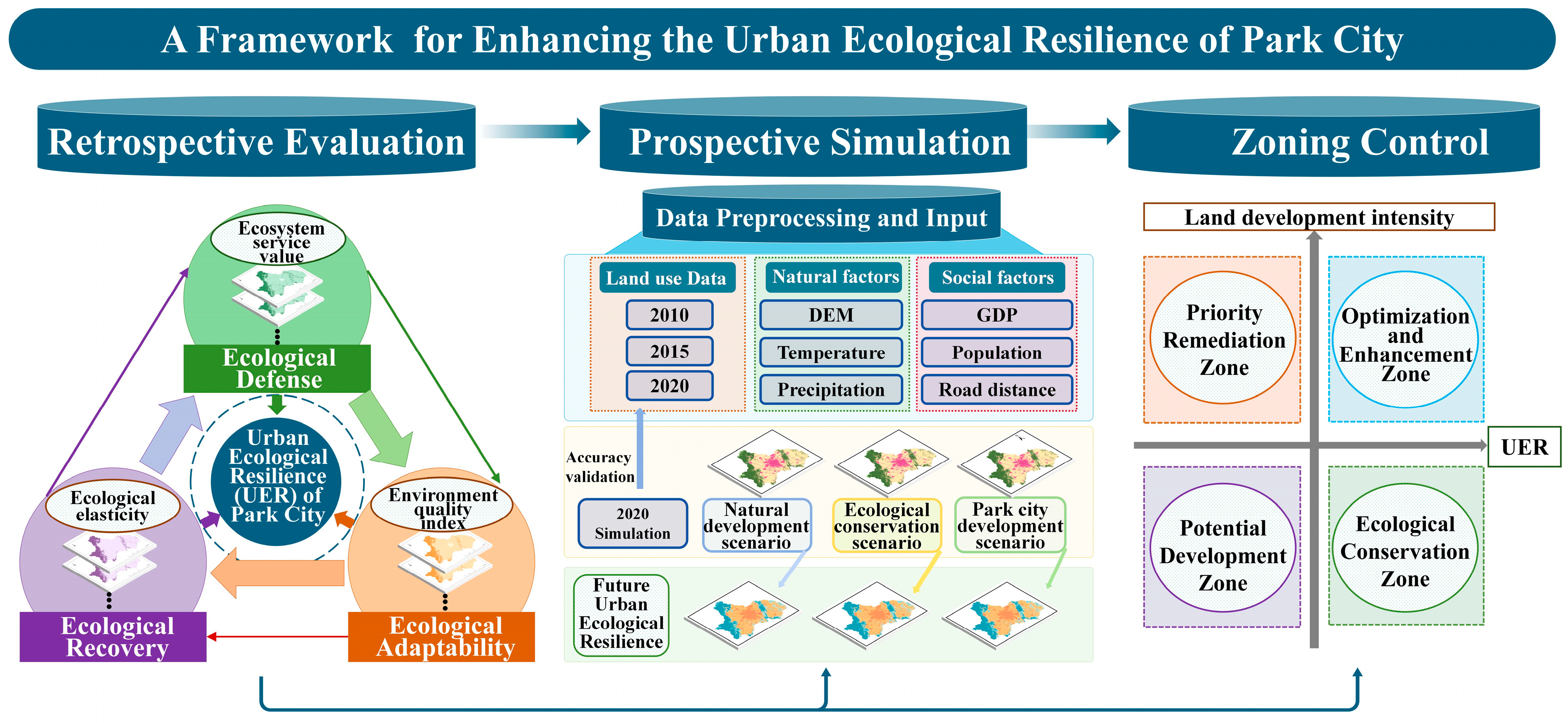
Figure 1. Research framework for enhancing the urban ecological resilience (UER) of park cities.
Land 15 00886 g001
Figure 2. Location of Chengdu.
Land 15 00886 g002
Figure 3. Land use from 1999 to 2023. ((ai) Spatial and temporal changes in land use from 1999 to 2023. (j) Sankey diagram of land-use transfer in Chengdu from 1999 to 2023. A Sankey diagram is used to depict the transitions and flows among multiple land-use types. In the diagram, the left side represents land-use types in the initial year, and the right side represents those in the final year. The connecting bands between the two sides are called “flows”. Each flow represents the conversion from one land-use type to another, and the thickness of the flow is proportional to the area of conversion. Different colors are used to distinguish different land-use types, allowing for an intuitive analysis of the structure, direction, and intensity of land-use changes in a region.).
Land 15 00886 g003
Figure 4. Changes in ecological defense, ecological adaptability and ecological recovery. ((ai) Spatial and temporal changes in ecological defense, ecological adaptability and ecological recovery. (j) Annual percentage of each level.).
Land 15 00886 g004
Figure 5. Statistics for each level of UER. ((a) Percentage of each level. (b) Annual average of each level.).
Land 15 00886 g005
Figure 6. Spatial and temporal changes in UER.
Land 15 00886 g006
Figure 7. Land use in 2035 under different scenarios. ((ac) Spatial distribution of land use under three scenarios. (df) Chord diagram of land-use transfer under three scenarios. The chord diagram is utilized to depict the correlation between multiple land-use types. The line segment that connects two points on a circle is referred to as a chord. Each chord represents the transformation between two land-use types, and the thickness of the chord represents the size of the transferred area.).
Land 15 00886 g007
Figure 8. UER in 2035 under different scenarios. ((ac) Spatial and temporal changes in UER under different scenarios. (d) Percentage distribution of each resilience level under different scenarios.).
Land 15 00886 g008
Figure 9. Ecological zoning in 2035 under different scenarios. ((ac) Spatial and temporal changes under different scenarios. (d) Percentage of each zone under different scenarios.).
Land 15 00886 g009
Table 1. Urban ecological resilience indicators.
FrameworkIndicators
Ecological defense (ED)Ecosystem service value
Ecological adaptability (EA)Environment quality index
Ecological recovery (ER)Ecological elasticity
Table 2. Details of all data.
CategoryDataSpatial ResolutionData Source
Land-use dataStudy area30 mResource and Environmental Science Data Platform
(https://www.resdc.cn/Default.aspx, accessed on 19 September 2025)
Land use30 m(https://doi.org/10.5281/zenodo.8176941, accessed on 19 September 2025) [53]
UERGrain sowing area Chengdu Statistical Yearbook,
China Statistical Yearbook
Production
Grain prices National Compendium of Agricultural Product Costs and Benefits
PLUSLand use201030 m(https://doi.org/10.5281/zenodo.8176941, accessed on 19 September 2025) [53]
2015
2020
Environmental dataDEM30 mNASA DEM
(https://earthdata.nasa.gov/esds/competitive-programs/measures/nasadem, accessed on 12 October 2025)
Slope
Annual average
temperature
1 kmNational Tibetan Plateau Data Center
(https://data.tpdc.ac.cn)
Annual average
precipitation
Socio-economic dataGDP
(2020)
1 km(https://github.com/thestarlab/ChinaGDP, accessed on 13 October 2025) [54]
POP
(2020)
1 kmResource and Environmental Science Data Platform
(https://www.resdc.cn/Default.aspx, accessed on 13 October 2025)
Distance to highway
(2020)
30 mOpen Street Map (https://openstreetmap.org)
Table 3. The equivalent coefficients table for ecosystem service value (ESV) per unit area for the eight ecosystems and four ecosystem services.
Ecosystem
Classification
Provisioning ServicesRegulating ServicesHabitat
Services
Cultural &
Amenity
Services
FoodMaterialsWaterAir Quality
Regulation
Climate
Regulation
Waste
Treatment
Regulation
of Water
Flows
Erosion
Prevention
Maintenance
of Soil Fertility
Habitat
Services
Cultural &
Amenity
Services
Cropland1.1050.245−1.3050.890.4650.1351.4950.520.1550.170.075
Forest0.290.660.342.176.51.934.472.650.22.411.06
Shrub0.190.430.221.414.231.283.351.720.131.570.69
Grassland0.2330.3430.191.20673.191.0532.33671.470.11331.33670.59
Water0.80.238.290.772.295.55102.240.930.072.551.89
Snow/Ice002.160.180.540.167.13000.010.09
Barren0000.0200.10.030.0200.020.01
Impervious00000000000
Table 4. Relative coefficients for ecological recovery of land-use types.
CroplandForestShrubGrasslandWaterSnow/IceBarrenImpervious
0.30.80.60.50.80.110.2
Table 5. The coefficients of environment quality index.
CroplandForestShrubGrasslandWaterSnow/IceBarrenImpervious
0.2880.8290.8290.5870.5330.10.020.061
Table 6. Verification of the accuracy of Markov chain volume forecasts.
Land-Use TypesCroplandForestShrubGrasslandWaterSnow/IceBarrenImpervious
2020 Forecast10,329,8393,529,8671310118,183187,72434893281,751,750
Percentage64.851913%22.160909%0.008224%0.741966%1.178553%0.002185%0.058562%10.997687%
2020 Actual10,385,8003,602,6485905125,871145,00633772421,655,540
Percentage65.203242%22.617837%0.037072%0.790233%0.910364%0.002116%0.045466%10.393670%
Error rate−0.351330%−0.456927%−0.028848%−0.048266%0.268188%0.000069%0.013096%0.604017%
Table 7. Transition matrix for three scenarios.
ScenariosTransition Matrix
Natural development
scenario
Land-use typeCroplandForestShrubGrasslandWaterSnow/IceBarrenImpervious
Cropland11111111
Forest11110111
Shrub11111111
Grassland11111111
Water00111000
Snow/Ice11111111
Barren11111111
Impervious11110111
Ecological
conservation
scenario
Land-use typeCroplandForestShrubGrasslandWaterSnow/IceBarrenImpervious
Cropland11110101
Forest01000000
Shrub11111111
Grassland01110000
Water11111111
Snow/Ice11111111
Barren11111111
Impervious11111111
Park city
development
scenario
Land-use typeCroplandForestShrubGrasslandWaterSnow/IceBarrenImpervious
Cropland11110001
Forest01000000
Shrub11110001
Grassland11110001
Water11111111
Snow/Ice11111111
Barren11111111
Impervious11111111
Table 8. Land demands for three scenarios.
ScenariosLand-Use Types
CroplandForestShrubGrasslandWaterSnow/IceBarrenImpervious
Natural development
scenario
8,757,3894,680,3504117116,523115,3488648872,249,649
Ecological
conservation
scenario
8,758,0264,680,5064129120,687116,7918649512,243,459
Park city development
scenario
8,860,7754,691,0894139122,940115,1808649872,131,358
Disclaimer/Publisher’s Note: The statements, opinions and data contained in all publications are solely those of the individual author(s) and contributor(s) and not of MDPI and/or the editor(s). MDPI and/or the editor(s) disclaim responsibility for any injury to people or property resulting from any ideas, methods, instructions or products referred to in the content.