Article

Prediction of Surface Soil Organic Carbon in Karst Cropland Based on Multi-Temporal Remote Sensing Data and Stacking Ensemble Method


1
College of Architecture and Urban Planning, Guizhou Institute of Technology, Guiyang 550025, China
2
School of Geography and Environmental Science, Guizhou Normal University, Guiyang 550025, China
3
School of Karst Science, Guizhou Normal University, Guiyang 550025, China
4
Anshun Agricultural Environment Field Observation and Research Station, Ministry of Agriculture and Rural Affairs of the Peopel’s Republic of China (MARA), Anshun 561301, China
*
Author to whom correspondence should be addressed.
Land 2026, 15(5), 884; https://doi.org/10.3390/land15050884 (registering DOI)
Submission received: 10 April 2026 / Revised: 11 May 2026 / Accepted: 14 May 2026 / Published: 20 May 2026

Abstract

Accurate prediction of soil organic carbon (SOC) in cropland is important for food production, sustainable soil management, and carbon sequestration. Although digital soil mapping (DSM) has been widely used in the prediction of SOC, most of the current DSM studies use only a single remote sensing image and a single machine learning (ML) approach, and few studies apply multi-temporal remote sensing images and ensemble methods. This study explores the accuracy of the prediction of surface SOC in cropland by comparing multi-temporal Sentinel-2A remote sensing with random forest (RF), support vector machine (SVM), gradient boosted decision trees (GBDT), extreme gradient boosted decision trees (XGBoost), and a stacking ensemble method consisting of these four ML approaches. The potential of multi-temporal remote sensing data and the stacking ensemble method for SOC prediction is discussed. To this end, 76 sampling points were selected in the study area, soil samples were collected at depths of 0–10 cm and 10–20 cm for each soil profile, and a total of 152 soil samples were obtained. Remote sensing variables extracted from topography, climate, and Sentinel-2A images on 13 January and 31 August 2023 were used as predictor variables. The results showed that the stacking ensemble method with multi-temporal predictor variables outperformed all single models and variable combinations. However, the overall predictive accuracy remained moderate, with the best performance for 0–10 cm (R2 = 0.386, RMSE = 4.782, MAE = 3.36) and 10–20 cm (R2 = 0.425, RMSE = 4.484, MAE = 4.031). The relatively low R2 values, despite the use of advanced methods, highlight the inherent challenges of SOC prediction in highly fragmented karst croplands. This study demonstrates the incremental benefit, rather than a universal high accuracy, of combining multi-temporal Sentinel-2 imagery with a stacking ensemble to improve SOC mapping in such complex environments.

1. Introduction

Soil is a highly sensitive and important element of the environment, and factors such as climate change and anthropogenic disturbances can have a significant impact on soil [1]. The soil organic carbon (SOC) pool is the largest store of organic carbon on the Earth’s surface and plays an important role in the functioning of terrestrial ecosystems by influencing soil quality and properties [2,3]. As a crucial part of terrestrial ecosystems, cropland has a very large carbon sequestration potential, with its SOC pool accounting for about 10% of the total SOC pool [4]. Meanwhile, SOC in cropland is closely related to soil fertility and crop production. Therefore, in the context of climate warming and soil degradation, the assessment and monitoring of SOC in karst cropland can provide a scientific basis for food production, rational development of soil resources, and carbon sequestration and emission reduction.
Traditional SOC prediction is to collect a large number of samples in the field and analyze them in the laboratory; it is a time-consuming, labor-intensive, and costly process, with a lag in monitoring results, and the SOC data obtained are usually low-density point data, which hardiy satisfy the requirements for the rapid visualization of the spatial distribution of SOC [5,6]. Digital soil mapping (DSM), as one of the most widely used and effective methods for mapping soil properties [7], has the characteristics of low cost and high efficiency, and can compensate for the shortcomings of traditional mapping methods. Most DSM techniques are developed on the basis of soil landscape modeling and incorporate field soil observations and readily available quantitative relationships between environmental variables [8]. The development of remote sensing technology has provided soil spectral information for DSM, and remote sensing images have been extensively utilized to predict SOC [9,10]. However, because soil surfaces are commonly covered by vegetation, satellite sensors cannot directly detect soil properties, which limits the application of remote sensing in soil mapping, particularly in agricultural areas with dense crop canopies. Vegetation indices extracted from remote sensing imagery have thus been incorporated into soil prediction models as proxies that indirectly reflect soil conditions [11,12]. Nevertheless, most previous DSM studies for SOC have relied on a single-date remote sensing image, which is prone to anomalies caused by cloud contamination, shadows, and phenological variations in vegetation cover, all of which reduce model stability and accuracy [13]. Multi-temporal remote sensing imagery, by capturing spectral information across different seasons and crop growth stages, can effectively mitigate the limitations of single-date images. Several studies have demonstrated that multi-temporal approaches consistently outperform single-temporal counterparts in SOC prediction [5,14,15].
In parallel, ensemble machine learning methods—particularly stacking, which combines multiple base learners through a meta-learner—have been increasingly applied in DSM and have shown to improve accuracy compared with any single model [16,17]. Initial efforts to combine multi-temporal remote sensing with ensemble modeling have been reported, mostly in large-scale agricultural plains or temperate homogeneous landscapes, where they have yielded promising results [15,16]. However, whether the ‘multi-temporal + stacking’ strategy can still provide a meaningful improvement in SOC prediction under extreme landscape heterogeneity remains an open question. In karst croplands of southwest China, SOC variability is dominated by fine-scale factors—such as micro-topography, exposed carbonate bedrock, and uneven farm management—that operate at sub-pixel scales relative to 10 m Sentinel-2 imagery [18]. In such environments, the spectral signal of a given pixel is a complex mixture of soil, sparse vegetation, bare rock, and crop residue, posing a fundamentally greater prediction challenge than in homogenous plain areas. This extreme heterogeneity may impose a ceiling on the predictive performance that remote sensing-based models can achieve, regardless of method sophistication. Whether multi-temporal data and ensemble methods can overcome, or only modestly mitigate, these limitations has not been systematically tested.
This study evaluated the capability of multi-temporal Sentinel-2A remote sensing data and the stacking ensemble method in cropland SOC prediction by constructing different models for performance comparison. The vegetation index, remote sensing bands, and brightness correlation index, extracted from two Sentinel-2A images obtained on 13 January and 31 August 2023, were used as remote sensing variables, combined with topographic and climatic variables, to construct SOC prediction models with and without the multi-temporal Sentinel-2A images through different combinations of variables. Then, we compared the SOC prediction accuracy of RF, SVM, GBDT, XGBoost, and their stacking ensemble under different environmental variable combinations. The primary objective of this study is not simply to compare model performance, but to test whether the combined multi-temporal + stacking strategy can provide a significant relative improvement in SOC prediction under the extreme spatial heterogeneity of fragmented karst croplands, where fine-scale environmental controls may impose a fundamental ceiling on prediction accuracy. A secondary objective is to quantify this ceiling and identify which environmental variables dominate prediction when single-date and single-model limitations are jointly mitigated.

2. Materials and Methods

2.1. Study Area

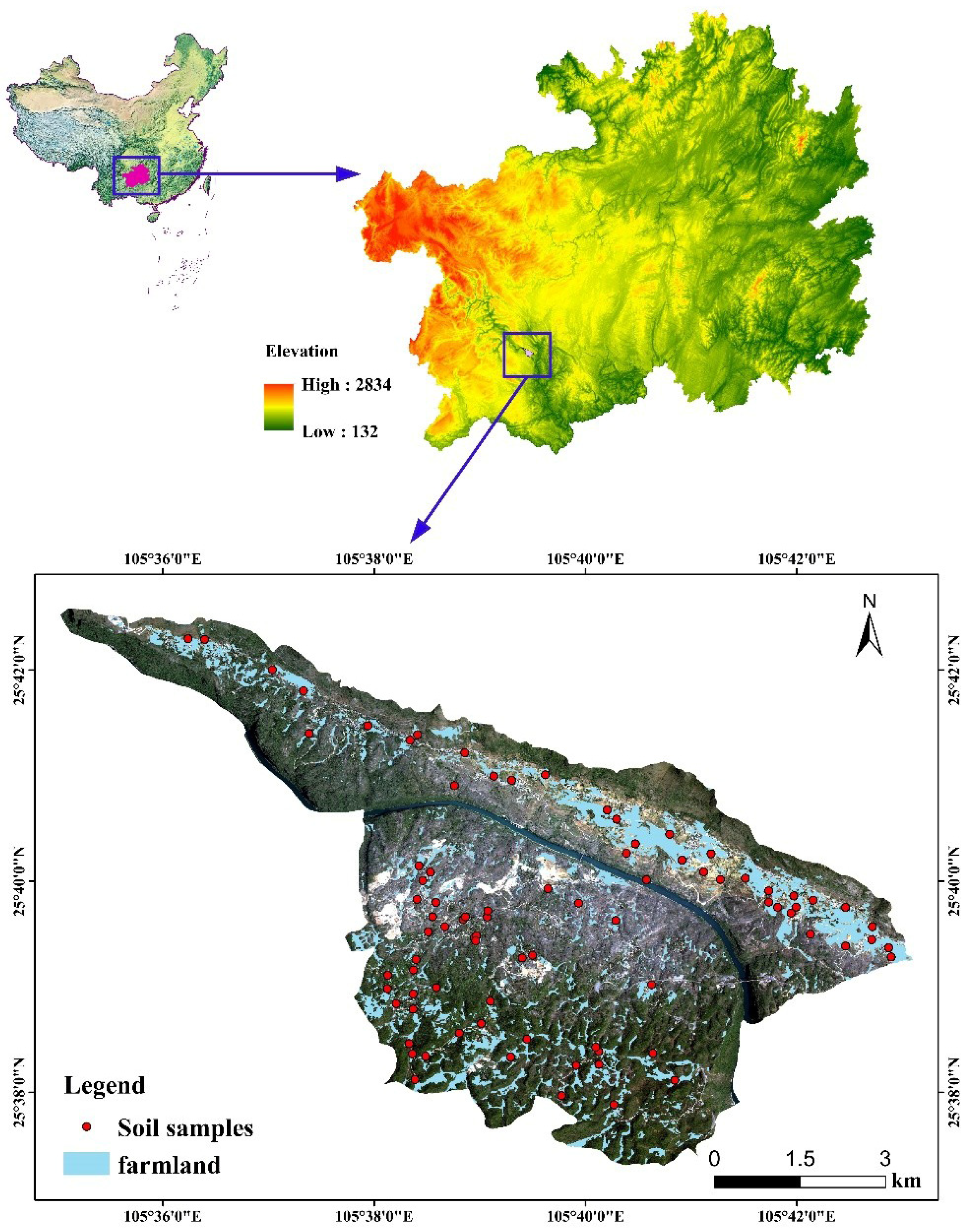
The Huajiang River Basin (Figure 1) is located in Anshun City on both sides of the Huajiang Canyon section of the Beipanjiang River (105°34′59″–105°43′06″ E, 25°37′18″–25°42′37″ N), and belongs to the Beipanjiang River system of the Pearl River Basin. The total area of the watershed is about 51.62 km2, with an elevation of 370–1473 m. Karst processes are intense within the study area, leading to abundant underground features, such as fissures, caves, subterranean rivers, and sinkholes. Carbonate rocks, primarily dolomitic limestone, are widely exposed, contributing to a high bedrock exposure rate and highly fragmented cropland. The predominant soil types are yellow soil and limestone soil. The average annual temperature is about 18.4 °C, and the average annual precipitation is 1100 mm. However, the distribution of rainfall seasons is not even, and the rainfall is mainly concentrated in the period from May to October, with a warm and arid winter and spring and a hot and humid summer and autumn, representing the climate of a subtropical dry and hot river valley. The river valley in the basin is deep, the terrain undulation difference is large, and the distribution of arable land is broken. The area of cropland in the region is about 6.32 km2, and the main food crop planted is corn, with planting time spanning from March to September.

2.2. Soil Samples

Owing to the exposed rocky surface, complicated terrain, and rugged roads in the study area, large-scale field sampling is difficult. Therefore, on the basis of the distribution of cultivated land in the study area, initial sampling points were set up by random sampling. Sampling was carried out from September to November 2023 at 76 sampling points. Soil samples were collected from each soil profile at depths of 0–10 cm and 10–20 cm, and a total of 152 soil samples were obtained. The coordinates of each soil sampling point were recorded using the Global Positioning System (GPS). The soil samples were brought back to the laboratory, naturally dried, decontaminated, ground, and sieved. SOC was measured using a FlashSmart (Thermo Fisher Scientific Inc., Waltham, MA, USA). The specific operation was to weigh 2000 mg of soil samples into a beaker and add 1 mol/L of HCL solution (10 mL). When no bubbles were generated in the soil solution, the beaker was placed in an oven at 105 °C to dry and study the finest. The processed samples (25 mg) were added to the elemental analyzer to obtain data, which were shown in the control computer and then converted to determine the content of SOC in the soil samples.

2.3. Environmental Variables

2.3.1. Topographic Variables

Topography is one of the five major factors in soil formation and an important condition influencing the exchange of materials and energy between the soil and the environment. It affects SOC mainly through hydrothermal conditions and soil erosion, which, in turn, govern the rate of SOC accumulation and its spatial distribution [19,20]. Therefore, terrain variables were selected as SOC predictor variables. The digital elevation model (DEM) was obtained from the ALOS PALSAR 12.5 m dataset downloaded from the NASA website (https://search.asf.alaska.edu/ (accessed on 15 May 2024)) [21] and resampled to 10 m resolution via ArcGIS 10.6 to match the spatial resolution of Sentinel-2A imagery. The topographic variables (Table 1) included elevation, slope, aspect, topographic roughness index (TRI), stream power index (SPI), topographic wetness index (TWI), slope length and steepness factor (LSF), and convergence index (CI). All terrain analyses were performed using SAGA GIS 9.2.0. While this DEM represents the highest freely available resolution for the study region, residual vertical errors—which can reach several meters in steep karst terrain—may propagate into derived topographic indices, particularly TWI, SPI, and LSF, which rely on local slope and flow accumulation calculations. Potential collinearity among topographic predictors (e.g., elevation and slope; TWI and SPI) was noted; however, as elaborated in Section 2.5, the primary tree-based ensemble models used in this study are inherently robust to predictor collinearity, and no variables were removed to ensure fair model comparison.

2.3.2. Climatic Variables

Climatic factors play an important role in the input and decomposition of SOC. On the one hand, climatic conditions affect the input of vegetative apomixis to SOC by influencing the type of plants, their growth and development, biomass accumulation, and photosynthesis rate [42,43]. On the other hand, different hydrothermal conditions affect the microbial decomposition of SOC by influencing the soil material composition and physicochemical properties and the life activities of soil microorganisms, causing changes in SOC storage [41]. Hence, the climatic variables MAT and MAP were used as predictor variables. The climatic data were obtained from the China Meteorological Data Network (http://data.cma.cn/( accessed on 15 May 2024)) [44] as regional climate normals at 1 km spatial resolution. For each sampling point, values were extracted by spatial overlay. Given the small size of the watershed (51.62 km2) and the limited number of meteorological stations in this remote karst region, MAP and MAT were treated as spatially uniform across the study area. This is a simplification, as the substantial elevation range (370–1473 m) likely generates local gradients in temperature (lapse rate) and precipitation that are not captured by the coarse-resolution climate grids. The potential inaccuracy introduced by this simplification should be considered when interpreting the moderate importance of MAP and MAT in the variable rankings.

2.3.3. Remote Sensing Variables

Sentinel-2 is a high-resolution multi-spectral imaging satellite that carries a multispectral imager (MSI) for terrestrial monitoring, providing images of vegetation, soil and water cover, inland waterways, and coastal areas, for emergency services. It is divided into two satellites, 2A and 2B, and covers 13 spectral bands, from visible and near-infrared to hort-wave infrared [15]. The Sentinel-2A imagery used in this study was downloaded from the ESA official website (https://dataspace.copernicus.eu/ (accessed on 15 May 2024)) [45] for 13 January 2023 and 31 August 2023, two periods of L2A class with less than 5% cloudiness. Spatial resampling to 10 m was conducted for all bands via SNAP software (v11.0). Six bands and eight spectral indices of Sentinel-2A were selected for remote sensing variables (Table 1). In consideration of the effects of soil texture, mineral composition, soil moisture, and SOC content on the optical properties of the soil, the main spectral indices used were the vegetation index and the brightness correlation index. The growth status of surface vegetation, which can be detected using vegetation indices extracted from remotely sensed data, directly affects the differences in input apoplastic material, which, in turn, influences the resulting SOC content [46]. SOC is correlated with soil color, and the brightness correlation index can characterize the soil color and reflectance magnitude in remote sensing images; thus, the brightness correlation index can be used as a predictor variable for SOC [47].
The selection of Sentinel-2 bands and spectral indices was guided by their documented associations with soil organic carbon and vegetation properties. The six bands cover the following spectral regions relevant to SOC detection: visible bands B2 (blue), B3 (green), and B4 (red) are sensitive to soil color variations driven by organic matter content and iron oxide mineralogy [9,25]; the red-edge band B6 is positioned at the transition between chlorophyll absorption and canopy scattering, making it responsive to vegetation chlorophyll content and leaf area; near-infrared band B8 is the primary indicator of vegetation biomass and canopy structure; and shortwave infrared band B12 is sensitive to soil mineral composition, clay content, and moisture, all of which covary with SOC in karst landscapes [22]. The eight spectral indices were selected to represent three complementary information dimensions: vegetation greenness and canopy density (NDVI, RVI, DVI, RDVI, SAVI), soil brightness and albedo (BI, BI2), and a red-edge curvature index (RI) that has been specifically linked to soil organic matter [48]. Together, these 14 spectral variables per time period constitute an exhaustive set of the Sentinel-2-derived features most commonly and successfully used in soil spectroscopy and DSM studies of croplands.
No formal dimensionality reduction or multicollinearity screening (e.g., Variance Inflation Factor, principal component analysis) was applied to the predictor set for the following reasons. First, the primary models in this study—random forest, gradient boosted decision trees, and XGBoost—are tree-based ensemble algorithms. These models select split variables greedily at each node, and their predictive performance is not biased by predictor collinearity in the way that linear regression models are. This property is well established in the machine learning literature: collinearity does not degrade the accuracy of tree ensembles; it merely distributes variable importance among correlated predictors without inflating error. While SVM is not inherently robust to collinearity, the radial basis function kernel used in this study performs an implicit mapping to a high-dimensional space where correlated inputs are accommodated through the localized nature of the kernel function. Second, retaining all original variables was a deliberate choice to ensure fair and comparable model evaluation across all five algorithms and three variable combinations, and to preserve the interpretability of individual variable contributions. Applying feature selection only to certain models or variable sets would confound the model comparison that constitutes the primary analytical framework of this study. To confirm that no extreme multicollinearity was present, pairwise Pearson correlations were computed among all continuous predictors. No variable pair exhibited a correlation exceeding |r| = 0.95, indicating that a severe collinearity that could destabilize distance-based or kernel-based calculations was absent. The derived spectral indices did show moderate to high correlations with their constituent bands (e.g., NDVI with B4 and B8), which is mathematically expected and is not a cause for concern given the properties of the selected models.

2.4. Modeling Techniques

The four machine learning models were selected to represent distinct learning paradigms relevant to SOC prediction. RF, as a bagging ensemble of decision trees, is robust to noise and outlier samples, which are common in heterogeneous karst landscapes where SOC can vary sharply over short distances. SVM, with its kernel-based projection, is effective in capturing nonlinear relationships when the number of predictor variables is large relative to the sample size. GBDT and XGBoost, both boosting algorithms, sequentially correct prediction errors and are particularly suited to datasets with complex interaction effects among environmental covariates, such as those between topographic, climatic, and spectral variables. Together, these four models encompass bagging, kernel-based, and boosting strategies, providing a diversified base from which the stacking ensemble can draw complementary predictive strengths.
SVM is a supervised ML approach with classification and regression [49], which usually has a sufficient balance between prediction accuracy and the ability to generalize the trained model to unknown data [50]. It mainly involves the use of an efficient kernel function to project the data into a high-dimensional feature space, and then applies simple linear regression within this augmented space [51].
RF is an ML technique that is typically used for data exploration and modeling of complex relationships between predictor and target variables. It is an integrated learning method based on decision trees, which improves prediction accuracy and stability by constructing multiple decision trees [52]. Each decision tree is constructed on the basis of random samples and features, and this randomness allows RF to avoid overfitting and have good robustness [53].
GBDT is an iterative decision tree algorithm that uses CART as a weak learner, and the optimal model is obtained by constructing multiple weak learners and successively fitting the loss function using a gradient descent algorithm [54]. It uses a boosting method to train the base classifiers, in which the basic idea is to stack a base classifier on top of another. In training, each layer gives higher weights to the samples that are wrongly classified by the previous base classifiers [55].
XGBoost is an ML approach based on GBDT, the basic principle of which is to improve prediction accuracy by combining multiple decision trees into a powerful model [56]. Different from previous decision tree algorithms, XGBoost is based on the second-order Taylor’s formula expansion, combined with a regularization module, and the prediction is performed by multiple additive functions, which effectively controls the overfitting phenomenon [57].
The stacking method is a type of ensemble method that combines the results of different ML models in a single model to maximize the generalization accuracy for prediction to reach optimal accuracy [58]. This method first learns the original data through base learners, and then each of these base learners outputs the original data; the outputs of these models are stacked in columns, which constitute the new data, and the new sample data are given to the second layer of the model to be fitted [17,59].
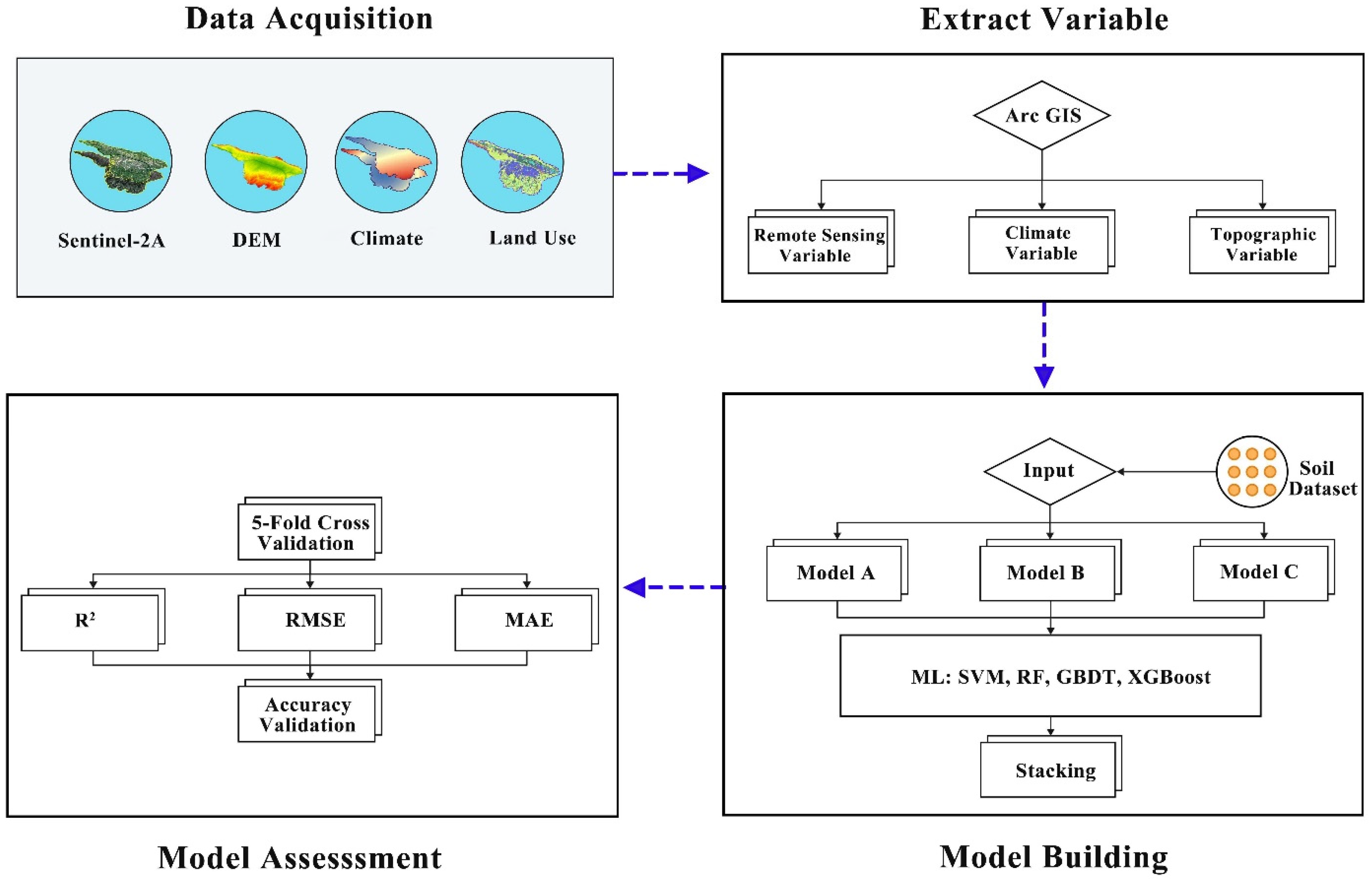
In this study, SVM, RF, GBDT, and XGBoost were used as base learners to construct the stacking model. All the above ML algorithms will be compiled in Pycharm (version 2024.3), and the scikit-learn library will be used for modeling. The specific flow is shown in Figure 2.
All models were implemented in Python 3.9 using the scikit-learn library (version 1.2.0). Hyperparameters for each base learner were optimized through a randomized search with 100 iterations combined with fivefold cross-validation on the training set. The search ranges were defined following commonly recommended ranges in the machine learning literature. For RF, the number of trees was searched in [100, 1000] and maximum tree depth in [5, 50]; for SVM with RBF kernel, the regularization parameter C was searched in [0.1, 100] and the kernel coefficient γ in [0.001, 1]; for GBDT, the number of boosting stages was searched in [100, 500], learning rate in [0.01, 0.3], and maximum depth in [3, 10]; for XGBoost, analogous ranges were applied with additional L1 and L2 regularization parameters (reg_alpha, reg_lambda) searched in [0, 10]. The best parameter combination for each model was selected according to the lowest cross-validation RMSE. To avoid overfitting, given the moderate sample size, model complexity was constrained by limiting the maximum tree depth and applying regularization where applicable. The stacking ensemble used logistic regression as the meta-learner, which combines the outputs of the four base learners without introducing substantial additional complexity. To ensure reproducibility, the complete modeling code—including data preprocessing, hyperparameter search, model training, and evaluation routines—has been archived and is available from the corresponding author upon reasonable request.

2.5. Model Evaluation

Given the use of tree-based ensemble models (RF, GBDT, XGBoost) as the core modeling algorithms, no formal multicollinearity screening (e.g., VIF) was applied. Decision tree-based methods select split variables greedily and are not biased by collinearity in the same way as linear regression models. Although SVM is not inherently robust to collinearity, the RBF kernel’s implicit feature mapping mitigates the impact of correlated inputs. We therefore retained all 32 predictor variables to preserve the full information content for model comparison.
Based on the four ML techniques and the stacking model constituted on their basis, SOC content prediction models with and without multi-temporal Sentinel-2A images were constructed using different combinations of variables (Table 2).
Fivefold cross-validation and the random search method were utilized for model performance assessment and hyperparameter adjustment to avoid underfitting and overfitting phenomena. The coefficient of determination (R2), root-mean-square error (RMSE), and mean absolute error (MAE) were used as model performance evaluation metrics. The specific formulas for these metrics are as follows:
R 2 = 1 i = 1 n ( y ^ i y i ) 2 i = 1 n ( y ¯ y i ) 2
R M S E = 1 n i = 1 n ( y ^ i y i ) 2
M A E = 1 n i = 1 n | y ^ i y i |
where y i denotes the true value, y ^ i denotes the predicted value, y ¯ denotes the sample mean, and n is the number of samples.
It should be noted that standard k-fold random cross-validation, as used in this study, does not account for spatial autocorrelation in the data. In spatial datasets, nearby sampling points tend to have more similar SOC values than distant points. When such points are randomly assigned to training and validation folds, the validation performance can be somewhat inflated because the model may learn from spatially proximate samples rather than from generalizable environmental relationships. Spatial cross-validation, in which folds are constructed by grouping geographically clustered points, provides a more conservative accuracy estimate. However, with only 76 points distributed across a highly fragmented landscape, the sample density was insufficient to construct meaningful spatial clusters without producing very small and unstable validation folds. Standard random cross-validation was therefore retained as the primary evaluation strategy, with the acknowledgment that the reported accuracy metrics should be interpreted as estimates that may be modestly optimistic due to spatial autocorrelation.

3. Results

3.1. Descriptive Statistics of the Soc Content of Samples

The statistical characteristics of the measured SOC content of the cropland are shown in Table 3. The minimum value of SOC content at 0–10 cm was 6.56 g/kg, the maximum value was 48.83 g/kg, and the mean value was 23.06 g/kg. The minimum value of SOC content at 10–20 cm was 5.89 g/kg, the maximum value was 51.23 g/kg, and the mean value was 21.17 g/kg. The SOC content of both layers showed a slightly skewed distribution, with skewness values of 0.501 and 0.706, respectively. To reduce this skewness, all prediction models were trained on the natural logarithm of SOC, ln(SOC). Reported R2, RMSE, and MAE were calculated after back-transforming predictions to the original scale (g/kg). It should be noted that back-transformation from the logarithmic scale introduces a systematic bias in absolute error metrics; therefore, the RMSE and MAE values should be interpreted as errors on the g/kg scale relative to the observed SOC distribution, for which the mean is approximately 23 g/kg.

3.2. Model Performance Comparison

The performance of SVM, RF, GBDT, XGBoost, and the stacking model composed of these four models based on different combinations of variables in the prediction of SOC in cropland is shown in Table 4. The comparative analysis based on the model fitting accuracy indicated that the choice of predictive modeling method and the composition of the types of predictor variables had a certain impact on the prediction of SOC values. Overall, the prediction accuracies using the stacking model in Models A, B, and C were better than those when using the other four single ML models (SVM, RF, GBDT, and XGBoost). The values of stacking model validation metrics for the 0–10 cm arable soil layer were R2 (0.302~0.386), RMSE (4.782~6.605), and MAE (3.36~5.165); the values of stacking model validation metrics for the 10–20 cm arable soil layer were R2 (0.321~0.425), RMSE (4.484~5.081), and MAE (4.031~5.749). Among the single ML models, GBDT and SVM exhibited the best prediction performance in Model A for the 0–10 and 10–20 cm soil layers, respectively (with R2 of 0.245 and 0.227); GBDT showed the best prediction in Model B performance for the 0–10 and 10–20 cm soil layers (with R2 of 0.253 and 0.284); GBDT indicated the best prediction performance in Model C for the 0–10 and 10–20 cm cultivated soil layers (with R2 of 0.271 and 0.318).
The best relative performance among the tested models was achieved when topographic, climatic, and multi-temporal remote sensing variables were jointly involved in the prediction. In the 0–10 cm soil layer, Model C showed improved R2 by 13.1% and 27.8% over Models B and A, respectively, by applying the stacking integration model; in the 10–20 cm soil layer, the R2 was improved by 7.3% and 32.3%. The other four single ML models demonstrated similar performance improvements at 0–10 cm and 10–20 cm. The RMSE and MAE of the all-variable Model C had the highest accuracy among the four single ML models and the stacking model. However, the stacking model performed the best (0–10 cm: R2 = 0.386, RMSE = 4.782, MAE = 3.36; 10–20 cm: R2 = 0.425, RMSE = 4.484, MAE = 4.031). Despite these relative improvements, the absolute prediction accuracy remains constrained, with the best R2 below 0.43, indicating that a substantial portion of SOC variability could not be explained.

3.3. Relative Importance of Environmental Variables

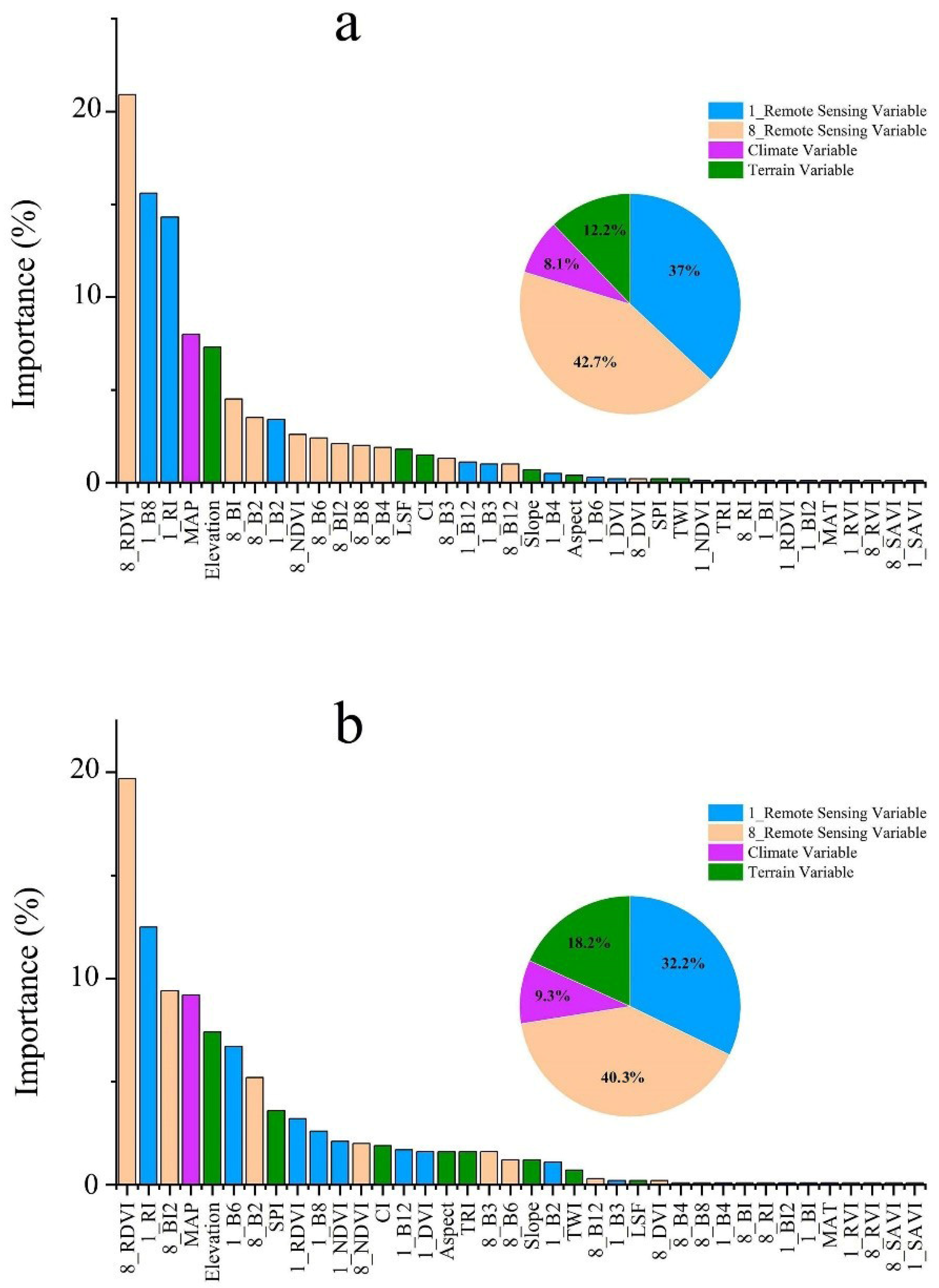
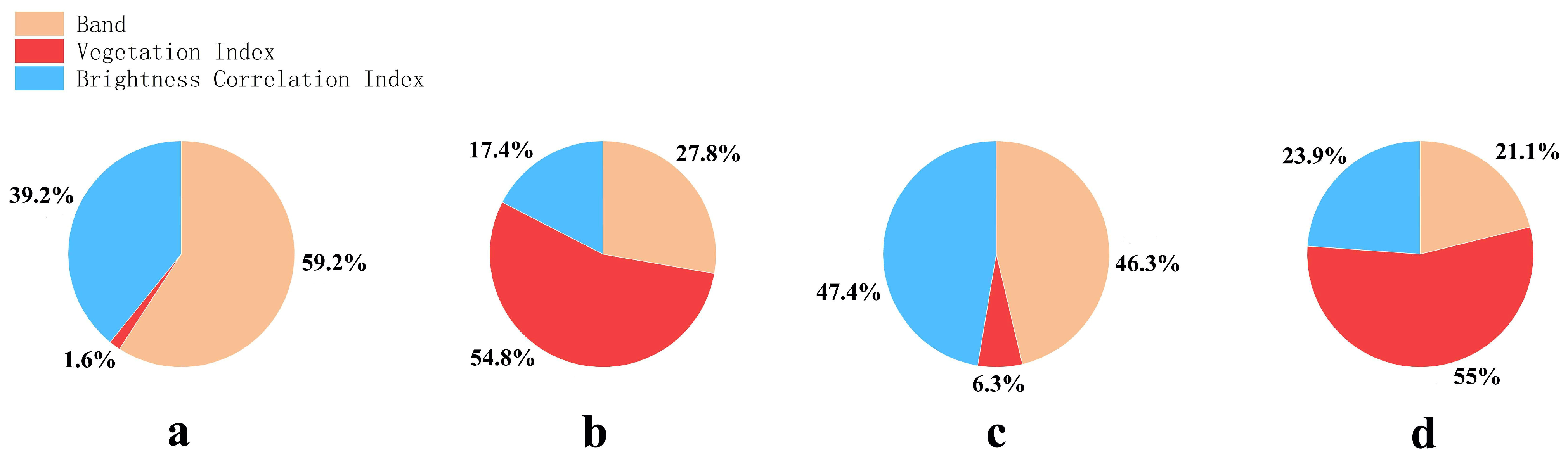
In the modeling process, the GBDT with the best predictive performance among the four single ML models was selected for variable feature importance analysis. This importance is related to the degree to which individual variables influence the prediction accuracy. By analyzing these factors, the model can identify which variables have a greater impact on the results. Therefore, the ranking of environmental variables based on the all-variable Model C for the prediction of SOC, ranked in order of relative importance, is shown in Figure 3. The importance of the different types of variables at 0–10 cm and 10–20 cm varied slightly, suggesting that the environmental features that dominated these models also varied. The top five features at 0–10 cm were 8_RDVI, 1_B8, 1_RI, MAP, and Elevation, with relative importance of 20.9%, 15.6%, 14.3%, 8%, and 7.3%, respectively; and the top five ranked feature importance in 10–20 cm are 8_RDVI, 1_RI, 8_B12, MAP, and Elevation, with relative importance of 19.7%, 12.5%, 9.4%, 9.2%, and 7.4%, respectively. The August remotely sensed variables were the main explanatory variables in the SOC prediction for both 0–10 cm and 10–20 cm (42.7% and 40.2%), followed by the January remotely sensed variables and topographic variables, with the climatic variables occupying the lowest percentage of relative importance. Among the remotely sensed variables, the remotely sensed band and brightness correlation indices accounted for a sizable portion of the January remotely sensed variables, while the vegetation index accounted for the largest portion of the August remotely sensed variables (Figure 4).

3.4. Spatial Prediction of Soc Content in the Surface Layer of Cropland

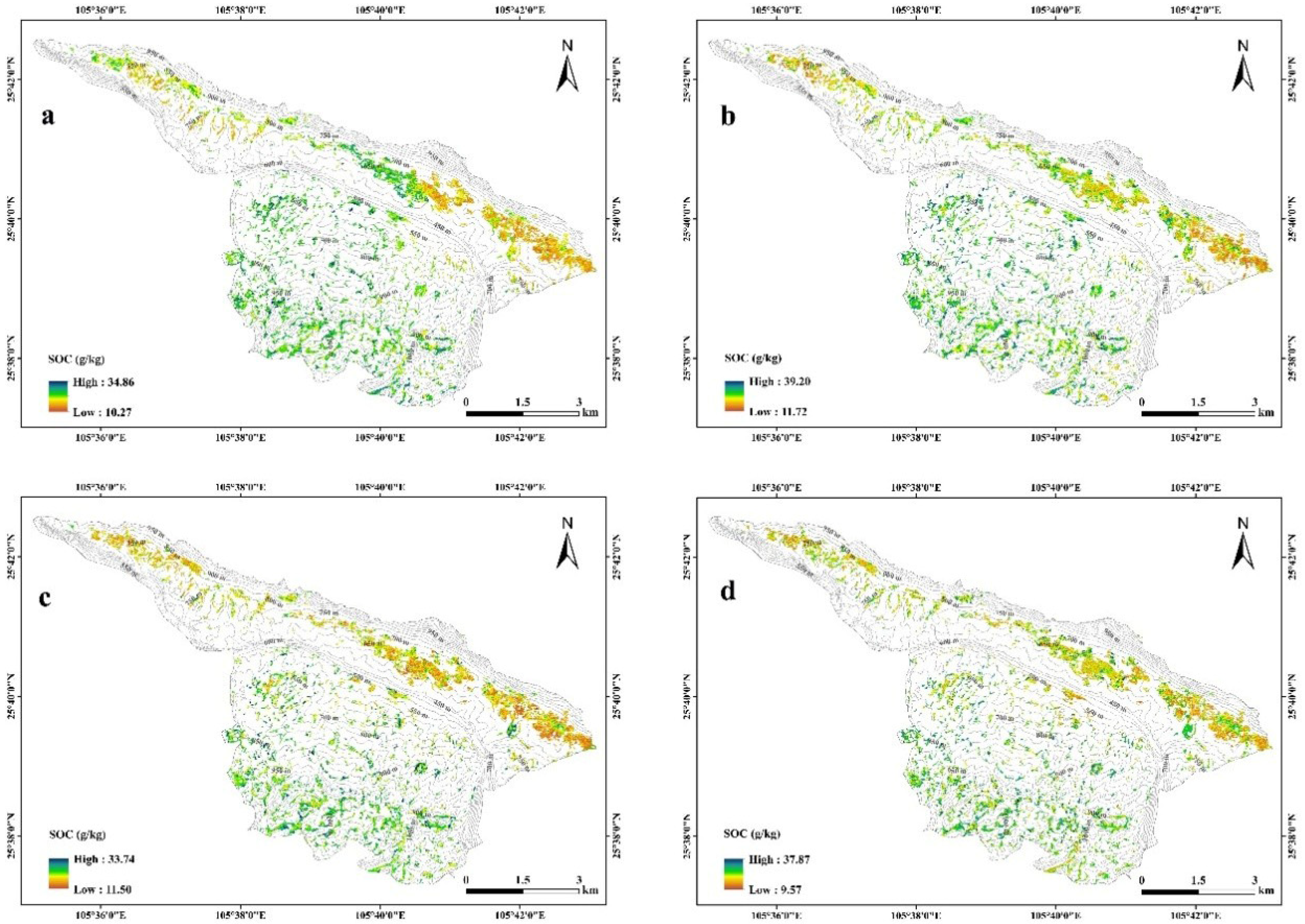
Based on Model C, the stacking model with the best prediction performance and the GBDT model with the best prediction performance among the four single ML models were used to predict the SOC content of the cultivated land in the study area, and the spatial distribution map of the cultivated land was generated (Figure 5). The mean and standard deviation of the predicted values of SOC in cropland in the study area were as follows: 21.18 and 3.73 g/kg for the GBDT model for 0–10 cm, 22.32 and 4.1 g/kg for the stacking model for 0–10 cm, 19.3 and 3.63 g/kg for the GBDT model for 10–20 cm, and 19.3 and 3.63 g/kg for the stacking model for 10–20 cm. 21.52 g and 5.24 g/kg for the stacking model for over 20 cm. Comparison of Figure 5a–c and d revealed that the overall trend of spatial distribution of SOC in 0–10 cm and 10–20 cm cropland was similar, i.e., areas with a higher SOC content were concentrated in the southern part of the study area, while areas with a lower SOC content were concentrated in the northern part of the study area.

4. Discussion

4.1. Model Predictive Performance

The results of this study show that the stacking ensemble with multi-temporal Sentinel-2A variables delivered the best predictive performance among all tested combinations. This finding is broadly consistent with previous studies that have reported the superiority of ensemble methods over single machine learning models in DSM applications [16,17] and the advantage of multi-temporal over single-date imagery [5,15]. However, the absolute prediction accuracy achieved in this study (R2 = 0.386–0.425, RPD ≈ 1.28) is substantially lower than that reported in several comparable cropland SOC mapping studies, where R2 values often exceed 0.6, and RPD reaches 1.8–2.5 [12,15].
This accuracy gap is attributed not to methodological limitations, but to the extreme spatial heterogeneity of karst croplands, which is fundamentally distinct from the relatively homogeneous plains where the majority of previous studies were conducted. Specifically, SOC variability in the Huajiang River Basin is controlled by fine-scale factors—micro-topographic depressions, exposed carbonate bedrock, fragmented field boundaries, and uneven farm management—that operate at spatial scales considerably smaller than a 10 m Sentinel-2 pixel. As a result, the spectral signal of any given pixel is a mixture of soil, vegetation, and bare rock, each with contrasting SOC signatures. This spectral mixing imposes an inherent ceiling on the covariation that can be captured between remotely sensed predictors and point-scale SOC measurements, regardless of model sophistication. This interpretation is consistent with the concept of a “prediction ceiling” proposed in soil spectroscopy for heterogeneous landscapes [18] and suggests that achieving substantially higher R2 in this environment would require predictor variables with finer spatial granularity—for instance, UAV-based imagery or explicit maps of bedrock distribution and soil depth—rather than more complex modeling algorithms alone.
The relatively small sample size (n = 76 per depth) may further contribute to model instability and moderate accuracy, as complex models like XGBoost and stacking have higher data requirements to learn stable feature–target relationships without overfitting. The performance gap between the stacking model and the best single model (GBDT) was numerically small (ΔR2 < 0.1), raising the question of whether the added complexity of the ensemble approach is justified for this dataset size. However, the stacking model’s consistent improvement across all three variable combinations and both soil depths suggests a systematic, if modest, benefit.
It is noted that the performance differences among models were numerically small, and formal statistical significance testing of these differences was not conducted. The Wilcoxon signed-rank test on cross-validation residuals or paired t-tests on performance metrics across repeated data splits are appropriate methods for such comparisons, but their statistical power depends on the number of folds and sample size. With a fivefold CV and 76 samples per soil layer, the effective degrees of freedom for such tests are limited. Nevertheless, the consistency of the stacking model’s advantage—observed across all three variable combinations (Models A, B, C) and both soil depths—lends qualitative support to the conclusion that the ensemble approach provides a systematic, albeit modest, improvement. It is recommended that future studies with larger sample sizes incorporate formal statistical comparisons to strengthen the evidential basis for model selection.

4.2. Role of Multi-Temporal Remote Sensing Data

The consistent improvement of Model C (multi-temporal) over Model B (single-date) across all models confirms the value of incorporating remote sensing information from two contrasting phenological stages. The January image, acquired during the non-growing season when much of the cropland is bare or sparsely vegetated, allows the satellite sensor to capture soil spectral properties more directly. The dominance of spectral bands (notably 1_B8 and 1_RI) among the January predictors (Figure 4) supports this interpretation: when vegetation is minimal, the reflectance signal is dominated by soil mineral and organic matter absorption features.
The August image, in contrast, corresponds to the peak of the growing season for maize, the dominant crop. The August vegetation indices—particularly RDVI—emerged as the single most important predictor across both soil depths (Figure 3). This suggests that peak-season vegetation productivity integrates the cumulative effect of soil fertility on crop growth: fields with higher SOCs tend to support more vigorous maize canopies, which are detected as higher RDVI values. This indirect pathway—SOC → soil fertility → crop biomass → vegetation index—explains why a vegetation index can serve as a proxy for a soil property, even though the satellite never directly “sees” the soil in August.
However, this indirect pathway also introduces limitations. Vegetation growth is influenced by many factors beyond SOC—including fertilizer application, pest pressure, and micro-climatic variations—which weaken the specificity of vegetation indices as SOC predictors. Furthermore, the spatial resolution of Sentinel-2 (10 m) means that individual pixels may encompass multiple crop rows, weeds, and exposed bedrock patches in the highly fragmented karst landscape, diluting the vegetation–SOC relationship. These factors likely contribute to the moderate R2 values observed even in the best-performing multi-temporal models.

4.3. Ecological Interpretation of Variable Importance

The variable importance analysis revealed that August RDVI, January spectral bands, elevation, and MAP were consistently among the top-ranked predictors (Figure 3). Rather than interpreting these rankings as evidence of independent effects, we suggest they reflect an interactive control system. Elevation and MAP jointly determine the hydrothermal regime, which shapes both the potential vegetation productivity and the rate of microbial SOC decomposition [60,61]. Higher elevations in the study area are associated with lower temperatures and, in this subtropical dry-hot valley climate, possibly orographic precipitation effects, which together favor SOC accumulation through reduced decomposition rates. The strong performance of RDVI as a predictor likely reflects the integrated outcome of this elevation–climate–soil fertility cascade: more favorable growing conditions produce denser maize canopies, registering as a higher RDVI.
The substantial contribution of the January spectral bands (1_B8, 1_RI) is consistent with the expectation that direct soil spectral information is valuable for SOC prediction. The near-infrared band B8 is sensitive to soil albedo variations linked to organic matter content and mineral composition, while the red index RI has been specifically associated with soil organic matter in previous spectroscopy studies [48]. The complementary roles of January bands and August vegetation indices highlight the value of the multi-temporal strategy, which captures two distinct SOC-sensitive signals—direct soil reflectance and vegetation-mediated productivity—within a single modeling framework.
It should be noted that the feature importance rankings were derived primarily from GBDT, and importance scores from tree-based models can be influenced by predictor collinearity. When two correlated variables are both strong SOC predictors, the tree ensemble may preferentially split on one, deflating the reported importance of the other. This effect may partially explain the dominance of a small number of variables and does not necessarily imply that lower-ranked variables lack ecological relevance. For instance, the relatively low importance of climatic variables (MAP, MAT) may partly reflect their coarse spatial resolution, which fails to capture fine-scale climatic gradients across the watershed.

4.4. Methodological Reflections on the Stacking Strategy

A noteworthy finding of this study is that while the stacking ensemble consistently outperformed the individual models, the margin of improvement was modest (ΔR2 < 0.1 in all cases). This raises the question of whether the added complexity of stacking is justified for datasets of this size and heterogeneity. Two factors may limit the benefit of stacking in this context. First, base learner diversity—a prerequisite for meaningful ensemble gains—may be constrained when all four models are applied to the same set of 32 predictors. If the base learners capture similar data structures, their prediction errors will be correlated, and the meta-learner cannot extract substantial additional signal. Second, with only 76 samples per depth, the training data available for the meta-learner after cross-validation is very limited, which prevents the stacking model from fully realizing its theoretical advantage.
These observations do not diminish the value of the present study; rather, they help define the conditions under which the stacking strategy yields meaningful gains and identify the bottlenecks that must be addressed in future work. For SOC mapping in karst and similarly heterogeneous landscapes, the primary methodological challenge may not be model selection but the acquisition of predictor variables and training data with sufficient spatial granularity to resolve sub-pixel SOC variability. The stacking ensemble, by providing a consistent—if modest—improvement over single models, represents one component of a broader strategy, alongside higher-resolution remote sensing, spatialized soil depth data, and management history records.

4.5. Limitations of the Current Study

Several limitations of this study should be acknowledged. First, despite the stacking ensemble with multi-temporal data yielding the best results among the tested models, the overall predictive accuracy remained modest (R2 = 0.386–0.425, RPD ≈ 1.28). This level of performance falls below the commonly accepted threshold of 1.4 even for a rough screening model, and it reflects the extreme spatial heterogeneity of karst croplands, where micro-topography, bedrock exposure, and uneven fertilization management dominate SOC variability at scales finer than the 10 m Sentinel-2 pixel. This inherent environmental constraint imposes a prediction ceiling that cannot be overcome solely by increasing model complexity.
Second, the sample size (76 points per depth, 152 total) is relatively small given the fragmented nature of the karst cropland. This limitation stems from several objective constraints: (a) the highly dissected terrain and deep river valleys severely restrict road accessibility, making large-scale systematic sampling logistically infeasible; (b) arable land patches are small, discontinuous, and interspersed with exposed bedrock, so that even within accessible areas, the spatial density of potential sampling sites is inherently low; and (c) field sampling must be conducted within a narrow post-harvest window (September–November), during which labor and time resources are limited. Together, these factors constrained the achievable sample size and the spatial coverage of the training dataset. For future studies in similar karst landscapes, we suggest two complementary strategies to improve sampling representativeness. First, conditioned Latin hypercube sampling (cLHS) could be applied to stratify the environmental covariate space (e.g., elevation, slope, NDVI percentiles) and guide sample placement toward under-represented covariate combinations. To account for accessibility constraints, a cost-surface layer, derived from road networks and slope gradients, can be incorporated into the cLHS algorithm to avoid selecting physically unreachable sites. Second, sample size could be incrementally expanded through multi-year field campaigns, perhaps adding 30–40 points per year in previously under-sampled topographic positions (e.g., steep mid-slopes and isolated depression fields). This phased strategy balances logistical feasibility with the need to capture a broader range of SOC variability, which is essential for raising the prediction ceiling identified in this study.
Third, the remote sensing data were affected by topography-induced shadows and residual cloud contamination, which introduced errors in spectral reflectance. Only optical Sentinel-2A imagery was used; other data sources, such as Sentinel-1 SAR or higher-resolution imagery, could provide complementary information in future studies. Similarly, the stacking ensemble was built exclusively on the four selected base learners; incorporating other modeling paradigms may further improve predictions.
Fourth, the use of random rather than spatial cross-validation may have yielded optimistic performance estimates, and pixel-wise uncertainty of the spatial predictions was not quantified. Future work should adopt spatial validation strategies, provide prediction uncertainty maps, and explore the inclusion of sub-meter resolution data, soil depth, and land management histories to narrow the prediction gap identified in this study.
Fifth, standard random cross-validation was used without explicit accounting for spatial autocorrelation, which may have yielded somewhat optimistic performance estimates.
Future studies with denser spatial sampling should adopt spatial cross-validation or target-oriented validation strategies. Sixth, the performance differences among models were not subjected to formal statistical significance testing. Given the modest sample size, the reported model rankings should be interpreted as indicative rather than conclusive.

5. Conclusions

We used DEM-derived variables, climatic variables, January Sentinel-2A remote sensing-derived variables, and August Sentinel-2A remote sensing-derived variables in different combinations. We evaluated and compared them using four ML models (RF, GBDT, XGBoost, and SVM) and their constituent stacking ensemble model to assess the integration of multi-temporal Sentinel-2A remote sensing data and stacking methods in cropland SOC prediction. The spatial distribution of cropland surface SOC in the Huajiang River Basin was mapped. The main conclusions are as follows:
(1) In the complex karst cropland environment, the stacking ensemble model yielded the best relative prediction performance among all tested approaches, though its absolute accuracy was limited.
(2) The combination of January bare-soil imagery and August peak-vegetation imagery provided complementary spectral information—direct soil reflectance and vegetation-mediated productivity, respectively—that consistently improved predictions over single-date models. However, the absolute accuracy remained moderate (R2 = 0.386–0.425, RPD ≈ 1.28), indicating that multi-temporal data alone cannot fully overcome the prediction ceiling imposed by fine-scale karst landscape heterogeneity.
(3) August Sentinel-2A remote sensing-derived variables were the main explanatory variables in both 0–10 cm and 10–20 cm SOC prediction, with RDVI ranking first, followed by January Sentinel-2A variables and topographic variables, while climatic variables accounted for the lowest percentage of relative importance.
(4) The spatial distribution maps produced by both the stacking and GBDT models consistently showed higher SOC concentrations in the southern part of the study area and lower values in the north, a pattern strongly associated with elevation and slope gradients.
(5) Methodologically, this study demonstrates that in highly heterogeneous landscapes, achieving substantial SOC mapping accuracy requires not only advanced modeling strategies but also predictor variables with finer spatial granularity and explicit representation of soil depth and bedrock distribution. The stacking ensemble, while providing a consistent but modest improvement, is best viewed as one component of a broader strategy rather than a standalone solution.

Author Contributions

K.L.: Conceptualization, validation, formal analysis, investigation, writing—original draft preparation, writing—original draft preparation, project administration, and funding acquisition. Y.L.: Conceptualization, methodology, validation, supervision, project administration, and funding acquisition. W.W.: methodology, software, formal analysis, resources, data curation, and visualization. L.Y.: investigation, validation, and data curation. All authors have read and agreed to the published version of the manuscript.

Funding

This research was supported by the Youth Scientific Research Project of Guizhou Provincial Education Department of China (Qian Jiao Ji [2024]. No. 171), the National Natural Science Foundation of China (No. 42561007), the Guizhou Provincial Science and Technology Plan Project (Qiankehe Foundation-ZK [2024]. No. 444 and Qiankehe Support-General [2026]. No.292), and the Guizhou Institute of Technology High level Talent Research Launch Project (No. 20221093).

Data Availability Statement

The datasets presented in this article are not readily available because of confidentiality agreements with participants and institutional data protection policies. Requests to access the datasets should be directed to the corresponding author.

Acknowledgments

This study is made possible through the Anshun Agricultural Environment Field Observation and Research Station, MARA. The authors express their appreciation to the farmers who participated in the field sample collection. Finally, we wish to express our profound gratitude to the anonymous reviewers whose contribution has led to a major improvement in this manuscript.

Conflicts of Interest

The authors declare that they have no competing interests, both financial and non-financial.

References

  1. Wang, T.; Zhou, W.; Xiao, J.; Li, H.; Yao, L.; Xie, L.; Wang, K. Soil Organic Carbon Prediction Using Sentinel-2 Data and Environmental Variables in a Karst Trough Valley Area of Southwest China. Remote Sens. 2023, 15, 2118. [Google Scholar] [CrossRef]
  2. Lausch, A.; Baade, J.; Bannehr, L.; Borg, E.; Bumberger, J.; Chabrilliat, S.; Dietrich, P.; Gerighausen, H.; Glässer, C.; Hacker, J.M.; et al. Linking remote sensing and geodiversity and their traits relevant to biodiversity—Part I: Soil characteristics. Remote Sens. 2019, 11, 2356. [Google Scholar] [CrossRef]
  3. Schillaci, C.; Acutis, M.; Lombardo, L.; Lipani, A.; Fantappie, M.; Märker, M.; Saia, S. Spatio-temporal topsoil organic carbon mapping of a semi-arid Mediterranean region: The role of land use, soil texture, topographic indices and the influence of remote sensing data to modelling. Sci. Total Environ. 2017, 601, 821–832. [Google Scholar] [CrossRef] [PubMed]
  4. Tang, H.; Liu, Y.; Li, X.; Muhammad, A.; Huang, G. Carbon sequestration of cropland and paddy soils in China: Potential, driving factors, and mechanisms. Greenh. Gases Sci. Technol. 2019, 9, 872–885. [Google Scholar] [CrossRef]
  5. de Almeida Minhoni, R.T.; Scudiero, E.; Zaccaria, D.; Saad, J.C.C. Multitemporal satellite imagery analysis for soil organic carbon assessment in an agricultural farm in southeastern Brazil. Sci. Total Environ. 2021, 784, 147216. [Google Scholar] [CrossRef] [PubMed]
  6. Ji, T. Comparison on determining the organic matter contents in the soils by different heating methods in the potassium dichromate-volumetric method. Acta Agric. Zhejiangensis 2005, 17, 311–313. [Google Scholar]
  7. Goldman, M.A.; Needelman, B.A.; Rabenhorst, M.C.; Lang, M.W.; McCarty, G.W.; King, P. Digital soil mapping in a low-relief landscape to support wetland restoration decisions. Geoderma 2020, 373, 114420. [Google Scholar] [CrossRef]
  8. Minasny, B.; McBratney, A.B. Digital soil mapping: A brief history and some lessons. Geoderma 2016, 264, 301–311. [Google Scholar] [CrossRef]
  9. Castaldi, F.; Hueni, A.; Chabrillat, S.; Ward, K.; Buttafuoco, G.; Bomans, B.; Vreys, K.; Brell, M.; Wesemael, B. Evaluating the capability of the Sentinel 2 data for soil organic carbon prediction in croplands. ISPRS J. Photogramm. Remote Sens. 2019, 147, 267–282. [Google Scholar] [CrossRef]
  10. Wang, H.; Zhang, X.; Wu, W.; Liu, H. Prediction of Soil Organic Carbon under Different Land Use Types Using Sentinel-1/-2 Data in a Small Watershed. Remote Sens. 2021, 13, 1229. [Google Scholar] [CrossRef]
  11. Mahmoudabadi, E.; Karimi, A.; Haghnia, G.H.; Sepehr, A. Digital soil mapping using remote sensing indices, terrain attributes, and vegetation features in the rangelands of northeastern Iran. Environ. Monit. Assess. 2017, 189, 500. [Google Scholar] [CrossRef]
  12. Zhang, Y.; Guo, L.; Chen, Y.; Shi, T.; Luo, M.; Ju, Q.; Zhang, H.; Wang, S. Prediction of soil organic carbon based on Landsat 8 monthly NDVI data for the Jianghan Plain in Hubei Province, China. Remote Sens. 2019, 11, 1683. [Google Scholar] [CrossRef]
  13. Liu, H.; Zhang, M.; Yang, H.; Zhang, X.; Meng, X.; Li, H.; Tang, H. Invertion of Cultivated Soil Organic Matter Content Combining Multi-Spectral Remote Sensing and Random Forest Algorithm. Trans. Chin. Soc. Agric. Eng. 2020, 36, 134–140. [Google Scholar]
  14. Dou, X.; Wang, X.; Liu, H.; Zhang, X.; Meng, L.; Pan, Y.; Yu, Z.; Cui, Y. Prediction of soil organic matter using multi-temporal satellite images in the Songnen Plain, China. Geoderma 2019, 356, 113896. [Google Scholar] [CrossRef]
  15. Shi, P.; Six, J.; Sila, A.; Vanlauwe, B.; Van Oost, K. Towards spatially continuous mapping of soil organic carbon in croplands using multitemporal Sentinel-2 remote sensing. ISPRS J. Photogramm. Remote Sens. 2022, 193, 187–199. [Google Scholar] [CrossRef]
  16. Sun, Y.; Ma, J.; Zhao, W.; Qu, Y.; Gou, Z.; Chen, H.; Tian, Y.; Wu, F. Digital mapping of soil organic carbon density in China using an ensemble model. Environ. Res. 2023, 231, 116131. [Google Scholar] [CrossRef]
  17. Taghizadeh-Mehrjardi, R.; Schmidt, K.; Amirian-Chakan, A.; Rentschler, T.; Zeraatpisheh, M.; Sarmadian, F.; Valavi, R.; Davatgar, N.; Behrens, T.; Scholten, T. Improving the spatial prediction of soil organic carbon content in two contrasting climatic regions by stacking machine learning models and rescanning covariate space. Remote Sens. 2020, 12, 1095. [Google Scholar] [CrossRef]
  18. Huang, K.; Ma, Z.; Wang, X.; Shan, J.; Zhang, Z.; Xia, P.; Jiang, X.; Wu, X.; Huang, X. Control of soil organic carbon under karst landforms: A case study of Guizhou Province, in southwest China. Ecol. Indic. 2022, 145, 109624. [Google Scholar] [CrossRef]
  19. Mirchooli, F.; Kiani-Harchegani, M.; Darvishan, A.K.; Falahatkar, S.; Sadeghi, S.H. Spatial distribution dependency of soil organic carbon content to important environmental variables. Ecol. Indic. 2020, 116, 106473. [Google Scholar] [CrossRef]
  20. Yu, H.; Zha, T.; Zhang, X.; Nie, L.; Ma, L.; Pan, Y. Spatial distribution of soil organic carbon may be predominantly regulated by topography in a small revegetated watershed. CATENA 2020, 188, 104459. [Google Scholar] [CrossRef]
  21. National Aeronautics and Space Administration (NASA). Alaska Satellite Facility Data Search. Available online: https://search.asf.alaska.edu/ (accessed on 15 May 2024).
  22. Xie, B.; Ding, J.; Ge, X.; Li, X.; Han, L.; Wang, Z. Estimation of soil organic carbon content in the Ebinur Lake wetland, Xinjiang, China, based on multisource remote sensing data and ensemble learning algorithms. Sensors 2022, 22, 2685. [Google Scholar] [CrossRef] [PubMed]
  23. Li, X.; Ding, J.; Liu, J.; Ge, X.; Zhang, J. Digital mapping of soil organic carbon using sentinel series data: A case study of the Ebinur lake watershed in Xinjiang. Remote Sens. 2021, 13, 769. [Google Scholar] [CrossRef]
  24. Wang, K.; Qi, Y.; Guo, W.; Zhang, J.; Chang, Q. Retrieval and mapping of soil organic carbon using Sentinel-2A spectral images from bare cropland in autumn. Remote Sens. 2021, 13, 1072. [Google Scholar] [CrossRef]
  25. Vaudour, E.; Gomez, C.; Fouad, Y.; Lagacherie, P. Sentinel-2 image capacities to predict common topsoil properties of temperate and Mediterranean agroecosystems. Remote Sens. Environ. 2019, 223, 21–33. [Google Scholar] [CrossRef]
  26. do Valle Júnior, R.F.; Siqueira, H.E.; Valera, C.A.; Oliveira, C.F.; Fernandes, L.F.S.; Moura, J.P.; Pacheco, F.A.L. Diagnosis of degraded pastures using an improved NDVI-based remote sensing approach: An application to the Environmental Protection Area of Uberaba River Basin (Minas Gerais, Brazil). Remote Sens. Appl. Soc. Environ. 2019, 14, 20–33. [Google Scholar] [CrossRef]
  27. Ren, H.; Zhou, G. Estimating green biomass ratio with remote sensing in arid grasslands. Ecol. Indic. 2019, 98, 568–574. [Google Scholar] [CrossRef]
  28. Tucker, C.J. Red and photographic infrared linear combinations for monitoring vegetation. Remote Sens. Environ. 1979, 8, 127–150. [Google Scholar] [CrossRef]
  29. Aldubai, A.A.; Alsadon, A.A.; Al-Gaadi, K.A.; Tola, E.; Ibrahim, A. Utilizing spectral vegetation indices for yield assessment of tomato genotypes grown in arid conditions. Saudi J. Biol. Sci. 2022, 29, 2506–2513. [Google Scholar] [CrossRef]
  30. Sashikkumar, M.C.; Selvam, S.; Karthikeyan, N.; Ramanamurthy, J.; Venkatramanan, S.; Singaraja, C. Remote sensing for recognition and monitoring of vegetation affected by soil properties. J. Geol. Soc. India 2017, 90, 609–615. [Google Scholar] [CrossRef]
  31. Rapinel, S.; Bouzillé, J.B.; Oszwald, J.; Bonis, A. Use of bi-seasonal Landsat-8 imagery for mapping marshland plant community combinations at the regional scale. Wetlands 2015, 35, 1043–1054. [Google Scholar] [CrossRef]
  32. Escadafal, R. Remote sensing of arid soil surface color with Landsat thematic mapper. Adv. Space Res. 1989, 9, 159–163. [Google Scholar] [CrossRef]
  33. Zhou, T.; Geng, Y.; Chen, J.; Pan, J.; Haase, D.; Lausch, A. High-resolution digital mapping of soil organic carbon and soil total nitrogen using DEM derivatives, Sentinel-1 and Sentinel-2 data based on machine learning algorithms. Sci. Total Environ. 2020, 729, 138244. [Google Scholar] [CrossRef]
  34. Jakšić, S.; Ninkov, J.; Milić, S.; Vasin, J.; Živanov, M.; Jakšić, D.; Komlen, V. Influence of slope gradient and aspect on soil organic carbon content in the region of Niš, Serbia. Sustainability 2021, 13, 8332. [Google Scholar] [CrossRef]
  35. Fang, H.; Ji, B.; Deng, X.; Ying, J.; Zhou, G.; Shi, Y.; Xu, L.; Tao, J.; Zhou, Y.; Li, C.; et al. Effects of topographic factors and aboveground vegetation carbon stocks on soil organic carbon in Moso bamboo forests. Plant Soil 2018, 433, 363–376. [Google Scholar] [CrossRef]
  36. Wehrhan, M.; Sommer, M. A parsimonious approach to estimate soil organic carbon applying unmanned aerial system (UAS) multispectral imagery and the topographic position index in a heterogeneous soil landscape. Remote Sens. 2021, 13, 3557. [Google Scholar] [CrossRef]
  37. Mohseni, N.; Salar, Y.S. Terrain indices control the quality of soil total carbon stock within water erosion-prone environments. Ecohydrol. Hydrobiol. 2021, 21, 46–54. [Google Scholar] [CrossRef]
  38. Kumar, S.; Singh, R.P. Spatial distribution of soil nutrients in a watershed of Himalayan landscape using terrain attributes and geostatistical methods. Environ. Earth Sci. 2016, 75, 473. [Google Scholar] [CrossRef]
  39. Zhang, H.; Yang, Q.; Li, R.; Liu, Q.; Moore, D.; He, P.; Ritsema, C.; Geissen, V. Extension of a GIS procedure for calculating the RUSLE equation LS factor. Comput. Geosci. 2013, 52, 117–188. [Google Scholar] [CrossRef]
  40. Koethe, R. (Scilands GmbH—Scientific Landscapes, Göttingen, Germany); Lehmeier, F. (University of Göttingen, Göttingen, Germany). SARA—System zur Automatischen Relief-Analyse: User Manual. Unpublished work. 1996. [Google Scholar]
  41. Owusu, S.; Yigini, Y.; Olmedo, G.F.; Omuto, C.T. Spatial prediction of soil organic carbon stocks in Ghana using legacy data. Geoderma 2020, 360, 114008. [Google Scholar] [CrossRef]
  42. Bai, Y.; Wong, C.P.; Jiang, B.; Hughes, A.C.; Wang, M.; Wang, Q. Developing China’s Ecological Redline Policy using ecosystem services assessments for land use planning. Nat. Commun. 2018, 9, 3034. [Google Scholar] [CrossRef]
  43. Ledo, A.; Smith, P.; Zerihun, A.; Whitaker, J.; Vicente-Vicente, J.L.; Qin, Z.; McNamara, N.; Zinn, Y.L.; Llorente, M.; Liebig, M.; et al. Changes in soil organic carbon under perennial crops. Glob. Change Biol. 2020, 26, 4158–4168. [Google Scholar] [CrossRef]
  44. National Meteorological Information Center (NMIC), China Meteorological Administration. China Meteorological Data Network. Available online: http://data.cma.cn/ (accessed on 15 May 2024).
  45. European Space Agency (ESA). Copernicus Data Space Ecosystem. Available online: https://dataspace.copernicus.eu/ (accessed on 15 May 2024).
  46. Ganuza, A.; Almendros, G. Organic carbon storage in soils of the Basque Country (Spain): The effect of climate, vegetation type and edaphic variables. Biol. Fertil. Soils 2023, 37, 154–162. [Google Scholar] [CrossRef]
  47. Gholizadeh, A.; Žižala, D.; Saberioon, M.; Borůvka, L. Soil organic carbon and texture retrieving and mapping using proximal, airborne and Sentinel-2 spectral imaging. Remote Sens. Environ. 2018, 218, 89–103. [Google Scholar] [CrossRef]
  48. He, X.; Yang, L.; Li, A.; Zhang, L.; Shen, F.; Cai, Y.; Zhou, C. Soil organic carbon prediction using phenological parameters and remote sensing variables generated from Sentinel-2 images. CATENA 2021, 205, 105442. [Google Scholar] [CrossRef]
  49. Vapnik, V. The Nature of Statistical Learning Theory; Springer Science & Business Media: New York, NY, USA, 2013. [Google Scholar]
  50. Gholizadeh, A.; Borůvka, L.; Saberioon, M.; Vaát, R. Visible, near-infrared, and mid-infrared spectroscopy applications for soil assessment with emphasis on soil organic matter content and quality: State-of-the-art and key issues. Appl. Spectrosc. 2013, 67, 1349–1362. [Google Scholar] [CrossRef]
  51. Keskin, H.; Grunwald, S.; Harris, W.G. Digital mapping of soil carbon fractions with machine learning. Geoderma 2019, 339, 40–58. [Google Scholar] [CrossRef]
  52. Rial, M.; Cortizas, A.M.; Rodríguez-Lado, L. Understanding the spatial distribution of factors controlling topsoil organic carbon content in European soils. Sci. Total Environ. 2017, 609, 1411–1422. [Google Scholar] [CrossRef]
  53. Kim, J.; Grunwald, S. Assessment of carbon stocks in the topsoil using random forest and remote sensing images. J. Environ. Qual. 2016, 45, 1910–1918. [Google Scholar] [CrossRef]
  54. Zhan, D.; Mu, Y.; Duan, W.; Ye, M.; Song, Y.; Song, Z.; Yao, K.; Sun, D.; Ding, Z. Spatial Prediction and Mapping of Soil Water Content by TPE-GBDT Model in Chinese Coastal Delta Farmland with Sentinel-2 Remote Sensing Data. Agriculture 2023, 13, 1088. [Google Scholar] [CrossRef]
  55. Ye, Z.; Sheng, Z.; Liu, X.; Ma, Y.; Wang, R.; Ding, S.; Liu, M.; Li, Z.; Wang, Q. Using machine learning algorithms based on GF-6 and Google Earth engine to predict and map the spatial distribution of soil organic matter content. Sustainability 2021, 13, 14055. [Google Scholar] [CrossRef]
  56. Zhou, J.; Li, E.; Wang, M.; Chen, X.; Shi, X.; Jiang, L. Feasibility of stochastic gradient boosting approach for evaluating seismic liquefaction potential based on SPT and CPT case histories. J. Perform. Constr. Facil. 2019, 33, 04019024. [Google Scholar] [CrossRef]
  57. Wang, L.; Yen, H.; Wang, X.; Huang, C.H.; Sun, J.; Hammac, A.; Wang, Y. Deposition-and transport-dominated erosion regime effects on the loss of dissolved and sediment-bound organic carbon: Evaluation in a cultivated soil with laboratory rainfall simulations. Sci. Total Environ. 2021, 750, 141717. [Google Scholar] [CrossRef] [PubMed]
  58. Malone, B.P.; Minasny, B.; Odgers, N.P.; McBratney, A.B. Using model averaging to combine soil property rasters from legacy soil maps and from point data. Geoderma 2014, 232, 34–44. [Google Scholar] [CrossRef]
  59. Wilson, S.; Steenwerth, K.; O’Geen, A. Mapping phosphorus sorption and availability in California vineyard soils using an ensemble of machine learning models. Soil Sci. Soc. Am. J. 2023, 87, 119–139. [Google Scholar] [CrossRef]
  60. Lozano-García, B.; Muñoz-Rojas, M.; Parras-Alcántara, L. Climate and land use changes effects on soil organic carbon stocks in a Mediterranean semi-natural area. Sci. Total Environ. 2017, 579, 1249–1259. [Google Scholar] [CrossRef] [PubMed]
  61. Yin, S.; Wang, C.; Zhou, Z. Globally altitudinal trends in soil carbon and nitrogen storages. CATENA 2022, 210, 105870. [Google Scholar] [CrossRef]
Figure 1. Distribution of the study area, sampling sites, and cropland.
Land 15 00884 g001
Figure 2. Flow chart of SOC content prediction.
Land 15 00884 g002
Figure 3. Relative importance of environmental predictor variables for SOC prediction based on the GBDT model under Model C (all variables): (a) 0–10 cm soil layer; (b) 10–20 cm soil layer. Variable naming conventions: “1_” and “8_” denote predictors derived from Sentinel-2A imagery acquired on 13 January 2023 and 31 August 2023, respectively. B2, B3, B4, B6, B8, and B12 refer to Sentinel-2 spectral bands (blue, green, red, red-edge 2, near-infrared, and shortwave infrared 2, respectively). NDVI, RVI, DVI, RDVI, and SAVI are vegetation indices; BI and BI2 are brightness indices; RI is the red index. Elevation, Slope, Aspect, TRI, SPI, TWI, LSF, and CI are topographic variables. MAP and MAT refer to mean annual precipitation and mean annual temperature, respectively.
Land 15 00884 g003
Figure 4. Relative importance of Sentinel-2A remote sensing variables in SOC prediction for different months and soil layers under Model C: (a) January variables, 0–10 cm; (b) August variables, 0–10 cm; (c) January variables, 10–20 cm; (d) August variables, 10–20 cm. Variable naming conventions follow those described in Figure 3. “VI” and “Band” denote vegetation indices and spectral bands, respectively.
Land 15 00884 g004
Figure 5. (a) Prediction of SOC for 0–10 cm using GBDT model; (b) Prediction of SOC for 0–10 cm using stacking model; (c) Prediction of SOC for 10–20 cm using GBDT model; (d) Prediction of SOC for 10–20 cm using stacking model.
Land 15 00884 g005
Table 1. Predictive covariates.
ClassesAbbreviationVariableFormulateReference
BandB2Blue BandWave length: 458–523 nm[22]
B3Red BandWave length: 543–578 nm[23]
B4Green BandWave length: 650–680 nm[24]
B6Red Edage 2Wave length: 733–748 nm[25]
B8Near-infraredWave length: 785–900 nm[9]
B12ShortWave InfraRed 2Wave length: 2100–2280 nm[22]
Vegetation IndexNDVINormalized Differences Vegetation Index B 8 B 4 B 8 + B 4 [26]
RVIRatio Vegetation Index B 8 B 4 [27]
DVIDifferential Vegetation Index B 8 B 4 [28]
RDVIRe-normalized Vegetation Index B 8 B 4 B 8 + B 4 [29]
SAVISoil Regulates Vegetation Index B 8 B 4 × ( 1 + 0.5 ) B 8 B 4 + 0.5 [30]
Brightness Correlation IndexBIBrightness Index B 8 2 + B 4 2 [31]
BI2Second Brightness Index B 8 2 + B 3 2 + B 4 2 2 [32]
RIRed Index B 4 2 B 2 × B 3 3 [2]
Terrain AttributesEElevation [33]
SSlope [34]
AAspect [35]
TRITopographic Roughness Index [36]
SPIStream Power Index [37]
TWITopographic Wetness
Index
[38]
LSFSlope Length And Steepness Factor [39]
CIConvergence Index [40]
Climate AttributeMAPMean Annual Precipitation [41]
MATMean Annual Temperature [41]
Table 2. Different combinations of environment variables.
NumberModelVariables
1Model ATopography + Climate
2Model BSingle Sentinel-2A Data + Topography + Climate
3Model CMulti-temporal Sentinel-2 Data + Topography + Climate
Table 3. Statistics on soil organic carbon content at different soil depths.
Soil Depth
(cm)
Min
(g/kg)
Max
(g/kg)
Mean
(g/kg)
Standard
Deviation
Skewness
0~106.5648.8323.069.330.501
10~205.8951.2321.179.460.706
Ln (0~10)1.883.883.050.440.295
Ln (10~20)1.773.942.950.470.292
Table 4. Predictive accuracy of SOC under different models and different combinations of variables.
Soil Depth
(cm)
ModelModeling
Techniques
R2RMSEMAE
SOC (0–10)Model AXGBoost0.1687.9546.653
RF0.1818.1516.193
GBDT0.2457.6826.936
SVM0.2017.6846.069
Stacking0.3026.6055.165
Model BXGBoost0.1767.1736.086
RF0.1927.3736.096
GBDT0.2537.0466.075
SVM0.2165.4325.253
Stacking0.3415.0424.844
Model CXGBoost0.2096.5166.235
RF0.2166.7646.114
GBDT0.2715.7155.785
SVM0.2545.4765.278
Stacking0.3864.7823.36
SOC (10–20)Model AXGBoost0.1989.7247.167
RF0.2067.2545.515
GBDT0.1947.3075.754
SVM0.2276.6845.368
Stacking0.3215.0815.749
Model BXGBoost0.2628.3856.234
RF0.246.7325.339
GBDT0.2846.8875.494
SVM0.2726.6435.69
Stacking0.3965.515.279
Model CXGBoost0.2836.4235.101
RF0.2786.615.176
GBDT0.3186.2874.028
SVM0.3095.4875.33
Stacking0.4254.4844.031
Disclaimer/Publisher’s Note: The statements, opinions and data contained in all publications are solely those of the individual author(s) and contributor(s) and not of MDPI and/or the editor(s). MDPI and/or the editor(s) disclaim responsibility for any injury to people or property resulting from any ideas, methods, instructions or products referred to in the content.