Prediction of Surface Soil Organic Carbon in Karst Cropland Based on Multi-Temporal Remote Sensing Data and Stacking Ensemble Method


Abstract
1. Introduction
2. Materials and Methods
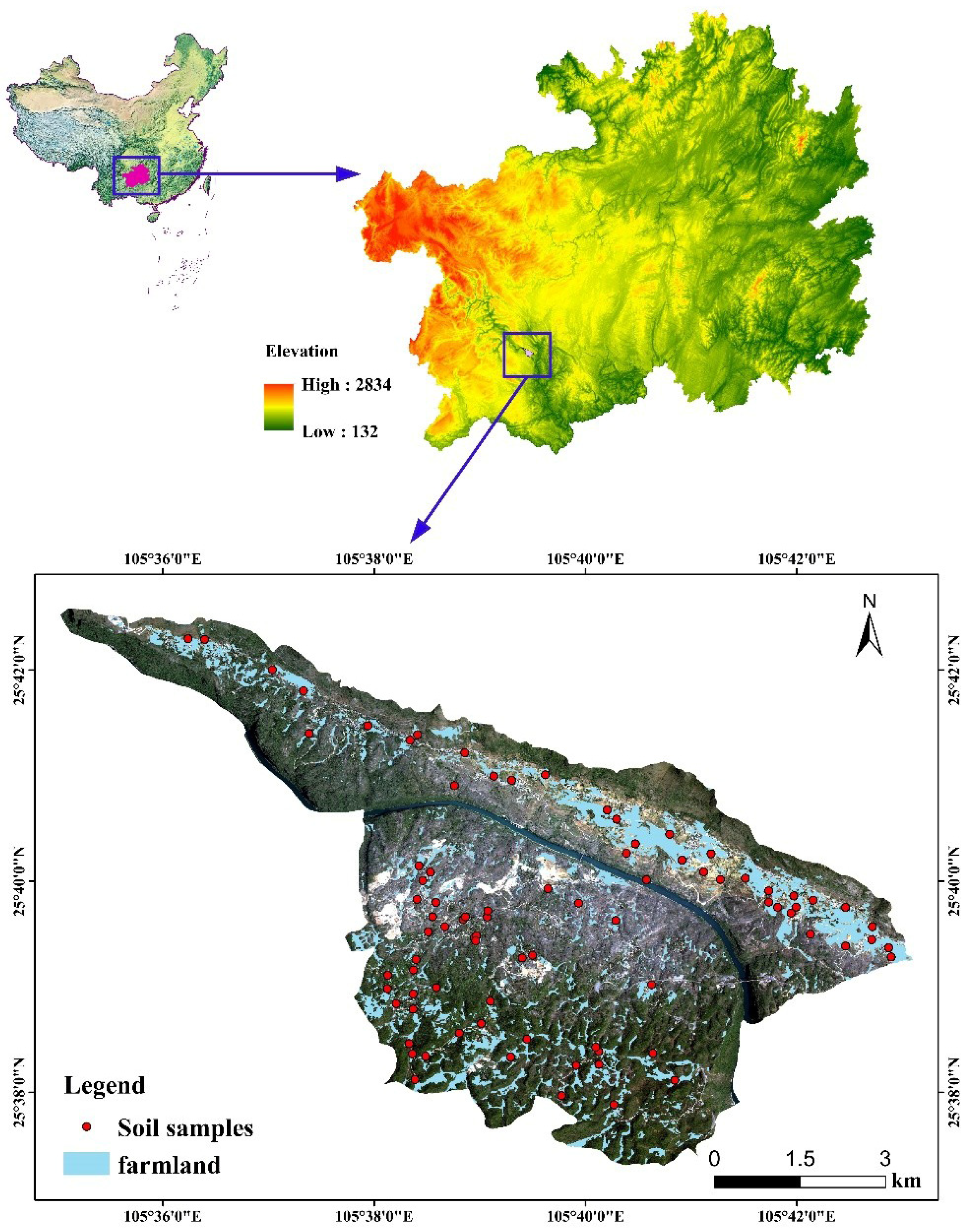
2.1. Study Area
2.2. Soil Samples
2.3. Environmental Variables
2.3.1. Topographic Variables
2.3.2. Climatic Variables
2.3.3. Remote Sensing Variables
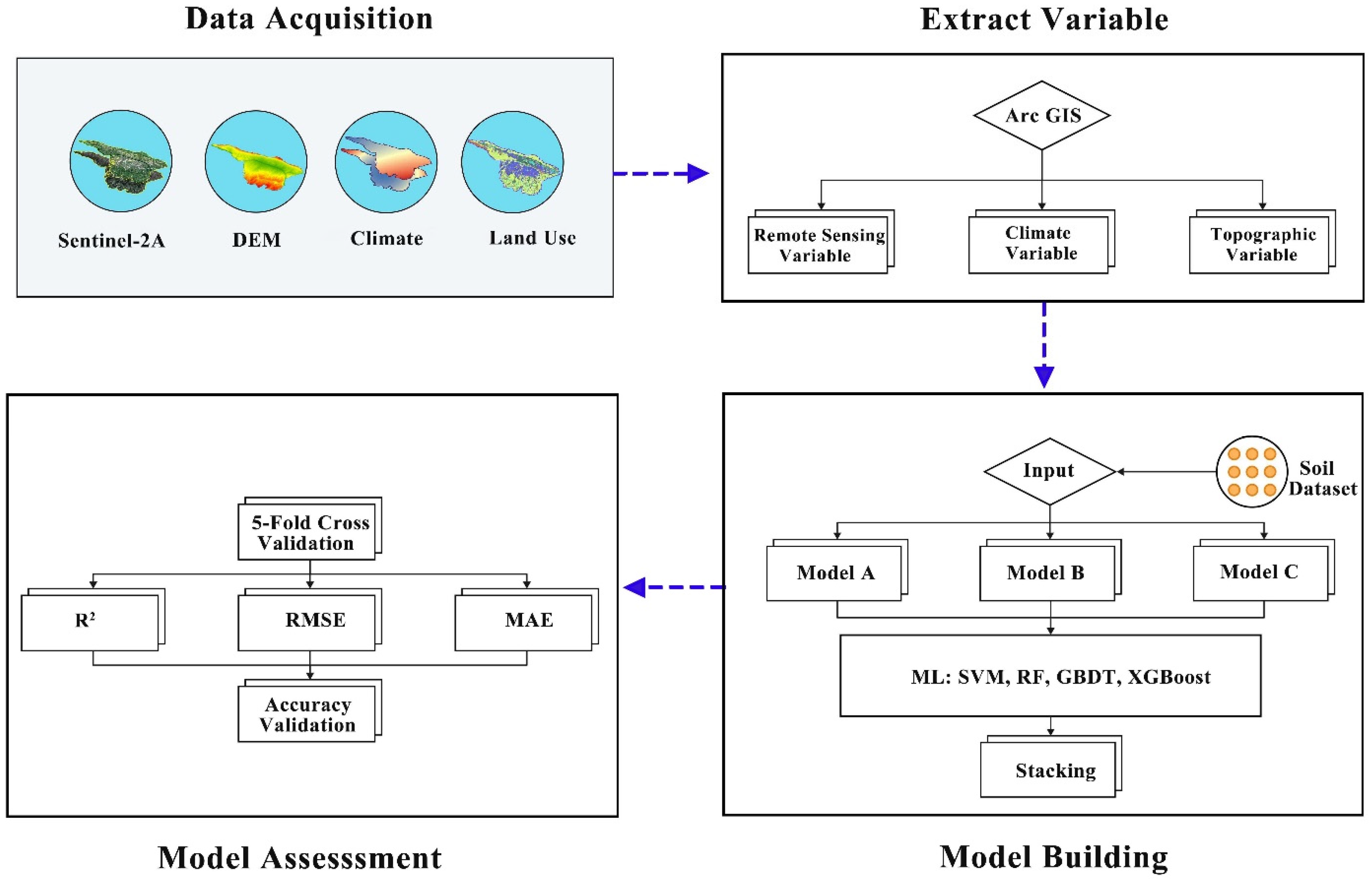
2.4. Modeling Techniques
2.5. Model Evaluation
3. Results
3.1. Descriptive Statistics of the Soc Content of Samples
3.2. Model Performance Comparison
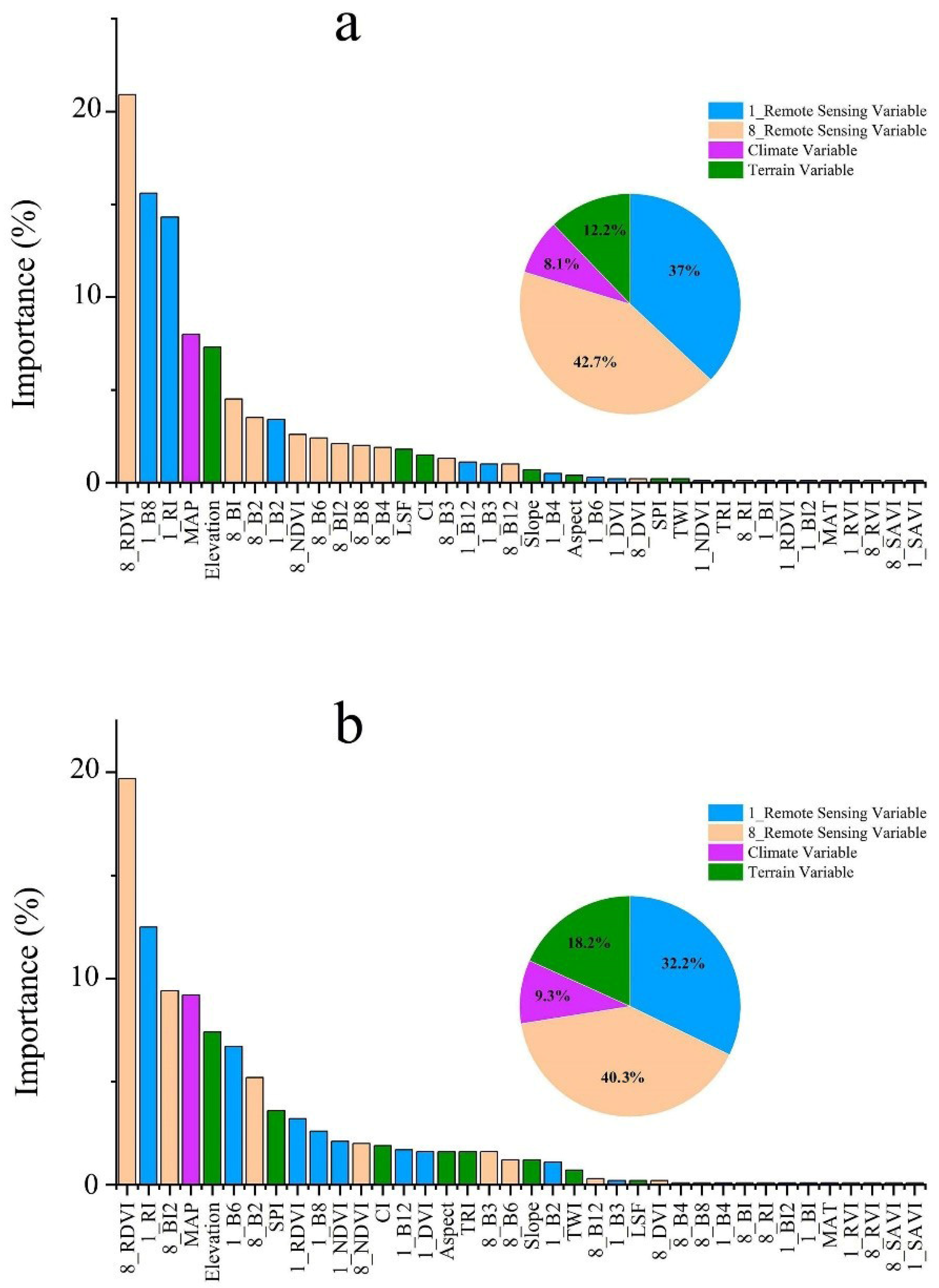
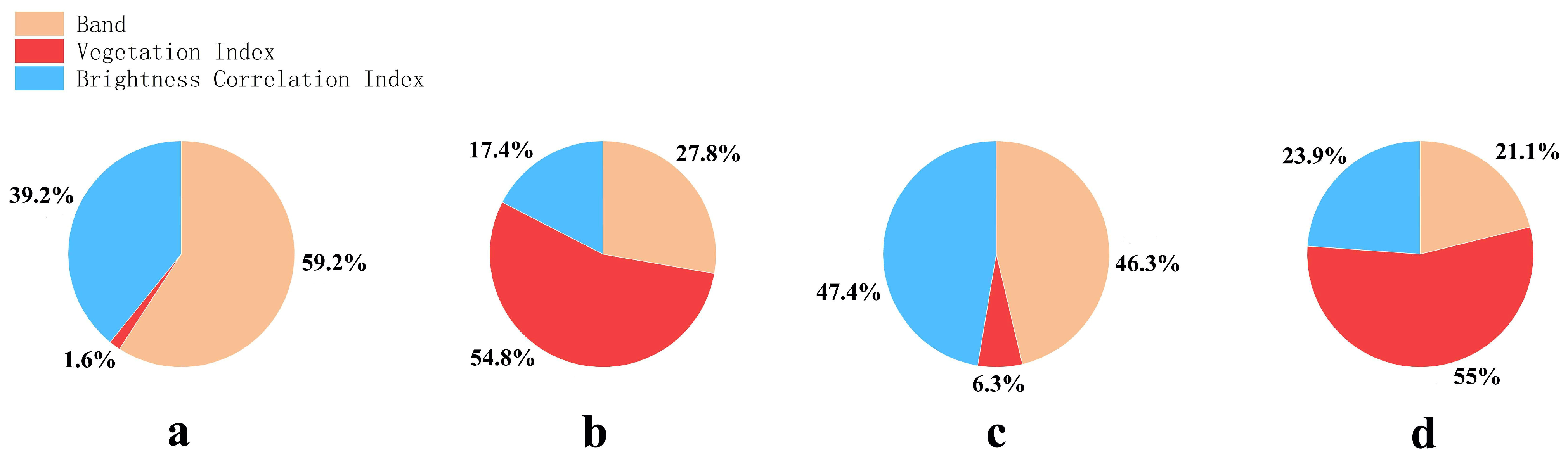
3.3. Relative Importance of Environmental Variables
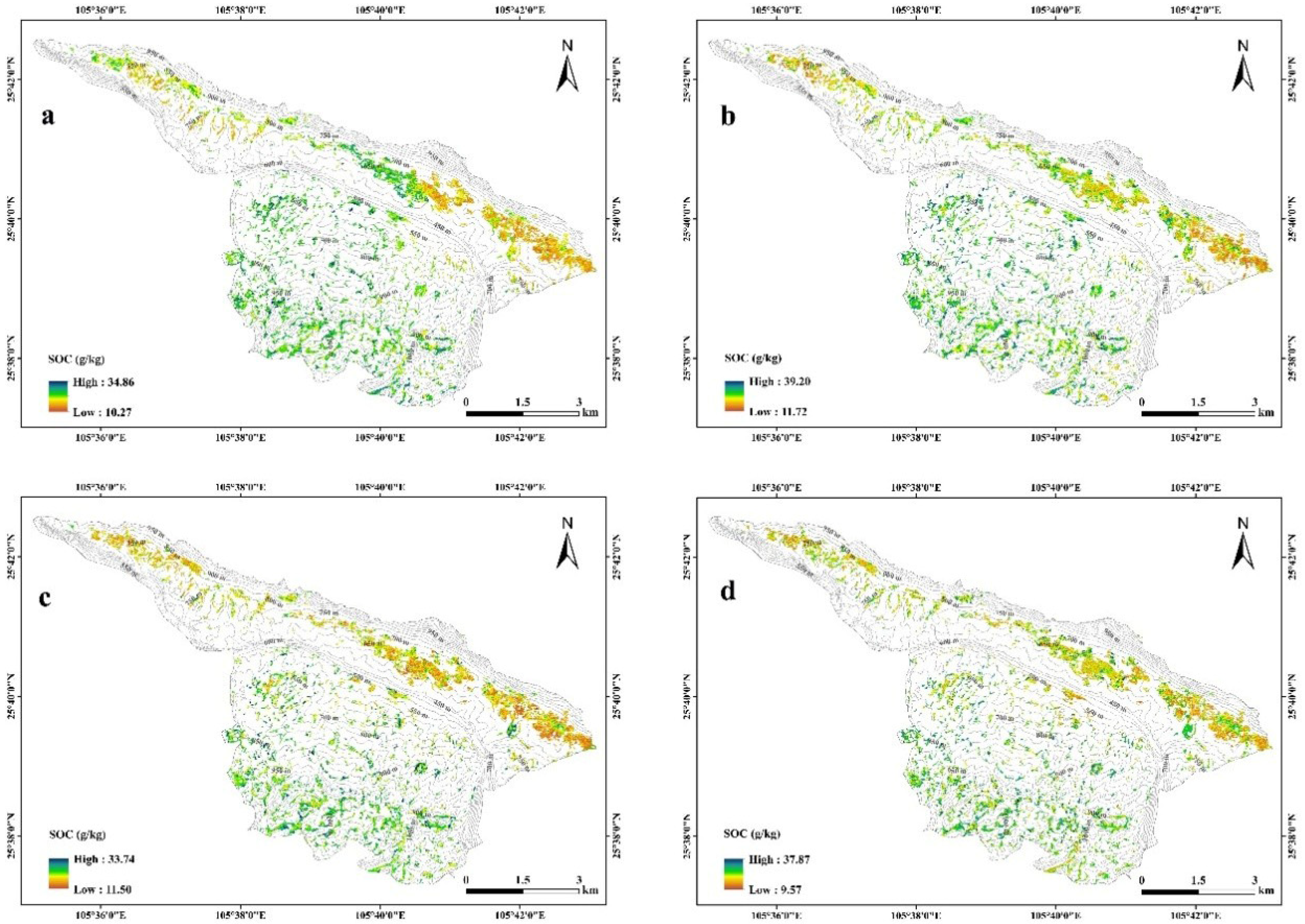
3.4. Spatial Prediction of Soc Content in the Surface Layer of Cropland
4. Discussion
4.1. Model Predictive Performance
4.2. Role of Multi-Temporal Remote Sensing Data
4.3. Ecological Interpretation of Variable Importance
4.4. Methodological Reflections on the Stacking Strategy
4.5. Limitations of the Current Study
5. Conclusions
Author Contributions
Funding
Data Availability Statement
Acknowledgments
Conflicts of Interest
References
- Wang, T.; Zhou, W.; Xiao, J.; Li, H.; Yao, L.; Xie, L.; Wang, K. Soil Organic Carbon Prediction Using Sentinel-2 Data and Environmental Variables in a Karst Trough Valley Area of Southwest China. Remote Sens. 2023, 15, 2118. [Google Scholar] [CrossRef]
- Lausch, A.; Baade, J.; Bannehr, L.; Borg, E.; Bumberger, J.; Chabrilliat, S.; Dietrich, P.; Gerighausen, H.; Glässer, C.; Hacker, J.M.; et al. Linking remote sensing and geodiversity and their traits relevant to biodiversity—Part I: Soil characteristics. Remote Sens. 2019, 11, 2356. [Google Scholar] [CrossRef]
- Schillaci, C.; Acutis, M.; Lombardo, L.; Lipani, A.; Fantappie, M.; Märker, M.; Saia, S. Spatio-temporal topsoil organic carbon mapping of a semi-arid Mediterranean region: The role of land use, soil texture, topographic indices and the influence of remote sensing data to modelling. Sci. Total Environ. 2017, 601, 821–832. [Google Scholar] [CrossRef] [PubMed]
- Tang, H.; Liu, Y.; Li, X.; Muhammad, A.; Huang, G. Carbon sequestration of cropland and paddy soils in China: Potential, driving factors, and mechanisms. Greenh. Gases Sci. Technol. 2019, 9, 872–885. [Google Scholar] [CrossRef]
- de Almeida Minhoni, R.T.; Scudiero, E.; Zaccaria, D.; Saad, J.C.C. Multitemporal satellite imagery analysis for soil organic carbon assessment in an agricultural farm in southeastern Brazil. Sci. Total Environ. 2021, 784, 147216. [Google Scholar] [CrossRef] [PubMed]
- Ji, T. Comparison on determining the organic matter contents in the soils by different heating methods in the potassium dichromate-volumetric method. Acta Agric. Zhejiangensis 2005, 17, 311–313. [Google Scholar]
- Goldman, M.A.; Needelman, B.A.; Rabenhorst, M.C.; Lang, M.W.; McCarty, G.W.; King, P. Digital soil mapping in a low-relief landscape to support wetland restoration decisions. Geoderma 2020, 373, 114420. [Google Scholar] [CrossRef]
- Minasny, B.; McBratney, A.B. Digital soil mapping: A brief history and some lessons. Geoderma 2016, 264, 301–311. [Google Scholar] [CrossRef]
- Castaldi, F.; Hueni, A.; Chabrillat, S.; Ward, K.; Buttafuoco, G.; Bomans, B.; Vreys, K.; Brell, M.; Wesemael, B. Evaluating the capability of the Sentinel 2 data for soil organic carbon prediction in croplands. ISPRS J. Photogramm. Remote Sens. 2019, 147, 267–282. [Google Scholar] [CrossRef]
- Wang, H.; Zhang, X.; Wu, W.; Liu, H. Prediction of Soil Organic Carbon under Different Land Use Types Using Sentinel-1/-2 Data in a Small Watershed. Remote Sens. 2021, 13, 1229. [Google Scholar] [CrossRef]
- Mahmoudabadi, E.; Karimi, A.; Haghnia, G.H.; Sepehr, A. Digital soil mapping using remote sensing indices, terrain attributes, and vegetation features in the rangelands of northeastern Iran. Environ. Monit. Assess. 2017, 189, 500. [Google Scholar] [CrossRef]
- Zhang, Y.; Guo, L.; Chen, Y.; Shi, T.; Luo, M.; Ju, Q.; Zhang, H.; Wang, S. Prediction of soil organic carbon based on Landsat 8 monthly NDVI data for the Jianghan Plain in Hubei Province, China. Remote Sens. 2019, 11, 1683. [Google Scholar] [CrossRef]
- Liu, H.; Zhang, M.; Yang, H.; Zhang, X.; Meng, X.; Li, H.; Tang, H. Invertion of Cultivated Soil Organic Matter Content Combining Multi-Spectral Remote Sensing and Random Forest Algorithm. Trans. Chin. Soc. Agric. Eng. 2020, 36, 134–140. [Google Scholar]
- Dou, X.; Wang, X.; Liu, H.; Zhang, X.; Meng, L.; Pan, Y.; Yu, Z.; Cui, Y. Prediction of soil organic matter using multi-temporal satellite images in the Songnen Plain, China. Geoderma 2019, 356, 113896. [Google Scholar] [CrossRef]
- Shi, P.; Six, J.; Sila, A.; Vanlauwe, B.; Van Oost, K. Towards spatially continuous mapping of soil organic carbon in croplands using multitemporal Sentinel-2 remote sensing. ISPRS J. Photogramm. Remote Sens. 2022, 193, 187–199. [Google Scholar] [CrossRef]
- Sun, Y.; Ma, J.; Zhao, W.; Qu, Y.; Gou, Z.; Chen, H.; Tian, Y.; Wu, F. Digital mapping of soil organic carbon density in China using an ensemble model. Environ. Res. 2023, 231, 116131. [Google Scholar] [CrossRef]
- Taghizadeh-Mehrjardi, R.; Schmidt, K.; Amirian-Chakan, A.; Rentschler, T.; Zeraatpisheh, M.; Sarmadian, F.; Valavi, R.; Davatgar, N.; Behrens, T.; Scholten, T. Improving the spatial prediction of soil organic carbon content in two contrasting climatic regions by stacking machine learning models and rescanning covariate space. Remote Sens. 2020, 12, 1095. [Google Scholar] [CrossRef]
- Huang, K.; Ma, Z.; Wang, X.; Shan, J.; Zhang, Z.; Xia, P.; Jiang, X.; Wu, X.; Huang, X. Control of soil organic carbon under karst landforms: A case study of Guizhou Province, in southwest China. Ecol. Indic. 2022, 145, 109624. [Google Scholar] [CrossRef]
- Mirchooli, F.; Kiani-Harchegani, M.; Darvishan, A.K.; Falahatkar, S.; Sadeghi, S.H. Spatial distribution dependency of soil organic carbon content to important environmental variables. Ecol. Indic. 2020, 116, 106473. [Google Scholar] [CrossRef]
- Yu, H.; Zha, T.; Zhang, X.; Nie, L.; Ma, L.; Pan, Y. Spatial distribution of soil organic carbon may be predominantly regulated by topography in a small revegetated watershed. CATENA 2020, 188, 104459. [Google Scholar] [CrossRef]
- National Aeronautics and Space Administration (NASA). Alaska Satellite Facility Data Search. Available online: https://search.asf.alaska.edu/ (accessed on 15 May 2024).
- Xie, B.; Ding, J.; Ge, X.; Li, X.; Han, L.; Wang, Z. Estimation of soil organic carbon content in the Ebinur Lake wetland, Xinjiang, China, based on multisource remote sensing data and ensemble learning algorithms. Sensors 2022, 22, 2685. [Google Scholar] [CrossRef] [PubMed]
- Li, X.; Ding, J.; Liu, J.; Ge, X.; Zhang, J. Digital mapping of soil organic carbon using sentinel series data: A case study of the Ebinur lake watershed in Xinjiang. Remote Sens. 2021, 13, 769. [Google Scholar] [CrossRef]
- Wang, K.; Qi, Y.; Guo, W.; Zhang, J.; Chang, Q. Retrieval and mapping of soil organic carbon using Sentinel-2A spectral images from bare cropland in autumn. Remote Sens. 2021, 13, 1072. [Google Scholar] [CrossRef]
- Vaudour, E.; Gomez, C.; Fouad, Y.; Lagacherie, P. Sentinel-2 image capacities to predict common topsoil properties of temperate and Mediterranean agroecosystems. Remote Sens. Environ. 2019, 223, 21–33. [Google Scholar] [CrossRef]
- do Valle Júnior, R.F.; Siqueira, H.E.; Valera, C.A.; Oliveira, C.F.; Fernandes, L.F.S.; Moura, J.P.; Pacheco, F.A.L. Diagnosis of degraded pastures using an improved NDVI-based remote sensing approach: An application to the Environmental Protection Area of Uberaba River Basin (Minas Gerais, Brazil). Remote Sens. Appl. Soc. Environ. 2019, 14, 20–33. [Google Scholar] [CrossRef]
- Ren, H.; Zhou, G. Estimating green biomass ratio with remote sensing in arid grasslands. Ecol. Indic. 2019, 98, 568–574. [Google Scholar] [CrossRef]
- Tucker, C.J. Red and photographic infrared linear combinations for monitoring vegetation. Remote Sens. Environ. 1979, 8, 127–150. [Google Scholar] [CrossRef]
- Aldubai, A.A.; Alsadon, A.A.; Al-Gaadi, K.A.; Tola, E.; Ibrahim, A. Utilizing spectral vegetation indices for yield assessment of tomato genotypes grown in arid conditions. Saudi J. Biol. Sci. 2022, 29, 2506–2513. [Google Scholar] [CrossRef]
- Sashikkumar, M.C.; Selvam, S.; Karthikeyan, N.; Ramanamurthy, J.; Venkatramanan, S.; Singaraja, C. Remote sensing for recognition and monitoring of vegetation affected by soil properties. J. Geol. Soc. India 2017, 90, 609–615. [Google Scholar] [CrossRef]
- Rapinel, S.; Bouzillé, J.B.; Oszwald, J.; Bonis, A. Use of bi-seasonal Landsat-8 imagery for mapping marshland plant community combinations at the regional scale. Wetlands 2015, 35, 1043–1054. [Google Scholar] [CrossRef]
- Escadafal, R. Remote sensing of arid soil surface color with Landsat thematic mapper. Adv. Space Res. 1989, 9, 159–163. [Google Scholar] [CrossRef]
- Zhou, T.; Geng, Y.; Chen, J.; Pan, J.; Haase, D.; Lausch, A. High-resolution digital mapping of soil organic carbon and soil total nitrogen using DEM derivatives, Sentinel-1 and Sentinel-2 data based on machine learning algorithms. Sci. Total Environ. 2020, 729, 138244. [Google Scholar] [CrossRef]
- Jakšić, S.; Ninkov, J.; Milić, S.; Vasin, J.; Živanov, M.; Jakšić, D.; Komlen, V. Influence of slope gradient and aspect on soil organic carbon content in the region of Niš, Serbia. Sustainability 2021, 13, 8332. [Google Scholar] [CrossRef]
- Fang, H.; Ji, B.; Deng, X.; Ying, J.; Zhou, G.; Shi, Y.; Xu, L.; Tao, J.; Zhou, Y.; Li, C.; et al. Effects of topographic factors and aboveground vegetation carbon stocks on soil organic carbon in Moso bamboo forests. Plant Soil 2018, 433, 363–376. [Google Scholar] [CrossRef]
- Wehrhan, M.; Sommer, M. A parsimonious approach to estimate soil organic carbon applying unmanned aerial system (UAS) multispectral imagery and the topographic position index in a heterogeneous soil landscape. Remote Sens. 2021, 13, 3557. [Google Scholar] [CrossRef]
- Mohseni, N.; Salar, Y.S. Terrain indices control the quality of soil total carbon stock within water erosion-prone environments. Ecohydrol. Hydrobiol. 2021, 21, 46–54. [Google Scholar] [CrossRef]
- Kumar, S.; Singh, R.P. Spatial distribution of soil nutrients in a watershed of Himalayan landscape using terrain attributes and geostatistical methods. Environ. Earth Sci. 2016, 75, 473. [Google Scholar] [CrossRef]
- Zhang, H.; Yang, Q.; Li, R.; Liu, Q.; Moore, D.; He, P.; Ritsema, C.; Geissen, V. Extension of a GIS procedure for calculating the RUSLE equation LS factor. Comput. Geosci. 2013, 52, 117–188. [Google Scholar] [CrossRef]
- Koethe, R. (Scilands GmbH—Scientific Landscapes, Göttingen, Germany); Lehmeier, F. (University of Göttingen, Göttingen, Germany). SARA—System zur Automatischen Relief-Analyse: User Manual. Unpublished work. 1996. [Google Scholar]
- Owusu, S.; Yigini, Y.; Olmedo, G.F.; Omuto, C.T. Spatial prediction of soil organic carbon stocks in Ghana using legacy data. Geoderma 2020, 360, 114008. [Google Scholar] [CrossRef]
- Bai, Y.; Wong, C.P.; Jiang, B.; Hughes, A.C.; Wang, M.; Wang, Q. Developing China’s Ecological Redline Policy using ecosystem services assessments for land use planning. Nat. Commun. 2018, 9, 3034. [Google Scholar] [CrossRef]
- Ledo, A.; Smith, P.; Zerihun, A.; Whitaker, J.; Vicente-Vicente, J.L.; Qin, Z.; McNamara, N.; Zinn, Y.L.; Llorente, M.; Liebig, M.; et al. Changes in soil organic carbon under perennial crops. Glob. Change Biol. 2020, 26, 4158–4168. [Google Scholar] [CrossRef]
- National Meteorological Information Center (NMIC), China Meteorological Administration. China Meteorological Data Network. Available online: http://data.cma.cn/ (accessed on 15 May 2024).
- European Space Agency (ESA). Copernicus Data Space Ecosystem. Available online: https://dataspace.copernicus.eu/ (accessed on 15 May 2024).
- Ganuza, A.; Almendros, G. Organic carbon storage in soils of the Basque Country (Spain): The effect of climate, vegetation type and edaphic variables. Biol. Fertil. Soils 2023, 37, 154–162. [Google Scholar] [CrossRef]
- Gholizadeh, A.; Žižala, D.; Saberioon, M.; Borůvka, L. Soil organic carbon and texture retrieving and mapping using proximal, airborne and Sentinel-2 spectral imaging. Remote Sens. Environ. 2018, 218, 89–103. [Google Scholar] [CrossRef]
- He, X.; Yang, L.; Li, A.; Zhang, L.; Shen, F.; Cai, Y.; Zhou, C. Soil organic carbon prediction using phenological parameters and remote sensing variables generated from Sentinel-2 images. CATENA 2021, 205, 105442. [Google Scholar] [CrossRef]
- Vapnik, V. The Nature of Statistical Learning Theory; Springer Science & Business Media: New York, NY, USA, 2013. [Google Scholar]
- Gholizadeh, A.; Borůvka, L.; Saberioon, M.; Vaát, R. Visible, near-infrared, and mid-infrared spectroscopy applications for soil assessment with emphasis on soil organic matter content and quality: State-of-the-art and key issues. Appl. Spectrosc. 2013, 67, 1349–1362. [Google Scholar] [CrossRef]
- Keskin, H.; Grunwald, S.; Harris, W.G. Digital mapping of soil carbon fractions with machine learning. Geoderma 2019, 339, 40–58. [Google Scholar] [CrossRef]
- Rial, M.; Cortizas, A.M.; Rodríguez-Lado, L. Understanding the spatial distribution of factors controlling topsoil organic carbon content in European soils. Sci. Total Environ. 2017, 609, 1411–1422. [Google Scholar] [CrossRef]
- Kim, J.; Grunwald, S. Assessment of carbon stocks in the topsoil using random forest and remote sensing images. J. Environ. Qual. 2016, 45, 1910–1918. [Google Scholar] [CrossRef]
- Zhan, D.; Mu, Y.; Duan, W.; Ye, M.; Song, Y.; Song, Z.; Yao, K.; Sun, D.; Ding, Z. Spatial Prediction and Mapping of Soil Water Content by TPE-GBDT Model in Chinese Coastal Delta Farmland with Sentinel-2 Remote Sensing Data. Agriculture 2023, 13, 1088. [Google Scholar] [CrossRef]
- Ye, Z.; Sheng, Z.; Liu, X.; Ma, Y.; Wang, R.; Ding, S.; Liu, M.; Li, Z.; Wang, Q. Using machine learning algorithms based on GF-6 and Google Earth engine to predict and map the spatial distribution of soil organic matter content. Sustainability 2021, 13, 14055. [Google Scholar] [CrossRef]
- Zhou, J.; Li, E.; Wang, M.; Chen, X.; Shi, X.; Jiang, L. Feasibility of stochastic gradient boosting approach for evaluating seismic liquefaction potential based on SPT and CPT case histories. J. Perform. Constr. Facil. 2019, 33, 04019024. [Google Scholar] [CrossRef]
- Wang, L.; Yen, H.; Wang, X.; Huang, C.H.; Sun, J.; Hammac, A.; Wang, Y. Deposition-and transport-dominated erosion regime effects on the loss of dissolved and sediment-bound organic carbon: Evaluation in a cultivated soil with laboratory rainfall simulations. Sci. Total Environ. 2021, 750, 141717. [Google Scholar] [CrossRef] [PubMed]
- Malone, B.P.; Minasny, B.; Odgers, N.P.; McBratney, A.B. Using model averaging to combine soil property rasters from legacy soil maps and from point data. Geoderma 2014, 232, 34–44. [Google Scholar] [CrossRef]
- Wilson, S.; Steenwerth, K.; O’Geen, A. Mapping phosphorus sorption and availability in California vineyard soils using an ensemble of machine learning models. Soil Sci. Soc. Am. J. 2023, 87, 119–139. [Google Scholar] [CrossRef]
- Lozano-García, B.; Muñoz-Rojas, M.; Parras-Alcántara, L. Climate and land use changes effects on soil organic carbon stocks in a Mediterranean semi-natural area. Sci. Total Environ. 2017, 579, 1249–1259. [Google Scholar] [CrossRef] [PubMed]
- Yin, S.; Wang, C.; Zhou, Z. Globally altitudinal trends in soil carbon and nitrogen storages. CATENA 2022, 210, 105870. [Google Scholar] [CrossRef]



| Classes | Abbreviation | Variable | Formulate | Reference |
|---|---|---|---|---|
| Band | B2 | Blue Band | Wave length: 458–523 nm | [22] |
| B3 | Red Band | Wave length: 543–578 nm | [23] | |
| B4 | Green Band | Wave length: 650–680 nm | [24] | |
| B6 | Red Edage 2 | Wave length: 733–748 nm | [25] | |
| B8 | Near-infrared | Wave length: 785–900 nm | [9] | |
| B12 | ShortWave InfraRed 2 | Wave length: 2100–2280 nm | [22] | |
| Vegetation Index | NDVI | Normalized Differences Vegetation Index | [26] | |
| RVI | Ratio Vegetation Index | [27] | ||
| DVI | Differential Vegetation Index | [28] | ||
| RDVI | Re-normalized Vegetation Index | [29] | ||
| SAVI | Soil Regulates Vegetation Index | [30] | ||
| Brightness Correlation Index | BI | Brightness Index | [31] | |
| BI2 | Second Brightness Index | [32] | ||
| RI | Red Index | [2] | ||
| Terrain Attributes | E | Elevation | [33] | |
| S | Slope | [34] | ||
| A | Aspect | [35] | ||
| TRI | Topographic Roughness Index | [36] | ||
| SPI | Stream Power Index | [37] | ||
| TWI | Topographic Wetness Index | [38] | ||
| LSF | Slope Length And Steepness Factor | [39] | ||
| CI | Convergence Index | [40] | ||
| Climate Attribute | MAP | Mean Annual Precipitation | [41] | |
| MAT | Mean Annual Temperature | [41] |
| Number | Model | Variables |
|---|---|---|
| 1 | Model A | Topography + Climate |
| 2 | Model B | Single Sentinel-2A Data + Topography + Climate |
| 3 | Model C | Multi-temporal Sentinel-2 Data + Topography + Climate |
| Soil Depth (cm) | Min (g/kg) | Max (g/kg) | Mean (g/kg) | Standard Deviation | Skewness |
|---|---|---|---|---|---|
| 0~10 | 6.56 | 48.83 | 23.06 | 9.33 | 0.501 |
| 10~20 | 5.89 | 51.23 | 21.17 | 9.46 | 0.706 |
| Ln (0~10) | 1.88 | 3.88 | 3.05 | 0.44 | 0.295 |
| Ln (10~20) | 1.77 | 3.94 | 2.95 | 0.47 | 0.292 |
| Soil Depth (cm) | Model | Modeling Techniques | R2 | RMSE | MAE |
|---|---|---|---|---|---|
| SOC (0–10) | Model A | XGBoost | 0.168 | 7.954 | 6.653 |
| RF | 0.181 | 8.151 | 6.193 | ||
| GBDT | 0.245 | 7.682 | 6.936 | ||
| SVM | 0.201 | 7.684 | 6.069 | ||
| Stacking | 0.302 | 6.605 | 5.165 | ||
| Model B | XGBoost | 0.176 | 7.173 | 6.086 | |
| RF | 0.192 | 7.373 | 6.096 | ||
| GBDT | 0.253 | 7.046 | 6.075 | ||
| SVM | 0.216 | 5.432 | 5.253 | ||
| Stacking | 0.341 | 5.042 | 4.844 | ||
| Model C | XGBoost | 0.209 | 6.516 | 6.235 | |
| RF | 0.216 | 6.764 | 6.114 | ||
| GBDT | 0.271 | 5.715 | 5.785 | ||
| SVM | 0.254 | 5.476 | 5.278 | ||
| Stacking | 0.386 | 4.782 | 3.36 | ||
| SOC (10–20) | Model A | XGBoost | 0.198 | 9.724 | 7.167 |
| RF | 0.206 | 7.254 | 5.515 | ||
| GBDT | 0.194 | 7.307 | 5.754 | ||
| SVM | 0.227 | 6.684 | 5.368 | ||
| Stacking | 0.321 | 5.081 | 5.749 | ||
| Model B | XGBoost | 0.262 | 8.385 | 6.234 | |
| RF | 0.24 | 6.732 | 5.339 | ||
| GBDT | 0.284 | 6.887 | 5.494 | ||
| SVM | 0.272 | 6.643 | 5.69 | ||
| Stacking | 0.396 | 5.51 | 5.279 | ||
| Model C | XGBoost | 0.283 | 6.423 | 5.101 | |
| RF | 0.278 | 6.61 | 5.176 | ||
| GBDT | 0.318 | 6.287 | 4.028 | ||
| SVM | 0.309 | 5.487 | 5.33 | ||
| Stacking | 0.425 | 4.484 | 4.031 |
Disclaimer/Publisher’s Note: The statements, opinions and data contained in all publications are solely those of the individual author(s) and contributor(s) and not of MDPI and/or the editor(s). MDPI and/or the editor(s) disclaim responsibility for any injury to people or property resulting from any ideas, methods, instructions or products referred to in the content. |
© 2026 by the authors. Licensee MDPI, Basel, Switzerland. This article is an open access article distributed under the terms and conditions of the Creative Commons Attribution (CC BY) license.
Share and Cite
Li, K.; Li, Y.; Wu, W.; Yang, L. Prediction of Surface Soil Organic Carbon in Karst Cropland Based on Multi-Temporal Remote Sensing Data and Stacking Ensemble Method. Land 2026, 15, 884. https://doi.org/10.3390/land15050884
Li K, Li Y, Wu W, Yang L. Prediction of Surface Soil Organic Carbon in Karst Cropland Based on Multi-Temporal Remote Sensing Data and Stacking Ensemble Method. Land. 2026; 15(5):884. https://doi.org/10.3390/land15050884
Chicago/Turabian StyleLi, Kaiping, Yuan Li, Wenxian Wu, and Leping Yang. 2026. "Prediction of Surface Soil Organic Carbon in Karst Cropland Based on Multi-Temporal Remote Sensing Data and Stacking Ensemble Method" Land 15, no. 5: 884. https://doi.org/10.3390/land15050884
APA StyleLi, K., Li, Y., Wu, W., & Yang, L. (2026). Prediction of Surface Soil Organic Carbon in Karst Cropland Based on Multi-Temporal Remote Sensing Data and Stacking Ensemble Method. Land, 15(5), 884. https://doi.org/10.3390/land15050884