1. Introduction
In recent decades, most developed countries have embraced brownfield redevelopment as an effective urban policy tool. However, its initial acceptance is often challenging, particularly in developing countries where these challenges are more pronounced. Identifying sustainable solutions that can facilitate brownfield redevelopment in these regions is thus essential [
1]. Brownfield sites are an integral part of the environment and are unique areas whose neglect could lead to adverse environmental impacts [
2]. Since the 1980s, cities, especially in advanced economies, have undergone significant transformations characterized by deindustrialization and urban evolution. These changes have resulted in a legacy of vacant and abandoned lands, now considered significant opportunities for development and progress. This situation has not only alleviated planning constraints but also created new opportunities for urban development and improvement [
3]. Due to their often central locations and the associated benefits, brownfield sites offer substantial potential for sustainable urban planning [
4]. They serve as valuable resources, providing opportunities for redevelopment within an appropriate urban land use strategy, rather than continuing wasteful linear land use practices [
5]. As valuable and non-renewable land resources, brownfield redevelopment can introduce more diverse natural features into the urban environment. Moreover, their redevelopment can help curb urban land consumption and prevent the spread of urban sprawl that erases network features in other areas [
6]. It is important to note that brownfield redevelopment is not limited to simply revitalizing specific lands and reusing abandoned spaces; it also encompasses socio-economic revitalization and the health and safety of the communities involved [
7]. Thus, the revitalization of brownfield sites represents a strategic move towards achieving territorial sustainability by introducing new activities that alleviate construction pressure on undeveloped areas and reduce the demand for transportation and other urban infrastructure [
8].
Given the growing environmental and public health concerns during the last decade, soil pollution has become increasingly significant in brownfield areas [
7]. Moreover, regional sustainable development through systems implemented in these sites can be described as a strategic, complex, and synergistic process that shapes the socio-economic, environmental, and institutional aspects of regional development, thus outlining a human-crafted performance model [
9]. Economic, social, and environmental sustainability have increasingly become central considerations in urban and territorial development policies at both European and global scales. Since the late 2010s, the United States and Europe have introduced green deal policies that propose a programmatic approach to achieving land sustainability through the redevelopment of brownfield sites into sustainable industrial zones [
9]. Given the potential of brownfield sites to reduce negative environmental impacts and contribute to urban sustainability, their redevelopment has increasingly been recognized as an important component of urban sustainability strategies [
10]. Therefore, sustainability linkages can be used as a framework for the comprehensive evaluation of brownfield redevelopment and its environmental, social, and economic impacts [
11]. Although there has been a growing amount of research on brownfield redevelopment, the methodological approaches adopted in these studies remain fragmented, and there is no comprehensive understanding of how different research methodologies have been applied and combined in this field.
Studies published in recent years have highlighted the growing relevance of brownfield research in less developed countries, where these sites are increasingly recognized as opportunities for urban transformation despite their social, economic, and environmental challenges [
12]. Although previous studies have examined brownfield redevelopment from environmental, economic, and planning perspectives, the methodological characteristics of research in this field remain comparatively underexplored. Therefore, a meta-methodological review is necessary to better understand how research on brownfield redevelopment has been designed and conducted.
Thus, the aim of this study is to systematically review brownfield redevelopment studies with a focus on the research methodologies used in this field. The study aims to determine the predominant research methods, analytical instruments, and methodological frameworks employed in contemporary brownfield redevelopment studies, as well as to investigate the relationships between research themes and methodologies. Previous research reveals that the predominant methodology in such cases has been a quantitative approach followed by a mixed one, but less often is it that a qualitative research methodology has been used. Such a fact highlights the need for a better understanding of research methodologies in brownfields redevelopment. Although several review studies have examined brownfield redevelopment from environmental and planning perspectives (e.g., sustainability assessments, policy frameworks, and spatial analysis), most of them primarily focus on thematic or sector-specific outcomes rather than on the underlying methodological structures of research. For example, previous reviews have emphasized environmental remediation techniques or socio-economic impacts, but they rarely provide a systematic comparison of research philosophies, methodological approaches, and analytical tools. Furthermore, existing studies often lack an integrated perspective linking research themes with methodological choices. This creates a gap in understanding how knowledge is produced in this field and limits the potential for methodological advancement. Therefore, by adopting a meta-methodological approach, this study aims to address this gap through the systematic analysis and comparison of the research methodologies used in brownfield redevelopment studies.
2. Theoretical Background
2.1. Brownfields
The term “brownfields” was first used in North America and quickly became common in other parts of the world, particularly in Europe. Unlike in the United States, where specific laws govern these sites, their protection elsewhere is often indirectly provided through regulations concerning soil pollution, biodiversity, or environmental conservation [
4]. Alker described the concept of “brownfield” as emerging in contrast to “greenfield” development. Brownfields are frequently associated with contaminated or degraded land, which has contributed to their negative perception, although not all brownfield sites are necessarily polluted. They usually have degraded soils that could have pollutants that might negatively impact the environment. There are different kinds of brownfields, and each one has its own problems. Some can be easily fixed, while others stay empty and aren’t used for a long time [
10]. Brownfields are usually sites that used to be industrial and are now abandoned because of a variety of human activities. They are usually found in cities. The lack of available land in cities, along with environmental rules, has made it necessary to have strict environmental policies [
13]. Therefore, brownfields are a significant issue for governments, businesses, and environmental organizations. Even though many people use the word, it doesn’t always have a clear meaning. Some definitions limit it to industrial properties, properties with known contamination, or properties with limited market demand [
12]. For example, the US Environmental Protection Agency (EPA) states that brownfields are properties where the presence or possible presence of harmful substances, pollutants, or contaminants may make it harder to expand, redevelop, or reuse them [
14].
The limited availability of urban land, influenced by constraints on the environment, has led to strict environmental regulations [
15]. A significant number of brownfields have contaminants that harm the environment and people’s health. Redevelopment efforts, such as remediation and cleanup, can lower the levels of these pollutants and make air and water pollution less likely [
16]. The negative impacts of brownfields on urban environments and communities have been widely recognized in the literature. These impacts are particularly significant because brownfield sites can contribute to uneven urban development and unsustainable urban expansion. In many cities, abandoned and underutilized areas remain insufficiently addressed within planning and development processes. Such neglect can adversely affect economic conditions, environmental quality, public health, social welfare, and overall urban livability, highlighting the importance of strategic approaches to urban management and redevelopment [
17]. Many cities continue to experience outward urban expansion while simultaneously facing processes of inner decline and deterioration. The abandonment of brownfield sites in urbanized areas represents a significant challenge in many countries, generating economic and environmental problems while also negatively affecting social welfare, public health, and quality of life. From an urban planning perspective, the persistence of neglected and underutilized areas may contribute to the emergence of urban environments that fail to meet fundamental standards of livability and sustainable development [
18]. From a theoretical perspective, brownfield redevelopment has been examined through multiple disciplinary lenses.
Table 1 summarizes key concepts and dimensions of brownfield redevelopment identified in recent studies.
The analysis presented in
Table 1 indicates that brownfield redevelopment is conceptualized through several dominant dimensions, including environmental remediation, governance and stakeholder participation, economic sustainability, and technological innovation. Among these, environmental and technical dimensions appear more prominently, reflecting a strong emphasis on risk assessment, remediation strategies, and sustainability outcomes. In contrast, social and governance-related dimensions, such as spatial justice and participation, have received comparatively less attention. This imbalance suggests that while technical solutions are relatively well developed, the integration of social and institutional perspectives remains limited. These findings highlight the need for more interdisciplinary approaches that integrate environmental, social, and governance dimensions in future research.
2.2. Brownfield Redevelopment
Following the definition and conceptual understanding of brownfields, the concept of brownfield redevelopment must be examined as a multidimensional urban and regional development process. Brownfield redevelopment has become a key element of government initiatives aimed at revitalizing numerous cities across the United States. Although these initiatives have largely been centered on promoting industrial and commercial redevelopment, the concept of brownfield redevelopment has arisen in response to a growing demand for sustainable land use methods and the revitalization of urban areas [
27].
In recent decades, the redevelopment of lands previously utilized for industrial, military, or commercial purposes, which have been abandoned due to evolving human needs, has become a significant concern for urban planners and city developers [
28]. Brownfield sites are frequently associated with various forms of contamination and a range of social, economic, and environmental challenges. At the same time, they present significant opportunities for urban regeneration and sustainable future development [
29].
Brownfields can be found in both urban and rural settings and may even encompass existing city centers or neighborhoods [
30] .The redevelopment of these sites can contribute to the revitalization of the physical, social, and economic fabric of neglected urban areas, while also helping to reduce pressure on natural and agricultural lands, improve the quality of urban cores, increase property values, and support local economic development [
31]. Brownfield sites addressed through contemporary strategies focused on economic development and quality of life improvement are increasingly recognized as important components of regional development and spatial planning. Consequently, brownfields should be understood as a multidimensional phenomenon that encompasses social, ecological, and economic dimensions [
32,
33].
Moreover, the rise in brownfields and abandoned man-made areas poses a significant sustainability concern. These sites disassociate land from its productive social role and frequently harm natural ecosystems. Land use policies with a sustainability focus aim to restore or redevelop such areas. This is relevant not only to post-industrial brownfields in urban settings but also to numerous forms of neglect in rural areas [
34]. Brownfields are generally characterized as underutilized, neglected, and potentially contaminated properties. These sites may originate from former industrial, agricultural, military, transportation, religious, residential, or other uses, including public facilities, and are commonly located within urban and municipal boundaries [
35]. Brownfield redevelopment remains a contested issue due to the complex interaction of environmental risks, economic interests, planning priorities, and social concerns [
36].
Consequently, the redevelopment of brownfields is largely influenced by socio-economic factors that have led to stagnation in sectors of the economy. Effective brownfield management, aligned with sustainable land use principles, is vital for achieving broad-based sustainable development [
37]. Brownfields often emerge in contexts where rapid economic transitions follow the decline of primary and secondary industries. In many cases, limited economic activity and reduced investment incentives contribute to the marginalization of these areas and hinder their redevelopment processes [
38].
Considering the multidimensional nature of brownfield redevelopment, research in this area has employed a wide array of research methodologies, including quantitative, qualitative, and mixed-methods research. The differences in research methodologies employed in brownfield redevelopment research highlight the complexities associated with this research field, thereby emphasizing the importance of understanding the methodological structure of existing research in this area. Hence, research methodologies employed in brownfield redevelopment research are important in understanding the evolution of this research field. Although a considerable amount of literature has been generated regarding brownfield redevelopment, review research has mostly examined the themes associated with their findings, which include environmental restoration, sustainability evaluation, policy recommendations, or economic benefits. Little emphasis has been placed on the methodology behind the studies in terms of the research philosophy used, methods employed, data analysis, and data gathering. This means that a meta-methodology review is essential in order to examine the way knowledge about brownfield redevelopment has been generated and the main methodologies involved, as well as the gaps in research methodology. In this regard, the research onion was utilized to serve as an organized structure of analysis for the studies reviewed.
3. Materials and Methods
3.1. Search Strategy and Data Collection
Studies published between 2018 and 2023 were identified through a structured keyword-based literature search in major academic databases, including Web of Science, ScienceDirect, Google Scholar, and Semantic Scholar. The databases were searched for peer-reviewed English-language studies related to brownfield redevelopment. The search process applied thematic filters associated with Environmental Sciences, Geography, and Urban Studies. The search strategy was expanded using Boolean operators to improve comprehensiveness and reproducibility. The search string included combinations such as (“brownfield redevelopment” OR “brownfield regeneration”) AND (“methodology” OR “research methods” OR “urban planning” OR “sustainability”).
3.2. Study Selection and Eligibility Criteria
The included studies were then grouped based on their main research themes and methodological characteristics for the purpose of synthesis and comparative analysis. The screening, eligibility assessment, and methodological coding processes were conducted independently by two researchers, and ambiguous cases or disagreements were resolved jointly through discussion until consensus was reached. The classification of studies was based primarily on explicit methodological information whenever available. This process helped improve consistency and reduce interpretive bias in the categorization of methodological characteristics. The screening process was conducted in three stages: (1) title and keyword screening, (2) abstract screening, and (3) full-text assessment. At each stage, the dataset was progressively reduced based on predefined inclusion criteria.
3.3. Data Analysis
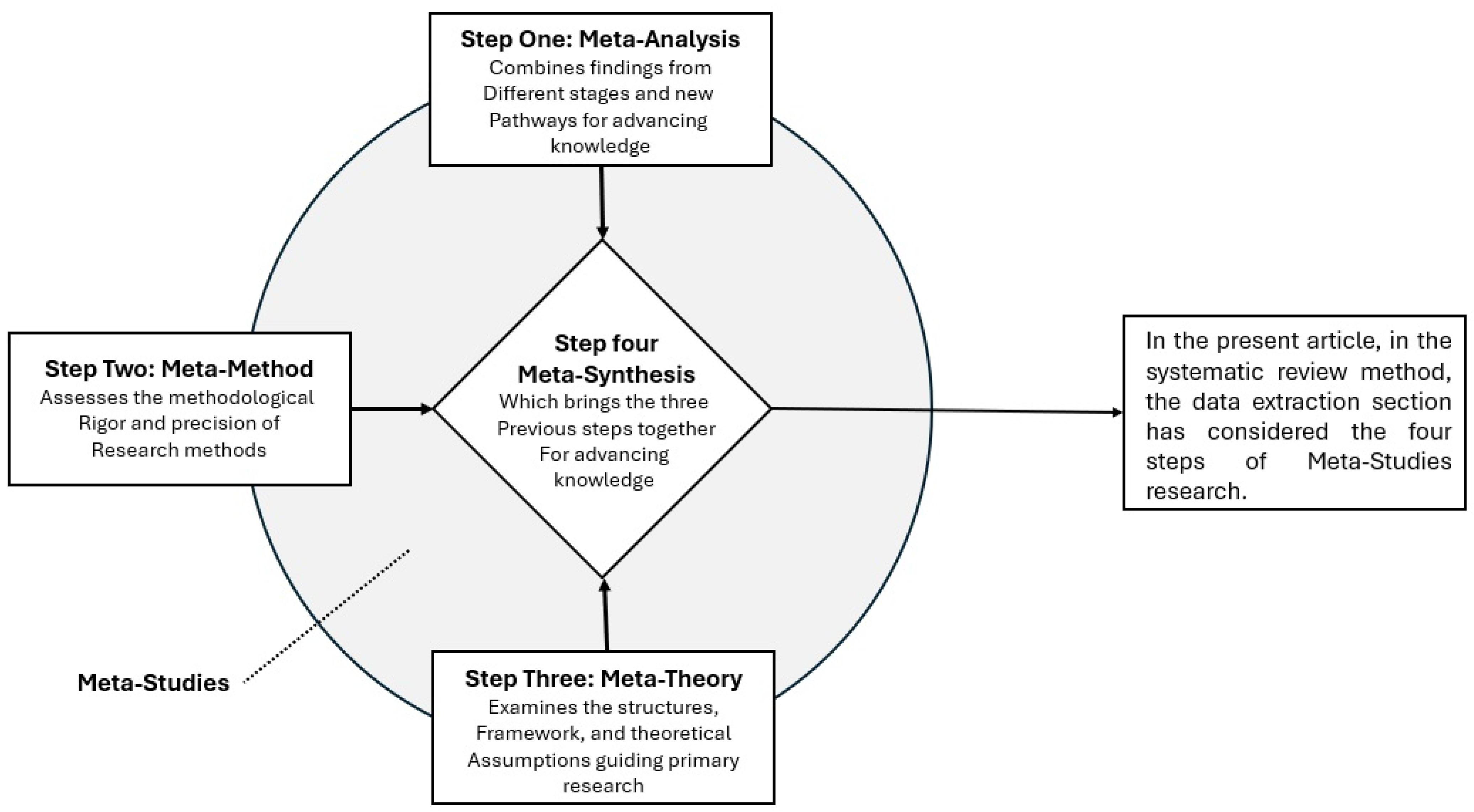
This study adopts a meta-methodological systematic review approach, combining document analysis, content analysis, and descriptive quantitative synthesis to examine the methodological characteristics of brownfield redevelopment studies. For each included study, data were extracted on methodological characteristics, including research philosophy, research orientation, research strategy, nature of research, research method, research approach, time horizon, data collection methods, qualitative and quantitative analysis methods, and software tools used. These data formed the basis for coding and comparative methodological analysis. Meta-studies can be characterized by two primary phases, analysis and synthesis, along with four distinct analytical components, meta-theory, meta-methodology, meta-analysis, and meta-synthesis [
39]. The meta-methodology includes a thorough examination and precise comprehension of the methods utilized in primary research studies. A critical aspect involves identifying specific methods to examine the target phenomenon. Patterson et al. define meta-methodology as encompassing detailed procedures (participant characteristics, sampling techniques, data collection methods) and broader reflections on how disciplinary assumptions, methodological traditions, and the researcher’s perspective influence the research being produced. Meta-methodological techniques are used to compare results from studies employing various methodological frameworks to uncover a range of distinctive concepts, approaches, and epistemologies [
40]. To enhance methodological rigor, a preliminary quality assessment was conducted based on criteria such as methodological clarity, transparency of data collection, and appropriateness of analytical methods. Studies with insufficient methodological information were excluded.
Figure 1 illustrates the four-step framework of meta-studies used in this research.
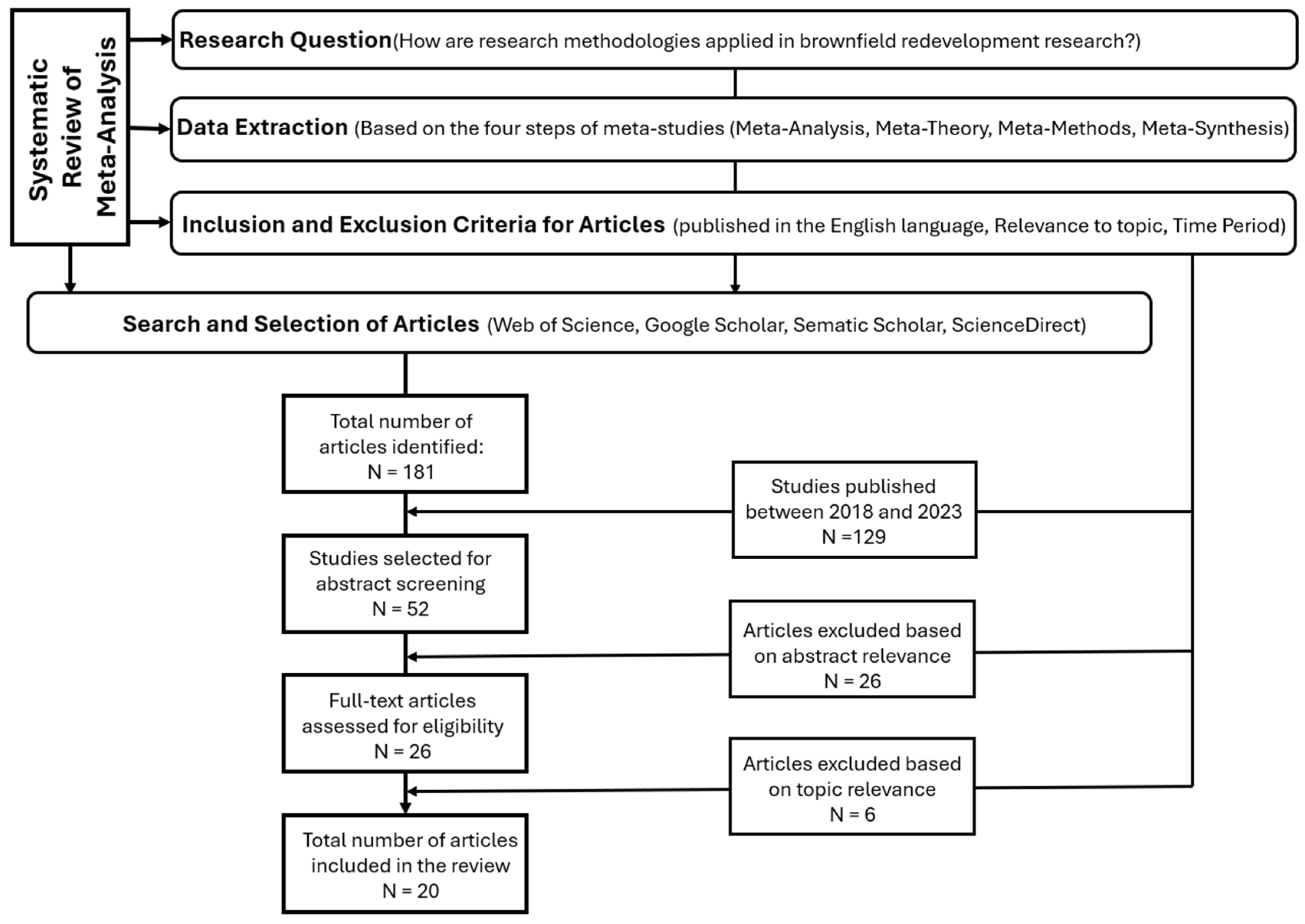
This study focuses on brownfield redevelopment as an applied research field, since its findings contribute to understanding methodological challenges and research trends in this area. The data were collected using literature review and document analysis techniques, whereas content analysis and inductive coding strategies were used to analyze the papers. Data extraction was done by manually extracting data from the entire text of the chosen papers and coding the data using MAXQDA 2020 software. The research onion model by Saunders, Lewis, and Thornhill was used to facilitate the coding process. Although a formal risk-of-bias assessment was not conducted, the study primarily focuses on methodological characteristics and research trends rather than effect evaluation. Nevertheless, potential selection bias related to database selection and keyword limitations is acknowledged. The study selection process is illustrated in
Figure 2.
The research methodology for this study began by formulating the question: “How are research methods in brownfield redevelopment studies conducted?” Afterwards, for the subsequent stage, articles were retrieved from reputable databases of research in the English language, including the Web of Science, targeting papers that focus on theoretical development and enhance understanding about brownfield regeneration. In the third phase, considering the objectives, a thematic search of the articles was performed, selecting those that directly relate to brownfield redevelopment, as indicated even in their titles. Relevance to disciplines such as “Environmental Sciences,” “Geography,” and “Urban Studies” was also ensured. To ensure a recent and comparable body of literature, the review was limited to studies published between 2018 and 2023. In the fifth phase, articles were evaluated based on their abstracts, titles, and relevance to the research question. The sixth phase involved a careful selection of 20 articles (
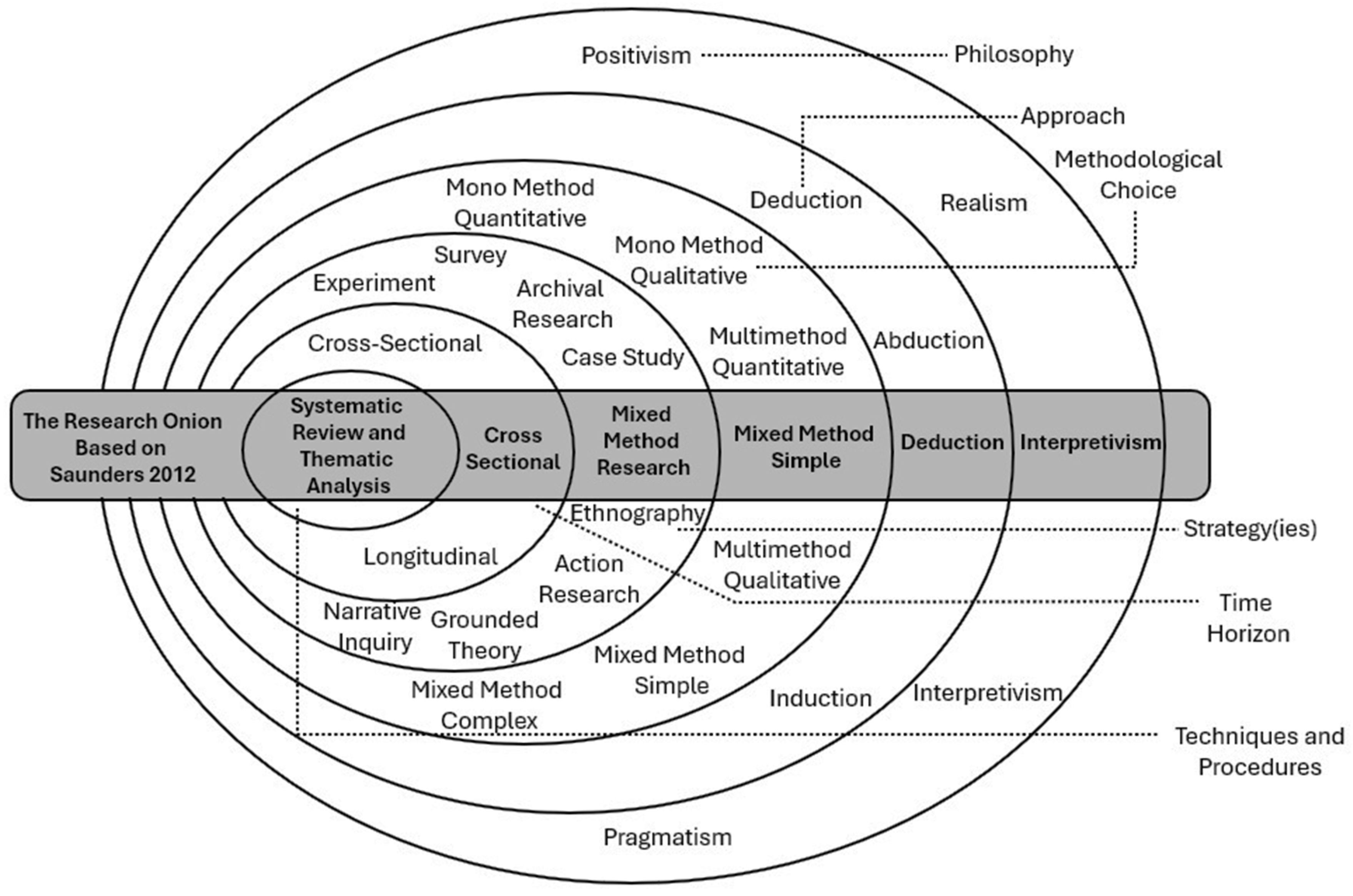
Appendix A), which were then analyzed using MAXQDA 2020 software. In the final phase, the included studies were coded and analyzed in the software based on the selected methodological criteria. Data analysis and interpretation were conducted quantitatively using Saunders’ research onion model as a conceptual framework for systematically categorizing and analyzing the methodological characteristics of the selected studies. Specifically, the model guided the classification of methodological dimensions including research philosophy, research approach, methodological choice, research strategy, time horizon, and data collection techniques. The synthesis of results was subsequently performed through thematic classification and comparative analysis to identify methodological patterns and relationships across the reviewed studies.
Figure 3 presents the methodological coding framework based on the Research Onion model.
This review focused on the methodological characteristics of published studies rather than intervention outcomes; therefore, formal effect measures, meta-analytic heterogeneity analyses, reporting bias assessment, and certainty-of-evidence assessment were not applicable.
4. Results
4.1. Characteristics of Selected Studies
A total of 181 references were initially identified through database searches. After filtering out based on the time period and relevance, 129 references were left. Abstract screening filtered 52 references for review in full text. After full-text assessment, 20 articles were included in the final review. Studies were excluded due to irrelevance to brownfield redevelopment, insufficient methodological information, non-English language, or publication outside the selected time period.
Table 2 presents the methodological characteristics of the selected studies, including research philosophy, research orientation, strategy, research methods, time horizons, data collection methods, analysis techniques, and software used.
Positivism was the most frequently identified research philosophy, with 11 studies reflecting a stronger emphasis on quantitative and rational approaches in the reviewed literature. Other codes include five pragmatist cases, three interpretative cases, and one critical case, implying that philosophers have examined philosophical research methodologies from various perspectives. The research approach codes are composed of twelve deductive cases, five inductive-deductive cases, and three inductive cases. Concerning research orientation, thirteen cases are functional, implying that most researchers have been motivated to investigate philosophical concepts from an applied orientation. Seven cases fall under fundamental research orientation, showing that only a few investigations have been conducted concerning philosophical principles. Concerning research strategy, fifteen cases are described as case studies and five others as documentary research. The research strategy or design provides the overarching framework for answering the research questions. Based on the findings from analyzing the selected articles, six cases of systematic reviews, five cases of descriptive-analytical studies, five cases of exploratory research, three cases of survey research, and one case of comparative study were found. The data shows that the majority of the research is conducted under a positivist paradigm, with the deductive research method. Case study and descriptive-analytical research are the most common research methods used in this particular area.
4.2. Methodological and Thematic Analyses
The percentage distribution of the general methodological characteristics of the reviewed articles is presented in
Table 3.
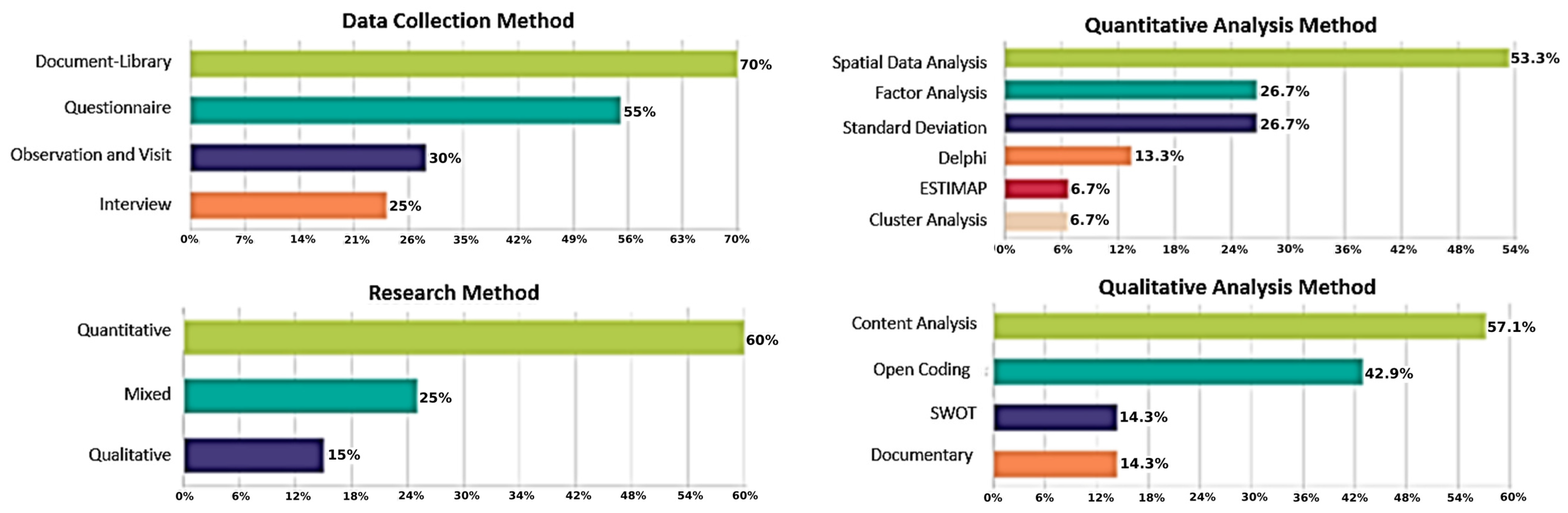
Based on the findings, one can make assumptions that 60% of all the studies carried out made use of quantitative methods, while 25% adopted mixed methods and only 15% used qualitative approaches. The frequency distribution of research methods and analysis techniques is presented in
Figure 4.
The results suggest that research in brownfield redevelopment is primarily based on positivist philosophy and deductive research. Quantitative research is given much importance. This implies that research has primarily focused on quantifiable aspects related to the environment, economy, and space. The relatively limited occurrence of mixed research methods in the reviewed sample suggests comparatively less methodological attention to governance, stakeholder, and social dimensions in brownfield redevelopment studies. The reviewed studies appear to give comparatively less attention to the long-term impacts of brownfield redevelopment projects.
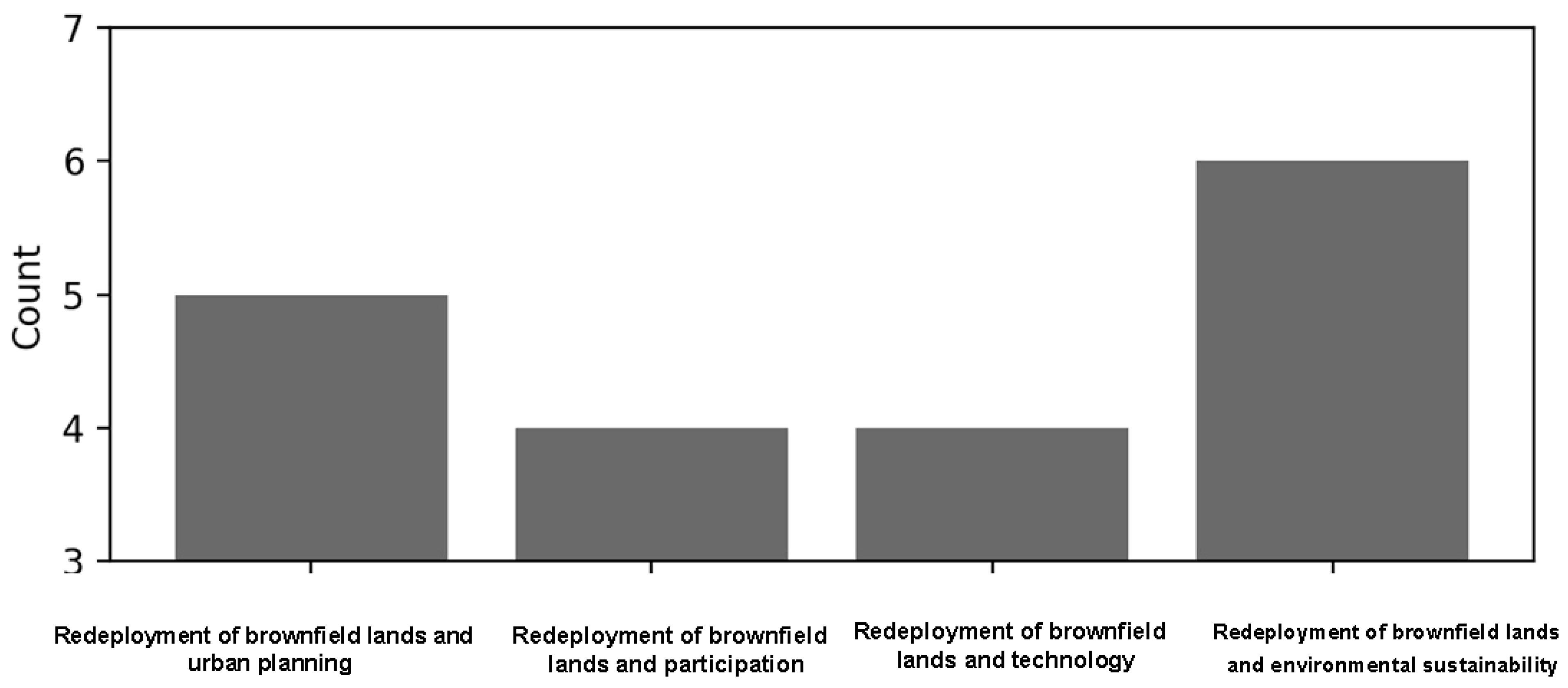
Overall, the analysis of this data indicates that research in the field of brownfield development employs a variety of approaches, research methods, and software for data collection and analysis. This diversity in the selection of research methods and software can contribute to enhancing the quality and credibility of research in this field. Based on the objectives and thematic focus of the reviewed studies, the literature can be categorized into four thematic groups: brownfield redevelopment and participation, brownfield redevelopment and urban planning, brownfield redevelopment and environmental sustainability, and brownfield redevelopment and technology. The highest frequency is observed in the category of brownfield redevelopment and environmental sustainability, suggesting that brownfield redevelopment is a significant concern for urban designers and planners in their efforts to promote sustainability. The thematic classification of brownfield redevelopment studies is shown in
Figure 5.
The findings indicate that there is a greater emphasis on quantitative approaches in brownfield redevelopment research. Researchers are primarily focused on urban studies and the research domain within these two areas, with fewer studies addressing the implementation of projects related to the reuse of these spaces and the evaluation of their progress. Additionally, the reviewed literature shows a relatively limited emphasis on comparative evaluations of the strengths and weaknesses of implemented brownfield redevelopment projects across different contexts. The selected sample indicates a greater emphasis on positivism and quantification in brownfield redevelopment studies, as well as a lower methodological diversity and the use of longitudinal and comparative methodologies. These findings may indicate the need for further methodological diversification, particularly through comparative and mixed-methods research designs. Overall, the results indicate a strong dominance of positivist, quantitative, and deductive approaches in brownfield redevelopment research. Case study strategies and spatial analysis tools are the most commonly used methods. However, there is a notable lack of qualitative, comparative, and longitudinal studies. These patterns reflect a methodological imbalance that limits the exploration of social and governance-related dimensions. These findings provide a foundation for the critical discussion presented in the following section. To further clarify the thematic and methodological structure of the reviewed literature,
Table 4 presents a comparative synthesis of the thematic themes, reviewed studies, dominant methodological characteristics, and main analytical interpretations.
5. Discussion
The present research explores the meta-methodology of brownfield redevelopment studies and examines the methodological trends and research approaches used in this field. A comparison of the findings of this study with previous research indicates that methodological approaches in brownfield redevelopment research have largely focused on environmental and economic sustainability, while social and institutional dimensions have received comparatively less methodological attention. Incorporating brownfield redevelopment into municipal laws and the agendas of relevant organizations contributes to the elimination of hazardous areas within the urban fabric. The results of this study indicate a predominance of positivist and quantitative methodological approaches in the reviewed brownfield redevelopment research.
This may indicate that brownfield redevelopment research has primarily focused on quantifiable dimensions, while social, institutional, and governance-related aspects have received comparatively less methodological attention.
The relatively small number of qualitative and mixed-method studies can be understood to mean that there is currently limited knowledge about how to understand and study aspects such as stakeholder engagement, planning, and social-spatial dynamics in brownfield redevelopment projects. Additionally, the relatively small number of longitudinal and comparative studies can be understood to mean that the reviewed studies provide comparatively limited evidence regarding long-term effects and cross-regional variations in brownfield redevelopment processes.
These findings are consistent with the results presented in the previous section, which showed that most studies were based on positivist philosophy, deductive approaches, and quantitative methods, with spatial data analysis and GIS being the most frequently used analytical tools. Recent studies increasingly employ GIS, remote sensing techniques, questionnaire surveys, and statistical analysis in sustainability-oriented spatial planning research, highlighting the growing role of quantitative geospatial methodologies in territorial planning, mobility analysis, environmental assessment, and urban transport studies [
58,
59].
For instance, a study by Nogueira and Welling (2022) found that restorative and regenerative processes in post-industrial areas present complex and ambiguous challenges, requiring organizations to consider the intertwined interactions among social, environmental, and technical components that shape everyday experiences [
60]. In a similar manner, the existence of brownfields or neglected man-made spaces is also a challenge in achieving sustainability, as these places separate land from the societal uses of land that are productive, and in many cases, adversely affect the environment as well [
61]. Land use policies with a sustainable outlook aim to revive or reconstruct such areas, addressing not only post-industrial brownfields in urban settings but also various forms of neglect in rural areas.
In another study by Wang et al., it was concluded that social, economic, and ecological factors must be fully considered in brownfield sites. Moreover, the identification and redevelopment of these sites within cities should be managed by specialized government entities to achieve more effective and scientifically grounded outcomes [
42]. Apart from these contributions, several limitations pertaining to the examined studies must be recognized. However, the current review was conducted on a limited selection of papers, as the sources considered were only peer-reviewed journal articles written in English between 2018 and 2023. As such, research carried out in other languages or previously published material might not be reflected in the findings of the present analysis. There are also limitations with the review process itself. The research relied on certain sources and search terms relating to brownfields reclamation. Such limitations may mean that other sources using different vocabulary may have been overlooked. In addition, there was subjectivity involved in the identification and categorization of methodological approaches.
The implications that may arise from the conclusions drawn by this study are many. Methodologically speaking, it is imperative that studies conducted on brownfield redevelopment be conducted using a variety of techniques, specifically the use of qualitative and mixed-method studies to aid in the understanding of the issues surrounding governance, stakeholder involvement, and socio-spatial aspects of such projects. Another important implication of these findings is the need for more longitudinal and comparative studies in brownfield redevelopment research, given their relatively limited presence in the reviewed literature. From a practical perspective, greater integration of social and institutional dimensions into brownfield redevelopment processes should also be considered.
Relevant organizations can acquire state-of-the-art software for quantitative and qualitative analysis methods to enhance their research and operational areas related to brownfield redevelopment.
The comparative approach with other case studies and regional contexts examined in this study can help improve methodologies, site-specific analyses, and broader analytical frameworks in brownfield research.
In conclusion, the results reveal that theoretical research, comparative approaches, long-term studies, and mixed-methodology investigations are crucial in gaining an understanding of the complex socio-spatial processes associated with brownfield redevelopment. This study contributes to the existing literature by shifting the focus from thematic findings to methodological structures and by providing a meta-methodological perspective. Unlike conventional reviews, this study systematically links research themes with methodological approaches and reveals imbalances in current research practices. However, these findings should be interpreted with caution due to the limited sample size and review scope. The dominance of quantitative approaches may partly reflect database selection and inclusion criteria rather than the full diversity of the field. Future research should prioritize mixed-method and longitudinal designs, as well as comparative studies across different regions, in order to better capture the complexity of brownfield redevelopment processes.
6. Conclusions
Considering the objectives of the present study and comparing its findings with other literature reviews dealing with strategies in these fields, it can be concluded that redevelopment of brownfield sites in different countries plays an important role in promoting sustainability. Integrating this development into municipal laws and the agendas of relevant organizations helps eliminate hazardous areas within the urban fabric. This research aligns with previous studies and aims to provide suitable, implementable, and specialized solutions in these areas. This study examines methodological trends and thematic developments in brownfield redevelopment research in order to identify key patterns, methodological characteristics, and research gaps that may contribute to future studies in the field.
Using the PRISMA method, 20 peer-reviewed articles published between 2018 and 2023 were systematically analyzed to identify methodological trends and thematic research areas in this field.
Based on the thematic classification of the research, the studies can be categorized into four groups: brownfield redevelopment and participation, brownfield redevelopment and urban planning, brownfield redevelopment and environmental sustainability, and brownfield redevelopment and technology. The majority of studies in this classification focus on brownfield redevelopment and environmental sustainability. From a methodological perspective, most of the reviewed studies were based on quantitative methods, while qualitative and mixed-method approaches were less frequently used.
Furthermore, there is a notable lack of comparative studies documenting the tangible effects of brownfield redevelopment in minority communities. It should be noted that most of the research methods used in the studies were quantitative, highlighting a significant research gap in this area. Additionally, minimal attention was given to the use of mixed methods research, and fewer qualitative analysis tools were utilized. Some reviewed studies provided comparatively limited discussion of their theoretical foundations. Additional visual graphics and conceptual diagrams could further enhance the clarity of methodological presentation. Thus, this study contributes to the existing literature by identifying methodological tendencies and potential gaps within the reviewed sample of brownfield redevelopment studies. Finally, it should be noted that this study contributes to the literature by shifting the focus from thematic findings to methodological structures and by providing a new meta-methodological perspective. Unlike previous reviews, this study systematically links research themes with methodological choices and reveals significant imbalances in current research practices. One of the key limitations of this study is its restriction to English-language publications and a limited time frame, which may have excluded relevant studies. In addition, reliance on selected databases and keywords may have introduced selection bias. Future research should focus on developing integrated methodological frameworks that combine qualitative, quantitative, and comparative approaches. Longitudinal studies are particularly needed to capture the dynamic evolution of brownfield redevelopment processes.
Author Contributions
Conceptualization, M.R.; methodology, M.R.; software, M.R.; validation, M.R.,; formal analysis, M.R.; investigation, M.R.; resources, C.F., C.S.V.A. and D.C.I.; data curation, M.R.; writing—original draft preparation, M.R.; writing—review and editing, M.R., C.F., C.S.V.A. and D.C.I.; visualization, M.R.; supervision, C.F., C.S.V.A. and D.C.I.; project administration, C.F., C.S.V.A. and D.C.I.; funding acquisition, D.C.I. All authors have read and agreed to the published version of the manuscript.
Funding
This research received no external funding.
Data Availability Statement
The data presented in this study are available within the article and
Appendix A.
Acknowledgments
The authors would like to express their sincere gratitude to Elnaz Khalili, Urbanism researcher at Islamic Azad University, Mashhad, Iran, and Esmaeil Kalate Rahmani, Urban Planning researcher at Islamic Azad University of Kerman, Iran, for their valuable comments and constructive feedback, which significantly improved the quality of this manuscript. During the preparation of this manuscript, the authors used ChatGPT (OpenAI, GPT-5) and QuillBot Premium (web-based version:
https://quillbot.com/) for language editing and text editing purposes. The authors reviewed and edited all generated content and take full responsibility for the content of this publication.
Conflicts of Interest
The authors declare no conflicts of interest.
Appendix A. Methodological Characteristics of the Included Studies
This appendix presents the methodological characteristics of the reviewed studies, including research methodology, data collection tools, and analysis methods used in each study.
| Title | Author(s)/Year | Methodology | Data Collection Tool | Analysis Method |
| A negotiation decision model for public–private partnerships in brownfield redevelopment [45] | Glumac & Schaefer 2018 | Mixed | Interview
Questionnaire | Thematic analysis
Factor analysis |
| Amenity proximity analysis for sustainable brownfield redevelopment planning. Landscape and Urban Planning [50] | Beames et al., 2018 | Quantitative | Field Surveys
Documentary-library research | Spatial data analysis |
| Development of a standard brownfield definition, guidelines, and evaluation index system for brownfield redevelopment in developing countries: The case of Pakistan [51] | Ahmad et al.,2018 | Quantitative | Questionnaire
Documentary-library research
Questionnaire | Delphi
Spatial data analysis |
| A methodological approach for evaluating brownfield redevelopment projects [52] | Cappai, 2019 | Quantitative | Field Surveys | Spatial data analysis |
| A novel preference elicitation technique based on a graph model and its application to a brownfield redevelopment conflict in China [46] | Zhao, 2019 | Quantitative | Documentary-library research
Questionnaire | Descriptive Statistics (Mean) |
| A participatory decision support system for contaminated brownfield redevelopment: a case study from France [53] | Tendero & Plottu, 2019 | Quantitative | Questionnaire
Documentary-library research | Multi-Criteria Analysis |
| Climate change resilience and sustainability assessment at a coastal brownfield redevelopment [54] | O’Connor et al., 2019 | Quantitative | Questionnaire
Documentary-library research | Descriptive Statistics (Mean) |
| Brownfield development is the new green for sustainable mine-dump redevelopment [41] | Venter, 2020 | Qualitative | Interview | Thematic analysis |
| The hybrid spatialities of post-industrial Beijing: communism, neoliberalism, and brownfield redevelopment [42] | Wang et al., 2020 | Qualitative | Interview
Documentary-library research | Content Analysis |
| Are EU policies for brownfield redevelopment sufficient [47] | Krošelj et al., 2022 | Quantitative | Questionnaire | Factor analysis |
| Developing decision model and sustainable mapping to screen the efficiency of brownfield redevelopment based on socioeconomic open data [62] | Chen & Yang, 2022 | Quantitative | Field Surveys
Documentary-library research | Spatial data analysis |
| Research on brownfield redevelopment based on Wuli-Shili-Renli system theory and catastrophe progression method [48] | Jian et al., 2022 | Mixed | Questionnaire
Documentary-library research
Interview | Descriptive Statistics (Mean)
Content analysis |
| Urban forests and green areas as nature-based solutions for brownfield redevelopment: a case study from Brescia Municipal Area [43] | Masiero et al., 2022 | Mixed | Field Surveys
Documentary-library research
Interview | Spatial data analysis
Factor analysis
Content analysis |
| Redevelopment Initiatives on Brownfield Sites: An Evaluation Model for the Definition of Sustainable Investments [44] | Tajani & Di Liddo, 2023 | Quantitative | Questionnaire
Documentary-library research | Factor analysis |
| Integration of ecosystem services and life cycle assessment allows improved accounting of sustainability benefits of nature-based solutions for brownfield redevelopment [55] | Alshehri et al., 2023 | Quantitative | Questionnaire | Spatial data analysis |
| Research on brownfield redevelopment based on Wuli-Shili-Renli system theory and catastrophe progression method [63] | Jian et al., 2024 | Quantitative | Questionnaire | Factor analysis |
| Sustainable brownfield redevelopment and planning: Bibliometric and visual analysis [49] | Cui & Fang, 2023 | Mixed | Questionnaire
Interview | Content Analysis |
| Research on the spatial perception of stakeholders in brownfield redevelopment based on value compatibility analysis [13] | Zheng et al., 2023 | Qualitative | Interview | Coding
Factor analysis |
| Assessing community needs in The brownfield site redevelopment: A Case Study of The Broadway Volvo Site [56] | Blas, 2023 | Quantitative | Questionnaire | Cluster analysis
Spatial data analysis |
| Digital tools for brownfield redevelopment: Stakeholder perspectives and opportunities [57] | Hammond et al., 2023 | Mixed | Interview
Questionnaire
Documentary-library research | Multi-Criteria Analysis
Coding |
References
- Ahmad, N.; Zhu, Y.; Shafait, Z.; Sahibzada, U.F.; Waheed, A. Critical Barriers to Brownfield Redevelopment in Developing Countries: The Case of Pakistan. J. Clean. Prod. 2019, 212, 1193–1209. [Google Scholar] [CrossRef] [Scilit]
- Guidi Nissim, W.; Labrecque, M. Reclamation of Urban Brownfields through Phytoremediation: Implications for Building Sustainable and Resilient Towns. Urban For. Urban Green. 2021, 65, 127364. [Google Scholar] [CrossRef] [Scilit]
- Kim, G.; Newman, G.; Jiang, B. Urban Regeneration: Community Engagement Process for Vacant Land in Declining Cities. Cities 2020, 102, 102730. [Google Scholar] [CrossRef] [Scilit] [PubMed]
- Jacek, G.; Rozan, A.; Desrousseaux, M.; Combroux, I. Brownfields over the Years: From Definition to Sustainable Reuse. Environ. Rev. 2022, 30, 50–60. [Google Scholar] [CrossRef] [Scilit]
- Chowdhury, S.; Kain, J.-H.; Adelfio, M.; Volchko, Y.; Norrman, J. Transforming Brownfields into Urban Greenspaces: A Working Process for Stakeholder Analysis. PLoS ONE 2023, 18, e0278747. [Google Scholar] [CrossRef] [Scilit]
- Wolff, M.; Haase, D.; Priess, J.; Hoffmann, T.L. The Role of Brownfields and Their Revitalisation for the Functional Connectivity of the Urban Tree System in a Regrowing City. Land 2023, 12, 333. [Google Scholar] [CrossRef] [Scilit]
- Mehdipour, A.; Kellett, J.; Palazzo, E.; Larbi, M. Policy Integration for Brownfield Regeneration: An Analytical Tool. Sustain. Horiz. 2024, 10, 100085. [Google Scholar] [CrossRef] [Scilit]
- Bakalár, T.; Pavolová, H.; Lacko, R.; Hajduová, Z. The Sustainable Revitalization Potentialof Agricultural Brownfield—A Case Studyof East Slovakia. Pol. J. Environ. Stud. 2023, 32, 1049–1059. [Google Scholar] [CrossRef] [Scilit]
- Sessa, M.R.; Russo, A.; Sica, F. Opinion Paper on Green Deal for the Urban Regeneration of Industrial Brownfield Land in Europe. Land Use Policy 2022, 119, 106198. [Google Scholar] [CrossRef] [Scilit]
- Ahmad, N.; Zhu, Y.; Ullah, Z.; Iqbal, M.; Hussain, K.; Ahmed, R.I. Sustainable Solutions to Facilitate Brownfield Redevelopment Projects in Emerging Countries—Pakistani Scenario. Land Use Policy 2021, 109, 105727. [Google Scholar] [CrossRef] [Scilit]
- Bardos, R.P.; Jones, S.; Stephenson, I.; Menger, P.; Beumer, V.; Neonato, F.; Maring, L.; Ferber, U.; Track, T.; Wendler, K. Optimising Value from the Soft Re-Use of Brownfield Sites. Sci. Total Environ. 2016, 563–564, 769–782. [Google Scholar] [CrossRef] [Scilit] [PubMed]
- Ramezani, M. Brownfield Research: A Comprehensive Review of LibraryBased Data Collection and Descriptive Analysis. IN FOLIO 2024, 42, 167–171. [Google Scholar]
- Zheng, B.; Masrabaye, F. Sustainable Brownfield Redevelopment and Planning: Bibliometric and Visual Analysis. Heliyon 2023, 9, e13280. [Google Scholar] [CrossRef] [Scilit]
- United States Environmental Protection Agency Office. Environmental Contamination at Brownfield Sites. Available online: https://www.epa.gov/brownfields/environmental-contamination-brownfield-sites (accessed on 4 April 2026).
- Wang, Z.; Chen, X.; Huang, N.; Yang, Y.; Wang, L.; Wang, Y. Spatial Identification and Redevelopment Evaluation of Brownfields in the Perspective of Urban Complex Ecosystems: A Case of Wuhu City, China. Int. J. Environ. Res. Public Health 2022, 19, 478. [Google Scholar] [CrossRef] [Scilit]
- Mastervich, B.; Garbach, K.; Harwell, M.C. Enhancing Multiple Benefits of Brownfield Cleanups by Applying Ecosystem Services Concepts. Front. Ecol. Evol. 2024, 12, 1286150. [Google Scholar] [CrossRef] [Scilit] [PubMed]
- Ansenberg, U.; Marom, N. The Multiple Enactments of Contamination: Rethinking the Remediation and Redevelopment of Military-Industrial Brownfields in the Tel Aviv Region. Int. J. Urban Reg. Res. 2024, 48, 7–30. [Google Scholar] [CrossRef] [Scilit]
- Krüger, E.L.; Karunathilake, H.P.; Alam, T. Resilient and Responsible Smart Cities: The Path to Future Resiliency; Springer Nature: Berlin/Heidelberg, Germany, 2023. [Google Scholar]
- Li, H.; Cui, X.; Sun, Y.; Zheng, P.; Wang, L.; Shi, X. Advances in Microbial Remediation of Heavy Metal-Contaminated Soils: Mechanisms, Synergistic Technologies, Field Applications and Future Perspectives. Toxics 2025, 13, 1069. [Google Scholar] [CrossRef] [Scilit]
- Morioka, W.; Cidell, J. Railyard Reuse and Spatial Justice: Environmental and Socio-Economic Impacts of Infrastructural Removal and Intensification in Chicago. Urban Stud. 2025, 1–16. [Google Scholar] [CrossRef] [Scilit]
- Seo, K.H. Urban Resilience through Design: A Holistic Framework for Sustainable Redevelopment of Brownfield Sites. J. Environ. Earth Sci. 2024, 7, 395–413. [Google Scholar] [CrossRef] [Scilit]
- Malta-Oliveira, C.; Souto, S.; Marrone, T.; Fonseca, E. Sustainable Approaches for Brownfield Revitalisation & Rehabilitation: A Case in São Paulo. Environ. Geotech. 2024, 12, 676–690. [Google Scholar] [CrossRef] [Scilit]
- Jex, S.L. From Vacant to Valuable: Building Community Wealth through Brownfield Redevelopment in Legacy Industrial Cities. Ph.D. Thesis, Massachusetts Institute of Technology, Cambridge, MA, USA, 2025. [Google Scholar]
- Farhadi, R.; Soltanifard, H.; Alizadeh, B. Enhancing Climate Resilience Through Urban Landscape Design: Strategies for Green Infrastructure and Adaptation. In Urban Climate and Urban Design. Urban Sustainability; Springer: Singapore, 2025; pp. 117–128. [Google Scholar]
- Mahammedi, C.; Al-Mhdawi, M.K.S.; Pour Rahimian, F.; Luo, X. Application of Immersive Technologies in the Management of Brownfield Sites. In Applications of Immersive Technology in Architecture, Engineering and Construction; Routledge: Oxfordshire, UK, 2025; pp. 17–28. [Google Scholar]
- Okoye, O.N.N. Circular Economy in Construction: Brownfield Redevelopment of a Mining Site in Ebonyi State, Nigeria. In Recent Developments and Innovations in the Sustainable Production of Concrete; Elsevier: Amsterdam, The Netherlands, 2025; pp. 461–500. [Google Scholar]
- Hou, D.; Al-Tabbaa, A.; O’Connor, D.; Hu, Q.; Wang, L.; Kirkwood, N.; Ok, Y.S.; Tsang, D.; Bolan, N.; Rinklebe, J. Sustainable Remediation and Redevelopment of Brownfield Sites. Nat. Rev. Earth Environ. 2023, 4, 271–286. [Google Scholar] [CrossRef] [Scilit]
- Sinnett, D.; Bray, I.; Baranyi, G.; Braubach, M.; Netanyanhu, S. Systematic Review of the Health and Equity Impacts of Remediation and Redevelopment of Contaminated Sites. Int. J. Environ. Res. Public Health 2022, 19, 5278. [Google Scholar] [CrossRef] [Scilit]
- Washbourne, C.-L.; Goddard, M.A.; Le Provost, G.; Manning, D.A.C.; Manning, P. Trade-Offs and Synergies in the Ecosystem Service Demand of Urban Brownfield Stakeholders. Ecosyst. Serv. 2020, 42, 101074. [Google Scholar] [CrossRef] [Scilit]
- Ramezani, M. The Strategy of Temporary Use in Brownfields Edevelopment Process. IN FOLIO 2023, 41, 155–169. [Google Scholar]
- Ghabouli, E.; Soltani, A.; Ranjbar, E. Heritage and the Regeneration of Urban Brownfields: Insights on Public Perception in Tehran, Iran. Heritage 2023, 6, 4451–4471. [Google Scholar] [CrossRef] [Scilit]
- Bez, C.S.; Ash, M.; Boyce, J.K. Environmental Inequality in Industrial Brownfields: Evidence from French Municipalities. Ecol. Econ. 2024, 217, 108018. [Google Scholar] [CrossRef] [Scilit]
- Ramezani, M.; Tabrizi, A.B.; Rahmani, E.K.; Campisi, T. Identifying the Features of a Walkable-Oriented Redevelopment of Brownfields: A Systematic Review. In Innovation in Urban and Regional Planning; Marucci, A., Zullo, F., Fiorini, L., Saganeiti, L., Eds.; Lecture Notes in Civil Engineering; Springer Nature: Cham, Switzerland, 2024; Volume 463, pp. 447–459. [Google Scholar]
- Fernandes, A.; Figueira De Sousa, J.; Costa, J.P.; Neves, B. Mapping Stakeholder Perception on the Challenges of Brownfield Sites’ Redevelopment in Waterfronts: The Tagus Estuary. Eur. Plan. Stud. 2020, 28, 2447–2464. [Google Scholar] [CrossRef] [Scilit]
- Ferrara, E. Brownfield Remediation and Redevelopment: An Analysis of Barriers, Methods, Processes, and the Future of Brownfields. Bachelor’s Thesis, Long Island University, Brooklyn, NY, USA, 2019. [Google Scholar]
- Dregulo, A. Brownfields, Environmental Stability and Renewable Energy: Pathways to Overcome the Imperfection of Cumulative Effect Assessment. Energies 2023, 16, 6218. [Google Scholar] [CrossRef] [Scilit]
- Ramezani, M. A Practical Solutions Framework in the Brownfield Regeneration Process. Ph.D. Thesis, Università Degli Studi di Palermo, Palermo, Italy, 2024. [Google Scholar]
- Song, Y.; Lyu, Y.; Qian, S.; Zhang, X.; Lin, H.; Wang, S. Identifying Urban Candidate Brownfield Sites Using Multi-Source Data: The Case of Changchun City, China. Land Use Policy 2022, 117, 106084. [Google Scholar] [CrossRef] [Scilit]
- Harrer, M.; Cuijpers, P.; Ebert, D. Doing Meta-Analysis with R: A Hands-On Guide; Chapman: Boca Raton, FL, USA; London, UK, 2021. [Google Scholar]
- Gurevitch, J.; Koricheva, J.; Nakagawa, S.; Stewart, G. Meta-Analysis and the Science of Research Synthesis. Nature 2018, 555, 175–182. [Google Scholar] [CrossRef] [Scilit]
- Venter, T. Brownfield Development Is the New Green for Sustainable Mine-Dump Redevelopment. Town Reg. Plan. 2020, 76, 42–55. [Google Scholar] [CrossRef] [Scilit]
- Wang, N.; Golubchikov, O.; Chen, W.; Liu, Z. The Hybrid Spatialities of Post-Industrial Beijing: Communism, Neoliberalism, and Brownfield Redevelopment. Sustainability 2020, 12, 5029. [Google Scholar] [CrossRef] [Scilit]
- Masiero, M.; Biasin, A.; Amato, G.; Malaggi, F.; Pettenella, D.; Nastasio, P.; Anelli, S. Urban Forests and Green Areas as Nature-Based Solutions for Brownfield Redevelopment: A Case Study from Brescia Municipal Area (Italy). Forests 2022, 13, 444. [Google Scholar] [CrossRef] [Scilit]
- Tajani, F.; Morano, P.; Di Liddo, F. Redevelopment Initiatives on Brownfield Sites: An Evaluation Model for the Definition of Sustainable Investments. Buildings 2023, 13, 724. [Google Scholar] [CrossRef] [Scilit]
- Glumac, B.; Han, Q.; Schaefer, W. A Negotiation Decision Model for Public–Private Partnerships in Brownfield Redevelopment. Environ. Plan. B Urban Anal. City Sci. 2018, 45, 145–160. [Google Scholar] [CrossRef] [Scilit]
- Zhao, S.; Xu, H. A Novel Preference Elicitation Technique Based on a Graph Model and Its Application to a Brownfield Redevelopment Conflict in China. Int. J. Environ. Res. Public Health 2019, 16, 4088. [Google Scholar] [CrossRef] [Scilit] [PubMed]
- Krošelj, M.; Pipan, T.; Marot, N. Are EU Policies for Brownfield Redevelopment Sufficient? A Case Study of Alpine Industrial Landscapes in the Context of Small and Medium-Sized Towns. Urbani Izziv 2022, 33, 93–104. [Google Scholar] [CrossRef] [Scilit]
- Jian, H.; Hao, H.; Haize, P.; Chuan, L.; Xiaoqin, L.; Yan, W.; Haidan, J.; Changliang, Z. Research on Brownfield Redevelopment Based on Wuli-Shili-Renli System Theory and Catastrophe Progression Method. PLoS ONE 2022, 17, e0277324. [Google Scholar] [CrossRef] [Scilit] [PubMed]
- Cui, Y.; Fang, W. Research on the Spatial Perception of Stakeholders in Brownfield Redevelopment Based on Value Compatibility Analysis. Appl. Sci. 2023, 13, 620. [Google Scholar] [CrossRef] [Scilit]
- Beames, A.; Broekx, S.; Schneidewind, U.; Landuyt, D.; van der Meulen, M.; Heijungs, R.; Seuntjens, P. Amenity Proximity Analysis for Sustainable Brownfield Redevelopment Planning. Landsc. Urban Plan. 2018, 171, 68–79. [Google Scholar] [CrossRef] [Scilit]
- Ahmad, N.; Zhu, Y.; Ibrahim, M.; Waqas, M.; Waheed, A. Development of a Standard Brownfield Definition, Guidelines, and Evaluation Index System for Brownfield Redevelopment in Developing Countries: The Case of Pakistan. Sustainability 2018, 10, 4347. [Google Scholar] [CrossRef] [Scilit]
- Cappai, F.; Forgues, D.; Glaus, M. A Methodological Approach for Evaluating Brownfield Redevelopment Projects. Urban Sci. 2019, 3, 45. [Google Scholar] [CrossRef] [Scilit]
- Tendero, M.; Plottu, B. A Participatory Decision Support System for Contaminated Brownfield Redevelopment: A Case Study from France. J. Environ. Plan. Manag. 2019, 62, 1736–1760. [Google Scholar] [CrossRef] [Scilit]
- O’Connor, D.; Zheng, X.; Hou, D.; Shen, Z.; Li, G.; Miao, G.; O’Connell, S.; Guo, M. Phytoremediation: Climate Change Resilience and Sustainability Assessment at a Coastal Brownfield Redevelopment. Environ. Int. 2019, 130, 104945. [Google Scholar] [CrossRef] [Scilit] [PubMed]
- Alshehri, K.; Harbottle, M.; Sapsford, D.; Beames, A.; Cleall, P. Integration of Ecosystem Services and Life Cycle Assessment Allows Improved Accounting of Sustainability Benefits of Nature-Based Solutions for Brownfield Redevelopment. J. Clean. Prod. 2023, 413, 137352. [Google Scholar] [CrossRef] [Scilit]
- Blas, D. Assessing Community Needs in The Brownfield Site Redevelopment: A Case Study of The Broadway Volvo Site. Ph.D. Thesis, The University of Arizona, Tucson, AZ, USA, 2023. [Google Scholar]
- Hammond, E.B.; Coulon, F.; Hallett, S.H.; Thomas, R.; Hardy, D.; Beriro, D.J. Digital Tools for Brownfield Redevelopment: Stakeholder Perspectives and Opportunities. J. Environ. Manag. 2023, 325, 116393. [Google Scholar] [CrossRef] [Scilit]
- Sagatbayev, Y.; Tulegenov, S.; Adamzhanova, Z.; Auezova, N.; Karabalayeva, A.; Azbantayeva, M.; Amangeldi, A.; Zhamangara, A.; Pashkov, S. Geographical Bases of Remote Sensing Methods of Research of the Accuracy of Lakes Measurement for the Development of Tourism in Northern and Central Kazakhstan. Geoj. Tour. Geosites 2026, 64, 315–325. [Google Scholar] [CrossRef] [Scilit]
- Amichi, H.; Setti, M.; Bouchama, L. Towards Enhanced Planning of Urban Transport in Algeria: Strategies for Improvement in the City of Bouira. Geoj. Tour. Geosites 2026, 65, 856–866. [Google Scholar] [CrossRef] [Scilit]
- Nogueira, A.; Wallig, J.F. The Post-Industrial Legacy in Brazil: Where Circular Economy Principles Meet Collective Urban Practices by Design. Local Environ. 2022, 27, 1372–1393. [Google Scholar] [CrossRef] [Scilit]
- Klaus, V.H.; Kiehl, K. A Conceptual Framework for Urban Ecological Restoration and Rehabilitation. Basic Appl. Ecol. 2021, 52, 82–94. [Google Scholar] [CrossRef] [Scilit]
- Chen, I.-C.; Yang, B.-C. Developing Decision Model and Sustainable Mapping to Screen the Efficiency of Brownfield Redevelopment Based on Socioeconomic Open Data. Sustain. Environ. Res. 2022, 32, 29. [Google Scholar] [CrossRef] [Scilit]
- Jian, H.; Hao, H.; Haize, P.; Chuan, L.; Xiaoqin, L.; Yan, W.; Haidan, J.; Changliang, Z. Correction: Research on Brownfield Redevelopment Based on Wuli-Shili-Renli System Theory and Catastrophe Progression Method. PLoS ONE 2024, 19, e0308126. [Google Scholar] [CrossRef] [Scilit]
| Disclaimer/Publisher’s Note: The statements, opinions and data contained in all publications are solely those of the individual author(s) and contributor(s) and not of MDPI and/or the editor(s). MDPI and/or the editor(s) disclaim responsibility for any injury to people or property resulting from any ideas, methods, instructions or products referred to in the content. |