Size of Sand Grains Controls Pore Structure and Water Dynamics: Implications for Water Retention and Hydraulic Conductivity

 ,
, 
 and
and 
Abstract
1. Introduction
2. Materials and Methods
2.1. Study Location and Material
2.2. Sample Preparation and Particle Size Fractionation
2.3. Assembly of Cylinders and Saturation
2.4. Water Retention Curve Determination
2.5. Porosity and Water Retention Calculations
2.6. Calculations of Pore Volume in Each Sand Diameter Class
2.7. Adjustment of the Water Retention Curve
2.8. Unsaturated Hydraulic Conductivity Calculations
3. Results and Discussion
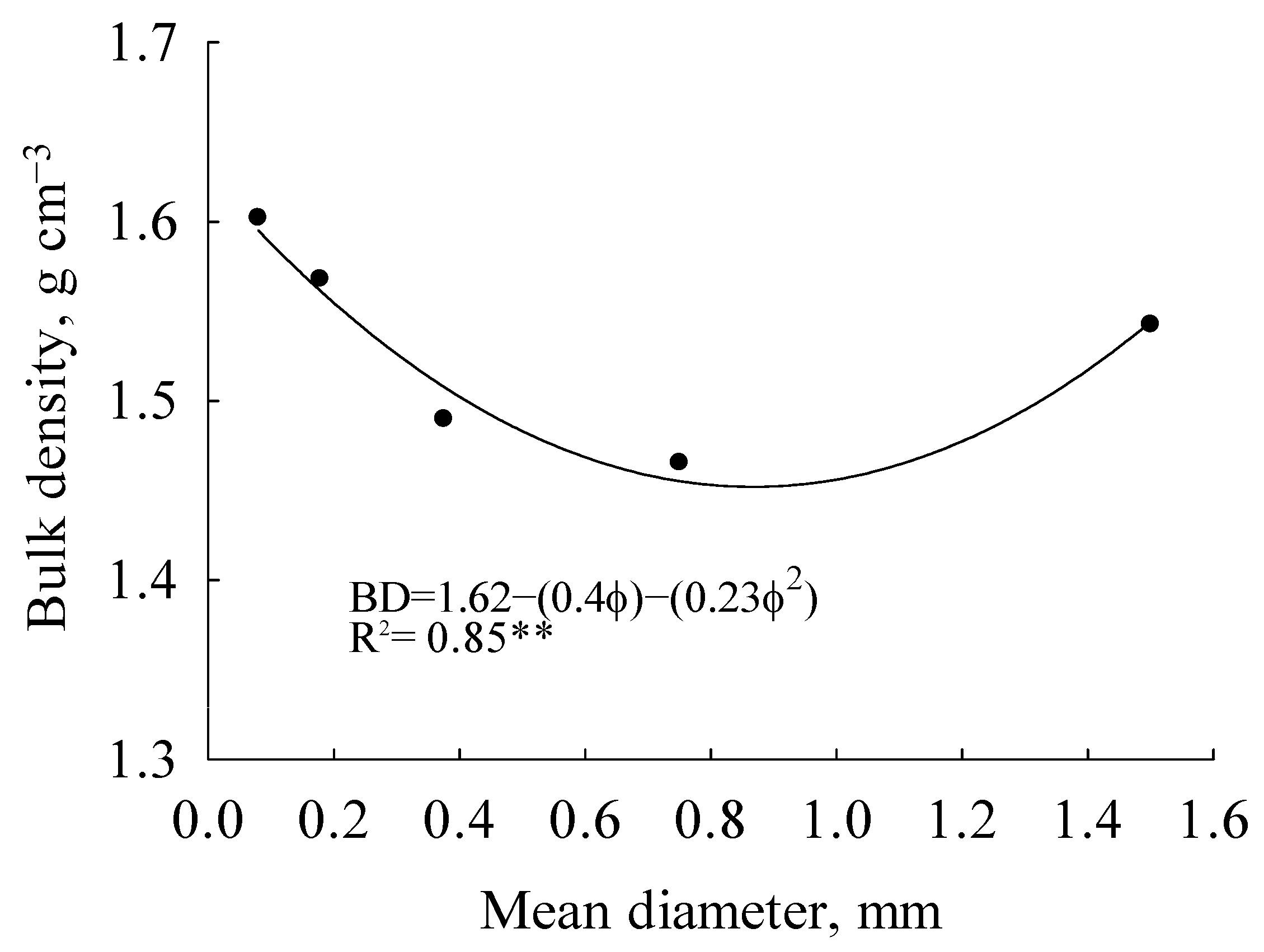
3.1. Bulk Density
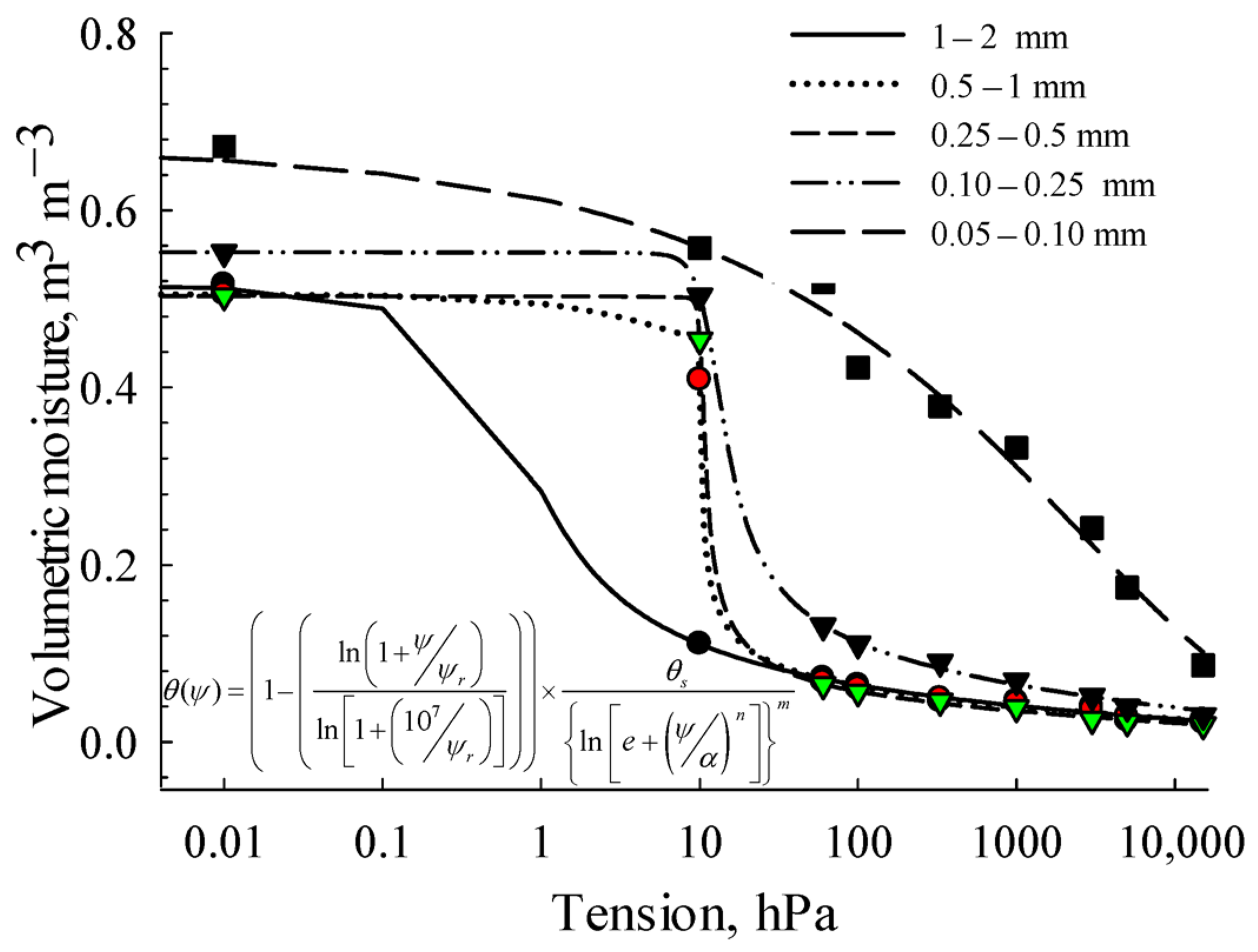
3.2. Water Retention Curve by Fredlund & Xing
3.3. Pore Diameter Distribution and Available Water
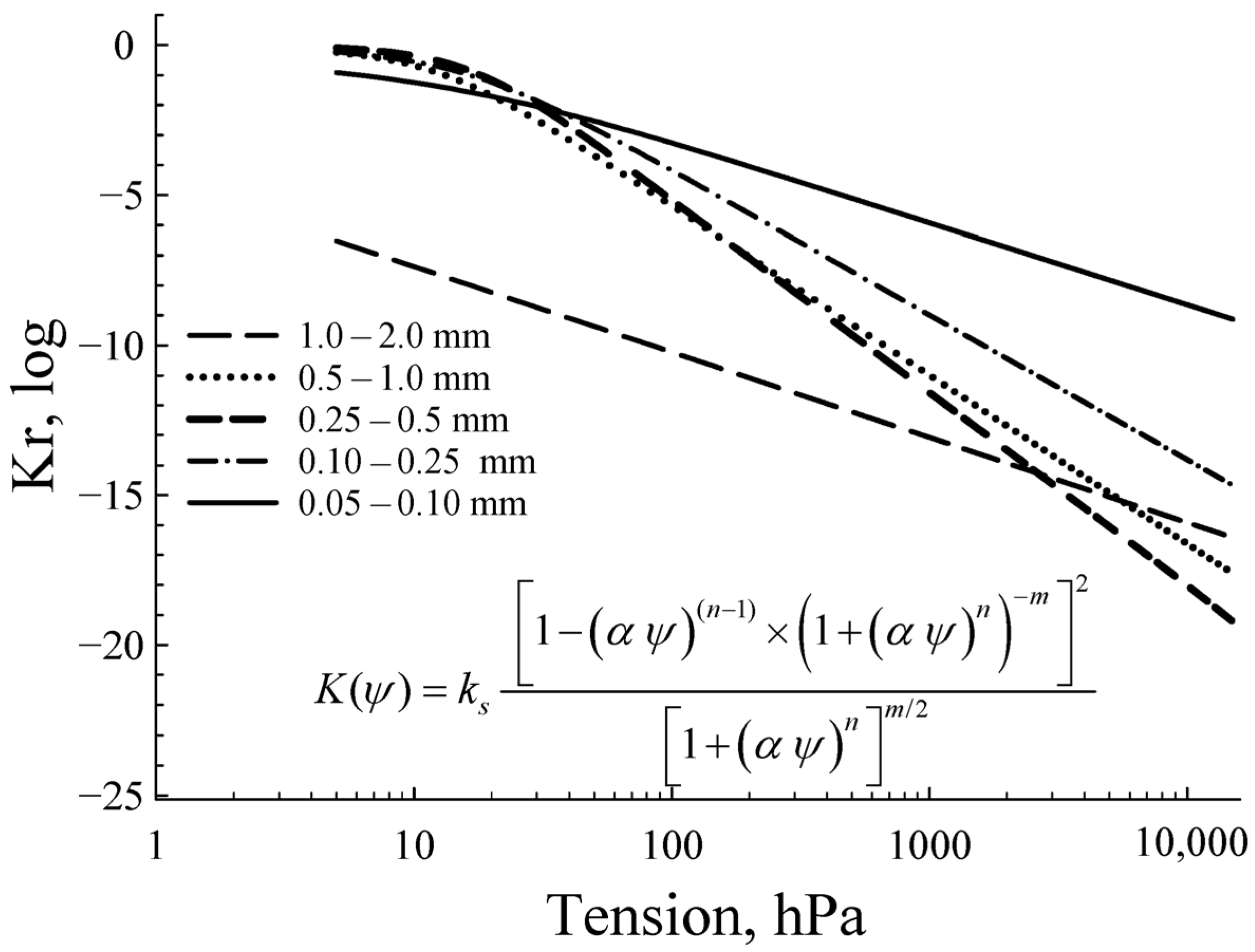
3.4. Unsaturated Hydraulic Conductivity (Kr) by Van Genuchten
4. Conclusions
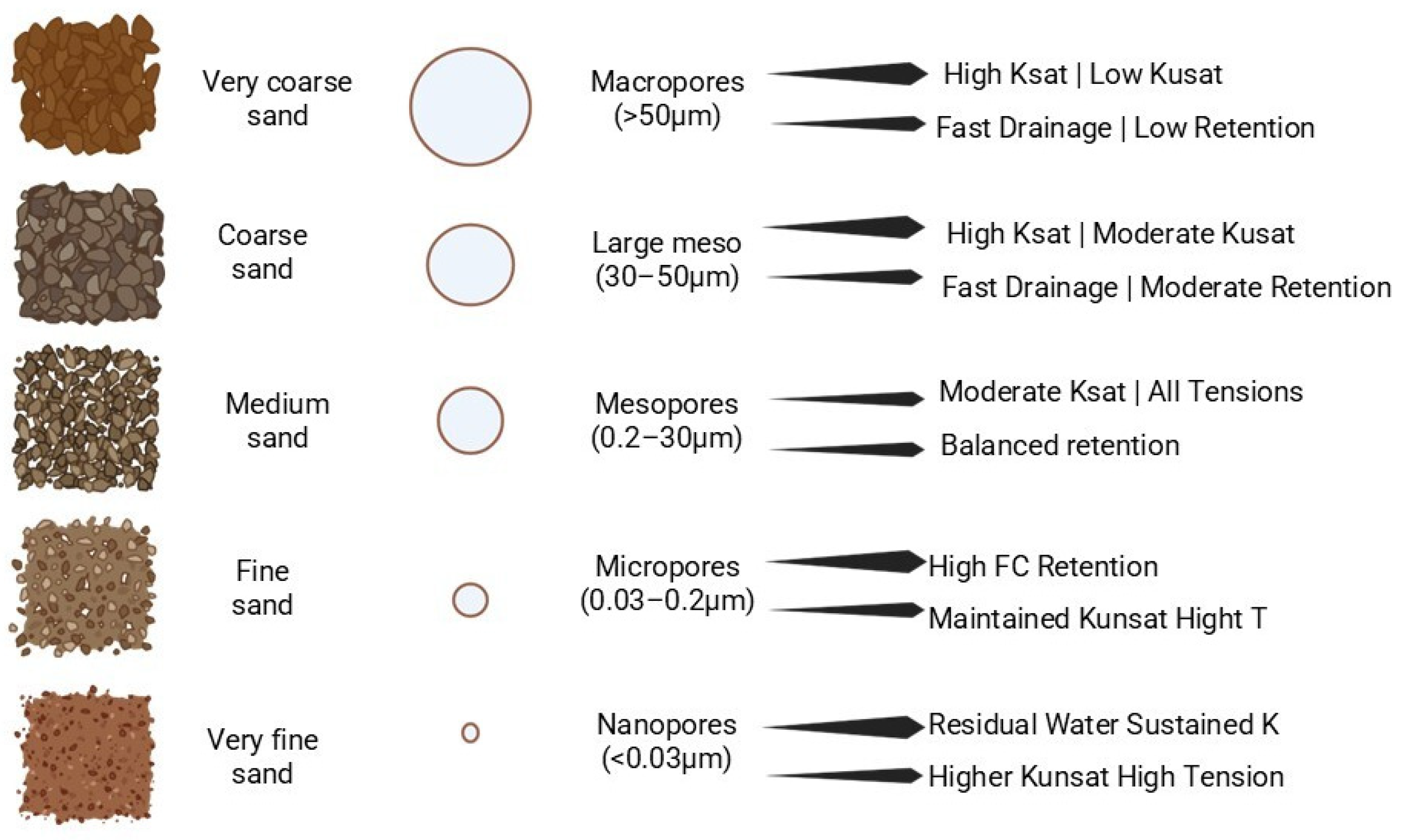
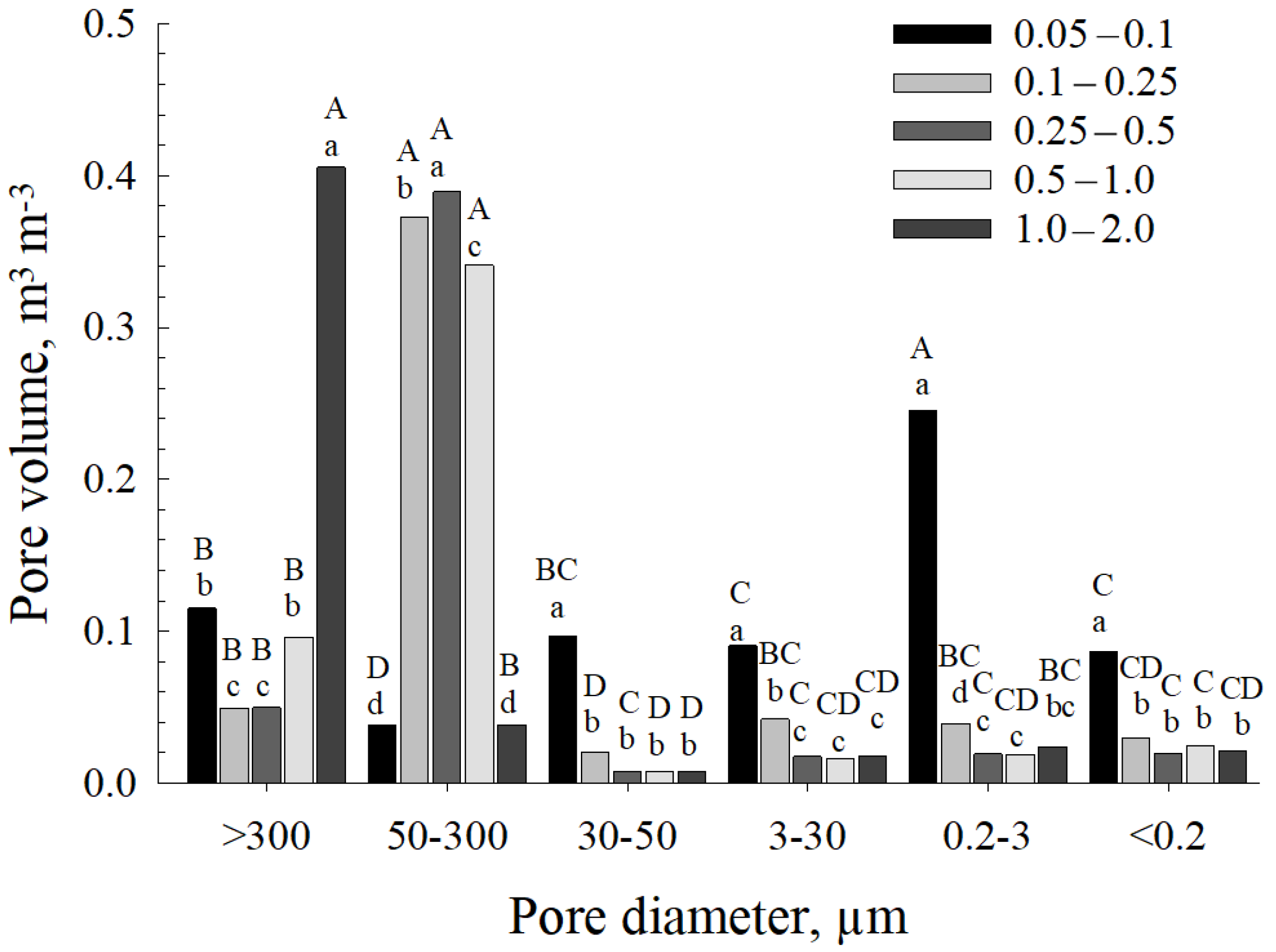
- The grain size of sand directly influences pore diameter distribution, water retention, and soil hydraulic conductivity (Figure 7). In very fine sand (0.053–0.106 mm), pores between 0.2 and 3.0 μm predominate, which provide high water retention capacity. In fine, medium, and coarse fractions, pores with diameters between 50 and 300 μm predominate, while in very coarse sand (1.0–2.0 mm), macropores with diameters greater than 300 μm predominate, which favour drainage and aeration at the expense of water retention.
- 2.
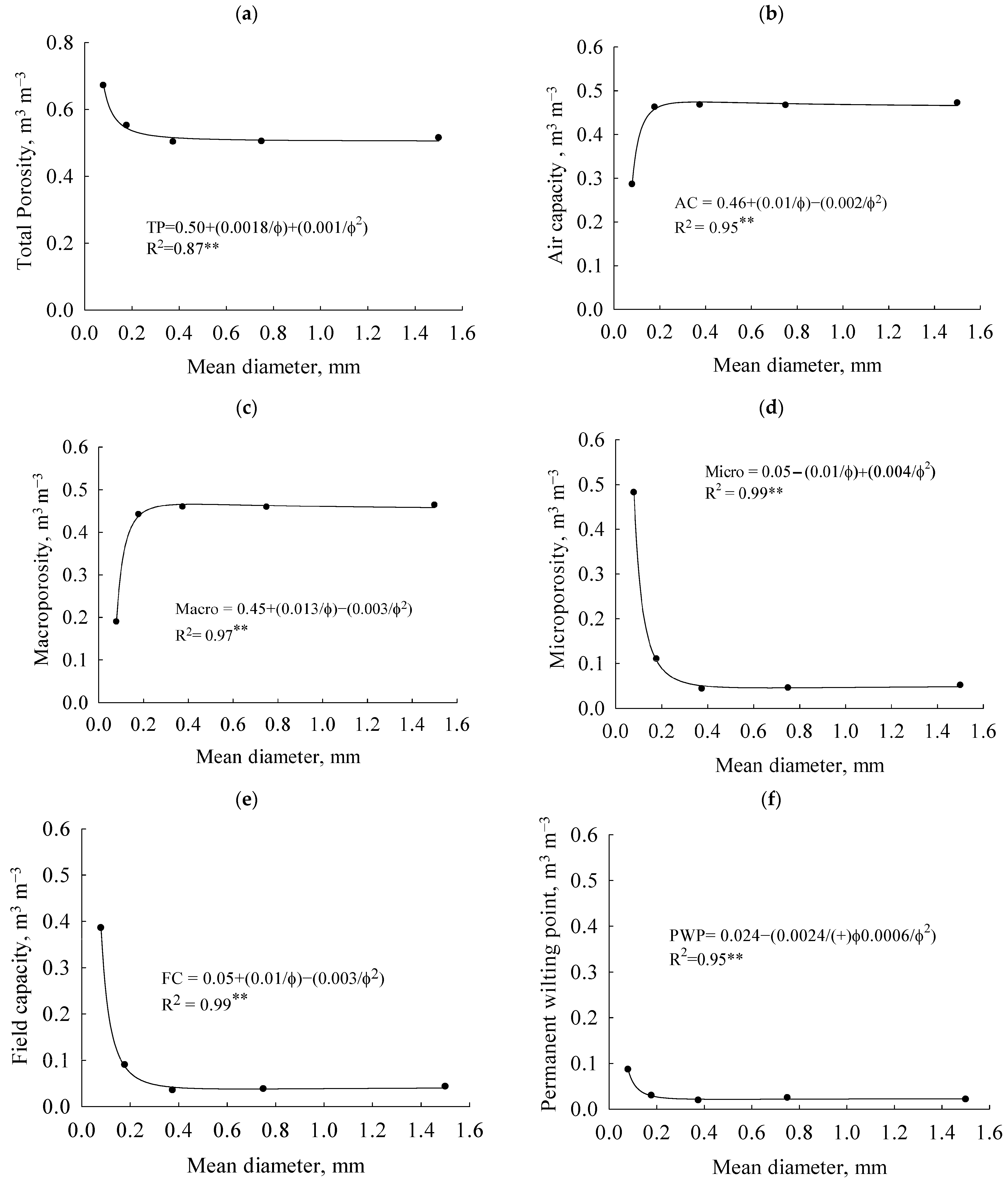
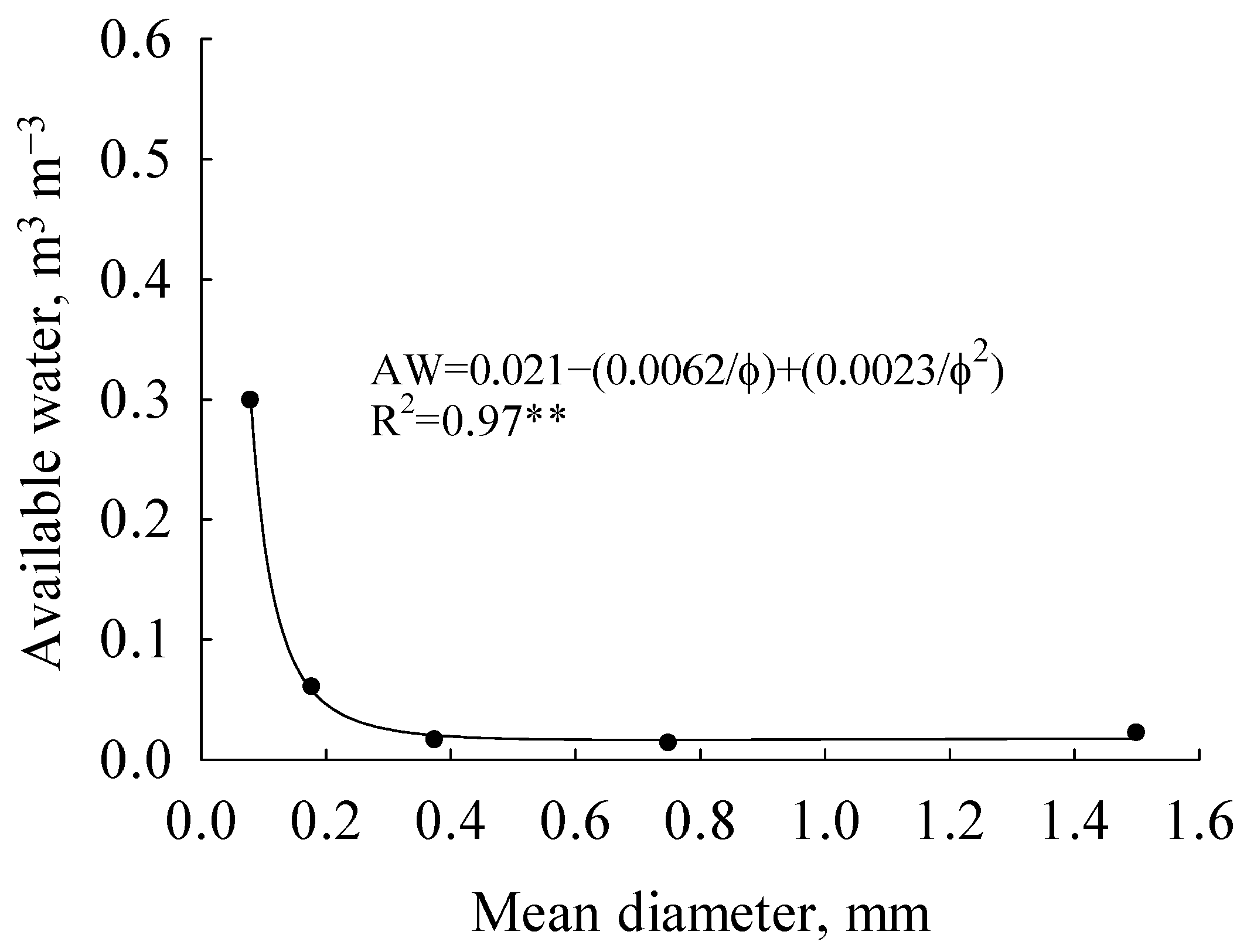
- The distribution of pore diameter, defined by the sand’s granulometric class, was reflected distinctly in the soil’s water behaviour. Field capacity was highest in very fine sand (0.38 m3 m−3) and reduced in the other fractions (≈0.05 m3 m−3). The permanent wilting point, in turn, remained similar across all classes (≈0.02 m3 m−3). As a result, available water was strongly dependent on particle size, being highest in very fine sand (0.30 m3 m−3), intermediate in fine sand (0.06 m3 m−3), and lowest in medium, coarse, and very coarse fractions (≈0.02 m3 m−3). These differences result from retention dynamics: in very fine sand, water is gradually removed as tension increases, while in very coarse sand, there is a high water loss already at 10 hPa.
- 3.
- Under low matric tensions (up to 10–30 hPa), unsaturated hydraulic conductivity (Kr) was lower in very coarse sand, while the other fractions showed similar values. With increasing matric tensions, Kr declined sharply in the very coarse, coarse, medium, and fine sand classes. In contrast, very fine sand maintained the highest Kr values under matric tensions above 100 hPa, thus sustaining the highest water flow in the soil under conditions of lower water availability.
- 4.
- The reduction in the diameter of sand particles, particularly in the very fine fraction, promotes an increase in water retention, available water, and unsaturated hydraulic conductivity, to the detriment of macroporosity and aeration capacity. It can be concluded that the water behaviour of sandy soils is significantly modulated by the granulometric composition of the sand fraction, highlighting the importance of detailed characterization of sand fractions for water management in agricultural and environmental systems.
- 5.
- While our monodisperse system isolated the fundamental physical effects of sand grain size on water retention and hydraulic conductivity, it is important to acknowledge that soils are polydisperse (clay, silt, and sand) and structurally complex. Our findings provide the physical foundation for the sand matrix, but the inclusion of finer particles (silt and clay) and organic matter in natural soils modify these results by altering pore geometry and adding water retention mechanisms (capillarity and adsorption). The presence of these finer components would increase total water retention and change the hydraulic conductivity compared to our monodisperse quartz sand, as they contribute to pore clogging and enhance surface charge interactions. Therefore, while our results clarify the contribution of sand fractions, they should be applied to natural soil simulations as a baseline, considering the interactive effects of soil structure and clay and silt fractions.
- 6.
- These findings regarding the effects of sand grains size have direct implications for land management in drought-prone sandy soils. Understanding these differences enables technicians and farmers to more effectively plan appropriate management systems for specific soil types, while improving irrigation efficiency and water conservation to optimize water delivery during critical dry periods.
Author Contributions
Funding
Data Availability Statement
Acknowledgments
Conflicts of Interest
References
- Wankmüller, F.J.P.; Delval, L.; Lehmann, P.; Baur, M.J.; Cecere, A.; Wolf, S.; Or, D.; Javaux, M.; Carminati, A. Global influence of soil texture on ecosystem water limitation. Nature 2024, 635, 631–638. [Google Scholar] [CrossRef]
- Costa, A.; Albuquerque, J.A.; Costa, A.; Pértile, P.; Silva, F.R. Water retention and availability in soils of the State of Santa Catarina-Brazil: Effect of textural classes, soil classes and lithology. Rev. Bras. Cienc. Solo 2013, 37, 1535–1548. [Google Scholar] [CrossRef]
- Hillel, D. Introduction to Environmental Soil Physics; Academic Press: San Diego, CA, USA, 2004. [Google Scholar] [CrossRef]
- Kirkham, M.B. Principles of Soil and Plant Water Relations, 2nd ed.; Academic Press: San Diego, CA, USA, 2014. [Google Scholar]
- Bortolini, D.; Albuquerque, J.A. Estimation of the retention and availability of water in soils of the state of Santa Catarina. Rev. Bras. Cienc. Solo 2018, 42, e0170250. [Google Scholar] [CrossRef]
- Reichert, J.M.; Albuquerque, J.A.; Kaiser, D.R.; Reinert, D.J.; Urach, F.L.; Carlesso, C. Estimation of water retention and availability in soils of Rio Grande do Sul. Rev. Bras. Cienc. Solo 2009, 33, 1547–1560. [Google Scholar] [CrossRef]
- Cabalar, A.F.; Akbulut, N. Evaluation of actual and estimated hydraulic conductivity of sands with different gradation and shape. SpringerPlus 2016, 5, 820. [Google Scholar] [CrossRef]
- Amorim, R.S.S.; Albuquerque, J.A.; Couto, E.G.; Kunz, M.; Rodrigues, M.F.; da Silva, L.C.M.; Reichert, J.M. Water retention and availability in Brazilian Cerrado (neotropical savanna) soils under agricultural use: Pedotransfer functions and decision trees. Soil Tillage Res. 2022, 224, 105485. [Google Scholar] [CrossRef]
- Chang, C.C.; Cheng, D.H. Predicting the soil water retention curve from the particle size distribution based on a pore space geometry containing slit-shaped spaces. Hydrol. Earth Syst. Sci. 2018, 22, 4621–4632. [Google Scholar] [CrossRef]
- Rivers, E.D.; Shipp, R.F. Soil water retention as related to particle size in selected sands and loamy sands. Soil Sci. 1978, 126, 94–100. [Google Scholar] [CrossRef]
- Fidalski, J.; Tormena, C.A.; Alves, S.J.; Auler, P.A.M. Influence of sand fractions on water retention and availability in Caiuá and Paranavaí sandstone formations. Rev. Bras. Cienc. Solo 2013, 37, 613–621. [Google Scholar] [CrossRef]
- Parahyba, R.B.V.; Araújo, M.S.B.; Almeida, B.G.; Rolim Neto, F.C.; Sampaio, E.V.S.B.; Caldas, A.M. Water retention capacity in Arenosols and Ferralsols in a semiarid area in the state of Bahia, Brazil. An. Acad. Bras. Cienc. 2019, 91, e20181031. [Google Scholar] [CrossRef]
- Tuller, M.; Or, D. Water retention and characteristic curve. In Encyclopedia of Soils in the Environment; Elsevier: Oxford, UK, 2004; Volume 4, pp. 278–289. [Google Scholar] [CrossRef]
- USDA. Soil Taxonomy: A Basic System of Soil Classification for Making and Interpreting Soil Surveys; USDA: Washington, DC, USA, 1975.
- Mecke, M.; Westman, C.J.; Ilvesniemi, H. Water retention capacity in coarse Podzol profiles predicted from measured soil properties. Soil Sci. Soc. Am. J. 2002, 66, 1–11. [Google Scholar] [CrossRef]
- Ribeiro, K.D.; Menezes, S.M.; Mesquita, M.G.B.F.; Sampaio, F.M.T. Soil physical properties, influenced by pores distribution, of six soil classes in the region of Lavras-MG. Cienc. Agrotec. 2007, 31, 1167–1175. [Google Scholar] [CrossRef]
- Chapuis, R.P. Predicting the saturated hydraulic conductivity of sand and gravel using effective diameter and void ratio. Can. Geotech. J. 2004, 41, 787–795. [Google Scholar] [CrossRef]
- Tsai, Y.Z.; Liu, Y.T.; Wang, Y.L.; Chang, L.C.; Hsu, S.Y. Effects of the grain size on dynamic capillary pressure and the modified Green-Ampt model for infiltration. Geofluids 2018, 2018, 8946948. [Google Scholar] [CrossRef]
- Vereecken, H.; Huisman, J.A.; Bogena, H.; Vanderborght, J.; Vrugt, J.A.; Hopmans, J.W. On the value of soil moisture measurements in vadose zone hydrology: A review. Water Resour. Res. 2008, 44, W00D06. [Google Scholar] [CrossRef]
- Laflen, J.M.; Elliot, W.J.; Flanagan, D.C.; Meyer, C.R.; Nearing, M.A. WEPP—Predicting water erosion using a process-based model. J. Soil Water Cons. 1997, 52, 96–102. [Google Scholar] [CrossRef]
- Klute, A. Water retention: Laboratory methods. In Methods of Soil Analysis, 2nd ed.; Klute, A., Ed.; American Society of Agronomy: Madison, WI, USA, 1986; pp. 635–662. [Google Scholar]
- SAS Institute Inc. SAS/STAT® 9.2 User’s Guide; SAS Institute Inc.: Cary, NC, USA, 2008. [Google Scholar]
- Fredlund, D.G.; Xing, A. Equations for the soil water characteristic curve. Can. Geotech. J. 1994, 31, 521–532. [Google Scholar] [CrossRef]
- van Genuchten, M.T. A closed-form equation for predicting the hydraulic conductivity of unsaturated soils. Soil Sci. Soc. Am. J. 1980, 44, 892–898. [Google Scholar] [CrossRef]
- Marquardt, D.W. An algorithm for least-squares estimation of nonlinear parameters. J. Soc. Ind. Appl. Math. 1963, 11, 431–441. [Google Scholar] [CrossRef]
- Hillel, D. Environmental Soil Physics: Fundamentals, Applications, and Environmental Considerations; Academic Press: San Diego, CA, USA, 1998. [Google Scholar]
- Klein, C.; Hurlbut, C.S. Manual of Mineralogy, 20th ed.; John Wiley & Sons: New York, NY, USA, 1985. [Google Scholar]
- Reichert, J.M.; Albuquerque, J.A.; Peraza, J.E.S.; Costa, A. Estimating water retention and availability in cultivated soils of southern Brazil. Geoderma Reg. 2020, 21, e00277. [Google Scholar] [CrossRef]
- Arya, L.M.; Paris, J.F. A physicoempirical model to predict the soil moisture characteristic from particle-size distribution and bulk density data. Soil Sci. Soc. Am. J. 1981, 45, 1023–1030. [Google Scholar] [CrossRef]
- Scott, H.D. Soil Physics: Agricultural and Environmental Applications; Iowa State University Press: Ames, IA, USA, 2000. [Google Scholar]
- Lal, R.; Shukla, M.K. Principles of Soil Physics; Marcel Dekker: New York, NY, USA, 2004. [Google Scholar] [CrossRef]
- Bocuti, E.D.; Amorim, R.S.S.; Lal, R.; Magalhães, W.A.; Azevedo, E.C. Effective hydraulic conductivity and its relationship with the other attributes of Cerrado soils. Rev. Bras. Eng. Agric. Ambient. 2020, 24, 357–363. [Google Scholar] [CrossRef]
- Toumpanou, I.C.; Pantazopoulos, I.A.; Markou, I.N.; Atmatzidis, D.K. Predicted and measured hydraulic conductivity of sand-sized crushed limestone. Bull. Eng. Geol. Environ. 2020, 80, 1875–1890. [Google Scholar] [CrossRef]
- BioRender.com. Scientific Illustration Platform. 2026. Available online: https://www.biorender.com (accessed on 5 May 2026).





| Sand Diameter (mm) | θs (m3 m−3) * | Ψr (hPa) | α (hPa) | n | m |
|---|---|---|---|---|---|
| 1.0 to 2.0 | 0.51 | 0.1 | 0.07 | 0.59 | 2.4 |
| 0.5 to 1.0 | 0.52 | 0.1 | 1.0 | 0.32 | 96.5 |
| 0.25 to 0.50 | 0.50 | 30 | 1.0 | 0.53 | 25.7 |
| 0.106 to 0.25 | 0.55 | 20 | 1.1 | 0.57 | 7.0 |
| 0.053 to 0.106 | 0.67 | 187 | 53.7 | 2.30 | 0.4 |
| Particle Diameter | Pore Diameter * | Tension ** | |||||||
|---|---|---|---|---|---|---|---|---|---|
| Sand | Average | Min | Max | Average | Min | Max | Average | Min | Max |
| ------------------------- μm ---------------------------- | ---------- hPa ---------- | ||||||||
| Very coarse | 1500 | 1000 | 2000 | 674 | 449 | 899 | 4 | 7 | 3 |
| Coarse | 750 | 500 | 1000 | 337 | 225 | 449 | 9 | 13 | 7 |
| Medium | 375 | 250 | 500 | 169 | 112 | 225 | 17 | 26 | 13 |
| Fine | 178 | 106 | 250 | 80 | 48 | 112 | 37 | 62 | 26 |
| Very fine | 79.5 | 53 | 106 | 36 | 24 | 48 | 82 | 123 | 62 |
Disclaimer/Publisher’s Note: The statements, opinions and data contained in all publications are solely those of the individual author(s) and contributor(s) and not of MDPI and/or the editor(s). MDPI and/or the editor(s) disclaim responsibility for any injury to people or property resulting from any ideas, methods, instructions or products referred to in the content. |
© 2026 by the authors. Licensee MDPI, Basel, Switzerland. This article is an open access article distributed under the terms and conditions of the Creative Commons Attribution (CC BY) license.
Share and Cite
Adriano Albuquerque, J.; da Costa, A.; Merten, G.H.; De Mattos E Avila, A.C.; Kirchhof, G. Size of Sand Grains Controls Pore Structure and Water Dynamics: Implications for Water Retention and Hydraulic Conductivity. Land 2026, 15, 864. https://doi.org/10.3390/land15050864
Adriano Albuquerque J, da Costa A, Merten GH, De Mattos E Avila AC, Kirchhof G. Size of Sand Grains Controls Pore Structure and Water Dynamics: Implications for Water Retention and Hydraulic Conductivity. Land. 2026; 15(5):864. https://doi.org/10.3390/land15050864
Chicago/Turabian StyleAdriano Albuquerque, Jackson, André da Costa, Gustavo Henrique Merten, Ana Carolina De Mattos E Avila, and Gunnar Kirchhof. 2026. "Size of Sand Grains Controls Pore Structure and Water Dynamics: Implications for Water Retention and Hydraulic Conductivity" Land 15, no. 5: 864. https://doi.org/10.3390/land15050864
APA StyleAdriano Albuquerque, J., da Costa, A., Merten, G. H., De Mattos E Avila, A. C., & Kirchhof, G. (2026). Size of Sand Grains Controls Pore Structure and Water Dynamics: Implications for Water Retention and Hydraulic Conductivity. Land, 15(5), 864. https://doi.org/10.3390/land15050864