The Impact of Rural Collective Property Rights System Reform on County-Level Urban–Rural Integration: Evidence from 1106 Counties in China


Abstract
1. Introduction
2. Theoretical Analysis and Research Hypotheses
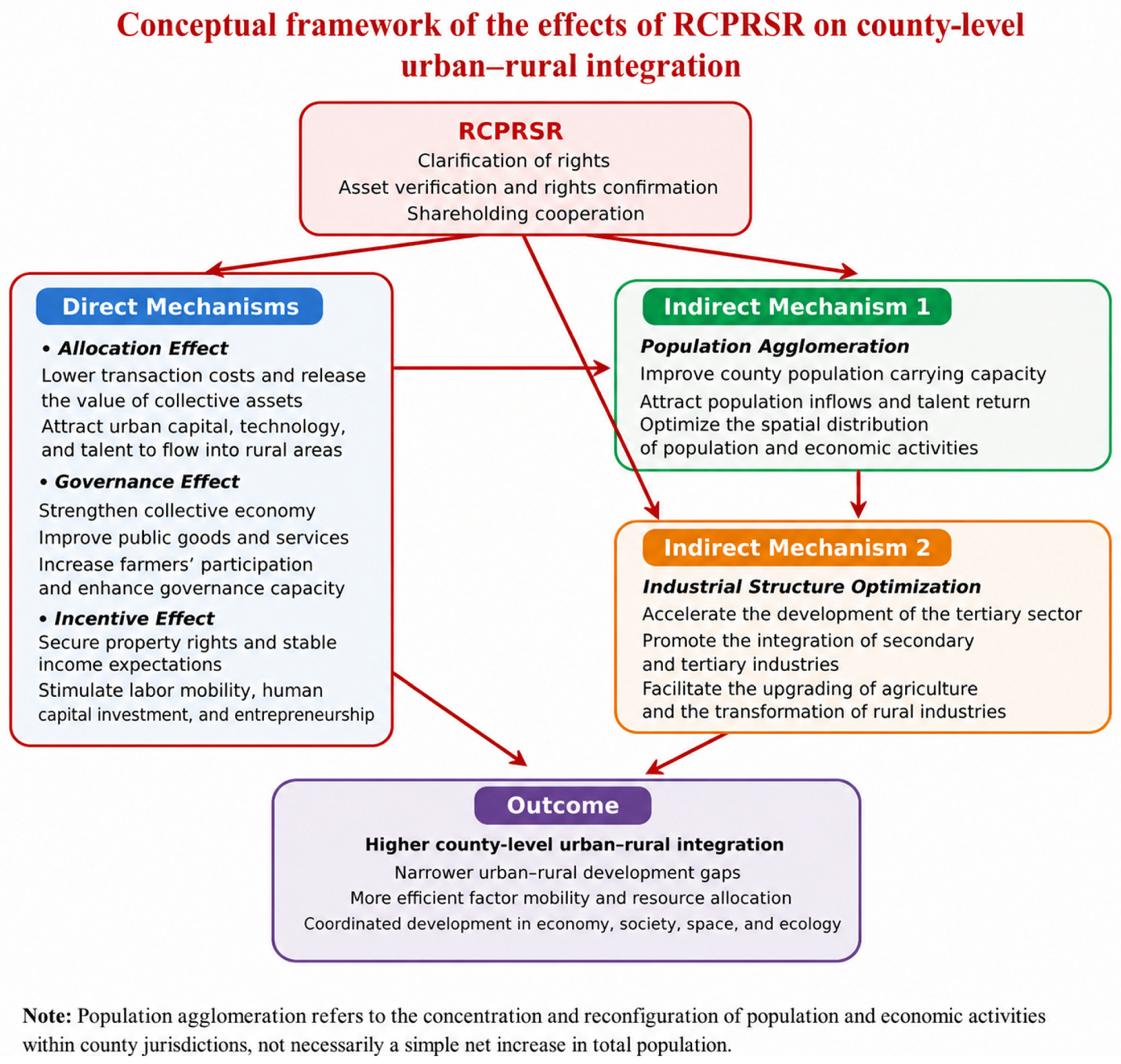
2.1. Direct Mechanisms
2.2. Indirect Mechanisms
2.2.1. Population Agglomeration (PopAgg)
2.2.2. Industrial Structure Optimization (IndStr)
3. Materials and Methods
3.1. Data Sources
3.2. Variable Design
3.3. Model Construction
4. Empirical Results and Analysis
4.1. Baseline Regression Results
4.2. Precondition Tests
4.2.1. Policy Randomness Test
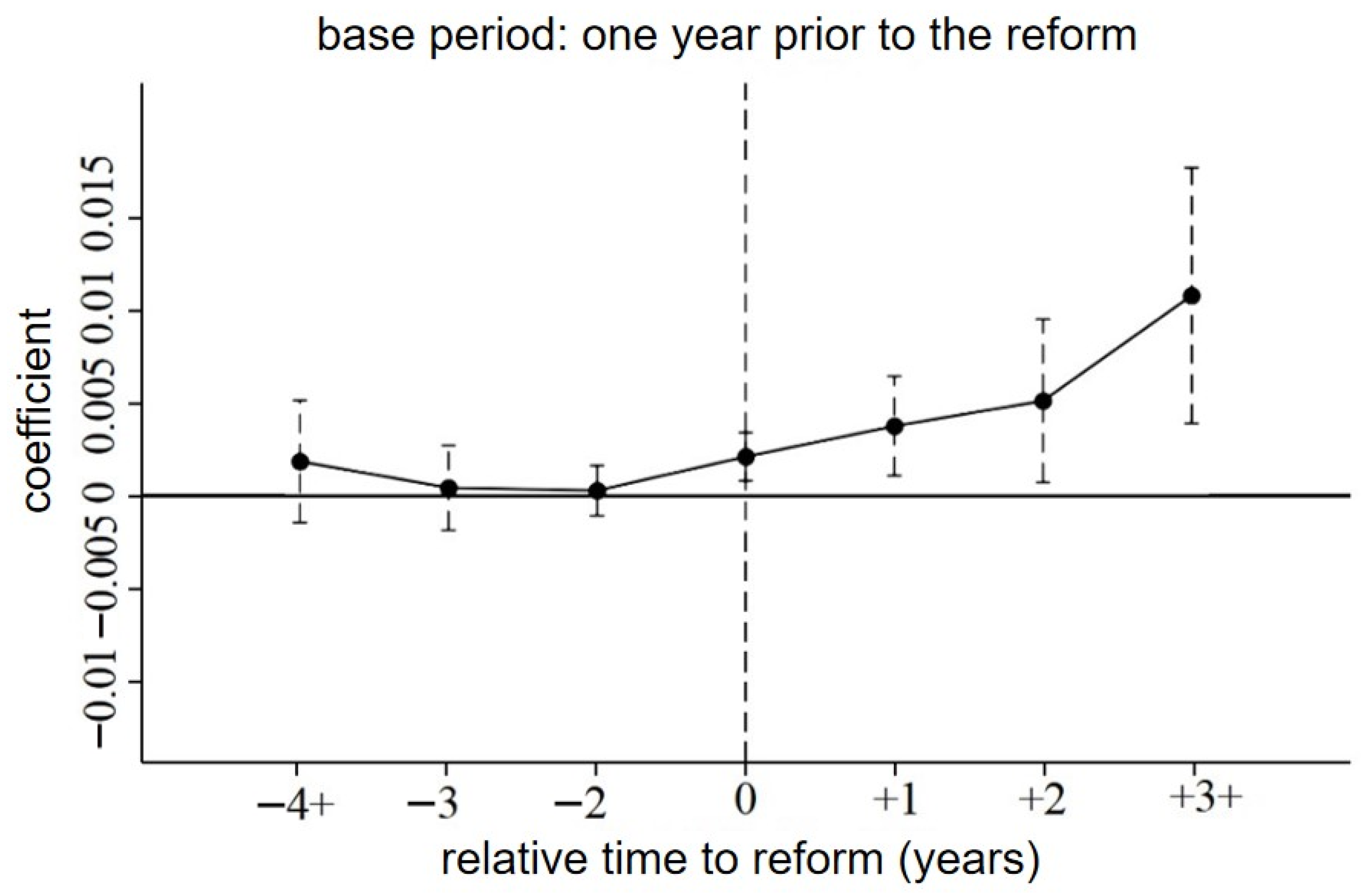
4.2.2. Parallel Trends and Dynamic Effects Test
4.3. Robustness Checks
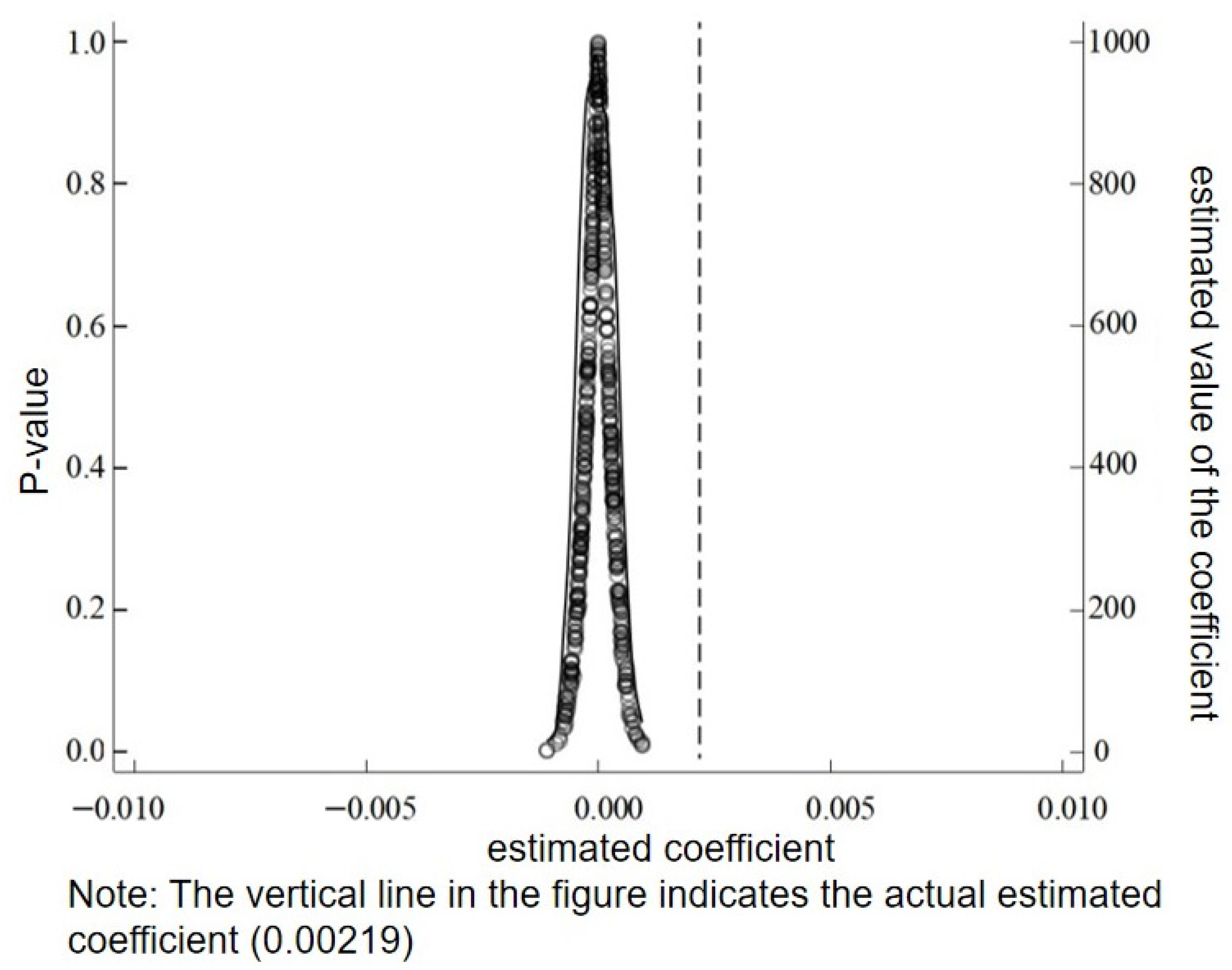
4.3.1. Placebo Test
4.3.2. Alternative Timing Specification
4.3.3. Lagged Dependent Variable
4.3.4. Exclusion of Leading Reform Regions
5. Heterogeneity Analysis
5.1. Economic Foundation
5.2. Initial Urban–Rural Integration Levels
6. Mechanism Analysis
6.1. Population Agglomeration Mechanism
6.2. Industrial Structure Optimization Mechanism
7. Conclusions and Policy Implications
- (1)
- Consolidating Reform Achievements, Deepening Rights Empowerment, and Facilitating Urban–Rural Factor Circulation.
- (2)
- Adhering to Local Conditions, Implementing Differentiated Regional Policies, and Precisely Addressing Integration Challenges.
- (3)
- Strengthening the Coordination of Industrial Quality Improvement and Population Agglomeration to Enhance County Development Vitality.
Author Contributions
Funding
Data Availability Statement
Conflicts of Interest
Abbreviations
| RCPRSR | Rural Collective Property Rights System Reform |
| PopAgg | Population Agglomeration |
| IndStr | Industrial Structure Optimization |
References
- Tu, S.W. Strategic Orientation and Realization Path of Urban-Rural Integrated Development. Macroeconomics 2020, 4, 103–116. [Google Scholar]
- Zhou, Q.; Shi, W. How does town planning affect urban-rural income inequality: Evidence from China with simultaneous equation analysis. Landsc. Urban Plan. 2022, 221, 104380. [Google Scholar] [CrossRef]
- Wan, G.; Zhang, X.; Zhao, M. Urbanization can help reduce income inequality. npj Urban Sustain. 2022, 2, 1. [Google Scholar] [CrossRef]
- Li, Y.S.; Xu, X.L.; Xu, Z. High-quality urban-rural integration promotes Chinese modernization: Theoretical logic and practical paths. Rural Econ. 2025, 4, 12–21. [Google Scholar]
- Long, H.L.; Xu, Y.L.; Zheng, Y.H.; Chen, K.Q. County-level urban-rural integrated development under Chinese modernization. Econ. Geogr. 2023, 43, 12–19. [Google Scholar]
- Yao, Y.; Jiang, L. Urbanization forces driving rural urban income disparity: Evidence from metropolitan areas in China. J. Clean. Prod. 2021, 312, 127748. [Google Scholar] [CrossRef]
- Tacoli, C. Rural-urban interactions: A guide to the literature. Environ. Urban. 1998, 10, 147–166. [Google Scholar] [CrossRef]
- Christiaensen, L.; Todo, Y. Poverty reduction during the rural-urban transformation: The role of the missing middle. World Dev. 2014, 63, 43–58. [Google Scholar] [CrossRef]
- Agergaard, J.; Tacoli, C.; Steel, G.; Ørtenblad, S.B. Revisiting rural–urban transformations and small town development in Sub-Saharan Africa. Eur. J. Dev. Res. 2019, 31, 2–11. [Google Scholar] [CrossRef]
- Demsetz, H. Modern Understandings of Liberty and Property; Routledge: New York, NY, USA, 2013; pp. 125–137. [Google Scholar]
- Besley, T. Property Rights and Investment Incentives: Theory and Evidence from Ghana. J. Polit. Econ. 1995, 103, 903–937. [Google Scholar] [CrossRef]
- Deininger, K. Land Policies for Growth and Poverty Reduction; World Bank: Washington, DC, USA; Oxford University Press: New York, NY, USA, 2003. [Google Scholar]
- Lawry, S.; Samii, C.; Hall, R.; Leopold, A.; Hornby, D.; Mtero, F. The impact of land property rights interventions on investment and agricultural productivity in developing countries: A systematic review. J. Dev. Eff. 2017, 9, 61–81. [Google Scholar] [CrossRef]
- Lipton, M. Land Reform in Developing Countries: Property Rights and Property Wrongs; Routledge: London, UK; New York, NY, USA, 2009. [Google Scholar]
- Hu, L.X.; Shu, W.; Zhou, Y.H. The effectiveness and deepening direction of property rights reform in promoting new rural collective economic development. Issues Agric. Econ. 2024, 2, 87–97. [Google Scholar]
- Ma, S.; Gong, Y.; Li, D. Reform of the shareholding system for collective assets, residents’ participation, and community debts risk. China Econ. Rev. 2019, 58, 101296. [Google Scholar] [CrossRef]
- Huang, J.K.; Li, K.L.; Wang, X.B.; Ding, Y.W. Rural collective operating asset property rights reform: Status quo, progress and impacts. Rural Econ. 2019, 12, 1–10. [Google Scholar] [CrossRef]
- Zhang, H.; Mu, Y.Y. The income-increasing and catch-up effects of farmers from the value realization of village collective operating assets: Exogenous promotion and endogenous development. Chin. Rural Econ. 2023, 8, 37–59. [Google Scholar]
- Guo, Y.; Liu, Y. Poverty alleviation through land assetization and its implications for rural revitalization in China. Land Use Policy 2021, 105, 105418. [Google Scholar] [CrossRef]
- Peng, L.Z.; Zhao, M.J. The impact of rural collective property rights system reform on county economic development: Evidence from 1,873 counties in China. Chin. Rural Econ. 2024, 2, 112–130. [Google Scholar]
- Luo, M.Z.; Wei, B.H. Rural collective property rights system reform and county urban-rural income gap. J. South China Agric. Univ. (Soc. Sci. Ed.) 2022, 21, 78–90. [Google Scholar]
- Zhang, H.Y.; Hu, Z.T.; Hu, L.X. The practical exploration of the reform of rural collective property right system: Based on the investigation of 24 villages (communities) in 4 provinces. Reform 2020, 8, 5–17. [Google Scholar]
- Ma, P.R.; Li, Z.P. The social effects of rural endogenous collective economic development: A case study of Cai Village in southwestern Shandong. China Rural Surv. 2023, 4, 151–168. [Google Scholar]
- Tafesse, W.G.; Van Passel, S.; Berhanu, T.; D’Haese, M.; Maertens, M. Big is efficient: Evidence from agricultural cooperatives in Ethiopia. Agric. Econ. 2019, 50, 555–566. [Google Scholar] [CrossRef]
- Qiao, C.X.; Wang, J. Path innovation for rural collective economic organizations to participate in public goods supply: A typical case study of “purchasing reform” in Daining County. Chin. Rural Econ. 2020, 12, 22–34. [Google Scholar]
- Kong, X.Z. Property rights system reform and rural collective economic development: A study based on the theoretical framework of “clear property rights + institutional incentives”. Econ. Horiz. 2020, 7, 32–41. [Google Scholar]
- Lu, Q.W.; Yang, Y.W. Does the reform of rural collective property rights system strengthen the rural collective economy: An empirical test based on China’s rural revitalization survey data. Chin. Rural Econ. 2022, 3, 84–103. [Google Scholar]
- Xiong, C.; Cai, J.M.; Liu, Y. Urban-rural integrated development and land system reform. Polit. Econ. Rev. 2021, 12, 107–138. [Google Scholar]
- Zhou, Y.; Li, X.; Liu, Y. Rural land system reforms in China: History, issues, measures and prospects. Land Use Policy 2020, 91, 104377. [Google Scholar] [CrossRef]
- Li, Z.H.; Tang, H.T. The income-increasing effect of China’s rural collective property rights system reform: An empirical study based on rural “three transformations” reform. Econ. Horiz. 2023, 12, 64–75. [Google Scholar]
- Yi, Q.; Chen, M.; Sheng, Y.; Huang, J. Mechanization services, farm productivity and institutional innovation in China. China Agric. Econ. Rev. 2019, 11, 536–554. [Google Scholar] [CrossRef]
- Jiao, M.; Xu, H. How do collective operating construction land (COCL) transactions affect rural residents’ property income? Evidence from rural Deqing county, China. Land Use Policy 2022, 113, 105897. [Google Scholar] [CrossRef]
- Coase, R.H. The Problem of Social Cost. J. Law Econ. 1960, 3, 1–44. [Google Scholar] [CrossRef]
- Bu, D.; Liao, Y. Land property rights and rural enterprise growth: Evidence from land titling reform in China. J. Dev. Econ. 2022, 157, 102865. [Google Scholar] [CrossRef]
- Williamson, O.E. The Economics of Organization: The Transaction Cost Approach. Am. J. Sociol. 1981, 87, 548–577. [Google Scholar] [CrossRef]
- Gao, J.; Zhu, J.T.; Yang, Y.H.; Zhao, L. The effect and empirical evidence of rural collective property rights system reform promoting rural common prosperity. J. Agrotech. Econ. 2025, 7, 130–144. [Google Scholar]
- Cheng, W.; Zhou, N.; Zhang, L. How does land titling affect credit demand, supply, access, and rationing: Evidence from China. Can. J. Agric. Econ. 2021, 69, 383–414. [Google Scholar] [CrossRef]
- Ostrom, E. Governing the Commons: The Evolution of Institutions for Collective Action; Cambridge University Press: Cambridge, UK, 1990. [Google Scholar]
- Holmstrom, B. Moral Hazard in Teams. Bell J. Econ. 1982, 13, 324–340. [Google Scholar] [CrossRef]
- Liu, S.Y. Common prosperity with Chinese characteristics. J. Renmin Univ. China 2022, 36, 9–12. [Google Scholar] [CrossRef]
- Deininger, K.; Jin, S. The potential of land rental markets in the process of economic development: Evidence from China. J. Dev. Econ. 2005, 78, 241–270. [Google Scholar] [CrossRef]
- Rozelle, S.; Boisvert, R.N. Quantifying the Impact of Land Tenure in China: A Framework for Analysis and Evidence from Hebei Province; Cornell University: Ithaca, NY, USA, 1995. [Google Scholar]
- Tu, S.W. Research on China’s rural property rights system reform under the background of new-type urbanization construction. Econ. Horiz. 2017, 7, 40–46. [Google Scholar]
- Qi, J.; Zheng, X.; Guo, H. The formation of Taobao villages in China. China Econ. Rev. 2018, 53, 106–127. [Google Scholar] [CrossRef]
- Zhang, X.F.; Xu, H. How does new-type village collective economy drive rural common prosperity? An analysis based on the ANT perspective. J. Northwest A&F Univ. (Soc. Sci. Ed.) 2022, 22, 11–19. [Google Scholar]
- Lin, J.F. New Structural Economics; Peking University Press: Beijing, China, 2012; p. 204. [Google Scholar]
- Zhou, Q.; Li, Z. The impact of industrial structure upgrades on the urban–rural income gap: An empirical study based on China’s provincial panel data. Growth Change 2021, 52, 1761–1782. [Google Scholar] [CrossRef]
- Guo, X.M.; Zhang, Y.W. The development logic, field expansion and kinetic energy strengthening of new-type rural collective economy. Econ. Horiz. 2022, 4, 87–95. [Google Scholar]
- Zhang, Y.L.; Xu, Y.D. Rural “three transformations” reform and collective economic growth: Theoretical logic and practical enlightenment. Issues Agric. Econ. 2019, 5, 8–18. [Google Scholar]
- Zheng, Y.H.; Long, H.L. Measurement, evaluation and spatio-temporal pattern of urban-rural integrated development in China. Acta Geogr. Sin. 2023, 78, 1869–1887. [Google Scholar]
- Henderson, J.V.; Storeygard, A.; Weil, D.N. Measuring economic growth from outer space. Am. Econ. Rev. 2012, 102, 994–1028. [Google Scholar] [CrossRef]
- Zhou, C.; Zheng, H.; Wan, S. Industrial structure, employment structure and economic growth: Evidence from China. Sustainability 2023, 15, 2890. [Google Scholar] [CrossRef]
- Beck, T.; Levine, R.; Levkov, A. Big bad banks? The winners and losers from bank deregulation in the United States. J. Financ. 2010, 65, 1637–1667. [Google Scholar] [CrossRef]
- Baron, R.M.; Kenny, D.A. The moderator-mediator variable distinction in social psychological research: Conceptual, strategic, and statistical considerations. J. Pers. Soc. Psychol. 1986, 51, 1173–1182. [Google Scholar] [CrossRef] [PubMed]
- Xie, X.X.; Zhao, M.J.; Cai, Y.; Deng, Y. How does farmland fallow affect farmers’ income? An empirical study based on panel data of 1,240 farmers in the northwest fallow pilot area. Chin. Rural Econ. 2020, 11, 62–78. [Google Scholar]
- Qi, X.L.; Jiang, Q.C. Digital economy and migrant workers’ employment: Promotion or crowding-out? Evidence from the “Broadband China” policy pilot. China Rural Surv. 2023, 1, 59–77. [Google Scholar]
- Sun, Q.L.; Zhou, B.; Yu, D. Regional differences and convergence of urban-rural integrated development level. Inq. Econ. Issues 2021, 5, 26–36. [Google Scholar]
- Lu, J.Y.; Guo, J.H. The integration of three industries promotes common prosperity for farmers and rural areas: Logical mechanism and practical path. Issues Agric. Econ. 2023, 11, 105–117. [Google Scholar]
- Liu, G.; Fang, H.; Gong, X.; Wang, F. Inclusive finance, industrial structure upgrading and farmers’ income: Empirical analysis based on provincial panel data in China. PLoS ONE 2021, 16, e0258860. [Google Scholar] [CrossRef]



| Target Layer | Dimension Layer | Indicator Layer | Specific Indicator (Unit) | Type | Attribute |
|---|---|---|---|---|---|
| County-Level Urban–Rural Integrated Development Level | Economic Integration | Economic Development Level | S1 GDP per capita (CNY/person) | State | + |
| Wealth Status | S3 Balance of urban–rural residents’ savings deposits (CNY) | State | + | ||
| Grain Output Per Capita | S4 Total grain output/Regional population (tons/10,000 persons) | State | + | ||
| Social Integration | Urban–Rural Income Gap | S5 Urban–rural income ratio (Urban per capita disposable income/Rural per capita disposable income) (%) | State | − | |
| Healthcare | X1 Hospital and health center beds per 10,000 persons (beds/10,000 persons) | Disparity | + | ||
| Basic Education Security | X2 Primary and secondary school students/Regional population (%) | Momentum | + | ||
| Spatial Integration | Science and Technology Innovation | X3 Patent grants per 10,000 persons (pieces/10,000 persons) | State | + | |
| Public Service Funding Support | S2 Per capita local fiscal budget revenue (CNY/person) | State | + | ||
| Urban–Rural Market Circulation | Y1 Industrial enterprises above designated size per 10,000 persons (units/10,000 persons) | State | + | ||
| Ecological Integration | Spatial Agglomeration Degree | Y2 Number of townships/County administrative area (units/square kilometer) | State | + | |
| Urban–Rural Air Quality | Z1 PM2.5 concentration (μg/m3) | Momentum | − | ||
| Urban–Rural Vegetation Coverage | Z2 Mean NDVI of urban–rural areas | Momentum | + |
| Variable Name | Variable Definition or Assignment | Observations | Mean | Std. Dev. |
|---|---|---|---|---|
| County-Level Urban–Rural Integration Level | Calculated by entropy method | 8848 | 0.287 | 0.05 |
| Rural Residents’ Income Level | Per capita disposable income of rural residents | 8848 | 3392.433 | 2076.099 |
| Urban Residents’ Income Level | Per capita disposable income of urban residents | 8848 | 28,131.168 | 8238.932 |
| Population Density | Total population/administrative land area | 8848 | 0.037 | 0.032 |
| Financial Development Level | Balance of deposits and loans at financial institutions/GDP | 8848 | 0.713 | 0.423 |
| Residents’ Consumption Capacity | Per capita retail sales of consumer goods | 8848 | 14,769.102 | 10,434.461 |
| Telecommunication Infrastructure Level | Fixed telephone subscribers/year-end total population | 8848 | 981.285 | 776.774 |
| Government Expenditure Scale | Fiscal expenditure/GDP | 8848 | 0.256 | 0.200 |
| Population Agglomeration | Regional average nighttime light intensity (DMSP/OLS) | 8848 | 6.375 | 8.530 |
| Industrial Structure Optimization | Ratio of secondary to tertiary industry value added | 8848 | 1.239 | 0.845 |
| Variable | County-Level Urban–Rural Integrated Development Level | |
|---|---|---|
| (1) | (2) | |
| RCPRSR Pilot | 0.002 *** | 0.002 *** |
| (0.001) | (0.001) | |
| Rural Residents’ Income Level | 0.000 *** | |
| (0.000) | ||
| Urban Residents’ Income Level | 0.000 *** | |
| (0.000) | ||
| Population Density | 0.007 | |
| (0.006) | ||
| Financial Development Level | 0.000 | |
| (0.000) | ||
| Residents’ Consumption Capacity | 0.000 | |
| (0.000) | ||
| Telecommunication Infrastructure Level | −0.000 | |
| (0.000) | ||
| Government Expenditure Scale | −0.000 | |
| (0.000) | ||
| County Fixed Effects | Yes | Yes |
| Year Fixed Effects | Yes | Yes |
| Constant | 0.286 *** | 0.251 *** |
| (0.000) | (0.005) | |
| Observations | 8848 | 8848 |
| R2 | 0.936 | 0.939 |
| Variable | Pilot County Selection (Logit) |
|---|---|
| Baseline Urban–Rural Integration Index (2013) | 0.570 |
| (3.220) | |
| Control Variables | yes |
| County Fixed Effects | yes |
| Year Fixed Effects | yes |
| Constant | 7.480 *** |
| (1.796) | |
| Observations | 2212 |
| Sample Period | 2013–2014 |
| Variable | (1) | (2) | (3) |
|---|---|---|---|
| Alternative Timing | Lagged Dependent Variable | Exclusion of Leading Regions | |
| Lagged URI | 0.565 *** (0.021) | ||
| RCPRSR Pilot | 0.001 (0.001) | 0.001 *** (0.001) | 0.002 *** (0.001) |
| Control Variables | Yes | Yes | Yes |
| County Fixed Effects | Yes | Yes | Yes |
| Year Fixed Effects | Yes | Yes | Yes |
| Constant | 0.233 *** | 0.124 *** | 0.251 *** |
| (0.004) | (0.006) | (0.005) | |
| Observations | 8488 | 7742 | 8104 |
| R2 | 0.937 | 0.961 | 0.925 |
| Variable | (1) | (2) | (3) | (4) | (5) |
|---|---|---|---|---|---|
| Poverty-Stricken Counties | Non-Poverty-Stricken Counties | Low Integration | Medium Integration | High Integration | |
| RCPRSR Pilot | 0.003 ** | 0.001 | 0.005 *** | 0.00165 | 0.000126 |
| (0.001) | (0.001) | (0.001) | (0.001) | (0.002) | |
| Control Variables | Yes | Yes | Yes | Yes | Yes |
| County Fixed Effects | Yes | Yes | Yes | Yes | Yes |
| Year Fixed Effects | Yes | Yes | Yes | Yes | Yes |
| Constant | 0.250 *** | 0.258 *** | 0.223 *** | 0.251 *** | 0.270 *** |
| (0.001) | (0.007) | (0.008) | (0.010) | (0.012) | |
| Observations | 2768 | 6080 | 2952 | 2952 | 2944 |
| R2 | 0.856 | 0.941 | 0.854 | 0.793 | 0.923 |
| Variable | (1) | (2) | (3) | (4) | (5) |
|---|---|---|---|---|---|
| Baseline Regression | Population Agglomeration | URI with PopAgg | Industrial Structure Optimization | URI with IndStr | |
| RCPRSR Pilot | 0.002 *** (0.001) | 0.786 *** (0.111) | 0.001 (0.001) | −0.045 ** (0.019) | 0.002 *** (0.001) |
| PopAgg (Night Light) | 0.002 *** | ||||
| (0.000) | |||||
| IndStr (Second/Tertiary) | 0.006 *** (0.001) | ||||
| Constant | 0.251 *** | −0.123 | 0.251 *** | 0.835 *** | 0.244 *** |
| (0.005) | (0.878) | (0.005) | (0.154) | (0.005) | |
| Observations | 8848 | 8848 | 8848 | 8848 | 8848 |
Disclaimer/Publisher’s Note: The statements, opinions and data contained in all publications are solely those of the individual author(s) and contributor(s) and not of MDPI and/or the editor(s). MDPI and/or the editor(s) disclaim responsibility for any injury to people or property resulting from any ideas, methods, instructions or products referred to in the content. |
© 2026 by the authors. Licensee MDPI, Basel, Switzerland. This article is an open access article distributed under the terms and conditions of the Creative Commons Attribution (CC BY) license.
Share and Cite
Sun, X.; Xu, H. The Impact of Rural Collective Property Rights System Reform on County-Level Urban–Rural Integration: Evidence from 1106 Counties in China. Land 2026, 15, 832. https://doi.org/10.3390/land15050832
Sun X, Xu H. The Impact of Rural Collective Property Rights System Reform on County-Level Urban–Rural Integration: Evidence from 1106 Counties in China. Land. 2026; 15(5):832. https://doi.org/10.3390/land15050832
Chicago/Turabian StyleSun, Xinyue, and Hengzhou Xu. 2026. "The Impact of Rural Collective Property Rights System Reform on County-Level Urban–Rural Integration: Evidence from 1106 Counties in China" Land 15, no. 5: 832. https://doi.org/10.3390/land15050832
APA StyleSun, X., & Xu, H. (2026). The Impact of Rural Collective Property Rights System Reform on County-Level Urban–Rural Integration: Evidence from 1106 Counties in China. Land, 15(5), 832. https://doi.org/10.3390/land15050832