1. Introduction
Despite decades of regional policy, cohesion strategies, and decentralisation reforms, territorial disparities remain a defining feature of contemporary spatial development [
1,
2]. Dominant explanations have emphasised structural economic change, globalisation, agglomeration dynamics, and uneven capital accumulation [
3,
4,
5]. While these forces remain important, growing scholarship suggests that territorial inequality is not only an economic outcome, but also a political and institutional one [
6,
7].
Territorial disparities remain a persistent challenge across national and regional contexts despite decades of spatial development strategies, decentralisation reforms, and cohesion-oriented policies. Economic restructuring, globalisation, and uneven capital accumulation have long been recognised as key drivers of spatial inequality [
8]. However, growing evidence suggests that territorial imbalances cannot be fully explained by economic or geographic factors alone. Instead, they are increasingly understood as outcomes of governance arrangements that shape the distribution of power, resources, and voice across space [
9,
10].
Conventional spatial and regional development approaches, dominant from the post-World War II period until the late 1980s, tended to prioritise technocratic planning, large-scale infrastructure investment, and hierarchical intergovernmental coordination. Rooted in rational–comprehensive models of state-led development, these approaches largely treated space as a neutral container for economic growth, often underestimating the role of citizen agency, grassroots initiatives, and bottom-up participation [
11,
12,
13]. At the same time, the subsequent expansion of decentralisation and collaborative governance has not consistently translated into greater territorial equity, frequently reproducing elite capture, fragmented decision-making, or selective inclusion [
14,
15,
16].
The shift away from conventional spatial planning emerged from the combined pressures of economic restructuring, globalisation, and the crisis of hierarchical state coordination from the late 1980s onwards. As Fordist development models weakened and territorial disparities persisted or widened, technocratic and sectorally fragmented planning frameworks increasingly proved incapable of addressing place-specific challenges and social inequalities [
17]. In response, planning and regional development theory moved towards governance-oriented, participatory, and place-based approaches, emphasising collaboration across levels of government, stakeholder engagement and mobilisation of local knowledge [
1,
18,
19]. However, this transition from government to governance did not eliminate power asymmetries; instead, it reconfigured them, often embedding participation within unequal institutional contexts that continue to shape who benefits from decentralisation and collaborative arrangements [
16,
20].
Governance arrangements shape how territorial priorities are defined, who participates in decision-making, and how development resources are allocated across space [
21,
22]. Yet spatial planning and regional development research have tended to treat governance as a secondary or technical dimension, often prioritising administrative efficiency over citizen agency, grassroots participation, and bottom-up development pathways [
11,
23].
Territorial inequalities are not only theoretical constructs but are increasingly reflected in persistent disparities between core and peripheral regions, particularly in countries with uneven institutional capacity. Peripheral areas often face structural disadvantages, including limited access to infrastructure, weaker administrative capacity, and reduced ability to attract investment, which further constrains their development trajectories [
2,
24]. In such contexts, governance arrangements play a critical role in mediating access to resources and shaping development outcomes, making the relationship between governance models and territorial inequality a key empirical and policy-relevant issue.
At the same time, decentralisation and collaborative governance reforms have not consistently produced more territorially balanced outcomes, frequently reproducing elite capture, selective inclusion, and fragmented territorial coordination [
15,
16,
25].
While extensive literature exists on governance, decentralisation, and participation, there is limited theoretical work that systematically evaluates governance models based on their capacity to enable bottom-up territorial development and reduce spatial disparities. This paper’s aim is to address this gap by advancing a comparative theoretical framework that evaluates how different territorial governance models enable or constrain bottom-up capacity—defined as the ability of citizens, communities, and grassroots actors to influence territorial development priorities and outcomes. Also, we expand on how, in turn, bottom-up capacity influences territorial inequality and spatial justice.
By conceptualising territorial inequality as a governance-produced outcome, the paper seeks to clarify how institutional configurations distribute power, voice, and decision-making authority across space, and how these arrangements enable or constrain citizen agency, grassroots initiatives and territorially balanced development. In doing so, the paper also aims to provide a foundation for future empirical research in spatial planning and regional studies by offering analytically comparable governance ideal types and evaluation criteria.
To achieve this aim, the paper addresses the following research questions:
How do different territorial governance models structure the distribution of power, voice and decision-making authority across space?
In what ways do centralised, decentralised, collaborative and participatory governance models enable or constrain bottom-up capacity in territorial development processes?
How do variations in bottom-up capacity across governance models shape their potential to redirect development toward marginalised territories and contribute to spatial justice and territorial cohesion?
2. Literature Review
In this paper, governance is understood as the set of institutional arrangements through which collective decisions are made and implemented across different levels and actors. Bottom-up approaches refer to processes that incorporate local knowledge, stakeholder input and citizen participation into decision-making. Territorial cohesion is introduced as an overarching normative and analytical concept referring to the degree to which governance arrangements promote balanced spatial development, reduce territorial disparities, and ensure equitable access to resources, services, and opportunities across space.
This literature provides the conceptual foundation for constructing the governance ideal types and evaluating their implications for bottom-up capacity and territorial cohesion.
2.1. Governance and Territorial Development
Governance theory has evolved from hierarchical state control toward multi-level and networked forms [
18,
21]. Contemporary approaches emphasise the dispersion of authority across territorial scales and the growing role of multiple actors in policy-making processes [
22]. In this context, territorial development is increasingly understood as the outcome of interdependent institutional relationships, shaped by coordination mechanisms, institutional capacity, and power distribution [
26,
27].
The restructuring of governance has also been linked to processes of state rescaling and territorial reorganisation under globalisation [
6,
28]. At the same time, place-based development approaches stress that policies should reflect territorial specificities rather than rely on spatially neutral interventions [
1,
29]. Governance, therefore, provides the institutional architecture through which territorial development strategies are formulated and implemented.
2.2. Spatial Justice and Territorial Cohesion
Spatial justice conceptualises territorial inequality as a question of fairness in the spatial distribution of resources, infrastructure and political voice [
30]. Territorial disparities are increasingly understood as socially and institutionally produced outcomes rather than merely economic imbalances [
3,
31]. Governance asymmetries, institutional quality, and selective investment patterns may reinforce peripheralisation and uneven development trajectories [
2,
24].
Territorial cohesion emerged within European policy discourse as a principle aimed at promoting balanced and harmonious spatial development [
12,
32]. However, the concept remains politically contested and conceptually ambiguous [
33]. Its implementation depends heavily on multi-level governance structures, institutional quality, and administrative capacity [
27,
34].
2.3. Participation and Bottom-Up Governance
Participatory and collaborative planning theories advocate the integration of local knowledge and stakeholder engagement into decision-making processes [
11,
35]. Participation is often associated with stronger democratic legitimacy, improved policy responsiveness, and more context-sensitive development outcomes [
36].
At the same time, critical perspectives emphasise that participation may remain symbolic, unevenly representative, or constrained by institutional hierarchies and power asymmetries [
14,
37,
38]. This can occur through tightly controlled agendas, consultation formats, or institutional procedures that do not translate citizen input into actual policy decisions [
38]. Additionally, participatory processes may be influenced by local elites, as actors with greater resources, knowledge, or organisational capacity are often better positioned to dominate discussions and shape outcomes in their favour [
36,
39]. Effective bottom-up governance, therefore, depends not only on participation itself but also on institutional design, coordination mechanisms, and governance capacity [
15,
40].
3. Materials and Methods
This study adopts a qualitative, theory-building research design aimed at developing a conceptual framework for analysing territorial governance through the lens of bottom-up capacity. Rather than pursuing empirical hypothesis testing, the paper seeks to advance theoretical understanding by refining, integrating, and reconfiguring existing conceptual insights from governance theory, spatial planning, and territorial development. This approach aligns with established principles of conceptual scholarship, which emphasise the creation of novel theoretical linkages, typologies, and explanatory constructs as legitimate and rigorous forms of scientific contribution [
41,
42,
43].
The hypothesis is that territorial inequalities are not only the result of economic factors but also a consequence of dominant governance models, with those that institutionally integrate bottom-up actors having greater potential to produce spatially just and territory-specific development outcomes.
The framework was developed through an iterative process of conceptual abstraction and synthesis. The analysis began with the systematic interrogation of foundational and contemporary debates on territorial governance, decentralisation, participation, and spatial justice, with particular attention to how governance arrangements structure power relations and shape territorial development trajectories [
11,
22,
40]. This stage is focused on identifying normative assumptions and theoretical tensions concerning the distribution of authority across territorial scales and the integration of local actors into decision-making processes. Through this conceptual mapping, governance is theorised as a mediating structure that conditions whose knowledge counts, whose interests are prioritised, and which territories receive strategic investment.
Building on this foundation, the study employs a Weberian ideal-type methodology [
44] to construct four analytically distinct governance models: centralised, decentralised, collaborative, and participatory. These models are developed as analytical ideal types and are not intended to represent empirical systems in their pure form. Rather, they serve as heuristic devices to facilitate comparison and interpretation of governance arrangements in practice, accentuating core institutional logics, modes of authority, and patterns of actor inclusion. The use of ideal types enables systematic comparison by clarifying the defining structural features of each model while recognising that real-world governance arrangements typically combine elements of multiple types.
To facilitate comparative evaluation across governance models, the study introduces bottom-up capacity as a central analytical construct. Bottom-up capacity is defined as the institutional ability of a territorial governance system to recognise, incorporate, and empower grassroots actors in shaping development priorities and spatial outcomes. Conceptually, this construct draws on scholarship on participatory governance, co-production, polycentric and democratic governance, which emphasises the role of citizen agency, local knowledge, and institutional openness in producing more inclusive and responsive policy outcomes [
36,
40,
45,
46]. This framework provides a structured lens for assessing how institutional designs enable or constrain territorially inclusive development.
The analytical procedure involves examining each governance model in relation to its dominant power configuration, decision-making architecture, and mechanisms of participation and accountability. Drawing on planning theory and governance scholarship, the analysis explores how authority is allocated across territorial scales, how deliberative spaces are structured, and how feedback loops between institutions and citizens are institutionalised [
18,
19,
21]. This comparative assessment identifies both the enabling conditions and structural constraints associated with each governance model, highlighting the trade-offs embedded in centralised coordination, decentralised autonomy, networked collaboration, and participatory empowerment. Rather than ranking these models in normative terms, the analysis conceptualises them as distinct governance architectures with varying capacities to institutionalise bottom-up influence and mitigate territorial disparities and embrace spatial justice.
Given the theoretical nature of the study, particular emphasis is placed on ensuring conceptual rigour, analytical transparency, and reflexive boundary-setting. Key constructs are explicitly defined, alternative theoretical interpretations are considered, and critical perspectives on decentralisation and participation are incorporated to avoid unreflective normative bias [
20,
47].
However, beyond its primary theory-building purpose, this study also provides an important methodological contribution by proposing a structured set of indicators that enable the future empirical operationalisation of bottom-up capacity. These indicators were derived through the synthesis of the reviewed literature, the conceptual framework developed in this paper, and the comparative theoretical analysis of the four governance ideal types. In this sense, although the present research does not empirically test the proposed framework, it generates analytically grounded tools that can support future comparative and empirical investigations of territorial governance and cohesion. The study provides a foundation for subsequent empirical investigation through qualitative case studies, institutional analysis, policy document review, stakeholder interviews, and participatory research approaches.
The methodological limitations of the study stem primarily from its reliance on ideal-typical abstraction and its lack of direct empirical testing. The governance models necessarily simplify complex and context-dependent institutional realities, and the concept of bottom-up capacity may manifest differently across political systems, cultural settings, and territorial configurations. Accordingly, the framework does not claim universal predictive validity but is instead positioned as a transferable analytical lens capable of guiding future comparative and case-based research.
4. Results
4.1. Theoretical Analysis
The four governance ideal types analysed in this paper—centralised, decentralised, collaborative, and participatory—are selected as analytically distinct but complementary models that capture key and widely recognised variations in the distribution of authority, actor involvement, and decision-making processes within territorial governance systems. Together, they represent a parsimonious typology encompassing the main governance logics identified in the literature on multilevel and network governance [
18,
48]. The use of ideal types follows a Weberian methodological tradition [
44], in which analytically constructed categories are employed to isolate and compare key institutional logics rather than to describe empirical systems in a one-to-one manner. This approach enables systematic comparison by clarifying the defining structural features of each model while recognising that real-world governance arrangements typically combine elements of multiple types.
The concept of bottom-up capacity is defined here as the degree to which governance structures enable local actors, citizens, and community initiatives to influence decision-making, resource allocation, and spatial development trajectories. It encompasses several dimensions, including:
Institutional openness to citizen participation;
Decision-making autonomy at local and community levels;
Recognition of local and experiential knowledge;
Mechanisms for translating grassroots input into policy outcomes.
Using bottom-up capacity as an evaluative lens allows governance models to be assessed not only in terms of efficiency or coordination, but also in terms of their democratic quality, spatial justice potential, and capacity to mitigate territorial inequalities.
4.1.1. Centralised Governance
Centralised governance refers to institutional arrangements in which decision-making authority is concentrated within national governments and central administrative institutions. In such systems, policy priorities, development strategies, and resource allocation are primarily determined at the national level, while regional and local authorities have limited autonomy in shaping development policies [
7]. Historically, this model is associated with hierarchical state structures and state-led development paradigms characterised by top-down planning, designed to ensure national territorial integration, policy coherence, and redistributive coordination [
6,
28].
A key functional rationale of centralised governance lies in its capacity to ensure strategic coordination at the national scale. By concentrating decision-making authority, central governments are able to design and implement large-scale development strategies, coordinate infrastructure investment across regions, and mobilise fiscal and administrative resources more efficiently [
7,
49]. This capacity for macro-level coordination has historically been considered particularly important in contexts requiring spatial redistribution and national integration, where fragmented regional decision-making could undermine overall policy coherence.
However, the governance literature also highlights significant limitations of centralised systems in relation to territorial sensitivity and distributional fairness. Decision-making concentrated at the national level often struggles to account for regional diversity in economic structures, social needs, and institutional capacities, thereby limiting policy responsiveness to place-specific conditions [
50,
51]. In addition, centralisation may reinforce power asymmetries between national and subnational actors, reducing the ability of local institutions to influence development priorities and adapt policies to territorial specificities.
These structural constraints are closely linked to processes of spatial inequality. Empirical and theoretical work suggests that centralised allocation of resources can be shaped by political and institutional biases, particularly when accountability mechanisms are weak or when investment decisions are influenced by central political priorities rather than territorially balanced criteria [
33]. This may result in uneven spatial development patterns, including the concentration of investment in capital regions or politically strategic areas [
52]. Such dynamics are often conceptualised as “metropolitan bias,” where major urban centres—frequently capital cities—systematically attract disproportionate shares of public investment and development resources, reinforcing the marginalisation of peripheral regions [
53].
In this context, centralised governance presents a dual role in territorial development. On the one hand, it enables strong national coordination, large-scale investment capacity, and policy coherence across territories. On the other hand, it may reduce institutional sensitivity to territorial diversity and contribute to the reproduction of spatial inequalities through uneven resource allocation and constrained local agency [
7,
51]. Consequently, contemporary governance debates increasingly focus on how centralised arrangements can be recalibrated or combined with decentralised and participatory mechanisms in order to better address territorial heterogeneity and promote more balanced spatial development [
6].
4.1.2. Decentralised Governance
Decentralised governance refers to the transfer of political authority, administrative responsibilities, and financial resources from central governments to regional and local institutions. Decentralisation has been widely promoted as a mechanism for improving policy efficiency and responsiveness by enabling decisions to be made closer to the citizens and territories they affect [
16]. In normative terms, it is associated with the expectation that proximity between decision-making and territorial realities enhances the alignment between policies and local needs, economic conditions, and socio-spatial specificities [
49].
Beyond this general principle of proximity, decentralised governance is also linked to the strengthening of regional capacities for development planning and implementation. Regional and local governments often possess more detailed knowledge of local economic structures, institutional environments, and social challenges, which enables more context-sensitive and targeted policy interventions [
7]. Accordingly, decentralisation is frequently associated with place-based development approaches that emphasise the mobilisation of local resources, institutional endowments, and territorial identity as key drivers of development trajectories [
1,
54].
However, the literature also emphasises that decentralisation does not automatically produce more effective or equitable territorial outcomes. Its effectiveness is highly contingent on the quality of subnational institutions and administrative capacity. In contexts where local institutions are weak or under-resourced, decentralisation may lead to limited substantive participation and can reduce governance processes to formal or symbolic compliance rather than meaningful decision-making influence [
14,
55]. In such cases, decentralisation may fail to translate institutional proximity into effective empowerment.
Moreover, uneven institutional capacity across regions may produce divergent development trajectories. Where subnational governments differ significantly in fiscal, administrative, or organisational resources, decentralisation can amplify existing territorial inequalities by enabling stronger regions to benefit more effectively from devolved responsibilities, while weaker regions struggle to do so [
56,
57,
58,
59,
60]. Development strategies may become fragmented or inconsistent across regions in the absence of effective intergovernmental coordination, particularly when institutional capacities differ significantly [
61]. Empirical evidence illustrates this dynamic, for instance, in the case of Benin, where limited local administrative capacity constrained the effective delivery of public services and resulted in uneven territorial outcomes [
58].
These challenges highlight the importance of coordination within multi-level governance systems. Without effective mechanisms linking national and subnational levels, decentralisation may lead to fragmentation, policy inconsistency, or duplication of development efforts across territories [
61]. Accordingly, decentralised governance requires institutional arrangements that ensure coherence across scales while preserving regional autonomy, particularly in contexts where institutional capacities vary significantly [
22,
62,
63].
Decentralised governance is therefore closely connected to place-based development approaches, which argue that effective development strategies must be tailored to the specific socio-economic and institutional characteristics of individual regions [
29]. Such approaches emphasise that development processes are embedded in local institutional environments, social capital structures, and regional economic systems [
1,
54]. Within this framework, decentralisation enables regions to better mobilise local assets and adapt policies to territorial challenges in a more flexible and context-sensitive manner [
29,
64].
4.1.3. Collaborative Governance
Collaborative governance refers to decision-making processes in which public institutions, private actors, civil society organisations, and other stakeholders engage in negotiation, dialogue, and collective problem-solving to address complex policy challenges [
15,
65,
66]. Unlike hierarchical governance models, it is based on interaction among interdependent actors rather than command-and-control authority structures.
Such arrangements are particularly relevant in territorial development, where economic, social, and environmental challenges cut across administrative boundaries and policy sectors. Collaborative governance, therefore, enables coordination across multiple governance levels and policy domains, including economic development, infrastructure planning, environmental management, and social policy [
2,
29,
63]. In this sense, it is closely aligned with networked forms of governance in which policy outcomes depend on negotiated interaction rather than unilateral decision-making.
A key feature of collaborative governance is its capacity to integrate diverse forms of knowledge and resources. By bringing together public authorities, businesses, non-governmental organisations, and local communities, collaborative arrangements create institutional spaces for the exchange of expertise, experiential knowledge, and technical capacities [
11,
67]. This can improve the quality of decision-making by allowing more context-sensitive and multidimensional problem framing.
Beyond coordination, collaborative governance is also associated with enhanced policy adaptability and innovation. Interaction among heterogeneous actors may generate more flexible and creative solutions to complex territorial problems, particularly in situations characterised by uncertainty and interdependence [
65,
66]. In this respect, collaboration is not only a mechanism of coordination but also a potential source of institutional learning and policy innovation.
However, collaborative governance is structurally conditioned by power relations among actors. While it formally presupposes inclusiveness, in practice some stakeholders may hold greater resources, expertise, or political leverage, which enables them to disproportionately shape agendas and outcomes [
6,
15]. As a result, collaborative processes may reproduce rather than eliminate underlying asymmetries in decision-making power.
These dynamics are further reinforced by differences in institutional capacity. Where governance systems lack effective facilitation, trust-building mechanisms, or conflict-resolution structures, collaboration risks becoming inefficient or fragmented. In such cases, participation may remain largely procedural rather than substantively influential, limiting its transformative potential [
65,
66,
68].
Consequently, the effectiveness of collaborative governance depends not only on the presence of multiple actors but on the quality of institutional design and coordination mechanisms that structure their interaction. Without adequate governance capacity, collaboration may be reduced to symbolic consultation rather than substantive co-production of policy outcomes.
4.1.4. Participatory Governance
Participatory governance institutionalises citizen engagement through mechanisms such as participatory budgeting, community planning, and other forms of structured public involvement in decision-making processes [
36,
37,
69]. It is grounded in the normative assumption that direct citizen involvement can strengthen democratic legitimacy by enabling individuals and communities to influence policies that affect their territories [
70,
71].
Regarding the potential confusion in differentiating collaborative and participatory governance, we underline that collaborative governance refers to coordinated interaction among multiple stakeholders in policy-making, while participatory governance centres on the direct involvement of citizens in decision-making processes.
In territorial development, participatory governance is closely associated with bottom-up planning approaches that emphasise the incorporation of local knowledge, lived experience, and place-based understanding into policy design [
11,
67,
72]. By opening decision-making processes to non-institutional actors, participatory mechanisms can improve policy responsiveness and support more context-sensitive development strategies, particularly in spatial planning where territorial specificity is crucial [
73,
74,
75].
At the same time, participatory governance is not only a mechanism of inclusion but also a contested institutional space shaped by unequal access to resources, knowledge, and organisational capacity. Empirical research shows that participatory processes are often structured by power asymmetries, which can lead to unequal influence among participants and reinforce existing social hierarchies rather than reduce them [
14,
36,
76]. In such contexts, participation may become consultative rather than decision-shaping, particularly when institutional frameworks do not ensure that citizen input is effectively translated into policy outcomes [
37,
38].
A related limitation concerns elite capture within participatory arenas, where more organised or resourceful actors are better positioned to dominate deliberative spaces and shape outcomes in their favour [
77,
78,
79]. As a result, participatory governance may reproduce rather than transform inequalities, particularly when institutional actors retain control over agendas and final decisions [
14,
80].
Despite these constraints, participatory governance can generate important institutional benefits when properly designed and supported. It can strengthen transparency and accountability by enabling public scrutiny of decision-making processes, while also improving trust between citizens and public institutions [
81,
82]. Moreover, participatory mechanisms can enhance the social legitimacy of territorial development policies by broadening the range of actors involved in policy formulation and implementation [
36,
75,
83].
In addition, participatory governance can contribute to more equitable territorial development by enabling underrepresented groups to articulate their needs and priorities in planning processes [
38,
84]. When effectively institutionalised, such processes may improve the alignment between development policies and local territorial conditions, thereby supporting more inclusive and socially responsive spatial outcomes [
85,
86].
Overall, participatory governance represents a mechanism that enhances bottom-up input and democratic inclusion, but its effectiveness is contingent upon institutional design, power distribution, and the extent to which citizen input is integrated into binding decision-making structures.
4.2. Comparative Evaluation: Governance Models and Territorial Outcomes
This section synthesises theoretical perspectives on governance typologies—centralised, decentralised, collaborative, and participatory—and examines their effects on bottom-up planning capacity and territorial cohesion. The analysis synthesises insights from the literature and the analytical framework developed in this study, allowing for a structured assessment of how different governance logics translate into varying degrees of citizen involvement, institutional openness, and potential territorial outcomes (
Table 1).
The analysis indicates variation in the degree to which different governance models enable bottom-up planning processes. Centralised governance is characterised by low institutional openness, limited local autonomy, and weak recognition of local knowledge. As a result, citizen influence is largely consultative or symbolic, which significantly constrains bottom-up development capacity. This configuration tends to reinforce top-down decision-making logics, limiting the integration of territorial specificities into policy design.
In contrast, decentralised governance enhances decision-making autonomy at regional and local levels and provides greater space for context-sensitive policy design. However, the effectiveness of decentralisation varies widely, depending on institutional capacity and administrative resources. The main critique of the decentralisation model is that if subnational institutions are weak, decentralisation may fail to generate meaningful bottom-up outcomes and instead reproduce territorial inequalities. Political autonomy within a decentralised governance system allows the local government to adapt to its limitations and use its resources to the best of its ability, without unwanted intervention from outside. Conversely, in well-resourced regions, decentralisation can strengthen local development strategies and improve responsiveness to territorial needs.
Collaborative governance introduces a different mechanism of bottom-up engagement by emphasising multi-actor coordination across public, private, and civil society actors. While institutional openness is high, actual bottom-up capacity depends on the balance of power among actors and the quality of network management. In practice, collaborative arrangements may generate selective territorial gains, particularly in regions with strong institutional and organisational capacities. Since collaborative governance does not imply the political decentralisation of power and local autonomy, and because of the imbalance of power among actors, there is an obvious problem of inequality in the decision-making process.
Participatory governance demonstrates the highest theoretical potential for bottom-up planning, as it institutionalises direct citizen engagement and embeds local knowledge into decision-making processes. However, its effectiveness depends on the degree of institutionalisation and the extent to which participatory inputs are translated into binding policy decisions. When effectively implemented, participatory governance can significantly strengthen bottom-up capacity and improve the alignment between policy outcomes and local needs.
At the same time, governance models differ in their capacity to promote territorial cohesion and spatial justice outcomes. Centralised governance tends to concentrate decision-making authority and resources at the national level, often reinforcing spatial inequalities through metropolitan bias and uneven investment patterns. However, centralized system may also offer stronger strategic coordination and redistribution capacity across territories, even if it frequently lacks sensitivity to territorial diversity.
Decentralised governance produces mixed spatial outcomes. On one hand, it can enhance territorial responsiveness and enable place-based development strategies. On the other hand, disparities in institutional capacity across regions may lead to unequal development trajectories, where stronger regions benefit disproportionately from devolved authority.
Collaborative governance has the potential to reduce territorial disparities by facilitating coordination across sectors and governance levels, primarily through negotiated interactions among organised stakeholders such as public institutions, private actors, and civil society organisations. However, its impact is often selective, benefiting regions with stronger networking capacity and institutional leadership. As a result, collaborative arrangements may produce uneven territorial gains rather than uniform improvements in spatial equity.
Participatory governance offers the strongest normative alignment with spatial justice objectives, as it directly incorporates citizen voices and local knowledge into planning processes through more direct involvement of individual citizens and local communities in decision-making processes. This can enhance the legitimacy and inclusiveness of territorial development policies. However, its impact on territorial equity and cohesion is contingent upon institutional design and inclusiveness. Without adequate supra-local coordination and safeguards, participatory processes may produce fragmented development trajectories or reproduce existing inequalities due to unequal participation and power asymmetries.
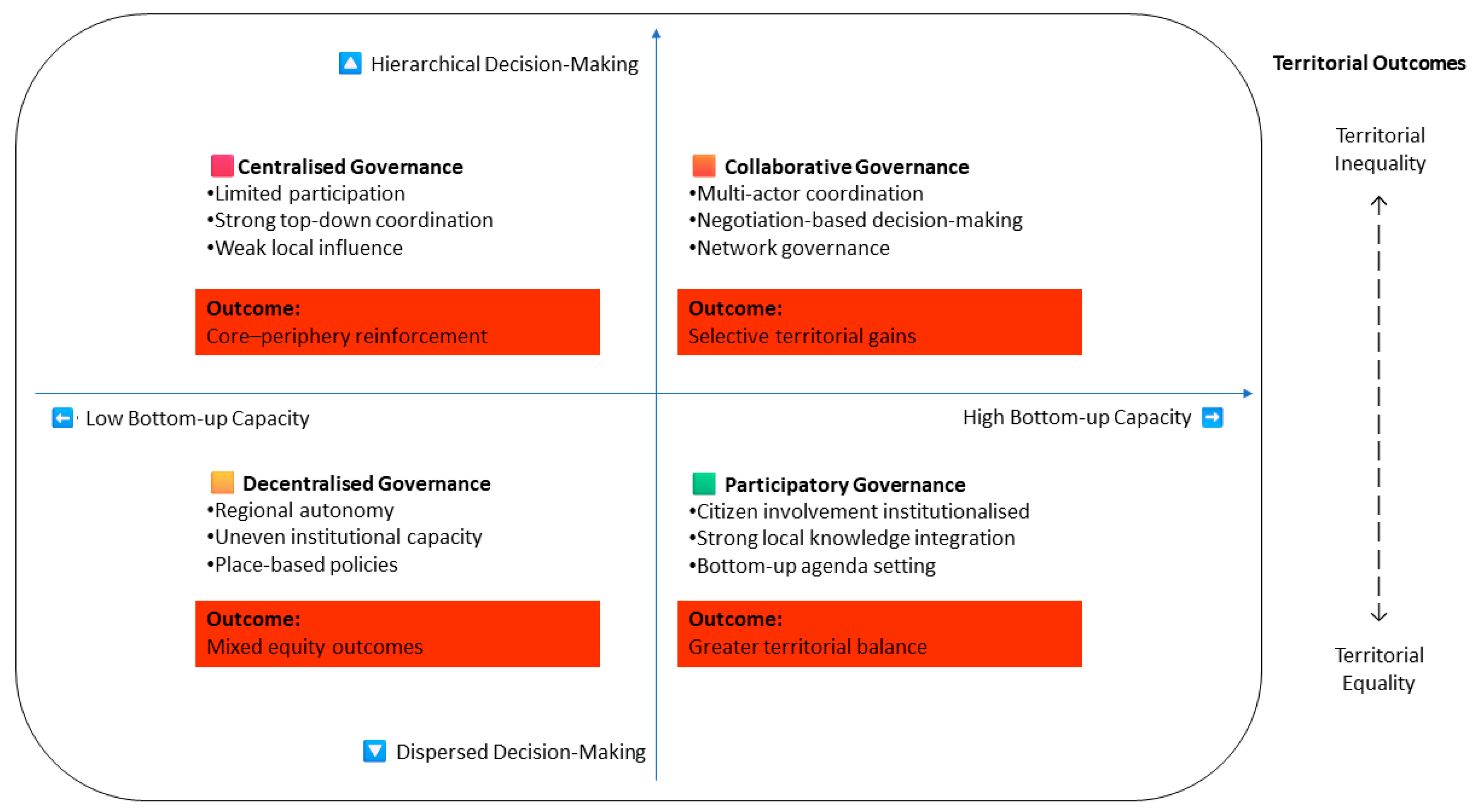
The comparative analysis shows that no single governance model ensures optimal outcomes for bottom-up planning and territorial equity. Instead, each model has distinct strengths and limitations shaped by institutional capacity, actor configurations, and coordination mechanisms. Overall, territorial development outcomes are shaped not only by formal authority structures but by how power, knowledge, and coordination are distributed across governance systems. This suggests that territorial cohesion is most likely to be achieved through hybrid governance arrangements that balance top-down strategic coordination and redistribution with bottom-up responsiveness, local knowledge, and participation (
Figure 1).
5. Discussion
The analysis of governance structures and territorial development models highlights the importance of institutional design for addressing spatial inequalities. As discussed in the previous chapters, governance systems influence how resources are allocated, how development priorities are defined, and how different actors participate in decision-making processes. Regions characterised by strong institutional capacity and effective governance arrangements tend to demonstrate greater ability to design and implement development strategies that address structural disparities [
7,
27]. Consequently, public policy aimed at reducing territorial inequalities must pay greater attention not only to economic investments but also to the institutional frameworks through which development policies are implemented.
One of the central policy implications emerging from the literature concerns the need to balance different governance models. While centralised governance can provide strategic coordination and ensure the implementation of large-scale development programs, excessive centralisation may limit the ability of local actors to respond to specific territorial challenges [
2]. Conversely, decentralised, collaborative and participatory governance can enhance local autonomy and policy responsiveness but may also produce uneven outcomes if regional institutional capacities differ significantly. This suggests that effective territorial development policies require a carefully balanced multi-level governance system that combines national strategic coordination with strong regional and local governance capacities [
26].
Bottom-up capacity is often normatively associated with more inclusive and territorially sensitive development; however, it may also generate tensions with the principle of territorial cohesion at the national scale. While locally embedded actors possess context-specific knowledge and are better positioned to articulate place-based needs, strong local autonomy can lead to fragmented development trajectories, reinforcing disparities between more and less capable territories [
1,
87]. In this sense, bottom-up governance may unintentionally privilege already resource-rich or institutionally mature regions, thereby undermining national cohesion objectives. From the perspective of collective action theory, bottom-up capacity may also be understood as the ability of local actors to coordinate, mobilise resources, and pursue shared territorial goals despite institutional fragmentation or conflicting interests [
88,
89]. Since such collective action is often conditioned by existing social capital, institutional capacity, and resource availability, territorially uneven local capacities may further amplify uneven development outcomes, reinforcing the need for balancing bottom-up dynamics with top-down coordination mechanisms. In this context, hybrid governance arrangements that combine elements of these models may offer a more effective approach. By integrating top-down coordination with bottom-up participation and horizontal collaboration, hybrid models can better address the institutional and spatial complexity of territorial development processes.
The tension between top-down and bottom-up approaches reflects a broader dilemma between local responsiveness and strategic coordination. As highlighted in the place-based development literature, effective territorial governance requires a balance between endogenous development dynamics and overarching frameworks that ensure redistribution, solidarity, and policy coherence across regions [
1,
50]. Without such balancing mechanisms, bottom-up capacity risks evolving into fragmented localism, where territorial inequalities are reproduced rather than mitigated.
Finally, the concept of spatial justice provides an important normative framework for territorial policy. Addressing regional disparities should not be understood solely as a technical issue of economic efficiency but also as a question of fairness in the distribution of opportunities, infrastructure, and political influence across territories [
30]. From this perspective, territorial cohesion policies should prioritise balanced development strategies that ensure equitable access to public services and development opportunities for both central and peripheral regions [
12,
32]. Strengthening institutional coordination across governance levels, therefore, becomes a crucial condition for achieving more inclusive and spatially balanced development outcomes.
Toward the Empirical Operationalisation of Bottom-Up Capacity
While the present study is primarily theoretical, the proposed framework is designed to be further operationalised in future empirical research through a set of indicative dimensions and measurable proxies. Recent bibliometric and conceptual research supports this approach, suggesting that participatory processes can be systematically evaluated through indicators of engagement, coordination, and outcome integration, highlighting the importance of multidimensional rather than single-dimensional measures of bottom-up capacity [
90]. Drawing on governance theory, collective action literature, and territorial cohesion research, bottom-up capacity can be conceptualised as a multidimensional construct encompassing institutional, social-processual, and outcome-oriented dimensions (
Table 2).
From an institutional perspective, bottom-up capacity depends on the extent to which governance arrangements create formal opportunities for local actors to influence decision-making. One possible indicator is the number and diversity of formal participation channels, such as public consultations, participatory budgeting mechanisms, advisory councils, or stakeholder committees. The participatory governance literature emphasises that institutionalised channels are essential for translating local knowledge and preferences into policy processes [
36,
91]. A second indicator is the degree of fiscal and administrative autonomy, reflecting the extent to which local authorities possess decision-making powers and control over resources. Studies on decentralisation and multilevel governance show that formal authority and fiscal capacity condition whether local participation can meaningfully shape territorial outcomes [
92]. Finally, institutional openness may capture the responsiveness and permeability of institutions to bottom-up input, an issue highlighted in the network and interactive governance literature [
18,
93].
From a social and process-oriented perspective, bottom-up capacity is closely linked to the ability of local actors to engage in collective action. The density of civic organisations may serve as an indicator of local associational capacity and organisational infrastructure, as suggested by social capital theory [
94]. Likewise, trust and reciprocity are widely recognised as enabling conditions for cooperation and self-organisation [
89,
94]. A further indicator is collective mobilisation capacity, or the ability of local actors to organise around shared interests and overcome free-rider problems, a central issue in collective action theory [
88]. In collaborative governance settings, the frequency and quality of stakeholder coordination may also indicate the strength of interaction, dialogue, and consensus-building processes [
15].
Finally, bottom-up capacity may be assessed through outcome-oriented indicators that capture the territorial consequences of governance arrangements. Implementation success may indicate the extent to which collectively shaped decisions are translated into effective action [
95]. Conflict resolution capacity may capture whether governance systems are capable of mediating competing interests and reducing territorial or stakeholder tensions [
15]. Most importantly, balanced territorial outcomes, understood in terms of territorial cohesion, may serve as the ultimate evaluative criterion. The territorial cohesion literature and EU policy frameworks define such outcomes through reduced territorial disparities and more equitable access to services, infrastructure, and opportunities across space [
96].
Table 2.
Proposed indicators for the empirical operationalisation of bottom-up capacity.
Table 2.
Proposed indicators for the empirical operationalisation of bottom-up capacity.
| Dimension | Indicator | Theoretical Justification | Key References |
|---|
| Institutional | Formal participation channels | Institutional access to decision-making | Thomas (1995) [91]; Fung (2006) [36]; Wasowska & Postula (2018) [97] |
| Fiscal/local autonomy | Capacity to act and allocate resources | Hooghe et al. (2016) [92] |
| Institutional openness | Responsiveness to bottom-up input | Rhodes (1996) [18]; Sørensen & Torfing (2007) [93]; Nabatchi et al. (2019) [78] |
| Social | Density of civic organisations | Associational capacity | Putnam (1993) [94] |
| Trust/reciprocity | Enabling cooperation | Ostrom (1990) [89]; Putnam (1993) [94] |
| Collective mobilisation | Ability to overcome free-rider problems | Olson (1965) [88] |
| Stakeholder coordination | Interaction and consensus-building | Ansell & Gash (2008) [15] |
| Outcome | Implementation success | Translation into action | Pressman & Wildavsky (1973) [95] |
| Conflict resolution | Mediation of competing interests | Ansell & Gash (2008) [15] |
| Territorial cohesion | Balanced territorial outcomes | European Commission (2008) [96]; Medeiros et al. (2024) [98] |
Taken together, these indicators provide an initial operational pathway for empirically assessing bottom-up capacity across governance models. By distinguishing between institutional inputs, collective-action processes, and territorial outcomes, future research may test the proposed framework comparatively across socio-economic and territorial contexts.
6. Conclusions
This paper examined the relationship between governance structures and territorial development, with particular attention to the spatial justice, territorial cohesion, and a bottom-up approach in decision-making. The analysis demonstrates that governance structures significantly shape territorial development outcomes through differences in institutional capacity, policy coordination, and the distribution of decision-making authority across governance levels. A central finding of this study is that territorial cohesion requires a balance between top-down strategic coordination and bottom-up contextual responsiveness. While centralised governance can provide strategic direction, policy coherence, and redistributive capacity, decentralised, collaborative and participatory governance models can enhance responsiveness to local conditions, improve legitimacy, and facilitate the inclusion of diverse stakeholders in development processes. At the same time, purely bottom-up governance may become place-bound and insufficiently attentive to broader territorial interdependencies, while overly centralised systems may overlook territorial diversity and weaken local agency.
Effective territorial cohesion, therefore, depends on institutional frameworks capable of integrating both dimensions within coherent multi-level governance systems. More specifically, the findings suggest that territorial development outcomes depend on:
The degree of vertical integration between governance levels;
The extent of horizontal coordination among actors;
The institutional mechanisms that translate local knowledge into territorial strategy.
These findings highlight that different combinations of centralised, decentralised, collaborative, and participatory governance may either reinforce or undermine territorial cohesion depending on how these dimensions are institutionally balanced.
This study is subject to several limitations. As a theory-building paper, it does not empirically test the proposed typology or causal relationships across real-world cases. Rather than providing empirical validation, the paper develops a conceptual and analytical framework intended to guide future empirical research. To address this limitation, the study proposes pathways for empirical operationalisation and comparative testing in future work.
Future research should further explore how hybrid governance arrangements function in different institutional contexts and how governance design can be used as a policy instrument for reducing territorial inequalities and strengthening bottom-up development processes, particularly in peripheral and institutionally weaker regions.
The comparative analysis research between the governance model and its relation to the bottom-up approach and territorial cohesion could be empirically deepened through case studies of countries or regions that correspond to given governance models (e.g., Germany for decentralisation, Russia for centralisation, some EU states for collaborative and Nordic countries for participative governance models). Such an approach would allow for systematic comparison of how governance structures shape bottom-up capacity and territorial cohesion outcomes across diverse institutional contexts. Methodologically, this could be explored through qualitative comparative case study designs, combining document analysis of cohesion policy frameworks, semi-structured interviews with policy actors at different governance levels, and secondary data on regional development performance and institutional capacity. This would enable a more fine-grained assessment of how different governance logics translate into territorial development outcomes in practice.
To facilitate future empirical applications, the theoretical framework developed in this study can be operationalised through a structured set of indicators capturing the multidimensional nature of bottom-up capacity. As summarised in
Table 2, these indicators are organised across three interrelated dimensions: institutional, social, and outcome-related. Finally, the outcome dimension reflects the extent to which governance arrangements translate into implementation success, conflict resolution, and territorially balanced development outcomes. Taken together, these indicators provide a coherent operational framework for translating the conceptual model into empirical research designs, particularly in comparative studies of territorial governance systems.
Author Contributions
Conceptualisation, M.M. and M.P.; methodology, M.M. and M.P.; software, M.M.; validation, M.P.; formal analysis, M.M.; investigation, M.M. and M.P.; resources, M.P.; data curation, M.M. and M.P.; writing—original draft preparation, M.M. and M.P.; writing—review and editing, M.P.; visualization, M.M. and M.P.; supervision, M.P.; project administration, M.P.; funding acquisition, M.P. All authors have read and agreed to the published version of the manuscript.
Funding
This research was funded by the Ministry of Science, Technological Development and Innovation of the Republic of Serbia (Grant No. 451-376/2024-03/3373 and 451-03-33/2026-03/200006).
Data Availability Statement
The data presented in this study are available from the corresponding author upon reasonable request.
Acknowledgments
Matij Mitrović, a doctoral researcher at the Institute of Architecture and Urban & Spatial Planning of Serbia, as a scholarship holder of the Ministry of Science, Technological Development and Innovation, would like to express his gratitude to his mentor, Marijana Pantić, for her support in developing the research idea, designing the methodological framework, and validating the results. Her guidance and constructive feedback during the writing and editing process, as well as her continuous professional support and supervision throughout the manuscript preparation, were essential to the completion of this paper.
Conflicts of Interest
The authors declare no conflicts of interest. The funders had no role in the design of the study; in the collection, analysis, or interpretation of data; in the writing of the manuscript; or in the decision to publish the results.
References
- Barca, F.; McCann, P. The case for regional development intervention: Place-based versus place-neutral approaches. J. Reg. Sci. 2012, 52, 134–152. [Google Scholar] [CrossRef]
- Rodríguez-Pose, A. The revenge of the places that don’t matter (and what to do about it). Camb. J. Reg. Econ. Soc. 2018, 11, 189–209. [Google Scholar] [CrossRef]
- Harvey, D. The Condition of Postmodernity; Blackwell: Oxford, UK, 1989. [Google Scholar]
- Krugman, P. Geography and Trade; MIT Press: Cambridge, MA, USA, 1991. [Google Scholar]
- Storper, M. Keys to the City; Princeton University Press: Princeton, NJ, USA, 2013. [Google Scholar]
- Jessop, B. The Future of the Capitalist State; Polity: Cambridge, UK, 2002. [Google Scholar]
- Pike, A.; Rodríguez-Pose, A.; Tomaney, J. Local and Regional Development; Routledge: London, UK, 2017. [Google Scholar]
- Ezcurra, R.; Del Villar, A. Globalization and spatial inequality: Does economic integration affect regional disparities? Ann. Reg. Sci. 2021, 67, 335–358. [Google Scholar] [CrossRef]
- Kyriacou, A.P.; Roca-Sagalés, O. Regional disparities and government quality: Redistributive conflict crowds out good government. J. Reg. Sci. 2011, 51, 815–834. [Google Scholar] [CrossRef]
- Barca, F. Place-based policy and politics. Renewal 2019, 27, 84. [Google Scholar]
- Healey, P. Collaborative Planning; Macmillan: London, UK, 1997. [Google Scholar]
- Faludi, A. Territorial cohesion post-2013: To whomsoever it may concern. In Proceedings of the 24th AESOP Annual Conference, Helsinki, Finland, 7–10 July 2010. [Google Scholar]
- Albrechts, L. Strategic spatial planning in uncertain times. Plan. Theory 2019, 18, 509–529. [Google Scholar]
- Cooke, B.; Kothari, U. Participation: The New Tyranny? Zed Books: London, UK, 2001. [Google Scholar]
- Ansell, C.; Gash, A. Collaborative governance in theory and practice. J. Public Adm. Res. Theory 2008, 18, 543–571. [Google Scholar] [CrossRef]
- Faguet, J.-P. Decentralization and governance. World Dev. 2014, 53, 2–13. [Google Scholar] [CrossRef]
- Burrows, R.; Loader, B. (Eds.) Towards a Post-Fordist Welfare State? Routledge: London, UK, 1994. [Google Scholar]
- Rhodes, R.A.W. The new governance. Political Stud. 1996, 44, 652–667. [Google Scholar] [CrossRef]
- Healey, P. Making Better Places; Macmillan: London, UK, 2020. [Google Scholar]
- Purcell, M. Recapturing Democracy; Routledge: London, UK, 2008. [Google Scholar]
- Pierre, J.; Peters, B.G. Governance, Politics and the State; Macmillan: London, UK, 2000. [Google Scholar]
- Hooghe, L.; Marks, G. Unraveling the central state. Am. Political Sci. Rev. 2003, 97, 233–243. [Google Scholar]
- Flyvbjerg, B. Rationality and Power; University of Chicago Press: Chicago, IL, USA, 1998. [Google Scholar]
- Iammarino, S.; Rodríguez-Pose, A.; Storper, M. Regional inequality in Europe. J. Econ. Geogr. 2019, 19, 273–298. [Google Scholar] [CrossRef]
- Peck, J. Austerity urbanism. City 2012, 16, 626–655. [Google Scholar] [CrossRef]
- Piattoni, S. The Theory of Multi-Level Governance; Oxford University Press: Oxford, UK, 2010. [Google Scholar]
- Rodríguez-Pose, A.; Ketterer, T. Institutional quality and regional development. Reg. Stud. 2020, 54, 537–549. [Google Scholar]
- Brenner, N. New State Spaces; Oxford University Press: Oxford, UK, 2004. [Google Scholar]
- Barca, F. An Agenda for a Reformed Cohesion Policy; European Commission: Brussels, Belgium, 2009. [Google Scholar]
- Soja, E.W. Seeking Spatial Justice; University of Minnesota Press: Minneapolis, MN, USA, 2010. [Google Scholar]
- Kühn, M. Peripheralization: Theoretical concepts explaining socio-spatial inequalities. Eur. Plan. Stud. 2015, 23, 367–378. [Google Scholar] [CrossRef]
- Medeiros, E. Territorial cohesion. Reg. Stud. 2016, 50, 1227–1240. [Google Scholar]
- Davoudi, S. Understanding territorial cohesion. Plan. Theory Pract. 2005, 6, 433–441. [Google Scholar] [CrossRef]
- Piattoni, S.; Polverari, L. Cohesion policy and European Union politics. In Oxford Research Encyclopedia of Politics; Oxford University Press: Oxford, UK, 2019. [Google Scholar] [CrossRef]
- Fung, A.; Wright, E.O. Deepening Democracy; Verso: London, UK, 2003. [Google Scholar]
- Fung, A. Varieties of participation. Public Adm. Rev. 2006, 66, 66–75. [Google Scholar] [CrossRef]
- Arnstein, S.R. A ladder of citizen participation. J. Am. Inst. Plan. 1969, 35, 216–224. [Google Scholar] [CrossRef]
- Cornwall, A. Unpacking participation. Community Dev. J. 2008, 43, 269–283. [Google Scholar] [CrossRef]
- Gaventa, J. Finding the spaces for change: A power analysis. IDS Bull. 2006, 37, 23–33. [Google Scholar] [CrossRef]
- Ostrom, E. Beyond markets and states. Am. Econ. Rev. 2010, 100, 641–672. [Google Scholar] [CrossRef]
- Whetten, D.A. What constitutes a theoretical contribution? Acad. Manag. Rev. 1989, 14, 490–495. [Google Scholar] [CrossRef]
- Cornelissen, J.P. Developing propositions or typology? Acad. Manag. Rev. 2017, 42, 1–9. [Google Scholar] [CrossRef]
- Jaakkola, E. Designing conceptual articles. AMS Rev. 2020, 10, 18–26. [Google Scholar] [CrossRef]
- Weber, M. The Methodology of the Social Sciences; Free Press: New York, NY, USA, 1949. [Google Scholar]
- Nabatchi, T.; Amsler, L.B. Direct public engagement. Am. Rev. Public Adm. 2014, 44, 63S–88S. [Google Scholar] [CrossRef]
- Sørensen, E.; Torfing, J. Accountable government. Adm. Sci. 2021, 11, 127. [Google Scholar] [CrossRef]
- Swyngedouw, E. Governance innovation. Urban Stud. 2005, 42, 1991–2006. [Google Scholar] [CrossRef]
- Marks, G.; Hooghe, L. Contrasting visions of multi-level governance. In Multi-Level Governance; Oxford University Press: Oxford, UK, 2004; pp. 15–30. [Google Scholar]
- Rodríguez-Pose, A.; Gill, N. Economic dividend of devolution. Reg. Stud. 2005, 39, 405–420. [Google Scholar] [CrossRef]
- Rodríguez-Pose, A. Do institutions matter? Reg. Stud. 2013, 47, 1034–1047. [Google Scholar] [CrossRef]
- Rodríguez-Pose, A.; Wilkie, C. Innovating in less developed regions: What drives patenting in the lagging regions of Europe and North America. Growth Change 2019, 50, 4–37. [Google Scholar] [CrossRef]
- Albalate, D.; Bel, G.; Fageda, X. Beyond the efficiency–equity dilemma: Centralization as a determinant of government investment in infrastructure. Pap. Reg. Sci. 2012, 91, 599–615. [Google Scholar] [CrossRef]
- Gómez-Lobo, A.; Oviedo, D. Spatial inequalities in Latin America: Mapping Aggregate to Micro-Level Disparities; LACIR Working Paper No. 123; International Inequalities Institute, London School of Economics and Political Science: London, UK, 2023. [Google Scholar]
- Vasta, A.; Figueiredo, E.; Valente, S.; Vihinen, H.; Nieto-Romero, M. Place-based policies for sustainability and rural development. Soc. Sci. 2019, 8, 289. [Google Scholar] [CrossRef]
- Rodríguez-Pose, A.; Ezcurra, R. Is fiscal decentralization harmful for economic growth? J. Econ. Geogr. 2011, 11, 619–643. [Google Scholar] [CrossRef]
- Beramendi, P. Inequality and the territorial fragmentation of solidarity. Int. Organ. 2007, 61, 783–820. [Google Scholar] [CrossRef]
- Tselios, V.; Torrisi, G.; Rodríguez-Pose, A.; Tomaney, J.; Pike, A. Income inequality, decentralisation and regional development in Western Europe. Environ. Plan. A Econ. Space 2012, 44, 1278–1301. [Google Scholar] [CrossRef]
- Caldeira, E.; Foucault, M.; Rota-Graziosi, G. Does Decentralization Facilitate Access to Poverty-Related Services? NBER Working Paper No. 18118; National Bureau of Economic Research: Cambridge, MA, USA, 2012. [Google Scholar] [CrossRef]
- Arends, H. The dangers of fiscal decentralization and public service delivery. Politische Vierteljahresschr. 2020, 61, 599–622. [Google Scholar] [CrossRef]
- Tselios, V. Does political decentralization affect income inequality? Reg. Stud. 2023, 57, 829–843. [Google Scholar] [CrossRef]
- Faguet, J.-P.; Pöschl, C. (Eds.) Is Decentralization Good for Development? Oxford University Press: Oxford, UK, 2015. [Google Scholar]
- Rodríguez-Pose, A.; Ezcurra, R. Does decentralization matter for regional disparities? J. Econ. Geogr. 2010, 10, 619–644. [Google Scholar] [CrossRef]
- OECD. Making Decentralisation Work: A Handbook for Policy-Makers; OECD Publishing: Paris, France, 2019. [Google Scholar] [CrossRef]
- Rodríguez-Pose, A.; Crescenzi, R. Research and development and regional growth. Reg. Stud. 2008, 42, 51–67. [Google Scholar] [CrossRef]
- Sørensen, E.; Torfing, J. Enhancing collaborative innovation. Adm. Soc. 2011, 43, 842–868. [Google Scholar] [CrossRef]
- Emerson, K.; Nabatchi, T.; Balogh, S. Integrative framework for collaborative governance. J. Public Adm. Res. Theory 2012, 22, 1–29. [Google Scholar] [CrossRef]
- Innes, J.E.; Booher, D.E. Reframing public participation. Plan. Theory Pract. 2004, 5, 419–436. [Google Scholar] [CrossRef]
- Klijn, E.-H.; Steijn, B.; Edelenbos, J. Network management and outcomes. Public Adm. 2010, 88, 1063–1082. [Google Scholar] [CrossRef]
- Sintomer, Y.; Herzberg, C.; Röcke, A. Participatory budgeting in Europe. Int. J. Urban Reg. Res. 2008, 32, 164–178. [Google Scholar] [CrossRef]
- Fung, A. Putting the public back into governance. Public Adm. Rev. 2015, 75, 513–522. [Google Scholar] [CrossRef]
- Pantić, M.; Cilliers, J.; Cimadomo, G.; Montaño, F.; Olufemi, O.; Torres Mallma, S.; van den Berg, J. Public participation during COVID-19. Land 2021, 10, 1379. [Google Scholar] [CrossRef]
- Fischer, F. Participatory Governance: From Theory to Practice; Oxford University Press: Oxford, UK, 2012. [Google Scholar]
- Campbell, S. Green cities, growing cities, just cities? J. Am. Plan. Assoc. 1996, 62, 296–312. [Google Scholar] [CrossRef]
- Albrechts, L. Strategic spatial planning re-examined. Environ. Plan. B 2004, 31, 743–758. [Google Scholar] [CrossRef]
- OECD. A Territorial Approach to the Sustainable Development Goals; OECD Publishing: Paris, France, 2020. [Google Scholar]
- Baiocchi, G.; Ganuza, E. Participatory Budgeting as if Emancipation Mattered. Politics Soc. 2014, 42, 29–50. [Google Scholar] [CrossRef]
- Irvin, R.A.; Stansbury, J. Citizen participation in decision making. Public Adm. Rev. 2004, 64, 55–65. [Google Scholar] [CrossRef]
- Nabatchi, T.; Sancino, A.; Sicilia, M. Varieties of participation in public services. Public Adm. Rev. 2019, 79, 688–700. [Google Scholar]
- Klijn, E.-H.; Steijn, B.; Edelenbos, J. Network management impact. Public Manag. Rev. 2020, 22, 1181–1202. [Google Scholar]
- Wampler, B.; Avritzer, L. Participatory governance revisited. World Dev. 2021, 138, 105235. [Google Scholar]
- Smith, G. Democratic Innovations; Cambridge University Press: Cambridge, UK, 2009. [Google Scholar]
- McNulty, S.L.; Wampler, B. Participatory governance. In Emerging Trends in the Social and Behavioral Sciences; Wiley: Hoboken, NJ, USA, 2015. [Google Scholar]
- Beierle, T.C. Democracy in Practice; Routledge: London, UK, 2002. [Google Scholar]
- Latupeirissa, J.J.P.; Adi, I.W.T.; Valencia, E.B. Empowering marginalized groups. J. Gov. Public Policy 2025, 12, 191–205. [Google Scholar] [CrossRef]
- Swapan, M.S.H.; Aktar, S.; Maher, J. Spatial justice and urban parks. Sustainability 2024, 16, 3929. [Google Scholar]
- Gonçalves, J.E.; Rocco, R.; Sitzoglou, M.; Michail, N.; Kupper, D.; Grafakos, S. Spatial justice in participatory planning. Front. Sustain. Cities 2025, 7, 1656745. [Google Scholar] [CrossRef]
- Bache, I.; Flinders, M. Multi-Level Governance; Oxford University Press: Oxford, UK, 2004. [Google Scholar]
- Olson, M. The Logic of Collective Action; Harvard University Press: Cambridge, MA, USA, 1965. [Google Scholar]
- Ostrom, E. Governing the Commons; Cambridge University Press: Cambridge, UK, 1990. [Google Scholar]
- Shi, X.; Ling, G.H.T.; Alalouch, C.; Leng, P.C.; Lim, S.B.; Rashid, M.F.A.; Rahmat, A. Smart cities and participation. Open House Int. 2025, 50, 904–927. [Google Scholar] [CrossRef]
- Thomas, J.C. Public Participation in Public Decisions; Jossey-Bass: San Francisco, CA, USA, 1995. [Google Scholar]
- Hooghe, L.; Marks, G.; Schakel, A.H.; Niedzwiecki, S.; Osterkatz, S.C.; Shair-Rosenfield, S. Measuring Regional Authority; Oxford University Press: Oxford, UK, 2016. [Google Scholar]
- Sørensen, E.; Torfing, J. Governance network research. In Theories of Democratic Network Governance; Palgrave Macmillan: London, UK, 2007. [Google Scholar]
- Putnam, R.D. Making Democracy Work; Princeton University Press: Princeton, NJ, USA, 1993. [Google Scholar]
- Pressman, J.L.; Wildavsky, A. Implementation; University of California Press: Berkeley, CA, USA, 1973. [Google Scholar]
- European Commission. Green Paper on Territorial Cohesion; Commission of the European Communities: Brussels, Belgium, 2008. [Google Scholar]
- Wasowska, A.; Postuła, I. Governance mechanisms in state-owned enterprises. Balt. J. Manag. 2018, 13, 410–432. [Google Scholar] [CrossRef]
- Medeiros, E.; Potluka, O.; Demeterova, B.; Musiałkowska, I. EU cohesion policy towards territorial cohesion? Reg. Stud. 2024, 58, 1513–1517. [Google Scholar] [CrossRef]
| Disclaimer/Publisher’s Note: The statements, opinions and data contained in all publications are solely those of the individual author(s) and contributor(s) and not of MDPI and/or the editor(s). MDPI and/or the editor(s) disclaim responsibility for any injury to people or property resulting from any ideas, methods, instructions or products referred to in the content. |