1. Introduction
Urban land use planning has long been a foundational instrument of spatial governance, traditionally understood as the allocation of distinct functions such as residential, commercial, or industrial uses within defined territorial boundaries [
1,
2]. This approach, embedded in zoning systems and master plans, assumes that future conditions can be sufficiently anticipated and stabilized through spatial prescription [
3]. Under conditions of accelerating urbanization, climate change, and socio-economic transformation, however, this assumption has become increasingly untenable [
4,
5]. Urban areas are no longer seen as fixed mosaics of land uses but as dynamic, evolving socio-economic-ecological systems where land use change is a constant and multifaceted [
5,
6]. Environmental pressures associated with climate change interact with shifting economic structures, governance arrangements, and social practices, producing patterns of transformation that unfold over extended time horizons and resist precise prediction [
7,
8,
9]. In this context, land use change is not an episodic deviation from planned order, but an intrinsic condition of urban systems [
10,
11].
Despite growing recognition of uncertainty and complexity in planning scholarship, much land use planning theory and practice remains grounded in static spatial allocation and anticipatory control [
3,
12]. Even adaptive and resilience-oriented approaches often rely on predefined future scenarios, treating time as a variable to be managed through forecasting rather than as a constitutive dimension of spatial performance [
5,
13,
14]. As a result, planning frameworks tend to evaluate success at discrete moments (plan adoption, implementation, or recovery) rather than in terms of how urban form performs, adapts, and remains relevant over time [
15,
16]. This temporal limitation is particularly problematic under climate change, where urban systems are shaped by both gradual, cumulative pressures and abrupt disruptions that exceed the limits of predictive planning [
17,
18,
19].
Conventional land use planning has historically relied on spatial allocation models that assume relatively stable socio-economic and environmental conditions. However, contemporary urban systems increasingly operate under conditions of accelerating change, uncertainty, and systemic risk associated with climate change and global urbanization [
20,
21]. Recent debates in planning theory, therefore, call for approaches that move beyond static representations of spatial order toward more adaptive and process-oriented understandings of urban development [
5,
15,
22]. Within this context, resilience thinking and socio-ecological systems perspectives provide conceptual foundations for reconsidering planning.
This work seeks to fill an important gap in the field of spatial planning: the need to conceptualize and operationalize land use change not merely as a reactionary phenomenon but as an inherent condition of urban systems, one that planning must actively engage with. It addresses this conceptual gap by reframing urban land use planning as the governance of land use change over time. Rather than proposing new regulatory instruments or empirical models, the paper advances a theory-driven conceptual framework that integrates systems thinking, resilience perspectives, and temporal analysis [
5,
23,
24]. Central to this framework is the concept of temporal resilience, understood as the capacity of urban form to sustain functionality, adaptability, and relevance across uncertain and evolving futures.
To operationalize this temporal perspective without reverting to deterministic forecasting or static indicators, the paper draws on the Time Quality Assessment (TQA) approach developed by Marušić and Goličnik Marušić [
24,
25,
26]. While originally formulated to assess the quality of time experienced in urban spaces, TQA is employed here as a conceptual–operational interface rather than as an empirical method. By foregrounding duration, continuity, rhythm, and transformation, TQA provides a structured way to engage with time as a qualitative dimension of spatial performance, making visible how planning decisions shape long-term trajectories of land use, adaptability, and obsolescence. This perspective moves beyond static land use categorizations toward a model of open-ended, adaptive urban planning that embraces uncertainty as a design principle rather than a limitation.
The paper’s contribution is primarily theoretical. It does not present new empirical case studies or prescriptive planning solutions. Instead, it offers a coherent conceptual synthesis that challenges static and deterministic models of land use planning and argues for a shift from managing land use toward stewarding land use change [
3,
11]. By placing temporal resilience at the heart of planning rationality, the framework offers a foundation for both future empirical research and planning practices focused on robustness, adaptability, and long-term responsibility in the face of uncertainty (e.g., climate uncertainty) [
27]. The paper contributes to ongoing debates on resilience and climate adaptation in planning theory by introducing a temporally grounded perspective on urban land use planning. While resilience has increasingly been incorporated into planning discourse, it is often operationalized through spatial indicators or risk management frameworks that insufficiently address the temporal dynamics of urban transformation. However, recent European research initiatives addressing climate adaptation and sustainability transitions increasingly emphasize the need for integrated analytical frameworks capable of assessing climate risks, societal vulnerability, and long-term transformation processes across multiple spatial and temporal scales (e.g., DISTENDER). Thus, the framework proposed here reconceptualizes urban land use planning as the governance of land use change over time, emphasizing the temporal performance of spatial systems under conditions of uncertainty. By integrating resilience thinking, socio-ecological systems perspectives, and the Time Quality Assessment (TQA) approach, the paper advances the concept of temporal resilience as a critical dimension of spatial performance. In doing so, it provides a conceptual–operational interface for evaluating urban form not only in terms of spatial configuration but also in terms of duration, adaptability, and long-term trajectories of change.
The paper proceeds as follows.
Section 2 examines the limitations of conventional land use planning approaches that rely on static spatial allocation models.
Section 3 reviews relevant theoretical perspectives from resilience thinking and socio-ecological systems research.
Section 4 introduces the temporal dimension of urban spatial systems and develops the conceptual foundations of temporal resilience.
Section 5 operationalizes this perspective through the Time Quality Assessment (TQA) framework and discusses emerging research directions in climate adaptation governance. The paper concludes by reflecting on the implications of temporally informed planning approaches for future research and planning practice.
2. Theoretical Background
Urban resilience has evolved from a focus on shock absorption to an emphasis on temporal performance under continuous change (temporal resilience). This perspective recognizes that cities are complex adaptive systems, where long-term outcomes emerge from interactions among social, economic, and spatial processes rather than from discrete interventions alone. The chapter explores how planning can engage with time as a fundamental dimension of urban development. Moving beyond static approaches to land use allocation, it frames land use change as an ongoing process shaped by continuous transformation and uncertainty. The discussion examines how urban form and spatial systems can develop temporal resilience, adapting to shifting social, environmental, and economic conditions. It also highlights the limits of anticipatory planning in contexts where future conditions cannot be fully predicted, emphasizing the need for more flexible and adaptive planning frameworks. In this context, the chapter introduces the concept of Time Quality Assessment (TQA) as a tool for evaluating temporal performance in planning. Together, these perspectives underscore the importance of integrating temporal thinking into planning theory and practice to better manage ongoing land use transformation.
2.1. Land Use Change as a Temporal Process
Recognizing land use change as an ongoing condition challenges the foundations of conventional planning. It implies that planning cannot be limited to regulating spatial outcomes at fixed points in time but must engage with how land use trajectories evolve across extended temporal horizons [
11,
16]. This reframes planning from the pursuit of spatial equilibrium toward the governance of change under conditions of uncertainty. This shift reframes the planner’s task from achieving spatial equilibrium toward shaping the conditions under which land use change occurs, acknowledging that stability is provisional and that transformation is intrinsic to urban life.
Temporal resilience highlights the ability of urban systems to maintain and adapt functionality over time, even as conditions shift (e.g., demographic change, economic flux, or climate variability). Unlike conventional resilience approaches, which often focus on rapid recovery after discrete shocks, temporal resilience foregrounds long-term performance and adaptability [
13,
15].
The concept of spatial lock-in versus adaptability is central. Urban form can either constrain future change, through rigid infrastructure layouts or land use patterns, or enable flexibility by preserving options for functional reallocation, retrofitting, or ecological integration [
28,
29]. Recognizing this dynamic allows planners to anticipate, for example, how urban form may influence both everyday functioning and long-term climate responsiveness.
2.2. Temporal Resilience and Urban Form
In response to growing uncertainty, resilience has become a central concept in urban planning discourse. Much resilience-oriented work has focused on cities’ capacity to absorb shocks, recover from disturbance, or adapt to specific risks. While valuable, these approaches often remain oriented toward discrete events and identifiable disruptions (e.g., extreme weather events, economic crises, or infrastructural failures), leaving less attention to the long-term performance of urban form under continuous transformation. This paper advances the concept of temporal resilience to address this gap. Temporal resilience shifts analytical attention from recovery and adaptation at specific moments toward the sustained performance of urban form over time. It concerns how spatial configurations, infrastructures, and regulatory arrangements maintain functionality, relevance, and adaptability amid evolving socio-economic and environmental conditions. Temporal resilience shifts attention away from episodic disturbance and recovery toward the long-term performance of urban form under conditions of continuous change. Rather than asking whether urban systems can return to a prior state or adapt to a projected future scenario, temporal resilience concerns how urban form sustains functionality, relevance, and adaptability across time, amid uncertainty and transformation.
Urban form is central to this perspective. Spatial configurations, infrastructural arrangements, and regulatory frameworks shape not only present land uses but also the range of future transformations that remain possible. Development patterns optimized for short-term efficiency may generate rigidity over time through infrastructural lock-in or regulatory inflexibility. By contrast, urban forms characterized by redundancy, modularity, and reversibility may initially appear less efficient but help preserve adaptive capacity under changing conditions. In this sense, temporal resilience reframes urban form not as a fixed spatial outcome but as a time-dependent asset whose value lies in its ability to accommodate future change.
Climate adaptation and mitigation, for example, are increasingly understood as emergent properties of urban systems, rather than additive policy measures, e.g., [
30]. The spatial configuration of cities (density, connectivity, land use mix) directly affects energy use, emissions, and resilience to climate stressors. By framing climate outcomes as emerging from temporal performance, the analysis links urban morphology with both mitigation potential and adaptive capacity. Temporal resilience thus positions urban form as a time-dependent asset, shifting evaluation from short-term efficiency to the capacity to maintain multiple future trajectories. In climate adaptation, this perspective is crucial, as environmental pressures interact with urban systems both gradually and abruptly.
2.3. The Limits of Anticipatory Planning
Conventional planning approaches often treat time as linear and manageable through forecasting, scenario-building, and anticipatory control [
12]. Even adaptive planning frameworks typically operate by defining alternative future states and managing transitions between them. While such approaches introduce flexibility, they frequently assume that future conditions can be sufficiently bounded to inform optimal present-day decisions. A temporal resilience perspective challenges this assumption by recognizing uncertainty as an inherent feature of complex urban systems rather than a residual problem of insufficient knowledge [
17]. Urban land use change emerges from interacting processes whose trajectories cannot be fully predicted, particularly under climate change, where gradual and non-linear dynamics interact with socio-economic transformation [
8,
18].
From this standpoint, the objective of planning is not to optimize land use configurations for anticipated futures, but to preserve the capacity of urban systems to respond meaningfully to a range of possible futures. Planning decisions must therefore be evaluated in terms of how they shape future options, enable or constrain adaptation, and distribute risks and responsibilities across time. This reframing foregrounds robustness, flexibility, and learning over prediction and control, and has normative implications. Treating uncertainty as constitutive rather than residual requires planners to acknowledge the limits of foresight and to adopt a more reflexive, iterative approach to decision-making. It also raises questions of accountability and intergenerational responsibility, as planning choices made in the present condition the adaptive capacity of future urban systems.
2.4. Planning Time Quality Assessment (TQA)
Engaging systematically with temporal performance requires conceptual tools that do not reduce time to a variable in predictive models. The Time Quality Assessment (TQA) approach offers such an entry point by treating time as a qualitative dimension of spatial performance. TQA foregrounds duration, continuity, rhythm, and transformation, shifting attention from static spatial attributes toward how urban environments perform across time. Although originally developed to assess the quality of time spent in urban spaces, TQA’s underlying logic is relevant to broader land use planning questions. According to Goličnik Marušić and Marušić [
25], TQA is a theoretically grounded framework for evaluating the suitability of urban spaces for different population segments by integrating user profiles, activities, and spatial characteristics. It combines expert knowledge, statistical data, and participatory input to define population segments and their boundary profiles, including daily routines, needs, and preferences. By analyzing time balance, economic balance, and time–quality balance, TQA produces a measure of how well a space supports the activities and co-habitation of specific groups over time.
By focusing on temporal qualities rather than fixed outcomes, TQA evaluates how spatial configurations support or undermine long-term use, adaptability, and transformation. Its core logic (capturing duration, continuity, rhythm (daily, weekly, seasonal routines), and transformation) is highly relevant to land use planning, where similar temporal dynamics govern the evolution of urban form over extended periods. In this paper, TQA is not used as an empirical method or prescriptive tool. Instead, it functions as a conceptual–operational interface linking theories of temporal resilience with the practical demands of planning, evaluation and governance. It complements existing planning instruments by introducing a temporal lens that cuts across land use categories and regulatory frameworks, making visible forms of rigidity, lock-in, or premature obsolescence that static analyses often overlook.
2.5. Toward a Temporal Framework for Land Use Planning
Taken together, these theoretical strands support a reframing of urban land use planning around time, change, and uncertainty. Land use change is understood as an intrinsic condition of urban systems rather than a deviation from planned order [
10]. Temporal resilience provides a lens for evaluating the long-term performance of urban form under continuous transformation, while the Time Quality Assessment (TQA) offers a means of operationalizing this perspective without collapsing complexity into static indicators or deterministic forecasts.
This synthesis establishes the foundation for the conceptual framework developed in the following sub-sections. By integrating land use change as a temporal process, temporal resilience as a measure of spatial performance, and TQA as an interpretive interface, the framework advances a planning paradigm oriented toward governing change rather than prescribing fixed spatial outcomes. In doing so, it aligns land use planning more closely with the realities of climate uncertainty and the open-ended nature of contemporary urban futures. At its core are two interdependent pillars: (1) temporal resilience of urban form (see
Section 2.5.1), and (2) climate adaptation and mitigation as emergent properties of temporal land use performance (see
Section 2.5.2). These pillars are integrated through a systems-oriented understanding of change and operationalized through a temporal evaluative lens (see
Section 2.5.3).
2.5.1. Temporal Resilience as a Planning Principle
Temporal resilience of urban form refers to the capacity of spatial configurations, infrastructures, and regulatory arrangements to sustain functionality, relevance, and adaptability across extended time horizons, and asks how urban form accommodates evolving practices, environmental pressures, and socio-economic transformations without requiring repeated large-scale restructuring. In fact, urban form plays a decisive role in shaping long-term trajectories of land use change, where spatial layouts, infrastructural investments, and regulatory frameworks condition not only present-day uses but also the range of future transformations that remain possible. Temporal resilience, therefore, reframes urban form as a time-dependent asset rather than a fixed spatial outcome. Its value lies not in maintaining stable configurations but in sustaining the ability of urban environments to remain usable and adaptable under uncertain futures. This perspective is particularly relevant in the context of climate change, where urban systems are exposed to both gradual, cumulative pressures and abrupt disruptions, e.g., [
30]. Avoiding premature spatial obsolescence and preserving adaptive capacity across generations becomes a central objective of resilient urban development.
From a planning perspective, focusing on temporal resilience shifts evaluative attention away from compliance with static land use categories toward the long-term implications of spatial decisions [
29,
31]. Planning interventions are assessed in terms of how they shape trajectories of change, enable or constrain future adaptation, and distribute risks and responsibilities across time. In this sense, planning is repositioned as an ongoing engagement with evolving urban systems rather than the design of stable spatial end-states.
2.5.2. Climate Adaptation and Mitigation as Temporal Land Use Performance
Building on this understanding of temporal resilience, contemporary approaches to climate adaptation and mitigation in planning can be reconsidered. In much current practice, climate responses are addressed through targeted policies, standards, and sectoral interventions applied to relatively stable spatial frameworks [
9,
32]. Measures such as flood zoning, energy efficiency standards, or heat mitigation strategies are typically introduced as corrective responses to identified risks, operating alongside rather than within broader land use planning logics [
31,
33]. While essential, these approaches often treat climate responsiveness as an external requirement imposed on urban form rather than as an intrinsic property of how land use systems evolve over time [
34].
A temporal resilience perspective instead frames climate adaptation and mitigation as emergent properties of land use systems capable of sustaining performance under changing conditions [
15,
19]. Climate change unfolds through non-linear and interacting processes that cannot be fully anticipated through scenario-based planning alone [
30,
32]. Historical evidence suggests that interactions between climatic shifts and land use dynamics have contributed to major societal transformations and, in some cases, civilizational decline, underscoring the importance of recognizing environmental change early and integrating it into planning processes. Urban forms optimized for narrowly defined futures or technological fixes may therefore prove fragile when confronted with unexpected combinations of environmental stress, behavior change, and institutional constraints [
34]. Temporal resilience thus shifts attention toward spatial configurations that remain viable across a wider range of climatic and socio-economic conditions.
Within this perspective, climate mitigation emerges through land use configurations that reduce long-term dependence on resource-intensive practices, such as rigid functional segregation or car-dependent spatial structures [
35]. Adaptation capacity, in turn, is supported by spatial arrangements that maintain ecological continuity, permeability, and the potential for incremental transformation as environmental conditions evolve [
31,
33]. Climate responsiveness, therefore, becomes a property of how land use systems perform over time, rather than the result of isolated interventions or short-term optimization.
2.5.3. Systems Dynamics and Planning Implications
The two pillars of the framework, temporal resilience of urban form and climate adaptation/mitigation, are mutually reinforcing. Temporal resilience shapes the range of climate responses that remain feasible over time, while climate pressures feedback into urban system evolution, influencing adaptability and transformation. These dynamics are complex, non-linear, and extend across long temporal horizons, challenging planning approaches reliant on fixed categories or deterministic forecasts. To engage with these dynamics, the framework adopts a systems-oriented perspective, emphasizing feedback loops, path dependencies, and cumulative effects. Planning interventions are not isolated actions but contributions to evolving trajectories of urban transformation.
The Time Quality Assessment (TQA) as a qualitative lens for examining temporal performance, capturing duration, continuity, rhythm, and transformation in urban form with various GIS-based dash boards or decision-making platforms offering spatially explicit, simulation-based tools that model the evolution of land use patterns under alternative scenarios of socio-economic and environmental change may help planners to explore potential lock-ins, path dependencies, and adaptive capacities across time and space.
This integration positions TQA and platforms such as DISTENDER [
36] as complementary tools within the framework. TQA directs evaluative attention toward temporal affordances, while, for example, DISTENDER [
37,
38,
39] operationalizes scenario-based exploration of strategies for related spatial and urban trajectories. Together, they support planning as a dynamic, learning-oriented process, enabling decision-makers to anticipate potential consequences of present interventions and maintain flexibility under uncertainty.
3. Methodological Approach
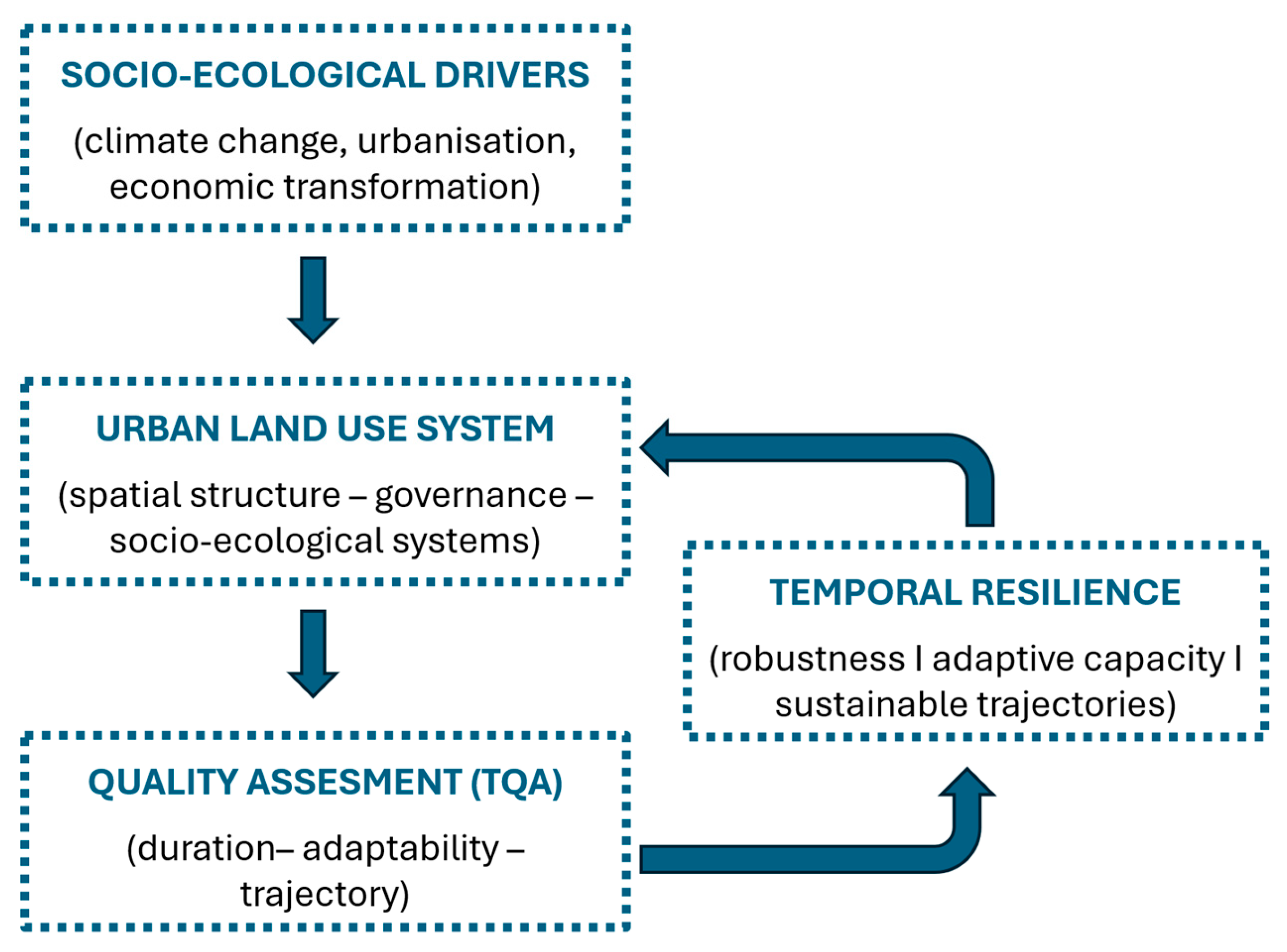
This paper adopts a theory-driven conceptual methodology aimed at developing a comprehensive framework to understand and guide urban land use change in dynamic socio-economic-ecological contexts. The study draws on an interdisciplinary synthesis of the existing literature, theoretical constructs, and established methodological tools, particularly the Time Quality Assessment (TQA) approach. The proposed framework (see
Figure 1) is intended as a foundation for subsequent research that can operationalize these concepts in diverse urban contexts and through varied methodological approaches, including quantitative modeling, participatory planning, and longitudinal case studies.
According to [
25] the TQA methodology explicitly operationalizes the three balances through a bottom-up, behavior-mapping–based framework in which individual daily activity chains are decomposed into time–space events and linked to spatially explicit urban functions. As outlined in the original formulation, behavior maps record location, duration, frequency, and type of activities, enabling the reconstruction of complete daily routines as sequences of constrained decisions within a 24 h time budget. These routines are then evaluated against spatial conditions (availability, accessibility, and opening hours of services), allowing time balance to be calculated as the degree to which required and discretionary activities can be completed within feasible temporal windows. This provides a direct operational link between individual schedules and urban system performance through observed or simulated activity–place interactions.
Within this framework, time-quality is operationalized as a weighted function of activity and place attributes, where, e.g., high-quality time corresponds to time spent in activities and environments characterized by higher satisfaction, voluntariness, and restorative or social value (e.g., leisure, social interaction), as opposed to constrained or obligatory activities (e.g., commuting, fragmented task completion). The formulation further specifies that quality of time depends on both the economic capacity of the user profile and the conduciveness of the physical environment, allowing the computation of a time-quality balance through weighted contributions of activity and spatial components. Accordingly, economic balance is expressed as the share of household resources required to sustain the observed activity pattern, while spatial mapping is achieved by aggregating these individual-level evaluations into spatial units to identify areas of systematic temporal and economic strain, thereby translating activity chains into urban system demand surfaces.
3.1. TQA as Conceptual-Operational Interface
The TQA framework operationalizes temporal resilience by providing a lens to examine urban form across time rather than at discrete moments. The original Time Quality Assessment (TQA) method evaluates the quality of living environments by analyzing how a specific user profile performs daily activities within a particular spatial environment. It examines whether people can complete their daily routines within available time and financial limits, and how much of their time is experienced as good or bad quality (showing also in which places, as after calculations of quality dimensions, it is shown on a map, this map being used in a manner that planners are very familiar with) [
24,
25,
26]. The assessment is based on three indicators: time balance, economic balance and time-quality balance.
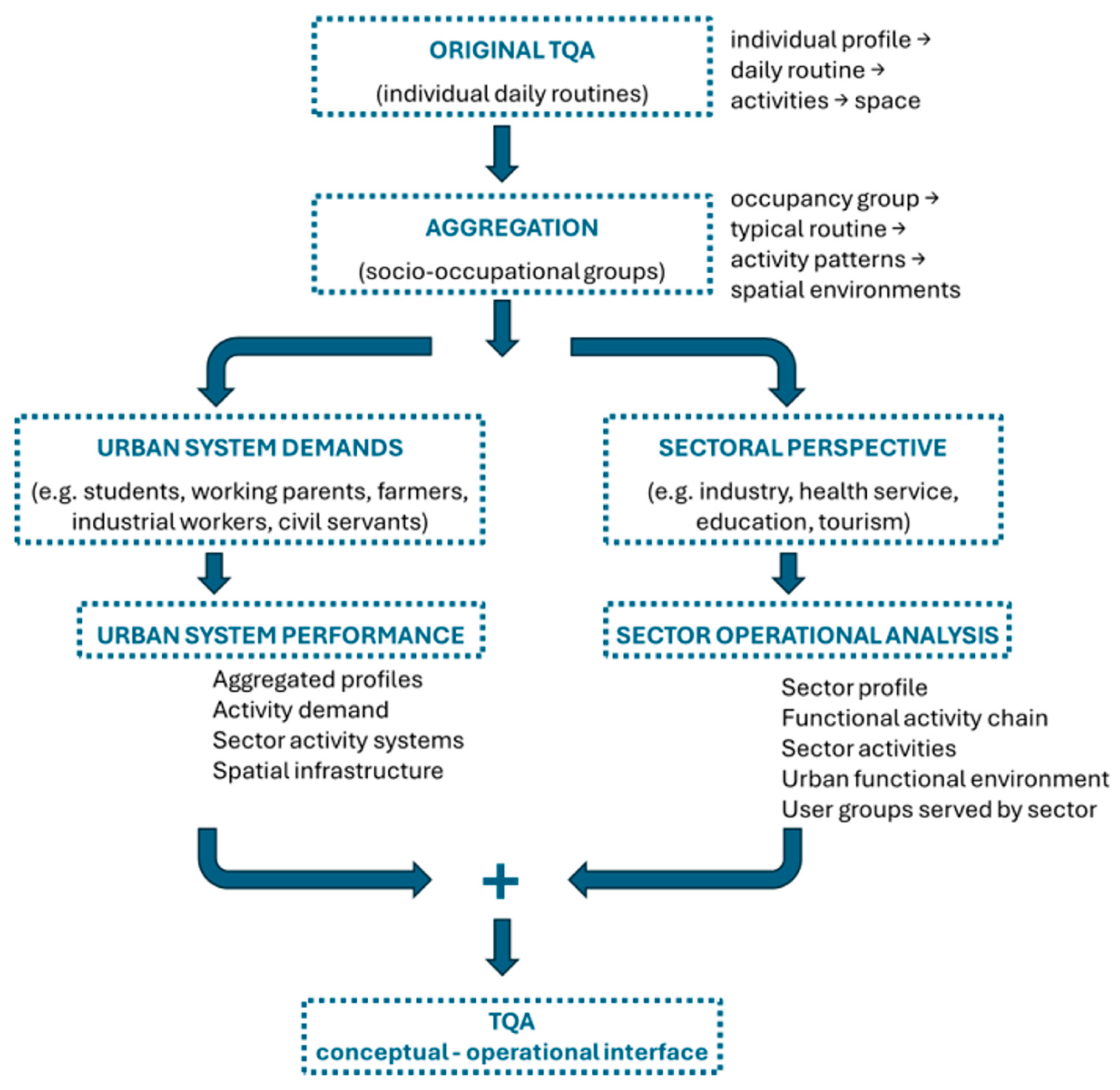
To make the method more applicable to spatial planning, the approach is extended through several transformations, as illustrated in
Figure 2. First, individual user profiles are generalized into aggregated socio-occupational groups, such as working parents, students or elderly residents. These groups represent typical daily routines and allow the analysis to reflect the needs of larger population segments rather than single individuals. Second, the activities of these population groups are interpreted as demands for urban systems, such as housing, mobility, services or green infrastructure. This enables the analysis to evaluate how well spatial environments support everyday activities for different groups of people. In this way, the extended TQA approach moves from analyzing individual experiences of place to evaluating the performance of urban environments for entire populations, while maintaining the original human-centered perspective. A further step introduces a sectoral perspective, which allows aggregated socio-occupational groups to be analyzed according to additional occupational or disciplinary categories, such as farmers, civil servants or industrial workers. These categories may have different activity patterns and, therefore, different demands regarding the improvement or deterioration of time quality.
Beyond this population-based perspective, the TQA framework can also be applied directly to the analysis of sectors (disciplines) and their spatial distribution. In this case, the method evaluates operational aspects of sectors (e.g., industry, central activities, health services or agriculture) by examining elements such as the sector profile, functional activity chain, sector activities, urban functional environment and the user groups served by the sector.
Through these extensions, TQA can support both human-centered evaluation of everyday life and system-level analysis of spatial structures, making it more suitable for spatial and urban planning applications. Thus, the paper extends TQA to the scale of urban land use, allowing planners and researchers to evaluate how spatial configurations sustain functionality, flexibility, and adaptation under changing socio-economic and environmental conditions. TQA evaluates the quality of everyday life through the lens of three balances: Time balance (Are profile’s activities temporally feasible?); Economic balance (Are the profile’s activities in the given environment financially feasible?); and Time-quality balance (How much of profile’s time is experienced as high-quality time?). Maintaining these balances is the ultimate goal. Poor balance in any of the three areas indicates stress, inefficiency, or low quality of living or sector performance. The extended TQA framework turns this principle into a planning tool helping to understand whether daily routines are achievable (individual level), showing whether population segments can live comfortably and efficiently within the urban system (group level), and evaluating whether urban structures and economic sectors support good-quality time for employees, users, and beneficiaries on the one hand, and reflecting on spatial distribution of the sector related activities regarding functional activity chains including user groups served by sector, on the other (sector/spatial system level).
Such extended TQA mediates between abstract system dynamics and practical planning evaluation, structuring attention toward temporal qualities that are often overlooked in conventional spatial analysis. By revealing rigidity, lock-in, or premature obsolescence, such TQA approach highlights opportunities for interventions that enhance long-term adaptability. Importantly, TQA complements existing planning instruments. While zoning, land use plans, and scenario models classify space according to fixed functions or projected states, TQA introduces a temporal lens that captures evolving affordances, both from user-profile aspect as well as sector (field). It enables planners to assess whether interventions enhance or constrain the capacity of urban environments to adapt over time, supporting learning-oriented, iterative, and reflexive planning practices, based on coping capacities. Thus, TQA is not just a measurement tool; it is a framework for decision-making: it identifies where time, economic, or experiential imbalances exist and informs interventions to restore or maintain the balances, improving both well-being and system efficiency.
Illustrative Application of TQA in an Urban District
To illustrate the operational logic of the extended TQA framework, a hypothetical application is considered in a suburban district characterized by a high share of young commuting families. These households typically combine full-time employment with childcare responsibilities and therefore operate under tightly constrained daily schedules. Within the TQA framework, this socio-occupational group is represented through an aggregated activity profile comprising commuting, work, childcare, household tasks, and limited leisure time. The analysis evaluates three interrelated balances: time balance, economic balance, and time-quality balance, each capturing a distinct dimension of temporal resilience in everyday life.
First, time balance is assessed by examining whether daily activity chains are temporally feasible within available time budgets. In the baseline scenario, long commuting distances (e.g., 60–90 min daily travel time) reduce temporal flexibility and generate systematic time deficits, increasing schedule pressure and limiting adaptability. In contrast, a land-use scenario introducing mixed-use development, integrating workplaces, childcare facilities, and essential services within the district, reduces travel times and improves the temporal feasibility of daily activity chains.
Second, economic balance evaluates whether the monetary costs associated with daily mobility and activity participation are sustainable relative to household expenditure patterns. Empirical evidence from Eurostat-based Household Budget Surveys indicates that transport costs in EU countries typically account for approximately 12–13% of total household expenditure, with substantial variation across spatial and transport system contexts. Values range from around 6% in more compact or transit-oriented contexts (e.g., Slovakia) to approximately 17% in highly car-dependent contexts (e.g., Slovenia). This variation reflects differences in urban form, transport accessibility, and car dependence rather than income alone, with private car ownership and operation constituting the dominant cost component in most cases.
In the baseline district scenario, long commuting distances and high car dependency imply transport expenditure levels that can be interpreted as approaching the upper range of EU benchmarks (approximately 14–17%), thereby constraining disposable resources available for other household needs. In alternative scenarios, improved public transport accessibility, reduced commuting distances, and proximity-based service provision shift the system towards lower expenditure regimes (approximately 6–11%), consistent with more compact urban structures. Within this interpretation, economic balance is not only an income function but also a spatially produced outcome of urban form and mobility organization.
Third, time-quality balance examines the extent to which available time is experienced as high-quality time, such as leisure, social interaction, or restorative activities. In the baseline scenario, long and fragmented commuting patterns reduce both the quantity and continuity of such time, leading to a lower share of daily life perceived as high-quality. By contrast, spatial reconfiguration that shortens travel distances and clusters daily functions increases the availability of discretionary time and enhances its qualitative value, improving opportunities for recovery and social participation.
These three balances can be spatially represented, following the original TQA methodology (see [
24,
25,
26]), by mapping areas where temporal, economic, and qualitative imbalances are most pronounced. This enables planners to identify critical zones in which interventions such as densification, functional mixing, or public transport optimization would generate the greatest improvements in temporal resilience. Moreover, in [
24,
25,
26], spatial quality component is also validated within time-quality parameter as being in well-designed, comfortable, maintained and people-responsive places, which increases the quality of time spent in a place.
Through this illustrative application, TQA demonstrates its capacity to translate everyday activity constraints into spatial planning parameters. It links individual time-use patterns with urban form and infrastructure provision, thereby operationalizing temporal resilience as the ability of an urban system to sustain feasible, affordable, and high-quality daily routines under varying spatial and infrastructural conditions. In line with established TQA methodology, which emphasizes the interdependence between time use, economic constraints, and perceived quality of time, this framework provides a structured basis for evaluating alternative spatial scenarios and their impacts on everyday life.
To enhance operational transparency,
Table 1 summarizes an illustrative set of indicative quantitative indicators for each TQA component, translating the conceptual balances into measurable variables that can be applied in urban planning analysis and spatial evaluation.
4. Results: Integrating Temporal Resilience and Land Use Planning
TQA is fundamentally about maintaining three balances over time (time, economic, and time-quality) despite changes, disruptions, or stressors in everyday life or urban systems. It is essentially a measure of how robust the system is to temporal variability. Temporal resilience in the extended TQA framework represents the capacity of individuals, population groups, and sectors to maintain time, economic, and time-quality balances under changing or disruptive temporal conditions, ensuring that everyday life and sector operations remain feasible, affordable, and satisfying over time. By anchoring the framework in TQA, this study positions temporal resilience as a practical and evaluative concern: planning becomes not only about managing land use today but stewarding its evolution over time. TQA provides the analytical scaffolding to apply this logic, ensuring that subsequent conceptual arguments, analyses, and planning recommendations are grounded in a coherent operational perspective.
Reframing urban land use planning around temporal resilience requires a fundamental reconsideration of the planner’s role. Traditionally, planners act as regulators of spatial allocation, enforcing zoning and guiding development toward predefined outcomes. Even within adaptive frameworks, planners are often cast as managers of transition (responding to disruption or adjusting plans to reach anticipated future states). These roles, however, are increasingly misaligned with the continuous, incremental, and often unpredictable nature of urban land use change.
In a temporal resilience paradigm, planners function as stewards of urban change over time. Their task is no longer to control fixed outcomes but to actively guide the conditions under which land use evolves, attending to temporal performance, adaptability, and long-term sustainability. This requires three interlinked responsibilities:
Stewardship across time: Planners anticipate how present actions shape future conditions. Decisions such as zoning or infrastructure investment influence adaptive options decades later. Temporal resilience-based reframes planning as a continuous, iterative process rather than a series of fixed interventions.
Managing uncertainty: Environmental, social, and economic change is unpredictable. Planners act as temporal interpreters, translating scenarios into policies while maintaining flexibility for future adjustments. Uncertainty is treated as constitutive, not residual, meaning planning must embed reflexive learning and adaptability at its core.
Operationalizing temporal insights: Tools such as Time Quality Assessment (TQA) provide a conceptual–operational interface for understanding time-based dynamics. TQA shifts attention from static spatial attributes to the quality of time, making visible temporal dependencies, lock-in effects, and opportunities for adaptive land use trajectories. Through TQA planners can prioritize interventions that enhance long-term resilience without compromising immediate functionality.
By situating the planner at the nexus of time, uncertainty, and operational strategy (covered with extended TQA approach), this framework integrates theory with practice. Planning becomes an anticipatory, learning-oriented engagement with evolving socio-spatial systems, emphasizing temporal stewardship over static control. This approach ensures that land use change is guided to preserve flexibility, relevance, and adaptability across generations. By situating the planner at this nexus of time, uncertainty, and operational strategy, this framework provides a conceptual foundation for integrating temporal resilience into planning practice, laying the groundwork for (extended) TQA as a bridging tool between theory and action.
4.1. A Hypothetical Application of the TQA Framework in an Urban District
To demonstrate the operational use of the extended TQA framework, a hypothetical application is considered for a suburban district characterized by car-dependent commuting and a high proportion of dual-earner households with childcare responsibilities. The analysis compares a baseline configuration with an integrated mixed-use and transit-oriented scenario, using the indicator set proposed in
Table 1.
In the baseline scenario, residential areas are spatially separated from employment, education, and service functions, resulting in an average commuting time of 70–90 min per day. The activity chain completion rate is reduced due to frequent temporal mismatches between service availability (e.g., childcare opening hours, retail services) and household schedules, producing a high time-window pressure index. Economically, transport expenditure accounts for approximately 14–17% of household expenditure, reflecting high car dependency consistent with car-oriented urban structures observed in comparable EU contexts. Time-quality balance is constrained, with less than one-third of daily time allocated to discretionary activities, low frequency of green space use during weekdays, and low subjective time satisfaction due to fragmented daily schedules.
In the intervention scenario, spatial reconfiguration introduces mixed-use development, localized service provision, and improved public transport connectivity. Average commuting time is reduced to 25–40 min per day, significantly increasing activity chain completion rates by improving temporal alignment between required activities and urban system availability. The time-window pressure index decreases due to improved synchronization between service hours and household time constraints. Transport costs decline to an estimated 8–11% of household expenditure, reflecting reduced car dependence and increased accessibility of essential functions within the district. Time-quality balance improves through an increased share of discretionary time (above 40% of daily non-work time), higher frequency of green space use due to proximity effects, and improved subjective time satisfaction linked to reduced temporal fragmentation.
Spatially, these differences can be aggregated at the district or sub-district level to produce TQA balance surfaces, where zones of high temporal and economic stress in the baseline configuration are progressively attenuated under the intervention scenario. This allows planners to identify areas where densification, service relocation, or mobility improvements generate the greatest gains in temporal resilience.
Overall, this example demonstrates how the TQA framework translates individual activity constraints into measurable spatial outcomes. By linking time-use patterns, economic burden, and perceived time quality to urban form, TQA enables comparative evaluation of alternative spatial configurations in terms of their capacity to support feasible, affordable, and high-quality daily life.
An important extension of the TQA framework concerns its sensitivity to social differentiation and issues of temporal justice. While the current formulation allows for the aggregation of socio-occupational groups, different population groups, such as low-income households, elderly residents, or single-parent families, for example, experience temporal constraints and accessibility conditions unevenly. These differences are reflected not only in income disparities but also in varying degrees of time poverty, flexibility of schedules, and dependence on specific transport and service systems. To address this, TQA actually covers temporal inequality perspective, in which the three balances (time, economic, and time-quality) are evaluated across population groups rather than as system averages.
At the population level, TQA could serve as an approach that supports the way to operationalize this by capturing the distribution of time deficits, cost burdens, and access to high-quality time across different socio-demographic groups. Such operationalization would allow planners to identify whether proposed spatial configurations systematically disadvantage already time-constrained populations, for example, by increasing commuting burdens for low-income households or reducing service accessibility for elderly residents. Integrating this perspective shifts the focus of temporal resilience from system efficiency alone towards equitable time-use outcomes, aligning TQA with broader concerns of social justice in urban planning.
4.2. The Role of the Planner in a Temporal Resilience Paradigm
Planners operating within this paradigm act as stewards of temporal quality in urban environments, attending to how spatial configurations perform across extended time horizons rather than at isolated moments of implementation or review. This involves recognizing and managing temporal mismatches between planning instruments, investment cycles, behavioral change, and environmental processes. Planning decisions are thus evaluated not only for their immediate effects but for how they influence long-term trajectories of use, transformation, and obsolescence. By focusing on the affordances embedded in urban form (i.e., what spaces enable or constrain across time), planners can guide land use change by shaping the range, durability, and compatibility of potential uses. This approach prioritizes multifunctionality, reversibility, and redundancy, recognizing that the capacity to accommodate unforeseen uses may be more valuable than optimization for any single, anticipated function. In this sense, planning interventions aim to expand the temporal affordance range of urban environment, thereby increasing its resilience to socio-economic and climatic uncertainty.
Planners are repositioned as stewards of temporal performance and adaptive (coping) capacity. Temporal stewardship requires a more strategic and interventionist stance, grounded in systems thinking and long-term responsibility. Planners must actively identify where rigid spatial configurations, regulatory lock-in, or infrastructural path dependencies undermine temporal resilience and intervene to reopen possibilities for adaptation and transformation. This may involve revising zoning logics, enabling mixed and transitional uses, protecting latent spatial capacities, or resisting forms of development that prematurely exhaust the adaptive potential of urban form. Uncertainty plays a constitutive role in this reconceptualized planning practice. Rather than treating uncertainty as a deficit to be reduced through better forecasting or scenario modeling, planners operating within a temporal resilience paradigm acknowledge uncertainty as an enduring condition of urban governance. Planning, in this context, becomes a learning-oriented and iterative process, in which strategies are continuously reassessed in light of emerging patterns of use, environmental feedback, and socio-economic change. This orientation aligns with adaptive governance approaches but extends them by explicitly embedding temporal performance and land use evolution at the core of planning rationality.
Finally, the temporal resilience paradigm implies a reconfiguration of planning legitimacy and accountability. If planning outcomes cannot be fully specified in advance, legitimacy must derive not from the precision of spatial prescriptions but from the robustness of processes, the transparency of decision-making, and the capacity to respond responsibly over time. Planners are accountable not only for what is built or designated, but for how urban spaces remain usable, adaptable, and inclusive across generations. In this sense, the planner’s role evolves from that of spatial regulator to that of a long-term custodian of urban change.
5. Discussion
The results of this study suggest that extending the Time Quality Assessment (TQA) framework provides a promising basis for integrating temporal resilience into spatial and urban planning. By linking everyday temporal experiences with spatial structures, population dynamics, and sectoral systems, the extended TQA approach introduces a perspective in which urban environments are evaluated not only through their spatial configuration but also through their capacity to sustain viable and meaningful routines over time. In this sense, TQA contributes to a broader shift in planning rationality, from the management of static spatial arrangements toward the stewardship of evolving socio-spatial systems.
Recent European research initiatives further highlight the increasing relevance of temporally informed planning approaches in the context of climate adaptation and sustainability transitions. For example, the Horizon Europe project DISTENDER (Developing Indicators for a Sustainability Transitions Evaluation and Resilience Framework) develops integrated indicators and modeling tools to assess climate risks, societal vulnerability, and adaptation pathways across multiple spatial and temporal scales. Although primarily focused on climate risk assessment, such initiatives implicitly acknowledge that sustainability transitions unfold over extended temporal horizons and under conditions of deep uncertainty.
Within this broader research landscape, the conceptualization of urban land use planning as the governance of land use change over time resonates strongly with emerging efforts to operationalize resilience-oriented planning and decision-support systems. The extended TQA framework offers a complementary perspective by foregrounding the temporal performance of spatial systems, particularly their ability/capacity to maintain functionality, accessibility, and quality of everyday life under changing socio-economic and environmental conditions. Integrating temporally explicit evaluation approaches such as TQA with climate risk modeling and sustainability transition frameworks, therefore, represents a promising direction for bridging strategic spatial planning with emerging resilience-oriented governance tools.
5.1. Implications for Planning Practice and Research
The temporal resilience paradigm reframes both planning practice and research by shifting the focus from regulating static land use outcomes toward stewarding the long-term evolution of urban systems. The extended TQA framework supports this shift through a multi-level analytical structure that connects individual experiences with broader spatial and sectoral dynamics. At the micro level, the method focuses on individual profiles, assessing the feasibility, affordability, and overall time quality of daily routines through the three core balances: time balance, economic balance, and time-quality balance. At the meso level, individual profiles are aggregated into socio-occupational groups, enabling the analysis to examine how different population segments experience temporal constraints, economic conditions, and the quality of everyday activities within particular spatial environments. At the macro or sectoral level, the framework extends the analysis to economic sectors and urban systems, where these balances can be used to evaluate the operational and spatial performance of services and activities for employees, users, and other beneficiaries. Through this multi-level integration, the extended TQA approach links human-centered experiences with system-level dynamics, enabling planners to better understand how spatial configurations influence everyday temporal patterns and long-term land use trajectories. In this sense, TQA provides a valuable analytical tool for informing planning decisions and shaping the conditions under which land use systems evolve, helping ensure that spatial structures retain sufficient flexibility to accommodate social, economic, and environmental changes.
For research, the framework opens several new directions for investigation, including how temporal affordances emerge and are constrained in different urban contexts, how planning instruments influence long-term land-use trajectories, and how TQA can be empirically applied to support decision-making under conditions of uncertainty. Insights from recent initiatives such as the DISTENDER project further reinforce the importance of temporally informed and systemic approaches to planning. Analyses of co-created transition pathways demonstrate that effective climate adaptation and mitigation strategies often arise from transformative interventions addressing broader governance structures, lifestyles, and economic systems. This calls for a necessity for further exploration as to how the proposed framework can be expanded, tested, operationalized, and integrated into planning practice.
5.1.1. Empirical Operationalization of the Extended TQA Framework
A key direction for further research lies in the empirical operationalization of the extended TQA framework in diverse spatial contexts. While this study establishes the conceptual foundations for integrating temporal resilience into land use planning, systematic empirical applications are necessary to test its analytical and practical value. Future research could apply the extended TQA methodology to different urban and regional environments, including dense metropolitan areas, medium-sized cities, and rural territories. Such studies would examine how spatial configurations influence the capacity of socio-occupational groups to maintain time, economic, and time-quality balances in everyday life. Comparative analyses across planning contexts could also reveal how variations in land use patterns, accessibility structures, and service distributions affect temporal resilience. Empirical testing would therefore provide important insights into the conditions under which spatial environments enhance or undermine the temporal feasibility and quality of daily routines.
5.1.2. Integration with Spatial Planning Instruments
Another important topic for further research concerns the integration of temporal resilience considerations into existing spatial planning instruments. While the extended TQA framework offers an analytical lens for understanding the temporal performance of urban environments, its practical relevance depends on how these insights can be translated into planning tools and regulatory frameworks. Future research could explore how TQA-informed assessments might inform current zoning strategies, mixed-use development policies, mobility planning, and infrastructure investment decisions. Particular attention should be given to identifying planning approaches that preserve adaptive capacity in land use structures, avoid rigid spatial lock-ins, and support multifunctional urban environments capable of accommodating changing societal needs. By embedding temporal performance indicators into planning practice, TQA could contribute to more adaptive and forward-looking forms of spatial governance.
5.1.3. Multi-Scalar Analysis of Temporal Resilience
The extended TQA framework also opens opportunities for research into the multi-scalar dynamics of temporal resilience. Although the method begins with the analysis of individual experiences of everyday life, it progressively expands toward population groups, urban systems, and sectoral structures. Future studies could further investigate how temporal constraints and opportunities emerge and interact across different spatial scales, from the household and neighborhood level to the scale of cities and metropolitan regions. Such research would help clarify how local spatial configurations influence daily activity patterns while also being shaped by broader territorial structures such as regional mobility networks or the distribution of economic activities. A multi-scalar perspective could therefore strengthen the capacity of spatial planning to address temporal challenges that transcend individual neighborhoods and reflect wider socio-spatial dynamics.
5.1.4. Sectoral and Economic Dimensions of Temporal Resilience
Further research could also explore the sectoral and economic dimensions of temporal resilience within the extended TQA framework. By incorporating sector-based perspectives alongside population-oriented analysis, the approach provides an opportunity to examine how different economic activities generate distinct temporal patterns and spatial demands. Future studies might investigate how sectoral structures such as industry, agriculture, health services, or central urban functions shape daily activity chains and influence the temporal organization of urban life. Understanding these relationships could support planning strategies that better reconcile economic productivity (including circular economy opportunities) with the temporal quality of everyday life. Such research would also contribute to bridging spatial planning with related fields such as economic geography, labor studies, and regional development research.
5.1.5. Digital Data and Dynamic Temporal Analysis
Advances in digital data collection and spatial analytics present additional opportunities for developing the analytical capacity of the extended TQA framework. Future research could explore how new data sources, such as mobility datasets, time-use surveys, location-based services, or various sensor-based urban monitoring, might support more detailed and dynamic analyses of temporal patterns in urban environments. Integrating these datasets with geographic information systems and simulation tools could enable planners to model the temporal implications of alternative land-use scenarios and identify potential bottlenecks in everyday activity systems. Such developments would not only improve the empirical robustness of TQA-based assessments but also enhance their usefulness for evidence-based planning and policy-making.
5.1.6. Governance and Institutional Implications
Finally, further research is needed to examine the governance and institutional implications of adopting a temporal resilience perspective in spatial planning. The reconceptualization of planners as stewards of urban change implies shifts in planning culture, decision-making processes, and institutional responsibilities. Future studies could investigate how planning institutions might support more iterative, learning-oriented planning processes capable of responding to evolving socio-economic and environmental conditions. Comparative analyses across planning systems may also reveal how different governance arrangements facilitate or constrain the integration of temporal resilience into spatial policy. Addressing these institutional dimensions will be essential for translating the conceptual insights of the extended TQA framework into durable planning practices.
In addition, translating temporal resilience into planning practice requires explicit institutional transition pathways. One possible mechanism is the introduction of a time impact assessment (TIA) within existing planning and regulatory procedures, analogous to environmental or social impact assessments, to systematically evaluate the temporal consequences of development proposals on daily activity patterns, accessibility, and time-use inequality. This would embed temporal considerations directly into statutory decision-making processes. A second pathway involves strengthening cross-sectoral coordination mechanisms between spatial planning, transport planning, and social service provision, enabling shared data infrastructures and joint evaluation of accessibility, service timing, and mobility demand, as well as evolving towards a more mosaic-like governance structure, e.g., [
40,
41] in which multiple actors operate through partially overlapping and interconnected decision-making frameworks. This would support more integrated governance of urban time budgets across policy domains, allowing for local adaptation and sector-specific flexibility.
In addition, temporal inequality perspective (see
Section 4.1) also reinforces the need for governance arrangements capable of addressing differentiated needs. In this context, mosaic governance structures characterized by multi-actor, cross-sectoral, and multi-scalar coordination provide a suitable institutional framework for incorporating diverse user perspectives and locally specific temporal constraints into planning processes. By enabling collaboration between planning authorities, social services, transport providers, and community actors, such arrangements can support targeted interventions that prioritize improvements for time-poor and vulnerable groups, thereby embedding temporal justice within the operationalization of temporal resilience.
Finally, the establishment of a kind of temporal resilience pilot zone could provide experimental governance environments in which flexible zoning, adaptive service hours, and temporary land-use arrangements are tested in practice. Such pilots would allow iterative learning about how urban form and institutional arrangements jointly shape temporal outcomes, thereby bridging the gap between conceptual frameworks such as TQA and real-world planning systems. Together, these mechanisms outline a gradual and implementable pathway for institutional adaptation rather than a sudden restructuring of existing planning regimes.
5.1.7. Limitations
There are several limitations of the paper that emerge at the current stage of conceptual development, particularly in relation to the proposed temporal-aspects-driven approach to urban planning. The following paragraphs reflect on empirical and methodological considerations, governance and implementation challenges, and normative/theoretical questions that remain open for further exploration.
A first limitation of the proposed framework concerns the gap between its advanced conceptual–operational structure and its empirical grounding. While the extended TQA framework moves beyond a purely theoretical construct through the introduction of indicator sets, multi-scalar logic, and hypothetical applications, it remains primarily illustrated through conceptual and scenario-based examples rather than real-world case studies. As such, the relationships between spatial configurations, temporal balances, and behavioral adaptations are not yet systematically examined across different urban contexts. In particular, the translation of individual-level activity patterns into aggregated socio-occupational groups and sectoral dynamics involves assumptions that could benefit from further empirical exploration, building on existing TQA implementation examples [
24,
25,
26]. Future research may therefore explore how these indicators and balances perform across diverse planning systems, data environments, and socio-spatial conditions, and how they might be refined or adapted in practice.
A second limitation relates to the complexity and practical integration of the temporal resilience paradigm within existing planning institutions. By foregrounding long-term transformation, uncertainty, and emergent system dynamics, the framework challenges conventional planning practices that rely on clearly defined categories, regulatory certainty, and relatively fixed decision cycles. Although the paper outlines possible pathways for institutional integration, such as time impact assessments, cross-sectoral coordination, and pilot zones, the practical implications of these approaches remain to be further examined. Questions of governance capacity, data availability, and decision-making accountability may shape how, and to what extent, such concepts can be embedded in planning practice. Moreover, the emphasis on temporal performance and adaptability introduces a degree of interpretative openness that, while analytically valuable, may also complicate prioritization and implementation in applied contexts. In this sense, the framework is best understood as a complementary perspective that invites gradual integration and iterative development within existing planning processes.
A third limitation concerns the normative assumptions embedded in the evaluation of time-quality and the interpretation of temporal balances. While the TQA framework provides a structured way to assess the feasibility, affordability, and qualitative experience of daily routines, the definition of what constitutes high-quality time is not value-neutral. It reflects culturally and socially situated preferences regarding leisure, productivity, care, and social interaction, which may vary across population groups and contexts. Although the framework partially addresses this through differentiated socio-occupational profiles, it may still privilege certain interpretations of desirable time use over others. This raises broader questions regarding whose temporal preferences are represented in planning decisions and how potential tensions between efficiency, economic productivity, and well-being are navigated. Further work could therefore engage more explicitly with these normative dimensions, particularly in relation to inclusivity and temporal justice.
6. Conclusions
Urban land use planning has long assumed that spatial order and functional allocation provide stability. Accelerating climate uncertainty and socio-economic transformation challenge this premise. By reframing planning as the governance of land use change over time, this paper positions temporal resilience as a core lens for contemporary urban planning. Key points include:
Temporal resilience emphasizes long-term performance, focusing on sustaining affordances, adaptability, and relevance across changing socio-ecological contexts.
Affordances provide a capacities-based logic, highlighting how spatial configurations expand or constrain future possibilities.
Time Quality Assessment (TQA) serves as a conceptual–operational interface, guiding planners to attend systematically to temporal dynamics without reducing complexity to static metrics.
The framework does not prescribe exact solutions but establishes principles for temporal stewardship, balancing flexibility, climate responsibility, and intergenerational accountability.
In an era where urban futures cannot be fully anticipated, the challenge for planning is not to design fixed end-states but to cultivate urban forms and governance arrangements capable of enduring and adapting. By embedding temporal resilience into the core of land use planning, this paper argues for a shift from controlling space toward stewarding change, recognizing that the long-term viability of cities depends on their ability to remain meaningful, adaptable, and open to possibility over time.
This paper has advanced a framework for understanding urban land use as a temporally resilient system, in which climate adaptation and mitigation emerge from long-term spatial performance rather than isolated interventions. By shifting attention from static spatial outcomes toward trajectories of change, the framework reframes urban planning as the governance of land use change over time and positions planners as stewards of temporal processes. Rather than attempting to control spatial outcomes or predict the future with precision, planning becomes an effort to cultivate conditions that sustain flexibility, diversity, and reversibility in urban form. Such temporal stewardship emphasizes maintaining options, anticipating the long-term consequences of present decisions, and ensuring that cities remain meaningful, functional, and adaptable across generations. The enduring value of planning, therefore, lies not in stabilizing urban form, but in stewarding the conditions that allow cities to evolve while preserving possibilities for future action.