Governing Rural Public Open Spaces in Taigu, China: An SES-Based Collective Action Model Using Delphic Hierarchy Process (DHP)




Abstract
1. Introduction
2. Literature Review
2.1. SES Framework
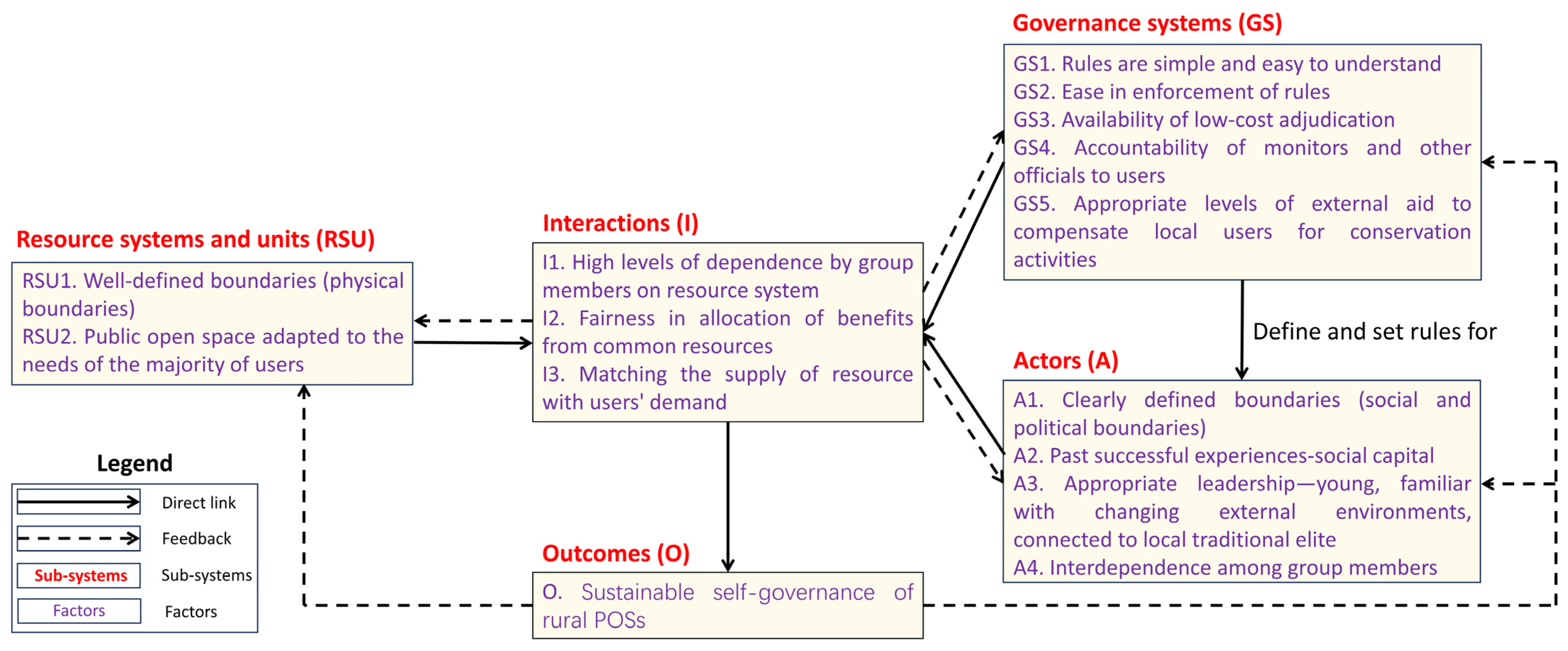
2.2. Key Theories and Conceptual SES Framework
2.2.1. Collective Action Theories
2.2.2. Transaction Cost Economics (TCE)
Human Factors
Transaction-Specific Factors
Transaction Environment Factors
3. Research Methodology
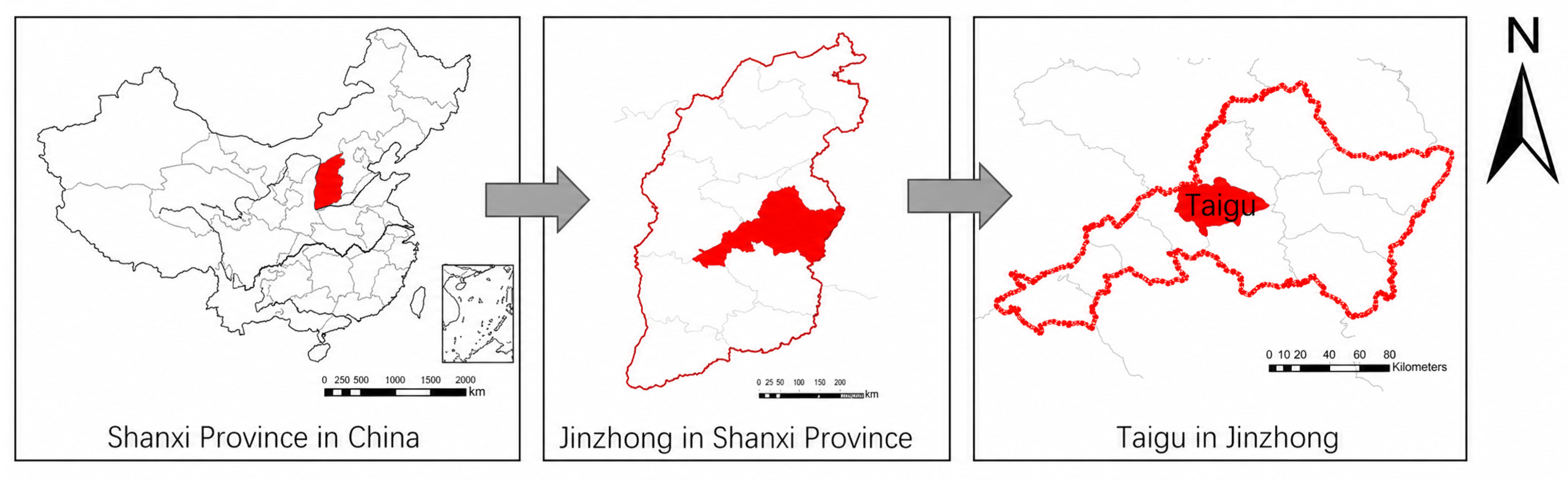
3.1. Study Area
3.2. Data Collection
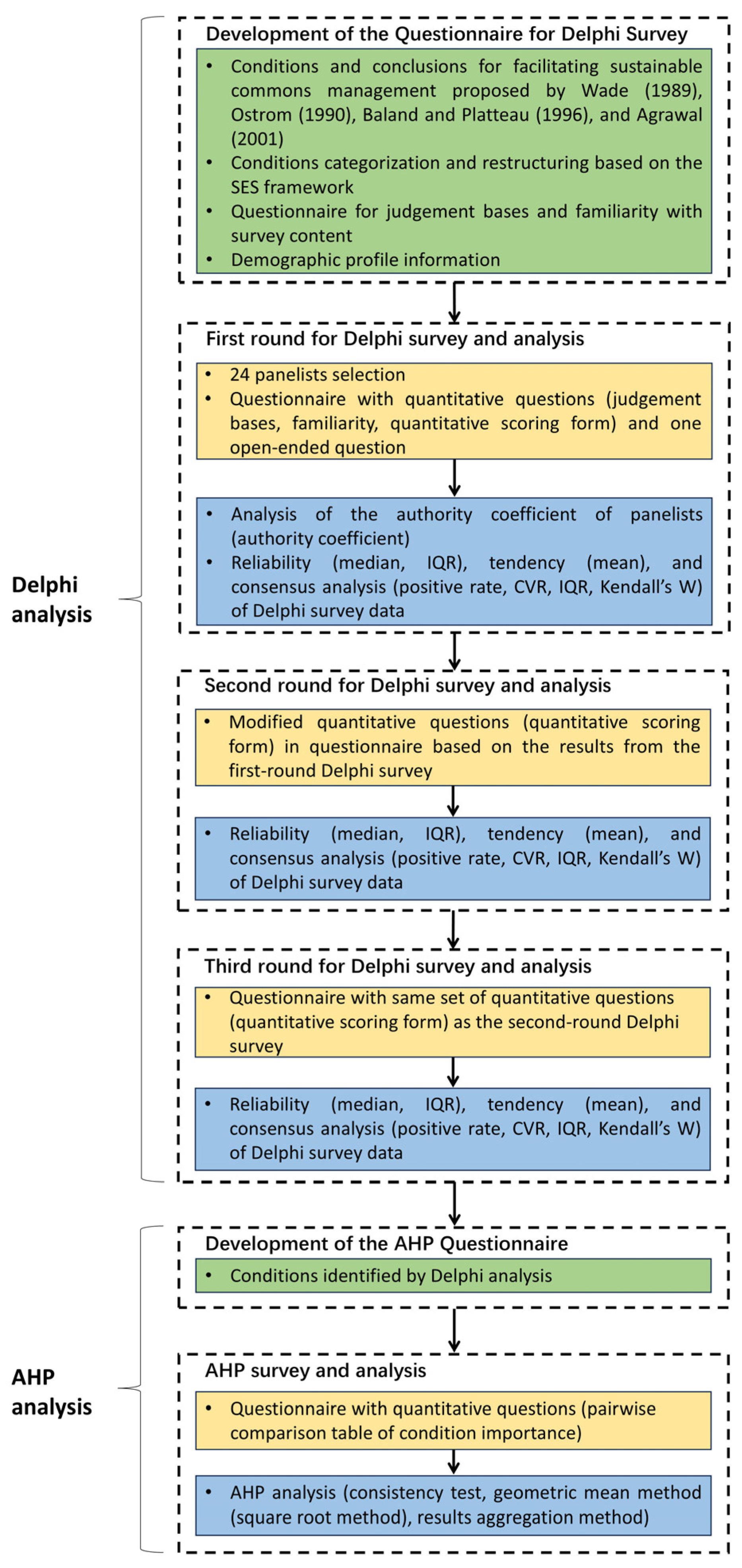
3.3. Data Analysis
4. Research Results
4.1. Demographics of the Panelists
4.2. First-Round Delphi Analysis
4.3. Second-Round Delphi Analysis
4.4. Third-Round Delphi Analysis
4.5. Results of AHP Analysis
5. Discussions
6. Conclusions
Author Contributions
Funding
Institutional Review Board Statement
Informed Consent Statement
Data Availability Statement
Conflicts of Interest
Appendix A

| Median | Interquartile Range (IQR) | Mean | Positive Rate | Content Validity Ratio (CVR) | Kendall’s W | Results | |||
|---|---|---|---|---|---|---|---|---|---|
| Resource systems and units (RSU) | Small size | 1st round | 3.00 | 1.00 | 2.54 | 16.67% | −0.67 | 1st round: N = 24, Kendall’s = 0.548, Chi-Square = 420.924, df = 32, p = 0.000 2nd round: N = 24, Kendall’s W = 0.591, Chi-Square = 481.872, df = 34, p = 0.000 3rd round: N = 24, Kendall’s W = 0.672, Chi-Square = 547.946, df = 34, p = 0.000 | |
| 2nd round | 2.00 | 1.00 | 2.29 | 8.33% | −0.83 | ||||
| 3rd round | 2.00 | 1.00 | 2.21 | 0.00% | −1.00 | ||||
| Well-defined boundaries (physical boundaries) | 1st round | 4.00 | 2.00 | 3.92 | 70.83% | 0.42 | |||
| 2nd round | 4.00 | 1.00 | 4.08 | 79.17% | 0.58 | ● | |||
| 3rd round | 4.00 | 1.00 | 4.08 | 79.17% | 0.58 | ● | |||
| Low levels of mobility | 1st round | 2.00 | 2.00 | 2.17 | 8.33% | −0.83 | |||
| 2nd round | 2.00 | 2.00 | 2.13 | 4.17% | −0.92 | ||||
| 3rd round | 2.00 | 1.00 | 2.08 | 0.00% | −1.00 | ||||
| Possibilities of storage of benefits from the resource | 1st round | 3.00 | 2.00 | 2.96 | 33.33% | −0.33 | |||
| 2nd round | 3.00 | 1.75 | 2.88 | 25.00% | −0.50 | ||||
| 3rd round | 3.00 | 1.00 | 2.79 | 12.50% | −0.75 | ||||
| Predictability | 1st round | 3.00 | 1.75 | 3.04 | 29.17% | −0.42 | |||
| 2nd round | 3.00 | 1.50 | 2.96 | 25.00% | −0.50 | ||||
| 3rd round | 3.00 | 0.75 | 2.92 | 20.83% | −0.58 | ||||
| Low levels of articulation with external markets | 1st round | 2.00 | 1.75 | 2.00 | 8.33% | −0.83 | |||
| 2nd round | 2.00 | 1.00 | 1.88 | 4.17% | −0.92 | ||||
| 3rd round | 2.00 | 1.50 | 2.00 | 0.00% | −1.00 | ||||
| Gradual change in articulation with external markets | 1st round | 2.00 | 1.00 | 2.13 | 4.17% | −0.92 | |||
| 2nd round | 2.00 | 1.00 | 2.29 | 0.00% | −1.00 | ||||
| 3rd round | 2.00 | 1.00 | 2.13 | 0.00% | −1.00 | ||||
| Public open space adapted to the needs of the majority of users | 1st round | ||||||||
| 2nd round | 4.00 | 1.00 | 3.71 | 70.83% | 0.42 | ● | |||
| 3rd round | 4.00 | 0.75 | 3.92 | 75.00% | 0.50 | ● | |||
| Governance systems (GS) | Rules are simple and easy to understand | 1st round | 4.00 | 1.00 | 4.21 | 83.33% | 0.67 | ● | |
| 2nd round | 4.00 | 1.00 | 4.17 | 83.33% | 0.67 | ● | |||
| 3rd round | 4.00 | 1.00 | 4.38 | 91.67% | 0.83 | ● | |||
| Locally devised access and management rules | 1st round | 3.50 | 1.00 | 3.58 | 50.00% | 0.00 | |||
| 2nd round | 3.00 | 1.00 | 3.54 | 45.83% | −0.08 | ||||
| 3rd round | 3.00 | 1.00 | 3.50 | 45.83% | −0.08 | ||||
| Ease in enforcement of rules | 1st round | 4.00 | 1.00 | 4.13 | 83.33% | 0.67 | ● | ||
| 2nd round | 4.00 | 1.00 | 4.21 | 83.33% | 0.67 | ● | |||
| 3rd round | 4.50 | 1.00 | 4.42 | 91.67% | 0.83 | ● | |||
| Graduated sanctions | 1st round | 3.00 | 1.00 | 3.46 | 45.83% | −0.08 | |||
| 2nd round | 3.50 | 1.00 | 3.54 | 50.00% | 0.00 | ||||
| 3rd round | 3.50 | 1.00 | 3.58 | 50.00% | 0.00 | ||||
| Availability of low-cost adjudication | 1st round | 4.00 | 0.00 | 3.92 | 79.17% | 0.58 | ● | ||
| 2nd round | 4.00 | 1.00 | 4.17 | 87.50% | 0.75 | ● | |||
| 3rd round | 4.00 | 1.00 | 4.33 | 91.67% | 0.83 | ● | |||
| Accountability of monitors and other officials to users | 1st round | 4.00 | 1.00 | 4.29 | 83.33% | 0.67 | ● | ||
| 2nd round | 5.00 | 1.00 | 4.42 | 87.50% | 0.75 | ● | |||
| 3rd round | 5.00 | 1.00 | 4.54 | 100.00% | 1.00 | ● | |||
| Low-cost exclusion technology | 1st round | 3.00 | 1.75 | 3.08 | 37.50% | −0.25 | |||
| 2nd round | 3.00 | 1.00 | 3.13 | 29.17% | −0.42 | ||||
| 3rd round | 3.00 | 0.00 | 3.00 | 20.83% | −0.58 | ||||
| Central governments should not undermine local authority | 1st round | 3.00 | 1.00 | 3.46 | 45.83% | −0.08 | |||
| 2nd round | 3.00 | 1.00 | 3.29 | 33.33% | −0.33 | ||||
| 3rd round | 3.00 | 1.00 | 3.46 | 37.50% | −0.25 | ||||
| Supportive external sanctioning institutions | 1st round | 3.00 | 2.00 | 2.96 | 75.00% | −0.25 | |||
| 2nd round | 3.00 | 1.75 | 2.88 | 25.00% | −0.50 | ||||
| 3rd round | 3.00 | 0.00 | 3.04 | 20.83% | −0.58 | ||||
| Appropriate levels of external aid to compensate local users for conservation activities | 1st round | 4.00 | 1.75 | 3.71 | 62.50% | 0.25 | |||
| 2nd round | 4.00 | 0.75 | 3.96 | 75.00% | 0.50 | ● | |||
| 3rd round | 4.00 | 1.00 | 4.08 | 79.17% | 0.58 | ● | |||
| Nested levels of appropriation, provision, enforcement, governance | 1st round | 3.00 | 1.00 | 3.17 | 33.33% | −0.33 | |||
| 2nd round | 3.00 | 1.00 | 3.25 | 33.33% | −0.33 | ||||
| 3rd round | 3.00 | 1.00 | 3.21 | 33.33% | −0.33 | ||||
| Actors (A) | Small group | 1st round | 2.50 | 1.00 | 2.54 | 12.50% | −0.75 | ||
| 2nd round | 2.50 | 1.00 | 2.58 | 8.33% | −0.83 | ||||
| 3rd round | 2.50 | 1.00 | 2.50 | 4.17% | 0.08 | ||||
| Clearly defined boundaries (Social and political boundaries) | 1st round | 4.00 | 1.00 | 4.21 | 79.17% | 0.58 | ● | ||
| 2nd round | 4.00 | 1.00 | 4.29 | 87.50% | 0.75 | ● | |||
| 3rd round | 4.00 | 1.00 | 4.33 | 91.67% | 0.83 | ● | |||
| Shared norms | 1st round | 4.00 | 1.00 | 3.67 | 58.33% | 0.17 | |||
| 2nd round | 4.00 | 1.00 | 3.75 | 62.50% | 0.25 | ||||
| 3rd round | 4.00 | 1.00 | 3.67 | 62.50% | 0.25 | ||||
| Past successful experiences—social capital | 1st round | 4.00 | 1.00 | 4.21 | 79.17% | 0.58 | ● | ||
| 2nd round | 4.00 | 1.00 | 4.21 | 83.33% | 0.67 | ● | |||
| 3rd round | 4.00 | 1.00 | 4.25 | 87.50% | 0.75 | ● | |||
| Appropriate leadership—young, familiar with changing external environments, connected to local traditional elite | 1st round | 4.00 | 1.00 | 3.58 | 58.33% | 0.17 | |||
| 2nd round | 4.00 | 1.00 | 3.88 | 70.83% | 0.42 | ● | |||
| 3rd round | 4.00 | 0.75 | 3.92 | 75.00% | 0.50 | ● | |||
| Interdependence among group members | 1st round | 4.00 | 1.00 | 4.04 | 79.17% | 0.58 | ● | ||
| 2nd round | 4.00 | 1.00 | 4.17 | 83.33% | 0.67 | ● | |||
| 3rd round | 4.00 | 1.00 | 4.21 | 91.67% | 0.83 | ● | |||
| Heterogeneity of endowments, homogeneity of identities and interests | 1st round | 4.00 | 1.00 | 3.63 | 58.33% | 0.17 | |||
| 2nd round | 4.00 | 1.00 | 3.54 | 54.17% | 0.08 | ||||
| 3rd round | 4.00 | 1.00 | 3.71 | 66.67% | 0.33 | ||||
| Low levels of poverty | 1st round | 3.50 | 1.00 | 3.54 | 50.00% | 0.00 | |||
| 2nd round | 4.00 | 1.00 | 3.63 | 54.17% | 0.08 | ||||
| 3rd round | 4.00 | 1.00 | 3.67 | 58.33% | 0.17 | ||||
| Time for adaptation to new technologies related to the commons | 1st round | 2.00 | 1.75 | 2.42 | 16.67% | −0.67 | |||
| 2nd round | 2.00 | 1.00 | 2.33 | 4.17% | −0.92 | ||||
| 3rd round | 2.00 | 1.00 | 2.38 | 0.00% | −1.00 | ||||
| Interactions (I) | Overlap between user group residential location and resource location | 1st round | 3.00 | 2.00 | 3.04 | 37.50% | −0.25 | ||
| 2nd round | 3.00 | 1.00 | 3.17 | 33.33% | −0.33 | ||||
| 3rd round | 3.00 | 1.00 | 3.21 | 33.33% | −0.33 | ||||
| High levels of dependence by group members on resource system | 1st round | 4.00 | 1.75 | 4.13 | 75.00% | 0.50 | |||
| 2nd round | 4.00 | 1.00 | 4.13 | 83.33% | 0.67 | ● | |||
| 3rd round | 4.00 | 1.00 | 4.21 | 87.50% | 0.75 | ● | |||
| Fairness in allocation of benefits from common resources | 1st round | 4.00 | 1.00 | 4.17 | 79.17% | 0.58 | ● | ||
| 2nd round | 4.50 | 1.00 | 4.38 | 87.50% | 0.75 | ● | |||
| 3rd round | 5.00 | 1.00 | 4.54 | 100.00% | 1.00 | ● | |||
| Low levels of user demand | 1st round | 3.50 | 1.00 | 3.33 | 50.00% | 0.00 | |||
| 2nd round | 3.00 | 1.00 | 3.46 | 45.83% | −0.08 | ||||
| 3rd round | 3.00 | 1.00 | 3.46 | 45.83% | −0.08 | ||||
| Gradual change in levels of demand | 1st round | 3.00 | 1.00 | 3.25 | 41.67% | −0.17 | |||
| 2nd round | 3.00 | 1.00 | 3.42 | 41.67% | −0.17 | ||||
| 3rd round | 3.00 | 1.00 | 3.42 | 37.50% | −0.25 | ||||
| Match restrictions on harvests to regeneration of resources | 1st round | 3.00 | 1.75 | 2.92 | 25.00% | −0.50 | |||
| 2nd round | 3.00 | 1.00 | 2.75 | 12.50% | −0.75 | ||||
| 3rd round | 3.00 | 1.00 | 2.75 | 8.33% | −0.83 | ||||
| Matching the supply of resources with users’ demand | 1st round | ||||||||
| 2nd round | 4.00 | 1.00 | 3.92 | 70.83% | 0.42 | ● | |||
| 3rd round | 4.00 | 1.00 | 4.13 | 83.33% | 0.67 | ● |
References
- Liu, K. Research on Chinese Rural Public Open Space: A Case of Sunan. Master’s Thesis, Tsinghua University, Beijing, China, 2012. [Google Scholar]
- Ostrom, E. A diagnostic approach for going beyond panaceas. Proc. Natl. Acad. Sci. USA 2007, 104, 15181–15187. [Google Scholar] [CrossRef]
- Friedman, E.; Pickowicz, P.; Selden, M.; Johnson, K.A. Chinese Village, Socialist State; Yale University Press: New Haven, CT, USA, 1991. [Google Scholar]
- Buchanan, J.M. An Economic Theory of Clubs. Economica 1965, 32, 1–14. [Google Scholar] [CrossRef]
- Hardin, G. The Tragedy of the Commons. Science 1968, 162, 1243–1248. [Google Scholar] [CrossRef]
- Webster, C. Property rights, public space and urban design. Town Plan. Rev. 2007, 78, 81–101. [Google Scholar] [CrossRef]
- Ostrom, E. Governing the Commons: The Evolution of Institutions for Collective Action; Cambridge University Press: Cambridge, UK, 1990. [Google Scholar]
- Wade, R. Village Republics; Cambridge University Press: Cambridge, UK, 1989. [Google Scholar]
- Baland, J.M.; Platteau, J.P. Halting Degradation of Natural Resources: Is There a Role for Rural Communities? Food & Agriculture Org.: Rome, Italy, 1996. [Google Scholar]
- Agrawal, A. Common property institutions and sustainable governance of resources. World Dev. 2001, 29, 1649–1672. [Google Scholar] [CrossRef]
- McGinnis, M.D.; Ostrom, E. Social-ecological system framework: Initial changes and continuing challenges. Ecol. Soc. 2014, 19, 30. [Google Scholar] [CrossRef]
- Li, Y. The collective action dilemma and its solution in the governance of urban community public space—An empirical analysis from Tianjin. Front. Built Environ. 2024, 9, 1284139. [Google Scholar] [CrossRef]
- Yuen, S. China’s new rural land reform? Assessment and prospects. China Perspect. 2014, 2014, 61–65. [Google Scholar] [CrossRef]
- Toumbourou, T. Using a Delphi approach to identify the most efficacious interventions to improve Indonesia’s forest and land governance. Land Use Policy 2020, 99, 102768. [Google Scholar] [CrossRef]
- Shih, C.H.; Wang, X.R.; Lu, Y.M.; Chu, T.J. Assessing the role of policy in the evolution of recreational fisheries in Chinese fishing villages: An Analytical Hierarchy Process (AHP) and Delphi Method Analysis. Fishes 2024, 9, 353. [Google Scholar] [CrossRef]
- Alshehri, S.A.; Rezgui, Y.; Li, H. Disaster community resilience assessment method: A consensus-based Delphi and AHP approach. Nat. Hazards 2015, 78, 395–416. [Google Scholar] [CrossRef]
- Ansell, C.; Gash, A. Collaborative governance in theory and practice. J. Public Adm. Res. Theory 2008, 18, 543–571. [Google Scholar] [CrossRef]
- Williamson, O.E. Transaction-cost economics: The governance of contractual relations. J. Law Econ. 1979, 22, 233–261. [Google Scholar] [CrossRef]
- Ling, G.H.T.; Ali, N.E.H.; Siong, H.C.; Ali, H.M. Ostrom’s design principles in residential public open space governance: Conceptual framework and literature review. Int. J. Built Environ. Sustain. 2014, 1, 27–37. [Google Scholar]
- Janssen, M.A.; Anderies, J.M.; Ostrom, E. Robustness of social-ecological systems to spatial and temporal variability. Soc. Nat. Resour. 2007, 20, 307–322. [Google Scholar] [CrossRef]
- Shi, X.; Ling, G.H.T. A systematic review of factors influencing self-governed public open spaces: Insights from social-ecological system framework and collective action. Open House Int. 2024, 50, 20–39. [Google Scholar] [CrossRef]
- Ling, G.H.T. Ostrom’s collective-action in neighbourhood public open space: Evidence from Sabah, Malaysia. Inst. Econ. 2019, 11, 103–134. [Google Scholar]
- Shi, X.; Ling, G.H.T.; Wang, H.K. Sustainable collective action in high-rise gated communities: Evidence from Shanxi, China using Ostrom’s design principles. Sustainability 2022, 14, 14432. [Google Scholar] [CrossRef]
- Blomquist, W.; Schlager, E.; Tang, S.Y.; Ostrom, E. Regularities from the field and possible explanations. In Rules, Games, and Common-Pool Resources; The University of Michigan Press: Ann Arbor, MI, USA, 1994; pp. 301–318. [Google Scholar]
- Agrawal, A.; Gibson, C.C. Enchantment and disenchantment: The role of community in natural resource conservation. World Dev. 1999, 27, 629–649. [Google Scholar] [CrossRef]
- Young, K.R. Roads and the environmental degradation of tropical montane forests. Conserv. Biol. 1994, 8, 972–976. [Google Scholar] [CrossRef]
- Tang, S.Y. Institutions and Collective Action: Self-Governance in Irrigation; ICS Press: San Francisco, CA, USA, 1992. [Google Scholar]
- Ostrom, E.; Gardner, R.; Walker, J. Rules, Games, and Common-Pool Resources; University of Michigan Press: Ann Arbor, MI, USA, 1994. [Google Scholar]
- Pinkerton, E. (Ed.) Co-Operative Management of Local Fisheries: New Directions for Improved Management and Community Development; UBC Press: Vancouver, BC, Canada, 1989. [Google Scholar]
- Sengupta, N. Managing Common Property: Irrigation in India and the Philippines; Sage Publications India Pvt Ltd.: Haryana, India, 1991. [Google Scholar]
- Coase, R. The Nature of the Firm. Economica 1937, 4, 386–405. [Google Scholar] [CrossRef]
- Williamson, O.E. The Economic Institutions of Capitalism: Firms, Markets, Relational Contracting; University of Illinois at Urbana-Champaign’s Academy for Entrepreneurial Leadership Historical Research Reference in Entrepreneurship; Gabler: Wiesbaden, Germany, 1985. [Google Scholar]
- Taigu District Bureau of Statistics. Taigu Statistical Yearbook; Taigu District Bureau of Statistics: Jinzhong, China, 2022. [Google Scholar]
- Wang, Y.; Su, Y.; Araral, E.K. Migration and collective action in the commons: Application of social-ecological system framework with evidence from China. Ecol. Soc. 2022, 27, 36. [Google Scholar] [CrossRef]
- Yin, J.; Wang, J.; Li, Y.; Zhang, Y. China’s rural revitalization in the context of rural depopulation: Challenges, opportunities and responses. J. Rural Stud. 2026, 123, 103985. [Google Scholar] [CrossRef]
- Powell, C. The Delphi technique: Myths and realities. J. Adv. Nurs. 2003, 41, 376–382. [Google Scholar] [CrossRef]
- Khorramshahgol, R.; Moustakis, V.S. Delphic hierarchy process (DHP): A methodology for priority setting derived from the Delphi method and analytical hierarchy process. Eur. J. Oper. Res. 1988, 37, 347–354. [Google Scholar] [CrossRef]
- Trevelyan, E.G.; Robinson, N. Delphi methodology in health research: How to do it? Eur. J. Integr. Med. 2015, 7, 423–428. [Google Scholar] [CrossRef]
- Iqbal, S.; Pipon-Young, L. The Delphi Method. The British Psychological Society. 2009. Available online: https://www.bps.org.uk/psychologist/delphi-method (accessed on 17 June 2024).
- Hughes, A.S. Mixed methods research. APS Obs. 2016, 29, 38–39. [Google Scholar]
- Li, N.; Zhao, M.; Yang, X.; He, Y.; Yi, F. Developing Criteria for Asian Facial Skin Health Status Based on a Non-Invasive Skin Test: The Delphi Process. Clin. Cosmet. Investig. Dermatol. 2022, 15, 383–393. [Google Scholar] [CrossRef]
- Saaty, T.L. How to make a decision: The analytic hierarchy process. Eur. J. Oper. Res. 1990, 48, 9–26. [Google Scholar] [CrossRef]
- Shi, C.; Zhang, Y.; Li, C.; Li, P.; Zhu, H. Using the Delphi method to identify risk factors contributing to adverse events in residential aged care facilities. Risk Manag. Healthc. Policy 2020, 13, 523–537. [Google Scholar] [CrossRef]
- Chen, Z.; Zhong, P.; Liu, M.; Ma, Q.; Si, G. An integrated expert weight determination method for design concept evaluation. Sci. Rep. 2022, 12, 6358. [Google Scholar] [CrossRef]
- Yi, Y.K.; Yoo, K.E. A Study on Competitiveness Assessment Indicators for Global Aviation Training Organizations. J. Educ. Train. Stud. 2018, 6, 77–86. [Google Scholar] [CrossRef]
- Lawshe, C.H. A quantitative approach to content validity. Pers. Psychol. 1975, 28, 563–575. [Google Scholar] [CrossRef]
- Varona, D.; Capretz, L.F. Using the DELPHI Method for model for role assignment in the software industry. In IECON 2021–47th Annual Conference of the IEEE Industrial Electronics Society; IEEE: Piscataway, NJ, USA, 2021; pp. 1–7. [Google Scholar]
- Kendall, M.G. Rank Correlation Methods; American Psychological Association: Washington, DC, USA, 1948. [Google Scholar]
- Ploch, M.E. Urban Forestry in Hanoi, Vietnam Applying the Framework of Social Ecological Systems to the Urban Forestry Management in Vietnam; School of Environmental and Public Affairs Indiana University: Bloomington, IN, USA, 2012. [Google Scholar]
- Wu, J.; Xiong, J. How governance tools facilitate citizen co-production behavior in urban community micro-regeneration: Evidence from Shanghai. Land 2022, 11, 1243. [Google Scholar] [CrossRef]
- Zhang, Y.; Lu, X.; Zhang, M.; Ren, B.; Zou, Y.; Lv, T. Understanding farmers’ willingness in arable land protection cooperation by using fsQCA: Roles of perceived benefits and policy incentives. J. Nat. Conserv. 2022, 68, 126234. [Google Scholar] [CrossRef]
- Chai, Y.; Qiao, W.; Hu, Y.; He, T.; Jia, K.; Feng, T.; Wang, Y. Land-use transition of tourist villages in the metropolitan suburbs and its driving forces: A case study of she village in nanjing city, China. Land 2021, 10, 168. [Google Scholar] [CrossRef]
- Ling, G.H.T.; Leng, P.C.; Ho, C.S. Effects of diverse property rights on rural neighbourhood public open space (POS) governance: Evidence from Sabah, Malaysia. Economies 2019, 7, 61. [Google Scholar] [CrossRef]
- Cox, M.; Arnold, G.; Tomás, S.V. A review of design principles for community-based natural resource management. Ecol. Soc. 2010, 15, 38. [Google Scholar] [CrossRef]
- Tan, M.; Yan, X.; Feng, W. The Mechanism and Empirical Study of Village Rules in Rural Revitalization and Ecological Governance. Rev. Cercet. Interv. Soc. 2019, 64, 276–299. [Google Scholar] [CrossRef]
- Mittelstaedt, J.C. The grid management system in contemporary China: Grass-roots governance in social surveillance and service provision. China Inf. 2022, 36, 3–22. [Google Scholar] [CrossRef]
- O’brien, K.J. Rightful resistance. World Politics 1996, 49, 31–55. [Google Scholar] [CrossRef]
- Dietsch, W.S. State-Reinforced Self-Governance of Community-Managed Open Spaces in Chicago, IL and Louisville, KY. Master’s Thesis, University of Louisville, Louisville, KY, USA, 2018. [Google Scholar]
- Xu, G.; Liu, J.; Zhang, M. Land property rights, spatial form, and land performance: A framework of policy performance evaluation on collective-owned construction land and evidence from rural China. Land 2024, 13, 956. [Google Scholar] [CrossRef]
- Wang, R.; Tan, R. Patterns of rural collective action in contemporary China: An archetype analysis of rural construction land consolidation. J. Rural Stud. 2020, 79, 286–301. [Google Scholar] [CrossRef]
- Tong, D.; Wu, Y.; MacLachlan, I.; Zhu, J. The role of social capital in the collective-led development of urbanising villages in China: The case of Shenzhen. Urban Stud. 2021, 58, 3335–3353. [Google Scholar] [CrossRef]
- Lehavi, A. Property rights and local public goods: Toward a better future for urban communities. Urb. Law. 2004, 36, 1. [Google Scholar]
- Luo, Y.; Lai, B.; Zhang, Y.; Liu, J. Village leadership, social networks and collective actions in indigenous communities: Case of Hani rice terrace social-ecological system in Southwest China. J. Rural Stud. 2024, 106, 103237. [Google Scholar] [CrossRef]
- Engbring, G.; Hajjar, R. Conflicts between core purposes: Trade-offs associated with organizational shifts in Mexican community forest enterprises. World Dev. 2022, 160, 106078. [Google Scholar] [CrossRef]
- Li, L. Political trust in rural China. Mod. China 2004, 30, 228–258. [Google Scholar] [CrossRef]
- Olson, M. The Logic of Collective Action: Public Goods and the Theory of Groups; Harvard University Press: Cambridge, MA, USA, 1965. [Google Scholar]
- Su, Y.; Xuan, Y.; Zang, L.; Zhang, X. Is Land Fragmentation Undermining Collective Action in Rural Areas? An Empirical Study Based on Irrigation Systems in China’s Frontier Areas. Land 2024, 13, 1041. [Google Scholar] [CrossRef]
- Zhang, Z.; Tang, X.; Wang, Y. Evaluation of the Intergenerational Equity of Public Open Space in Old Communities: A Case Study of Caoyang New Village in Shanghai. Land 2023, 12, 1347. [Google Scholar] [CrossRef]
- Lin, Y.; Shui, W.; Li, Z.; Huang, S.; Wu, K.; Sun, X.; Liang, J. Green space optimization for rural vitality: Insights for planning and policy. Land Use Policy 2021, 108, 105545. [Google Scholar] [CrossRef]
- Cao, Y.; Zhang, X.; He, L. Collective Action in maintaining rural infrastructures: Cadre-farmer relationship, institution rules and their interaction terms. Land Use Policy 2020, 99, 105043. [Google Scholar] [CrossRef]





| Judgement Bases (Ca) | Quantized Value | Familiarity (Cs) | Quantized Value | ||
|---|---|---|---|---|---|
| Big | Middle | Small | |||
| Experience | 0.5 | 0.4 | 0.3 | Very familiar | 1 |
| Theoretical analysis | 0.3 | 0.2 | 0.1 | Familiar | 0.8 |
| References at home and abroad | 0.1 | 0.1 | 0.1 | Generally familiar | 0.6 |
| Intuition | 0.1 | 0.1 | 0.1 | Less familiar | 0.4 |
| Not familiar | 0.2 | ||||
| Intensity of Importance | Definition |
|---|---|
| 1 | Equal importance |
| 3 | Moderate importance of the first element over the second element in the pair |
| 5 | Essential or strong importance |
| 7 | Very strong importance |
| 9 | Extreme importance |
| 2, 4, 6, 8 | Intermediate values between the two adjacent judgments |
| Reciprocals of the above non-zero numbers | The inverse of the importance (e.g., a value of 1/5 means that the second element has a very strong importance over the first element in the pair) |
| Statistic | Criteria |
|---|---|
| Median | The median value is relatively stable in several Delphi rounds |
| Interquartile Range (IQR) | The IQR is relatively stable in several Delphi rounds. IQR =< 1 |
| Mean | Mean >= 3.56 |
| Positive rate | Positive rate > 0.55 |
| Content validity ratio (CVR) | Content validity ratio (CVR) > 0.37 |
| Kendall’s W | Kendall’s W > 0.5 |
| n | 1 | 2 | 3 | 4 | 5 | 6 | 7 | 8 | 9 | 10 | 11 | 12 | 13 | 14 | 15 |
|---|---|---|---|---|---|---|---|---|---|---|---|---|---|---|---|
| RI | 0.00 | 0.00 | 0.52 | 0.89 | 1.11 | 1.25 | 1.35 | 1.40 | 1.45 | 1.49 | 1.52 | 1.54 | 1.56 | 1.58 | 1.59 |
| n (%) | ||
|---|---|---|
| Gender | Male | 12 (50%) |
| Female | 12 (50%) | |
| Age | 30–40 | 13 (54.17%) |
| 41–50 | 7 (29.17%) | |
| 51–60 | 4 (16.67%) | |
| Work experience | 5–10 | 9 (37.50%) |
| 11–20 | 8 (33.33%) | |
| 21–30 | 5 (20.83%) | |
| 31–40 | 2 (8.33%) | |
| Education | Associate degree | 2 (8.33%) |
| Bachelor | 5 (20.83%) | |
| Master | 8 (33.33%) | |
| PhD | 9 (37.50%) | |
| Occupation | Scholar | 8 (33.33%) |
| Private planner | 8 (33.33%) | |
| Government administrator | 8 (33.33%) |
| Judgment Bases | Familiarity | Authority Coefficient | |
|---|---|---|---|
| 1 | 0.90 | 0.60 | 0.75 |
| 2 | 0.90 | 0.60 | 0.75 |
| 3 | 0.80 | 0.60 | 0.70 |
| 4 | 1.00 | 0.60 | 0.80 |
| 5 | 1.00 | 0.80 | 0.90 |
| 6 | 0.70 | 0.80 | 0.75 |
| 7 | 0.90 | 0.60 | 0.75 |
| 8 | 0.80 | 0.80 | 0.80 |
| 9 | 0.80 | 0.60 | 0.70 |
| 10 | 0.90 | 0.80 | 0.85 |
| 11 | 0.90 | 0.80 | 0.85 |
| 12 | 0.90 | 0.60 | 0.75 |
| 13 | 0.90 | 0.60 | 0.75 |
| 14 | 0.80 | 0.60 | 0.70 |
| 15 | 0.80 | 0.80 | 0.80 |
| 16 | 0.90 | 0.60 | 0.75 |
| 17 | 0.90 | 0.60 | 0.75 |
| 18 | 0.80 | 1.00 | 0.90 |
| 19 | 0.90 | 0.80 | 0.85 |
| 20 | 0.90 | 0.80 | 0.85 |
| 21 | 0.90 | 1.00 | 0.95 |
| 22 | 0.80 | 0.60 | 0.70 |
| 23 | 1.00 | 0.80 | 0.90 |
| 24 | 0.90 | 0.60 | 0.75 |
| Matrix No | CR |
|---|---|
| 1 | 0.0218 |
| 2 | 0.0209 |
| 3 | 0.0247 |
| 4 | 0.0280 |
| 5 | 0.0209 |
| 6 | 0.0229 |
| 7 | 0.0220 |
| 8 | 0.0229 |
| 9 | 0.0261 |
| 10 | 0.0259 |
| 11 | 0.0209 |
| 12 | 0.0246 |
| 13 | 0.0209 |
| 14 | 0.0289 |
| 15 | 0.0279 |
| 16 | 0.0245 |
| 17 | 0.0182 |
| 18 | 0.0247 |
| 19 | 0.0281 |
| 20 | 0.0345 |
| 21 | 0.0247 |
| 22 | 0.0247 |
| 23 | 0.0190 |
| 24 | 0.0190 |
Disclaimer/Publisher’s Note: The statements, opinions and data contained in all publications are solely those of the individual author(s) and contributor(s) and not of MDPI and/or the editor(s). MDPI and/or the editor(s) disclaim responsibility for any injury to people or property resulting from any ideas, methods, instructions or products referred to in the content. |
© 2026 by the authors. Licensee MDPI, Basel, Switzerland. This article is an open access article distributed under the terms and conditions of the Creative Commons Attribution (CC BY) license.
Share and Cite
Shi, X.; Leng, P.C.; Ling, G.H.T. Governing Rural Public Open Spaces in Taigu, China: An SES-Based Collective Action Model Using Delphic Hierarchy Process (DHP). Land 2026, 15, 764. https://doi.org/10.3390/land15050764
Shi X, Leng PC, Ling GHT. Governing Rural Public Open Spaces in Taigu, China: An SES-Based Collective Action Model Using Delphic Hierarchy Process (DHP). Land. 2026; 15(5):764. https://doi.org/10.3390/land15050764
Chicago/Turabian StyleShi, Xuerui, Pau Chung Leng, and Gabriel Hoh Teck Ling. 2026. "Governing Rural Public Open Spaces in Taigu, China: An SES-Based Collective Action Model Using Delphic Hierarchy Process (DHP)" Land 15, no. 5: 764. https://doi.org/10.3390/land15050764
APA StyleShi, X., Leng, P. C., & Ling, G. H. T. (2026). Governing Rural Public Open Spaces in Taigu, China: An SES-Based Collective Action Model Using Delphic Hierarchy Process (DHP). Land, 15(5), 764. https://doi.org/10.3390/land15050764