1. Introduction
Implementing regional coordinated development is one of the key measures for promoting high-quality development and is of great significance for sustaining healthy and stable economic growth in China. Coordinated development among multiple central cities within a region can enhance agglomeration effects and economies of scale across a broader territorial space [
1]. With the accelerating processes of urbanization and regional integration, cities are no longer isolated administrative units; rather, they have become interconnected through flows of population, industry, capital, information, and freight, forming large-scale regional linkage systems and gradually evolving into interdependent and interactive urban agglomerations [
2]. As important spatial carriers of regional division of labor, optimized factor allocation, and innovation diffusion, urban agglomerations play an increasingly significant role in regional economic cooperation and global competition [
3]. As a complex socio-economic phenomenon, cross-regional flows and exchanges of various factors within urban agglomerations profoundly shape economic interactions and their network structures, prompting a re-examination of traditional static spatial delineations and their correspondence with actual interaction patterns and spatial organization [
4]. In this context, scientifically identifying the internal structure of regional economic linkages and cross-regional flow characteristics, and on this basis rationally delineating urban agglomerations and economic clusters, has become a fundamental task for achieving coordinated regional development [
5].
In the context of deepening regional integration and increasingly intensive factor mobility, regional spatial organization can no longer be adequately explained solely through traditional territorial units and administrative hierarchies. Relevant theoretical perspectives can generally be categorized into two approaches: the “space of place” and the “space of flows.” The former, grounded in Christaller’s central place theory [
6], emphasizes hierarchical urban systems and center–hinterland relationships. The latter, proposed by Castells, highlights cross-city functional linkages, network structures, and relational connections formed through flows of population, capital, information, and goods [
7]. Building upon these perspectives, Taylor’s central flow theory further argues that both space of place and space of flows coexist within regions: the former manifests as hierarchical urban systems and their hinterland relations, while the latter reflects external linkages that transcend traditional urban hinterlands [
8]. Central flow theory incorporates core ideas from the urban network paradigm without entirely rejecting central place theory, instead emphasizing the interpretation of place-based structures through the lens of functional linkages [
1]. On this theoretical basis, the understanding of regional boundaries has also evolved from a purely institutional delineation toward function-based identification grounded in spatial interactions. Administrative boundaries are institutional constructs formed through governance, statistical, and managerial needs in a top–down manner, whereas functional boundaries emerge bottom–up from actual spatial interactions [
9]. While the two often overlap at the national scale, spatial mismatches are more likely to occur at regional and urban scales [
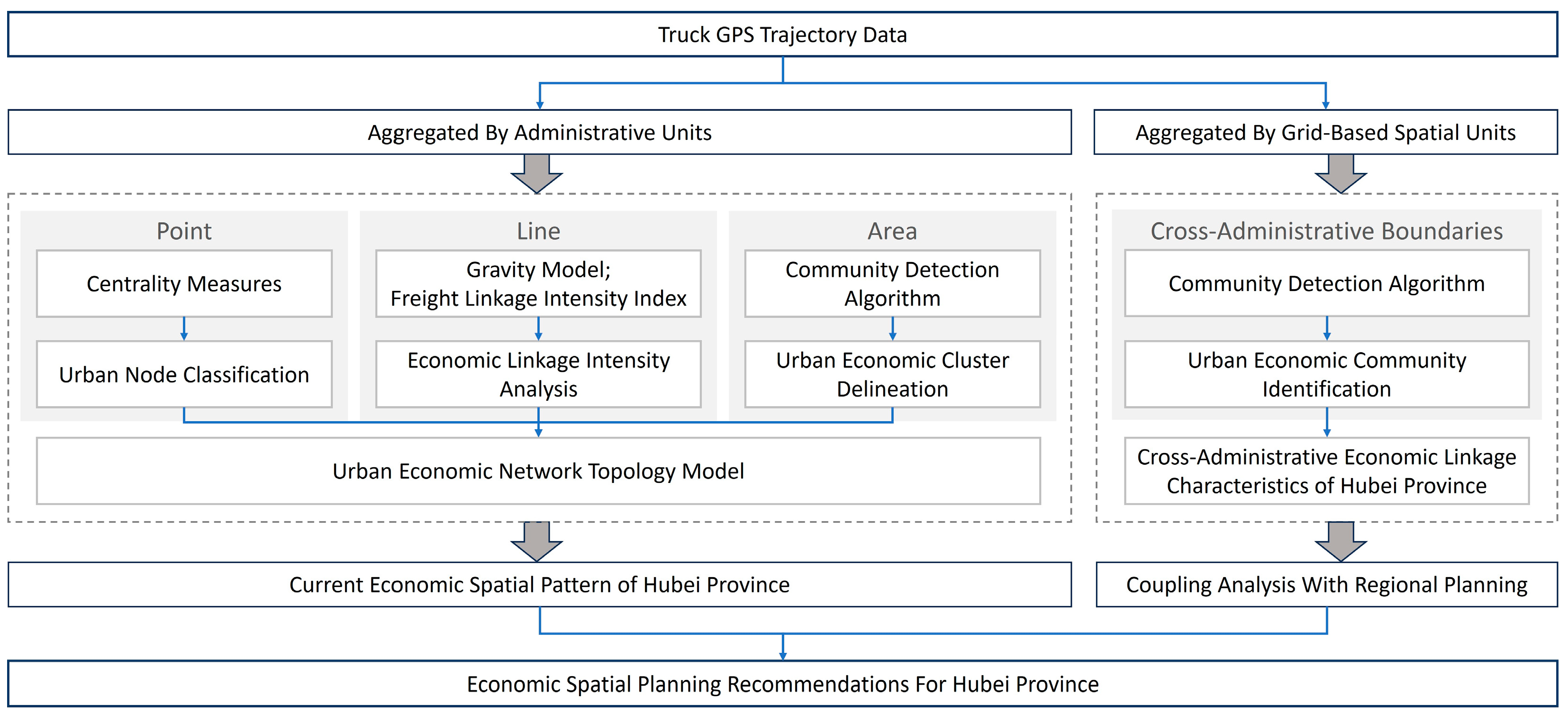
4]. In light of this perspective, this study adopts a dual-scale analytical framework that juxtaposes administrative space and functional space. The administrative scale is employed to identify urban economic spatial structures within existing governance units, while the cross-administrative scale is used to delineate functional economic communities organized by freight flows. Through this dual-scale approach, the study aims to provide a more comprehensive understanding of regional economic spatial organization.
Studies on regional economic spatial structure typically take existing governance units, such as prefectural-level cities and counties/districts, as the basic units of analysis. By applying urban network analysis methods, cities are conceptualized as network nodes, inter-city relationships as network edges, and urban clusters are subsequently delineated to identify internal economic linkage patterns and spatial organizational characteristics within regions. On this basis, urban network research at the administrative scale has gradually developed a relatively mature “point–line–area” analytical framework. First, node-level analysis primarily relies on centrality measures—such as degree centrality, closeness centrality, and betweenness centrality—to identify the hierarchical position and functional roles of cities within the network, thereby revealing their relative positions in processes of resource agglomeration, diffusion, and control [
10]. Second, edge-level analysis focuses on measuring the intensity, directionality, and density of inter-city linkages. Methods such as the Gravity Model and social network analysis are widely employed to characterize patterns of regional interaction and structural features of economic linkage networks [
2,
11]. Third, area-level analysis introduces community detection algorithms and related approaches to identify regions of high internal connectivity within the network, thereby delineating urban clusters at different hierarchical levels [
12]. Overall, urban network studies at the administrative scale provide an important methodological foundation for understanding hierarchical urban systems, regional linkage structures, and cluster configurations within existing governance units.
With the rapid development of urban agglomerations and metropolitan areas, flows of population, goods, and information increasingly transcend administrative boundaries [
4]. Research focusing on functional boundaries and cross-administrative spatial delineation has continued to deepen, promoting regional spatial analysis beyond existing administrative units toward the identification of actual interaction spaces. Yu et al. [
13] introduced the concept of “cross-city communities,” demonstrating that interaction intensity between adjacent cities may, in some cases, exceed intra-city interactions, and arguing that such cross-boundary communities should be identified based on functional linkages to provide new spatial references for economic development and urban governance. Liu et al. [
14] similarly suggested that metropolitan economic regions should be delineated according to the spatial scope of economic activities in order to reconcile administrative divisions with the trend toward economic integration. Building on this perspective, recent studies have employed fine-grained spatial units—such as grid cells, Voronoi polygons, and hexagonal tessellations—combined with flow data derived from truck trajectories, mobile phone signaling, passenger travel records, and social media activity. Using spatial interaction networks and community detection algorithms, these studies have identified cross-administrative functional communities, activity ranges, and their internal organizational structures [
13,
15,
16,
17]. Notably, although these studies differ in data types and methodological approaches, their findings consistently indicate that highly connected urban areas identified as communities within network space tend to exhibit strong geographical clustering. Such geographically cohesive regions are widely interpreted as manifestations of spatial proximity effects, whereby interaction intensity between regions typically decreases as geographical distance increases [
9].
Although existing research has progressively shifted regional economic network analysis from “static interactions” toward the identification of “dynamic network structures” based on factor flows, and studies of urban spatial structure are increasingly oriented toward multi-scale relational and functional network analysis [
18,
19], several limitations remain in the comprehensive identification of regional economic spatial organization. First, urban network studies conducted at the administrative scale and functional space identification across administrative boundaries are often undertaken separately, lacking a unified dual-scale analytical framework. As a result, it is difficult to simultaneously capture the urban network structure within existing governance units and the functional spatial structures shaped by actual factor flows. Second, although some scholars have employed big data sources—such as mobile phone signaling data, social media check-ins, and passenger transport schedules—to analyze flows of people and information, these datasets primarily reflect patterns of social interaction and commuting behavior rather than real industrial and economic linkages. Applications based on freight data, which more directly represent the operation of the real economy through freight flows and the flow of goods, remain relatively limited. Third, in measuring economic linkages, many existing studies still rely heavily on macro-level statistical indicators such as population and gross domestic product (GDP) to construct Gravity Models or related measurement frameworks. While such approaches effectively characterize potential linkages between cities, they pay insufficient attention to the characteristics of actual factor flows. Therefore, developing a unified analytical framework that integrates administrative-scale and cross-administrative-scale analysis, and incorporating freight flow data that better represent the operational processes of the real economy, remains an important direction for further research. Such an approach would enable the identification of regional economic spatial organization from the dual perspectives of potential linkages and actual flows.
At present, regional economic development in Hubei Province exhibits a pronounced imbalance. At the provincial level, the economic output of the Wuhan Metropolitan Area reached 3.6 trillion yuan in 2024, accounting for more than 60% of the total economic output of Hubei Province. Within the Wuhan Metropolitan Area, Wuhan alone generates a GDP exceeding the combined total of all other prefecture-level cities, indicating a highly uneven regional development pattern. On this basis, this study takes Hubei Province as the case study and focuses on the core issue of provincial economic spatial organization by constructing a dual-scale analytical framework that integrates the administrative scale and the grid scale. At the administrative scale, truck GPS trajectory data are employed to build a “point–line–area” urban network analytical framework. From the perspective of freight flows, urban nodes at the county and district levels are classified hierarchically, inter-city economic linkage intensity is measured, and urban clusters characterized by dense economic interactions are identified. On this basis, an urban economic network topology model of Hubei Province is constructed to reveal the hierarchical structure, linkage configuration, and spatial distribution patterns of the provincial economic network. At the grid scale, this study applies a 5 km × 5 km grid-based modeling approach in combination with the Louvain community detection algorithm to identify urban economic communities beyond administrative boundary constraints. This enables the delineation of the actual spatial scope of economic activities and their internal functional linkage structures. Furthermore, the results are analyzed in relation to the existing regional planning framework of Hubei Province through a coupling analysis. Specifically, this study seeks to address three research questions: (1) At the administrative scale, what hierarchical patterns, linkage configurations, and cluster structures characterize the urban economic network of Hubei Province? (2) At the cross-administrative scale, what are the spatial extent and internal structural features of functional economic communities organized by freight flows? (3) How do the dual-scale identification results correspond to the existing regional planning framework of Hubei Province, and what implications can be derived for planning optimization?
3. Results and Analysis
3.1. Hierarchical Characteristics of Urban Nodes
This study calculates the values of degree centrality, alter-based centrality, and alter-based power for each city- and county-level spatial unit in Hubei Province. The computed results are then classified using the natural breaks (Jenks) classification method. Following existing studies, urban nodes within the Hubei urban network are categorized into four hierarchical levels [
11].
3.1.1. Degree Centrality Classification
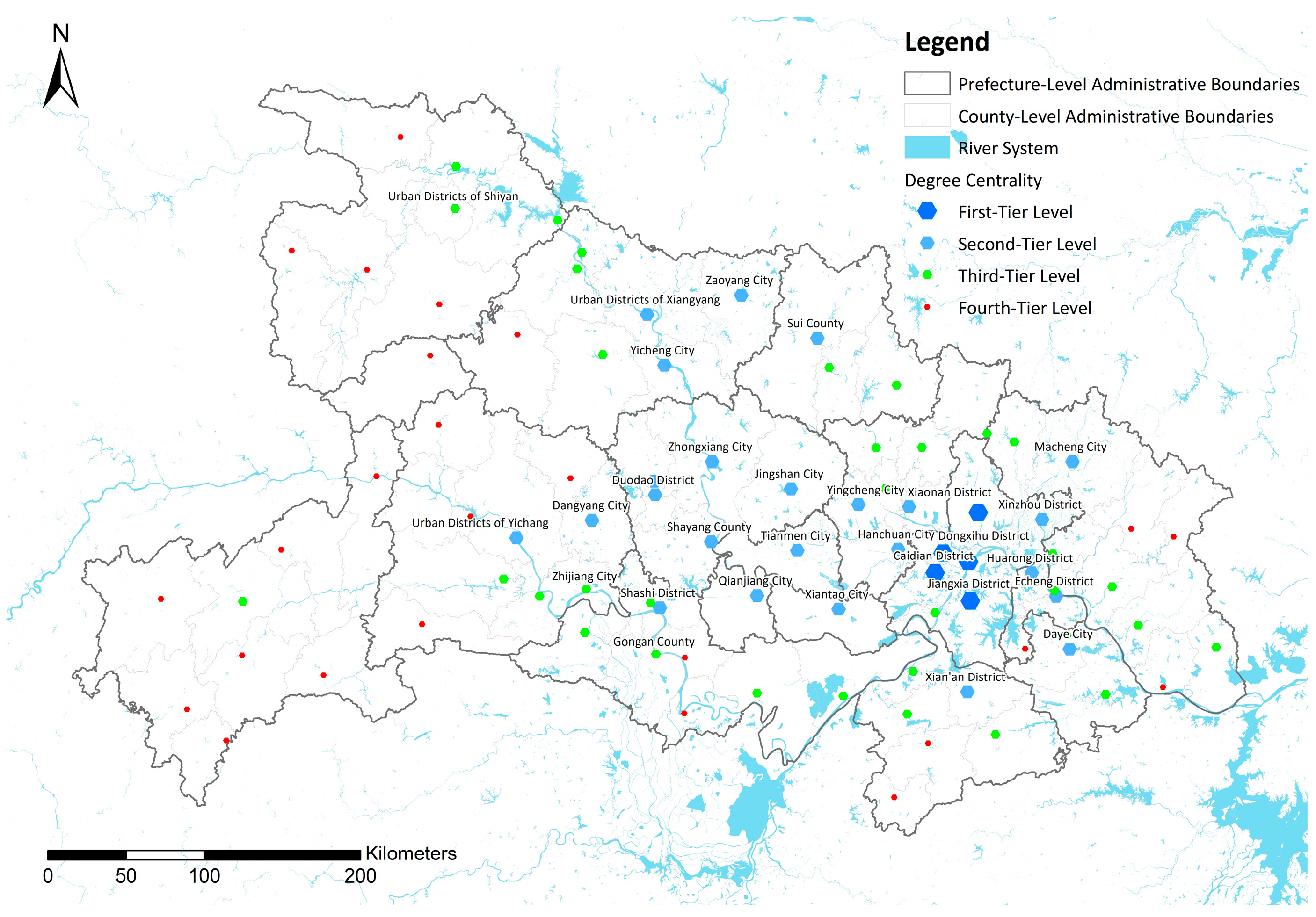
The classification results of city- and county-level spatial units in Hubei Province based on degree centrality are shown in
Figure 4. A total of five nodes are classified into the first hierarchical level, including the central urban area of Wuhan, Dongxihu District, Caidian District, Jiangxia District, and Huangpi District. Among them, the central urban area of Wuhan exhibits the highest degree centrality value, followed by Dongxihu District.
From the perspective of degree centrality, the urban economic network of Hubei Province exhibits a core-dominated structure supported by multiple secondary nodes. At the provincial scale of Hubei, all five first-tier nodes are located within the administrative area of Wuhan, indicating that Wuhan occupies a prominent hub position in the provincial economic network and exhibits the strongest capacity for linkage agglomeration and network control. Other cities with relatively high degree centrality values include Jingshan, the urban districts of Xiangyang, and Zhongxiang, none of which are situated within the Wuhan Metropolitan Area. This pattern indicates that although Wuhan occupies the highest central position in the provincial urban network, its radiation and spillover effects on surrounding cities remain limited and have not reached an optimal level. The urban districts of Xiangyang, Yichang, Xian’an District, among others, are classified as second-level nodes and exhibit relatively high degree centrality compared with their neighboring cities, suggesting that they possess certain characteristics of regional centers. However, compared with the high level of concentration in Wuhan, these nodes still exhibit a substantial gap in network hierarchy. This indicates that the provincial economic linkage structure continues to display pronounced polarization characteristics. Wuhan’s capacity to organize and concentrate inter-city linkages far exceeds that of other cities, while the development of polycentric coordination across the province remains relatively limited.
At the scale of the Wuhan municipality, the urban network demonstrates a pronounced polycentric pattern: with the exception of Hannan District, degree centrality values across districts are relatively similar. This indicates that Wuhan is not dominated by a single central district; rather, it exhibits a network configuration supported by multiple strongly connected and functionally complementary nodes. When each administrative district of Wuhan is treated as an independent node, the results show that Dongxihu District, Caidian District, and Jiangxia District exhibit relatively high degree centrality values, whereas central districts such as Jianghan District rank lower. This result is broadly consistent with the spatial distribution of economic development zones, high-tech industrial parks, and modern logistics functional areas in Wuhan, indicating that the most active areas of economic linkages within the municipality have gradually expanded from the traditional central urban districts toward peripheral functional new zones.
3.1.2. Alter-Based Centrality Classification
The results of the alter-based centrality analysis are presented in
Figure 5. Nodes classified into the first hierarchical level include the central urban area of Wuhan, Dongxihu District, Jiangxia District, Caidian District, and Huangpi District, which are similar to the results obtained from the degree centrality classification. Among these nodes, the central urban area of Wuhan exhibits the highest alter-based centrality value, followed by Dongxihu District.
Compared with the urban node classification based on degree centrality, the nodes classified into the first hierarchical level under alter-based centrality are identical. However, the number of second-tier nodes is significantly reduced, indicating that when the roles of nodes in transmitting and transforming linkages within the network are taken into account, high-level nodes in the economic network of Hubei Province become further concentrated in the core region. Except for Zhongxiang, all second-level nodes belong to the Wuhan Metropolitan Area, with Jingshan included as an observer city. This pattern indicates that economically active areas in Hubei Province are largely concentrated within the Wuhan Metropolitan Area. Within the Wuhan Metropolitan Area, cities located farther from Wuhan—such as Qianjiang and Xian’an District of Xianning—are classified as third-level nodes, whereas cities closer to Wuhan, including Hanchuan, Xiaonan District, and Yingcheng, are promoted to the second level. Notably, Hanchuan exhibits a higher alter-based centrality value than Xiaonan District, which serves as the administrative seat of Xiaogan. This indicates that node hierarchy is not determined solely by administrative rank but is more strongly influenced by spatial proximity to Wuhan and the intensity of economic linkages with it.
At the provincial scale, the urban network of Hubei Province exhibits a concentric diffusion structure centered on the central urban area of Wuhan, with urban hierarchy declining as spatial distance from the core increases. This pattern reflects a typical core–periphery structure. Most urban nodes located outside the Wuhan Metropolitan Area are classified into the third and fourth hierarchical levels. Notably, the urban districts of Xiangyang and Yichang—designated as regional central cities in the Hubei Territorial Spatial Plan (2021–2035) and the Outline of the 14th Five-Year Plan of Hubei Province—also exhibit lower alter-based centrality values than many counties and county-level cities within the Wuhan Metropolitan Area. This finding suggests that current economic linkages in Hubei Province remain highly dependent on geographic proximity, and that an efficient, network-based functional transmission mechanism capable of overcoming spatial distance has yet to be fully established.
From a regional perspective, the Wuhan Metropolitan Area currently exhibits a single-tier system characterized by Wuhan as the absolute core. The relatively active economic performance of surrounding cities is largely attributable to spillover effects generated by the excessive concentration of economic activities and industries in Wuhan, rather than to endogenous growth driven by inter-city synergy. In contrast, the agglomeration and coordinated development features of the Xiangyang Metropolitan Area and the Yijingjing Metropolitan Area remain insufficiently evident. The Wuhan Metropolitan Area Development Plan, officially approved in 2023, explicitly proposes strengthening Wuhan’s radiating role to promote the joint development of surrounding cities, accelerating infrastructure interconnectivity, fostering specialized industrial division of labor and collaboration, advancing the co-construction and sharing of public services, and establishing coordinated mechanisms for joint risk prevention and control, thereby improving the institutional framework for metropolitan integration. However, from the perspective of the actual economic hierarchical structure, the construction of a modern, networked metropolitan area remains a long-term and challenging task.
3.1.3. Alter-Based Power Classification
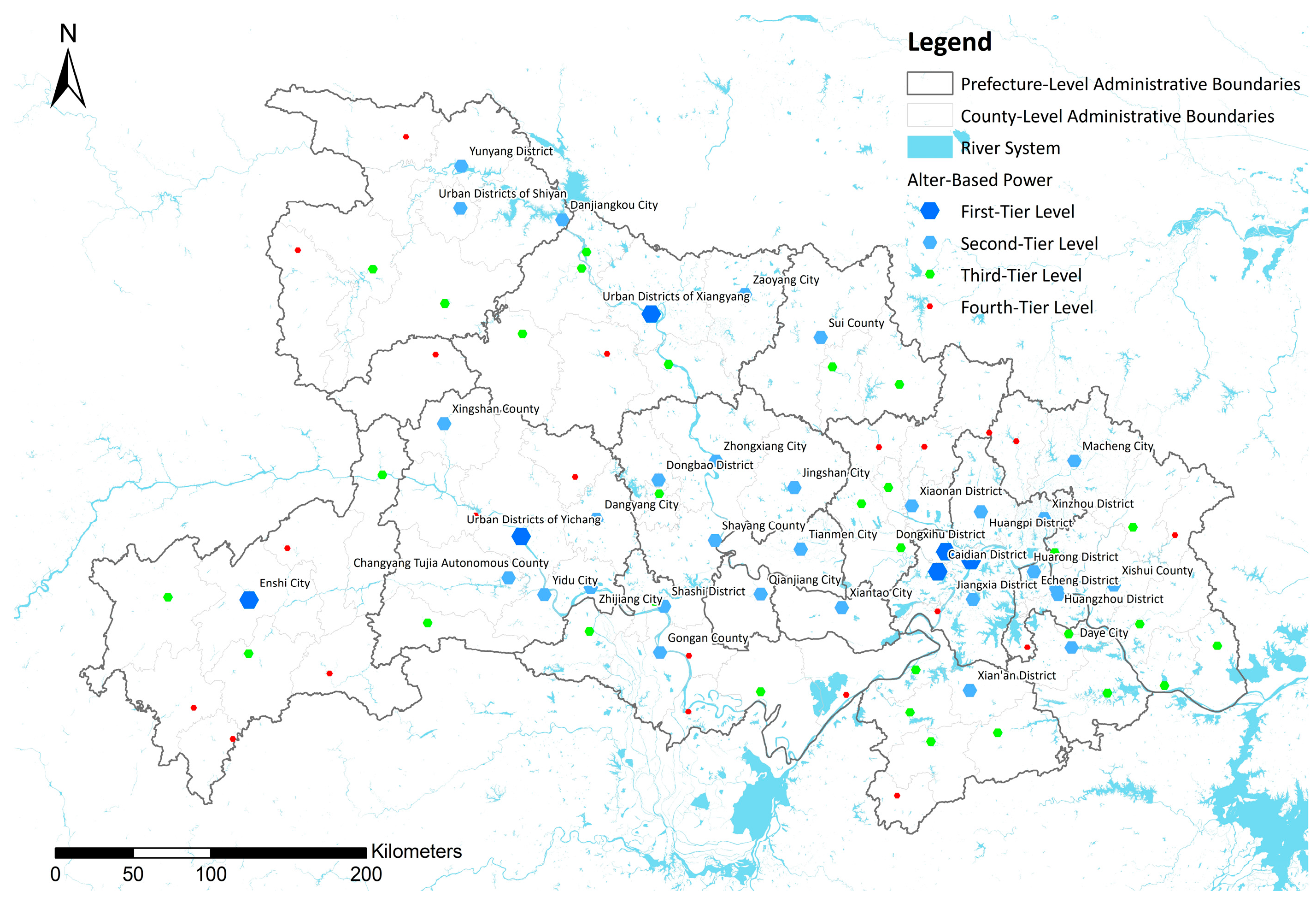
The classification results of urban nodes based on the alter-based power indicator are shown in
Figure 6. Six nodes are classified into the first hierarchical level, including the central urban area of Wuhan, Dongxihu District, Caidian District, the urban districts of Xiangyang, Enshi City, and the urban districts of Yichang. Nodes classified into the second hierarchical level are more numerous and are mainly composed of prefecture-level Party committee and government seats, exhibiting an approximately even spatial distribution across the province.
Based on the hierarchical classification of urban nodes derived from the alter-based power indicator, the urban network of Hubei Province already exhibits pronounced polycentric characteristics. Unlike degree centrality and alter-based centrality, which primarily reflect the level of node activity and linkage transmission capacity, alter-based power places greater emphasis on a node’s ability to control surrounding resource exchanges and organize network connections. Accordingly, although Wuhan continues to dominate in terms of the overall volume of economic linkages and network activity at the provincial scale, multiple regional centers with relatively independent control capacity have emerged in Hubei Province in terms of linkage governance and regional organization. Yichang and Xiangyang, which are classified as first-level nodes, serve as the core cities of the “two wings” within the regional economic development pattern of “one core leading with two wings driving,” as proposed in the Outline of the 14th Five-Year Plan of Hubei Province. Among them, the urban districts of Xiangyang display the highest alter-based power value, exceeding those of all districts in Wuhan. In contrast, the urban districts of Yichang exhibit the lowest alter-based power value among first-level nodes, indicating a comparatively weaker capacity to dominate resource exchanges with surrounding cities relative to other first-level urban nodes.
It is noteworthy that Enshi City is classified into the third and fourth hierarchical levels in the degree centrality and alter-based centrality classifications, respectively, while it is elevated to the first hierarchical level in the alter-based power classification. This indicates that although the overall scale of Enshi’s inter-city economic activities is relatively small and its level of participation in resource exchanges within the surrounding urban network is extremely low, it exerts a disproportionately strong controlling influence over neighboring urban nodes. Its dominance over cities within its hinterland even exceeds that of Yichang, the regional center of southwestern Hubei, thereby forming a “gateway node” in the southwestern Hubei region. This pattern is broadly consistent with the population distribution and resource endowment of Enshi City and the Enshi Autonomous Prefecture.
3.1.4. Comprehensive Classification of Urban Nodes
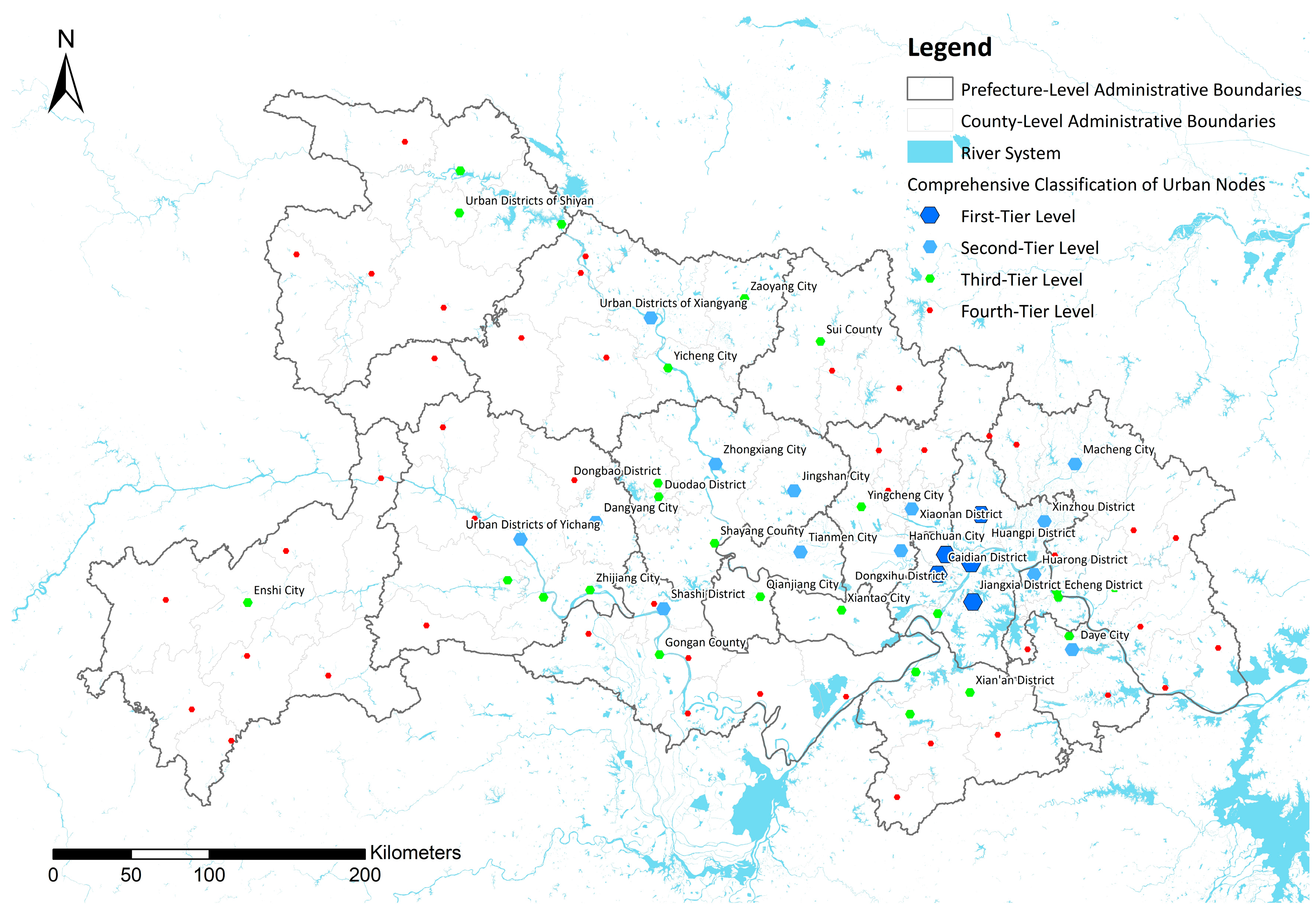
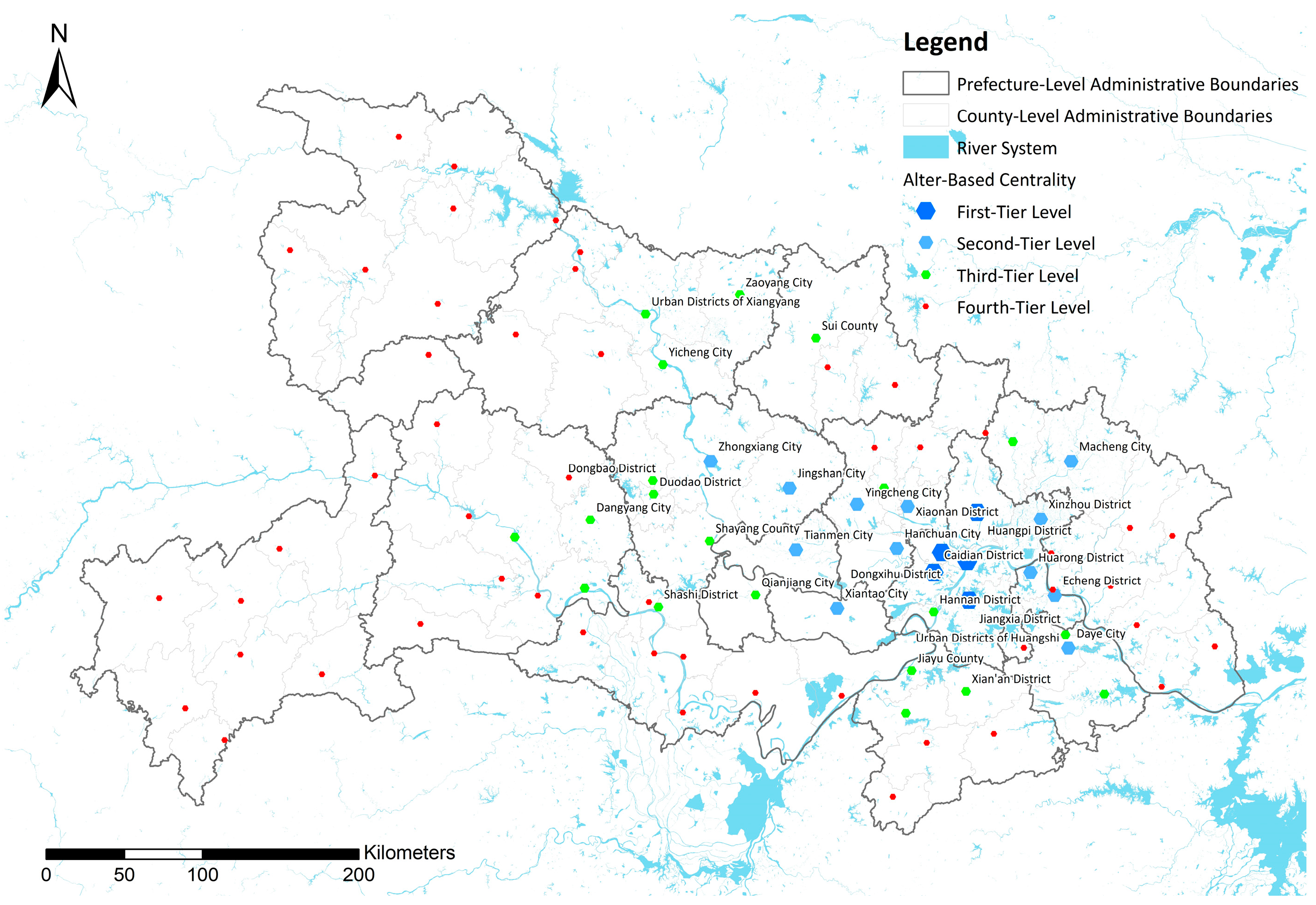
Based on the hierarchical levels of urban nodes derived from degree centrality, alter-based centrality, and alter-based power, this study assigns scores to each urban node accordingly. The average of the three scores is then calculated to obtain a composite score for each city, resulting in a comprehensive classification of urban nodes in Hubei Province (
Figure 7). All first-level urban nodes are concentrated within the administrative area of Wuhan, reflecting Wuhan’s absolute core position in the provincial economic network. The second hierarchical level comprises 13 urban nodes, including the urban districts of Xiangyang, Xinzhou District of Wuhan, Jingshan, Zhongxiang, Daye, Xiaonan District of Xiaogan, Huarong District of Ezhou, Macheng, Tianmen, the urban districts of Yichang, Dangyang, Hanchuan, and Shashi District of Jingzhou. This distribution indicates a locally polycentric pattern.
Overall, the hierarchical classification of urban economic network nodes in Hubei Province exhibits a core-dominated structure supported by multiple secondary nodes. As the core and leading city of provincial economic development, Wuhan demonstrates a pronounced polycentric pattern within its internal economic linkage network: with the exception of Hannan District and Xinzhou District, all districts of Wuhan are classified into the first hierarchical level. At the provincial scale, second-level nodes are mainly distributed across the Jianghan Plain, forming a spatial pattern characterized by “concentration in the central and eastern regions and dispersion in the western region.” This configuration indicates that regional economic development in Hubei Province has gradually evolved toward a networked structure driven by a primary core and supported by multiple nodes, which is of significant importance for improving the provincial spatial organization system and promoting regional coordinated development. Moreover, these nodes are predominantly prefecture-level administrative seats or economically important county-level cities, possessing strong inter-regional linkage capacities and functioning as key secondary hubs for receiving and transmitting economic flows within the provincial network. Notably, several county-level cities—such as Hanchuan and Daye—are classified into the second hierarchical level, suggesting that within the provincial economic network, industrial and logistics linkages have, to some extent, surpassed administrative hierarchy in shaping urban economic status.
3.2. Economic Linkage Intensity Analysis
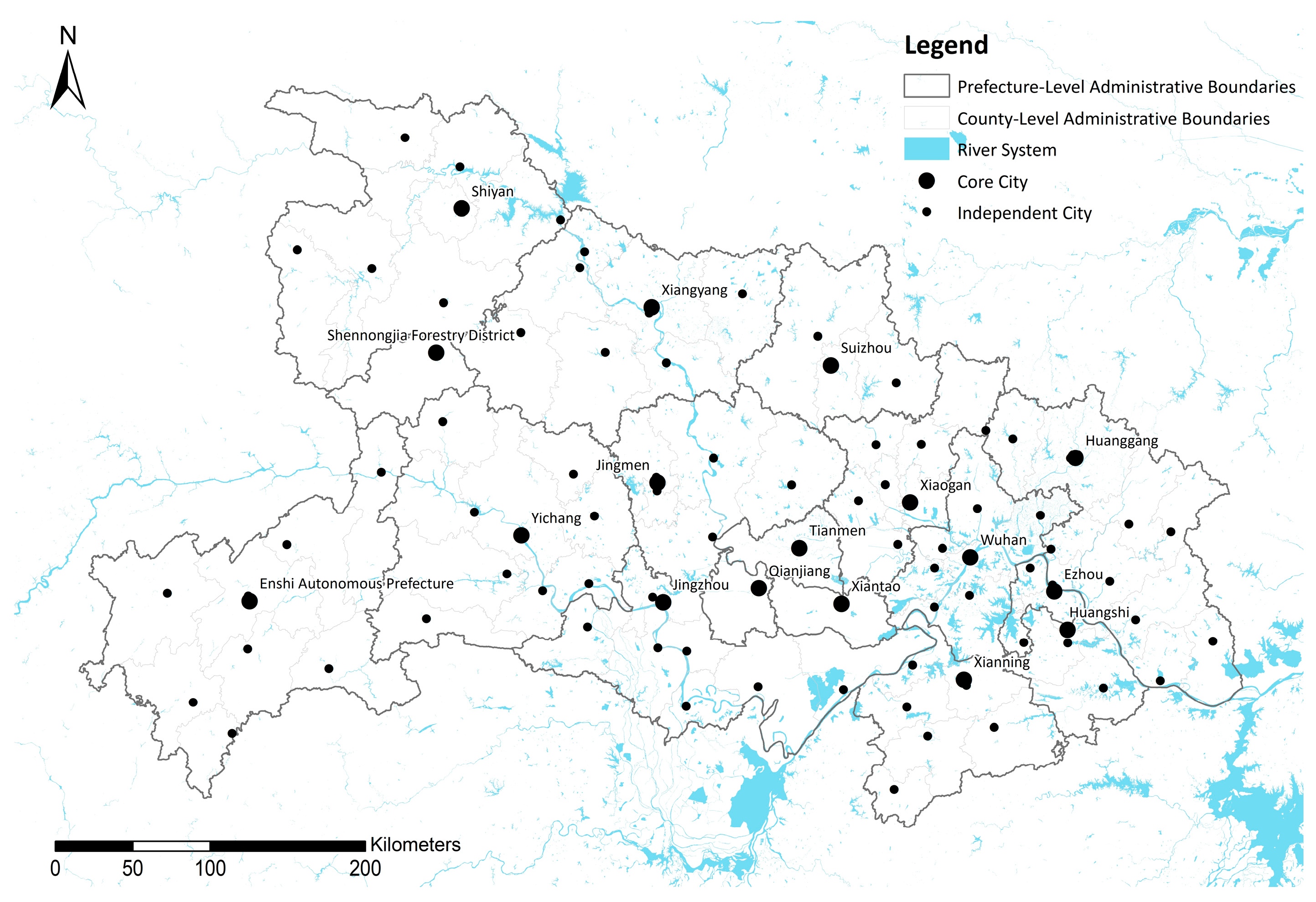
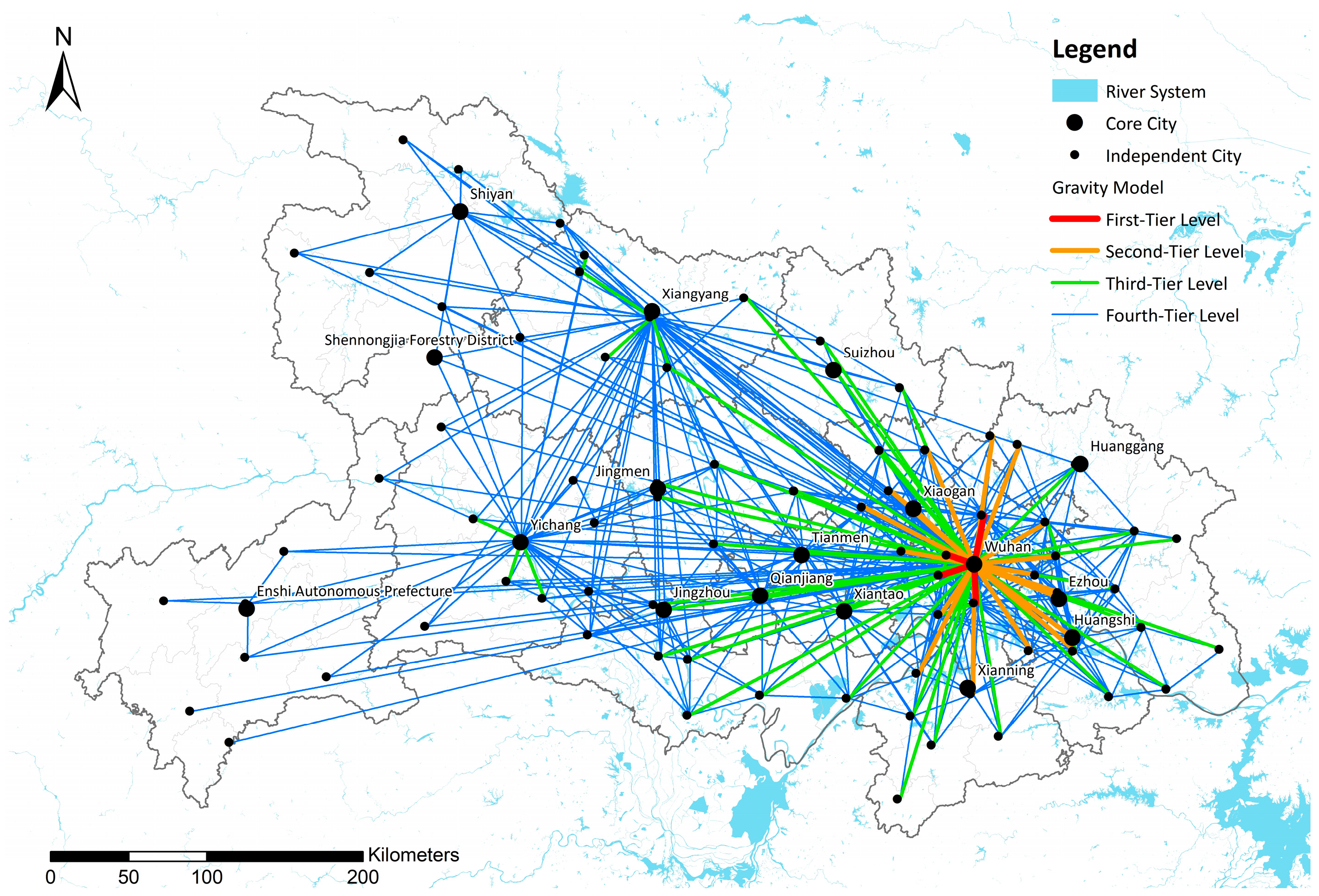
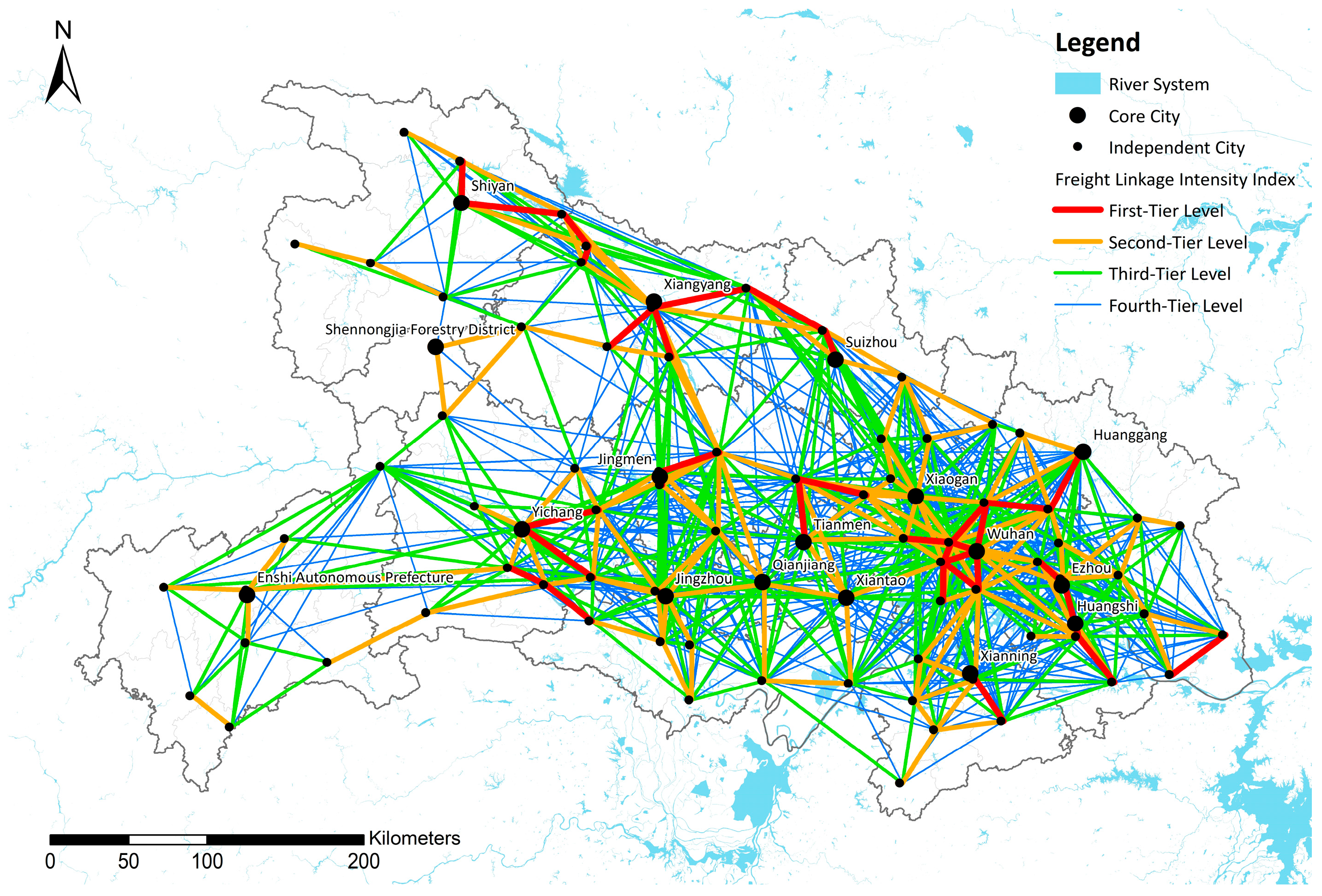
This study applies two approaches—the gravity model and a freight linkage-based intensity index—to calculate the economic linkage intensity among 87 independent urban nodes across Hubei Province. The resulting linkage intensities are classified into hierarchical levels using the geometric interval classification method and visualized accordingly (
Figure 8 and
Figure 9). Furthermore, the linkage intensity results are standardized and adjusted to obtain a composite analytical outcome that more accurately reflects the actual pattern of economic linkages.
3.2.1. Linkage Intensity Analysis Based on the Gravity Model
The classification results of linkage intensity based on the gravity model indicate that the economic linkage network of Hubei Province exhibits a pronounced radial structure (
Figure 8). Overall, the top five inter-city linkages in terms of intensity, ranked from highest to lowest, are as follows: the central urban area of Wuhan–Dongxihu District, the central urban area of Wuhan–Caidian District, the central urban area of Wuhan–Jiangxia District, the central urban area of Wuhan–Huangpi District, and the central urban area of Wuhan–Hanchuan City. Among the top 20 strongest linkages, 13 involve the central urban area of Wuhan, indicating that the central urban area of Wuhan (including the Optics Valley High-Tech Development Zone) occupies an overwhelmingly dominant position in the provincial economic network. This dominance can be attributed to the concentration of population and industrial resources in the central urban area of Wuhan, which generates strong attraction and agglomeration effects on surrounding urban nodes.
Beyond Wuhan’s role as the primary hub in the economic network, distinctive linkage patterns are also observed among other cities in Hubei Province. For example, Tianmen, Qianjiang, and Xiantao exhibit relatively dense economic linkages with one another, forming a localized radial structure. Similarly, cities within the Yichang-centered and Xiangyang-centered urban agglomerations display relatively strong inter-city linkages, forming localized outward-radiating structures centered on Yichang and Xiangyang, respectively. These patterns suggest that urban agglomerations centered on Yichang and Xiangyang have begun to take shape.
3.2.2. Linkage Intensity Analysis Based on Freight Linkage Volume
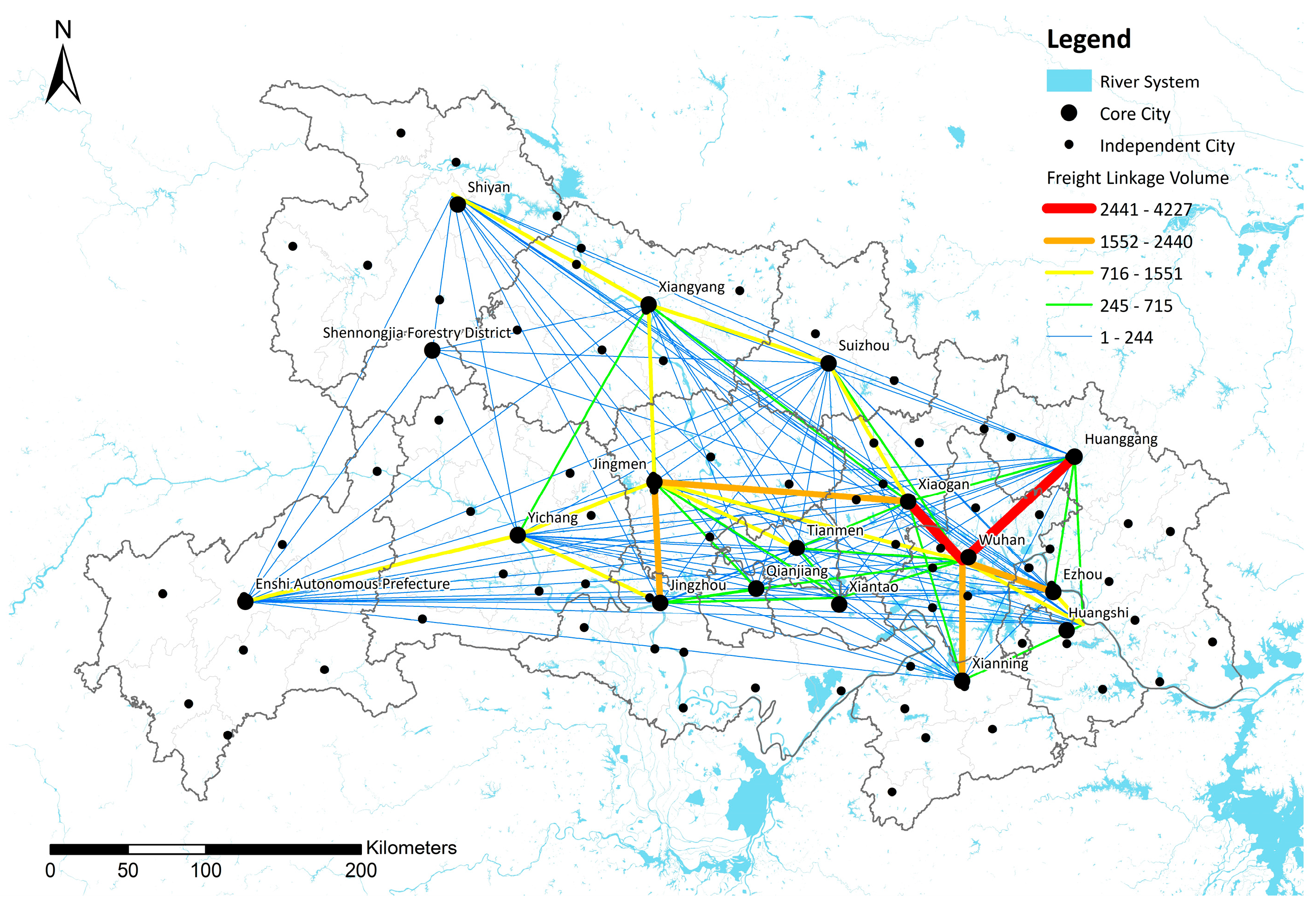
The results of economic linkage intensity measurement based on freight linkage volume are presented in
Figure 9. Ranked in descending order of linkage intensity index values, the top five inter-city linkages are Huangshi urban districts–Daye, the central urban area of Wuhan–Jiangxia District, Dongbao District–Duodao District of Jingmen, the central urban area of Wuhan–Dongxihu District, and Dongxihu District–Caidian District of Wuhan. Among the top 20 strongest linkages, seven involve Wuhan, while the remaining strong linkages are distributed across multiple regional nodes throughout the province. Compared with the gravity model–based results, Wuhan continues to occupy a dominant position; however, the distribution of freight-based linkage intensity is more dispersed, indicating a tendency toward a multi-core development pattern in the provincial economic network.
From the perspective of freight interactions, the urban economic network of Hubei Province exhibits a polycentric structure dominated by Wuhan, with Yichang and Xiangyang serving as secondary centers. Compared with the gravity model–based results, the freight linkage intensity index reveals a more balanced pattern of inter-city economic linkages. Within the Wuhan Metropolitan Area, interactions among Wuhan’s districts and surrounding counties no longer display a strictly radial structure centered on the central urban area but instead form a network-like configuration with relatively high linkage intensity. This indicates that, in the actual process of freight flows, provincial economic linkages do not rely entirely on Wuhan as a single core but instead form a more networked interaction structure among multiple regional nodes. Although the Wuhan Metropolitan Area as a whole still exhibits a centripetal tendency centered on Wuhan, horizontal linkages among cities within the metropolitan area have been significantly strengthened.
In addition, the areas surrounding Yichang and Xiangyang display typical radial linkage patterns, forming regionally radiating structures centered on Yichang and Xiangyang, respectively. This reflects the emergence of these two cities as secondary cores within the provincial economic network. Notably, Shiyan and several western cities within the Xiangyang region (including Yunyang District–Shiyan–Danjiangkou–Laohekou–Gucheng) exhibit relatively low overall levels of economic activity and weak external linkages with other cities. Nevertheless, their internal connections are relatively strong, forming relatively independent local network units.
3.2.3. Composite Linkage Intensity Classification
To enhance the accuracy and comparability of economic linkage measurements between urban nodes, this study performs a comprehensive classification by integrating the results derived from the gravity model and the freight linkage intensity index. First, the potential economic linkage intensity obtained from the gravity model and the actual economic linkage intensity based on freight flows are standardized to eliminate differences in measurement scales. Second, the results of the two approaches are averaged to derive a composite linkage intensity between urban nodes in Hubei Province. Based on this composite measure, the inter-city linkage intensities are reclassified into hierarchical levels.
The correspondence between urban nodes in the top three hierarchical levels and their primary linked cities is presented in
Table 2.
3.3. Urban Economic Cluster Delineation
To identify the spatial linkage characteristics of the urban economic network in Hubei Province, this study applies the Louvain community detection algorithm to delineate urban clusters based on composite economic linkage intensity. The algorithm iteratively optimizes modularity to obtain an optimal partition, with higher modularity values indicating denser internal connections and weaker external linkages within clusters. When the modularity value converges and becomes stable, the primary and secondary hierarchical cluster structures of the urban network can be determined. Such multi-level clustering facilitates a more in-depth examination of the internal economic interactions within each cluster.
3.3.1. Major Urban Economic Clusters
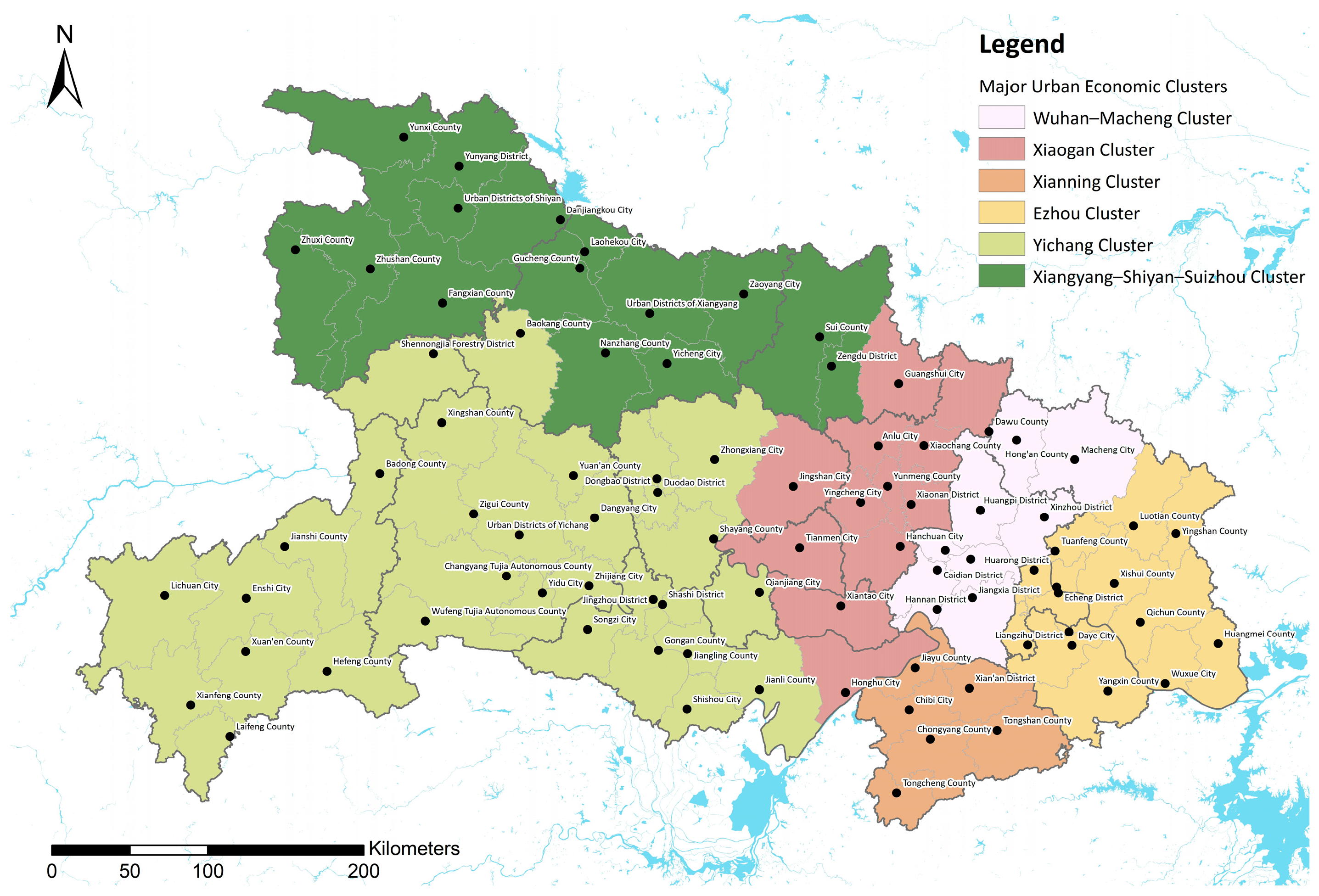
The results of the Louvain community detection algorithm indicate that the urban economic network of Hubei Province can be divided into six major urban economic clusters (
Figure 10): the Wuhan–Macheng cluster, the Xiaogan cluster, the Xianning cluster, the Ezhou cluster, the Yichang cluster, and the Xiangyang–Shiyan–Suizhou cluster. Overall, this clustering pattern is broadly consistent with Hubei Province’s regional coordinated development strategy of “one core with two wings.” However, cities within the Wuhan Metropolitan Area do not form a single unified cluster; instead, they are subdivided into four distinct urban clusters. Only Macheng City and Hong’an County in Huanggang are grouped together with Wuhan, indicating that economic linkages within the Wuhan Metropolitan Area remain relatively fragmented. The Yichang cluster encompasses not only most areas of Yichang, Jingmen, Jingzhou, and Enshi, but also includes Shennongjia Forestry District and Qianjiang City. The Xiangyang–Shiyan–Suizhou cluster covers the Shiyan, Xiangyang, and Suizhou regions, suggesting that the actual structure of economic linkages deviates to some extent from the existing “Xiang–Shi–Sui–Shen” regional delineation.
From a spatial perspective, the boundaries of most clusters generally coincide with prefecture-level administrative boundaries. This is particularly evident in the Xianning cluster, whose boundaries fully overlap with the administrative area of Xianning and which exhibits the highest modularity value, reflecting the strongest internal economic linkages. Meanwhile, several county-level cities—such as Jingshan, Guangshui, and Honghu—are assigned to clusters that do not correspond to the dominant cluster of their respective prefecture-level cities, indicating a mismatch between administrative boundaries and functional economic clusters. In particular, Guangshui City has stronger economic ties with the Xiaogan region due to its long-term administrative affiliation with Xiaogan prior to the establishment of Suizhou as a prefecture-level city in 2000. Jingshan City, owing to its geographic proximity to the Wuhan Metropolitan Area, is classified into the Xiaogan cluster. These findings indicate that the formation of urban economic clusters is influenced not only by current administrative affiliations, but also closely associated with historical administrative linkages, spatial proximity conditions, and the intensity of actual economic interactions.
3.3.2. Secondary Urban Economic Clusters
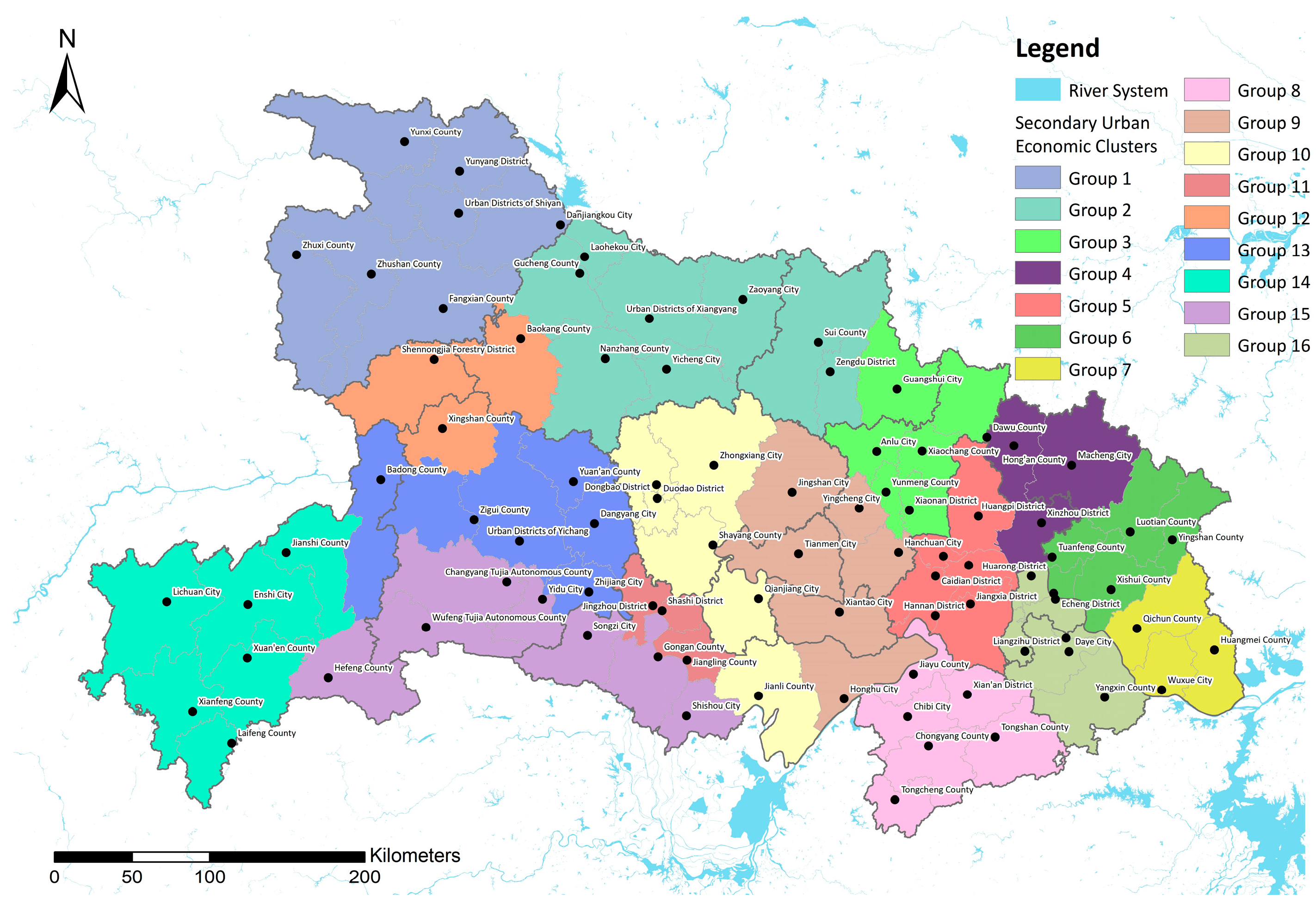
Based on the six major urban economic clusters, a further subdivision yields sixteen secondary urban economic clusters (
Figure 11). Overall, the Xianning cluster exhibits highly cohesive internal economic linkages and is therefore not further divided into secondary clusters. The Xiangyang–Shiyan–Suizhou cluster, the Xiaogan cluster, and the Wuhan–Macheng cluster are each subdivided into two secondary clusters, while the Ezhou cluster is divided into three secondary clusters. In contrast, the Yichang cluster displays substantial internal heterogeneity and is further divided into six secondary clusters.
From a spatial perspective, the delineation of secondary clusters in western Hubei largely corresponds to administrative boundaries. For instance, the clusters centered on Shiyan and Xiangyang generally coincide with their respective prefecture-level administrative jurisdictions, indicating relatively strong internal economic linkages. In contrast, the economic linkage patterns in central and eastern Hubei are more complex. Although Wuhan functions as the provincial core, its administrative districts are not entirely integrated into a single cluster. Xinzhou District forms a cross-boundary cluster together with Macheng and Hong’an in Huanggang, reflecting a certain degree of fragmentation in economic linkages within the Wuhan Metropolitan Area and suggesting that the spillover effects of the core city have not yet been fully realized. Regions such as Huanggang and Huangshi exhibit patterns characterized by the coexistence of multiple clusters and relatively weak inter-cluster linkages. From the perspective of the road freight–based urban network, these areas have yet to form stable urban agglomeration structures, further highlighting the tendency for economic linkages to transcend administrative boundaries in network terms.
Overall, the regional economic network of Hubei Province is characterized by strong internal linkages within clusters and weak linkages across clusters. While economic activities exhibit pronounced cluster-based spatial agglomeration, insufficient inter-cluster connectivity constrains, to some extent, the coordinated and integrated development of the provincial economic network.
3.4. Construction of the Urban Economic Network Topology Model of Hubei Province
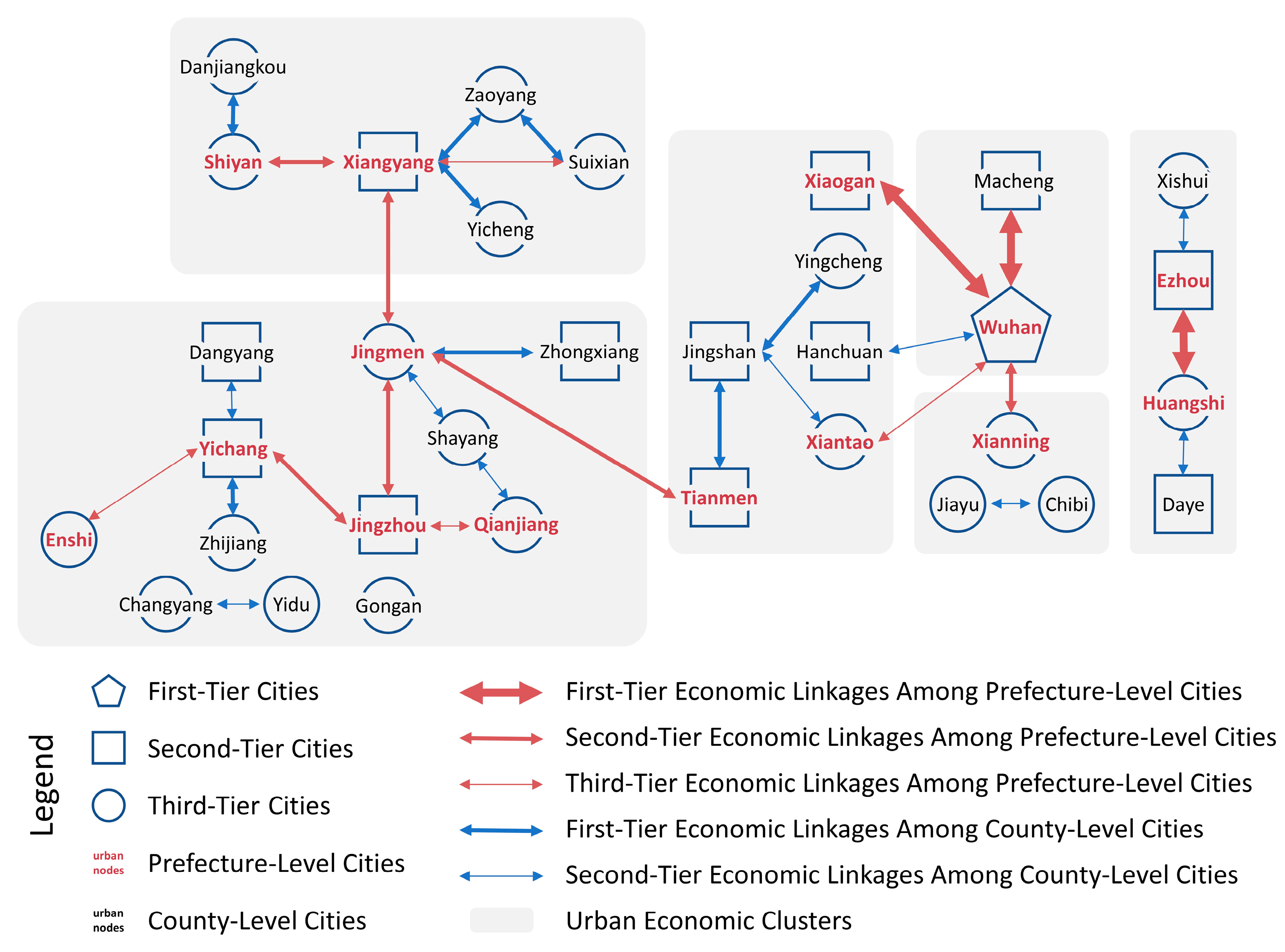
In this study, cities are treated as network nodes, inter-city economic linkages as network edges, and urban economic clusters identified through community detection as the areal layer of the network. Based on a “point–line–area” framework, a topological model of the urban economic network is constructed to characterize the hierarchical relationships and spatial organization of the urban system in Hubei Province (
Figure 12, where prefecture-level cities are highlighted in bold red). Specifically, the top three tiers of urban nodes identified through the comprehensive node classification are selected as the primary structural nodes, with municipal districts merged to reflect their relative influence within the network. Based on the composite economic linkage intensity, the dominant linkage between each city and its primary linked city is extracted and represented by edges with varying line widths to depict linkage strength, thereby constructing a county-level economic linkage network. These linkages are then aggregated to form the prefecture-level economic network structure. Finally, urban economic clusters identified using the Louvain community detection algorithm are overlaid as the areal layer of the network to reveal functionally cohesive spatial aggregation areas characterized by dense economic linkages.
From an overall structural perspective, the urban economic network of Hubei Province is characterized by single-core dominance and cluster-based organization. Wuhan occupies an absolute core position in the network and is the only first-tier city, exhibiting the strongest economic linkage intensity and the widest spatial influence at both prefecture-level and county-level scales. Provincial economic interactions are organized around several urban economic clusters, within which internal linkages are relatively strong, while inter-cluster connections remain limited. This indicates that a highly balanced polycentric network has yet to emerge in Hubei Province.
In terms of hierarchical distribution, the topological model clearly reveals a multi-level structure nested between prefecture-level and county-level cities. As the sole first-tier city, Wuhan not only maintains first-tier economic linkages with multiple prefecture-level cities but also directly attracts primary linkages from several county-level cities, demonstrating strong agglomeration and control capacity. Most prefecture-level cities—including Xiangyang, Yichang, Jingzhou, Xiaogan, Ezhou, and Huangshi—constitute second-tier nodes in the provincial network, functioning as regional hubs for the aggregation and redistribution of economic linkages. However, notable hierarchical mismatches are observed: some prefecture-level cities (e.g., Huanggang, Suizhou, and Shennongjia Forestry District) do not rank among the top three tiers, whereas several county-level cities (e.g., Macheng, Daye, Zhongxiang, and Jingshan) exhibit higher network positions than their administratively affiliated prefecture-level cities. This suggests that a city’s position within the provincial economic network is shaped less by administrative status than by its industrial base and the strength of its economic linkages.
From the perspective of economic connections, the topological model displays a pronounced vertical dependency pattern and relatively weak horizontal interactions. For most county-level cities, primary economic linkages are directed toward their corresponding prefecture-level cities, reflecting a typical bottom–up dependency structure. At the prefecture level, certain inter-city connections—such as Xiangyang–Shiyan, Yichang–Jingzhou–Jingmen, and Ezhou–Huangshi—are evident, but their overall intensity remains weaker than that of linkages between Wuhan and selected prefecture-level cities. A stable and tightly connected horizontal network among prefecture-level cities has therefore not yet formed. Within the central region, Jingmen and Jingzhou exhibit partial hub-like characteristics, while the linkage between Ezhou and Huangshi reaches the first-tier intensity level. In contrast, several county-level cities (e.g., Gongan, Changyang Tujia Autonomous County, and Yidu) display clear peripheral characteristics, with relatively weak economic linkages to other cities.
At the level of urban economic clusters, inter-cluster linkages are generally limited, indicating insufficient cross-cluster coordination. The Wuhan–Macheng cluster and the Xiaogan cluster exhibit the strongest inter-cluster connections, forming a network involving multiple cities. By contrast, the Ezhou cluster remains relatively isolated within the provincial network, lacking direct connections with other clusters. Most remaining clusters are connected only through single linkage pathways, resulting in weak overall inter-cluster integration. Notably, although Yichang is designated as a regional sub-center in provincial planning, its cluster does not exhibit strong cross-regional spillover effects in the topological structure; instead, its external connections rely primarily on Jingmen as an intermediary node. Furthermore, urban economic clusters display clear cross-administrative characteristics—for example, Jingshan is incorporated into the Xiaogan cluster and maintains relatively strong economic linkages with multiple cities within the cluster.
3.5. Urban Economic Community Identification
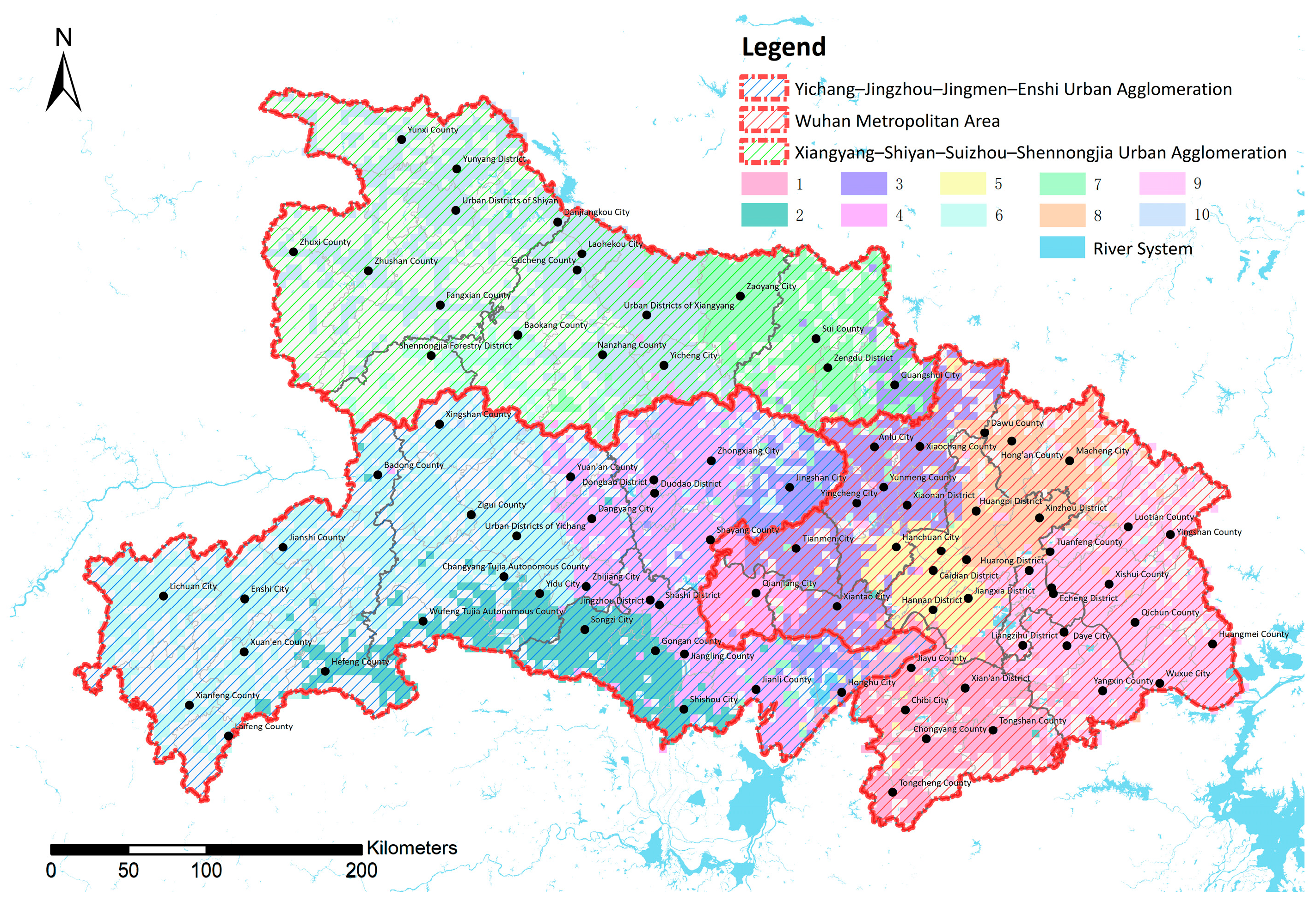
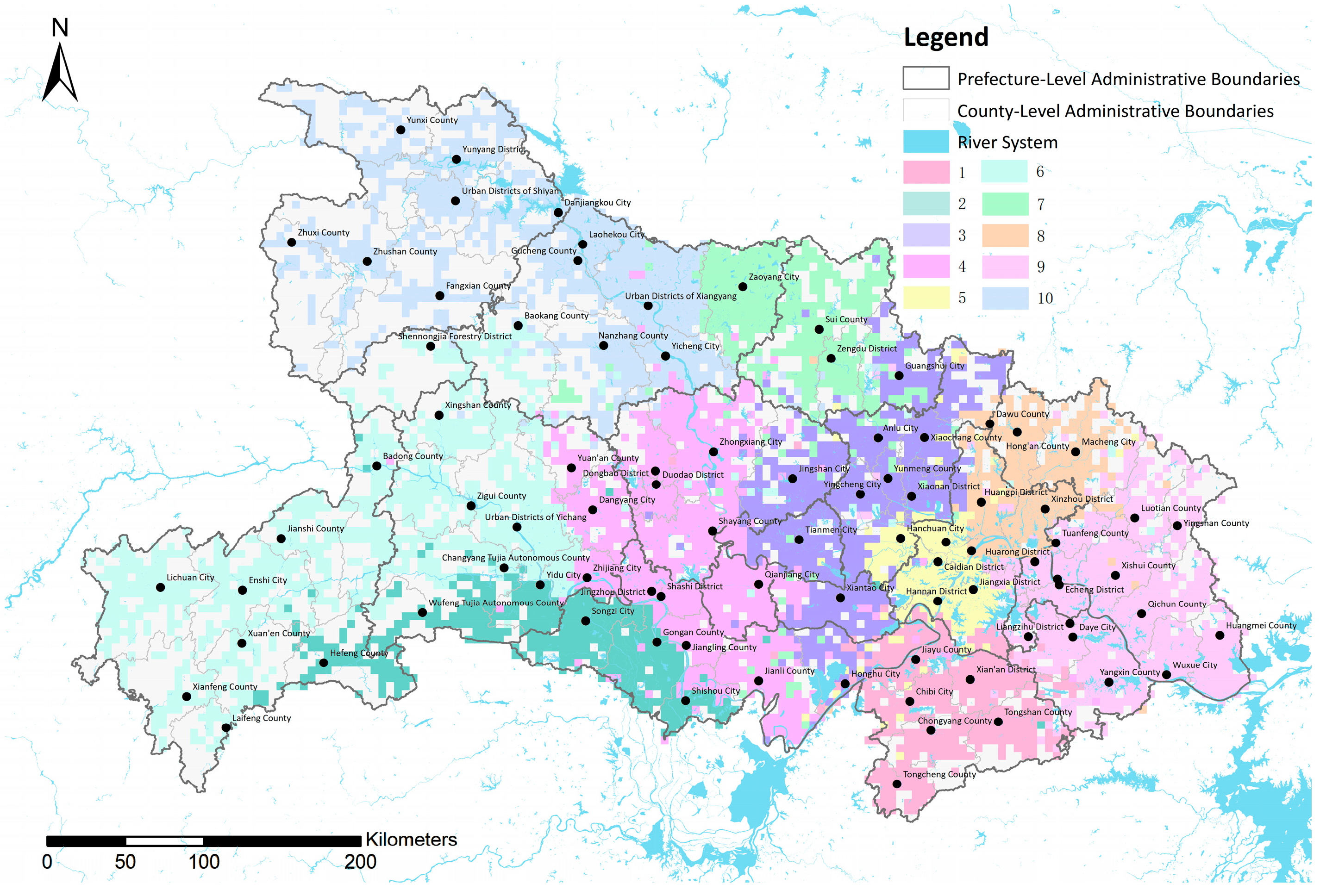
Based on grid-based modeling and community detection, this study constructs a freight-based economic linkage network for Hubei Province using 5 km × 5 km grid cells. The Louvain community detection algorithm is applied to identify network communities through iterative modularity optimization, yielding partitions with maximized modularity. This approach produces a classification of urban economic communities grounded in actual economic linkages, thereby revealing spatial organization patterns that transcend administrative boundaries. The visualization results (
Figure 13) identify ten major urban economic communities. Their boundaries differ substantially from prefecture-level administrative divisions but show a high degree of consistency with county-level boundaries, indicating that cities in Hubei Province primarily participate in provincial economic activities at the county scale.
From an overall perspective, urban economic communities in Hubei Province exhibit pronounced cross-boundary reconfiguration characteristics. On the one hand, some communities clearly transcend existing prefectural-level administrative boundaries, forming continuous functional spaces composed of multiple adjacent areas. For example, Community 5 (Wuhan–Hanchuan), Community 8 (Northern Huanggang–Xinzhou–Huangpi), and Community 9 (Eastern Huanggang–Huangshi–Ezhou) each span two or more prefectural-level cities, indicating that actual economic linkages have formed relatively stable cross-boundary organizational units in several regions. On the other hand, such cross-boundary integration does not occur in a random or unstructured manner; rather, it follows patterns of spatial proximity, transportation corridors, and industrial linkages, demonstrating clear directionality and selectivity. This suggests that cross-administrative urban economic communities in Hubei Province do not simply represent a mechanical break from administrative boundaries, but instead constitute functional spatial units more closely aligned with the underlying logic of economic operations shaped by sustained freight flows.
The identified urban economic communities also exhibit evident concentric differentiation in spatial scale: communities located closer to Wuhan tend to be smaller in size, whereas those farther from Wuhan cover broader spatial areas. This pattern indicates that freight linkages in the vicinity of Wuhan are denser and more multidirectional, and that economic spatial organization in these areas has evolved toward a relatively high degree of subdivision and networkization, thereby facilitating the formation of multiple small-scale functional communities. In contrast, peripheral regions generally display weaker inter-node linkages and lower internal heterogeneity, making it more likely for communities to merge into larger spatial units. Essentially, this phenomenon reflects a differentiated provincial economic spatial structure characterized by a declining gradient from the Wuhan core toward the periphery.
Further examination reveals that cross-administrative urban economic communities in Hubei Province can be categorized into three typical types:
- (1)
Core city spillover-driven communities.
Represented by Community 5 (Wuhan–Hanchuan) and Community 8 (Northern Huanggang–Xinzhou–Huangpi), and also including Community 1 (Xianning–Eastern Honghu), Community 3 (Xiaogan–Tianmen–Xiantao–Guangshui–Jingshan), and Community 9 (Eastern Huanggang–Huangshi–Ezhou), this type typically relies on a core city or high-hierarchy node and expands continuously into adjacent areas, exhibiting strong cross-boundary integration characteristics.
- (2)
Regionally coordinated integration communities.
Including Community 4 (Jingmen–Northern Jingzhou–Qianjiang–Dangyang–Zhijiang) and Community 7 (Western Suizhou–Zaoyang), these communities are not entirely dependent on a single core city but are instead formed through relatively strong horizontal linkages among multiple neighboring nodes, reflecting a certain degree of regional coordination and integration. Although some of these areas are administratively designated as part of the Wuhan Metropolitan Area, differences in spatial proximity and actual linkage directions with Wuhan have resulted in relatively independent economic communities.
- (3)
Transport–geography constrained communities.
Including Community 2 (Wufeng–Yidu–Songzi–Gongan–Shishou), Community 6 (Central–Western Yichang–Enshi–Shennongjia), and Community 10 (Xiangyang–Shiyan), this type is spatially influenced by topography and transportation conditions, particularly in southwestern Hubei and mountainous areas. Communities 6 and 10, located in mountainous regions, tend to form relatively cohesive units at larger spatial scales due to terrain constraints and limited accessibility. Community 2 forms an elongated belt along provincial highways S322, S242, and S325, spanning Yichang, Jingzhou, and Enshi, highlighting the guiding role of transportation corridors in shaping economic linkages.
Meanwhile, significant differences exist among communities in terms of internal economic cohesion and network integration. For instance, Community 1 (Xianning–Eastern Honghu) exhibits the highest modularity value, indicating the strongest internal economic cohesion. In contrast, Community 10 (Xiangyang–Shiyan), despite covering a relatively large area, has the lowest modularity, suggesting that the middle and upper reaches of the Han River have not yet formed a highly cohesive and integrated cross-boundary functional space; instead, its community structure reflects relative aggregation among geographically adjacent areas rather than a mature and stable high-intensity economic community.
4. Discussion
4.1. Structural Characteristics of the Urban Economic Network at the Administrative Scale
By integrating the results of urban node classification, economic linkage intensity measurement, cluster delineation, and topological modeling, this study finds that the urban economic network of Hubei Province overall exhibits a core-dominated structure supported by multiple nodes.
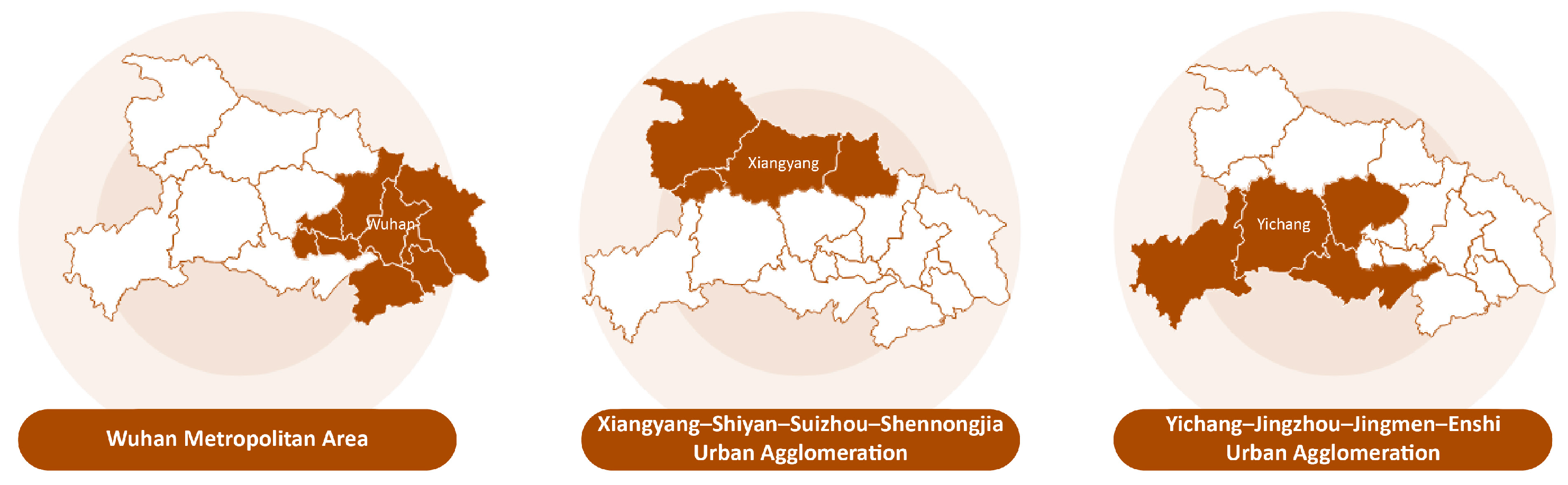
At the provincial scale, the regional development strategy of “one core with two wings” has begun to manifest in the economic network structure. According to the Hubei Territorial Spatial Plan (2021–2035), Wuhan is designated as the provincial core city, while Xiangyang and Yichang serve as sub-centers, jointly forming the spatial framework of “one core with two wings” (
Figure 14). The results of this study indicate that both Xiangyang and Yichang have developed independent urban economic clusters centered on themselves, with their network hierarchies significantly higher than those of other nodes within the same regions. The primary economic linkages of surrounding cities—such as Suizhou, western Jingmen, western Jingzhou, Shiyan, Enshi, and the Shennongjia Forestry District—are largely oriented toward these two cities. This suggests that Xiangyang and Yichang are gradually assuming their roles as regional sub-centers, although their spatial influence and radiating capacity remain to be further strengthened.
From a regional development perspective, inter-city economic linkages in Hubei Province exhibit pronounced spatial imbalance. Economic connections within the “1 + 8” Wuhan Metropolitan Area are relatively strong, whereas linkages with central and western regions are considerably weaker. The radiating and driving roles of Xiangyang and Yichang within their respective regions have not yet been fully realized. As the core area under the “one core leading” strategy, the Wuhan Metropolitan Area demonstrates the highest level of economic activity; however, horizontal linkages among its constituent cities remain relatively weak. Economic activities are highly concentrated in Wuhan, and with the exception of geographically proximate cities such as Hanchuan, most member cities exhibit predominantly one-directional dependency on Wuhan rather than forming an effective multi-node collaborative network. This pattern indicates that internal coordination mechanisms within the Wuhan Metropolitan Area require further strengthening, and that a more interactive economic linkage structure is urgently needed to alleviate the structural imbalance characterized by an overly dominant core and dependent peripheries.
From a spatial planning perspective, a certain degree of misalignment remains between the structure of regional economic linkages and existing administrative divisions. Community detection results indicate that the Wuhan Metropolitan Area is subdivided into several relatively independent urban economic clusters, while Jingmen and Jingzhou exhibit pronounced east–west differentiation, with parts of their eastern areas already integrated into the Wuhan Metropolitan Area. In addition, the Shennongjia Forestry District demonstrates stronger economic linkages with Yichang. These findings suggest that the overall spatial organization of Hubei Province generally aligns with the strategic framework of “one core with two wings,” yet further optimization is needed in terms of internal hierarchical coordination and inter-cluster connectivity. Future spatial planning should strengthen connectivity between the core city and regional sub-centers, thereby promoting functional coordination and the integrated development of the provincial economic network.
4.2. Characteristics of Urban Economic Communities at the Cross-Administrative Scale
By comparing the identified urban economic communities with the “one core with two wings” regional development framework of Hubei Province (
Figure 15), a high degree of consistency is observed between the two in terms of their overall spatial configuration. Both delineate regional structures centered on Wuhan, Xiangyang, and Yichang. Wuhan occupies the core position within the provincial network, exhibiting a pronounced primary-center role, while Xiangyang and Yichang function as secondary centers supporting the northwestern and southwestern wings of the province, respectively. Together, they constitute key pillars of Hubei’s emerging multi-core regional structure.
The coupling analysis indicates that although Hubei Province’s current regional planning has achieved certain progress in implementation, discrepancies remain between actual economic linkages and planned spatial structures. These discrepancies are mainly reflected in the following aspect:
- (1)
The internal evolution of the Wuhan Metropolitan Area has not yet reached the level of coordination envisioned in the planning framework.
The plan positions the Wuhan Metropolitan Area as the core region under the “one core leading” strategy, aiming to establish an integrated spatial structure centered on Wuhan with coordinated development among member cities. However, the urban economic community delineation reveals that the Wuhan Metropolitan Area has not formed a tightly integrated whole. Instead, it exhibits a multi-area configuration composed of the “Wuhan–Hanchuan” core community alongside several eastern, southern, western, and northern communities. Nodes such as Xian’an District and Ezhou play pronounced gateway roles in resource exchange and factor flows, while some cities in the Xiaogan area maintain predominantly one-directional dependency on Wuhan, with limited horizontal interaction. This pattern suggests that economic linkages within the Wuhan Metropolitan Area remain fragmented, with Wuhan functioning as the sole dominant hub and insufficient horizontal connectivity and coordination among other nodes. Consequently, a gap persists between actual economic interactions and the planning objectives of internal coordination and functional complementarity. Future efforts should therefore place greater emphasis on strengthening horizontal linkages and functional integration among cities surrounding Wuhan through enhanced metropolitan integration and cross-jurisdictional cooperation mechanisms.
- (2)
Mismatches between actual economic linkage structures and planned regional affiliations in certain areas.
The results of urban economic community identification indicate that economic linkages in Hubei Province exhibit pronounced cross-administrative characteristics, with functional inter-city relationships partially transcending the administrative divisions defined in regional planning. In several cases, the primary directions of economic interaction for certain counties and cities are inconsistent with their designated regional affiliations under the current planning framework. For example, although Qianjiang is classified as part of the “1 + 8” Wuhan Metropolitan Area, its freight flows are more strongly integrated into the central–western Hubei economic network formed by Yichang, Jingmen, and Jingzhou. Similarly, Guangshui City in Suizhou and Jingshan City in Jingmen, which are designated as observer cities of the Wuhan Metropolitan Area, exhibit economic linkage structures that are more closely aligned with cities in the western part of the metropolitan area. In addition, although the Shennongjia Forestry District and Baokang County are included in the “Xiangyang–Shiyan–Suizhou–Shennongjia” region in planning documents, their economic linkages are more oriented toward the Yichang–Enshi corridor. These patterns reveal clear discrepancies between the actual economic networks of certain cities or counties and their planned regional affiliations, highlighting the tendency for functional economic spaces to transcend administrative boundaries in practice. Overall, while maintaining the overarching framework of the “one core with two wings” strategy, regional planning should more closely incorporate empirically observed economic linkage networks and further refine functional zoning at the county scale.
4.3. Dual-Scale Characteristics of Provincial Economic Spatial Organization in Hubei Province
Existing studies on urban networks at the administrative scale generally indicate that regional economic linkages tend to exhibit a hierarchical structure dominated by high-level central cities and supported by secondary centers [
2,
18]. In contrast, research on functional boundaries and cross-city communities suggests that actual interaction spaces do not always conform to administrative boundaries but may form cross-boundary functional units shaped by spatial proximity, transportation connectivity, and factor flows [
15,
19]. The findings of this study are broadly consistent with these two strands of research. On the one hand, the economic spatial structure of Hubei Province displays a clearly defined network configuration in which Wuhan functions as a dominant core, while Xiangyang and Yichang emerge as regional secondary centers. This aligns with the general conclusion in the literature that regional economic networks are characterized by core dominance supported by secondary nodes. On the other hand, the urban economic communities identified in this study transcend certain existing administrative boundaries, indicating that actual economic activities in Hubei are not entirely confined to institutional space, but instead reorganize across boundaries along directions defined by spatial proximity and transportation linkages. This observation echoes findings from functional boundary and cross-city community research. At the same time, some differences are evident. Compared with the more pronounced polycentric coordination patterns observed in regions such as the Yangtze River Economic Belt and the Pearl River Delta [
5], the provincial economic spatial organization of Hubei—although exhibiting a “one core with multiple nodes” network structure—remains predominantly dominated by a single core centered on Wuhan. The secondary center roles of Xiangyang and Yichang have not yet fully matured. This suggests that the level of network balance and regional coordination in Hubei Province remains weaker than that of more developed urban agglomeration regions.
By integrating the results from both administrative-scale and cross-administrative-scale analyses, it becomes evident that the provincial economic spatial organization of Hubei exhibits pronounced dual-scale characteristics. At the administrative scale, it presents a relatively stable hierarchical network structure. At the cross-administrative scale, it manifests as economic communities that transcend administrative boundaries. The former primarily reflects urban hierarchy, linkage structures, and regional center systems within institutional space, corresponding to the hierarchical order emphasized in space of place theory [
6]. The latter reveals cross-boundary economic communities and functional boundaries shaped by actual freight flows, aligning more closely with the factor-linkage structures emphasized in space of flows theory [
7]. Together, these two dimensions reflect the coexistence and interaction of space of place and space of flows as articulated in central flow theory [
8]. This dual-scale perspective provides empirical evidence for understanding the interaction between institutional space and functional space at the provincial scale and further reveals the complexity and dynamic nature of economic spatial organization in Hubei Province.





 ,
,