Article

Spatial Dynamics of Climate-Driven Suitability for Africa’s Rainfed Staple Crops
by
Benjamin Kipkemboi Kogo
* and
Philip Kibet Langat
School of Engineering and Technology, Central Queensland University, Rockhampton, QLD 4701, Australia
*
Author to whom correspondence should be addressed.
Land 2026, 15(5), 725; https://doi.org/10.3390/land15050725
Submission received: 28 March 2026 / Revised: 20 April 2026 / Accepted: 23 April 2026 / Published: 24 April 2026
(This article belongs to the Section Land–Climate Interactions)

Abstract

Africa’s rainfed agricultural systems are highly exposed to climate change, making shifts in temperature and rainfall a major concern for staple-food crop production. Using a MaxENT ecological niche modelling approach with crop occurrence, elevation, soil and climatic predictors, this study assessed current and future suitability for rainfed maize, millet and sorghum under RCP 4.5 and RCP 8.5. The projections show a notable expansion of 11.1–22.0% in areas suitable for maize cultivation, and a decline of 1.6–7.3% in areas suitable for production of millet and sorghum, indicating likelihood for increased food-security risks in regions dependent on drought-tolerant cereals. These differing shifts highlight the need for targeted adaptation measures, including crop diversification and region-specific planning to help sustain crop production under a changing climate.

1. Introduction

Agriculture is one of the most weather-dependent sectors, and shifts in climate change and variability affect the key aspects of food security, including availability, access, stability and utilisation [1,2]. These risks are particularly true for Africa where the majority of the communities living in the rural areas are poor and highly dependent on agriculture for livelihoods and economic growth [3,4]. Africa is largely susceptible to climate change impacts due to widespread rainfed crop production, high climate variability, recurrent occurrences of droughts and floods, and low ability to adapt [5,6]. In recent years, some regions in the continent have experienced frequent food shortages and water scarcities that have been mainly triggered by intra-annual variations in rainfall and occurrences of extreme weather events such as prolonged droughts and floods [7]. Such climatic phenomenon have huge effects on land suitability and productivity of crops [8,9].
Maize, millet and sorghum are Africa’s principal cereals and are widely grown under rainfed conditions. Whereas maize dominates the total cereal area [10], millet and sorghum remain vital in semi-arid regions due to their strong tolerance drought, poor soils, low vulnerability to pests and diseases and can grow in areas where many other crops cannot thrive [11,12]. They are of enormous importance and potential in agricultural systems, and constitute critical food security components, after maize, among millions of small-scale farmers in the continent [12,13].
Despite extensive research on climate impacts on crop yields and agricultural land-use patterns in Africa, important knowledge gaps remain in understanding how future climatic conditions will affect the ecological suitability for major staple cereals [7,14,15]. Most of the existing studies focus on yield responses, historical trends of local case studies, leaving few continent-wide assessments that combine crop-specific bioclimatic requirements with projected climate scenarios [16]. Furthermore, predictive ecological niche modelling has been underused for evaluating how suitable environments for maize, millet, and sorghum may under different greenhouse-gas trajectories [17]. Addressing this gap is essential because these cereals are central to regional food security and their predominantly rainfed production systems are highly vulnerable to climatic variability across Africa [2,18].
Ecological niche modelling (ENM) offers a robust framework for assessing potential shifts in land suitability under different greenhouse gas emission scenarios [19,20]. Recent applications of ENM to examine climate suitability on food crops include those by [8,21,22,23,24], among others. Among the ENM tools, the maximum entropy (MaxEnt) model is widely due to its string performance for predicting distribution of flora and fauna species [25,26]. Predictive modelling is essential in African context because historical observations alone cannot capture how future temperature and rainfall shifts will alter the climatic suitability ranges required for these crops [2]. ENM enables the integration of crop-specific bioclimatic thresholds with projected climate conditions, providing insights into where suitable environments may expand or decline [27]. Applying such models is particularly important for maize, millet, and sorghum, whose responses to climate change are non-linear and highly sensitive to shifts in rainfall and temperature [15,28].
The objective of this study was to assess how climate change and variability will influence land suitability for production of maize, millet and sorghum under rainfed conditions across Africa. The specific objectives were to (1) identify the key bioclimatic factors affecting their cultivation; and (2) quantify spatial and temporal shifts in suitability under future climate scenarios. This information is critical for anticipating production risks, guiding adaptation strategies and supporting food-security planning in the continent.

2. Materials and Methods

2.1. Study Area

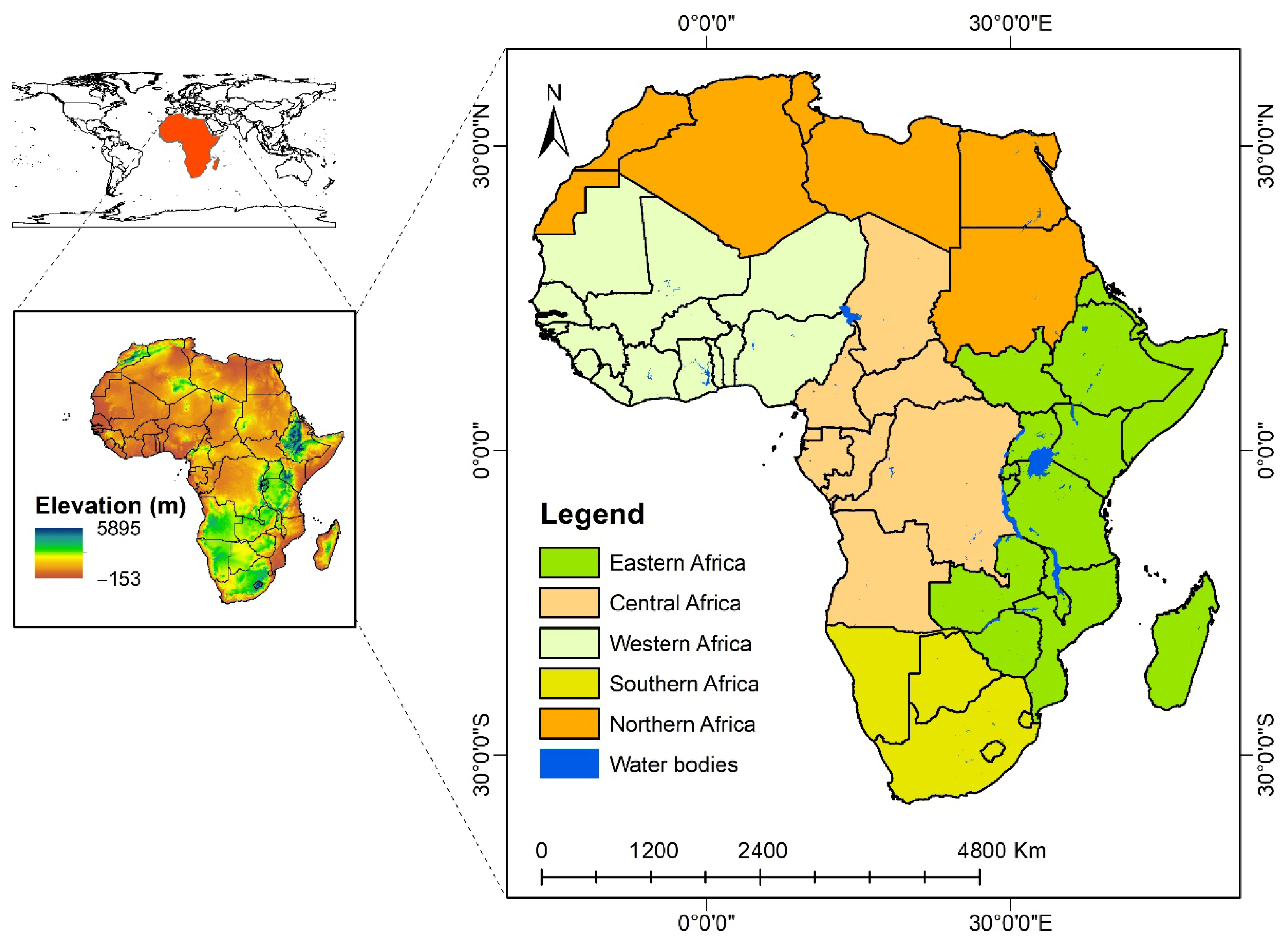
Africa is the second largest continent, stretching from 35° N to 35° S (Figure 1) and covers an area of approximately 30.37 million km2 [29,30]. Of the total area, the arid and semi-arid lands cover an area of approximately 65–70% contributing to the continent’s high sensitivity to climate variability and extremes [2]. Africa’s climate generally ranges from humid equatorial, through the tropical, to sub-tropical Mediterranean climate that differs in spatial and temporal variability [31]. On average, the continent receives less than 1000 mm of rainfall annually, which tends to decrease with distance from the equator, with negligible amounts recorded in Sahara, eastern Somalia and southwest of the continent [32]. The continent is endowed with diverse ecosystems with major features being evergreen tropical forests, bushlands, woodlands and savannah that are hotspots for biodiversity. Other geographic features in the continent are the Great Rift Valley, Mt. Kilimanjaro (5895 m above sea level) being the highest mountain in Africa, lake Victoria (second largest fresh water lake in the world covering about 69,000 km2) and Lake Tanganyika (depth of 1470 m, being the deepest lake in the world) [33,34]. The major deserts in the continent are Kalahari and Sahara [35].
Despite its vast land area, Africa is relatively insignificant for the harvest of cropland. As recently reported global assessments show that Africa accounts for 13 to 15% of global cropland harvested in all regions and less so than Asian countries [18]. The region’s farmers are affected by seasonal gradients and different crop types can apply to different agro-climatic zones as well [36]. A summary of the crops grown in the various climatic divisions in Africa is shown in Table 1.
Regional-level data on average cropped areas under the various crops compiled from the FAO database http://www.fao.org/faostat/en/#data (accessed on 14 March 2026 for the period 1980–2024 show that the area under common crops in Africa vary spatially and temporarily in various regions. Maize is the most dominant crop among the three cereals in Africa, covering 40.5% of the average cropped area under the three cereals (Table 2). West Africa dominates (13.7%) in the areas where the three crops (maize, millet and sorghum) are cultivated relative to the total cropped area in the continent (Table 2).

2.2. Methodology

2.2.1. Data for Crop Modelling

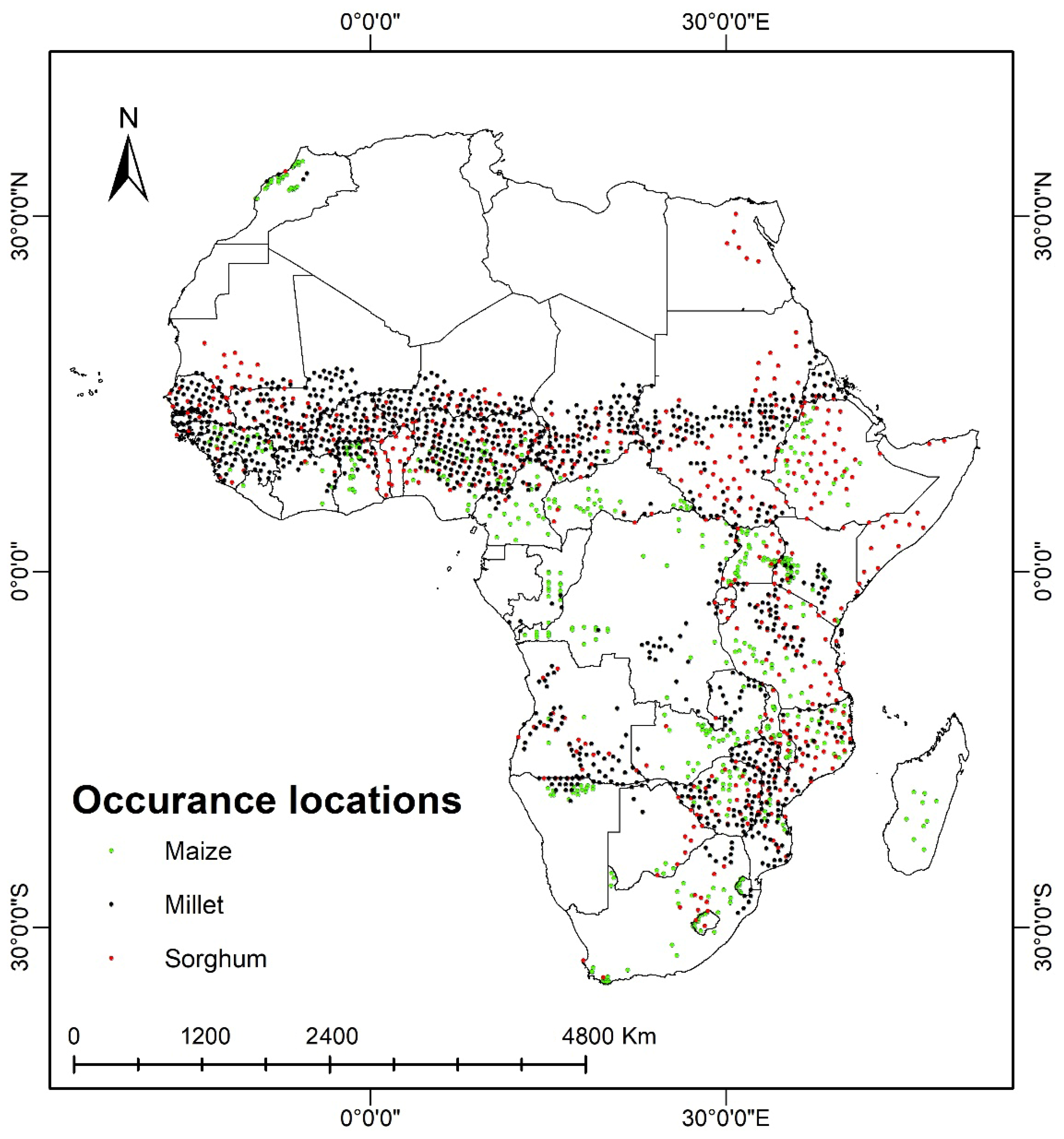
Occurrence records for maize, millet and sorghum were obtained by directly extracting the georeferenced data in the Global Biodiversity Information Facility (GBIF; http://www.gbif.org/, accessed on 19 January 2026). GBIF is one of the largest biodiversity data networks that promotes free dissemination of georeferenced species occurrence data and is widely used in ecological and agricultural modelling [38,39,40]. However, GBIF data are known to exhibit spatial sampling bias, often reflecting uneven collection effort rather than true species distributions. To minimise this bias and reduce spatial autocorrelation, we applied a 10 km spatial filtering threshold using the SDM Toolbox in ArcGIS version 11.5. This threshold corresponds to the ~1 km spatial resolution of the environmental layers and, is widely used to minimise geographic sampling biases arising from uneven data collection, which can otherwise introduce spatial autocorrelation and reduce model performance [41,42,43]. The filtering process resulted in 2365 unique records (551, 1199 and 615 for maize, millet and sorghum, respectively). This provided species occurrence location data for use to model land suitability for the various crops (Figure 2).
The environmental predictors used in this study comprised both climatic and non-climatic variables. Climatic variables (temperature and precipitation) were selected because they are the primary determinants of crop growth and distribution across Africa, strongly influencing physiological processes such as germination, growth rates and yield formation [44].
The climatic predictors were a set of 19 global gridded bioclimatic variables for the current and future climate available for download from http://worldclim.org, which is explained in detail by [45,46]. The bioclimatic variables reflect the aspects of temperature and precipitation at a spatial resolution of 30 arc seconds (~1 km) and include annual mean temperature, mean diurnal temperature range, isothermality, temperature seasonality, maximum temperature of warmest month, minimum temperature of the coldest month, temperature annual range, mean temperature of wettest quarter, mean temperature of the driest quarter, mean temperature of warmest quarter, mean temperature of coldest quarter, annual precipitation, precipitation of wettest month, precipitation of driest month, precipitation seasonality, precipitation of wettest quarter, precipitation of driest quarter, precipitation of warmest quarter and precipitation of coldest quarter (https://www.worldclim.org/, 19 January 2026).
Climate projections data were obtained from the HadGEM2-ES general circulation model (GCM) which has been observed to present model simulations that are closer to the mean of multimodal ensemble under the first phase of the Coupled Model Inter-comparison Project (CMIP6) protocols for historical and two future periods: 2050 (an average for years 2041–2060) and 2070 (an average for 2061–2080) for Africa [47]. Detailed description of HadGEM2-ES is provided by Jones and Hughes [48]. We used two emission scenarios, that is, the medium emissions scenario (RCP 4.5) with radiative forcing of ~4.5 W/m2 and the high emissions scenario (RCP 8.5) with radiative forcing of ~8.5 W/m2 [49,50]. The two RCPs provide contrasting policy scenarios and thus can help in understanding socio-economic uncertainties in projected climate impacts.
Additional input data sets used in modelling land suitability were the non-climatic predictors including elevation and soil data. A digital elevation model (DEM) with 30 arc- seconds (~1 km) spatial resolution for Africa was downloaded from https://databasin.org/datasets/, accessed on 19 January 2026. The DEM was developed by U.S. Geological Survey’s Centre for Earth Resources Observation and Science (EROS) in the year 1996 [51].
A raster soil data set developed by FAO for Africa was downloaded from https://africasis.isric.org/download.html (accessed 14 March 2026). The soil dataset provides soil attributes such as total organic carbon, cation exchange capacity (CEC), calcium carbonate (CaCO3), bulk density, Carbon/nitrogen (C/N), pH and percentage of sand, silt and clay for the top soil (0–30 cm) and for the sub soil (30–100 cm).

2.2.2. Species Distribution Modelling

Species distribution modelling was conducted using maximum entropy (MaxEnt version 3.4.4), a widely used presence-only algorithm for predicting distribution of flora and fauna species [25]. The model applies a machine-learning mechanism called maximum entropy modelling to simulate species distributions by use of species presence-only locations and a set of environmental predictor variables [26]. Model performance was evaluated using 10 replicate runs with random subsampling, allocating 80% (1892) of the occurrence location data to train the model and the remainder to evaluate the analytical performance of the model based on the area under the curve (AUC) of the receiver operating characteristic. The AUC measures the ability of the model to discriminate binary data for testing the accuracies of species prediction modelling between the sites with species and those without [26,52,53]. The AUC values range from 0.5 to 1.0, representing low to excellent performance of the model [53]. Recent studies highlight that MaxEnt remains one of best most presence-only models used for both habitat and agricultural suitability analyses [54].

2.2.3. Climate Suitability Classification

The ENM model converted the climate data calibrated from the current climatic conditions in locations that maize, millet and sorghum are grown, into a mosaic of climatic stabilities. Thus, the average model outputs of the 10 replicate runs under the study for each species were analysed in spatial analyst tools available in ArcGIS for climate suitability. The maximum training sensitivity and specificity Cloglog transformation was used to visualise the binary maps showing suitability distribution under the current and future climate scenarios for 2050 and 2070. Land suitability for crop production was assessed in four classes: highly suitable (lands with suitable optimal conditions for crop productivity); moderately suitable (lands with minor climatic limitations for optimal cultivation of crops); mildly suitable (lands with major climatic limitations that may significantly affect crop production); and unsuitable (lands with severe climatic limitations for crop production) [55]. In essence, the suitability classification is a comparison of conditions that permit successful plant productivity.
For the various crops, the potential spatial extent of suitable lands was derived by comparing the current suitability with baseline conditions in terms of gain (improved suitability) or loss (change to lower suitability) in suitability. Such detection of changes is helpful in identifying the likely opportunities and risks for rainfed agricultural systems under climate scenarios [56].

3. Results

3.1. Environmental Factors Influencing Climatic Suitability

Among the 19 bioclimatic variables, three rainfall variables (annual rainfall, precipitation of the wettest quarter, coefficient of precipitation variation) and three temperature variables (mean temperature of wettest quarter, temperature seasonality and annual mean temperature) were found to be considerable contributors towards distribution of maize, millet and sorghum in Africa. The relative contribution of the climatic variables in the MaxENT model showed that the most contributing bioclimatic variable in the three crop species was the annual precipitation. Other variables that were significant for maize, millet and sorghum were, respectively, mean temperature, coefficient of precipitation variation and temperature seasonality. Soil was the least contributing variable to the model (Table 3).

3.2. Current and Future Climatic Suitability Evaluation

The MaxENT models produced AUC values above 0.75, indicating good performance in predicting land suitability for the crops [57,58].
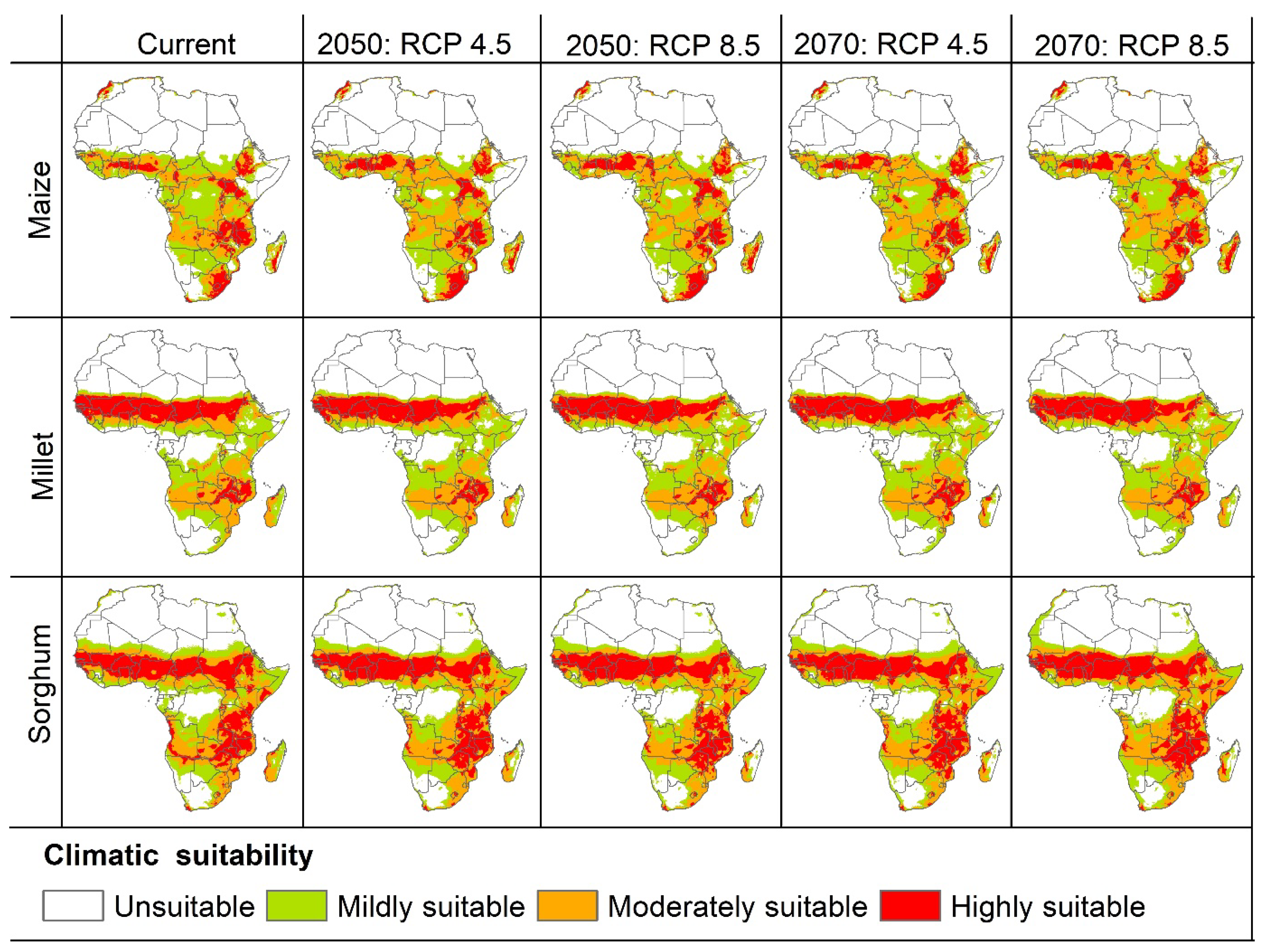
The simulated results showed variability in climatic suitability for the various crops across the continent for current, 2050 and 2070 (Figure 3). The highest suitability for all the crops (maize, millet and sorghum) is mainly in western, eastern and southern sub-regions of the sub-Saharan Africa.
Under current climate conditions, the three crops together occupy about 4.5 million km2 of highly suitable land, 5.8 million km2 of moderately suitable land, and 6.1 million km2 of mildly suitable land. Maize has about 2.7 million km2 of highly suitable area, compared with 4.5 million km2 for millet and 6.2 million km2 for sorghum. Moderate-suitability zones are similar across the three crops, ranging from 5.5 to 6.4 million km2, while mild-suitability areas span 5.9 to 6.6 million km2 (Table 4). Overall, sorghum occupies the largest extent of suitable land, followed by millet and then maize.
Maize is projected to have approximately 3.3 million km2 of highly suitable area in both 2050 and 2070, while moderate suitability is expected to increase slightly from about 6.3 million km2 in 2050 to 6.4 million km2 in 2070, and mild suitability from around 5.7 million km2 to 5.9 million km2 over the same period. Millet is projected to expand its highly suitable area from about 4.4 million km2 in 2050 to roughly 4.5 million km2 in 2070, with moderate suitability increasing from approximately 5.2 million km2 to 5.5 million km2, while mild suitability shows a slight decline from around 6.3 million km2 to 6.1 million km2. Sorghum remains the most spatially extensive crop across both periods, with high suitability increasing from about 6.2 million km2 in 2050 to 6.6 million km2 in 2070, moderate suitability from 6.3 million km2 to 6.8 million km2, and mild suitability remaining stable at approximately 5.3 million km2 (Table 4).
Relative to the current climate, areas that are moderately to highly suitable for maize increase by 11.1–19.4% in 2050 and 14.5–22.2% in 2070. In contrast, millet shows a decline of up to 7.3% in these suitability classes. Sorghum experiences a reduction of up to 3.1% by 2050, but by 2070 may gain up to 6.5% under the RCP 8.5 scenario (Table 5). Overall, combined moderate-to-high suitability increases slightly by 2050 and 2070, while mildly suitable areas decline by 0.4–0.6 million km2.
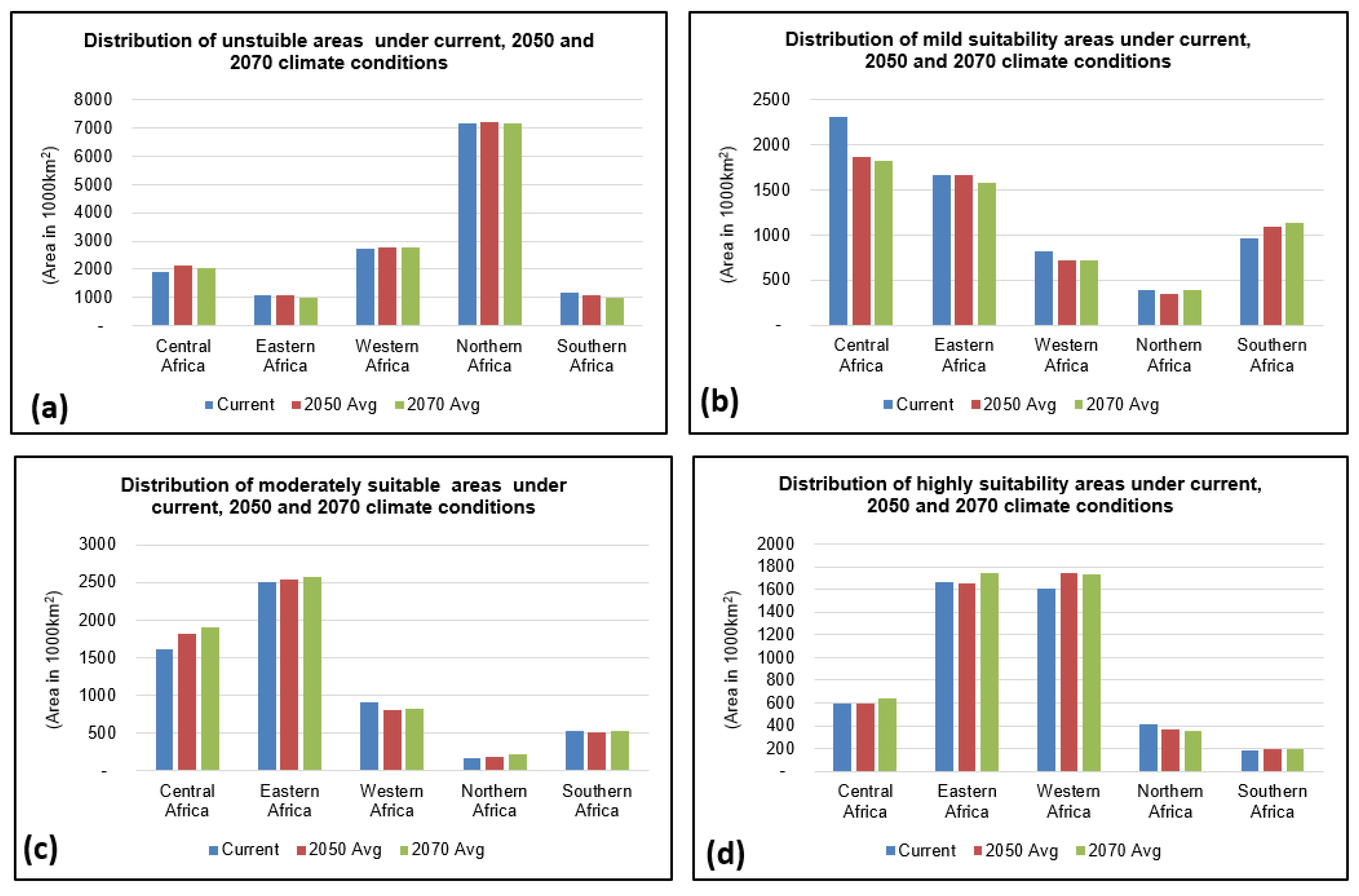
Across all time periods, Northern Africa contains the largest areas classified as unsuitable for maize, millet and sorghum, covering 7.1–7.2 million km2 (Table 6). Additional unsuitable zones occur in Western Africa (2.7–2.8 million km2), Central Africa (1.9–2.2 million km2), Southern Africa (1.0–1.2 million km2) and Eastern Africa (0.9–1.1 million km2). Suitable areas are greatest in Eastern Africa (2.5–2.7 million km2), followed by Central Africa (1.6–2.0 million km2), Western Africa (0.8–0.9 million km2), Southern Africa (0.5 million km2) and Northern Africa (0.2 million km2). Highly suitable land is most concentrated in eastern and Western Africa, each with 1.6–1.8 million km2.
A summary of the results from Table 6 is presented in Figure 4, illustrating the distribution of suitability classes across Africa. The suitability trends reveal clear regional contrasts from the current climate to 2050 and 2070. Eastern Africa remains the most favourable region, characterised by low and declining unsuitability and consistently large areas of moderate-to-high suitability. Central Africa shows a slight increase in unsuitable land, a decline in mild suitability, and steady gains in both moderate and highly suitable areas. Western Africa experiences gradual increases in unsuitability and reductions in mild suitability, while moderate and high suitability remain stable or increase slightly. Southern Africa shows progressive reductions in unsuitable land alongside small increases in mild, moderate and highly suitable areas. In contrast, Northern Africa remains dominated by unsuitable land with minimal change over time, continuing to be the least suitable region for crop production.

4. Discussion

4.1. Spatial Trend in Land Suitability for Crop Cultivation

This study applied maximum entropy (MaxENT) modelling and spatial analysis in ArcGIS environment to evaluate climatic suitability for maize, millet and sorghum production. The simulated results show that projected changes in climatic suitability in Africa are crop and region-specific. The results show a clear increase in areas that are climatically suitable for maize production and a slight decrease in areas suitable for millet and sorghum (Table 5). Regionally, Central and Western Africa show an increase in areas that are currently unsuitable for production of the three staple crops, and a decrease in Northern Africa. The changes in land suitability for the common crops are highly influenced by rainfall that emerged as a key predictor in the model performance. Rainfall alongside temperature influence the crop phenology and water balance. The non-climatic variables (elevation and soil data) are among the ecophysiologically meaningful predictors in plant species modelling that are meant to increase predictive accuracy of the model in capturing important environmental requirements for a species [59]. However, in this study these variables contributed only minimally. Such weak influence aligns with evidence showing that at broad spatial scales, climatic factors are the primary drivers of species distributions, whereas soil and topographic attributes tend to have secondary or indirect effects [60,61]. Continental-scale soil datasets typically exhibit low spatial variability, which limits their ability to explain fine-scale suitability patterns when compared with the much stronger gradients in temperature and rainfall [62]. Elevation also affects crop suitability mainly through its influence on temperature and moisture regimes, factors already captured by the climatic predictors used in the model.
The projected spatial and temporal suitability corroborates other studies on climate suitability that established that climate change and variability is likely to render some areas with improved and others with decreased suitability for crop cultivation (for example: Jayasinghe and Kumar [21], Ovalle-Rivera, Läderach [23], Kogo and Kumar [55], He and Zhou [63]). In Africa, the direct effects of climate change are projected to be variable with regions exhibiting wetter, drier or hotter conditions [2,29,64,65], leading to gain or loss of climatic suitability for crop production.
The impact of climate change and variability on crop production varies in terms of the region, the growing season, crop growth and yield, hydrological balances and other components affecting agricultural systems [66,67]. Given that climate is a primary determinant of agricultural productivity, any spatial and temporal changes will shift agro-climatic zones for crop production, leading to changes in cropping systems and crop productivity. The major drivers of Africa’s climate are the Inter Tropical Convergence Zone (ITCZ), the El Niño–Southern Oscillation (ENSO) and the West African Monsoon that result from the interactions between the atmosphere, land and ocean [29,64,68]. The adverse impacts of climate change that are likely to influence the shifts in land suitability are the changes in spatial and temporal patterns of temperature, daily and inter-annual variability of rainfall and changes in drought and flood hazards. Climate variability does not only influence land suitability, but also the onset and cessation of rainfall that may influence productivity and maturity period of agricultural crops and yield potential [69,70].
The simulation results of this study indicate that climate change is likely to have either an advantageous or disadvantageous impact on the suitability of areas for the production of maize, millet, or sorghum. Among the three crops, maize production is likely to benefit from the shifts in suitable areas, which are projected to increase by approximately 19.4% and 22.2% in the years 2050 and 2070, respectively (Table 5). Thornton and Jones [71], noted that there is a possibility of warming of high-altitude zones in Eastern Africa as a result of climate change which is likely to benefit maize production. In addition, there is a possibility of projected increase in annual rainfall in East Africa, which is likely to improve land suitability for crop production [72]. On the other hand, the maize-based systems in Southern Africa are likely to be negatively affected by climate change, leading to loss of yield by up to 18% [7]. The results also show a decline in areas of high suitability for crop production in Northern Africa under future climate (Table 6). As per the Fifth Assessment Report of the IPCC, Southern Africa and Northern Africa have been singled out as some of the regions that are likely be affected by a reduction in precipitation by the end of the 21st century [2]. Area suitability losses are projected for millet and sorghum in the range of 1.6–7.3% (Table 5). This is supported by the findings of Sultan and Gaetani [15], who argue that an increase in temperature above 2 °C particularly in some regions such as West Africa is likely to diminish the yield potential of the crops, irrespective of the changes in rainfall. Extreme temperature rise affects land suitability for optimum plant growth and development by interfering with phenological stages and creating severe water stress conditions through elevated evapotranspiration [5,44,73]. These spatial patterns are further clarified when the projected physiological responses of the crops are taken into account. Maize, which is generally more sensitive to heat and moisture stress than millet or sorghum, is expected to benefit in cooler and higher-elevation regions where future warming may shift local climates closer to its optimal temperature and moisture requirements [74]. In contrast, millet and sorghum already perform well under hot and dry conditions, meaning that further increases in temperature and reductions in rainfall across many lowland and semi-arid areas are likely to exceed their upper tolerance limits. Consequently, these regions are projected to experience declines in suitability for both crops [15,75].

4.2. Adaptation and Policy Implications

The projected shifts in land suitability for common crops will most likely affect food security in the continent as more frequent or severe drought years are anticipated [14,76,77]. Thus, adapting crop production to prevailing local ecological conditions may be required to sustain crop production under climate change. Options for anticipatory adaptation in African agriculture should include planning for water reservoirs and irrigation schemes in areas showing decline in precipitation. Considering the anticipated increase in CO2 concentrations, there may be a need for the continent to enhance research on establishment of cultivars with positive responses to CO2. Protection of crop production systems against the current and anticipated future weather extreme occurrences that may result from climate change should give priority to the establishment of (i) drought early warning and preparedness, (ii) use of improved germplasm, and (iii) modification of crop cultivars to increase heat and drought tolerance [14,74,78,79,80]. Support is also needed in order to sustain agricultural development through better use of climate information to intensify crop production, manage local and regional water resources and reduce vulnerabilities through integration of regional development. Considering the shift in climate suitability, there is also potential for adopting crop varieties in other regions that have similar abiotic and biotic stresses [66,81,82].
In terms of agricultural drought management, the continent should encourage policies and strategies that recognise drought as part of variable climate change, rather than treating it as a natural catastrophe in order to reduce vulnerability threats and increase resilience [83]. The process of enhancing adaptive capacity should also consider incorporating climate change in long-term planning policy decisions [84]. In particular, land-use planning for agricultural purposes should be informed by climate suitability assessments for crop cultivation. Likewise, there will be a need to promote awareness on climate change and the potential risks among farmers and decision makers. For instance, in areas where climatic conditions such as temperature and rainfall are projected to decline, farmers should be encouraged to diversify their cropping systems and develop options to switch to in case the conditions become unfavourable. Given the financial constraints many smallholders face when shifting to new crops, promoting diversification rather than reliance on a single crop is essential. Encouraging small-scale farmers to avoid monoculture and plant a wider variety of crops can help to reduce the risk of climate-related crop failure [18,82]. Although the present analysis is restricted to the three major cereals, incorporating other key food-security crops into future suitability assessments would provide decision-makers with a broader set of adaptation options, particularly in regions where sorghum and millet are projected to decline.

4.3. Methodological Limitations and Future Work

Land suitability assessments are subject to uncertainties which arise from the modelling tools, reliability and quality of data (climate variables and species occurrences), and emissions scenarios [85,86]. For example, the species occurrences data downloaded from GBIF database records could be affected by location errors [87]. Other uncertainties in crop modelling relate to GCM projections due to greenhouse gas emission scenarios [88,89]. Additional uncertainty stems from the climatic data which are broad scale; hence, the results presented are on broad shifts on land suitability and are subject to changes in future climate. Recent studies also highlight that climate-impact projects continue being highly reliant on the quality of climate inputs, with course-scale datasets often masking the fine-scale climatic and edaphic variations relevant to crop cultivation [90,91,92]. The model did not account for the potential carbon fertilisation effect (CO2 fertilisation), which may partially offset heat-related yield losses for some crops. This omission represents a methodological gap that should be addressed in future work. In addition, this study has not included socio-economic constraints faced by smallholder farmers such as limited access to credit and extension service which can constraint their ability to adopt alternative crops under changing climate even in areas likely to gain suitability. It is also worth noting that not all areas simulated by the model under this study grow the stated cereal crops since some areas that are shown as climatically suitable may not be growing the crops, reflecting possibilities of unsuitable soils, prevalence of other crops and other land uses such settlements or protected areas [15,93]. Therefore, future research should prioritise country-specific suitability assessments that consider various land covers and uses in order to establish effective areas under the climate suitability classification.

5. Conclusions

This study provides an assessment of how climate change is likely to reshape the climatic suitability of maize, millet and sorghum across Africa. The results show that maize is projected to experience notable expansions in climatically suitable areas, while millet and sorghum face moderate contractions, particularly in regions where rising temperatures and declining rainfall occur. These shifts are strongly driven by rainfall and temperature variability, reaffirming the central role of climate in determining agro-ecological potential across the continent. By integrating MaxENT modelling with spatial analysis, the study advances understanding of how future warming and shifting precipitation patterns may reshape Africa’s agricultural landscapes. Despite these insights, the analysis is constrained by uncertainties arising from the limitations of species distribution modelling, the use of coarse resolution climate inputs, and the exclusion of socio-economic and land-use constraints that influence farmers’ ability to adopt alternative crops. Future research should therefore prioritise higher resolution climate and soil datasets, incorporate CO2 fertilisation effects and integrate socio-economic issues to better align suitability projections with on-the-ground feasibility.
Overall, the projected shift in suitable areas for Africa’s staple cereals underscores the urgency of climate-responsive agricultural planning. Strengthening adaptation strategies through improved germplasm, enhanced drought preparedness, strategic investment in irrigation and diversification of cropping systems will be critical for safeguarding food production under changing climate.

Author Contributions

Conceptualization, B.K.K. and P.K.L.; Methodology, B.K.K.; Software, B.K.K.; Validation, B.K.K.; Formal analysis, B.K.K.; Investigation, B.K.K.; Resources, B.K.K.; Data curation, B.K.K.; Writing—original draft, B.K.K.; Writing—review and editing, B.K.K. and P.K.L.; Visualisation B.K.K.; Supervision, P.K.L. All authors have read and agreed to the published version of the manuscript.

Funding

This research was not externally supported.

Data Availability Statement

The datasets used and analysed in the current study are publicly available.

Conflicts of Interest

The authors have no conflicts of interest to declare.

References

  1. Practical, G. An Introduction to the Basic Concepts of Food Security; FAO: Rome, Italy, 2008. [Google Scholar]
  2. IPCC. Impacts, Adaptation and Vulnerability: The IPCC Sixth Assessment Report; IPCC: Cambridge, UK, 2022. [Google Scholar]
  3. Challinor, A.; Wheeler, T.; Garforth, C.; Craufurd, P.; Kassam, A. Assessing the vulnerability of food crop systems in Africa to climate change. Clim. Change 2007, 83, 381–399. [Google Scholar] [CrossRef]
  4. Leal Filho, W.; Totin, E.; Roncoli, C.; Dlamini, L.; North, M.A.; Rudden, W.; Ayimasse, A.F.; Assogba, F.J.; Zoundji, G.C.; Trisos, C.H. Climate change and food production in Africa: What do we know about climate related losses and damages, and adaptation responses? Clim. Dev. 2026, 1–11. [Google Scholar] [CrossRef]
  5. Roudier, P.; Sultan, B.; Quirion, P.; Berg, A. The impact of future climate change on West African crop yields: What does the recent literature say? Glob. Environ. Change 2011, 21, 1073–1083. [Google Scholar] [CrossRef]
  6. Funk, C.; Dettinger, M.D.; Michaelsen, J.C.; Verdin, J.P.; Brown, M.E.; Barlow, M.; Hoell, A. Warming of the Indian Ocean threatens eastern and southern African food security but could be mitigated by agricultural development. Proc. Natl. Acad. Sci. USA 2008, 105, 11081–11086. [Google Scholar] [CrossRef]
  7. Lobell, D.B.; Burke, M.B.; Tebaldi, C.; Mastrandrea, M.D.; Falcon, W.P.; Naylor, R.L. Prioritizing climate change adaptation needs for food security in 2030. Science 2008, 319, 607–610. [Google Scholar] [CrossRef]
  8. Kogo, B.K.; Kumar, L.; Koech, R. Climate change and variability in Kenya: A review of impacts on agriculture and food security. Environ. Dev. Sustain. 2021, 23, 23–43. [Google Scholar] [CrossRef]
  9. Giannini, A.; Biasutti, M.; Held, I.M.; Sobel, A.H. A global perspective on African climate. Clim. Change 2008, 90, 359–383. [Google Scholar] [CrossRef]
  10. Shiferaw, B.; Prasanna, B.M.; Hellin, J.; Bänziger, M. Crops that feed the world 6. Past successes and future challenges to the role played by maize in global food security. Food Secur. 2011, 3, 307. [Google Scholar] [CrossRef]
  11. Macauley, H.; Ramadjita, T. Cereal crops: Rice, maize, millet, sorghum, wheat. Feed. Afr. 2015, 36, 2017–2021. [Google Scholar]
  12. Belton, P.S.; Taylor, J.R. Sorghum and millets: Protein sources for Africa. Trends Food Sci. Technol. 2004, 15, 94–98. [Google Scholar] [CrossRef]
  13. Garí, J.A. Review of the African millet diversity. In International Workshop on Fonio, Food Security and Livelihood Among the Rural Poor in West Africa; IPGRI/IFAD: Bamako, Mali, 2002; pp. 19–22. [Google Scholar]
  14. Rippke, U.; Ramirez-Villegas, J.; Jarvis, A.; Vermeulen, S.J.; Parker, L.; Mer, F.; Diekkrüger, B.; Challinor, A.J.; Howden, M. Timescales of transformational climate change adaptation in sub-Saharan African agriculture. Nat. Clim. Change 2016, 6, 605–609. [Google Scholar] [CrossRef]
  15. Sultan, B.; Gaetani, M. Agriculture in West Africa in the twenty-first century: Climate change and impacts scenarios, and potential for adaptation. Front. Plant Sci. 2016, 7, 1262. [Google Scholar] [CrossRef]
  16. Müller, C.; Cramer, W.; Hare, W.L.; Lotze-Campen, H. Climate change risks for African agriculture. Proc. Natl. Acad. Sci. USA 2011, 108, 4313–4315. [Google Scholar] [CrossRef]
  17. Adhikari, U.; Nejadhashemi, A.P.; Woznicki, S.A. Climate change and eastern Africa: A review of impact on major crops. Food Energy Secur. 2015, 4, 110–132. [Google Scholar] [CrossRef]
  18. FAO. The State of Food and Agriculture 2021: Making Agrifood Systems more Resilient to Shocks and Stresses; FAO: Rome, Italy, 2021. [Google Scholar]
  19. Trisurat, Y.; Shrestha, R.P.; Kjelgren, R. Plant species vulnerability to climate change in Peninsular Thailand. Appl. Geogr. 2011, 31, 1106–1114. [Google Scholar] [CrossRef]
  20. Beck, J. Predicting climate change effects on agriculture from ecological niche modeling: Who profits, who loses? Clim. Change 2013, 116, 177–189. [Google Scholar] [CrossRef]
  21. Jayasinghe, S.L.; Kumar, L. Modeling the climate suitability of tea [Camellia sinensis (L.) O. Kuntze] in Sri Lanka in response to current and future climate change scenarios. Agric. For. Meteorol. 2019, 272, 102–117. [Google Scholar] [CrossRef]
  22. Ji, Y.; Zhou, G.; He, Q.; Wang, L. The effect of climate change on spring maize (Zea mays L.) suitability across China. Sustainability 2018, 10, 3804. [Google Scholar] [CrossRef]
  23. Ovalle-Rivera, O.; Läderach, P.; Bunn, C.; Obersteiner, M.; Schroth, G. Projected shifts in Coffea arabica suitability among major global producing regions due to climate change. PLoS ONE 2015, 10, e0124155. [Google Scholar] [CrossRef]
  24. He, Q.; Zhou, G. Climate-associated distribution of summer maize in China from 1961 to 2010. Agric. Ecosyst. Environ. 2016, 232, 326–335. [Google Scholar] [CrossRef]
  25. Morales, N.S.; Fernández, I.C.; Baca-González, V. MaxEnt’s parameter configuration and small samples: Are we paying attention to recommendations? A systematic review. PeerJ 2017, 5, e3093. [Google Scholar] [CrossRef]
  26. Phillips, S.J.; Anderson, R.P.; Schapire, R.E. Maximum entropy modeling of species geographic distributions. Ecol. Model. 2006, 190, 231–259. [Google Scholar] [CrossRef]
  27. Merow, C.; Smith, M.J.; Silander, J.A., Jr. A practical guide to MaxEnt for modeling species’ distributions: What it does, and why inputs and settings matter. Ecography 2013, 36, 1058–1069. [Google Scholar] [CrossRef]
  28. Thornton, P.K.; Ericksen, P.J.; Herrero, M.; Challinor, A.J. Climate variability and vulnerability to climate change: A review. Glob. Change Biol. 2014, 20, 3313–3328. [Google Scholar] [CrossRef]
  29. Collier, P.; Conway, G.; Venables, T. Climate change and Africa. Oxf. Rev. Econ. Policy 2008, 24, 337–353. [Google Scholar] [CrossRef]
  30. Awojobi, O.N.; Tetteh, J. The impacts of climate change in Africa: A review of the scientific literature. J. Int. Acad. Res. Multidiscip. 2017, 5, 39–52. [Google Scholar]
  31. Hulme, M.; Doherty, R.; Ngara, T.; New, M.; Lister, D. African climate change: 1900–2100. Clim. Res. 2001, 17, 145–168. [Google Scholar] [CrossRef]
  32. Nicholson, S.E. The nature of rainfall variability over Africa on time scales of decades to millenia. Glob. Planet. Change 2000, 26, 137–158. [Google Scholar] [CrossRef]
  33. Hemp, A. Climate change-driven forest fires marginalize the impact of ice cap wasting on Kilimanjaro. Glob. Change Biol. 2005, 11, 1013–1023. [Google Scholar] [CrossRef]
  34. Anyah, R.; Semazzi, F. Simulation of the sensitivity of Lake Victoria basin climate to lake surface temperatures. Theor. Appl. Climatol. 2004, 79, 55–69. [Google Scholar] [CrossRef]
  35. Williams, M. Climate Change in Deserts; Cambridge University Press: Cambridge, UK, 2014. [Google Scholar]
  36. Leff, B.; Ramankutty, N.; Foley, J.A. Geographic distribution of major crops across the world. Glob. Biogeochem. Cycles 2004, 18, GB1009. [Google Scholar] [CrossRef]
  37. Garrity, D.; Dixon, J.; Boffa, J.-M. Understanding African Farming Systems; Australian International Food Security Centre: Canberra, Australia, 2012; pp. 1–50.
  38. Gilman, E.; King, N.; Peterson, T.; Chavan, V.; Hahn, A. Building the biodiversity data commons—The global biodiversity information facility. In ICT for Agriculture and Biodiversity Conservation; Graz University of Technology: Graz, Austria, 2009; pp. 79–99. [Google Scholar]
  39. Yesson, C.; Brewer, P.W.; Sutton, T.; Caithness, N.; Pahwa, J.S.; Burgess, M.; Gray, W.A.; White, R.J.; Jones, A.C.; Bisby, F.A. How global is the global biodiversity information facility? PLoS ONE 2007, 2, e1124. [Google Scholar] [CrossRef]
  40. Jetz, W.; McPherson, J.M.; Guralnick, R.P. Integrating biodiversity distribution knowledge: Toward a global map of life. Trends Ecol. Evol. 2012, 27, 151–159. [Google Scholar] [CrossRef]
  41. Boria, R.A.; Olson, L.E.; Goodman, S.M.; Anderson, R.P. Spatial filtering to reduce sampling bias can improve the performance of ecological niche models. Ecol. Model. 2014, 275, 73–77. [Google Scholar] [CrossRef]
  42. Dormann, C.F.; Elith, J.; Bacher, S.; Buchmann, C.; Carl, G.; Carré, G.; Marquéz, J.R.G.; Gruber, B.; Lafourcade, B.; Leitão, P.J. Collinearity: A review of methods to deal with it and a simulation study evaluating their performance. Ecography 2013, 36, 27–46. [Google Scholar] [CrossRef]
  43. Veloz, S.D. Spatially autocorrelated sampling falsely inflates measures of accuracy for presence-only niche models. J. Biogeogr. 2009, 36, 2290–2299. [Google Scholar] [CrossRef]
  44. Hatfield, J.L.; Prueger, J.H. Temperature extremes: Effect on plant growth and development. Weather Clim. Extrem. 2015, 10, 4–10. [Google Scholar] [CrossRef]
  45. Hijmans, R.J.; Cameron, S.E.; Parra, J.L.; Jones, P.G.; Jarvis, A. Very high resolution interpolated climate surfaces for global land areas. Int. J. Climatol. A J. R. Meteorol. Soc. 2005, 25, 1965–1978. [Google Scholar] [CrossRef]
  46. Fick, S.E.; Hijmans, R.J. WorldClim 2: New 1-km spatial resolution climate surfaces for global land areas. Int. J. Climatol. 2017, 37, 4302–4315. [Google Scholar] [CrossRef]
  47. Dike, V.N.; Shimizu, M.H.; Diallo, M.; Lin, Z.; Nwofor, O.K.; Chineke, T.C. Modelling present and future African climate using CMIP5 scenarios in HadGEM2-ES. Int. J. Climatol. 2015, 35, 1784–1799. [Google Scholar] [CrossRef]
  48. Jones, C.; Hughes, J.; Bellouin, N.; Hardiman, S.; Jones, G.; Knight, J.; Liddicoat, S.; O’connor, F.; Andres, R.J.; Bell, C. The HadGEM2-ES implementation of CMIP5 centennial simulations. Geosci. Model Dev. 2011, 4, 543–570. [Google Scholar] [CrossRef]
  49. Meinshausen, M.; Smith, S.J.; Calvin, K.; Daniel, J.S.; Kainuma, M.; Lamarque, J.-F.; Matsumoto, K.; Montzka, S.; Raper, S.; Riahi, K. The RCP greenhouse gas concentrations and their extensions from 1765 to 2300. Clim. Change 2011, 109, 213. [Google Scholar] [CrossRef]
  50. Moss, R.H.; Edmonds, J.A.; Hibbard, K.A.; Manning, M.R.; Rose, S.K.; Van Vuuren, D.P.; Carter, T.R.; Emori, S.; Kainuma, M.; Kram, T. The next generation of scenarios for climate change research and assessment. Nature 2010, 463, 747–756. [Google Scholar] [CrossRef]
  51. Harding, D.J.; Gesch, D.B.; Carabajal, C.C.; Luthcke, S.B. Application of the shuttle laser altimeter in an accuracy assessment of GTOPO30, a global 1-kilometer digital elevation model. Int. Arch. Photogramm. Remote Sens. 1999, 32, 81–85. [Google Scholar]
  52. Peterson, A.T.; Papeş, M.; Soberón, J. Rethinking receiver operating characteristic analysis applications in ecological niche modeling. Ecol. Model. 2008, 213, 63–72. [Google Scholar] [CrossRef]
  53. Elith, J.; Graham*, C.H.; Anderson, R.P.; Dudík, M.; Ferrier, S.; Guisan, A.; Hijmans, R.J.; Huettmann, F.; Leathwick, J.R.; Lehmann, A. Novel methods improve prediction of species’ distributions from occurrence data. Ecography 2006, 29, 129–151. [Google Scholar] [CrossRef]
  54. Lissovsky, A.A.; Dudov, S.V. Species-distribution modeling: Advantages and limitations of its application. 2. MaxEnt. Biol. Bull. Rev. 2021, 11, 265–275. [Google Scholar] [CrossRef]
  55. Kogo, B.K.; Kumar, L.; Koech, R.; Kariyawasam, C.S. Modelling climate suitability for rainfed Maize cultivation in Kenya using a Maximum Entropy (MaxENT) approach. Agronomy 2019, 9, 727. [Google Scholar] [CrossRef]
  56. Li, J.; Zhang, B.; Mao, Y.; Jiang, J.; Li, K.; You, S. Comparative analysis of habitat suitability for a crop and its primary insect herbivore: Providing insights for crop planting and pest management strategies. Front. Ecol. Evol. 2024, 11, 1305369. [Google Scholar] [CrossRef]
  57. Swets, J.A. Measuring the accuracy of diagnostic systems. Science 1988, 240, 1285–1293. [Google Scholar] [CrossRef]
  58. Pramanik, M.; Paudel, U.; Mondal, B.; Chakraborti, S.; Deb, P. Predicting climate change impacts on the distribution of the threatened Garcinia indica in the Western Ghats, India. Clim. Risk Manag. 2018, 19, 94–105. [Google Scholar] [CrossRef]
  59. Mod, H.K.; Scherrer, D.; Luoto, M.; Guisan, A. What we use is not what we know: Environmental predictors in plant distribution models. J. Veg. Sci. 2016, 27, 1308–1322. [Google Scholar] [CrossRef]
  60. Elith, J.; Leathwick, J.R. Species distribution models: Ecological explanation and prediction across space and time. Annu. Rev. Ecol. Evol. Syst. 2009, 40, 677–697. [Google Scholar] [CrossRef]
  61. Soberón, J.; Nakamura, M. Niches and distributional areas: Concepts, methods, and assumptions. Proc. Natl. Acad. Sci. USA 2009, 106, 19644–19650. [Google Scholar] [CrossRef]
  62. Hengl, T.; De Jesus, J.M.; MacMillan, R.A.; Batjes, N.H.; Heuvelink, G.B.; Ribeiro, E.; Samuel-Rosa, A.; Kempen, B.; Leenaars, J.G.; Walsh, M.G. SoilGrids1km—Global soil information based on automated mapping. PLoS ONE 2014, 9, e105992. [Google Scholar] [CrossRef]
  63. He, Q.; Zhou, G. The climatic suitability for maize cultivation in China. Chin. Sci. Bull. 2012, 57, 395–403. [Google Scholar] [CrossRef]
  64. Mulenga, H.; Rouault, M.; Reason, C. Dry summers over northeastern South Africa and associated circulation anomalies. Clim. Res. 2003, 25, 29–41. [Google Scholar] [CrossRef]
  65. Kikstra, J.S.; Nicholls, Z.R.; Smith, C.J.; Lewis, J.; Lamboll, R.D.; Byers, E.; Sandstad, M.; Meinshausen, M.; Gidden, M.J.; Rogelj, J. The IPCC Sixth Assessment Report WGIII climate assessment of mitigation pathways: From emissions to global temperatures. Geosci. Model. Dev. 2022, 15, 9075–9109. [Google Scholar] [CrossRef]
  66. Lane, A.; Jarvis, A. Changes in climate will modify the geography of crop suitability: Agricultural biodiversity can help with adaptation. SAT eJournal 2007, 4, 1–12. [Google Scholar]
  67. Knox, J.; Hess, T.; Daccache, A.; Wheeler, T. Climate change impacts on crop productivity in Africa and South Asia. Environ. Res. Lett. 2012, 7, 034032. [Google Scholar] [CrossRef]
  68. Ropelewski, C.F.; Halpert, M.S. Global and regional scale precipitation patterns associated with the El Niño/Southern Oscillation. Mon. Weather Rev. 1987, 115, 1606–1626. [Google Scholar] [CrossRef]
  69. Zabel, F.; Putzenlechner, B.; Mauser, W. Global agricultural land resources–a high resolution suitability evaluation and its perspectives until 2100 under climate change conditions. PLoS ONE 2014, 9, e107522. [Google Scholar] [CrossRef] [PubMed]
  70. Gopalakrishnan, T.; Hasan, M.K.; Haque, A.; Jayasinghe, S.L.; Kumar, L. Sustainability of Coastal Agriculture under Climate Change. Sustainability 2019, 11, 7200. [Google Scholar] [CrossRef]
  71. Thornton, P.K.; Jones, P.G.; Alagarswamy, G.; Andresen, J. Spatial variation of crop yield response to climate change in East Africa. Glob. Environ. Change 2009, 19, 54–65. [Google Scholar] [CrossRef]
  72. Ziervogel, G.; Cartwright, A.; Tas, A.; Adejuwon, J.; Zermoglio, F.; Shale, M.; Smith, B. Climate Change and Adaptation in African Agriculture; Stockholm Environment Institute: Stockholm, Sweden, 2008; pp. 17–19. [Google Scholar]
  73. Lipiec, J.; Doussan, C.; Nosalewicz, A.; Kondracka, K. Effect of drought and heat stresses on plant growth and yield: A review. Int. Agrophysics 2013, 27, 463–477. [Google Scholar] [CrossRef]
  74. Cairns, J.E.; Hellin, J.; Sonder, K.; Araus, J.L.; MacRobert, J.F.; Thierfelder, C.; Prasanna, B. Adapting maize production to climate change in sub-Saharan Africa. Food Secur. 2013, 5, 345–360. [Google Scholar] [CrossRef]
  75. Prasad, V.R.; Govindaraj, M.; Djanaguiraman, M.; Djalovic, I.; Shailani, A.; Rawat, N.; Singla-Pareek, S.L.; Pareek, A.; Prasad, P.V. Drought and high temperature stress in sorghum: Physiological, genetic, and molecular insights and breeding approaches. Int. J. Mol. Sci. 2021, 22, 9826. [Google Scholar] [CrossRef]
  76. Durodola, O.S. The impact of climate change induced extreme events on agriculture and food security: A review on Nigeria. Agric. Sci. 2019, 10, 487–498. [Google Scholar] [CrossRef]
  77. Weber, T.; Haensler, A.; Rechid, D.; Pfeifer, S.; Eggert, B.; Jacob, D. Analyzing regional climate change in Africa in a 1.5, 2, and 3 C global warming world. Earth’s Future 2018, 6, 643–655. [Google Scholar] [CrossRef]
  78. Beyene, Y.; Semagn, K.; Mugo, S.; Tarekegne, A.; Babu, R.; Meisel, B.; Sehabiague, P.; Makumbi, D.; Magorokosho, C.; Oikeh, S. Genetic gains in grain yield through genomic selection in eight bi-parental maize populations under drought stress. Crop Sci. 2015, 55, 154–163. [Google Scholar] [CrossRef]
  79. Jama, B.; Pizarro, G. Agriculture in Africa: Strategies to improve and sustain smallholder production systems. Ann. N. Y. Acad. Sci. 2008, 1136, 218–232. [Google Scholar] [CrossRef]
  80. Mnukwa, M.L.; Mdoda, L.; Mudhara, M. Assessing the adoption and impact of climate-smart agricultural practices on smallholder maize farmers’ livelihoods in Sub-Saharan Africa: A systematic review. Front. Sustain. Food Syst. 2025, 9, 1543805. [Google Scholar] [CrossRef]
  81. Rejeb, I.B.; Pastor, V.; Mauch-Mani, B. Plant responses to simultaneous biotic and abiotic stress: Molecular mechanisms. Plants 2014, 3, 458–475. [Google Scholar] [CrossRef]
  82. Appiah, C.E.; Quarmine, W.; Osei-Amponsah, C.; Okem, A.E.; Sarpong, D.B. Improving smallholder farmers’ access to and utilization of climate information services in sub-Saharan Africa through social networks: A systematic review. Clim. Serv. 2025, 37, 100528. [Google Scholar] [CrossRef]
  83. Smith, J.B.; Lenhart, S.S. Climate change adaptation policy options. Clim. Res. 1996, 6, 193–201. [Google Scholar] [CrossRef]
  84. Smit, B.; Pilifosova, O. Adaptation to climate change in the context of sustainable development and equity. Sustain. Dev. 2003, 8, 9. [Google Scholar]
  85. Kassie, B.T.; Asseng, S.; Rotter, R.P.; Hengsdijk, H.; Ruane, A.C.; Van Ittersum, M.K. Exploring climate change impacts and adaptation options for maize production in the Central Rift Valley of Ethiopia using different climate change scenarios and crop models. Clim. Change 2015, 129, 145–158. [Google Scholar] [CrossRef]
  86. Warren, D.L.; Seifert, S.N. Ecological niche modeling in Maxent: The importance of model complexity and the performance of model selection criteria. Ecol. Appl. 2011, 21, 335–342. [Google Scholar] [CrossRef] [PubMed]
  87. Otegui, J.; Ariño, A.H.; Chavan, V.; Gaiji, S. On the Dates of GBIF Mobilised Primary Biodiversity Records. Biodivers. Inform. 2013, 8, 173–184. [Google Scholar] [CrossRef]
  88. Osborne, T.; Rose, G.; Wheeler, T. Variation in the global-scale impacts of climate change on crop productivity due to climate model uncertainty and adaptation. Agric. For. Meteorol. 2013, 170, 183–194. [Google Scholar] [CrossRef]
  89. Kenny, G.; Harrison, P. The effects of climate variability and change on grape suitability in Europe. J. Wine Res. 1992, 3, 163–183. [Google Scholar] [CrossRef]
  90. Zabel, F.; Müller, C.; Elliott, J.; Minoli, S.; Jägermeyr, J.; Schneider, J.M.; Franke, J.A.; Moyer, E.; Dury, M.; Francois, L. Large potential for crop production adaptation depends on available future varieties. Glob. Change Biol. 2021, 27, 3870–3882. [Google Scholar] [CrossRef]
  91. Benaly, M.A.; Brouziyne, Y.; Kharrou, M.H.; Chehbouni, A.; Bouchaou, L. Crop modeling to address climate change challenges in Africa: Status, gaps, and opportunities. Mitig. Adapt. Strateg. Glob. Change 2025, 30, 12. [Google Scholar] [CrossRef]
  92. Jimaima, M.; Kayusi, F.; Mwewa, T.; Mukombwe, J.S.; Umer, Y.; Chavula, P. Computational Algorithms for Climate-Smart Agriculture in Sub-Saharan Africa. EDRAAK 2026, 2026, 44–54. [Google Scholar] [CrossRef]
  93. Mason-D’Croz, D.; Sulser, T.B.; Wiebe, K.; Rosegrant, M.W.; Lowder, S.K.; Nin-Pratt, A.; Willenbockel, D.; Robinson, S.; Zhu, T.; Cenacchi, N. Agricultural investments and hunger in Africa modeling potential contributions to SDG2–Zero Hunger. World Dev. 2019, 116, 38–53. [Google Scholar] [CrossRef] [PubMed]
Figure 1. Location of the African continent within the world map, including elevation, major geographic regions and principal water bodies.
Land 15 00725 g001
Figure 2. Spatially filtered GBIF occurrence locations of rainfed maize, millet, and sorghum used for land-suitability modelling.
Land 15 00725 g002
Figure 3. Maps showing current and projected climatic suitability for maize, millet, and sorghum in Africa, modelled under RCP 4.5 and RCP 8.5 emission scenarios for mid-century (2050) and late-century (2070).
Land 15 00725 g003
Figure 4. Distribution of unsuitable (a), mildly suitable (b), moderately suitable (c) and highly suitable (d) areas across African regions under Current, 2050 and 2070 climate conditions.
Land 15 00725 g004
Table 1. Crops grown in regions of Africa under various climatic divisions (adopted from: Garrity, Dixon [37]).
Climate DivisionCropsRegion
Sub-humid and humid areas Maize, legumes and cassava East, Central and Southern Africa
Sub-humid areas Sorghum, maize, millet, cassava, yams, legumesWest and Central Africa.
Low-land areas Yams, cassava, legumesWest and Central Africa
Highland areas (1400 m asl)Maize, beans, sweet potato, cassava, tea, coffee, bananaEastern Africa
Cool highland areas (above 1600 m asl)Wheat, barley, tef, peas, lentils, broad beans, potatoes,Eastern and Southern Africa
Humid lowland areasCoffee, cocoa, rubber, oil palm, yams, cassava and maizeWest and Central Africa
Semi-arid areas Sorghum, some maize, pearl millet, pulses, sesameWest, East and Southern Africa
Table 2. Average cropped area of maize, millet and sorghum across Africa regions for the period 1980–2024. The relative fraction is the summed share for the three cereals per region (derived from https://www.fao.org/faostat/en/#data, 19 January 2026.
RegionArea Grown (10,000 ha (%))Relative Fraction (%)
Maize (Corn)MilletSorghum
Eastern Africa1310.24 (18.0)146.17 (2.0)407.23 (5.6)25.6
Central Africa405.85 (5.6)114.65 (1.6)150.75 (2.1)9.3
Northern Africa123.43 (1.7)223.17 (3.1)607.79 (8.3)13.1
Southern Africa384.35 (5.3)24.88 (0.3)28.44 (0.4)6.0
Western Africa842.04 (11.6)1328.59 (18.2)1187.54 (16.3)46.1
Total3065.91 (42.1)1837.46 (25.2)2381.76 (32.7)100.0
Table 3. Relative contributions of the climatic and non-climatic variables to the MaxENT model.
VariableRelative Contribution (%)
MaizeMilletSorghum
Annual precipitation (Bio12)6746.847.1
Mean temperature of wettest quarter (Bio8)13.40.50.6
Precipitation of wettest quarter (Bio18)5.936.4
Annual mean temperature (Bio7)4.164.5
Temperature seasonality (Bio4)3.921.127
Coefficient of precipitation variation (Bio15)2.815.38.2
Elevation 1.56.65.6
Soil 1.50.80.6
Table 4. Classification of simulated land suitability for rainfed maize, millet and sorghum production in Africa for the current, and projections for the 2050 and 2070 using RCP 4.5 and RCP 8.5 climatic scenarios. The areas are in million km2 and include other land uses. The values in parenthesis are percentage coverage.
Suitability 20502070
CurrentRCP 4.5RCP 8.5RCP 4.5RCP 8.5
Maize
Unsuitable15.5 (50.9)15.2 (50.1)15.3 (50.4)15.1 (49.6)14.7 (48.6)
Mildly suitable6.6 (21.9)5.7 (18.7)5.6 (18.6)5.9 (19.5)5.9 (19.3)
Moderately suitable5.5 (18.2)6.3 (20.9)6.2 (20.3)6.3 (20.6)6.4 (21.1)
Highly suitable 2.7 (9.0)3.1 (10.3)3.3 (10.7)3.1 (10.3)3.3 (11)
Millet
Unsuitable14.5 (47.7)14.6 (48.2)14.8 (48.7)14.7 (48.5)14.6 (48)
Mildly suitable5.9 (19.5)6.3 (20.7)6.0 (19.8)6.1 (20.0)6.1 (20.0)
Moderately suitable5.5 (18)5.1 (16.8)5.2 (17.2)5.1 (16.7)5.5 (18.1)
Highly suitable 4.5 (14.9)4.3 (14.3)4.4 (14.4)4.5 (14.7)4.2 (14)
Sorghum
Unsuitable11.9 (39.3)12.6 (41.6)12.8 (42)12.6 (41.6)12.2 (40.2)
Mildly suitable5.9 (19.5)5.3 (17.5)5.2 (17.3)5.3 (17.4)4.7 (15.5)
Moderately suitable6.4 (20.9)6.2 (20.5)6.3 (20.8)6.2 (20.4)6.8 (22.5)
Highly suitable 6.2 (20.3)6.2 (20.4)6.1 (19.9)6.3 (20.6)6.6 (21.8)
Average for all crops
Unsuitable14.0 (46.0)14.1 (46.5)14.3 (47.1)14.1 (46.5)13.8 (45.5)
Mildly suitable6.1 (20.2)5.8 (19.0)5.6 (18.4)5.8 (19.0)5.6 (18.3)
Moderately suitable5.8 (19.1)5.9 (19.3)5.9 (19.4)5.9 (19.3)6.2 (20.5)
Highly suitable 4.5 (14.7)4.5 (14.9)4.6 (15.1)4.7 (15.3)4.8 (15.5)
Table 5. Predicted area changes in suitability relative to the current climate.
Crop Land Suitability 20502070
RCP 4.5RCP 8.5RCP 4.5RCP 8.5
Maize Unsuitable−1.9%−1.3%−2.6%−5.2%
Mildly suitable−13.6%−17.5%−10.6%−10.6%
Moderately suitable14.5%11.1%14.5%16.4%
Highly suitable 14.8%19.4%14.8%22.2%
Millet Unsuitable0.7%2.1%1.4%0.7%
Mildly suitable6.8%1.6%3.4%3.4%
Moderately suitable−7.3%−5.9%−7.3%0.0%
Highly suitable −4.4%−2.3%0.0%−6.7%
Sorghum Unsuitable5.9%7.1%5.9%2.5%
Mildly suitable−10.2%−13.2%−10.2%−20.3%
Moderately suitable−3.1%−1.6%−3.1%6.2%
Highly suitable 0.0%−1.6%1.6%6.5%
Table 6. Regional suitability classification showing average areas (in thousand km2) for the three crops (maize, millet and sorghum) for the current and future climate.
Region Land Suitability Current20502070
RCP 4.5RCP 8.5RCP 4.5RCP 8.5
Central Africa Unsuitable19102105217620462075
Mildly suitable23101879185019181716
Moderately suitable16171846178418521947
Highly suitable 594593595595693
Eastern AfricaUnsuitable1056102210891058925
Mildly suitable16641728160116031567
Moderately suitable25132511258124532676
Highly suitable 16641663163417661730
Western AfricaUnsuitable27142778280228212770
Mildly suitable824734707731700
Moderately suitable904805790803830
Highly suitable 16091728175917091752
Northern Africa Unsuitable71627225724572507140
Mildly suitable387339347358413
Moderately suitable174194193187236
Highly suitable 412368360359346
Southern AfricaUnsuitable1181107410411018973
Mildly suitable9681073111911281139
Moderately suitable522515503529535
Highly suitable 184190195185207
Disclaimer/Publisher’s Note: The statements, opinions and data contained in all publications are solely those of the individual author(s) and contributor(s) and not of MDPI and/or the editor(s). MDPI and/or the editor(s) disclaim responsibility for any injury to people or property resulting from any ideas, methods, instructions or products referred to in the content.