Research on the Mechanisms and Models of Comprehensive Land Consolidation Coordinated with New Energy Industry Development in Ecologically Fragile Areas

Abstract
1. Introduction
2. Mechanisms for Mutual Promotion Between New Energy Industry Development and Comprehensive Land Consolidation in Ecologically Fragile Areas
2.1. Challenges and Opportunities for New Energy Industry Development in Ecologically Fragile Areas
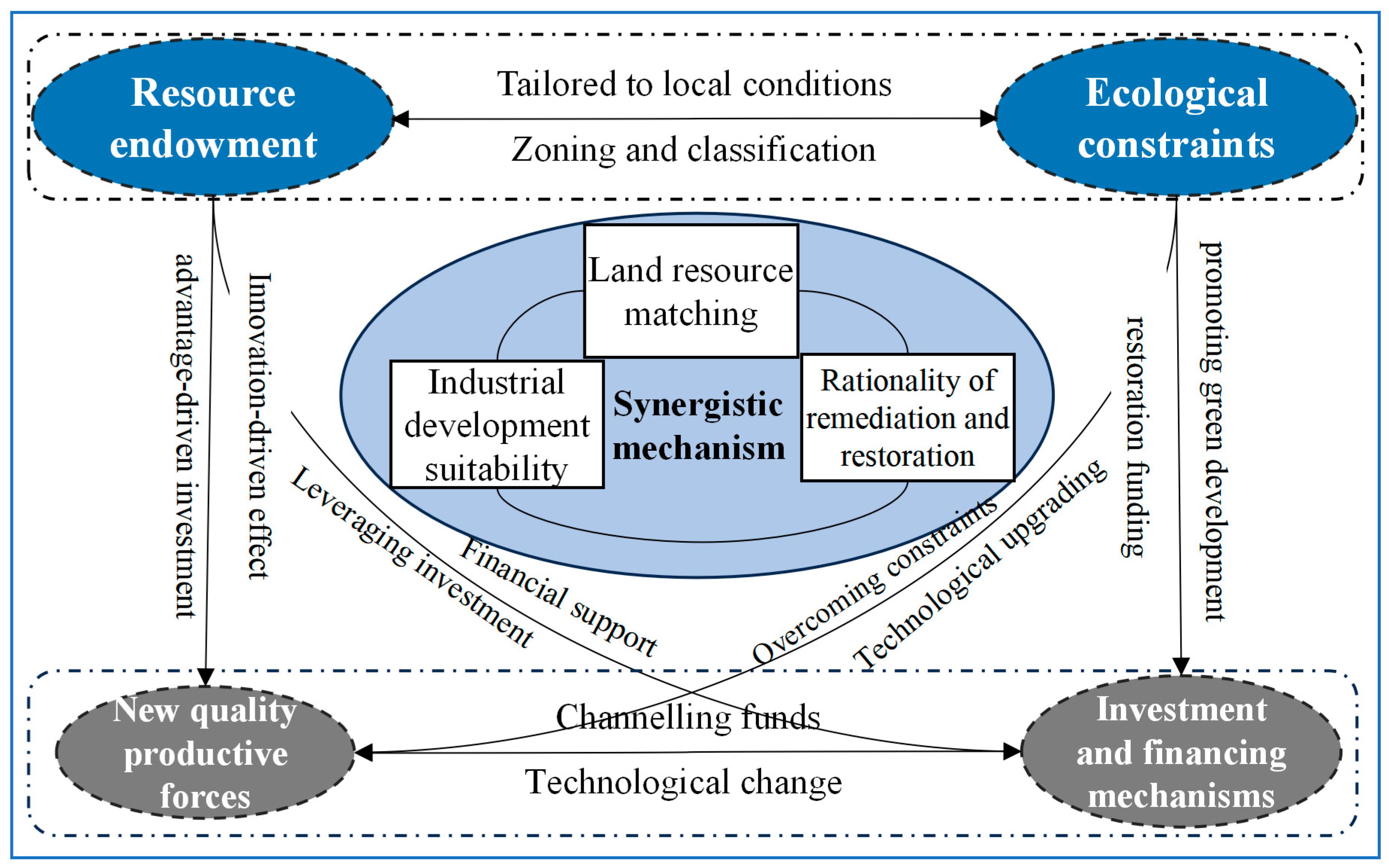
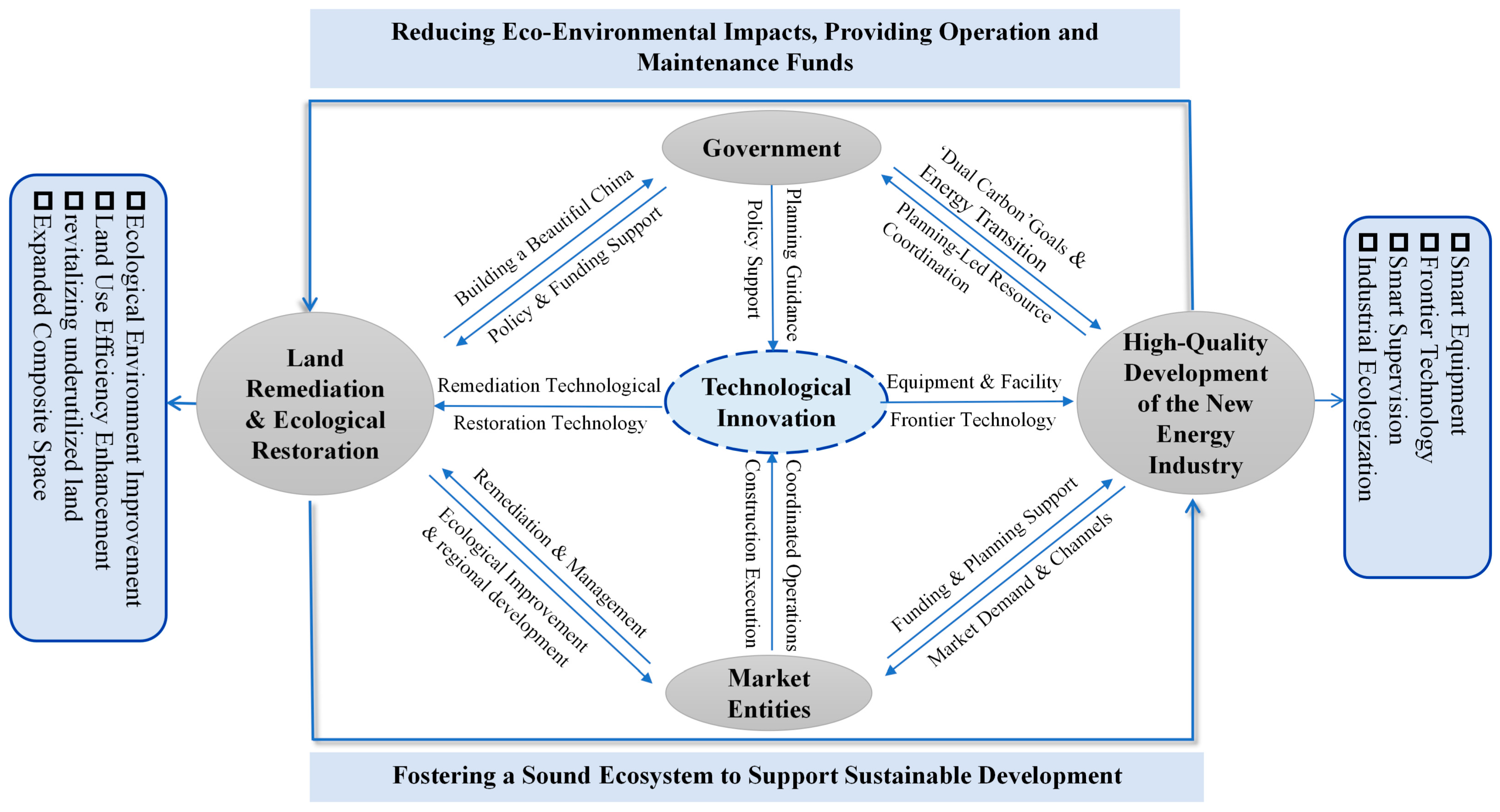
2.2. Interaction Mechanisms Between New Energy Industry Development and Comprehensive Land Consolidation
2.3. Coordinated Pathways for New Energy Industry Development and Comprehensive Land Consolidation
3. Typical Models of Comprehensive Land Consolidation Coordinated with New Energy Industry Development
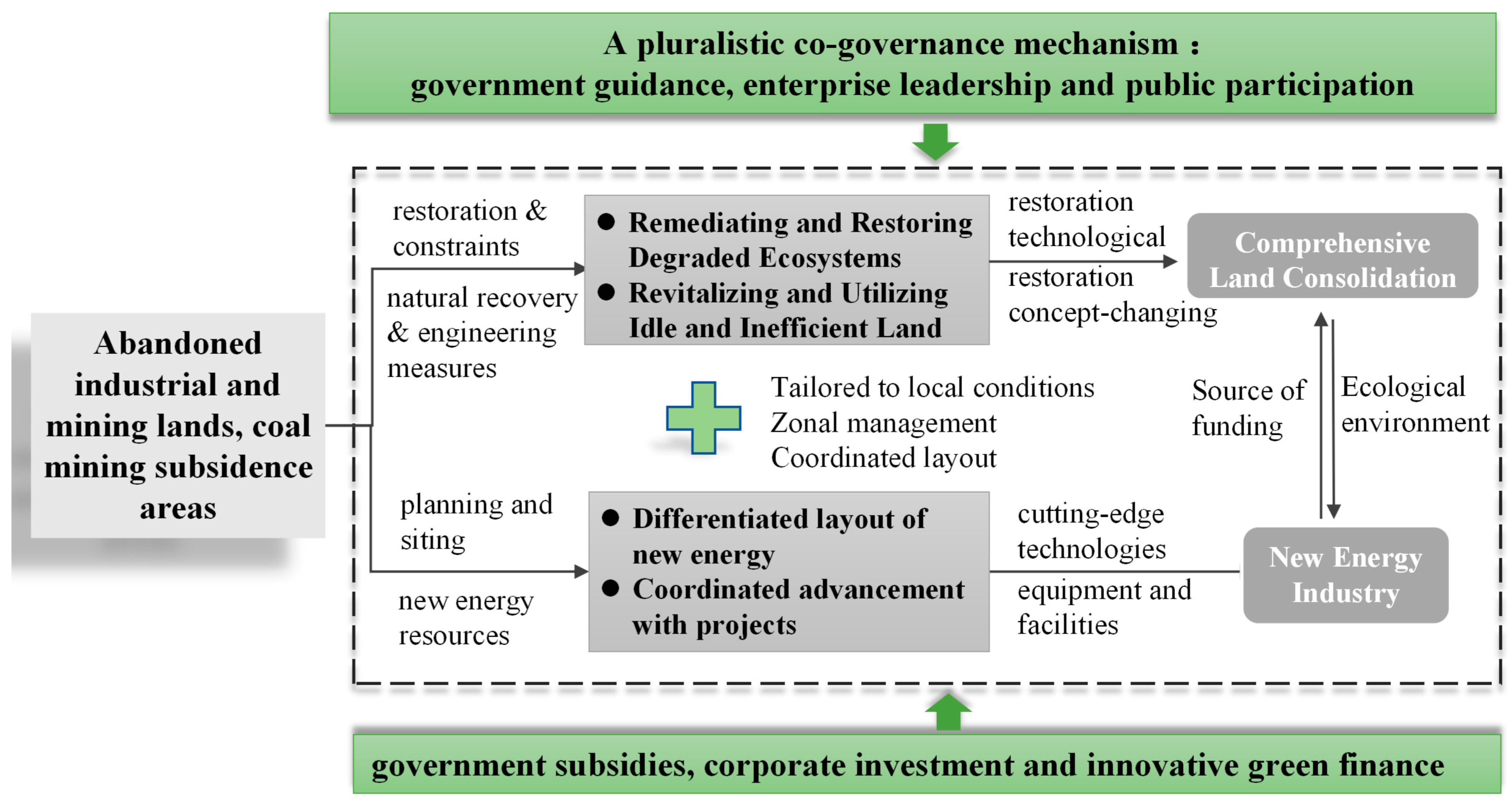
3.1. Ecological Restoration-Led Land Consolidation Model
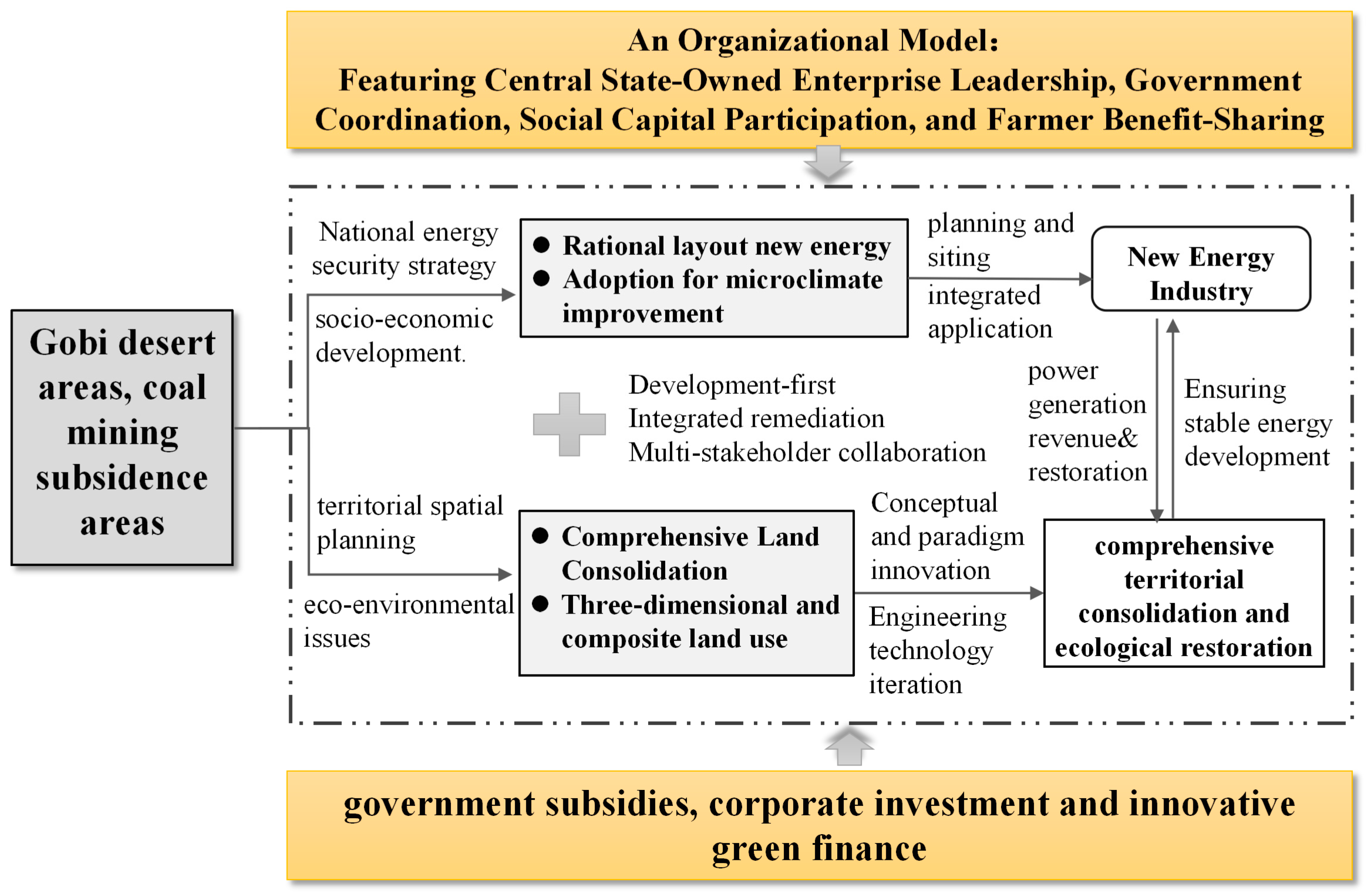
3.2. Resource Development-Led Land Consolidation Model
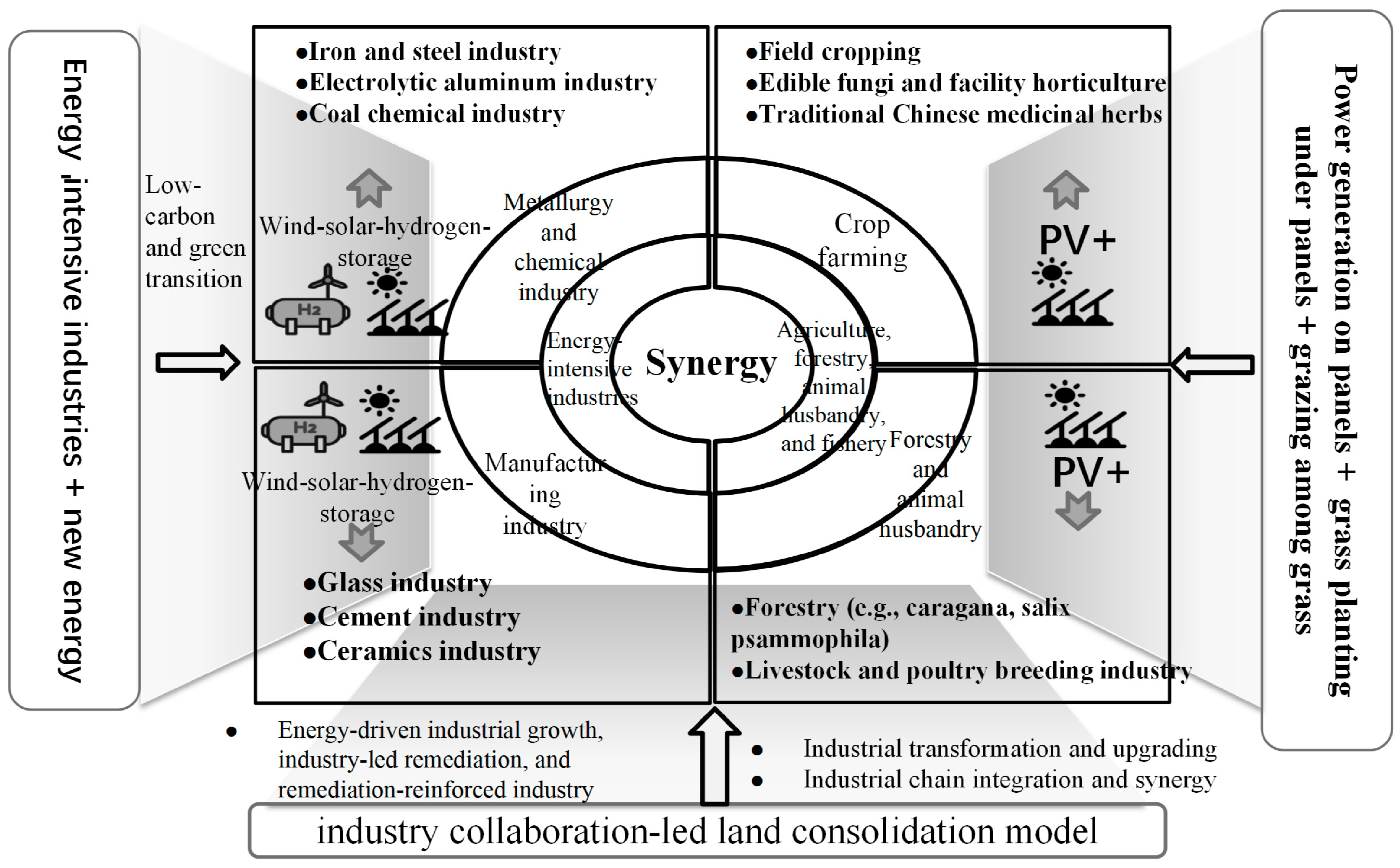
3.3. Industrial Collaboration-Led Land Consolidation Model
3.4. Technological Innovation-Led Land Consolidation Model
3.5. Integrated Development Model
4. Conclusions and Discussion
Author Contributions
Funding
Data Availability Statement
Acknowledgments
Conflicts of Interest
References
- Guo, J.; Fast, V.; Teri, P.; Calvert, K. Integrating land-use and renewable energy planning decisions: A technical mapping guide for local government. ISPRS Int. J. Geo-Inf. 2020, 9, 324. [Google Scholar] [CrossRef]
- Ahmad, M.; Zeeshan, M.; Khan, J.A. Life cycle multi-objective (geospatial, techno-economic, and environmental) feasibility and potential assessment of utility scale photovoltaic power plants. Energy Convers. Manag. 2023, 291, 117260. [Google Scholar] [CrossRef]
- Chen, Q.; Chi, H.M.; Ding, W.; Yang, H.; Wu, J.; Yang, Y.; Wu, X.; Zhang, Y.; Ji, B.; Li, Y. Theory and strategies for vegetation conservation and ecological restoration in a large-scale photovoltaic power station in the southern Tengger Desert. J. Desert Res. 2024, 44, 123–132. (In Chinese) [Google Scholar]
- Zou, C.; Chen, Y.; Xiong, B.; Liu, H. Mission of new energy under carbon neutrality goal in China. Bull. Chin. Acad. Sci. 2023, 38, 48–58. (In Chinese) [Google Scholar]
- Yan, J.; Zhao, Y. Research hotspot and prospect of ecologically vulnerable area in China in the past three decades. J. Nanjing Norm. Univ. (Nat. Sci. Ed.) 2020, 43, 74–85. (In Chinese) [Google Scholar]
- Wang, C.; Wu, X.; Fu, B.; Han, X.; Chen, Y.N.; Wang, K.L.; Zhou, H.K.; Feng, X.M.; Li, Z.S. Ecological restoration in the key ecologically vulnerable regions: Current situation and development direction. Acta Ecol. Sin. 2019, 39, 7333–7343. (In Chinese) [Google Scholar] [CrossRef]
- Zhang, W.; Bai, K.; Lu, Z.; Li, H. Analysis of the challenges and future morphological evolution of super large-scale renewable energy base. J. Glob. Energy Interconnect. 2023, 6, 10–25. (In Chinese) [Google Scholar]
- Sturchio, M.A.; Knapp, A.K. New Research Shows How Solar Arrays Can Aid Grasslands during Drought. Environ. Res. Lett. 2025, 20, 064047. [Google Scholar] [CrossRef]
- Grodsky, S.M.; Campbell, J.W.; Roeder, K.A.; Waite, E.S.; Wright, E.R.; Johnston, M.A. Mixed Responses of Tenebrionid Beetles to Solar Energy Development in the Mojave Desert. J. Arid Environ. 2024, 225, 105243. [Google Scholar] [CrossRef]
- Cole, S.G. Wind Power Compensation Is Not for the Birds: An Opinion from an Environmental Economist. Restor. Ecol. 2011, 19, 147–153. [Google Scholar] [CrossRef]
- Pickering, J.; Chalaye, P. Can Renewable Energy Zones Become Regional Equity Zones? Policy Coherence and Social Equity in the Electricity Infrastructure Roadmap in New South Wales, Australia. Energy Res. Soc. Sci. 2025, 130, 104415. [Google Scholar] [CrossRef]
- Wang, Y.; Ding, Q.; Hao, X.; Yang, H.; Qu, Z. A Global Assessment of the Risks to Biodiversity and Indigenous People’s Lands from Solar and Wind Farms. Geogr. Sustain. 2025, 6, 100371. [Google Scholar] [CrossRef]
- Guo, C.; Han, Z.; Li, A.; Zhong, S. The typical models of ecological management and development and utilization in the Hobq Desert. J. Northwest Norm. Univ. (Nat. Sci.) 2017, 53, 112–118. (In Chinese) [Google Scholar]
- Sui, X.; Wei, Y.; Luo, X.; Wu, S. Emergence of a new pattern of ecological solar photovoltaics (Eco-PV) in ecologically fragile areas driven by carbon peak and neutrality targets in China. Acta Energiae Solaris Sin. 2022, 43, 56–63. (In Chinese) [Google Scholar]
- Zhong, R.; Wang, J.; Xu, T.; Xi, F.; Han, M.; Hu, Q.; Bing, L.; Yin, Y. Assessment of carbon reduction and sink enhancement potential of photovoltaic + mining ecological restoration model. Chin. J. Appl. Ecol. 2024, 35, 1379–1387. (In Chinese) [Google Scholar]
- Liu, Y.; Yang, Q.; Su, J.; Zhou, F. Analysis of coordinated development of photovoltaic power generation and “Three-North” project construction. Chin. J. Grassl. 2024, 46, 122–129. (In Chinese) [Google Scholar]
- Jin, Y.; Ma, J.; Zhu, S.; Li, N. Renewable energy development and multi-energy complementation, taking Qinghai as an example. J. Tsinghua Univ. (Sci. Technol.) 2022, 62, 1357–1365. (In Chinese) [Google Scholar]
- Xiao, J.; Si, J.; Liu, C.; Li, X.; Xi, H.; Yu, T.; Zhang, C.; Zhao, C.; Zhu, M.; Jia, B. Concept, connotation and development model of desert energy ecosphere. J. Desert Res. 2021, 41, 11–20. (In Chinese) [Google Scholar]
- Li, Y.; Kong, L. Developing solar and wind power generation technology to accelerate China’s energy transformation. Bull. Chin. Acad. Sci. 2019, 34, 426–433. (In Chinese) [Google Scholar]
- Yan, Q.; Chen, Y.; Wang, A.; Wang, G.S.; Yu, W.J.; Chen, Q.S. Development obstacles of new energies in China and countermeasures: A review on global current situation. Acta Geosci. Sin. 2010, 31, 759–767. (In Chinese) [Google Scholar]
- Chen, Y.; Li, Y.; Wang, X.; Yao, C.; Niu, Y. Risk and countermeasures of global change in ecologically vulnerable regions of China. J. Desert Res. 2022, 42, 148–158. (In Chinese) [Google Scholar]
- Li, S.; Zhang, Y.; Wang, Z.; Liu, L.; Li, D.; Li, Y.; Wang, Y. Some ideas on the development of new energy geography. Acta Sci. Nat. Univ. Pekin. 2025, 1–19. (In Chinese) [Google Scholar]
- Liu, M. Land use dilemmas of implementing renewable energy development plans under the ‘dual carbon’ goals and their countermeasures. China Popul. Resour. Environ. 2022, 32, 21–30. (In Chinese) [Google Scholar]
- Chen, H.; Li, H.; Xu, Y.; Xu, D.; Wang, L.; Zhou, X.; Chen, M.; Hu, D.; Lin, H.; Li, X. Research progress on energy storage technology in 2024. Energy Storage Sci. Technol. 2025, 14, 2149–2192. (In Chinese) [Google Scholar]
- Zhao, T.; Liu, Q.; Chen, Y.; Wang, Y.; Wu, X.; Kang, L. Development trend and prospect of green hydrogen production from renewable energy power generation. Acta Energiae Solaris Sin. 2025, 46, 39–48. (In Chinese) [Google Scholar]
- Xu, C.; Liu, W.; Song, W.; Li, H. Thoughts on differentially carrying out land ecological restoration. J. Nat. Resour. 2021, 36, 384–394. (In Chinese) [Google Scholar] [CrossRef]
- Wang, Y.; Wang, X.; Zhu, Z. Reflections on the evolutionary direction of new-quality productive forces, renewable energy, and national spatial planning: A discussion focused on wind and solar energy. Urban Plan. Forum 2025, 3, 43–51. (In Chinese) [Google Scholar]
- Yu, J.; Liu, S.; Shi, X.; Qi, Y. The theoretical logic, business model and experience enlightenment of enterprise participation in desertification control under the multi-governance model. J. Desert Res. 2024, 44, 244–252. (In Chinese) [Google Scholar]
- Huang, P.; Yang, H.; Zhang, K.; Yuan, C.; Xie, S. Research on development of “PV + coal mining subsidence area” mode in China. Sol. Energy 2024, 9, 7–14. (In Chinese) [Google Scholar]
- Hu, Z.; Zhao, Y. Principle and technology of coordinated control of eco-environment of mining areas and river sediments in Yellow River watershed. J. China Coal Soc. 2022, 47, 438–448. (In Chinese) [Google Scholar]
- Li, S.; Zhao, J.; Li, Z.; Zhang, F.; Bai, J.; Yang, X. Research progress on ecological impacts of photovoltaic systems in deserts, Gobi and desertification lands. J. Environ. Eng. Technol. 2025, 15, 709–716. (In Chinese) [Google Scholar]
- Han, J. Unused land development expands new space for new energy industry: Taking Ningxia, Qinghai and Shaanxi as examples. China Land. 2016, 5, 44–45. (In Chinese) [Google Scholar]
- Zhang, L.; Liu, Q.; Zhao, X.; Gao, Y. Research on renewable energy penetration in wind and solar resource-intensive areas from the perspective of power demand growth and load flexibility enhancement. Glob. Energy Interconnect. 2024, 7, 454–462. (In Chinese) [Google Scholar]
- National Energy Administration. China Hydrogen Industry Development Report; National Energy Administration: Beijing, China, 2025. (In Chinese) [Google Scholar]
- Zhang, C.; Hu, P.; Yin, G.; Yan, W.; Xu, S.; Cao, R.; Feng, Y.; Zhao, M.; Yang, L.; Jin, Z. Comprehensive review and future trend outlook on energy utilization technologies in low-carbon energy systems. Strateg. Study CAE 2024, 26, 164–175. (In Chinese) [Google Scholar]
- Liu, C.; Zhuo, J.; Zhao, D.; Li, S.; Chen, J.; Wang, J.; Yao, Q. A review on the utilization of energy storage system for the flexible and safe operation of renewable energy microgrids. Proc. CSEE 2020, 40, 1–18. (In Chinese) [Google Scholar]
- Institute for Carbon Neutrality, Tsinghua University. Technology Outlook on Wind and Solar Power Toward China’s Carbon Neutrality Goal; Institute for Carbon Neutrality, Tsinghua University: Beijing, China, 2024. (In Chinese) [Google Scholar]
- Shi, D.; Shi, K. The role of new energy in developing new quality productivity. China Energy 2024, 46, 5–12. (In Chinese) [Google Scholar]
- Ren, S.; Bao, R.; Gao, Z. Arrival of distant power: The impact of ultra-high voltage transmission projects on energy structure in China. Energy 2025, 316, 134527. [Google Scholar] [CrossRef]
- Li, J.; Wei, Y.; Liu, L. Hydrogen production potential from wind power in China by 2060. Resour. Conserv. Recycl. 2025, 222, 108492. [Google Scholar] [CrossRef]
- Song, C.; Guo, Z.; Liu, Z.; Zhang, H.; Liu, R.; Zhang, H. Application of photovoltaics on different types of land in China: Opportunities, status and challenges. Renew. Sustain. Energy Rev. 2024, 191, 114146. [Google Scholar] [CrossRef]
- Lyv, F.; Wu, J.; Yu, Z.; Gong, C.; Di, H.J.; Pan, Y. Quantifying the potential triple benefits of photovoltaic energy development in reducing emissions, restoring ecological resource, and alleviating poverty in China. Resour. Conserv. Recycl. 2025, 215, 108110. [Google Scholar]



| Model | Positioning | Concept and Practices | Advantages and Disadvantages |
|---|---|---|---|
| Ecological Restoration-led Model | Severely degraded ecosystems (mining subsidence, industrial wasteland) with abundant new energy resource. | “Self-sustaining” governance with revenue feedback to ecology. Practices: (1) multi-stakeholder governance with green finance innovation; (2) Micro-consolidation and optimized PV design for windbreak/sand fixation. | Advantages: significant ecological benefits, revenue feedback to restoration; Disadvantages: long payback period, limited governance scale, high coordination costs. |
| Resource Development-led Model | Large-scale developable regions (“desert-Gobi-wasteland,” saline–alkali flats) serving national energy security strategy. | Development-first with embedded consolidation for parallel economic and ecological gains. Practices: (1) central state-owned enterprise (SOE)-led organization with benefit-sharing mechanisms; (2) revenue feedback to restoration and infrastructure. | Advantages: high development efficiency, rapid economic returns, serves national energy strategy; Disadvantages: risk of secondary ecological degradation, hidden water consumption, low social participation. |
| Industrial Collaboration-led Model | Regions with sound industrial foundations and urgent transformation needs. | Industrial chain extension achieving “energy-promoting-industry, industry-driving-consolidation.” Practices: (1) government-led planning with new quality productive forces support; (2) innovative models such as “agrivoltaics” and “photovoltaic grazing.” | Advantages: industrial chain extension, economic multiplier effects; Disadvantages: high industrial matching thresholds, risk of efficiency loss in agrivoltaics, high cross-sector costs. |
| Technological Innovation-led Model | Complex terrain/climate regions or energy-rich but consumption-constrained areas. | Technological breakthroughs overcoming natural constraints with low environmental impact. Practices: (1) integrated energy hubs and “green electricity plus” chains; (2) low-disturbance technologies (screw piles, slope-adaptive construction). | Advantages: overcomes natural constraints, low environmental disturbance, enables complex terrain development; Disadvantages: insufficient technological maturity, high initial investment, limited technology spillover. |
| Integrated Development Model | Regions with equally important ecological and energy demands (soil erosion areas, ecological barriers). | Coordinated advancement of energy, consolidation, ecology and industry with multi-functional spatial coupling. Practices: (1) multi-stakeholder collaborative frameworks; (2) synchronized implementation of new energy bases with agricultural integration and ecological restoration. | Advantages: multi-objective synergy, highest spatial coupling; Disadvantages: highest implementation complexity, difficult performance evaluation, limited applicability. |
Disclaimer/Publisher’s Note: The statements, opinions and data contained in all publications are solely those of the individual author(s) and contributor(s) and not of MDPI and/or the editor(s). MDPI and/or the editor(s) disclaim responsibility for any injury to people or property resulting from any ideas, methods, instructions or products referred to in the content. |
© 2026 by the authors. Licensee MDPI, Basel, Switzerland. This article is an open access article distributed under the terms and conditions of the Creative Commons Attribution (CC BY) license.
Share and Cite
Ren, Y.; Wu, Z.; Yao, L.; Tang, L.; Liu, Y. Research on the Mechanisms and Models of Comprehensive Land Consolidation Coordinated with New Energy Industry Development in Ecologically Fragile Areas. Land 2026, 15, 713. https://doi.org/10.3390/land15050713
Ren Y, Wu Z, Yao L, Tang L, Liu Y. Research on the Mechanisms and Models of Comprehensive Land Consolidation Coordinated with New Energy Industry Development in Ecologically Fragile Areas. Land. 2026; 15(5):713. https://doi.org/10.3390/land15050713
Chicago/Turabian StyleRen, Yanmin, Zhihong Wu, Lan Yao, Linnan Tang, and Yu Liu. 2026. "Research on the Mechanisms and Models of Comprehensive Land Consolidation Coordinated with New Energy Industry Development in Ecologically Fragile Areas" Land 15, no. 5: 713. https://doi.org/10.3390/land15050713
APA StyleRen, Y., Wu, Z., Yao, L., Tang, L., & Liu, Y. (2026). Research on the Mechanisms and Models of Comprehensive Land Consolidation Coordinated with New Energy Industry Development in Ecologically Fragile Areas. Land, 15(5), 713. https://doi.org/10.3390/land15050713