Simulating Interactions Between Land Use and Land Cover Changes for Prospective Scenarios with FORESCEM


Abstract
1. Introduction
2. State of the Art
- Land demand. Two criteria are considered on how the land demand is set. First, land demand can stem from an internal module (like Markov chains), or from external estimates (e.g., expert or model-based approaches). Second, land demand depends on the model’s capability to explore a wide diversity of LUCC dynamics. Among available models, some only deal with slight variations (increases or decreases) in the past quantity of LUCC (for, e.g., [35]), while others can handle tipping points and breaking trends (non-linear variations) of future land demand.
- Probability maps. Every model can use an unlimited number of drivers to set where future LUCC are more likely to occur. Various approaches can be used to generate these maps: logistic regressions (LogReg), Weight of evidence (WoE) or deep learning/artificial neural nets (DP-ANN). These drivers can be incorporated in two main ways: some models only rely on the input map to estimate where land cover types are more likely to be located (suitability maps—SuitMap), whereas others use observed transitions between two dates to estimate where future LUCCs may occur (transition potential map—TPM) [36]. Although TPM-based approaches can outperform suitability mapping to predict LUCC, data availability and dependency on past trends may limit the ability of models to explore contrasting futures [37].
- Excluded/Constrains maps. Excluded maps are used to forbid some LUCC in some predefined areas using Boolean maps (Hard), while soft maps (ranging from 0 to 100%) can be used to prioritize or weight the influence of drivers. Their update along the simulation is also important to account for changes in land planning policies or non-path dependencies.
- Landscape patterns simulation. Simulating transparent and realistic spatiotemporal LUCC patterns is crucial to inform land policy-makers [17,29,38]. The most commonly used LUCC models are based on cellular automata (CA), relying on pixel-based or object-based approaches [33], which strongly impacts the realism of simulated anthropogenic landscape patterns and dynamics representation. Some pixel-based CA models incorporate dedicated functions to improve the patchiness of LUCC simulations [39,40], while others indirectly achieve this through the spatial rendering of probability maps [27]. By contrast, using object-based CA models may inherently favour the simulation of realistic landscape patterns, especially when the minimum mapping units (MMUs) correspond to the scale at which LUCC actually occurs. With excessively large MMUs, such models may fail to consistently simulate both anthropogenic and natural vegetation changes [33]. Lastly, integrating sub-regions that differ in land demand, probability and constraint maps can further contribute to the generation of realistic patterns.
- Land cover/Land use distinction. Accounting for interactions between land uses and land covers require a clear conceptual and operational distinction between them. In the literature, attempts have been made to differentiate the two within a single land use or land cover input map distinguishing different classes (e.g., Managed forest vs. Natural forest [41]). However, none of the above-cited models explicitly sets two different land cover and land use input maps [23] (Different maps), a fundamental distinction that underlies the FORESCEM. Lastly, while accounting for horizontal interactions is quasi-implicit with CA models, temporal interactions (legacies) require consideration of LUCC occurrences at the level of each MMU.

| Function/Property | Criteria 1 | CA_Markov [30] | LCM [30] | Dinamica [31] | CLUE-s [32] | PLUS [33] | FORESCEM (This Paper) |
|---|---|---|---|---|---|---|---|
| Land demand | Internal/external | Internal | Internal | Both | Both | Both | Both |
| Breaking trends LUCC quantity | No | No, only slight variations in past LUCCs | Both | Both | Both | Both | |
| Probability maps | LogReg/WoE/ DP-ANN | LogReg | LogReg/ DP-ANN | All | LogReg | All | LogReg |
| SuitMap/TPM | SuitMap | TPM | TPM | SuitMap | A data mining combination of both [42] | SuitMap | |
| Excluded/constraint maps | Hard/soft | Hard | Hard | Both | Both | Both | Both 2 |
| Updates | Not easily | Yes | Yes | Yes | Yes | Yes | |
| Landscape patterns simulation | Pixel/object-based | Pixel-based | Pixel-based | Both | Pixel-based | Pixel-based | Both |
| Related functions | No | No | No/Yes [40] 2 | No | Yes | No/Yes 3 | |
| Sub-regions | No | No | No | Yes | No | No | |
| Land cover/land use distinction | Land covers/uses input data | Single map | Single map | Single map | Single map | Single map | Different maps |
| Legacy | No | No | Yes | No/Yes 4 | No | Yes |
3. Materials and Methods
3.1. Model Design
3.1.1. Principles
- Each portion of the study area is represented by coherent MMUs (a pixel or a group of pixels—referred to as parcels in the FORESCEM) to capture landscape patterns while reflecting the scale at which land changes commonly occur. Each parcel is characterized by a single land cover and a single land use. These MMUs can be derived from existing spatial datasets (e.g., cadastral maps or the LPIS database for European agricultural land) or generated through landscape segmentation.
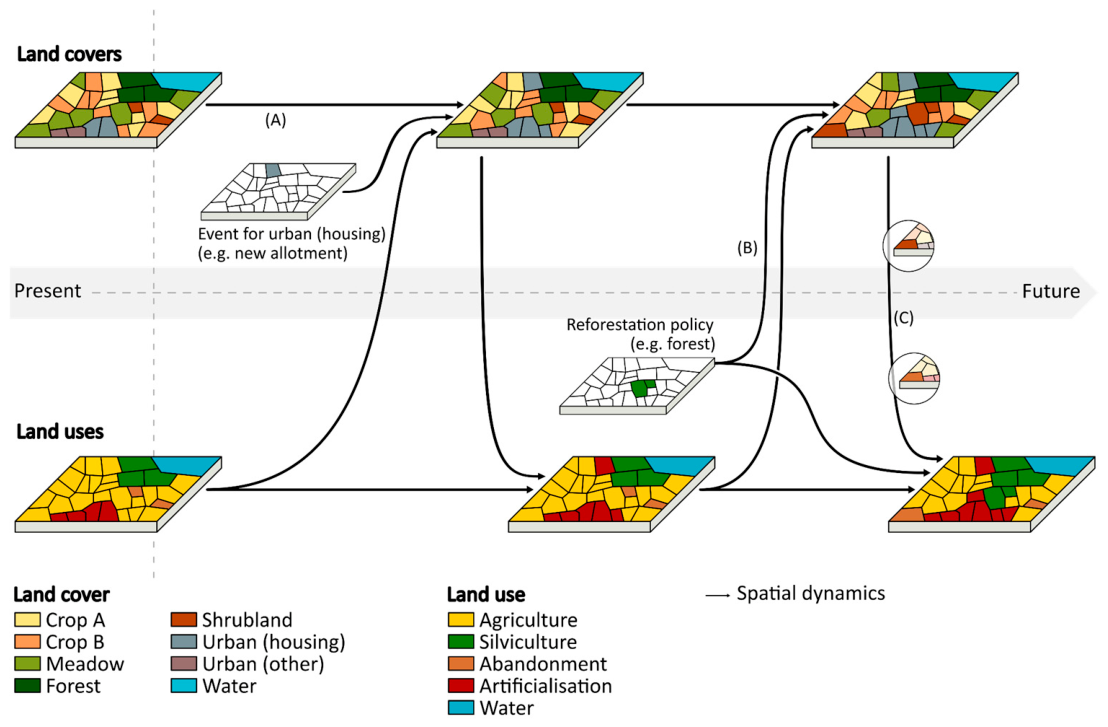
- Land cover refers to a specific type of surface cover (e.g., meadows, maize, or forest), and its changes depend on the land use to which it depends (e.g., agriculture or forestry). Crop successions illustrate land cover changes linked to agricultural land use at the scale of an individual plot. In the absence of human activity, considered as a distinct land use category (“no land use” or “abandonment”), the associated land cover changes correspond to natural vegetation dynamics. In some cases, a given land cover (e.g., deciduous forest) may be associated with different land uses (e.g., “no land use” or silviculture).
- Land uses are generic categories (e.g., agriculture and silviculture) that describe how and for what purposes humans exploit the land. As such, artificialized areas are land use driven by human decisions (e.g., settlement development, land use planning) and may exhibit various types of urban fabrics or a single urban land cover class, or even vegetated areas corresponding, for instance, to urban parks.
- 4.
- The FORESCEM framework adopts an imbricated nomenclature, similar to those used in the Corine Land Cover and Urban Atlas classifications (which refer exclusively to nested land cover classes). The key difference is that the FORESCEM requires both land use classes and their associated land cover classes.
- 5.
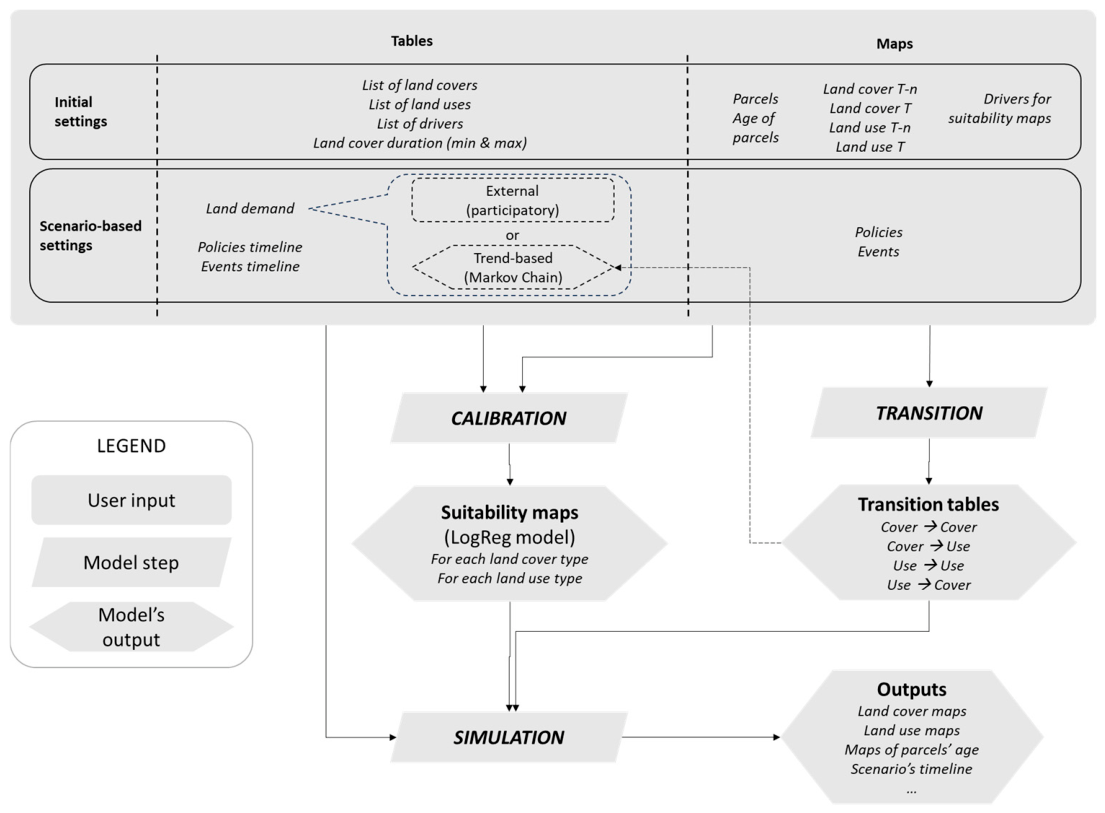
- Land cover and land use changes are modelled independently. This enables explicit consideration and control of natural vegetation dynamics and anthropogenic decisions. However, because they influence one another, their interactions are incorporated into the modelling framework. A land use change induces corresponding land cover changes, and conversely, land cover changes may trigger a land use change, for instance, in cases of abandonment.
- 6.
- Narratives provide information on the transition rules governing both LUCC, as well as on the interactions between them, enabling the simulation of complex and interdependent LUCC processes, as described in principle (5).
- 7.
- Narratives may incorporate temporal variations in LUCC, including shifts in rates, directions, or durations, either in future land demand or in their spatial allocation’s drivers. These variations may diverge from historical trends (e.g., a slowdown in urban expansion), involve abrupt disruptions (e.g., the development of a new housing estate following planning decisions, or a spatially random land-use shift resulting from deforestation or reforestation), or arise from unexpected events (e.g., wildfires). In FORESCEM, deviations from LUCC trends are operationalized through three distinct mechanisms: events, policies and a scenario-based future land demand. Events represent sudden, discrete land changes. Policies, by contrast, represent broader spatial constraints that facilitate or restrict the allocation of specific land uses or land covers over the long term. The land demand is set a priori, may result from external (expert-based or modelling) approaches, and drives trend-breaking LUCC simulation. Such an approach is quite common nowadays, while the majority of published articles still use Markov-based trend land demand to simulate future LUCC as illustrated by [26].
3.1.2. Architecture and Functioning
3.1.3. List of Input Data for FORESCEM
3.2. Study Site
3.3. Dataset Description
3.4. Validation Tests
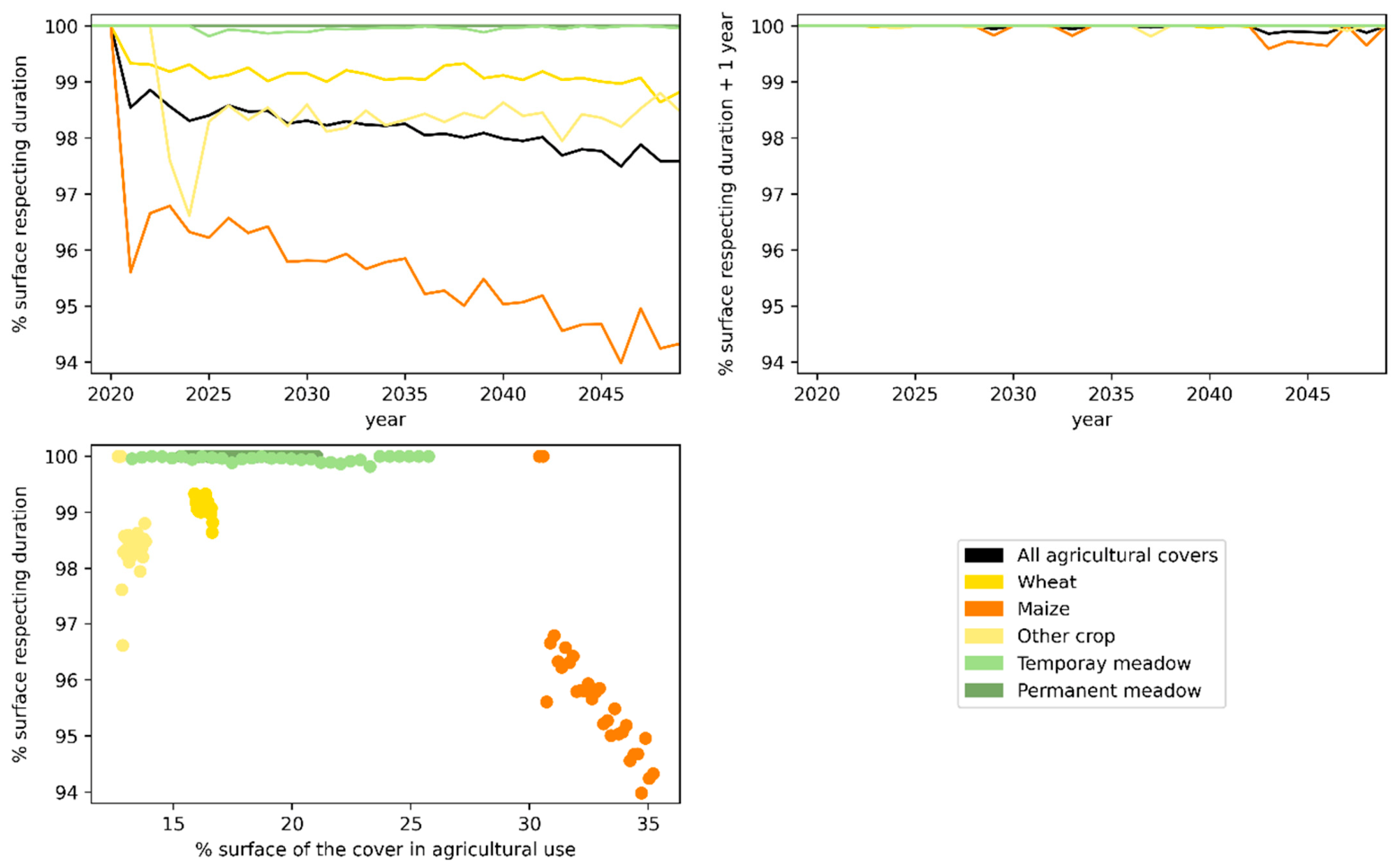
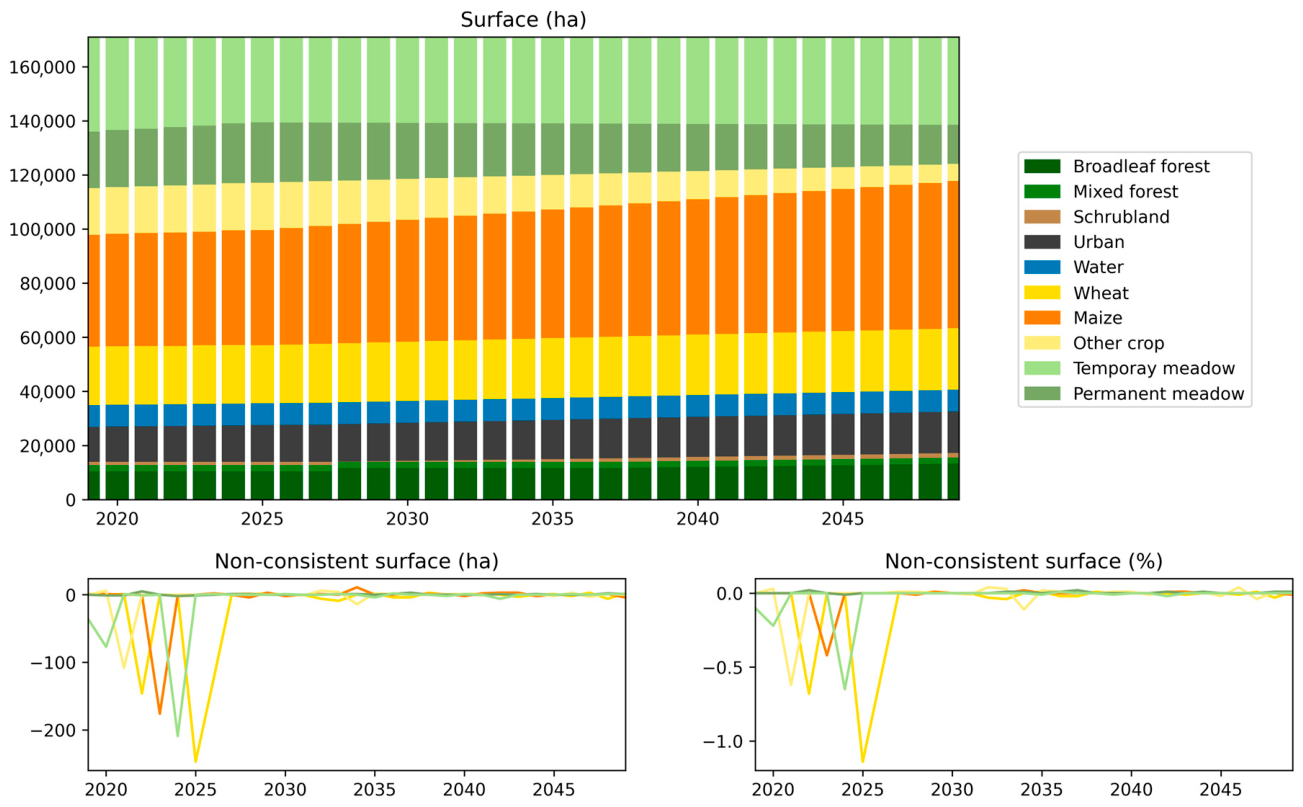
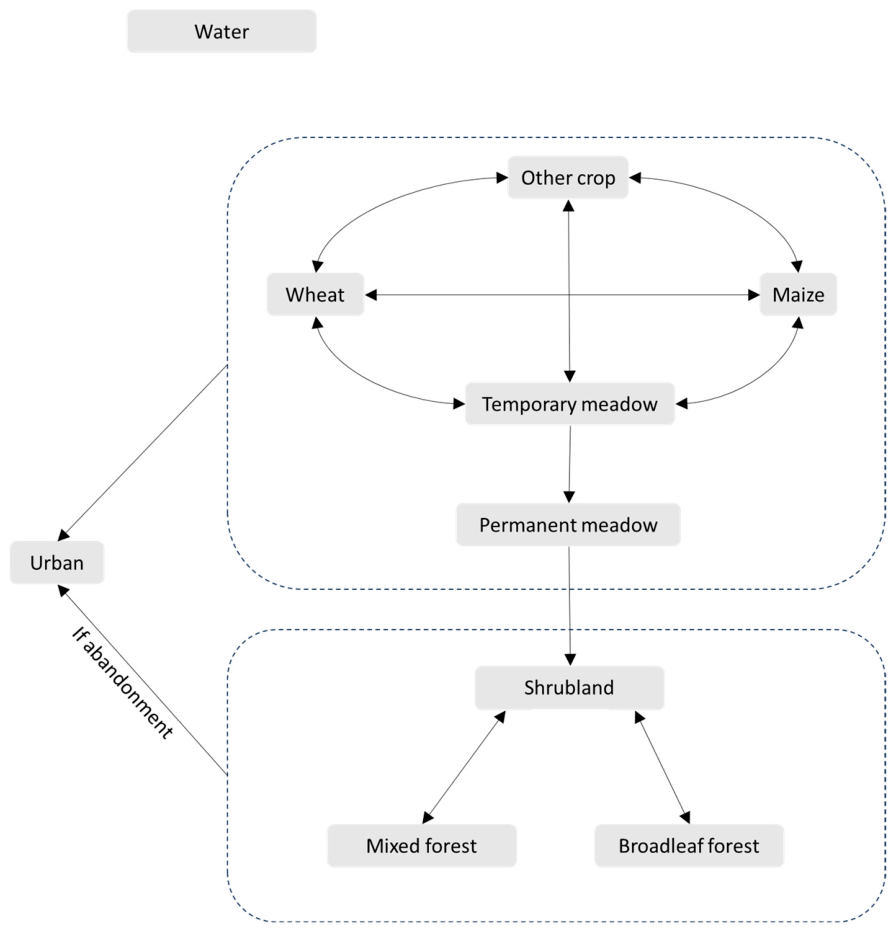
- Land cover duration. This feature is particularly important for land covers characterized by specific temporal dynamics, such as agricultural crop rotations. One crop may not occur more than a predefined number of years for agronomic reasons (maintaining soil quality, avoiding invasive species…). Thus, a minimum and maximum duration is set for each land cover, similarly to one of the decision rules of CLUE-S to avoid inconsistent changes [32]. Most commonly used land change models are unable to accurately simulate these types of land cover dynamics [29]. The FORESCEM’s capability to respect such constraints enables the simulation of realistic agricultural practices. For example, in the French case study with an intensive agricultural system, wheat cultivation is restricted to a maximum of two consecutive years on the same plot. Maize cultivation (1) generally does not exceed three consecutive years and (2) typically follows wheat. Temporary meadows have durations ranging from one to seven years. However, under certain conditions, the full set of constraints—including land use duration—may result in no feasible solution that satisfies all constraints simultaneously. In these cases, the FORESCEM is designed to override the duration constraints to ensure finding a consistent solution.
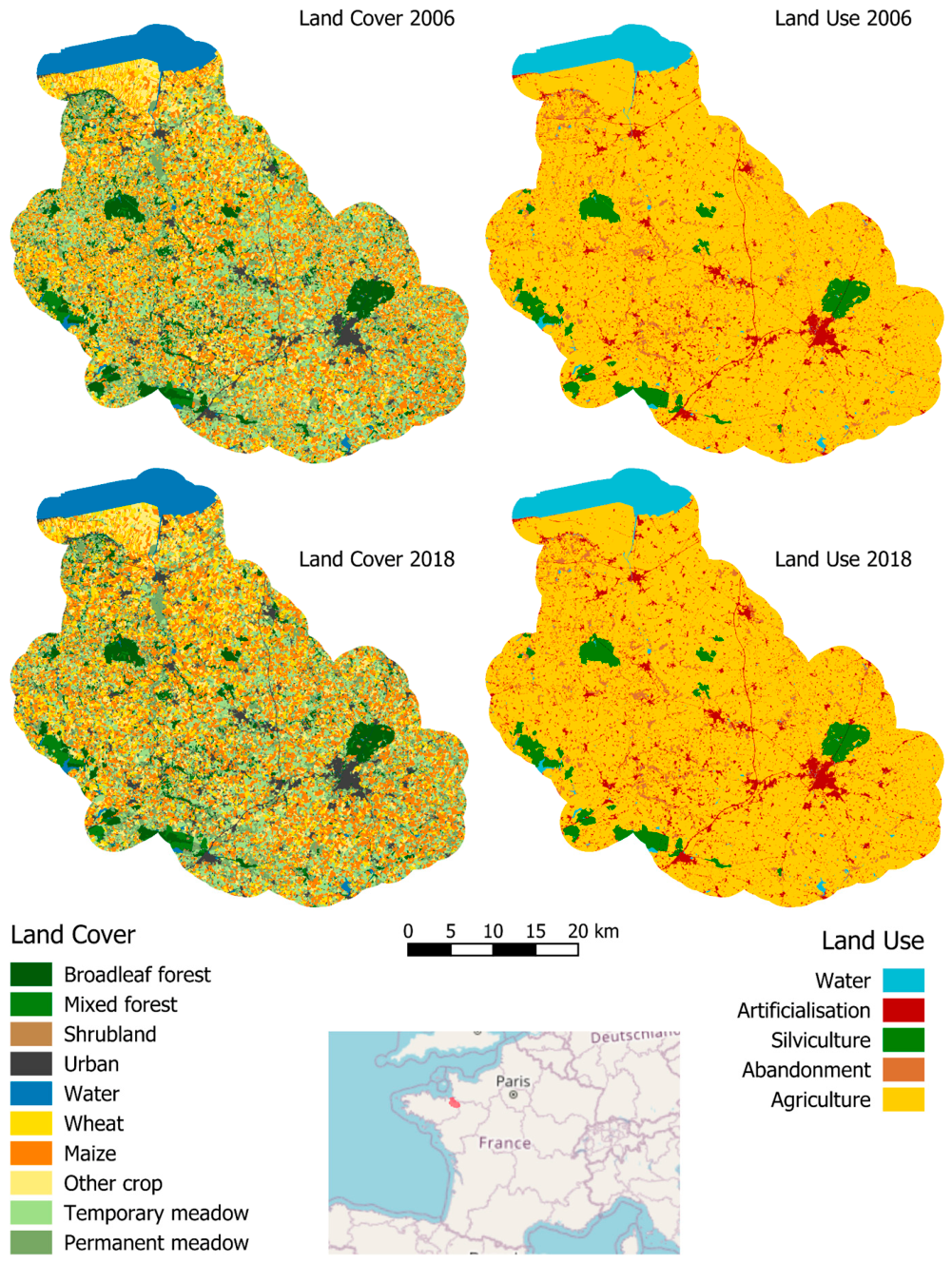
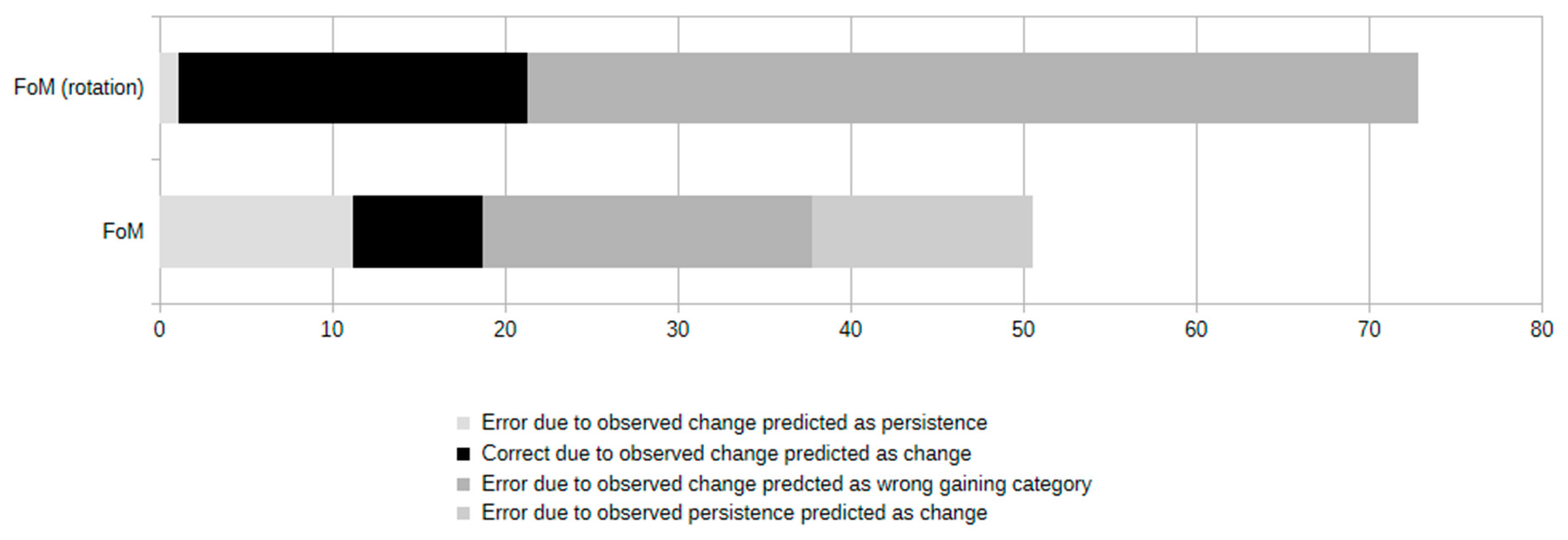
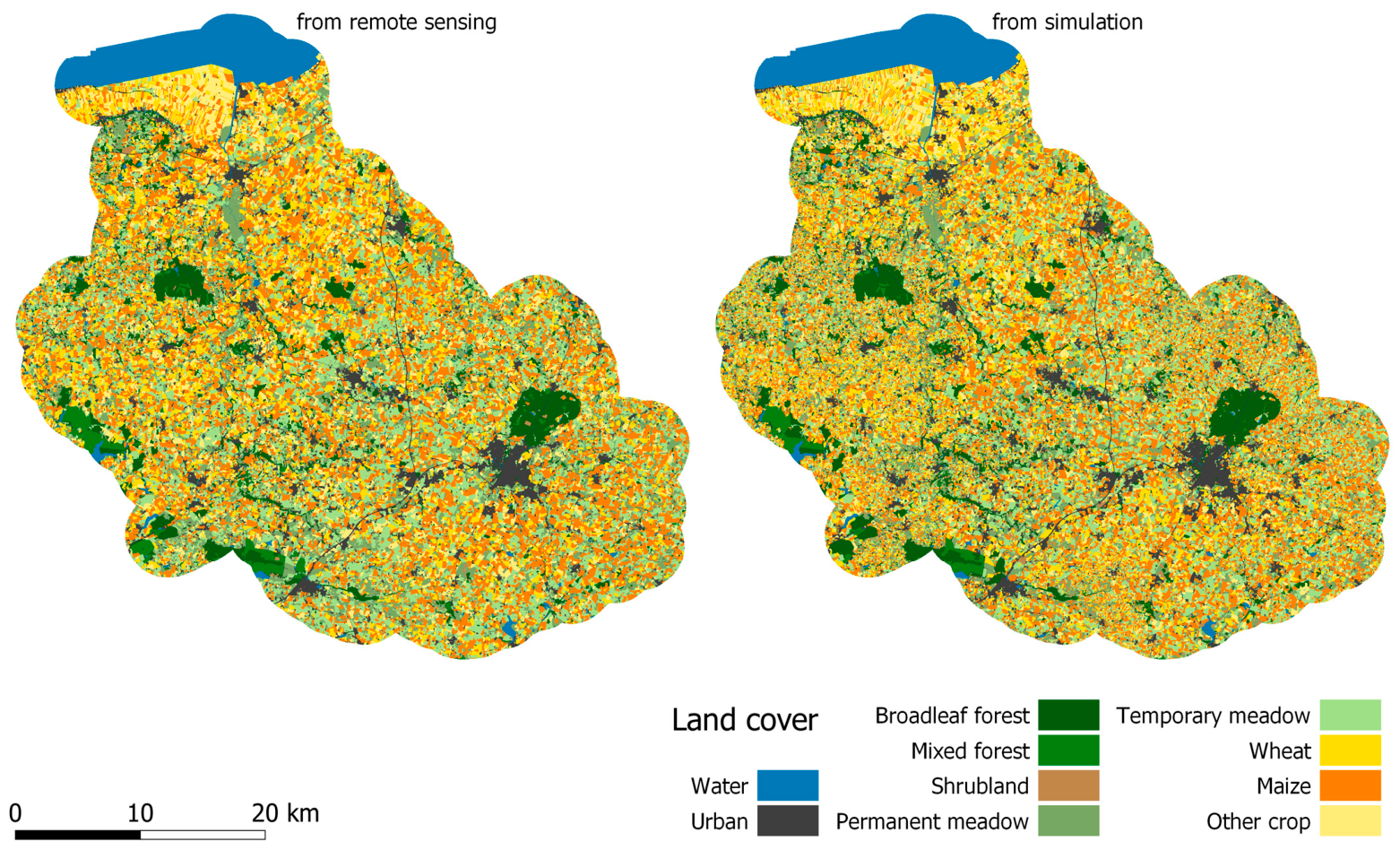
- Landscape dynamics. This test assesses the model’s ability to reproduce historical LUCC dynamics. A simulation is conducted over the period 2006–2018. The simulated land cover map is then compared to the observed classification derived from remote sensing data. Model performance is quantified using the figure of merit [46] and kappa indices, as defined by [25]. Kappa, kappahistogram, kappalocation, kappasimulation, kappatransition, and kappatransloc, respectively, indicate the similarity of the two compared maps, the quantitative similarity of the two compared maps, the similarity between both compared maps’ categories and their spatial allocation, the similarity between simulated and real transitions, the quantitative similarity between simulated and real transitions, and the similarity of spatial allocation between simulated and real transitions. To supplement these spatial metrics, the Shannon Diversity Index (H′) and its associated evenness are calculated to assess the model’s ability to replicate the thematic complexity and structural organization of the landscape [47]. This allows for an evaluation of the landscape’s compositional realism beyond pixel-to-pixel comparison. Analysis is conducted for all land cover classes separately, and for all crops reclassified as a single class, “agricultural land”, as crops rotations show a high degree of randomness influenced by individual farmers’ decisions.
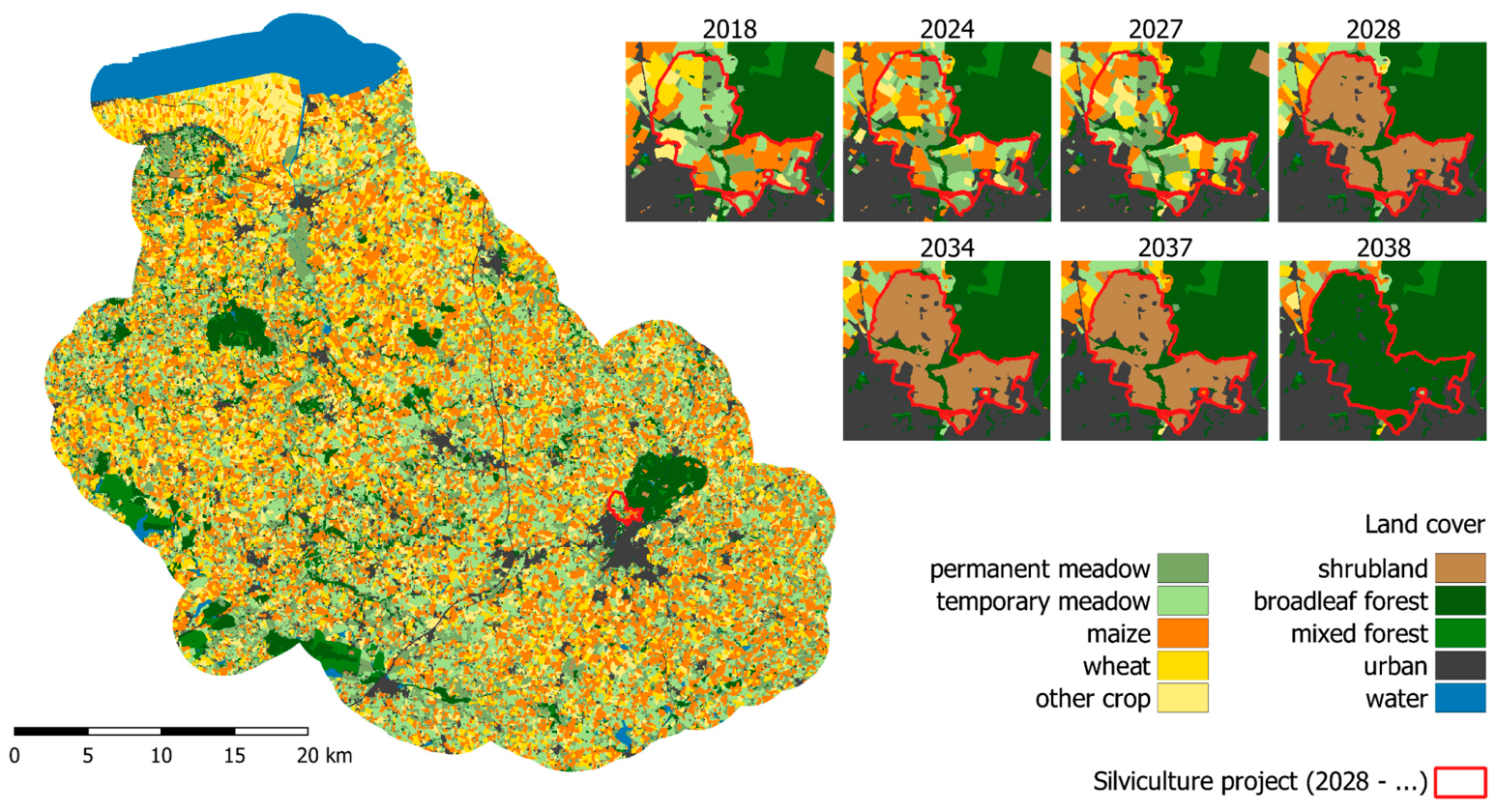
- Unexpected land cover transitions resulting from land use changes. Land development projects, such as afforestation initiatives, can drive land cover changes that are not predicted by historical trends. To simulate such scenarios, a new silvicultural zone will be introduced in 2028, without prior information on expected land cover changes. The FORESCEM is designed to enforce these unexpected land cover transitions triggered by land use changes set as events in stakeholder narratives, while striving to maintain the overall proportions of initial land cover demand. For instance, transitions initially prohibited—such as from wheat land cover to recolonization land cover—are allowed to occur. Subsequently, the shrubland land cover changes to forest cover after 10 years, as defined by the configured land cover duration parameters.
- Variations in land cover demands. Compared to historical trends, a substantial shift in crop demand is anticipated following a reform of the Common Agricultural Policy. Based on a narrative simulating this policy shift in 2026, which triggers agricultural intensification (see [23] for details), this test examines a marked increase in wheat and maize at the expense of grasslands and other crops. During the calibration period, the respective annual increases for wheat and maize were +25.6 ha and +192.5 ha. Post-2026, these rates are projected to rise to +43.2 ha and +496.5 ha per year, respectively.
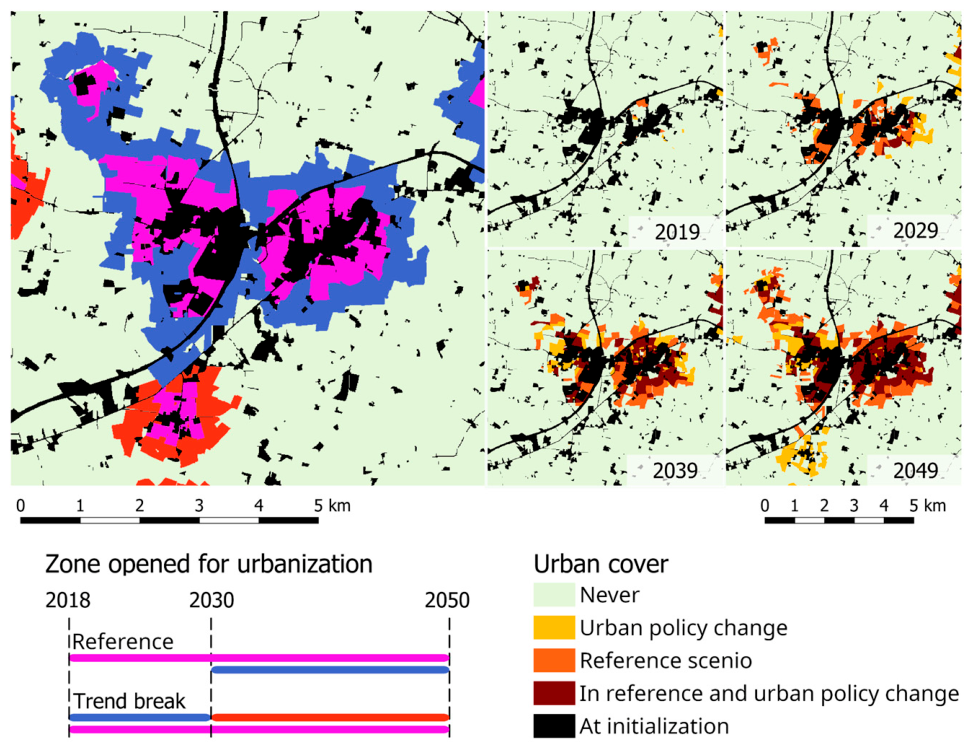
- Trend-breaking policies. Urban planning policies evolve over time. For instance, French urban planning instruments defined at the municipal level are expected to become more restrictive in the future to limit artificialization. This test assesses how the FORESCEM framework responds when areas previously designated as suitable for urban development become temporarily unavailable due to policy restrictions, and are later reopened following local policy changes. Specifically, this fifth test assesses how the model handles annual urban land demand when no suitable areas are available during a certain period, but new areas become accessible later.
4. Results
4.1. Test 1: Land Cover Duration and Crop Occurrences
4.2. Test 2: Landscape Dynamics
4.3. Test 3: Unexpected Land Cover Transitions Resulting from Land Use Changes—The Influence of an Event
4.4. Test 4: Variations in Land Cover Demands
4.5. Test 5: Trend-Breaking Policies
5. Discussion
5.1. Addressing Current Challenges in LUCC Modelling: The FORESCEM Contribution
5.2. Shifting the Validation Paradigm: From Predictive Accuracy to “Process-Based” Credibility
- Structural and logic validation. Instead of comparing outcomes, this approach assesses whether the model’s internal mechanism (e.g., land cover duration, soil suitability, and policy constraints) correctly represents the causal drivers of change. This aligns with pattern-oriented modelling [53], where the goal is to reproduce the internal logic of the system rather than a single historical trajectory.
- Spatial syntax and landscape heterogeneity. At fine scales, the exact location of a simulated change is often stochastic and almost impossible to predict. However, spatial configuration and compositional diversity must remain realistic to ensure ecological and functional coherence. By utilizing Shannon’s Diversity Index (SHDI), we validate that the FORESCEM preserves the landscape’s heterogeneity and evenness. A stable SHDI across simulations demonstrates that the model does not lead to an artificial homogenization of the territory but instead maintains the complex “spatial grammar” inherent to the study area. To complement this validation, grounded in landscape ecology metrics, the integration of Intensity Analysis [54] allows us to verify if the “pace” of these diversity shifts is consistent with known transition regimes, providing a dual validation of both landscape pattern and process.
- Heuristic and Social Validation. In the context of participatory modelling, the ultimate test of a model is its face validity among stakeholders. As [55] emphasizes, the model acts as a “boundary object.” This confirms the effectiveness of the Story-And-Simulation (SAS) approach outlined in our Introduction, where the model succeeds not by “predicting” the future, but by providing plausible and consistent trajectories of future land systems. The fact that stakeholders in our study challenged the underlying assumptions (e.g., urban demand) rather than the spatial patterns indicates that the FORESCEM possesses high legitimacy [23]. Moreover, this social validation was a prerequisite for considering LUCC scenarios as potential cognitive, instrumental or political outcomes that may lead to decision-making [56,57].
Author Contributions
Funding
Data Availability Statement
Conflicts of Interest
Appendix A
| Land Cover | Cover Type |
|---|---|
| Broadleaf forest | Non-demand-based |
| Mixed forest | Non-demand-based |
| Shrubland | Non-demand-based |
| Water | Demand-based |
| Urban | Demand-based |
| Wheat | Demand-based |
| Maize | Demand-based |
| Other crops | Demand-based |
| Temporary meadow | Demand-based |
| Permanent meadow | Demand-based |
| Land Cover | Minimum Duration | Maximum Duration |
|---|---|---|
| Broadleaf forest | 100 | 1000 |
| Mixed forest | 80 | 1000 |
| Shrubland | 10 | 10 |
| Water | 200 | 1000 |
| Urban | 200 | 1000 |
| Wheat | 1 | 3 |
| Maize | 1 | 3 |
| Other crops | 1 | 5 |
| Temporary meadow | 1 | 1000 |
| Permanent meadow | 5 | 5 |
| Year | Broadleaf Forest | Mixed Forest | Shrubland | Urban | Water | Wheat | Maize | Others Crops | Temporary Meadow | Permanent Meadow |
|---|---|---|---|---|---|---|---|---|---|---|
| 2019 | 0 | 0 | 0 | 125 | 0 | 25.4 | 192.5 | 42.5 | 244.7 | −576.8 |
| 2020 | 0 | 0 | 0 | 125 | 0 | 25.4 | 192.5 | 42.5 | 244.7 | −576.7 |
| 2021 | 0 | 0 | 0 | 125 | 0 | 25.4 | 192.5 | 42.5 | 244.7 | −576.8 |
| 2022 | 0 | 0 | 0 | 125 | 0 | 25.4 | 192.5 | 42.5 | 244.7 | −576.7 |
| 2023 | 0 | 0 | 0 | 125 | 0 | 25.4 | 192.5 | 42.5 | 244.7 | −576.8 |
| 2024 | 0 | 0 | 0 | 125 | 0 | 25.4 | 192.5 | 42.5 | 244.7 | −576.7 |
| 2025 | 0 | 0 | 0 | 125 | 0 | 25.4 | 192.5 | 42.5 | 244.7 | −576.8 |
| 2026 | 0 | 0 | 0 | 76.6 | 0 | 43.2 | 496.5 | −468.8 | −328.7 | 38.1 |
| 2027 | 0 | 0 | 0 | 76.6 | 0 | 43.1 | 496.6 | −468.8 | −328.7 | 38.1 |
| 2028 | 0 | 0 | 0 | 76.6 | 0 | 43.2 | 496.5 | −468.8 | −328.7 | 38.1 |
| 2029 | 0 | 0 | 0 | 76.6 | 0 | 43.1 | 496.6 | −468.8 | −328.7 | 38.1 |
| 2030 | 0 | 0 | 0 | 76.6 | 0 | 43.2 | 496.5 | −468.8 | −328.7 | 38.1 |
| 2031 | 0 | 0 | 0 | 76.6 | 0 | 43.1 | 496.6 | −468.8 | −328.7 | 38.1 |
| … | … | … | … | … | … | … | … | … | … | … |
| 2050 | 0 | 0 | 0 | 43.8 | 0 | 43.1 | 496.6 | −468.8 | −328.7 | 38.1 |
| Drivers | Land Uses | ||||
|---|---|---|---|---|---|
| Water | Artificialization | Silviculture | Abandonment | Agriculture | |
| Elevation | x | x | x | x | x |
| Exposition | x | x | x | x | x |
| Slope | x | x | x | x | x |
| Geology | x | x | x | x | |
| Distance to river | x | x | x | x | x |
| BGIN | x | x | x | x | x |
| Dist. to primary city | x | ||||
| Dist. to secondary city | x | ||||
| Drivers & Scores | Land Covers | |||||||||
|---|---|---|---|---|---|---|---|---|---|---|
| Forests | Shrubland | Urban | Water | Crops | Grasslands | |||||
| Broadleaf | Mixed | Wheat | Maize | Others | Temporary | Permanent | ||||
| AUC | 0.996 | 0.858 | 0.5 | 0.910 | 0.990 | 0.731 | 0.720 | 0.705 | 0.816 | 0.709 |
| Intercept | −4.21634 | −4.37285 | −4.32177 | 0.07830 | −8.35369 | −3.99571 | −2.37256 | −3.71833 | −2.18785 | −1.41741 |
| Elevation | 0.20261 | 0.13268 | 0.09984 | 0.00252 | 0.06911 | −0.10418 | −0.09686 | −0.11894 | −0.03273 | −0.02820 |
| Exposition | −0.08041 | −0.05764 | −0.04201 | 0.00020 | 0.03997 | 0.05447 | 0.00871 | 0.01413 | 0.00303 | −0.02826 |
| Slope | −0.00007 | −0.00116 | −0.00038 | −0.00675 | 0.00040 | 0.00045 | 0.00028 | 0.00038 | −0.00013 | −0.00027 |
| Geology | 0.00072 | 0.00024 | 0.00052 | 0.00061 | 0.00022 | 0.00032 | 0.00003 | 0.00009 | ||
| Distance to river | −0.00040 | 0.00095 | 0.00019 | −0.00112 | 0.00143 | 0.00003 | 0.00044 | 0.00028 | 0.00043 | 0.00074 |
| BGIN | 0.02299 | 0.02742 | 0.01228 | −0.02015 | 0.02654 | −0.00725 | −0.00667 | 0.00070 | 0.01170 | 0.00675 |
| Dist. to primary city | 0.01800 | |||||||||
| Dist. to secondary city | −0.00015 | |||||||||

Appendix B

References
- Programme des Nations Unies pour L’environnement. (Ed.) Global Environment Outlook 3: Past, Present and Future Perspectives; UNEP Earthscan: Nairobi, Kenya; London, UK, 2002. [Google Scholar]
- Lambin, E.F.; Geist, H. (Eds.) Land-Use and Land-Cover Change: Local Processes and Global Impacts; Global Change—The IGBP Series; Springer: Berlin/Heidelberg, Germany, 2006. [Google Scholar]
- Akber, M.A.; Khan, M.W.R.; Islam, M.A.; Rahman, M.M.; Rahman, M.R. Impact of Land Use Change on Ecosystem Services of Southwest Coastal Bangladesh. J. Land Use Sci. 2018, 13, 238–250. [Google Scholar] [CrossRef]
- Wilson, E.; Piper, J. Spatial Planning for Biodiversity in Europe’s Changing Climate. Eur. Environ. 2008, 18, 135–151. [Google Scholar] [CrossRef]
- Edman, T.; Angelstam, P.; Mikusiński, G.; Roberge, J.-M.; Sikora, A. Spatial Planning for Biodiversity Conservation: Assessment of Forest Landscapes’ Conservation Value Using Umbrella Species Requirements in Poland. Landsc. Urban Plan. 2011, 102, 16–23. [Google Scholar] [CrossRef]
- Albert, C.; Fürst, C.; Ring, I.; Sandström, C. Research Note: Spatial Planning in Europe and Central Asia—Enhancing the Consideration of Biodiversity and Ecosystem Services. Landsc. Urban Plan. 2020, 196, 103741. [Google Scholar] [CrossRef]
- Wang, X. Integrating Water-Quality Management and Land-Use Planning in a Watershed Context. J. Environ. Manag. 2001, 61, 25–36. [Google Scholar] [CrossRef]
- Dorning, M.A.; Koch, J.; Shoemaker, D.A.; Meentemeyer, R.K. Simulating Urbanization Scenarios Reveals Tradeoffs between Conservation Planning Strategies. Landsc. Urban Plan. 2015, 136, 28–39. [Google Scholar] [CrossRef]
- Xiang, W.-N.; Clarke, K.C. The Use of Scenarios in Land-Use Planning. Environ. Plan. B Plan. Des. 2003, 30, 885–909. [Google Scholar] [CrossRef]
- Couclelis, H. “Where Has the Future Gone?” Rethinking the Role of Integrated Land-Use Models in Spatial Planning. Environ. Plan. A 2005, 37, 1353–1371. [Google Scholar] [CrossRef]
- Cihlar, J.; Jansen, L.J.M. From Land Cover to Land Use: A Methodology for Efficient Land Use Mapping over Large Areas. Prof. Geogr. 2001, 53, 275–289. [Google Scholar] [CrossRef]
- Verburg, P.H.; Dearing, J.A.; Dyke, J.G.; Leeuw, S.V.D.; Seitzinger, S.; Steffen, W.; Syvitski, J. Methods and Approaches to Modelling the Anthropocene. Glob. Environ. Change 2016, 39, 328–340. [Google Scholar] [CrossRef]
- Parker, D.C.; Manson, S.M.; Janssen, M.A.; Hoffmann, M.J.; Deadman, P. Multi-Agent Systems for the Simulation of Land-Use and Land-Cover Change: A Review. Ann. Assoc. Am. Geogr. 2003, 93, 314–337. [Google Scholar] [CrossRef]
- Verburg, P.H.; De Nijs, T.C.M.; Ritsema Van Eck, J.; Visser, H.; De Jong, K. A Method to Analyse Neighbourhood Characteristics of Land Use Patterns. Comput. Environ. Urban Syst. 2004, 28, 667–690. [Google Scholar] [CrossRef]
- Brown, D.G.; Page, S.; Riolo, R.; Zellner, M.; Rand, W. Path Dependence and the Validation of Agent-based Spatial Models of Land Use. Int. J. Geogr. Inf. Sci. 2005, 19, 153–174. [Google Scholar] [CrossRef]
- Kolb, M.; Mas, J.-F.; Galicia, L. Evaluating Drivers of Land-Use Change and Transition Potential Models in a Complex Landscape in Southern Mexico. Int. J. Geogr. Inf. Sci. 2013, 27, 1804–1827. [Google Scholar] [CrossRef]
- Verburg, P.H.; Schot, P.P.; Dijst, M.J.; Veldkamp, A. Land Use Change Modelling: Current Practice and Research Priorities. GeoJournal 2004, 61, 309–324. [Google Scholar] [CrossRef]
- Verburg, P.H. Simulating Feedbacks in Land Use and Land Cover Change Models. Landsc. Ecol. 2006, 21, 1171–1183. [Google Scholar] [CrossRef]
- Güneralp, B.; Reilly, M.K.; Seto, K.C. Capturing Multiscalar Feedbacks in Urban Land Change: A Coupled System Dynamics Spatial Logistic Approach. Environ. Plan. B Plan. Des. 2012, 39, 858–879. [Google Scholar] [CrossRef]
- Alcamo, J. Chapter Six The SAS Approach: Combining Qualitative and Quantitative Knowledge in Environmental Scenarios. In Developments in Integrated Environmental Assessment; Elsevier: Amsterdam, The Netherlands, 2008; Volume 2, pp. 123–150. [Google Scholar]
- Houet, T.; Grémont, M.; Vacquié, L.; Forget, Y.; Marriotti, A.; Puissant, A.; Bernardie, S.; Thiery, Y.; Vandromme, R.; Grandjean, G. Downscaling Scenarios of Future Land Use and Land Cover Changes Using a Participatory Approach: An Application to Mountain Risk Assessment in the Pyrenees (France). Reg. Environ. Change 2017, 17, 2293–2307. [Google Scholar] [CrossRef]
- Houet, T.; Marchadier, C.; Bretagne, G.; Moine, M.P.; Aguejdad, R.; Viguié, V.; Bonhomme, M.; Lemonsu, A.; Avner, P.; Hidalgo, J.; et al. Combining Narratives and Modelling Approaches to Simulate Fine Scale and Long-Term Urban Growth Scenarios for Climate Adaptation. Environ. Model. Softw. 2016, 86, 1–13. [Google Scholar] [CrossRef]
- Houet, T.; Palka, P.; Rigo, R.; Boussard, H.; Baudry, J.; Poux, X.; Narcy, J.B.; Alvarez-Martinez, M.J.; Balbi, S.; Mony, C.; et al. European Blue and Green Infrastructure Network Strategy vs. the Common Agricultural Policy. Insights from an Integrated Case Study (Couesnon, Brittany). Land Use Policy 2022, 120, 106277. [Google Scholar] [CrossRef]
- Godet, M. Introduction to La Prospective. Futures 1986, 18, 134–157. [Google Scholar] [CrossRef]
- Van Vliet, J.; Bregt, A.K.; Brown, D.G.; Van Delden, H.; Heckbert, S.; Verburg, P.H. A Review of Current Calibration and Validation Practices in Land-Change Modeling. Environ. Model. Softw. 2016, 82, 174–182. [Google Scholar] [CrossRef]
- Mas, J.-F.; Kolb, M.; Paegelow, M.; Camacho Olmedo, M.T.; Houet, T. Inductive Pattern-Based Land Use/Cover Change Models: A Comparison of Four Software Packages. Environ. Model. Softw. 2014, 51, 94–111. [Google Scholar] [CrossRef]
- Houet, T.; Vacquié, L.; Sheeren, D. Evaluating the Spatial Uncertainty of Future Land Abandonment in a Mountain Valley (Vicdessos, Pyrenees—France): Insights from Model Parameterization and Experiments. J. Mt. Sci. 2015, 12, 1095–1112. [Google Scholar] [CrossRef]
- Houet, T.; Hubert-Moy, L. Modelling and Projecting Land-Use and Land-Cover Changes with A Cellular Automaton in Considering Land-Scape Trajectories. EARSeL eProc. 2006, 5, 63–76. [Google Scholar]
- Houet, T.; Verburg, P.H. Exploring Futures in Landscape Agronomy: Methodological Issues and Prospects of Combining Scenarios and Spatially Explicit Models. In Landscape Agronomy; Rizzo, D., Marraccini, E., Lardon, S., Eds.; Springer International Publishing: Cham, Switzerland, 2022; pp. 163–181. [Google Scholar]
- Eastman, J.R. IDRISI Selva Tutorial: January 2012; Clark Labs-Clark University: Worcester, UK, 2012. [Google Scholar]
- Soares-Filho, B.S.; Coutinho Cerqueira, G.; Lopes Pennachin, C. Dinamica—A Stochastic Cellular Automata Model Designed to Simulate the Landscape Dynamics in an Amazonian Colonization Frontier. Ecol. Model. 2002, 154, 217–235. [Google Scholar] [CrossRef]
- Verburg, P.H.; Soepboer, W.; Veldkamp, A.; Limpiada, R.; Espaldon, V.; Mastura, S.S.A. Modeling the Spatial Dynamics of Regional Land Use: The CLUE-S Model. Environ. Manag. 2002, 30, 391–405. [Google Scholar] [CrossRef] [PubMed]
- Liang, X.; Guan, Q.; Clarke, K.C.; Liu, S.; Wang, B.; Yao, Y. Understanding the Drivers of Sustainable Land Expansion Using a Patch-Generating Land Use Simulation (PLUS) Model: A Case Study in Wuhan, China. Comput. Environ. Urban Syst. 2021, 85, 101569. [Google Scholar] [CrossRef]
- Zhou, J.; Johnson, V.C.; Shi, J.; Tan, M.L.; Zhang, F. Multi-Scenario Land Use Change Simulation and Spatial-Temporal Evolution of Carbon Storage in the Yangtze River Delta Region Based on the PLUS-InVEST Model. PLoS ONE 2025, 20, e0316255. [Google Scholar] [CrossRef]
- Martellozzo, F.; Amato, F.; Murgante, B.; Clarke, K.C. Modelling the Impact of Urban Growth on Agriculture and Natural Land in Italy to 2030. Appl. Geogr. 2018, 91, 156–167. [Google Scholar] [CrossRef]
- Camacho Olmedo, M.T.; Pontius, R.G.; Paegelow, M.; Mas, J.-F. Comparison of Simulation Models in Terms of Quantity and Allocation of Land Change. Environ. Model. Softw. 2015, 69, 214–221. [Google Scholar] [CrossRef]
- Paegelow, M.; Camacho Olmedo, M.T.; Mas, J.-F.; Houet, T. Benchmarking of LUCC Modelling Tools by Various Validation Techniques and Error Analysis. Cybergeo 2014. [Google Scholar] [CrossRef]
- Sohl, T.L.; Claggett, P.R. Clarity versus Complexity: Land-Use Modeling as a Practical Tool for Decision-Makers. J. Environ. Manag. 2013, 129, 235–243. [Google Scholar] [CrossRef] [PubMed]
- Sohl, T.L.; Sayler, K.L.; Drummond, M.A.; Loveland, T.R. The FORE-SCE Model: A Practical Approach for Projecting Land Cover Change Using Scenario-Based Modeling. J. Land Use Sci. 2007, 2, 103–126. [Google Scholar] [CrossRef]
- Mas, J.-F.; Pérez-Vega, A.; Clarke, K.C. Assessing Simulated Land Use/Cover Maps Using Similarity and Fragmentation Indices. Ecol. Complex. 2012, 11, 38–45. [Google Scholar] [CrossRef]
- Redo, D.J.; Millington, A.C. A Hybrid Approach to Mapping Land-Use Modification and Land-Cover Transition from MODIS Time-Series Data: A Case Study from the Bolivian Seasonal Tropics. Remote Sens. Environ. 2011, 115, 353–372. [Google Scholar] [CrossRef]
- Mutale, B.; Qiang, F. Modeling Future Land Use and Land Cover under Different Scenarios Using Patch-Generating Land Use Simulation Model. A Case Study of Ndola District. Front. Environ. Sci. 2024, 12, 1362666. [Google Scholar] [CrossRef]
- Silva, E.; Wu, N. Surveying Models in Urban Land Studies. J. Plan. Lit. 2012, 27, 139–152. [Google Scholar] [CrossRef]
- Baudry, J.; Bunce, R.G.H.; Burel, F. Hedgerows: An International Perspective on Their Origin, Function and Management. J. Environ. Manag. 2000, 60, 7–22. [Google Scholar] [CrossRef]
- Sohl, T.; Dornbierer, J.; Wika, S.; Sayler, K.; Quenzer, R. Parcels versus Pixels: Modeling Agricultural Land Use across Broad Geographic Regions Using Parcel-Based Field Boundaries. J. Land Use Sci. 2017, 12, 197–217. [Google Scholar] [CrossRef]
- Pontius, R.G.; Boersma, W.; Castella, J.-C.; Clarke, K.; De Nijs, T.; Dietzel, C.; Duan, Z.; Fotsing, E.; Goldstein, N.; Kok, K.; et al. Comparing the Input, Output, and Validation Maps for Several Models of Land Change. Ann. Reg. Sci. 2008, 42, 11–37. [Google Scholar] [CrossRef]
- McGarigal, K.; Marks, B.J. FRAGSTATS: Spatial Pattern Analysis Program for Quantifying Landscape Structure; U.S. Department of Agriculture, Forest Service, Pacific Northwest Research Station: Portland, OR, USA, 1995; p. PNW-GTR-351.
- Meyfroidt, P.; Roy Chowdhury, R.; De Bremond, A.; Ellis, E.C.; Erb, K.-H.; Filatova, T.; Garrett, R.D.; Grove, J.M.; Heinimann, A.; Kuemmerle, T.; et al. Middle-Range Theories of Land System Change. Glob. Environ. Change 2018, 53, 52–67. [Google Scholar] [CrossRef]
- IPBES; Acosta, L.A.; Akçakaya, H.R.; Brotons, L.; Cheung, W.W.L.; Christensen, V.; Harhash, K.A.; Kabubo-Mariara, J.; Lundquist, C.; Obersteiner, M.; et al. The Methodological Assessment Report on Scenarios and Models of Biodiversity and Ecosystem Services; Zenodo: Geneva, Switzerland, 2016. [Google Scholar]
- Verburg, P.H.; Alexander, P.; Evans, T.; Magliocca, N.R.; Malek, Z.; Rounsevell, M.D.; Van Vliet, J. Beyond Land Cover Change: Towards a New Generation of Land Use Models. Curr. Opin. Environ. Sustain. 2019, 38, 77–85. [Google Scholar] [CrossRef]
- Cash, D.W.; Clark, W.C.; Alcock, F.; Dickson, N.M.; Eckley, N.; Guston, D.H.; Jäger, J.; Mitchell, R.B. Knowledge Systems for Sustainable Development. Proc. Natl. Acad. Sci. USA 2003, 100, 8086–8091. [Google Scholar] [CrossRef]
- Pontius, R.G.; Millones, M. Death to Kappa: Birth of Quantity Disagreement and Allocation Disagreement for Accuracy Assessment. Int. J. Remote Sens. 2011, 32, 4407–4429. [Google Scholar] [CrossRef]
- Grimm, V.; Revilla, E.; Berger, U.; Jeltsch, F.; Mooij, W.M.; Railsback, S.F.; Thulke, H.-H.; Weiner, J.; Wiegand, T.; DeAngelis, D.L. Pattern-Oriented Modeling of Agent-Based Complex Systems: Lessons from Ecology. Science 2005, 310, 987–991. [Google Scholar] [CrossRef] [PubMed]
- Aldwaik, S.Z.; Pontius, R.G. Intensity Analysis to Unify Measurements of Size and Stationarity of Land Changes by Interval, Category, and Transition. Landsc. Urban Plan. 2012, 106, 103–114. [Google Scholar] [CrossRef]
- Voinov, A.; Bousquet, F. Modelling with Stakeholders. Environ. Model. Softw. 2010, 25, 1268–1281. [Google Scholar] [CrossRef]
- Rigo, R.; Houet, T. Do Land Use and Land Cover Scenarios Support More Integrated Land Use Management? Land 2023, 12, 1414. [Google Scholar] [CrossRef]
- Rigo, R.; Martin, P.; Verburg, P.H.; Houet, T. Contributions of Local LUCC Spatially Explicit Scenarios for Water Management: Lessons Learned from an Ex-Post Evaluation. Futures 2022, 139, 102937. [Google Scholar] [CrossRef]
- Houet, T.; Schaller, N.; Castets, M.; Gaucherel, C. Improving the Simulation of Fine-Resolution Landscape Changes by Coupling Top-down and Bottom-up Land Use and Cover Changes Rules. Int. J. Geogr. Inf. Sci. 2014, 28, 1848–1876. [Google Scholar] [CrossRef]


| Data | Type | Mandatory (M)/Optional (O) | Description |
|---|---|---|---|
| Land cover at time t-n | Map | M | Land cover map used to compute past transitions, past trends, and the calibration. |
| Land cover at time t | Map | M | Land cover map used to compute past transitions, past trends, and the calibration. It is also the simulation’s starting landscape. |
| Land use at time t-n | Map | M | Land use map used to calibrate the model. |
| Land use at time t | Map | M | Land use map as starting date of the simulation. |
| Set of drivers | Maps | M | Maps used for the calibration and the simulation. Driver maps at time t + x can be included if drivers evolve during the simulation. |
| Cover duration table | Table | M | Duration for each cover that FORESCEM will intend to respect. In some situations, cover duration can be exceeded to find a solution. |
| Cover type | Table | M | Table defining for each land cover if demand is a constraint or not. |
| Drivers | Table | M | Table defining which driver needs to be used for each land cover’s calibration. |
| Demand | Table | M | Table used during the simulation and gathering annual demand for each land cover. |
| Parcels | Map | O | Simulation is processed at pixel unit if this map is not provided. |
| Land cover’s age at time t | Map | O | If no map is provided, a random age map respecting land cover duration is generated. |
| Policy | Map | O | Map used to influence land allocation according to a narrative. It can be a hard (binary) or soft map. Policy is used from the year for which it is defined. For example, urban sprawl policy. |
| Event | Map | O | Map used to create unexpected changes such as an urban project (housing estate, new lake), a forest project (new forest). It occurs from the date it is defined. |
| Index | Meaning | Land Cover | Reclassified Land Cover |
|---|---|---|---|
| Kappa | Similarity of the two compared maps | 0.38 | 0.85 |
| Kappahistogram | Quantitative similarity of the two compared maps | 0.97 | 0.97 |
| Kappalocation | Similarity between both compared maps’ categories and their spatial allocation | 0.38 | 0.87 |
| Kappasimulation | Similarity between simulated and real transitions | 0.06 | 0.19 |
| Kappatransition | Quantitative similarity between simulated and real transitions | 0.87 | 0.61 |
| Kappatransloc | Similarity of spatial allocation between simulated and real transitions | 0.08 | 0.31 |
| Land Cover | Kappa | Reclassified Land Cover | |
|---|---|---|---|
| Broadleaf forest | 1.00 | Broadleaf forest | |
| Mixed forest | 0.71 | Mixed forest | |
| Shrubland | 0.00 | Shrubland | |
| Water | 0.92 | Water | |
| Urban | 0.82 | Urban | |
| Wheat | 0.08 | 0.86 | Land covers as part of crop rotations |
| Maize | 0.17 | ||
| Other crops | 0.09 | ||
| Temporary meadow | 0.14 | ||
| Permanent meadow | 0.76 | Permanent meadow | |
Disclaimer/Publisher’s Note: The statements, opinions and data contained in all publications are solely those of the individual author(s) and contributor(s) and not of MDPI and/or the editor(s). MDPI and/or the editor(s) disclaim responsibility for any injury to people or property resulting from any ideas, methods, instructions or products referred to in the content. |
© 2026 by the authors. Licensee MDPI, Basel, Switzerland. This article is an open access article distributed under the terms and conditions of the Creative Commons Attribution (CC BY) license.
Share and Cite
Palka, G.; Houet, T. Simulating Interactions Between Land Use and Land Cover Changes for Prospective Scenarios with FORESCEM. Land 2026, 15, 706. https://doi.org/10.3390/land15050706
Palka G, Houet T. Simulating Interactions Between Land Use and Land Cover Changes for Prospective Scenarios with FORESCEM. Land. 2026; 15(5):706. https://doi.org/10.3390/land15050706
Chicago/Turabian StylePalka, Gaetan, and Thomas Houet. 2026. "Simulating Interactions Between Land Use and Land Cover Changes for Prospective Scenarios with FORESCEM" Land 15, no. 5: 706. https://doi.org/10.3390/land15050706
APA StylePalka, G., & Houet, T. (2026). Simulating Interactions Between Land Use and Land Cover Changes for Prospective Scenarios with FORESCEM. Land, 15(5), 706. https://doi.org/10.3390/land15050706