Dynamic Conflict Footprints and Land-System Transformation in Large-Scale Mining: Evidence from Las Bambas, Peru



Abstract
1. Introduction
2. Materials and Methods
2.1. Study Area
2.2. Data Sources and Workflow
- 1.
- Environmental
- (a)
- Pollution and Environmental Damage: complaints regarding actual, alleged, or anticipated pollution caused by mining activities, including impacts on water sources, spills, soil degradation, air pollution, and noise.
- (b)
- Material Transport Issues: complaints related to the transport of minerals or operational materials through community territories, typically via pipelines or trucks, often without adequate consultation.
- 2.
- Social
- (a)
- Displacement and Relocation of Communities: complaints arising from displacement or resettlement associated with mining project implementation.
- (b)
- Illegal/Informal Mining: conflicts of interest between informal miners and mining companies over territorial exploitation.
- (c)
- Community–Mine Disputes: disputes over access to, control of, or use of water, land, or protected areas.
- (d)
- Resource Competition Between Localities: competition between localities over land or water resources in mining-affected areas.
- 3.
- Economic
- (a)
- Unfulfilled Company Commitments: breaches of formal or informal commitments concerning goods, services, infrastructure, or employment.
- (b)
- Poor Public Works Execution: deficient implementation of public works financed through mining-related revenues.
- 4.
- Political-Legal
- (a)
- Decisions Without Community Consent: decisions affecting communities without adequate participation or prior consultation.
- (b)
- Exclusion from Environmental Impact Assessment (EIA) Area: exclusion of localities from the direct or indirect area of influence defined in the Environmental Impact Assessment.
2.3. Units of Analysis
2.4. Analytical Methods
2.4.1. Spatiotemporal Indicators
2.4.2. Exploratory Clustering Analysis
2.4.3. Association Rule Mining
3. Results
3.1. Spatiotemporal Expansion of Conflict Influence Zones
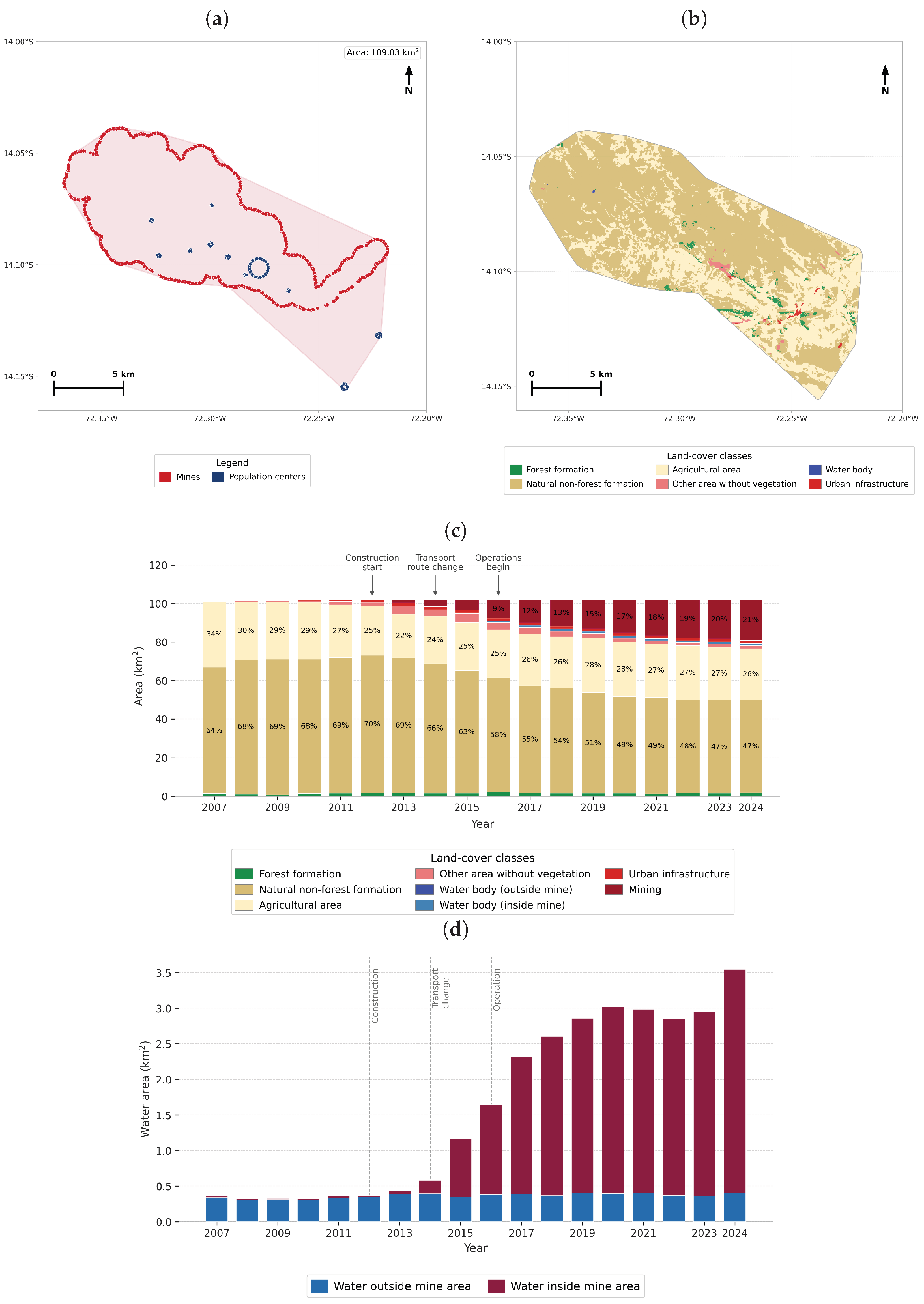
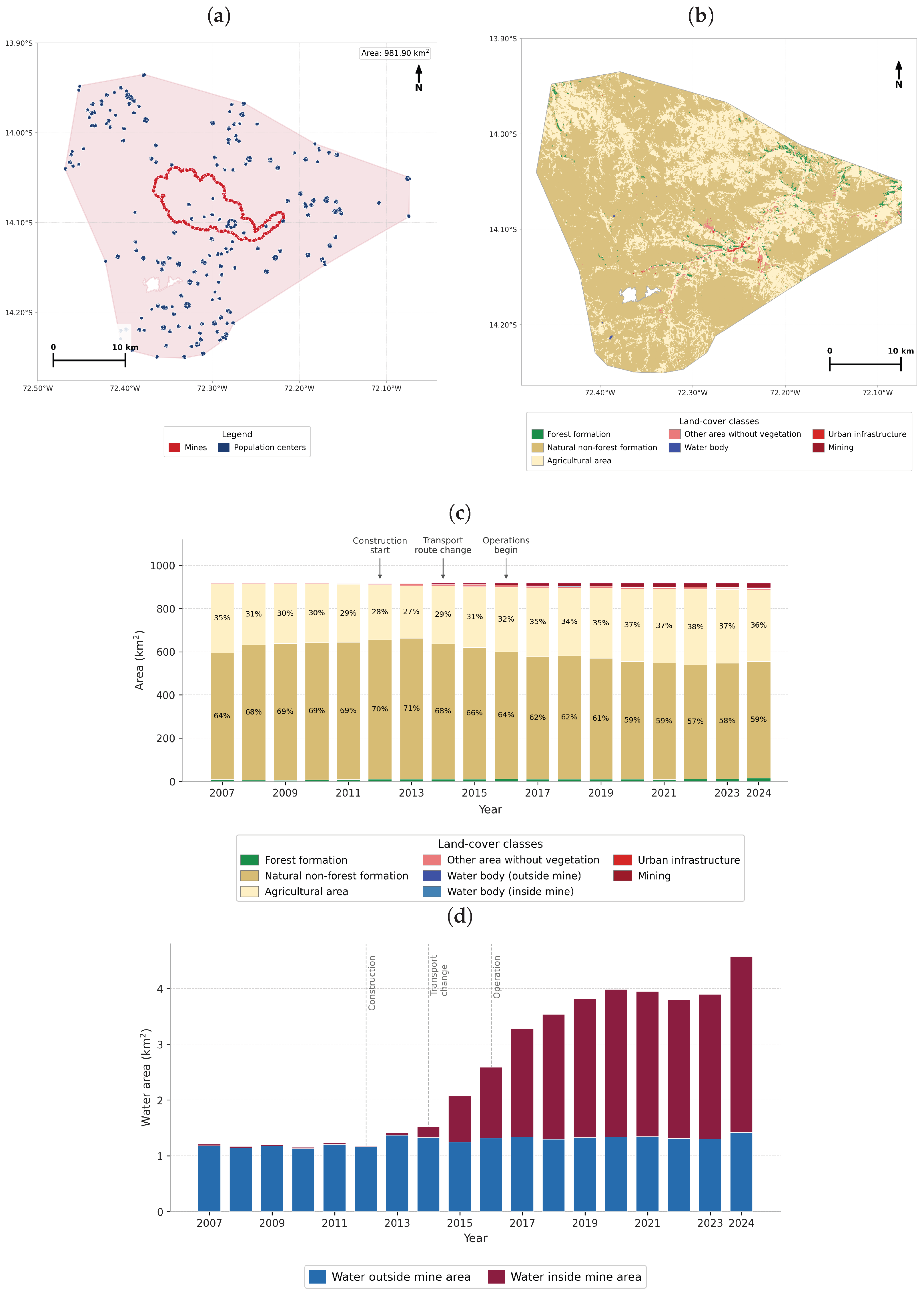
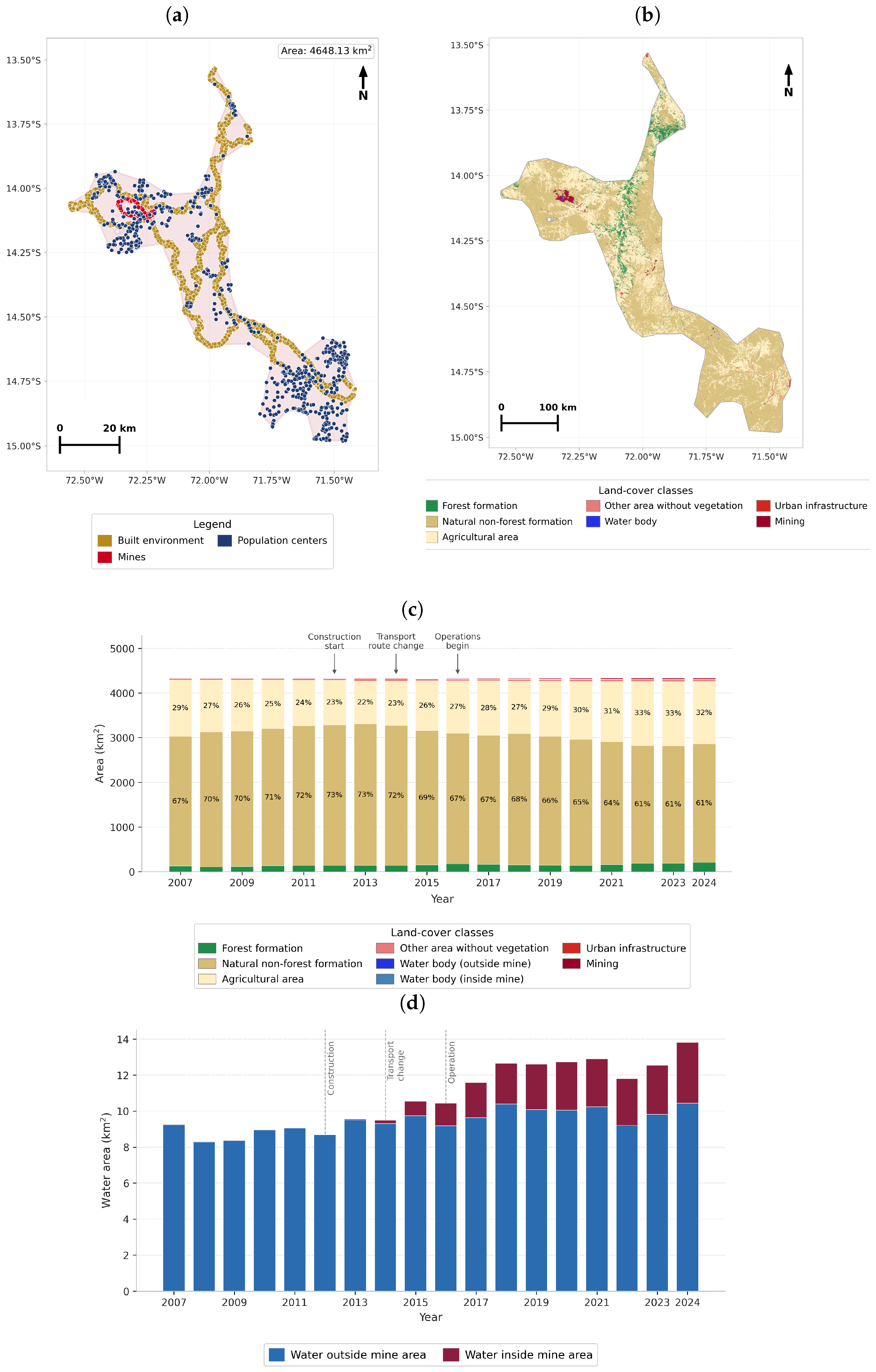
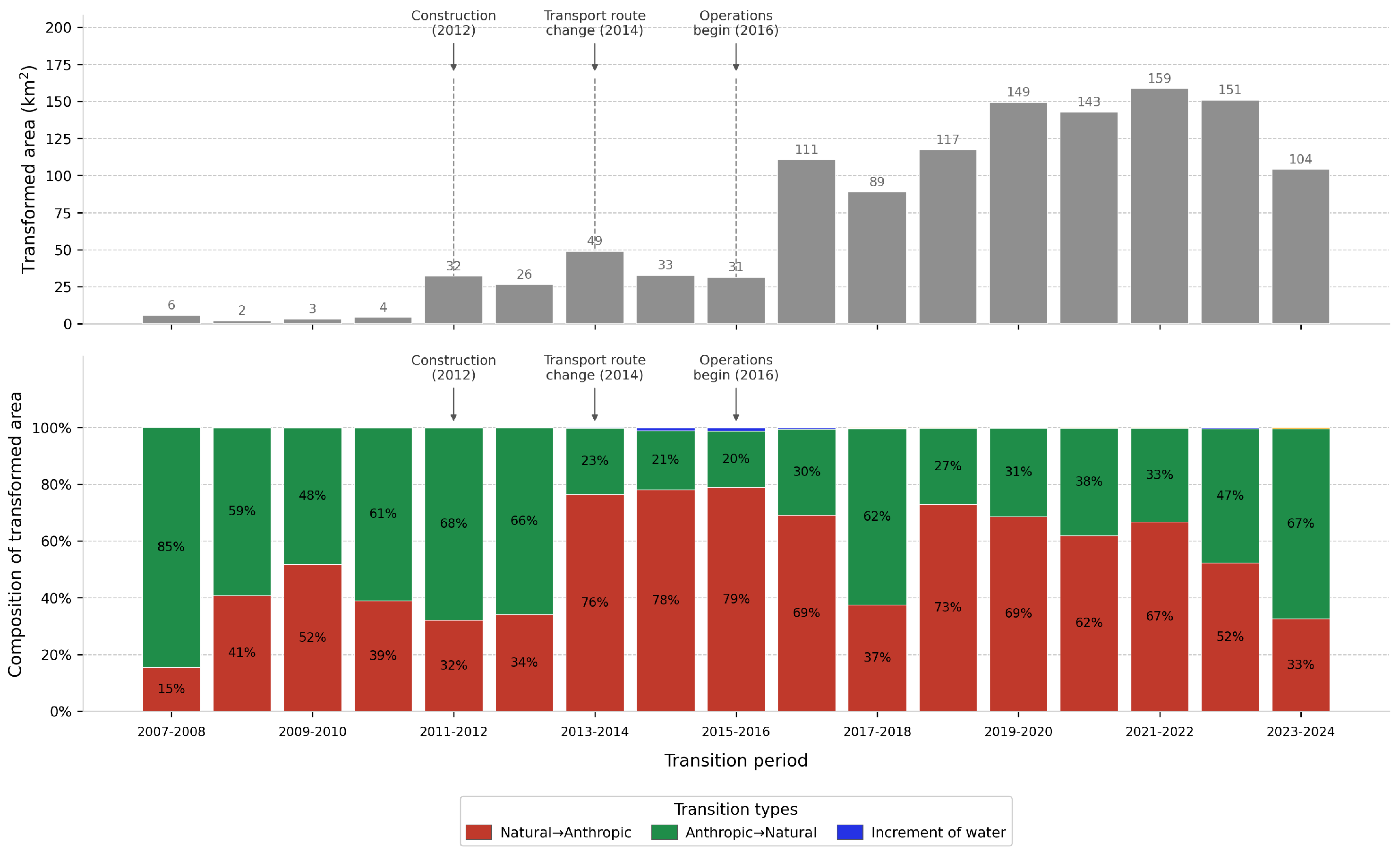
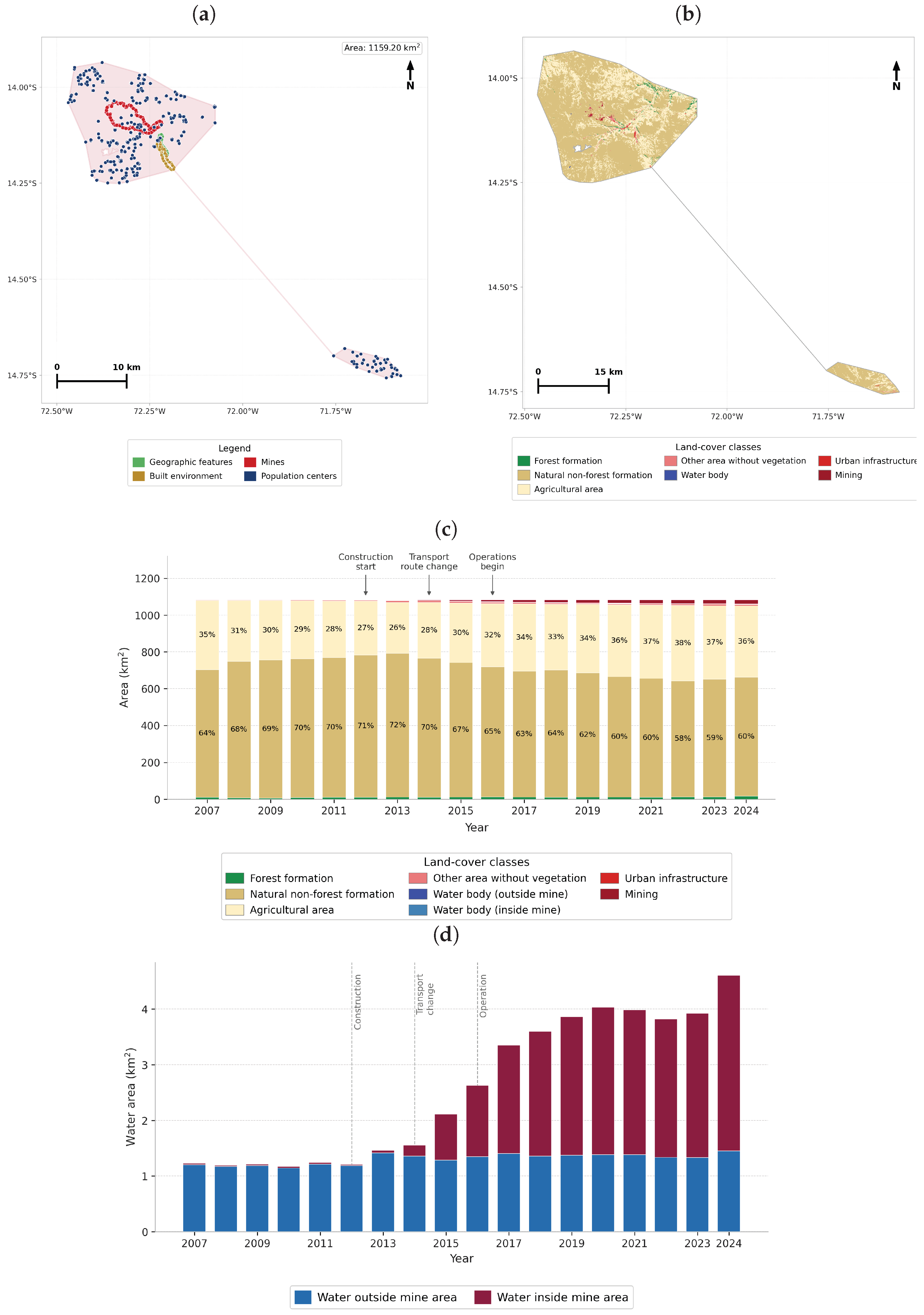
3.2. Land-System Transformation Across Conflict Phases
3.3. Conflict Typologies Across Space and Time
3.3.1. Robustness of the Three-Cluster Solution
3.3.2. Summary Profile of Conflict Clusters
3.3.3. Spatial Distribution of Conflict Clusters
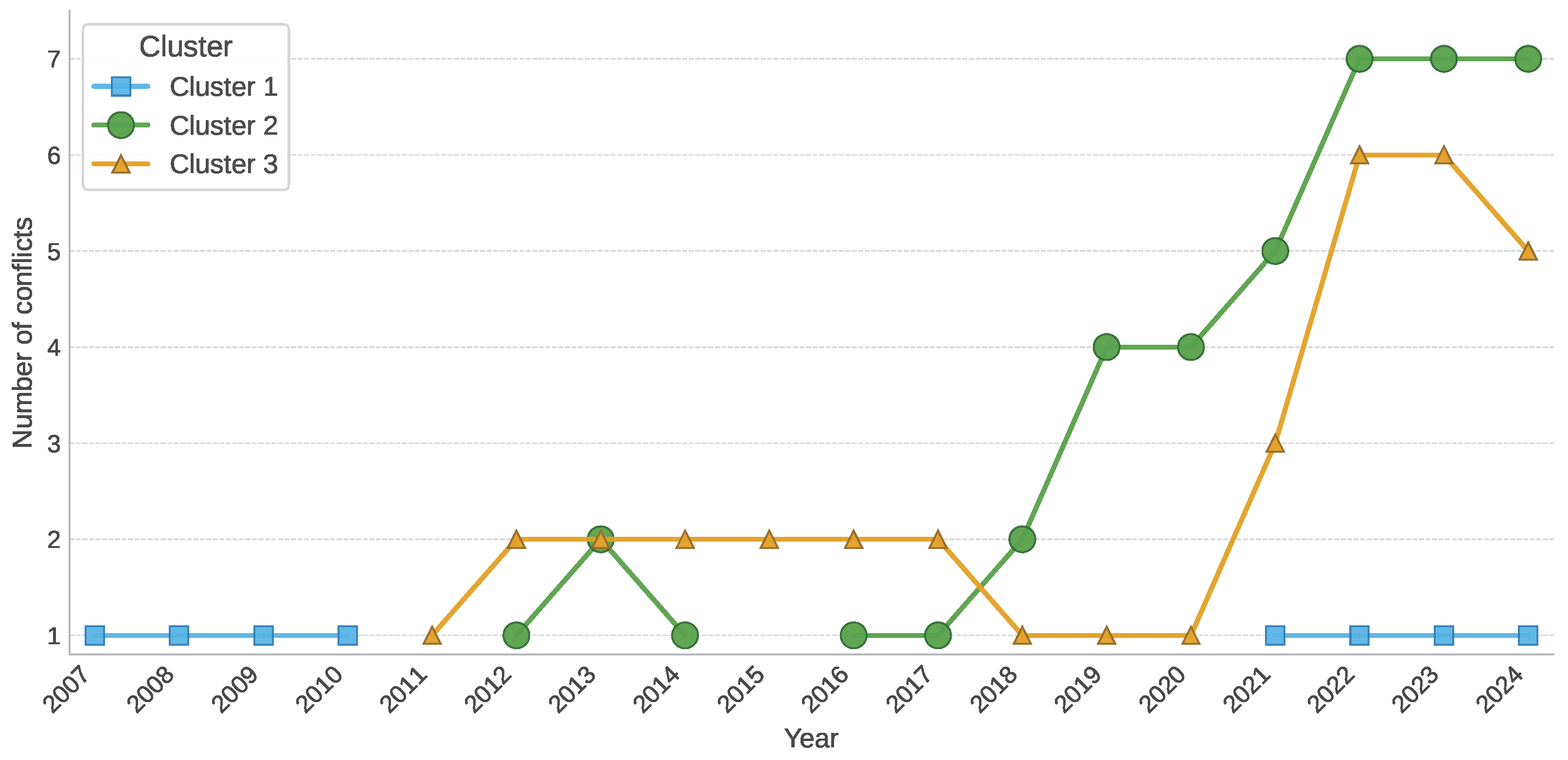
3.3.4. Temporal Evolution of Conflict Clusters
3.3.5. Association Patterns Among Conflict Causes
- Pollution + Transport Issues → No Community Consent + Unfulfilled Commitments
- Unfulfilled Commitments + No Community Consent → Pollution
- Transport Issues + No Community Consent → Pollution
- Poor Public Works Execution → Transport Issues + Unfulfilled Commitments
- Poor Public Works Execution → Transport Issues
- Poor Public Works Execution → Unfulfilled Commitments
- Unfulfilled Commitments + No Community Consent → Transport Issues
4. Discussion
5. Conclusions
Author Contributions
Funding
Data Availability Statement
Conflicts of Interest
Appendix A. Supplementary Methodological Details
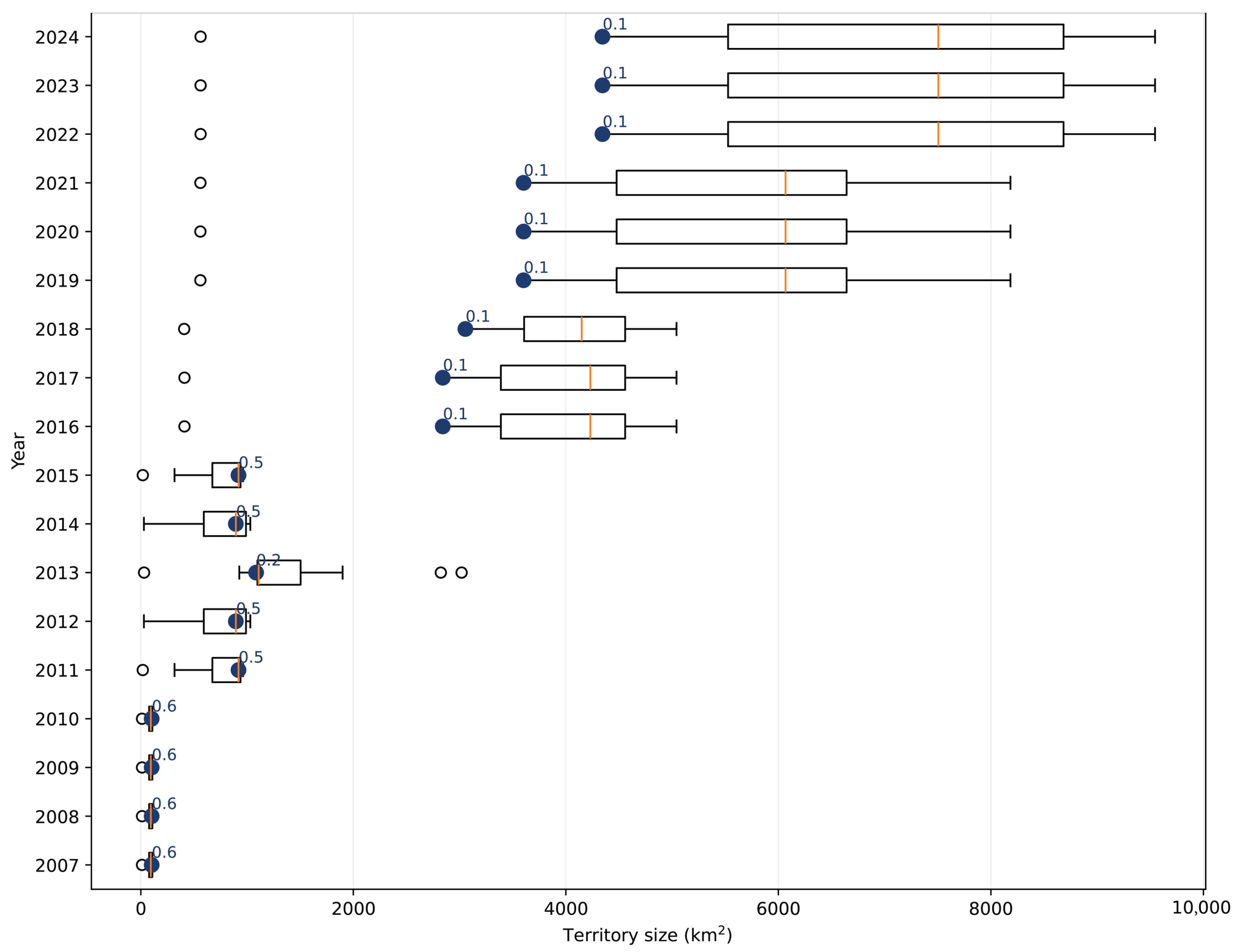
Appendix A.1. Concave Hull Ratio Settings and Sensitivity Check

Appendix A.2. MapBiomas Classes and Analytical Categories

| Code | Macroclass | Original MapBiomas classes grouped |
|---|---|---|
| 1 | Forest formation | Forest; Dry forest; Mangrove; Flooded forest |
| 2 | Natural non-forest formation | Swamp or flooded grassland; Grassland/herbaceous vegetation; Rocky outcrop; Shrubland; Coastal hills; Other non-forest formation |
| 3 | Agricultural area | Grass; Cropland; Oil palm; Rice; Other crops; Forest plantation; Agricultural mosaic |
| 4 | Other area without vegetation | Beach; Coastal salt flat; Salt flat; Other natural area without vegetation; Other area without vegetation |
| 5 | Water body | River, lake or ocean; Aquaculture; Glacier |
| 6 | Not observed | Not observed |
| 7 | Urban infrastructure | Urban infrastructure |
| 8 | Mining | Mining |
Appendix A.3. Relative Prevalence of Root Causes Across the Three Conflict Clusters
| Root Cause | C1 | C2 | C3 |
|---|---|---|---|
| Pollution/environmental damage | 0.000 | 0.417 | 0.375 |
| Material transport issues | 0.000 | 1.000 | 0.000 |
| Community–mine disputes | 0.667 | 0.167 | 0.500 |
| Resource competition | 0.000 | 0.083 | 0.125 |
| Displacement/relocation | 0.000 | 0.083 | 0.000 |
| Illegal/informal mining | 0.333 | 0.000 | 0.125 |
| Unfulfilled commitments | 0.000 | 0.833 | 1.000 |
| Poor public works | 0.000 | 0.333 | 0.000 |
| No community consent | 1.000 | 0.333 | 0.125 |
| EIA area exclusion | 0.000 | 0.417 | 0.375 |
References
- Ministerio de Energía y Minas. Anuario Minero 2024. 2025. Available online: https://www.gob.pe/institucion/minem/informes-publicaciones/6827926-anuario-minero-2024 (accessed on 16 March 2026).
- Arellano-Yanguas, J. Aggravating the Resource Curse: Decentralisation, Mining and Conflict in Peru. J. Dev. Stud. 2011, 47, 617–638. [Google Scholar] [CrossRef]
- Bebbington, A.; Humphreys Bebbington, D. Mining and Social Conflict in the Peruvian Andes. Dev. Change 2008, 39, 887–914. [Google Scholar] [CrossRef]
- Bury, J. Mining, Livelihoods and Development in Cajamarca, Peru. Geogr. J. 2005, 171, 79–93. [Google Scholar] [CrossRef]
- United Nations Working Group on Business and Human Rights. Statement at the End of Visit to Peru by the United Nations Working Group on Business and Human Rights. 2017. Available online: https://www.ohchr.org/en/statements-and-speeches/2017/07/statement-end-visit-peru-united-nations-working-group-business-and (accessed on 16 March 2026).
- Saenz, C. A Social Conflict Diagnostic Tool for Application in the Mining Industry: A Case Study in Peru. Corp. Soc. Responsib. Environ. Manag. 2019, 26, 690–700. [Google Scholar] [CrossRef]
- Mendoza Michilot, M. Actores, actantes y redes. Representación mediática de la acción colectiva en un conflicto socioambiental peruano. Comun. Y Soc. 2024, 21, e8703. [Google Scholar] [CrossRef]
- Uribe-Sierra, S.E.; Mansilla-Quiñones, P.; Mora-Rojas, A.I. Latent Rural Depopulation in Latin American Open-Pit Mining Scenarios. Land 2022, 11, 1342. [Google Scholar] [CrossRef]
- Mestanza-Ramón, C.; Cuenca-Cumbicus, J.; D’Orio, G.; Flores-Toala, J.; Segovia-Cáceres, S.; Bonilla-Bonilla, A.; Straface, S. Gold Mining in the Amazon Region of Ecuador: History and a Review of Its Socio-Environmental Impacts. Land 2022, 11, 221. [Google Scholar] [CrossRef]
- Montero, P.; Bustos, E.; Padró, J.C.; Carabassa, V. Monitoring of Open-Pit Mining Areas Using Landsat Series Imagery (1984–2023) and Cloud Processing. Land 2024, 13, 1301. [Google Scholar] [CrossRef]
- Boza Espinoza, T.E.; Salinas, N.; Cosio, E.G.; Tito, R.; Nina-Quispe, A.; Roman-Cuesta, R.M. Assessing Peru’s Land Monitoring System Contributions towards Fulfilment of Its International Environmental Commitments. Land 2024, 13, 205. [Google Scholar] [CrossRef]
- Maiza-Larrarte, A.; Claudio-Quiroga, G. The Impact of Las Bambas Megamine on Development in Apurímac, Peru. Miner. Econ. 2025, 38, 569–583. [Google Scholar] [CrossRef]
- Machicao, J.C.; Arosemena, G.M. Peruvian Ombudsman Monthly Social Conflict Reports Analysis Using Knowledge Management and Artificial Intelligence Tools. In 2019 IEEE XXVI International Conference on Electronics, Electrical Engineering and Computing (INTERCON); IEEE: Piscataway, NJ, USA, 2019; pp. 1–4. [Google Scholar] [CrossRef]
- Ang, M.L.E.; Arts, D.; Crawford, D.; Labatos, B.V., Jr.; Ngo, K.D.; Owen, J.R.; Gibbins, C.; Lechner, A.M. Socio-environmental land cover time-series analysis of mining landscapes using Google Earth Engine and web-based mapping. Remote Sens. Appl. Soc. Environ. 2021, 21, 100458. [Google Scholar] [CrossRef]
- Bebbington, A. Underground political ecologies: The second Annual Lecture of the Cultural and Political Ecology Specialty Group of the Association of American Geographers. Geoforum 2012, 43, 1152–1162. [Google Scholar] [CrossRef]
- Schilling, J.; Schilling-Vacaflor, A.; Flemmer, R.; Froese, R. A political ecology perspective on resource extraction and human security in Kenya, Bolivia and Peru. Extr. Ind. Soc. 2021, 8, 100826. [Google Scholar] [CrossRef]
- Szablowski, D. “Legal enclosure” and resource extraction: Territorial transformation through the enclosure of local and indigenous law. Extr. Ind. Soc. 2019, 6, 722–732. [Google Scholar] [CrossRef]
- Defensoría del Pueblo. Paz Social y Prevención de Conflictos. 2025. Available online: https://www.defensoria.gob.pe/areas_tematicas/paz-social-y-prevencion-de-conflictos/ (accessed on 16 March 2026).
- Proyecto MapBiomas Perú. Mapa Anual de Cobertura y Uso de la Tierra en el Perú—Colección 3. 2025. Available online: https://peru.mapbiomas.org/ (accessed on 16 March 2026).
- Instituto Nacional de Estadística e Informática. Infraestructura de Datos Espaciales del INEI. 2025. Available online: https://ide.inei.gob.pe/ (accessed on 16 March 2026).
- Autoridad Nacional del Agua. Visor por Cuencas. 2025. Available online: https://snirh.ana.gob.pe/ (accessed on 16 March 2026).
- MMG Limited. Las Bambas Operation. 2024. Available online: https://www.mmg.com/our-business/las-bambas/ (accessed on 16 March 2026).
- Las Bambas. Home-Las Bambas. 2026. Available online: https://www.elaportedelasbambas.pe/home-1.html (accessed on 10 April 2026).
- Servicio Nacional de Certificación Ambiental para las Inversiones Sostenibles (SENACE). Mapa del área de Influencia Social del Proyecto Minero Las Bambas, 2018. Third MEIA Documentation Submitted to SENACE in January 2018. Available online: https://www.senace.gob.pe/wp-content/uploads/filebase/comunicaciones/eia-meia/unidad-minera-las-bambas-3era-mod/Mapa-del-area-de-Influencia-Social-del-proyecto-minero-Las-Bambas.pdf (accessed on 10 April 2026).
- Las Bambas. Logística de Concentrado. 2026. Available online: https://www.elaportedelasbambas.pe/home-sobre-las-bambas-logistica-de-concentrado.html (accessed on 10 April 2026).
- Instituto Nacional de Estadística e Informática (INEI). Producto Bruto Interno por Departamentos 2007–2022: Año Base 2007; Technical report; Instituto Nacional de Estadística e Informática: Lima, Peru, 2023; Official departmental GDP publication.
- Instituto Nacional de Estadística e Informática (INEI). Pobreza Monetaria Afectó al 27,5% de la Población del país en el año 2022; Official press release; Instituto Nacional de Estadística e Informática: Lima, Peru, 2023.
- Instituto Geológico, Minero y Metalúrgico. GEOCATMIN: Sistema de Información Geológica y Catastral Minera. 2025. Available online: https://geocatmin.ingemmet.gob.pe/geocatmin/ (accessed on 16 March 2026).
- Ministerio de Transportes y Comunicaciones. GeoPortal del MTC. 2025. Available online: https://www.gob.pe/74825-geoportal-del-mtc (accessed on 16 March 2026).
- Bachmann, M. RapidFuzz, Version 3.13.0; GitHub, Inc.: San Francisco, CA, USA, 2025. Available online: https://github.com/rapidfuzz/RapidFuzz (accessed on 13 March 2026).
- Kaufman, L.; Rousseeuw, P.J. Finding Groups in Data: An Introduction to Cluster Analysis; John Wiley & Sons: Hoboken, NJ, USA, 1990. [Google Scholar] [CrossRef]
- Ester, M.; Kriegel, H.P.; Sander, J.; Xu, X. A density-based algorithm for discovering clusters in large spatial databases with noise. In Proceedings of the Second International Conference on Knowledge Discovery and Data Mining; KDD’96; AAAI Press: Washington, DC, USA, 1996; pp. 226–231. [Google Scholar]
- Hubert, L.; Arabie, P. Comparing partitions. J. Classif. 1985, 2, 193–218. [Google Scholar] [CrossRef]
- Strehl, A.; Ghosh, J. Cluster Ensembles—A Knowledge Reuse Framework for Combining Multiple Partitions. J. Mach. Learn. Res. 2002, 3, 583–617. [Google Scholar]
- Han, J.; Pei, J.; Yin, Y. Mining Frequent Patterns without Candidate Generation. In Proceedings of the 2000 ACM SIGMOD International Conference on Management of Data; Association for Computing Machinery: New York, NY, USA, 2000. [Google Scholar] [CrossRef]





| Period | Ratio Value |
|---|---|
| 2007–2010 | 0.6 |
| 2011–2012 | 0.5 |
| 2013 | 0.2 |
| 2014–2015 | 0.5 |
| 2016–2024 | 0.1 |
| Comparison | Observations | ARI | NMI |
|---|---|---|---|
| K-medoids vs. Hierarchical | 23 | 0.513 | 0.491 |
| K-medoids vs. DBSCAN (all observations) | 23 | 0.156 | 0.249 |
| Hierarchical vs. DBSCAN (all observations) | 23 | 0.218 | 0.323 |
| K-medoids vs. DBSCAN (non-noise only) | 14 | 0.401 | 0.487 |
| Hierarchical vs. DBSCAN (non-noise only) | 14 | 0.471 | 0.477 |
| Cluster | N | Dominant Causes | Main Spatial Pattern | Main Temporal Pattern |
|---|---|---|---|---|
| 1 | 3 | Decisions without community consent and territorial governance disputes, including cases linked to the mining trust, exploration, expansion, and land restitution claims. | Concentrated near the mine area, especially in the earliest and latest phases. | Dominant in the initial phase (2007–2010) and reappearing after 2021. |
| 2 | 12 | Transport-centered conflicts combining material transport issues with unfulfilled company commitments, and moderate pollution- and EIA-related grievances. Some cases also include poor public works execution. | Strongly associated with the Apurímac–Cusco mining corridor, later expanding regionally along the transport route. | Emerging in 2012 and becoming more frequent from 2019 onward. |
| 3 | 8 | Compensation- and community-centered conflicts combining unfulfilled company commitments with community–mine disputes, together with moderate pollution- and EIA-related grievances, but without transport issues as a defining driver. | More spatially dispersed around the mine area than Cluster 2. | First appearing in 2011 and remaining present through most of the series, with higher frequency after 2021. |
| Antecedent | Consequent | Support | Confidence | Lift |
|---|---|---|---|---|
| Pollution + Transport Issues | No Community Consent + Unfulfilled Commitments | 0.130 | 0.60 | 2.760 |
| Unfulfilled Commitments + No Community Consent | Pollution | 0.174 | 0.80 | 2.300 |
| Poor Public Works Execution | Transport Issues + Unfulfilled Commitments | 0.174 | 1.00 | 2.300 |
| Transport Issues + No Community Consent | Pollution | 0.130 | 0.75 | 2.156 |
| Poor Public Works Execution | Transport Issues | 0.174 | 1.00 | 1.917 |
| Unfulfilled Commitments + No Community Consent | Transport Issues | 0.174 | 0.80 | 1.533 |
| Poor Public Works Execution | Unfulfilled Commitments | 0.174 | 1.00 | 1.278 |
Disclaimer/Publisher’s Note: The statements, opinions and data contained in all publications are solely those of the individual author(s) and contributor(s) and not of MDPI and/or the editor(s). MDPI and/or the editor(s) disclaim responsibility for any injury to people or property resulting from any ideas, methods, instructions or products referred to in the content. |
© 2026 by the authors. Licensee MDPI, Basel, Switzerland. This article is an open access article distributed under the terms and conditions of the Creative Commons Attribution (CC BY) license.
Share and Cite
Espezúa, S.; Caballero, R.; Talavera, Á.; Stucchi, L. Dynamic Conflict Footprints and Land-System Transformation in Large-Scale Mining: Evidence from Las Bambas, Peru. Land 2026, 15, 698. https://doi.org/10.3390/land15050698
Espezúa S, Caballero R, Talavera Á, Stucchi L. Dynamic Conflict Footprints and Land-System Transformation in Large-Scale Mining: Evidence from Las Bambas, Peru. Land. 2026; 15(5):698. https://doi.org/10.3390/land15050698
Chicago/Turabian StyleEspezúa, Soledad, Rodrigo Caballero, Álvaro Talavera, and Luciano Stucchi. 2026. "Dynamic Conflict Footprints and Land-System Transformation in Large-Scale Mining: Evidence from Las Bambas, Peru" Land 15, no. 5: 698. https://doi.org/10.3390/land15050698
APA StyleEspezúa, S., Caballero, R., Talavera, Á., & Stucchi, L. (2026). Dynamic Conflict Footprints and Land-System Transformation in Large-Scale Mining: Evidence from Las Bambas, Peru. Land, 15(5), 698. https://doi.org/10.3390/land15050698