A Novel Framework for Reimagining Agricultural Heritage Tourism: Ancient Irrigation Systems in South Asia



Abstract
1. Introduction
2. Literature Review
2.1. Heritage Tourism and the Potential and Challenges for GIAHS
2.2. The Case Study Context
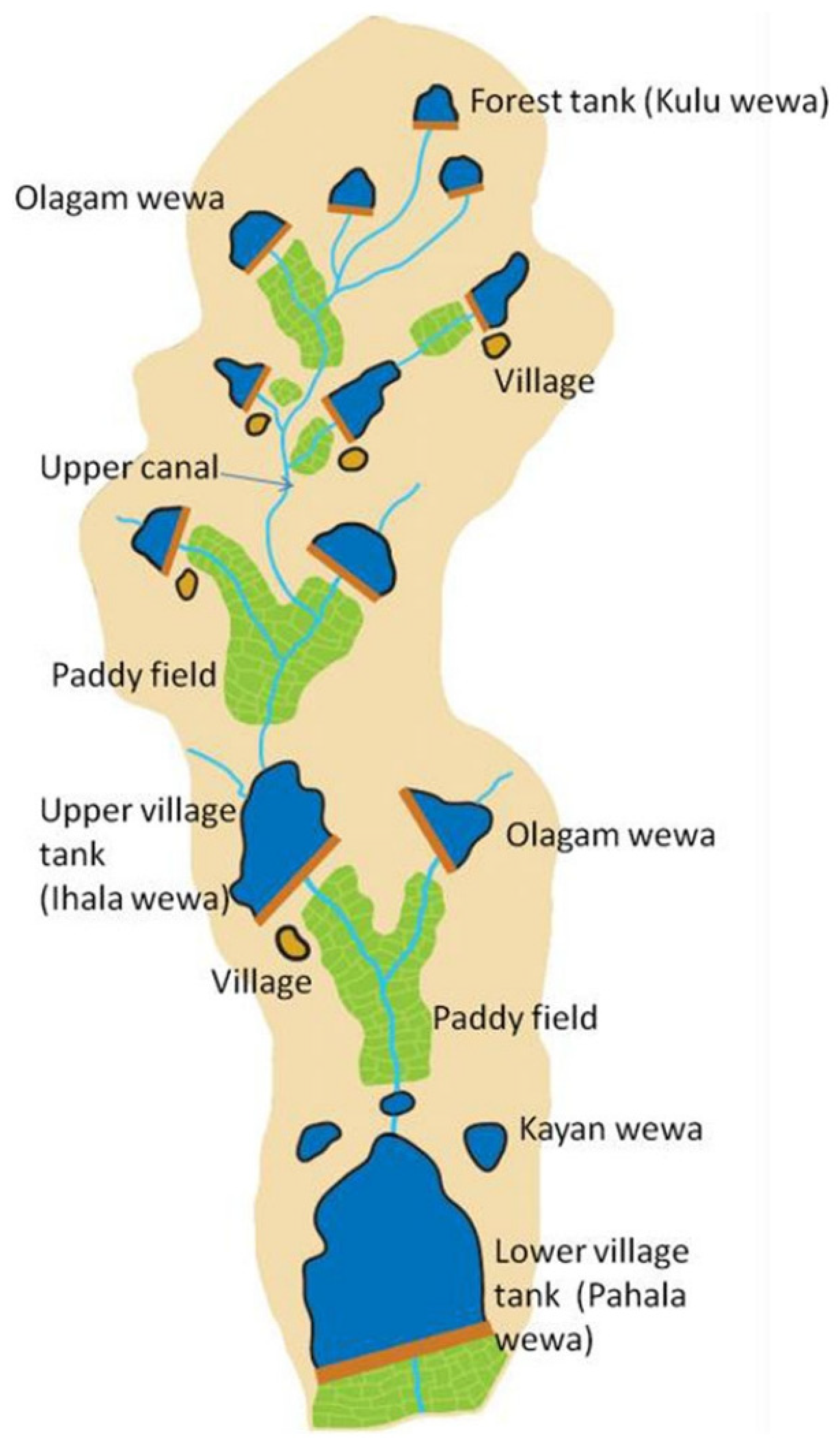
Ellanga Gammana—Sri Lanka’s Cascaded Tank-Village Water Management System

2.3. A Global Perspective on Sustainable Tourism and Agricultural Heritage
3. Methodology
4. Results and Discussion

| Innovation Category | Innovation Types | References | |
|---|---|---|---|
| A | Product innovations | Traditional crop varieties, Traditional farming, Traditional food culture, Traditional festivals, Worship activities, Sightseeing, Water resource utilization technique, local village, Certified traditional food. | [11,19,31,45,46,50,53,62,63,64] |
| B | Process innovation | Diversify events, attractions, services and accommodation, Product certification. | [65,66,67] |
| C | Management innovation | Establish information centers about agricultural heritage. Organize educational sightseeing tours about ancient irrigation systems. Encourage tourists and hosts to participate in tourism activities based on agricultural heritage. Train tour guides who are familiar with traditional irrigation and agricultural systems. Integrate traditional tourism and agricultural heritage tourism in the dry zone to create positive network effects for tourism. Bilateral and multilateral agreements. | [11,58] |
| D | Logistics innovation | Strategic branding. Visitor management. | [45,68] |
| E | Institutional innovation | Stakeholder participation; Introduce policy schemes; Increase research activities; Strive towards international standards. | [32,45,62,63,69] |
4.1. Innovation Areas for Global Agricultural Heritage Systems
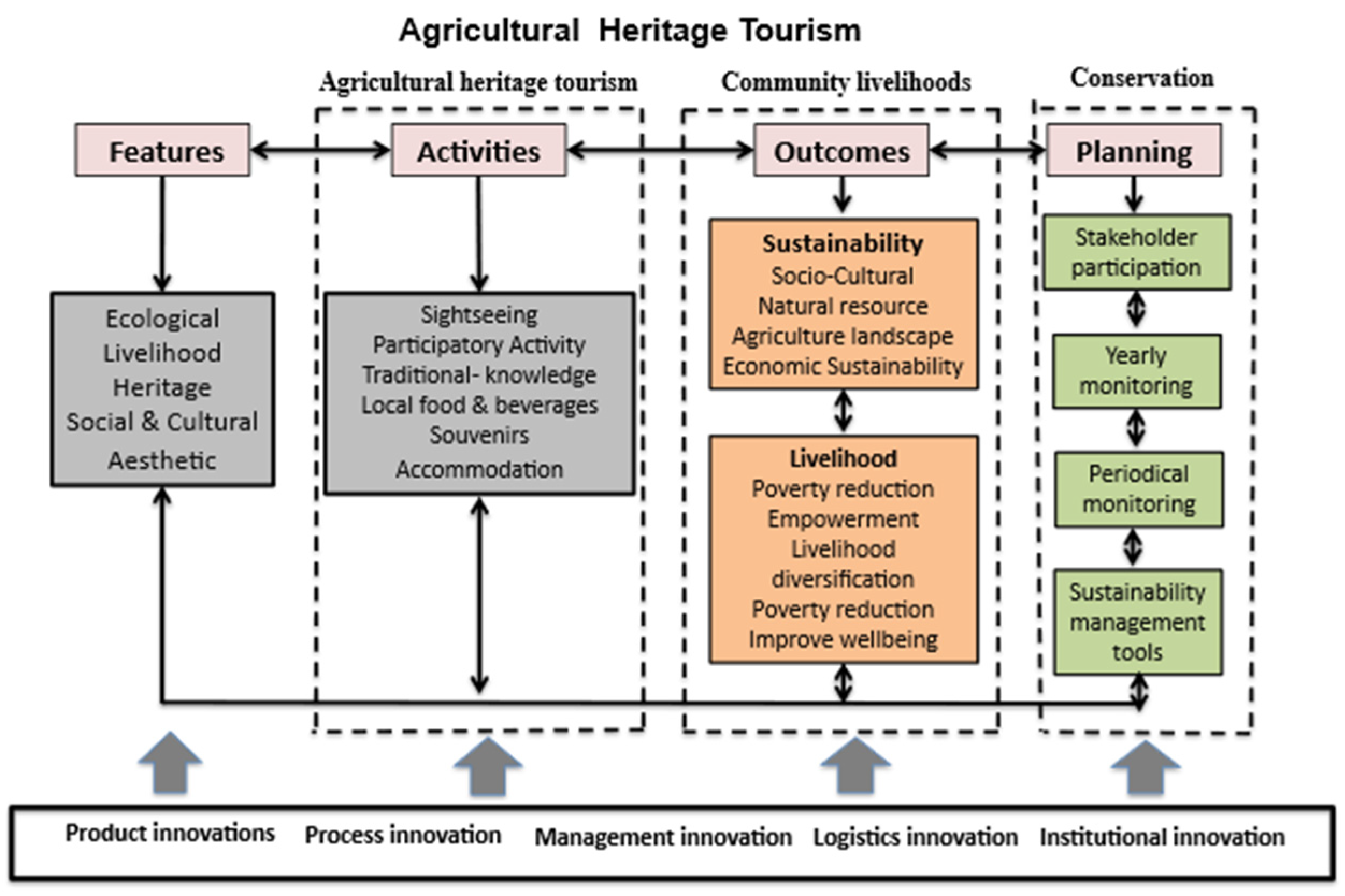
4.2. A New Framework for the Development of GIAHS-Based Tourism in Sri Lanka

5. Conclusions
Author Contributions
Funding
Data Availability Statement
Acknowledgments
Conflicts of Interest
References
- Yotsumoto, Y.; Vafadari, K. Comparing cultural world heritage sites and globally important agricultural heritage systems and their potential for tourism. J. Heri Tour. 2021, 16, 43–61. [Google Scholar] [CrossRef]
- Jia, S.; Chi, O.H.; Martinez, S.D.; Lu, L. When “old” meets “new”: Unlocking the future of innovative technology implementation in heritage tourism. J. Hosp. Tour. Res. 2025, 49, 640–661. [Google Scholar] [CrossRef]
- Qiu, Q.; Zuo, Y.; Zhang, M. Intangible cultural heritage in tourism: Research review and investigation of future agenda. Land 2022, 11, 139. [Google Scholar] [CrossRef]
- Arnés García, M.; Yagüe, J.L.; de Nicolás, V.L.; Diaz-Puente, J.M. Characterization of globally important agricultural heritage systems (GIAHS) in Europe. Sustainability 2020, 12, 1611. [Google Scholar] [CrossRef]
- Zhang, Q.; Li, S.; Cheng, Z.; Wu, X.; Long, C. Ethnobotanical Knowledge and Ecological Wisdom in Honghe Hani Rice Terrace System, Southwest China. In Ethnobiology and Development in Asia: The Belt and Road Initiative; Springer Nature: Cham, Switzerland, 2026; Volume 1, pp. 215–232. [Google Scholar]
- Min, Q. Research priorities, problems and countermeasures of Important Agricultural Heritage Systems and their conservation. Chin. J. Eco-Agric. 2021, 28, 1285–1293. [Google Scholar]
- Gutierriz, I.; Ferreira, J.J.; Fernandes, P.O. Digital transformation and the new combinations in tourism: A systematic literature review. Tour. Hosp. Res. 2025, 25, 194–213. [Google Scholar] [CrossRef]
- Lu, H.; Qingwen, M. The role of multi-functionality of agriculture in sustainable tourism development in Globally Important Agricultural Heritage Systems (GIAHS) sites in China. J. Resour. Ecol. 2013, 4, 250–257. [Google Scholar] [CrossRef]
- Chen, B.X.; Qiu, Z.M.; Usio, N.; Nakamura, K. Tourism’s impacts on rural livelihood in the sustainability of an aging community in Japan. Sustainability 2018, 10, 2896. [Google Scholar] [CrossRef]
- Timothy, D.J.; Boyd, S.W. Heritage tourism in the 21st century: Valued traditions and new perspectives. J. Herit. Tour. 2006, 1, 1–16. [Google Scholar] [CrossRef]
- Su, M.M.; Dong, Y.; Wall, G.; Sun, Y. A value-based analysis of the tourism use of agricultural heritage systems: Duotian Agrosystem, Jiangsu Province, China. J. Sustain. Tour. 2020, 28, 2136–2155. [Google Scholar] [CrossRef]
- Timothy, D.J.; Boyd, S.W. Heritage Tourism; Prentice Hall: Harlow, UK, 2003. [Google Scholar]
- Park, H.Y. Heritage Tourism; Routledge: Abingdon, UK, 2013. [Google Scholar]
- Su, M.; Sun, Y.; Min, Q.; Jiao, W. A community livelihood approach to agricultural heritage system conservation and tourism development: Xuanhua Grape Garden urban agricultural heritage site, Hebei Province of China. Sustainability 2018, 10, 361. [Google Scholar] [CrossRef]
- Persson, E.; Li, Y. The Green Heritage. In Det Gröna Kulturarvet; Sveriges Lantbruksuniversitet: Uppsala, Sweden, 2018; pp. 9–13. [Google Scholar]
- Hosseini, K.; Stefaniec, A.; Hosseini, S.P. World Heritage Sites in developing countries: Assessing impacts and handling complexities toward sustainable tourism. J. Destin. Mark. Manag. 2021, 20, 100616. [Google Scholar] [CrossRef]
- Winter, C. Safeguarding Agricultural Heritage: The Case of Colombia’s Coffee Cultural Landscape. Doctoral Dissertation, University of Pennsylvania, Philadelphia, PA, USA, 2015. [Google Scholar]
- Farsani, N.T.; Ghotbabadi, S.S.; Altafi, M. Agricultural heritage as a creative tourism attraction. Asia Pac. J. Tour Res. 2019, 24, 541–549. [Google Scholar] [CrossRef]
- Food and Agriculture Organization (FAO). Globally Important Agricultural Heritage Systems (GIAHS). 2024. Available online: https://www.fao.org/giahs (accessed on 30 March 2026).
- Min, Q. Six types of relations that should be managed in Agricultural Heritage Tourism development. World Heri. 2018, 62, 38. [Google Scholar]
- Jiao, W.; Min, Q. Reviewing the progress in the identification, conservation and management of China-Nationally Important Agricultural Heritage Systems (China-NIAHS). Sustainability 2017, 9, 1698. [Google Scholar] [CrossRef]
- Koohafkan, P.; Cruz, M.J.D. Conservation and adaptive management of globally important agricultural heritage systems (GIAHS). J. Resour. Ecol. 2011, 2, 22–28. [Google Scholar]
- Reyes, S.R.C.; Miyazaki, A.; Yiu, E.; Saito, O. Enhancing sustainability in traditional agriculture: Indicators for monitoring the conservation of globally important agricultural heritage systems (GIAHS) in Japan. Sustainability 2020, 12, 5656. [Google Scholar] [CrossRef]
- Sun, Y.H.; Dela Cruz, M.J.; Min, Q.W.; Liu, M.C.; Zhang, L.Y. Conserving agricultural heritage systems through tourism: Exploration of two mountainous communities in China. J. Mt. Sci. 2013, 10, 962–975. [Google Scholar] [CrossRef]
- Liu, Y.; Lu, S.; Chen, Y. Spatio-temporal change of urban-rural equalized development patterns in China and its driving factors. J. Rural Stud. 2013, 32, 320–330. [Google Scholar] [CrossRef]
- Fuller, A.M.; Min, Q.; Jio, W.; Bai, Y. Globally Important Agricultural Heritage Systems (GIAHS) of China: The challenge of complexity in research. Ecosyst. Health Sustain. 2015, 1, 11878980. [Google Scholar] [CrossRef]
- Reitsma, K.D.; Dunn, B.H.; Mishra, U.; Clay, S.A.; DeSutter, T.; Clay, D.E. Landuse change impact on soil sustainability in a climate and vegetation transition zone. J. Agron. 2015, 107, 2363–2372. [Google Scholar] [CrossRef]
- Zhu, G.; Li, X.; Zhang, Y. Multi-Stakeholder Involvement Mechanism in Tourism Management for Maintaining Terraced Landscape in Important Agricultural Heritage Systems (IAHS) Sites: A Case Study of Dazhai Village in Longji Terraces, China. Land 2021, 10, 1146. [Google Scholar] [CrossRef]
- Yang, L.; Liu, M.C.; Min, Q.W.; Li, W. Specialization or diversification? The situation and transition of households’ livelihood in Agricultural Heritage Systems. Int. J. Agric. Sustain. 2018, 16, 455–471. [Google Scholar] [CrossRef]
- Sun, Y.; Timothy, D.J.; Wang, Y.; Min, Q.; Su, Y. Reflections on Agricultural Heritage Systems and tourism in China. J. China Tour. Res. 2019, 15, 359–378. [Google Scholar] [CrossRef]
- Zhang, Y.Y. Study on the Relationship Between Contemporary Poetry of Hani Ethnic Group and Hani Culture. Master’s Thesis, Yunnan Normal University, Yunnan, China, 2016. [Google Scholar]
- Min, Q.W.; Zhang, Y.X.; Jiao, W.J.; Sun, X.P. Responding to common questions on the conservation of agricultural heritage systems in China. J. Geogr. Sci. 2016, 26, 969–982. [Google Scholar] [CrossRef]
- Qiu, Z.M.; Chen, B.X.; Takemoto, K. Conservation of terraced paddy fields engaged with multiple stakeholders: The case of the Noto GIAHS site in Japan. Paddy Water Environ. 2014, 12, 275–283. [Google Scholar] [CrossRef]
- Chowdhury, R.B.; Moore, G.A. Floating agriculture: A potential cleaner production technique for climate changes adapation and sustainable community development in Bangladesh. J. Clean. Prod. 2017, 150, 371–389. [Google Scholar] [CrossRef]
- Nianthi, K.W.G.R.; Jayakumara, M.A.S. Progress of research on cascade irrigation systems in the dry zones of Sri Lanka. In Water Communit; Community, Environment and Disaster Risk Management; Emerald Group Publishing Limited: Leeds, UK, 2010; Volume 2, pp. 109–137. [Google Scholar]
- Bebermeier, W.; Meister, J.; Withanachchi, C.R.; Middelhaufe, I.; Schütt, B. Tank Cascade Systems as a Sustainable Measure of Watershed Management in South Asia. Water 2017, 9, 231. [Google Scholar] [CrossRef]
- Leach, E.R. Village irrigation in the dry zone of Sri Lanka. In Irrigation and Agricultural Development in Asia: Perspectives from the Social Sciences; Cornell University Press: Ithaca, NY, USA, 1980; pp. 91–126. [Google Scholar]
- Dharmasena, P.B. Sedimentation and desiltation of minor tank. In Summaries of Papers Presented at Irrigation Research Management Unit Seminar Series; Irrigation Department, Irrigation Department Head Office: Colombo, Sri Lank, 1994. [Google Scholar]
- Bandara, C.M. Catchment ecosystem and village tank cascade in the dry zone of Sri Lanka: A time-tested system of land and water resources management. In Strategies for River Basin Management; Lundqvist, J., Lohm, U., Falkenmark, M., Eds.; Reidel Publishing: Dordrecht, The Netherlands, 1985; pp. 99–113. [Google Scholar]
- Geekiyanage, N.; Pushpakumara, D.K.N.G. Ecology of ancient tank cascade systems on island Sri Lanka. J. Mar. Isl. Cult. 2013, 2, 93–101. [Google Scholar] [CrossRef]
- Dharmasena, P.B. Evolution of hydraulic Societies in the ancient Anuradhapura kingdom of Sri Lanka. In Landscapes and Societies; Martini, I.P., Chesworth, W., Eds.; Springer: Dordrecht, The Netherlands, 2010; pp. 341–352. [Google Scholar]
- Kekulandala, B.; Jacobs, B.; Cunningham, R. Management of small irrigation tank cascade systems (STCS) in Sri Lanka: Past, present and future. Clim. Dev. 2021, 13, 337–347. [Google Scholar] [CrossRef]
- Edirisooriya, C. Wevugam Pubuduwa Aims to Transform Dry Zone Water Management and Climate Resilience. 2025. Available online: https://www.sundayobserver.lk/2025/07/20/business/57270/wevugam-pubuduwa-aims-to-transform-dry-zone-water-management-and-climate-resilience/ (accessed on 3 February 2026).
- Dissanayake, S.T.; Vidanage, S. Valuing ecosystem services from restoring ancient irrigation systems: An application comparing labor vs. monetary payments for choice experiments. Agric. Resour. Econ. Rev. 2023, 52, 422–449. [Google Scholar] [CrossRef]
- Yiu, E.; Nagata, A.; Takeuchi, K. Comparative study on conservation of agricultural heritage systems in China, Japan and Korea. J. Resour. Ecol. 2016, 7, 170–179. [Google Scholar] [CrossRef]
- Hashimoto, A.; Telfer, D.J.; Telfer, S. Life beyond growth? Rural depopulation becoming the attraction in Na-goro, Japan’s scarecrow village. J. Herit. Tour. 2021, 16, 493–512. [Google Scholar] [CrossRef]
- Akira, N.; Evonne, Y. Ten Years of GIAHS Development in Japan. J. Resour. Ecol. 2021, 12, 567–577. [Google Scholar] [CrossRef]
- Choo, H.; Jamal, T. Tourism on organic farms in South Korea: A new form of ecotourism. J. Sustain. Tour. 2009, 17, 431–454. [Google Scholar] [CrossRef]
- Ma, N.; Yang, L.; Min, Q.; Bai, K.; Liu, W. The Significance of Traditional Culture for Agricultural Biodiversity—Experiences from GIAHS. J. Resour. Ecol. 2021, 12, 453–461. [Google Scholar] [CrossRef]
- Maharjan, K.L.; Gonzalvo, C.M.; Aala, W.F., Jr. Leveraging Japanese Sado island farmers’ GIAHS inclusivity by understanding their perceived involvement. Sustainability 2021, 13, 11312. [Google Scholar] [CrossRef]
- Zhang, A.; Hou, B.; Ma, N. Community residents’ perceptions of tourism impacts and their participation attitudes at agricultural heritage sites: A case study of Hani Terraces. Hum. Geogr. 2017, 32, 138–144. [Google Scholar]
- Medina, L.K. Commoditizing culture: Tourism and Maya identity. Ann. Tour. Res. 2003, 30, 353–368. [Google Scholar] [CrossRef]
- Su, M.M.; Wall, G.; Wang, Y.N.; Jin, M. Livelihood sustainability in a rural tourism destination—Hetu Town, Anhui Province China. Tour. Manag. 2019, 71, 272–281. [Google Scholar] [CrossRef]
- Zhang, Y.; Li, X. Protecting traditional agricultural landscapes by promoting industrial integration development: Practices form Important Agricultural Heritage Systems (IAHS) sites in China. Land 2022, 11, 1286. [Google Scholar] [CrossRef]
- Sumanapala, D.; Timothy, D.J.; Wolf, I.D. An agenda for heritage tourism research in Sri Lanka: Current knowledge and future directions. J. Hosp. Tour. Manag. 2024, 1, 20–24. [Google Scholar]
- Sumanapala, D.; Wolf, I.D. Recreational ecology: A review of research and gap analysis. Environments 2019, 6, 81. [Google Scholar] [CrossRef]
- Wohlin, C.; Kalinowski, M.; Felizardo, K.R.; Mendes, E. Successful combination of database search and snowballing for identification of primary studies in systematic literature studies. Inf. Softw. Technol. 2022, 147, 106908. [Google Scholar] [CrossRef]
- Hjalager, A.-M. Reparing innovation defectiveness in tourism. Tour. Manag. 2002, 23, 465–474. [Google Scholar]
- Farsani, N.T.; Zeinali, H.; Moaiednia, M. Food heritage and promoting herbal medicine-based niche tourism in Isfahan, Iran. J. Herit. Tour. 2016, 13, 77–87. [Google Scholar] [CrossRef]
- Kajihara, H.; Zhang, S.; You, W.; Min, Q. Concerns and opportunities around cultural heritage in east Asian globally important agricultural heritage systems (GIAHS). Sustainability 2018, 10, 1235. [Google Scholar] [CrossRef]
- Su, M.; Wang, M.; Sun, Y.; Wang, Y. Tourist perspectives on agricultural heritage interpretation—A case study of the Qingtian Rice-Fish System. Sustainability 2022, 14, 10206. [Google Scholar] [CrossRef]
- Inagaki, H.; Kusumoto, Y. Assessment of GIAHS in Shizuoka: The traditional tea-grass integrated system. J. Resour. Ecol. 2014, 5, 398–401. [Google Scholar] [CrossRef]
- Zhang, C.; Liu, M. Challenges and countermeasures for the sustainable development of Nationally Important Agricultural Heritage Systems in China. J. Resour. Ecol. 2014, 5, 390–394. [Google Scholar] [CrossRef]
- Liu, M.; Yang, L.; Bai, Y.; Min, Q. The impacts of farmers’ livelihood endowments on their participation in eco-compensation policies: Globally important agricultural heritage systems case studies from China. Land Use Policy 2018, 77, 231–239. [Google Scholar] [CrossRef]
- Kajima, S.; Tanaka, Y.; Uchiyama, Y. Japanese sake and tea as place-based products: A comparison of regional certifications of globally important Agricultural Heritage Systems, geopark, biosphere reserves, and geographical indication at product level certification. J. Ethn. Foods. 2017, 4, 80–87. [Google Scholar] [CrossRef]
- Chiang, Y.C.; Weng, P.Y.; Sato, N. The preservation of important rural japanese cultural landscapes: Considering the warabino paddy field as an example. J. Fac. Agric. Kyushu Univ. 2013, 58, 209–218. [Google Scholar] [CrossRef] [PubMed]
- Lee, Y.S.; Shin, W.J. Marketing tradition-bound products through storytelling: A case study of a Japanese sake brewery. Serv. Bus. 2015, 9, 281–295. [Google Scholar] [CrossRef]
- Hayashi, H. Understandings of relationships between agriculture and biodiversity in Kunisaki GIAHS. J. Resour. Ecol. 2014, 5, 395–397. [Google Scholar] [CrossRef]
- Wang, N.; Li, J.; Zhou, Z. Landscape pattern optimization approach to protect rice terrace Agroecosystem: Case of GIAHS site Jiache Valley, Guizhou, southwest China. Ecol. Indic. 2021, 129, 107958. [Google Scholar] [CrossRef]
- Herskovitz, S.; Crystal, M. The essential brand persona: Storytelling and branding. J. Bus. Strategy 2010, 31, 21–28. [Google Scholar] [CrossRef]
- Wang, Y.; Huang, S.; Kim, A.K. Towards a framework integrating authenticity and integrity in heritage tourism. J. Sustain. Tour. 2015, 23, 1468–1481. [Google Scholar] [CrossRef]
- Jiang, H.Y. Conservation of Ifugao Values. Master’s Thesis, University of California, Davis, CA, USA, 2006. [Google Scholar]
- Su, M.M.; Sun, Y.; Wall, G.; Min, Q. Agricultureal heritage conservation, tourism and community livelihood in the process of urbanization-Xuanhua grape garden, Hebei province, China. Aisa Pac. J. Tour. Res. 2020, 25, 205–222. [Google Scholar] [CrossRef]
- Khater, M. The role of tourism guides in heritage management at archaeological sites: Enhancing conservation and visitor experience. Tour. Recreat. Res. 2026, 51, 268–285. [Google Scholar] [CrossRef]
- Sun, Y.; Zhou, H.; Wall, G.; Wei, Y. Cognition of disaster risk in a tourism community: An agricultural heritage system perspective. J. Sustin. Tour. 2017, 25, 536–553. [Google Scholar] [CrossRef]
- Hjalager, A.M. Cultural tourism innovation systems—The Roskilde festival. In Festival and Event Management in Nordic Countries; Routledge: Abingdon, UK, 2014; pp. 104–125. [Google Scholar]
- Altieri, M.A.; Koohafkan, P. Globally Important Ingenious Agricultural Heritage Systems (GIAHS): Extent, significance, and implications for development. In Proceedings of the Second International Workshop and Steering Committee Meeting for the Globally Important Agricultural Heritage Systems (GIAHS) Project; FAO: Rome, Italy, 2004; pp. 7–9. [Google Scholar]
- Hjalager, A.M. The coevolution of tourism and agriculture. Gastron. Tour 2020, 4, 175–191. [Google Scholar] [CrossRef]
- Timothy, D.J. Cultural Heritage and Tourism: An Introduction; Channel View Publications: Bristol, UK, 2011; Volume 4. [Google Scholar]
- Jiao, W.; Yang, X.; Min, Q. A review of the progress in globally important agricultural heritage systems (GIAHS) monitoring. Sustainability 2022, 14, 9958. [Google Scholar] [CrossRef]
- Swarbrroke, J. The future of the past: Heritage tourism in the 21st centuary. In Tourism: The State of the Art; Seaton, A.B., Ed.; Johan Wiley and Sons: Oxford, UK, 1994. [Google Scholar]
- Poria, Y.; Airey, D.; Butler, R. Challenging the present approach to heritage tourism: Is tourism to heritage places heritage tourism. Tour Rev. 2021, 56, 51–53. [Google Scholar] [CrossRef]
- Zhang, Y.; Min, Q.; Li, H.; He, L.; Zhang, C.; Yang, L. A conservation approach of globally important agricultural heritage systems (GIAHS): Improving traditional agricultural patterns and promoting scale-production. Sustainability 2017, 9, 295. [Google Scholar] [CrossRef]
- Gu, H.; Jiao, Y.; Liang, L. Strengthening the socio-ecological resilience of forest-dependent communities: The case of the Hani Rice Terraces in Yunnan, China. For. Policy Econ. 2012, 22, 53–59. [Google Scholar] [CrossRef]
- Hoang, T.T.H.; Van Rompaey, A.; Meyfroidt, P.; Govers, G.; Vu, K.C.; Nguyen, A.T.; Hens, L.; Vanacker, V. Impact of tourism development on the local livelihoods and land cover change in the Northern Vietnamese highlands. Environ. Dev. Sustain. 2018, 22, 1371–1395. [Google Scholar] [CrossRef]
- Tian, M.; Min, Q.; Lun, F.; Yuan, Z.; Fuller, A.M.; Yang, L.; Zhang, Y.; Zhou, J. Evaluation of tourism water capacity in agricultural heritage sites. Sustainability 2015, 7, 15548–15569. [Google Scholar] [CrossRef]
- Jiao, W.; Wang, B.; Sun, Y.; Liu, M. Design and application of the annual report of Globally Important Agricultural Heritage Systems (GIAHS) monitoring. J. Resour. Ecol. 2021, 12, 498–512. [Google Scholar] [CrossRef]
| Division of Innovation | Description of Sub-Division | |
|---|---|---|
| A | Product innovations | Consists of new products or services, development to the stage of commercialization. |
| B | Process innovation | Involves ways of raising the performance of existing operations with new or improved technology or redesigning of the entire production line. |
| C | Management innovation | Involves new job profiles, collaborative structures, and authority systems. |
| D | Logistics innovation | Involves Internet marketing development. |
| E | Institutional innovation | Deals with collaborative and regulatory structures in communities in which public and private sectors cooperate with new rules and regulations. |
Disclaimer/Publisher’s Note: The statements, opinions and data contained in all publications are solely those of the individual author(s) and contributor(s) and not of MDPI and/or the editor(s). MDPI and/or the editor(s) disclaim responsibility for any injury to people or property resulting from any ideas, methods, instructions or products referred to in the content. |
© 2026 by the authors. Licensee MDPI, Basel, Switzerland. This article is an open access article distributed under the terms and conditions of the Creative Commons Attribution (CC BY) license.
Share and Cite
Sumanapala, D.; Wolf, I.D. A Novel Framework for Reimagining Agricultural Heritage Tourism: Ancient Irrigation Systems in South Asia. Land 2026, 15, 678. https://doi.org/10.3390/land15040678
Sumanapala D, Wolf ID. A Novel Framework for Reimagining Agricultural Heritage Tourism: Ancient Irrigation Systems in South Asia. Land. 2026; 15(4):678. https://doi.org/10.3390/land15040678
Chicago/Turabian StyleSumanapala, Daminda, and Isabelle D. Wolf. 2026. "A Novel Framework for Reimagining Agricultural Heritage Tourism: Ancient Irrigation Systems in South Asia" Land 15, no. 4: 678. https://doi.org/10.3390/land15040678
APA StyleSumanapala, D., & Wolf, I. D. (2026). A Novel Framework for Reimagining Agricultural Heritage Tourism: Ancient Irrigation Systems in South Asia. Land, 15(4), 678. https://doi.org/10.3390/land15040678