


Abstract
The conservation of traditional villages has shifted from isolated site-by-site protection to regional collaboration, and exploring pathways for their sustainable development has become a key focus of research. Existing research still falls short in areas such as the integration of heritage value into decision-making mechanisms and the establishment of systematic conservation frameworks, leading to prominent issues of isolated conservation and homogeneous development. Taking traditional villages in Yanchuan County, China, as a case study, this research aims to establish a clustered conservation system and achieve a transition towards networked collaborative governance. The study utilised field surveys and literature review to establish a database and systematically catalogue heritage resources; it combined the Analytic Hierarchy Process (AHP) and the Delphi method to construct a value evaluation system and identify distinctive features; and it integrated cluster theory with GIS spatial analysis to construct a clustered conservation framework across three dimensions: classification and grading, symbiotic models, and the overall spatial pattern. The results indicate that: (1) the spatial distribution of villages in Yanchuan County is uneven, and the villages themselves exhibit significant homogeneity in their characteristics; (2) core characteristics include Loess culture, cave dwellings and revolutionary heritage sites, with comprehensive scores ranging from 0.4437 to 0.9116; these are classified into three protection levels, identifying five categories of villages of value. (3) Five major cluster zones were delineated based on resource and spatial characteristics. By integrating river basins and transport corridors, a comprehensive protection framework of ‘one belt, two wings, two centers and five zones’ was established, alongside three types of cluster symbiosis models, thereby achieving regional resource integration and enhancing collaborative efficiency. The cluster-based protection system proposed in this study can effectively address the challenges facing the conservation and development of traditional villages, providing a feasible solution for regional collaborative protection, and holds practical significance for cultural heritage management and sustainable development.
1. Introduction
As important repositories of regional culture and folk customs, traditional villages embody profound historical, cultural, aesthetic and economic value, and are highly representative and characteristic within the cultural heritage system [1]. Since China launched its traditional village assessment program in 2012, a total of 8155 traditional villages across six batches have been included in the protection list, forming the world’s largest and most valuable cluster of protected agricultural heritage. Agricultural industries constrained by soil and climatic conditions, regional social structures based on kinship ties and geographical environments, and traditional lifestyles have fostered similarities in the cultural and landscape dimensions of these villages, leading to a phenomenon of homogenisation [2,3]. The traditional ‘atomised’ conservation model, coupled with excessive tourism development, has exacerbated disorderly competition and resource wastage among villages [4].
With the advancement of globalisation and urbanisation, traditional museum-style and emergency conservation approaches are no longer sufficient to meet the sustainable development needs of traditional villages. Consequently, research into the conservation and utilization of traditional villages from a regional holistic perspective has become a key topic in the academic community [5]. In 2020, China issued the ‘Notice on organizing Applications for the 2020 Demonstration Cities for the Protection and utilization of Concentrated Clusters of Traditional Villages’, and subsequently announced 120 demonstration counties (cities and districts) between 2020 and 2024, with the aim of exploring effective pathways for the protection and development of traditional villages. Against this backdrop, the key issue that urgently needs to be addressed is how, building upon the foundation of ‘improving the protection inventory and gaining a clear understanding of the existing situation’, to apply holistic and systematic concepts to achieve ‘equal emphasis on protection and utilization, with utilization promoting protection’ [6,7].
Existing research has made some progress in identifying the value of traditional villages and formulating conservation strategies, with the scope of study gradually expanding from the aesthetic and architectural value of individual villages to the exploration and integration of multi-dimensional value systems—including historical, social, economic, cultural and ecological dimensions—across entire regions [8]. Among these, comprehensive surveys and analyses of heritage resource characteristics, with the objective of ‘taking stock of existing assets’, have become a prerequisite for undertaking the conservation of traditional villages [9,10]. Conducting an objective and comprehensive assessment of the heritage resource endowments and distinctive values of traditional villages through a combination of qualitative and quantitative methods serves as the cornerstone and core of conservation efforts [11]. Existing research often focuses on subjective descriptions of cultural value through qualitative methods, whilst quantitative methods are predominantly applied in isolation to identify spatial distributions. There is a lack of deep integration between the two, and they have failed to establish effective links with cluster conservation strategies, resulting in a ‘disconnect between value assessment and conservation decision-making’. The transformation and regeneration of traditional villages are inherently interdependent. Their core lies in systematically understanding heritage resources, distilling distinctive values, constructing differentiated conservation strategies, and fostering the formation of a synergistic industrial structure, thereby driving the reshaping of village values and sustainable development [12].
Although clustered conservation strategies from a regional integration perspective have been applied to the conservation of traditional villages in previous studies [13,14,15], most of these remain confined to the level of spatial clustering. They fail to incorporate the results of multi-dimensional value assessments into cluster delineation and collaborative governance, making it difficult to realise the synergistic effects of such clusters. Existing research primarily focuses on three aspects: the analysis of agglomeration characteristics, the construction of conservation frameworks, and guidance strategies. In terms of content, most studies rely solely on geographical features or cultural contexts, overlooking the influence of heritage value on cluster delineation [16,17]. Methodologically, spatial analysis techniques such as kernel density analysis [18], the nearest neighbour index method [19], complex network analysis [20] and the least resistance model [21]—though widely used to identify the spatial distribution of villages—overemphasise the geospatial dimension and lack a focus on the multidimensional values of heritage. In terms of trends, existing research has begun to focus on practical applicability, concentrating on management models and the shaping of tourism brand images; however, the absence of an integrated methodological framework makes it difficult to support the practical needs of clustered conservation of traditional villages [22].
Existing findings provide a foundation for clustered conservation, yet shortcomings persist at both theoretical and practical levels: Firstly, at the theoretical level, a systematic conservation framework has yet to be established, and there is a lack of a comprehensive methodological system that integrates the recognition of heritage values, cluster delineation and collaborative development; secondly, at the practical level, there is a lack of systematic understanding and integration of multi-dimensional heritage values; qualitative and quantitative assessments are disconnected from conservation decision-making, and key elements for sustaining the vitality of the villages are being undermined; finally, existing research has failed to explore the endogenous development drivers of clusters from the perspective of regional economic and cultural dynamics, and lacks integration with industrial linkages, leading to persistent issues of ‘conservation silos’ and ‘homogeneous development’.
Yanchuan County is situated in the Loess hilly and gully region of northern Shaanxi, where its traditional villages embody a unique Loess culture and boast abundant heritage resources. However, constrained by geographical location and natural conditions, local economic development has lagged behind, progress in the conservation of traditional villages has been slow, and the preservation of heritage resources faces severe challenges. With the advancement of the Western Development Strategy and the Strategy for Ecological Conservation and High-Quality Development in the Yellow River Basin, clarifying the value of heritage resources in traditional villages and undertaking comprehensive planning has become an urgent and vital task.
Consequently, this study takes Yanchuan County as its case study, aiming to establish a replicable system for the protection of clusters of traditional villages. The innovation of this study is primarily reflected in the following three aspects:
Firstly, by combining the PLE landscape perspective with the AHP method, the study provides a systematic understanding of heritage resources, overcoming the limitations of qualitative subjectivity and quantitative one-dimensionality to achieve a comprehensive quantification of multidimensional heritage value.
Secondly, by integrating the results of value assessment with spatial methods such as kernel density analysis and anti-distance analysis, and by constructing a complex grid system through topological relationships, the study overcomes the shortcoming of traditional cluster delineation—which ‘prioritises geography over value’—to achieve ‘value-oriented cluster delineation’.
Finally, by integrating value assessment, spatial clustering and collaborative development methodologies, the study constructs a systematic approach comprising ‘resource inventory—value identification—cluster delineation—collaborative development’, thereby addressing the systemic shortcomings of existing approaches.
Through a systematic understanding and integration of multidimensional heritage values, this study has mapped the resource characteristics and current conservation status of traditional villages in Yanchuan County, highlighted the key elements sustaining the vitality of these villages, and identified the endogenous drivers of cluster development from the perspective of regional economic and cultural dynamics, thereby providing a viable pathway to address the issues of ‘conservation isolation’ and ‘homogeneous development’. Concurrently, this study enriches the theoretical framework for the clustered conservation of traditional villages and refines relevant research methodologies, thereby offering scientific theoretical support and practical guidance for the sustainable conservation, efficient utilization, and high-quality development of regional cultural heritage.
2. Materials and Methods
2.1. Study Area
Yanchuan County is situated in the north of Shaanxi Province, China, northeast of Yan’an City, on the western bank of the Yellow River. It spans approximately 74.25 km from east to west and 51.5 km from north to south, with a total area of 1984 km2. The county is situated in the loess hilly and gully region of the Loess Plateau, characterized by unique loess cultural landscapes and abundant, diverse heritage resources, with particularly prominent revolutionary cultural heritage. The county houses 79 cultural heritage sites, including the former site of the Taixiang Temple Conference, the former residences of Duan Siying and Lu Yao, the former site of the educated youth movement, a millennium-old post station, and the Qingshuiguan Ferry Crossing. These resources encompass diverse categories such as revolutionary culture and cave dwelling culture, alongside abundant mineral resources and a distinctive political standing. It was designated as a “Demonstration County for Concentrated and Contiguous Conservation of Traditional Villages” in 2022, following the release of the Chinese national document “On Conducting Demonstration Work for Concentrated and Contiguous Conservation and Utilization of Traditional Villages in 2022.” As of 2025, the county comprises 20 traditional villages, 8 of which are nationally designated traditional villages.
2.2. Research Methods
This study employs a combination of quantitative and qualitative methods to assess the value of traditional villages, conduct spatial analysis, and develop cluster conservation strategies. The primary methods used include kernel density analysis, anti-distance visualisation analysis, the Analytic Hierarchy Process (AHP) and the Delphi method.
- (1)
- Kernel Density Analysis
In the conservation of traditional villages, kernel density analysis can be used to identify their spatial aggregation characteristics, providing data support for optimizing the spatial layout of conservation planning and prioritizing resource allocation. In kernel density analysis, higher values indicate a more concentrated distribution of villages, while lower values indicate a more dispersed distribution. Its core function is to transform discrete traditional village point data into a continuous density surface map using the ArcGIS 10.8 platform, visually revealing the spatial distribution patterns of the villages [23].
denotes the density estimate at location (x,y); di denotes the distance from location (x,y) to the i-th observation location; K denotes the kernel function; h denotes the bandwidth or smoothing parameter; n denotes the number of observations.
- (2)
- Inverse Distance Weighting Analysis
One of the commonly employed geostatistical and mathematical interpolation techniques, it is utilised for mapping and forecasting spatial distribution patterns. Inverse distance weighting analysis is applied to transform the discrete distribution of traditional villages into a continuous spatial surface. It reveals the spatial gradient variation and aggregation characteristics of conservation value, transcends administrative boundaries, establishes a conservation theory from a geospatial perspective, and is used for comparative analysis and visual representation of traditional villages [24].
z(x) denotes the estimated value at the interpolation point x; z(xi) denotes the value at the i-th sample point; n denotes the number of sample points used in the interpolation; wi denotes the weight assigned to the i-th sample point. a denotes the distance exponent; denotes the distance from the i-th sample point xi to the target point x. The weight decreases as the distance increases.
- (3)
- The Analytic Hierarchy Process (AHP) and the Delphi Method
This study employs the Analytic Hierarchy Process (AHP) and the Delphi Method to establish an evaluation model, with the aim of determining the importance of each indicator and assigning appropriate weights. Firstly, through expert consultation and literature review, the objective layer, criterion layer and indicator layer of the traditional village value evaluation were constructed, forming a multi-level evaluation system. Secondly, two rounds of expert consultation were conducted using the Delphi Method to progressively optimise the indicator system. Subsequently, the AHP method was employed to perform pairwise comparisons of the indicators, calculate their respective weights, and conduct consistency tests to ensure the consistency of the matrix (CI, CR).
The consistency test formula in the AHP method is:
Here, λmax denotes the largest eigenvalue of the decision matrix, n denotes the order of the matrix, and RI denotes the random consistency index.
Finally, by combining the results of the Delphi method and the AHP method, a comprehensive evaluation system covering multiple dimensions was established.
2.3. Theoretical Framework
The concept of a cluster originates from ecology, referring to the organised grouping of various biological populations within a specific area to form a structural unit, thereby creating a synergy where the whole is greater than the sum of its parts [25]. In 1990, Michael Porter introduced the concept of ‘industrial clusters’ in “The Competitive Advantage of Nations”, applying the phenomenon of clustering to industrial management. He defined an industrial cluster as ‘the spatial concentration of a large number of closely linked enterprises and supporting institutions within a specific sector (usually centred on a dominant industry), resulting in a strong and sustainable competitive advantage’ [26]. Subsequently, research on ‘cluster’ theory gradually moved beyond the concept of ‘industrial clusters’, with its meaning evolving to encompass ‘the complementary sharing of resources to enhance regional competitiveness and innovation’ [27], and it has since been widely applied in numerous fields such as cultural heritage and urbanisation [28]. For instance, scholars such as Dai Yan have applied cluster theory to the clustered conservation of historic towns from the perspective of ‘leadership-differentiation-interconnection’. However, the scope of this theory is not limited to historic towns; it can also be applied to the conservation of traditional villages. Introducing it to conduct research on the clustered conservation of villages is both necessary and feasible.
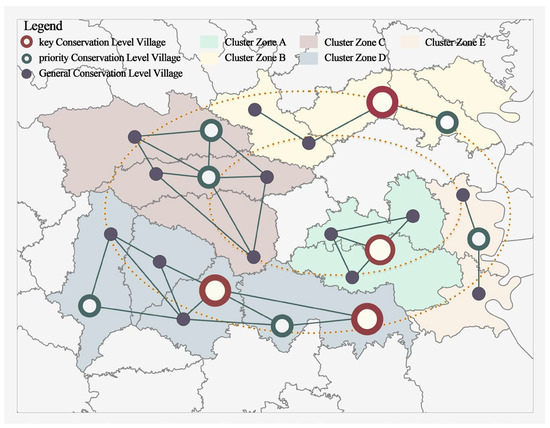
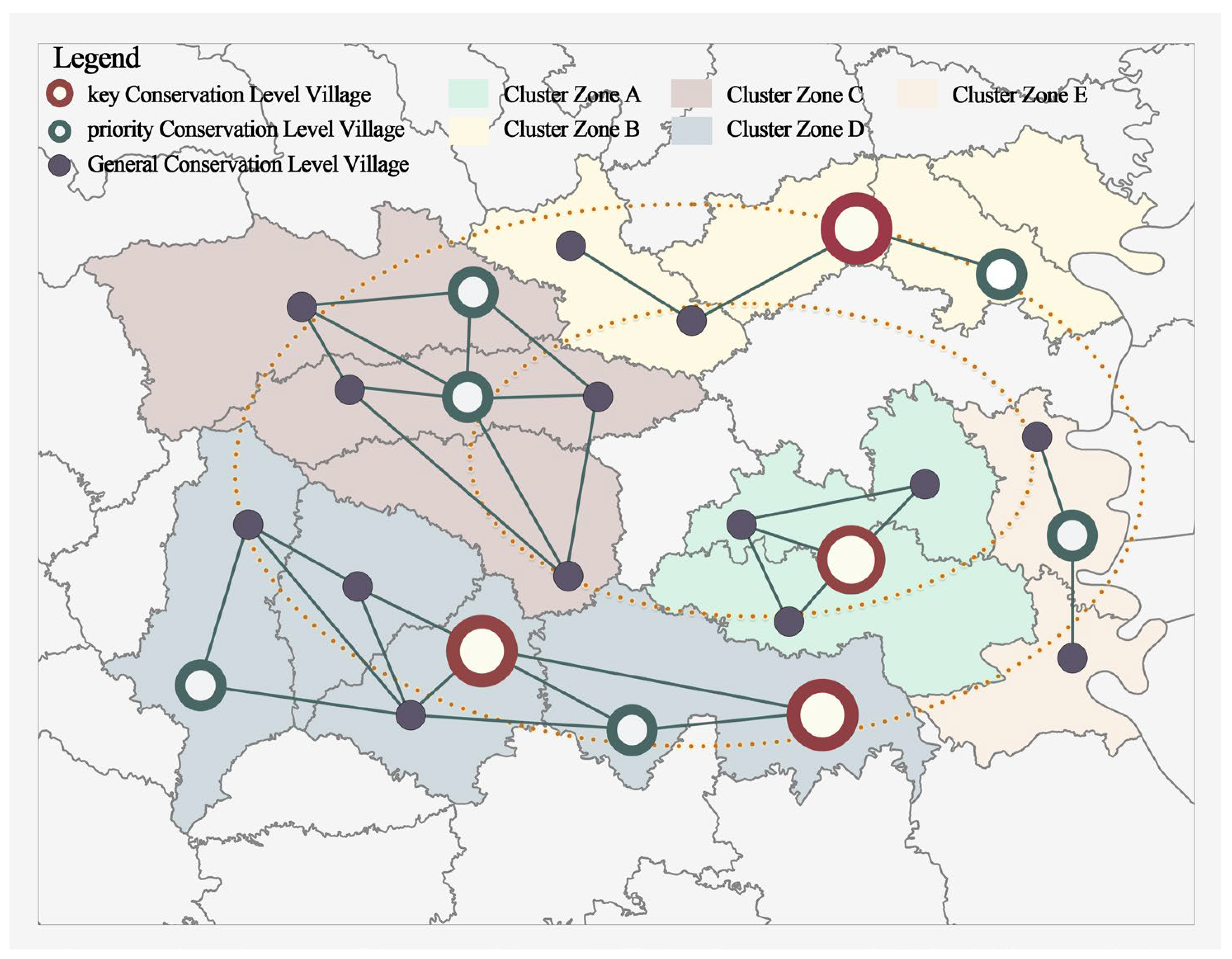
A cluster of traditional villages is formed by integrating scattered settlements through the coordinated delineation of multi-dimensional factors, creating a cohesive whole with close interconnections across various aspects (as shown in Figure 1). Consequently, the development of clustered conservation is not merely based on economies of scale, but rather on the resource endowments, cultural characteristics, and developmental foundations of each village. Through systematic planning and differentiated guidance, it constructs a network of complementary strengths, multi-dimensional connections, and symbiotic coexistence. Guided by this approach, clustered conservation emphasises regional synergy and systemic coupling. It highlights the distinctive features and value of these settlements by ‘connecting points, linking lines, and forming clusters’, and, through the identification of topological relationships among heterogeneous elements, constructs an organic development system. This facilitates functional complementarity and orderly collaboration among villages, thereby avoiding homogeneous competition [29].
Figure 1.
Schematic diagram of traditional village cluster classification.
2.4. Research Framework
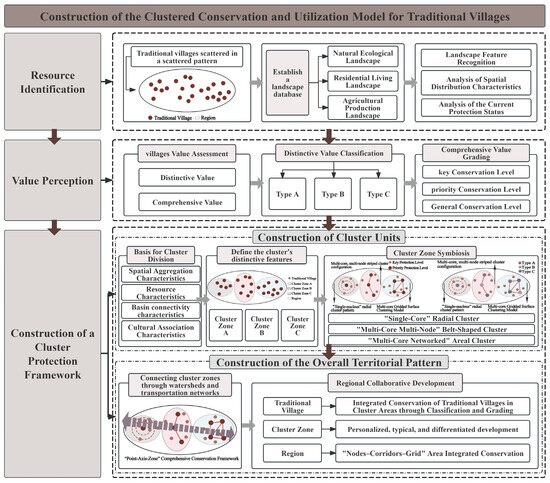
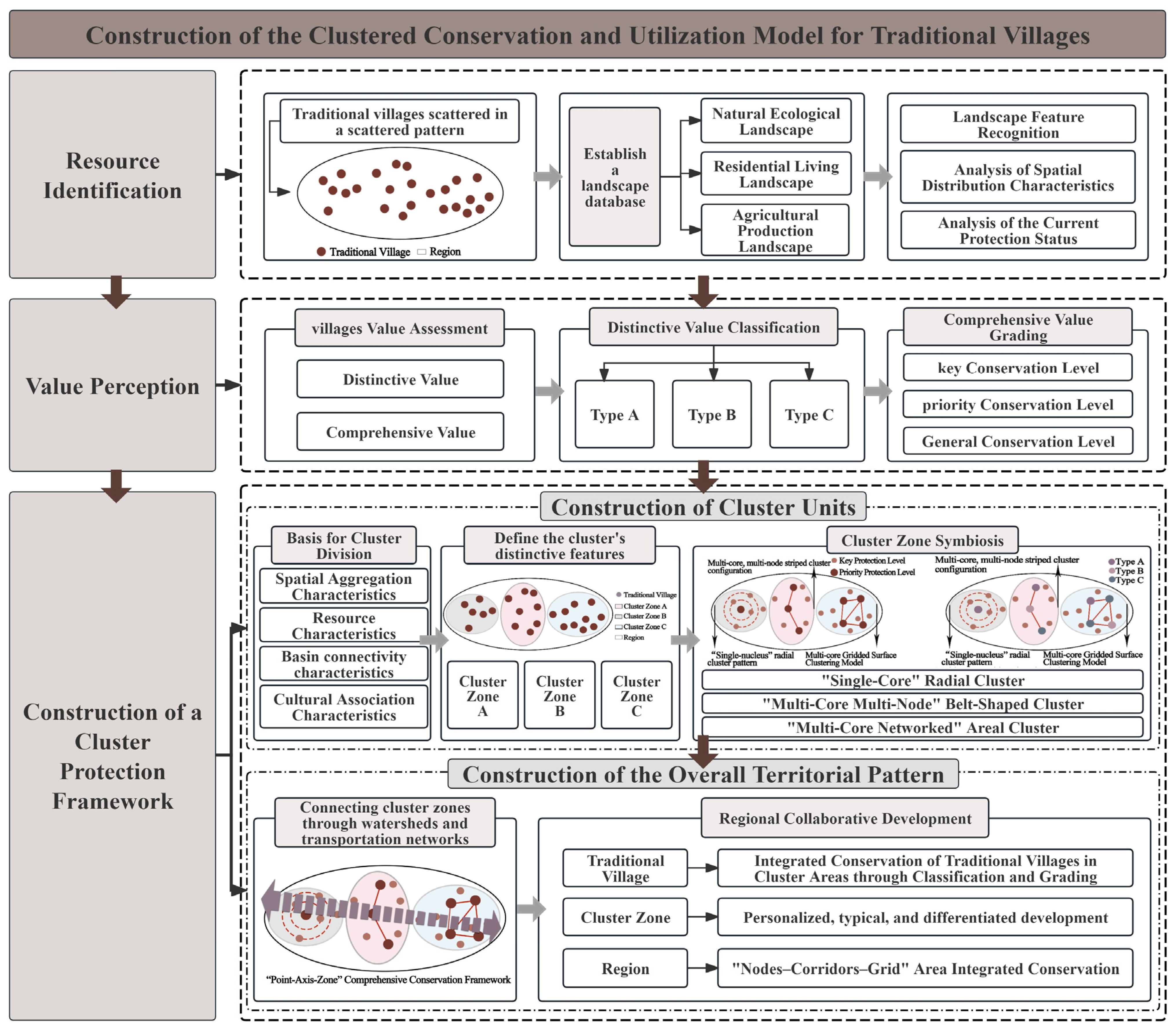
This study centers on the core logic of ‘resource identification—value assessment—construction of a cluster conservation framework’, establishing a research framework for the conservation of traditional village clusters in Yanchuan County. It is carried out in three systematic stages: first, the heritage resources and spatial distribution characteristics of traditional villages are analysed; second, the distinctive values of traditional villages are identified, their development positioning is clarified, and classification and grading for conservation are undertaken; finally, based on the results of the value assessment, different thematic cluster zones are delineated to form a symbiotic cluster model, and a complex, multi-layered, and multi-linked grid relationship is established through topological relationships (As shown in Figure 2).
Figure 2.
Framework for constructing clustered conservation of traditional villages.
2.4.1. Identification of Heritage Resources and Spatial Distribution Characteristics
As a ‘vehicle for values and local memory’, landscape serves as the spatial foundation for historical identity and cultural heritage. Traditional villages are, in essence, holistic landscape systems formed by the interplay and integration of the Production–Living–Ecology (PLE) framework. Among these, the ecological landscape constitutes the natural foundation, whilst the productive and living landscapes derive from this basis and interact with the natural environment over the long term, forming a stable spatial pattern [30]. Through methods such as field surveys, literature reviews and on-site inspections, this study systematically undertakes data collection and information integration regarding the resource elements of the three major landscape types: natural ecological landscapes, agricultural production landscapes and residential living landscapes. Utilising ArcGIS and big data technology, the collected data was organised, validated and standardised to construct the ‘Database of Heritage Resource Characteristics of Traditional Villages’. Kernel density analysis and anti-distance visualisation methods were employed to identify the spatial clustering characteristics and distribution patterns of traditional villages. Combined with the database information, this enabled a comprehensive assessment of the current status of conservation and utilization in traditional villages, as well as the identification of core heritage resources.
2.4.2. Value Evaluation and Construction of Classification and Grading Systems
The various elements that constitute landscape features serve as the vehicles for their distinctive values and are also the core focus of conservation and development efforts. Therefore, identifying landscape features and conducting value assessments are prerequisites for determining the value characteristics of traditional villages and formulating conservation and development strategies. This study employs the Delphi Method and the Analytic Hierarchy Process (AHP) to construct an evaluation system that combines quantitative and qualitative approaches, thereby clarifying the comprehensive and distinctive values of traditional villages in Yanchuan County and providing a quantitative basis for cluster classification.
- (1)
- Selection of Value Indicators
Firstly, based on the characteristics of traditional villages in Yanchuan County, a three-tiered indicator system comprising the objective layer (A), criterion layer (B) and indicator layer (C) was established. Secondly, the indicators were optimised through questionnaire surveys and expert consultation, with respondents including experts from the fields of landscape architecture, urban and rural planning, rural tourism and cultural heritage conservation. Data was collected through face-to-face interviews, questionnaires and interviews. A total of 60 questionnaires were distributed, 58 were returned, and 54 were deemed valid. A five-point rating scale (5 being ‘very important’ and 1 being ‘very unimportant’) was used to evaluate the importance of each indicator, with insignificant indicators (those with a mean importance score < 3.5) being excluded. Finally, a two-round screening process using the Delphi method was conducted: two rounds of expert consultation were carried out based on criteria including the concentration of expert opinions (mean), degree of dispersion, consistency of expert opinions, frequency of full marks, and the degree of agreement among experts; the first round of consultation was used to gather preliminary opinions and screen indicators; the second round of consultation involved re-evaluation and refinement based on feedback from the first round. Ultimately, by integrating expert opinions with the characteristics of villages in Yanchuan County, a comprehensive evaluation system comprising five criterion levels (B1–B5) and 25 indicator levels (C1–C25) was established.
- (2)
- Determination of Evaluation Indicator Weights
The Analytic Hierarchy Process (AHP) was employed to construct a judgment matrix, with pairwise comparisons conducted for indicators at each level; a 9-point scale (1–9 points) was used to quantify the relative importance of indicators. Using Yaanp 10.3 software, the maximum eigenvalue (λmax) and corresponding eigenvector of the judgment matrix were calculated, and consistency tests were conducted (calculating the consistency index CI, random consistency index RI, and consistency ratio CR). When CR < 0.1, the matrix was deemed to have satisfactory consistency, and the weights of each indicator were finally determined.
- (3)
- Establishing scoring grades for the indicator layer
A five-level scoring standard was adopted to construct the indicator-level evaluation system (n = 5). Drawing on the characteristics of traditional villages and the ‘Evaluation and Certification Indicator System for Traditional Villages (Trial)’, corresponding evaluation criteria were established (Table 1). Based on the evaluation results, the comprehensive value of each village was calculated; simultaneously, the village’s distinctive value type was determined according to the highest score in each criterion layer, providing data support for subsequent clustering.
Table 1.
Value evaluation model for traditional villages.
2.4.3. Establishing a Cluster-Based Protection Framework
Based on relevant data such as value characteristics, this paper explores methods for establishing a clustered conservation and development system for traditional villages from three perspectives: the delineation of cluster units, cluster symbiosis models, and the construction of a comprehensive conservation framework.
- (1)
- Delineation of cluster units
Based on administrative divisions, spatial agglomeration characteristics and watershed distribution, and guided by value, this study utilises value-specific data on traditional villages. By employing inverse distance weighting and fuzzy overlay analysis, villages sharing similar cultural resources are clustered to form distinct thematic clusters. Finally, the ArcGIS platform is used to conduct overlay analyses of natural, industrial and cultural resources, enabling the precise identification of each village’s strengths and providing a basis for establishing a symbiotic cluster model.
- (2)
- Cluster Symbiosis Models
From the perspective of cluster domains, and based on the delineation of cluster zones, it is also necessary to consider development dynamics where stronger entities support weaker ones and core areas drive peripheral development, thereby forming a comprehensive development framework. Consequently, by applying comprehensive value grading and distinctive value classification, the following three symbiosis models are established [31,32].
“Single-core” radial cluster model: This model selects regional-, national-, and provincial-level traditional villages as cores, utilising polarisation and diffusion effects to radiate and drive surrounding heritage resources such as villages, cultural heritage sites, and natural scenic areas, thereby forming a centre-radial spatial structure. This model relies on core villages to establish a two-way transmission mechanism: core villages act as engines of development, attracting external capital, technology, and other factors to aggregate and restructure, shaping local industrial clusters and playing a demonstrative and leading role; surrounding resource sites, leveraging their geographical proximity and similar endowments, absorb these spillover factors and functions, thereby establishing a relationship of developmental synergy.
“Multi-core, Multi-node” Belt-shaped Cluster Model: This refers to a belt-shaped spatial structure formed by multiple geographically adjacent traditional villages, with key-level or priority-level protected villages serving as cores and general-level villages as nodes, interconnected via waterways and transport corridors. Driven by both policy guidance and local emulation, this model promotes the agglomeration and scaled development of village industries, forming multiple core clusters of distinctive industries. Each node builds economies of scale through collaborative development by sharing infrastructure and regional brands.
“Multi-core Networked” Area-based Cluster Model: This refers to a networked, area-based conservation structure formed by multiple traditional villages of outstanding heritage value, interconnected through linear elements such as transport routes and cultural corridors. Through the staggered development of villages, this model gradually fosters industrial synergies or forms upstream and downstream industrial chains. Simultaneously, industrial complementarity and collaboration enable traditional villages within the region to share visitor markets, regional brands and infrastructure, thereby achieving intensive and efficient conservation.
- (3)
- Construction of a Regional Framework
Regional Scale (Macro): At the regional level, the focus is on coordinated conservation and utilization. Using clusters as areas and villages as nodes, these are linked via transport corridors and waterways to construct an integrated ‘node-corridor-network’ conservation framework. Furthermore, the distinctive values and differences in resource structures of each cluster area are identified at the regional level to clarify their thematic positioning and strengthen spatial and functional links between clusters, ultimately forming distinctive tourist routes that facilitate the coordinated development of each cluster area.
Cluster Scale (Mesoscale): Clusters serve as the core units of clustered conservation. By establishing multidimensionally interconnected cluster zones within the macro-regional perspective, synergies between villages are enhanced. Based on cluster demarcation, and guided by comprehensive value grading and distinctive value classification, “single-core”, “multi-core multi-node” and “multi-core grid-based” cluster symbiosis models are established. Finally, the development positioning of each cluster is defined based on the specific characteristics of the villages within it, thereby achieving differentiated development across cluster zones.
Village Scale (Micro): At the village unit level, the focus is on constructing graded and categorised nodes to achieve personalised and exemplary village conservation. Based on comprehensive value grading, villages are classified into three levels: key protection, priority protection and general protection. The types of distinctive resources in traditional villages are identified according to their characteristic value classifications. Finally, through the evaluation of individual elements, the development strengths of each village are assessed to establish a collaborative mechanism where strong villages support weaker ones, thereby promoting coordinated development among villages.
3. Results
3.1. Analysis of Landscape Characteristics and Conservation Status in Yanchuan County
This study systematically analyses the landscape characteristics of traditional villages in Yanchuan County from three dimensions—natural ecology, agricultural production and residential life—to examine their impact on the current state of conservation and spatial layout, thereby laying the groundwork for subsequent value identification and the development of a cluster conservation model. The findings for each dimension are presented below.
3.1.1. Analysis of Traditional Village Landscape Characteristics
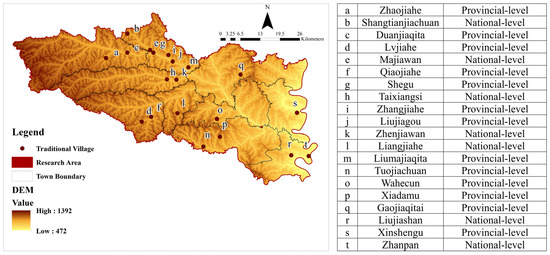
(1) Natural Ecological Landscape. Yanchuan County is situated in the loess hilly and gully region of the Loess Plateau. The terrain is high in the northwest and low in the southeast, sloping from northwest to southeast (as shown in Figure 3). Elevation decreases from west to east, with the topography sequentially comprising loess ridge-hillock hills (altitude 825–1402.6 m), loess wide-ridge remnant tablelands (altitude 523–1202 m), and Yellow River-side rocky hills (altitude 508.5–894.2 m), River valley flatlands (altitude 835–1025 m). The rivers within the county belong to the Yellow River system. Influenced by the terrain, tributaries branch out in a dendritic pattern, traversing the entire county from northwest to southeast. Among them, the Qingjian River is a first-level tributary of the Yellow River, while the Yongpingchuan, Qingpingchuan, Wen’anyichuan, and Tuojiachuan Rivers are second-level tributaries. The intricate combination of tablelands, ridges, hillocks, and gullies in this region forms a landform characterized by undulating ridges and hillocks, crisscrossing gullies, deeply incised river valleys, and interspersed mountains and rivers, creating magnificent natural scenery. Within the county lies the 5A-level scenic area Qiankunwan and the Qin-Jin Grand Canyon, also known as the “Yellow River Meander National Geopark.”
Figure 3.
Distribution map of traditional villages in Yanchuan county.
(2) Agricultural Production Landscape. Yanchuan County’s unique landform types and favorable light and heat conditions are suitable for growing crops such as apples, earning it the titles “Hometown of Chinese Red Dates” and “High-Quality Apple Production Base County.” The county’s agricultural landscape closely integrates with the topography, forming distinctive spatial layout patterns. In the loess ridge-hillock hilly areas, the agricultural production landscape fully combines with the “mountain-river” landform of loess ridges and hillocks, resulting in an agricultural land form primarily consisting of “dry-farming terraces on hilltops + ecological forest land on slopes + dam lands in river valley flatlands,” and an agro-forestry landscape model featuring “apple (or jujube) orchards on hilltops within valley basins + grain (and coarse cereals) cultivation in the valleys + returning farmland to forest on slopes.” In the Yellow River-side rocky hill areas, the agricultural landscape manifests as an agricultural land form of “terraces on hilltops (date-grain intercropping) + natural sloping land on slopes (date-grain intercropping, returning farmland to forest) + ecological forest land in gullies,” and an agro-forestry landscape model featuring “miscellaneous crops (dates) on hillock-ridge mountains + animal husbandry/returning grazing land to forest (pasture) on slopes + ecological forest land (forest) in gullies.”
(3) Residential Living Landscape. Regarding village morphology, traditional villages in Yanchuan County exhibit diverse forms. Watershed flatland-type villages distributed in the loess ridge-hillock hilly areas often display a linear layout developing along rivers, with distinct street features. Main streets frequently exhibit a “straight-line” or “well-shaped” structure. In contrast, hillock-ridge mountain-type villages located in the Yellow River-side rocky hill areas generally follow the principles of backing onto mountains and facing water, adapting to the terrain and distributing flexibly, forming clustered or scattered layouts that follow the landform’s undulations. Their street structures and settlement boundaries are relatively indistinct. Regarding architectural forms, the predominant type in this region is the independent stone-arch vaulted cave dwelling. A small number of hillside cave dwellings or joint-interface cave dwellings exist along slopes and gullies. Building materials are primarily stone, supplemented by brick and loess.
The aforementioned landscape features (such as topography, water systems and architecture) have a direct impact on the challenges involved in conserving traditional villages and their spatial layout. For instance, the topography of the Loess Plateau’s hilly and gully-ridden terrain exacerbates ecological fragility, whilst linear and clustered layouts increase the complexity of conservation planning. Furthermore, the layout characteristics of the agricultural landscape determine the fundamental direction of the villages’ industrial development, providing a crucial contextual framework for subsequent analyses of the current state of conservation.
3.1.2. Analysis of Spatial Distribution Characteristics of Traditional Villages
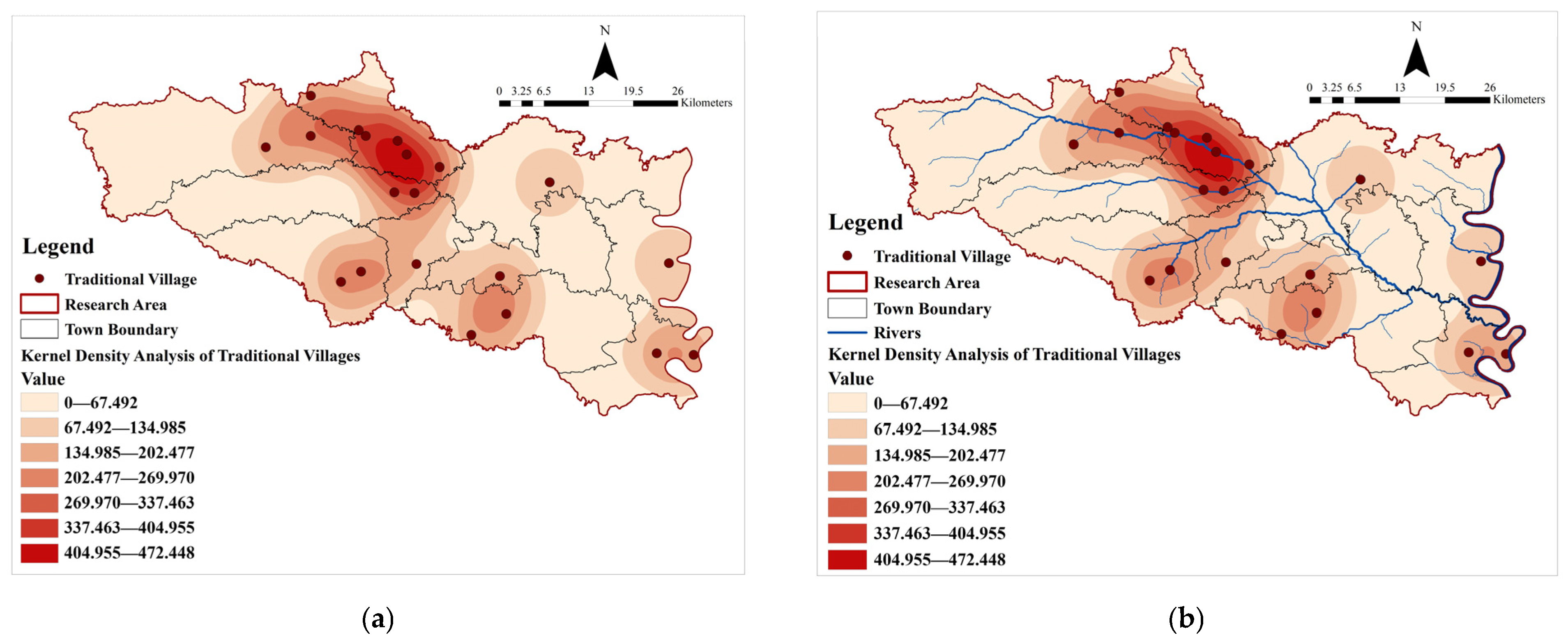
This study used the ArcGIS platform and kernel density analysis to identify the spatial distribution pattern of traditional villages in Yanchuan County. The results indicate that their distribution overall exhibits a characteristic of “dense in the northwest, sparse in the southeast,” and shows a “large dispersion, small aggregation” pattern in spatial agglomeration form, with significant spatial differences (as shown in Figure 4a). Furthermore, traditional villages are mainly concentrated in the loess hillock-ridge hilly and gully areas on the east bank of the Qingjian River, and along the three major flatlands of Yongpingchuan, Qingpingchuan, and Wen’anyichuan Rivers and their tributaries (as shown in Figure 4b).
Figure 4.
(a) Spatial distribution analysis map of traditional villages in Yanchuan county, (b) watershed analysis map of Yanchuan.
3.1.3. Analysis of the Current Status of Traditional Village Conservation and Utilization
Based on the findings of the aforementioned research, the problems of ‘hollowing out’ and decline in Yanchuan County’s traditional villages are particularly severe, and the proportion of villages for which systematic conservation plans have been implemented remains low. From an ecological perspective, the county is situated in a zone where agriculture and pastoralism intersect and within an ecologically fragile area. Soil erosion is severe, and the ecosystem is sensitive and lacks stability; this is directly related to the natural landscape characteristics of the hilly and gully-ridden regions of the Loess Plateau. The rugged topography, criss-crossed by gullies, exacerbates soil erosion, thereby affecting the protection of the ecological foundation of traditional villages. In terms of production, traditional production models are becoming unsustainable, leading to a decline in the economic vitality of villages and consequently constraining overall sustainable development. At the community level, the social functions of villages are in decline, and the cultural ecological space upon which intangible cultural heritage relies is shrinking, facing the dilemma of a generational gap in transmission and the threat of extinction; this forms a vicious cycle with the deterioration of the residential landscape and the hollowing-out of villages. Overall, although Yanchuan County boasts a wealth of traditional villages, diverse heritage resources and outstanding cultural value, it has yet to establish a systematic conservation framework and lacks a development model suited to local characteristics, resulting in delays in the progress of conservation efforts.
3.2. Identification of Value and Distinctiveness of Traditional Villages in Yanchuan County
Based on landscape characteristics and the current state of conservation, this study employed a value assessment procedure to identify the value of traditional villages. The results (Table 2) show that their comprehensive value scores range from 0.4437 to 0.9116, and they are consequently classified into three categories: ‘Key Protection’, ‘Priority Protection’ and ‘General Protection’.
Table 2.
Evaluation Results of Traditional Village.
In conjunction with the ‘Indicator System for the Evaluation and Recognition of Traditional Villages (Trial)’ and the landscape elements of ‘uniqueness, singularity and typicality’, the traditional villages of Yanchuan County can be categorised into five distinct types: revolutionary culture, ecological wellness, distinctive cave dwellings, industrial economy and folk culture experience. These village types exhibit significant differences in spatial layout, resource attributes and development potential, thereby providing a classification basis for cluster conservation strategies.
3.3. Construction of Clustered Conservation Models for Traditional Villages in Yanchuan County
3.3.1. Construction of Cluster Units
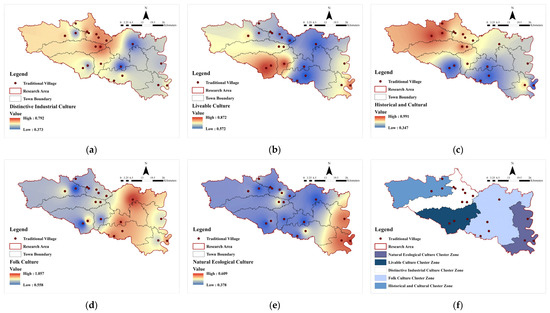
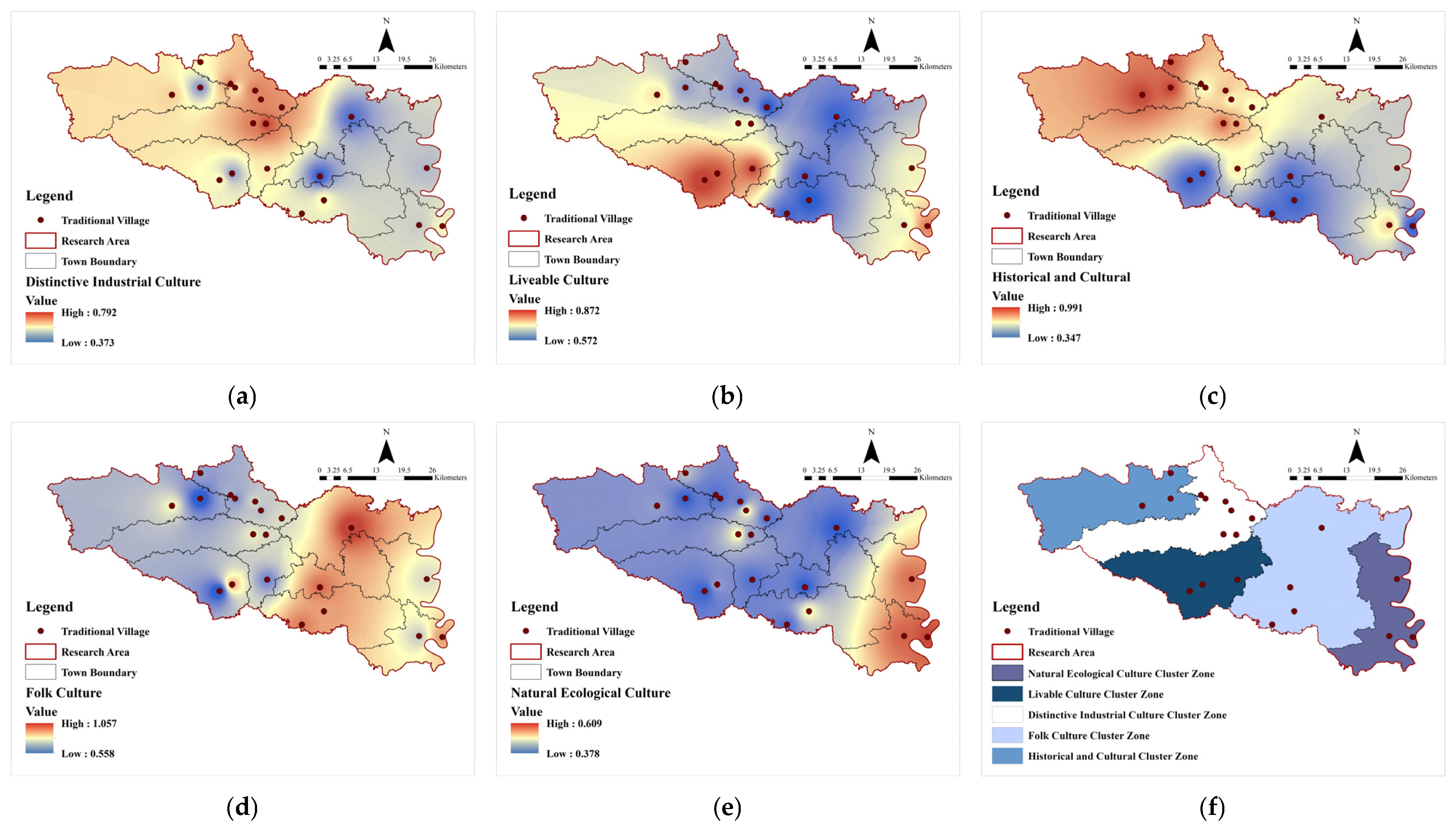
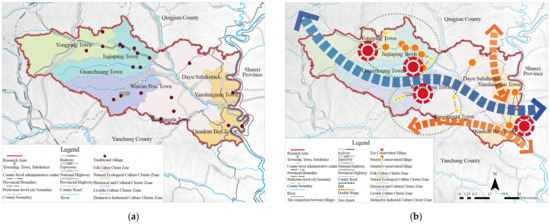
Adhering to the working principle of ‘holistic conservation and integrated development’, the aim is to establish a cluster zone where culture, industry, resources and ecology coexist in harmony. Based on spatial distribution characteristics and the results of a distinctive value assessment (as shown in Figure 5), and in conjunction with administrative boundaries, the traditional villages of Yanchuan County have been divided into five cluster zones, namely the Yongping River Historical and Cultural Cluster Zone, the Yellow River Natural Ecological and Cultural Cluster Zone, the Wen’anyi River Livable Cultural Cluster Zone, the Tuojiachuan-Qingjian River Folk Culture Cluster, and the Qingpingchuan-Yongpingchuan Specialised Industry Culture Cluster.
Figure 5.
Analytical maps of traditional village cultures in Yanchuan county. (a) Analytical map of economic and industrial culture county; (b) Analytical map of livable culture in Yanchuan county; (c) Analytical map of historical culture in Yanchuan county; (d) Analytical map of folk culture in Yanchuan county; (e) analytical map of natural ecology culture in Yanchuan county; (f) Zoning. map of cluster culture in Yanchuan county.
3.3.2. Clustered Symbiosis Models
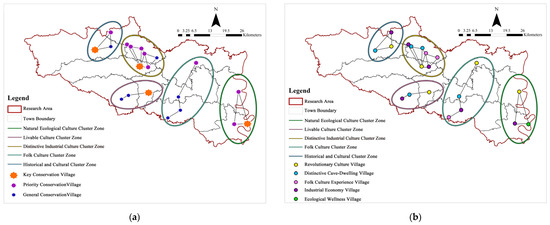
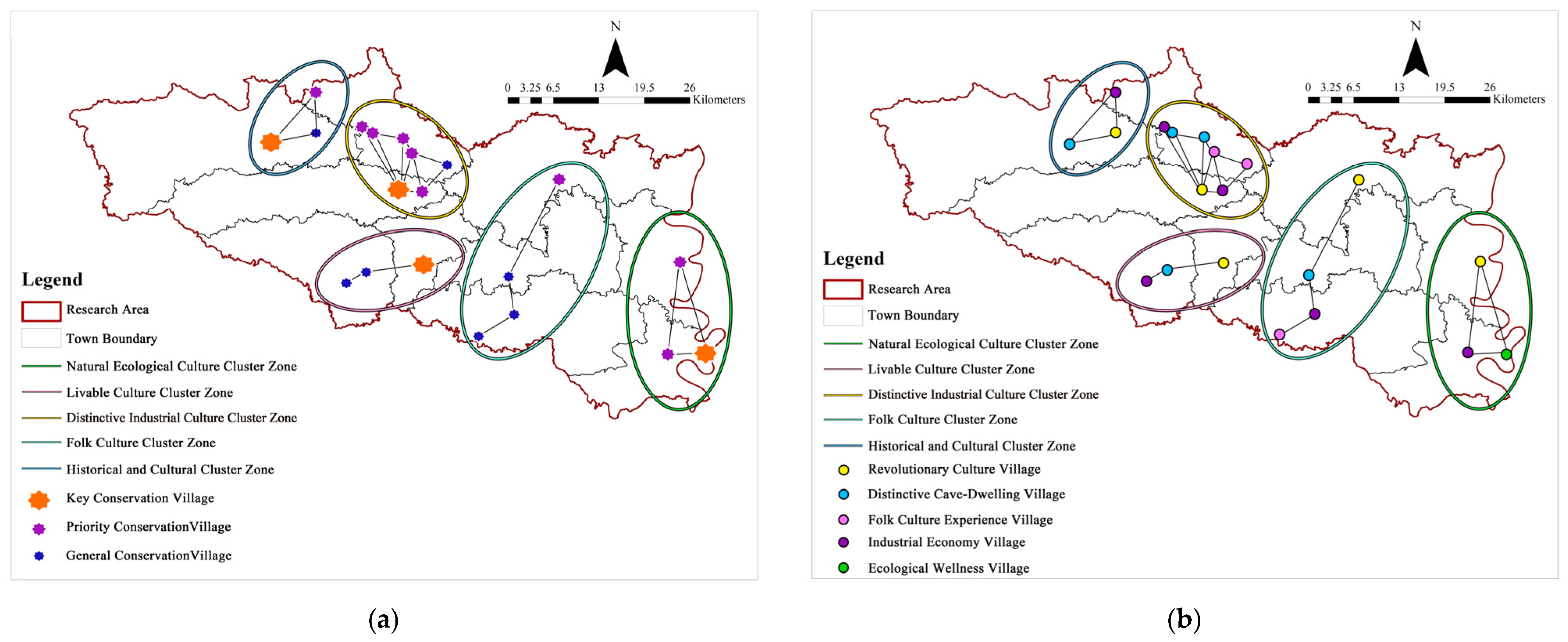
Based on the protection levels and types of traditional villages in Yanchuan County, the ArcGIS platform was used to conduct resource overlay analysis and visualisation of traditional villages in the region, thereby establishing the following three models of cluster symbiosis systems (as shown in Figure 6).
Figure 6.
Schematic diagram of clustered symbiosis in traditional villages of Yanchuan county. (a) Classified protection of traditional village; (b) Graded protection of traditional villages.
“Single-Core” Radial Cluster: Each traditional village serves as a core, radiating influence to surrounding heritage resources such as other villages and cultural relics sites. Based on the grading results from the comprehensive value evaluation, differentiated conservation and development strategies are adopted for traditional villages at different protection levels. For key conservation-level traditional villages (e.g., Taixiangsi Village), which possess high resource value across aspects and are well-preserved, the primary direction should be conservation and renewal, focusing on enhancing architectural quality and style, deepening cultural themes, strengthening cultural-tourism service capabilities, and creating demonstration models for future villages. For priority conservation-level villages (e.g., Majiawan Village), which have prominent historical and cultural value but lag in conservation, the core strategy should be adaptive reuse. Relying on distinctive resources to develop cultural tourism industries can stimulate endogenous village dynamics. Guiding villagers to participate in distinctive transformations can help shape benchmark boutique villages. For general conservation-level villages (e.g., Shegu Village), which have limited heritage resources and lag in conservation, protection planning should be formulated promptly. This involves maintaining the overall traditional village character and implementing salvage conservation for distinctive resources.
“Multi-Core Multi-Node” Belt-Shaped Cluster: Using the Changyan Expressway, National Highway G341, and county roads as links, traditional village resources along the Wen’anyichuan River are connected. Relying on the revolutionary cultural resources of Liangjiahe Village to build an Educated Youth Culture Experience Park, combining the agricultural industry resources of Lvjiahe Village to create a Traditional Farming Practice Park, and utilizing the distinctive cave-dwelling resources of Qiaojiahe Village to develop an Ancient Architecture Tour Park, a functionally complementary and thematically distinct Wen’anyichuan River Livable Culture Cluster Zone is constructed. Relying on provincial roads to connect the distinctive cave dwellings of Wahe Village, the agricultural industry of Xiadamu Village, the distinctive folklore of Tuojiachuan Village, and the revolutionary resources of Gaojiagetai Village, the Tuojiachuan River Folk Culture Cluster Zone is formed. Among these, Tuojiachuan Village focuses on developing boutique homestays, Xiadamu Village emphasizes distinctive cuisine and rural farming experiences, while Wahe Village and Gaojiagetai Village cultivate cultural workshops, intangible cultural heritage study programs, and immersive experience projects, forming a development pattern with functional synergy and complementary formats. By integrating the industrial chain, transportation lines, and village clusters, a complete cultural tourism industrial chain integrating “food, accommodation, transportation, touring, shopping, and entertainment” is systematically constructed, achieving efficient regional resource linkage and enhancing comprehensive value.
“Multi-Core Networked” Areal Cluster: Using county roads as links, the revolutionary resources of Taixiangsi Village, the folk and educated youth cultural resources of Liujiagou Village, the film and television base of Majiawan Village, and the distinctive cave-dwelling resources of Zhangjiahe Village and Shegu Village are integrated. Combined with the resource characteristics of Zhenjiawan Village, the Qingpingchuan River-Yongpingchuan River Distinctive Industrial Culture Cluster Zone with the themes of “revolutionary culture” and “rural revitalization demonstration” is constructed. Relying on county and township roads, the educated youth cultural resources of Zhaojiahe Village, the revolutionary resources of Duanjiagetai Village, and the distinctive industry of Shangtianjiachuan Village are connected, creating the Yongpingchuan River Historical and Cultural Agglomeration Area integrating an ecological resort and picking garden, a revolutionary culture memorial park, and an educated youth culture experience park. Using expressways and county roads as links, natural ecological resources such as Qingshuiguan and Qiankunwan in Nianpan Village, revolutionary resources of Xinsheng Ancient Village, and the Yellow River painting base of Liujiashan, etc., are integrated to create a cluster zone with composite functions including educated youth culture experience, ecological resort and picking, traditional farming practice, and revolutionary culture commemoration. This forms an industrial chain integrating picking, ecology, sightseeing, and tourism, and constitutes the Yellow River Natural Ecological Culture Cluster Zone, embodying the Yellow River canyon and loess culture.
3.3.3. Construction of the Overall Territorial Pattern
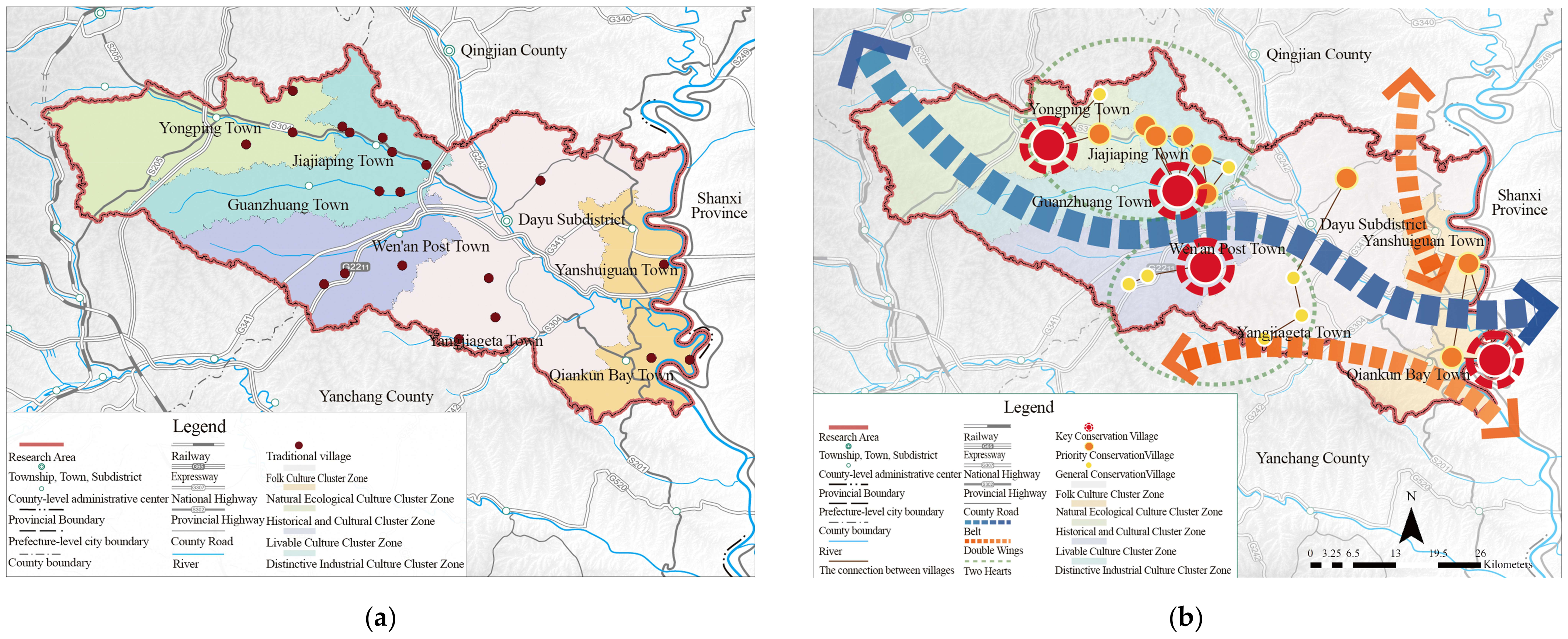
Following the spatial organization principles of “networking, hierarchy, and complexity,” constructing a connectivity network that links various traditional villages and connects different cluster zones is crucial a vital foundation for achieving regional synergy and cluster effects. This study, integrating the Yanchuan County All-for-One Tourism Development Plan, couples traditional village distribution with transportation routes to construct cross-village premium tourism routes. This forms a coherent touring sequence spatially and achieves effective linkage and value extension of various village formats functionally. Ultimately, a conservation pattern of “one belt with two wings, two cores and five zones, cluster symbiosis” was constructed. This pattern uses water systems at various levels (Yongpingchuan River, Qingpingchuan River, Liangjiahe River, Yellow River, etc.) as bonds and transportation corridors as links (as shown in Figure 7a) to connect the cluster zones (as shown in Figure 7b).
Figure 7.
(a) Schematic Diagram of Road Network Distribution in Yanchuan County; (b) Schematic Diagram of the Overall Territorial Conservation Pattern for Traditional Villages in Yanchuan County.
The “One Belt, Two Wings” refers to the three major natural landform zones formed from west to east along the Qingjian River basin: the loess ridge-hillock hilly area, the loess wide-ridge remnant tableland area, and the Yellow River-side rocky hill area, which constitute the traditional village development belt of Yanchuan County and its northern/southern wings and three type areas. The “Two Cores” refer to the two major cores formed by the two village agglomeration areas centered on Jiajiaping Town and Yongping Town, and Wen’anyi Town and Guanzhuang Town, respectively. “Five zones” refer to the five cluster zones: Yongpingchuan River Historical and Cultural Cluster Zone, Yellow River Natural Ecological Culture Cluster Zone, Wen’anyichuan River Livable Culture Cluster Zone, Tuojiachuan River-Qingjian River Folk Culture Cluster Zone, and Qingpingchuan River-Yongpingchuan River Distinctive Industrial Culture Cluster Zone. Finally, leveraging the resource characteristics of each cluster zone and adopting themes such as “Ecological Resort Area,” “Handicraft Tour,” “Revolutionary Culture Memorial Park,” “Farming Culture Experience Route,” and “Ancient Architecture Tour,” scattered resource points are transformed into experiential processes with logical connections and cultural depth. This promotes the evolution of regional tourism from “point-based development” to “linear corridors” and a “networked system,” forming a Yellow River local customs experience tour characterized by “harmonious landscape colors, diverse local features.”
4. Discussion
The formation and development of traditional villages represent a process of deep interplay between the local natural environment, socio-cultural structures and historical evolution [33]. Existing models for the conservation of traditional villages predominantly adopt a ‘point-based conservation’ strategy, focusing on the static preservation of individual villages, and failing to take full account of the cultural, ecological and social connections between villages [34]. This approach leads to the fragmentation of resources and a lack of synergy, thereby limiting the overall effectiveness of conservation efforts. In recent years, some studies have attempted to achieve regional conservation through spatial clustering [35], but these studies often overlook the multidimensional nature of village values and the mechanisms for their integration [36]. This study systematically identifies the multidimensional values of traditional villages by combining the Production–Living–Ecology (PLE) landscape framework with the Analytic Hierarchy Process (AHP), thereby constructing a multi-level, multi-grid cluster conservation pattern that integrates ‘space, value and function’ [37]. This approach not only fills a gap in the existing literature regarding the integration of cultural, ecological and social values, but also provides a new theoretical framework for the conservation of traditional villages at the regional level.
The study found that traditional villages in Yanchuan County exhibit a spatial distribution characterised by ‘dense clusters in the north-west and sparse distribution in the south-east’, primarily concentrated in the loess ridge and gully areas on the east bank of the Qingjian River and the adjacent river valleys. This distribution pattern is constrained by topographical and hydrological conditions, whilst also being closely linked to historical transport networks, agricultural suitability and socio-economic activities [38]. The Loess ridge and hill areas have formed relatively concentrated clusters of villages due to topographical constraints, whereas the gentle slopes of the hills and the river valley zones are suitable for agricultural production and settlement, resulting in a relatively dispersed layout. This phenomenon is consistent with existing research concluding that the geographical environment influences settlement layout [39], further validating the theoretical hypothesis that natural constraints and socio-economic factors jointly shape the spatial patterns of traditional settlements. Research indicates that the PLE landscape can reveal the intrinsic connections between cultural, ecological and social resources [40]. For example, the ecological environment determines settlement layout and production patterns; production patterns, in turn, influence social organisation and cultural transmission; whilst socio-cultural activities shape the characteristics of the settlement landscape. This multidimensional coupling relationship indicates that single-dimensional conservation strategies struggle to achieve systematic value preservation, whereas a clustered conservation model can integrate various elements and enhance regional conservation efficacy [41].
Based on the value assessment results, all villages classified as priority conservation sites are national-level traditional villages, possessing high comprehensive value, which is consistent with the study’s classification criteria. Based on the results of the distinctive value analysis, the traditional villages of Yanchuan County were categorised into five types: revolutionary culture, ecological wellness, distinctive cave dwellings, industrial economy, and folk culture experience. This outcome reflects the multiple mechanisms at play involving historical culture, adaptation to the landscape, and resource endowment: the large number of revolutionary culture villages reflects the long-term influence of historical events and their unique historical status; ecological wellness-type villages rely primarily on the natural environment and ecological resources, embodying geographical and ecological adaptability; distinctive cave-dwelling-type villages are highly correlated with the loess landform, with architectural forms closely coupled to environmental constraints; industrial–economic-type villages are closely linked to local agricultural industries and distinctive resources, demonstrating the supportive role of economic activities in village sustainability; whilst folklore experience-type villages depend on cultural continuity and the transmission of intangible heritage. The results reveal the spatial heterogeneity of traditional village values and provide a theoretical basis for clustering, emphasising the crucial role of value orientation in conservation strategies [42].
This study employs the PLE landscape approach combined with the AHP method to conduct a systematic value assessment and clustering of traditional villages, providing a scientific means for the integration of multi-dimensional values. The PLE method overcomes the limitations of single-dimensional cultural or spatial analysis [43] and is capable of simultaneously considering ecological, productive and social dimensions [37]; the AHP method, by quantifying weights, enables the scientific implementation of multi-criteria decision-making. The combination of these two approaches ensures that clustering is not solely dependent on spatial proximity but also fully considers cultural, ecological and economic values, thereby achieving the precise allocation of resources.
However, the methods still have limitations. Firstly, the PLE method is scale-dependent; in analyses of small areas, it may obscure local cultural and topographical differences, leading to a bias towards homogeneity in cluster delineation. Secondly, the AHP method is subject to subjective bias in the setting of weights; particularly when quantifying cultural and social values, the researcher’s judgements may influence the evaluation results [44]. This study is based on static geographical data and does not fully account for the dynamic nature of cluster evolution or changes in socio-economic factors. Future research could integrate dynamic spatio-temporal data with complex network analysis and social network analysis methods to simulate cluster evolution pathways, thereby enhancing the scientific rigour and sustainability of cluster conservation [45].
The clustered conservation model not only extends traditional protection approaches but also reconstructs the heritage protection framework at the regional level. Traditional isolated protection models are unable to effectively address the collaborative protection needs of multiple villages, whereas the clustered conservation model proposed in this study integrates the cultural, ecological and social connections between villages, providing a regional-level framework for protection and development. By constructing a networked ‘node-corridor-grid’ structure, the value of traditional villages has been redefined, thereby promoting the sustainable development of regional cultural heritage. Through the prioritisation of traditional village conservation, the clarification of development positioning, and the optimisation of resource allocation, a dynamic relationship has been established where the core drives the periphery whilst maintaining deep internal connections. By defining the distinctive characteristics of the cluster area and establishing coherent cultural routes, this approach provides an operational pathway for rural revitalisation and regional cultural and tourism development [46].
The ‘resource perception—value assessment—cluster classification—coordinated development’ framework developed in this study, combined with the PLE and AHP methodologies, overcomes the limitations of traditional single-evaluation approaches. By integrating spatial clustering with value-oriented analysis, this system provides a new theoretical framework for the conservation and utilization of villages. Furthermore, the system is holistic, practical and replicable, and is equally applicable to the conservation of different types of cultural heritage in other regions. However, adaptive adjustments must be made in accordance with the cultural, ecological and social contexts of different regions. Taking the Loess Plateau as an example, the methodological framework of this study is well-suited to the characteristics of “scattered villages, strong cultural homogeneity and ecological fragility”. Nevertheless, other regions may face distinct cultural and socio-economic contexts; therefore, when implementing this framework, the value evaluation indicator system must be optimised and adapted to the specific characteristics of each region. For instance, consideration must be given to how the concept of ‘clusters’ might be redefined within different geographical and social contexts to formulate conservation strategies better suited to local realities.
Future research on rural heritage conservation and tourism development should place greater emphasis on the experiential value of heritage, particularly against the backdrop of the growing popularity of experiential tourism. Traditional approaches to rural heritage conservation have largely focused on physical or digital preservation; however, as visitors increasingly seek cultural and emotional experiences, the experiential dimension is gradually becoming a key focus in both research and practice. Eye-tracking and neuroimaging experiments can serve as important tools for evaluating the effectiveness of experiential tourism: the former captures visitors’ visual focus on heritage landscapes, cultural symbols and interactive designs, providing a basis for exhibition optimisation and tourist route planning; the latter uses physiological feedback data (such as brainwave activity and heart rate) to reveal visitors’ emotional engagement and cognitive responses, offering guidance for the design of immersive, culturally rich tourism projects [47,48].
Furthermore, future research should focus on the adaptability of villages, assessing the potential of different villages to accommodate experiential tourism in terms of cultural adaptability, infrastructure support and community participation [49,50,51]. A comprehensive evaluation of each village can provide targeted strategies for tourism development, achieving the protection and sustainable use of rural heritage, and promoting the synergistic benefits of cultural transmission and economic development [52].
5. Conclusions
This study focuses on 20 traditional villages in Yanchuan County. Employing the Production–Living–Ecology (PLE) landscape framework and the Analytic Hierarchy Process (AHP), it systematically analysed the characteristics of the villages’ resources and identified their multidimensional values. Based on this, a clustered conservation framework was established and differentiated guidance strategies were formulated. Compared to traditional ‘isolated site protection’ strategies, the clustered conservation model effectively integrates the cultural, economic and spatial resources of individual villages within a region, thereby enhancing conservation outcomes. It provides a new methodological framework and practical reference for the conservation of traditional villages in similar areas.
- (1)
- Analysis of traditional village resource characteristics: Based on the ‘Database of Heritage Resource Characteristics of Traditional Villages in Yanchuan County’, this study revealed significant disparities in the level of conservation and development among these villages. It was found that most villages exhibit both resource strengths and weaknesses, with an overall low level of coordinated development. The spatial distribution exhibits a pattern of “broad dispersion and small-scale clustering”, with villages primarily concentrated in the loess-covered ridges, hills and ravines on the eastern bank of the Qingjian River, as well as in the main river valleys and tributaries such as the Yongping, Qingping and Wen’anyi Rivers. Through the PLE landscape perspective, heritage resources were comprehensively catalogued, and the cultural, ecological and social factors influencing the layout and conservation of traditional villages were identified, providing a solid theoretical foundation for the subsequent development of conservation models.
- (2)
- Identification of the distinctive values of traditional villages: Through a multi-dimensional value assessment, this study found that the traditional villages of Yanchuan County are deeply influenced by Loess culture, encompassing multiple cultural values such as liveability, folklore, ecology, industry and history. Among these, historical and cultural value is the most prominent, whilst ecological and cultural value is relatively weaker. This finding is consistent with research results from other regions of the Loess Plateau, indicating that the phenomenon of relatively weak ecological value is widespread, primarily influenced by the natural environment and pressures from resource development. Using the AHP method, this study effectively integrated multi-dimensional evaluation criteria, providing a scientific basis for resource value assessment and quantitative support for the formulation of differentiated conservation strategies.
- (3)
- Construction of a Cluster Conservation Model: Based on the interrelationships of multi-dimensional factors, this study identified five major cluster zones. By combining comprehensive and distinctive values, it proposed a classified and graded model of cluster symbiosis comprising ‘single-core radial’, ‘multi-core multi-node belt-shaped’ and ‘multi-core networked area’ configurations. By linking the various cluster zones through the integration of elements such as water systems and transport corridors, a comprehensive protection framework of ”one belt and two wings, two centers and five zones, and cluster symbiosis” has been formed. This model not only achieves resource integration with the river basin as a whole and the road network as a guiding thread, but also promotes the efficient aggregation and directed flow of resources by using villages as nodes.
Through a multidimensional value analysis of Yanchuan County’s traditional villages and the construction of a clustered conservation model, this study offers an innovative perspective for both theoretical research and practical implementation in cultural heritage conservation, possessing broad academic significance and practical application value. It also demonstrates strong feasibility and transferability, providing a reference for cultural heritage conservation and rural revitalisation in other similar regions. Furthermore, by establishing this cluster conservation model, the study provides robust support for future policy formulation and the optimal allocation of resources in rural cultural heritage conservation.
Author Contributions
Conceptualization, S.K.; methodology, S.K.; software, X.H.; validation, W.X. and X.H.; formal analysis, M.W.; investigation, S.K. and X.Z.; resources, Y.T. and C.S.; data curation, W.X.; writing—original draft preparation, S.K.; writing—review and editing, Y.T. and C.S.; visualization, S.K.; supervision, Y.T. and C.S.; project administration, Y.T. and C.S.; funding acquisition, Y.T. and C.S. All authors have read and agreed to the published version of the manuscript.
Funding
This work was supported by Annual Project of National Social Science Fund Arts Project for Western Regions: Research on the Evaluation of Yellow River Cultural Heritage Value and the Construction of Cultural Tourism Brands (grant No. 25EH283).
Data Availability Statement
The original contributions presented in this study are included in the article. Further inquiries can be directed to the corresponding authors.
Acknowledgments
The author thanks the residents and related staff of Yanchuan County, Shaanxi Province for their help and support in this study, and also thanks all the teachers who participated in this study.
Conflicts of Interest
The authors declare no conflicts of interest.
References
- Kong, L.; Xu, X.; Wang, W.; Wu, J.; Zhang, M. Comprehensive evaluation and quantitative research on the living protection of traditional villages from the perspective of “Production–Living–Ecology”. Land 2021, 10, 570. [Google Scholar] [CrossRef] [Scilit]
- Du, Y. Holistic gentrification and the recreation of rurality: The new wave of rural gentrification in chengdu, China. J. Rural Stud. 2022, 96, 237–245. [Google Scholar] [CrossRef] [Scilit]
- Hu, X.; Li, H.; Zhang, X.; Chen, X.; Yuan, Y. Multi-dimensionality and the totality of rural spatial restructuring from the perspective of the rural space system: A case study of traditional villages in the ancient Huizhou region, China. Habitat Int. 2019, 94, 102062. [Google Scholar] [CrossRef] [Scilit]
- Hu, B.; Li, X.; Wang, X. Investigation Report on the Protection of Chinese Traditional Villages; Social Sciences Academic Press: Beijing, China, 2017. (In Chinese) [Google Scholar]
- Zhao, X.; Xue, P.; Wang, F.; Qin, Y.; Duan, X.; Yang, Z. How to become one? The modern bond of traditional villages in centralized contiguous protection and utilization areas in China. Habitat Int. 2024, 145, 103018. [Google Scholar] [CrossRef] [Scilit]
- Chen, Z.; Liu, Y.; Feng, W.; Li, Y.; Li, L. Study on spatial tropism distribution of rural settlements in the Loess Hilly and Gully Region based on natural factors and traffic accessibility. J. Rural. Stud. 2019, 93, 441–448. [Google Scholar] [CrossRef] [Scilit]
- Ren, Y.; Zhao, W.; Zhang, Y.; Li, Y.; Jia, S. Coupling Coordination and Driving Mechanisms of Regional Protection and Development in Traditional Villages of the Loess Hilly and Gully Region, Northern Shaanxi Province. Sustainability 2024, 16, 10554. [Google Scholar] [CrossRef] [Scilit]
- Li, G.; Hu, W. A network-based approach for landscape integration of traditional settlements: A case study in the Wuling Mountain area, southwestern China. Land Use Policy 2019, 83, 105–112. [Google Scholar] [CrossRef] [Scilit]
- Ravankhah, M.; de Wit, R.; Argyriou, A.V.; Chliaoutakis, A.; Revez, M.J.; Birkmann, J.; Žuvela-Aloise, M.; Sarris, A.; Giapitsoglou, K. Integrated assessment of natural hazards, including climate change’s influences, for cultural heritage sites: The case of the historic centre of Rethymno in Greece. Int. J. Disaster Risk Sci. 2019, 10, 343–361. [Google Scholar] [CrossRef] [Scilit]
- Rodwell, D. The Values of Heritage: A New Paradigm for the 21st Century. In From Postwar to Postmodern—20th Century Built Cultural Heritage; The 6th Baltic Sea Region Cultural Heritage Forum; Riksantikvarieämbetet: Stockholm, Sweden, 2017; p. 99. [Google Scholar]
- Mason, R.; Avrami, E. Heritage values and challenges of conservation planning. In Management Planning for Archaeological Sites; Getty Conservation Institute: Los Angeles, CA, USA, 2002; pp. 13–26. [Google Scholar]
- Moreno, M.; Ortiz, R.; Cagigas-Muñiz, D.; Becerra, J.; Martin, J.M.; Prieto, A.J.; Garrido-Vizuete, M.; Macías-Bernal, J.; Chávez, M.; Ortiz, P. ART-RISK 3.0 a fuzzy—Based platform that combine GIS and expert assessments for conservation strategies in cultural heritage. J. Cult. Herit. 2022, 55, 263–276. [Google Scholar] [CrossRef] [Scilit]
- Zhang, S. Traditional villages as forms of habitat and their holistic conservation. J. Urban. Plan 2017, 2, 44–49. [Google Scholar] [CrossRef]
- Zheng, C.; Jiao, S.; Xiong, Y. A study on the characteristics of regional historical and cultural resources and cluster protection. J. Archit. 2020, 98–102. [Google Scholar]
- Li, B.; Wang, J.; Jin, Y. Spatial distribution characteristics of traditional villages and influence factors thereof in hilly and gully areas of northern Shaanxi. Sustainability 2022, 14, 15327. [Google Scholar] [CrossRef] [Scilit]
- Wang, H.; Wang, Y.; Ren, Z.; Wu, C.; Song, W. Cluster-Based Protection Mechanisms for Coastal Traditional Villages: A Complex Network Analysis Approach with a Case Study of Rongcheng, Shandong Province (Part 1). Buildings 2025, 15, 784. [Google Scholar] [CrossRef] [Scilit]
- Zhao, W.; Xiao, D.; Li, J.; Xu, Z.; Tao, J. Research on traditional village spatial differentiation from the perspective of cultural routes: A case study of 338 villages in the Miao Frontier Corridor. Sustainability 2024, 16, 5298. [Google Scholar] [CrossRef] [Scilit]
- Fan, J.; Zheng, B.; Yuan, H.; Zhang, B.; Zhang, P. Spatial Connectivity and Development Potential of Traditional Villages in Clustered Areas: A Case Study of Qiandongnan Prefecture. Land 2025, 14, 1929. [Google Scholar] [CrossRef] [Scilit]
- Guo, Y.; Rao, J.; Huang, J.; Zhu, Y. Spatial and Temporal Evolution and Conservation Significance of Traditional Villages in the Yangtze River Basin, China. Buildings 2024, 14, 3249. [Google Scholar] [CrossRef] [Scilit]
- Zhou, J.; Jiang, Y.; Niu, S.; Li, L.; Li, W.; Zhang, Y.; Liu, D. Spatial optimization of rural settlements in a small watershed based on social network analysis. Netw. Spat. Econ. 2023, 23, 799–823. [Google Scholar] [CrossRef] [Scilit]
- Huang, Y.; Zhang, Z.; Fei, J.; Chen, X. Optimization strategies of commercial layout of traditional villages based on space syntax and space resistance model: A case study of anhui longchuan village in china. Buildings 2023, 13, 1016. [Google Scholar] [CrossRef] [Scilit]
- Kaijian, Y.; Congjian, Y.; Jun, S. Agglomeration phenomena and evolutionary patterns of contemporary architectural interventions in traditional villages: An empirical analysis from 211 cases in Songyang County, China. Habitat Int. 2025, 166, 103571. [Google Scholar] [CrossRef] [Scilit]
- Sarp, G.; Duzgun, S. Morphometric evaluation of the Afşin-Elbistan lignite basin using kernel density estimation and Getis-Ord’s statistics of DEM derived indices, SE Turkey. J. Asian Earth Sci. 2015, 111, 819–826. [Google Scholar] [CrossRef] [Scilit]
- Xue, Q.; Huang, M. Construction Method of the Concentrated Contiguous Protection and Utilization Pattern for Traditional Villages:An Empirical Study of Liangdang County, Gansu Province. Planner 2024, 40, 66–74. [Google Scholar]
- Porter, M.E. Competitive Advantage: Creating and Sustaining Superior Performance; Free Press: New York, NY, USA, 1985. [Google Scholar]
- Zhan, S.; Wang, M.; Wang, X. Features of Essential Elements, Development Approaches, and Case Study of Scene Theory-based Cultural Industrial Clusters. JIANGHAN Acad. 2020, 39, 5. [Google Scholar]
- Li, T.; Zhang, Q. Research on the Construction Mode of Characteristic Towns in the New Era Based on the Perspective of Residents Experience. J. Shandong Univ. Sci. Technol. (Soc. Sci.) 2019, 21, 86–95. [Google Scholar] [CrossRef]
- Dai, Y.; Zhong, J.; Wang, R.; Ping, N.; Chen, Z. Research on Cluster Zoning and Preservation of Historical Village and Town Clusters from Regional Perspective: A Case Study of the Underdeveloped Areas of Chongqing. Stud. Mod. Cities 2024, 39, 41–48. [Google Scholar]
- Qian, Y.; Li, X. From Space–Behavior Mismatch to Regional Integration: A Cross-Scale Social Network Analysis of Sustainable Rural Construction in Suburban China. Sustainability 2025, 17, 9137. [Google Scholar] [CrossRef] [Scilit]
- Sun, Y.; Ou, Q. Research on the traditional zoning, evolution, and integrated conservation of village cultural landscapes based on “production-living-ecology spaces”–A case study of villages in Meicheng, Guangdong, China. Open Geosci. 2021, 13, 1303–1317. [Google Scholar] [CrossRef] [Scilit]
- Wang, P.; Luo, X.; Wang, J. The Concept and Practice of Rural Cluster Planning. Planner 2025, 41, 92–99. [Google Scholar] [CrossRef]
- Yao, Q. Research on Traditional Towns Spatial Environment Features and the Protection Strategies in Sichuan and Chongqing Areas. Ph.D. Thesis, Chongqing University, Chongqing, China, 2015. [Google Scholar]
- García-Esparza, J.A. Urban scene protection and unconventional practices—Contemporary landscapes in World Heritage Cities of Spain. Land 2022, 11, 324. [Google Scholar] [CrossRef] [Scilit]
- Mao, Y.; Li, T.; Liu, Y.; Zhang, P.; Yu, H. Study on the Synergy/Trade-Off Relationships Between the Concentrated-Contiguous Conservation and Utilization of Traditional Villages and the Social-Ecological System Based on Network Science. Sustainability 2026, 18, 1625. [Google Scholar] [CrossRef] [Scilit]
- Guo, L.; Lin, H.; Wu, Q. The Spatial Relationship Characteristics and Driving Mechanisms Between Traditional Villages and Intangible Cultural Heritage in Zhejiang Province. Buildings 2026, 16, 822. [Google Scholar] [CrossRef] [Scilit]
- Dey, A.; Pasupuleti, R.S. A value-based priority matrix for assessing the attributes of heritage buffer zones: A case of centrally protected monuments in Delhi. Built Herit. 2026, 10, 16. [Google Scholar] [CrossRef] [Scilit]
- Liu, T.; Wang, Y.; Sun, C.; Wu, Z.; Xu, H.; Wang, X. Morphological Characteristics and Influencing Mechanisms of Traditional Tujia Villages from the Perspective of Spatial Genes: A Case Study of the Wuling Mountain Area, Southwest China. Chin. Geogr. Sci. 2026, 36, 492–508. [Google Scholar] [CrossRef] [Scilit]
- Jiang, Y.; Zhang, R. Characteristics of urban agricultural heritage sites: Policies and management methods for their conservation in China, Germany, and Italy. Habitat Int. 2023, 131, 102710. [Google Scholar] [CrossRef] [Scilit]
- Zhang, X.; Wang, Y.; Huang, H.; Yuan, S.; Hua, R.; Tang, Y.; Shi, C. Evaluating Resource Endowments and Optimization Strategies for Traditional Riverside Villages in Shaanxi: A Yellow River Cultural Perspective. Sustainability 2025, 17, 5014. [Google Scholar] [CrossRef] [Scilit]
- Mo, W.; Bao, J.; Li, Q. Spatiotemporal Evolution and Driving Mechanisms of Production–Living–Ecological Space Coupling Coordination in Foshan’s Traditional Villages: A Perspective of New Quality Productive Forces. Sustainability 2026, 18, 1494. [Google Scholar] [CrossRef] [Scilit]
- Yuan, Y.; Hu, H. From Heritage-rich Villages to Cultural Corridors: Cross-boundary Patterns and Drivers of Heritage-based Rural Tourism in the Yangtze River Delta. Appl. Spat. Anal. Policy 2026, 19, 35. [Google Scholar] [CrossRef] [Scilit]
- Eberhardt, S.; Pospisil, M. E-P heritage value assessment method proposed methodology for assessing heritage value of load-bearing structures. Int. J. Archit. Herit. 2022, 16, 1621–1641. [Google Scholar] [CrossRef] [Scilit]
- Jin, T.; Yu, F. Spatial distribution characteristics and influencing factors of Suzhou traditional villages from the perspective of “Millennium Village”. npj Herit. Sci. 2026, 14, 172. [Google Scholar] [CrossRef] [Scilit]
- Liu, Y.; Liu, H.; Zhou, F. Research on the evaluation of human settlement landscapes in lakeside traditional villages of Plateau Lake Regions—A case study of Dianchi Lake, Kunming. Front. Urban Rural. Plan. 2026, 4, 3. [Google Scholar] [CrossRef] [Scilit]
- Fan, J.; Huang, Z.; Zhang, B. Designing a traditional village cluster protection-utilization system via complex network analysis: Qiandongnan case study. npj Herit. Sci. 2026, 14, 59. [Google Scholar] [CrossRef] [Scilit]
- Yue, G.; Mohamed Afla, M.R.; Mundher, R. A Landscape Imagery Framework for Sustainable Tourism Development in Traditional Villages: Systematic Literature Review. Front. Sustain. 2026, 7, 1761796. [Google Scholar] [CrossRef] [Scilit]
- Hong, W.C.H. Towards Rigorous Eye-Tracking Methodology in Interdisciplinary Fields: Insights from and Recommendations for Tourism Research. J. Eye Mov. Res. 2026, 19, 31. [Google Scholar] [CrossRef] [Scilit]
- Rusnak, M.; Kilijańska, B.; Garaszczuk, I.; Duchowski, A.; Biegańska, M.; Dobrasiak, D.; Koszewicz, Z. From eye-tracking to games: Exploring low-tech solutions for sustainable cultural landscape management. J. Cult. Herit. 2025, 74, 225–235. [Google Scholar] [CrossRef] [Scilit]
- Wang, Z.; Xing, Z. Bridging the Urban–Rural Tourism Satisfaction Gap: A Service Capacity Perspective on Territorial Development Challenges. Sustainability 2026, 18, 3011. [Google Scholar] [CrossRef] [Scilit]
- Kumar, V.; Agarwala, T.; Kumar, S. Rural tourism as a driver of sustainable development: A systematic review and future research agenda. Tour. Rev. 2026, 81, 1101–1120. [Google Scholar] [CrossRef] [Scilit]
- Zhang, X.; Zhang, S.; Liu, J.; Li, T.; Gu, Q. Spatiotemporal Characteristics and Mechanisms of Tourism-Driven Rural Land Use Change in Metropolitan Suburbs. Land 2026, 15, 310. [Google Scholar] [CrossRef] [Scilit]
- Cerjak, M.; Galić, G.; Antoniak, M.A. Cultural Heritage as a Driver of Sustainable Rural Tourism Development: A Case Study of Šibenik-Knin County. Sustainability 2026, 18, 1416. [Google Scholar] [CrossRef] [Scilit]

Disclaimer/Publisher’s Note: The statements, opinions and data contained in all publications are solely those of the individual author(s) and contributor(s) and not of MDPI and/or the editor(s). MDPI and/or the editor(s) disclaim responsibility for any injury to people or property resulting from any ideas, methods, instructions or products referred to in the content. |
© 2026 by the authors. Licensee MDPI, Basel, Switzerland. This article is an open access article distributed under the terms and conditions of the Creative Commons Attribution (CC BY) license.