Article

Assessing Sediment Transport Risk of Rainstorm-Triggered Landslides from a Connectivity Perspective

1
State Key Laboratory of Plateau Ecology and Agriculture, Qinghai University, Xining 810016, China
2
The Research Centre of Soil and Water Conservation and Ecological Environment, Chinese Academy of Sciences and Ministry of Education, Yangling 712100, China
3
Yellow River Engineering Consulting Co., Ltd., Zhengzhou 450003, China
4
Inner Mongolia Autonomous Region Hydrology and Water Resources Center, Hohhot 010000, China
*
Authors to whom correspondence should be addressed.
Land 2026, 15(4), 635; https://doi.org/10.3390/land15040635
Submission received: 18 January 2026 / Revised: 8 April 2026 / Accepted: 9 April 2026 / Published: 13 April 2026
(This article belongs to the Special Issue Climate Change and Soil Erosion: Challenges and Solutions)

Abstract

Sediment connectivity is a key indicator of whether eroded sediment can be efficiently transported within a catchment. Landslides are a major form of rainfall-induced erosion on the steep slopes of the Loess Plateau and contribute substantially to overall catchment sediment yield. However, evaluating the connectivity of landslide-derived sediment and its implications for sediment transport risk remains challenging. Therefore, field investigations were conducted in three watersheds (R1, R2, and R3) on the Loess Plateau to examine landslides triggered by rainstorms. We analyzed the characteristics of landslide erosion and its influencing factors, applied graph theory to investigate sediment connectivity after landslides occurred, and assessed the risk of sediment transport to the catchment outlet. The results showed that the landslide number densities in the catchments R1, R2, and R3 were 9, 155, and 214 km−2, respectively. The average erosion intensities were 25,153, 53,074, and 172,153 t km−2, respectively. The network analyses indicated that the locations of landslides within the catchments were primarily concentrated in areas with high transport networks and high sediment accessibility to the catchment outlets. The sediment connectivity index further showed that 59%, 43%, and 51% of landslides in the three watersheds, respectively, were at high risk of delivering sediment to the catchment outlet. Accordingly, measures such as slope drainage and gully dam construction may help reduce both landslide occurrence and sediment transport. These findings provide new insights into the transport risk of eroded sediment from a connectivity perspective, identify hotspot areas of sediment connectivity and landslide erosion, and support the targeted prevention and control of catchment erosion.

1. Introduction

In the context of global climate variability, extreme precipitation events are increasingly prevalent [1,2,3,4], further exacerbating the risk of soil erosion disasters, such as landslides [5,6]. The Chinese Loess Plateau is widely recognized as one of the most severely eroded regions in the world [7]. To mitigate soil erosion, the Chinese government has implemented a series of vegetation restoration projects, including the Three-North Shelterbelt Project and the Grain for Green Project. After decades of implementation, the ecological environment has improved significantly [8,9], resulting in dramatic changes in the condition of the underlying surface [10]. However, under the persistent influence of high-intensity rainstorms, slopes are more prone to water accumulation, and once the soil becomes saturated, pore water may generate outward seepage forces. As a result, even slopes with good vegetation cover can undergo large-scale landslides under gravity [11], making landslides a key component of sediment cascades under extreme rainfall conditions [12,13,14].
Landslides, a form of gravitational erosion, transpire when soil or rock masses on inclines descend along a compromised surface or zone due to gravitational forces. Ap-proximately 17.1% of the Earth’s land has experienced landslides [15], contributing over 50% of the total sediment in mountainous regions [16]. Precipitation is the principal catalyst of landslides [17,18,19,20]. Rainfall infiltration increases soil weight and pore water pressure, reducing soil shear strength and altering the stress–strain state of slopes, ultimately leading to slope landslides [21,22]. Under extreme rainfall conditions, sediment yield from landslides and collapses in small watersheds accounts for over 71% of the total sediment yield [12,23]. Landslides not only cause soil erosion but also significantly increase runoff sediment concentration, resulting in hyperconcentrated flow, which is a major source of downstream river sediment [24,25]. However, effectively identifying sediment sources, transport pathways, and depositional sinks following landslide occurrence remains essential for understanding the development and hazard-causing processes of landslide erosion.
Hydrological connectedness refers to the flow relationship of water and sediment among various geomorphic or landscape elements within a system [26,27]. It is mainly divided into structural connectivity that characterizes static features and functional connectivity that characterizes dynamic features [28,29,30]. Hydrologic connectivity can be further subdivided into lateral, longitudinal and vertical connectivity [31]. Sedimentation connectivity belongs to a type of hydrological connectivity; sediment connectivity can reflect key parameters of runoff-sediment processes [32]. It is not only used to explore sediment sources and identify critical areas for water and soil conservation [33,34] but is also widely used to characterize runoff and sediment transport at the catchment scale [35,36]. It is an effective method for studying the sources, transport processes, and sinks of soil erosion sediment [37].
Currently, the main research methods of sediment connectivity are in situ observation methods [32], tracing methods [38], index methods [39,40], modeling [41,42], and graph theory [43,44]. Sediment marks of erosion are an effective basis for judging sediment connectivity [45,46]; through field investigations, connectivity can be classified as connected or unconnected, and strongly connected or weakly connected [47,48]. There is a direct relationship between the degree of connectivity and the magnitude of erosion. Researchers studied road erosion in small watersheds after a rainstorm and found that the erosion intensity of sediment-connected roads is 1.88 times greater than that of non-connected roads [46]. Another study used ArcGIS to interpret aerial images of a small watershed in the Ruahine Ranges of New Zealand at different time periods and found that shallow landslides are significant contributors to sediment cascades [13]. Therefore, exploring the risk of landslide erosion sediment transport is crucial for landslide hazard control.
Previous studies have primarily focused on exploring the concepts and characterization methods of sediment connectivity [31,39,40,49,50,51,52,53], as well as its application at the runoff plot and catchment scales [45]. Currently, there are relatively few studies on landslide sediment connectivity; one study proposed a lateral connectivity index (LCI), classifying sub-watershed landslides into four risk categories: low, medium, high, and very high [54]. However, there is still a lack of identification of landslide hotspots at specific locations within the watershed and an assessment of sediment transport risks. The graph theory method developed in recent years can visualize the spatial distribution and dynamic changes in sediment cascades among different landscape units, and it is an effective tool for identifying key nodes of erosion and assessing the behavior of runoff sediment transfer to watershed outlets [44,55].
This study, through field surveys and indoor extraction of landslides from Unmanned Aerial Vehicle (UAV) images in different watersheds after rainstorms, combined with sediment connectivity research methods, aims to achieve the following objectives: to analyze the erosion characteristics of landslides under extreme rainfall conditions and identify hotspot areas of landslide spatial distribution within the catchment; and to evaluate the sediment transport risk of landslides by graph theory. The results of this study can provide new insights into research on rainstorm erosion and sediment connectivity, and offer scientific evidence for the precise prevention and control of landslides.

2. Materials and Methods

2.1. Study Area

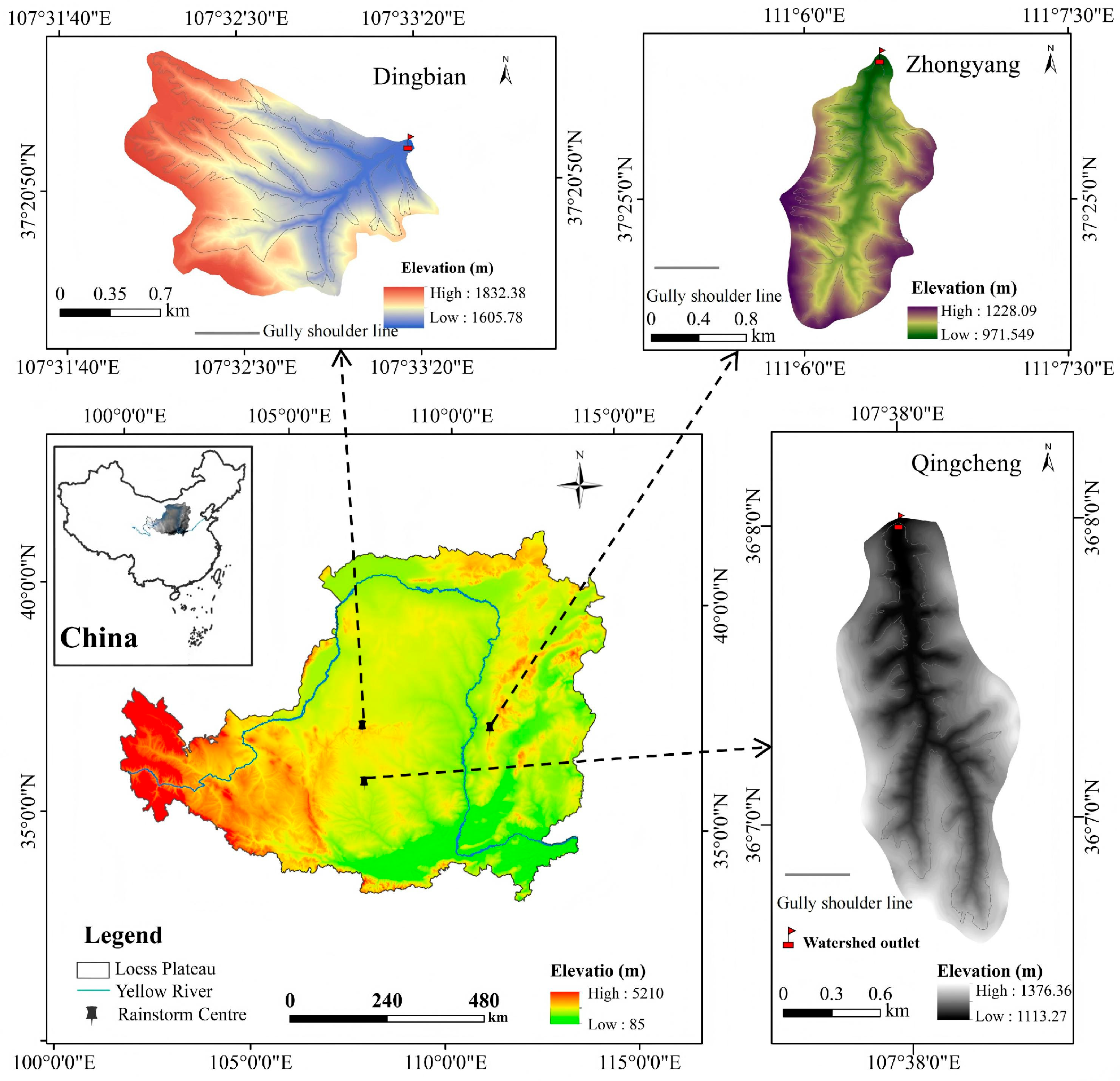
The three study catchments are located in two geomorphological subregions of the Chinese Loess Plateau: the plateau–gully region and the hilly–gully region (Figure 1). The plateau–gully region is characterized by relatively broad interfluves and deeply incised gullies, whereas the hilly–gully region has steeper hillslopes, stronger topographic dissection, and denser slope–channel coupling. Due to the impact of three rainstorms in 2022, these three river basins experienced severe erosion, resulting in severe floods and waterlogging disasters downstream. The three selected catchments are situated in R1—Dingbian (107°39′07″ E, 37°18′58″ N); R2—Qingcheng (107°39′43″ E, 36°08′12 N); and R3—Zhongyang County (111°06′47″ E, 37°25′24″ N), respectively. The area lies within the arid to semi-arid zone of northern China, where the mean annual precipitation ranges from approximately 300 to 600 mm. Precipitation exhibits strong seasonality, with most rainfall occurring between June and September, accounting for more than 79%. Over 80% of the interannual variation in large-scale rainfall on the Loess Plateau during this time is attributed to erosive rainfall [56]. Elevation within the study area varies from 1070 to 1765 m above sea level. The most common land-use category is grassland, with cultivated land coming in second. The soils are primarily loess-derived, characterized by weak structural stability, high permeability, and limited water-holding capacity. These terrain and soil characteristics, together with seasonal intense rainfall, likely contribute to high erosion susceptibility in the study area. We conducted on-site investigations a week after the rainstorm. Basic information about the watershed is shown in Table 1.
In Figure 1, the gully shoulder line is defined as the geomorphic break in slope separating the relatively gentle interfluve or upper hillslope surface from the steep gully-side slope. In this study, the gully shoulder line was delineated in ArcGIS by visual interpretation of the DTM, hillshade, and high-resolution orthophoto, and was checked against field observations where available. The delineation followed the continuous upper edge of the gully-side slope where slope gradient increased sharply and the terrain changed from the upland surface to the incised gully flank. After mapping the gully shoulder line, each landslide was classified according to the position of its main source area relative to this line. Landslides whose main source area was located upslope of the mapped gully shoulder line were classified as above the gully shoulder line, whereas landslides whose main source/scar area was located on the gully-side slope below the mapped line were classified as below the gully shoulder line. Where a landslide crossed the gully shoulder line, classification was assigned according to the location of the crown area.

2.2. Rainstorm Characteristics

Monitoring data for the three rainfall events were retrieved from the Meteorological Network (Table 2). Rainfall intensity was evaluated using national precipitation grading standards (GB/T 28592–2012) [57] issued by the National Meteorological Administration, in combination with duration-dependent criteria for intense and extreme rainfall events developed specifically for the Loess Plateau by [58]. Based on this integrated classification framework, the rainfall event recorded in Dingbian met the criteria for a heavy rainstorm, whereas the events in Qingcheng and Zhongyang satisfied the thresholds for extremely heavy rainstorms. Rainfall data were used to identify and classify the rainfall events associated with the surveyed landslides and to characterize event severity; they were not directly used in the graph theory calculations. Sub-hourly hyetograph characteristics and antecedent soil-wetness observations were not consistently available for all three events and therefore were not analyzed in a comparable way.

2.3. Landslide Survey and Its Erosion Amount Estimation

Field investigations were combined with high-resolution UAV image analysis to document erosion characteristics in the study area. Fieldwork was implemented following the official technical guidelines for investigations of rainstorm-induced soil and water erosion released by MWRPRC (the Ministry of Water Resources of the People’s Republic of China).

2.3.1. UAV Aerial Photography

Aerial surveys were conducted using a DJI Phantom 4 RTK (DJI Technology Co., Ltd., Shenzhen, China) drone operating in a terrain-following mode [14]. To accommodate topographic variations, flight missions were conducted in terrain-following mode at a nominal altitude of approximately 200 m above ground level (AGL). The aircraft’s forward and lateral overlap rates were set at 80% and 70%, respectively. Subsequently, the acquired images were processed in Pix4Dmapper Version 4.4.12 to generate the Digital Orthophoto Map (DOM), Digital Terrain Model (DTM), and DSM; the image resolution is 0.05 m.

2.3.2. Landslide Field Investigation and Image Extraction

Field investigations were conducted following the protocols of [24]; our determination of whether a landslide occurred during this rainfall event was primarily based on observing Google Earth images taken before the rainstorm and the freshness of the landslide cross-section during the investigation. The field surveys provided technical support for indoor landslide image recognition and extraction, where landslides were morphologically segmented into distinct sections to minimize measurement errors. The dimensions (length, width, and depth) of each segment were recorded individually, and soil bulk density was determined using standard cutting rings. For broader analysis, data were primarily derived from UAV imagery, supported by field verification against field observations. Thanks to the high resolution of the synthesized imagery [14], landslide features were clearly discernible. Using ArcGIS vector tools (points, lines, and polygons) on the DOM and DTM datasets, we accurately quantified the geometric parameters and erosion volumes by summing the values of the subdivided sections. Landslide erosion amount was calculated by Equation (1):
M = 10 3 × i = 1 m A i × D i ¯ × B D
where M denotes the total mass of soil eroded by a landslide (kg), i = 1, …, m refers to individual sub-units obtained from landslide segmentation, A i represents the surface area of the i th landslide unit (m2), D ¯ i is the corresponding mean erosion depth (m), and B D denotes the bulk density of landslide material (kg m−3). Soil samples were taken using a 100 cm3 ring cutter, dried indoors, and then weighed.
The landslides erosion intensity (EI) quantifies the magnitude of soil loss per unit of the catchment area (t km−2). The calculation is performed as follows:
E I = j = 1 m M C A
where j refers to individual landslide numbers j = 1 , , m , and CA represents the area of the catchment area above this type of erosion (km2).

2.3.3. Definition of Channel-Connected and Unconnected Landslides

Landslides were classified as channel-connected when the landslide source area, transport path, or depositional toe directly intersected the mapped channel, or when a continuous downslope sediment-transfer pathway linking the landslide to the channel could be identified from the DOM, DTM/hillshade, and field observations. Landslides lacking such direct or continuous linkage were classified as unconnected. This classification was performed in ArcGIS by manual interpretation of the mapped landslide polygons in relation to the channel network.

2.4. Assessment of Transport Network of Landslides

Based on field surveys, this study combined graph theory to quantify the size of the landslide transport network within the catchment. It evaluated the network structure based on the Shi (Shimbel index) and Fi (potential flow index) proposed by [43,44]. Furthermore, the initial graph structure derived from the raster-based drainage framework was checked against the actual catchment topography. Links inconsistent with downslope flow routing or crossing topographic divides were removed, whereas links corresponding to observed channelized or downslope transfer pathways were retained. This rule was applied consistently across all three catchments.
The Shi quantifies the accessibility of a node within the transport network and was calculated as the sum of the shortest-path distances from node i to all other nodes in the graph. Lower Shi values indicate higher accessibility and a more compact network position, whereas higher Shi values indicate that a node is connected through longer transport pathways. To enable comparison among catchments with different network sizes, specifically, it is calculated as the sum of the shortest path distances between node i   and all other nodes j   in the graph ( d i j ). The index should be standardized to enable comparisons across time and space. The lengths of every path in the network from j to the catchment outlet (0) are then added together and divided by this index, which can be done as follows:
S h i i = d i j d j o
where [0, +∞] is the Shi’s value range. If its Shi is high, node i contributes to the network by establishing lengthy pathways, which suggests low accessibility; if the Shi is low, the node optimizes the network’s compactness, leading to increased accessibility [59].
The Fi presumes uniform circumstances for all other variables and allocates a unit virtual volume of sediments to each node for assessment. It illustrates the influence of network architecture on connectivity, revealing the spatial locations where material movement is hindered. The Fi is used to estimate the potential of individual nodes to contribute to material transport toward the outlet and is calculated as follows:
F i = i F i j o F j o
where the Fi represents the runoff potential of each node in the graph. Fijo signifies the quantity of pathways from node j via node i to the catchment outlet (o), whereas Fjo indicates the aggregate number of paths from node j to the outflow (o) within the catchment.
Sediment transport through the cascade can be represented by the multiplication of the adjacency matrix (A) with a sediment-state vector (Sn). The vector Sn is defined as a column vector in which each element corresponds to a node within the cascade network. At the initial step, all elements of Sn are assigned a value of one, representing a unit amount of virtual sediment associated with each node prior to transfer. Each matrix multiplication represents one transport step, during which sediment is redistributed along network connections defined by the adjacency matrix. The resulting vector Sn+1 therefore describes the spatial distribution of sediment after a single iteration of transfer.
S n = S n 1 × A
The iterative procedure continues until all virtual sediment has been transferred out of the system. The outputs from each step are then assembled into a composite matrix that integrates the sequence of state vectors S0, S1, …, Sn generated during the calculation process. This approach represents a dedicated matrix-based computation grounded in established mathematical principles, with a detailed methodological description provided in [43].

2.5. Assessment of Sediment Connectivity of Landslides

The Residual Flow index (RF) was applied to quantify the structural connectivity of sediment associated with landslides. Compared with conventional connectivity metrics, the RF shows reduced sensitivity to extremely low accessibility and flow values within complex graph structures, thereby providing a more robust assessment of sediment structural connectivity. The formulation and application of this index follow the methodology proposed by [44] and can be expressed as follows:
F i = a × S h i i + b
R F i = F i F i
where F i denotes the theoretical expectation of the potential flow index. The slope and intercept obtained from the linear regression between Shi and Fi are represented by parameters a and b, respectively. When R F i approaches zero, sediment flux through node i is primarily controlled by its topological position within the network, and the flow magnitude is largely determined by the number of upstream contributing sources. A positive value of R F i indicates that network configuration and pathway geometry enhance runoff-driven sediment convergence, reflecting a high level of structural connectivity. In contrast, negative R F i values suggest weak connectivity at node i .
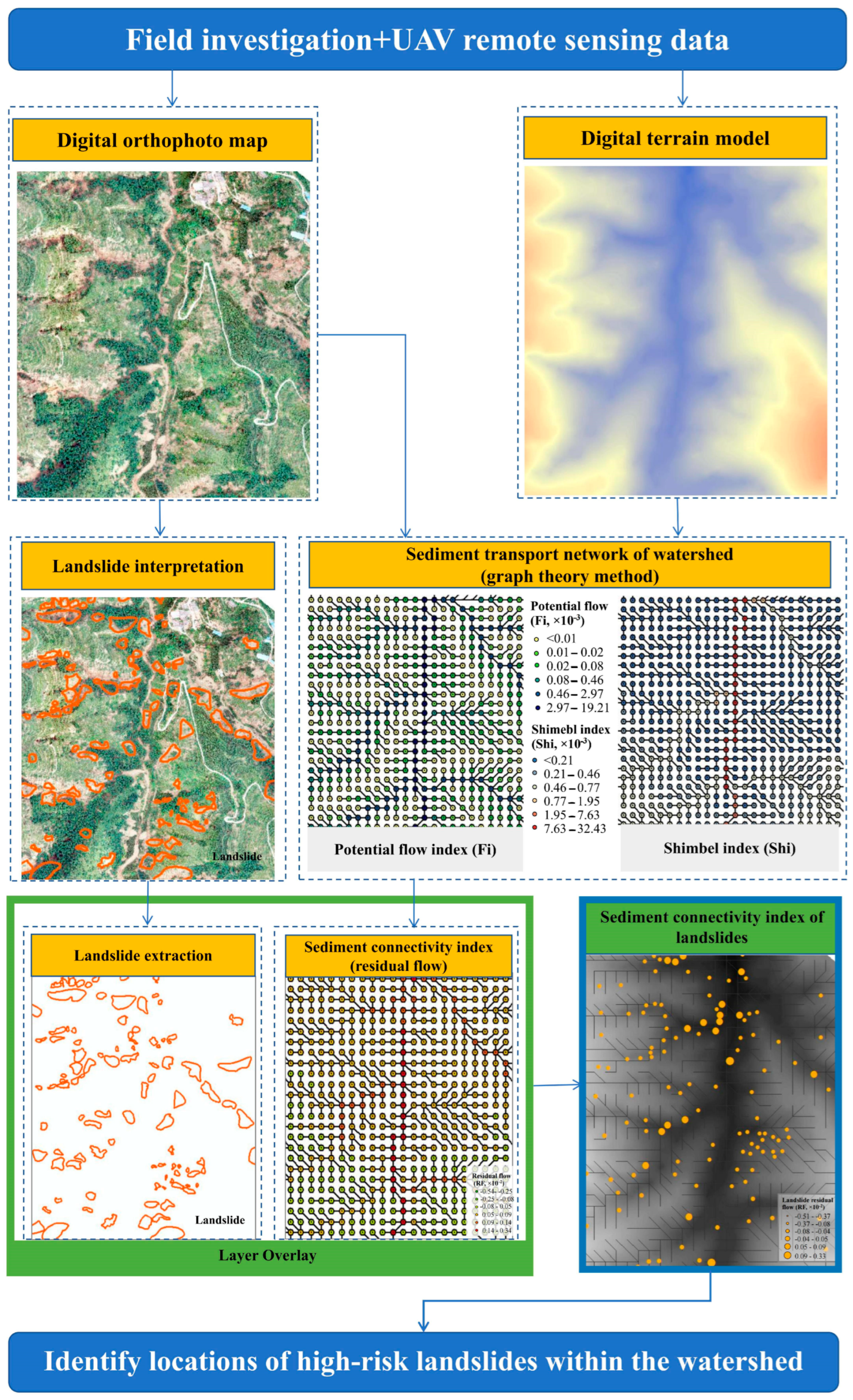
Based on the extracted landslide erosion distribution map within the catchment, the Shi, Fi, and RF maps of the small catchments were overlaid with the landslide distribution map. Using ArcGIS tools, the Shi, Fi, and RF values were extracted to the position of landslides, and the size of the transport network indexes and the size of the sediment connectivity index at the location of the landslide were obtained (Figure 2).

2.6. Statistical Analysis

ArcGIS 10.8 was used to extract underlying surface factors, including slope, aspect, elevation, catchment area, and vegetation coverage. Based on the DEM data of each catchment, the adjacent matrix was calculated using ArcGIS. The data was then exported to R 4.3.1 for graph theory analysis using the iGraph package. The resulting graph was then visualized using ArcGIS. IBM SPSS 17.0 software was used to perform an analysis of variance (ANOVA) on the morphological differences in landslides. Differences among catchments or groups were tested using Welch’s ANOVA, depending on the data structure. Prior to analysis, normality and homogeneity of variance were evaluated using the Shapiro–Wilk test and Levene’s test, respectively. Because the sample sizes among catchments were highly unbalanced, Welch’s ANOVA was used for the main group comparisons, followed by the Games–Howell post hoc test for multiple comparisons. Different lowercase letters in the figures indicate significant differences at p < 0.05. Origin 2021 was used to analyze the correlation between underlying surface factors and landslide erosion amount, and it was used for plotting.

3. Results

3.1. Landslide Characteristics in the Catchments

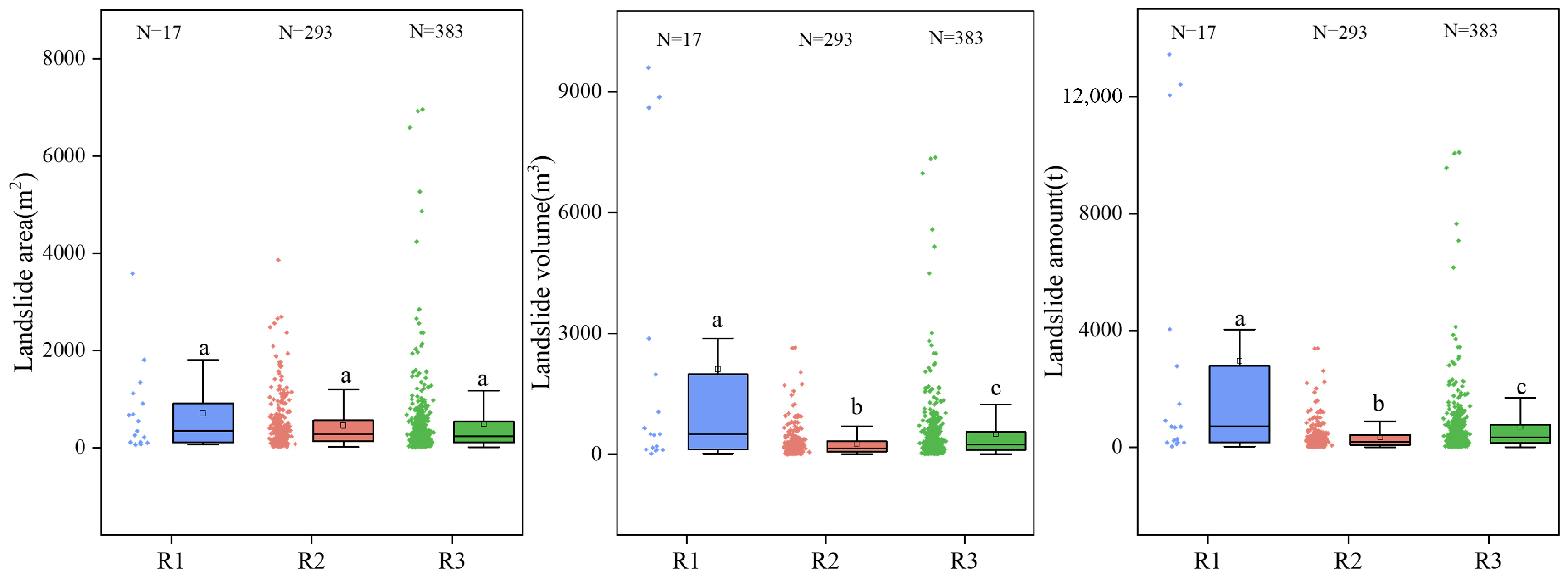
As shown in Figure 3, there were no significant differences in landslide erosion area among the different catchments (p > 0.05), with areas ranging from 63 to 3583 m2, 18.4 to 3858.2 m2, and 11 to 6855.1 m2, respectively. Nonetheless, substantial disparities in landslide volume and quantity were observed among the several catchments (p < 0.05). The average landslide volumes and amounts were 2119.94 m3, 273.55 m3, 515.11 m3, and 2967.92 t, 350.15 t, 705.69 t, respectively. The landslide number density within the three different catchments was 9 km−2, 155 km−2, and 214 km−2, respectively. The landslide number densities in catchments R2 and R3 were 17.2 times and 22.2 times higher than that in catchment R1. The landslides were all small, as indicated by their sizes (<105 m3). The average erosion intensities were 25,153.76 t km−2, 53,074.98 t km−2, and 172,153.44 t km−2, respectively.
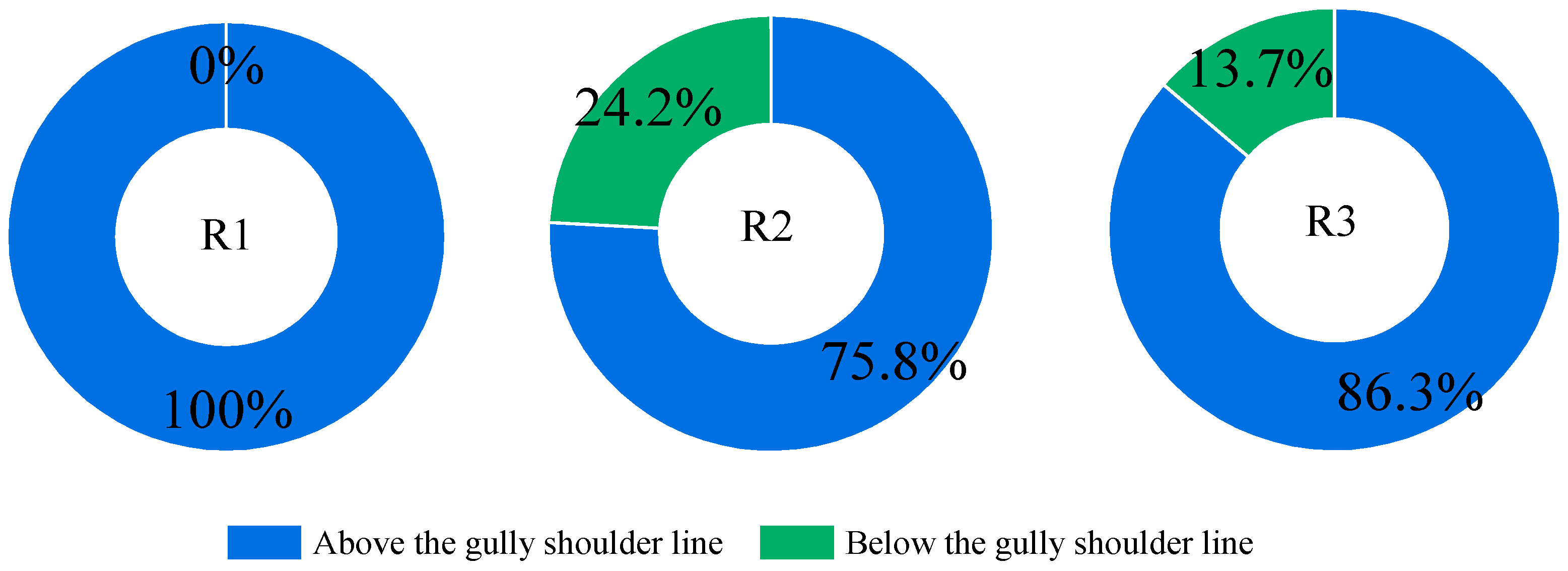
The investigation found that landslides primarily occurred on valley slopes within the catchments (Figure 4), contributing over 75.8% of the total landslide-derived erosion and representing between 76% and 91% of landslide occurrences across the catchments. These valley slopes were mainly located on the channels, where the terrain is steep and consists largely of non-agricultural land. Significant landslide erosion in these areas may further exacerbate channel bank expansion and increase terrain fragmentation.

3.2. Sediment Transport Network

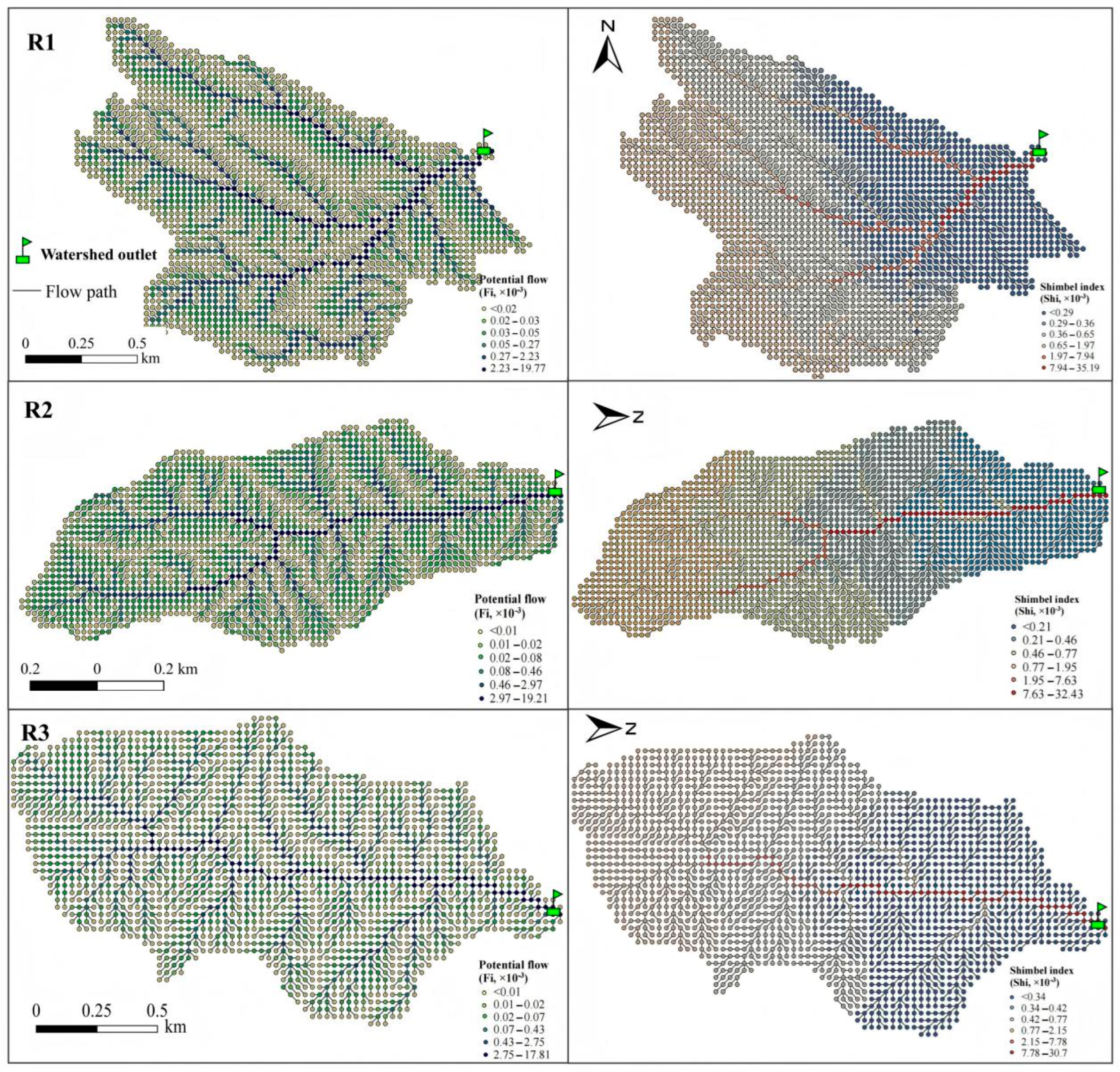
As shown in Figure 5, the transport network structure varied among catchments and generally exhibited the highest transport network in the channels. This indicated that there were more paths through which runoff and sediment were transported from these nodes to the catchment outlet. The Fi value of the catchment gradually increased from the slope to the channel, while the Shi value decreased from upstream to downstream of the catchment. A larger Fi indicated that there were more paths for the runoff sediment to be transported to the catchment outlet. The lower Shi at a node suggested that the distance for runoff sediment to be transported through that node to the outlet was shorter, facilitating the transport of runoff sediment. In summary, the convenience of the sediment transport network within the catchment was related to the distance to the catchment outlet and the specific location of the network itself.
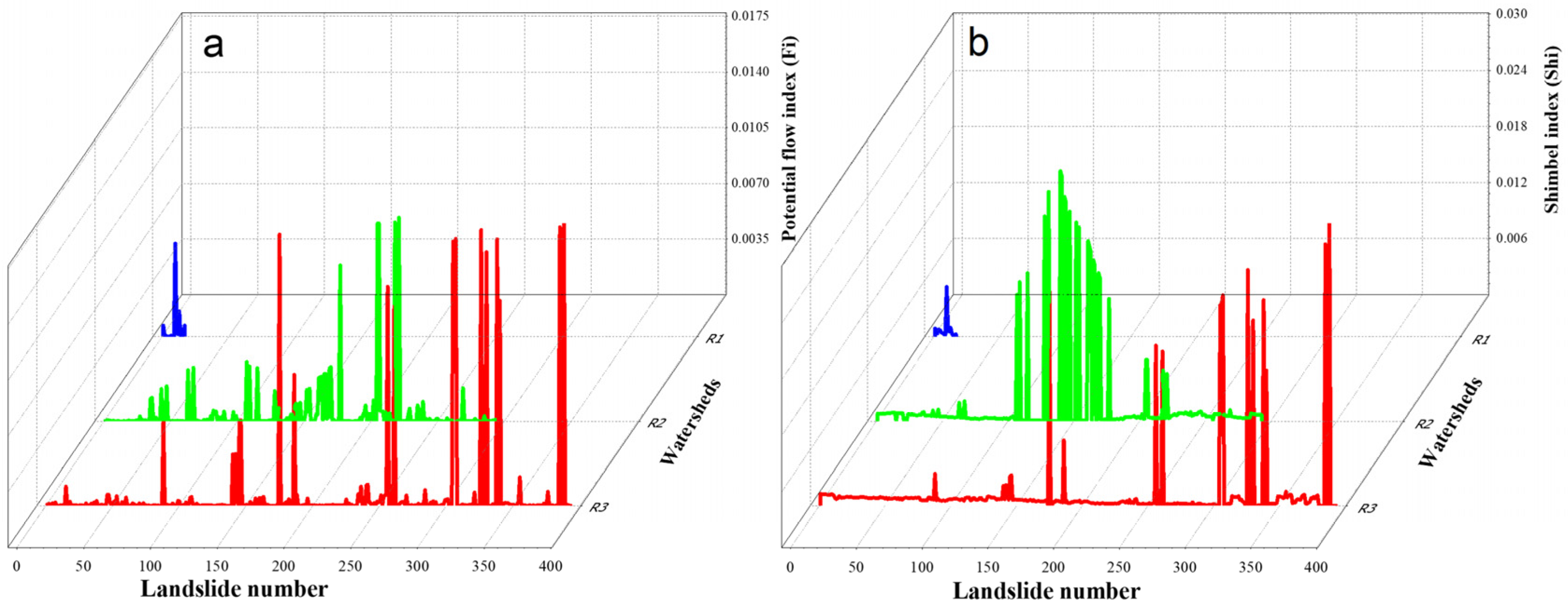
The Fi and Shi values for catchments R1, R2, and R3 where landslides occurred were 0.08 × 10⁻³–5.86 × 10⁻³, 0.09 × 10⁻³–12.8 × 10⁻³, 0.09 × 10⁻³–17.72 × 10⁻³, and 0.11 × 10⁻³–5.36 × 10⁻³, 0.02 × 10⁻³–26.8 × 10⁻³, 0.03 × 10⁻³–30.14 × 10⁻³, respectively, with average Fi and Shi values of 0.69 × 10⁻³, 0.58 × 10⁻³, 0.67 × 10⁻³ and 0.79 × 10⁻³, 1.83 × 10⁻³, 1.23 × 10⁻³, respectively (Figure 6). The locations of landslides concentrated in areas with high Fi values indicated that a greater number of paths exist through these nodes for sediment produced by landslides to be transported to the catchment outlet, thereby demonstrating better network connectivity. The network nodes downstream of the catchment where the landslide occurred maximized the compactness of the network, and the accessibility of runoff sediment from these nodes to the catchment outlet was greater.

3.3. Sediment Connectivity and Transport Risk for Landslides

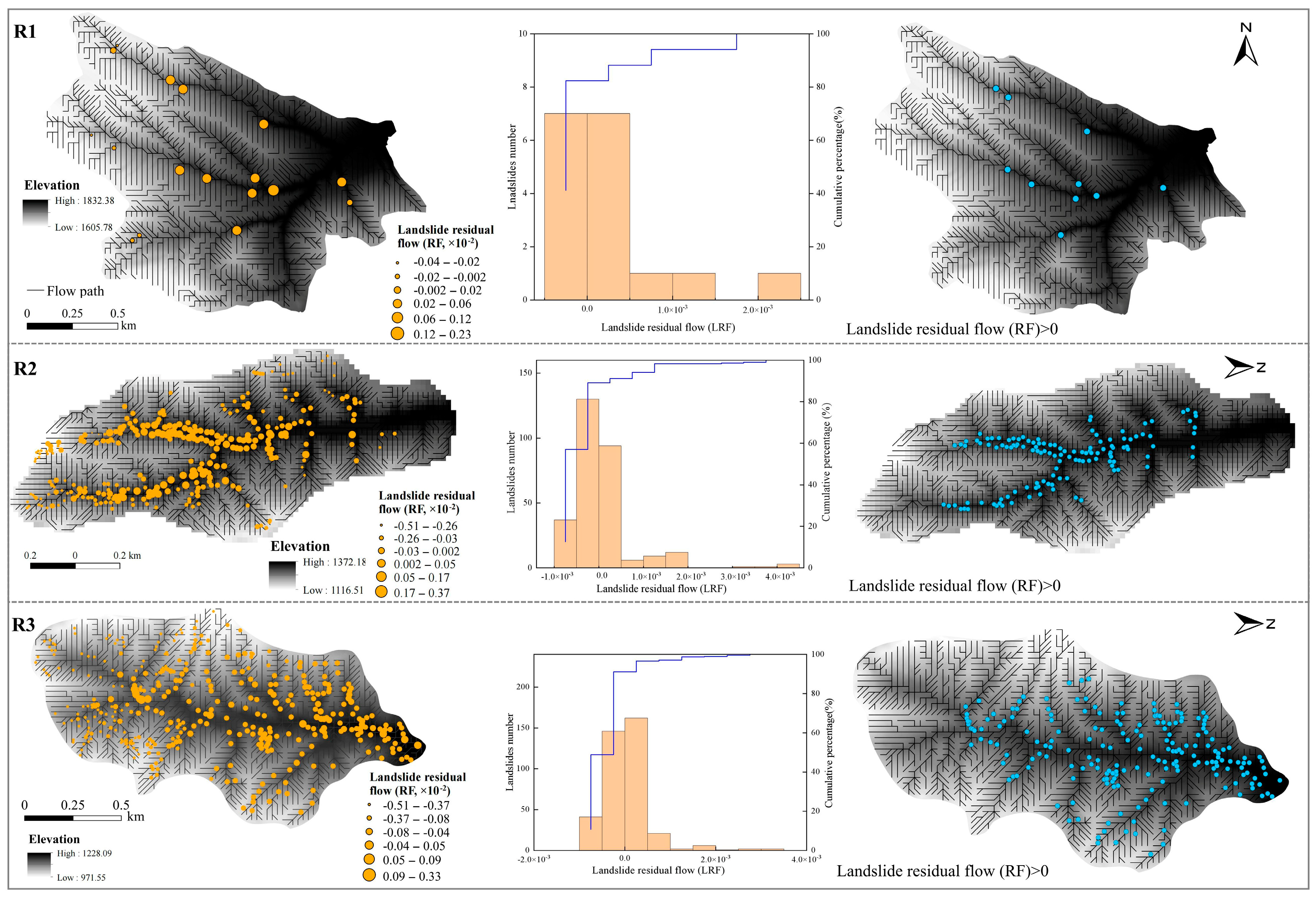
The RF values for landslides in catchments R1, R2, and R3 ranged from −0.04 × 10⁻² to 0.23 × 10⁻², −0.51 × 10⁻² to 0.37 × 10⁻², and −0.51 × 10⁻² to 0.33 × 10⁻², respectively (Figure 7). Within these catchments, landslides characterized by low RF values were mainly distributed in upstream portions of the basin and in areas farther from the main channels. Notably, 41%, 57%, and 49% of landslides in R1, R2, and R3 had RF values < 0, indicating weak structural connectivity to the catchment outlet. These landslides are therefore less likely to act as effective sediment contributors during storm events and may instead function as local sediment storage zones. In contrast, in catchments R1, R2, and R3, landslides with an RF value greater than 0 accounted for 59%, 43%, and 51% of the total, respectively. Landslides with high sediment connectivity were mainly concentrated near the channel in the lower and middle reaches of the catchments, indicating that the hydrological network structure of the catchment facilitated the transport of runoff sediment to the catchment outlet, and also implying a high risk of sediment generated by these landslides being transported to the catchment outlet. This finding suggests that watershed management should prioritize highly connected landslides rather than treating all landslides uniformly.

4. Discussion

4.1. Effectiveness of the Sediment Transport Risk Assessment Method

Connectivity refers to the efficiency of runoff and its transported materials or energy moving from the source area through the drainage network to the catchment outlet [60,61]. Graph theory is a tool for analyzing structural connectivity; it provides a comprehensive list of connections within a conventional network of nodes, representing sediment sources, storage areas, or sinks, categorized by landscape units [43,62,63]. Nodes are linked through edges that represent sediment transport routes and inter-node sediment linkages. Together, these connections form a stable spatial network suitable for evaluating sediment connectivity [43,44]. This approach assigns an equal unit of sediment to each node and evaluates node-level sediment connectivity based on the number and cumulative length of transport pathways linking the node to the outlet. As a result, areas acting as connectivity hotspots within the catchment can be effectively identified [44,64]. In current graph theory-based research, researchers have successfully used this method to quantify the sediment connectivity characteristics of catchments under different human interventions [55]; this method plays a positive role in adjusting catchment management measures. Therefore, this research used this method to identify high-risk locations for erosion sediment transport following landslides within the catchment under the influence of heavy rainfall, which effectively identifies high-risk locations for landslide-derived sediment transport to the catchment outlet.
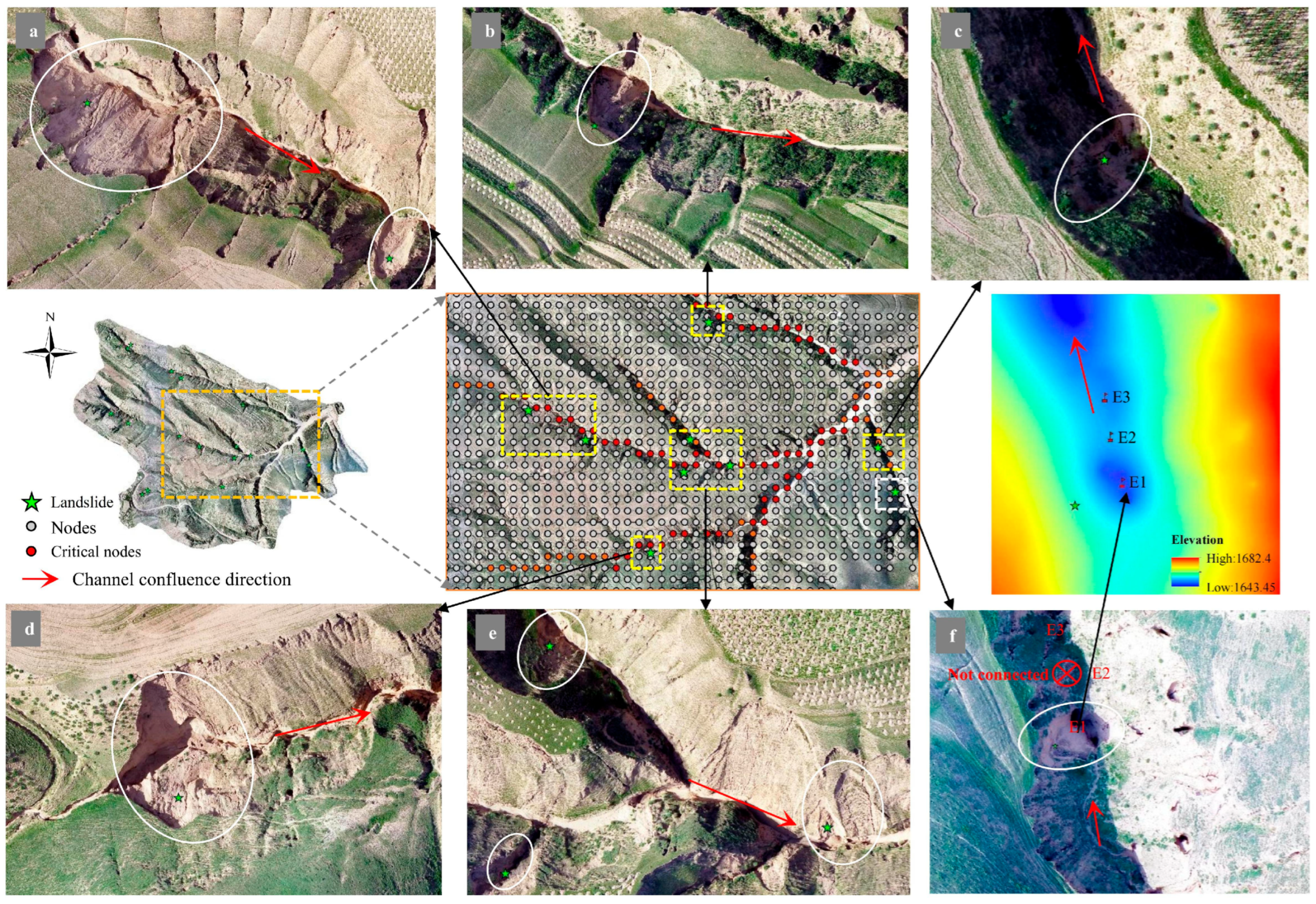
In practical terms, the widely used sediment connectivity index IC [39,65] estimates the connectivity of a location within the catchment as the ratio between upslope and downslope components. Although IC can identify spatial variations in sediment connectivity within a catchment, it is only valid in relative terms and cannot directly determine the risk of sediment at a given location being transported to the outlet. In contrast, the RF based on graph theory allows for the direct determination of connectivity at a specific location by comparing its value. As shown in Figure 8a–e, we can observe that most landslides with high RF-based structural risk were located near channel confluences and in parts of the network characterized by relatively high RF values, making it easier for sediment to be transported by runoff. Therefore, the risk of sediment transport following landslides is high [13]. Additionally, the RF can also identify areas with low sediment transport risk as illustrated in Figure 8f. Since the height of the confluence channel at the base of the landslide is lower than that of the downstream areas (E2 > E3 > E1), runoff is obstructed here, leading to a disruption in sediment connectivity. Thus, this landslide can be classified as having a low risk of sediment transport.

4.2. Prevention and Control of Landslide Hotspots

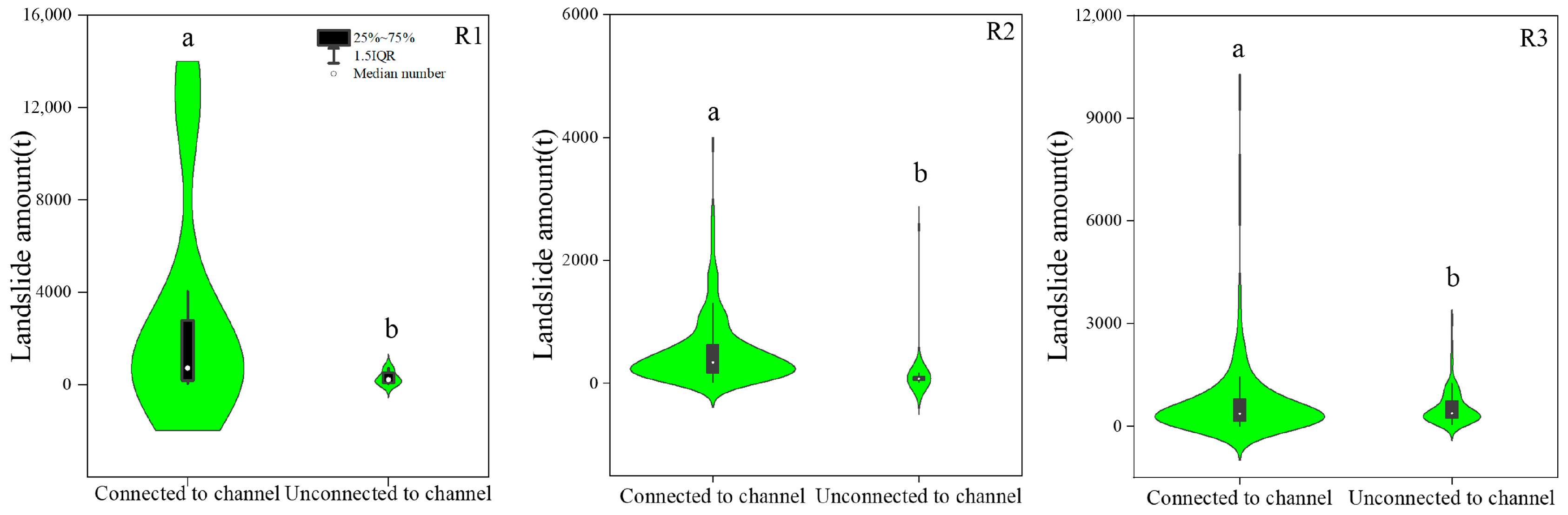
The concentration of landslides on valley slopes observed in this study is generally consistent with previous studies on the Loess Plateau, which have identified slope–channel coupling zones as preferential locations for shallow failures during intense storms [12,66,67]. In addition to topographic controls, recent engineering activities, such as gully land consolidation, slope cutting, toe disturbance, artificial fills, and modified drainage pathways, may further alter local slope stability and sediment connectivity in these areas. On the Loess Plateau, these valley slopes are typically developed on both sides of deeply incised channels characterized by steep terrain. As a form of gravity erosion, slope gradient is one of the primary topographic conditions influencing landslide occurrence [46,68]. The erosion rate of landslides directly associated with channels was 3.43–10.17 times greater than that of those not directly connected to channels (Figure 9). This portion of the landslides was mostly located in areas with high connectivity (Figure 7), making them easily transported to the catchment outlet under runoff erosion [13]. This aspect of landslides should be the focus of prevention and control.
In addition, landslides are also significantly influenced by the catchment area and vegetation cover. However, different vegetation types have different erosion resistance capabilities. As shown in Figure 3, the landslide area did not differ significantly among the three watersheds, but the landslide volume and mass showed significant differences. This is related to the differences in vegetation and soil among the three watersheds. Due to the steep slope in these areas, herbaceous vegetation is more likely to grow here than trees, transforming steep valley inclines into hotspots for landslides [14,69]. To prevent landslides from occurring in these areas, intercepting ditches should be built above the valley slope; diversion ditches should be built on the slopes; and drainage ditches along with protective facilities should be built at the bottom of valley slopes to reduce the sediment connectivity of slope land, thereby decreasing the risk of landslides caused by base instability. When using vegetation measures to control landslides, it is essential to adopt a mixed planting approach with trees, shrubs, and grasses to enhance the slope’s resistance to landslides [11].

4.3. Limitations and Implications

In light of the rising frequency of extreme rainfall events [9,70], erosion disasters are becoming more frequent [71]. Sediment connectivity is a major factor directly influencing whether erosion sediment can be transferred downstream. Most previous studies have focused on evaluating sediment connectivity at the catchment scale [39,65]. In this study, sediment connectivity at landslide locations is quantified by examining its magnitude within a network-based framework. Network approaches have been widely applied to the interpretation of sediment-related processes since early conceptual work [72], and subsequent studies introduced graph theory to characterize connectivity patterns in catchment systems [73]. Owing to its capacity to capture spatial organization and topological relationships, this framework is particularly effective for identifying the key structural features of sediment connectivity, thereby offering a robust basis for simulating sediment transport dynamics [44,73]. Therefore, this study demonstrates the feasibility of using graph theory to assess the risk of landslide-eroded sediment being transported to the catchment outlet. However, the present assessment is affected by several sources of uncertainty, including the spatial resolution and vertical accuracy of the DTM, the delineation of flow paths and nodes, and the interpretation of landslide boundaries from UAV images. In addition, this study evaluates structural connectivity rather than event-based functional connectivity; therefore, the actual sediment delivery during a specific storm may also depend on runoff generation, sediment availability, and temporary barriers along the transport pathway. Understanding the development process of runoff sediment is also crucial for the study of landslide hazards, which necessitates further research in the future.

5. Conclusions

The study indicated that valley slopes were hotspot areas for landslides, with landslide number densities of 9, 155, and 214 km−2, and erosion intensities of 25,153, 53,074, and 172,153 t km−2, respectively, in the three catchments. The study also identified key nodes in the sediment transport network for landslides within the catchment. The accessibility index increased from upstream to downstream, while the complexity of the hydrological network structure decreased with increasing distance to the catchment outlet. The study also identified the location of high-risk landslides, concluding that 59%, 43%, and 51% of the landslides in each respective catchment had a high risk of sediment transport. We first recommend applying the graph theory method to identify hotspots of landslides during heavy rainfall within the catchment. Secondly, we suggest implementing drainage interception measures to reduce sediment connectivity above and below the valley slopes, thereby decreasing the risk of landslide occurrence and sediment transport. This research provides new insights into assessing the risk of sediment transport from erosion under extreme rainfall conditions from the perspective of sediment connectivity, and offers a reference for the precise treatment of landslides in hotspot areas of small catchments.

Author Contributions

Conceptualization, B.Y., L.S., T.W., Z.S., J.X., R.L., and Y.Z.; methodology, B.Y.; software, B.Y.; validation, B.Y., R.L., and Y.Z.; formal analysis, B.Y.; investigation, B.Y.; resources, L.S., T.W., R.L., and Y.Z.; data curation, B.Y.; writing—original draft preparation, B.Y.; writing—review and editing, B.Y., and Y.Z.; visualization, B.Y.; supervision, R.L., and Y.Z.; project administration, B.Y.; funding acquisition, R.L., and Y.Z. All authors have read and agreed to the published version of the manuscript.

Funding

This work was supported by the National Natural Science Foundation of China (U2243213, 42407461, 42077078).

Data Availability Statement

Data will be made available on request.

Conflicts of Interest

Author Lele Sun was employed by the Yellow River Engineering Consulting Co., Ltd. The remaining authors declare that the research was conducted in the absence of any commercial or financial relationships that could be construed as a potential conflict of interest.

References

  1. Alexander, L.V.; Zhang, X.; Peterson, T.C.; Caesar, J.; Gleason, B.; Klein Tank, A.; Haylock, M.; Collins, D.; Trewin, B.; Rahimzadeh, F. Global observed changes in daily climate extremes of temperature and precipitation. J. Geophys. Res. Atmos. 2006, 111, 109. [Google Scholar] [CrossRef]
  2. Huang, H.; Cui, H.; Ge, Q. Assessment of potential risks induced by increasing extreme precipitation under climate change. Nat. Hazards 2021, 108, 2059–2079. [Google Scholar] [CrossRef]
  3. Kotz, M.; Lange, S.; Wenz, L.; Levermann, A. Constraining the pattern and magnitude of projected extreme precipitation change in a multi-model ensemble. J. Clim. 2023, 37, 97–111. [Google Scholar] [CrossRef]
  4. Donat, M.G.; Lowry, A.L.; Alexander, L.V.; O’Gorman, P.A.; Maher, N. More extreme precipitation in the world’s dry and wet regions. Nat. Clim. Change 2016, 6, 508–513. [Google Scholar] [CrossRef]
  5. Ombadi, M.; Risser, M.D.; Rhoades, A.M.; Varadharajan, C. A warming-induced reduction in snow fraction amplifies rainfall extremes. Nature 2023, 619, 305–310. [Google Scholar] [CrossRef]
  6. Huang, R. Some catastrophic landslides since the twentieth century in the southwest of China. Landslides 2009, 6, 69–81. [Google Scholar] [CrossRef]
  7. Zhao, G.; Mu, X.; Wen, Z.; Wang, F.; Gao, P. Soil erosion, conservation, and eco-environment changes in the Loess Plateau of China. Land Degrad. Dev. 2013, 24, 499–510. [Google Scholar] [CrossRef]
  8. Zhang, X.; Liu, K.; Li, X.; Wang, S.; Wang, J. Vulnerability assessment and its driving forces in terms of NDVI and GPP over the Loess Plateau, China. Phys. Chem. Earth Parts A/B/C 2022, 125, 103106. [Google Scholar] [CrossRef]
  9. Yu, Y.; Hua, T.; Chen, L.; Zhang, Z.; Pereira, P. Divergent Changes in Vegetation Greenness, Productivity, and Rainfall Use Efficiency Are Characteristic of Ecological Restoration Towards High-Quality Development in the Yellow River Basin, China. Engineering 2024, 34, 109–119. [Google Scholar] [CrossRef]
  10. Zhang, X.; Ceng, Y.; Gao, Z.; Li, Y.; Sun, G.; Liu, W. Reponse fo eco-environment quality to climate change and land use in the Loess Plateau from 2000 to 2020. Bull. Soil Water Conserv. 2023, 43, 234–244. (In Chinese) [Google Scholar] [CrossRef]
  11. Xu, Y.; Luo, L.; Guo, W.; Jin, Z.; Tian, P.; Wang, W. Revegetation Changes Main Erosion Type on the Gully–Slope on the Chinese Loess Plateau Under Extreme Rainfall: Reducing Gully Erosion and Promoting Shallow Landslides. Water Resour. Res. 2024, 60, e2023WR036307. [Google Scholar] [CrossRef]
  12. Chen, Y.; Vanmaercke, M.; Jiao, J.; Bai, L.; Tang, B.; Wang, N.; Zhang, Y.; Wang, H. Quantifying the importance of different erosion processes and soil and water conservation measure collapses following an extreme rainstorm in the Chinese Loess Plateau. Land Degrad. Dev. 2023, 34, 403–422. [Google Scholar] [CrossRef]
  13. Fuller, I.C.; Riedler, R.A.; Bell, R.; Marden, M.; Glade, T. Landslide-driven erosion and slope–channel coupling in steep, forested terrain, Ruahine Ranges, New Zealand, 1946–2011. Catena 2016, 142, 252–268. [Google Scholar] [CrossRef]
  14. Yang, B.; Ma, X.; Jiao, J.; Zhao, W.; Ling, Q.; Li, J.; Zhang, X. Magnitude and hotspots of soil erosion types during heavy rainstorm events on the Loess Plateau: Implications for watershed management. Catena 2024, 246, 108365. [Google Scholar] [CrossRef]
  15. Guzzetti, F. Landslide Early Warning Systems: Resources or Problems? In Proceedings of the E3S Web of Conferences; EDP Sciences: Les Ulis, France, 2023; p. 03010. [Google Scholar]
  16. Whipp, D.M.; Ehlers, T.A. Quantifying landslide frequency and sediment residence time in the Nepal Himalaya. Sci. Adv. 2019, 5, eaav3482. [Google Scholar] [CrossRef]
  17. Minder, J.R.; Roe, G.H.; Montgomery, D.R. Spatial patterns of rainfall and shallow landslide susceptibility. Water Resour. Res. 2009, 45, W04419. [Google Scholar] [CrossRef]
  18. Li, C.; Ma, T.; Zhu, X.; Li, W. The power–law relationship between landslide occurrence and rainfall level. Geomorphology 2011, 130, 221–229. [Google Scholar] [CrossRef]
  19. Guo, W.-Z.; Luo, L.; Wang, W.-L.; Liu, Z.-Y.; Chen, Z.-X.; Kang, H.-L.; Yang, B. Sensitivity of rainstorm-triggered shallow mass movements on gully slopes to topographical factors on the Chinese Loess Plateau. Geomorphology 2019, 337, 69–78. [Google Scholar] [CrossRef]
  20. Hu, S.; Jiao, J.; García-Fayos, P.; Kou, M.; Chen, Y.; Wang, W. Telling a different story: Plant recolonization after landslides under a semi-arid climate. Plant Soil 2018, 426, 163–178. [Google Scholar] [CrossRef]
  21. Brönnimann, C.; Stähli, M.; Schneider, P.; Seward, L.; Springman, S.M. Bedrock exfiltration as a triggering mechanism for shallow landslides. Water Resour. Res. 2013, 49, 5155–5167. [Google Scholar] [CrossRef]
  22. von Ruette, J.; Lehmann, P.; Or, D. Effects of rainfall spatial variability and intermittency on shallow landslide triggering patterns at a catchment scale. Water Resour. Res. 2014, 50, 7780–7799. [Google Scholar] [CrossRef]
  23. Jiao, J.; Wang, Z.; Wei, Y.; Su, Y.; Cao, B.; Li, Y. Characteristics of erosion sediment yield with extreme rainstorms in Yanhe Watershed based on field measurement. Trans. Chin. Soc. Agric. Eng. 2017, 33, 159–167. (In Chinese) [Google Scholar]
  24. Yang, B.; Jiao, J.; Ma, X.; Zhao, W.; Ling, Q.; Zhang, X.; Han, J.; Du, P.; Chen, Y.; Chen, H. Distribution and formation of soil balls under heavy rainstorm conditions in the northern Loess Plateau. J. Hydrol. 2023, 625, 130103. [Google Scholar] [CrossRef]
  25. Chen, Y.; Chang, K.; Lee, H.; Chiang, S. Average landslide erosion rate at the watershed scale in southern Taiwan estimated from magnitude and frequency of rainfall. Geomorphology 2015, 228, 756–764. [Google Scholar] [CrossRef]
  26. Wu, Y.; Zhang, Y.; Dai, L.; Xie, L.; Zhao, S.; Liu, Y.; Zhang, Z. Hydrological connectivity improves soil nutrients and root architecture at the soil profile scale in a wetland ecosystem. Sci. Total Environ. 2021, 762, 143162. [Google Scholar] [CrossRef]
  27. Pringle, C. What is hydrologic connectivity and why is it ecologically important? Hydrol. Process. 2003, 17, 2685–2689. [Google Scholar] [CrossRef]
  28. Bracken, L.J.; Wainwright, J.; Ali, G.A.; Tetzlaff, D.; Smith, M.W.; Reaney, S.M.; Roy, A.G. Concepts of hydrological connectivity: Research approaches, pathways and future agendas. Earth-Sci. Rev. 2013, 119, 17–34. [Google Scholar] [CrossRef]
  29. Wainwright, J.; Turnbull, L.; Ibrahim, T.G.; Lexartza-Artza, I.; Thornton, S.F.; Brazier, R.E. Linking environmental régimes, space and time: Interpretations of structural and functional connectivity. Geomorphology 2011, 126, 387–404. [Google Scholar] [CrossRef]
  30. Bracken, L.J.; Croke, J. The concept of hydrological connectivity and its contribution to understanding runoff-dominated geomorphic systems. Hydrol. Process. Int. J. 2007, 21, 1749–1763. [Google Scholar] [CrossRef]
  31. Fryirs, K.A.; Brierley, G.J.; Preston, N.J.; Kasai, M. Buffers, barriers and blankets: The (dis)connectivity of catchment-scale sediment cascades. Catena 2007, 70, 49–67. [Google Scholar] [CrossRef]
  32. Martínez-Murillo, J.F.; Hueso-González, P.; Ruiz-Sinoga, J.D. Impact of Low Pressure Grazing on the Hydrological and Sediment Connectivity in Hillslopes under Contrasted Mediterranean Climatic Conditions (South of Spain). Land Degrad. Dev. 2018, 29, 1130–1140. [Google Scholar] [CrossRef]
  33. Wu, Z.; Baartman, J.E.M.; Pedro Nunes, J.; López-Vicente, M. Intra-annual sediment dynamic assessment in the Wei River Basin, China, using the AIC functional-structural connectivity index. Ecol. Indic. 2023, 146, 109775. [Google Scholar] [CrossRef]
  34. Hooke, J.; Souza, J.; Marchamalo, M. Evaluation of connectivity indices applied to a Mediterranean agricultural catchment. Catena 2021, 207, 105713. [Google Scholar] [CrossRef]
  35. Bracken, L.J.; Turnbull, L.; Wainwright, J.; Bogaart, P. Sediment connectivity: A framework for understanding sediment transfer at multiple scales. Earth. Surf. Proc. Land. 2015, 40, 177–188. [Google Scholar] [CrossRef]
  36. Marchamalo, M.; Hooke, J.M.; Sandercock, P.J. Flow and Sediment Connectivity in Semi-arid Landscapes in SE Spain: Patterns and Controls. Land Degrad. Dev. 2016, 27, 1032–1044. [Google Scholar] [CrossRef]
  37. Keesstra, S.; Nunes, J.P.; Saco, P.; Parsons, T.; Poeppl, R.; Masselink, R.; Cerdà, A. The way forward: Can connectivity be useful to design better measuring and modelling schemes for water and sediment dynamics? Sci. Total Environ. 2018, 644, 1557–1572. [Google Scholar] [CrossRef] [PubMed]
  38. Polyakov, V.O.; Nearing, M.A. Rare earth element oxides for tracing sediment movement. Catena 2004, 55, 255–276. [Google Scholar] [CrossRef]
  39. Borselli, L.; Cassi, P.; Torri, D. Prolegomena to sediment and flow connectivity in the landscape: A GIS and field numerical assessment. Catena 2008, 75, 268–277. [Google Scholar] [CrossRef]
  40. López-Vicente, M.; Ben-Salem, N. Computing structural and functional flow and sediment connectivity with a new aggregated index: A case study in a large Mediterranean catchment. Sci. Total Environ. 2019, 651, 179–191. [Google Scholar] [CrossRef]
  41. Reulier, R.; Delahaye, D.; Viel, V. Agricultural landscape evolution and structural connectivity to the river for matter flux, a multi-agents simulation approach. Catena 2019, 174, 524–535. [Google Scholar] [CrossRef]
  42. Schmitt, R.J.P.; Bizzi, S.; Castelletti, A. Tracking multiple sediment cascades at the river network scale identifies controls and emerging patterns of sediment connectivity. Water Resour. Res. 2016, 52, 3941–3965. [Google Scholar] [CrossRef]
  43. Cossart, É.; Fressard, M. Assessment of structural sediment connectivity within catchments: Insights from graph theory. Earth Surf. Dyn. 2017, 5, 253–268. [Google Scholar] [CrossRef]
  44. Fressard, M.; Cossart, E. A graph theory tool for assessing structural sediment connectivity: Development and application in the Mercurey vineyards (France). Sci. Total Environ. 2019, 651, 2566–2584. [Google Scholar] [CrossRef] [PubMed]
  45. Yan, X.; Jiao, J.; Jiang, X.; Xu, Q.; Li, M.; Zhang, Z.; Qi, H.; Yang, L. Rainfall characteristics of sediment connectivity activation from plot to watershed scales on the Loess Plateau. Catena 2024, 235, 107654. [Google Scholar] [CrossRef]
  46. Xu, Q.; Jiao, J.; Yan, Z.; Liao, J.; Zhang, Z.; Li, M.; Yan, X.; Chen, Y.; Li, J.; Jian, J. Response of road erosion to hydrological connectivity under a heavy rainstorm in an agricultural watershed on the Loess Plateau. Catena 2024, 240, 107991. [Google Scholar] [CrossRef]
  47. Hooke, J. Coarse sediment connectivity in river channel systems: A conceptual framework and methodology. Geomorphology 2003, 56, 79–94. [Google Scholar] [CrossRef]
  48. Zhang, Y.; Jiao, J.; Chen, Y.; Tang, B. Channel morphology and sediment connectivity in the Ansai Fangta small watershed in northern Shaanxi. Res. Soil Water Conserv. 2019, 26, 11–15. (In Chinese) [Google Scholar] [CrossRef]
  49. Ali, G.; Birkel, C.; Tetzlaff, D.; Soulsby, C.; McDonnell, J.J.; Tarolli, P. A comparison of wetness indices for the prediction of observed connected saturated areas under contrasting conditions. Earth. Surf. Proc. Land. 2014, 39, 399–413. [Google Scholar] [CrossRef]
  50. Heckmann, T.; Cavalli, M.; Cerdan, O.; Foerster, S.; Javaux, M.; Lode, E.; Smetanová, A.; Vericat, D.; Brardinoni, F. Indices of sediment connectivity: Opportunities, challenges and limitations. Earth-Sci. Rev. 2018, 187, 77–108. [Google Scholar] [CrossRef]
  51. Hoffmann, T. Sediment residence time and connectivity in non-equilibrium and transient geomorphic systems. Earth-Sci. Rev. 2015, 150, 609–627. [Google Scholar] [CrossRef]
  52. Jancewicz, K.; Migoń, P.; Kasprzak, M. Connectivity patterns in contrasting types of tableland sandstone relief revealed by Topographic Wetness Index. Sci. Total Environ. 2019, 656, 1046–1062. [Google Scholar] [CrossRef]
  53. Yan, X.-Q.; Jiao, J.-Y.; Tang, B.-Z.; Liang, Y.; Wang, Z.-J. Assessing sediment connectivity and its spatial response on land use using two flow direction algorithms in the catchment on the Chinese Loess Plateau. J. Mt. Sci. 2022, 19, 1119–1138. [Google Scholar] [CrossRef]
  54. Yan, X.; Jiao, J.; Li, M.; Qi, H.; Liang, Y.; Xu, Q.; Zhang, Z.; Jiang, X.; Li, J.; Zhang, Z. Lateral sediment connectivity of landslides occurred under a heavy rainstorm and its influence on sediment yield of slope-channel cascade on the loess plateau. Catena 2022, 216, 106378. [Google Scholar] [CrossRef]
  55. Wang, J.; Li, X.; Wang, L.; Zhang, Y.P.; Yin, W.; Bian, H.X.; Xu, J.F.; Hao, R.; Xiao, H.B.; Shi, Y.Y.; et al. Assessing hydrological connectivity for natural-artificial catchment with a new framework integrating graph theory and network analysis. J. Environ. Manag. 2023, 346, 119055. [Google Scholar] [CrossRef]
  56. Tang, X.; Miao, C.; Xi, Y.; Duan, Q.; Lei, X.; Li, H. Analysis of precipitation characteristics on the loess plateau between 1965 and 2014, based on high-density gauge observations. Atmos. Res. 2018, 213, 264–274. [Google Scholar] [CrossRef]
  57. GB/T 28592–2012; Grade of Precipitation. China Standards Press: Beijing, China, 2012.
  58. Wang, W.; Jiao, J. Rainfall Erosion and Sediment Production and Soil and Water Conservation Reduction in the Loess Plateau; Science Press: Beijing, China, 2018. [Google Scholar]
  59. Rodrigue, J.-P. The Geography of Transport Systems; Routledge: Oxfordshire, UK, 2020. [Google Scholar]
  60. Freeman, M.C.; Pringle, C.M.; Jackson, C.R. Hydrologic Connectivity and the Contribution of Stream Headwaters to Ecological Integrity at Regional Scales1. JAWRA J. Am. Water Resour. Assoc. 2007, 43, 5–14. [Google Scholar] [CrossRef]
  61. Western, A.W.; Blöschl, G.; Grayson, R.B. Toward capturing hydrologically significant connectivity in spatial patterns. Water Resour. Res. 2001, 37, 83–97. [Google Scholar] [CrossRef]
  62. With, K.A.; Gardner, R.H.; Turner, M.G. Landscape connectivity and population distributions in heterogeneous environments. Oikos 1997, 78, 151–169. [Google Scholar] [CrossRef]
  63. Tischendorf, L.; Fahrig, L. On the usage and measurement of landscape connectivity. Oikos 2000, 90, 7–19. [Google Scholar] [CrossRef]
  64. Cossart, E.; Viel, V.; Lissak, C.; Reulier, R.; Fressard, M.; Delahaye, D. How might sediment connectivity change in space and time? Land Degrad. Dev. 2018, 29, 2595–2613. [Google Scholar] [CrossRef]
  65. Cavalli, M.; Trevisani, S.; Comiti, F.; Marchi, L. Geomorphometric assessment of spatial sediment connectivity in small Alpine catchments. Geomorphology 2013, 188, 31–41. [Google Scholar] [CrossRef]
  66. Megahan, W.F.; Day, N.F.; Bliss, T.M. Landslide occurrence in the western and central Northern Rocky Mountain physiographic province in Idaho. In Proceedings of the 5. North American Forest Soils Conference; Department of Forest and Wood Sciences, Colorado State University: Fort Collins, CO, USA, 1978. [Google Scholar]
  67. Densmore, A.L.; Hovius, N. Topographic fingerprints of bedrock landslides. Geology 2000, 28, 371–374. [Google Scholar] [CrossRef]
  68. Ramos-Scharrón, C.; Arima, E.; Hughes, K. An assessment of the spatial distribution of shallow landslides induced by Hurricane María in Puerto Rico. Phys. Geogr. 2022, 43, 163–191. [Google Scholar] [CrossRef]
  69. Guo, W.-Z.; Chen, Z.-X.; Wang, W.-L.; Gao, W.-W.; Guo, M.-M.; Kang, H.-L.; Li, P.-F.; Wang, W.-X.; Zhao, M. Telling a different story: The promote role of vegetation in the initiation of shallow landslides during rainfall on the Chinese Loess Plateau. Geomorphology 2020, 350, 106879. [Google Scholar] [CrossRef]
  70. Li, S.; Chen, Y.; Wei, W.; Fang, G.; Duan, W. The increase in extreme precipitation and its proportion over global land. J. Hydrol. 2024, 628, 130456. [Google Scholar] [CrossRef]
  71. Ma, X.; Jiao, J.; Yang, B.; Zhao, W.; Ling, Q.; Zhang, X.; Han, J.; Du, P.; Chen, Y.; Chen, H. Using SAR imagery to extract flash flood sediment deposition area in the northern Loess Plateau. J. Hydrol. 2024, 644, 132045. [Google Scholar] [CrossRef]
  72. Kirkby, M.J. Tests of the random network model, and its application to basin hydrology. Earth Surf. Process. 1976, 1, 197–212. [Google Scholar] [CrossRef]
  73. Heckmann, T.; Schwanghart, W. Geomorphic coupling and sediment connectivity in an alpine catchment—Exploring sediment cascades using graph theory. Geomorphology 2013, 182, 89–103. [Google Scholar] [CrossRef]
Figure 1. The geographic location of the study catchments.
Land 15 00635 g001
Figure 2. Schematic diagram of analysis to determine sediment connectivity and high-risk landslides.
Land 15 00635 g002
Figure 3. Landslide erosion characteristics in the three catchments under rainstorm event. Note: Distinct lowercase letters denote significant differences as per the ANOVA (p < 0.05), with R1, R2, and R3 representing various catchments, respectively.
Land 15 00635 g003
Figure 4. The proportion of landslides in different locations in catchment. R1, R2 and R3 represent different catchments, respectively.
Land 15 00635 g004
Figure 5. Sediment transport network structure in catchments. R1, R2, and R3 represent different catchments, respectively.
Land 15 00635 g005
Figure 6. Sediment transport network index at the landslide; (a) is the Fi, and (b) is the Shi; R1, R2 and R3 represent different catchments, respectively.
Land 15 00635 g006
Figure 7. Spatial distribution and statistics of the RF for all landslides and high-risk landslides in different catchments. R1, R2 and R3 represent different catchments, respectively.
Land 15 00635 g007
Figure 8. Verification of sediment transport risk from landslides; (ae) are photographs taken at sites of high-sediment-transport-risk landslides, and (f) is a photograph taken at a site of low-sediment-transport-risk landslides.
Land 15 00635 g008
Figure 9. The impact of whether the landslide is connected to the channel on landslide erosion. Note: Different lowercase letters indicate the significant difference in landslide according to the ANOVA (p < 0.05); R1, R2 and R3 represent different catchments, respectively.
Land 15 00635 g009
Table 1. Catchment-scale topographic characteristics of the three study catchments.
Catchment CodeArea (km2)Elevation Range (m)Main Slope (°)Local Relief (m)Gully Density (km−2)
Dingbian (R1)2.11605.78–1832.3815–35226.620.2
Qingcheng (R2)1.91113.27–1376.3615–35263.098
Zhongyang (R3)1.8971.55–1228.0915–35256.549
Table 2. Basic rainfall information of the study area.
Rainfall StationRainfall Date1 h Max Rainfall/24 h Accumulation (mm)Rainstorm TypeAverage (1971–2020) Annual Rainfall (mm)
Jipan (R1)10 July 202256.3/114.3Heavy rainstorm320.00
Zhaijiahe (R2)15 July 202284.9/373.1Extremely heavy rainstorm537.40
Jinluo(R3)10 August 202263.6/219.5Extremely heavy rainstorm518.60
Note: Rainfall events were classified based on accumulated precipitation and short-duration intensity. A rainstorm corresponds to 50.0–99.9 mm within 24 h or more than 10.6 mm within 1 h; a heavy rainstorm is defined by 100.0–249.9 mm within 24 h or rainfall exceeding 40 mm within 1 h; extremely heavy rainstorms are identified when precipitation exceeds 250 mm within 24 h or 60 mm within 1 h. In cases where a rainfall event simultaneously satisfies the thresholds of multiple categories, classification follows the highest applicable intensity level.
Disclaimer/Publisher’s Note: The statements, opinions and data contained in all publications are solely those of the individual author(s) and contributor(s) and not of MDPI and/or the editor(s). MDPI and/or the editor(s) disclaim responsibility for any injury to people or property resulting from any ideas, methods, instructions or products referred to in the content.