1. Introduction
Cities serve as crucial platforms for promoting high-quality development, improving living standards, and advancing the comprehensive modernization of society [
1]. However, globalization has intensified polarization among cities worldwide, leading to the widespread emergence of urban shrinkage as a major socioeconomic challenge [
2]. It is projected that by 2050 approximately 37% of cities globally will experience shrinkage [
3]. In developing countries, the World Cities Report published by UN-Habitat indicates that about one-tenth of the 1408 cities in developing economies have experienced population decline. In China, more than 25% of county-level cities have recorded decreases in either total population or population density [
4]. During China’s transition toward high-quality economic development, pronounced regional disparities and polarization in development dynamics have also emerged. One of the most prominent manifestations of this trend is urban shrinkage, which represents a phenomenon distinct from urban expansion during the process of urbanization [
5]. Data indicate that, between 2010 and 2020, 266 of China’s 684 cities experienced net population outflows, accounting for 39% of all cities and representing an increase of 86 shrinking cities compared with the period from 2000 to 2010. Urban shrinkage often results in human capital loss, hindered industrial transformation, and insufficient public services, thereby becoming a significant constraint on regional development [
6].
At the same time, new-quality productive forces—primarily driven by digitalization and intelligent technologies—have become a key engine of China’s high-quality economic growth. Clarifying the relationship between digital technological innovation and urban shrinkage is not only a key issue in academic inquiry but also a practical imperative for overcoming regional economic difficulties.
Existing research on the relationship between digital technological innovation and urban shrinkage can be broadly divided into two strands. The first strand emphasizes the economic growth effects of digital technological innovation, focusing on high-quality urban economic development [
7], green development performance [
8], and the attraction of high-skilled labor [
9]. Moreover, Zhang and Yao [
10] demonstrate that digital technological innovation not only strengthens regional economic resilience but also reduces energy intensity [
11], thereby facilitating urban energy transitions.
The second strand concentrates on urban shrinkage. Early studies primarily addressed its conceptualization, yet no consensus has been reached. For example, the term “urban shrinkage” was first introduced by Häußermann and Siebel [
12] to describe German cities experiencing sustained population decline and economic downturn. Subsequent research has explored its driving mechanisms: Li et al. [
13] suggest that low-carbon pilot city policies effectively curb urban shrinkage trends. Using Chinese city panel data from 2007 to 2022, Tang et al. [
14] treat the “Broadband China” pilot policy as a quasi-natural experiment and, via a difference-in-differences approach, show that digital infrastructure development can significantly alleviate urban shrinkage. However, these studies provide limited insight into the micro-level mechanisms through which digital empowerment mitigates shrinkage. Similarly, Li et al. [
15] confirm the positive role of the digital economy in mitigating urban shrinkage but focus predominantly on environmental policy spillovers rather than on digital technology as an emerging driver.
Despite advances in measuring urban shrinkage and identifying its drivers, notable gaps remain. First, traditional statistical indicators often fail to capture the complex spatial patterns of urban shrinkage and are vulnerable to distortions caused by administrative boundary changes or statistical recalibrations. Second, most studies adopt a macroeconomic perspective, overlooking micro-level pathways through which regional innovation and entrepreneurship may channel the effects of digital technologies. Third, the moderating role of ecological environmental resilience in digital empowerment processes remains largely unexplored, as do policy implications for managing urban shrinkage.
To address these gaps, this study constructs a panel dataset covering 269 prefecture-level and above cities in China from 2014 to 2022 and employs two-way fixed-effects models, mediation analysis, and threshold regression to systematically investigate the effects and mechanisms of digital technological innovation on urban shrinkage. Specifically, the study addresses three core questions: Can digital technological innovation effectively mitigate urban shrinkage? Do its transmission pathways vary across contexts? How does ecological environmental resilience moderate these effects?
This study offers three potential contributions. First, it innovatively employs nighttime light data to measure urban shrinkage, providing a more objective and comprehensive proxy than conventional population-based indicators by capturing population loss, economic decline, industrial downturn, and spatial vacancy while minimizing human-induced biases. Second, from the perspective of regional innovation and entrepreneurship, the study elucidates the transmission mechanisms through which digital technological innovation mitigates urban shrinkage and examines the interactive effect with ecological environmental resilience. Third, a multidimensional heterogeneity analysis across urban shrinkage intensity and city types reveals differentiated effects. Overall, the findings provide empirical guidance for policymakers to leverage digital technological innovation effectively, tailored to local resource endowments, to mitigate urban shrinkage.
2. Theoretical Analysis and Research Hypotheses
2.1. The Direct Impact of Digital Technological Innovation on Urban Shrinkage
According to new economic geography, urban shrinkage reflects a vicious cycle in which the continuous outflow of production factors—such as population and capital—weakens spatial agglomeration effects and undermines economic vitality. Shrinking cities typically lack effective innovation systems and highly skilled human capital, which may lead to the emergence of the “Solow paradox” in the process of informatization. In contrast, endogenous growth theory emphasizes that technological progress is the fundamental driver of economic growth. In this context, digital technological innovation—characterized by high penetration, strong externalities, and declining marginal costs—has increasingly been recognized as a critical factor shaping the development trajectory of shrinking cities [
1,
15].
First, shrinking cities are often constrained by the decline of traditional leading industries and structural economic crises, while lacking new engines of growth [
16]. Digital technologies can substitute the traditional “demographic dividend” with a “digital dividend,” whereby the dual drivers of industrial digitalization and the expansion of digital industries promote the upgrading of urban industrial structures. This transformation fosters the emergence of new industrial systems centered on big data and artificial intelligence, reshaping the technological and social integration of production factors and fundamentally transforming modes of production [
17]. Through intelligent upgrading, traditional industries can improve total factor productivity, extend industrial value chains, and help cities overcome local technological constraints [
18]. Consequently, new growth opportunities and high-skilled employment are created, existing jobs are stabilized, and cities’ capacity to attract talent and capital is strengthened. These effects reduce passive population outflows caused by industrial decline and help offset urban shrinkage associated with the downturn of traditional manufacturing sectors.
Second, digital technologies weaken the constraints imposed by geographical boundaries on the mobility of production factors, thereby overcoming spatial limitations and reducing information asymmetries in labor markets [
19], while also lowering transaction costs. In shrinking cities, digital platforms can efficiently match underutilized local labor with market demand. In shrinking cities, digital platforms can efficiently match local idle labor with market demand, providing a “buffer pool” for the urban workforce through flexible employment forms such as ride-hailing and food delivery services [
20], mitigating livelihood pressures caused by the contraction of formal employment sectors and helping to curb population outflows. Furthermore, digital technologies enable some highly skilled workers to reside in small and medium-sized cities with lower living costs and more favorable environmental conditions while providing services to leading firms in major metropolitan areas. To some extent, this arrangement can offset the negative impacts of industrial hollowing-out in shrinking cities.
Third, according to Tiebout’s (1956) “voting with one’s feet” hypothesis, declining public service quality is a key factor exacerbating urban shrinkage [
21]. Shrinking cities often face fiscal constraints and deteriorating public service provision. Digital technologies provide an effective means of improving both the quality and efficiency of public services. Through the application of digital technologies—such as smart city systems and internet-based healthcare—residents in shrinking cities can access high-quality services comparable to those available in large metropolitan areas at relatively low cost. As a result, both the efficiency of public service delivery and the overall quality of urban services can be significantly improved. This digital dividend helps compensate for deficiencies in physical infrastructure and high-end human capital in shrinking cities, thereby narrowing the gap in public service provision between shrinking and more developed cities. In addition, digital governance technologies enhance the precision and effectiveness of urban management, improve the quality of the urban living environment, and strengthen residents’ sense of well-being and belonging. These improvements reduce residents’ incentives to relocate and help curb population outflows.
Based on the above analysis, the following hypothesis is proposed:
Hypothesis 1 (H1).
Improvements in the level of digital technological innovation contribute to mitigating urban shrinkage.
2.2. Transmission Mechanisms Through Which Digital Technological Innovation Affects Urban Shrinkage
Digital technological innovation creates significant opportunities for regional innovation and entrepreneurship. According to Keynesian multiplier theory, innovation and entrepreneurial activities are major sources of job creation and serve as key drivers of urban economic revitalization [
22]. Moreover, entrepreneurship generates multiplier effects through industrial linkages, stimulating the development of related sectors such as logistics, services, and packaging. Digital technological innovation does not operate in isolation; rather, it empowers regional innovation and entrepreneurial ecosystems, reshapes regional economic geography, and helps curb population outflows from shrinking cities caused by limited employment opportunities.
From the perspective of transaction cost theory, traditional entrepreneurship often involves high information search costs and substantial barriers to market entry. Digitalization—through internet platforms, big data, and related technologies—facilitates the circulation of innovation factors, significantly reduces the fixed costs of entrepreneurship, and accelerates factor mobility. It also promotes resource sharing and complementary advantages among innovative actors [
23]. These effects substantially lower entry barriers and stimulate entrepreneurial activity. Meanwhile, a vibrant innovation and entrepreneurship ecosystem can absorb a large labor force, promote knowledge spillovers, and reinforce the non-rival nature of knowledge and technology, thereby increasing tolerance for risk and failure in innovation activities [
24]. Such dynamics enhance regional economic resilience and encourage the emergence of numerous micro-entrepreneurial entities in rural and agricultural sectors that were previously marginalized, thereby injecting new endogenous growth momentum into shrinking cities.
Urban shrinkage is often associated with a fragmented urban–rural dual structure, where rural decline accelerates the contraction of urban hinterlands and contributes to the shrinkage of small and medium-sized cities. In contrast, inclusive digital technological innovation can bridge the urban–rural divide and promote profound transformations in urban–rural development, thereby indirectly supporting urban revitalization. Digital technologies facilitate the transformation and upgrading of agricultural production and promote agricultural modernization, fostering new agricultural business models such as smart agriculture and rural e-commerce. The growth of agriculture-related innovation extends agricultural value chains, restructures agricultural industrial systems, and increases agricultural value-added. These developments not only stabilize agricultural production and promote the integration of primary, secondary, and tertiary industries in rural areas but also enable shrinking cities to regain their functional role in serving agricultural hinterlands, thereby generating new industrial support and economic flows.
First, digital technologies drive the transformation and modernization of agricultural production, fostering the emergence of new agricultural industry formats such as smart agriculture and rural e-commerce. The expansion of such agriculture-related innovations enhances productivity, extends industrial value chains, reshapes agricultural systems, and increases agricultural value added [
25]. This not only stabilizes agricultural production and promotes the integration of primary, secondary, and tertiary rural industries but also enables shrinking cities to reclaim their role as service centers for the surrounding agricultural hinterlands, thereby generating new industrial support and economic flows.
Second, amid the deep integration of the digital economy into rural development, digital tools such as live-stream e-commerce and inclusive digital finance have facilitated new rural entrepreneurial models, including “Taobao Villages” and live-stream sales [
26]. Income growth from rural entrepreneurship enhances the consumption capacity of rural residents [
27], expanding the consumer market hinterlands of shrinking cities. This process also encourages labor that might otherwise migrate to large cities to return for entrepreneurial activities or local urbanization, transforming rural areas from passive “population sources” into active “economic partners” of urban centers.
Finally, the prosperity of rural entrepreneurship and agriculture-related innovation promotes bidirectional flows of resources and factors between urban and rural areas, boosting the economic vitality of urban hinterlands. Cities provide production-oriented services such as financial and technological support, while rural areas supply ecological products and consumption demand, reinforcing urban economic foundations. This virtuous cycle of rural-driven urban development and urban–rural complementarity transcends traditional geographic constraints on resource allocation, reshapes interregional industrial networks [
28], expands regional market capacity, and stabilizes total regional populations. At a broader scale, it establishes a buffer against urban shrinkage, preventing cities from hollowing out due to the loss of hinterland support and fundamentally mitigating urban contraction pressures. Accordingly, the following hypothesis is proposed:
Hypothesis 2 (H2).
Digital technological innovation mitigates urban shrinkage by promoting regional innovation and entrepreneurship development.
2.3. The Moderating Role of Ecological Environmental Resilience
Against the dual backdrop of China’s “dual carbon” targets and the development of Digital China, the integration of digital technologies with ecological and environmental governance has emerged as a critical driver of high-quality urban development. Coordinating urban form optimization with ecological environmental resilience is essential for advancing sustainable urban and societal development [
29]. Furthermore, given the increasing impacts of natural disasters and human activities, maintaining and enhancing the resilience of ecological and urban systems has become an urgent priority [
30]. Ecological environmental resilience refers to the capacity of an urban ecosystem to maintain structural stability and to recover, adapt, and transform in response to external shocks such as resource depletion, pollution, or climate change. Environmental degradation is also an important factor contributing to urban shrinkage [
31]. According to push–pull migration theory, a high-quality ecological environment enhances a city’s locational attractiveness and plays a key role in the location decisions of highly skilled talent and innovative capital.
First, according to the theory of strategic complementarity proposed by Milgrom and Roberts, when two or more factors generate mutually reinforcing positive feedback, their combined effect exceeds the sum of their individual contributions, and the effectiveness of one factor depends heavily on the quality of the other. Ecological environmental resilience and digital technological innovation exemplify such complementary elements: a high-quality ecological environment serves as a scarce resource that enhances the effectiveness of digital technological innovation. The strength of their synergistic effect is determined by the matching quality between these elements. In cities with clean air, stable water supply, and well-developed green infrastructure, digital technological innovations are more likely to translate into tangible social benefits and business opportunities, attracting high-skilled talent and green capital through “voting with their feet.” This concentration of talent and capital exhibits increasing marginal returns rather than a simple linear addition. In ecologically resilient cities, superior green infrastructure [
32] allows digital technologies to more readily generate green economic and ecological industries, leveraging tools such as big data, cloud computing, and artificial intelligence to create new models in smart environmental management, eco-tourism, and green manufacturing. This process efficiently produces diversified employment opportunities and mitigates population loss, illustrating the “1 + 1 > 2” synergy of strategic complementarity.
Conversely, in cities with low ecological resilience, the breakdown of strategic complementarity can produce dual losses. Poor-quality ecological conditions severely constrain the effectiveness of digital technologies. Even when digital innovation generates some industrial opportunities, degraded environments drive large-scale population outflows, particularly among high-skilled digital talent [
31,
33]. Fragile ecosystems may compel cities to allocate resources toward end-of-pipe environmental remediation rather than productive innovation or impose excessive regulatory costs that hinder entrepreneurship. This “environmental crowding-out” effect undermines the complementarity between digital innovation and ecological resilience, weakening economic growth benefits and reducing the capacity of digital technologies to mitigate urban shrinkage, creating a vicious cycle of low resilience, low innovation conversion, talent outflow, and intensified shrinkage.
Second, digital technological innovation inherently possesses green attributes, while ecological resilience provides a carrier for sustainable development, consistent with the green–digital synergy theory [
34]. This theory posits a bidirectional empowerment mechanism: in the digital-enabled green dimension, digital technologies enhance ecological adaptability and recovery through real-time monitoring, precision resource allocation, and energy efficiency optimization, directly strengthening ecological resilience; in the green-driven digital dimension, high ecological resilience provides a sustainable physical foundation for digital infrastructure and, through environmental regulations and green standards, drives digital technologies toward low-carbon, clean development. Higher alignment between these elements fosters deep digital–green synergy, enhancing coupling, coordination [
35], and absorptive capacity for resource integration, technological conversion, and green innovation [
36].
The challenges faced by traditional industrial cities—resource depletion and environmental degradation—reflect systemic failures in dual digital and green transitions. Deep synergy between ecological resilience and digital innovation can restructure urban development by optimizing the combination of key factors. Improved ecological resilience stabilizes digital infrastructure, reduces environmental risk costs, and, through regulatory incentives, promotes green technological innovation, expanding the application boundaries of digital technologies. The interaction and complementarity of these factors are essential for coordinated human–environment governance, aligning urban development with ecological carrying capacity and preventing the outflow of digital talent [
37]. Ultimately, cities that combine high ecological resilience with advanced digital technological innovation achieve strong synergistic effects, where the multiplier effect of green–digital development maximizes the potential to overcome urban shrinkage. Based on this reasoning, the following hypothesis is proposed:
Hypothesis 3 (H3).
Ecological environmental resilience positively moderates the relationship between digital technological innovation and urban shrinkage; specifically, stronger ecological environmental resilience enhances the mitigating effect of digital technological innovation on urban shrinkage.
2.4. The Nonlinear Impact of Digital Technological Innovation on Urban Shrinkage
Digital technologies evolve rapidly and tend to exhibit strong capital-intensive characteristics during the early stages of development. Their effective application requires complementary investments in infrastructure, the agglomeration of highly skilled labor, and supportive institutional environments. For shrinking cities that lack a sufficient digital industrial base, high levels of human capital, or strong fiscal support, the premature promotion of digital technological innovation may generate technological lock-in effects. On the one hand, unsuccessful digital transformation may accelerate capital outflows and reduce employment in traditional sectors. This is particularly evident in manufacturing, where production processes are increasingly shifting toward automation and intelligent systems. Although these transformations improve production efficiency, they also reduce demand for frontline operational workers [
38]. On the other hand, the mobility and income changes of low-skilled workers vary significantly depending on factors such as gender and educational attainment [
39]. As a result, the substitution effect of digital technologies on low-skilled labor may intensify population outflows. Consequently, during the early stages of digital technological innovation, the risk of urban shrinkage may temporarily increase.
However, as digital technologies enter a stage of large-scale application—supported by advances in information technology, network infrastructure, and digital platforms—characteristics such as economies of scale, economies of scope, and long-tail effects gradually emerge [
40,
41]. Digital platform economies reduce transaction costs, optimize resource allocation, and overcome geographical constraints, thereby attracting remote workers and digital service demand to shrinking cities [
42]. Meanwhile, the development of the industrial internet as a key infrastructure supporting new industrialization promotes the intelligent upgrading of traditional industries, creates high-value-added employment opportunities, and generates a technological compensation effect. In addition, advances in digital governance promote the development of professionalized and intelligent urban management systems, improve public service provision, and enhance urban livability.
At this stage, digital technological innovation acts as a “stabilizer” for the recovery of urban economic vitality. Once certain thresholds are surpassed, digital technological innovation can significantly mitigate urban shrinkage. Therefore, the relationship between digital technological innovation and urban shrinkage may exhibit nonlinear characteristics. Accordingly, the following hypothesis is proposed:
Hypothesis 4 (H4).
The inhibitory effect of digital technological innovation on urban shrinkage exhibits nonlinear threshold characteristics.
3. Research Design
3.1. Research Method
To examine the impact of digital technological innovation on urban shrinkage, a two-way fixed-effects model is employed to construct the following baseline panel regression:
where
represents the degree of urban shrinkage in city
in year
;
denotes the level of digital technological innovation in city
in year
;
represents a set of control variables;
is the intercept;
and
are the coefficients of the explanatory variables;
,
, and
represent city fixed effects, year fixed effects, and the idiosyncratic error term, respectively.
Second, building on Model (1), to examine whether digital technological innovation mitigates urban shrinkage by promoting regional innovation and entrepreneurship, the following mediation mechanism model is constructed, following the approach of Wen, Zhang, and Ye [
43]:
where
is the mediating variable, representing regional innovation and entrepreneurship development in city
in year
.
Finally, to further analyze the moderating effect of ecological resilience on the relationship between digital technological innovation and urban shrinkage, the interaction term between ecological resilience and digital technological innovation (
) is introduced. The corresponding moderating effect model based on Model (1) is specified as:
where
represents the ecological resilience of city
in year
. A significantly negative coefficient for
indicates that ecological environmental resilience has a moderating effect: as ecological resilience increases, the urban shrinkage index declines more sharply, meaning that the inhibitory effect of resilience on urban shrinkage is strengthened.
3.2. Variable Selection and Data Sources
3.2.1. Dependent Variable
The dependent variable in this study is the Urban Shrinkage Index. Nighttime light data have been widely used in economic research as a proxy for regional population and economic activity. Higher nighttime light intensity generally indicates larger populations, more active economic activities, and more developed industrial structures. Following the methodology of Tang and Liu [
44], this study sets 2013 as the base year and utilizes annual nighttime light intensity data synthesized from monthly DMSP/OLS and NPP/VIIRS composites. Building on the approach of Murdoch et al. [
45], urban nighttime light intensity is employed to identify urban shrinkage, with the urban shrinkage index serving as a proxy variable. Using this framework, the urban shrinkage index for each prefecture-level city in China from 2014 to 2022 is calculated, with the specific formula presented in Equation (5).
where
represents urban nighttime light intensity, and
denotes the base year of 2013. In Equation (5), a negative sign is introduced to indicate that when the change in urban nighttime light intensity satisfies
< 1, that is, when
> 0, urban shrinkage occurs. The lower the nighttime light intensity, the larger the urban shrinkage index, indicating a more severe degree of urban shrinkage.
3.2.2. Core Explanatory Variable
Digital technological innovation (dig). Digital technological innovation differs from conventional technological innovation in that it relies primarily on data and digital resources as key production inputs [
46]. Following Tao et al. [
47], digital technological innovation is measured by the number of invention patents related to the digital economy applied for in each city in a given year. Specifically, based on the Correspondence Table between the International Patent Classification and the National Economic Industry Classification (2018) issued by the China National Intellectual Property Administration and the Statistical Classification of the Digital Economy and Its Core Industries released by the National Bureau of Statistics in 2021, invention and utility model patents related to digital economy industries are identified through International Patent Classification (IPC) codes. The number of patent applications associated with the digital economy is then calculated, and the natural logarithm of this value is used to measure the level of digital technological innovation in each prefecture-level city.
3.2.3. Mechanism Variable
The mechanism variable in this study is regional innovation and entrepreneurship development (ried). Following Ruan et al. [
48], this variable is measured using the China Rural Innovation and Entrepreneurship Index developed by the Zhejiang University–CART (Center for Agricultural and Rural Transformation) Rural Industry Research Team. Furthermore, regional innovation and entrepreneurship can be disaggregated into two core secondary indicators: rural entrepreneurship (ent) and agriculture-related innovation (cre). This composite index not only captures the development trajectory and current status of rural innovation and entrepreneurship in China but also systematically reflects its spatiotemporal evolution, rendering it highly representative. Rural entrepreneurship encompasses three main areas—entrepreneurship in agriculture and related industries, farmer cooperatives, and family farms—highlighting the entrepreneurial ecosystem that supports diversified rural economic development. Agriculture-related innovation spans four dimensions: technological innovation, brand innovation, green innovation, and digital innovation, comprehensively capturing rural capacities in technology adoption, brand development, environmental stewardship, and digital transformation.
3.2.4. Moderating Variable
The moderating variable in this study is the ecological environmental resilience index (eres). Ecological environmental resilience reflects a city’s capacity to constrain pollution emissions, maintain ecological environmental conditions, and enhance governance capabilities when facing environmental pressures or unexpected shocks. Drawing on the studies of Guo and Liu [
49], Chu et al. [
50], the ecological environmental resilience index is decomposed into three sub-dimensions: state resilience, pressure resilience, and response resilience, which together form an integrated ecological resilience indicator system. These three second-level dimensions are measured using 14 third-level indicators (see
Table 1). Finally, since the individual indicators exert both positive and negative effects on the overall resilience index, this study standardizes all indicators listed in
Table 1 and employs the entropy weighting method to calculate a composite ecological environmental resilience index for each city.
3.2.5. Control Variables
Several control variables are included to account for other factors that may influence urban shrinkage.
Population density (pop). Population density is an important indicator of the sustainability of urban growth [
51]. Differences in population density reflect variations in population distribution and regional economic disparities. It is measured as the ratio of the total population (persons) to the land area (km
2) of each city. Economic vitality (gdp). Economic vitality constitutes the foundation of urban development and is a key determinant of urban shrinkage [
52]. Improvements in ecological infrastructure and the adoption of advanced technologies require substantial financial resources. Economic vitality is therefore measured using deflated GDP, expressed in natural logarithmic form. Financial development (fin). Financial development is measured as the ratio of the sum of deposit and loan balances to GDP for each city. Environmental governance (gre). Following Chen and Chen [
53], environmental governance is proxied by the frequency of environment-related terms in local government work reports, expressed as the proportion of these terms relative to the total word count of the report. The keywords include environmental protection, pollution, energy consumption, emission reduction, ecological protection, green development, low-carbon development, air quality, chemical oxygen demand, sulfur dioxide, carbon dioxide, PM10, and PM2.5. Human capital (edu). According to the new economic growth theory, human capital plays a crucial role in sustaining innovation capacity [
54]. In this study, it is measured as the ratio of the sum of scientific expenditure and educational expenditure to total local government fiscal expenditure. Fixed asset investment (inv). Fixed asset investment reflects the vitality and growth momentum of urban economic development. It is measured as the natural logarithm of total fixed asset investment in each city. Industrial structure upgrading (ind). Industrial upgrading is measured by the ratio of value added in the tertiary sector to that in the secondary sector.
3.2.6. Data Sources
Nighttime light data for this study were obtained from the DMSP/OLS dataset released by the U.S. Air Force Defense Meteorological Satellite Program and the NPP/VIIRS dataset provided by NASA and the U.S. National Oceanic and Atmospheric Administration. The regional innovation and entrepreneurship index was sourced from the China Rural Innovation and Entrepreneurship Index Report published by the China Rural Development Institute of Zhejiang University [
48]. Data for other variables were drawn from the CSMAR database, the China City Statistical Yearbook for the corresponding years, and official municipal statistical releases, with missing values imputed using linear interpolation. After excluding regions with severely incomplete data, a balanced panel dataset comprising 269 prefecture-level and above cities in China from 2014 to 2022 was compiled. Descriptive statistics for all variables are reported in
Table 2.
4. Empirical Analysis
4.1. Test of Variable Correlations
To assess potential multicollinearity between the explanatory and control variables, a variance inflation factor (VIF) test was performed. The results, presented in
Table 3, show an overall mean VIF of 1.95, with all individual variable VIFs well below the commonly accepted threshold of 10. These findings indicate that multicollinearity is minimal and unlikely to undermine the robustness of the baseline regression estimates.
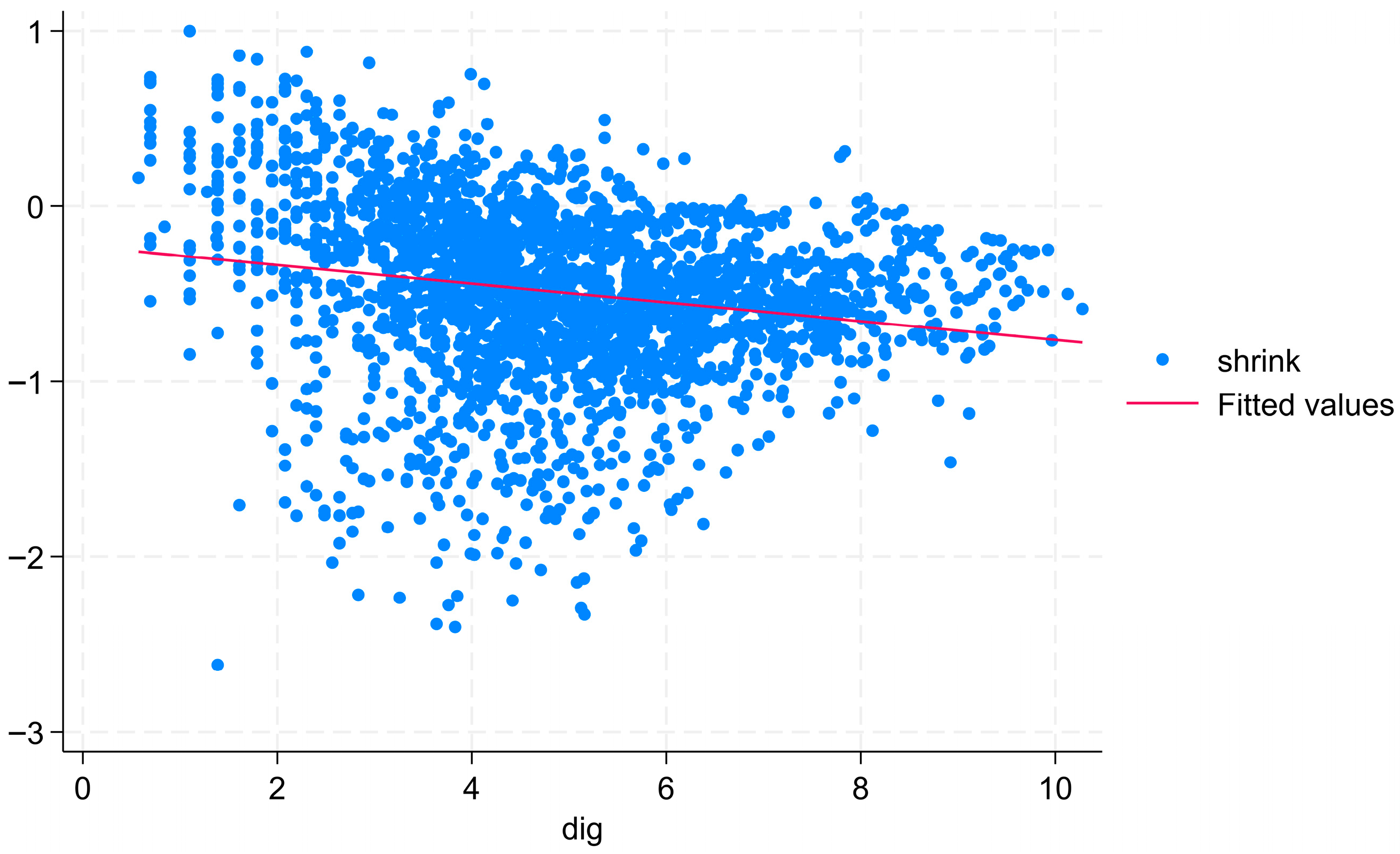
Additionally, using the original panel data on digital technological innovation and urban shrinkage, a preliminary scatter plot was constructed to examine their correlation. As shown in
Figure 1, most data points cluster around a straight line, displaying a pronounced downward trend from the upper left to the lower right, with a negative slope for the fitted line. This suggests a tentative linear relationship between digital technological innovation and urban shrinkage. Although the overall pattern indicates a negative correlation, the observed dispersion around the fitted line implies the possible influence of moderating factors or nonlinear effects, which will be investigated further in the subsequent empirical analysis.
4.2. Baseline Regression
The baseline regression results assessing the impact of digital technological innovation on urban shrinkage are presented in
Table 4. Column (1) reports the effect of digital technological innovation after controlling for city and year fixed effects but without additional control variables. The coefficient for digital technological innovation is −0.045 and is statistically significant at the 1% level, indicating that digital technological innovation significantly mitigates urban shrinkage. This finding provides empirical support for Hypothesis H1.
To reduce potential bias from omitted variables, Columns (2)–(8) progressively incorporate control variables alongside city and year fixed effects. Across all specifications, the inhibitory effect of digital technological innovation on urban shrinkage remains consistently negative and statistically significant, confirming the robustness of the baseline results.
Among the control variables, economic vitality has a coefficient of −0.370, significant at the 5% level, indicating that stronger economic development substantially reduces urban shrinkage. Cities with higher economic activity, such as central cities in the Beijing–Tianjin–Hebei and Pearl River Delta regions, attract population inflows. Conversely, slower economic growth and widening income gaps relative to developed regions create strong push factors, encouraging population outmigration and exacerbating urban shrinkage.
Financial development and fixed asset investment are not statistically significant. Notably, the positive coefficient for financial development aligns with Martinez et al. [
55], who identified financial development as a factor contributing to urban shrinkage. Environmental governance, however, is significantly negative at the 5% level, suggesting that improving urban environmental management and enhancing residents’ quality of life can effectively curb urban shrinkage.
The coefficient of human capital is positive but not statistically significant. Although China has a large population and substantial aggregate economic capacity, the quality of human capital remains relatively low, with the quantity and skill level of highly educated individuals insufficient to meet development needs. Additionally, income disparities and migration costs associated with the urban–rural dual structure create threshold effects in population mobility. High-income, highly skilled talent tends to concentrate in developed cities, while lower-skilled workers remain in small and medium-sized cities, affecting productivity and accelerating urban shrinkage.
Finally, industrial upgrading exerts a significant negative effect on urban shrinkage. Advanced industrial structures, often synergizing with technological innovation to drive structural growth, play a crucial role in mitigating shrinkage, particularly in resource-dependent cities and old industrial bases in China [
56].
4.3. Robustness Tests
To ensure the robustness of the above findings, a series of robustness tests were conducted across five dimensions:
4.3.1. Replacement of the Core Explanatory Variable
Digital infrastructure is a key enabler of digital technological innovation, encompassing tools and systems that provide communication, collaboration, and computational services while concentrating resources [
57,
58]. The Chinese government’s 14th Five-Year Plan emphasizes new digital infrastructure as a central pillar of the digital economy, aligning closely with the objectives of technological innovation. Furthermore, the pace of digital infrastructure development is highly synchronized with innovation cycles. Following Chao et al. [
59], new digital infrastructure was used as an alternative core explanatory variable, denoted as nic. Specifically, (i) government work reports from 2014 to 2022 were collected to identify relevant keywords; (ii) Python 3.9 was used to tokenize the full texts and count both total words and infrastructure-related terms; and (iii) the proportion of infrastructure-related terms was calculated. The regression results, reported in Column (1) of
Table 5, show that the coefficient of new digital infrastructure remains negative and statistically significant at the 10% level, confirming the robustness of the original findings.
4.3.2. Take into Account the Lag Effect
Given the time lag associated with patent grants, and to mitigate potential “simultaneity bias,” this study follows the approach outlined in Shi et al. [
60] by incorporating first- and second-order lagged terms of the core explanatory variables into the baseline regression model and conducting robustness tests. The results are presented in column (2) of
Table 5. The results show that the first-order lagged variable continues to significantly inhibit urban shrinkage at the 1% level. Although the second-order lagged variable exhibits slightly lower significance, it still exerts a notable inhibitory effect, thereby confirming the robustness of the baseline estimates.
4.3.3. Incorporation of Finer Fixed Effects
Following Yang et al. [
61], more detailed fixed effects were incorporated by including city × year fixed effects in the baseline model to account for additional unobserved heterogeneity. As shown in Column (3) of
Table 5, the coefficient of digital technological innovation on urban shrinkage is −0.041 and significant at the 1% level, supporting the robustness of the baseline results.
4.3.4. Alternative Estimation Model: SYS-GMM
To account for the temporal persistence of urban shrinkage, the lagged dependent variable (L.shrink) was used as an instrument in a system GMM estimation. Results in Column (4) of
Table 5 indicate that the AR(2) test yields a
p-value greater than 0.1, confirming no second-order serial correlation in the residuals. The coefficient of L.shrink is 0.823 and significant at the 1% level, validating the instrument’s relevance. Digital technological innovation remains negatively associated with urban shrinkage at the 10% level, reinforcing the robustness of the baseline findings.
4.3.5. Sample Trimming
To mitigate potential bias from extreme values, the top and bottom 1% of observations were winsorized, and the regression was re-estimated. As shown in Column (1) of
Table 6, the effect of digital technological innovation on urban shrinkage remains significantly negative, confirming robustness after trimming.
4.3.6. Adjustment of Sample Periods
Finally, the sample period was adjusted to 2014–2019 and 2018–2022 to test temporal robustness. Regression results in Columns (2) and (3) of
Table 6 show that digital technological innovation continues to exert a significantly negative effect on urban shrinkage at the 10% level in both periods, further validating the robustness of the baseline estimates.
4.4. Endogeneity Test
To address the potential reverse causality between the explanatory and dependent variables, an endogeneity test was conducted to assess whether digital technological innovation and urban shrinkage mutually influence each other. Following the methodology of He et al. [
62], the level of digital technological innovation in period t was specified as the dependent variable, while urban shrinkage in period t + 2 was treated as the explanatory variable. Both a two-way fixed-effects model and a system GMM model were applied to examine the presence of reverse causality.
The results, presented in
Table 7, show that urban shrinkage has no statistically significant effect on digital technological innovation under either estimation method. This indicates that reverse causality is unlikely, confirming that the mitigating effect of digital technological innovation on urban shrinkage remains robust even when potential endogeneity is accounted for.
4.5. Heterogeneity Analysis
4.5.1. Differences in Urban Shrinkage Levels
Given the substantial variation in city size and development levels in China, the impact of digital technological innovation on urban shrinkage may vary with the degree of shrinkage. To capture this heterogeneity, cities with Shrink > 0 are classified as shrinking cities, while those with Shrink ≤ 0 are classified as non-shrinking cities. The regression results, presented in Columns (1) and (2) of
Table 8, indicate that the inhibitory effect of digital technological innovation is more pronounced in shrinking cities than in non-shrinking cities.
Specifically, although the coefficient of digital technological innovation on urban shrinkage in non-shrinking cities is negative, it is not statistically significant. This may be attributed to the fact that non-shrinking cities generally feature well-developed infrastructure and higher employment levels, which effectively satisfy residents’ needs and enable these cities to sustain a strong “siphon effect.” In such contexts, the marginal benefits of digital technological innovation are relatively limited, and digital platforms may further concentrate advanced resources in core cities, resulting in an insignificant effect on mitigating shrinkage.
By contrast, in shrinking cities, digital technological innovation demonstrates a significant inhibitory effect. First, in shrinking cities, underutilized land and vacant industrial facilities offer essential physical space and resources for digital infrastructure development, thereby improving the efficiency of urban resource utilization. Second, the expansion of online e-commerce platforms enables local specialty products to reach wider markets and realize value appreciation, attracting remote workers and freelancers, alleviating geographical constraints on employment, and partially mitigating rapid population outflows. Finally, the synergistic development of digital technological innovation and the industrial internet supports traditional manufacturing industries in inventory reduction and market expansion, delays enterprise relocation, and effectively addresses the industrial decline challenges faced by shrinking cities.
4.5.2. Analysis of City Hierarchy Differences
Cities of different administrative levels differ in resource endowments and economic development, resulting in heterogeneous effects of digital technological innovation on urban shrinkage. Provincial capitals, municipalities directly under the central government, sub-provincial cities, and cities with separate planning status typically function as the economic, political, and cultural centers of their provinces. These cities generally possess abundant financial, human, and educational resources, play leading roles in high-quality provincial economic development, and benefit from strong policy support, which attracts concentrations of talent and industry. Accordingly, these cities are classified as central cities, whereas all others are defined as peripheral cities. The results of the heterogeneity analysis by city hierarchy are presented in Columns (3) and (4) of
Table 8.
The inhibitory effect of digital technological innovation on urban shrinkage is more pronounced in peripheral cities than in central cities. Peripheral cities often possess distinctive resources that are relatively scarce in central cities. Digital technologies can rapidly convert these resources into economic advantages, enhancing their attractiveness and mitigating the negative effects of information barriers and high transaction costs. Furthermore, the integration of data resources with artificial intelligence facilitates the “digital-intelligent” transformation of public services. This transformation improves the accessibility and quality of public services at relatively low cost and enables partial online sharing of high-quality educational and healthcare resources. These enhancements strengthen the capacity of peripheral cities to attract and retain population, effectively mitigating urban shrinkage.
4.5.3. Differences by City Type
Resource-based cities have historically played a pivotal role in China’s rapid economic and social development. However, as the national economy transitions to a “new normal,” their resource advantages are gradually eroding, and they face challenges such as long-term overexploitation of natural resources. Resource depletion often triggers large-scale unemployment, accelerated population outflows, and economic decline, creating a vicious cycle of both economic and demographic contraction. Consequently, it is essential to account for city-type heterogeneity when examining the relationship between digital technological innovation and urban shrinkage. Following Wang and Hao [
63], cities are classified as resource-based or non-resource-based, and separate regressions are conducted, with the results presented in Columns (1) and (2) of
Table 9.
In non-resource-based cities, digital technological innovation does not exert a statistically significant effect on urban shrinkage. This may be because shrinkage in these cities is driven more by structural factors—such as high housing costs, traffic congestion, and elevated living expenses—that digital technological innovation cannot directly address, and in some cases, it may even accelerate population migration to higher-quality cities. By contrast, in resource-based cities, digital technological innovation significantly mitigates urban shrinkage. Specifically, it fosters the emergence of new industries and business models, such as next-generation information technology and generative artificial intelligence, providing alternative sources of economic growth and reducing dependence on single-resource industries. Furthermore, due to limited fiscal capacity, public services in resource-based cities are often underdeveloped. Digital technological innovation effectively optimizes the allocation of public service resources, enhances urban livability, and slows population outflows, yielding particularly pronounced marginal benefits.
4.5.4. Differences in Education Levels
The educational attainment of a city’s workforce reflects its capacity for technological innovation and overall competitiveness. Given the variation in human capital across cities, the impact of digital technological innovation on urban shrinkage may differ accordingly. Following Ge et al. [
64], cities hosting “985” or “211” universities are classified as high-education-level regions, while the remaining cities are categorized as low-education-level regions. Separate regressions are conducted for these two groups, with results presented in Columns (3) and (4) of
Table 9.
The findings show that digital technological innovation negatively affects urban shrinkage in both high- and low-education-level cities, indicating that it can mitigate shrinkage regardless of education level. Notably, the effect is more pronounced in cities with lower educational attainment. This pattern can be explained by two mechanisms. First, cities with a highly educated workforce demand advanced skills, and in these contexts, digital technological innovation may exacerbate skill mismatches and accelerate capital deepening, partially offsetting its inhibitory effect on urban shrinkage. In contrast, cities with lower educational attainment often possess a surplus of low-skilled labor, which supports the new industries and employment opportunities generated by digital technological innovation, effectively retaining the local “labor dividend.” Second, these cities tend to have fewer high-quality educational institutions, as well as lower housing and living costs. Consequently, equivalent wage increases result in higher real disposable income for residents, more effectively curbing population outflows and alleviating urban shrinkage.
4.6. Mechanism Test
Based on Models (2)–(3), this section examines the mediating role of regional innovation and entrepreneurship development in the effect of digital technological innovation on urban shrinkage. Specifically, two key components—rural entrepreneurship and agriculture-related innovation—are analyzed separately to explore their mechanisms.
4.6.1. Regional Innovation and Entrepreneurship Development
Columns (1) and (2) of
Table 10 present the stepwise regression results with regional innovation and entrepreneurship development as the mediating variable. In Column (1), digital technological innovation exhibits a coefficient of 0.699 on regional innovation and entrepreneurship, significant at the 1% level, indicating that it substantially stimulates regional entrepreneurial and innovative activity. Column (2), which incorporates regional innovation and entrepreneurship into the regression in urban shrinkage, reports a coefficient of −0.011, significant at the 10% level. This suggests that regional innovation and entrepreneurship exert a marginal inhibitory effect on urban shrinkage. By fostering innovation and entrepreneurial activity in urban centers and surrounding areas, digital technological innovation invigorates local entrepreneurial vitality, enhances economic resilience, and partially mitigates the outflow of population and industries, thereby alleviating urban shrinkage. This result confirms Hypothesis H2.
4.6.2. Rural Entrepreneurship
Columns (3) and (4) of
Table 10 present the stepwise regression results with rural entrepreneurship included as a mediating variable. In Column (3), the coefficient of digital technological innovation on rural entrepreneurship is positive but not statistically significant. In Column (4), after incorporating rural entrepreneurship into the model, its coefficient on urban shrinkage is 0.005, also failing to reach statistical significance. These results suggest that rural entrepreneurship partially obscures the direct inhibitory effect of digital technological innovation on urban shrinkage, indicating a “partial masking effect.”
In shrinking cities, rural entrepreneurship is predominantly “low-quality” or “subsistence-oriented,” driven primarily by survival motives. While digital technological innovation stimulates rural entrepreneurial activity, these enterprises typically generate limited added value and fail to attract the return of high-quality urban and rural resources as theoretically anticipated. Consequently, they do not provide substantial alternative employment opportunities or sufficient population retention, thereby attenuating the direct inhibitory effect of digital innovation and producing only a marginal urban expansion effect.
4.6.3. Agriculture-Related Innovation
Columns (5) and (6) of
Table 10 report the stepwise regressions with agriculture-related innovation as the mediating variable. Column (5) indicates that digital technological innovation significantly promotes agriculture-related innovation, with a coefficient of 0.987 at the 1% level, demonstrating substantial positive effects on agricultural innovation outputs. Column (6), which controls for agriculture-related innovation, shows a significant inhibitory effect on urban shrinkage, with a coefficient of −0.017. These findings suggest that digital technological innovation, by enhancing the density of innovation in agriculture and its value chains, strengthens the economic resilience of counties and cities, facilitates the reallocation of labor, capital, and other factors within local agricultural systems and associated services, and buffers urban shrinkage. Thus, agriculture-related innovation represents a robust and critical mediating pathway through which digital technological innovation effectively mitigates urban shrinkage.
4.7. Analysis of the Moderating Effect of Ecological Environmental Resilience
To capture the dynamic evolution of urban shrinkage, this study incorporates the first-order lag of the dependent variable. This approach controls for the path dependence of urban shrinkage and enhances the efficiency of the estimates. Given the large sample size and relatively short time dimension, a two-way fixed-effects model is employed to account for individual heterogeneity and temporal trends while avoiding the instrument proliferation and over-identification issues associated with system generalized method of moments (GMM) estimation. Accordingly, the two-way fixed-effects model is used to examine moderating effects, ensuring the robustness and reliability of the results.
The empirical results for the moderating role of ecological environmental resilience are reported in
Table 11. After introducing the interaction term between ecological resilience and digital technological innovation, its coefficient on urban shrinkage is −0.123 and statistically significant at the 10% level. This indicates that ecological resilience strengthens the effect of digital technological innovation in mitigating urban shrinkage: the higher the level of ecological resilience, the greater the positive impact of digital technological innovation. These findings provide empirical support for Hypothesis H3.
5. Further Analysis: Threshold Effect
The preceding analysis demonstrates that digital technological innovation significantly mitigates urban shrinkage. However, it remains unclear whether this effect exhibits a threshold pattern and whether its impact varies across different levels of digital technological innovation. To investigate this, the study adopts the threshold estimation methodology proposed by Hansen, treating urban shrinkage as the dependent variable and using digital technological innovation as both the key explanatory variable and the threshold variable. A threshold effect model is then constructed for empirical testing.
Model (6) assumes a single threshold, with extensions to double- and triple-thresholds possible based on this framework.
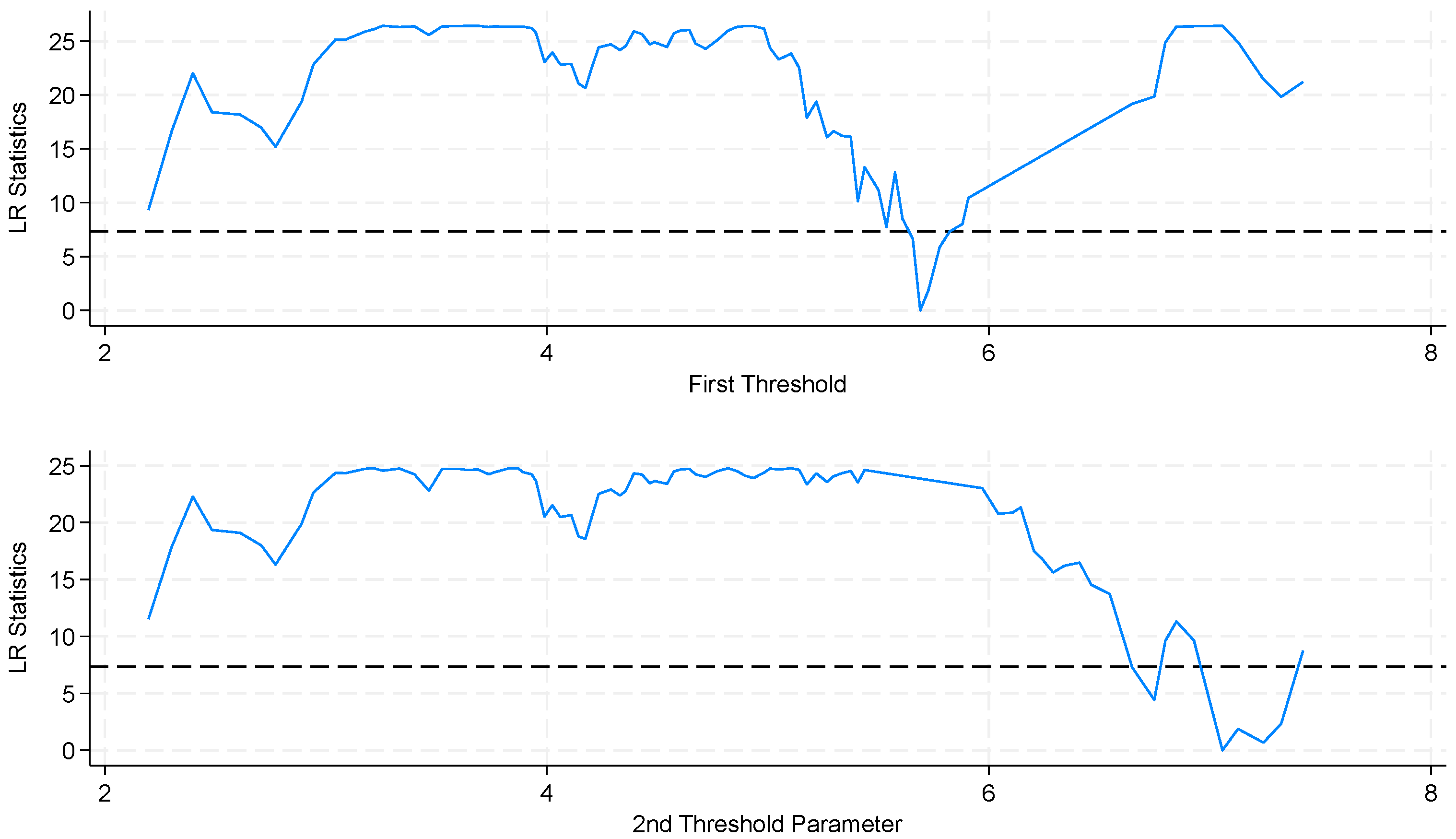
In this framework, and denote the two threshold values to be estimated, dividing the sample into three intervals representing low, medium, and high levels of digital technological innovation. The model was estimated using a stepwise selection method: the first threshold is initially fixed to determine the second threshold, after which the second threshold is held constant while the first is re-estimated. This iterative process continues until both thresholds converge, ensuring their simultaneous optimal estimation. Finally, the significance of the threshold regression is tested using a bootstrap resampling method with 300 repetitions.
The results of the threshold effect test are shown in
Table 12. The single- and double-threshold tests for digital technological innovation produced
p-values of 0.003 and 0.000, respectively, both significant at the 1% level, providing evidence in favor of the alternative hypothesis of a double-threshold effect. To assess the adequacy of the threshold specification, a triple-threshold test was further conducted, yielding a
p-value of 0.627, which is not statistically significant. Consequently, the null hypothesis of no triple-threshold effect is retained, confirming the double-threshold model as the optimal specification. Overall, the threshold analysis confirms a significant double-threshold effect of digital technological innovation.
Additionally, the likelihood ratio (LR) test plot for the threshold variable (
Figure 2) exhibits two intersections with the dashed line, delineating the confidence intervals and indicating the existence of a double threshold. The corresponding threshold values of digital technological innovation for urban shrinkage are 5.690 and 7.057, both within the 1% confidence interval, effectively segmenting digital technological innovation into three distinct stages. Based on these threshold effect results, regression models are then specified according to the number of thresholds, with coefficients estimated separately for each stage.
The threshold effect estimation results, with urban shrinkage as the dependent variable and digital technological innovation as the threshold variable, are presented in
Table 13. When digital technological innovation remains below the first threshold, the regression coefficient is 0.031 and not statistically significant, indicating that at low levels, digital technological innovation does not significantly mitigate urban shrinkage. As innovation levels rise between the first and second thresholds, the coefficient becomes −0.049 and is significant at the 1% level, suggesting that digital technological innovation begins to exert a clear inhibitory effect once it reaches a certain threshold.
When digital technological innovation exceeds the second threshold, the coefficient is −0.030, significant at the 5% level. Although the absolute value decreases relative to the previous interval, the inhibitory effect persists, albeit with reduced marginal impact. This attenuation may result from high-level innovation dynamics, including technological monopolies, skill mismatches, and intensified regional competition, which create uneven distribution of technological dividends and partially weaken the mitigation effect on urban shrinkage. These results provide empirical support for Hypothesis H4 and further indicate that China’s developmental imbalances are reflected not only in income disparities but also in the unequal capacity of cities, at differing innovation levels, to counteract urban shrinkage.
6. Conclusions and Policy Recommendations
Urban shrinkage has increasingly constrained coordinated urban development in China, making its mitigation an urgent policy and research priority. This study employs integrated nighttime light data to identify and measure urban shrinkage, constructing a panel dataset covering 269 prefecture-level and higher cities in China from 2014 to 2022. It systematically examines the impact of digital technological innovation on urban shrinkage, while exploring the mediating role of regional innovation and entrepreneurship and the moderating effect of ecological resilience. The key findings are as follows:
First, at the national level, digital technological innovation significantly mitigates urban shrinkage across the 269 cities. This conclusion remains robust across multiple robustness checks, including replacement of the core explanatory variable, take lagging effects into account, finer fixed effects, system generalized method of moments (SYS-GMM) estimation, sample trimming, and endogeneity tests.
Second, at the regional level, the inhibitory effect of digital technological innovation is particularly pronounced in shrinking cities, peripheral cities, resource-based cities, and cities with lower education levels, indicating marked spatial heterogeneity.
Third, mechanism analysis reveals that regional innovation and entrepreneurship constitute a critical pathway through which digital technological innovation mitigates urban shrinkage. When decomposed further, rural entrepreneurship and agriculture-related innovation emerge as two distinct subsystems. Rural entrepreneurship exhibits a “partial masking effect,” partially concealing the direct impact of digital technological innovation on shrinkage, whereas agriculture-related innovation significantly suppresses urban shrinkage, representing a robust mediating pathway.
Fourth, moderating effect analysis indicates that ecological resilience amplifies the inhibitory effect of digital technological innovation: higher levels of ecological resilience strengthen its capacity to mitigate urban shrinkage.
Fifth, threshold effect analysis shows that the mitigating effect of digital technological innovation is contingent on its development level. The effect becomes significant only once innovation surpasses certain thresholds, exhibiting a pronounced nonlinear double-threshold pattern.
Based on these findings, the study offers the following policy recommendations:
(1) Implement differentiated digital innovation strategies to mitigate urban shrinkage. Targeted investment in digital infrastructure and supportive policies should prioritize shrinking cities, peripheral cities, resource-based cities, and cities with lower education levels to maximize the marginal benefits of digital technological innovation. In contrast, non-shrinking and high-education-level cities should focus on integrating digital technologies with the real economy to prevent uneven distribution of technological dividends and avoid exacerbating the digital divide.
(2) Leverage agriculture-related innovation to stimulate regional innovation and entrepreneurship. Policies should promote smart agriculture, rural e-commerce, and other emerging business models to extend the agricultural value chain and enhance added value. Concurrently, support for returnee entrepreneurship and improved rural entrepreneurship environments can guide the reallocation of labor, capital, and other resources within local agricultural systems and associated services, fostering a virtuous cycle of rural–urban complementarity that addresses urban shrinkage at its root.
(3) Coordinate digital technological innovation with ecological resilience to achieve a green digital transformation. By deploying technologies such as big data, cloud computing, and artificial intelligence, cities can develop eco-tourism, green manufacturing, and other sustainable models, aligning technological dividends with environmental benefits and enhancing attractiveness to high-quality talent and green capital.
(4) Based on the threshold identification results for digital technological innovation, this study proposes phased and differentiated policy recommendations. For cities lagging in digital innovation (dig < 5.690), priorities should include addressing structural gaps by accelerating new infrastructure development, integrating digital technologies with local specialty industries, and establishing regional digital collaboration mechanisms, with the goal of crossing the first threshold within three to five years. For medium-level cities that have surpassed the initial threshold (5.690 ≤ dig < 7.057), the focus should shift to enhancing quality and efficiency through deeper integration of digital technologies with the real economy, reinforcing green–digital synergies, and leveraging digital tools in public services to stabilize population retention. For leading cities (dig ≥ 7.057), policymakers should capitalize on the “leading goose” effect by developing national-level digital innovation platforms, creating regional digital collaboration networks, and translating governance experience into replicable institutional practices to support surrounding cities in collectively mitigating urban shrinkage risks.
7. Research Limitations and Future Directions
Against the backdrop of China’s “dual carbon” targets and the development of Digital China, this study investigates the impact of digital technological innovation on urban shrinkage and its underlying mechanisms. Nevertheless, several limitations exist, which also highlight avenues for future research.
First, the China-specific context may limit the generalizability of the findings. This study relies on prefecture-level city data, where rapid urbanization, regional development disparities, and institutional factors exert significant influence. For example, the measurement of digital technological innovation depends on China-specific digital economy policies and industrial statistics, while urban shrinkage identification is closely linked to the household registration (hukou) system and population mobility patterns. These institutional and developmental characteristics suggest that extrapolating the results to other developing or developed countries should be done cautiously. Future research could adopt cross-national comparative designs to explore the universality and context-specific variations in the relationship between digital technological innovation and urban shrinkage.
Second, measurement of core variables can be improved. Nighttime light data are used here as a proxy for urban shrinkage. While this captures the spatial distribution and dynamics of urban economic activity, it cannot fully reflect multidimensional shrinkage, such as population loss and declining social vitality, and may be influenced by satellite sensor calibration or auroral interference. Future studies could integrate micro-level mobility data, including shared-bike and ride-hailing usage, to build a more comprehensive urban shrinkage assessment framework. Similarly, digital technological innovation is measured primarily by patents and enterprise counts, emphasizing inputs rather than technology transfer efficiency or practical application. Subsequent research could leverage multi-source data—such as mobile signaling, points of interest (POI), and enterprise registration—to develop more precise indicators of urban shrinkage and digital innovation.
Third, the reliance on econometric models for large-sample quantitative analysis, while ensuring statistical robustness, limits insights into the micro-level processes and contextual mechanisms through which digital technological innovation affects urban shrinkage. For instance, how digital technology shapes firms’ location choices or residents’ migration decisions remains unclear. Complementary qualitative approaches, such as case studies and in-depth interviews, are needed. Future research could adopt mixed-methods designs, including fieldwork in representative shrinking cities, to uncover the deeper logic of digital-enabled urban transformation.
Fourth, causal identification requires further strengthening. Although instrumental variable techniques and two-way fixed-effects models mitigate endogeneity concerns, potential confounding from omitted variables or reverse causality cannot be fully ruled out. Future studies could exploit exogenous policy shocks—such as the “Broadband China” initiative or the creation of national digital economy innovation zones—and apply quasi-experimental methods, including difference-in-differences and regression discontinuity designs, to enhance causal inference.
Despite these limitations, this study provides novel theoretical insights and empirical evidence on governing urban shrinkage in the digital era. Future research can advance this field by broadening contextual applicability, refining variable measurement, integrating diverse methodological approaches, and strengthening causal identification, ultimately offering more targeted policy guidance for the digital transformation and sustainable development of shrinking cities.