Article

Temporal Matching of Unsupervised Cluster Structures for Monitoring Post-Catastrophic Floodplain Dynamics: A Case Study of Khortytsia Island


1
Department of Botany, Ecology and Horticulture, Bogdan Khmelnytskyi Melitopol State Pedagogical University, 72300 Zaporizhzhia, Ukraine
2
Department of Biodiversity and Ecology, Oles Honchar Dnipro National University, Gagarin Av., 72, 49000 Dnipro, Ukraine
*
Author to whom correspondence should be addressed.
Land 2026, 15(4), 624; https://doi.org/10.3390/land15040624
Submission received: 26 March 2026 / Revised: 8 April 2026 / Accepted: 9 April 2026 / Published: 11 April 2026

Abstract

Remote sensing enables the analysis of landscape dynamics; however, catastrophic disturbances create new surface conditions that are not adequately captured by retrospectively defined land-cover classes. This study addresses the challenge of temporally matching unsupervised classifications to monitor post-catastrophic floodplain dynamics on Khortytsia Island following the destruction of the Kakhovka Reservoir. Multi-temporal Sentinel-2 Level-2A data from 2022 to 2025 were processed using spectral indices, standardised within a common predictor space, and classified through unsupervised clustering. Cluster solutions from individual dates were then matched based on spectral similarity and spatial continuity, with their temporal interpretation guided by concepts of landscape memory and landscape perception. Higher-order spatiotemporal units were subsequently derived through contextual superclustering. The analysis identified 16 clusters across the study period, with 4 to 12 clusters represented on individual dates. Their temporal coordination enabled the distinction of higher-order units exhibiting contrasting dynamics, including directional trend, seasonal, and mixed types. The proposed framework facilitates the identification of newly formed surface states, their temporal coordination, and their integration into a hierarchical spatiotemporal model of post-catastrophic landscape change.

1. Introduction

Remote sensing of the Earth enables the analysis of the spatiotemporal dynamics of landscapes through the regularity of observations, extensive spatial coverage, the multispectral nature of imagery, and the availability of long-term time series [1,2]. Based on this information, it is possible to identify differences between landscape states at various points in time and to trace the sequence of their transformations across time and space, driven by natural processes and anthropogenic influences [3]. These landscape processes are captured in satellite data through variations in the spectral, textural, and structural characteristics of the surface, which indicate qualitative restructuring of natural systems and the spatial relationships between them [4,5]. Catastrophic disturbances can drive landscape transformation by generating new surface types and novel combinations of surface properties, rather than solely through transitions between predefined land cover categories [6,7].
Catastrophic transformations of the Earth’s surface present a distinct methodological challenge for classification, as they alter the spatial relationships between existing land cover types and reshape the composition of surface conditions recorded in imagery [6,8]. As a result of such events, new surface types, intermediate states, or atypical combinations of spectral and structural features emerge, which have no direct analogues in the pre-catastrophic period [9,10]. Approaches based on a system of classes and training samples derived from retrospective data are limited, as they assume that Earth’s surface dynamics are stationary [11]. The classification of catastrophic changes requires identifying newly formed surface states and correlating them with the pre-catastrophic surface structure [7].
When catastrophic changes occur, it is advisable to use unsupervised classification, as it is not constrained by a class system derived from retrospective data and can identify newly formed surface states without prior description [12,13]. In this approach, each time slice defines its own cluster structure, which depends on the composition of surface states, their spectral relationships, and the algorithm’s parameters [14,15]. Clusters obtained across different dates lack a predefined correspondence: their numbers, boundaries, internal heterogeneity, and interpretative meanings vary [14,16]. This gives rise to the problem of temporally comparing cluster solutions; without resolving this issue, it is impossible to accurately trace transitions between surface states and reconstruct the trajectory of landscape changes [17,18,19].
The conceptual basis for resolving temporal inconsistencies in unsupervised clustering solutions [17] can be linked to the concept of landscape memory [20,21]. Even in the event of significant restructuring of the Earth’s surface, the relief continues to influence the spatial organisation of surface conditions, as it determines the directions of runoff, zones of accumulation, and the redistribution of moisture and matter, thereby shaping the conditions for the formation of new morphological and spectral differences [22,23,24]. Consequently, newly formed surface states emerge within an inherited structural framework [20,25]. In this context, the comparison of clusters at different points in time is based not on their formal identity but on the identification of spatial continuity, mediated by relatively stable elements of the relief [26]. This provides grounds for considering temporal comparison as an interpretation of landscape transformations within a system of morphostructural relationships, rather than merely as a technical procedure for harmonising cluster-based solutions.
The problem of temporally matching the results of unsupervised classification of satellite images acquired at different times, particularly in scenarios involving catastrophic landscape changes, remains unresolved. In such transformations, the new states of the Earth’s surface fall outside the class system established based on retrospective data. At the same time, cluster solutions for individual dates lack direct correspondence because their numbers, boundaries, internal structures, and spectral characteristics change. This necessitates a matching procedure that simultaneously captures the newly formed states, accounts for their spatial continuity, and enables the reconstruction of the trajectory of landscape changes within a unified spatio-temporal framework. The questions addressed in this article are as follows: (1) How can unsupervised classification of multi-temporal satellite data be performed to identify newly formed surface conditions, rather than reducing changes to transitions between retrospectively defined classes? (2) How can cluster solutions for different dates be matched based on their spectral similarity and spatial continuity, drawing on the development of concepts related to terrain memory? (3) How can we integrate the matched clusters into a hierarchical spatiotemporal system suitable for monitoring and interpreting directional and seasonal components of landscape change?

2. Materials and Methods

2.1. Study Area

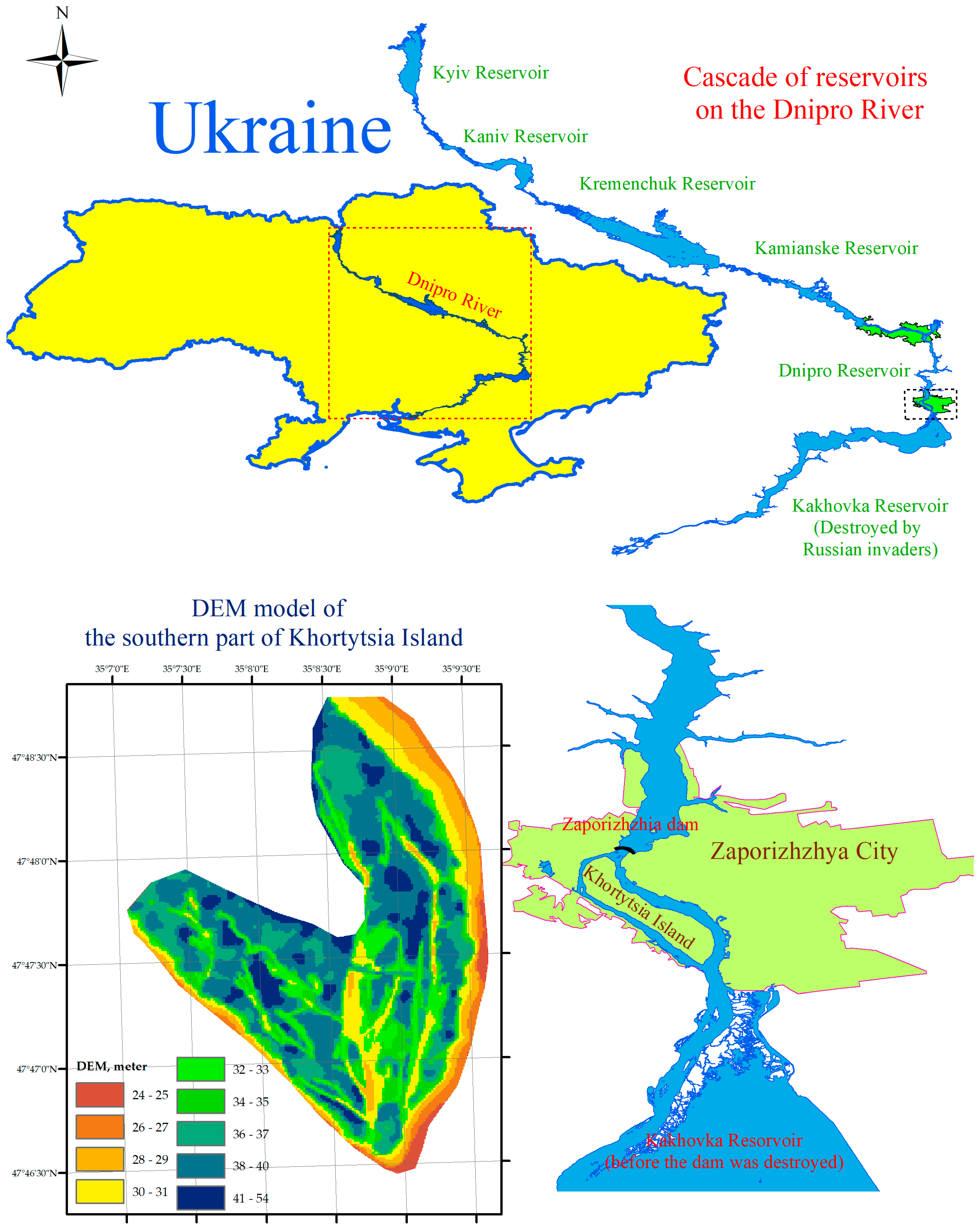
The study area comprised the floodplain ecosystems of Khortytsia Island, which underwent significant restructuring following the destruction of the Kakhovka Reservoir in 2023 (Figure 1). Khortytsia Island (Ukraine) was selected as a model site for analysing post-disaster land-cover dynamics [27]. Khortytsia is the largest island in the Dnipro River, located near the city of Zaporizhzhia, downstream of the Dnipro Hydropower Plant (DniproHES). The island is elongated in a northwest–southeast direction; it is approximately 12 km long and 1.6–2.7 km wide, with an area of about 2359 hectares prior to the Kakhovka dam failure. Khortytsia lies within the northern part of the former Kakhovka Reservoir’s water area and its floodplain–riparian zone. Field surveys on the island were conducted in 2024–2025. On 6 June 2023, the Kakhovka Hydroelectric Power Plant dam was destroyed by an explosion, resulting in a rapid drawdown of the Kakhovka Reservoir and a significant decline in water levels throughout the Dnipro system. Observations at the Nikopol hydrological gauge recorded a decrease in river level of approximately 8 metres [28]. This event initiated a cascade of long-term changes affecting the hydrological regime, shoreline morphology, moisture dynamics in floodplain soils, and, consequently, the structure of the vegetation cover and the spatial configuration of habitats. Within the floodplain system of Khortytsia, the disaster primarily manifested as a rapid reorganisation of river-channel and floodplain ecosystems: disconnection of certain floodplain water bodies from the main channel, progressive shallowing and exposure of substrates, formation of new sandy shores and shoals, and accelerated colonisation of these newly exposed surfaces by pioneer and aquatic-associated vegetation [27]. Changes on relatively elevated parts of the floodplain may proceed more slowly, yet remain ecologically significant, as the altered root-zone moisture regime increases stress on woody stands, particularly during the summer period. These processes create a mosaic of new and unstable surface types (and corresponding spectral objects), which is crucial when selecting remote-sensing approaches capable of accommodating the emergence of novel, previously unanticipated land-cover classes [27,29,30,31].
The study analyses the dynamics of the territory using satellite data from 2022 to 2025, covering the pre-disaster state, the phase of drastic restructuring, and the subsequent post-disaster stages.

2.2. Remote Sensing Metrics, Vegetation Data Sources, and EUNIS Habitat Identification

Spectral indices were used as generalised quantitative descriptors of vegetation condition and temporal dynamics, providing a consistent basis for comparing different periods and tracking shifts in the spectral responses of both vegetation and substrate (soil) components. In particular, inter-period comparisons based on individual indices are widely used to assess vegetation cover dynamics, with the Normalised Difference Vegetation Index (NDVI) among the principal indicators of vegetation change. The formulas for all indices used in this study, along with their ecological interpretations, are presented and discussed in the protocol [32]. Spectral indices were calculated from Sentinel-2 MSI Level-2A data acquired from 61 scenes between 2022 and 2025, including 9 scenes in 2022, 15 in 2023, 16 in 2024, and 21 in 2025. The methods of vegetation sampling, phytosociological data processing, and compilation of the Prodromus of vegetation are described in detail in the openly available dataset [33].
EUNIS habitat types were assigned to terrestrial land-cover classes using a formal interpretative procedure, in which plant associations provided the primary phytosociological basis for habitat identification, while physiognomy and spatial distribution served as complementary criteria. This approach followed the general method of the EUNIS classification, whereby terrestrial habitats are commonly related to vegetation types but are not strictly identical to phytosociological syntaxa, as environmental and geographic context may also be necessary for delimitation [34]. Habitat attribution was therefore based on the dominant and accompanying associations recorded within each land-cover class and subsequently refined according to the physiognomic expression and landscape position of the corresponding patches. This allowed multiple spectrally distinct classes to be retained within the same EUNIS habitat type when they differed in dominant associations, while avoiding a simplistic one-to-one correspondence between individual associations and habitat codes.
The relationship between land-cover classes and plant associations was evaluated using a contingency table approach [35]. A cross-tabulation matrix was constructed, with rows representing plant associations and columns representing land-cover classes. Cell values corresponded to the number of observations assigned to each combination. The overall association between the two categorical variables was tested using Pearson’s chi-square test of independence. Because the table contained numerous low expected frequencies, the significance of the global test was assessed using a Monte Carlo simulation procedure rather than relying solely on the asymptotic approximation [36,37]. The strength of the overall association was quantified using Cramér’s V. Each class was additionally compared against all other classes combined in separate one-versus-rest chi-square tests, and the resulting p-values were adjusted for multiple comparisons using the Holm procedure to assess the distinctiveness of individual land-cover classes [38,39]. The contribution of each land-cover class to the total chi-square statistic was calculated as the sum of cell-wise chi-square components within the corresponding column, expressed both in absolute terms and as a percentage of the total chi-square value [40]. Standardised residuals were examined for individual cells of the contingency table to identify which plant associations were overrepresented or underrepresented within each land-cover class. Residuals with large absolute values were interpreted as indicating the main associations responsible for the observed deviations from independence [41].

2.3. Preparation of Input Raster Data for Spectral Indices

Processing multi-date remote sensing rasters was performed to detect, refine, and track spectrally homogeneous clusters in space and time. Prior to temporal analysis, Sentinel-2 MSI Level-2A scenes were processed date by date within the study-area polygon. The required spectral bands were extracted from SAFE archives, cropped to the study polygon, and masked to its boundary. Cloud- and shadow-affected pixels were identified using Sentinel-2 quality layers and masked as missing values, with an optional one-pixel buffer applied around contaminated areas to reduce edge effects. Spectral indices were then calculated and saved for each date as single-band GeoTIFF layers. After index generation, missing values in the temporal sequence of index rasters were filled by pixel-wise linear interpolation across dates following spatial alignment to a common grid. For the subsequent multi-date analysis, these single-band GeoTIFF layers were used as inputs. One of the rasters, typically NDVI, served as the geometric template. All other layers were aligned to the template in terms of coordinate reference system, extent, and spatial resolution. If a layer used a different coordinate reference system, it was reprojected; it was then clipped to the template extent and, where necessary, resampled to the common grid. For continuous spectral indices, bilinear interpolation was applied. After alignment, a common set of predictors was constructed for all dates by intersecting layer names, thereby ensuring that the same variables were used throughout the temporal analysis.

2.4. Pooled z-Scaling of Predictors

Means and standard deviations were estimated from a pooled sample drawn from all stacks to ensure a common predictor scale across all temporal slices and to prevent differences between dates arising solely from varying scaling parameters. A subset of valid pixels was randomly selected from each stack and then combined into a common observation matrix. For each variable, the pooled mean and pooled standard deviation were calculated. The standard deviation was additionally bounded below by a small value, eps, to avoid division by zero. After that, all rasters were transformed into z-space according to the following formula:
z = x μ p o o l e d / σ p o o l e d .
This procedure established a common predictor scale across all temporal slices and reduced the likelihood that inter-date differences would reflect only variations in scaling parameters.

2.5. Forming a Joint Sample of Pixels

The analysis was performed on a common sample of randomly selected pixels to reduce computational load and ensure direct comparability across dates. Candidate cells were generated on the template grid, and their coordinates were extracted from all standardised stacks. Only those points for which finite values were available for all dates and all variables were retained in the final sample. If the number of valid shared points proved insufficient, the procedure was repeated with additional resampling. An observation table was constructed for each date with identical point IDs, coordinates, and predictor sets. This harmonised sample then served as the training set for clustering, temporal transition estimation, and the construction of the training library of clusters. In the present study, the common sample comprised 20,000 pixels. Given that a scene contained approximately 75,615–76,085 valid pixels across all aligned predictor layers, this sample represented about 26% of the valid pixels in a scene and therefore provided dense spatial coverage, including the most dynamic parts of the study area. Thus, in this case, the use of a joint sample should be regarded primarily as a computationally convenient representation of the study area rather than as a strong reduction of spatial information. By contrast, for substantially larger study areas analysed across many dates, such subsampling may become an important optimisation tool. In those cases, alternative strategies for non-random spatial allocation of sampled pixels could also be considered, but this issue lies beyond the scope of the present study.

2.6. Primary Clustering

Clusters were identified using hierarchical agglomerative clustering. The initial grouping was based on the scores of the first two principal components of spectral-index variability (PC1–PC2). Euclidean distance and Ward’s method (Ward D2) were used for cluster analysis. The number of clusters, k, in the clustering solution was selected by maximising the Calinski–Harabasz criterion [42]. Admissible solutions were additionally required to have no cluster smaller than 100 pixels and a maximum ratio of 20 between the sizes of the largest and smallest clusters.
Because the first two principal components mainly captured the dominant gradients of greenness and moisture, two successive PCA steps and, accordingly, two stages of clustering were applied in order to account for additional sources of heterogeneity that were not represented by these primary gradients. After the initial clustering stage (primary clusters), selective subclustering was performed only for those clusters exhibiting the greatest internal heterogeneity. For each spectral index, the linear contribution of the first two components was removed, yielding a residual matrix. Residual PCA was then performed on this matrix, and the number of residual components was determined using the maximum-deviation elbow method. The residual PC space was used as the input for the secondary partitioning of the selected primary clusters. The internal heterogeneity of primary clusters was assessed using four indicators: the mean distance of points to the centroid, the 95th percentile of this distance, the trace of the covariance matrix, and the log-determinant of the covariance matrix. After standardisation, these indicators were summed to form a variability score. Primary clusters were selected for subclustering when their variability score exceeded the larger of the median of the cluster-level variability score distribution q 0.50 and the absolute threshold of 0.50. Only clusters containing at least 120 pixels were considered eligible for subdivision.

2.7. Temporal Tracking and Identification of Superclusters

Because primary clustering was performed separately for each date, the resulting local clusters had to be matched across time. Temporal sequences of primary clusters that could be justifiably assigned the same name were treated as primary superclusters. The matching of primary clusters was performed by comparing them against the properties of a global cluster library comprising clusters encountered at all temporal stages of the procedure. Clusters observed on a given date were either assigned the names (numbers) of clusters already present in the library when a correspondence was established (the so-called absorption) or assigned new names (numbers) when no such correspondence could be identified (the birth of a new cluster), thereby expanding the composition of the library. The decision on absorption was based on a combined score that simultaneously accounted for spatial inheritance and spectral similarity:
S c o r e g , j = α S g , j s p a t i a l + 1 α S g , j f e a t ,
where g is an existing global cluster, j is the current local cluster for a given date, α [ 0,1 ] is the weight of spatial memory, S g , j s p a t i a l is the score of spatial inheritance, and S g , j f e a t is the score of similarity in feature space. In the present analysis, α was set to 0.8, giving greater weight to spatial inheritance than to feature-space similarity during temporal matching.
If no match proves sufficiently convincing, a new global cluster code is created.
Feature similarity is calculated as the Euclidean distance between the centroid of the current cluster j and the centroid of the global cluster g with which the current cluster is being compared:
d g , j = c j c u r c g g l o b ,   S g , j f e a t = exp d g , j σ ,
where σ is a scaling parameter. In the present analysis, σ was set to 3.5, defining the scale at which feature-space distances were converted into similarity scores during temporal matching.
The spatial component is based on memory vectors A g ( i ) , which represent the historical membership of point (pixel) i in a given global cluster g (the number of memory vectors is equal to the number of clusters in the library). For the current cluster j :
b a s e g , j = 1 C j i C j A g i ,
where C j is the set of points belonging to local cluster j .
Next, the cluster-specific zone of cluster g and its mean are calculated:
A g s e l f ¯ = 1 Z g i Z g A g i ,
after which the normalised ratio is introduced:
R g , j = b a s e g , j A g s e l f ¯ ,
and the adjusted spatial score:
S g , j s p a t i a l , r a w = min 1 ,   b a s e g , j · min R g , j , r c a p r β .
The spatial score is then normalised across rows, i.e., within each global cluster g :
S g , j s p a t i a l = S g , j s p a t i a l , r a w j S g , j s p a t i a l , r a w .
After that, two thresholds were applied:
S c o r e g , j = 0 ,   if   d g , j > d m a x   and   S c o r e g , j = 0 ,   if   S g , j s p a t i a l < S m i n s p a t i a l ,
and absorption into an existing global cluster was performed if:
S c o r e g , j S m i n ,
where d m a x = time_match_max_dist, S m i n = memory_min_spatial. Absorption into an existing global cluster was therefore allowed only when d g , j 15.0 , S g , j s p a t i a l 0.000 , and S c o r e g , j 0.30 .

2.8. Spatial Memory and Markers of Spatial Identity

Two mechanisms were implemented to stabilise cluster identification across the temporal sequence of satellite scenes. The first was the spatial identity marker, which characterised the consistency of assigning an individual point to a given global cluster. If a point retained the same cluster membership, its marker remained unchanged; if it moved to another existing cluster, the marker was reduced by the number of such changes. For newly born clusters, the marker was initialised to 1. The second mechanism was the spatial presence memory, that is, a vector of spatial presence for each global cluster defined over a fixed set of points. This memory was updated using the learning and forgetting coefficients, then normalised so that, for each point, the total membership across all clusters was 1.
For a newly formed cluster:
m i t = 1 ,     r i t = 0 .
If the pixel remained assigned to the same global cluster:
m i t = max m i t 1 , m m i n , r i t = r i t 1 .
If the pixel moved to another already existing cluster, the number of transitions was first updated:
r i t = r i t 1 + 1 .
Next, the attenuation coefficient was calculated:
δ i t = 1 2 2 r i t + 1 p .
The baseline marker of the candidate recipient cluster h = c i t was taken as the mean marker value of all its pixels at the previous step:
b h t 1 = 1 G h t 1 l G h t 1 m l t 1 .
After that, the updated pixel marker was defined as:
m i t = max b h t 1 δ i t , m m i n .
Finally, to avoid exact zeros:
m i t max m i t , ε .
For each global cluster g and point i , the memory was first attenuated (forgotten) and then reinforced for the cluster to which the point belonged at time t :
A g t ~ i = 1 γ A g t 1 i + η m i t I c i t = g .
where I ( c i t = g ) was equal to 1 if point i belonged to cluster g at time t , and 0 otherwise.
Next, normalisation across all clusters was performed for each pixel:
A g t i = A g t ^ i h = 1 K A h t ^ i .
As a result, the following condition held for each pixel:
g = 1 K A g t i = 1 .
For the current local cluster C j t , the spatial component of the combined score with respect to global cluster g was defined as the mean memory of global cluster g across all pixels belonging to that local cluster. This quantity was then used as the spatial term of the combined score.

2.9. Construction of a Trajectory-Wide Cluster Library and Evaluation of Index Informativeness

A global cluster library was constructed for subsequent classifier training and the generalisation of spectral signatures. For each cluster and each date, the cluster’s ‘core’ pixels were selected as those located closest to the cluster centroid in the chosen feature space (either scaled or raw). The number of such pixels was defined as the greater of a fixed fraction of the cluster size and a minimum threshold. These core pixels were then combined into a common library containing the date, cluster label, coordinates, distance to the centroid, and, when available, the mean spatial marker. Based on this library, cluster signatures were calculated, and the contribution of individual spectral indices was also evaluated. For this purpose, on the one hand, the top indices that most strongly distinguished a given cluster from the others were identified based on the absolute difference in mean values in feature space; on the other hand, linear discriminant analysis (LDA) in the space of common and residual components was used to estimate the overall discriminant weight of the predictors.

2.10. Cluster Prediction for Full Rasters

The model trained on the pooled sample of pixels was transferred to the full raster scenes. For each date, the same set of latent features used in the clustering procedure was constructed, including PC1–PC2, the residuals obtained after regressing the original predictors on these components, and the residual PCs. A linear discriminant analysis (LDA) classifier was trained in this feature space and then applied to each pixel of the full raster. Alternatively, a centroid classifier could be applied to the standardised predictors. After spatial prediction, maps of inter-date changes and a raster of the cumulative number of cluster switches per pixel were generated.

2.11. Time-Integrated Cluster Model, Contextual Clustering, Temporal Diagnostics, and Analysis of Supercluster Compositional Dynamics

A time-integrated cluster model was implemented to synthesise a multi-date series of raster classification maps, derive spatially integrated characteristics of superclusters, delineate second-order superclusters based on local context, and assess the temporal stability and compositional dynamics of the cluster structure. The full computational workflow consisted of four interrelated blocks: integration of temporal information for primary clusters, normalisation of spatial membership, construction of locally contextual superclusters, and analysis of the temporal behaviour of both individual clusters and the supercluster composition.
A series of raster maps of first-order superclusters was then generated. For each first-order supercluster code k , the time-integrated probability of membership, p k ( x ) , was calculated for each raster pixel. This quantity was equal to the sum of the weights of the dates at which the pixel had been assigned to clusters similar to the given supercluster, divided by the sum of the weights of all dates available for that pixel. All dates were assigned equal weights w t 1 . The result was a multilayer stack of spatial probabilities for all superclusters across all raster pixels. The values of p k ( x ) could be asymmetric among superclusters because some superclusters generally occupied broader or narrower spatial ranges. Therefore, at the second stage, a normalisation scale was introduced for each supercluster defined either as the maximum of p k ( x ) or as its upper quantile. After that, the relative membership of each pixel was calculated, with values greater than 1 being truncated to 1:
r k x = min 1 , p k x s k ,
where p k ( x ) was the integrated probability of membership of pixel x in supercluster k ; s k was the scaling coefficient for supercluster k , defined either as the upper quantile or as the maximum of p k ( x ) ; and r k ( x ) was the relative membership of pixel x in supercluster k , bounded to the interval 0 1 . Thus, this measure reflected the relative proximity of the pixel to the typical core of that particular supercluster. Based on this stack, a map of the relatively dominant supercluster was generated, that is, the cluster for which r k ( x ) attained the highest value.

2.12. Second-Order Superclustering: Contextual Scenic Similarity

Superclusters formed a mosaic whose patterns were specific to the geographic object under study. The idea was to classify pixels according to the scenery they “saw” in their surroundings: pixels assigned to different superclusters could “see” the same scenery, and the similarity of this scenery served as the classification criterion. This procedure yielded second-order superclusters. To this end, after the relatively dominant supercluster had been identified for each pixel, the local scenic context was evaluated. For each primary cluster k , a distance map to the nearest pixel of that cluster was constructed:
d k ( x ) = m i n y M k   d i s t ( x , y ) ,
where M k was the set of pixels belonging to supercluster k . When necessary, excessively small contiguous patches were removed from M k in advance in order to reduce the influence of isolated and noisy pixels. The distance was then transformed into a measure of local contextual proximity:
c k ( x ) = e x p ( d k ( x ) λ k T ) ,
where λ k was the supercluster-specific distance scale, defined as the 0.90 quantile of the nearest-distance values for supercluster k , and T was the temperature coefficient, set to 0.4. The set of such surfaces formed a stack of local contextual proximities, which characterised the position of pixels relative to the typical pixels of all superclusters.

2.13. Identification of Second-Order Superclusters Based on Local Contextual Proximity

Next, for each pixel, the vector c k ( x ) was normalised by its sum to obtain a profile of relative contextual proximity:
q k ( x ) = c k ( x ) j = 1 K c j ( x ) .
This profile was further modulated by a power transformation, which altered the contrast among its components depending on the value of γ :
q k x = q k ( x ) γ j = 1 K q j ( x ) γ .
For clustering, either the profiles q k ( x ) themselves or their Hellinger transform, h k ( x ) = q k ( x ) , were used. Based on this feature matrix, hierarchical clustering was performed using the Ward D2 method with a predefined number of superclusters. After the second-order superclusters had been delineated, a centroid was calculated for each of them in the space used for clustering, and the diagnostic surfaces were constructed from the minimum Euclidean distance between the pixel profile and the nearest supercluster centroid:
d m i n x = min g z x μ g .
In addition, the margin was calculated as the difference between the two smallest distances:
m a r g i n x = d 2 x d 1 x ,
and the entropy of fuzzy membership was calculated as:
H x = g = 1 G u g x l n u g x ln G ,
where u g ( x ) was the fuzzy membership of pixel x in supercluster g .
In the present analysis, very small isolated patches smaller than 3 pixels were removed before contextual processing. The number of second-order superclusters was set to 10, the relative context profiles were Hellinger-transformed, and the contrast-enhancing exponent was set to γ = 7 .

2.14. Analysis of the Temporal Compositional Dynamics of Second-Order Superclusters

The next block of the algorithm analyses changes in the composition of each second-order supercluster. For each second-order supercluster g and each date t , the number of pixels that, within its spatial domain S g , belonged to each first-order supercluster k was counted:
N g k t = x S g I ( c t ( x ) = k ) .
These counts were then converted into proportions to obtain a time series of the compositional structure of the second-order supercluster:
p g k t = N g k t j = 1 K N g j t .
Thus, each second-order supercluster was described by a matrix of “dates × proportions of primary clusters”. To interpret these compositional time series, a matrix of temporal predictors was constructed. It included a trend component in the form of centred time and, when needed, its polynomial terms, as well as harmonic sine and cosine terms for one or several seasonal harmonics. This allowed assessment of the directional long-term change in composition and the regular cyclical fluctuations separately. For the construction of temporal predictors, centred time in years was used:
t m = d m 365.25 , t m = t m t ,
as well as, when required, its polynomial terms and harmonic components:
s i n 2 π h d m P , c o s 2 π h d m P ,
where P = 365.25 days.
Before the ordination analysis, the compositional data were Hellinger-transformed:
h g k t = p g k t ,
which reduced the disproportionate influence of dominant components and therefore allowed Euclidean distances to reflect differences among structures of relative composition better.
Next, two partial redundancy analyses (RDA) were performed for each second-order supercluster. The RDA for the trend component was conducted after controlling for the seasonal component:
Y g X t r + C o n d i t i o n X s e ,
whereas the RDA for the seasonal component was conducted after controlling for the trend component:
Y g X s e + C o n d i t i o n ( X t r ) .
For each model, the adjusted R2 and the permutation-based p -value were calculated. Based on the relationship between R a d j , t r 2 and R a d j , s e 2 , the superclusters were assigned to the categories seasonal, directional trend, mixed, or weak. If the seasonal component substantially exceeded the trend component, the dynamics were classified as seasonal; if the trend component exceeded the seasonal component, they were classified as trend-driven; if both components were expressed without a clear predominance of either one, they were classified as mixed; and if both components were weak, they were classified as weakly expressed.

2.15. Temporal Dynamics in Cluster Number

Temporal dynamics in cluster number were analysed using generalised additive models (GAMs). The response variable was the number of clusters observed on each sampling date. The candidate set included models representing a global temporal trend, a seasonal effect of day of year, between-year differences, and year-specific seasonal smooths. Seasonality was modelled using a cyclic smooth term for day of year to ensure continuity between the end and the beginning of the annual cycle. Because cluster number is a count variable, inference was based primarily on negative binomial GAMs. In contrast, Gaussian GAMs were fitted as a supplementary sensitivity analysis to assess the robustness of conclusions about temporal structure.

2.16. Validation of the Transition from a Common Sample to the Entire Raster

A common sample was defined as a set of spatially identical points that were valid across all dates following geometric alignment and pooled standardisation of predictor layers. To ensure temporal comparability, the classification rule used for raster prediction was developed within a fixed feature space derived from the pooled dataset, based on the principal components of total variation and residual variation. The reliability of transferring from the common sample to the entire raster was assessed through point-based holdout validation and cross-validation [43]. The common sample points were divided by point identifier into training and testing subsets, ensuring that withheld points were not used during model fitting. The classifier employed for wall-to-wall raster prediction was trained on the training subset and subsequently applied to the independent test subset. Validation was quantified using confusion matrices and summary accuracy metrics, including overall accuracy, balanced accuracy, macro-F1 score, and class-specific accuracies [44,45]. This procedure was used to estimate the transferability of the classification rule from the common sample to the raster domain. It was interpreted as an internal validation of classification transfer rather than as external ground-truth validation of every raster cell.

2.17. Settings for the Temporal Matching and Spatial-Memory Procedures in the Khortytsia Island Case Study

The parameter settings used in the temporal matching and spatial-memory procedures for the Khortytsia Island case study are summarised in Table 1.

3. Results

3.1. Temporal Dynamics of Cluster Number

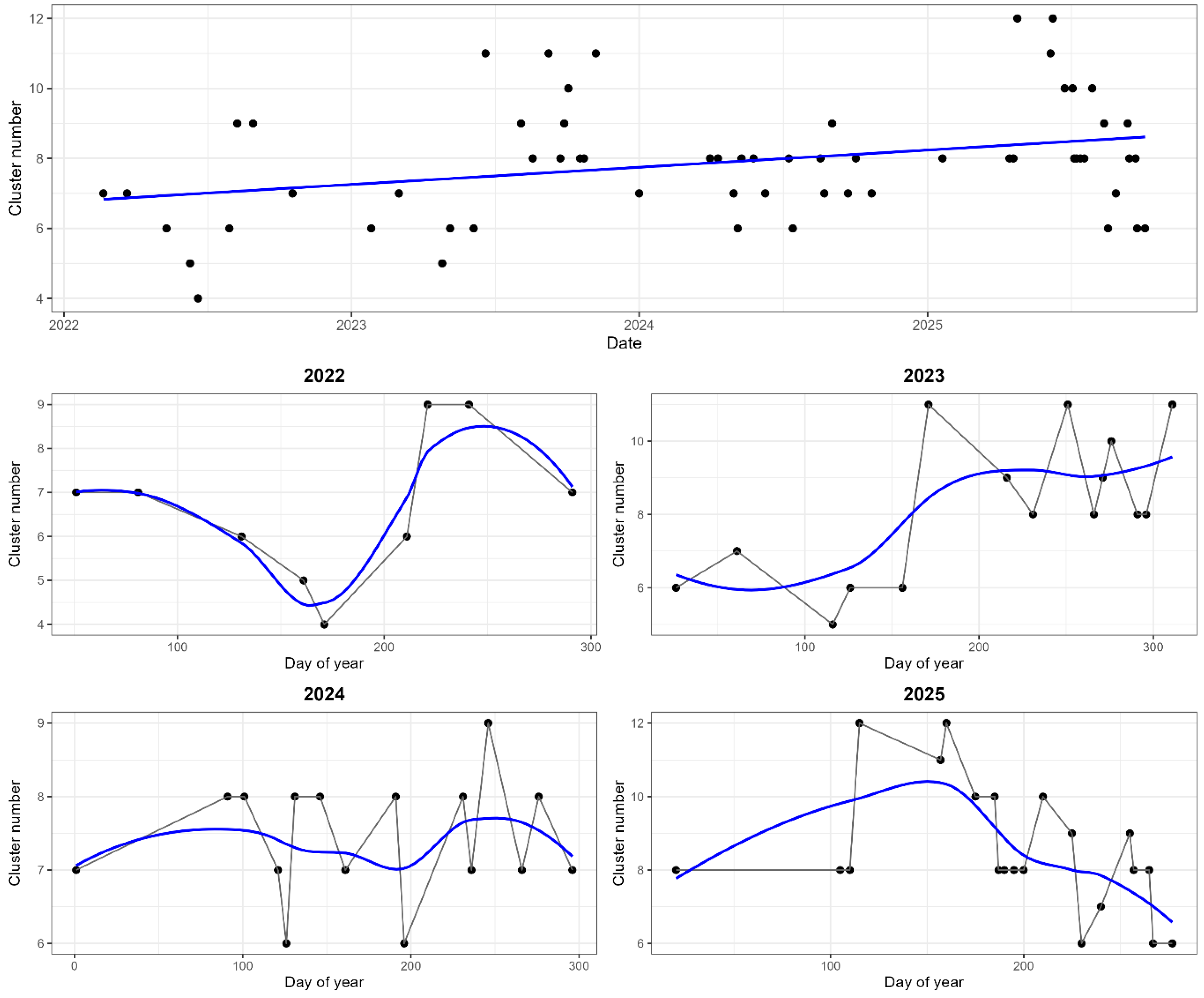
The clustering procedure identified 16 distinct clusters over the entire study period. At each date, the study area consisted of four to twelve clusters (Figure 2).
Negative binomial GAM analysis did not provide robust support for a long-term temporal trend in cluster number or for consistent between-year differences or year-specific seasonal structure (Table 2). Although some penalised smooth comparisons yielded very small p-values, these were associated with near-zero effective degrees of freedom and negligible changes in deviance, indicating that the additional seasonal terms did not meaningfully improve model fit (Table 3). The number of clusters appears relatively stable through time, with observed fluctuations better interpreted as irregular short-term variation rather than a systematic temporal or seasonal pattern.
Under the Gaussian GAM framework, model comparison showed that the best-supported model according to AIC was m8 (Year effect + year-specific season), whereas m9 (which additionally included a smooth global trend) had only a slightly poorer fit (ΔAIC = 1.287) (Table 4). This indicates that variation in cluster number is best described by between-year differences and by seasonal dynamics whose shapes vary across years.
At the same time, adding a separate smooth long-term trend on top of this structure did not substantially improve model performance. Models including only a year effect (m6) or a year effect plus a common seasonal curve (m7) were markedly inferior to m8 in terms of AIC (ΔAIC ≈ 15.5), which supports the idea of year-specific seasonality rather than a single common within-year curve shared by all years.
The fact that m6 and m7 had almost identical AIC values further indicates that a single seasonal curve common to all years is not supported. Models describing only a global temporal trend (m1, m2, m2w, m2gp) or a global trend combined with common seasonality (m4, m5, m5w, m5gp) were also substantially worse than m8 (ΔAIC ≈ 15.6). Thus, under the Gaussian assumption, the data structure is better explained by a combination of between-year differences and different seasonal shapes in individual years. A model that included only a common seasonal curve (m3) was virtually indistinguishable from the null model (m0), indicating a lack of convincing evidence for a single general seasonal pattern across the entire time series. In substantive terms, the Gaussian assumption corresponds to viewing cluster number as an aggregated indicator of the structural state of the system, whose variation is shaped by many small additive factors and can therefore be approximated by symmetric fluctuations around a mean temporal trajectory. The cluster number is best described by a year effect and year-specific seasonal dynamics.

3.2. Validation of the Transition from the Common Sample to the Entire Raster

The reliability of the transition from the common sample to the entire raster was evaluated through holdout validation using withheld common sample points for each date. Across 61 dates, the classification rule demonstrated stable predictive performance, with a mean overall accuracy of 0.883 ± 0.039, a mean balanced accuracy of 0.856 ± 0.043, and a mean macro-F1 score of 0.829 ± 0.050. These values indicate that the transfer of class labels from the common sample to raster-wide prediction was generally robust, although performance varied between dates. Date-specific overall accuracy ranged from 0.745 to 0.984, balanced accuracy from 0.699 to 0.959, and macro-F1 from 0.680 to 0.943. Thus, the transition was not equally reliable for all dates, but most remained within a relatively narrow interval around the mean. This result suggests that the common sample-based rule can be applied to the full raster with generally high reproducibility, while some dates exhibit lower class separability and therefore require more cautious interpretation. The pooled confusion matrix for aggregated classes further elucidated the structure of classification accuracy (Table 5).
The overall accuracy of the aggregated classification reached 89.1%. Several classes showed high user’s accuracy, including classes C (98.7%), A (95.6%), P (93.0%), E (89.8%), M (88.3%), and L (88.2%). Producer’s accuracy was also high for the dominant classes, reaching 96.3% for class C, 92.7% for class P, 91.7% for class A, and 88.2% for class M. By contrast, lower user’s accuracy was observed for classes K (66.2%), N (70.2%), G (73.7%), O (74.5%), and F (76.4%), indicating weaker class discrimination for these categories. The confusion matrix also revealed that misclassification was not randomly distributed across all classes. The largest off-diagonal counts were concentrated among a limited subset of classes, especially between A, E, M, and O, with additional confusion involving I and J. This pattern suggests that the main source of classification uncertainty arose from spectrally or structurally adjacent classes rather than from general instability of the classifier. The transition from the common sample to the entire raster can thus be regarded as quantitatively supported, albeit with class-specific differences in reliability that should be taken into account when interpreting raster maps.

3.3. Interpretation of Clusters (Land Cover Classes) in Terms of EUNIS Habitat Types

The identified land cover classes were assigned to habitat types based on their relationship to plant associations, as well as on the physiognomic characteristics and spatial distribution of the corresponding landscape patches. In total, 878 sample areas were used for habitat interpretation, and the number of sample areas represented in individual terrestrial clusters varied from 20 to 122 (Table 6). The dominant association within a cluster was represented by nine to thirty-nine sample areas. Land cover class A differed significantly from the other classes in its plant-association spectrum (χ2 = 215.81, df = 19, Monte Carlo p = 0.0001, Holm-adjusted p = 0.0015) and accounted for 4.82% of the total χ2, with the strongest positive residuals for associations 15, 10, and 16 (z = 7.83, 6.34, and 4.99, respectively). Land cover class A was characterised by the dominance of Populetum nigro-albae (38.0%) and the accompanying presence of woody-edge and secondary communities, notably Myosotido sparsiflorae-Alliarietum petiolatae (13.0%), DC Erigeron canadensis (12.2%), DC Stellaria media (11.2%), Salicetum albae (10.2%), and DC Amorpha fruticosa (9.7%). The phytosociological composition thus reflects riparian poplar vegetation with a substantial contribution of marginal and disturbance-related communities. These locations occupy a considerable part of the floodplain and are predominantly associated with its elevated sites. Their physiognomic characteristics and spatial distribution were also compatible with an interpretation of these patches as corresponding most closely to T1474 Central and eastern Pontic poplar forests.
Land cover class C differed significantly from the other classes (χ2 = 322.56, df = 19, Monte Carlo p = 0.0001, Holm-adjusted p = 0.0015) and contributed 7.83% to the total χ2, being primarily characterised by associations 18 and 7 (z = 12.48 and 11.04, respectively). In land cover class C, BC Cyperus fuscus (44.6%) predominated, accompanied by Chenopodietum stricti (20.4%), Typhetum angustifoliae (12.9%), and Rumici maritimi-Ranunculetum scelerati (12.9%). This phytosociological pattern points to moist floodplain habitats where pioneer ephemeral and wetland communities are combined. Spatially, these patches were associated with low-lying parts of the floodplain, especially shallow channels and wet depressions. Their physiognomy and spatial position also support a tentative interpretation of these patches as corresponding to F9.1282 Ponto-Sarmatic riverine willow scrub.
Land cover class D differed significantly from the other classes (χ2 = 348.77, df = 19, Monte Carlo p = 0.0001, Holm-adjusted p = 0.0015) and contributed 8.20% to the total χ2, with the highest positive residuals for associations 20, 19, 18, and 17 (z = 12.58, 10.06, 5.38, and 2.71, respectively). The spectral signal of land cover class D was associated primarily with Secaletum sylvestre (32.0%), while Secali sylvestri-Brometum tectorum (13.3%) and DC Vicia villosa (5.6%) represented its psammophytic component; additional contributions were provided by DC Stellaria media (15.8%), Populetum nigro-albae (15.1%), DC Cirsium arvense (9.4%), and Salicetum albae (8.8%). This composition reflects a habitat complex in which sandy steppe communities are combined with ruderal and marginal floodplain vegetation. These patches were mainly confined to elevated, well-drained sandy parts of the floodplain, where open xeromorphic herbaceous cover prevailed. These features are consistent with an interpretation of these patches as most likely corresponding to R11 Pannonian and Pontic sandy steppe.
Land cover class E differed significantly from the other classes (χ2 = 278.09, df = 19, Monte Carlo p = 0.0001, Holm-adjusted p = 0.0015) and contributed 6.53% to the total χ2, with association 17 showing the strongest overrepresentation (z = 13.77), followed by associations 14 and 13 (z = 5.77 and 4.08, respectively). Despite the mixed floristic composition of land cover class E, dominated by DC Stellaria media (46.2%) and accompanied by Erigeronto-Lactucetum serriolae (18.4%), Salicetum albae (15.4%), Populetum nigro-albae (10.8%), and DC Oxybasis rubra (9.2%), the physiognomy and spatial distribution of these patches pointed to a woody habitat occupying the driest parts of the floodplain. Although locally restricted, these locations were consistently associated with the most well-drained positions. Such a combination suggests riverine woodland with a substantial edge and disturbance component. Therefore, these patches were considered most consistent with T1315 Sarmatic riverine oak forests.
Land cover class F differed significantly from the other classes (χ2 = 190.35, df = 19, Monte Carlo p = 0.0001, Holm-adjusted p = 0.0015) and contributed 4.62% to the total χ2, being mainly defined by associations 8 and 7 (z = 11.64 and 4.55, respectively). Cluster F was distinguished by the predominance of DC Oxybasis rubra (36.0%) and BC Cyperus fuscus (22.3%), accompanied by Rumici maritimi-Ranunculetum scelerati (13.3%), DC Cirsium arvense (10.2%), Populetum nigro-albae (10.2%), and Typhetum angustifoliae (8.1%). This combination indicates periodically exposed, relatively stable mesotrophic sediments occupied by pioneer and ephemeral vegetation, with a minor admixture of wetland and floodplain communities. Spatially, these patches were associated with temporarily exposed floodplain margins and shallow depressions. On this basis, the available evidence supports the inference that cluster F corresponds most closely to Q62 Periodically exposed shore with stable, mesotrophic sediments with pioneer or ephemeral vegetation.
Although the shoreline habitats were assigned to a single habitat type, C3.6 Unvegetated or sparsely vegetated shores with soft or mobile sediments, they were markedly heterogeneous in spectral terms. This spectral differentiation corresponded to differences in floristic composition, so several spectral classes were distinguished within the same habitat type according to the predominance of particular plant associations. In particular, class G differed significantly from the other classes (χ2 = 305.97, df = 19, Monte Carlo p = 0.0001, Holm-adjusted p = 0.0015) and contributed 7.71% to the total χ2, with the clearest positive residual for association 1 (z = 16.47) and additional positive deviations for associations 2 and 4 (z = 3.71 and 3.29, respectively), and was associated with Bromo tectorum-Corispermetum leptopteri. Land cover class J differed significantly from the other classes (χ2 = 185.08, df = 19, Monte Carlo p = 0.0001, Holm-adjusted p = 0.0015) and contributed 4.69% to the total χ2, being marked by associations 2, 1, and 4 (z = 10.56, 5.81, and 5.21, respectively), and was associated with Chenopodietum stricti. Land cover class K differed significantly from the other classes (χ2 = 141.00, df = 19, Monte Carlo p = 0.0001, Holm-adjusted p = 0.0015) and contributed 3.49% to the total χ2, with the highest positive residuals for associations 3, 13, and 7 (z = 8.65, 4.30, and 4.11, respectively), and was associated with Portulacetum oleracea. Land cover class M differed significantly from the other classes (χ2 = 273.89, df = 19, Monte Carlo p = 0.0001, Holm-adjusted p = 0.0015) and contributed 6.86% to the total χ2, with associations 3, 7, and 2 showing the highest positive residuals (z = 12.50, 9.53, and 3.13, respectively), and was associated with a combination of Portulacetum oleracei and BC Cyperus fuscus. Land cover class N differed significantly from the other classes (χ2 = 296.81, df = 19, Monte Carlo p = 0.0001, Holm-adjusted p = 0.0015) and contributed 7.50% to the total χ2, being characterised by associations 4, 1, and 2 (z = 14.80, 7.60, and 2.75, respectively), and was associated with Amarantho retroflexi-Echinochloetum cruris-galli. Land cover class O differed significantly from the other classes (χ2 = 124.36, df = 19, Monte Carlo p = 0.0001, Holm-adjusted p = 0.0015) and made the smallest contribution to the total χ2 (3.05%), with positive residuals concentrated in associations 9, 19, 1, and 17 (z = 7.04, 5.34, 2.94, and 2.79, respectively), and was associated with Populetum nigro-albae. Thus, within the single habitat type C3.6, several spectral variants could be recognised, reflecting differences in the dominant vegetation of exposed shore habitats.
Land cover class H differed significantly from the other classes (χ2 = 410.69, df = 19, Monte Carlo p = 0.0001, Holm-adjusted p = 0.0015) and contributed 9.92% to the total χ2, being characterised by associations 5, 12, and 8 (z = 14.69, 11.20, and 5.72, respectively). Spectral class H was clearly distinguished by the predominance of Typhetum angustifoliae (58.3%), accompanied by DC Oxybasis rubra (22.3%) and DC Erigeron canadensis (19.4%). This composition indicates dense tall-helophyte vegetation developing in permanently or long-term waterlogged parts of the floodplain. Spatially, these patches were associated with shallow inundated margins and wet depressions. On this basis, spectral class H was considered most consistent with Q5132 Typha angustifolia beds.
Land cover class I was characterised by the predominance of Erigeronto-Lactucetum serriolae (45.0%), accompanied by Myosotido sparsiflorae-Alliarietum petiolatae (17.5%), Salicetum albae (13.4%), and DC Stellaria media (12.5%). This composition indicates vegetation shaped by strong disturbance and the prevalence of annual ruderal herbs, with a minor admixture of woody-edge communities. Spatially, these patches were associated with transformed and unstable parts of the floodplain. These features support the identification of spectral class I as V37 Annual anthropogenic herbaceous vegetation, which differed significantly from the other classes (χ2 = 320.44, df = 19, Monte Carlo p = 0.0001, Holm-adjusted p = 0.0015) and contributed 7.43% to the total χ2, with the strongest positive residuals for associations 13, 16, and 14 (z = 12.45, 9.53, and 4.24, respectively). Land cover class L differed significantly from the other classes (χ2 = 483.50, df = 19, Monte Carlo p = 0.0001, Holm-adjusted p = 0.0015) and made the largest contribution to the total χ2 (11.92%), being overwhelmingly associated with association 6 (z = 19.60) and additionally with association 11 (z = 8.91).
Land cover class L was distinguished by the predominance of Rumici maritimi-Ranunculetum scelerati (75.0%), accompanied by DC Cirsium arvense (25.0%). This composition indicates periodically exposed eutrophic sediments occupied by pioneer vegetation developing under conditions of pronounced moisture fluctuation. Spatially, these patches were associated with shallow depressions and exposed floodplain surfaces subject to temporary inundation, making it reasonable to interpret this class as corresponding most closely to Q61 Periodically exposed shore with stable, eutrophic sediments with pioneer or ephemeral vegetation.
Land cover class P differed significantly from the other classes (χ2 = 237.64, df = 19, Monte Carlo p = 0.0001, Holm-adjusted p = 0.0015) and contributed 5.44% to the total χ2, being characterised by associations 10, 11, 12, and 15 (z = 8.79, 8.01, 4.69, and 4.04, respectively). A mixed association spectrum characterised spectral class P, with a predominance of DC Cirsium arvense (39.0%), accompanied by DC Erigeron canadensis (14.1%), Populetum nigro-albae (13.8%), DC Oxybasis rubra (12.8%), and DC Amorpha fruticosa (11.2%). Despite this floristic admixture, the physiognomy and spatial distribution of these patches indicated dense emergent vegetation developing along persistently wet floodplain margins. These locations were mainly associated with contact zones between shallow water and more terrestrial communities, where tall helophytes formed extensive fringes, supporting an interpretation of these patches as corresponding most closely to Q51 Tall-helophyte bed.

3.4. Ordination of Spectral Classes in PCA Space and Interpretation of Principal Component Axes

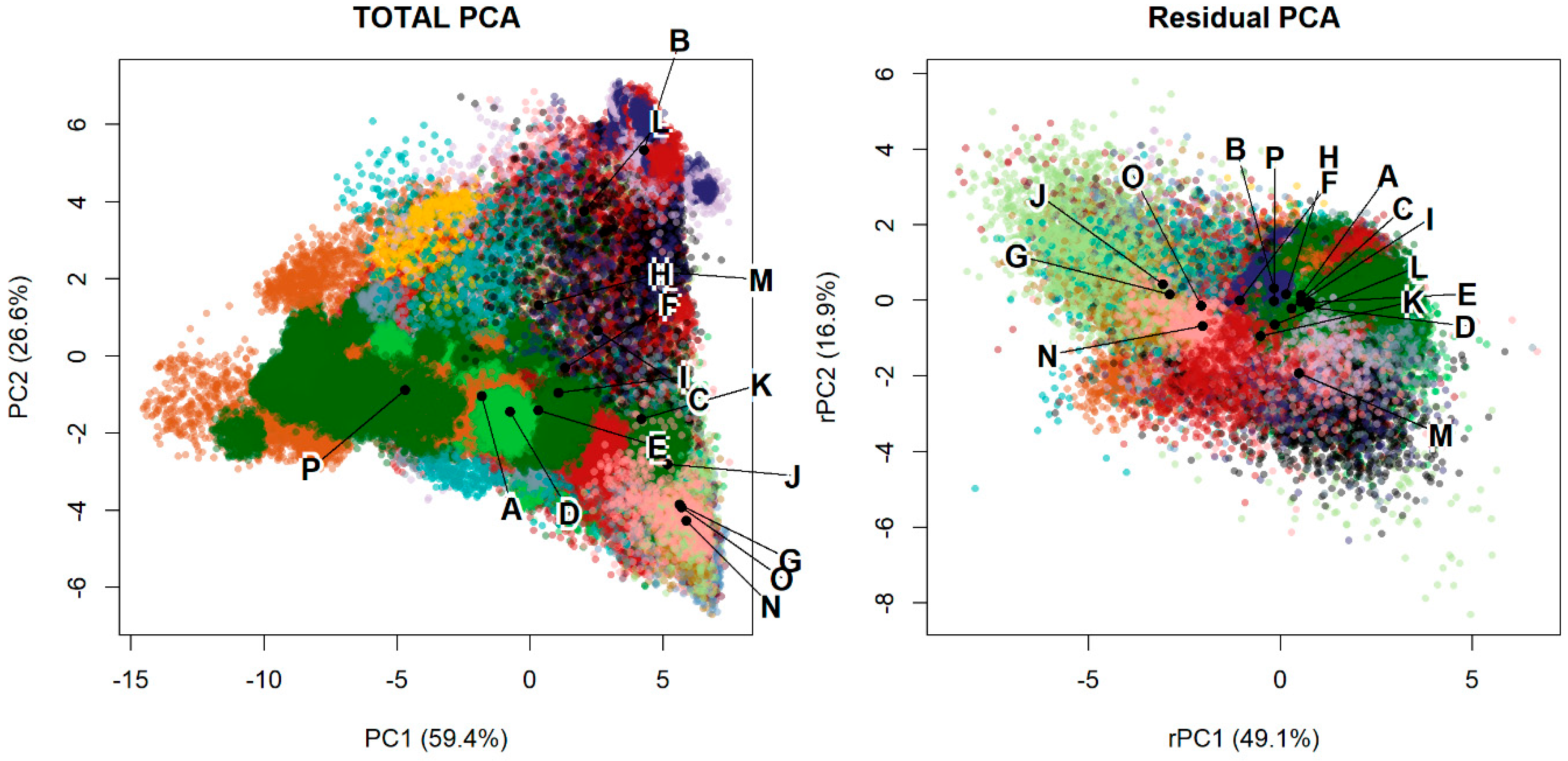
The spectral classes occupied distinct, though partly overlapping, positions in both the total and residual PCA ordination spaces (Figure 3), indicating that each class was characterised by a specific configuration of spectral indices. In the space of the original PCA axes, the major differentiation occurred along PC1 (59.4% of variance), which separated classes associated with green, structurally developed, and relatively moist vegetation from those related to exposed, weakly vegetated, or disturbed surfaces. PC2 (26.6%) represented a secondary gradient mainly associated with surface moisture and the land–water transition, distinguishing wetter floodplain and helophytic classes from drier or brighter substrates. As a result, the shoreline classes formed a broad group in the total PCA space but still retained substantial internal spectral heterogeneity. The residual PCA revealed an additional level of class differentiation after removing the variation explained by the original principal components. In this space, rPC1 (49.1%) primarily reflected a contrast between vegetation-related spectral properties and bright or weakly vegetated moist substrates, whereas rPC2 (16.9%) captured more specific variation in vegetation composition and surface properties. This residual ordination separated several shoreline classes more clearly than the total PCA, confirming that the habitat type C3.6 included multiple spectrally distinct variants associated with different dominant plant associations.
According to the loading structure (Table 7), the original PCA axes can be interpreted mainly in terms of “greenness” and moisture/water-edge conditions, whereas the residual axes reflect finer differences related to substrate exposure, pigment-related spectral properties, and the structure of vegetation cover.

3.5. Spectral Indices Underlying the Differentiation of Habitat-Related Classes

The overall importance ranking of spectral indices (Table 8) showed that spectral class differentiation was determined mainly by MNDW, NDTI, RI, NDWI2, and NDBaI, with additional contributions from NBRI, CIGRN, NDGCI, NDVI, and NDTSM. These results suggest that variation among classes was governed primarily by gradients of moisture and land–water contrast, together with differences in substrate exposure and vegetation properties. The spectral indices identified as most important for class differentiation clearly reflected the ecological and spatial boundaries of the corresponding habitat types. The prominent role of MNDW can be explained by the fact that T1474 Central and eastern Pontic poplar forests and C2.3 Permanent non-tidal, smooth-flowing watercourses occupy a substantial proportion of the study area and define one of its major land–water contrasts. Sandy-shore habitats and their psammophytic variants were differentiated primarily by brightness- and substrate-related indices, especially TCI_BRIGHT and AC_Index. In turn, pioneer and ephemeral vegetation of exposed floodplain surfaces was associated mainly with water- and soil-related indices, indicating the importance of moisture regime, substrate exposure, and sediment properties for the spectral separation of these classes.

3.6. Seasonal Dynamics of Spectral Classes Along PCA and Residual PCA Axes

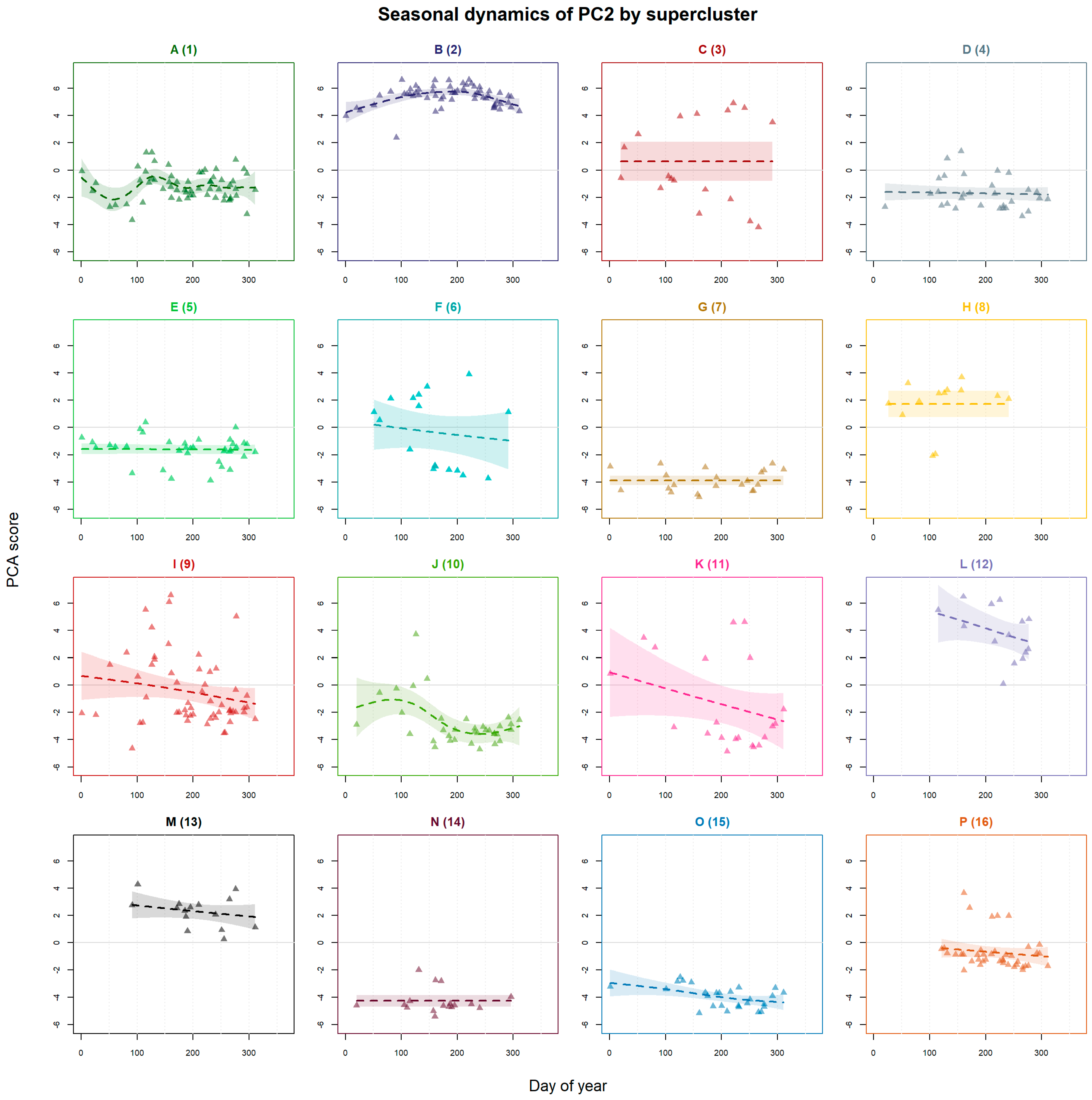
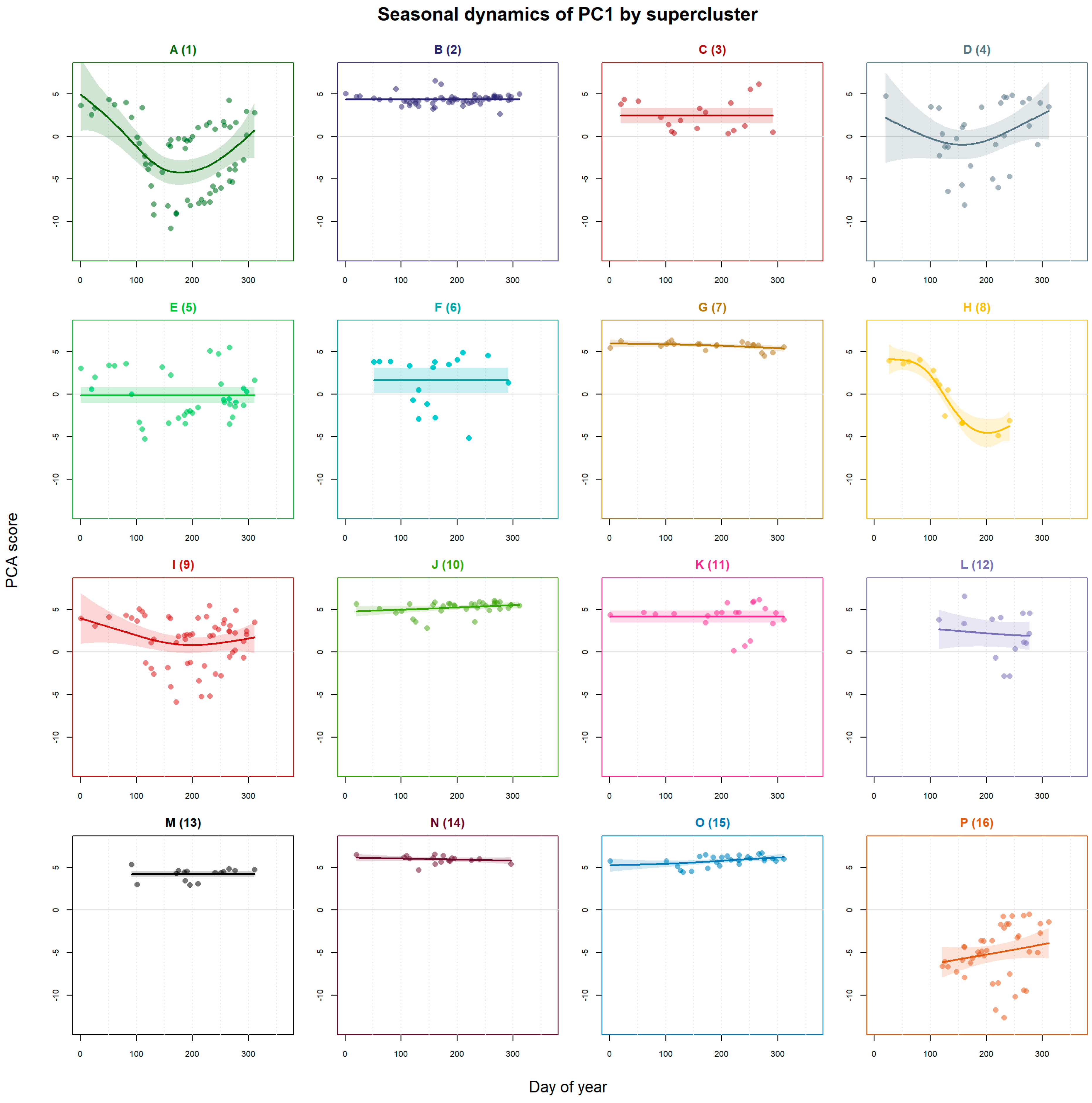
The seasonal dynamics of PC1 differed markedly among spectral classes (Figure 4). The most pronounced temporal changes were observed in classes A and H, both showing a strong decline in PC1 values toward the middle of the growing season, followed by partial recovery. A weaker but still noticeable seasonal pattern was recorded in classes D and I, whereas class P showed a gradual increase from strongly negative values. In contrast, most other classes (B, C, E, F, G, J, K, L, M, and N) remained comparatively stable throughout the year, indicating limited seasonal variation in their position along the main spectral gradient. Class O showed a slight increasing trend over the season. The results indicate that some spectral classes are seasonally dynamic, whereas others retain relatively constant spectral characteristics. Seasonal variation in PC2 was generally weaker and more class-specific than that observed for PC1 (Figure 5). The most pronounced temporal patterns were recorded in classes B and L, both maintaining high positive PC2 values but showing a gradual decline toward the end of the season, and in classes I and K, which exhibited a clear shift from higher to lower PC2 values over time. Class J also showed a marked curvilinear trend, with a decline during the growing season followed by slight stabilisation. By contrast, most other classes (C, D, E, F, G, H, M, N, O, and P) remained comparatively stable, differing mainly in their average position along the PC2 gradient rather than in seasonal dynamics. The results indicate that PC2 captured relatively persistent differences among spectral classes, while seasonal shifts were pronounced only in a limited number of them.
Seasonal variation in rPC1 followed distinct trajectories among spectral classes (Figure S1). A seasonal decline in rPC1 was most evident in classes C, F, H, and J. Class K showed the strongest nonlinear pattern, with an initial increase, a subsequent decline, and a slight late-season recovery. A weaker curvilinear trend was observed in class I, where rPC1 decreased during the first half of the season and then increased slightly. Positive seasonal shifts were recorded in classes D, G, M, and O. In contrast, classes A, B, E, L, N, and P remained comparatively stable, showing only minor fluctuations over the annual cycle. Seasonal variation in rPC2 was limited in most spectral classes (Figure S2). The clearest positive trends were observed in classes I and J, whereas classes C, F, and H showed a moderate decline over the season. The remaining classes were comparatively stable and differed mainly in their average position along the rPC2 gradient rather than in seasonal trajectory.
Seasonal trajectories of rPC3 were characterised mainly by the presence or absence of mid-season extrema rather than by simple monotonic trends (Figure S3). U-shaped patterns with a minimum in the middle of the season were most evident in classes A, B, E, F, G, and J, with the strongest curvature in class F. Class O showed the opposite tendency, with a decline during the first part of the season followed by stabilisation or slight recovery. In contrast, classes D and P showed a gradual increase toward the end of the annual cycle. By contrast, classes C, H, K, L, M, and N remained comparatively stable, showing only weak seasonal change.
Seasonal dynamics of rPC4 were most clearly expressed as either directional increases or trajectories with mid-season extrema (Figure S4). The strongest monotonic increases were observed in classes C and H, while classes G, J, K, and O showed pronounced nonlinear patterns with distinct seasonal turning points. Weaker positive shifts occurred in classes E and M, whereas classes B, F, L, N, and P remained nearly constant throughout the annual cycle.

3.7. Second-Order Superclusters and Their Correspondence to EUNIS Habitat Categories

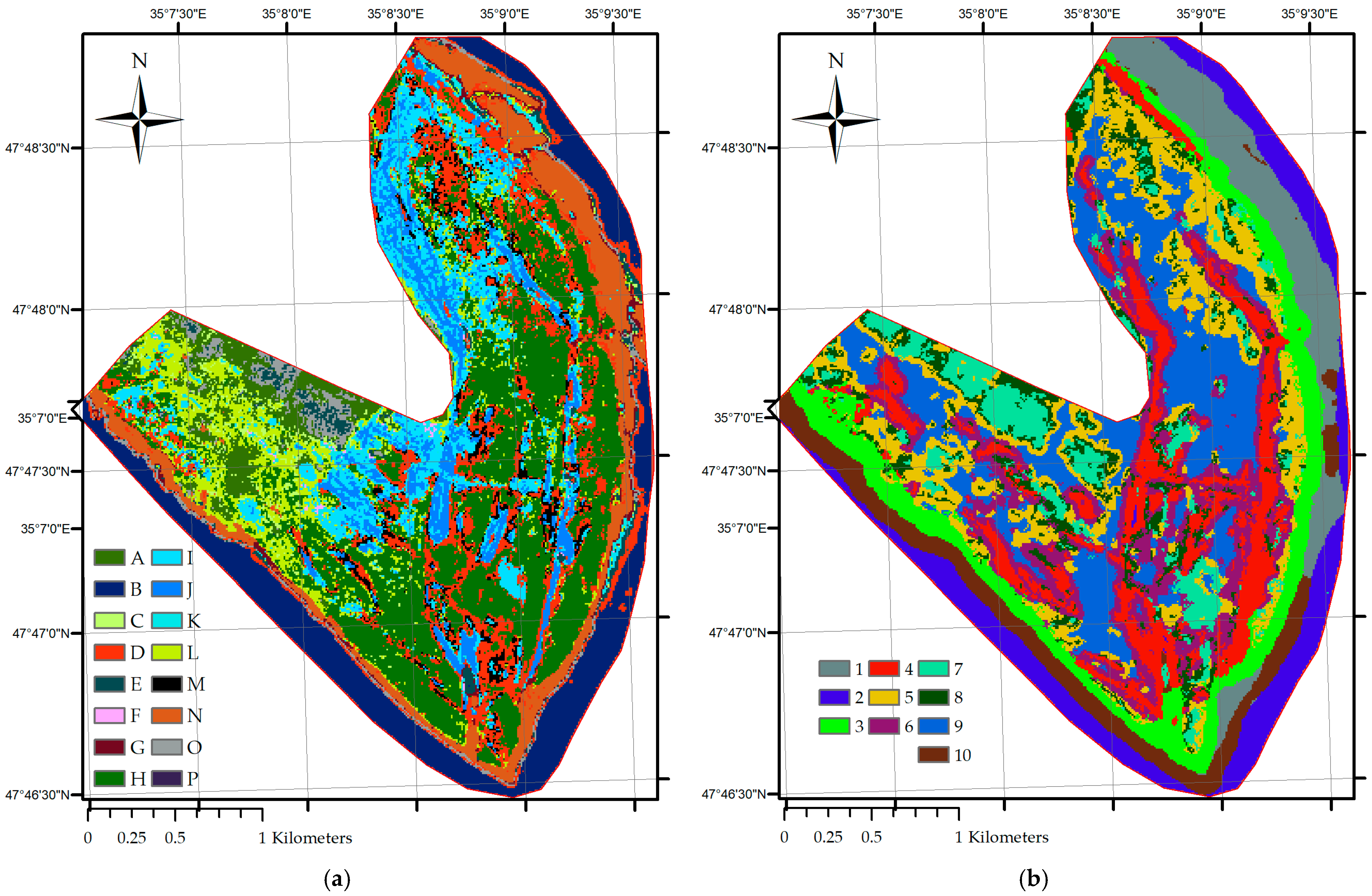
Superclusters identified for individual dates formed a mosaic-like spatial pattern that was specific to particular parts of the floodplain, as illustrated by the example for 18 August 2025 (Figure 6a). Incorporating the temporal dynamics of these superclusters and applying the landscape-vision procedure made it possible to distinguish second-order superclusters, which captured the integrated spatiotemporal organisation of the floodplain during 2022–2025 (Figure 6b). The same first-order supercluster may be represented, in different quantitative proportions, in several second-order superclusters (Table 9). The dominant first-order superclusters, which determine the physiognomic character of these units, may therefore provide a basis for identifying second-order superclusters in terms of EUNIS habitat categories.

3.8. Temporal Dynamics of Second-Order Superclusters

The map of second-order superclusters provides a spatial imprint of the landscape in which temporal dynamics are represented only implicitly. Table 10 makes this temporal component explicit by summarising the relative contributions of trend and seasonal structure to the compositional dynamics of each second-order supercluster.
Most notably, second-order superclusters 1, 2, 4, and 10 were classified as directional trend units, whereas superclusters 5–9 showed predominantly seasonal dynamics, and supercluster 3 was of a mixed type. The seasonal group may reflect relatively recurrent, quasi-stationary regimes, while the directional group indicates persistent compositional change over time. Given the study setting, these directional dynamics are most plausibly associated with landscape transformation resulting from the Kakhovka disaster.

4. Discussion

4.1. Hierarchical Organisation of Clusters Derived from Unsupervised Classification of Remote Sensing Data

Remote sensing data represent the landscape as raster images [46]. Their classification, particularly in unsupervised mode, inevitably results in the identification of phenomenologically defined, conditionally discrete categories—clusters [47]. Such clusters are not strictly “natural units” in an ontological sense [48]. However, they capture actual differences in the spectral composition of vegetation cover, substrate, and moisture conditions [49,50]. In this respect, a cluster serves as a primary means of ordering the continuous landscape field. That is, it is a formal construct through which complex spatial reality becomes amenable to analysis. At the same time, the landscape is far more than a collection of isolated, spectrally homogeneous patches [51]. Its dynamics in space and time generate a multiplicity of structural states that may change, be partially preserved, disappear, or recover [52,53]. For this reason, the cluster structure acquires heuristic value only when clusters are considered as elements of a hierarchical organisation. Within such an approach, the same formal construct—a cluster—can represent different levels of natural organisation, ranging from locally spectrally homogeneous areas of vegetation cover to higher-order spatiotemporal landscape units. The features of clusters at different hierarchical levels are revealed through the following conceptual features: nominal identifier, method of delineation, criterion, ecological interpretation, landscape interpretation, landscape memory, and recognition (Table 11). Collectively, these features enable tracing how the meaning of a cluster changes across hierarchical levels. At the primary cluster level, it corresponds to the instantaneously recorded spectral structure of the raster field. At the first-order supercluster level, temporal coordination emerges. At the second-order supercluster level, the cluster already reflects the memory and recognition of invariant spatiotemporal mosaics.

4.2. Evolution of the Nominal Identifier Within the Cluster Hierarchy

For the primary cluster, the nominal identifier is a formally unique label whose meaning is determined by its position within spectral space. Relationships of similarity and difference between such clusters are established through spectral homogeneity within clusters and spectral differentiation between clusters. The principal dimensions of this differentiation include the overall greenness of vegetation, moisture characteristics expressed through spectral indices, and secondary principal component analysis (PCA) components reflecting soil properties and plant physiological condition. Thus, at the primary cluster level, the nominal identifier fixes the spectral position of the cluster within a particular raster snapshot.
At the first-order supercluster level, the nominal identifier maintains its connection to primary clusters. Yet, its meaning broadens as it now refers to coordinated identification across different dates. The same identifier denotes not a single cluster within an individual snapshot but rather a sequence of related clusters aligned in time. This procedure is fundamentally important for analysing the spatiotemporal dynamics of the landscape, as it enables the tracing of persistence, transformation, and disappearance of cluster structures across a series of scenes. The key criteria for this alignment are spectral similarity and spatial continuity. Spectral similarity ensures the recognition of related states in spectral space, while spatial continuity captures the spatial inheritance of clusters between adjacent scenes. Mismatches between corresponding clusters in successive scenes may arise from spatial shifts, spectral drift, and noise. For this reason, the nominal identifier of the first-order supercluster is not merely a transferred label. It is formed by relating the current cluster to cluster structures preserved in landscape memory and evaluating the degree to which it belongs to an already known trajectory of states. The effectiveness of this procedure depends on the rules by which current clusters are matched with those in memory, as well as on the algorithm’s ability to detect structures that lack convincing counterparts among previously known states. In this way, the nominal identifier performs a dual function: it ensures the temporal coordination of preserved structures and simultaneously registers newly emergent formations. This property is particularly important under conditions of catastrophically induced landscape change when qualitatively new spatial patterns arise for which no direct analogues exist in the landscape’s previous state. Under such circumstances, the identification system must support both the recognition of inherited structures and the recording of genuine novelty.
At the level of the second-order supercluster, the nominal identifier is formed not through direct spectral homogeneity or through simple temporal alignment of clusters, but through the invariance of the patch mosaic constituted by first-order superclusters. It is precisely the configuration of this mosaic that defines the specificity of higher-order structures [54,55]. Accordingly, the identifier of the second-order supercluster captures an integral spatiotemporal pattern that remains recognisable despite local changes in individual components. An approach based on contextual landscape vision was applied to detect such structures. Within this framework, pixels are related according to the characteristics of their surroundings, represented by a profile of affinities to the entire pool of first-order superclusters. Under these conditions, qualitatively different clusters localised within a similar patch mosaic can generate similar affinity profiles and, therefore, are assigned to the same second-order supercluster. Such a nominal identifier no longer reflects the individuality of a separate cluster state but rather membership in an invariant mode of spatiotemporal landscape organisation. An important feature of this approach is the use of the entire pool of first-order superclusters as a common basis of comparison. As a result, each pixel is described within a single coordinate system that is universal across the entire study area. It is precisely this universality of the basis that ensures the comparability of local spatial configurations across the whole raster field. In more conventional schemes for extracting higher-order spatial patterns, neighbouring clusters or clusters within a moving window are taken as the basis [56,57]. Under such procedures, the basis of comparison changes depending on the local pattern configuration or the method’s parameters. In the proposed approach, the nominal identifier of the second-order supercluster relies on a globally shared basis, which increases the integrity and reproducibility of identification.

4.3. The Raster Paradigm and the Hierarchical Shift in Clustering Criteria

Designating all three types of clusters as outcomes of pixel-wise classification is of fundamental methodological significance, as it firmly situates the proposed approach within the raster paradigm. The hierarchical complexity of cluster organisation does not entail a change in the spatial language of description itself. At every level of analysis, the basic unit remains the raster pixel. At the same time, the distinctions among primary clusters, first-order superclusters, and second-order superclusters are determined by how pixel membership is interpreted and by the nature of the spatial and temporal relationships established among pixels. In traditional approaches for analysing higher-order spatial phenomena, the transition to more complex structures is often accompanied by a shift from raster objects to vector spatial representations, primarily polygons [58,59,60]. In such cases, spatial patterns are characterised through the geometry of individual polygons, and analytical procedures rely on polygon-based metrics and statistics [61,62,63]. An alternative approach involves preserving the raster format under conditions of hierarchical pixel labelling, that is, through increasing the complexity of the nominal identifier [57,64]. The proposed method belongs precisely to this latter category. Its distinctive feature is that hierarchical complexity is represented without altering the fundamental spatial representation format. Consequently, second-order structures can be identified within the same pixel-wise ontology as primary clusters. Higher-order spatial organisation thus emerges as a property of the system of pixel relations rather than as a separate class of geometric objects. This allows the cluster hierarchy to be interpreted as an extension of the semantics of the raster field, in which increasing complexity is achieved by redefining pixel identity and local spatial configuration while preserving a unified spatial language of analysis.
The criteria for cluster delineation vary according to their hierarchical level. For the primary cluster, the determining factor is spectral homogeneity, that is, the internal uniformity of pixels within spectral space. For the first-order supercluster, spatial continuity is added to spectral homogeneity, ensuring temporal alignment of related clusters across successive scenes and supporting their spatial inheritance. For the second-order supercluster, the criterion becomes the profile of affinities to first-order superclusters. In this case, decisive importance is assigned to the configuration of the surroundings, expressed through a system of relations with the entire set of first-order superclusters. This transition from spectral properties to a contextual affinity profile reflects the increasing hierarchical complexity of cluster organisation.

4.4. Ecological and Landscape Interpretation of the Cluster Hierarchy

Ecological and landscape interpretations suggest that the delineation of clusters acquires full significance only when considered in relation to their natural counterparts. Formal differentiation in spectral space, spatial inheritance, and spatiotemporal patterns provides the analytical foundation for distinguishing clusters. However, this alone is insufficient for their ecological and landscape interpretation. Primary clusters and first-order superclusters may be interpreted as lower-level habitat types and ecotopes, whereas second-order superclusters correspond to higher-level habitat types and chorological units [65]. Nevertheless, such correspondences remain imprecise. This is due to the partial autonomy of different natural dimensions of the landscape: vegetation cover, soil properties, hydrological regimes, and overall landscape organisation change in a coordinated manner only to a limited extent. Further uncertainty arises from the conventional nature of natural boundaries, which in real landscapes are often transitional, gradient-like, or mosaic. Cluster units cannot be regarded as unambiguous equivalents of natural categories; rather, they should be treated as operational spatial surrogates that reflect ecological and landscape entities with varying degrees of precision. It is precisely this partial correspondence that constitutes one of the most important heuristic properties of the clustering approach, as it allows us to trace how formally identified structures relate to the actual, yet loosely structured, organisation of the landscape.
In this approach, the concept of landscape memory [66] is complemented by the notion of recognition. For hierarchically organised landscapes, memory alone is insufficient, as the preservation of traces of previous states does not, in itself, ensure the identification of new configurations. Recognition enables the current state to be related to the pool of previously known structures, allowing for the registration of persistence and forgetting, as well as the detection of novelty that has no direct analogue in earlier phases of system development. This perspective is particularly appropriate for landscapes characterised by pronounced catastrophic dynamics, where inherited elements coexist with qualitatively new patterns. Under these conditions, second-order superclusters reflect the memory and recognition of invariant spatiotemporal mosaics, that is, the system’s capacity both to retain the invariant features of the patch mosaic and to recognise new structural combinations emerging during landscape transformation.
At the level of the primary cluster, landscape memory takes the form of a template memory representing an instantaneous snapshot. Such memory records the current state as a conditionally representative pattern, yet it lacks a recognition mechanism capable of relating this state to a set of previous or alternative configurations. In this sense, the primary cluster retains a trace of the state but does not perform a recognition function. Its connection to landscape dynamics is therefore limited to a single snapshot, tacitly assumed sufficient to describe the system. At the level of the first-order supercluster, landscape memory and recognition assume a more complex form, encompassing persistence, forgetting, and novelty. This involves not merely the fixation of an isolated state but the alignment of successive cluster configurations within a temporal sequence. Persistence reflects the preservation of a cluster’s structural identity despite natural variation in its spectral and spatial characteristics. Forgetting describes the loss of connection to previous states when certain cluster configurations disappear or become irrelevant to the current state of the system. Novelty refers to the emergence of structures for which no sufficiently close counterparts exist in the preceding cluster memory. Consequently, the first-order supercluster represents not a template memory of a single snapshot but a mechanism for recognising continuity, loss, and emergence in landscape dynamics. At the second-order supercluster level, differentiating spatial structures within high-level temporal dynamics requires memory and the recognition of invariant spatiotemporal mosaics. At this level, identification cannot rely solely on the preservation of individual cluster states or their sequential temporal alignment. What becomes decisive is the capacity to retain in memory an invariant mosaic pattern formed by first-order superclusters and to recognise it despite local changes in particular components. It is precisely this form of memory and recognition that enables the identification of higher-order structures, for which the crucial property is not the identity of individual elements but the reproducibility of the overall spatiotemporal organisation. In this sense, the second-order supercluster reflects not a single state or merely a sequence of related states, but an invariant mode of the spatiotemporal ordering of the landscape.
The principal finding of the study is the statistically supported identification of second-order superclusters as higher-order spatiotemporal units exhibiting distinct modes of dynamics. Rather than reducing post-catastrophic landscape change to a sequence of isolated cluster transitions, the proposed framework demonstrates that the floodplain can be partitioned into units dominated by directional trend dynamics, units primarily governed by seasonal restructuring, and an intermediate mixed type. Because these categories were derived from separate evaluations of trend and seasonal components using partial redundancy analysis and supported by adjusted R2 values and permutation-based significance tests, they provide not only a descriptive but also an analytical basis for distinguishing persistent transformation from recurrent variability. Under conditions of ecological catastrophe, such differentiation has direct practical relevance for identifying parts of the landscape where structural change is ongoing and therefore most important for continued monitoring and interpretation.

4.5. Ecological Interpretation and Practical Relevance of Higher-Order Clusters

Second-order superclusters can be understood as the spatiotemporal manifestations of concrete ecosystem types rather than as abstract mathematical constructs. Within this framework, a seasonal dynamic type primarily corresponds to recurrent phenological restructuring within relatively stable ecosystem configurations, whereas a directional trend type reflects compositional changes driven by the post-catastrophic transformation of the floodplain. This interpretation aligns with the study’s analytical design, in which second-order superclusters were introduced specifically to monitor and interpret directional and seasonal components of landscape change, with trend and seasonal effects evaluated separately using partial redundancy analysis (RDA). From an ecological perspective, the principal practical outcome is that these two modes of dynamics were explicitly distinguished rather than conflated. Seasonal units indicate areas where observed variability is mainly associated with cyclic within-year reorganisation, that is, phenological and recurrent hydrological fluctuations. In contrast, directional trend units denote parts of the floodplain undergoing persistent restructuring induced by the Kakhovka disaster, including the long-term consequences of drawdown, exposure of new substrates, and the reorganisation of vegetation cover. In this regard, the extracted higher-order clusters provide a basis for separating recurrent ecosystem functioning from catastrophe-driven transformation. This distinction is directly relevant to wetland management and conservation planning, as it enables priority to be given to areas where structural change is ongoing, while other areas can be treated as systems whose variability is predominantly governed by seasonal reorganisation. Such differentiation is particularly important for the future of the former reservoir zone, where strategic decisions remain unresolved: whether the territory should be re-inundated through reservoir restoration, which would entail renewed destruction of the newly formed floodplain ecosystems, or whether it should remain terrestrial; and, concurrently, whether these emerging landscapes should be primarily protected as conservation areas or integrated into future economic use. Under these circumstances, the identified higher-order clusters provide not only a descriptive framework but also a spatially explicit basis for discussing alternative ecological futures for the territory.

4.6. Limitations and Implications for Future Research

An important limitation of the present study concerns the validation of habitat-related interpretations derived from unsupervised clustering. In standard remote sensing studies, such interpretations are often supported by synchronous ground-truth data and conventional external accuracy assessments. However, in the case considered here, the post-catastrophic transformation affected a very large part of the former Kakhovka Reservoir area, much of which remains inaccessible for regular field investigation because it lies within an active war zone. Under such conditions, remote sensing is not merely a preferred tool but, in practice, the only feasible means for systematic observation and monitoring of ongoing landscape change. Khortytsia Island was selected as a model area because it combines pronounced landscape diversity with relative, though still conditional, accessibility for field investigation. Even there, fieldwork is constrained by security conditions and can only be conducted during limited safety windows due to the close proximity of the front line. This means that fully synchronous and spatially exhaustive ground reference data, of the kind typically expected for conventional accuracy assessment, cannot be obtained for the evolving post-disaster landscape as a whole. Any validation strategy must therefore be understood within the operational constraints of wartime field ecology and the rapid temporal reorganisation of the study system. Within this context, the correspondence between land-cover classes and the frequency distribution of plant associations represents the most reasonable and practical validation approach currently available. Vegetation composition is the most sensitive diagnostic component of habitat transformation under such conditions because it responds relatively rapidly to shifts in flooding regime, substrate exposure, and moisture availability. By contrast, other habitat markers, such as relief position and physiognomy, are more conservative. Although they remain important for interpretation, they are less suitable as primary sources of meaningful comparative diagnosis in a landscape undergoing abrupt and continuing reorganisation. For this reason, plant associations were used as the principal ecological basis for evaluating the interpretation of spectral classes, whereas physiognomy and spatial setting were treated as complementary evidence. A broader limitation extends beyond the present case study. Any post hoc or retrospective ecological assessment of catastrophic change is constrained by the lack of sufficiently detailed pre-disturbance and early-transition reference data. This highlights the importance of continuous baseline monitoring of representative habitat systems before catastrophic events occur. The accumulation of such a priori ecological and remote sensing information is essential for improving future validation, interpretation, and diagnosis in situations of sudden large-scale environmental disruption.
Observations from late 2025 suggest that the post-catastrophic development of the floodplain entered a new phase. The prolonged lowering of water levels led to the desiccation of floodplain forests, increasing their susceptibility to fire. Under wartime conditions, fire thus emerged as an additional driver of landscape transformation, superimposed upon the earlier hydrological disturbance. A substantial part of Khortytsia Island was burned, demonstrating that the ecological consequences of the catastrophe continue to unfold through cascading processes rather than as a single disturbance event. This new situation also adds further value to the field data collected in 2024–2025. Although these surveys were originally designed to characterise the vegetation structure of the post-drawdown landscape, they now serve as a priori reference material for assessing the subsequent fire-related stage of transformation. Future monitoring should therefore address not only hydrological and successional changes but also the interactions between dewatering, vegetation stress, and pyrogenic disturbance within the evolving floodplain system.

5. Conclusions

Unsupervised classification of remote sensing data enables the identification of clusters as phenomenologically defined, conditionally discrete categories suitable for analysing landscape spatial heterogeneity. Their significance increases substantially when interpreted hierarchically. From this perspective, primary clusters capture spectrally defined states of the raster field. First-order superclusters coordinate temporally based on spectral similarity and spatial continuity, whereas second-order superclusters reflect higher-order invariant spatiotemporal mosaics. This creates the possibility of using a single formal construct—the cluster—to represent different levels of natural organisation, from lower-level habitat types and ecotopes to chorological units. A fundamental feature of the proposed approach is the preservation of the raster paradigm at all levels of analysis. The hierarchical complexity of cluster structure is achieved through changes in the nominal identifier, criterion, ecological interpretation, landscape interpretation, and landscape memory and recognition, without requiring a shift to polygon-based representation. As a result, higher-order spatial patterns can be identified within the same pixel-wise ontology as primary clusters. Of particular methodological importance is the use of the entire pool of first-order superclusters as a globally shared basis for evaluating affinity profiles, thereby ensuring the comparability of local spatial configurations across the whole study area. Ecological and landscape counterparts of clusters do exist, but their correspondence remains imprecise. This indeterminacy arises from the partial autonomy of vegetation, soil, hydrological, and holistic landscape processes, as well as from the gradient-like and mosaic character of natural boundaries. For this reason, the cluster hierarchy is best understood as a system of operational spatial surrogates that can reflect ecological and landscape entities with varying degrees of precision. In this sense, the proposed approach combines formal differentiation with the possibility of meaningful natural-scientific interpretation. For landscapes characterised by catastrophic dynamics, the concept of landscape memory and recognition has particular heuristic value. Landscape memory provides the connection between successive landscape states, enables the retention of traces of previous configurations, and creates the basis for recognising both inherited and newly formed structures. At the level of the primary cluster, landscape memory is reduced to a template-like snapshot, in which the current state is recorded as a conditionally representative pattern without a recognition mechanism. At the level of the first-order supercluster, landscape memory and recognition take on a more complex form encompassing persistence, forgetting, and novelty. At the level of the second-order supercluster, the object of identification becomes the memory and recognition of invariant spatiotemporal mosaics. This opens the possibility of detecting inherited structures, tracing their transformation, and identifying qualitatively new formations induced by catastrophic events. In the context of post-catastrophic dynamics in floodplain landscapes, such an approach provides a foundation for analysing landscape organisation in terms of memory, recognition, and the formation of new structural states.

Supplementary Materials

The following supporting information can be downloaded at: https://www.mdpi.com/article/10.3390/land15040624/s1, Figure S1: Seasonal dynamics of rPC1 scores in spectral classes (superclusters) along the day-of-year gradient. Points represent observations, solid lines show GAM-smoothed trends, and shaded areas indicate 95% confidence intervals; Figure S2: Seasonal dynamics of rPC2 scores in spectral classes (superclusters) along the day-of-year gradient. Points represent observations, solid lines show GAM-smoothed trends, and shaded areas indicate 95% confidence intervals; Figure S3: Seasonal dynamics of rPC3 scores in spectral classes (superclusters) along the day-of-year gradient. Points represent observations, solid lines show GAM-smoothed trends, and shaded areas indicate 95% confidence intervals; Figure S4: Seasonal dynamics of rPC4 scores in spectral classes (superclusters) along the day-of-year gradient. Points represent observations, solid lines show GAM-smoothed trends, and shaded areas indicate 95% confidence intervals; Table S1: Sentinel spectral indices for ecological analysis [67,68,69,70,71,72,73,74,75,76,77,78,79,80,81,82,83,84,85,86,87,88,89,90,91,92,93,94,95,96,97].

Author Contributions

Conceptualization, O.K. and O.Z.; methodology, O.L.; software, H.T.; validation, O.K., O.L. and O.Z.; formal analysis, H.T.; investigation, O.L.; resources, O.Z.; data curation, H.T.; writing—original draft preparation, O.Z.; writing—review and editing, O.K.; visualisation, O.L.; supervision, H.T.; project administration, O.L.; funding acquisition, O.Z. All authors have read and agreed to the published version of the manuscript.

Funding

This research was funded by the National Research Foundation of Ukraine, grant number 2025.07/0001 “Procrustean analysis of spectral indices for assessing changes in hemeroby and the functional structure of plant communities as a result of military destruction: the example of the destruction of the Kakhovka Reservoir”.

Data Availability Statement

The raw data supporting the conclusions of this article will be made available by the authors on request.

Acknowledgments

The authors would like to express their sincere gratitude to the leadership of Bohdan Khmelnytskyi Melitopol State Pedagogical University for their administrative and technical support. The authors have reviewed and edited the output and take full responsibility for the content of this publication.

Conflicts of Interest

The authors declare no conflicts of interest.

References

  1. Gómez, C.; White, J.C.; Wulder, M.A. Optical Remotely Sensed Time Series Data for Land Cover Classification: A Review. ISPRS J. Photogramm. Remote Sens. 2016, 116, 55–72. [Google Scholar] [CrossRef]
  2. Nykytiuk, Y.; Kravchenko, O.; Pitsil, A.; Bambura, V.; Seredniak, D. Global Climate Change May Reduce the Anti-Erosion Regulatory Capacity of Vegetation Cover in Ukraine’s Polissya and Forest-Steppe Regions. Regul. Mech. Biosyst. 2025, 33, e25004. [Google Scholar] [CrossRef]
  3. Lu, D.; Mausel, P.; Brondízio, E.; Moran, E. Change Detection Techniques. Int. J. Remote Sens. 2004, 25, 2365–2401. [Google Scholar] [CrossRef]
  4. Kuenzer, C.; Dech, S.; Wagner, W. (Eds.) Remote Sensing Time Series; Remote Sensing and Digital Image Processing; Springer International Publishing: Cham, Switzerland, 2015; Volume 22. [Google Scholar]
  5. Minarchenko, V.; Tymchenko, I.; Pushkarova, Y.; Dvirna, T.; Futorna, O.; Polishchuk, O. Impact of Climate Change on Populations and Resources of Convallaria Majalis. Biosyst. Divers. 2025, 33, e2543. [Google Scholar] [CrossRef]
  6. Zhu, Z.; Qiu, S.; Ye, S. Remote Sensing of Land Change: A Multifaceted Perspective. Remote Sens. Environ. 2022, 282, 113266. [Google Scholar] [CrossRef]
  7. Moffett, K.; Nardin, W.; Silvestri, S.; Wang, C.; Temmerman, S. Multiple Stable States and Catastrophic Shifts in Coastal Wetlands: Progress, Challenges, and Opportunities in Validating Theory Using Remote Sensing and Other Methods. Remote Sens. 2015, 7, 10184–10226. [Google Scholar] [CrossRef]
  8. Cheng, X.; He, X.; Qiao, M.; Li, P.; Hu, S.; Chang, P.; Tian, Z. Enhanced Contextual Representation with Deep Neural Networks for Land Cover Classification Based on Remote Sensing Images. Int. J. Appl. Earth Obs. Geoinf. 2022, 107, 102706. [Google Scholar] [CrossRef]
  9. Mandl, L.; Viana-Soto, A.; Seidl, R.; Stritih, A.; Senf, C. Unmixing-Based Forest Recovery Indicators for Predicting Long-Term Recovery Success. Remote Sens. Environ. 2024, 308, 114194. [Google Scholar] [CrossRef]
  10. Zelenova, V.O.; Zelenov, P.V.; Tutova, G.F. Bioindication Potentials of the Grass Stand and Soil Macrofauna for Assessing the Level of Anthropogenic Transformation of an Urban Park Are Complementary. Biosyst. Divers. 2024, 32, 306–313. [Google Scholar] [CrossRef]
  11. Smith-Tripp, S.M.; Coops, N.C.; Mulverhill, C.; White, J.C.; Axelson, J. Landsat Assessment of Variable Spectral Recovery Linked to Post-Fire Forest Structure in Dry Sub-Boreal Forests. ISPRS J. Photogramm. Remote Sens. 2024, 208, 121–135. [Google Scholar] [CrossRef]
  12. Tilon, S.; Nex, F.; Kerle, N.; Vosselman, G. Post-Disaster Building Damage Detection from Earth Observation Imagery Using Unsupervised and Transferable Anomaly Detecting Generative Adversarial Networks. Remote Sens. 2020, 12, 4193. [Google Scholar] [CrossRef]
  13. Ponomarenko, O.; Komlyk, Y.; Tutova, H.; Zhukov, O. Landscape Diversity Mapping Allows Assessment of the Hemeroby of Bird Species in a Modern Industrial Metropolis. Biosyst. Divers. 2024, 32, 470–483. [Google Scholar] [CrossRef]
  14. Han, S.; Lee, J. Parallelized Inter-Image k-Means Clustering Algorithm for Unsupervised Classification of Series of Satellite Images. Remote Sens. 2023, 16, 102. [Google Scholar] [CrossRef]
  15. Nykytiuk, Y.; Kravchenko, O.; Komorna, O.; Bambura, V.; Seredniak, D. Spatial and Temporal Variation of the Rainfall Erosivity Factor in Polissya and Forest-Steppe of Ukraine. Biosyst. Divers. 2024, 32, 407–415. [Google Scholar] [CrossRef]
  16. Růžička, V.; Vaughan, A.; De Martini, D.; Fulton, J.; Salvatelli, V.; Bridges, C.; Mateo-Garcia, G.; Zantedeschi, V. RaVÆn: Unsupervised Change Detection of Extreme Events Using ML on-Board Satellites. Sci. Rep. 2022, 12, 16939. [Google Scholar] [CrossRef]
  17. Liu, D.; Cai, S. A Spatial-Temporal Modeling Approach to Reconstructing Land-Cover Change Trajectories from Multi-Temporal Satellite Imagery. Ann. Assoc. Am. Geogr. 2012, 102, 1329–1347. [Google Scholar] [CrossRef]
  18. Liu, S.; Su, H.; Cao, G.; Wang, S.; Guan, Q. Learning from Data: A Post Classification Method for Annual Land Cover Analysis in Urban Areas. ISPRS J. Photogramm. Remote Sens. 2019, 154, 202–215. [Google Scholar] [CrossRef]
  19. Candido, C.; Blanco, A.C.; Medina, J.; Gubatanga, E.; Santos, A.; Ana, R.S.; Reyes, R.B. Improving the Consistency of Multi-Temporal Land Cover Mapping of Laguna Lake Watershed Using Light Gradient Boosting Machine (LightGBM) Approach, Change Detection Analysis, and Markov Chain. Remote Sens. Appl. Soc. Environ. 2021, 23, 100565. [Google Scholar] [CrossRef]
  20. Brierley, G.J. Landscape Memory: The Imprint of the Past on Contemporary Landscape Forms and Processes. Area 2010, 42, 76–85. [Google Scholar] [CrossRef]
  21. Peterson, G.D. Contagious Disturbance, Ecological Memory, and the Emergence of Landscape Pattern. Ecosystems 2002, 5, 329–338. [Google Scholar] [CrossRef]
  22. Beven, K.J.; Kirkby, M.J. A Physically Based, Variable Contributing Area Model of Basin Hydrology. Hydrol. Sci. J. 1979, 24, 43–69. [Google Scholar] [CrossRef]
  23. Kopecký, M.; Macek, M.; Wild, J. Topographic Wetness Index Calculation Guidelines Based on Measured Soil Moisture and Plant Species Composition. Sci. Total Environ. 2021, 757, 143785. [Google Scholar] [CrossRef] [PubMed]
  24. Riihimäki, H.; Kemppinen, J.; Kopecký, M.; Luoto, M. Topographic Wetness Index as a Proxy for Soil Moisture: The Importance of Flow-Routing Algorithm and Grid Resolution. Water Resour. Res. 2021, 57, e2021WR029871. [Google Scholar] [CrossRef]
  25. Chetvertak, T.; Diuzhykova, T.; Hryshko, S.; Nepsha, O.; Tutova, H. The Precipitation Levels during the Warmest Quarter Are the Primary Factor Influencing the Spatial Distribution of Opatrum Sabulosum. Biosyst. Divers. 2025, 33, e2507. [Google Scholar] [CrossRef]
  26. Johnstone, J.F.; Allen, C.D.; Franklin, J.F.; Frelich, L.E.; Harvey, B.J.; Higuera, P.E.; Mack, M.C.; Meentemeyer, R.K.; Metz, M.R.; Perry, G.L.; et al. Changing Disturbance Regimes, Ecological Memory, and Forest Resilience. Front. Ecol. Environ. 2016, 14, 369–378. [Google Scholar] [CrossRef]
  27. Lisovets, O.; Podorozhniy, S.; Tutova, H.; Molozhon, K.; Kunakh, O.; Zhukov, O. Hemeroby Reveals the Dynamics of Vegetation Cover Following the Destruction of the Kakhovka Reservoir. PeerJ 2025, 13, e19607. [Google Scholar] [CrossRef] [PubMed]
  28. Gleick, P.; Vyshnevskyi, V.; Shevchuk, S. Rivers and Water Systems as Weapons and Casualties of the Russia-Ukraine War. Earth’s Future 2023, 11, e2023EF003910. [Google Scholar] [CrossRef]
  29. Tutova, H.; Lisovets, O.; Kunakh, O.; Zhukov, O. Ecosystems as Organisms in Spectral Space: Landscape Corrosion Revealed by Unreliable Classification Zones. Geographies 2026, 6, 33. [Google Scholar] [CrossRef]
  30. Tutova, H.; Lisovets, O.; Kunakh, O.; Zhukov, O. Procrustean Analysis of the Set of Spectral Indices Reveals the Transformations in Plant Community Hemeroby and Functional Structure Induced by Anthropogenic Disasters. Biosyst. Divers. 2025, 33, e2528. [Google Scholar] [CrossRef]
  31. Tutova, H.; Lisovets, O.; Kunakh, O.; Zhukov, O. The Future of the Kakhovka Reservoir after Ecocide: Afforestation and Ecosystem Service Recovery through Emergent Willow-Popular Communities. Stud. Biol. 2025, 19, 171–194. [Google Scholar] [CrossRef]
  32. Kunakh, O.; Tutova, H.; Lisovets, O.; Zhukov, O. Methods for Assessing the Temporal Dynamics of Landscape Cover Based on Procrustean Analysis of Spectral Indices. Nat. Protoc. 2025, 1, 1–47. [Google Scholar] [CrossRef]
  33. Lisovets, O.; Tutova, H.; Kunakh, O.; Zhukov, O. Prodromus of the Vegetation Cover of the Southern Part of Khortytsia Island (Floodplain Ecosystems That Underwent Transformational Changes Following the Destruction of the Kakhovka Reservoir Due to the Blasting of the Kakhovka Hydropower Plant Dam by Russ); Zenodo: Genève, Switzerland, 2026. [Google Scholar]
  34. Chytrý, M.; Tichý, L.; Hennekens, S.M.; Knollová, I.; Janssen, J.A.M.; Rodwell, J.S.; Peterka, T.; Marcenò, C.; Landucci, F.; Danihelka, J.; et al. EUNIS Habitat Classification: Expert System, Characteristic Species Combinations and Distribution Maps of European Habitats. Appl. Veg. Sci. 2020, 23, 648–675. [Google Scholar] [CrossRef]
  35. Kim, H.-Y. Statistical Notes for Clinical Researchers: Chi-Squared Test and Fisher’s Exact Test. Restor. Dent. Endod. 2017, 42, 152. [Google Scholar] [CrossRef]
  36. Agresti, A.; Wackerly, D.; Boyett, J.M. Exact Conditional Tests for Cross-Classifications: Approximation of Attained Significance Levels. Psychometrika 1979, 44, 75–83. [Google Scholar] [CrossRef]
  37. Patefield, W.M. Algorithm AS 159: An Efficient Method of Generating Random R × C Tables with Given Row and Column Totals. Appl. Stat. 1981, 30, 91. [Google Scholar] [CrossRef]
  38. Haberman, S.J. The Analysis of Residuals in Cross-Classified Tables. Biometrics 1973, 29, 205. [Google Scholar] [CrossRef]
  39. Holm, S. A Simple Sequentially Rejective Multiple Test Procedure. Scand. J. Stat. 1979, 6, 65–70. [Google Scholar]
  40. Beasley, T.M.; Schumacker, R.E. Multiple Regression Approach to Analyzing Contingency Tables: Post Hoc and Planned Comparison Procedures. J. Exp. Educ. 1995, 64, 79–93. [Google Scholar] [CrossRef]
  41. García-Pérez, M.A.; Núñez-Antón, V.; Alcalá-Quintana, R. Analysis of Residuals in Contingency Tables: Another Nail in the Coffin of Conditional Approaches to Significance Testing. Behav. Res. Methods 2015, 47, 147–161. [Google Scholar] [CrossRef]
  42. Caliñski, T.; Harabasz, J. A Dendrite Method Fo Cluster Analysis. Commun. Stat. 1974, 3, 1–27. [Google Scholar] [CrossRef]
  43. Comber, A.; Fisher, P.; Brunsdon, C.; Khmag, A. Spatial Analysis of Remote Sensing Image Classification Accuracy. Remote Sens. Environ. 2012, 127, 237–246. [Google Scholar] [CrossRef]
  44. Farhadpour, S.; Warner, T.A.; Maxwell, A.E. Selecting and Interpreting Multiclass Loss and Accuracy Assessment Metrics for Classifications with Class Imbalance: Guidance and Best Practices. Remote Sens. 2024, 16, 533. [Google Scholar] [CrossRef]
  45. Owen, B.M.; Tweedley, J.R.; Moheimani, N.R.; Hallett, C.S.; Cosgrove, J.J.; Silberstein, L.P.O. What Is “Accuracy”? Rethinking Machine Learning Classifier Performance Metrics for Highly Imbalanced, High Variance, Zero-inflated Species Count Data. Limnol. Oceanogr. Methods 2026, 24, 70009. [Google Scholar] [CrossRef]
  46. Wicks, T.; Smith, G.; Curran, P. Polygon-Based Aggregation of Remotely Sensed Data for Regional Ecological Analyses. Int. J. Appl. Earth Obs. Geoinf. 2002, 4, 161–173. [Google Scholar] [CrossRef]
  47. Richards, J.A. Clustering and Unsupervised Classification. In Remote Sensing Digital Image Analysis; Springer International Publishing: Cham, Switzerland, 2022; pp. 369–401. [Google Scholar]
  48. Xie, Y.; Sha, Z.; Yu, M. Remote Sensing Imagery in Vegetation Mapping: A Review. J. Plant Ecol. 2008, 1, 9–23. [Google Scholar] [CrossRef]
  49. Młynarczyk, A.; Konatowska, M.; Królewicz, S.; Rutkowski, P.; Piekarczyk, J.; Kowalewski, W. Spectral Indices as a Tool to Assess the Moisture Status of Forest Habitats. Remote Sens. 2022, 14, 4267. [Google Scholar] [CrossRef]
  50. Pichura, V.; Potravka, L.; Dudiak, N.; Bahinskyi, O. Natural and Climatic Transformation of the Kakhovka Reservoir after the Destruction of the Dam. J. Ecol. Eng. 2024, 25, 82–104. [Google Scholar] [CrossRef]
  51. Lausch, A.; Blaschke, T.; Haase, D.; Herzog, F.; Syrbe, R.-U.; Tischendorf, L.; Walz, U. Understanding and Quantifying Landscape Structure—A Review on Relevant Process Characteristics, Data Models and Landscape Metrics. Ecol. Model. 2015, 295, 31–41. [Google Scholar] [CrossRef]
  52. Liodaki, D.; Rekhviashvili, L.; Lang, T.; Apostolopoulou, E. Theorizing Multiple Geographies: Interrelations of Space and Multiplicity in Geographical Research. Geogr. Compass 2024, 18, 12766. [Google Scholar] [CrossRef]
  53. Pichura, V.; Potravka, L.; Domaratskiy, Y.; Drobitko, A. Water Balance of Winter Wheat Following Different Precursors on the Ukrainian Steppe. Int. J. Environ. Stud. 2024, 81, 324–341. [Google Scholar] [CrossRef]
  54. Vogt, P.; Wickham, J.; Barredo, J.I.; Riitters, K. Revisiting the Landscape Mosaic Model. PLoS ONE 2024, 19, e0304215. [Google Scholar] [CrossRef] [PubMed]
  55. Tkachuk, R.; Nykytiuk, Y.; Komorna, O.; Kravchenko, O.; Zymaroieva, A. Ecological Groups of Birds of Zhytomyr Region (Ukraine) in Relation to Thermal Regime and Their Future Prospects in the Context of Global Climate Change. Biosyst. Divers. 2024, 32, 297–305. [Google Scholar] [CrossRef]
  56. Hagen-Zanker, A. A Computational Framework for Generalized Moving Windows and Its Application to Landscape Pattern Analysis. Int. J. Appl. Earth Obs. Geoinf. 2016, 44, 205–216. [Google Scholar] [CrossRef]
  57. Riitters, K.H.; Wickham, J.D.; Wade, T.G. An Indicator of Forest Dynamics Using a Shifting Landscape Mosaic. Ecol. Indic. 2009, 9, 107–117. [Google Scholar] [CrossRef]
  58. Blaschke, T. Object Based Image Analysis for Remote Sensing. ISPRS J. Photogramm. Remote Sens. 2010, 65, 2–16. [Google Scholar] [CrossRef]
  59. Kucharczyk, M.; Hay, G.J.; Ghaffarian, S.; Hugenholtz, C.H. Geographic Object-Based Image Analysis: A Primer and Future Directions. Remote Sens. 2020, 12, 2012. [Google Scholar] [CrossRef]
  60. Nykytiuk, Y.; Kravchenko, O.; Komorna, O. Bioclimatic and Soil Determinants of Buckwheat Cultivation Prospects under Global Warming: A Case Study of the Ukrainian Polissya and Forest-Steppe. Biosyst. Divers. 2025, 33, e2537. [Google Scholar] [CrossRef]
  61. Jia, Y.; Tang, L.; Xu, M.; Yang, X. Landscape Pattern Indices for Evaluating Urban Spatial Morphology—A Case Study of Chinese Cities. Ecol. Indic. 2019, 99, 27–37. [Google Scholar] [CrossRef]
  62. Shao, S.; Yu, M.; Huang, Y.; Wang, Y.; Tian, J.; Ren, C. Towards a Core Set of Landscape Metrics of Urban Land Use in Wuhan, China. ISPRS Int. J. Geo-Inf. 2022, 11, 281. [Google Scholar] [CrossRef]
  63. Ye, S.; Pontius, R.G.; Rakshit, R. A Review of Accuracy Assessment for Object-Based Image Analysis: From per-Pixel to per-Polygon Approaches. ISPRS J. Photogramm. Remote Sens. 2018, 141, 137–147. [Google Scholar] [CrossRef]
  64. Vogt, P.; Riitters, K.H.; Estreguil, C.; Kozak, J.; Wade, T.G.; Wickham, J.D. Mapping Spatial Patterns with Morphological Image Processing. Landsc. Ecol. 2007, 22, 171–177. [Google Scholar] [CrossRef]
  65. Zonneveld, I.S. The Land Unit ? A Fundamental Concept in Landscape Ecology, and Its Applications. Landsc. Ecol. 1989, 3, 67–86. [Google Scholar] [CrossRef]
  66. Skaloš, J.; Kašparová, I. Landscape Memory and Landscape Change in Relation to Mining. Ecol. Eng. 2012, 43, 60–69. [Google Scholar] [CrossRef]
  67. Komlyk, Y.; Ponomarenko, O.; Zhukov, O. A Hemeroby Gradient Reveals the Structure of Bird Communities in Urban Parks. Biosyst. Divers. 2024, 32, 426–436. [Google Scholar] [CrossRef]
  68. Elfanah, A.M.S.; Darwish, M.A.; Selim, A.I.; Elmoselhy, O.M.A.; Ali, A.M.; El-Maghraby, M.A.; Abdelhamid, M.T. Hyperspectral Reflectance and Agro-Physiological Traits for Field Identification of Salt-Tolerant Wheat Genotypes Using the Genotype by Yield*trait Biplot Technique. Front. Plant Sci. 2023, 14, 1165113. [Google Scholar] [CrossRef] [PubMed]
  69. Louhaichi, M.; Borman, M.M.; Johnson, D.E. Spatially Located Platform and Aerial Photography for Documentation of Grazing Impacts on Wheat. Geocarto Int. 2001, 16, 65–70. [Google Scholar] [CrossRef]
  70. Gitelson, A.A.; Kaufman, Y.J.; Merzlyak, M.N. Use of a Green Channel in Remote Sensing of Global Vegetation from EOS-MODIS. Remote Sens. Environ. 1996, 58, 289–298. [Google Scholar] [CrossRef]
  71. Chandrasekar, K.; Sesha Sai, M.V.R.; Roy, P.S.; Dwevedi, R.S. Land Surface Water Index (LSWI) Response to Rainfall and NDVI Using the MODIS Vegetation Index Product. Int. J. Remote Sens. 2010, 31, 3987–4005. [Google Scholar] [CrossRef]
  72. Xu, H. Modification of Normalised Difference Water Index (NDWI) to Enhance Open Water Features in Remotely Sensed Imagery. Int. J. Remote Sens. 2006, 27, 3025–3033. [Google Scholar] [CrossRef]
  73. Seydi, S.T.; Akhoondzadeh, M.; Amani, M.; Mahdavi, S. Wildfire Damage Assessment over Australia Using Sentinel-2 Imagery and MODIS Land Cover Product within the Google Earth Engine Cloud Platform. Remote Sens. 2021, 13, 220. [Google Scholar] [CrossRef]
  74. Zhao, H.; Chen, X. Use of Normalized Difference Bareness Index in Quickly Mapping Bare Areas from TM/ETM+. In Proceedings of the 2005 IEEE International Geoscience and Remote Sensing Symposium, IGARSS’05, Seoul, Republic of Korea, 29 July 2005; Volume 3, pp. 1666–1668. [Google Scholar]
  75. Ha, N.T.T.; Thao, N.T.P.; Koike, K.; Nhuan, M.T. Selecting the Best Band Ratio to Estimate Chlorophyll-a Concentration in a Tropical Freshwater Lake Using Sentinel 2A Images from a Case Study of Lake Ba Be (Northern Vietnam). ISPRS Int. J. Geo-Inf. 2017, 6, 290. [Google Scholar] [CrossRef]
  76. Chaves, M.E.D.; Picoli, M.C.A.; Sanches, I.D. Recent Applications of Landsat 8/OLI and Sentinel-2/MSI for Land Use and Land Cover Mapping: A Systematic Review. Remote Sens. 2020, 12, 3062. [Google Scholar] [CrossRef]
  77. Wang, J.; Ding, J.; Yu, D.; Ma, X.; Zhang, Z.; Ge, X.; Teng, D.; Li, X.; Liang, J.; Lizaga, I.; et al. Capability of Sentinel-2 MSI Data for Monitoring and Mapping of Soil Salinity in Dry and Wet Seasons in the Ebinur Lake Region, Xinjiang, China. Geoderma 2019, 353, 172–187. [Google Scholar] [CrossRef]
  78. Hardisky, M.A.; Klemas, V.; Smart, R.M. The Influence of Soil Salinity, Growth Form, and Leaf Moisture on the Spectral Radiance of Spartina Alterniflora Canopies. Photogramm. Eng. Remote Sens. 1983, 49, 77–83. [Google Scholar]
  79. Yazdi, M.; Taheri, M.; Navi, P.; Sadati, N. Landsat ETM+ Imaging for Mineral Potential Mapping: Application to Avaj Area, Qazvin, Iran. Int. J. Remote Sens. 2013, 34, 5778–5795. [Google Scholar] [CrossRef]
  80. Yang, C.; Everitt, J.H.; Bradford, J.M.; Murden, D. Airborne Hyperspectral Imagery and Yield Monitor Data for Mapping Cotton Yield Variability. Precis. Agric. 2004, 5, 445–461. [Google Scholar] [CrossRef]
  81. Barnes, E.M.; Clarke, T.R.; Richards, S.E.; Colaizzi, P.D.; Haberland, J.; Kostrzewski, M.; Waller, P.; Choi, C.; Riley, E.; Thompson, T. Coincident Detection of Crop Water Stress, Nitrogen Status and Canopy Density Using Ground-Based Multispectral Data. In Proceedings of the Fifth International Conference on Precision Agriculture, Bloomington, MN, USA, 16–19 July 2000; pp. 16–19. [Google Scholar]
  82. Van Deventer, A.P.; Ward, A.D.; Gowda, P.M.; Lyon, J.G. Using Thematic Mapper Data to Identify Contrasting Soil Plains and Tillage Practices. Photogramm. Eng. Remote Sens. 1997, 63, 87–93. [Google Scholar]
  83. Premkumar, R.; Venkatachalapathy, R.; Visweswaran, S. Mapping of Total Suspended Matter Based on Sentinel-2 Data on the Hooghly River, India. Indian J. Ecol. 2021, 48, 159–165. [Google Scholar]
  84. Rouse, J.W.; Haas, R.H.; Schell, J.A.; Deering, D.W. Monitoring Vegetation Systems in the Great Plains with ERTS. In Proceedings of the NASA Goddard Space Flight Center 3D ERTS-1 Symposium; NASA: Greenbelt, MD, USA, 1974; Volume 1, Section B, pp. 309–317. [Google Scholar]
  85. McFeeters, S.K. The Use of the Normalized Difference Water Index (NDWI) in the Delineation of Open Water Features. Int. J. Remote Sens. 1996, 17, 1425–1432. [Google Scholar] [CrossRef]
  86. Gašparović, M.; Singh, S.K. Spatio-Temporal Salinity Monitoring of the Ghaghara River Using Landsat Time-Series Imagery and Multiple Regression Analysis. Int. Arch. Photogramm. Remote Sens. Spat. Inf. Sci. 2020, XLIII-B3-2, 401–405. [Google Scholar] [CrossRef]
  87. Xie, Q.; Dash, J.; Huang, W.; Peng, D.; Qin, Q.; Mortimer, H.; Casa, R.; Pignatti, S.; Laneve, G.; Pascucci, S.; et al. Vegetation Indices Combining the Red and Red-Edge Spectral Information for Leaf Area Index Retrieval. IEEE J. Sel. Top. Appl. Earth Obs. Remote Sens. 2018, 11, 1482–1493. [Google Scholar] [CrossRef]
  88. Addabbo, P.; Focareta, M.; Marcuccio, S.; Votto, C.; Ullo, S.L. Contribution of Sentinel-2 Data for Applications in Vegetation Monitoring. Acta IMEKO 2016, 5, 44–54. [Google Scholar] [CrossRef]
  89. Imbroane, M.A.; Melenti, C.; Gorgan, D. Mineral Explorations by Landsat Image Ratios. In Proceedings of the Ninth International Symposium on Symbolic and Numeric Algorithms for Scientific Computing (SYNASC 2007); IEEE: New York, NY, USA, 2007; pp. 335–340. [Google Scholar]
  90. Penuelas, J.; Baret, F.; Filella, I. Semi-Empirical Indices to Assess Carotenoids/Chlorophyll a Ratio from Leaf Spectral Reflectance. Photosynthetica 1995, 31, 221–230. [Google Scholar]
  91. Lugassi, R.; Goldshleger, N.; Chudnovsky, A. Studying Vegetation Salinity: From the Field View to a Satellite-Based Perspective. Remote Sens. 2017, 9, 122. [Google Scholar] [CrossRef]
  92. Kauth, R.J.; Thomas, G.S. The Tasselled Cap—A Graphic Description of the Spectral-Temporal Development of Agricultural Crops as Seen by Landsat. In Proceedings of the Symposium on Machine Processing of Remotely Sensed Data, West Lafayette, IN, USA, 1 January 1976; pp. 4B41–4B51. [Google Scholar]
  93. Huete, A. A Soil-Adjusted Vegetation Index (SAVI). Remote Sens. Environ. 1988, 25, 295–309. [Google Scholar] [CrossRef]
  94. Qi, J.; Chehbouni, A.; Huete, A.R.; Kerr, Y.H.; Sorooshian, S. A Modified Soil Adjusted Vegetation Index. Remote Sens. Environ. 1994, 48, 119–126. [Google Scholar] [CrossRef]
  95. Gitelson, A.A.; Merzlyak, M.N. Remote Estimation of Chlorophyll Content in Higher Plant Leaves. Int. J. Remote Sens. 1997, 18, 2691–2697. [Google Scholar] [CrossRef]
  96. Gitelson, A.A.; Kaufman, Y.J.; Stark, R.; Rundquist, D. Novel Algorithms for Remote Estimation of Vegetation Fraction. Remote Sens. Environ. 2002, 80, 76–87. [Google Scholar] [CrossRef]
  97. Haboudane, D.; Miller, J.R.; Tremblay, N.; Zarco-Tejada, P.J.; Dextraze, L. Integrated Narrow-Band Vegetation Indices for Prediction of Crop Chlorophyll Content for Application to Precision Agriculture. Remote Sens. Environ. 2002, 81, 416–426. [Google Scholar] [CrossRef]
Figure 1. Study area within the floodplain complex of the southern part of Khortytsia Island (Zaporizhzhia, Ukraine): digital elevation model of the southern part of the island (left) and its location relative to Zaporizhzhia City, the Zaporizhzhia Dam, and the former Kakhovka Reservoir before its destruction in 2023 (right).
Land 15 00624 g001
Figure 2. Temporal dynamics of cluster number during 2022–2025. The upper panel shows the overall relationship between cluster number and sampling date across the whole study period. The lower panels show within-year patterns for 2022, 2023, 2024, and 2025 as a function of day of year. Black points indicate observed values, grey lines connect successive observations within each year, and blue lines represent smooth trends fitted using generalised additive models (GAMs).
Land 15 00624 g002
Figure 3. Distribution of land cover classes in the space of the original PCA axes and the residual PCA axes derived from regression models with the original principal components used as predictors: A—T1474 Central and eastern Pontic poplar forests; B—C2.3 Permanent non-tidal, smooth-flowing watercourses (C2.3); C—F9.1282 Ponto-Sarmatic riverine willow scrub; D—R11 Pannonian and Pontic sandy steppe; E—T1315 Sarmatic riverine oak forests; F—Q62 Periodically exposed shore with stable, mesotrophic sediments with pioneer or ephemeral vegetation; G—C3.6 Unvegetated or sparsely vegetated shores with soft or mobile sediments (with a predominance of Bromo tectorum-Corispermetum leptopteri Sissingh et Westhoff ex Sissingh 1950 corr. Dengler 2000); H—Q5132 Typha angustifolia beds; I—V37 Annual anthropogenic herbaceous vegetation; J—C3.6 Unvegetated or sparsely vegetated shores with soft or mobile sediments (with a predominance of Chenopodietum stricti (Oberd. 1957) Passarge 1964); K—C3.6 Unvegetated or sparsely vegetated shores with soft or mobile sediments (with a predominance of Portulacetum oleracei Felföldy 1942); L—Q61 Periodically exposed shore with stable, eutrophic sediments with pioneer or ephemeral vegetation; M—C3.6 Unvegetated or sparsely vegetated shores with soft or mobile sediments (with a predominance of Portulacetum oleracei Felföldy 1942 and BC Cyperus fuscus [Eleocharition soloniensis]); N—C3.6 Unvegetated or sparsely vegetated shores with soft or mobile sediments (dominated by Amarantho retroflexi-Echinochloetum cruris-galli Bagrikova 2005); O—C3.6 Unvegetated or sparsely vegetated shores with soft or mobile sediments (dominated by Populetum nigro-albae Slavnić 1952); P—Q51 Tall-helophyte bed.
Land 15 00624 g003
Figure 4. Seasonal dynamics of PC1 scores in spectral classes (superclusters) along the day-of-year gradient. Points represent observations, solid lines show GAM-smoothed trends, and shaded areas indicate 95% confidence intervals.
Land 15 00624 g004
Figure 5. Seasonal dynamics of PC2 scores in spectral classes (superclusters) along the day-of-year gradient. Triangle represent observations, dashed lines show GAM-smoothed trends, and shaded areas indicate 95% confidence intervals.
Land 15 00624 g005
Figure 6. Spatial arrangement of landscape spatiotemporal units: (a) superclusters as of 18 August 2025: A—T1474 Central and eastern Pontic poplar forests; B—C2.3 Permanent non-tidal, smooth-flowing watercourses (C2.3); C—F9.1282 Ponto-Sarmatic riverine willow scrub; D—R11 Pannonian and Pontic sandy steppe; E—T1315 Sarmatic riverine oak forests; F—Q62 Periodically exposed shore with stable, mesotrophic sediments with pioneer or ephemeral vegetation; G—C3.6 Unvegetated or sparsely vegetated shores with soft or mobile sediments (with a predominance of Bromo tectorum-Corispermetum leptopteri Sissingh et Westhoff ex Sissingh 1950 corr. Dengler 2000); H—Q5132 Typha angustifolia beds; I—V37 Annual anthropogenic herbaceous vegetation; J—C3.6 Unvegetated or sparsely vegetated shores with soft or mobile sediments (with a predominance of Chenopodietum stricti (Oberd. 1957) Passarge 1964); K—C3.6 Unvegetated or sparsely vegetated shores with soft or mobile sediments (with a predominance of Portulacetum oleracei Felföldy 1942); L—Q61 Periodically exposed shore with stable, eutrophic sediments with pioneer or ephemeral vegetation; M—C3.6 Unvegetated or sparsely vegetated shores with soft or mobile sediments (with a predominance of Portulacetum oleracei Felföldy 1942 and BC Cyperus fuscus [Eleocharition soloniensis]); N—C3.6 Unvegetated or sparsely vegetated shores with soft or mobile sediments (dominated by Amarantho retroflexi-Echinochloetum cruris-galli Bagrikova 2005); O—C3.6 Unvegetated or sparsely vegetated shores with soft or mobile sediments (dominated by Populetum nigro-albae Slavnić 1952); P—Q51 Tall-helophyte bed; (b) second-order superclusters based on the spatiotemporal dynamics of 2022–2025: 1—C3 Littoral zone of inland surface waterbodies; 2—C2 Surface running waters; 3—Q6 Periodically exposed shores; 4—T13 Temperate hardwood riparian forest; 5—R1 Dry grasslands; 6—F9 Riverine and fen scrubs; 7—Q5 Helophyte beds; 8—T14/R1/Q5 Mosaic of riparian woodland dominated by poplar forests; 9—T14 Mediterranean and Macaronesian riparian forest; 10—V37 Annual anthropogenic herbaceous vegetation.
Land 15 00624 g006
Table 1. Parameter settings used in the temporal matching and spatial-memory procedures for the Khortytsia Island case study.
Symbol in ManuscriptScript ParameterValue UsedRole in the AlgorithmBasis for Setting
α memory_alpha0.8Weight of spatial memory relative to feature similarity in the combined matching scoreSet to give greater weight to spatial inheritance during temporal matching
σ memory_sigma3.5Scaling parameter converting feature-space distance into similaritySet empirically for the feature-similarity transformation
d m a x time_match_max_dist15.0Maximum centroid distance allowing absorption into an existing global clusterSet as a permissive upper bound for admissible feature-space matching
S m i n memory_min_spatial0.000Minimum spatial score required before absorption is consideredSet to avoid excluding matches on spatial grounds alone
S m i n memory_min_score0.30Minimum combined score required for absorption into an existing global clusterSet as the main acceptance threshold for temporal matching
p spatial_dilution_power1.0Controls attenuation of the spatial identity marker after reassignmentDefault retained
m m i n spatial_marker_floor0.0Lower bound for the spatial identity markerDefault retained
ε spatial_marker_eps 1 × 10 12 Small constant preventing exact zeros in the marker valuesDefault retained
η memory_eta0.07Learning coefficient in the spatial presence memory updateDefault retained
γ memory_gamma0.005Forgetting coefficient in the spatial presence memory updateDefault retained
Table 2. Negative binomial model comparison.
RankModelDescriptionAICΔ(AIC)Deviance of ExplainedRadj2
1nb1linear global trend263.950.000.100.08
2nb2smooth global trend263.950.000.100.08
3nb4linear trend + common season263.950.000.100.08
4nb5smooth trend + common season263.950.000.100.08
5nb0intercept only264.200.250.000.00
6nb3common seasonal curve264.200.250.000.00
7nb7year effect + common season266.592.640.160.12
8nb6year effect266.592.640.160.12
9nb8year effect + year-specific season267.213.250.200.15
Table 3. Targeted nested tests.
TestDfDeviancep-Value
NB0 vs. NB1: global linear trend12.250.134
NB0 vs. NB2: global smooth trend12.250.134
NB0 vs. NB3: common season00.00<0.001
NB1 vs. NB4: season beyond linear trend00.00<0.001
NB2 vs. NB5: season beyond smooth trend00.00<0.001
NB0 vs. NB6: year effect33.610.307
NB6 vs. NB7: common season beyond the year00.00<0.001
NB7 vs. NB8: year-specific season10.750.391
Table 4. Gaussian model comparison.
RankModelDescriptionDfAICΔ(AIC)Deviance of ExplainedRadj2
1m8Year effect + year-specific season12221.480.000.480.39
2m9Smooth trend + year effect + year-specific season12222.771.290.480.38
3m8wYear effect + wavy global trend9227.986.500.360.29
4m8gpYear effect + GP global trend9228.236.740.360.28
5m6Year effect5236.9615.480.160.12
6m7Year effect + common season5236.9615.480.160.12
7m1Linear global trend3237.0915.600.100.09
8m2gpGaussian process global trend3237.0915.600.100.09
9m2wWavy global trend (k = 8)3237.0915.610.100.09
10m2Smooth global trend3237.0915.610.100.09
11m5Smooth trend + common season3237.0915.610.100.09
12m5wWavy trend + common season3237.0915.610.100.09
13m4Linear trend + common season3237.0915.610.100.09
14m5gpGaussian process trend + common season3237.0915.610.100.09
15m0Intercept only2241.5420.060.000.00
16m3Common seasonal curve2241.5420.060.000.00
Table 5. Confusion matrix for clusters based on holdout validation. Overall accuracy = 89.1%.
ClassACDEFGHIJKLMNOPUA (%)
A46.0k351725521047319029143050315318195.6
C2220.6k0224711104011130414098.7
D46404.8k1420179392396511374483.1
E63674117.6k1492971001082016231221089.8
F511272092.3k5845119834421251924876.4
G1366910133181.7k18290316054024073.7
H5720434210342.5k111840341143612480.0
I35612466229898.4k239722060210991482.6
J70523243743526310.7k5638897635917083.1
K964454185965441221692.3k2598862387866.2
L255235037349431474.2k188909488.2
M126477073276918280575201524.4k151114588.3
N239102402945181350124261.6k21970.2
O762523958821809436870199116.9k074.5
P311864242383727112401176410119.0k93.0
PA (%)91.796.384.088.085.278.682.586.084.580.985.488.284.283.592.7
Table 6. Correspondence between plant associations and land cover classes (clusters), based on the frequency distribution of associations within each class (expressed as a percentage of the total number of association occurrences within each land cover class). The overall association was significant ( χ 2 ( 266 ) = 3858.2 , Monte Carlo p = 0.001 , Cramer’s V = 0.56 ).
Plant Association *Land Cover Class (Cluster)
ACDEFGHIJKLMNOP
164.322.129.622.4
220.420.653.414.421.016.911.1
36.442.351.1
415.118.253.416.8
512.98.158.3
612.913.375.0
744.622.316.427.9
89.236.022.312.8
938.015.110.810.224.114.433.013.8
109.711.2
119.410.225.039.0
1212.219.414.1
1318.445.012.5
1410.28.815.413.4
155.63.1
1613.017.56.0
1711.215.846.211.1
189.35.6
1913.35.6
2032.0
Sample areas12256828255246093203943302248102
Note: *—Plant association. Ruderal vegetation: 1—Bromo tectorum-Corispermetum leptopteri Sissingh et Westhoff ex Sissingh 1950 corr. Dengler 2000, 2—Chenopodietum stricti (Oberd. 1957) Passarge 1964, 3—Portulacetum oleracei Felföldy 1942, 4—Amarantho retroflexi-Echinochloetum cruris-galli Bagrikova 2005; Wetland: 5—Typhetum angustifoliae Pignatti 1953, 6—Rumici maritimi-Ranunculetum scelerati Oberd. 1957, 7—BC Cyperus fuscus [Eleocharition soloniensis], 8—DC Oxybasis rubra [Phragmitetalia]; Shrublands: 9—Populetum nigro-albae Slavnić 1952, 10—DC Amorpha fruticosa [Phragmition australis]; Pioner vegetation: 11—DC Cirsium arvense [Phragmition australis], 12—DC Erigeron canadensis [Phragmition australis], 13—Erigeronto-Lactucetum serriolae Lohmeyer in Oberd. 1957; Forest and forest edges: 14—Salicetum albae Issler 1926, 15—Symphyto officinalis-Anthriscetum sylvestris Passarge 1975, 16—Myosotido sparsiflorae-Alliarietum petiolatae Gutte 1973, 17—DC Stellaria media [Aceri tatarici-Quercion]; Psammophytic: 18—DC Vicia villosa [Artemisio arenariae-Festucion beckeri], 19—Secali sylvestri-Brometum tectorum Hargitai 1940; 20—Secaletum sylvestre Popescu et Sanda 1973.
Table 7. Overall importance ranking of spectral indices and their loadings on the original PCA axes and residual PCA axes derived from regression models using the original principal components as predictors (only loadings with |loading| ≥ 0.2 are shown).
Spectral IndexIndex RankPCA1PCA2rPCA1rPCA2rPCA3rPCA4
AC_Index200.2000.508−0.5230.212
BIG211−0.277−0.546−0.289
CIGRN7
GLI14−0.336−0.294
GNDVI18
LSWI32−0.2020.244
MNDW10.259−0.264
MSAVI33
MTVI215−0.203
NBRI6−0.211
NDBaI5−0.2190.263
NDChla19−0.277−0.209
NDGCI8
NDI280.216−0.207
NDII12−0.241
NDIO22−0.264−0.2110.366
NDNIRBlue17−0.330
NDRE29−0.201
NDREI24
NDTI20.272
NDTSM10
NDVI9
NDWI134
NDWI240.267−0.2110.2750.300
RBNDVI30
RedEdge_NDVI125−0.203
RedEdge_NDVI231−0.202
REDI26
RENDVI27−0.203
RI30.289−0.252
SIPI36
SVSI23−0.247−0.2400.384
TCI_BRIGHT21−0.317−0.389−0.4130.382
TCI_GREEN16−0.212
TCI_WET130.2970.338−0.257
VARI35−0.266
Table 8. Relative importance of spectral indices in the differentiation of spectral classes.
ClusterLabelHabitatIndex_1Index_2Index_3
1AT1474 Central and eastern Pontic poplar forestsMNDWCIGRNNDWI2
2BC2.3 Permanent non-tidal, smooth-flowing watercoursesMNDWNDTSMNDGCI
3CF9.1282 Ponto-Sarmatic riverine willow scrubRINDWI2AC_Index
4DR11 Pannonian and Pontic sandy steppeMNDWNDBaIRI
5ET1315 Sarmatic riverine oak forestsNDTIMNDWNDVI
6FQ62 Periodically exposed shore with stable, mesotrophic sediments with pioneer or ephemeral vegetationTCI_WETSVSICIGRN
7GC3.6 Unvegetated or sparsely vegetated shores with soft or mobile sediments (with a predominance of Bromo tectorum-Corispermetum leptopteri)TCI_BRIGHTAC_IndexSVSI
8HQ5132 Typha angustifolia bedsNDWI2NDBaIRI
9IV37 Annual anthropogenic herbaceous vegetationNDBaIMNDWRI
10JC3.6 Unvegetated or sparsely vegetated shores with soft or mobile sediments (with a predominance of Chenopodietum stricti)AC_IndexSVSITCI_BRIGHT
11KC3.6 Unvegetated or sparsely vegetated shores with soft or mobile sediments (with a predominance of Portulacetum oleracei)TCI_BRIGHTTCI_WETNDIO
12LQ61 Periodically exposed shore with stable, eutrophic sediments with pioneer or ephemeral vegetationNDNIRBlueNDREIRBNDVI
13MC3.6 Unvegetated or sparsely vegetated shores with soft or mobile sediments (with a predominance of Portulacetum oleracei and BC Cyperus fuscus)NDREIAC_IndexRBNDVI
14NC3.6 Unvegetated or sparsely vegetated shores with soft or mobile sediments (dominated by Amarantho retroflexi-Echinochloetum cruris-galli)TCI_BRIGHTTCI_WETSVSI
15OC3.6 Unvegetated or sparsely vegetated shores with soft or mobile sediments (dominated by Populetum nigro-albae)TCI_BRIGHTTCI_WETSVSI
16PQ51 Tall-helophyte bedNDTINBRINDVI
Table 9. Correspondence between habitat-defined superclasses and second-order superclusters. Values are percentages of habitat-defined superclasses occurring within each corresponding second-order supercluster.
HabitatSecond-Order Superclusters
12345678910
T147432.628.976.996.640.4
C2.319.7100.048.0
F9.12827.21.734.4
R1110.340.82.05.28.91.54.3
T131528.712.01.24.43.21.9
Q6210.13.37.5
C3.67.612.7
Q51322.31.916.94.7
V372.21.40.838.750.6
C3.64.32.616.6
C3.616.29.8
Q6140.5
C3.610.78.9
C3.632.5
C3.69.1
Q516.48.251.711.0
1—C3 Littoral zone of inland surface waterbodies; 2—C2 Surface running waters; 3—Q6 Periodically exposed shores; 4—T13 Temperate hardwood riparian forest; 5—R1 Dry grasslands; 6—F9 Riverine and fen scrubs; 7—Q5 Helophyte beds; 8—T14/R1/Q5 Mosaic of riparian woodland dominated by poplar forests; 9—T14 Mediterranean and Macaronesian riparian forest; 10—V37 Annual anthropogenic herbaceous vegetation.
Table 10. Temporal dynamics indicators of second-order superclusters.
Second-Order SuperclusterEUNIS CodeTrendSEASONDynamic_Type
Radj2p-LevelRadj2p-Level
1C30.450.0010.070.001directional trend
2C20.330.0010.030.06directional trend
3Q60.230.0010.190.001mixed
4T130.350.0010.170.001directional trend
5R10.040.0050.240.001seasonal
6F90.110.0010.210.001seasonal
7Q50.050.0010.220.001seasonal
8T14/R1/Q50.110.0010.310.001seasonal
9T140.050.0040.180.001seasonal
10V370.450.0010.090.001directional trend
Table 11. Conceptual features of primary clusters and first- and second-order superclusters derived from unsupervised classification of remote sensing data.
Conceptual FeaturePrimary ClusterFirst-Order SuperclusterSecond-Order Supercluster
Nominal identifierUniqueCoordinated across different time slices based on spectral and spatial similarityCoordinated across space and time based on patch–mosaic invariance
Method of delineationPixel-wise classificationPixel-wise classificationPixel-wise classification
CriterionSpectral homogeneitySpectral homogeneity and spatial continuityProfile of affinities to first-order superclusters
Ecological interpretationLower-level habitat typeLower-level habitat typeHigher-level habitat type
Landscape interpretationEcotopeEcotopeChorological unit (microchore)
Landscape memory and recognitionImplicitly universalised snapshot memoryPersistence, forgetting, and noveltyMemory and recognition of invariant spatiotemporal mosaics
Disclaimer/Publisher’s Note: The statements, opinions and data contained in all publications are solely those of the individual author(s) and contributor(s) and not of MDPI and/or the editor(s). MDPI and/or the editor(s) disclaim responsibility for any injury to people or property resulting from any ideas, methods, instructions or products referred to in the content.