Article

Trade-Offs, Synergies, and Driving Mechanisms of Ecosystem Services in the Gully Region of the Loess Plateau

1
School of Architecture and Urban Planning, Lanzhou Jiao Tong University, Lanzhou 730070, China
2
School of Urban Construction, Lanzhou Modern Vocational College, Lanzhou 730300, China
3
Institute of Territorial Spatial Planning Engineering Technology, Lanzhou Jiaotong University, Lanzhou 730070, China
*
Author to whom correspondence should be addressed.
Land 2026, 15(4), 623; https://doi.org/10.3390/land15040623
Submission received: 12 March 2026 / Revised: 5 April 2026 / Accepted: 8 April 2026 / Published: 10 April 2026

Abstract

As a core area for soil and water conservation on the Loess Plateau and a national primary shale oil production zone, Qingyang City faces an increasingly acute contradiction between its inherently fragile ecological base and energy development activities. From the dual perspectives of ecological regulating services and production-supporting services, this study selected six key ecosystem services—habitat quality (HQ), soil retention (SR), carbon storage (CS), water yield (WY), food supply (FS), and grassland forage supply (GS)—to comprehensively assess their spatiotemporal evolution, trade-off/synergy relationships, and driving mechanisms from 2000 to 2020. The results indicate: (1) Significant changes occurred in the total amounts and spatial patterns of all ecosystem services during 2000–2020. HQ showed a fluctuating upward trend, while SR, FS, and GS increased overall; by contrast, CS and WY generally declined. (2) Ecosystem services exhibited a differentiated pattern characterized by “intra-category synergy and inter-category trade-off.” Regulating and supporting services were generally dominated by synergistic relationships, although clear differences remained among specific service pairs; provisioning services generally showed trade-offs with regulating services, among which the trade-offs between FS–HQ and between FS–GS were the most pronounced, whereas FS–CS showed a certain degree of synergy. (3) Driving force analysis revealed a continuous decline in the influence of natural factors and a sharp intensification of human activity factors. Groundwater level and land-use intensity became core drivers of pattern shifts, with their explanatory power increasing significantly. The study reveals that ecosystem services in Qingyang have rapidly transitioned from being dominated by natural hydrothermal conditions to being profoundly reshaped by energy development activities, exposing the region to the ecological risk of a “resource curse.” These findings provide a scientific basis and management insights for achieving coordinated development between resource exploitation and ecological conservation in ecologically fragile areas of the Loess Plateau.

1. Introduction

The Loess Plateau is one of the regions suffering the most severe soil erosion and exhibiting the highest ecological fragility in the world [1]. Its complex “yuan–liang–mao–gou” landform system, coupled with intensive human activities, makes it a representative region for investigating the evolution of ecosystem services and their interactions. Qingyang City, located in the hinterland of the Loess Plateau, is characterized by dense gullies, highly fragmented terrain, and intense soil erosion. It is not only home to Dongzhiyuan, the largest loess tableland in the world [2], but also an important development area of the Changqing Oilfield, China’s first shale oil field with reserves exceeding 1 billion tons. The city is estimated to possess coal reserves of 236.0 billion tons (accounting for 94% of the total in Gansu Province), proven geological petroleum reserves of 2.0 billion tons, and total natural gas resources of 2 trillion m3 [3]. This unique natural geographic setting, together with intensive and compound human disturbances, has shaped Qingyang into a typical eco-economic-social composite system.
As an important energy and chemical industrial base and a major economic growth pole in Gansu Province, the continuous expansion of Qingyang’s energy and chemical industries has stimulated regional economic growth while also generating a series of significant ecological and environmental effects [4], including surface deformation and land damage, disturbances to water systems and rising pollution risks, as well as the accumulation of contaminants in soils and agricultural products. These impacts, superimposed on traditional agricultural activities and ecological restoration projects, have further intensified the competition and spatial compression among multiple resources, namely coal, oil, gas, and grain [5,6], placing the ecosystem under long-term critical overload conditions [7,8]. Therefore, revealing the spatiotemporal evolution of key ecosystem services under the dual drivers of the natural environment and human activities, as well as their trade-off/synergy relationships, is a critical scientific issue for reconciling ecological protection with resource development and optimizing territorial spatial patterns in Qingyang.
Ecosystem services provide an important bridge linking ecosystem structure, ecological processes, and human well-being. According to the Millennium Ecosystem Assessment and the classical classification framework, ecosystem services can be categorized into provisioning, regulating, supporting, and cultural services [9]. In recent years, research on ecosystem services in the Loess Plateau has gradually shifted from the assessment of single ecological elements to an integrated analytical framework of “pattern–process–service–sustainability” [10]. Existing studies have shown that large-scale ecological restoration programs, such as Grain for Green, have significantly improved SR, CS, and HQ on the Loess Plateau, thereby reshaping regional ecosystem service patterns [11]. However, ecological restoration is not a unidirectional gain process; WY often exhibits significant trade-offs with CS-SR-HQ, with marked watershed differences, precipitation-gradient differences, and spatial heterogeneity [12]. Existing studies have mostly focused on typical ecological restoration areas or small watershed scales, such as Yan’an, the Yanhe River Basin, and the Jinghe River Basin, and have primarily emphasized regulating/supporting services such as SR, CS, WY and HQ, while relatively less attention has been paid to provisioning services directly related to regional livelihoods and resource use, such as FS and GS.
Compared with studies on ecological restoration, research in energy development areas has focused more on the environmental effects induced by coal mining, oil extraction, and oil shale exploitation, such as surface deformation, land damage, water disturbance, groundwater pollution, and the accumulation of petroleum hydrocarbons in soils [13]. In recent years, some studies have begun to explore the sustainable development of energy development areas from the perspectives of ecological security in resource-based cities, territorial spatial conflicts, and the coordination of production–living–ecological spaces [14]. Nevertheless, under the background of intensive and compound energy development, there is still a lack of systematic quantitative analyses within a unified framework for a single region regarding the dynamic evolution of synergy/trade-off relationships among multiple ecosystem services and their coupled natural–human driving mechanisms. In particular, for regions such as Qingyang, where energy abundance overlaps with ecological fragility, the complex feedbacks and spatial differentiation between ecological security functions and production-support functions remain to be further elucidated [15].
To comprehensively characterize the ecological security and production-support functions of Qingyang, this study selected six key ecosystem services in two categories [16], following the principles of consistency with the ecosystem service classification framework, relevance to dominant regional conflicts, indicator representativeness, and data availability [17], and based on the supply sources of ecosystem services and their direct relevance to human well-being. Among them, habitat quality (HQ), soil retention (SR), carbon storage (CS), and water yield (WY) represent regional ecological security and ecological regulation capacity, while food supply (FS) and grassland forage supply (GS) represent regional production-support capacity. On this basis, taking Qingyang as the study area, this paper systematically assesses the spatiotemporal evolution of the six key ecosystem services from 2000 to 2020, analyzes their trade-off/synergy relationships, and employs the optimal parameter-based geographical detector (OPGD) to identify the dominant roles and interaction-enhancement mechanisms of natural and anthropogenic factors, thereby helping to overcome the limitations of existing studies in the integrated analysis of “multi-service–multi-driver–multi-objective coordination” in energy-oriented ecologically fragile regions.
Based on the above considerations, this study aims to address the following three scientific questions:
  • How did the spatiotemporal patterns of key ecosystem services in Qingyang evolve from 2000 to 2020?
  • Do the relationships among different ecosystem services predominantly manifest as synergies or trade-offs, and do these relationships exhibit significant temporal stage characteristics and spatial heterogeneity?
  • To what extent did natural and anthropogenic factors drive these changes, and were there significant interaction-enhancement effects among them?
Around these questions, this study proposes three scientific hypotheses:
  • Under the coexistence of continued ecological restoration and accelerated energy development, regulating/supporting services in Qingyang generally improved, whereas WY and some provisioning services exhibited stronger fluctuations and spatial heterogeneity;
  • HQ-SR-CS were generally synergistic, whereas WY tended to exhibit trade-offs with other services, and FS-GS was more likely to trade off with some regulating services;
  • Precipitation, topography, and NDVI constitute the natural basis of the spatial differentiation of ecosystem services, while land-use change, energy development, and socioeconomic activities amplify such differentiation through interaction effects.
The innovation of this study lies in comprehensively evaluating multiple ecosystem services in energy-oriented ecologically fragile regions from the dual dimensions of ecological security and production support, revealing the relational pattern of “intra-category synergy and inter-category trade-off” among ecosystem services in Qingyang, and identifying a driving mechanism characterized by the weakening influence of natural factors, the strengthening influence of human activities, and enhanced interactions between them. The results can provide a scientific basis for territorial spatial optimization, targeted ecological restoration, and resource development regulation in Qingyang and similar energy-oriented ecologically fragile regions.

2. Materials and Methods

2.1. Study Area Overview

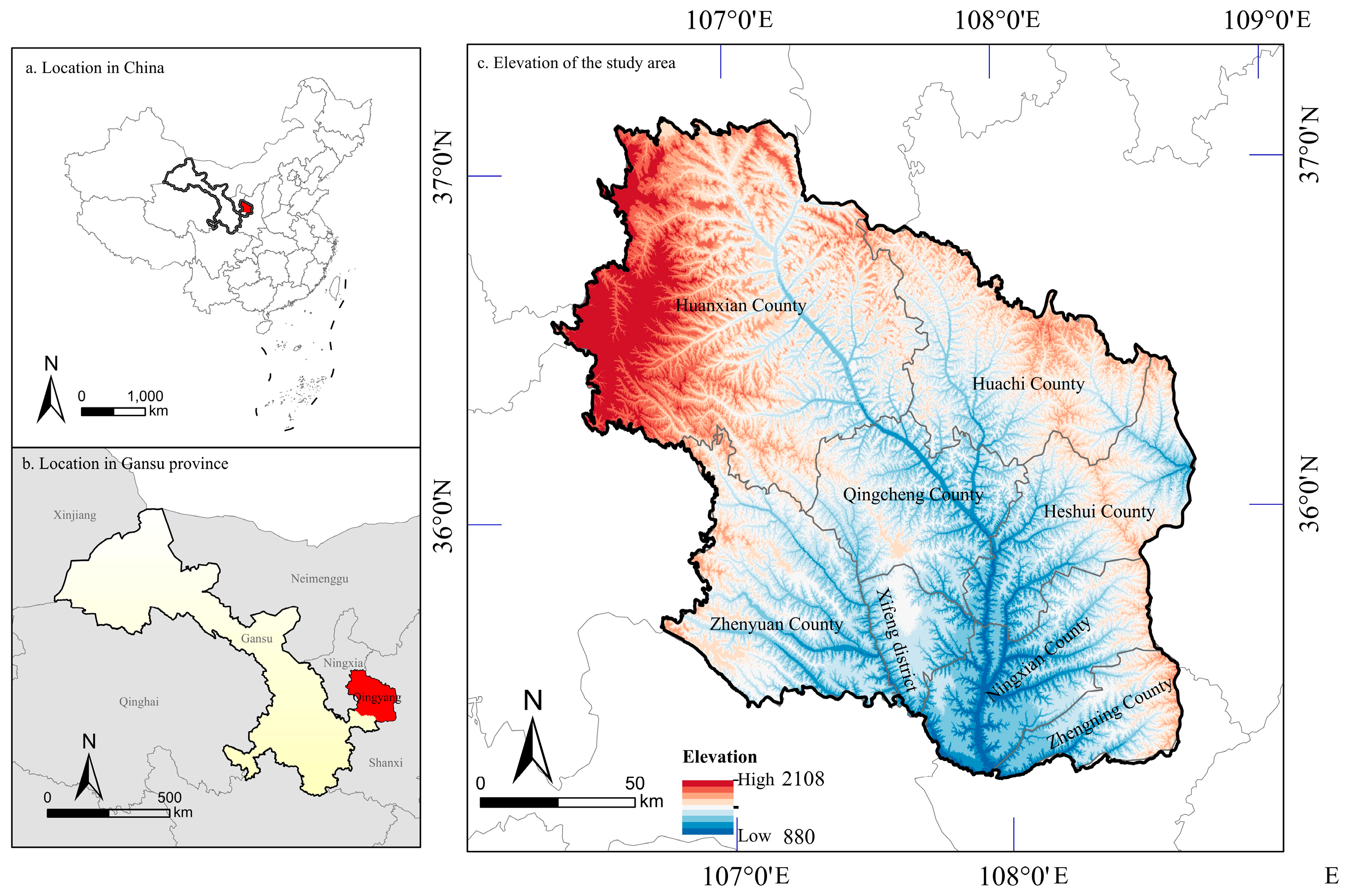
Qingyang City is situated in the hinterland of the eastern Loess Plateau, Gansu Province (104°42′–108°42′ E, 35°14′–37°09′ N). It serves as the core area of the Shaanxi-Gansu-Ningxia Energy “Golden Triangle” and has a total area of 27,119 km2 (Figure 1). The landforms are predominantly characterized by loess yuan (tablelands), liang (ridges), mao (knolls), and gullies. Among these, Dongzhi Yuan is the world’s largest loess tableland surface (910 km2) [18,19]. Due to intense water and wind erosion, the regional gully density reaches 2.5–3.8 km/km2 [20], resulting in high terrain fragmentation and a fragile ecological base. The climate is temperate semi-arid continental monsoon, with an average annual precipitation of 480–660 mm and an aridity index of 1.5–2.0 [21]. According to the latest forest and grassland resource survey data, the city’s forest coverage rate is 26.3%, while soil erosion affects over 85% of its total area, making it a high-intensity erosion center within the Yellow River Basin. Water resources are extremely scarce, with per capita water availability amounting to only one-eighth of the national average [22], and localized groundwater over-extraction occurs [23]. Over the past two decades, high-intensity energy development has triggered significant ecological and environmental effects:
  • Surface deformation and land degradation [24], where mining subsidence areas and industrial land occupation have intensified the consumption of land resources;
  • Structural damage to water systems, as water consumption by the energy and chemical industries has exacerbated the water supply–demand imbalance, increasing the risk of localized water pollution [25];
  • Imbalance in biogeochemical cycles, where soil petroleum hydrocarbon contamination and heavy metal accumulation pose potential threats to agricultural product safety [26].

2.2. Data Sources

The data utilized in this study are detailed in Table 1. To facilitate subsequent data processing and computation, all datasets were resampled and reprojected using ArcGIS software. The unified spatial resolution was set to 1 km, and the projection coordinate system was standardized to WGS_1984_Albers.

2.3. Research Methods

The InVEST (Integrated Valuation of Ecosystem Services and Tradeoffs) model, developed by the Natural Capital Project, is one of the most widely used modular tools for the spatial assessment of ecosystem services [27,28]. By integrating land use/land cover, climate, topography, soil, and related biophysical parameters, the model can quantitatively evaluate ecosystem services such as HQ, WY, SR, and CS, and is suitable for comparing ecosystem service changes under different scenarios or across different time periods. Owing to its explicit input requirements, clear modular structure, and strong spatial representation capability, InVEST has been widely applied in studies of trade-offs/synergies and driving mechanisms of ecosystem services at the regional scale. Given the typical ecological fragility and compounded disturbances from resource development in Qingyang, this study employed the Habitat Quality, Sediment Delivery Ratio (SDR), Carbon Storage and Sequestration, and Annual Water Yield modules of the InVEST model to assess HQ, SR, CS, and WY, respectively. FS and GS were spatialized using statistical data, NDVI, and a gridded index model.

2.3.1. Ecosystem Service Assessment

  • Habitat Quality (HQ)
The Habitat Quality module of the InVEST model was used for calculation, and the formula is as follows [29,30]:
Q x j = H j 1 D x j z D x j z + k z
where Q x j is the HQ index for grid cell x in land use (LULC) type; H j is the HQ of LULC type; k is the half-saturation constant; z is a normalization constant, typically set to 2.5.
Parameter settings were established with reference to the InVEST Model User’s Guide and studies conducted in similar regions. Within the ArcMap 10.8 platform, the five-period land use/land cover (LULC) data of Qingyang City underwent vectorization, reclassification, rasterization, and data aggregation. Considering the actual conditions of Qingyang City, four LULC types—Cropland, Urban construction, Rural residential areas and industrial land—were designated as threat sources. Their respective weights, associated maximum threat distances, and decay types were determined. Parameters were refined based on relevant literature and expert consultation. Specific details are provided in the Threat Factor Weight Table (Table 2) and Sensitivity Index Table (Table 3) [31].
  • Soil Retention (SR)
Calculated using the Sediment Delivery Ratio (SDR) module of the InVEST model. This module is based on the actual soil erosion model at the raster scale, incorporating raster data such as land use types, soil properties, elevation, vegetation cover factor, rainfall erosivity, and soil conservation practice factors. It ultimately outputs result at both raster and watershed scales. The calculation formula for soil retention capacity is as follows [32]:
RKLS = R × K × LS
USLE = R × K × LS × C × P
SC = RKLS − USLE
where RKLS is the potential soil erosion amount, USLE is the actual soil erosion amount, SC is the soil retention capacity, LS is the slope length and steepness factor, K is the soil erodibility factor, C is the cover and management factor, R is the rainfall-runoff erosivity factor, and P is the support practice factor.
With reference to relevant studies [33] and in consideration of the characteristics of typical land-use/land-cover types in the gully region of the Loess Plateau in Qingyang, localized values of the C and P parameters were assigned to different land-use types in this study. The specific parameter values are shown in Table 4. Water bodies, urban construction land, rural residential land, and industrial land were treated as non-erodible surfaces in this study; therefore, their C and P values were set to 0.
  • Carbon Storage (CS)
CS represents an ecosystem’s carbon sequestration capacity, encompassing above-ground, below-ground, soil, and dead organic matter carbon pools. The InVEST model was applied to quantify CS in Qingyang City, calculated as follows [34]:
Ct = (Ca + Cb + Cs + Cd)
Ci = (Ca + Cb + Cs + Cd) × Ai
where Ct is the total CS (in tonnes); Ca, Cb, Cs, Cd are the above-ground, below-ground, soil, and dead organic matter CS, respectively; Ci is the CS of land use type i; Ai is the area of land use type i. Carbon density values for Qingyang City’s land use types (Table 5) were derived from peer-reviewed studies on carbon density in the Loess Plateau and Gansu Province [35].
  • Water Yield (WY)
WY is an important indicator characterizing the annual water supply capacity of an ecosystem. In this study, the Annual WY module of the InVEST model was employed to estimate the relative contribution of the landscape to mean annual WY at the pixel scale, based on the Budyko water–energy balance theory [40], and to interpret its spatial differentiation at the regional scale. The model calculates annual WY for each pixel by comparing precipitation and actual evapotranspiration, as follows [41]:
A W Y x = 1 A E T x P x × P x
where A W Y x is the annual WY of pixel x (mm), A E T x is the actual annual evapotranspiration of pixel x (mm), and P x is the annual precipitation of pixel x (mm). For vegetated land-cover types, actual evapotranspiration is calculated according to the Budyko curve:
A E T x P x = 1 + P E T x P x 1 P E T x P x ω x 1 / ω x
where
ω x = Z A W C x P x + 1.25
In this equation, Z is an empirical constant used to characterize the local precipitation regime and additional hydrogeological characteristics; it was calibrated by comparing model outputs with the statistical values of total surface water resources in Qingyang reported in the Gansu Provincial Water Resources Bulletin. A W C x denotes the plant-available water content of pixel x (mm), which is determined by the root-restricting layer depth, rooting depth, and plant-available water content [42]:
A W C x = m i n   ( S D , R D ) × P A W C
P A W C = 54.509 0.312 S A 0.003 S A 2 0.055 S I 0.006 S I 2 0.738 C L + 0.007 C L 2 2.688 O M + 0.501 O M 2
where S D is the root-restricting layer depth (mm), R D is the rooting depth (mm), and P A W C is the plant-available water content (%). S A , S I , C L , and O M represent the contents of sand, silt, clay, and organic matter, respectively, and P A W C is calculated using the Saxton empirical equation. The Budyko dryness index R is defined as:
R = P E T x P x = K x × E T 0 P x
where P E T x is the potential evapotranspiration (mm), K x is the evapotranspiration coefficient for the land-use type, and E T 0 is the reference evapotranspiration (mm). Reference evapotranspiration was calculated using the Hargreaves equation [43]:
                E T 0 = 0.0023 × R a × ( T m a x T m i n ) 0.5 × ( T m e a n + 17.8 )
where R a is extraterrestrial radiation (MJ·m–2·d–1), and T m a x , T m i n , and T m e a n are the daily maximum, minimum, and mean air temperatures (°C), respectively. The biophysical parameters required by the WY module mainly include rooting depth and evapotranspiration coefficients for different land-use types. Parameter values were derived from the InVEST User’s Guide and relevant studies conducted in Gansu Province and the Loess Plateau [44], and were further localized according to the actual conditions of Qingyang. The specific parameter values are listed in Table 6.
  • Food Supply (FS)
FS were spatially distributed across 1 km × 1 km grids by integrating grain yield statistics from Gansu Province with NDVI data. This approach quantifies ecosystem-derived food supply through grain production metrics [45].
Pi = NDVIi/NDVIsum × Psum
where P i is the FS at pixel i; P sum is the total FS in Qingyang City; N D V I i is the NDVI value of cropland pixel i; and N D V I sum is the summed NDVI values of all cropland pixels.
  • Grassland Forage Supply (GS)
This study employed a grid-based carrying capacity model to assess grassland forage provisioning capacity, quantified through the GS Index (GFSI). The index integrates three critical determinants: vegetation productivity, grassland resource endowment, and livestock grazing pressure. The computational framework is expressed as [46,47]:
G F S I j , i = N D V I j , i / i = 1 n N D V I j , i × G A j , i / A j , i × S U j , i
where N D V I j , i is the NDVI value of 1 km grid i within region j; G A j , i is the grassland area (km2) of grid i; A j , i is the total area (km2) of grid i; and S U j , i is the total livestock population within region j uniformly converted to sheep units (SU).

2.3.2. Ecosystem Service Trade-Offs and Synergies

We employed R-based Pearson correlation matrices to quantify interrelationships among six ecosystem services (HQ–SR–CS–WY–FS–GS). The analysis established the following interpretation framework:
Synergistic relationships were identified by statistically significant positive correlations ( r > 0 , p < 0.05 ), indicating simultaneous increase or decrease in paired services.
Trade-off relationships were denoted by statistically significant negative correlations ( r < 0 , p < 0.05 ), reflecting an inverse relationship where one service increases as the other diminishes.

2.3.3. Optimal Parameters-Based Geographical Detector (OPGD)

To accurately identify core drivers of ecosystem service supply and their interaction mechanisms, this study employs the OPGD [48]. This method addresses limitations in traditional Geographical Detectors (GD), it specifically results biases caused by subjective discretization of explanatory variables, through systematic optimization of classification parameters to deeply extract geospatial feature information, significantly enhancing model analytical efficacy. Implementation was conducted using the “GD” package in R 4.3.0 with standardized preprocessing of continuous explanatory variables, based on unified spatial units for ecosystem service supply data (dependent variable Y) and driving factors (independent variables X1–Xn). A grid search strategy was then applied to optimize discretization parameters by exhaustively evaluating five classification methods (Natural Breaks, Quantile, Equal Interval, Geometric Interval, and Standard Deviation) combined with 30 parameter configurations of class numbers k ∈ [3,8]. The optimal discretization scheme for each factor was selected by maximizing the q-statistic (Formula (16)), calculated as follows [49]:
q = 1 h = 1 k N h σ h 2 N σ 2
where N denotes the total sample size, N h represents the subsample size within a subregion, σ 2 is the global variance of Y, and σ h 2 indicates the intra-subregion variance. A higher q-value signifies stronger explanatory power of the factor regarding the spatial heterogeneity of ecosystem services. By comparing the interaction q-value (derived from dual-factor detection) with the sum of individual factor q-values, we classified interaction types into: nonlinear enhancement, bifactorial enhancement, independence, or weakening effects.
Drawing on relevant studies and the energy development context of the research area, we investigated influencing factors of ecosystem services in Qingyang City through three dimensions: natural environment, socioeconomic conditions, and energy extraction pressure. Eleven independent variables were selected as Elevation (X1), Precipitation (X2), Temperature (X3), Potential Evapotranspiration (X4), NDVI (X5), Soil Erosion Modulus (X6), Population Density (X7), GDP (X8), Land Use Intensity (X9), Road Network Density (X10), and Groundwater Level (X11). Detailed metric specifications are presented in Table 7.

3. Results

3.1. Quantification of Ecosystem Services

3.1.1. Spatiotemporal Patterns of Habitat Quality

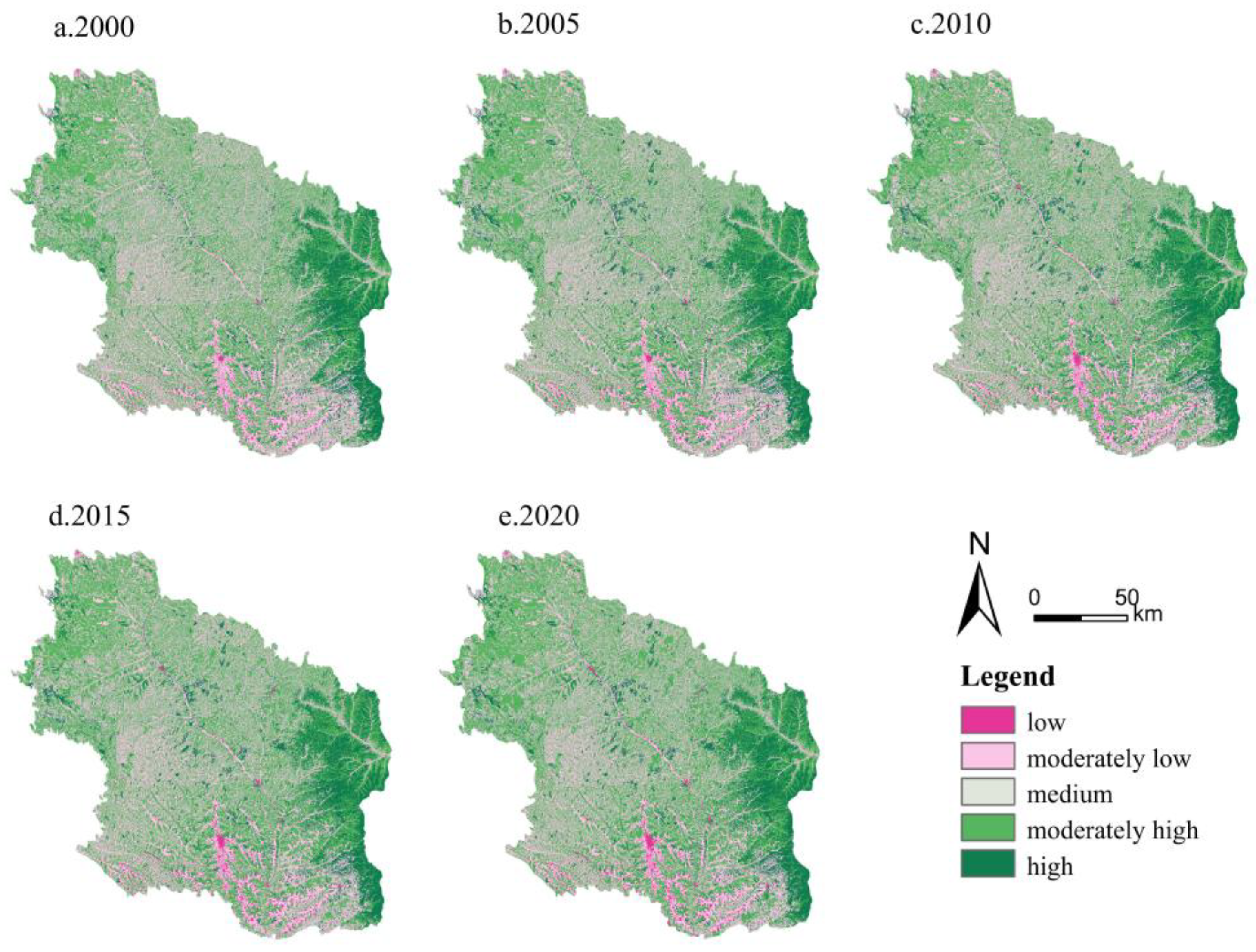
To quantify the evolution of HQ, the HQ index was classified into five tiers using the equal interval method in ArcGIS 10.8: Low (0–0.2), Moderate-Low (0.2–0.4), Medium (0.4–0.6), Moderate-High (0.6–0.8), and High (0.8–1). As shown in Figure 2, the average HQ index in Qingyang City during 2000–2020 was 0.6654, indicating an overall high level. Annual averages were 0.6581 (2000), 0.6633 (2005), 0.6658 (2010), 0.6656 (2015), and 0.6797 (2020), demonstrating a fluctuating upward trend. Spatially, HQ exhibited a pattern of “higher values in the east and north, lower values in the center and south,” with high-quality zones gradually expanding while low-quality areas locally contracted.
High-quality zones were concentrated along the southeastern periphery and river valleys, dominated by forest, grassland, and structurally intact farmland ecosystems. Temporally, these areas showed slight northwestward and southwestward boundary expansion, particularly after 2010 when medium-high quality zones increased in hilly-valley transition areas, indicating positive effects from ecological restoration and land management measures. Medium-quality zones exhibited minor area fluctuations but stabilized spatially during 2015–2020, suggesting dynamic equilibrium without significant degradation. Low-quality zones were predominantly distributed across the Xifeng-Qingcheng loess tablelands and Ruhe River corridors, characterized by intensive cropland and built-up areas under agricultural and urbanization pressures. Despite this, these zones did not expand significantly; instead, localized shrinkage occurred along their edges. For instance, scattered low-quality patches shrank in central tablelands during 2010–2015, and by 2020 partial replacement by medium-quality zones was observed, reflecting gradual improvements from human interventions like the Grain-for-Green Program and soil-water conservation projects.

3.1.2. Spatiotemporal Patterns of Soil Retention

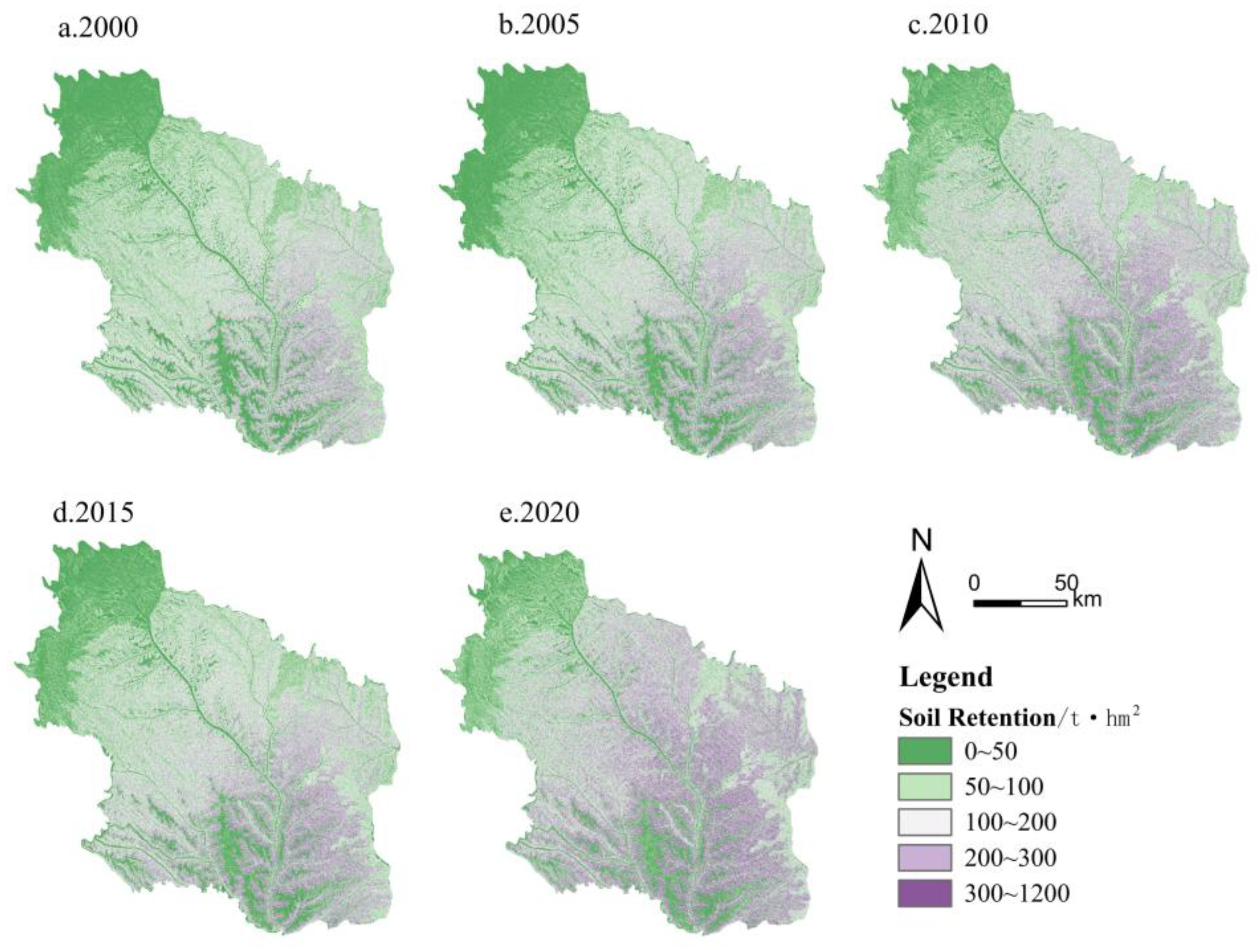
Using 30 m resolution DEM data, SR in Qingyang City from 2000 to 2020 was quantified through the sediment delivery ratio module of the InVEST model. Total SR volumes were 2598.57 × 106 t (2000), 2888.27 × 106 t (2005), 3567.91 × 106 t (2010), 3143.04 × 106 t (2015), and 4053.41 × 106 t (2020), with corresponding mean areal densities of 97.7 t·hm−2, 101.93 t·hm−2, 125.92 t·hm−2, 110.92 t·hm−2, and 143.05 t·hm−2. Overall, SR capacity demonstrated a persistent increasing trend, with total volume rising by 1454.84 × 106 t and areal density increasing by 45.35 t·hm−2.
Spatially (Figure 3), high SR zones predominantly occurred in southern Huachi County, southwestern Heshui County, southeastern Qingcheng County, and parts of Ningxian and Zhengning counties. This spatial clustering reflects synergistic effects between favorable physiographic conditions and systematic ecological restoration projects. High-value areas, such as the relatively flat Dongzhi Tableland, facilitate soil and nutrient preservation. With enhanced NDVI from key ecological initiatives (e.g., Grain-for-Green Program, small watershed management [52] effectively reducing erosion. In contrast, low SR zones were extensively distributed across loess hilly-gully regions in northern Huachi and Huanxian counties, where steep slopes, fragmented terrain, and sparse vegetation increase erosion susceptibility, resulting in diminished SR capacity.

3.1.3. Spatiotemporal Patterns of Carbon Storage

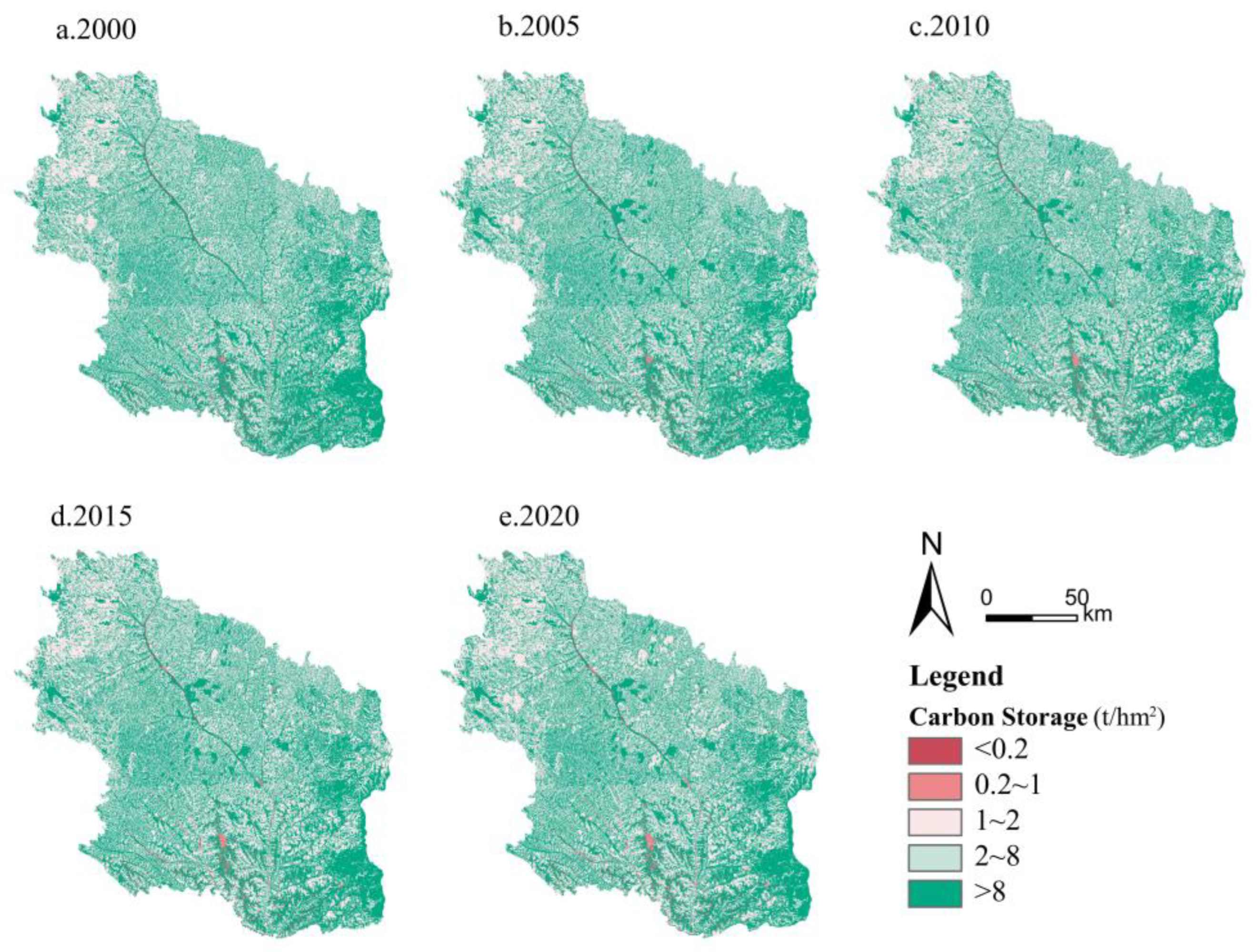
The spatial distribution of CS in Qingyang City during 2000–2020 is shown in Figure 4, exhibiting a pattern of “higher values in the south, lower values in the north, with localized expansion of high-value zones.” Total CS was 1601.85 × 104 t (2000), 1607.13 × 104 t (2005), 1585 × 104 t (2010), 1580.32 × 104 t (2015), and 1552.83 × 104 t (2020), demonstrating a fluctuating trajectory of initial increase followed by decrease. This represents a cumulative reduction of 3.06% over the two decades. High CS zones (>8 t·hm−2) were concentrated in the southern Ziwuling region, where dense forest and grassland coverage formed stable carbon sinks. In contrast, the northern loess hilly areas predominantly exhibited medium CS (2–8 t·hm−2).
Temporally, high-value zones expanded slowly during 2000–2010, with accelerated growth after 2015. Particularly in southern and southeastern regions, high-carbon patches (>8 t·hm−2) showed increasing connectivity and aggregation, indicating enhanced carbon sequestration capacity from long-term ecological conservation and restoration initiatives. Meanwhile, low-carbon zones (<0.2 t·hm−2) contracted in northern and central agricultural areas but persisted around urban peripheries and major transportation corridors, reflecting sustained pressure from urbanization and infrastructure development.

3.1.4. Spatiotemporal Patterns of Water Yield

  • Accuracy validation of the water yield model
To examine the applicability of the InVEST Annual Water Yield module in Qingyang, this study used the surface water resources of Qingyang reported in the Gansu Provincial Water Resources Bulletin for 2000, 2005, 2010, 2015, and 2020 as an independent regional-scale reference. The modeled total WY at the municipal scale was compared with the statistical values, and the key parameter Z was calibrated. After repeated adjustments to obtain the optimal Z value for each year, model performance was evaluated using relative error (RE), mean absolute error (MAE), root mean square error (RMSE), mean absolute percentage error (MAPE), mean error rate (MER), and the coefficient of determination ( R 2 ). The results showed a high overall consistency between the modeled and statistical values for the five selected years. The absolute values of the relative errors for all years were below 5%, with an MAE of 0.118 × 10⁸ m3, an RMSE of 0.139 × 10⁸ m3, a MAPE of 2.11%, a MER of −1.36%, and an R 2 of 0.983 ( p < 0.001 ) (Table 8). The slightly negative MER indicates a minor overall underestimation by the model, but no evident systematic bias was observed. Overall, the calibrated InVEST model can effectively capture the variation characteristics of annual WY in Qingyang.
Furthermore, the Morris global sensitivity analysis was employed to assess the effects of three key input factors— Z , precipitation, and potential evapotranspiration—on the simulation results within the neighborhood of the optimal parameter values. The perturbation ranges were set as Z ± 30 % , precipitation ± 15 % , and potential evapotranspiration ± 10 % . The results showed that precipitation had the highest sensitivity (sensitivity index = 1.570), indicating that its accuracy plays a decisive role in WY simulation. Potential evapotranspiration ranked second (sensitivity index = 0.176), whereas the sensitivity of Z was the lowest (sensitivity index = 0.036), suggesting that the model remained stable near the calibrated optimal Z values. These results indicate that the InVEST Annual WY module has good applicability in Qingyang and can provide reliable support for regional-scale WY service assessment.
  • Spatiotemporal variation characteristics of WY
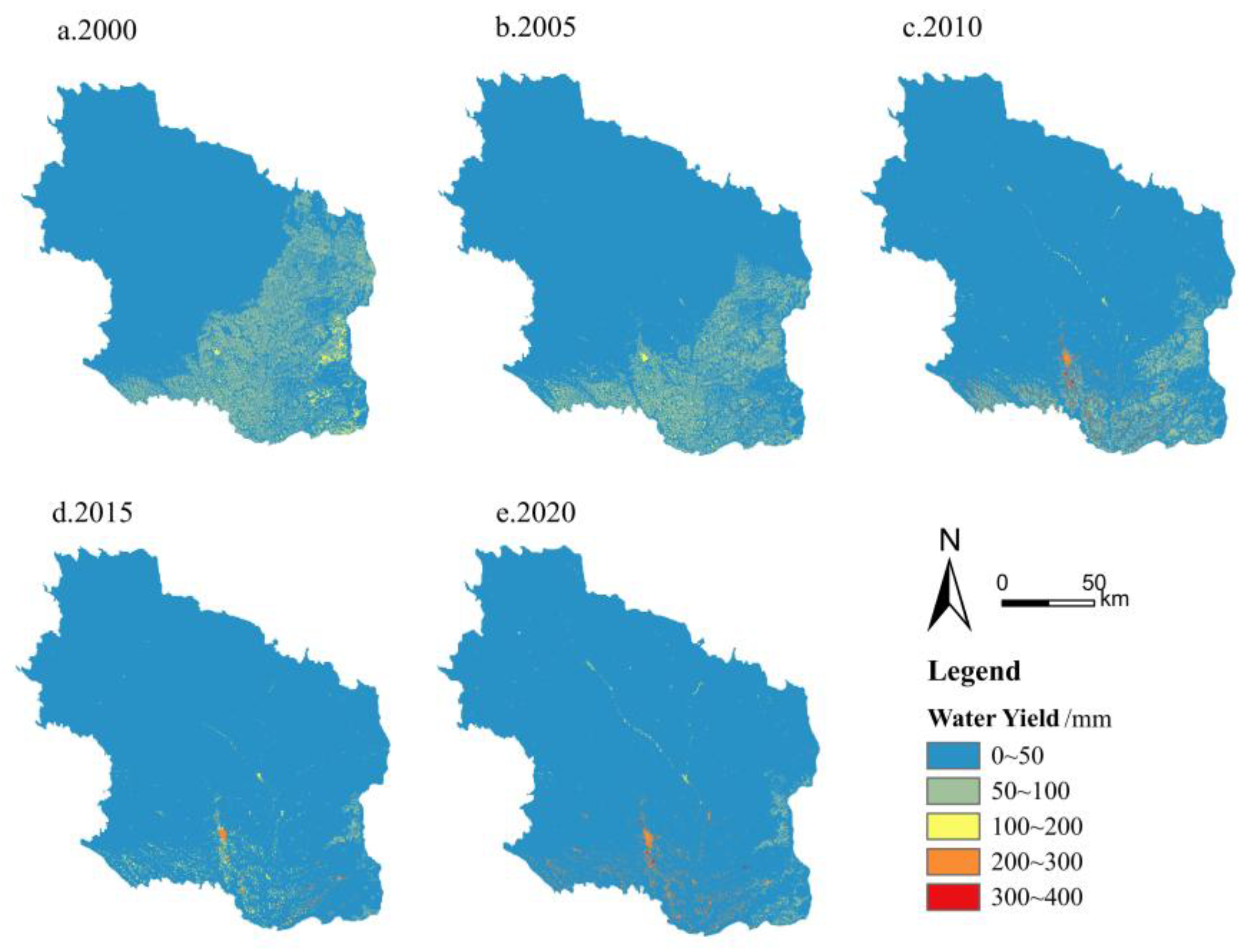
As shown in Figure 5, WY in Qingyang City exhibited a tiered spatial pattern characterized by “higher values in the south, lower values in the north, with pronounced gully features.” High-yield zones (>200 mm) concentrated in the upper valleys of the Jinghe and Puhe rivers (eastern Ningxian, southwestern Zhengning), with a multi-year average WY of 220–260 mm. Local areas near the headwaters of the Jiulong River (a tributary of the Jinghe) reached 300 mm, forming the region’s core water source belt. Medium-yield zones (100–200 mm) extended in dendritic patterns along the southern Malian River and Honghe River, while low-yield zones (≤50 mm) covered 98.3% of the study area, predominantly across northern loess ridge-hillock terrain, particularly in northwestern Huanxian and northern Huachi counties.
Temporally, the WY classification structure underwent fundamental shifts during the study period. The proportion of low-yield areas (≤50 mm) expanded from 84.90% to 98.30%, increasing by 13.4% over the 20-year period. Concurrently, medium-yield areas (50–200 mm) experienced comprehensive contraction, declining from 13.49% to 0.12%. High-yield areas (200–400 mm) exhibited unique spatiotemporal fluctuations, maintaining 0.02–1.38% areal coverage while persistently clustering in the Ziwuling forest region. Transient expansions occurred following episodic events (e.g., 2010 rainstorms, 2020 sponge city development). This structural transition reflects altered deep-layer hydrological processes driven by the convergence of soil-water conservation projects and climatic aridification, revealing a complex hydrological evolution: widespread WY decline alongside enhanced local regulatory capacity.

3.1.5. Spatiotemporal Patterns of Food Supply Service

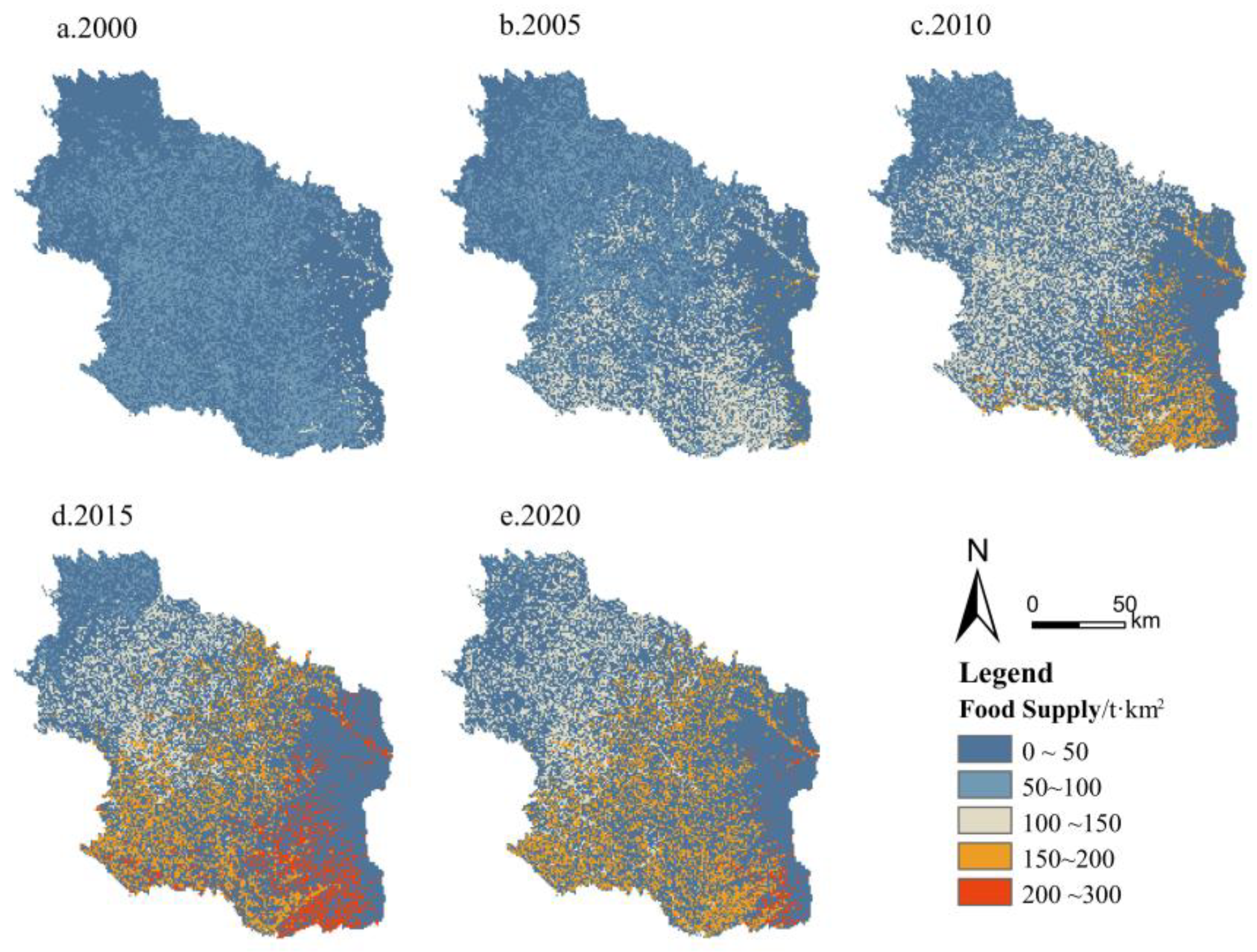
During 2000–2020, FS in Qingyang City exhibited a fluctuating trend characterized by an initial increase followed by a decline. The total output rose from 698,200 metric tons in 2000 to 1,631,300 metric tons in 2015 (a 134% increase), subsequently decreasing to 1,474,600 metric tons by 2020.
Spatial heterogeneity in FS capacity was pronounced (Figure 6), forming a gradient pattern with high-value zones concentrated in the southeast (centered on the Malian River Basin) and low-value areas in the northwest (Huanjiang River Basin). High-yield zones (200–300 t·km−2) clustered predominantly on the alluvial plains of the lower Malian River, encompassing Ningxian County, central-western Zhengning County, and southeastern Heshui County. These areas benefit from flat loess tableland topography (elevation: 1200–1400 m), fertile lou soils (a subtype of loessial soil), and semi-humid monsoonal climate conditions (mean annual precipitation: 550–650 mm), collectively establishing them as the core production area of the “Longdong Granary.”
Low-yield zones (<100 t·km−2) primarily occurred in the loess hilly-gully region of northern Huanxian County and the eastern foothills of the Ziwuling Mountains (spanning Huachi, Heshui, and eastern Zhengning). Constrained by severe soil erosion, arid climate (mean annual precipitation in Huanxian: <400 mm), and fragmented terrain, these areas rely predominantly on rain-fed agriculture. Farmland distribution is fragmented, irrigation coverage remains below 20%, and land productivity is consequently limited.

3.1.6. Spatiotemporal Patterns of Grassland Forage Supply

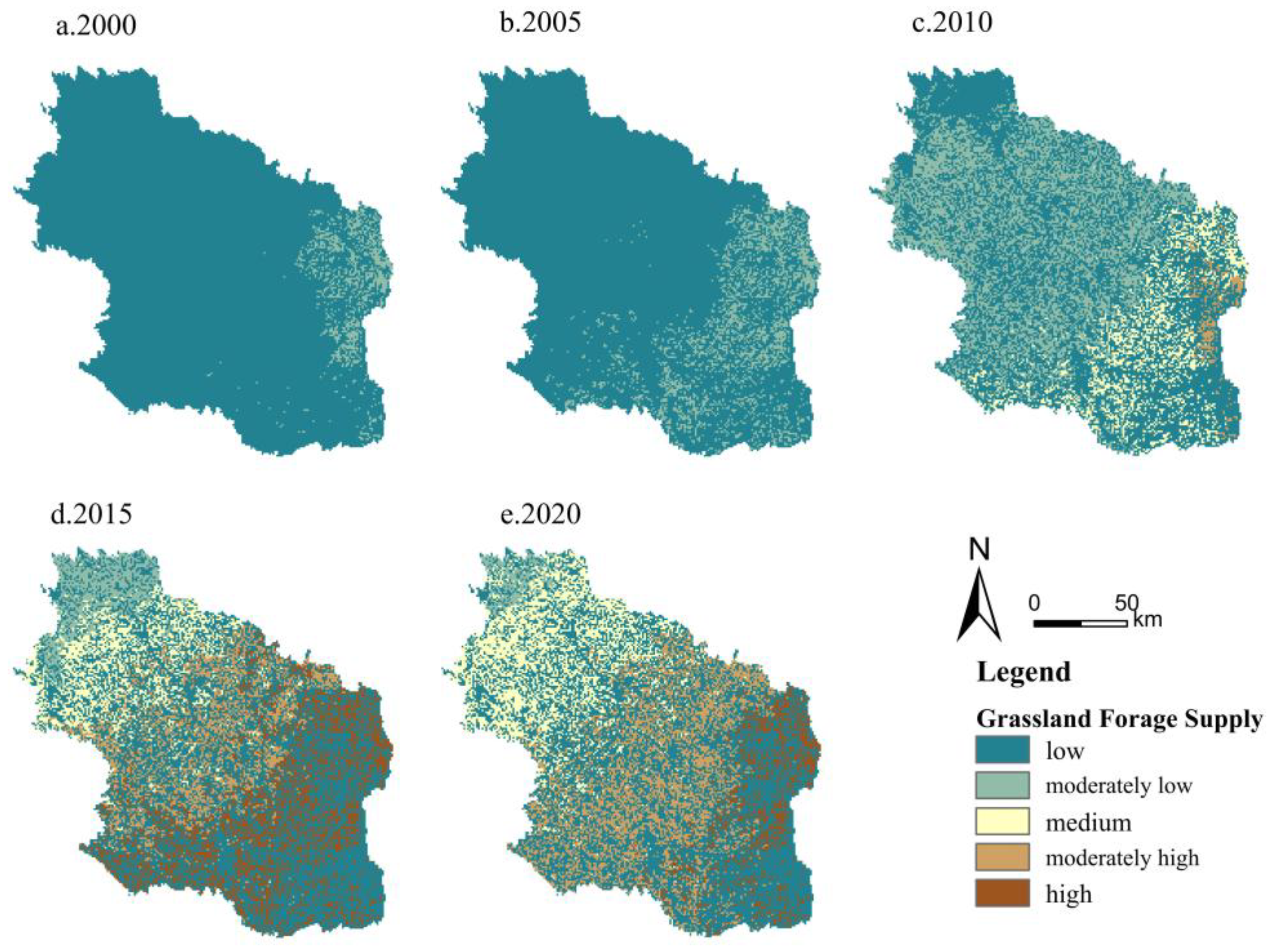
Based on InVEST model simulations and the GS Index (GFSI), GS was classified into five levels: Low (GFSI < 5), Moderate-Low (5 ≤ GFSI < 10), Medium (10 ≤ GFSI < 15), Moderately High (15 ≤ GFSI < 20), and High (GFSI ≥ 20). During 2000–2020, Qingyang City exhibited a pattern of rapid initial growth followed by moderate adjustment in GS, with total volume increasing by 241% (from 264.47 × 10⁴ SU to 902.59 × 10⁴ SU). Spatially, a distinct gradient of “higher values in the southeast, lower values in the northwest, with localized expansion of high-value zones” was observed (Figure 7). The eastern Ziwuling forest region and southern loess tablelands formed core high-supply areas, while northern loess hilly-gully regions were dominated by low supply.
High-supply zones (Moderately High to High levels) featured natural forests, plantations, and high-quality grasslands with dense NDVI conducive to forage growth. Low-supply zones (Low to Moderate-Low levels), constrained by severe soil erosion, arid climate (<400 mm annual precipitation), and fragmented terrain, supported sparse shrubs and xerophytic herbs with limited productivity.
Temporally, GS demonstrated a clear “scissors differential” pattern: contraction of low-grade zones and expansion of medium-high grades. The supply capacity transitioned from a near-exclusive “Low” dominance in 2000 to a tripartite structure (“Low,” “Medium,” and “Moderately High”) by 2020. The combined area share of Medium and higher grades rose from 0% to 43.26%, highlighting the efficacy of ecological restoration and grassland management measures. Nevertheless, low-grade areas still dominated spatially, indicating that enhancing baseline productivity in extensive low-yield grasslands remains critical for sustainable regional ecological animal husbandry.

3.2. Trade-Offs and Synergies Among Ecosystem Services

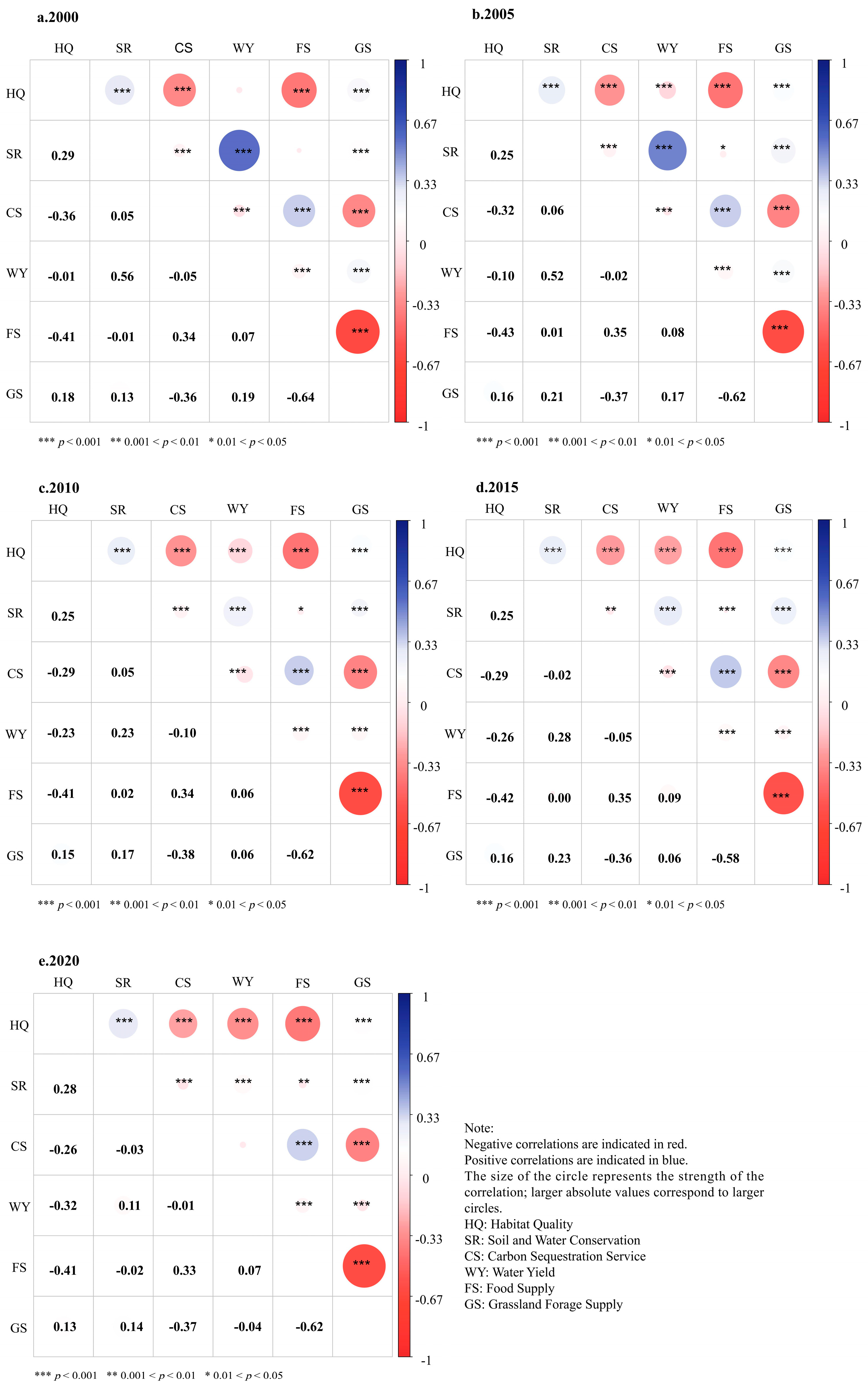
Trade-offs and synergies among ecosystem services reflect the coupled effects of ecological processes and human activities and are therefore essential for understanding regional ecological security patterns. Overall, the relationships among ecosystem services in Qingyang exhibit a differentiated pattern characterized by intra-category synergy and inter-category trade-off. Regulating and supporting services are dominated by synergistic relationships, although clear differences remain among specific service pairs. By contrast, provisioning services generally exhibit trade-offs with regulating services, among which the trade-offs between FS–HQ and between FS–GS are the most pronounced, whereas FS–CS show a certain degree of synergy (Figure 8).
Within regulating and supporting services, SR–WY show the most stable and significant synergistic relationship, with the correlation coefficient declining from 0.56 in 2000 to 0.11 in 2020, indicating that the two services remained positively coupled overall, although the strength of the synergy weakened over time. HQ–SR also consistently showed a weak positive correlation (0.25–0.29), suggesting that better vegetation conditions and more intact habitat structures generally contribute to reducing erosion risk. At the same time, regulating services were not entirely synergistic: HQ–CS remained negatively correlated (−0.36 to −0.26), and HQ–WY were also generally negatively correlated (−0.01 to −0.32), indicating evident spatial mismatches and functional differences among different regulating services.
The relationships between provisioning services and regulating services were more complex. FS–HQ remained significantly negatively correlated throughout the study period (−0.41 to −0.43), indicating that the expansion of food production continuously compressed natural habitat space. FS–GS showed the strongest trade-off (−0.64 to −0.58), suggesting that under the constraint of limited land resources, competition between grain production and forage supply constitutes the core contradiction in the ecosystem service relationships of Qingyang. In contrast, FS–CS remained positively correlated throughout the study period (0.33–0.35), indicating that, at the municipal scale, food supply and carbon storage are not simply opposed to each other but instead display a certain degree of synergy. By comparison, GS–HQ and GS–SR were mostly weakly positively correlated (0.13–0.23), whereas GS–CS remained negatively correlated (−0.38 to −0.36), indicating clear differentiation in the relationships between forage supply and different regulating services.
In terms of temporal dynamics, the overall trade-off/synergy pattern remained relatively stable from 2000 to 2020, suggesting that it was jointly shaped by the regional natural background and long-term human activities and therefore exhibited strong inertia. Only modest changes were observed among specific service pairs: the synergy between SR–WY gradually weakened, whereas the negative correlation between HQ–CS was slightly alleviated, although the overall pattern remained unchanged. Overall, ecosystem service relationships in Qingyang cannot be simply summarized as “synergy among regulating services and trade-offs involving provisioning services”; rather, they exhibit a more complex differentiated structure, in which the FS–GS competition and the FS–HQ contradiction are the most prominent.

3.3. Driving Force Analysis Based on OPGD

3.3.1. Single Factor Detection Results

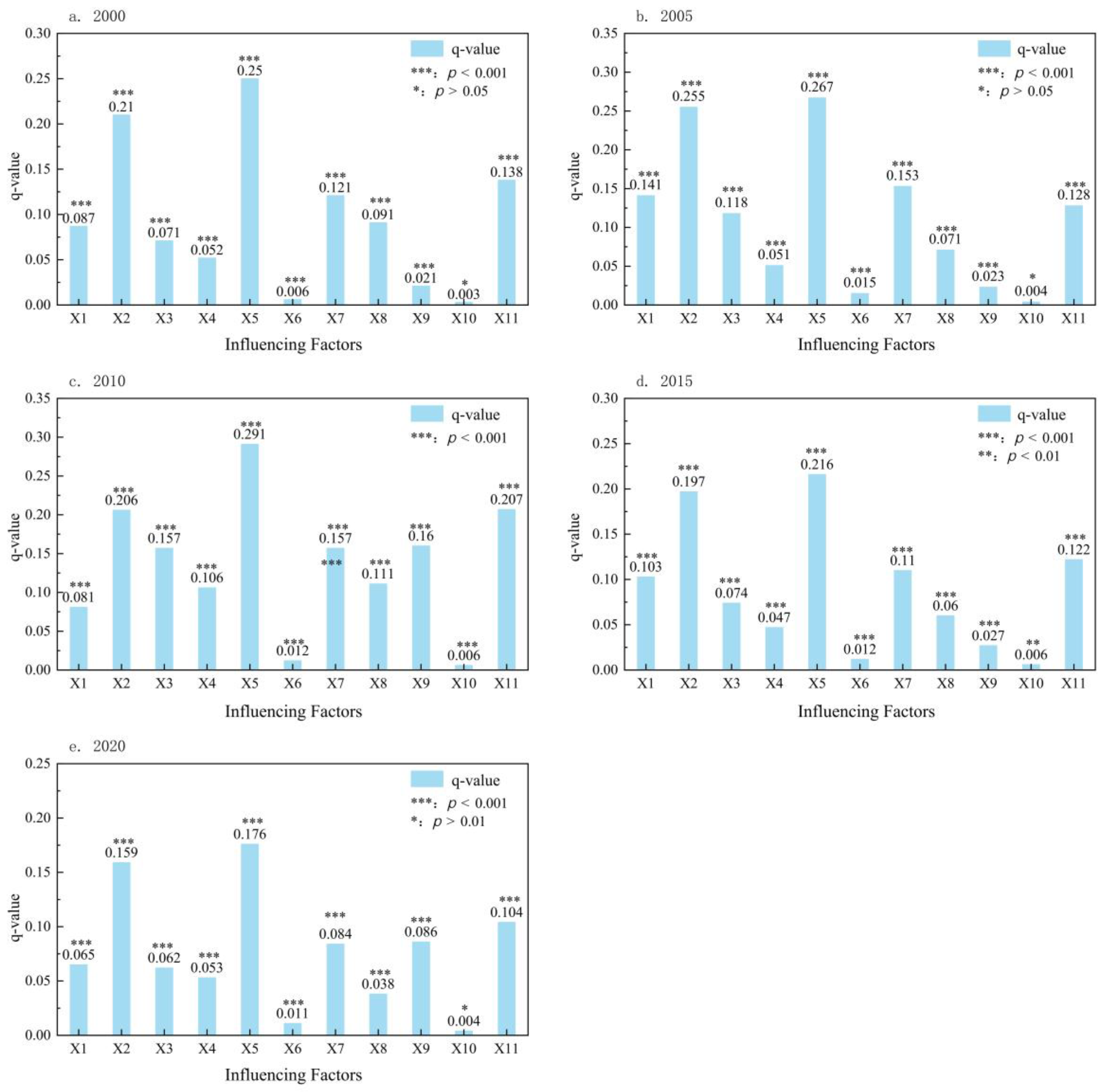
As shown in Figure 9, drivers of ecosystem services in Qingyang City over the 20-year period were characterized by persistent decline in natural factors and intensified human activities. The combined contribution rate of natural factors—NDVI (X5) and precipitation (X2)—declined from 54.6% in 2005 to 33.5% in 2020. Groundwater level (X11), a core indicator of energy extraction activities, emerged as the second-largest driver (q = 0.207) by 2010, signaling water resource crises as a primary ecological stressor. Land use intensity (X9) underwent a transition from “peripheral to core” influence, with its q-value rising from 0.021 in 2000 to 0.086 in 2020 (a 309.5% increase), becoming the fourth-largest driver. Conversely, population density (X7) descended from the third position (0.153) in 2005 to fifth (0.084) in 2020, while GDP (X8) decreased by 65.8% after 2010 (from 0.111 to 0.038). These dynamics epitomize Qingyang’s core conflict as a national energy base: ecological conservation versus energy exploitation. Plummeting groundwater tables and intensified land use jointly mark the region’s transition into a “resource curse” risk phase.

3.3.2. Interaction Detection Results

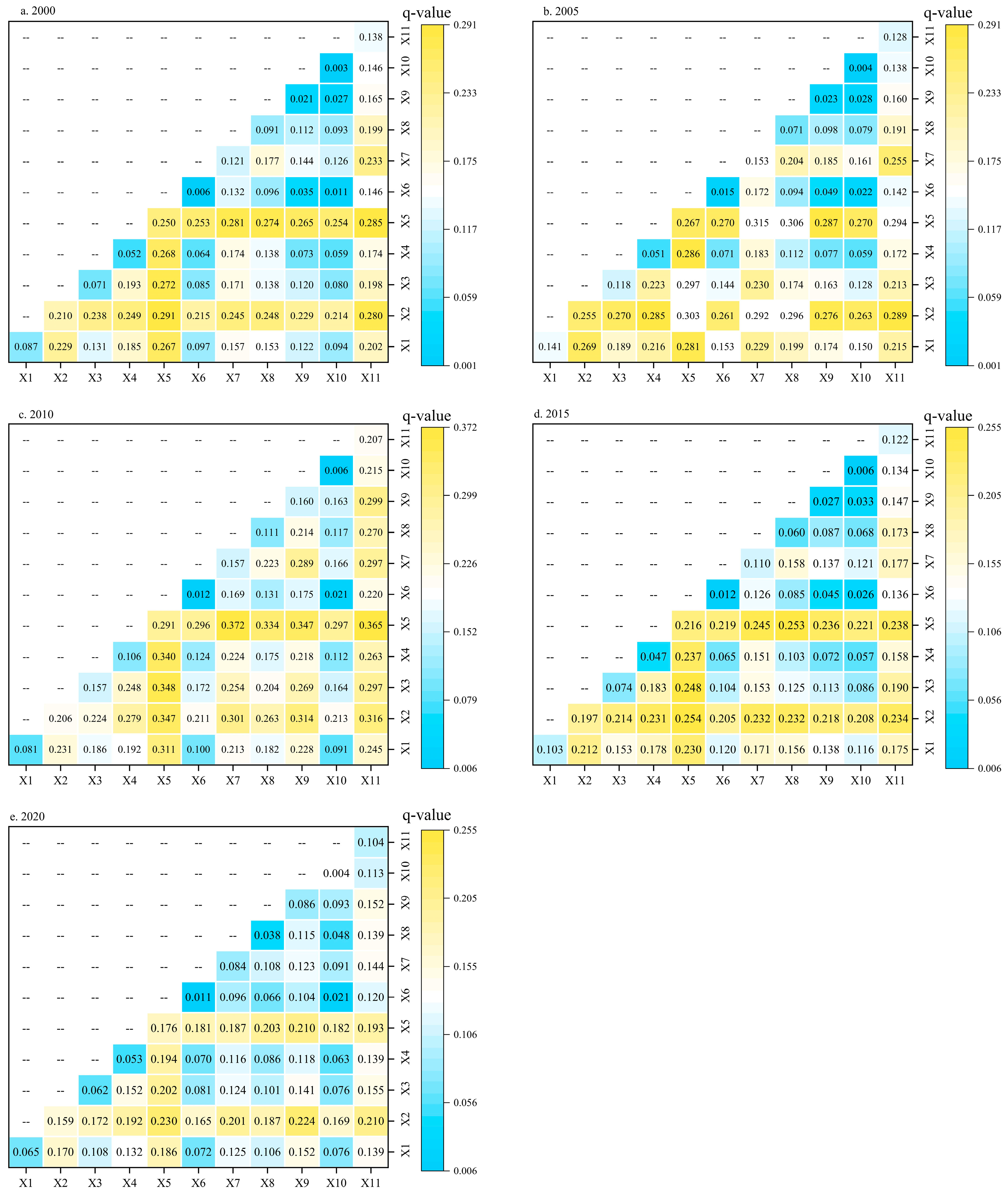
OPGD interaction analysis revealed nonlinear enhancement effects among driving factors of ecosystem services in Qingyang City (Figure 10). Calculations of pairwise q-values demonstrated that all factor combinations exhibited either bivariate enhancement or nonlinear enhancement, indicating that ecosystem service changes are predominantly governed by multi-factor synergies. During the study period, NDVI (X5) showed significant interactions with all factors (q > 0.25), peaking in 2010 with temperature (X3, q = 0.3478) and precipitation (X2, q = 0.3471), empirically validating vegetation’s sensitivity to hydrothermal conditions.
Human activity factors displayed progressively intensified interactions with other elements. For instance, interactions between GDP (X8) and population density (X7) with natural factors (e.g., precipitation X2, elevation X1) consistently strengthened (q-value increases >0.05 during 2000–2020), highlighting urbanization’s constraining effect on ecological services.
Temporally, enhanced interactions included the NDVI-precipitation combination (X5-X2), whose q-value rose from 0.2908 (2000) to 0.3471 (2010) before declining to 0.2304 (2020), reflecting vegetation’s phased sensitivity to climate fluctuations. Conversely, groundwater level (X11) and GDP (X8) interactions surged from 0.1994 (2000) to 0.2695 (2010), revealing intensified coupling between water resource exploitation and economic growth.
Weakened interactions manifested most notably in the road density-soil erosion pair (X10-X6), which maintained consistently low stability (q ≈ 0.01–0.02), indicating limited direct impact of transportation infrastructure on soil and water loss.

4. Discussion

4.1. Regional Commonalities and Local Differences in Ecosystem Service Evolution

From 2000 to 2020, ecosystem services in Qingyang exhibited a mixed pattern of improvement and decline. Specifically, HQ and SR improved overall, while FS and GS showed an overall increase; in contrast, CS declined and WY continuously decreased. These findings are broadly consistent with the general patterns reported for the Loess Plateau and the Yellow River Basin, namely that ecological restoration can substantially improve SR and local habitat conditions, but does not necessarily lead to the simultaneous enhancement of all ecosystem services. In particular, WY often declines as vegetation restoration enhances evapotranspiration, while gains in carbon-related services may also be offset by land development disturbances [53,54,55]. This suggests that ecosystem services respond differently to ecological restoration, climate change, and human activities, and that regional change does not follow a simple linear trajectory of improvement.
In spatial terms, ecosystem services in Qingyang were generally higher in the southeastern and southern parts of the region and lower in the northwest, which is consistent with the hydrothermal and topographic gradients commonly identified in studies of the Loess Plateau and the Yellow River Basin. The Ziwuling area and its surrounding regions, characterized by relatively favorable precipitation conditions and high forest and grassland cover, constitute key zones for habitat maintenance, carbon sequestration, and water conservation. By contrast, northwestern areas such as Huanxian are jointly constrained by aridity, severe erosion, and fragmented terrain, resulting in generally lower levels of ecosystem services. This indicates that the natural geographic setting remains the fundamental basis for the spatial differentiation of ecosystem services in the region.
However, compared with studies conducted at the scale of the entire Loess Plateau or within typical small watersheds, Qingyang also exhibits distinct local characteristics. First, areas of high SR are more concentrated in Dongzhiyuan and the surrounding tableland areas, rather than being confined to steep forested slopes. This suggests that in relatively gentle terrain, the combined effects of terracing, integrated small-watershed management, and vegetation restoration can generate more stable soil and water conservation benefits. Second, the decline in WY is more pronounced in Qingyang, implying that, in addition to climatic drying and vegetation restoration, groundwater-level changes and shifts in surface–groundwater recharge relationships under intensive energy development may have further intensified the decline in water-yield services. Third, although CS increased locally in some forest and grassland areas, it still showed an overall downward trend, indicating that urban expansion and energy development at the municipal scale have imposed stronger encroachment on high-carbon spaces. Such localized degradation is often masked when averaged over larger spatial scales.
Overall, the Qingyang case shows that ecosystem service dynamics in energy-oriented and ecologically fragile areas of the Loess Plateau follow the general trajectory of regional ecological restoration, while also being strongly shaped by resource-development disturbances and municipal-scale land-use reorganization. Understanding such local differentiation within broader regional patterns is a prerequisite for accurately diagnosing regional ecological problems and formulating targeted governance strategies.

4.2. Scale Characteristics of Trade-Off and Synergy Patterns and Their Governance Implications

This study identified a relatively stable pattern of intra-category synergy and inter-category trade-off. Regulating and supporting services were generally dominated by synergistic relationships, although clear differences remained among specific service pairs. In particular, the positive associations of SR–WY and HQ–SR indicate that better vegetation conditions and more intact habitat structures can generally enhance soil and water conservation and habitat maintenance functions simultaneously. At the same time, HQ–CS did not exhibit a stable synergy; instead, it remained generally negatively correlated, suggesting evident spatial mismatches and functional differentiation among regulating services. By contrast, provisioning services generally showed trade-offs with regulating services, although not all service pairs followed a uniform trade-off pattern. In particular, the significant negative correlation of FS–HQ, together with the strong trade-off of FS–GS, suggests that the competition among grain production, forage provision, and ecological functions constitutes the central contradiction in Qingyang’s ecosystem service relationships. In contrast, FS–CS showed a certain degree of synergy, indicating that food production and carbon storage are not simply opposed to each other at the municipal scale.
These findings are consistent with previous studies in the Loess Plateau and the Yellow River Basin showing that agricultural expansion compresses ecological space and thereby weakens regulating services, but they also indicate that ecosystem service relationships are more differentiated across specific service combinations and more sensitive to spatial scale than is often implied by broader regional analyses. One reason is that studies conducted at larger spatial scales usually integrate differences among multiple functional zones, so that local conflicts are partially smoothed out during statistical averaging, making weak synergies or relatively balanced overall patterns more likely to emerge. By contrast, Qingyang represents a typical region where agricultural production, ecological restoration, and energy development overlap intensively, resulting in more direct internal competition among land functions and making stable and strong trade-offs easier to detect at finer scales. This indicates that trade-off and synergy relationships among ecosystem services are strongly scale-dependent, and that general judgments at broader regional scales cannot substitute for the identification of key contradictions at municipal and county scales [56,57].
This finding has direct implications for territorial spatial governance. In major grain-producing areas, policy priorities should shift toward improving cultivated land quality, irrigation efficiency, and per-unit-area productivity in order to alleviate the continuing encroachment on ecological space. In areas dominated by grassland-based livestock production, the competition reflected in FS–GS should be mitigated through optimized grassland allocation and the restoration of degraded grasslands. In areas with high levels of regulating ecosystem services, especially the forest–grassland areas of Ziwuling, water-conservation-sensitive zones, and severely eroded gully areas, ecological redlines and land-use regulation should be strengthened to maintain the stability of existing synergies. In other words, the value of ecosystem service research lies not only in identifying spatial patterns, but also in providing a basis for multi-objective spatial coordination.

4.3. Evolution of Driving Mechanisms, Effects of Energy Development, and Ecological Risks

The results indicate that changes in ecosystem services in Qingyang were jointly driven by natural and anthropogenic factors, but the overall pattern shows a decline in the explanatory power of natural factors and an increasing influence of human activities. Precipitation and NDVI remained important driving factors, which is consistent with the widely recognized principle of natural-background dominance in studies of the Loess Plateau and the Yellow River Basin. At the same time, groundwater level and land-use intensity rapidly emerged as key factors in the later stages of the study period, suggesting that the ecosystem service pattern in Qingyang has shifted from being primarily controlled by natural background conditions to being jointly reinforced by natural and anthropogenic forces.
Among these factors, changes in groundwater level are of particular significance. For a semi-arid, highly erosion-prone, and ecologically fragile city in the Loess Plateau, once the groundwater system shifts from being a supporting background condition to a dominant constraint, its effects are no longer limited to reductions in WY. Rather, groundwater decline can further affect CS, HQ, and agricultural productivity by altering soil moisture conditions, vegetation restoration potential, and land-use suitability. Therefore, the emergence of groundwater level as a key driving factor essentially reflects the profound restructuring of regional ecosystem service patterns under resource development.
The continuous increase in land-use intensity and its emergence as a dominant anthropogenic driving factor further indicate that surface modification caused by the combined effects of energy development, urban expansion, and agricultural use is reshaping the spatial pattern of ecosystem services in the region [58]. Compared with composite socioeconomic indicators such as population density and GDP, land-use intensity more directly reflects the extent to which land surface space is developed, occupied, and transformed. Its increased explanatory power therefore points more directly to the influence of specific spatial development processes on ecosystem services.
The interaction detection results show that all combinations of factors exhibited enhancement effects, indicating that changes in ecosystem services in Qingyang are not determined by any single factor in a linear manner, but rather by the combined effects of the natural environment, vegetation restoration, land-use change, infrastructure disturbance, and pressure from energy development. This is consistent with the general understanding that multi-factor interactions are often stronger than single-factor effects. However, the distinctive feature of Qingyang is that the enhanced combinations involving groundwater level, land-use intensity, and natural factors are particularly prominent. This implies that in regions with limited ecological carrying capacity, human activities are not simply superimposed on the natural background; instead, they interact with natural constraints in ways that amplify the risks of ecosystem service degradation.
From a broader perspective, the developmental trajectory of Qingyang exhibits a typical pattern of resource development accompanied by intensified ecological constraints. Although oil and gas development has promoted economic growth, it has also increased regional ecological security risks through declining groundwater levels, intensified land-use conflicts, and increasing differentiation among ecosystem services. This suggests that in regions with fragile ecological foundations, resource advantages may become obstacles to sustainable development if not accompanied by forward-looking water-resource constraints and spatial regulation.

4.4. Implications for Territorial Spatial Governance

Taken together, the results suggest that the core challenge of ecological governance in Qingyang is not the insufficiency of any single ecosystem service, but rather the superposition of three long-term pressures: intensified groundwater constraints, increasing land-use intensity, and persistent trade-offs between production and ecology. Therefore, regional ecological protection and territorial spatial governance should be organized around water-resource constraints, spatial zoning and regulation, and multifunctional coordination.
First, groundwater security should be treated as the bottom line for the coordinated management of energy development and ecological protection. Since groundwater level has become a key driving factor, it should be incorporated into project access criteria, development intensity controls, and environmental assessment systems for energy development. Total groundwater extraction control, dynamic monitoring, and ecological water replenishment mechanisms should be implemented to prevent groundwater overdraft from further weakening water-yield services and regional ecological resilience.
Second, land-use intensity regulation should be used as a key lever to optimize the allocation of ecological space, agricultural space, and energy-development space. In areas with high ecosystem service values, water-conservation-sensitive zones, and areas subject to severe erosion, ecological functions should be maintained through ecological redlines and land-use regulation. In major grain-production areas, high-standard farmland construction, improvements in cultivated land quality, and water-saving agricultural technologies should be promoted to increase per-unit-area productivity and reduce the need for newly expanded cropland. In areas of concentrated energy development, a full-process management mechanism should be established, covering pre-development assessment, disturbance control during development, and systematic post-development restoration.
Third, the identification of ecosystem service trade-offs should be translated into zoning-based and category-specific governance strategies. Given the significant trade-offs between FS–HQ–SR–CS, governance should no longer be guided solely by the goal of maximizing output. Instead, the achievements of Grain-for-Green and slope management should be consolidated in slope cropland and erosion-sensitive areas; in flat agricultural tableland areas, greater agricultural efficiency and optimized cropping structures should be used to reduce pressure on ecological space; and in grassland-livestock development areas, coordinated planning of forage production and grassland restoration should be promoted to alleviate competition between grain and forage.
More broadly, the case of Qingyang is not only relevant to other energy-oriented ecologically fragile areas within the Loess Plateau, but also offers useful implications for resource-development regions in arid and semi-arid environments worldwide. The key lesson is that ecosystem service research should not stop at identifying spatial patterns and statistical relationships; it should also serve the practical needs of water-resource constraint identification, land-use regulation optimization, and resource-development access design. Only by linking the dynamics of ecosystem service change with concrete policy instruments can we truly move from problem identification to governance response.

5. Conclusions

Overall, From 2000 to 2020, the six ecosystem services in Qingyang exhibited significant spatiotemporal heterogeneity and differentiated evolutionary patterns. HQ and SR generally improved, while FS and GS increased overall. In contrast, CS declined overall and WY continuously decreased, indicating that different ecosystem services responded differently to ecological restoration, climate change, and human activities.
Within this context, a relatively stable differentiated pattern of “intra-category synergy and inter-category trade-off” was observed among ecosystem services in Qingyang. Regulating and supporting services were generally dominated by synergistic relationships, although clear differences remained among specific service pairs. Provisioning services, by contrast, were generally characterized by trade-offs with ecological regulating services. Among these, the competition between FS–GS was the most pronounced, and the trade-off between FS–HQ was also significant, whereas FS–CS showed a certain degree of synergy. This reflects the structural contradiction between ecological protection and agricultural production under the constraint of limited land resources in the region.
Critically, The evolution of ecosystem services in Qingyang was jointly driven by natural and anthropogenic factors, with the driving mechanism was characterized by a weakening influence of natural factors, a strengthening influence of human activities, and increasingly prominent multi-factor interactions. NDVI and precipitation were important natural drivers, while groundwater level and land-use intensity gradually became key anthropogenic drivers, indicating that the impacts of energy development and land-use change on the evolution of ecosystem service patterns in the region have continued to deepen.

Author Contributions

Conceptualization, M.Z.; Methodology, M.Z.; Software, M.Z.; Validation, M.Z.; Formal analysis, M.Z.; Investigation, X.T.; Resources, X.T.; Data curation, M.Z. and X.T.; Writing—original draft, M.Z.; Writing—review & editing, X.T.; Visualization, M.Z.; Supervision, X.T.; Project administration, X.T.; Funding acquisition, X.T. All authors have read and agreed to the published version of the manuscript.

Funding

This research was funded by the National Natural Science Foundation of China (grant number 52068040). The funder had no role in study design, data collection/analysis, or manuscript preparation. No additional funding sources were involved in this research.

Data Availability Statement

The original contributions presented in the study are included in the article. Further inquiries can be directed to the corresponding author.

Acknowledgments

We would like to express our gratitude to the Resource and Environmental Science and Data Center of the Chinese Academy of Sciences for providing the land use/land cover remote sensing data that was fundamental to our analysis. We also extend our appreciation to the experts and colleagues at Lanzhou Jiaotong University for their valuable feedback and technical support. Special thanks to the local government of Qingyang City for offering essential information and field access during the study. Finally, we are deeply grateful to our families and friends for their continued support and encouragement throughout this research. We confirm that all individuals and entities mentioned in this section have consented to the acknowledgement.

Conflicts of Interest

The authors declare no conflict of interest.

References

  1. Yu, Y.; Zhao, W.; Martinez-Murillo, J.F.; Pereira, P. Loess Plateau: From Degradation to Restoration. Sci. Total Environ. 2020, 738, 140206. [Google Scholar] [CrossRef]
  2. Liu, W.; Zhang, H.; Zhu, J.; Hu, A. Strategies for Gully Stabilization and Highland Protection in Chinese Loess Plateau. Front. Earth Sci. 2022, 10, 812609. [Google Scholar] [CrossRef]
  3. The People’s Government of Qingyang City. Available online: https://zgqingyang.gov.cn/sq (accessed on 1 April 2026).
  4. Gao, S.; Guan, Q.; Dong, D.; Huang, F. Environmental Risks of Shale Gas Exploitation and Solutions for Clean Shale Gas Production in China. Front. Earth Sci. 2021, 15, 406–422. [Google Scholar] [CrossRef]
  5. Lu, Z.; Yang, S.; Chen, W.; Lu, L.; Fan, Y.; Yue, C.; Shi, Y. Coupling Coordination and Driving Factors of the Water-Energy-Food Nexus in China: A Sustainable Development Perspective. Energy Nexus 2025, 20, 100545. [Google Scholar] [CrossRef]
  6. Harvey, M.; Pilgrim, S. The New Competition for Land: Food, Energy, and Climate Change. Food Policy 2011, 36, S40–S51. [Google Scholar] [CrossRef]
  7. Measuring Distance to SDGs. Available online: https://www.oecd.org/en/topics/measuring-distance-to-sdgs.html (accessed on 8 March 2026).
  8. Fan, J. Resource and Environmental Carrying Capacity Warning Technology Method; Science Press: Beijing, China, 2019. [Google Scholar]
  9. Finlayson, C.M. Millennium Ecosystem Assessment. In The Wetland Book; Finlayson, C.M., Everard, M., Irvine, K., McInnes, R.J., Middleton, B.A., Van Dam, A.A., Davidson, N.C., Eds.; Springer: Dordrecht, The Netherlands, 2016; pp. 1–5. [Google Scholar]
  10. Fu, B.; Wu, X.; Wang, Z.; Wu, X.; Wang, S. Coupling Human and Natural Systems for Sustainability: Experience from China’s Loess Plateau. Earth Syst. Dyn. 2022, 13, 795–808. [Google Scholar] [CrossRef]
  11. Lü, Y.; Fu, B.; Feng, X.; Zeng, Y.; Liu, Y.; Chang, R.; Sun, G.; Wu, B. A Policy-Driven Large Scale Ecological Restoration: Quantifying Ecosystem Services Changes in the Loess Plateau of China. PLoS ONE 2012, 7, e31782. [Google Scholar] [CrossRef] [PubMed]
  12. Feng, X.; Fu, B.; Piao, S.; Wang, S.; Ciais, P.; Zeng, Z.; Lü, Y.; Zeng, Y.; Li, Y.; Jiang, X.; et al. Revegetation in China’s Loess Plateau Is Approaching Sustainable Water Resource Limits. Nat. Clim. Change 2016, 6, 1019–1022. [Google Scholar] [CrossRef]
  13. Yuan, L.; Wu, Y.; Fan, Q.; Li, P.; Liang, J.; Wang, Z.; Li, R.; Shi, L. Spatial Distribution, Composition, and Source Analysis of Petroleum Pollutants in Soil from the Changqing Oilfield, Northwest China. Mar. Pollut. Bull. 2022, 185, 114338. [Google Scholar] [CrossRef]
  14. Liu, C.; Zhai, X.; Ai, K. Ecological Safety Assessment and Convergence of Resource-Based Cities in the Yellow River Basin. Sustainability 2024, 16, 2983. [Google Scholar] [CrossRef]
  15. Zhang, M.; Tang, X. Quantification and Analysis of Factors Influencing Territorial Spatial Conflicts in the Gully Region of the Loess Plateau: A Case Study of Qingyang City, Gansu Province, China. Sustainability 2025, 17, 3552. [Google Scholar] [CrossRef]
  16. Ouyang, Z.; Wang, R.; Zhao, J. Ecosystem Services and Their Economic Valuation. Chin. J. Appl. Ecol. 1999, 10, 635–640. [Google Scholar] [CrossRef]
  17. Czúcz, B.; Keith, H.; Maes, J.; Driver, A.; Jackson, B.; Nicholson, E.; Kiss, M.; Obst, C. Selection Criteria for Ecosystem Condition Indicators. Ecol. Indic. 2021, 133, 108376. [Google Scholar] [CrossRef]
  18. Du, M. Changes in Water and Sediment Regime and Erosion-Sediment Yield Pattern of Rivers in the Loess Plateau Gully Region. Ph.D. Thesis, University of Chinese Academy of Sciences, Beijing, China, 2022. [Google Scholar]
  19. Yang, S.; Jin, Z.; Yu, Y. Analysis of the Spatial Temporal Characteristics of LUCC from 1975 to 2015 on the Dongzhi Loesstablelan. Quat. Sci. 2019, 39, 1433–1442. [Google Scholar]
  20. Wen, X.; Zhen, L. Soil Erosion Control Practices in the Chinese Loess Plateau: A Systematic Review. Environ. Dev. 2020, 34, 100493. [Google Scholar] [CrossRef]
  21. Hou, Q.; Pei, T.; Chen, Y.; Ji, Z.; Xie, B. Variations of Drought and Its Trend in the Loess Plateau from 1986 to 2019. J. Appl. Ecol. 2021, 32, 649–660. [Google Scholar] [CrossRef]
  22. Gansu Provincial Water Resources Bulletin—Gansu Provincial Water Resources Department Portal Website. Available online: https://slt.gansu.gov.cn/slt/c106726/c106732/c106773/c106775/tld_2.shtml (accessed on 8 March 2026).
  23. Lancia, M.; Yao, Y.; Andrews, C.B.; Wang, X.; Kuang, X.; Ni, J.; Gorelick, S.M.; Scanlon, B.R.; Wang, Y.; Zheng, C. The China Groundwater Crisis: A Mechanistic Analysis with Implications for Global Sustainability. Sustain. Horiz. 2022, 4, 100042. [Google Scholar] [CrossRef]
  24. Zheng, L.; Zhu, L.; Wang, W.; Guo, L.; Chen, B. Land Subsidence Related to Coal Mining in China Revealed by L-Band InSAR Analysis. Int. J. Environ. Res. Public Health 2020, 17, 1170. [Google Scholar] [CrossRef] [PubMed]
  25. Li, Z.; He, X.; Lu, C. Assessment and Analysis of Groundwater Overexploitation in China. E3S Web Conf. 2021, 228, 01008. [Google Scholar] [CrossRef]
  26. Gao, H.; Wu, M.; Liu, H.; Xu, Y.; Liu, Z. Effect of Petroleum Hydrocarbon Pollution Levels on the Soil Microecosystem and Ecological Function. Environ. Pollut. 2022, 293, 118–511. [Google Scholar] [CrossRef] [PubMed]
  27. InVEST, 3.18.0; Integrated Valuation of Ecosystem Services and Tradeoffs. Natural Capital Alliance: Stanford, CA, USA, 2026.
  28. Tallis, H.; Polasky, S. Mapping and Valuing Ecosystem Services as an Approach for Conservation and Natural-Resource Management. Ann. N. Y. Acad. Sci. 2009, 1162, 265–283. [Google Scholar] [CrossRef]
  29. InVEST|Natural Capital Alliance. Available online: https://naturalcapitalalliance.stanford.edu/software/invest (accessed on 8 March 2026).
  30. Terrado, M.; Sabater, S.; Chaplin-Kramer, B.; Mandle, L.; Ziv, G.; Acuña, V. Model Development for the Assessment of Terrestrial and Aquatic Habitat Quality in Conservation Planning. Sci. Total Environ. 2016, 540, 63–70. [Google Scholar] [CrossRef]
  31. Liu, C.; Yang, J.; Xie, B.; Chen, Y.; Pei, T. Temporal and Spatial Characteristics of Habitat Quality and Its Topographic Gradient Effect in the Gansu-Qinghai Section of the Yellow River Basin. J. Agric. Resour. Environ. 2023, 40, 372–383. [Google Scholar] [CrossRef]
  32. Singh, P.D.; Klamerus-Iwan, A.; Hawryło, P.; Sierka, E.; Pietrzykowski, M. Possibility of Spatial Estimation of Soil Erosion Using Revised Universal Soil Loss Equation Model and Generalized Additive Model in Post-hard Coal Mining Spoil Heap. Land Degrad. Dev. 2024, 35, 923–935. [Google Scholar] [CrossRef]
  33. Feng, X. Assessment of Ecosystem Service Functions and Scenario Prediction on the Loess Plateau Based on the InVEST Model. Master’s Thesis, Northwest A&F University, Xianyang, China, 2025. [Google Scholar]
  34. Xu, J.; Liu, H. Assessment and Prediction of Ecosystem Services Trade-Offs and Synergies Relationships in Gansu Province. LZUFE-KMS 2024, 44, 1863–1874. [Google Scholar]
  35. Yang, J.; Xie, B.; Zhang, D. Spatio-Temporal Evolution of Carbon Stocks in the Yellow River Basin Based on InVEST and CA-Markov Models. Chin. J. Eco-Agric. 2021, 29, 1018–1029. [Google Scholar] [CrossRef]
  36. Ma, J. Analysis and Prediction of Carbon Storage and Habitat Quality Based on InVEST Model:Taking LongDongNan Region as an Example. Master’s Thesis, Lanzhou University, Lanzhou, China, 2024. [Google Scholar]
  37. Li, K.; Wang, S.; Cao, M. Vegetation and Soil Carbon Storage in China. Sci. China Ser. D 2003, 33, 72–80. [Google Scholar] [CrossRef]
  38. Xie, X.; Sun, B.; Zhou, H.Z.; Li, Z.; Li, A. Organic carbon density and storage in soils of China and spatial analysis. Acta Pedol. Sin. 2004, 41, 35–43. [Google Scholar]
  39. Chen, L.; Liu, G.; Li, H. Estimating Net Primary Productivity of Terrestrial Vegetation in China Using Remote Sensing. J. Remote Sens. 2002, 6, 129–135+164. [Google Scholar]
  40. Budyko, M.I. Climate and Life; Academic Press: Cambridge, MA, USA, 1974. [Google Scholar]
  41. Sharp, R.; Chaplin-Kramer, R.; Wood, S.; Guerry, A.; Tallis, H.; Ricketts, T.; Nelson, E.; Ennaanay, D.; Wolny, S.; Olwero, N.; et al. InVEST User’s Guide; The Natural Capital Project: Stanford, CA, USA; Stanford University: Stanford, CA, USA; University of Minnesota: Minneapolis, MN, USA; The Nature Conservancy: Arlington, VA, USA; World Wildlife Fund: Washington, DC, USA, 2018. [Google Scholar]
  42. Saxton, K.E.; Rawls, W.J. Soil Water Characteristic Estimates by Texture and Organic Matter for Hydrologic Solutions. Soil Sci. Soc. Am. J. 2006, 70, 1569–1578. [Google Scholar] [CrossRef]
  43. Hargreaves, G.H.; Samani, Z.A. Reference Crop Evapotranspiration from Temperature. Appl. Eng. Agric. 1985, 1, 96–99. [Google Scholar] [CrossRef]
  44. Bao, Y.; Li, T.; Liu, H.; Ma, T.; Wang, H.X.; Liu, K.; Sheng, Q.; Liu, X. Spatial and Temporal Changes of Water Conservation of Loess Plateau in Northern Shaanxi Province by InVEST Model. Geogr. Res. 2016, 35, 664–676. [Google Scholar]
  45. Liu, Y.; Wang, X.; Shi, Z.; Su, Y.; Lu, Z. Characterization of Spatial and Temporal Changes of Ecosystem Services in the Yellow River Basin and Their Synergistic Relationship with Multi-scale Trade-offs. Environ. Sci. 2025, 1–20. [Google Scholar] [CrossRef]
  46. Zhu, P.; Liu, X.; Zheng, Y.; Wang, S.; Huang, L. Tradeoffs and Synergies of Ecosystem Services in Key Ecological Function Zones in Northern China. Acta Ecol. Sin. 2020, 40, 8694–8706. [Google Scholar]
  47. Xu, D.; Li, J.; Xu, C.; Fan, T.; Wang, Y.; Xu, Z. Nonlinear Water–Heat Thresholds, Human Amplification, and Adaptive Governance of Grassland Degradation Under Climate Change. Remote Sens. 2026, 18, 148. [Google Scholar] [CrossRef]
  48. Wang, J.; Xu, C. Geodetector: Principle and Prospective. Acta Geogr. Sin. 2017, 72, 116–134. [Google Scholar]
  49. Su, J.; Zhao, X.; Gao, L.; Li, G. Temporal and Spatial Characteristics of Ecosystem Carbon Storage and Its Driving Mechanism in Qilian Mountain National Nature Reserve Based on Optimal Parameter Geodetector. J. Basic Sci. Eng. 2025, 33, 1668–1680. [Google Scholar] [CrossRef]
  50. Zhang, M.; Zhao, Y.; Mo, D. Coordinated Development and Convergence of Urban Ecological Resilience and Land Use Intensity in the Yellow River Basin. J. Nat. Resour. 2025, 40, 2479–2496. [Google Scholar] [CrossRef]
  51. Zhang, B.; Tang, X.; Cui, J. Temporal and Spatial Relationship Between Ecological Resilience and Land Use Intensity in the Xi’an City. Environ. Sci. 2025, 46, 2463–2474. [Google Scholar] [CrossRef]
  52. Liu, L. A Study on Integrated Management of Soil and Water Loss in a Small Watershed of the Loess Plateau. Ph.D. Thesis, Chang’an University, Xi’an, China, 2004. [Google Scholar]
  53. Qiu, H.; Zhang, J.; Han, H.; Cheng, X.; Kang, F. Study on the Impact of Vegetation Change on Ecosystem Services in the Loess Plateau, China. Ecol. Indic. 2023, 154, 110812. [Google Scholar] [CrossRef]
  54. Wu, F.; Liang, Y.; Liu, L.; Yin, Z.; Huang, J. Identifying Eco-Functional Zones on the Chinese Loess Plateau Using Ecosystem Service Bundles. Reg. Sustain. 2023, 4, 425–440. [Google Scholar] [CrossRef]
  55. Feng, Q.; Zhao, W.; Hu, X.; Liu, Y.; Daryanto, S.; Cherubini, F. Trading-off Ecosystem Services for Better Ecological Restoration: A Case Study in the Loess Plateau of China. J. Clean. Prod. 2020, 257, 120469. [Google Scholar] [CrossRef]
  56. Dang, L.; Zhao, F.; Teng, Y.; Teng, J.; Zhan, J.; Zhang, F.; Liu, W.; Wang, L. Scale Dependency of Trade-Offs/Synergies Analysis of Ecosystem Services Based on Bayesian Belief Networks: A Case of the Yellow River Basin. J. Environ. Manag. 2025, 375, 124410. [Google Scholar] [CrossRef] [PubMed]
  57. Han, X.; Gao, G.; Zhang, J.; Wang, Z.; Wu, X.; Lü, Y. Spatial Scale-Dependence and Controlling Factors of Ecosystem Service Supply-Demand Relationships in the Loess Plateau of China. Geogr. Sustain. 2025, 6, 100297. [Google Scholar] [CrossRef]
  58. Li, N.; Sun, P.; Zhang, J.; Shen, D.; Qiao, D.; Liu, Q. Impact of Land Use Intensity Changes on Ecosystem Services in the Yellow River Basin, China. J. Geogr. Sci. 2025, 35, 1003–1023. [Google Scholar] [CrossRef]
Figure 1. Geographical location of the study area.
Land 15 00623 g001
Figure 2. Spatial Distribution of Habitat Quality in Qingyang (2000~2020).
Land 15 00623 g002
Figure 3. Spatial Distribution of SR per Unit Area in Qingyang (2000~2020).
Land 15 00623 g003
Figure 4. Spatial Distribution of CS in Qingyang (2000~2020).
Land 15 00623 g004
Figure 5. WY Spatial Variation in Qingyang (2000~2020).
Land 15 00623 g005
Figure 6. Spatial temporal Distribution of FS in Qingyang (2000~2020).
Land 15 00623 g006
Figure 7. Spatial temporal Distribution of GS Services in Qingyang (2000~2020).
Land 15 00623 g007
Figure 8. Correlation matrix of ecosystem services in Qingyang (2000~2020).
Land 15 00623 g008
Figure 9. Single factor detection results of driving forces for ecosystem services in Qingyang (2000~2020).
Land 15 00623 g009
Figure 10. Interaction Detection Results of Driving Forces for Ecosystem Services in Qingyang (2000~2020).
Land 15 00623 g010
Table 1. Data types, native resolution, temporal resolution, and preprocessing notes.
Data TypeData FormatData SourceNative Spatial Resolution/ScaleTemporal Resolution/YearPreprocessing and Use
Land useRasterResource and Environment Science and Data Center, Chinese Academy of Sciences (https://www.resdc.cn/)30 m2000, 2005, 2010, 2015, 2020Resampled to 1 km; used as the base map for all InVEST modules and for land use intensity analysis
Administrative boundary of Qingyang CityVectorResource and Environment Science and Data Center, Chinese Academy of Sciences (https://www.resdc.cn/)Vector boundaryCorresponding to the study periodUsed for study area clipping, masking, and zonal statistics
Elevation (DEM)RasterResource and Environment Science and Data Center, Chinese Academy of Sciences (https://www.resdc.cn/)30 m
(SRTM)
Relatively staticResampled to 1 km; used to derive topographic factors and for soil retention modeling
Vegetation cover (NDVI)RasterResource and Environment Science and Data Center, Chinese Academy of Sciences (https://www.resdc.cn/)1 km2000, 2005, 2010, 2015, 2020Reprojected and used for vegetation cover analysis and driving-factor analysis
PopulationRasterResource and Environment Science and Data Center, Chinese Academy of Sciences (https://www.resdc.cn/)1 km2000, 2005, 2010, 2015, 2020Reprojected and clipped; used to characterize the spatial distribution of population density
GDPRasterResource and Environment Science and Data Center, Chinese Academy of Sciences (https://www.resdc.cn/)1 km2000, 2005, 2010, 2015, 2020Used to characterize the intensity of economic activities
Potential evapotranspirationRasterNational Tibetan Plateau/Third Pole Environment Data Center (https://data.tpdc.ac.cn/)1 km2000, 2005, 2010, 2015, 2020Used in the water yield module
PrecipitationRasterNational Earth System Science Data Center (https://www.geodata.cn/)1 kmMonthly data, aggregated to annual scale for the study yearsReprojected and clipped; used as an important climatic input for water yield modeling and driving-factor analysis
SoilRasterHarmonized World Soil Database (HWSD)1 kmRelatively staticUsed for assigning soil property parameters
Gansu Provincial Water Resources BulletinStatistical dataNational Cryosphere Desert Data Center (https://www.ncdc.ac.cn/)2000, 2005, 2010, 2015, 2020Used for parameter validation, comparison of result plausibility, and auxiliary analysis
Table 2. Maximum distance of influence and weighting of threat factors.
Threat FactorMaximum DistanceWeightingDecay Type
Cropland60.6Linear
Urban construction land101Exponential
Rural residential areas80.8Exponential
Industrial land90.9Exponential
Table 3. Sensitivity index of land use types to habitat threat factors.
Land Use TypeHabitat Suitability ScoreUrban ConstructionRural Residential AreasIndustrial LandCropland
Cropland0.40.80.60.70
Woodland10.80.70.70.6
Grassland10.70.50.60.5
Water bodies0.90.70.60.70.4
Urban construction land00000
Rural residential areas00000
Industrial land00000
Unutilized land0.60.60.50.60.4
Table 4. C and P values for different land-use types.
Land-Use TypeCroplandWoodlandGrasslandWater BodiesUrban Construction LandRural Residential LandIndustrial LandUnused Land
C value0.310.0060.0100000.4
P value0.410.900000.4
Table 5. Carbon density values of different land types in Gansu Province (kg·m−2).
Land Use TypeAbove-Ground Carbon DensityBelow-Ground Carbon DensitySoil Carbon Density
Cropland0.52 [36,37]7.41 [36,38] 1.5989
Woodland4.9411.80231.7528
Grassland0.19200.32701.4259
Water bodies0.09 [34]00
Urban construction land0.23 [36,39]00
Rural residential areas0.23 [36,39]0
Industrial land0.23 [36,39]00
Unutilized land0.12 [36,39]02.16 [5]
Table 6. Biophysical parameters for the WY module of the InVEST model.
Land-Use TypeVegetated (1 = Yes, 0 = No)Root Depth/mmEvapotranspiration Coefficient ( K c )
Cropland110000.9
Woodland118000.93
Grassland16000.8
Water bodies01001
Urban construction land01000.35
Rural residential land01000.35
Industrial land01000.25
Unused land03000.65
Note: For non-vegetated land-cover types, root depth is a placeholder value and is not actually used in model calculations.
Table 7. Influencing factors of ecosystem services in Qingyang (2000~2020).
DimensionFactorVariableData Source & Quantification MethodRationale for Selection
Natural EnvironmentElevationX130 m resolution DEM data (GDEMV2), Geospatial Data Cloud, CAS (http://www.gscloud.cn)Fundamental topographic factor influencing vertical differentiation of ecological processes
PrecipitationX21 km resolution data, Resource and Environment Science Data Center, CAS (http://www.resdc.cn)Core input for water yield service
TemperatureX3Regulates vegetation productivity and evapotranspiration
Potential EvapotranspirationX4Integrates atmospheric water demand affecting water yield capacity
NDVIX5MODIS 16-day 250 m composite products, Resource and Environment Science Data Center, CAS (http://www.resdc.cn)Core vegetation coverage indicator linked to carbon storage and soil retention
Soil Erosion ModulusX630 m resolution data, National Basic Science Data Center—Science Data Bank (https://doi.org/10.57760/sciencedb.12876)Quantifies soil retention service (SR) status
Socioeconomic ConditionsPopulation DensityX71 km gridded data, Resource and Environment Science Data Center, CAS (http://www.resdc.cn)Proxy for human activity intensity
GDPX8Economic scale indicator
Land Use Intensity (LUI) X9 L U I = i = 1 n A i × C i = i = 1 n A i × S i S (17)
Where LUI is the Land use intensity; Ai is the Intensity grading index of land use type i; Ci is the Area percentage of land use type i; Si is the Area of land use type i; S is the Total land area [50,51]
Reflects anthropogenic modification of natural surfaces
Road Network DensityX10Road data from OpenStreetMap; Calculated as total road length per unit areaTransportation disturbance indicator
Energy Extraction PressureGroundwater LevelX11National Tibetan Plateau Data Center (http://data.tpdc.ac.cn)Indicates depletion risks from energy extraction
Table 8. Comparison between modeled WY and statistical data (2000~2020).
Year Calibrated   Z ValueModeled Water Yield/108 m3Statistical Value from the Water Resources Bulletin/108 m3Relative Error/%
20006.26.7376.800−0.9290
200595.0635.199−2.6079
201013.65.6515.898−4.1882
201513.53.8753.912−0.9355
202018.55.8175.7101.8707
Disclaimer/Publisher’s Note: The statements, opinions and data contained in all publications are solely those of the individual author(s) and contributor(s) and not of MDPI and/or the editor(s). MDPI and/or the editor(s) disclaim responsibility for any injury to people or property resulting from any ideas, methods, instructions or products referred to in the content.