Article

Urban Functional Zone Recognition Using the Fusion of POI and Impervious Surface Data: A Case Study of Chengdu, China


1
College of Geography and Planning, Chengdu University of Technology, Chengdu 610059, China
2
Institute of Transportation Development Strategy & Planning of Sichuan Province, Chengdu 610059, China
*
Author to whom correspondence should be addressed.
Land 2026, 15(4), 620; https://doi.org/10.3390/land15040620
Submission received: 28 February 2026 / Revised: 27 March 2026 / Accepted: 5 April 2026 / Published: 10 April 2026

Abstract

Accurately identifying an urban functional zone (UFZ) is crucial for rationally allocating urban land resources and optimizing urban spatial structure. Existing research based on Points of Interest (POIs) mostly uses the relationship between the number of various types of POIs as the basis for identification. However, this approach neglects the difference of physical surface property of urban functional zones—imperviousness. Based on the FD-CR method, this study proposes the RFD-ECR identification method by combining TF-IDF and ISI. This study divides research units according to OpenStreetMap (OSM), and reclassifies POI data. It then uses the Term Frequency-Inverse Document Frequency (TF-IDF) algorithm to highlight the dominant function of study units and incorporates the impervious surface index (ISI) as a correction to recognize urban functional zones. Experiments conducted in the central urban area of Chengdu demonstrate that this method is effective in identifying urban functional zones, achieving an accuracy rate of 80.21%. Comparison with the Frequency Density-Category Ratio (FD-CR) method reveals that this method, through the TF-IDF algorithm and the impervious surface index constraint, effectively improves the classification accuracy of mixed commercial UFZs. This method broadens the scope of research on urban functional zone identification based on POI data, and also provides a valuable reference for other cities undertaking functional zone identification.

1. Introduction

An urban functional zone (UFZ) is the result of closely intertwined human–land interactions during urban development [1]. In order to meet the needs of residents for production, life, shopping, consumption, leisure and entertainment, urban functional zones defined by intensive human activity have developed within cities [2,3]. These UFZs carry different social and economic activities of human beings and reflect the characteristics of the city [4,5]. At the same time, UFZ recognition provides an important basis for the rational allocation of urban public resources and for meeting urban resident needs, and optimizing urban spatial structure [6,7,8]. Therefore, accurate recognition of UFZs is of great significance to the formulation of urban development plans and the improvement of people’s quality of life.
The rapid renewal and optimization of cities have led to an increasing complexity of UFZs, making it difficult for low-precision data to meet the needs of rapid and accurate recognition of functional areas. Remote sensing has been employed to identify urban land cover and produce land grade maps, thus serving as a foundation for recognizing urban functional zones [9,10]. The increasing availability of very-high-resolution (VHR) remote sensing imagery enables the more accurate extraction of road structures, landscape characteristics, and building features within a study area [11]. Researchers have begun to use remote sensing images to obtain surface landscapes, establish spatial object relationships, and use deep learning to extract landscape features to identify urban functional zone [12,13]. While remote sensing can effectively capture surface landscapes and land cover for UFZ identification, this method is flawed as it ignores the role of human activities and decouples them from land use.
Currently, it is easier to obtain open social data, such as OSM road network data, Point of Interest (POI) date, taxi data, and mobile signaling data, which create new opportunities for identifying UFZs [14,15,16,17,18,19]. Researchers can use more data sources to optimize the recognition system of UFZs. Compared to other open social data sources, POI data offers advantages in spatial coverage, identification accuracy, and accessibility, making it a more suitable foundation data for UFZ identification [20,21]. Studies have shown that POI data is valuable both for the classification of functional zones [22,23,24] and for the effective identification of single-functional zones [25,26,27]. Subsequent research has explored different method avenues, with one method utilizing the homogeneity and structural similarity of POIs from textual attributes for recognizing UFZs [28] and another proposing the SO-CNN model for fine-grained UFZ division by combining Super Object (SO) concepts with CNN [29]. A prominent approach for rapid UFZ identification is the “Frequency Density-Category Ratio (FD-CR)” method, which achieves accurate recognition through its analysis of quantitative relationships in POI data [30]. These methods are limited by their focus on quantitative POI data, which oversimplifies the reality of multi-functional areas. For instance, in an area where tourism is the primary function and commerce is secondary, a high count of commercial POIs can lead to its misrecognition as a primarily commercial zone [31].
In recent years, the methodological paradigm for identifying urban functional zones (UFZs) has shifted toward the integration of multi-source heterogenous data [32,33,34,35]. To achieve a more comprehensive characterization of UFZs, researchers have synthesized diverse geographic datasets—including nighttime light imagery [25], bike-sharing records [36], taxi trajectories [37], and remote sensing imagery [38]—resulting in a significant leap in identification precision. Within POI-based frameworks, current efforts focus on optimizing the Frequency Density-Category Ratio (FD-CR) method by incorporating auxiliary indicators, such as traffic accessibility [39], functional intensity [40], and NDVI [41]. A notable advancement in this lineage is the adoption of the TF-IDF (Term Frequency-Inverse Document Rate) scheme, which leverages text-analytic weighting to amplify the significance of infrequent yet functionally defining POI categories [42,43,44,45]. However, despite these advancements in socioeconomic sensing and weight calibration, the intrinsic physical characteristics of the urban surface remain largely overlooked. The functional intensity of POIs is not spatially distributed in a uniform manner, and it is constrained by land surface physical properties. Relying exclusively on the compositional proportions of POIs is insufficient for the effective identification of distinct functional zones. Likewise, land surface physical properties alone fail to fully capture the intricate socioeconomic of a region A critical research question arises: How can functional data (POI) be integrated with physical indicators to improve the precision of identification?
To address the aforementioned limitations, this study proposes a refined framework for UFZ identification by integrating functional signatures with land surface attributes. Given that impervious surfaces represent the foundational physical substrate of urban environments and are intrinsically linked to functional zoning [46], this research incorporates the Impervious Surface Index (ISI) as a representative indicator of surface physical characteristics [47,48]. The proposed methodology follows the process: First, the TF-IDF algorithm is employed to refine functional signatures, thereby elevating the weights of categories that are numerically scarce yet functionally dominant within a given area. Subsequently, functional type ratios are calibrated using the ISI derived from the V-I-S model to embed surface physical characteristics into the weight correction. Finally, by reweighting POI functional types through these dual indicators, this research established a novel UFZ identification approach based on Reweighted Frequency Density (RFD) and the Eigenvalues of Category Ratios (ECR). This methodological improvement expands the research perspective on the identification of urban functional zones based on POI data., offering an optimization path for frameworks utilizing POI data to identify urban functional zones. It is expected that the implementation of this framework will provide actionable insights for urban planners, enabling more sophisticated resource distribution and contributing to the scientific refinement of future urban spatial configurations.
As a prominent national central city and a key economic hub in Southwest China, Chengdu has undergone rapid urbanization, resulting in highly heterogeneous and complex spatial structures. This complexity provides an ideal empirical setting for testing the robustness of the proposed RFD-ECR framework. Taking the central urban area of Chengdu as a case study, the remainder of this manuscript is structured as follows: Section 2 provides a brief introduction to the study area and the dataset; Section 3 details the methodology, including data preprocessing and the construction of the RFD-ECR framework; Section 4 present the results and discusses the implications and limitations of these findings; Section 5 summarizes the entire text and outlines potential directions for future methodological optimization.

2. Study Area and Datasets

2.1. Study Area

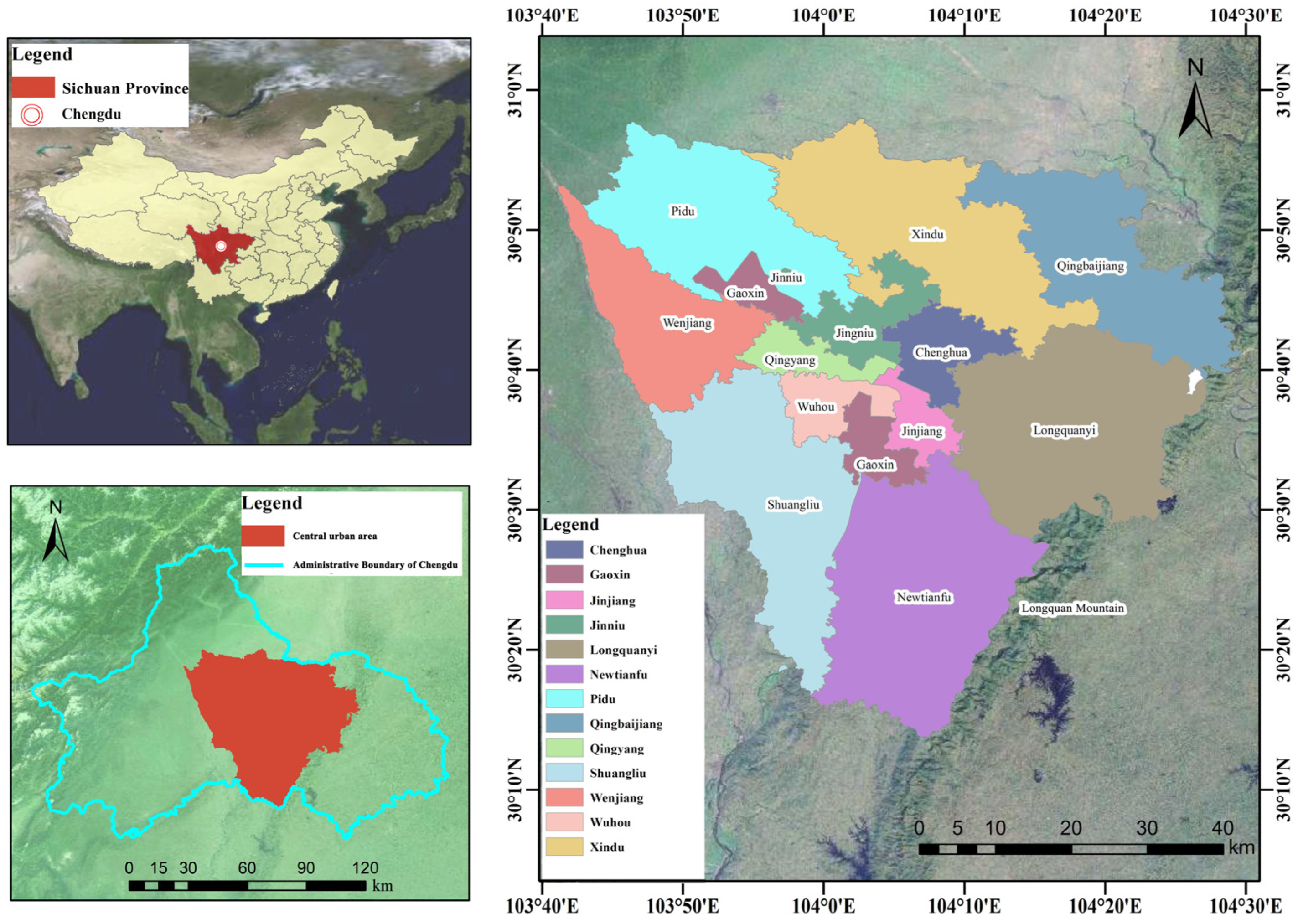
Chengdu is the capital of Sichuan Province and a core city in Southwest China. With a resident population of over 20 million and a GDP exceeding 1.7 trillion yuan (as of 2020), it serves as the demographic and economic hub of Southwest China. As the engine of regional development, Chengdu possesses a highly diversified urban functional structure. Its central urban area is composed of plains, terraces, and parts of the low mountains and hills (Longquan Mountain), and serves as the main carrier of functions, such as commerce and finance, transportation and logistics, leisure and entertainment, and international cultural exchange. The multifunctional and differentiated spatial structure of this region provides a typical example for urban studies. The study area encompasses 13 districts (Figure 1)—Qingyang, Jinjiang, Wuhou, Jinniu, Chenghua, High-tech Zone, Pidu, Wenjiang, Shuangliu, Qingbaijiang, Xindu, Longquanyi, and Tianfu New Area—totaling approximately 1100 square kilometers.

2.2. Datasets

This study incorporates a diverse range of data types, all with a consistent temporal reference to the year 2020. The Landsat 7 imagery was acquired on 17 May 2020, with track number P129/R39 (http://www.gscloud.cn (accessed on 15 August 2023)), covering the central urban area of Chengdu. The image quality is excellent, with cloud cover less than 10%. Road network data comes from OpenStreetMap (OSM) (https://www.openstreetmap.org/ (accessed on 8 July 2021)). POI data comes from Amap (https://www.amap.com (accessed on 8 July 2021)), one of China’s most popular internet map service providers. While the 2020 POI data may reflect pandemic-induced fluctuations in commercial and entertainment vitality, its impact on UFZ classification is mitigated by our focus on structural functional orientation rather than transient operational status. Due to the varying characteristics and data structures of these heterogeneous data types, the preprocessing procedures for each type of data are also different. Subsequent Section 3.2.1, Section 3.2.2, and Section 3.3.1 will provide more detailed information on the basic information and processing methods for each type of data.

3. Research Methodology

3.1. Research Process

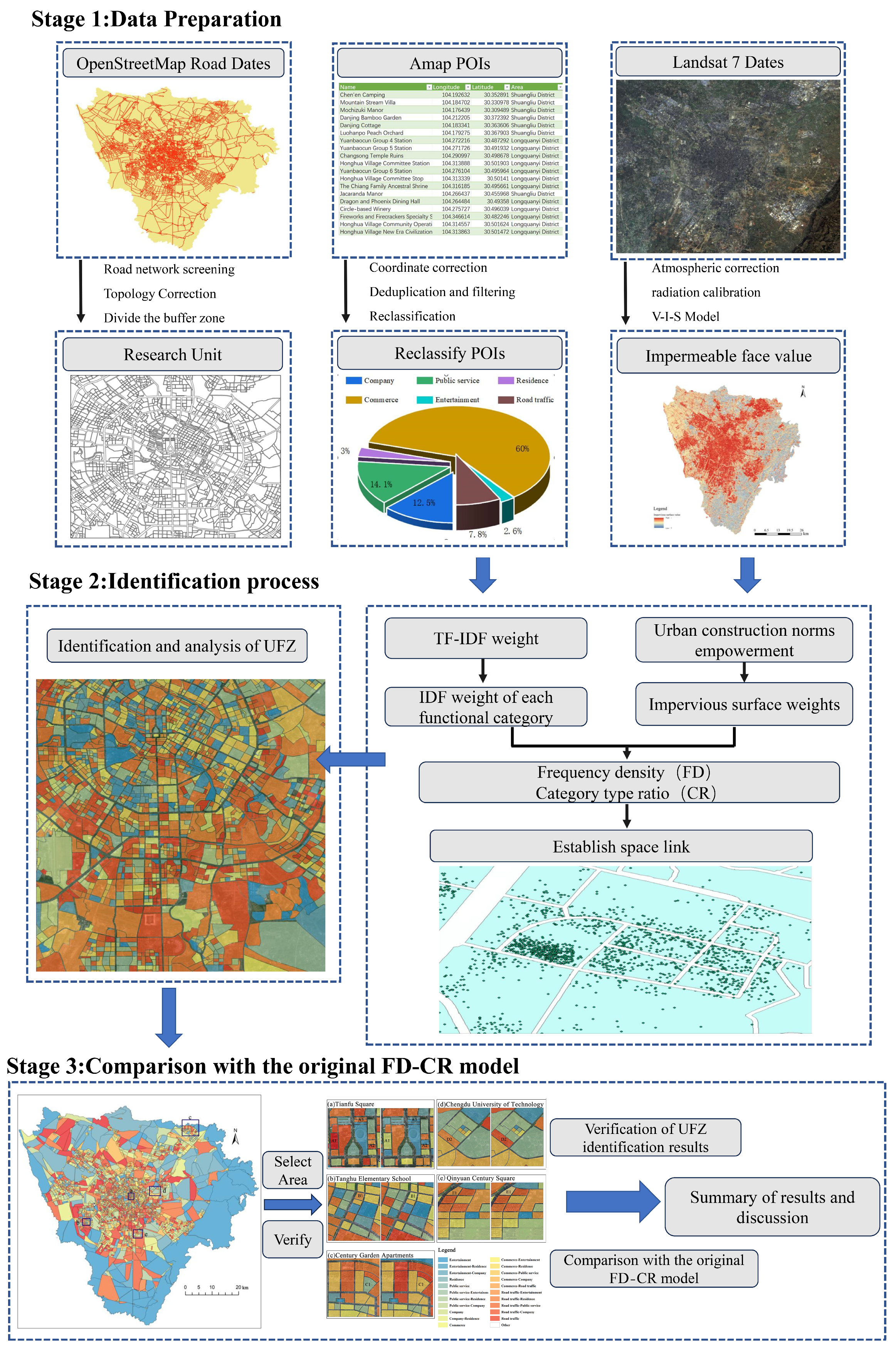
The methodological framework of this study is shown in Figure 2. First, the OSM road network data is screened and topologically corrected to delineate appropriate study units. Subsequently, combine surface impermeability with socioeconomic attributes to appropriate weighting criteria.
From a socioeconomic perspective, the TF-IDF algorithm is used to reweight POIs within each functional category, yielding the reweighted frequency density (RFD). Toward surface impermeability, the V-I-S model is used to process remote sensing imagery to obtain an impervious surface index (ISI). According to relevant urban construction laws and regulations, the UFZ types of POI are assigned weights based on the ISI. The resulting RFD is then combined with the ISI weight values to calculate the eigenvalues of category ratios (ECR) within each study unit, ultimately yielding functional area recognition results. Finally, the recognition results are benchmarked against those from the FD-CR method, and the accuracy of the research results is further evaluated using field situation and Amap.

3.2. Data Preprocessing

3.2.1. Research Unit Division

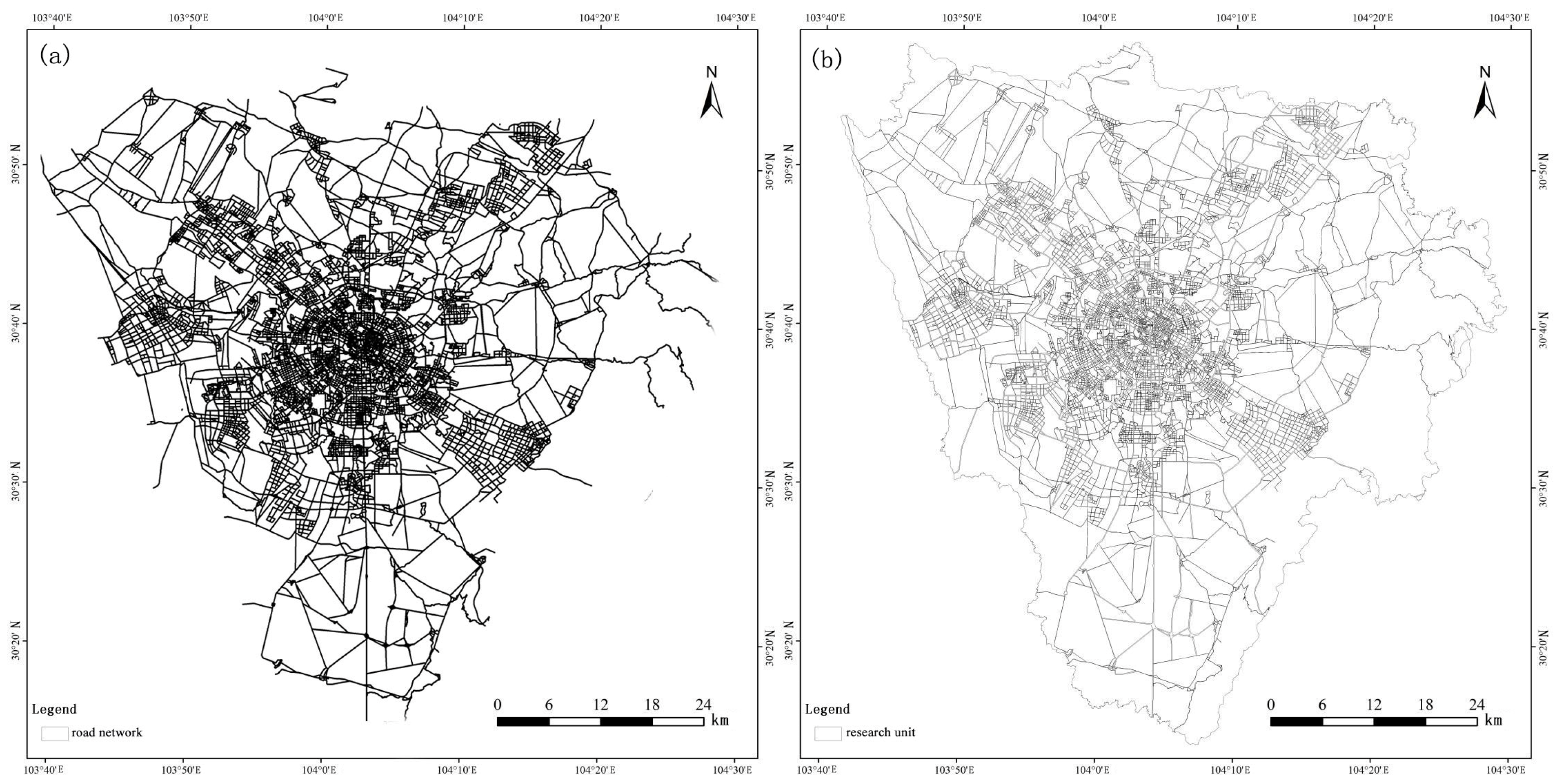
Regarding the research unit, Long and Liu [49] believed that a parcel is a polygon bounded by a road network, which is the natural dividing boundary of an urban area. In this study, we adopted this assumption and defined the research unit using OSM data. By analyzing the OSM road network data, the road space was separated, and only the blocks enclosed by the roads were used as research units to identify the functional structure. Buffer analysis was performed on roads of different levels, and 40 m, 40 m, 20 m, and 10 m buffers were generated for highways, main roads, secondary roads, and branch roads, respectively [30]. After filtering out blocks with an area smaller than a specific threshold (5000 square meters in this paper), 5837 research units were finally obtained (Figure 3b).

3.2.2. POI Data Reclassification

Using the public interface of Amap, a total of 415,550 data points were collected in the study area in 2020. In order to fully extract the semantic information in the POI data and avoid data redundancy, this paper chose to reclassify all POI data.
The classification scheme was refined based on the Code for Classification of Urban Land Use and Planning Standards of Development Land (GB 50137-2011) while prioritizing the distinctiveness of the geophysical (ISI) and socio-economic (POI) characteristics [25,42]. The original POI data in the study area are divided into 6 functional types (Table 1): Company (This emphasizes the “production and research and development” aspect, distinguishing it from purely commercial office spaces. These types of land parcels typically have a high ISI and large building volumes); Public service (Focus on the “social welfare and administration” aspect. Remove for-profit “training institutions” and retain non-profit facilities.); Residence (Focus on properties primarily intended for “residential living.” Exclude “mixed-use commercial and residential” properties, because in the ISI weighting system, they are more aligned with high-density residential or commercial properties.); Commerce (Focus on the “economic exchange” attribute. “Commercial office spaces” are uniformly categorized here, distinguishing them from the headquarters of manufacturing companies.); Entertainment (The focus is on “ecology and open space.” A common characteristic of these plots is a low ISI (Index of Spatial Integration), which is a key feature distinguishing them from other functional areas); Road traffic (Focusing on the “infrastructure” attribute, these areas typically have large areas of paved surfaces (high ISI) but with very strong points of interest (POI) characteristics).
Subsequently, the reclassified POI data was removed for duplicate values, missing values, and outliers to obtain the final data results. Finally, the POI data preprocessing results were imported into ArcGis 10.8 and assigned to the corresponding research units using the spatial link tool to obtain the number and proportion of POIs in the study area (Table 2).

3.3. POI Frequency of Each Category

3.3.1. TF-IDF Algorithm

In the TF-IDF algorithm, TF (Term Frequency) represents term frequency, and IDF (Inverse Document Frequency) represents the inverse document frequency index. The TF-IDF algorithm has a relatively reliable classification capability [49] and can effectively determine the importance of a word in a file set. Therefore, in machine learning, it is often used for information retrieval or massive data mining [8]. In the POI weight calculation process, each research unit can be regarded as a single file, and the POI category in a single file can be regarded as the term frequency. The weight ratio of the term frequency of different POI categories in the file is determined to be the weight of each type of POI. The calculation formula is as follows:
t f i , j = n i , j k n k , j
I D F i = l g D j : t i d j
t f i d f i , j = t f i , j × I D F i
In Equation (1), i represents POI category; j represents research unit; t f i , j represents the proportion of type i POIs in research units; n i , j represents the frequency of POI type i appearing in research unit j; k n k , j represents the sum of the frequencies of all POIs in the research unit; In Equation (2), D represents the total number of spatial research units; | j : t i d j | represents the number of research unit cells containing a certain type of POI; i d f i represents solve the logarithm of the frequency percentage of type i POI in all research unit cells; In Equation (3), t f i d f i , j represents the weight value of type i POI in the research unit cell.
By calculating the TF-IDF of POI data for 14 Class I POIs, the TF-IDF weights, number of occurrence areas, IDF values, etc. of each category are as follows (Table 3). This study considers using the TF-IDF value to perform frequency density weighting calculations on the functional units in the study area in the future, in order to increase the weight values of some functional units that are relatively small in number but have a greater impact on functional area recognition.

3.3.2. Assignment of Frequency Density Reweighting

The functional attributes of each block in the city are largely related to the POI data type with the highest density within the block. Therefore, calculating the frequency density (FD) of the POI data type in each research unit is an important basis for determining the functional type of the research unit. Areas with high frequency density generally indicate that the functional type is more concentrated or active. However, there are still some POI data with small numbers but important characteristics that are easily overlooked. Therefore, this paper employs the IDF to enhance these easily overlooked POI types and constructs the reweighted frequency density (RFD) for subsequent research. Based on the above, the calculation formula of the feature vector RFD is as follows:
R F D k = j 1 n i I D F i 6 1 N k ( i = 1,2 , , 14 ; k = 1,2 , , 6 )
In Equation (4), R F D k represents the frequency density of the number of POIs of the k-th type in the six UFZs as a percentage of the total number of the six UFZs; n i represents the number of POIs of type i in the current research unit; k represents the k-th category among the 6 categories of UFZs in Table 1; j represents the total number of POIs in Class I in the UFZ belonging to the k-th category; Nj represents the number of POIs in the j type of UFZ; I D F i represents the weight value of POI category i after inverse document rate normalization.

3.4. Extraction and Weighting of the ISI

3.4.1. Extraction of the ISI

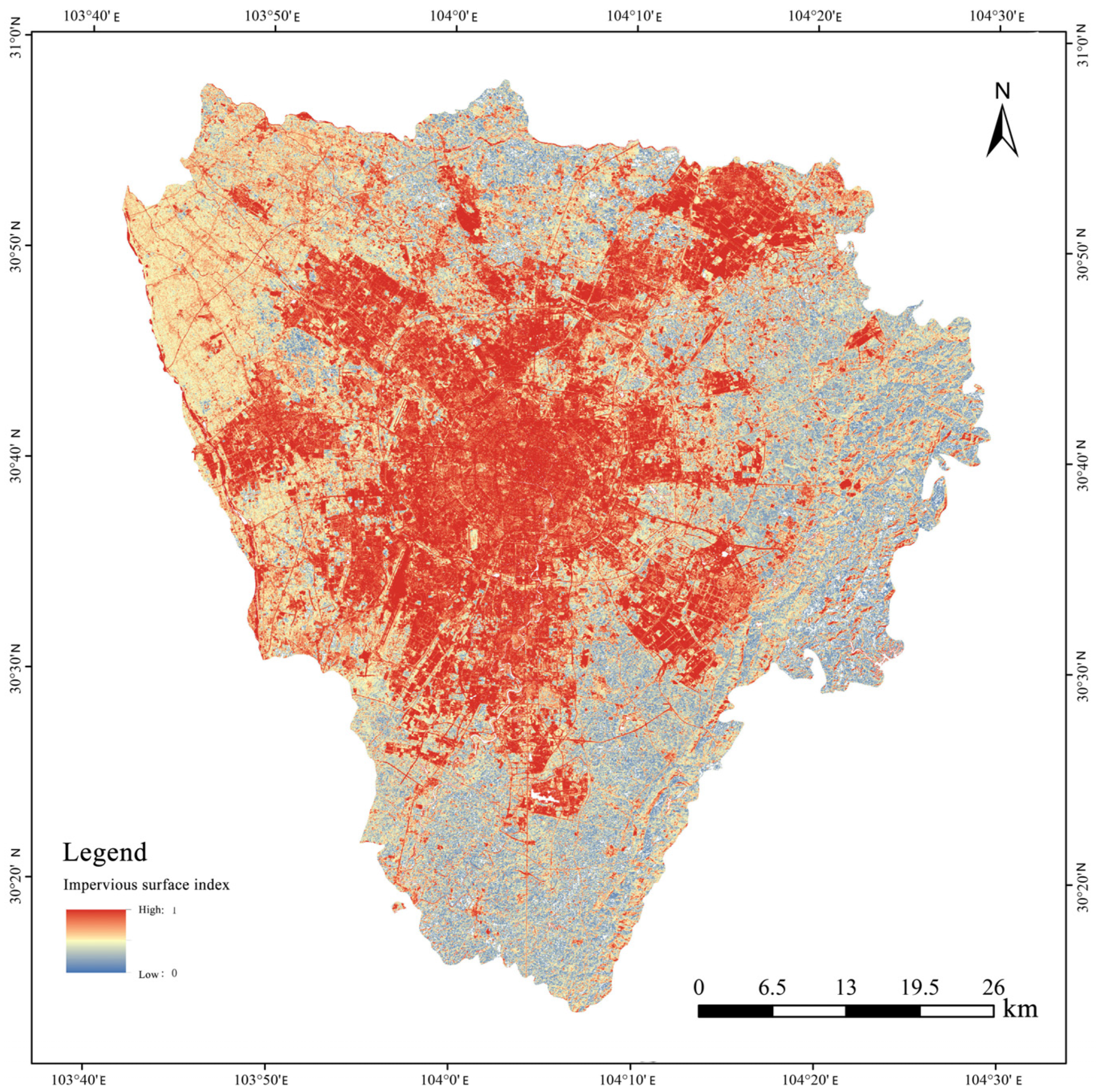
This study uses the V-I-S model proposed by Ridd to identify the different spectral reflectance of different band features in remote sensing images [46]. After radiometric calibration, atmospheric correction, and mosaic cropping of the remote sensing images on the remote sensing imagery using ENVI 5.6, four spectral feature combinations of high albedo, low albedo, bare soil, and vegetation were determined. Then, the linear spectral mixture decomposition model was applied to extract the impervious surface index of the central urban area of Chengdu in 2020 by summing the abundances of the high albedo end and the low albedo end (Figure 4). The linear spectral mixture decomposition model expresses the reflectance of a single image element in each spectral band as a linear combination of its unit component reflectance and its respective abundance. The formula is as follows:
L b = j = 1 M h i L i , b + a b
In Equation, L b represents b spectral reflectance of the band; M represents end-elements; h i represents the proportional weight of end-element i in the image element, L i , b represents the reflectance of end-element i in the b-band; a b represents the value of the unmodeled residual error.
To validate the accuracy of the ISI, a Stratified Random Sampling approach was implemented. The study area was categorized into five distinct strata representing a gradient of impervious surface intensity (from 0% to 100%). A total of 50 validation units (each 100 × 100 m) were randomly distributed across these strata to ensure unbiased representation of diverse urban land-cover types, including high-density business districts, industrial parks, residential neighborhoods, and peripheral ecological zones. This stratified approach ensures that the regression analysis accounts for the high spatial heterogeneity of Chengdu’s urban fabric. To quantitatively validate the ISI research unit, 50 random clusters (30 m × 30 m) were selected. The regression analysis yielded an R2 of 0.81, confirming that the ISI map is a reliable weight layer for UFZ identification (Table 4).
Figure 4. The ISI of Chengdu (2020).
Land 15 00620 g004

3.4.2. Assignment of ISI Weights

The ISI is affected by many factors, so its correspondence with UFZs is not direct and fixed [50]. Generally speaking, a higher ISI may correspond to areas with a high degree of urbanization and intensive human activities, and these areas often have a certain correlation with specific functional areas. For example, commercial areas usually have a higher ISI because these areas are often high-rise buildings, hardened roads, and less vegetation cover; industrial areas have a large number of factories, warehouses, and hardened ground, so the ISI will also be relatively high, especially heavy industrial areas, where this index may be higher due to the lack of vegetation cover. Parks and green spaces are mainly vegetation and have less hardened ground, so the ISI will be relatively low.
This paper calculates the average ISI of the research unit and refers to existing research [51,52] and relevant standards to determine the weights. For example, the national government clearly stipulates that the “greening rate” of residential areas cannot be less than 30%; the “Chengdu Garden Greening Regulations” stipulate that the greening rate of land used by hospitals and sanatoriums cannot be less than 35%; the “Regulations on Urban Greening Planning and Construction Indicators” stipulate that the greening rate of industrial enterprises cannot be less than 20%, etc. Based on the general understanding and experience of urban environment, land use type, human activity intensity and urbanization level, this paper divides the impervious surface index into six ranges (Table 5).
Based on this range, this paper sets specific weights for different functional types, referring to existing studies [46,47] and the possible correspondence between the impervious surface index and various functional zones. The specific ISI weight multipliers presented in Table 6 were determined through a hierarchical approach. The Delphi method was employed, where experts in urban geography and planning provided a range of weights based on the Code for Classification of Urban Land Use (GB 50137-2011) [53]. For instance, Residential zones are assigned higher weights in the ‘Medium to High’ ISI range (60–95%), reflecting the high-rise, high-density nature of modern Chinese residential compounds.

3.5. Urban Functional Zone Recognition

3.5.1. Construction of the ECR

On the basis of using the RFD as the quantitative relationship, the ISI is introduced for weight correction. The F D & I S I is obtained by weighting the ISI of the research unit. Referring to the UFZ recognition method proposed by Chi et al. [30], the eigenvalues of category ratios (ECR) were constructed using FD&ISI as a key indicator for judging the functional attributes of research units. The calculation formula is as follows:
R F D & I S I i = R F D i × I S I i   i = 1 , 2 , , 6
E C R i = F D & I S I i i = 1 6 F D & I S I i   i = 1 , 2 , , 6
R F D i represents frequency density of the i functional area category in the total number of the six functional area categories. R F D & I S I i represents RFD values corrected with the ISI impervious surface index weights. I S I i represents the weight corresponding to the impervious surface value of the i POI type in the plot; E C R i represents the ratio of the frequency density of the i-th type of functional unit in the current research unit to the sum of the frequency densities of all functional units.

3.5.2. UFZ Recognition Based on ECR

The functional attributes of each block are determined by the each ECR of POI. When a certain ECR of POI has the highest density, that POI type is used to represent the functionality of the current block. Following the existing research findings [30,39,40,41], the study established a ECR of 50% as the standard for determining the functional properties of a unit. When the proportion of a certain type of the ECR of POI within a unit account for 50% or more, the unit is determined to be a single-functional zone, and the functional nature of the zone is determined by the POI type. When the proportion of all the ECR of POI within a unit does not reach 50%, the unit is determined to be a mixed-functional zone, and the mixed type is determined by the two most important POI types within the unit. When a unit contains no POIs, the type ratio is null, and the unit type is called a no data zone.

4. Result Analysis and Discussion

4.1. Functional Zone Recognition Results and Features

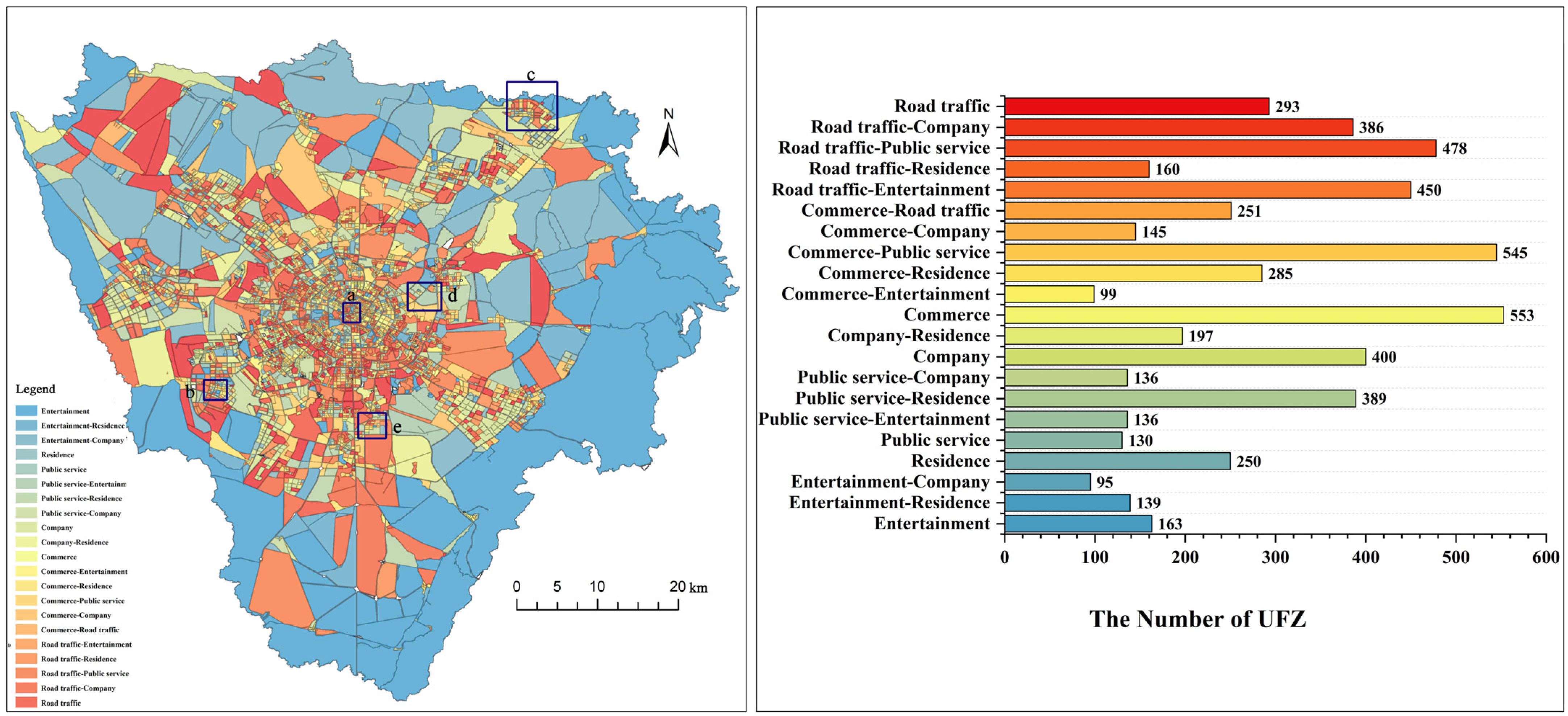
The functional zone UFZs recognition results are shown in Figure 5. In Chengdu’s central urban area, functional categories, such as Company, Commerce, and Public Service, predominate. Residence and Entertainment districts are scattered among these functional zones, often encompassing public service and commerce districts; The entertainment zones are continuously distributed in the southeastern part of the study area. The Entertainment district is distributed in a continuous zone in the southeast of the study area, with a small number of Road traffic functional zones. The area’s land is mostly mountainous and water-based, with numerous green spaces and wetland parks; Qingbaijiang District and Xindu District in the northeast are connected by road traffic networks, such as the Beijing–Kunming Expressway, Hanrong Expressway, and Chengmian Expressway, as well as railway stations and high-speed rail stations. Due to their convenient transportation and distance from the city center, most factories are concentrated in this area, making it primarily a company district and road traffic district; Pidu District and Wenjiang District in the northwest also have important transportation arteries, such as the Chengguan Expressway and the Chengming Expressway, as well as transportation hubs, such as Chengdu West Railway Station. These areas are also home to universities, such as Xihua University, University of Electronic Science and Technology of China, and Southwestern University of Finance and Economics, making them primarily road traffic districts, public service districts, and company districts.
The specific recognition results have the following features: (1) high proportion of commercial and financial elements. Commerce zones are the most prevalent among single-functional areas, with 553 identified units widely distributed across central districts, such as Chenghua, Qingyang, Wuhou, and Jinniu. This even distribution reflects Chengdu’s consumption upgrading and regional coordination, which have dispersed commercial amenities throughout the urban core. Moreover, the frequent co-occurrence of commercial and financial zones with all other functional types underscores their pivotal role in urban development. (2) Predominance of mixed-functional zone. The identification results reveal 3891 mixed-functional zones, far outnumbering single-functional zones and underscoring a high degree of functional integration in Chengdu. This spatial pattern aligns with the city’s adoption of the “industry-city integration” concept. This concept has promoted the development of multifunctional clusters and the rational allocation of urban resources. For instance, the Tianfu New Area was initially planned as a comprehensive area integrating industry, residence, commerce and public service facilities. In subsequent planning and development, elements such as leisure and parks were incorporated, further enhancing the mixed-use nature of the functional areas. The phenomenon thus epitomizes a broader shift in urban planning priorities—from mere land development and investment to the cultivation of comprehensive, livable-workable urban units. (3) Strong linkages between road traffic and functional types. Statistical results confirm the pervasive integration of road traffic with other urban functions, with 1725 research units combined with transportation zones. Chengdu’s ring-radial road network forms the city’s backbone, while its subway system connects major commercial areas, tourist attractions, and public service facilities. This integrated infrastructure fosters a cohesive synergy of society, city, environment, and industry. Guided by the Transit-Oriented Development (TOD) model, subway stations have evolved into integrated “mini-centers” that combine employment, residence, commerce, and leisure, thereby powerfully demonstrating the critical role of traffic infrastructure in linking the city’s functional elements.

4.2. Verify the Comparison Results

4.2.1. Accuracy of Urban Functional Zone Identification

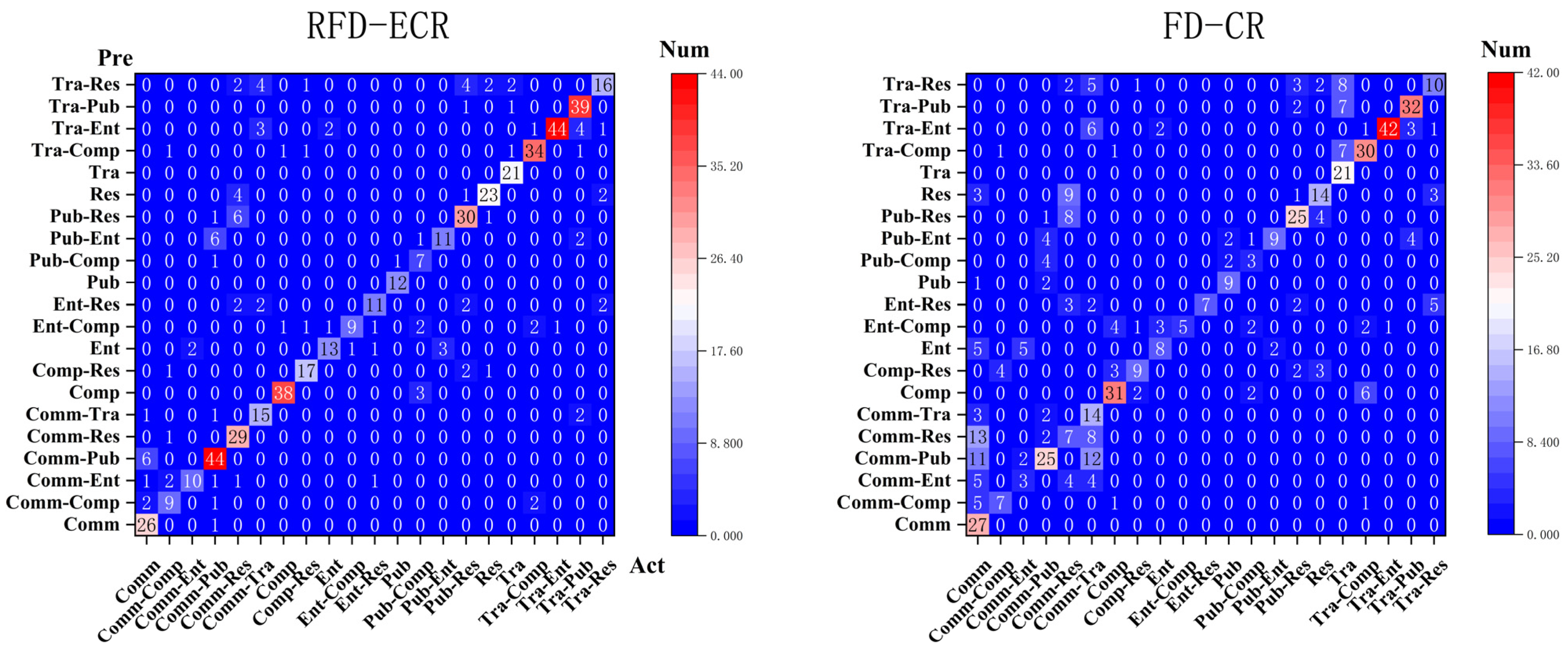
This study employs the confusion matrix and Kappa coefficient to assess the performance of RFD-ECR in comparison to FD-CR (Figure 6). Following the principles of stratified sampling, 10% of the samples (a total of 571 research units) were randomly selected from the 21 identified functional area types, as illustrated in Figure 5, for the purpose of experimental validation. The actual UFZ types were determined by comparing them against the land use classifications of Chengdu in 2020. To construct a robust and auditable validation dataset, we implemented a hierarchical triangulation protocol that integrates physical, semantic, and field-level evidence. The process began with physical morphology assessment, utilizing imagery to delineate precise boundaries and structural features of each research units. This was complemented by semantic identification via the Amap API to extract POI distributions. To mitigate semantic ambiguity, Amap Street View was employed to visually audit building facades, signage, and ground-floor land usage. In cases where remote sensing imagery and Amap data yielded inconsistent results, targeted on-site field surveys were conducted across Chengdu’s central districts to ascertain the dominant urban function. Ultimately, a consensus-based labeling approach was adopted, whereby a grid cell was only designated as ‘Truth’ for the confusion matrix if at least two independent sources converged on a single-functional classification.
The findings indicate that the overall accuracy (OA) of RFD-ECR reached 80.21%, reflecting an improvement of nearly 21% over FD-CR’s accuracy of 59.19%. Furthermore, the Kappa coefficient for RFD-ECR was found to be 0.79 (Table 7). Specifically, the model significantly improved the accuracy of identifying mixed-use commercial and residential functional areas, with the F1 score increasing from 0.22 to 0.78 in the identification of “commercial and residential areas”. In the case study of Chengdu, the RFD-ECR framework demonstrates effective performance in capturing the interplay between surface physical features and functional attributes. These results suggest that within the specific context of a high-density monocentric city, the integration of ISI and POI provides a feasible optimization path for reducing functional ambiguity.

4.2.2. Application of the RFD-ECR in UFZ Identification

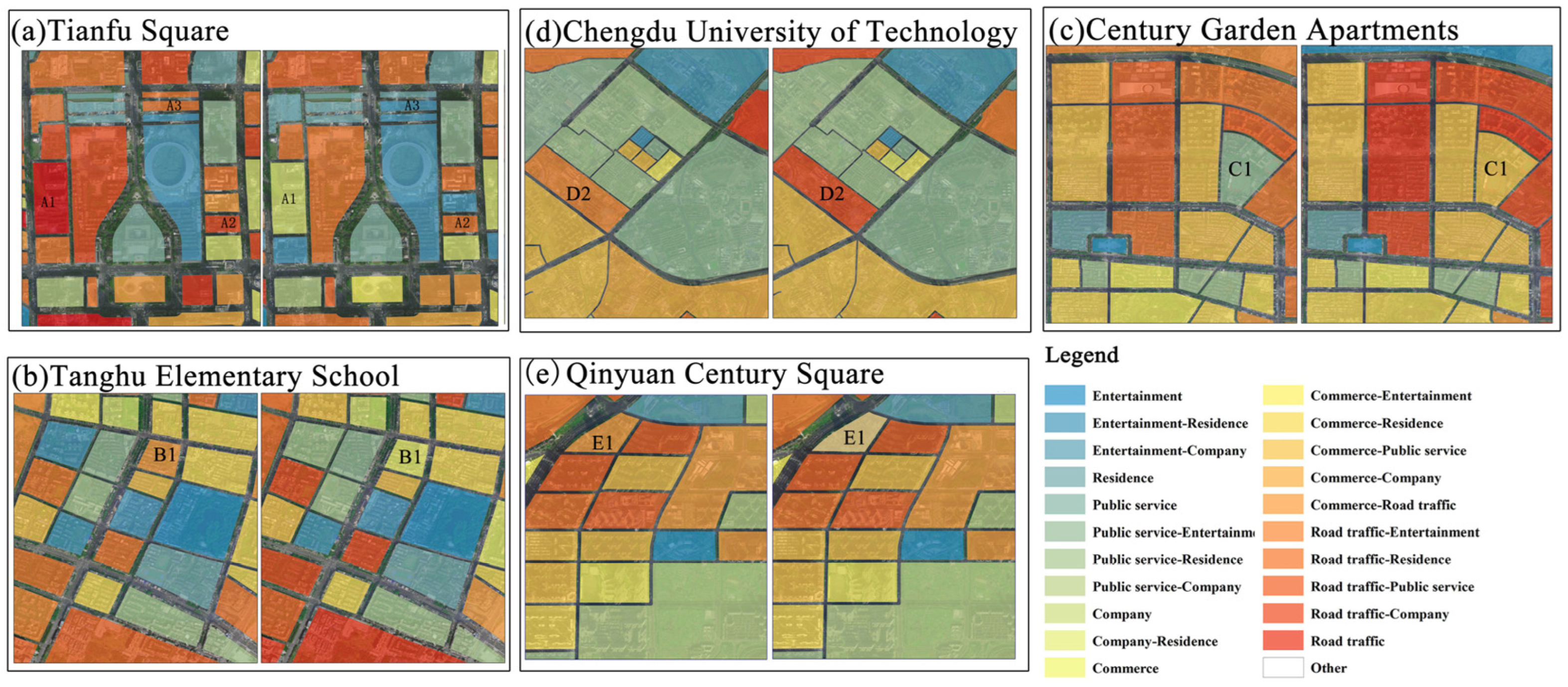
By applying the methodology to five sample units UFZs—including university campuses, business districts, and residential communities—this study found that: (1) IDF value reduces the influence of excessive functional units. The introduction of IDF value weighting reduces the impact of excessive Commerce POIs on Public Service and Residence POIs. As shown in Figure 7, the E1 study unit around Qinyuan Square is primarily comprised of the Country Garden Qinyuanli Residential Complex and the Sichuan Provincial Public Security Department’s Exit-Entry Administration. Using the unweighted FD-CR method for functional area recognition, this area was identified as “Commerce-Road traffic”. Using the weighted IDF and impervious surface index, this area was identified as “Residence-Road traffic”. While this still differs from the actual functional category, it improves accuracy compared to the original method. (2) The ISI highlights single-function areas. The introduction of ISI highlights further optimization of the functional units of the original mixed-function district, reweighting them to identify them as single-function districts. For example, in the B1 study unit in the area surrounding Tanghu Primary School, the number of Road traffic POIs and Commerce POIs is similar, so quantitative weighting alone cannot be used to further delineate the area. However, due to the different impervious surface index ranges between the Road traffic district and the Commerce district, the weights assigned to them are also different. The impervious surface index in this area is 0.955, which is extremely high, and the Commerce weight in this range is twice that of the Road traffic area. The weighting calculation based on the impervious surface index ultimately increases the Commerce weight, and the area is identified as “Commerce”. (3) The ISI can correct the impact of excessively high IDF values. Because the TF-IDF algorithm amplifies some smaller but more influential POIs, it can also result in higher weights for previously smaller but equally unimportant functional units. By adjusting the ISI, these inflated weights are reduced, making the recognition results more realistic. As shown in Figure 7, in the C1 research unit of the Century Garden Apartments, the original method, after introducing the IDF value, increased the weight of the Entertainment category and decreased the weight of the Commerce category, causing the area to be identified as “Public service-Entertainment” instead of “Commerce-Public service”. However, after introducing the ISI, the impervious surface value of this area was 0.761, and the weight of Entertainment was only one-fifth of that of Commerce. Combined, the final recognition result is consistent with the original FD-CR method. A similar situation occurs in Figure 7 in the D2 area around Chengdu University of Technology, where the IDF value shifted the area from “Residence-Road traffic” to “Entertainment-Road traffic”. Specifically speaking, both areas are due to the presence of a small living plaza, which is surrounded by many commercial buildings and catering services. The main functions of the two areas are still the unweighted FD-CR recognition results, and the final recognition results are consistent with the actual situation.

4.3. Limitations of the Proposed Method

The TF-IDF algorithm and ISI were used for weight correction, and most functional areas can be effectively identified; however, this study has several limitations. In CBD areas with ‘ground-floor retail and upper-floor residential’ structures, the ISI reflects the total imperviousness of the building footprint but cannot decompose the vertical functional intensity, which remains a challenge for 2D spatial models. In rapid urbanizing fringes, areas with ‘paved roads but no businesses’ (high ISI, low POI) may be erroneously characterized as Industrial or Brownfield sites. For example, in study unit A3 (Figure 7), the absence of certain low-level public service facility POIs introduces incompleteness and bias in the analysis of lower-order functional areas, thereby impairing the accurate identification of public service zones. While the ISI weights demonstrate strong classification performance in our study, we acknowledge that their sensitivity may lead to variations in results across different geographic regions. Future studies should consider a dynamic weight-tuning mechanism to account for regional variations in urban sprawl and building density. Additionally, the practice of delineating land parcels based on road boundaries overlooks cross-street differentiation and radiating effects, limiting the analysis of intrinsic functional linkages between adjacent areas and consequently reducing identification accuracy.

5. Conclusions

By integrating the Impervious Surface Index (ISI) with the TF-IDF-based framework, this study established an optimized RFD-ECR method that effectively addresses the limitations of the FD-CR model, which typically overlooks the physical attributes of the urban surface. The empirical application in Chengdu’s central urban area demonstrates that this integration significantly enhances identification accuracy. The main conclusions are presented as follows:
(1)
The application of the proposed RFD-ECR framework in Chengdu’s central urban area yielded an overall identification accuracy of 80.21% based on sampling surveys. This high level of precision demonstrates that the framework effectively integrates the dual dimensions of functional intensity and diversity, providing a optimization method for UFZ recognition.
(2)
The identification results of Chengdu’s UFZ indicate that single-function zones in Chengdu’s central urban area are mainly commercial and financial districts; the proportion of the mixed-functional zone is far greater than that of the single-functional zone, which is highly consistent with Chengdu’s “industry-city integration” concept; and road traffic functions are highly integrated with other urban functions, further demonstrating the important role of road traffic in the city’s development.
This study methodologically proposes a new framework for recognizing UFZ by combining POI data with remote data. It introduces innovations in the construction of the weighting of POI function types. The findings reveal the accuracy of UFZ recognition and the distribution of urban functional zones in Chengdu in 2020, providing a reference for subsequent optimization of UFZ recognition. Future research will focus on optimizing the ISI weight assignments for various functional zones through extensive empirical testing, thereby strengthening the methodological framework’s rigor and applicability. To refine spatial partitioning, the current OSM-based road network division will be replaced with more advanced street-view semantic segmentation techniques. Furthermore, to enhance the reliability of POI data, weighting factors based on public perception and spatial attributes will be introduced to mitigate the impact of outliers. This will be complemented by the integration of multi-source POI data from various map service providers (e.g., location-based services and online navigation platforms), ensuring a more comprehensive and high-fidelity foundational dataset.

Author Contributions

Conceptualization, C.Z. and Y.C.; methodology, C.Z. and B.W.; software, C.Z. and Y.G.; validation, C.Z. and Y.Z.; formal analysis, C.Z.; data curation; writing—original C.Z.; writing—review and editing Y.Z. and Y.C.; supervision, B.W. All authors have read and agreed to the published version of the manuscript.

Funding

This research was made possible by the generous financial support from a number of organizations. We gratefully acknowledge the backing from the National Natural Science Foundation of China (No. 42501258).

Data Availability Statement

The data presented in this study are currently in use for ongoing and future research. Consequently, they are not publicly available at this time. Requests for data should be directed to the corresponding author.

Conflicts of Interest

The authors declare no conflicts of interest.

Abbreviations

The following abbreviations are used in this manuscript:
UFZUrban functional zone
POIPoint-of-interest
OSMOpenStreetMap
ISIImpervious Surface Index
FD-CRFrequency Density-Category Ratio
RFDReweighted frequency density
ECREigenvalues of category ratios
TF-IDFTerm Frequency-Inverse Document Frequency
TODTransit-Oriented Development

References

  1. Yu, D.; Fang, C. Urban remote sensing with spatial big data: A review and renewed perspective of urban studies in recent decades. Remote Sens. 2023, 15, 1307. [Google Scholar] [CrossRef]
  2. Wu, C.; Ye, Y.; Gao, F.; Ye, X. Using street view images to examine the association between human perceptions of locale and urban vitality in Shenzhen, China. Sustain. Cities Soc. 2023, 88, 104291. [Google Scholar] [CrossRef]
  3. Schiavina, M.; Melchiorri, M.; Freire, S.; Florio, P.; Ehrlich, D.; Tommasi, P.; Pesaresi, M.; Kemper, T. Land use efficiency of functional urban areas: Global pattern and evolution of development trajectories. Habitat Int. 2022, 123, 102543. [Google Scholar] [CrossRef] [PubMed]
  4. Guo, L.; Tang, M.; Wu, Y.; Bao, S.; Wu, Q. Government-led regional integration and economic growth: Evidence from a quasi-natural experiment of urban agglomeration development planning policies in China. Cities 2025, 156, 105482. [Google Scholar] [CrossRef]
  5. Sanlang, S.; Cao, S.; Du, M.; Mo, Y.; Chen, Q.; He, W. Integrating aerial lidar and very high-resolution images for urban functional zone mapping. Remote Sens. 2021, 13, 2573. [Google Scholar] [CrossRef]
  6. Montanges, A.P.; Moser, G.; Taubenbock, H.; Wurm, M. Classification of urban structural types with multisource data and structured models. In 2015 Joint Urban Remote Sensing Event; IEEE: Piscataway, NJ, USA, 2015. [Google Scholar]
  7. Guo, Z.; Wen, J.; Xu, R. A shape and size free-CNN for urban functional zone mapping with high-resolution satellite images and POI data. IEEE Trans. Geosci. Remote Sens. 2023, 61, 5622117. [Google Scholar] [CrossRef]
  8. Hong, D.; Zhang, B.; Li, H.; Li, Y.; Yao, J.; Li, C.; Werner, M.; Chanussot, J.; Zipf, A.; Zhu, X.X. Cross-city matters: A multimodal remote sensing benchmark dataset for cross-city semantic segmentation using high-resolution domain adaptation networks. Remote Sens. Environ. 2023, 299, 113856. [Google Scholar] [CrossRef]
  9. Huang, W.; Wang, J.; Cong, G. Zero-shot urban function inference with street view images through prompting a pretrained vision-language model. Int. J. Geogr. Inf. Sci. 2024, 38, 1414–1442. [Google Scholar] [CrossRef]
  10. Hu, T.; Yang, J.; Li, X.; Gong, P. Mapping urban land use by using Landsat images and open social data. Remote Sens. 2016, 8, 151. [Google Scholar] [CrossRef]
  11. Zhang, X.; Du, S.; Wang, Y.C. Semantic classification of heterogeneous urban scenes using intrascene feature similarity and interscene semantic dependency. IEEE J. Sel. Top. Appl. 2015, 8, 2005–2014. [Google Scholar] [CrossRef]
  12. Heiden, U.; Heldens, W.; Roessner, S.; Segl, K.; Esch, T.; Mueller, A. Urban structure type characterization using hyperspectral remote sensing and height information. Landsc. Urban Plan. 2012, 105, 361–375. [Google Scholar] [CrossRef]
  13. Li, Y.; Liu, C.; Li, Y. Identification of urban functional areas and their mixing degree using point of interest analyses. Land 2022, 11, 996. [Google Scholar] [CrossRef]
  14. Jiang, N.; Zhang, J.X.; Li, H.T.; Lin, X. Semi-automatic building extraction from high resolution imagery based on segmentation. In Proceedings of the 2008 International Workshop on Earth Observation and Remote Sensing Applications; IEEE: Piscataway, NJ, USA, 2008; pp. 1–5. [Google Scholar]
  15. Lu, W.; Tao, C.; Li, H.; Qi, J. A unified deep learning framework for urban functional zone extraction based on multi-source heterogeneous data. Remote Sens. Environ. 2022, 270, 112830–112835. [Google Scholar] [CrossRef]
  16. Xu, N.; Luo, J.; Wu, T.; Dong, W.; Liu, W.; Zhou, N. Identification and portrait of urban functional zones based on multisource heterogeneous data and ensemble learning. Remote Sens. 2021, 13, 373. [Google Scholar] [CrossRef]
  17. Cao, R.; Tu, W.; Yang, C.; Li, Q.; Liu, J.; Zhu, J.; Zhang, Q.; Li, Q.; Qiu, G. Deep learning-based remote and social sensing data fusion for urban region function recognition. ISPRS J. Photogramm. Remote Sens. 2020, 163, 82–97. [Google Scholar] [CrossRef]
  18. Ratti, C.; Frenchman, D.; Pulselli, R.M.; Williams, S. Mobile landscapes: Using location data from cell phones for urban analysis. Environ. Plan. B Plan. Des. 2006, 33, 727–748. [Google Scholar] [CrossRef]
  19. Guande, Q.; Xiaolong, L.; Shijian, L.; Gang, P.; Zonghui, W.; Daqing, Z. Measuring social functions of city regions from large-scale taxi behaviors. In Proceedings of the 2011 IEEE International Conference on Pervasive Computing and Communications Workshops (PERCOM Workshops), Seattle, WA, USA, 21–25 March 2011; pp. 384–388. [Google Scholar]
  20. Zhao, W.; Bo, Y.; Chen, J.; Tiede, D.; Blaschke, T.; Emery, W.J. Exploring semantic elements for urban scene recognition: Deep integration of high-resolution imagery and OpenStreetMap (OSM). ISPRS J. Photogramm. Remote Sens. 2019, 151, 237–250. [Google Scholar] [CrossRef]
  21. Deng, Y. Research on Urban Functional Area Division Method Based on Multi-Source Point of Interest Data; Chinese Academy of Surveying and Mapping: Beijing, China, 2018. [Google Scholar]
  22. Hu, Y.; Han, Y. Identification of Urban Functional Areas Based on POI Data: A Case Study of the Guangzhou Economic and Technological Development Zone. Sustainability 2019, 11, 1385. [Google Scholar] [CrossRef]
  23. Dong, Q.; Qu, S.; Qin, J.; Yi, D.; Liu, Y.; Zhang, J. A Method to Identify Urban Fringe Area Based on the Industry Density of POI. ISPRS Int. J. Geo-Inf. 2022, 11, 128. [Google Scholar] [CrossRef]
  24. Miao, R.; Wang, Y.; Li, S. Analyzing Urban Spatial Patterns and Functional Zones Using Sina Weibo POI Data: A Case Study of Beijing. Sustainability 2021, 13, 647. [Google Scholar] [CrossRef]
  25. Ding, Y.; Xu, H.; Wang, C. Research on Urban Functional Area Recognition Integrating OSM Road Network and POI Data. Geogr. Geo-Inf. Sci. 2020, 36, 57–63. [Google Scholar]
  26. Cao, S.; Du, S.; Yang, S.; Du, S. Functional Classification of Urban Parks Based on Urban Functional Zone and Crowd-Sourced Geographical Data. ISPRS Int. J. Geo-Inf. 2021, 10, 824. [Google Scholar] [CrossRef]
  27. Lu, C.; Pang, M.; Zhang, Y.; Li, H.; Lu, C.; Tang, X.; Cheng, W. Mapping Urban Spatial Structure Based on POI (Point of Interest) Data: A Case Study of the Central City of Lanzhou, China. ISPRS Int. J. Geo-Inf. 2020, 9, 92. [Google Scholar] [CrossRef]
  28. Yang, X.; Bo, S.; Wang, J. Classifying Urban Functional Zones by Integrating the Homogeneity and Structural Similarity of POIs. J. Urban Plan. Dev. 2024, 150, 04024052. [Google Scholar] [CrossRef]
  29. Zhou, W.; Ming, D.; Lv, X.; Zhou, K.; Bao, H.; Hong, Z. SO-CNN based urban functional zone fine division with VHR remote sensing. Remote Sens. Environ. 2020, 236, 111458. [Google Scholar] [CrossRef]
  30. Chi, J.; Jiao, L.; Dong, T.; Gu, Y. Quantitative Identification and Visualization of Urban Functional Area Based on POI Data. J. Surv. Mapp. 2016, 41, 68–73. [Google Scholar] [CrossRef]
  31. Zhai, W.; Bai, X.; Shi, Y.; Han, Y.; Peng, Z.-R.; Gu, C. Beyond Word2vec: An approach for urban functional region extraction and identification by combining Place2vec and POIs. Comput. Environ. Urban Syst. 2019, 74, 1–12. [Google Scholar] [CrossRef]
  32. Mo, Y.; Guo, Z.; Zhong, R.; Song, W.; Cao, S. Urban functional zone classification using light-detection-and-ranging point clouds, aerial images, and point-of-interest data. Remote Sens. 2024, 16, 386. [Google Scholar] [CrossRef]
  33. Wang, J.; Feng, C.C.; Guo, Z. A novel graph-based framework for classifying urban functional zones with multisource data and human mobility patterns. Remote Sens. 2023, 15, 730. [Google Scholar] [CrossRef]
  34. Bao, H.; Ming, D.; Guo, Y.; Zhang, K.; Zhou, K.; Du, S. DFCNN-based semantic recognition of urban functional zones by integrating remote sensing data and POI data. Remote Sens. 2020, 12, 1088. [Google Scholar] [CrossRef]
  35. Du, Z.; Zhang, X.; Li, W.; Zhang, F.; Liu, R. A multi-modal transportation data-driven approach to identify urban functional zones: An exploration based on Hangzhou City, China. Trans. GIS 2020, 24, 123–141. [Google Scholar] [CrossRef]
  36. Qian, Z.; Liu, X.; Tao, F.; Zhou, T. Identification of urban functional areas by coupling satellite images and taxi GPS trajectories. Remote Sens. 2020, 12, 2449. [Google Scholar] [CrossRef]
  37. Cheng, G.; Yang, C.; Yao, X.; Guo, L.; Han, J. When deep learning meets metric learning: Remote sensing image scene classification via learning discriminative CNNs. IEEE Trans. Geosci. Remote Sens. 2018, 56, 2811–2821. [Google Scholar] [CrossRef]
  38. Liu, T.; Chen, H.; Ren, J.; Zhang, L.; Chen, H.; Hong, R.; Li, C.; Cui, W.; Guo, W.; Wen, C. Urban Functional Zone Classification via Advanced Multi-Modal Data Fusion. Sustainability 2024, 16, 11145. [Google Scholar] [CrossRef]
  39. Huang, H.; Huang, J.; Chen, B.; Xu, X.; Li, W. Recognition of functional areas in an old city based on POI: A case study in Fuzhou, China. J. Urban Plan. Dev. 2024, 150, 04024001. [Google Scholar] [CrossRef]
  40. Huang, C.; Xiao, C.; Rong, L. Integrating point-of-interest density and spatial heterogeneity to identify urban functional areas. Remote Sens. 2022, 14, 4201. [Google Scholar] [CrossRef]
  41. Wang, J.; Gao, C.; Wang, M.; Zhang, Y. Identification of urban functional areas and urban spatial structure analysis by fusing multi-source data features: A case study of Zhengzhou, China. Sustainability 2023, 15, 6505. [Google Scholar] [CrossRef]
  42. Méndez, M.; Merayo, M.G.; Núñez, M. Design of hybrid machine learning and TF-IDF models to discard irrelevant reviews on public transport stations. J. Inf. Telecommun. 2025, 9, 481–504. [Google Scholar] [CrossRef]
  43. Zhong, S.; Xu, X.; Yu, C.; Xia, L. A Classification Method of Rail Transit Stations Based on POI Data and TF-IDF Index. In CICTP 2021; American Society of Civil Engineers: Reston, VA, USA, 2021; pp. 2337–2346. [Google Scholar]
  44. Cai, L.; Zhu, L.; Jiang, F.; Zhang, Y.; He, J. Research on multi-source POI data fusion based on ontology and clustering algorithms. Appl. Intell. 2022, 52, 4758–4774. [Google Scholar] [CrossRef]
  45. Zhang, Y.; Liu, W.; Zhu, X.; Peng, Y.; Li, R.; Zhao, T.; Wang, X.; Zhai, X.; Di, X.; Xu, H. Spatial Interaction Analysis of Urban Functional Districts Based on Taxi Trajectories. Int. Arch. Photogramm. Remote Sens. Spat. Inf. Sci. 2023, 48, 383–390. [Google Scholar] [CrossRef]
  46. Zhang, J.; Zhou, Z.; Huang, D. Extraction of Impermeable Surfaces Based on Multi-Source Nighttime Light Images of Different Geomorphological Partitions. Appl. Sci. 2023, 13, 3006. [Google Scholar] [CrossRef]
  47. Ridd, M.K. Exploring a V-I-S (vegetation-impervious surface-soil) model for urban ecosystem analysis through remote sensing: Comparative anatomy for cities. Int. J. Remote Sens. 1995, 16, 2165–2185. [Google Scholar] [CrossRef]
  48. Chai, J.; Zhang, Z.; Chen, L.; Ma, X.; Wu, Z. Analysis of the spatial and temporal evolution characteristics and driving forces of the surface thermal environment in Lanzhou city. Sustainability 2023, 15, 7700. [Google Scholar] [CrossRef]
  49. Long, Y.; Liu, X.J. Automated Identification and Characterization of Parcels (AICP) with OpenStreetMap and Points of Interest; Cornell University Library: Ithaca, NY, USA, 2013. [Google Scholar]
  50. Wang, Z.; Wang, D.; Li, Q. Keyword extraction from scientific research projects based on SRP-TF-IDF. Chin. J. Electron. 2021, 30, 652–657. [Google Scholar]
  51. Zhang, Y.; Xia, X.; Li, J.; Xing, L.; Yang, C.; Wang, H.; Dai, X.; Wang, J. Simulation of urban growth boundary under the guidance of stock development: A case study of Wuhan city. Land 2024, 13, 1174. [Google Scholar] [CrossRef]
  52. Wu, H.; Luo, W.; Lin, A.; Hao, F.; Olteanu-Raimond, A.-M.; Liu, L.; Li, Y. SALT: A multifeature ensemble learning framework for mapping urban functional zones from VGI data and VHR images. Comput. Environ. Urban Syst. 2023, 100, 101921. [Google Scholar] [CrossRef]
  53. GB 50137-2011; Classification of Urban Land Use and Standards for Planning and Construction Land. China People’s Republic of China Housing and Castle Construction Department: Beijing, China, 2011.
Figure 1. Central urban area of Chengdu.
Land 15 00620 g001
Figure 2. Flow chart of UFZ recognition method.
Land 15 00620 g002
Figure 3. Road network (a) and research unit (b).
Land 15 00620 g003
Figure 5. The result of urban functional zone recognition in Chengdu. (a–e) represent the selected validation regions.
Land 15 00620 g005
Figure 6. Comparison of confusion matrices between RFD-ECR and FD-CR.
Land 15 00620 g006
Figure 7. Comparison of recognition methods. (ae) The left side of the figure shows the FD-CR recognition result, and the right side shows the RFD-ECR recognition result. The same applies below. A1–E1 are verification units within the verification area.
Land 15 00620 g007
Table 1. The rules for POI reclassification.
UFZ TypeClass IClass II
CompanyFactories and enterprises, Large companiesManufacturing plants, industrial parks, logistics and warehousing facilities, large enterprise production bases and research and development headquarters, and industrial support facilities.
Public serviceScience, Education and Culture, Medical insurance, Sports and Fitness, Life ServicesAdministrative offices, institutions of higher education and primary and secondary schools, medical and health institutions, research institutes, nursing homes, and cultural activity centers
CommerceShopping, Dining, Hotel accommodation, Financial institutionsCommercial complexes, retail supermarkets, financial and insurance institutions, office buildings and business centers, star-rated hotels and accompanying restaurants, wholesale markets
ResidenceResidential buildingsUrban residential communities, townhouses and villa areas, employee dormitories, retirement communities, and affordable housing.
EntertainmentTourist attractions, Green spaces and parksUrban comprehensive parks, city squares, scenic spots, historical and cultural heritage sites/monuments, forest parks and botanical gardens, and resort lawns/campsites.
Road trafficTransportation facilitiesIntegrated transportation hubs (train stations/airports), subway and bus terminals, parking lots, long-distance bus stations, and port/dock facilities.
Table 2. Quantity and proportion of POIs in different UFZ type.
UFZ TypePOI QuantityPOI Proportion
Company52,32512.59%
Public service58,40114.05%
Residence12,3582.97%
Commerce249,13159.95%
Entertainment10,6432.56%
Road traffic32,6927.87%
Table 3. TF-IDF calculation results for each POI type of Class I.
TypeAverage WeightNumber of Research UnitIDF Weight
Shopping0.441749771.13
Dining0.346946771.19
Life Services0.278349031.15
Factories and enterprises0.231143961.26
Transportation facilities0.176447711.18
Residential buildings0.118842161.30
Science, Education and Culture0.112537171.42
Large companies0.112131231.60
Medical insurance0.111236831.43
Hotel accommodation0.071824591.84
Green spaces and parks0.046723071.90
Sports and Fitness0.040818812.11
Financial institutions0.039118932.10
Tourist attractions0.02679392.80
Table 4. ISI regression analysis results.
MetricValue
Number of Samples (N)50
Correlation (R2)0.81
Root Mean Square Error (RMSE)0.21
Mean Absolute Error (MAE)0.12
Table 5. ISI values in different region types.
ValueRegion TypeExplain
Very low
(0–10%)
Natural and agricultural landNatural or agricultural land, which has almost no impervious surface, such as forests, farmland, etc.
Low
(10–25%)
Open spaceGreen spaces and parks on the edge of cities still have relatively little human activity
Medium to low (25–40%)Urban transition areaLow-density residential areas, small commercial areas, etc., where more buildings and roads begin to appear
Medium
(40–60%)
Medium-density areasCorresponding to medium-density residential areas, mixed-use areas or transportation roads within the city
Medium to high (60–95%)City centers and industrial core areasRepresents the core area of a city or industrial area, an area with intensive human activities
Very high
(95–100%)
Specific areas of extreme urbanizationCentral business districts with dense skyscrapers or high-density industrial areas
Table 6. The ISI weight values of the six UFZ types.
UFZ TypeResidencePublic ServiceCommerceCompanyRoad TrafficEntertainment
ISI Weight
VERY Low
(0–10%)
000000.6
Low (10–25%)0.20.10.10.10.11
Medium to low (25–40%)0.60.20.20.20.20.8
Medium
(40–60%)
110.8110.4
Medium to high (60–95%)0.40.610.60.60.2
Very high
(95–100%)
00.10.80.40.40
Table 7. Comparison of PA, UA, F1, OA and kappa between RFD-ECR and FD-CR.
UFZ TypePA
(RFD-ECR)
PA
(FD-CR)
UA
(RFD-ECR)
UA
(FD-CR)
F1
(RFD-ECR)
F1
(FD-CR)
Comm96%100%72%37%0.830.54
Comm-Comp64%50%64%58%0.640.54
Comm-Ent63%19%83%30%0.710.23
Comm-Pub88%50%79%63%0.830.56
Comm-Res97%23%66%21%0.780.22
Comm-Tra79%74%63%27%0.700.40
Comp93%76%95%78%0.940.77
Comp-Res81%43%85%69%0.830.53
Ent65%40%81%62%0.720.48
Ent-Comp50%28%90%100%0.640.43
Ent-Res58%37%79%100%0.670.54
Pub100%75%92%69%0.960.72
Pub-Comp78%33%54%38%0.640.35
Pub-Ent55%45%79%82%0.650.58
Pub-Res79%66%75%71%0.770.68
Res77%47%85%61%0.810.53
Tra100%100%84%49%0.910.66
Tra-Comp87%77%87%75%0.870.76
Tra-Ent80%76%98%98%0.880.86
Tra-Pub95%78%81%82%0.880.80
Tra-Res52%32%76%53%0.620.40
OA (RFD-ECR)80.21% OA (FD-CR)59.19%
Kappa (RFD-ECR)0.7900 Kappa (FD-CR)0.5679
Disclaimer/Publisher’s Note: The statements, opinions and data contained in all publications are solely those of the individual author(s) and contributor(s) and not of MDPI and/or the editor(s). MDPI and/or the editor(s) disclaim responsibility for any injury to people or property resulting from any ideas, methods, instructions or products referred to in the content.