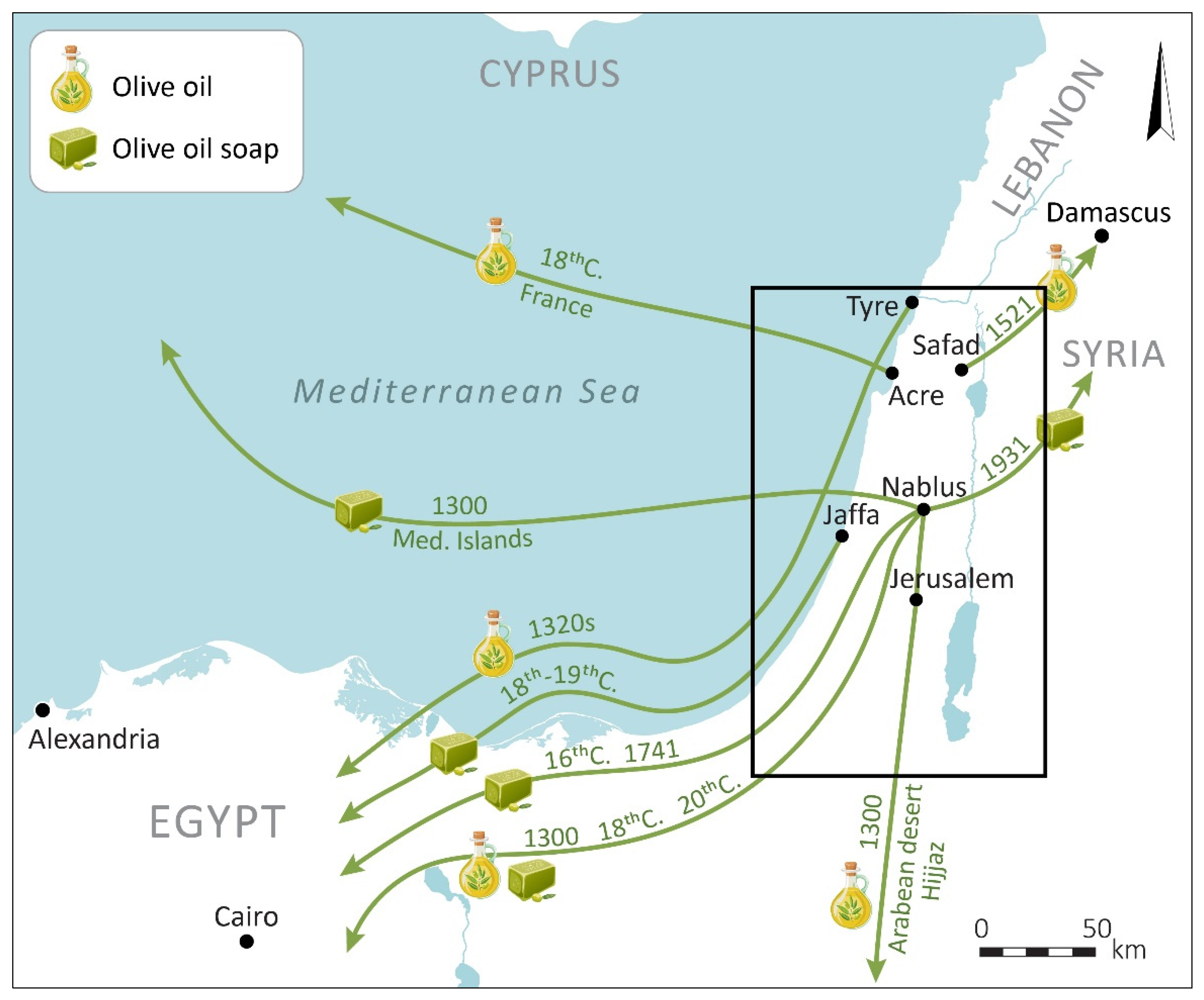
Olive Tree Cultivation and the Olive Oil Industry in Palestine: Trends of Growth and Decline from the Late Mamluk Period to the End of the British Mandate
 , and
, and 
Abstract
1. Introduction

| Year | Origin of Merchants and Quantity |
|---|---|
| 1400 | A merchant from Barcelona exported olive oil to Alexandria worth 2964 dinars [19] (p. 139). |
| 1401 | Heavy snow and a wave of locusts [20]. |
| 1405 | A shipment of 2790 oil jars from Seville to Alexandria at the cost of 1400 dinars. |
| 1406 | A merchant of Gaeta, Bicoli Limbito, exported olive oil and soap worth 2079 dinars to Alexandria [19] (p. 161). |
| Catalans exported to the Muslim Levant great quantities of olive oil produced in Tarragona, Majorca, and other provinces ruled by the King of Aragon [19] (p. 214). | |
| A Venetian ship carried olive oil worth 25,000 ducats to Syria [19] (p. 230). | |
| 1415 | A Catalan shipwreck on its way to Egypt carried olive oil and other merchandise. The cargo was worth 60,000 dinars [19] (pp. 235–236). |
| 1421 | The Genoese exported great quantities of olive oil to Egypt, especially from Andalusia [19] (p. 269). |
| 1451 | A peace treaty or a 5-year truce was proposed between the King of Aragon and the Mamluk sultan in Cairo. The Aragonian ambassador proposed that the sultan oblige himself to buy from the king annually 10,000 quintals of soap worth 100,000 ducats, 5000 djarwi kintar hazelnuts for 125,000 ducts and 3000 butts (1 butt = 0.45–0.61 ton) of olive oil for 90,000 ducts [19] (p. 311). |
| 1490 | Heavy snow damaged the orchards and especially the olive trees (Ibn Ṭūlūn 1998: 112) [21]. |
| 1504 | Heavy rains and strong winds. Damage to olive trees in the village of Sakhnin in the Lower Galilee (Ibn Ṭūlūn 1962: 272) [22] (p. 272). |
| 1508 | An extreme winter hit the area, snow fell continuously for 15 days and piled up. Wild and domestic animals died (Duwayhī 1976: 379) [23]. |
2. Materials and Methods
3. Results and Discussion
3.1. Olive Cultivation in the Mamluk Period: Compiling a Map Based on Brief Descriptions
3.2. The Fifteenth Century: Temporary Shortage or Full-Scale Decline
3.3. From Sultanate to Empire: Olive Cultivation During the Sixteenth Century
3.4. First Glance at the Ten Galilean Villages That Form Our Case Study
3.5. The Seventeenth–Nineteenth Centuries: The Role of Independent Rulers in Expanding Olive Cultivation
3.6. The First World War: Ottoman Orders and British Counter-Orders
3.7. The British Mandate: The Zenith of Olive Tree Cultivation (1917–1947)
3.8. Demographic Growth Versus the Increase in Olive Tree Cultivation and Olive Oil Industry
4. Conclusions and Future Perspectives
Author Contributions
Funding
Data Availability Statement
Acknowledgments
Conflicts of Interest
References
- Tepper, Y.; Porat, N.; Langgut, D.; Barazani, O.; Bajpai, P.K.; Dag, A.; Ehrlich, Y.; Boaretto, E.; Bar-Oz, G. Relict olive trees at runoff agriculture remains in Wadi Zetan, Negev Desert, Israel. J. Archaeol. Sci. Rep. 2022, 41, 103302. [Google Scholar] [CrossRef]
- Barazani, O.; Dag, A.; Dunseth, Z. The history of olive cultivation in the southern Levant. Front. Plant Sci. 2023, 14, 1–10. [Google Scholar] [CrossRef] [PubMed]
- Galili, E.; Langgut, D.; Terral, J.F.; Barazani, O.; Dag, A.; Horwitz, L.K.; Ramirez, I.O.; Rosen, B.; Weinstein-Evron, M.; Chaim, S.; et al. Early production of table olives at a mid-7th millennium BP submerged site off the Carmel coast (Israel). Sci. Rep. 2021, 11, 2218. [Google Scholar] [CrossRef] [PubMed]
- Langgut, D.; Garfinkel, Y. 7000-year-old evidence of fruit tree cultivation in the Jordan Valley, Israel. Sci. Rep. 2022, 12, 7463. [Google Scholar] [CrossRef] [PubMed]
- Langgut, D.; Cheddadi, R.; Carrión, J.S.; Cavanagh, M.; Colombaroli, D.; Eastwood, W.J.; Greenberg, R.; Litt, T.; Mercuri, A.M.; Miebach, A.; et al. The origin and spread of olive cultivation in the Mediterranean Basin: The fossil pollen evidence. Holocene 2019, 29, 902–922. [Google Scholar] [CrossRef]
- Fuks, D.; Melamed, Y.; Langgut, D.; Erickson-Gini, T.; Tepper, Y.; Bar-Oz, G.; Weiss, E. Unprecedented yet gradual nature of first millennium CE intercontinental crop plant dispersal revealed in ancient Negev desert refuse. eLife 2023, 12, e85118. [Google Scholar] [CrossRef]
- Frankel, R.; Avitsur, S.; Ayalon, E. History and Technology of Olive Oil in the Holy Land; Eretz Israel Museum: Tel Aviv, Israel, 1994. [Google Scholar]
- Goor, A.; Spiegel, P.; Gratch, H. The Olive; Ministry of Agriculture State of Israel: Tel Aviv, Israel, 1960.
- Frankel, R. Ancient oil mills and presses in the Land of Israel. In History and Technology of Olive Oil in the Holy Land; Ayalon, E., Ed.; Eretz Israel Museum: Tel Aviv, Israel, 1994; pp. 19–90. [Google Scholar]
- Allouche, A. Mamluk Economics, A Study and Translation of Al-Maqrizi’s Ighathah; University of Utah Press: Salt Lake City, UT, USA, 1994. [Google Scholar]
- Avitsur, S. Olive oil production in the Galilee in the beginning of the 20th century—Its scope and extent. Horiz. Geogr. 1987, 20, 15. [Google Scholar]
- Alcalay, B.Z.; Kara, Y. Arabic Proverbs, Sayings and Idioms in Palestinian Colloquial Arabic; Ministry of Defence: Tel Aviv, Israel, 1993; p. 111.
- Infante-Amate, J.; de Molina, M.G. The socio-ecological transition on a crop scale: The case of olive orchards in southern Spain (1750–2000). Hum. Ecol. 2013, 41, 963–965. [Google Scholar] [CrossRef]
- Kapellakis, I.; Emmanouil, K.; Tsagarakis, P.; Crowther, J.C. Olive oil history, production and by-product management. Rev. Environ. Sci. Bio/Technol. 2008, 7, 1–26. [Google Scholar] [CrossRef]
- Frankel, Y. Oil and olives in the Land of Israel (Palestine) in the Early Muslim period (634–1099). In Olive Oil in Antiquity; Eitam, D., Heltzer, M., Eds.; University of Haifa: Haifa, Israel, 1996. [Google Scholar]
- Avitsur, S. Industrial Installations in their landscapes. In Chapters in Industrial Archaeology in Israel; Center for Culture and Education, General Federation of Workers in Israel: Tel Aviv, Israel, 1994; p. 84. [Google Scholar]
- Maxwell, S.; Fernando, A. Cash crops in developing countries: The issues, the facts, the policies. World Dev. 1989, 17, 1678. [Google Scholar] [CrossRef]
- Israeli, A. Bet HaKerem Valley and its Settlement. In A Regional Approach; The Western Galilee-the Regional Land Knowledge Group of the “Sulam Tzur” and “Ga’aton” Council: Nahariya, Israel, 1979. [Google Scholar]
- Ashtor, E. Levant Trade in the Later Middle Ages; Princeton University Press: Princeton, NJ, USA, 1983. [Google Scholar]
- Ibn Qadi Shahba, A.i.M. Tārikh Ibn Qadi Shuhba; The French Institute for Arab Studies: Damascus, Syrian Arab Republic, 1997; Volume 4, pp. 163, 189. [Google Scholar]
- Ibn Tūlūn, S.M. Mufakahat al-Khillan fi Hawadith al-Zaman; Dar al-Kutub al-Ilmiyah: Beirut, Lebanon, 1998; p. 112. [Google Scholar]
- Ibn Tūlūn, S.M. Mufakahat al-Khillan fi Hawadith al-Zaman, Tarikh Misr wal-Sham; The Egyptian General Organization for Authorship, Translation, Printing and Publishing: Cairo, Egypt, 1962. [Google Scholar]
- Duwayhi, I.; Fahd, B. Tarikh al-Azmina; Dar Lahd Khatir: Beirut, Lebanon, 1976; p. 379. [Google Scholar]
- Al-Dimashqī, S.A. Nokhbet ed-Dahr fi Adjaib-il-Birr wal-Bah’r; Imperial Academic Press: Saint Petersburg, Russia, 1865. [Google Scholar]
- Al-Hanbalī, M. AI-Uns al-Jalīl fi Tārikh Al-Quds wal-Khalīl; Al-Muhtasib Library: Amman, Jordan, 1973. [Google Scholar]
- Al-ʻUthmānī, M. Tārikh Ṣafad; Dar al Takween: Damascus, Syria, 2009. [Google Scholar]
- Fabri, F. The Wanderings of Felix Fabri 1484 A.D; Stewart, A., Translator; Palestine Pilgrims’ Text Society: London, UK, 1893; Volume 2. [Google Scholar]
- Battuta, I. Travels in Asia and Africa 1321–1354; Routlage and Kegan Paul: London, UK, 1984. [Google Scholar]
- Volterra, M.b.M. The Travels of Menahem of Volterra in Eretz Israel in the Year 1481; Yaari, Y., Ed.; Bialik Institute: Jerusalem, Israel, 1948. [Google Scholar]
- Suriano, F. Treatise on the Holy Land; Bagatti, B., Ed.; Bellorini, T.; Hoade, E., Translators; Franciscan Press: Jerusalem, Israel, 1949. [Google Scholar]
- Ashtor, E. Observations on Venetian trade in the Levant in the XIVth Century. J. Eur. Econ. Hist. 1976, 5, 533–586. [Google Scholar]
- Hütteroth, W.D.; Abdulfattah, K. Historical Geography of Palestine, Transjordan and Southern Syria in the Late 16th Century; Fränkische Geographische Gesellschaft: Erlangen, Germany, 1977. [Google Scholar]
- Hütteroth, W.D.; Abdulfattah, K. To get an idea of the buying power of the akçe in Jerusalem one sack of wheat (=600 Kg) cost 500 akçe. In Historical Geography of Palestine, Transjordan and Southern Syria in the Late 16th Century; Fränkische Geographische Gesellschaft: Erlangen, Germany, 1977; p. 68. [Google Scholar]
- Lewis, B. Studies in the Ottoman Archives. Bull. Sch. Orient. Afr. Stud. Univ. Lond. 1954, 16, 469–501. [Google Scholar] [CrossRef]
- Cohen, A.; Lewis, B. Population and Revenue in the Towns of Palestine in the Sixteenth Century; Princeton University Press: Princeton, NJ, USA, 1978. [Google Scholar]
- Cohen, A.; Lewis, B. Palestine in the 18th Century: Patterns of Government and Administration; In Contrast to the Sixteenth Century, When Tax Collectors Were Appointed by the Central Ottoman Government and Reported to Its Central Treasury and Submitted a Full and Detailed Account for Each Village, in the Seventeenth and Eighteenth Centuries, Tax Collecting Was Carried Out by Locals Who Bought the Right to Collect Taxes from the Central Ottoman Treasury; Magnes Press: Jerusalem, Israel, 1973; pp. 127, 179–180. [Google Scholar]
- Gavish, D. The Survey of Palestine under the British Mandate, 1920–1948; Routledge: London, UK, 2005. [Google Scholar]
- Schaffer, G.; Levin, N. Mapping human induced landscape changes in Israel between the end of the 19th century and the beginning of the 21th century. J. Landsc. Ecol. 2014, 7, 110–145. [Google Scholar] [CrossRef]
- Conder, C.R.; Kitchener, H.H. The Survey of Western Palestine. In Memoirs of the Topography, Orography, Hydrography, and Archaeology; I, Sheets I–IV, Galilee; Committee of the Palestine Exploration Fund: London, UK, 1881. [Google Scholar]
- Nadan, A. The Palestinian Peasant Economy Under the Mandate; Center for Middle Eastern Studies—Harvard University: Cambridge, MA, USA, 2006. [Google Scholar]
- Arbel, Y. Olive oil soap production during the Ottoman period: Methods, sites and innovations. In Lod “Diospolis—City of God” Collected Papers on the History and Archaeology of Lod; Shavit, A., Ed.; Tagliyot, Israeli Institute of Archaeology: Lod, Israel, 2019. [Google Scholar]
- Clawson, M.; Landsberg, H.H.; Alexander, L.T. The Agricultural Potential of the Middle East; Elsevier Science Ltd.: New York, NY, USA, 1971. [Google Scholar]
- Cohen, A. The Arab sector economy during the Mandatory period. Econ. Q. 1979, 103, 407–419. [Google Scholar]
- El-Eini, R.I.M. The implementation of British agricultural policy in Palestine in the 1930s. Middle East. Stud. 1996, 32, 211–250. [Google Scholar] [CrossRef]
- Israeli, A. On the history of olives and olive oil production in Galilee and The Bet-Hakerem Valley in the Ottoman and Mandatory times. Cathedra 1980, 15, 95–105. [Google Scholar]
- Verlinsky, N. Problems of agricultural export. Econ. Q. 1956, 11, 249–257. [Google Scholar]
- Nasouh al-Tahir, A. Shajrat al-Zitun [The Olive Tree: Its History, Cultivation, Diseases, and Industry]; Maktabat al-Tahir Akhwan: Jaffa, Israel, 1947. [Google Scholar]
- Amar, Z. Agricultural Produce in the Land of Israel in the Middle Ages; Yad Ben Zvi: Jerusalem, Israel, 2000. [Google Scholar]
- Al-Dimashqī. Nokhbet ed-Dahr; Dār al-Kutub al-ʿIlmiyyah: Beirut, Lebanon, 1980. [Google Scholar]
- Battuta, I. Travels in Asia and Africa; Routledge: London, UK, 1929. [Google Scholar]
- Yaari, A. Igrot Eretz Israel; Department of Youth Affairs of the Zionist Organization and with the Participation of Keren Hayesod by Gazit: Tel Aviv, Israel, 1943; p. 92. [Google Scholar]
- Yaari, A. Igrot Eretz Israel; Masadah: Ramat Gan, Israel, 1971. [Google Scholar]
- Al-ʻUthmānī, M. Tārikh Ṣafad; Dār al-Baṣāʼir: Damascus, Syria, 1985; pp. 122–123. [Google Scholar]
- Goor, A. The place of the olive in the Holy Land and its history through the Ages. Econ. Bot. 1966, 20, 236–237, 242. [Google Scholar] [CrossRef]
- Ashtor, E. Levantine sugar industry in the Later Middle Ages–An example of technological decline. Isr. Orient. Stud. 1977, 7, 227. [Google Scholar]
- Schur, N. A History of Acre; Devir: Tel Aviv, Israel, 1990. [Google Scholar]
- Sanudo, M. The Book of the Secrets of the Faithful of the Cross: Liber Secretorum Fidelium Crucis; Routledge: London, UK, 2016; p. 51. [Google Scholar]
- Ashtor, E. The Economic decline of the Middle East during the Late Middle Ages an outline. In Technology, Industry and Trade; Kedar, B.Z., Ed.; Variorum: Hampshire, UK, 1992. [Google Scholar]
- Coureas, N.S. The export of soap and olive oil from the Port of Famagusta in the fourteenth and fifteenth centuries. In Famagusta Maritima; Walsh, M.J.K., Ed.; Brill: Leiden, The Netherlands; Boston, MA, USA, 2019; pp. 159–169. [Google Scholar]
- Tsugitaka, S. State and Rural Society in Medieval Islam; Brill: Leiden, The Netherlands; New York, NY, USA; Köln, Germany, 1997; p. 233. [Google Scholar]
- Walker, B.J. The role of agriculture in Mamluk-Jordanian power relations. In Bulletin d’ètudes Orientales; Supplement LVII; Presses de l’Institut Français du Proche-Orient: Damascus, Syria, 2008; p. 95. [Google Scholar]
- Grigg, D. Olive oil, the Mediterranean and the world. GeoJournal 2001, 53, 165–166. [Google Scholar] [CrossRef]
- Cohen, A. Palestine in the 18th Century; The Magnes Press, The Hebrew University: Jerusalem, Israel, 1973; p. 43. [Google Scholar]
- Peled, A. Sugar in the Kingdom of Jerusalem; Magnes Press, The Hebrew University: Jerusalem, Israel, 2009; p. 264. [Google Scholar]
- Cohen, A. The History of Eretz Israel Under the Mamluk and Ottoman Rule (1260–1804); Keter: Jerusalem, Israel, 1990; p. 192. [Google Scholar]
- Singer, A. Palestinian Peasants and Ottoman Officials; Cambridge University Press: Cambridge, UK, 1994. [Google Scholar]
- Bassola, M. A Pilgrimage to Palestine by Rabbi Moshe Bassola of Ancona; The Jewish Palestine Exploration Society: Jerusalem, Israel, 1939; p. 43. [Google Scholar]
- Hütteroth, W.D.; Abdulfattah, K. Agriculture production in Southern Syrian Liwas 1005H./1596 A.D. map 5. In Historical Geography of Palestine; Vorstand der Fränkischen Geographischen Gesellschaft: Erlangen, Germany, 1977; p. 71. [Google Scholar]
- Petersen, A. A Gazetteer of Buildings in Muslim Palestine; Council for British Research in the Levant: Oxford, UK, 2001; pp. 132–135. [Google Scholar]
- Philipp, T. Acre, The Rise and Fall of a Palestinian City, 1730–1831; Columbia University Press: New York, NY, USA, 2001. [Google Scholar]
- Frangakis-Syrett, E. Trade and Money: The Ottoman Economy in the Eighteenth and Early Nineteenth Centuries; Gorgias Press: Piscataway, NJ, USA, 2010. [Google Scholar]
- Panzac, D. International and domestic maritime trade in the Ottoman empire during the 18th Century. Int. J. Middle East Stud. 1992, 24, 189–206. [Google Scholar] [CrossRef]
- Ben-Bassat, Y. Petitioning the Sultan: Protests and Justice in Late Ottoman Palestine, 1865–1908; I.B. Tauris: London, UK; New York, NY, USA, 2013. [Google Scholar]
- Yazbak, M. The Politics of Trade and Power: Dahir al-ʿUmar and the Making of Early Modern Palestine. J. Econ. Soc. Hist. Orient 2013, 56, 696–736. [Google Scholar] [CrossRef]
- Cohen, A. Ottoman rule and the reemergence of the coast of Palestine. Cathedra 1985, 34, 55–74. [Google Scholar]
- Cohen, A. History of Eretz Israel Under the Mamluk and Ottoman Rule; Yad Yitsḥaḳ Ben-Tsevi: Jerusalem, Israel, 1981. [Google Scholar]
- Pococke, R. A Description of the East, and Some Other Countries; Printed for the Author: London UK, 1743; Chapter 1; p. 3. [Google Scholar]
- Frangakis-Syrett, E. Trade and Money in the Ottoman Levant; Brill: Leiden, The Netherlands, 1995; p. 117. [Google Scholar]
- Ben-Arieh, Y.; Oren, A. Yishuvi Haglil erev mifal ha’hityashvot hatzyoni. In Artzot Haglil; Shmuali, A., Sofer, A., Kliot, N., Eds.; Kluwer: Leiden, The Netherlands, 1983; Volume 1, p. 334. [Google Scholar]
- Doumani, B. The political economy of population counts in Ottoman Palestine: Nablus, circa 1850. Int. J. Middle East Stud. 1994, 26, 12. [Google Scholar] [CrossRef]
- Doumani, B. Rediscovering Palestine: Merchants and Peasants in Jabal Nablus, 1700–1900; University of California Press: Oakland, CA, USA, 1995; pp. 132, 135. [Google Scholar]
- Schölch, A. Palestine in Transformation, 1856–1882: Studies in Social, Economic, and Political Development; Institute for Palestine Studies: Washington, DC, USA, 1993. [Google Scholar]
- Ben-Arieh, Y. The Development of the Towns in Eretz Israel. In The History of Eretz Israel, The Last Phase of the Ottoman Rule (1799–1917); Ben-Arieh, Y., Bartal, I., Eds.; Keter: Jerusalem, Israel, 1990. [Google Scholar]
- Rivlin, H.A. The Agricultural Policy of Muḥammad ʿAlī in Egypt; Harvard University Press: Cambridge, MA, USA, 1961; p. 166. [Google Scholar]
- Cuinet, V. Syrie, Liban et Palestine, Géographie Administrative, Statistique, Descriptive et Raisonnée; E. Leroux: Paris, France, 1896; p. 95. [Google Scholar]
- Cuinet, V. Syrie, Liban et Palestine; E Leroux Publishing House: Paris, France, 1879. [Google Scholar]
- Volney, M.C.F. Travels Through Syria and Egypt in the Years 1783, 1784, and 1785; G.G.J. and J. Robinson: London, UK, 1787; pp. 101, 229–230. [Google Scholar]
- Liphshitz, N.; Biger, G. Afforestation policy of the British regime in Palestine. Horiz. Geogr. 1994, 40–41, 5–16. [Google Scholar]
- Bunton, M.P. Colonial Land Policies in Palestine, 1917–1936; Oxford University Press: Oxford, UK, 2007. [Google Scholar]
- Avrahamoviiz, Z.; Guelfat, I. Hamesheq Ha’Aravi; Hakibutz Hameuchad: Tel Aviv, Israel, 1944. [Google Scholar]
- Avitsur, S. Olive production in the Land of Israel: Traditional to industrial. In History and Technology of Olive Oil in the Holy Land; Ayalon, E., Ed.; Olearius Editions: Kemblesville, PA, USA, 1994; p. 136. [Google Scholar]
- Ashkenazi, E. Environmental and Anthropogenic Factors Influencing the Survival of Fruit Trees in Abandoned Bedouin Groves in the Negev Highlands. Ph.D. Thesis, The Hebrew University of Jerusalem, Jerusalem, Israel, 2013; p. 19. [Google Scholar]
- El-Eini, R.I.M. Mandate Landscape; Routledge: London, UK; New York, NY, USA, 2003; pp. 132–133. [Google Scholar]
- Biger, G. A geographical analysis of imperial rule: The British regime in Eretz-Israel (Palestine) 1917–1929. In Eretz-Israel: Archaeological, Historical and Geographical Studies David Amiran Volume; Israel Exploration Society: Jerusalem, Israel, 1991; p. 32. [Google Scholar]
- Avitsur, S. Man and His Work, Historical Atlas of Tools and Workshops in the Holy Land; Carta, the Israeli Mapping and Publishing Society: Jerusalem, Israel, 1976; p. 172. [Google Scholar]
- Bar-Oz, G.; Schmidt, J. Why study the archeo-histories of dryland landraces now? Trends Plant Sci. 2025, 30, 724–735. [Google Scholar] [CrossRef]


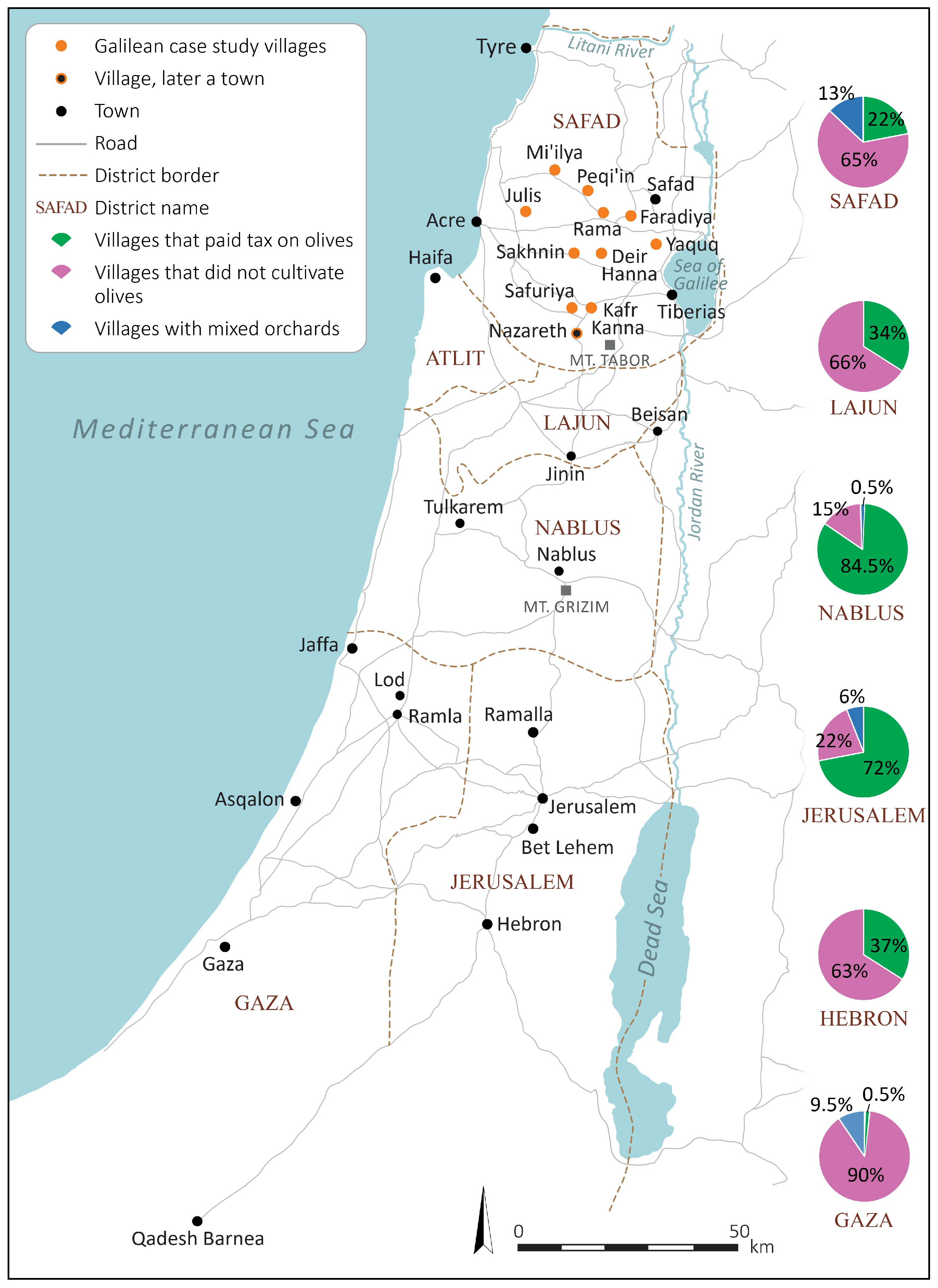




| Jerusalem | Safad | Nablus | Lajjun | Gaza | Total | |
|---|---|---|---|---|---|---|
| Villages with olive groves | 105 | 69 | 192 | 19 | 1 | 349 |
| Villages with no olive trees | 32 | 211 | 34 | 37 | 192 | 493 |
| Villages with mixed orchards | 9 | 31 | 1 | 0 | 18 | 58 |
| Total number of villages in district | 146 | 311 | 227 | 56 | 211 | 902 |
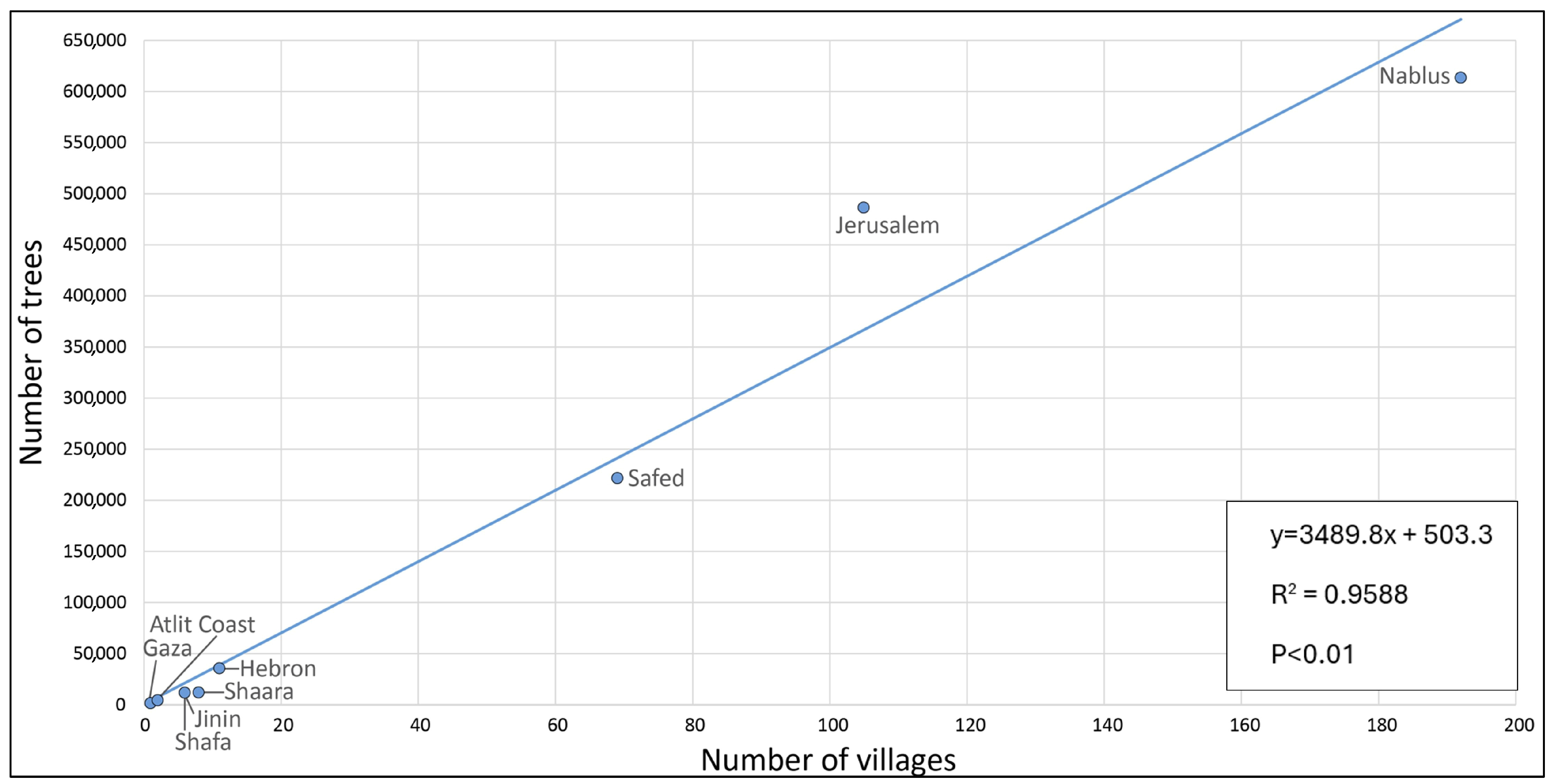
| Districts | No. of Villages | No. of Trees | Average of Trees per Village | Min | Max | Olive Presses |
|---|---|---|---|---|---|---|
| Nablus | 192 | 613,572 | 3195 | 40 | 29,998 | 90 |
| Jerusalem | 105 | 486,598 | 4634 | 30 | 42,000 | 2 |
| Safad | 69 | 221,888 | 3215 | 80 | 32,000 | 34 |
| Hebron | 11 | 35,300 | 3209 | 600 | 14,400 | 0 |
| Shaara | 8 | 12,380 | 1547 | 200 | 4000 | 1 |
| Shafa | 6 | 12,242 | 2040 | 242 | 3000 | 2 |
| Jinin | 6 | 12,064 | 2010 | 500 | 5964 | 0 |
| Atlit Coast | 2 | 4400 | 2200 | 700 | 1500 | 0 |
| Gaza | 1 | 2000 | 2000 | - | - | 6 |
| Ramla | 0 | 0 | 0 | - | - | 6 |
| Total | 400 | 1,400,794 | 139 |
| Name of Town | No. of Oil Presses |
|---|---|
| Acre and vicinity | 250 |
| Haifa | 89 |
| Tiberias | 15 |
| Safad | 7 |
| Nazareth | 9 |
| Total | 370 |
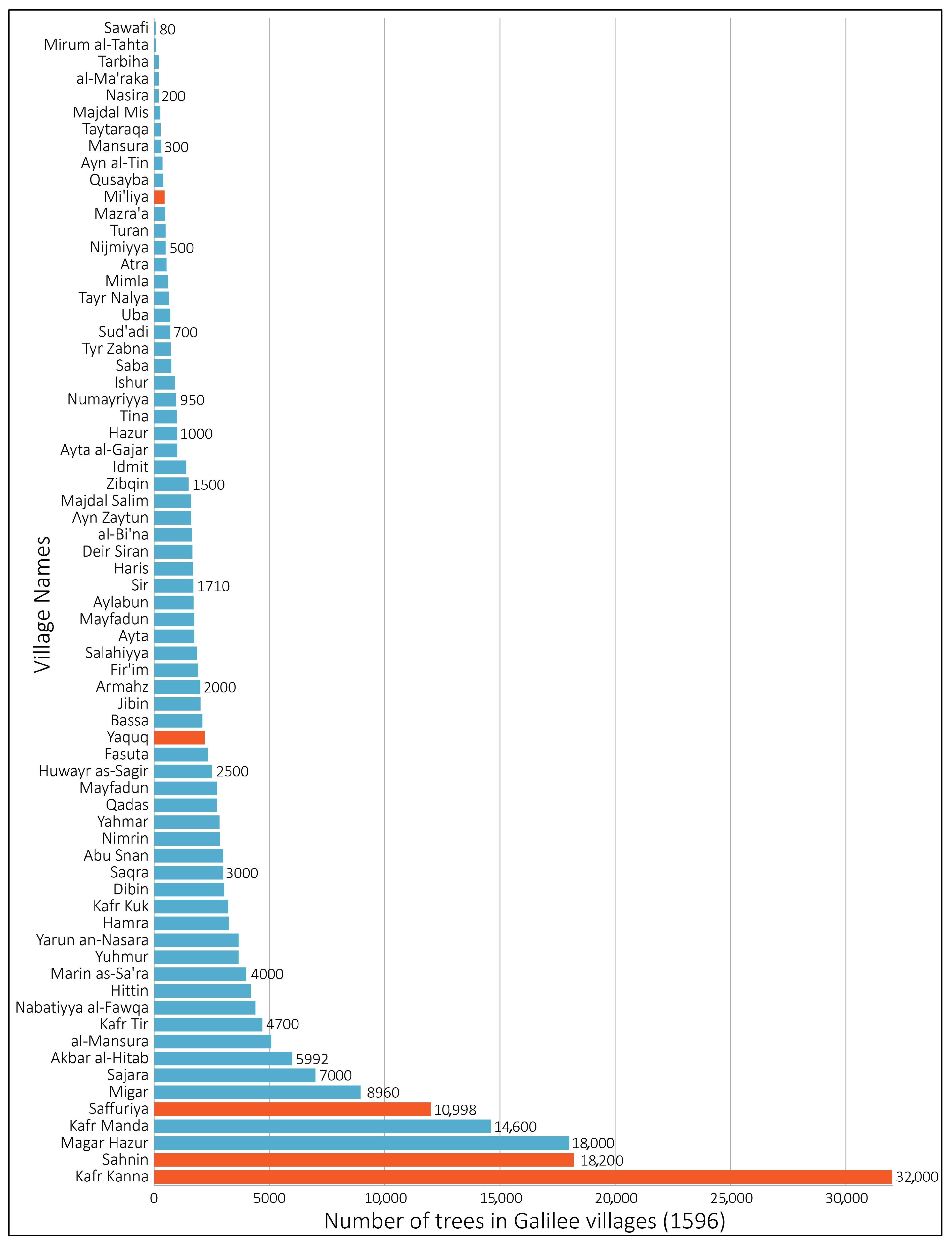
| Village Name | Y_ITM | X_ITM | Elevation (in Meters) | No. of Trees 1596 | No. of Trees 1871–1877 SWP * |
|---|---|---|---|---|---|
| Mʻilya | 769893 | 224625 | 529 | 458 | 16,910 |
| Kafr Kanna | 738990 | 232065 | 256 | 32,000 | 2100 |
| Sakhnin | 752213 | 227836 | 255 | 9100 | 40,090 |
| Saffuriya | 739701 | 226330 | 252 | 10,998 | 18,970 |
| Yaquq | 754462 | 254141 | 31 | 220 | 120 |
| Rama | 760390 | 234727 | 445 | Olive & other fruit orchards | 79,600 |
| Julis | 760890 | 217780 | 138 | Olive & other fruit orchards | 25,150 |
| Faradiya | 759656 | 240292 | 420 | Olive & other fruit orchards | 2980 |
| Arrabe | 750668 | 231990 | 250 | Not available | 10,720 |
| Deir Hanna | 751989 | 243309 | 310 | Not available | 25,600 |
| Total | 54,756 (4575.6 dunams) | 222,240 (22,224 dunams) |
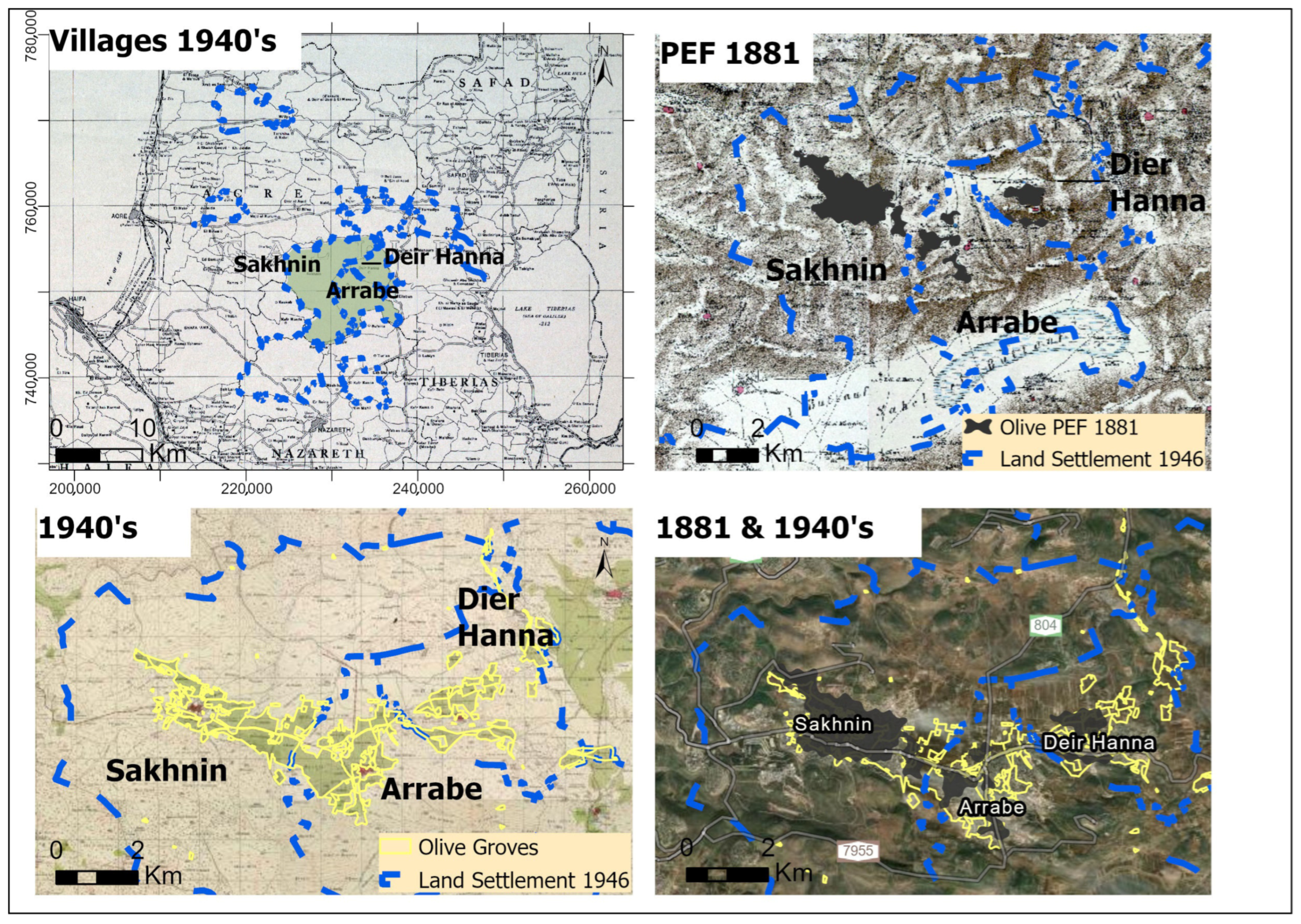
| Village Name | No. of Trees 1871–1877 SWP * | Number of Dunams 1941–1945 | Number of Trees 1943 | Growth | Decrease | |
|---|---|---|---|---|---|---|
| Mʻilya | 16,910 |  Decline due to fuel shortage during World War? | 784 | 15,000 | 11.3% | |
| Kafr Kanna | 2100 | 1130 | 11,000 | 80.9% | ||
| Sakhnin | 40,090 | 3112 | 10,320 | 74.2% | ||
| Saffuriya | 18,970 | 4089 | 32,700 | 42% | ||
| Yaquq | 120 | 23 | 160 | 25% | ||
| Rama | 79,600 | 8020 | 76,880 | 3.4% | ||
| Julis | 25,150 | 1846 | 8270 | 67% | ||
| Arrabe | 10,720 | 2908.5 | 20,400 | 47.4% | ||
| Faradiya | 2980 | 750.9 | 7040 | 57.7% | ||
| Deir Hanna | 25,600 | 2560.4 | 10,600 | 58.6% | ||
| Total | 222,240 (22,224 dunams) | 192,370 (19,237 dunams) | 13.4% |
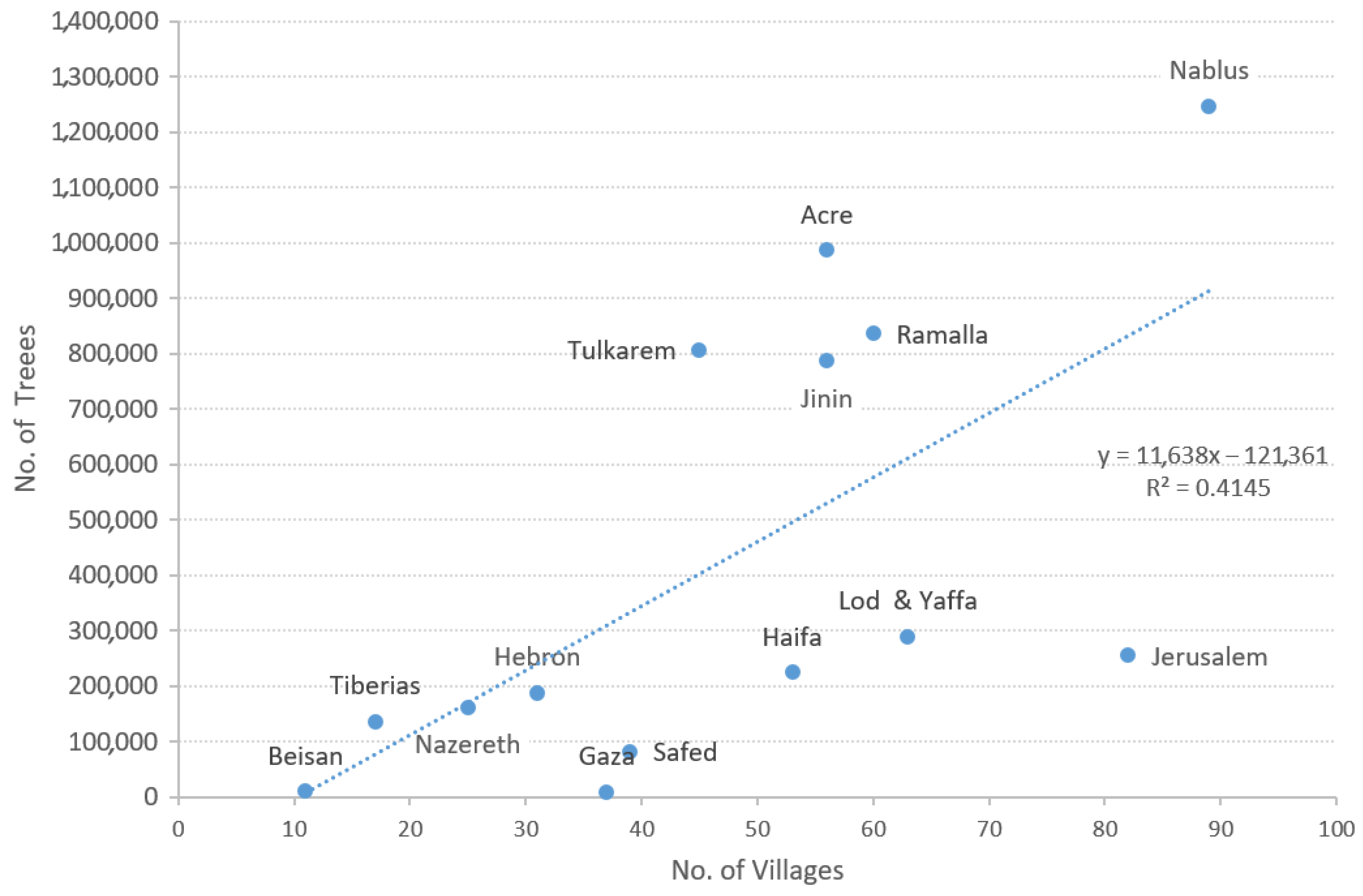
| Districts | # Villages | # Trees | Average of Trees per Village | STD | Min | Max | # Olive Press |
|---|---|---|---|---|---|---|---|
| Nazareth | 25 | 162,290 | 6492 | 7219 | 20 | 32,700 | 36 (7) |
| Tiberias | 17 | 136,800 | 6840 | 17,586.1 | 20 | 77,520 | 18 (5) |
| Safad | 39 | 82,641 | 2109 | 2201.95 | 6 | 8030 | 33 (3) |
| Haifa | 53 | 225,340 | 4418 | 7915 | 10 | 46,000 | 36 (11) |
| Acre | 56 | 986,860 | 17,622.5 | 54,103.241 | 20 | 403,470 | 104 (33) |
| Tulkarem | 45 | 80,7270 | 18,773 | 25,102.6 | 150 | 109,500 | 56 (25) |
| Lod and Jaffa | 63 | 289,967 | 4602 | 10,755.1 | 10 | 59,000 | 44 (11) |
| Gaza | 37 | 9510 | 257 | 737.19 | 10 | 4200 | 22 |
| Ramalla | 60 | 836,550 | 13,942 | 12,453.6 | 550 | 50,200 | 110 (17) |
| Beisan | 11 | 11,530 | 1048 | 1698.5 | 20 | 6000 | |
| Jinin | 56 | 787,210 | 14,057 | 18,183.6 | 60 | 85,600 | 54 (11) |
| Nablus | 89 | 1,247,380 | 14,151 | 16,032.1 | 70 | 94,650 | 71 (34) |
| Hebron | 31 | 188,720 | 6290 | 8481.43 | 30 | 35,000 | 15 (3) |
| Jerusalem | 82 | 256,230 | 3125 | 2 | 4300 | 14 (15) | |
| Total | 664 | 6,053,367 (605,336.7 dunams) | 613 (139) |
Disclaimer/Publisher’s Note: The statements, opinions and data contained in all publications are solely those of the individual author(s) and contributor(s) and not of MDPI and/or the editor(s). MDPI and/or the editor(s) disclaim responsibility for any injury to people or property resulting from any ideas, methods, instructions or products referred to in the content. |
© 2026 by the authors. Licensee MDPI, Basel, Switzerland. This article is an open access article distributed under the terms and conditions of the Creative Commons Attribution (CC BY) license.
Share and Cite
Raphael, K.; Avni, G.; Wachtel, I.; Porat, R.; Mansour, T.; Barazani, O.; Bar-Oz, G. Olive Tree Cultivation and the Olive Oil Industry in Palestine: Trends of Growth and Decline from the Late Mamluk Period to the End of the British Mandate. Land 2026, 15, 609. https://doi.org/10.3390/land15040609
Raphael K, Avni G, Wachtel I, Porat R, Mansour T, Barazani O, Bar-Oz G. Olive Tree Cultivation and the Olive Oil Industry in Palestine: Trends of Growth and Decline from the Late Mamluk Period to the End of the British Mandate. Land. 2026; 15(4):609. https://doi.org/10.3390/land15040609
Chicago/Turabian StyleRaphael, Kate, Gideon Avni, Ido Wachtel, Roi Porat, Tamer Mansour, Oz Barazani, and Guy Bar-Oz. 2026. "Olive Tree Cultivation and the Olive Oil Industry in Palestine: Trends of Growth and Decline from the Late Mamluk Period to the End of the British Mandate" Land 15, no. 4: 609. https://doi.org/10.3390/land15040609
APA StyleRaphael, K., Avni, G., Wachtel, I., Porat, R., Mansour, T., Barazani, O., & Bar-Oz, G. (2026). Olive Tree Cultivation and the Olive Oil Industry in Palestine: Trends of Growth and Decline from the Late Mamluk Period to the End of the British Mandate. Land, 15(4), 609. https://doi.org/10.3390/land15040609