Article

Farmland Transfer, Land Use Transition, and Grain Production Capacity: Spatial Evidence from China

Institute of Food and Strategic Reserves, Nanjing University of Finance and Economics, Nanjing 210023, China
*
Author to whom correspondence should be addressed.
Land 2026, 15(4), 605; https://doi.org/10.3390/land15040605
Submission received: 9 March 2026 / Revised: 3 April 2026 / Accepted: 4 April 2026 / Published: 7 April 2026
(This article belongs to the Special Issue Land Use Transition Pathways: Governance, Resources, and Policies)

Abstract

As a crucial pathway for optimizing land factor allocation, farmland transfer plays a pivotal role in implementing the “storing grain in land and technology” strategy and safeguarding national grain security. Based on panel data from 30 provinces in China spanning 2009 to 2023, this study employs a two-way fixed effects model and a Spatial Durbin Model (SDM) to systematically examine the mechanisms, heterogeneity, and spatial spillover effects of farmland transfer on grain production capacity. The results indicate that: (1) Farmland transfer significantly enhances grain production capacity, and this conclusion remains robust after multiple robustness and endogeneity tests. (2) Farmland transfer boosts grain production capacity by promoting cultivated land connectivity and facilitating the substitution of machinery for labor; however, the accompanying non-grain tendency and land governance disputes exert inhibitory effects on capacity release. (3) Transfers to farming households and professional cooperatives, as well as the adoption of leasing and informal exchange arrangements, exhibit the strongest positive effects on production capacity, and the scale-efficiency gains of farmland transfer are particularly pronounced in major grain-consuming areas. (4) Improvements in a region’s farmland transfer level drive the enhancement of grain production capacity in neighboring regions through the diffusion of management experience and the sharing of social services. This study provides empirical evidence and policy insights to optimize farmland transfer mechanisms and safeguard food security.

1. Introduction

Food security represents a cornerstone of national socio-economic stability and a fundamental prerequisite for long-term national security. Against the backdrop of tightening natural resource constraints, China has explicitly advanced the strategic guideline of “storing grain in land and technology.” This approach focuses on enhancing production capacity through improvements in land quality and technological advancement to achieve the overarching goal of building a stable, reliable, and self-sufficient food security system. Central to implementing this strategy is the deepening of rural land system reform. In particular, the “Three-Rights Separation” reform, which disaggregates farmland ownership, contracting rights, and management rights, has facilitated the flexible transfer of land management rights, thereby providing core institutional support for the scaled and intensive development of modern agriculture [1]. However, transitioning this framework from policy design to practical application continues to encounter institutional frictions between legal ownership and on-the-ground implementation [2,3]. Against this backdrop, establishing a governance mechanism that effectively balances incentives and constraints while ensuring transfer efficiency has emerged as a central challenge in deepening land reform and consolidating food security [4].
A substantial body of literature has investigated the economic and environmental performance of farmland transfer. The prevailing view holds that farmland transfer drives the transition from fragmented smallholder operations to moderate-scale management, thereby improving micro-level land use efficiency [5] and macro-level agricultural sustainability [6,7]. Furthermore, by alleviating credit constraints for agricultural operators and enhancing total factor productivity [8,9], farmland transfer stimulates agricultural investment and ultimately strengthens grain production capacity [10,11]. However, its effects are not uniformly positive. In pursuit of profit maximization, new-type operating entities are incentivized to shift planting structures away from low-value grain crops toward high-value cash crops, thereby accelerating the trend of “non-grain” conversion [12,13]. Meanwhile, escalating transfer rents compress the margin for optimizing technical efficiency [14], and governance disputes stemming from ambiguous property rights or non-standardized contracts further undermine the stability of agricultural investment. Beyond these economic dimensions, a growing strand of research has examined the systemic transformations initiated by orderly land transfers. Such transfers not only reshape traditional smallholder farming models [15] but also reduce the intensity of agricultural chemical inputs and enhance ecological efficiency, thereby driving a broader green transition in land use [16,17,18].
Despite these advances, three critical gaps remain insufficiently addressed. First, existing literature has predominantly focused on the impact of farmland transfer on contemporaneous grain yield, while comparatively little attention has been directed toward grain production capacity. Unlike yield, which fluctuates in response to short-term shocks, production capacity reflects the comprehensive, long-term supportive potential of factor inputs—an orientation more closely aligned with the core logic of the “storing grain in land” strategy [19]. Second, the intermediate mechanisms through which farmland transfer affects grain production capacity remain poorly understood, particularly with regard to the multi-dimensional land use transitions that encompass changes in spatial morphology, factor input structures, and land governance conditions. Third, the cross-regional spatial spillover effects of farmland transfer on grain production capacity have yet to be adequately examined. Given the ongoing trends of rural labor outmigration and population aging [20,21], regions that successfully enhance production capacity through land transfers are likely to generate demonstration and service-sharing effects in neighboring areas, underscoring the need for an explicit spatial analytical perspective.
Building on provincial panel data from China spanning 2009–2023, this study employs Stochastic Frontier Analysis (SFA) and the Spatial Durbin Model (SDM) to systematically investigate the direct effects, transmission mechanisms, spatial spillovers, and heterogeneous characteristics of farmland transfer on grain production capacity. The marginal contributions of this study are threefold. First, in terms of research perspective, this study shifts the analytical lens from a “yield logic” to a “capacity logic”. By isolating random disturbances and technical inefficiencies through SFA, we construct a more precise measure of each province’s potential grain production capacity, enabling a more scientifically grounded assessment of farmland transfer’s long-term contribution to national food security. Second, in terms of mechanism identification, this study develops an analytical framework grounded in Land Use Transition (LUT) theory, encompassing four dimensions: spatial morphology, factor inputs, land function, and governance structure. By utilizing this framework, we can distinguish the positive pathways of land contiguity enhancement and machinery-labor substitution from the constraining effects associated with non-grain tendencies and transfer-related governance disputes. Third, in terms of spatial analysis, this study employs the SDM to capture the spatial dependence and inter-regional linkage characteristics of grain production capacity, revealing how farmland transfer in one region propagates capacity-enhancing effects to neighboring regions through experience diffusion and service sharing.

2. Theoretical Analysis and Research Hypothesis

2.1. Farmland Transfer on Grain Production Capacity

Farmland transfer, driven by market-oriented allocation mechanisms, facilitates the optimal reorganization of land management rights, thereby disrupting the inefficient equilibrium of traditional small-scale agriculture and extending the boundaries of agricultural production. On the one hand, farmland transfer activates significant economies of scale. The moderate expansion of operational farm size helps spread indivisible fixed costs across a larger output volume, thereby enhancing the marginal efficiency of factor inputs [22] and ensuring the economic rationality and financial viability of grain cultivation among large-scale producers [23]. Furthermore, farmland transfer promotes the reintegration of fragmented, low-yielding, or idle land into active production systems, thereby curbing farmland abandonment and effectively mobilizing regional potential output stocks [24,25,26].
On the other hand, farmland transfer optimizes factor allocation efficiency by facilitating the structural mobility of land resources. Specifically, the transfer market redirects land away from low-efficiency, part-time farming households toward new-type agricultural operating entities. These entities, such as family farms and professional cooperatives, typically possess greater professional expertise and capital endowment. Compared to traditional smallholders, these entities demonstrate superior capabilities in technological adaptation, risk management, and evidence-based decision-making. By narrowing the yield gap through precision management and integrated technology application, farmland transfer systematically elevates overall land productivity and output stability [27,28].
Accordingly, the following hypothesis is proposed:
Hypothesis 1:
Farmland transfer exerts a significant positive impact on grain production capacity.

2.2. Land Use Transition as a Mediating Mechanism

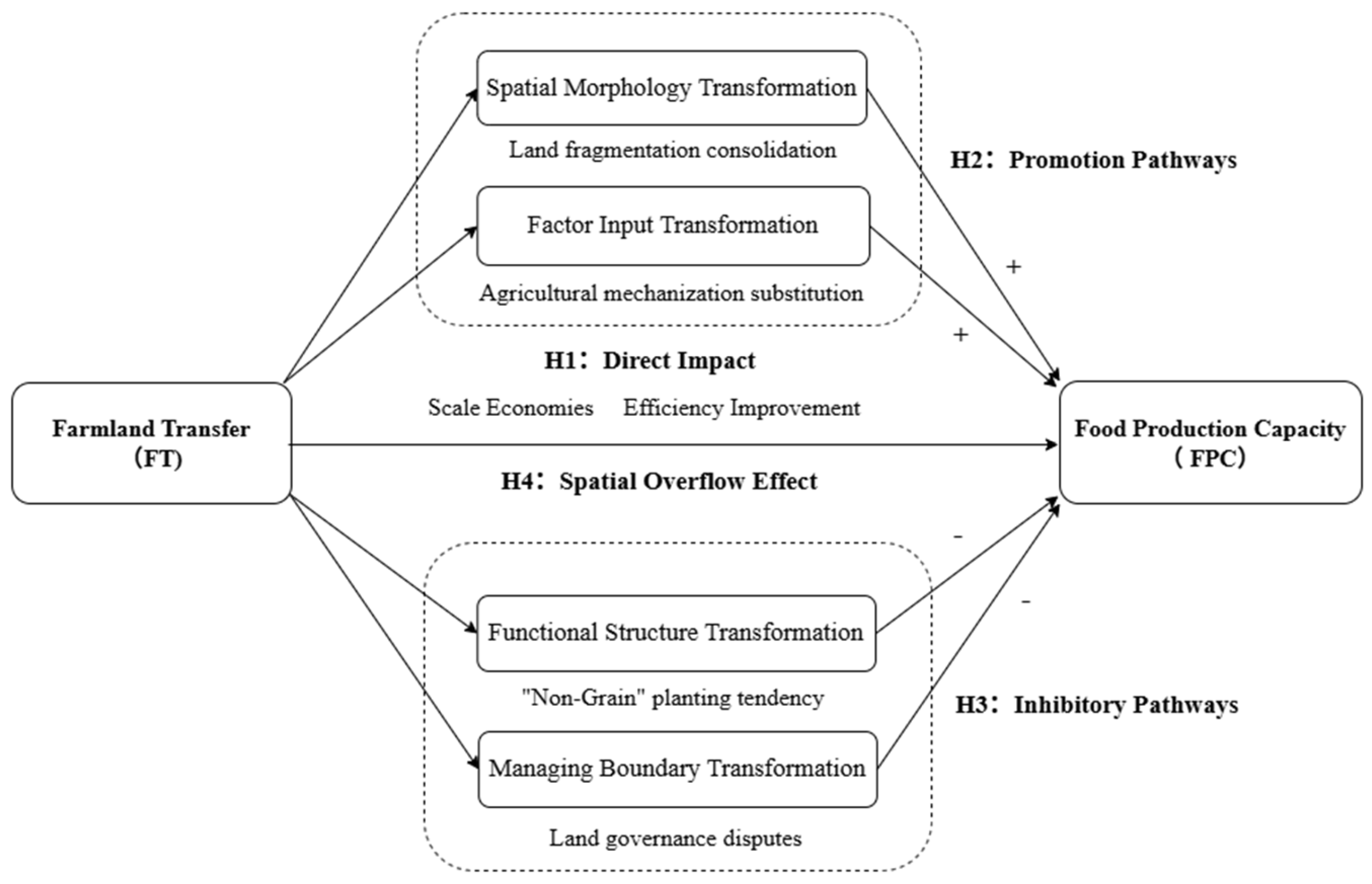
While farmland transfer may directly influence grain production capacity, its effects are likely transmitted through structural transformations in land use patterns. Specifically, land use transition can be conceptualized along two positive channels—namely, spatial morphology optimization and factor input transformation—as well as two potentially constraining channels including crop structure adjustment and land governance disputes. The theoretical framework and the specific pathways of these impacts are illustrated in Figure 1.

2.2.1. Spatial Morphology Optimization and Factor Input Transformation

Farmland transfer facilitates the comprehensive unlocking of grain production potential by optimizing the spatial morphology of cultivated plots and driving a structural transformation in factor inputs.
In terms of spatial morphology, the layout of cultivated land constitutes the fundamental physical foundation for grain production. Owing to resource constraints and historical land allocation systems, rural China is characterized by pervasive land fragmentation [29,30]. Such fragmentation not only raises the transaction and coordination costs of agricultural activities but also creates structural barriers that hinder the adoption and diffusion of modern production technologies [31]. New-type operating entities that acquire land through transfer possess both the incentive and the capacity to implement comprehensive land consolidation measures, which encompass the removal of redundant field ridges, the merging of irrigation channels, and the leveling of plots. These consolidation efforts minimize boundary losses in effective cultivation area [6] and, more importantly, overcome the physical constraints that fragmented plot layouts impose on mechanized operations [32]. By creating the spatial conditions necessary for the standardized deployment of medium- and large-scale machinery [33], such consolidation unlocks the long-suppressed productive potential embedded in the land.
In terms of factor inputs, the structural shift from labor to capital has emerged as a core driver of production efficiency gains. Against the backdrop of large-scale rural-to-urban migration, widespread labor shortages, and rising agricultural operating costs, the sustained enhancement of grain production capacity faces mounting constraints [34]. New-type operating entities, leveraging their capital advantages, typically respond by adopting machinery-labor substitution strategies. Rather than a simple exchange of inputs, this transformation represents a qualitative leap in production technique. Mechanized field operations, specifically deep plowing and subsoiling, significantly improve soil biophysical properties and enhance the land’s capacity to retain water and nutrients [35]. Simultaneously, precision fertilization and large-scale plant protection technologies, enabled by mechanization, fully realize the available technological dividends and generate step-change improvements in grain production capacity [36,37].
Accordingly, the following hypothesis is proposed:
Hypothesis 2:
Farmland transfer enhances grain production capacity by optimizing cultivated land contiguity and driving the structural substitution of machinery for labor.

2.2.2. Crop Structure Adjustment and Land Governance Disputes

While farmland transfer facilitates the realization of scale-related dividends, it is concurrently accompanied by shifts in operational objectives and frictions in institutional arrangements, both of which may impose asymmetric constraints on grain production capacity.
The first constraining channel concerns the adjustment of crop planting structures toward “non-grain” tendencies. In the context of market-oriented transfer, grain production faces mounting pressure from the widening gap between its relatively low comparative returns and the rigid upward trajectory of land rents [38]. To offset escalating rental costs and maximize profitability, new-type operating entities have strong incentives to redirect planting structures away from low-value grain crops toward high-value cash crops such as vegetables, flowers, and fruit trees [39,40]. This structural reorientation not only substantially reduces the total sown area devoted to grain crops but also generates deeper ecological risks. Large-scale cash crop cultivation frequently involves physical modifications to farmland infrastructure, specifically the construction of greenhouses or aquaculture ponds, which can severely damage soil structure and disrupt the cultivable plow layer. Such alterations impair the land’s ability to resume grain production in the short to medium term, thereby undermining the sustainability and stability of regional grain output [41,42].
The second constraining channel manifests as land governance disputes arising during the transfer process. The prevalence of unclear land boundaries and non-standardized transfer contracts gives rise to frequent breaches of contract and property rights conflicts in agricultural land transfer practice [43,44]. This governance-level uncertainty directly erodes the tenure security expectations of operating entities [45]. When land rights are perceived as unstable or contestable, rational operators tend to adopt short-horizon, extractive management strategies, which leads to a substantial reduction in long-term protective investments in soil fertility, such as organic fertilizer application, soil improvement measures, and irrigation infrastructure maintenance [46,47]. This investment short-termism, induced by elevated governance costs, constrains the sustained release of land’s production potential at the micro-level and constitutes a significant institutional barrier to enhancing grain production capacity.
Accordingly, the following hypothesis is proposed:
Hypothesis 3:
Farmland transfer exerts an inhibitory effect on grain production capacity by intensifying non-grain planting tendencies and increasing the incidence of land governance disputes.

2.2.3. The Coexistence of Positive and Negative Mechanisms

The structural transformations induced by farmland transfer are inherently multidimensional, such that positive drivers and negative constraints operate concurrently rather than in isolation. Theoretically, this coexistence originates from a fundamental tension between the micro-level economic rationality of individual agricultural operators and the macro-level strategic imperatives of national food security. Upon acquiring transferred land, new-type operating entities are primarily motivated to maximize the marginal returns on their land and capital investments. This profit-maximizing logic directly incentivizes productive behaviors, specifically land consolidation and machinery adoption, which effectively expand operational boundaries and enhance factor efficiency. Yet this same economic motive, when confronted with escalating land rents and the persistent disparity in comparative agricultural returns, simultaneously generates incentives to substitute grain staples with high-value cash crops. Moreover, the transition from traditional, kin-based land tenure arrangements to market-based leasing relationships inherently introduces transaction costs and property rights frictions. Where formal institutional safeguards remain incomplete, these frictions surface as governance disputes that discourage long-term protective investments in soil fertility and productive infrastructure. Taken together, these dynamics suggest that the enhancement of grain production capacity through farmland transfer is not a linear process. Rather, it represents the net outcome of a dynamic equilibrium between operational optimizations and institutional frictions, where the direction and magnitude of this balance depend critically on the quality of the supporting institutional environment.

2.3. Spatial Spillover Effect

Agricultural production is inherently dependent on natural endowments—including solar radiation, temperature regimes, and soil moisture conditions—that exhibit strong spatial continuity across regions. The pronounced similarities in agro-ecological conditions, crop variety portfolios, and cultivation practices among neighboring areas create a structural foundation for cross-regional spillover effects of farmland transfer [48].
One important manifestation of such spillovers is the demonstration effect generated by successful transfer cases. When a region achieves meaningful land use transformation through the farmland transfer market and realizes substantial productivity gains, neighboring regions are likely to treat it as a reference model. In response, local farmers and government agencies in adjacent areas typically study the successful management practices and policy designs of such regions [49], facilitating the horizontal diffusion of advanced governance approaches, institutional innovations, and technological paradigms [50]. Through this process, capacity-enhancing knowledge and experience propagate across administrative boundaries, driving regional improvements in grain production capacity beyond the originating locality.
A second critical dimension involves the service-sharing effects generated by agglomeration economies. Moderate-scale agricultural operations resulting from land transfer create a concentrated and predictable demand for socialized agricultural services; namely, large-scale mechanized tillage, unified pest and disease management, and drone-assisted fertilization. This demand concentration attracts specialized service providers and fosters the formation of regional service clusters. Concurrently, the continued improvement of rural transportation infrastructure has significantly enhanced the cross-regional mobility of agricultural machinery and service personnel [51]. Motivated by the pursuit of higher marginal returns and spatial economies of scale, these service providers progressively extend their operations into neighboring regions [52,53]. This spatial expansion lowers the technical entry barriers and factor acquisition costs facing adjacent areas, enabling them to achieve higher levels of grain output at comparatively lower input costs [54].
Accordingly, the following hypothesis is proposed:
Hypothesis 4:
Improvements in the farmland transfer system within a given region can drive growth in grain production capacity in surrounding areas through the diffusion of management experience and the sharing of agricultural services.

3. Materials and Methods

3.1. Data Sources

This study employs a balanced provincial panel dataset covering 30 provinces, municipalities, and autonomous regions in China, excluding Tibet, Hong Kong, Macao, and Taiwan, for the period 2009 to 2023. This timeframe was selected because it encompasses the critical evolutionary stages of China’s rural land system, from the early exploration of land circulation mechanisms to the formal institutionalization of the “Three-Rights Separation” reform. To ensure data reliability and cross-source consistency, all variables were systematically compiled from the following authoritative national sources.
  • Agricultural and land use indicators were primarily drawn from the Annual Statistical Report on Rural Operation and Management (renamed the Annual Statistical Report on Rural Policy and Reform after 2018) and the China Rural Statistical Yearbook.
  • Land spatial morphology data were derived from the 30 m resolution China Land Cover Dataset (CLCD) developed by Wuhan University, which provides high-precision, long-term annual land use information at the provincial level.
  • Socioeconomic and labor force variables, specifically regional GDP, urbanization rates, and rural employment figures, were sourced from the China Statistical Yearbook and the China Population and Employment Statistical Yearbook.
  • Supplementary regional details were cross-referenced with the relevant Provincial Statistical Yearbooks to ensure panel data integrity.
With respect to data processing, linear interpolation was applied to fill isolated missing values in a small number of province-year observations. To eliminate the influence of inflationary fluctuations, all monetary variables were deflated using the corresponding provincial Consumer Price Index (CPI). In addition, all variables were winsorized at the 1% level to mitigate the influence of extreme outliers.

3.2. Variable Definitions

3.2.1. Explanatory Variable

The core explanatory variable is the Farmland Transfer Rate (FTR), measured as the ratio of the total area of household contracted farmland transferred out to the total area of household contracted farmland under management. This indicator captures both the intensity of transfer activity and the frequency with which rural land management rights are reorganized. To guard against potential measurement error, robustness checks additionally employ the logarithm of the total transferred area and the per-household transferred area as alternative proxies.

3.2.2. Explained Variable

This study operationalizes food security through the lens of grain production capacity (GPC) in its narrow sense. Under China’s strategic framework of “storing grain in land and technology,” GPC serves as a crucial evaluative criterion for assessing the performance of farmland transfer. By isolating random disturbances, specifically climate fluctuations and market price volatility, GPC more accurately reflects the land use transitions and technical efficiency improvements attributable to farmland transfer. Accordingly, this study employs the Stochastic Frontier Analysis (SFA) framework to estimate the frontier output boundary of grain production, net of technical inefficiency losses, under prevailing factor input levels:
ActualY it   =   GPC it   ×   T E it   ×   exp ( v it )
GPC it = ActualY it T E it exp ( v it )
where Actual Y it denotes the actual food output, T E it represents the level of technical efficiency, and v it is the stochastic error term. GP C it thus represents the potential frontier output level for each province after removing the influence of random shocks and technical inefficiencies.
Given that the standard Cobb–Douglas function cannot adequately capture the complex interactions among land, capital, and labor in the context of farmland transfer, this study follows the relevant literature [7,12,23] and adopts the following Translog Production Function (TPF):
ln   ActualY it = β 0 + j = 1 4 β j ln X jit +   1 2 j = 1 4 k = 1 4 β jk ln X jit ln X kit +   v it u it
where i and t index province and year, respectively. X j i t denotes the set of factor inputs, comprising: (1) land input (X1), measured by the sown area of grain crops; (2) labor input (X2), measured by the number of agricultural employees weighted by the share of agricultural output value; (3) material input (X3), measured by the volume of pure agricultural chemical fertilizer applied; and (4) facility input (X4), measured by the effective irrigated area. β j denotes the output elasticity coefficient of each factor, while β jk represents the coefficients of quadratic and interaction terms, capturing synergistic or substitution effects among input factors. v it is the random error term, and u it is the non-negative technical inefficiency term.

3.2.3. Control Variables

To mitigate potential estimation bias arising from omitted variables, this study introduces the following control variables, drawing on established precedents in the literature [37,55]: (1) natural disaster risk, measured by the ratio of disaster-affected cropland area to total sown area; (2) economic development level, measured by regional per capita GDP; (3) urbanization level, measured by the proportion of the urban population at year-end; (4) rural human capital, measured by the average years of schooling of the rural population; (5) rural labor share, measured by the proportion of the agricultural labor force in the total population; (6) agricultural research intensity, measured by the share of agricultural research funding in total agricultural investment; and (7) fiscal support for agriculture, measured by the share of fiscal expenditure on agriculture, forestry, and water affairs in total local fiscal expenditure.

3.2.4. Mechanism Variables

To systematically trace the pathways through which farmland transfer affects grain production capacity, this study constructs mechanism variables representing land use transition (LUT) across four dimensions: (1) morphological transition: the degree of cultivated land fragmentation, extracted and calculated from the CLCD (30 m) land cover dataset using ArcGIS 10.8 and Fragstats 4.3 [29,30]; (2) input transition: per capita total power of agricultural machinery, reflecting the capital-for-labor substitution induced by transfer; (3) functional transition: the proportion of transferred farmland area allocated to non-grain crops relative to total transferred area [40]; and (4) management transition: the number of land contract and transfer disputes per unit of operated farmland area.
Variable definitions, symbols, and descriptive statistics are presented in Table 1.

3.3. Model Specification

3.3.1. Benchmark Regression Model

To quantitatively examine the impact of farmland transfer on grain production capacity, this study constructs the following two-way fixed effects model:
GPC it = α 0   +   α 1 FTR it   +   γ X i t   +   μ i   +   v t   +   ϵ it
where i and t index province and year, respectively. GPC it is the dependent variable representing grain production capacity; FTR it is the core explanatory variable denoting the farmland transfer rate; and X i t is the vector of control variables. μ i denotes province fixed effects, capturing time-invariant heterogeneity such as natural endowments and local farming traditions. v t denotes time fixed effects, absorbing common time-trend influences such as macroeconomic fluctuations and nationwide agricultural policy shifts. ϵ it is the stochastic error term. The parameter of primary interest is α 1 ; a significantly positive estimate of α 1 would provide evidence that farmland transfer constitutes a meaningful driver of grain production capacity growth.

3.3.2. Mechanism Analysis Model

To identify the mediating role of land use transition in the relationship between farmland transfer and grain production capacity, this study estimates the following mechanism test model [56]:
LUT it = β 0   +   β 1 FTR it   +   γ X i t   +   μ i   +   v t   +   ϵ it
where LUT it denotes the mechanism variable, corresponding in turn to the four dimensions of land use transition defined in Section 3.2.4. The estimated coefficient β 1 captures the extent to which farmland transfer drives changes in each dimension of land use transition, thereby tracing the intermediate pathways through which farmland transfer ultimately affects grain production capacity.

3.3.3. Spatial Econometric Model

The effects of farmland transfer on grain production capacity may extend beyond administrative boundaries, generating spillover effects on surrounding regions. To capture these spatial dynamics, this study employs the following Spatial Durbin Model (SDM):
G P C it = ρ j = 1 n W ij G P C jt   +   1 FTR it   +   θ 1 j = 1 n W ij FTR jt   +   γ X it   +   δ j = 1 n W ij X jt   +   μ i +   v t   +   ϵ it
where W ij is the spatial weight matrix constructed on the basis of the inverse square of geographic distance between provincial centroids. ρ is the spatial autoregressive coefficient, which tests whether grain production capacity exhibits co-evolutionary dynamics across regions. 1 and θ 1 denote the coefficients on the local farmland transfer rate and its spatial lag term, respectively, capturing the direct and indirect effects of farmland transfer on grain production capacity.

4. Results and Analysis

4.1. Benchmark Regression Analysis

The baseline regression results are reported in Table 2. Column (1) presents the specification without control variables, in which the estimated coefficient on farmland transfer (FTR) is positive and statistically significant at the 1% level. Columns (2) through (7) progressively incorporate control variables; specifically, natural disaster risk, economic development level, rural population characteristics, agricultural research intensity, and fiscal support for agriculture. Across all seven specifications, the coefficient on FTR remains consistently positive and statistically significant, indicating that farmland transfer is robustly associated with higher grain production capacity. These results provide empirical support for Hypothesis 1. Among the control variables, natural disaster risk exerts a significantly negative effect on grain production capacity, consistent with the expectation that climatic shocks erode effective output potential. The coefficients on the rural labor share, agricultural research intensity, and fiscal support for agriculture are all significantly positive, suggesting that an adequate agricultural labor force and sustained government support constitute essential foundations for capacity enhancement.

4.2. Robustness Checks and Endogeneity Tests

4.2.1. Robustness Test

To verify the reliability of the baseline results, three sets of robustness checks were conducted. First, the four directly administered municipalities of Beijing, Tianjin, Shanghai, and Chongqing were excluded from the dataset. Due to their unique resource endowments, urban functional orientations, and land market environments, these observations were dropped, and the model was subsequently re-estimated using the remaining provincial data. Second, the dependent variable was replaced: since a province’s actual total grain yield can be regarded as the realized manifestation of its production capacity, both the total grain yield and the per capita grain yield were adopted as alternative proxy indicators for GPC to assess the stability of the findings. Third, the core explanatory variable was replaced: to account for both the aggregate scale and household-level intensity of farmland transfer, the logarithm of total transferred area (FTR_A) and the per-household transferred area (FTR_B) were employed as alternative measures of the farmland transfer rate. The results of these robustness checks are reported in columns (1) through (5) of Table 3. Across different sample compositions and variable operationalizations, the direction and statistical significance of the estimated effect of farmland transfer on grain production capacity remain largely consistent with the baseline findings, further corroborating the reliability of the benchmark results.

4.2.2. Endogeneity Test

To mitigate potential estimation bias arising from unobservable confounders and reverse causality, this study employs two complementary approaches to address endogeneity concerns.
The first approach uses lagged explanatory variables. Columns (1) and (2) of Table 4 report regression results using one- and two-period lags of the farmland transfer rate, respectively. In both cases, the estimated coefficient remains significantly positive at the 1% level, and the magnitude is comparable to or slightly larger than that of the baseline estimate, indicating that the positive effect of farmland transfer on grain production capacity is not driven by contemporaneous reverse causality.
The second approach employs an Instrumental Variable (IV) strategy. Following the shift-share IV construction of Goldsmith-Pinkham et al. [57], this study selects provincial topographic relief as the “share” component and the national average farmland transfer rate (calculated after excluding the province itself) as the “shift” component, with their product serving as the instrument for provincial farmland transfer [58,59]. The theoretical rationale is as follows: rugged terrain increases land fragmentation, raises mechanization costs, and elevates transaction costs, thereby constraining the scale of transfers—satisfying the relevance condition. Meanwhile, the national trend in farmland transfer reflects aggregate policy orientation and technological progress, imposing a common push on provincial transfer rates, while the exclusion of the own province’s transfer activity from the national average eliminates the possibility of direct reverse feedback from a province’s own grain production status, thereby satisfying the exogeneity condition.
The first-stage results reported in column (3) of Table 4 show that the estimated coefficient on the IV is significantly negative, consistent with theoretical expectations. The Kleibergen–Paap rk LM statistic of 40.563 strongly rejects the null hypothesis of under-identification, and the Kleibergen–Paap rk Wald F statistic of 40.529 substantially exceeds the Stock–Yogo critical value at the 10% significance level, ruling out weak instrument concerns. The second-stage results in column (4) indicate that, after correcting for endogeneity bias, the estimated coefficient of farmland transfer on grain production capacity remains significantly positive, with a magnitude that exceeds the baseline estimate. This pattern suggests that the baseline model may have underestimated the true effect due to endogeneity, and further confirms that farmland transfer constitutes a meaningful driver of grain production capacity enhancement.

4.3. Mechanism Analysis

4.3.1. Empirical Results of Spatial Morphology Optimization and Factor Input Transformation

The regression results in column (1) of Table 5 show that the estimated coefficient of farmland transfer on cultivated land fragmentation is −0.808 and statistically significant at the 1% level. This finding suggests that farmland transfer effectively reduces the physical fragmentation of cultivated land, thereby improving the spatial connectivity of grain-producing plots. From a theoretical standpoint, enhanced cultivated land contiguity is expected to increase the effective planting area by reducing non-productive boundaries such as field ridges and drainage gullies, lower the energy consumption and operational time associated with machinery transitions between scattered plots, and thus contribute to the release of latent land production potential.
The estimated coefficient of farmland transfer in column (2) is significantly positive at the 1% level, consistent with the argument that farmland transfer strengthens the substitution of traditional labor inputs with modern mechanized agricultural services. Specifically, the expansion of the transfer scale reduces the per-unit cost of machinery operations, creating incentives for operating entities to substitute capital-intensive mechanical power for conventional labor, specifically in a context of rising rural labor costs. Enhanced mechanization not only improves cultivated land quality through operations such as deep plowing and subsoiling, but also raises the precision of sowing and fertilization through standardized processes, collectively strengthening grain production capacity. These results thus provide empirical support for Hypothesis 2.

4.3.2. Empirical Results of Crop Structure Adjustment and Land Governance Disputes

The results in column (3) of Table 5 indicate that farmland transfer is positively and significantly associated with the functional transition variable (Func), suggesting that, alongside scale efficiency gains, farmland transfer may simultaneously intensify non-grain planting tendencies. Driven by escalating land rents and profit-maximizing incentives, some new-type operating entities may redirect land toward high-value cash crops such as fruits, vegetables, and cotton. As discussed in the theoretical framework, this functional reorientation reduces the sown area devoted to grain crops and, while potentially increasing the land’s short-term economic output, may compromise soil fertility over the longer term, thereby posing a structural threat to grain production capacity.
The estimated coefficient of farmland transfer in column (4) is significantly positive at the 1% level, indicating that farmland transfer is also associated with a higher incidence of land governance disputes. In practice, farmland transfer markets in a number of regions continue to suffer from unclear plot boundary demarcations, irregular contract arrangements, and inadequate benefit-sharing mechanisms, giving rise to frequent disputes among households and between households and village collectives. Theoretically, when operating entities face persistent contractual uncertainty, they are likely to curtail long-term protective investments, including organic fertilizer application and irrigation infrastructure maintenance, to limit exposure to potential losses. This behavior partially offsets the productivity dividends of scale operation and provides empirical support for Hypothesis 3.

4.3.3. Summary of Mechanism Analysis

The empirical findings in Table 5 offer a more nuanced characterization of the “double-edged sword” effect of farmland transfer on grain production capacity. Rather than acting as a unidirectional driver, farmland transfer activates a complex interplay of divergent pathways that operate concurrently and may partially offset one another. The positive mechanisms, specifically spatial morphology optimization and factor input transformation, represent the efficiency gains inherent in scale operations. Conversely, the negative mechanisms, representing non-grain planting tendencies and land governance disputes, reflect the structural risks and institutional frictions that accompany the marketization of land rights.
The net effect of farmland transfer on grain production capacity is therefore determined by the relative strength of these opposing forces. The significantly positive baseline coefficient on FTR (Table 2) suggests that, at the current stage of China’s agricultural transition, the efficiency-enhancing effects captured by Hypothesis 2 outweigh the structural and institutional constraints identified in Hypothesis 3. However, this net-positive equilibrium is not self-sustaining. The coexistence of positive and negative mechanisms implies that the latter act as persistent “efficiency drags” that prevent the full realization of grain production potential. These findings suggest that policy attention should shift from promoting the scale of farmland transfer alone to improving its institutional quality—specifically, through regulatory frameworks designed to contain non-grain conversion risks and through the standardization of dispute resolution mechanisms to safeguard the long-term productivity gains achieved through spatial and input optimization.

4.4. Heterogeneity Analysis

4.4.1. Heterogeneity by Transaction Entity Type

Given the substantial differences among farmland transfer recipients in terms of transaction costs, planting preferences, and management models, this section examines the differential effects of transfers directed toward farming households, professional cooperatives, and commercial enterprises on grain production capacity. The corresponding regression results are presented in Table 6.
As shown in column (1), the coefficient on transfers to farming households is 1.475 and is significant at the 1% level, indicating a strong positive effect on grain production capacity. This result is consistent with the expectation that intra-village transfers among familiar households entail lower transaction costs and stronger contractual stability, thereby creating a more conducive environment for sustained grain production. Column (2) similarly shows that transfers to professional cooperatives exert a significantly positive impact. This result likely reflects the comparative advantages of cooperatives in integrating socialized agricultural services, such as the unified procurement of high-quality seed varieties and the centralized deployment of agricultural machinery, to enhance regional production capacity.
In contrast, column (3) reveals a significant negative association between transfers to commercial enterprises and grain production capacity. Unlike farming households or cooperatives, enterprises typically face higher land rents and management overheads, which generate stronger incentives to substitute grain crops with high-value cash crops in pursuit of profit maximization, potentially weakening regional grain output. The coefficient on transfers to other entity types in column (4) is negative but statistically insignificant, suggesting no robust effect in either direction.

4.4.2. Heterogeneity by Transfer Mode

The mode of farmland transfer reflects the degree of marketization and the formalization of land factor allocation. This section categorizes transfer arrangements into three types, specifically leasing, shareholding, and other modes, which include subcontracting and informal exchange. It then examines their differential effects on grain production capacity, with the corresponding regression results reported in Table 7.
As China’s most prevalent market-oriented transfer arrangement, land leasing exhibits a significant positive association with grain production capacity. To recoup rental costs and achieve expected economic returns, lessees are typically motivated to optimize their factor input structure and raise mechanization levels, thereby more fully unlocking the productive potential of the acquired land. The results in column (3) similarly suggest that other transfer arrangements, specifically subcontracting and informal land exchange, also exert a significantly positive effect on grain production capacity. This may reflect the distinctive advantages of informal or semi-formal transfer mechanisms within China’s rural institutional context. For instance, land swaps enable households to consolidate scattered plots into spatially contiguous parcels at relatively low cost, thereby directly alleviating cultivated land fragmentation without requiring formal market intermediation.
In contrast, the shareholding model in column (2) exhibits no significant contribution to grain production capacity. When households contribute land as equity shares, operational management rights are typically delegated to professional managers. However, without adequate oversight mechanisms, agency problems such as cost inflation, misappropriation of operating funds, or the substitution of lower-quality agricultural inputs for higher-quality alternatives may emerge. Consequently, these governance failures directly offset any potential gains in scale efficiency.

4.4.3. Heterogeneity by Grain Production Zone

Given the significant differences in agricultural strategic positioning across regions, this section categorizes the sample into primary grain-producing regions, primary grain-consuming regions, and production–consumption balance regions, and examines the differential effects of farmland transfer across these groups. The regression results are presented in Table 8.
The estimated coefficient for farmland transfer in primary grain-consuming regions is 0.166 and is statistically significant at the 1% level. These regions are typically characterized by dense populations, limited arable land resources, and relatively abundant non-agricultural employment opportunities. In this context, market-oriented land transfer mechanisms can effectively channel idle or inefficiently utilized farmland toward skilled agricultural operators, thereby enhancing local grain production capacity. In contrast, the coefficient for farmland transfer in primary grain-producing regions fails to reach conventional levels of statistical significance. This result does not negate the productive value of farmland transfer in these areas; rather, it reveals that scale-related constraints in the agricultural production process may attenuate the expected capacity-enhancing effect.
To further elucidate the mechanisms underlying this pattern, this study draws on the methodology proposed by Hou and Yan [33] and employs the per capita issuance of land contract management rights certificates as a proxy for agricultural operation scale. Using a panel threshold model, this section examines the nonlinear relationship between farmland transfer and grain production capacity in primary grain-producing regions. The estimation results presented in Table 9 confirm the existence of a significant single threshold effect with respect to operation scale.
When operation scale falls below the identified threshold of 0.061, the capacity-enhancing effect of farmland transfer is statistically insignificant. At this stage, although land transfers are taking place, the large number of participating households and their heterogeneous willingness to transfer land prevent a substantive transformation in land use patterns. Once the operation scale exceeds this threshold, however, the estimated impact coefficient of farmland transfer rises sharply to 0.613 and becomes statistically significant at the 1% level. At this stage, land use transformation has entered a phase of deep integration: enhanced plot contiguity enables the deployment of large-scale agricultural machinery and supports the uptake of specialized socialized services. These findings suggest that the capacity-enhancing effect of farmland transfer in primary grain-producing regions is contingent on the realization of meaningful scale economies; only when a sufficient operational threshold is reached can farmland transfer deliver significant and sustained improvements in grain production capacity.

4.5. Spatial Econometric Analysis

4.5.1. Spatial Autocorrelation Test

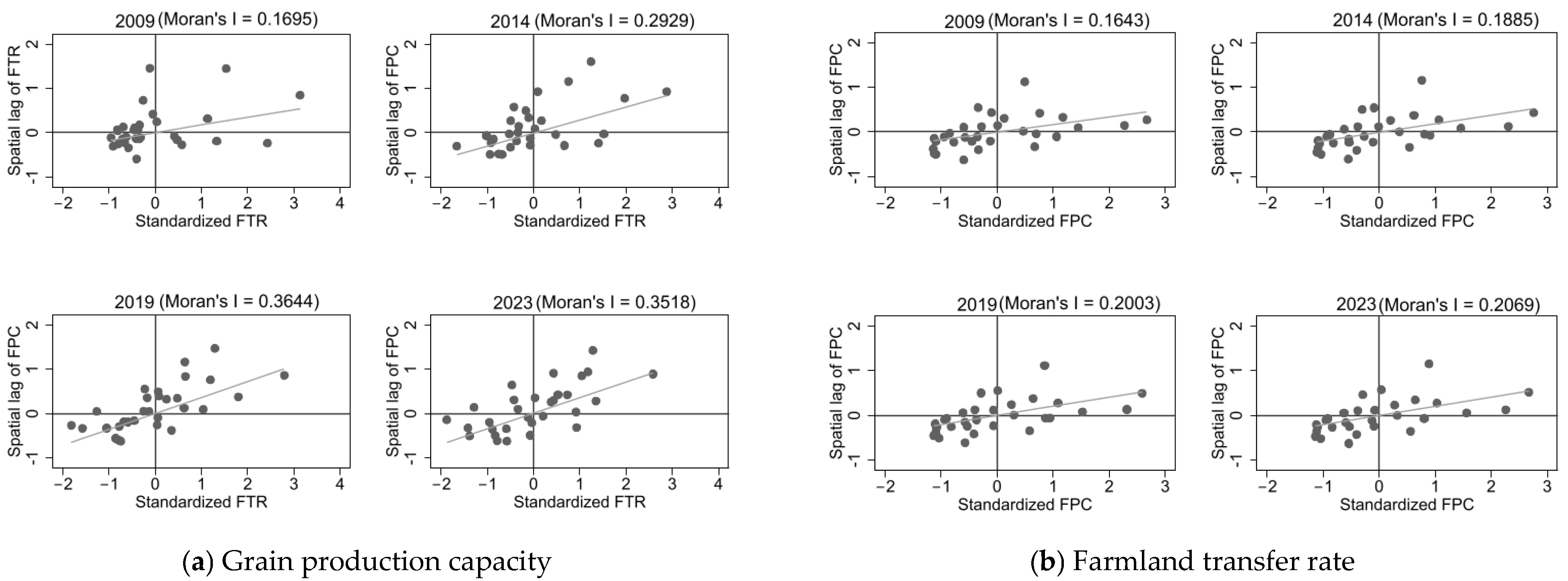
Prior to estimating spatial econometric models, this study tests for spatial dependence in the core variables. Table 10 presents the global Moran’s I indices for provincial grain production capacity and farmland transfer rates from 2009 to 2023. The Moran’s I statistic for grain production capacity remains positive throughout the sample period and is consistently significant at the 5% level, indicating a pattern of significant positive spatial autocorrelation rather than random geographic distribution. Furthermore, the Moran’s I for the farmland transfer rate increased substantially, specifically from 0.170 in 2009 to 0.352 in 2023. Such a trajectory aligns with the progressive deepening of China’s rural land system reform, indicating the presence of meaningful demonstration and diffusion effects across provincial boundaries.
To further characterize local spatial clustering dynamics, this study selects four representative time points—2009, 2014, 2019, and 2023—to construct local Moran scatterplots, as displayed in Figure 2. From a structural perspective, the majority of provincial observations are stably and consistently concentrated in the first (High-High) and third (Low-Low) quadrants, confirming that both grain production capacity and farmland transfer rates exhibit significant spatial agglomeration characteristics in China. From a temporal perspective, the scatter points in the first quadrant progressively shift toward the upper-right region of the coordinate space, suggesting a gradual intensification of local spatial autocorrelation over time. Concurrently, the diminishing presence of outliers in the second and fourth quadrants may reflect the progressive dismantling of spatial barriers across regions and an emerging convergence trend in production capacity and transfer levels among neighboring provinces.
Taken together, the strengthening spatial correlation documented above suggests that conventional OLS models may yield biased estimates when spatial dependence is present, because they assume spatial independence. This provides a clear justification for adopting spatial econometric models in the subsequent analysis.

4.5.2. Model Selection and Diagnostics

Prior to parameter estimation, this study conducts a series of specification tests to identify the most appropriate spatial econometric model. The results are summarized in Table 11. First, Lagrange Multiplier (LM) tests and their robust counterparts are applied to detect the nature of spatial dependence. Both the spatial error LM statistic and the spatial lag LM statistic are highly significant, rejecting the null hypothesis of no spatial correlation. Although the robust LM-lag statistic does not reach conventional significance levels, the robust LM-error statistic remains significant at the 5% level, a discrepancy that may indicate a complex underlying spatial structure.
Subsequently, Likelihood Ratio (LR) tests and Wald tests are conducted to assess whether the Spatial Durbin Model (SDM) can be appropriately simplified. Both sets of test statistics reject the respective null hypotheses at the 1% significance level, indicating that the SDM cannot be reduced to either a Spatial Autoregressive (SAR) model or a Spatial Error Model (SEM). The SDM, which incorporates spatial lag terms for both the dependent and independent variables, therefore provides a more comprehensive representation of the spatial dynamics through which farmland transfer affects grain production capacity. In addition, the Hausman test rejects the null hypothesis of random effects at the 5% significance level, providing support for the adoption of a two-way fixed-effects specification.

4.5.3. Spatial Durbin Model Regression Results

Table 12 reports the regression results from the two-way fixed-effects SDM, together with the decomposition of direct, indirect, and total spatial effects. The estimated spatial autoregressive coefficient (ρ) is 0.259 and is significant at the 1% level, confirming that a province’s grain production capacity is not determined in isolation but is systematically influenced by the capacity levels of neighboring provinces through spatial interaction—a finding consistent with the theoretical framework outlined in Section 2.3.
Regarding the core explanatory variable, both the main coefficient on farmland transfer in column (1) and its spatial lag term in column (2) are positive and statistically significant. This results in a preliminary indication that land use reforms, whether local or in neighboring regions, are conducive to the enhancement of grain production capacity. However, given the inherent spatial feedback loops embedded in the SDM framework, these raw coefficients cannot be directly interpreted as marginal effects. Accordingly, this study focuses on the effect decomposition results reported in columns (5) through (7).
The estimated direct effect of farmland transfer is 0.881 and is significant at the 1% level, indicating that improvements in local farmland transfer directly and meaningfully promote local grain production capacity. More notably, the estimated indirect effect is 1.149 and is also significantly positive, specifically with a magnitude that exceeds the direct effect. This suggests that farmland transfer generates strong positive spatial spillovers extending beyond the originating province. These spillovers may operate through at least two channels: first, successful management models and institutional innovations in one province may be observed and emulated by neighboring local governments and operating entities; second, as transfer-induced scale operations expand, agricultural socialized service providers are increasingly incentivized to extend their operations across provincial boundaries, thereby reducing the cost of modern factor inputs for adjacent regions. The estimated total effect in column (7) is 2.030 and is highly significant, underscoring that farmland transfer functions as a critical engine for enhancing national grain production capacity when viewed from the perspective of the regional system as a whole.

5. Discussion

5.1. Interpretation and Contribution Relative to Existing Literature

This study confirms that farmland transfer constitutes a significant driver of grain production capacity enhancement. Departing from prior research that predominantly examined single-dimensional scale economies, this study deconstructs the underlying mechanism into two distinct yet synergistic dimensions: morphological transition and input transition. With respect to morphological transition, the findings indicate that farmland transfer alleviates land fragmentation, thereby providing the necessary physical conditions for mechanized field operations [32,33]. The consolidation of scattered plots facilitates the maneuvering, repositioning, and standardized deployment of large agricultural machinery, effectively dismantling the barriers that traditionally separated fragmented smallholder farming from modern production techniques. With respect to input transition, farmland transfer promotes a structural shift in the composition of factor inputs [10,37]. Against the backdrop of a tightening rural labor supply, replacing labor-intensive cultivation with capital-intensive mechanized services enables operating entities to reach higher production frontiers under equivalent resource endowments.
At the same time, the non-grain conversion tendency identified in this study highlights a key structural contradiction within the current land reform process. When agricultural land is transferred to commercial enterprises, capital’s inherent profit-seeking orientation may drive crop structure adjustments toward higher-value non-grain alternatives [12,39,40]. This trend suggests a potential misalignment between the transformation of operating entities and the transformation of production capacity, posing a latent threat to national food security even as technical efficiency improves. Furthermore, the land governance disputes documented in this study indicate that institutional friction represents a significant obstacle to capacity enhancement. Such disputes not only disrupt normal production rhythms but also erode operating entities’ willingness to commit to long-term investments in soil and water conservation, farmland improvement, and high-standard agricultural infrastructure [45,46,47]. These findings underscore the critical importance of robust property rights protection systems and effective dispute resolution mechanisms for stabilizing production expectations and safeguarding long-term productive capacity.
Taken together, these findings reveal a fundamental policy dilemma inherent in farmland transfer promotion. Policymakers must navigate a trade-off between two competing objectives: maximizing scale efficiency through accelerated transfer expansion, and minimizing the non-grain conversion risks that accompany commercially oriented land use. This tension is particularly pronounced when transfers involve agricultural enterprises rather than individual farming households or professional cooperatives. While enterprise-managed operations may achieve higher levels of technical efficiency, they also exhibit stronger incentives to convert grain-producing land to cash crops. Consequently, undifferentiated policies that promote farmland transfer without entity-specific targeting risk inadvertently undermining food security objectives. Moreover, the tension between short-term capacity gains and long-term land sustainability introduces additional challenges: intensive mechanization and large-scale operations can enhance immediate productivity but may accelerate soil degradation in the absence of complementary conservation practices. Addressing these trade-offs requires differentiated policy frameworks that calibrate transfer incentives to entity types and regional contexts, rather than relying on uniform approaches.

5.2. Spatial Implications: Institutional Diffusion and Regional Interdependence

A pivotal contribution of this study lies in the empirical documentation of significant spatial spillover effects. The Spatial Durbin Model estimates indicate that farmland transfer not only enhances localized production capacity but also generates substantial positive externalities for neighboring provinces. This phenomenon can be interpreted through two complementary theoretical lenses.
The first concerns institutional and managerial diffusion: successful transfer practices, governance arrangements, and operational experiences in one province may be adopted by adjacent regions through policy learning and demonstration effects [49]. The second concerns cross-regional service market integration: as transfer-induced scale operations expand, aggregate demand for mechanized services and specialized agricultural outsourcing grows, incentivizing service providers to extend their operations across provincial boundaries [50,54]. Improved rural transportation infrastructure and the greater cross-regional mobility of agricultural machinery further facilitate this service diffusion, reducing the effective cost of modern inputs in neighboring areas.
These spatial findings underscore that farmland transfer reform should not be evaluated as an isolated administrative endeavor confined within provincial boundaries. Rather, the enhancement of grain production capacity is more appropriately understood as an emergent outcome of a spatially integrated system, shaped by interregional interdependence in institutional innovation, factor mobility, and service sharing. This perspective implies that active regional cooperation and the progressive removal of interprovincial barriers are essential for fully realizing the spillover dividends of land reform.

5.3. Policy Implications

To fully harness the capacity-enhancing potential of the farmland transfer system while mitigating the negative mechanisms identified in this study, the following targeted policy recommendations are proposed.
First, land transfer procedures should be standardized to reduce institutional friction. Specific actions include: (a) developing national contract templates with minimum duration requirements to incentivize long-term land investments; (b) establishing rent adjustment mechanisms indexed to grain prices to balance stakeholder interests; (c) clarifying land return and compensation clauses upon termination; and (d) mandating contract registration with agricultural authorities for legal enforceability. Additionally, county-level arbitration committees, comprising agricultural officials, legal experts, and farmer representatives, should be established to provide expedited dispute mediation and reduce market uncertainty.
Second, entity-differentiated incentive structures are necessary to optimize the composition of operators and curb non-grain conversion. Subsidies should be allocated as follows: (a) grain-producing family farms and cooperatives receive premium, output-linked subsidies; (b) commercial enterprises receive standard subsidies only after signing legally binding grain-cultivation agreements, subject to regular audits; and (c) entities converting arable land to cash crops face subsidy deductions or lease termination. Furthermore, real-time remote sensing monitoring systems must be deployed to detect unauthorized crop structure changes.
Third, regional coordination mechanisms must be strengthened to amplify positive spatial spillovers. To maximize interregional benefits, neighboring provincial governments should: (a) establish shared agricultural machinery platforms with online booking systems for efficient cross-boundary deployment; (b) create inter-provincial demonstration networks to disseminate successful management practices; (c) integrate production and marketing databases to reduce information asymmetry; and (d) coordinate production planning to foster complementary specialization. These measures will facilitate the efficient cross-regional diffusion of service capacities and expertise.

5.4. Limitations and Future Research

While this study provides a systematic investigation of the multidimensional relationship between farmland transfer and grain production capacity, several limitations warrant acknowledgment and suggest directions for future inquiry.
First, the analysis is constrained by data granularity. Measuring farmland transfer and grain capacity at the provincial level may obscure substantial within-province heterogeneity. Specifically, it masks variations in natural resource endowments, policy implementation, and land market development. Future research using county-level or household survey data would allow for a more granular examination. Such data could better reveal how non-grain tendencies and contract disputes influence specific production decisions and investment behaviors.
Second, while the Spatial Durbin Model identifies positive spillovers, the specific channels remain untested. We proposed two theoretical mechanisms: technology diffusion through cross-regional learning and service market integration through machinery sharing. However, formally disentangling these pathways requires data currently unavailable at the provincial level, such as records of inter-provincial technology transfers. Future studies employing spatial mediation analysis or new agricultural service databases could more precisely identify the dominant spillover pathway.
Third, the ecological impacts of farmland transfer typically exhibit significant time lags. It remains unclear whether short-term capacity enhancement leads to soil fertility exhaustion or ecological decline over the long term. This warrants further investigation using dynamic panel models with longer time horizons. Additionally, incorporating soil quality monitoring data would provide a more comprehensive understanding of the sustainability of these land use transitions.


6. Conclusions

Based on panel data from 30 Chinese provinces spanning 2009 to 2023, this study systematically investigates the direct effects, transmission pathways, heterogeneous characteristics, and spatial spillover dynamics of farmland transfer on grain production capacity. The principal findings are as follows.
(1)
Farmland transfer significantly improves grain production capacity. It facilitates the reallocation of land resources by consolidating fragmented plots and promoting moderate-scale operations. This conclusion remains consistent across multiple robustness checks and endogeneity tests.
(2)
Farmland transfer operates through a “double-edged sword” mechanism. On the positive side, it enhances capacity by reducing land fragmentation and optimizing input allocation. This is primarily achieved through machinery-labor substitution and improved land contiguity. On the negative side, the process may trigger non-grain conversion and land governance disputes. These issues can inhibit capacity and partially offset the efficiency gains of scale operations.
(3)
The effects of farmland transfer vary across entity types, transfer modes, and production zones. Transfers to individual households and professional cooperatives markedly enhance capacity, due to lower transaction costs and better access to agricultural services. In contrast, transfers to commercial enterprises often lead to a shift toward cash crops, which suppress grain capacity. Leasing arrangements and informal mechanisms, such as land exchange and subcontracting, are the primary drivers of capacity growth. Effects are most pronounced in grain-consuming regions, where market-oriented consolidation mobilizes idle land. In major grain-producing regions, the benefits depend on reaching a minimum operational scale. Below this threshold, scale-efficiency dividends remain unrealized.
(4)
Farmland transfer exhibits significant spatial spillover characteristics. Specifically, indirect cross-regional effects exceed the magnitude of direct local effects. Spatial econometric analysis confirms that grain production capacity is interdependent across provinces. Transfers in one province generate strong positive spillovers for neighbors through the diffusion of management practices and the integration of service markets. These results suggest that farmland transfer reform functions as a regional public good, driving synergistic growth across provincial boundaries.

Author Contributions

Conceptualization, X.Z. and L.J.; methodology and software, X.Z. and L.J.; formal analysis and data curation, L.J. and Y.L.; writing—original draft preparation, X.Z. and L.J.; writing—review and editing, X.Z., L.J. and Y.L.; supervision and funding acquisition, X.Z. All authors have read and agreed to the published version of the manuscript.

Funding

This research was funded by the National Natural Science Foundation of China (General Program), “Food Waste Governance through Multi-Scale Collaboration: An Exploration of the Dynamic Integration of Dietary Culture from the Perspective of the Space of Flows”, grant number 72574097 and the Major Project of the National Social Science Fund of China, “Research on Risk Prevention of China’s Food Security under the New Development Pattern”, grant number 23&ZD118.

Data Availability Statement

The dataset used in this paper is not readily available. For access, please contact the corresponding author directly.

Conflicts of Interest

The authors declare no conflicts of interest.

References

  1. Li, N.; Chen, L.; Sun, Y. How to make the “three-rights separation” of farmland more effective under the background of modern agricultural development. Issues Agric. Econ. 2016, 37, 11–26. (In Chinese) [Google Scholar]
  2. Ou, M.; Gong, J. Farmland transfers in China: From theoretic framework to practice. Int. J. Environ. Res. Public Health 2021, 19, 217. [Google Scholar] [CrossRef] [PubMed]
  3. Zhou, C.; Liang, Y.; Fuller, A. Tracing agricultural land transfer in China: Some legal and policy issues. Land 2021, 10, 58. [Google Scholar] [CrossRef]
  4. Zeng, F. Incentive and constraint mechanism of establishing farmland transfer to ensure food security. Issues Agric. Econ. 2015, 36, 15–23. (In Chinese) [Google Scholar]
  5. Fei, R.; Lin, Z.; Chunga, J. How land transfer affects agricultural land use efficiency. Land Use Policy 2021, 103, 105300. [Google Scholar] [CrossRef]
  6. Duan, J.; Ren, C.; Wang, S.; Zhang, X.; Luo, Z.; Qin, S. Consolidation of agricultural land can contribute to agricultural sustainability in China. Nat. Food 2021, 2, 1014–1022. [Google Scholar] [CrossRef]
  7. Deng, X.; Peng, J.; Wan, C. The impact of internet use on land productivity. Land 2024, 13, 262. [Google Scholar] [CrossRef]
  8. Chen, C.; Liu, B.; Wang, Z. Can land transfer relax credit constraints? Evidence from China. Econ. Model. 2023, 119, 106248. [Google Scholar] [CrossRef]
  9. Huang, H.; Xu, Z.; Qi, Y. Did farmland transfer and scale management mitigate farmers’ credit constraints? Empirical evidence from Jiangsu. J. Nanjing Agric. Univ. (Soc. Sci. Ed.) 2016, 16, 109–120. (In Chinese) [Google Scholar]
  10. Kuang, Y.; Yang, J.; Abate, M.C. Farmland transfer and agricultural economic growth nexus in China: Agricultural TFP intermediary effect perspective. China Agric. Econ. Rev. 2022, 14, 184–201. [Google Scholar] [CrossRef]
  11. Ding, Z.; Zhang, Q.; Tang, Y. Nexus between farmland transfer, agricultural loans, and grain production. Front. Sustain. Food Syst. 2024, 8, 1229381. [Google Scholar] [CrossRef]
  12. Zeng, Y.; Lyu, Y.; Cai, J. Is farmland transfer the inducement of “non-grain” agricultural production? J. Northwest A&F Univ. (Soc. Sci. Ed.) 2018, 18, 123–130. (In Chinese) [Google Scholar]
  13. Qian, L.; Yuan, H.; Liu, J.; Cao, B. Analysis of the impact of farmland transfer on grain planting structure. J. Agric. Technol. Econ. 2018, 8, 63–74. (In Chinese) [Google Scholar]
  14. Liu, Y.; Yan, B.; Wang, Y.; Zhou, W. Will land transfer always increase technical efficiency in China? —A land cost perspective. Land Use Policy 2019, 82, 414–421. [Google Scholar] [CrossRef]
  15. Kuang, Y.; Hu, H. Farmland transfer reshapes smallholder economy: Mechanism, pluralistic modes and connection with modern agriculture. J. Huazhong Agric. Univ. 2025, 6, 1–13. (In Chinese) [Google Scholar]
  16. Zou, W.; Cui, Y.; Zhou, J. The fertilizer reduction effect of farmland transfer: Based on the analysis of land property liquidity and stability. China Land Sci. 2020, 34, 48–57. (In Chinese) [Google Scholar]
  17. Cao, H.; Zhu, X.; Heijman, W.; Zhao, K. The impact of land transfer and farmers’ knowledge of farmland protection policy on pro-environmental agricultural practices: The case of straw return to fields in Ningxia, China. J. Clean. Prod. 2020, 277, 123701. [Google Scholar] [CrossRef]
  18. Peng, S.; Wang, L.; Xu, L. Does farmland transfer promote green agricultural production? An empirical analysis of fertilizer and pesticide reduction. J. Clean. Prod. 2025, 489, 144631. [Google Scholar] [CrossRef]
  19. Zhang, Y.; Gong, Y.; Zhang, Y. From grain yield to grain production capacity: Conversion logic, reality constraints and policy orientation. Reform 2025, 1, 1–15. (In Chinese) [Google Scholar]
  20. Liao, L.; Long, H.; Gao, X.; Ma, E. Effects of land use transitions and rural aging on agricultural production in China’s farming area. Land Use Policy 2019, 88, 104152. [Google Scholar] [CrossRef]
  21. Kang, J.; Wu, F. The impact of steady flow of rural labor in China on rural aging. J. Finan. Econ. 2024, 50, 1–15. (In Chinese) [Google Scholar]
  22. Zhang, J.; Wei, X.; Chen, Z.; Zhao, Y. Revisiting economies of scale: The moderating role of efficiency in corn farming. Front. Sustain. Food Syst. 2025, 9, 1621038. [Google Scholar] [CrossRef]
  23. Cui, M.; Xia, X. Can production outsourcing improve farmers’ grain production capacity? J. South China Agric. Univ. 2025, 24, 63–78. (In Chinese) [Google Scholar]
  24. Shao, J.; Zhang, S.; Li, X. Effectiveness of farmland transfer in alleviating farmland abandonment in mountain regions. J. Geogr. Sci. 2016, 26, 203–218. [Google Scholar] [CrossRef]
  25. Ma, Z.; Xu, D.; Ran, R. Impact of land consolidation on farmers’ abandonment behavior: A study based on the triple farmland scale perspective. Land 2025, 14, 2429. [Google Scholar] [CrossRef]
  26. Wang, Y.; Yang, A.; Li, Y.; Liu, C. Effect of e-commerce popularization on farmland abandonment in rural China: Evidence from a large-scale household survey. Land Use Policy 2023, 135, 106958. [Google Scholar] [CrossRef]
  27. Gong, T.; Battese, G.E.; Villano, R.A. Family farms plus cooperatives in China: Technical efficiency in crop production. J. Asian Econ. 2019, 64, 101129. [Google Scholar] [CrossRef]
  28. Zeng, Y.; Lyu, Y.; Liu, W. Did farmland transfer improve the technical efficiency of grain production? —From the perspective of farmers. J. Agric. Technol. Econ. 2018, 3, 41–55. (In Chinese) [Google Scholar]
  29. Wang, X. Changes in cultivated land loss and landscape fragmentation in China from 2000 to 2020. Land 2022, 11, 684. [Google Scholar] [CrossRef]
  30. Liu, J.; Jin, X.; Xu, W.; Zhou, Y.; Fan, Y.; Ren, J. Evolution characteristics and trend prediction of cultivated land landscape fragmentation in China from 1990 to 2020. Acta Geogr. Sin. 2023, 78, 2163–2185. (In Chinese) [Google Scholar]
  31. Hu, X.; Lin, X.; Wen, G.; Ye, B. The impact of cultivated land fragmentation on farmers’ ecological efficiency of cultivated land use based on the moderating and mediating effects of the cultivated land management scale. Land 2024, 13, 1628. [Google Scholar] [CrossRef]
  32. Wang, S.; Ma, J.; Li, N. How does farmland management scale affect farmers’ choice of agricultural mechanization? Rural Econ. 2021, 4, 111–118. (In Chinese) [Google Scholar]
  33. Hou, L.; Yan, Y. Towards sustainable agriculture: How does agricultural scale operation affect the cultivated land green utilization efficiency? The empirical evidence from China. Land 2026, 15, 134. [Google Scholar] [CrossRef]
  34. Tian, M.; Xiong, T.; Zhang, P. Study on the impact of labor transfer on cultivated land abandonment—Based on the moderating effect analysis of agricultural mechanization. World Agric. 2023, 11, 103–114. (In Chinese) [Google Scholar]
  35. Peng, J.; Zhao, Z.; Liu, D. Impact of agricultural mechanization on agricultural production, income, and mechanism: Evidence from Hubei Province, China. Front. Environ. Sci. 2022, 10, 838686. [Google Scholar] [CrossRef]
  36. Hu, Y.; Zhang, Z. Does agricultural machinery service affect the technical efficiency of wheat production? China Rural Econ. 2018, 5, 68–83. (In Chinese) [Google Scholar]
  37. Zhou, X.; Ma, W. Agricultural mechanization and land productivity in China. Int. J. Sustain. Dev. World Ecol. 2022, 29, 530–542. [Google Scholar] [CrossRef]
  38. Zhang, Z.; Du, Z. Does land transfer necessarily lead to “non-grain” production? —Empirical analysis based on monitoring data of 1740 planting family farms nationwide. Econ. Perspect. 2015, 9, 63–69. (In Chinese) [Google Scholar]
  39. Gao, Y.; Zhang, Z.; Wang, Z. Farmland in-transfer, household risk preference and planting structure adjustment—An empirical analysis based on micro data of CHFS. J. Agric. Technol. Econ. 2021, 8, 66–80. (In Chinese) [Google Scholar]
  40. Yang, H.; Feng, S.; Yuan, K.; Chen, Z. Evolution of spatial-temporal pattern and driving factors of cultivated land “non-grainization” from the perspective of land transfer. China Popul. Resour. Environ. 2024, 34, 189–200. (In Chinese) [Google Scholar]
  41. Lu, D.; Wang, Z.; Su, K.; Zhang, H.; Zhou, G. Understanding the impact of cultivated land-use changes on China’s grain production potential and policy implications: A perspective of non-agriculturalization, non-grainization, and marginalization. J. Clean. Prod. 2024, 436, 140647. [Google Scholar] [CrossRef]
  42. He, Y.; Duan, S.; Xiao, H. Farmland transfer, cultivated land “non-grainization” and food security—Simultaneously discussing the problem of “who grows grain”. J. Northwest A&F Univ. (Soc. Sci. Ed.) 2024, 24, 74–82. (In Chinese) [Google Scholar]
  43. Xu, X.; Zhang, Y.; Liu, X. Farmland transfer disputes: Default mechanism and its empirical study. J. China Agric. Univ. 2020, 25, 216–230. (In Chinese) [Google Scholar]
  44. Cui, M.; Guo, Y.; Xu, Z. Research on the impact of farmland transfer compliance environment on the development of scale operation. China Land Sci. 2023, 37, 84–92. (In Chinese) [Google Scholar]
  45. Wang, S.; Xu, L.; Li, N.; Ma, J. Impact of farmland rental contract disputes on farmland rental market participation. Land 2022, 11, 2138. [Google Scholar] [CrossRef]
  46. Cao, Y.; Bai, Y.; Zhang, L. The impact of farmland property rights security on the farmland investment in rural China. Land Use Policy 2020, 97, 104736. [Google Scholar] [CrossRef]
  47. Tesfaye, B.; Lengoiboni, M.; Zevenbergen, J.; Simane, B. Rethinking the impact of land certification on tenure security, land disputes, land management, and agricultural production: Insights from South Wello, Ethiopia. Land 2023, 12, 1713. [Google Scholar] [CrossRef]
  48. Liao, X.; Qin, S.; Wang, Y.; Zhang, X. Effects of land transfer on agricultural carbon productivity and its regional differentiation in China. Land 2023, 12, 1358. [Google Scholar] [CrossRef]
  49. Zhou, B.; Zhang, Q. Study on spatial dependence and influencing factors of farmland transfer behavior—Based on the perspective of learning effect. Res. Finan. Econ. Issues 2023, 11, 101–114. (In Chinese) [Google Scholar]
  50. Mu, L.; Luo, C.; Li, Y.; Tan, Z.; Gao, S. ‘They adopt, I also adopt’: The neighborhood effects and irrigator farmers’ conversion to adopt water-saving irrigation technology. Agric. Water Manag. 2024, 305, 109141. [Google Scholar] [CrossRef]
  51. Fang, S.; Wei, L.; Wu, J. Spatial spillover effects of agricultural mechanization and its distribution law—From the perspective of agricultural machinery trans-regional services. J. Manag. World 2017, 11, 65–78. (In Chinese) [Google Scholar]
  52. Tang, Y.; Lu, X.; Yi, J.; Wang, H.; Zhang, X.; Zheng, W. Evaluating the spatial spillover effect of farmland use transition on grain production–an empirical study in Hubei Province, China. Ecol. Indic. 2021, 125, 107478. [Google Scholar] [CrossRef]
  53. Ma, W.; Liu, T.; Li, W.; Chen, Z.; Zhou, X. The role of agricultural machinery in improving green grain productivity in China: Towards trans-regional operation and low-carbon practices. Heliyon 2023, 9, e20279. [Google Scholar] [CrossRef] [PubMed]
  54. Wu, Z.; Dang, J.; Pang, Y.; Xu, W. Threshold effect or spatial spillover? The impact of agricultural mechanization on grain production. J. Appl. Econ. 2021, 24, 478–503. [Google Scholar] [CrossRef]
  55. Kuang, Y.; Zhang, R. The impact of farmland transfer on agricultural production eco-efficiency. China Popul. Resour. Environ. 2021, 31, 1–10. (In Chinese) [Google Scholar]
  56. Jiang, T. Mediating effects and moderating effects in causal inference empirical research. China Indust. Econ. 2022, 5, 100–120. (In Chinese) [Google Scholar]
  57. Goldsmith-Pinkham, P.; Sorkin, I.; Swift, H. Bartik instruments: What, when, why, and how. Am. Econ. Rev. 2020, 110, 2586–2624. [Google Scholar] [CrossRef]
  58. Zhu, J.; Peng, H.; Zhang, Z.; Wang, J.; Gao, Y. Research on the impact of digital village construction on food security: Based on the empirical analysis at the county level. China Soft Sci. 2025, 5, 79–91. (In Chinese) [Google Scholar]
  59. Cao, Y.; Jiang, A.; Chen, W. Mechanism and empirical analysis of the impact of climate endowment on grain production from the perspective of natural productivity. J. China Agric. Resour. Reg. Plan. 2026, 1–19. (In Chinese) [Google Scholar]
Figure 1. The impact of farmland transfer on grain production capacity.
Land 15 00605 g001
Figure 2. Moran scatterplots for representative years.
Land 15 00605 g002
Table 1. Descriptive statistical results.
Variable TypeVariable NameCodeNMeanSdMinMax
Explanatory VariableFarmland transfer rateFTR4500.3090.1770.0230.911
Explained VariableGrain Production CapacityGPC4502.2431.9040.0318.532
Control VariablesNatural disaster riskDisa4500.0710.0660.0000.347
Economic development levelPgdp45010.8050.5319.28912.207
Urbanization levelUrban4500.5940.1270.2990.896
Rural education levelEdu4507.7680.6255.84810.065
Rural labor shareLabor4500.5710.0580.0591.165
Agricultural research intensityTech4500.3470.0990.0590.505
Fiscal support for agricultureFiscal4500.1130.0330.0360.204
Mechanism VariableMorphological TransitionMorpho4504.6582.4931.16813.656
Input TransitionInput4504.8052.4751.23615.550
Functional TransitionFunc4500.4630.1900.0600.938
Management TransitionMgt4500.0200.0190.0000.116
Table 2. Baseline regression results.
VariableGrain Production Capacity
(1)(2)(3)(4)(5)(6)(7)
FTR0.879 ***0.920 ***0.925 ***0.988 ***0.892 ***0.871 ***0.888 ***
(0.139)(0.144)(0.141)(0.143)(0.139)(0.140)(0.141)
Disa −0.420 **−0.419 **−0.389 *−0.352 *−0.350 *−0.353 *
(0.201)(0.202)(0.212)(0.202)(0.194)(0.189)
Pgdp 0.015−0.162−0.089−0.152−0.120
(0.115)(0.122)(0.121)(0.122)(0.123)
Urban 1.356 ***0.945 *0.7640.741
(0.488)(0.514)(0.525)(0.534)
Edu −0.101 **−0.087 **−0.079 *
(0.043)(0.042)(0.041)
Labor 0.761 ***0.669 ***0.603 ***
(0.228)(0.218)(0.217)
Tech 0.716 ***0.717 ***
(0.250)(0.263)
Fiscal 1.403 *
(0.819)
Constant2.145 ***2.162 ***2.0013.083 **2.917 **3.410 ***2.890 **
(0.045)(0.043)(1.248)(1.232)(1.203)(1.210)(1.216)
N450450450450450450450
Within R20.0940.1120.1120.1330.1640.1820.194
Province FEYESYESYESYESYESYESYES
Year FEYESYESYESYESYESYESYES
Note: Standard errors in parentheses. * p < 0.10, ** p < 0.05, *** p < 0.01.
Table 3. Robustness test results.
VariableGrain Production Capacity
(1)(2)(3)(4)(5)
FTR0.877 ***1.213 ***0.300 ***
(0.150)(0.221)(0.074)
FTR_A 0.203 ***
(0.041)
FTR_B 0.007 *
(0.004)
Disa−0.327 *−0.780 **−0.310 ***−0.235−0.266
(0.173)(0.309)(0.117)(0.193)(0.190)
Pgdp0.034−0.448 **−0.170 **−0.172−0.233 *
(0.139)(0.178)(0.072)(0.122)(0.128)
Urban−2.605 ***0.995−0.464−0.6190.225
(1.005)(0.760)(0.326)(0.516)(0.536)
Edu−0.095 *−0.088−0.037−0.101 **−0.127 ***
(0.057)(0.058)(0.028)(0.042)(0.046)
Aging0.473 **0.936 ***0.533 ***0.666 ***0.733 ***
(0.217)(0.327)(0.161)(0.222)(0.198)
Tech0.749 ***1.153 ***0.313 *0.625 ***0.705 ***
(0.225)(0.426)(0.167)(0.238)(0.236)
Fiscal1.634 **3.617 **2.478 ***1.1420.991
(0.751)(1.760)(0.607)(0.899)(0.843)
Constant3.607 ***5.404 ***2.115 ***1.4885.015 ***
(1.333)(1.728)(0.676)(1.328)(1.293)
N390450450450450
Within R20.2270.2360.2660.1830.132
Province FEYESYESYESYESYES
Year FEYESYESYESYESYES
Note: Standard errors in parentheses. * p < 0.10, ** p < 0.05, *** p < 0.01.
Table 4. Endogeneity test results.
VariableGPCGPCFTRGPC
(1)(2)(3)(4)
FTR 2.679 ***
(0.507)
L_FTR0.918 ***
(0.138)
L2_FTR 0.861 ***
(0.131)
IV −0.223 ***
(0.035)
Disa−0.0200.0660.085 *−0.509 **
(0.116)(0.106)(0.044)(0.208)
Pgdp−0.099−0.042−0.0640.134
(0.124)(0.122)(0.047)(0.170)
Urban1.076 **0.826 **−0.285 *1.795 ***
(0.481)(0.415)(0.157)(0.666)
Edu−0.068 *−0.054 *−0.041 ***0.003
(0.036)(0.030)(0.016)(0.049)
Labor0.445 **0.298 *0.262 ***0.275
(0.197)(0.167)(0.089)(0.310)
Tech0.504 **0.394 *0.0920.567
(0.227)(0.220)(0.109)(0.383)
Fiscal1.136 *1.458 **0.411 **1.796 **
(0.641)(0.595)(0.209)(0.828)
Kleibergen–Paap rk LM statistic 40.529 ***
Kleibergen–Paap rk Wald F statistic 40.563
N420390450450
Within R20.1870.1940.2580.050
Province FEYESYESYESYES
Year FEYESYESYESYES
Note: Standard errors in parentheses. * p < 0.10, ** p < 0.05, *** p < 0.01.
Table 5. Mechanism verification results.
VariableMorphoInputFuncMgt
(1)(2)(3)(4)
FTR−0.808 ***4.606 ***0.418 ***0.034 ***
(0.252)(0.831)(0.046)(0.010)
Disa0.301−0.1320.086−0.014
(0.281)(0.859)(0.070)(0.009)
Pgdp0.079−0.877−0.271 ***−0.028 ***
(0.205)(0.797)(0.047)(0.008)
Urban−0.18610.824 ***−0.0050.087 ***
(0.975)(2.661)(0.171)(0.029)
Edu−0.067−0.251−0.016−0.004
(0.084)(0.265)(0.017)(0.003)
Labor0.8302.1490.1070.014
(0.624)(1.562)(0.124)(0.025)
Tech−0.506−3.025 **−0.224 ***−0.028 *
(0.659)(1.197)(0.086)(0.015)
Fiscal2.903 **9.524 **−1.187 ***−0.130 ***
(1.437)(4.551)(0.211)(0.034)
Constant4.045 **7.1413.531 ***0.310 ***
(2.033)(7.678)(0.465)(0.080)
N450450450450
Within R20.0540.1350.3650.099
Province FEYESYESYESYES
Year FEYESYESYESYES
Note: Standard errors in parentheses. * p < 0.10, ** p < 0.05, *** p < 0.01.
Table 6. Empirical results for different transaction entity type.
VariableGrain Production Capacity
(1)(2)(3)(4)
Farmers1.475 ***
(0.218)
Cooperative 0.219 **
(0.091)
Enterprise −1.938 **
(0.750)
Other entities −0.309
(0.336)
Disa−0.283−0.270−0.251−0.277
(0.176)(0.192)(0.181)(0.193)
Pgdp−0.059−0.253 **−0.226 *−0.242 *
(0.126)(0.129)(0.131)(0.129)
Urban0.5760.239−0.0600.184
(0.496)(0.542)(0.568)(0.545)
Edu−0.051−0.122 ***−0.129 ***−0.126 ***
(0.041)(0.046)(0.047)(0.046)
Labor0.556 ***0.860 ***0.784 ***0.782 ***
(0.192)(0.228)(0.203)(0.207)
Tech0.706 ***0.848 ***0.816 ***0.822 ***
(0.226)(0.252)(0.239)(0.250)
Fiscal1.302 *1.1611.1891.170
(0.778)(0.875)(0.859)(0.874)
Constant2.186 *5.051 ***5.116 ***5.071 ***
(1.187)(1.294)(1.302)(1.301)
N450450450450
Within R20.2320.1180.1310.114
Province FEYESYESYESYES
Year FEYESYESYESYES
Note: Standard errors in parentheses. * p < 0.10, ** p < 0.05, *** p < 0.01.
Table 7. Empirical results for different transfer mode.
VariableGrain Production Capacity
(1)(2)(3)
Leasing0.505 ***
(0.147)
Shareholding 0.061
(0.299)
Others 0.374 **
(0.160)
Disa−0.327 *−0.275−0.283
(0.194)(0.193)(0.190)
Pgdp−0.189−0.247 *−0.212
(0.127)(0.129)(0.131)
Urban0.9900.214−0.140
(0.618)(0.550)(0.579)
Edu−0.096 **−0.120 ***−0.126 ***
(0.045)(0.046)(0.045)
Aging0.643 ***0.768 ***0.809 ***
(0.212)(0.205)(0.214)
Tech0.681 ***0.793 ***0.831 ***
(0.257)(0.245)(0.245)
Fiscal1.2211.2091.324
(0.862)(0.878)(0.866)
Constant3.768 ***5.060 ***4.867 ***
(1.293)(1.299)(1.297)
N450450450
Within R20.1410.1120.124
Province FEYESYESYES
Year FEYESYESYES
Note: Standard errors in parentheses. * p < 0.10, ** p < 0.05, *** p < 0.01.
Table 8. Empirical results for different grain production zone.
VariableGrain-Producing Grain-Consuming Balance
(1)(2)(3)(4)
FTR0.207 0.166 ***0.055
(0.240) (0.050)(0.266)
FTR (Scale < 0.061) 0.066
(0.194)
FTR (Scale > 0.061) 0.613 ***
(0.142)
Disa−0.039−0.4086 ***−0.057−0.485 ***
(0.286)0.1385(0.041)(0.110)
Pgdp−0.073−0.1336−0.238 ***0.069
(0.235)0.1189(0.041)(0.092)
Urban−3.609 **0.8558 **0.277 *−3.159 ***
(1.515)0.4234(0.142)(0.724)
Edu−0.246 ***−0.0662−0.0120.077 **
(0.088)0.0427(0.010)(0.039)
Labor2.030 **0.6019 **0.0760.027
(0.845)0.2508(0.064)(0.183)
Tech−0.7050.6669 ***−0.334 ***0.270
(0.540)0.2283(0.051)(0.185)
Fiscal0.8211.5884 ***−0.4500.901
(1.040)0.5615(0.274)(0.640)
Constant8.020 ***2.856 **3.056 ***1.476
(1.979)1.128(0.472)(1.061)
N195195105150
Within R20.2680.5150.5850.268
Province FEYESYESYESYES
Year FEYESYESYESYES
Note: Standard errors in parentheses. * p < 0.10, ** p < 0.05, *** p < 0.01.
Table 9. Estimation results of the threshold effect in the main production areas.
VariableNumberF Statisticsp ValueConfidence IntervalThreshold
10%5%1%
Business scaleSingle36.780.01720.44826.83043.990
Double10.210.43722.10529.89942.128
Triple6.000.75023.35229.30544.444
Business scaleSingle37.630.04031.11936.24753.3770.061
Table 10. Spatial autocorrelation test results.
YearGrain Production CapacityFarmland Transfer Rate
Moran’s IZp-ValueMoran’s IZp-Value
20090.1642.1150.0340.1702.2520.024
20100.1692.1720.0300.1792.3430.019
20110.1722.2110.0270.1722.2340.025
20120.1782.2700.0230.2012.5270.011
20130.1922.4220.0150.2302.8400.004
20140.1892.3840.0170.2933.5170.000
20150.1922.4220.0150.2883.4360.001
20160.1972.4590.0140.3654.2580.000
20170.1992.4810.0130.3604.1760.000
20180.1902.3920.0170.3644.2830.000
20190.2002.4920.0130.3644.2580.000
20200.1972.4620.0140.3784.4370.000
20210.2042.5440.0110.3664.2910.000
20220.2032.5310.0110.3353.9170.000
20230.2072.5680.0100.3524.0670.000
Table 11. Spatial diagnostic test results.
Test TypeDiagnostic StatisticStatisticsp-Value
LM TestSpatial error: LM45.9390.000
Spatial error: Robust LM5.3510.021
Spatial lag: LM41.1090.000
Spatial lag: Robust LM0.5210.471
Hau TestHausman Test16.560.035
LR TestLR_sdm_sar83.720.000
LR_sdm_sem98.470.000
Wald TestWald_sdm_sar87.550.000
Wald_sdm_sem106.980.000
Table 12. SDM estimation results.
VariableMainWxSpatialVarianceDirectIndirectTotal
(1)(2)(3)(4)(5)(6)(7)
FTR0.834 ***0.620 * 0.881 ***1.149 ***2.030 ***
(0.126)(0.332) (0.129)(0.419)(0.444)
Disa−0.291 **−0.342 −0.317 ***−0.546−0.862 **
(0.125)(0.289) (0.119)(0.370)(0.381)
Pgdp0.100−1.946 *** 0.004−2.541 ***−2.537 ***
(0.122)(0.275) (0.117)(0.392)(0.417)
Urban1.035 **3.255 *** 1.227 ***4.761 ***5.988 ***
(0.422)(0.957) (0.403)(1.422)(1.451)
Edu−0.065 *−0.039 −0.066 *−0.075−0.141
(0.036)(0.086) (0.038)(0.110)(0.122)
Aging0.301−0.077 0.290−0.0000.290
(0.218)(0.663) (0.222)(0.914)(0.999)
Tech0.937 ***3.510 *** 1.143 ***4.970 ***6.114 ***
(0.208)(0.634) (0.207)(0.910)(1.029)
Fiscal0.423−0.829 0.388−0.804−0.416
(0.531)(1.304) (0.526)(1.782)(1.911)
ρ 0.259 ***
(0.080)
sigma2_e 0.013 ***
(0.001)
N450450450450450450450
R20.14470.14470.14470.14470.14470.14470.1447
Province FEYESYESYESYESYESYESYES
Year FEYESYESYESYESYESYESYES
Note: Standard errors in parentheses. * p < 0.10, ** p < 0.05, *** p < 0.01.
Disclaimer/Publisher’s Note: The statements, opinions and data contained in all publications are solely those of the individual author(s) and contributor(s) and not of MDPI and/or the editor(s). MDPI and/or the editor(s) disclaim responsibility for any injury to people or property resulting from any ideas, methods, instructions or products referred to in the content.