Article

Large Arable Land Promotes Abundant Grain: An Analysis of the Impact of Land Plot Size on Farmers’ Grain Production Efficiency and Its Mechanisms

1
College of Economics and Management, Yunnan Agricultural University, Kunming 650201, China
2
Institute of New Rural Development, Yunnan Agricultural University, Kunming 650201, China
*
Authors to whom correspondence should be addressed.
Land 2026, 15(4), 590; https://doi.org/10.3390/land15040590
Submission received: 2 March 2026 / Revised: 31 March 2026 / Accepted: 1 April 2026 / Published: 3 April 2026

Abstract

The way land is managed and utilized restricts agricultural development and food production. The fragmentation of arable land, characterized by “many plots and small areas,” is unfavorable for moderate-scale agricultural management and food production supply. Based on survey data of grain farmers in the Yellow River Basin, this study employs methods such as 2SLS, PSM, and IVQR to analyze the impact of average plot size on farmers’ grain production efficiency and its mechanisms. It also examines the differentiated effects of expanding plot size on different types of farmers, regions, and crops. The results show the following: (1) Expanding the arable land plot size (ALPS) helps improve farmers’ grain production efficiency, thereby enhancing the quality and benefits of agricultural development. (2) Expanding plot size can affect grain production efficiency through multiple pathways, including promoting machinery use and agricultural technology adoption, reducing material and labor input costs, and increasing grain yields. (3) Expanding plot size is more beneficial to farmers with higher production efficiency and smaller operation scales, as it both “supports the strong” and has a “pro-smallholders” characteristic, with more benefits for farmers in the western region and those growing wheat. Therefore, in order to promote high-quality agricultural development and ensure national food security, policies should focus on addressing land fragmentation and appropriately expanding the average plot size for farmers, especially smallholders.

1. Introduction

Ensuring stable grain production and improving agricultural efficiency remain central challenges for food security in many developing countries characterized by smallholder-dominated farming systems. Arable land constitutes the fundamental material basis of food production; however, long-standing land fragmentation, manifested in small, scattered, and irregular plots, has substantially constrained agricultural modernization and productivity growth [1]. In China, the coexistence of a large population and limited arable land, combined with egalitarian land allocation practices adopted during the early stages of rural reform, has resulted in a highly fragmented land structure that continues to impede efficient grain production. Reducing land fragmentation and promoting moderate-scale farming have therefore become key policy objectives. The chinese government emphasizes not only the expansion of total operational farm size through land transfer, but also the consolidation of fragmented plots at the micro level. This shift reflects growing recognition that plot size, rather than farm size alone, constitutes the basic operational unit for agricultural production. Plot size directly affects the feasibility and efficiency of mechanized operations, the adoption of modern agricultural technologies, and the control of production costs [2]. Consequently, understanding how average plot size influences grain production efficiency is critical for improving land-use efficiency and strengthening food security.
The inverse relationship between farm size and grain production efficiency is a classic starting point in this field. Since Sen’s (1966) pioneering study [3], the finding that farm size and land productivity are negatively correlated in developing countries has been widely discussed [4]. The classic explanation for this relationship primarily focuses on market failures: small farms tend to rely more on family labor, and the costs of supervising this labor are lower, thereby giving them a comparative advantage in labor-intensive production [5]. However, subsequent research has introduced significant revisions to this conclusion. Helfand and Taylor (2021) [6] point out that the choice of productivity indicators is crucial; if total factor productivity (TFP) is used instead of land productivity alone, the relationship between farm size and productivity evolves with the process of modernization, exhibiting a “U”-shaped or even positive relationship. Ferreira and Féres (2020) [7] similarly found a U-shaped relationship between farm size and land use efficiency in the Brazilian Amazon region. These studies indicate that the relationship between farm size and production efficiency is not static but depends on the stage of development, technological conditions, and the choice of productivity indicators.
However, farm size alone is insufficient to fully capture the complex reality of farmers’ land allocation. Unlike farm size as an aggregate indicator, land fragmentation characterizes land allocation from multiple dimensions, including the number of plots, average plot size, spatial distribution of plots, and the distance between plots and residences, thereby providing a more precise understanding of micro-level land configuration. In recent years, this multidimensional perspective has attracted increasing attention in the international academic literature [8,9]. Regarding the impact of land fragmentation on agricultural production efficiency, two contrasting conclusions have emerged in the literature. A large body of research confirms that land fragmentation exerts a negative effect on agricultural production efficiency through multiple channels, including constraining the effective use of agricultural machinery, increasing fuel consumption and labor input, hindering the adoption of modern agricultural technologies, and raising overall production costs [10,11]. For example, Rahman and Rahman (2009) [12] found that for every 1% increase in the degree of land fragmentation, rice yield decreased by 0.05% and technical efficiency declined by 0.03%. At the same time, some studies have also revealed potential positive effects of land fragmentation. On the one hand, fragmentation can help optimize crop planting patterns, allowing farmers to optimize crop matching across different plots, thereby increasing overall yields [13]. On the other hand, land fragmentation can help disperse production risks and reduce overall losses caused by localized pest infestations, hailstorms, or floods [14]. For example, A study by Eder (2025) [15] of crop farms in Austria showed that although land fragmentation has no significant negative impact on technical efficiency, it leads to higher risk-adjusted returns. A study by Ayalew et al. (2019) [16] in Rwanda similarly found that land fragmentation may have positive economic functions under specific circumstances.
In summary, the debate over the relationship between farm size and production efficiency, coupled with the coexistence of both positive and negative effects of land fragmentation, collectively points to a core issue: how can the causal logic between land resource allocation and production efficiency be revealed at a micro level? The arable land plot size is the key link between these two research trajectories. It serves as the fundamental unit of farm management size and is the core indicator of land fragmentation. Therefore, conducting an in-depth examination of the impact of plot size on grain production efficiency and thoroughly analyzing its underlying mechanisms not only deepens the debate over the “inverse relationship” but also refines research on the effects of “fragmentation”. Based on this, relevant scholars have analyzed the mechanisms through which plot size affects grain production efficiency from the perspectives of agricultural machinery use, adoption of agricultural technologies and social services, agricultural production inputs, and grain output. First, at the level of agricultural machinery utilization, farm machinery is characterized by indivisibility and technological rigidity, which impose objective thresholds and compatibility requirements with respect to cultivated plot size [9]. Excessively small plots not only constrain the normal operating speed of machinery, increase turning and idling time, and reduce overall operational efficiency, but also intensify boundary effects, leading to higher crop damage rates and a greater proportion of land occupied by ridges and bunds. These factors ultimately result in increased fuel consumption and time costs for mechanized operations, thereby limiting both the diffusion and effectiveness of agricultural mechanization [17]. As agricultural machinery constitutes a core carrier of agricultural modernization and a pivotal driver of improvements in grain production efficiency [18], the average size of cultivated plots directly affects the operability, utilization efficiency, and economic returns of machinery, constraining the level of mechanization and, in turn, influencing grain production outcomes. Second, excessively small plot sizes are not conducive to the adoption of agricultural technologies or the development of agricultural socialized services. With respect to technology and service adoption, the application of modern agricultural technologies exhibits a significant dependence on plot size [19]. When plots are too small, the fixed costs associated with technology adoption cannot be effectively amortized through economies of scale, reducing the rate of return per unit area and thereby discouraging farmers from adopting and applying advanced technologies [20]. Moreover, fragmented and diminutive plots are incompatible with the standardized and large-scale production models required by modern agriculture, impeding the deepening of agricultural socialized services. Specifically, small plot sizes increase the difficulty of unified operations and machinery scheduling, elevate coordination and transaction costs, and induce service providers to raise operational fees to compensate for efficiency losses. Such “price discrimination” against small plots, in turn, weakens farmers’ willingness to purchase specialized services [21]. Third, in terms of production costs, expanding plot size contributes to reductions in per-unit input of material resources and labor costs. Compared with larger plots, smaller plots entail repeated boundary setting, more frequent machinery transfers, and lower field management efficiency, leading to redundant input of production materials and wasted labor time, thereby raising per-unit production costs [22]. Empirical evidence indicates that for every 1% increase in plot size, the utilization efficiency of chemical fertilizers and other agricultural inputs increases by approximately 0.2% [23], while labor input per unit area decreases by about 0.73% [24]. Fourth, with regard to grain output, excessively small plot sizes may undermine production performance. Smaller plots constrain the rational layout and efficient construction of public infrastructure, such as field roads and irrigation channels, and reduce the utilization efficiency of existing agricultural facilities, thereby imposing rigid constraints on grain yields per unit area [25]. In addition, small plots raise production costs and depress operational returns, making it difficult to achieve contiguous and consolidated farming through land transfer arrangements. This may induce farmland abandonment by farmers [26], resulting in declines in both sown area and total grain output. Research further shows that expanding plot size from less than 1.5 mu to 105–900 mu can increase grain output by 2% to 13% [24].
In summary, the existing literature provides valuable multi-perspective insights into the relationship between plot size and grain production efficiency. However, it still has the following shortcomings: on the one hand, most studies concentrate on the impact of plot size on a single intermediate stage, such as mechanized operations and technology adoption, which is a lack of systematic examination within a unified analytical framework to determine whether these parallel mechanisms exist and their relative importance. In other words, the empirical identification of the underlying transmission mechanisms remains incomplete; on the other hand, the majority of existing studies focus on the effect of arable land plot size on average production efficiency, while overlooking potential structural heterogeneity at both the household and regional levels.
Against this background, drawing on micro-level data from 1362 farm households across provinces along the Yellow River Basin, this study investigates the efficiency-enhancing effect of cultivated plot size on grain production, its underlying mechanisms, and its heterogeneous impacts. The potential marginal contributions of this study are twofold. First, it develops a systematic analytical framework and simultaneously test multiple core mechanism paths, namely agricultural machinery use, adoption of agricultural technologies and socialized services, production cost control, and grain yield improvement, thereby comprehensively revealing the internal “black box” of how field size influences grain production efficiency. Second, it overcomes the limitations of traditional mean-reversion approaches by analyzing the heterogeneity of plot size effects across four dimensions: internal structure (differing efficiency levels), farm scale, crop type, and geographic region. This provides a more scientific basis for formulating differentiated, targeted policies on consolidating small plots into larger fields and promoting scale operations.

2. Theoretical Framework and Research Hypotheses

2.1. Plot Size and Grain Production Efficiency in the Era of Agricultural Mechanization

Modern grain production increasingly relies on agricultural machinery rather than manual or animal labor. Due to the indivisibility and technical rigidity of agricultural machinery, increased mechanization in grain production has made plot size a critical variable affecting technical efficiency and output levels [27].
Various types of agricultural machinery are subject to explicit minimum technical requirements in terms of physical dimensions, operating radius, and turning radius, which objectively impose a minimum area threshold for cultivated plots to ensure compatibility. The larger the machinery, the greater the land area required. When the plot size is excessively small, machinery may be unable to enter the field, let alone operate efficiently. This situation hinders the agricultural modernization process, fundamentally characterized by replacing manual labor with machinery. Farmers engaged in grain production are thus compelled either to reduce the use of machinery or to bear the high costs and low efficiency associated with operating large equipment on fragmented plots [2]. As a key pillar of agricultural modernization, agricultural machinery operations influence grain production through multiple pathways. First, mechanized operations achieve far greater standardization than manual labor, enabling more precise seeding depth and more uniform fertilizer and pesticide application, thereby enhancing resource utilization efficiency and grain yield per unit area [18]. Second, the widespread adoption of agricultural machinery not only reduces labor demand and increases mechanization levels in grain production but also spurs emerging industries like agricultural machinery operation services, thereby deepening the specialized division of labor and scaled operations in agricultural production, boosting overall grain production efficiency [28]. Finally, mechanization accelerates the diffusion and application of improved crop varieties, precision agronomy, and intelligent management in grain production. Through the mutually reinforcing interaction between technological progress and innovation in production modes, mechanization promotes the modernization of grain production models.
In the era of agricultural mechanization, promoting a sound alignment between cultivated plot size and the optimal scale required by machinery constitutes a crucial strategy for safeguarding grain supply. On the one hand, excessively small plot sizes constrain the development of mechanized operations and professional specialization. Low efficiency and high costs prevent mechanized services from achieving the scale threshold necessary for economic viability, thereby limiting the widespread provision of high-quality mechanized services that would otherwise benefit from specialization advantages [29]. This ultimately undermines grain production performance. For China, where agricultural labor transfer has already surpassed the “Lewis Turning Point”, excessively small plot sizes hinder the substitution of machinery for labor, and agricultural production requires greater labor input, leading to increased costs in food production and heightened pressure and likelihood of farmland abandonment [26]. On the other hand, appropriately enlarging plot size can enhance mechanized operational efficiency and reduce grain production costs. Janulevicius et al. [30] found that on 15 m wide plots, increasing length from 200 m to 1000 m raised operational time efficiency from 0.56 to 0.88, demonstrating that larger plots boost agricultural productivity. When plot size exceeds a threshold (240 mu), machinery utilization rates can increase by 91% [24]; moreover, a 1% increase in agricultural mechanization rates can boost grain crop yields by approximately 1.59% [28]. In addition, the efficiency of mechanized operations directly impacts service pricing. A survey of 391 farming households in Yangzhou, Jiangsu Province, revealed that a 1% increase in plot size reduced machinery service prices in plowing and harvesting by 8.47% and 1.09%, respectively [31]. The expansion and consolidation of plot size can generate both cost savings and income gains, which is precisely why the Chinese government encourages farmers to swap and consolidate contracted land, promoting the “consolidation of small fields into larger ones.”
Evidently, enlarging arable land plot size is an effective measure to enhance agricultural mechanization, address structural labor shortages, reduce agricultural production costs, and curb farmland abandonment. It contributes to stabilizing and boosting grain production capacity, thereby ensuring national food security. Based on this, the following research hypothesis is proposed:
H1: 
Expanding the arable land plot size helps improve farmers’ grain production efficiency.

2.2. Mechanisms Linking Plot Size to Grain Production Efficiency: Input and Output Perspectives

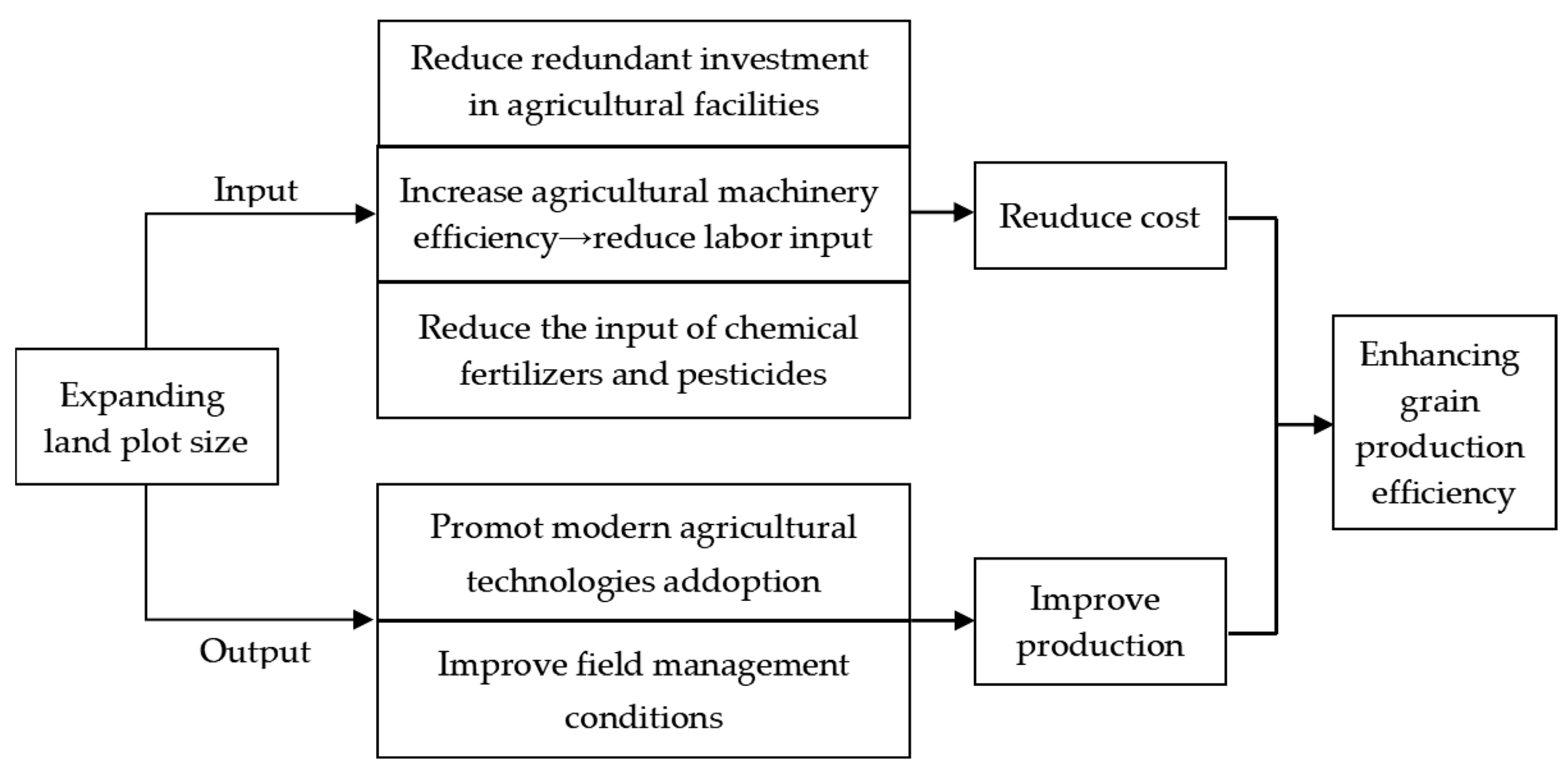
With the widespread and intensive use of various agricultural machinery, larger farmland plots enhance grain production efficiency primarily by facilitating the optimal allocation of resources such as land, labor, agricultural machinery, and technology. In doing so, they reduce production inputs and costs while increasing grain output per unit of cultivated land, as illustrated in Figure 1.
First, a larger plot size contributes to reducing material inputs and accelerating the substitution of machinery for labor, thereby boosting grain production efficiency. The input-saving effect of larger plots is manifested in three main aspects. Firstly, it minimizes the fragmented construction and redundant investment in agricultural infrastructure, leveraging economies of scale in facility utilization. Compared to scattered small plots, contiguous plots allow a single facility to cover more cultivated land, thereby spreading fixed investment costs and lowering unit production expenses [19]. Secondly, it improves agricultural machinery efficiency and consequently reduces fuel consumption in grain production. When plot size is sufficiently large, machinery can operate continuously and efficiently, leading to lower fuel consumption and reduced mechanical wear per unit of operating area [31]. Conversely, operations on small plots require frequent relocation, turning, and idling, which substantially increase fuel expenditures. Thirdly, it reduces the unreasonable overuse of fertilizers and pesticides. Cultivating numerous scattered small plots incurs labor time costs due to moving between fields. To save time and labor costs, farmers managing many fragmented plots may resort to extensive management practices, leading to excessive fertilizer and pesticide application and thereby increasing production costs [32]. Research indicates that when the average plot size for wheat and rice cultivation is less than 0.067 hectares (1 mu), per-mu input expenditures exceed those for plots of 2–5 mu by 7.72 yuan and 12.32 yuan, respectively [33]. Moreover, larger plots are more accessible to agricultural machinery services, reducing labor input and thus enhancing agricultural efficiency. In contrast, smaller plots face lower efficiency and higher costs for such services, which hinders the substitution of labor with machinery [34]. Research indicates that when the average cultivated plot size exceeds 240 mu, farmers’ adoption of machinery services increases by 91%, while labor demand decreases by 39% [24]. The above pathways indicate that expanding plot size can lay the foundation for efficiency gains by reducing production costs.
Second, expanding plot size will increase grain yields by promoting the adoption of modern agricultural technologies and improving field management conditions. The influence of plot size on the adoption of innovative agricultural technologies operates through three principal dimensions: farmers’ psychological motivations, technological suitability, and economic feasibility. Firstly, smaller plots can trigger a “broken window effect” among farmers, leading them to perceive limited value in undertaking modern agricultural investments or adopting advanced agronomic practices on fragmented land. Conversely, larger plots not only facilitate management but also yield higher rental income. They are more likely to be viewed by operators as significant assets warranting long-term investment, thereby generating an “endowment effect” that motivates them to adopt new agricultural technologies to enhance land value [35]. Secondly, many new agricultural technologies and advanced cultivation methods require a minimum plot size for scale-appropriate implementation. For instance, yield-enhancing techniques like “wide-row dense planting” necessitate contiguous, uniform land layouts to achieve optimal plant density, ventilation, and light exposure, challenging to implement on fragmented small plots. Similarly, facility-based technologies like water–fertilizer integration and water-saving irrigation require larger plots for systematic deployment and efficient operation [19]. Furthermore, only with larger plots can certain modern agricultural technologies requiring significant investment (e.g., soil-tested fertilization, high-efficiency plant protection machinery) more easily spread fixed investment costs and achieve better economic returns [20]. Lastly, larger land plots also improve the surrounding production conditions and strengthen farmers’incentives for refined field management, thereby increasing grain output. Small and fragmented plots are often associated with a high density of field ridges, irrigation ditches, and irregular marginal areas. These features not only reduce the effective cultivated area but also provide favorable conditions for the proliferation of weeds and pests. Moreover, small plots are more likely to be spatially surrounded by different crops, which may lead to problems such as insufficient pollination or pesticide drift, thereby impairing crop growth and constraining yield improvement [36]. Conversely, larger plots enhance agricultural machinery efficiency, minimize boundary losses and external disturbances to grain production, simplify field management, and better safeguard grain production capacity. Furthermore, excessively small plots may suppress farmers’ willingness to invest in land due to issues like fragmented investments, management difficulties, and low return on investment. This can lead to lax management or even land abandonment [37], thereby constraining output levels per unit area. The above analysis demonstrates that expanding plot size can enhance yield per unit area, thereby providing output support for efficiency improvement.
Third, input savings and output increases jointly drive improvements in grain production efficiency. The above analysis indicates that expanding plot size does not affect grain production efficiency through a single channel but rather through the synergistic effects of two pathways: “input savings” and “output increases”. On the one hand, improved agricultural machinery efficiency and reduced inputs of materials and labor directly lower production costs; on the other hand, the adoption of modern agricultural technologies, improvements in field management, and increases in grain yields enhance the output per unit of land. The combined effect of reduced production costs and increased output ultimately leads to a significant improvement in grain production efficiency. Based on this, this paper proposes the second research hypothesis:
H2: 
Expanding the arable land plot size may have a positive impact on farmers’ grain production efficiency through multiple channels, such as reducing material and labor inputs, accelerating the adoption and application of modern agricultural technologies, and increasing grain yields.
The foregoing discussion of the impact of cultivated plot size on grain production is primarily based on a general analysis at the aggregate level. In practice, due to variations in farmers’ material inputs and their capacity to adopt agricultural technologies and practices, coupled with significant differences in resource endowments, agricultural infrastructure, and farming methods across regions, the effect of arable land plot size may differ for heterogeneous farmers, across regions, and for different grain crops. Firstly, the efficiency gains from enlarging plot size may vary among households with differing grain production efficiencies. More efficient households possess stronger agricultural machinery operation capabilities, greater awareness of technology adoption, and more advanced management practices [38]. Larger plots enable them to better leverage their advantages, generate synergies, and enhance grain production capacity. In this context, expanding arable land plot size exhibits a “reinforcing-the-strong” characteristic, whereby more efficient producers benefit disproportionately from scale enlargement. Second, compared to central regions, western areas possess relatively abundant arable land resources but face labor shortages and predominantly single-season grain cultivation. Consequently, the constraints imposed by field size on mechanized operations, agricultural technology adoption, and achieving optimal scale are more pronounced [39], making field enlargement more effective in boosting grain production. Third, the impact of plot size may vary across different grain crops due to differences in production characteristics, cultivation methods, and factor inputs. For instance, wheat production relies heavily on mechanized operations in key stages such as sowing and harvesting, which exhibit high standardization and uniform agronomic requirements [40]. Thus, a larger plot size can effectively reduce mechanization costs and enhance field management efficiency. By contrast, while corn harvesting depends on large-scale machinery, labor-intensive field management tasks, such as weeding, thinning, and irrigation, exert a greater influence on corn production.
Therefore, this study proposes a third research hypothesis:
H3: 
The effect of arable land plot size on grain production efficiency is heterogeneous across farmers, regions, and crop types. Farmers with higher production efficiency and smaller operational scales, those located in western regions, and those cultivating wheat may benefit more from enlarging plot size.

3. Data, Variables, and Methods

3.1. Data Sources

The data used in this paper is sourced from the special survey on “Ecological Conservation and High-Quality Development of Agriculture and Rural Areas in the Yellow River Basin,” conducted by the College of Economics and Management of Northwest A&F University in China from July to August 2023. Employing a multistage stratified random sampling method, the survey systematically collected microdata on grain production, land parcel characteristics, and factor inputs from 1362 farming households across 165 administrative villages in five provinces/autonomous regions: Gansu, Ningxia, Inner Mongolia, Henan, and Shanxi. This provides a robust data foundation for measuring key variables and identifying causal effects in this study. The selection of this dataset was based on the following considerations: First, the middle and upper reaches of the Yellow River Basin constitute a vital grain-producing region and ecological barrier for China. The efficient utilization of its arable land resources holds strategic significance for ensuring regional food security and promoting sustainable agricultural development. Second, this region exhibits strong representativeness in terms of topography, climate conditions, and agricultural development levels, coupled with distinct gradient variations. This makes it an excellent observational sample for studying the impact of average plot size on grain production efficiency.

3.2. Variables Selection and Description

3.2.1. Dependent Variables

To analyze the impact and mechanism of cultivated arable land plot size on farmers’ grain production efficiency and test the research hypothesis, this study categorizes dependent variables into two types: outcome dependent variables and intermediate dependent variables. The outcome dependent variable is grain production efficiency, focusing on the technical efficiency of producing the two primary grain crops, wheat and corn, in the sample region. Drawing on existing research [40], the technical efficiency of grain production is measured through an indicator system constructed from input and output dimensions. Efficiency calculations employ an input-oriented non-radial SBM model under conditions of variable returns to scale.
ρ 0 * = min λ , s > s + ( 1 1 / m i = 1 m s i / x i   0 ) / ( 1 + 1 / s r = 1 s r + / y r   0 )
s . t . X 0 = X λ + s , Y 0 = Y λ s + , j = 1 n λ j = 1 λ j 0 , s i 0 , s r + 0 ( j = 1 , 2 , , n ; i = 1 , 2 , , m ; r = 1 , 2 , , s )
ρ 0 * denotes the grain production efficiency value; n represents the number of decision-making units; m and s denote the number of input and output variables, respectively; s i and s r + denote the slack variables for inputs and outputs, respectively; x and y denote the input and output variables, respectively; X and Y denote the input and output matrices, respectively; λ denotes the weight vector.
The reason for using an input-oriented non-radial SBM (Slack-Based Measurement) model to measure efficiency is twofold. On the one hand, changes in the plot size primarily affect farmers’ input behaviors, such as the use of agricultural machinery, labor, and materials, which in turn impact grain production efficiency. An input-oriented approach can accurately identify the reduction in input redundancy achieved by expanding plot size for a given output. On the other hand, different input factors respond differently to changes in plot size, and the non-radial model allows for the reduction in each input factor by varying proportions, thereby avoiding the limitation of proportional adjustments found in radial models. This approach more accurately captures the structural economies of scale and factor substitution relationships resulting from plot consolidation.
Intermediate dependent variables include material inputs, agricultural machinery operations, labor inputs, adoption of agricultural technologies, and grain yield per mu. Given that agricultural socialized services often rely on farm machinery operations for implementation, this study uses the number of agricultural socialized services utilized by households to reflect their farm machinery usage. Changes in grain production efficiency primarily stem from both input and output aspects. Therefore, the analysis examines how the size of cultivated land parcels influences the aforementioned intermediate explained variables to explore the mechanism of action on grain production efficiency.

3.2.2. Explanatory Variables

The core explanatory variable is the average plot size of farmland managed by households, expressed as the ratio of total managed farmland area to the number of plots. Generally, larger average plot sizes indicate more contiguous farmland holdings and lower fragmentation. The selection of this variable is primarily based on the following considerations: first, the core of this study is to investigate the scale economy effects at the plot level. The average plot size directly reflects the degree of land consolidation in a single plot, which allows for more precise capture of key transmission paths such as improved mechanization efficiency and input savings. Indicators such as the number of plots and the distance between them primarily reflect the degree of fragmentation in farm operations. Second, the Chinese government’s policies, such as promoting the consolidation of small plots into larger ones (“small fields into big fields”), aim to expand the average size of individual plots. The average plot size has stronger practical relevance and guiding significance in the context of ongoing national agricultural strategies. Third, the number of plots is highly correlated with the total scale of farm operations, and including it directly could lead to multicollinearity issues. In contrast, average plot size allows for better identification of the net effects of plot consolidation while controlling for total scale.

3.2.3. Control Variables

Considering the practical realities and influencing factors of grain production, this study controls for the head of household’s personal characteristics, household management status, farmland quality, and regional location.

3.2.4. Instrumental Variables

Identifying the causal effects of plot size on each dependent variable requires selecting appropriate instrumental variables. Following the methodology of Zhang et al. [40], this study employs “the average plot size of other farmers in the same village” as the instrumental variable for household average plot size. Theoretically, this instrument satisfies two fundamental conditions: first, correlation, meaning it is highly correlated with the dependent variable. Land allocation methods, topography, and whether concentrated land consolidation has been implemented are two key factors determining the average size of farmland plots managed by households [41]. Within the same village, topography, land allocation methods, and the presence of concentrated land consolidation exhibit high homogeneity. Consequently, the average size of farmland plots managed by a particular household is clearly closely related to the average size of farmland plots managed by other households in the village. Second, exogeneity, meaning no direct relationship with the dependent variable. Grain production constitutes an internal household activity [41]. Households allocate their grain production using their own arable land, labor, and agricultural machinery services. The average plot size of other households in the same village does not directly impact their grain production efficiency.
The definitions and related explanations of variables are shown in Table 1.

3.3. Econometric Model

To estimate the impact of farmland parcel size on household grain production efficiency, this paper establishes the following model:
Y i = α 0 + α 1 x i + β i c o n t r o l s i + ϵ i
In the equation, x i epresents the explanatory variable, denoting the average area of cultivated land plots for the i-th farmer; the dependent variable Y i simultaneously reflects the production efficiency of wheat and corn for the i-th farmer, as well as their material inputs, agricultural machinery operations, labor inputs, adoption of agricultural technology, and grain yield per mu; c o n t r o l s i denote the set of control variables encompassing the individual characteristics of the household head, the operational status of the household, and the quality of cultivated land; α 0 , α 1 and β i are the parameters to be estimated; ϵ i represents the random disturbance term.
To test research hypotheses H1 and H2, this paper first estimates Equation (1) using ordinary least squares (OLS). Subsequently, to identify causal effects, both two-stage least squares (2SLS) and propensity score matching (PSM) methods are employed to estimate Equation (1). By employing instrumental variables, the 2SLS method effectively addresses endogeneity biases arising from omitted variables, measurement errors, or mutual causation. The core principle of PSM involves matching samples based on observable covariates to mitigate self-selection bias in causal inference. Its fundamental logic involves finding highly similar matching counterparts for each individual in the treatment group from the control group based on covariate characteristics, thereby constructing a “counterfactual” control group to estimate the average treatment effect (ATT) for the treatment group. However, since the explanatory variable “average plot size” in this study is continuous, to adapt it for PSM, two treatment groups are constructed using the sample median and mean of the average plot size managed by households as thresholds to construct two treatment variables. Households with an average plot size above the median (or mean) were assigned to the treatment group (value 1), while those below the median (or mean) were assigned to the control group (value 0). Multiple matching methods, including nearest neighbor matching, kernel matching, and radius matching, were employed to test the robustness of the average plot size’s impact on household grain production efficiency.
However, the aforementioned estimation methods primarily examine the impact of x i on the conditional mean of Y i . Their results reflect the effect of average plot size on grain production efficiency for farmers in the “average situation,” failing to reveal the differentiated impact of plot size on different types of farmers. To avoid “averages masking structural differences” and examine the differentiated impact of average plot size on heterogeneous farmers, this study introduces an instrumental variable quantile regression (IVQR) model to test research hypothesis H3.

4. Empirical Results and Analysis

4.1. Baseline Regression Results and Analysis

According to Table 2, the multicollinearity test results indicate that the variance inflation factor (VIF) for all variables is below 10, with an average of 1.50, confirming no multicollinearity issues among the variables. Columns 2 and 3 of Table 2, respectively, present the impact of average cultivated plot size on grain production efficiency estimated via OLS, with and without control variables. Results indicate that the coefficients for average cultivated plot size in the two models are 0.018 and 0.008, respectively, both statistically significant at the 1% level. This confirms that enlarging cultivated plot size effectively enhances grain production efficiency, consistent with findings by Duan et al. [24] and Xu et al. [27], thereby preliminarily validating research Hypothesis H1.
Among the control variables, the coefficients for the household head’s gender and regional location were significantly positive, while those for the household head’s age, non-agriculturalization level, disaster frequency, and contracted land adjustment frequency were significantly negative. This may be attributed to the following factors: Male household heads typically possess advantages in physical labor, agricultural machinery operation, and adoption of agricultural technologies that impact grain production. Compared to western provinces, central provinces possess better agricultural infrastructure and more level farmland, facilitating scaled operations and contiguous machinery use, thereby achieving higher grain production efficiency. Households with high non-agriculturalization levels exhibit lower dependence on and prioritization of grain production, weakening their willingness to invest in agriculture and thereby undermining grain production efficiency. Frequent adjustments to contracted land weaken expectations for long-term stable utilization, deterring household investment in land and hindering improvements in grain production efficiency.
Additionally, the coefficients for household operation scale and its squared term were 0.110 and −0.009, respectively, both statistically significant at the 1% level, indicating an inverted U-shaped relationship between cultivated land size and grain production efficiency. This suggests that larger cultivated land areas are not necessarily better, but pursuing an “appropriate” scale. Coefficient calculations reveal that when other conditions remain constant, grain production efficiency peaks at 81.135 mu (approximately 6.11 hectares) of arable land plot size.

4.2. Endogeneity Test

Table 3 presents the results estimated using the 2SLS method. First, the Hausman test rejects the null hypothesis that “average arable land plot size is an exogenous variable” at the 1% significance level, indicating the presence of endogeneity and justifying the use of the instrumental variables method for estimation. Second, the first-stage regression results show that the “average plot size of other households in the same village” has a significant positive effect on a household’s average plot size. Moreover, the F-statistic far exceeds the critical value at the 10% error level, confirming a strong correlation between the instrumental variable and the endogenous explanatory variable. To ensure that the instrumental variable satisfies the exclusion restriction, this study further conducts a placebo test and a control function approach. In the placebo test, the instrumental variable was directly included as an additional exogenous control variable in the production efficiency equation, while controlling for village fixed effects; its coefficient was not significant. In the control function test, the instrumental variable was included in the second-stage equation after controlling for endogeneity, and its coefficient was similarly not significant. The results of both tests support the identification assumption that the instrumental variable affects food production efficiency solely through average plot size, providing indirect evidence for the validity of the exclusion restriction. Finally, the second-stage regression results reveal that after controlling for endogeneity, the coefficient for the impact of average plot size on grain production efficiency is 0.072, significant at the 1% level. In economic terms, this estimate indicates that each additional mu of average plot size increases grain production efficiency by 7.2 percentage points. Additionally, the sign, significance, and economic interpretation of the coefficients estimated using the 2SLS method align with the benchmark regression results. However, the coefficient value is larger than the 0.008 coefficient estimated by OLS, indicating that failing to address endogeneity would severely underestimate the impact of average arable land plot size on household grain production efficiency.

4.3. Robustness Test

To examine the robustness of the average plot size’s impact on household grain production efficiency, this study re-estimates the regression results using various methods: replacing the dependent variable, switching models, applying truncated data, excluding certain samples, and employing nonparametric PSM estimation.
First, we replace the dependent variable. To examine how the indicator construction affects results, this study further recalculated household grain production efficiency using output-oriented and non-oriented methods. These values were then substituted into the model for re-estimation using the 2SLS method. The results in columns 2 and 3 of Table 4 show that the coefficients for average cultivated land area per plot are 0.082 and 0.084, respectively, both statistically significant at the 1% level. This is highly consistent with the results in Table 3, indicating that the core conclusions remain unchanged regardless of the efficiency measurement method, and the impact of average cultivated land area per plot on grain production efficiency exhibits good robustness.
Second, we change the econometric model. Considering that farmers’ grain production efficiency values range from 0 to 1, constituting a restricted dependent variable, this study re-estimates using the Tobit model suitable for such data. Column 4 of Table 4 shows that the coefficient for average cultivated plot size is 0.083, closely matching estimates from other models and passing the 1% statistical significance test. This further demonstrates that there is a positive relationship between arable land plot size and grain production efficiency.
Third, we winsorize variables. To eliminate interference from extreme values, the core explanatory and dependent variables were bilaterally truncated at the 1% level before re-estimation. Column 5 of Table 4 shows that the coefficient for average plot size remains significantly positive after truncation, further supporting the reliability of the research conclusions.
Fourth, we exclude partial samples. To prevent the fragmentation of farmland holdings—which may arise from inflow or outflow of arable land and potentially affect farm management, and to better focus on the impact of average plot size on grain production efficiency, this study excluded a subsample of farmers involved in arable land transfers (both inflow and outflow). Column 6 of Table 4 shows that the coefficient for average plot size is 0.084, closely matching the results from other methods without sample exclusion. It also passes the 1% statistical significance test, further demonstrating the robustness of the benchmark conclusions.
The four robustness tests discussed above are based on parameter estimation results. Table 5 reports the results of the non-parametric method propensity score matching (PSM), where the sample of farmers is divided into two groups based on the median and mean values, respectively. Results indicate that when using the median as the cutoff, the estimated average treatment effects (ATT) under the three matching methods were 0.063, 0.059, and 0.063, respectively, all significant at the 1% level. When using the mean as the partition criterion, the ATTs under the three matching methods were 0.042, 0.046, and 0.045, respectively, passing the significance tests at the 10% and 5% levels. Furthermore, since the median division revealed a larger difference in average plot size between the two farmer groups, while the mean division showed a smaller difference, and the ATT for grain production efficiency was larger for the former and smaller for the latter, the PSM estimation results further indicate that there is a positive correlation between avaerage arable land plot size and grain production efficiency.
These robust results collectively confirm that there is a significant positive correlation between average arable land plot size and grain production efficiency. Farmers with larger plot sizes exhibit higher grain production efficiency. Hypothesis H1 is thus further validated, demonstrating the strong robustness of the econometric findings presented earlier.

4.4. Mechanism Analysis

To investigate how the average plot size affects farmers’ grain production efficiency and test the mechanism of action and research Hypothesis H2, this study employs the 2SLS method to estimate intermediate explanatory variable, including material input per mu, agricultural machinery service utilization, labor input per mu, agricultural technology adoption, and wheat and corn yield per mu, after controlling for relevant variables. The results are presented in Table 6.

4.4.1. Reduction in Material Input

Column 2 of Table 6 shows that the estimated coefficient for the impact of average plot size on material input per mu is −58.335, significant at the 10% level, indicating that expanding the plot size reduces material input in grain production. On average, for each additional mu of plot size, material input per mu decreases by 58.335 yuan. Several studies have found that increasing plot size has a cost-saving effect on agricultural production. For instance, Wu et al. [42] found that a 1% increase in plot size leads to a 0.3% and 0.5% reduction in fertilizer and pesticide use per mu, respectively. Considering that expanding arable land plot size inherently constitutes a form of scale operation, the above results support the transmission pathway of “scale operation—cost savings” in agriculture.

4.4.2. Promotion of Mechanized Operations and Labor Substitution

Columns 3 and 4 of Table 6 show that expanding plot size has a significant positive effect on the adoption of agricultural machinery services, while the adoption of these services significantly reduces labor input per mu during grain production. In the context where grain production is highly dependent on mechanized operations and such operations are primarily carried out by agricultural service providers, these results suggest that increasing the average plot size promotes the adoption of mechanized services, which, in turn, facilitates the substitution of machinery for labor. As previously discussed in the theoretical analysis, larger plots are more conducive to agricultural machinery operations and allow farmers to outsource labor-intensive tasks, increasing machinery use while reducing household labor input, thus lowering labor costs and improving grain production efficiency [43]. Therefore, expanding arable land plot size not only directly improves agricultural production conditions and promotes specialized division of labor but also advances agricultural mechanization, elevates the technological level of agricultural development, shifting grain production from labor-intensive to technology-driven processes.

4.4.3. Accelerating Agricultural Technology Adoption

Column 5 of Table 6 shows that the estimated coefficient for the impact of average plot size on agricultural technology adoption is 0.211, significant at the 1% level, indicating that expanding plot size promotes the adoption of agricultural technologies by farmers. This mechanism primarily stems from the increased expected returns and shared investment risks associated with contiguous land management. Larger contiguous plots are more favorable for realizing the economies of scale of agricultural technologies, reducing per-unit costs of technology application while simultaneously enhancing farmers’ willingness and capacity to adopt new technologies [19]. Expanding plot size encourages the adoption of advanced technologies such as integrated water–fertilizer systems and water-saving irrigation, significantly improving the efficiency of resource allocation and providing important technical support for improving grain production efficiency.

4.4.4. Increase in Grain Yield

Columns 6 and 7 of Table 6 show that expanding plot size significantly increases yields for both wheat and maize. This result is driven by two main factors: first, increasing plot size reduces land waste caused by field boundaries and excess weed growth, improving the micro-environment for crop growth; second, larger plots make farm management (e.g., water and fertilizer management, pest control) more convenient and less susceptible to the inefficiencies and delays caused by fragmented plots. This is conducive to increasing grain yield. Wan et al. [43] estimated that if fragmented land operated by farmers were consolidated into larger plots, Chinese annual grain production could increase by about 15.3%.
The above input-output analysis indicates that expanding the average plot size reduces material and labor inputs, promotes mechanization and adoption of agricultural technologies, and increases wheat and corn per unit area yields. Consequently, it enhances farmers’ grain production efficiency, validating research Hypothesis H2.

5. Heterogeneity Analysis

To investigate the differentiated effects of arable land plot size on different farmers, regions, and grain crops, and to test research Hypothesis H3, this study first employs instrumental variable quantile regression. Subsequently, the farmer sample is categorized by farm size, crop type, and region for further econometric analysis. The descriptive statistics on opertional scale and regional distribution are shown in Table A1, Table A2, Table A3, Table A4 and Table A5 in the Appendix A.

5.1. Impact on Farmers with Different Production Efficiency

To examine the differentiated impact of expanding average plot size on farmers with varying grain production efficiencies, we divide farmers’ grain production efficiency into five quantiles: 0.10, 0.25, 0.50, 0.75, and 0.90. Estimation was conducted using instrumental variable quantile regression (IVQR).
Table 7 reveals that the estimated coefficient of average arable land plot size shows an increasing trend with the elevation of quantile points. Except for the lowest 0.10 percentile, estimated coefficients for all other percentiles pass significance tests at certain levels. This suggests that expanding the positive correlation between arable land plot size and grain production efficiency is more pronounced among highly efficient households, demonstrating that the expansion of plot size has a “reinforcing-the-strong” characteristic. This finding is consistent with the conclusion drawn by Wan et al. [43], based on rural household survey data in China. The underlying reason is that highly efficient farmers typically possess stronger capabilities in resource integration and technology adoption. When plot sizes increase, these farmers are able to adjust production decisions more rapidly, make fuller use of agricultural machinery services, and optimize the allocation of production factors, thereby converting the potential scale advantages of larger plots into actual efficiency gains more effectively. In contrast, low-efficiency farmers may be constrained by limited managerial capacity or financial resources; even if plot conditions improve, they struggle to optimize factor allocation in tandem, resulting in relatively limited benefits. In other words, expanding plot size creates the potential for efficiency improvement, while farmers’ managerial and operational capabilities determine the extent to which this potential can be realized.

5.2. Impact on Farmers with Different Operational Scales

To examine the impact of average plot size on the grain production efficiency of farmers with different operational scales, we follow the approach of government agencies and categorize the sample farmers into three groups based on operational scale: less than 10 mu, between 10 and 30 mu, and 50 mu or more. Estimation was conducted using the 2SLS method. Table 8 results indicate that expanding the average plot size has a positive impact on the grain production efficiency of all three groups of farmers. Specifically, the estimated coefficients for the groups with a farming scale of less than 10 mu and between 10 and 30 mu were significant at the 1% and 10% statistical levels, respectively, while the coefficient for the group with more than 30 mu did not pass the significance test. This result suggests that the positive correlation between average plot size and grain production efficiency is more pronounced for small-scale farmers. This result can be explained by differences in the bottlenecks of factor allocation. For smallholder farmers, land fragmentation constitutes the primary constraint on production efficiency. Specifically, small and scattered plots hinder mechanized operations and lead to substantial labor inefficiencies. Therefore, when this bottleneck is alleviated through land consolidation, the marginal effect on efficiency improvement is particularly pronounced. In contrast, for farmers who have already reached a certain operational scale (more than 30 mu), production processes may have already been partially mechanized. At this stage, the primary factors constraining further efficiency gains may shift to areas such as capital investment, technology adoption, or market access, while the marginal contribution of simply expanding plot size declines relatively.

5.3. Impact on Different Regions

Due to differences in agricultural production methods and resource endowments, the average plot size of cultivated land may have varying effects on household grain production efficiency across different regions. Following the National Bureau of Statistics’ classification, the sample provinces were grouped into central regions (Shanxi, Henan) and western regions (Gansu, Inner Mongolia, Ningxia) for separate regression analysis. The 2SLS estimation results presented in Table 9 show that the estimated coefficient for average plot size on household grain production efficiency is positive in both regions but only the coefficient for the western region is statistically significant at the 1% level. As the theoretical analysis suggests, excessively small plot sizes and land fragmentation act as “obstructive” factors, causing greater harm to grain production in the western region, which possesses relatively abundant arable land resources. This is because, while the western regions have relatively abundant per capita arable land resources, their agricultural infrastructure is relatively weak and mechanization levels are relatively low; consequently, the hindrance caused by small plot sizes to agricultural machinery operations is more pronounced. Therefore, as plot sizes increase, farmers in the western regions can benefit from more significant “mechanization-driven productivity gains” and “labor-saving effects”. By contrast, agricultural production conditions in the central regions are better, and the constraints imposed by land fragmentation may have already been partially mitigated through the development of agricultural socialized services. As a result, the marginal contribution of expanding plot size to efficiency improvement is comparatively smaller.

5.4. Impact on Different Crops

Table 9 also reports the results estimated separately for wheat and corn using the 2SLS method (excluding samples with dual cropping). Findings indicate that the average plot size has a positive effect on the production efficiency of both wheat and corn, with significance levels of 10% for corn and 1% for wheat. This further supports the conclusion of a positive relationship between average plot size and grain production efficiency. Based on the estimated coefficients, for each additional mu of average plot size, wheat and corn production efficiency increase by 16.9% and 6.8%, respectively. Clearly, the association between plot size and production efficiency is stronger for wheat than for wheat. This conclusion is supported by the fact that the estimated coefficient for wheat yield in Table 6 is significantly larger than that for corn yield. This difference stems primarily from variations in the production characteristics and levels of mechanization between the two crops. Wheat production relies heavily on agricultural machinery for plowing, sowing, pest control, and harvesting, and is highly standardized. As plot size expands, machinery idle time and turning frequency are reduced, allowing the scale economies of agricultural machinery to be more fully realized. In contrast, corn production in some regions still involves certain manual operations (such as harvesting and sun-drying), making it relatively less sensitive to plot size. Moreover, field management for corn cultivation is relatively flexible; farmers can partially substitute machinery with additional labor input, thereby offsetting the negative impact of smaller plot sizes to some extent. Consequently, when plot sizes are expanded, wheat farmers are better positioned to fully realize the efficiency gains resulting from larger plots.
Regardless, the positive relationship between average land plot size and grain production efficiency is more pronounced among farmers with higher efficiency, smaller operational scales, as well as in the western regions and among wheat-growing farmers. These findings provide supporting evidence for the research Hypothesis H3 of this study.

6. Discussion

This study provides empirical evidence that expanding the average plot size can help improve grain production efficiency in smallholder-dominated agricultural systems. These findings contribute to the ongoing debate regarding land fragmentation and economies of scale in agriculture.
First, in terms of average effects, there is a significant positive correlation between average arable land plot size and the grain production efficiency of farmers in the Yellow River Basin. This finding is consistent with existing research on land fragmentation and agricultural performance. Expanding land plot size can significantly improve the grain production efficiency of farmers in the Yellow River Basin. This finding is consistent with existing research conclusions on land fragmentation and agricultural performance [44,45]. At the same time, this study further incorporates the farm size into the analytical framework and finds that, when considering plot size, the optimal grain production efficiency occurs when farmers operate around 81.135 mu of arable land. In contrast, the study by Ni et al. (2015) [46], based on China’s National Rural Household Survey data, indicates that the maximum grain production efficiency is achieved when the farmland area managed by a household is around 130 mu. The difference in these findings can be attributed to the strict control of the key variable of plot size in this study. This result highlights that the concentration of land plots significantly moderates the relationship between farm size and grain production efficiency. When the plot size is larger and more concentrated, the positive impact of farm size on production efficiency can be more fully realized. However, when land fragmentation is high, even if the total farm size is expanded, its effect on improving production efficiency will be constrained. Therefore, when formulating relevant policies, attention should be paid to the appropriate expansion of farm size and effective management of land fragmentation, with a focus on increasing the size of individual plots to fully capitalize on the benefits of scale farming for improving grain production efficiency.
Second, the mechanism analysis indicates that the positive relationship between plot size and grain production efficiency may be realized through multiple pathways. This study finds that expanding plot size is associated with an increase in the adoption of agricultural machinery and technology, a reduction in material and labor inputs per unit area, and an improvement in grain yield per unit area. This multi-channel transmission framework expands upon existing research. The previous literature typically examines individual mechanisms in isolation, such as mechanization or input costs, whereas this study integrates them into a unified analytical framework, revealing the complete chain of effects linking “plot size-input structure-production efficiency”. Notably, the transmission effects of agricultural machinery use and technology adoption are particularly prominent. This finding is consistent with the conclusions of Balogun et al. (2018) [47], indicating that the optimization of land structure is a fundamental prerequisite for transforming agricultural production methods. Therefore, policy formulation should comprehensively consider the synergistic effects of increased plot size across multiple pathways, including mechanized operations, technology adoption, cost control, and yield enhancement, to systematically advance land structure optimization.
Finally, the heterogeneity analysis reveals the conditional nature of scale advantages. This study finds that the positive association between land plot size and grain production efficiency is more pronounced among farmers with higher efficiency and smaller operational scales, exhibiting both “supporting the strong” and “favoring small farmers” characteristics. This finding indicates that farmers with different initial conditions benefit from land structure adjustments to varying degrees. For high-efficiency farmers, their management capabilities complement the expanded plot size, enabling them to more effectively integrate modern production factors. For small-scale farmers, expanding plot size helps break the economies of scale constraints caused by land fragmentation, allowing them to achieve marginal benefits through land consolidation, even with limited overall scale. This finding addresses concerns regarding whether land consolidation policies favor large-scale operators. The study confirms that there is also a positive correlation between moderate land consolidation and the improvement of grain production efficiency among small farmers. Therefore, policy development should avoid a “one-size-fits-all” approach and instead implement differentiated land consolidation strategies based on farmers’ production efficiency levels and operational scale characteristics, ensuring that farmers with different conditions can all benefit from the expansion of plot size.

7. Conclusions and Policy Implications

7.1. Main Conclusions

Based on survey data from grain-growing households in the Yellow River Basin, this study employs methods such as 2SLS, PSM, and IVQR to examine the average treatment effect of farmland plot size on household grain production efficiency. It also reveals the underlying transmission mechanisms and investigates the heterogeneity of this effect across different households, regions, and crops. The study yields the following three key findings: First, there is a significant positive correlation between expanding average land plot size and grain production efficiency in the Yellow River Basin. Second, in terms of mechanisms, the expansion of land plot size is associated with reductions in material and labor input costs, as well as increases in grain yield, with these pathways potentially working together to improve farmers’ production efficiency. Third, the heterogeneity analysis reveals that in the Yellow River Basin, the positive association between land plot size and grain production efficiency is more pronounced among higher-efficiency farmers and smallholders with less than 30 mu of operational land. Additionally, compared with farmers in the central region and corn growers, the association between land plot size and production efficiency is stronger in the western regions and among wheat-growing farmers.

7.2. Policy Implication

First, to enhance grain production capacity and safeguard national food security in the Yellow River Basin, it is essential to fully leverage the key role of farmers in grain production. This requires addressing the issues of excessively small plot sizes and severe land fragmentation. Expanding the average plot size and mitigating fragmentation should be regarded as a crucial measure to promote the effective linkage between smallholder farming and modern agricultural development, thereby facilitating the moderate consolidation and contiguous management of farmland operated by smallholders. Second, based on the actual conditions of the Yellow River Basin, efforts should focus on accelerating agricultural mechanization and technology adoption to increase farmers’ operating income and enhance grain production capacity, which requires addressing the fragmented nature of smallholder contracted land. Efforts should focus on promoting contiguous land use to swiftly transform the current situation of “multiple small plots” held by smallholder farmers. During the extension of second-round land contracts, integrating efforts with high-standard farmland construction and land consolidation, promoting land swaps and consolidation among farmers to merge small plots into larger ones, achieving “one plot per household”, and expanding the average size of cultivated land parcels represent a key reform approach. Third, in response to the heterogeneous needs of different types of farmers, regions, and crops within the Yellow River Basin, a differentiated and pilot-based approach should be adopted and advanced in an orderly manner. Actively explore and introduce legal and policy documents to resolve fragmented farmland and excessively small plots. At the same time, the average plot size within a region can be incorporated as a key indicator in the evaluation and acceptance of high-standard farmland construction, thereby promoting the continuous expansion of the average plot size.

7.3. Limitations and Prospects

First, limitations in the core variable measurement. Land fragmentation is a multidimensional concept, encompassing not only plot size but also plot number, spatial distribution, plot spacing, and other dimensions. This study primarily uses the average plot size as the core explanatory variable, focusing on the scale dimension of land fragmentation, and does not fully capture other dimensions of land fragmentation and their interactive effects. Therefore, the empirical results of this study should be interpreted as the impact of fragmentation at the plot size level on grain production efficiency, rather than the overall effect of land fragmentation as a comprehensive phenomenon. Future research could combine spatial plot data (e.g., GIS data and plot coordinates) to further investigate the differentiated impact of multidimensional land fragmentation on agricultural production efficiency.
Second, limitations in the data dimension. Due to constraints on data availability, this study uses cross-sectional data from a single year, making it difficult to capture the dynamic impact and long-term effects of changes in plot size on grain production efficiency. Grain production is characterized by cyclicality and volatility, and the efficiency gains from land consolidation may exhibit a lag. Observational data from a single period cannot fully account for the interference of factors such as annual climate and market fluctuations. Therefore, the conclusions of this study are primarily based on cross-sectional comparisons among farmers, reflecting differences between groups at the time of the survey rather than causal evolution over time. In the future, panel data could be collected to track changes in farmers’ circumstances before and after land consolidation, or quasi-natural experiments such as land consolidation initiatives, using the difference-in-differences (DID) method to provide more rigorous empirical evidence for causal relationships.
Third, limitations in sample scope. The study focuses on provinces along the Yellow River Basin, and the sample crops are limited to wheat and corn, which may restrict the generalizability of the findings. There are significant differences in resource endowments, topographical conditions, agricultural production methods, and levels of economic development among major grain-producing regions. For instance, large-scale mechanized farming dominates in the Northeast Plain, while rice cultivation in the Yangtze River Basin exhibits distinct patterns of fragmentation and operational modes compared to the Yellow River Basin. Therefore, the findings of this study mainly reflect empirical evidence under the specific crop and regional context of the Yellow River Basin, and caution is needed when extending them to the national level or to other crops. Future research could expand the research scope to include major grain-producing regions such as the Northeast Plain, the Yangtze River Basin, and the Sichuan Basin, and include a diverse range of crops such as rice, soybeans, and potatoes. This would help examine the regional heterogeneity and crop-specific variations in the effects of plot size, thereby further enhancing the external validity of the conclusions.


Author Contributions

Conceptualization, Y.G. and T.L.; methodology, Y.G., T.L. and L.M.; validation, Y.G., T.L. and L.M.; formal analysis, Y.G. and L.M.; resources, L.M.; data curation, L.M.; writing—original draft preparation, Y.G. and L.M.; writing—review and editing, Y.G. All authors have read and agreed to the published version of the manuscript. The authors have reviewed and edited the output and take full responsibility for the content of this publication.

Funding

This research was supported by the National Social Science Foundation of China (Grant No. 25XJY052), Yunnan Philosophy and Social Sciences Innovation Team Construction Project “Coordinated Promotion of Rural Revitalization through Characteristic Agriculture and Land Use” (Project Number: 2025CX03), and Sci-Tech Service Station for Farmer Academicians in Eryuan County (Document No. 17 of 2025 jointly issued by Yunnan Association for Sci-Tech).

Data Availability Statement

The data analyzed in this study are subject to the following licenses/restrictions: The data used in this article are confidential and not publicly available. The original data can be obtained from the College of Economics and Management of Northwest A&F University.

Conflicts of Interest

The authors declare that the research was conducted in the absence of any commercial or financial relationships that could be construed as a potential conflict of interest.

Appendix A

Table A1. Basic characteristics of households with operational scale of less than 10 mu.
Variable NameMeanSDMinMax
Grain production efficiency0.2810.1720.0661.000
Average arable land plot size1.2631.0410.0509.500
Gender0.9430.2320.0001.000
Age4.0370.1963.2194.443
Education7.9063.5770.00020.000
Health Status2.6640.6371.0003.000
Operation arable land scale4.2492.2870.3009.500
Operation arable land scale in square meters23.28322.3880.09090.250
Labor Force ratio0.6590.2830.0001.000
Level of non-agriculturalization0.6590.3310.0001.000
Number of Disasters2.3172.9310.00018.000
Quality of arable land3.3510.8501.0005.000
Topography0.3690.4830.0001.000
Adjustment of contracted land0.7950.9780.0005.000
Region0.5310.4990.0001.000
Table A2. Basic characteristics of households with operational scale between 10 and 30 mu.
Variable NameMeanSDMinMax
Grain production efficiency0.4300.2150.0911.000
Average arable land plot size3.5072.8740.15420.000
Gender0.9170.2760.0001.000
Age4.0300.1773.4014.394
Education7.4043.8100.00021.000
Health Status2.5960.6861.0003.000
Operation arable land scale15.3095.16710.00028.000
Operation arable land scale in square meters260.998179.890100.000784.000
Labor Force ratio0.6520.3010.0001.000
Level of non-agriculturalization0.4110.3310.0001.000
Number of Disasters1.8392.4960.00018.000
Quality of arable land3.3810.8141.0005.000
Topography0.4980.5010.0001.000
Adjustment of contracted land0.7870.8360.0005.000
Region0.3920.4890.0001.000
Table A3. Basic characteristics of households with operational scale of more than 30 mu.
Variable NameMeanSDMinMax
Grain production efficiency0.5510.2760.1211.000
Average arable land plot size7.7109.0150.75066.667
Gender0.9860.1170.0001.000
Age3.9650.2013.2194.489
Education7.6783.4960.00015.000
Health Status2.8010.4931.0003.000
Operation arable land scale43.06223.11730.000200.000
Operation arable land scale in square meters2385.0484130.946900.00040,000.000
Labor Force ratio0.7280.2690.0001.000
Level of non-agriculturalization0.2380.2660.0001.000
Number of Disasters2.1163.3290.00018.000
Quality of arable land3.6160.7631.0005.000
Topography0.5620.4980.0001.000
Adjustment of contracted land0.7330.8080.0005.000
Region0.2600.4400.0001.000
Table A4. Basic characteristics of households in central regions.
Variable NameMeanSDMinMax
Grain production efficiency0.3670.2040.0841.000
Average arable land plot size2.2253.5700.05066.667
Gender0.9450.2280.0001.000
Age4.0400.1913.3324.443
Education8.6753.0190.00021.000
Health Status2.7620.5311.0003.000
Operation arable land scale9.60513.7020.300200.000
Operation arable land scale in square meters279.6951911.9810.09040,000.000
Labor Force ratio0.6720.2960.0001.000
Level of non-agriculturalization0.6220.3360.0001.000
Number of Disasters1.9772.0370.00018.000
Quality of arable land3.2480.8341.0005.000
Topography0.4150.4930.0001.000
Adjustment of contracted land0.8231.1450.0005.000
Table A5. Basic characteristics of households in western regions.
Variable NameMeanSDMinMax
Grain production efficiency0.3530.2350.0661.000
Average arable land plot size3.0784.3020.07156.500
Gender0.9340.2490.0001.000
Age4.0170.1913.2194.489
Education6.9123.9330.00018.000
Health Status2.5680.7111.0003.000
Operation arable land scale14.07114.8090.300113.000
Operation arable land scale in square meters417.0001105.3890.09012,769.000
Labor Force ratio0.6580.2820.0001.000
Level of non-agriculturalization0.4580.3600.0001.000
Number of Disasters2.2743.3800.00018.000
Quality of arable land3.5080.8131.0005.000
Topography0.4460.4970.0001.000
Adjustment of contracted land0.7540.6630.0002.000

References

  1. Liu, T.S.; Kong, X.Z.; Yang, X.T. How to Achieve Integrated Farmland Management with Both Small and Large Plots: A Case Study of “Small Fields Merged into Large Fields” in Tinghu District, Yancheng, Jiangsu Province. Chin. Rural Econ. 2023, 12, 44–64. [Google Scholar] [CrossRef]
  2. Wang, Q.; Yu, J. Analysis of the Impact of Plot Size on Farmers’ Grain Production Investment in the Context of Agricultural Land Transfer. Chin. Popul. Resour. Environ. 2017, 27, 129–137. [Google Scholar]
  3. Sen, A.K. Peasants and Dualism with or without Surplus Labor. J. Polit. Econ. 1966, 74, 425–450. [Google Scholar] [CrossRef]
  4. Henderson, H. Considering Technical and Allocative Efficiency in the Inverse Farm Size–Productivity Relationship. J. Agric. Econ. 2015, 66, 442–469. [Google Scholar] [CrossRef]
  5. Assunção, J.J.; Braido, B.H.L. Testing Household-Specific Explanations for the Inverse Productivity Relationship. Am. J. Agric. Econ. 2007, 89, 980–990. [Google Scholar] [CrossRef]
  6. Helfand, M.S.; Taylor, P.M. The inverse relationship between farm size and productivity: Refocusing the debate. Food Policy 2020, 99, 101977. [Google Scholar] [CrossRef]
  7. Ferreira, P.D.M.; Féres, G.J. Farm size and Land use efficiency in the Brazilian Amazon. Land Use Policy 2020, 99, 104901. [Google Scholar] [CrossRef]
  8. Looga, J.; Jürgenson, E.; Sikk, K.; Matveev, E.; Maasikamäe, S. Land fragmentation and other determinants of agricultural farm productivity: The case of Estonia. Land Use Policy 2018, 79, 285–292. [Google Scholar] [CrossRef]
  9. Tran, D.; Thu, V.H.; Goto, D. Agricultural land consolidation, labor allocation and land productivity: A case study of plot exchange policy in Vietnam. Econ. Anal. Policy 2022, 73, 455–473. [Google Scholar] [CrossRef]
  10. Colombo, S.; Villanueva, M.P. The inefficiency and production costs due to parcel fragmentation in olive orchards. Acta Hortic. 2017, 16, 2–10. [Google Scholar] [CrossRef]
  11. Leń, P. An algorithm for selecting groups of factors for prioritization of land consolidation in rural areas. Comput. Electron. Agric. 2018, 144, 216–221. [Google Scholar] [CrossRef]
  12. Rahman, S.; Rahman, M. Impact of land fragmentation and resource ownership on productivity and efficiency: The case of rice producers in Bangladesh. Land Use Policy 2008, 26, 95–103. [Google Scholar] [CrossRef]
  13. Tan, S.; Heerink, N.; Kuyvenhoven, A.; Qu, F. Impact of land fragmentation on rice producers’ technical efficiency in South-East China. Wagening. J. Life Sci. 2010, 57, 117–123. [Google Scholar] [CrossRef]
  14. Kawasaki, K. The costs and benefits of land fragmentation of rice farms in Japan. Aust. J. Agric. Resour. Econ. 2010, 54, 509–526. [Google Scholar] [CrossRef]
  15. Eder, A. The Effect of Land Fragmentation on Risk and Technical Efficiency of Austrian Crop Farms. J. Agric. Econ. 2025, 76, 391–404. [Google Scholar] [CrossRef]
  16. Ayalew, D.A.; Klaus, D.; Loraine, R. Costs and Benefits of Land Fragmentation: Evidence from Rwanda. World Bank Econ. Rev. 2019, 33, 750–771. [Google Scholar] [CrossRef]
  17. Al-Amin, A.A.; Lowenberg-DeBoer, J.; Franklin, K.; Behrendt, K. Economics of field size and shape for autonomous crop machines. Precis. Agric. 2023, 24, 1738–1765. [Google Scholar] [CrossRef] [PubMed]
  18. Xue, C.; Shi, X.Y.; Zhou, H. Research on the Impact Pathways of Agricultural Mechanization on Total Factor Productivity in Crop Production. J. Agric. Econ. 2020, 10, 87–102. [Google Scholar] [CrossRef]
  19. Song, H.N.; Luan, J.D.; Zhang, S.Y.; Jiang, J.Y. Land Fragmentation, Diversified Cropping, and Agricultural Production Efficiency: An Empirical Study Based on Stochastic Frontier Production Function and Mediating Effect Models. J. Agric. Econ. 2021, 2, 18–29. [Google Scholar] [CrossRef]
  20. Ren, C.; Jin, S.; Wu, Y.; Zhang, B.; Kanter, D.; Wu, B.; Xi, X.; Zhang, X.; Chen, D.; Xu, J.; et al. Fertilizer overuse in Chinese smallholders due to lack of fixed inputs. J. Environ. Manag. 2021, 293, 112913. [Google Scholar] [CrossRef]
  21. Liu, X.R.; Li, R. Impact of Contiguous Cropping on Farmers’ Access to Economies of Scale in Land Parceling under Fragmented Land Conditions: A Case Study of Agricultural Machinery Operation Service Fees. J. Chin. Agric. Mech. 2020, 41, 185–191. [Google Scholar] [CrossRef]
  22. Wen, G.H.; Wang, X.Y.; Hu, X.H.; Xia, W. Impact of Farmland Scale and Fragmentation on Fertilizer Nonpoint Source Pollution. J. Chin. Ecol. Agric. 2023, 31, 1081–1093. [Google Scholar]
  23. Zhu, W.; Qi, L.X.; Wang, R.M. The relationship between farm size and fertilizer use efficiency: Evidence from China. J. Integr. Agric. 2022, 21, 273–281. [Google Scholar] [CrossRef]
  24. Duan, J.; Ren, C.; Wang, S.; Zhang, X.; Reis, S.; Xu, J.; Gu, B. Consolidation of agricultural land can contribute to agricultural sustainability in China. Nat. Food 2021, 2, 1014–1022. [Google Scholar] [CrossRef] [PubMed]
  25. Guo, G.C.; Ding, C.X. Quantitative Study on the Impact of Land Fragmentation on Returns to Scale in Grain Production: Empirical Evidence from Yancheng and Xuzhou, Jiangsu Province. J. Nat. Resour. 2016, 31, 202–214. [Google Scholar]
  26. Tang, H.; Liang, L.J.; He, H.F.; Liu, Y.Q. Impact of Agricultural Socialized Services and Farmland Fragmentation on Farmland Abandonment. J. Nat. Resour. 2024, 39, 2171–2187. [Google Scholar]
  27. Xu, Z.G.; Zhang, D.; Cheng, B.D. The Logic of Farmland Scale Operations in China’s Food Security Assurance: An Analysis Perspective Based on Dual Economies of Scale at the Household and Parcel. J. Manag. World 2024, 40, 106–122. [Google Scholar] [CrossRef]
  28. Peng, J.Q.; Zhao, Z.H.; Liu, D.N. Impact of agricultural mechanization on agricultural production, income, and mechanism: Evidence from Hubei Province, China. Front. Environ. Sci. 2022, 10, 838686. [Google Scholar] [CrossRef]
  29. Yu, P.; Fennell, S.; Chen, Y.; Liu, H.; Xu, L.; Pan, J.; Bai, S.; Gu, S. Positive impacts of farmland fragmentation on agricultural production efficiency in Qilu Lake Watershed: Implications for appropriate scale management. Land Use Policy 2022, 117, 106108. [Google Scholar] [CrossRef]
  30. Janulevičius, A.; Šarauskis, E.; Čiplienė, A.; Juostas, A. Estimation of farm tractor performance as a function of time efficiency during ploughing in f ields of different sizes. Biosyst. Eng. 2019, 179, 80–93. [Google Scholar] [CrossRef]
  31. Xia, T.; Wang, X.Q.; Yang, J. Plot Size and Socialized Agricultural Machinery Services. Anhui Agric. Sci. 2015, 43, 315–318. [Google Scholar] [CrossRef]
  32. Zhang, L.; Luo, B.L. Agricultural Downsizing: The Scale Logic of Farmhouse Operations and Its Evidence. Chin. Rural Econ. 2020, 2, 81–99. [Google Scholar]
  33. Zhang, Y.; Liu, T.S. Impacts and Governance of Agricultural Land Fragmentation: An Analysis Based on China Rural Revitalization Survey (CRRS) Data. Rural Econ. 2024, 5, 55–65. [Google Scholar] [CrossRef]
  34. Zeng, Z.; He, P.M. The Impact of Agricultural Socialized Services on Farmers’ Adoption of Green Agricultural Technologies: An Element Allocation Perspective. Rural Financ. Res. 2025, 2, 51–66. [Google Scholar] [CrossRef]
  35. Yue, M.; Zhang, L.; Zhang, J.B. Land Fragmentation and Farmers’ Decisions on Adopting Environmentally Friendly Technologies: The Case of Soil-Testing and Formula Fertilization. Resour. Environ. Yangtze River Basin 2021, 30, 1957–1968. [Google Scholar]
  36. Yang, Z.Y.; Fang, C.L.; Ji, Y.Q. Operational Fragmentation, Land Rights Confirmation, and Agricultural Structural Adjustment: An Analysis at the Plot Level. J. Nanjing Agric Univ. (Soc. Sci. Ed.) 2021, 21, 127–137. [Google Scholar] [CrossRef]
  37. Yang, Z.Y.; Ji, Y.Q. Impact of Contracted Land Rights Confirmation and Plot Size on Farmers’ Land Investment: A Perspective Based on Decision-Making Pattern Differences. Chin. Land Sci. 2021, 35, 48–55, 94. [Google Scholar]
  38. Deng, Y.Y.; Zhu, J.F. Enhancement Effects of Conservation Tillage Technology on Grain Production Efficiency and Environmental Efficiency. Chin. Popul. Resour. Environ. 2023, 33, 218–228. [Google Scholar]
  39. Shi, C.L.; Zhang, Y.; Guo, Y.; Zhu, J.F. Impact of Farmland Fragmentation on Fertilizer Use Efficiency Among Farmers. J. Nat. Resour. 2019, 34, 2687–2700. [Google Scholar]
  40. Zhang, R.H.; Ma, L.Y.; Zhao, K.; Zhang, Z. Enhancing Green Production Efficiency in Grain Farming Through Agricultural Production Agency Services. Resour. Sci. 2023, 45, 2248–2263. [Google Scholar]
  41. Zhuang, J.; Luo, B.L. The Impact of Contiguous Planting on Farmland Abandonment: An Analysis Based on the “Contiguous Planting-Vertical Division of Labor-Farmland Abandonment” Framework. J. Huazhong Agric Univ. (Soc. Sci. Ed.) 2025, 1, 8–18. [Google Scholar] [CrossRef]
  42. Wu, Y.; Xi, X.; Tang, X.; Luo, D.; Gu, B.; Lam, S.K.; Vitousek, P.M.; Chen, D. Policy distortions farm size and the overuse of agricultural chemicals in China. Proc. Natl. Acad. Sci. USA 2018, 115, 7010–7015. [Google Scholar] [CrossRef] [PubMed]
  43. Wan, G.H.; Cheng, E.J. Effects of land fragmentation and returns to scale in the Chinese farming sector. Appl. Econ. 2001, 33, 183–194. [Google Scholar] [CrossRef]
  44. Zhang, B.; Niu, W.; Ma, L.; Zuo, X.; Kong, X.; Chen, H.; Zhang, Y.; Chen, W.; Zhao, M.; Xia, X. A company-dominated pattern of land consolidation to solve land fragmentation problem and its effectiveness evaluation: A case study in a hilly region of Guangxi Autonomous Region, Southwest China. Land Use Policy 2019, 88, 104115. [Google Scholar] [CrossRef]
  45. Isenhardt, L.; Seifert, S.; Wiltfang, T.; Hüttel, S. Costs of Farmland Fragmentation: Evidence from Farmland Transactions in Eastern Germany. Ger. J. Agric. Econ. 2025, 74, 1–33. [Google Scholar] [CrossRef]
  46. Ni, G.H.; Cai, F. How Much Farmland Do Households Need? A Decision Map Study on Farmland Management Scale. Econ. Res. J. 2015, 50, 159–171. [Google Scholar]
  47. Balogun, O.L.; Akinyem, B.E. Land Fragmentation Effects on Technical Efficiency of Cassava Farmers in South-West Geopolitical Zone, Nigeria. Cogent. Soc. Sci. 2017, 3, 1387983. [Google Scholar] [CrossRef]
Figure 1. Impact of arable land plot size on grain production efficiency and its mechanism.
Land 15 00590 g001
Table 1. Definition and descriptive statistics of variables.
Type of VariableVariable NameDescriptionMeanSDMinMax
Outcome dependent variablesGrain production efficiencyInput-oriented non-radial SBM model0.3590.2220.0661.000
Intermediate dependent variablesMaterial inputProduction costs per mu of farmland (CNY)371.539377.2710.0002183.333
Agricultural machinery operation serviceNumber of agricultural socialized services adopted by farmers (items)0.3020.9630.0006.000
Labor inputLabor input per mu of farmland (hours)2.1835.3220.00030.000
Agricultural technology adoption Number of technologies adopted: water–fertilizer integration, water-saving irrigation, and soil-tested formula fertilization (items)0.1920.5900.0003.000
yield per mu of wheatWheat yield per mu of farmland (kg)334.635125.790100.000750.000
yield per mu of cornCorn yield per mu of farmland (kg)517.170151.631100.000800.000
Explanatory VariablesAverage arable land plot sizeFarmers’ farmland area/number of plots (mu/plots)2.6894.0060.05066.666
Control VariablesGenderThe gender of household head (1 = male; 0 = female)0.9390.2390.0001.000
AgeThe natural logarithm of household head age (year)4.0270.1923.2194.489
EducationEducation level of household head (year)7.7173.6510.00021.000
Health StatusThe health statue of household head (1 = Unhealthy; 2 = Normal; 3 = Healthy)2.6560.6421.0003.000
Operation arable land scaleFarmers’operation arable land scale (mu)0.8020.9650.300200.000
operation arable land scale in square metersFarmers’operation arable land scale in square meters1.5756.7930.09040,000.000
Labor Force ratioNumber of household laborers/Total household population0.6640.2880.0001.000
Level of non-agriculturalizationNon-agricultural income/Total household income0.5330.3580.0001.000
Number of Disasters Number of natural disasters affecting farmland (times)2.1392.8490.00018.000
Quality of arable landSoil fertility rated 1–5 (higher values indicate better fertility)3.3890.8331.0005.000
Topographyopography of the village (1 = Plain; 0 = Mountainous)0.4320.4950.0001.000
Adjustment of contracted landNumber of adjustments to household-based farmland contracting in this village (times)0.7860.9160.0005.000
RegionWhether household is located in a central province: Yes = 1; No = 00.4570.4980.0001.000
Instrumental VariablesAverage plot size of arable land among other households in the same village Average plot size (mu/plot) of arable land managed by other households in the same village, excluding the sample household2.6892.0441.66711.000
Table 2. Impact of average plot size on farmers’ grain production efficiency.
VariablesGrain Production EfficiencyGrain Production Efficiency
Average arable land plot size0.018 *** (0.002)0.008 *** (0.002)
Gender 0.035 ** (0.017)
Age −0.052 * (0.031)
Education 0.001 (0.002)
Health Status 0.002 (0.008)
Operation arable land scale 0.007 *** (0.001)
operation arable land scale in square meters −0.0000421 *** (0.000)
Labor Force ratio 0.027 (0.019)
Level of non-agriculturalization −0.115 *** (0.017)
Number of Disasters −0.004 * (0.002)
Quality of arable land 0.006 (0.007)
Topography 0.005 (0.011)
Adjustment of contracted land −0.022 *** (0.005)
Region 0.066 *** (0.011)
Constant0.311 *** (0.008)0.437 *** (0.141)
Observations13621362
F-value65.45 ***29.85 ***
R20.1020.256
Note: *, **, *** indicate significant at the levels of 10%, 5%, and 1%, respectively. Robust standard errors for the parameters are in parentheses.
Table 3. Results of the endogeneity test.
VariablesPhase 1: Average Arable Land Plot SizePhase 2: Grain Production EfficiencyPlacebo TestCF
Average arable land plot size 0.072 *** (0.021)0.006 ** (0.003)
Average plot size of arable land among other households in the same village0.248 *** (0.048) 0.007(0.010)
Control VariablesControlledControlledControlledControlled
Control Villages ControlledControlled
Constant1.354 (1.988)0.183 (0.210)−0.166 (0.681)−0.736 (0.815)
Observations1343134313431343
F-value106.98 ***13.41 ***15.71 ***26.62 ***
R20.5070.2520.4120.388
Hausman test49.94 *** (0.000)
Note: **, *** indicate significant at the levels of 5%, and 1%, respectively. Robust standard errors for the parameters are in parentheses.
Table 4. Robustness test 1: Estimation results from parametric 2SLS and tobit models.
VariablesOutput-OrientedNon-OrientedTobit ModelingWinsorizationHousehold Excluding Arable Land Transfer
Average arable land plot size0.082 ***0.084 ***0.083 ***0.078 ***0.084 ***
(0.023)(0.023)(0.020)(0.017)(0.025)
Control VariablesControlledControlledControlledControlledControlled
Constant0.530 **0.2400.2710.2810.327
(0.229)(0.231)(0.210)(0.182)(0.224)
F-value10.07 ***14.08 *** 17.65 ***13.51 ***
R20.2860.290 0.2450.267
Wald chi2 220.16 ***
Observation13431343134313431045
Note: **, *** indicate significant at the levels of 5%, and 1%, respectively. Robust standard errors for the parameters are in parentheses.
Table 5. Robustness test 2: PSM estimation based on nonparametric method.
Criterion of ClassificationMaching MethodTreatment GroupControl GroupATT
Median (1.667 mu per plot)Nearest-neighbor matching0.4410.3780.063 ***
Radius matching0.4410.3820.059 ***
kernel matching0.4410.3790.063 ***
Mean value (2.689 mu per plot)Nearest-neighbor matching0.4690.4270.042 *
Radius matching0.4690.4230.046 **
kernel matching0.4690.4240.045 **
Note: *, **, *** indicate significant at the levels of 10%, 5%, and 1%, respectively. Robust standard errors for the parameters are in parentheses.
Table 6. Results of the impact of average plot size on input-output in grain production.
VariablesInputOutput
Material InputAgricultural Machinery Operation ServiceLabor InputAgricultural Technology AdoptionYield Per Mu of WheatYield Per Mu of Corn
Average arable land plot size−58.335 *0.233 *** 0.211 ***144.443 **58.856 ***
(35.000)(0.075) (0.038)(68.349)(20.914)
Agricultural operation service −0.329 ***
(0.091)
Control VariablesControlledControlledControlledControlledControlledControlled
Constant875.986 *** 3.280 774.716 *322.276
(333.627) (4.108) (411.153)(223.486)
F-value4.95 *** 6.10 *** 0.964.97 ***
R20.392 0.060 0.2150234
Wald chi2 1974.29 *** 2280.03 ***
Observation13431343136213432671058
Note: *, **, *** indicate significant at the levels of 10%, 5%, and 1%, respectively. Robust standard errors for the parameters are in parentheses.
Table 7. Results of the impact of land plot size on farmers with different production efficiency.
VariablesQuantile
0.100.250.500.750.90
Average arable land plot size0.0200.046 ***0.089 ***0.160 **0.272 *
(0.029)(0.015)(0.027)(0.075)(0.156)
Control VariablesControlledControlledControlledControlledControlled
Constant0.1280.166 *0.231 **0.335 *0.502
(0.115)(0.101)(0.110)(0.183)(0.338)
Observation13431343134313431343
Note: *, **, *** indicate significant at the levels of 10%, 5%, and 1%, respectively. Robust standard errors for the parameters are in parentheses.
Table 8. Results of the impact of land plot size on farmers with different operating scales.
VariablesLess 10 mu10~30 muMore than 30 mu
Average arable land plot size0.101 ***0.147 *0.004
(0.030)(0.090)(0.005)
Control VariablesControlledControlledControlled
Constant0.292−1.1361.387 ***
(0.184)(1.127)(0.493)
F-value7.83 ***1.800 *81.77 ***
R20.1800.4180.495
Observation761438144
Note: *, *** indicate significant at the levels of 10%, and 1%, respectively. Robust standard errors for the parameters are in parentheses.
Table 9. Results of the impact on different regions and different crops.
VariablesDifferent RegionsDifferent Crop
Central RegionWestern RegionWheatCorn
Average arable land plot size0.0430.093 ***0.169 *0.068 ***
(0.039)(0.029)(0.099)(0.023)
Control VariablesControlledControlledControlledControlled
Constant0.1350.3350.866 *0.190
(0.301)(0.357)(0.508)(0.247)
F-value16.37 ***7.21 ***0.9311.10 ***
R20.2050.3390.2680.268
Observation6127312671058
Note: *, *** indicate significant at the levels of 10%, and 1%, respectively. Robust standard errors for the parameters are in parentheses.
Disclaimer/Publisher’s Note: The statements, opinions and data contained in all publications are solely those of the individual author(s) and contributor(s) and not of MDPI and/or the editor(s). MDPI and/or the editor(s) disclaim responsibility for any injury to people or property resulting from any ideas, methods, instructions or products referred to in the content.