Previous Article in Journal
Do Return Migrant Workers Reduce Household Grain Production? Evidence from Rural China
Previous Article in Special Issue
WebGIS Dynamic Framework for AHP+Random Forest Landslide Susceptibility Mapping with Open-Source Technologies
 
 
Due to scheduled maintenance work on our servers, there may be short service disruptions on this website between 11:00 and 12:00 CEST on March 28th.
Article

Land Subsidence and Earthquake-Timed Vertical Offsets in the Messara Basin, Crete: EGMS-Based Screening for the 2021 Mw 6.0 Arkalochori Earthquake


by
Ioannis Michalakis
1,2 and
Constantinos Loupasakis
1,*
1
Laboratory of Engineering Geology and Hydrogeology, School of Mining and Metallurgical Engineering, National Technical University of Athens, GR-157 80 Athens, Greece
2
Hellenic Survey of Geology and Mineral Exploration, Regional Branch of Crete, GR-741 00 Rethymno, Greece
*
Author to whom correspondence should be addressed.
Land 2026, 15(4), 545; https://doi.org/10.3390/land15040545 (registering DOI)
Submission received: 3 March 2026 / Revised: 20 March 2026 / Accepted: 24 March 2026 / Published: 26 March 2026
(This article belongs to the Special Issue Ground Deformation Monitoring via Remote Sensing Time Series Data)

Abstract

Land subsidence and coseismic deformation can interact in groundwater-stressed sedimentary basins, yet basin-scale identification of event-timed vertical offsets in InSAR products requires explicit control of referencing and processing effects. This study evaluates whether the 27 September 2021 Arkalochori earthquake (Mw 6.0; central Crete) produced detectable coseismic vertical offsets within the Messara Basin by applying a reproducible screening workflow to Copernicus European Ground Motion Service (EGMS) Level-3 Vertical time series, from two processing generations (EGMS 2015–2021 and EGMS 2018–2022). An event-centered step metric (stepEQ), defined as the difference between post-event and pre-event mean displacements over a fixed acquisition window, is evaluated across three fixed spatial masks (MESSARA, R15060, R8750) together with a dispersion-based precision proxy (σstep) and a cross-generation sensitivity diagnostic (ΔstepEQ). A supplementary 2 + 2 subset sensitivity analysis indicates that the adopted fixed 3 + 3 estimator is stable at the basin scale, with sensitivity concentrated mainly in threshold-adjacent cases. Results indicate that Arkalochori-related offsets are not expressed as a basin-wide step across Messara; instead, non-background responses form a spatially limited and coherent subset concentrated where the basin intersects the near-source footprint. In EGMS 2018–2022, the higher vertical offset class (C2; |stepEQ| > 40 mm) is exclusively subsidence-direction and is enriched toward the screening center (up to ~19% within the radii mask R8750 m) but remains sparse at the basin scale mask (MESSARA mask) (~1%). Step-dominated points co-locate with strongly subsiding mean vertical velocity regimes and are hosted almost entirely by post-Alpine basin deposits, indicating strong material and background-deformation conditioning of step detectability. Cross-generation comparison shows basin-scale stability of background behavior but localized near-source sensitivity, supporting use of ΔstepEQ as a Quality Control (QC) lens for threshold-adjacent interpretations. The workflow provides a transparent, transferable approach for prioritizing candidate coseismic-step locations in EGMS time series. Results are interpreted as screening-level evidence in the derived vertical signal using event timing, spatial coherence, and QC diagnostics.

1. Introduction

Land subsidence and earthquake-related vertical ground deformation are increasingly treated as coupled geohazard processes in intensively exploited sedimentary basins, where anthropogenic forcing (e.g., groundwater-driven compaction) interacts with tectonic loading across a broad range of spatial and temporal scales [1,2,3]. In many basins, long-term groundwater overexploitation promotes progressive compaction of unconsolidated deposits and gradual surface lowering, while moderate-to-strong earthquakes can impose additional, step-like vertical offsets that locally steepen deformation gradients and affect infrastructure, agricultural systems, and water-management assets [1,3,4]. Disentangling event-related offsets from background deformation and characterizing their spatial footprint are therefore prerequisites for robust hazard interpretation and risk-informed management in groundwater-dependent basins [3,5]. Such assessments benefit from integrating short-term EGMS data with long-term geological uplift records, as demonstrated in Mediterranean coastal settings [6], and probabilistic models for coseismic vertical displacement hazards [7].
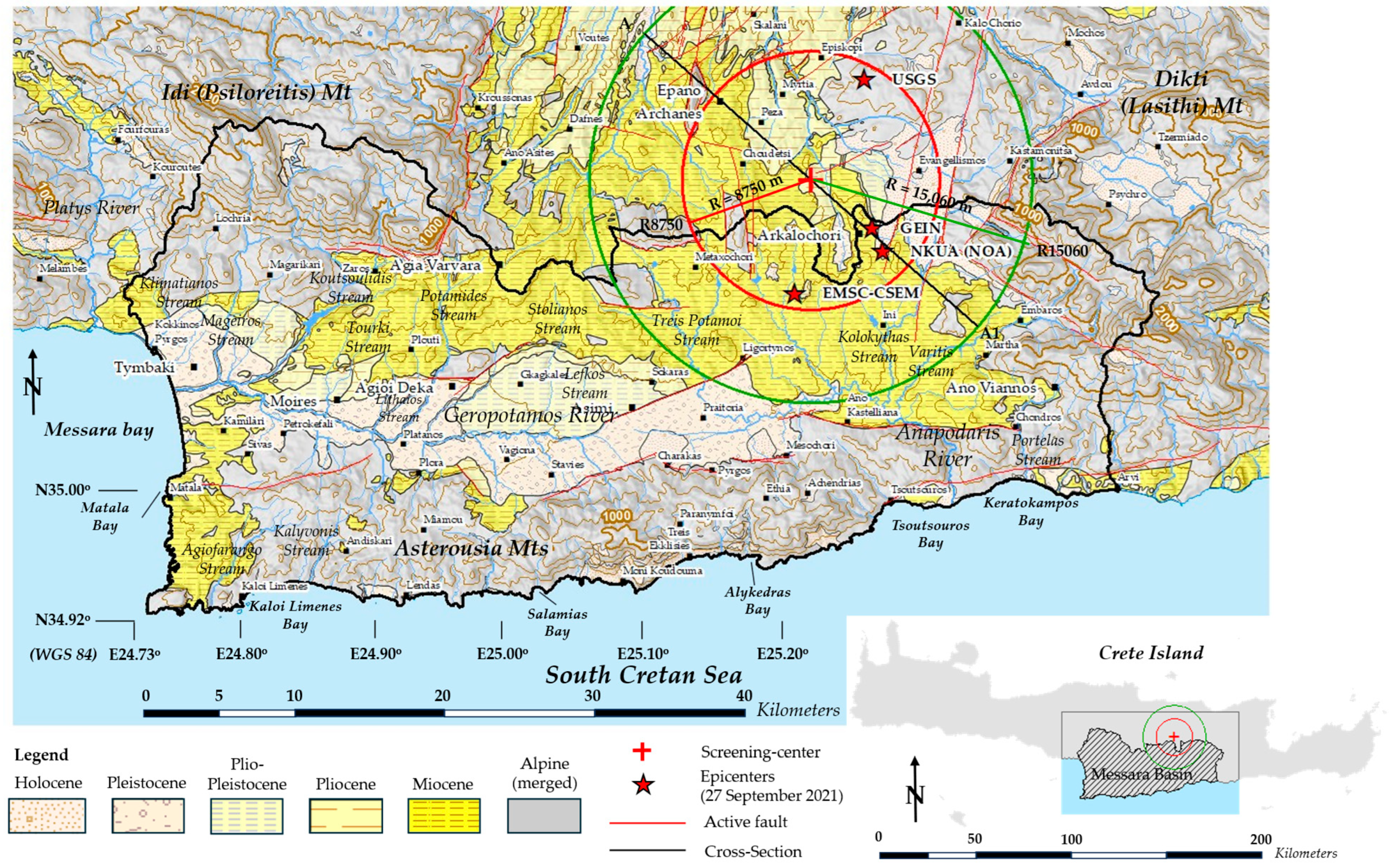
The Messara Basin in central–southern Crete (Figure 1) represents a characteristic example of this coupled setting. As the largest agricultural basin on the island, it has experienced decades of intensive groundwater abstraction accompanied by documented water-level declines and concern for compaction-related subsidence [8]. Satellite geodetic observations indicate persistent vertical deformation patterns consistent with ongoing compaction of Neogene and Quaternary deposits under chronic groundwater stress [8]. Superimposed on this longer-term behavior, the Mw 6.0 Arkalochori earthquake of 27 September 2021 occurred immediately northeast of the basin, motivating a practical question: to what extent did earthquake-related vertical offsets propagate into the Messara Basin, and how can any event-timed signal be distinguished from the background deformation field at basin scale? [9,10,11,12]. InSAR and GNSS analyses of the event reveal coalescent fault segments with ~20 cm subsidence and a NW-dipping normal fault model [11,13], highlighting unexpected rupture on buried structures [13].
The Copernicus European Ground Motion Service (EGMS) enables basin-scale assessment of this question using dense, quality-controlled vertical time series at ~100 m sampling [2,27,28,29,30,31]. EGMS Level-3 Ortho “Vertical” products provide calibrated displacement time series intended for geohazard applications [27,28,29,30,31]. Recent applications include statistical and independent component analysis of Sentinel-1 time series for subsidence trends [32] and ground deformation mapping using EGMS basic products [27]. However, interpretation of earthquake-related signals from basin-scale InSAR products requires explicit attention to processing-generation sensitivity and internal referencing. When expected offsets are modest relative to background variability, cross-generation differences can influence inferred offset prevalence and spatial footprint, particularly near screening thresholds [28,29,30,31]. Consequently, defensible basin-scale coseismic-step screening benefits from controlled comparison across EGMS product generations under an identical event-centered definition and a fixed set of spatial masks [28,29,30,31].
Accordingly, two temporally overlapping EGMS Level-3 Ortho “Vertical” product generations—EGMS 2015–2021 and EGMS 2018–2022—are evaluated to characterize Arkalochori-related, event-timed vertical offsets within the Messara Basin mask (MESSARA) and within two fixed distance masks (R8750 and R15060) defined around a screening center (Figure 1). The screening center is used to ensure robustness to catalog-level epicentral variability across published solutions, while retaining a consistent near-source spatial context for comparative screening. A simple, reproducible earthquake-centered step metric is derived from a common pre-/post-event acquisition window shared by both EGMS products; the formal definition, thresholds, and cross-generation comparability diagnostics are provided in the Methods (Section 3). Interpretation is anchored on distributional behavior and internal consistency diagnostics—maps, class-wise displacement envelopes, cross-mask summaries, and cross-generation comparisons. Interpretation uses distributional behavior and internal QC diagnostics [28,29,30,31].
The contribution of this work is threefold. First, a basin-scale characterization of Arkalochori-related vertical offsets is provided for the Messara Basin, interpreted against the near-source screening footprint [8,10,11,12]. Second, a transparent screening workflow is demonstrated that evaluates two EGMS processing generations under an identical event-centered framework and quantifies where cross-generation sensitivity is negligible versus where it may affect threshold-adjacent classification, without asserting product superiority in the absence of independent ground truth [28,29,30,31]. Third, class- and bin-based distributional diagnostics are linked to spatial mapping within a common near-source–basin context, providing a defensible basis for subsequent, targeted interpretation of where event-related vertical offsets concentrate within the geological setting of the Messara Basin [8,9,10,11,12].

2. Study Area and Reference Event

2.1. Study Area: Messara Basin and Near-Source–Basin Spatial Framework (Crete, Greece)

Published epicentral coordinates for the 27 September 2021 Arkalochori mainshock vary among agencies (USGS, GEIN/NOA, NKUA/UOA, EMSC-CSEM; see Table S2) [23,24,25,26]. This catalog-level variability motivates a fixed, center-referenced geometry for spatial screening. Accordingly, a screening center was defined at 35.182° N, 25.229° E. The screening center was selected such that all published epicenter solutions fall within the inner distance mask (R8750; r = 8750 m), ensuring that spatial screening is robust to agency-to-agency epicentral differences under a single, fixed mask definition.
To characterize the near-source footprint in a controlled, screening center-referenced setting—and to interpret how that footprint intersects the northeastern margin of the Messara Basin—two fixed screening center distance masks are used consistently throughout the analysis (Figure 1): R15060 (r = 15,060 m) defines the operational outer screening domain adopted from the mapped reach of non-background step magnitudes under the event-window definition (Methods, Section 3), whereas R8750 (r = 8750 m) delineates the inner core where the strongest step responses are concentrated (Section 3).
These masks serve complementary purposes. The MESSARA Basin mask supports basin-scale screening and interpretation, whereas R8750 and R15060 provide consistent reference domains for diagnosing spatial focusing, distributional tail behavior, and the basin’s partial overlap with the near-source footprint. In this framework, R8750 captures the concentrated core of the event-timed response, whereas R15060 characterizes its broader mapped near-source extent.

2.2. Reference Event: The 27 September 2021 Arkalochori Earthquake (Mw 6.0)

On 27 September 2021 (06:17 UTC), the Arkalochori earthquake (central Crete) occurred with reported moment magnitude spanning Mw 5.7–6.0 across agencies; the event is labeled Mw 6.0 in this study for consistency, while catalog-level variability in location and magnitude is documented in Table S2 [23,24,25,26]. The focal mechanism is consistently described as predominantly normal faulting, indicating extension within the central Cretan crustal domain, and strong ground motion was recorded in the near-source area, consistent with a shallow source [9,12]. Although Mw 5.9 is also commonly reported for the same earthquake in the literature, adoption of Mw 6.0 as a uniform label does not affect the event-centered acquisition window or the screening center geometry used for spatial screening [9,12].
The mainshock was preceded by a months-long escalation of foreshock activity (from at least June 2021) and was followed by an intense aftershock sequence; the largest aftershock (Mw ~5.3) occurred on 28 September 2021 with a similar mechanism [9,33]. Independent Sentinel-1 geodetic analyses document a compact coseismic deformation field centered on the causative structure, with near-field displacements at the centimeter-to-decimeter scale [10,11,12]. Joint inversions integrating InSAR and GNSS constrain rupture on a NW-dipping normal fault with slip concentrated in the upper crust, consistent with shallow faulting [10,11,12]. Geodetic inversions indicate a compact deformation field with centimeter-scale subsidence, modeled as coalescent normal fault segments [11] and highlight unexpected activation of buried fault portions [13]. Field reports emphasize the absence of a clear, continuous primary surface-fault rupture, despite widespread coseismic ground cracking and localized surface ruptures in surficial deposits [12,34].
The Arkalochori mainshock is used as the reference date for defining a consistent pre-/post-event window for EGMS time-series step estimation (Section 3) [28,29,30,31].

2.3. Datasets and Spatial Subsetting (Summary; Details in Section 3)

Two EGMS Level-3 Ortho Vertical (Up) product generations are used: EGMS 2015–2021 and EGMS 2018–2022 [28,29]. The EGMS products provide vertical displacement time series at measurement locations (Persistent Scatterers; PSs). Data were extracted from the Level-3 Ortho (100 km) Up-component tiles E56N14 and E57N14 covering the study area. Spatial subsetting applies to the fixed masks defined in Section 2.1, and all processing definitions and quality-control procedures are provided in Section 3 and the Supplementary Materials. Because the EGMS Level-3 Ortho “Vertical” product is a derived component rather than a direct measurement of the full displacement vector, the present analysis is restricted to screening earthquake-timed responses in the derived vertical signal and does not attempt to reconstruct the full coseismic displacement field. Because the study focuses on land subsidence and earthquake-timed vertical offsets in a groundwater-stressed basin, the EGMS Up component is used here as the primary screening variable; no complementary horizontal-component analysis is undertaken, and inference is therefore restricted to event-timed behavior expressed in the derived vertical signal.

3. EGMS-Based Workflow for Coseismic Step Analysis

3.1. Overview and Spatial Analysis Domains

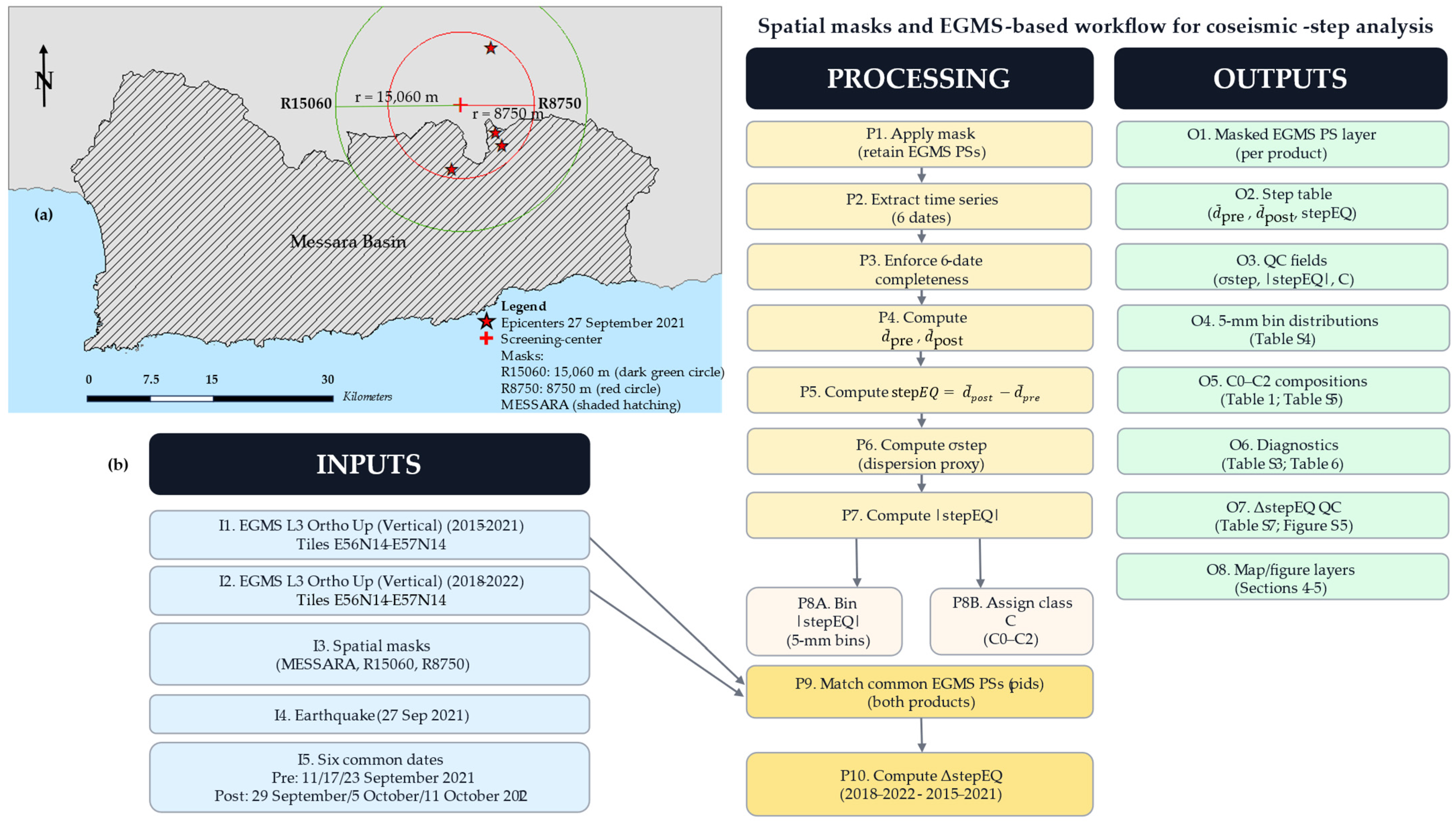
This section defines the workflow used to derive, classify, and quality-check event-timed, step-like vertical offsets from Copernicus EGMS Level-3 Ortho “Vertical” displacement time series, with application to the Messara Basin and the screening center-referenced screening domains (Figure 2). The workflow is applied consistently to two EGMS processing generations (EGMS 2015–2021 and EGMS 2018–2022) under the same fixed set of spatial masks (MESSARA, R15060, R8750; Section 2.1) in order to separate basin-scale interpretation from near-source footprint characterization.
The present section provides the formal definitions, processing sequence, and quality-control logic required for reproducibility. A fully parameterized, step-by-step implementation (including intermediate layers and outputs) is provided in Supplementary Section S3 and is summarized schematically in Figure 2. The sensitivity of the adopted fixed 3 + 3 event-window estimator to omission of individual acquisitions is evaluated separately in Supplementary Section S5 (Tables S11 and S12).

3.2. EGMS Datasets and Spatial Subsetting

Two Copernicus EGMS Level-3 Ortho “Vertical” (L3/100 km) displacement time-series product generations are analyzed: the EGMS “2015–2021” release and EGMS 2018–2022. The products provide calibrated vertical time series sampled on a 100 × 100 m grid and include standard EGMS quality information. Data were extracted from the Level-3 Ortho (100 km) Up-component archives for tiles E56N14 and E57N14 [28,29]. For the study tiles, the earlier release provides time-series coverage from 5 January 2016 to 22 December 2021, and the later release from 6 January 2018 to 23 December 2022, yielding an overlap period from 6 January 2018 to 22 December 2021.
The EGMS Level-3 Ortho “Vertical” product used here is a derived component obtained from the decomposition of ascending and descending InSAR line-of-sight geometries, rather than a direct measurement of the full 3D displacement vector. Consequently, its interpretation requires caution, particularly where horizontal motion and/or strong near-source deformation gradients may influence the decomposed vertical response. Accordingly, the present workflow is designed as a screening analysis of earthquake-timed responses in the derived vertical signal, not as a full vector reconstruction of coseismic deformation.
Because the present study is framed around land subsidence and earthquake-timed vertical offsets, the EGMS Level-3 Ortho “Vertical” product is used as the principal screening dataset. No parallel analysis of the horizontal component is performed here; accordingly, the workflow does not attempt to reconstruct the full coseismic displacement field and is restricted to screening event-timed behavior in the derived vertical signal.
Spatial subsetting retains EGMS PS locations falling within the three fixed masks defined in Section 2.1: the MESSARA basin boundary and the radii masks R15060 and R8750. Aside from spatial masking and exclusion of EGMS PSs lacking valid values for the acquisition dates required by the event-centered step calculation (Section 3.3), no additional user-defined filtering is applied at this stage. Consequently, differences observed between product generations reflect EGMS processing-generation effects under identical masks and an identical event-window definition.

3.3. Time-Series Extraction and Definition of the Coseismic Step Metric

For each retained EGMS Level-3 PS, the full vertical time series (mm) was extracted and analyzed using the EGMS vertical sign convention throughout (negative indicates subsidence; positive values indicate uplift). Although the two EGMS products have different temporal extents, they share a dense set of common acquisition dates over their overlap period (6 January 2018–22 December 2021). To ensure strict cross-generation comparability, the event-centered step metric stepEQ was defined using six Sentinel-1 acquisition dates common to both processing generations and bracketing the 27 September 2021 Arkalochori earthquake:
  • ▪ Pre-event dates: 11, 17, 23 September 2021
  • ▪ Post-event dates: 29 September, 5, 11 October 2021
For each EGMS PS, the coseismic response is quantified as the difference between the mean post-event and pre-event displacements,
s t e p E Q = d ¯ p o s t d ¯ p r e
where  d ˉ post  and  d ˉ pre  are the mean vertical displacement over the three pre- and three post-event dates, respectively:
d pre = d 11 S e p + d 17 S e p + d 23 S e p 3 ,     d post = d 29 S e p + d 5 O c t + d 11 O c t 3
This three-date averaging reduces sensitivity to single-date variability while retaining the step-like offset expected for an earthquake-timed signal. Under the adopted sign convention, negative stepEQ indicates subsidence-direction offsets and positive stepEQ indicates uplift-direction offsets. The fixed 3 + 3 event-window definition represents a reproducible compromise rather than a formally optimized estimator. It was selected to ensure strict use of acquisition dates common to both EGMS processing generations, to bracket the earthquake symmetrically, to reduce sensitivity to any single acquisition, and to keep the event window short enough to limit contamination from longer-term background deformation and seasonal variability. Its sensitivity to omission of individual acquisitions was evaluated through a supplementary 2 + 2 subset analysis using the same six-date common event window (Supplementary Section S5; Tables S11 and S12).
A dispersion-based precision proxy, σstep, was estimated as σstep ≈ √(σpre2/3 + σpost2/3), where σpre and σpost are the standard deviations of the three pre-event and three post-event displacements, respectively, assuming independent acquisition-date errors; the full formulation, diagnostic checks, and complementary subset-sensitivity results are reported in the Supplementary Materials (Sections S2 and S5; Tables S6 and S12).

3.4. Step Binning and Operational Step-Magnitude Classes

Step magnitudes are summarized using two complementary schemes. The first (5 mm bins) is retained for distributional diagnostics and transparency (Supplementary Table S4), whereas the second (C0–C2 classes) provides the primary screening framework used throughout the Results (Section 4 and Section 5), including cross-mask synthesis (Table 1) and sign decomposition (Supplementary Table S5).
(i)
The 5 mm absolute-magnitude bins.
For distributional diagnostics and envelope construction, points are grouped by |stepEQ| into 5 mm bins spanning 0–5 mm, 5–10 mm, …, 35–40 mm, and >40 mm. Bin counts and percentages for all dataset–mask combinations are reported in Supplementary Table S4. In line with the emphasis of Section 5, these bin summaries are treated as supporting evidence for how class-level outcomes arise, rather than as the primary screening product.
(ii)
Operational step-magnitude classes (C0–C2).
For compact mapping and screening-level interpretation, each point is assigned to one of three classes using a step-magnitude index C defined from |stepEQ| (Supplementary Section S1; Equation (S1)):
C = 0 (Background): |stepEQ| ≤ 20 mm
C = 1 (Moderate): 20 < |stepEQ| ≤ 40 mm
C = 2 (Strong): |stepEQ| > 40 mm
This class scheme is used consistently in Section 4 (near-source footprint mapping and class-wise envelopes) and Section 5 (Messara Basin results and cross-mask synthesis). Supplementary Table S3 reports descriptive statistics for stepEQ and |stepEQ| (including skewness and excess kurtosis) across masks and product generations, Supplementary Table S5 reports sign decomposition by class, and Supplementary Table S6 summarizes σstep relative to the adopted 20–40 mm thresholds. The 20 mm and 40 mm cutoffs are adopted as empirical, conservative screening thresholds rather than as optimal geodetic breakpoints: the lower boundary flags the transition from background to moderate event-timed responses, whereas exceedance of 40 mm is used to isolate stronger, step-dominated responses that are then interpreted jointly with σstep, ΔstepEQ, time-series behavior, and spatial coherence.
Cross-generation comparability check (ΔstepEQ). Sensitivity to EGMS processing generation under an identical step definition and identical masks is evaluated using the inter-product difference computed at locations common to both products (N_common; Supplementary Section S4: Table S7; Figure S5):
ΔstepEQ = stepEQ(2018–2022) − stepEQ(2015–2021)
Cross-generation comparability summaries are reported in Supplementary Section S4 (Table S7; Figure S5). This diagnostic is used to identify where processing-generation sensitivity may influence threshold-adjacent class membership (particularly near the 20–40 mm boundaries), while tight clustering of ΔstepEQ near zero supports interpretation of background behavior under the event-centered definition.
Together, the 5 mm bin summaries (Table S4), the operational C0–C2 classes (Section 3.4; Table S5), and ΔstepEQ (Section S4) provide a tiered screening and quality-control framework for interpreting event-timed step-like offsets under fixed spatial masks and across EGMS product generations.
Scope of the screening framework. The C0–C2 thresholds are adopted as a conservative screening scheme rather than as “optimal” geodetic breakpoints. ΔstepEQ is treated as a QC lens that flags locations where processing-generation sensitivity may influence threshold-adjacent magnitudes, whereas basin-scale stability of ΔstepEQ near zero supports interpretation of background behavior under the event-centered definition. Consequently, values near the 20 mm boundary are treated as QC-sensitive unless supported by additional evidence (e.g., sign coherence and spatial clustering), while exceedance of 40 mm is used to isolate step-dominated responses expected to be spatially focused and strongly sign-asymmetric in the later EGMS generation. Overall, this screening builds on EGMS time-series applications for resolving coseismic and aseismic normal fault slip [35] and statistical signal decomposition techniques for InSAR subsidence trends [27,32], ensuring robust handling of processing-generation sensitivities in tectonically active basins.

3.5. Percentile-Envelope Construction

To characterize time-series behavior at the population level, EGMS vertical-displacement time series are summarized within each 5 mm |stepEQ| bin and operational class (C0–C2) using percentile envelopes. For each acquisition date in the EGMS record, the 5th, 50th (median), and 95th percentiles (P05, P50, P95) are computed across all retained EGMS PSs in the bin/class, yielding envelope curves that describe central tendency and dispersion through time. Envelope construction uses the full time-series extent available for each EGMS product within a given mask, while group membership (bin/class) is determined from stepEQ computed on the fixed six-date event window (Section 3.3).
These envelopes form the basis of the bin-wise comparisons (Section 4.2; Figure 3) and the class-wise summaries (Section 4.3; Figure 4) and are also used for basin-focused diagnostics in Section 5.1. For bins/classes with very small sample sizes, tail percentiles are not robust; in such cases, only the median curve is reported, as indicated in the relevant figure captions.

3.6. Cross-Product Comparability and Acquisition-Date Referencing

EGMS Level-3 displacements are cumulative and internally referenced within each processing generation; consequently, absolute displacement levels are not directly comparable between products even over the same calendar interval. Cross-generation interpretation is therefore anchored on the timing and relative magnitude of the event-centered step across the fixed six-date window (Section 3.3), rather than on absolute baseline differences. Because stepEQ is computed from the same three pre-event and three post-event acquisition dates in both products, the longer post-2021 temporal extent of EGMS 2018–2022 does not enter the stepEQ calculation itself and cannot, by itself, explain the cross-generation contrast in step responses.
To support PS-scale cross-product inspection explicitly aligned with the stepEQ definition, selected time series are additionally expressed as pre-event-referenced anomalies by subtracting, for each product separately, the mean displacement over the three pre-event acquisition dates (11, 17, 23 September 2021). This normalization removes product-specific baseline offsets and emphasizes the event-date offset and its persistence. Paired point-scale series and the corresponding anomaly plots are provided in the Supplementary Materials (Figures S1 and S2). Remaining differences between products are therefore interpreted cautiously as reflecting generation-dependent processing effects, including possible differences in referencing, filtering, point density, and step preservation, especially within the near-source masks. The longer EGMS 2018–2022 record may aid contextual inspection of post-event persistence in full-series envelopes, but it does not affect the fixed six-date stepEQ definition itself; accordingly, the observed contrast is interpreted primarily as a product-generation effect under an identical event-centered metric.

4. Overview of Coseismic Step Patterns

4.1. Spatial Distribution of |stepEQ| in 5 mm Bins (Cross-Product Overview)

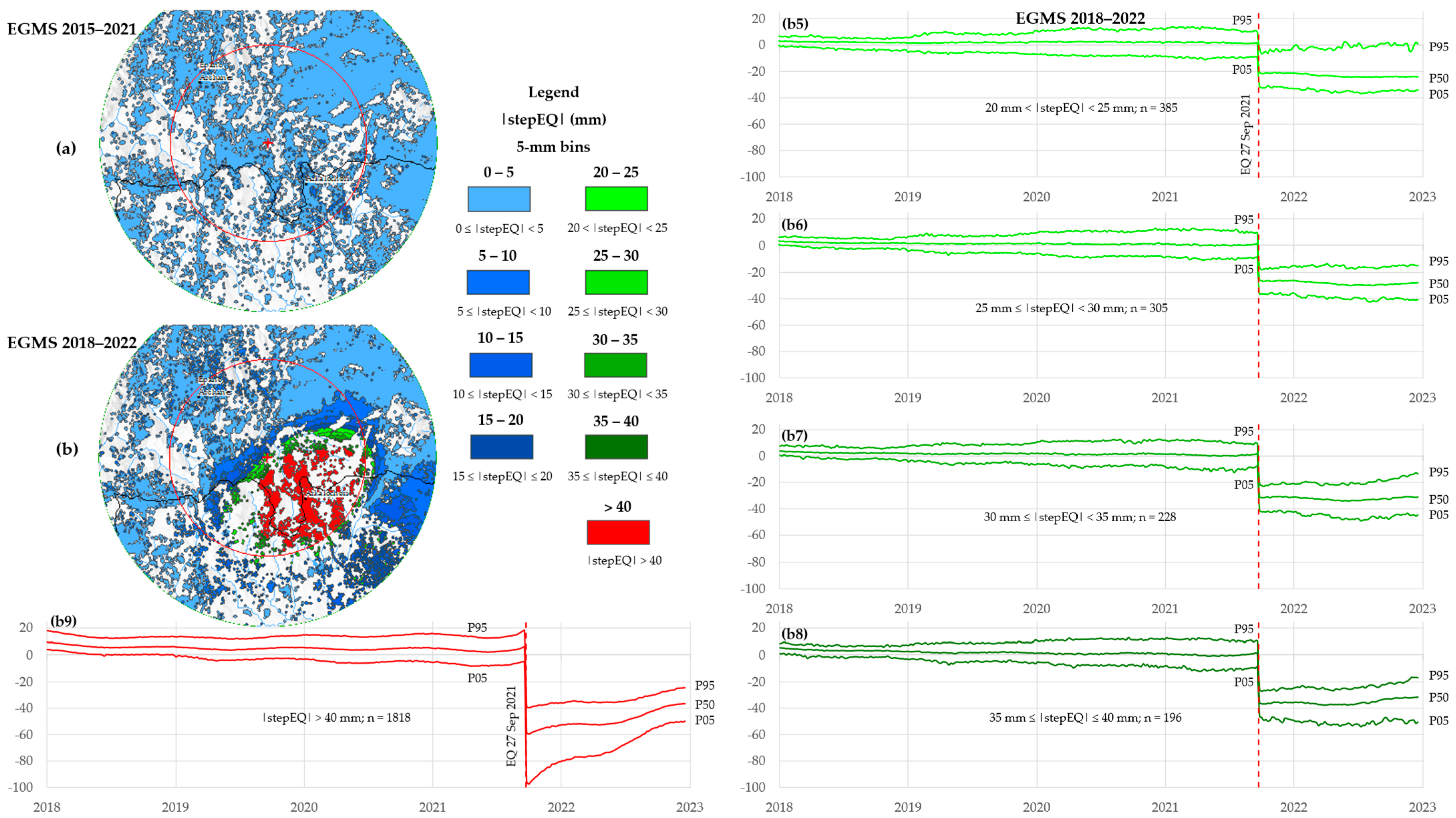
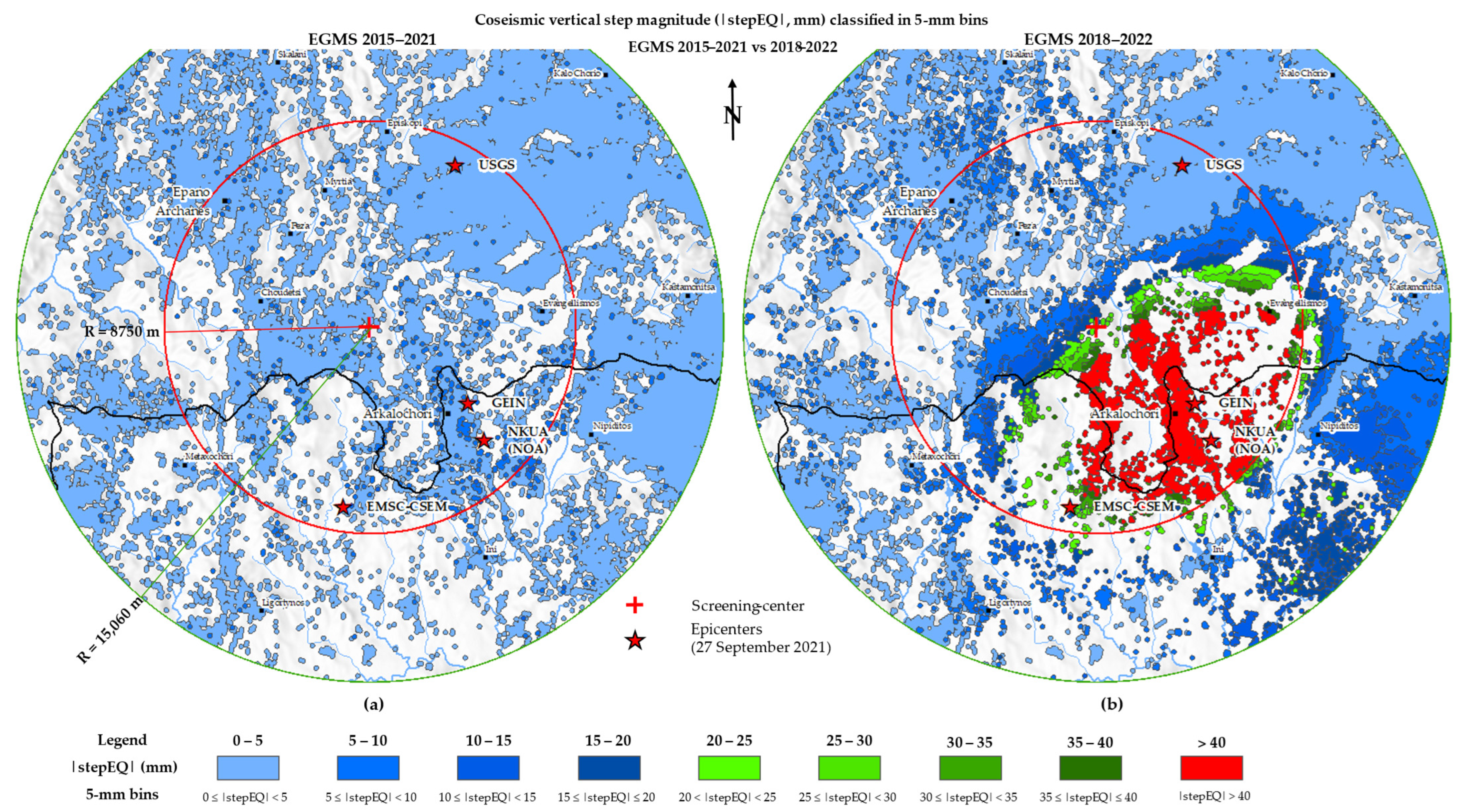
An overview of step magnitudes is presented in Figure 3, which compares the two EGMS Level-3 “Vertical” product generations within the screening center domain. The 2018–2022 dataset exhibits a coherent population of non-background responses (|stepEQ| > 20 mm) extending to 15.06 km from the screening center, whereas the EGMS “2015–2021” release remains confined to background magnitudes (|stepEQ| ≤ 20 mm) in the same window.
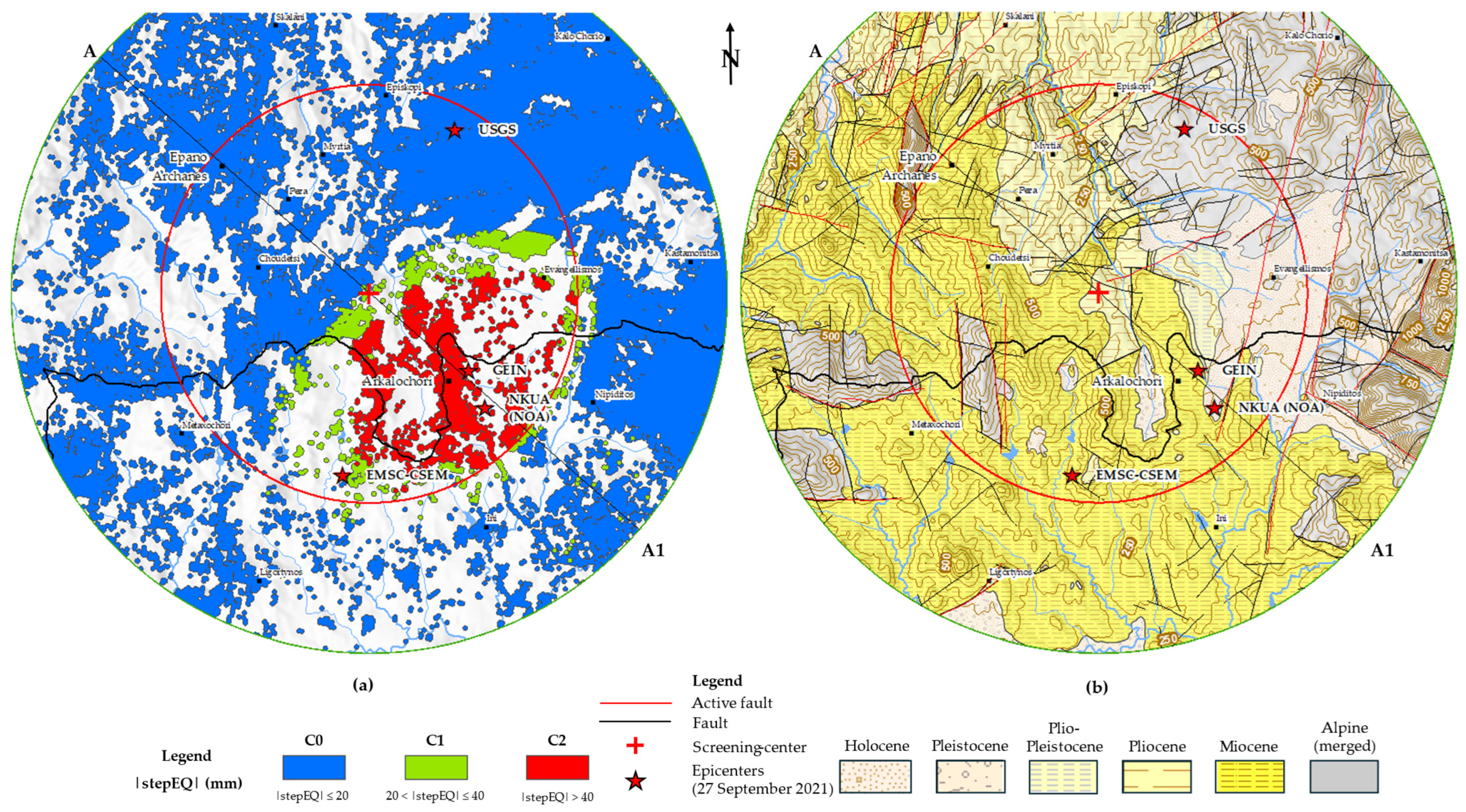
Spatially, the highest |stepEQ| values form a compact, elliptical cluster located mainly to the southeast of the screening center. The cluster has an approximate NE–SW major axis of ~15 km and a minor axis of ~9.5 km extending from near the epicentral area toward the southeast. Step magnitudes decay rapidly toward the west, north, and northeast, while the southeast–south sector shows a broader reach, indicating an asymmetric coseismic imprint superimposed on background variability. This map-based pattern is evaluated further using distributional time-series diagnostics (Section 4.2 and Section 4.3) and pre-event-referenced anomaly views at selected locations (Figure S2).

4.2. Time-Series Behavior by Step-Magnitude Bins (Distributional Evidence)

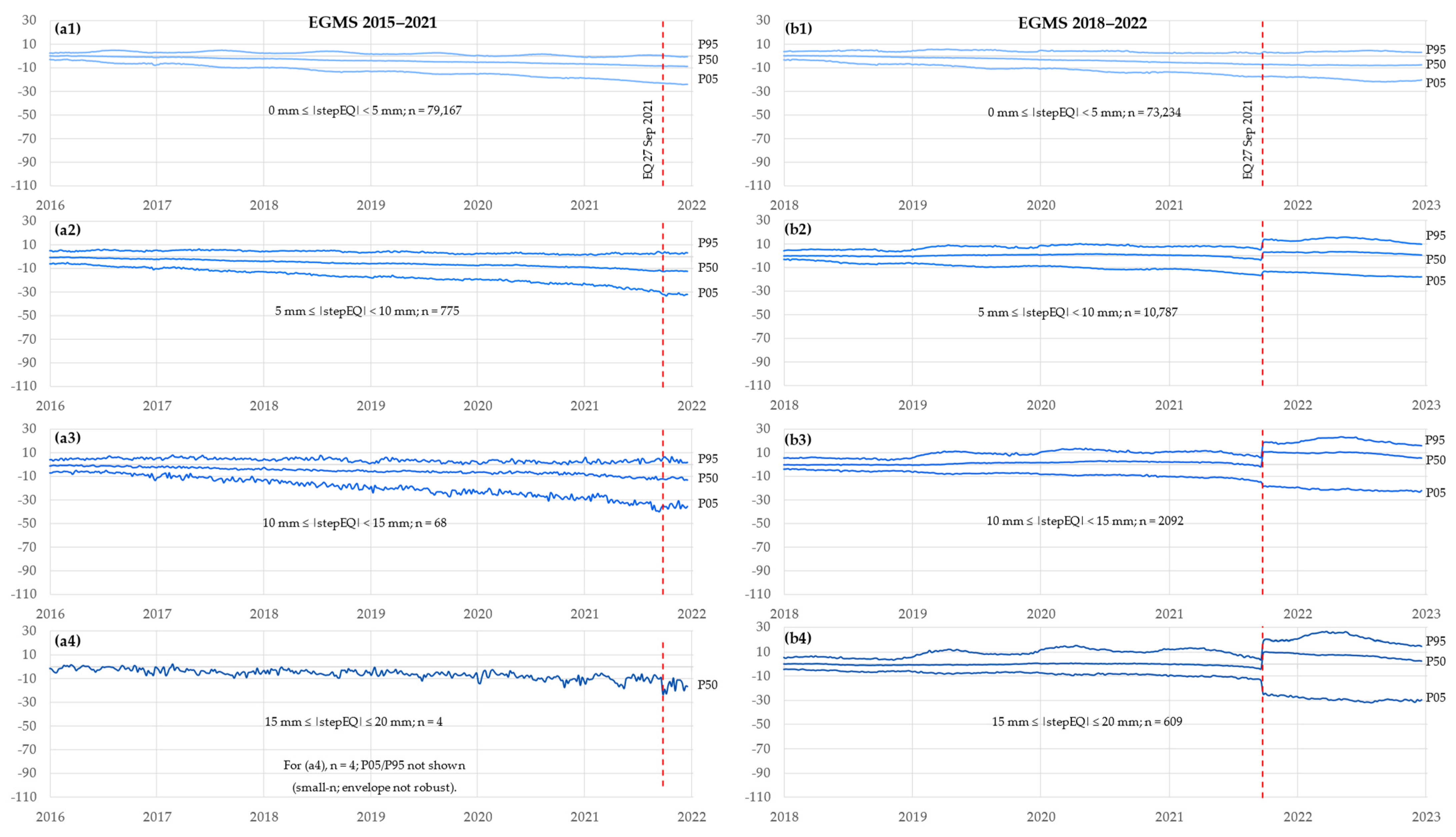
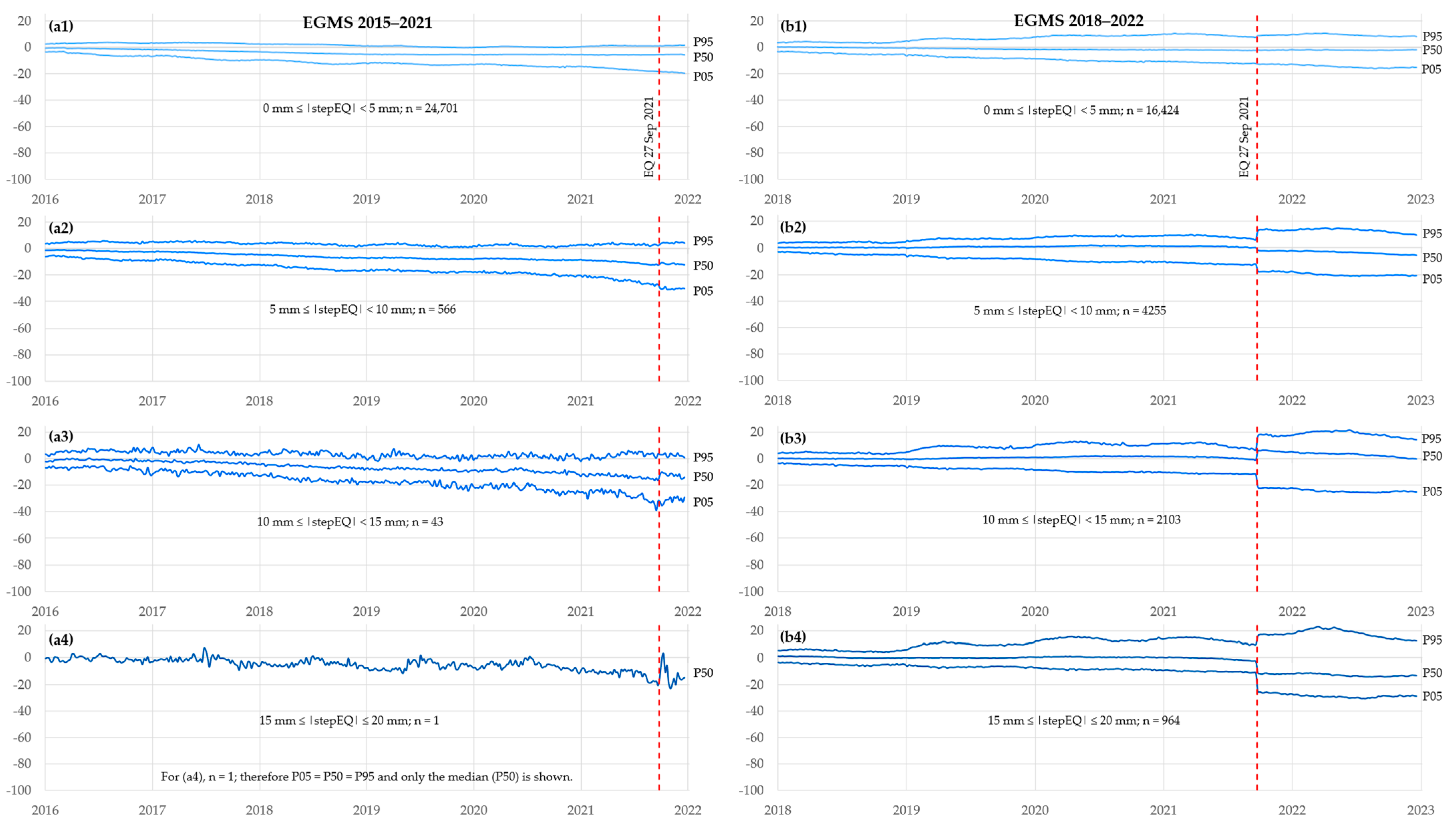
Time-series behavior is assessed using percentile envelopes (P05–P50–P95) computed across all EGMS PSs within each 5 mm |stepEQ| bin (Figure 4). This population-level aggregation reduces sensitivity to PS-scale noise and local outliers while retaining the step-like signature expected at the 27 September 2021 event date. The envelopes summarize both central tendency (median) and dispersion through time, enabling assessment of whether the event-timed offset is coherent across the bin population or driven by a limited subset of points.
In the 2018–2022 dataset, progressively higher |stepEQ| bins exhibit increasingly distinct downward offsets at the earthquake date, followed by persistence at lower displacement levels, consistent with a coherent coseismic imprint superimposed on longer-term deformation. Cross-product comparison is informative but must account for differences in internal referencing between EGMS processing generations; interpretation is therefore anchored on the timing and relative magnitude of the step-like offset rather than on absolute displacement levels. Point-scale comparisons supporting event-centered interpretation are provided in the Supplementary Materials (Figures S1 and S2), where the same locations are additionally shown as pre-event-referenced anomalies aligned with the stepEQ definition.

4.3. Operational Classes and Class-Wise Time-Series Envelopes (EGMS 2018–2022)

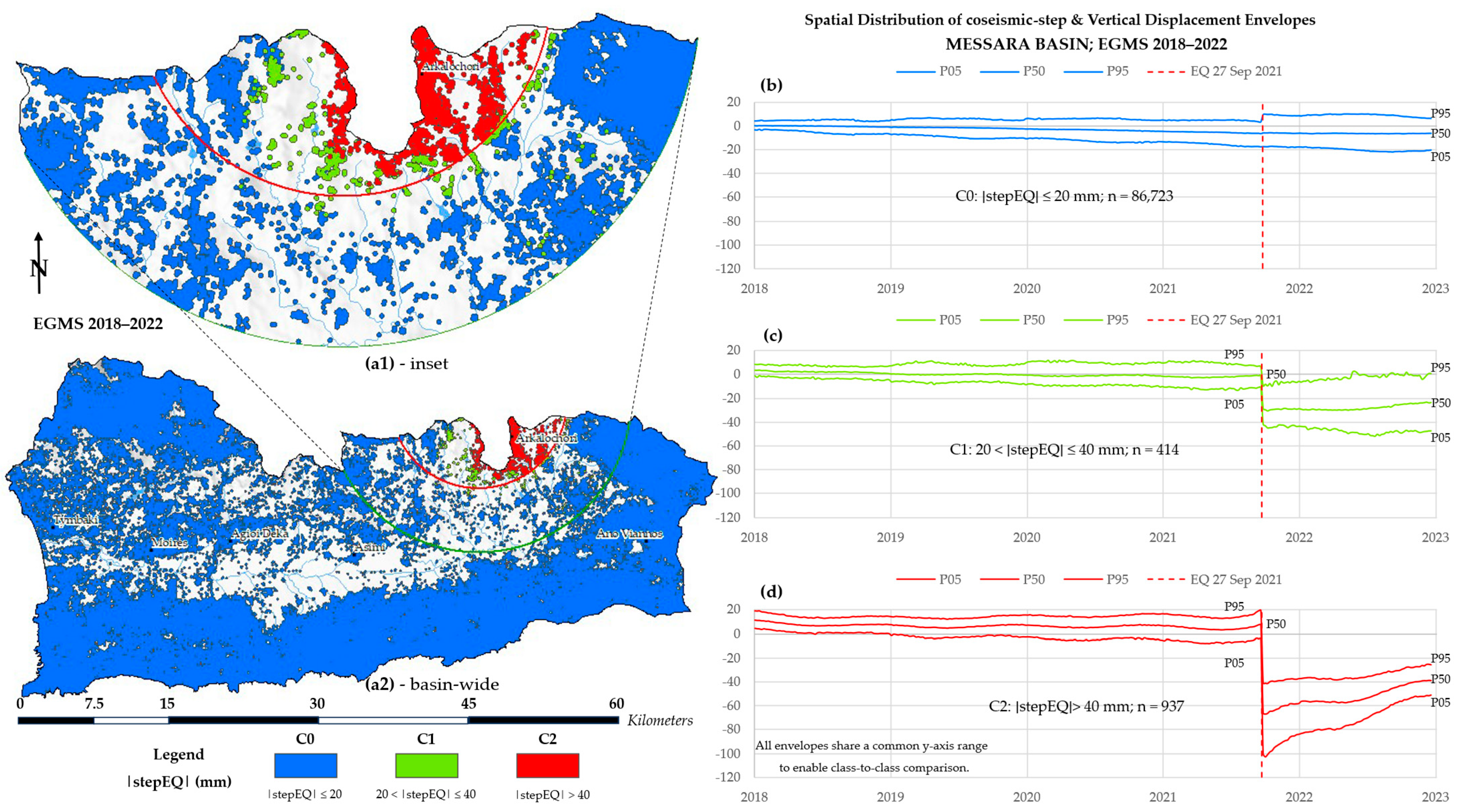
To complement the 5 mm bin analysis and to facilitate an operational interpretation at basin scale, the coseismic step field was additionally condensed into three step-magnitude classes (C0–C2) designed as conservative, noise-aware screening categories rather than “optimal” geodetic breakpoints. This aggregation provides an immediately interpretable map product that highlights the spatial footprint of the non-background coseismic signal, and it enables robust distributional diagnostics that are less sensitive to point-level variability and to the strongly peaked, near-zero nature of the |stepEQ| distribution. In this framing, C0 represents the dominant background population, whereas C1 and C2 isolate progressively stronger step-like responses suitable for spatial coherence screening and for prioritizing locations for detailed inspection in follow-up analyses.
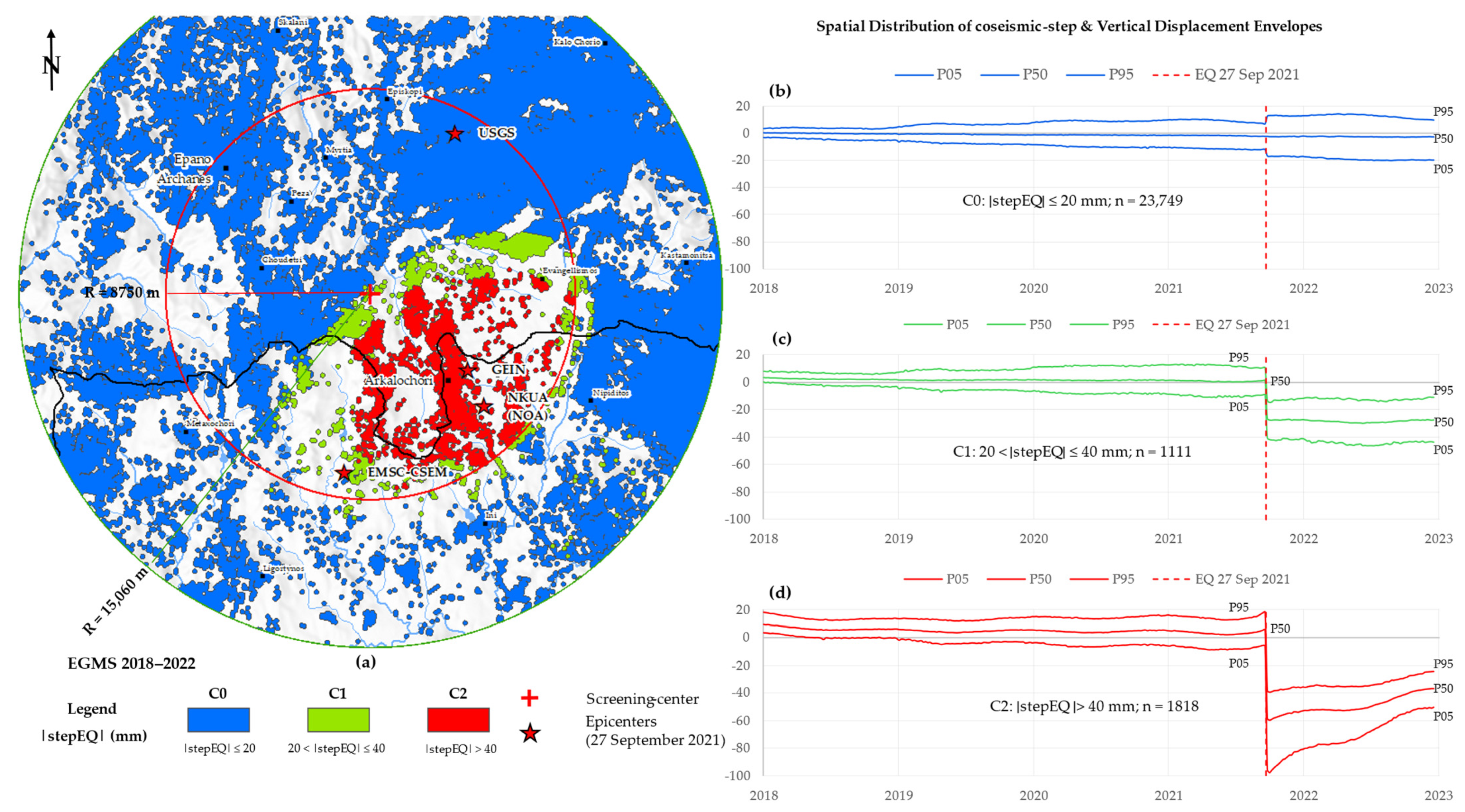
Figure 5 shows that this class scheme preserves the primary pattern observed in the 5 mm bin mapping while reducing visual and statistical complexity. Spatially (Figure 5a), C2 forms a compact core surrounded by a broader C1 halo within the fixed screening center masks (R8750 and R15060; Section 2.1). Temporally (Figure 5b–d), the class-wise envelopes indicate a systematic and persistent offset introduced at the earthquake date, with a clear progression in magnitude from C0 to C2: C0 remains tightly clustered with minimal step-like separation, C1 exhibits a distinct downward shift relative to pre-event levels, and C2 shows the largest and most coherent coseismic drop followed by sustained post-event displacement levels. Overall, the spatial–temporal coherence across classes supports interpretation of the mapped footprint as an event-timed imprint superimposed on longer-term deformation behavior rather than an artifact of isolated outliers.

5. EGMS-Based Estimation of Coseismic Vertical Offsets

5.1. Messara Basin Mask (MESSARA): Spatial and Distributional Results

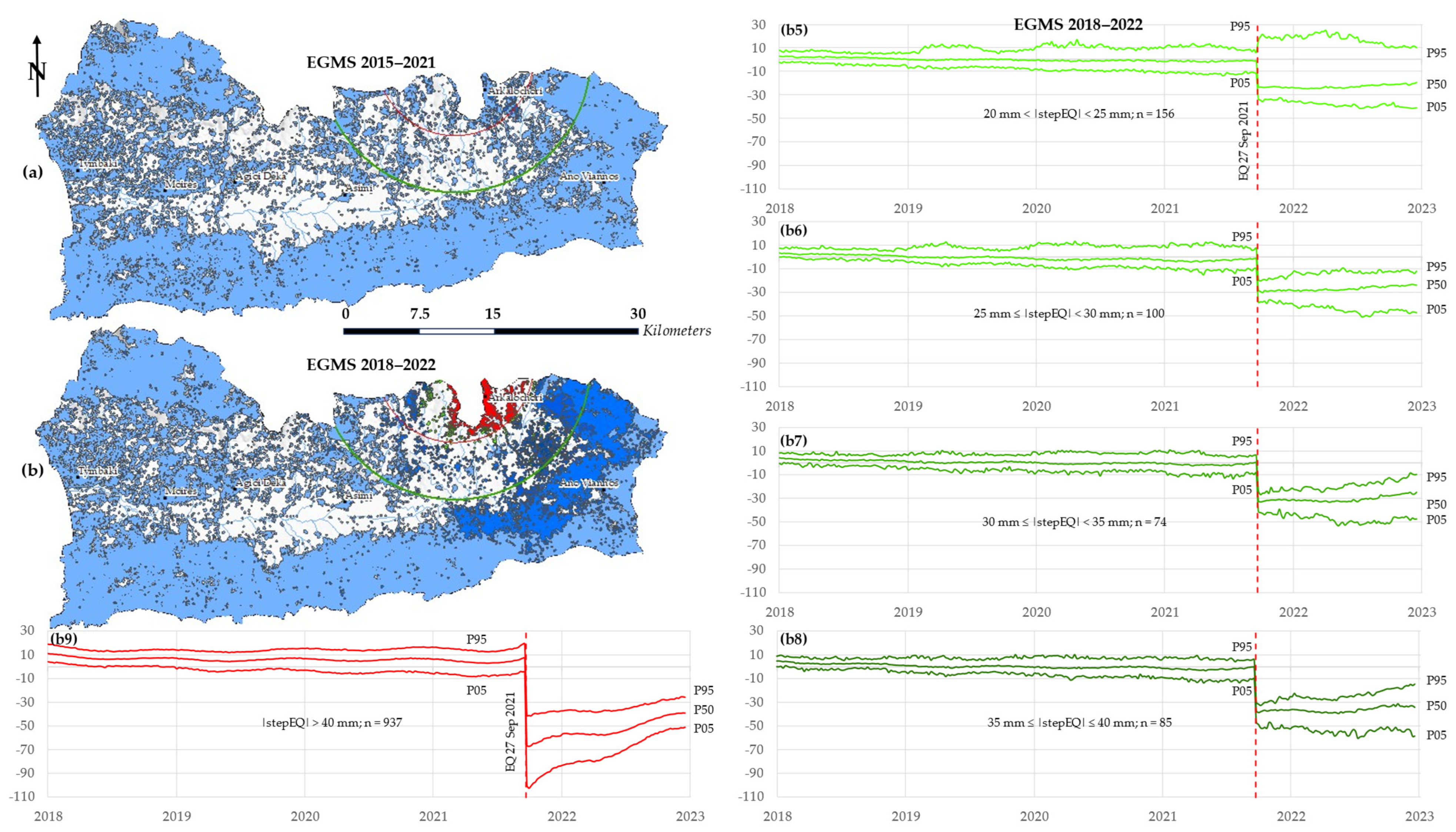
Under the MESSARA mask, the two EGMS processing generations exhibit markedly different |stepEQ| distributions. In EGMS 2015–2021, the distribution is effectively confined to background magnitudes: the 0–5 mm bin contains 98.94% of points (79,167 of 80,014) and no points exceed 20 mm (full bin counts and percentages in Supplementary Table S4). In contrast, EGMS 2018–2022 shows a broader right tail: although the 0–5 mm bin remains dominant (83.15%, 73,234 of 88,074), a non-negligible fraction exceeds the conservative non-background threshold (1.53%, 1351 of 88,074), including 937 points in the > 40 mm bin (Supplementary Table S4).
Spatial patterns and percentile envelopes (Figure 6) are consistent with this distributional contrast. The EGMS 2015–2021 dataset remains tightly clustered across the occupied bins, supporting a background-dominated response within the basin under that processing generation. The EGMS 2018–2022 dataset shows a step-like offset emerging at the event date that strengthens with increasing bin membership, culminating in the highest-magnitude group where the downward offset is largest and most persistent. This motivates explicit mapping of the ≥ 20 mm population and its relationship to the fixed screening center distance masks, and it supports class-based synthesis using the C0–C2 screening scheme (Figure 7) as the primary compact basis for basin-scale interpretation.

5.2. Screening-Centered Radii Masks (R15060 and R8750): Synthesis

Results from the radii masks provide a controlled near-source reference for evaluating spatial focusing of the event-timed step signal and for contextualizing its partial expression within the Messara Basin. Under EGMS 2015–2021, both radii remain background-dominated: all points are assigned to C0 (Table 1), and the 5 mm bin distributions are effectively confined to the lowest-magnitude bins (Supplementary Table S4). Consistently, the corresponding percentile envelopes show no systematic step-like separation at the event date within either radius (Figure 4 and Figure 5).
In contrast, EGMS 2018–2022 exhibits a coherent emergence of non-background responses that strengthen toward the screening center and are consistent across mapping, distributions, and time-series summaries (Figure 3, Figure 4 and Figure 5). Within R15060, the distribution includes a substantive non-background tail and a coherent step-like offset that becomes increasingly distinct with higher |stepEQ| bin membership (Table 1; Supplementary Table S4; Figure 4). This behavior intensifies within R8750, where the class composition shifts toward stronger responses and the |stepEQ| distribution becomes markedly heavy-tailed (Table 1; Supplementary Table S4). Class-wise envelopes consolidate this pattern: C0 remains narrowly clustered, whereas C1—and especially C2—show a clear and persistent downward offset initiated at the event date (Figure 5).
Taken together, the radii-mask synthesis supports three inferences: (i) under EGMS 2018–2022, the event-timed step imprint is spatially concentrated and strongest within R8750, (ii) R15060 captures the broader mapped reach of non-background behavior while retaining sufficient sample size for robust distributional characterization, and (iii) the absence of comparable non-background populations in EGMS 2015–2021 under identical masks and an identical step definition reinforces interpretation based on event timing and distributional structure.

5.3. Cross-Mask, Cross-Generation Summary Tables

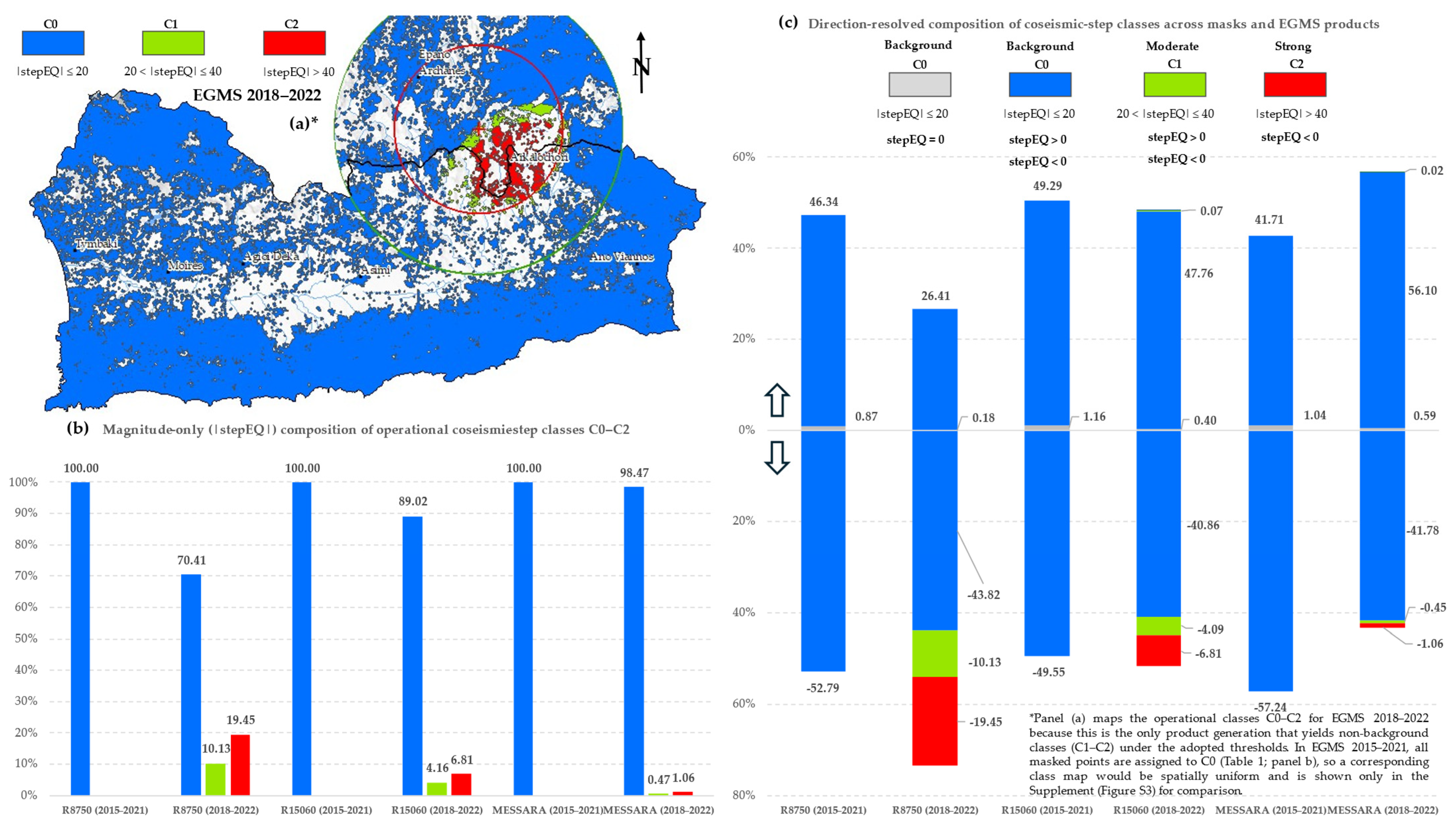
Across all three masks, the EGMS 2015–2021 generation assigns 100% of points to the background class C0 (R8750: 9225/9225; R15060: 25,311/25,311; MESSARA: 80,014/80,014), indicating that no locations exceed the conservative non-background threshold under that processing generation (Table 1). In contrast, EGMS 2018–2022 exhibits a systematic emergence of non-background classes that strengthens toward the screening center. Within R15060, C0 remains dominant (89.03%) while C1 (4.16%) and C2 (6.82%) define a clear non-background population; within R8750, the composition shifts further to C0 = 70.41%, C1 = 10.13%, and C2 = 19.45%, indicating strong near-source concentration of the largest step responses (Table 1). Within MESSARA, non-background classes are present but limited (C1 = 0.47%; C2 = 1.06%), consistent with the basin intersecting only the northern fringe of the near-source footprint (Table 1).
Overall, the cross-mask class proportions provide a compact screening synthesis that is consistent with the bin- and envelope-based diagnostics, supporting interpretation of the mapped footprint as spatially coherent event-timed behavior rather than as a small number of isolated outliers.
Supplementary Table S3 provides descriptive statistics for stepEQ and |stepEQ| across the six dataset–mask combinations, serving as a compact check on central tendency, spread, and tail behavior under the common event-window definition. Consistent with the class proportions in Table 1, EGMS 2015–2021 distributions remain tightly centered near zero across all masks with limited dispersion, indicating background-dominated behavior under that processing generation. In EGMS 2018–2022, dispersion and tail heaviness increase toward the screening center masks, with the strongest variability expressed in R8750 and remaining pronounced in R15060, consistent with a spatially concentrated event-timed imprint. Within MESSARA, the statistics remain background-dominated but broaden relative to EGMS 2015–2021, matching the limited presence of non-background classes at basin scale (Table 1). Overall, the primary cross-generation contrast is expressed as the emergence and spatial concentration of a non-background tail in EGMS 2018–2022 rather than as a uniform shift in the background population.
Supplementary Table S4 reports counts and percentages by 5 mm |stepEQ| bins across masks and product generations, clarifying how the class-level differences arise from the underlying magnitude distributions. Under EGMS 2015–2021, bin occupancy is effectively confined to |stepEQ| < 20 mm in all masks, consistent with exclusive assignment to C0. Under EGMS 2018–2022, the distributions broaden systematically toward the screening center: R15060 exhibits a clear high-magnitude tail, and R8750 shows the strongest enrichment of the highest bins, whereas MESSARA remains dominated by low bins with a small ≥ 20 mm tail. These bin-wise proportions provide the distributional basis for the class proportions in Table 1 and motivate the comparative histogram synthesis in Section 5.4.

5.4. Statistical Characterization of Coseismic-Step Screening and Tail Behavior

Figure 8 and Supplementary Tables S3–S5 provide a compact statistical synthesis of coseismic-step screening outcomes, emphasizing how directionality and tail behavior of stepEQ vary with mask and EGMS processing generation. Under EGMS 2015–2021, screening yields an exclusively background outcome (C0 only) across R8750, R15060, and MESSARA (Table 1), consistent with near-zero, weakly dispersed stepEQ distributions (Supplementary Table S3) and the absence of a high-magnitude tail in the bin summaries (Supplementary Table S4). In the common screening center–basin map window, this background-only behavior is also expressed cartographically by the uniform class field (Supplementary Figure S3b) and the corresponding 5 mm bin map dominated by the lowest bins (Supplementary Figure S4b), providing a stable baseline for interpreting the cross-generation contrast.
In contrast, the EGMS 2018–2022 generation exhibits a clear non-background tail that systematically strengthens toward the screening center and is strongly sign-asymmetric. The combined non-background share (C1 + C2) increases from 1.53% in MESSARA to 10.97% in R15060 and 29.58% in R8750 (Figure 8; Supplementary Table S5), indicating progressive enrichment of moderate-to-strong step responses with proximity to the near-source domain. The emergent tail is directionally coherent: C2 is entirely subsidence-direction (negative stepEQ) across masks, and C1 is likewise dominated by negative steps (Supplementary Table S5). By contrast, within C0, the negative–positive partition remains mixed and mask-dependent, consistent with background variability and internal referencing. Together, these results indicate that once |stepEQ| exceeds the conservative screening threshold, the response becomes strongly sign-consistent and spatially focused within the radii masks.
This interpretation is corroborated by the distributional diagnostics in Supplementary Table S3, which show increased dispersion and heavier tails in EGMS 2018–2022 toward the screening center masks, with the strongest extremes expressed in R8750 and remaining pronounced in R15060. The 5 mm bin summaries (Supplementary Table S4) provide the magnitude-level basis for the class outcomes by documenting systematic broadening and the emergence of a high-magnitude tail in EGMS 2018–2022 that is absent in EGMS 2015–2021; the same contrast is visible in the paired bin maps within the common screening center–basin window (Supplementary Figure S4a,b). Taken together, the statistical synthesis indicates that the principal cross-generation contrast is the appearance—only in EGMS 2018–2022—of a spatially concentrated, predominantly subsidence-direction, heavy-tailed stepEQ distribution whose intensity increases toward the screening center, supporting the operational C0–C2 screening framework used for interpretation.

6. Structural and Geological/Hydrogeological Controls on the Coseismic-Step Footprint

6.1. Fault-Framework Context and Spatial Coherence

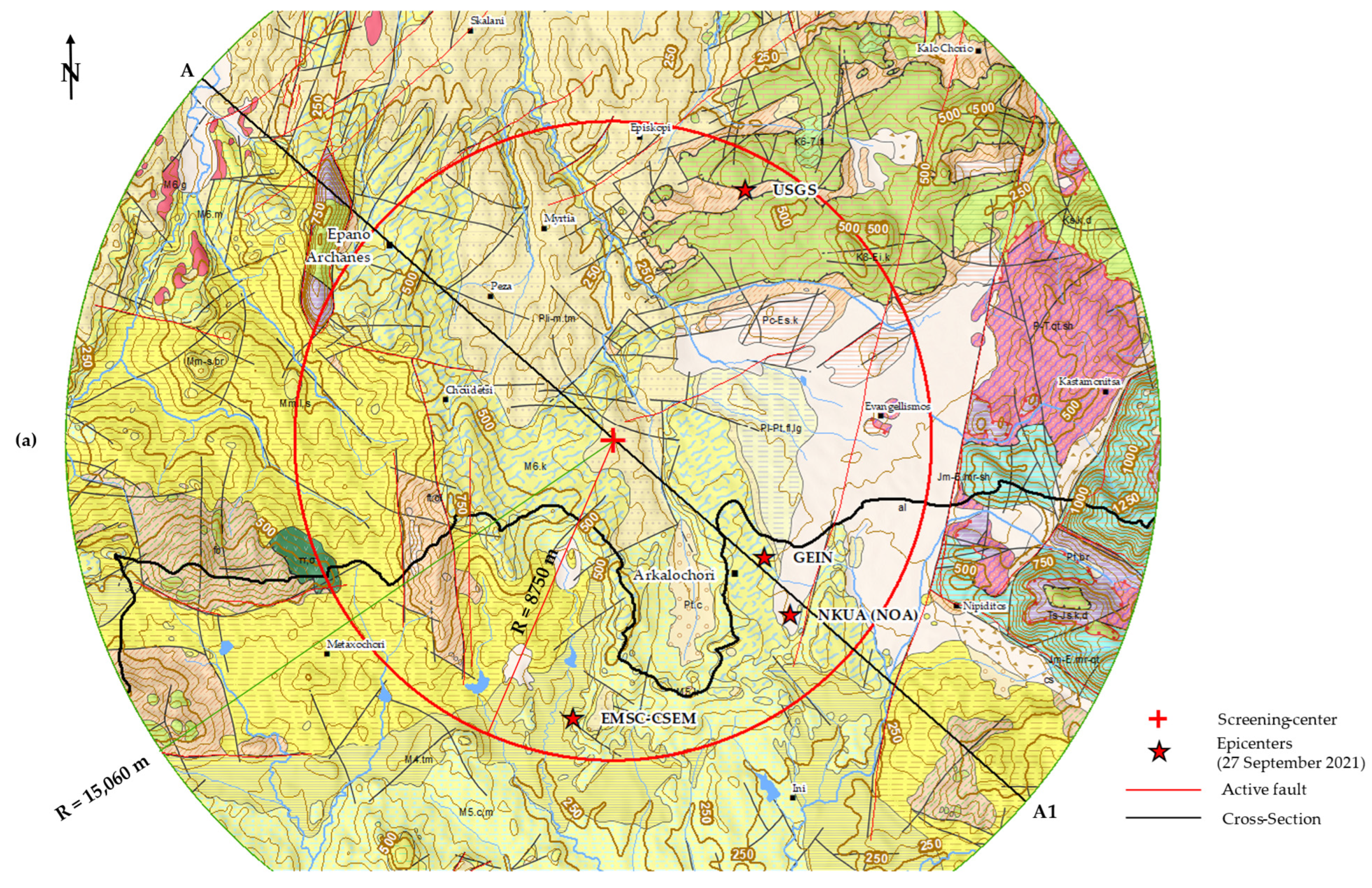
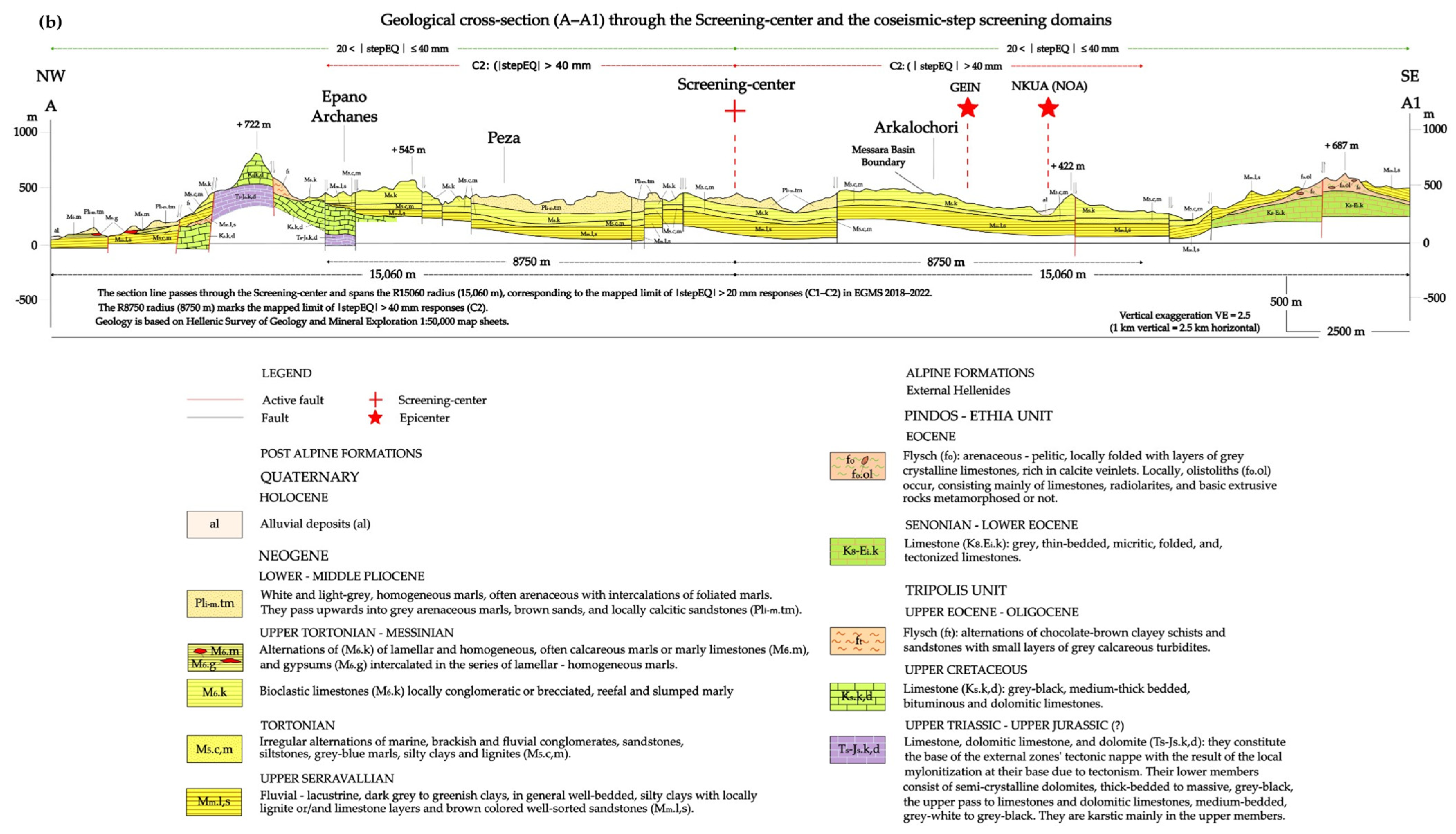
The interior of the near-source screening domains is dominated by post-Alpine sedimentary formations ranging in age from the Middle–Upper Miocene to the Quaternary (Figure 9). Additional details for the southern part of the mapped area (at the margins of the Messara Basin) are available in the Geological Map of the Messara Basin (northeastern sector) [8]. Within the post-Alpine succession, extensional deformation is expressed by normal faults that broadly follow the inherited structural grain of the Alpine substratum. Faulting is developed both within Neogene basin-fill units—locally generating smaller graben structures—and along structural contacts between Neogene deposits and the underlying Alpine units, reflecting an active and spatially heterogeneous extensional regime that shapes the broader basin architecture.
In the study area, the Neogene basin fill comprises a heterogeneous stratigraphic stack with strong lateral and vertical lithological variability, which translates into spatially variable hydrolithological behavior over short distances. Representative units (Figure 9b provides a schematic, generalized cross-section illustration) include: (i) Lower–Middle Pliocene marls (white to light gray, commonly arenaceous, with intercalations of foliated marls), passing upward into gray arenaceous marls, brown sands, and locally calcitic sandstones; (ii) Upper Tortonian–Messinian alternations of lamellar and homogeneous marls or marly limestones, locally calcareous, with gypsum intercalations, and bioclastic limestones that can be conglomeratic/brecciated, reefal, or slumped; (iii) Tortonian mixed marine–brackish–fluvial deposits (conglomerates, sandstones, siltstones, gray-blue marls, silty clays, and lignite horizons); and (iv) Upper Serravallian fluvial–lacustrine deposits (dark gray to greenish, generally well-bedded silty clays, locally with lignite and/or limestone layers, and well-sorted brown sandstones). Within this stratigraphic complexity, hydrolithological properties can change markedly over short distances, and hydrogeological conditions may differ both vertically and laterally.
Alpine basement is exposed at scattered locations within the study domain, particularly in the west and southwest, where tectonic horsts interrupt the basin fill, and along the northeastern–eastern sector where Alpine formations define the Lasithi Mountains domain. Against this framework, Figure 9 provides the structural and lithostratigraphic context for interpreting the coseismic-step screening domains: the NW–SE cross-section (A–A1) is drawn across the near-source area, spans the screening center-referenced R15060 extent, and marks the inner R8750 segment corresponding to the mapped outer limit of C2 responses in EGMS 2018–2022. The transect highlights a fault-segmented setting with strong contrasts between Alpine basement and post-Alpine basin deposits and their internal stratigraphic architecture. This context motivates a stratified interpretation of class occurrence by geological domain and supports a discussion of spatial coherence patterns, while remaining distinct from deterministic earthquake source modeling.

6.2. Geological Footprint of Coseismic Step

Material controls on the coseismic-step footprint are assessed by stratifying the operational classes (C0–C2) against a simplified geological framework derived from merged polygons that separate post-Alpine basin deposits from Alpine basement (Supplementary Figure S6; Supplementary Table S8). The geological footprint is quantified by (i) class composition within each geological domain and (ii) complementary |stepEQ| summary statistics, evaluated consistently across the fixed spatial masks (R8750, R15060, and MESSARA). This stratified comparison tests whether non-background responses preferentially occur within basin-fill materials relative to basement, and whether this partitioning persists from the near-source domains to the basin scale.
Material control is evident under the simplified binary framework (Supplementary Table S8). Across masks, the strong-step class (C2) is hosted almost entirely by post-Alpine deposits, while the Alpine basement remains background-dominated. In the near-source masks, > 99% of C2 points fall within post-Alpine deposits, and at the basin scale (MESSARA), C2 is confined to post-Alpine deposits. This persistent segregation indicates that the coseismic-step footprint is not explained solely by the distance masks but is strongly conditioned by the spatial distribution of basin-fill materials relative to surrounding bedrock.
A higher-resolution description within post-Alpine deposits is provided by the age-group stratification (Figure 10; Table 2). Within post-Alpine deposits, C2 is dominated by Miocene units across masks (e.g., 91.04% of post-Alpine C2 at the basin scale), with smaller contributions from younger units. This pattern is interpreted descriptively—reflecting both material properties and mapped unit extent—yet it supports the inference that step-dominated responses are preferentially expressed within older Neogene basin fill.

6.3. Background Deformation Context Using EGMS Mean Vertical Velocity

Background deformation context was evaluated using the EGMS 2018–2022 mean vertical velocity (mean_veloc) through within-product comparisons only. Velocity bins were selected to isolate a near-stable regime (−1 to +1 mm/yr) and to distinguish moderate (|mean_veloc| = 1–5 mm/yr) from strong (|mean_veloc| > 5 mm/yr) long-term vertical motion, enabling a transparent test of whether step-dominated classes preferentially occur under strong subsidence (Table S9). When operational coseismic-step classes are cross-tabulated against these bins, step-dominated responses are systematically restricted to the strong subsidence regime (V1; mean_veloc < −5 mm/yr). In the near-source domain (R8750), all C2 points occur in V1, where C2 constitutes 60.44% of the bin (1818/3008), whereas near-stable and uplift bins are exclusively C0 background. The same behavior holds for the broader near-source mask (R15060): all C2 points again fall in V1, where C2 accounts for 53.53% of the bin (1818/3396), while the near-stable regime (V3; −1 to +1 mm/yr) and uplift bins remain essentially background. At basin scale (MESSARA), C2 is likewise confined to V1 (937/937), although dilution by the much larger basin-wide population reduces the within-bin share of C2 to 23.87% (937/3926). Across all masks, C1 points also concentrate in subsiding bins, while near-stable and uplift bins are dominated by C0. This consistent co-location of step-dominated responses with strongly negative mean_veloc indicates that the coseismic-step footprint preferentially develops within sectors exhibiting an ongoing subsidence tendency during 2018–2022, supporting the interpretation of coseismic steps as superimposed on longer-term deformation patterns rather than distributed uniformly around the screening center. The same tendency is expressed by class-wise medians of mean_veloc, which become progressively more negative from C0 to C2 in all masks (R8750: −1.3/−7.2/−12.5 mm/yr; R15060: −0.5/−7.0/−12.5 mm/yr; MESSARA: −1.6/−6.8/−13.6 mm/yr for C0/C1/C2).

6.4. Hydrogeological Context (Shallow and Deep Wells) and Illustrative Groundwater Time Series

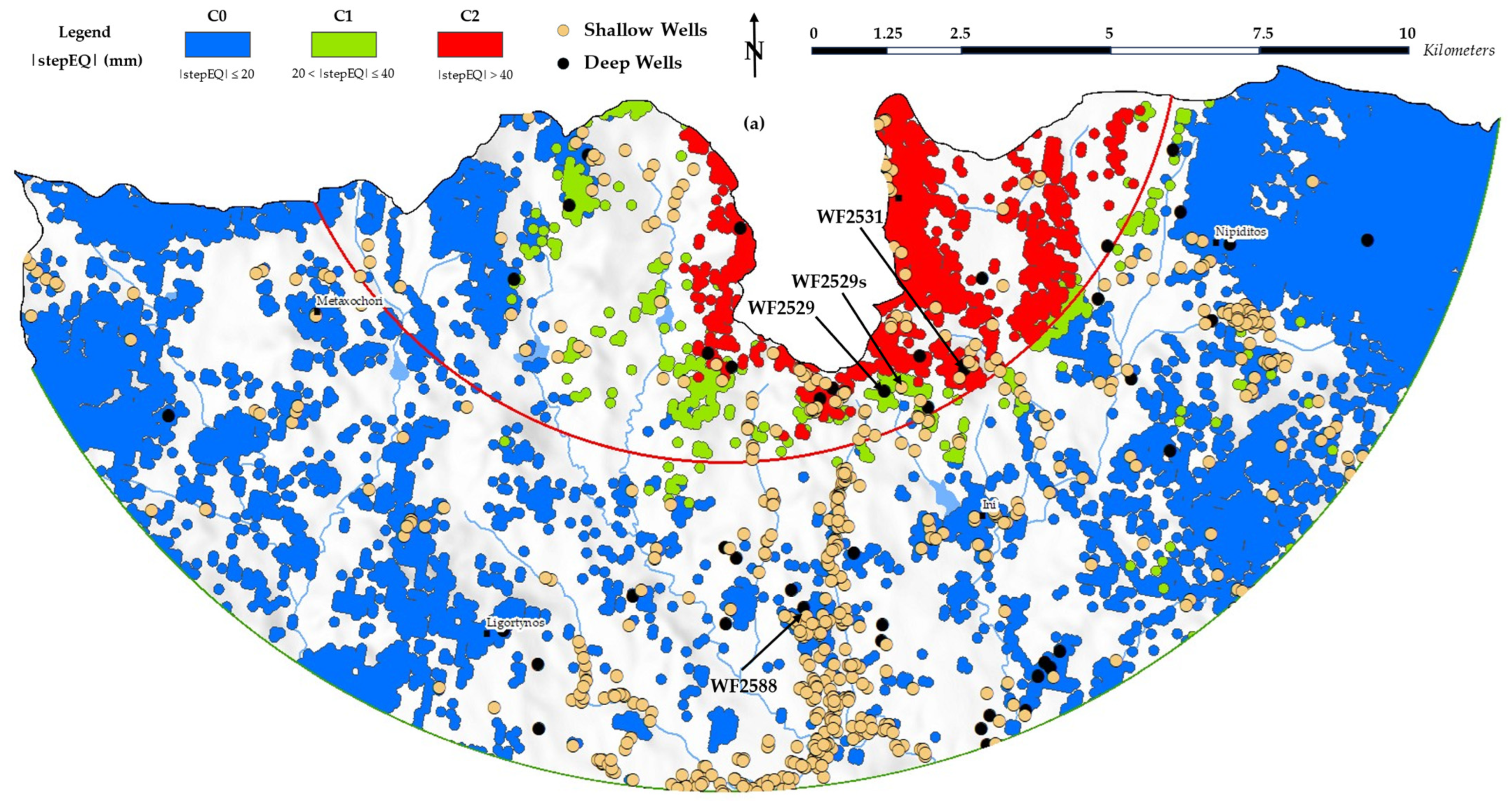
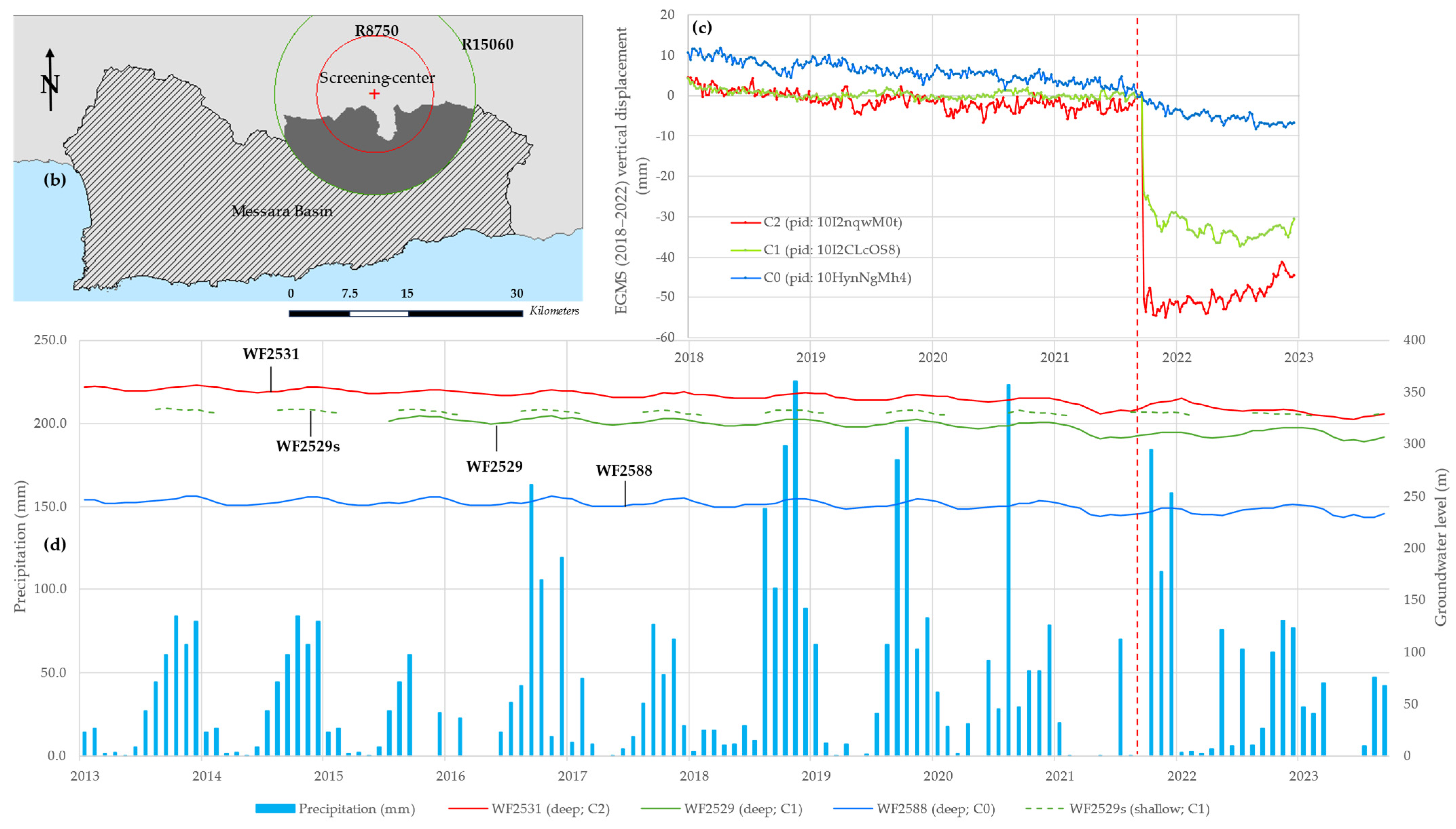
This subsection provides a site-scale hydrogeological touchpoint to support interpretation of the coseismic-step screening outcomes (Figure 11).
The northeastern sector of the Messara Basin exhibits a complex hydrogeological setting, where groundwater use occurs through both shallow and deep wells [36,37], reflecting contrasting hydrostratigraphic conditions. Shallow wells typically exploit shallow, unconfined aquifers developed in Quaternary alluvial deposits and near-channel permeable layers, where storage is limited and seasonal drying can occur. Deep wells generally target deeper post-Alpine basin-fill formations, primarily permeable horizons within the Neogene succession, where sustained abstraction can produce multi-season drawdown and longer-lived hydraulic deficits [8].
To connect the hydrogeological setting to the deformation screening domain, a focused map window was defined using the overlap between the Messara Basin mask (northeastern sector) and R15060 (Figure 11a). Within this overlap, the distribution of shallow and deep wells is shown together with the EGMS-derived coseismic-step screening layer (C0–C2), enabling qualitative inspection of whether step-dominated clusters occur in sectors characterized by intensive groundwater exploitation and thick basin-fill conditions where compaction-driven subsidence is plausible.
A co-located time-series illustration is provided for three deep reference wells—WF2531 (C2), WF2529 (C1), and WF2588 (C0)—and one shallow well near WF2529 (WF2529s; C1) (Figure 11a) [37,38]. These sites were selected based on data availability and representation of contrasting screening classes. The groundwater records indicate a multi-year decline superimposed on seasonal variability. For the deformation component, EGMS 2018–2022 vertical time series are plotted at representative nearby EGMS PS points (one point identifier, pid, per class) associated with the reference wells (Figure 11c). The corresponding vertical velocities are −3.4 mm/yr for the C0 reference pid (10HynNgMh4), −7.7 mm/yr for the C1 reference pid (10I2CLcOS8), and −11.5 mm/yr for the C2 reference pid (10I2nqwM0t). Well coordinates and pid identifiers are reported in Table S10. This pairing is intended as interpretive context rather than a deterministic head–deformation transfer function: groundwater observations may be irregular and non-linear, whereas EGMS time series reflect satellite sampling and processing constraints and can integrate deformation sources not uniquely attributable to groundwater dynamics.
Monthly precipitation at the Arkalochori station [38] is plotted together with groundwater levels (m a.s.l.) at the reference wells for 2013–2023 (Figure 11d). Months when the shallow well is dry/bottomed-out are treated as missing. Panels (c) and (d) share a common time axis over 2018–2022, with panel (c) plotted directly above panel (d), allowing the timing of the 27 September 2021 Arkalochori earthquake (dashed red line) to be read consistently across both deformation and groundwater/precipitation records.
This site-scale context supports interpretation in Section 6.5 by framing step-dominated screening outcomes relative to the local groundwater-use setting and the broader deformation background, while remaining distinct from causal attribution or source-mechanism modeling.

6.5. Implications for Screening and Interpretation

Screening outcomes indicate that the coseismic-step footprint is strongly conditioned by material and structural context: step-dominated classes concentrate within post-Alpine basin-fill deposits and are sparse in the Alpine basement, supporting a geology-conditioned (not purely distance-controlled) interpretation of the near-source screening domains (Table 2; Supplementary Table S8). The dispersion-based precision proxy σstep provides a practical robustness check on the fixed screening thresholds; across masks, σstep remains small relative to the magnitudes defining C1–C2, supporting use of these classes as conservative screening tiers rather than fine-tuned geodetic breakpoints (Supplementary Section S2; Supplementary Table S6).
Cross-generation differences quantified by ΔstepEQ indicate that processing-generation sensitivity is spatially localized and mask-dependent: distributions remain tightly centered near zero at the basin scale, whereas heavier negative tails occur in the near-source domains. Accordingly, ΔstepEQ is used as a QC lens when interpreting extreme or threshold-adjacent values near the screening center, where processing effects may be amplified (Supplementary Section S4; Supplementary Table S7; Supplementary Figure S5). The velocity-context stratification is consistent with this screening logic: step-dominated points co-locate with strongly negative mean_veloc bins, indicating preferential expression of the mapped step population within sectors that also exhibit an ongoing subsidence tendency during 2018–2022 (Supplementary Table S9).
For borderline values near the C0/C1 threshold (|stepEQ| ≈ 20 mm), class assignment should be treated as provisional unless supported by multiple lines of evidence: (i) σstep small relative to |stepEQ|, (ii) spatial coherence at neighborhood scale, and (iii) inspection of the underlying time series across the defining pre-/post-event dates to confirm a clear step-like offset rather than dispersion-driven variability (Section 3.3; Supplementary Section S2). Overall, the combined use of conservative thresholds, σstep as a precision proxy, and ΔstepEQ as a cross-generation comparability diagnostic provides a reproducible, noise-aware screening framework that prioritizes physically plausible candidates for interpretation while explicitly flagging near-source areas where processing sensitivity can be most pronounced. This caution is supported by the supplementary 2 + 2 subset sensitivity analysis, which shows high basin-scale stability of the fixed 3 + 3 estimator overall, while confirming that subset-driven class switching is concentrated mainly in threshold-adjacent cases (Supplementary Section S5; Table S12).

7. Discussion

Results indicate that coseismic vertical offsets attributable to the 27 September 2021 Arkalochori event are limited at the scale of the Messara Basin as a whole, while a small, spatially coherent subset of EGMS 2018–2022 points exhibit moderate-to-strong, predominantly subsidence-direction steps over the event acquisition window. Cross-generation discrepancies under identical masks, acquisition dates, and thresholds are treated as processing-generation sensitivity; interpretation relies on event timing and distributional structure.

7.1. Limitations and Interpretation Boundaries

Several limitations bound the interpretation of EGMS-derived stepEQ patterns.
Processing-generation sensitivity. The two EGMS Level-3 datasets (2015–2021 vs. 2018–2022) yield markedly different stepEQ distributions under identical masks and the same fixed event-window definition, indicating processing-generation sensitivity in step preservation. Accordingly, stepEQ is treated primarily as a screening metric and spatial-coherence test, not as a definitive estimate of basin-wide coseismic vertical offset magnitude.
Cross-product comparability. Absolute displacement time-series baselines are not directly comparable across EGMS processing generations because each product is internally referenced and processed. Cross-product interpretation, therefore, relies on event-centered metrics (stepEQ), distributional diagnostics (bin- and class-wise envelopes), and pre-event-referenced anomaly plots at selected locations that suppress product-specific baseline offsets. In addition, the adopted fixed 3 + 3 event-window estimator is intentionally screening-oriented rather than a fully optimized time-series model; although the supplementary 2 + 2 subset analysis demonstrates high basin-scale stability, threshold-adjacent cases remain more sensitive to omission of individual acquisitions and are therefore interpreted within the broader QC framework (Supplementary Section S5; Table S12).
Derived vertical-component limitation. The EGMS Level-3 Ortho “Vertical” signal analyzed here is a derived component obtained from the decomposition of ascending and descending InSAR viewing geometries rather than a direct measurement of the full 3D displacement vector. Interpretation must therefore remain cautious, particularly in near-source settings where horizontal motion and/or strong deformation gradients may influence the decomposed vertical response. For this reason, the present results are treated as screening-level evidence of earthquake-timed behavior in the derived vertical signal, not as a full coseismic displacement solution. Likewise, because no complementary horizontal-component analysis is performed in the present study, the results should not be interpreted as a full characterization of the coseismic displacement field.
Coherence is necessary, not sufficient. Spatial clustering of C1–C2 responses supports plausibility but does not uniquely establish a physical mechanism. Residual processing artifacts, localized non-tectonic effects, and threshold-adjacent classification sensitivity can still contribute to apparent coherence. Spatial coherence is therefore used to prioritize candidates for targeted time-series inspection and contextual interpretation rather than to assign a unique source process.
Field context is not validation. Field observations provide exposure context and qualitative screening of damage/distress patterns but do not constitute ground-truth validation of EGMS-derived deformation magnitudes. Observed indicators may reflect interacting drivers (construction practices, moisture variability, local ground conditions, and seismic legacy) and should be interpreted cautiously when discussed alongside stepEQ patterns.
These boundaries are maintained to avoid over-interpretation of stepEQ magnitudes and to keep inference anchored on robust event-timed structure in space and time.

7.2. Interpreting the Coseismic-Step Footprint in a Coupled Tectonic–Subsidence Setting

The results support a consistent screening-level interpretation of Arkalochori-related step-like behavior within the near-source–basin setting. Across masks, the strong class (C2) is expressed exclusively as negative stepEQ (subsidence-direction) and remains spatially focused, while near-stable to uplift regimes are dominated by background behavior (Supplementary Table S9). Geological stratification indicates a clear material control: C2 is hosted almost entirely by post-Alpine basin deposits, whereas Alpine basement is predominantly background (Supplementary Figure S6; Supplementary Table S8). Within the post-Alpine domain, age-group stratification shows strong enrichment of step-dominated points within Miocene units (Table 2). Together, these patterns indicate that the mapped step footprint is not a purely geometric consequence of the distance masks, but is preferentially expressed where (i) deformable basin-fill materials are present and (ii) EGMS indicates an ongoing subsidence tendency during 2018–2022.
At the same time, the cross-generation contrast and ΔstepEQ diagnostics indicate that step preservation is processing-generation sensitive and that the strongest departures are localized within the near-source screening domains. This reinforces treatment of stepEQ as a noise-aware screening metric rather than as an absolute coseismic-offset estimate. Within this framing, C2 points represent high-priority candidates for event-timed step-like offsets superimposed on the local deformation background. C1 points should be treated as threshold-adjacent and interpreted using σstep, ΔstepEQ behavior at common locations, and neighborhood-scale spatial coherence before advancing mechanism-oriented interpretation. Overall, the EGMS-derived stepEQ workflow functions as a reproducible filtering and prioritization tool that isolates where the event window coincides with coherent non-background behavior, providing a defensible basis for targeted follow-up using independent geodetic, geological, hydrogeological, or engineering evidence.

7.3. Implications for Hazard Screening and Transferability of the Workflow (EGMS-Based)

The workflow is intended as a screening and prioritization framework for basin-scale identification of event-timed, step-like vertical offsets in EGMS Level-3 “Vertical” time series, rather than as a substitute for earthquake source modeling, full-vector geodetic inversion, horizontal-component deformation analysis, or fully optimized site-scale deformation validation. Its hazard-screening value is that it isolates a small, spatially coherent subset of points exhibiting non-background behavior (C1–C2) within a fixed event window and applies internal consistency checks that reduce over-interpretation: (i) an event-window mean-difference step metric (stepEQ) that suppresses single-date noise, (ii) a dispersion-based precision proxy (σstep) that contextualizes threshold-adjacent values and flags dispersion-dominated responses, and (iii) a cross-generation sensitivity diagnostic (ΔstepEQ) that identifies domains where processing-generation differences can influence class membership. In this tiered interpretation, C2 points represent high-priority candidates for targeted review and exposure-oriented screening, whereas C1 points require additional QC (σstep and ΔstepEQ, together with neighborhood-scale coherence and direct inspection of the defining pre-/post-event dates) before informing hazard-relevant interpretation.
Transferability is strongest where three prerequisites are satisfied: (a) dense, quality-controlled displacement time series (EGMS Level-3 or an equivalent service), (b) a clearly defined reference event date, and (c) pre- and post-event acquisitions that bracket the event with comparable sampling and limited seasonal or long-term trend contamination. Application to other events and basins requires changing only the event date, the pre-/post-event date lists, and the spatial masks, while keeping the step definition, bin/class logic, and QC criteria fixed, enabling reproducible comparisons across domains. Under independent referencing and differing processing strategies, ΔstepEQ functions as a spatial QC flag for threshold-adjacent sensitivity. Finally, the observed co-location of step-dominated responses with strong subsidence velocity regimes motivates coupling event-centered screening with subsidence monitoring to prioritize sectors where transient offsets may compound ongoing deformation and where follow-up using independent evidence is most warranted.

7.4. Consistency with Published Geodetic Constraints and Directions for Follow-Up

Published geodetic analyses of the 27 September 2021 Arkalochori earthquake (InSAR and GNSS) resolve a compact near-field deformation pattern and support rupture on a normal fault with shallow slip concentration; field surveys did not document a clear, continuous primary surface-fault rupture. The EGMS-based results presented here do not attempt source inversion or a quantitative coseismic displacement solution. Instead, they provide a basin-scale screening view of how event-timed, step-like vertical offsets manifest within and adjacent to the Messara Basin under a fixed event-window definition, conservative thresholds, and screening center-referenced spatial masks.
Within this screening framing, the spatial focusing of the strongest step responses and their preferential association with post-Alpine basin deposits and strongly subsiding background regimes (mean_veloc) are consistent with the expectation that coherent step-like behavior is most readily expressed within deformable basin-fill materials rather than competent bedrock, particularly where longer-term subsidence is ongoing. At the same time, the cross-generation contrast indicates that step preservation is processing-generation sensitive and that apparent step prevalence can be locally amplified within the near-source domains. This reinforces the role of σstep and ΔstepEQ as QC lenses, especially for threshold-adjacent points and for interpretation of distributional tails around the screening center.
These outcomes motivate targeted follow-up in three directions: (i) comparison of stepEQ at high-priority EGMS PS locations (C2, and QC-vetted C1) against independent Sentinel-1 coseismic interferograms and any available GNSS coseismic offsets in the near field; (ii) focused structural–material interpretation of step-dominated clusters relative to mapped basin-fill architecture, local site conditions, and hydrogeological setting to evaluate whether mechanical susceptibility plausibly conditions step detectability; and (iii) application of the same screening and QC framework to additional events and alternative event windows to test whether the co-location tendency between step-dominated responses and strong subsidence velocity regimes generalizes to other groundwater-stressed basins and to evaluate sensitivity to sampling choices. Within these bounds, the workflow provides a reproducible bridge between event-centered coseismic screening and basin-scale deformation context, supporting defensible prioritization for detailed geohazard investigation.

7.5. Practical Interpretation Rules for EGMS-Based Coseismic-Step Screening

For practical use, stepEQ outputs should be interpreted as a tiered screening product rather than as a definitive coseismic-offset estimate. C2 clusters that are spatially coherent and remain stable under the QC lenses (σstep not anomalously large relative to |stepEQ|; ΔstepEQ not dominated by cross-generation mismatch at common locations) represent the highest-priority candidates for targeted follow-up, particularly where they co-locate with strongly negative mean_veloc regimes and post-Alpine basin deposits (Table 2; Supplementary Tables S8 and S9). C1 points are threshold-adjacent and should be interpreted conservatively, using neighborhood-scale coherence, σstep context, and localized ΔstepEQ behavior before advancing mechanism-oriented interpretation. C0 represents background under the adopted event window and screening definition; however, C0 points occurring within strongly subsiding mean_veloc regimes may still reflect longer-term deformation unrelated to the earthquake and should be interpreted within that broader context.

8. Conclusions

This study examined the extent to which Arkalochori-related coseismic vertical offsets propagate into the Messara Basin and how any event-timed signal is expressed relative to the background deformation field. Using Copernicus EGMS Level-3 “Vertical” time series and a fixed, event-centered step metric (stepEQ) evaluated consistently across three locked spatial masks (MESSARA, R15060, R8750), results indicate that the Arkalochori signal is not expressed as a basin-wide offset across the Messara Basin. Instead, the event-timed response appears as a spatially limited, coherent subset of points exhibiting predominantly subsidence-direction step-like behavior, concentrated where the basin intersects the near-source footprint and where background deformation during 2018–2022 is already subsiding. This screening-level picture is consistent with published geodetic constraints that indicate a compact deformation field and upper-crustal normal-fault slip for the 27 September 2021 event.
Key conclusions are:
  • Non-background responses emerge only in the EGMS 2018–2022 generation under the common event window. Under identical masks and thresholds, EGMS 2018–2022 exhibits a systematic non-background population that strengthens toward the screening center (C2 increasing from ~1% at basin scale to ~19% in R8750), whereas EGMS 2015–2021 assigns all retained points to background (C0). This cross-generation contrast supports the use of stepEQ as a screening and coherence diagnostic rather than as a definitive coseismic-offset magnitude estimate.
  • Strong steps are materially conditioned. Geological stratification indicates that C2 is hosted almost entirely by post-Alpine basin deposits, with Alpine basement behaving predominantly as background (Supplementary Table S8; Supplementary Figure S6). Within post-Alpine deposits, age-group stratification shows enrichment of step-dominated points in Miocene units (Table 2), supporting a material-control interpretation consistent with deformation susceptibility in groundwater-stressed basin deposits.
  • Step-dominated responses co-locate with ongoing subsidence. Cross-tabulation against EGMS 2018–2022 mean vertical velocity indicates that C2 is confined to strongly subsiding velocity regimes (Supplementary Table S9), implying that event-timed step-like behavior is preferentially expressed where a longer-term subsidence tendency is already present rather than distributed uniformly around the near-source domain.
  • Processing-generation sensitivity is spatially localized and functions as QC. Cross-generation differencing at common locations (ΔstepEQ) remains tightly centered at the basin scale but develops broader, asymmetric tails within the near-source masks. ΔstepEQ is therefore most useful as a spatial QC lens for identifying where threshold-adjacent outcomes may be sensitive to processing-generation effects (Supplementary Table S7; Supplementary Figure S5).
  • A tiered interpretation supports practical geohazard prioritization. C2 clusters that remain coherent under QC lenses define high-priority candidates for targeted follow-up, whereas C1 should be treated as threshold-adjacent and interpreted using σstep, localized ΔstepEQ behavior, and neighborhood-scale coherence before mechanism-oriented interpretation. This aligns with the use of EGMS as a screening product for geohazard applications while explicitly bounding inference under independent product referencing.
  • The framework is transferable when prerequisites are satisfied. Given a fixed reference event date, matched pre-/post-event acquisition dates, and consistent spatial masks, the workflow can be applied to other earthquakes and groundwater-stressed basins by updating only the event date, the pre-/post-event date lists, and the masks while keeping the step definition and QC logic fixed (Supplementary Section S3).
Overall, the study provides a transparent and transferable framework for identifying where event-timed step-like offsets appear as coherent non-background behavior in EGMS vertical time series, while explicitly bounding interpretation in the presence of independent referencing and processing-generation sensitivity. Arkalochori-related vertical offsets propagate into the Messara Basin only locally, and where expressed, they appear primarily as subsidence-direction step-like behavior superimposed on an already subsiding deformation regime rather than as a basin-wide displacement field.

Supplementary Materials

The following supporting information can be downloaded at: https://www.mdpi.com/article/10.3390/land15040545/s1. The Supplementary Materials include: Table S1 (glossary of symbols and terms used in the EGMS-based coseismic stepEQ analysis); Table S2 (published mainshock locations and fixed screening center coordinates); Figures S1 and S2 (paired EGMS PS time series and pre-event-referenced anomalies for EGMS 2015–2021 vs. 2018–2022); Tables S3–S5 (descriptive statistics, 5-mm |stepEQ| bin distributions, and sign decomposition of C0–C2 classes across masks/datasets); Figures S3 and S4 (cross-dataset maps of C0–C2 classes and 5-mm |stepEQ| bins in the common near-source–basin window); Tables S6 and S7 and Figure S5 (σstep uncertainty proxy and ΔstepEQ cross-dataset comparability/QC diagnostics); Table S8 and Figure S6 (simplified geological framework and class proportions by post-Alpine vs. Alpine domains); Table S9 (class composition by mean vertical-velocity bins); Table S10 (well coordinates and EGMS PS pid identifiers used in Figure 11); Tables S11 and S12 (definition of the nine symmetric 2 + 2 subset variants and sensitivity of the fixed 3 + 3 stepEQ estimator to symmetric 2 + 2 subset selection across masks and EGMS product generations). Sections S1–S5 provide definitions (C0–C2), σstep formulation, a step-by-step workflow implementation, the ΔstepEQ comparability check, and the fixed 3 + 3 event-window sensitivity analysis. Glossary: A detailed glossary of all symbols and terms is provided in the Supplementary Materials (Table S1).

Author Contributions

Conceptualization, I.M. and C.L.; methodology, I.M. and C.L.; validation, I.M. and C.L.; formal analysis, I.M. and C.L.; investigation, I.M. and C.L.; resources, I.M. and C.L.; data curation, I.M.; writing—original draft preparation, I.M.; writing—review and editing, C.L.; visualization, I.M.; supervision, C.L. All authors have read and agreed to the published version of the manuscript.

Funding

This research received no external funding.

Data Availability Statement

The datasets used and/or analyzed during the current study are available from the authors upon request.

Acknowledgments

The authors would like to acknowledge the European Ground Motion Service (EGMS) for providing free access to the datasets utilized in this study.

Conflicts of Interest

The authors declare no conflicts of interest.

Abbreviations

The following abbreviations are used in this manuscript:
EGMSEuropean Ground Motion Service
InSARInterferometric Synthetic Aperture Radar
PSPersistent Scatterer
GNSS Global Navigation Satellite System
SD Standard Deviation
QCQuality Control
RMSERoot Mean Square Error
MAEMean Absolute Error
UTCCoordinated Universal Time
WGS 84World Geodetic System 1984
MwMoment magnitude
EGSA 87Hellenic Geodetic Reference System 1987 (Greek Grid)
USGSU.S. Geological Survey
GEIN/NOAGeodynamic Institute, National Observatory of Athens
NKUANational and Kapodistrian University of Athens
EMSC-CSEMEuropean-Mediterranean Seismological Centre (EMSC-CSEM)
a.s.l.Above sea level

References

  1. Loupasakis, C. An Overview of the Land Subsidence Phenomena Occurring in Greece. Proc. IAHS 2020, 382, 321–326. [Google Scholar] [CrossRef]
  2. Thiéblemont, R.; Le Cozannet, G.; Nicholls, R.J.; Rohmer, J.; Wöppelmann, G.; Raucoules, D.; de Michele, M.; Toimil, A.; Lincke, D. Assessing Current Coastal Subsidence at Continental Scale: Insights from Europe Using the European Ground Motion Service. Earth’s Future 2024, 12, e2024EF004523. [Google Scholar] [CrossRef]
  3. Lenardón Sánchez, M.; Farías, C.A.; Cigna, F. Multi-Decadal Land Subsidence Risk Assessment at Major Italian Cities by Integrating PSInSAR with Urban Vulnerability. Land 2024, 13, 2103. [Google Scholar] [CrossRef]
  4. Li, Y.; Jiang, W.; Zhang, J.; Li, B.; Yan, R.; Wang, X. Sentinel-1 SAR-Based Coseismic Deformation Monitoring Service for Rapid Geodetic Imaging of Global Earthquakes. Nat. Hazards Res. 2021, 1, 11–19. [Google Scholar] [CrossRef]
  5. Pla, C.; Valdés-Abellán, J.; Navarro-Hernández, M.I.; Tomás, R.; Guardiola-Albert, C.; Elçi, A.; Batkan, E.A.; Meisina, C.; Pedretti, L.; Mohammad, A.H.; et al. Expert-Guided Multicriteria Decision-Making for Mitigating Land Subsidence Caused by Groundwater Overexploitation. Hydrogeol. J. 2025, 33, 1681–1702. [Google Scholar] [CrossRef]
  6. Cardello, G.L.; Marshall, C.; D’Arcy, M.; Roberts, G.P.; Mason, J.; Kerr, E.N.; Ribolini, A.; Spagnolo, M.; Mariani, G.S.; Santoro, E.; et al. Comparison between Copernicus EGM and MIS 5.5 Uplift Data: Implications for Vertical Land Motion and Sea-Level Studies. Earth-Sci. Rev. 2025, 265, 105132. [Google Scholar] [CrossRef]
  7. Delano, J.; Howell, A.; Clark, K.; Stahl, T.; Rollins, C.; Seebeck, H.; McGrath, J. A probabilistic model for coseismic vertical displacement hazard in coastal settings. Geosphere 2025, 21, 148–178. [Google Scholar] [CrossRef]
  8. Michalakis, I.; Loupasakis, C.I.; Tsolaki, E. Groundwater Overexploitation and Land Subsidence in the Messara Basin, Crete: Integrating Land Use, Hydrolithology and Basin-Scale Potentiometry with InSAR. Land 2025, 14, 2124. [Google Scholar] [CrossRef]
  9. Vassilakis, E.; Kaviris, G.; Kapetanidis, V.; Papageorgiou, E.; Foumelis, M.; Konsolaki, A.; Petrakis, S.; Evangelidis, C.P.; Alexopoulos, J.; Karastathis, V.; et al. The 27 September 2021 Earthquake in Central Crete (Greece)—Detailed Analysis of the Earthquake Sequence and Indications for Contemporary Arc-Parallel Extension to the Hellenic Arc. Appl. Sci. 2022, 12, 2815. [Google Scholar] [CrossRef]
  10. Zhu, M.; Chen, F.; Zhou, W.; Lin, H.; Parcharidis, I.; Luo, J. Two-Dimensional InSAR Monitoring of the Co- and Post-Seismic Ground Deformation of the 2021 Mw 5.9 Arkalochori (Greece) Earthquake and Its Impact on the Deformations of the Heraklion City Wall Relic. Remote Sens. 2022, 14, 5212. [Google Scholar] [CrossRef]
  11. Famiglietti, N.A.; Golshadi, Z.; Vallianatos, F.; Caputo, R.; Kouli, M.; Sakkas, V.; Atzori, S.; Moschillo, R.; Cecere, G.; D’Ambrosio, C.; et al. The 2021 Greece central Crete ML 5.8 earthquake: An example of coalescent fault segments reconstructed from InSAR and GNSS data. Remote Sens. 2022, 14, 5783. [Google Scholar] [CrossRef]
  12. Ganas, A.; Hamiel, Y.; Serpetsidaki, A.; Briole, P.; Valkaniotis, S.; Fassoulas, C.; Piatibratova, O.; Kranis, H.; Tsironi, V.; Karamitros, I.; et al. The Arkalochori Mw = 5.9 Earthquake of 27 September 2021 Inside the Heraklion Basin: A Shallow, Blind Rupture Event Highlighting the Orthogonal Extension of Central Crete. Geosciences 2022, 12, 220. [Google Scholar] [CrossRef]
  13. Triantafyllou, I.; Karavias, A.; Koukouvelas, I.; Papadopoulos, G.A.; Parcharidis, I. The Crete Isl. (Greece) Mw6.0 Earthquake of 27 September 2021: Expecting the Unexpected. GeoHazards 2022, 3, 106–124. [Google Scholar] [CrossRef]
  14. Hellenic Survey of Geology and Mineral Exploration (HSGME). Geological Map of Greece, Melambes Sheet, 2nd ed.; Scale 1:50,000; HSGME: Acharnes, Greece, 2023.
  15. Hellenic Survey of Geology and Mineral Exploration (HSGME). Geological Map of Greece, Tymbakion Sheet, 2nd ed.; Scale 1:50,000; HSGME: Acharnes, Greece, 2023.
  16. Hellenic Survey of Geology and Mineral Exploration (HSGME). Geological Map of Greece, Antiskarion Sheet, 2nd ed.; Scale 1:50,000; HSGME: Acharnes, Greece, 2023.
  17. Hellenic Survey of Geology and Mineral Exploration (HSGME). Geological Map of Greece, Epano Archanae Sheet, 2nd ed.; Scale 1:50,000; HSGME: Acharnes, Greece, 2023.
  18. Hellenic Survey of Geology and Mineral Exploration (HSGME). Geological Map of Greece, Achentrias Sheet, 2nd ed.; Scale 1:50,000; HSGME: Acharnes, Greece, 2023.
  19. Hellenic Survey of Geology and Mineral Exploration (HSGME). Geological Map of Greece, Mochos Sheet, 2nd ed.; Scale 1:50,000; HSGME: Acharnes, Greece, 2023.
  20. Hellenic Survey of Geology and Mineral Exploration (HSGME). Geological Map of Greece, Ano Viannos Sheet, 2nd ed.; Scale 1:50,000; HSGME: Acharnes, Greece, 2023.
  21. H.S.G.M.E. Geoportal (EAGME). Geological Maps (GeolMaps) Web Application. Available online: https://geoportal.eagme.gr/ (accessed on 2 February 2026).
  22. Galanakis, D.; Sboras, S.; Ganas, A.; Koukouvelas, I.; Kranis, C.; Lalechos, S.; Lekkas, E.; Pavlides, S.; Rondoyanni, T.; Sakellariou, D.; et al. The Hellenic DataBase of Active Faults (HeDBAF); Version 1.0; Hellenic Survey of Geology & Mineral Exploration (HSGME) and Earthquake Planning & Protection Organization (EPPO): Athens, Greece, 2024. Available online: https://activefaults.eagme.gr/en/ (accessed on 2 February 2026).
  23. U.S. Geological Survey (USGS). Earthquake Event Page: Us7000fes8—Origin Detail (Arkalochori, Crete; 27 September 2021). Available online: https://earthquake.usgs.gov/earthquakes/eventpage/us7000fes8/origin/detail (accessed on 3 November 2025).
  24. GEIN/NOA (Database Search Portal) Geodynamic Institute, National Observatory of Athens (NOA/GEIN). Seismicity Database Search (GEIN). Available online: https://www.gein.noa.gr/en/services-products/database-search/ (accessed on 3 November 2025).
  25. NKUA (UoA Geophysics Stations Map/Database Page) National and Kapodistrian University of Athens (NKUA), Department of Geology and Geoenvironment, Section of Geophysics. Stations Map/Database Interface. Available online: http://www.geophysics.geol.uoa.gr/stations/gmapv3_db/index.php (accessed on 3 November 2025).
  26. EMSC-CSEM (Event Page) European-Mediterranean Seismological Centre (EMSC-CSEM). Earthquake Information: Event ID 1041084 (27 September 2021). Available online: https://www.emsc-csem.org/Earthquake_information/earthquake.php?id=1041084 (accessed on 3 November 2025).
  27. Shahbazi, S.; Crosetto, M.; Barra, A. Ground Deformation Analysis Using Basic Products of the Copernicus Ground Motion Service. Int. Arch. Photogramm. Remote Sens. Spat. Inf. Sci. 2022, 43, 349–354. [Google Scholar] [CrossRef]
  28. European Union’s Copernicus Land Monitoring Service. European Ground Motion Service (EGMS) Level-3 Ortho (100 km) up Component 2015–2021 (Vector), Europe, Yearly; European Environment Agency (EEA): Copenhagen, Denmark, 2023. Available online: https://egms.land.copernicus.eu/ (accessed on 21 May 2024).
  29. European Union’s Copernicus Land Monitoring Service. European Ground Motion Service (EGMS) Level-3 Ortho (100 km) up Component 2018–2022 (Vector), Europe, Yearly (Release 1); European Environment Agency (EEA): Copenhagen, Denmark, 2023. Available online: https://egms.land.copernicus.eu/ (accessed on 21 May 2024).
  30. Sala Calero, J.; Vöge, M.; Esteves Martins, J.; Raucoules, D.; de Michelle, M.; Vradi, A.; Vecchiotti, F. EGMS Validation Report (2015–2021 Update); Version 3.0; Public distribution; European Union: Brussels, Belgium, 19 December 2023.
  31. Sala Calero, J.; Vöge, M.; Esteves Martins, J.; Raucoules, D.; de Michelle, M.; Vradi, A.; Vecchiotti, F. EGMS Validation Report 2018–2022 Update; Version 2.0; Public distribution; European Union: Brussels, Belgium, 26 June 2024.
  32. Farías, C.A.; Lenardón Sánchez, M.; Bonì, R.; Cigna, F. Statistical and Independent Component Analysis of Sentinel-1 InSAR Time Series to Assess Land Subsidence Trends. Remote Sens. 2024, 16, 4066. [Google Scholar] [CrossRef]
  33. Vallianatos, F.; Karakonstantis, A.; Michas, G.; Pavlou, K.; Kouli, M.; Sakkas, V. On the Patterns and Scaling Properties of the 2021–2022 Arkalochori Earthquake Sequence (Central Crete, Greece) Based on Seismological, Geophysical and Satellite Observations. Appl. Sci. 2022, 12, 7716. [Google Scholar] [CrossRef]
  34. Bonatis, P.; Karakostas, V.; Kaplon, J.; Papadimitriou, E.; Kaviris, G.; Ilieva, M.; Foumelis, M.; Pikridas, C. Co-Seismic and Post-Seismic Slip Associated with the 2021 Mw 5.9 Arkalochori, Central Crete (Greece) Earthquake Constrained by Geodetic Data and Aftershocks. Tectonophysics 2024, 889, 230481. [Google Scholar] [CrossRef]
  35. Wood, J.; Whittaker, A.C.; Bell, R.E.; Coveney, S.M.; Kranis, H.D. Resolving Coseismic and Aseismic Normal Fault Slip Behaviors from InSAR Time Series of the European Ground Motion Service (EGMS). Tectonics 2025, 44, e2025TC008904. [Google Scholar] [CrossRef]
  36. Water Directorate of Crete. Datasets; Decentralized Administration of Crete: Irakleion, Greece. Available online: https://data.apdkritis.gov.gr/search?s=&sort_by=changed&sort_order=DESC&f%5B0%5D=content_type%3Adataset (accessed on 27 January 2025).
  37. Hellenic Survey of Geology and Mineral Exploration (HSGME)/Regional Branch of Crete (RBC). Systematic Inventory of Water Wells of Every Use throughout the Country of Greece (2019–2023); Preliminary Technical Reports; Hellenic Survey of Geology and Mineral Exploration (HSGME)/Regional Branch of Crete (RBC): Rethymno, Greece. Available online: https://eagme.gr/programs/bsamy-ii-b-systhmatikh-apografh-ydrogewtrhsewn-kathe-xrhshs-se-olh-thn (accessed on 4 December 2024).
  38. CretaWeather. Stations. Available online: https://cretaweather.gr/arkalohori/ (accessed on 27 January 2025).
Figure 1. Study area and spatial framework for coseismic-step screening in the Messara Basin (central–southern Crete, Greece). The Messara Basin boundary is shown over a simplified geological background (Holocene–Miocene post-Alpine deposits and merged Alpine basement) [14,15,16,17,18,19,20,21], with mapped active faults in red [22]. Published mainshock epicenter solutions for the 27 September 2021 Arkalochori earthquake are shown as black stars (USGS, GEIN/NOA, NKUA/UOA, EMSC-CSEM) [23,24,25,26]. A fixed screening center (red cross) defines the radii masks R15060 and R8750. A–A1 denotes the trace of the geological cross-section shown later in the manuscript.
Land 15 00545 g001
Figure 2. Spatial masks and EGMS-based workflow for coseismic-step screening. (a) Messara Basin boundary and screening-center-referenced radii masks (R15060, R8750). The red cross marks the fixed screening center, and the red stars mark published mainshock epicentral solutions for the 27 September 2021 Arkalochori earthquake. (b) Schematic workflow applied independently to European Ground Motion Service (EGMS) Level-3 Ortho Vertical (Up) time-series products (EGMS 2015–2021 and EGMS 2018–2022) using a common six-date event window (pre-event: 11, 17, and 23 September 2021; post-event: 29 September, 5 October, and 11 October 2021). For each retained EGMS Persistent Scatterer (PS), stepEQ is computed from mean post-event and mean pre-event displacement, with σstep used as a dispersion-based precision proxy. Outputs include 5-mm |stepEQ| bins and operational screening classes (C0–C2). Cross-generation sensitivity at common locations is quantified by ΔstepEQ = stepEQ(2018–2022) − stepEQ(2015–2021). A supplementary 2 + 2 subset sensitivity analysis of the fixed 3 + 3 estimator is provided separately in Section S5 (Tables S11 and S12).
Land 15 00545 g002
Figure 3. Coseismic vertical step magnitude |stepEQ| (mm) classified in 5-mm bins within R15060, comparing the European Ground Motion Service (EGMS) 2015–2021 and EGMS 2018–2022 products. (a) EGMS 2015–2021 and (b) EGMS 2018–2022 Persistent Scatterer (PS) maps, symbolized by 5-mm |stepEQ| bins (0–5 to > 40 mm). Panels are clipped to a radius of 15,060 m from the fixed screening center, corresponding to the outermost occurrence of |stepEQ| ≥ 20 mm within the study domain (R15060). The red circle denotes R8750, corresponding to the outermost occurrence of the |stepEQ| ≥ 40 mm class in the 2018–2022 product; in 2015–2021, all points satisfy |stepEQ| < 20 mm. For cartographic clarity, EGMS PS are rendered as 100 m patches to emphasize spatial continuity.
Land 15 00545 g003
Figure 4. Cross-generation comparison of vertical-displacement percentile envelopes grouped by 5-mm |stepEQ| bins within R15060, comparing the European Ground Motion Service (EGMS) 2015–2021 and EGMS 2018–2022 products. (a,b) European Ground Motion Service (EGMS) Persistent Scatterer (PS) maps symbolized by 5-mm |stepEQ| bins for (a) EGMS 2015–2021 and (b) EGMS 2018–2022; the red cross marks the fixed screening center, and the red circle denotes R8750. (a1a4) and (b1b9) show percentile envelopes (P05, P50, P95) of EGMS vertical displacement for each bin across the full time series. The vertical dashed red line marks 27 September 2021.
Land 15 00545 g004aLand 15 00545 g004b
Figure 5. Operational coseismic-step classes and class-wise vertical-displacement envelopes within R15060 for the European Ground Motion Service (EGMS) 2018–2022 product. (a) Spatial distribution of operational step-magnitude classes C0–C2 within the R15060 screening mask. The red cross marks the fixed screening center, the black stars mark published mainshock epicentral solutions for the 27 September 2021 Arkalochori earthquake, and the red circle denotes R8750. Panel (a) is clipped to a radius of 15,060 m from the screening center, corresponding to the outermost occurrence of non-background coseismic steps (|stepEQ| > 20 mm; R15060); R8750 (r = 8750 m) denotes the outermost occurrence of the strong step class (C2; |stepEQ| > 40 mm), as determined from the 2018–2022 product. (bd) Percentile envelopes (P05, P50, P95) of EGMS vertical displacement for classes (b) C0, (c) C1, and (d) C2. The vertical dashed red line marks 27 September 2021.
Land 15 00545 g005
Figure 6. Earthquake-centered step magnitudes in 5 mm bins within the Messara Basin, comparing EGMS 2015–2021 and EGMS 2018–2022. (a,b) Basin-wide |stepEQ| maps (5 mm bins) for (a) EGMS 2015–2021 and (b) EGMS 2018–2022, with R15060 and R8750 overlain for context. (a1a4) and (b1b9) Percentile envelopes (P05, P50, P95) of EGMS vertical displacement for each bin. The vertical dashed red line marks 27 September 2021.
Land 15 00545 g006aLand 15 00545 g006b
Figure 7. Operational coseismic-step classes and class-wise vertical-displacement envelopes in the Messara Basin (EGMS 2018–2022). (a1) Inset of the northern Messara sector showing overlap with R15060 and R8750; the green arc marks R15060 and the red arc marks R8750 within the Messara Basin. (a2) Basin-wide C0–C2 class map. (bd) Percentile envelopes (P05, P50, P95) of EGMS vertical displacement for classes C0, C1, and C2, with the earthquake date marked by a vertical dashed red line.
Land 15 00545 g007
Figure 8. Spatial footprint and class composition of coseismic-step screening across masks and European Ground Motion Service (EGMS) product generations. (a) C0–C2 class map for EGMS 2018–2022 in the common near-source–basin window (Messara Basin boundary with R8750/R15060 overlays); the red cross marks the fixed screening center, the green arc marks R15060, and the red arc marks R8750. (b) Magnitude-only C0–C2 composition across masks and product generations. (c) Direction-resolved (signed) composition shown as a diverging 100% stacked bar chart, including the zero segment; the upward and downward arrows indicate the positive and negative signed components, respectively.
Land 15 00545 g008
Figure 9. NW–SE geological cross-section (A–A1) through the Arkalochori near-source area, providing structural and lithostratigraphic context for the radii masks. (a) Geological map of the R8750 and R15060 domains. (b) Cross-section A–A1 spanning R15060 and indicating the R8750 interior domain.
Land 15 00545 g009aLand 15 00545 g009b
Figure 10. Screening center domains used in the coseismic-step analysis: EGMS operational classes and geological framework. (a) C0–C2 class map derived from EGMS 2018–2022 using the fixed event-window step definition (stepEQ). (b) Geological framework of the same domains (R8750, R15060) compiled from H.S.G.M.E. 1:50,000 geological map sheets [17,19,20,21], with mapped active faults from HeDBAF [22]. The green arc marks R15060, the red arc marks R8750, and A–A1 denotes the trace of the geological cross-section shown in the manuscript.
Land 15 00545 g010
Figure 11. Groundwater context and illustrative co-located groundwater and EGMS time series (EGMS 2018–2022). (a) Overlap window between the northeastern Messara Basin sector and R15060, showing C0–C2 classes with shallow- and deep-well locations. (b) Representative groundwater hydrographs for selected deep and shallow wells. (c) Representative EGMS vertical displacement time series for nearby EGMS Persistent Scatterers (PS), grouped by class; identifiers are reported in Table S10. (d) Monthly precipitation at the Arkalochori station plotted together with groundwater levels (m a.s.l.) at the reference wells for 2013–2023. The red dashed line marks the date of the 27 September 2021 Arkalochori earthquake.
Land 15 00545 g011aLand 15 00545 g011b
Table 1. Operational class proportions (C0–C2) for coseismic-step screening across spatial masks and EGMS processing generations.
MaskR8750R15060MESSARA
EGMS DATASET2015–20212018–20222015–20212018–20222015–20212018–2022
Total EGMS PS (N)
(Count)
NN (%)NN (%)NN (%)NN (%)NN (%)NN (%)
9225100.009345100.0025,311100.0026,678100.0080,014100.0088,074100.00
C0 Background|stepEQ| ≤ 20 mm9225100.00658070.4125,311100.0023,74989.0280,014100.0086,72398.47
C1 Moderate20 < |stepEQ| ≤ 40 mm00.0094710.1300.0011114.1600.004140.47
C2 Strong|stepEQ| > 40 mm00.00181819.4500.0018186.8100.009371.06
Class definitions (C0–C2) and the step metric (stepEQ) are provided in Section 3.3 and Section 3.4. Values are reported as counts and percentages relative to the total number of EGMS PS (N) within each mask and EGMS dataset. Directional (sign) decomposition of class membership is reported in Supplementary Table S5.
Table 2. Operational class composition within post-Alpine basin deposits stratified by post-Alpine age group (EGMS 2018–2022).
R8750R15060MESSARA
N (Count)N (%)N (Count)N (%)N (Count)N (%)
Post-Alpine depositsTotal6220100.0013,527100.0028,888100.00
Holocene3645.85144810.70338911.73
Pleistocene (incl. Tyrrhenian)400.642021.49476016.48
Plio-Pleistocene2023.251411.0419016.58
Pliocene109017.52256018.9214264.94
Miocene452472.73917667.8517,41260.27
C0 BackgroundTotal3658100.0010,803100.0027,540100.00
Holocene1002.73110910.27328311.92
Pleistocene (incl. Tyrrhenian)00.001010.94476017.28
Plio-Pleistocene10.0310.0118996.89
Pliocene94125.72241122.3213744.99
Miocene261671.52718166.4816,22458.92
C1 ModerateTotal761100.00923100.00411100.00
Holocene13117.2120622.324410.71
Pleistocene (incl. Tyrrhenian)00.0000.0000.00
Plio-Pleistocene8611.30869.3200.00
Pliocene9712.759710.51327.79
Miocene44758.7453457.8533581.51
C2 StrongTotal1801100.001801100.00937100.00
Holocene1337.381337.38626.62
Pleistocene (incl. Tyrrhenian)402.22402.2200.00
Plio-Pleistocene1156.391156.3920.21
Pliocene522.89522.89202.13
Miocene146181.12146181.1285391.04
Percentages in the “Post-Alpine deposits” block are relative to the post-Alpine total within each mask. Percentages in the C0–C2 blocks are relative to the class total within post-Alpine deposits for each mask. Minor differences in Messara post-Alpine totals reflect coverage of age-group attribution versus the binary post-Alpine/basement split reported in Supplementary Table S8.
Disclaimer/Publisher’s Note: The statements, opinions and data contained in all publications are solely those of the individual author(s) and contributor(s) and not of MDPI and/or the editor(s). MDPI and/or the editor(s) disclaim responsibility for any injury to people or property resulting from any ideas, methods, instructions or products referred to in the content.