Article

Analysis of Spatio-Temporal Evolution and Driving Mechanism of Landscape Pattern in Huangshan City Based on Moving Window Method and Geodetector

1
College of Resources and Environment, Yunnan Agricultural University, Kunming 650201, China
2
School of Resources and Environmental Engineering, Hefei University of Technology, Hefei 230009, China
3
Chengdu Center, China Geological Survey, Chengdu 610218, China
4
College of Water Conservancy, Yunnan Agricultural University, Kunming 650201, China
5
School of Geophysics and Geomatics, China University of Geosciences (Wuhan), Wuhan 430074, China
6
School of Earth Resources, China University of Geosciences (Wuhan), Wuhan 430074, China
7
Chinese Academy of Geological Sciences, Beijing 100037, China
8
School of Earth and Planetary Sciences, China University of Geosciences (Wuhan), Wuhan 430074, China
9
Yunnan Geological Engineering Second Survey Institute Co., Ltd., Kunming 650218, China
*
Author to whom correspondence should be addressed.
Land 2026, 15(3), 503; https://doi.org/10.3390/land15030503
Submission received: 7 February 2026 / Revised: 13 March 2026 / Accepted: 18 March 2026 / Published: 20 March 2026

Abstract

The spatiotemporal evolution of landscape patterns represents the most direct manifestation of land use change and remains a pivotal focus within landscape ecology research. Taking Huangshan City—a typical mountainous tourism city—as the study area, this research systematically analyzes the spatiotemporal evolution characteristics and driving mechanisms of landscape patterns over the past three decades. Based on land use data from 1992, 2002, 2012, and 2022, the study employs an integrated methodological framework including land use transition matrices, landscape pattern indices, moving window analysis, and the geographical detector (Geodetector) model, supported by ArcGIS and FRAGSTATS platforms. The results indicate that (1) during the study period, the landscape structure in Huangshan City exhibited a general trend characterized by “a stable foundation of forest land, continuous contraction of cropland, and significant expansion of construction land.” (2) From 1992 to 2012, cropland served as the primary source of transfer, mainly being converted into forest land; conversely, between 2012 and 2022, the reciprocal transformation between cropland and forest land became the dominant transition process. (3) At the landscape level, overall diversity enhanced and spatial distribution tended toward uniformity, whereas landscape fragmentation persisted in localized areas. (4) The driving force analysis revealed that “distance to the urban center” was the primary driving factor shaping landscape pattern changes, with its explanatory power continuously increasing. Furthermore, significant synergistic enhancement effects were observed between natural and socio-economic factors. These findings provide a scientific basis for ecological protection, restoration, and sustainable development strategies in Huangshan City within the context of rapid urbanization and tourism development.

1. Introduction

Land use change serves as a direct manifestation of the interaction between anthropogenic activities and the natural environment, recording the transformation of land utilization patterns across different spatiotemporal scales and reflecting the dynamic evolution of human–land relationships [1]. Landscape pattern, a core concept in landscape ecology, refers to the spatial configuration and distribution regularities of landscape elements. It quantitatively characterizes landscape heterogeneity and elucidates the distribution and interaction of patches under the influence of natural and anthropogenic factors, thereby revealing the evolutionary process of ecosystems [2,3,4]. Driven by the combined effects of natural evolution and human activities, changes in landscape patterns exert profound impacts on regional ecological security and sustainable development [5,6,7], while intuitively reflecting land use transitions. Consequently, exploring landscape pattern evolution based on land use change has emerged as a critical research direction in landscape ecology [8].
The theoretical and methodological foundations of landscape pattern research can largely be traced back to a series of seminal works from the late 1980s. Gardner et al. [9] established the concept of neutral models for landscape pattern comparison by comparing the number, size, and perimeter of patches in real versus simulated landscapes; Krummel et al. [10] first introduced a multiscale index based on fractal geometry to describe the scale relationship between patch perimeter and area; and O’Neill et al. [11] extended Shannon’s diversity index to describe spatial adjacency relationships, proposing dominance and spread indices. These early studies laid the methodological foundation for quantitative landscape pattern analysis, enabling landscape indices to highly summarize landscape characteristics for depicting spatial structures, identifying ecological risk zones, and revealing ecological issues triggered by pattern changes [12,13,14,15,16,17,18]. Quantitative analysis of landscape indices can visually demonstrate landscape pattern evolution [19,20]. Furthermore, related metrics such as landscape fragmentation and aggregation effectively reflect current landscape ecological conditions and land-use changes [21]. Investigating the driving mechanisms of landscape pattern change not only helps uncover overall evolutionary patterns but also provides a basis for simulating and predicting future landscape transformations. Consequently, the research focus in this field is increasingly shifting toward studying the driving mechanisms of landscape pattern change [22].
Analyzing the driving mechanisms of landscape patterns holds significant theoretical and practical importance for revealing the intrinsic causes of landscape evolution [23]. International research indicates that landscape pattern evolution exhibits distinct driving characteristics across different regions. Olsen et al. [24] studied Fort Benning in Georgia, USA, finding that landscape pattern changes from 1827 to 1999 were closely linked to intensity differences between military and nature conservation land uses. Indicators such as percentage of patch area proved most effective in describing landscape change. Kefalas et al. [25] noted that changes in natural vegetation cover areas are primarily influenced by natural factors such as topography, climate, and natural disasters, while changes in agricultural regions are closely linked to socioeconomic development levels. Ma et al. [26] analyzed landscape pattern changes in the Shule River Basin from 1987 to 2015, revealing that the transformation process exhibits distinct phased characteristics. Woodman et al. [27] demonstrated in a global-scale study covering 1992–2020 that incorporating landscape pattern indices into land-use change models significantly enhances the predictive accuracy of cropland expansion models, revealing the potential value of landscape pattern indicators in global change research. Collectively, these studies demonstrate that human activities profoundly influence regional landscape morphology, fragmentation levels, and spatial connectivity. However, comprehensive identification and quantification of all potential drivers remain challenging due to constraints such as data acquisition, observational methods, and research scales. Regarding analytical methods for driving mechanisms, previous studies predominantly employed qualitative descriptions [28], correlation analyses [29], or regression models [30]. Qualitative analysis relies heavily on researcher experience and exhibits strong subjectivity [31]; correlation analysis suffers from insufficient statistical power with limited sample sizes and struggles to eliminate multicollinearity interference [32,33]; while regression analysis imposes stringent requirements on data volume and distribution characteristics, limiting its applicability in small-to-medium-scale or data-constrained studies [34]. In contrast, the geographic detector method objectively quantifies the explanatory power of each driver factor. It offers advantages in handling small sample sizes and detecting interactions and nonlinear relationships among factors [35], making it more suitable for the practical demands of such research. In recent years, domestic scholars have progressively applied this method to investigate landscape pattern driving mechanisms. For instance, Wang Peng et al. [36] studied the landscape pattern evolution in Qianjiangyuan National Park from 1990 to 2018, revealing that annual precipitation exerted the strongest driving force on landscape pattern evolution. Concurrently, socioeconomic factors such as tea production and the Engel coefficient of rural residents also exerted significant influence, demonstrating the comprehensive driving characteristics of both natural and socioeconomic factors on landscape patterns within the national park pilot area.
This study selects Huangshan City—a national key tourism city—as the research area, owing to its high typicality and representativeness [37]. As a world-class tourism destination, Huangshan is renowned for its dual titles of “World Cultural and Natural Heritage” and “Global Geopark,” with tourism serving as its pillar industry [4]. Situated in the mountainous region of southern Anhui, Huangshan City is the source of the Xin’an and Qingyi Rivers and serves as a vital ecological barrier for the Yangtze River Delta region [38]. Its ecosystem is inherently fragile and highly sensitive to anthropogenic interference. Simultaneously, the region boasts rich biodiversity, meaning that the evolution of its landscape patterns is directly related to regional ecological security and water conservation functions. However, as a typical mountain tourism city, Huangshan faces key scientific challenges: balancing the conservation and development of its World Heritage Site, addressing ecological impacts during tourism urbanization, and preserving while innovating Huizhou culture. Systematic research examining the spatiotemporal evolution of landscape patterns and their driving mechanisms over the past three decades in this region remains scarce. Particularly, studies integrating the moving window method with the geographic detector model to reveal factors influencing landscape index changes from both natural and socioeconomic dimensions require further exploration. Therefore, based on land use data spanning four periods (1992, 2002, 2012, and 2022), this study employs an integrated methodological framework—including land use dynamic degree, land use transition matrix, and moving window analysis—supported by software platforms such as ArcGIS 10.8, FRAGSTATS 4.2, and SPSS 29.0, to analyze the dynamic change characteristics of landscape patterns in Huangshan City. Furthermore, the factor detector and interaction detector within the Geodetector model are utilized to explore the influencing factors of landscape pattern index changes from both natural and socio-economic perspectives. This study aims to provide scientific basis for future ecological conservation, land use planning, and rational resource utilization in Huangshan City, while also serving as a reference for the sustainable development of similar mountainous tourist cities.

2. Materials and Methods

2.1. Study Area

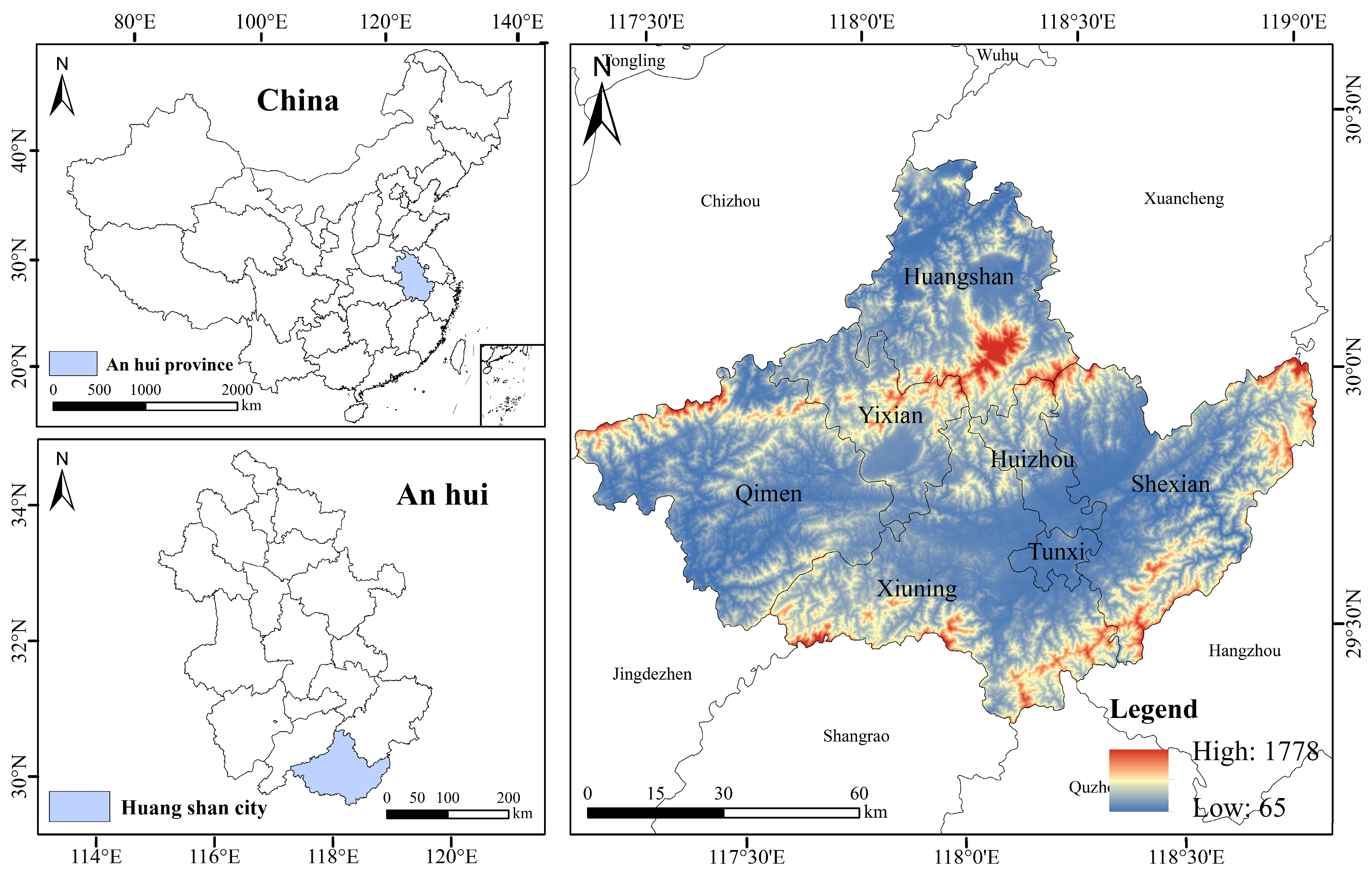
Situated in the southern part of Anhui Province, Huangshan City lies at the strategic junction of Anhui, Zhejiang, and Jiangxi provinces (117°12′–118°53′ E, 29°24′–30°31′ N). Covering a total land area of 9807 km2, the city administratively comprises three districts and four counties (Figure 1). Characterized by a topography predominantly consisting of mountains and hills, the region experiences a subtropical monsoon humid climate with abundant precipitation and distinct seasonal patterns [39]. As a prominent member of the Hangzhou Metropolitan Circle, Huangshan City serves as the core pivot city of the Southern Anhui International Tourism and Culture Demonstration Zone and is designated as a National Cultural and Ecological Protection Zone [40,41,42]. The region is home to world-class heritage sites, including the Huangshan Scenic Area (a dual UNESCO World Cultural and Natural Heritage site) and the ancient villages of Xidi and Hongcun. These sites uniquely integrate natural wonders with the profound heritage of Hui culture. This dual-heritage configuration, unique among prefecture-level cities in China, provides a substantial material foundation and brand support for establishing Huangshan as a modern international tourism city [43,44]. Consequently, this study selects Huangshan City as the study area not only because it is one of China’s most representative tourism destinations but also because it confronts critical scientific issues, including the trade-off between world heritage conservation and development, the environmental implications of tourism-driven urbanization, and the inheritance and innovation of Hui culture. Investigating Huangshan City will offer valuable insights and serve as a significant reference for the sustainable development of similar regions.

2.2. Data Description

The multi-source datasets utilized in this study primarily encompass land use records, natural environmental factors, and socio-economic variables (Table 1). The land use data utilized in this study originates from the China 30 m resolution annual land cover product developed by the research team of Professors Yang Jie and Huang Xin at Wuhan University (https://zenodo.org/records/18180184, accessed on 1 July 2025). This product is built upon the Google Earth Engine (GEE) cloud computing platform, utilizing 335,709 Landsat series images (Landsat5 TM, Landsat7 ETM+, Landsat8 OLI) provided by the platform, all with a spatial resolution of 30 m. Annual land cover maps are generated using a random forest classifier and spatio-temporal filtering techniques, with accuracy assessed through independent validation samples. The overall accuracy of this product is 80% [45]. This dataset provides reliable data support for long-term land use change analysis.
Among the natural factor data and socioeconomic data, the DEM originates from the Geospatial Data Cloud (https://www.gscloud.cn/, accessed on 1 July 2025). Elevation information is extracted through processes such as stitching and cropping. Slope and aspect are derived from the Digital Elevation Model (DEM) using ArcGIS surface analysis tools. The Normalized Difference Vegetation Index (NDVI) was sourced from the Geospatial Data Cloud (https://www.gscloud.cn/, accessed on 1 July 2025), extracted from Landsat 8 imagery. After radiometric calibration and atmospheric correction, it was calculated using band operations. Soil type data originated from the Chinese Academy of Sciences Resource and Environment Data Center (https://www.resdc.cn/, accessed on 1 July 2025), and was rasterized and resampled to 30 m resolution. Annual mean temperature and precipitation data were downloaded in 1 km grid format from the Chinese Academy of Sciences Resource and Environment Data Center (https://www.resdc.cn/, accessed on 1 July 2025) and cropped to the study area boundary; distance to urban centers was calculated using the Euclidean Distance tool to determine the distance from each grid cell to the nearest urban land use patch, extracted from 2012 and 2022 land use data; nighttime light data were sourced from the VIIRS Nighttime Lights dataset (https://eogdata.mines.edu/products/vnl/, accessed on 1 July 2025), reprojected and resampled to 500 m resolution, and masked to the study area boundaries; and population data (https://hub.worldpop.org/, accessed on 1 July 2025) and GDP data (https://www.resdc.cn/, accessed on 1 July 2025) were similarly reprojected, resampled to the target resolution, and then clipped. All drivers were unified into a common coordinate system and resampled to 30 m spatial resolution to ensure pixel-to-pixel correspondence in subsequent analyses.
In accordance with the Chinese National Standard for Current Land Use Classification (GB/T 21010-2017) [46], the land use types within the study area were uniformly reclassified into six primary categories: cropland, forest land, grassland, water bodies, construction land, and unutilized land. To ensure spatial consistency for subsequent analyses, all spatial datasets were standardized to the WGS-1984-UTM-Zone-50N projection coordinate system and resampled to a uniform spatial resolution of 30 m × 30 m.

2.3. Methods

2.3.1. Land Use Dynamic Degree

The land use dynamic degree (LUDD) serves as a critical indicator for characterizing the magnitude and rate of variations in different land use types within a specific spatiotemporal scope [47].
The single land use dynamic degree (k) is employed to reflect the quantity change in a specific land use category within the study area over a given period, enabling a quantitative description of the rate of land use evolution [48,49,50]. The calculation formula is expressed as follows:
K = U b U a U a × 1 T × 100 %
In the formula, (K) represents the single land use dynamic degree, indicating the annual change rate of a specific land use type; Ua and Ub denote the area of the land use type at the beginning and the end of the study period, respectively; and T signifies the duration of the research period (in years).
The comprehensive land use dynamic degree (LC) captures the overall quantity changes in all land use types within the study area, thereby reflecting the intensity of regional land use transformation [51,52]. It is calculated using the following equation:
L C = i = 1 n L U i j 2 i = 1 n L U i × 1 T × 100 %
In the formula, LC represents the comprehensive land use dynamic degree; LUi is the area of the i-th land use type at the beginning of the study period; LUij denotes the absolute value of the area converted from the i-th land use type to the j-th land use type during the study period; and T represents the time interval (in years).

2.3.2. Land Use Transfer Matrix

The land use transition matrix is utilized to quantitatively characterize the transfer directions and area changes among different land use types within the study area over a specific period, presented in a standard matrix format [49,53,54,55]. The calculation formula is expressed as follows:
S i j = S 11 S 1 m S m 1 S m m
In the formula, Sij represents the area converted from the i-th land use type to the j-th land use type; m denotes the total number of land use categories within the study area; and within the matrix, the rows signify the land use types at the initial stage of the study period, while the columns correspond to the land use types at the final stage.

2.3.3. Landscape Pattern Index

Landscape pattern indices, serving as quantitative indicators that highly condense landscape pattern information, effectively characterize attributes such as landscape quantity, shape, fragmentation, and diversity, thereby reflecting the structural composition and spatial configuration of ecosystems [56,57,58]. Landscape pattern indices are typically categorized into three levels based on their characterization scale: patch-level indices, type-level indices, and landscape-level indices. These indices exhibit intrinsic interconnections and information overlap across levels. Therefore, practical applications require both the integrated use of multi-scale indices and the targeted selection of key indicators reflecting landscape heterogeneity to ensure comprehensive and representative analytical outcomes. Drawing upon existing research [59,60,61] and the computational methods and ecological significance of various landscape indices [52], this study employs land use type data and integrates spatial analysis tools such as ArcGIS 10.8 (Environmental Systems Research Institute, Inc., Redlands, CA, USA) and landscape pattern analysis software like Fragstats FRAGSTATS 4.2 (University of Massachusetts, Amherst, MA, USA) to conduct a systematic quantitative analysis of the landscape pattern in Huangshan City. This approach aims to reveal its spatial structural characteristics and ecological implications.
(1)
At the class level: Six indices were selected, including Percentage of Landscape (PLAND), Edge Density (ED), Number of Patches (NP), Patch Density (PD), Largest Patch Index (LPI), and Landscape Shape Index (LSI). Calculating these class-level indices enables the characterization of landscape fragmentation, dominance, and shape complexity within Huangshan City.
(2)
At the landscape level: Eight indices were selected, comprising Contagion Index (CONTAG), Shannon’s Evenness Index (SHEI), Shannon’s Diversity Index (SHDI), Patch Density (PD), Largest Patch Index (LPI), Landscape Shape Index (LSI), Aggregation Index (AI), and Edge Density (ED). These indices were employed to characterize the diversity, aggregation connectivity, and fragmentation degree of the overall landscape. Detailed descriptions of the selected landscape indices are presented in Table 2.

2.3.4. Moving Window Method

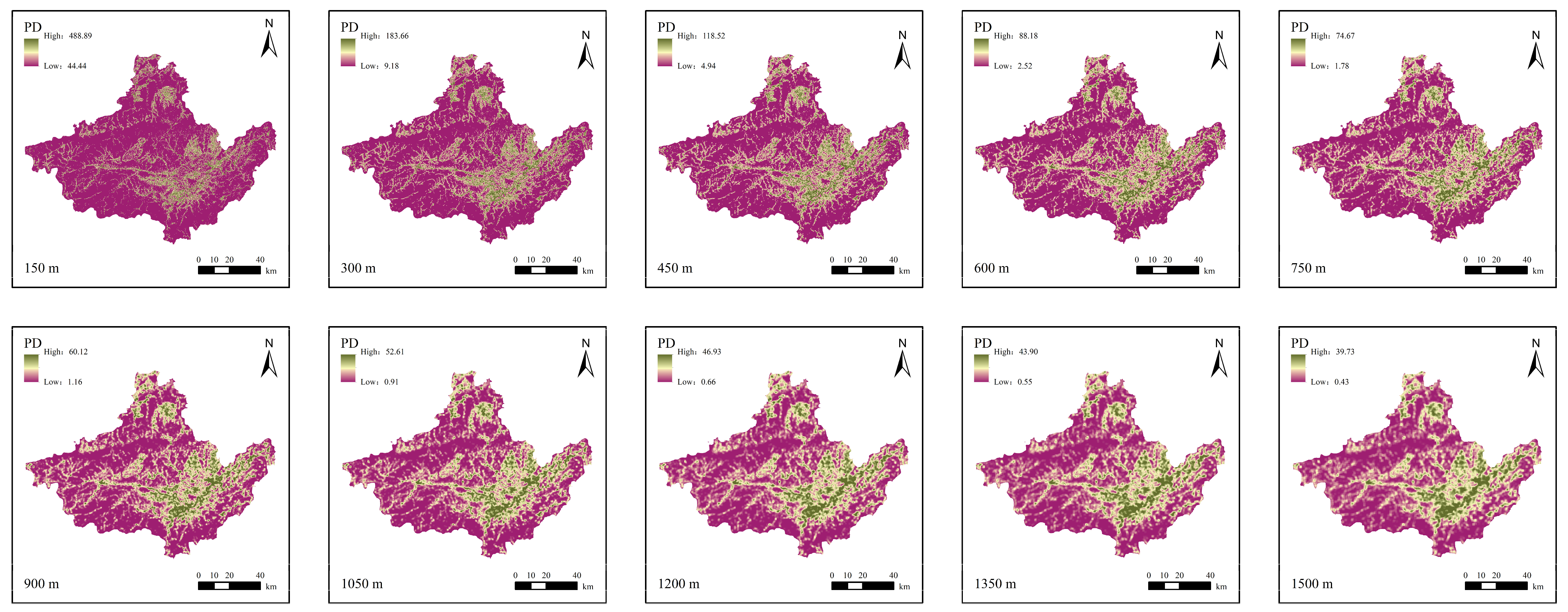
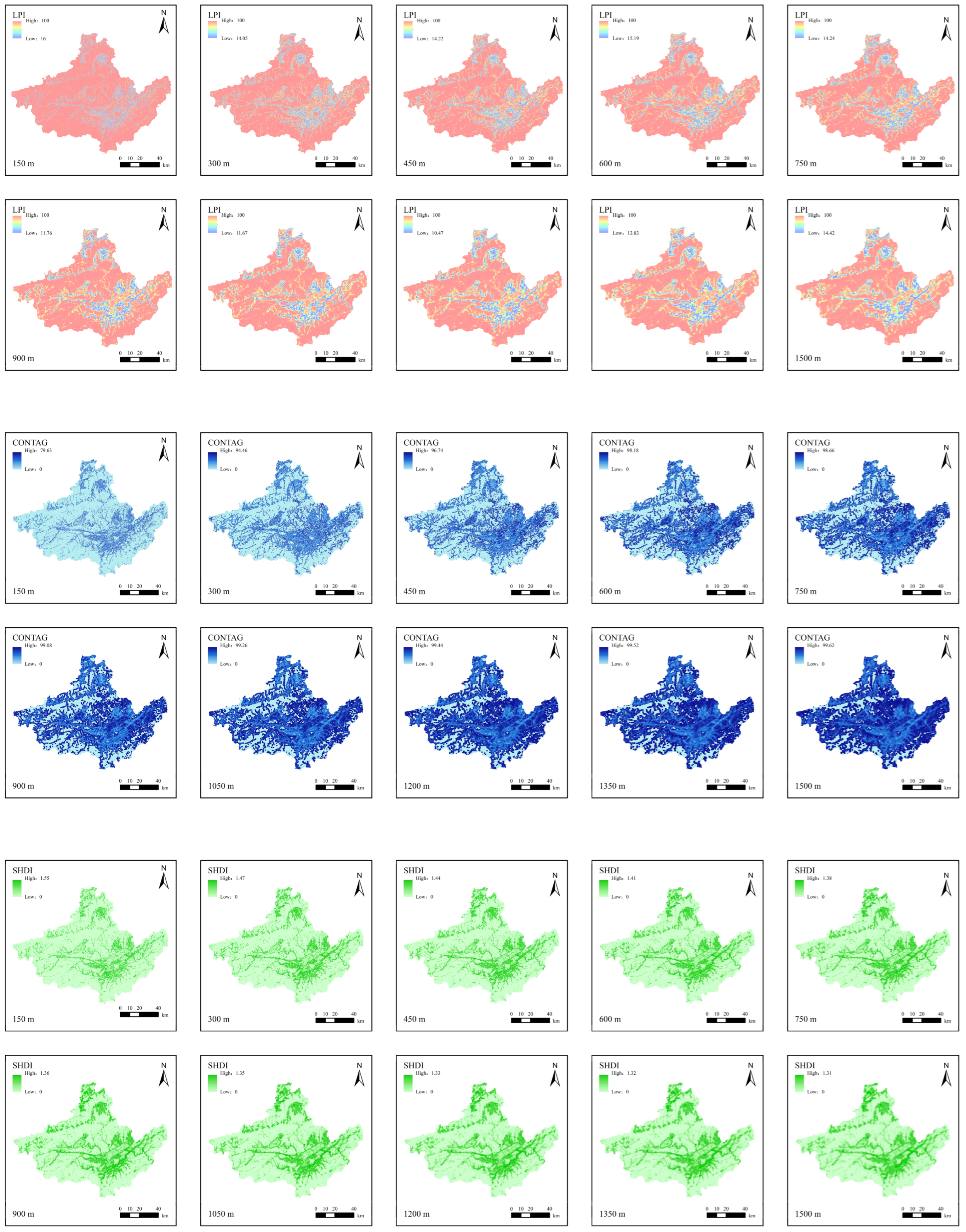
This study aims to examine the spatial evolution characteristics of Huangshan City’s landscape pattern from perspectives including landscape fragmentation, dominance, and diversity. Specifically, the research employs patch density (PD), maximum patch index (LPI), contiguity index (CONTAG), and Shannon diversity index (SHDI). Based on the land use data from 1992, the moving window method within FRAGSTATS 4.2 software was employed to generate landscape index raster maps at varying scales. Specifically, the window radii were set as integer multiples of the 30 m pixel size (i.e., 150 m, 300 m, 450 m, 600 m, 750 m, 900 m, 1150 m, 1200 m, 1350 m, and 1500 m) (Figure 2).
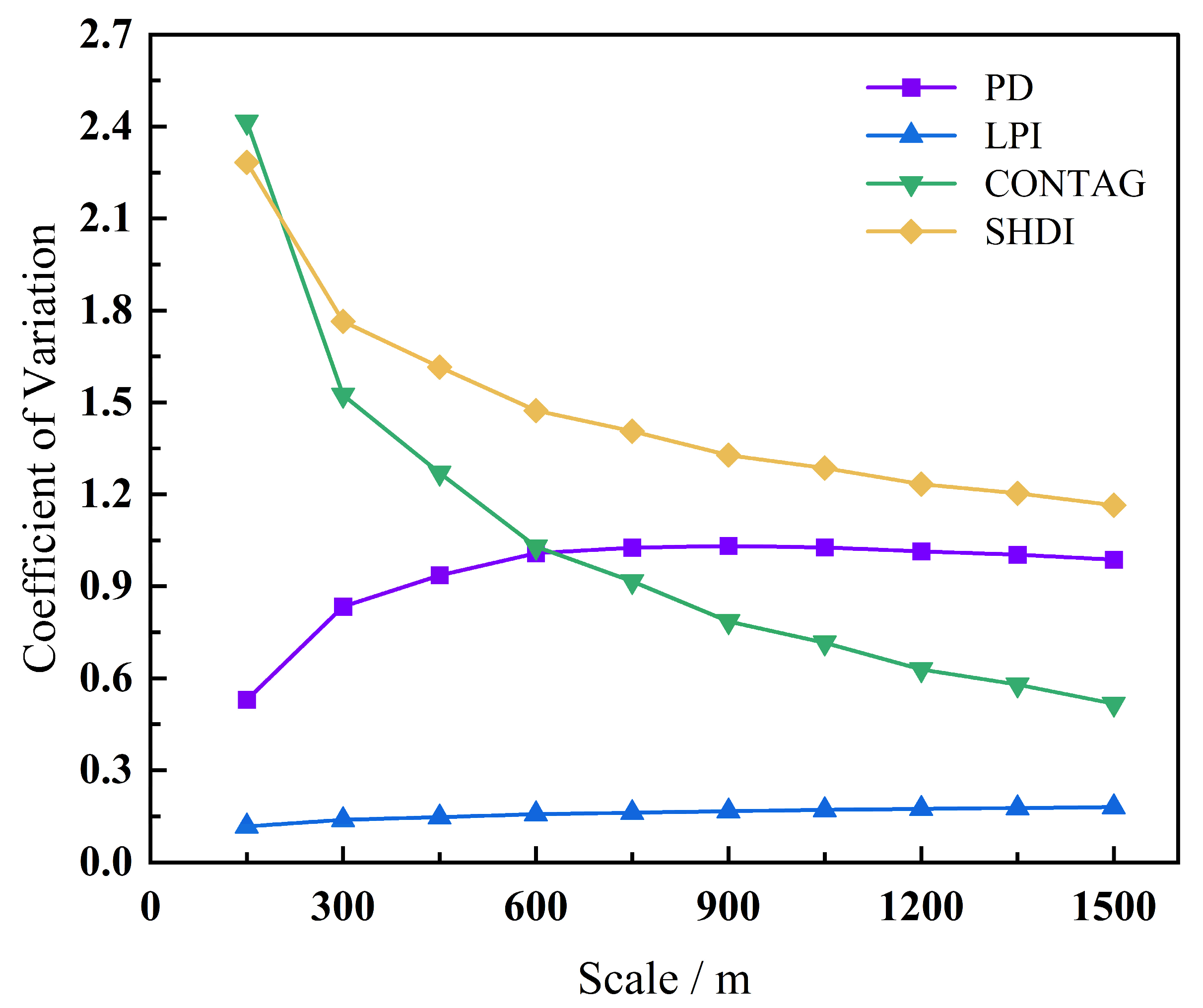
The selection of the moving window scale is pivotal. An excessively small scale tends to allow local landscape features to dominate, thereby obscuring global characteristics and resulting in a lack of spatial continuity in the generated images. Conversely, an excessively large scale is prone to the loss of detailed information, leading to image over-smoothing or blurring. Consequently, it is essential to strike a balance between retaining local details and maintaining overall spatial continuity [62]. In this study, the optimal moving window size for the research area was determined via the Coefficient of Variation (CV) analysis [63]. It is worth noting that the CV serves solely as a metric for data analysis and does not imply statistical significance in this context.

2.3.5. Geophysical Detector Model

The Geographical Detector (Geodetector), developed by Wang et al. [35], represents a statistical toolset designed to reveal spatial heterogeneity, identify influencing factors, and explore interactions among variables. It comprises four distinct modules: the factor detector, interaction detector, risk detector, and ecological detector. In this study, the factor detector and interaction detector modules were specifically employed to investigate the driving factors underlying the landscape indices in Huangshan City, as well as the interactive effects among these factors. The calculation formula is expressed as follows:
q = 1 h = 1 L N h σ h 2 N h σ 2
In the formula, h = 1, …, L represents the stratification of variable Y or factor X; Nh and N denote the number of units in layer h and the entire region, respectively; and σ h 2 and σ 2 represent the variances of the Y values in layer h and the entire region, respectively. The value of q ranges from [0, 1]. A value of q indicates that factor X explains 100 × q% of the spatial variance of Y. A larger q value signifies a stronger explanatory power of factor X on Y, and vice versa.
In accordance with the data requirements of the Geodetector, the independent variable (X) must be discretized (categorical), whereas the dependent variable (Y) can be continuous. Consequently, this study performed a discretization transformation on the landscape indices and 11 driving factors of Huangshan City for the years 2012 and 2022. The specific operational procedures were as follows: Initially, the “Create Fishnet” tool in ArcGIS 10.8 was utilized to generate grid points covering Huangshan City. Subsequently, these grid points were clipped using the city’s boundary layer, resulting in 415 valid sampling points after excluding invalid data. Thereafter, the “Extract Multi Values to Points” function was employed to extract the landscape index values and the 11 driving factors for 2012 and 2022 to the sampling points. Finally, to ensure the proper functioning of the Geodetector model, the K-means clustering algorithm in SPSS 29.0 (IBM Corp., Armonk, NY, USA) software was applied to the extracted independent variables to classify all samples into five distinct categories.

3. Results

3.1. Land Use Change Analysis

3.1.1. Land Use Area Change and Dynamics

Table 3 shows the changes in the area of different land use types in Huangshan City between 1992 and 2022. Throughout the study period, forest land consistently constituted over 87% of the total area, dominating the regional land use structure. Meanwhile, cropland showed an overall downward trend, shrinking from 1091.07 km2 in 1992 to 925.88 km2 in 2022, and its proportion of the total area decreased from 11.22% to 9.59%. Forest land showed a fluctuating trend, remaining relatively stable overall despite a slight quantitative decrease. Similarly, grassland experienced continuous annual decline, with its proportion dropping from 0.05% to 0.02%, representing a total reduction of 2.62 km2. Conversely, Built-up Land expanded continuously over the three decades, growing from 49.640 km2 to 152.366 km2. Its proportion of the total area increased from 0.510% to 1.579%, reflecting pronounced urban expansion. Additionally, unused land showed no significant changes. Overall, from 1992 to 2022, Huangshan City’s land use pattern was characterised by the predominance of forest land, alongside a trajectory of reducing cropland and grassland and significant Built-up Land expansion.
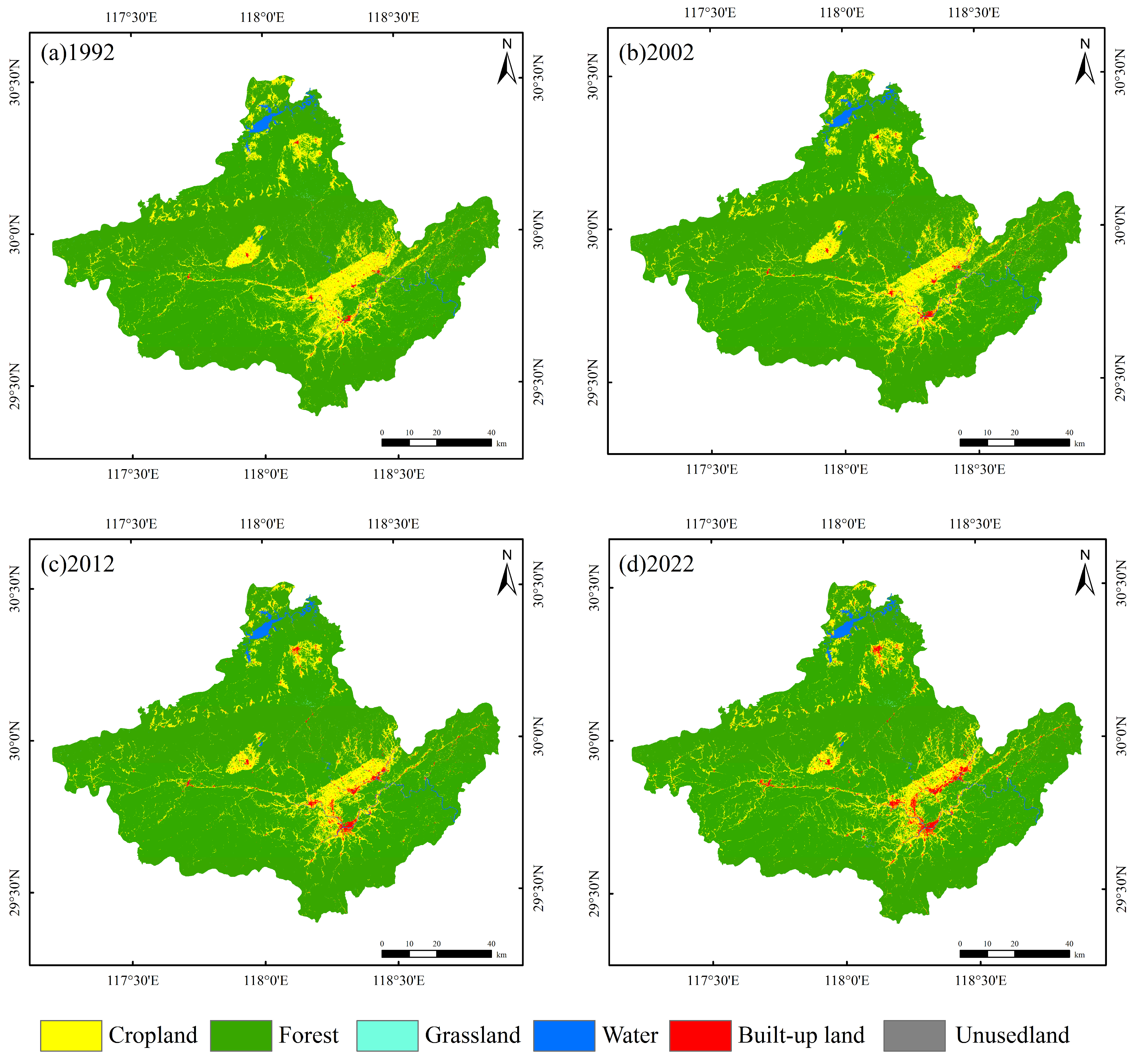
Figure 3 shows how land use has been distributed across Huangshan City from 1992 to 2022. Alongside the quantitative statistics on land use area, it is clear that forest land is the most prevalent land use category in Huangshan City. It is widely distributed across Huangshan District, Huizhou District, the south of Xiuning County, Qimen County and the northwest of She County. Cropland is mainly concentrated in Xiuning County, She County and Yi County, whereas grassland is distributed sporadically across various districts and counties. Water bodies are primarily located in Huangshan District and She County. Built-up Land has continuously expanded due to rapid urbanisation, exhibiting a concentration in Huangshan District and a radiating expansion trend from the centre of Tunxi District towards peripheral county towns. unused land accounts for a minimal proportion of the total area and shows no significant trend variations. Overall, the spatial distribution patterns of the various land use types reflect the trends in area changes, characterised by the dominance of forest land, the relative concentration of cropland and the gradual expansion of Built-up Land.
Table 4 presents the dynamic degrees of various land use types in Huangshan City across three periods from 1992 to 2022. The single land use dynamic degree serves as an indicator to quantify the rate and direction of area change for a specific land use type. A larger absolute value indicates a more drastic magnitude of change, while positive and negative values denote area expansion and contraction, respectively [64]. The comprehensive land use dynamic degree reflects the overall intensity of regional land use change; a higher value suggests more frequent transitions among land types and stronger anthropogenic or natural driving forces, whereas a lower value indicates a more stable land use structure [65]. Regarding the single dynamic degree, between 1992 and 2002, grassland and unused land exhibited negative values with large magnitudes, indicating a significant reduction and drastic change in their areas during this period. From 2002 to 2012, the single dynamic degrees for forest land, water bodies, and Built-up Land were positive and surpassed those of the preceding and subsequent periods, reflecting their rapid expansion during this phase. Conversely, although cropland recorded the highest dynamic degree magnitude during the same period, its negative value indicates a rapid area contraction. In terms of the comprehensive land use dynamic degree, the values for the 1992–2002, 2002–2012, and 2012–2022 periods remained below 0.3%, recorded at 0.046%, 0.214%, and 0.156%, respectively. Notably, the low value observed between 1992 and 2002 suggests relatively slow land use changes and limited anthropogenic intensity. The higher value during 2002–2012 indicates more active land use transitions, while the subsequent decline in the 2012–2022 period reflects a trend toward stabilization in the land use structure of Huangshan City.

3.1.2. Land Use Transition Matrix Analysis

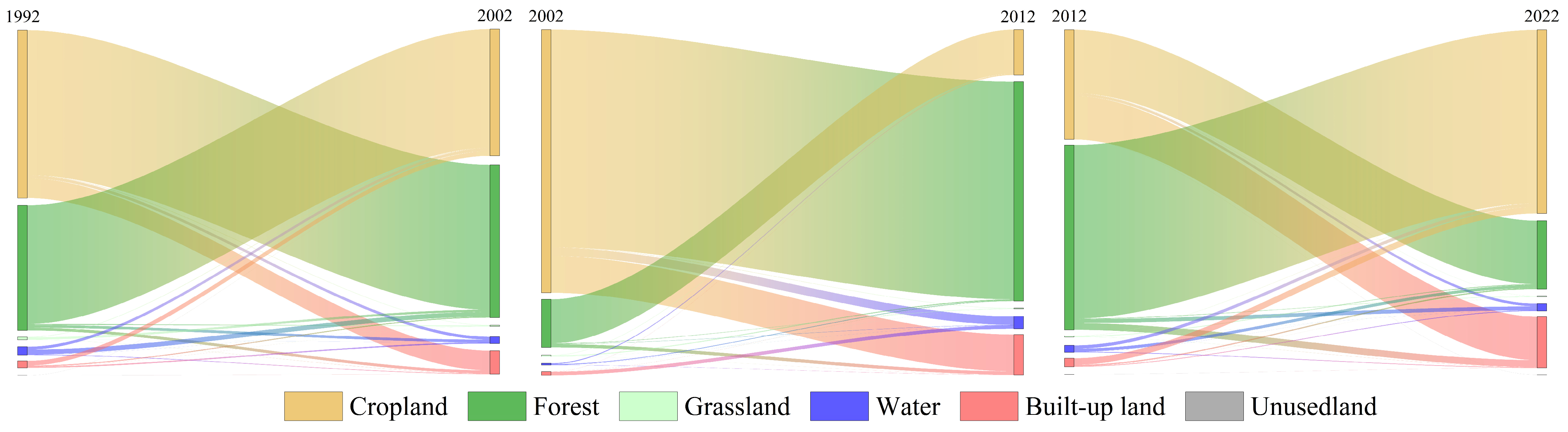
Figure 4 illustrates the land use transition dynamics in Huangshan City across different study periods, revealing significant shifts in transfer characteristics from 1992 to 2022. During the period from 1992 to 2012, the transfer-in area of cropland was smaller than its transfer-out area, with the primary outflow directed towards forest land. Concurrently, forest land recorded the largest transfer-in area, derived predominantly from cropland. Additionally, both Built-up Land and water bodies exhibited transfer-in areas exceeding their respective transfer-out areas. Specifically, the expansion of Built-up Land originated mainly from cropland and forest land, while water bodies were primarily converted from cropland, forest land, and Built-up Land. During this interval, grassland and unused land remained relatively stable. From 2012 to 2022, a distinct shift occurred in the land use transition pattern: cropland became the category with the largest transfer-in area, primarily sourced from forest land. Correspondingly, forest land experienced the largest transfer-out area, being predominantly converted into cropland. Built-up Land and water bodies continued to maintain a trend where inflow exceeded outflow during this period. Overall, the reciprocal conversion between cropland and forest land constituted the primary characteristic of land use change, reflecting a state of dynamic equilibrium in the land use of Huangshan City.

3.2. Landscape Pattern Index Analysis

3.2.1. Landscape Index Correlation Analysis

Based on Pearson correlation analysis in SPSS, correlation analyses were conducted for landscape indices at both the class level and landscape level in Huangshan City. As shown in Table 5 (Class Level Landscape Index Correlation Matrix), the Patch Percentage Index (PLAND) exhibited a highly significant positive correlation with the Largest Patch Index (LPI), indicating that both indices provide highly similar information regarding patch dominance. Patch number (NP) and patch density (PD) showed a perfect positive correlation, both representing fragmentation characteristics; Landscape Shape Index (LSI) exhibited extremely significant positive correlations with both NP and PD, revealing that fragmentation processes are accompanied by increased shape complexity; and edge density (ED) showed moderate correlations with other indicators. As shown in Table 6, the Landscape Level Correlation Matrix, Landscape Shape Index (LSI), Aggregation Index (AI), Landscape Shape Index (LSI), and Edge Density (ED) exhibit extremely significant high correlations, collectively reflecting landscape aggregation and dominant patch size dimensions. Among these, the Largest Patch Index (LPI) positively correlates with the Aggregation Index (AI), and both are completely negatively correlated with the Landscape Shape Index (LSI) and Edge Density (ED); The Contagion Index (CONTAG), Shannon Diversity Index (SHDI), and Shannon Evenness Index (SHEI) exhibit extremely significant high correlations, characterizing landscape diversity and the dimension of contiguity. The Shannon Diversity Index (SHDI) is completely positively correlated with the Shannon Evenness Index (SHEI), and both indices are highly negatively correlated with the Contagion Index (CONTAG). PD shows weaker correlations with other indicators, independently representing the degree of fragmentation.
Based on the analysis results, at the type level, the largest patch index (LPI) redundant with the patch percentage index (PLAND) and the patch density (PD) redundant with the number of patches (NP) were removed. Meanwhile, the landscape shape index (LSI) representing the shape dimension was retained. Ultimately, four indicators were selected: the largest patch index (LPI), the landscape shape index (LSI), and the edge density (ED). This combination characterizes landscape patterns at the class level across four dimensions: dominance (PLAND), fragmentation (NP), shape complexity (LSI), and edge effects (ED). The indicators exhibit no high collinearity, enabling independent and comprehensive reflection of structural characteristics across Huangshan’s landscape types. At the landscape level, from the highly correlated group, the Maximum Patch Index (LPI) was retained to represent dominance, the Shannon Diversity Index (SHDI) was retained to represent diversity, and the independent Patch Density (PD) was retained to represent fragmentation. Considering both indicator representativeness and ecological significance, the final selection comprised Patch Density (PD), Maximum Patch Index (LPI), spread index (CONTAG), and Shannon Diversity Index (SHDI) were selected to characterize the diversity, dominance, connectivity, and fragmentation of Huangshan City’s landscape at the landscape level.

3.2.2. Determining the Optimal Research Scale

As illustrated in Figure 5, with the enlargement of the moving window scale, the Contagion Index (CONTAG) and Shannon Diversity Index (SHDI) values for Huangshan City both show a continuous downward trend. Notably, the range of 150–600 m represented a phase of sharp decline, with the reduction in CONTAG being the most pronounced; beyond 600 m, the declining trend began to decelerate. Conversely, Patch Density (PD) values demonstrated a positive correlation with the moving window scale, increasing significantly between 150 and 600 m before the growth trend moderated from 600 m onwards. As shown in Figure 2, the Largest Patch Index (LPI) at the 150–450 m granularity appeared relatively small in scale, lacking coherence and significant magnitude of variation. Furthermore, from 750 to 1500 m, the visualization results proved suboptimal, leading to a substantial loss of spatial information. Consequently, given that the variations in the four landscape metrics tended to stabilize beyond the 600 m scale, this study selected 600 m as the optimal research scale for generating spatial distribution maps of landscape metrics.

3.2.3. Level Index Changes in Plaque Types

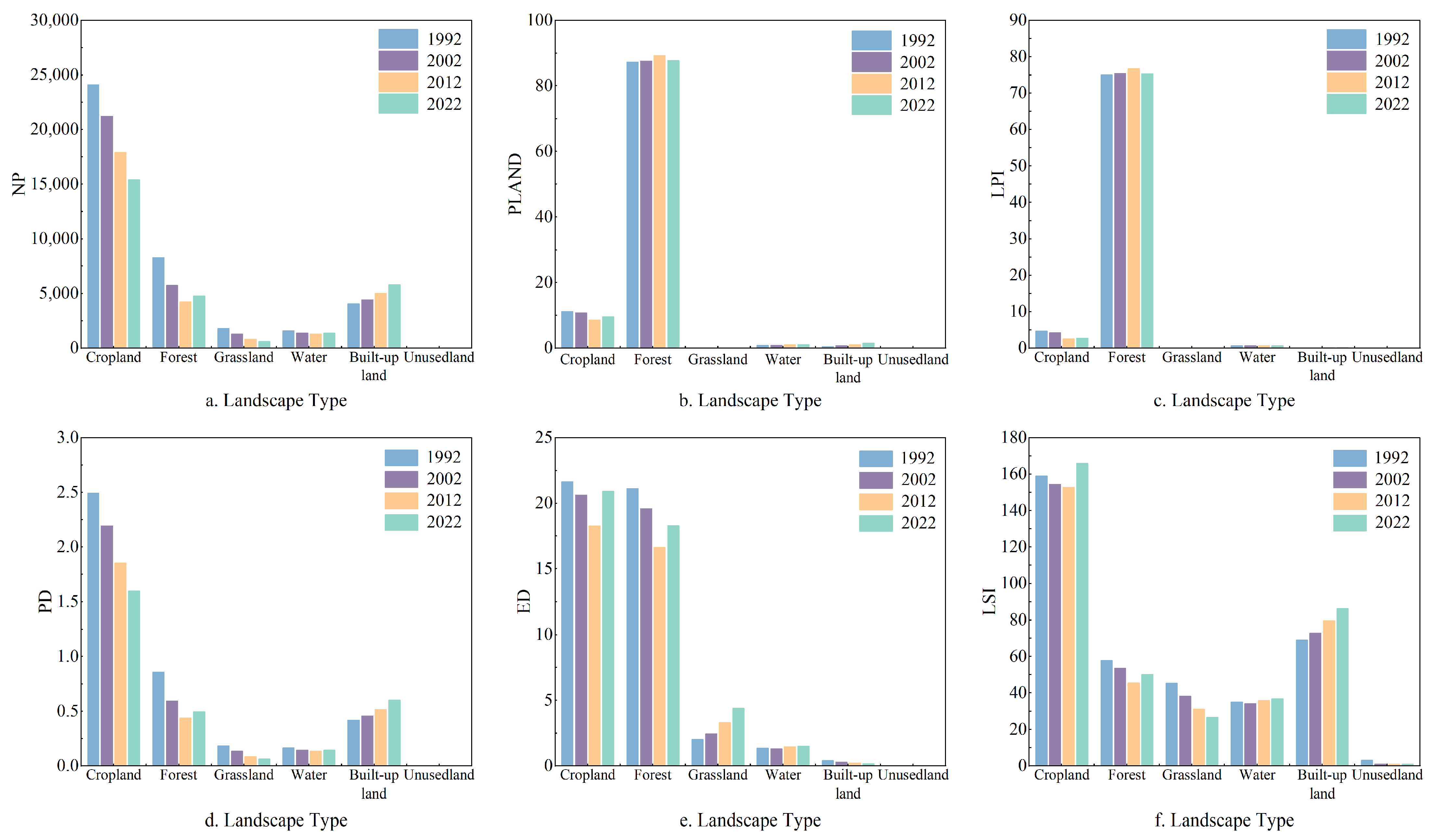
Figure 6 illustrates the landscape pattern indices at the class level for Huangshan City from 1992 to 2022. Throughout the study period, forest land exhibited the highest Percentage of Landscape (PLAND), indicating that it constituted the dominant landscape type in the region. Both the Number of Patches (NP) and Patch Density (PD) of cropland demonstrated a declining trend, implying a mitigation in the fragmentation degree of cropland. Similarly, forest land consistently maintained the highest Largest Patch Index (LPI), further confirming its status as the predominant patch type between 1992 and 2022. The Landscape Shape Index (LSI) showed the most pronounced variations in grassland and Built-up Land; specifically, grassland displayed a downward trend while Built-up Land exhibited an upward trend. This suggests a decrease in the shape irregularity of grassland, whereas the irregularity of Built-up Land intensified. Additionally, the Edge Density (ED) of grassland presented an increasing trend from 1992 to 2022, signifying an enhanced degree of segmentation by boundaries. In contrast, water bodies showed minimal overall fluctuations, and unused land remained largely unchanged.
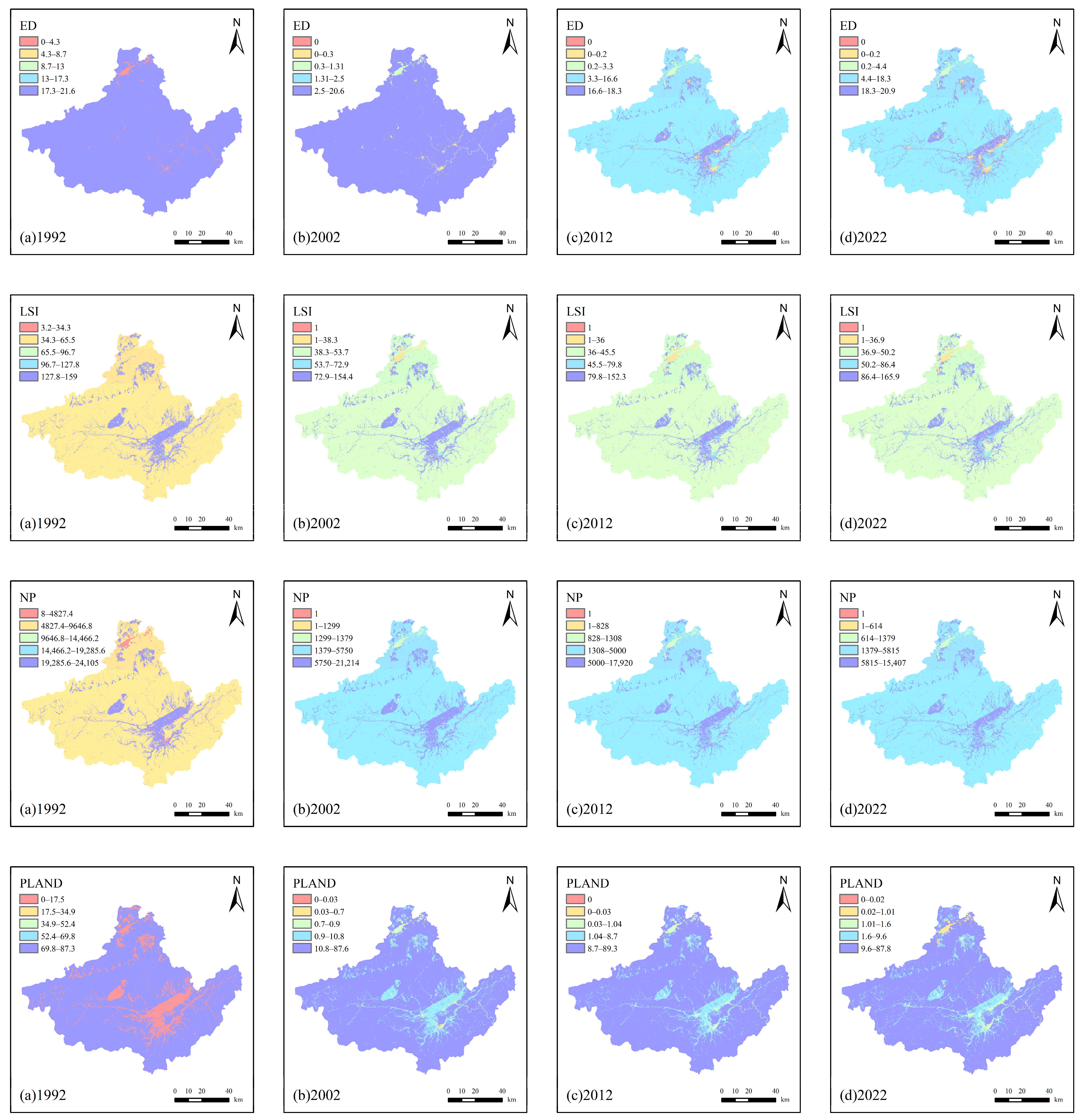
As shown in Figure 7, the spatial distribution of land cover types reveals that high values of the Patch Land Use Distribution Index (PLAND) consistently cluster in deeply forested areas such as Qimen County, Huangshan District, and southern Xiuning County. This indicates that forested land remains the dominant landscape type in the region. However, since 2002, the extent of high-value areas has progressively retreated toward the core mountain ranges. Low values of the Patch Land Use Distribution Index (PLAND) have continuously expanded in Tunxi District, Huizhou District, and along major transportation corridors, reflecting the encroachment of construction land onto forested areas. Conversely, areas with high Patch Land Use Distribution Index (PLAND) values have predominantly been concentrated in 1992 in the southern parts of Qimen County, Huangshan District, and Xiuning County. Huizhou District, and along major transportation corridors, reflecting the encroachment of construction land onto forested areas. High values for the number of patches (NP) were primarily distributed in hilly areas of southern She County and eastern Xiuning County in 1992. By 2022, the center of fragmentation had shifted toward the urban fringe, with NP values surging around Tunxi District and at the entrance to Huangshan Scenic Area. This indicates that tourism development and urban expansion have intensified landscape fragmentation. In 1992, high values for edge density (ED) and landscape shape index (LSI) were concentrated in Huangshan District, reflecting the complex morphology of natural forest land. After 2002, high-value areas shifted toward Shexian and Yixian counties. Regionally, Qimen County and Huangshan District functioned as ecologically stable zones, maintaining consistently high Patch Proportion Index (PLAND) values and low Patch Number (NP) values. However, the rise in Landscape Shape Index (LSI) around scenic areas warrants attention. Shexian and Xiuning counties, situated in the hilly transition zone, exhibit persistently high values for both Patch Number (NP) and Edge Density (ED), highlighting acute human-land conflicts. Tunxi and Huizhou districts, as core urbanization areas, show an increase in the proportion of constructed land within the Patch Proportion Index (PLAND), maintain a regular Landscape Shape Index (LSI), but experience a significant rise in Edge Density (ED). Yixian County, driven by dual-heritage tourism, exhibits a steep rise in the Landscape Shape Index (LSI), highlighting the tension between conservation and development. Overall, Huangshan City’s typological landscape pattern shows spatial differentiation characterized by “stable mountain areas, fragmented hills, and urbanized plains.” Future management should implement differentiated controls tailored to the dominant functions of each administrative district.

3.2.4. Landscape Level Index Change

Table 7 presents the landscape-level indices for Huangshan City from 1992 to 2022. Patch Density (PD) exhibited a continuous decline from 4.1196 to 2.9008, indicating a reduction in the number of patches and a general trend toward landscape simplification. The Largest Patch Index (LPI) fluctuated around 75%, with the value in 2022 being slightly lower than that in 1992, suggesting that the dominance of the largest patch remained relatively stable despite a marginal decline. The Landscape Shape Index (LSI) decreased from 59.3476 to 57.7852, reaching a minimum of 51.154 in 2012, which reflects a trend toward more regular patch shapes and reduced boundary complexity. The Contagion Index (CONTAG) experienced a slight decrease from 83.7261% to 83.3941%, indicating that while overall landscape connectivity remained high, the degree of patch aggregation weakened slightly. Both Shannon’s Diversity Index (SHDI) and Shannon’s Evenness Index (SHEI) showed upward trends, rising from 0.4374 to 0.4529 and from 0.2441 to 0.2528, respectively; this implies an increase in landscape diversity and a more even distribution of landscape types. The Aggregation Index (AI) consistently remained above 96.5%, reaching 96.578% in 2022, demonstrating that the degree of patch aggregation was maintained at a high level. Finally, Edge Density (ED) decreased from 23.2892 to 22.6555, reflecting a mitigation of edge effects within the landscape.
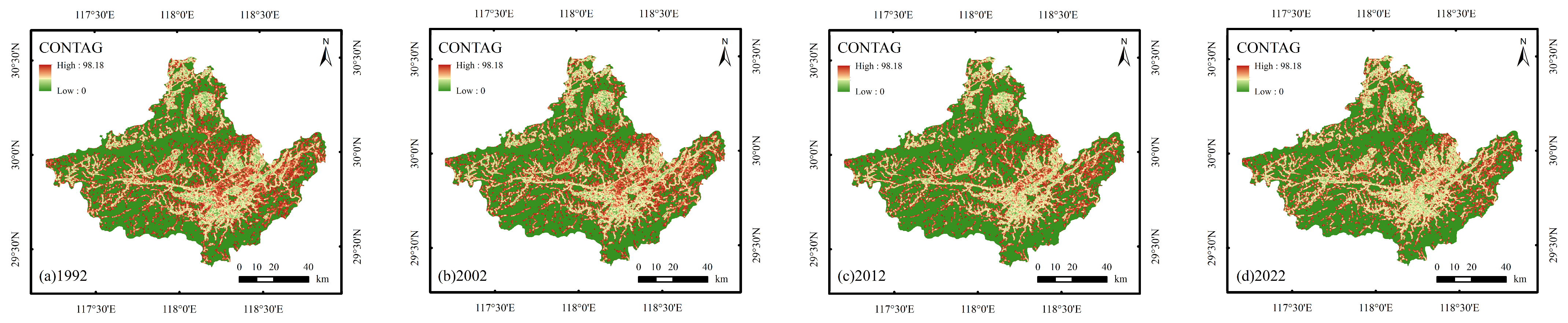
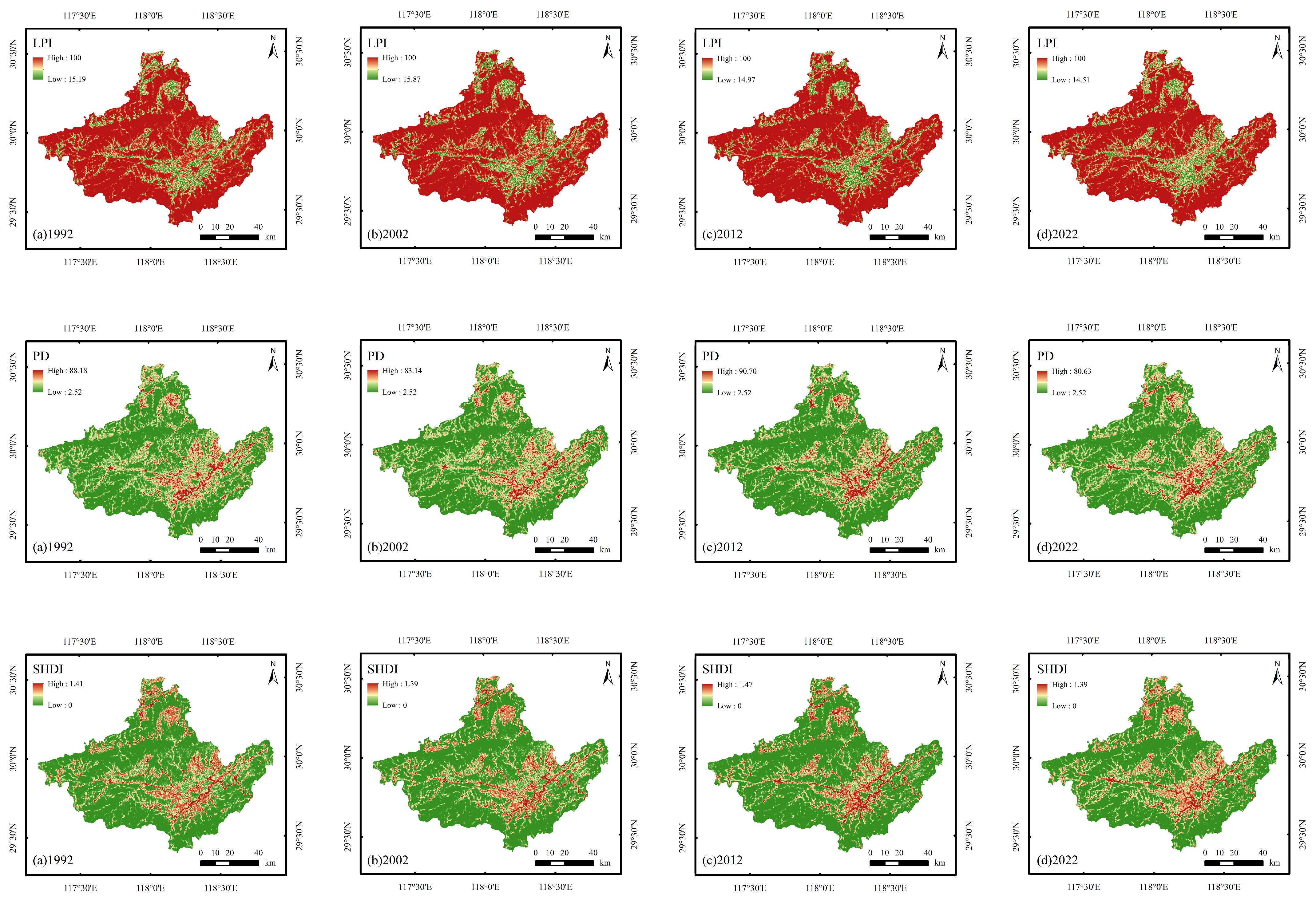
As depicted in Figure 8, regarding the spatial distribution, areas with high Patch Density (PD > 80) appeared in a flocculent pattern within cropland, forest land, and sparse grassland, signifying a high degree of landscape fragmentation. Conversely, low-value areas (PD ≈ 2.52) were predominantly located in contiguous forest land or concentrated cropland, indicating a relatively intact landscape. From 1992 to 2022, the peak PD value showed a fluctuating decline from 88.18 to 80.62, suggesting that the issue of landscape fragmentation persisted. Areas with high Largest Patch Index (LPI) values (approaching 100) were consistently concentrated in contiguous unused land and grassland, characterizing the presence of core patches with strong dominance. In contrast, low-value areas (approximately 14–16) were scattered across cropland and forest land, indicating a small scale of dominant patches. The low LPI values initially rose and then fell, reflecting fluctuations in the scale of local dominance. The Contagion Index (CONTAG) remained extremely high (approximately 98) and stable over the long term, implying that the landscape was dominated by a few highly aggregated landscape types with superior connectivity, resulting in strong pattern aggregation. High Shannon’s Diversity Index (SHDI) values (>1.4) were concentrated in the interlaced areas of cropland, forest land, and Built-up Land in the central region, indicating a rich diversity of landscape types. Between 1992 and 2022, the SHDI fluctuated between 1.39 and 1.47, peaking in 2012 before receding, which demonstrates a trend of increasing and then decreasing landscape diversity. Overall, while the general landscape distribution in Huangshan City was relatively even, the local fluctuations in diversity reflect the sustained influence of anthropogenic activities on the landscape structure.

3.3. Analysis of Driving Forces Behind Changes in Landscape Index

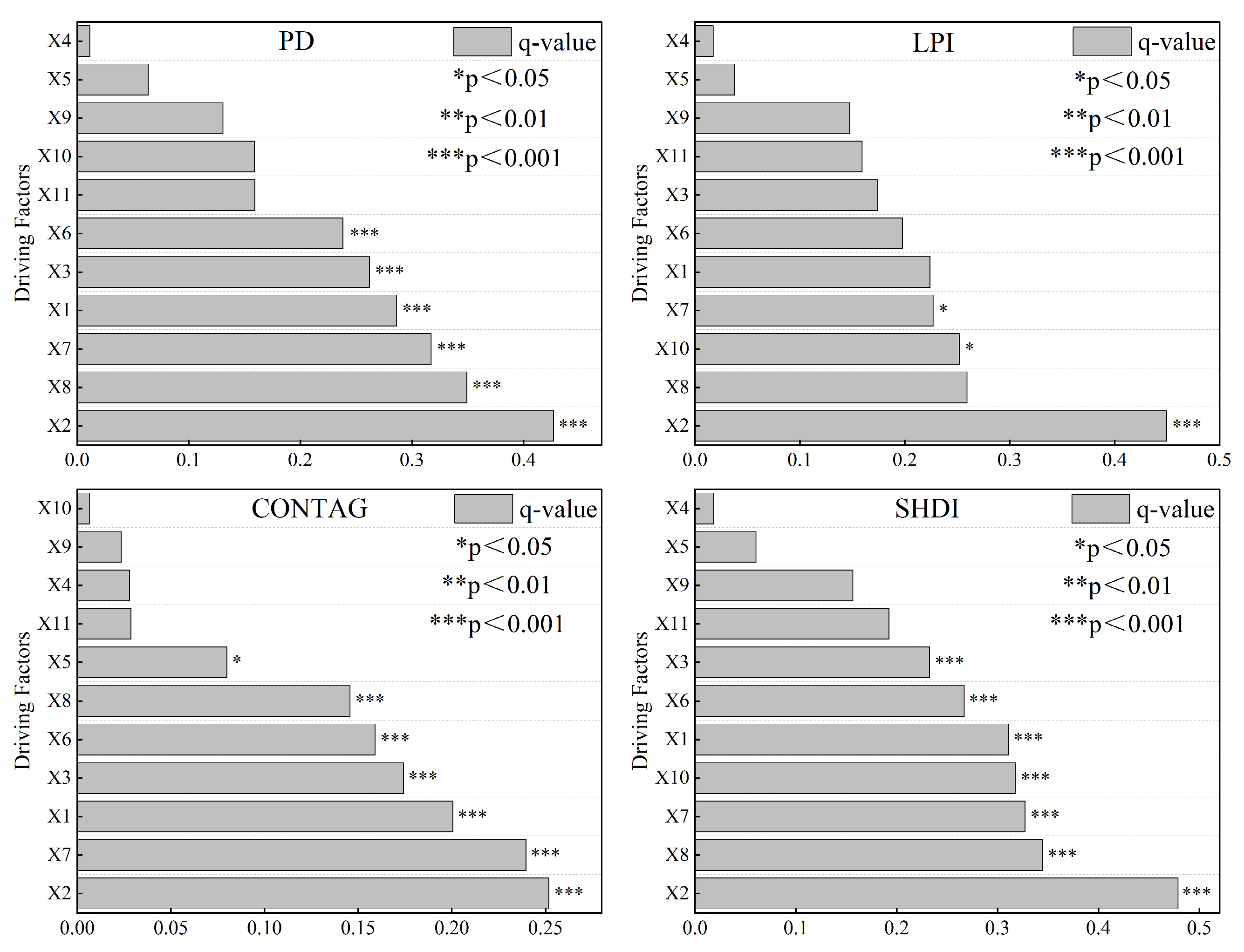
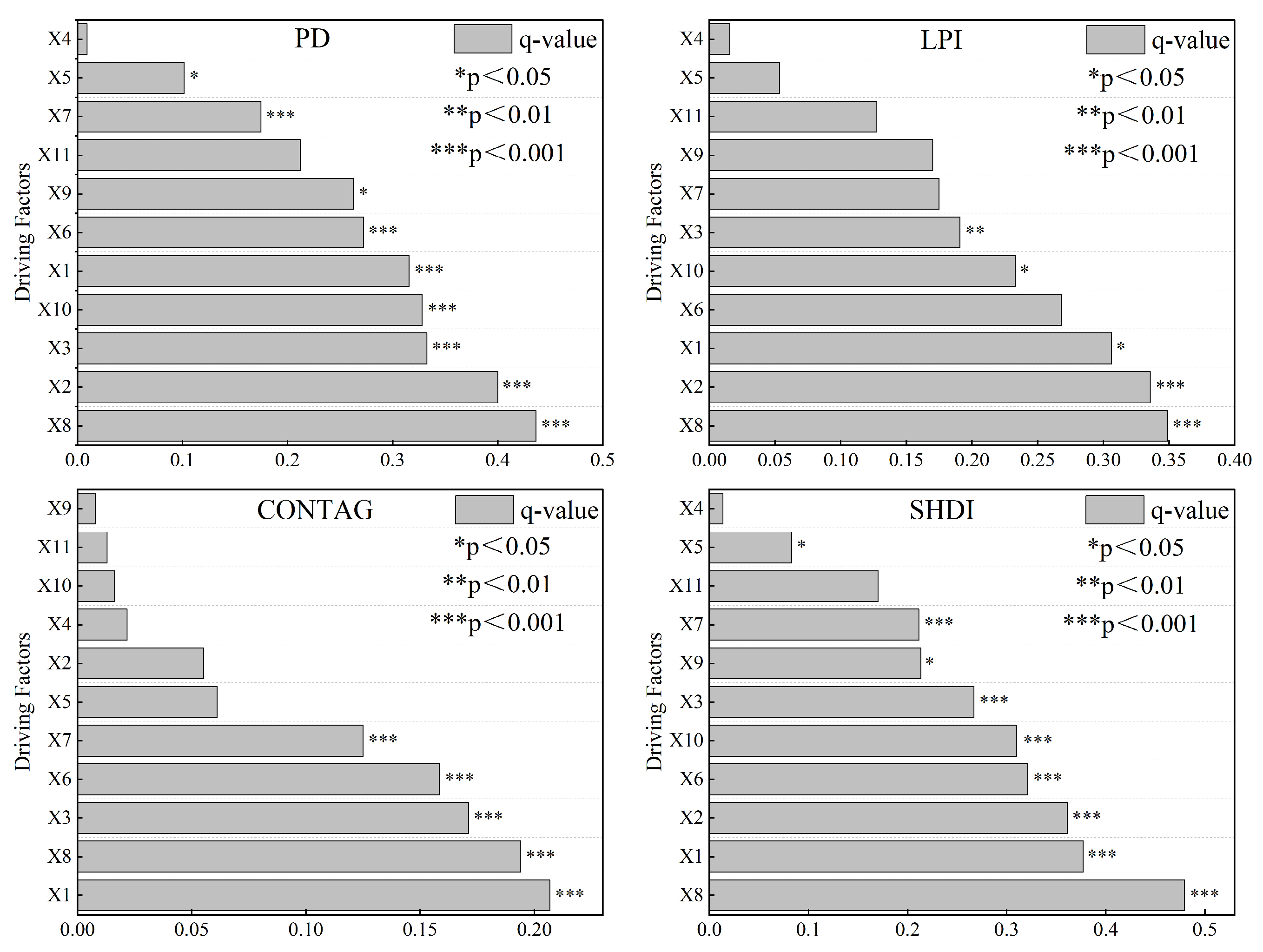
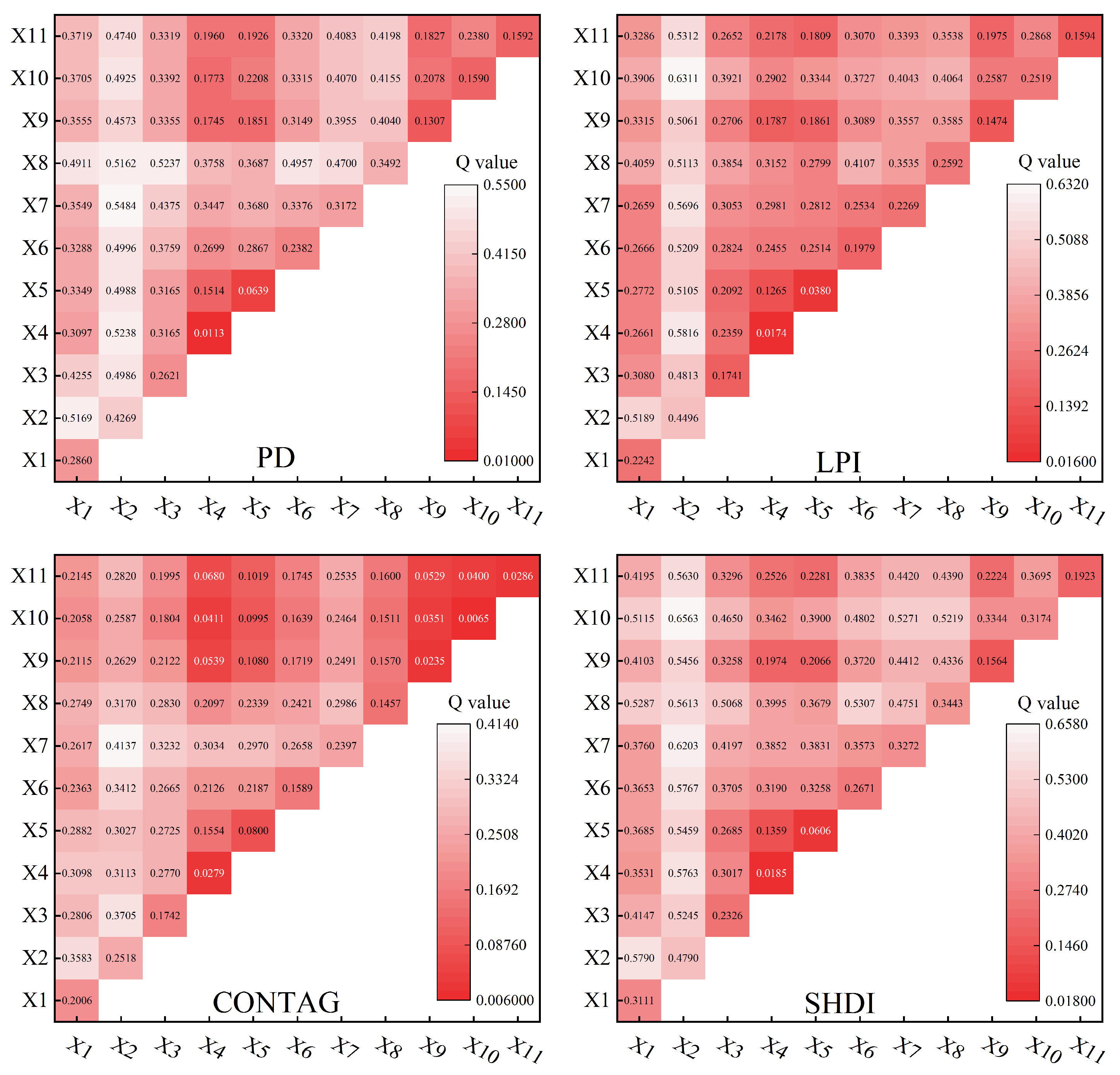
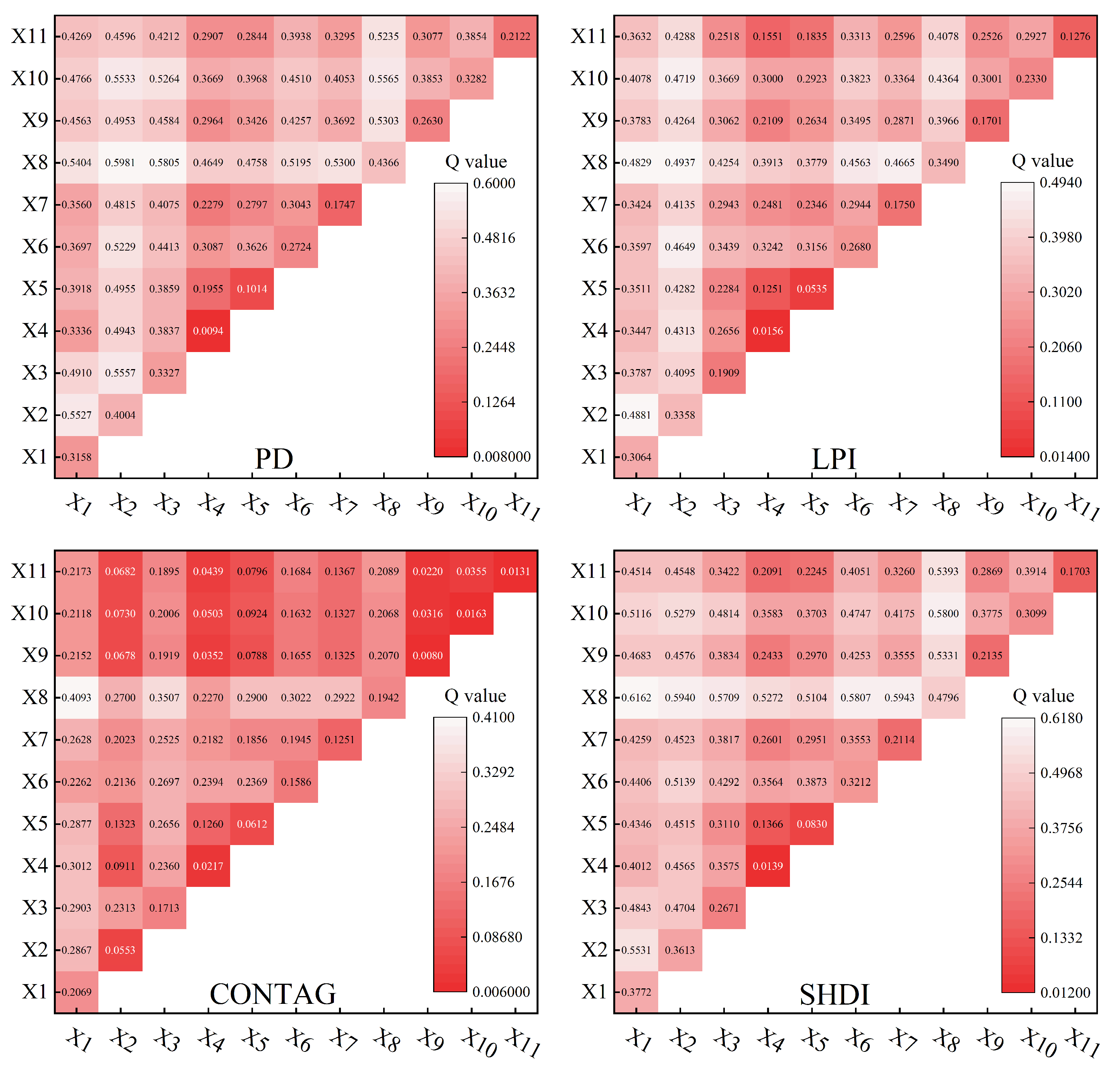
To investigate the correlations between landscape index variations and various driving factors in Huangshan City from 2012 to 2022, this study selected 11 natural and socio-economic factors as independent variables and 4 landscape indices reflecting fragmentation and dominance as dependent variables. The natural factors include DEM (X1), normalized difference vegetation index (X2), slope (X3), aspect (X4), soil type (X5), annual mean temperature (X6), and annual mean precipitation (X7). The socioeconomic factors include distance from the town center (X8), nighttime light index (X9), population density (X10), and GDP (X11). The Geodetector model was employed to analyze the explanatory power of each driving factor on different landscape indices. Figure 9 and Figure 10 illustrate the single-factor detection results for 2012 and 2022, respectively.
In 2022, the distance to town center (X8) exerted the strongest and most highly significant explanatory power on Patch Density (PD), whereas in 2012, these indices were primarily influenced by NDVI (X2). Over the decade, the influence of X8 continuously intensified, gradually assuming a dominant role in determining the degree of landscape fragmentation. Similarly, regarding the Largest Patch Index (LPI), which reflects landscape dominance, the explanatory power of X8 evolved from being insignificant in 2012 to highly significant in 2022, emerging as the primary driving force. Furthermore, for the Contagion Index (CONTAG) and Shannon’s Diversity Index (SHDI), the explanatory power of X8 also significantly increased between 2012 and 2022, becoming the most influential factor by 2022. Consequently, the distance to town center was identified as the key determinant driving changes in landscape fragmentation, dominance, and diversity.
As shown in Table 8, the explanatory power of driving factors for each landscape index underwent significant changes from 2012 to 2022, reflecting the transformation of landscape pattern driving mechanisms in Huangshan City. Regarding patch density (PD), the q-value of NDVI (X2) decreased from 0.4269 to 0.4004, while the q-value of distance from urban centers (X8) significantly increased from 0.3492 to 0.4366, becoming the most explanatory factor. This indicates that while vegetation cover still influences landscape fragmentation, urbanization has gradually become the dominant factor, with human activities increasingly shaping landscape structure. In 2012, the Landscape Patch Index (LPI) was primarily driven by NDVI (X2, q = 0.4496), followed by distance from urban centers (X8, q = 0.2592), demonstrating strong control of dominant patches by natural vegetation. By 2022, distance from urban areas (X8) surged to become the primary factor (q = 0.3490), while NDVI declined to 0.3358. The explanatory power of annual mean temperature (X6) also significantly increased (0.2680). This indicates that urban expansion and climate warming jointly weakened the dominance of natural vegetation over core patches, highlighting the spatial compression effect of human activities. In 2012, spread was dominated by NDVI (X2, q = 0.2518) and precipitation (X7, q = 0.2397), with landscape connectivity dependent on natural baseline conditions. By 2022, NDVI explanatory power plummeted to 0.0553, precipitation influence significantly weakened, and distance from urban areas (X8) rose from 0.1457 to 0.1942 as the primary controlling factor. This reflects the collapse of natural factors’ support for landscape aggregation, while the overall decline in explanatory power suggests increasingly complex driving mechanisms. In 2012, Shannon’s diversity index (SHDI) was jointly driven by NDVI (X2, q = 0.4790) and distance from urban areas (X8, q = 0.3443), indicating initial coupling between natural vegetation and urban gradients. By 2022, distance from urban areas (X8) surged as the strongest factor (q = 0.4796), while DEM (X1) and annual mean temperature (X6) simultaneously increased in explanatory power (reaching 0.3772 and 0.3212, respectively). This indicates a shift in landscape diversity from “vegetation-dominated” to a composite “urban–terrain–climate” driving mechanism, where the interaction between human activities and natural endowments became the core driver of pattern diversification.
Building on single-factor detection, this study further utilized OriginPro 2024 (OriginLab Corporation, Northampton, MA, USA) to analyze the effects of interactions between driving factors on landscape pattern indices through heatmaps (Figure 11 and Figure 12). The results indicate that in 2022, the interaction between NDVI (X2) and distance to town center (X8) had the most significant impact on PD and LPI, with q-values reaching 0.5981 and 0.4937, respectively. From 2012 to 2022, the q-value of this interaction term rose continuously, suggesting that the combination of NDVI and distance to town center had a significant enhancing effect on PD and LPI. Meanwhile, the interaction between DEM (X1) and distance to town center (X8) exerted the strongest influence on CONTAG and SHDI in 2022, with q-values of 0.4093 and 0.6162, respectively. The increasing trend of these q-values over the decade further demonstrates the significant positive impact of the DEM and X8 interaction on these two indices. Among all interactions, the distance to town center (X8) appeared with the highest frequency, further underscoring its critical role in landscape pattern changes. Moreover, interactions involving X8 consistently manifested as bifactor enhancement types, with q-values maintaining high levels in both 2012 and 2022, reflecting a sustained and significant amplifying effect.

4. Discussion

4.1. Analysis of Land Use Type Change

From 1992 to 2022, land use changes in Huangshan City exhibited distinct characteristics: forest land dominance, shrinking arable land, and expanding construction land. Forest land area consistently remained above 87%, closely aligning with its natural mountainous and hilly terrain [66]; arable land decreased cumulatively by 165.19 km2, primarily converted into forest land and construction land. Construction land increased by a net 102.73 km2, with the most pronounced expansion occurring in Huangshan District and Tunxi District, clearly reflecting the spatial response of urbanization and tourism development [67]. This evolution exhibits distinct phases, closely tied to the socio-economic development stages and policy orientations of different periods.
The period from 1992 to 2002 marked the nascent stage of tourism and urbanization, with a composite land use dynamics index of only 0.046%, indicating relatively slow change. During this phase, tourism was still in its early developmental stages, the economic structure remained dominated by traditional agriculture, and urbanization progressed sluggishly, yet to significantly impact land use patterns. The period from 2002 to 2012 witnessed rapid urbanization and an explosive growth in the tourism economy, with the comprehensive dynamic degree reaching its peak (0.214%). During this time, the average annual growth rate of construction land reached 5.272%, leading to a dramatic restructuring of the urban–rural spatial pattern. This transformation stemmed from China’s rapid post-WTO accession economic growth, coupled with Huangshan City’s explicit 2006 declaration of its “International Tourism City” development goal [68]. The opening of the Hangzhou-Huangshan Expressway further enhanced regional accessibility, accelerating population and industrial concentration in urban areas. Against this backdrop, vast tracts of farmland were converted into construction land and forest land: the former directly reflected urban expansion, while the latter synergized with the concurrent nationwide implementation of the Grain-for-Green Program [69], jointly driving the dramatic transformation of land use types during this period. From 2012 to 2022, the region entered a transition and stabilization phase guided by ecological civilization principles, with the composite dynamic rate declining to 0.156%. While construction land growth remained high (5.136%), cultivated land shifted from decline to increase (single dynamic rate changing from −1.978% to 1.068%), with mutual conversion between cultivated and forested land becoming the dominant change. The 18th CPC National Congress incorporated ecological civilization into the national development blueprint [70]. As a key ecological barrier in the Yangtze River Delta, Huangshan City successively introduced stringent spatial control policies. The 2016 Huangshan City Land Use Master Plan further strengthened construction land management and intensified utilization [71], while the “Greater Huangshan” strategy shifted development logic from “spatial expansion” to “quality enhancement” [72]. Concurrently, the restorative growth of farmland is closely linked to the rehabilitation of abandoned farmland, the construction of high-standard farmland, and controls on non-grain cultivation. This dynamic equilibrium between farmland and forest land reflects both the resilience of agricultural restructuring in mountainous regions and the rigid constraints imposed by ecological redlines. The phased variations in Huangshan’s land use changes fundamentally result from the interaction between “tourism-driven urbanization” and “ecologically constrained conservation policies” across different periods, corroborating Ma et al.’s observation that landscape pattern evolution exhibits distinct phasic characteristics [26].

4.2. Spatio-Temporal Evolution Analysis of Landscape Pattern

The evolution of Huangshan City’s landscape pattern involves localized dynamic adjustments within an overall trend toward stability, reflecting the unique spatial organization logic characteristic of a mountain tourism city. At the landscape level, the rise in Shannon Diversity Index (SHDI) indicates increasing landscape diversity. This stems primarily from tourism development enriching land use types and introducing new landscape elements—such as tourism service facilities and transportation networks—onto the traditional forest-farmland dual structure, thereby enhancing landscape heterogeneity. However, the continuous decline in Patch Density (PD) and the slight fluctuations in the Largest Patch Index (LPI) indicate that, although overall fragmentation has eased, localized fragmentation remains prominent in areas of high human activity—such as scenic area entrances and urban fringes—manifesting as an increase in the number of patches and active edge-intersection zones. Spatial analysis reveals that high edge density (ED) zones persist along the interstices between farmland, forestland, and developed areas—the very frontiers where tourism expansion intersects with natural landscapes, reflecting tourism’s reshaping of landscape boundaries. The Contagion Index (CONTAG) remains high but has declined slightly, indicating that the highly connected landscape dominated by contiguous forest areas has not changed; however, the expansion of tourism infrastructure has, to some extent, fragmented continuous ecological spaces. This pattern of “overall stability with localized disturbances” is a typical manifestation of landscape responses in mountain tourism cities under the dual objectives of “conservation and development.”

4.3. Driving Force Analysis of Landscape Pattern Change

Driving force analysis indicates that distance from urban centers is the core factor influencing landscape pattern changes in Huangshan City. Specifically, this factor exhibits significantly and continuously increasing explanatory power for patch density (PD) and edge density (ED)—which characterize landscape fragmentation—as well as for the largest patch index (LPI), which reflects landscape dominance. From a temporal perspective, the explanatory power q-value of distance from urban centers for patch density (PD) increased significantly from 0.3492 in 2012 to 0.4366 in 2022. Its explanatory power for LPI surged from insignificant to 0.3490, becoming the dominant factor. This shift clearly reveals the increasingly prominent role of urbanization in shaping regional landscape structures: as urban boundaries expand, surrounding areas undergo drastic land-use transformations, fragmenting contiguous ecological spaces. This directly intensifies landscape fragmentation while weakening natural vegetation’s control over core patches, causing natural landscape dominance to gradually decline under spatial pressure from human activities. Conversely, interactions among natural background factors profoundly influence spatial landscape configurations. Findings indicate that the interaction between the Normalized Difference Vegetation Index (NDVI) and Digital Elevation Model (DEM) significantly impacts landscape pattern indices. In 2022, the interaction between NDVI and distance from urban centers explained 59.81% and 61.60% of patch density and edge density, respectively, while the interaction between DEM and distance from urban centers explained 61.62% of Shannon diversity index (SHDI). This clearly demonstrates that in Huangshan City, a typical mountainous and hilly region, land use patterns are strongly constrained by vegetation cover and topographic conditions. Urban development tends to prioritize areas with lower vegetation coverage and relatively flat topography, while zones with high vegetation cover and complex terrain act as natural barriers to development activities. Consequently, the evolution of landscape patterns is not solely driven by urbanization but represents the selective unfolding of human activities on a natural substrate—a result of the interplay between urban expansion demands and natural endowment constraints. As a typical mountainous tourism city, Huangshan’s landscape pattern changes are constrained by natural topography and vegetation conditions while being driven by socioeconomic activities such as urbanization and tourism development. Consequently, future efforts should further coordinate land use with ecological conservation, optimize the layout of construction land, and protect important ecological patches and corridors to advance sustainable landscape management.

4.4. Comparative Analysis of Similar Studies

Compared with other mountain tourism cities, the evolution of Huangshan’s landscape pattern follows the general laws of mountain tourism development while exhibiting distinct regional characteristics due to its unique natural and cultural resources. From a commonality perspective, Huangshan City shares similarities with typical mountain tourism cities like Zhangjiajie and the Taihang Mountains, all exhibiting an evolutionary trend characterized by “dominant forest land, reduced farmland, and increased construction land.” Among these, forest land serves as the landscape foundation, consistently maintaining an absolute dominance with a proportion exceeding 87%, reflecting the fundamental constraints imposed by topographical conditions on land use [73]. The expansion of construction land clearly exhibits a trend of outward sprawl from urban centers, a phenomenon also observed in the urbanization process of karst mountainous regions in Guizhou [74]. Concurrently, the continuous reduction in farmland and its conversion to forest land is closely linked to the implementation of ecological policies such as the Grain-for-Green Program [69]. However, the evolution of Huangshan City’s landscape pattern exhibits distinct characteristics: as a dual World Cultural and Natural Heritage site, it encompasses both the Huangshan Scenic Area, renowned for its unique pines and bizarre rocks, and ancient Huizhou-style villages like Xidi and Hongcun. This “coexistence of natural wonders and cultural heritage” is exceptionally rare among prefecture-level cities nationwide. Consequently, landscape evolution is influenced not only by natural geography but also by cultural heritage conservation policies. Moreover, Huangshan exhibits a pronounced topographic gradient in its landscape pattern differentiation: cultivated land and construction land are predominantly distributed in low-to-medium elevation areas, while forested land is concentrated in high-elevation zones. Stable patches dominate the overall landscape change, indicating that topography exerts a strong constraining effect on land-use conversion [75].

4.5. Limitations and Future Development Directions

This study systematically applied geographic information system tools such as ArcGIS and Fragstats in analyzing the spatiotemporal evolution of landscape patterns, integrating the moving window method, land-use transition matrices, and geographic detector models. The research methodology is rigorous, with a clear technical approach demonstrating strong operational feasibility and reproducibility. However, from the perspective of tool accuracy, the study exhibits several limitations: first, land use data derived from 30 m resolution remote sensing imagery is susceptible to mixed pixel effects in complex mountainous terrain, leading to insufficient classification accuracy for fragmented patches. Second, although the moving window scale was determined using the coefficient of variation method, the selection of 600 m as the optimal scale remains statistically subjective, lacking multi-scale validation grounded in ecological significance. A single scale struggles to fully capture the hierarchical characteristics of landscape patterns. Beyond technical limitations, the study also exhibits design flaws: first, it fails to account for drivers such as policy orientation and tourism development intensity, hindering a comprehensive portrayal of the complex causes behind landscape pattern evolution in mountain tourism cities. Second, the study selected only four temporal points (1992, 2002, 2012, and 2022), resulting in discontinuous time series that fail to capture continuous landscape change processes or abrupt transition points. Overall, this research demonstrates significant strengths in methodological integration and empirical analysis. Given these limitations, future research could deepen in the following directions: (1) incorporate high-resolution remote sensing data to enable fine-grained identification of landscape elements; (2) integrate policy factors into the driving factor system to refine the analysis of driving mechanisms; and (3) combine models such as CA-Markov and intPLUS to simulate landscape pattern evolution trends under different policy scenarios, thereby providing scientific theoretical foundations for national spatial planning and ecological conservation.


5. Conclusions

This study integrates the land use transition matrix, moving window method and Geodetector model, using land use data and natural and socio-economic datasets from 1992 to 2022, to investigate the spatiotemporal dynamics of land use and landscape pattern characteristics in Huangshan City. Furthermore, it analyses the driving mechanisms of natural and socio-economic factors on variations in the landscape index. The main results are as follows:
(1)
From 1992 to 2022, forest land consistently accounted for over 87% of the total area in Huangshan City, dominating land use. Meanwhile, cropland shrank from 1091.07 km2 to 925.88 km2, whereas Built-up Land expanded significantly from 49.64 km2 to 152.37 km2, presenting a stark contrast. Land use dynamic activity peaked during the period from 2002 to 2012 before stabilising. The primary characteristic was the reciprocal conversion between cropland and forest land, reflecting a process of dynamic equilibrium. Huangshan City underwent rapid urbanisation while maintaining its ecological foundation. Consequently, future strategies should prioritise protecting cropland and intensively utilising Built-up Land to promote sustainable development.
(2)
From 1992 to 2022, the landscape pattern in Huangshan City remained generally stable, with forest land consistently accounting for the largest proportion. The fragmentation of cultivated land decreased further, while grassland patches gradually became more regular in shape, though edge segmentation intensified. Conversely, the shape of construction land became increasingly complex and irregular. These changes suggest that human activities have had a significant impact on the morphology of construction land and grassland, while natural landscapes such as forests and bodies of water have remained relatively stable.
(3)
Between 1992 and 2022, the landscape pattern in Huangshan City showed an overall trend towards aggregation and regularisation. Landscape fragmentation and edge complexity declined continuously, patch shapes became more regular and the overall pattern was dominated by land cover types with high connectivity. Ecotones exhibited higher fragmentation and diversity, whereas contiguous forest and grassland areas maintained high aggregation and stability. Under the persistent influence of human activities, the region’s landscape structure showed a general trend towards simplification and regularisation. However, local areas experienced fluctuations in landscape diversity, revealing the dynamic complexity of its spatial evolution.
(4)
The distance to the town centre was identified as the key factor driving landscape fragmentation, dominance and diversity, with its influence intensifying over time. The interaction between NDVI and DEM also significantly influenced landscape patterns, reflecting the joint shaping of the spatial configuration of the landscape by natural factors and anthropogenic activities.

Author Contributions

Conceptualization, E.Y. and H.Z.; Methodology, E.Y., Q.W. and Y.L.; Software, Q.W. and Y.L.; Formal analysis, E.Y., Q.W. and Y.L.; Investigation, Y.P.; Resources, X.Z.; Data curation, E.Y., Q.W., Y.P. and Q.C.; Writing—original draft, E.Y.; Writing—review & editing, H.Z. and Y.G.; Visualization, E.Y., Y.P., Q.C. and Y.G.; Supervision, H.Z. and X.Z.; Project administration, H.Z. and X.Z.; Funding acquisition, H.Z. All authors have read and agreed to the published version of the manuscript.

Funding

This research was funded by the National Science and Technology Support Program (Grant No. 2015BAD06B04).

Data Availability Statement

Data are contained within the article.

Conflicts of Interest

Xingfeng Zhao is employed by Yunnan Geological Engineering Second Survey Institute Co., Ltd. The authors declare no conflict of interest.

References

  1. Che, T.; Li, C.; Luo, Y.J. Changes in landscape pattern of Built-up Land and its driving factors during urban sprawl. Acta Ecol. Sin. 2020, 40, 3283–3294. [Google Scholar] [CrossRef]
  2. Chen, H.; Ren, J.; Ren, W.J.; Luan, H.; Luo, L.C. Land use change patterns and landscape ecological risk assessment in the process of watershed ecological compensation. Front. Environ. Sci. 2025, 13, 1723453. [Google Scholar] [CrossRef]
  3. Mas, J.F.; Gao, Y.; Pacheco, J.A.N. Sensitivity of landscape pattern metrics to classification approaches. For. Ecol. Manag. 2010, 259, 1215–1224. [Google Scholar] [CrossRef]
  4. Huang, S.M.; Hu, Q.W.; Wang, S.H.; Li, H.D. Ecological Risk Assessment of World Heritage Sites Using RS and GIS: A Case Study of Huangshan Mountain, China. Chin. Geogr. Sci. 2022, 32, 808–823. [Google Scholar] [CrossRef]
  5. Zhang, Y.; Qu, S.; Huang, F.; Gao, G.B. Scale-dependent mechanisms of karst ecosystem service drivers revealed by landscape pattern indices. Ecol. Indic. 2026, 182, 114566. [Google Scholar] [CrossRef]
  6. He, M.Z.; Zhang, L.T.; Wei, Y.Y.; Zheng, Z.H.; Wang, Q.Y. Landscape Pattern Vulnerability and Its Driving Forces in Different Geomorphological Divisions in the Middle Yellow River. Environ. Sci. 2024, 45, 3363–3374. [Google Scholar] [CrossRef]
  7. Li, X.; Ji, B.; Li, N.; Anderson, C.J.; Chen, Q.Y. Using PLS-SEM models to explore the interactions of meteorology and landscape pattern changes on waterbird diversity: A case of the Liaohe Estuary. Ecol. Inform. 2025, 86, 103022. [Google Scholar] [CrossRef]
  8. Deng, S.J.; Wang, K.; Hong, Y.; Qi, J.G. Spatio-temporal dynamics and evolution of land use change and landscape pattern in response to rapid urbanization. Landsc. Urban Plan. 2009, 92, 187–198. [Google Scholar] [CrossRef]
  9. Gardner, R.H.; Milne, B.T.; Turnei, M.G.; O’Neill, R.V. Neutral models for the analysis of broad-scale landscape pattern. Landsc. Ecol. 1987, 1, 19–28. [Google Scholar] [CrossRef]
  10. Krummel, J.R.; Gardner, R.H.; Sugihara, G.; O’Neill, R.V.; Coleman, P.R. Landscape patterns in a disturbed environment. Oikos 1987, 48, 321–324. [Google Scholar] [CrossRef]
  11. O’Neill, R.V.; Krummel, J.R.; Gardner, R.H.; Sugihara, G.; Jackson, B.; DeAngeils, D.L.; Milne, B.T.; Turner, M.G.; Zygmunt, B.; Christensen, S.W. Indices of landscape pattern. Landsc. Ecol. 1988, 1, 153–162. [Google Scholar] [CrossRef]
  12. Wei, Y.; Zhou, P.; Zhang, L.; Zhang, Y. Spatio-temporal evolution analysis of land use change and landscape ecological risks in rapidly urbanizing areas based on Multi-Situation simulation-a case study of Chengdu Plain. Ecol. Indic. 2024, 166, 112245. [Google Scholar] [CrossRef]
  13. Akintayo, A. Time-series analysis of land use land cover change dynamics in Sukur Cultural Landscape, northeast Nigeria. J. Cult. Herit. 2026, 77, 168–177. [Google Scholar] [CrossRef]
  14. Shi, L.; Zhang, X.; Halik, Ü. The Driving Mechanism and Spatio-Temporal Nonstationarity of Oasis Urban Green Landscape Pattern Changes in Urumqi. Remote Sens. 2025, 17, 3123. [Google Scholar] [CrossRef]
  15. Wu, M.X.; Li, C.W.; Du, J.; He, P.M.; Zhong, S.C.; Wu, P.L.; Fang, S.B. Quantifying the dynamics and driving forces of the coastal wetland landscape of the Yangtze River Estuary since the 1960s. Reg. Stud. Mar. Sci. 2019, 32, 100854. [Google Scholar] [CrossRef]
  16. Lin, W.P.; Cen, J.W.; Xu, D.; Du, S.Q.; Gao, J. Wetland landscape pattern changes over a period of rapid development (1985–2015) in the ZhouShan Islands of Zhejiang Province, China. Estuar. Coast. Shelf Sci. 2018, 213, 148–159. [Google Scholar] [CrossRef]
  17. Smiraglia, D.; Ceccarellt, T.; Bajocco, S.; Perini, L.; Salvati, L. Unraveling landscape complexity: Land use/land cover changes and landscape pattern dynamics (1954-2008) in contrasting Peri-Urban and Agro-Forest Regions of Northern Italy. Environ. Manag. 2015, 56, 916–932. [Google Scholar] [CrossRef]
  18. Yang, M.; Gong, J.; Zhao, Y.; Wang, H.; Zhao, C.P.; Yang, Q.; Tian, B. Landscape pattern evolution processes of wetlands and their driving factors in the Xiong’an new area of China. Int. J. Environ. Res. Public Health 2021, 18, 4403. [Google Scholar] [CrossRef] [PubMed]
  19. Lu, J.G.; Fu, Y.M. Analysis on the Evolution Characteristics of Land Use/Landscape Pattern in Ganjiang River Basin from 2000 to 2020. Jiangxi Sci. 2022, 40, 865–869. [Google Scholar] [CrossRef]
  20. Zhai, J.; Pu, L.; Qie, L.; He, G.L.; Wang, X.Q.; Zhang, R.; Huang, S.H. Changes of land use and landscape pattern along sea–land gradient in developed coastal region: A case study of Jiangsu Province, China. Ecol. Indic. 2025, 176, 113635. [Google Scholar] [CrossRef]
  21. Li, Y.; Liu, G.; Xie, H.; Yu, Y.N. Characterizing Spatiotemporal Pattern of Land Use Change and Its Driving Force Based on GIS and Landscape Analysis Techniques in Tianjin during 2000–2015. Sustainability 2017, 9, 894. [Google Scholar] [CrossRef]
  22. Wan, Z.; Yuan, B.; Wu, H.; Liu, L.Y.; Zeng, J.; He, X.W. Dynamic evolution of century-scale land use and landscape pattern coupled with historical topographic maps under AWCA-Markov framework. Catena 2025, 261, 109565. [Google Scholar] [CrossRef]
  23. Zhao, W.W.; Fang, X.N. Landscape sustainability and landscape sustainability science. Acta Ecol. Sin. 2014, 34, 2453–2459. [Google Scholar] [CrossRef]
  24. Olsen, L.M.; Dale, V.H.; Foster, T. Landscape patterns as indicators of ecological change at Fort Benning, Georgia, USA. Landsc. Urban Plan. 2007, 79, 137–149. [Google Scholar] [CrossRef]
  25. Kefalas, G.; Kalogirou, S.; Poirazidis, K.; Lorilla, R.S. Landscape transition in Mediterranean islands: The case of Ionian islands, Greece 1985–2015. Landsc. Urban Plan. 2019, 191, 103641. [Google Scholar] [CrossRef]
  26. Ma, L.B.; Bo, J.; Li, X.Y.; Fang, F.; Cheng, W.J. Identifying key landscape pattern indices influencing the ecological security of inland river basin: The middle and lower reaches of Shule River basin as an example. Sci. Total Environ. 2019, 674, 424–438. [Google Scholar] [CrossRef] [PubMed]
  27. Woodman, T.L.; Alexander, P.; Burslem, D.F.R.P.; Travis, J.M.J.; Eigenbrod, F. Incorporating landscape patterns can improve global-scale models of land use and land cover change. J. Land Use Sci. 2026, 21, 35–55. [Google Scholar] [CrossRef]
  28. Lu, T.; Zhang, J.; Hu, W.Y. Spatio-temporal Evolution Characteristics and Driving Mechanism of Roky Desertification in Karst Area of Easter Yunnan. J. Ecol. Rural Environ. 2022, 38, 418–427. [Google Scholar] [CrossRef]
  29. Zhao, J.; Wang, K.; Zhou, Z.H.; Yan, D.H.; Liu, J.J.; Wang, J.Q. Research on vegetation evolution and carbon budget in the Yellow River Basin based on the Integrated Biosphere Simulator model. Acta Ecol. Sin. 2026, 46, 1–14. [Google Scholar]
  30. Jaimes, N.B.P.; Sendra, J.B.; Delgado, M.G.; Plata, F.R. Exploring the driving forces behind deforestation in the state ofMexico (Mexico) using geographically weighted regression. Appl. Geogr. 2010, 30, 576–591. [Google Scholar] [CrossRef]
  31. Ren, L.L.; Li, Y.Z.; Yu, M.; Yang, J.S.; Zhang, C.; Zhou, D. Evolution of artificial wetlands in the Yellow River Delta and related driving factors during 1984–2015. J. Agric. Resour. Environ. 2020, 37, 493–502. [Google Scholar]
  32. Zhou, Z.L.; Sha, J.M.; Fan, Y.X.; Shuai, C.; Gao, S. Temporal and spatial variations of impervious surface landscape pattern and the driving fac tors in Xiamen City, China. Chin. J. Appl. Ecol. 2020, 31, 230–238. [Google Scholar]
  33. Yi, A.L.; Wang, J. Quantitative study on spatio-temporal evolution and mechanisms of wetland landscape patterns in Shanghai. Acta Ecol. Sin. 2021, 41, 2622–2631. [Google Scholar] [CrossRef]
  34. Yang, Y.Y.; Yao, Y.; Hao, S. Spatial-Temporal Variations and Influencing Factors of Intensified Cultivated Land Use Level in Guizhou Province Based on GWR Model. Res. Soil Water Conserv. 2022, 29, 326–332+338. [Google Scholar]
  35. Wang, J.; Xu, C. Geodetector: Principles and Prospects. Acta Geogr. Sin. 2017, 72, 116–134. [Google Scholar]
  36. Wang, P.; Huang, H.W.; Zhou, X.; Chen, S.X.; Xu, S.S.; Li, L. Evolution of Landscape Pattern’s Characteristics in Pilot National Parksand Its Driving Mechanism. J. Chin. Urban For. 2023, 21, 72–80. [Google Scholar]
  37. Qian, C.; Sasaki, N.; Jourdain, D.; Kim, S.M.; Shivakoti, P.G. Local livelihood under different governances of tourism development in China—A case study of Huangshan Mountain area. Tour. Manag. 2016, 61, 221–233. [Google Scholar]
  38. Bao, J.; Lu, L.; Ling, S.J.; Zhang, Y. Tourism space production and evolution logic of Xin’an River Basin: The perspective of social construction of nature. Acta Geogr. Sin. 2023, 78, 2609–2629. [Google Scholar]
  39. Wang, S.Q.; Zhou, Z.H.; Liu, D.Y.; Hu, Q.; Tang, W.H.; Zhou, M. Study on land scape pattern change of Chaohu basin based on land use chang. Agric. Sci. J. Yanbian Univ. 2022, 44, 84–93. [Google Scholar]
  40. Zhou, Y.Q.; Xu, Y.; Li, D.H.; Jiang, W.F.; Wu, S.M.; Lu, L. Characteristics of Huangshan tourism flow network structure: The comparative analysis of team tour and self-guided tour. J. Cent. China Norm. Univ. (Nat. Sci.) 2022, 56, 853–863. [Google Scholar]
  41. Chang, J.; Lu, S. A Study on the Spatial-temporal Evolution and Influencing Factors of Homestay in Huangshan City. Tour. Sci. 2022, 36, 147–159. [Google Scholar]
  42. Lin, Z.L.; Cheng, Z. Study on Efficiency of Tourism Poverty Alleviation and Its Influencing Factors in Western China: A Case Study of Pingliang City, Gansu Province. Areal Res. Dev. 2020, 39, 94–98+110. [Google Scholar]
  43. Peng, J.; Wu, J.; Xu, F.X.; Lv, J. Spatio-temporal evolution characteristics of habitat quality in typical tourism cities based on value evaluation: A case study of Huangshan. Acta Ecol. Sin. 2021, 41, 665–679. [Google Scholar] [CrossRef]
  44. Wang, L.L.; Tan, X.L.; Yu, H. Evolutionary mechanism of tourism destinations in Huangshan City from the perspective of evolutionary. J. Chin. Ecotour. 2025, 15, 336–351. [Google Scholar]
  45. GB/T21010-2017; Current Land Use Classification. China Standard Publishing House: Beijing, China, 2017.
  46. Wu, Y.J.; Liu, T.X.; Tong, X.; Luo, Y.Y.; Duan, L.M.; Wang, G.L. Dynamic evolution analysis of land use (land cover) in Horqin Sandy Land based on long time deries landsat data. Acta Ecol. Sin. 2020, 40, 8672–8682. [Google Scholar]
  47. Jia, Y.Y.; Tang, X.L.; Tang, F.L.; Yang, Y. Spatial-temporal evolution of landscape pattern in the middle and lower reaches of the Yangtze River basin from 1995 to 2015. J. Nanjing For. Univ. (Nat. Sci. Ed.) 2020, 44, 185–194. [Google Scholar]
  48. Gan, L.; Halik, Ü.; Shi, L.; Yu, R.J.; Cheng, W.Z. Integrating Multi-Source Data to Explore Spatiotemporal Dynamics and Future Scenarios of Arid Urban Agglomerations: A Geodetector–PLUS Modelling Framework for Sustainable Land Use Planning. Remote Sens. 2025, 17, 1851. [Google Scholar] [CrossRef]
  49. Wei, Z.; Du, N.; Yu, W. Land use change and its driving factors in the ecological function area: A case study in the Hedong Region of the Gansu Province, China. J. Arid Land 2024, 16, 71–90. [Google Scholar] [CrossRef]
  50. Li, S.Y.; Li, A.; Wang, L.; Zhang, Y.A.; Ning, L.B. Spatial-Temporal Change Analysis of Land Use in Zhifanggou Watershed Based on Remote Sensing. J. Nat. Sci. Hunan Norm. Univ. 2020, 43, 8–14. [Google Scholar]
  51. He, D.; Zhou, J.; Cai, J.M.; Chen, Z.X. Analysis of land use and landscape pattern changes on the areas along the high-speed railway in China. Ecol. Sci. 2021, 40, 184–194. [Google Scholar]
  52. Wei, T.T.; Zhang, Y.; Ma, Q.H.; Hou, J.Z.; Xiang, Y.N. Prediction of land use change in Baojixia Irrigation District based on FLUS-Markovmodel. J. Drain. Irrig. Mach. Eng. 2025, 43, 604–611. [Google Scholar]
  53. Zhou, X.; Chu, Z.; Ji, X. Changes in the land-use landscape pattern and ecological network of Xuzhou planning area. Sci. Rep. 2024, 14, 8854. [Google Scholar] [CrossRef]
  54. Wu, J.G. Landscape Ecology-Concepts and Theories. Chin. J. Ecol. 2000, 19, 42–52. [Google Scholar]
  55. Zhu, Y.; Ling, T.H.G. Spatio-Temporal Changes and Driving Forces Analysis of Urban Open Spaces in Shanghai between 1980 and 2020: An Integrated Geospatial Approach. Remote Sens. 2024, 16, 1184. [Google Scholar] [CrossRef]
  56. Chen, W.B.; Xiao, D.N.; Li, X.Z. Classification application and creation of landscape indices. Chin. J. Appl. Ecol. 2002, 13, 121–125. [Google Scholar]
  57. Wang, R.H. Connotation and Characteristics of Landscape Scale, Process and Pattern (LSPP) Research. Trop. Geogr. 2018, 38, 458–464. [Google Scholar]
  58. Chen, L.D.; Zhang, Y.J.; Ma, S.K. Multi-scale characteristics and scale selection in landscape ecological studies. Chin. J. Appl. Ecol. 2025, 36, 1933–1940. [Google Scholar]
  59. Wen, Y.J.; Shi, C.; Wang, S.W.; Zhang, J.L.; Ma, X.F. Landscape pattern evolution and its driving forces in the Shiyang River Basin from1986 to 2020. Pratacult. Sci. 2023, 40, 303–317. [Google Scholar]
  60. Li, J.X.; Li, C.; Zhu, F.G.; Song, C.H.; Wu, J.G. Spatiotemporal pattern of urbanization in Shanghai, China between 1989 and 2005. Landsc. Ecol. 2013, 28, 1545–1565. [Google Scholar] [CrossRef]
  61. Yang, Q. Landscape Pattern Dynamics and Ecological Effects of Urbanization in Small and Medium-Sized Cities of China. Ph.D. Thesis, Nanjing University, Nanjing, China, 2011. [Google Scholar]
  62. Zhang, C.Q.; Li, X.; Sun, L.; Dong, B.; Li, X.Y.; Wang, Q.; Sheng, S.W.; Yang, L.; Yang, S.W.; Wang, T. Ecological Risk Assessment of Wetland Land Use and Landscape Index Dynamic Based on Different Granularity. J. Northeast For. Univ. 2014, 42, 104–108+147. [Google Scholar]
  63. Huang, B.; Huang, J.; Pontius, R.G.; Tu, Z.S. Comparison of Intensity Analysis and the land use dynamic degrees to measure land changes outside versus inside the coastal zone of Longhai, China. Ecol. Indic. 2018, 89, 336–347. [Google Scholar] [CrossRef]
  64. Sun, Y.X.; Meng, Q.L. Spatiotemporal evolution characteristics of land use change and its carbon storage effects and prediction in Shaanxi Province. Res. Soil. Water Conserv. 2026, 33, 244–254+263. [Google Scholar]
  65. Peng, J.; Xu, F.X. Effect of grid size on habitat quality assessment: A case study of Huangshan City. J. Geo-Inf. Sci. 2019, 21, 887–897. [Google Scholar]
  66. Liu, H.; Huang, C.L.; Mei, Y.; Fu, S.L. Current situation and development in the areas after the implementation of Project of Conversion of Cropland to Forest, Anhui Province. J. Anhui Agric. Univ. 2012, 39, 381–384. [Google Scholar]
  67. Hong, Q.; Zhang, J.H.; Hu, W.J.; Wang, J.W.; Ma, J.X. Study on changes of three-dimensional ecological footprint and tourism impact in Huangshan City. Ecol. Sci. 2023, 42, 29–38. [Google Scholar]
  68. Huangshan Municipal People’s Government. Huangshan Municipal People’s Government Huangshan City Master Plan (2008–2030); Huangshan Municipal People’s Government: Huangshan, China, 2008.
  69. Wang, P.J.; Zhang, J.H.; Yang, L.J.; Guo, L.J.; Ma, X.B.; Kan, Y.; Chen, M. Spatio-temporal evolution of ecosystem services in a typical tourist city and its influencing factors: A case study of Huangshan City. Acta Ecol. Sin. 2024, 44, 3897–3910. [Google Scholar]
  70. Hu, J.T. Unswervingly Follow the Path of Socialism with Chinese Characteristics and Strive to Build a Moderately Prosperous Society in All Respects—Report to the 18th National Congress of the Communist Party of China. Theor. Study 2012, 12, 4–27. [Google Scholar]
  71. Huangshan Municipal People’s Government. Huangshan City Land Use Master Plan (2006–2020); Huangshan Municipal People’s Government: Huangshan, China, 2016.
  72. Anhui Provincial Department of Natural Resources. Anhui Department Advances Development of “Greater Huangshan” as a World-Class Tourism Destination; Anhui Provincial Department of Natural Resources: Hefei, China, 2024.
  73. Wang, L.L.; Wang, S.Q.; Fang, J.R.; Wang, H. Study on Spatial-temporal Evolution of Scenic Spots and Coordination Strategy of Transport and Tourism in Mountainous Tourist Cities: A Case Study of Zhangjiajie. Environ. Des. 2024, 2, 72–76. [Google Scholar]
  74. Li, R.; Wang, Z.T.; Bao, Y. Urban Sprawl and Landscape Pattern of Hilly City in Central Guizhou Province Under the Backgroung of Fast Unbanization-Taking Anshun City as the Example. Res. Soil. Water Conserv. 2020, 27, 376–384+391. [Google Scholar]
  75. Wang, S.Q.; Zhou, Z.H.; Liu, D.Y.; Hu, Q.; Tang, W.H.; Zhou, M. Exolution analysis of landscape palten of Huangshan City based on topographic gradient. J. Hunan Ecol. Sci. 2023, 10, 10–18. [Google Scholar]
Figure 1. Location of the study area.
Land 15 00503 g001
Figure 2. Spatial distribution map of landscape index changing with moving window scale.
Land 15 00503 g002aLand 15 00503 g002b
Figure 3. Distribution of land use types in Huangshan City from 1992 to 2022: (a) distribution of land use types in Huangshan City in 1992. (b) distribution of land use types in Huangshan City in 2002. (c) distribution of land use types in Huangshan City in 2012. (d) distribution of land use types in Huangshan City in 2022.
Land 15 00503 g003
Figure 4. The land use transfer matrix Sankey map of Huangshan City from 1992 to 2022.
Land 15 00503 g004
Figure 5. Landscape index changes with moving window scale.
Land 15 00503 g005
Figure 6. (af) Type level index of Huangshan City from 1992 to 2022.
Land 15 00503 g006
Figure 7. Spatial distribution map of type-level landscape index in Huangshan City from 1992 to 2022.
Land 15 00503 g007
Figure 8. Spatial distribution map of landscape fragmentation, dominance and diversity in Huangshan City from 1992 to 2022.
Land 15 00503 g008aLand 15 00503 g008b
Figure 9. Results of single-factor detection of landscape index in Huangshan City in 2012 (* p < 0.05, ** p < 0.01, *** p < 0.001).
Land 15 00503 g009
Figure 10. Results of single-factor detection of landscape index in Huangshan City in 2022 (* p < 0.05, ** p < 0.01, *** p < 0.001).
Land 15 00503 g010
Figure 11. Detection results of landscape index interaction in Huangshan City in 2012.
Land 15 00503 g011
Figure 12. Detection results of landscape index interaction in Huangshan City in 2022.
Land 15 00503 g012
Table 1. Data information.
Data CategoryData NameYearGrid ResolutionData Sources
Land use dataLand use data1992/2002/
2012/2022
30 mhttps://zenodo.org/records/18180184, accessed on 1 July 2025
Natural factors dataDEM/30 mGeospatial Data Cloud (https://www.gscloud.cn/)
Slope/30 mExtraction using ArcGIS based on DEM data
Aspect/30 mExtraction using ArcGIS based on DEM data
Normalized Difference Vegetation Index (NDVI)2012/202230 mGeospatial Data Cloud (https://www.gscloud.cn/)
Soil types/30 mResource and Environment Science and Data Center (https://www.resdc.cn/)
Annual average temperature2012/202230 mResource and Environment Science and Data Center (https://www.resdc.cn/)
Annual average precipitation2012/202230 mResource and Environment Science and Data Center (https://www.resdc.cn/)
Socioeconomic factors dataDistance from the town center2012/202230 mExtraction using ArcGIS based on land use data
Nighttime lighting index2012/202230 mVIIRS Nighttime Lights Data (https://eogdata.mines.edu/products/vnl/, accessed on 1 July 2025)
Population density (POP)2012/202230 mWorldPop (https://hub.worldpop.org/)
Gross domestic product (GDP)2012/202230 mResource and Environment Science and Data Center (https://www.resdc.cn/)
Note: / does not distinguish between years.
Table 2. Landscape index and its meaning.
Full NameAbbreviationsImplicationValue Range
Percent of LandscapePLANDThe total area of a specific patch type as a percentage of the entire landscape area1~100
Largest Path IndexLPIThe percentage of the maximum landscape area of a given patch relative to the total patch area0~100
Number of PatchesNPTotal number of patches of a specific patch type within the landscape≥1
Patch DensityPDNumber of patches of a certain landscape type per unit area>0
Edge DensityEDThe degree to which landscape types are fragmented by boundaries≥0
Landscape Shape IndexLSIComplexity of patch shapes within the landscape≥1
Shannon’s Diversity IndexSHDIReflecting changes in the number of landscape types and the proportion each type occupies≥0
Shannon’s Evenness IndexSHEIThe ratio of the equilibrium between the area proportions of different patch types in the landscape to their maximum values0~1
Aggregation IndexAIThe probability of different patch types appearing adjacent to each other within the overall landscape0~100
Contagion IndexCONTAGIs there a type of advantageous plaque with high connectivity0~100
Table 3. The area and proportion of land use in Huangshan City from 1992 to 2022.
Land-Use Type1992200220122022
Area/km2Percent/%Area/km2Percent/%Area/km2Percent/%Area/km2Percent/%
Cropland1091.07011.2201042.85510.786836.5558.653925.8839.594
Forest8489.34687.3018469.59087.6028631.79489.2808472.60887.798
Grassland4.9330.0513.3200.0342.7710.0292.3070.024
Water89.2590.91886.5730.89596.4680.99896.9811.005
Built-up Land49.6400.51065.9140.682100.6631.041152.3661.579
Unused land 0.0230.0000.0010.0000.0010.0000.0010.000
Table 4. The dynamic change in land use in Huangshan City from 1992 to 2022.
Land-Use Type1992–20022002–20122012–2022
Single/%Comprehensive/%Single/%Comprehensive/%Single/%Comprehensive/%
Cropland−0.4420.046−1.9780.2141.0680.156
Forest−0.0230.192−0.184
Grassland−3.269−1.654−1.676
Water−0.3011.1430.053
Built-up Land3.2785.2725.136
Unused Land−9.6150.0000.000
Table 5. Class-Level Landscape Index Correlation Matrix.
PLANDNPPDLPILSIED
PLAND1
NP0.111
PD0.1141.000 **1
LPI0.998 **0.0410.0451
LSI0.0060.981 **0.981 **−0.0611
ED0.6330.7460.7480.5810.6491
Note: ** indicates p < 0.01.
Table 6. Landscape-Level Landscape Index Correlation Matrix.
PDLPILSICONTAGSHDISHEIAIED
PD1
LPI−0.5951
LSI0.573−0.993 **1
CONTAG−0.240.921−0.9311
SHDI0.082−0.8480.861−0.987 *1
SHEI0.08−0.8470.86−0.987 *1.000 **1
AI−0.5710.993 **−1.000 **0.932−0.862−0.8611
ED0.573−0.993 **1.000 **−0.9310.8610.86−1.000 **1
Note: ** indicates p < 0.01, * indicates p < 0.05.
Table 7. Landscape level index of Huangshan City from 1992 to 2022.
YearPDLPILSICONTAGSHDISHEIAIED
19924.119675.035259.347683.72610.43740.244196.483523.2892
20023.524175.460356.519883.9550.43510.242996.656222.1386
20123.028576.758751.15485.02760.40880.228296.983719.9555
20222.900875.388657.785283.39410.45290.252896.57822.655
Table 8. Changes in the (q)-value of Driving Factors in Huangshan City from 2012 to 2022.
Landscape IndexYearX1X2X3X4X5X6X7X8X9X10X11
PD20120.28600.42690.26210.01130.06390.23820.31720.34920.13070.15900.1592
20220.31580.40040.33270.00940.10140.27240.17470.43660.26300.32820.2122
LPI20120.22420.44960.17410.01740.03800.19790.22690.25920.14740.25190.1594
20220.30640.33580.19090.01560.05350.26800.17500.34900.17010.23300.1276
CONTAG20120.20060.25180.17420.02790.08000.15890.23970.14570.02350.00650.0286
20220.20690.05530.17130.02170.06120.15860.12510.19420.00800.01630.0131
SHDI20120.31110.47900.23260.01850.06060.26710.32720.34430.15640.31740.1923
20220.37720.36130.26710.01390.08300.32120.21140.47960.21350.30990.1703
Disclaimer/Publisher’s Note: The statements, opinions and data contained in all publications are solely those of the individual author(s) and contributor(s) and not of MDPI and/or the editor(s). MDPI and/or the editor(s) disclaim responsibility for any injury to people or property resulting from any ideas, methods, instructions or products referred to in the content.