Article

Assessing Urban Flood Resilience in the Low-Elevation Capital, Georgetown, Guyana: A Principal Component Analysis-Driven Census-Based Index


1
Department of Mathematics, Physics and Statistics, University of Guyana, Georgetown, Guyana
2
Stuckeman School, Pennsylvania State University, University Park, PA 16802, USA
3
School for the Future of Innovation in Society, Arizona State University, Tempe, AZ 85281, USA
*
Author to whom correspondence should be addressed.
Land 2026, 15(3), 467; https://doi.org/10.3390/land15030467
Submission received: 31 January 2026 / Revised: 6 March 2026 / Accepted: 13 March 2026 / Published: 14 March 2026
(This article belongs to the Special Issue Multiscalar Interactions Between Climate and Land Management Regimes)

Abstract

Urban flood resilience has emerged as a holistic citywide approach for mitigating flood hazards and navigating the impacts of extreme weather patterns induced by climate change. This is particularly pertinent for high-risk, low-elevation coastal cities like Georgetown, Guyana. However, while the literature on Georgetown includes assessments, analyses, modeling, vulnerability, and the socio-political history of flooding, we found no evidence of flood resilience assessment for the city. Therefore, this study presents a data-driven evaluation of flood resilience at the sub-district level in Georgetown. To accomplish this, we constructed flood resilience indices (FRIs) using the aggregated weighted mean index approach and census-based indicators across physical, social, and economic dimensions. Principal component analysis (PCA) was employed to generate these weights and, subsequently, to perform dimensionality reduction and determine a linear regression model for the FRI values. To evaluate the stability of the constructed indices, robustness tests were conducted using alternative normalization and weighting schemes to demonstrate the consistency of resilience rankings across specifications. The results show that (a) economic resilience is lowest, (b) there is notable clustering and sharp disparities in the physical and social dimensions, and (c) the social dimension has the strongest correlation with the total FRI, which is generally heterogeneous. PCA-derived principal components explained 77.347% of the variation in the FRI values, enabling dimensionality reduction and three-dimensional graphical presentations. Our findings provide urban planners with insights into the distribution of flood resilience needs across the city. This study enables informed decision-making, serving as a pathway to achieve equitable resource allocation and build the city’s resilience.

1. Introduction

Floods represent the most prevalent global disaster type, accounting for about 44% of all recorded disaster events between 2000 and 2019, affecting more than 1.6 billion people and causing over USD 650 billion in economic losses [1]. Since 2020, flood events have continued to increase in both frequency and intensity, posing persistent risks to low-elevation regions [2]. Low-elevation coastal cities are particularly vulnerable due to their sensitivity to natural hazards and human-induced factors such as land use change, rapid urbanization, and technological and industrial disasters [3,4,5,6,7,8,9]. Socioeconomic conditions further heighten vulnerability, as low-income groups often lack the resources to prepare for, cope with, and recover from floods. Exposure compounds this risk, with low-elevation coastal zones accounting for only 2% of the global land area but housing around 10% of the world’s population, including in major cities such as Shanghai, Dhaka, New York, and Lagos [10]. Countries such as Guyana, Suriname, and Vietnam have particularly high population exposure. Consequently, flood risks and associated losses are substantial [11], including mortality, disease, displacement, and long-term socioeconomic disruption [12,13]. Climate change is further intensifying these risks through sea-level rise and altered rainfall patterns [2], underscoring the urgent need for proactive and adaptive flood management strategies [14,15].
Urban resilience has emerged as a key framework in disaster risk reduction and urban planning in response to increasing environmental threats. The concept is inherently flexible, varying depending on the system type and the disturbance; for example, resilience has been applied across multiple domains, including community disaster resilience [16,17], natural disaster resilience [18,19], beach and dune resilience [20], tropical cyclone resilience [21], coastal farming resilience [22], education sector resilience [23], and urban flood resilience [24].
Urban flood resilience specifically denotes a city’s capacity to withstand flooding while sustaining critical functions, and takes the form of both traditional means of resisting floods and contemporary approaches that prioritize adaptive and transformative strategies [15,25,26,27]. This paradigm shift reflects the acceptance of flooding as an inevitable condition in flood-prone cities, where living with floods is supported by data-driven, socio-ecological planning [28]. Although urban flood resilience enhances preparedness and risk buffering, it remains difficult to quantify absolutely. Nevertheless, scholars and practitioners have conceptualized and developed flood resilience indices and models that combine constructs across societal dimensions and flood resilience parameters [26,29,30,31,32,33,34,35,36,37,38]. A commonly employed approach in this context involves the categorization of societal dimensions into natural, physical, social, economic, and institutional components [24,39,40]. The natural dimension refers to the features of the environment in its pre-urbanized state; the physical dimension is the built environment of all manufactured structures; the social dimension refers to the attributes of individuals and groups, as well as their interactions; the economic dimension concerns aspects of money and resources; and the institutional dimension refers to the laws, policies, regulations, and guidelines that govern the city.
The literature also presents numerous indicators of these constructs, along with several FRI formulations [32,33,40,41,42,43,44]. A common feature is the use of weighted indicators and means, with weights assigned based on uniform assumptions, perceived importance, or statistical techniques such as principal component analysis [28,45,46]. Index construction is typically guided by contextual relevance, data availability, cost, and sensitivity to flood conditions [28,34,42,47,48]. Scale is another critical consideration, with studies conducted at household, building, block, sub-district, or city levels [24,32,34,40].
The results of spatial analyses in the literature consistently show that flood resilience is not uniformly distributed: urban cores tend to exhibit higher physical, social, and economic resilience, while natural resilience is often stronger in peripheral or rural areas [28,31,47]. Positive correlations between physical and economic dimensions are common, whereas institutional resilience remains under-represented in empirical assessments. Population density has also been shown to influence resilience, with lower-density areas often displaying lower resilience levels [47]. Despite their theoretical robustness, the practical application of flood resilience assessments remains missing for most cities and countries [40], often challenged by the lacking availability and complexity of large, multi-indicator datasets. To address these issues, researchers have consistently relied on census data, employing spatial visualization and dimensionality reduction techniques to improve interpretability [28,33,45,46,49]. Data availability and access are particularly affected in poor and developing countries due to a lack of resources and data infrastructure.
The city of Georgetown in Guyana lies within the low-elevation coastal zone and faces recurrent flooding and increasing flood risk due to its flat topography, shallow water table, negligible infiltration due to inundation, seasonal rainfall patterns, high poverty rates, concentrated urban exposure, and impending weather extremes [10,50,51,52]. Despite this scenario, we found no prior flood resilience assessments of the city. Therefore, to address this gap, we aim to (a) provide a baseline sub-district level flood resilience assessment of Georgetown, (b) perform dimensionality reduction to improve the interpretability of the flood resilience assessment, and (c) offer data-driven insights and recommendations for equitable improvements in the city’s flood resilience. This study provides a transparent, policy-relevant baseline for understanding and promoting flood resilience assessment in the coastal low-elevation city of Georgetown.

2. Materials and Methods

2.1. Study Area

Georgetown is situated on the right bank of the mouth of the Demerara River, in a coastal area that is generally below sea level at high tide. The city is relatively small, with an area of less than 40 square kilometers. While it is subdivided into 62 wards/sub-districts/communities that align with census tracts, these are all governed by the same laws, policies, and municipal structure. Similarly to other studies, we approached resilience assessment at the ward level [28]. However, for clarity, when representing the city’s FRI data in a geographical information system (GIS), some adjacent wards were merged due to their small size and shared socioeconomic and infrastructural characteristics. This resulted in 26 sub-districts, which were used to construct the GIS map for this study. Official documents on the city’s internal dimensions were provided by the Guyana Lands and Surveys Commission.

2.2. Indicator Selection

While some FRIs incorporate indicators from remote sensing or secondary sources such as municipal, government, or online databases [34,53], the use of composite indices that mainly rely on census-based indicators is common and cost-effective [28,31,47,54]. Moreover, data describing the physical, social, and economic dimensions are readily available in census databases and are commonly used at various scales [31,32]. In contrast, while some indicators reflecting the institutional and natural dimensions are captured in census data, these dimensions more effectively distinguish flood resilience across heterogeneous geophysical conditions and laws, which are typically associated with multi-city studies [28,31,55,56]. Therefore, given the homogeneous nature of Georgetown’s natural and institutional dimensions, the FRIs were constructed using census-based indicators of the physical, social, and economic dimensions [57].
The indicator selection process was guided by four criteria: (a) availability—being captured in the census data; (b) theoretical relevance—there is literature evidence of its suitability in flood resilience assessment; (c) sensitivity—ability to discriminate resilience in an intra-urban context; and (d) occurs singly—it is not obtained by combining other variables. We found that some literature-based variables, including ‘personal insurance’, were missing from the census data for Georgetown, while others, such as ‘communication capacity’, are functions of other variables. Furthermore, some variables within the census data, such as ‘access to drinking water’, did not show spatial discrimination. This process is suitable for providing significant insights into how indicators relate to flood resilience and ensuring that the three dimensions are well represented [48]. This process culminated in a total of 15 a priori indicators that were used to measure physical (6), social (4), and economic (5) resilience for the 26 sub-districts of Georgetown. Table 1 lists the indicators, their descriptions, supporting literature on their suitability, and whether they are expected to positively or negatively correlate with flood resilience. As an example, population density is an indicator of the social dimension [58] that the literature suggests is negatively correlated with flood resilience. The measures of the first eleven indicators are percentages, while those of the last two are densities.

2.3. Data

This study relied on an authorized dataset from the 2012 census provided by the Bureau of Statistics, Georgetown, Guyana [59]. At the time of the study, the 2012 census was the most recent available. Therefore, we caution that the subsequent results do not necessarily reflect the city’s current level of flood resilience. Nevertheless, these data enabled us to conduct this baseline study to gather pertinent information to inform and support the city’s flood resilience needs and plans. The provided dataset captured all city census tracts with no missing data, establishing its representativeness and eliminating the need for any data imputation by the researchers. The data covered the 62 city wards as census tracts, making it suitable for index construction [54]. To facilitate its reduction to 26 sub-districts, raw data for the combined adjacent wards were carefully summed prior to determining percentages or densities. For example, the transportation access rate for the Sophia/Liliendaal sub-district is 331 out of 1922 households, derived from 161 out of 1048 households of Sophia and 170 out of 874 households of Liliendaal.

2.4. Analysis

The literature presents several methods for establishing resilience indices. Among these, we adopted the simple aggregated weighted mean index and employed PCA as an objective approach for two aspects of our analyses. First, whereas some studies use PCA for indicator screening [28,60,61], we employed it as a weight extraction tool to assess the representation of the 15 previously identified theoretically relevant indicators [34,62]. This allowed us to construct the FRIs using all 15 indicators in order to measure the 3 dimensions. Second, aligning with most PCA-based studies, PCA was used to reduce the dimensionality of the indicators’ space and identify uncorrelated/orthogonal principal components [62]. The intention here is to illustrate the utility of dimensionality reduction in improving the interpretability of flood resilience data. Moreover, notwithstanding the additional utilities of more sophisticated reduction methods, PCA was considered sufficient for achieving these aims [62]. Microsoft Excel 2016, IBM SPSS version 28, and ArcMap 10.8.2 were employed for data management and analysis.
Table 1. The classification and description of flood resilience indicators, where +/− indicate positive or negative correlation with flood resilience.
#IndicatorsDescription and Unit of Measure r DimensionLiterature Evidence
1Transportation AccessPercentage of households that own vehicles.+Economic[28]
2Employment ratePercentage of employed adult population.+Economic[31,58]
3Secondary+ EducationPercentage of adults (age 15 ) with secondary education.+Social[63]
4Vulnerable PopulationPercentage of children (under age 14) and elderly (age 65+).Social[31,42]
5Internet Access at HomePercentage of households with internet access.+Economic[47]
6Connection to Public Electricity Percentage of households with connections to public electricity.+Physical[64]
7Connection to Public WaterPercentage of households receiving centralized piped water from the utility.+Physical[31]
8Use of Garbage TrucksPercentage of households that use the city’s garbage trucks to dispose of garbage.+Physical[64]
9Drainage as a ProblemPercentage of population that faces drainage as a problem.Physical[65]
10History of floodingPercentage of households that experienced flooding.+Social[66]
11Connection to Septic Tank or SewerPercentage of households using water closets connected to the sewerage system.+Physical[64]
12Separate DwellingPercentage of households in detached, standalone houses.+Physical[28]
13Owner of DwellingPercentage of homes owned by the dwellers.+Economic[28]
14Population DensityRatio of residents per square kilometer.Social[58]
15Household DensityRatio of households per square kilometer.Economic[31]
The PCA process is described in a series of steps. The first three steps culminate in computing the FRIs for the 15 shortlisted indicators. The other three steps are concerned with dimensionality reduction and regression modeling of the FRI values.
Step 1. Data standardization. To ensure that the statistical analyses are performed at the same scale, the raw values (e.g., percentages) A i , j , corresponding to each indicator ( i = 1 ,   2 ,   3 ,   ,   15 ) and each district ( j = 1 ,   2 ,   3 ,   ,   26 ), were standardized to A i j using min–max transformations [31,67]. This is represented in Equations (1) and (2), applied to indicators that the literature suggests have positive and negative correlations with flood resilience, respectively.
A i j = A i j M i n A i M a x A i M i n A i
A i j = 1 A i j M i n A i M a x A i M i n A i
Table 2 lists the standardized values in matrix form by sub-districts and indicators. The indicators are numbered 1 to 15 and correspond to the order in Table 1. Additionally, Table 3 presents partial summary statistics for the standardized indicators—namely, mean, standard deviation, and coefficient of variation (CV)—enabling a comparison of indicators prior to the determination of weights for index construction.
Step 2. Determining weights. To assign weights to each indicator, we used communalities derived from the PCA [34]. These range from 0 to 1, indicating how well the underlying latent constructs (principal components; see step 4) explain the variation in the indicator values. While the initial communalities were set to 1, consistent with PCA assumptions, the extracted communalities represent the proportion of variances given by Equation (3) for i = 1 ,   2 ,   ,   15 . The last two columns of Table 3 list the initial and extracted weights for each indicator. The moderate-to-high values (>0.6) [34,62] confirm the a priori inclusion of these indicators.
C o m m u n a l i t y   o f   i n d i c a t o r   i = V a r i a n c e   e x p l a i n e d   b y   p r i n c i p a l   c o m p o n e n t s T o t a l   v a r i a n c e   f o r   i n d i c a t o r   i
Step 3. Constructing indices. The aggregated weighted mean index FRI was formulated, both for each sub-district at the dimension level and overall, by first multiplying the indicator values by their respective weights and then summing the products. The approach is summarized in Equations (4) and (5).
F R I j , k = i = 1 n ( k ) w i A i , j i = 1 n ( k ) w i
F R I j = i = 1 15 w i A i , j i = 1 15 w i
where for district j , indicator i , and dimension k , n ( k ) denotes the number of indicators for dimension k , and w denotes the weights. For example, F R I 1,3 denotes the economic ( k = 3 ) flood resilience in Cummings Lodge ( j = 1 ), and F R I 1 refers to the overall flood resilience in Cummings Lodge ( j = 1 ). These FRIs are used for comparisons among districts and across dimensions. Descriptive statistics, charts, and geographic information system (GIS) maps are presented. In the case of the maps, class intervals were determined independently using Jenks’ natural breaks [54] for each dimension. This is suitable for optimizing the representation of intra-dimensional variation, consistent with established practice for indices based on relative values. Therefore, color categories represent the relative distribution within each index, rather than directly comparable class thresholds across indices.
To evaluate the stability of the constructed FRI (min–max normalization with PCA-derived weights), a robustness and sensitivity analysis was conducted using three additional FRI schemes that employ alternative standardization and weighting approaches: (a) min–max standardization followed by equal weights, (b) z-score standardization with PCA-derived weights, and (c) z-score standardization with equal weights [67]. For z-score standardization [48,54], the indicators were transformed using Equations (6) and (7):
z = x μ σ  
z = μ x σ  
where x is the raw indicator value, and μ and σ are the arithmetic mean and standard deviation, respectively, of the raw indicator values across the 26 sub-districts. Equation (7) was applied to the 11 indicators that positively correlate with flood resilience, while Equation (8) was used for the other four indicators that negatively correlate with flood resilience. This ensured that higher values consistently represented greater resilience. Equal-weight indices were computed by assigning uniform weights within each dimension. The PCA weights for the z-score-transformed indices were generated using the same approach as described in Step 2 above. Spearman’s rank correlation coefficients were calculated to assess the degree of agreement between the adopted FRI specification and the alternative constructions at both dimensional and total index levels. This approach enables evaluation of whether observed resilience patterns are sensitive to normalization or weighting choices.
Step 4. Suitability tests. Statistical tests were conducted to ensure sampling adequacy for PCA-based dimensionality reduction. As an initial step to prevent multicollinearity, pairs of highly correlated indicators ( r > 0.8 ) were identified [28] and, for each pair, the indicator with lower communality was removed. This process removed five indicators—transportation access, connection to public electricity, use of garbage trucks, history of flooding, and household density—leaving the physical, social, and economic dimensions with 4, 3, and 3 indicators, respectively. Sampling adequacy was assessed using the Kaiser–Meyer–Olkin (KMO) measure and Bartlett’s test of sphericity [54,60,68]. The moderate KMO statistic (0.623) points to an acceptable level of common variance among indicators, while Bartlett’s test (p < 0.001) asserts that the indicators are sufficiently correlated to continue with the dimensionality reduction.
Step 5. Principal Components. For the dimensionality reduction, there are 10 latent components, each representing a linear combination of the indicators that satisfy Step 4 above. As in most PCA-based research, we used eigenvalues > 1 to identify three principal components [62]. Together, these three principal components explained 77.347% of the variation; the remaining 22.653% is reasonably traded for simplicity, compared to the index composed of 15 indicators. The Varimax-rotated component matrix in Table 4 presents the components as uncorrelated linear combinations of indicators, with the retained factor loadings (in bold) for each component assigned based on the component with the largest absolute value.
Similarly to the practice of other studies [28], these principal components were named according to the predominant aspects of their indicators; namely, public utilities, individual agency, and spatial aspects for components 1, 2, and 3, respectively. There are four indicators that contribute significantly to public utilities: vulnerable population, home internet access, connection to public water, and connection to a septic tank or sewer. Similarly, the individual agency component is weighted by four additional indicators: the employment rate, secondary education, ownership of the dwelling, and drainage problems. The spatial aspect component is attributed to two indicators: population density and separate dwellings.
Step 6. Linear Regression Model. Relying on the three principal components, a linear regression equation was generated to estimate the total FRI. The regression approach in SPSS was used to generate the 10 × 3 component score coefficient matrix in Table 5, which, when pre-multiplied by the 26 × 10 matrix of standardized FRI values, generated the 26 × 3 matrix of factor scores provided in Table 6. These were used to fit the linear regression Equation (8) for estimating the FRI for each district:
F R I j ^ = β 0 + β 1 C 1 , j + β 2 C 2 , j + β 3 C 3 , j
where the β l values are the estimated coefficients that measure each component’s slope with respect to the FRI, and C l , j are the respective factor scores in Table 6 for district j .

3. Results

3.1. Performance of Indicators

This study assessed flood resilience across 26 sub-districts of Georgetown using 15 theoretically supported indicators of flood resilience. Table 2 indicates substantial spatial variation in standardized scores for the societal resilience indicators across Georgetown’s sub-districts. Overall, infrastructure- and utility-related indicators such as access to public water, electricity, drainage, garbage collection, and internet tend to record consistently high standardized values across many districts, indicating relatively widespread coverage. In contrast, economic and demographic indicators, such as the employment rate, population density, household density, and ownership of dwellings, display greater heterogeneity, with several communities exhibiting low standardized scores. Informal or peripheral areas show weaker performance across multiple indicators, while historically established neighborhoods generally score higher across social and physical dimensions.
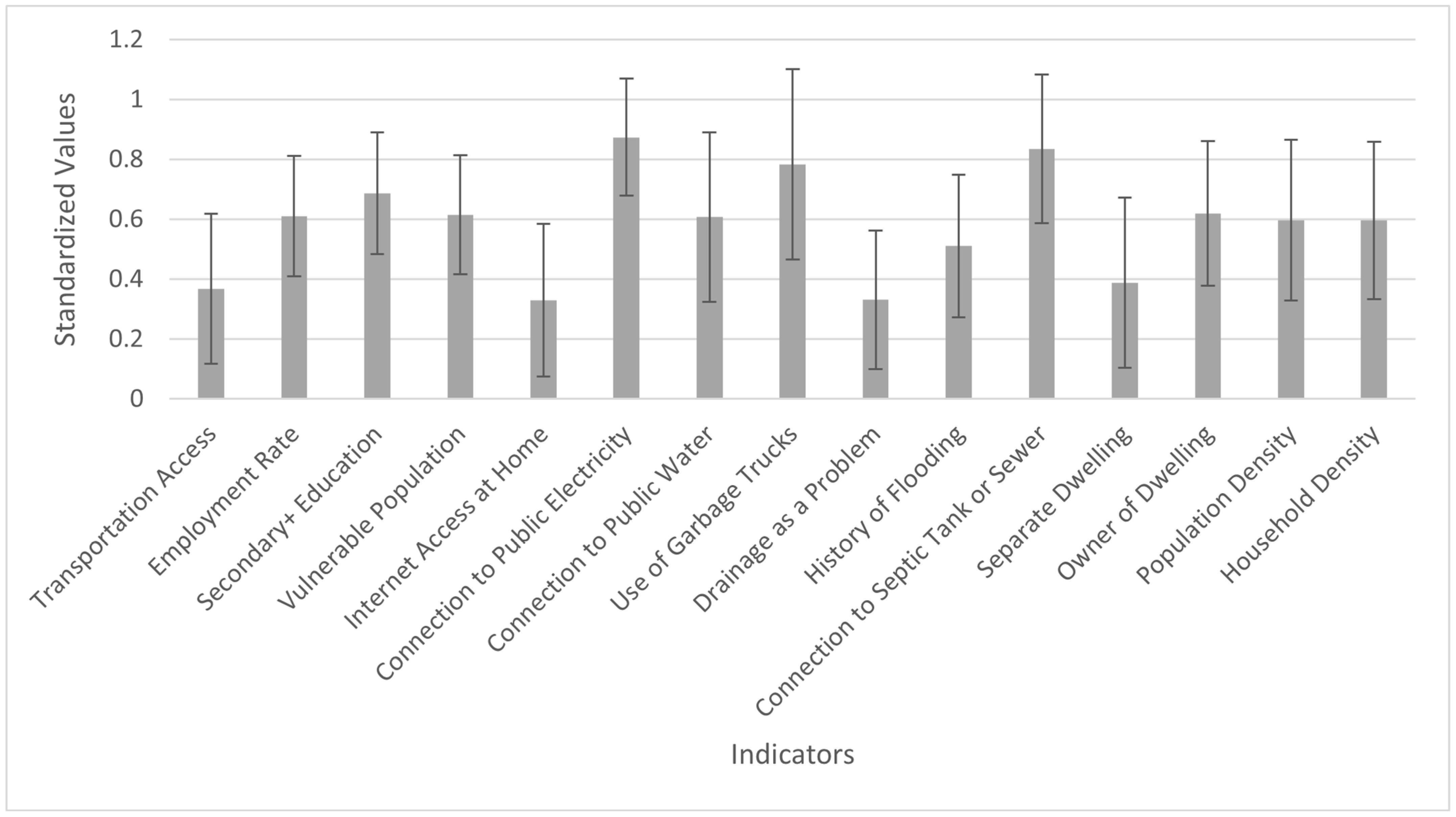
The summary descriptive statistics of the indicators are graphically represented in Figure 1, where the heights of the columns and the error bars depict the mean and standard deviation, respectively. Transportation access, internet access, drainage as a problem, and separate dwellings all have low means but relatively wide spreads. In contrast, values for connection to public electricity and connection to septic tanks or sewer have higher means and are more tightly clustered. Variables reflecting household characteristics tend to have moderate means and spreads, including the employment rate, education, vulnerable population, history of flooding, and owner of the dwelling. The other four indicators—connection to public water, use of garbage trucks, population density, and household density—all have moderate means with substantial spread.
All indicators exhibit high extraction communalities (see Table 3), ranging from 0.628 to 0.955. Infrastructure and utility-related indicators show particularly strong representation, including connection to septic tank or sewer (0.947), use of garbage trucks (0.929), population density (0.906), connection to public electricity (0.908), and internet access at home (0.899). Social and housing indicators, such as separate dwelling (0.880), owner of dwelling (0.955), and vulnerable population (0.847), are also well captured by the component structure.

3.2. Performance of Dimension-Wise and Total FRIs

Relying on Equations (4) and (5), Table 7 outlines the dimension-wise and overall flood resilience values for each of the 26 sub-districts in the city. The physical flood resilience had the highest mean of 0.6411, with a standard deviation of 0.1431. The sub-districts of Lamaha Gardens to Prashad Nagar and Durban Area to Botanical Gardens have the highest and lowest physical resilience scores, respectively. The notable negative skewness suggests that, while the mean is relatively high, some sub-districts (including Turkeyen) perform rather poorly. The social resilience measurements have a mean of 0.6021 and a standard deviation of 0.1042, indicating greater homogeneity than those of the other dimensions. Economic resilience performs worst, with a mean below 0.5 and a high standard deviation (0.1565), suggesting greater measurement disparities. The Albouystown to La Penitence sub-district is the least resilient, whereas the Subryanville to Bel Air Springs area is the most resilient for both the social and economic dimensions. Regarding total resilience, the adjacent districts of Lamaha Gardens through to Subryanville have outstanding overall flood resilience. Contrasting these are the Durban Area to Botanical Gardens, Turkeyen, and Albouystown to La Penitence, with low resilience scores. The penultimate column of Table 7 lists the total FRI values for each sub-district, with a mean of 0.5850 and a standard deviation of 0.1124. The Subryanville/Bel Air Springs/Bel Air Gardens district is the most flood resilient, scoring 0.79. Following closely is the adjacent district, Lamaha Gardens to Prashad Nagar, with a score of 0.77. The Kingston district (0.71) is the only other to score more than 0.7. In contrast, the Durban Area/Botanical Gardens district is the least flood-resilient (0.36).
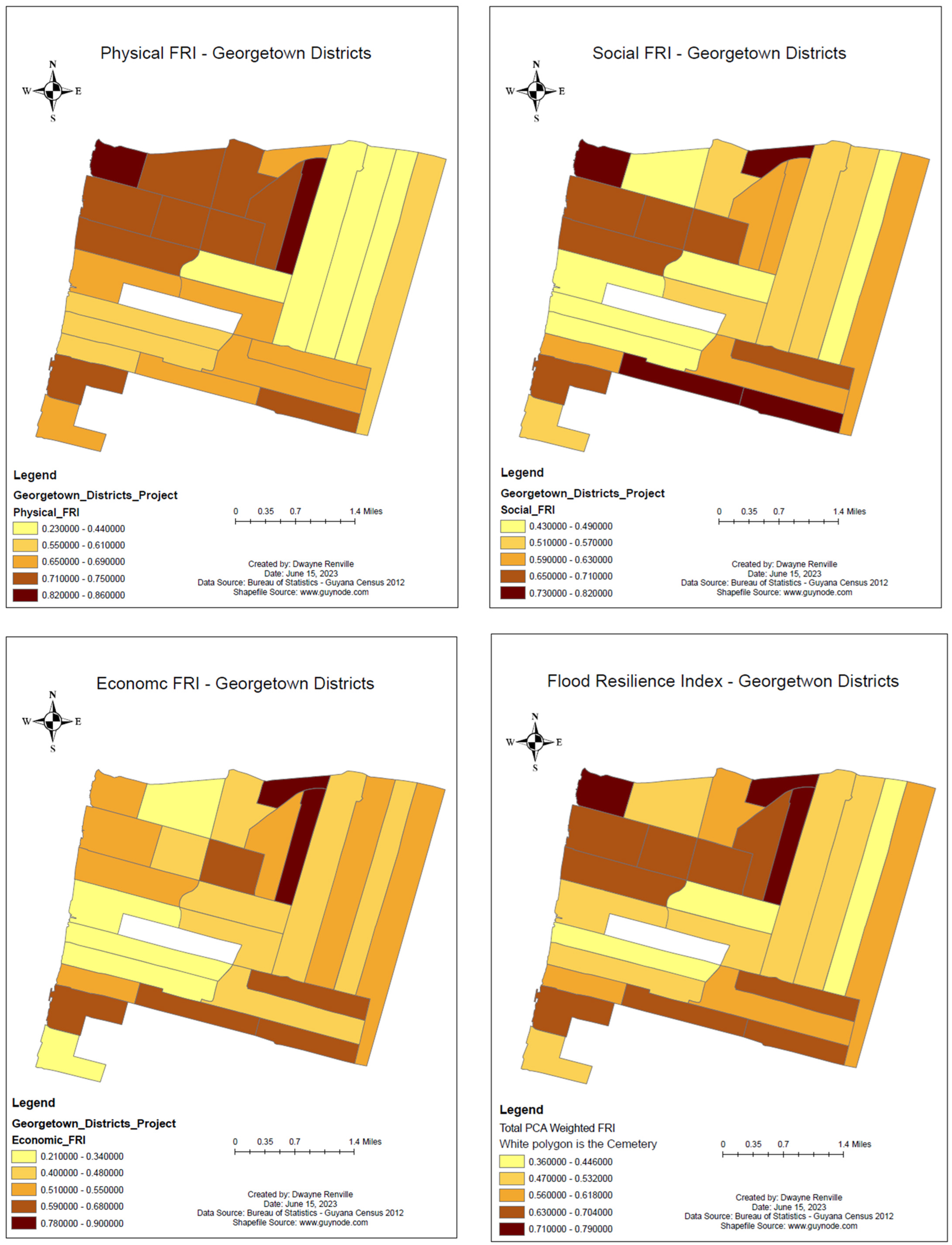
Figure 2 illustrates the spatial distribution of flood resilience values across the city for the three dimensions and the overall flood resilience. Each of the four maps is accompanied by an independent legend showing Jenks’ natural breaks classification. Darker shades indicate higher resilience, relative only to that particular FRI. The white central portion denotes the city’s cemetery, which was excluded from the analysis. Physical resilience exhibits large clusters, with a notable distinction between the cluster of sub-districts in the northeast and that of the sub-districts in the north-central to northwest. The social resilience map shows many areas with relatively low resilience values and indicates sharp disparities between two adjacent clusters. The economic resilience map shows the least clustering, but also fewer areas with relatively high flood resilience values. Notwithstanding their unique classification schemes of resilience values, the heterogeneous nature of resilience across the city is common among these maps. Furthermore, they illustrate that while a few sub-districts are classified as moderate- to high-resilience across multiple dimensions, many sub-districts consistently show lower resilience values across all maps.
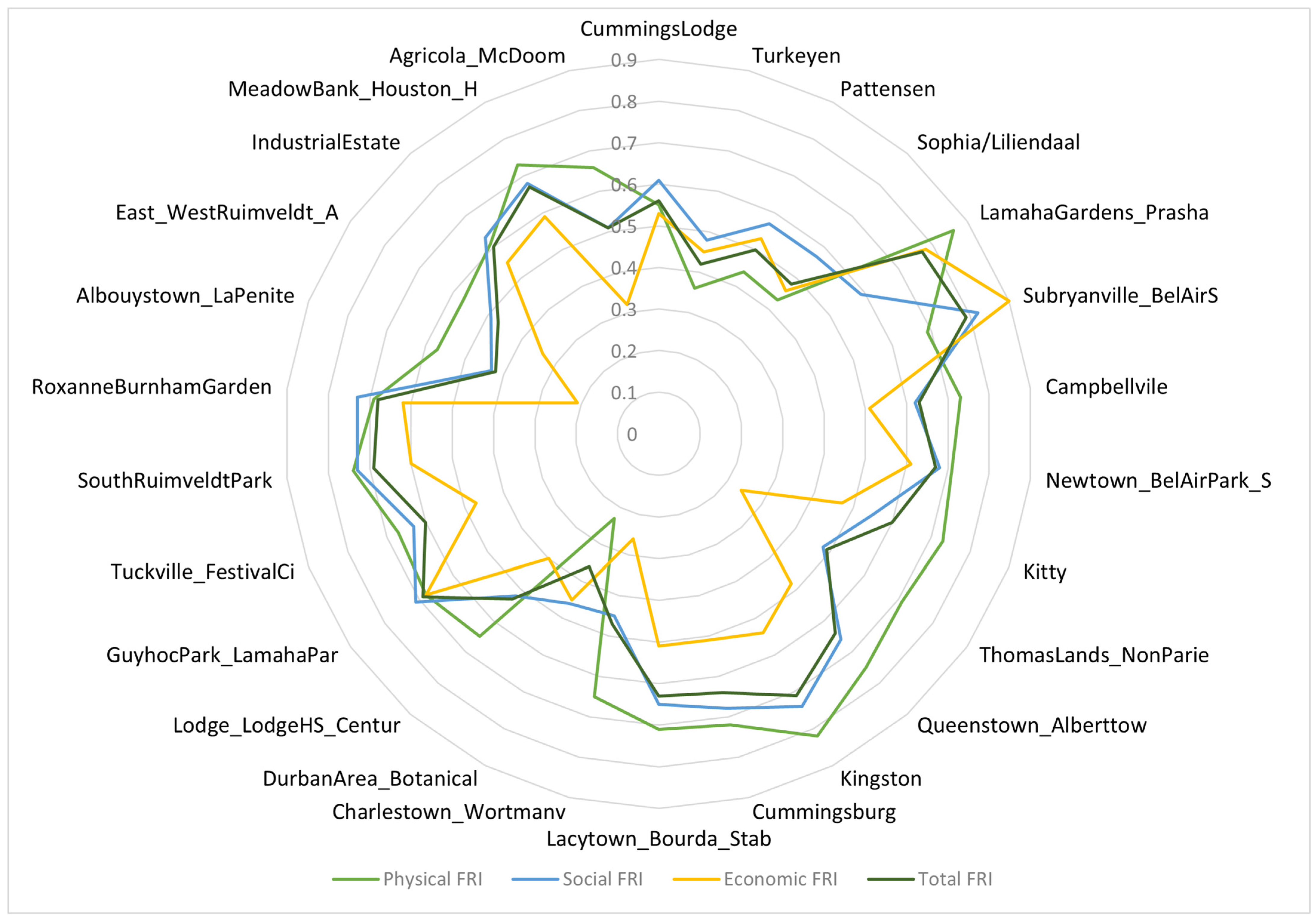
The radar plot in Figure 3 shows dimension-wise and total FRI values by sub-district, arranged clockwise, with Cummings Lodge at the top. This portrays an alternative view of the resilience patterns. A notable feature of the plot is the close alignment of the total FRI with the physical and social FRIs, indicating strong ties between them. In contrast, the economic FRI shows greater variability and frequently diverges from the total FRI, particularly in communities with relatively strong physical or social conditions. Correlation analysis confirms that, while the FRI for each dimension relates well with the total FRI ( r > 0.75 ), the social dimension has the strongest ties ( r = 0.883 ). The weakest correlation, r = 0.302 , is observed between the physical and economic dimensions. It can also be noted from the figure that the alignment of social and total FRIs is closest for the vast majority of the city, except for the continuous stretch of eastern sub-districts from Cummings Lodge to Lamaha Garden/Prashad Nagar. A similar finding was observed for the eastern stretch of communities from Turkeyen to Subryanville, where, unlike the majority of the rest of the city, the values of economic FRI were not the lowest. Finally, as evidenced by Table 7, while the FRIs of a given district vary to different extents, those of Guyhoc Park/Lamaha Park are the most consistent: while it does not boast having the highest FRI values for any of the indices, its values all range between 0.68 and 0.71.
Finally, it is important to note that the robustness analysis revealed very strong agreement between the adopted FRI specification (min–max normalization with PCA weights) and all alternative constructions. Across the physical, social, and economic dimensions, Spearman’s rank correlation coefficients exceeded 0.977 in all comparisons. The social dimension exhibited marginally lower—though still exceptionally strong—correlations relative to the other dimensions. At the aggregate level, total FRI correlations between the adopted specification and alternative configurations were consistently at least 0.990. These results indicate that sub-district resilience rankings and spatial patterns remain highly stable regardless of normalization or weighting scheme.

3.3. Regression Model from Dimensionality Reduction

The PCA reduced the 15 indicators to three principal components, each an orthogonal linear combination of 10 indicators (see Table 4). First is the utility component, which captures the vulnerable population, internet access, connection to public water, and connection to septic tank to sewer. Second, the personal agency component is determined by the employment rate, secondary+ education, drainage as a problem, and ownership of the dwelling. Finally, the spatial component is defined by separate dwelling and population density. Given these, and relying on the component scores shown in Table 6, the regression procedure yielded a high coefficient of determination ( R 2 = 0.941 ), indicating that 94.1% of the variation in the FRI values is explained by our model. This confirms that the reduced model with the three principal components represents the FRI values well. Additionally, the analysis of variance (ANOVA) statistics, with p-value < 0.001, indicates the model’s statistical significance, suggesting that at least one component directly influences the estimated FRI values. Moreover, the linear regression coefficients for the model are all statistically significant, with a p-value < 0.001, indicating that each of the three principal components directly influences the FRI values. The derived regression equation with these coefficients is given by Equation (9), where C l , j represents the factor scores (see Table 7) for each sub-district j .
F R I j ^ = 0.585 + 0.086 C 1 , j + 0.050 C 2 , j + 0.045 C 3 , j
In this model, the F R I j ^ comprises 0.086 of the public utility component, 0.05 of the individual agency component, 0.045 of the spatial component, and a constant of 0.585. To apply the regression equation, we substituted the factor scores of Table 6 for each sub-district. For example, while the FRI for the first sub-district, Cummings Lodge, was calculated as F R I = 0.56 , its value obtained via PCA regression is obtained as
F R I 1 ^ = 0.585 + 0.086 0.20554 + 0.050 0.36125 + 0.045 0.43092 = 0.56865 .
Similarly, while the calculated overall FRI for Roxanne Burnham Gardens was 0.68 , the model returns
F R I 21 ^ = 0.585 + 0.086 0.4364 + 0.050 0.75583 + 0.045 0.0478 = 0.66248
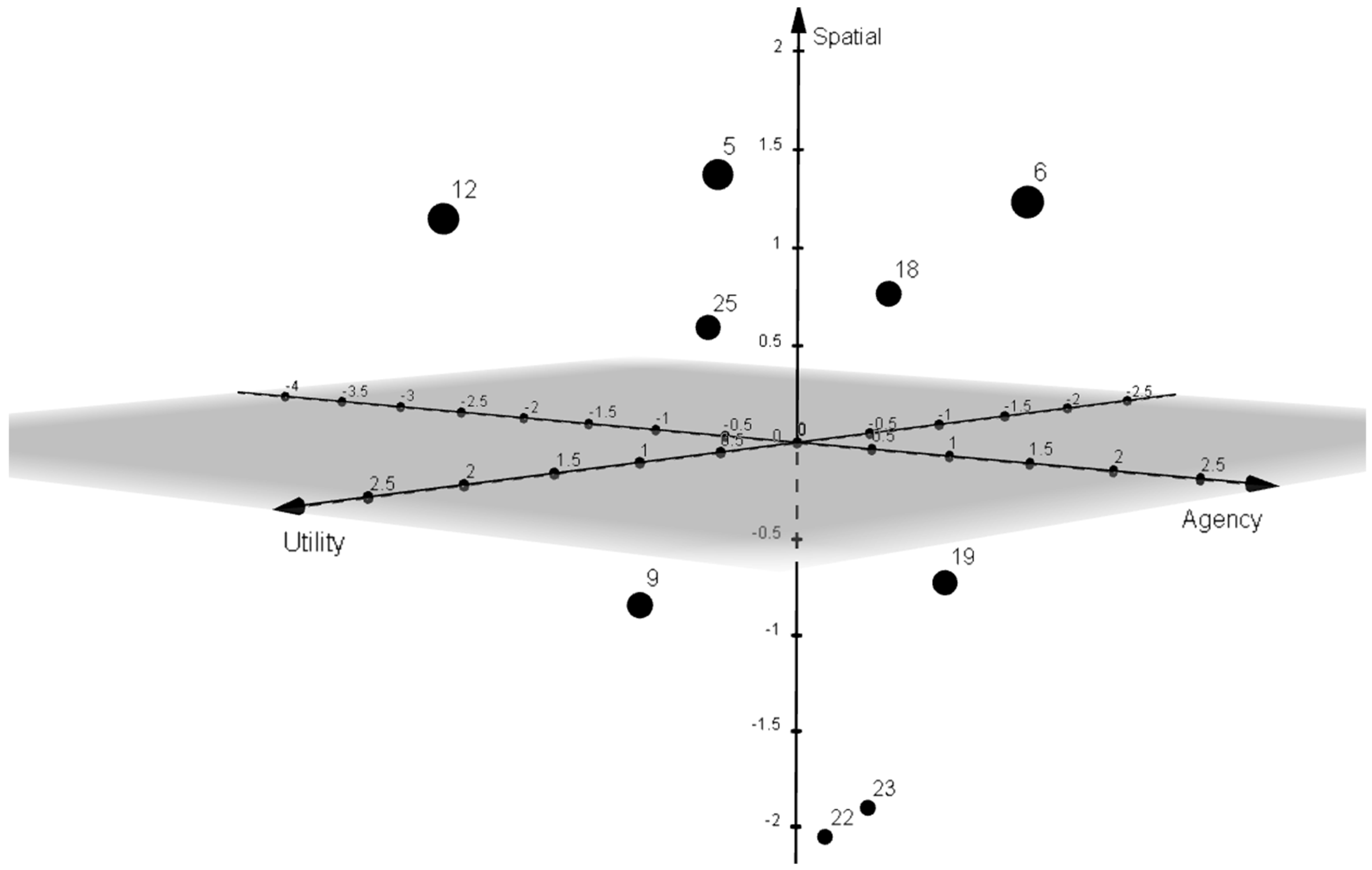
These calculations were performed for each sub-district and are provided in the last column of Table 7. These results confirm that the PCA dimensionality reduction approach for calculating FRI values for any sub-district uses significantly fewer dimensions, is easier to relate to, and effectively represents the flood resilience states of the sub-districts of Georgetown. Figure 4 provides a single view of the three-dimensional flood resilience across a sample of sub-districts with distinct resilience across the components, enabling non-overlapping circles and values. Public utility and individual agency are measured along the horizontal axes, while the spatial component is measured vertically. Such a visualization allows for rotating, zooming, and closer inspection of any district. The view shown mainly distinguishes between the sub-districts with high and low spatial resilience. For example, districts below the horizontal plane have low spatial resilience, including Albouystown, La Penetence (22), and East Ruimveldt and West Ruimveldt (23); meanwhile, those above the horizontal plane have high spatial resilience, including Lamaha Gardens and Prashad Nagar (5), and Kingston (12).

4. Discussion

Urban flood resilience is widely accepted as an effective approach for managing the effects of floods, whether traditional seasonal floods, impending floods associated with anticipated extreme weather patterns, or unprecedented floods. Therefore, flood resilience is increasingly pertinent in cities such as Georgetown, Guyana, where a substantial portion is frequently inundated [69]. By examining the case of Georgetown, Guyana, this study uncovered insights regarding the city’s flood resilience status. However, given that the data were obtained from the 2012 census, our findings reflect the flood resilience of that time and do not necessarily reflect the current state of affairs in the city. However, this study is still particularly useful, as it (a) accounts for an under-represented geographic region in the literature and (b) provides a basis for comparison with future studies using data more proximate to the current time. In general, our findings show that flood resilience is heterogeneous across the city, with better performances observed in traditionally commercial and residential areas known for their affluence or having standalone housing units. At the other end of the flood resilience spectrum are the peripheral communities and those densely populated with apartment-style housing that supports multiple families in small units.

4.1. Indicator Performances and Spatial Patterns

At the indicator level, our findings show that connection to public electricity has the highest indicator scores, suggesting widespread household connection to the electricity network during a flood event. In contrast, transportation access, internet access, drainage problems, and separate dwellings were major deficits among city dwellers. These describe a potential flood situation where (a) drains might have easily overflowed; (b) critical information might not have reached the masses in a timely manner; and (c) evacuation might have been adversely affected, and (d) many residents might not have been able to make adjustments to properties to escape flood waters. It is reasonable to infer that transportation and internet access have likely improved over the years, driven by the massive increase in vehicle imports [70,71] and advances in information and communication technology. On the other hand, improvements in drainage and independent dwelling units are not straightforward, as they are tied to the city’s spatial capacity and may only be determined with new data from the municipality or the 2022 census (when it becomes available). These low-scoring indicators also showed high variance, reflecting major intra-urban disparities, and can all be traced to households’ economic situation.
The disparities were further evident in the dimension-wise indices, particularly in physical resilience, which showed a higher mean and many high-resilience values, but was marred by stark differences in resilience values between adjacent clusters of sub-districts. While high values are common across traditionally residential and commercial areas, low values are observed in communities known to be less affluent, in regularized squatting areas, or in those that are still not regularized. It is important to note that the city has expanded over time to include areas in the east that had dense squatter settlements. Whereas these areas have since been regularized, they remain poorly served, faced with infrastructural underdevelopment, and are among the least flood-resilient sub-districts of Georgetown. Social resilience showed fewer disparities and reduced clustering. However, it was the economic dimension that exhibited the least clustering, which, together with its overall poor performance, suggests that many city dwellers lacked the financial means to adequately navigate a major flood event.
While the Jenks’ natural break classification of values in the GIS maps prioritized intra-dimensional variation, together with correlation analysis, they show certain spatial patterns and strong ties between each dimension and the total resilience scores. In particular, social resilience had the strongest correlation with total resilience. Despite these strong ties, the social resilience of the eastern sub-districts—which include densely populated, regularized squatting areas—was not as closely correlated with the total FRI as in the rest of the city. These sub-districts appear constrained by physical or economic limitations that dampen the aggregate effect of their social resilience, suggesting that social capacity alone may be insufficient to offset structural and infrastructural deficits in these newer, regularized communities. This pattern underscores the importance of targeted infrastructure investments and spatial planning interventions, especially in transitional settlements.
The results of the PCA proved ideal for graphical representation, improving interpretability. While the indicators and sub-dimensions draw attention to specific needs, the principal components focus on uncorrelated areas of grouped needs. For example, utility resilience was poor within the eastern sub-sections, corroborating the findings of the dimension-wise analyses. Similarly, spatial resilience was poor across a large cluster of areas in Georgetown’s central to south-central parts. Their concentration of high-density apartment clusters is associated with lower spatial resilience scores, suggesting that infrastructural capacity has not scaled proportionally with population density. While density can support social and economic vitality without commensurate drainage capacity, building flood-proofing standards, and open space integration, it may amplify flood sensitivity. Therefore, resilience planning in these districts should prioritize infrastructure retrofitting and other flood-proofing upgrades. Given that these findings illustrate location-centric resilience needs, they enable targeted interventions to improve the city’s flood resilience.
The application of PCA provided an additional analytical advantage by reducing the multidimensional indicator space to three principal components that collectively capture the dominant structure of variation in the flood resilience indicators. This dimensionality reduction enabled the visualization of sub-district resilience profiles in three-dimensional space, offering a more intuitive representation of how areas of the city relate to one another in terms of resilience characteristics. For resilience planners and city practitioners, such graphical representations simplify interpretation by transforming a complex set of indicators into a visually interpretable structure where clusters, gradients, and outliers among sub-districts can be readily identified. This allows decision makers to quickly discern which areas exhibit similar resilience challenges and which require unique policy attention.
The high correlation across alternative index constructions suggests that the spatial distribution of flood resilience in Georgetown is driven primarily by underlying structural variation in the selected indicators, rather than methodological specification. The stability of rankings under both normalization approaches and weighting schemes demonstrates that the constructed FRI is insensitive to scaling transformations and weight assignments. This strengthens confidence in the empirical robustness and interpretative reliability of the findings. Furthermore, while we do not claim a causal relationship, the stability of the FRIs may partly reflect the robustness of the initial indicators, being derived from established resilience frameworks [67].

4.2. Literature Comparison

This study follows a plethora of other studies in adopting a multidimensional approach to flood resilience, while still allowing for disaggregation into specific components, dimensions, or indicators [28,67]. A further similarity is the use of metrics of societal dimensions to evaluate flood resilience, conforming to a widespread pattern in which the historical city’s core is more likely to be resilient to flooding than the peripheral sub-districts [28,34,47]. The sharp disparities in total flood resilience among adjacent clusters are also consistent with findings from other studies [30], in which lower scores indicate potential vulnerability and a lack of capacity to deal with flood disruptions [28,30]. Whereas economic resilience performed the worst and had the weakest correlation with overall flood resilience, the financial states of households underpin a number of flood resilience indicators and are considered to substantially influence flood resilience [30]. Strong ties between social and overall resilience are common among flood resilience studies, suggesting that investment in people and services is essential for advancing flood resilience [31,34]. A notable contribution to the literature of this study is that, unlike other studies that used dimensionality reduction [28,34], the principal components explain a high percentage of the variation. Furthermore, our study yielded three principal components, enabling graphical representation to further simplify interpretation.

4.3. Recommendations for Building Equitable Flood Resilience

This study provides a potential indication of discontinuity and inequity in the distribution of the quality and quantity of resilience needs, as reflected in the provision of infrastructural and utility services to communities. The flood resilience patterns highlight uneven societal resilience, driven more by socioeconomic and settlement characteristics than by individual characteristics. We draw attention to the sub-districts of high population density but low independent housing as high-risk areas. Moreover, these findings underscore the need for targeted, equitable, district-specific flood mitigation strategies rather than uniform citywide interventions. Lower-resilience districts should be prioritized for climate-adaptive infrastructure, while governance and planning frameworks must explicitly address spatial inequality in urban flood resilience. The average performance and weaker alignment of economic resilience suggest that economic factors, while important, exert a less dominant influence on the composite resilience score than the physical and social dimensions.
Considering the evidence, we argue that the achievement of improved resilience hinges on a city’s ability to adopt inclusive approaches. We recommend urgent attention to underserved areas with poor spatial and physical attributes. In particular, attention can be paid to improving employment rates, access to separate housing, and connections to utility services. The city is encouraged to establish strong collaborations with stakeholders, including resilience and other scholars, in order to investigate root causes and develop data-driven solutions to enhance the city’s flood resilience in an equitable manner. As a baseline study for Georgetown, further studies can replicate the analysis performed here using the 2022 census data to provide insights into changes in levels of flood resilience across the city; however, to support such analyses, there is also a need for better data management and access. Furthermore, future studies should examine the meaning of the statistics generated in this study, especially in the context of inclusiveness and other societal concerns. Acknowledging that such indices are temporal, spatial, and scale-dependent, we also recommend further studies that use finer scales for better understanding; for example, regarding flood resilience at the household level. Moreover, based on our transparent methodology, this study can be replicated in other jurisdictions with a similar context.

5. Conclusions

This study investigated Georgetown’s flood resilience in order to identify patterns and hotspots that warrant further study. The indicators used were based on census data and corresponded to physical, social, and economic dimensions. Flood resilience indices were constructed using these indicators based on the aggregated weighted mean index. Principal component analysis was employed to assign weights to these indicators and, subsequently, to reduce their dimensionality and simplify the interpretation of the indices. The findings suggest that resilience differs by dimension, sub-district, and groups of sub-districts, where communities with access to utility services and higher affluence are more likely to be flood-resilient. The findings suggest that Georgetown’s flood resilience is moderate, closer to the coping end of the resilience spectrum. The implications are that the city may continue to suffer significant flood losses without sound flood-resilient plans, policies, and actions. Municipal leaders are encouraged to collaborate with stakeholders to develop a resilience plan to withstand future floods, particularly amid the uncertainty of climate-induced flood hazards. This study provides compelling insights for action and further studies to better understand and position Georgetown toward a transformative resilience agenda.

Author Contributions

Conceptualization, D.S.R., C.C. and N.C.; methodology, D.S.R., C.C. and N.C.; software, D.S.R.; validation, D.S.R., C.C., L.F. and B.B.; formal analysis, D.S.R., C.C., L.F. and B.B.; investigation, D.S.R., C.C., L.F., B.B. and N.C.; resources, D.S.R., L.F. and B.B.; data curation, D.S.R., L.F. and B.B.; writing—original draft preparation, D.S.R.; writing—review and editing, D.S.R. and L.F.; visualization, D.S.R. and N.C.; supervision, D.S.R., C.C. and N.C.; project administration, D.S.R. All authors have read and agreed to the published version of the manuscript.

Funding

This research received no external funding.

Data Availability Statement

The raw data supporting the conclusions of this article will be made available by the authors upon request.

Acknowledgments

The authors extend sincere gratitude to the management of the Bureau of Statistics, Guyana, for providing access to census data, and to the operator(s) of the website www.guynode.com, who provided significant assistance in developing the shapefile used for the GIS analysis.

Conflicts of Interest

The authors declare no conflicts of interest.

Abbreviations

The following abbreviations are used in this manuscript:
ANOVAAnalysis of variance.
FRIFlood resilience index.
GISGeographic information system.
PCAPrincipal component analysis.

References

  1. UNDRR. Human Cost of Disasters; UNDRR: Geneva, Switzerland, 2020. [Google Scholar] [CrossRef]
  2. IPCC. Climate Change 2022—Impacts, Adaptation and Vulnerability—Working Group II Contribution to the Sixth Assessment Report of the Intergovernamental Panel on Climate Change; IPCC: Geneva, Switzerland, 2022. [Google Scholar] [CrossRef]
  3. Ekumah, B.; Armah, F.A.; Afrifa, E.K.A.; Aheto, D.W.; Odoi, J.O.; Afitiri, A.R. Geospatial assessment of ecosystem health of coastal urban wetlands in Ghana. Ocean Coast. Manag. 2020, 193, 105226. [Google Scholar] [CrossRef]
  4. Mycoo, M.; Robinson, S.A.; Nguyen, C.; Nisbet, C.; Tonkel, R. Human Adaptation to Coastal Hazards in Greater Bridgetown, Barbados. Front. Environ. Sci. 2021, 9, 647788. [Google Scholar] [CrossRef]
  5. Rodrigues, M.; Antunes, C. Best management practices for the transition to a water-sensitive city in the south of portugal. Sustainability 2021, 13, 2983. [Google Scholar] [CrossRef]
  6. Solan, M.; Bennett, E.M.; Mumby, P.J.; Leyland, J.; Godbold, J.A. Benthic-based contributions to climate change mitigation and adaptation. Philos. Trans. R. Soc. B Biol. Sci. 2020, 375, 20190107. [Google Scholar] [CrossRef]
  7. Pelling, M.; Özerdem, A.; Barakat, S. The macro-economic impact of disasters. Prog. Dev. Stud. 2002, 2, 283–305. [Google Scholar] [CrossRef]
  8. Wagner, M.; Chhetri, N.; Sturm, M. Adaptive capacity in light of Hurricane Sandy: The need for policy engagement. Appl. Geogr. 2014, 50, 15–23. [Google Scholar] [CrossRef]
  9. Errett, N.A.; Tanner, A.; Shen, X.; Chang, S.E. Understanding the Impacts of Maritime Disruption Transportation to Hospital-Based Acute Health Care Supplies and Personnel in Coastal and Geographically Isolated Communities. Disaster Med. Public Health Prep. 2019, 13, 440–448. [Google Scholar] [CrossRef]
  10. McGranahan, G.; Balk, D.; Anderson, B. The rising tide: Assessing the risks of climate change and human settlements in low elevation coastal zones. Environ. Urban. 2007, 19, 17–37. [Google Scholar] [CrossRef]
  11. Smith, G.; Anderson, A.; Perkes, D. New urbanism and the hazard transect overlay district: Improving the integration of disaster resilience and design in coastal areas. Landsc. J. 2021, 40, 35–47. [Google Scholar] [CrossRef]
  12. Saatchi, M.; Khankeh, H.R.; Shojafard, J.; Barzanji, A.; Ranjbar, M.; Nazari, N.; Mahmodi, M.A.; Ahmadi, S.; Farrokhi, M. Communicable diseases outbreaks after natural disasters: A systematic scoping review for incidence, risk factors and recommendations. Prog. Disaster Sci. 2024, 23, 100334. [Google Scholar] [CrossRef]
  13. Paterson, D.L.; Wright, H.; Harris, P.N.A. Health Risks of Flood Disasters. Clin. Infect. Dis. 2018, 67, 1450–1454. [Google Scholar] [CrossRef]
  14. Theodora, Y.; Spanogianni, E. Assessing coastal urban sprawl in the Athens’ southern waterfront for reaching sustainability and resilience objectives. Ocean Coast. Manag. 2022, 222, 106090. [Google Scholar] [CrossRef]
  15. Torabi, E.; Dedekorkut-Howes, A.; Howes, M. Adapting or maladapting: Building resilience to climate-related disasters in coastal cities. Cities 2018, 72, 295–309. [Google Scholar] [CrossRef]
  16. Shabrina, F.Z.; Meilano, I.; Windupranata, W.; Hanifa, N.R. Measure coastal disaster resilience using community disaster resilience index (CDRI) in Mentawai Island, Indonesia. AIP Conf. Proc. 2018, 1987, 020080. [Google Scholar] [CrossRef]
  17. Orencio, P.M.; Fujii, M. A localized disaster-resilience index to assess coastal communities based on an analytic hierarchy process (AHP). Int. J. Disaster Risk Reduct. 2013, 3, 62–75. [Google Scholar] [CrossRef]
  18. Kusumastuti, R.D.; Viverita; Husodo, Z.A.; Suardi, L.; Danarsari, D.N. Developing a resilience index towards natural disasters in Indonesia. Int. J. Disaster Risk Reduct. 2014, 10, 327–340. [Google Scholar] [CrossRef]
  19. Rus, K.; Kilar, V.; Koren, D. Resilience assessment of complex urban systems to natural disasters: A new literature review. Int. J. Disaster Risk Reduct. 2018, 31, 311–330. [Google Scholar] [CrossRef]
  20. Dong, Z.; Elko, N.; Robertson, Q.; Rosati, J. Quantifying Beach and Dune Resilience Using the Coastal Resilience Index. Coast. Eng. Proc. 2018, 1, 30. [Google Scholar] [CrossRef]
  21. Islam, M.A.; Paull, D.J.; Griffin, A.L.; Murshed, S. Spatio-temporal assessment of social resilience to tropical cyclones in coastal Bangladesh. Geomat. Nat. Hazards Risk 2021, 12, 279–309. [Google Scholar] [CrossRef]
  22. Jayadas, A.; Ambujam, N.K. Research and design of a farmer resilience index in coastal farming communities of tamil nadu, india. J. Water Clim. Change 2021, 12, 3143–3158. [Google Scholar] [CrossRef]
  23. Shah, A.A.; Gong, Z.; Ali, M.; Jamshed, A.; Naqvi, S.A.A.; Naz, S. Measuring education sector resilience in the face of flood disasters in Pakistan: An index-based approach. Environ. Sci. Pollut. Res. 2020, 27, 44106–44122. [Google Scholar] [CrossRef] [PubMed]
  24. Batica, J.; Gourbesville, P.; Hu, F.-Y. Methodology for Flood Resilience Index. In Proceedings of the International Conference on Flood Resilience: Experiences in Asia and Europe, Exeter, UK, 5–7 September 2013; Volume 5. [Google Scholar]
  25. Chhetri, N.; Stuhlmacher, M.; Ishtiaque, A. Nested pathways to adaptation. Environ. Res. Commun. 2019, 1, 015001. [Google Scholar] [CrossRef]
  26. Wang, L.; Cui, S.; Li, Y.; Huang, H.; Manandhar, B.; Nitivattananon, V.; Fang, X.; Huang, W. A review of the flood management: From flood control to flood resilience. Heliyon 2022, 8, e11763. [Google Scholar] [CrossRef]
  27. Mannucci, S.; Rosso, F.; D’amico, A.; Bernardini, G.; Morganti, M. Flood Resilience and Adaptation in the Built Environment: How Far along Are We? Sustainability 2022, 14, 4096. [Google Scholar] [CrossRef]
  28. Kotzee, I.; Reyers, B. Piloting a social-ecological index for measuring flood resilience: A composite index approach. Ecol. Indic. 2016, 60, 45–53. [Google Scholar] [CrossRef]
  29. Moghadas, M.; Asadzadeh, A.; Vafeidis, A.; Fekete, A.; Kötter, T. A multi-criteria approach for assessing urban flood resilience in Tehran, Iran. Int. J. Disaster Risk Reduct. 2019, 35, 101069. [Google Scholar] [CrossRef]
  30. Ji, J.; Chen, J. Urban flood resilience assessment using RAGA-PP and KL-TOPSIS model based on PSR framework: A case study of Jiangsu province, China. Water Sci. Technol. 2022, 86, 3264–3280. [Google Scholar] [CrossRef]
  31. Satour, N.; Raji, O.; El Moçayd, N.; Kacimi, I.; Kassou, N. Spatialized flood resilience measurement in rapidly urbanized coastal areas with a complex semi-arid environment in northern Morocco. Nat. Hazards Earth Syst. Sci. 2021, 21, 1101–1118. [Google Scholar] [CrossRef]
  32. Chen, K.F.; Leandro, J. A Conceptual time-varying flood resilience index for urban areas: Munich city. Water 2019, 11, 830. [Google Scholar] [CrossRef]
  33. Bertilsson, L.; Wiklund, K.; de Moura Tebaldi, I.; Rezende, O.M.; Veról, A.P.; Miguez, M.G. Urban flood resilience—A multi-criteria index to integrate flood resilience into urban planning. J. Hydrol. 2018, 573, 970–982. [Google Scholar] [CrossRef]
  34. Pathak, S.D.; Kulshrestha, M. Assessment of flood resilience using RAAAR framework: The case of Narmada River Basin, India. Environ. Eng. Manag. J. 2021, 20, 1263–1276. [Google Scholar] [CrossRef]
  35. Andal, A.G. Children’s spaces in coastal cities: Challenges to conventional urban understandings and prospects for child-friendly blue urbanism. Child. Geogr. 2021, 20, 688–700. [Google Scholar] [CrossRef]
  36. Cheng, C.; Tsai, J.Y.; Yang, Y.C.E.; Esselman, R.; Kalcic, M.; Xu, X.; Mohai, P. Risk communication and climate justice planning: A case of Michigan’s huron river watershed. Urban Plan. 2017, 2, 34–50. [Google Scholar] [CrossRef]
  37. Tyler, S.; Moench, M. A framework for urban climate resilience. Clim. Dev. 2012, 4, 311–326. [Google Scholar] [CrossRef]
  38. Zhang, Y.; Yue, W.; Su, M.; Teng, Y.; Huang, Q.; Lu, W.; Rong, Q.; Xu, C. Assessment of urban flood resilience based on a systematic framework. Ecol. Indic. 2023, 150, 110230. [Google Scholar] [CrossRef]
  39. Chen, X.; Quan, R. A spatiotemporal analysis of urban resilience to the COVID-19 pandemic in the Yangtze River Delta. Nat. Hazards 2021, 106, 829–854. [Google Scholar] [CrossRef]
  40. Osei-Kyei, R.; Ampratwum, G.; Komac, U.; Narbaev, T. Critical analysis of the emerging flood disaster resilience assessment indicators. Int. J. Disaster Resil. Built Environ. 2025, 16, 417–436. [Google Scholar] [CrossRef]
  41. Miguez, M.G.; Veról, A.P. A catchment scale Integrated Flood Resilience Index to support decision making in urban flood control design. Environ. Plan. B Urban Anal. City Sci. 2017, 44, 925–946. [Google Scholar] [CrossRef]
  42. Leandro, J.; Chen, K.F.; Wood, R.R.; Ludwig, R. A scalable flood-resilience-index for measuring climate change adaptation: Munich city. Water Res. 2020, 173, 115502. [Google Scholar] [CrossRef]
  43. Zhang, H.; Yang, J.; Li, L.; Shen, D.; Wei, G.; Khan, H.U.R.; Dong, S. Measuring the resilience to floods: A comparative analysis of key flood control cities in China. Int. J. Disaster Risk Reduct. 2021, 59, 102248. [Google Scholar] [CrossRef]
  44. Barreiro, J.; Lopes, R.; Ferreira, F.; Matos, J.S. Index-based approach to evaluate city resilience in flooding scenarios. Civ. Eng. J. 2021, 7, 197–207. [Google Scholar] [CrossRef]
  45. Manandhar, B.; Cui, S.; Wang, L.; Shrestha, S. Post-Flood Resilience Assessment of July 2021 Flood in Western Germany and Henan, China. Land 2023, 12, 625. [Google Scholar] [CrossRef]
  46. Satour, N.; Benyacoub, B.; El Mahrad, B.; Kacimi, I. KPCA over PCA to assess urban resilience to floods. E3S Web Conf. 2021, 314, 03005. [Google Scholar] [CrossRef]
  47. Schwarz, I.; Ziegelaar, M.; Kelly, M.; Watkins, A.B.; Kuleshov, Y. Flood Resilience Assessment and Mapping: A Case Study from Australia’s Hawkesbury-Nepean Catchment. Climate 2023, 11, 39. [Google Scholar] [CrossRef]
  48. Gomez Vaca, A.N.; Popartan, L.A.; Nuss-Girona, S.; Rodríguez-Roda, I. Spatial approach for assessing vulnerability to urban flooding: A proposal for a multidimensional index. Nat. Hazards 2025, 121, 16799–16825. [Google Scholar] [CrossRef]
  49. Cao, F.; Xu, X.; Zhang, C.; Kong, W. Evaluation of urban flood resilience and its Space-Time Evolution: A case study of Zhejiang Province, China. Ecol. Indic. 2023, 154, 110643. [Google Scholar] [CrossRef]
  50. Rosenzweig, B.R.; McPhillips, L.; Chang, H.; Cheng, C.; Welty, C.; Matsler, M.; Iwaniec, D.; Davidson, C.I. Pluvial flood risk and opportunities for resilience. Wiley Interdiscip. Rev. Water 2018, 5, e1302. [Google Scholar] [CrossRef]
  51. IPCC. Glossary of Terms. In Managing the Risks of Extreme Events and Disasters to Advance Climate Change Adaptation; Field, S.K.A., Barros, V.C.B., Stocker, T.F., Qin, D., Dokken, D.J., Ebi, K.L., Mastrandrea, M.D., Mach, K.J., Plattner, G.-K., Tignor, P.M.M.M., Eds.; Cambridge University Press: Cambridge, UK; New York, NY, USA, 2012; pp. 555–564. [Google Scholar] [CrossRef]
  52. World Bank Group. Guyana. Available online: https://www.worldbank.org/ext/en/country/guyana#tab-economy (accessed on 28 December 2025).
  53. Zhou, M.; He, Q.; Gu, Y.; Wang, K.; Shen, Z. Urban Flood Resilience Assessment of Prefecture-Level Cities in Yangtze River Delta. ISPRS Int. J. Geo-Inf. 2025, 14, 108. [Google Scholar] [CrossRef]
  54. Wu, T. Quantifying coastal flood vulnerability for climate adaptation policy using principal component analysis. Ecol. Indic. 2021, 129, 108006. [Google Scholar] [CrossRef]
  55. Batica, J.; Gourbesville, P. Resilience in Flood Risk Management—A New Communication Tool. Procedia Eng. 2016, 154, 811–817. [Google Scholar] [CrossRef]
  56. Sudradjat, A.; Nastiti, A.; Barlian, K.; Angga, M.S. Flood and Drought Resilience Measurement at Andir Urban Village, Indonesia. E3S Web Conf. 2020, 148, 06005. [Google Scholar] [CrossRef]
  57. Satour, N.; Benyacoub, B.; Ennaimani, Z.; Niazi, S.; Kassou, N.; Kacimi, I. Machine Learning Enchances Flood Resilience Measurements in a Coastal Area—Case Study of Morocco. J. Environ. Inform. 2023, 42, 53–64. [Google Scholar] [CrossRef]
  58. Hung, H.C.; Yang, C.Y.; Chien, C.Y.; Liu, Y.C. Building resilience: Mainstreaming community participation into integrated assessment of resilience to climatic hazards in metropolitan land use management. Land Use Policy 2016, 50, 48–58. [Google Scholar] [CrossRef]
  59. Bureau of Statistics. Copy of Census. Available online: https://statisticsguyana.gov.gy/classified/ (accessed on 13 January 2026).
  60. Abdrabo, K.I.; Kantoush, S.A.; Esmaiel, A.; Saber, M.; Sumi, T.; Almamari, M.; Elboshy, B.; Ghoniem, S. An integrated indicator-based approach for constructing an urban flood vulnerability index as an urban decision-making tool using the PCA and AHP techniques: A case study of Alexandria, Egypt. Urban Clim. 2023, 48, 101426. [Google Scholar] [CrossRef]
  61. Bucherie, A.; Hultquist, C.; Adamo, S.; Neely, C.; Ayala, F.; Bazo, J.; Kruczkiewicz, A. A comparison of social vulnerability indices specific to flooding in Ecuador: Principal component analysis (PCA) and expert knowledge. Int. J. Disaster Risk Reduct. 2022, 73, 102897. [Google Scholar] [CrossRef]
  62. Castello, A.B.; Osborne, J.W. Best Practices in Exploratory Factor Analysis: Four Recommendations for Getting the Most From Your Analysis. Pract. Assess. Res. Eval. 2005, 10, 1–9. [Google Scholar] [CrossRef]
  63. Isia, I.; Hadibarata, T.; Hapsari, R.I.; Jusoh, M.N.H.; Bhattacharjya, R.K.; Shahedan, N.F. Assessing social vulnerability to flood hazards: A case study of Sarawak’s divisions. Int. J. Disaster Risk Reduct. 2023, 97, 104052. [Google Scholar] [CrossRef]
  64. Parvin, G.A.; Ahsan, S.M.R.; Yusop, A.Y.B.M.; Gordon, J.A.; Abedin, M.A.; Ahmad, M.H. Kampung (village) flood resilience: An empirical analysis in Malaysia. Environ. Hazards 2021, 20, 550–574. [Google Scholar] [CrossRef]
  65. Mruksirisuk, P.; Thanvisitthapon, N.; Pholkern, K.; Garshasbi, D.; Saguansap, P. Flood vulnerability assessment of Thailand’s flood-prone Pathum Thani province and vulnerability mitigation strategies. J. Environ. Manag. 2023, 347, 119276. [Google Scholar] [CrossRef]
  66. Houston, D.; Ball, T.; Werritty, A.; Black, A.R. Social influences on flood preparedness and mitigation measures adopted by people living with flood risk. Water 2021, 13, 2972. [Google Scholar] [CrossRef]
  67. Moreira, L.L.; Madruga De Brito, M.; Kobiyama, M. A systematic review and future prospects of flood vulnerability indices. Hazards Earth Syst. Sci. 2021, 21, 1513–1530. [Google Scholar] [CrossRef]
  68. Muqeet Shah, A.; Ahmad Rana, I.; Bin Waseem, H.; Hameed Lodhi, R.; Ahmad, S. Multidimensional Vulnerability Assessment of Flood-Prone Rural Communities of Pakistan. Int. J. Disaster Risk Sci. 2025, 17, 81–98. [Google Scholar] [CrossRef]
  69. JICA. Data Collection Survey on Drainage Capacity in Georgetown in the Co-Operative Republic of Guyana; JICA: Chiyoda, Japan, 2017. Available online: https://openjicareport.jica.go.jp/pdf/12292934.pdf (accessed on 22 February 2022).
  70. CEIC Data. Guyana Motor Vehicle Sales: Passenger Cars. Available online: https://www.ceicdata.com/en/indicator/guyana/motor-vehicle-sales-passenger-cars (accessed on 30 January 2026).
  71. Bureau of Statistics. Major Imports by Trade Classification, Guyana: Year-to-Date, January to December 2023. Available online: https://statisticsguyana.gov.gy/subjects/external-trade/major-imports-by-trade-classification-guyana-year-to-date-january-to-december-2023/ (accessed on 30 January 2026).
Figure 1. Mean and standard deviation of standardized flood resilience values for the 15 indicators.
Land 15 00467 g001
Figure 2. GIS maps, based on Jenks’ natural breaks, of flood resilience by sub-districts of Georgetown. Maps span physical, social, and economic dimensions, as well as overall flood resilience Data was sourced from the Bureau of Statistics, Guyana [59].
Land 15 00467 g002
Figure 3. The flood resilience index by dimension.
Land 15 00467 g003
Figure 4. Three-dimensional model of flood resilience in Georgetown. The numbers correspond to the sub-districts listed in Table 7. The size of a shaded circle and its distance from an axes are proportional to the sub-district’s total and component-wise FRI values, respectively.
Land 15 00467 g004
Table 2. Standardized values by sub-districts and flood resilience indicators.
Sub-DistrictFlood Resilience Indicators
123456789101112131415
Cummings Lodge0.280.610.490.860.240.900.390.410.410.350.730.460.810.710.69
Turkeyen0.100.440.580.310.020.680.000.000.340.410.320.810.980.610.64
Pattensen0.180.650.660.430.070.800.080.270.250.410.440.790.920.780.80
Sophia, Liliendaal0.180.420.520.530.080.690.230.220.370.460.500.590.830.730.76
Lamaha Gardens, Prashad Nagar1.000.590.800.590.830.990.810.990.640.250.990.730.770.710.68
Subryanville, BelAir Springs0.941.000.980.561.000.880.610.890.080.890.960.710.770.870.83
Campbellville0.420.560.760.760.430.980.790.990.400.480.990.200.650.510.51
Newtown, Bel Air Park0.620.730.880.820.631.001.001.000.180.480.980.080.640.540.47
Kitty0.410.850.670.850.420.980.931.000.440.380.970.020.470.320.30
Thomas Lands, Non Pariel0.000.000.000.770.120.910.700.541.000.000.910.170.001.001.00
Queenstown, Alberttown0.430.530.880.690.460.950.901.000.310.600.990.340.560.490.43
Kingston0.360.651.001.000.440.910.920.920.870.071.000.290.450.850.85
Cummingsburg0.400.490.710.560.470.960.860.970.220.680.890.390.450.770.74
Lacytown, Bourda, Stabroek0.350.560.520.700.360.910.780.990.260.570.990.280.490.800.79
Charlestown, Wortmanville0.190.480.630.530.190.950.541.000.300.571.000.070.380.110.09
Durban Area, Botanical Gardens0.210.910.470.000.180.000.150.050.210.380.001.000.140.970.97
Lodge, Lodge HS, Century Palm Garden0.300.650.730.600.290.960.640.980.220.510.950.080.510.290.33
Guyhoc Park, Lamaha Park0.540.680.830.840.520.930.250.870.410.460.890.670.920.690.72
Tuckville, Festival City0.330.660.750.480.240.920.710.920.010.910.950.510.690.440.45
South Ruimveldt Park0.600.940.850.640.450.970.870.970.001.000.990.640.680.480.44
Roxanne Burnham Garden0.630.550.910.570.600.960.700.990.090.800.990.390.650.660.65
Albouystown, La Penitence0.130.550.670.530.000.950.390.860.260.590.920.000.470.000.00
East and West Ruimveldt0.170.520.610.570.070.890.480.940.130.770.880.050.760.080.18
Industrial Estate0.070.830.770.570.070.900.530.770.380.340.810.261.000.800.82
Meadow Bank, Houston0.570.580.590.680.310.930.780.940.410.590.870.420.670.830.84
Agricola, McDoom0.170.450.600.560.070.850.780.910.450.360.800.130.420.520.52
Table 3. Summary statistics and PCA-derived weights for the standardized indicators.
Summary StatisticsPCA Weights
MeanStd. DeviationCVInitialExtracted
1Transportation Access0.36820.2500367.910.867
2Employment Rate0.60960.2008532.910.628
3Secondary+ Education0.68680.2037729.710.753
4Vulnerable Population0.61510.1984932.310.847
5Internet Access at Home0.32950.2545177.210.899
6Connection to Public Electricity0.87380.1954022.410.908
7Connection to Public Water0.60720.2836246.710.876
8Use of Garbage Trucks0.78330.3184840.710.929
9Drainage as a Problem0.33160.2313769.810.887
10History of Flooding0.51090.2378846.610.778
11Connection to Septic Tank or Sewer0.83490.2484229.810.947
12Separate Dwelling0.38800.2840973.210.880
13Owner of Dwelling0.61830.2415539.110.955
14Population Density0.59780.2684244.910.906
15Household Density0.59570.2638444.310.892
Table 4. Rotated component matrix where the values in bold under each component correspond to their retained indicators.
Retained IndicatorsPrincipal Components
123
Employment Rate0.0210.8260.113
Secondary+ Education0.4140.812−0.016
Vulnerable Population0.832−0.1730.008
Internet Access at Home0.6280.4990.429
Connection to Public Water0.887−0.017−0.072
Drainage as a Problem0.275−0.7410.384
Connection to Septic Tank or Sewer0.8970.049−0.302
Separate Dwelling−0.5230.3680.706
Owner of Dwelling−0.1750.6010.051
Population Density−0.063−0.1370.933
Extraction Method: Principal Component Analysis.
Rotation Method: Varimax with Kaiser Normalization. a
a. Rotation converged in six iterations.
Table 5. Component score coefficient matrix.
IndicatorsComponent
123
Employment Rate0.0050.3050.037
Secondary+ Education0.1220.300−0.008
Vulnerable Population0.267−0.0740.069
Internet Access at Home0.2240.1650.271
Connection to Public Water0.277−0.0140.022
Drainage as a Problem0.123−0.2940.264
Connection to Septic Tank or Sewer0.2640.019−0.111
Separate Dwelling−0.1210.1190.353
Owner of Dwelling−0.0590.225−0.004
Population Density0.047−0.0830.532
Extraction Method: Principal Component Analysis.
Rotation Method: Varimax with Kaiser Normalization.
Table 6. Factor scores by communities and principal components.
DistrictPublic UtilitiesIndividual AgenciesSpatial Aspects
Cummings Lodge−0.20554−0.361250.43092
Turkeyen−2.16293−0.003610.28027
Pattensen−1.690380.428420.57098
Sophia, Liliendaal−1.24832−0.473200.34131
Lamaha Gardens, Prashad Nagar0.837040.318931.44985
Subryanville, BelAir Springs0.579241.994011.34387
Campbellville0.75643−0.06622−0.24681
Newtown, Bel Air Park1.238800.67059−0.29542
Kitty1.04051−0.03477−0.70055
Thomas Lands, Non Pariel0.43769−3.768751.02573
Queenstown, Alberttown0.780990.18887−0.20211
Kingston1.68507−0.516251.18128
Cummingsburg0.37511−0.105760.32314
Lacytown, Bourda, Stabroek0.44348−0.459460.19389
Charlestown, Wortmanville−0.07994−0.48980−1.67002
Durban Area, Botanical Gardens−2.561180.075621.39211
Lodge, Lodge HS, Century Palm Garden0.163120.10947−1.21772
Guyhoc Park, Lamaha Park0.143900.665820.84728
Tuckville, Festival City−0.268870.73290−0.70344
South Ruimveldt Park0.347421.42836−0.15901
Roxanne Burnham Garden0.436400.755830.04790
Albouystown, La Penitence−0.48884−0.30931−2.19593
East and West Ruimveldt−0.500380.01270−2.02793
Industrial Estate−0.315130.493250.04562
Meadow Bank, Houston0.27231−0.339130.57553
Agricola, McDoom−0.01598−0.94726−0.63075
Table 7. FRI values by sub-districts and societal dimensions.
#Sub-DistrictsFlood Resilience IndicesEstimated Total FRI
PhysicalSocialEconomicTotal
1Cummings Lodge0.550.610.530.560.56865
2Turkeyen0.360.480.450.420.41142
3Pattensen0.440.570.530.500.48674
4Sophia, Liliendaal0.430.570.460.480.46934
5Lamaha Gardens, Prashad Nagar0.860.590.780.770.73817
6Subryanville, BelAir Springs0.690.820.900.790.79499
7Campbellville0.730.620.510.630.63564
8Newtown, Bel Air Park0.710.680.610.670.71177
9Kitty0.730.550.470.600.64122
10Thomas Lands, Non Pariel0.710.480.240.490.48036
11Queenstown, Alberttown0.750.660.480.640.65251
12Kingston0.820.740.540.710.75726
13Cummingsburg0.720.680.510.640.62651
14Lacytown, Bourda, Stabroek0.710.650.510.630.60889
15Charlestown, Wortmanville0.650.450.260.470.47848
16Durban Area, Botanical Gardens0.230.460.450.360.43116
17Lodge, Lodge HS, Century Palm Garden0.650.520.400.530.54970
18Guyhoc Park, Lamaha Park0.680.710.680.690.66879
19Tuckville, Festival City0.670.630.470.600.56687
20South Ruimveldt Park0.740.730.600.690.67914
21Roxanne Burnham Garden0.690.730.620.680.66248
22Albouystown, La Penitence0.570.430.210.420.42868
23East and West Ruimveldt0.570.490.340.470.45135
24Industrial Estate0.610.630.550.600.58461
25Meadow Bank, Houston0.730.680.590.670.61736
26Agricola, McDoom0.660.510.320.510.50788
Mean0.64110.60210.49990.5850
Standard Deviation0.14310.10420.15650.1124
Skewness−1.3220.0370.335−0.156
Disclaimer/Publisher’s Note: The statements, opinions and data contained in all publications are solely those of the individual author(s) and contributor(s) and not of MDPI and/or the editor(s). MDPI and/or the editor(s) disclaim responsibility for any injury to people or property resulting from any ideas, methods, instructions or products referred to in the content.