Article

Does Road Infrastructure Close or Widen the Urban–Rural Divide? Evidence from China’s Lanxi Urban Agglomeration

School of Traffic and Transportation, Lanzhou Jiaotong University, Lanzhou 730070, China
*
Author to whom correspondence should be addressed.
Land 2026, 15(3), 408; https://doi.org/10.3390/land15030408
Submission received: 29 January 2026 / Revised: 20 February 2026 / Accepted: 27 February 2026 / Published: 2 March 2026

Abstract

Transportation infrastructure is often viewed as a driver of regional convergence, yet its distributional consequences remain empirically unsettled. This study examines the direct and spatial spillover effects of road network density on urban–rural income inequality across 44 counties in the Lanxi (Lanzhou–Xining) Urban Agglomeration (2013–2022), a key development cluster in the upper reaches of the Yellow River Basin in Northwest China. By employing a Spatial Durbin Model with two-way fixed effects and three alternative spatial weight matrices (inverse geographic distance, economic distance, and an economic–geographic nested specification), we decompose total effects into direct and indirect components. The results indicate that the inequality effect of road density is specification-dependent: under the baseline geographic matrix, road density shows no robust inequality-reducing effect, while its spillover effect becomes significantly negative when spatial dependence is defined by economic similarity (p < 0.05). In contrast, local government health expenditure—a fiscal proxy for public service provision—exhibits a consistently negative association with urban–rural income inequality across all specifications, with statistically significant direct and total effects. These findings suggest that physical connectivity is a necessary but insufficient condition for inclusive growth; fiscal commitment to public services—particularly healthcare—appears to represent a key constraint for urban–rural convergence in topographically complex, ecologically sensitive regions.

1. Introduction

Urban–rural inequality continues to be a pervasive challenge to sustainable development worldwide, particularly in emerging economies [1]. Institutions such as the United Nations Development Programme (UNDP) and the World Bank have long emphasized that spatial disparities between urban centers and rural hinterlands represent significant barriers to inclusive economic growth and efforts to eradicate poverty [2,3]. In the Global South, rapid but uneven urbanization exacerbates this divide, with agglomeration economies predominantly benefiting metropolitan cores while marginalizing peripheral rural regions [4]. This spatial imbalance not only constitutes a global challenge within the framework of the Sustainable Development Goals (SDGs), but also stands as a critical policy issue for China, the world’s largest developing nation.
Against this global backdrop, narrowing the income gap between urban and rural residents has emerged as a paramount policy priority for China. This challenge is especially acute in western regions, where complex terrain, ecological constraints, and uneven development coexist. Within the framework of China’s Western Development Strategy and the initiative for ecological protection and high-quality development of the Yellow River Basin, urban agglomerations have been promoted as key spatial carriers for coordinating population distribution, economic activity, and regional development [5,6,7]. From a spatial perspective, the organization of population and economic activities within urban agglomerations is deeply shaped by geographic conditions, transportation accessibility, and institutional arrangements, making them a critical scale for examining urban–rural interactions and distributional outcomes [8,9,10].
The relationship between urban expansion and rural welfare has garnered increasing scholarly attention in recent years. Empirical evidence from China suggests that urban expansion has contributed to the enlargement of the urban–rural income gap, with spatial heterogeneity playing a significant moderating role [11]. The pursuit of urbanization efficiency while maintaining ecological sustainability presents a fundamental tension that shapes regional development outcomes [12]. International experiences further illuminate this complexity: highway expansion has been identified as a major driver of urban sprawl in metropolitan regions, with profound implications for spatial inequality [13], while urban spatial structure and suburbanization patterns mediate the distributional effects of transportation investments [14]. These findings underscore the imperative to examine how transportation infrastructure—the physical backbone of urban–rural connectivity—shapes income distribution patterns within and across regions.
The role of transportation infrastructure in economic development has attracted substantial scholarly interest since the seminal contributions of Aschauer, Fernald, and Barro, who established that core transportation infrastructure such as highways and roads enhances productivity and catalyzes economic growth [15,16,17]. This body of work stimulated extensive research on the macroeconomic effects of transport investment, spanning analyses of aggregate economic growth [18,19], manufacturing agglomeration [20,21], and trade cost reduction [22]. More recently, the research frontier has shifted toward examining the distributional consequences of infrastructure development, with particular emphasis on the urban–rural income distribution effects of highway infrastructure [23,24]. Calderón and Chong pioneered this line of inquiry by incorporating infrastructure investment as a key explanatory variable in analyses of income inequality, arguing that transport infrastructure reduces inequality while promoting growth [25]. However, subsequent research has complicated this optimistic narrative. Chatterjee and Turnovsky demonstrated that the relationship between infrastructure and inequality is contingent upon a country’s level of economic development and the time horizon of analysis: while infrastructure investment may reduce inequality in the short term, it can exacerbate income disparities over longer periods [26]. Studies on high-speed rail (HSR) in China have further revealed the spatial complexity of these effects, with evidence suggesting that HSR development simultaneously promotes economic growth and generates regional disparities through network effects [27,28,29]. This convergence-versus-divergence debate remains unresolved, highlighting the need for nuanced analyses that account for spatial heterogeneity and spillover dynamics.
The mechanisms through which transportation infrastructure affects urban–rural income distribution can be synthesized into three theoretical channels. The first operates through factor flow dynamics: improved transport connectivity reduces transaction costs and facilitates the circulation of capital, technology, and information between urban and rural areas, thereby optimizing resource allocation and potentially narrowing income differentials [30,31]. The second channel concerns labor mobility: enhanced transportation accessibility lowers migration costs for rural laborers seeking urban employment, enabling them to access higher-wage opportunities and remit earnings to rural households [32,33]. Empirical evidence suggests that rural road construction significantly increases the probability of rural labor force transfer, with heterogeneous effects across demographic groups. The third mechanism involves industrial structure transformation. Some scholars argue that under the combined forces of urbanization and industrialization, industrial upgrading increases demand for skilled labor, creating training and employment opportunities for rural migrants that ultimately compress the urban–rural wage gap [34,35]. However, alternative perspectives contend that industrial restructuring may disadvantage rural workers who lack the skills demanded by upgraded industries, potentially widening income disparities [36]. Recent research has further demonstrated that the relationship between industrial structure and income inequality is nonlinear and contingent upon policy interventions—without effective redistributive measures, industrial development may perpetuate or even exacerbate urban–rural income gaps [37,38,39]. Transportation infrastructure serves not merely as a connector between urban and rural spaces but as a catalyst for industrial transformation, accelerating factor circulation and promoting sectoral upgrading [40,41,42,43].
A critical dimension that has gained prominence in the recent literature is the spatial spillover effect of transportation infrastructure—a perspective particularly germane to land system science. Transportation investments generate externalities that transcend administrative boundaries, affecting not only the localities where infrastructure is constructed but also neighboring regions through network effects and market integration [44,45,46]. Studies employing spatial econometric methods have demonstrated that highway and communication infrastructure exhibit significant spatial spillovers in their effects on urban–rural inequality, suggesting that conventional non-spatial models may substantially underestimate the true impact of transport development [46]. Research on the spatio-temporal heterogeneity of transportation-urbanization linkages has further revealed that these relationships vary systematically across space and time, necessitating analytical frameworks capable of capturing such complexity [47]. The spatial spillover of urbanization on urban green development efficiency, for instance, exhibits nonlinear threshold effects that depend on local economic conditions [48]. These findings collectively point to the inadequacy of aspatial approaches and underscore the imperative to adopt spatial econometric frameworks—such as the Spatial Durbin Model (SDM)—that can simultaneously estimate direct effects within localities and indirect spillover effects across neighboring regions.
While substantial progress has been made in understanding the transportation-inequality nexus [49], several dimensions warrant further scholarly attention. The existing literature has predominantly concentrated on provincial or prefectural administrative units [50], leaving room to complement these macro-level findings with granular, county-level insights—the fundamental administrative scale where urban–rural interactions materially unfold [51]. Similarly, much of the empirical evidence originates from economically developed eastern seaboard regions or high-profile metropolitan areas, presenting an opportunity to extend the discourse to ecologically fragile zones in western China that remain underrepresented in the literature [52]. Furthermore, comparative assessments of alternative spatial proximity conceptualizations—geographic contiguity, distance decay, and economic similarity—in modeling spillover dynamics remain relatively scarce, inviting methodological contributions. The Lanxi Urban Agglomeration (Lanzhou-Xining Urban Agglomeration) offers a compelling context to enrich this research landscape. Situated in the upper reaches of the Yellow River, the Lanxi Urban Agglomeration is one of six nationally designated urban agglomerations targeted for strategic cultivation under China’s Western Development Strategy. It constitutes the primary population concentration zone in the upper Yellow River region and serves as a critical growth pole supporting development across Northwest China. From a new economic geography perspective, population distribution in this region is intimately shaped by first-nature geographic factors including elevation and terrain complexity [9]. Straddling the transition zone between China’s first and second topographic steps, the Lanxi Urban Agglomeration exhibits substantial elevation gradients and diverse landforms, making it a paradigmatic case for examining urban–rural dynamics in topographically complex, ecologically sensitive contexts. The resilience perspective further suggests that understanding infrastructure-development linkages in such vulnerable regions is essential for designing sustainable development pathways that escape poverty traps [53,54].
This study aims to enrich the existing landscape of transportation-inequality research by examining the direct and spillover effects of road network density on urban–rural income inequality across 44 counties in the Lanxi Urban Agglomeration from 2013 to 2022. Employing a Spatial Durbin Model with spatial fixed effects, we construct three alternative spatial weight matrices to test the robustness of our findings and explore alternative mechanisms of spatial dependence: (1) An inverse distance matrix (W1), reflecting the geographic friction of space; (2) An economic distance matrix (W2), based on per capita GDP differentials; and (3) a nested matrix (W3), which integrates both geographic and economic proximity, to discern whether spillover effects stem primarily from physical connectivity or from economic integration and market linkages. This study makes three main contributions: (1) it provides empirical evidence from an underrepresented yet strategically significant region in western China, complementing existing studies that have focused predominantly on developed coastal areas; (2) it systematically compares the performance of geographic versus economic proximity in capturing spillover effects, offering methodological insights for spatial econometric applications; and (3) it decomposes total effects into direct and indirect components, yielding policy-relevant insights for targeted infrastructure investment and cross-jurisdictional coordination. Our findings contribute to the broader discourse on achieving common prosperity through spatially integrated development strategies in ecologically fragile regions.

2. Theoretical Framework and Hypotheses

2.1. Transport Connectivity and Urban–Rural Inequality

Transport infrastructure is commonly regarded as a catalyst for regional convergence by reducing spatial frictions and facilitating market integration. However, its distributional consequences for urban–rural inequality are theoretically ambiguous and empirically context-dependent. Drawing on New Economic Geography (NEG) [55], the spatial distribution of economic activity is shaped by the tension between centripetal forces (which promote agglomeration) and centrifugal forces (which encourage dispersion). Improved connectivity simultaneously lowers barriers for rural producers to access urban markets and enhances the ability of urban capital, firms, and skilled labor to penetrate peripheral economies. As a result, transport infrastructure may generate both convergence and divergence effects across regions.
In regions characterized by pronounced core–periphery structures, reductions in transport costs may disproportionately benefit urban cores by expanding their effective market reach. Enhanced accessibility can reinforce agglomeration advantages, intensify competition from more productive urban firms, and accelerate the out-migration of skilled labor from peripheral areas. This dynamic aligns with Myrdal’s cumulative causation theory, wherein “backwash effects” drain resources from less developed peripheries to booming urban centers [56]. Under such conditions, improvements in transport connectivity may fail to narrow the urban–rural income gap and may even contribute to its persistence or widening.
Conversely, where peripheral regions possess sufficient productive capacity or complementary economic structures, improved connectivity may facilitate diffusion effects. By enabling participation in broader value chains and improving access to external demand, transport infrastructure can support income growth in rural areas. The net impact of transport infrastructure on urban–rural inequality therefore depends on whether diffusion forces outweigh agglomeration forces—a balance that is inherently contingent on regional economic structure and development stage.
Hypothesis 1 (Transport Ambiguity). 
Transport infrastructure exerts a bidirectional influence on the urban–rural income gap. In regions with strong core–periphery asymmetries, agglomeration effects may dominate diffusion effects, resulting in weak or inequality-widening outcomes.

2.2. Spatial Spillovers and Interregional Connectivity

The effects of transport infrastructure are not confined to local jurisdictions but extend across space through interregional interactions. As foundational spatial econometric theories emphasize, regional economic observations are inherently interdependent [57,58]. Economic outcomes in one county may be influenced by infrastructure development and growth dynamics in neighboring areas, giving rise to spatial spillover effects. Such spillovers may either reduce inequality through positive diffusion or amplify disparities through the reallocation of mobile resources toward more dynamic regions.
Crucially, the direction of spatial spillovers depends on the structure of interregional connectivity. Following Boschma’s taxonomy of proximity [59], distinct forms of proximity channel spatial spillovers differently. Geographic proximity primarily facilitates the physical mobility of factors, including commuting, migration, and capital flows. When neighboring regions experience economic expansion, geographic closeness may intensify competitive pressures and accelerate factor outflows from less developed areas, producing inequality-widening spillovers.
Economic proximity, by contrast, reflects similarity in development levels or industrial structures. Regions that are economically proximate are more likely to engage in horizontal interactions, such as knowledge exchange, complementary production, and coordinated development. In such contexts, growth in neighboring areas may generate positive spillovers that support convergence rather than divergence.
Distinguishing between geographic and economic connectivity is therefore essential for identifying the dominant spillover channel. Failure to account for this heterogeneity may obscure the mechanisms through which transport infrastructure influences urban–rural inequality.
Hypothesis 2 (Contingent Spatial Spillovers). 
Transport infrastructure development in neighboring regions generates spatial spillover effects on local urban–rural inequality. Geographic proximity may amplify inequality through factor reallocation, whereas economic proximity may promote convergence through diffusion effects.

2.3. Public Services and Capability-Based Convergence

While transport infrastructure operates primarily through mobility and market integration, public services affect urban–rural inequality through a fundamentally different channel. Rooted in Amartya Sen’s Capability Approach [60], public service provision—particularly investments in healthcare—enhances individual capabilities and human capital in situ, rather than merely facilitating the spatial reallocation of resources. As a result, their distributional effects are expected to be more stable and less contingent on regional competitive dynamics.
Drawing on foundational health economics literature [61], improved healthcare provision reduces vulnerability to income shocks associated with illness, mitigates the risk of medical impoverishment, and enhances labor productivity by improving population health. These effects directly support income generation within rural communities. Moreover, improved access to local healthcare services reduces migration incentives driven by service deficits, helping to retain human capital in peripheral areas.
Unlike transport infrastructure, which may simultaneously strengthen centripetal and centrifugal forces, healthcare investment generates predominantly place-bound benefits. Its inequality-reducing effects are therefore less susceptible to offsetting agglomeration dynamics and are expected to persist across different spatial configurations.
Hypothesis 3 (Public Service Equalization). 
The equalization of health expenditure significantly reduces the urban–rural income gap by enhancing local human capabilities and mitigating vulnerability to health-related income shocks. These effects are robust across alternative spatial structures and model specifications.

3. Methodology and Data

3.1. Study Area

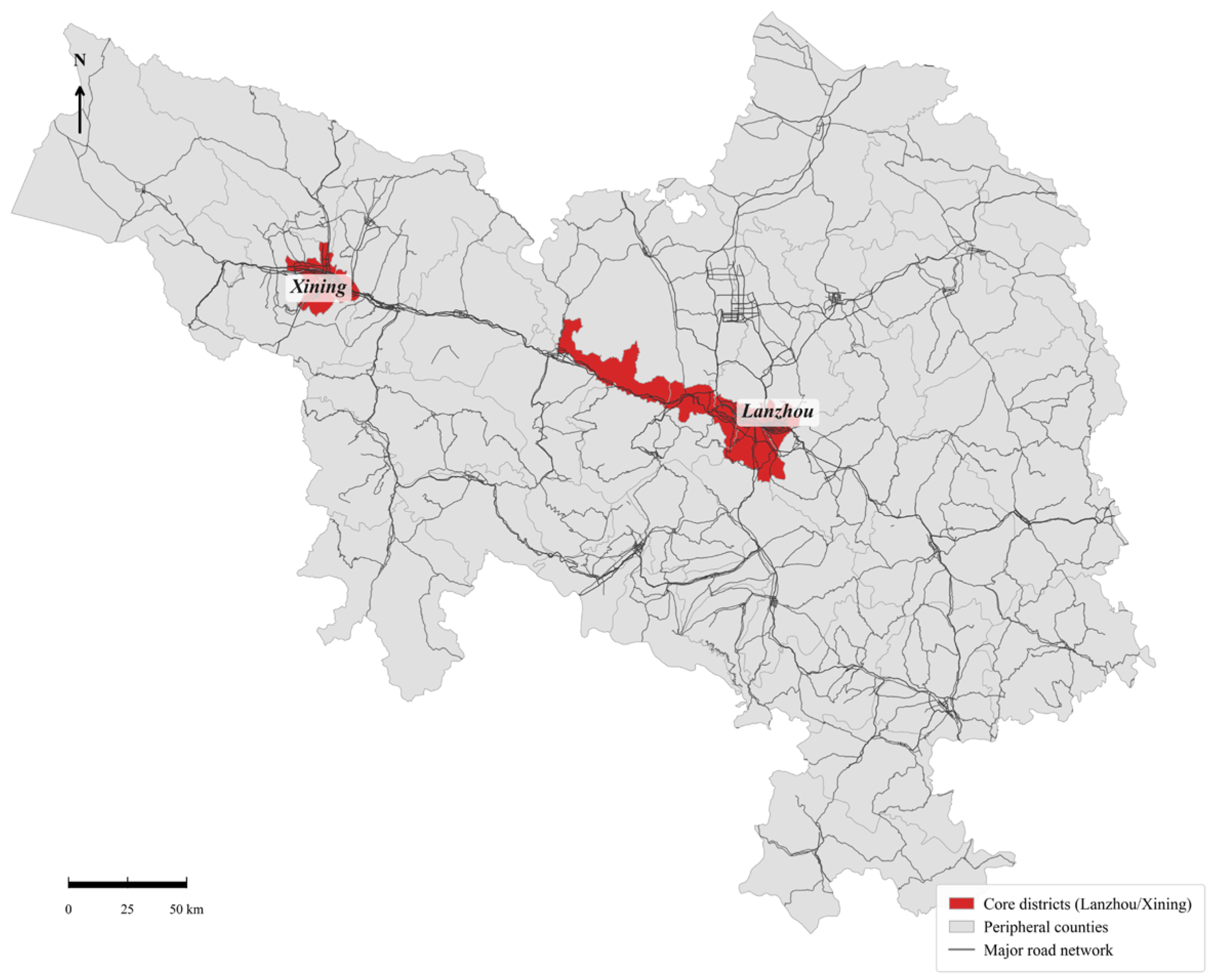
The Lanxi Urban Agglomeration, located in the upper Yellow River Basin, is one of China’s 19 nationally designated urban agglomerations and a key development pole under the “Ecological Protection and High-quality Development of the Yellow River Basin” initiative. The spatial scope of the Lanxi Urban Agglomeration is primarily based on the Development Plan for the Lanzhou-Xining Urban Agglomeration issued by the National Development and Reform Commission of China in 2018 [62]. Considering data availability and administrative consistency over the study period, this study focuses on 44 core county-level administrative units within this region, covering the core cities of Lanzhou and Xining along with their surrounding peripheral counties in Gansu and Qinghai provinces.
Figure 1 illustrates the geographic location of the Lanxi Urban Agglomeration, its core–periphery structure, and the spatial distribution of the 44 county-level units included in this study.
This region presents a unique geographical and socioeconomic context for examining infrastructure–inequality linkages. First, its location at the juncture of China’s first and second topographic steps—with elevations ranging from 1500 to 4000 m—creates complex terrain conditions that impose significant transportation constraints and elevate the marginal returns to road infrastructure investment. Second, the region is characterized by pronounced urban–rural disparities; urban–rural income disparities in the region have persistently remained above the national average, reflecting pronounced and long-standing structural inequality. Third, as a strategic node of the “Western Development Strategy” and an ecological security barrier for the Yellow River Basin, the region has received substantial transport infrastructure investment over the past decade while simultaneously facing the challenge of balancing development with ecological conservation. Taken together, these characteristics make the Lanxi Urban Agglomeration a particularly suitable setting for examining the spatial dynamics of transport infrastructure and urban–rural income inequality.

3.2. Variable Selection and Definitions

3.2.1. Dependent Variable: Urban–Rural Income Inequality

The urban–rural income gap is measured using the Theil Index ( Theil i t ), a decomposable inequality measure derived from information theory and widely employed in regional economics research. Following the two-sector (urban–rural) decomposition approach, the within-county Theil Index is calculated as:
T h e i l i t = Y i t u Y i t ln Y i t u / Y i t P i t u / P i t + Y i t r Y i t ln Y i t r / Y i t P i t r / P i t
where Y i t u and Y i t r denote the aggregate income of urban and rural populations, respectively; P i t u and P i t r denote the urban and rural population counts; and Y i t and P i t represent the county totals. Higher values of T h e i l i t indicate greater inequality between urban and rural sectors. The Theil Index is preferred over the simple urban–rural income ratio due to its superior decomposability, sensitivity to distributional changes, and widespread acceptance in spatial inequality research.

3.2.2. Core Explanatory Variable: Road Network Density

Road network density ( Road i t ) is measured as total road length per unit area (km/km2) and serves as the primary indicator of transportation infrastructure development. To address right-skewness and facilitate coefficient interpretation as elasticities, we apply logarithmic transformation:
ln R o a d i t = ln L e n g t h i t A r e a i
where L e n g t h i t denotes the total road mileage in county i at time t , and A r e a i represents the county’s land area. This variable operationalizes the “market accessibility” concept articulated in Hypothesis 1, capturing the density of physical connectivity that reduces iceberg transport costs and facilitates bidirectional factor mobility between urban and rural areas.

3.2.3. Control Variables

To isolate the net effect of transport infrastructure on the urban–rural income gap, we include a set of control variables capturing alternative socioeconomic and institutional determinants of regional inequality.
(1)
Economic Development Level ( ln   P G D P i t ).
The natural logarithm of per capita GDP is used to control for the overall level of economic development. Differences in development stages may influence income distribution through productivity gaps, labor market structure, and access to non-agricultural employment. The expected effect on the urban–rural income gap is ambiguous a priori and is therefore determined empirically.
(2)
Industrial Structure ( Ind_Struc )
Industrial structure is measured as the share of non-agricultural output (secondary and tertiary industries) in total GDP. A higher non-agricultural share reflects structural transformation away from agriculture, which may reduce urban–rural income disparities by expanding non-farm employment opportunities and facilitating labor reallocation. A negative association with the urban–rural income gap is expected.
(3)
Government Intervention ( Gov_Interv )
Government intervention is proxied by the ratio of local fiscal expenditure to GDP, capturing the intensity of public sector involvement in the local economy. Higher values indicate greater reliance on fiscal transfers and public spending, which may contribute to reducing urban–rural inequality through redistribution and public investment. The expected effect is inequality-reducing, although its magnitude remains an empirical question.
(4)
Public Service Provision ( ln M e d i t ).
Public Service Provision ( ln M e d i t ): Measured as the natural logarithm of local government health expenditure (unit: 1000 RMB). This indicator proxies for the fiscal intensity of healthcare provision at the county level, capturing government spending on public health spending, service subsidies, and personnel support. Compared with static physical indicators, fiscal expenditure better reflects the dynamic commitment of local governments to public service provision.
The specific definitions of the variables and their expected impacts on the urban–rural income gap, based on the theoretical framework, are presented in Table 1.

3.2.4. Data Sources and Descriptive Statistics

The dataset comprises a balanced panel of 44 counties from 2013 to 2022 (N = 440). All socioeconomic and infrastructure data, including road network density, were primarily obtained from the China County Statistical Yearbook and the provincial statistical yearbooks of Gansu and Qinghai [63,64,65]. To ensure panel continuity, minor missing values were imputed using linear interpolation. Table 2 presents the descriptive statistics of the variables.

3.3. Spatial Weight Matrix Construction

To ensure robustness across alternative spatial conceptualizations and to distinguish between geographic and economic channels of spatial dependence, we construct three spatial weight matrices. All matrices are row-standardized such that each row sums to unity, facilitating interpretation of spatially lagged variables as neighborhood-weighted averages.
(1)
Inverse Distance Matrix (W1).
To account for the continuous decay of spatial spillovers with geographic separation, we employ an inverse distance weight matrix:
w i j 1 = 1 / d i j , i j 0 , i = j
where d i j denotes the Euclidean distance between the centroids of counties i and j .
(2)
Economic Distance Matrix (W2).
To distinguish whether spillovers arise from physical proximity or economic integration, we construct a matrix based on the similarity of economic development levels:
W i j 2 = 1 / | ln ( Y ¯ i ) ln ( Y ¯ j ) | , i j 0 , i = j
where ln ( Y ¯ i ) denotes the annual average per capita GDP of county i during the observation period (2013–2022). Using the logarithmic transformation effectively mitigates the influence of extreme values and better reflects relative economic disparities.
It is important to clarify that the economic distance matrix W2 is specified as a time-invariant matrix. While employing a time-varying weight matrix based on annual GDP could theoretically capture dynamic economic shifts, we utilize the long-run average over the full sample period for two primary methodological reasons. First, relying on the full-period average effectively smooths out short-term economic volatilities, cyclical shocks, and potential measurement errors in yearly data, thereby capturing the stable, long-term structural economic linkages between counties. Second, using a time-invariant spatial weight matrix helps mitigate severe endogeneity concerns that frequently arise when spatial weights are contemporaneously correlated with the dependent variable in panel data models [57]. Therefore, the long-run average is preferred to ensure the stability and reliability of the spatial spillover estimates.
(3)
Economic-Geographic Nested Matrix (W3):
To capture the complexity of regional interactions governed by both physical costs and economic linkages, we construct a nested economic-geographic matrix (W3) as a convex combination of the geographic and economic distance matrices. Following standard spatial econometric practices, the formula is specified as:
w i j 3 = ϕ w i j 1 + ( 1 ϕ ) w i j 2
where w i j 1 and w i j 2 represent the unstandardized elements of the geographic distance matrix and economic distance matrix, respectively. The weight parameter ϕ balances the relative importance of the two distance decay mechanisms: geographic and economic proximity. In this study, we assign equal importance to both components by setting ϕ = 0.5 .
Crucially, to ensure valid spatial interpretations and satisfy the assumptions of spatial Markov processes, the resulting composite matrix is strictly row-standardized after the linear combination step, such that:
j w i j 3 = 1
This nested structure is employed as an additional robustness check to examine whether the baseline results hold when economic and geographic proximities are jointly incorporated into the spatial structure.

3.4. Spatial Autocorrelation Test

Prior to model estimation, we examine the presence of spatial dependence using the Global M o r a n s   I statistic, in order to assess whether spatial dependence is present and whether spatial econometric specifications are warranted. The test is conducted for the urban–rural income gap variable as well as for key explanatory variables.
I = N i = 1 N j = 1 N w i j · i = 1 N j = 1 N w i j x i x ¯ x j x ¯ i = 1 N x i x ¯ 2
where N is the number of spatial units (44 counties); w i j represents the element of the spatial weight matrix; x i and x j are the observations for counties i and j ; and x ¯ is the mean of the variable. A statistically significant M o r a n s   I indicates the presence of spatial autocorrelation, thereby providing support for the use of spatial econometric specifications in subsequent analysis.
To further explore local spatial dependence and identify specific clustering patterns of the urban–rural income gap across counties, we employ the Local Indicators of Spatial Association (LISA) [66]. While the global Moran’s I statistic evaluates the overall spatial autocorrelation across the entire study area, LISA allows for the decomposition of this global measure to observe the spatial clustering around individual spatial units. The Local Moran’s I for county i is calculated as:
I i = z i S 2 j i w i j z j
where z i and z j represent the standardized values of the urban–rural income gap for counties i and j , respectively; S 2 is the sample variance; and w i j denotes the element of the spatial weight matrix.
A pseudo p-value for the significance of I i is obtained through conditional randomization or permutation approaches. Based on the LISA scatter plot and significance testing, local spatial patterns can be categorized into four distinct quadrants: High-High (HH) and Low-Low (LL) clusters, which indicate positive local spatial autocorrelation where counties are surrounded by neighbors with similar levels of inequality; and High-Low (HL) and Low-High (LH) spatial outliers, which reflect negative local spatial autocorrelation.

3.5. Model Specification: Spatial Durbin Model

Given the significant spatial dependence documented above and the theoretical expectation of both direct effects (H1) and spatial spillover effects (H2), we employ the Spatial Durbin Model (SDM). The SDM incorporates spatial lags of both the dependent variable and explanatory variables, thereby allowing for flexible specification of spatial interaction channels:
ln ( T h e i l i t ) = ρ j = 1 N w i j ln ( T h e i l j t ) + β 1 ln ( R o a d i t ) + β 2 ln ( P G D P i t ) + β 3 I n d i t + β 4   G o v i t + β 5 ln M e d i t ) + θ 1 j = 1 N w i j ln R o a d j t + θ 2 j = 1 N w i j ln P G D P j t + θ 3 j = 1 N w i j I n d j t + θ 4 j = 1 N w i j G o v j t + θ 5 j = 1 N w i j ln M e d j t ) + μ i + γ t + ε i t  
T h e i l i t denotes the urban–rural income inequality for county i in year t . w i j represents the element of the spatial weight matrix (W) between county i and j . ρ is the spatial autoregressive coefficient, capturing the endogenous interaction of inequality levels among neighbors. ln ( R o a d i t ) , ln ( P G D P i t ) , U r b i t , S t r u c i t and ln M e d i t ) are the explanatory variables for the focal county. w i j ( ) terms represent the spatially weighted values of explanatory variables from neighboring counties. β 1 β 5 are the coefficients capturing the direct effects of local determinants. θ 1 θ 5 are the coefficients capturing the spatial spillover effects (indirect effects) of neighboring determinants. Specifically, the coefficient θ 1 provides an empirical test for Hypothesis 2 by capturing whether road density in neighboring counties influences local inequality. μ i represents county-fixed effects controlling for time-invariant unobserved heterogeneity. γ t represents year-fixed effects controlling for common temporal shocks. ε i t   is the idiosyncratic error term, assumed to be independently and identically distributed.

3.6. Effects Decomposition

In the Spatial Durbin Model, the estimated coefficients ( β and θ ) cannot be interpreted as marginal effects due to the inherent feedback loops implied by the spatial multiplier matrix I N ρ W 1 · A change in an explanatory variable in county i affects not only its own dependent variable but also spills over to neighboring counties, which in turn feeds back to county i .
Following the partial differentiation method proposed by LeSage and Pace [57], we decompose the total impact into direct and indirect (spillover) effects. The matrix of partial derivatives for the k - t h explanatory variable (e.g., road density) is given by:
Y x k = I N ρ W 1 β k I N + θ k W  
where I N is the N × N identity matrix; β k and θ k denote the coefficients of the k - t h explanatory variable and its spatial lag, respectively. Based on this matrix:
  • Direct Effect: Measured by the average of the diagonal elements of the matrix. It represents the impact of a change in a local variable on the local outcome, inclusive of feedback loops.
  • Indirect (Spillover) Effect: Measured by the average of the row sums of the off-diagonal elements. It captures the impact of neighboring counties’ variables on the local outcome, corresponding to the spillover mechanism described in Hypothesis 2.
  • Total Effect: The sum of the direct and indirect effects.
Statistical inference for these effects is conducted using Monte Carlo simulations with 1000 draws.

3.7. Robustness Checks

To ensure the reliability and validity of our empirical findings, we implement a comprehensive robustness strategy encompassing three approaches:
(1)
Alternative Spatial Weight Matrices.
The specification of the spatial weight matrix plays a central role in spatial econometric analysis, as it reflects alternative assumptions regarding interregional connectivity. To assess the sensitivity of the estimated effects to different spatial conceptualizations, we re-estimate the Spatial Durbin Model using two alternative matrices beyond the baseline inverse-distance specification: the Economic Distance Matrix (W2), which captures spillovers through similarity in economic development levels, and the Economic–Geographic Nested Matrix (W3), which combines physical proximity with economic gravity. Consistency in the sign and statistical significance of the core coefficients across these alternative specifications would suggest that the main findings are not driven by a particular choice of spatial weight structure.
(2)
Alternative Model Specification.
To verify that our results are not driven by the specific choice of fixed effects, we re-estimate the model using an Entity Fixed Effects specification, in contrast to the baseline two-way fixed effects model that controls for both county and year fixed effects. While the baseline specification accounts for common time-specific shocks, the entity fixed effects model provides a rigorous test by controlling for time-invariant unobserved heterogeneity at the county level (e.g., topography and cultural factors). If the core findings—particularly the effect of public service provision ( ln   ( M e d ) )—remain stable under this alternative specification, it would provide strong evidence against omitted variable bias.
(3)
Variable Substitution Using Satellite Data.
To mitigate potential measurement bias in official statistical data—particularly GDP figures that may be subject to reporting incentives—we introduce independent satellite-based data. Specifically, we substitute the per capita GDP control variable ( ln   ( P G D P ) ) with the average nighttime light intensity ( ln L i g h t ) derived from VIIRS satellite imagery. Nighttime light intensity is widely regarded as an objective proxy for regional economic activity and agglomeration. Robustness of the main results after this substitution would confirm that the estimated effects are not artifacts of statistical measurement errors.

4. Empirical Results

4.1. Spatiotemporal Evolution of Urban–Rural Inequality

4.1.1. Descriptive Trends in Urban–Rural Income Inequality

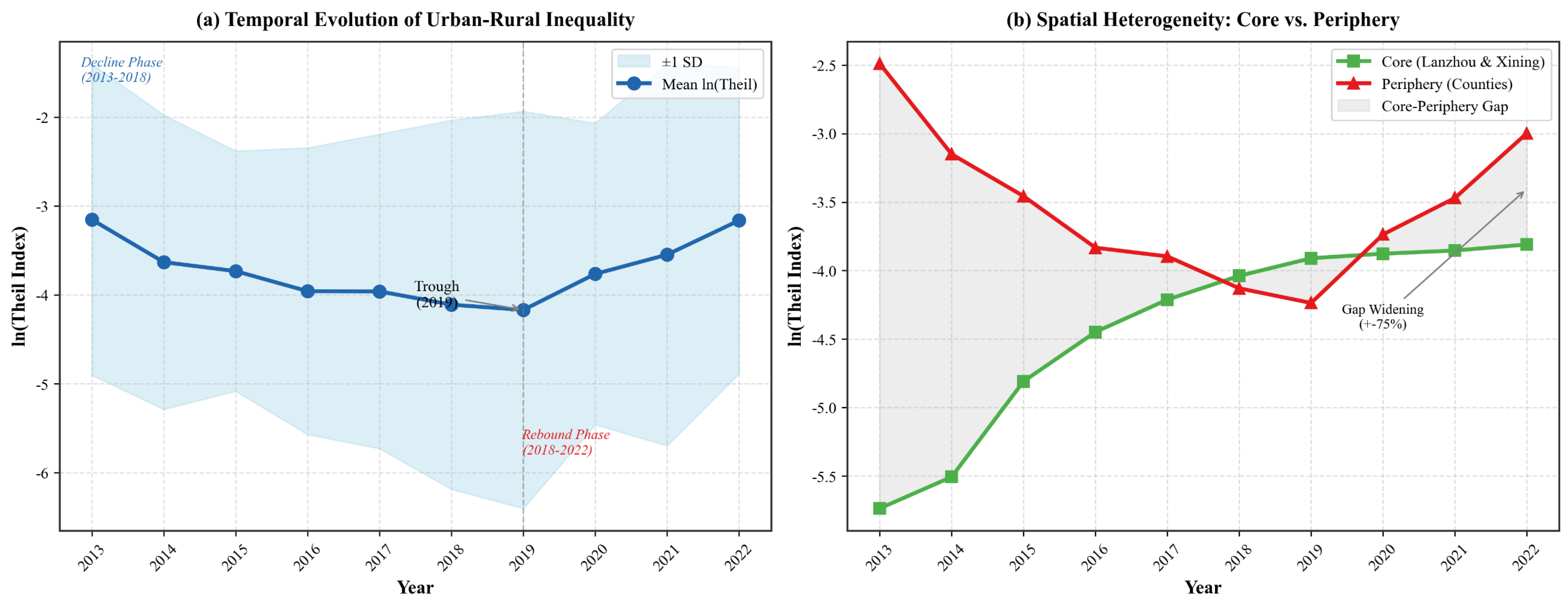
The temporal evolution of urban–rural income inequality in the Lanxi Urban Agglomeration exhibits a broadly inverted U-shaped trajectory over the study period (2013–2022), as illustrated in Figure 2a. This non-linear trajectory is consistent with a period characterized by national policy interventions, regional economic restructuring, and uneven spatial penetration of infrastructure-led development.
During the initial phase (2013–2019), the mean ln ( T h e i l i t ) declined substantially from −3.15 to −4.17, corresponding to a substantial reduction in measured urban–rural inequality. This period coincides with the intensive implementation of China’s Targeted Poverty Alleviation Campaign (jingzhun fupin, 精准扶贫), during which substantial fiscal transfers and infrastructure investments were directed toward underdeveloped rural areas. The downward trajectory suggests that this period was associated with a temporary narrowing of the urban–rural income gap between urban centers and their rural hinterlands. The trough reached in 2019 marks the culmination of this redistributive momentum, with the region reaching its lowest observed level of urban–rural inequality within the sample period.
However, a pronounced rebound emerged post-2019, with inequality indicators reverting toward initial levels by 2022 ( ln ( T h e i l i t ) ¯ = −3.16). This 24.1% increase in inequality within a three-year period points to the possibility of emerging structural constraints that warrant further investigation. While causal inference is beyond the scope of this descriptive analysis, the temporal coincidence suggests that the withdrawal of temporary policy support and pandemic-related shocks may have jointly coincided with this reversal. The timing of this inflection point coincides with two major macro-level developments: (1) the formal declaration of victory over absolute poverty in late 2020, and (2) the COVID-19 pandemic, both of which may have altered income-generating opportunities across urban and rural areas. A substantial reversion toward the 2013 baseline levels (net change: −0.3%) raises important questions regarding the sustainability of infrastructure-driven inequality reduction strategies.
Spatial disaggregation reveals a more nuanced narrative of convergence through differential deterioration rather than uniform progress (Figure 2b). The nine core urban districts of Lanzhou and Xining exhibited comparatively lower volatility and inequality over the study period (CV = 16.0%), demonstrating the institutional resilience characteristic of established metropolitan centers. In contrast, the 35 peripheral counties exhibited substantially higher volatility (CV = 15.3%) and persistently elevated inequality levels. Notably, the core–periphery gap narrowed by approximately 75% over the decade, primarily driven by a relative deterioration in income distribution within urban cores rather than substantive improvement in peripheral counties. The core’s ln ( T h e i l i t ) increased from −5.74 (2013) to −3.81 (2022), suggesting that the benefits of rapid transport expansion may have been captured disproportionately by higher-income urban residents, a pattern broadly aligned with the “siphon effect” mechanism discussed in Section 2.
This temporal and spatial heterogeneity provides the empirical foundation for subsequent spatial econometric analysis. The descriptive evidence suggests that while aggregate inequality remains relatively stable, the underlying distributional dynamics reveal a concerning trajectory wherein infrastructure-driven growth may be reinforcing, rather than mitigating, spatial polarization.

4.1.2. Global Spatial Autocorrelation Analysis

Prior to estimating the spatial econometric model, it is essential to formally test for the presence of spatial autocorrelation in the dependent variable. Failure to account for spatial dependence in the presence of such effects would result in biased and inefficient ordinary least squares (OLS) estimates, thereby undermining the validity of causal inferences.
Table 3 reports the Global M o r a n s   I statistics for ln ( T h e i l i t ) computed using an inverse-distance spatial weight matrix across the 44 counties of the Lanxi Urban Agglomeration. The results provide robust evidence of statistically significant positive spatial autocorrelation throughout the entire observation period. All Moran’s I values are positive and substantially exceed the expected value under spatial randomness (E(I) = −0.023), with Z-scores ranging from 2.60 to 14.56, corresponding to p-values below 0.01 in all years. Notably, after reaching a minimum of 0.080 in 2021, the M o r a n s   I value rebounded slightly to 0.119 in 2022, suggesting a potential re-emergence of spatial clustering patterns in the post-pandemic recovery period. These findings support rejection of the statistical assumption of spatial randomness, indicating that counties with similar levels of urban–rural inequality tend to cluster geographically—a phenomenon consistent with the spatial spillover mechanisms posited in Section 2.
The results illustrate the temporal evolution of global spatial autocorrelation in urban–rural income inequality, as measured by Global Moran’s I. The results indicate a consistently positive and statistically significant level of spatial dependence throughout the study period. Although the magnitude of Moran’s I exhibits a clear downward trend—declining from 0.549 in 2013 to 0.119 in 2022 (with a trough of 0.080 in 2021)—spatial autocorrelation remains present in all years.
However, it is important to note that despite the weakening trend in the magnitude of Moran’s I, global spatial autocorrelation remains statistically significant at the 1% level in all years, including 2022. This persistence indicates that counties with similar levels of urban–rural income inequality continue to exhibit spatial clustering, implying a violation of the independence assumption underlying conventional ordinary least squares (OLS) regression. Consequently, the presence of statistically significant spatial dependence suggests that conventional OLS regression may be inappropriate in this context, motivating the adoption of spatial econometric models that explicitly account for spatial interactions.
Based on this diagnostic evidence, we proceed to estimate a Spatial Durbin Model (SDM), which accommodates both spatially lagged dependent variables and spatially lagged explanatory variables, thereby capturing both endogenous spatial interaction effects and exogenous spillover mechanisms. The significant and declining M o r a n s   I pattern further motivates our interest in decomposing the total effect of transport infrastructure into direct and indirect (spillover) components, as the changing spatial structure may imply heterogeneous transmission channels across the study period.

4.1.3. Local Spatial Association Patterns

(1)
Spatial Reallocation of Urban–Rural Inequality: A Descriptive Overview
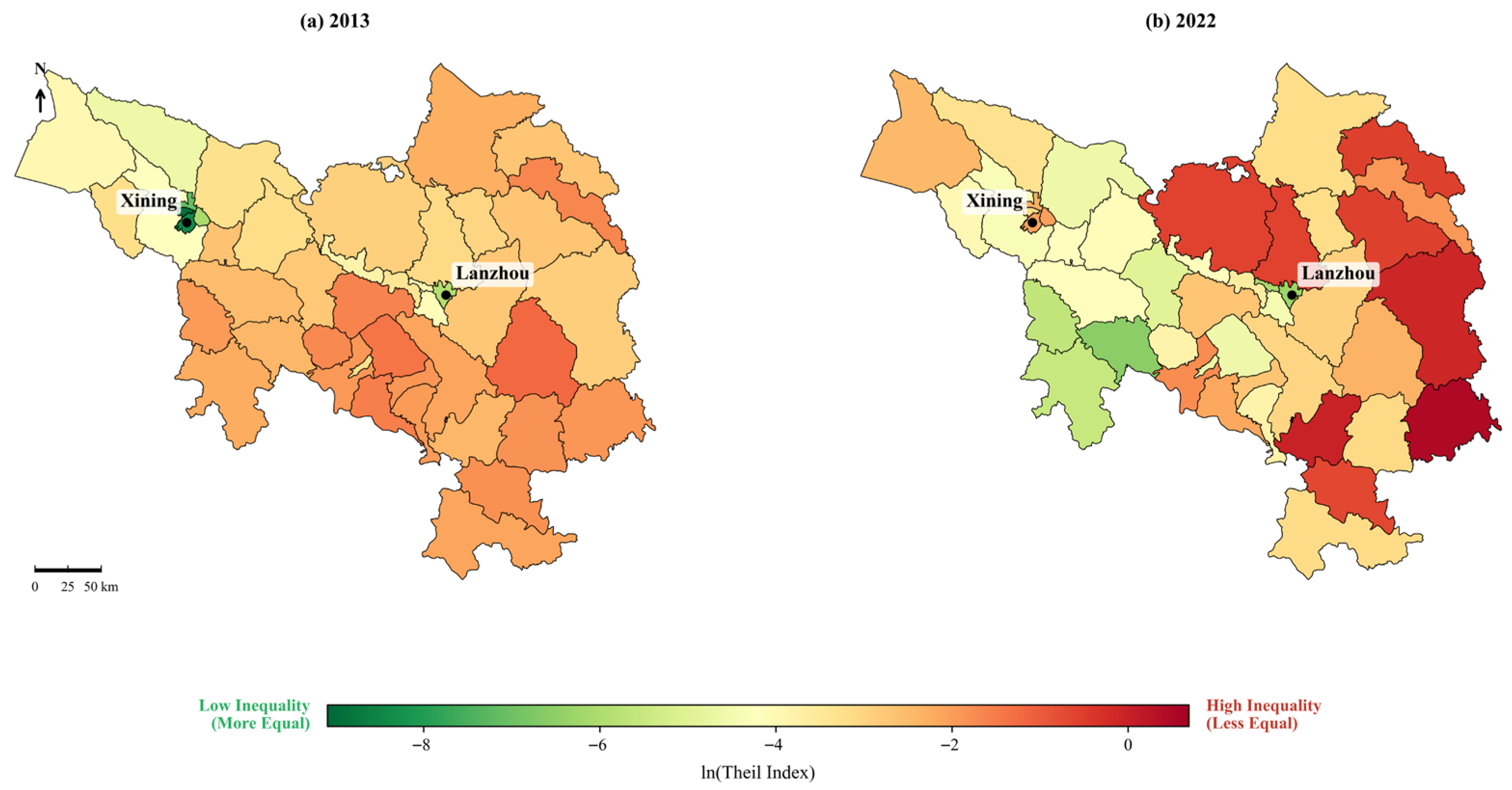
Before turning to formal local spatial autocorrelation analysis, it is useful to examine how the spatial distribution of urban–rural inequality evolved over the study period. Figure 3 presents a comparison of county-level ln ( T h e i l ) values in 2013 and 2022. Although the regional average remained largely stable, the spatial pattern became increasingly heterogeneous. Several peripheral counties—particularly along the Gansu–Qinghai border—experienced noticeable reductions in measured inequality, while core urban districts in Lanzhou and Xining exhibited noticeable increases. This divergence indicates that aggregate stability may mask pronounced spatial reallocation of inequality across counties, underscoring the need for a local indicator approach to identify clustering, persistence, and transition dynamics.
(2)
Local Clustering and Persistence: Evidence from LISA Analysis
While global statistics confirm the presence of spatial clustering, they mask important local heterogeneity in the spatial distribution of urban–rural inequality. To identify specific agglomeration patterns and track their evolution, we employ Local Indicators of Spatial Association (LISA) analysis, which decomposes the global M o r a n s   I into location-specific contributions.
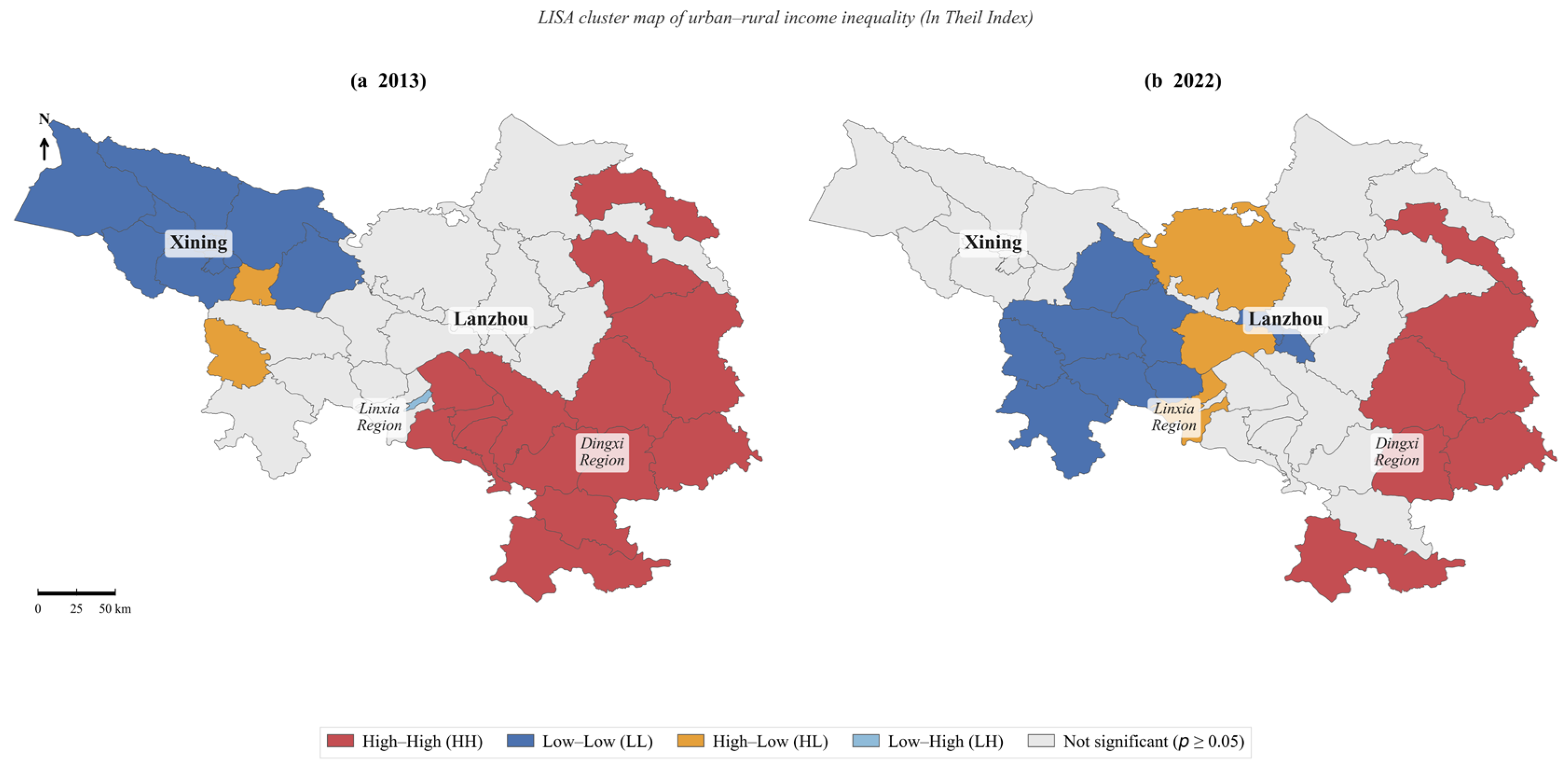
Figure 4 presents LISA cluster maps for 2013 and 2022, revealing a pronounced core-periphery spatial structure in the distribution of urban–rural inequality. In 2013, 13 counties (29.5% of the sample) were classified as High-High (HH) clusters, indicating areas of elevated inequality surrounded by similarly disadvantaged neighbors. These HH clusters were geographically concentrated in two contiguous zones: the Linxia Prefecture corridor (including Dongxiang, Guanghe, Hezheng, and Kangle counties) and the Central Gansu Poverty Belt spanning Dingxi Prefecture (Anding, Tongwei, Weiyuan, Longxi, Minxian, and Zhangxian). Conversely, 10 counties (22.7%) formed Low-Low (LL) clusters, predominantly located in the Xining metropolitan core and its immediate periphery, encompassing all four urban districts of Xining (Chengdong, Chengzhong, Chengxi, and Chengbei) as well as surrounding counties with strong economic linkages to the provincial capital.
By 2022, a notable contraction of the HH cluster had occurred. The number of HH counties decreased from 13 to 6, representing a reduction of over 50%. Eight counties—including Dongxiang, Lintao, Hezheng, Guanghe, Kangle, Weiyuan, Zhangxian, and Jingyuan—transitioned out of the high-inequality trap, moving to the “not significant” category. This contraction coincides temporally with a period of intensified targeted poverty alleviation investments and large-scale transport infrastructure expansion in the region.
However, five counties—Huining, Anding, Minxian, Tongwei, and Longxi—remained persistently trapped in HH clusters across both periods, forming a persistent core of spatial inequality lock-in. These counties share common characteristics: they are located in the mountainous interior of Central Gansu, far from both Lanzhou and Xining; they exhibit low road density despite infrastructure expansion; and they possess limited non-agricultural employment opportunities. The persistence of these HH clusters is consistent with the poverty trap hypothesis, suggesting that, for certain regions, incremental improvements alone may be insufficient to overcome cumulative disadvantage, consistent with the poverty trap framework (Azariadis & Stachurski, 2005) [67].
Interestingly, the composition of LL clusters also shifted geographically. While the Xining urban core maintained its low-inequality status, several counties in the Gansu-Qinghai border region—including Minhe, Hualong, Xunhua, and Tongren—transitioned into LL clusters by 2022. This spatial diffusion of low-inequality conditions coincides with the expansion of infrastructure investment along the Lanxi Economic Corridor, suggesting the presence of spatial interactions that warrant further econometric examination. This observation is consistent with the notion of spatial diffusion, suggesting that spatial interactions may play a role in the redistribution of inequality across neighboring regions.
The coexistence of cluster contraction (consistent with diffusion) and cluster persistence (consistent with poverty trap) suggests that the relationship between transport infrastructure and spatial inequality is heterogeneous across space. The spatial econometric analysis in Section 4.2 will further examine and decompose these direct and indirect effects to identify the dominant mechanism at the aggregate level.

4.2. Spatial Econometric Analysis: Main Results

4.2.1. Model Selection and Specification Tests

Prior to estimating the spatial econometric models, a series of diagnostic tests were conducted to assess the presence of spatial dependence and to determine the appropriate model specification. The results are summarized in Table 4.
The Lagrange Multiplier (LM) tests provide strong evidence of spatial dependence of the data. Both the LM-Error and LM-Lag statistics are highly significant (p < 0.001), indicating the presence of spatial autocorrelation in both the error term and the dependent variable. Importantly, the robust versions of these tests remain significant, suggesting that neither the Spatial Autoregressive Model (SAR) nor the Spatial Error Model (SEM) alone is sufficient to capture the underlying spatial processes. Following the standard decision rule, these results motivate the adoption of the more general Spatial Durbin Model (SDM).
To further validate this choice, Likelihood Ratio (LR) and Wald tests were conducted to examine whether the SDM can be simplified to nested alternatives. The LR tests decisively reject the restrictions corresponding to both the SAR and SEM specifications, indicating that the spatially lagged explanatory variables play an essential role and that the SDM cannot be reduced without loss of explanatory power.
Model selection tests further favor a fixed-effects framework. The Hausman test strongly rejects the null hypothesis that the random-effects estimator is consistent, implying that unobserved county-specific characteristics are correlated with the regressors. In addition, F-tests confirm the joint significance of both entity and time fixed effects, supporting the inclusion of a two-way fixed-effects structure to control for unobserved spatial heterogeneity and common temporal shocks.
Based on this comprehensive set of diagnostic tests, we estimate a Spatial Durbin Model with two-way fixed effects, specified as follows:
ln T h e i l i t = ρ j w i j ln T h e i l j t + X i t β + j w i j X j t θ + μ i + λ t + ε i t
where ρ is the spatial autoregressive parameter capturing endogenous spatial interaction effects; β represents the direct effects of explanatory variables; θ captures the effects of neighboring counties’ characteristics (spatial spillovers); w i j denotes the element of the row-standardized inverse distance weight matrix; μ i and λ t represent entity and time fixed effects, respectively.

4.2.2. SDM Estimation and Effect Decomposition

Table 5 reports the estimation results of the Spatial Durbin Model (SDM) with two-way fixed effects, controlling for both unobserved county-specific heterogeneity and common temporal shocks. This specification represents the baseline model for inference.
The spatial autoregressive parameter is positive ( ρ = 0.428 ) but statistically insignificant, indicating that once spatially lagged explanatory variables are accounted for, residual endogenous interaction in urban–rural income inequality across counties is limited. This suggests that spatial dependence in inequality operates primarily through observable spillover channels rather than through strong feedback effects in the dependent variable itself.
A counterintuitive pattern emerges for transport infrastructure under the two-way fixed effects specification. The direct coefficient is positive (0.464) and statistically significant at the 10% level ( ρ < 0.10 ). This result suggests that, during the study period, expansion of transport networks is correlated with a marginal widening—rather than a narrowing—of the local urban–rural income gap. Interpreted cautiously, the estimated elasticity implies that higher road density tends to be associated with higher inequality at the local level, although the effect is only weakly significant and should not be viewed as conclusive evidence of a causal relationship.
One possible interpretation of this counterintuitive pattern is that, in less-developed regions, improvements in transport connectivity may initially generate asymmetric benefits favoring urban centers. In the early stages of development, improved transport infrastructure often disproportionately benefits urban centers by enhancing their siphon effects on rural capital and labor, while rural residents face high transaction costs in accessing urban markets. Consequently, the distributional benefits of transport infrastructure may be uneven in the short run, with advantages accruing more strongly to urban areas than to surrounding rural regions.
Decomposition of Spatial Effects. Since point estimates in spatial models contain feedback loops, we rely on the partial derivative decomposition (Direct, Indirect, and Total Effects) reported in Table 6 for precise interpretation.
(1) Transport Infrastructure. The direct effect of ln ( R o a d ) is positive (+0.481), and the indirect (spillover) effect is also positive (+1.178), resulting in a positive total effect (+1.659). Although the indirect effect does not reach conventional significance levels under the strict two-way fixed effects specification, the uniformly positive signs across the direct, indirect, and total effects—despite the lack of statistical significance—suggest that, under current development conditions, transport expansion may be associated with uneven regional outcomes rather than broad-based inclusive growth. Quantitatively, the estimated total effect is positive, indicating that higher road density tends to coincide with a wider urban–rural income gap, although statistical insignificance precludes precise quantitative interpretation.
(2) Public Services as the Equalizer. In sharp contrast to transport, fiscal health expenditure ( ln M e d ) emerges as a particularly effective instrument for reducing urban–rural income inequality. The variable exhibits a statistically significant negative direct effect (−1.281 **) and a substantial negative indirect effect (−10.621 **). This indicates that government investment in public health spending not only significantly bridges the local urban–rural divide but also generates powerful positive spillovers, helping to reduce inequality in neighboring counties. In elasticity terms, higher local government health expenditure is associated with a statistically significant reduction in the urban–rural income gap, underscoring the strong equalizing role of public service provision.
(3) Economic Drivers. The level of economic development ( ln   P G D P ) shows a strong disequalizing effect, with a substantial positive spillover (+21.797). This pattern is consistent with the hypothesis that, at the current stage of development, economic growth may be accompanied by widening spatial disparities. Furthermore, the industrial structure variable exhibits inconsistent significance across specifications, suggesting its effect on the urban–rural gap may be complex and mediated by other regional factors.
Summary. Overall, the empirical evidence points to a divergence between growth-oriented infrastructure expansion and equity-oriented public service provision. While economic growth and transport expansion are associated with uneven distributional outcomes, public service equalization—particularly in healthcare—appears to play a stabilizing role in mitigating urban–rural inequality.

4.3. Robustness and Sensitivity Analysis

4.3.1. Sensitivity to Spatial Weight Matrix Specification

A central methodological concern in spatial econometrics is that inference may be sensitive to the specification of the spatial weight matrix, which embodies assumptions about the channels through which cross-sectional units interact. To assess the robustness of our findings, we re-estimate the SDM using two alternative weight specifications: an economic distance matrix (W2), where weights are inversely proportional to the absolute difference in per capita GDP between county pairs, and a nested matrix (W3), which integrates geographic proximity with economic gravity by scaling the inverse-distance weights with relative economic size. The corresponding estimation results are presented in Table 7.
(1)
Transport Infrastructure ( ln ( R o a d ) )
Divergent Spillover Channels. The sensitivity analysis reveals a notable pattern regarding the spatial effects of transport infrastructure. Under the baseline geographic specification (W1), the indirect effect of ln ( R o a d ) is positive (+1.178) but fails to attain statistical significance (p = 0.613). In contrast, when spatial relationships are defined by economic similarity (W2), the indirect effect reverses sign and becomes statistically significant (−2.707, p = 0.048). This sign reversal suggests that the spatial transmission mechanism of transport effects operates differently depending on the nature of inter-county linkages. Under the economic proximity specification, the indirect (spillover) effect of transport infrastructure becomes negative and statistically significant (−2.707, p = 0.048), suggesting that a 1% increase in road density among economically similar neighbors is associated with a 2.707% reduction in local inequality—a reversal from the geographic baseline.
The divergence may reflect different channels of spatial interaction captured by alternative matrices. Under geographic proximity, transport improvements in physically adjacent counties might intensify localized competition for mobile factors—skilled labor and capital may be drawn toward better-connected neighbors, potentially widening the urban–rural gap in the origin county. However, under economic proximity, counties at similar developmental stages may be more likely to participate in integrated economic networks characterized by complementary production structures and coordinated policy frameworks. In this context, transport improvements in economically similar counties appear to be associated with the diffusion of growth benefits through shared labor markets and supply chain linkages, thereby contributing to inequality reduction in peer counties.
The nested specification (W3), which incorporates both proximity dimensions, yields an intermediate indirect effect (−1.195, p = 0.370) that is negative but not statistically distinguishable from zero. This attenuation suggests that geographic and economic linkages may operate in opposite directions, leading to partial offsetting effects in the nested specification, underscoring the importance of distinguishing between them when assessing spatial spillovers.
(2)
Health Expenditure ( ln ( M e d ) )
Robust Equalizing Effects. In contrast to the matrix-sensitive transport findings, the healthcare variable ( ln ( M e d ) ) exhibits notable consistency. The direct effect remains negative and statistically significant across all three specifications: −1.280 (p = 0.011) under W1, −1.328 (p = 0.013) under W2, and −1.148 (p = 0.036) under W3. This stability suggests that the inequality-reducing effect of local health expenditure is unlikely to be an artifact of any single spatial-weight specification. Regardless of whether neighbors are defined geographically or economically, counties with greater health expenditure exhibit systematically narrower urban–rural income gaps.
Summary and Implications. The robustness analysis yields two principal insights. First, the spatial effects of transport infrastructure appear channel-dependent: the indirect effect is positive (though insignificant) when neighbors are defined geographically, but turns significantly negative when economic similarity is emphasized. This finding indicates that transport investment may generate heterogeneous spillovers depending on the broader economic context, cautioning against universal claims regarding infrastructure’s equalizing potential. Second, the healthcare findings prove robust to alternative spatial specifications, reinforcing the conclusion that public health investment represents a more reliable policy lever for promoting inclusive development. These results collectively highlight the importance of considering multiple dimensions of spatial connectivity when evaluating infrastructure policies in regional development contexts.

4.3.2. Sensitivity to Fixed Effects Structure

A potential concern with our baseline specification is that the inclusion of time fixed effects may absorb variation attributable to national macro-events that evolved concurrently with regional infrastructure development. During the study period (2013–2022), China implemented large-scale initiatives—including the Targeted Poverty Alleviation Campaign and the Rural Revitalization Strategy. Furthermore, the COVID-19 pandemic (2020–2022) introduced significant external shocks to regional connectivity. To the extent that these temporal macro-factors are collinear with transport expansion, time fixed effects may inadvertently capture their combined influence, potentially masking the true contribution of infrastructure investment.
To assess the sensitivity of our results to this specification choice, we re-estimate the Spatial Durbin Model using entity fixed effects only, excluding year dummies. Table 8 compares the estimated spatial effects under the baseline two-way fixed effects model and the alternative entity-only specification.
(1) Transport Infrastructure. A noticeable difference emerges with respect to the spatial spillover effects of transport infrastructure. Under the baseline two-way fixed effects model, the indirect effect of ln ( R o a d ) is positive but not statistically significant (1.178, p = 0.613). When time fixed effects are excluded, however, the indirect effect reverses sign and becomes marginally significant (−1.466, p = 0.068). This change implies a qualitatively different interpretation of the spillover channel: whereas the baseline specification suggests no detectable spillover effect, the entity-only model is consistent with the presence of negative spatial spillovers, whereby transport improvements in neighboring counties are associated with a reduction in local urban–rural income inequality. The emergence of a significant negative spillover (−1.47, p = 0.067) under entity-only fixed effects suggests that, after removing common temporal shocks, a 1% increase in neighboring road density is associated with about a 1.47% reduction in local urban–rural inequality.
A plausible explanation lies in the role of time fixed effects in absorbing common temporal patterns. By controlling for year-specific shocks and policy cycles that affected all counties simultaneously, the two-way fixed effects model isolates only within-county, within-year variation in transport density. Such variation may be insufficient to capture spillover effects that materialize gradually and operate in conjunction with broader policy environments. When temporal controls are relaxed, the transport variable may partly reflect the combined influence of infrastructure expansion and contemporaneous policy support, allowing spatial diffusion effects to become more visible.
(2) Health Expenditure. In contrast, the estimated effects of health expenditure exhibit a high degree of stability across specifications. The direct effect of ln ( M e d ) remains negative and statistically significant under both the two-way fixed effects model (−1.280, p = 0.011) and the entity-only specification (−1.076, p = 0.015). This robustness suggests that the local inequality-reducing effect of health expenditure reflects a fundamental within-county relationship rather than being driven by time-specific confounders. In magnitude, the baseline estimates imply that a 1% increase in local health expenditure is associated with approximately a 1.28% reduction in the urban–rural income gap.
(3) Methodological Implications. Taken together, these results highlight a general trade-off inherent in panel fixed effects estimation. While time fixed effects provide rigorous control for unobserved temporal heterogeneity, they may also absorb substantively meaningful variation when key explanatory variables exhibit strong time trends. For transport infrastructure, which expanded systematically during the study period, this absorption appears nontrivial. Consequently, null or weak results obtained under highly restrictive specifications should be interpreted with caution.
Summary. The sensitivity analysis indicates that the baseline model’s insignificant transport spillovers may reflect attenuation due to time fixed effects rather than a definitive absence of impact. When temporal controls are relaxed, transport infrastructure displays a negative and marginally significant indirect effect, consistent with diffusion-type spillovers through regional connectivity. By contrast, the equalizing role of health expenditure remains robust across specifications. These findings suggest that while the distributive effects of transport investment are contingent on the broader policy environment and temporal dynamics, investments in public health constitute a more stable and reliable mechanism for reducing urban–rural inequality.

4.3.3. Alternative Indicator: Nighttime Light Intensity

To further assess the robustness of the baseline results to alternative measures of local economic activity, we replace per capita GDP with satellite-derived nighttime light intensity (NTL) as an alternative proxy. Nighttime light data have been widely used in the literature as an objective indicator of economic activity, capturing both formal and informal production while remaining independent of administrative reporting practices. This substitution allows us to examine whether the estimated spatial effects are sensitive to the choice of economic development indicator. Table 9 presents the results of this robustness check.
(1)
Core Robustness under Alternative Economic Proxy
The core findings remain robust under the alternative economic proxy. For health expenditure, the direct effect of ln ( M e d ) remains negative and statistically significant in both specifications (−1.281 under ln P G D P , p = 0.011; and −0.990 under ln L i g h t , p = 0.088). Notably, the total effect is nearly identical across models (−11.90 versus −11.97), indicating that the overall inequality-reducing impact of health expenditure is largely invariant to how local economic activity is measured. The direct effect of ln R o a d remains positive under both specifications (0.481 under ln P G D P and 0.866 under ln L i g h t , but becomes only marginally significant in the NTL-based model (p = 0.068). Meanwhile, the indirect and total effects remain statistically insignificant, reinforcing the conclusion that transport infrastructure does not exhibit a robust or unambiguous equalizing effect when alternative economic proxies are employed.
(2)
Magnitude Interpretation and Policy Relevance.
In terms of magnitude, the alternative specification yields estimates that are highly comparable to those obtained under the baseline model, indicating that the economic significance of healthcare investment is not an artifact of the particular proxy used to measure local economic development. Controlling for nighttime light intensity, a 1% increase in local health expenditure is associated with approximately a 0.99% reduction in the urban–rural income gap at the local level, while the total spatial effect remains close to −12%. Under the baseline specification using per capita GDP, the corresponding elasticity is slightly larger, at around −1.28% for the direct effect. These estimates indicate that healthcare investment represents a relatively high-leverage policy instrument for reducing urban–rural inequality, with economically meaningful impacts that are broadly stable across alternative measures of local economic development. The robustness of the health expenditure coefficient (−0.99 to −1.28 across specifications) indicates a stable elasticity: each 1% increase in local fiscal health spending is consistently associated with approximately a 1% reduction in the income gap.
Summary. This satellite-based robustness check indicates that the main conclusions do not hinge on the specific proxy used to capture local economic development. The inequality-reducing effect of health expenditure remains stable when economic activity is measured using nighttime light intensity, lending further support to its role as a reliable policy instrument. By contrast, the estimated effects of transport infrastructure continue to display sensitivity across specifications, suggesting that its spatial impacts are more context-dependent. Overall, these findings reinforce the view that public service provision—particularly healthcare—constitutes a more consistent driver of urban–rural convergence than infrastructure expansion alone.

5. Discussion and Policy Implications

5.1. Discussion: Unpacking the Transport Paradox and Public Service Equalizer

5.1.1. Why Transport Infrastructure Fails to Deliver: The Asymmetric Connectivity Hypothesis

The baseline SDM results present a counterintuitive finding: transport infrastructure ( ln ( R o a d ) ) exhibits a positive but statistically insignificant association with urban–rural inequality, suggesting that the inequality-reducing role of road expansion is not systematically supported in this context. We refer to this pattern as the “Transport Paradox” to describe the apparent disconnect between infrastructure expansion and distributive outcomes, which warrants further theoretical examination.
We term this pattern the Asymmetric Connectivity Hypothesis. Transport infrastructure is inherently bidirectional: while improved roads enable rural producers to access urban markets, they simultaneously allow urban capital, talent, and enterprises to penetrate—and potentially dominate—rural economies. In regions characterized by pronounced developmental gradients—such as the Lanxi Urban Agglomeration located at the transition between the Loess Plateau and the Qinghai–Tibet Plateau—the latter effect may dominate under certain structural conditions.
Results based on the economic distance matrix (W2) provide additional evidence consistent with this interpretation. When spatial dependence is defined by economic proximity rather than geographic distance, the estimated indirect effect of transport infrastructure becomes negative and statistically significant (Table 7), indicating a potential inequality-reducing spillover among economically similar counties. This suggests that physical connectivity operates differentially across network types: geographic neighbors may experience a “siphon effect” whereby improved roads facilitate outward migration of labor and capital toward core cities, while economically similar counties—which share industrial structures and factor endowments—exhibit genuine spillover benefits. In essence, in the absence of economic complementarity, improved transport connectivity may be more closely associated with factor reallocation toward core areas rather than broad-based diffusion.
This interpretation aligns with the “tunnel effect” documented in transportation economics: high-speed corridors can bypass intermediate regions, concentrating benefits at terminal nodes while leaving peripheral areas no better off—or worse [27,28,52]. In the Lanxi context, the Lanzhou–Xining expressway corridor offers an illustrative case, where growth appears to be more strongly concentrated in core nodes while leaving transitional counties such as Linxia and Dingxi relatively disadvantaged.
The sensitivity analysis under entity-only fixed effects (Table 8) offers an additional layer of interpretation. When time fixed effects—which absorb macro-level policy shocks common to all counties—are removed, transport infrastructure becomes statistically significant. This implies that the “Transport Paradox” is partially an artifact of policy simultaneity: road-building in the Lanxi region has coincided with national initiatives (e.g., Targeted Poverty Alleviation, 2013–2020; Western Development Strategy) that independently influence inequality trajectories. The baseline two-way fixed effects specification, while econometrically rigorous, may therefore understate the contribution of transport infrastructure per se.

5.1.2. The Public Service Equalizer: Why Healthcare Succeeds Where Roads Falter

In stark contrast, fiscal health investment ( ln ( M e d ) ) emerges as a robust and consistently inequality-reducing factor across alternative specifications. The direct effect is negative and significant (−1.28, p < 0.05); the estimated total spatial effect remains stable in magnitude (approximately −12%) across baseline and alternative specifications. This resilience to alternative weight matrices, fixed effects structures, and economic proxies suggests that the healthcare–inequality nexus reflects a fundamentally different mechanism than transport connectivity.
We advance the Opportunity Equalization framework to explain this pattern [60]. Public services—particularly healthcare and education—operate through human capital channels rather than factor mobility channels. When rural residents gain access to quality medical care locally, several consequences follow:
(1)
Reduced catastrophic health expenditures: Medical impoverishment is a leading driver of rural poverty in China. Adequate fiscal commitment to local healthcare mitigates this risk, preventing downward income shocks [61].
(2)
Enhanced labor productivity: Healthier workers are more productive, enabling rural households to capture higher returns from agricultural and non-agricultural activities.
(3)
Diminished “push” factors for migration: Adequate local services reduce the necessity of urban migration for accessing healthcare, allowing rural residents to benefit from place-based development strategies [54].
Crucially, fiscal health investment is non-rivalrous in its equalizing effects: unlike transport—which can facilitate both convergence and divergence depending on factor mobility—medical services generate predominantly progressive outcomes. Healthcare spending in Minhe County primarily benefits local residents and is less directly associated with cross-county factor reallocation toward core cities such as Xining. This asymmetry explains the robustness of the healthcare coefficient across spatial weight specifications.

5.1.3. Contextualizing the Findings: Common Prosperity and Urban–Rural Integration

The empirical patterns documented here carry significant implications for China’s Common Prosperity agenda and the Urban–Rural Integration policy framework articulated in the 14th Five-Year Plan [34,35]. Our findings suggest that the current emphasis on “hard” infrastructure—roads, railways, digital connectivity—must be complemented by accelerated investment in “soft” infrastructure that directly addresses capability gaps [53].
The Lanxi Urban Agglomeration, as a designated national-level cluster, has received substantial infrastructure investment over the study period. Yet inequality persists, particularly in the Linxia–Dingxi periphery. The results indicate that connectivity without complementarity yields limited redistributive benefits. Policymakers should recalibrate expectations: transport is a necessary but insufficient condition for inclusive growth; public service equalization appears to constitute a critical constraint.

5.2. Policy Implications: From Connectivity to Capability

5.2.1. Beyond Roads: Toward Economic Coordination Infrastructure

Recommendation 1: Shift the policy emphasis from transport quantity to economic integration quality.
The finding that transport effects are contingent on economic network structure (significant under W2 but not W1) implies that road-building alone is unlikely to be sufficient to close the urban–rural divide. Peripheral counties require complementary investments in:
Supply chain integration: Establishing formal linkages between rural producers and urban processing/distribution networks. Cold-chain logistics for agricultural products, for instance, can transform physical connectivity into economic opportunity [42,43].
Industrial positioning: Peripheral counties should develop distinctive comparative advantages rather than replicating core-city industries. Linxia’s halal food processing and Dingxi’s traditional Chinese medicine clusters represent successful examples; policy should reinforce rather than homogenize such specialization [34,35].
Factor market reforms: Land transfer mechanisms, rural financial services, and labor mobility policies determine whether roads become conduits for opportunity or extraction. Ensuring that rural residents can capitalize on connectivity requires institutional infrastructure alongside physical infrastructure [41].

5.2.2. Fiscal Commitment to Public Services as the Equalizer

Recommendation 2: Prioritize Medical and Educational Consortia as the primary instruments for urban–rural convergence [54].
The robust equalizing effect of fiscal health expenditure suggests high returns to increased budgetary allocation for public health services. Specific policy levers include:
(1)
Telemedicine networks: Expanding telemedicine platforms linking rural clinics with urban tertiary hospitals, enabling remote diagnosis and treatment guidance. The marginal cost of extending specialist expertise to peripheral counties is declining rapidly with 5G infrastructure [45].
(2)
Rotating physician programs: Institutionalizing urban doctor rotations to county-level hospitals, combined with salary supplements and career advancement incentives, can improve the effectiveness of health spending to healthcare without requiring prohibitive capital investment.
(3)
Educational resource sharing: Analogous consortia for education—streaming urban classroom instruction to rural schools, coordinating curriculum development, facilitating teacher exchanges—can address the human capital dimension of rural disadvantage.
These interventions target the capability gap directly [60], enabling rural residents to improve their income-generating potential without necessitating permanent migration to urban cores.

5.2.3. Regional Synergy: Integrating Periphery into Core Supply Chains

Recommendation 3: For peripheral counties, pursue complementary integration rather than competitive emulation.
While these examples are necessarily illustrative, they highlight how peripheral counties can benefit more from complementary integration than from competitive emulation. The economic distance matrix results suggest that counties benefit from neighbors with similar economic structures—not merely proximate ones. This implies a division-of-labor approach to regional development [5,6]:
Linxia Prefecture, with its cultural ties to Central Asia, should deepen its role as a gateway for Halal trade rather than competing with Lanzhou for manufacturing investment.
Dingxi, with established potato and herbal medicine industries, should focus on upstream specialization while Lanzhou handles downstream processing and marketing.
Xining’s periphery (Haidong, Huangnan) should integrate into Qinghai’s emerging clean energy and ecological tourism sectors rather than pursuing heavy industrialization.
Such coordination requires inter-county governance mechanisms—joint planning bodies, revenue-sharing arrangements, infrastructure co-investment—that transcend administrative boundaries. The Lanxi Urban Agglomeration framework provides an institutional foundation [62]; implementation requires moving from spatial designation to functional integration.

5.3. Limitations and Future Directions

5.3.1. Data Constraints and Measurement Refinement

This study relies on county-level aggregate data, which limits the granularity of causal inference. Household-level panel data would enable direct examination of income dynamics, migration decisions, and service utilization patterns. Future research should leverage microdata such as the China Family Panel Studies (CFPS) [32] or the China Household Income Project (CHIP) to complement the aggregate spatial analysis presented here.
Furthermore, the current transport infrastructure measure (road density) does not distinguish between road quality tiers (e.g., expressways, national highways, and county roads) or connectivity to specific destinations. More refined measures—such as travel time to the nearest prefecture-level city or accessibility indices weighted by economic mass [51]—could significantly sharpen the identification of transport effects and capture network heterogeneity.

5.3.2. Mechanism Identification

The theoretical mechanisms proposed—specifically the siphon effects, opportunity equalization, and asymmetric connectivity—are inferred from spatial coefficient patterns rather than directly tested. To strengthen causal claims, future studies should conduct rigorous mediation analysis incorporating population flow data, firm location choices, and capital remittance patterns. Leveraging real-time mobility data from cell phone records or platform-based migration tracking (e.g., Baidu Migration Index) offers promising avenues to explicitly test the balance between diffusion and backwash mechanisms.

5.3.3. Temporal Dynamics and Structural Breaks

The study period (2013–2022) encompasses significant macro-level policy shifts, including the culmination of the Targeted Poverty Alleviation campaign and the onset of the COVID-19 pandemic. These exogenous shocks likely disrupted established spatial interaction patterns in ways not fully captured by the baseline two-way fixed effects specification. Future research could employ structural break analysis or regime-switching models to systematically investigate whether and how the transport–inequality relationship has evolved across different policy and economic regimes.

5.3.4. Generalizability and Comparative Analysis

The Lanxi Urban Agglomeration is characterized by distinctive topography (the transition zone between the Yellow River valley and the Loess Plateau), ethnic composition, and a specific developmental trajectory. Consequently, these findings may not directly generalize to coastal urban agglomerations, resource-dependent regions, or areas with fundamentally different governance structures. Conducting comparative analyses across multiple Chinese urban agglomerations [6] is a critical next step to establish the external validity of the “Transport Paradox” and the “Public Service Equalizer” phenomena documented in this study.

6. Conclusions

This study set out to examine whether transport infrastructure reduces urban–rural inequality in the Lanxi Urban Agglomeration—a region emblematic of Western China’s developmental challenges. The results suggest that the inequality-reducing effects of transport infrastructure are highly conditional: in the baseline specification, road density exhibits no significant equalizing effect; under alternative network definitions (economic distance) and model structures (entity-only fixed effects), transport effects emerge but remain fragile. By contrast, fiscal health investment—a proxy for public service provision—demonstrates robust, substantial, and consistent inequality-reducing effects across all specifications.
The central finding can be summarized as follows: In the rugged terrain of Western China, physical connectivity is a necessary but insufficient condition for convergence; public service equalization plays a more stable and consistently inequality-reducing role.
Roads connect places; services empower people. The policy implication is clear: the next phase of the Common Prosperity agenda in lagging regions should prioritize capability-building infrastructure—hospitals, schools, telemedicine networks, and skill training systems—over further expansion of transport networks whose benefits remain contested. For the Lanxi Urban Agglomeration, this means completing the transition from a “corridor economy” to an “integrated economy,” where peripheral counties participate as complementary partners rather than dependent satellites.
The Transport Paradox is not an indictment of infrastructure investment; it is a reminder that infrastructure operates through institutions, incentives, and industrial structures. Getting these complementary factors right is the unfinished business of China’s regional development strategy—and the empirical foundation for a more equitable urban–rural future.

Author Contributions

Conceptualization, Y.Q.; Methodology, F.Y. and J.Z.; Software, X.W.; Data curation, X.W.; Formal analysis, Y.Q. and J.Z.; Validation, J.Z.; Investigation, F.Y.; Funding acquisition, Y.Q.; Supervision, Y.Q.; Writing—original draft, F.Y.; Writing—review & editing, Y.Q. All authors have read and agreed to the published version of the manuscript.

Funding

This research was funded by the National Social Science Foundation of China (Grant No. 15BJY037), the Double–First Class Major Research Programs, Educational Department of Gansu Province (Grant No. GSSYLXM—04), the Philosophy and social science planning project of Gansu Province (Grant No. 2021YB058), the Higher Education Innovation Fund project of Gansu Province (Grant No. 2020B—113), and the Natural Science Foundation of Gansu Province (Grant No. 23JRRA904).

Informed Consent Statement

Informed consent was obtained from all subjects involved in the study.

Data Availability Statement

The original contributions presented in this study are included in the article. Further inquiries can be directed to the corresponding author.

Conflicts of Interest

The authors declare no conflicts of interest.

References

  1. Kanbur, R.; Venables, A.J. (Eds.) Spatial Inequality and Development; Oxford University Press: Oxford, UK, 2005. [Google Scholar]
  2. United Nations Development Programme (UNDP). Human Development Report 2019: Beyond Income, Beyond Averages, Beyond Today: Inequalities in Human Development in the 21st Century; UNDP: New York, NY, USA, 2019. [Google Scholar]
  3. World Bank. World Development Report 2009: Reshaping Economic Geography; The World Bank: Washington, DC, USA, 2009. [Google Scholar]
  4. Turok, I.; McGranahan, G. Urbanization and economic growth: The arguments and evidence for Africa and Asia. Environ. Urban. 2013, 25, 465–482. [Google Scholar] [CrossRef]
  5. Fang, C. Theoretical research progress and basic laws of China’s new urbanization and high-quality development. Geogr. Res. 2019, 38, 13–22. (In Chinese) [Google Scholar]
  6. Zhang, X.; Shen, Q.; Li, Y. Study on the differences and spatial structure characteristics of China’s ten urban agglomerations. Urban Plan. Forum 2016, 3, 36–44. (In Chinese) [Google Scholar]
  7. Wang, J.; Liu, B.; Li, Y. Population development patterns and problem area identification in the Beijing-Tianjin-Hebei region. Econ. Geogr. 2017, 37, 27–36. (In Chinese) [Google Scholar]
  8. Wang, F.; Jin, F.; Zeng, G. Regional population density function and growth models: GIS methods for delineating urban attraction ranges. Geogr. Res. 2004, 23, 97–103. (In Chinese) [Google Scholar]
  9. Zhang, Z.; Pan, J.; Li, X. Spatial evolution and formation mechanism of population density in Lanzhou over the past 30 years. Sci. Geogr. Sin. 2013, 33, 36–44. (In Chinese) [Google Scholar]
  10. Lu, J.; Liu, Q. Key research areas and prospects of Chinese demography under the background of population development transformation. Popul. J. 2019, 41, 5–15. (In Chinese) [Google Scholar]
  11. Zhong, S.; Wang, M.; Zhu, Y.; Chen, Z.; Huang, X. Urban expansion and the urban–rural income gap: Empirical evidence from China. Cities 2022, 129, 103831. [Google Scholar] [CrossRef]
  12. He, L.; Zhang, X.; Zhang, X. Urbanization with the pursuit of efficiency and ecology: Theory and evidence from China. Environ. Impact Assess. Rev. 2023, 103, 107274. [Google Scholar] [CrossRef]
  13. Pratama, A.P.; Yudhistira, M.H.; Koomen, E. Highway expansion and urban sprawl in the Jakarta Metropolitan Area. Land Use Policy 2022, 112, 105856. [Google Scholar] [CrossRef]
  14. Garcia-López, M.À. Urban spatial structure, suburbanization and transportation in Barcelona. J. Urban Econ. 2012, 72, 176–190. [Google Scholar] [CrossRef]
  15. Aschauer, D.A. Is public expenditure productive? J. Monet. Econ. 1989, 23, 177–200. [Google Scholar] [CrossRef]
  16. Fernald, J.G. Roads to prosperity? Assessing the link between public capital and productivity. Am. Econ. Rev. 1999, 89, 619–638. [Google Scholar] [CrossRef]
  17. Barro, R.J. Government spending in a simple model of endogenous growth. J. Polit. Econ. 1990, 98, S103–S125. [Google Scholar] [CrossRef]
  18. Zhang, X.; Sun, B.; Wan, G.; He, D. A comprehensive framework for how transport infrastructure promotes economic growth. Econ. Res. J. 2018, 53, 50–64. (In Chinese) [Google Scholar]
  19. Luo, N.; Sun, L. The impact of transportation development on regional economic disparities. Urban Probl. 2019, 8, 51–60. (In Chinese) [Google Scholar]
  20. Bai, W.; Lv, Z.; Liu, L. Foreign direct investment, transport infrastructure improvement and manufacturing agglomeration: Evidence from 285 prefecture-level cities in China (2003–2016). J. Guizhou Univ. Finance Econ. 2019, 2, 11–23. (In Chinese) [Google Scholar]
  21. Tang, H.; Wang, Y.; Wang, D.; Wei, H. Impact of transport infrastructure on manufacturing agglomeration in western China. China Soft Sci. 2018, 8, 137–147. (In Chinese) [Google Scholar]
  22. Limão, N.; Venables, A.J. Infrastructure, geographical disadvantage, transport costs, and trade. World Bank Econ. Rev. 2001, 15, 451–479. [Google Scholar] [CrossRef]
  23. Zhang, J.; Wang, W. The impact and mechanism of highway infrastructure on urban-rural income gap in China. J. Zhengzhou Univ. (Philos. Soc. Sci. Ed.) 2021, 54, 55–65. (In Chinese) [Google Scholar]
  24. Zhou, Z.; Duan, J.; Li, W.; Chen, X. Rural road construction, agricultural labor productivity and urban-rural income gap: Empirical analysis based on Spatial Durbin Model. Econ. Theory Bus. Manag. 2022, 42, 23–36. (In Chinese) [Google Scholar]
  25. Calderón, C.; Chong, A. Volume and quality of infrastructure and the distribution of income: An empirical investigation. Rev. Income Wealth 2004, 50, 87–106. [Google Scholar] [CrossRef]
  26. Chatterjee, S.; Turnovsky, S.J. Infrastructure and inequality. Eur. Econ. Rev. 2012, 56, 1730–1745. [Google Scholar] [CrossRef]
  27. Jin, M.; Lin, K.C.; Shi, W.; Lee, P.T.W. Impacts of high-speed railways on economic growth and disparity in China. Transp. Res. Part A Policy Pract. 2020, 138, 158–171. [Google Scholar] [CrossRef]
  28. Liu, S.; Wan, Y.; Zhang, A. Does China’s high-speed rail development lead to regional disparities? A network perspective. Transp. Res. Part A Policy Pract. 2020, 138, 299–321. [Google Scholar] [CrossRef]
  29. Chen, Z.; Haynes, K.E. Impact of high-speed rail on regional economic disparity in China. J. Transp. Geogr. 2017, 65, 80–91. [Google Scholar] [CrossRef]
  30. Yang, Q.; Shi, D. Transport infrastructure, factor mobility and urban-rural income gap. South China J. Econ. 2019, 9, 35–50. (In Chinese) [Google Scholar]
  31. Ren, X.; Zhang, Z. Transport infrastructure, factor mobility and urban-rural income gap. Manag. Rev. 2013, 25, 51–59. (In Chinese) [Google Scholar]
  32. Chen, M.; Wang, Z.; Chen, F. Rural transport infrastructure and rural labor transfer: Evidence from China Family Panel Studies. J. Nanjing Univ. Finance Econ. 2023, 4, 1–12. (In Chinese) [Google Scholar]
  33. Sun, Y. Transport infrastructure construction, labor mobility and urban-rural income gap. J. Nanjing Audit Univ. 2020, 17, 103–111. (In Chinese) [Google Scholar]
  34. Zhao, L.; Huang, Y.; Wang, F. Industrial digitalization, industrial structure upgrading and common prosperity: From the perspective of urban-rural income gap. Stat. Decis. 2024, 40, 94–98. (In Chinese) [Google Scholar]
  35. Jia, J.; Tao, Y. Research on the impact of industrial structure transformation and upgrading on common prosperity. Finance Trade Res. 2023, 34, 24–35. (In Chinese) [Google Scholar]
  36. Xiao, W.; Wang, J.; Zhao, X. Industrial structure, employment structure and urban-rural income gap. Macroeconomics 2022, 9, 78–86. (In Chinese) [Google Scholar]
  37. Wang, S.; Li, Y. Impact of industrial structure upgrading on urban-rural income gap: Threshold effect analysis from the perspective of new urbanization. J. Harbin Univ. Commer. (Soc. Sci. Ed.) 2022, 4, 81–92. (In Chinese) [Google Scholar]
  38. Lan, G.; Kuang, X. Analysis of the impact of industrial structure transformation and upgrading on urban-rural income gap: From the perspective of financial “de-industrialization”. Ind. Econ. Rev. 2021, 12, 104–113. (In Chinese) [Google Scholar]
  39. Xu, X.; Kou, J.; Zheng, Z. How does infrastructure investment affect industrial structure upgrading: Theoretical framework and empirical evidence. J. Shenzhen Univ. (Humanit. Soc. Sci.) 2021, 38, 67–78. (In Chinese) [Google Scholar]
  40. Sun, W.; Niu, D.; Wan, G. Transport infrastructure construction and industrial structure upgrading: Empirical analysis using high-speed rail construction. Manag. World 2022, 38, 19–41. (In Chinese) [Google Scholar]
  41. Zhang, H.; Yang, G. The impact mechanism and spatial differences of urban-rural road construction on return migration entrepreneurship and income growth. Econ. Geogr. 2023, 43, 103–112. (In Chinese) [Google Scholar]
  42. Zhang, X.; Shi, Y. Transport infrastructure and the national unified market. Consum. Econ. 2024, 40, 44–60. (In Chinese) [Google Scholar]
  43. Ma, X.; Huang, T. Transport infrastructure construction and inter-regional market integration: Evidence from expressways. J. Quant. Tech. Econ. 2023, 40, 111–132. (In Chinese) [Google Scholar]
  44. Zhou, G.; Chen, N. Can transport infrastructure construction narrow the urban-rural cultural consumption gap? Evidence from China’s highway transport. Mod. Econ. Res. 2024, 10, 31–42. (In Chinese) [Google Scholar]
  45. Sun, W.; Yan, W. Impact of communication infrastructure on urban-rural income gap in China: From a spatial spillover perspective. China Econ. Q. 2021, 6, 33–46. (In Chinese) [Google Scholar]
  46. Zeng, F.; Guo, C. The impact of transport infrastructure construction on urban-rural income gap and its spatial effects. Econ. Geogr. 2025, 45, 145–152. (In Chinese) [Google Scholar]
  47. Li, J.; Ma, Y.; Li, L.; Liu, X.; Xue, B.; Chen, L. Study on the correlation between transportation development and urban expansion in China from the perspective of spatio-temporal heterogeneity. Land 2025, 14, 2326. [Google Scholar] [CrossRef]
  48. Wang, G.; Salman, M.; Zhang, K. Exploring the dynamic spatial spillover and nonlinear threshold effect of urbanization on urban green development efficiency in China. Ecol. Indic. 2025, 175, 113570. [Google Scholar] [CrossRef]
  49. Sun, D.; Zhao, X.; Zhang, G.; Chen, P. Impact of the introduction of high-speed rail on the income gap between urban and rural residents. PLoS ONE 2023, 18, e0292105. [Google Scholar] [CrossRef]
  50. Liu, T.Y.; Lin, Y. Is the high-speed railway network narrowing the urban-rural income gap? Appl. Spat. Anal. Policy 2025, 18, 20. [Google Scholar] [CrossRef]
  51. Huang, X.; Kang, C.; Yin, C.; Tang, J. Influence of transportation accessibility on urban-rural income disparity and its spatial heterogeneity. Chin. Geogr. Sci. 2024, 34, 453–467. [Google Scholar] [CrossRef]
  52. Xu, Y.; Zhu, S. Transport infrastructure, intra-regional inequality and urban-rural divide: Evidence from China’s high-speed rail construction. Int. Reg. Sci. Rev. 2024, 47, 378–406. [Google Scholar] [CrossRef]
  53. Lade, S.J.; Haider, L.J.; Engström, G.; Schlüter, M. Resilience offers escape from trapped thinking on poverty alleviation. Sci. Adv. 2017, 3, e1603043. [Google Scholar] [CrossRef]
  54. Zhang, Z.; Sun, B. Impact of public service supply efficiency on urban-rural income gap and its improvement paths. Seeker 2022, 1, 152–164. (In Chinese) [Google Scholar]
  55. Krugman, P. Increasing returns and economic geography. J. Polit. Econ. 1991, 99, 483–499. [Google Scholar] [CrossRef]
  56. Myrdal, G.; Sitohang, P. Economic Theory and Under-Developed Regions; Gerald Duckworth: London, UK, 1957. [Google Scholar]
  57. LeSage, J.P.; Pace, R.K. Introduction to Spatial Econometrics; Taylor & Francis: Boca Raton, FL, USA, 2009. [Google Scholar]
  58. Anselin, L. Spatial Econometrics: Methods and Models; Springer Science & Business Media: Berlin, Germany, 1988. [Google Scholar]
  59. Boschma, R. Proximity and innovation: A critical assessment. Reg. Stud. 2005, 39, 61–74. [Google Scholar] [CrossRef]
  60. Sen, A. Development as Freedom; Oxford University Press: Oxford, UK, 1999. [Google Scholar]
  61. Grossman, M. On the concept of health capital and the demand for health. J. Polit. Econ. 1972, 80, 223–255. [Google Scholar] [CrossRef]
  62. National Development and Reform Commission (NDRC); Ministry of Housing and Urban-Rural Development (MOHURD). Development Plan for the Lanzhou–Xining Urban Agglomeration; NDRC: Beijing, China, 2018. (In Chinese)
  63. National Bureau of Statistics of China. China County Statistical Yearbook 2023; China Statistics Press: Beijing, China, 2023. (In Chinese)
  64. Gansu Provincial Bureau of Statistics. Gansu Statistical Yearbook 2023; China Statistics Press: Beijing, China, 2023. (In Chinese)
  65. Qinghai Provincial Bureau of Statistics. Qinghai Statistical Yearbook 2023; China Statistics Press: Beijing, China, 2023. (In Chinese)
  66. Anselin, L. Local indicators of spatial association—LISA. Geogr. Anal. 1995, 27, 93–115. [Google Scholar] [CrossRef]
  67. Azariadis, C.; Stachurski, J. Poverty Traps. In Handbook of Economic Growth; Aghion, P., Durlauf, S.N., Eds.; Elsevier: Amsterdam, The Netherlands, 2005; Volume 1, pp. 295–384. [Google Scholar]
Figure 1. Study area of the Lanxi Urban Agglomeration, illustrating the core–periphery structure and the spatial distribution of the 44 county-level units included in this study.
Land 15 00408 g001
Figure 2. Temporal dynamics of urban–rural income inequality in the Lanxi Urban Agglomeration 2019—2022). (a) Overall trend of the mean ln ( T h e i l i t ) showing an inverted U-shaped pattern with a trough in 2019; the shaded area represents±1 standard deviation. (b) Core–periphery heterogeneity illustrating an apparent convergence pattern that is largely associated with changes in income distribution within urban cores, rather than pronounced improvements in peripheral counties. The core–periphery gap is calculated as the difference in mean ln ( T h e i l i t ) between peripheral counties and core urban districts. Note that ln ( T h e i l i t ) takes negative values due to the logarithmic transformation of index values below unity.
Land 15 00408 g002
Figure 3. Spatiotemporal evolution of urban–rural inequality in the Lanxi Urban Agglomeration (2013 vs. 2022).
Land 15 00408 g003
Figure 4. LISA cluster maps of urban–rural inequality in the Lanxi Urban Agglomeration (2013 vs. 2022). HH (red) denotes high-inequality clusters; LL (blue) denotes low-inequality clusters; NS (gray) indicates statistically insignificant local association (p ≥ 0.05). The contraction of HH clusters and persistence of a “hard core” in Central Gansu highlight heterogeneous spatial dynamics.
Land 15 00408 g004
Table 1. Variable Definitions and Expected Signs.
SymbolVariableDefinitionExpected Sign
T h e i l Urban–Rural GapNatural logarithm of the Theil IndexN/A
ln R o a d Road densityln (road length/county area)Uncertain ( ± )
ln   ( P G D P ) Economic developmentln (per capita GDP)Ambiguous ( ± )
Ind_Struc Industrial structureShare of non-agricultural output (Secondary + Tertiary) in GDPNegative ( )
Gov_Interv Government InterventionRatio of local fiscal expenditure to GDPNegative ( )
ln   ( M e d ) Public servicesNatural logarithm of local fiscal health expenditure (1000 RMB)Negative ( )
Table 2. Descriptive Statistics ( N = 440 ).
VariableMeanStd. Dev.MinMaxSkewness
T h e i l −3.7191.832−12.0370.559−1.399
ln R o a d −0.7401.048−3.2921.7000.290
ln   ( P G D P ) 10.2170.8778.25712.7050.261
Ind_Struc 0.8520.1050.4891.052−0.441
Gov_Interv 0.4950.3890.0282.9061.421
ln   ( M e d ) 13.0340.61811.32615.1220.466
ln   ( L i g h t ) 0.4601.071−1.4733.1970.661
Notes: N = 440 (44 counties × 10 years, 2013–2022). All variables are measured at the county-year level. Road density, per capita GDP, and local government health expenditure are logarithmically transformed. Ind_Struc denotes the share of secondary and tertiary industries in GDP. Gov_Interv is measured as the ratio of local fiscal expenditure to GDP. ln   ( L i g h t ) represents the logarithm of the average nighttime light intensity (NPP-VIIRS), serving as a proxy for regional economic vitality.
Table 3. Global M o r a n s   I statistics for ln ( T h e i l i t ) based on the inverse-distance spatial weight matrix (W1), 2013–2022.
YearMoran’s IZ-Statisticp-Value
20130.54914.555<0.001 ***
20140.3399.312<0.001 ***
20150.2466.645<0.001 ***
20160.1574.538<0.001 ***
20170.1484.605<0.001 ***
20180.1173.622<0.001 ***
20190.1103.415<0.001 ***
20200.1283.708<0.001 ***
20210.0802.6030.009 ***
20220.1193.471<0.001 ***
Note: *** p < 0.01.
Table 4. Diagnostic tests for spatial econometric model selection.
TestStatisticp-Value
Panel A: Spatial dependence tests
LM-Error232.597<0.001 ***
LM-Lag695.185<0.001 ***
Robust LM-Error186.077<0.001 ***
Robust LM-Lag556.148<0.001 ***
Panel B: Model specification tests
Hausman test (FE vs. RE)28.640<0.001 ***
LR test (SDM vs. SAR)21.380<0.001 ***
LR test (SDM vs. SEM)18.9200.002 ***
Panel C: Fixed effects selection
F-test (Time effects)3.4200.001 ***
F-test (Entity effects)8.760<0.001 ***
Note: *** p < 0.01. LM = Lagrange Multiplier; LR = Likelihood Ratio; FE = Fixed Effects; RE = Random Effects; SAR = Spatial Autoregressive Model; SEM = Spatial Error Model. All tests support the specification of a Spatial Durbin Model with two-way fixed effects.
Table 5. Estimation results of the Spatial Durbin Model (W1).
VariableCoefficientStd. Errort-Statp-Value
Spatial Autoregressive
ρ ( W · ln ( T h e i l ) ) 0.4280.6830.630.532
Direct Coefficients ( β )
ln ( R o a d ) 0.4640.2491.870.063 *
ln ( P G D P ) 1.7340.5323.260.001 ***
Industrial Structure−5.5852.308−2.420.016 **
Government Intervention−0.2230.371−0.600.549
ln ( M e d ) −1.1230.317−3.540.001 ***
Spatial Lag Coefficients ( θ )
W 1 · ln ( R o a d ) 0.4861.3590.360.721
W 1 · ln ( P G D P ) 11.9174.8742.450.015 **
W 1 · Industrial   Structure 5.18714.3520.360.718
W 1 · Government   Intervention 2.7083.8370.710.481
W 1 · ln ( M e d ) −5.6882.896−1.960.050 **
Model Diagnostics
R 2 (within)0.147
Log-likelihood−752.61
Observations440
Note: *** p < 0.01, ** p < 0.05, * p < 0.10. Standard errors are robust. Model includes two-way fixed effects (Entity + Time).
Table 6. Decomposition of Direct, Indirect, and Total Effects (W1).
VariableDirect EffectIndirect EffectTotal Effect
ln ( R o a d ) 0.481
(1.23)
1.178
(0.51)
1.659
(0.70)
ln ( P G D P ) 2.057 **
(2.46)
21.797 **
(2.61)
23.854 **
(2.84)
Industrial Structure−5.513
(−1.52)
4.818
(0.20)
−0.696
(−0.03)
Government Intervention−0.156
(−0.27)
4.500
(0.68)
4.344
(0.66)
ln ( M e d ) −1.281 **
(−2.57)
−10.621 **
(−2.14)
−11.901 **
(−2.39)
Note: T-statistics are in parentheses. ** p < 0.05. Direct effects differ from raw coefficients in Table 5 due to the spatial multiplier feedback effect.
Table 7. Robustness to Alternative Spatial Weight Matrices.
VariableW1 (Geographic)W2 (Economic)W3 (Nested)
Panel A: Transport Infrastructure ( ln ( R o a d ) )
Direct Effect0.481
(0.218)
0.047
(0.938)
0.044
(0.938)
Indirect Effect1.178
(0.613)
−2.707 **
(0.048)
−1.195
(0.370)
Total Effect1.659
(0.483)
−2.660 *
(0.076)
−1.151
(0.426)
Panel B: Health Expenditure ( ln ( M e d ) )
Direct Effect−1.280 **
(0.011)
−1.328 **
(0.013)
−1.148 **
(0.036)
Indirect Effect−10.621 **
(0.033)
−2.725
(0.307)
−2.126
(0.461)
Total Effect−11.901 **
(0.018)
−4.053
(0.136)
−3.274
(0.265)
Panel C: Model Diagnostics
Spatial ρ 0.4280.561−0.492
R 2 (within)0.1470.1160.136
Note: p-values in parentheses. ** p < 0.05, * p < 0.10. All specifications include two-way fixed effects.
Table 8. Comparison of SDM estimates under alternative fixed effects structures.
VariableTwo-Way FE (Baseline)Entity FE Only
Transport   Infrastructure   ( ln ( R o a d ) )
Direct Effect0.481
(0.218)
0.613 *
(0.074)
Indirect Effect1.178
(0.613)
−1.466 *
(0.067)
Total Effect1.659
(0.483)
−0.853
(0.327)
Health   Expenditure   ( ln ( M e d ) )
Direct Effect−1.280 **
(0.011)
−1.076 **
(0.015)
Total Effect−11.901 **
(0.018)
−6.293
(0.180)
Model Diagnostics
Spatial ρ 0.428−0.151
R 2 (within)0.1470.165
Log-likelihood−753.2−756.3
Note: p-values in parentheses. ** p < 0.05, * p < 0.10. Both models use geographic distance matrix (W1).
Table 9. Robustness check using satellite-derived nighttime light intensity as an alternative economic proxy.
VariableBaseline
(Using ln(PGDP))
Robustness
(Using ln(light))
Transport   Infrastructure   ( ln ( R o a d ) )
Direct Effect0.481
(0.218)
0.866 *
(0.068)
Indirect Effect1.178
(0.613)
−3.494
(0.252)
Total Effect1.659
(0.483)
−2.629
(0.327)
Health   Expenditure   ( ln ( M e d ) )
Direct Effect−1.281 **
(0.011)
−0.990 *
(0.088)
Total Effect−11.901 **
(0.018)
−11.969 **
(0.037)
Model Diagnostics
R 2 (within)0.1470.111
Notes: p-values in parentheses. ** and * denote significance at the 5% and 10% levels, respectively. Both models are estimated using the Spatial Durbin Model with two-way fixed effects and the inverse geographic distance matrix (W1). The two specifications differ only in the proxy used to measure local economic development: ln P G D P versus ln L i g h t .
Disclaimer/Publisher’s Note: The statements, opinions and data contained in all publications are solely those of the individual author(s) and contributor(s) and not of MDPI and/or the editor(s). MDPI and/or the editor(s) disclaim responsibility for any injury to people or property resulting from any ideas, methods, instructions or products referred to in the content.