Article

Study on the Adaptive Conservation of Cultural Landscapes Along the Ancient Tibet–Nepal Route in the Context of Climate Change


1
School of Cultural Heritage, Northwest University, Xi’an 710127, China
2
School of Architecture, Harbin Institute of Technology (Shenzhen), Shenzhen 518055, China
3
Xi’an Institute of Cultural Heritage Conservation and Archaeology, Xi’an 710068, China
4
Collaborative Research Centre for Archaeology of the Silk Roads, Northwest University, Xi’an 710127, China
*
Author to whom correspondence should be addressed.
Land 2026, 15(3), 405; https://doi.org/10.3390/land15030405
Submission received: 14 January 2026 / Revised: 12 February 2026 / Accepted: 12 February 2026 / Published: 1 March 2026
(This article belongs to the Section Land–Climate Interactions)

Abstract

Under the intensifying impacts of global climate change, high-altitude linear cultural landscapes are increasingly threatened by natural hazards such as extreme precipitation and glacier-fed runoff. Taking the cultural landscape of the Tibet–Nepal Route as the study object, it employs an integrated methodology combining spatial analysis, adaptive assessment, field investigation, and case studies to systematically identify levels of hazard exposure and explore pathways for adaptive governance. This study makes two key contributions. It develops an interdisciplinary framework that combines spatial exposure analysis, barrier diagnosis, and multi-criteria evaluation. It also proposes a governance shift from external interventions to internally driven approaches, underscoring the central role of traditional community institutions system in building landscape resilience. The findings provide a scientific basis for the coordinated governance of cross-border high-altitude linear cultural landscapes between China and Nepal, and offer transferable insights for advancing the World Heritage nomination research of the Silk Road: the routes network of the Qinghai–Tibet Plateau to South Asia Corridor.

1. Introduction

Cultural landscapes emerge from protracted interactions between human societies and their natural environments [1,2,3]. These landscapes function as dynamic socio-ecological systems shaped by multi-scalar processes, integrating environmental adaptation, cultural practices, and institutional arrangements. Serving as a conceptual bridge between nature and culture, cultural landscapes occupy a unique niche within contemporary heritage conservation frameworks [4,5,6]. Rössler (2006) emphasizes that cultural landscapes exist at the nexus of tangible and intangible heritage, as well as biological and cultural diversity, forming relational networks that transcend material fabric to embody evolving cultural meanings [7].
However, under accelerating climate change, the complexity of cultural landscapes is increasingly reflected in their differential exposure and adaptive capacity to external disturbances [8,9]. In high-altitude mountainous regions, climate-induced extreme events present critical threats to both ecological integrity and heritage security [10,11]. Between 1950 and 2023, 261 major flood events were recorded across High-Mountain Asia, predominantly on the southern Himalayan slopes, where rainfall-triggered landslides constitute over 63% of reported hazards [12,13]. Within trans-Himalayan regions, these events trigger cascading impacts, encompassing the degradation of agricultural terraces, damage to traditional settlements, the erosion of intangible practices, and economic losses from tourism decline [14].
In response, UNESCO and ICOMOS advocate for a paradigm shift from reactive protection toward proactive climate adaptation frameworks emphasizing the pivotal roles of Traditional Ecological Knowledge (TEK), community engagement, and local institutions in bolstering resilience [10,11,15,16,17,18]. From a theoretical standpoint, Critical Heritage Studies further deconstruct the assumption of heritage as a neutral or conflict-free domain [19]. Informed by Laurajane Smith’s (2006) Authorized Heritage Discourse (AHD), heritage values are understood as social constructs mediated by dominant institutional narratives frequently marginalizing mundane practices, indigenous knowledge systems, and community-led governance mechanisms [19,20,21,22,23,24].
This theoretical lens is crucial for deciphering the complexities of linear cultural landscapes in high-altitude regions. Along the Tibet–Nepal route, the spatial configuration—comprising sacred sites, settlements, and ecological infrastructures—embodies a protracted symbiosis between local communities and extreme mountain environments. The significance of this route resides not in atomized monuments, but in situated religious practices, institutional arrangements, and enduring human–environment interactions. Consequently, the Tibet–Nepal route serves as a quintessential transboundary high-mountain cultural landscape, providing a critical locus for examining climate adaptation within plateau heritage systems.
Despite its regional significance, existing scholarship on the Tibet–Nepal route remains fragmented and siloed. While historical narratives and individual site typologies are well-documented [25,26,27,28,29,30,31,32,33], the adaptive conservation of the route as an integrated transboundary system remains critically under-examined. In contrast, studies in other high-mountain regions have established the pivotal roles of traditional institutions and landscape-based knowledge in climate resilience [34,35,36]. Nevertheless, robust methodological frameworks for the adaptive conservation of transnational cultural routes in high-altitude settings are still lacking.
To bridge this gap, this study conceptualizes heritage as a dynamic socio-ecological system rather than a static assemblage of discrete artifacts. Using the Tibet–Nepal route as a quintessential case, this research develops an integrated adaptive framework through a three-phased methodological approach: (1) spatial risk analysis to characterize differentiated exposure patterns across distinct physiographic units; (2) construction of an adaptive screening framework integrating resilience barrier diagnosis with multi-criteria decision analysis (MCDA); and (3) empirical assessment of the adaptive potential and institutional constraints of endogenous community systems and TEK through participant-based fieldwork. Consequently, the study advocates for zonation-based and institution-oriented strategies, providing scalable methodological insights for high-altitude landscapes globally.

2. Study Area and Methodology

2.1. Study Area

Between 629 and 640 AD, the Tubo Dynasty was formally established and flourished following the unification of various plateau tribes by Songtsen Gampo and the designation of Lhasa as the capital [25,27]. From the 7th to the 9th centuries, the Tubo Empire expanded eastward, establishing extensive ties with the Tang Dynasty of Central China [26]. The marriage between Songtsen Gampo and Princess Wencheng in 641 AD served as a pivotal milestone in the formation of the corridor between Chang’an and Lhasa [32]. Concurrently, the Tubo Empire extended its influence westward and southward. Centered in Lhasa, these movements facilitated multi-dimensional interactions with Central Asian states and South Asian nations, such as Nepal and India leading to the establishment of strategic trans-regional routes [25,26,27,28,29]. These corridors integrated the Tubo Empire with Western, Central, and South Asia, fostering a plateau-based cultural dissemination system that became a critical segment of the Plateau Silk Road network [30]. Extensive historical records document three primary routes connecting Tang China and India. Among these, the “Eastern Route” is identified as traversing from Chang’an through Tibet to Nepal, eventually reaching India [25,26,31,37,38].
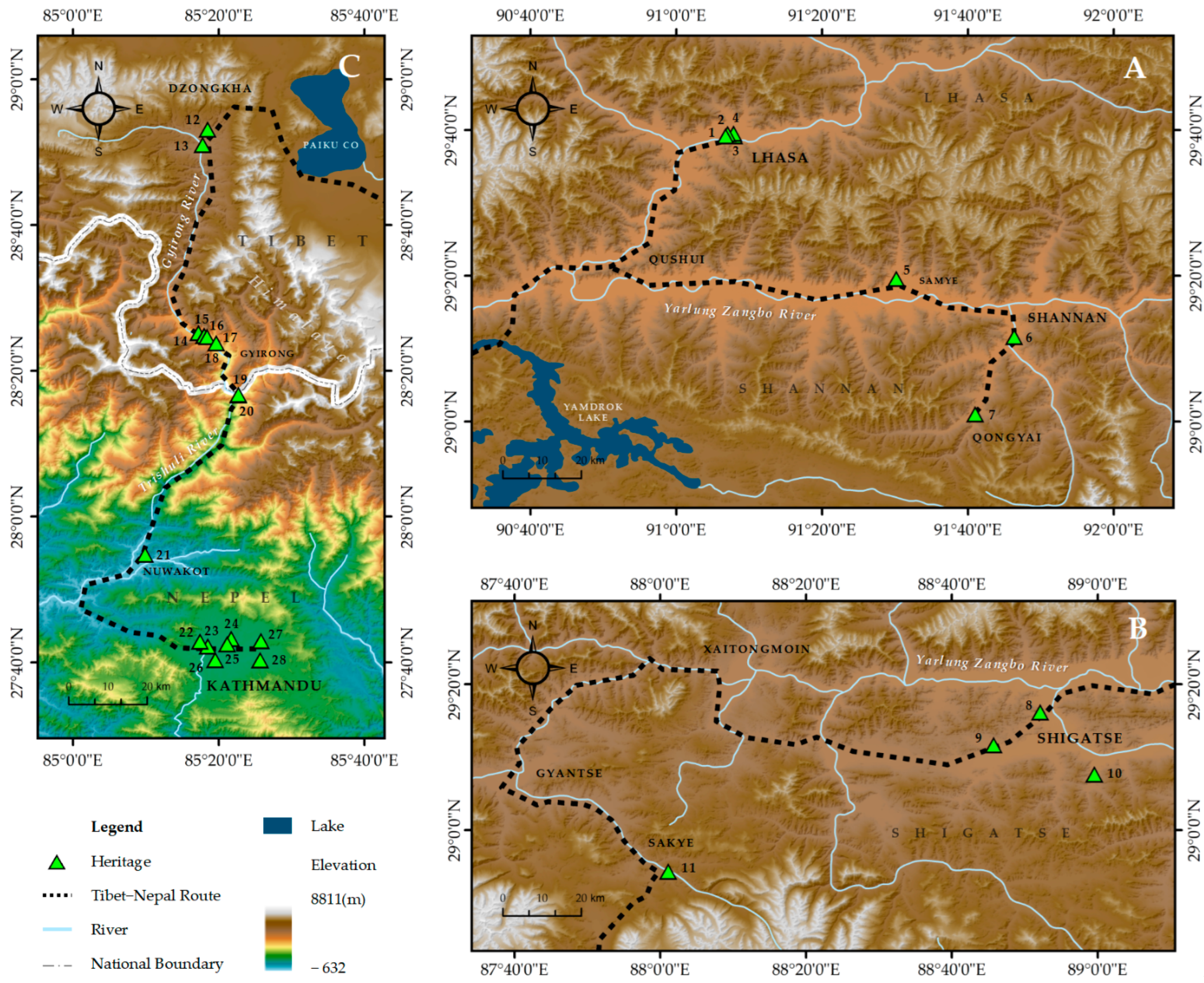
In this study, the Tibet–Nepal route refers to a highland and mountainous overland corridor that had already been opened in the early 7th century CE, linking southwestern China with Nepal in the South Asian subcontinent [25]. Originating in Lhasa, Tibet, the route runs westward through the Gyirong River valley, crosses the Himalayas, enters Nepal, and follows the Trishuli River and its tributaries via Nuwakot to the Kathmandu Valley. The Tibet–Nepal route was connected eastward to the Chang’an–Tibet Ancient Road linking Lhasa with Xi’an, and westward to the ancient routes from Kathmandu to India [25,26]. It represents another major overland route of the Silk Roads, following the Tianshan Route and the Yunnan Route [26,28]. See Figure 1 [39] and Table 1.
Although historical records regarding Tibet–Nepal relations are scarce, Tibetan chronicles and Nepalese Brahmi inscriptions document that between 624 and 640 AD, Songtsen Gampo married Princess Bhrikuti, the daughter of the Nepalese King [27,29]. According to the Royal Genealogy of Tibet, the Princess entered Tibet via the present-day Gyirong County [38]. Chinese annals record that during a period of civil unrest in Nepal around 624 AD, Prince Narendra Deva sought refuge in Tibet after his father, Udaya Deva, was usurped. Subsequently, Titeban forces assisted him in reclaiming the throne [27]. This political alliance catalyzed the activation of the Tibet–Nepal Route between 640 and 660 AD, facilitating a peak in diplomatic exchanges between Nepal and the Tang Dynasty. The Tang envoy Wang Xuance traversed this route on three diplomatic missions to Nepal and India. The discovery of the Inscription of the Great Tang Envoy to India in Gyirong County in 1990 serves as a critical epigraphic record left by Wang Xuance during his mission [37,38]. This stela constitutes indispensable physical evidence for researching the ancient Tibet–Nepal transport corridor. The frequent utilization of this road facilitated the large-scale transmission of Buddhist culture into Tibet. Under the patronage of Princess Bhrikuti, Nepalese artisans constructed the Jokhang Temple in Lhasa [28]. Similarly, the Changzhu Monastery also built by Nepalese craftsmen during Songtsen Gampo’s reign, mirrors the architectural style of the Jokhang. During the 8th century reign of Trisong Detsen, the route became a major thoroughfare for Buddhist proselytization [26,27]. Key figures, including Shantarakshita and Padmasambhava, traversed this road to introduce Indian Buddhism to Tibet. Supported by the Emperor, they oversaw the construction of the Samye Monastery, marking the definitive establishment of Buddhism in Tibet [26,29].
Historical records indicate that King Amshuverma of the Lichchhavi Dynasty prioritized mercantilism over agriculture, actively fostering trans-regional trade [27]. Nepalese merchants served as essential intermediaries in the commercial network connecting ancient Tibet and India. Commodities such as Indian spices and rice were exported to Tubo, while Tibetan salt and wool were distributed to India, with Nepalese traders facilitating these bilateral exchanges [29,30]. Furthermore, the marriage of Princess Wencheng catalyzed the diffusion of paper making technology from the Central Plains into Tibet via the Chang’an–Tibet Ancient Route. Shortly thereafter, this technology was introduced to Nepal through the Tibet–Nepal Route, establishing Nepal as one of the earliest regions in the South Asian subcontinent to adopt papermaking [40].
Since its establishment, this route has therefore played a crucial role in dynastic marriage alliances, the transmission of religion, cultural exchange, economic trade, the development of agricultural technologies, and inter-ethnic relations [37,38,41,42,43].
The Tibet–Nepal route traverses multiple natural geographical units, extending from the interior of the Qinghai–Tibet Plateau southward across the high mountain gorges of the Himalayas and ultimately reaching the Kathmandu Valley. The corridor has a total length of approximately 1000 km and a vertical elevation difference exceeding 2500 m. Its geomorphological types include plateau basins, high-mountain gorges and river valleys, faulted mountains, and impact basins, with ecological and climatic conditions varying markedly along the route [44].
Physiographically, this corridor traverses the southern margin of the Qinghai–Tibet Plateau, the Hengduan Mountains, and the southern slopes of the Himalayas. Located within the marginal zone of the Asian monsoon, it is a region sensitive to glacial retreat and is characterized by frequent seismic activity and complex hydrological processes. Consequently, it represents one of the regions where geological hazards and climate risks exhibit significant overlap [12]. The plateau section from Lhasa to Gyirong features a predominantly cold and dry climate. Here, the primary geological concerns are seasonal permafrost, slope slides, and high-altitude wind erosion. Upon entering Nepal, the climate transitions to a subtropical humid type. In this region, the primary hazards become rainstorm-induced landslides, glacial lake outbursts, and valley floods [13,14,45,46,47,48,49].
This route demonstrates a typical geomorphological transition sequence from plateau basins to alpine valleys, foothill hills, and sedimentary basins. This not only reflects significant physical geographical differences but also shapes the spatial distribution patterns and diversity of cultural landscapes. This natural geomorphological framework provides a crucial geographical context for understanding the spatial exposure and heritage adaptability of cultural landscapes along the Tibet–Nepal route.
The diverse physiographic patterns along the Tibet–Nepal route have fostered a rich variety of locally adapted cultural landscape types. These cultural landscapes encompass several distinct types: multi-layered terraced fields adapted to steep terrain; integrated irrigation systems that combine religious rituals, subsistence practices, and water governance; religious temples situated within mountainous or hillside environments; traditional settlements shaped by long-term habitation and production; and ancient transportation networks that connect these critical cultural nodes [28]. Collectively, these elements constitute a culturally embedded system of landscape construction and management, demonstrating the long-term co-evolution between human societies and extreme environments.
Historically, the Tibet–Nepal route served as both an ancient transit corridor connecting the Qinghai–Tibet Plateau with the Kathmandu Valley and a vital conduit for trans-regional exchange. It specifically facilitated the dissemination of Buddhism and the movement of official envoys, artisans, and merchants between China and Nepal [27,29,38,39,42]. Through prolonged historical development, a series of strategic transit hubs and religious/cultural centers emerged along this path. These elements fostered a composite spatial structure that evolved from discrete heritage nodes into linear segments and, ultimately, into an integrated route network.
These spatial nodes embody the integration of political, religious, and commercial functions, manifesting the adaptive strategies of societies within high-altitude ecological constraints. Notably, the formation and evolution of these cultural landscapes occur within a dynamic, symbiotic system characterized by the nexus of land use, climate change, and religious beliefs [34,50]. Within this system, topographic conditions dictate settlement patterns and landscape morphology, diverse microclimates catalyze the evolution of technologies and institutions, while religious beliefs endow the landscape with spiritual and ritual dimensions.
Within this system, topography dictates settlement patterns and landscape morphology. Diverse microclimates catalyze technological and institutional evolution, while religious beliefs endow the landscape with spiritual and ritual dimensions.
Traditional villages along this route typically emerged organically, with spatial development centered around temples, water sources, arable land, and transportation hubs. Their spatial configurations are profoundly integrated with surrounding heritage through daily practices, resource management, and ritual activities. In the Lhasa region, for example, valley farmlands and palace-temple complexes constitute a socio-cultural entity integrating administrative, religious, and agricultural functions. Similarly, within the Kathmandu Valley, the Guthi system facilitates a seamless nexus between land tenure, religious rituals, and communal life [51].
The relationship between the cultural landscapes and traditional villages along the Tibet–Nepal route extends beyond physical proximity. It constitutes a tripartite symbiotic system integrating ecological, cultural, and institutional dimensions, shaped by long-term human–environment interactions [50]. Within this system, cultural heritage functions not as a static material symbol but as a dynamic space and repository of social memory. It is continuously reproduced by village communities through land management practices, religious rituals, and adaptive responses to environmental change. However, pressures arising from climate change and modern interventions are increasingly undermining the stability of this symbiotic system. These pressures pose significant challenges to its long-term adaptability and sustainability [50,52].
In recent years, environmental disturbances induced by climate change have increasingly disrupted the long-established stability of the cultural landscape system along the Tibet–Nepal route. Studies shows that the rate of temperature increase on the Qinghai–Tibet Plateau and in the Himalayan region exceeds the global average significantly. This trend has accelerated processes such as glacial retreat, permafrost degradation, and extreme precipitation events, while also increasing frequency of glacial lake outbursts [12,13]. Concurrently, human activities—including population growth, infrastructure expansion, and the weakening of traditional systems—have further exacerbated the vulnerability and exposure of regional cultural landscapes [50]. For instance, over one-third of the Dhungedhara water spring systems in the Kathmandu Valley have dried up as a result of urban expansion and declining groundwater levels, thereby simultaneously disrupting associated irrigation and religious activity systems [49]. Frequent landslides in the Gyirong Canyon area have blocked traditional border trade routes, thereby posing direct threats to the safety of villages located along them. Furthermore, trends of permafrost degradation and land desertification within the Lhasa River Basin have begun to adversely affect both farmland productivity and the stability of settlement ecosystems [12]. These environmental changes not only inflict direct damage on tangible cultural heritage but also challenge the functional continuity of the institutional, knowledge-based, and community networks that underpin these landscapes.
Therefore, the protection and management of the cultural landscape along the Tibet-Nepal route should shift from site-specific heritage restoration to a holistic governance approach that is systematic, forward-looking, and adaptive. This transition requires the integration of multi-source spatial data, local institutional arrangements, and community practices into a comprehensive, multi-scale analytical framework. Such an approach is essential for identifying high-risk areas, evaluating the adaptive capacity of traditional systems, and formulating adaptation strategies that balance cultural heritage resilience with practical feasibility [53,54,55].
Based on this framework, the study selects 28 representative heritage sites or clusters along the route and classifies them into three study areas based on their current spatial distribution: A (Lhasa section), B (Shigatse section), and C (Gyirong to Kathmandu section). These areas provide the basis for a regional comparative analysis. Using a mixed-method approach that integrates quantitative and qualitative analysis, the study examines strategies for the protection and governance of high-altitude cultural route landscapes under climate change. The analysis is framed within a symbiotic framework that emphasizes interactions among community, environment, and culture.

2.2. Research Method

To identify the diverse risks and governance challenges facing Tibet–Nepal Route cultural landscapes amidst climate change, this study categorizes the corridor into three subregions based on geomorphology, settlement patterns, and heritage density. Based on this spatial differentiation, the study employs a mixed-method framework integrating spatial risk analysis, adaptive conservation assessment, and qualitative fieldwork.
Instead of treating these methods as parallel components, the framework adopts a problem-oriented logic to sequentially link risk exposure, institutional constraints, and adaptation strategies. The methodological objectives are threefold: (1) assessing spatial patterns of hazard exposure; (2) diagnosing structural barriers to adaptive responses; and (3) prioritizing context-sensitive strategies grounded in local institutions and knowledge systems.

2.2.1. Spatial Risk Analysis

The Tibet–Nepal Route, a transboundary linear cultural landscape, exhibits significant geomorphological heterogeneity, compound climatic hazards, and uneven heritage distribution. A 0.1° × 0.1° grid system was adopted as the primary analytical unit to ensure comparative rigor and reproducibility. Multi-source datasets, comprising precipitation records (2020–2024), Digital Elevation Models (DEM), and remote sensing imagery, were synthesized into a geospatial database via ArcGIS. Spatial overlay and coupling analyses evaluated the correlations between heritage distribution and key environmental drivers, including slope, elevation, and extreme precipitation. These findings informed the classification of three subregions (Figure 2) into distinct risk levels, establishing a spatially explicit foundation for subsequent adaptive assessments [56,57,58,59,60,61,62,63].

2.2.2. Adaptive Conservation Assessment

To address the complex adaptive challenges inherent in the Tibet–Nepal transboundary cultural landscape, this study develops an integrated three-stage framework encompassing barrier diagnosis, strategy identification, and MCDA. Rather than a mere aggregation of existing tools, this framework follows a logical sequence where diagnosis precedes evaluation. This ensures that assessment variables are context-specific instead of arbitrarily selected.
During the first stage, Aktürk and Dastgerdi’s (2021) framework is employed to diagnose constraints inhibiting adaptive action [6]. Barriers are categorized into four interrelated dimensions—institutional, technical, financial, and socio-cultural—reflecting the core pillars of heritage governance. The purpose of this stage is not to propose solutions but to reveal the structural and institutional conditions that limit the effectiveness of adaptation efforts along the Tibet–Nepal Route [6].
Building on this diagnostic foundation, the second stage operationalizes seven adaptation criteria (Carmichael et al., 2020) to screen and compare potential strategies: cost-effectiveness, goal orientation, practical feasibility, cultural suitability, co-benefits, timeliness, and robustness [52]. These criteria were selected not as universal metrics but because they directly correspond to the barrier types identified in the first stage. Specifically, technical barriers map to feasibility and robustness; institutional barriers to feasibility and goal orientation; socio-cultural barriers to cultural suitability; and financial barriers to cost-effectiveness, timeliness, and co-benefits. This diagnostic-led logic embeds evaluation criteria within the local governance context, enhancing both analytical transparency and policy relevance.
In the third stage, MCDA functions as a prioritization tool rather than a deterministic decision-making mechanism. Given the data scarcity and political sensitivity of the Central Himalayas, the study avoids complex weighting schemes to minimize subjective bias. Instead, a simplified 0–2 scoring system is employed (2 = Yes; 1 = Partial; 0 = No), following Carmichael et al. (2020) [52]. To further mitigate bias, scores are assigned through a participatory process with a stratified division of responsibility based on stakeholder expertise and lived experience. Final scores for each criterion are determined using a majority consensus principle, thereby improving inter-rater consistency and reproducibility while maintaining sensitivity to local socio-cultural conditions.

2.2.3. Fieldwork and Case Studies

To contextualize assessment results and explore adaptive mechanisms beyond quantitative metrics, this study integrates field surveys with qualitative case studies. Grounded in anthropological and cultural geographical perspectives, fieldwork provides a critical lens for interpreting local knowledge, institutional practices, and routine landscape maintenance [64,65,66].
Semi-structured interviews and participant observations were conducted with key stakeholders—including villagers, monks, and heritage practitioners—to explore how traditional institutions are embedded in governance through religious rituals, festivals, and routine infrastructure maintenance. This approach conceptualizes cultural landscapes not as static material assemblages, but as “fields of social practice” continuously reproduced through collective action [3]. The study specifically identifies “invisible cultural resilience”-adaptive capacities sustained by belief systems, customary norms, and embodied knowledge [35].
Nepal’s Guthi system serves as a representative case to illustrate the adaptive potential and vulnerabilities of traditional land management institutions under climatic stress. By analyzing institutional “fracture points” and their impact on collective action, the case study demonstrates how governance shifts directly influence landscape resilience in high-altitude regions. Consequently, integrating fieldwork and case analysis complements the MCDA results, bolstering the social validity and policy relevance of the study’s conclusions [5].

3. Research Results

3.1. Spatial Risk Identification and Analysis

(1)
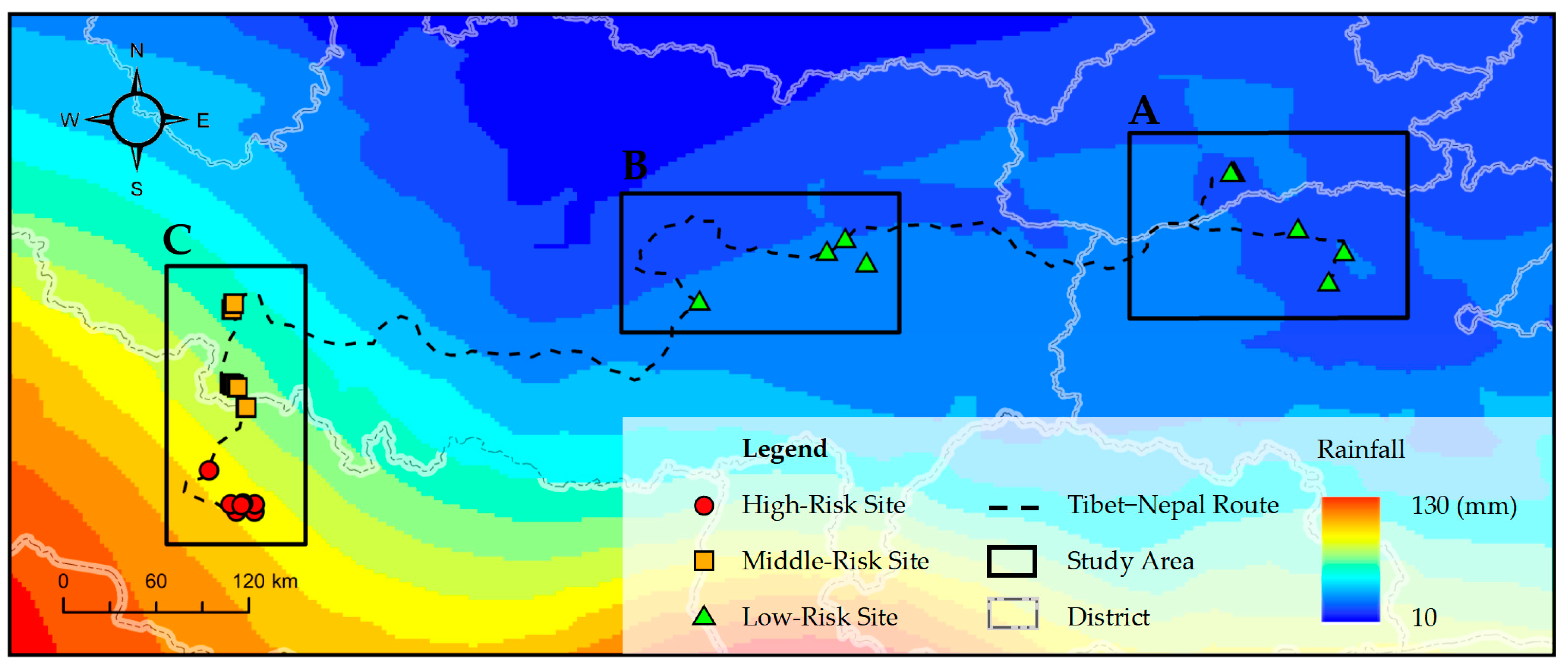
The mean annual maximum daily precipitation for the period 2020–2024 was analyzed. Precipitation data were obtained from the National Centers for Environmental Information (NCEI) of the U.S. National Oceanic and Atmospheric Administration (NOAA). The dataset includes meteorological station locations, elevation, and daily precipitation records, providing reference information for areas with limited observational coverage. The mean annual maximum daily precipitation for the study area was calculated for 2020–2024. Co-kriging interpolation was then performed within a GIS environment to examine the spatial distribution patterns of precipitation [56,57]. The results indicate that the mean annual maximum daily precipitation across the study area ranges from 20 to 90 mm. The spatial distribution was classified into 10 mm intervals for visualization (Figure 3). Areas experiencing higher precipitation are associated with elevated risks of hazards such as flooding and landslides. Accordingly, heritage sites were categorized into three risk levels: high (>80 mm), medium (40–80 mm), and low (<40 mm). The findings indicate that most heritage sites in Study Area C, particularly along the southern Himalayan foothills from Nuwakot to the Kathmandu Valley, are located in areas of high-risk exposure.
(2)
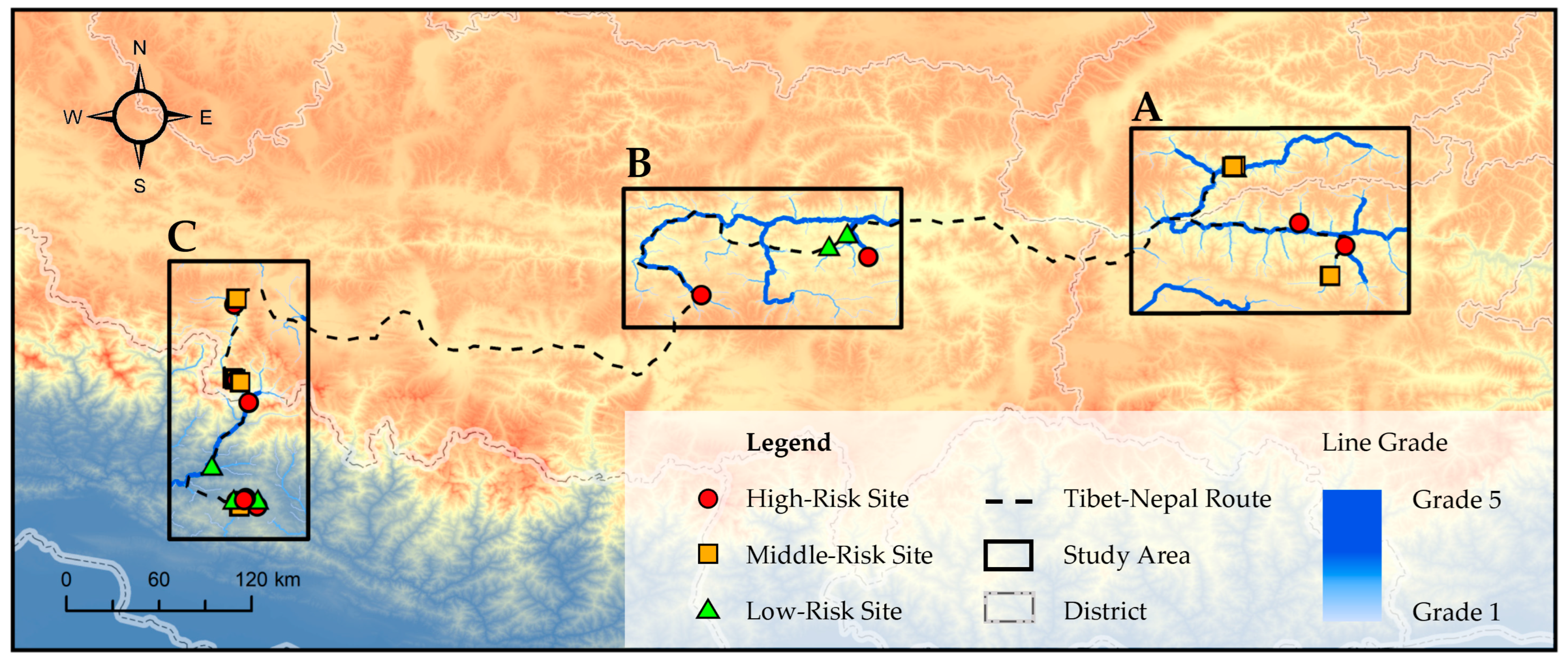
The distance between each heritage site and its nearest drainage line was analyzed. Drainage line data were derived from a 30 m resolution digital elevation model obtained from the Geospatial Data Cloud (https://www.gscloud.cn accessed on 11 December 2025). Using the Hydrology module in a GIS environment, drainage networks for the three study areas were extracted with a flow accumulation threshold of 5000. The distance from each heritage site to the nearest drainage line was then calculated (Figure 4). Proximity to drainage lines increases the risk of hazards such as flooding and landslides. Based on these calculations, heritage sites were categorized into three risk levels: high (<5 m), medium (5–10 m), and low (>10 m) [61]. The results indicate that across all three study areas, heritage sites located closer to drainage lines exhibit higher levels of risk exposure.
(3)
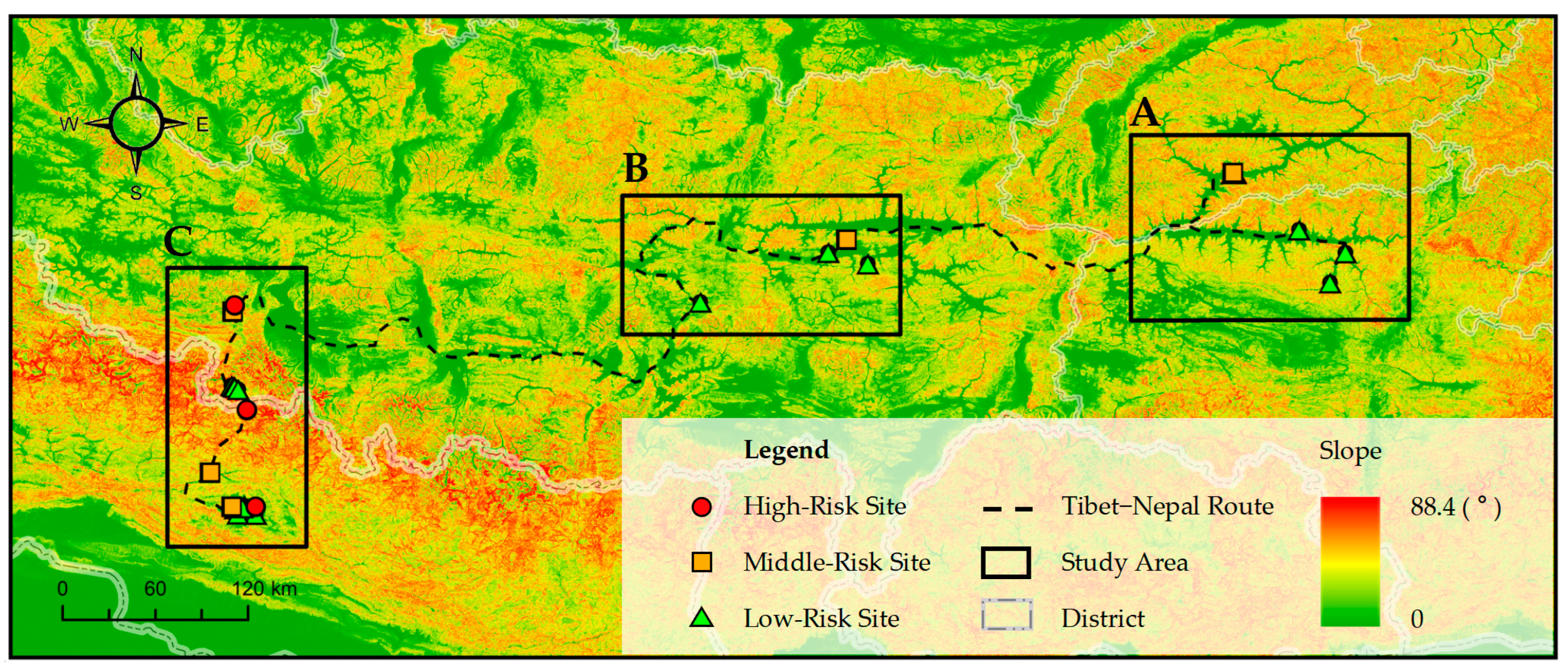
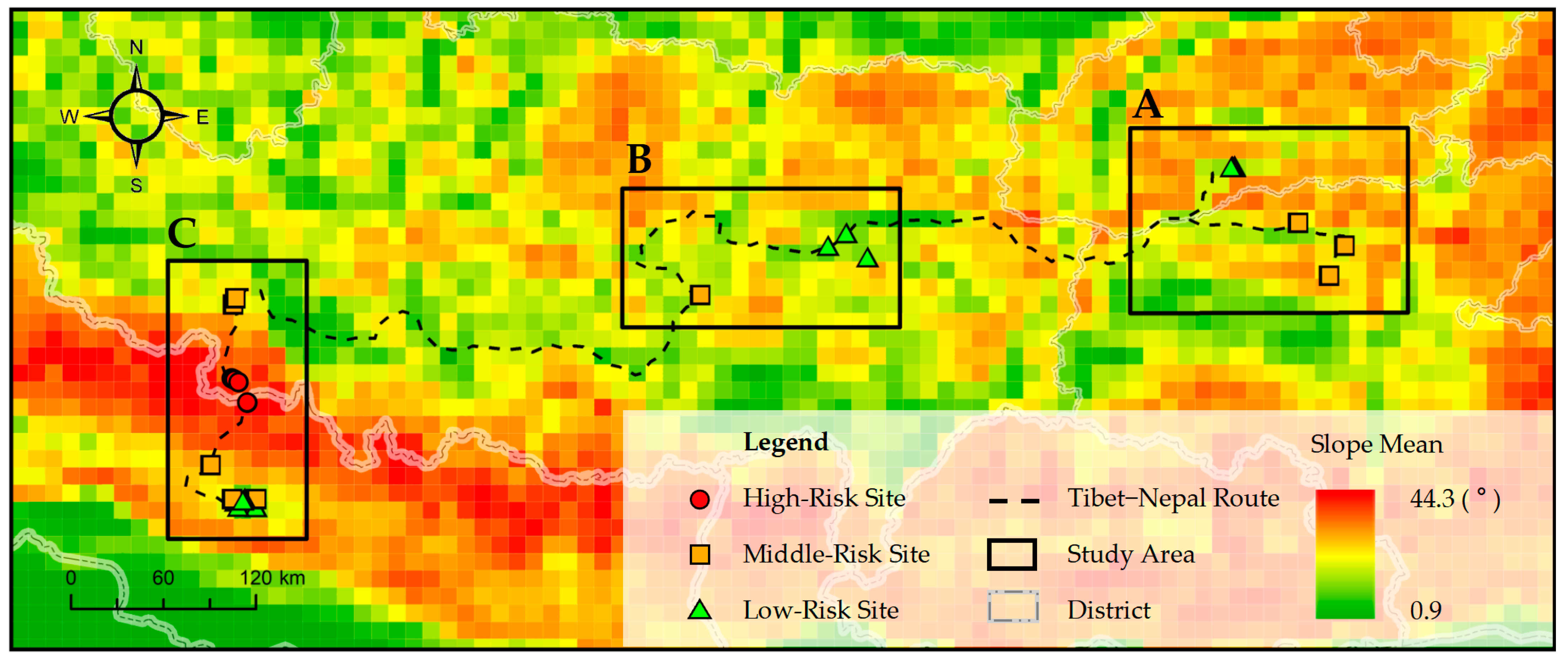
Site slope was derived from the DEM data described above, and the results are presented in Figure 5. Slope represents the local topographic conditions of each site and reflects its direct exposure to terrain-related hazards. Slopes within the study area range from 0° to 73.6°. Landslide risk increases with slope gradient. Accordingly, heritage sites were categorized into three risk levels: high risk (>30°), medium risk (10–30°), and low risk (<10°) [56]. The results indicate that Study Area C, characterized by abrupt geomorphological transitions and high terrain variability, contains several heritage sites located along canyon corridors that face elevated hazard risk.
(4)
The mean slope of the area surrounding each heritage site was calculated to characterize terrain complexity. This metric represents the broader topographic context of the cultural landscape unit and reflects the environmental constraints and systemic risk conditions operating at a larger spatial scale. Higher mean slope values indicate steeper terrain and an increased likelihood of exposure to environmental hazards. For example, sites in mountainous areas face a higher landslides risk than those in plains. The mean slope was calculated using a 0.1° grid as the spatial analysis unit. Based on the results, heritage site were categorized into three risk levels: high risk (>30°), medium risk (15–30°), and low risk (<15°). The results indicate that Study Area C, located in the canyon section along the China–Nepal border, exhibits relatively high risk levels (Figure 6).
(5)
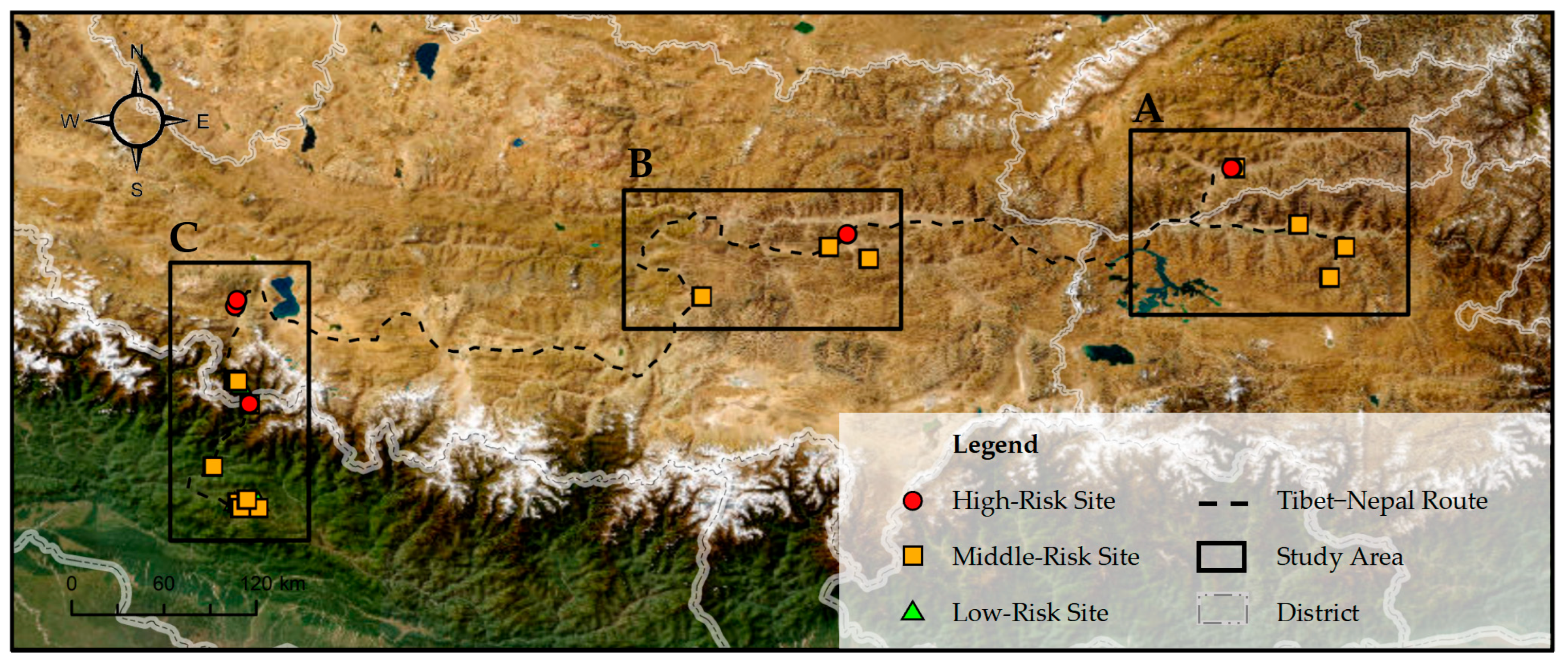
Remote sensing imagery provided by Esri was used to identify land-use types, following established approaches in previous studies [60,61,62]. Visual interpretation was employed to identify the dominant land use types surrounding each heritage site. These categories were then used to classify site risk levels as follows: high (bare land, rivers), medium (built-up areas, farmland, grassland, shrubland), and low (forest) (Figure 7). The results indicate that across the three study areas, heritage sites located on bare land or in close proximity to rivers exhibit elevated risk levels.
By integrating the risk factors with international natural disaster databases, a comprehensive analysis reveals a marked upward trend in climate-induced natural hazards across the study area. These hazards are characterized by a broad taxonomic diversity and the complex coupling of multi-hazard processes. The hazard distribution exhibits pronounced zonation and clustering, fundamentally governed by geomorphic structure, hydrological regimes, and precipitation patterns.
Special attention is warranted for high-risk concentration zones on the southern Himalayan slopes in Study Area C, particularly in canyon areas between 1500 m and 3500 m elevation. This zone constitutes a hotspot for pluvial flooding and landslides, where the interaction of extreme precipitation and steep terrain produces a substantially higher geological hazard sensitivity index compared to other regions. In contrast, the Lhasa–Shigatse river valley belt, situated within a plateau basin and characterized by relatively gentle topography, is more susceptible to risks such as permafrost degradation associated with rising temperatures.
The Tibet–Nepal corridor displays a distinct spatial pattern of disaster risks: the southern Himalayan slopes are primarily affected by rainfall-induced hazards, whereas the northern slopes are susceptible to permafrost degradation and thaw-related hazards. This pattern underscores the differential impacts of distinct climatic zones on landscape vulnerability.

3.2. Assessment of Cultural Landscape Adaptive Capacity

To address the complexity of the Tibet–Nepal route cultural landscape, this study employs social–ecological system resilience as its foundational analytical framework and utilizes MCDM as the primary evaluation method. Heritage value conservation serves as the core screening criterion. An integrated assessment framework is constructed by synthesizing the adaptation barrier typology proposed by Aktürk and Dastgerdi (2021) with the adaptation option assessment approach developed by Carmichael et al. (2020) [6,52]. First, the framework identifies four key barriers categories within the current system: technical, institutional, socio-cultural, and financial. This step clarifies the principal constraints on responding to climate change risks. Building on this diagnosis, targeted adaptation options are then identified and screened using a multi-criteria qualitative assessment tool. This process prioritizes strategies based on their feasibility across cultural, economic, and governance dimensions.
This study employs a combined methodology of in-depth interviews and participant observation to systematically assess the social–ecological adaptive capacity of cultural landscapes along the Tibet–Nepal route. The assessment framework consists of three stages: barrier diagnosis, option identification and multi-criteria evaluation. The overall survey covers three study areas, with more than 25 stakeholders participating in the investigation, including local residents and community workers, administrative officials, and academic experts.
In the first stage of the integrated assessment framework, drawing on Aktürk & Dastgerdi (2021), the study recognizes that insufficient resilience of cultural landscapes in the context of climate change is often rooted in deep-seated systemic barriers [6]. Through field investigations, resilience barriers along the route are systematically identified, including:
(1)
Technical barriers represent the primary bottleneck for enhancing resilience in the study area. There is a notable lack of models and tools for assessing current and future risk levels, exposure, potential loss impacts, and the probability of climate-related effects on various types of cultural heritage [67]. For instance, Study Area C, which is highly exposed to pluvial flooding and landslides, lacks an effective early-warning system. Furthermore, insufficient monitoring data across the route, coupled with complex terrain and a low spatial density of meteorological stations, severely limit the accurate prediction of local microclimatic changes, glacial lake outburst floods, and land degradation. Moreover, holistic assessment approaches are lacking. Current conservation practices predominantly focus on the physical restoration of individual monuments, exemplified by the restoration of Nuwakot Palace and the structural reinforcement of Qude Monastery. Technical tools for evaluating the ancient route and its surrounding traditional agro-pastoral landscapes, hydrological systems, and ecosystems as an integrated social–ecological system are still largely absent. Additionally, a shortage of professional expertise persists. Local heritage managers generally lack the specialized skills needed to address climate risks and to employ advanced techniques such as 3D scanning and remote sensing for long-term monitoring of landscape dynamics. Finally, the low level of digital documentation for traditional heritage assets further constrains effective risk assessment and adaptive management.
(2)
Institutional barriers significantly undermine the adaptive capacity of the study area, with institutional fragmentation representing a major constraint. This study argues that institutional fragmentation is not coincidental but deeply rooted in the region’s millennium-long geopolitical history. As a strategic corridor connecting East and South Asia, the Tibet–Nepal route has historically functioned as a pivotal hub for territorial contestation and power infiltration among the Chinese central dynasties, the Tubo Empire, and various South Asian polities. This enduring geopolitical legacy has fostered profound regional path dependencies, resulting in significant institutional divergences between China and Nepal regarding heritage management systems, legal frameworks, and data-sharing protocols. Closer cooperation between the two countries is made more challenging by their very different cultural traditions and customs. Furthermore their different languages and writing systems present practical challenges in communications between the two, raising the potential for miscommunications and misunderstandings. Specifically, the absence of cross-border collaboration stemming from high trust costs associated with geopolitical sensitivity precludes a unified coordination mechanism. Consequently, this hinders the implementation of transnational early warning systems and synchronized disaster responses under extreme weather events. Structural conflicts between departmental functions further exacerbate the issue. Domestically, cultural conservation, tourism development, and urban planning departments operate in silos, where development priorities often supersede conservation logics, hindering a synergistic approach to resilience enhancement. The political erosion of endogenous local institutions represents another critical variable. The reconfiguration of local self-governance by state political power has fundamentally altered the regional landscape. For instance, Nepal’s land nationalization has bolstered state control while simultaneously undermining the 800-year-old traditional Guthi system. This displacement of informal institutions by state administration has diminished communal collective action, leading to the decay of traditional infrastructure—such as stone drainage systems—and escalating the physical vulnerability of the landscape [68,69].
(3)
Socio-cultural barriers are manifested primarily through the erosion and fragmentation of local knowledge systems, which are at significant risk of decline. Participatory investigations indicate that, due to ongoing modernization, youth outmigration, and shifts in social structure, younger generations demonstrate declining engagement with traditional knowledge. Awareness and practical application of TEK have markedly declined among younger community members, while knowledge transmission increasingly depends on older generations, indicating an escalating risk of intergenerational discontinuity [68,69]. Moreover, a substantial gap between community risk perception and preparedness for action further limits adaptive capacity. Although local communities often demonstrate high awareness of climate-related hazards, this awareness does not consistently translate into preventive investment or proactive adaptation measures. For example, in certain communities in Nepal, high awareness of landslide risks has not led to the implementation of concrete preventive measures [45]. Furthermore, divergent value perceptions between management authorities and local communities constitute a critical socio-cultural challenge. While some management actors emphasize the economic and developmental value of heritage resources, local residents tend to prioritize their religious significance and everyday lived experiences. This misalignment of values often results in the spiritual and intangible dimensions of cultural landscapes being neglected in the development of climate adaptation strategies.
(4)
Financial barriers are primarily manifested as limited access to long-term and stable funding mechanisms dedicated to climate change adaptation. Furthermore, owing to logistical challenges in high-altitude environments and short construction windows, physical adaptation measures, such as structural reinforcement or drainage works, face substantial cost pressures, which further constrain their feasibility and long-term implementation.
The second stage of the integrated assessment framework focuses on identifying and preliminarily screening adaptation options. This stage builds upon the four categories of resilience barriers identified in the first stage: technical, institutional, socio-cultural, and financial barriers [6]. Following the principles outlined by Carmichael et al. (2020), an adaptation strategy pool was established to respond to climate-related risks while remaining consistent with the context-specific conditions of the Himalayan region [52]. Adaptation options were identified through multiple sources, including field interviews with residents of traditional communities and heritage conservation managers along the route, consultations with experts from diverse disciplines (e.g., archeology, geology, and architecture), and analogical analysis of documented cases in the literature [52,53,54,55,70,71]. Based on their underlying mechanisms, the 13 initially identified candidate options were subsequently classified into three categories: (i) direct interventions and engineering-based conservation measures; (ii) strategies aimed at enhancing landscape resilience; and (iii) measures focused on strengthening governance and adaptive capacity [17].
Prior to the detailed multi-criteria evaluation, a preliminary screening of the adaptation strategy pool was conducted in accordance with the methodology proposed by Carmichael et al. [52]. Adaptation options were excluded if they met any of the following criteria:
(i)
Cultural veto: Whether the option involves large-scale ground disturbance within sacred areas or conflicts with local religious doctrines and ritual practices (e.g., construction of large concrete retaining walls along sacred sections of the route).
(ii)
Technical impossibility: Whether the option relies on heavy machinery that cannot be transported to roadless areas at elevations exceeding 4000 m above sea level.
(iii)
Sustainability veto: Whether the option requires high long-term maintenance costs or prolonged presence of specialized external teams, thereby undermining its long-term sustainability.
Following preliminary screening, hard engineering solutions characterized by high costs and substantial environmental impacts, such as large-scale reinforced concrete flood control structures, were excluded. Consequently, ten adaptation options were retained for the third stage of MCDA [52]. This screening process ensured that all options subjected to subsequent evaluation possessed a minimum level of contextual feasibility, referred to here as “on-site viability.”
The third stage of the research framework involves a systematic MCDA of the ten adaptation strategies remaining after the preliminary screening. The Tibet–Nepal Route is conceptualized as a contested arena shaped by the intersection of sovereign management, local traditions, and global heritage discourses. To address the resilience barriers identified by Aktürk and Dastgerdi (2021) [6] stemming from stakeholder cognitive biases and power asymmetries, this study develops a modified MCDA model based on the framework by Carmichael et al. (2020) [52].
First, rather than relying on a singular expert-driven approach, the study established a collaborative evaluation mechanism characterized by multi-stakeholder participation and a clear division of labor. 25 diverse stakeholders participated in the scoring process, with specific indicators assigned according to their expertise and lived experience. Scholars (n = 5) primarily evaluated technical robustness (C7) and goal orientation (C2); administrative officials (n = 10) focused on cost-effectiveness (C1) and timeliness (C6); and community representatives (n = 10) assessed cultural suitability (C4) and practical feasibility (C3). This stratification ensures that specific criteria are judged by participants with the highest contextual cognition, thereby enhancing the situated rationality of the evaluation results. Second, following Carmichael et al. (2020) [52] seven-indicator system, a simplified 0–2 scoring rubric was applied to accommodate the unique geographic environment of the central Himalayas (2 = Yes; 1 = Partial; 0 = No). This discrete assignment method mitigates subjective uncertainty inherent in complex quantitative weighting under data-scarce conditions, while improving inter-rater consistency and comparability. Third, the majority consensus principle was employed during the integration phase to assign values to the evaluation matrix. The option receiving the most votes was assigned as the final score for each indicator. Crucially, this MCDA process aims to prioritize and screen adaptation options rather than replace political decision-making, ensuring that technical tools do not oversimplify complex socio-cultural judgments. (see Table 2).
A preliminary list of adaptation options for the Tibet–Nepal route under climate change is presented in Figure 7. Using mode-based composite scoring and consensus analysis, optimal adaptation strategies with a high stakeholder agreement were identified to mitigate climate change risk to cultural landscapes along the corridor.
  • Use of traditional techniques. Traditional construction techniques are recommended for restoring drainage systems and terraced irrigation networks, with traditional drainage systems integrated into contemporary disaster risk reduction planning [36,73]. This approach addresses socio-cultural barriers and ensures a high level of cultural appropriateness by leveraging TEK. Building on Jigyasu’s (2019) empirical research on traditional building knowledge in Nepal [73] and Rautela’s (2015) study of traditional disaster risk management practices in Uttarakhand, India, this study proposes a traditional stone drainage restoration strategy [36]. Furthermore, based on the well-documented traditional water-harvesting systems of South Asia with a history exceeding 8000 years, a terrace and irrigation system restoration strategy is proposed [78]. These measures not only effectively reduce the kinetic energy of slope runoff but also contribute to maintaining the authenticity and integrity of the Tibet–Nepal Route as a high-mountain linear cultural landscape.
  • Digital monitoring, early warning, and transboundary cooperation mechanisms. To mitigate the chronic scarcity of meteorological and hydrological data in high-altitude regions, this study proposes a digital monitoring and early-warning framework centered on community participation. By strengthening grassroots monitoring systems and fostering multi-stakeholder collaboration, this approach addresses the technical and institutional barriers arising from fragmented data and insufficient sharing at the trans-boundary scale. At the transnational level, drawing on the Kailash Sacred Landscape Conservation and Development Initiative (KSLCDI) initiated by ICIMOD this study adopts a trans-boundary landscape management approach to construct a regional cooperation framework. Aiming to synergistically address compound risks including climate change, biodiversity loss, and declining community resilience [75,83]. Regarding the technical trajectory, this study draws on ICIMOD’s Community-Based Flood Early Warning System (CBFEWS) successfully implemented in the Himalayas. By deploying low-cost sensors for real-time monitoring of glacial runoff and extreme precipitation, combined with threshold-based alerting, a community-centric disaster response system is established [77,79]. Concurrently, this research proposes a conceptual framework for a community-based monitoring app. This serves as a strategic roadmap for future exploration rather than a finalized technological product. This vision aligns with the successful application of citizen science to fill environmental data gaps in mountain regions [80] and mirrors the SCAPE project’s approach to mobilizing public participation in heritage risk recording [84]. It emphasizes streamlining data collection and lowering technical barriers to activate the agency of rangers, monks, and residents in risk identification and information feedback. This low-cost, decentralized mechanism facilitates information sharing, thereby mitigating the opacity and delays in trans-boundary monitoring inherent in traditional institutional frameworks [76]. Consequently, this framework establishes a digital support system for collaborative risk governance across the Tibet-Nepal Route trans-boundary linear cultural landscape.
  • Capacity-building training for stakeholders. Enhancing the collective action capacity and knowledge base of stakeholders along the route can significantly reduce the transaction costs associated with responding to environmental risks [85]. The Tibet–Nepal route examined in this study is located in a remote Himalayan environment characterized by complex terrain. Given limited accessibility and financial constraints, establishing a community-based risk management system represents the only cost-feasible approach. Based on the UNESCO (2010) World Heritage Disaster Risk Management Guidelines [18], which emphasize the active involvement of local communities in heritage-related risk management, this approach proposes targeted training for local residents and grassroots heritage custodians in risk awareness and traditional techniques. Such training not only enhances local adaptive capacity but also enables stakeholders to independently address small-scale physical damage [18,80,82,86,87]. This approach improves the timeliness of emergency responses to climate-related hazards while substantially reducing long-term dependence on costly external professional teams. Through systematic knowledge transfer, reliance on high-cost external experts and heavy machinery can be markedly reduced, thereby fundamentally alleviating the financial constraints imposed by high-altitude maintenance costs [86,87]. In this way, a durable and self-sustaining heritage management mechanism can be established in resource-constrained environments.
  • Participation of traditional community institutions. The study found that along the Tibet–Nepal route, distinct governance models exist in China and Nepal. In the Nepalese section, heritage conservation and management predominantly rely on traditional community institutions, primarily the Guthi system, whereas the Chinese section is primarily administratively led. Despite these institutional differences, both contexts emphasize the role of traditional communities and religious beliefs in heritage management. This finding underscores that the continuity and autonomy of traditional social institutions are key determinants of the adaptive capacity of the Tibet–Nepal route cultural landscape.

3.3. Case Study

The Guthi system in the Kathmandu Valley, Nepal, constitutes a central focus of this study. It illustrates how traditional institutions enhance the resilience of both tangible and intangible cultural heritage through collective governance mechanisms. The Guthi system traces its origins to the Licchavi dynasty (c. 400–750 CE) and has historically been responsible for the managing and maintaining temples, sacred sites, festivals, and other cultural heritage assets. Through land endowments, the Guthi system established a unique land trust mechanism that serves as both the economic foundation and organizational support structure for cultural heritage conservation in Nepal. Through community-based organizational networks, Guthis mobilize local residents to undertake collective maintenance activities, including: (i) tangible heritage (temples, stupas, stone spouts [Dhunge Dhara], and traditional houses); (ii) intangible heritage (major annual festivals, religious rituals, and traditional music and dance); and (iii) ecological heritage (surrounding forests, water systems, and public ponds associated with cultural sites). By ritualizing and socializing conservation practices, the Guthi system effectively leverages community-based intangible capital to sustain the vitality of the cultural landscape, representing a holistic approach to maintaining the integrity of social–ecological systems [68,88,89,90].
Since the 1960s, land nationalization policies implemented by the Nepalese government have posed a significant challenges to the Guthi system. These reforms deprived many Guthi organizations of the land ownership and financial foundations on which they depended, thereby weakening their fiscal autonomy and capacity for resource allocation [90]. As a result, the collective action capacity and sustained maintenance funding of the Guthis have been undermined, limiting their ability to implement preventive measures prior to disasters and to conduct rapid post-disaster recovery, thereby reducing their effectiveness in the sustainable management of cultural heritage [68]. The comparison presented in Table 3 clearly illustrates the erosion of effective management mechanisms within the Guthi system following state-led reforms.
Evidence from other case studies indicates that indigenous communities, such as the Lachenpas and Dokpas in the Sikkim Himalaya (India), rely on TEK to support phenological forecasting, thereby enabling adaptive resource allocation and sharing in response to climate change [34]. In Bolivia, the Monkox community has revitalized traditional fire management practices [17], whereas in New Zealand, Māori perspectives provide culturally grounded interpretations and adaptive approaches to mountain landscapes [91]. Collectively, these cases support the conclusion that successful climate adaptation practices are rooted in the integration of traditional local knowledge with robust, community-led institutional frameworks. By clearly defining resource-use rules and maintenance responsibilities, such institutions enable communities to respond to environmental change in a flexible, coordinated, and collective manner. These examples underscore the critical role of traditional community institutions and local knowledge in heritage conservation and management, and provide important implications for the protection of cultural landscapes along the Tibet–Nepal route.

4. Discussion and Recommendations

4.1. Discussion

Through an integrated analytical framework combining spatial analysis, adaptive assessment, field investigations, and case studies, this study identifies the spatial distribution of hazard exposure levels, resilience barriers, and adaptation options for cultural landscapes along the Tibet–Nepal route under climate change. The results indicate that the corridor’s complex geomorphological conditions generate pronounced zonal patterns of hazard exposure across the cultural landscape, with certain segments, particularly within Study Area C, experiencing multiple overlapping high-risk hazards. Importantly, the vulnerability of the corridor cannot be reduced to the natural exposure of isolated heritage sites. Rather, it constitutes a systemic threat to the overall authenticity and integrity of the corridor as a linear high-mountain cultural landscape, thereby posing significant challenges to its long-term conservation and management.
Based on field investigations and the Resilience Barrier Diagnostic System proposed by Aktürk and Dastgerdi (2021) [6], this study identified cross-border monitoring gaps as the primary technical bottleneck limiting resilience in the study area, while the absence of transnational coordination mechanisms was identified as a key institutional barrier undermining adaptive capacity. In addition, the discontinuity and erosion of traditional local knowledge emerged as the principal socio-cultural barrier, while the lack of stable financial support in most areas constrained the sustainable conservation and management of the corridor’s cultural landscapes [6]. Subsequently, following the mode-based consensus principle and applying the multi-criteria assessment matrix developed by Carmichael et al. (2020) [52], the study conducted participatory surveys with 25 local stakeholders to identify integrated adaptation strategies with high stakeholder consensus. These strategies emphasize the use of traditional techniques, digital monitoring and early-warning systems, transboundary cooperation mechanisms, stakeholder capacity building, and the participation of traditional community institutions. Case analyses further demonstrate the critical role of traditional community institutions and locally embedded knowledge in the protection and management of cultural heritage [52].
Through a mixed-methods approach, this study corroborates Rössler’s (2006) [7] conceptualization of cultural landscapes as “dynamically coupled systems” and aligns with the theory of social–ecological system resilience proposed by Folke (2006) [92]. This perspective emphasizes that human societies and natural ecosystems are not independent entities but constitute deeply interconnected and highly integrated systems. Accordingly, research should not focus exclusively on natural or social dimensions in isolation, but instead analyze social–ecological systems as an integrated wholes [7,92]. In the context of the Tibet–Nepal route, a representative high-mountain transboundary cultural heritage corridor, the cultural landscape is not merely an aggregation of physical assets but a spatial field of practice shaped by topography, institutional structures, and belief systems. The findings further underscore the need to avoid treating cultural landscapes as static objects of restoration and instead to recognize them as evolving adaptive systems whose conservation should be grounded in cultural continuity and enduring social institutions.

4.2. Recommendations

Based on the preceding discussion, this study proposes targeted recommendations across three dimensions—trans-boundary governance, knowledge translation, and institutional restructuring—to address the constrained adaptation of the Tibet-Nepal route cultural landscape under high-risk exposure.
First, establish a geopolitical buffer trans-boundary collaboration mechanism centered on third-party international organizations. As a quintessential trans-boundary linear cultural landscape, the Tibet–Nepal route faces climate risks that transcend administrative boundaries and ecological systems. However, current management models fragmented by national and local jurisdictions fail to address this multi-scalar risk. Consequently, the study advocates for an unofficial collaboration platform led by ICIMOD [93]. Drawing on the success of the KSLCDI initiated by ICIMOD, a trans-boundary knowledge-sharing platform should be prioritized [83]. This aims to bridge data silos by sharing non-sensitive climate risk data, facilitating a transition from geopolitical maneuvering to functional collaboration for resilience. This approach not only enhances the feasibility of adaptation within a transnational context but also provides an institutional guarantee for the integrity of linear cultural heritage.
Second, develop a hybrid monitoring system integrating TEK with digital empowerment. Research indicates that while local communities possess acute climate risk perception and rich TEK, these cognitive advantages have not been effectively translated into timely adaptation, revealing a significant cognition-action gap. Therefore, the study propose integrating phenological and hydrological indicators from TEK [92] with mobile-based community monitoring to implement customized early warning systems. This synergy transforms the deep-seated cultural resilience of local residents into efficient real-time responses to extreme climate hazards. Furthermore, to bridge the cultural transmission gap, traditional solar terms, temple fair rhythms, and communal water management wisdom should be integrated into local curricula to establish a sustainable platform for intergenerational knowledge transfer. This strategy not only activates the agency of villagers as landscape guardians but also preserves the dynamic authenticity of the cultural landscape while ensuring timely crisis response.
Third, formally restore the statutory status of traditional community institutions, such as the Guthi system. Case studies reveal that the primary barrier to the adaptive potential of the Nepal section is not a lack of community willingness, but rather the institutional marginalization of traditional systems within modern governance frameworks. Institutions like Guthi excel in resource allocation, routine maintenance, and collective mobilization; however, their legal identities and governance roles remain under-recognized. Integrating these traditional institutions into Nepal’s modern national spatial planning and heritage conservation legal frameworks is essential to clarify their mandates in heritage management. Through institutional empowerment and targeted financial support, social capital can be effectively mobilized to mitigate labor and funding shortages, thereby enhancing the adaptive capacity of the Tibet–Nepal Route landscape.
It should be noted however that the implementation of each of these recommendations will be challenging due to the differences between China and Nepal in cultural and administrative traditions and customs. Further challenges are likely to arise in establishing common monitoring and collaboration mechanisms due to their different languages and writing systems. Consideration should therefore be given to using English as the common language for these mechanisms.
In summary, the future conservation trajectory of the Tibet–Nepal route should shift toward a collaborative governance model. This model requires decision-makers to acknowledge the multiple layers of barriers identified by Aktürk (2021) [6], and to continuously refine and adjust adaptation strategies in accordance with the evaluative criteria proposed by Carmichael (2020) [52]. The ultimate goal is to construct an integrated framework in which local institutions serve as the endogenous driving force, digital technologies function as monitoring and sensing interfaces, and cross-border cooperation provides external institutional support. This study not only provides a scientifically grounded basis for heritage conservation in the Himalayan region but also offers an empirically informed and transferable reference for other high-altitude linear cultural landscapes worldwide facing the challenges of climate change.

5. Conclusions

Focusing on the Tibet–Nepal route, a representative high-mountain transboundary linear cultural landscape, this study develops a systematic adaptive governance framework. Under the context of accelerating climate change, this framework employs an integrated approach encompassing spatial risk analysis, adaptive assessment, and field investigations. Results validate that Study area C constitutes a high-risk exposure zone, where landslides and floods—induced by extreme precipitation—directly jeopardize the integrity of the linear cultural landscape. Utilizing Aktürk’s (2021) [6] resilience barrier model, the study uncovers four major impediments to adaptive conservation. Notably, socio-cultural misalignments and the lack of transboundary institutional frameworks represent the primary bottlenecks hindering adaptative implementation. Applying Carmichael et al. (2020)’s [52] multi-criteria assessment framework, the findings demonstrate that low-intervention, high-participation strategies—such as traditional stonework restoration and community-based monitoring applications—achieve the highest social consensus, effectively bridging TEK with contemporary monitoring requirements.
Methodologically, this study develops an integrated analytical framework that combines spatial exposure analysis, dynamic barrier diagnosis, and mode-based multi-criteria assessment, thereby offering an interdisciplinary paradigm for investigating high-mountain linear cultural landscapes. The principal innovation of this research lies in advancing a shift from an externally driven intervention approaches toward an endogenously driven model of coordinated governance. By revitalizing traditional community institutions, local communities can transform cultural identity into social capital for heritage conservation and management. In doing so, the study addresses a notable gap in the literature concerning the role of informal institutions in climate adaptation. Beyond its theoretical contributions, this study holds practical significance by directly informing to the collaborative governance of the China–Nepal transboundary high-altitude linear cultural landscape. Furthermore, it provides a transferable reference framework for World Heritage nomination research related to the Silk Roads: the routes network of the Qinghai–Tibet Plateau to South Asia corridor.
This study is limited by the high-altitude geography and the insufficiency of long-term quantitative monitoring data. Future research could integrate deep learning models to analyze unstructured data collected through community monitoring apps, enabling more precise dynamic early warning systems.

Author Contributions

Conceptualization, J.Z. (Jingqiu Zhang) and J.W.; methodology, J.Z. (Jingqiu Zhang); software, L.X. and J.H.; validation, J.Z. (Jingqiu Zhang), Y.S. and J.Z. (Jianlin Zhang); formal analysis, J.Z. (Jingqiu Zhang); investigation, J.Z. (Jingqiu Zhang), L.X., J.Z. (Jianlin Zhang) and J.H.; resources, J.Z. (Jingqiu Zhang), L.X., J.Z. (Jianlin Zhang) and J.H.; data curation, J.Z. (Jingqiu Zhang); writing—original draft preparation, J.Z. (Jingqiu Zhang) and L.X.; writing—review and editing, J.Z. (Jingqiu Zhang) and Y.S.; visualization, L.X.; supervision, J.W. and J.Z. (Jianlin Zhang); project administration, J.W.; funding acquisition, J.H. and X.Z. All authors have read and agreed to the published version of the manuscript.

Funding

The APC was funded by Collaborative Research Project: Northwest University and the ICOMOS International Conservation Center-Xi’an (A Heritage Study on the Nepal Section of the Silk Roads: the routes network of Chang’ an–Qinghai–Tibet Plateau to South Asia Corridor) Grant No.: 208032600001 and the National Natural Science Foundation of China, Grant No.: 52478049. Project name: Heritage identification and evaluation of the Upper Mustang of South Asian Silk Road cultural landscape through GeoAI and knowledge graph approaches.

Data Availability Statement

The original contributions presented in the study are included in the article; further inquiries can be directed to the corresponding author.

Acknowledgments

We would like to express our sincere gratitude to all those who have contributed to this research. Special thanks to the ICOMOS International Conservation Center-Xi’an and the Harbin Institute of Technology (Shenzhen) the Spatial Humanities and Place Computation Laboratory for their financial support. We also extend our heartfelt appreciation to Researcher David Brough who has assisted and support. I would like to express my sincere gratitude to the following individuals for their invaluable support during my fieldwork in Nepal: Prof. Suresh Suras Shrestha, Mr. Sunil Pandey, Mr. Shekhar Dangol, as well as the community members in the relevant villages. My special thanks go to Mr. Salik Subedi for generously sharing his time and providing essential materials regarding the Guthi organization. Lastly, we thank our families and friends for their unwavering support and encouragement during this study.

Conflicts of Interest

The authors declare no conflicts of interest.

References

  1. Taylor, K.; Clair, A.S.; Mitchell, N.J. Conserving Cultural Landscapes: Challenges and New Directions; Routledge: New York, NY, USA; London, UK, 2015; pp. 2–25. [Google Scholar]
  2. Selman, P. Sustainable Landscape Planning: The Reconnection Agenda; Routledge: London, UK, 2012; pp. 1–166. [Google Scholar]
  3. Taylor, K. Landscape and meaning: Context for a global discourse on cultural landscape values. In Managing Cultural Landscapes; Taylor, K., Lennon, J., Eds.; Routledge: Abingdon, UK, 2012; pp. 21–43. [Google Scholar]
  4. Rowntree, L.B.; Conkey, M.W. Symbolism and the cultural landscape. Ann. Assoc. Am. Geogr. 1980, 70, 459–474. [Google Scholar] [CrossRef]
  5. Bürgi, M.; Bieling, C.; von Hackwitz, K.; Kizos, T.; Lieskovský, J.; Martín, M.G.; McCarthy, S.; Müller, M.; Palang, H.; Plieninger, T.; et al. Processes and driving forces in changing cultural landscapes across Europe. Landsc. Ecol. 2017, 32, 2097–2112. [Google Scholar] [CrossRef]
  6. Aktürk, G.; Dastgerdi, A.S. Cultural landscapes under the threat of climate change: A systematic study of barriers to resilience. Sustainability 2021, 13, 9974. [Google Scholar] [CrossRef]
  7. Rössler, M. World Heritage cultural landscapes: A UNESCO flagship programme 1992–2006. Landsc. Res. 2006, 31, 333–353. [Google Scholar] [CrossRef]
  8. Sesana, E.; Gagnon, A.S.; Ciantelli, C. Climate change impacts on cultural heritage: A literature review. Wiley Interdiscip. Rev. Clim. Change 2021, 12, e710. [Google Scholar] [CrossRef]
  9. ICOMOS Climate Change and Heritage Working Group. The Future of Our Pasts: Engaging Cultural Heritage in Climate Action; ICOMOS: Paris, France, 2019. [Google Scholar]
  10. UNESCO. World Heritage and Climate Change Policy Document; UNESCO World Heritage Centre: Paris, France, 2021. [Google Scholar]
  11. ICOMOS. Climate Action Charter; International Council on Monuments and Sites: Paris, France, 2022. [Google Scholar]
  12. Bai, Y.; Li, D.; Wangchuk, S.; Kettner, A.; Zhao, Y.; Deng, R.; Liu, Y.; Xiao, C.; Ni, J.; Cui, P. Flood complexity and rising exposure risk in High Mountain Asia under climate change. Sci. Bull. 2025, 70, 1601–1604. [Google Scholar] [CrossRef]
  13. Kashyap, R.; Pandey, A.C.; Parida, B.R. Spatio-temporal variability of monsoon precipitation and its effects on precipitation-triggered landslides in relation to relief in the Himalayas. Spat. Inf. Res. 2021, 29, 857–869. [Google Scholar] [CrossRef]
  14. Shrestha, M.; Noppradit, P.; Shrestha, R.P.; Bhandary, N.P. Perception versus preparedness: Unveiling the gap and its significance for landslide risk management in Nepal. Nat. Hazards Rev. 2025, 26, 04024051. [Google Scholar] [CrossRef]
  15. ICSM–CHC. White Paper I: Intangible Cultural Heritage, Diverse Knowledge Systems and Climate Change; International Centre for the Study of the Preservation and Restoration of Cultural Property–Climate Heritage Centre: Paris, France, 2023. [Google Scholar]
  16. ICSM–CHC. White Paper II: Impacts, Vulnerability, and Understanding Risks of Climate Change for Culture and Heritage; International Centre for the Study of the Preservation and Restoration of Cultural Property–Climate Heritage Centre: Paris, France, 2024. [Google Scholar]
  17. ICSM–CHC. White Paper III: The Role of Cultural and Natural Heritage for Climate Action; International Centre for the Study of the Preservation and Restoration of Cultural Property–Climate Heritage Centre: Paris, France, 2025. [Google Scholar]
  18. UNESCO; ICCROM; ICOMOS; IUCN. Managing Disaster Risks for World Heritage; UNESCO World Heritage Centre: Paris, France, 2010. [Google Scholar]
  19. Harrison, R. Heritage: Critical Approaches, 1st ed.; Routledge: London, UK, 2012; pp. 95–113. [Google Scholar] [CrossRef]
  20. Smith, L. Uses of Heritage; Routledge: London, UK, 2006; pp. 87–113. [Google Scholar]
  21. Byrne, D. A Critique of Unfeeling Heritage. In Intangible Heritage; Smith, L., Akagawa, N., Eds.; Routledge: London, UK, 2009; pp. 229–252. [Google Scholar]
  22. Herzfeld, M. Spatial Cleansing: Monumental Vacuity and the Idea of the West. J. Mater. Cult. 2006, 11, 127–149. [Google Scholar] [CrossRef]
  23. Winter, T. Post-Conflict Heritage, Postcolonial Tourism: Tourism, Politics and Development at Angkor; Routledge: London, UK, 2007; p. 15. [Google Scholar]
  24. Holtorf, C.; Högberg, A. Contemporary Heritage and the Future. In The Palgrave Handbook of Contemporary Heritage Research; Waterton, E., Watson, S., Eds.; Palgrave Macmillan: London, UK, 2015; pp. 509–523. [Google Scholar]
  25. Xiong, W. The Tibet-Nepal Ancient Route and Its Historical Role. China Tibetol. 2020, 1, 38–48. [Google Scholar]
  26. He, W. Formation, Development, and Historical Significance of the “Plateau Silk Road”. Soc. Sci. 2017, 32, 19–24. [Google Scholar]
  27. Shen, C. Transportation between the Tibetan Empire and Nepal during the Tang Dynasty: Evidence from Chinese and Tibetan historical sources and Nepalese inscriptions. J. Natl. Mus. China 2022, 12, 67–77. [Google Scholar]
  28. Xiong, W. The Tibet-Nepal ancient route and its major remains during the Song, Yuan, Ming and Qing dynasties. China Tibetol. 2019, 1, 67–68. [Google Scholar]
  29. Dawa, C. On the cultural connotations of the Tibet-Nepal Ancient Route during the Tibetan Empire period. J. Tibet Univ. (Soc. Sci. Ed.) 2021, 36, 50–61. [Google Scholar] [CrossRef]
  30. Huo, W. The Plateau Silk Road from the perspective of archaeological discoveries under the Belt and Road Initiative. China Tibet 2023, 3, 36–39. [Google Scholar]
  31. Huo, W. On the return route of the Song monk Jiye from India via the “Gyirong Route”. Hist. Mon. 2020, 8, 25–31. [Google Scholar]
  32. Zhuoma, D. The Nepalese Princess Bhrikuti and Tibetan Buddhism. China Tibetol. 2016, 2, 22–30. [Google Scholar]
  33. Sen, J. India’s Trade with Central Asia via Nepal; University of Cambridge: Cambridge, UK, 1971. [Google Scholar]
  34. Ingty, T. High mountain communities and climate change: Adaptation, traditional ecological knowledge, and institutions. Clim. Change 2017, 145, 41–55. [Google Scholar] [CrossRef]
  35. Aryal, S.; Cockfield, G.; Maraseni, T.N. Vulnerability of Himalayan transhumant communities to climate change. Clim. Change 2014, 125, 193–208. [Google Scholar] [CrossRef]
  36. Rautela, P. Traditional practices of the people of Uttarakhand Himalaya in India and relevance of these in disaster risk reduction in present times. Int. J. Disaster Risk Reduct. 2015, 13, 281–290. [Google Scholar] [CrossRef]
  37. Huo, W.; Li, Y. The Tang Dynasty inscription “Da Tang Tianzhu Envoy Inscription” dated to the third year of Xianqing discovered in Gyirong County, Tibet. Archaeology 1994, 7, 619–623. [Google Scholar]
  38. Fang, T.J. A Review of Studies on the Relationship between the Tibetan Empire and Nepal during the Tang Dynasty. J. North Minzu Univ. (Philos. Soc. Sci. Ed.) 2016, 5, 108–113. [Google Scholar]
  39. Williams, T.; Wordsworth, P. Silk Roads Thematic Study; Institute of Archaeology, University College London: London, UK, 2011. [Google Scholar]
  40. Huang, S.Z. On the Timing and Routes of the Transmission of Chinese Paper and Papermaking Technology to the Indian Subcontinent. Hist. Res. 1980, 1, 113–133. [Google Scholar]
  41. Chen, H. Cultural exchanges between ancient China and Nepal (5th–17th centuries CE). Hist. Res. 1961, 2, 95–109. [Google Scholar]
  42. Acharya, K.T.L.T. Early relations between Tibet and Nepal (7th–8th centuries). Tibet J. 1982, 83–86. [Google Scholar]
  43. Chandra, M. Trade and Trade Routes in Ancient India; Munshiram Manoharlal: New Delhi, India, 1977; pp. 20–21. [Google Scholar]
  44. Wei, X.; Zhang, Y.; Sun, S.; Song, Z. Response characteristics of growing-season vegetation on the Qinghai–Tibet Plateau to climate change. Earth Environ. 2025, 53, 631–642. [Google Scholar] [CrossRef]
  45. Shrestha, M.; Sharma, S.; Shrestha, R.P. Landslides in the Himalayas: A comprehensive review of hazards, impacts, and adaptive strategies. Rural. Reg. Dev. 2025, 3, 10002. [Google Scholar] [CrossRef]
  46. Han, Y.; Liao, J.; Zhao, Y.; Zhao, B.; Zhao, S.; Ma, Y. Multi-sphere Observation Network and Climate Warming and Humidification Research on the Qinghai-Xizang Plateau: Advances and Future Directions. Plateau Meteorol. 2026, 45, 305–323. [Google Scholar] [CrossRef]
  47. Zhang, J.; Zhang, Z.; Liang, L.; Song, H.; Xie, W.; Wand, Y. Characteristics of typical extreme climate changes on the Qinghai–Tibet Plateau. J. Glaciol. Geocryol. 2025, 47, 1165–1177. [Google Scholar]
  48. Jiang, J. Responses of Lake Water Levels and Glacier Thickness on the Qinghai–Tibet Plateau to Climate Change. Ph.D. Thesis, Chengdu University of Technology, Chengdu, China, 2022. [Google Scholar] [CrossRef]
  49. Li, H. Remote Sensing Monitoring of Glacier and Glacial Lake Changes in the Central Himalayas. Ph.D. Thesis, Chang’an University, Xi’an, China, 2021. [Google Scholar] [CrossRef]
  50. Ribeiro, S.C.; Celliers, L.; Rosendo, S.; Mechisso, M.; Matavel, A.; Joubert, A.; New, M. Barriers to climate change resilience in cultural landscapes: A systematic review. J. Environ. Manag. 2021, 278, 111482. [Google Scholar]
  51. Apil, K.C. Renewal and Preservation in a Sustainable Global Environment: A Case of Dhungedharas of the Kathmandu Valley. M.Sc. Thesis, Tribhuvan University, Kathmandu, Nepal, 2017. [Google Scholar]
  52. Carmichael, B.; Wilson, J.; Namarnyilk, I.; Hubbert, J. A methodology for the assessment of climate change adaptation options for cultural heritage sites. Clim. Dev. 2020, 12, 177–189. [Google Scholar] [CrossRef]
  53. Burton, I.; Malone, E.; Huq, S. Adaptation Policy Frameworks for Climate Change: Developing Strategies, Policies and Measures; Press Syndicate of the University of Cambridge for UNDP: Cambridge, UK, 2005. [Google Scholar]
  54. Dazé, A.; Ambrose, K.; Ehrhart, C. CARE Climate Vulnerability and Capacity Analysis Handbook; CARE International: Nairobi, Kenya, 2009. [Google Scholar]
  55. Hinkel, J.; Bharwani, S.; Bisaro, B.; Carter, T.; Cull, T.; Davis, M.; Klein, R.; Lonsdale, K.; Rosentrater, L.; Vincent, K. UNEP–PROVIA Guidance on Assessing Vulnerability, Impacts and Adaptation to Climate Change; United Nations Environment Programme: Nairobi, Kenya, 2013. [Google Scholar]
  56. Sherpa, P.; Lal, U.; Kumar, R. Landslide susceptibility mapping in the Darjeeling Hills. Disaster Dev. 2025, 13, 1–27. [Google Scholar]
  57. Liu, Y.; Han, J.; Xie, M.; Shang, T.S.; Zhao, X.L.; Ge, W.Y. Risk assessment of flood disasters on the Loess Plateau based on the integration of GIS and AHP. Res. Soil Water Conserv. 2023, 30, 129–134. [Google Scholar] [CrossRef]
  58. Pathak, D. Knowledge-based landslide susceptibility mapping in the Himalayas. Geoenviron. Disasters 2016, 3, 8. [Google Scholar] [CrossRef]
  59. Allam, A.M.; Ibrahim, M.G.; Kanae, S.; Sharaan, M. Evaluating flood and landslide hazards to cultural heritage sites in Historic Cairo. Nat. Hazards 2025, 121, 15491–15535. [Google Scholar] [CrossRef]
  60. Löbmann, M.T.; Geitner, C.; Wellstein, C.; Zerbe, S. The influence of herbaceous vegetation on slope stability: A review. Earth-Sci. Rev. 2020, 209, 103328. [Google Scholar] [CrossRef]
  61. Recanatesi, F.; Petroselli, A. Land cover change and flood risk in a peri-urban environment of the metropolitan area of Rome (Italy). Water Resour. Manag. 2020, 34, 4399–4413. [Google Scholar] [CrossRef]
  62. Zhu, H.; Zhu, X.; Xu, Q.; Fu, X.; Li, M.; Jia, X.; Fan, Z. From hazard mapping to risk governance: A 20-year trajectory of land use/cover change impacts on landslide susceptibility via multi-modal scientometrics. Humanit. Soc. Sci. Commun. 2025, 12, 1609. [Google Scholar] [CrossRef]
  63. Stanley, T.A.; Soobitsky, R.B.; Amatya, P.M.; Kirschbaum, D.B. Landslide hazard is projected to increase across High Mountain Asia. Earth’s Future 2024, 12, e2023EF004325. [Google Scholar] [CrossRef]
  64. Geertz, C. The Interpretation of Cultures: Selected Essays; Basic Books: New York, NY, USA, 1973. [Google Scholar]
  65. Herzfeld, M. Anthropology: Theoretical Practice in Culture and Society; Blackwell: Oxford, UK, 2001. [Google Scholar]
  66. Ingold, T. Being Alive: Essays on Movement, Knowledge and Description; Routledge: London, UK, 2011. [Google Scholar]
  67. Fatorić, S.; Biesbroek, R. Adapting cultural heritage to climate change impacts in the Netherlands: Barriers, interdependencies, and strategies for overcoming them. Clim. Change 2020, 162, 301–320. [Google Scholar] [CrossRef]
  68. Subedi, S.R.; Shrestha, S. A case of the Guthi system in Nepal: The backbone of the conservation and management of the cultural heritage. Conservation 2024, 4, 216–235. [Google Scholar] [CrossRef]
  69. Tandan, G. Guthi system in Nepal. In RICH Architectures; RICH Architectures Company: Kathmandu, Nepal, 2024; pp. 92–110. [Google Scholar]
  70. UKCIP. Adaptation Wizard. Available online: https://climate-adapt.eea.europa.eu/en/metadata/guidances/ukcip-2018adaptation-wizard2019 (accessed on 23 February 2018).
  71. Willows, R.; Connell, R. Climate Adaptation: Risk, Uncertainty and Decision-Making; UK Climate Impacts Programme: Oxford, UK, 2003. [Google Scholar]
  72. Altieri, M.A.; Koohafkan, P. Enduring Farms: Climate Change, Smallholders and Traditional Farming Communities; Third World Network (TWN): Penang, Malaysia, 2008; pp. 30–36. [Google Scholar]
  73. Jigyasu, R. Reducing disaster vulnerability through local knowledge and capacity. In The Cultural Turn in International Aid; Routledge: London, UK, 2019; pp. 192–206. [Google Scholar]
  74. Erg, B.; Groves, C.; McKinney, M.; Michel, T.R.; Phillips, A.; Schoon, M.L.; Vasilijevic, M.; Zunckel, K. Transboundary conservation: A systematic and integrated approach. In Best Practice Protected Area Guidelines Series; No. 23; IUCN (International Union for Conservation of Nature): Gland, Switzerland, 2015. [Google Scholar]
  75. Pandey, A.; Kotru, R.; Pradhan, N. Kailash Sacred Landscape: Bridging cultural heritage, conservation and development through a transboundary landscape approach. In Asian Sacred Natural Sites; Routledge: London, UK, 2016; pp. 167–180. [Google Scholar]
  76. Conrad, C.C.; Hilchey, K.G. A review of citizen science and community-based environmental monitoring: Issues and opportunities. Environ. Monit. Assess. 2011, 176, 273–291. [Google Scholar] [CrossRef]
  77. Eriksson, M.; Xu, J.C.; Shrestha, A.B.; Vaidya, R.A.; Nepal, S.N.S.; Sandström, K. The Changing Himalayas: Impact of Climate Change on Water Resources and Livelihoods in the Greater Himalayas; International Centre for Integrated Mountain Development (ICIMOD): Kathmandu, Nepal, 2009. [Google Scholar]
  78. Sarkar, A.; Mukherjee, A.D.; Bera, M.K.; Das, B.; Juyal, N.; Morthekai, P.; Deshpande, R.D.; Shinde, V.S.; Rao, L.S. Oxygen isotope in archaeological bioapatites from India: Implications to climate change and decline of Bronze Age Harappan civilization. Sci. Rep. 2016, 6, 26555. [Google Scholar] [CrossRef]
  79. Mishra, A.; Agrawal, N.K. Building Mountain Resilience: Solutions from the Hindu Kush Himalaya; International Centre for Integrated Mountain Development (ICIMOD): Kathmandu, Nepal, 2017; pp. 79–82. [Google Scholar]
  80. Buytaert, W.; Zulkafli, Z.; Grainger, S.; Acosta, L.; Alemie, T.C.; Bastiaensen, J.; De Bièvre, B.; Bhusal, J.; Clark, J.; Dewulf, A.; et al. Citizen science in hydrology and water resources: Opportunities for knowledge generation and ecosystem service management. Front. Earth Sci. 2014, 2, 26. [Google Scholar] [CrossRef]
  81. Vileikis, G.; Serruys, E.; Dumont, B.; Van Balen, K.; Santana Quinterod, M.; De Maeyer, P.; Tigny, V. Silk Roads Cultural Landscape: An Integrated Management and Monitoring System. In Strategic Study for the World Heritage Cultural Landscape of the Silk Roads; ICOMOS/UNESCO: Paris, France, 2012. [Google Scholar]
  82. Michelle, L.; Berenfeld, J. Climate change and cultural heritage: Local evidence, global responses. Georg. Wright Forum 2008, 25, 66–82. [Google Scholar]
  83. ICIMOD. Kailash Sacred Landscape Conservation and Development Initiative. Available online: https://www.icimod.org/initiative/ksl/ (accessed on 9 January 2026).
  84. SCAPE Trust. Sites at Risk. SCAPE Trust. Available online: https://scapetrust.org/sites-at-risk/ (accessed on 5 February 2026).
  85. Adger, W.N. Social capital, collective action, and adaptation to climate change. In Der Klimawandel: Sozialwissenschaftliche Perspektiven; VS Verlag für Sozialwissenschaften: Wiesbaden, Germany, 2010; pp. 327–345. [Google Scholar]
  86. Sharma, E.; Chettri, N.; Tse-ring, K.; Shrestha, A.B.; Jing, F.; Mool, P.; Eriksson, M. Climate Change Impacts and Vulnerability in the Eastern Himalayas; ICIMOD (International Centre for Integrated Mountain Development): Kathmandu, Nepal, 2009. [Google Scholar]
  87. Agrawal, A. The Role of Local Institutions in Adaptation to Climate Change; World Bank: Washington, DC, USA, 2008. [Google Scholar]
  88. Scott, T. The Guthi System of Nepal. Independent Study Project (ISP), School for International Training, Degree-Granting Institution Not Specified. 2019. Available online: https://digitalcollections.sit.edu/isp_collection/3182 (accessed on 15 December 2025).
  89. Pradhananga, N.; Shrestha, K.K.; Dee, J. Sustaining indigenous heritage: Learning from the Guthi system in Nepal. In Proceedings of the New Zealand Geographical Society Conference, Christchurch, New Zealand, 5–8 July 2010; pp. 5–8. [Google Scholar]
  90. Maharjan, M.; Barata, F.T. The Kathmandu Valley’s indigenous practices of safeguarding heritage: An assessment of present-day challenges. J. Cult. Herit. Manag. Sustain. Dev. 2021, 11, 214–225. [Google Scholar] [CrossRef]
  91. Carr, A. Mountain places, cultural spaces: The interpretation of culturally significant landscapes. J. Sustain. Tour. 2004, 12, 432–459. [Google Scholar] [CrossRef]
  92. Folke, C. Resilience: The emergence of a perspective for social–ecological systems analyses. Glob. Environ. Change 2006, 16, 253–267. [Google Scholar] [CrossRef]
  93. Schild, A. ICIMOD’s position on climate change and mountain systems. Mt. Res. Dev. 2008, 28, 328–331. [Google Scholar] [CrossRef]
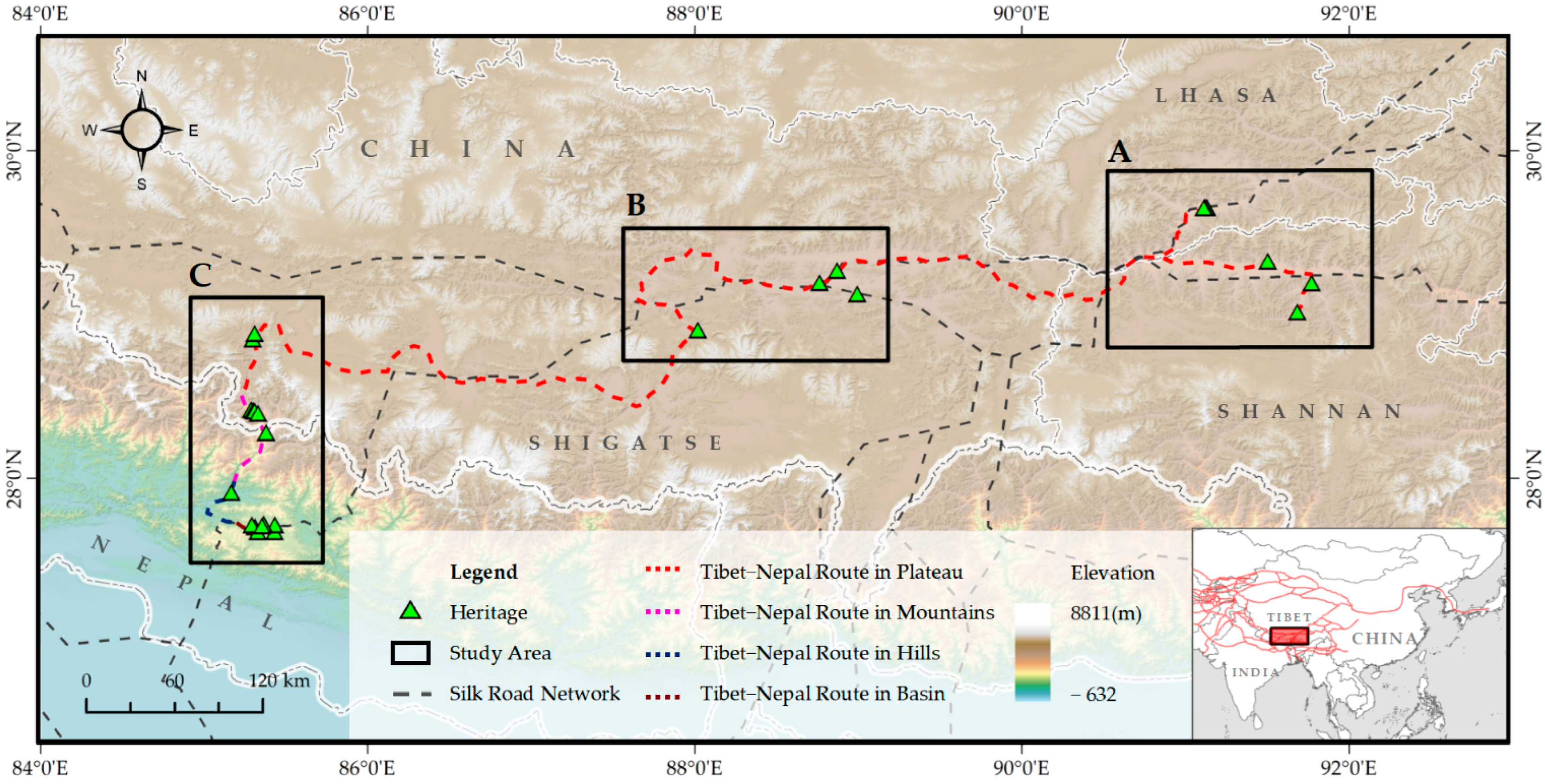
Figure 1. Route Map of the Tibet–Nepal route under Silk Roads Network based on Silk Roads Thematic study [39]. Study Areas: (A) Lhasa Section; (B) Shigatse Section; (C) Gyirong–Kathmandu Section.
Land 15 00405 g001
Figure 2. Topographic Maps of Each Region: Study areas (A) (Lhasa section), Study areas (B) (Shigatse section), Study areas (C) (Gyirong to Kathmandu section).
Land 15 00405 g002
Figure 3. Mean Maximum Daily Precipitation (2020–2024) and Heritage Site Risk Levels. Study areas (A) (Lhasa section), Study areas (B) (Shigatse section), Study areas (C) (Gyirong to Kathmandu section).
Land 15 00405 g003
Figure 4. Drainage Line Distribution and Heritage Site Risk Levels.Study areas (A) (Lhasa section), Study areas (B) (Shigatse section), Study areas (C) (Gyirong to Kathmandu section).
Land 15 00405 g004
Figure 5. Regional Slope Distribution and Heritage Site Risk Levels.Study areas (A) (Lhasa section), Study areas (B) (Shigatse section), Study areas (C) (Gyirong to Kathmandu section).
Land 15 00405 g005
Figure 6. Mean Regional Slope and Heritage Site Risk Levels. Study areas (A) (Lhasa section), Study areas (B) (Shigatse section), Study areas (C) (Gyirong to Kathmandu section).
Land 15 00405 g006
Figure 7. Remote Sensing Imagery of the Study Area and Heritage Site Risk Levels. Study areas (A) (Lhasa section), Study areas (B) (Shigatse section), Study areas (C) (Gyirong to Kathmandu section).
Land 15 00405 g007
Table 1. Heritage List of the Tibet–Nepal Route.
Num.Name
1Jokhang Temple
2Ramoche Temple
3Potala Palace
4Chhalupo Cave
5Samye Monastery
6Changzhu Monastery
7Qonggyai Tombs of the Tibetan Kings
8Tashilhunpo Monastery
9Nartang Monastery
10Shalu Monastery
11Sakya Monastery
12Inscription of the Tang Dynasty’s Envoy to India
13The archeological site of the ancient Gongtang Kingdom
14Qiangzhun Lhakang Monastery
15Risum Gonpo Cliff Carvings
16Chongdui White Pagoda
17Chongdui White Pagoda
18Palha Lhakhang
19Resuo bridge Historic Site
20Rasuwagadhi
21Nuwakot Palace Complex
22Swayambhu Monument
23Hanuman Dhoka Durbar Square Monument
24Bauddhanath Monument
25Pashupati Monument
26Patan Durbar Square Monument
27Changunarayan Monument
28Bhaktapur Durbar Square Monument
Table 2. Integrated multi-criteria assessment framework for adaptive heritage conservation.
Adaptation Option TypeOptionsAssessment CriteriaTotalConsensus Level
C1C2C3C4C5C6C7
Direct intervention optionsBioengineered slope stabilization222111110Medium
Ecological slope restoration in hazard-prone sections221111210Medium
Restoration of traditional stone drainage systems [59,72,73]222211212High
Options building cultural site resilienceChina–Nepal transboundary coordination mechanism [74,75]212221212High
Community-based participatory management mechanism [76,77]122221212High
Restoration of traditional terrace and irrigation systems [72,73]212222112High
Options building stakeholders’ adaptive capacityTransboundary digital monitoring and early warning platform [76,78,79,80]122122212High
Digital 3D site documentation [52],112121210Medium
Capacity-building training on climate risk awareness and TEK [81,82],222121111Medium
Setting up a Heritage Conservation Fund for the Tibet–Nepal Route12112119Low
CriteriaQuestions
1. Cost efficiency
2. Goal orientation
3. Practicality
4. Cultural appropriateness
5. Co-benefit provision
6. Timeliness
7. Robustness
1. Is the option affordable?
2. Does the option meet our goals?
3. Does option require available skills & capacities?
4. Is the option culturally appropriate?
5. Will the option benefit the community in other ways?
6. Can we implement the option in a short time frame?
7. Will the option work if climate change is worse than expected?
Table 3. Comparative Table of the Guthi Institution Before and After Land Reform.
AspectBefore Land ReformAfter Land Reform
Historical context and structureOriginating during the Licchavi dynasty (c. 400–750 CE), it is a traditional Nepalese institution integrating land, religion, and community, serving as a pillar for cultural heritage conservation and management [68,69].In the 1960s, land reform policies implemented by the Nepalese government led to the weakening of traditional authority and institutional identity [68].
Economic and financial foundationOperated through a land trust mechanism based on land endowments, its revenues formed the financial basis for the maintenance of temples, festivals, and the surrounding environment, ensuring a high degree of fiscal autonomy.Land nationalization deprived Guthi organizations of land ownership, and the resulting loss of fiscal autonomy led to chronic shortages in funding for heritage maintenance [51].
Function and cognitionIt maintained the integrity of the social–ecological system, encompassing tangible heritage, intangible heritage, and ecological heritage.
Community-based cooperative mechanisms rooted in religious traditions and customary practices encouraged active participation in collective maintenance, embedding conservation within ritualized and socialized practices, which constituted a key foundation for rapid post-disaster recovery [68,69].
State policy interventions led to a decline in the authority of Guthi leadership, weakening its capacity for resource allocation and social mobilization, and thereby undermining the effectiveness of sustainable cultural heritage management.
At the same time, declining participation among younger generations in traditional community institutions has placed locally embedded adaptive knowledge at risk of intergenerational discontinuity, eroding the community’s intangible capital [88,89,90].
Land use and ecological carrying capacityLand-use regulation: The inalienability and public-interest character of Guthi land effectively constrained overdevelopment in environmentally sensitive areas (such as steep slopes and catchment zones), thereby maintaining the ecological carrying capacity of the landscape [88,89].Risk of over-privatization: The traditional public-interest character of land has been challenged, with portions of land being appropriated or transferred, increasing the ecological vulnerability of environmentally sensitive areas [89].
Disclaimer/Publisher’s Note: The statements, opinions and data contained in all publications are solely those of the individual author(s) and contributor(s) and not of MDPI and/or the editor(s). MDPI and/or the editor(s) disclaim responsibility for any injury to people or property resulting from any ideas, methods, instructions or products referred to in the content.