Article

High Nitrogen and Phosphorus Concentrations in Human-Impacted Soil and Surface Runoff Negatively Affect Water Quality at Momella Lakes, Tanzania


by
Deogratias Ladislaus Lihepanyama
1,*,
Patrick Alois Ndakidemi
2,
Janeth Jonathan Marwa
3 and
Anna Christina Treydte
4,5,6,*
1
Department of Agriculture, Earth and Environmental Sciences, Faculty of Science, Mwenge Catholic University, Moshi P.O. Box 1226, Tanzania
2
Department of Sustainable Agriculture, School of Life Sciences and Bioengineering, Nelson Mandela African Institution of Science and Technology, Arusha P.O. Box 447, Tanzania
3
School of Business Studies and Humanities, Nelson Mandela African Institution of Science and Technology, Arusha P.O. Box 447, Tanzania
4
Department of Sustainable Agriculture, Biodiversity, and Ecosystem Management, School of Life Sciences and Bioengineering, Nelson Mandela African Institution of Science and Technology, Arusha P.O. Box 447, Tanzania
5
Physical Geography Department, Stockholm University, Svante Arrhenius Väg 8, 10691 Stockholm, Sweden
6
Ecology of Tropical Agricultural Systems, Hohenheim University, 70599 Stuttgart, Germany
*
Authors to whom correspondence should be addressed.
Land 2026, 15(3), 395; https://doi.org/10.3390/land15030395
Submission received: 3 January 2026 / Revised: 5 February 2026 / Accepted: 6 February 2026 / Published: 28 February 2026
(This article belongs to the Special Issue Land-Use Impacts on Water Resources and Watershed Management)

Abstract

Human land use in catchment areas has become a global concern due to its profound effects on water quality degradation. Associated eutrophication and algal bloom outbreaks in aquatic ecosystems pose an increasing threat to species that rely exclusively on water for foraging and breeding. In soda lakes, harmful algal blooms have caused fatal effects on lesser flamingos (Phoeniconaias minor), which are obligatory filter feeders and vital bio-indicators. However, little is known about how human land use affects nitrogen (N) and phosphorus (P) levels in soil and surface runoff at a watershed scale, particularly in human-dominated areas bordering the eastern African soda lakes. We aimed to understand how these levels differ between protected and unprotected land and how they might affect lesser flamingo foraging sources. We analyzed 72 surface soil and 13 surface runoff samples for N and P concentrations along valleys that potentially drain water into the Momella lakes, northern Tanzania. We found a higher soil P concentration in unprotected than in protected land, and at both sites, soil N and P concentrations were negatively related to slope. Water P concentrations in surface runoff from the unprotected land exceeded the United States Environmental Protection Agency recommended threshold (<0.1 mg/L), suggesting that human land use might negatively impact water quality and, thus, the foraging resources of flamingos in the Momella lakes. We recommend optimizing nutrient management strategies in the watershed to reduce nutrient enrichment from human-dominated areas in these unique soda lakes in Tanzania.

1. Introduction

Over the past six decades, human land use has drastically increased and its associated effects on terrestrial and aquatic ecosystems are of concern [1,2]. Human land use refers to agricultural and residential activities [3,4], which can result in soil and water quality degradation. In the past 60 years, humans have changed about three-quarters of the global land surface through various activities [5]. In addition, the expanding human population and rising socio-economic needs drive the increased demand for land, leading to vegetation cover destruction and unexpected land use changes [6,7], as well as soil and water quality deterioration in terrestrial and aquatic ecosystems [6,8]. Furthermore, human land use has significantly changed soil nutrients such as nitrogen (N) and phosphorus (P), as well as the soil’s physico-chemical characteristics [6,9].
Most soil nitrogen is stored in organic matter and must be released into the soil by microbes before plant uptake [10]. Plants absorb N mainly as nitrate (NO3), which is highly mobile, and as ammonium (NH4+), which is less mobile [10]. In contrast, phosphorus is much less mobile, often fixed to iron or aluminum in acidic soils, and is absorbed as phosphate ions (H2PO4 and HPO42−) [11]. In addition, factors such as soil pH, texture, organic matter, and microbial activity can strongly influence P availability. In the soil, nitrogen and phosphorus interact closely, and deficiency of one reduces the efficiency of the other [11]. Thus, because of the N–P interaction, nitrogen and phosphorus are primary nutrients whose availability can significantly limit the growth of primary producers in terrestrial and aquatic ecosystems [12,13].
To compensate for N and P nutrient constraints and to increase crop yields, applying chemical fertilizers in agricultural soils has become central to the “green revolution” [14]. However, excessive use of fertilizers can pollute water bodies, resulting in water quality degradation [12,15]. This eutrophication due to N and P has become a challenge in aquatic ecosystems worldwide because of its related effects on biodiversity, ecosystem services, and functioning [12,16]. Excess N and P in the system promote rapid growth of algae, which can result in large surface blooms [15,17], posing health risks to species like fish, birds, and mammals that depend exclusively on the water for feeding and breeding [18,19]. In addition, harmful algal blooms can produce poisonous substances, induce anoxic conditions, release unpleasant scents, and block light from reaching other creatures below in the water column, all of which can be stressful [20,21].
Because of their predominant role in causing eutrophication in water bodies, understanding N and P concentrations in soil and surface runoff has become crucial [22,23], particularly as chemical fertilizers containing N and P are used worldwide [24]. In the year 2017, the annual consumption of chemical N and P fertilizers in China accounted for about 27% of the global consumption [24]. Similar trends are observed in East Africa, including Tanzania, where fertilizer imports have increased, with nitrogenous fertilizers and Di-ammonium Phosphate (DAP) accounting for roughly 61% and 9% of the bulk imports, respectively [25]. Additionally, the Tanzanian government’s fertilizer subsidy programs for farmers have promoted fertilizer application across the region [26], often with little control in application, which can put aquatic ecosystems at risk. Despite the suspected effects of human land use on the declining water quality in eastern African soda lakes [27,28], there is limited information about the effect of human land use on the status of N and P in soil and surface runoff at a watershed scale.
We focused on the Momella lakes watershed of northern Tanzania, since it forms a water catchment crucial for thousands of foraging East African lesser flamingos (Phoeniconais minor), a species categorized by the IUCN as Near Threatened due to increased degradation of their habitats [27,29]. Lesser flamingos are ecologically vital bio-indicators, and water-dependent, obligate algae filters that feed on Arthrospira fusiformis, a blue-green algae species abundant in shallow soda lakes and wetlands [30,31]. Thus, the presence of lesser flamingos in the Momella lakes is vital for the Tanzanian economy [32], especially through tourism. Since the lakes are located at the border of Arusha National Park, the risk of pollution due to human land use is high [7,33]. In addition, an analysis of the Momella lakes watershed’s land use changes over the last three decades (1989–2019) showed a notable 38% increase in land used for settlement and agriculture, as well as the use of synthetic fertilizers [7]. In addition, previous reports and studies that dealt with spatio-temporal water quality [34] and the effects of cyanobacteria blooms on lesser flamingos [27,29] pinpointed a lack of information on soil N and P levels in the lakes’ watershed, particularly relating to human land use and how that might contribute to eutrophication. Understanding how human land use alters nutrient transfer in soil and surface runoff at a watershed scale is essential for protecting water quality and conserving lesser flamingos in these unique soda lakes.
In view of the above, we aimed to (i) quantify the amount of nutrients (N, P) in surface soil and surface runoff and (ii) establish whether human land use has affected the soil N and P concentrations of the soil and surface runoff in the Momella lakes watershed. We hypothesized that human land use in the watershed has resulted in significantly higher N and P content in soil and surface runoff compared to protected areas. The findings of our study will provide baseline information on the soil nitrogen (N) and phosphorus (P) status in the Momella lakes watershed. In addition, our results will be useful in optimizing nutrient management strategies and possibly reducing nutrient runoff that negatively affects water quality in these unique Momella lakes and species that depend on them for foraging, especially the lesser flamingos.

2. Materials and Methods

2.1. Study Site

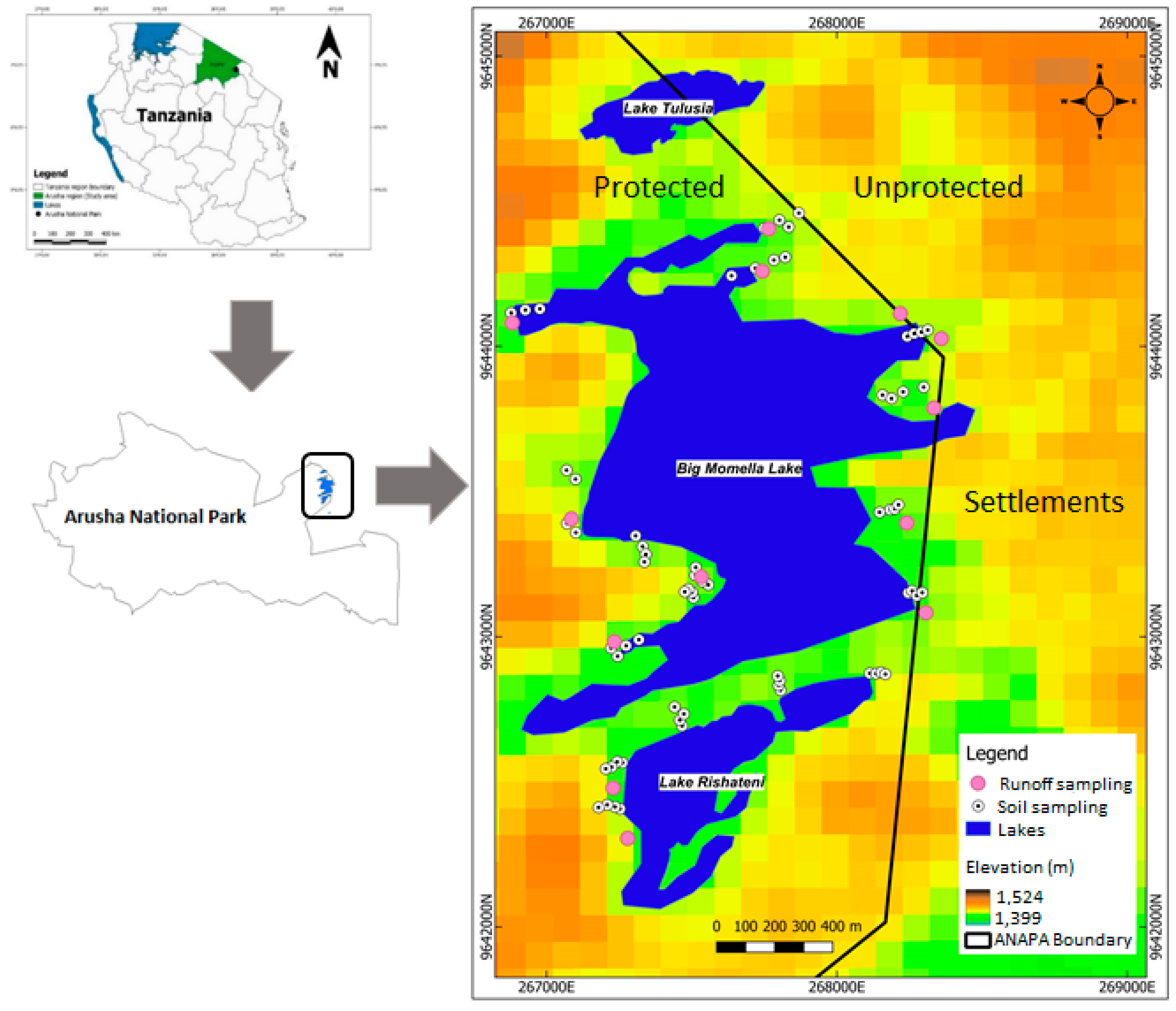
This study was conducted in the Momella lakes watershed, which covers 3.45 km2, located in the north-eastern part of Arusha National Park (ANAPA). We focused on Big Momella (3°13′ S 36°54′ E) and Rishateni (3°13′ S 36°53′ E) lakes, which form the principal foraging grounds for lesser flamingos (Figure 1). According to Krienitz [35], lesser flamingos often appear in large flocks along these lakes and are a flagship species of the East African avifauna due to their spectacular appearance. Since there are no permanent rivers or streams, the lakes are fed by rainfall and runoff from the surrounding valleys [33,36]. The two lakes are <1 km apart and are located on the periphery of ANAPA, making them susceptible to pollutants from human land use.
The Momella lakes border human-dominated areas on the eastern side, and the watershed around these lakes is partly protected and partly accessible by humans (Figure 1). Thus, binary separation of the land use types in this study (protected vs. unprotected) was important to understand the effect of land use on nutrient contents and leaching [7]. The protected area, which is managed by ANAPA, has Vachellia xanthophloea (yellow-barked acacia) trees scattered throughout, bushes composed primarily of Cordia ovalis and herbs dominated by Ocinum suave and Solanum incanum [33]. The unprotected area encompasses the region outside the park, where human activities such as crop cultivation, livestock rearing, and settlements are prevalent [7,37]. These land use characteristics and levels of human disturbance allowed us to conveniently isolate the effects of human activities on soil and surface runoff nutrients within the watershed. The average annual air temperatures in the study site range from 12 to 28 °C, and annual average rainfall varies between 500 mm and 1200 mm, exhibiting a bimodal pattern, with long rains from February to May and short rains from November to January [33,38].
Although a larger portion is protected by ANAPA, the eastern part of the watershed, which falls under the Meru District Council in the Arusha region, Tanzania, is inhabited by people [38]. The local human population of Meru District is approximately 268,000 people, with an annual growth rate of 2.7%. About 18,000 people reside near the lakes in Miririny Village, Leguruki Ward, where crop farming is their primary source of income, followed by livestock keeping [38,39]. In addition, the landscape of the watershed can strongly influence nutrient transport because soils range from sandy to loamy, with unprotected areas more disturbed by human activities [7]. Valleys in unprotected land show high hydrological connectivity, enhancing runoff and nutrient transfer, while protected areas retain nutrients due to higher vegetation cover and soil stability [33,40], with slope gradients ranging from gentle to steep further influencing nutrient movement [7]. Thus, due to their location, the lakes are susceptible to contamination from nearby farmlands and human settlements [7,38], which are likely to change the soil’s physico-chemical properties and, consequently, water nutrients and quality [33,41].

2.2. Data Collection

2.2.1. Soil Sampling

We sampled both within the protected and unprotected lands along 8 line transects [42,43] in human-impacted and 10 line transects in protected lands along valleys that potentially drain water into the lakes (Figure 1). Each transect was 150 m long and was designed to cope with the rugged, undulating terrain and surface drainage direction, which precluded line transects longer than 150 m. We collected soil samples from the predefined locations along the line transects established within the valleys that drain water into the lakes systematically [42]. We used a soil auger to collect soil samples for total N and total P nutrient analyses from sample plots spaced every 50 m along the transects [42,44,45]. We measured total N and total P to capture all forms of N and P, which is critical for monitoring water quality and ecosystems, as excess levels trigger eutrophication, harmful algal blooms, and oxygen depletion [46,47]. In addition, soil pH was measured because it influenced soil nutrient availability [48]. We also took into account slope and soil texture, because they might accelerate the movement of soil nutrients to lower slopes [49,50]. Elevation was recorded at each sampling site using a GPS (Garmin GPS Map 64s, KS, USA), and the slope percentage for each sample plot in the transects was determined by dividing the change in elevation by the amount of horizontal distance covered and then multiplying the result by 100 [51].
In total, we collected 72 soil samples for total N and total P analyses between December 2020 and January 2021, 40 in the protected area and 32 in the unprotected area. Soil samples were collected early in the growing season before the application of fertilizers to understand the potential impact of the past land use type on nutrient status and amount of fertilizer [44,52]. Each soil sample weighed 500 g and was obtained by mixing three randomly selected soil samples from the center of each point within the sampling plot, at a depth of 0 to 20 cm [13,53].
The collected soil samples were air-dried, crushed using a mortar and pestle to pass through a 2 mm mesh sieve [13,45], and transported to Sokoine University of Agriculture (SUA) for laboratory nutrient analyses. Soil pH was determined in a 1:2.5 soil: water mixture using a portable HI9829 Multi-parameter (Hanna Instruments, Woonsocket, Rhode Island, USA), and soil texture was measured by a hydrometer [13,54]. We determined the total soil N using semi-micro Kjeldahl digestion, which involves digesting the sample with concentrated sulfuric acid and a catalyst, converting organic N to ammonium. After making the solution alkaline, ammonia is distilled into boric acid and quantified by titration to calculate total N [55,56]. Total soil P was determined by Bray-P1 (determines available P in acidic-to-neutral soils) and Olsen (estimates available P in neutral-to-alkaline and calcareous soils) methods, which have a strong correlation with other standard methods [57,58].

2.2.2. Surface Runoff Sampling

Runoff water samples were collected by scooping from ditches [59] immediately after rainfall events, during the fertilizer application period, in the rainy season between March and April 2021 (Figure 1). We used a Digital Elevation Model and Ground Survey techniques to model the terrain of the catchment area and to identify the valleys that potentially drain water into the lakes [60]. The ditches, from which runoff samples were collected for N and P analyses, were positioned in the identified valleys 2–3 m from the lakes’ shorelines [61,62]. In total, we collected 13 runoff water samples, of which 6 were in the protected area and 7 in the unprotected area.
The polythene plastic bottles (1 L) used to collect the water samples were first washed with detergents, acidified with 5% HNO3, then rinsed with distilled water, and finally rinsed three times with the water before filling [59,63]. We sieved the collected water samples through a <1 mm plastic sieve to filter out large particulate matter [64]. We labeled the water sample bottles, preserved them in an icebox, and transported them to the Nelson Mandela African Institution of Science and Technology (NM-AIST) for immediate analysis of N and P within 48 h [63]. The runoff water N was quantified using the Persulfate Digestion Method 10071, an alkaline oxidation method that turns all types of nitrogen in the sample into nitrate), and then quantified with a DR 2800 spectrophotometer. Runoff water P was quantified by PhosVer 3, using the Acid Digestion Method 8190, a technique that uses acid/persulfate digestion to convert organic phosphorus in the sample into reactive orthophosphate, and then quantified using a DR 2800 spectrophotometer after the sample had been neutralized and reacted with PhosVer 3 [65].

2.3. Data Analysis

We compared the mean soil physico-chemical parameters between the two land use types using an independent-sample t-test [66,67]. We performed a Shapiro–Wilk test to ensure normal data distribution, with transformation for those data not normally distributed. Using Pearson correlation, we tested the strength of the relationship between slope and the concentration of soil N, P, and other physical properties in the watershed. We further compared the mean values for water N and P concentrations in runoff samples from the protected and unprotected land against the allowable thresholds as recommended by the United States Environmental Protection Agency to evaluate the magnitude of nutrients draining into the lakes from the watershed [68]. Analyses were undertaken using Jamovi (version 2.2.2), with a statistical significance level of p < 0.05.

3. Results

3.1. Soil N and P Concentrations

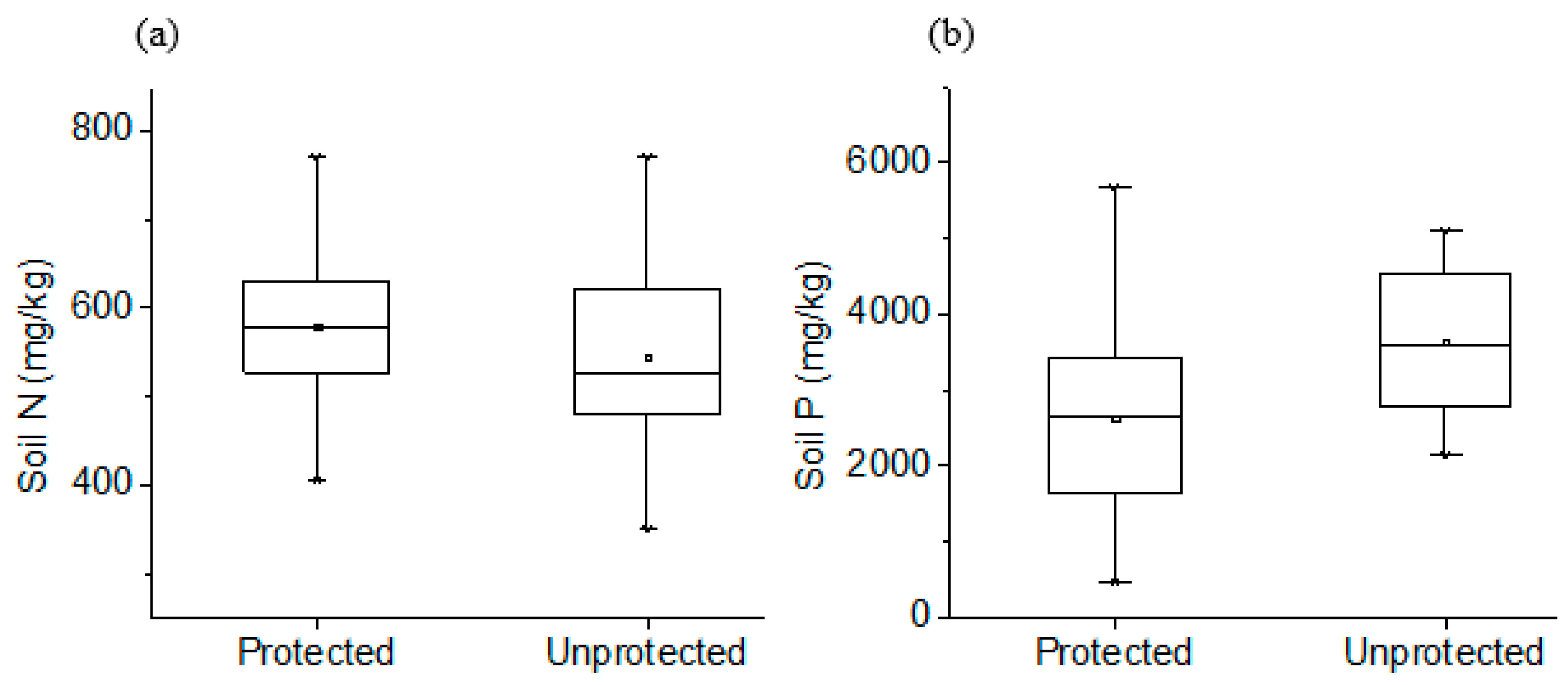
We found that the average ± Standard Error (SE) soil N values did not differ significantly between protected and unprotected sites (t (70) = 1.59, p = 0.115; Figure 2a). The average (±SE) soil P differed significantly between the two land use categories, with the P concentration in the unprotected land use being 1.5 times higher than in the protected land (t (70) = 3.95, p < 0.001; Figure 2b). Soil pH was not significantly correlated with soil N in protected and unprotected lands (r = 0.12, p = 0.452, and r = 0.10, p = 0.582; see Appendix A and Appendix B), but was slightly and significantly higher in the unprotected land than in the protected land (t (70) = 4.89, p < 0.001). Similarly, soil P was not significantly correlated with soil pH in protected and unprotected land (r = 0.04, p < 0.804; r = 0.21, p < 0.252; see Appendix A and Appendix B). We further observed that most (78%) of the 56 samples had a pH above 7 and were of sandy loam texture. The average (±SE) values of the particle size distribution (PSD), namely clay, silt, and sand, did not differ significantly between the two land types (p > 0.05; Table 1).
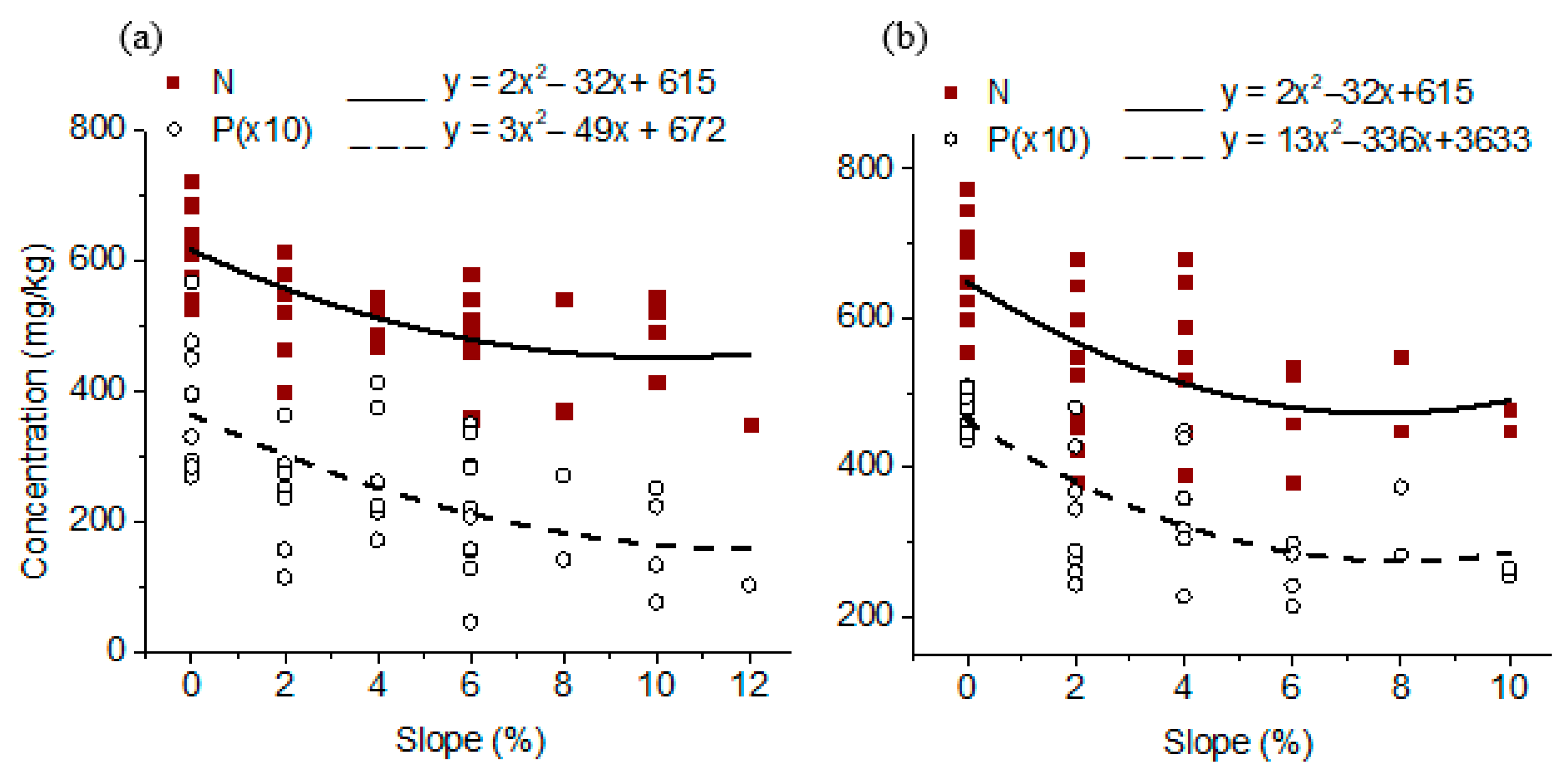
Pearson correlation analysis revealed that the soil N concentration significantly declined with increasing slope in both protected (r = −0.59, p < 0.001; Figure 3a) and unprotected land (r = −0.64, p < 0.001; Figure 3b). Similarly, a statistically significant negative correlation in the soil P concentration with increasing slope was observed in the protected (r = −0.61, p < 0.001; Figure 3a) and unprotected land (r = −0.65, p < 0.001; Figure 3b). We found no statistically significant correlation in soil N and P concentrations and the soil particle size distribution (PSD), namely sand, clay, and silt, in either protected or unprotected land (p > 0.05; see Appendix A and Appendix B).

3.2. N and P Concentrations in Surface Runoff

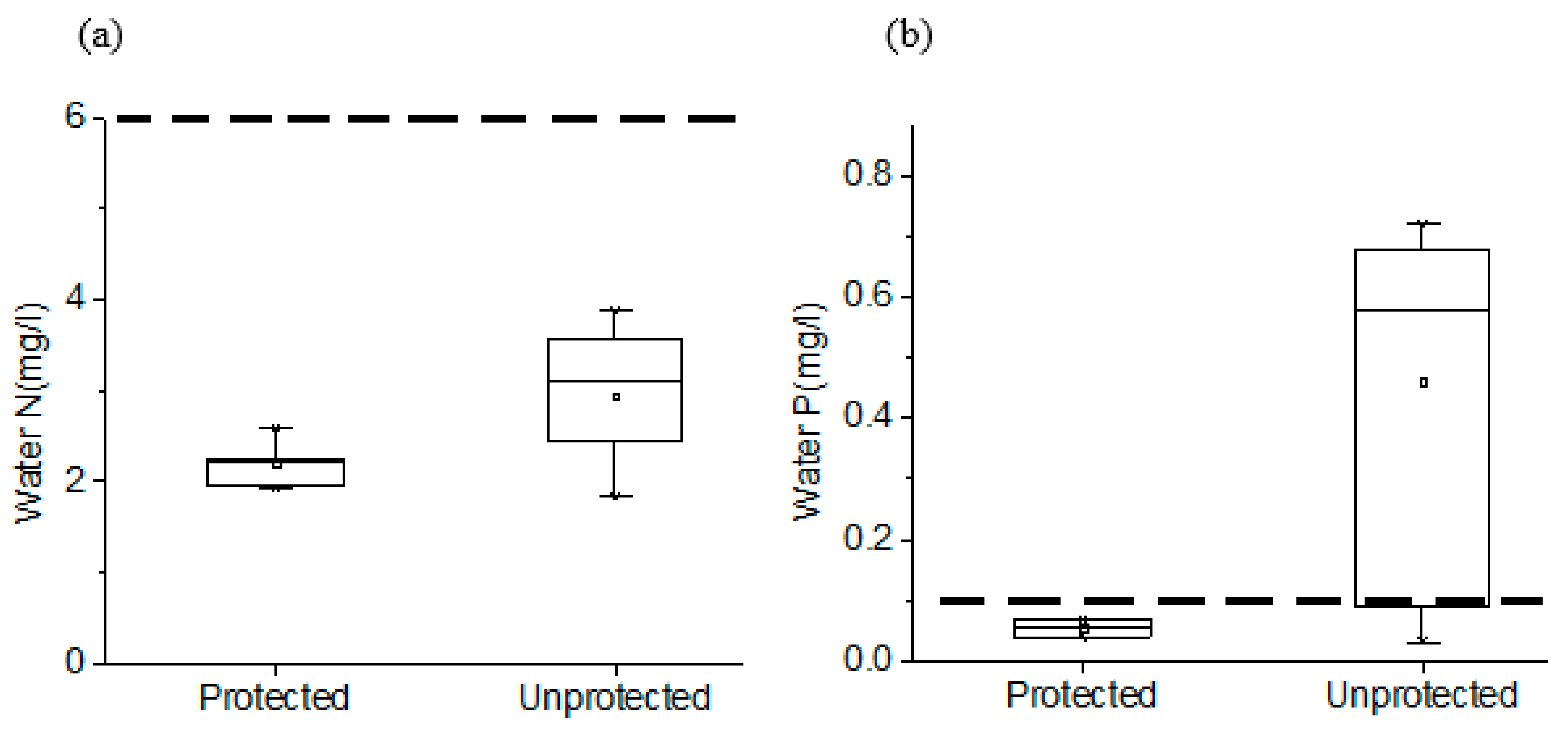
The average ± Standard Error (SE) water runoff N concentration from the protected area was slightly but significantly lower than in the unprotected area ((t (11) = 2.45, p < 0.033; Figure 4a), while the water runoff P concentration was almost 10 times lower in the protected compared to the unprotected area (t (11) = 3.46, p < 0.005; Figure 4b). Additionally, we observed that the concentration of N in surface runoff was below the recommended threshold for water N in surface runoff, i.e., N < 6 mg/L (Figure 4a). In contrast, the average P concentration in the unprotected land exceeded the threshold for water, i.e., p < 0.1 mg/L (Figure 4b), in surface runoff recommended by the United States Environmental Protection Agency [68]. These results suggest substantial P losses, but minimal N losses through the surface water runoff into lakes.

4. Discussion

4.1. Soil N and P Concentrations Elevated in Unprotected Land

Our finding that soil P was higher on cultivated compared to uncultivated or protected land within the Momella lakes’ watershed was consistent with the findings by Wang [56] in the Loess Plateau, China, and by Habtamu [70] in the Wujiraba watershed, North-Western Highlands of Ethiopia. The high soil P concentration we found in unprotected land could be a result of fertilizer application practices during crop cultivation in the catchment area [7,71]. High fertilizer leakage from land into water can occur easily at the onset of the rainy season, following plowing and planting, when soil erodibility is high [72]. In contrast to the findings by Chen [9] and Pingali [14], we found no difference in soil N in the Momella lakes watershed across the two land use types. Possibly, the sandy loam soils of the study area promoted soil N leaching [50] and the nitrogenous fertilizers frequently used by the local farmers in this area [7] often show a volatile nature [73]. Since our study duration was short, however, we highlight the need for further monitoring of soil N in the watershed because farming and pasture areas usually transfer nitrogen diffusely [9].
Additionally, our finding that soil N and P concentrations were negatively correlated with slope may indicate that soil particles can easily be carried from higher to lower sloping areas through runoff [51,74], particularly in unprotected land, which highly threatens the water quality of the Momella lakes. Our findings are similar to those by Zhang, [75], which revealed that as slope gradient increases, nutrient losses through surface runoff also increase, which can be intensive in areas with no vegetation, especially during rainfall events, resulting in intensified nutrient pollution in water bodies. Nitrogen carried by surface runoff contributes to significant environmental issues, including ecological deterioration, land degradation, and eutrophication in water bodies [76], which are often marked by outbreaks of algal blooms [34,77]. When dense algal blooms eventually die, microbial decomposition severely depletes dissolved oxygen, creating a hypoxic or anoxic ‘dead zone’ lacking sufficient oxygen to support most organisms [77].
In addition, the observed changes in soil and runoff N and P contents in the Momella lakes watershed might contribute to a deeper understanding of nutrient transport and loss mechanisms, driven by factors such as surface runoff and anthropogenic inputs, which jointly affect nutrient redistribution in soil and lakes. Given the above, we emphasize the need for regular monitoring of N levels in runoff water, particularly in the unprotected watershed areas and within the waters of the Momella lakes. We promote the maintenance of riparian vegetation to control surface runoff to reduce excess nutrient inputs into the lakes through surface runoff [78]. We also recommend that future research should determine the soil infiltration rate and soil moisture content in the Momella lakes catchment area, as this can further influence nutrient losses, especially during high rainfall events [79].

4.2. Runoff Water N and P Concentration

As expected, and similar to the trends observed in soil N and P, runoff water N and P concentrations were significantly higher in unprotected than in protected land. Our observed P concentrations in runoff water were even above the reference level of p < 0.1 mg/L, which is critical according to the USEPA, as eutrophication can be triggered if values rise beyond this threshold [64,68]. Our finding is consistent with studies in the Usangu Basin [64], Lake Rukwa [80] and Lake Victoria [81,82], which have shown high N and P concentrations in surface waters, likely due to long-term agricultural intensification. According to Hua [83], N and P concentrations in runoff water from agricultural areas can reach as high as 22.4 mg/L and 4.8 mg/L, respectively, during storm events.
Furthermore, the observation that water N in surface runoff was slightly higher, but within the recommended threshold by the USEPA in the unprotected land, could be due to N losses through ammonia volatilization and leaching processes [84]. Surface runoff and deep percolation findings by Pradhan [85] revealed that chemical fertilizers and other hazardous materials can be transferred from agricultural fields to deep aquifers, which has an impact on the quality of the water. Since runoff and leaching processes are two major routes for agricultural P losses [83,86], we support studies that emphasize the need for riparian buffer zone conservation as part of land use management in catchment areas [78,87]. In addition, since our study provides more of the mechanisms on how human land use can affect nitrogen and phosphorus levels, we advise monitoring studies that will reflect a real-time assessment, including soil erosion, and consider more land use categories to understand their different contributions in environmental nutrients shifts.

5. Significance of the Findings to Wildlife Conservation

Our findings contribute significantly to wildlife conservation, particularly for water-dependent species like the lesser flamingo (Phoeniconaias minor) and its habitats. We highlight the impact of human land use on the lakes’ watershed nutrient levels. We claim that understanding the status of N and P at a watershed scale is crucial for conserving water-dependent wildlife species. We claim that human land use near protected areas will strongly impact the particularly fragile aquatic ecosystems. We propose that conservation strategies near protected areas must incorporate sustainable land use practice programs in immediately adjacent areas to reduce N and P influx. In addition, we recommend the use of buffer zones, which have been proven to be efficient in reducing nutrient influxes through runoffs from human-dominated areas [88]. Buffer zones have been widely used in protected area management to balance conservation objectives with the needs of local communities [89,90]. Thus, coordinated and integrated conservation efforts are essential for balancing human land use and wildlife conservation and protecting biodiversity while supporting local livelihoods.

6. Conclusions

Our findings highlight the impact of human land use on soil and water runoff N and P concentrations at a watershed scale. We propose that this knowledge is crucial for conserving water-dependent wildlife species and for mitigating human land use near protected areas and fragile aquatic ecosystems. We emphasize that the conservation strategies of soda lakes should incorporate sustainable land use practice programs in immediately adjacent areas to reduce N and P influx into these highly fragile lake ecosystems, thereby promoting and maintaining the existence of lesser flamingos in these waters. Since a previous study found that the use of fertilizers in the region is barely regulated [7], we propose conducting training programs on nutrient management and best soil management practices, like maintaining crop residues and using cover crops. In addition, we recommend the use of buffer zones, which have been proven to be efficient in reducing nutrient influxes through runoffs from human-dominated areas [88] and for balancing conservation objectives with the needs of local communities bordering protected lakes [89].

Author Contributions

Conceptualization, methodology, data collection, software, formal data analysis, initial manuscript preparation, and project administration submission: D.L.L.; methodology validation, interpretation of results, review, and editing: D.L.L., P.A.N., J.J.M. and A.C.T. All authors have read and agreed to the published version of the manuscript.

Funding

Rufford Foundation Small Grants (31046-1) through the Nelson Mandela African Institution of Science and Technology (NM-AIST) and IDEA WILD funded this research.

Data Availability Statement

Data are contained within the article.

Acknowledgments

We would like to thank the Rufford Foundation for financial support, IDEAWILD for research equipment provision, and TAWIRI and COSTECH for issuing research permits. We also thank the ANAPA staff for their support and guidance during data collection. We also appreciate the assistance and generosity of Y.J. Magangali during data collection.

Conflicts of Interest

The authors declare no conflicts of interest that could have appeared to influence the work reported in this paper.

Appendix A

Table A1. Correlation matrix for the studied variables in the protected land as measured between December 2020 and January 2021 in the Momella Lakes watershed, northern Tanzania. N = Nitrogen and P = Phosphorus.
N (mg/kg)P (mg/kg)Slope (%)Clay (%)Silt (%)Sand (%)pH
N (mg/kg)
P (mg/kg)0.42 **
Slope (%)−0.59 ***−0.61 ***
Clay (%)−0.03−0.05−0.17
Silt (%)0.05−0.090.040.4 **
Sand (%)−0.020.080.06−0.77 ***−0.89 ***
pH0.250−0.220.090.09−0.11
Note: Mean difference values with an asterisk (*) are statistically significantly different at ** p < 0.01, *** p < 0.001.

Appendix B

Table A2. Correlation matrix for the studied variables in the unprotected land as measured between December 2020 and January 2021 in the Momella Lakes watershed, northern Tanzania. N = Nitrogen and P = Phosphorus.
N (mg/kg)P (mg/kg)Slope (%)Clay (%)Silt (%)Sand (%)pH
N (mg/Kg)
P (mg/Kg) 0.62 ***
Slope (%) −0.64 ***−0.65 ***
Clay (%)-0.03−0.120.08
Silt (%)−0.120.030.050.46 **
Sand (%)0.10.03−0.07−0.77 ***−0.92 ***
pH0.060.110.11−0.27−0.140.22
Note: Mean difference values with an asterisk (*) are statistically significantly different at ** p < 0.01, *** p < 0.001.

References

  1. Hasan, S.; Shi, W.; Zhu, X.; Abbas, S. Monitoring of Land Use/Land Cover and Socioeconomic Changes in South China over the Last Three Decades Using Landsat and Nighttime Light Data. Remote Sens. 2019, 11, 1658. [Google Scholar] [CrossRef]
  2. Hansen, A.J.; DeFries, R. Ecological mechanisms linking protected areas to surrounding lands. Ecol. Appl. 2007, 17, 974–988. [Google Scholar] [CrossRef]
  3. Ramankutty, N.; Mehrabi, Z.; Waha, K.; Jarvis, L.; Kremen, C.; Herrero, M.; Rieseberg, L.H. Trends in global agricultural land use: Implications for environmental health and food security. Annu. Rev. Plant Biol. 2018, 69, 789–815. [Google Scholar] [CrossRef] [PubMed]
  4. Foley, J.A.; DeFries, R.; Asner, G.P.; Barford, C.; Bonan, G.; Carpenter, S.R.; Chapin, F.S.; Coe, M.T.; Daily, G.C.; Gibbs, H.K.; et al. Global Consequences of Land Use. Science 2005, 309, 570–574. [Google Scholar] [CrossRef]
  5. Winkler, K.; Fuchs, R.; Rounsevell, M.; Herold, M. Global land use changes are four times greater than previously estimated. Nat. Commun. 2021, 12, 2501. [Google Scholar] [CrossRef] [PubMed]
  6. Kebebew, S.; Bedadi, B.; Erkossa, T.; Yimer, F.; Wogi, L. Effect of Different Land-Use Types on Soil Properties in Cheha District, South-Central Ethiopia. Sustainability 2022, 14, 1323. [Google Scholar] [CrossRef]
  7. Lihepanyama, D.L.; Ndakidemi, P.A.; Marwa, J.J.; Treydte, A.C. Human activities affecting lesser flamingo (Phoeniconaias minor) habitat in Momella lakes, Tanzania. J. Land Use Sci. 2024, 19, 97–120. [Google Scholar] [CrossRef]
  8. Chen, M.; Chen, J.; Sun, F. Agricultural phosphorus flow and its environmental impacts in China. Sci. Total Environ. 2008, 405, 140–152. [Google Scholar] [CrossRef]
  9. Chen, L.; Qi, X.; Zhang, X.; Li, Q.; Zhang, Y. Effect of agricultural land use changes on soil nutrient use efficiency in an agricultural area, Beijing, China. Chin. Geogr. Sci. 2011, 21, 392. [Google Scholar] [CrossRef]
  10. Lamb, J.A.; Fernandez, F.G.; Kaiser, D.E. Understanding Nitrogen in Soils; (Revised); University of Minnesota Extension: St. Paul, MN, USA, 2014; pp. 1–5. [Google Scholar]
  11. Mwende Muindi, E. Understanding soil phosphorus. Int. J. Plant Soil Sci. 2019, 31, 1–18. [Google Scholar] [CrossRef]
  12. Guignard, M.S.; Leitch, A.R.; Acquisti, C.; Eizaguirre, C.; Elser, J.J.; Hessen, D.O.; Jeyasingh, P.D.; Neiman, M.; Richardson, A.E.; Soltis, P.S. Impacts of nitrogen and phosphorus: From genomes to natural ecosystems and agriculture. Front. Ecol. Evol. 2017, 5, 70. [Google Scholar] [CrossRef]
  13. Mng’ong’o, M.; Munishi, L.; Ndakidemi, P. Characterization of land use influence on soil phosphate bioavailability in Usangu agro-ecosystem-Tanzania. Environ. Chall. 2021, 5, 100259. [Google Scholar] [CrossRef]
  14. Pingali, P.L. Green Revolution: Impacts, limits, and the path ahead. Proc. Natl. Acad. Sci. USA 2012, 109, 12302–12308. [Google Scholar] [CrossRef] [PubMed]
  15. Hamilton, D.P.; Salmaso, N.; Paerl, H.W. Mitigating harmful cyanobacterial blooms: Strategies for control of nitrogen and phosphorus loads. Aquat. Ecol. 2016, 50, 351–366. [Google Scholar] [CrossRef]
  16. Hamilton, D.P.; Wood, S.A.; Dietrich, D.R.; Puddick, J. Costs of harmful blooms of freshwater cyanobacteria. In Cyanobacteria: An Economic Perspective; John Wiley & Sons: Hoboken, NJ, USA, 2014; pp. 247–256. [Google Scholar]
  17. Huisman, J.; Codd, G.A.; Paerl, H.W.; Ibelings, B.W.; Verspagen, J.M.H.; Visser, P.M. Cyanobacterial blooms. Nat. Rev. Microbiol. 2018, 16, 471–483. [Google Scholar] [CrossRef] [PubMed]
  18. Van Apeldoorn, M.E.; Van Egmond, H.P.; Speijers, G.J.; Bakker, G.J. Toxins of cyanobacteria. Mol. Nutr. Food Res. 2007, 51, 7–60. [Google Scholar] [CrossRef]
  19. Havens, K.E. Cyanobacteria blooms: Effects on aquatic ecosystems. In Cyanobacterial Harmful Algal Blooms: State of the Science and Research Needs; Springer: New York, NY, USA, 2008; pp. 733–747. [Google Scholar]
  20. Anderson, D.M.; Glibert, P.M.; Burkholder, J.M. Harmful algal blooms and eutrophication: Nutrient sources, composition, and consequences. Estuaries 2002, 25, 704–726. [Google Scholar] [CrossRef]
  21. Paerl, H.W.; Otten, T.G. Harmful Cyanobacterial Blooms: Causes, Consequences, and Controls. Microb. Ecol. 2013, 65, 995–1010. [Google Scholar] [CrossRef]
  22. Ma, X.; Li, Y.; Li, B.; Han, W.; Liu, D.; Gan, X. Nitrogen and phosphorus losses by runoff erosion: Field data monitored under natural rainfall in Three Gorges Reservoir Area, China. CATENA 2016, 147, 797–808. [Google Scholar] [CrossRef]
  23. Gilley, J.; Eghball, B.; Marx, D.B. Nutrient Concentrations of Runoff During the Year Following Manure Application. Trans. ASABE 2007, 50, 1987–1999. [Google Scholar] [CrossRef]
  24. Zeng, F.; Zuo, Z.; Mo, J.; Chen, C.; Yang, X.; Wang, J.; Wang, Y.; Zhao, Z.; Chen, T.; Li, Y. Runoff Losses in Nitrogen and Phosphorus From Paddy and Maize Cropping Systems: A Field Study in Dongjiang Basin, South China. Front. Plant Sci. 2021, 12, 675121. [Google Scholar] [CrossRef]
  25. Benson, T.; Kirama, S.L.; Selejio, O. The Supply of Inorganic Fertilizers to Smallholder Farmers in Tanzania: Evidence for Fertilizer Policy Development; IFPRI: Washington, DC, USA, 2012. [Google Scholar]
  26. Hepelwa, A.S.; Selejio, O.; Mduma, J.K. The voucher system and the agricultural production in Tanzania: Is the model adopted effective? Evidence from the panel data analysis. Environ. Dev. 2013, 5, 1–24. [Google Scholar]
  27. Lugomela, C.; Pratap, H.B.; Mgaya, Y.D. Cyanobacteria blooms—A possible cause of mass mortality of Lesser Flamingos in Lake Manyara and Lake Big Momela, Tanzania. Harmful Algae 2006, 5, 534–541. [Google Scholar] [CrossRef]
  28. Nonga, H.E.; Mdegela, R.H.; Lie, E.; Sandvik, M.; Skaare, J.J. Assessment of farming practices and uses of agrochemicals in Lake Manyara basin, Tanzania. Afr. J. Agric. Res. 2011, 6, 2216–2230. [Google Scholar]
  29. Tanzania Wildlife Research Institute. Priority Areas for Research for Tanzania National Parks (TANAPA), Ngorongoro Conservation Area Authority (NCAA), Wildlife Division (WD), and Tanzania Forest Service (TFS); Tanzania Wildlife Research Institute: Arusha, Tanzania, 2012; Available online: https://www.tawiri.or.tz/wp-content/uploads/2025/05/Research-Agenda_May-2.pdf (accessed on 26 October 2025).
  30. Krienitz, L.; Krienitz, D.; Dadheech, P.K.; Hübener, T.; Kotut, K.; Luo, W.; Teubner, K.; Versfeld, W.D. Food algae for Lesser Flamingos: A stocktaking. Hydrobiologia 2016, 775, 21–50. [Google Scholar] [CrossRef]
  31. Tuite, C.H. The distribution and density of Lesser Flamingos in East Africa in relation to food availability and productivity. Waterbirds 2000, 23, 52–63. [Google Scholar] [CrossRef]
  32. URT. Tanzania Tourism Sector Report 2015. 2015. Available online: https://www.tanzaniainvest.com/tourism/tanzania-tourism-sector-report (accessed on 26 October 2025).
  33. Marttila, O. The Great Savanna: The National Parks of Tanzania and Other Key Conservation Areas; Auris Publishers: Rauha, Finland, 2011. [Google Scholar]
  34. Lihepanyama, D.L.; Ndakidemi, P.A.; Treydte, A.C. Spatio–Temporal Water Quality Determines Algal Bloom Occurrence and Possibly Lesser Flamingo (Phoeniconaias minor) Presence in Momella Lakes, Tanzania. Water 2022, 14, 3532. [Google Scholar] [CrossRef]
  35. Krienitz, L.; Mähnert, B.; Schagerl, M. Lesser Flamingo as a Central Element of the East African Avifauna. In Soda Lakes of East Africa; Schagerl, M., Ed.; Springer International Publishing: Cham, Switzerland, 2016; pp. 259–284. [Google Scholar]
  36. Scoon, R.N. Arusha national park (Mount Meru). In Geology of National Parks of Central/Southern Kenya and Northern Tanzania; Springer: Berlin/Heidelberg, Germany, 2018; pp. 141–154. [Google Scholar]
  37. Kitalika, A.J.; Machunda, R.; Komakech, H.C.; Njau, K.N. Land-Use and Land Cover Changes on the Slopes of Mount Meru-Tanzania; Current World Environment: Bhopal, India, 2018. [Google Scholar]
  38. URT. Prime Minister’s Office Regional Administration and Local Government, Meru District Council Socio–Economic Profile; URT: Surat Thani, Thailand, 2017. [Google Scholar]
  39. URT. National Sample Census of Agriculture 2007/2008. In Volume VI: Regional Report: Arusha Region; National Bureau of Statistics: Dodoma, Tanzania, 2012; pp. 1–326. [Google Scholar]
  40. Lei, M.; Long, Y.; Li, T.; Sun, G.; Liu, H.; Ma, Y.; Zeng, Q.; Liu, Y. Hydrological connectivity on watershed nitrogen transport processes: A review. Appl. Water Sci. 2025, 15, 169. [Google Scholar] [CrossRef]
  41. Baker, N.E.; Baker, E. Important Bird Areas in Tanzania: A Fist Inventory; WCST, Wildlife Conservation Society of Tanzania: Dar es Salaam, Tanzania, 2002. [Google Scholar]
  42. Carter, M.R.; Gregorich, E.G. Soil Sampling and Methods of Analysis; CRC Press: Boca Raton, FL, USA, 2007. [Google Scholar]
  43. Morton, J.; Baird, D.; Manning, M. A soil sampling protocol to minimise the spatial variability in soil test values in New Zealand hill country. N. Z. J. Agric. Res. 2000, 43, 367–375. [Google Scholar] [CrossRef]
  44. Walworth, J. Soil Sampling and Analysis; College of Agriculture and Life Sciences, University of Arizona: Tucson, Arizona, 2006. [Google Scholar]
  45. Liu, Z.-P.; Shao, M.-A.; Wang, Y.-Q. Spatial patterns of soil total nitrogen and soil total phosphorus across the entire Loess Plateau region of China. Geoderma 2013, 197–198, 67–78. [Google Scholar] [CrossRef]
  46. Zhao, S.; Shi, X.; Sun, B.; Liu, Y.; Tian, Z.; Huotari, J. Effects of pH on phosphorus form transformation in lake sediments. Water Supply 2022, 22, 1231–1243. [Google Scholar] [CrossRef]
  47. Liu, J.-H.; Lu, Y.; Guo-Hua, D.; Sheng-Nan, W.; Ke-Ying, S.; Hong-Ying, H. Algal Growth Potential Based Nitrogen and Phosphorus Criteria for Bloom Control. Water Cycle, 2025; in press. [Google Scholar] [CrossRef]
  48. Fernández, F.G.; Hoeft, R.G. Managing soil pH and crop nutrients. Ill. Agron. Handb. 2009, 24, 91–112. [Google Scholar]
  49. Obayomi, O.; Bernstein, N.; Edelstein, M.; Vonshak, A.; Ghazayarn, L.; Ben-Hur, M.; Tebbe, C.C.; Gillor, O. Importance of soil texture to the fate of pathogens introduced by irrigation with treated wastewater. Sci. Total Environ. 2019, 653, 886–896. [Google Scholar] [CrossRef]
  50. Petrovic, A. Impact of soil texture on nutrient fate. Proc. I Int. Conf. Turfgrass Manag. Sci. Sports Fields 2003, 661, 93–98. [Google Scholar] [CrossRef]
  51. Gong, J.; Chen, L.D.; Fu, B.J.; Wei, W. Integrated effects of slope aspect and land use on soil nutrients in a small catchment in a hilly loess area, China. Int. J. Sustain. Dev. World Ecol. 2007, 14, 307–316. [Google Scholar] [CrossRef]
  52. Fery, M.; Murphy, E. A Guide to Collecting Soil Samples for Farms and Gardens; Extension Service, Oregon State University: Corvallis, OR, USA, 2013. [Google Scholar]
  53. Warren, J.; Zhang, H.; Arnall, B. Importance of Sampling Depth for Soil Health Assessment; Oklahoma Cooperative Extension Service: Stillwater, OK, USA, 2019. [Google Scholar]
  54. Chaturvedi, R.; Sankar, K. Laboratory Manual for the Physico-Chemical Analysis of Soil, Water and Plant; Wildlife Institute of India: Dehradun, India, 2006; Volume 97. [Google Scholar]
  55. Bremner, J.; Tabatabai, M. Use of an ammonia electrode for determination of ammonium in Kjeldahl analysis of soils. Commun. Soil Sci. Plant Anal. 1972, 3, 159–165. [Google Scholar] [CrossRef]
  56. Wang, Y.; Zhang, X.; Huang, C. Spatial variability of soil total nitrogen and soil total phosphorus under different land uses in a small watershed on the Loess Plateau, China. Geoderma 2009, 150, 141–149. [Google Scholar] [CrossRef]
  57. Olsen, S.R. Estimation of Available Phosphorus in Soils by Extraction with Sodium Bicarbonate; US Department of Agriculture: Washington, DC, USA, 1954. [Google Scholar]
  58. Gutierrez Boem, F.H.; Rubio, G.; Barbero, D. Soil phosphorus extracted by Bray 1 and Mehlich 3 soil tests as affected by the soil/solution ratio in Mollisols. Commun. Soil Sci. Plant Anal. 2011, 42, 220–230. [Google Scholar] [CrossRef]
  59. Sulej, A.M.; Polkowska, Ż.; Namieśnik, J. Pollutants in Airport Runoff Waters. Crit. Rev. Environ. Sci. Technol. 2012, 42, 1691–1734. [Google Scholar] [CrossRef]
  60. Tarboton, D.G. Terrain analysis using digital elevation models in hydrology. In Proceedings of the 23rd ESRI International Users Conference, San Diego, CA, USA, 7 July 2003. [Google Scholar]
  61. Buchanan, B.; Falbo, K.; Schneider, R.; Easton, Z.; Walter, M. Hydrological impact of roadside ditches in an agricultural watershed in Central New York: Implications for non-point source pollutant transport. Hydrol. Process. 2013, 27, 2422–2437. [Google Scholar] [CrossRef]
  62. Dollinger, J.; Dagès, C.; Bailly, J.-S.; Lagacherie, P.; Voltz, M. Managing ditches for agroecological engineering of landscape. A review. Agron. Sustain. Dev. 2015, 35, 999–1020. [Google Scholar] [CrossRef]
  63. APHA. Standard Methods for the Examination of Water and Wastewater, 20th ed.; American Public Health Association: Washington, DC, USA; American Water Work Association: Denver, CO, USA; Water Environment Federation: Alexandria, Virginia, 1998. [Google Scholar]
  64. Mng’ong’o, M. Comparative Assessment of Soil Phosphate Status, Water Eutrophication, and Potentially Toxic Metal Accumulation in Usagu Agro-Ecosystem. Ph.D. Thesis, The African Institution of Science and Technology, Arusha, Tanzania, 2022. [Google Scholar]
  65. Hach, D. 2800 Spectrophotometer: Procedures Manual; Hach Company: Düsseldorf, Germany, 2007. [Google Scholar]
  66. Kim, H.-Y. Statistical notes for clinical researchers: The independent samples t-test. Restor. Dent. Endod. 2019, 44, e26. [Google Scholar] [CrossRef]
  67. MacFarland, T.W.; Yates, J.M. Student’s t-Test for Independent Samples. In Using R for Biostatistics; Springer International Publishing: Cham, Switzerland, 2021; pp. 141–240. [Google Scholar]
  68. USEPA. Nutrient Criteria Technical GruidanceManual Lake and Reservoirs; USEPA: Washington, DC, USA, 2000. [Google Scholar]
  69. de Vries, W.; Schulte-Uebbing, L.; Kros, H.; Voogd, J.C.; Louwagie, G. Spatially explicit boundaries for agricultural nitrogen inputs in the European Union to meet air and water quality targets. Sci. Total Environ. 2021, 786, 147283. [Google Scholar] [CrossRef]
  70. Habtamu, A.; Heluf, G.; Bobe, B.; Enyew, A. Fertility status of soils under different land uses at Wujiraba Watershed, North-Western Highlands of Ethiopia. Agric. For. Fish. 2014, 3, 410–419. [Google Scholar] [CrossRef]
  71. Gebrekidan, H.; Negassa, W. Impact of Land use and management practices on Chemical properties of some soils of Bako area, Western Ethiopia. Ethiopian J. Nat. Resour. 2006. Available online: https://agris.fao.org/search/en/providers/122600/records/64724d3e53aa8c8963059852 (accessed on 25 October 2025).
  72. Chen, S.; Zhang, G.; Zhu, P.; Wang, C.; Wan, Y. Impact of slope position on soil erodibility indicators in rolling hill regions of northeast China. Catena 2022, 217, 106475. [Google Scholar] [CrossRef]
  73. Savci, S. Investigation of Effect of Chemical Fertilizers on Environment. APCBEE Procedia 2012, 1, 287–292. [Google Scholar] [CrossRef]
  74. Liu, S.; Guo, X.; Fu, B.; Lian, G.; Wang, J. The effect of environmental variables on soil characteristics at different scales in the transition zone of the Loess Plateau in China. Soil Use Manag. 2007, 23, 92–99. [Google Scholar] [CrossRef]
  75. Zhang, W.; Li, H.; Pueppke, S.G.; Diao, Y.; Nie, X.; Geng, J.; Chen, D.; Pang, J. Nutrient loss is sensitive to land cover changes and slope gradients of agricultural hillsides: Evidence from four contrasting pond systems in a hilly catchment. Agric. Water Manag. 2020, 237, 106165. [Google Scholar] [CrossRef]
  76. Ostad-Ali-Askari, K.; Shayannejad, M.; Ghorbanizadeh-Kharazi, H. Artificial neural network for modeling nitrate pollution of groundwater in marginal area of Zayandeh-rood River, Isfahan, Iran. KSCE J. Civ. Eng. 2017, 21, 134–140. [Google Scholar] [CrossRef]
  77. Chislock, M.F.; Doster, E.; Zitomer, R.A.; Wilson, A.E. Eutrophication: Causes, consequences, and controls in aquatic ecosystems. Nat. Educ. Knowl. 2013, 4, 10. [Google Scholar]
  78. Khan, N.; Jhariya, M.K.; Banerjee, A.; Meena, R.S.; Raj, A.; Yadav, S.K. Chapter 9—Riparian conservation and restoration for ecological sustainability. In Natural Resources Conservation and Advances for Sustainability; Jhariya, M.K., Meena, R.S., Banerjee, A., Meena, S.N., Eds.; Elsevier: Amsterdam, The Netherlands, 2022; pp. 195–216. [Google Scholar]
  79. Easton, Z.M.; Petrovic, A.M. Effect of hill slope on nutrient runoff from turf. Golf Course Manag. 2005, 2005, 109–113. [Google Scholar]
  80. Mshana, J.G. Mercury and lead contamination in three fish species and sediments from lake rukwa and catchment areas in Tanzania. J. Health Pollut. 2015, 5, 7–18. [Google Scholar] [CrossRef]
  81. Gikuma-Njuru, P.; Hecky, R.E. Nutrient Concentrations in Nyanza Gulf, Lake Victoria, Kenya: Light Limits Algal Demand and Abundance. Hydrobiologia 2005, 534, 131–140. [Google Scholar] [CrossRef]
  82. Sitoki, L.; Gichuki, J.; Ezekiel, C.; Wanda, F.; Mkumbo, O.C.; Marshall, B.E. The environment of Lake Victoria (East Africa): Current status and historical changes. Int. Rev. Hydrobiol. 2010, 95, 209–223. [Google Scholar] [CrossRef]
  83. Hua, L.; Liu, J.; Zhai, L.; Xi, B.; Zhang, F.; Wang, H.; Liu, H.; Chen, A.; Fu, B. Risks of phosphorus runoff losses from five Chinese paddy soils under conventional management practices. Agric. Ecosyst. Environ. 2017, 245, 112–123. [Google Scholar] [CrossRef]
  84. Zhou, M.; Zhu, B.; Butterbach-Bahl, K.; Wang, T.; Bergmann, J.; Brüggemann, N.; Wang, Z.; Li, T.; Kuang, F. Nitrate leaching, direct and indirect nitrous oxide fluxes from sloping cropland in the purple soil area, southwestern China. Environ. Pollut. 2012, 162, 361–368. [Google Scholar] [CrossRef] [PubMed]
  85. Pradhan, P.; Rathod, A.P. Impact of nitrogenous fertilizers on water quality and climate. In Nonpoint Source Nitrogen Pollution; Elsevier: Amsterdam, The Netherlands, 2026; pp. 79–87. [Google Scholar]
  86. Liu, J.; Zuo, Q.; Zhai, L.; Luo, C.; Liu, H.; Wang, H.; Liu, S.; Zou, G.; Ren, T. Phosphorus losses via surface runoff in rice-wheat cropping systems as impacted by rainfall regimes and fertilizer applications. J. Integr. Agric. 2016, 15, 667–677. [Google Scholar] [CrossRef]
  87. Lucy, N.; Robert, T. Phosphorus Eutrophication and Mitigation Strategies. In Phosphorus; Tao, Z., Ed.; IntechOpen: Rijeka, Croatia, 2018; Available online: https://www.intechopen.com/chapters/62471 (accessed on 1 January 2026).
  88. Walton, C.R.; Zak, D.; Audet, J.; Petersen, R.J.; Lange, J.; Oehmke, C.; Wichtmann, W.; Kreyling, J.; Grygoruk, M.; Jabłońska, E.; et al. Wetland buffer zones for nitrogen and phosphorus retention: Impacts of soil type, hydrology and vegetation. Sci. Total Environ. 2020, 727, 138709. [Google Scholar] [CrossRef]
  89. Cole, L.J.; Stockan, J.; Helliwell, R. Managing riparian buffer strips to optimise ecosystem services: A review. Agric. Ecosyst. Environ. 2020, 296, 106891. [Google Scholar] [CrossRef]
  90. Nadhira, S.; Basuni, S. Implementation of the concept of conservation area buffer zone in Indonesia. J. Manaj. Hutan Trop. 2021, 27, 32–41. [Google Scholar]
Figure 1. Location of lakes Big Momella and Rishateni in northern Tanzania, along with soil and runoff sampling points within the watershed, in which we determined the concentrations of nitrogen (N) and phosphorus (P) in soil between December 2020 and January 2021, and in surface runoff between March and April 2021 (Source: author).
Land 15 00395 g001
Figure 2. Box plots showing the amount of (a) soil N and (b) soil P in the protected land and unprotected land use types in lakes Big Momella and Rishateni watershed, Tanzania, in soil samples collected between December 2020 and January 2021. The bottom and top of each box represent the 25th and 75th percentiles, respectively. The thin band within the box represents the median, the small square within the box represents the mean, and the whiskers indicate the lowest and highest values.
Land 15 00395 g002
Figure 3. Scatter diagrams with regression lines showing the relationship between soil N and P concentrations and slope along line transects in valleys draining water into the lakes Big Momella and Rishateni, northern Tanzania, as measured between December 2020 and January 2021 in the (a) protected and (b) unprotected land use categories.
Land 15 00395 g003
Figure 4. Plots showing average concentrations (±SE) of (a) water N and (b) water P in surface runoff in protected and unprotected land between March and April 2021, in the Momella lakes watershed, Tanzania. The dashed lines in the plots indicate recommended thresholds by the United States Environmental Protection Agency for water N (<6 mg/L) and water P (<0.1 mg/L) in surface runoff [68,69].
Land 15 00395 g004
Table 1. Independent-sample t-test results comparing the studied soil physico-chemical properties between protected and unprotected land use types, as determined between December 2020 and January 2021 in the lakes Big Momella and Rishateni watershed, Tanzania. Values are presented as Mean ± SE. Negative t-values indicate higher means in unprotected land.
VariableLand Use TypentMeanSEp
Clay (%)Protected40−1.35160.40.180
Unprotected32170.5
Silt (%)Protected40−0.5660.60.576
Unprotected3270.8
Sand (%)Protected401.02780.90.310
Unprotected32761.2
pHProtected40−4.6980.1<0.001
Unprotected3290.2
Disclaimer/Publisher’s Note: The statements, opinions and data contained in all publications are solely those of the individual author(s) and contributor(s) and not of MDPI and/or the editor(s). MDPI and/or the editor(s) disclaim responsibility for any injury to people or property resulting from any ideas, methods, instructions or products referred to in the content.