Article

Ports on Urban Construction Land Expansion: A Case Study of Coastal Port Cities in China

1
School of Economics and Management (School of Tourism), Dalian University, Dalian 116622, China
2
School of Maritime Economics and Management, Dalian Maritime University, Dalian 116026, China
*
Author to whom correspondence should be addressed.
Land 2026, 15(3), 378; https://doi.org/10.3390/land15030378
Submission received: 27 January 2026 / Revised: 21 February 2026 / Accepted: 25 February 2026 / Published: 27 February 2026
(This article belongs to the Special Issue Urban Land Expansion and Regional Inequality)

Abstract

In China, ports have long served as a key engine of growth for coastal cities. Increases in coastal port throughput inevitably lead to port spatial expansion, which in turn drives construction land expansion in port cities. Consequently, ports are a critical factor shaping construction land expansion in coastal cities, with direct implications for spatial planning and sustainable development in coastal port cities. Therefore, it is necessary to examine how ports influence construction land expansion in coastal cities. This paper using multiple linear regression and binary logistic regression models and incorporating landscape metrics explores the impacts of ports on the expansion of urban construction land in coastal port cities. The findings reveal distinct characteristics of land expansion in port cities compared to non-port cities: (1) Macro-level changes: The expansion of construction land is driven by industrial restructuring, real estate development, port cargo traffic, population growth, and GDP growth. Industrial restructuring is the primary driver, while real estate development plays a significant role in land expansion. Port cargo demand serves as a unique driving factor compared to non-port cities, whereas population and GDP growth have minimal effects. (2) Micro-level spatial expansion: Land expansion is influenced by proximity to port shorelines, transportation infrastructure, and the degree of base construction land expansion. Expansion tends to concentrate along the port shoreline, transport hubs, and established urban areas. Elevation and slope are significant factors for coastal port cities, while rivers and proximity to core urban areas predominantly impact estuarine port cities. (3) Temporal patterns of expansion: Port development follows a phased pattern of land expansion: “Decline → Increase → Decline”. Ports also influence landscape patterns, with increased distance from the port shoreline leading to decreased patch density and higher landscape fragmentation. The results of this paper help to address gaps in existing research on how ports shape the spatial expansion of coastal cities. Furthermore, this paper provides insights for effective land use strategies, spatial planning, and port-city management, promoting coordinated land and marine development. It offers a foundation for addressing the integration of land and sea spatial planning in the “One Map” initiative.

1. Introduction

Since 1990, China’s coastal ports and cities have undergone significant changes [1,2]. The total population of 53 coastal port cities in China (excluding Sansha, Hong Kong, Macao, and Taiwan) increased from approximately 169 million in 1990 to approximately 319 million in 2020, with an annual growth rate of 2.14%. The average urbanization rate of the population increased from 30.39% to nearly 69.79%, which is close to the average level of developed countries (75%), and has exceeded the national average level (approximately 65%). Similarly, construction land area increased from 12.7 thousand km2 in 1990 to approximately 33 thousand km2 in 2020, with an average annual growth rate of 3.23%. The land urbanization rate increased from 2.88% in 1990 to 7.49% in 2020, indicating that the development process was typical and special. Therefore, the planning and management of construction land of coastal port cities is particularly important for the national strategy of promoting land and sea integration [3]. Factors that drive the expansion of port city construction land must be identified to create an effective connection between land and sea planning. This could guide the spatial planning and management of future port cities and have practical significance for achieving land and sea integration in coastal areas. The expansion of construction land in coastal port cities is reflected in macro-level changes due to socioeconomic development, as changes in the society, economy, and population directly affect port city construction land [4,5,6,7,8] and microspatial expansion of construction land, which is affected by the underlying surface. Good terrain and geomorphic conditions facilitate construction land expansion [2,7,9,10,11]. In addition, with the rapid socioeconomic development of coastal port cities, construction land is gradually decoupled from economic growth, per capita construction land area continues to increase, and incongruity between construction land and population growth occur frequently [1,12,13]. Therefore, there is an urgent need to regulate the expansion of construction land in coastal port cities to achieve sustainable resource utilization [14].

1.1. Study Area

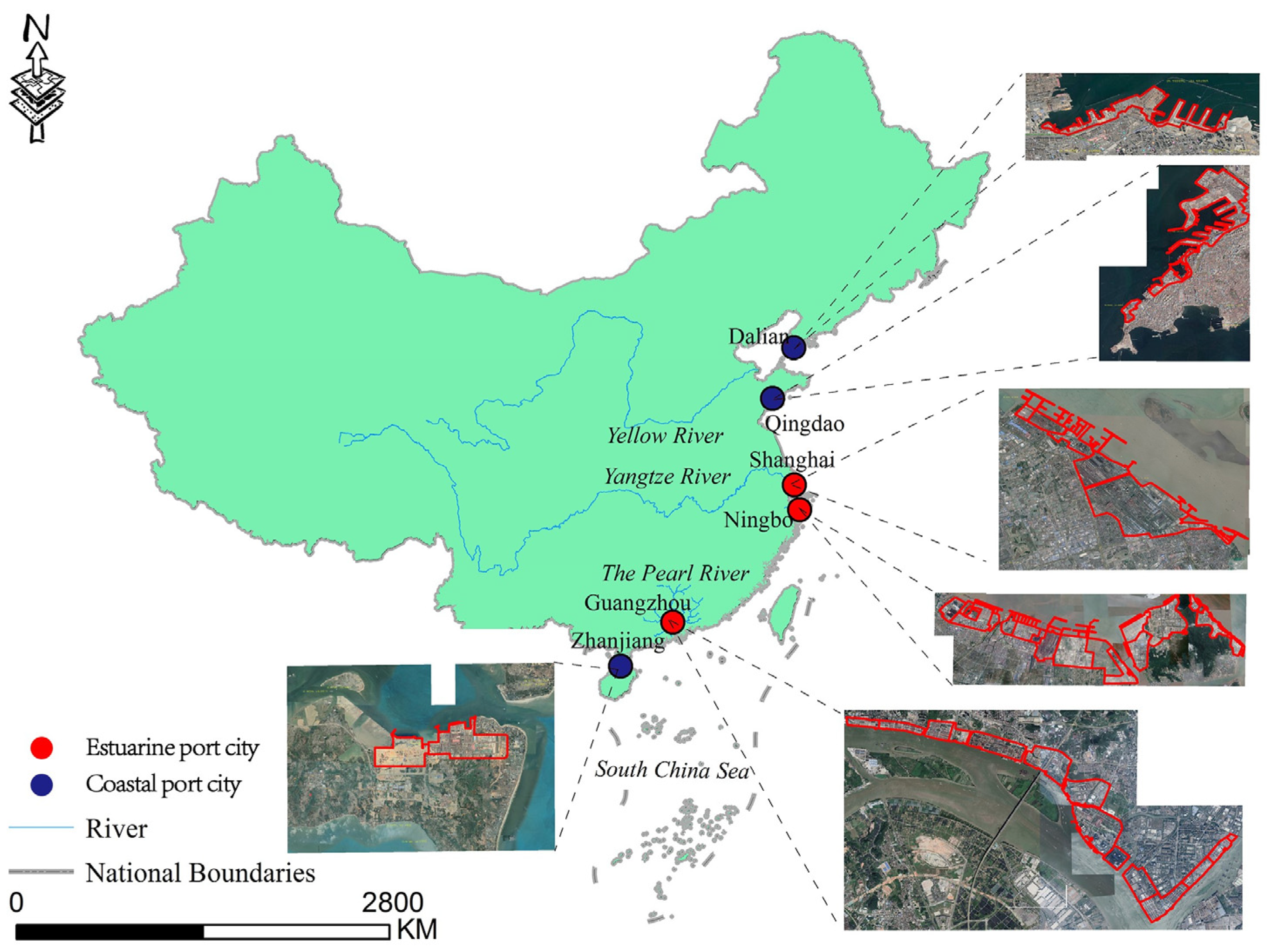
Coastal port cities in China can be divided based on their locations into estuarine port cities (such as Shanghai, Ningbo, and Guangzhou) and coastal port cities (such as Dalian, Qingdao, and Zhanjiang). In contrast to inland cities, construction land expansion in coastal port cities is affected not only by socioeconomic development but also by the spatial expansion of ports and shorelines. Therefore, this paper investigated the factors driving construction land expansion in six typical coastal port cities (Figure 1) using multi-temporal land cover change and panel data.

1.2. Literature Review

Previous research on urban spatial expansion has examined the impact of internal indicator changes from different levels and focused on dynamic [15,16,17,18] natural [19,20], market [21,22], social [23,24,25], and rights factors [26,27,28]. Chinese scholars have mainly focused on empirical research on the drivers of urban expansion and argued that different types, locations, and developmental stages of urban expansion have different driving factors, mainly including natural location, population [29], economy [30], transportation [31], industry [29], and policy [32,33]. The restrictive effect of natural conditions on urban expansion is gradually weakening, and the sustainable development of urban economy promotes the continuous expansion of urban space. The concentration of population and industry and density of transportation networks enhance urban expansion. Although previous studies have investigated the driving factors of urban construction land expansion, research on coastal port cities is scarce. Moreover, in coastal cities, port development is a major driver of urban expansion but is often overlooked in existing research. Because port cities have dual land and sea attributes and are constrained by limited land space, their socioeconomic and natural locational conditions are distinctive, with important implications for future port-city spatial planning and sustainable development. Therefore, this paper aimed to address this gap.
This paper is organized into six sections. Section 1 introduces the research background and significance, reviews related literature, and outlines the study’s contributions. Section 2 presents the theoretical framework and indicator selection. Section 3 describes the data and methods. Section 4 reports the results, including the socioeconomic and natural locational effects of ports on urban construction land expansion. Section 5 discusses the implications and limitations. Section 6 concludes with three main findings on how ports influence urban construction land expansion.

2. Indicator Selection and Description

2.1. Index Selection

Urban spatial expansion is a complex process driven by external and internal factors. Unlike inland cities, coastal port cities have marine and terrestrial characteristics due to their special geographical location. Therefore, the external and internal driving factors that affect the expansion of construction land differ from those in inland cities. External drivers refer to socioeconomic factors, including demographic changes, income inequality, policy support, economic growth, technological progress, and value, that influence the amount of construction land. These factors drive long-term dynamic changes and impact construction land expansion. Internal driving factors refer to the underlying micro-environment, such as climate, landform, and location, that impacts construction land expansion. Unlike external factors, internal factors are static. Therefore, this paper constructed a driving factor indicator system (Table 1 and Table 2) of macro quantitative changes and microspatial expansion from the perspectives of socioeconomic needs and location conditions.

2.2. Indicator Description

Based on previous research [34], the socioeconomic indicators were described as follows: Urban population density was assumed to be the direct driving force of construction land growth, with higher values indicating greater demand for construction land. GDP was used to represent the scale of urban economic development. Previous studies have found a positive correlation between economic growth and construction land expansion. With a higher index of industrial structure upgrading indicating more developed secondary and tertiary industries and greater the demand for construction land. Greater total amount of fixed asset and real estate investments was assumed to indicate greater demand for construction land. Greater total amount of foreign investment was assumed to indicated a more developed export-oriented economy and greater demand for construction land. Greater demand for port cargo was assumed to indicate larger port scale and greater demand for construction land. Greater number of students in universities was assumed to indicate greater demand for construction land. The number of medical institutions was assumed to be proportional to the demand for construction land.
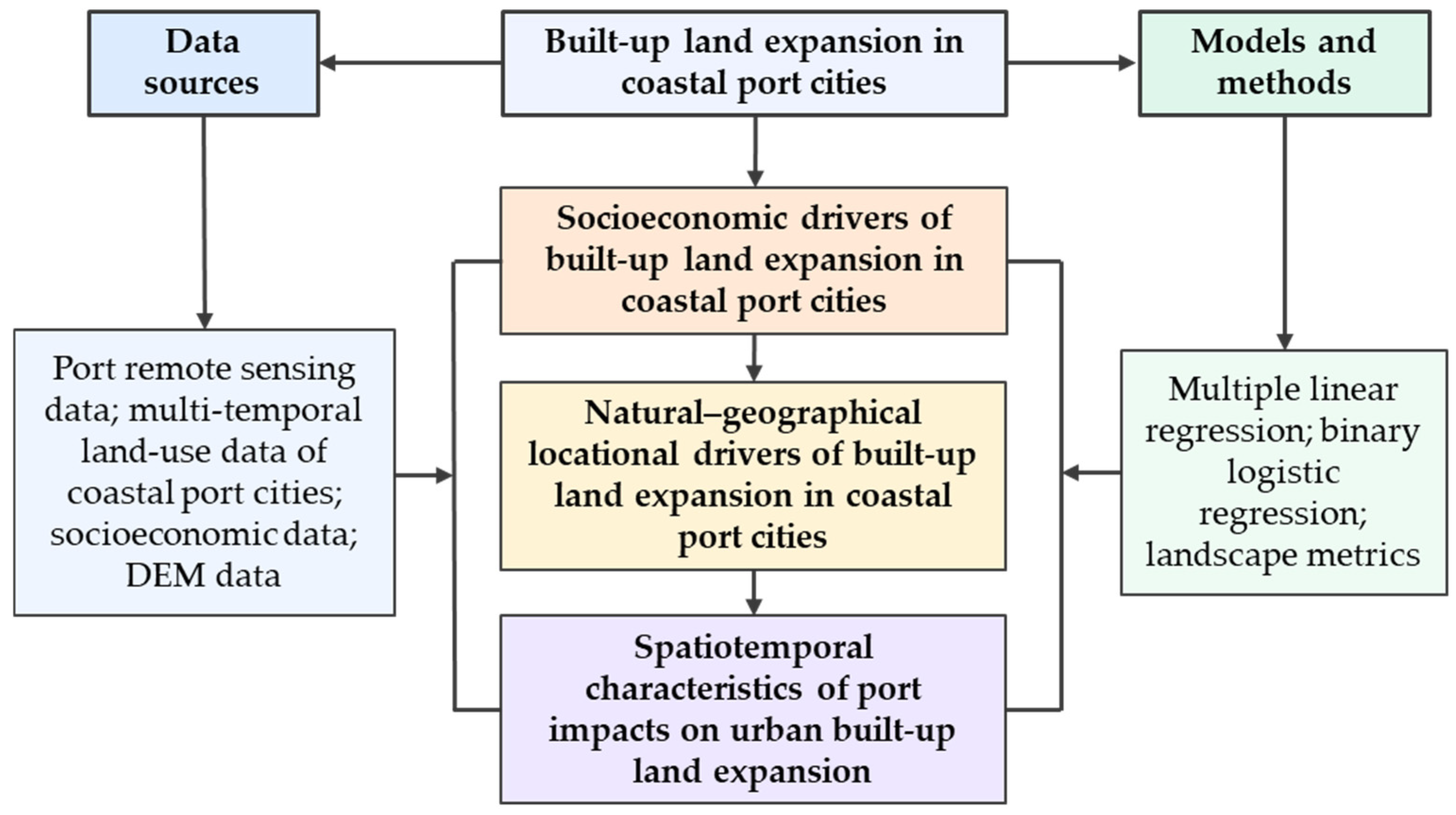
Moreover, the natural locational indicators were described as follows: Greater elevation and slope values were assumed to indicate stronger restriction on construction land expansion. Being farther away from the port line was assumed to indicate lower probability of construction land expansion. The above factors were assumed to be negatively correlated. Considering urban layout characteristics along rivers and attraction of transportation lines for construction land expansion, being farther away from rivers, airports, railways, highways, and urban core built-up areas was assumed to indicate smaller probability of construction land expansion (negative correlation). Land unit expansion was assumed to depend not only on the unit’s suitability for development but also on the development of adjacent land units. Therefore, greater base construction land (1990) expansion was assumed to be more likely to cause construction land expansion (positive correlation). The overall research framework is presented in Figure 2.

3. Materials and Methods

3.1. Data Sources and Processing

3.1.1. Data Sources

This paper included geospatial data from China’s Multi-Period Land Use/Cover Change (CMLUCC) Remote Sensing Monitoring Data Set, which was published every five years from 1990 to 2020, GDEMV2 30M resolution digital elevation data from geospatial data cloud websites, and the 1:4 million all-element map of China released by the National Bureau of Surveying, Mapping, and Geographic Information. Socioeconomic data were obtained from the China Urban Statistical Yearbook, China Statistical Yearbook, and the annual statistical bulletins of various cities. Given the lagged effects of construction land expansion on the economy, some economic indicators were lagged by two years; for example, construction land in 1990 corresponds to GDP in 1992.

3.1.2. Data Preprocessing

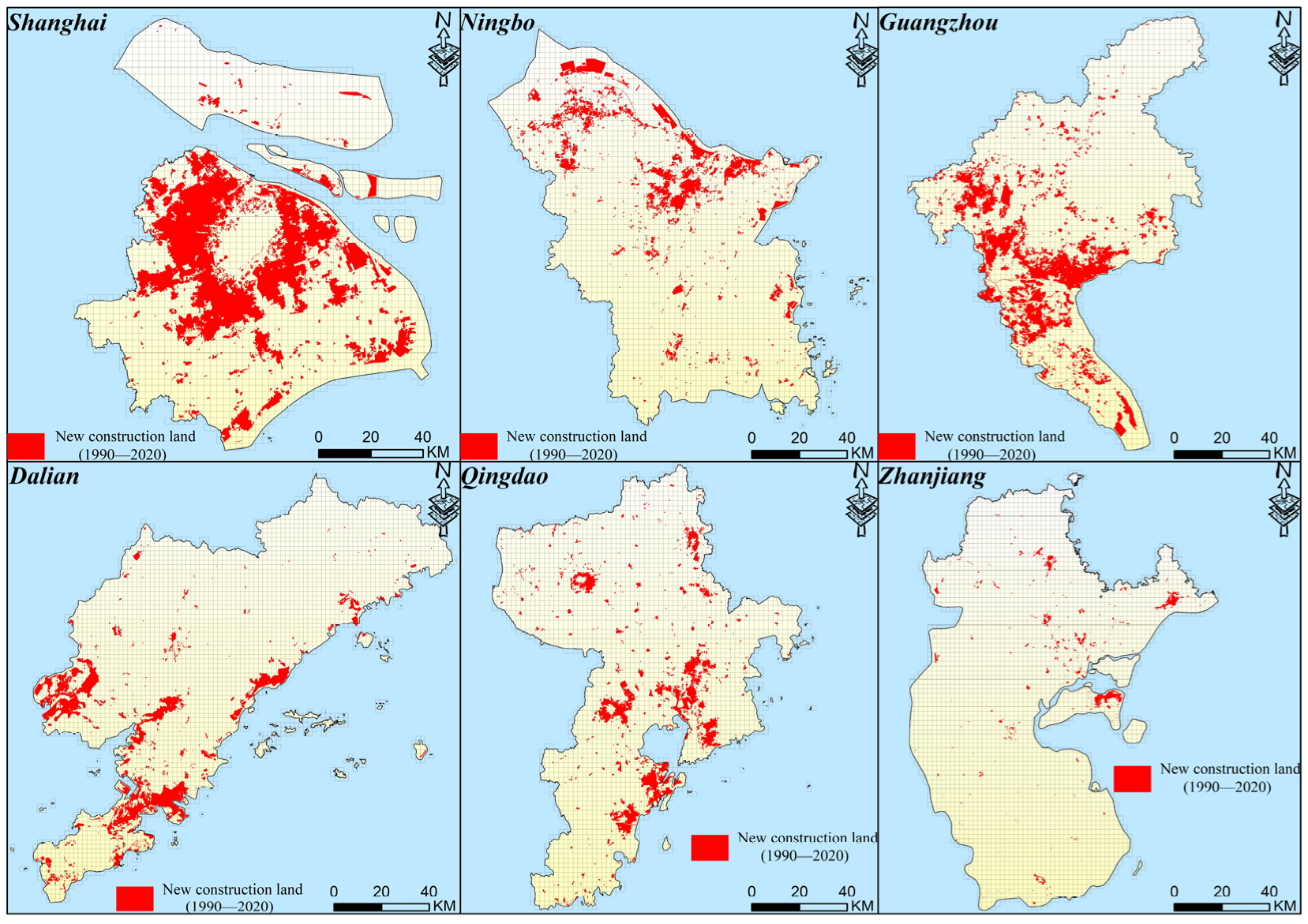
Data were analyzed using ArcGIS 10.8.2. Vector data of construction land in six major coastal port cities (Shanghai, Ningbo, Guangzhou, Dalian, Qingdao, and Zhanjiang) from 1990 to 2020 were extracted. An overlay analysis tool was used to extract patches of new construction land in each city from 1990 to 2020. Sampling tools with a pixel size of 2 km × 2 km were used to grid the study area (Figure 3). The minimum number of research units per city was 2245, 2857, 2050, 3924, 3137, and 3683 for Shanghai, Ningbo, Guangzhou, Dalian, Qingdao, and Zhanjiang, respectively. Second, raster data processing tools were used to obtain elevation maps using mosaics and cropping. Slope data were extracted using surface analysis tools. The reclassification tool was used to grade elevations and slopes. Data on rivers, railway lines, highways, and airports were obtained from the 1:4 million China full factor map, from which river elements were extracted from the main streams of the main rivers. Finally, overlay and neighborhood analysis tools were used to establish attribute connections between construction land attributes and geospatial elements, and each attribute was assigned to a grid to build a geospatial information database.

3.2. Models

3.2.1. Multiple Linear Regression Model

At the macro level, the study considered the change in the total area of construction land as a dependent variable and the social and economic factors that cause the change in the amount of construction land as explanatory variables. As both were continuous variables, a general multiple linear regression model was used to construct a socioeconomic driving force model for construction land expansion:
y i t = β 0 + β 1 x 1 i t + β 2 x 2 i t + β 3 x 3 i t + β k x k i t + ε i t
where yit is the construction land area of city i in year t, that is, the dependent variable; t refers to the year (t = 1990, 1991, 1992, …, 2020), with the interpolation method used to complete 30 years of land data to create a good model; xkit is the observed value of the k-th continuous variable of city i in year t, that is, the explanatory variable; β0, β1, β2, β3, ⋯, βk are the parameters to be estimated, which were estimated using the Ordinary Least Squares method; and εit is the error term.

3.2.2. Binary Logistic Regression Model

At the micro level, this paper considered whether construction land expansion occurred as the dependent variable and natural and location conditions as the explanatory variable. As both were discrete variables, a binary logistic regression model was used to construct a driving force model for the microspatial expansion of construction land. Assuming that urban construction land increased as the main event, it was defined as the dependent variable, Yi. Therefore, Yi was the result of the main event occurring in the ith research unit under the action of a set of explanatory variables Xki = (X1i, X2i, X3i, …, Xki) (i.e., whether the main event occurs). Y was a binary variable, and the value of Yi was defined as 0 or 1. If the main event did not occur, it was recorded as Yi = 0 (i.e., there was no increase in construction land within the research unit), and occurrence was recorded as Yi = 1 (i.e., there was an increase in construction land within the research unit).
Pi = P(Yi = 1/X1i, X2i, X3i, ⋯, Xki),
P i = e x p ( α + β 1 X 1 i + β X 2 i + β X 3 i + + β k X k i ) 1 + e x p ( α + β 1 X 1 i + β X 2 i + β X 3 i + + β k X k i )
The corresponding binary logistic regression model was
L o g i t ( P i ) = l n P i 1 P i = α + β 1 X 1 i + β X 2 i + β X 3 i + + β k X k i
where Pi is the probability of occurrence of the main event within the i-th research unit, α is a constant term, and βK is the regression coefficient.
The main event odds ratio was used to characterize the logistic regression coefficients of each explanatory variable and was calculated using an index of the parameter estimates, as follows:
o d d ( p ) = P i 1 P i = e x p ( α + β 1 X 1 i + β X 2 i + β X 3 i + + β k X k i )
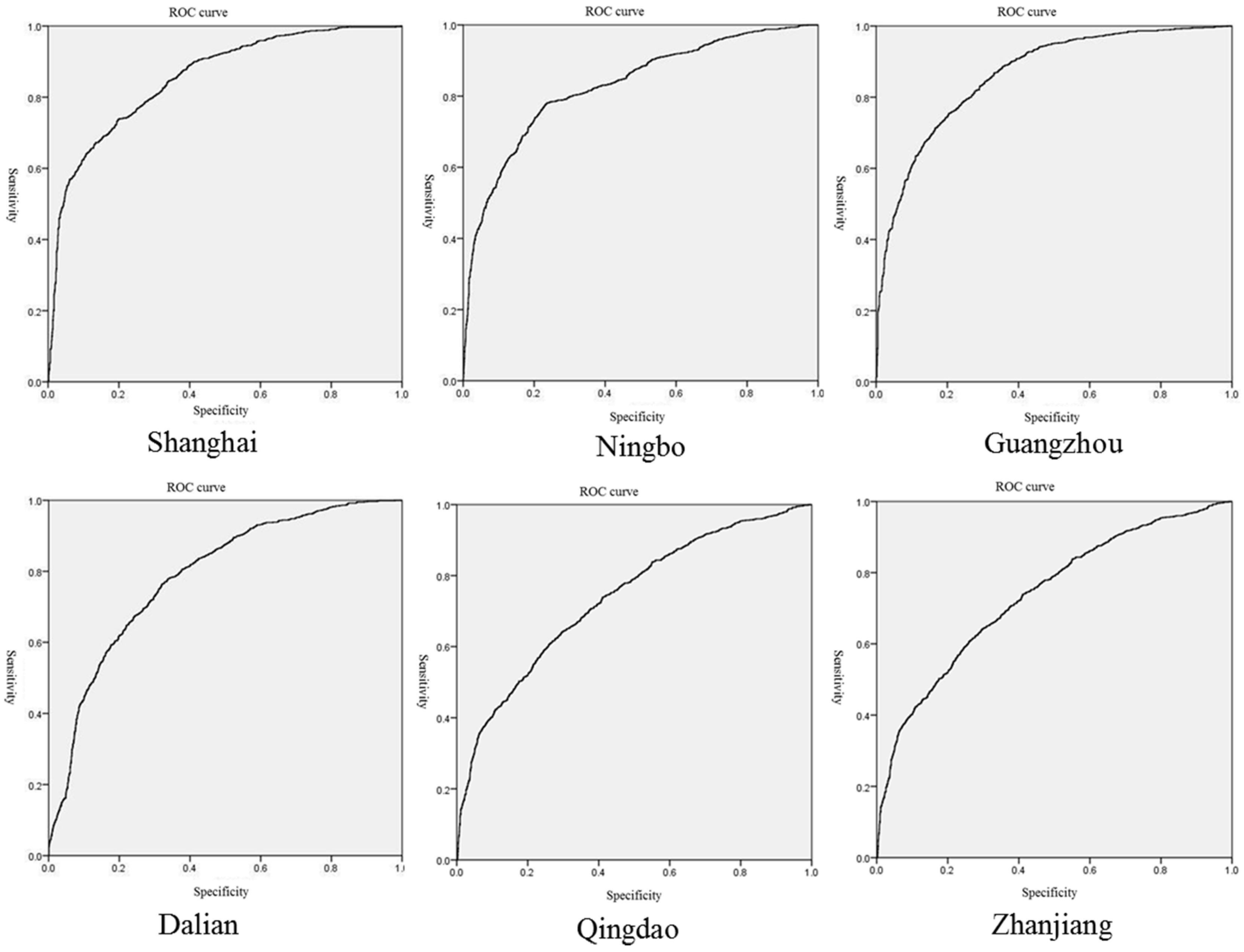
where odd(p) represents the multiple of the change in the occurrence ratio of the main event for each unit of increase in the explanatory variable; if odd(p) < 1, the occurrence ratio decreases; if odd(p) = 1, the occurrence ratio remains unchanged; if odd(p) > 1, the occurrence ratio increases. The goodness of fit of the regression models is generally tested using the relative operating characteristic (ROC) curve. The area value under the ROC curve is analyzed, with a reasonable range of 0.5–1.0 and higher values indicating better model consistency; an ROC value of 0.5 indicates that the model is completely random, and an ROC value of 1 indicates that the model is perfect.

3.2.3. GIS and Landscape Pattern Analysis Method

This paper used GIS methods and a landscape pattern index to explore the spatiotemporal characteristics of the impact of ports on urban construction land change from the perspective of patch expansion. ArcGIS was used for GIS spatial analyses. Landscape pattern refers to the shapes, proportions, and spatial configurations of the ecosystems or land use/land cover types that constitute a landscape. Landscape pattern analysis commonly applies a set of landscape metrics (indices) to quantitatively describe the spatiotemporal distribution characteristics of landscape elements [35]. Three landscape indices were used to quantitatively describe the spatial and temporal distribution characteristics of landscape elements.
The plaque density (PD) index was used to describe the density of the spatial distribution of landscape elements. Larger PD values indicate denser patches.
P D = N / A
where PD is the density of the landscape patches, N is the number of patches, and A is the total area of the study unit.
The average patch area (Av) index was used to describe the average size of the landscape elements. Larger Av values indicate larger average patch size.
A v = F / N
where Av is the average patch area, F is the total patch area, and N is the number of patches.
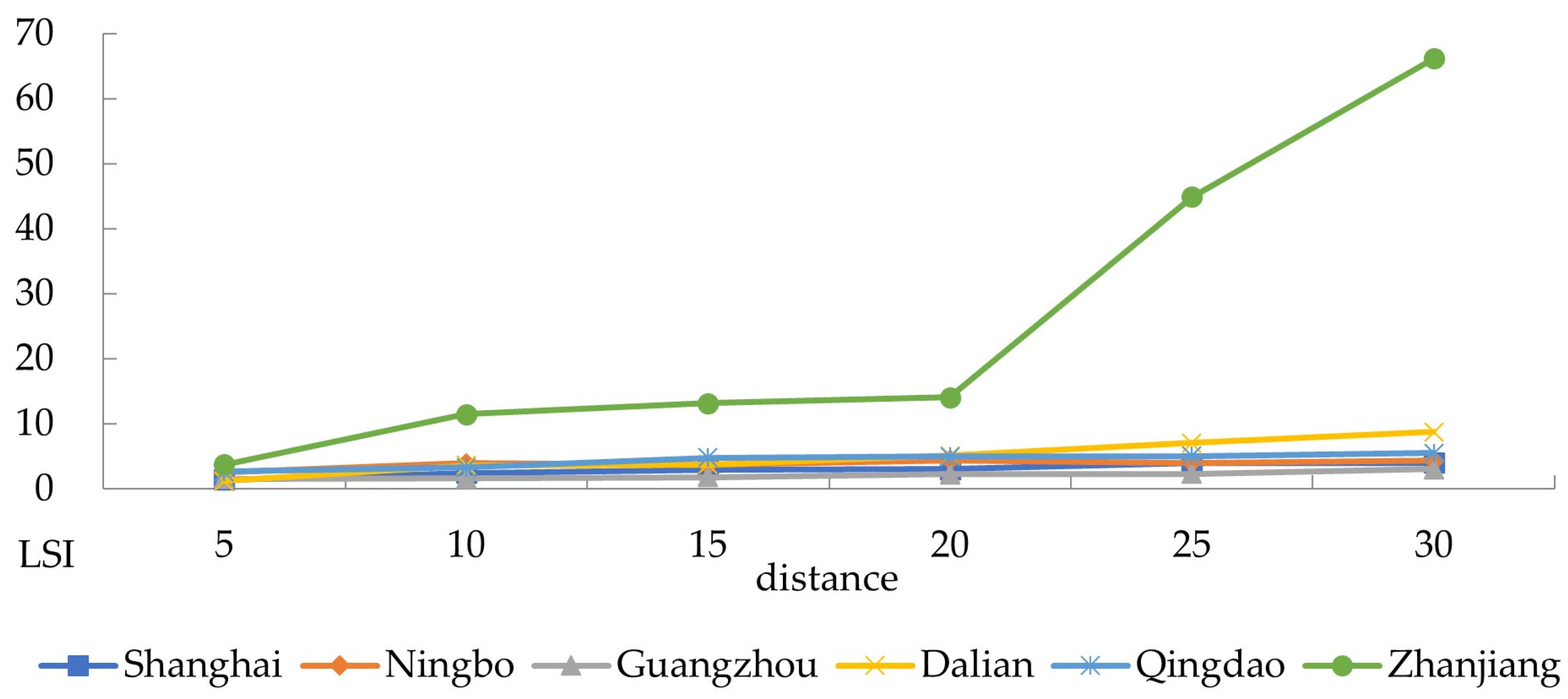
The landscape separation index (LSI) was used to describe the degree of dispersion of the spatial distribution of landscape elements. Larger LSI values indicate more dispersed landscape elements.
L S I i = D i / S i
D i = 1 2 m / A
S i = A i / A
where LSIi is the degree of landscape separation of the i-th land type, Di is the distance index of the i-th land type, Si is the area index of the i-th land type, m is the number of patches of the i-th land type, Ai is the area of the i-th land type, and A is the total study area.

4. Results

4.1. Socioeconomic Factors

Table 3 shows the regression results for driving factors of construction land expansion socioeconomic demand. Population density, GDP, industrial structure upgrading index, real estate investment, and port cargo demand had a significant positive impact on the expansion of construction land. Fixed asset investment and construction land expansion had a negative correlation. However, foreign investment, college students, and medical institutions were not significant.
To make the regression model more robust, the model was optimized by eliminating explanatory variables that were not correlated with the explained variables (foreign investment, university students, and medical institutions) and conducting multiple linear regressions on the remaining explanatory variables. The results are shown in Table 4. The adjusted R2 coefficient was 0.894, indicating that the model was robust.
Based on the optimized parameters, a driving factor model for macro-level changes was constructed using the following formula:
yCLA = −8.704 + 0.123Pd + 0.05GDP + 0.851Isui − 0.09Fai + 0.317Rei + 0.217Portct
The coefficient of each explanatory variable in the model represents the change in urban construction land resulting from a one-unit increase or decrease in that variable, holding all other conditions constant. As shown in Table 4, the following regression coefficients were found for the explanatory variables: industrial structure upgrading Index (0.85), real estate investment (0.32), port cargo demand (0.22), population density (0.12), GDP (0.05), and fixed assets investment (−0.09).
In the past 30 years, construction land expanded by 0.12% for every 1% increase in population density in major coastal port cities. An increase in population density leads to construction growth land. Compared to inland cities, coastal port cities have superior resources, markets, and environmental endowments, which easily attract population agglomeration. However, in recent years, due to the strict control of population settlement in major coastal port cities and relaxation of the permanent population, the effect of population on urban construction land decreased. Therefore, the regression coefficient of population density ranked fourth among the explained variables, indicating that the increase in population size did not cause a rapid expansion of construction land.
The GDP increased by 1%, whereas construction land expanded by 0.05%, ranking fifth, indicating that the impact of GDP growth on the expansion of construction land in coastal cities gradually decreased. From 1990 to 2020, the reserved amount of construction land and per capita construction land area in coastal port cities remained high, and the total amount of construction land increased while GDP decreased; that is, economic growth was decoupled from the expansion of construction land. Therefore, GDP growth was no longer the main driving factor behind construction land expansion. The industrial structure upgrading index increased by 1%, and of construction land expansion was approximately 0.86%, ranking first, indicating that the industrial structure was the main driving force behind construction land expansion. Over the past 30 years, the proportion of primary industries in coastal port cities gradually decreased, whereas the proportion of secondary and tertiary industries continuously increased. More developed secondary and tertiary industries indicate higher industrial structure upgrading. Secondary and tertiary industries have a higher demand for urban land resources than primary industries and use mainly urban construction land, with a continuous shift from agricultural to urban construction land. Therefore, the optimization and upgrading of industrial structures were important driving factors in stimulating the continuous expansion of construction land.
The regression coefficient of fixed asset investment was −0.09, indicating that fixed asset investment did not create direct growth in construction land. This suggests that by upgrading the industrial structure of coastal port cities, the government invested in technology upgrading, product innovation, digital economy, equipment introduction, and maintenance, whereas the proportion of investment in plant construction gradually decreased. The regression coefficient of real estate investment was 0.317, ranking second, indicating that for every 1% increase in real estate investment, the expansion of construction land was approximately 0.32%. The real estate industry promoted rapid development since 2008 and was a pillar industry in China. Governments at all levels have had relatively loose policies regarding the real estate industry, making it an important driving force for construction land expansion in coastal port cities over the past 30 years.
There were no statistically significant correlations between the total amount of foreign capital actually used, regular college students, medical institutions, and the macro quantity change in construction land. Therefore, the degree of opening up, science and education, and medical treatment had no significant impact on the expansion of construction land. The regression coefficient of port cargo throughput was 0.217, ranking third, with a 1% increase in port cargo throughput and expansion of construction land of approximately 0.22%. Previous studies have shown that port expansion led to urban construction land expansion and continuous increase in port cargo throughput led to port space expansion and construction of factories, enterprise factories, and warehouses, becoming an important driving force for urban construction land expansion along coastal ports.

4.2. Location Factors

Location factors were analyzed using binary logistic regression, and the model was subjected to a ROC test. The prediction accuracy and ROC curve test values of each model were 75.68% and 0.854 for Shanghai, 77.88% and 0.829 for Ningbo, 77.07% and 0.862 for Guangzhou, 76.86% and 0.786 for Dalian, 73.92% and 0.737 for Qingdao, and 87.29% and 0.763 for Zhanjiang, respectively (Figure 4). The regression results are shown in Table 5, Table 6, Table 7, Table 8, Table 9 and Table 10. Based on the estimated parameters of the regression results for each city, a micro spatial expansion driver model for construction land in major coastal port cities was established.
Logit ( P ) Shanghai = l n P 1 P = 2.374 0.04 Dp 0.047 Dr 0.033 Dra 0.083 De 0.023 Da 0.033 Dcub + 0.008 Eblc
Logit ( P ) Ningbo = l n P 1 P = 1.777 0.012 Dp 0.028 Dr 0.015 Dra 0.01 De 0.019 Da 0.059 Dcub + 0.12 Eblc
Logit ( P ) Guangzhou = l n P 1 P = 3.613 0.022 Dp 0.012 Dr 0.004 Dra 0.044 De 0.024 Da 0.057 Dcub + 0.072 Eblc
Logit ( P ) Dalian = l n P 1 P = 1.771 0.271 Dem 0.222 Slop 0.054 Dp 0.025 Dra 0.019 De 0.023 Da + 0.013 Eblc
Logit ( P ) Qingdao = l n P 1 P = 0.918 0.07 Dem 0.263 Slop 0.003 Dp 0.036 Dra 0.055 De 0.021 Da + 0.026 Eblc
Logit ( P ) Zhanjiang = l n P 1 P = 1.304 0.127 Dem 0.073 Slop 0.023 Dp 0.033 Dra 0.02 De 0.043 Da + 0.089 Eblc
The test results showed that the prediction accuracy of the regression model was high and the model fit was good. The explanatory variables that did not have statistical significance in each urban regression model were eliminated, and the remaining explanatory variables were analyzed.
Overall, distance from the port line had a significant impact on the microspatial expansion of port city construction land. Elevation and slope were only significant for coastal port cities (Dalian, Qingdao, and Zhanjiang), and distance from the river was only significant for estuarine port cities (Shanghai, Ningbo, and Guangzhou).
The regression coefficients for distance from the port line were negative, indicating that cities closer to the port shoreline were more likely to generate new construction land. The sum of the contribution values based on Wald statistics was 127.24, ranking first among all the indicators. This indicated that construction land expansion was characterized by agglomeration along port lines, and port space expansion drove urban construction land expansion [2]. In estuarine port cities, the average altitude was relatively low, terrain was flat, and landforms were mainly river valley plains. Therefore, elevation and slope had no significant impact on construction land expansion. In addition, cities originating along rivers and port cities were built along rivers. Therefore, construction land expansion was significantly affected by rivers. Specifically, greater distance from the river indicated lower probability of new construction land, indicating that construction land expansion in estuarine port cities was characterized by agglomeration along the river. The average altitude of coastal port cities was higher than that of estuarine port cities, with significant topographic relief. The landforms were mostly hilly and mountainous. Therefore, elevation and slope had a significant impact on construction land expansion. The sums of the contribution values of slope and elevation were 33.47 and 26.62, respectively, indicating that construction land expansion in coastal port cities was more likely to converge in the direction of smaller slopes and relatively low terrain due to terrain constraints. In addition, cities originated from coastal areas; therefore, rivers had no significant impact on construction land expansion.
Distance from major transportation facilities, such as airports, railways, and highways, and degree of expansion of base construction land had significant impacts on construction land expansion in port cities, whereas distance from the urban core built-up area only had a significant impact on estuarine port cities (Shanghai, Ningbo, and Guangzhou). The regression coefficients for distance from major transportation facilities were negative, indicating that the probability of construction land expansion decreased as distance increased. The sum of the contribution values was 126.17, 93.46, and 79.31 for distance from the airport, from the railway line, and from the highway, respectively. This indicated that construction land expansion in major coastal port cities was characterized by agglomeration along transportation facilities, and that the attraction of airports to newly added construction land was greater than that of railways and highways. The regression coefficient for base construction land (1990) expansion was positive, indicating that a higher proportion of original construction land within the research unit indicating higher probability of generating new construction land, with a total contribution value of 56.7. This suggested that construction land expansion in coastal port cities was characterized by clustering around the original construction land. The urban core built-up area had a significant impact only on estuarine port cities, as their urban space was arranged along rivers in the early stage, and urban expansion was conducted mainly on river impact plains with a relatively concentrated layout. However, coastal port cities were constrained by terrain and landforms, and their spatial layout was relatively scattered.

4.3. Impact of Ports on Construction Land Expansion

The findings indicated that ports influenced macro- and micro-expansion of urban construction land. Changes in port cargo demand promoted the growth of the total amount of urban construction land, and port space expansion drove urban construction land expansion, which was characterized by agglomeration toward the port shoreline. To explore the micro-impact of ports on urban construction land expansion, this paper used a landscape index and buffer zone analysis to examine the spatiotemporal characteristics of the impact of ports on urban construction land expansion.
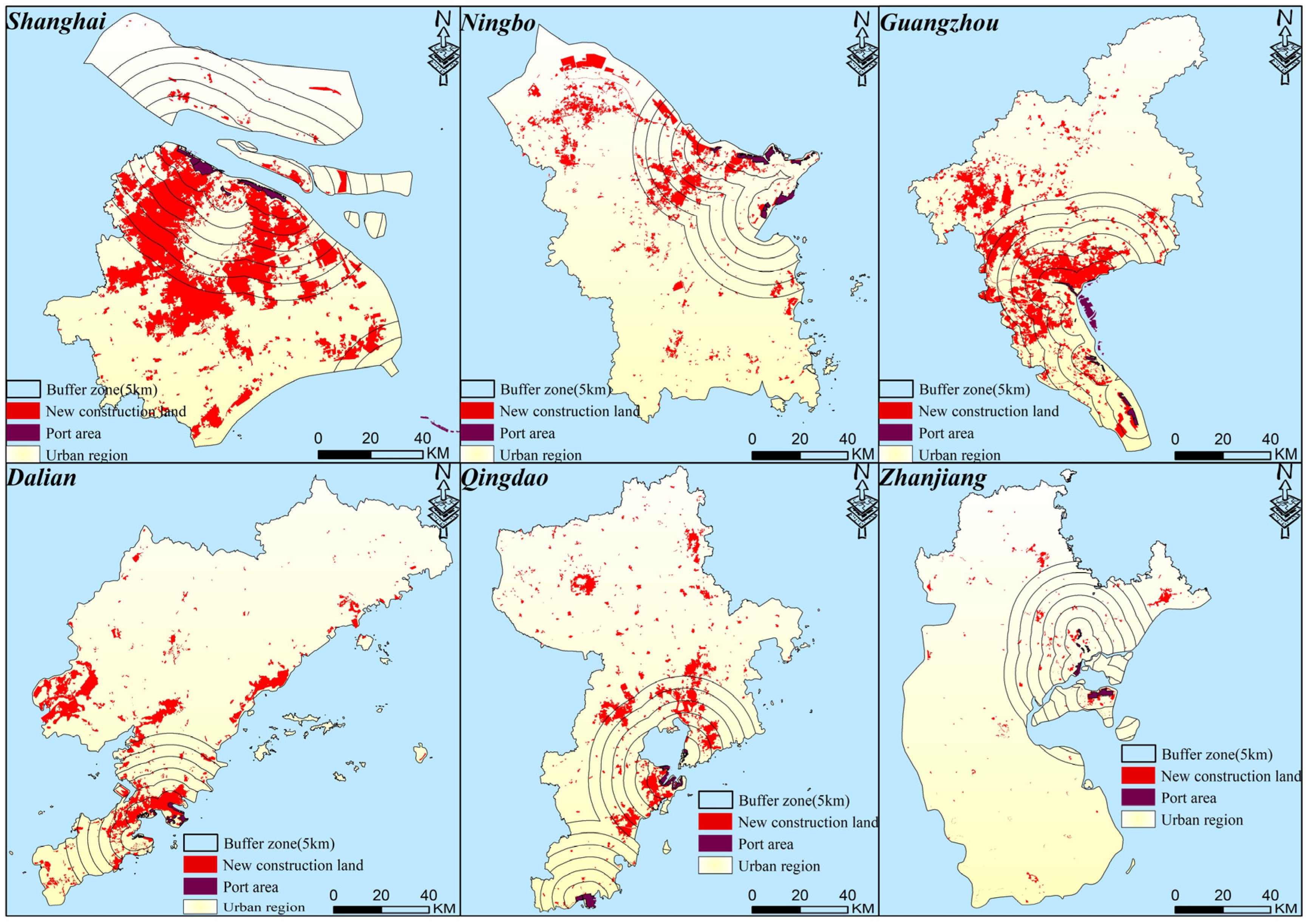
First, new construction land patches were extracted from the major coastal port cities between 1990 and 2020. Patches with an area of less than 0.01 km2 were eliminated [1]. Second, using buffer zone analysis with the port coastline as the boundary, equidistant buffer zones of 0–5 km, 5–10 km, 10–15 km, 15–20 km, and 20–30 km in the land direction were established and spatially overlaid with new construction land patches between 1990 and 2020. New construction land patches from different time periods and distance buffers were extracted (Figure 5). Finally, the spatiotemporal variations of new construction land patches in the buffer zone were obtained using statistical methods. As shown in Table 11, the proportion of new construction land within the 30 km buffer zone of each port city to the overall new construction land area exceeded 35%. Therefore, selecting the 30 km buffer zone as the largest research unit was reasonable and could accurately describe the spatiotemporal characteristics of the impact of ports on urban construction land expansion.

4.3.1. Temporal Characteristics of Patches of New Construction Land

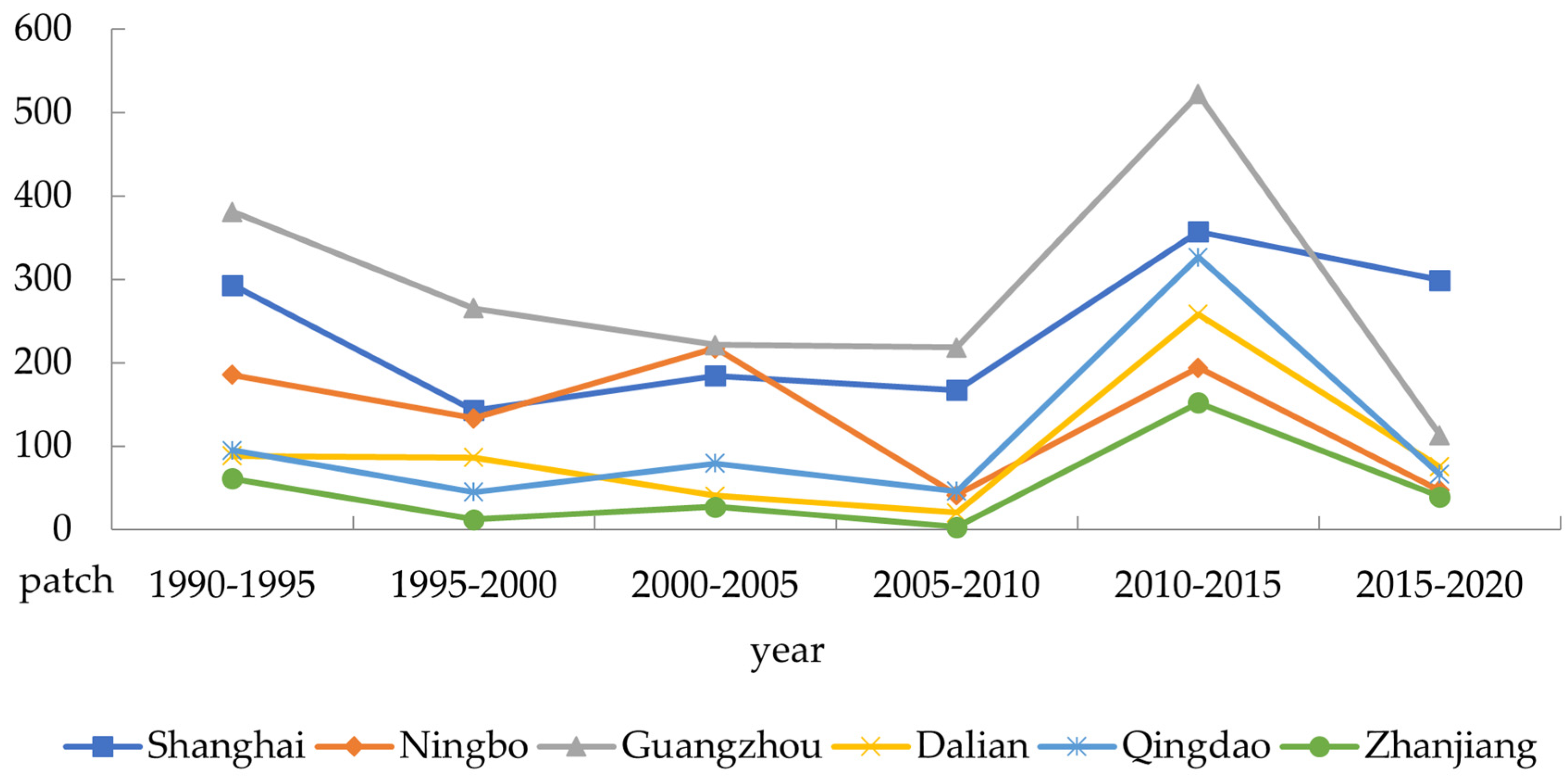
Between 1990 and 2020, the overall size of new construction land patches within the 30 km buffer zone of each port city showed a trend of decline → increase → decline (Table 12 and Figure 6), with peaks between 2010 and 2015, characterized by periodic changes. Before 1990, China’s coastal port had formed at a certain scale; however, due to low trade demand, the development of port cities was slow. The main types of ports were estuarine, such as Shanghai, Ningbo, and Guangzhou, and coastal, such as Dalian, Qingdao, and Zhanjiang [1]. Between 1990 and 2010, with the gradual increase in trade demand in coastal port cities, port scale began to expand, and new port areas emerged. Expansion, repair, and transformation began based on the original space of the port. Fewer new port areas were added, stalling the expansion of large-scale urban construction land spaces. Therefore, new urban construction land area during this period was relatively small. Between 2010 and 2015, the number of new ports and port areas in port cities gradually increased, and the structure gradually shifted to the coexistence stage of estuarine and coastal ports, with coastal ports removed from cities [1]. The construction of new port areas led to surrounding construction land expansion, with a gradual increase in new construction land. Between 2015 and 2020, deep-water ports appeared. Port scale met trade needs, and port expansion slowed, resulting in a decrease in urban construction land expansion and new construction land. The scale of the new construction land patches was small, with a size of < 1 km2 and proportion above 85% (Table 12). This indicated that construction land expansion used mainly small patches supplemented by medium patches, with fewer large patches. Moreover, the number of new patches in estuarine port cities was higher than that in large coastal port cities.

4.3.2. Landscape Index Changes with Distance of New Construction Land Patches

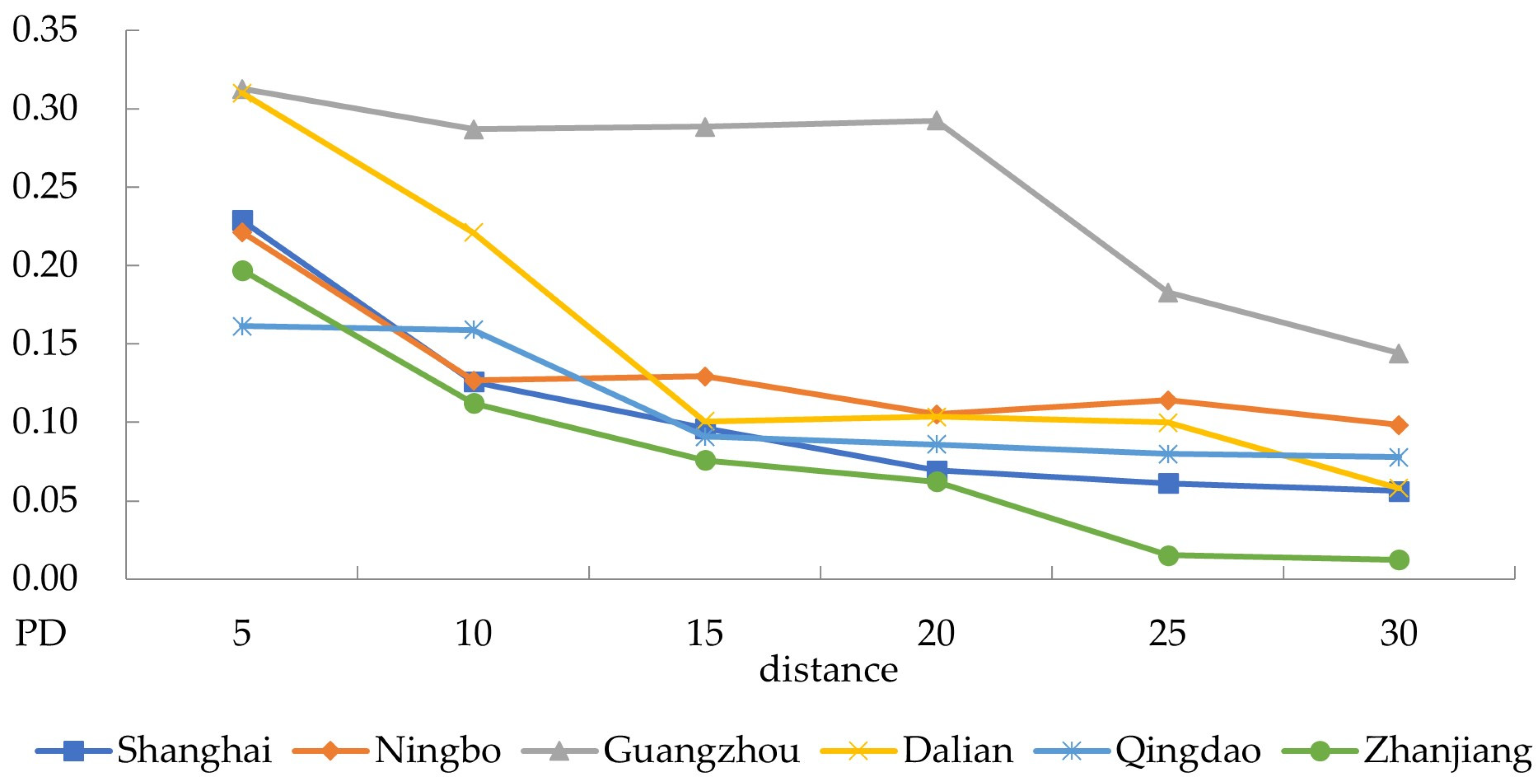
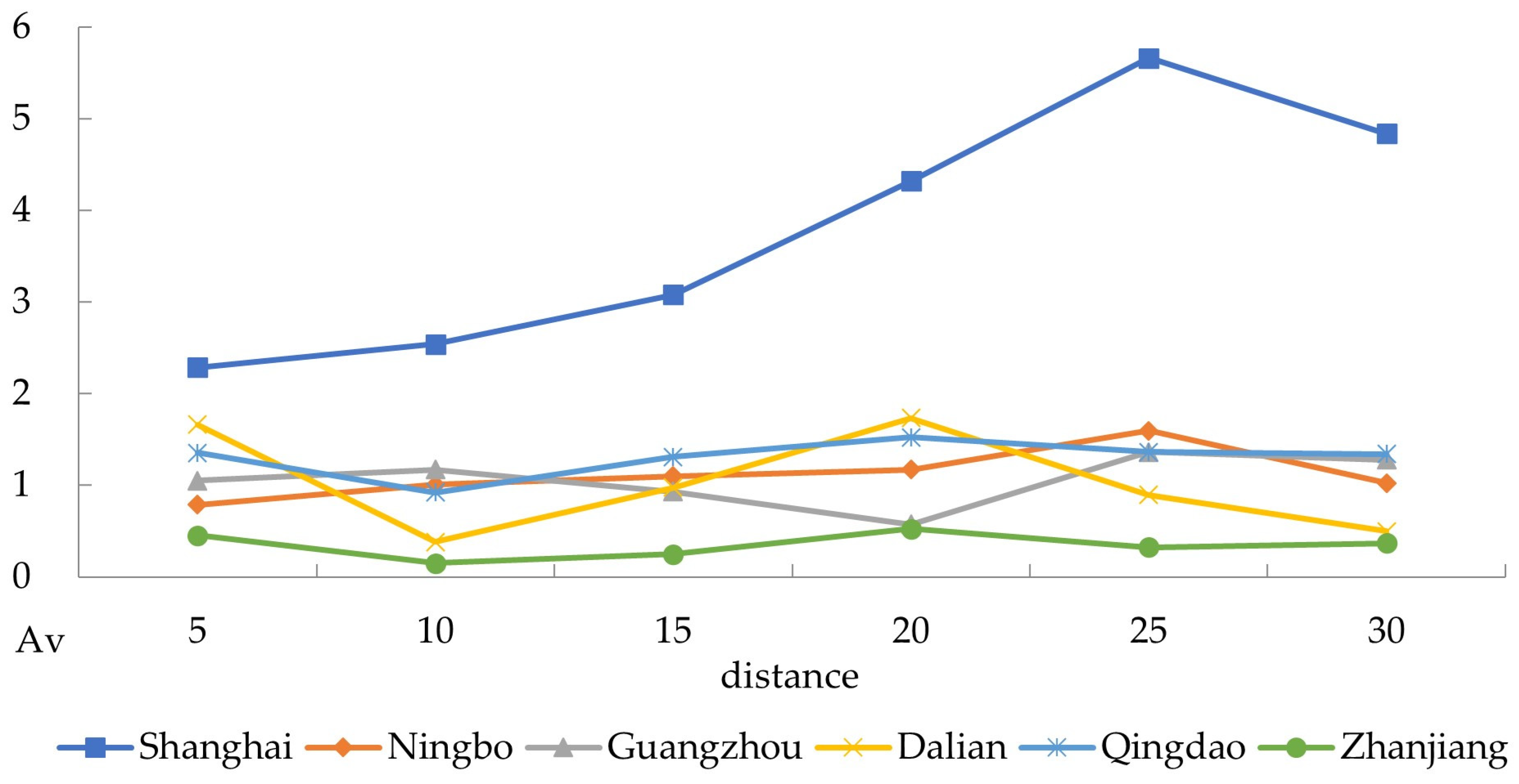
The patch density index exhibited a downward trend with increasing distance (Figure 7). Patches of new construction land were sparser and more dispersed farther away from the port, indicating that ports had a stronger driving effect on the spatial expansion of nearby construction land. The density of new construction land patches in Guangzhou was significantly higher than that in other port cities because Guangzhou Port is a typical estuarine port, and the formation and development of construction land patches in port cities takes longer and is more mature. The largest average patch areas of estuarine and coastal port cities were 20–25 km and 15–20 km from the port, respectively (Figure 8). The maximum impact distances of estuarine and coastal ports on construction land expansion were 25 km and 20 km, respectively. Landscape separation increased with distance (Figure 9), indicating that new construction land patches were more scattered farther away from the port. The expansion of port spaces and construction of new port areas accelerated the surrounding gathering of human production and life; therefore, areas closer to ports had greater production capacity, development intensity, and development efficiency, faster development speed, and more continuous growth of patches. Landscape separation of construction land patches increased and patch growth was relatively scattered in buffer zones far from ports due to slow development in the early stage as well as policies and land demand.


5. Discussion

Over the past 30 years, coastal port cities in China have undergone significant development. Previous studies have shown that after 30 years of rapid growth, the reserved amount of construction land and per capita construction land area in coastal port cities have remained high, whereas their utilization efficiency is low. Therefore, to maintain sustainable development of port cities and improve the utilization efficiency of construction land, measures are required to regulate construction land expansion and spatial layout. First, the industrial structure of coastal port cities should be optimized and adjusted. As shown by our results, among the socioeconomic drivers of construction land expansion in the six coastal port cities, the industrial structure upgrading Index remains the most important factor. Upgraded industrial structure caused primary and secondary industries to gradually transition to tertiary industries, whereas the demand for construction land in tertiary industries is relatively small. Therefore, after industrial structure optimization, the demand for construction land in urban industrial development decreases, weakening the effect of industrial structure adjustment on construction land. Second, land and sea coordination and planning in coastal areas should be improved. Across the six case-study port cities, construction land expansion exhibits pronounced locational agglomeration, primarily concentrating near the port shoreline, transport infrastructure, and existing construction land. Therefore, efficient use of land resources for coastal port city construction requires evaluation and planning before development. Economic development must be considered to avoid damaging the ecological environment of coastal zones. Finally, our results further show that, in the three estuarine port cities, construction land agglomeration is most evident at approximately 25 km from the port, whereas in coastal port cities the strongest agglomeration occurs at around 20 km. To this end, spatial planning and management of port cities should retain undeveloped shorelines with development potential, including estuarine and coastal shorelines, to reserve room for future spatial planning and construction.
For other port cities internationally, such as Rotterdam, ecological constraints have been institutionalized and embedded in engineering practice during port expansion and urban growth [36]; evidence from the United Arab Emirates more directly reflects a land-supply logic of seaward expansion [37,38]; in some Western European port cities, port land expansion is often constrained by land scarcity; the port–city interface becomes an arena of multi-actor, multi-objective land-use conflicts, and growth relies more on efficiency gains, functional mixing, and the reallocation of existing land [39]; unlike many port cities elsewhere, construction land expansion in Chinese port cities can proceed both seaward and landward [40]. Since China gradually proposed the “Land-Ocean Over-all-planned” strategy in 2010 [3], China’s economic and social development has shifted from focusing on land areas to land–sea coordination. However, its main task is to effectively connect land and ocean, and revolve around land and sea functional positioning, land and sea planning, land and sea development layout, land and sea resources, land and sea environmental quality, land and sea disaster prevention, and other aspects. The research conclusion in this paper helps to guide and solve the effective connection issues of land sea spatial planning, land sea development layout, and land sea resource utilization.
This paper examined the drivers of construction land expansion in coastal port cities from both macro-level socioeconomic and micro-level natural locational perspectives, identifying key socioeconomic factors (e.g., industrial structure, real estate development, and port cargo throughput) and key natural locational factors (e.g., distance to the port shoreline, distance to major transport infrastructure, and existing construction land). However, this study still has limitations. It does not explicitly account for the following point: “The mechanisms underlying urban expansion are inherently nonlinear and complex”; therefore, future research should employ machine-learning models to further examine the internal mechanisms of expansion in coastal port cities.

6. Conclusions

This paper analyzed the driving factors of construction land expansion and spatiotemporal characteristics of the impact of ports on urban construction land expansion using multi-temporal land use and panel data to construct indicator systems of macro- and micro-expansion.
(1) The main socioeconomic demand drivers of macro-level changes were advanced industrial structure indicators, real estate investment, port cargo demand, population density, and GDP. Industrial structure was the main driving factor. Decrease in primary industry demand and increase in secondary and tertiary industry demand directly drove the growth of the total amount of construction land. Real estate was an important driving force for the growth of construction land in coastal port cities. Unlike inland cities, the increase in demand for port goods as a driving factor for the growth of construction land in coastal port cities. The strict control of population in coastal port cities and relaxation of the permanent population reduced the effect of population on construction land growth. The reserved amount of construction land in seaport cities remained high, and GDP growth was no longer the main driving factor of construction land growth.
(2) Location factors influencing micro-expansion of construction land in coastal port cities included distance from the port line, distance from the main transportation facilities, and base construction land expansion. Areas closer to the port shoreline had more new construction land, indicating that construction land expansion clustered along the port line, and port expansion drove urban construction land expansion. Distance from major transportation facilities was negatively correlated with the probability construction land expansion. Construction land expansion agglomerated along transportation facilities, and airports attracted more new construction land than railways and highways. Construction land expansion clustered around original construction land. Elevation and slope impacted coastal port cities, indicating that their construction land expansion clustered around areas with smaller elevations and slopes. Rivers and distance from core built-up areas impacted estuarine port cities, indicating that their construction land expansion clustered around rivers and core built-up areas.
(3) New construction land patches showed a temporal trend of decline → increase → decline, which was consistent with the evolution of ports. Patch density decreased with distance, whereas landscape separation increased with distance.

Author Contributions

Conceptualization, Z.L. and Z.Z.; methodology, Z.L.; software, Z.L.; validation, Z.L.; formal analysis, Z.L.; investigation, Z.L., H.W. and H.Z.; resources, Z.L.; data curation, Z.L.; writing—original draft preparation, Z.L.; writing—review and editing, Z.Z.; visualization, Z.L.; supervision, H.W. and H.Z.; project administration, Z.L.; funding acquisition, Z.L. All authors have read and agreed to the published version of the manuscript.

Funding

This research was funded by The Liaoning Province Doctor Startup Fund 2025-BS-0894.

Data Availability Statement

The raw data supporting the conclusions of this article will be made available by the authors on request.

Acknowledgments

The authors would like to acknowledge all experts’ contributions in the building of the model and the formulation of the strategies in this paper. All authors have read and agreed to the published version of the manuscript.

Conflicts of Interest

The authors declare that they have no known competing financial interests or personal relationships that could have appeared to influence the work reported in this paper.

References

  1. Li, Z.; Luan, W.; Wang, X.; Wan, S.; Su, M.; Zhang, Z. Spatial expansion regular pattern and driving factors of estuarine and coastal harbors. Ocean Coast. Manag. 2022, 216, 105980. [Google Scholar] [CrossRef]
  2. Li, Z.; Luan, W.; Zhang, Z.; Su, M. Research on the interactive relationship of spatial expansion between estuarine and coastal port cities. Land 2023, 12, 371. [Google Scholar] [CrossRef]
  3. Luan, W.; Wang, H.; Pian, F. Research on Land and Marine Coordinated Development Strategy of China; Science Press: Beijing, China, 2020. [Google Scholar]
  4. Chen, D.; Hu, W.; Lu, X.; Li, Y. Exploring the influencing mechanism of newly-added urban construction land expansion: A configuration analysis based on PSR framework. China Land Sci. 2022, 36, 85–93. [Google Scholar]
  5. Balaka Opiyo, S.; Opinde, G.; Letema, S. Dynamics and drivers of land use and land cover changes in Migori river watershed, western Kenya region. Watershed Ecol. Environ. 2022, 4, 219–232. [Google Scholar] [CrossRef]
  6. Zhou, Y.; Zhong, Z.; Cheng, G. Cultivated land loss and construction land expansion in China: Evidence from national land surveys in 1996, 2009 and 2019. Land Use Policy 2023, 125, 106496. [Google Scholar] [CrossRef]
  7. Lin, J.; He, P.; Li, X.W.Y. Modeling urban land-use changes using a landscape-driven patch-based cellular automaton (LP-CA). Cities 2023, 132, 103901–103906. [Google Scholar] [CrossRef]
  8. Wang, Y.; Yin, K.; Jin, X. Spatio-temporal evolution and convergence analysis of China’s land economy and marine economy green development synergy. Struct. Change Econ. Dyn. 2025, 75, 423–438. [Google Scholar] [CrossRef]
  9. He, Q.; Zhou, J.; Tan, S.; Song, Y.; Zhang, L.; Mou, Y.; Wu, J. What is the developmental level of outlying expansion patches? A study of 275 Chinese cities using geographical big data. Cities 2020, 105, 102395. [Google Scholar] [CrossRef]
  10. Yang, D.; Zhang, P.; Jiang, L.; Zhang, Y.; Liu, Z.; Rong, T. Spatial change and scale dependence of built-up land expansion and landscape pattern evolution—Case study of affected area of the lower yellow river. Ecol. Indic. 2022, 141, 109123. [Google Scholar] [CrossRef]
  11. Ma, Z.; Wu, J.; Yang, H.; Yang, J.; Zhang, J. Unraveling the effects of land use change on carbon balance: A systematic study in the Beijing-Tianjin-Hebei region, China. Ecol. Indic. 2025, 179, 114109. [Google Scholar] [CrossRef]
  12. Zhou, T.; Jiang, G.H.; Ma, W.Q.; Zhang, R.J.; Tian, Y.Y.; Zhao, Q.L.; Tian, Y.Y. A framework for identifying the distribution of revitalization potential of idle rural residential land under rural revitalization. Land Use Policy 2024, 136, 106977. [Google Scholar]
  13. Zhao, K.; Vatankhah, S.; Li, Z. Mapping ecosystem services trade-offs as a decision tool for comprehensive ecological land-use planning. Ecol. Modell. 2026, 514, 111496. [Google Scholar] [CrossRef]
  14. Liu, B.; Zhang, F.; Kumar, P.; Meraj, G.; Johnson, V.C.; Orooji, Y.; Chan, N.W.; Wang, P.; Wei, L.; Ma, X.; et al. Dynamic changes in the sea-land convergence zone: Long-term coastal wetland dynamics, landscape pattern evolution, and human-activity impacts in Zhejiang. Ecol. Indic. 2026, 182, 114583. [Google Scholar] [CrossRef]
  15. Form, W.H. The place of social structure in the determination of land use: Some implications for a theory of urban ecology. Soc. Forces 1954, 32, 317–323. [Google Scholar] [CrossRef]
  16. Li, C.; Guan, C.; Zhang, B.; Ma, R.; Chen, X. Unpacking the law of spatial directionality on urban expansion morphology and carbon emissions. Sustain. Cities Soc. 2025, 134, 106935. [Google Scholar] [CrossRef]
  17. He, X.; Zhang, L.; Zhao, X.; Yuan, X.; Yuan, Y.; Zhou, C. Patterns and mechanisms of relative urban spatial growth in China from 2000 to 2020. Sustain. Cities Soc. 2025, 135, 107041. [Google Scholar] [CrossRef]
  18. Li, J.; Chen, M. Spatiotemporal evolution of urban expansion and spatial effect on sustainable development using multi-source night light data: A case study of the greater bay area. Environ. Sustain. Indic. 2025, 28, 100973. [Google Scholar] [CrossRef]
  19. Feng, Z.; Li, Z.; Xie, Z. Analysis of urban internal spatial structure characteristics and its influencing factors based on population flow: A case study of Nanjing. Geogr. Res. 2022, 41, 1525–1539. [Google Scholar]
  20. Zhou, L.N.; Pan, A.; Luo, F. Spatial-temporal evolution and driving forces of construction land expansion in Chengdu from 1980 to 2018. J. Southwest For. Univ. 2023, 43, 186–194. [Google Scholar] [CrossRef]
  21. Kassouri, Y.; Okunlola, O.A. Analysis of spatio-temporal drivers and convergence characteristics of urban development in Africa. Land Use Policy 2022, 112, 105868. [Google Scholar] [CrossRef]
  22. Zhou, Y.; Wu, Y.; Li, X.; Huang, X.; Niu, L. Impact of land market on the expansion of urban construction land in Shanghai, China. Cities 2026, 168, 106390. [Google Scholar] [CrossRef]
  23. de la Luz Hernández-Flores, M.; Otazo-Sánchez, E.M.; Galeana-Pizaña, M.; Roldán-Cruz, E.I.; Razo-Zárate, R.; González-Ramírez, C.A.; Galindo-Castillo, E.; Gordillo-Martínez, A.J. Urban driving forces and megacity expansion threats. Study case in the Mexico city periphery. Habitat Int. 2017, 64, 109–122. [Google Scholar] [CrossRef]
  24. Pratama, A.P.; Yudhistira, M.H.; Koomen, E. Highway expansion and urban sprawl in the Jakarta metropolitan area. Land Use Policy 2022, 112, 105856. [Google Scholar] [CrossRef]
  25. Mashi, S.A.; Abdullahi, S.A.; Jenkwe, E.D. The multidimensional lens of urban sprawl: Spatiotemporal dynamics and governance in Abuja, Nigeria. Land Use Policy 2025, 158, 107769. [Google Scholar] [CrossRef]
  26. Colsaet, A.; Laurans, Y.; Levrel, H. What drives land take and urban land expansion? A systematic review. Land Use Policy 2018, 79, 339–349. [Google Scholar] [CrossRef]
  27. Matsa, M.; Mupepi, O.; Musasa, T. Spatio-temporal analysis of urban area expansion in Zimbabwe between 1990 and 2020: The case of Gweru city. Environ. Chall. 2021, 4, 100141. [Google Scholar] [CrossRef]
  28. Liu, S.; Tong, Z.; Liu, Y.; Chen, H.; Liu, Y. What is the quality of urban expansion under different expansion patterns? A study of Chinese cities. Cities 2026, 168, 106409. [Google Scholar] [CrossRef]
  29. Li, C.; Li, J.; Wu, J. What drives urban growth in China? A multi-scale comparative analysis. Appl. Geogr. 2018, 98, 43–51. [Google Scholar] [CrossRef]
  30. Li, X.Y.; Kuang, W.H. Spatio-temporal trajectories of urban land use change during 1980–2015 and future scenario simulation in Beijing-Tianjin-Hebei urban agglomeration. Econ. Geogr. 2019, 9, 187–194. [Google Scholar]
  31. Wu, R.; Li, Y.; Wang, S. Will the construction of high-speed rail accelerate urban land expansion? Evidences from Chinese cities. Land Use Policy 2022, 114, 105920. [Google Scholar] [CrossRef]
  32. Jia, M.; Liu, Y.; Lieske, S.N.; Chen, T. Public policy change and its impact on urban expansion: An evaluation of 265 cities in China. Land Use Policy 2020, 97, 104754. [Google Scholar] [CrossRef]
  33. Hu, W.; Wang, L. Building the metropolis: Subway expansion, land use regulation, and welfare. J. Hous. Econ. 2025, 70, 102102. [Google Scholar] [CrossRef]
  34. Zhong, C.; Peng, L.; Yu, J.; Swan, I.; Li, H. Toward more reliable, complete, and equitable global urban land use efficiency assessments. Commun. Earth Environ. 2025, 6, 1055. [Google Scholar] [CrossRef]
  35. Liu, X.; Xia, L.; Chen, Y.; Yan, Q.; Li, S.; Chen, M. Landscape expansion index and its applications to quantitative analysis of urban expansion. Acta Geogr. Sin. 2009, 64, 1430–1438. [Google Scholar]
  36. Dekker, S.; Verhaeghe, R.J.; Pols, A. Expansion of the port of Rotterdam: Framework for evaluation. Transp. Res. Rec. 2002, 1782, 49–55. [Google Scholar] [CrossRef]
  37. Akhavan, M. Making of A Global Port-City in the Middle East: The Dubai Model; Springer: Berlin/Heidelberg, Germany, 2020; pp. 51–69. [Google Scholar]
  38. Subraelu, P.; Ebraheem, A.A.; Sherif, M.; Sefelnasr, A.; Yagoub, M.M.; Rao, K.N. Land in water: The study of land reclamation and artificial islands formation in the Uae coastal zone: A remote sensing and Gis perspective. Land 2022, 11, 2024. [Google Scholar] [CrossRef]
  39. Witte, P.; Wiegmans, B.; Louw, E. More claims than land: Multi-facetted land use challenges in the port-city interface. J. Transp. Geogr. 2025, 124, 104181. [Google Scholar] [CrossRef]
  40. Zhang, Y.; Chen, R.; Wang, Y. Tendency of land reclamation in coastal areas of shanghai from 1998 to 2015. Land Use Policy 2020, 91, 104370. [Google Scholar] [CrossRef]
Figure 1. Location of port cities (the red area indicates the port boundary).
Land 15 00378 g001
Figure 2. Research framework.
Land 15 00378 g002
Figure 3. Results of grid processing in the study area.
Land 15 00378 g003
Figure 4. ROC curve.
Land 15 00378 g004
Figure 5. Distribution of new construction map spots in the 5 km interval buffer zone of the study area.
Land 15 00378 g005
Figure 6. Statistics of the number of new construction land patches in each port city from 1990 to 2020.
Land 15 00378 g006
Figure 7. The patch density of new construction land in each port city changes with distance.
Land 15 00378 g007
Figure 8. The average patch area of new construction land in each port city changes with distance.
Land 15 00378 g008
Figure 9. Landscape separation of new construction land in each port city changes with distance.
Land 15 00378 g009
Table 1. Index system of socio-economic driving factors.
Element
Layer
Variable LayerVariable AbbreviationExpected Relevance
SocietyPopulation Density (Person/km2)Pd+
EconomyGross Domestic Product (RMB 100 mn)GDP+
Industrial Structure Upgrading IndexIsui+
PolicyFixed Assets Investment (RMB 100 mn)Fai+
Real Estate Investment (RMB 100 mn)Rei+
OpennessForeign Investment (USD 100 mn)Fi+
TrafficPort Cargo Demand (ten thousand tons)Portcd+
Science and educationCollege Students (ten thousand people)Cs+
Medical levelNumber of Medical Institutions (piece)Nmed+
Table 2. Index system of natural location driving factors.
Element LayerVariable LayerVariable AbbreviationExpected Relevance
Natural
condition
Digital Elevation ModelDem
SlopeSlop
Distance from the Port line (km)Dp
Distance from River (km)Dr
Geographic conditionsDistance from Airport (km)Da
Distance from Railway line (km)Dra
Distance from Highway (km)Dh
Distance from the Urban Core Built-up area (1990) (km)Dcbu
Base (1990) Expansion of Construction land (%)Becl+
Table 3. Regression results of socioeconomic demand drivers.
CLAParameter EstimationtSig.[95.0% Conf. Interval]
Coef.St. Err.Lower LimitSuperior Limit
Pd0.117 ***0.023−5.0020.000−0.0710.163
GDP0.044 ***0.0085.2720.0000.0280.061
Isui0.710 ***8.3636.6140.0000.4510.870
Fai−0.092 ***0.015−6.150.000−0.122−0.063
Rei0.342 ***0.0645.3100.0000.2150.469
Afi0.0220.0310.6990.486−0.0400.084
Portct0.107 ***0.0024.4580.0000.0040.114
Cs0.5140.6960.7390.461−0.8601.888
Nmed0.9330.1645.6740.1160.6081.257
Constant−8.197 ***2.771−1.1460.000−11.692−5.702
Note: *** respectively represent significance levels of 1%.
Table 4. Regression results of optimized.
CLAParameter EstimationtSig.[95.0% Conf. Interval]
Coef.St. Err.Lower LimitSuperior Limit
Pd0.123 ***0.022−5.5820.000−0.0790.166
GDP0.050 ***0.00412.3610.0000.0420.058
Isui0.851 ***0.0697.7300.0000.5740.916
Fai−0.090 ***0.015−6.1180.000−0.120−0.061
Rei0.317 ***0.0565.6460.0000.2060.428
Portct0.217 ***0.0014.7550.0000.0040.229
Constant−8.704 ***3.657−1.0080.000−11.970−5.434
Note: *** respectively represent significance levels of 1%.
Table 5. Regression results of natural location driving factors in Shanghai.
NewCLACoef.St. Err.WalddfSig.Exp(B)[95.0% Conf. Interval]
Lower LimitSuperior Limit
Dem0.1200.1181.03410.3101.1270.8951.421
Slop0.3170.1256.42910.1101.3721.0741.753
Dp−0.040 ***0.00561.98510.0000.9610.9520.971
Dr−0.047 ***0.0120.26210.0001.0481.0271.069
Dra−0.033 ***0.00913.13110.0000.9670.950.985
De−0.083***0.01337.78610.0000.9210.8970.945
Da−0.023 ***0.00613.12910.0000.9770.9650.99
Dcbu−0.033 ***0.00912.68310.0000.9670.9500.985
Ebcl0.008 **0.0045.44110.0200.9920.9850.999
Constant2.374 ***0.28071.70810.00010.741--
Note: ***, ** respectively represent significance levels of 1%, 5%.
Table 6. Regression results of natural location driving factors in Ningbo.
NewCLACoef.St. Err.WalddfSig.Exp(B)[95.0% Conf. Interval]
Lower LimitSuperior Limit
Dem−0.2190.05714.77210.1700.8030.7180.898
Slop−0.2230.04723.02810.1100.8000.7300.876
Dp−0.012 **0.0056.01810.0141.0131.0031.023
Dr−0.028 ***0.0098.94610.0031.0281.0101.047
Dra−0.015 **0.0066.20110.0130.9850.9730.997
De−0.010 **0.0081.48210.0230.9900.9751.006
Da−0.019 ***0.00340.01810.0000.9810.9750.987
Dcbu−0.059 ***0.01321.52410.0000.9430.9200.967
Ebcl0.120 ***0.0148.85510.0001.1271.0961.160
Constant1.777 ***0.161121.81410.0005.913--
Note: ***, ** respectively represent significance levels of 1%, 5%.
Table 7. Regression results of natural location driving factors in Guangzhou.
NewCLACoef.St. Err.WalddfSig.Exp(B)[95.0% Conf. Interval]
Lower LimitSuperior Limit
Dem−0.0530.0820.41810.5180.9480.8071.114
Slop−0.3710.06829.95910.2360.6900.6050.788
Dp−0.022 ***0.00341.99210.0000.9780.9710.985
Dr−0.012 **0.0091.60710.0251.0120.9941.030
Dra−0.004 **0.0060.38310.1361.0040.9921.016
De−0.044 **0.0195.63410.0180.9570.9220.992
Da−0.024 ***0.00527.22610.0000.9760.9680.985
Dcbu−0.057 ***0.01126.93310.0000.9450.9250.965
Ebcl0.072 ***0.02013.78010.0001.0751.0351.117
Constant3.613 ***0.236235.28010.00037.088--
Note: ***, ** respectively represent significance levels of 1%, 5%.
Table 8. Regression results of natural location driving factors in Dalian.
NewCLACoef.St. Err.WalddfSig.Exp(B)[95.0% Conf. Interval]
Lower LimitSuperior Limit
Dem−0.271 ***0.06517.5710.0000.7630.6720.866
Slop−0.222 ***0.05615.54610.0000.8010.7170.894
Dp−0.054 ***0.01415.55210.0000.9480.9230.973
Dr0.0080.0036.86710.2091.0081.0021.014
Dra−0.025 ***0.0089.78010.0020.9750.960.991
De−0.019 **0.0086.31610.0121.0201.0041.035
Da−0.023 **0.0113.94110.0471.0231.0001.046
Dcbu0.0130.0180.52110.4701.0130.9781.050
Ebcl0.013 ***0.00317.23910.0001.0131.0071.019
Constant1.771 ***0.21667.02110.0005.879--
Note: ***, ** respectively represent significance levels of 1%, 5%.
Table 9. Regression results of natural location driving factors in Qingdao.
NewCLACoef.St. Err.WalddfSig.Exp(B)[95.0% Conf. Interval]
Lower LimitSuperior Limit
Dem−0.070 ***0.0561.59110.0071.0730.9621.197
Slop−0.263 ***0.06416.90810.0000.7690.6780.871
Dp−0.003 **0.0060.25210.0261.0030.9921.014
Dr0.0100.0045.64010.1081.0101.0021.019
Dra−0.036 ***0.00543.98610.0000.9640.9540.975
De−0.055 ***0.01027.97910.0000.9470.9280.966
Da−0.021 ***0.00335.80910.0000.9800.9730.986
Dcbu0.0090.0061.98110.1591.0090.9971.021
Ebcl0.026 ***0.0037.25610.0001.0261.0201.032
Constant0.918 ***0.17128.88310.0002.504--
Note: ***, ** respectively represent significance levels of 1%, 5%.
Table 10. Regression results of natural location driving factors in Zhanjiang.
NewCLACoef.St. Err.WalddfSig.Exp(B)[95.0% Conf. Interval]
Lower LimitSuperior Limit
Dem−0.127 ***0.0477.46010.0060.880.8040.965
Slop−0.073 **0.0731.01110.0151.0760.9331.241
Dp−0.023 ***0.0191.44210.0031.0230.9851.063
Dr0.0280.00538.12910.1101.0291.0191.038
Dra−0.033 ***0.00719.97710.0000.9670.9530.982
De−0.002 **0.0060.11010. 0141.0020.9901.014
Da−0.043 **0.0176.05110.0140.9580.9260.991
Dcbu0.0000.0170.00010.9831.0000.9681.034
Ebcl0.089 ***0.00814.13010.0001.0931.0751.111
Constant−1.304 ***0.23032.21710.0000.272--
Note: ***, ** respectively represent significance levels of 1%, 5%.
Table 11. Statistics of new construction land area of each port city.
TypeCityNew Construction Land (km2)New Construction Land in the 30 km Buffer Zone (km2)Proportion
Estuarine
port city
Shanghai1852.61316.6671.07%
Ningbo854.73400.1246.81%
Guangzhou1164.22861.6474.01%
Coastal
port city
Dalian1105.76403.5636.50%
Qingdao791.49444.6256.18%
Zhanjiang190.3376.2640.07%
Table 12. Statistics of new construction land patches in port cities from 1990 to 2020.
TypeCityTime IntervalNew PatchesNew Patches of Different Sizes
<1 km21–10 km2>10 km2
Estuarine port cityShanghai1990–1995293250403
1995–200014313841
2000–2005184158260
2005–2010167136301
2010–2015357335220
2015–2020299258329
Total1443127515414
Ningbo1990–199518517780
1995–200013312940
2000–2005217182314
2005–2010414010
2010–2015194163301
2015–2020474430
Total817735775
Guangzhou1990–1995381343335
1995–200026525861
2000–2005221184325
2005–2010218191270
2010–2015522495270
2015–202011310670
Total1720157713211
Coastal port cityDalian1990–19958874122
1995–20008674120
2000–2005403550
2005–2010201910
2010–2015258229263
2015–20207562112
Total567493677
Qingdao1990–19959577180
1995–2000454050
2000–20057964123
2005–2010464420
2010–2015326295265
2015–2020666060
Total657580698
Zhanjiang1990–19959577180
1995–2000454050
2000–20057964123
2005–2010464420
2010–201515214660
2015–2020393630
Total294276180
Disclaimer/Publisher’s Note: The statements, opinions and data contained in all publications are solely those of the individual author(s) and contributor(s) and not of MDPI and/or the editor(s). MDPI and/or the editor(s) disclaim responsibility for any injury to people or property resulting from any ideas, methods, instructions or products referred to in the content.