Article

The Impact of Market-Oriented Reform of Rural Collective Operational Construction Land in China on the Urban–Rural Income Gap


School of Geographical Sciences, Southwest University, Chongqing 400715, China
*
Author to whom correspondence should be addressed.
Land 2026, 15(3), 364; https://doi.org/10.3390/land15030364
Submission received: 17 January 2026 / Revised: 21 February 2026 / Accepted: 23 February 2026 / Published: 25 February 2026
(This article belongs to the Section Land Socio-Economic and Political Issues)

Abstract

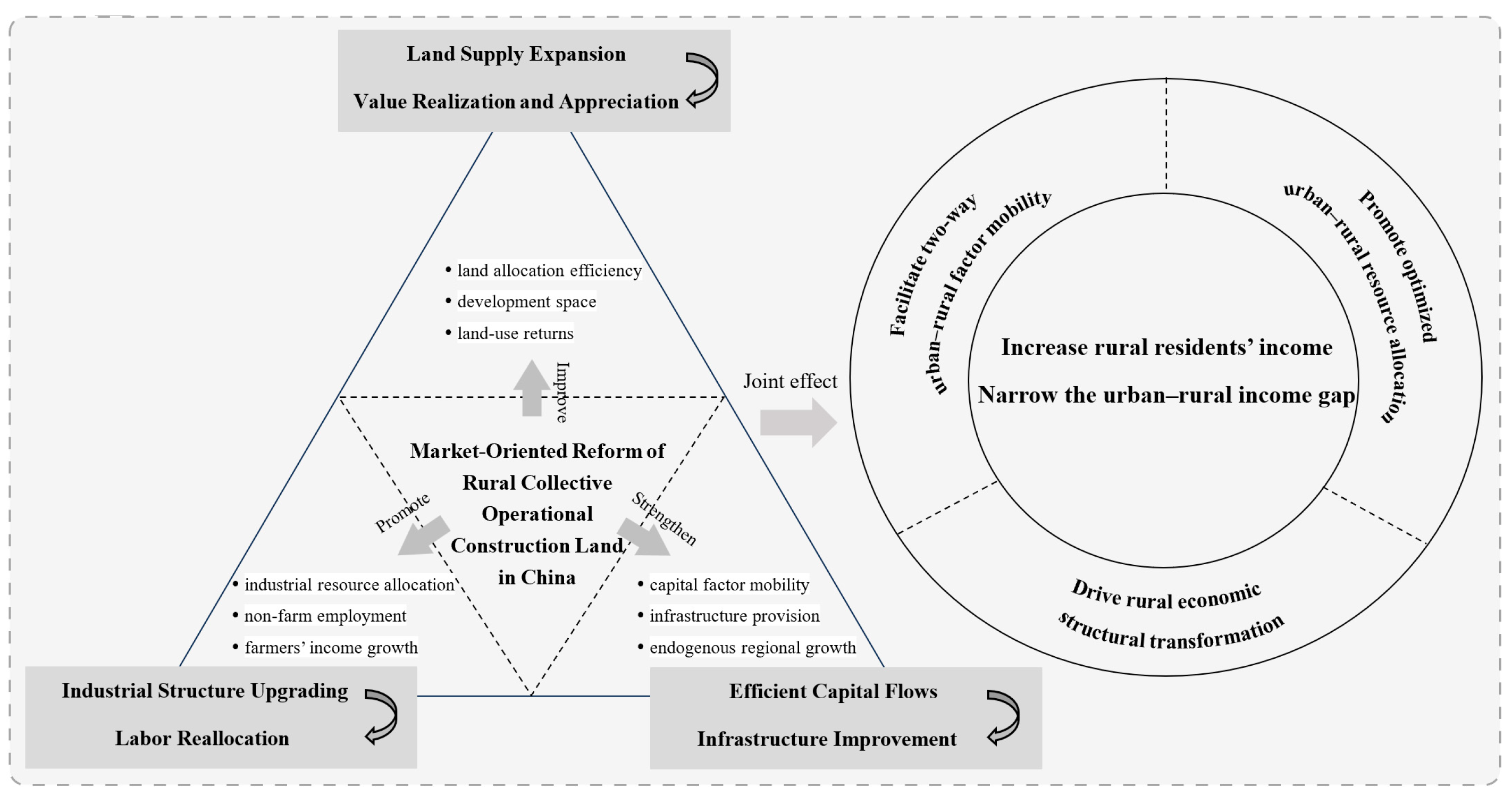
This study provided county-level empirical evidence on how rural land institutional reform affected the urban–rural income gap, and offered policy implications for advancing rural revitalization and common prosperity. Utilizing panel data for 1380 counties in China from 2010 to 2020, this study treated the Market-Oriented Reform of Rural Collective Operational Construction Land in China (the Reform) as a quasi-natural experiment and used a multi-period difference-in-differences (DID) model as a quantitative approach to empirically examine the effect and underlying mechanisms of the Reform on the urban–rural income gap. The results indicated that: (1) The Reform significantly narrowed the urban–rural income gap and passed a set of robustness checks, with an average reduction of approximately 17.41%. (2) The Reform reduced the urban-rural income gap through multiple pathways, including “land supply expansion–value realization and appreciation”, “industrial structure upgrading–labor reallocation” and “efficient capital flows–infrastructure improvement”. (3) The narrowing effect of reform was more pronounced in eastern and western counties, counties with higher proportions of mountainous areas, and non-resource-dependent counties. (4) The Reform demonstrated diminishing marginal returns: the effect was larger in counties with wider initial urban–rural income gaps. In addition, more market-oriented land transfer methods were more conducive to land value realization. Accordingly, the government should advance the Reform prudently, adopt place-based implementation, promote two-way factor mobility, and improve benefit-sharing and regulatory mechanisms to sustain policy gains.
Keywords: Rural Collective Operational Construction Land; Market-Oriented Reform; urban–rural income gap; multi-period difference-in-differences; mediation effect Rural Collective Operational Construction Land; Market-Oriented Reform; urban–rural income gap; multi-period difference-in-differences; mediation effect