Article

The Impact of Market-Oriented Reform of Rural Collective Operational Construction Land in China on the Urban–Rural Income Gap


School of Geographical Sciences, Southwest University, Chongqing 400715, China
*
Author to whom correspondence should be addressed.
Land 2026, 15(3), 364; https://doi.org/10.3390/land15030364
Submission received: 17 January 2026 / Revised: 21 February 2026 / Accepted: 23 February 2026 / Published: 25 February 2026
(This article belongs to the Section Land Socio-Economic and Political Issues)

Abstract

This study provided county-level empirical evidence on how rural land institutional reform affected the urban–rural income gap, and offered policy implications for advancing rural revitalization and common prosperity. Utilizing panel data for 1380 counties in China from 2010 to 2020, this study treated the Market-Oriented Reform of Rural Collective Operational Construction Land in China (the Reform) as a quasi-natural experiment and used a multi-period difference-in-differences (DID) model as a quantitative approach to empirically examine the effect and underlying mechanisms of the Reform on the urban–rural income gap. The results indicated that: (1) The Reform significantly narrowed the urban–rural income gap and passed a set of robustness checks, with an average reduction of approximately 17.41%. (2) The Reform reduced the urban-rural income gap through multiple pathways, including “land supply expansion–value realization and appreciation”, “industrial structure upgrading–labor reallocation” and “efficient capital flows–infrastructure improvement”. (3) The narrowing effect of reform was more pronounced in eastern and western counties, counties with higher proportions of mountainous areas, and non-resource-dependent counties. (4) The Reform demonstrated diminishing marginal returns: the effect was larger in counties with wider initial urban–rural income gaps. In addition, more market-oriented land transfer methods were more conducive to land value realization. Accordingly, the government should advance the Reform prudently, adopt place-based implementation, promote two-way factor mobility, and improve benefit-sharing and regulatory mechanisms to sustain policy gains.

1. Introduction

The urban–rural income gap is not only a long-standing structural challenge in China but also a persistent concern across many developing and transition economies, constraining rural–urban integration and high-quality development at the county level. Addressing such disparities is closely aligned with the United Nations 2030 Agenda for Sustainable Development, particularly its emphasis on reducing inequality. Although incomes have risen in both urban and rural areas in recent years, the relative gap remains substantial in China [1]. One important institutional driver is the urban–rural dual land system. Rural collective land has long faced restrictions in entering the land market on terms comparable to state-owned land. This segmentation of urban and rural land markets limits the realization of rural land value. It also restricts rural residents’ income sources and factor mobility, thereby widening the urban–rural income gap.
Against this background, the Market-Oriented Reform of Rural Collective Operational Construction Land in China (hereafter, the Reform) is widely regarded as a key lever for breaking the dual land system. By promoting a more integrated urban–rural factor market, the Reform may reshape resource allocation, employment structures, and patterns of public investment. Rural collective operational construction land refers to collectively owned land that rural collective economic organizations legally use for business purposes. This includes establishing enterprises on such land, or participating in joint ventures or equity cooperation with other entities or individuals through land-use rights [2]. The Reform refers to the process in which eligible land-use rights, subject to planning requirements and land-use controls, are transferred or leased through market transactions to realize economic value.
Land marketization reforms have become a major topic in the academic literature. Globally, these reforms are increasingly aligned with the 2030 Agenda for Sustainable Development, as effective land management is recognized as a cornerstone for achieving global Sustainable Development Goals (SDGs) [3]. Due to differences in country-specific institutional contexts and land systems, international studies and China-focused studies often emphasize different issues. International research typically examines property rights, market functioning, and benefit distribution. It highlights that clear and tradable land property rights can improve allocative efficiency by reducing transaction frictions, strengthening investment incentives, and facilitating the reallocation of land and related factors to higher-productivity uses [4,5]. It also stresses the importance of distributional equity and sustainability, as well as supporting governance arrangements, because the incidence and distribution of land value gains depend on market design and implementation quality [6,7]. Empirical evidence from a natural experiment in poor suburban areas of Buenos Aires, Argentina shows that granting land titles can strengthen tenure security and is associated with increased housing investment and enhanced children’s education, highlighting the role of formalized and transferable rights in unlocking asset value for low-income households [8]. Evidence from rural Ghana further indicates that ambiguous or contested land rights weaken investment incentives and reduce land-improving inputs, whereas more secure tenure is associated with greater investment in land productivity and higher output, underscoring how institutional arrangements shape the realization of land-related gains [9]. Taken together, these international findings suggest that land-market-oriented reforms can operate through investment incentives and the realization of land value, but the extent to which gains are realized by local communities versus implicitly transferred to other actors may depend on governance and allocation rules, including allocation procedures, pricing mechanisms, and enforcement capacity. In the Chinese context, research places greater emphasis on policy implementation and governance performance. It focuses on the institutional design of the Reform [10,11], implementation models [12,13], benefit distribution rules [14,15], challenges and policy responses [16,17,18], and central–local relations and grassroots governance [19,20]. This line of work discusses how to refine the Reform, improve land-use efficiency, and enhance implementation effectiveness to support rural revitalization and urban–rural integration. Regarding the impact of the Reform on the urban–rural income gap, some studies argue that the policy can help realize the economic value of land, raise rural residents’ property income and wage income, and broaden income sources, thereby reversing the widening trend of the urban–rural gap [21,22]. However, other studies reach the opposite conclusion. They suggest that the reform may disproportionately benefit farmers in advantaged locations, potentially widening income inequality and intensifying distributional tensions between the state and rural residents. They also point to increased difficulties in planning enforcement [23]. In addition, central–local bargaining and imperfect land regulation may hinder effective marketization [20]. Methodologically, as pilot programs have progressed and data availability has improved, the literature has gradually shifted from qualitative case studies to quasi-experimental evaluations, including difference-in-differences designs [24] and synthetic control methods [25].
Overall, although the existing literature provides useful theoretical foundations and methodological insights for analyzing the Market-Oriented Reform of Rural Collective Operational Construction Land in China and its impacts, several gaps remain. First, relatively few studies systematically evaluate the Reform’s effect on the urban–rural income gap, and further evidence is needed on the underlying channels and regional heterogeneity [24,26]. Second, much of the literature remains normative or qualitative, leaving room for more rigorous quantitative identification of policy effects [1,16]. Third, many studies rely on aggregate-level analyses or cross-sectional data, and further work is needed using long-span county-level panel data [25,27]. Accordingly, this study contributes in four ways. (1) We exploit the staggered rollout of the pilot reform as a quasi-natural experiment and build an econometric identification framework at the county level. We also conduct a sensitivity analysis related to the expanded round of pilots launched in 2023 to assess the robustness of the main results. (2) We examine multiple channels through which the Reform may affect the urban–rural income gap and conduct mediation analyses as supportive evidence. (3) Beyond location-related heterogeneity, we incorporate terrain and resource endowment, two dimensions that have received relatively limited attention, to conduct a multi-dimensional heterogeneity analysis and document differential policy effects. (4) We further test for diminishing marginal returns and examine how reform intensity and the share of negotiated land transfers are associated with changes in the urban–rural income gap. The remainder of this paper is organized as follows. First, we outline the policy background and theoretical framework. Next, we describe the data, identification strategy, and variable construction. We then present the empirical results and conduct additional analyses and robustness checks. Finally, we summarize the main conclusions, discuss policy implications, and highlight limitations and directions for future research.

2. Policy Background and Theoretical Framework

2.1. Policy Background

The Reform is closely linked to China’s economic and social development. It has evolved through a complex process, shifting from strict restrictions to gradual liberalization and ultimately moving toward “equal rights and equal prices” between rural collective and state-owned construction land. This institutional evolution reflects the policy direction of moving from a segmented urban–rural construction land market toward greater integration. It also provides the policy background and timeline for our quasi-natural experiment based on the staggered rollout of the pilot program.
(1)
Land Expansion and Prohibited Transfers (Late 1970s to the Late 1990s)
After China’s reform and opening-up, rapid changes in industrial structure and the growth of township and village enterprises generated strong demand for rural land transactions. Informal markets for rural collective construction land became widespread. They offered relatively low-cost land resources for rural development [24]. However, to stabilize agricultural production and protect farmland, the state emphasized strict land control. As a result, rural collectives often conducted land transactions through workaround arrangements in regulatory gray areas.
(2)
Local Experiments and Policy Relaxation (Late 1990s to 2012)
In the early 2000s, tensions between institutional restrictions and development needs led to exploratory efforts at both local and central levels to regularize transfers of collective construction land. At the local level, areas such as Nanhai District in Guangdong and Jiading District in Shanghai were among the first to relax traditional restrictions [28]. Later, other places, including Chengdu in Sichuan and Wenzhou in Zhejiang, issued related policies. Meanwhile, the central government also introduced policy documents and pilot programs to gradually standardize land transfers. During this period, some regions were allowed to explore market entry in pilot form. However, because national laws had not yet been substantively revised, the Reform remained limited in scope and did not achieve a broad breakthrough [29].
(3)
Reform Deepening and Legal Breakthrough (Since 2012)
Since 2012, rising urban–rural development imbalances have accelerated the Market-Oriented Reform of Rural Collective Operational Construction Land in China (the Reform). In 2015, the State Council approved pilot programs in 33 counties (county-level cities and districts), including 15 pilot counties under the Reform. This marked a major institutional breakthrough. In 2016, the Reform was extended to all 33 pilot counties. In 2019, the revised Land Administration Law formally recognized the legal status of market entry at the national level. This revision provided a clear legal basis for subsequent pilot implementation. In March 2023, the Ministry of Natural Resources issued the Work Plan for Deepening the Pilot Program of the Market-Oriented Reform of Rural Collective Operational Construction Land in China. The plan aimed to deepen the pilot over about two years (from the end of 2022 to the end of 2024). The expanded pilot program covers about 350 counties (county-level cities and districts). During this period, the central government continued to expand the pilot scope and refine the institutional framework and procedural rules. These efforts supported prudent and orderly implementation of the Reform.

2.2. Theoretical Foundations

Land is a core production factor in rural areas. Its degree of marketization directly affects rural residents’ income. Due to an insufficient supply of industrial land and the fact that collective land cannot enter the market on equal terms with state-owned land, returns to rural land are often “undervalued” or “locked in”. A large share of land value appreciation is captured by the government [30]. New institutional economics suggests that a key driver of institutional change is to reduce transaction costs. This means lowering institutional costs and improving institutional efficiency [31]. Property-rights economics views land rights as a bundle of specific rights, such as transfer rights, use rights, and income rights. These rights can be allocated across different actors [32]. Under the “equal rights and equal prices” framework, the Reform clarifies property rights and promotes market-based transactions. It can reduce institutional frictions and transaction costs, activate idle land assets and improve rural returns, thereby affecting the urban–rural income distribution. By contrast, weak or incomplete land rights can hinder market-based allocation and constrain income realization. Marx’s theory of land rent and land prices argues that rent appropriation is an economic form through which land ownership is realized [33]. Legalization and standardization under the Reform can enhance the economic value of land. In areas with rapid development and strong demand for construction land, land supply may be tight. Scarcity can generate monopoly rent [34]. Market mechanisms may then reallocate land toward higher-return uses. This can improve land-use efficiency and increase rural income. Lewis’s dual-sector theory argues that many developing economies are characterized by the coexistence of a traditional agricultural sector and a modern sector dominated by manufacturing [35]. The Reform may promote the development of non-agricultural industries and facilitate rural economic transformation. It may also accelerate the shift of surplus labor from agriculture to non-agricultural activities, thereby contributing to a gradual easing of the dual economic structure. It is important to note that, in the Chinese context, the tripartite separation among the household registration system, land, and public services increases the overall costs of cross-regional migration and full urban integration. This institutional setting may shape how labor reallocation occurs and may affect its marginal impact on the urban–rural income gap. Based on the above, we propose:
Hypothesis 1 (H1).
The Reform significantly narrows the urban–rural income gap.

2.3. Mechanisms and Research Hypotheses

2.3.1. Land Supply Expansion—Value Realization and Appreciation

The Reform grants Rural Collective Operational Construction Land a legal status for market transactions. It helps weaken the monopoly position of state-owned construction land. It also supports the development of a unified urban–rural construction land market. These changes can increase the supply of construction land and ease urban land shortages [5]. Under an institutional environment in which development rights and transaction rights are more clearly protected, land can flow toward uses and users with higher productive efficiency [36]. Firms can invest and build facilities in rural areas based on their development needs. This expands their space for growth. Rural residents, as land owners or users, can realize the value of land development rights through transfers, leases, or equity participation [22]. They may also increase income by using land for entrepreneurship. As exclusivity and enforceability improve, property-right boundaries become clearer. Spatial constraints on collective land are relaxed. Allocation efficiency and price discovery can improve at the same time. Implicit land rents and land prices are more fully revealed and converted into realizable income, thereby supporting rural economic growth. Because the Reform is likely to have limited effects on state-owned land prices, its impact on urban residents’ income may be small. By contrast, it can raise rural income more directly. As a result, a short-term pattern may emerge in which rural areas catch up more quickly and the urban–rural income gap narrows.

2.3.2. Industrial Structure Upgrading—Labor Reallocation

The Reform can reshape relative factor prices between urban and rural areas. It may improve land allocation efficiency. It can also generate welfare gains for rural areas, partly through a redistribution effect from urban to rural areas [37]. With more stable and coordinated property-right arrangements, firms face lower entry costs and lower adjustment costs for land use. Industrial parks may also strengthen their carrying capacity and agglomeration effects. Rural areas can leverage land resource advantages to attract firms into parks. This can foster non-agricultural industries, facilitate industrial upgrading, and promote urban–rural industrial linkages, thereby improving overall economic efficiency. In addition, the Reform may create more employment opportunities for surplus labor. It can help break the low-productivity lock-in of labor in traditional agriculture. It may also attract some migrant workers to return to their hometowns [38]. Local or nearby absorption into non-agricultural employment then becomes more likely. This can reduce the frictions of labor mobility. It can also raise rural labor productivity and income. When industrial capacity, public service provision, and commuting accessibility are relatively adequate, the Reform is more likely to increase local non-agricultural employment and wages. These improvements in productivity can then contribute to a narrowing of the urban–rural income gap.

2.3.3. Efficient Capital Flows—Infrastructure Improvement

The monetization and effective use of land transaction revenues is key to rural endogenous development. The Reform can increase the capitalization of income rights and strengthen financing capacity. This makes land assets and expected future cash flows easier for commercial finance and the fiscal system to recognize, thereby broadening funding sources. More predictable property rights and transaction rules can improve credit supply and the efficiency of capital pricing. They can also reduce institutional frictions in project implementation and operation. These changes may encourage corporate investment, structural adjustment, and greater market activity. From a perspective that considers both short-term and long-term interests, village collectives may form rational expectations of long-term land value appreciation [39]. This can motivate higher infrastructure investment and improvements in the local development environment. It can also create more diversified channels for income growth. In practice, local governments may allocate part of land transfer revenues to infrastructure construction. This can provide a more sustainable source of public funding. It may also attract capital and talent from urban areas back to rural areas [40]. Continued improvements in living and production conditions can further reduce transaction and production costs and enhance local carrying capacity. This can strengthen rural areas’ ability to attract production factors and support a virtuous cycle of “capital flows–infrastructure capacity–factor agglomeration–productivity gains”. Through this cycle, endogenous regional growth can be fostered, thereby narrowing the urban–rural income gap.
Based on the above, we propose:
Hypothesis 2 (H2).
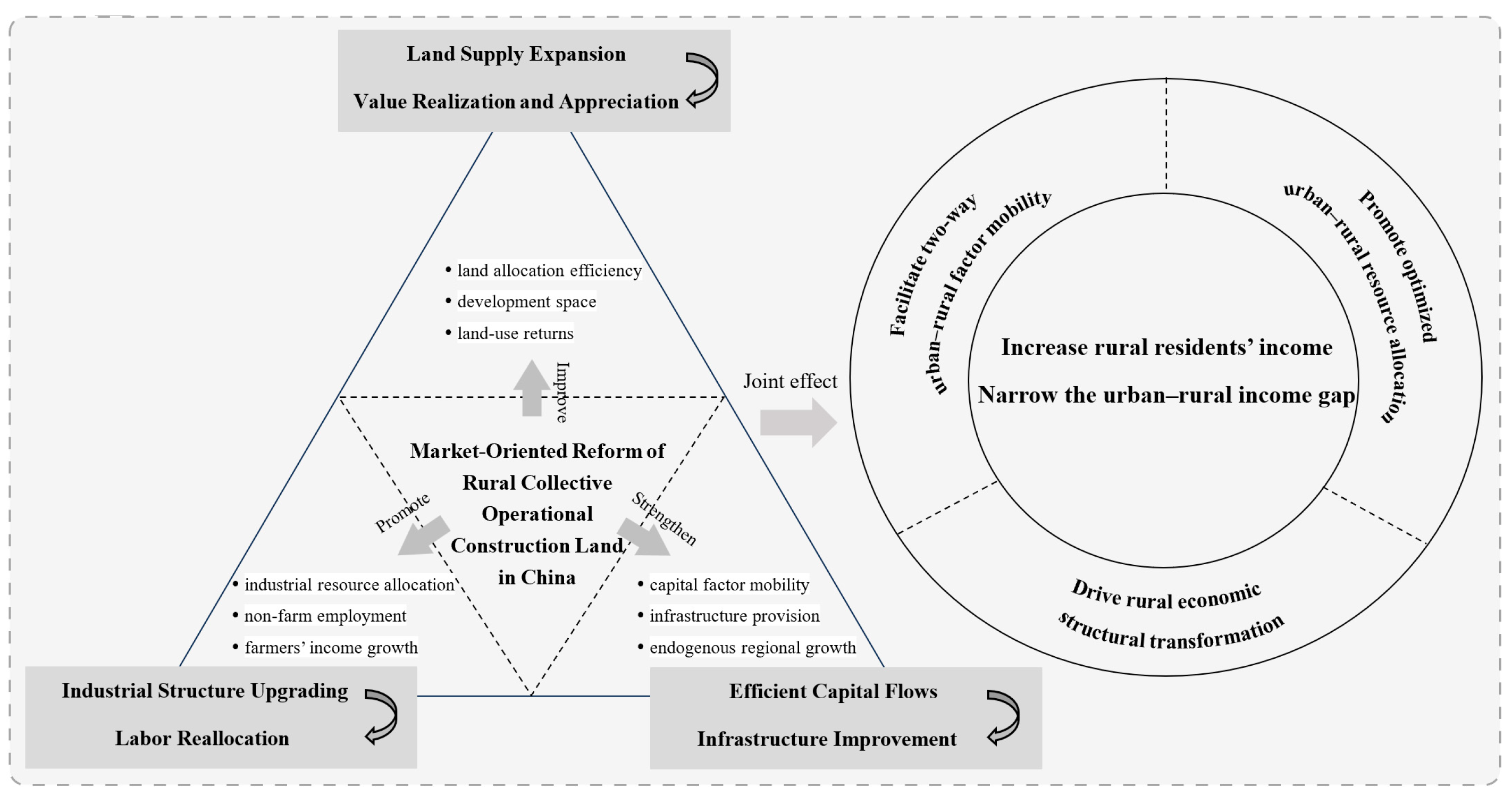
The Reform operates through multiple channels: “land supply expansion–value realization and appreciation”, “industrial structure upgrading–labor reallocation”, and “efficient capital flows–infrastructure improvement”. Through these channels, the Reform may promote factor mobility and more efficient resource allocation, facilitate rural economic restructuring, increase rural residents’ income, and ultimately narrow the urban–rural income gap (Figure 1).

3. Data and Methods

3.1. Data Sources

We focus on the period 2010–2020 for three main reasons. First, the sample provides a sufficiently long pre-treatment window to test the parallel-trends assumption and covers the main policy evaluation window, which is required for a multi-period DID design. Second, since 2010, county-level statistics are more comprehensive and missing values are less common, which helps improve estimation precision. Third, land system reform involves multiple stakeholders and is implemented in a gradual manner. After the pilot period ended in late 2019, the reform did not expand rapidly across China. In addition, a new round of expanded pilots launched in 2023 may contaminate the control group and introduce identification complexity. County-level data are mainly drawn from the China County Statistical Yearbook, as well as county-level Statistical Communiqués on National Economic and Social Development and Government Work Reports. We drop control-group counties with severe missing values in key variables. For a small number of missing observations, we apply linear interpolation. The final dataset is an 11-year panel covering 1380 counties in China from 2010 to 2020. It includes 31 pilot counties (county-level cities and districts) and 1349 non-pilot counties. Due to data availability constraints, the sample does not cover Tibet and Xinjiang.

3.2. Model Specification

Because the Reform was implemented in two batches, we treat it as a quasi-natural experiment and use a multi-period DID framework to estimate its impact on the urban–rural income gap. To mitigate potential selection bias arising from the non-random selection of pilot counties, we further implement a PSM–DID approach. The baseline model is specified as follows:
g a p i t = α 0 + α 1 t r e a t i × p o s t t + α 2 C o n t r o l i t + γ t + μ i + ε i t
In Equation (1), i indexes counties and t indexes years. g a p i t denotes the urban–rural income gap in county i in year t. The term t r e a t i × p o s t t is the interaction between the treatment indicator and the post-adoption indicator, defined as in Section 3.3. It equals 1 if county i is treated in year t , and 0 otherwise. C o n t r o l i t denotes a vector of control variables. γ t and μ i represent year fixed effects and county fixed effects, respectively. ε i t is the error term. α 0 , α 1 , and α 2 are parameters to be estimated. The coefficient of interest is α 1 , which captures the policy effect. A negative α_1 indicates that the Reform narrows the urban–rural income gap.

3.3. Variable Selection

The dependent variable is the urban–rural income gap ( g a p i t ). Following the literature and considering data availability, we measure it as the ratio of urban disposable income per capita to rural disposable income per capita [41].
The core explanatory variable captures whether county i is covered by the pilot policy under the Reform. It is defined as the interaction term t r e a t i × p o s t t . Here, t r e a t i is the treatment indicator, which equals 1 for pilot counties and 0 otherwise. p o s t t is the post-adoption indicator. Using 2015 and 2016 as the policy adoption years, p o s t t equals 1 in the adoption year and thereafter, and 0 otherwise.
Following prior studies [24], we include a set of control variables capturing economic development, industrial structure, communication infrastructure, government fiscal expenditure, agricultural development, education development, public services, household wealth, social security, and population density.
To examine potential mechanisms, we use the transaction area and transaction value of rural collective land transfers [42] to proxy land resource allocation. We measure non-agricultural employment and industrial development using the number of non-agricultural workers [43] and the number of above-scale industrial enterprises. We proxy capital flows and infrastructure conditions using the ratio of outstanding loans from financial institutions at year-end to GDP [44] and road network length per 10,000 people. Variable definitions and descriptive statistics are reported in Table 1.

4. Results

4.1. Analysis of Baseline Regression Results

Table 2 reported the baseline DID estimates. Column (1) presented the specification without control variables. The coefficient on t r e a t i × p o s t t was −0.1512 and was significant at the 1% level, indicating that the Reform was associated with a narrower urban–rural income gap. Columns (2)–(5) sequentially added control variables to mitigate potential multicollinearity. The DID coefficients were −0.1584, −0.1630, −0.1632, and −0.1741, respectively. All estimates remained negative and significant at the 1% level. The magnitude and statistical significance remained stable across specifications, suggesting that the results were robust. Overall, the Reform significantly narrowed the urban–rural income gap, with an average reduction of approximately 17.41%. We further conducted a robustness check using Driscoll–Kraay standard errors with a maximum lag of three. The results remained unchanged, indicating that the main conclusion was not driven by the choice of standard errors. Therefore, Hypothesis 1 was supported.

4.2. Robustness Checks

4.2.1. Parallel-Trend Test

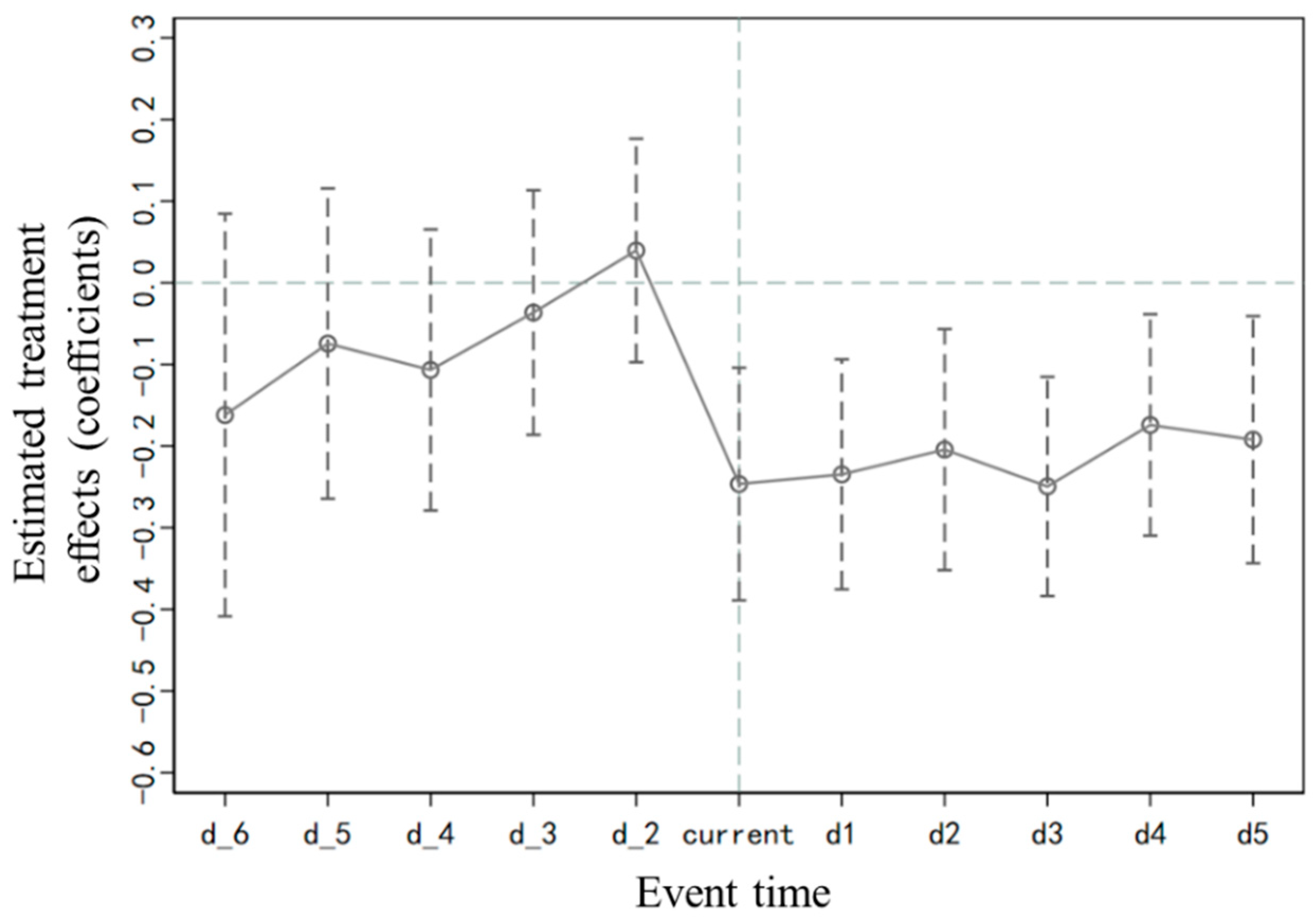
We took the year prior to the policy implementation (2014) as the baseline period. Figure 2 showed no clear pre-trends in the urban–rural income gap between pilot and non-pilot counties before the Reform, supporting the parallel-trends assumption. The estimated effect became significantly negative in the implementation year. The coefficients for the subsequent five periods remained negative, with no “rebound” above zero. Although the magnitude fluctuated slightly, it was generally stable. This suggested that the policy effect did not dissipate rapidly in the short run and exhibited some persistence.

4.2.2. Placebo Test

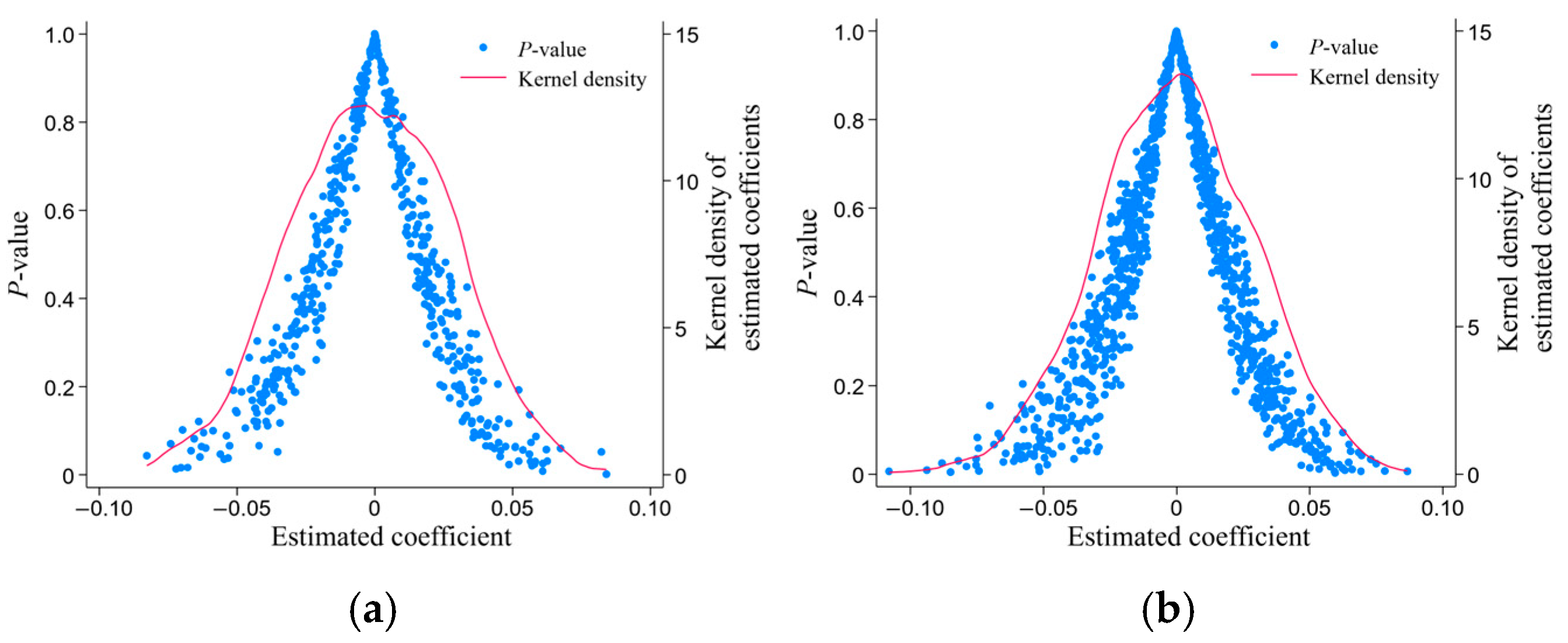
To assess the credibility of the results, we conducted a placebo test by randomly assigning “pseudo” pilot counties and estimating the distribution of the baseline regression coefficients based on these simulated assignments. We repeated this procedure 500 and 1000 times, respectively. As shown in Figure 3, the placebo DID coefficients were concentrated around zero and were clearly different from the baseline estimate. This suggested that our main results were unlikely to be driven by omitted variables or random shocks, supporting the robustness of the conclusions.

4.2.3. PSM–DID

Because pilot counties were not randomly assigned, we used a PSM–DID approach to mitigate potential selection bias by matching treated and control counties and re-estimating the policy effect. Specifically, we included per capita fiscal revenue as a matching covariate and applied kernel matching. We assigned weights based on the distance in propensity scores, giving greater weight to more similar observations. This improved matching quality and reduced between-group differences and selection bias. Column (1) of Table 3 shows that, after matching and dropping observations outside the common support, the estimated coefficient remained statistically significant and retained the same sign. This supported the reliability of our results.

4.2.4. Alternative Policy Window and One-Period-Lagged Controls

Building on the baseline specification, we further tested robustness by adjusting the policy window and lagging the control variables by one period (Table 3). Across these alternative specifications, the Reform continued to exhibit a statistically significant negative effect on the urban–rural income gap. Although the estimated magnitudes varied slightly across models, they remained broadly comparable. This indicated that our findings were not sensitive to a particular sample choice or model setup, and the results were robust.

4.2.5. Sensitivity Analysis

Given that the latest available China County Statistical Yearbook (2024) does not provide complete data coverage for the 2023 expansion, we conducted sensitivity tests focusing on the third-batch pilot counties added in 2023 (around 350 counties). We implemented five alternative treatment definitions. As reported in Table 4, the Reform yielded significantly negative coefficients under the dual-treated-group definition and the baseline definition. Under the pooled-treated-group definition, the coefficient became positive. Under the anticipated-effect definition, the coefficient was close to zero and statistically insignificant. These results indicated that both the sign and statistical significance of the estimated effect varied across definitions. Importantly, when we further excluded the 2023 pilot counties from the sample, the main conclusions remained robust. This suggested that our findings were not mechanically driven by sample composition, but instead reflected the underlying impact of the Reform.

4.3. Heterogeneity Analysis

4.3.1. Terrain-Based Heterogeneity

Mountainous and plain areas differed markedly in infrastructure development, land-use efficiency, and overall economic conditions. These differences could affect household income and the effectiveness of the Reform [45]. To examine terrain-related heterogeneity, the sample was split into two groups based on the share of mountainous terrain: high (>66%) and low (≤66%). As shown in columns (1) and (2) of Table 5, the DID coefficient for counties with a higher mountainous share was −0.229, which was larger in magnitude and statistically significant compared with the low-share group. This suggested that the Reform had a stronger gap-narrowing effect in more mountainous counties. One possible explanation was that mountainous areas faced greater constraints on traditional agriculture and often had weaker economic foundations, leaving more room for improvement. After the Reform, more efficient land allocation and improved supporting infrastructure could raise value added and facilitate industrial upgrading. These changes could translate into faster income growth in rural areas, leading to a stronger convergence in the urban–rural income gap.

4.3.2. Regional Heterogeneity

From the perspective of regional heterogeneity, we divided counties into eastern, central, and western regions and estimated the model separately. Columns (3)–(5) of Table 5 showed that the Reform had a stronger gap-narrowing effect in the eastern and western regions than in the central region. One possible explanation was that the eastern region was more economically developed. It typically had a higher degree of marketization and more efficient factor allocation. It also benefited from better infrastructure and stronger institutional support. With a more advanced industrial structure, eastern counties may have been better positioned to realize land value appreciation and translate it into income gains, thereby promoting income convergence. The western region, although less developed on average, may have had certain advantages in resource endowments and policy support. In addition, recent infrastructure improvements associated with large-scale regional development initiatives may have left greater room for value realization, leading to a more pronounced convergence effect. By contrast, many central counties faced greater pressure to protect cultivated land, which could limit the scale of market entry. Some areas also had more complex terrain and higher land development costs. Constraints in industrial upgrading, factor mobility, and institutional capacity may have further weakened the “leverage” effect of the Reform, making it harder to fully realize its potential.

4.3.3. Resource Endowment Heterogeneity

To examine whether policy effects vary with local resource endowments, we classified counties into resource-based and non-resource-based groups following the National Plan for the Sustainable Development of Resource-Based Cities (2013–2020), and then estimated the regressions. As reported in columns (6) and (7) of Table 5, compared with resource-based counties, the Reform had a stronger gap-narrowing effect in non-resource-based counties. A plausible explanation was that resource-based areas faced constraints related to resource dependence, ecological redlines, and land-use regulation. These constraints could reduce land-demand elasticity and weaken market activity, limiting the extent to which policy-related gains were transmitted to rural residents. By contrast, non-resource-based counties tended to have more diversified economic structures and more mature industrial and market systems. Land demand may have been more responsive, allowing the reform to improve factor allocation, reduce transaction costs, and ultimately narrow the urban–rural income gap.

4.4. Mediation Analysis

To further examine the mechanisms through which the Reform affected the urban–rural income gap, we followed the three-step mediation procedure proposed by Wen and Ye [46] and tested three channels: “land supply expansion”, “industrial structure upgrading”, and “efficient capital flows”. The first step was established by the baseline results in Table 2, which showed that the Reform significantly narrowed the urban–rural income gap. This provides the prerequisite for mediation analysis. The second step tested whether the Reform affects the mechanism variables, with the regression equation given by:
M i t = α 0 + α 1 t r e a t i × p o s t t + α 2 C o n t r o l i t + γ t + μ i + ε i t
In Equation (2), M i t denoted a candidate mechanism variable, all other terms were defined as in Equation (1). Columns (1)–(6) of Table 6 showed that the Reform had significantly positive effects on the transacted area and transaction value of rural collective land transfers, non-agricultural employment, the number of above-scale industrial enterprises, the ratio of year-end outstanding loans of financial institutions to GDP, and road network length per 10,000 people. These results suggested that the Reform promoted market-based land allocation in rural areas, strengthened non-agricultural industrial capacity and employment absorption, and improved capital flows and infrastructure investment. Therefore, the six variables were viewed as key mediators capturing the three mechanisms.
The third step introduced the mechanism variables into the baseline model to examine how the estimated relationship between the Reform and the urban–rural income gap changed, the regression took the following form:
Y i t = α 0 + δ M i t + α 1 t r e a t i × p o s t t + α 2 C o n t r o l i t + γ t + μ i + ε i t
In Equation (3), Y i t denoted the urban-rural income gap, all other terms were defined as in Equation (1). As reported in Table 7, the variables, such as the transacted area of rural collective land transfers, had statistically significant negative effects on the urban–rural income gap. These results provided supportive evidence for the three channels related to land, industry, and capital. Given the use of county-level proxy measures, these mediation results are indicative rather than strictly causal. Overall, the Reform narrowed the urban–rural income gap through multiple mechanisms operating jointly. Therefore, Hypothesis 2 was supported.

4.5. Extended Analysis

To further examine how the Reform performed across counties with different initial levels of the urban–rural income gap, we ranked counties by their pre-policy gap in the year prior to implementation (2014) and classified them into three groups: high, medium, and low. Equation (1) was then applied to each group to obtain the corresponding regression results. Results in columns (1)–(3) of Table 8 indicated that the gap-narrowing effect was strongest in the high-gap group. The effect remained statistically significant but was weaker in the medium-gap group. It was not significant in the low-gap group. This may have been because high-gap counties faced more pronounced urban–rural dual-structure constraints. They often exhibited larger disparities in economic conditions, resource endowments, and infrastructure, leaving greater room for improvement. In such settings, the Reform may have more strongly stimulated land factor mobility [47] and generated larger gains from improved resource allocation and income growth. Medium-gap counties may have already had some foundation for urban–rural integration, but they could still benefit from more efficient, market-oriented allocation of land factors. By contrast, low-gap counties tended to have stronger urban–rural linkages, better infrastructure, and a more balanced economic structure. As a result, the marginal impact of the Reform was likely to be limited. Overall, these findings provided further support for diminishing marginal returns: the larger the initial gap, the greater the scope for improvement.
In the baseline mechanism analysis, we used the transferred area of Reform land as a key variable. This measure directly reflected land supply expansion. However, because the scale of land supply varied substantially across counties, this absolute indicator was less comparable across regions and might not have captured the relative intensity of reform implementation. To address this issue, we introduced the share of collective construction land transfer area to measure the depth of the Reform. The absolute transferred area was driven not only by reform effort but also by a county’s overall transaction scale. By using a share-based measure, we normalized for scale differences and captured the Reform-induced shift in the composition of land transfers, which better reflected implementation intensity. The variable “share of collective operational construction land transfer area in total construction land transfer area” was introduced as a mediator M i t , and regressions are then conducted using Equations (2) and (3) to obtain the corresponding results. In Column (4) of Table 8, the results indicated that, as the policy rollout advanced, the depth of the Reform increased by approximately 3.7%. In Column (5) of Table 8, the coefficient on reform intensity was −0.041 and was significant at the 1% level, indicating that each one-unit increase in reform depth was associated with an average 4.1% reduction in the urban–rural income gap. This suggested that the Reform effect was not only driven by whether a county was treated. The estimates indicated a negative conditional association between implementation intensity and the urban–rural income gap. In other words, deeper reform implementation may have helped narrow the gap to some extent.
Existing mechanism tests did not distinguish across land transfer methods. This may have led to a potentially biased assessment of the land value realization channel. If industrial land was transferred through negotiated agreements at below-market prices, the transfer amount might not have reflected the true market value of land. In practice, negotiated transfers often involved greater administrative discretion and weaker competitive price discovery. Local governments may also have used price concessions to attract investment, accelerate project entry, or reduce firms’ upfront land costs. As a result, part of the land value gain may have been implicitly transferred to firms rather than being realized as transfer revenue. This could have weakened the explanatory power of the “land supply expansion–value realization” mechanism. To address this issue, we introduced the share of negotiated transfers (defined as the share of a county’s annual negotiated transfer amount in total land transfer revenue) and its interaction term with land transfer revenue. This allowed us to identify differences across transfer methods. The variables “Value realization”, “the share of negotiated transfers”, and their interaction term were added to the set of control variables, and the regression results were obtained using Equation (1). Result in Columns (6) of Table 8 indicated that the Reform significantly narrowed the urban–rural income gap, and land value realization played an important role. However, when the share of negotiated transfers was high, the urban–rural income gap tended to widen. The interaction term further indicated that as the negotiated-share increased, the marginal gap-narrowing effect of land value realization weakened. Overall, negotiated transfers appeared to be less efficient in price formation and in transmitting land value gains into income. This suggested that the policy effect of the Reform depended not only on the scale of land supply, but also on the institutional design of transfer methods. More market-based transfer mechanisms were more likely to reflect true land values and better support the land value realization channel.

5. Discussion and Conclusions

5.1. Conclusions

Building on the institutional context and theoretical framework, we use a county-level panel of 1380 counties in China from 2010 to 2020. We construct a quasi-natural experiment to examine the impact of the Reform on the urban–rural income gap. The main findings are as follows: (1) The parallel trends assumption holds. The Reform is associated with a statistically significant reduction in the urban–rural income gap, by approximately 17.41%, and the result remains robust in PSM-DID and a set of robustness checks. (2) The gap-narrowing effect tends to be more pronounced in counties with a high mountainous share, in counties located in eastern and western China, and in non-resource-based counties. (3) The mechanism analyses provide suggestive evidence, based on county-level proxy measures, that is consistent with multiple channels, including “land supply expansion–value realization and appreciation”, “industrial structure upgrading–labor reallocation” and “efficient capital flows–infrastructure improvement”. These channels help raise rural incomes and support high-quality economic development, thereby contributing to a narrower urban–rural income gap. (4) The policy effect appears to show diminishing marginal returns. Further deepening of the reform can help reduce the gap to some extent. More market-oriented transfer methods appear to better facilitate land value realization.

5.2. Discussion

5.2.1. Comparison with Existing Studies

The multi-period DID estimates indicated that the Reform narrowed the urban-rural income gap. The average reduction was about 17.41%. This finding was consistent with existing studies [24,25]. However, the estimated magnitude differed from some studies because research scale and model setup varied, including sample size and control variables. Single-county case studies are more limited in external validity [25]. By contrast, the sample in this study covered counties across China, which is closer to the average effect across counties in China.
Building on a factor-mobility framework, We developed and tested the mechanisms through which the Reform affected the urban-rural income gap. The analysis focused on three channels: “Land supply expansion-value realization and appreciation”, “Industrial structure upgrading-labor reallocation”, and “Efficient capital flows-infrastructure improvement”. Regarding the land value realization channel, Some scholars [19,22] drew on case evidence from areas such as Pidu District of Chengdu. They emphasized that innovation in grassroots governance and the reconfiguration of land rights were key drivers, which promoted collective land to enter market transactions. They also supported the realization of its asset value. We further applied a mediation model to test the land resource allocation pathway. The results indicated that the Reform increased both the transacted area and the transaction value of collective land, which provided more direct nationwide quantitative evidence for land value realization. Regarding the industrial upgrading channel, existing studies often focused on a single dimension, such as non-agricultural industry development or employment absorption [37,38]. We decomposed the channel into two parallel mediation paths under the same identification framework. The first path was the industrial link, proxied by the number of industrial enterprises above designated size. The second path was the employment link, proxied by the scale of non-agricultural employment. This two-link design reduced reliance on a single proxy indicator. It also improved the testability of the mechanism interpretation. Existing studies interpreted the capital mobility mechanism mainly from the supply side, with an emphasis on financial development and credit constraints [41,44]. This paper further incorporated expectations of land value appreciation and incentives for long-term investment. Based on this, the mechanism was organized as “a virtuous cycle of capital flows, infrastructure capacity, factor agglomeration-productivity gains.” Productivity gains then improved factor allocation and the market environment. This, in turn, supported the operation of the other two channels, namely land value realization and industrial expansion with employment absorption.
To facilitate a direct comparison with the existing literature, we adopted an eastern-central-western grouping to characterize regional differences in factor markets and institutional environments [1,24,48]. The policy effect was stronger and significant in western China, weaker in eastern China and insignificant in central China. This pattern contrasted with prior studies that emphasized the marketization advantage of eastern China [37]. It also showed that the regional pattern was not monotonic. For topographic heterogeneity, this paper used the share of mountainous area as the grouping criterion. It tested whether the Reform effect differed systematically under different terrain constraints. In mountainous counties, gains from farmland transfers mainly accrued at the household business level, which have widened the income gap [45]. By contrast, the Reform generated returns through the appreciation of collective assets and entered the distribution process. This was more likely to have promoted income-gap convergence. For resource endowment heterogeneity, this paper grouped counties into resource-based and non-resource-based types. It brought resource dependence and related industrial-structure features into the interpretation framework. This complemented existing studies that mainly relied on regional gradients to define heterogeneity [1,24,37,47].

5.2.2. Policy Implications

Although this study focuses on the Market-Oriented Reform of Rural Collective Operational Construction Land in China, the empirical evidence may offer policy insights for countries and regions where land institutions are segmented, where urban–rural factor mobility is constrained, or where collective land governance structures exist.
(1)
Continue to deepen the reform and strengthen institutional coherence and stability
Building on lessons from the pilot programs, policymakers should strengthen the theoretical guidance for the reform and expand its coverage in a steady manner [49]. At the same time, it is important to accelerate the improvement of relevant laws, regulations, and detailed implementation rules [50], and to develop a coordinated institutional framework across different levels of government to scale up the reform outcomes. In addition, reform design should balance institutional innovation with social stability, while preserving the collective ownership attributes of land. This can enhance policy predictability and improve long-term performance.
(2)
Adopt place-based implementation to improve policy fit and targeting
Reform design should account for local resource endowments and development conditions, and should be implemented in a differentiated manner. For counties with large urban–rural income gaps, prioritizing market entry may help strengthen the income-redistributive effect. Given location differences, eastern areas can place greater emphasis on market-based operation, while western areas should combine stronger policy support and complementary infrastructure investment with the principles of “controlled expansion, appropriate land use, and ecological priority,” so as to balance economic benefits with ecological security. In counties with a high mountainous share, land-use models should be adapted to local terrain, supported by feasibility assessments and small-scale pilots. Priority can be given to eco-friendly and low-cost land supply approaches to avoid extensive development and subsequent idle or inefficient land use. For non-resource-based counties, reforms can be deepened by leveraging their more diversified industrial base. Resource-based counties, by contrast, should explore tailored transition pathways to reduce dependence on resource-driven growth.
(3)
Promote two-way mobility of multiple factors to improve allocation efficiency
Expanding land supply alone does not automatically translate into income gains. What matters more is a complementary policy package that links land market entry with industrial introduction, job creation, financial support, and improvements in public services. Local governments should use the Reform as an opportunity to strengthen the coordination between land, capital, and industry, activate idle and underutilized land, and appropriately increase the share of market-based transfers of collectively owned land. At the same time, they should upgrade the industrial structure and improve infrastructure. These efforts can further facilitate two-way factor mobility and more efficient resource allocation [51], strengthen endogenous growth momentum, and enhance county-level competitiveness and sustainable development.
(4)
Improve benefit-sharing and oversight mechanisms to sustain long-term impacts
A core objective of the Reform is to enhance the market value of collectively owned land and to distribute value-added gains in a fair and effective manner. Local governments should develop practical arrangements for benefit sharing and public-interest spending that reflect local fiscal capacity as well as the needs of village collectives and rural households. It is also important to strengthen information disclosure and market supervision, and to improve collaborative governance among village collectives, enterprises, and governments, complemented by social oversight. Together, these measures can help form a fair, durable, and scalable model for reform implementation.

5.2.3. Limitations and Future Research

Although the DID framework and a range of robustness checks yield consistent results, this study has several limitations. First, the mechanism analysis relies mainly on county-level proxy measures, which may involve measurement error. Therefore, the mechanism results should be interpreted as supportive evidence. Future research could integrate household-level microdata with micro-level land transaction records to identify the transmission channels and their magnitudes more precisely. Second, due to data constraints, we are unable to evaluate the policy effects of the 2023 expansion of the pilot program. We also do not systematically identify potential spatial spillovers arising from factor mobility. Future research could incorporate data from the new round of pilots and apply spatial analysis to compare policy effects across different stages and to delineate spillover boundaries. This would allow a more comprehensive assessment of the Reform’s long-term impacts and its scope of applicability.

Author Contributions

Conceptualization, J.C. and Y.Z.; methodology, Y.Z.; software, Y.Z.; validation, Y.Z.; formal analysis, Y.Z.; investigation, Y.Z.; data curation, Y.Z.; writing—original draft, Y.Z.; writing—review and editing, J.C. and Y.Z.; visualization, Y.Z.; supervision, J.C.; project administration, Y.Z. All authors have read and agreed to the published version of the manuscript.

Funding

This work was supported by the Humanities and Social Sciences Research Youth Fund of the Ministry of Education of the People’s Republic of China (23YJCZH267).

Data Availability Statement

The processed dataset and code for replication supporting the conclusions of this article will be made available by the authors upon reasonable request.

Conflicts of Interest

The authors declare no conflicts of interest.

References

  1. Tang, J.; Tian, T. Construction Land Institution Innovation in China for Common Prosperity: Logic, Concept and Path. China Land Sci. 2022, 36, 1–9. [Google Scholar]
  2. Sun, Q.P. Rural Collective Commercial Construction Land: Market Entry and Local Government Behavior. Shanghai J. Econ. 2020, 11, 5–18. [Google Scholar] [CrossRef]
  3. Zhou, L.; de Vries, W.T. Collective Action for the Market-Based Reform of Land Element in China: The Role of Trust. Land 2022, 11, 926. [Google Scholar] [CrossRef]
  4. Galiani, S.; Schargrodsky, E. Land Property Rights and Resource Allocation. J. Law Econ. 2011, 54, 329–345. [Google Scholar] [CrossRef]
  5. Wen, L.J.; Chatalova, L.; Zhang, A.L. Can China’s unified construction land market mitigate urban land shortage? Evidence from Deqing and Nanhai, Eastern coastal China. Land Use Policy 2022, 115, 105996. [Google Scholar] [CrossRef]
  6. Meckelburg, R.; Wardana, A. The political economy of land acquisition for development in the public interest: The case of Indonesia. Land Use Policy 2024, 137, 107017. [Google Scholar] [CrossRef]
  7. Ding, C.R. Land policy reform in China: Assessment and prospects. Land Use Policy 2003, 20, 109–120. [Google Scholar] [CrossRef]
  8. Galiani, S.; Schargrodsky, E. Property rights for the poor: Effects of land titling. J. Public Econ. 2010, 94, 700–729. [Google Scholar] [CrossRef]
  9. Besley, T. Property Rights and Investment Incentives: Theory and Evidence from Ghana. J. Polit. Econ. 1995, 103, 903–937. [Google Scholar] [CrossRef]
  10. Jin, X.M.; Wang, Y.M. The Transformation Structure and Coupling Mechanism for the “Dual-Track System” of Collective Construction Land Marketization. Chin. Rural Econ. 2024, 7, 16–34. [Google Scholar]
  11. Ma, C.P. Exploration and Evaluation of Collective Operating Construction Land System: An Analysis Based on the First Batch of Pilot Projects. Chin. Rural Econ. 2021, 11, 35–54. [Google Scholar]
  12. Hu, R.M.; Tan, R. Governance Modes for Coordinated Rural Construction Land Transfer. China Land Sci. 2021, 35, 101–108. [Google Scholar]
  13. Cao, X.H. Market-Entry Models for Collective Construction Land and Their Legislative Options. Theor. Explor. 2016, 2, 116–122. [Google Scholar]
  14. Ma, C.P. Practice Exploration and System Optimization of Income Distribution of Rural Collective Operating Construction Land Entering the Market. Reform 2022, 10, 106–116. [Google Scholar]
  15. Lv, D.; Xue, K.W. The Evolutionary Game of the Marketization of Commercial Collective Construction Land’s Income—Role and Approaches of Local Government. J. Agrotech. Econ. 2021, 9, 115–128. [Google Scholar]
  16. Chen, H.B. Rural Collective Operating Construction Land Enter the Market: Progress, Difficulties and Solutions. Mod. Econ. Res. 2019, 7, 112–117. [Google Scholar]
  17. Gao, X.M.; Gu, Y.W. Challenges and Breakthrough Pathways for the Market Entry of Collective Operating Construction Land from the Perspective of Common Prosperity. Rural Econ. 2023, 9, 11–19. [Google Scholar]
  18. Lu, J.; Chen, Z.T. Pilot Reform of Collective Operating Construction Land Entering the Market: Difficulties and Solutions. J. Nanjing Agric. Univ. Soc. Sci. Ed. 2019, 19, 112–122+159. [Google Scholar]
  19. Yang, R.H.; Yang, Q.Y.; Feng, Y.T. Grassroots Governance in Rural Collective-owned Commercial Construction Land Transaction: A Case Study on Baohua Village, Pidu District, Chengdu City Based on Grounding Theory. West Forum 2020, 30, 32–42. [Google Scholar]
  20. Yang, R.H.; Zhang, Y.P. Fictitious commodification of land to solve rural crises?: Lessons from an experiment in rural Chengdu, China. Geoforum 2023, 143, 103769. [Google Scholar] [CrossRef]
  21. Comprehensive Research Task Force, National School of Development, Peking University; Zhou, Q.R. Property Rights Delineation: The Case of Chengdu’s Land Reform. Int. Econ. Rev. 2010, 2, 54–92+5. [Google Scholar]
  22. Yang, Q.Y.; Yang, R.H.; Zeng, L.; Chen, Y.D. Transaction of Rural Commercial Collective-Owned Construction Land Increases Farmers’ Land Property Income: A Case Study of Pidu District, Chengdu City. Econ. Geogr. 2017, 37, 155–161. [Google Scholar]
  23. He, X.F. Land-Use Problems in the Three Pilots of the Land-System Reform. J. Cent. South Univ. Soc. Sci. 2018, 24, 1–9. [Google Scholar]
  24. Luo, B.L.; Li, S.P. Policy Effect of the Reform of Collective Commercial Construction Land: An Empirical Evidence from a Quasi-natural Experiment. Issues Agric. Econ. 2023, 9, 19–36. [Google Scholar]
  25. Zhao, W.; Zhu, P.X.; Yu, J. Research on the Impact of Rural Construction Land Marketization on Urban-rural Integrated Development: Empirical Evidence from the Pilot Reform in Deqing County, Zhejiang Province. China Land Sci. 2023, 37, 42–52. [Google Scholar]
  26. Zhang, M.Y.; Chen, Q.X.; Zhang, K.W.; Yang, D.Y. Will Rural Collective-Owned Commercial Construction Land Marketization Impact Local Governments’ Interest Distribution? Evidence from Mainland China. Land 2021, 10, 209. [Google Scholar] [CrossRef]
  27. Jiao, M.; Xu, H. Does Rural Construction Land Marketization Inhibit State-Owned Industrial Land Transactions? Evidence from Huzhou City, China. Land 2022, 11, 1587. [Google Scholar] [CrossRef]
  28. Liu, Y.X.; Yang, M.H. Suppression and Resistance in the Development Rights of Farmers’ Collectively Owned Land in China. Chin. Rural Econ. 2003, 6, 16–24. [Google Scholar]
  29. Wang, X.Y. On the Distribution of Transfer Revenues from the Market Entry of Rural Collective Operating Construction Land. Rural Econ. 2014, 10, 3–7. [Google Scholar]
  30. Qu, F.T.; Tian, G.M. The Coordination Urban Growth between Rural Development, and the Reform of the System of the Property Right of the Rural Collective Land. J. Manag. World 2011, 6, 34–46+187. [Google Scholar]
  31. North, D.C. Institutions and Economic Theory. Am. Econ. 1992, 36, 3–6. [Google Scholar] [CrossRef]
  32. Ely, R.T.; Morehouse, E.W. Elements of Land Economics; The Commercial Press: Beijing, China, 1982; pp. 163–164. [Google Scholar]
  33. Marx, K. Capital: A Critique of Political Economy (Volume III); People’s Publishing House: Beijing, China, 2004; pp. 704–714. [Google Scholar]
  34. Liu, H.B.; Liu, Y.Y. The System of Collective Operating Construction Land: Reform Logic and Future Trend—Based on the Theoretical Analysis of Incomplete Property Rights-rent Dissipation. J. Nanchang Univ. Hum. Soc. Sci. 2020, 51, 50–60. [Google Scholar]
  35. Lewis, W.A. Economic Development with Unlimited Supplies of Labour. Manch. Sch. 1954, 22, 139–191. [Google Scholar] [CrossRef]
  36. Wang, S.L.; Chen, X. Effects of Rural Construction Land Marketization on Urban Land Use Efficiency. China Land Sci. 2023, 37, 113–122. [Google Scholar]
  37. Wang, R.Y.; Tan, R. Efficiency and distribution of rural construction land marketization in contemporary China. China Econ. Rev. 2020, 60, 101223. [Google Scholar] [CrossRef]
  38. Wang, K.Q.; Yang, Y.X.; Liu, H.M.; Liu, Z.B. Study on the Impact of Collective Commercial Construction Land Entering the Market on the Urban-Rural Integrated Development. J. Agrotech. Econ. 2023, 2, 45–63. [Google Scholar]
  39. Wang, W.F. Short-term or long-term? New insights into rural collectives’ perceptions of Land Value Capture within China’s rural land marketization reform. J. Rural Stud. 2022, 89, 87–97. [Google Scholar] [CrossRef]
  40. Yang, R.H.; Kesteloot, C. The interaction between local state and village collective in China’s market-oriented land reform: A case study in Pidu, Sichuan. J. Peasant Stud. 2025, 52, 1042–1070. [Google Scholar] [CrossRef]
  41. Hu, Z.Y.; Liu, Y.W. Research of the Kuznets Effect of Financial Non-balanced Development and Urban-Rural Income Distribution—The Analysis Based on the County-Level Cross-Section Data in China. Stat. Res. 2010, 27, 25–31. [Google Scholar]
  42. Zhao, K.J.; Jing, P.Q. A Study on Nonlinear Effect Between Factor Flow and Urban-Rural Economic Integration in China—Empirical test based on provincial panel data. Inq. Econ. Issues 2019, 10, 1–12. [Google Scholar]
  43. Zhang, K.; Xiong, Z.Y.; Huang, X.J.; Zhao, L. Red Tourism and Urban-rural Income Gap in Old Revolutionary Base Areas:An Empirical Analysis Based on the Difference-in-Differences Method. Chin. Rural Econ. 2023, 5, 103–121. [Google Scholar]
  44. Liu, S.H.; Zhu, J. Empirical Study on the Relationship Among Financial Development, Urbanization and Urban & Rural Residents’ Income Gap. Econ. Geogr. 2017, 37, 46–52. [Google Scholar]
  45. Niu, W.H.; Shen, S.H.; Luo, L.; Chai, C.Q.; Zhang, B.B.; Li, Y.H.; Zheng, W.W.; Kong, X.B. The impacts and its decomposition of cultivated land transfer on rural households’ income gap from the perspective of terrain difference: A case study of 1879 survey data of rural households in the middle and upper reaches of the Yellow River Basin. J. Nat. Resour. 2023, 38, 1262–1282. [Google Scholar] [CrossRef]
  46. Wen, Z.L.; Ye, B.J. Analyses of Mediating Effects: The Development of Methods and Models. Adv. Psychol. Sci. 2014, 22, 731–745. [Google Scholar] [CrossRef]
  47. Chen, K.Q.; Zhou, J.J.; Chen, Y.Y.; Chen, J. Pattern and Mechanism of The Flow of Urban-rural Land Elements in China. Econ. Geogr. 2024, 44, 183–192. [Google Scholar]
  48. Yao, P.; Jia, Q.; Liu, J.X.; Yamaka, W. Reform of Collective Land for Construction and Rental Housing and the Growth of Farmers’ Property Income: Evidence from China. Land 2023, 12, 131. [Google Scholar] [CrossRef]
  49. Hu, H.W.; Tan, R.; Hu, R.M.; Zhang, K.W. Configuration Path Analysis of Local Governments Actively Promoting Rural Construction Land Marketization Reform: Based on Qualitative Comparative Analysis of 32 Pilot Areas. China Land Sci. 2024, 38, 19–28. [Google Scholar]
  50. Liu, Y.H. Progress, Salient Problems, and Policy Responses in the Market Entry of Use Rights for Rural Collective Operating Construction Land. Rural Econ. 2018, 12, 18–23. [Google Scholar]
  51. Zhang, C.; Long, H.L. Research on the Impact of Rural Land Institution Reform on Urban-rural Integration Development at County Level: Evidence from a Quasi-Natural Experiment. J. Soochow Univ. Philos. Soc. Sci. Ed. 2024, 45, 121–133. [Google Scholar]
Figure 1. Framework of the Impact Mechanism. Note: The triangle decomposes the Reform into three mechanism channels, whereas the circle summarizes their joint contribution to the urban–rural income gap; the arrow between them indicates this aggregation.
Land 15 00364 g001
Figure 2. Results of the parallel trends test.
Land 15 00364 g002
Figure 3. Placebo test. (a) 500 randomized placebo assignments; (b) 1000 randomized placebo assignments.
Land 15 00364 g003
Table 1. Variable definitions and descriptive statistics.
Variable NameMeasurement MethodNMeanStandard
Deviation
MinimumMaximum
Dependent
variable
Urban–rural income gapRatio of urban disposable income per capita to rural disposable income per capita/%15,1762.470.7220.1977.015
Control
Variable
Economic developmentGDP per capita/CNY15,17638,949.2228,431.827749169,000
Industrial structureShare of secondary and tertiary value added in GDP/%15,1760.8030.1160.2452.009
Fiscal expenditureRatio of local fiscal budget expenditure to GDP/%15,1760.2670.2060.0343.941
Communication infrastructureComposite communication index15,17600.999−4.3096.449
Agricultural developmentGrain output per 10,000 people/(t/10,000 people)15,1766429.4967737.78615.877209,000
Education developmentNumber of secondary school students per 10,000 people/(persons/10,000 people)15,176481.199155.95731.9782069.345
Public servicesHospital and health-center beds per 10,000 people/(beds/10,000 people)15,17638.9418.181.224198.895
Social securityBeds in welfare institutions per 10,000 people/(beds/10,000 people)15,17632.34625.590.216355.913
Household wealthHousehold savings deposits per 10,000 people/(10,000 CNY/10,000 people)15,17625,149.5718,074.721184.833233,000
Population densityPopulation per square kilometer/(persons /km2)15,176313.464289.6051.5293876.404
Mechanism
Variable
Land resource allocationTransaction area of rural collective land transfers/hm211,21258.74284.9340.0011855.72
Transaction value of rural collective land transfers/10,000 CNY11,16425,654.7666,612.298103.3461960,000
Non-agricultural employment and industrial developmentNon-agricultural employment/10,000 people14,79515.58314.8340.0178.01
Number of above-scale industrial enterprises/count15,017113.032171.27221152
Capital flows and infrastructureRatio of outstanding loans of financial institutions at year-end to GDP/%13,9360.5880.2950.0022.184
Road network length per 10,000 people/(km/10,000 people)10,3412.6080.9810.0026.641
Reform intensityShare of rural collective land transfer area/%11,5340.6530.25901
Note: Except for the urban–rural income gap, industrial structure, fiscal expenditure, communication infrastructure, capital flow, and reform intensity, all other variables are entered in logarithmic form in the regressions. The communication index is constructed using the numbers of mobile phone users, broadband users, and fixed-line telephone users. It is estimated with a structural equation model using full-information maximum likelihood and then standardized. The coefficient of determination for the model residuals is CD = 0.698, and the three-indicator reliability is acceptable ( C r o n b a c h s   α = 0.7007 ), suggesting that the composite communication index is valid. The measures of collective land transfer area and transaction value are obtained by filtering land transfer records based on transfer method and land-use type.
Table 2. Baseline regression results.
VariablesUrban–Rural Income Gap
(1)(2)(3)(4)(5)
DID−0.1512 ***−0.1584 ***−0.1630 ***−0.1632 ***−0.1741 ***
(−4.2567)(−4.4671)(−4.5172)(−4.5234)(−4.8045)
Economic development −0.0776 ***−0.0507 **−0.0291−0.0270
(−3.1436)(−2.0285)(−1.1327)(−1.0117)
Industrial structure −0.2074 *−0.2067 *−0.2167 *−0.2072 *
(−1.6717)(−1.6961)(−1.7855)(−1.7123)
Fiscal expenditure −0.1266−0.1169−0.1239−0.1244
(−1.4508)(−1.3406)(−1.4298)(−1.4345)
Communication infrastructure −0.0318 ***−0.0287 ***−0.0312 ***
(−5.3550)(−4.7241)(−4.9915)
Agricultural development −0.00300.0106−0.0021
(−0.1930)(0.6462)(−0.1210)
Education development −0.1807 ***−0.1600 ***−0.1681 ***
(−8.8960)(−7.6820)(−7.5859)
Public services −0.0909 ***−0.0959 ***
(−4.5708)(−4.6896)
Social security 0.00620.0035
(1.1978)(0.6781)
Household wealth −0.0711 **
(−2.1621)
Population density −0.1694 ***
(−4.1926)
Constant2.4712 ***3.4756 ***4.3255 ***4.1748 ***5.9254 ***
(916.0951)(12.7254)(14.5921)(13.7634)(11.7731)
County fixed effectsYESYESYESYESYES
Year fixed effectsYESYESYESYESYES
N15,17615,17615,17615,17615,176
R20.8080.8080.8110.8110.812
Note: ***, **, and * denote significance at the 1%, 5%, and 10% levels, respectively. Robust standard errors were reported in parentheses. All regressions controlled for county and year fixed effects. The same applied to the tables below. We extended the sample period to 2010–2023 and restricted the treatment period to 2015–2019. The estimated coefficient in the extended sample was −0.1962. It remained negative and statistically significant, consistent with the baseline results. The difference in point estimates fell within a statistically plausible range, indicating that the 2010–2020 sample sufficiently covered the full policy window of the first two pilot batches. Adding later years did not change the main conclusion. Therefore, our results were not driven by the choice of the sample window and were robust to alternative time ranges.
Table 3. PSM-DID robustness test results.
Variables(1)(2)(3)(4)(5)(6)
PSM-DID2013–20172012–20182011–2019Lagged Controls (1)Lagged Controls (2)
DID−0.2950 ***−0.2463 ***−0.2275 ***−0.1997 ***−0.1512 ***−0.1713 ***
(−2.7405)(−5.2043)(−5.5067)(−5.2684)(−4.2567)(−4.7072)
ControlsYESYESYESYESNOYES
Constant0.25394.4891 ***5.8520 ***5.9185 ***2.4712 ***5.6035 ***
(0.0487)(8.5413)(12.3141)(14.2899)(916.0951)(14.4614)
N11,4146899965812,41815,17613,795
R20.7600.9550.9140.8820.8080.879
*** denotes significance at the 1% level.
Table 4. Sensitivity test results.
Variables(1)(2)(3)(4)(5)
Dual Treated-Group DefinitionBaseline DefinitionPooled Treated-Group DefinitionAnticipated-Effect DefinitionClean Control-Group Definition
2015 DID−0.1656 ***−0.1741 *** −0.1663 ***
(−4.5625)(−4.8045) (−4.5664)
2023 DID0.0843 ***
(5.1727)
Pooled/anticipated effect 0.0437 ***−0.0079
(2.8410)(−0.4920)
ControlsYESYESYESYESYES
Constant5.9161 ***5.9254 ***5.7189 ***5.7696 ***6.1801 ***
(11.7540)(11.7731)(11.4488)(11.5402)(11.5031)
N15,17615,17615,17615,17613,647
R20.8120.8120.8120.8110.810
Notes: Column (1) defined the 33 pilot counties introduced in 2015/2016 and the counties added in 2023 as two separate treated groups. Column (2) retained only the 33 pilots from 2015/2016 as the treated group. Column (3) pooled the 33 pilots and the 2023 pilots and assumed that all treated counties were affected by the policy starting in 2015. Column (4) assumed an anticipated effect for the 2023 pilots beginning in 2019. Column (5) retained only the 33 pilots and used a control group that excluded the counties added to the pilot program in 2023. *** denotes significance at the 1% level.
Table 5. Heterogeneity regression results.
Variables(1)(2)(3)(4)(5)(6)(7)
High Mountainous ShareLow Mountainous ShareEastern RegionCentral RegionWestern RegionResource-BasedNon-Resource-Based
DID−0.229 ***−0.158 ***−0.111 **−0.097−0.318 ***−0.009−0.225 ***
(−5.340)(−2.826)(−1.968)(−1.447)(−5.554)(−0.134)(−5.245)
ControlsYESYESYESYESYESYESYES
Constant6.157 ***1.222 **3.619 ***3.661 ***7.319 ***6.204 ***5.294 ***
(16.062)(2.301)(3.568)(4.397)(7.839)(9.001)(7.164)
N9160601634186006575268208356
R20.8060.7930.8500.7810.7960.8240.797
Notes: To avoid potential bias arising from differences in the administrative level used to identify resource-based areas, we refined the classification based on the original definition and redefined resource-based areas using only county-level units that were explicitly listed as such. The results showed that the sign and statistical significance of the estimated coefficient remained unchanged across the two definitions (−0.225 under the original definition and −0.193 under the stricter county-level definition; both significant at the 1% level). This indicated that our conclusions were not driven by the classification approach and remained robust. *** and ** denote significance at the 1% and 5% levels, respectively.
Table 6. Mediation effect test: regression results (1).
VariablesLand Resource AllocationNon-Agricultural Employment and Industrial DevelopmentCapital Flows and Infrastructure
(1)(2)(3)(4)(5)(6)
Transaction Area of Rural Collective Land TransfersTransaction Value of Rural Collective Land TransfersNon-Agricultural EmploymentNumber of Above-Scale Industrial EnterprisesRatio of Outstanding Loans of Financial Institutions at Year-End to GDPRoad Network Length per 10,000 People
DID0.2648 ***0.3458 ***0.0878 ***0.0996 **0.3643 ***0.1706 **
(2.8278)(2.6008)(2.6588)(2.4625)(9.6345)(2.1366)
ControlsYESYESYESYESYESYES
Constant−4.1964 **−1.9617−1.8810 ***−2.5662 ***0.7292 ***3.1595 ***
(−2.2470)(−0.9580)(−3.1255)(−5.7056)(2.8906)(4.2723)
N11,20911,16214,79315,01613,93010,339
R20.6090.6590.8940.9580.8050.921
*** and ** denote significance at the 1% and 5% levels, respectively.
Table 7. Mediation effect test: regression results (2).
Variables(1)(2)(3)(4)(5)(6)
DID−0.1584 ***−0.1863 ***−0.1568 ***−0.1232 **−0.2143 ***−0.2335 ***
(−2.8282)(−2.8138)(−4.0061)(−2.3023)(−3.8616)(−4.5479)
Transaction area of rural collective land transfers−0.0086 ***
(−2.6665)
Transaction value of rural collective land transfers −0.0081 ***
(−2.6095)
Non-agricultural employment −0.0363 ***
(−4.2816)
Number of above-scale industrial enterprises −0.0332 ***
(−2.7955)
Ratio of outstanding loans of financial institutions at year-end to GDP −0.0572 **
(−2.0134)
Road network length per 10,000 people −0.0136 **
(−1.9895)
ControlsYESYESYESYESYESYES
Constant6.0259 ***6.1846 ***5.8104 ***5.8996 ***5.7390 ***3.9026 ***
(10.0103)(11.2112)(11.4085)(11.5725)(11.4672)(10.4458)
N11,20911,16214,79315,01613,93010,339
R20.8310.8320.8240.8140.8200.943
*** and ** denote significance at the 1% and 5% levels, respectively.
Table 8. Extended analysis results.
Variables(1)(2)(3)(4)(5)(6)
Low-Gap GroupMedium-Gap GroupHigh-Gap GroupIntensity EffectUrban–Rural Income Gap (Supply Intensity)Urban–Rural Income Gap (Value Realization)
DID−0.065−0.127 **−0.254 ***0.037 ***−0.171 ***−0.348 ***
(−1.105)(−2.047)(−4.677)(2.644)(−4.469)(−2.732)
Share of collective land transfer area −0.041 ***
(−2.633)
Value realization (transfer value) −0.007 *
(−1.946)
Share of negotiated transfers 0.154 **
(2.281)
Interaction term −0.022 **
(−2.271)
ControlsYESYESYESYESYESYES
Constant2.472 ***7.995 ***6.443 ***0.1106.672 ***5.908 ***
(2.785)(11.945)(6.439)(0.303)(11.838)(4.035)
N50605059505911,53411,5344416
R20.7990.8140.7790.2870.8290.830
***, **, and * denote significance at the 1%, 5%, and 10% levels, respectively.
Disclaimer/Publisher’s Note: The statements, opinions and data contained in all publications are solely those of the individual author(s) and contributor(s) and not of MDPI and/or the editor(s). MDPI and/or the editor(s) disclaim responsibility for any injury to people or property resulting from any ideas, methods, instructions or products referred to in the content.