Article

Advancing Buffer Zone Delineation for Urban Cultural Heritage: A Risk-Based Framework

1
College of Landscape Architecture, Nanjing Forestry University, No. 159, Longpan Road, Nanjing 210037, China
2
College of Arts and Innovation Design, Suzhou City University, No. 1188, Wuzhong Road, Suzhou 215104, China
*
Author to whom correspondence should be addressed.
Land 2026, 15(3), 362; https://doi.org/10.3390/land15030362
Submission received: 30 January 2026 / Revised: 18 February 2026 / Accepted: 21 February 2026 / Published: 24 February 2026

Abstract

Rapid urbanization increasingly threatens urban cultural heritage. While buffer zones are crucial for mitigating external pressures, conventional delineation relies on value-based or geometric rules, overlooking parcel-scale heterogeneous externalities. This study addresses this gap by proposing a parcel-based, risk–value coupling framework that delineates heritage buffer zones and supports differentiated land-use regulations. In this study, “negative-impact risk” is operationalized as a composite proxy of cumulative urban development pressures that may increase the likelihood and potential severity of adverse externalities on heritage settings, rather than a full hazard–exposure–vulnerability risk model. And we construct a multi-source indicator system with 12 parcel-level indicators to characterize negative impact risk and heritage value, and adopt a hybrid weighting strategy integrating an AHP, entropy weighting, and game-theoretic combination to reconcile expert judgement and data-driven heterogeneity. To address uncertainty in multi-criteria evaluation, a cloud model maps indicator sets into discrete management levels. The framework is applied to the Pingjiang Historic District in Suzhou, China, using 121 land parcels as decision units. Results show that the approach identifies spatial risk–value patterns and delineates an operational buffer prioritizing parcels with elevated coupled scores. Compared with a fixed-distance buffer, it achieves greater coverage of high-risk parcels while maintaining a smaller regulatory scope. The parcel classification is then translated into tiered planning controls, including development intensity limits, land-use rules, and monitoring priorities. The framework integrates risk management and heritage conservation to support uncertainty-aware, proactive, and transferable zoning decisions.

1. Introduction

In rapidly urbanizing contexts, development-related pressures can become a dominant source of incremental impacts on heritage surroundings compared with natural disasters [1,2]. Human-driven urban transformation is increasingly threatening the world’s fundamental historical, social, and artistic heritage [3,4,5]. As a result, a key concern is how to safeguard the integrity of urban cultural heritage values from being compromised [6,7].
Buffer zones have become a prominent area of research as a vital management tool recognized by the World Heritage Committee for countering external threats and preserving the integrity of a heritage site’s Outstanding Universal Value (OUV) [8,9,10,11]. A buffer zone refers to an area surrounding a heritage site that offers additional protection through strict regulation of land use [9,12,13]. Numerous reports and conventions have highlighted the importance of buffer zones in the context of urban cultural heritage [14,15]. For instance, the 2005 Xi’an Declaration of ICOMOS stressed the necessity of establishing buffer zones to enhance the comprehensive conservation of settings and elements linked to the spiritual and cultural dimensions of historic heritage sites [16]. Therefore, the buffer zone is a promising tool for protecting and preserving urban cultural heritage and promoting its sustainable development [17].
Despite their critical role, conventional buffer zone delineation methods based on limited evaluation and the imposition of fixed boundaries around architectural heritage have led to various issues and ongoing challenges. Traditional approaches to buffer zone delineation often focus primarily on isolated elements, such as urban fabric or visual continuity [18,19,20]. Effective buffer zones around urban cultural heritage must strike a careful balance between being overly expansive, which stifles development, and being too limited, which threatens heritage preservation [16]. The inclusion of numerous low-conservation-value areas within the buffer zone that have not undergone comprehensive evaluation results in unduly stringent conservation measures. These measures potentially hinder local socioeconomic development [19,21].
Therefore, recent studies have presented more comprehensive methods for buffer zone delineation based on detailed value evaluation results [4,16,19]. These methods allow for a more scientific definition of protection boundaries through quantitative assessment, multi-attribute evaluation, and spatial visualization, providing much greater reliability and detail than traditional practices [22]. However, the value-based approach does not assess future risks to urban cultural surroundings, overlooks potential threats to those surroundings, and fails to consider dynamic changes in the heritage environment [11,23]. Indeed, while low-value areas near cultural heritage sites may be more likely to affect them, a value-based approach to buffer zone delineation might neglect such areas. Therefore, the value-based approach is not comprehensive. This reveals a clear knowledge gap that existing value-oriented delineation methods lack an explicit risk assessment to guide buffer zoning under dynamic urban pressures.
The buffer zone reflects the influence and potential negative effects of the periphery on the core area of urban cultural heritage [11], aligning with the main objectives of risk management [24]. Thus, a risk-based approach to buffer zone delineation can more effectively identify threats and help preserve the authenticity and integrity of urban cultural heritage. Consequently, developing a buffer zone delineation method grounded in negative impact risk assessment is essential. Here, risk refers to the risk of negative externalities to heritage settings induced by urban development pressures, which is measured through observable pressure proxies at the parcel scale.
Recognizing the unique value of urban cultural heritage and the threat of irreversible damage from the urban environment, this study aims to develop a risk-based approach for delineating buffer zones. The approach defines the extent of the buffer zone by assessing potential negative impacts on areas surrounding urban cultural heritage sites. The proposed framework supports evidence-based land-use control by translating the relationship between risk and value into practical zoning boundaries and tailored development regulations.

2. Methods

2.1. Theoretical Framework for Risk-Based Buffer Zone Delineation

This study integrates risk management with urban heritage conservation theory to reconceptualize the buffer zone as a strategic spatial governance instrument designed to mitigate negative externalities generated by intensive urban development. From a planning perspective, the vulnerability of urban heritage is recognized not as a static inherent attribute, but as a dynamic function of its exposure to external pressures. Moving beyond conventional “fixed-distance” delineation methods, we propose a risk–value coupling framework to facilitate evidence-based and differentiated heritage governance.
Rather than conceptualizing risk as acute catastrophic events, this study defines “negative-impact risk” in a planning-oriented lens, operationalizing it as a parcel-scale composite index of cumulative urban development pressures. Specifically, the selected indicators represent distinct causal pathways to approximate: (i) the probability that surrounding land-use activities generate adverse externalities, and (ii) the potential magnitude of such impacts mediated by spatial proximity and accessibility factors. Concurrently, heritage value is treated as the receptor sensitivity. Within this risk-based framework, higher significance dictates elevated protection priority and a diminished tolerance for external disturbances.
This theoretical framework establishes the scientific foundation for indicator selection, ensuring that each metric functions as a proxy for the specific mechanisms linking urban expansion to heritage degradation. The resulting risk–value coupling enables a shift from subjective boundary delineation toward transparent, risk-informed, and hierarchical spatial governance.

2.2. Overview of the Method and Design

This study defines risk as the potential negative effect of the external environment on urban cultural heritage. In this context, risk is measured quantitatively as the product of an event’s severity and the likelihood of its occurrence [25,26]. Severity refers to the degree of damage to specific objects caused by a risk event, or the seriousness of its consequences [27,28]. Therefore, this study seeks to demonstrate, through its risk-based buffer zone delineation method, both the likelihood and severity of negative impacts that buffer zones may have on urban cultural heritage, as follows:
N e g a t i v e   i m p a c t   r i s k = f ( P , S )
where P denotes the probability, and S represents the severity of the negative impact that the periphery area has on urban cultural heritage.
Moreover, in the process of buffer zone delineation, the value of the periphery area is an important element to consider [29]. Therefore, buffer zone delineation must consider both the negative impact risk and the value of the periphery area, as follows:
B u f f e r   z o n e   d e l i n e a t i o n = f ( N I R , V )
where NIR is the negative impact risk of the periphery area, defined as the likelihood of adverse externalities emerging under development pressure, and V is the value of the periphery area.
The coupling of negative impact risk and heritage value supports parcel-based regulation. Parcels with higher risk require stricter development control to mitigate externalities, while parcels with higher heritage value require higher protection priority under comparable risk levels. The coupled output, therefore, provides an operational basis for delineating buffer boundaries and assigning differentiated planning regulations at the parcel level.
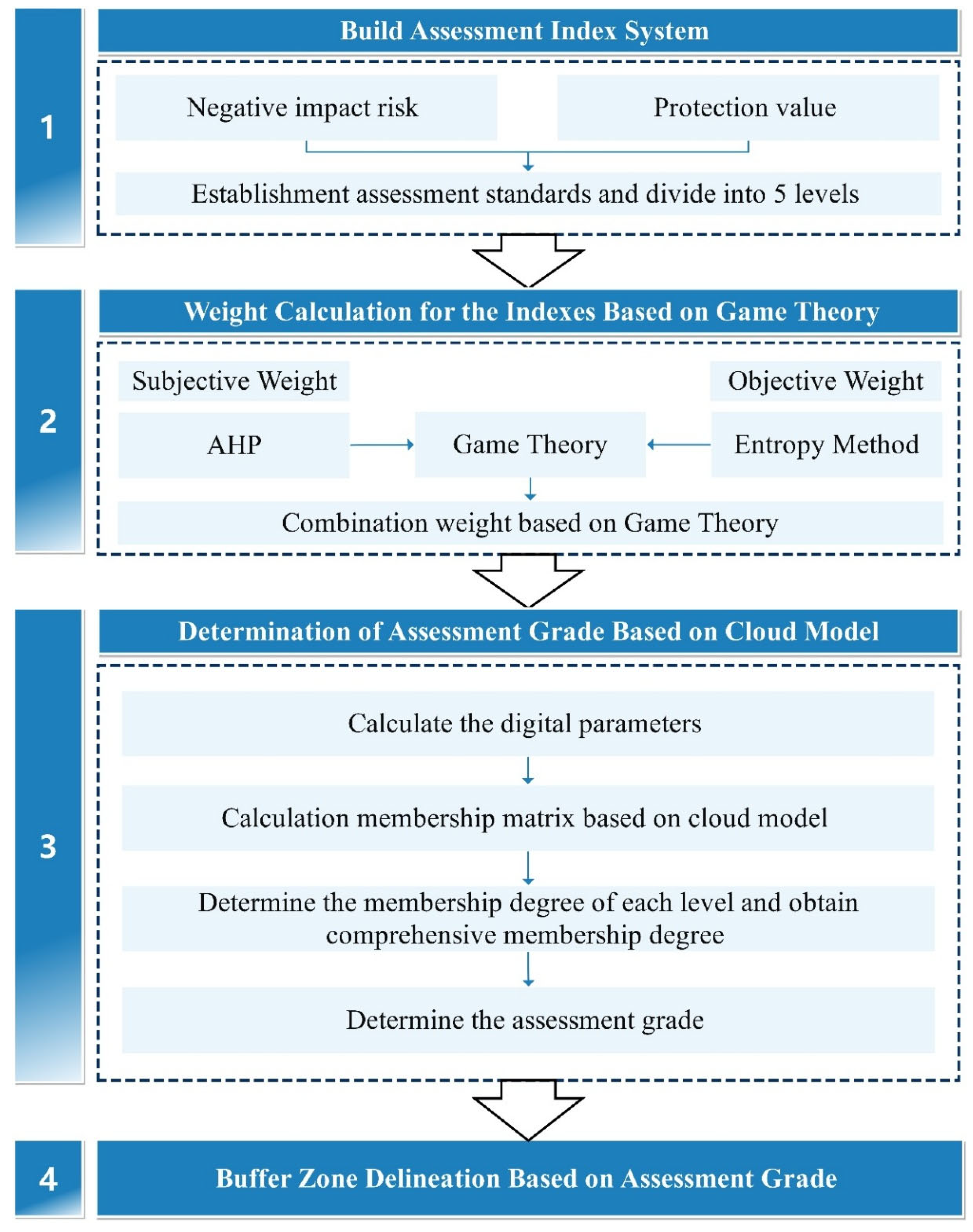
This study proposes a systematic, risk-based framework for delineating buffer zones around urban cultural heritage sites (Figure 1). First, we introduced key indices to assess the negative impact risk and the protective value of the peripheral area. A main challenge was to establish clear risk pathways that explain the causal links between buffer zone impacts and cultural heritage vulnerability. In this stage, we built an index system including probability, severity, and value, with criteria for each index set using the Jenks Natural Breaks classification method.
In the second phase, once data collection was finished, we determined the weights for each indicator using a combined weighting approach. While the Analytic Hierarchy Process (AHP) and Entropy Weight (EW) method are widely employed in heritage assessments, each approach exhibits inherent limitations when applied independently. AHP tends to overemphasize subjective preferences, whereas EW remains overly sensitive to data dispersion patterns. To mitigate these biases, this study integrates both methods by employing AHP to capture expert-informed subjective weights and EW to derive objective weights from indicator variability. Game theory is subsequently applied to synthesize these dual perspectives, yielding an optimized, internally consistent weight structure that balances expert judgment with empirical evidence.
In the third phase, we selected a robust and efficient risk assessment methodology, incorporating the predetermined index weights to generate final evaluations. To achieve this, a cloud model was employed to facilitate the bidirectional conversion between qualitative concepts and quantitative data, effectively addressing the inherent fuzziness in the evaluation process [30,31].
Fourth, after evaluating the negative impact risk of the periphery of the urban cultural heritage sites, we determined a risk-based buffer zone.

2.3. Determination of Assessment Index System

2.3.1. Assessment Index System

We developed an index system for buffer zone delineation by integrating risk indices (Table 1). Indicators were selected based on three complementary considerations: (i) alignment with established causal mechanisms linking urban development to heritage externalities, including morphological intensity, functional disturbance, accessibility-driven pressure, and spatial proximity effects; (ii) parcel-scale data availability and temporal updateability; and (iii) actionability for planning regulation and control (Table S1).
Negative impact risk describes the risk that the surrounding environment may have a detrimental effect on the site’s value and physical integrity, and the protection value refers to the periphery area’s value. The negative impact risk indices were measured as follows:
  • Population density (D1) serves as a key indicator for assessing urban expansion pressures, particularly in the peripheral zones adjacent to urban cultural heritage sites. Higher population densities within a subdistrict are strongly correlated with increased levels of anthropogenic pressure, thereby elevating the potential risk of physical intervention or encroachment on cultural heritage assets [32].
  • Road density (D2) is a key indicator of regional transportation accessibility. Elevated density often correlates with intensified heavy vehicle traffic, which generates mechanical vibrations, emits pollutants that can exceed safety thresholds, and poses substantial risks to cultural heritage sites’ structural integrity and material composition [2]. Furthermore, associated traffic noise can significantly disrupt the tranquility required in these settings. This metric can be quantitatively derived using spatial analysis tools in ArcGIS 10.4.1.
  • Type of land use (D3) is used to assess the potential interference of the surrounding environment with urban cultural heritage [2]. Land use in the vicinity of the cultural heritage can be categorized into five types: commercial land use (assigned value 9), transportation infrastructure (7), administrative land use (5), residential land use (3), and green space and protected areas (1). The ordinal scores (9–1) for land-use categories were assigned based on the local regulatory detailed plan, reflecting the relative strictness of land-use control and the expected intensity of externalities permitted under each category in the study area. This scoring scheme is theoretically grounded in the premise that local zoning regulations differentiate land uses by development intensity and regulatory thresholds, which directly correlate with varying disturbance potentials on proximate heritage settings.
  • The distance from the core protection area (D4) is an index that quantifies the proximity of cultural heritage sites to the periphery. Closer proximity to core conservation areas signifies a greater risk of potential impacts [3].
  • Type of commercial activity (D5) quantifies the disturbance of urban cultural heritage caused by commercial activities in the vicinity of the heritage [2]. These activities are classified into five categories based on their potential impact intensity: large-scale shopping malls (assigned value 9), restaurants (7), hotels (5), retail stores (3), and heritage-themed commerce (1). Higher values indicate a greater potential for interference. The scoring scheme for commercial activity types followed local planning control provisions, using category-based regulatory intensity as a proxy for potential disturbance.
  • Proximity to subway stations (D6) serves as a metric for gauging the distance between a cultural heritage site’s periphery and nearby metro stations. Areas adjacent to stations typically experience intensified commercial development and urban construction, potentially elevating anthropogenic pressure on the cultural asset [2].
The value indices are measured as follows:
  • The number of historical events (D7) serves as a key indicator of a site’s historical value; the more historical events it has witnessed, the higher its historical value [16].
  • Building history (D8), representing a structure’s temporal depth, serves as a core metric for assessing its historical and cultural value. Generally, a longer historical timeline correlates strongly with greater heritage significance [16].
  • Construction quality (D9) is a key indicator of a site’s artistic value [4]. There are five classes of construction quality: structure is well-preserved (assigned value 9), minor damage (7), moderate damage (5), severe damage (3), and buildings were damaged and abandoned (1).
  • Architectural feature (D10) serves as an indicator to evaluate the aesthetic and contextual integration between heritage sites and their surrounding built environment. A high degree of such harmony typically preserves or even enhances landscape integrity [33]. There are five classes of architectural features: harmonious integration with heritage sites (assigned value 9), ancient architectural style (7), neutral modern background with moderate harmony (5), containing elements of heritage sites (3), and conflicting with heritage sites (1).
  • The protection level index (D11) evaluates the cultural value of an urban heritage site’s peripheral area [17]. This value correlates directly with its conservation status, which is classified and scored on a scale from 9 to 1 as follows: World Heritage Site (9), national-level (7), provincial-level (5), city-level (3), and non-protected unit (1).
  • Example of traditional techniques (D12) serves as a key indicator for evaluating a site’s scientific value. The traditional artisanship used in historic buildings embodies rich scientific value [17].

2.3.2. Grading Standard of Assessment Indices

Continuous indicators were classified into five grades using the Jenks Natural Breaks method (Table 2), which identifies breakpoints by minimizing within-class variance and maximizing between-class variance [34,35]. Because Jenks thresholds are data-driven and therefore dataset-dependent, the class boundaries should be recalibrated when applying this framework to other cities or datasets to ensure transferability.

2.4. Combination Weight Calculation

Recent studies have identified two primary weighting approaches—subjective and objective—each with its own advantages and limitations [36]. Subjective weighting methods capture expert opinions and experiential judgments, with the AHP among the most widely applied approaches [37,38]. Objective weighting methods, grounded in mathematical theory, help minimize subjectivity. The EW method has been applied in numerous studies [39,40]. However, as the objective weighting approach evaluates only the variation in index values, it cannot account for the interrelationships among the indices. To address this limitation, game theory is applied to bridge the gap between subjective and objective methods, effectively harnessing the advantages of both to determine a unified set of optimal weights.

2.4.1. Subjective Weight Based on the AHP

The AHP is a structured decision-making method that systematically evaluates and integrates the influence of multiple factors [41]. This widely used technique allows analysts to derive weighting values. In our study, we invited 10 experts to complete a questionnaire that was used to develop the judgment matrix, including 3 heritage conservation practitioners, 3 urban planners with experience in regulatory detailed plans, and 4 academics in heritage conservation and urban planning. Experts were selected based on predefined criteria: (i) at least 5 years of professional or research experience, (ii) direct involvement in heritage-related planning/management or regulatory plan preparation, and (iii) familiarity with parcel-based land-use control in the study area. Each expert completed the pairwise comparison matrices independently using the standard 1–9 Saaty scale, and group judgments were aggregated using the geometric mean. All judgment matrices satisfied the AHP consistency requirement, with CR < 0.10, indicating acceptable internal consistency of expert judgments.

2.4.2. Objective Weight Based on EW

The EW method determines index weights based on the statistical dispersion of each index’s data [42]. This process includes four key steps: (1) constructing the initial decision matrix, (2) calculating the entropy value to assess each index’s information uncertainty, (3) synthesizing the difference coefficient (or divergence coefficient) from the entropy to represent information divergence, and (4) normalizing these coefficients to obtain the final weights. Indices with lower entropy and higher divergence coefficients receive greater weights.

2.4.3. Game-Theory-Based Weight Combination

To reconcile the differences between subjective and objective weighting, we combined the weight vectors derived from AHP and EW using a game-theoretic optimization approach. The procedure is as follows:
  • The initial weight set W = { w 1 ,   w 2 , , w n } , which aggregates results from various weighting methods, is synthesized into a final combined weight vector through a linear combination of the individual vectors wn, each scaled by its respective coefficient ai as follows:
    W = i = 1 n a i w i T     ( a k > 0 )
  • By optimizing the weight coefficient ak, an optimal solution for W can be derived, which minimizes the discrepancy between W and wk.
    m i n j = 1 n a j w j T w i T       i = 1,2 , , n
Based on the principles of matrix calculus, the first-order optimality condition for Equation (5) is given by:
j = 1 n a j × w i × w j T = w i × w i T     i = 1,2 , , n
Consequently, for analytical convenience, Equation (6) is reformulated into its compact matrix representation:
( w 1 × w 1 T w 1 × w 2 T w 1 × w n T w 2 × w 1 T   w 2 × w 2 T     w 2 × w n T                                   w n × w 1 T   w n × w 2 T   w n × w n T ) ( a 1 a 2 a n ) = ( w 1 × w 1 T w 2 × w 2 T w n × w n T )
3.
The computation of the combined weight coefficient a∗ and its subsequent normalization are performed according to the following formula:
a k * = a k k = 1 n a k
4.
Consequently, the optimal combined weight is ultimately derived as follows:
w * = k = 1 n a k * w k T

2.5. Assessment Based on a Cloud Model

2.5.1. Definition of Cloud Model

Introduced in 1995, the cloud model is a practical bidirectional cognitive framework that combines fuzzy set theory and probability theory to connect qualitative concepts with quantitative data through both forward and backward cloud transformations [43]. As a model for handling uncertainty, it uses linguistic descriptors to link qualitative ideas to their quantitative expressions, effectively integrating the randomness and fuzziness inherent in these concepts [44].
Let U be a set and x a quantitative concept associated with U. Let Q be the qualitative concept corresponding to U, where Q is represented by a random variable with a stable distribution for the numerical value x. The distribution of x over U is referred to as a cloud, and each x is defined as a cloud drop [36,45]. Within the defined discourse universe, the membership grade of an element x exhibits a stochastic nature, characterized by a specific probability distribution [46].
Q : U [ 0,1 ] , x U , x Q ( x )
The cloud model is characterized by three numerical parameters: expected value (Ex), entropy (En), and hyper-entropy (He). Ex denotes the core certainty of the qualitative concept, representing the expected value of the cloud drops within the universal set and serving as the set’s most representative measure. The parameter En quantifies the dispersion of the qualitative concept, defining the spectrum of elements that are encompassed by its inherent uncertainty. He measures the uncertainty of En and determines the “thickness” of the cloud. These three parameters are calculated as follows:
E x i j = ( x i j 1 + x i j 2 ) 2
E n i j = | x i j 1 x i j 2 | 2.355
H e = k ,
where x1ij and x2ij demarcate the lower and upper bounds, respectively, for the j-th assessment grade under the i-th evaluation index. The constant k serves as a granularity control parameter for cloud drop generation and requires calibration based on the actual dispersion characteristics of the cloud [46]. According to references [47], k is generally selected based on experience, and the value is generally taken between 0.05 and 0.08. In this study, the value of the constant k in this study was determined as 0.05 to yield an appropriate cloud thickness, while the remaining two digital characteristics were derived from Equations (10) and (11), with all resultant values provided in Table 3.

2.5.2. Cloud Generator

The cloud generator serves as a computational mechanism that bridges qualitative descriptors and quantitative measures, with practical implementations readily available in MATLAB R2021b. Cloud generators can be broadly categorized into two primary types based on their function: the forward cloud generator facilitates the transformation of qualitative concepts into quantitative data, while the backward cloud generator executes the inverse process, converting quantitative data back into qualitative characterization [36]. We employed the forward cloud generator, the most widely used fundamental approach in cloud models, to calculate the membership degree of each cloud drop. The inputs included Expectation (Ex), Entropy (En), and Hyper-Entropy (He), and the number of drops n, the latter of which was set to 2000 to ensure that the generated cloud drops met the conditions necessary to form a complete cloud. The outputs were n cloud drops along with their respective membership degrees. The operation of the forward cloud generator is defined as follows:
  • Sample a random number E n i from a normal distribution with expectation En and variance He2.
  • Obtain a random variate xi following a normal distribution with expectation Ex and variance E n i 2 .
  • Calculate u i = e ( x i E x ) 2 2 E n i 2 , and xi with membership degree ui is a cloud drop in the domain.
  • Complete iterations of Steps 1 through 3 until a total of n cloud droplets are generated.
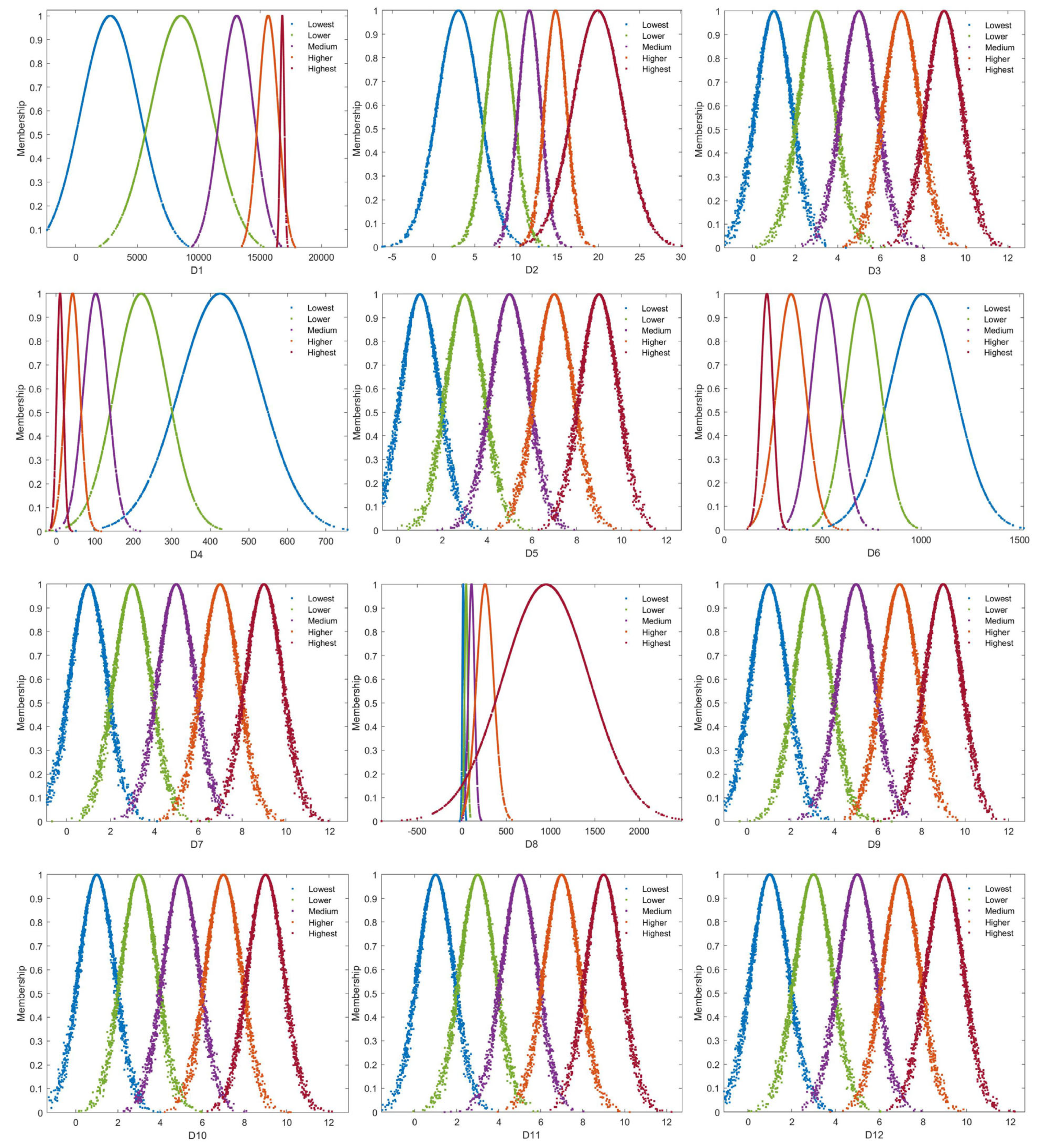
The digital characteristics of the cloud model—Ex, En, and He—were utilized as inputs to the forward cloud transformation algorithm in MATLAB 2021b to generate the cloud drop distribution visualized in Figure 2. The membership degree distributions for the five levels were calculated and are presented in Figure 2, where the x-axis represents the actual index values and the y-axis denotes the membership degree.

2.5.3. Comprehensive Evaluation and Final Results

Using the cloud model, we generated a membership degree matrix Z (Equation (10)), where each element rij corresponds to a raster layer quantifying the degree of membership. The comprehensive membership degree M was subsequently derived using a computational framework (Equation (11)), which synthesized the predetermined index weight vector W with the matrix Z.
Z = [ r 11   r 12   r 15 r 21   r 22   r 25       r i 1   r i 2   r i 5 ]     ( i = 1,2 , , 15 )
M = W × Z = [ w 1 ,   w 2 , , w i ] × [ r 11   r 12   r 15 r 21   r 22   r 25         r i 1   r i 2   r i 5 ] = [ m 1 ,   m 2 , , m 5 ] ,
where W denotes the indicator weight vector, and m1 to m5 refer to the comprehensive membership degrees. The maximum membership principle was subsequently applied to these degrees to ascertain the final assessment result, ensuring alignment with the most representative category. Parcels were classified by the maximum membership principle; a membership-gap check Δ = m 1 m 2 confirmed unambiguous assignments for all parcels ( Δ > 0 ), with no ties or near-ties.

2.5.4. From Assessment Results to Decision Making

After completing the parcel-based risk–value coupling assessment, it is essential to translate these results into actionable planning controls. This step helps minimize negative externalities within the buffer zone and strengthens heritage-oriented governance. In this study, the combined scores for the 121 parcels are divided into five management levels (Level 1–Level 5), corresponding to Lowest, Lower, Medium, Higher, and Highest regulatory priorities. Jenks natural breaks were used to determine the five score intervals (Table 2), and the cloud model was used to compute the membership of each parcel to the five risk grades (Figure 2). The management level in Table 4 follows the assessment grade with the highest membership.
This tiered approach enables a resource-efficient, risk-informed strategy by focusing regulatory capacity and mitigation resources on parcels with higher risk–value scores, rather than applying broad, undifferentiated controls. Based on this classification, tailored parcel-level control measures are proposed, outlining specific regulatory actions such as development-intensity limits, land-use admission rules, and monitoring or enforcement priorities. This provides a practical framework for permitting and daily management following buffer-zone delineation (Table 4).

3. Study Area and Data Sources

Suzhou, an ancient city in Jiangsu Province and one of the first 24 cities in China designated as a national historical and cultural city, is celebrated for its 2500-year history and vibrant cultural heritage [48]. The majority of Suzhou’s heritage is concentrated within the Ancient City of Suzhou in Gusu District, spanning 14.2 square kilometers and home to 250 protected buildings. As one of China’s oldest and best-preserved ancient cities, Suzhou stands as a testament to enduring cultural legacy.
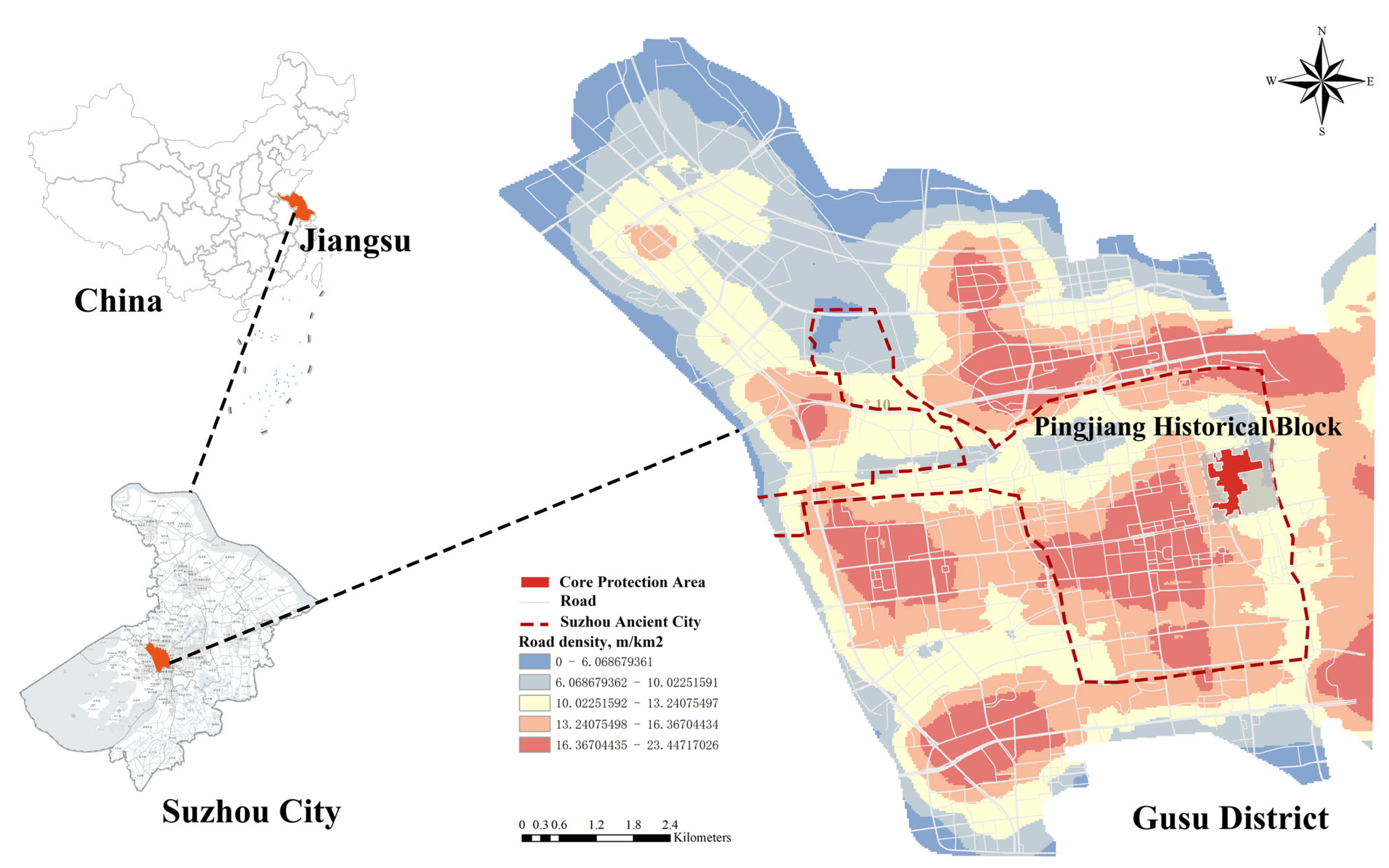
The Pingjiang Historical Block, situated in the northeast corner of the Ancient City (Figure 3), is the largest and most well-preserved historical block in Suzhou, epitomizing the city’s ancient character. Its distinctive dual-grid layout of “parallel waterways and adjacent streets” mirrors the design recorded in the Song Dynasty’s Pingjiang Map, earning it the title of a “living fossil of ancient Chinese urban planning”.
However, the rapid urbanization following China’s 1978 reforms has posed growing challenges to preserving the Pingjiang Historical Block. Additionally, shortcomings in the existing buffer zone—such as vague boundaries and insufficient scientific rationale—have diminished its effectiveness, leaving it unable to meet the conservation needs of the area. Due to the Pingjiang Historical Block’s exceptional value and gaps in current conservation practices, it was chosen as the focus of this research. We aimed to assess the value of delineating the buffer zone for the periphery of the Pingjiang Historical Block and to provide scientific support for this delineation.
The dataset for this study comprised multi-source materials, including urban planning blueprints, cultural heritage statistics, regional socioeconomic indicators, and geospatial street network data, sourced from governmental agencies and open platforms.
  • Urban planning data: The urban planning dataset included the Suzhou Pingjiang Historical and Cultural Block protection plan, acquired from the freely accessible website of the Suzhou Municipal Bureau of Natural Resources and Planning (https://zrzy.jiangsu.gov.cn/sz/ghcgy/201904/t20190402_769060.htm, accessed on 21 August 2025).
  • Social and economic data: The socioeconomic dataset was sourced from comprehensive statistical reports on national economic and social development across Suzhou’s subordinate districts and counties for the year 2024. The socioeconomic data used in this study primarily refer to population-related variables.
  • Road network data: We acquired road network data from the collaborative open-access mapping platform OpenStreetMap (OSM; https://www.openstreetmap.org/, accessed on 21 August 2025).
Indicators were calculated or assigned at the parcel scale (121 parcels), and distance-related variables were measured from each parcel to the nearest relevant feature.

4. Results

4.1. Weight Analysis

Initial weights for the indices were determined separately using the AHP and EW methods. The AHP judgment matrix satisfied the consistency requirement, with a consistency ratio of CR = 0.00637, indicating acceptable internal consistency (Table S2). Then, these distinct weight sets were then reconciled and synthesized using game theory to establish a strategic compromise, yielding the final combination weights listed in Table 5. As shown in Table 5, D1 and D8 were significant. This result illustrates that population density and building history played a critical role in buffer zone delineation. However, other indices, such as D6, accounted for small weights. The results indicate that the distance from the subway had a relatively minor impact on the delineation of the buffer zones. Apart from the three aforementioned indicators, the remaining nine indicators exhibited a relatively even distribution of weights.

4.2. Assessment Results and Buffer Zone Delineation

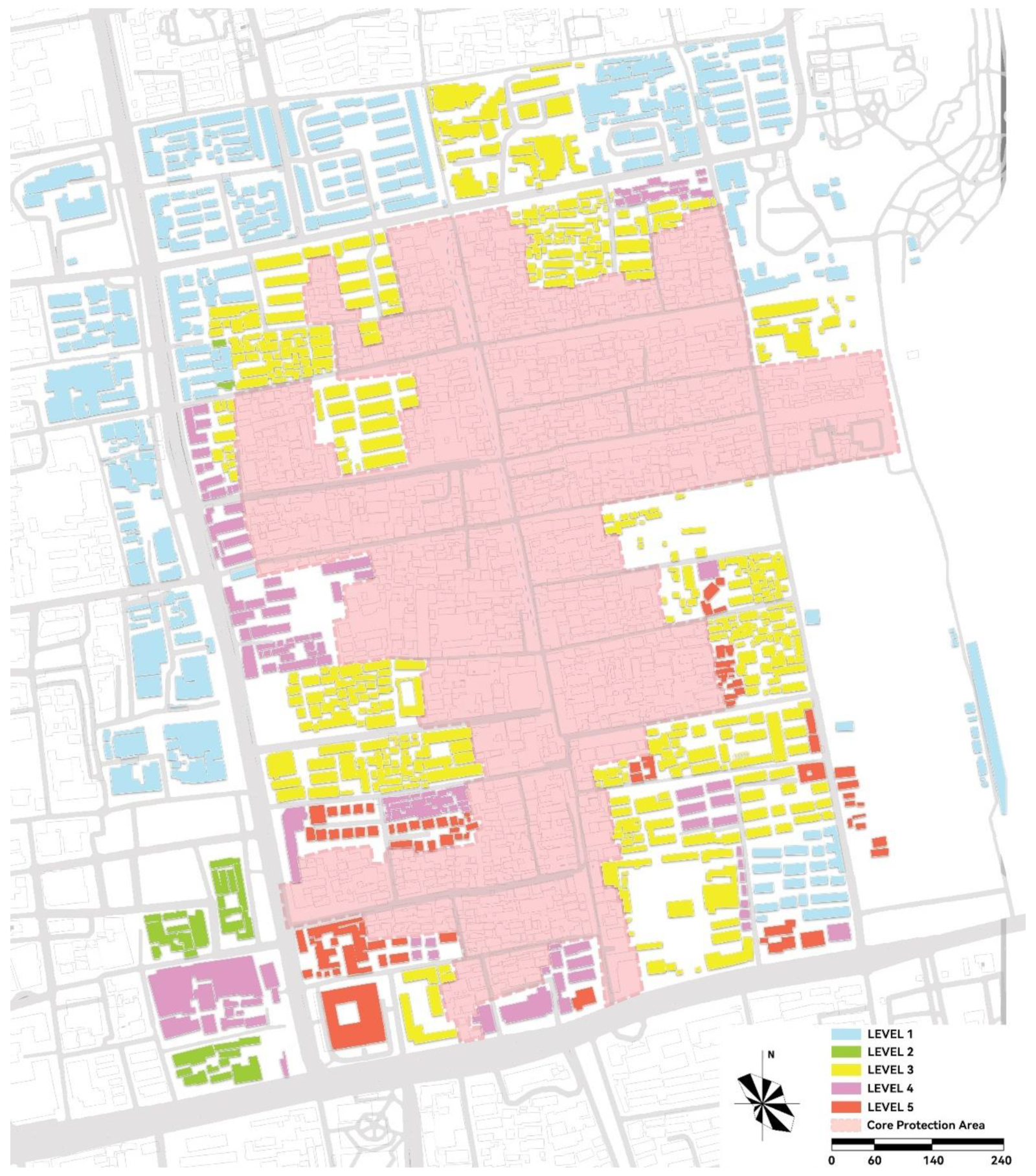
Based on the established indicator system and the combined weights, we conducted a parcel-based necessity assessment for the 121 land parcels in the study area. Specifically, we evaluated each parcel by integrating (i) the negative impact risk associated with external urban pressures and (ii) the heritage value reflecting cultural significance and sensitivity. The coupled evaluation outcomes were then mapped to a five-level classification using the cloud model, yielding a graded necessity pattern for buffer zone intervention. Figure 4 illustrates the assessment results, presenting the spatial distribution of the five management levels (Level 1–Level 5, from very low to very high necessity).
As illustrated in Figure 4, the assessment results reveal distinct spatial patterns at the parcel level. Parcels with higher necessity levels (Level 4–Level 5) are concentrated in areas where external urban pressures intersect with high heritage sensitivity—particularly near the core protected zone and along major corridors with significant human activity and urban functions. These parcels face greater exposure to negative externalities such as intensive commercial use, traffic, visitor pressure, or incompatible land uses, while also possessing higher heritage value and vulnerability. Conversely, parcels classified as Level 1–Level 3 generally experience lower combined risk and heritage value, indicating a reduced need for stringent buffer controls. Overall, the distribution across the five levels shows that Level 1 includes 41 parcels (33.9%), Level 2 includes 5 parcels (4.1%), Level 3 includes 39 parcels (32.2%), Level 4 consists of 22 parcels (18.2%), and Level 5 contains 14 parcels (11.6%). Notably, parcels in Levels 4 and 5 account for 36 parcels (29.8%), suggesting that nearly one-third of the study parcels require relatively strong, prioritized intervention from a risk-informed governance perspective. This graded structure provides an explicit basis for identifying priority areas where buffer zone regulation is most necessary and where limited regulatory resources should be allocated first.
In the Pingjiang Historic District, higher-level parcels (Levels 4–5) tend to cluster along the edges of the core protected area and near major access corridors, where commercial intensity and visitor/traffic pressures are typically concentrated. This pattern reflects the district’s tourism-oriented functions and the spatial coincidence of high externality land uses with highly sensitive heritage settings. By contrast, parcels farther from key corridors or dominated by compatible uses exhibit lower coupled scores, indicating that stringent controls can be spatially targeted rather than uniformly expanded.
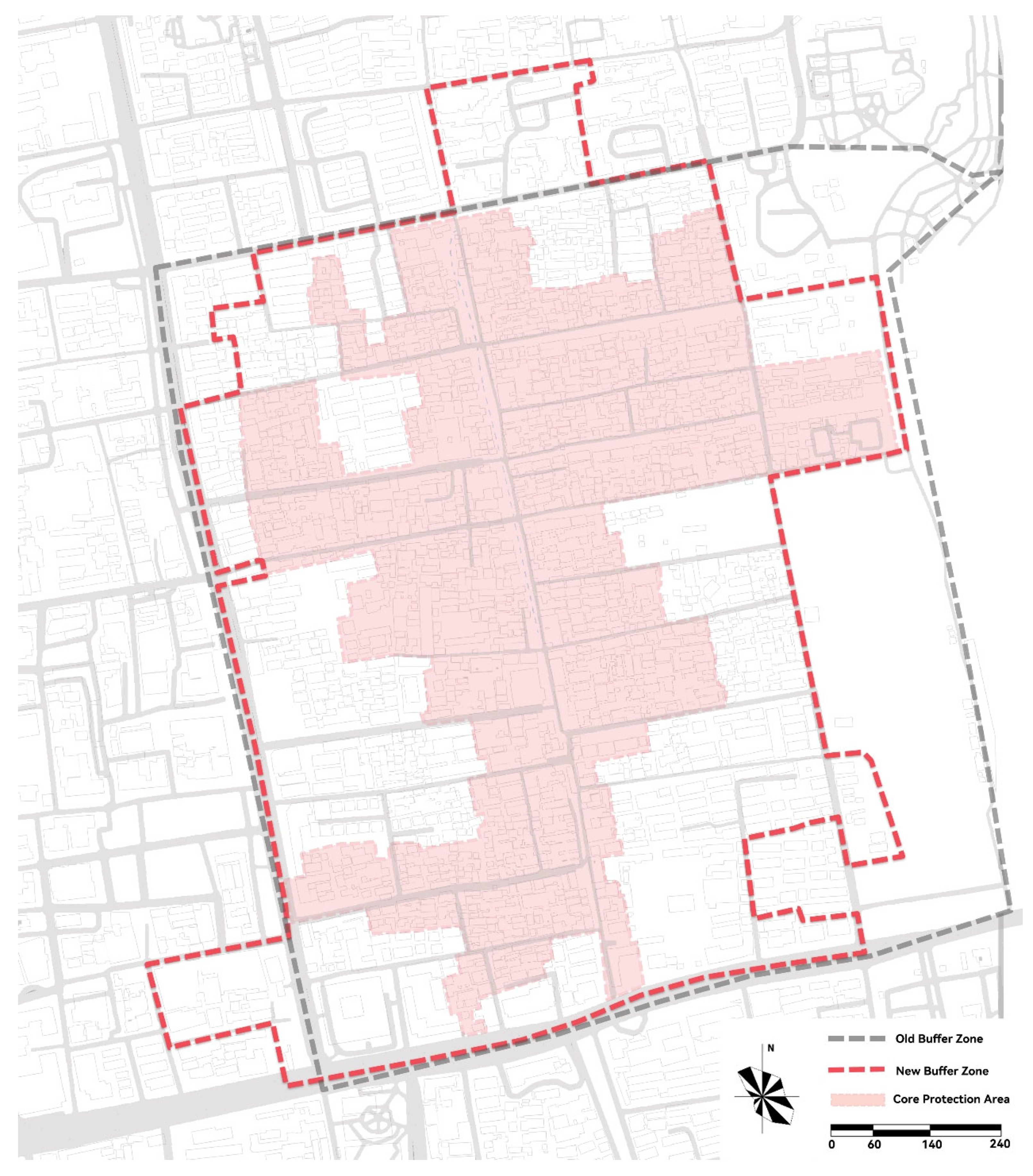
To delineate an operational buffer zone boundary, this study applied a risk-informed selection rule: parcels classified as Levels 3, 4, and 5 were prioritized to be incorporated into the buffer zone due to their elevated coupled risk–value. Accordingly, by delineating the buffer zone based on Level 3–Level 5 parcels, the proposed strategy defines a focused regulatory scope of 75 parcels (62% of the total), directing planning controls toward locations with the highest risk–value intensity to ensure resource efficiency.
These priority parcels were spatially aggregated to form a continuous, manageable boundary that ensures practical implementability. To enhance regulatory operability, minor geometric adjustments were made during boundary construction, including (i) reducing isolated fragments and (ii) aligning the boundary with recognizable urban features such as parcel edges, street blocks, or other stable morphological units, thereby facilitating the permitting process, enforcement, and management.

5. Discussion

5.1. From Assessment Outputs to Operational Land-Use Governance

This study demonstrates how parcel-scale risk–value coupling assessment can be operationalized into functional buffer zone boundaries with differentiated land-use controls. Unlike conventional buffer delineation relying on fixed-distance thresholds or value-centric criteria, the proposed framework provides a risk-informed zoning rationale that directly translates evaluation outcomes into planning regulations. By stratifying 121 parcels into five management tiers and prioritizing Levels 3–5 (75 parcels, 62%), the approach identifies where stringent governance is most warranted under constrained regulatory capacity.
As illustrated in Figure 5, the proposed delineation offers a spatially explicit, risk-responsive alternative to traditional methods dependent on geometric extensions or value-only assessments. Whereas conventional approaches may exclude high-risk parcels beyond arbitrary geometric buffers or unnecessarily encompass low-risk areas requiring minimal oversight, this parcel-based methodology concentrates regulatory resources on high-intensity zones, thereby optimizing governance efficiency. Notably, the refined buffer zone reduces the total regulated area by 19% compared to the existing boundary, demonstrating that effective risk mitigation can be achieved through a more compact and operationally feasible scope. Critically, this delineation establishes an actionable framework for tiered planning controls, enabling context-specific regulatory instruments—including permitting thresholds, design standards, and enforcement priorities—calibrated to each parcel’s intervention needs. This systematic translation of assessment into regulation enhances buffer zones’ effectiveness as spatial governance tools for mitigating adverse externalities on urban cultural heritage.

5.2. Regulatory Efficiency and Spatial Targeting of the Proposed Buffer Delineation

A key strength of the proposed framework lies in its capacity to establish targeted, administratively feasible regulatory zones by translating parcel-level risk–value assessments into differentiated controls. In this case study, the optimized buffer encompasses a regulated area 19% smaller than the existing boundary. Importantly, this reduction should be interpreted as a trade-off outcome—balancing regulatory capacity and stakeholder acceptance against the ambition to regulate a broader surrounding area—rather than as an inherent objective of buffer delineation.
Accordingly, the proposed boundary represents one policy-relevant configuration derived from a defined inclusion threshold (Levels 3–5) and spatial continuity criteria. Alternative scenarios can be generated within the same analytical framework, including more protective strategies—such as incorporating Levels 2–5 with enhanced continuity requirements to capture transitional zones—or more selective approaches—such as restricting inclusion to Levels 4–5 while excluding isolated fragments—contingent upon governance capacity and planning priorities. Critically, the methodology advances buffer zone governance not through boundary reduction per se but by enabling transparent, scenario-driven spatial prioritization that systematically aligns regulatory resources with assessed externality risks and heritage values.

5.3. Planning Implications: Tiered Controls at the Parcel Level

Beyond boundary delineation, the parcel-based classification serves as a practical foundation for tailored planning controls. Each of the five management levels can be linked to specific regulatory actions, such as limits on development intensity, design and height restrictions, land-use admission rules, and prioritized enforcement strategies. For example, Level 4–Level 5 parcels may require strict permitting conditions, mandatory impact assessments, and continuous monitoring of disturbance factors, whereas Level 1–Level 2 parcels can be managed with standard controls and compatibility-based oversight. This hierarchical framework not only promotes administrative transparency but also facilitates implementation by anchoring enforcement to the parcel unit, thereby enhancing the operational efficacy of buffer zones in heritage-sensitive land-use governance.

5.4. Stakeholder Engagement and Implementation Pathway

Although the proposed assessment framework is methodologically self-contained, its implementation is intended to be embedded in existing planning and heritage-governance procedures, rather than applied as an automatic technocratic decision. Stakeholder involvement can be envisioned at two points. First, upstream validation is recommended, in which the planning bureau and heritage authority` review and validate the indicator scheme, local scoring hierarchies, and key threshold choices to ensure regulatory consistency. Second, downstream consultation is suggested, whereby the tiered management levels are communicated to affected residents and refined through statutory procedures. In practice, tiered controls can be operationalized through zoning provisions and permit conditions by the planning bureau, with technical review by the heritage authority for higher-level parcels.

5.5. Transferability and Adaptability to Other Heritage Contexts

The proposed framework is designed to be transferable to other historic districts where parcel-scale planning regulation is feasible. Its applicability depends on (i) the availability of parcel boundaries and (ii) access to multi-source data supporting risk and value indicators. When certain datasets are unavailable, indicators can be replaced with locally feasible proxies while maintaining the underlying logic of risk–value coupling assessment. Furthermore, by generating boundaries through the aggregation of prioritized parcels and aligning them with stable morphological features, the delineation method ensures adaptability and compatibility across diverse planning systems and regulatory frameworks.

6. Conclusions

6.1. Key Contributions and Main Findings

This study proposes a parcel-based risk–value coupling approach for buffer zone delineation that translates assessment outputs into operational planning controls. By integrating a multi-source indicator system with 12 parcel-level indicators and applying an uncertainty-aware evaluation procedure, the framework supports differentiated regulations across parcels and improves regulatory efficiency for heritage-oriented land-use governance. Indicator weights are derived through a game-theoretic optimization process that reconciles subjective expert judgment (AHP) and objective data variability (entropy weighting), producing a balanced and internally consistent combined weight set. The framework is validated through application to the Pingjiang Historic District in Suzhou, China, where it facilitates parcel-scale buffer zone reconfiguration. Compared to conventional geometric or value-centric methods, the approach produces spatially explicit, risk-responsive boundaries and generates standardized, evidence-based outputs directly applicable to zoning decisions and enforcement prioritization. Operationally, the framework provides a governance-ready decision-support instrument for delineating buffer boundaries, calibrating differentiated land-use controls, and strategically allocating constrained regulatory capacity to parcels exhibiting elevated externality risks and heritage significance.

6.2. Policy and Planning Implications

From a governance perspective, the proposed framework supports a shift from uniform, boundary-only buffer zoning toward differentiated, parcel-level management. The five management levels provide an explicit basis for permitting and enforcement: higher-level parcels can be subject to stricter development-intensity limits, tighter land-use admission rules, and mandatory impact screening, whereas lower-level parcels can be managed through routine compatibility controls. This tiered approach helps allocate constrained governance capacity to sites where externality risks and heritage significance converge, minimizing unwarranted restrictions in lower-priority zones while intensifying protection where intervention is demonstrably justified.

6.3. Limitations and Future Research Directions

Several limitations of this study must be acknowledged. First, this assessment is largely static and may not fully reflect changes over time in land use, visitor patterns, or development pressures. Future studies could address this by incorporating scenario simulations or time-series monitoring to enable more adaptive buffer governance. Second, although the cloud model explicitly addresses uncertainty in multi-criteria evaluation, classification results may still be affected by the choice of indicators, normalization methods, and weighting schemes. In the present study, we did not conduct a formal uncertainty quantification or systematic sensitivity analysis, because the manuscript’s primary aim is to demonstrate an operational workflow that translates parcel-based assessment outputs into implementable buffer delineation and tiered land-use controls, rather than to develop a full uncertainty-propagation module. Conducting additional robustness checks, such as sensitivity analyses, could further improve the reliability of parcel-level prioritization. Third, the regulatory recommendations presented are generalized; effective local implementation necessitates alignment with statutory planning instruments and sustained stakeholder engagement. Addressing these limitations will advance risk-informed buffer delineation, rendering it a more adaptive and governance-ready instrument.

Supplementary Materials

The following supporting information can be downloaded at: https://www.mdpi.com/article/10.3390/land15030362/s1, Table S1: Justification table for 12 indicators; Table S2: AHP pairwise comparison matrix for D1–D12.

Author Contributions

L.F. was responsible for most of the work and writing of the manuscript. Q.Z., R.G. and Z.H. were responsible for the data analysis of the manuscript. Z.W., W.W., R.Z. and Q.H. were responsible for the site investigation of the manuscript. J.Y. was responsible for the review and revision of the manuscript. All authors have read and agreed to the published version of the manuscript.

Funding

This research was funded by the Jiangsu Province Key R&D Program Social Development Project (BE2023822) and Priority Academic Program Development of Jiangsu Higher Education Institutions (PAPD).

Data Availability Statement

The datasets used in this study are available from the corresponding author upon reasonable request.

Acknowledgments

We are grateful to the editor and anonymous reviewers for their insightful feedback and valuable suggestions.

Conflicts of Interest

The authors declare no conflicts of interest.

Abbreviations

The following abbreviations are used in this manuscript:
OUVOutstanding Universal Value
AHPAnalytic Hierarchy Process
EWEntropy Weight

References

  1. Coccossis, H. Sustainable development and tourism: Opportunities and threats to cultural heritage from tourism. In Cultural Tourism and Sustainable Local Development; Fusco Girard, L., Nijkamp, P., Eds.; Routledge: New York, NY, USA, 2016; pp. 65–74. [Google Scholar]
  2. Seyedashrafi, B.; Ravankhah, M.; Weidner, S.; Schmidt, M. Applying heritage impact assessment to urban development. Sustain. Cities Soc. 2017, 31, 213–224. [Google Scholar] [CrossRef]
  3. Ashrafi, B.; Kloos, M.; Neugebauer, C. Heritage impact assessment, beyond an assessment tool: A comparative analysis of urban development impact on visual integrity in four UNESCO World Heritage properties. J. Cult. Herit. 2021, 47, 199–207. [Google Scholar] [CrossRef]
  4. Ghanbari, E.; Lotfi, S.; Sholeh, M. HUL values in practice: A character area designation model for the conservation of built heritage in less-developed regions. J. Cult. Herit. 2024, 70, 41–53. [Google Scholar] [CrossRef]
  5. Seduikyte, L.; Grazuleviciute-Vileniske, I.; Kvasova, O.; Strasinskaite, E. Knowledge transfer in sustainable management of heritage buildings. Case of Lithuania and Cyprus. Sustain. Cities Soc. 2018, 40, 66–74. [Google Scholar] [CrossRef]
  6. Tweed, C.; Sutherland, M. Built cultural heritage and sustainable urban development. Landsc. Urban Plan. 2007, 83, 62–69. [Google Scholar] [CrossRef]
  7. Vecco, M. A definition of cultural heritage: From the tangible to the intangible. J. Cult. Herit. 2010, 11, 321–324. [Google Scholar] [CrossRef]
  8. Trau, A.M.; Ballard, C.; Wilson, M. Bafa zon: Localising world heritage at Chief Roi Mata’s Domain, Vanuatu. Int. J. Herit. Stud. 2014, 20, 86–103. [Google Scholar] [CrossRef]
  9. UNESCO. Operational Guidelines for the Implementation of the World Heritage Convention; UNESCO World Heritage Centre: Paris, France, 2008. [Google Scholar]
  10. Xiong, K.; Chen, D.; Zhang, J.; Gu, X.; Zhang, N. Synergy and regulation of South China Karst site integrity protection. Heritage Sci. 2023, 11, 218. [Google Scholar] [CrossRef]
  11. Zhang, J.; Xiong, K.; Liu, Z.; He, L. Research progress on world natural heritage conservation and buffer zones. Heritage Sci. 2022, 10, 102. [Google Scholar] [CrossRef]
  12. Darabi, H.; Behbahani, H.I.; Shokoohi, S.; Shokoohi, S. Perceptual buffer zone: A potential of going beyond the definition of broader preservation areas. J. Cult. Herit. Manag. Sustain. Dev. 2020, 10, 271–291. [Google Scholar] [CrossRef]
  13. Schlee, M.B. The role of buffer zones in Rio de Janeiro urban landscape protection. J. Cult. Herit. Manag. Sustain. Dev. 2017, 7, 381–406. [Google Scholar] [CrossRef]
  14. Carreño, A.M.; ICOMOS (Eds.) Buffer Zones as a Tool for Protecting World Heritage Sites: The Case of the Heritage Routes; ICOMOS: Paris, France, 2006. [Google Scholar]
  15. Jo, E.; Mackay, R.; Murai, M.; Therivel, R. Guidance and Toolkit for Impact Assessments in a World Heritage Context; UNESCO Publishing: Paris, France, 2022. [Google Scholar]
  16. Lv, R.; Liu, Y.; Zhang, L.; Kong, D. Urban historic heritage buffer zone delineation: The case of Shedian. Heritage Sci. 2022, 10, 64. [Google Scholar] [CrossRef]
  17. Bykowa, E.; Dyachkova, I. Modeling the size of protection zones of cultural heritage sites based on factors of the historical and cultural assessment of lands. Land 2021, 10, 1201. [Google Scholar] [CrossRef]
  18. Ackerman, L. The evolution of heritage management: Thinking beyond site boundaries and buffer zones. Public Archaeol. 2014, 13, 113–122. [Google Scholar] [CrossRef]
  19. Chen, Y.; Dong, Q.; Zhang, L.; Shao, L.; Tang, Y. Using natural language processing to identify and evaluate heritage value for buffer zone delineation in Hengdaohezi Town. Npj Herit. Sci. 2025, 13, 262. [Google Scholar] [CrossRef]
  20. Sukwai, J.; Mishima, N.; Srinurak, N. Balancing cultural heritage conservation: Visual integrity assessment using GIS and 3D modeling. Land 2022, 11, 666. [Google Scholar] [CrossRef]
  21. Martin, O.; Piatti, G. (Eds.) World Heritage and Buffer Zones; UNESCO World Heritage Centre: Paris, France, 2009. [Google Scholar]
  22. Caballero, G.V.; Roders, A. Understanding trends on urban heritage research in Asia. In Proceedings of the 2nd International Conference on Urban History: Cities in Europe, Cities in the World, Lisbon, Portugal, 3–6 September 2014. [Google Scholar]
  23. Heslinga, J.H.; Groote, P.; Vanclay, F. Using a social-ecological systems perspective to understand tourism and landscape interactions in coastal areas. J. Tour. Futures 2017, 3, 23–38. [Google Scholar] [CrossRef]
  24. Stelzenmüller, V.; Coll, M.; Mazaris, A.D.; Giakoumi, S.; Katsanevakis, S.; Portman, M.E.; Degen, R.; Mackelworth, P.; Gimpel, A.; Albano, P.G.; et al. A risk-based approach to cumulative effect assessments for marine management. Sci. Total Environ. 2018, 612, 1132–1140. [Google Scholar] [CrossRef]
  25. Alexander, D. The study of natural disasters, 1977–1997: Some reflections on a changing field of knowledge. Disasters 1997, 21, 284–304. [Google Scholar] [CrossRef]
  26. Fu, L.; Zhang, Q.; Tang, Y.; Pan, J.; Li, Q. Assessment of urbanization impact on cultural heritage based on a risk-based cumulative impact assessment method. Heritage Sci. 2023, 11, 177. [Google Scholar] [CrossRef]
  27. Appiotti, F.; Assumma, V.; Bottero, M.; Campostrini, P.; Datola, G.; Lombardi, P.; Rinaldi, E. Definition of a risk assessment model within a European interoperable database platform (EID) for cultural heritage. J. Cult. Herit. 2020, 46, 268–277. [Google Scholar] [CrossRef]
  28. Waller, R.R. Risk management applied to preventive conservation. In Storage of Natural History Collections: A Preventive Conservation Approach; Society for the Preservation of Natural History Collections: New York, NY, USA, 1995; pp. 21–27. [Google Scholar]
  29. Liu, Y.; Li, H.; Li, W.; Li, Q.; Hu, X. Value assessment for the restoration of industrial relics based on analytic hierarchy process. Environ. Sci. Pollut. Res. 2021, 28, 69129–69148. [Google Scholar] [CrossRef] [PubMed]
  30. Wu, Z.; Cui, Y.; Guo, Y. A Case Study of Flood Risk Evaluation Based on Emergy Theory and Cloud Model in Anyang Region, China. Water 2021, 13, 420. [Google Scholar] [CrossRef]
  31. Xu, G.; Huang, G.Q.; Fang, J. Cloud asset for urban flood control. Adv. Eng. Inform. 2015, 29, 355–365. [Google Scholar] [CrossRef]
  32. Pham, V.-M.; Nghiem, S.V.; Pham, C.V.; Luu, M.P.T.; Bui, Q.-T. Urbanization impact on landscape patterns in cultural heritage preservation sites. Landsc. Ecol. 2021, 36, 1235–1260. [Google Scholar] [CrossRef]
  33. Han, F.; Yang, Z.; Liu, X.; Di, F. Impact assessment and protection of outstanding landscape integrity in a natural heritage site. J. Mt. Sci. 2011, 8, 46–52. [Google Scholar] [CrossRef]
  34. Jenks, G.F. The data model concept in statistical mapping. Int. Yearb. Cartogr. 1967, 7, 186–190. [Google Scholar]
  35. McMaster, R. In memoriam: George F. Jenks (1916–1996). Cartogr. Geogr. Inf. Syst. 1997, 24, 56–59. [Google Scholar] [CrossRef]
  36. Zou, Q.; Liao, L.; Qin, H. Fast comprehensive flood risk assessment based on game theory and cloud model Under Parallel Computation (P-GT-CM). Water Resour. Manag. 2020, 34, 1625–1648. [Google Scholar] [CrossRef]
  37. Danumah, J.H.; Odai, S.N.; Saley, B.M.; Szarzynski, J.; Thiel, M.; Kwaku, A.; Kouame, F.K.; Akpa, L.Y. Flood risk assessment and mapping in Abidjan district using multi-criteria analysis (AHP) model and geoinformation techniques. Geoenviron. Disasters 2016, 3, 1–13. [Google Scholar] [CrossRef]
  38. Wang, Y.; Li, Z.; Tang, Z.; Zeng, G. A GIS-based spatial multi-criteria approach for flood risk assessment in the Dongting Lake Region, Hunan, Central China. Water Resour. Manag. 2011, 25, 3465–3484. [Google Scholar] [CrossRef]
  39. Lai, C.; Chen, X.; Chen, X.; Wang, Z.; Wu, X.; Zhao, S. A fuzzy comprehensive evaluation model for flood risk based on the combination weight of game theory. Nat. Hazards 2015, 77, 1243–1259. [Google Scholar] [CrossRef]
  40. Li, Z.; Luo, Z.; Wang, Y.; Fan, G.; Zhang, J. Suitability evaluation system for the shallow geothermal energy implementation in region by Entropy Weight Method and TOPSIS method. Renew. Energy 2022, 184, 564–576. [Google Scholar] [CrossRef]
  41. Saaty, T.L. How to make a decision: The analytic hierarchy process. Eur. J. Oper. Res. 1990, 48, 9–26. [Google Scholar] [CrossRef]
  42. Ding, L.; Shao, Z.; Zhang, H.; Xu, C.; Wu, D. A comprehensive evaluation of urban sustainable development in China based on the TOPSIS-entropy method. Sustainability 2016, 8, 746. [Google Scholar] [CrossRef]
  43. Deyi, L.; Haijun, M.; Xuemei, S. Membership clouds and membership cloud generators. J. Comput. Res. Dev. 1995, 32, 15–20. [Google Scholar]
  44. Ren, L.; He, L.; Chen, Y.; Tian, P.; Liu, J. A cloud model based multi-attribute decision-making approach for groundwater management schemes. J. Hydrol. 2017, 55, 881–893. [Google Scholar]
  45. Cheng, K.; Fu, Q.; Meng, J.; Li, T.X.; Pei, W. Analysis of the spatial variation and identification of factors affecting the water resources carrying capacity based on the cloud model. Water Resour. Manag. 2018, 32, 2767–2781. [Google Scholar] [CrossRef]
  46. Wang, X.; Yang, W.; Xu, Z.; Hu, J.; Xue, Y.; Lin, P. A Normal Cloud Model-Based Method for Water Quality Assessment of Springs and Its Application in Jinan. Sustainability 2019, 11, 2248. [Google Scholar] [CrossRef]
  47. Duan, B.; Chu, A.; Bu, L.; Li, Z.; Long, K. Safety Risk Evaluation of Water and Mud Inrush in Karst Tunnel Based on an Improved Weighted Cloud Model. Sustainability 2025, 17, 9328. [Google Scholar] [CrossRef]
  48. Zhang, T.; Lian, Z. Distribution and scale evolution of Suzhou gardens under urbanization. Land 2021, 10, 281. [Google Scholar] [CrossRef]
Figure 1. Flowchart of the risk-based buffer zone delineation method proposed in this study.
Land 15 00362 g001
Figure 2. Cloud models of different assessment indices at various risk levels.
Land 15 00362 g002
Figure 3. Overview map of the study area.
Land 15 00362 g003
Figure 4. Assessment results of the study area.
Land 15 00362 g004
Figure 5. The buffer zone boundaries of the Pingjiang Historical Block.
Land 15 00362 g005
Table 1. Index system for delineating buffer zones for urban cultural heritage.
Goal Layer (A)Criteria Layer (B)Criteria Layer (C)Index (D)Index Attribute
Necessity of buffer zone delineation Negative impact risk Population density (D1)Positive
Probability Road density (D2)Positive
Type of land use (D3)Positive
Distance from core protection area (D4)Negative
Severity Type of commercial activity (D5)Positive
Proximity to subway stations (D6)Negative
Historical Number of historical events (D7)Positive
Protection Value Building history (D8)Positive
Artistic Construction quality (D9)Positive
Architectural features (D10)Positive
Cultural Protection Level (D11)Positive
Scientific Examples of traditional techniques (D12)Positive
Table 2. Grading standard of assessment indices.
IndicesLowest Level Lower LevelMedium LevelHigher LevelHighest Level
D1(0–5628](5628–11,500](11,500–14,709](14,709–16,615](16,615–17,000
D2(0–6.07](6.07–10.02](10.02–13.24](13.24–16.37](16.37–23.45]
D3(0–2](2–4](4–6](6–8](8–10]
D4(550–301](301–140](140–65](65–20](20–0]
D5(0–2](2–4](4–6](6–8](8–10]
D6(1200–812](812–601](601–427](427–253](253–10]
D7(0–2](2–4](4–6](6–8](8–10]
D8(5–30](30–70](70–150](150–375](375–1522]
D9(0–2](2–4](4–6](6–8](8–10]
D10(0–2](2–4](4–6](6–8](8–10]
D11(0–2](2–4](4–6](6–8](8–10]
D12(0–2](2–4](4–6](6–8](8–10]
Table 3. Digital parameters of the cloud model.
LevelsD1D2D3D4
ExEnExEnExEnExEn
I281423903.0352.5771.0000.84910.0008.493
II856424938.0451.6773.0000.84942.50019.108
III13,104136311.6301.3675.0000.849102.50031.847
IV15,66280914.8051.3297.0000.849220.50068.365
V16,80716319.9103.0069.0000.849427.000104.46
LevelsD5D6D7D8
ExEnExEnExEnExEn
I1.0000.8491006.000164.7561.0000.849948.500487.049
II3.0000.849706.50089.5973.0000.849262.500225.000
III5.0000.849514.00073.8855.0000.849110.00033.970
IV7.0000.849340.00073.8857.0000.84950.00016.985
V9.0000.849131.500103.1859.0000.84917.50010.616
LevelsD9D10D11D12
ExEnExEnExEnExEn
I1.0000.8491.0000.8491.0000.8491.0000.849
II3.0000.8493.0000.8493.0000.8493.0000.849
III5.0000.8495.0000.8495.0000.8495.0000.849
IV7.0000.8497.0000.8497.0000.8497.0000.849
V9.0000.8499.0000.8499.0000.8499.0000.849
Table 4. Parcel-based regulatory implications for differentiated buffer zone governance.
Management Level (Parcel)Interpretation Primary Planning Control ObjectivesRecommended Regulatory Actions (Operational)
Level 5 (highest priority)Highly Sensitive Zone. Only conservation-compatible activities and minimal interventions are permissible. All development proposals are subject to the highest level of regulatory scrutiny and may be prohibited if they generate adverse externalities or compromise heritage setting integrity.Strict prevention + priority protectionProhibit new high-intensity development; require heritage impact assessment (HIA) before permitting; enforce strict design/height/material controls; restrict land-use change toward high-impact uses; implement continuous monitoring (visitor flow, traffic, vibration/noise)
Level 4 (Higher priority)Strict control zone. Development intensity and disturbance-generating activities are tightly limited. Permit approvals require heritage authority review; monitoring and enforcement are prioritized.Risk mitigation + intensity controlLimit FAR/height/plot ratio and construction scale; require traffic/visitor management measures; set construction constraints (vibration/noise/time windows); restrict high externality functions (e.g., nightlife clusters, heavy logistics); prioritize enforcement inspections
Level 3 (Medium priority)New development or change of use is subject to enhanced review. Applicants may need to submit additional documentation and comply with stricter controls on intensity, appearance, and operating impacts.Controlled development + targeted mitigationAllow adaptive reuse with conditions; require compliance with design guidelines and streetscape control; apply targeted mitigation (parking management, pedestrian dispersal, signage control); review major projects via simplified HIA screening
Level 2 (Lower priority)Minor changes are generally acceptable, but projects should follow basic design guidance. Authorities may provide advisory reviews to ensure compliance.Routine management + compatibilityPermit compatible development under standard planning review; maintain baseline design/visual controls; encourage low-impact regeneration; monitor key indicators periodically (annual/biannual)
Level 1 (Lowest priority)Routine activities can proceed under standard city rules. Only basic guidance applies; no additional heritage-specific restrictions are typically required.General governanceApply general zoning requirements; prioritize land-use efficiency and service improvement; no additional restrictions beyond standard urban management and basic heritage awareness provisions
Table 5. Weight of each index obtained using the combination weighting method.
Index Weight
AHPEMGT
D10.02740.27180.14227
D20.10350.01760.06313
D30.04350.12040.07964
D40.11790.10190.11038
D50.05150.08560.06753
D60.02250.01570.01931
D70.03250.12310.07509
D80.11530.17810.14482
D90.14860.02390.08999
D100.10930.00610.06080
D110.12520.01550.07364
D120.10280.04030.07342
Disclaimer/Publisher’s Note: The statements, opinions and data contained in all publications are solely those of the individual author(s) and contributor(s) and not of MDPI and/or the editor(s). MDPI and/or the editor(s) disclaim responsibility for any injury to people or property resulting from any ideas, methods, instructions or products referred to in the content.