1. Introduction
Rural shrinkage, marked by sustained population decline and socio spatial restructuring, is increasingly manifested as changing residential mobility, housing under occupancy, and intermittent dwelling use, rather than only permanent outmigration and abandonment. In many rural regions, demographic aging and economic contraction leave housing and infrastructure underused while weakening the local service base. These pressures often reinforce each other: shrinking demand undermines service viability, service erosion reduces everyday livability, and declining livability accelerates selective outmigration. The policy challenge is therefore less about restoring the population size and more about maintaining quality of life, service equity, and fiscal sustainability under persistent decline [
1,
2,
3]. Evidence also suggests that some places can sustain vitality despite demographic loss, motivating an adaptation perspective that is often framed as smart shrinkage [
4].
This perspective shifts rural shrinkage from a growth deficit narrative to an adaptive governance task that prioritizes managing decline, renewing local capacity, and stabilizing essential services. Smart shrinkage research stresses that settlements with similar demographic loss can diverge sharply in economic vitality and community wellbeing, which raises the need for operational indicators that benchmark adaptation performance and reveal why trajectories differ [
4,
5]. At the same time, critical reflections argue that headline population change can mask deeper drivers such as peripheralization and institutional capacity, and that growth-centered framings may overlook viable non-growth pathways [
6]. Together, these debates point to a measurement gap: shrinkage research needs indicators that capture residence stability and the service environments that underpin staying decisions, rather than relying mainly on static demographic summaries.
A parallel shift concerns residential mobility as a mechanism linking demographic change to settlement transformation. Rural population decline often coexists with multilocal living, circular migration, and seasonal residence, which complicate binary categories of resident versus migrant [
7]. Large-scale evidence from Finland shows that registered population counts can miss substantial seasonal redistribution driven by second homes, and that alternative indicators such as seasonal and average population can better represent mobility dynamics that are relevant to planning and service provision [
8]. These mobility forms also create inference challenges, including defining choice sets, capturing repeated moves, and distinguishing stated preferences from observed behavior [
9]. For rural shrinkage research, this implies that behavior-sensitive, high-frequency traces are often necessary to identify under occupancy, temporary residence, and transition-like residence regimes that conventional datasets tend to smooth over.
Recent advances in sensing and geospatial analytics are expanding how rural shrinkage and residential mobility can be observed beyond census snapshots. At the household scale, electricity consumption time series from smart meters can serve as a practical proxy for occupancy presence and absence, enabling detection of daily routines, under occupancy, and temporal transitions without intrusive sensors [
10,
11,
12]. Temporal clustering further supports the identification of occupancy trajectories by separating shape patterns across days and seasons, offering a way to characterize heterogeneous mobility rhythms and signatures that are consistent with intermittent or seasonal residence [
13]. At the settlement scale, deep learning YOLO-based building detection of high resolution imagery increasingly enables reliable extraction of building footprints and fine-grained rural structures, strengthening building area measurement in contexts where mapped building data are incomplete [
14,
15,
16]. Complementary remote sensing products also support the monitoring of the settlement extent and change through semantic or entity-based mapping strategies [
17], while nighttime lights have been used to infer seasonal residence dynamics and second home mobility when conventional mobility data are unavailable [
18]. Together, these streams point toward behavior-informed, spatially explicit evidence for diagnosing shrinkage processes and mobility restructuring.
Despite these opportunities, most studies still examine energy-based occupancy inference, remote sensing change, or demographic proxies in parallel, rather than as an integrated explanatory chain. Electricity-based occupancy detection is often framed around predictive accuracy for building management or short-term behavior recognition, with limited linkage to longer run settlement trajectories and mechanism diagnosis [
12,
19]. Remote-sensing-driven building detection and settlement mapping typically prioritize spatial completeness and transferability, but rarely connect vacancy-related morphology change to household level mobility dynamics captured through energy signatures [
15,
17]. Nighttime lights can indicate seasonal activity and redistribution, yet representativeness in sparsely lit rural settings remains constrained, which can bias monitoring if used alone [
20]. Even when hybrid indicator systems improve shrinkage identification, they commonly emphasize detection, rather than disentangling direct and mediated pathways among development conditions, governance capacity, environmental constraints, service accessibility, and residence stability [
2,
21]. Recent evidence further suggests that nighttime light signals are highly sensitive to contextual disruptions and may deviate substantially from actual human activity or occupancy patterns under abnormal conditions such as conflict or large-scale service interruptions [
22]. This sensitivity reinforces the limitations of NTL-based proxies in low-light or unstable settings and motivates the use of behavior-based indicators such as electricity consumption.
Taken together, recent work suggests that explaining rural shrinkage requires combining mobility sensitive observation with interpretable causal pathways. Service accessibility is widely recognized as a central constraint in shrinking rural areas, yet it is unevenly experienced and often poorly captured by aggregated indicators, which limits mechanism inference [
3,
23]. Structural equation modeling offers a useful approach because it can represent latent contextual conditions and separate direct effects from service-mediated effects, supporting an interpretable diagnosis of why residence stability diverges across settlements [
24,
25].
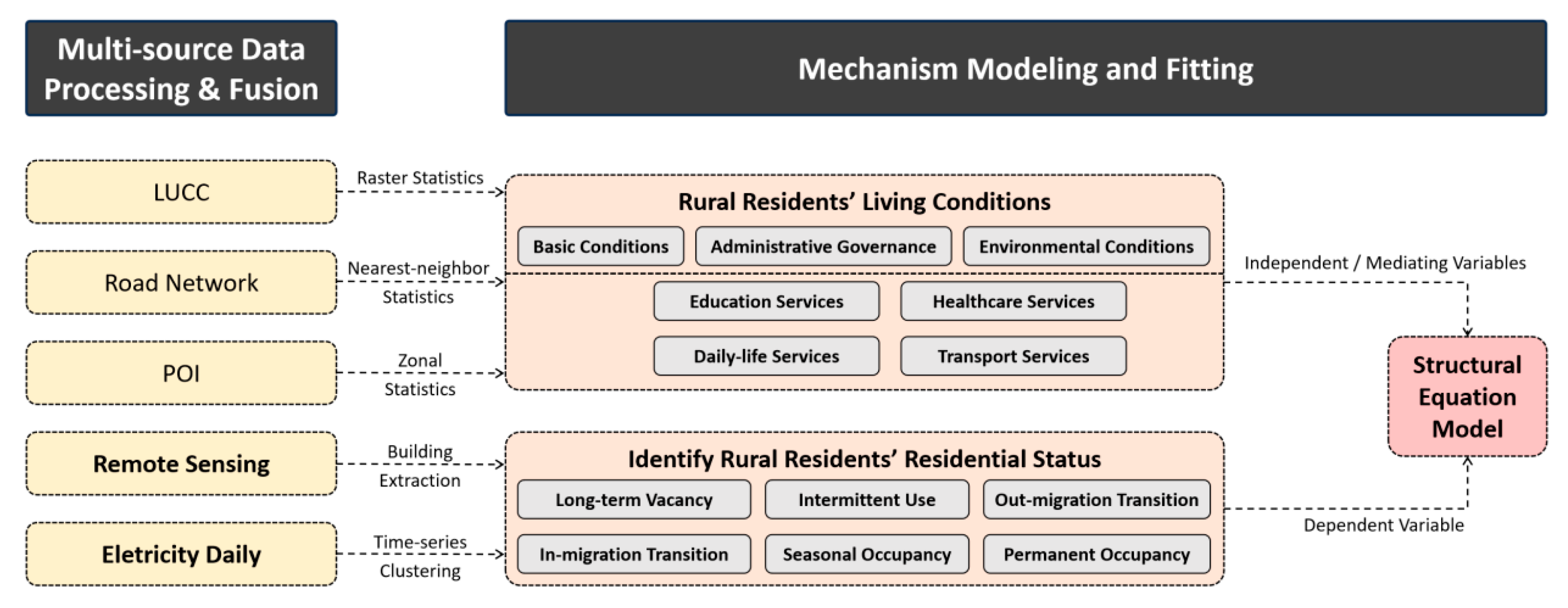
Building on this gap, this study develops an evidence-driven and explainable assessment framework that links electricity-informed occupancy dynamics, built-environment morphology, and mechanism identification (
Figure 1).
Figure 1 organizes the study into three connected modules—(i) behavior-based occupancy inference from daily electricity series, (ii) settlement-form characterization from high-resolution remote sensing, and (iii) explainable mechanism identification using a service-mediated structural equation model. Daily electricity consumption time series from 2021 to 2024 are used to infer the occupancy dynamics and derive differentiated occupancy trajectories via temporal clustering, while remote-sensing-based segmentation is used to quantify settlement-vacancy-linked built-environment differences. These evidence streams are integrated into a structural equation model that tests how development conditions, governance capacity, and environmental constraints shape residence stability, and whether these effects operate primarily through service accessibility across education, healthcare, transport, and daily life services. In this way, the framework provides a step-by-step research plan: from data acquisition and preprocessing to occupancy and building area indicator construction, and finally to explainable pathway testing and policy interpretation. Using Fuyuan City as the empirical case, the remainder of the paper introduces the study area and multi-source datasets, details the analytical workflow and model specification, reports trajectory patterns and mechanism results, and discusses planning implications for stabilizing residence under shrinkage.
2. Materials and Methods
2.1. Study Area and Data Sources
2.1.1. Study Area
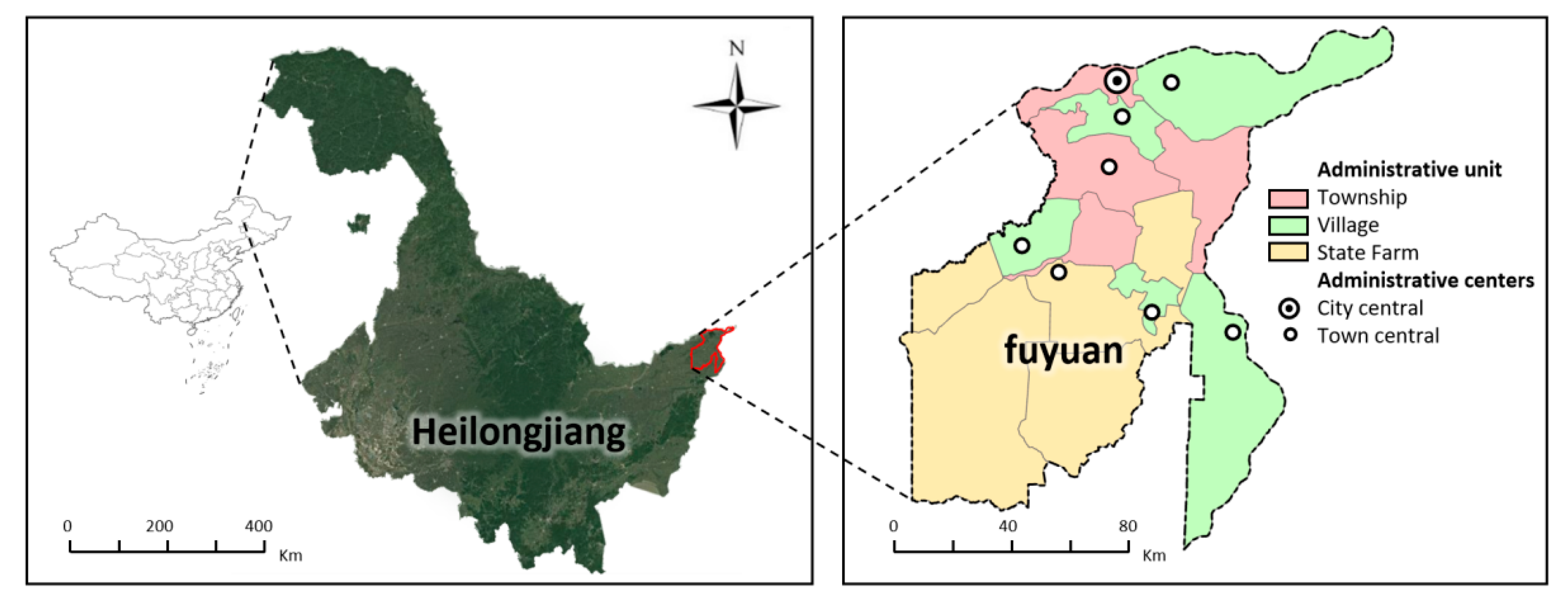
This study uses Fuyuan City as an empirical case. Fuyuan is a county-level city administered by Jiamusi in Heilongjiang Province, Northeast China, located in the lowland area at the confluence of the Heilongjiang River and the Wusuli River (
Figure 2). Its northern and eastern boundaries coincide with parts of China’s international border with Russia, and the area functions as a frontier-peripheral rural settlement system with constrained local opportunity structures and persistent service accessibility challenges. These structural conditions are frequently associated with stronger outmigration pressures and uneven residence stability, making the case suitable for examining service-mediated mechanisms of residence stability in rural shrinkage [
26,
27,
28]. Consistent with many county-level areas in Northeast China, rural settlements in Fuyuan include both administrative villages and state-farm (agricultural reclamation) units; therefore, this study considers both unit types in the study area description and subsequent settlement-scale analysis. Consistent with many county-level areas in northeast/northern China, rural settlements in Fuyuan include both administrative villages and state-farm (agricultural reclamation) units; therefore, this study considers both unit types in the study area description and subsequent settlement-scale analysis.
2.1.2. Data Sources
To support an evidence-driven and explainable assessment of rural shrinkage mechanisms, this study compiled a multi-source dataset combining behavioral observations, built-environment information, and spatial context (
Table 1). The core behavioral dataset consists of daily electricity consumption records from 2021 to 2024, provided by the local electricity company at the building or household level, covering 10 towns, 65 villages, and 8715 households. These daily time series provide a behavior-sensitive basis for inferring occupancy dynamics and identifying patterns such as under-occupancy, seasonal residence, and mobility transitions.
To characterize the settlement physical development intensity, 2 m remote sensing imagery was obtained from the Geospatial Data Cloud, which supports fine-scale measurement of settlement form and building-related indicators. Service provision and local activity opportunities were represented using POI data from the AMap LBS platform, provided as point locations and used to construct indicators aligned with education, healthcare, transport-related facilities, and daily life services. The transport and connectivity context was derived from road network data extracted from OpenStreetMap and represented as a line network. The land conditions were described using a 10 m land use and land cover dataset from webmap.cn, enabling settlement-level land composition indicators and surrounding environmental context. Topographic constraints were represented using 12.5 m elevation data accessed via the Alaska Satellite Facility data search portal to support terrain-related indicators. Together, these datasets provide a consistent empirical foundation for integrating occupancy dynamics, settlement morphology, and service-mediated mechanisms.
2.1.3. Spatial Linkage and Unit of Analysis
All datasets were harmonized into a unified coordinate reference system and linked to common spatial units. Electricity-monitored households or buildings were geocoded as point locations and spatially joined to the administrative village units used throughout the study, so that household-level occupancy signals could be aggregated consistently with village-level morphology, service, and environmental indicators. Remote-sensing-derived building indicators and POI- and road-based variables were aggregated to the same village units to enable cross-source integration. To protect privacy, individual identifiers in the electricity dataset were anonymized, and modeling was conducted using aggregated indicators, rather than personally identifiable records.
2.2. Multi-Source Data Preprocessing and Spatial Feature Construction
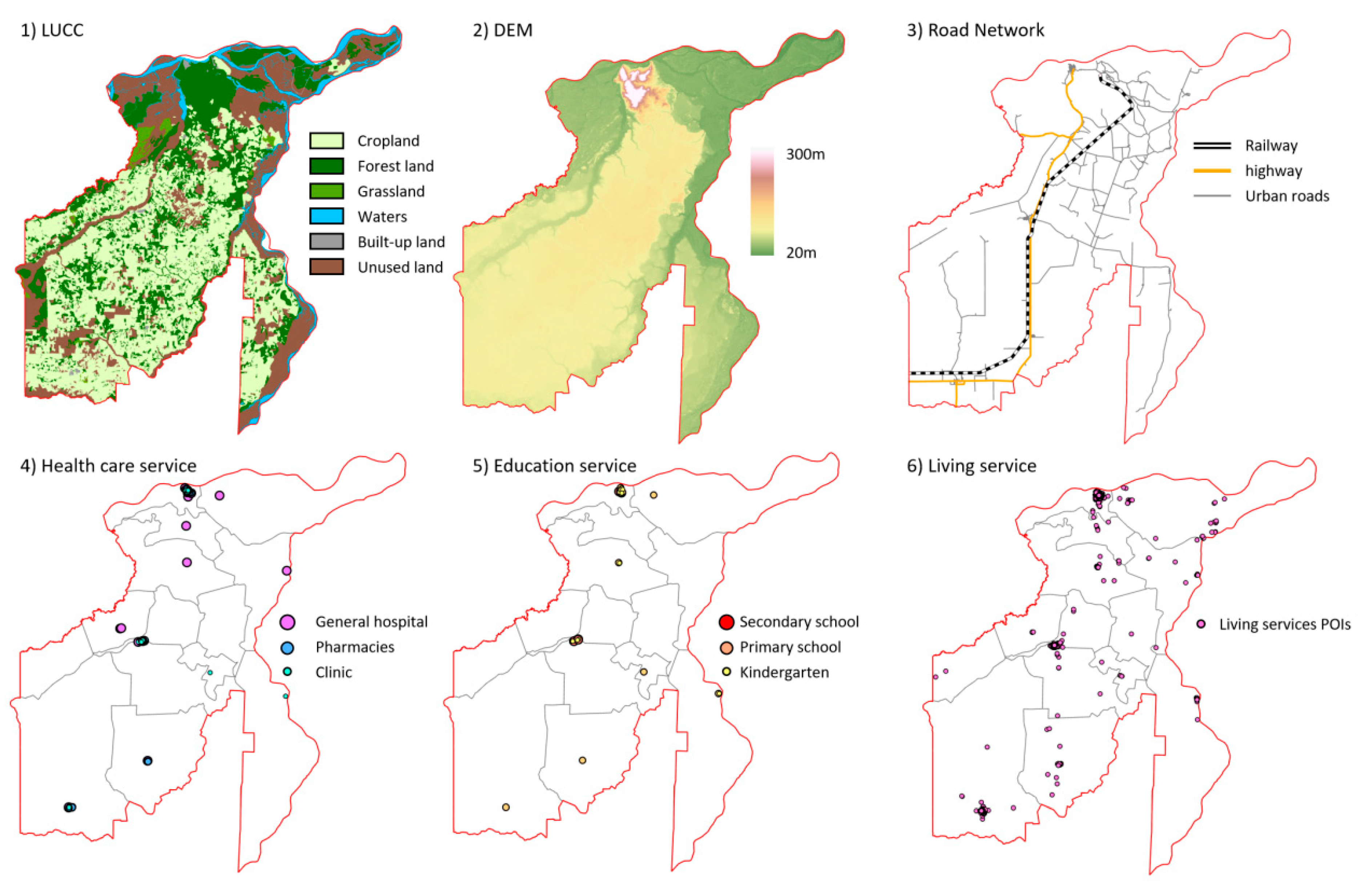
All spatial datasets were standardized to ensure cross source comparability in the coordinate reference system, spatial extent, and analysis scale (
Figure 3). High resolution remote sensing imagery with 2 m spatial resolution was mosaicked where necessary to achieve continuous coverage, screened to remove invalid pixels, and clipped to the administrative boundary of Fuyuan City. POI data were cleaned by removing duplicates, harmonizing category labels, and retaining service-related records that were consistent with the service accessibility mediators used in the mechanism model, including education, healthcare, transport-related facilities, and daily life services. Road network data were extracted and processed to improve topological usability by removing non-road artifacts, correcting obvious geometric errors when present, and retaining road classes that were relevant for accessibility characterization. Land use and land cover rasters were reprojected and aligned to the analysis grid, then prepared for zonal statistics. Elevation data were converted into analysis ready rasters and used to derive basic terrain constraints, such as mean elevation and mean slope.
Spatial explanatory variables were constructed at the settlement scale, using administrative villages as the common unit of analysis. Service accessibility indicators were computed from POIs, using complementary intensity and proximity measures. Intensity measures were derived as counts or densities within fixed buffers around each village, using a buffer radius of 10 km. Proximity measures were calculated as nearest distance to key service types and summarized at the village level as the minimum distance, depending on service logic. Road network indicators were summarized as connectivity and accessibility proxies, including road length density within villages, distance to higher-order roads, and a simple network-based accessibility score, which is the travel time to the nearest town center computed on the road graph. Land use and land cover composition was aggregated using zonal statistics to obtain village level shares of built-up land, cultivated land, woodland, grassland, and water bodies. Terrain indicators were aggregated in the same way, including mean elevation and mean slope. In parallel, daily electricity consumption series were prepared through quality control and standardization for subsequent occupancy dynamics identification, as described in
Section 2.3.
2.3. Energy-Informed Occupancy Dynamics and Temporal Clustering
Daily electricity consumption time series from 2021 to 2024 were used to infer occupancy dynamics as a behavior-sensitive proxy of residential mobility and under occupancy. Prior to clustering, each household or building level series was quality controlled to reduce non-behavioral noise. This process included screening and correcting missing day gaps, removing extreme spikes that were likely attributable to meter or transmission anomalies, and flagging long sequences of zero consumption that were inconsistent with realistic household use in this context. For missing day handling, short gaps of 3 consecutive days were interpolated using linear or local median interpolation, while longer gaps were masked and excluded from similarity computation. Outliers were identified using a robust rule, such as median absolute deviation with a cutoff of with 6 mean absolute deviation and were replaced with a local rolling median. Long zero runs longer than 30 days were flagged as potential metering or disconnection episodes and treated as invalid for behavioral inference unless corroborated by neighboring days.
After cleaning, series were standardized to support comparability across households with different absolute consumption levels. Following shape-based time series practice, normalization was applied so that clustering emphasizes temporal patterns such as seasonality, intermittency, and transition signatures, rather than magnitude differences [
29]. Specifically, each series was normalized to zero mean and unit variance, with optional winsorization at the 1st and 99th percentiles to reduce residual outlier influence.
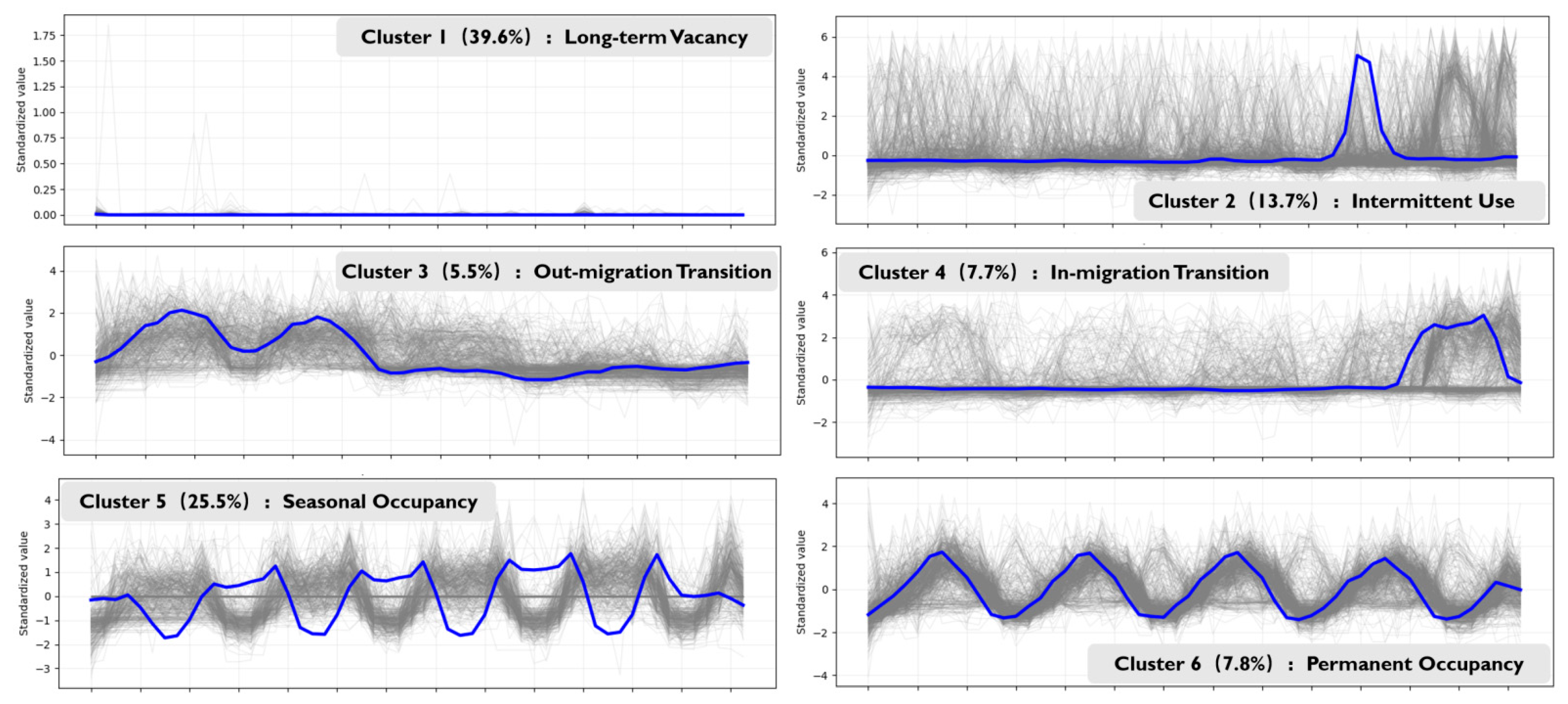
To identify interpretable occupancy trajectories, we applied k Shape time series clustering, a centroid-based method that groups sequences by similarity in temporal shapes using normalized cross correlation distance. K Shape is suitable for electricity consumption because it aligns series under phase shifts and focuses on pattern similarity, enabling the separation of long-term residence, seasonal residence, intermittent use, and transition-like behaviors from daily energy traces. The number of clusters was determined by jointly considering internal validity metrics such as within-cluster dispersion and the interpretability of the resulting trajectories, and the final solution produced six distinct occupancy trajectories. This choice is consistent with evidence that k Shape can extract meaningful typologies from building energy time series [
13]. Each monitored unit was assigned a trajectory label, which serves as the operational representation of occupancy dynamics and is used as the key outcome variable in the subsequent mechanism modeling. To support later structural modeling, the six trajectories were encoded as an ordered categorical indicator of residence stability, with the ordering defined by the degree of sustained year round use versus intermittent or near-zero use, based on the characteristic trajectory shapes shown in
Figure 4. The number of clusters was determined by jointly considering quantitative compactness and the interpretability of the resulting temporal patterns. Candidate solutions with different k values were evaluated using within-cluster dispersion (inertia) computed on a representative subsample, together with the stability and distinctness of centroid shapes. Although dispersion decreases monotonically with increasing k, improvements became marginal beyond six clusters, and higher k values mainly subdivided existing patterns without yielding substantively new occupancy trajectories. We therefore selected six clusters as the most parsimonious solution that captures heterogeneous residence regimes while remaining interpretable for subsequent mechanism analysis.
2.4. Remote-Sensing-Based Building Extraction and Building Area Estimation
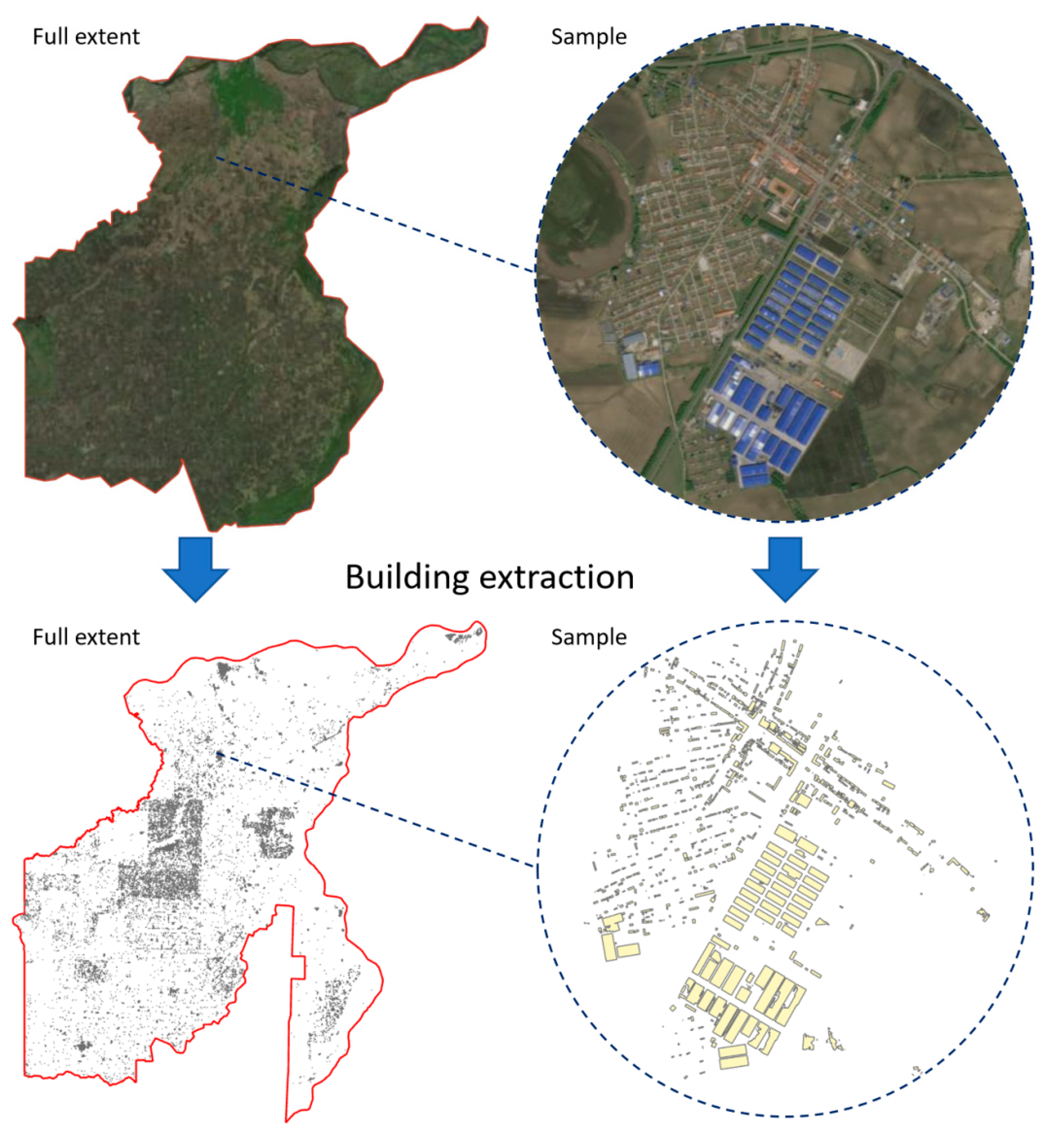
To complement electricity-derived occupancy dynamics with physical settlement evidence, built-environment morphology was quantified from high-resolution remote sensing imagery. The imagery was prepared by mosaicking tiles where necessary to ensure continuous coverage, removing invalid pixels, and clipping to the administrative boundary of Fuyuan City. Training samples for building objects were constructed by manually delineating representative building instances across heterogeneous settlement contexts to improve generalization across village types and landscape backgrounds. The remote sensing imagery used for building detection was acquired at the end of 2020, while the electricity consumption time series began in early 2021. This close temporal continuity allows the detected building objects to be directly matched to the households represented in the electricity dataset, ensuring spatial and temporal consistency between settlement morphology and occupancy dynamics.
A YOLO-based object detection workflow was adopted to identify building targets from the imagery, leveraging its demonstrated capability for detecting small and densely distributed buildings in remote sensing scenes [
14,
15]. Model training followed standard detection practice, including train and validation partitioning, data augmentation, and early stopping, based on validation performance. During inference, detections were filtered using a confidence threshold of 0.5 and non-maximum suppression with an IoU threshold of 0.5. The resulting building instances were then converted into analysis-ready vector objects for morphology measurement.
Building objects detected using the YOLO-based workflow were aggregated to the settlement level to derive the total detected building area, which serves as an indicator of settlement development intensity and is used as the observed measure within development conditions (X1) in the SEM.
The reliability of the building detection was evaluated using manually delineated building samples from representative villages covering heterogeneous settlement contexts. Detected building objects were compared with reference labels on selected subareas using an intersection-over-union (IoU)-based matching criterion under standard confidence-thresholded predictions. Based on this object-level comparison, the detection achieved an overall accuracy of 95.64%, indicating sufficient reliability for constructing village-scale building indicators, rather than for fine-grained cadastral mapping.
2.5. Structural Equation Modeling Design
To identify explainable mechanisms behind occupancy dynamics, we specified a structural equation model that links contextual conditions to residence stability through service accessibility as a mediating pathway. The model includes a measurement component and a structural component. The measurement model defines latent constructs for development conditions, governance capacity, environmental constraints, and service accessibility by using multiple observed indicators derived from the multi-source dataset described in
Section 2.2. Confirmatory factor analysis was used to verify that indicators load on their hypothesized constructs, with convergent validity being assessed using standardized loadings and average variance extracted, and internal consistency being assessed via composite reliability [
30].
The structural model specifies directional relationships from development, governance, and environment to residence stability, while explicitly modeling service accessibility as a mediator across four domains: education, healthcare, transport-related services, and daily life services. In this design, direct effects represent the net association between contextual conditions and residence stability, whereas indirect effects represent service-mediated pathways that translate broader conditions into household-level occupancy outcomes. The dependent variable was derived from the six occupancy trajectories identified in
Section 2.3 and was modeled as an ordered categorical outcome representing increasing residence stability [
31,
32]. Estimation therefore adopted a robust estimator that was suitable for ordinal categorical outcomes in structural equation modeling, which explicitly accounted for the ordered nature of the dependent variable, rather than treating it as continuous. Indirect effects were evaluated using bootstrap resampling with 5000 draws, and bias-corrected confidence intervals were used to assess their statistical significance, as indirect effects often exhibit non-normal sampling distributions [
33,
34]. The model fit for the measurement model and the full SEM was evaluated using standard indices including CFI, TLI, RMSEA, and SRMR, following commonly used cutoff guidance for covariance structure models [
35].
The structural components are shown below.
Development conditions (X1) represent the physical and demographic capacity for settlement development. This latent construct is measured using the (i) total detected building area derived from high-resolution remote sensing and (ii) village population size. Higher values indicate greater land-development capacity and settlement intensity.
Administrative governance (X2) captures the influence of administrative proximity and management context. It is measured using (i) distance to the township center and (ii) distance to the county-level city center. These indicators reflect the degree of integration into local administrative and governance structures.
Environmental conditions (X3) describe the physical and land use context constraining or enabling settlement functioning. This construct is measured using the mean elevation and surrounding land-cover composition, including the shares of cropland, forest land, and grassland surrounding each settlement.
Service accessibility is modeled as four distinct mediating constructs: (M1) education services, measured using distance to schools and education-related facilities; (M2) healthcare services, measured using distance to clinics, hospitals, and medical facilities; (M3) transport services, measured using road-network accessibility and distance to transport infrastructure; and (M4) daily life services, measured using accessibility to retail, markets, and other everyday service facilities.
Residence stability (Y) is the endogenous outcome variable and is derived from the six electricity-based occupancy trajectories identified in
Section 2.3. The trajectories are encoded as an ordered categorical variable ranging from long-term vacancy (lowest stability) to permanent occupancy (highest stability), reflecting increasing degrees of sustained residence presence.
2.6. Data Coverage and Quality Control
Daily electricity consumption time series were assembled for residential units in Fuyuan City from 2021 to 2024, covering 10 towns, 65 villages, and 8715 households. After quality control, 82.96% of households were retained for subsequent analysis, indicating stable data availability for behavior-based occupancy inference. At the household level, missing-day issues were limited: 3.32% of households exhibited missing-day records, suggesting that gaps were uncommon and unlikely to dominate trajectory identification. Quality control therefore focused on reducing non-behavioral noise in the daily series, including correcting short missing-day gaps, removing extreme spikes that were likely linked to metering or transmission anomalies, and flagging abnormal long sequences of zero consumption that were inconsistent with typical household electricity use in this context.
Spatially, monitored households were distributed across the rural settlement system of Fuyuan, providing broad coverage across towns and villages and supporting comparative analysis of heterogeneous residence stability and mobility-related occupancy dynamics. This diversity motivates temporal pattern-based methods rather than static summary indicators when diagnosing under-occupancy and residence instability.
4. Discussion
4.1. Electricity-Informed Occupancy Trajectories Enable Behavior-Based Diagnosis of Rural Shrinkage Mechanisms
This study advances rural shrinkage and residential mobility research by shifting from static, snapshot-based proxies to behavior-informed and temporally explicit evidence. Many shrinkage assessments still rely on decadal census change, vacancy ratios, or aggregated socioeconomic indicators. These measures tend to underrepresent short-term and seasonal mobility, which can blur the boundary between long-term depopulation and time-dependent residence regimes. Recent work argues that shrinkage should be interpreted through differentiated trajectories and adaptive capacities, rather than as a single decline pathway. In addition, evidence from demographic and land use planning contexts shows that shrinkage does not necessarily track population decline one-to-one, because household change and occupancy intensity can follow different dynamics and time lags [
36].
The first methodological contribution is the operationalization of residence stability using daily electricity consumption time series as a scalable behavioral proxy. Electricity traces have been widely used to support occupancy inference and vacancy-related detection when the goal is to distinguish persistent presence from absence or intermittency, rather than to estimate exact indoor counts. Building on this logic, we emphasize trajectories rather than single metrics. This is particularly relevant for shrinking rural contexts where multi-local living and intermittent use of dwellings are increasingly recognized as a stable settlement state, rather than a temporary anomaly [
37]. To operationalize these dynamics, we apply shape-based time-series clustering. The k-Shape approach clusters by temporal shape, making it suitable for identifying seasonal residence, intermittent use, and transition-like patterns in long sequences. The key contribution is not clustering itself, but the translation of clustered trajectories into an interpretable residence-stability outcome that can be carried forward into mechanism modeling.
A second contribution is multi-evidence triangulation with explainability. Rather than positioning remote sensing extraction as the novelty, we treat settlement building area indicators as an independent physical lens that complements behavioral signals from electricity and service context variables. The combined framework links occupancy dynamics, morphology, and service conditions in an explainable SEM structure, allowing separation of direct and indirect pathways. This integration supports a shift from describing where shrinkage occurs to explaining how residence stability is shaped under constrained service environments and selective mobility, in contrast to census-based or survey-only approaches that lack continuous behavioral observation [
36].
4.2. Development Enables Services, Governance Reallocates Them, and Education Anchors Staying Decisions
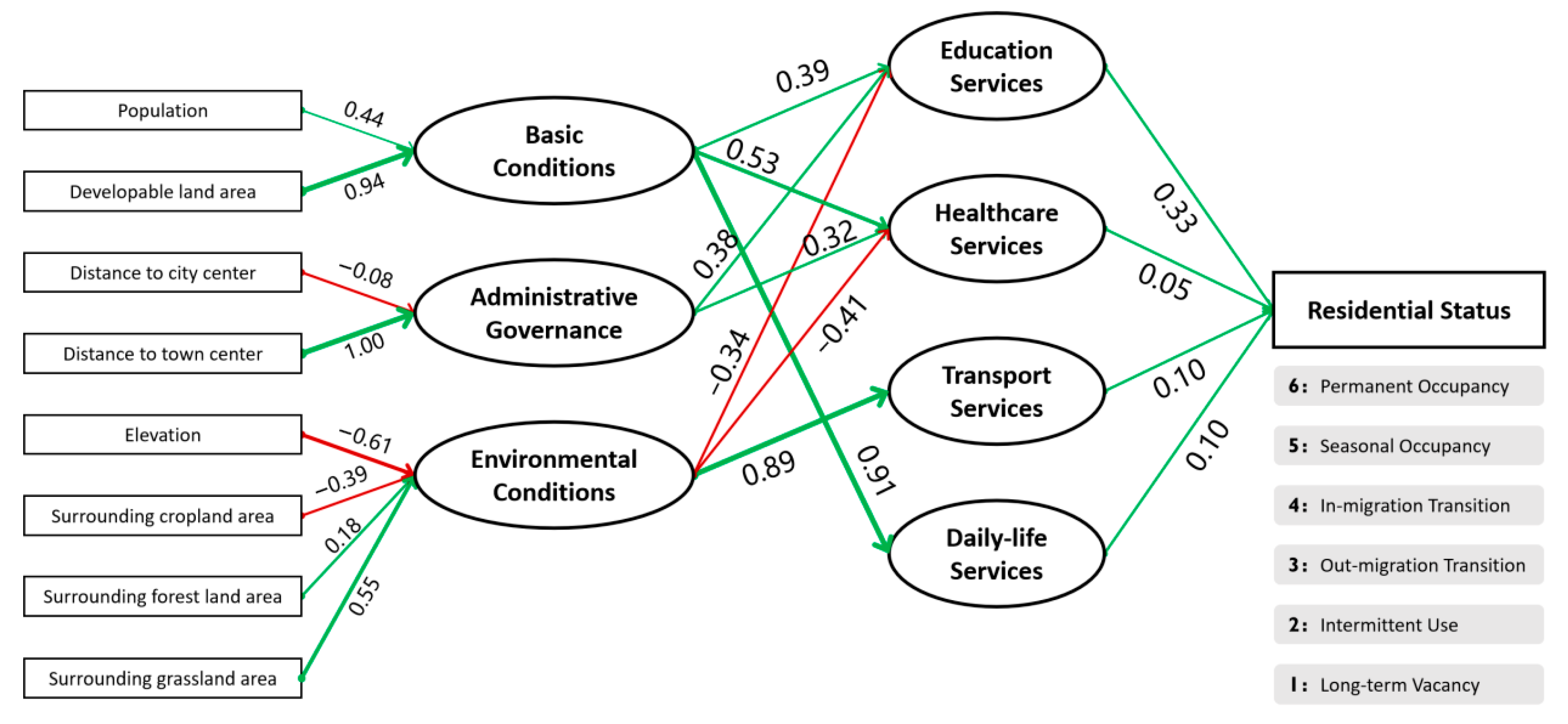
The SEM results clarify a service-mediated mechanism through which broader structural conditions translate into long-term residence stability. Development conditions (X1) show consistently strong positive effects across service domains, suggesting that the capacity for investment and service hosting remains a foundational constraint in shrinking systems. This aligns with accessibility and service-provision research arguing that service decline can reinforce depopulation through cumulative causation, especially for households whose life-course decisions are highly sensitive to education, healthcare, and daily life convenience [
25]. In this sense, shrinkage is not only a demographic outcome but also an everyday accessibility condition where service availability becomes the translation layer between structural capacity and household staying decisions.
A central discussion point is the differentiated role of administrative management (X2). Its positive association with education and healthcare services is consistent with the fact that these are more likely to follow formal administrative allocation and town-centered governance logics. At the same time, the negative association with transport and daily life services suggests that everyday convenience can deteriorate as service nodes consolidate toward central places, even when core public goods remain protected. This pattern matches broader rural accessibility arguments that improving rural well-being requires more than maintaining a minimal set of regulated services; it also depends on multilayer coordination across transport, daily facilities, and local opportunity structures [
38,
39]. Compared with survey-based studies that directly capture household motivations, the electricity-informed approach infers residence stability indirectly from observed behavior and therefore cannot fully resolve subjective decision-making processes, which represents a key limitation of the present framework [
37].
Environmental conditions (X3) show a polarized pattern, supporting transport and daily life services while weakening education. A plausible interpretation is that environmental and land-cover suitability improves infrastructure expansion and mobility connectivity, but education resources remain more institutionally concentrated and less responsive to biophysical advantages. This aligns with evidence that education accessibility is shaped by spatial justice issues and school-network restructuring, where peripheral settlements often face persistent disadvantages even when road expansion improves general mobility [
40].
Most importantly, education services show the strongest direct association with long-term residence stability. This indicates that education functions as a gateway service: when schooling access or perceived quality falls below a household threshold, mobility responses intensify, pushing families toward seasonal residence, circular migration, or permanent relocation. Other services contribute positively but with smaller direct effects, suggesting they may operate more through system-level interactions with development and governance capacity. Overall, the mechanism narrative is coherent: development capacity raises the service bundle; administrative proximity selectively supports formal services while everyday convenience can thin out; environmental suitability supports mobility and daily functioning; and education acts as the dominant lever converting service conditions into stable residence outcomes.
4.3. Regional Policy Implications for Managing Rural Shrinkage and Mobility Dynamics
The results imply that regional policy should move from uniform revitalization toward adaptive service planning that matches differentiated occupancy dynamics. When stable, seasonal, and transition-like residence regimes coexist within the same rural system, one-size-fits-all investment risks misallocating scarce resources. The occupancy typology supports a planning-oriented classification: settlements dominated by stable trajectories can be prioritized for service-quality improvement, while seasonal or transitional settlements may benefit more from flexible, shared, or mobile provision models, combined with housing and asset reuse strategies.
A practical policy direction is to adopt a multilayer accessibility perspective. Evidence from rural accessibility research suggests that the goal is not simply to preserve individual facilities, but to maintain functional access through coordinated packages that combine transport, distributed service points, and governance arrangements [
38,
39]. This is particularly relevant when public-welfare services remain protected but everyday services thin out, because households experience the latter as daily friction that accumulates into migration pressure.
A second direction is to treat education as the primary stabilizing lever for long-term residence. Because education has the strongest direct link to stability, improving educational accessibility and perceived quality can yield disproportionate retention effects, relative to comparable investments in other domains. Education-first does not imply rebuilding schools in every village. Instead, it implies designing workable education catchments supported by safe commuting, transport connectivity, boarding options where appropriate, and hybrid digital support that reduces education-driven exit pressure.
Finally, these implications are consistent with comparative East Asian policy reviews emphasizing a shift from growth restoration toward accepting structural change, reallocating resources, strengthening town-centered coordination, and reusing vacant assets as core tools for managing shrinkage [
41]. In this framing, the main objective becomes stabilizing livability and equity under mobility and demographic constraints, rather than pursuing uniform repopulation.
The proposed framework is methodologically transferable beyond the study area, complementing existing shrinkage and accessibility studies by adding a behavior-informed monitoring layer where detailed survey data are unavailable or infeasible. Its application in other countries depends primarily on data availability, rather than conceptual constraints. Where household- or building-level electricity consumption data (or comparable energy-use proxies) are accessible, and high-resolution imagery and service-related spatial data can be obtained, the same workflow can be applied to infer occupancy dynamics, characterize settlement morphology, and identify service-mediated mechanisms of residence stability. Differences in institutional context, energy systems, and data accessibility may affect implementation details, but the integrated logic of behavior-informed observation and explainable mechanism modeling remains broadly applicable.
5. Conclusions
This study develops an evidence-driven and explainable framework that advances rural shrinkage research from static description toward behavior-informed mechanism identification. Using daily electricity consumption time series from 2021 to 2024 for 8715 households in Fuyuan City, we operationalize residence stability as observable occupancy dynamics, rather than relying only on census snapshots or vacancy proxies. Shape-based temporal clustering identifies six occupancy trajectories that capture heterogeneous residence regimes, including stable long-term occupancy, seasonal residence, intermittent use, and transition-like patterns. These trajectories provide a transferable basis for monitoring mobility rhythms that commonly accompany shrinkage processes.
By integrating multi-source spatial evidence with a structural equation model, the study clarifies how structural conditions shape long-term residence stability, primarily through service provision. Development conditions act as an upstream enabler that strengthens education, healthcare, transport, and daily life services, while governance and environmental context show differentiated effects across service domains. Most importantly, education services emerge as the strongest direct predictor of long-term residence stability, exceeding the effects of transport, daily life services, and healthcare. This result supports a service-mediated interpretation of shrinkage dynamics, in which residence outcomes depend less on single-factor decline narratives and more on the accessibility and perceived quality of essential services that anchor household life-course decisions.
These findings imply that regional policy should shift toward adaptive service planning matched to differentiated occupancy regimes. An education-first stabilization strategy, implemented through functional catchments, commuting support, and hybrid delivery, is likely to yield disproportionate effects on long-term residence stability. Meanwhile, town-centered coordination should ensure that protecting regulated public services does not unintentionally weaken everyday convenience and mobility-related services in peripheral villages. Overall, the proposed framework provides a practical pathway for the continuous monitoring and explainable diagnosis of rural shrinkage mechanisms to inform targeted and equity-sensitive interventions.