Zoning Management Based on Spatiotemporal Evolution of Ecological Risk: Spatial Network Analysis of Riparian Zone in Lanzhou–Baiyin Metropolitan Area of the Yellow River Basin


Abstract
1. Introduction
2. Materials and Methods
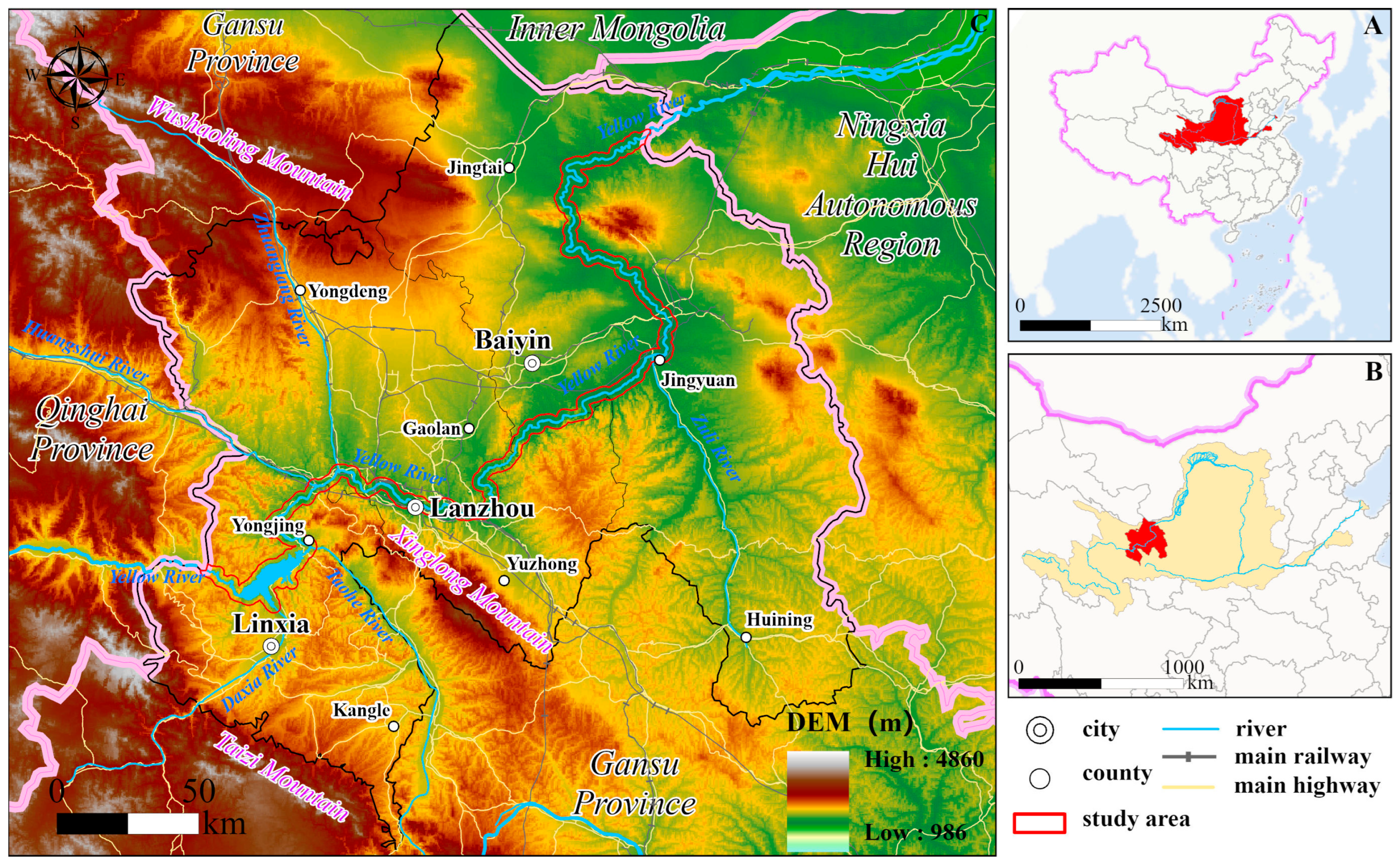
2.1. The Study Area
2.2. Data Sources and Preprocessing
2.3. Methods
2.3.1. Division of Research Units
2.3.2. ESV Estimation
2.3.3. Construction of LER Index
2.3.4. Ecological Zoning Model Based on ESV and LER
3. Results
3.1. Spatiotemporal Changes in LUCC
3.1.1. LUCC Temporal Variation
3.1.2. LUCC Spatial Variation
3.2. Spatiotemporal Changes in ESV
3.2.1. ESV Temporal Variation
3.2.2. ESV Spatial Variation
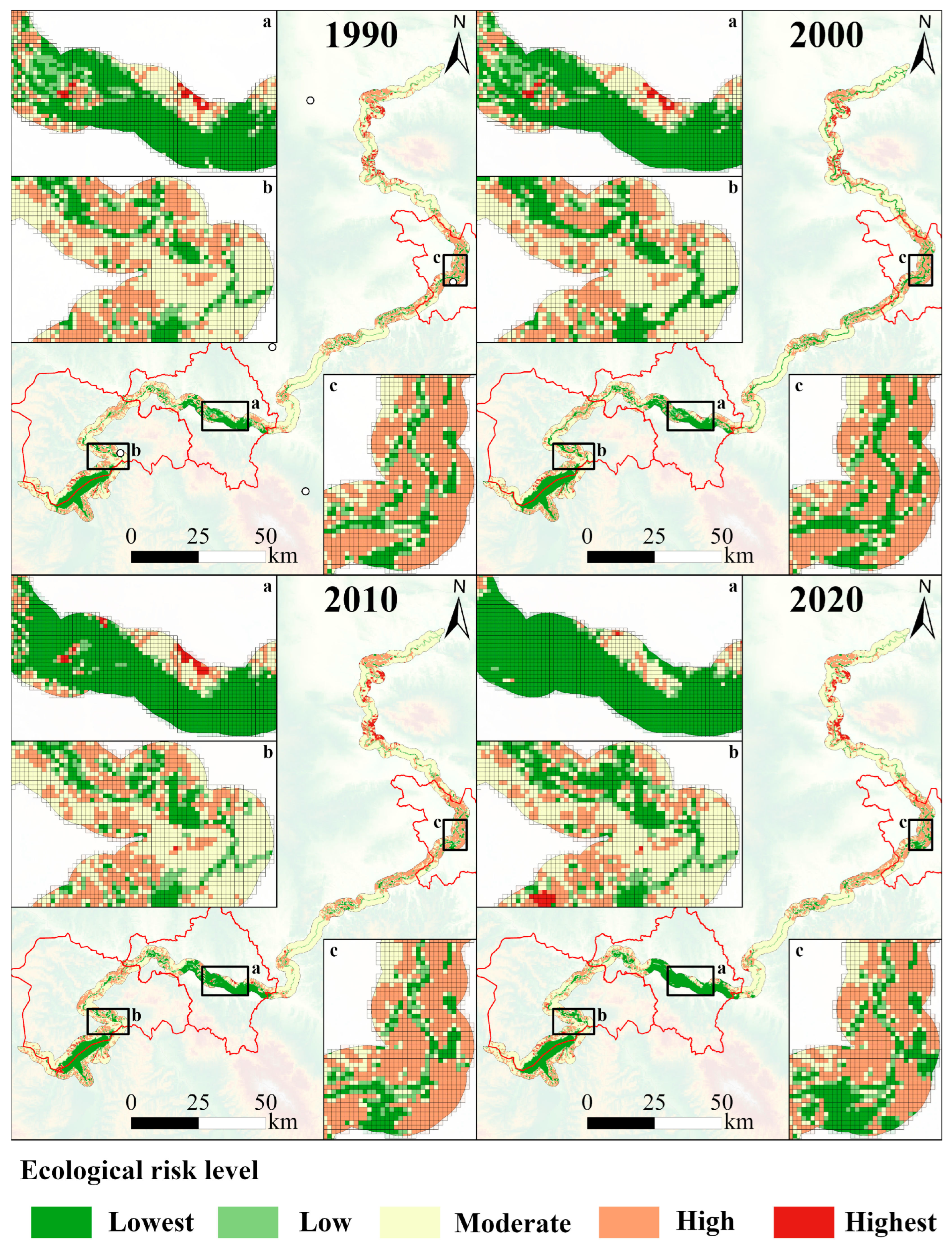
3.3. Spatiotemporal Changes in LER
3.3.1. LER Temporal Variation
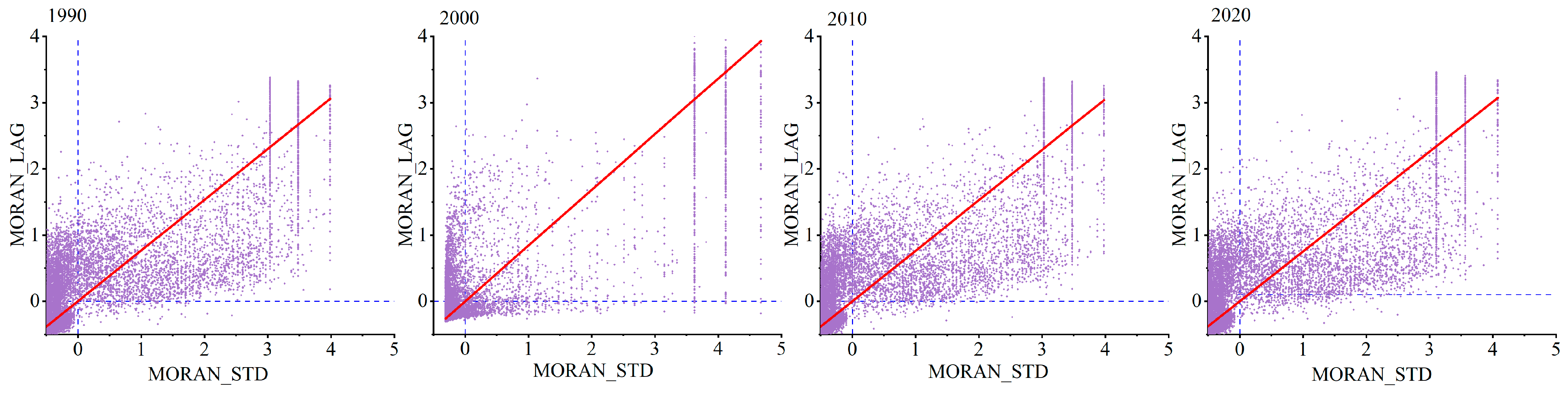
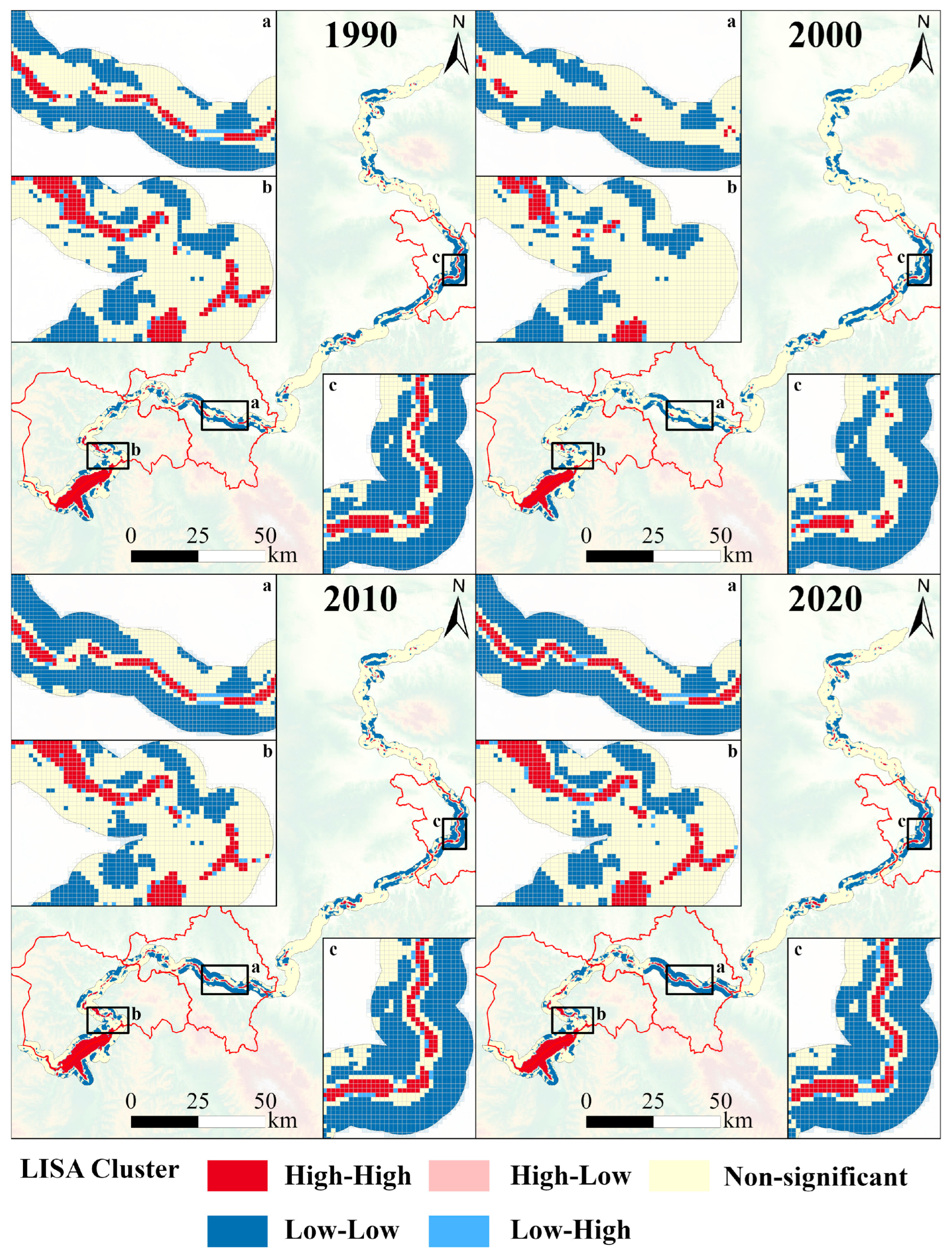
3.3.2. LER Spatial Change
3.4. Construction of Ecological Zoning Model Based on EBI
4. Discussion
4.1. Analysis of Spatiotemporal Drivers of ESV and LER
4.2. Methodological Evaluation: Efficacy and Boundaries of the Integrated Zoning Framework
4.3. Policy Recommendations
4.4. Limitations and Prospects
5. Conclusions
Supplementary Materials
Author Contributions
Funding
Data Availability Statement
Conflicts of Interest
References
- Fu, S.; Zhang, J.; Li, Y.; Chen, W.; Zhang, Y.; Yi, K.; Dai, Y. Environmental variables affect the effectiveness of ecosystem services of ecological restoration project: Evidence from Xiangjiang River Basin-Dongting Lake. J. Clean. Prod. 2025, 527, 146739. [Google Scholar] [CrossRef]
- Wang, C.; Chang, Y.; Guo, B.; Liu, P. Forecasting and Evaluation of Ecosystem Services Supply-Demand Under SSP-RCP Scenarios in the Henan Segment of the Yellow River Basin, China. Remote Sens. 2025, 17, 1067. [Google Scholar] [CrossRef]
- Xu, C.; Tian, Z.; Lu, Y.; Yin, Z.; Du, Z. Analysis of the Spatiotemporal Variation Characteristics and Driving Forces of Crops in the Yellow River Basin from 2000 to 2023. Remote Sens. 2025, 17, 2934. [Google Scholar] [CrossRef]
- Mou, X.; Zhang, X.; Wang, X.; Wang, J.; Rao, S.; Huang, J.; Chai, H. Ecological Change Assessment and Protection Strategy in the Yellow River Basin. Strateg. Study Chin. Acad. Eng. 2022, 24, 113–121. [Google Scholar] [CrossRef]
- Shuangmi, X.; Wenzhu, Z.; Bin, W.; Shengquan, L.; Guanhai, G.; Yanhua, L. Evaluating the migration of boundary river shorelines and coastal land cover changes for the Beilun River between China and Vietnam. J. Hydrol. Reg. Stud. 2025, 57, 102167. [Google Scholar] [CrossRef]
- Cole, L.J.; Stockan, J.; Helliwell, R. Managing riparian buffer strips to optimise ecosystem services: A review. Agric. Ecosyst. Environ. 2020, 296, 106891. [Google Scholar] [CrossRef]
- Wang, X.; Zhou, L.; Song, Y.; Wang, S.; Chen, H.; Gao, H.; Sun, Q.; Guo, Z.; Wei, W.; Lyu, R.; et al. Dramatic 2d/ 3d Differences in Urban Grey-Green Space Configurations Proportion and the Nonlinear Effects of the Thermal Environment. 2025. Available online: https://ssrn.com/abstract=5216323 (accessed on 2 January 2026).
- Ma, L.; Li, S.; Zhang, W.; Li, J. Identification of Spatial Fairness and Obstacle Factor of Public Service Facilities from Multigradient Perspective: Lan-Bai Urban Agglomeration. J. Urban Plan. Dev. 2025, 151, 05025017. [Google Scholar] [CrossRef]
- Zhao, X.; Li, J.; Ruan, F.; Zou, Z.; He, X.; Zhou, C. Spatiotemporal Dynamics and Multi-Scenario Projections of the Land Use and Habitat Quality in the Yellow River Basin: A GeoDetector-PLUS-InVEST Integrated Framework for a Coupled Human–Natural System Analysis. Remote Sens. 2025, 17, 2181. [Google Scholar] [CrossRef]
- Costanza, R.; d’Arge, R.; de Groot, R.; Farber, S.; Grasso, M.; Hannon, B.; Limburg, K.; Naeem, S.; O’Neill, R.V.; Paruelo, J.; et al. The value of the world’s ecosystem services and natural capital. Nature 1997, 387, 253–260. [Google Scholar] [CrossRef]
- Costanza, R.; de Groot, R.; Braat, L.; Kubiszewski, I.; Fioramonti, L.; Sutton, P.; Farber, S.; Grasso, M. Twenty years of ecosystem services: How far have we come and how far do we still need to go? Ecosyst. Serv. 2017, 28, 1–16. [Google Scholar] [CrossRef]
- Gao, L.; Tao, F.; Liu, R.; Wang, Z.; Leng, H.; Zhou, T. Multi-scenario simulation and ecological risk analysis of land use based on the PLUS model: A case study of Nanjing. Sustain. Cities Soc. 2022, 85, 104055. [Google Scholar] [CrossRef]
- Rezvani, A.; Cavalli, M.; Crema, S.; Djodjic, F.; Futter, M.; Ferreira, C.S.S.; Haozhi, P.; Kalantari, Z. A holistic framework for wetland placement and ecosystem service delivery by integrating landscape connectivity and participatory decision analysis in two Swedish catchments. J. Hydrol. Reg. Stud. 2025, 61, 102669. [Google Scholar] [CrossRef]
- Xu, W.; Wang, J.; Zhang, M.; Li, S. Construction of landscape ecological network based on landscape ecological risk assessment in a large-scale opencast coal mine area. J. Clean. Prod. 2021, 286, 125523. [Google Scholar] [CrossRef]
- Xie, G.D.; Zhang, C.X.; Zhang, L.M.; Chen, W.H.; Li, S.M. Improvement of the Evaluation Method for Ecosystem Service Value Based on Per Unit Area. J. Nat. Resour. 2015, 30, 1243–1254. [Google Scholar] [CrossRef]
- Gu, F.; Xu, G.; Wang, B.; Cheng, Y.; Xu, M.; Li, J. Spatiotemporal variation and drivers of ecosystem service value: A case study in Ziwuling area, Loess plateau. J. Environ. Manag. 2025, 393, 127053. [Google Scholar] [CrossRef]
- Yang, Q.; Liu, G.; Giannetti, B.F.; Agostinho, F.; Almeida, C.M.; Casazza, M. Emergy-based ecosystem services valuation and classification management applied to China’s grasslands. Ecosyst. Serv. 2020, 42, 101073. [Google Scholar] [CrossRef]
- Athukorala, D.; Murayama, Y.; Bandara, C.M.M.; Lokupitiya, E.; Hewawasam, T.; Gunatilake, J.; Karunaratne, S. Effects of urban land change on ecosystem service values in the Bolgoda Wetland, Sri Lanka. Sustain. Cities Soc. 2024, 101, 105050. [Google Scholar] [CrossRef]
- Zhang, Y.; Wang, Y. How does urbanization evolve heterogeneously in urbanized, urbanizing, and rural areas of China? Insights from ecosystem service value. Geogr. Sustain. 2025, 6, 100254. [Google Scholar] [CrossRef]
- Basu, T.; Das, A.; Das, K.; Pereira, P. Urban expansion induced loss of natural vegetation cover and ecosystem service values: A scenario-based study in the siliguri municipal corporation (Gateway of North-East India). Land Use Policy 2023, 132, 106838. [Google Scholar] [CrossRef]
- Yang, S.; Jin, Z. Impact of road network expansion on landscape ecological risk and soil erosion sensitivity on the Luochuan Tableland of the Chinese Loess Plateau. Reg. Environ. Change 2024, 24, 37. [Google Scholar] [CrossRef]
- Wang, N.; Yan, J.; Su, F. Landscape pattern changes and ecological risk assessment of major bays in the Philippines. Ocean Coast. Manag. 2024, 251, 107085. [Google Scholar] [CrossRef]
- Jiang, Y.; Zhou, L.; Wang, B.; Zhang, Q.; Gao, H.; Wang, S.; Cui, M. The impact of gradient expansion of urban–rural construction land on landscape fragmentation in typical mountain cities, China. Int. J. Digit. Earth 2024, 17, 2310093. [Google Scholar] [CrossRef]
- Gao, B.; Wu, Y.; Li, C.; Zheng, K.; Wu, Y.; Wang, M.; Fan, X.; Ou, S. Multi-Scenario Prediction of Landscape Ecological Risk in the Sichuan-Yunnan Ecological Barrier Based on Terrain Gradients. Land 2022, 11, 2079. [Google Scholar] [CrossRef]
- Gabisa, M.; Tiye, F.S.; Mammo, S. Impacts of land use land cover changes on wetland ecosystem services in Dandi Lake, Oromia, Ethiopia: An analysis using Google Earth Engine and machine learning. J. Nat. Conserv. 2026, 89, 127146. [Google Scholar] [CrossRef]
- Li, Y.; Liu, J.; Zhu, Y.; Wu, C. Assessment of Landscape Ecological Risks Driven by Land Use Change Using Multi-Scenario Simulation: A Case Study of Harbin, China. Land 2025, 14, 947. [Google Scholar] [CrossRef]
- Feng, B.; Zhou, J.; Hu, L.; Liu, Z.; Yang, Y.; Yang, S.; Ni, J.; Bai, W.; Zhao, S. Land Use and Ecosystem Service Value Spatiotemporal Dynamics, Topographic Gradient Effect and Their Driving Factors in Typical Alpine Ecosystems of the East Qinghai-Tibet Plateau: Implications for Conservation and Development. Ecol. Evol. 2025, 15, e71125. [Google Scholar] [CrossRef]
- Li, J.; Hu, D.; Wang, Y.; Chu, J.; Yin, H.; Ma, M. Study of identification and simulation of ecological zoning through integration of landscape ecological risk and ecosystem service value. Sustain. Cities Soc. 2024, 107, 105442. [Google Scholar] [CrossRef]
- Bian, J.; Chen, W.; Zeng, J. Ecosystem services, landscape pattern, and landscape ecological risk zoning in China. Environ. Sci. Pollut. Res. 2023, 30, 17709–17722. [Google Scholar] [CrossRef]
- Chen, D.; Guo, K.-R.; Zeng, W.; Wang, F.-H. Zoning-grading optimization of watershed ecological security network integrating function and structure: A case study in the Three Gorges Reservoir Area. J. Clean. Prod. 2026, 538, 147160. [Google Scholar] [CrossRef]
- Ma, L.; Li, J.; Wang, X.; Zhang, W.; Tao, T.; Zhong, Y. Evolution and simulation optimization of rural settlements in urban-rural integration areas from a multi-gradient perspective: A case study of the Lan-Bai urban agglomeration in China. Habitat Int. 2024, 153, 103203. [Google Scholar] [CrossRef]
- Liang, Z.; Yuefeng, J.; Chenghu, Z.; Zhifeng, L.I.U.; Qinke, S.U.N. Spatial characteristics and driving factors of gradient expansion of mountainous towns in China. Acta Geogr. Sin. 2025, 80, 2692–2707. [Google Scholar] [CrossRef]
- Wang, Y.; Ge, J.; Zhang, Y.; Lu, J.; Zhang, Y.; Ma, F. Health assessment of the current situation of rivers and discussion on ecological restoration strategies: A case study of the Gansu province section of the Bailong river. Ecol. Indic. 2024, 163, 112038. [Google Scholar] [CrossRef]
- Wang, Z.; Shi, P.; Shi, J.; Zhang, X.; Liu, Y. Research on the relationship between urban space and ecological environment evolution at the grid scale: A case study of Lanzhou City. Cities 2025, 163, 106006. [Google Scholar] [CrossRef]
- Wang, L.; Liu, X.; Lei, J.; Ma, J.; Zhang, L.; Liu, X. How the land use change impact on ecological vulnerability in the Lanzhou-Baiyin section of the Yellow River Basin, China. Environ. Sustain. Indic. 2025, 27, 100779. [Google Scholar] [CrossRef]
- Xie, Y.; Zhu, Q.; Bai, H.; He, H.; Zhang, Y. Combining ecosystem service value and landscape ecological risk to subdivide the riparian buffer zone of the Weihe River in Shaanxi. Ecol. Indic. 2024, 166, 112424. [Google Scholar] [CrossRef]
- Luan, C.; Liu, R.; Li, Y.; Zhang, Q. Comparison of various models for multi-scenario simulation of land use/land cover to predict ecosystem service value: A case study of Harbin-Changchun Urban Agglomeration, China. J. Clean. Prod. 2024, 478, 144012. [Google Scholar] [CrossRef]
- Das, M.; Das, A. Dynamics of Urbanization and its impact on Urban Ecosystem Services (UESs): A study of a medium size town of West Bengal, Eastern India. J. Urban Manag. 2019, 8, 420–434. [Google Scholar] [CrossRef]
- Sui, L.; Yan, Z.; Li, K.; Wang, C.; Shi, Y.; Du, Y. Prediction of ecological security network in Northeast China based on landscape ecological risk. Ecol. Indic. 2024, 160, 111783. [Google Scholar] [CrossRef]
- Xue-Bin, Z.; Pei-Ji, S.; Jun, L.; Hai-Long, L.; Wei, W. The Ecological Risk Assessment of Arid Inland River Basin at the Landscape Scale:A Case Study on Shiyang River Basin. J. Nat. Resour. 2014, 29, 410–419. [Google Scholar]
- Wang, W.; Chen, Y.; Du, Z.; Bi, S.; Zhang, Q.; Ye, T. Ecological restoration zoning and its driving factors in Beijing-Tianjin-Hebei based on landscape ecological risk and ecosystem services. Ecol. Indic. 2025, 178, 114086. [Google Scholar] [CrossRef]
- Assunção, R.M.; Reis, E.A. A new proposal to adjust Moran’s I for population density. Stat. Med. 1999, 18, 2147–2162. [Google Scholar] [CrossRef]
- Lee, S.-I. Developing a bivariate spatial association measure: An integration of Pearson’s r and Moran’s I. J. Geogr. Syst. 2001, 3, 369–385. [Google Scholar] [CrossRef]
- Marshall, R.J. Mapping Disease and Mortality Rates Using Empirical Bayes Estimators. J. R. Stat. Society. Ser. C Appl. Stat. 1991, 40, 283–294. [Google Scholar] [CrossRef]
- Mwasenga, J.M.; Mjemah, I.C. Socio-Economic Feasibility for Implementation of Environmental Legislation along the Riparian Buffer Zones in Urban Rivers of Northern Tanzania. Urban Sci. 2023, 7, 73. [Google Scholar] [CrossRef]
- Wang, J.; He, T.; Lin, Y. Changes in ecological, agricultural, and urban land space in 1984–2012 in China: Land policies and regional social-economical drivers. Habitat Int. 2018, 71, 1–13. [Google Scholar] [CrossRef]
- Sun, S.; Chu, X.; Dong, W.; Wei, C.; Li, Z.; Song, S.; He, T. Research on the interaction of “tourism development-land use-landscape pattern” since the 1990s in a small karst basin, China. Environ. Sci. Pollut. Res. 2023, 30, 46869–46883. [Google Scholar] [CrossRef]
- Gong, J.; Cao, E.; Xie, Y.; Xu, C.; Li, H.; Yan, L. Integrating ecosystem services and landscape ecological risk into adaptive management: Insights from a western mountain-basin area, China. J. Environ. Manag. 2021, 281, 111817. [Google Scholar] [CrossRef]
- Ye, Y.; Zhang, J.; Wang, T.; Bai, H.; Wang, X.; Zhao, W. Changes in Land-Use and Ecosystem Service Value in Guangdong Province, Southern China, from 1990 to 2018. Land 2021, 10, 426. [Google Scholar] [CrossRef]
- Kong, W.; Shen, W.; Yu, C.; Niu, L.; Zhou, H.; Zhang, Z.; Guo, S. The neglected cost: Ecosystem services loss due to urban expansion in China from a triple-coupling perspective. Environ. Impact Assess. Rev. 2025, 112, 107827. [Google Scholar] [CrossRef]
- Rahman, H.; Muhammad, H.; Indrayani, P.; Triyatno, T. Spatial Assessment of Landscape Structure Changes and Ecological Connectivity in Pariaman. J. Remote Sens. GIS Technol. 2020, 6, 10–22. [Google Scholar] [CrossRef]
- Meng, F.; Dong, L.; Zhang, Y. Spatiotemporal Dynamic Analysis and Simulation Prediction of Land Use and Landscape Patterns from the Perspective of Sustainable Development in Tourist Cities. Sustainability 2023, 15, 14450. [Google Scholar] [CrossRef]
- Yang, J.; Xie, B.; Zhang, D. Spatial–temporal evolution of ESV and its response to land use change in the Yellow River Basin, China. Sci. Rep. 2022, 12, 13103. [Google Scholar] [CrossRef] [PubMed]
- Ma, M.; He, Y.; Sun, Y.; Cui, H.; Zang, H. Land Use Modeling and Predicted Ecosystem Service Value Under Different Development Scenarios: A Case Study of the Upper–Middle Yellow River Basin, China. Land 2025, 14, 115. [Google Scholar] [CrossRef]
- Shi, S.; Yan, T.; Zhao, W.; Qin, W.; Bai, Z. Longitudinal dynamic characteristics of ecosystem services and its response to natural and anthropogenic interactions in ecologically fragile areas. J. Environ. Manag. 2025, 394, 127253. [Google Scholar] [CrossRef]
- Xiong, Y.; Li, Y.; Yang, Y. Landscape Ecological Risk Assessment of Peri-Urban Villages in the Yangtze River Delta Based on Ecosystem Service Values. Sustainability 2025, 17, 7014. [Google Scholar] [CrossRef]
- Wu, C.; Guo, X.; Liu, F.; Dai, E. Land use zoning planning based on ecosystem services can improve regional comprehensive benefits. Ecol. Indic. 2025, 181, 114420. [Google Scholar] [CrossRef]
- Nie, X.Y.; Wang, C.; Li, K.M.; Gao, F.Y.; Huang, W.-Z.; Li, X. Spatiotemporal analysis of landscape ecological risk and its influencing factors based on land cover changes in the Hexi Corridor, Northwest China, 2000–2020. Environ. Sustain. Indic. 2025, 28, 100888. [Google Scholar] [CrossRef]
- Lin, Y.; Zhang, F.; Jin, Y.; Wen, L.; Yu, Y.; Zhang, L.; Weng, A.; Ge, Y. Spatial non-stationarity effects of the driving factors on landscape ecological risk: A case of the Xiamen-Zhangzhou-Quanzhou Urban Agglomeration, China. Ecol. Indic. 2024, 167, 112660. [Google Scholar] [CrossRef]
- Brumberg, H.; Beirne, C.; Broadbent, E.N.; Almeyda Zambrano, A.M.; Almeyda Zambrano, S.L.; Quispe Gil, C.A.; Lopez Gutierrez, B.; Eplee, R.; Whitworth, A. Riparian buffer length is more influential than width on river water quality: A case study in southern Costa Rica. J. Environ. Manag. 2021, 286, 112132. [Google Scholar] [CrossRef]
- Luke, S.H.; Slade, E.M.; Gray, C.L.; Annammala, K.V.; Drewer, J.; Williamson, J.; Agama, A.L.; Ationg, M.; Mitchell, S.L.; Vairappan, C.S.; et al. Riparian buffers in tropical agriculture: Scientific support, effectiveness and directions for policy. J. Appl. Ecol. 2019, 56, 85–92. [Google Scholar] [CrossRef]
- Lind, L.; Hasselquist, E.M.; Laudon, H. Towards ecologically functional riparian zones: A meta-analysis to develop guidelines for protecting ecosystem functions and biodiversity in agricultural landscapes. J. Environ. Manag. 2019, 249, 109391. [Google Scholar] [CrossRef] [PubMed]
- Paarlberg, A.; Sena, G.; Loc, H.H.; Schultner, J. Understanding Stakeholder Perspectives on the Implementation and Management of Riparian Buffer Zones in the Santa Lucía River Basin, Uruguay. Environ. Manag. 2025, 75, 2596–2613. [Google Scholar] [CrossRef] [PubMed]
- Jiang, P.; Cheng, L.; Li, M.; Zhao, R.; Duan, Y. Impacts of LUCC on soil properties in the riparian zones of desert oasis with remote sensing data: A case study of the middle Heihe River basin, China. Sci. Total Environ. 2015, 506–507, 259–271. [Google Scholar] [CrossRef] [PubMed]
- Butt, A.N.; Rigoni, C. The Green Blueprint: Designing Future Cities with Urban Green Infrastructure and Ecosystem Services in the UK. Land 2025, 14, 1306. [Google Scholar] [CrossRef]



| Data Types | Data Name | Data Source | Data Format |
|---|---|---|---|
| Fundamental Geographic Data | Administrative boundaries of the study area | Standard map service system (http://bzdt.ch.mnr.gov.cn/) accessed on 5 June 2025 | Shp |
| Remote sensing satellite monitoring data | Land use and cover change | Resource and Environmental Science Data Platform (https://www.resdc.cn/) accessed on 8 June 2025 | Raster (30 m) |
| Road network data | Railway, highway network data | OpenStreetMap (https://www.openstreetmap.org) accessed on 15 August 2025 | Shp |
| Socio-economic data | Total sown area | National Bureau of Statistics (https://www.stats.gov.cn) accessed on 2 September 2025 Gansu Provincial Bureau of Statistics (https://tjj.gansu.gov.cn) accessed on 22 September 2025 | Excel |
| Total grain output | |||
| The price of grain |
| Ecosystem Service Function | Cultivated Land | Forest Land | Grassland | Waters | Construction Land | Unused Land |
|---|---|---|---|---|---|---|
| Food Production | 0.85 | 0.25 | 0.23 | 0.80 | 0.00 | 0.01 |
| Production of material | 0.40 | 0.58 | 0.34 | 0.23 | 0.00 | 0.03 |
| Water supply | 0.02 | 0.30 | 0.19 | 8.29 | 0.00 | 0.02 |
| Gas conditioning | 0.67 | 1.91 | 1.21 | 0.77 | 0.00 | 0.11 |
| Climate regulation | 0.36 | 5.71 | 3.19 | 2.29 | 0.00 | 0.10 |
| Environmental purification | 0.10 | 1.67 | 1.05 | 5.55 | 0.00 | 0.31 |
| Hydrological regulation | 0.27 | 3.74 | 2.34 | 102.24 | 0.00 | 0.21 |
| Soil conservation | 1.03 | 2.32 | 1.47 | 0.93 | 0.00 | 0.13 |
| Maintain nutrient cycle | 0.12 | 0.18 | 0.11 | 0.07 | 0.00 | 0.01 |
| Bio-diversity | 0.13 | 2.12 | 1.34 | 2.25 | 0.00 | 0.12 |
| Aesthetic landscape | 0.06 | 0.993 | 0.59 | 1.89 | 0.00 | 0.05 |
| Total | 4.01 | 19.77 | 12.06 | 125.31 | 0.00 | 1.10 |
| Ecosystem Service Function | Cultivated Land | Forest Land | Grassland | Waters | Construction Land | Unused Land |
|---|---|---|---|---|---|---|
| Food Production | 886.57 | 260.76 | 239.90 | 834.42 | 0.00 | 10.43 |
| Production of material | 417.21 | 604.96 | 354.63 | 239.90 | 0.00 | 31.29 |
| Water supply | 20.86 | 312.91 | 198.18 | 8646.69 | 0.00 | 20.86 |
| Gas conditioning | 698.83 | 1992.18 | 1262.06 | 803.13 | 0.00 | 114.73 |
| Climate regulation | 375.49 | 5955.68 | 3327.25 | 2388.53 | 0.00 | 104.30 |
| Environmental purification | 104.30 | 1741.85 | 1095.18 | 5788.80 | 0.00 | 323.34 |
| Hydrological regulation | 281.62 | 3900.92 | 2440.68 | 106,639.03 | 0.00 | 219.04 |
| Soil conservation | 1074.32 | 2419.82 | 1533.25 | 970.01 | 0.00 | 135.59 |
| Maintain nutrient cycle | 125.16 | 187.74 | 114.73 | 73.01 | 0.00 | 10.43 |
| Bio-diversity | 135.59 | 2211.22 | 1397.66 | 2346.81 | 0.00 | 125.16 |
| Aesthetic landscape | 62.58 | 1035.73 | 615.39 | 1971.32 | 0.00 | 52.15 |
| Total | 4182.54 | 20,623.76 | 12,578.90 | 130,701.65 | 0.00 | 1147.33 |
| Landscape Type | Cultivated Land | Forest Land | Grassland | Waters | Construction Land | Unused Land |
|---|---|---|---|---|---|---|
| Value | 4 | 3 | 2 | 5 | 1 | 6 |
| Vulnerability index | 0.190 | 0.095 | 0.143 | 0.238 | 0.048 | 0.286 |
| LUCC Types | 1990–2000 | 2000–2010 | 2010–2020 | 1990–2020 |
|---|---|---|---|---|
| Cultivated land | −1064.34 | 86.76 | −3088.08 | −4065.66 |
| Forest land | 2.34 | −952.29 | −411.57 | −1361.52 |
| Grassland | −189.99 | −677.16 | −185.13 | −1052.28 |
| Waters | −99.27 | −624.42 | 390.87 | −332.82 |
| Construction land | 1356.12 | 1896.12 | 3663.72 | 6915.96 |
| Unused land | −4.86 | 274.95 | −288.36 | −18.27 |
| Year | 1990 | 2000 | 2010 | 2020 | 1990–2000 | 2000–2010 | 2010–2020 | 1990–2020 |
|---|---|---|---|---|---|---|---|---|
| Cultivated land | 2.23 | 2.18 | 2.19 | 2.06 | −0.0445 | 0.0036 | −0.1292 | −0.1700 |
| Forest land | 1.57 | 1.57 | 1.37 | 1.29 | 0.0005 | −0.1964 | −0.0849 | −0.2808 |
| Grassland | 11.88 | 11.86 | 11.77 | 11.75 | −0.0239 | −0.0852 | −0.0233 | −0.1324 |
| Waters | 31.01 | 30.88 | 30.06 | 30.57 | −0.1297 | −0.8161 | 0.5109 | −0.4350 |
| Unused land | 0.04 | 0.04 | 0.04 | 0.04 | −0.0001 | 0.0032 | −0.0033 | −0.0002 |
| Total | 46.73 | 46.53 | 45.44 | 45.71 | −0.1977 | −1.0909 | 0.2702 | −1.0184 |
| Ecological Risk Level | Area (hm2) | Proportion (%) | ||||||
|---|---|---|---|---|---|---|---|---|
| 1990 | 2000 | 2010 | 2020 | 1990 | 2000 | 2010 | 2020 | |
| Lowest | 27,687.5 | 38,512.5 | 30,425 | 35,687.5 | 13.17 | 18.32 | 14.47 | 16.97 |
| Low | 16,437.5 | 12,437.5 | 15,356.25 | 15,106.25 | 7.82 | 5.92 | 7.30 | 7.18 |
| Moderate | 110,593.75 | 106,081.25 | 107,775 | 107,900 | 52.60 | 50.45 | 51.26 | 51.32 |
| High | 50,275 | 47,968.75 | 51,462.5 | 46,631.25 | 23.91 | 22.81 | 24.48 | 22.18 |
| Highest | 5268.75 | 5268.75 | 5243.75 | 4937.5 | 2.51 | 2.51 | 2.49 | 2.35 |
Disclaimer/Publisher’s Note: The statements, opinions and data contained in all publications are solely those of the individual author(s) and contributor(s) and not of MDPI and/or the editor(s). MDPI and/or the editor(s) disclaim responsibility for any injury to people or property resulting from any ideas, methods, instructions or products referred to in the content. |
© 2026 by the authors. Licensee MDPI, Basel, Switzerland. This article is an open access article distributed under the terms and conditions of the Creative Commons Attribution (CC BY) license.
Share and Cite
Chen, Z.; Yang, J.; Han, M.; Wang, H.; Song, Y. Zoning Management Based on Spatiotemporal Evolution of Ecological Risk: Spatial Network Analysis of Riparian Zone in Lanzhou–Baiyin Metropolitan Area of the Yellow River Basin. Land 2026, 15, 317. https://doi.org/10.3390/land15020317
Chen Z, Yang J, Han M, Wang H, Song Y. Zoning Management Based on Spatiotemporal Evolution of Ecological Risk: Spatial Network Analysis of Riparian Zone in Lanzhou–Baiyin Metropolitan Area of the Yellow River Basin. Land. 2026; 15(2):317. https://doi.org/10.3390/land15020317
Chicago/Turabian StyleChen, Zhijie, Jiayue Yang, Miao Han, Haoxin Wang, and Yongrui Song. 2026. "Zoning Management Based on Spatiotemporal Evolution of Ecological Risk: Spatial Network Analysis of Riparian Zone in Lanzhou–Baiyin Metropolitan Area of the Yellow River Basin" Land 15, no. 2: 317. https://doi.org/10.3390/land15020317
APA StyleChen, Z., Yang, J., Han, M., Wang, H., & Song, Y. (2026). Zoning Management Based on Spatiotemporal Evolution of Ecological Risk: Spatial Network Analysis of Riparian Zone in Lanzhou–Baiyin Metropolitan Area of the Yellow River Basin. Land, 15(2), 317. https://doi.org/10.3390/land15020317