Article

Multi-Scale Coordinated Optimization Framework for Territorial Space Based on Production–Living–Ecological Functions: A Case Study of the Central Yunnan Urban Agglomeration


1
Faculty of Land Resource Engineering, Kunming University of Science and Technology, Kunming 650093, China
2
Yunnan Key Laboratory of Quantitative Remote Sensing, Kunming 650093, China
3
Yunnan International Joint Laboratory for Integrated Sky-Ground Intelligent Monitoring of Mountain Hazards, Kunming 650093, China
4
Natural Resources Intelligent Governance Industry-University-Research Integration Innovation Base, Kunming 650093, China
*
Author to whom correspondence should be addressed.
Land 2026, 15(2), 315; https://doi.org/10.3390/land15020315
Submission received: 12 January 2026 / Revised: 6 February 2026 / Accepted: 9 February 2026 / Published: 12 February 2026

Abstract

To address the persistent challenges of the “disconnect between macro-level spatial zoning and micro-level land allocation” and the paradox of “localized intensification accompanied by overall inefficiency” in territorial spatial governance, this study adopts a multi-scale coupling perspective to explore an optimized spatial pattern that promotes the coordinated development of production, living, and ecological functions (PLEFs), thereby enhancing the systematic and scientific basis of spatial governance. Taking the Central Yunnan Urban Agglomeration (CYUA) as a case study, a coupled optimization framework integrating macro-scale spatial zoning and micro-scale land allocation was established. First, using multi-period land use data (2000–2020) in conjunction with multi-source geographic and socio-economic datasets, the correspondence between land use types and PLEFs was constructed, and the spatiotemporal evolution characteristics of these functions were systematically analyzed. Second, the GMOP-PLUS model was employed to simulate and optimize land use patterns for 2035 under multiple development scenarios, and dominant spatial types were further refined based on grid-scale spatial suitability evaluation results. Third, the NRCA model was applied to identify comparative functional advantages at the county level. These advantages were comprehensively integrated with the revised dominant spatial types following the principle of “seeking common ground while preserving differences,” ultimately enabling the delineation of optimized territorial spatial development zones. The results indicate the following: (1) Throughout the study period, ecological space remained the dominant land use type (exceeding 75%), although its proportion gradually declined. Living space expanded markedly, while the internal structure of production space shifted toward industrial and mining land uses. (2) The planning control scenario was identified as the most suitable development pathway, exhibiting a spatial configuration characterized by a “central core with stronger development in the southeast than in the northwest.” Under this scenario, production and living spaces continued to expand, whereas ecological space maintained its dominant status. (3) Spatial suitability evaluation revealed a high degree of functional compatibility across the study area (79.01%), with ecological suitability prevailing. The revised dominant spatial types were predominantly ecological (78.94%), forming a hierarchical structure described as a “living core–production composite ring–ecological periphery.” (4) By integrating dominant spatial types with comparative functional advantages, the study area was classified into five major categories of territorial spatial development zones, for which differentiated governance strategies were proposed. This study provides methodological insights and practical guidance for improving refined territorial spatial management and advancing regional sustainable development.

1. Introduction

As a self-organizing system far from equilibrium, territorial space is characterized by complex superposition, coupling, and even conflicts arising from the diverse combinations and interactions of its internal elements. Through continuous dynamic evolution, the system maintains a relatively stable macro-scale structure while undergoing constant local adaptation and adjustment, thereby exhibiting pronounced spatial heterogeneity and functional complexity [1,2]. When these inherent characteristics intersect with rapid socio-economic development, a series of global challenges emerge, including intensified land-use conflicts, imbalanced spatial structures, and the absence of effective cross-regional coordination mechanisms. Together, these issues impose significant constraints on regional sustainable transformation [3,4]. In response to these systemic challenges, the establishment of effective spatial planning and governance frameworks has become a widely recognized international consensus.
In 2019, the Chinese government proposed the establishment and supervision of a territorial spatial planning system, emphasizing the strengthening of suitability assessments in the optimization of spatial patterns [5,6], while also highlighting the importance of effective articulation and implementation transmission across different levels of spatial planning [7,8]. However, the current territorial spatial planning system in China continues to rely predominantly on rigid quantitative and structural indicators, and spatial layout guidance is often constrained within administrative boundaries at each planning level. This has resulted in a series of persistent practical problems in spatial governance, including “single-scale optimization accompanied by multi-scale imbalance” and “local intensification coupled with overall inefficiency” [9]. Specifically, national and provincial territorial spatial planning primarily emphasizes strategic guidance, whereas city, county, and township-level planning increasingly shifts toward operational implementation. Nevertheless, effective transmission and coordination mechanisms between upper and lower administrative levels remain insufficient [10]. Geospatially, this deficiency is reflected in the difficulty of reconciling localized optimization with overall spatial optimization, the underlying cause of which lies in a mismatch in multiscale coupling between spatial functional configuration and resource allocation [11]. Consequently, achieving cross-scale organic articulation and systematic integration—from micro-level resource allocation to macro-level functional positioning—has emerged as a core challenge in advancing the optimization of the territorial spatial system.
Current research on territorial spatial optimization mainly revolves around two paradigms. The first paradigm focuses on land-use allocation optimization at the micro-parcel scale, with an emphasis on improving land-use efficiency. This approach typically couples multi-objective optimization models (e.g., GMOP) with spatial simulation models, such as cellular automata (CA), multi-agent systems (MAS), and the PLUS model [12,13,14,15,16]. These methods generate future land-use allocation schemes that coordinate land-use quantity and spatial configuration under multiple scenarios. However, they often produce only locally optimal solutions, which may deviate from overall regional functions and higher-level strategic objectives. The second paradigm addresses functional zoning optimization at the macro-regional scale, emphasizing the integrated coordination of regional functions and large-scale spatial restructuring. It relies on multi-functional evaluation, advantage identification, and cluster analysis to inform zoning decisions [17,18,19,20]. Scholars such as Xie Gaodi and Guo Yan have further enriched the technical framework of territorial spatial zoning by incorporating overlay analysis, fuzzy clustering, and combined top-down and bottom-up approaches [21,22,23]. Nevertheless, the resulting zoning schemes frequently lack clear and actionable pathways for translation into specific land-use allocation plans, thereby constraining their practical implementation. Moreover, existing approaches rarely achieve a systematic integration of current regional assessments with future optimization projections, nor do they adequately reconcile spatial development suitability with localized functional advantages. Moreover, these approaches generally fail to systematically integrate current regional assessment results with future optimization simulations, nor do they adequately reconcile spatial development suitability with localized functional advantages.
To overcome these limitations, the academic community has progressively shifted from single-scale analysis toward multi-scale integration, leading to the development of cross-scale analytical frameworks such as functional zoning transmission, county-level linkage pathways, and multidimensional analytical systems encompassing “grid–land-use category–administrative region–entire area” [10,24,25,26,27,28]. However, existing studies still face several critical challenges in advancing the substantive integration of micro-level allocation and macro-level zoning. First, most research remains at the stage of methodological juxtaposition or result comparison, failing to establish a closed-loop logic of bidirectional feedback and iterative optimization. Second, there is a lack of operational and verifiable model-based representations for the content, rules, and effectiveness of scale transmission. Third, a comprehensive technical framework integrating the full process of “current-state diagnosis–future simulation–zoning regulation” has yet to be established.
The Central Yunnan Urban Agglomeration (CYUA) is situated at the strategic intersection of the “Belt and Road” Initiative and the Yangtze River Economic Belt. It serves as a key region within China’s Western Development Strategy and a critical node in the national urbanization pattern, functioning as the primary carrier through which Yunnan Province fulfills its “Three Positions” strategic orientation. Despite its solid development foundation and considerable growth potential, the CYUA faces a series of pronounced structural challenges. These include an underdeveloped urban division of labor characterized by a strong “monocentric” development pattern; a relatively low overall quality of urbanization accompanied by significant intra-regional disparities; an extensive mode of territorial development leading to low land-use efficiency; and a lack of spatial integration, as evidenced by the contraction of blue–green spaces and the dispersed distribution of industrial land [29,30,31]. Collectively, these issues have constrained the effective utilization of the region’s resource endowments. Against this backdrop, exploring pathways to optimize territorial spatial layout through multi-scale coupling is of substantial theoretical and practical significance for promoting the coordinated and sustainable development of the CYUA.
Therefore, this study aims to construct a multi-scale territorial spatial collaborative optimization framework and to propose a systematic implementation pathway spanning from micro-level resource allocation to macro-level spatial zoning. Specifically, the research focuses on two key aspects. (1) By coupling multi-objective planning with spatially explicit simulation, multi-scenario schemes based on land-use benefits are developed, and a progressive optimization pathway from the micro to the macro scale is established according to the mapping relationship between land-use types and production–living–ecological space functions. (2) A dual-cycle process of “prediction correction–advantage identification” is designed, in which the simulated results of production–living–ecological spaces (PLESs) are revised through grid-scale suitability evaluation, and the dominant functional types of each administrative unit are identified through matrix analysis integrating functional advantages and predicted dominant spaces. On this basis, a territorial spatial optimization zoning scheme that integrates efficiency, suitability, and regional advantages is formulated. Overall, this study is expected to provide technical and methodological support for territorial spatial planning and governance in the CYUA, thereby promoting regional collaborative development and sustainable utilization.

2. Materials and Methods

2.1. Study Area

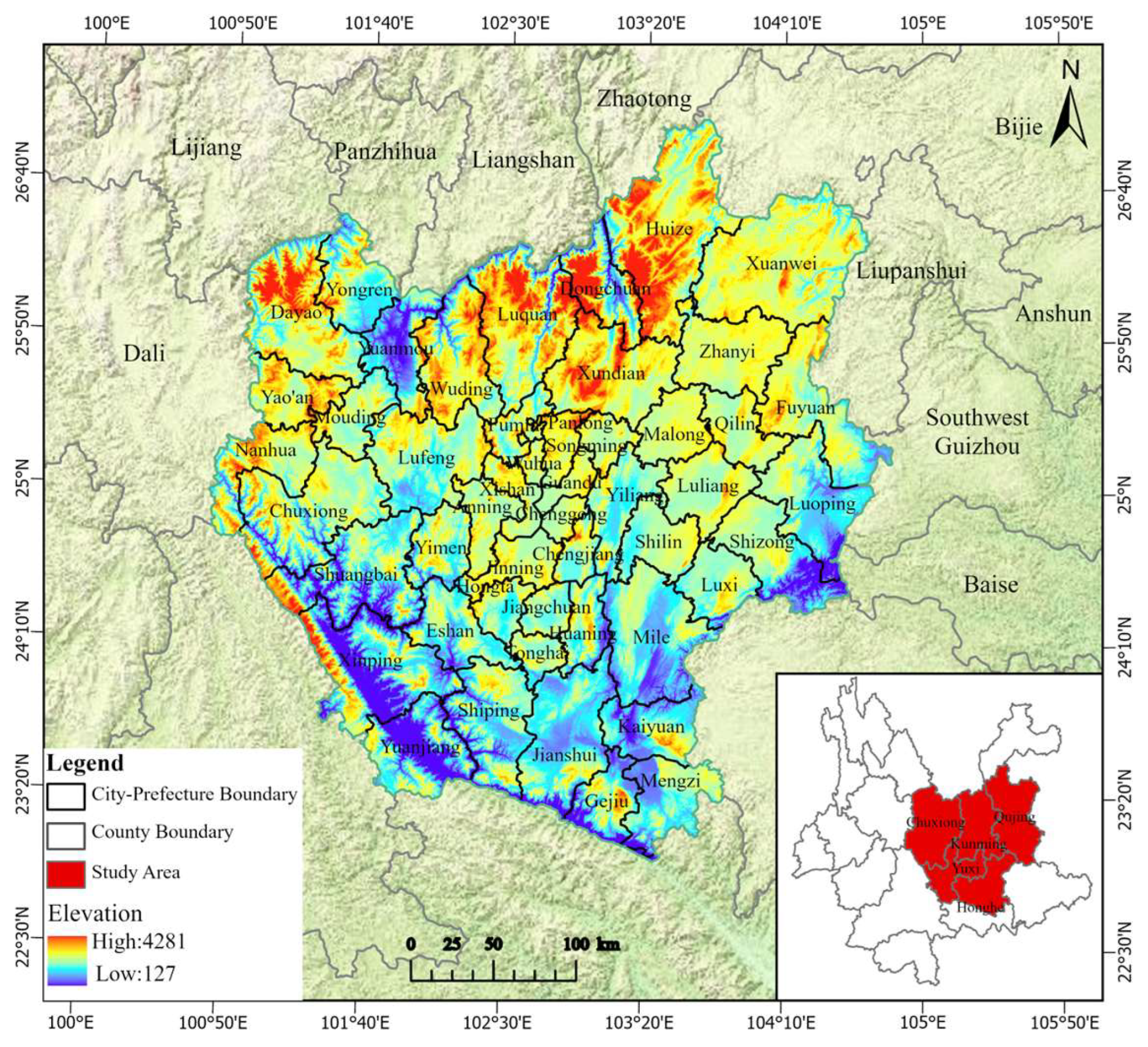
The Central Yunnan Urban Agglomeration (CYUA) is located in the east–central part of Yunnan Province and represents a typical plateau mountainous urban agglomeration. Geographically, it extends from 100°43′ E to 104°49′ E longitude and from 24°58′ N to 25°09′ N latitude. The CYUA encompasses four prefecture-level cities—Kunming, Qujing, Yuxi, and Chuxiong—and seven counties (or county-level cities) in the northern part of the Honghe Hani and Yi Autonomous Prefecture (Figure 1), comprising a total of 49 county-level administrative units and covering an area of approximately 111,400 km2. As a low-latitude, high-altitude region, the CYUA is characterized by a mountainous terrain with limited plains, exhibiting a topographic pattern that is higher in the northwest and lower in the southeast. The region contains five major plateau lakes, including Dianchi Lake, Fuxian Lake, and Yangzonghai Lake, and features diverse low-latitude plateau monsoon climates as well as pronounced three-dimensional climatic characteristics.
Against the backdrop of new-type urbanization and rapid regional economic development, intensified human activities have driven profound restructuring of the regional territorial spatial pattern. This process is manifested in a high degree of functional overlap between urban and agricultural uses in dam areas, increasingly pronounced conflicts between ecological protection and development in mountainous regions, and a marked disconnect between resource allocation and functional positioning. Such multi-scale spatial governance disorder has emerged as a major bottleneck constraining the region’s high-quality development.

2.2. Data Sources

The research data primarily comprise multi-temporal land use remote sensing datasets spanning from 2000 to 2020, physical geographic data (e.g., elevation, slope, cli-mate, and soil conditions), socio-economic data (e.g., gross domestic product (GDP) and population density), as well as infrastructure and planning-related datasets. Detailed information on data sources is provided in Table 1. All spatial datasets were uniformly projected to the Asia_North_Albers_Equal_Area_Conic_china_cgcs2000 coordinate system and resampled to a spatial resolution of 30 m × 30 m to ensure spatial consistency and comparability across datasets.

2.3. Research Methods

2.3.1. Logical Structure of the Multi-Scale Coupling Optimization Framework

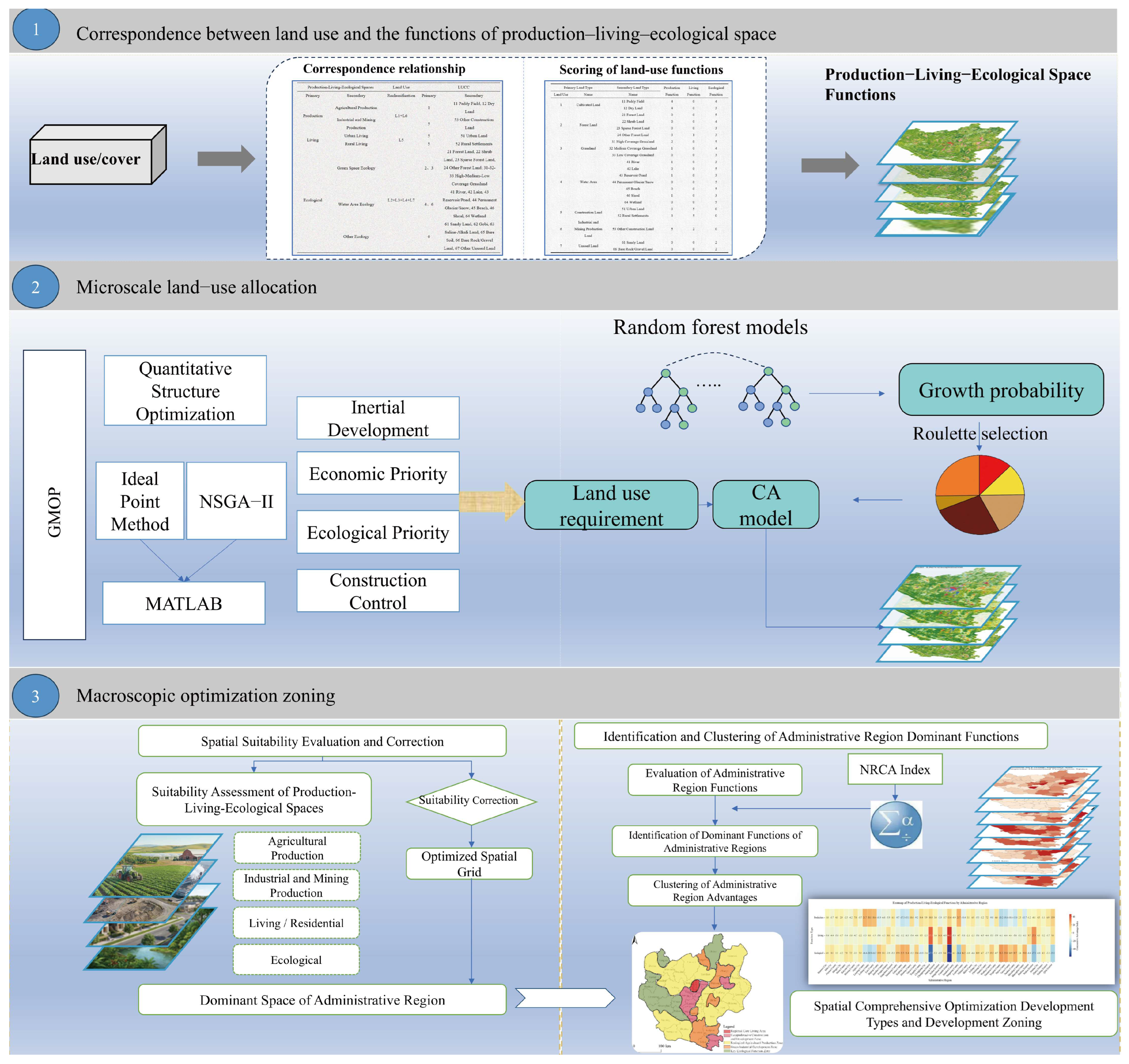
This study constructs a dual-cycle coupling framework of “micro-scale land use allocation–macro-scale zoning optimization” (Figure 2). The framework incorporates two critical feedback mechanisms. First, based on grid-scale spatial suitability evaluation, the benefit-oriented land use simulation results are adjusted according to the natural and socio-economic context of the land, thereby achieving feedback from the spatial context to the allocation scheme. Second, the NRCA model is employed to identify comparative functional advantages at the county level, which are then integrated with the adjusted dominant spatial patterns through a “seeking common ground while reserving differences” approach, thus realizing feedback from regional functional advantages to the zoning scheme. Together, these dual feedback mechanisms establish a dynamic interaction between bottom-up simulation and top-down determination, systematically addressing the prevalent issues of feedback lag and functional disconnection in cross-scale transmission.

2.3.2. Classification of PLE Spaces and Functional Evaluation

Based on the classification system of China’s LUCC remote sensing monitoring data, and incorporating insights from existing studies [36] while considering the distinct of characteristics of industrial and mining production land, this study categorized land use types into four spatial types: agricultural production, industrial and mining production, living, and ecological spaces. On this basis, referring to relevant studies [37,38,39] with a particular emphasis on the actual functional significance of different land use types within the study area regarding PLEFs, a systematic 0–5 scoring scale was applied to assign functional contribution values. This process culminated in the development of the PLESs Classification and Functional Scoring Table (Table 2), designed to quantify the composite functional value of each spatial category. A higher score indicates a stronger corresponding function.

2.3.3. Micro-Scale Land Use Resource Optimal Allocation Method

(1)
GMOP-PLUS Model
The GMOP-PLUS model integrates the Grey Multi-objective Programming (GMOP) approach with the Patch-generating Land Use Simulation (PLUS) model to optimize land-use structure and spatial patterns. The GMOP component addresses uncertainty by combining the Grey Model (GM (1, 1)) with Multi-objective Programming (MOP), thereby enabling land-use structure optimization [40], with the relevant formulations presented in Equations (1)–(3). The PLUS model employs a random forest algorithm together with patch-generation mechanisms to simulate land expansion processes under different policy scenarios [41]. In this study, land use data from 2000 and 2010 were used as the baseline inputs. By referring to relevant literature [42] to determine neighborhood weights and transition rules, and by designating water bodies as restricted transition areas, the land use pattern for 2020 was simulated for accuracy validation. The validation results show a Kappa coefficient of 92.49% and an overall accuracy (OA) of 95.16%, indicating that the GMOP-PLUS model effectively captures the actual land use changes in the study area and is suitable for subsequent future land use simulations.
F 1 x = max j = 1 m A j x j
F 2 x = max j = 1 m B j x j
s . t . j = 1 m C i j x i j = , D i , i = 1 , 2 , , n x j 0 , j = 1 , 2 , , m
In the formula, F1(x) and F2(x) represent the economic and ecological benefit functions, respectively. The decision variable xj denotes the proportion of the j-th land use type. Aj and Bj are the economic and ecological benefit coefficients of the j-th land use type. Here m represents the number of decision variables. The term s.t. denotes the land use constraints, where n is the number of constraints. Cij is the coefficient corresponding to the j-th variable in the i-th constraint, and Di represents the threshold value of the i-th constraint.
(2)
Scenario Design
Four scenarios were designed for the target year 2035. Scenario 1 (S1), the inertial development scenario, projects the quantitative land-use structure using a Markov chain (MC) model based on historical land-use transition patterns. Scenario 2 (S2), the economic-priority scenario, aims to maximize the economic benefits generated by land use, while Scenario 3 (S3), the ecological-priority scenario, seeks to maximize ecological benefits. Both S2 and S3 are formulated as single-objective optimization problems, and their optimal solutions are represented by ideal-point coordinates. Scenario 4 (S4), the planning-control scenario, comprehensively balances economic and ecological objectives while incorporating spatial planning constraints, such as total construction-land control. Under S4, the quantitative land-use structure was optimized using the Ideal-Point (IP) method combined with the NSGA-II algorithm implemented in MATLAB R2024b.
(3)
Model Prediction Parameters
Referring to relevant studies [43,44], the economic benefit per unit area for major land-use categories was calculated based on regional gross output values and sectoral outputs from agriculture, forestry, animal husbandry, and fishery. The ecological benefit per unit area was determined using the equivalent factor method [45] and adjusted according to the ratio of staple crop yield between the study area and the national average. The ecological benefit coefficient for construction land was set to zero [46]. All benefit coefficients were projected to the target year using the Grey Model (GM). The constraint intervals of the decision variables were defined based on land-use change trends over the past 20 years, integrating predictions derived from linear regression, the Markov chain (MC) model, and the Grey Model (GM). The upper and lower bounds of each variable were determined as the maximum and minimum values of the predicted ranges, respectively. The corresponding results are presented in Table A1.
The main parameters of spatial simulation include driving factors, neighborhood weights, and restricted transition layers. Following relevant studies [46,47], a total of 15 driving factors were selected, including elevation, slope, annual mean temperature, precipitation, soil type, distance to water bodies, GDP, population density, and distances to roads and residential areas. Neighborhood weights were assigned according to the degree of influence of land expansion on different land-use types under various scenarios [42]. Except for the economic-priority scenario (S2), water bodies were designated as restricted transition layers in the remaining scenarios to maintain their spatial stability. Detailed parameter settings are presented in Table A2.

2.3.4. Macro-Scale Zoning Optimization Method

(1)
Construction of the PLESs Suitability Evaluation Index System
By comprehensively integrating natural resource conditions and socio-economic factors, and drawing upon existing studies [48], a suitability evaluation index system was constructed for four spatial categories in the study area: agricultural production space, industrial and mining production space, living space, and ecological space (Table A3). This system was used to refine the predicted dominant land-use patterns derived from benefit-oriented optimization and to provide a methodological basis for subsequent territorial spatial zoning. A uniform evaluation procedure was applied across all suitability assessments. First, each indicator was classified into five levels using the natural breaks method, and corresponding suitability scores of 90, 70, 50, 30, and 10 were assigned. Subsequently, the indicators were aggregated using an equal-weight linear overlay approach to generate a composite suitability score for each spatial category, with higher values indicating greater suitability.
(2)
Dominant Space Revision Rules
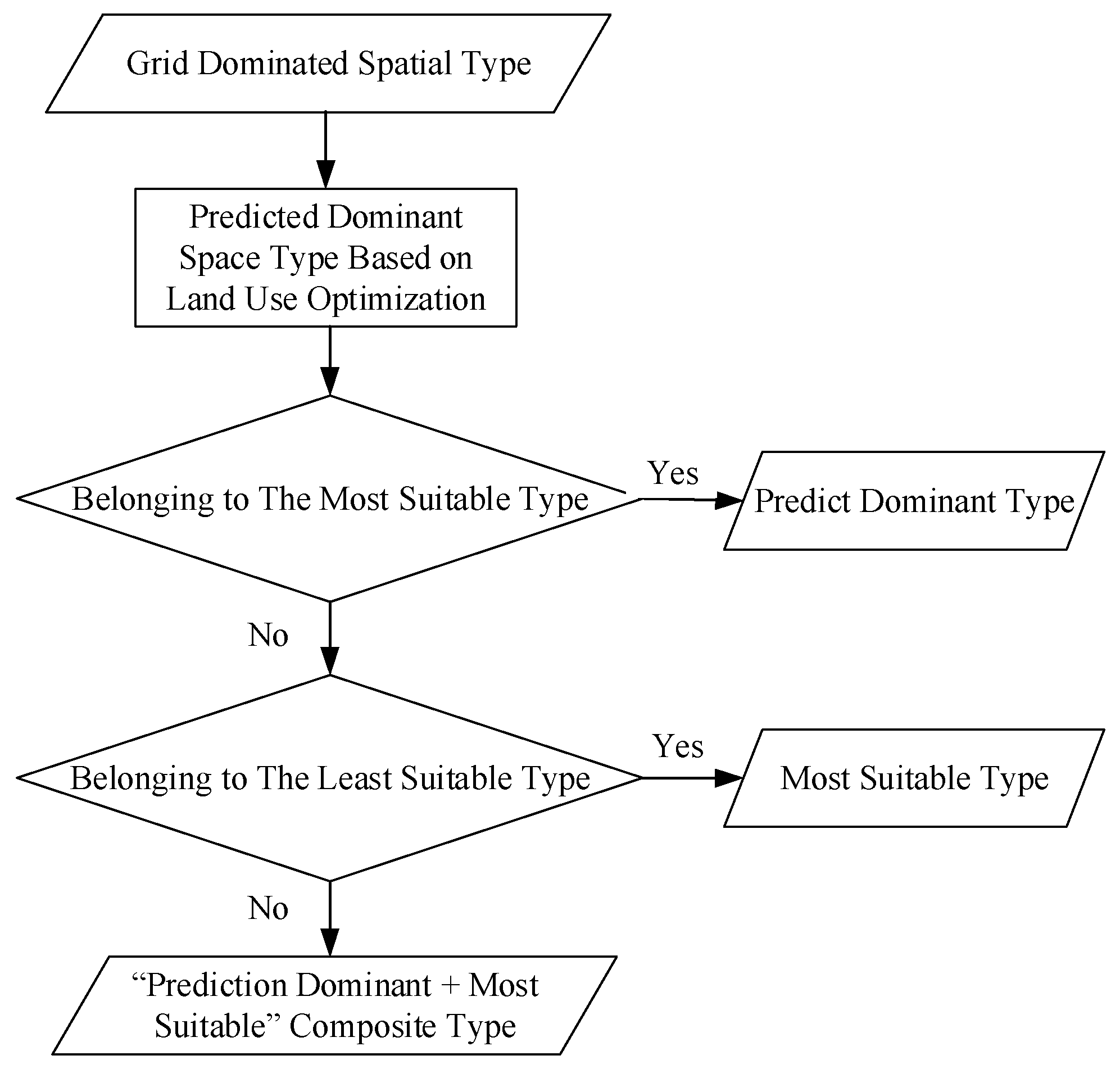
Based on the PLUS results, the predicted dominant spatial type for each grid cell was first identified. This predicted type was then compared with the most suitable and least suitable spatial types derived from the grid-scale PLESs suitability evaluation and revised according to the following rules (Figure 3):
① If the predicted dominant spatial type is consistent with the most suitable spatial type, it is retained;
② If the predicted dominant spatial type corresponds to the least suitable spatial type, it is revised to the most suitable spatial type;
③ If the predicted dominant spatial type is neither the most suitable nor the least suitable type, it is revised to a composite spatial type denoted as “predicted dominant–most suitable”.
(3)
Normalized Revealed Comparative Advantage (NRCA) Index Model
Regional development depends on the synergistic interaction among production, living, and ecological functions, as well as the functional complementarity among constituent spatial units. To identify the dominant functional advantages of administrative units and support territorial spatial zoning optimization, this study employs the Normalized Revealed Comparative Advantage (NRCA) index model [49] to quantify the comparative advantages of PLEFs at the county (district and city) level. Compared with traditional revealed comparative advantage indicators, the NRCA model effectively overcomes issues related to cross-regional comparability and index asymmetry, thereby providing a more robust basis for regional functional advantage assessment. The NRCA index is calculated as follows:
N R C A i j = X i j X X j X i X X
In the formula, Xij represents the value of the j-th PLEFs in the i-th administrative region. X denotes the total value of all PLEFs across all administrative regions. Xj is the sum of the j-th PLEFs values across all administrative regions, while Xi represents the total value of all PLEFs within the i-th administrative region. When the advantage index NRCAij > 0, the j-th PLEFs in the i-th administrative region exhibits a comparative advantage; conversely, when NRCAij < 0, the corresponding PLEF lacks a comparative advantage.
(4)
Zoning Determination and Optimization Rules
First, the dominant spatial type of each administrative unit was identified based on the degree of spatial agglomeration of the revised dominant spaces. Following the principle of “seeking common ground while reserving differences”, a matrix-based synthesis was conducted to integrate the dominant spatial type with the functional advantage type identified using the NRCA index. When the two were consistent, a single optimization zone was designated; when inconsistencies occurred, a composite optimization zone was delineated (e.g., a “living–ecological” composite zone).
Subsequently, hierarchical cluster analysis was employed to further refine the zoning scheme. The PLE functional advantage indices were first standardized using Z-score normalization. Squared Euclidean distance was selected as the similarity measure, and Ward’s linkage method was applied to minimize within-cluster variance, thereby generating compact and well-separated clusters that represent functionally homogeneous yet mutually distinct areas.
Finally, by synthesizing the agglomeration patterns revealed by the dendrogram with the previously derived composite optimization types, a set of function-oriented territorial spatial optimization and development zones was delineated.

3. Results

3.1. Analysis of the Evolution Characteristics of PLES and Their Functions

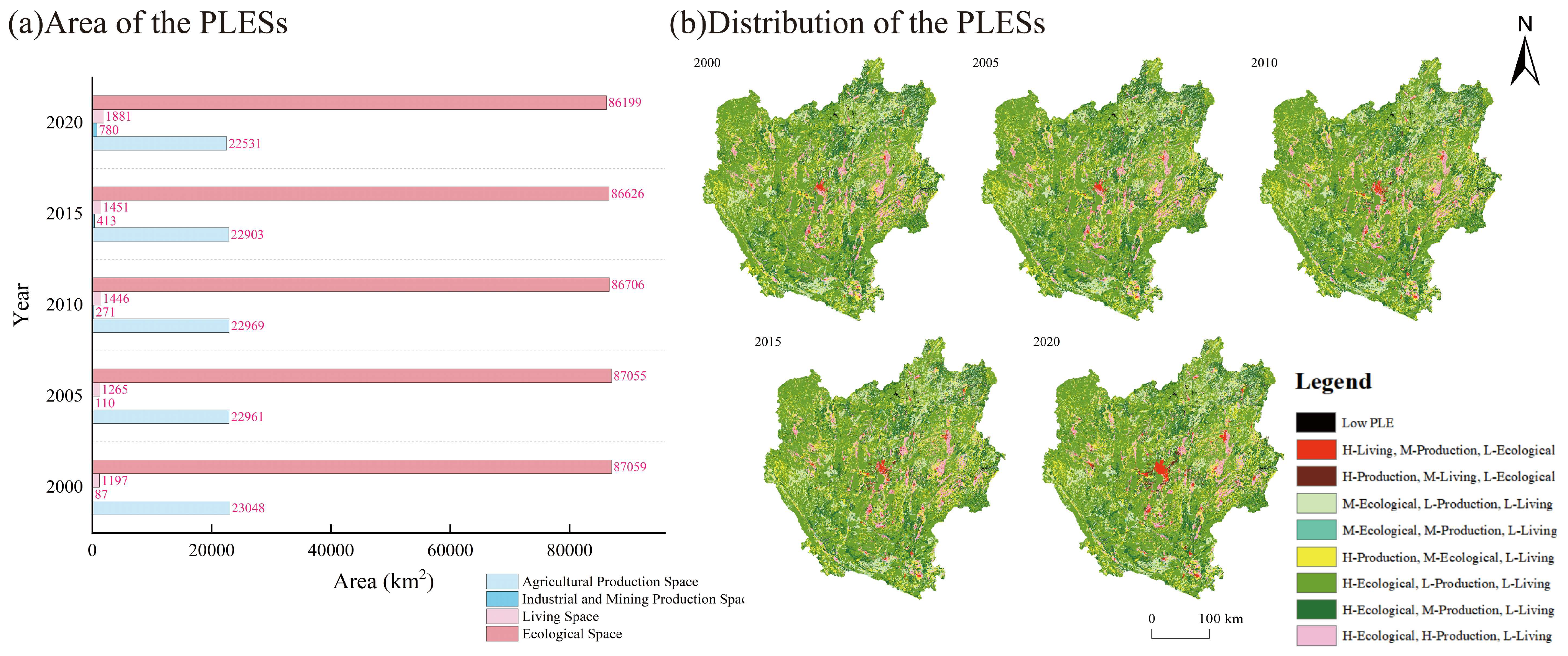
From 2000 to 2020, the territorial space of the study area exhibited an overall pattern characterized by ecological dominance, secondary production space, and rapidly expanding living space (Figure 4a). Ecological space consistently accounted for more than 75% of the total area, although its proportion showed a gradual decline, mainly attributable to the reduction in forest land, grassland, and water bodies. The internal structure of production space experienced pronounced adjustments, industrial and mining production space expanded continuously, whereas agricultural production space was progressively compressed. Living space demonstrated the most rapid growth, particularly during the periods 2005–2010 and 2015–2020, reflecting the accelerated urbanization process in the region.
The spatial function evaluation further reveals marked spatial differentiation and functional conflicts among PLEFs (Figure 4b). Areas with high production and living function values exhibit substantial spatial overlap and are primarily concentrated in urban areas in the central and eastern parts of the study area, expanding outward in tandem with the growth of construction land. In contrast, ecological functions display a distinct spatial pattern characterized by higher values in the west and lower values in the east, with high-value areas mainly distributed in mountainous and forested regions. Notably, a significant negative spatial correlation is observed between living and ecological functions, indicating the pronounced pressure exerted by intensified human activities in urbanized areas on the ecological environment.

3.2. Micro-Scale Optimal Allocation of Land-Use Resources

3.2.1. Multi-Scenario Land Use Simulation and Optimization Schemes

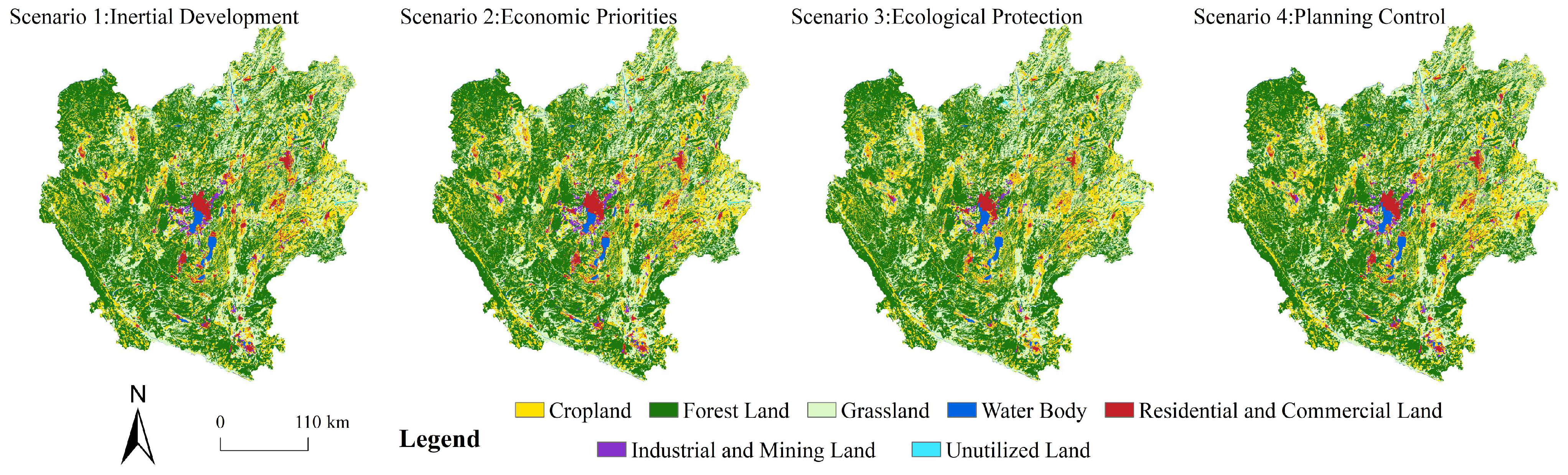
The multi-scenario land-use simulation results for 2035 (Figure 5) indicate that construction land expansion under all scenarios follows a general spatial pattern characterized by a “central core with peripheral diffusion”, with expansion intensity being stronger in the southeast than in the northwest. Compared with the 2020 baseline, construction land is projected to continue expanding by 2035, encompassing not only major regional central cities such as Kunming, Qujing, and Yuxi, but also small- and medium-sized cities located in other intermontane basins. This process results in an expansion structure in which the Kunming urban area in the northeastern Dianchi Lake Basin functions as the primary “source area”, while multiple surrounding basins act as secondary “source points”. Marked differences in construction land expansion patterns are observed among the development scenarios. Under Scenario 2, construction land expansion is relatively limited and remains largely confined to the peripheries of existing central urban areas, reflecting a strong constraint on urban sprawl. In contrast, Scenario 1 and Scenario 4 exhibit broadly similar spatial expansion patterns, both characterized by relatively stable and continuous outward growth along existing construction land boundaries. However, their land-use structural compositions differ substantially. Under Scenario 1, the expansion of residential construction land is pronounced and primarily encroaches upon forest land. By comparison, Scenario 4 imposes stricter controls on residential land growth, allocates more space for industrial and mining production land, and directs expansion mainly toward grassland areas.
Further optimization indicator calculations based on the simulation results (Table 3) demonstrate that Scenario 4 exhibits the most balanced overall optimization performance. Specifically, while maintaining relatively high growth in land-use benefits and improved levels of land-use intensification, this scenario is associated with a lower proportion of unused land and achieves the highest ecological benefit output efficiency for major ecological land types. Consequently, when jointly considering spatial expansion characteristics and multi-dimensional optimization indicators, Scenario 4 is identified as the preferred optimal land-use allocation scheme for future development.

3.2.2. Spatial Pattern of PLESs Based on Land Use Optimization Prediction

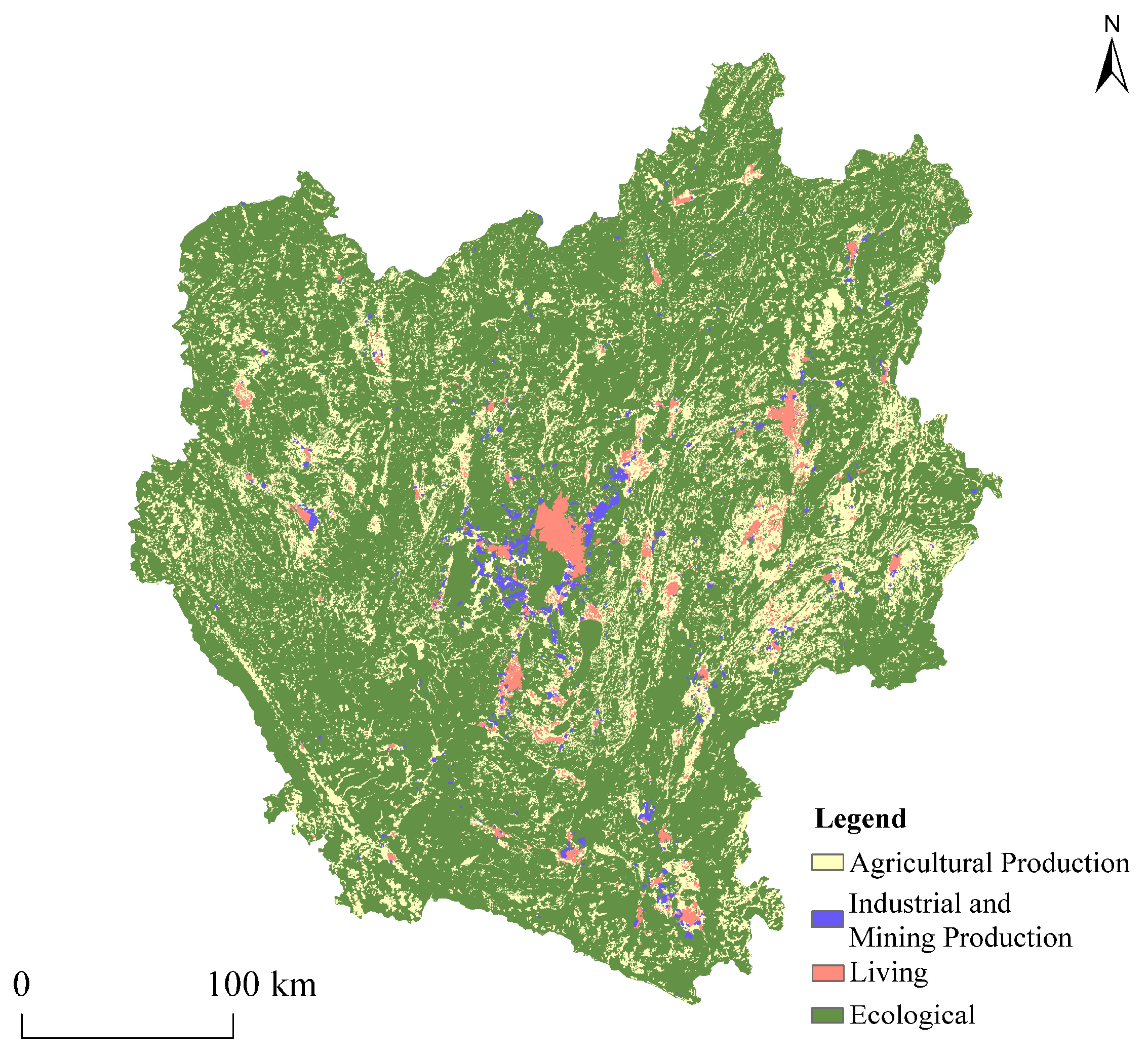
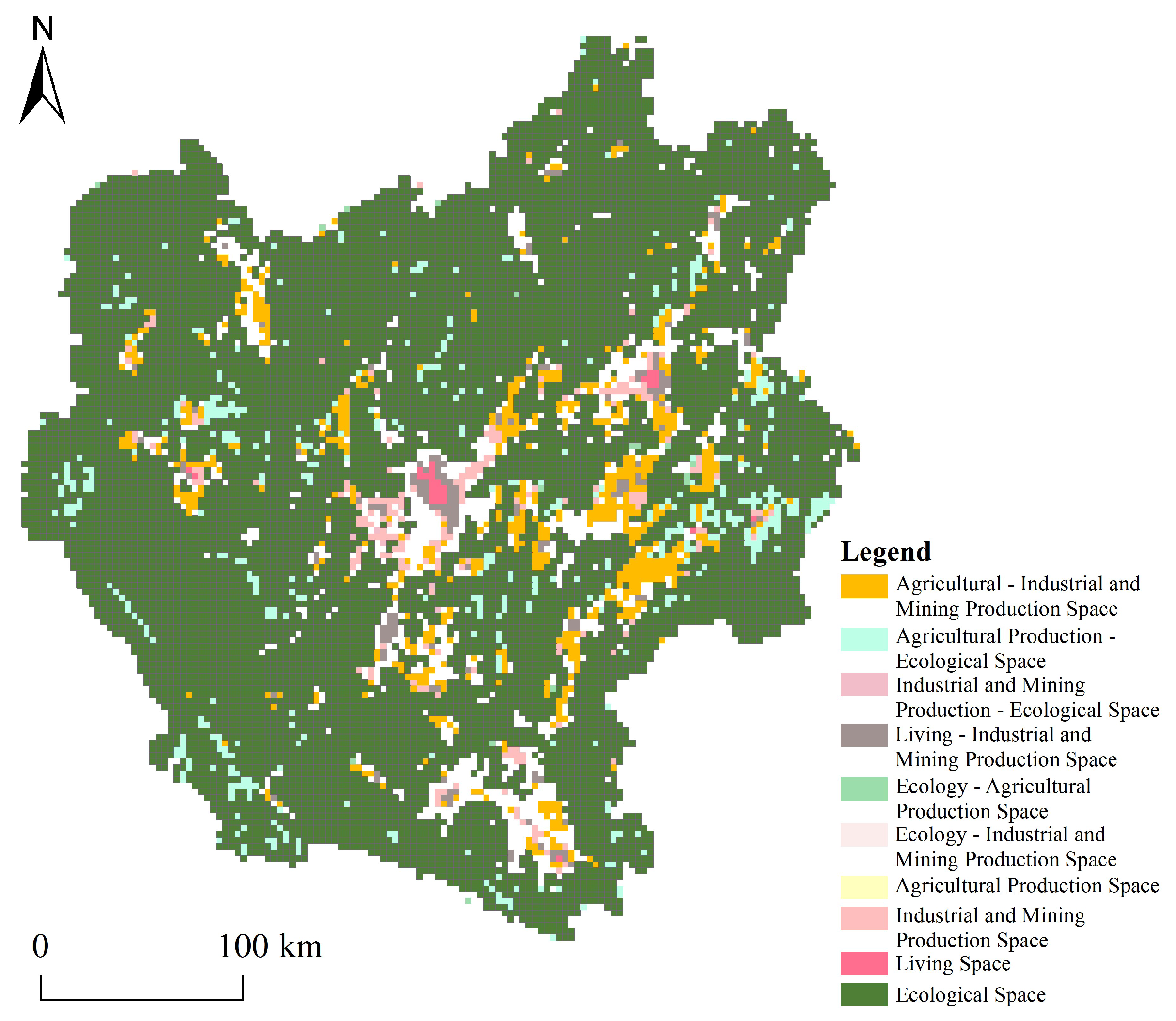
Based on the land-use simulation results under the Planning Control Scenario (S4), the spatial distribution pattern of PLESs in the study area for 2035 was derived (Figure 6). Compared with 2020, the overall spatial configuration remains relatively stable and is generally consistent with regional development planning objectives. The proportions of both production space and living space exhibit an increasing trend, whereas the proportion of ecological space shows a slight decline but continues to maintain a dominant position. In terms of specific land-use types, industrial and mining production space expands markedly, with an increase of 79.36%, while agricultural production space experiences a marginal contraction of 1.16%. Living space shows substantial growth, increasing by approximately 45%, reflecting sustained urbanization and population concentration trends. Within ecological space, green ecological space continues to account for nearly three-quarters of the total study area, and the extent of water space remains largely stable. These results indicate that, despite moderate adjustments in land-use structure, the overall ecological baseline of the study area is effectively preserved under the Planning Control Scenario.

3.3. Macro-Scale Territorial Space Zoning Optimization

3.3.1. Analysis of Spatial Suitability Evaluation Results

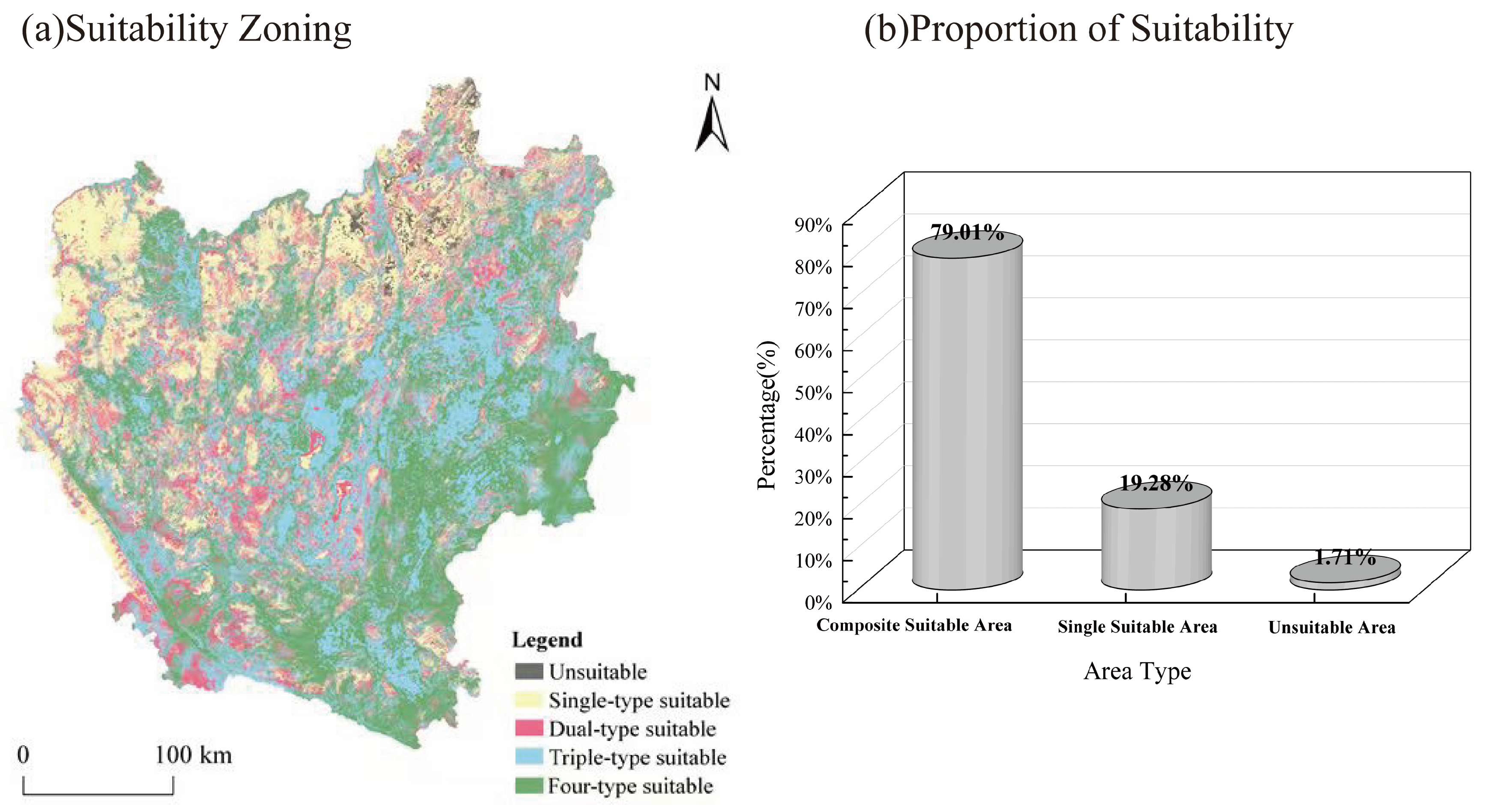
The results of the comprehensive suitability evaluation (Figure 7) reveal pronounced functional complexity within the territorial space of the study area. Composite suitable spaces dominate the overall pattern, accounting for 79.01% of the total area, whereas single suitable spaces constitute 19.28%, and unsuitable areas represent only 1.71%. Within the composite suitability structure, ecological functions play a dominant role. Not only do single ecological suitable areas account for the highest proportion among all single-function types (17.69%), but composite suitability types combining ecological functions with agricultural production or industrial and mining production are also widely distributed. This pattern reflects the region’s strong ecological foundation while simultaneously indicating substantial spatial overlap and potential conflicts between ecological protection and human activities.
From a spatial perspective, unsuitable areas are sparsely distributed, primarily occurring in Huize, Dongchuan, and other northeastern regions. These areas should be prioritized as key zones for ecological restoration and green-oriented development. Single suitable spaces are mainly concentrated along the northwestern periphery, where the orientation of dominant functions should be further clarified and strengthened. In contrast, multi-type composite suitable spaces are predominantly clustered within the central–eastern to southern development hinterland. Owing to their favorable functional support conditions and high development potential, these areas represent critical regions for enhancing functional coordination and optimizing the territorial spatial layout in future planning.

3.3.2. Results of Dominant Space Revision Based on Spatial Suitability

(1)
Grid-Scale Dominant Spaces and Suitability Distribution
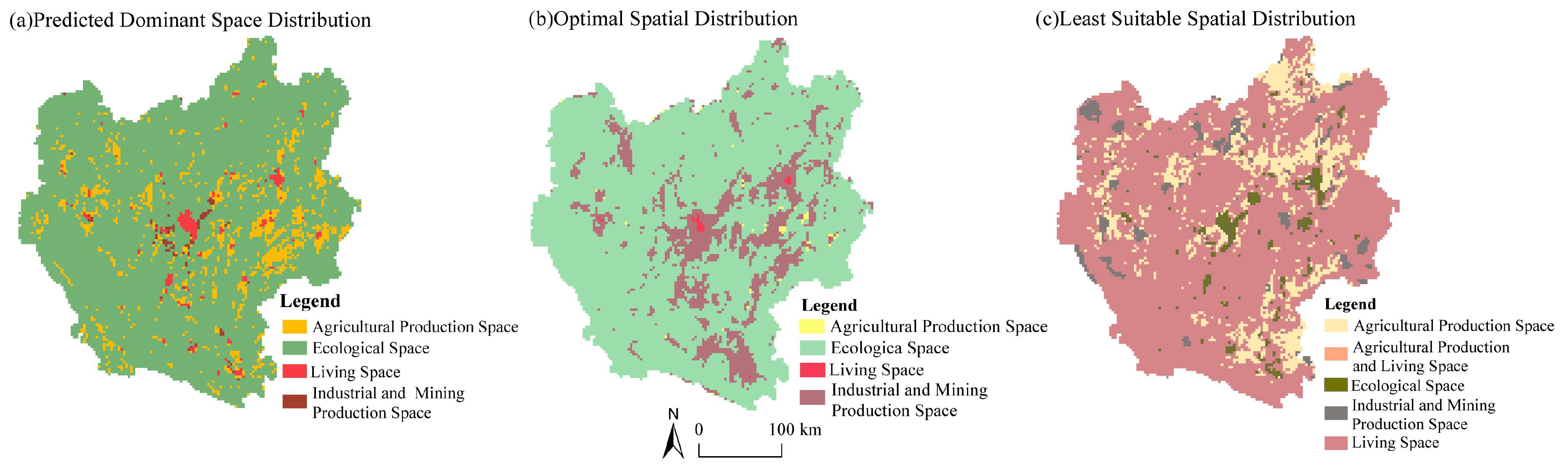
To establish an effective scale linkage between micro-scale land use optimization and macro-scale spatial zoning, and following grid-scale settings adopted in previous studies [50], a grid-based evaluation framework with a spatial resolution of 3 km × 3 km was constructed, resulting in a total of 121,808 grid units. Based on the PLESs simulation results (Figure 6), the predicted dominant spatial type for each grid was identified according to the principle of areal dominance (Figure 8a). Simultaneously, the most suitable and least suitable spatial types for each grid were determined using the average suitability scores of the four spatial categories at the grid scale.
The results indicate that dominant spatial types in the study area exhibit a highly simplified structure at the grid scale. Grids in which ecological space is identified as the most suitable type account for 82.84% of the total, demonstrating an absolute dominance. In contrast, grids most suitable for living space represent only 0.23% and are mainly concentrated within the urban cores of Kunming and Qujing (Figure 8b). Regarding least suitable types, living space predominates, accounting for 78.15% of all grids. Its spatial distribution shows a high degree of overlap with areas characterized by the highest ecological suitability, revealing a pronounced spatial conflict between urban living functions and ecological suitability. This pattern reflects the wide-spread vulnerability of ecological foundations within urbanized zones and underscores the necessity of suitability-based revision of dominant spatial patterns (Figure 8c).
(2)
Suitability Revision Results
After revising the grid-scale dominant spaces in accordance with the aforementioned rules (Figure 3), the statistical results are summarized in Table 4. Approximately 80.86% of the grids exhibit consistency between the predicted dominant space types and their most suitable types, indicating a high degree of alignment between land-use allocation derived from multi-objective optimization and spatial suitability. This finding suggests that micro-scale optimization exerts a positive guiding effect on the formation of the macro-scale spatial pattern. In addition, 19.14% of the grids fall into an “intermediate suitability” state, indicating potential flexibility for future development into composite spaces through the integration of predicted dominant types and most suitable types.
Following suitability revision, the ratio of single dominant space types to composite dominant space types is approximately 8:2, with ecological space remaining the most prevalent category. Among single dominant types, agricultural production space and living space account for relatively small proportions, both below 0.5%. In contrast, composite dominant space types—such as agriculture–industrial and mining production, agriculture–ecological, and living–industrial and mining production—occupy substantial proportions, reflecting pronounced functional mixing characteristics within the study area.
Notably, distinct internal structural differences are observed within the same category of composite dominant spaces. For instance, within the agriculture–ecological composite type, grids characterized by “agriculture-dominant, ecological most suitable” account for 3.86%, whereas those defined as “ecological-dominant, agriculture most suitable” constitute only 0.12%. This asymmetry indicates that agriculture-dominant areas generally possess favorable ecological conditions, while ecology-dominant areas exhibit limited suitability for agricultural production. Similarly, within the ecological–industrial and mining composite type, the configuration of “ecological-dominant, industrial and mining most suitable” represents 8.47%, whereas the reverse configuration (“industrial and mining dominant, ecological most suitable”) accounts for only 0.04%. This pattern suggests that areas suitable for industrial and mining development often maintain a relatively sound ecological foundation, while the actual occupation of high-ecological-value areas by industrial and mining activities remains minimal, thereby providing a spatial basis for balancing ecological conservation and development demands.
From a spatial perspective (Figure 9), single dominant agricultural production spaces are relatively dispersed, whereas agriculture–ecological composite spaces are embedded within ecological-dominant areas in a fragmented, patch-like pattern. Other dominant space types exhibit a clear concentric spatial structure: living-dominant spaces form the core, followed outward by living–industrial and mining production composite zones, industrial and mining production and agricultural–industrial and mining production composite zones, and finally ecological–industrial and mining production composite zones. Overall, a distinct “living–production–ecological” gradient radiation pattern emerges, which is consistent with the orderly outward expansion trajectory of urban spatial development.

3.3.3. Zoning Optimization Based on Spatial Dominance and Functional Advantages

(1)
Identification Results of Administrative Region-Level Dominant Spaces
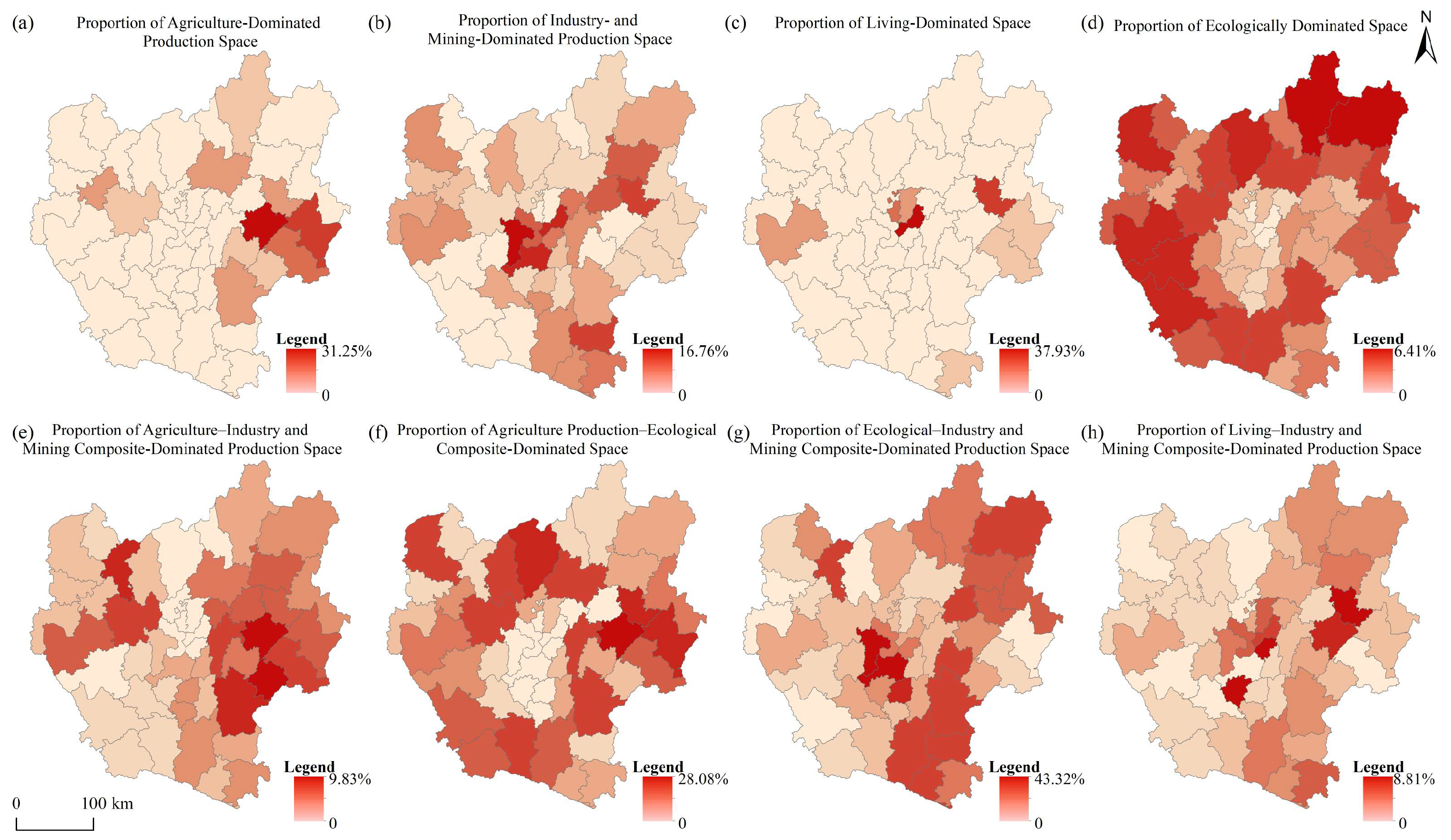
To mitigate the potential type convergence resulting from the overwhelming dominance of ecological space, this study introduces an indicator defined as “the proportion of each dominant space type within an administrative region relative to the total area of that space type across the entire study area” to identify the dominant spatial characteristics of each county (city, district) (Figure 10).
The results indicate clear spatial differentiation among dominant space types at the administrative-unit level. Agricultural production-dominant areas are primarily concentrated in southern Qujing, represented by Luliang County and Luoping County. Industrial and mining production-dominant areas are centered on Anning City and extend across southern Kunming, eastern Yuxi, and Kaiyuan City in Honghe Prefecture. Living-dominant areas exhibit a high degree of concentration within the central urban districts of Kunming and Qujing, including Guandu District, Wuhua District, and Qilin District. In contrast, ecological-dominant areas form a peripheral ring-like distribution, typified by Huize County, Dayao County, and Xinping County.
Composite dominant spaces also demonstrate distinct and regular spatial patterns. Agricultural–industrial and mining composite dominant areas are mainly distributed in central–eastern and northwestern Yunnan. Agricultural–ecological composite dominant areas are predominantly arranged around the periphery of central living-dominant zones. Ecological–industrial and mining composite dominant areas extend zonally across the eastern part of the study area, while living–industrial and mining composite dominant areas are highly concentrated within the built-up areas of Kunming, Qujing, and Yuxi.
(2)
Results of Functional Comparative Advantage Evaluation
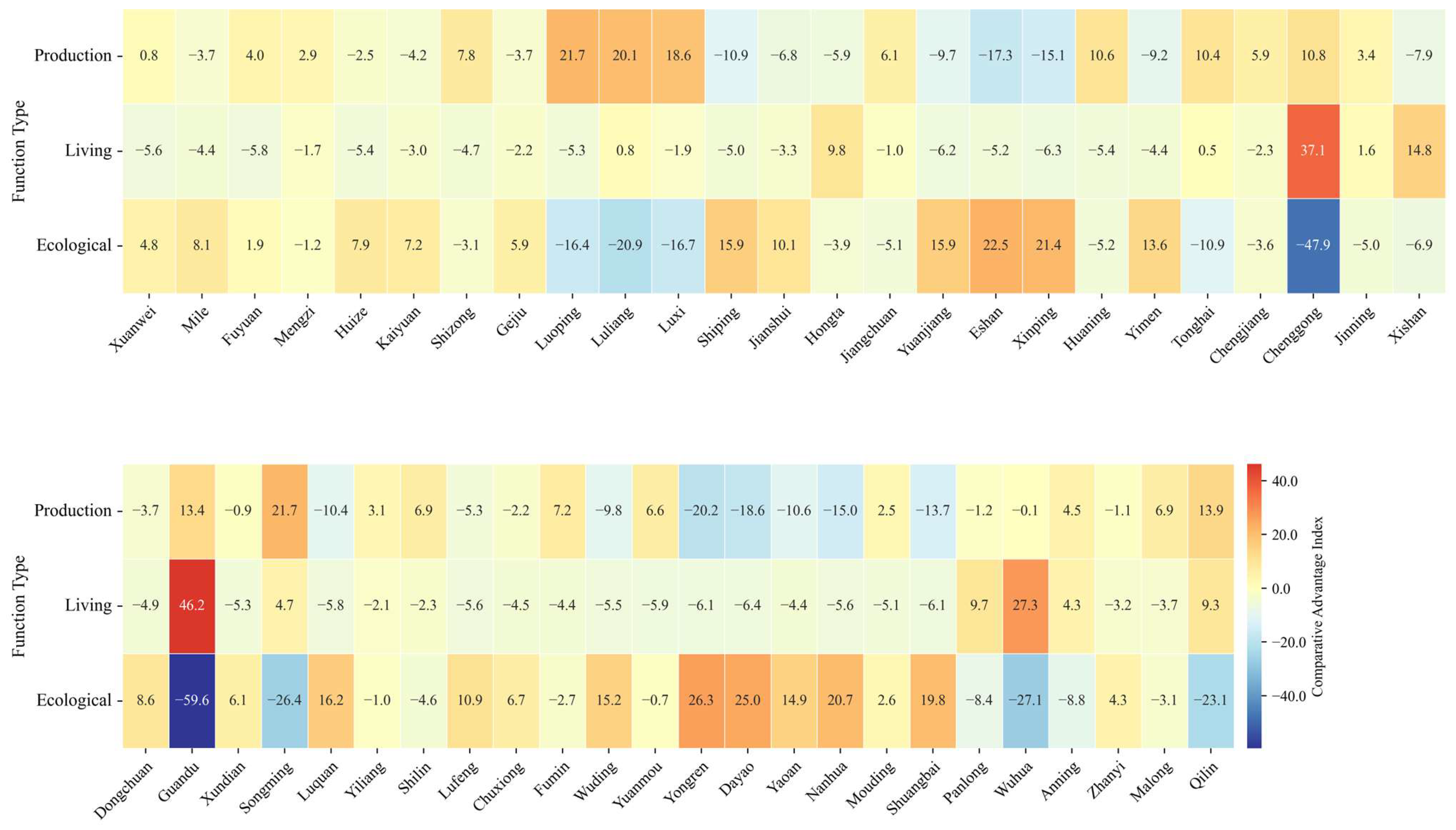
Based on the NRCA model, the comparative advantages of PLEFs for each county (city, district) were quantified (Figure 11). The results indicate that 12 administrative units exhibit a single production-function advantage, including Mengzi City, Luoping County, and Yuanmou County. Administrative units characterized solely by a living-function advantage are primarily concentrated in the core urban area of Kunming, represented by Wuhua District and Panlong District. Units with only an ecological-function advantage constitute the largest group, encompassing 22 administrative units such as Huize County, Chuxiong City, and Yimen County, and are predominantly distributed in peripheral ecological conservation areas. In addition, eight administrative units—including Luliang County, Guandu District, and Qilin District—demonstrate dual advantages in both production and living functions, indicating relatively strong comprehensive development potential. Administrative units with dual advantages in production and ecological functions are extremely limited, represented only by Xuanwei City, Fuyuan County, and Mouding County. Notably, no administrative unit simultaneously exhibits advantages in both living and ecological functions. This spatial pattern reflects pronounced trade-offs between urban–rural construction activities and ecological protection at the current stage of regional development, and suggests that the overall level of urban livability across the study area remains in need of further improvement.
(3)
Spatial Optimization and Development Zoning
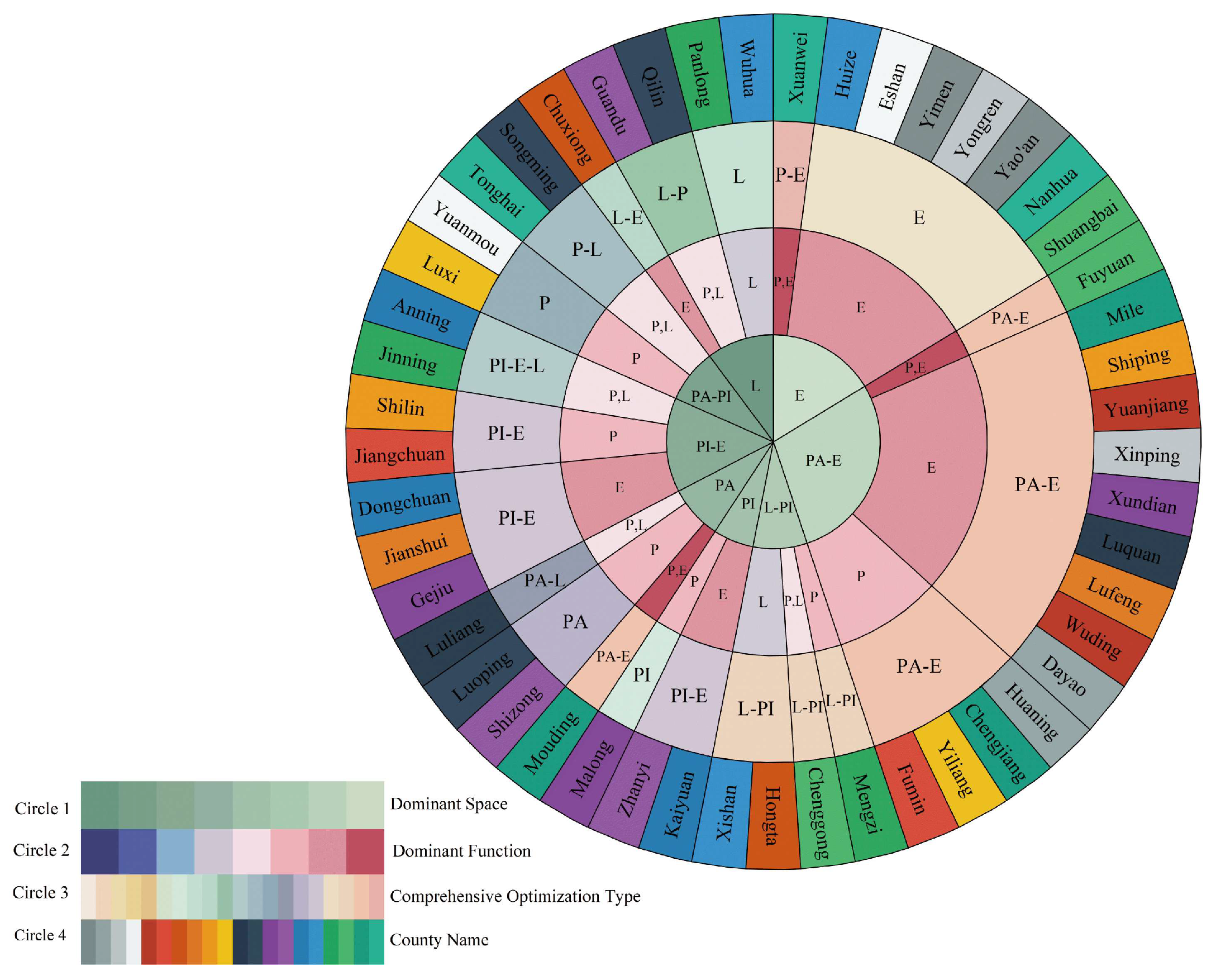
Based on the principle of the “optimal proportion of dominant spaces” and the determination logic of “seeking common ground while reserving differences”, the spatial optimization and development orientation of each county (city, district) was determined through the integrated consideration of dominant space types and functional comparative advantages for each administrative unit (Figure 12). Specifically, Huize County exhibits both an ecological-dominant spatial pattern and a clear ecological functional advantage; accordingly, its optimization orientation is defined as ecological space. Mengzi City is characterized by a living–industrial and mining production composite dominant space and simultaneously demonstrates a comparative advantage in production functions, and is therefore classified as a living–industrial and mining production composite optimization type. By contrast, Chuxiong City presents a living-oriented dominant space but an ecological functional advantage, which leads to its designation as a living–ecological composite optimization type.
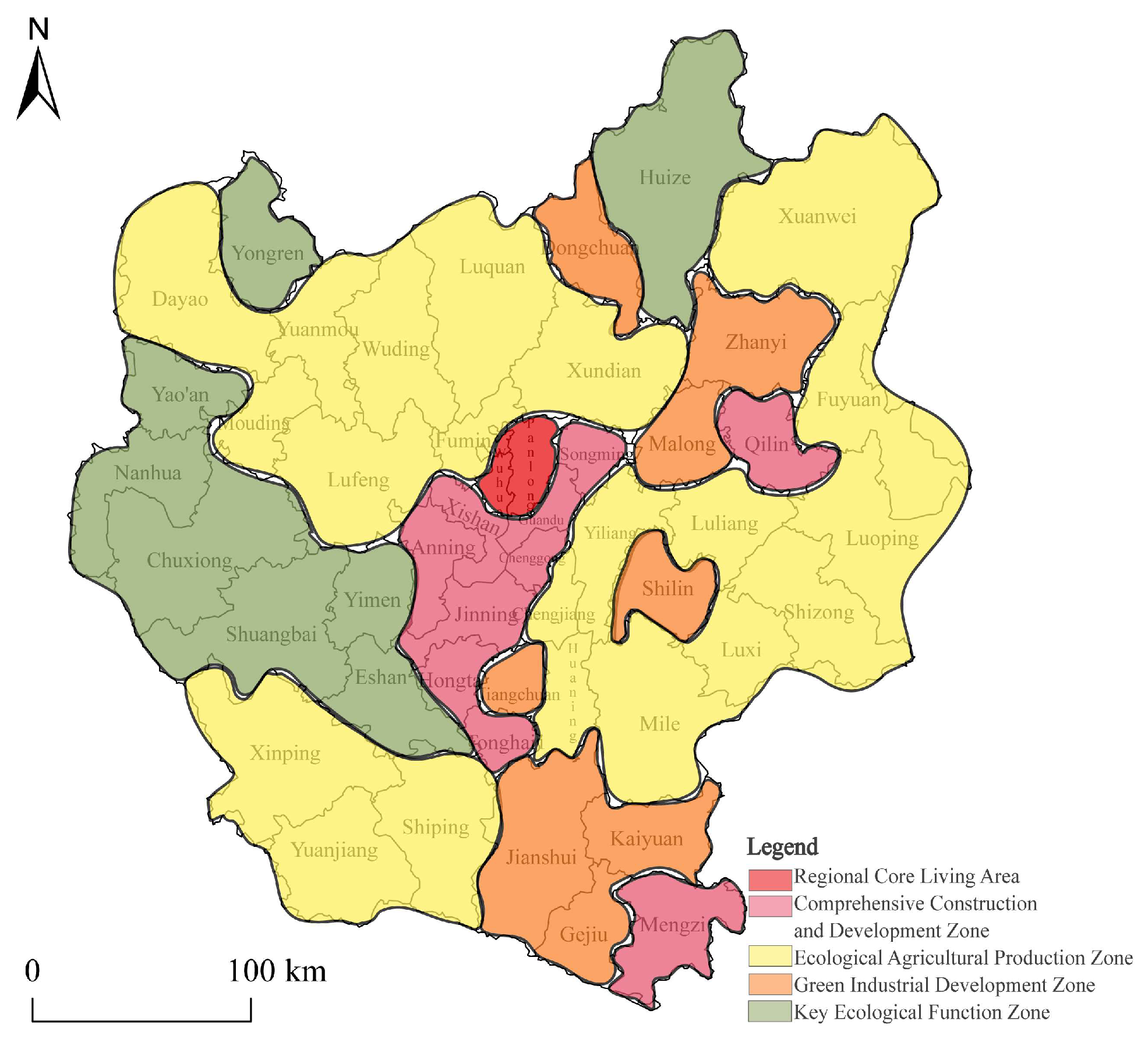
Furthermore, a systematic hierarchical clustering analysis was conducted using the PLEF advantage values as clustering variables. By integrating the clustering results with the optimization types identified for each administrative unit, the study area was ultimately divided into five spatial optimization and development zones: the Regional Core Living Zone, Construction and Development Comprehensive Zone, Eco-Agricultural Production Zone, Green Industry Development Zone, and Key Ecological Functional Zone (Figure 13). The resulting zoning pattern exhibits a spatial structure characterized by “core-led, axis-linked, and zone-coordinated” development. The Regional Core Living Zone functions as the central development hub. Two interconnected development corridors are formed through the spatial linkage of the Construction and Development Comprehensive Zone and the Green Industry Development Zone, while the Eco-Agricultural Production Zone and the Key Ecological Functional Zone act as peripheral supporting areas that provide ecological security and resource support for regional development.
Regional Core Living Zone. This zone is located in Wuhua District and Panlong District of Kunming and represents the urban core of the study area. It is characterized by highly concentrated living functions, dense population distribution, and a high level of public service provision. However, it also faces multiple development pressures, including traffic congestion, spatial saturation, industrial transformation demands, and the protection of historical urban fabric. Future development should prioritize the enhancement of spatial quality. On the basis of preserving the historical texture of the old city, emphasis should be placed on urban spatial optimization and renewal, strengthened three-dimensional development, improved supporting facilities, the integration of scientific and technological innovation with cultural creativity, and the upgrading of industries and urban services.
Construction and Development Comprehensive Zone. Located in the central hinterland of the study area, this zone encompasses ten counties (cities, districts), including the core urban areas of Kunming, Yuxi, and Qujing and their surrounding regions. It benefits from a solid construction foundation, relatively complete public service systems, and pronounced composite advantages in living and production functions, indicating substantial development potential. Future development should focus on improving the efficiency of resource utilization and promoting intensive spatial development, strengthening transportation and other public service infrastructure, optimizing the industrial structure, and fostering emerging growth poles.
Eco-Agricultural Production Zone. This zone is widely distributed across the eastern, northern, and southwestern parts of the study area and includes 23 counties (cities, districts). It is characterized by distinct agricultural attributes and significant ecological or production function advantages, serving as an important base for agricultural production and ethnic settlements. Future development should emphasize differentiated and characteristic development paths by extending crop–livestock–processing industrial chains, strengthening agricultural brand building and e-commerce empowerment, addressing logistics bottlenecks, and promoting the integrated development of agriculture, culture, and tourism.
Green Industry Development Zone. This zone includes eight counties (cities, districts), such as Dongchuan District, Zhanyi District, and Gejiu City. It possesses a relatively strong industrial and mining foundation but faces challenges including resource depletion, high environmental governance pressure, urgent demands for industrial transformation and upgrading, and insufficient utilization of industrial heritage. Its optimized spatial pattern is dominated by industrial and mining production spaces or industrial–ecological composite spaces, with either production or ecological functions exhibiting comparative advantages. Future development should adhere to a green-oriented transformation pathway by strengthening ecological restoration, cultivating green energy and modern logistics industries, promoting industrial and mining heritage tourism, and advancing diversified and innovative industrial development.
Key Ecological Functional Zone. This zone is mainly located in the western part of the study area and includes eight counties (cities), such as Huize County, Chuxiong City, and Shuangbai County. It exhibits prominent ecological function advantages but relatively lagging economic development. Under the premise of strict ecological protection, future development should focus on improving basic infrastructure, fostering characteristic industries such as ecotourism, health and wellness, and biopharmaceuticals, and exploring effective pathways for ecological value realization. Meanwhile, coordinated development with surrounding counties (cities, districts) should be promoted through the integration of tourism resources, thereby facilitating the transformation of ecological advantages into sustainable development advantages.

4. Discussion

4.1. Scientific and Practical Breakthroughs in Multi-Scale Coupled Optimization Methods

Compared with traditional studies, the “micro-allocation–macro-zoning” coupled framework proposed in this study represents a substantial paradigm shift in multi-scale collaborative optimization, evolving from a “unidirectional static linkage” toward a “bidirectional dynamic feedback” mechanism. This shift is realized through a dual-cycle system of “simulation–correction–determination,” enabling continuous interaction and mutual constraint across multiple spatial scales. At the raster scale, the coupling of the GMOP and PLUS models facilitates the coordinated optimization of land use in terms of both quantitative structure and spatial configuration. Under the planning control scenario, targeted land-use transition rules and constraint layers were introduced to guide the intensive expansion of construction land while ensuring the overall stability of ecological land. This approach not only achieves “vertical coupling” at the technical level but also enables a computable and operable transmission from abstract “strategic objectives” to concrete “spatial implementation” at the methodological level. At the grid scale, a comprehensive PLESs suitability evaluation was incorporated to revise the simulation outputs based on the identification of “most suitable” and “least suitable” spatial types, thereby establishing a horizontal validation mechanism that integrates “benefit orientation” with “environmental context.” The results indicate that more than 80% of grid-level predictions are consistent with their most suitable spatial types, demonstrating a high degree of coherence between micro-scale optimization outcomes and spatial suitability conditions. Meanwhile, the functional adjustment of a small proportion of inconsistent grids provides explicit spatial guidance for development restriction and land-use adjustment in territorial spatial planning, reinforcing the corrective role of suitability evaluation in multi-scale optimization processes [5,28]. At the administrative district scale, the NRCA model was employed to identify comparative functional advantages at the county level. These functional advantage profiles were then integrated with the revised dominant spatial patterns using the principle of “seeking common ground while reserving differences.” This approach transcends static zoning logic by jointly considering existing spatial dominance and latent functional potential. For example, administrative units characterized by living-dominant spatial patterns but exhibiting ecological functional advantages were designated as living–ecological composite optimization zones, thereby reflecting a coordinated determination of both current development status and future transformation potential. Through its bidirectional dynamic feedback mechanism, the proposed framework systematically integrates the vertical transmission of “quantity–space–function” relationships across scales. This not only enhances the scientific rigor and practical operability of territorial spatial optimization schemes but also provides a transferable methodological reference for addressing the governance dilemma of “localized intensification coupled with overall inefficiency” in territorial spatial development.

4.2. The Implications of Spatial Complexity for Territorial Space Governance

The evaluation results indicate that nearly 80% of the territorial space within the study area is suitable for two or more functional composites, whereas single-function dominant zones account for only a limited proportion. This pattern confirms the inherent characteristics of “coexistence, intertwining, and overlap” that have emerged from long-term interactions between natural geographical conditions and human activities within PLESs. These findings provide important insights into the limitations of the current territorial spatial governance system centered on the framework of the “three zones and three lines.” In practice, governance models based on traditional “single-function zoning” often encounter challenges such as ineffective control or intensified conflicts when applied to spatial units with highly composite functional attributes [18]. For example, areas designated as ecological spaces may simultaneously exhibit high suitability for ecological agriculture or green tourism, while agricultural production spaces may contain ecologically sensitive patches with high conservation value. Such functional overlap reflects the intrinsic spatial complexity of territorial systems rather than planning deficiencies alone. The multiple composite dominant space types identified in this study—such as agriculture production–ecological and ecological–industrial and mining production spaces—constitute both an objective response to spatial complexity and a methodological attempt to explicitly reveal, rather than conceal, potential land-use conflicts. Taking the ecological–industrial and mining production composite space as an example, its delineation directly exposes the spatial concurrence of areas with high ecological protection suitability and those yielding substantial industrial and mining benefits. These areas represent typical “conflict hotspots” that require targeted regulation and refined governance strategies in territorial spatial planning. From this perspective, the identification of composite dominant spaces in this study can be regarded as a preliminary analytical step toward conflict diagnosis in territorial spatial governance. By clarifying where and how functional conflicts are most likely to occur, the results provide explicit spatial targets for subsequent planning interventions, such as the delineation of special-purpose zones, the formulation of positive and negative industry access lists, and the design of ecological compensation mechanisms. More broadly, this approach supports a transition from rigid single-function zoning toward a governance paradigm based on flexible, dominant-compatible function management, thereby enhancing the adaptability and precision of territorial spatial regulation in complex regional contexts.

4.3. Comparative Analysis with Current Planning and Its Policy Implications

The regional core living zones delineated in this study exhibit a high degree of spatial consistency with the “Core Area of the Kunming Metropolitan Circle” and the “Qujing–Yuxi–Chuxiong Development Belt” identified in the Central Yunnan Urban Agglomeration Development Plan [51]. This consistency further confirms the planning consensus and practical rationale for positioning this region as a primary regional growth pole. At the same time, the key ecological functional zones identified in this study largely overlap with the provincial ecological conservation redlines, as well as the major areas of the “Plateau Lake Ecological Barrier” and the “Central Yunnan Forest Ecological Barrier” defined in the same plan. From the perspective of coordinating PLEFs, these results reinforce the priority of ecological protection within these areas. Beyond validating existing planning orientations, this study also provides important supplements and early warnings for the current planning framework. On the one hand, several basin areas that are primarily designated for agricultural use in the plan (e.g., Luliang and Jiangchuan) are identified in this study as having the potential to function as eco-agricultural production zones or green industry development zones, owing to their favorable ecological baseline and locational advantages. This finding suggests that, while maintaining food security as a baseline requirement, these areas could explore development pathways oriented toward higher value-added ecological agriculture and the integrated development of agriculture and tourism. On the other hand, some “point-based development” areas located at the margins of ecologically sensitive zones in the existing plan are classified in this study as key ecological functional zones or ecological–industrial composite zones. This reclassification implies that development activities in these areas should proceed with caution and be subject to more stringent ecological access thresholds, environmental impact controls, and compensation mechanisms, so as to mitigate potential conflicts between development and conservation objectives. Overall, the optimized zoning results derived in this study provide scientific validation and support for the macro-scale functional pattern of the CYUA established in existing plans. At the micro scale, they offer explicit spatial targets and decision-making references for the refined adjustment, flexible management, and conflict coordination of territorial spatial planning. In this sense, the study demonstrates the practical value of translating multi-scale optimization models into actionable planning instruments, thereby bridging the gap between theoretical modeling and policy implementation.

4.4. Limitations and Research Prospective

Despite the systematic framework and methodological innovations proposed for multi-scale territorial spatial optimization, several limitations remain in this study, which also indicate directions for future research. First, with respect to model construction, although the coupled GMOP–PLUS model integrates economic and ecological benefits and incorporates planning control constraints, it does not explicitly represent institutional factors such as land-use policies, regulatory instruments, or inter-regional coordination agreements. These “soft constraints” often play a decisive role in shaping spatial patterns, particularly in the allocation of industrial land and major infrastructure. Future studies could attempt to incorporate policy agents or couple system dynamics models with spatial simulation models to represent behavioral feedbacks and spatial interactions among multiple stakeholders under different policy scenarios, thereby enhancing the policy sensitivity and realistic complexity of optimization outcomes. Second, regarding evaluation systems, although a multi-indicator framework for assessing territorial spatial functions and suitability has been established, it remains largely static and relatively simplified. The functional scoring approach does not fully capture the complex synergies and trade-offs among production, living, and ecological functions. Moreover, indicator weights in the suitability evaluation are primarily treated as equal, which may fail to reflect differentiated regional development strategies and policy priorities. Future research could integrate approaches such as ecosystem service flow analysis [52] and spatial network analysis to dynamically evaluate functional interactions. In addition, machine learning-based feature importance methods (e.g., XGBoost-SHAP and Random Forest) [53] could be employed to derive more objective and targeted indicator weights, thereby improving the scientific robustness of suitability assessment. Finally, in terms of scale linkage and practical application, although this study proposes a “micro–macro” coupled optimization framework, limitations remain in the mechanisms of scale transmission and the connection with concrete spatial governance tools. On the one hand, the current scale linkage primarily relies on spatial overlay and rule-based adjustment, offering limited insight into the internal mechanisms of element flows, functional feedbacks, and policy interactions across scales. Future research could explore the development of operational-level transmission rules or process-based models to dynamically simulate cross-scale interactions. On the other hand, the five types of optimized zones identified in this study have not yet been fully translated into specific governance instruments, such as differentiated land-use control rules, development intensity indicators, or ecological compensation mechanisms. Subsequent studies should focus on converting zoning outcomes into operable planning tools and validating their effectiveness through interdisciplinary approaches and participatory planning practices, thereby supporting more adaptive and resilient governance of composite territorial spaces.

5. Conclusions

Taking the CYUA as a case study, this research develops a territorial spatial pattern optimization framework from the perspective of PLEFs, coupling micro-level resource allocation with macro-level spatial zoning. A multi-scale collaborative optimization approach for territorial space is proposed and empirically validated. The main conclusions are as follows:
(1)
From 2000 to 2020, the territorial space of the study area was dominated by ecological space, accounting for more than 75% of the total area, although exhibiting a gradual declining trend. The structure of production space experienced continuous adjustment, characterized by the expansion of industrial production space and the contraction of agricultural production space. Living space increased rapidly, particularly during the periods of 2005–2010 and 2015–2020. The spatial distribution of territorial functions showed a distinct pattern, with production and living functions being “high in the east and low in the west,” while ecological functions displayed the opposite gradient of “high in the west and low in the east.” A significant negative spatial correlation was observed between living and ecological functions.
(2)
The coupled GMOP–PLUS model effectively realizes multi-objective collaborative optimization of land-use quantity structure and spatial layout. Among the four simulated scenarios, the planning control scenario achieves a more balanced performance in terms of economic benefits, ecological benefits, and land-use intensity, and is therefore identified as the recommended land-use optimization scheme for the study area by 2035. Under this scenario, future construction land expansion is projected to follow a spatial pattern of “central core concentration, peripheral expansion, and stronger development in the southeast than in the northwest.” Production and living spaces will continue to expand, while ecological space will remain the dominant land-use type.
(3)
The study area exhibits pronounced spatial composite suitability, with ecological suitability maintaining a clear overall advantage. Areas suitable for production and living functions display a spatial pattern of “higher suitability in the southeast and lower suitability in the northwest.” Among the suitability-corrected dominant spatial types, ecologically dominant areas account for 78.94% of the total, forming a layered gradient structure characterized by a “living core—production composite belt—ecological periphery.”
(4)
By integrating dominant spatial types with functional comparative advantages at the county (city and district) level, the CYUA is further divided into five major optimized development zones: the core living zone, the comprehensive construction and development zone, the ecological agricultural production zone, the green industrial development zone, and the key ecological function zone. These zones exhibit significant differences in development foundations, functional advantages, and development constraints. Accordingly, differentiated development strategies are proposed to enhance regional functional synergy and promote coordinated territorial spatial development.

Author Contributions

Methodology, conceptualization, Y.L.; software, S.P.; validation, H.X. and Z.M.; supervision, Y.L.; resources, Y.L. and J.Z.; data curation, H.X.; writing—review and editing, Y.L. and S.P.; project administration, Y.L.; funding acquisition, Y.L. and J.Z. All authors have read and agreed to the published version of the manuscript.

Funding

This research was funded by the National Natural Science Foundation of China, under the project titled, “Study on multi-scale coupling and multi-objective collaborative optimization of the production-living-ecological space of the urban agglomeration in central Yunnan” (grant number: 42301304), and “Study on spatio-temporal evolution mechanism and coordination allocation of territorial spatial conflicts in mountainous plateau of Yunnan Province” (grant number: 42561066); the University-level Youth Fund Project, “Study on the Evolution and Optimized Regulation of Multifunctional Trade-offs and Synergies in Territorial Space of Plateau Mountain-Basin Regions” (grant number: 202404); the Ministry-Provincial Collaboration Project, “Key Technology R&D and Demonstration for the Implementation Monitoring Network System of Territorial Space Planning in Plateau Mountainous and Dam Areas” (grant number: 2023-2247).

Data Availability Statement

The original contributions presented in the study are included in the article; further inquiries can be directed to the corresponding authors.

Conflicts of Interest

The authors declare no conflicts of interest.

Appendix A

Table A1. Function Coefficients and Constraints of the GMOP Model.
Economic Benefit Function
(10,000 CNY/hm2)
Ecological Benefit Function
(10,000CNY/hm2)
ConstraintsDescriptions
Total Land Area1875.633158.1582x1 + x2 + x3 + x4 + x5 + x6 + x7 = 1The sum of the proportions of all land use types equals 1.
Cultivated Land18.97881.389220.6200% ≥ x1 ≥ 19.4628%The upper limit was defined as the highest historical proportion recorded over the past fifteen years, while the lower limit was set as the minimum value projected by the MC 5-year time series forecast.
Forest Land0.52356.851049.0804% ≥ x2 ≥ 48.5766%The upper limit was defined as the current value, while the lower limit was set as the minimum predicted value by the MC 5-year time-series projection.
Grassland12.59344.438427.5115% ≥ x3 ≥ 25.8093%
Water Area4.365845.26491.7837% ≥ x4 ≥ 1.1571%The upper limit was set as the maximum predicted value from the MC 5-year time-series projection, and the lower limit was defined as the lowest historical proportion recorded over the past fifteen years.
Unused Land00.21470.1359% ≥ x7 ≥ 0.1273%
Construction Land1447.112602.9845% ≥ x5 ≥ 1.6885%The upper limit was set as the maximum predicted value from the MC 5-year time-series projection, the lower limit as the current value for 2020, and the planning control upper limit was set at 2.4554%.
Industrial and Mining Production Land392.059001.2558% ≥ x6 ≥ 0.7002%The upper limit was set as the maximum predicted value from the MC 5-year time-series projection, the lower limit as the current value for 2020.
Table A2. Simulation Parameter Settings Under Multiple Scenarios.
ScenarioCost MatrixNeighborhood WeightConstraint Layer
Inertial DevelopmentFollow historical land use transfer rules; no restricted transfer types0.161, 0.227, 0.001, 0.621, 0.999, 0.691, 0.446Current Water Areas
Economic PriorityLand types with higher economic benefits are less likely to be transferred out; restrict the conversion of living construction land to non-construction land, and industrial and mining production land to water areas0.383, 0.226, 0.001, 0.368, 0.999, 0.681, 0.439None
Ecological ProtectionLand types with higher ecological benefits are less likely to be transferred out; restrict the conversion of water areas to cultivated land, and forest land to unused land0.001, 0.628, 0.891, 0.999, 0.628, 0.628, 0.621Current Water Areas
Planning ControlImprove land use efficiency; restrict the conversion of cultivated land, forest land, and living construction land to unused land0.442, 0.292, 0.001, 0.825, 0.999, 0.882, 0.568Current Water Areas
Table A3. Production-Living-Ecological Spaces Suitability Evaluation Index System.
Agricultural Production Suitability
ConditionIndicatorGrading Scores
9070503010
TopographyElevation/m<12001200~17001700~20002000~2500>2500
Slope/°<22~66~1515~25>25
SoilSoil TextureLoamClaySand
Soil Organic Matter Content>40%30~40%15~30%10~15%<10%
ClimateAnnual Average Temperature/℃>1917~1915~1713~15<13
Annual Average Precipitation/mm>13001100~1300900~1100700~900<700
Farming ConvenienceDistance to Water Areas/m<200200~500500~10001000~1500>1500
Distance to Rural Settlements/m<500500~10001000~15001500~2000>2000
Industrial and Mining Production Suitability
ConditionIndicator9070503010
TopographyElevation/m<12001200~17001700~20002000~2500>2500
Slope/°<99~1717~2525~35>35
Production ConvenienceDistance to Water Areas/m<300300~500500~10001000~2000>2000
Distance to Main Roads/m<16291629~37233723~62056205~95419541~19,779
Industrial and Mining Agglomeration Density (units/km2)>0.33560.1681~0.33560.0843~0.16810.0368~0.0843<0.0368
Development ConstraintsOriginal Land TypeOther Construction LandUrban-Rural Construction Land, Bare LandCultivated Land, Other Forest Land, Medium-Low Coverage GrasslandForest Land, High Coverage GrasslandWater Areas, Other Unused Land
Living Suitability
ConditionIndicator9070503010
Natural ConditionsElevation/m<12001200~17001700~20002000~2500>2500
Slope/°<99~1717~2525~35>35
Geological Hazard Density (units/km2)<0.03440.0344~0.05560.0556~0.07730.0773~0.1016>0.1016
Social DevelopmentPopulation Density (persons/km2)>52773313~52771379~3313397~1379<397
Night-Time Light Value>69.336.5~69.317.5~36.54.5~17.5<4.5
GDP Distribution (10,000 CNY/km2)>45,50030,200~45,50014,800~30,2004100~14,800<4100
Main Public Service Facility Density (units/km2)>130.31811421.4836~130.31813.4735~21.48360.4931~3.4735<0.4931
Development ConstraintsOriginal Land TypeUrban-Rural Living Construction LandOther Construction Land, Bare LandCultivated Land, Other Forest Land, Medium-Low Coverage GrasslandForest Land, High Coverage Grassland, Reservoirs & PondsOther Water Areas, Other Unused Land
Ecological Suitability
ConditionIndicator9070503010
Climate & Water ResourcesAnnual Average Temperature/℃>1917~1915~1713~15<13
Annual Average Precipitation/mm>13001100~1300900~1100700~900<700
Distance to Water Areas/km<33~88~1414~25>25
Vegetation CoverageNDVI>86007900~86006700~79004700~6700<4700
NPP/1000>11,3009500~11,3007620~95003350~7620<3350
Original Land TypeLakes, Marshes, Beaches, Bare LandForest Land, Medium-High Coverage GrasslandShrubland, Low Coverage GrasslandCultivated Land, Rivers, Reservoirs, Bare Rock LandConstruction Land, Other Unused Land
External DisturbanceDistance to Non-Agricultural Construction Land/km>3020~3010~205~10<5

References

  1. Qu, Y.B.; Zhang, Y.J.; Wang, S.L.; Shang, R.; Zong, H.N.; Zhan, L.Y. Coordinated development of land multi-function space: An analytical framework for matching the supply of resources and environment with the use of land space for ecological protection, agricultural production and urban construction. J. Geogr. Sci. 2023, 33, 311–339. [Google Scholar] [CrossRef]
  2. Jie, F.; Kan, Z. Theoretical thinking and approach exploration on deepening the implementation of major function zoning strategy with “three-zones and three-lines”. China Land Sci. 2021, 35, 1–9. [Google Scholar]
  3. Liu, C.; Cheng, L.; Li, J.; Lu, X.; Xu, Y.; Yang, Q. Trade-offs analysis of land use functions in a hilly-mountainous city of northwest hubei province: The interactive effects of urbanization and ecological construction. Habitat Int. 2023, 131, 102705. [Google Scholar] [CrossRef]
  4. Czarnecki, A.; Milczarek-Andrzejewska, D.; Widła-Domaradzki, A.; Jórasz-Żak, A. Conflict dynamics over farmland use in the multifunctional countryside. Land Use Policy 2023, 128, 106587. [Google Scholar] [CrossRef]
  5. Qu, Y.B.; Wang, S.L.; Tian, Y.Y.; Jiang, G.H.; Tao, Z.; Liang, M. Territorial spatial planning for regional high-quality development-an analytical framework for the identification, mediation and transmission of potential land utilization conflicts in the yellow river delta. Land Use Policy 2023, 125, 106462. [Google Scholar]
  6. Ye, Q.Q.; Wei, R.; Zhang, P.P. A conflict identification method of urban, agricultural and ecological spaces based on the space conversion matrix. Sustainability 2018, 10, 3502. [Google Scholar] [CrossRef]
  7. Tan, K.; Zhao, X.Q.; Pu, J.W.; Li, S.N.; Li, Y.H.; Miao, P.P.; Wang, Q. Zoning regulation and development model for water and land resources in the karst mountainous region of southwest china. Land Use Policy 2021, 109, 105683. [Google Scholar] [CrossRef]
  8. Xie, Z.L.; Ma, Z.W.; Liu, J.Y. Conflicts in land use in marine protected areas: The case of the yellow river delta, china. J. Coast. Res. 2014, 30, 1307–1314. [Google Scholar] [CrossRef]
  9. Chuanglin, F.; Zhenbo, W.; Haitao, M. The theoretical cognition of the development law of china’s urban agglomeration and academic contribution. Acta Geogr. Sin. 2018, 73, 651–665. [Google Scholar]
  10. Wang, S.L.; Qu, Y.B.; Zong, H.N.; Zhang, Y.J.; Guan, M.; Zhang, Y. Research on multi-dimensional decomposition and conduction path of territory spatial pattern at the municipal level. J. Nat. Resour. 2022, 37, 2803–2818. [Google Scholar] [CrossRef]
  11. Zhao, J.S.; Yuan, L.; Zhang, M. A study of the system dynamics coupling model of the driving factors for multi-scale land use change. Environ. Earth Sci. 2016, 75, 529. [Google Scholar] [CrossRef]
  12. Yang, D.; Zhang, P.Y.; Zhang, J.B.; Liu, Y.; Liu, Z.Y.; Chen, Z. Land use assessment under dynamic evolution: Multi-objective optimization and multi-scenario simulation analysis. J. Environ. Manage. 2025, 373, 123456. [Google Scholar] [CrossRef] [PubMed]
  13. Fu, H.; Liang, Y.W.; Chen, J.; Zhu, L.; Fu, G. A new framework of land use simulation for land use benefit optimization based on gmop-plus model-a case study of haikou. Land 2024, 13, 1257. [Google Scholar] [CrossRef]
  14. Zhang, K.; Huang, C.; Wang, Z.; Wu, J.; Zeng, Z.; Mu, J.J.; Yang, W.Y. Optimization of"production-living-ecological"spaces based on dttd-mcr-plus model: Taking changsha city as an example. Acta Ecol. Sin. 2022, 42, 9957–9970. [Google Scholar]
  15. Huang, Q.; Song, W. A land-use spatial optimum allocation model coupling a multi-agent system with the shuffled frog leaping algorithm. Comput. Environ. Urban Syst. 2019, 77, 101360. [Google Scholar] [CrossRef]
  16. Yang, X.; Zheng, X.Q.; Lv, L.N. A spatiotemporal model of land use change based on ant colony optimization, markov chain and cellular automata. Ecol. Model. 2012, 233, 11–19. [Google Scholar] [CrossRef]
  17. Li, Y.; Zhang, F.H.; Li, R.F.; Yu, H.B.; Chen, Y.; Yu, H. Comprehensive ecological functional zoning: A data-driven approach for sustainable land use and environmental management-a case study in shenzhen, china. Land 2024, 13, 1413. [Google Scholar] [CrossRef]
  18. Zhang, J.; Li, S.N.; Lin, N.F.; Lin, Y.; Yuan, S.F.; Zhang, L.; Zhu, J.X.; Wang, K.; Gan, M.Y.; Zhu, C.M. Spatial identification and trade-off analysis of land use functions improve spatial zoning management in rapid urbanized areas, china. Land Use Policy 2022, 116, 106058. [Google Scholar] [CrossRef]
  19. Bryan, B.A.; Ye, Y.Q.; Zhang, J.E.; Connor, J.D. Land-use change impacts on ecosystem services value: Incorporating the scarcity effects of supply and demand dynamics. Ecosyst. Serv. 2018, 32, 144–157. [Google Scholar] [CrossRef]
  20. Jin, G.; Deng, X.Z.; Zhang, Q.; Wang, Z.Q.; Li, Z.H. Comprehensive function zoning of national land space for wuhan metropolitan region. Geogr. Res. 2017, 36, 541–552. [Google Scholar]
  21. Zhou, H.; Jin, P.; Xia, W.S. Functional zoning of territorial space in provinciallevel based on the production-living-ecologicalfunctions:a case of henan province. China Land Sci. 2020, 34, 10–17. [Google Scholar]
  22. Guo, Y.; Zhang, C.C.; Kang, Y.Y. Land assessment division research on economic development in henan province. Geogr. Res. 2015, 34, 2320–2328. [Google Scholar]
  23. Xie, G.D.; Cao, S.Y.; Leng, Y.F.; Zhang, C.S.; Ge, L.Q.; Lu, C.X.; Zhang, Y.S. Targeted zoning in china according to sustainable development principles. Resour. Sci. 2012, 34, 1600–1610. [Google Scholar]
  24. Qu, Y.; Dong, X.; Su, D.; Jiang, G.; Ma, W. How to balance protection and development? A comprehensive analysis framework for territorial space utilization scale, function and pattern. J. Environ. Manage. 2023, 339, 117809. [Google Scholar] [CrossRef]
  25. Li, S.N.; Zhao, X.Q.; Pu, J.W.; Miao, P.P.; Wang, Q.; Tan, K. Optimize and control territorial spatial functional areas to improve the ecological stability and total environment in karst areas of southwest china. Land Use Policy 2021, 100, 104940. [Google Scholar] [CrossRef]
  26. Fu, L.H.; Peng, Y.H.; Xie, M.; Mo, Z.C.; Lu, C.; Gao, X.Y. Resilience spatial measurement of coordinated spatial planning in hilly areas: A case study of chaling county, hunan province. Prog. Ingeogr. 2020, 39, 1085–1094. [Google Scholar] [CrossRef]
  27. Zhao, X.Q.; Li, S.N.; Pu, J.W.; Tan, S.C.; Chen, J.X. Optimal partitions and control of territorial space in karst mountainous areas of yunnan province. J. Nat. Resour. 2020, 35, 2339–2357. [Google Scholar] [CrossRef]
  28. Fan, J. Draft of major function oriented zoning of china. Acta Geogr. Sin. 2015, 70, 186–201. [Google Scholar]
  29. Li, Y.P.; Zhang, S.Q.; Zhao, J.S.; Zhang, G.R.; Qu, G.X.; Ma, S.L.; Liu, X.B. Spatiotemporal evolution and sustainably comprehensive zoning optimization of production-living-ecological functions in the mountain-flatland areas. Heliyon 2024, 10, e23425. [Google Scholar] [CrossRef]
  30. Yang, A.R.; Zhao, J.S.; Lin, Y.L.; Chen, G.P. Coupling and coordination relationship of economic-social-natural composite ecosystem in central yunnan urban agglomeration. Sustainability 2024, 16, 2758. [Google Scholar] [CrossRef]
  31. Li, Y.P.; Zhao, J.S.; Zhang, S.Q.; Zhang, G.R.; Zhou, L.J. Qualitative-quantitative identification and functional zoning analysis of production-living-ecological space: A case study of urban agglomeration in central yunnan, china. Environ. Monit. Assess. 2023, 195, 1163. [Google Scholar] [CrossRef] [PubMed]
  32. Xu, X.L.; Liu, J.Y.; Zhang, S.W.; Li, R.D.; Yan, C.Z.; Wu, S.X. Multi Period Land Use and Land Cover Remote Sensing Monitoring Data Set in China (Cnlucc). 2018. Available online: https://www.resdc.cn/DOI/DOI.aspx?DOIID=54 (accessed on 10 October 2024).
  33. Dai, Y.J.; Shangguan, W. Dataset of Soil Properties for Land Surface Modeling Over China. National Tibetan Plateau Data Center. 2019. Available online: https://data.tpdc.ac.cn/en/data/8ba0a731-5b0b-4e2f-8b95-8b29cc3c0f3a/ (accessed on 10 October 2024).
  34. Wei, S.G.; Dai, Y.J.; Liu, B.Y.; Zhu, A.X.; Duan, Q.Y.; Wu, L.Z.; Ji, D.Y.; Ye, A.Z.; Yuan, H.; Zhang, Q.; et al. A china data set of soil properties for land surface modeling. J. Adv. Model. Earth Syst. 2013, 5, 212–224. [Google Scholar] [CrossRef]
  35. GB50137-2011; Code for Classification of Urban Land Use and Planning Standards of Development Land. China Building Industry Press: Beijing, China, 2011.
  36. Lin, Y.L.; Zhao, J.S.; Zhang, M.; Chen, G.P. Identification of territory space pattern and spatio-temporal evolution analysis of urban agglomeration in central yunnan. Trans. Chin. Soc. Agric. Mach. 2019, 8, 176–191. [Google Scholar]
  37. Liu, Z.; Chen, B.; Liu, S.X. Spatio-temporal evolution and driving factors of the functional coupling and coordination of the"production-living-ecological spaces"in the southwest karst region: A case study of guizhou province. Environ. Sci. 2025, 46, 7131–7141. [Google Scholar]
  38. Wu, A.B. Classification evaluation and pattern evolution of production-living-ecological spaces in beijing-tianjin-hebei rerion. Chin. J. Agric. Resour. Reg. Plan. 2019, 40, 237–242. [Google Scholar]
  39. Cui, J.X.; Gu, J.; Sun, J.W.; Luo, J. The spatial pattern and evolution characteristics of the production, living and ecological space in hubei provence. China Land Sci. 2018, 32, 67–73. [Google Scholar]
  40. Dong, K.N.; Wang, H.W.; Luo, K.; Yan, X.M.; Yi, S.Y.; Huang, X. The use of an optimized grey multi-objective programming-plus model for multi-scenario simulation of land use in the weigan-kuche river oasis, china. Land 2024, 13, 802. [Google Scholar] [CrossRef]
  41. Liang, X.; Guan, Q.F.; Clarke, K.C.; Liu, S.S.; Wang, B.Y.; Yao, Y. Understanding the drivers of sustainable land expansion using a patch-generating land use simulation (plus) model: A case study in wuhan, china. Comput. Environ. Urban Syst. 2021, 85, 101569. [Google Scholar] [CrossRef]
  42. Wang, B.S.; Liao, J.F.; Zhu, W.; Qiu, Q.Y.; Wang, L.; Tang, L.N. The weight of neighborhood setting of the flus model based on a historical scenario: A case study of land use simulation of urban agglomeration of the golden triangle of southern fujian in 2030. Acta Ecol. Sin. 2019, 39, 4284–4298. [Google Scholar]
  43. Wang, G.; Zhou, Z.Q.; Xia, J.G.; Ou, D.H.; Fei, J.B.; Gong, S.Y.; Xiang, Y.X. Optimal allocation of territorial space in the minjiang river basin based on a double optimization simulation model. Land 2023, 12, 1989. [Google Scholar] [CrossRef]
  44. Zhao, X.Q.; Tan, K.; Xie, P.F.; Chen, B.; Pu, J.W. Multiobjective land-use optimization allocation in eucalyptus-introduced regions based on the gmdp-aco model. J. Urban Plan. Dev 2021, 147, 05021004. [Google Scholar] [CrossRef]
  45. Xie, G.D.; Zhang, C.X.; Zhang, L.M.; Chen, W.H.; Li, S.M. Improvement of the evaluation method for ecosystem service value based on per unit area. J. Nat. Resour. 2015, 30, 1243–1254. [Google Scholar]
  46. Wang, J. National spatial strategic plan of england. J. Urban Plan. Dev 2016, 142, 4015007. [Google Scholar] [CrossRef]
  47. Wang, H.H.; Li, H.T.; Xie, M.M.; Xu, M.; Li, S.L.; Bai, Z.K. Construction of ecological security pattern for systematic restoration of industrial and mining land in resource-based cities. J. Nat. Resour. 2020, 35, 162–173. [Google Scholar] [CrossRef]
  48. Xiao, J.Y.; Dai, J.J.; Chen, L.Q.; Song, Y. The identification of land use conflicts and policy implications for donghai county based on the “production-living-ecological” functions. Land 2024, 13, 2013. [Google Scholar] [CrossRef]
  49. Yu, R.; Qin, Y.; Xu, Y.T.; Chuai, X.W. Study on the optimization of territory spatial "urban-agricultural-ecological" pattern based on the improvement of "production-living-ecological" function under carbon constraint. Int. J. Environ. Res. Public Health 2022, 19, 6149. [Google Scholar] [CrossRef]
  50. Wu, G.Z.; Lin, Y.L.; Zhao, J.S.; Chen, Q.X. Identification of land use conflict based on multi-scenario simulation-taking the central yunnan urban agglomeration as an example. Sustainability 2024, 16, 10043. [Google Scholar] [CrossRef]
  51. Notice of the People’s Government of Yunnan Province on Issuing the Development Plan for the Central Yunnan Urban Agglomeration. Available online: https://www.yn.gov.cn/zwgk/zcwj/zxwj/202008/t20200826_209715.html (accessed on 2 November 2024).
  52. Serna-Chavez, H.M.; Schulp, C.; van Bodegom, P.M.; Bouten, W.; Verburg, P.H.; Davidson, M.D. A quantitative framework for assessing spatial flows of ecosystem services. Ecol. Indic. 2014, 39, 24–33. [Google Scholar] [CrossRef]
  53. Li, K.; Zhao, J.S.; Li, Y.P.; Lin, Y.L. Identifying trade-offs and synergies among land use functions using an xgboost-shap model: A case study of kunming, china. Ecol. Indic. 2025, 172, 11330. [Google Scholar] [CrossRef]
Figure 1. Geographical Location Map of the Study Area.
Land 15 00315 g001
Figure 2. Workflow of this study.
Land 15 00315 g002
Figure 3. Dominant space type revision flow chart.
Land 15 00315 g003
Figure 4. Spatial evolution characteristics of PLESs in the study area (2000–2020).
Land 15 00315 g004
Figure 5. Simulated distribution of land use in 2035.
Land 15 00315 g005
Figure 6. Spatial distribution of Production–Living–Ecological spaces in 2035.
Land 15 00315 g006
Figure 7. Zoning of spatial suitability evaluation.
Land 15 00315 g007
Figure 8. Spatial distribution of predicted dominant spaces and suitability-based spatial types.
Land 15 00315 g008
Figure 9. Spatial distribution of revised dominant spaces.
Land 15 00315 g009
Figure 10. Proportional distribution of dominant spaces within each spatial type.
Land 15 00315 g010
Figure 11. Results of comparative advantages of PLEFs by administrative region.
Land 15 00315 g011
Figure 12. Comprehensive spatial optimization results by administrative region. (Note: In the table, PA, PI, P, L, and E represent agricultural production, industrial and mining production, production, living, and ecological types respectively.)
Land 15 00315 g012
Figure 13. Optimized development zoning of the CYUA.
Land 15 00315 g013
Table 1. Data source information.
Data TypeData ContentData Sources
Land use data
(30 m × 30 m)
National land use data for 2000, 2005, 2010, 2015, and 2020 [32]Resources and Environmental Science Data Center, Chinese Academy of Sciences (https://www.resdc.cn/ (accessed on 10 October 2024))
Grid dataset
(1 km × 1 km)
Annual average temperature, annual precipitation, soil type, GDP and population density distribution data, soil texture, NDVI, NPP, GDEMV3, and soil organic matter data [33,34] in 2010 and 2020.Resources and Environmental Science Data Center, Chinese Academy of Sciences; Geospatial Data Cloud (https://www.gscloud.cn/ (accessed on 10 October 2024)); National Tibetan Plateau Science Data Center (https://data.tpdc.ac.cn/ (accessed on 10 October 2024))
Vector datasetAdministrative division in 2024 (GS (2024)0650), POI data such as roads and public facilities in 2020, distribution data of residential areas and settlements in 2020, and distribution data of geological disaster pointsNational Geographical Information Public Service Platform (https://www.tianditu.gov.cn/ (accessed on 13 October 2024)); Amap; Geographical Information Resource Catalog (https://www.webmap.cn/ (accessed on 13 October 2024)); Resources and Environmental Science Data Center, Chinese Academy of Sciences (https://www.resdc.cn/ (accessed on 13 October 2024))
Statistical dataYunnan Statistical Yearbook, China Statistical Yearbook, and National Agricultural Product Cost–Benefit Data Compilation for 2001, 2006, 2011, 2016, and 2021Yunnan Provincial Bureau of Statistics (https://stats.yn.gov.cn/List22.aspx (accessed on 25 October 2024)); National Bureau of Statistics (https://www.stats.gov.cn/ (accessed on 25 October 2024)); National Bureau of Statistics/China Statistics Press (https://www.zgtjcbs.com/ (accessed on 25 October 2024))
Planning and standard document dataCentral Yunnan Urban Agglomeration Development Plan, Standard for Classification of Urban and Rural Land Use and Planning of Construction Land (GB50137-2011) [35], and Guidelines for Compilation of Provincial Territorial Spatial Planning (Trial)People’s Government of Yunnan Province (https://www.yn.gov.cn/ (accessed on 2 November 2024)); Ministry of Housing and Urban-Rural Development of the People’s Republic of China (https://www.mohurd.gov.cn/ (accessed on 2 November 2024)); Ministry of Natural Resources of the People’s Republic of China (https://gi.mnr.gov.cn/ (accessed on 2 November2024))
Table 2. The PLESs Classification and Functional Scoring.
Production–Living–Ecological SpacesLand UseLUCCPLE Functions Scores
PrimarySecondaryReclassification
ProductionAgricultural ProductionCultivated Land11 Paddy Field, 12 Dry LandP: 4, L: 0, E: 3–4
Industrial and Mining ProductionIndustrial and Mining Production Land 53 Other Construction LandP: 5, L: 2, E: 0
LivingUrban LivingLiving Construction Land51 Urban LandP: 3, L: 5, E: 0
Rural Living52 Rural SettlementsP: 3, L: 5, E: 0
EcologicalGreen Space EcologyForest Land, Grassland21 Forest Land, 22 Shrub Land, 23 Sparse Forest Land, 24 Other Forest Land; 31-32-33 High-Medium-Low Coverage GrasslandP: 0–3, L: 0–1, E: 3–5
Water Area EcologyWater Area41 River, 42 Lake, 43 Reservoir/Pond, 44 Permanent Glacier/Snow, 45 Beach, 46 Shoal, 64 WetlandP: 0–1, L: 0, E: 3–5
Other EcologyUnused Land61 Sandy Land, 62 Gobi, 63 Saline-Alkali Land, 65 Bare Soil, 66 Bare Rock/Gravel Land, 67 Other Unused LandP: 0, L: 0, E: 2
Table 3. Simulation results of land use quantity under multiple scenarios.
Category20202035 S12035 S22035 S32035 S4
x120.2270%20.0101%20.0894%19.9099%19.9919%
x249.0804%48.6858%48.7874%49.0804%49.0296%
x326.8372%26.0412%25.8093%27.1571%25.8093%
x41.3307%1.3307%1.1626%1.3307%1.3307%
x51.6885%2.6641%2.7511%1.6885%2.4554%
x60.7002%1.1279%1.2558%0.7002%1.2558%
x70.1359%0.1401%0.1444%0.1331%0.1273%
sum100.00%100.00%100.00%100.00%100.00%
fc (10,000 CNY)386,684,804561,020,141580,395,237386,457,201532,623,108
fe (10,000 CNY)60,567,15859,839,02458,966,44560,676,15659,983,562
sumf (10,000 CNY)447,251,962620,859,164639,361,682447,133,357592,606,670
Meanf2of234 (10,000 CNY)6.67466.69716.61866.66546.7046
Note: x1 to x7 represent cultivated land, forest land, grassland, water area, residential construction land, industrial and mining production land, and unused land, respectively. fc denotes economic benefit, fe denotes ecological benefit, sumf represents the sum of economic and ecological benefits, and meanf2of234 indicates the average ecological benefit of major ecological land uses (forest, grassland, and water area).
Table 4. Results of dominant space revision processing.
Dominant Space TypeNumber of GridsProportionMeaning
Predicted Dominant Space TypeMost Suitable Space Type
Agricultural Production320.25%80.86%Agricultural Production
Industrial and Mining Production1851.44%Industrial and Mining Production
Living290.23%Living
Ecological10,11078.94%Ecological
Agricultural–Industrial and Mining Production6925.40%19.14%Agricultural ProductionIndustrial and Mining Production
Agricultural Production–Ecological4953.86%3.99%Agricultural ProductionEcological
160.12%EcologicalAgricultural Production
Ecological–Industrial and Mining Production10858.47%8.51%EcologicalIndustrial and Mining Production
50.04%Industrial and Mining ProductionEcological
Living–Industrial and Mining Production1591.24%LivingIndustrial and Mining Production
Total12,808100%100%
Disclaimer/Publisher’s Note: The statements, opinions and data contained in all publications are solely those of the individual author(s) and contributor(s) and not of MDPI and/or the editor(s). MDPI and/or the editor(s) disclaim responsibility for any injury to people or property resulting from any ideas, methods, instructions or products referred to in the content.