Article

Assessment of Ecosystem Service Value and Analysis of Driving Factors in the Giant Panda National Park in China


1
Chengdu Institute of Biology, Chinese Academy of Sciences, Chengdu 610213, China
2
Sichuan Forestry Survey, Design & Research Institute Co., Ltd., Chengdu 610081, China
3
Sichuan Forestry and Grassland Investigation and Planning Institution, Chengdu 610081, China
*
Authors to whom correspondence should be addressed.
These authors contributed equally to this work.
Land 2026, 15(2), 302; https://doi.org/10.3390/land15020302
Submission received: 13 January 2026 / Revised: 4 February 2026 / Accepted: 7 February 2026 / Published: 11 February 2026
(This article belongs to the Section Land Use, Impact Assessment and Sustainability)

Abstract

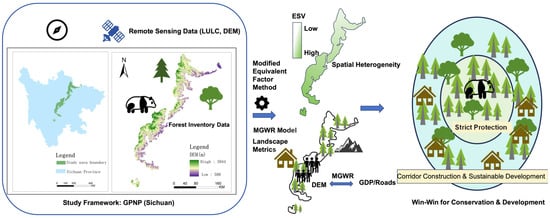
In 2021, China integrated over 80 nature reserves to establish the Giant Panda National Park (GPNP), creating the world’s largest contiguous habitat for giant panda conservation. To evaluate whether this unified management framework effectively enhances ecological integrity and provides essential governance benefits for the national park, this study employed ecosystem service value (ESV) as a key indicator of ecological condition in the Sichuan region of the GPNP (GPNPSC) based on 2022 data. Spatial autocorrelation analysis and a multiscale geographically weighted regression model were applied to examine the spatial heterogeneity of ESV and its driving factors. Landscape fragmentation indices were further incorporated to characterize habitat structure and connectivity. The results revealed pronounced spatial differentiation in ESV across the study area, with forest ecosystems and regulating services contributing the most. Elevation and socioeconomic factors stood out as major influences on ESV distribution. Areas with higher ESV also exhibited stronger landscape connectivity, highlighting the importance of continuous habitats for ecosystem functioning and giant panda population stability. These findings support ESV-based zoning for habitat monitoring, giant panda conservation, and sustainable development.

Graphical Abstract

1. Introduction

National parks are critical for protecting global biodiversity and managing ecosystems. They serve as key strongholds against growing threats from climate change and human activities. In recent decades, national park goals have shifted. Management has moved beyond protecting single sites or species. It now focuses on larger, connected landscapes that support ecological connectivity, multiple functions, and long-term sustainability [1]. Assessing ecological outcomes in large and heterogeneous protected areas has become a major challenge for both science and policy. Ecosystem services (ESs), which link ecosystem processes to human well-being, have been widely adopted as an effective framework to evaluate park performance, guide conservation planning, shape land use, and promote sustainable development worldwide [2].
Among various ESV assessment methods [3], the equivalent factor approach has become widely employed for regional studies. It is simple, transparent, and allows for strong comparisons [4,5]. Recent studies have emphasized the necessity of regionalizing equivalent factors to better reflect local ecological characteristics and improve accuracy [6]. However, how natural conditions and human activities jointly shape the spatial heterogeneity of ESV remains a core question. This issue is especially pressing in mountainous protected areas, where environmental gradients are steep and human pressures vary across spaces.
Previous studies have explored ESV drivers using models such as Geo Detector, spatial autocorrelation analysis, and classical geographically weighted regression (GWR) [7]. These methods help, but they have limits. Geo Detector cannot explicitly represent spatial relationships [8]. Traditional GWR relies on one fixed bandwidth [9,10], so it struggles with processes that vary across scales, for instance, broad climatic effects versus local human impacts. In complex mountain systems like the Giant Panda National Park (GPNP) in China, such models often miss the true non-stationarity and scale-dependent effects of key drivers of ESV.
China’s Giant Panda National Park offers an ideal case to address these challenges. As the “crown jewel” of China’s national park system, the GPNP was established by merging over 80 fragmented reserves into a unified area of approximately 22,000 km2 [11]. Although earlier efforts successfully increased the giant panda population [12], the region still suffers from habitat fragmentation and restricted dispersal corridors [13,14]. The park also acts as a critical ecological barrier for the upper Yangtze River basin. It features a huge scale, complex topography, and pronounced environmental heterogeneity. However, we still lack detailed maps of ESV distribution inside the park. This gap weakens the link between broad conservation aims and local management. A clear, spatially explicit assessment of ESV drivers is, therefore, urgently needed to support science-based management.
To address these gaps, this study focuses on the Sichuan region of the GPNP core area (GPNPSC), which possesses the highest biodiversity and habitat complexity. Employing a multiscale geographically weighted regression (MGWR) model, which allows each explanatory variable to operate at its own optimal spatial scale. By combining regionally adaptive ESV coefficients, refined environmental indicators, and human activity metrics [15], we aim to (1) comprehensively map ESV distribution across the GPNPSC; (2) identify and quantify the dominant natural and human drivers behind ESV spatial heterogeneity; (3) unravel how these drivers act at different scales; and (4) evaluated landscape fragmentation metrics to enrich ESV map with habitat structure insights. Together, these results can provide an integrated ecological assessment to guide targeted conservation, improve functional zoning, and balance biodiversity protection with local community needs within this globally important area.

2. Materials and Methods

2.1. Study Area

The Giant Panda National Park (GPNP) occupies the eastern extremity of the Tibetan Plateau in China (102°11′–108°30′ E, 28°51′–34°10′ N), spanning 21,978 km2 across three provinces. The park’s spatial distribution encompasses 19,327 km2 (87.94%) in Sichuan province, 2553 km2 (11.61%) in Gansu province, and 98 km2 (0.45%) in Shaanxi province [11]. This study focused on the Sichuan region of GPNP (GPNPSC, 102°27′–105°57′ E, 29°42′–33°34′ N), which covers the core habitat area containing 20 counties (Figure 1a–c) [11].
The GPNPSC exhibits distinct topoclimatic gradients, with elevation decreasing gradually from northwest to southeast (Figure 1d). The region is situated within a monsoon climate zone, characterized by average annual temperatures from 13 °C to 15 °C and average annual precipitation of 1100 mm. Major water systems include the Min River, Jialing River, and Tuo River, which all flow into the Yangtze River basin. The region is predominantly covered by forest, and the vegetation type is subtropical evergreen broadleaf forest [16,17]. The GPNPSC serves as the core component of the national park system, protecting over 90% of the park’s wild giant panda population [11]. The region features a low population density with scattered settlements.

2.2. Workflow and Data Preparation

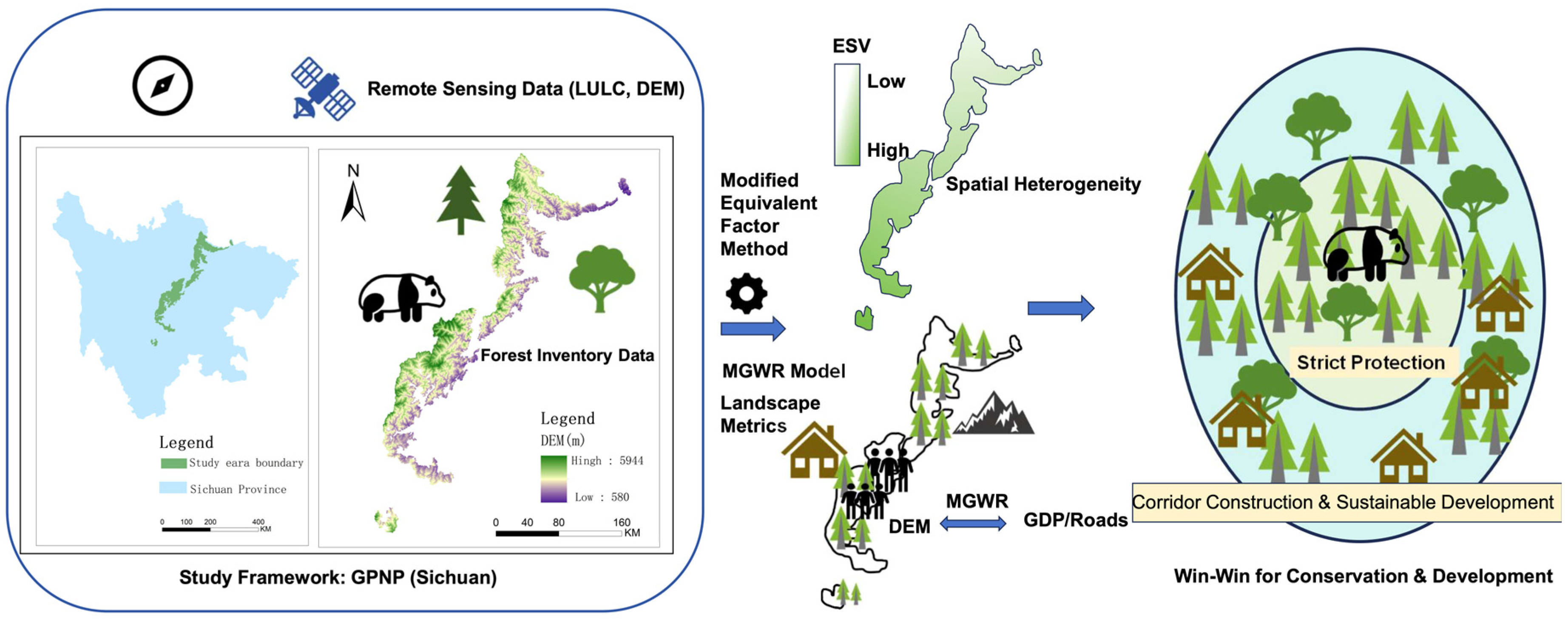
The workflow of this study contained three main stages (Figure 2): First, mapping the spatial distribution of ecosystem service value (ESV). Net primary productivity (NPP) was used to calibrate equivalent factors, which were then integrated with land-use data to quantify ESV at a 2 km × 2 km grid resolution. Second, assessing spatial patterns and choosing the model. Ordinary least squares (OLS) regression and Global Moran’s I were applied to examine ESV spatial characteristics, thereby justifying the selection of the multiscale geographically weighted regression (MGWR) model. Third, identifying ESV-driving factors. Thirteen environmental variables, including digital elevation model (DEM), climate variables, forest structure metrics, and socioeconomic indicators, were integrated. Bivariate Moran’s I was employed to screen variables by examining spatial autocorrelation, followed by natural and human driver quantification using the MGWR model.
The boundaries of the GPNPSC were obtained from the Sichuan Forestry and Grassland Investigation and Planning Institution (SFGIPI) (Figure 1b–d). Using the Fishnet tool in ArcGIS10.8, the study area was divided into 5798 square grid cells (2 km × 2 km resolution) to establish the fundamental spatial units for ESV assessment.
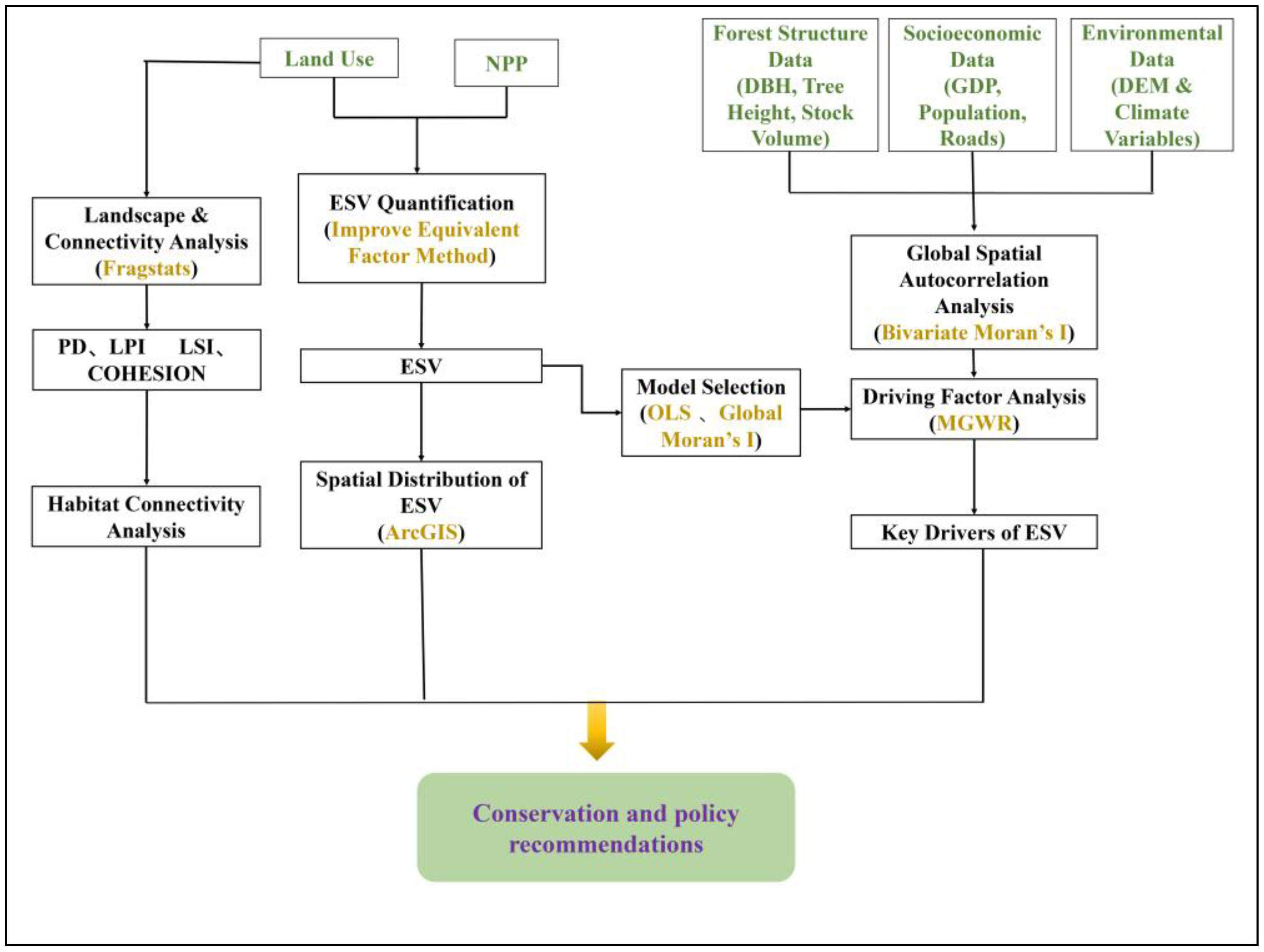
The land-use data for 2022 were obtained from Wuhan University (https://zenodo.org/ (accessed on 5 July 2024). The original data underwent categorical refinement to match the ecological conditions in the GPNPSC through the reclassify tool in ArcGIS10.8. This produced six first-level land-use types: construction land, cultivated land, grassland, forest, unutilized land, and water body. To improve data accuracy, forest was subdivided into four secondary types by the SFGIPI: shrub forest, broadleaf forest, mixed forest, and coniferous forest. These layers were combined to generate the 2022 land-use/ecosystem type map for the GPNPSC (Figure 3). Agricultural and economic data, including crop yields, cultivated areas, and market values of major crops (e.g., rice, wheat, and maize), were derived from the 2023 Statistical Yearbook covering the 20 counties in the study area. Market prices were obtained from the National Farm Product Cost-benefit Survey [18].
To demonstrate how natural environments and human activities influence ESV, a list of potential driving factors for the GPNPSC was constructed (Table 1). Forest stock, tree height, and diameter at breast height were provided by SFGIPI. We used 2022 as the reference year for all dynamic socioeconomic and environmental variables. Topographic and distance-related factors were treated as static, while climatic variables represent multi-year averages.

2.3. Assessment of Ecosystem Service Values

To quantify ESV in the Sichuan region of the Giant Panda National Park (GPNPSC), we employed the equivalent factor method based on the equivalent factor per unit of land-use area. This approach, developed by Xie et al. [19] based on Costanza (1997) [20], utilized quantifiable criteria to construct value equivalents for different types of ESs. Then, it calculates the total ESV by integrating these equivalents with the corresponding ecosystem areas. To improve accuracy for our region, we adjusted the original equivalent factors. Based on the standard table [21], we corrected the equivalent factor coefficients for each land-use type, computed a regional standard equivalent value, and applied adjustment coefficients. Construction land was excluded from the valuation, following common practice in a previous study [22]. The standard equivalent value is one-seventh of the economic value of the main food crop grown on one hectare of cultivated land. We derived this from the statistical yearbooks of 20 counties, based on the average market price and yield per unit area of these crops in 2022, resulting in a standard equivalent factor of 330.19 USD/hm2. Note: the average exchange rate between USD and CNY in 2022 was 7.04 (http://www.gov.cn, accessed on 28 July 2024).
The ESV coefficient (in USD/hm2 per service type) for each land-use type was then calculated by multiplying the equivalent factor coefficients, the standard equivalent factor, and the adjustment coefficient (Table 2). To capture the spatial heterogeneity of ecosystem services, net primary productivity (NPP) is chosen as the spatial adjustment coefficient at the grid scale, given that the forest system is dominant. The formula of the corrected ESV coefficient is as follows:
E v i = sef × e i k × N P P i j / N P P a , i
where E v i is the ESV coefficient of land-use/ecosystem type i , sef is the standard equivalent factor, e i k is the equivalent factor for the k t h ecosystem service provided by the i t h land-use/ecosystem type, N P P i j is the NPP of the i t h land-use/ecosystem service type for the j t h grid, and N P P a , i is the average NPP for the study area.
In order to avoid conflict between NPP data and local forest survey data, the Thornthwaite Memorial model [23] was used to calculate NPP with the following formula:
N P P = 3000 × [ 1 e 0.0009695 V 20 ]
V = 1.05 P r e / 1 + 1 + 1.05 P r e / L 2
L = 3000 + 25 T m p + 0.05 T m p 3
where   N P P is the net primary productivity (t/hm2) of the study area; V and L are the annual actual evapotranspiration (mm) and the annual average evapotranspiration (mm), respectively; P r e is the annual precipitation (mm); and T m p is the annual average temperature (°C).
In the fourth step, three indicators concerning ESV, including grid ESV, grid ESV intensity, and total ESV in the study area, are given in the following formulas:
A ESV = i = 1 n S i j × E v i
where A ESV is the total value of ecosystem service of the grid i , and S i j is the area of the j t h land-use/ecosystem service type in the i t h grid.
T ESV = j = 1 m A ESV
where T ESV is the total value of ecosystem service in the study area, and m is the total number of grids equal to 5798.
A ¯ ESV = A ESV S
where A ¯ ESV is the value per unit area of each grid (ESV intensity); S is the area of each grid.

2.4. Global Spatial Autocorrelation Analysis

Before choosing a regression model to analyze ESV drivers, we first checked the spatial pattern of the ESV data. When ESV shows a random distribution, ordinary least squares (OLS) regression would be employed. Nevertheless, if ESV clusters or disperses spatially, OLS can produce biased or inefficient results [24]. Therefore, Global Moran’s I was employed to examine the overall spatial autocorrelation of ESV. Moran’s I is a widely used spatial statistical test that measures the degree of spatial dependence among observations by comparing attribute similarity and spatial proximity. A positive value (I > 0) indicates spatial clustering, whereas a negative value (I < 0) suggests spatial dispersion. Values close to zero imply a random spatial pattern. The formula for Global Moran’s I is as follows [25]:
I = i = 1 n j = 1 n w i j ( x i x ¯ ) ( x j x ¯ ) S 2 i j w i j
where n is the number of spatial units, and x i and x j are the attribute values for spatial units i and j . ( x i x ¯ ) indicates the deviation of the attribute value at spatial unit i from the mean value. w i j is the spatial weight matrix for unit i and unit j , and S 2 refers to the variance.

2.5. Bivariate Spatial Autocorrelation Analysis

Variable selection of potential driving factors is required prior to the introduction of spatial regression models to enable data downscaling and model optimization [26]. We employed the bivariate Moran’s I to investigate the presence of spatial autocorrelation between ESV intensity and potential driving factors [27]. As with Global Moran’s I, bivariate Moran’s I [28] identifies spatial patterns between variables, which helps to select variables for potential drivers [29]. The formula is as follows:
I k l i = Z k i j = 1 n w i j Z l i
where z k i = x k i x k ¯ λ k ; z l i = x l i x l ¯ λ l ; x k i is the attribute value of k for spatial unit i ; x l i s the attribute value of l for spatial unit j ; x k ¯ and x l ¯ are the average attribute values of k and l ; and λ k and λ l are the variances of k and l .
For variables that pass the bivariate Moran’s I test, we used the OLS model to check for multicollinearity [30,31]. The variance inflation factor (VIF) was employed to quantify the extent of multicollinearity between the variables in question.
GeoDa 1.6.7 was used for spatial autocorrelation analysis [15]. To mitigate boundary effects from incomplete grids, this study utilized the grid ESV intensity for spatial correlation analyses.

2.6. Multiscale Geographically Weighted Regression Analysis

To explore how strongly each driver influences ESV, and to support targeted management, we introduced geographically weighted regression models that have the unique advantage of allowing local coefficients to vary with space [32]. Compared to standard GWR, multiscale GWR (MGWR) allows the bandwidths of specific variables to be adjusted at different spatial scales [33], enabling the driving factors to be explored more precisely for accurate management [34]. The related models were run using MGWR 2.2 software, and the formula of MGWR is as follows [35]:
y i = β 0 x i , y i + j β b w j ( x i , y i ) x i j + ε i
where b w j is the bandwidth used for the regression coefficient of the j t h independent variable.

2.7. Landscape Fragmentation Metrics

Habitat connectivity is crucial for giant panda conservation. Continuous forest corridors facilitate movement and gene flow between subpopulations. This study employed FRAGSTATS 4.3 to calculate four widely used landscape metrics at the landscape scale: patch density (PD), largest patch index (LPI), landscape shape index (LSI), and cohesion [8]. These metrics collectively characterize the spatial connectivity and ecological integrity of different land-use types.

3. Results

3.1. Forest Is the Dominant Land-Use Type and ESV Contributor in the GPNPSC

Different land-use/ecosystem types provide different ecosystem services. In the Sichuan region of the Giant Panda National Park (GPNPSC), forest covers the vast majority of the landscape, while grassland and other types occupy relatively small proportions (Table 3 and Figure 3). To improve the accuracy of ESV assessment, we adjusted the ESV coefficient for each land-use type by incorporating the NPP adjustment factor. The adjusted standard equivalent factors ranked as follows: water body > mixed forest > broadleaf forest > coniferous forest > shrub forest > grassland > cultivated land > unutilized land (Table 2).
Total ESV depends on both land-use type and these coefficients (Table 2 and Table 3). Using the improved equivalent factor method, the GPNPSC’s total ESV in 2022 reached 11.58 billion USD, with an average density of 5994.01 USD/hm2. Forest ecosystems dominate in both area and value, contributing 10.32 billion USD. Broadleaf forest played the most significant role, owing to its extensive coverage and relatively high ESV coefficients. Grassland was another significant component in the GPNPSC, accounting for 14.49% of the area and supplying 9.85% of the total ESV. Water bodies exhibited the highest ESV coefficients but contributed little overall due to the limited extent. Together, forest and grassland accounted for 98.93% of the total ESV, highlighting their indispensable role in providing essential ecological services within the region.
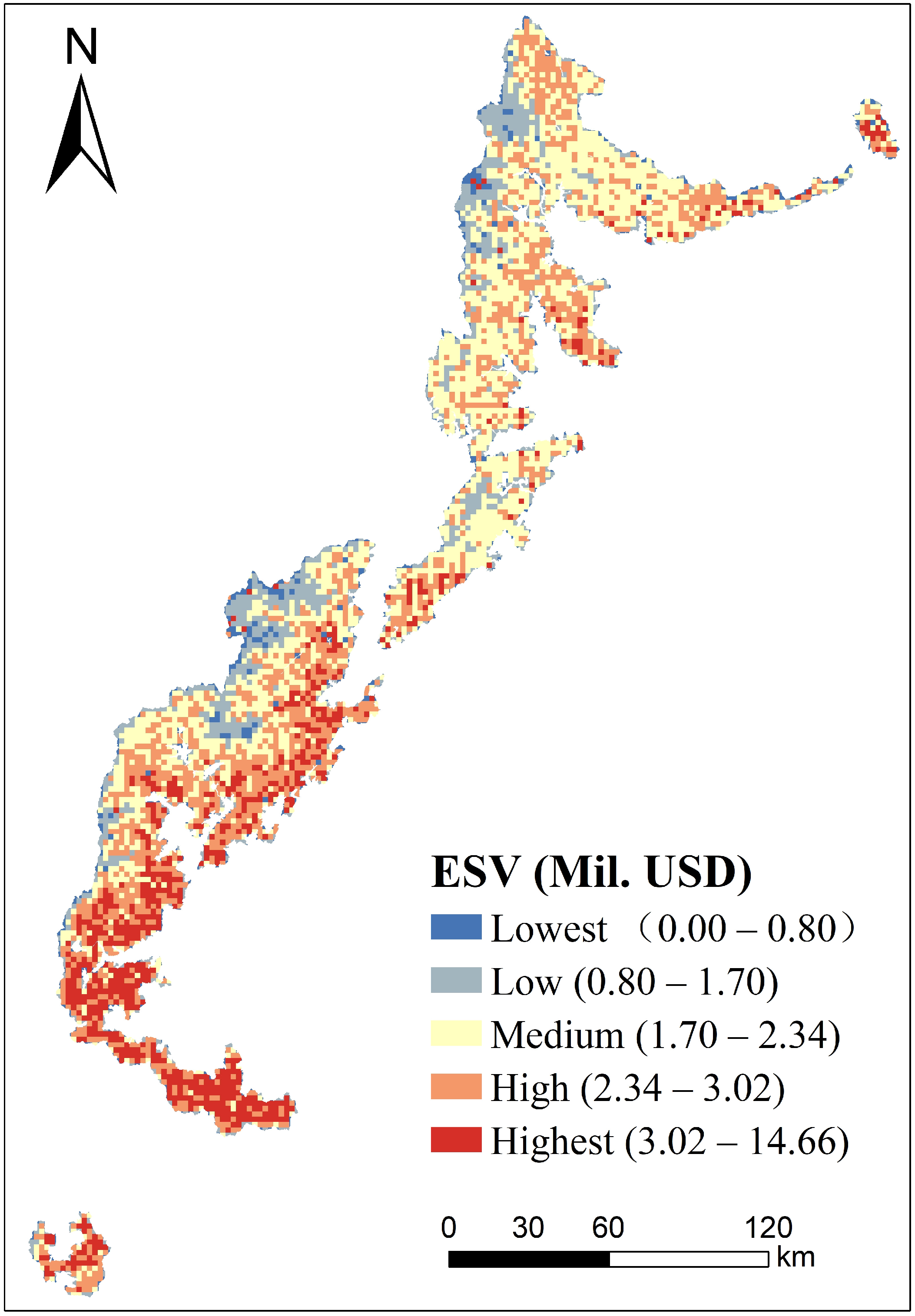
At the grid scale, ESV exhibited an increasing trend from the northwest to the southeast (Figure 4). Medium-value areas covered the largest portion, mainly in the north and center, totaling 3.71 billion USD. Within this zone, shrub forest, coniferous forest, and grassland, each with medium ESV coefficients, drove most of the value. High-value areas made up approximately 30.93% of the total area, with a dispersed pattern in the north and stronger concentration in the south, totaling 4.09 billion USD, marking the highest among categories. Notably, broadleaf forest constituted the largest share of the high-value areas, followed by coniferous forest, confirming forests as the backbone of high-ESV regions.
The highest-value zones clustered in the south, where broadleaf forest prevailed, contributing 2.39 billion USD. The low- and lowest-value areas lie mostly in the west, dominated by grassland, along with some cultivated and unutilized land. Overall, the GPNPSC showed predominantly medium-to-high ESV levels, suggesting that ecological protection efforts have been effective.

3.2. Regulating Service Value Is the Main Source of ESV

Among ecosystem service categories, regulating services held the largest share at 66.45% of the total value, followed by supporting services at 23.11%. Provisioning services ranked lower, while cultural services contributed the least at just 4.67% (Table 4).
The GPNPSC is predominantly composed of forest, which plays a significant role in climate regulation, hydrological regulation, and soil conservation, thereby providing high-quality ecosystem services. Climate regulation emerged as the single largest contributor, followed by hydrological adjustment and soil conservation. These three together formed the foundation of the region’s ESV, with climate regulation and hydrological adjustment alone accounting for nearly half of the total. It is, therefore, logical that the highest-level regulating values appear in forest-dominated protected zones. Preserving these forests remains critical for sustaining the park’s overall ecological functions.

3.3. High Total ESV but Low ESV Intensity in Core Conserve Zone

The core reserve zone occupies most of the area (73.49%) and contributes a substantially large share of total ecosystem service value at approximately 64.71%. The general control zone, though smaller, accounts for the remaining 35.29%.
While the core zone leads in absolute ESV due to its size and ecological importance, ESV intensity (value per unit area) told a different story. The general control zone shows higher intensity at 6769.22 USD/hm2 compared with 5713.88 USD/hm2 in the core zone. Forests cover approximately 94.91% of the general control zone, boosting its ESV intensity. Conversely, the core zone contains about 79.03% forest and 18.29% grassland. Given the low coefficient of grassland, it dilutes the overall ESV intensity despite the core zone’s higher total ESV. This observation highlights the superior ecological contribution of forests compared with grasslands.

3.4. ESV Intensity Shows a Clustered Distribution Pattern

To choose the appropriate regression approach for driving factor analysis, we initially examined the spatial pattern of ESV intensity using Global Moran’s I. The result was 0.37 (p < 0.01), confirming significant positive autocorrelation. High-intensity areas cluster together, as do low-intensity ones. This is consistent with the spatial distribution of ESV (Figure 4), with low values concentrated in the northwest and high values in the southeast. Such a clustered distribution pattern of ESV intensity supports the use of spatial regression models to capture how drivers influence ESV across space [36].

3.5. Screening of Driving Factors by Bivariate Spatial Autocorrelation Analysis

To identify effective driving factors and improve model accuracy, bivariate Moran’s I analysis was employed. Electricity consumption (X12) showed no significant correlation (p > 0.01) and was dropped (Table 5). The remaining 12 factors all passed the 99% significance threshold, indicating that they are meaningful spatial links to ESV intensity.
Next, an OLS analysis was performed to examine the multicollinearity. Diameter at breast height (X7) had a VIF exceeding five, indicating a strong linear correlation with other factors. Therefore, this factor was eliminated from further analysis. The final 11 factors passed multicollinearity tests and were used in the subsequent spatial regression model.

3.6. Digital Elevation Model and Gross Domestic Product Are the Dominant Natural and Human Driving Factors on ESV

To select the appropriate mode, the performance parameters of OLS and the classical GWR and MGWR models were compared (Table 6). A higher value for R2 indicates greater explanatory power and model stability, while a lower value for the corrected Akaike information criterion (AIC) signifies a more concise and better-fitting model [37]. MGWR showed the highest R2 (explaining 56.30% of ESV intensity variation) and the lowest AIC, balancing accuracy and conciseness and making it ideal for identifying the effects of drivers on the spatial distribution of ESV intensity.
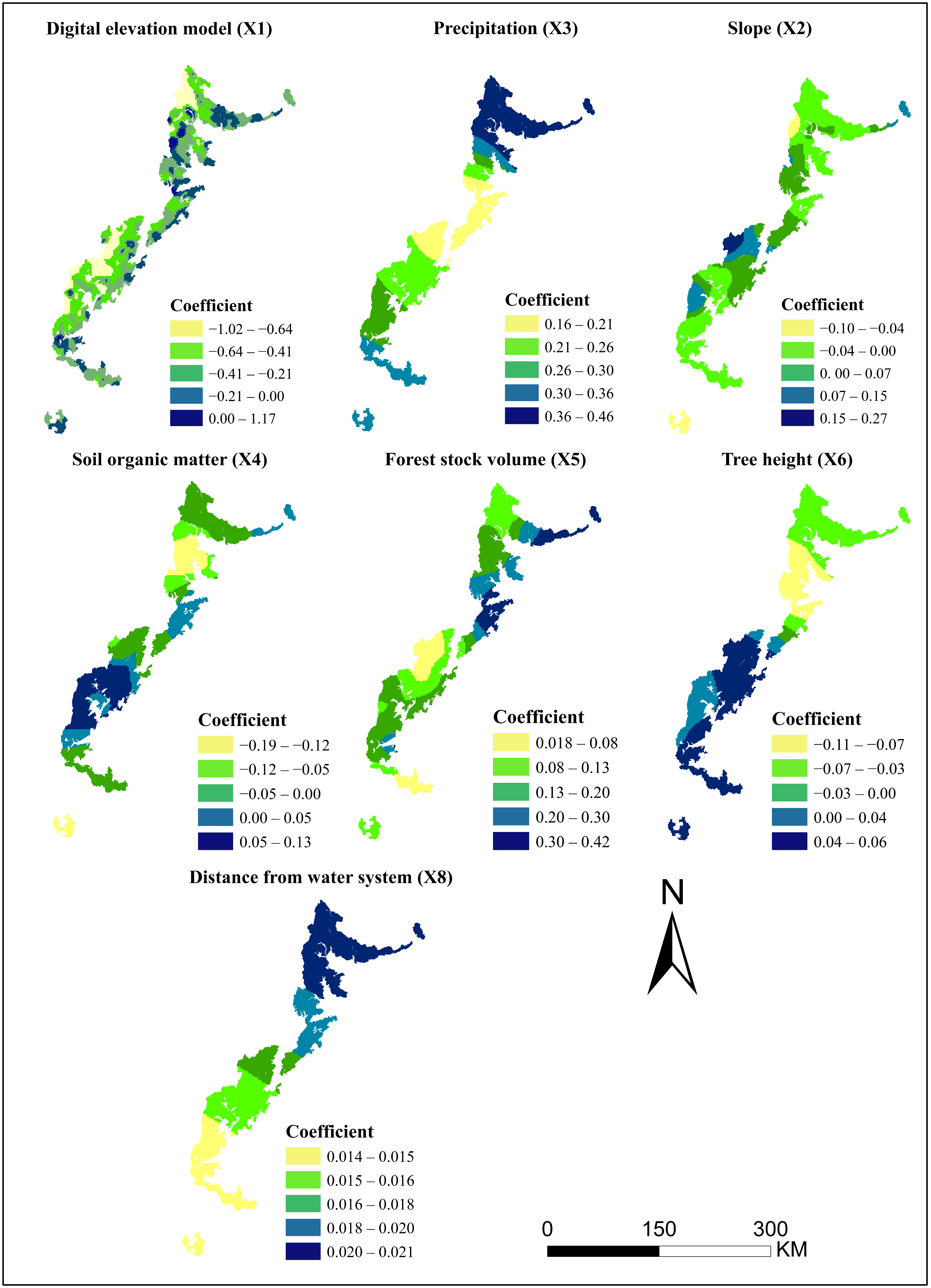
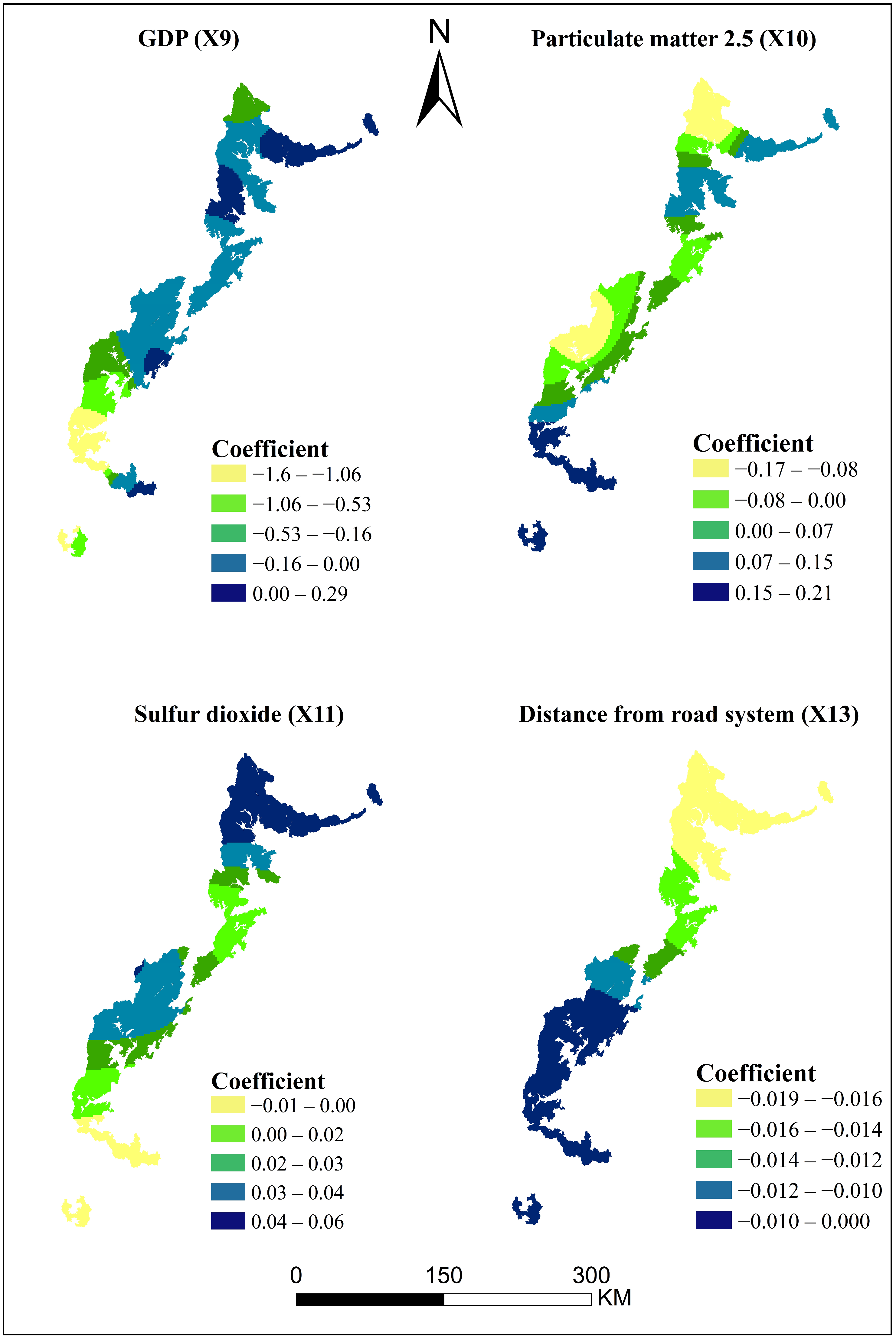
MGWR outputs revealed the drivers’ effects through spatially explicit regression coefficients (Figure 5), where coefficient magnitude reflects the effect strength on ESV intensity, and sign polarity (positive/negative) denotes enhancement or suppression relationships.
Key environmental drivers of ESV intensity demonstrated contrasting spatial patterns (Figure 5). The digital elevation model (DEM, X1) had the strongest overall negative effect, weakening from west to east as elevation decreases. Average annual precipitation (X3) showed positive correlations, strengthening bidirectionally from the center, reflecting its role as a critical hydrological determinant of ecosystem productivity. Slope (X2) displayed generally weak positive effects that decreased eastward, turning negative in southern regions and specific northern zones. Soil organic matter content (X4) enhanced ESV intensity in the central and southern regions by enhancing nutrients and biodiversity. Forest stock (X5) strengthened ESV intensity eastward through enhanced carbon storage, except in west–central grassland zones. Tree height (X6) positively influenced southern areas, correlating with the healthy forest ecosystem, providing various ESs. Distance from the water system (X8) showed latitudinal heterogeneity, with weak positive effects growing northward. The southern region exhibited sufficient precipitation and abundant water sources, maintaining high ESV despite the far distances from river systems.
Economic and social factors showed distinct patterns (Figure 6). Gross domestic product (GDP, X9) emerged as the principal one, with a southward negative impact on ESV intensity. High GDP correlated with frequent human activities and decreased biodiversity through accelerated land conversion. PM2.5 concentration (X10) showed negative gradient effects in northwestern regions with grassland and cultivated lands, where particulate absorption capacities were limited. In eastern and southern regions, PM2.5 exhibited attenuated effects due to the high forest cover, which enhanced the region’s air purification abilities. Additionally, the higher GDP and increasing value of supplying services in these areas helped to partially offset the negative effects of PM2.5 concentrations and sulfur dioxide levels (X11). Distance from the highway (X13) had an overall negative effect on ecosystems, with ESV suppression intensity increasing from south to north. Roads represent human activity trajectories, with ecosystems generally faring better where human activity is less prevalent.

3.7. Habitat Connectivity and Giant Panda Conservation

Class-level fragmentation metrics revealed substantial differences in spatial structure across land-use types (Table 7). Broadleaf and coniferous forests exhibited high connectivity and low fragmentation, whereas mixed forests and anthropogenic land uses showed strong patch isolation. These contrasting structural patterns highlight substantial spatial variation in habitat integrity across the region.
Broadleaf and coniferous forests had a low patch density (PD) and a high patch cohesion index, indicating well-connected habitats. Their high landscape structure index (LSI > 24) reflects complex boundaries shaped by mountainous terrain. Shrublands exhibited extremely low PD but the highest cohesion index, suggesting strong connectivity despite fewer patches. In contrast, mixed forests exhibited extremely low cohesion index and the smallest maximum patch index (LPI), pointing to severe isolation and high vulnerability. Ecological restoration efforts should, therefore, prioritize mixed forest areas to improve habitat integrity for giant pandas and other species.

4. Discussion

4.1. Reliability of Spatial Regression Analysis

This study refined the equivalent factor method to develop an ESV assessment framework tailored to the Sichuan region of the Giant Panda National Park (GPNPSC). Our total ESV estimate aligns closely with the earlier studies in Baoxing county [38] and the Minshan area [39], confirming that incorporating forest-type-specific coefficients, NPP-based biomass adjustments, and locally derived cultivated land economic data improves regional relevance. Rather than merely confirming model performance, these results highlight the importance of contextualizing ESV parameters to regional ecological and socioeconomic conditions. Minor differences between studies likely arise from variations in land-use classification, coefficient calibration, and spatial resolution, which highlights the sensitivity of ESV outcomes to methodological choices.
For spatial determinant analysis of ESV, bivariate spatial autocorrelation and OLS regression were employed, followed by MGWR to examine their impacts. Notably, the lower resolution at the administrative area scale made it difficult to identify spatial heterogeneity in driving factors [9]. Utilizing grid-based data with high spatial resolution can effectively address this issue. The MGWR model demonstrated strong explanatory power, and its spatially varying coefficients provided meaningful insights into how natural and human drivers influence ESV patterns. Interestingly, ESV intensity exhibited slightly higher explanatory performance than total ESV. Normalizing ecosystem service values by area appears to reduce scale-driven heterogeneity and better reflect localized ecological processes. These findings contribute to ongoing methodological discussions regarding the trade-offs between spatial resolution, interpretability, and model stability in ecosystem service research.

4.2. Spatial Heterogeneity in the Effects of Driving Factors on ESV

By combining bivariate spatial autocorrelation with MGWR, we gained a more detailed view of spatial non-stationarity in ESV intensity and its links to natural and human drivers.
We found that ESV intensity showed significant spatial differences driven by natural and human factors. The digital elevation model exhibited a generally negative correlation with ESV intensity in the GPNP, which contrasts with the positive correlation observed in the Tibet Autonomous Region [40,41]. This divergence can be attributed to the vertical zonation of vegetation and giant panda habitat preferences. Unlike the vast high-altitude grasslands of Tibet, high-ESV areas in the GPNP concentrate at mid-elevation zones (typically 1500–3500 m), where subalpine coniferous forests and lush bamboo understories provide both food and habitat for giant pandas, as well as substantial regulating services like water retention and carbon sequestration [42]. Above 4000 m, rocky and glaciated areas have very low biomass, leading to the decline in ESV with increasing altitude.
Frequent human activities generally reduce ESV intensity. GDP showed a consistent negative effect here, as in the previous research [43]. However, human presence does not always degrade ESV [9]. In specific concentrated development areas, such as park entrances or traditional settlements, ESV can be enhanced through the “umbrella effect” of panda conservation. The global iconic status of the giant panda fosters high cultural ecosystem service values through ecotourism and recreational activities. Furthermore, community-led conservation initiatives and low-intensity traditional land use within the park often maintain a mosaic of habitats that support biodiversity while meeting local livelihood needs [44]. Thus, the GPNP represents a complex landscape where the conservation of a flagship species interacts with human settlements to reshape the spatial distribution of ecosystem services.

4.3. Habitat Connectivity Improvement and Implications for Giant Panda Population Recovery

The observed patterns of landscape fragmentation further reflect the ecological outcomes of habitat restoration in the GPNPSC. Notably, broadleaf and coniferous forests exhibited high cohesion and low patch density, indicating substantial improvement in habitat integrity and spatial continuity. These structural enhancements are consistent with ecological restoration and corridor construction efforts undertaken since the establishment of the GPNP.
Improved habitat connectivity is directly relevant to giant panda conservation. As a species highly sensitive to landscape fragmentation, the giant panda depends on continuous forest corridors to facilitate dispersal, maintain gene flow, and reduce the risk of local subpopulations [13,45,46]. In recent years, the wild giant panda population has shown a steady increase [12]. This recovery can be partly attributed to the restoration of forest habitats and the establishment of ecological corridors linking previously isolated habitat patches.
The fragmentation metrics analyzed in this study suggest a trend of structural improvement that aligns with this population recovery. These findings highlight that maintaining and further enhancing connectivity within key forest landscapes is critical for ensuring the long-term viability of giant panda populations and promoting broader ecological resilience within the GPNPSC.

4.4. Application and Recommendations

The quantitative ESV assessment for the GPNPSC highlights that effective ecological governance requires a transition from broad administrative approaches to targeted, location-specific management. Developing tailored strategies requires a clear understanding of the varying levels of ESV and their distinct drivers across the region.
In low-ESV areas, primarily comprising farmland and built-up areas surrounding Wenchuan county, priority should be given to ecological restoration. Key measures include the afforestation of marginal farmland and the restoration of riparian buffer zones. High-ESV areas, corresponding to intact forest ecosystems such as those in Shimian county, require strict zoning regulations and dynamic monitoring of key habitat patches. This is essential for degradation and maintaining long-term ecological security. Medium-ESV areas with mixed land-use patterns, exemplified by Baoxing county, call for sustainable management strategies that carefully balance ecological conservation with the support of local livelihoods.
To mitigate the generally negative impacts of human activities on ESV, particularly in sensitive regions, practical measures are necessary. Balancing conservation with human needs can be advanced through mechanisms such as payment for ecosystem services programs, which provide direct incentives for environmentally friendly practices. Concurrently, investing in green infrastructure, such as by promoting electric vehicles for tourism and community transport, can help meet human demands without degrading ecological assets.
The GPNP’s zonal management strategy, which designates core reserves and general control areas, yields different contributions to ecosystem services. While core reserves contain the largest total ESV due to their expanse, general control areas often exhibit higher ESV intensity because of their extensive forest cover. Conservation strategies should, therefore, be differentiated accordingly.
Within core protected areas, the priority is the conservation and management of natural forests, which provide vital breeding and foraging habitat for giant pandas. In general, control zones dominated by planted forests, efforts should focus on converting monoculture stands into mixed forests. This transformation enhances ecosystem service intensity, strengthens ecological corridor functions to reduce fragmentation, and facilitates gene flow. Furthermore, forest fire prevention remains a critical priority across all zones to protect both panda habitat and their primary bamboo food sources. By aligning specific zoning regulations with the needs of this flagship species, managers can enhance landscape resilience to climate-related shifts, solidifying the GPNP’s role as a sanctuary for biodiversity and its iconic species.

4.5. Innovations and Limitations

This study represents the first large-scale assessment of ecosystem service values for the GPNP, providing actionable insights to guide conservation strategies and park management. It is also the first to systematically investigate the drivers behind ESV within the park by integrating both natural environmental and human activity factors.
Given the forest-dominated landscape of the GPNPSC, we incorporated specific forest structure variables, including stock volume, tree height, and diameter at breast height, to improve the accuracy of the driver analysis. This approach addresses a gap existing in research and provides a more nuanced understanding of ESV in the GPNP. The explanatory power (R2) of the MGWR model in this study was lower than that reported in some analyses conducted at coarser administrative scales [9]. This discrepancy is likely due to differences in spatial resolution. While MGWR effectively captures spatial heterogeneity, the use of finer-grid data can introduce greater noise and data sparsity, potentially reducing model performance. This effect is compounded within the GPNPSC, a strictly protected area where human activity, beyond that of local communities, is minimal, resulting in limited availability and granularity of socioeconomic spatial data. In addition, the inherent complexity of ecosystems also imposes a fundamental limit on the proportion of variation any model can explain [47]. Although this study considered a wide range of drivers, it was not feasible to account for all potential influencing factors.

5. Conclusions

This study employed a refined equivalent factor method, spatial autocorrelation analysis, and multiscale geographically weighted regression to assess the ecosystem service value (ESV) and its driving factors within the Sichuan region of the Giant Panda National Park for the year 2022. The study demonstrates that introducing forest-type-specific coefficients, net primary productivity (NPP)-calibrated biomass adjustment factors, and localized farmland economic data significantly enhances the regional accuracy of ecosystem service assessments. The results revealed a distinct spatial gradient of increasing ESV from the northwest to the southeast, a pattern shaped by the heterogeneous influences of land use, natural environmental conditions, and human activities. Notably, the inclusion of detailed forest structure variables, such as stock volume, tree height, and diameter at breast height, improved the accuracy of the driver analysis. Critically, the observed improvements in landscape structure validate the efficacy of ongoing ecological corridor projects, which facilitate giant panda migration and contribute to broader ecosystem resilience.
These outcomes emphasize the necessity of implementing spatially differentiated management strategies. In low-ESV areas, primarily consisting of farmland and construction land, restoration activities such as afforesting marginal farmlands and rehabilitating riparian buffer zones should be prioritized. High-ESV zones, typically intact forest ecosystems, require strict protective zoning and dynamic patches monitoring to prevent habitat degradation and maintain long-term ecological security. Medium-ESV mixed zones call for sustainable management strategies that balance ecological protection with local community needs. This targeted approach not only optimizes the trade-off between protection and development but also provides a foundation for anticipating future ESV dynamics and for formulating adaptive policies within the park.
Future research should incorporate even finer-resolution spatial data to better capture ecosystem complexity, thereby supporting more precise and effective conservation and management decisions for the Giant Panda National Park.

Author Contributions

Conceptualization, Y.Z. (Yongmei Zhang), W.Y. and H.Z.; Methodology, W.Y.; Software, W.Y. and H.Z.; Validation, H.Z., W.Y. and Y.Z. (Yi Zhang); Formal Analysis, H.Z. and W.Y.; Investigation, W.Y., H.Z. and C.L.; Resources, X.L. and Y.Z. (Yongmei Zhang); Data Curation, W.Y., H.Z. and C.L.; Writing—Original Draft Preparation, H.Z. and W.Y.; Writing—Review and Editing, Y.Z. (Yongmei Zhang), Y.Z. (Yi Zhang) and X.L.; Visualization, W.Y. and H.Z.; Supervision, Y.Z. (Yongmei Zhang) and X.L.; Project Administration, Y.Z. (Yongmei Zhang); Funding Acquisition, Y.Z. (Yongmei Zhang) and X.L. All authors have read and agreed to the published version of the manuscript.

Funding

This work was supported by the Science and Technology Department of Sichuan Province [Grant No. 2024NSFSC0348] and the Sichuan Forestry and Grassland Investigation and Planning Institution [Grant No. LGKT202306 and No. CLK-2023-163-6].

Data Availability Statement

The sources of all data used in this study are fully described in the Section 2.

Conflicts of Interest

Author Chuan Luo was employed by the company Sichuan Forestry Survey, Design & Research Institute Co., Ltd. The remaining authors declare that the research was conducted in the absence of any commercial or financial relationships that could be construed as a potential conflict of interest.

References

  1. Kang, X.; Du, M.; Zhao, L.; Liu, Q.; Liao, Z.; Su, H.; Xiang, T.; Gou, C.; Liu, N. Integrity-centered framework for determining protected areas boundary: An application in the china’s national park. Ecol. Inform. 2024, 84, 102885. [Google Scholar] [CrossRef]
  2. Costanza, R.; de Groot, R.; Sutton, P.; van der Ploeg, S.; Anderson, S.J.; Kubiszewski, I.; Farber, S.; Turner, R.K. Changes in the global value of ecosystem services. Glob. Environ. Change 2014, 26, 152–158. [Google Scholar] [CrossRef]
  3. Li, L.; Wang, X.Y.; Luo, L.; Ji, X.Y.; Zhao, Y.; Zhao, Y.C.; Nabil, B. A systematic review on the methods of ecosystem services value assessment. Chin. J. Ecol. 2018, 37, 1233–1245. (In Chinese) [Google Scholar] [CrossRef]
  4. Kreuter, U.P.; Harris, H.G.; Matlock, M.D.; Lacey, R.E. Change in ecosystem service values in the San Antonio area, Texas. Ecol. Econ. 2001, 39, 333–346. [Google Scholar] [CrossRef]
  5. Pan, N.; Guan, Q.; Wang, Q.; Sun, Y.; Li, H.; Ma, Y. Spatial differentiation and driving mechanisms in ecosystem service value of arid region: A case study in the middle and lower reaches of Shule River Basin, NW China. J. Clean. Prod. 2021, 319, 128718. [Google Scholar] [CrossRef]
  6. Xiong, C.; Xu, H.; Tian, Y. Assessment of ecosystem service value in China from the perspective of spatial heterogeneity. Ecol. Indic. 2024, 159, 111707. [Google Scholar] [CrossRef]
  7. Bhuiyan, M.A.H.; Inostroza, L.; Nihei, T.; Sultana, M.; Louw, A.S.; Supe, H.; Chen, X.; Alsulamy, S.; Avtar, R. The differential impacts of the spatiotemporal vertical and horizontal expansion of megacity Dhaka on ecosystem services. Curr. Res. Environ. Sustain. 2024, 7, 100252. [Google Scholar] [CrossRef]
  8. Zhang, H.; Nie, K.; Wu, X. Spatiotemporal analysis of ecological security based on landscape patterns. ISPRS Int. J. Geo-Inf. 2024, 13, 204. [Google Scholar] [CrossRef]
  9. Yang, L.; Jiao, H. Spatiotemporal changes in ecosystem services value and its driving factors in the karst region of China. Sustainability 2022, 14, 6695. [Google Scholar] [CrossRef]
  10. Luo, Z.; Yang, X. Interrelationships between urbanization and ecosystem services in the urban agglomeration around Poyang Lake and its zoning management at an integrated multi-scale. Sustainability 2024, 16, 5128. [Google Scholar] [CrossRef]
  11. National Forestry and Grassland Administration. The Master Plan for the Giant Panda National Park (2023–2030); National Forestry and Grassland Administration: Beijing, China, 2023. [Google Scholar]
  12. Wang, X.; Yang, Y.T.; Wu, Y.; Xie, Y.; Tu, P.; Liu, M.L.; Zhang, M.J.; Lu, T. Construction of the Giant Panda National Park corridor and restoration of edible bamboo: A case study from the Chengdu area region. Ecol. Indic. 2025, 171, 113143. [Google Scholar] [CrossRef]
  13. Jia, W.; Yan, S.; He, Q.; Li, P.; Fu, M.; Zhou, J. Giant panda microhabitat study in the Daxiangling Niba Mountain Corridor. Biology 2023, 12, 165. [Google Scholar] [CrossRef] [PubMed]
  14. Zhu, D.; Yang, D. Spatiotemporal heterogeneity of ecological policy compromises human well-being and giant panda habitat conservation in Giant Panda National Park. Sustainability 2021, 13, 5013. [Google Scholar] [CrossRef]
  15. Li, T.; Li, D.; Liang, D.; Huang, S. Coupling coordination degree of ecological-economic and its influencing factors in the counties of Yangtze River Economic Belt. Sustainability 2022, 14, 15467. [Google Scholar] [CrossRef]
  16. Hou, X.Y. Editorial Committee of Vegetation Map of China. Vegetation Atlas of China (1:1,000,000); Science Press: Beijing, China, 2001. [Google Scholar]
  17. Sichuan Vegetation Cooperative Group. Vegetation of Sichuan; Sichuan People’s Publishing House: Chengdu, China, 1980. [Google Scholar]
  18. National Development and Reform Commission. National Farm Product Cost-Benefit Survey; China Statistics Press: Beijing, China, 2024. [Google Scholar]
  19. Xie, G.D.; Lu, C.X.; Leng, Y.F.; Zheng, D.U.; Li, S.C. Ecological assets valuation of the Tibetan Plateau. J. Nat. Resour. 2003, 18, 189–196. [Google Scholar] [CrossRef]
  20. Costanza, R.; d’Arge, R.; de Groot, R.; Farber, S.; Grasso, M.; Hannon, B.; Limburg, K.; Naeem, S.V.; O’Neill, R.; Paruelo, J.; et al. The value of the world’s ecosystem services and natural capital. Nature 1997, 387, 253–260. [Google Scholar] [CrossRef]
  21. Xie, G.; Zhang, C.; Zhang, L.; Chen, W.; Li, S. Improvement of the evaluation method for ecosystem service value based on per unit area. J. Nat. Resour. 2015, 30, 1243–1254. [Google Scholar] [CrossRef]
  22. Gong, X.; Chang, C. Correlation and trade-off analysis of ecosystem service value and human activity intensity: A case study of Changsha, China. Environ. Dev. Sustain. 2023, 27, 3081–3102. [Google Scholar] [CrossRef]
  23. Zhang, C.; Wang, X.; Li, J.; Hua, T. Roles of climate changes and human interventions in land degradation: A case study by net primary productivity analysis in China’s Shiyanghe Basin. Environ. Earth Sci. 2011, 64, 2183–2193. [Google Scholar] [CrossRef]
  24. Okunlola, O.A.; Alobid, M.; Olubusoye, O.E.; Ayinde, K.; Lukman, A.F.; Szűcs, I. Spatial regression and geostatistics discourse with empirical application to precipitation data in Nigeria. Sci. Rep. 2021, 11, 16374. [Google Scholar] [CrossRef]
  25. Moran, P.A.P. Notes on continuous stochastic phenomena. Biometrika 1950, 37, 17–22. [Google Scholar] [CrossRef] [PubMed]
  26. Ge, J.; Hou, M.; Liang, T.; Feng, Q.; Meng, X.; Liu, J.; Bao, X.; Gao, H. Spatiotemporal dynamics of grassland aboveground biomass and its driving factors in North China over the past 20 years. Sci. Total Environ. 2022, 826, 154226. [Google Scholar] [CrossRef] [PubMed]
  27. Xu, H.; Zhang, C. Development and applications of GIS-based spatial analysis in environmental geochemistry in the big data era. Environ. Geochem. Health 2023, 45, 1079–1090. [Google Scholar] [CrossRef] [PubMed]
  28. Anselin, L. Local indicators of spatial association—LISA. Geogr. Anal. 1995, 27, 93–115. [Google Scholar] [CrossRef]
  29. Chou, Y.H. Spatial Information Theory: A Theoretical Basis for GIS; Springer: Berlin, Germany, 1995; pp. 365–376. [Google Scholar]
  30. Wu, K.; Wang, D.; Lu, H.; Liu, G. Temporal and spatial heterogeneity of land use, urbanization, and ecosystem service value in China: A national-scale analysis. J. Clean. Prod. 2023, 418, 137911. [Google Scholar] [CrossRef]
  31. Chan, J.Y.L.; Leow, S.M.H.; Bea, K.T.; Cheng, W.K.; Phoong, S.W.; Hong, Z.W.; Chen, Y.L. Mitigating the multicollinearity problem and its machine learning approach: A review. Mathematics 2022, 10, 1283. [Google Scholar] [CrossRef]
  32. Liu, Z.; Wang, S.; Fang, C. Spatiotemporal evolution and influencing mechanism of ecosystem service value in the Guangdong–Hong Kong–Macao Greater Bay Area. J. Geogr Sci. 2023, 33, 1226–1244. [Google Scholar] [CrossRef]
  33. Fotheringham, A.S.; Yu, H.; Wolf, L.J.; Oshan, T.M.; Li, Z. On the notion of “bandwidth” in geographically weighted regression models of spatially varying processes. Int. J. Geogr. Inf. Sci. 2022, 36, 1485–1502. [Google Scholar] [CrossRef]
  34. Jackson, F.L.; Hannah, D.M.; Fryer, R.J.; Millar, C.P.; Malcolm, I.A. Development of spatial regression models for predicting summer river temperatures from landscape characteristics: Implications for land and fisheries management. Hydrol. Process. 2017, 31, 1225–1238. [Google Scholar] [CrossRef]
  35. Fotheringham, A.S.; Yang, W.; Kang, W. Multiscale geographically weighted regression (MGWR). Ann. Am. Assoc. Geogr. 2017, 107, 1247–1265. [Google Scholar] [CrossRef]
  36. Su, S.; Li, D.; Hu, Y.N.; Xiao, R.; Zhang, Y. Spatially non-stationary response of ecosystem service value changes to urbanization in Shanghai, China. Ecol. Indic. 2014, 45, 332–339. [Google Scholar] [CrossRef]
  37. DelSole, T.; Tippett, M.K. Correcting the corrected AIC. Stat. Probab. Lett. 2021, 173, 109064. [Google Scholar] [CrossRef]
  38. Xu, Y.Y.; Liu, T.; Zhang, W.; Yang, X.Y.; Gu, X.D.; Dai, Q.; Yang, Z.S. The ecosystem service value of giant panda habitat in Baoxing County. Chin. J. Appl. Environ. Biol. 2020, 26, 697–704. [Google Scholar]
  39. Wang, L.; Fu, X.; Zhu, C.Y. Spatiotemporal evolution of ecosystem service value in Minshan area of Giant Panda National Park. Hubei Agric. Sci. 2021, 60, 44–49. (In Chinese) [Google Scholar]
  40. Li, L.; Tang, H.; Lei, J.; Song, X. Spatial autocorrelation in land use type and ecosystem service value in Hainan Tropical Rain Forest National Park. Ecol. Indic. 2022, 137, 108727. [Google Scholar] [CrossRef]
  41. Liu, J.; Pei, X.; Liao, B.; Zhang, H.; Liu, W.; Jiao, J. Scale effects and spatial heterogeneity of driving factors in ecosystem services value interactions within the Tibet Autonomous Region. J. Environ. Manag. 2024, 351, 119871. [Google Scholar] [CrossRef]
  42. Kang, L.; Jia, Y.; Zhang, S. Spatiotemporal distribution and driving forces of ecological service value in the Chinese section of the “Silk Road Economic Belt”. Ecol. Indic. 2022, 141, 109074. [Google Scholar] [CrossRef]
  43. Zhao, Y.; Han, Z.; Yan, X.; Wang, X. Integrating spatial heterogeneity into an analysis between ecosystem service value and its driving factors: A case study of Dalian, China. Int. J. Environ. Res. Public Health 2022, 19, 17055. [Google Scholar] [CrossRef]
  44. Fei, L.; Shu, W.Z.; Jiu, C.Y.; Liping, C.; Hai, J.Y.; Kun, B. Effects of land use change on ecosystem services value in West Jilin since the reform and opening of China. Ecosyst. Serv. 2018, 31, 12–20. [Google Scholar] [CrossRef]
  45. Sun, X.; Long, Z.; Jia, J. Identifying core habitats and corridors for giant pandas by combining multiscale random forest and connectivity analysis. Ecol. Evol. 2022, 12, e8628. [Google Scholar] [CrossRef]
  46. Ma, T.; Hu, Y.; Russo, I.M.; Nie, Y.; Yang, T.; Xiong, L.; Ma, S.; Meng, T.; Han, H.; Zhang, X.; et al. Walking in a heterogeneous landscape: Dispersal, gene flow and conservation implications for the giant panda in the Qinling Mountains. Evol. Appl. 2018, 11, 1859–1872. [Google Scholar] [CrossRef]
  47. Van Voris, P.; O’Neill, R.V.; Emanuel, W.R.; Shugart, H.H. Functional complexity and ecosystem stability. Ecology 1980, 61, 1352–1360. [Google Scholar] [CrossRef]
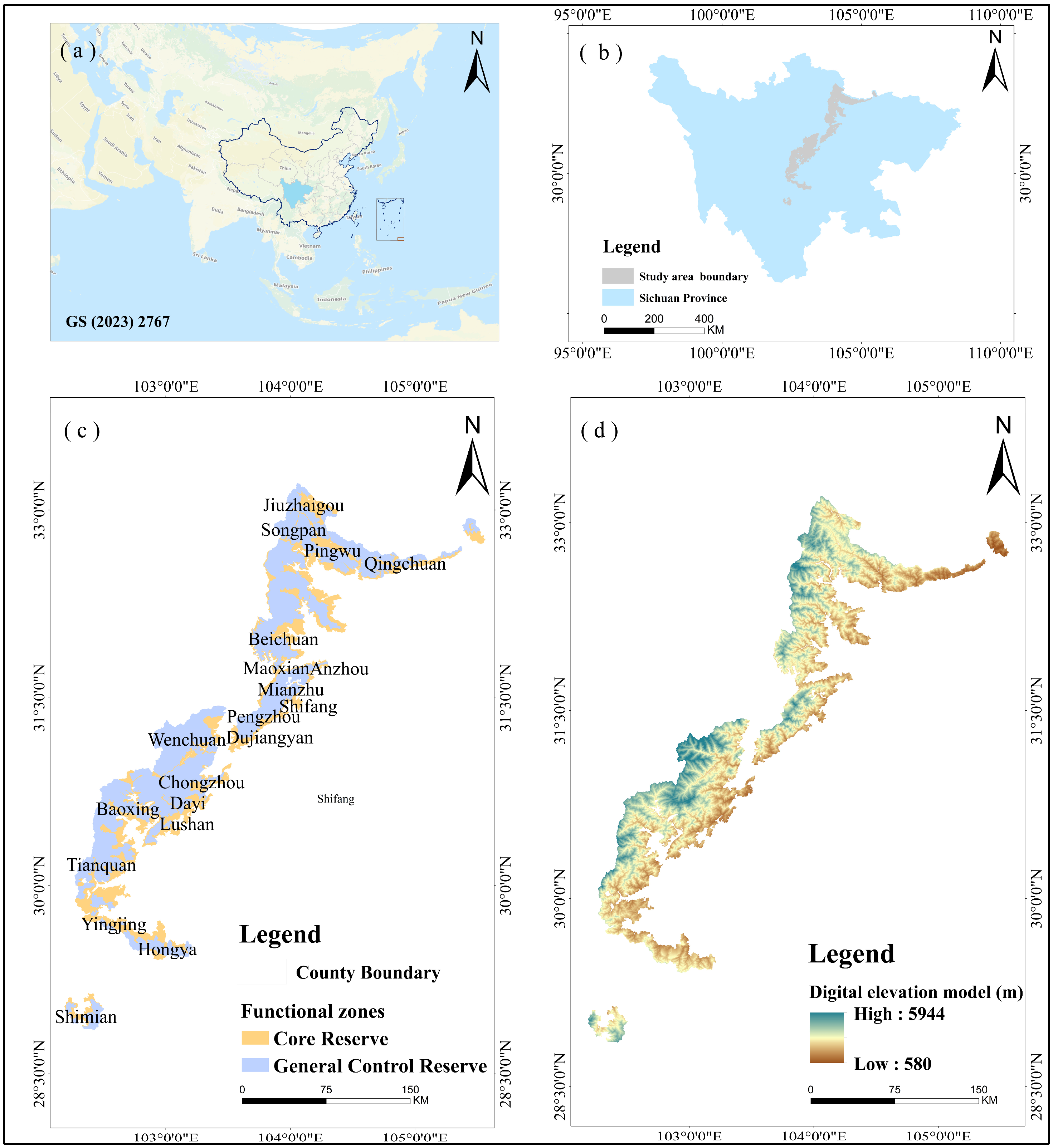
Figure 1. Geographical configuration of the Giant Panda National Park and its surrounding counties (GPNPSC). (a) Global location of China. (b) Location of the study area within China. (c) Functional zoning of the park. (d) Digital elevation model (DEM).
Land 15 00302 g001
Figure 2. Research flowchart.
Land 15 00302 g002
Figure 3. Distribution of land-use/ecosystem types within the GPNPSC.
Land 15 00302 g003
Figure 4. Spatial distribution of total ESV within the GPNPSC at the grid scale. The ESV was categorized into five classes using the ArcGIS 10.8 Jenks tool.
Land 15 00302 g004
Figure 5. MGWR coefficients between ESV intensity and natural driving factors in the GPNPSC.
Land 15 00302 g005
Figure 6. MGWR coefficients between ESV intensity and human activity driving factors in the GPNPSC.
Land 15 00302 g006
Table 1. Data sources on potential driving factors of ESV.
VariablesData ResourcesYearVariable Number
Natural environmentDEM (m)https://www.gscloud.cn (accessed on 5 July 2024)Static (2019)X1
Slope (°)https://www.gscloud.cn (accessed on 5 July 2024)StaticX2
Average annual precipitation (mm)Geographic Data Sharing Infrastructure, Global Resources Data Cloud (www.gis5g.com) (accessed on 5 July 2024)Multi-year mean (1991–2020)X3
Soil organic matter content (%)Geographic Data Sharing Infrastructure, Global Resources Data Cloud (www.gis5g.com) (accessed on 5 July 2024)Static (2022)X4
Forest stock volume (m3)SFGIPI2022X5
Tree height (m)SFGIPI2022X6
Diameter at breast height (cm)SFGIPI2022X7
Distance from water system (m)National Catalogue Service for Geographic Information (https://www.webmap.cn/) (accessed on 5 July 2024)StaticX8
Human activitiesGross domestic product (GDP) (10,000 CNY)Resource and Environmental Science Data Platform (https://www.resdc.cn/) (accessed on 5 July 2024)2022X9
Sulfur dioxide (SO2) concentration (μg/m3)Institute of Tibetan Plateau Research, Chinese Academy of Sciences (https://data.tpdc.ac.cn/home) (accessed on 5 July 2024)2022X10
Particulate matter 2.5 (PM 2.5) concentration (μg/m3)Institute of Tibetan Plateau Research, Chinese Academy of Sciences (https://data.tpdc.ac.cn/home) (accessed on 5 July 2024)2022X11
Electricity consumption (kWh)Scientific Data (https://data.stats.gov.cn/) (accessed on 5 July 2024)2022X12
Distance from road system (m)National Catalogue Service for Geographic Information (https://www.webmap.cn/) (accessed on 5 July 2024)StaticX13
Table 2. ESV coefficients of ecosystems (USD/hm2). Note: the average exchange rate between USD and CNY in 2022 was 7.04 (http://www.gov.cn, accessed on 28 July 2024).
Landscape CategoryCultivated LandForest LandGrasslandUnutilized LandWater Body
Cultivated LandConiferous
Forest
Mixed
Forest
Broadleaf
Forest
Shrub ForestGrasslandUnutilized LandWater Body
Supplying Service
Food production364.8672.64102.3695.7562.7477.040.00144.18
Raw materials80.90171.70234.43217.92141.98113.360.0080.35
Water supply−430.9089.15122.17112.2672.6462.740.001435.22
Regulating Service
Gas regulation293.87561.32775.94716.51465.57398.436.60313.68
Climate regulation153.541674.062321.232146.231396.701053.300.00707.70
Environment purification44.58491.98657.08637.26422.64347.8033.021024.69
Hydrological adjustment493.631102.831158.961565.091106.13771.549.9114,704.40
Supporting Service
Soil conservation171.70680.19944.34875.00567.92485.386.60356.60
Nutrient cycling51.1852.8372.6466.0442.9237.420.0027.52
Biodiversity56.13620.75858.49795.75518.40441.356.601147.96
Cultural Service
Landscape aesthetics24.76270.75376.42350.00227.83194.813.30738.52
Total1304.255788.217624.067577.835025.473983.1866.0420,680.82
Table 3. The area and ESV of different secondary classification land-use types within the GPNPSC.
Area (hm2)Proportion (%)Value (Million USD)Proportion (%)
Cultivated land11,397.380.5915.100.13
Coniferous
forest
564,910.7729.243263.2628.18
Mixed
forests
125,656.156.50956.068.26
Broadleaf
forest
614,792.8131.824594.1539.67
Shrub forest303,091.6115.691503.6612.98
Grassland279,936.8014.491140.919.85
Unutilized land27,039.341.401.820.02
Water body4938.130.26105.790.91
Table 4. Ecosystem service values of the GPNPSC in 2022 (mil. USD).
Landscape CategoryCultivated LandForest LandGrasslandUnutilized LandWater BodyTotal
Cultivated LandConiferous
Forest
Mixed
Forest
Broadleaf
Forest
Shrub ForestGrasslandUnutilized LandWater Body
Supplying Service 667.95
Food production4.2240.9512.8458.0518.7722.070.000.74
Raw materials0.9496.8029.40132.1242.4832.470.000.41
Water supply−4.9950.2615.3268.0621.7317.970.007.34
Regulating Service7695.79
Gas regulation3.40316.4697.30434.39139.30114.120.181.60
Climate regulation1.78943.80291.081301.18417.90301.700.003.62
Environment purification0.52277.3782.40386.35126.4699.620.915.24
Hydrological adjustment5.71621.75145.33948.86330.96220.990.2775.22
Supporting Service2676.83
Soil conservation1.99383.48118.42530.48169.93139.030.181.82
Nutrient cycling0.5929.789.1140.0412.8410.720.000.14
Biodiversity0.65349.96107.65482.43155.11126.420.185.87
Cultural Service540.16
Landscape aesthetics0.29152.6547.20212.1968.1755.800.093.78
Total15.103263.26956.064594.151503.661140.911.82105.7911,580.74
Table 5. The bivariate Moran’s I for ESV intensity and potential driving factors.
Potential Driving FactorsMoran’s Ip
X1−0.410.00
X2−0.050.00
X30.490.00
X4−0.260.00
X50.130.00
X60.150.00
X70.200.00
X8−0.070.00
X90.090.00
X10−0.200.00
X110.370.00
X120.010.09
X13−0.170.00
Table 6. Model performance parameters for OLS, GWR, and MGWR.
OLSGWRMGWR
R2AICR2AICR2AIC
0.4512,976.460.4912,572.630.5612,454.13
Table 7. Class-level landscape fragmentation metrics within the GPNPSC.
Land Cover TypePDLPI (%)LSICOHESION
Broadleaf forest0.01303.456124.379783.3935
Coniferous forest0.01353.311324.684278.7554
Shrub forest0.00482.649014.717085.4426
Mixed forest0.01020.165615.416729.0574
Cultivated land0.01162.069518.400071.5698
Grassland0.00140.22766.529450.9128
Water body0.00120.02074.80000.0000
Unutilized land0.00050.06213.142916.8853
Construction land0.00010.02071.00000.0000
Disclaimer/Publisher’s Note: The statements, opinions and data contained in all publications are solely those of the individual author(s) and contributor(s) and not of MDPI and/or the editor(s). MDPI and/or the editor(s) disclaim responsibility for any injury to people or property resulting from any ideas, methods, instructions or products referred to in the content.