1. Introduction
Addressing the constraints that hinder high-quality and sufficient employment among rural labor, ensuring stable employment for rural workers, and assessing the actual effects of new rural development policies in the digital era are critical for advancing rural revitalization and sustaining long-term national development. However, against the backdrop of rapid urbanization and industrialization, rural China is experiencing a substantial outflow of labor, particularly among young workers. The resulting economic consequences include not only an aging rural population, abandoned farmland, and the hollowing out of rural industries [
1,
2,
3], but also, more fundamentally, a systemic weakening of RLFS. Conceptually, RLFS refers to the employment pattern of working-age individuals whose household registration or primary workplace is located in rural areas, characterized by low mobility and high employment stability driven by subjective preferences or the specificity of human capital. At the individual level, RLFS manifests as sustained and stable employment intentions or long, uninterrupted employment spells. In China’s dual urban–rural structure, RLFS is a key factor in maintaining stable employment relationships and is an important indicator of rural employment quality and the degree of integration between rural and urban labor markets. Higher RLFS implies that rural regions can effectively retain labor and sustain a stable local labor market; conversely, weakened RLFS signals persistent labor outflow and declining vitality in rural areas. Traditionally, the rural labor supply has relied on small-scale social networks rooted in local attachment or has been constrained by limited employment options [
4,
5]. These conditions generate substantial labor market mismatches, making it difficult for rural workers to form stable and long-term employment intentions. On the one hand, such distortions prevent rural labor from fully realizing its factor value; on the other hand, the rising frequency and risk of job switching undermine the healthy functioning of the labor market. Therefore, alleviating labor market distortions faced by rural workers, fostering stable employment intentions, and enhancing RLFS become one of the key issues in promoting rural development. Furthermore, as the stability of rural labor improves, whether digital rural development can effectively raise land resource utilization efficiency and activate regional factor vitality also constitutes urgent tasks for advancing rural revitalization and ensuring employment stability and sustained economic development.
The implementation of the digital rural development strategy offers a new opportunity to address these challenges. It is noteworthy that digital rural development is not merely the application of information tools but represents a profound transformation involving the restructuring of production relations and factor allocation mechanisms. Through the enhancement of digital infrastructure, the introduction of data as a factor, and the comprehensive empowerment provided by digital technologies, digital rural development profoundly affects rural economic structures, governance systems, and public service provisions [
6,
7], thereby creating new external conditions for the rural labor market. Moreover, digital rural development can not only generate high-quality local employment opportunities by fostering new business models [
8] but also enhance human capital and community identity through innovative services such as remote education and online cultural services, thereby optimizing public service experiences via information equity. Collectively, these changes constitute a comprehensive ecosystem that enhances the “attractiveness” of rural areas, making it possible to address the weakening of RLFS.
As a key measure for achieving agricultural and rural modernization, the core of digital rural development policies lies in integrating new digital tools—such as digital infrastructure, digital governance, and digital public services—into the traditional rural economic system, thereby shaping a new external environment for rural labor employment and ultimately influencing individual employment decisions, particularly RLFS. Overall, digital rural development policies promote the further penetration of digital information technologies into rural areas. The establishment of digital information service platforms and remote online training platforms not only injects digital knowledge into the rural workforce but also provides residents with new digital services and tools. While enhancing the match between labor skills and job requirements, these initiatives also foster new rural business formats and transform traditional industries, thereby strengthening the long-term employment willingness of the labor force. Specifically, the direct effects of digital rural development policies on RLFS manifest in the following aspects:
First, the continuous improvement of digital infrastructure under policy promotion reduces both the spatial friction costs of cross-regional employment and the temporal friction costs of local employment for rural labor [
9,
10], enhancing the matching between labor demand and supply and thereby increasing individual RLFS. On the one hand, regarding spatial friction costs, geographic disparities in traditional labor markets often impose “market segmentation barriers” on rural labor. When local employment opportunities are scarce and cross-regional employment involves high risks, rural workers are compelled to engage in fragmented, temporary employment, which limits both their subjective RLFS and objective employment continuity. Digital rural development policies, through initiatives such as constructing digital base stations and promoting 5G deployment in rural areas, enhance digital infrastructure, reduce spatial friction costs in labor search, and mitigate market segmentation barriers caused by geographic differences. This alleviates labor misallocation due to information asymmetry, further strengthening the long-term employment willingness of labor individuals. For example, in Guiying Village, Longshan County, Hunan Province, the construction of a digital platform facilitated the active publication of convenience services and labor demand information, creating an online communication channel for the rural labor market. The platform also includes an “incident reporting” section, providing an accessible online feedback mechanism that enhances risk-avoidance capacity during cross-regional mobility, thereby supporting the improvement of RLFS. On the other hand, with respect to temporal friction costs, traditional agricultural labor relies heavily on past experience for planting decisions, resulting in path dependency, and the seasonal nature of farming leads to extended land idleness and seasonal unemployment [
11]. Digital rural development policies enhance the application of agricultural sensors and big data platforms in crop cultivation, shortening average growth cycles, increasing annual planting batches per plot, and continuously improving agricultural production efficiency and stability. Consequently, labor willingness to engage in agriculture increases. Additionally, the development of remote online training enables laborers to improve their skills without reducing their planting efficiency, increasing their human capital stock and converting it into knowledge for subsequent planting decisions, thereby enhancing long-term agricultural RLFS.
Second, from the perspective of income utility, RLFS fundamentally reflects laborers’ employment decisions and work duration on the basis of the realized utility of different job-related incomes. When the actual utility derived from a given employment option exceeds that of alternatives, RLFS is reinforced. Traditional forms of rural employment, such as crop and livestock farming or casual labor, are characterized by low income levels, high vulnerability to natural risks and market price fluctuations, and limited opportunities for skill enhancement, resulting in low expected income utility and weak long-term employment intentions [
12,
13]. Digital rural development policies can enhance RLFS by both increasing the marginal returns of traditional employment activities and providing new avenues for career development. On the one hand, these policies promote the adoption of smart agriculture, precision agriculture, and agricultural big data management systems, digitally transforming the entire agricultural value chain and mitigating production-related natural risks and market risks in sales, thereby increasing income stability and average marginal returns. This strengthens laborers’ long-term employment intentions and RLFS within the agricultural sector. On the other hand, the integration of digital technology with traditional agriculture generates “agricultural new business models”, offering rural laborers new career development opportunities. Traditional agricultural work often suffers from low added value, labor intensity, and constrained career prospects, limiting skill and income growth and prompting labor outflow [
14]. In contrast, digital integration fosters new agriculture-related positions such as live-streaming agriculture, e-commerce operations, and digital governance specialists, providing rural workers with alternative employment options. Participation in these new agricultural sectors enables laborers to obtain higher skill premiums and compensation, clarifying career trajectories and continuously enhancing RLFS. On the basis of the analysis above, we propose the following hypothesis:
H1. The implementation of a digital rural development policy can significantly promote RLFS.
From the perspective of transmission mechanisms, the implementation of a digital rural development policy may influence RLFS through five pathways. First, the policy can enhance RLFS by increasing the degree of rural laborers’ integration into local social networks. Within a given region, digital rural initiatives leverage advances in digital technology and communication infrastructure to transfer social networks traditionally based on kinship and geographic proximity onto digital platforms, overcoming the small-group limitations inherent in conventional rural social ties [
15,
16]. As digital governance tools continue to improve, new social networks emerge, reshaping local network integration patterns and stabilizing employment activities. Across regions, community platforms such as WeChat and TikTok facilitate the maintenance and expansion of external social networks for rural residents, reduce barriers to cross-regional labor mobility, enhance belonging and identification for migrant workers, and strengthen their long-term employment intentions. Second, the policy can enhance RLFS by improving rural laborers’ digital literacy. Targeted training programs in smart agriculture management and data analytics for large-scale farmers and family farms increase their understanding of new agricultural models, bolster confidence in continued agricultural engagement, and lay the groundwork for further digital transformation. For migrant workers, remote skills training and management or operations courses provided under digital rural initiatives improve labor market skill matching, supporting access to stable employment positions.
Third, the implementation of a digital rural development policy can enhance RLFS by improving laborers’ health conditions. Imbalances in the supply and demand of medical resources have long constrained traditional rural labor, significantly affecting both work capacity and employment stability. With the ongoing development of digital rural infrastructure, integrated online-offline healthcare systems have gradually emerged. The rise in teleconsultations and online medical services reduces the costs and delays associated with seeking medical care for rural laborers [
17]. The establishment of electronic health records increases transparency regarding workers’ health status, effectively preventing major illnesses while avoiding redundant medical expenses. These improvements mitigate sudden employment interruptions and strengthen RLFS.
Furthermore, the implementation of a digital rural development policy can enhance RLFS by reducing laborers’ speculative motives. For rural laborers engaged in agricultural production, the integration of the IoT and big data under the policy enables precision farming and better alignment of production with market demand, mitigating supply–demand fluctuations and price risks and thereby stabilizing operational returns. This ensures more predictable labor income expectations for agricultural workers [
18,
19]. The development of digital inclusive finance also provides smallholders with more accessible financing channels, alleviating liquidity constraints in agricultural operations, fostering long-term business confidence, and reducing speculative employment choices. For rural laborers engaged in off-farm work, the establishment of online data platforms increases transparency regarding job requirements, wage standards, and firm credibility, reducing information asymmetries that drive short-term, speculative employment behaviors, and thereby strengthening the RLFS between laborers and their current positions.
Finally, on the labor demand side, the implementation of a digital rural development policy can enhance RLFS by expanding the scale of labor demand. By continuously improving rural digital infrastructure, fostering digital industrial clusters, and promoting the digital transformation of traditional agricultural enterprises, the policy substantially broadens the development space for rural firms. As rural industry chains are strengthened and new industries and business models emerge, the labor demand structure shifts from predominantly manual work to a diversified mix of manual and technical tasks, increasing overall labor demand. This expansion not only generates sufficient local employment opportunities for rural laborers but also provides a stable job supply. Moreover, the availability of diverse positions allows rural laborers to match roles to their capabilities, reducing labor interruptions caused by poor job fit and thereby enhancing RLFS. Consequently, we propose the following hypothesis:
H2. The implementation of a digital rural development policy influences RLFS through five channels: enhancing social network integration, improving laborers’ digital literacy, increasing health status, reducing speculative labor motives, and expanding the scale of enterprise labor demand.
2. Literature Review
The existing literature indicates that digital technologies and the digital economy have multidimensional and complex effects on labor markets. With respect to employment opportunities, some studies have reported that participation in the digital economy can significantly increase protective farming behaviors among rural households, thereby contributing to labor retention in the agricultural sector [
20]. The impacts of digital skills vary. Some scholars have argued that digital skills, combined with the development of telecommunications infrastructure, primarily promote nonagricultural employment and entrepreneurial activities, with limited effects on agricultural employment [
21,
22]. Conversely, other studies have suggested that digital skills can simultaneously increase employment opportunities in both agricultural and nonagricultural sectors while reducing informal employment and enhancing overall employment security [
23]. In terms of employment quality, rural digital infrastructure development also significantly improves the quality of nonagricultural employment [
24].
In terms of labor mobility and stability, digital technologies have a dual effect. On the one hand, access to digital technologies significantly facilitates rural labor mobility [
25]; however, the technologies themselves may introduce governance challenges. For instance, a comparative study in the German agricultural sector indicated that digital technologies can be used to intensify labor supervision and control, which may undermine worker autonomy and reduce work motivation [
26]. Moreover, improvements in farmers’ digital literacy also drive employment transitions, manifested in increased local part-time work and extended periods of migrant labor [
27]. On the other hand, digital technologies strengthen intravillage social networks and a sense of belonging, helping to mitigate labor outflow and promote collective action [
28]. The development of inclusive digital finance further reinforces the promotion of nonagricultural employment [
29,
30].
In terms of the employment structure, the development of agricultural digital technologies has driven a profound transformation. This effect manifests as a coexistence of “substitution” and “creation”, with smart agriculture replacing certain low-skilled laborers while new business models such as e-commerce live streaming and online training generate additional employment opportunities [
31]. Overall, the advancement of rural digital technologies facilitates the shift in rural labor from production-oriented positions to service-oriented and technical roles [
32]. However, this process is accompanied by employment polarization and risk, as low-skilled workers may face marginalization [
33], and the uncertainties associated with the development of rural e-commerce platforms introduce new risks for laborers [
34].
Another key concept relevant to this study is labor flexibility, defined as the ability to reallocate labor across different sectors [
35]. In contrast, labor stickiness, as a core measure of employment stability, embodies a multilayered connotation in the literature. At the firm level, labor stickiness is considered an organizational characteristic significantly associated with firm survival and growth probabilities [
36,
37]. At the individual employment level, labor stickiness is directly reflected in employment stability. Factors affecting this stability span both the micro and macro dimensions: at the micro level, household migration satisfaction and individual human capital have been identified as critical determinants [
38]; from a macro perspective, labor migration patterns and the level of the rural credit supply significantly influence employment stability in different contexts [
39,
40].
In summary, the existing studies have examined the impact of digital technology or digital economy penetration into rural areas on the labor market from multiple perspectives. However, several gaps remain. First, most studies have focused on the effects of the digital economy on labor “mobility” or “employment choices”, neglecting its systematic impact on “employment stability”. At the policy level, the intrinsic relationship between digital rural development policies and labor stickiness has not been adequately analyzed theoretically or empirically. Most existing studies treat identity-based and health-protection policies, such as hukou system reforms or social insurance reforms, as quasi-natural experiments to examine their effects on rural labor mobility. For example, Ning (2016) and Shen et al. (2017) find that rural insurance system reforms increase rural labor working hours and slow labor market exit [
41,
42], while hukou system reforms promote rural labor out-migration but reduce return migration to rural areas [
43]. Other studies take the implementation of digital rural development policy as a quasi-natural experiment to investigate its economic effects on rural household income and the development of new agricultural business entities; for instance, Wang et al. (2026) show that the digital rural strategy significantly narrows the urban–rural income gap by increasing complementary resource allocation [
44], and digital rural development policy strengthens the cultivation of new agricultural business entities, thereby promoting overall agricultural economic development [
45,
46]. Overall, existing policy evaluation studies have not sufficiently explored the economic linkages between digital rural development policy and the rural labor market. Second, although some studies have investigated the stabilizing effects of digital technology, a systematic examination of the mechanisms through which digital rural development policies influence RLFS is lacking. In particular, previous research has not integrated multiple dimensions, such as social networks, health security, occupational expectations, and industry demand, into a comprehensive analytical framework. Third, discussions on the heterogeneity of policy effects remain insufficient, with limited identification of which groups or regions benefit most from digital rural development policies, constraining targeted policy implementation. Finally, the existing studies have largely not analyzed labor allocation effects and have failed to assess whether enhanced labor stickiness translates into improved efficiency in the use of core rural resources, such as land, thereby limiting the comprehensive evaluation of policy effectiveness.
On this basis, the present study aims to systematically examine the effects of a digital rural development policy on the allocation of rural labor resources from the core dimension of RLFS. The potential marginal contributions of this study are as follows: First, it shifts the research focus from the broad concept of “employment effects” to the deeper dimension of “employment stickiness”, offering a novel perspective for evaluating the economic impact of digital rural development policies; second, it constructs and tests the microlevel mechanisms through which digital rural development policies enhance RLFS across five dimensions: social network embedding, labor skill improvement, health security enhancement, speculation suppression, and labor demand stabilization; third, it provides an in-depth analysis of policy heterogeneity across groups with different employment choices and educational levels, as well as regions with varying population and land resource conditions, offering empirical evidence for the formulation of targeted and differentiated digital rural development policies; and fourth, by moving beyond the limitations of the existing research, it further investigates the impact of digital rural development policies on land use efficiency, extending the analytical perspective from “employment stability” to “resource productivity”, thereby providing a deeper theoretical basis for optimizing digital rural policy.
5. Discussion
The rapid development of digital technologies provides new avenues for alleviating labor market distortions in rural areas and addressing rural labor hollowing; therefore, it is essential to rigorously assess the positive impacts of digital rural development policy, which promotes the deep integration of digital technologies with agriculture and rural development, on rural labor markets, and to examine how such policies affect RLFS. This study attempts to reveal the relationship between digital rural development policy implementation and RLFS from both direct effects and indirect effects. Compared with the existing literature, our findings extend and complement studies on digital rural development and rural labor mobility. Prior research generally argues that digital rural development accelerates the transfer of surplus rural labor and promotes labor mobility [
27,
61,
62]. This study further demonstrates that digital rural development not only lengthens the duration of continuous employment for surplus rural labor—thereby strengthening RLFS—but also enhances the RLFS of out-migrants, namely rural workers engaged in off-farm employment, ultimately improving overall conditions in the rural labor market. From the perspective of policy evaluation, we also advance existing approaches to assessing digital rural development policy implementation: whereas prior studies typically proxy digital rural development by whether a region is selected as a digital rural pilot or a “Broadband China” pilot, or by the provision of rural digital services [
63,
64,
65], this study relies on whether governments have formally issued concrete digital rural development plans, thereby more accurately capturing the actual effects of policy implementation.
However, several limitations remain. First, the measurement of RLFS is relatively unidimensional, and the study does not capture its dynamic aspects. Specifically, at the static level, RLFS is defined as the stability of a worker in the same position, i.e., the duration of continuous employment in the same job. At the dynamic level, RLFS should also reflect whether workers can maintain stability when facing unexpected shocks or whether, after temporary employment interruptions, they have the willingness and capacity to quickly restore their employment to the previous state. This dynamic dimension is not considered in the current study. Second, although the study revealed a significant increase in RLFS in regions implementing digital rural development policies, policy implementation did not further improve rural land resource utilization efficiency. Building on this finding, the study does not conduct deeper analyses to identify the key reasons why the digital rural development policy fails to enhance land use efficiency, nor does it propose targeted policy adjustments. Third, the study finds that the digital rural development policy has a more pronounced effect on RLFS for less-educated laborers. Existing research generally suggests that highly educated individuals are better able to adopt digital tools and leverage digital technology effectively. The present findings contradict this conventional view, yet the study does not offer a satisfactory comprehensive theoretical and empirical explanation for this phenomenon.
These limitations offer insights and directions for future research: on the one hand, future studies may more precisely assess the economic effects of the digital rural development policy by identifying whether concrete policy measures have been effectively implemented at the village level, such as upgrading local digital infrastructure and strengthening residents’ digital technology adoption; on the other hand, focusing on labor skills and productivity, further research should systematically examine why the current digital rural development policy has failed to further improve land-use efficiency in rural areas, thereby informing policy refinement and promoting deeper integration of digital technologies with agriculture and rural development.
6. Conclusions
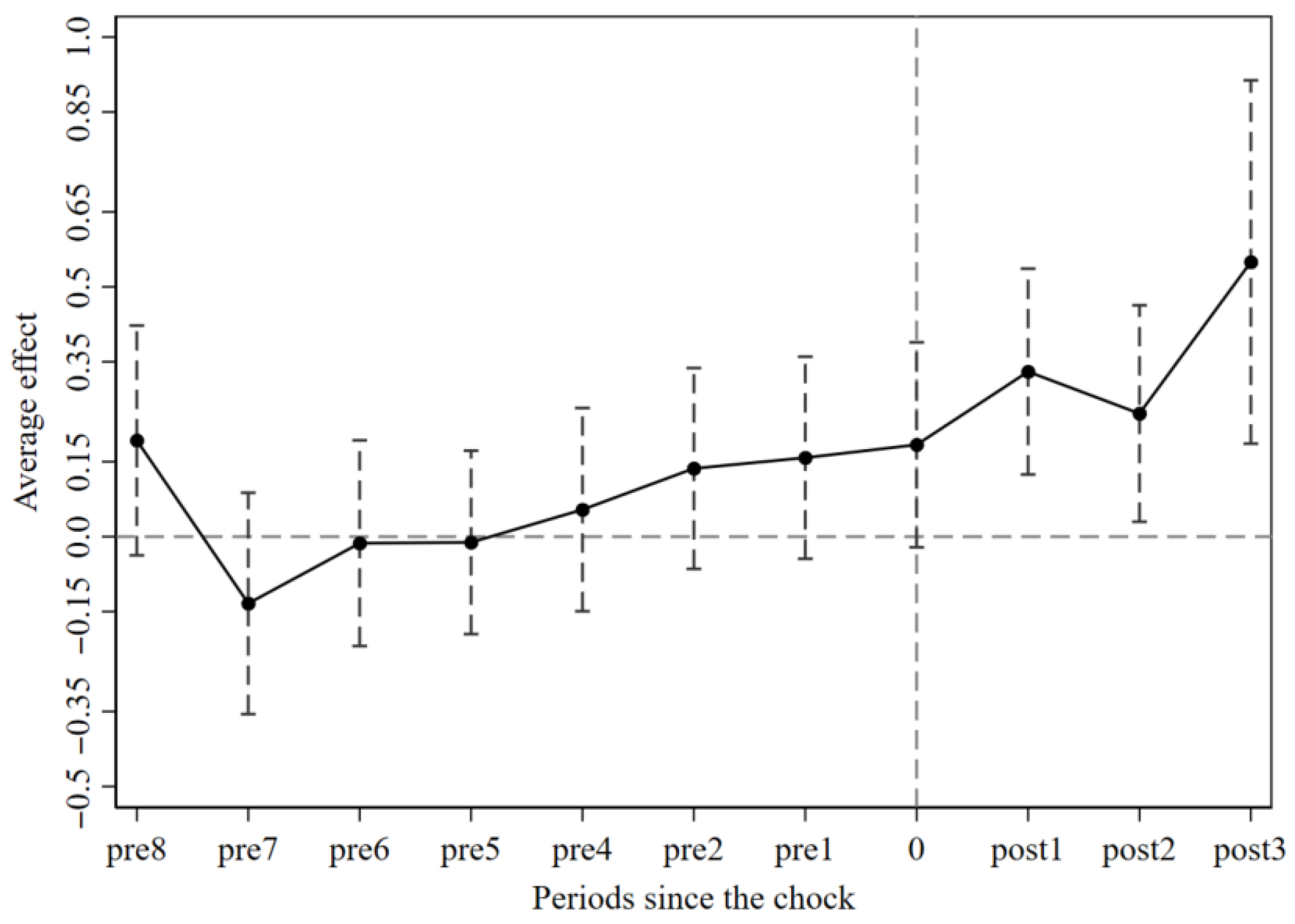
Under the proactive implementation of the digital rural development strategy, the ongoing digitalization process has exerted a notable influence on industrial transformation and upgrading in rural China, as well as on adjustments in labor employment behavior. This study examines, from a policy support perspective, whether the introduction of digital rural development action plans—represented as the digital rural development policy—can effectively enhance RLFS. Specifically, we first theoretically elucidate both the direct and indirect effects of digital rural development policy implementation on RLFS. On this basis, using individual survey data from the 2014–2022 CFPS database, we employ a multiperiod difference-in-differences model to empirically examine the impact and mechanisms through which the digital rural development policy affects RLFS.
This study reveals the following: First, the implementation of the digital rural development policy can effectively enhance RLFS. Second, the digital rural development policy affects RLFS through five channels: increasing labor embeddedness in local social networks, enhancing digital literacy, improving physical health, reducing speculative motives, and expanding labor demand. Third, the policy has a stronger positive effect on RLFS among young and middle-aged individuals, laborers with lower human capital, and those engaged in agricultural work; moreover, its impact is more pronounced in regions with declining demographic dividends and poorer land resource endowments. Fourth, although the policy increased RLFS among young rural laborers and agricultural workers, it did not lead to a significant improvement in rural land resource utilization efficiency.
On the basis of the findings mentioned above, we present specific policy recommendations as follows:
First, governments at all levels should actively implement the Digital Rural Development Action Plan to clarify the positive impact of the digital rural development policy on rural labor employment behavior. On the one hand, the scope of the Action Plan should be further expanded, promoting the deep integration of digital technologies with rural industries, culture, and governance and thereby fully leveraging the spillover effects of digital technologies. On the other hand, the relevant measures and requirements of the Action Plan should be further refined. In advancing targeted digital rural development, supervision and evaluation mechanisms should be established to track the progress and status of digital rural development in real time, providing practical evidence and data for dynamically adjusting the policy direction. Second, considering the heterogeneity among rural residents and regional differences in resources and population, digital rural policies should be implemented in a categorized, multistage, and targeted manner to ensure context-specific application. Specifically, efforts should be made to actively promote and disseminate the policy, enhancing young and middle-aged rural laborers’ and agricultural workers’ understanding of the policy measures. In regions with relatively scarce land resources and declining demographic dividends, the stabilizing effect of the digital rural development policy on local labor should be fully utilized. During policy implementation, the phased outcomes can be compiled into best-practice cases or manuals, offering official guidance for laborers on how to better absorb policy benefits and align with policy requirements, thereby maximizing the economic value of the digital rural development policy. Third, current policy measures should be actively adjusted to promote the deep integration of digital technologies with rural land resources and identify the key pathways for improving land resource utilization efficiency. Against the backdrop of digitalization, the new economic value of rural land resources should be cultivated. Although the existing digital rural development policy has partially mitigated the outflow of young and middle-aged labor in the rural and agricultural sectors, it has not effectively improved rural land utilization efficiency, and new growth poles in agriculture remain undeveloped. Therefore, policy measures should be actively refined to expand the application scenarios for integrating digital technologies with land resources, establish new models of digital-land resource synergy, enhance land use efficiency, and strengthen the sustainable development capacity of the rural economy.