Article

Spatiotemporal Evolution and Driving Factors of the Pear Production Land in China

by
Chao Pan
1,
Yi Xiao
2,
Haisong Zheng
1 and
Xianhui Geng
1,*
1
College of Economics and Management, Nanjing Agricultural University, Nanjing 210095, China
2
College of Land Management, Nanjing Agricultural University, Nanjing 210095, China
*
Author to whom correspondence should be addressed.
Land 2026, 15(2), 279; https://doi.org/10.3390/land15020279
Submission received: 7 January 2026 / Revised: 28 January 2026 / Accepted: 30 January 2026 / Published: 8 February 2026

Abstract

China is the world’s largest pear producer, yet its production remains constrained by structural inefficiencies and regional disparities. Clarifying the spatiotemporal evolution of pear production land and its driving mechanisms is essential for improving efficiency and supporting sustainable agricultural development. Using provincial panel data from 29 Chinese regions during 2001–2020, this study analyzes changes in pear yield, planting area, and yield per unit area by integrating the Production Concentration Index, Exploratory Spatial Data Analysis, and Comparative Advantage Analysis. A Spatial Durbin Model is applied to quantify both direct and spatial spillover effects of natural conditions, opportunity costs, infrastructure, technology, market demand, and policy. The results indicate a shift in pear production from area-driven expansion to efficiency-oriented growth, alongside a gradual westward relocation and declining spatial dependence. While core producing regions remain dominant, several western regions have enhanced their comparative advantages. Labor-related factors are crucial: expanding non-agricultural employment opportunities constrain pear production (−0.482), but agricultural mechanization indirectly increases rural labor hiring costs (0.089), whereas agricultural mechanization (0.144) and moderate increases in labor costs (0.126) contribute positively to regional production efficiency. Improved transportation infrastructure, irrigation, fertilizer input, market demand, and policy further promote pear production, with evident spatial spillover effects. These research findings provide empirical support for optimizing regional pear production layouts and formulating applicable policies.

1. Introduction

The pear production is an important component of China’s agricultural economy, contributing to farmers’ income growth, rural revitalization, employment creation, and the broader green transformation of agriculture. China is the world’s largest producer and consumer of pears, consistently ranking first in both planting area and total output [1]. Supported by market-oriented reforms and the comparative advantages of specialized production, national pear yield has continued to rise, reaching 19.85 million tons in 2023, a 3% year-on-year increase, and the planting area has shown a gradual decline in recent years—falling by 0.72% in 2022—which suggests an ongoing production structural adjustment within the pear industry. Despite its scale, Chinese pear production faces notable structural challenges [2]. Although the Chinese pear planting area is the largest globally, its yield per unit area ranks only 31st worldwide, far below that of developed countries. This mismatch between extensive land input and relatively low productivity indicates inefficiencies in resource allocation and suboptimal production performance [3]. In addition, the rapid development and promotion of new cultivars have created significant supply–demand imbalances. Demand for high-end varieties remains unmet, whereas excessive introduction and production of medium- or low-quality varieties have led to oversupply, market contraction, intensified price competition, declining profits, and reduced grower incomes, ultimately affecting the sustainability of production systems [4]. These phenomena are particularly pronounced across Chinese diverse pear-producing regions. Therefore, it is essential to analyze the spatiotemporal evolution of planting area, yield, and yield per unit area within these regions, along with their spatial driving factors. This analysis aims to address structural contradictions in the spatial distribution of Chinese pear-producing regions.
Recent studies on the spatial evolution of Chinese pear production—using indicators such as production concentration, origin concentration coefficients, and comparative advantage indices—have shown a gradual transition from highly concentrated production to a more dispersed pattern. Key planting areas have shifted from traditional dominant regions toward western provinces and the Yangtze River Basin [2]. This transition is shaped by climate change, evolving market demand, industrial upgrading, and policy support, while factors such as rising labor costs, aging agricultural workforce, and expanding non-agricultural employment opportunities have weakened regional comparative advantages. Conversely, improvements in mechanization have positively influenced production efficiency and generated spatial spillover effects [5].
Technical efficiency studies employing stochastic frontier production functions further demonstrate that the overall improvement in production efficiency has been limited, with substantial regional variation and considerable room for enhancement across most provinces [3]. More broadly, research on crop production patterns emphasizes that agricultural spatial configuration is shaped jointly by natural factors—such as temperature, precipitation, and land cover—and human factors, including labor availability, technological progress, market accessibility, and policy interventions [6,7,8,9,10,11,12,13,14]. These perspectives align with the principles of new structural economics, which highlight factor endowments, comparative advantages, market forces, and governmental actions as the principal drivers of spatial pattern evolution [10,11].
Methodologically, studies have increasingly applied mathematical and statistical tools such as principal component analysis [15,16,17] and regression-based approaches [18,19,20,21]. However, traditional regression models often overlook the spatial dependence intrinsic to agricultural systems. Spatial panel econometric models address this issue by incorporating both temporal and individual effects while explicitly accounting for spatial autocorrelation [22], making them an increasingly mainstream approach for analyzing spatiotemporal evolution and their determinants in agricultural production [23,24,25,26].
Although the literature has advanced in describing the spatial distribution and temporal evolution of Chinese pear production, two major gaps remain. First, existing assessments of industrial agglomeration rely heavily on statistical indices such as location entropy and production concentration [2,8,11,27], which cannot fully capture spatially explicit patterns or the systematic evolution of agglomeration. Second, the spillover effects generated by spatially correlated factor flows are largely underexplored, and few studies incorporate spatial econometric models to identify the driving forces shaping the evolving spatial configuration of the pear production [5,13]. And the dependent variable only included a single indicator, namely the yield or the planting area [4,11,22,28,29,30]. This did not deeply reveal the main manifestation of the spatial changes in the production land, which was merely the efficiency of yield per unit area [3].
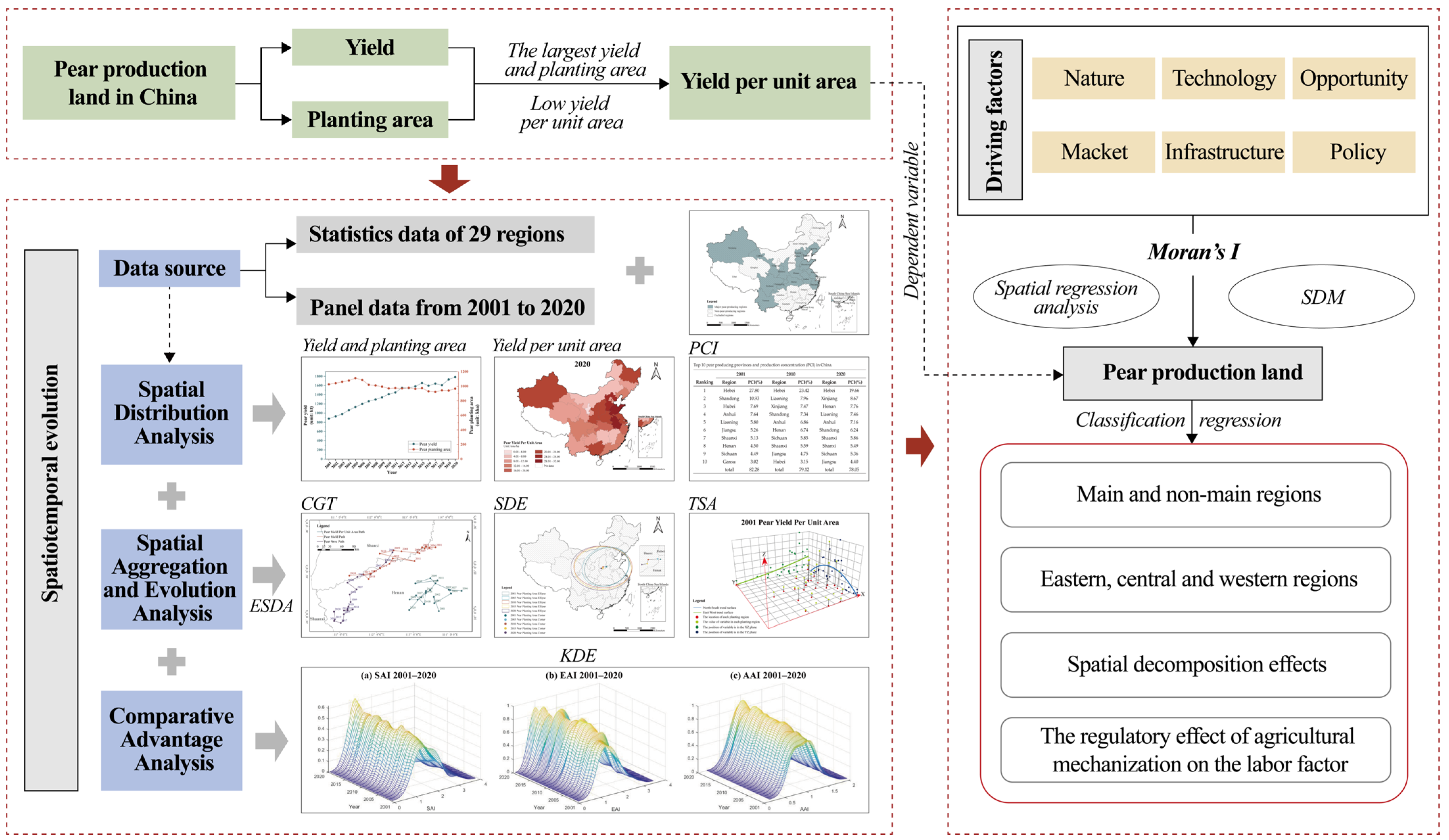
To address these gaps, this innovative study analyzes the spatial structural changes and driving factors of various pear-producing regions from the perspective of pear yield per unit area, based on Chinese pear yield and planting area. The research framework is shown in Figure 1. Based on 20 years of panel data from 29 Chinese pear-producing regions, the spatiotemporal evolution characteristics were analyzed from three aspects (spatial distribution; spatial aggregation and evolution; comparative advantage), the degree, form, and evolution of production agglomeration are systematically characterized.
Accordingly, this study constructs a theoretical mechanism comprising six dimensions: nature, technology, opportunity costs, market, infrastructure and policy. These dimensions form the analytical framework for examining the drivers of spatial changes in pear production, which is empirically tested using the Spatial Durbin Model (SDM). Building upon existing research, this paper innovatively employs pear yield per unit area as an indicator to characterize the spatiotemporal evolution of pear production land [31,32]. Drawing on agricultural location theory, theories of agricultural production patterns and comparative advantage, as well as new economic geography, this study posits that farmers’ planting decisions—driven by cost–benefit considerations under market conditions—play a central role in shaping and reshaping the spatiotemporal evolution of agricultural production [17]. Factors that alter the comparative returns of farming activities—including natural resource endowments [4], opportunity costs of labor [20], infrastructure conditions [30], market prices [14], technological progress [33], and policy interventions [34]—can all influence production costs and income levels. These factors consequently affect pear yields, planting area, and pear yield per unit area (production efficiency), ultimately leading to adjustments in the spatial configuration of the pear production land.

2. Materials and Methods

2.1. Study Area

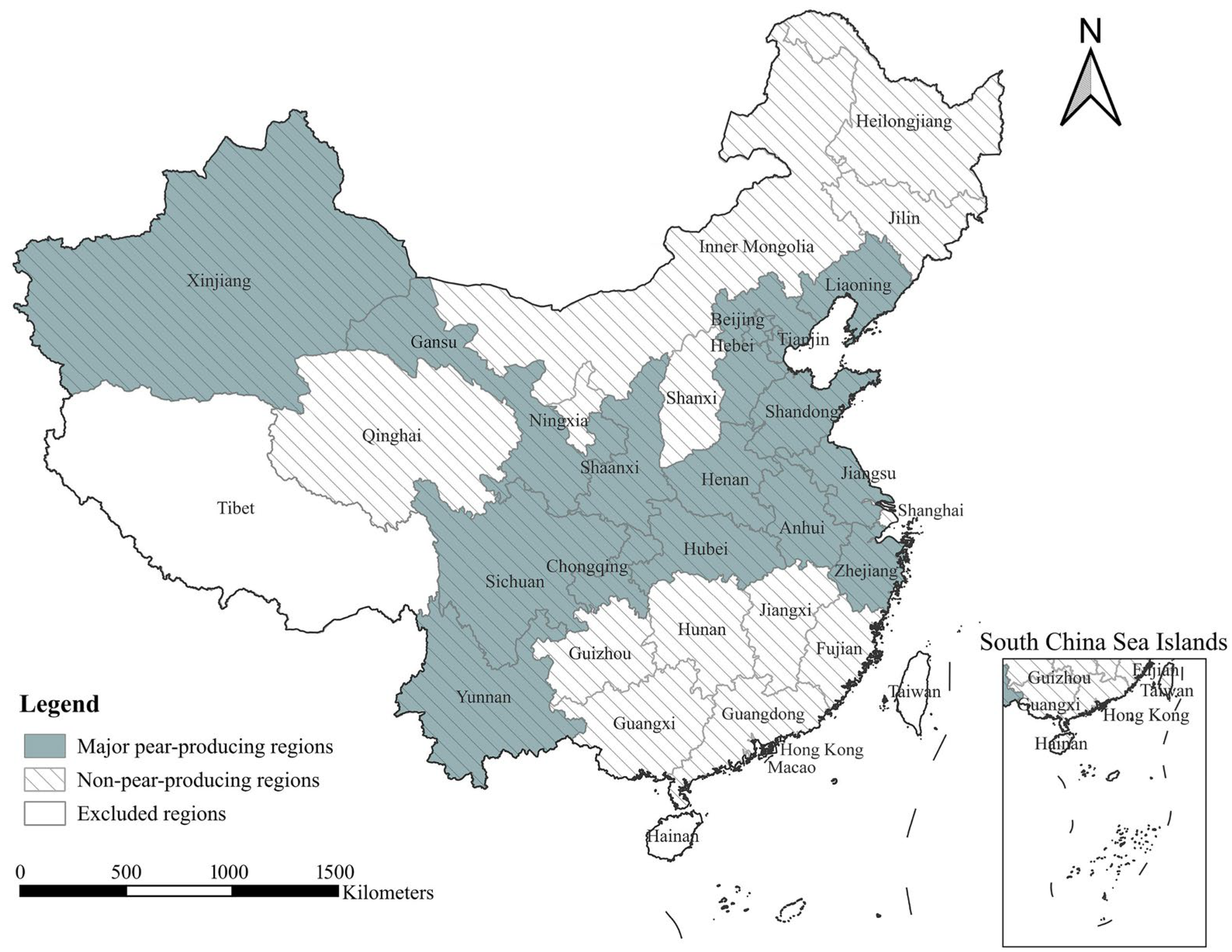
In line with the National Pear Key Region Development Plan (2009–2015) issued by the Ministry of Agriculture, 29 provinces, municipalities, and autonomous regions in mainland China were selected as the study area, covering both main and non-main pear-producing regions (Figure 2).
Due to data limitations, Tibet, Hainan, Hong Kong, Macao, and Taiwan were excluded. According to the Plan, 16 provinces are designated as main pear-producing regions, while the remaining provinces are classified as non-major producing regions. This classification provides a consistent basis for distinguishing regional differences in pear production.

2.2. Variable Selection and Data Sources

To analyze the spatiotemporal evolution of Chinese pear production, provincial-level data on pear yield (total production), pear planting area and pear yield per unit area (output per hectare) from 2001 to 2020 were obtained from the National Bureau of Statistics of Chinahttps://data.stats.gov.cn (accessed on 28 May 2025)”. Pear yield per unit area was adopted as the dependent variable, representing the efficiency of pear production, while explanatory variables were categorized into six dimensions following the theoretical framework (Table 1). Several continuous variables were logarithmically transformed to mitigate heteroskedasticity and enhance model stability.
(1)
Natural variables. The affected area, annual precipitation, and sunshine duration were selected as proxies for natural endowments influencing pear production. Data on disaster-affected area were obtained from the China Rural Statistical Yearbook (2001–2020, Ministry of Agriculture and Rural Affairs), while climatic variables (precipitation and sunshine duration) were sourced from the National Meteorological Information Centerhttp://data.cma.cn (accessed on 1 June 2025)”.
(2)
Opportunity cost variables. Rural non-farm employment opportunities and labor costs for pears were selected as proxies for the opportunity cost of agricultural labor. Due to the lack of detailed cost–benefit data specific to pear production, average labor compensation for individuals engaged in agriculture, forestry, animal husbandry, and fishery was used as a proxy for pear production labor costs. Data on non-farm employment opportunities were obtained from the China Rural Statistical Yearbook (2001–2020, Ministry of Agriculture and Rural Affairs), while labor compensation data were sourced from the China Statistical Yearbook (2001–2020, National Bureau of Statistics of China).
(3)
Infrastructure variables. Road density and effective irrigated area for pears were used as proxies for agricultural infrastructure, reflecting accessibility and irrigation capacity, respectively. Data for both variables were obtained from the China Statistical Yearbook (2001–2020, National Bureau of Statistics of China).
(4)
Market variable. The annual wholesale price of pears relative to the average price of major food crops was used as a proxy for market conditions. Price data were obtained from the Agricultural Statistical Bulletin and the Agricultural and Rural Directorate of respective provinces, supplemented with records from the monitoring network of the National Pear System.
(5)
Technical variables. Fertilizer input for pears and the per capita level of agricultural mechanization were used as proxies for technological progress, reflecting input intensity and improvements in production efficiency. Both variables were obtained from the China Agricultural Statistical Yearbook (2001–2020, Ministry of Agriculture and Rural Affairs of China).
(6)
Policy variables. Since 2001, China has implemented a series of agricultural support policies with potential impact on pear production. Among these, the Regional Layout Plan for Characteristic Agricultural Products (2013–2020) issued by the Ministry of Agriculture and Rural Affairs is particularly relevant. To capture the effect of this policy, a dummy variable was constructed, taking the value 1 for years after its implementation (2013 onwards) and 0 for earlier years.

2.3. Research Methods

2.3.1. Production Concentration Index (PCI)

The PCI was employed to measure the degree of production concentration across provinces [27]. It is defined as the share of pear yield in a given region relative to the national total, thereby capturing the regional contribution to overall production. Changes in the index over time reflect the spatiotemporal evolution of changes in Chinese pear production [29]. Formally, if qit denotes pear yield in region i during year t, and Qt represents the total national pear yield in year t, the index is expressed as:
P C I i t = q i t Q t  
where P C I i t measures the Production Concentration Index of region i in year t.

2.3.2. Exploratory Spatial Data Analysis (ESDA)

In this study, ESDA was employed to examine the spatial patterns of pear production, its spatiotemporal evolution, and potential spatial dependencies [22]. ESDA consisted of two groups of methods. The first group, morphological distribution analysis, included Center of Gravity Transfer (CGT), Standard Deviation Ellipse (SDE), and Trend Surface Analysis (TSA). These techniques were used to capture shifts in distribution centers, overall orientation, and the degree of spatial dispersion. The second group, spatial statistical test, comprised both global and local spatial autocorrelation analysis, which were applied to identify clustering patterns and assess their statistical significance in the distribution of pear production.
Center of Gravity Transfer (CGT). It is applied to characterize the spatiotemporal evolution of pear production across China [29]. The “center of gravity” refers to the weighted geographic location of pear yield in a given year and functions as the equilibrium point of production, reflecting the balance of spatial contributions among provinces. When pear production in a particular region expands rapidly, the center of gravity shifts towards that region, and the magnitude of displacement reflects the extent of that region’s contribution to the spatial restructuring of pear production. Based on this model, the pear-producing region of each province was used as a weight to calculate the annual spatial coordinates of the production center, as well as the interannual direction and distance of its movement. The model is formulated as:
X t , Y t = i = 1 n m i t × x i i = 1 n m i t , i = 1 n m i t × y i i = 1 n m i t
where (Xt, Yt) represent the geographic coordinates (longitude and latitude) of the production center in year t; (xt, yt) denote the geographic coordinates of province i; mit is the weighted value of pear production in province i during year t, and n is the total number of provinces.
The distance of the center of gravity movement is expressed as:
D t T = r × x i T x i t 2 + y i T y i t 2
where DtT denotes the distance (km) that the center of gravity of pear production shifts from year t to year T; (xit, yit) and (xiT, yiT) represent the geographic coordinates (longitude and latitude) of the production center in year t and year T, respectively; and r = 111.13 km is the conversion factor from geographic degrees to planar distance.
Standard Deviation Ellipse (SDE). SDE is a visualization tool for describing the spatial dispersion and directional characteristics of multivariate data [35]. It visualizes the overall distribution, orientation, and degree of dispersion, thereby helping to reveal potential correlations among variables.
For a dataset with n samples, let xi denote the i-th sample. The mean vector is defined as:
x ¯ = 1 n i = 1 n x i
The covariance matrix for the dataset is given by:
S = 1 n 1 i = 1 n x i x ¯ x i x ¯ T
where x i x ¯ x i x ¯ T denotes the outer product, S is a p  × p matrix, and p is the number of variables.
Compute the eigenvalues and eigenvectors of the covariance matrix S to obtain eigenvalues λ1λ2 ≥ … and their corresponding unit eigenvectors v1, v2, …, vp. The lengths of the major and minor axes of the SDE are given by
M a j o r   a x i s = 2 × F × λ 1 , M i n o r   a x i s = 2 × F × λ 2
where F is the critical value of the statistical distribution. Typically, F = 2.4477, to a 95% confidence level, which indicates that approximately 95% of the data lie within the ellipse [36].
Trend Surface Analysis (TSA). TSA is a polynomial regression technique that establishes a mathematical relationship between geographic coordinates and study variables to approximate a continuous spatial distribution surface [36]. Support there are n sample points in the study area, with coordinates (xi, yi) and corresponding variable values zi. A third-order trend surface model can be expressed as:
z ( x , y ) = β 0 + β 1 x + β 2 y + β 3 x 2 + β 4 x y + β 5 y 2 + β 6 x 3 + β 7 x 2 y + β 8 x y 2 + β 9 y 3 + ε
where z (x, y) is the estimate of location (x, y); β0, β1, …, β9 are regression coefficients; and ε is the residuals.
Moran’s I. This study employed Moran’s I to assess the spatial autocorrelation of pear yield per unit area across provinces in China. The statistic is defined as:
M o r a n s   I = n i = 1 n j i n w i j Y P U A i Y P U A ¯ Y P U A j Y P U A ¯ i = 1 n j i n w i j i = 1 n Y P U A i Y P U A ¯ 2
where YPUAi and YPUAj represent the average pear yield per unit area in provinces i and j, respectively; n is the number of provinces, wij is an element of the spatial weights matrix; and i = 1 n j i n w ij is the sum of all spatial weights.
The spatial weights matrix adopts a 0–1 adjacency scheme [37] and is defined as:
w i j = { 0       i   and   j   are   not   adjacent . 1       i   is   adjacent   to   j ( i j )

2.3.3. Comparative Advantage

The production scale index alone cannot fully capture the production capacity of main pear-producing regions [5,37]. Therefore, an Aggregated Advantage Index, combining the Scale Advantage Index and the Efficiency Advantage Index, provides a more comprehensive measure of the comparative advantage of agricultural products across regions and helps explain interregional differences in production capacity [28]. The relevant calculation formulas are as follows:
S A I i t = G S i t G S i G S t G S
E A I i t = V S i t V S i V S t V S
A A I i t = S A I i t × E A I i t
Here, SAIit denotes the Scale Advantage Index, defined as the share of pear planting area in region i ( G S i t G S i ) relative to its share of the national fruit planting area (GSt/GS). A value of SAIit > 1 indicates that pear production in region i has a comparative scale advantage. EAIit represents the Efficiency Advantage Index, calculated as the share of pear yield in region i ( V S i t V S i ) relative to its share of the national fruit yield ( V S t V S ), reflecting differences in production efficiency across regions. The Aggregated Advantage Index, AAIit is defined as the geometric mean of SAIit and EAIit. If AAIit > 1, pear production in region i has an aggregated comparative advantage compared with the national average, and the larger the AAIit, the stronger the advantage; conversely, AAIit < 1 indicates no aggregated advantage.
Kernel Density Estimation (KDE). It is a widely used non-parametric method that does not rely on a specific distributional assumption, exhibits strong robustness, and effectively captures the dynamic evolution of spatial imbalance in Chinese pear production. Traditionally, KDE is applied to estimate the probability density of a random variable by approximating its distribution with a continuous density curve. The formula is as follows:
f ^ x = 1 N h i = 1 N K x x i h
where N is the number of observations; xi denotes the i−th observation (i = 1, 2, …, N); h is the bandwidth that controls the smoothness of the density curve; and K(∙) is the kernel function.
In this study, the gaussian kernel function is employed, which is defined as:
K u = 1 2 π e x p 1 2 u 2

2.3.4. Spatial Econometric Model

If significant spatial autocorrelation is detected in the dependent variable, namely pear yield per unit area, spatial econometric models should be employed for empirical analysis. The three commonly applied models are the Spatial Durbin Model (SDM), the Spatial Lag Model (SLM), and the Spatial Error Model (SEM) [38]. Among them, the SDM incorporates both the spatial lag of the dependent variable and the spatially lagged explanatory variables, while also accounting for error dependence [39]. Compared with SLM and SEM, the SDM provides a more comprehensive framework by simultaneously capturing spatial spillover effects of both independent and dependent variables, thereby better reflecting spatial relationships and mitigating potential model misspecification.
The process of model comparison and selection proceeds as follows. First, conduct the priori tests by estimating an Ordinary Least Squares (OLS) regression and applying Lagrange Multiplier (LM) tests to examine the presence of spatial error and spatial lag dependence. If both are significant, a spatial regression model is required. Second, post-estimation tests are performed in three steps. (i) The Hausman test is used to determine whether the spatial regression model should adopt fixed effects or random effects. (ii) The Likelihood Ratio (LR) test is applied under the initial assumption of the Spatial Durbin Model (SDM); by pairwise comparison, it can be assessed whether the SDM simplifies to the SLM or the SEM. (iii) The Wald test is further employed to examine whether the SDM degenerates into the SLM or SEM. The general specification of the SDM model is given by:
Y = ρ W Y + X β + θ W X + α L n + ε , ε ~ N 0 , σ 2 I
where Y is the N × 1 vector of the dependent variable (pear yield per unit area); W is the N × N spatial weights matrix; WY and WX denote the spatially lagged dependent and independent variables, respectively; α is the intercept term; Ln is an N × 1 unit vector (all elements equal to 1), with N denoting the number of provinces; ρ is the spatial autoregressive coefficient; X is the N × k matrix of explanatory variables; β and θ are parameter vectors to be estimated; and ε is the error term.

3. Results

3.1. Spatial Distribution and Spatial Trends of Chinese Pear Production

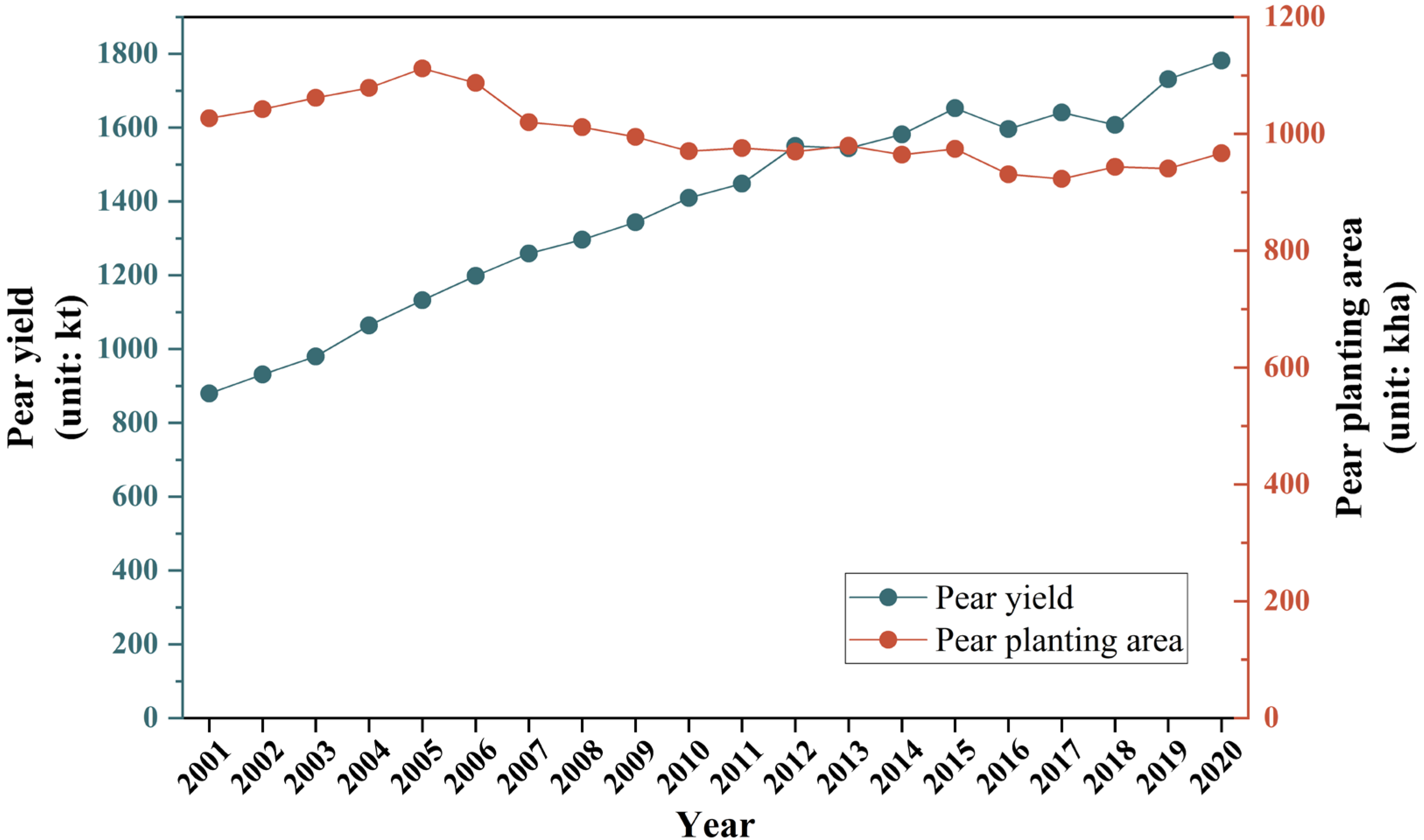
From the perspective of changes in pear yield and planting area (Figure 3), national pear yield has exhibited a steady upward trend, whereas the planting area peaked at 1112.05 kha in 2005 and has declined continuously thereafter.
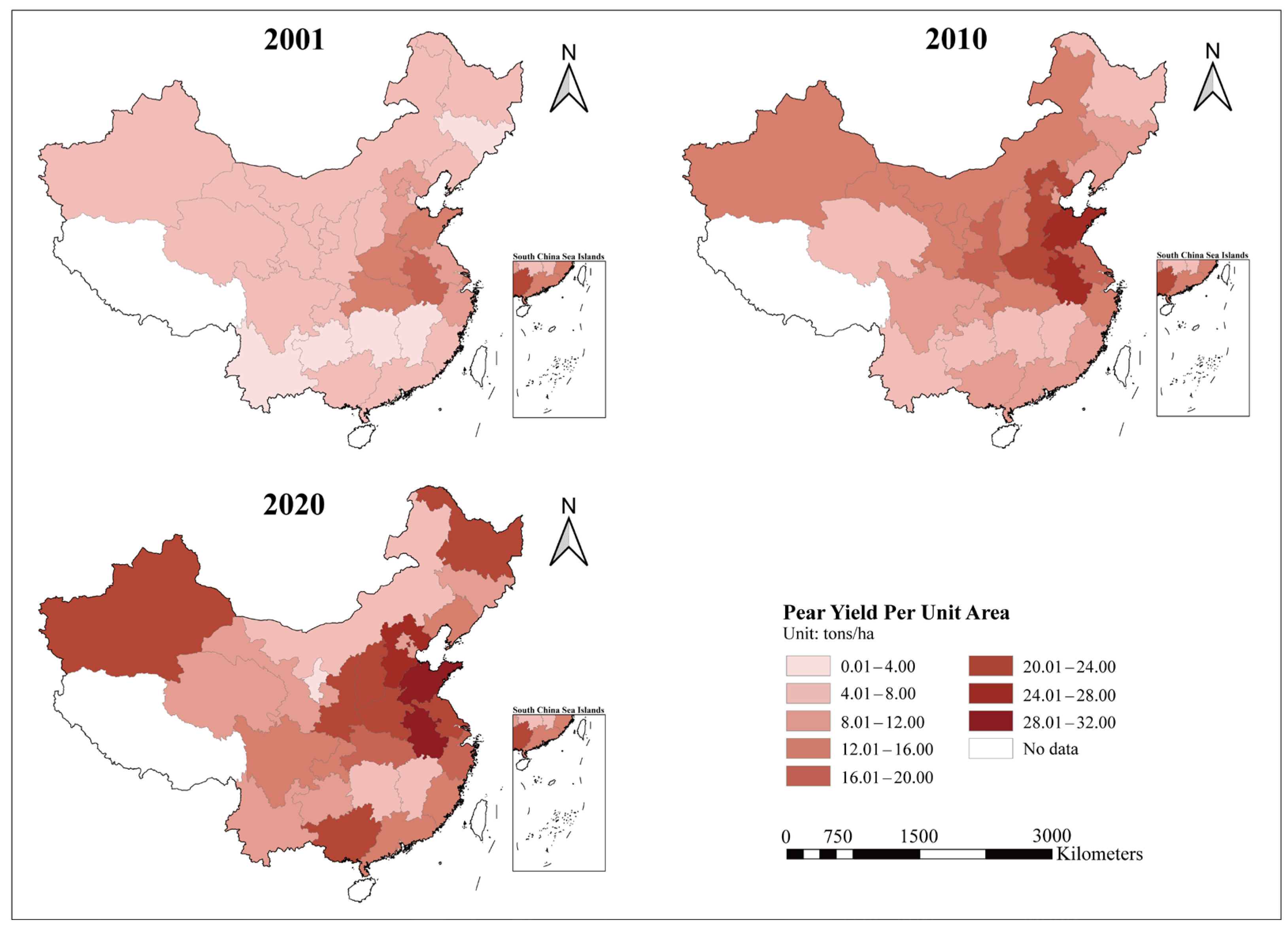
Notably, Shandong, Anhui, Hebei, Henan, Shanxi, Shaanxi, Heilongjiang, Xinjiang, and Guangxi have experienced particularly rapid improvements in yield per unit area (Figure 4).
The ranking of the top ten provinces in terms of PCI from 2001–2020 is presented in Table 2. The results indicate that Hebei, Shandong, Liaoning, Jiangsu, Anhui, and Sichuan consistently remained within the top ten throughout the study period, reflecting their roles as traditional main pear-producing regions in China.
Hebei maintained the highest production concentration; however, its output—along with that of Shandong, Liaoning, and Jiangsu—exhibited a gradual decline over time. In contrast, production concentration increased rapidly in Xinjiang, Shaanxi, Henan, and Shanxi, suggesting a notable shift in the spatial focus of Chinese pear production.

3.2. Spatial Aggregation and Evolution of Chinese Pear Production

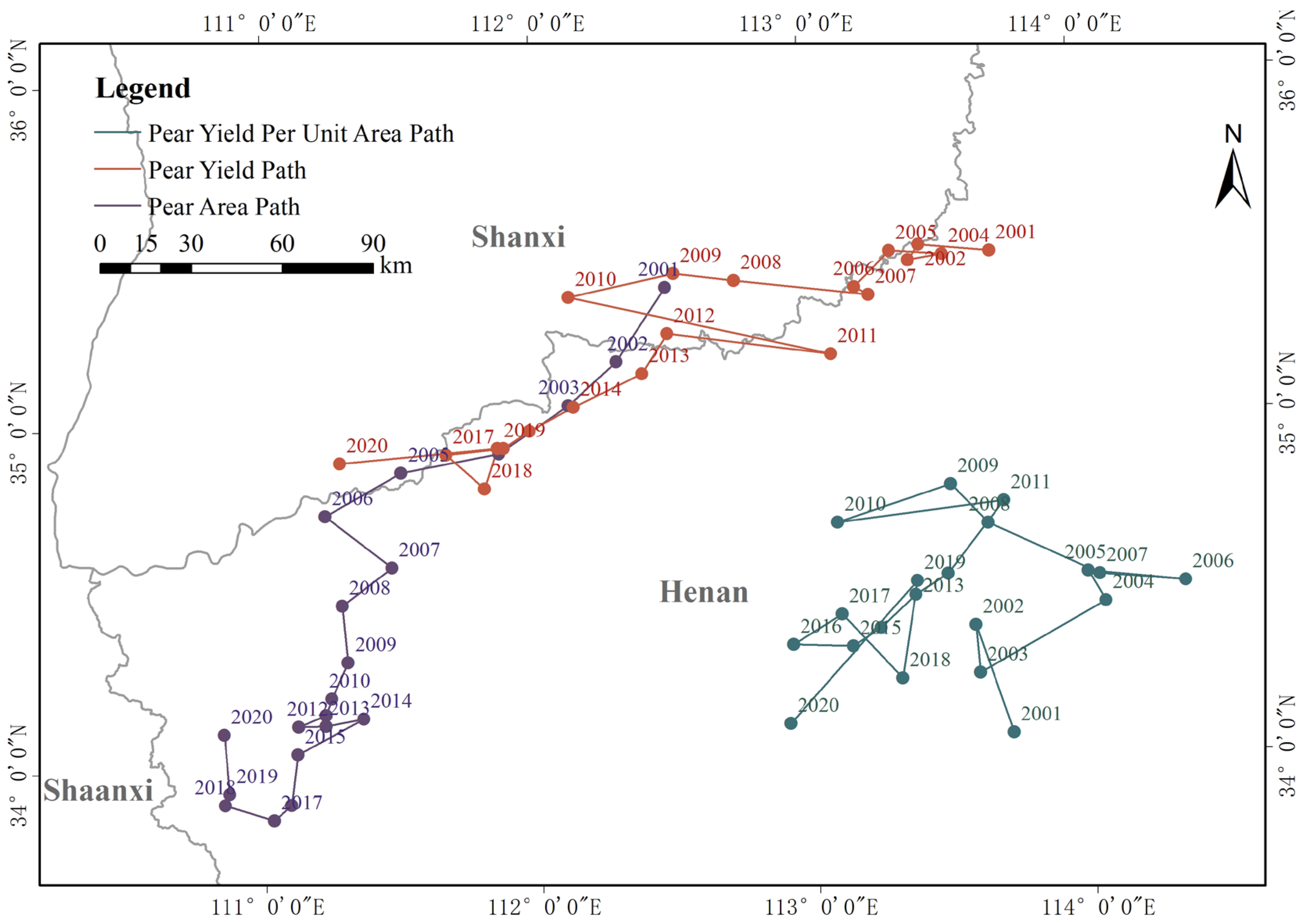
From 2001 to 2020, in Figure 5, the centers of Chinese pear yield and planting area exhibited clear directional shifts, moving 275.34 km and 231.58 km toward the southwest, respectively. During the same period, the center of pear yield per unit area migrated 90.17 km toward the northwest.
Specifically, the yield center shifted from Henan Province (113.69° E, 35.48° N) in 2001 to Shanxi Province (111° E, 38° N) in 2020. Similarly, the geographic center of pear planting moved from 35°40′ N, 112°49′ E (Shanxi Province) to 34°12′ N, 110°85′ E (Henan Province), reflecting a notable spatial migration of planting activities toward central Henan by 2020.
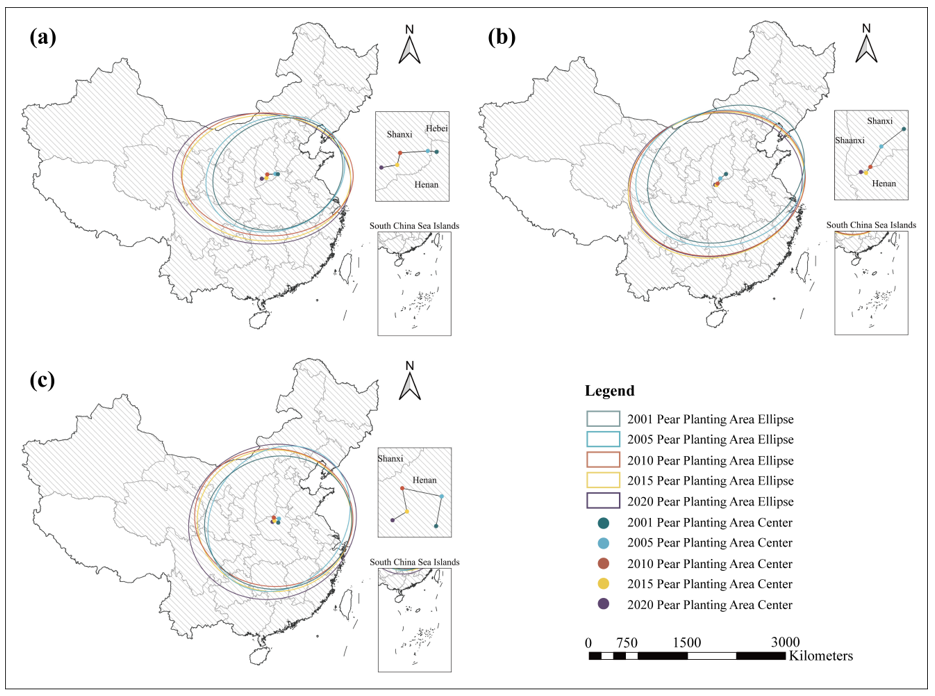
As shown in Figure 6, the centers of the SDE for pear yield and planting area shifted southwestward from 2001 to 2020. Over the same period, both the major and minor axes of the ellipses expanded considerably, resulting in a more elongated and flattened shape in 2020 compared with earlier years. In contrast, the center of the SDE for pear yield per unit area moved toward the northwest. The center of the ellipse for yield volume shifted from Henan in 2001 to Shanxi in 2020, while the center of the ellipse for planting area also migrated toward the Shanxi border. In contrast, the center of the ellipse for yield per unit area remained located within Henan throughout the study period.
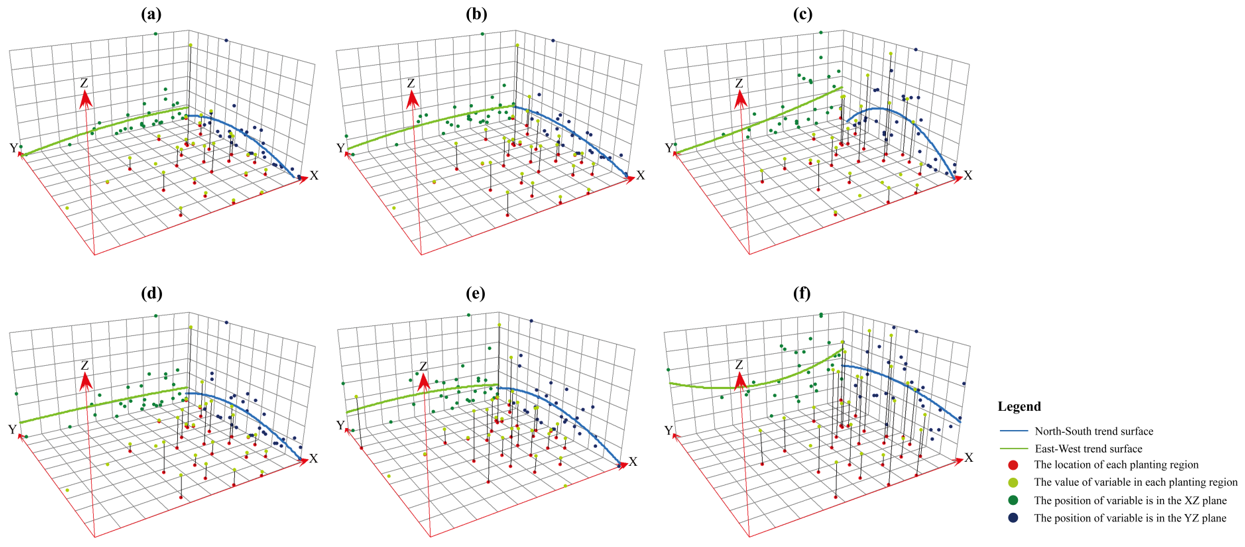
The spatial Trend Surface Analysis maps for 2001 and 2020 (Figure 7) reveals that both pear yield and planting area exhibit an inverted U-shaped pattern along the east–west and north–south directions, with higher values in the north than in the south.
Over time, the western region’s production trajectory has gradually converged toward that of the east, and the inverted U-shape has become less pronounced. Meanwhile, the spatial trend of planting area has shifted from a pattern of low values in the west and high values in the east to the opposite configuration—higher in the west and lower in the east. In contrast, pear yield per unit displays a distinct positive U-shaped pattern along the east–west direction, while the inverted U-shape along the north–south axis has weakened.
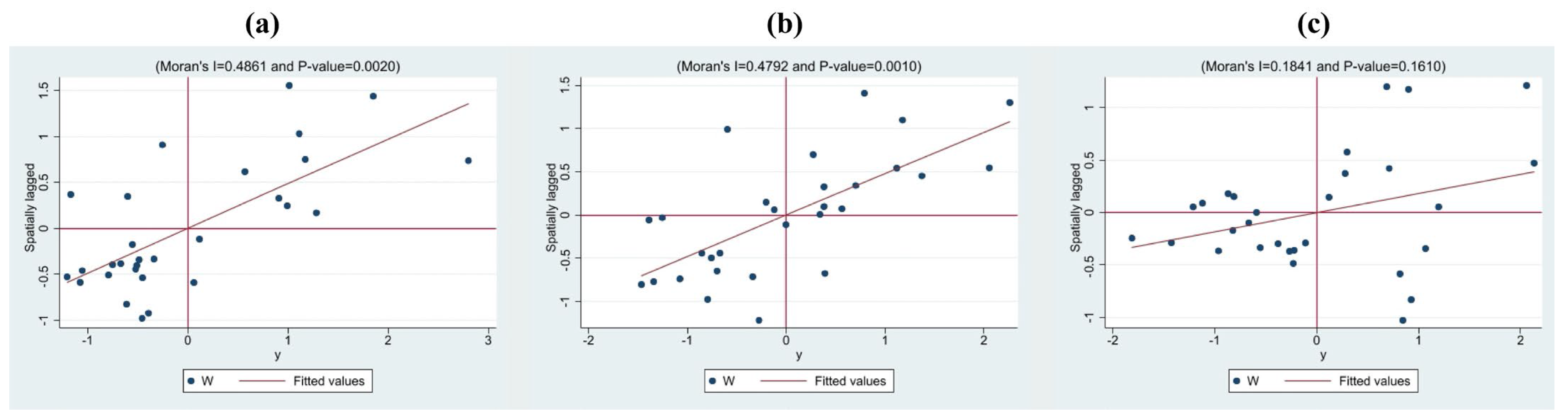
As shown in Table 3, the Moran’s I for Chinese pear yield per unit area from 2001 to 2020 indicate a consistently significant and positive global spatial autocorrelation. However, the Moran’s I displays an overall downward trend over the study period. By 2020, the spatial autocorrelation remained significant only at the 10% level. In Figure 8, provinces with relatively high or low pear yield per unit area tend to be geographically clustered.

3.3. Comparative Advantage Analysis

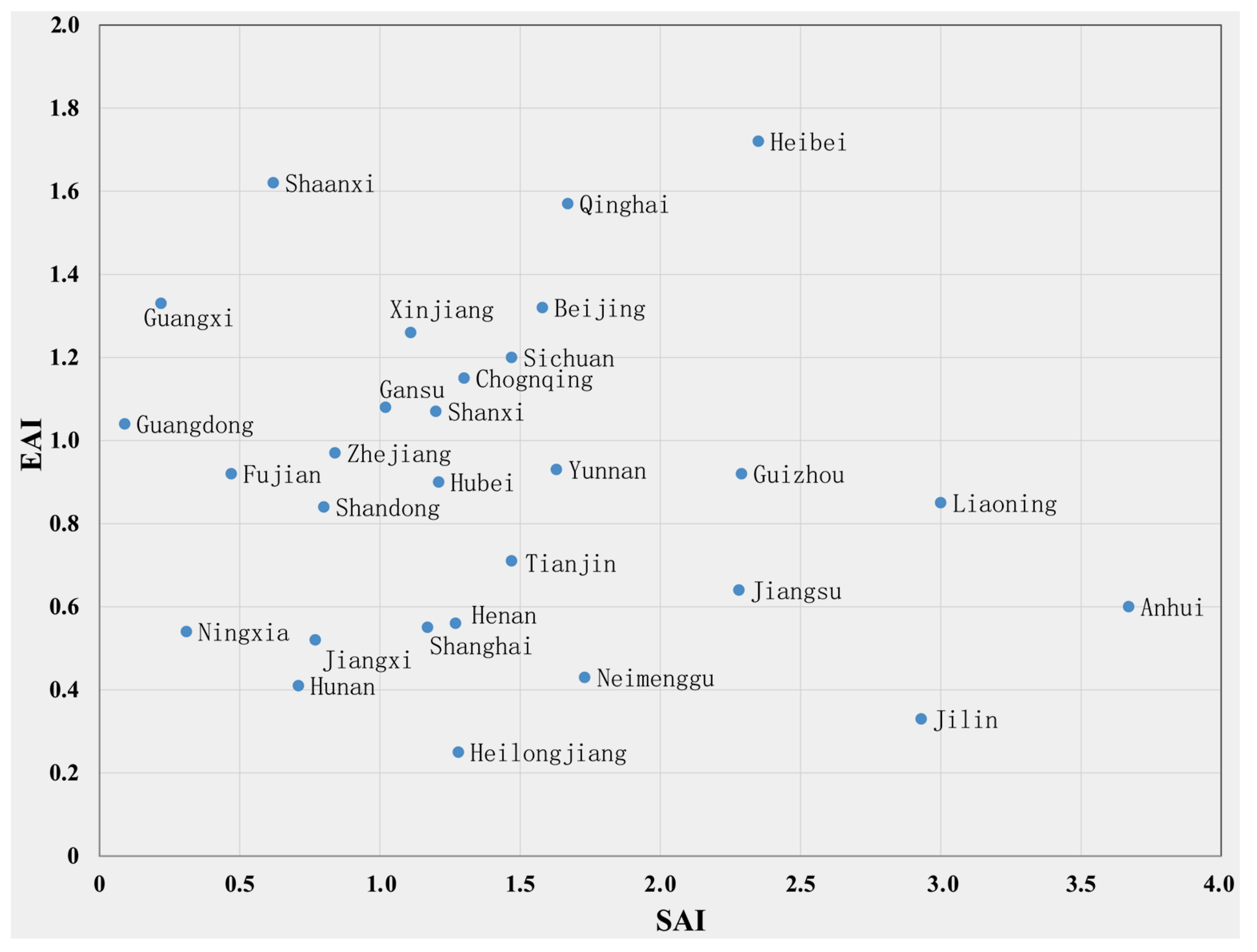
Based on the average scale advantage and comparative advantage of pear production in China from 2001 to 2020 (Figure 9), notable regional differences in production efficiency and scale efficiency can be observed. Xinjiang, Gansu, Hubei, Beijing, Qinghai, and Hebei exhibit both scale efficiency and comparative advantages. In contrast, several traditional pear-producing regions, such as Henan and Zhejiang, no longer demonstrate scale-efficiency advantages. Shandong, Shanxi, and Guangxi possess efficiency advantages but lack corresponding scale advantages, whereas Shanxi, Shanghai, Tianjin, Yunnan, Guizhou, Inner Mongolia, Jiangsu, Liaoning, Jilin, and Anhui show the opposite pattern—having scale advantages but insufficient production efficiency.
The results show that Hebei maintains a pronounced agglomeration advantage over other regions and has become the largest pear-producing region in China (Table 4). The agglomeration advantages of Shanxi, Anhui, Sichuan, and Xinjiang have continued to strengthen, positioning them as regions with strong and growing concentration levels. In addition, the agglomeration advantages of Fujian, Henan, Guangxi, and Shaanxi have also increased, falling within the range of 0.5 to 1, indicating moderate but rising levels of production concentration.
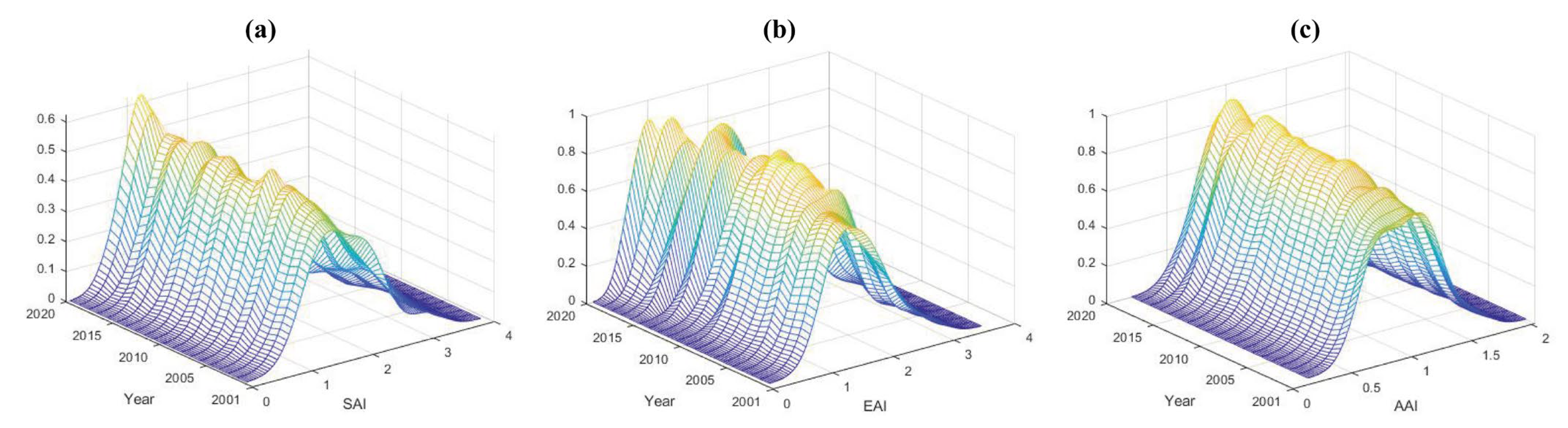
It is evident (Figure 10) that the “low peak” observed for the SAI, EAI, and AAI in 2001 has transformed into a pronounced “high peak” by 2020. Over time, the kernel density curves have become taller and narrower, indicating a strengthened concentration of pear production. This pattern suggests a continuous upward trend in production concentration for all three indices, with no evidence of polarization.

3.4. Empirical Analysis of Driving Factors of the Spatiotemporal Evolution

As shown in Table 5, the LM tests are significant at the 1% level, providing preliminary evidence that a spatial econometric model is required. The Hausman test also yields significant results, rejecting the null hypothesis of random effects and indicating that the fixed-effects specification is more suitable. Furthermore, the LR tests demonstrate that both individual and time fixed effects are significant, confirming that the SDM cannot be simplified to either the SLM or the SEM. Consistently, the Wald tests show that the restrictions required for the SDM to degenerate into SLM or SEM are rejected at the 1% significance level. Therefore, the two-way fixed-effects SDM is identified as the most appropriate model for analyzing the spatiotemporal evolution determinants of Chinese pear-producing regions.
In Table 6, natural disasters exert an overall negative effect on pear-producing regions (−0.016). While the impact in main producing regions is relatively limited, non-main regions are significantly affected (−0.020). In contrast, the effects of rainfall and sunshine on pear production are not statistically significant across regions. Non-agricultural employment opportunities hinder the development of pear-producing regions overall (−0.482), and the effect is particularly pronounced in non-main production regions, where the expansion of non-farm employment exerts a strong negative impact on production capacity (−1.790). In contrast, rising rural labor costs appear to have a positive effect in main production regions (0.318).
Improvements in agricultural irrigation infrastructure generally promote pear planting and growth (0.165), with particularly strong effects observed in main producing regions (0.321), and inadequate irrigation facilities in non-main production regions fail to provide sufficient water supply, thereby limiting tree growth and fruit development. Moreover, regional transportation infrastructure also contributes positively to the expansion and development of pear-producing regions overall (0.078), as improved accessibility enhances input delivery, product circulation, and market connectivity. With respect to production technology, the application of appropriate fertilizers exerts a significant positive influence on pear-producing regions overall (0.118), with an even stronger effect observed in main producing regions (0.214). Similarly, agricultural mechanization significantly enhances pear production efficiency (0.083), and its impact is particularly pronounced in main producing regions (0.174). Meanwhile, strong consumer demand (0.208) for pears and supportive policy (0.049) interventions both contribute positively to the development and expansion of pear-producing regions.
From the regional perspective of eastern, central, and western pear-producing regions, several factors exert heterogeneous influences on yield (Table 7). In the eastern region, increases in non-agricultural employment opportunities (1.489), higher road density (0.209), and the strengthening of industrial policies (0.093) all contribute positively to production growth. In the central region, rising labor costs (0.684) and expansion of irrigated area (0.283) play particularly important roles in enhancing pear production. In contrast, in the western region, higher labor costs negatively affect production, as pear planting in mountainous and hilly terrain limits the applicability and effectiveness of agricultural mechanization (−0.658).
From the perspective of spatial decomposition effects (Table 8), natural disasters exert a notable negative impact on the spatiotemporal evolution of pear production (−0.031). In regions that experience more frequent natural disasters, production efficiency tends to decline accordingly. However, because such events are inherently unpredictable and typically episodic, natural disasters are not the primary drivers of long-term shifts in the spatial configuration of pear production.
The effects of climatic factors on the spatiotemporal evolution of pear production exhibit regional heterogeneity, particularly with respect to precipitation and sunshine duration. Precipitation shows a relatively strong positive influence on pear production (direct effect: 0.021; total effect: 0.035), indicating that stable and sufficient rainfall supports pear tree growth and fruiting. The impact of sunshine duration is positive but not statistically significant. However, as the number of pear-producing regions continues to expand, adequate sunlight has increasingly become a necessary condition for sustaining pear production, even if its marginal contribution does not appear significant in the empirical estimates.
As a labor-intensive sector, pear production is highly sensitive to labor-related factors, and the spatial effects of non-agricultural employment opportunities and labor costs exert distinct and significant influences on its spatiotemporal evolution. With the development of the market economy, rising labor costs in pear-producing regions have played a positive role by encouraging farmers to remain engaged in pear planting and strengthening their work incentives, thereby supporting the development of pear-producing regions (total effect: 0.126).
In contrast, ongoing urbanization has expanded non-agricultural employment opportunities, prompting rural laborers—especially younger workers—to migrate to cities in pursuit of higher income. This outflow of labor has accelerated rural aging and resulted in labor shortages across large agricultural areas, exerting a substantial direct negative impact on pear production (−0.602).
The per capita level of agricultural mechanization, which is closely linked to the availability of labor, exerts a significant overall promoting effect on pear production (direct effect: 0.157; indirect effect: 0.107; total effect: 0.144). This suggests that improvements in mechanization in neighboring regions generate only limited competitive pressure on local pear production. At present, pear planting primarily depends on small-scale agricultural machinery, and large-scale, cross-regional mechanized operations are generally uncommon. As a result, enhancements in mechanization tend to strengthen local production capacity without inducing substantial interregional substitution effects.
Among the remaining variables, improved transportation accessibility, higher economic returns, and supportive policy interventions all exert significant positive effects on the comparative advantage of pear production. It is also important to note that pear planting continues to rely on fertilizer inputs, with the total effect showing a significant positive impact (0.182). However, under ongoing agricultural structural adjustments, fertilizer use across production regions is expected to gradually decline. In practice, producers have increasingly incorporated organic fertilizers to meet the requirements of green and sustainable agricultural production.
As an important moderating variable, agricultural mechanization was incorporated into the spatial-effect regression analysis examining the impacts of non-agricultural employment opportunities and labor costs on pear production (Table 9). The results indicate that higher levels of mechanization accelerate the outflow of rural labor into non-agricultural sectors, thereby intensifying agricultural labor loss and negatively affecting pear production (−0.458). Conversely, increased mechanization also requires the employment of skilled operators, leading to higher labor costs. This, in turn, exerts a positive moderating effect on pear production (0.089), as the use of mechanized operations enhances production efficiency and partially offsets the negative impact of labor shortages.

4. Discussion

4.1. Spatiotemporal Evolution in Pear Production

The results show that in recent years, the continuous growth of Chinese pear production has gradually shifted from the extensive expansion of planting area to improving production efficiency. Among them, Hebei remains the main production area, while Xinjiang has experienced rapid growth in production due to its geographical advantages and advancements in production technology. These findings are consistent with existing research results [2,3]. The production levels in the main producing regions have steadily increased, thanks to the advancement of pear planting technology and the enhanced adaptability of planting varieties [3,5]. At the same time, the findings of this study are in line with previous research [4,28], and the overall spatial trajectory of Chinese pear production is gradually shifting from the northern region to the western region, with obvious spatial clustering characteristics and spatial dependence, manifested as the enhanced spatial clustering of high-performance producing regions [5]. This clustering may also indicate that advanced production practices and technologies are spreading from high-value regions to surrounding areas, thereby contributing to the regional convergence of production performance [6,7]. The comparative advantages of each production area show significant uncertainty and instability, which is different from the existing research on the spatial correlation of pear comparative advantages [5]. What is different in this study is that the spatial correlation degree of pear production is gradually weakening, providing a prerequisite basis for analyzing the spatial spillover effect of pear production and its driving factors.

4.2. Important Spatial Driving Factors in Pear Production

The gradual westward shift of pear production is in line with the trends of other main fruit production. For instance, studies have shown that the main apple-producing regions in China have shifted from Shandong to Shaanxi [8,29]. This broader pattern is closely related to regional economic development differences, especially factors related to labor [5,30,33]. Additionally, this study has found that moderately increasing labor costs can help optimize the temporal and spatial evolution pattern of fruit production land, which contributes to related research [13,22,27,33,37,40]. Previous research has generally emphasized low labor costs as a key determinant of spatial shifts in pear production, with production activities tending to migrate toward regions where labor is cheaper [28]. However, with continued economic development, non-agricultural employment opportunities have expanded across regions, resulting in pronounced labor shortages—particularly among young and able-bodied rural workers [5]. Unlike grain-producing regions, pear-producing regions located in mountainous and hilly terrain require more intensive physical labor. For older farmers, identical production tasks demand greater physical effort, thereby amplifying labor requirements. This persistent labor scarcity has led to sustained increases in rural wage levels [41,42,43]. In this context, rising labor costs may incentivize producers to adopt more efficient production technologies and optimize planting decisions, ultimately contributing to a more rational and sustainable spatiotemporal evolution of the pear production.

4.3. Policy Implications

Informed by spatial econometric evidence and grounded in existing national and sub-national policy frameworks (Table 10), future pear industry policies could adopt a coordinated approach that integrates spatial planning, infrastructure upgrading, and whole-chain quality governance to improve development effectiveness.
(1) Regional agricultural layout policies—such as the national Products Regional Layout Planning for Specialty Agricultural Products and related provincial cluster strategies—could be further strengthened by explicitly incorporating investments in transport and logistics infrastructure, thereby leveraging spatial spillover effects and improving connectivity between established and emerging producing regions. (2) Quality-oriented initiatives, including the Fruits Quality-Oriented Development Promotion Work Plan, may achieve greater impact through the systematic implementation of graded sorting, post-harvest cold-chain facilities, and traceability systems, which is consistent with our findings on the role of market demand and quality premiums in shaping production outcomes. (3) Targeted support for mechanization services and labor-saving technologies, in line with provincial programs for orchard modernization, could help alleviate seasonal labor constraints and enhance the efficiency of service organization, as suggested by the empirical results. (4) Local initiatives in e-commerce development and brand building, as observed at the municipal level, could be scaled up to better connect production clusters with downstream markets, strengthening linkages along the production-to-consumption chain and enabling growers to capture higher value added.

4.4. Limitation and Research Prospects

Building on the findings of this study, several opportunities for further research can be identified, while acknowledging certain data and methodological constraints. (1) Future studies could extend the current framework by incorporating finer spatial scales, such as county- or orchard-level data, to better capture localized heterogeneity in orchard management practices, production conditions, and decision-making processes that are particularly relevant for perennial fruit systems. This would allow a more nuanced understanding of spatial variability that cannot be fully revealed using province-level aggregates. (2) The integration of more detailed, crop-specific input data represents an important direction for future research. While proxy-based measures enable large-scale and long-term analysis, incorporating direct information on labor structure, mechanization intensity, and input use specific to fruit production would improve the accuracy of variable representation and help clarify the role of production factors in shaping regional productivity patterns. (3) Future research could benefit from employing complementary analytical approaches to strengthen causal interpretation. Combining spatial econometric models with alternative identification strategies or dynamic frameworks may help disentangle the complex interactions among policy interventions, technological change, infrastructure development, and productivity outcomes, thereby providing more robust evidence to support policy design and evaluation. (4) Incorporating biological and structural characteristics intrinsic to perennial orchards—such as cultivar composition, orchard age structure, and renewal processes—would further enhance the explanatory power of macro-scale analyzes. Integrating such information could help distinguish productivity gains driven by technological improvements from those resulting from structural adjustments, offering deeper insights into the long-term sustainability of fruit production systems.

5. Conclusions

Based on panel data from 29 pear-producing regions in China during 2001–2020, this study systematically characterizes the degree, patterns, and evolution of production agglomeration using the Production Concentration Index (PCI), Exploratory Spatial Data Analysis (ESDA: CGT, SDE, TSA, and Moran’s I), and Comparative Advantage Analyzes (SAI, EAI, AAI, and KDE). Then, spatial decomposition effects of key drivers factors changes in pear production land are examined using the Spatial Durbin Model (SDM), followed by a regression-based classification analysis.
The results of the study are summarized as follows: (1) The total production of pears has been rising, while the area for growing pears has been shrinking. The yield per unit area in all pear-producing regions has been continuously increasing. The increase in Chinese pear production has shifted from the scale effect brought about by expanding the planting area to improving the planting efficiency per unit area. (2) The overall development trend of Chinese pear production is a slow and stable advancement from east to west. The production level of pears in the west is gradually approaching that in the east, and the gap between the east and the west is narrowing. The core production regions remain dominant, but the comparative advantage of western production areas is gradually increasing. (3) The Moran’s I of Chinese pear production from 2001 to 2020 shows a significant positive spatial correlation. Pear production has obvious spatial clustering characteristics. However, the Moran’s I shows a downward trend, indicating that the spatial correlation is gradually weakening. (4) Natural disasters can significantly constrain production in major pear-producing regions (−0.020), and the influence of rainfall and sunlight has become very small. Improved transportation infrastructure (0.240), irrigation (0.163), fertilizer input (0.182), market demand (0.900), and policy (0.019) further promote pear production, with evident spatial spillover effects. (5) Labor factors play a pivotal role in pear production areas, with non-agricultural employment opportunities significantly constraining output (−0.482). This effect is particularly pronounced in non-primary production zones (−1.790). Increasing rural labor hiring costs benefits pear production in major production areas (0.318) and central production areas (0.684). The mountainous and hilly terrain in western regions limits the adoption of agricultural mechanization (−0.658). (6) Agricultural mechanization exerts a dynamic regulatory effect on labor factors, accelerating the adverse impact of non-agricultural employment opportunities on pear production (−0.458). However, the resulting increase in rural labor hiring costs benefits pear production (0.089), validating that within the decomposition effect, a certain degree of labor costs increase enhances labor motivation, thereby boosting pear production (total effect: 0.126).
Chinese pear production faces challenges related to production efficiency, regional differences and labor constraints. This study provides valuable empirical evidence for optimizing regional fruit production layouts, improving production efficiency, and supporting sustainable agricultural development.

Author Contributions

Conceptualization, C.P. and X.G.; methodology, C.P.; software, C.P., Y.X. and H.Z.; validation, C.P.; formal analysis, C.P. and Y.X.; investigation, X.G.; resources, X.G.; data curation, C.P.; writing—original draft preparation, C.P.; writing—review and editing, X.G. and Y.X.; visualization, C.P. and Y.X.; supervision, X.G.; project administration, X.G. and Y.X.; funding acquisition, X.G. and Y.X. All authors have read and agreed to the published version of the manuscript.

Funding

This research was funded by “The Earmarked Fund for China Agriculture Research System, grant number CARS-28”; “ China Scholarship Council, grant number 202106850047”; “The China Postdoctoral Science Foundation, grant number 2025M781544”; “The Postdoctoral Fellowship Program (Grade C) of China Postdoctoral Science Foundation, grant number GZC20250175”.

Data Availability Statement

Supplementary data to this article can be found online at https://data.stats.gov.cn (accessed on 28 May 2025); http://data.cma.cn (accessed on 1 June 2025).

Acknowledgments

The authors would like to thank the anonymous reviewers and the editor for their support, insightful critiques, and constructive comments.

Conflicts of Interest

The authors declare no conflicts of interest.

Abbreviations

The following abbreviations are used in this manuscript:
YPUAYield per unit area
PCIProduction concentration index
ESDAExploratory spatial data analysis
CGTCenter of gravity transfer
SDEStandard deviation ellipse
TSATrend surface analysis
SAIScale advantage index
EAIEfficiency advantage index
AAIAggregated advantage index
KDEKernel density estimation
SDMSpatial durbin model
SLMSpatial lag model
SEMSpatial error model
OLSOrdinary least squares
LMLagrange multiplier
LRLikelihood ratio

References

  1. Food and Agriculture Organization of the United Nations. World Food and Agriculture—Statistical Yearbook 2020; Food and Agriculture Organization of the United Nations: Rome, Italy, 2020; ISBN 978-92-5-133394-5. [Google Scholar]
  2. Geng, X.; Zhou, Y. From Concentration to Deconcentration: Analysis on the Production Changes of China’s Pear Growing Areas. J. Nanjing Agric. Univ. 2010, 10, 38–44. [Google Scholar]
  3. He, W.; Zhou, J.; Zhou, D. Stochastic Frontier Analysis on Technical Efficiency of Pear Production in China. North. Fruits 2021, 03, 10–13. [Google Scholar] [CrossRef]
  4. Lu, H.; Geng, X. Impact of Climate Change on Chinese Pear Production: Based on the Data of 28 Provinces and Municipalities in 1990–2010. J. Hunan Agric. Univ. 2014, 15, 35–40. [Google Scholar] [CrossRef]
  5. Pan, C.; Xiao, Y.; Geng, X. Influence Mechanism and Spatial Effect of Labor Factors on the Comparative Advantage of Pear Production. Jiangsu J. Agric. Sci. 2025, 41, 372–380. [Google Scholar]
  6. Liu, Y.; Wang, S.; Chen, B. Optimization of National Food Production Layout Based on Comparative Advantage Index. Energy Procedia 2019, 158, 3846–3852. [Google Scholar] [CrossRef]
  7. Hou, M.; Deng, Y.; Yao, S. Spatial Agglomeration Pattern and Driving Factors of Grain Production in China since the Reform and Opening Up. Land 2021, 10, 10. [Google Scholar] [CrossRef]
  8. Zhang, Q.; Weng, F.; Shi, F.; Shao, L.; Huo, X. The Evolutionary Characteristics of Apple Production Layout in China from 1978 to 2016. Cienc. Rural 2021, 51, e20200688. [Google Scholar] [CrossRef]
  9. You, L.; Spoor, M.; Ulimwengu, J.; Zhang, S. Land Use Change and Environmental Stress of Wheat, Rice and Corn Production in China. China Econ. Rev. 2011, 22, 461–473. [Google Scholar] [CrossRef]
  10. Xiang, Y.; Wang, W.; Qi, C. Research on Relationship between Geographical Agglomeration and International Competitiveness of Agriculture—Evidence from China’s Fruit Industry. Guangdong Agric. Sci. 2014, 41, 194–199+232. [Google Scholar] [CrossRef]
  11. Zhang, Y.; Zhang, S. Study on Citrus Production’s Spatial Distribution, Changes and Influencing Factors in Central Delta Area. Res. Agric. Mod. 2016, 37, 687–693. [Google Scholar] [CrossRef]
  12. Liu, Y.; Wang, J.; Guo, L. The Spatial-Temporal Changes of Grain Production and Arable Land in China. Sci. Agric. Sin. 2009, 42, 4269–4274. [Google Scholar]
  13. Zhang, Q.; Shi, F.; Abdullahi, N.M.; Shao, L.; Huo, X. An Empirical Study on Spatial–Temporal Dynamics and Influencing Factors of Apple Production in China. PLoS ONE 2020, 15, e0240140. [Google Scholar] [CrossRef] [PubMed]
  14. Niu, Y.; Xie, G.; Xiao, Y.; Qin, K.; Liu, J.; Wang, Y.; Gan, S.; Huang, M.; Liu, J.; Zhang, C.; et al. Spatial Layout of Cotton Seed Production Based on Hierarchical Classification: A Case Study in Xinjiang, China. Agriculture 2021, 11, 759. [Google Scholar] [CrossRef]
  15. Wei, Q.; Lu, W. Study on the Dynamic Model for the Harmonious Development of Agriculture and Animal Husbandry in Typical Regions. J. Anhui Agric. Sci. 2008, 07, 3023–3025. [Google Scholar] [CrossRef]
  16. Wang, G.; Zhang, L.; Chen, Q.; Yu, H.; Chen, Y. Analysis on Landscape Pattern Change and Its Driving Forces—Taking Caofeidian New Area, Tangshan City as an Example. Res. Soil Water Conserv. 2014, 21, 84–88. [Google Scholar] [CrossRef]
  17. Bai, J.; Zhang, H. Spatio-Temporal Variation and Driving Force of Water-Energy-Food Pressure in China Spatio-Temporal Variation and Driving Force of Water-Energy-Food Pressure in China. Geogr. Sci. 2018, 38, 1653–1660. [Google Scholar]
  18. Liang, C.; Wang, N. Driving Factor Analysis of Construction Land Changes in Coastal Economic Driving Factor Analysis of Construction Land Changes in Coastal Economic Zone Based on Logistic Regression: A Case Study of Dalian New Urban Zone Based on Logistic Regression: A Case Study of Dalian. Geogr. Sci. 2014, 34, 556–562. [Google Scholar]
  19. Huang, B.; Zhang, H.; Song, D.; Ma, Y. Driving Forces of Built-up Land Expansion in China from 2000 to 2010. Acta Ecol. Sin. 2017, 37, 4149–4158. [Google Scholar] [CrossRef][Green Version]
  20. Han, C.; Wang, G.; Zhang, Y.; Song, L.; Zhu, L. Analysis of the Temporal and Spatial Evolution Characteristics and Influencing Factors of China’s Herbivorous Animal Husbandry Industry. PLoS ONE 2020, 15, e0237827. [Google Scholar] [CrossRef]
  21. Yan, B.; Li, Y.; Qin, Y.; Yan, J.; Shi, W. Spatial–Temporal Analysis of the Comparative Advantages of Dairy Farming: Taking 18 Provinces or Municipalities in China as an Example. Comput. Electron. Agric. 2021, 180, 105846. [Google Scholar] [CrossRef]
  22. Wang, H.; He, J.; Aziz, N.; Wang, Y. Spatial Distribution and Driving Forces of the Vegetable Industry in China. Land 2022, 11, 981. [Google Scholar] [CrossRef]
  23. Chen, Y.; Li, X. Spatial-Temporal Characteristics and Influencing Factors of Grain Yield Change in China. Trans. Chin. Soc. Agric. Eng. 2013, 29, 1–10. [Google Scholar]
  24. Shui, W.; Du, Y.; Chen, Y.; Jian, X.; Fan, B. Spatial Patterns and Influence Factors of Specialization in Tea Cultivation Based on Geographically Weighted Regression Model: A Case Study of Anxi County of Fujian Province, China. Chin. J. Appl. Ecol. 2017, 28, 1298–1308. [Google Scholar] [CrossRef]
  25. Pan, J.; Zhang, J. Spatial-Temporal Pattern and Its Driving Forces of Per Capital Grain Possession in China. Resour. Environ. Yangtze Basin 2017, 26, 410–418. [Google Scholar]
  26. Jiao, W.; Liu, X.; Du, F. Spatial Temporal Pattern Change and Driving Forces of Grain Per Capita in the Tarim River Basin Based on the Perspective of County Fertility Bayangol Mongolia Autonomous Prefecture. Chin. J. Agric. Resour. Reg. Plan. 2017, 38, 137–144. [Google Scholar]
  27. Zhang, Q.; Si, R.; Shi, F.; Huo, X. The Evolution Trend of Chinese Fruit Prodution Concentration Level. Chin. J. Agric. Resour. Reg. Plan. 2021, 42, 96–108. [Google Scholar]
  28. Geng, X.; Lu, H.; Zhou, Y. Changes of Pear Production Layout and Its Influence Factors in China: Based on Analysis of Provincial Panel Data. Agric. Econ. Manag. 2014, 04, 67–77. [Google Scholar]
  29. Zhang, C.; Chang, Q.; Huo, X. Analysis on the Layout of China’s Apple Production Transition. Econ. Geogr. 2018, 38, 141–151. [Google Scholar] [CrossRef]
  30. Liu, T.; Fan, Y. Analysis of the Influencing Factor and Layout of Major Apple Production in China. Issues Agric. Econ. 2012, 33, 36–42. [Google Scholar] [CrossRef]
  31. Bai, C.; Wu, L.; Song, X. Spatial Difference of Grain Yield Changes during 1995–2010 and Balanced Potential Output to Increase in Shandong Province. Sci. Geogr. Sin. 2013, 32, 1257–1265. [Google Scholar]
  32. Liu, Y.; Tang, X.; Pan, Y.; Tang, L. Analysis on Spatial Spillover Effect and Influence Factors of Grain Yield per Hectare at County Level in Huang-Huai-Hai Region. Trans. Chin. Soc. Agric. Eng. 2016, 32, 299–307. [Google Scholar]
  33. Li, Y.; Lu, Z.; Ling, Z. The Evolution and Optimization of Vegetable Productive Regionalization in China–Positive Analysis Based on 31 Provinces of China. Econ. Geogr. 2007, 02, 191–195. [Google Scholar]
  34. Zhou, S.; Jing, L.; Meng, H.; Qiao, H. Analysis on Spatial Distribution Evolution of Main Peanut Production Areas in China and Its Influencing Factors. J. Agrotech. Econ. 2018, 03, 100–109. [Google Scholar] [CrossRef]
  35. Zhao, L.; Zhao, Z. Projecting the Spatial Variation of Economic Based on the Specific Ellipses in China. Sci. Geogr. Sin. 2014, 34, 979–986. [Google Scholar] [CrossRef]
  36. Lefever, D.W. Measuring Geographic Concentration by Means of the Standard Deviational Ellipse. Am. J. Sociol. 1926, 32, 88–94. [Google Scholar] [CrossRef]
  37. Deng, Z.; Feng, Y.; Zhang, J.; Wang, J. Analysis on the Characteristics and Tendency of Grain Production’s Spatial Distribution in China. Econ. Geogr. 2013, 33, 117–123. [Google Scholar]
  38. Elhorst, J.P. Dynamic Spatial Panels: Models, Methods, and Inferences. J. Geogr. Syst. 2012, 14, 5–28. [Google Scholar] [CrossRef]
  39. LeSage, J.; Pace, R.K. Introduction to Spatial Econometrics; Chapman and Hall/CRC: New York, NY, USA, 2009; ISBN 978-0-429-13808-9. [Google Scholar]
  40. Wang, S.; Wang, S. Empirical Analysis of Farmers’ Decision-Making Behavioral Factors in the Change of Vegetable Planting Area in Chinese Provinces. Econ. Geogr. 2013, 33, 128–134. [Google Scholar] [CrossRef]
  41. Chang, H.; Dong, X.; MacPhail, F. Labor Migration and Time Use Patterns of the Left-behind Children and Elderly in Rural China. World Dev. 2011, 39, 2199–2210. [Google Scholar] [CrossRef]
  42. Jorgenson, D.W.; Kuroda, M.; Motohashi, K. Productivity in Asia: Economic Growth and Competitiveness; Edward Elgar Publishing: Cheltenham, UK, 2007; ISBN 978-1-84720-874-3. [Google Scholar]
  43. Cheng, M.; Ruan, Q. Capital Input, Infield Protection, Technology Advancement and Farmer Labor Migration. China Popul. Resour. Environ. 2010, 20, 27–32. [Google Scholar]
Figure 1. Research framework.
Land 15 00279 g001
Figure 2. Spatial distribution of major and non-main pear-producing regions in China (Review number: GS (2020) 4632).
Land 15 00279 g002
Figure 3. Trends in pear yield and planting area in China.
Land 15 00279 g003
Figure 4. The pear yield per unit area change chart in different provinces of China (Review number: GS (2020) 4632).
Land 15 00279 g004
Figure 5. The Center of gravity transfer map of Chinese pear production (Review number: GS (2020) 4632).
Land 15 00279 g005
Figure 6. Standard Deviation Ellipse map of the Chinese pear production (Review number: GS (2020) 4632). (a) Pear yield ellipse; (b) Pear planting area ellipse; (c) Pear yield per unit area ellipse.
Land 15 00279 g006
Figure 7. Spatial Trend Surface Analysis of the Chinese pear production. (a) 2001 Pear yield; (b) 2001 Pear planting area; (c) 2001 Pear yield per unit area; (d) 2020 Pear yield; (e) 2020 Pear planting area; (f) 2020 Pear yield per unit area.
Land 15 00279 g007
Figure 8. The local Moran’s I map of pear yield per unit area. (a) 2001 Local Moran’s I; (b) 2010 Local Moran’s I; (c) 2020 Local Moran’s I.
Land 15 00279 g008
Figure 9. Division of average SAI-EAI comparative advantage intervals for pear yield.
Land 15 00279 g009
Figure 10. Three–dimensional kernel density analysis of comparative advantage in pear production. (a) SAI (2001–2020); (b) EAI (2001–2020); (c) AAI (2001–2020).
Land 15 00279 g010
Table 1. Description and definition of the studied variables.
CategoryVariablesSymbolsDefinition
Dependent
variable
Pear yield per
unit area
LnYPUAPear yield ÷ pear planting area
Natural variablesPears affected areaLnAffCrop affected area × (pear planting area ÷ crop planting area)
PrecipitationlnPreAverage precipitation by province
Sunshine durationlnSunAverage daylight hours by province
Opportunity cost variablesRural non-agricultural employment opportunitiesEmp(Rural labor force—Labor force engaged in agriculture, forestry, animal husbandry, and fishery) ÷ rural labor force
Labor costs for pearslnLabThe average labor remuneration of the employed people in agriculture, forestry, animal husbandry and fishery as the proxy variable.
Infrastructure variablesRoad densityLnRoaRoad mileage ÷ administrative area
Effective irrigated area for pearsLnIrrEffective irrigated area of crop × (pear planting area ÷ crop planting area)
Technical variablesFertilizer input for pearslnFerTotal fertilizer input for crop × (pear planting area/crop planting area)
Agricultural mechanizationlnMecPer capita level of agricultural mechanization
Market variableMarket pricelnMarAnnual wholesale price of pears ÷ annual average price of major food crops
Policy variablesPear Industry PolicyPolAccording to the Regional Layout Plan for Special Agricultural Products (2013–2020), it is set that the value after 2013 will be 1, while the value before 2013 will be 0.
Table 2. Top 10 pear-producing provinces and Production Concentration Index (PCI) in China.
Ranking200120102020
RegionPCI (%)RegionPCI (%)RegionPCI (%)
1Hebei27.80Hebei23.42Hebei19.66
2Shandong10.93Liaoning7.96Xinjiang8.67
3Hubei7.69Xinjiang7.47Henan7.76
4Anhui7.64Shandong7.34Liaoning7.46
5Liaoning5.80Anhui6.86Anhui7.16
6Jiangsu5.26Henan6.74Shandong6.24
7Shaanxi5.13Sichuan5.85Shaanxi5.86
8Henan4.50Shaanxi5.59Shanxi5.49
9Sichuan4.49Jiangsu4.75Sichuan5.36
10Gansu3.02Hubei3.15Jiangsu4.40
total82.28total79.12total78.05
Table 3. Moran’s I of pear yield per unit area.
YearMoran’s IZYearMoran’s IZ
20010.486 ***4.36120110.518 ***4.582
20020.333 ***3.18820120.449 ***4.002
20030.381 ***3.41020130.395 ***3.545
20040.427 ***3.76920140.402 ***3.609
20050.469 ***4.12820150.358 ***3.242
20060.480 ***4.23120160.363 ***3.298
20070.521 ***4.64120170.338 ***3.101
20080.552 ***4.86520180.275 ***2.587
20090.546 ***4.82020190.239 **2.265
20100.479 ***4.23520200.184 *1.804
Note: ***, **, and * indicate 1%, 5%, and 10% significance levels, respectively.
Table 4. Comparison of Aggregated Advantage Index (AAI) in different years.
YearAAI > 10.5 < AAI < 1AAI < 0.5
2001Qinghai, Hebei, Liaoning, Yunnan, Gansu, Sichuan, Beijing, Guizhou, Hubei, Chongqing, Anhui, Inner Mongolia, Shaanxi, Jiangsu, Xinjiang Shanxi, Shandong, Jilin, Zhejiang, Tianjin, Henan, Fujian, Ningxia, Jiangxi,Shanghai, Hunan, Guangxi, Heilongjiang, Guangdong
2010Hebei, Liaoning, Guizhou, Beijing, Anhui, Sichuan, Qinghai, Xinjiang, Chongqing, Jiangsu, Yunnan, ShanxiJilin, Tianjin, Gansu, Hubei, Shaanxi, Zhejiang, Shandong, Henan, Shanghai, Inner Mongolia, Fujian, Jiangxi, Guangxi, HunanNingxia, Heilongjiang,
Guangdong
2020Hebei, Anhui, Qinghai, Liaoning, Beijing, Shanxi, Xinjiang, Tianjin, Guizhou, Jiangsu, Sichuan, Shanghai, Yunnan, ChongqingHenan, Shaanxi, Jilin, Zhejiang, Hubei, Shandong, Gansu, Heilongjiang, Fujian, Jiangxi, Inner Mongolia, Hunan, GuangxiGuangdong, Ningxia
Table 5. Selection test results of Spatial Durbin Model (SDM).
TestStatistical valuep
LM-error46.022 ***0.000
R-LM-error26.95 ***0.000
LM-lag29.78 ***0.000
R-LM-lag10.71 ***0.001
Hausman221.89 ***0.000
Ind fe26.02 ***0.000
Time fe831.38 ***0.000
LR-lag142.32 ***0.000
LR-error93.62 ***0.000
Wald lag161.71 ***0.000
Wald error102.30 ***0.000
Note: *** indicate 1% significance levels.
Table 6. Regression results of spatial driving factors in Chinese pear production.
VariablesAll Producing
Regions
Main Producing RegionsNon-Main Producing Regions
MainWxMainWxMainWx
LnAff−0.009 *−0.016 *−0.005−0.017−0.020 ***0.010
(0.07)(0.08)(0.33)(0.11)(0.01)(0.53)
lnPre0.020 **0.0090.0030.026 *0.027 *0.012
(0.02)(0.55)(0.75)(0.09)(0.06)(0.54)
lnSun0.0010.035−0.0320.0240.030−0.022
(0.97)(0.29)(0.17)(0.50)(0.28)(0.67)
Emp−0.618 ***−0.482 **−0.346 **−0.191−0.342 **−1.790 ***
(0.00)(0.03)(0.02)(0.46)(0.05)(0.00)
lnLab0.084 ***0.0160.103 ***0.318 ***0.042−0.024
(0.00)(0.71)(0.01)(0.00)(0.15)(0.63)
LnRoa0.035 *0.165 ***0.0400.321 ***0.0010.048
(0.07)(0.00)(0.23)(0.00)(0.98)(0.41)
LnIrr0.055 ***0.078 ***0.068 ***0.112 ***0.0340.097 ***
(0.00)(0.01)(0.00)(0.00)(0.10)(0.01)
lnFer0.036 *0.118 ***0.059 *0.214 ***0.000−0.098
(0.06)(0.00)(0.07)(0.00)(1.00)(0.16)
lnMec0.034 **0.083 **0.065 **0.174 ***0.018−0.068
(0.03)(0.02)(0.03)(0.00)(0.37)(0.19)
lnMar0.941 ***0.208 ***0.936 ***0.0080.948 ***0.213 ***
(0.00)(0.00)(0.00)(0.92)(0.00)(0.00)
Pol0.022 **0.049 ***0.064 **0.0480.0180.072
(0.02)(0.01)(0.03)(0.39)(0.32)(0.13)
Observations580580320320260260
R-squared0.7350.7350.6320.6320.8450.845
Number of id292916161313
Note: ***, **, and * indicate 1%, 5%, and 10% significance levels, respectively.
Table 7. Spatial Impact Regression Analysis Results of Different Pear-Producing Regions in China.
VariablesEastern Producing RegionsCentral Producing RegionsWestern Producing Regions
MainWxMainWxMainWx
LnAff0.013−0.0230.041 **0.065 *−0.041 ***−0.030
(0.11)(0.12)(0.05)(0.08)(0.00)(0.27)
lnPre0.0130.0120.049−0.019−0.019−0.075 *
(0.47)(0.59)(0.12)(0.77)(0.36)(0.07)
lnSun0.003−0.081−0.043−0.137−0.0420.088
(0.93)(0.12)(0.54)(0.24)(0.33)(0.28)
Emp−0.806 ***1.489 ***−0.816 *−0.3571.673 ***2.478 **
(0.00)(0.00)(0.09)(0.67)(0.00)(0.04)
lnLab−0.359 ***−0.017−0.0440.684 ***−0.241 ***−0.405 ***
(0.00)(0.87)(0.66)(0.00)(0.00)(0.00)
LnRoa0.329 ***0.209 ***0.542 ***0.1370.0210.134
(0.00)(0.01)(0.00)(0.33)(0.79)(0.45)
LnIrr0.028−0.252 ***0.137 ***0.283 ***0.121 ***0.163 **
(0.54)(0.00)(0.01)(0.00)(0.00)(0.04)
lnFer−0.121 **−0.346 ***−0.162 *−0.1270.291 ***0.121
(0.01)(0.00)(0.08)(0.36)(0.00)(0.54)
lnMec0.054−0.154 *0.128 ***0.114−0.126 *−0.658 ***
(0.20)(0.05)(0.00)(0.21)(0.07)(0.00)
lnMar0.349 ***−0.0570.292 ***−0.1070.434 ***0.030
(0.00)(0.32)(0.00)(0.22)(0.00)(0.68)
Pol−0.0180.093 ***−0.0170.0040.0340.178
(0.33)(0.00)(0.61)(0.94)(0.54)(0.18)
Observations220220180180180180
R-squared0.0770.0770.2050.2050.1920.192
Number of id11119999
Note: ***, **, and * indicate 1%, 5%, and 10% significance levels, respectively.
Table 8. The result of spatial decomposition effects.
VariablesDirect EffectIndirect EffectsTotal Effect
LnAff−0.010 *−0.021 *−0.031 **
(0.06)(0.07)(0.01)
lnPre0.021 **0.0150.035 *
(0.02)(0.42)(0.09)
lnSun0.0040.0420.046
(0.82)(0.27)(0.28)
Emp−0.602 ***0.422 *−0.180
(0.00)(0.09)(0.50)
lnLab0.085 ***0.0410.126 **
(0.00)(0.46)(0.05)
LnRoa0.042 **0.198 ***0.240 ***
(0.03)(0.00)(0.00)
LnIrr0.059 ***0.104 ***0.163 ***
(0.00)(0.01)(0.00)
lnFer0.040 **0.142 ***0.182 ***
(0.04)(0.00)(0.00)
lnMec0.037 **0.107 **0.144 ***
(0.01)(0.01)(0.00)
lnMar0.940 ***−0.0400.900 ***
(0.00)(0.14)(0.00)
Pol0.019 **−0.053 **−0.034
(0.03)(0.01)(0.13)
Observations580580580
R-squared0.7350.7350.735
Number of id292929
Note: ***, **, and * indicate 1%, 5%, and 10% significance levels, respectively.
Table 9. The regulatory effect of agricultural mechanization on the labor factor.
VariablesDirect EffectIndirect EffectsTotal Effect
Emp−0.383 ***0.998 ***0.615 **
(0.116)(0.270)(0.280)
lnLab0.109 ***0.0240.133 **
(0.020)(0.050)(0.055)
lnMec0.031 *0.114 ***0.145 ***
(0.016)(0.034)(0.034)
Emp * lnMec−0.443 ***−0.015−0.458 ***
(0.075)(0.181)(0.177)
lnLab * lnMec0.039 ***0.050 **0.089 ***
(0.012)(0.025)(0.027)
Control variableYESYESYES
idYESYESYES
yearYESYESYES
N580580580
Note: ***, **, and * indicate 1%, 5%, and 10% significance levels, respectively.
Table 10. The pear industry policies (Examples).
LevelPolicyIssuer
National(2009–2015) National Development Plan for Key Pear-Growing RegionsMinistry of Agriculture (MOA)
National(2013–2020) Regional Layout Plan for Characteristic Agricultural Products
National(2022) 14th Five-Year Plan for the Development of Agricultural Products Origin Market SystemMinistry of Agriculture and Rural Affairs (MARA)
National(2025) Fruits Quality-Oriented Development Promotion Work Plan
Provincial(2004) Fruit Tree Industry Development Guidance in Jiangsu Province (research cooperation-based)Jiangsu Provincial Agricultural Academy
Provincial(2022) Hebei Pear Industry Cluster Advancement ProgramHebei Provincial Agriculture authority
Provincial(2021–2025) Shandong Plan for Cultivating Agricultural Advantage & Specialty IndustriesShandong Provincial Government
Municipal/
County
(2022) Dangshan County Pear E-commerce and Orchard Modernization InitiativeDangshan Local Government
Municipal/
County
(2023) Regulation on Promoting High-Quality Development of Korla Fragrant Pear IndustryBayingolin People’s Congress
Municipal/
County
(2026) Official reply on proposals for “High-quality development of Laiyang pear industry”Yantai Municipal Government
Disclaimer/Publisher’s Note: The statements, opinions and data contained in all publications are solely those of the individual author(s) and contributor(s) and not of MDPI and/or the editor(s). MDPI and/or the editor(s) disclaim responsibility for any injury to people or property resulting from any ideas, methods, instructions or products referred to in the content.