Article

Sourcing Critical Metal from Critical Habitat: Is the Trade-Off Worth Making?

1
Centre for Environmental Policy, Imperial College London, London SW7 1NE, UK
2
Impacts on Agriculture, Forestry and Ecosystem Services (IAFES) Division, Euro-Mediterranean Center on Climate Changes (CMCC), 07100 Sassari, Italy
3
National Biodiversity Future Center (NBFC), Palazzo Steri, 90133 Palermo, Italy
4
Nature Based Solutions Initiative (NBSI), School of Geography and Environment, Oxford University, Oxford SW7 2UA, UK
*
Author to whom correspondence should be addressed.
Land 2026, 15(2), 273; https://doi.org/10.3390/land15020273
Submission received: 3 January 2026 / Revised: 1 February 2026 / Accepted: 4 February 2026 / Published: 6 February 2026

Abstract

This study analyzes the environmental impact of nickel mining on biodiversity in Indonesia’s Wallacea region, using habitat quality as a proxy. It employs the Integrated Valuation of Ecosystem Services and Trade-offs (InVEST) Habitat Quality Model to project current and future habitat quality and degradation. Findings confirm that nickel mining significantly threatens habitat quality. Under a future scenario, 10% (513 km2) of excellent-quality habitat is projected to be lost across the study area. Specifically, mining zones face severe degradation and a future absence of excellent habitat, though protected areas are expected to maintain excellent quality. The study highlights Indonesia’s core dilemma between economic nickel dominance and severe environmental destruction, stressing the need for equitable global risk-sharing. We recommend three strategies: (1) an Integrated Land-Sparing Strategy, (2) Responsible Mining Practices, and (3) Risk Mapping with Equitable Global Risk-Sharing Policies.

1. Introduction

Energy transition, defined as the global shift from fossil-based to renewable energy sources, is fundamentally altering the global energy system’s dynamics. This shift is evidenced by the significant and continuous worldwide increase in the uptake of renewable energy sources over the past few years [1]. However, the transition’s scope extends beyond merely achieving carbon reduction and cleaner energy. It simultaneously introduces complex and often overlooked sustainability challenges [2] related to resource extraction, geopolitical risk, and equity that are critical to its long-term viability.
A crucial issue originates at the beginning of the supply chain: The energy transition is intrinsically metal- and mineral-intensive, necessitating unprecedented levels of resource extraction and subsequently increasing environmental impacts [3]. For instance, the construction of large-scale solar and wind infrastructure requires substantial amounts of copper, nickel, and aluminum, alongside minerals like quartz and rare earth elements for specialized components [4]. This mineral dependence is similarly evident in electric vehicle technologies [5]. This escalating demand directly translates into expanded global mining operations and associated environmental damages. This situation presents a profound paradox: efforts to mitigate atmospheric carbon emissions are concurrently driving an unprecedented, resource-intensive race to extract and deplete terrestrial resources.
The scarce and regionally restricted distribution of these energy transition metals [6] creates market volatility [7] and significant geopolitical implications [1]. Crucially, the local occurrence of these metals, despite economic potential, often results in a regional environmental catastrophe. Unlike the global benefits of reduced emissions, the associated damages are heavily concentrated near the extraction sites. The most noticeable direct impacts are Deforestation and Land Use Land Cover Change (LULCC), which precipitate further ecological and social issues, including soil degradation, water pollution [8], and the displacement of Indigenous Peoples’ lands due to mine expansion [9]. Therefore, the environmental damages resulting from the energy transition constitute a critical, localized sustainability challenge that warrants thorough examination.
Indonesia provides a compelling example of the energy transition paradox, as it boasts substantial global nickel resources [6] that are unfortunately concentrated in regions of high ecological value. Specifically, the Sulawesi and Maluku islands host these extensive nickel reserves while simultaneously containing globally significant biodiversity hotspots [10]. While the economic promise of nickel extraction offers enormous potential for Indonesian development [11,12,13], this region’s habitat is crucial for global biodiversity conservation, hosting numerous endemic and globally significant species [14]. Hence, this research project aims to thoroughly examine this critical intersection between resource extraction and biodiversity conservation in Indonesia.

1.1. Nickel Mining in Weda Bay-Halmahera

Nickel is an indispensable component across numerous renewable energy technologies and decarbonization tools [13]. Its primary applications include its substantial use in cathodes for electric vehicle (EV) batteries [14], in higher-alloy steels for wind turbines [15], and as a critical structural component in emerging technologies like Concentrated Solar Power (CSP) plants [16,17,18]. Reflecting this strategic value, the United States Geological Survey (USGS) has added nickel to its critical metal list [6]. Projections from the International Energy Agency (IEA) underscore the scale of future demand, suggesting a quadrupling of nickel requirements compared to existing production to meet global climate goals [14], with total global demand projected to reach 4200 kt by 2030 [17]. This consistent trend, also highlighted in recent IEA reports [7], confirms nickel’s increasing, fundamental importance for the future development of renewable energy.
Despite its global importance, nickel occurrence is geographically restricted, creating unique supply chain vulnerabilities. Indonesia holds the highest share of global nickel reserves, accounting for nearly 50% [7]. These deposits are heavily concentrated in the Sulawesi and Maluku islands and primarily take the form of lateritic ore rather than sulfide deposits [13]. The formation of these abundant lateritic deposits is largely attributed to the region’s tropical climate, which promotes the essential chemical and physical weathering processes [18]. Consequently, the nickel discussed throughout this paper refers specifically to the lateritic deposit type.
The nickel abundance in Halmahera has attracted significant domestic and foreign investment. The Government of Indonesia views this as a vital economic lever, designating the development of the Weda Bay industrial estate as a priority under the National Medium-Term Development Plan for 2020–2024 [19]. Weda Bay is a key priority among several planned estates intended to maximize nickel’s economic value-added. It is a rapidly growing, vertically integrated industrial hub, encompassing not only mining but also refining, characterized by the establishment of nickel smelters and numerous supporting processing facilities [20]. The entities involved in this area include a mix of domestic, Chinese, and French mining companies [21,22,23]. However, despite the profitable economic returns, this concentrated industrial activity exerts substantial and escalating pressure on the regional environment.

1.2. Mining-Induced Deforestation and LULCC in the Study Area

Most mining activities necessitate LULCC, primarily through deforestation [24,25,26,27,28]. In this region, mining-induced forest loss has been ongoing for decades, showing no signs of abatement. While this phenomenon is seen globally, including in the Amazon [29,30,31] and Africa [23], a pantropical assessment found that Indonesia experienced the highest tropical forest loss due to industrial mining between 2000 and 2019 [23]. Although this study was not exclusive to nickel mining, the trend is projected to intensify as Indonesia pursues aggressive expansion and downstream processing strategies for its domestic nickel industry [19]. Supporting this, region-specific modeling for Wallacea forecasts a total of 56% forest cover loss in North Maluku by 2053 due to emerging industrial development [10]. Despite rehabilitation efforts required by Indonesian law (UU No. 4 of 2009) and implemented by several regional mining companies, available studies consistently suggest that the rate of forest cover loss significantly exceeds the gain from rehabilitation [24].
While mining accounts for a minor proportion of deforestation compared to major national drivers like agriculture [26], its environmental impact is profound and concentrated, as it fundamentally modifies the entire landscape [27,28,29] and represents a crucial, often overlooked, threat to biodiversity [30]. The study area, unlike major Indonesian islands, is characterized by unique soils supporting exotic commodities like clove, nutmeg, and cinnamon [18]. Although primary LULCC drivers, such as palm oil plantations common in Sumatra and Kalimantan, are present on the main island of Halmahera [32], the Weda Bay area’s function as a frontier development zone is distinctly centered on resource extraction, particularly nickel [10]. Hence, given the area’s designation and the scale of industrial commitment, nickel mining is reasonably assumed to be the primary driver of LULCC within the specific study area.
The LULCC resulting from mining activities extends well beyond the actual extraction pits [29]. It encompasses vast areas for supporting infrastructure, processing facilities, and transportation corridors to ports, leading to significant fragmentation of intact forest landscapes [31]. In Indonesian nickel mining, the sheer scale of land clearing is attributed to the prevalent use of strip mining. This surface mining technique requires the removal of all overlying soil, rock, and vegetation to access lateritic mineral deposits found near the Earth’s surface [18]. While underground mining is practiced elsewhere in Indonesia, such as at the copper-gold mine in Papua [33,34], as a method to reduce land clearing, it is not a practically viable alternative for lateritic nickel. Given that most Indonesian laterite reserves are concentrated near the surface, underground methods are economically and technically unsuitable.

1.3. Natural Habitat of High Endemicity and Significant Biodiversity

Undisturbed Halmahera Island is predominantly covered by tropical forests. Owing to the island’s unique geological formation, however, the vegetation has specialized to adapt to the serpentine soils—high in mineral content and low in essential nutrients [18]. This makes the vegetation types distinguishable from the rest of Indonesia’s rainforests. The lowland areas are characterized by evergreen and semi-evergreen forests [12], with common families including Myrtaceae, Burseraceae, and Lauraceae [35]. Notably, the presence of Dipterocarpaceae is lower here than in Western Indonesian rainforests [12], reflecting the distinct habitat. Crucially, the region exhibits an extremely high level of endemism [10], defined by species that occur nowhere else globally. The Halmahera ecoregion is, in fact, recognized as having the highest rate of endemism per area worldwide [12]. A comprehensive Wallacea biodiversity assessment [12] highlights this richness: over 10,000 plant species are recorded, with 15% being endemic. Similar patterns of high species richness and endemism are confirmed across mammals, birds, reptiles, amphibians, and freshwater fishes [36].
Pressure from global nickel demand continues to intensify, with this biodiverse Indonesian region highly likely to be the primary source [7], despite the presence of reserves in New Caledonia, the Philippines, Australia, Brazil, and Russia [6]. This industrial drive is crucial to Indonesia’s economic growth [11], yet it creates a complex dilemma: the conflict between rapid economic development and essential biodiversity conservation. Given the presence of endemic and endangered species, conserving this unique habitat is paramount. Therefore, prudent spatial planning and effective maintenance of habitat quality are imperative for achieving sustainable development in this critical region.

1.4. Habitat Quality as a Proxy for Biodiversity

Habitat quality (HQ) is a concept of significant importance in biological conservation, defined by an ecosystem’s capacity to provide the essential resources and conditions necessary for species survival and reproduction [37,38,39]. Since habitat encapsulates biodiversity across genetic, species, and ecosystem levels [38], HQ serves as a direct measure of ecological health. Consequently, higher HQ directly translates into better biodiversity. Given the current absence of a single, universally accepted unit for measuring biodiversity, utilizing HQ as a quantifiable proxy to approximate the current state of biodiversity in a specific area represents the most practical and robust methodological choice for this study.
The Integrated Valuation of Ecosystem Services and Trade-offs (InVEST) Habitat Quality Model is a widely validated tool for quantifying habitat quality, demonstrated across numerous peer-reviewed studies [37,38,39,40,41,42]. InVEST-HQ is utilized to produce spatial maps of habitat quality and degradation, effectively identifying priority conservation hotspots and areas experiencing the most intense degradation. This spatial output is instrumental for informing land-use planning and conservation strategy by directing efforts toward preserving remaining high-quality habitat. The model’s utility extends to practical application, having been integrated into regional planning efforts in various countries, including Colombia, China, and Indonesia [43]. A notable local example is its use in assessing Sumatran tiger habitat quality [44]. Accordingly, this study will employ the InVEST-HQ Model to evaluate habitat quality in the Weda Bay area of Central Halmahera Regency, serving as a critical case study of nickel mining expansion in the high-endemic Wallacea region.

1.5. Objectives

This project aims to quantify the ecological implications of nickel mining within Indonesia’s globally significant Wallacea biodiversity hotspot, specifically to the habitat quality in Central Halmahera. The Integrated Valuation of Ecosystem Services and Trade-offs (InVEST) Habitat Quality Model was utilized to simulate habitat quality and degradation. QGIS was subsequently used for spatial visualization, processing, and comprehensive analysis of the InVEST-HQ outputs. This study did not incorporate stakeholder engagement. Consequently, the resulting strategic recommendations are framed for a broad audience and are not tailored toward specific governmental or industrial stakeholders.
To achieve this aim, the following objectives are proposed.
  i.
Project the region’s habitat quality and habitat degradation using the InVEST-HQ Model.
 ii.
Map the extent of habitat quality and habitat degradation in the region using the InVEST-HQ model and QGIS.
iii.
Develop potential policy recommendations for strategies to minimize habitat degradation and preserve habitat quality.

2. Materials and Methods

2.1. Study Area

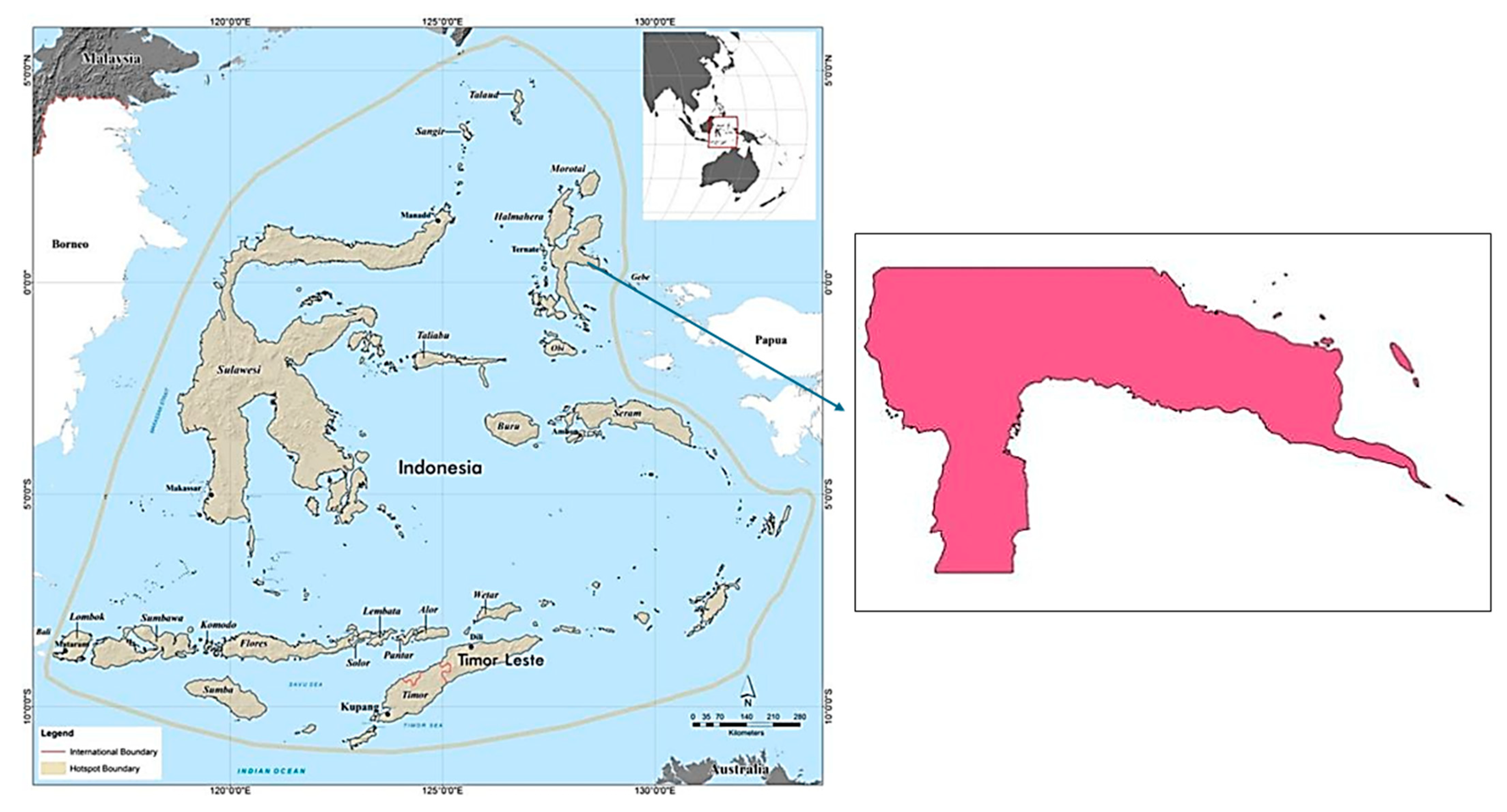
The area of interest is the Central Halmahera Regency in North Maluku Province, Indonesia, specifically focusing on the Weda Bay region. As previously established, this area was selected due to its dual significance: it is a designated national industrial estate for nickel extraction and simultaneously lies within the Wallacea global biodiversity hotspot. The findings from this case study are intended to offer generalizable insights into the impacts of nickel development across the broader Wallacean region (Figure 1). The Central Halmahera Regency was selected as the study area specifically because its well-defined administrative and legally recognized boundaries provide a practical framework for spatial analysis, avoiding the need for arbitrary delimitations. Therefore, the study area is formally defined as the Central Halmahera Regency.
Nickel laterites are typically exploited by surface (strip) mining that removes vegetation and topsoil to expose lateritic horizons; this makes extraction highly land-consumptive and fragmenting. Process routes for laterite ores include hydrometallurgical High-Pressure Acid Leaching (HPAL) for limonitic ores and pyrometallurgical smelting for saprolitic ores or concentrates. HPAL uses concentrated sulfuric acid at high temperature and pressure to solubilize Ni/Co, producing large volumes of acidic, metal-rich residues; smelting and roasting produce off-gases and solid slags.

2.2. Habitat Quality Assessment with InVEST Habitat Quality Model

This study employed the InVEST 3.13.0 Workbench (Mac) Habitat Quality (HQ) Module, hereafter referred to as InVEST-HQ. This specific model was selected for several key reasons. First, the model is relatively straightforward, providing a spatially explicit output with minimal data demands [39]. Its established use across numerous peer-reviewed publications also underscores its credibility and obviates the need for developing a custom model. Second, the InVEST-HQ output serves as a convenient, measurable proxy for decision-making, which directly supports the objectives of this project. Finally, the model’s advanced capability allows users to tailor the habitat sensitivity to each threat, thereby increasing realism by accounting for the specific variability in how each habitat responds to different pressures within the study area. While this customization improves realism, choosing specific parameter values involves some subjective judgment. To reduce arbitrariness, we based our choices on relevant literature and regional reports and consulted experts in tropical ecology and mine rehabilitation. We also ran sensitivity tests using alternative plausible values and found the main spatial patterns remained consistent.

2.2.1. Model Description

The model facilitates the assessment of habitat quality by integrating Land Use/Land Cover (LULC) maps with data detailing habitat threats and ecosystem responses. The generated spatial outputs—specifically, the habitat quality and habitat degradation maps—effectively identify locations where habitat integrity is compromised by heightened threat levels or diminished ecological sensitivity [45,46,47,48]. This capability allows for critical spatial comparisons necessary to prioritize areas for immediate conservation intervention.
From a technical perspective, the model implements a grid-based spatial analysis to characterize and visualize habitat condition under the influence of various threats [48]. By conceptualizing the landscape as a tessellation of cells (pixels), the method accounts for the fundamental principle that the threat’s impact generally decreases (attenuates) as the distance between the threat source and the habitat increases [39]. Within each grid cell, the overall threat impact is further determined by key mediating factors: the relative severity of each specific threat, the inherent sensitivity of the habitat type to those threats, and the degree of formal protection against disturbance [42].
The model addresses these factors by assigning specific attributes to each grid cell, such as land cover, threat intensity, and habitat sensitivity. Through a defined mathematical process (see File S1), these attributes are combined to calculate the Habitat Degradation Index and the Habitat Quality Index—a numerical value assigned to every cell. These index values are then transformed into visual maps. Using GIS analysis, such as a pixel count in QGIS, the model can also quantify the total area (in square meters) of both degraded and high-quality habitats. Essentially, the InVEST Habitat Quality model converts intricate spatial data into clear visual and quantifiable results, effectively illustrating how ecological elements and human activities interact within the landscape.
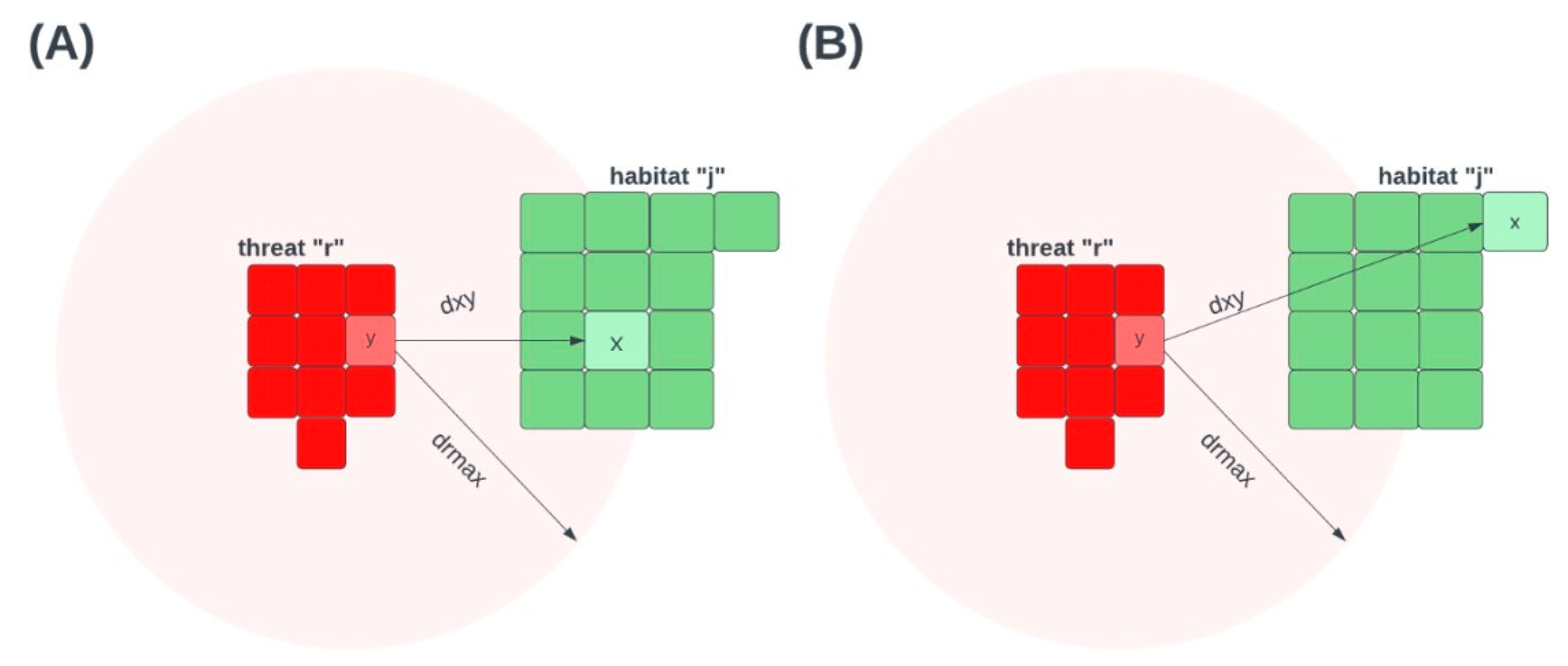
Figure 2 shows a grid-based approach, where each grid cell represents a distinct point within the study area. The impact of habitat “j” from threat “r” is determined by considering the cumulative impact of “grid y” and other grids within the extent of threat “r.” (A) illustrates the impact on gird x of habitat ‘j’ from threat ‘r’, while (B) depicts an instance where the impact on grid x is null because dxy is greater than dram. Notes: grid y in threat factor r, r (red color): spatial extent of the threat factor; x: grid x in habitat type j; dxy: linear distance between grid x and grid y; drmax: maximum effective distance of threat r’s reach across space (beyond this distance, the impact from threat r to habitat j is set to zero by the model).

2.2.2. Model Scenarios

This study utilizes the model to project shifts in habitat quality primarily driven by the escalating threat of mining activities. The core analysis involves a scenario comparison, contrasting the current mining impact with a future state while assuming all other habitat threats remain unchanged. The current threat is delimited by existing LULCCs within the mining concession boundary, while the future threat is assumed to encompass the entire concession area. This latter scenario reflects a worst-case prediction of habitat loss, necessitated by the significant global demand for nickel, for which Indonesia is the largest global source [7]. Although recognizing the potential for rehabilitation and partial habitat preservation in reality, the methodological choice of a worst-case analysis is justified by the urgent need to address the high rates of habitat conversion observed in the region [10] (refer to model scenario in File S2).

2.2.3. Input Data and Processing

Due to its fundamental reliance on a grid-based approach, the model requires raster images for spatial data representation, which must align with an accompanying biophysical table that maps the attributes of each grid cell. The analysis is further informed by two specialized tables: a ‘Threat Table,’ which systematically outlines the relative impact score of each threat factor on various habitat classifications, and a ‘Sensitivity Table,’ which assigns a score detailing the relative sensitivity or inherent response of each habitat type when exposed to individual threats.
The LULCC raster was acquired from the Dynamic World V1 (DWv1) Datasets [49] using Google Earth Engine [50]; threat-specific spatial data are referenced in Table 1. Preparation of the requisite model inputs involved several geospatial processing steps, conducted within QGIS 3.28 Firenze. This workflow required: establishing the precise study area using the administrative boundaries of Central Halmahera; clipping all necessary geospatial inputs to fit this boundary; rasterizing vector shapefile datasets; and subsequently reprojecting all rasters into a linear coordinate system to ensure meter-based unit consistency.

2.2.4. Parameters and Settings

The model operates by combining raster maps with threats and sensitivity tables (Table 2 and Table 3). Input parameters—including the maximum distance, weight, and decay for each threat, along with each habitat’s sensitivity to that threat [42]—must be assigned. This parameter assignment inherently involves a degree of subjectivity, which is a recognized limitation of the procedure. Consequently, the specific input parameters for the threats and sensitivity tables were derived from informed, reasoned assumptions based on relevant literature, prioritizing contextual similarity with the present study. The weights and sensitivity scores in Table 2 and Table 3 were assigned using a combination of published guidance for InVEST-HQ, empirical findings from studies of tropical mining and land-use impacts, and targeted expert judgment from regional biodiversity and mining-environment specialists. File S4 provides the full rationale for each value, including the literature sources consulted and the expert inputs used. To assess the robustness of our results to these subjective choices, we conducted a sensitivity analysis using alternative plausible weightings; the main spatial patterns and the relative ranking of high-risk areas remained consistent.

2.2.5. Model Limitations

The dataset, being a predictive map, inherently involves simplification and may not perfectly reflect the actual conditions of the study area. For example, it aggregates diverse forest ecosystems—such as primary, secondary, and dryland forests—into a single “trees” category, ignoring crucial land cover nuances. However, this limitation is partially offset by the dataset’s use of near-real-time data [49], which is essential for capturing and reflecting the rapid LULC changes occurring in the region.

2.3. Result Analysis

Maps of habitat quality and habitat degradation were generated by utilizing the model’s output layers to illustrate the dynamic of habitat quality and degradation in response to the mining threat scenarios. The habitat quality and degradation score were classified into several bracket values, which range from 0 to 1 [51]. “Very poor,” “poor,” “medium,” “good,” and “excellent” were applied for habitat quality while the degradation class comprises “very low,” “low,” moderate,” “high,” very high.” The threshold for designating the habitat with excellent quality was established at 0.8 or higher. Furthermore, a descriptive statistic summary table and graph were subsequently compiled based on the maps with the aim of quantifying the remaining patches of habitat that still have high habitat quality.
To gain additional insights into the spatial distribution and variation of habitat quality, the study performed a comparative zonal statistics analysis. This procedure contrasted statistical metrics derived from areas within the designated Aketajawe National Park (which falls within the study boundary) against those from areas outside the park’s protective designation.

3. Results

3.1. Model Output: Spatial and Temporal Variations of Habitat Quality

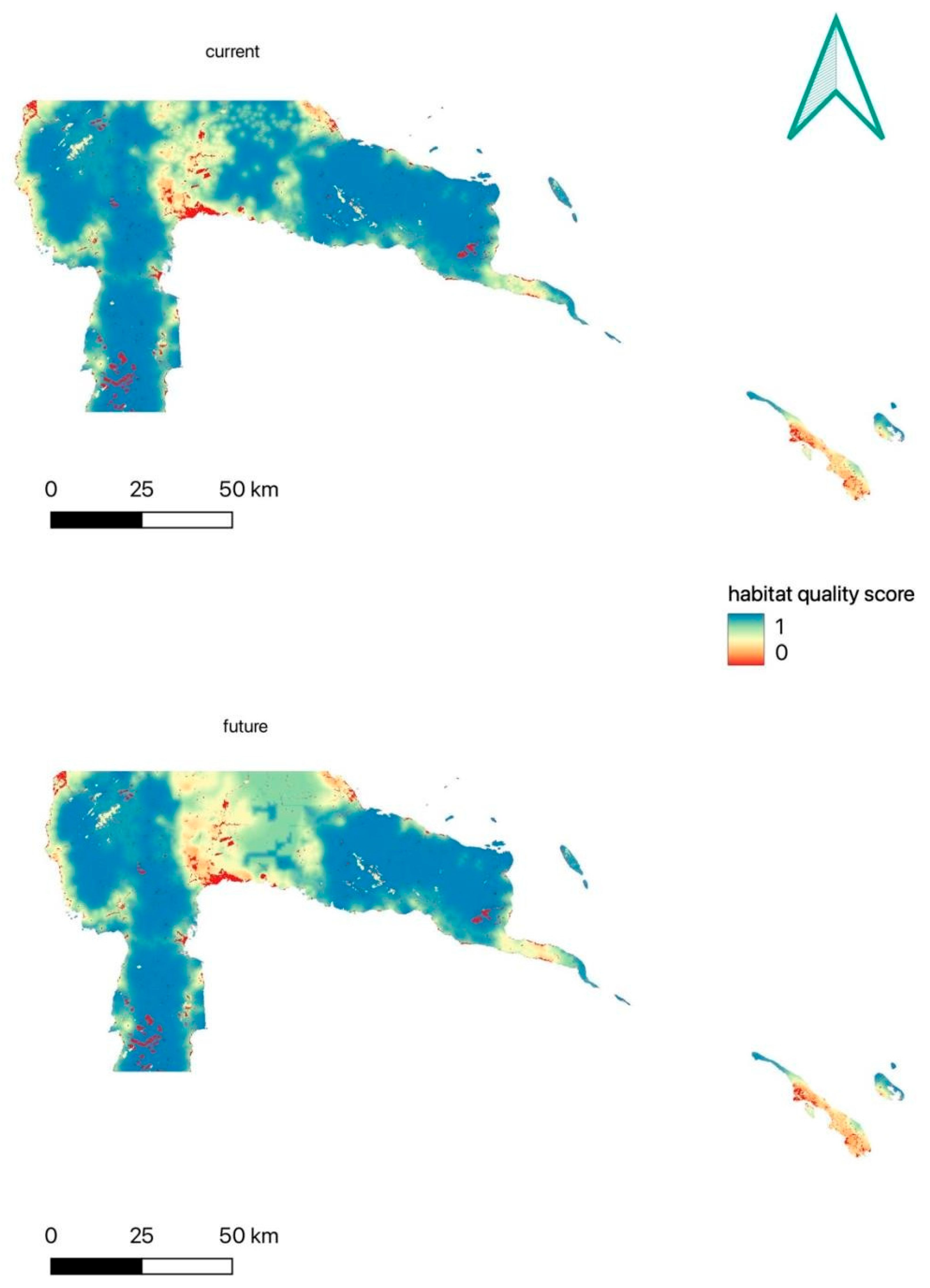
The model’s habitat quality maps (Figure 3) illustrate continuous pixel values ranging from 0 to 1, with 1 representing the highest habitat quality score. These continuous values were subsequently categorized into five distinct categories: ‘very low’ (0–0.2), ‘low’ (0.2–0.4), ‘moderate’ (0.4–0.6), ‘high’ (0.6–0.8), and ‘excellent’ (0.8–1). To enhance the intuitive interpretation of spatial and temporal characteristics, these categories were visually represented using a color spectrum, as displayed in the accompanying legends of the habitat quality map.
In general, the model predicted spatial and temporal variation in habitat quality following the applied scenario of increasing mining threats, indicating that quality is not uniform and changes over time.
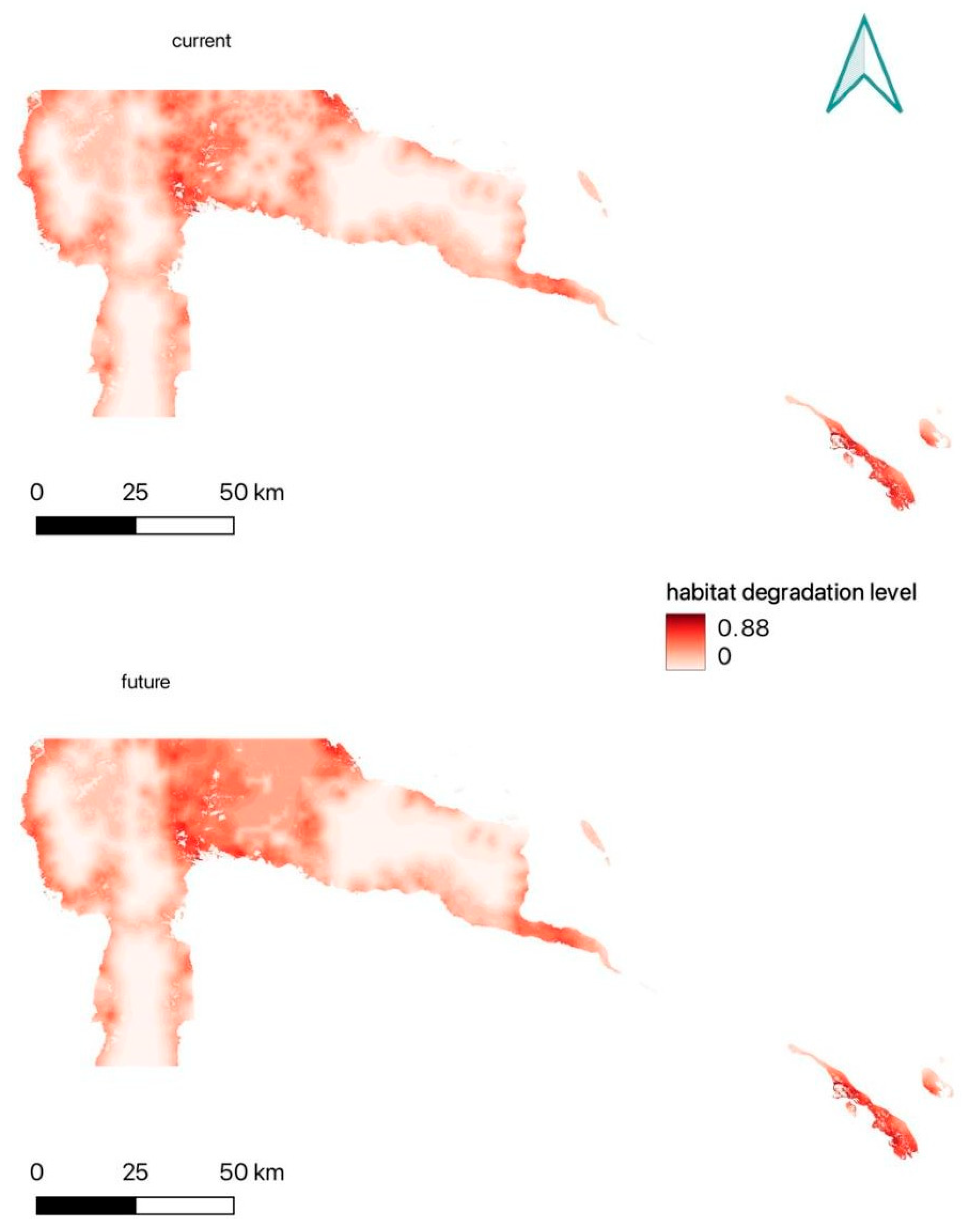
The output maps visually confirm this prediction: the area categorized as excellent habitat quality (represented by blue) notably decreases in the future scenario. This decline is most pronounced in the areas designated for mining expansion (indicated by the yellowish-green tone), suggesting a clear positive correlation where increasing mining area drives a decline in habitat quality. Supporting this, Figure 4’s habitat degradation maps show a distinct cluster of high degradation (indicated by dark red) concentrated both within and surrounding the mining areas.

3.2. Findings

The data extraction involved several steps: reclassification of the habitat quality raster using a bin size of 0.05, application of the aforementioned categorization system, and subsequent zonal histogram analysis within QGIS. This process yielded three key findings.

3.2.1. Habitat with Excellent Quality Will Be Lost in the Future

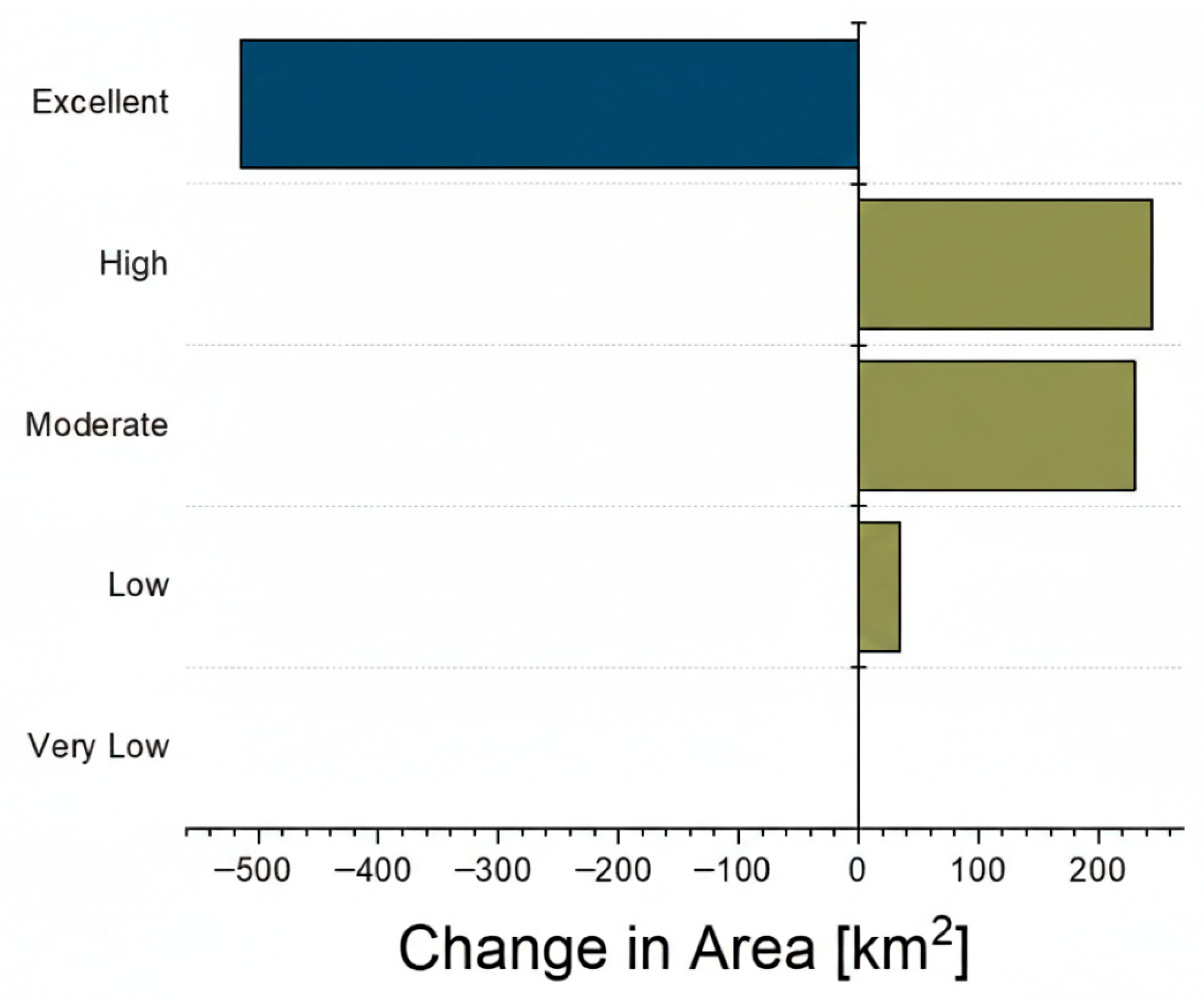
Figure 5 illustrates the habitat quality distribution by area count (in km2), offering a clear comparison between the current and future scenarios. This comparison underscores significant habitat quality variations across the study area. Although high- to excellent-quality habitats remain predominant in both scenarios, the overall habitat quality changes, most notably with a decrease in the excellent habitat category.
The graph shows the pattern of habitat quality changes with a decrease in area with excellent habitat quality being observed. A total of 513 km2 area of excellent habitat (HQI > 0.8) will be lost according to the future scenario. This total area accounts for 9.54% of the total study area.

3.2.2. Impact of Mining Activities on Habitat Quality and Degradation

Most of the degradation and decline in habitat quality is concentrated in the surrounding mining area. Specifically, the habitat quality map illustrates that changes are primarily clustered around this zone. Furthermore, the map shows that the decline is most pronounced in areas with proximity to threats (see File S5). This spatial pattern is complemented by the findings of the habitat degradation map (Figure 4).
A zonal analysis, performed by overlaying the habitat quality data with the mining concession polygons, yields a compelling insight: the projected future scenario strongly suggests the mining zone will exhibit a complete absence of areas categorized as excellent habitat quality (Table 4).

3.2.3. Protected Area Retains Stable Excellent Habitat Quality Compared to Mining Area

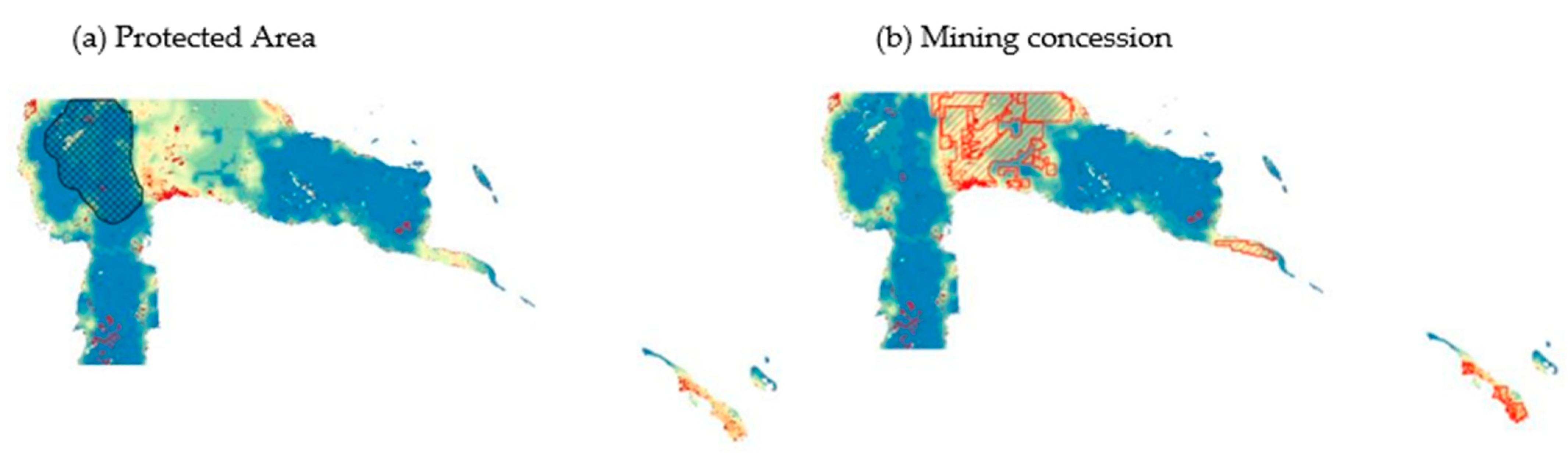
In contrast to declining habitat quality surrounding the mining area, two patches of mostly excellent habitat quality can still be recognized. One is known to be spatially overlapping the Protected Area, the Aketajawe National Park. Figure 6 showcases the protected area and the mining concession in the study area.

4. Discussion

4.1. Discussion of Research Findings

The study’s findings suggest that nickel mining is a prominent threat to habitat quality in the study area. By applying a future scenario, three essential findings were disclosed. (1) The entire study area is projected to experience a decline in habitat quality, as indicated by the projected loss of 513 km2 of excellent-quality habitat, accounting for 10% of the study area. (2) Upon a closer examination of the mining area, the model uncovers severe habitat degradation and the absence of excellent habitat quality in this region in the future. (3) Conversely, areas with protected statuses will retain their excellent habitat quality despite the challenge of the intensifying threat of nickel mining.
Rehabilitation of lateritic nickel sites in high-rainfall tropical settings faces substantial practical challenges that reduce the likelihood of rapid or full ecological recovery. Common constraints include severe soil disturbance and loss of topsoil, poor nutrient status of lateritic substrates, high erosion and sediment transport under intense rainfall, invasive species colonization of disturbed areas, and persistent contamination or altered hydrology from mining and processing activities. Regional assessments of Halmahera and nearby nickel developments report extensive landscape alteration, ongoing pollution risks, and social impacts that complicate restoration efforts. As a result, documented rehabilitation outcomes in similar Indonesian contexts are mixed, with recovery of original forest structure and endemic species often slow or incomplete over decadal timescales. Given these realities, rehabilitation should be treated as a complementary mitigation measure rather than a substitute for avoiding or minimizing habitat loss in the first place.

4.1.1. Future Decline of Habitat Quality in the Region

The overall decline in habitat quality is an expected outcome, as extractive activities fundamentally modify entire landscapes and reduce existing land cover [52]. Resource extraction is widely recognized as a major driver of LULCC, posing a significant threat to forest cover across Indonesia and other critical tropical regions, including Amazonia and Mesoamerica [28]. Compounding this, studies focused on the Wallacean region specifically anticipate rapid deforestation at a rate projected to exceed the global average for tropical deforestation, driven by emerging development [10]. The consequent loss of habitat due to deforestation inevitably reduces habitat quality by diminishing the capacity of the land to provide necessary resources and space [37]. This study builds upon these established findings by integrating habitat sensitivity to specific threats (like mining) within the InVEST model, offering new, specific information regarding the quality of the remaining habitat in direct response to mining pressure.
The results show that high-quality habitats persist within the study area, categorized across five levels: very low, low, moderate, high, and excellent. However, a notable finding is the depletion of ‘excellent’ quality habitats. This depletion has significant implications for biodiversity. Firstly, habitat quality serves as a crucial proxy for biodiversity, representing diversity across genes, species, and ecosystems [42]. Therefore, the loss of excellent habitat quality strongly suggests the potential loss of an impeccable level of biodiversity. While this study does not include ground data validation of species distribution, previous research using the same model consistently correlates excellent habitat quality with more abundant wildlife [40] and higher species richness [53,54,55]. Secondly, and critically, the study area is located within the Wallacea region, a global biodiversity hotspot characterized by a substantial level of endemism [12]. Endemism means the region holds a significant number of species found only within that geographic area [54]. Given this uniqueness, applying habitat quality as a proxy for biodiversity means the projected loss of excellent habitat quality in Wallacea is a crucial concern for global conservation, as it would significantly contribute to worldwide biodiversity loss.

4.1.2. Mining Poses Substantial Degradation and Reduction of Habitat Quality

The model’s prediction that mining concession areas would undergo substantial degradation, resulting in the complete loss of excellent-quality habitat, strongly confirms the assumption that nickel mining is a major threat to this region. The reduction in habitat quality is a direct consequence of LULCC driven by deforestation [5]. For instance, the Indonesian provinces of North Maluku and Central Sulawesi, which host the country’s most active mines, show a correlation with a higher probability of deforestation [55,56,57]. Significant LULCC due to nickel mining has also been reported in New Caledonia, the world’s fifth-largest nickel producer [29]. However, the New Caledonia study suggests that, despite similar nickel mining contexts, LULCC impacts can be site-specific, varying across concessions due to differences in scale, geological properties, and extractive technology. Nonetheless, LULCC is an absolute necessity for mining operations, making the ensuing reduction in habitat quality unavoidable regardless of intensity. This necessitates serious consideration, as LULCC bears substantial accountability for global biodiversity loss [56].
It is crucial to acknowledge that similar variations of LULCC might also occur within the study area. Given this, it is reasonable to assert that mining companies are responsible for mitigating habitat degradation within their legally occupied concessions. This study utilized the polygon of mining concessions as a single unit of analysis and applied the worst-case scenario of a full future conversion of the entire area. Therefore, the possibility exists to minimize the severe loss of excellent habitat through responsible practices implemented by each individual mining entity. However, despite the potential for lower habitat degradation within the concession boundaries, the overall impact of mining often extends beyond those boundaries [22].
Furthermore, the establishment of mines can lead to the unintended consequence of population migration, which subsequently encourages human activities that exacerbate existing degradation or create new environmental pressures [28]. For example, a study in the Brazilian Amazon found that the impact could stretch over 70 km beyond the mining lease [57]. Additionally, the model employed in this study assumes that the resultant environmental impact is simply the sum of the impact of each individual threat (see File S1). Yet, the cumulative impact of mining is often more severe and likely exceeds the sum of individual impacts [58]. This limitation in the model’s ability to fully capture the potential for a higher resultant impact underscores the necessity of remaining vigilant regarding the worst-case scenario results.

4.1.3. Protected Area Is Likely to Maintain Excellent Habitat Quality in the Future

The finding that the overlapping region with the protected area comprises notably uniform and extensive patches of high-quality habitat compared to the mining sites suggests a clear protective effect. One plausible explanation is the legal restrictions on land modifications imposed within these designated zones [59]. Numerous studies affirm that protected areas effectively help retain intact habitats; despite variations in management effectiveness, a global assessment confirms their positive contribution to biodiversity conservation [60]. A recent and highly relevant study focusing on the Wallacea region revealed that protected areas exhibit the lowest deforestation rates [55], a finding pertinent to the Central Halmahera area, which is situated within Wallacea and governed by the same authority.
Nonetheless, it is important to note that LULCC (Land Use/Land Cover Change) is not completely prevented within protected areas [61], and human-induced land modification has been reported to encroach across their boundaries. Therefore, the success of conservation efforts critically hinges on effective management and robust law enforcement, exemplified by success stories like Brazil, where deforestation rates have reportedly declined under new governmental policies [62]. Finally, because the habitat quality scores in this study are based on relative comparisons among grids across the local study landscape (see File S1), it is crucial to acknowledge that the score for this specific protected area cannot be directly compared to those of protected areas outside the study boundaries, even those in similar settings.
However, a study in Brazilian Legal Amazon concluded that protected areas play a pivotal role in maintaining the forest ecosystem [63]. Regarding this finding, the idea of land sparing emerges as a strategy that could be applied in future spatial planning to strongly establish protected areas and defend the integrity of the designated zones in response to the increasing mining threat.

4.2. Strategic Recommendations

Following the discussion of the research findings and the wider implications, a summary of strategic recommendations is outlined in Table 5.
Two of the proposed recommendations are anchored in the biodiversity mitigation hierarchy [64]. However, this study argues that offsetting is not a viable option due to the high endemism in the study area [12], which makes it irreplaceable, while one last recommendation emerges from the concept of a “just transition”.

4.2.1. Integrated Land-Sparing Strategy

Land sparing, a conservation approach originally used in the agricultural sector in response to LULCC [65], is also applicable to this mining case as it effectively balances economic development with conservation efforts. A practical approach involves implementing a land-sparing strategy by establishing new protected areas and strengthening the integrity of existing ones, while still permitting responsible mining within its designated zones. This strategy is considered the best alternative for this biodiversity hotspot region, where the distinct flora and fauna face the potential for rapid decline [66].
Furthermore, establishing more protected areas contributes directly to Indonesia’s commitment to the UN CBD “30 by 30” goals and aligns with the mitigation hierarchy principle of “avoidance.” Given Indonesia’s demonstrated capability in conservation, having already established 32.5 million hectares of marine protected area [67], creating additional land-protected areas appears plausible. However, recognizing that land use needs to extend beyond biodiversity safeguarding, integrating the land-sparing strategy into regional spatial planning is proposed. This provides a systematic, comprehensive, and practical approach to regional development. Crucially, its implementation must be harmonized with existing policies to prevent conflicting goals.

4.2.2. Responsible Mining Practices

This final recommendation underscores the critical necessity of minimizing potential environmental impacts, since complete avoidance of mining is no longer a feasible option. Following the standard mitigation hierarchy, strategies for impact minimization should involve the application of advanced extractive technologies and refined management approaches. Technological advancements in mineral processing have already demonstrated the ability to contribute to reduced LULCC [29]. Effective management strategies must align with established national and international standards for responsible mining. The subsequent hierarchy principle, “restore,” entails comprehensive habitat restoration during or after mining operations within legal concession boundaries.
However, achieving successful restoration in practice is challenging, and its success primarily depends on robust, government-led law enforcement. This approach, beyond its environmental benefits, can enhance companies’ reputations, attract environmentally conscious end-users, and fortify their position within the nickel supply chain. This is supported by initiatives such as the London Metal Exchange (LME) guidelines for Responsible Sourcing [16] and the 2023 G7 Hiroshima Summit’s endorsement of responsibly sourced critical minerals [68].

4.2.3. Risk Mapping and Develop Equitable Global Risk-Sharing Policies

Risk mapping includes identifying and assessing the various risks associated with mineral sourcing for energy transition and how their geographic distribution looks like. As discussed in the findings of this study, there are still undercover impacts that might arise from the metal dependency on the 1.5 °C pathway, and the biodiverse region is highly likely to bear the risks.
Equitable risk-sharing policies include developing strategies to distribute these risks fairly among all parties involved. This might consist of mechanisms to compensate regions affected by negative consequences, sharing responsibilities among nations, or ensuring that the benefits generated by the energy transition are used to mitigate the risks for affected communities. For instance, a potential risk-sharing policy could involve establishing “Critical Mineral Conservation Funds,” analogous to “Loss and Damage Funds,” which is continuously being discussed in international climate events [69]. Countries who experience habitat degradation from mineral extraction should be paid, while others pay.
This might provoke varying responses globally. The debate about putting a price on nature is still far from settled [70]. However, this paper believes that avoiding damages must be the priority, as stated in recommendation 1, as nature has an intrinsic value rather than solely beneficial value. Nonetheless, climate change mitigation by increasing renewable and decarbonization and biodiversity conservation by protecting land and resources are two shared global agendas that require equitable risk-sharing policies to distribute the risks fairly among all parties involved.

5. Conclusions

This study assessed the ecological implications of nickel mining in Central Halmahera by quantifying its effects on habitat quality using the InVEST Habitat Quality Model and spatial analysis in QGIS. The results demonstrate that mining activities exert a substantial negative influence on habitat condition within the Wallacea biodiversity hotspot. In particular, the projected complete loss of excellent-quality habitat inside mining concessions highlights the severity of future degradation if expansion proceeds as modeled. Conversely, protected areas are expected to retain high habitat quality, underscoring the importance of formal conservation status in safeguarding ecological integrity.
The findings indicate that responsible mining practices and strengthened spatial planning could help reduce habitat degradation within legally designated concessions. The modeling framework applied here is transferable to other regions experiencing similar pressures, offering a practical tool for evaluating trade-offs between resource extraction and biodiversity conservation.
More broadly, the study illustrates a critical tension within the global energy transition: the increasing demand for minerals essential to low-carbon technologies is driving habitat loss in ecologically sensitive regions. Integrating biodiversity considerations into mineral supply planning is therefore essential. Future research should incorporate field-based ecological assessments, pollution pathways, and socio-economic dimensions to provide a more comprehensive understanding of mining impacts and to support more equitable and sustainable decision-making.

Supplementary Materials

The following supporting information can be downloaded at: https://www.mdpi.com/article/10.3390/land15020273/s1, File S1: Model Calculations; File S2: Spatial Extent of Model Scenario; File S3: LULC Classification Dynamic World V1; File S4: Sensitivity Table and Threat Table Justifications; File S5: Threat Maps.

Author Contributions

Conceptualization, L.A. and M.S.; Data curation, L.A.; Formal analysis, L.A.; Investigation, L.A.; Methodology, M.S. and L.A.; Project administration, M.S.; Resources, M.S.; Supervision, M.S.; Writing—original draft, L.A.; Writing—review and editing, M.S. and L.A. All authors have read and agreed to the published version of the manuscript.

Funding

This research received no external funding.

Data Availability Statement

The data used can be obtained here: https://drive.google.com/drive/folders/15UtYPQLtBYJF2SAfoyb4rKg43NiQDfj6 (accessed on 5 December 2023).

Conflicts of Interest

The authors declare no conflicts of interest.

References

  1. International Renewable Energy Agency. Renewable Energy Statistics 2023. Available online: https://www.irena.org/Publications/2023/Jul/Renewable-energy-statistics-2023 (accessed on 1 September 2023).
  2. Wang, J.; Shahbaz, M.; Dong, K.; Dong, X. Renewable energy transition in global carbon mitigation: Does the use of metallic minerals matter? Renew. Sustain. Energy Rev. 2023, 181, 113320. [Google Scholar] [CrossRef]
  3. Boer, L.; Pescatori, A.; Stuermer, M. Energy Transition Metals. Available online: https://papers.ssrn.com/sol3/papers.cfm?abstract_id=3945524 (accessed on 1 September 2023).
  4. Farina, A.; Anctil, A. Material consumption and environmental impact of wind turbines in the USA and globally. Resour. Conserv. Recycl. 2022, 176, 105938. [Google Scholar] [CrossRef]
  5. Kosai, S.; Takata, U.; Yamasue, E. Natural resource use of a traction lithium-ion battery production based on land disturbances through mining activities. J. Clean. Prod. 2021, 280, 124871. [Google Scholar] [CrossRef]
  6. United States Geological Survey. National News Release: U.S. Geological Survey Releases 2022: List of Critical Minerals. Available online: https://www.usgs.gov/news/national-news-release/us-geological-survey-releases-2022-list-critical-minerals (accessed on 1 September 2023).
  7. International Energy Agency. Critical Minerals Market Review 2023. Available online: https://www.iea.org/reports/critical-minerals-market-review-2023 (accessed on 1 September 2023).
  8. Dou, S.; Xu, D.; Keenan, R.J. Effect of income, industry structure and environmental regulation on the ecological impacts of mining: An analysis for Guangxi Province in China. J. Clean. Prod. 2023, 400, 136654. [Google Scholar] [CrossRef]
  9. Owen, J.R.; Lechner, A.M.; Harris, J.; Zhang, R.; Lèbre, E. Energy transition minerals and their intersection with land-connected peoples. Nat. Sustain. 2023, 6, 203–211. [Google Scholar] [CrossRef]
  10. Voigt, M.; Supriatna, J.; Deere, N.J.; Kastanya, A.; Mitchell, S.L.; Rosa, I.M.D.; Santika, T.; Siregar, R.; Tasirin, J.S.; Widyanto, A.; et al. Emerging threats from deforestation and forest fragmentation in the Wallacea centre of endemism. Environ. Res. Lett. 2021, 16, 094048. [Google Scholar] [CrossRef]
  11. Huber, I. Indonesia’s Nickel Industrial Strategy. Available online: https://www.csis.org/analysis/indonesias-nickel-industrial-strategy (accessed on 1 September 2023).
  12. Burung Indonesia. Ecosystem Profile Wallacea Biodiversity Hotspot. Available online: https://www.cepf.net/sites/default/files/ecosystemprofile_wallacea.pdf (accessed on 1 September 2023).
  13. Mweene, L.; Gomez-Flores, A.; Jeong, H.E.; Ilyas, S.; Kim, H. Challenges and future in Ni laterite ore enrichment: A critical review. Miner. Process. Extr. Metall. Rev. 2024, 45, 539–563. [Google Scholar] [CrossRef]
  14. Targeted News Service. International Energy Agency Issues 2021 Report Entitled ‘The Role of Critical Minerals in Clean Energy Transitions’. Available online: https://www.iea.org/reports/the-role-of-critical-minerals-in-clean-energy-transitions (accessed on 1 September 2023).
  15. Carrara, S. Raw Materials Demand for Wind and Solar PV Technologies in the Transition Towards a Decarbonised Energy System. Available online: https://data.europa.eu/doi/10.2760/160859 (accessed on 5 September 2023).
  16. Nickel Institute. Available online: https://nickelinstitute.org/ (accessed on 31 August 2023).
  17. Konopka, G.; Szamałek, K.; Zglinicki, K. Ni-Co bearing laterites from Halmahera Island (Indonesia). Appl. Sci. 2022, 12, 7586. [Google Scholar] [CrossRef]
  18. van der Ent, A.; Baker, A.J.M.; van Balgooy, M.M.J.; Tjoa, A. Ultramafic nickel laterites in Indonesia (Sulawesi, Halmahera): Mining, nickel hyperaccumulators and opportunities for phytomining. J. Geochem. Explor. 2013, 128, 72–79. [Google Scholar] [CrossRef]
  19. Bappenas. The National Medium-Term Development Plan for 2020–2024; Ministry of National Development Planning of the Republic of Indonesia: Jakarta, Indonesia, 2023.
  20. Indonesia Weda Bay Industrial Park. Available online: https://iwip.co.id/en/home/ (accessed on 1 September 2023).
  21. Weda Bay Nickel Project, Halmahera Island, Indonesia. Available online: https://www.nsenergybusiness.com/projects/weda-bay-nickel-project/ (accessed on 18 July 2023).
  22. Siqueira-Gay, J.; Sonter, L.J.; Sánchez, L.E. Exploring potential impacts of mining on forest loss and fragmentation within a biodiverse region of Brazil’s northeastern Amazon. Resour. Policy 2020, 67, 101662. [Google Scholar] [CrossRef]
  23. Giljum, S.; Maus, V.; Kuschnig, N.; Luckeneder, S.; Tost, M.; Sonter, L.J.; Bebbington, A.J. Mining Causes Direct and Indirect Loss of Tropical Forests. Available online: https://www.fineprint.global/publications/briefs/mining-deforestation/ (accessed on 1 September 2023).
  24. Ritchie, H.; Roser, M. Forests and Deforestation. Available online: https://ourworldindata.org/deforestation (accessed on 13 July 2023).
  25. Obodai, J.; Adjei, K.A.; Odai, S.N.; Lumor, M. Land use/land cover dynamics using landsat data in a gold mining basin-the Ankobra, Ghana. Remote Sens. Appl. Soc. Environ. 2019, 13, 247–256. [Google Scholar] [CrossRef]
  26. Hosonuma, N.; Herold, M.; De Sy, V.; De Fries, R.S.; Brockhaus, M.; Verchot, L.; Angelsen, A.; Romijn, E. An assessment of deforestation and forest degradation drivers in developing countries. Environ. Res. Lett. 2012, 7, 044009. [Google Scholar] [CrossRef]
  27. Hooke, R.L.; Martín-Duque, J.F. Land transformation by humans: A review. GSA Today 2012, 12, 4–10. [Google Scholar] [CrossRef]
  28. Bebbington, A.J.; Bebbington, D.H.; Sauls, L.A.; Verdum, R. Resource extraction and infrastructure threaten forest cover and community rights. Proc. Natl. Acad. Sci. USA 2018, 115, 13164–13173. [Google Scholar] [CrossRef]
  29. Iwatsuki, Y.; Nakajima, K.; Yamano, H.; Otsuki, A.; Murakami, A. Variation and changes in land-use intensities behind nickel mining: Coupling operational and satellite data. Resour. Conserv. Recycl. 2018, 134, 361–366. [Google Scholar] [CrossRef]
  30. Sonter, L.J.; Ali, S.H.; Watson, J.E.M. Mining and biodiversity: Key issues and research needs in conservation science. Proc. R. Soc. B Biol. Sci. 2018, 285, 20181926. [Google Scholar] [CrossRef]
  31. Sirajudin, N.; Ridwan, M.; Malamassam, D. Agroforestry development strategy in West Halmahera Regency, North Maluku. Int. J. Sci. Manag. Stud. (IJSMS) 2021, 4, 117–125. [Google Scholar] [CrossRef]
  32. Hiar, H. Deforestation in Halmahera Paves Way for Palm Oil Industry. Available online: https://www.ekuatorial.com/en/2019/10/deforestation-in-halmahera-paves-way-for-palm-oil-industry/ (accessed on 14 July 2023).
  33. Steve, F. Major Open-Pit Copper Mines Move Underground. Available online: https://www.e-mj.com/features/major-open-pit-copper-mines-move-underground/ (accessed on 13 July 2023).
  34. Iwuji, C.C.; Okeke, O.C.; Ezenwoke, B.C.; Amadi, C.C.; Nwachukwu, H. Earth resources exploitation and sustainable development: Geological and engineering perspectives. Eng. J. 2016, 8, 21–33. [Google Scholar] [CrossRef]
  35. Listrik Untuk Kehidupan Yang Lebih Baik. Available online: https://web.pln.co.id/pln-jetp/jetp-home (accessed on 1 September 2023).
  36. White Cockatoo Cacatua Alba. Available online: http://datazone.birdlife.org/species/factsheet/white-cockatoo-cacatua-alba/details (accessed on 17 July 2023).
  37. Zhao, H.; Xiaoman Xu, X.; Tang, J.; Wang, Z.; Miao, C. Spatial pattern evolution and prediction scenario of habitat quality in typical fragile ecological region, China: A case study of the Yellow River floodplain area. Heliyon 2023, 9, e14430. [Google Scholar] [CrossRef]
  38. Dashtbozorgi, F.; Hedayatiaghmashhadi, A.; Dashtbozorgi, A.; Ruiz–Agudelo, C.A.; Fürst, C.; Cirella, G.T.; Naderi, M. Ecosystem services valuation using InVEST modeling: Case from southern Iranian mangrove forests. Reg. Stud. Mar. Sci. 2023, 60, 102813. [Google Scholar] [CrossRef]
  39. Wang, S.; Liang, X.; Wang, J. Parameter assignment for InVEST habitat quality module based on principal component analysis and grey coefficient analysis. Math. Biosci. Eng. 2022, 19, 13928–13948. [Google Scholar] [CrossRef] [PubMed]
  40. Sulistyawan, B.S.; Eichelberger, B.A.; Verweij, P.; Boot, R.G.A.; Hardian, O.; Adzan, G.; Sukmantoro, W. Connecting the fragmented habitat of endangered mammals in the landscape of Riau–Jambi–Sumatera Barat (RIMBA), central Sumatra, Indonesia (connecting the fragmented habitat due to road development). Glob. Ecol. Conserv. 2017, 9, 116–130. [Google Scholar] [CrossRef]
  41. Mengist, W.; Soromessa, T.; Feyisa, G.L. Landscape change effects on habitat quality in a forest biosphere reserve: Implications for the conservation of native habitats. J. Clean. Prod. 2011, 329, 129778. [Google Scholar] [CrossRef]
  42. Wang, G.; Wan, Y.; Ding, C.J.; Liu, X.; Jiang, Y. A review of applied research on low-carbon urban design: Based on scientific knowledge mapping. Environ. Sci. Pollut. Res. 2023, 30, 103513–103533. [Google Scholar] [CrossRef]
  43. Yu-kuan, W.; Colvin, C. Mapping Ecosystem Function Conservation Areas to Integrate ecosystem Services Into Land Use Plans in Baoxing County, China. Available online: https://www.semanticscholar.org/paper/Mapping-Ecosystem-Function-Conservation-Areas-to-in-Yu-kuan-Colvin/77e9a9e0db4569641c85443665b63d97ee3ea4b2 (accessed on 1 September 2023).
  44. Bhagabati, N.K.; Ricketts, T.; Sulistyawan, T.B.S.; Conte, M.; Ennaanay, D.; Hadian, O.; McKenzie, E.; Olwero, N.; Rosenthal, A.; Tallis, H.; et al. Ecosystem services reinforce Sumatran tiger conservation in land use plans. Biol. Conserv. 2014, 169, 147–156. [Google Scholar] [CrossRef]
  45. Muralikrishna, I.V.; Manickam, V. (Eds.) Chapter three: Natural resource management and biodiversity conservation. In Environmental Management; Butterworth-Heinemann: Woburn, MA, USA, 2017; pp. 23–35. [Google Scholar]
  46. Millennium Ecosystem Assessment, Ecosystems and Human Well-Being. 2003. Available online: https://www.millenniumassessment.org/documents/document.356.aspx.pdf (accessed on 1 September 2023).
  47. Moreira, M.; Fonseca, C.; Vergílio, M.; Calado, H.; Gil, A. Spatial assessment of habitat conservation status in a Macaronesian island based on the InVEST model: A case study of Pico Island (Azores, Portugal). Land Use Policy 2018, 78, 637–649. [Google Scholar] [CrossRef]
  48. Li, Y.; Duo, L.; Zhang, M.; Yang, J.; Guo, X. Habitat quality assessment of mining cities based on InVEST model: A case study of Yanshan County, Jiangxi Province. Int. J. Coal Sci. Technol. 2022, 9, 28. [Google Scholar] [CrossRef]
  49. Brown, C.F.; Brumby, S.P.; Guzder-Williams, B.; Birch, T.; Hyde, S.B.; Mazzariello, J.; Czerwinski, W.; Pasquarella, V.J.; Haertel, R.; Ilyushchenko, S.; et al. Dynamic world, near real-time global 10 m land use land cover mapping. Sci. Data 2022, 9, 251. [Google Scholar] [CrossRef]
  50. Gorelick, N.; Hancher, M.; Dixon, M.; Ilyushchenko, S.; Thau, D.; Moore, R. Google Earth Engine: Planetary-scale geospatial analysis for everyone. Remote Sens. Environ. 2017, 202, 18–27. [Google Scholar] [CrossRef]
  51. Li, X.; Hou, X.; Song, Y.; Shan, K.; Zhu, S.; Yu, X.; Mo, X. Assessing changes of habitat quality for shorebirds in stopover sites: A case study in Yellow River Delta, China. Wetlands 2019, 39, 67–77. [Google Scholar] [CrossRef]
  52. Islam, K.; Yokoi, R.; Motoshita, M.; Murakami, S. Ecological footprint accounting of mining areas and metal production of the world. Resour. Conserv. Recycl. 2022, 183, 106384. [Google Scholar] [CrossRef]
  53. Aznarez, C.; Svenning, J.; Taveira, G.; Baró, F.; Pascual, U. Wildness and habitat quality drive spatial patterns of urban biodiversity. Landsc. Urban Plan. 2022, 228, 104570. [Google Scholar] [CrossRef]
  54. Morrone, J.J. Endemism. In Encyclopedia of Ecology; Jørgensen, S.E., Fath, B.D., Eds.; Academic Press: Oxford, UK, 2008; pp. 1254–1259. [Google Scholar]
  55. Voigt, M.; Supriatna, J.; Deere, N.J.; Kastanya, A.; Mitchell, S.L.; Rosa, I.M.D.; Santika, T.; Siregar, R.; Tasirin, J.S.; Widyanto, A.; et al. Past Deforestation (2000–2018) and Future Deforestation Probability (2019–2053) for Wallacea. Available online: https://catalogue.ceh.ac.uk/id/c7148c20-c6b3-43e1-9f99-b6e38e4dfdaf (accessed on 1 September 2023).
  56. Davison, C.W.; Rahbek, C.; Morueta-Holme, N. Land-use change and biodiversity: Challenges for assembling evidence on the greatest threat to nature. Glob. Change Biol. 2021, 27, 5414–5429. [Google Scholar] [CrossRef] [PubMed]
  57. Sonter, L.J.; Herrera, D.; Barrett, D.J.; Galford, G.L.; Moran, C.J.; Soares-Filho, B.S. Mining drives extensive deforestation in the Brazilian Amazon. Nat. Commun. 2017, 8, 1013. [Google Scholar] [CrossRef]
  58. Sonter, L.J.; Dade, M.C.; Watson, J.E.; Valenta, R.K. Renewable energy production will exacerbate mining threats to biodiversity. Nat. Commun. 2020, 11, 4174. [Google Scholar] [CrossRef]
  59. Mulyana, A.; Moeliono, M.; Minnigh, P.; Indriatmoko, Y.; Limberg, G.; Utomo, N.A.; Iwan, R.; Saparuddin; Hamzah. Establishing Special Use Zones in National Parks: Can It Break the Conservation Deadlock in Indonesia? Center for International Forestry Research (CIFOR). Available online: https://www.cifor-icraf.org/knowledge/publication/3094/ (accessed on 1 September 2023).
  60. Leverington, F.; Costa, K.L.; Pavese, H.; Lisle, A.; Hockings, M. A global analysis of protected area management effectiveness. Environ. Manag. 2010, 46, 685–698. [Google Scholar] [CrossRef]
  61. Kennerley, R.J.; Nicoll, M.A.C.; Young, R.P.; Turvey, S.T.; Nuñez-Miño, J.M.; Brocca, J.L.; Butler, S.J. The impact of habitat quality inside protected areas on distribution of the Dominican Republic’s last endemic non-volant land mammals. J. Mammal. 2019, 100, 45–54. [Google Scholar] [CrossRef]
  62. Pulice, C.; Spring, J. Deforestation in Brazil’s Amazon Drops 34% in First Half 2023. Available online: https://www.reuters.com/business/environment/deforestation-brazils-amazon-drops-34-first-half-2023-2023-07-06/ (accessed on 1 September 2023).
  63. Arlidge, W.N.S.; Bull, J.W.; Addison, P.F.E.; Burgass, M.J.; Gianuca, D.; Gorham, T.M.; Jacob, C.; Shumway, N.; Sinclair, S.P.; Watson, J.E.M.; et al. a global mitigation hierarchy for nature conservation. J. Biosci. 2018, 68, 336–347. [Google Scholar] [CrossRef]
  64. Jiren, T.S.; Dorresteijn, I.; Schultner, J.; Fischer, J. The governance of land use strategies: Institutional and social dimensions of land sparing and land sharing. Conserv. Lett. 2018, 11, e12429. [Google Scholar] [CrossRef]
  65. Salles, J.; Teillard, F.; Tichit, M.; Zanella, M. Land sparing versus land sharing: An economist’s perspective. Reg. Environ. Change 2017, 17, 1455–1465. [Google Scholar] [CrossRef]
  66. Amkieltiela; Handayani, C.N.; Andradi-Brown, D.A.; Estradivari; Ford, A.K.; Beger, M.; Hakim, A.; Muenzel, D.K.; Carter, E.; Agung, F.; et al. The rapid expansion of Indonesia’s marine protected area requires improvement in management effectiveness. Mar. Policy 2022, 146, 105257. [Google Scholar] [CrossRef]
  67. Annex to the Climate, Energy and Environment Ministers’ Communiqué: Five-Point Plan for Critical Minerals Security. Available online: https://www.meti.go.jp/press/2023/04/20230417004/20230417004-5.pdf (accessed on 23 August 2023).
  68. Abnett, K. Explainer: COP27: What Is “Loss and Damage” Funding, and Who Should Pay? Available online: https://www.reuters.com/business/cop/cop27-what-is-loss-damage-compensation-who-should-pay-2022-11-06/ (accessed on 31 August 2023).
  69. Sparrow, J. The Call to Put “a Price on Nature” Can Be Appealing But It Misunderstands What’s at Stake. Available online: https://www.theguardian.com/commentisfree/2022/dec/16/the-call-to-put-a-price-on-nature-can-be-appealing-but-it-misunderstands-whats-at-stake (accessed on 1 September 2023).
  70. Sandler, R. Intrinsic value, ecology, and conservation. Nat. Educ. Knowl. 2012, 3, 4. [Google Scholar]
Figure 1. Wallacean biodiversity hotspot (left) [12], administrative boundary of Central Halmahera Regency (right), located in the Indonesian region (red box, inset).
Land 15 00273 g001
Figure 2. Schematic illustration of the grid-based approach of the InVEST Habitat Quality Model. The diagram illustrates the spatial influence of a threat (red) source r at location y on a habitat (green) cell j at location x. In (A), the habitat cell is within the maximum impact distance drmax, meaning the threat exerts a degrading effect on the habitat quality. In (B), the habitat cell lies outside the maximum distance drmax, and is therefore unaffected by the threat at location y. The variable dxy represents the Euclidean distance between the threat and the habitat cell.
Land 15 00273 g002
Figure 3. Projected Change in Habitat Quality: Maps comparing current habitat quality against a future scenario. The maps, scored from 0 (low quality) to 1 (high quality), illustrate areas where habitat suitability is expected to decline (red and orange areas decreasing) or remain stable, providing a basis for conservation planning.
Land 15 00273 g003
Figure 4. Spatial distribution of habitat degradation in the study area. Maps compare the current state (Scenario A) with future projections (Scenario B). Degradation levels are categorized from “Low” to “High,” with increasing intensity often correlating to the expansion of human-driven threats such as construction land and agricultural expansion. Areas shown in red/high-intensity indicate zones where habitat suitability is most compromised by proximity to threat sources.
Land 15 00273 g004
Figure 5. Quantification of net changes in habitat quality area between the current and future scenarios. The horizontal bar chart illustrates the shift in land area (km2) for each quality class. A significant reduction of approximately 500 km2 is observed in the Excellent habitat category, while High-, Moderate-, and Low-quality areas show corresponding increases. This trend suggests a broad degradation of the study area’s most valuable ecological zones, resulting in a transition toward lower-quality habitat classifications.
Land 15 00273 g005
Figure 6. Spatial overlay of habitat quality with protected areas and mining concessions. This map utilizes a color gradient to represent habitat quality, where dark green indicates high-quality, intact ecosystems and red/yellow tones signify lower quality or degraded areas. The intersection highlights areas of high conservation priority and potential land-use conflict, particularly where mining concessions encroach upon protected boundaries or intact, high-value ecosystems. These overlaps demonstrate the competing demands between resource extraction and biodiversity preservation within the study area.
Land 15 00273 g006
Table 1. List of data sources for raster maps.
DataSourceDescriptionJustification
LULCDynamic WorldThe raster dataset is a global NRT dataset with nine land cover classes (see File S2)Near real time, allowing data availability for year 2023.
High resolution (10 m × 10 m)
Threats
Mining (future)IUM ESDMMining concessions within the study boundary
Shapefiles transformed to raster, excluding mining concession other than nickel
Legally recognized
Mining (current)Subset of IUM ESDMAn extracted raster of mining activities inside the IUP (see File S3)To capture the current extent of mining activities
RoadBIG Indonesia GeoportalShapefiles transformed to rasterActual, legally recognized
Settlement
Built Area
Crops and Agriculture
Table 2. The threats table employed in the model.
ThreatMax. DistanceWeightDecay
Mining61exponential
Road40.6linear
Agriculture30.6linear
Built Area50.8exponential
Settlements50.7exponential
Table 3. Sensitivity table.
LULC CodeLULC NameHabitat SuitabilityThreats
MiningRoadAgricultureSettlementsBuilt Area
0Water *0.00.00.00.00.00.0
1Trees1.01.01.00.80.80.8
2Grass0.50.70.40.50.60.5
3Flooded Vegetation1.00.80.30.80.81.0
4Crops0.50.20.20.00.60.2
5Shrub and Scrub0.60.20.30.10.60.2
6Built *0.00.00.00.00.00.0
7Snow and Ice0.00.000.0.00.00.0
* Non-Habitat classes.
Table 4. Habitat quality compositions within the mining zone in the current and future scenarios.
CategoryCurrentFeature
Very Low0%0%
Low7%9%
Moderate24%42%
High28%49%
Excellent42%0%
Table 5. Strategic Recommendations for Sustainable Nickel Mining and Biodiversity Conservation.
Context and ChallengesIdentified OpportunitiesStrategic Recommendation
Indonesia
Nickel mining will bring
substantial habitat degradation which leads to biodiversity loss, but also contribute as Indonesian economic lever.
Some patches of high-quality habitat can still be maintained
through Land Sparring Strategy; Protected area vs. Mining
Concession
Integrated Land-Sparing strategy
to the regional spatial planning.
Mining brings damages to the environment, but legal
concession has been granted
The mining entities have the authority and responsibility to manage their legal occupied
concession.
Responsible mining and Law Enforcement.
Global
The risks are geographically concentrated in the mineral
sourcing region while the benefits are experienced globally.
An opportunity to re-evaluate just energy transitionRisk Mapping and Equitable Risk-Sharing Policies
Disclaimer/Publisher’s Note: The statements, opinions and data contained in all publications are solely those of the individual author(s) and contributor(s) and not of MDPI and/or the editor(s). MDPI and/or the editor(s) disclaim responsibility for any injury to people or property resulting from any ideas, methods, instructions or products referred to in the content.