Identification of Township-Scale Ecological Restoration Priority Areas Based on Ecological Security Pattern and Multi-Method Integration

 ,
, 
Abstract
1. Introduction
2. Materials and Methods
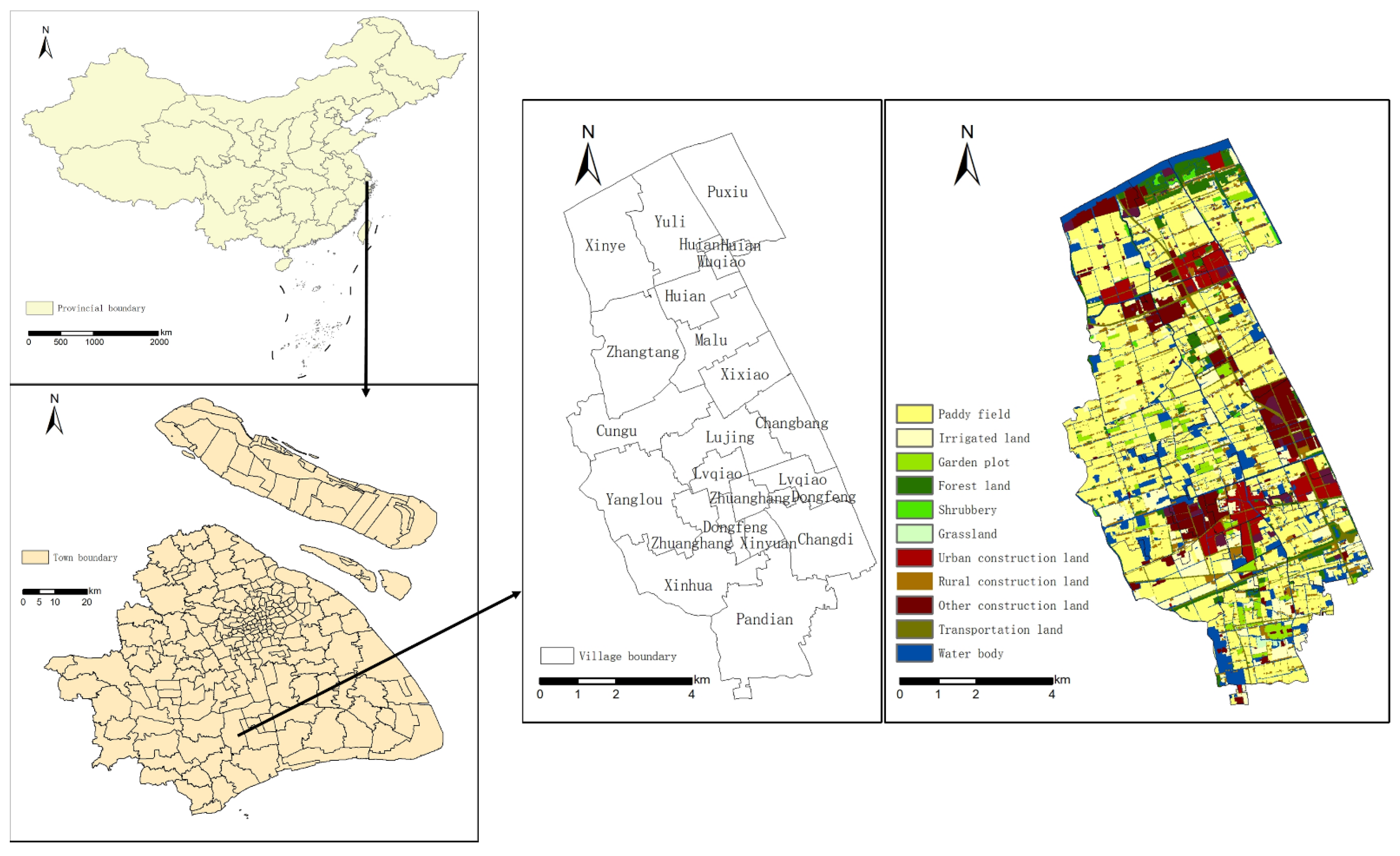
2.1. Study Area
2.2. Data Sources and Preprocessing
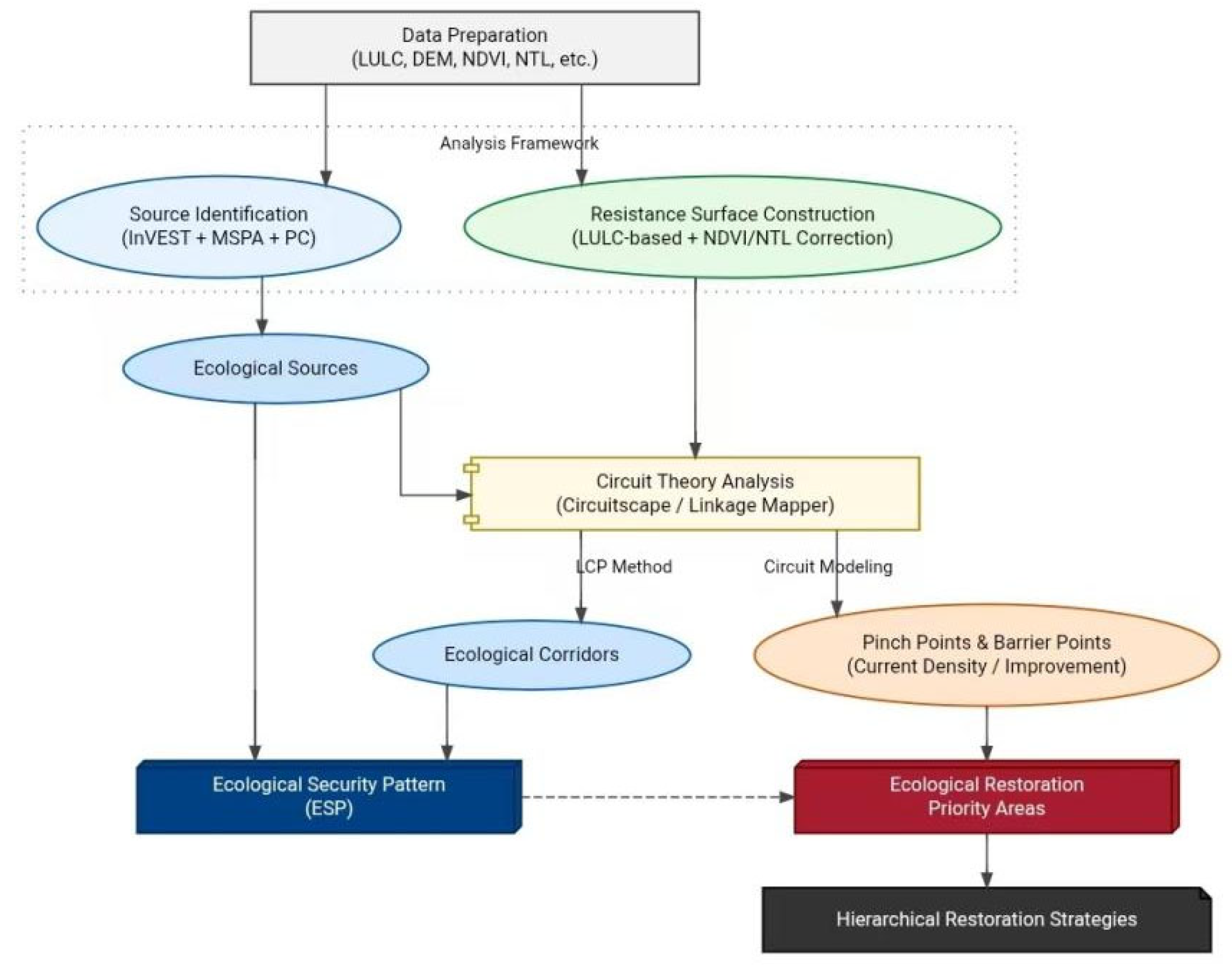
2.3. Methods
2.3.1. Identification of Ecological Sources
2.3.2. Construction of the Ecological Resistance Surface
2.3.3. Extraction of Ecological Corridors
2.3.4. Identification of Key Areas for Ecological Restoration
2.3.5. Validations
3. Results
3.1. Construction of the ESP
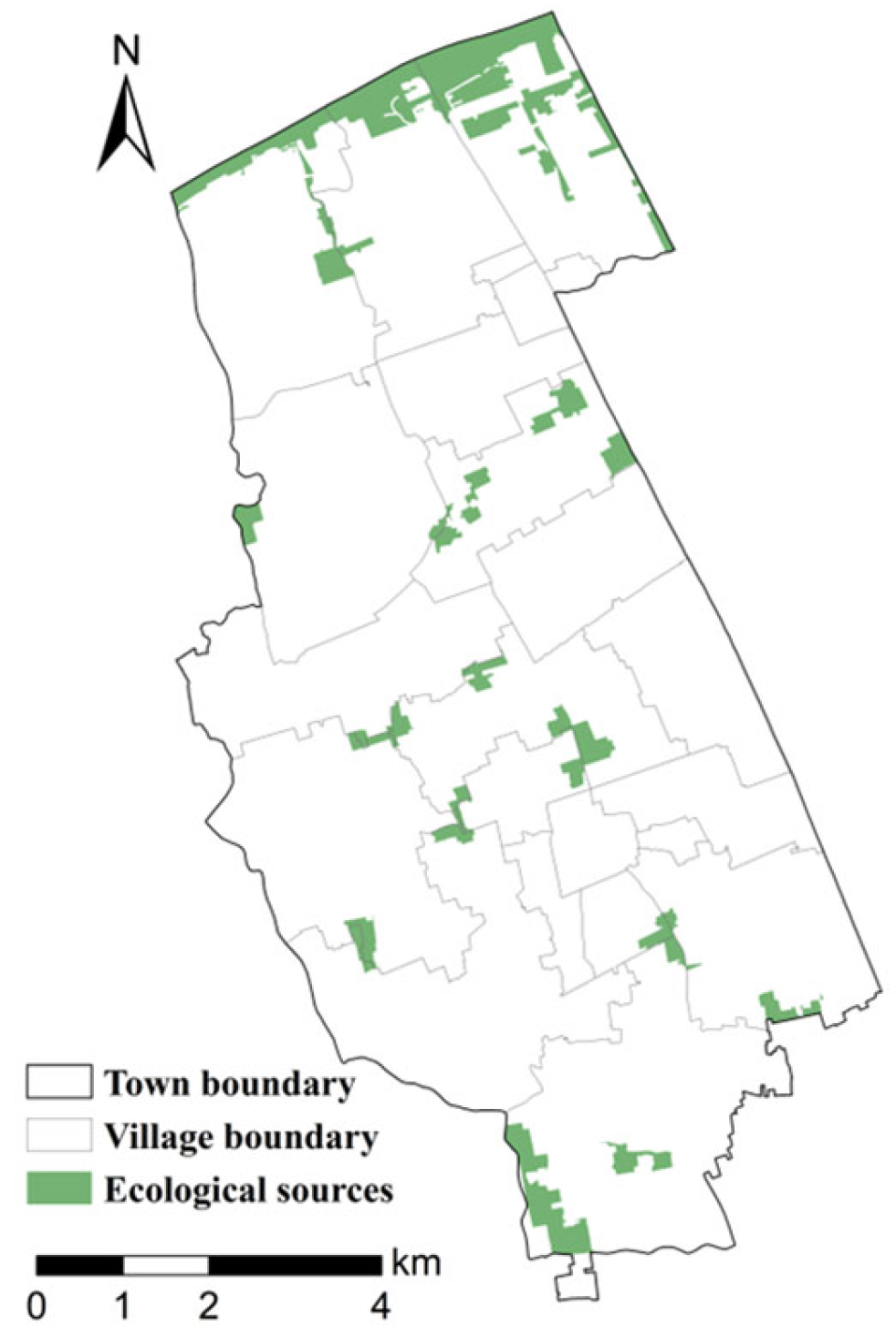
3.1.1. Ecological Source Analysis
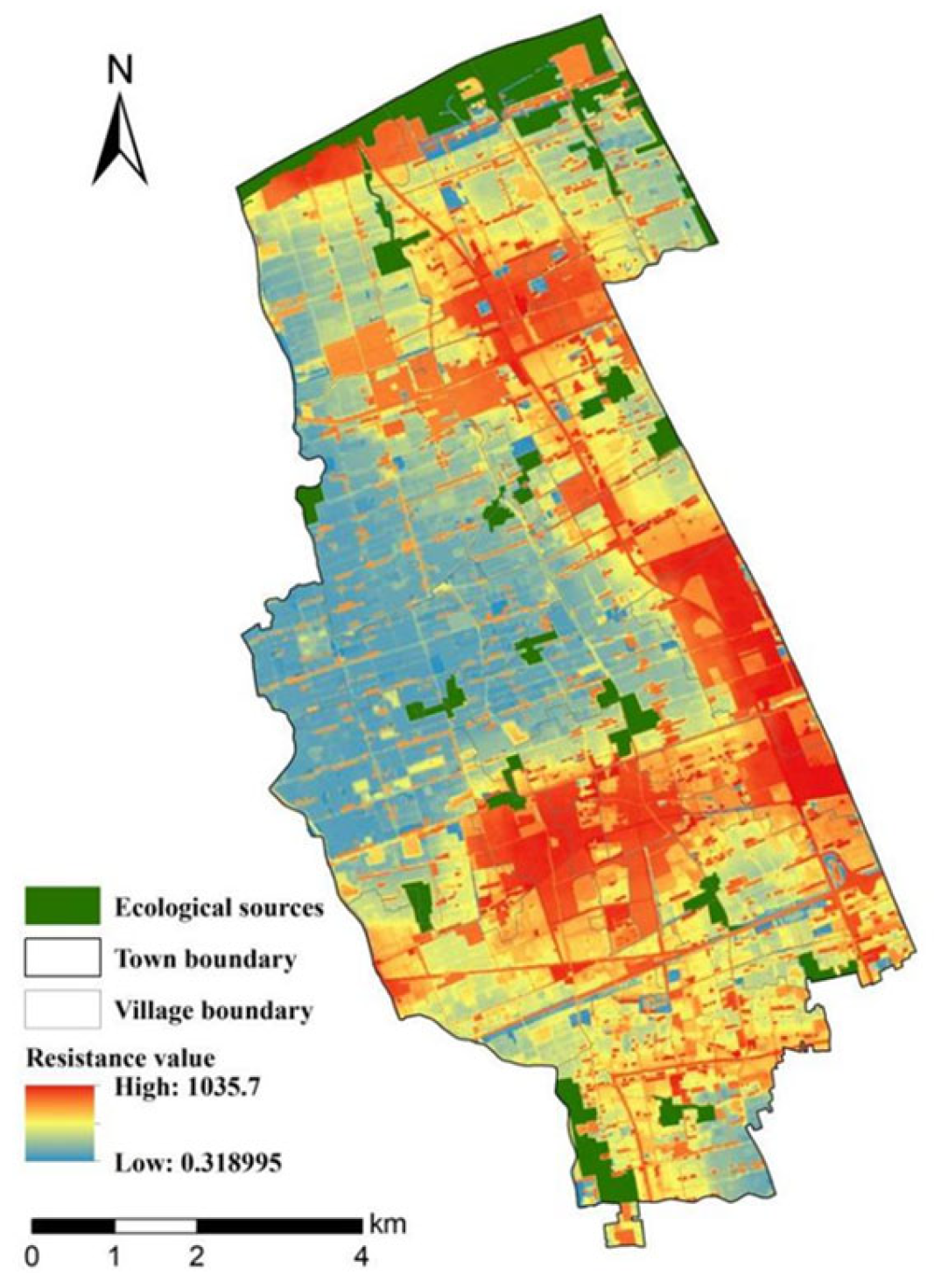
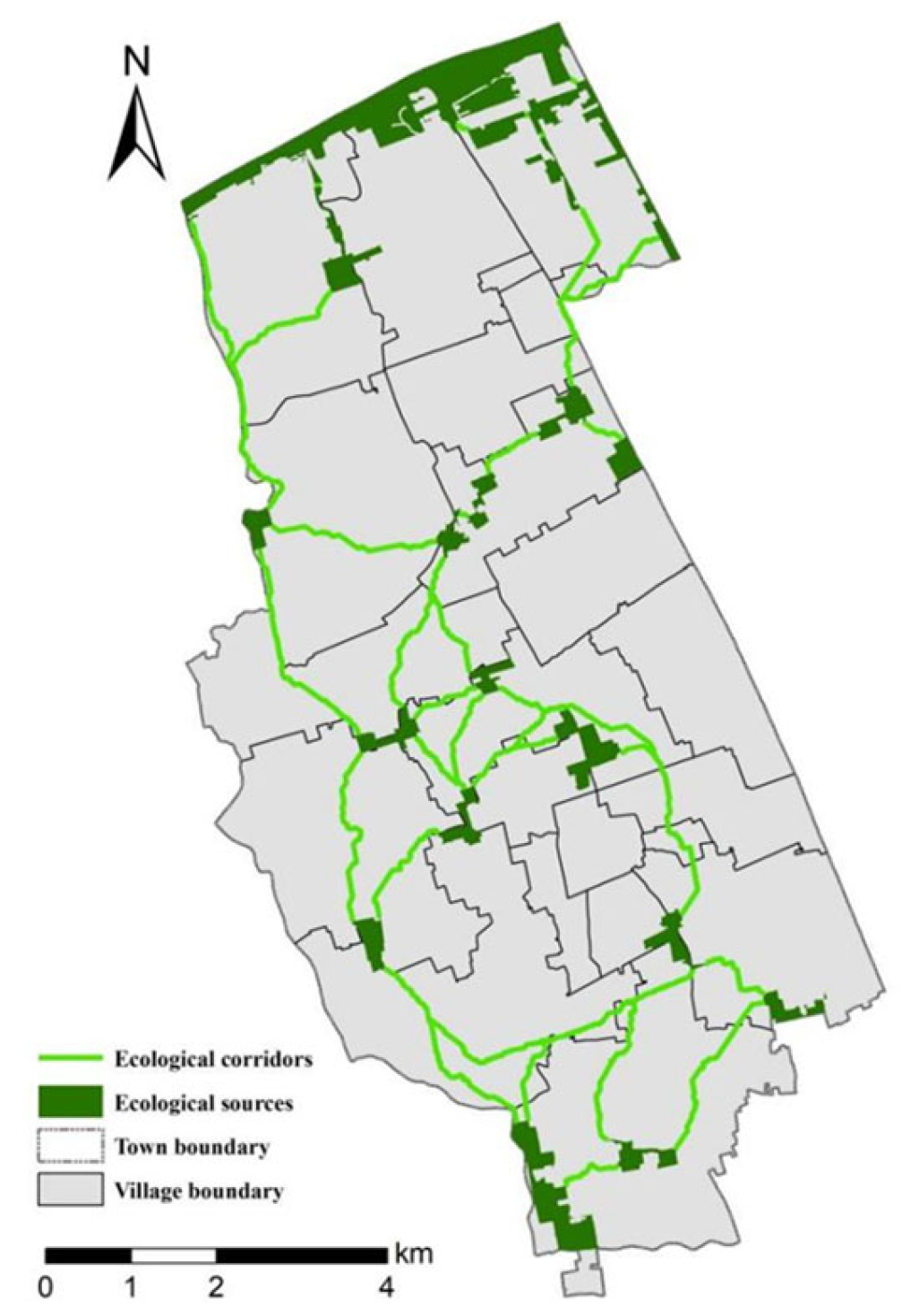
3.1.2. Resistance Surface Construction and Ecological Corridor Analysis
3.2. Identification of Priority Areas for Ecological Restoration
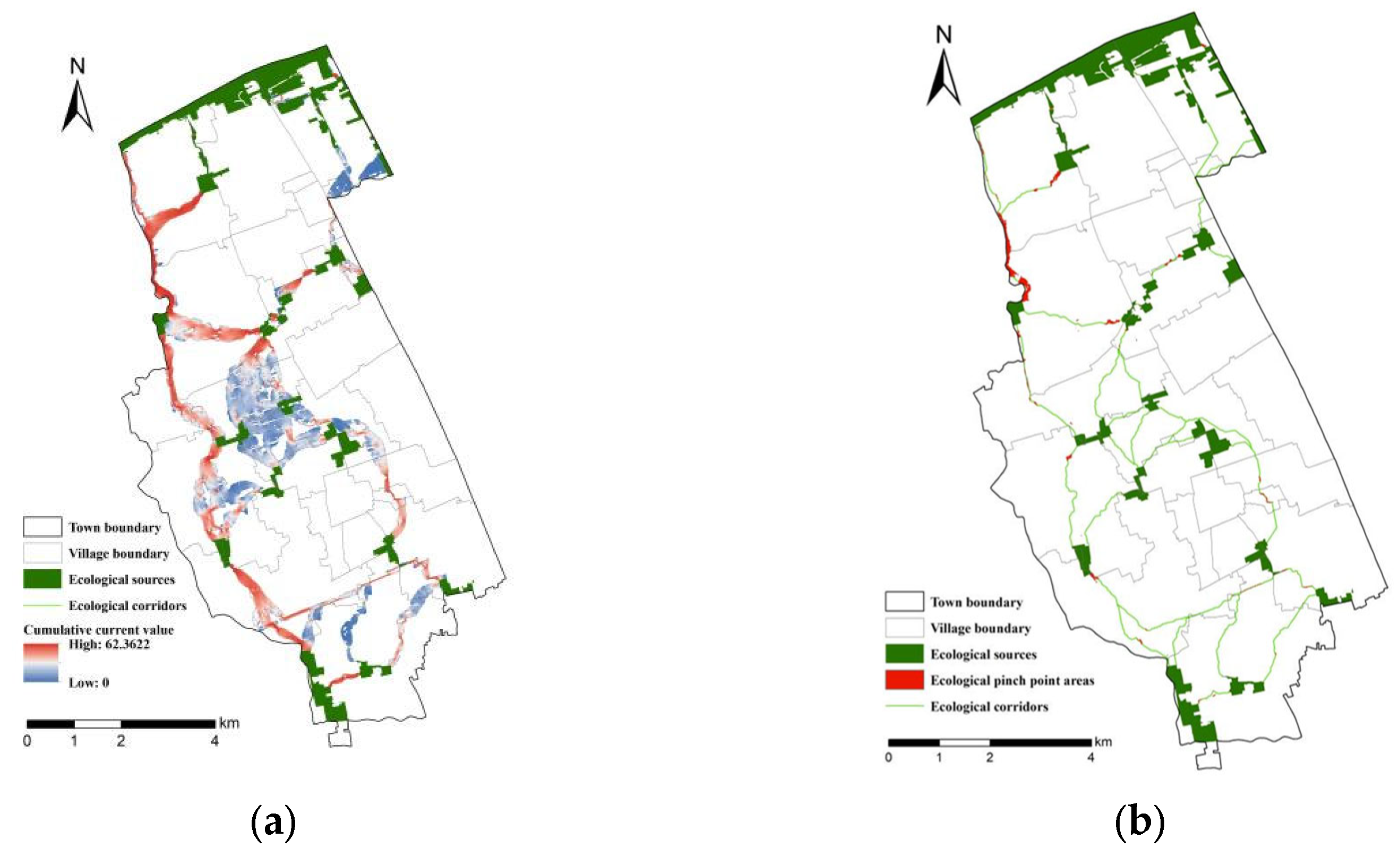
3.2.1. Identification of Ecological Pinch Points
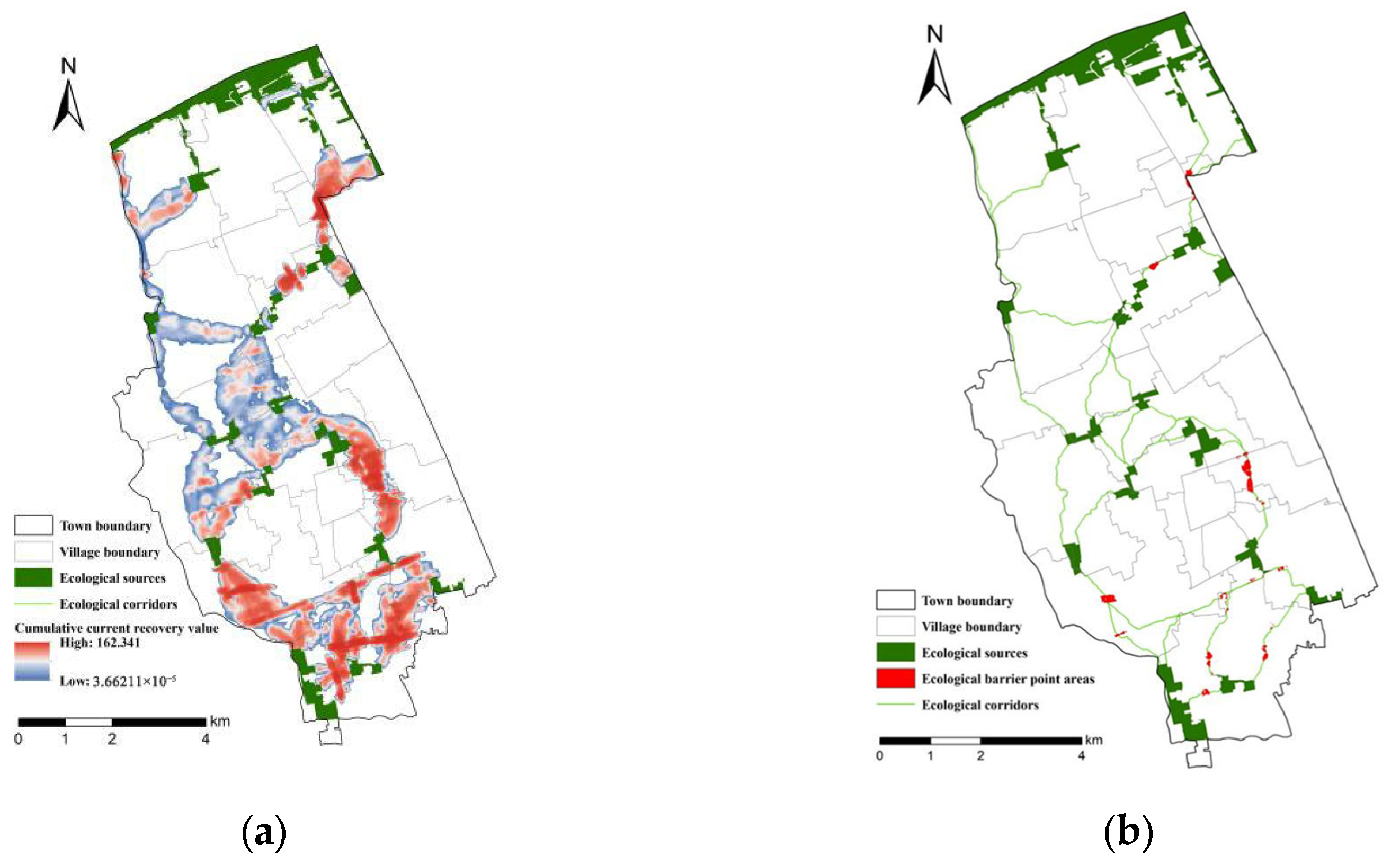
3.2.2. Identification of Ecological Barrier Points
4. Discussion
4.1. Rationality and Scientific Basis of Methods for Constructing the ESP and Identifying Priority Areas for Ecological Restoration
4.2. Implications for Territorial Spatial Ecological Restoration
4.3. Limitations and Future Research Directions
5. Conclusions
Author Contributions
Funding
Data Availability Statement
Acknowledgments
Conflicts of Interest
References
- Li, Y.; Wei, M.; Zhou, R.; Jin, H.; Chen, Y.; Hong, C.; Duan, W.; Li, Q. Identifying priority restoration areas based on ecological security pattern: Implications for ecological restoration planning. Ecol. Indic. 2025, 174, 113486. [Google Scholar] [CrossRef] [Scilit]
- Liu, D.; Zhou, R.; Ma, Q.; He, T.; Fang, X.; Xiao, L.; Hu, Y.; Li, J.; Shao, L.; Gao, J. Spatio-temporal patterns and population exposure risks of urban heat island in megacity Shanghai, China. Sustain. Cities Soc. 2024, 108, 105500. [Google Scholar] [CrossRef] [Scilit]
- Zhang, Y.; Zhou, R.; Lv, X.; Ma, Q.; Li, Y.; Li, C.; Fang, X.; Li, J.; Zhang, Z.; Fang, S. Quantifying the impacts of blue-green spaces on population exposure to heatwaves across climate zones. Landsc. Ecol. 2025, 40, 205. [Google Scholar] [CrossRef] [Scilit]
- Yang, M.; Wang, Z.; Zhang, Z.; Chen, P.; Zhao, D.; Cheng, E.; Wang, C.; Yan, Y. Pathways for ecological restoration of territorial space based on ecosystem integrity: A case study of approach to protecting and restoring mountains, rivers, forests, farmlands, lakes, and grasslands in Beijing, China. Ecol. Front. 2024, 44, 1214–1223. [Google Scholar] [CrossRef] [Scilit]
- Chen, W.; Gu, T.; Xiang, J.; Luo, T.; Zeng, J.; Yuan, Y. Ecological restoration zoning of territorial space in china: An ecosystem health perspective. J. Environ. Manag. 2024, 364, 14. [Google Scholar] [CrossRef] [Scilit]
- Fang, Y.; Wang, J.; Huang, L.; Zhai, T. Determining and identifying key areas of ecosystem preservation and restoration for territorial spatial planning based on ecological security patterns: A case study of Yantai city. J. Nat. Resour. 2020, 35, 190–203. [Google Scholar] [CrossRef] [Scilit]
- Niu, X.; Zhang, J.; Wang, S.; Zong, L.; Zhou, M.; Zhang, M. Identification of priority areas for ecological restoration based on ecological security patterns and ecological risks: A case study of the Hefei Metropolitan Area. Ecol. Indic. 2025, 175, 113590. [Google Scholar] [CrossRef] [Scilit]
- Wang, Y.; Peng, J.; Yang, Z.; Liu, X.; Wang, Y. Towards regional sustainability under adaptive ecological restoration and urbanization in Shanxi Province, China: From priority areas to critical battles. Environ. Impact Assess. Rev. 2026, 116, 108073. [Google Scholar] [CrossRef] [Scilit]
- Peng, J.; Xu, D.; Tang, H.; Jiang, H.; Dong, J.; Wu, J. A landscape ecological approach to spatial conservation planning–ecological security pattern. Trends Ecol. Evol. 2025, 40, 1010–1022. [Google Scholar] [CrossRef] [Scilit]
- Yuan, M.; Xian, Q.; Huang, Q.; Yang, C.; Shu, J.; Yao, C.; Pan, H. Research on ecological security pattern based on the paradigm of “portray-assessment-construction-validation”–Minjiang River Basin as an example. J. Environ. Manag. 2025, 394, 127553. [Google Scholar] [CrossRef] [Scilit]
- Yuan, Q.; Li, R. Priority conservation zoning for future karst areas based on the construction of a multi-perspective ecological security pattern. Ecol. Indic. 2025, 178, 113941. [Google Scholar] [CrossRef] [Scilit]
- Yang, D.; Gao, Y.; Chen, J.; Li, X.; Li, Z.; Shen, L.; Yang, C. Optimizing regional ecological security patterns based on interpretable machine learning models: A case study of Huzhou, Zhejiang Province. J. Environ. Manag. 2025, 393, 126905. [Google Scholar] [CrossRef] [Scilit] [PubMed]
- Peng, J.; Zhao, H.; Liu, Y.; Wu, J. Research progress and prospect on regional ecological security pattern construction. Geogr. Res. 2017, 36, 407–419. [Google Scholar] [CrossRef]
- Wang, L.; Li, Z.; Wang, D.; Chen, J.; Liu, Y.; Nie, X.; Zhang, Y.; Ning, K.; Hu, X. Unbalanced social-ecological development within the Dongting Lake basin: Inspiration from evaluation of ecological restoration projects. J. Clean. Prod. 2021, 315, 128161. [Google Scholar] [CrossRef] [Scilit]
- Li, J.; Liang, L.E.; Chao, Y.; Wang, X.; Qiu, M.; Luo, P.; Zhu, Y. Construction of the ecological security pattern of Mu Us sandy land on the basis of the “Source – Resistance − Corridor” theory. Ecol. Indic. 2025, 171, 113162. [Google Scholar] [CrossRef] [Scilit]
- Guo, J.; Feng, P.; Xue, H.; Xue, S.; Fan, L. A framework of ecological security patterns in arid and semi-arid regions considering differences socioeconomic scenarios in ecological risk: Case of Loess Plateau, China. J. Environ. Manag. 2025, 373, 123923. [Google Scholar] [CrossRef] [Scilit]
- McClure, M.L.; Hansen, A.J.; Inman, R.M. Connecting models to movements: Testing connectivity model predictions against empirical migration and dispersal data. Landsc. Ecol. 2016, 31, 1419–1432. [Google Scholar] [CrossRef] [Scilit]
- Meng, J.; Wang, Y.; Wang, X.; Zhou, Z.; Sun, N. Construction of landscape ecological security pattern in Guiyang Basin on MCR model. Resour. Environ. Yangtze Basin 2016, 25, 1052–1061. [Google Scholar] [CrossRef]
- Zhou, L.; Qin, Y.; Cheng, J.; Zhu, H.; Li, M.; Zhang, J.; LeBleu, C.; Shen, G.; Chen, T.; Liu, Y. Urban ecosystem services, ecological security patterns and ecological resilience in coastal cities: The impact of land reclamation in Macao SAR. J. Environ. Manag. 2025, 373, 123750. [Google Scholar] [CrossRef] [Scilit]
- Wu, Q.; Cao, Y.; Zhang, Y.; Su, D.; Fang, X. Linking ecosystem services trade-offs, human preferences and future scenario simulations to ecological security patterns: A novel methodology for reconciling conflicting ecological functions. Appl. Geogr. 2025, 176, 103534. [Google Scholar] [CrossRef] [Scilit]
- Wu, W.; Zheng, T. Establishing a” dynamic two-step floating catchment area method” to assess the accessibility of urban green space in Shenyang based on dynamic population data and multiple modes of transportation. Urban For. Urban Green. 2023, 82, 127893. [Google Scholar] [CrossRef] [Scilit]
- Chen, X.; Kang, B.; Li, M.; Du, Z.; Zhang, L.; Li, H. Identification of priority areas for territorial ecological conservation and restoration based on ecological networks: A case study of Tianjin City, China. Ecol. Indic. 2023, 146, 109809. [Google Scholar] [CrossRef] [Scilit]
- Wang, Y.; Li, J.; Gu, K.; Lu, L. Optimization of urban green infrastructure network layout based on MSPA-CIRCUIT: Case of Hefei. Chin. Acta Ecol. Sin. 2022, 42, 2022–2032. [Google Scholar] [CrossRef] [Scilit]
- Zhang, L.; Wan, Y.; Sun, Y.; He, G.; Lei, X.; Wei, X.; Jin, G. Optimizing ecological security patterns in a megacity by enhancing urban-rural connectivity: Insights from Wuhan, China. Appl. Geogr. 2025, 176, 103535. [Google Scholar] [CrossRef] [Scilit]
- Li, Q.; Zhou, Y.; Yi, S. An integrated approach to constructing ecological security patterns and identifying ecological restoration and protection areas: A case study of Jingmen, China. Ecol. Indic. 2022, 137, 108723. [Google Scholar] [CrossRef] [Scilit]
- Lu, Y.; Cheng, Q.; Wang, M. Construction and evaluation of the Panjin wetland ecological network based on the minimum cumulative resistance model. Ecol. Model. 2025, 505, 111118. [Google Scholar] [CrossRef] [Scilit]
- Peng, J.; Zhao, S.; Dong, J.; Liu, Y.; Meersmans, J.; Li, H.; Wu, J. Applying ant colony algorithm to identify ecological security patterns in megacities. Environ. Model. Softw. 2019, 117, 214–222. [Google Scholar] [CrossRef] [Scilit]
- Pan, J.; Liang, J.; Zhao, C. Identification and optimization of ecological security pattern in arid inland basin based on ordered weighted average and ant colony algorithm: A case study of Shule River basin, NW China. Ecol. Indic. 2023, 154, 110588. [Google Scholar] [CrossRef] [Scilit]
- Li, Y.; Wang, S.; Zhang, S.; Wei, M.; Chen, Y.; Huang, X.; Zhou, R. The creation of multi-level urban ecological cooling network to alleviate the urban heat island effect. Sustain. Cities Soc. 2024, 114, 105786. [Google Scholar] [CrossRef] [Scilit]
- Zhang, L.; Liu, Q.; Wang, J.; Wu, T.; Li, M. Constructing ecological security patterns using remote sensing ecological index and circuit theory: A case study of the Changchun-Jilin-Tumen region. J. Environ. Manag. 2025, 373, 123693. [Google Scholar] [CrossRef] [Scilit]
- Huang, L.; Chen, Z.; Yang, Z.; Chen, M.; Chen, X.; Zhai, T.; Qiu, T. Integrating “quality-risk-demand” framework and circuit theory to identify spatial range and priority area of ecological security pattern in a rapidly urbanizing landscape. Ecol. Inform. 2024, 82, 102673. [Google Scholar] [CrossRef] [Scilit]
- Ran, Y.; Lei, D.; Li, J.; Gao, L.; Mo, J.; Liu, X. Identification of crucial areas of territorial ecological restoration based on ecological security pattern: A case study of the central Yunnan urban agglomeration, China. Ecol. Indic. 2022, 143, 109318. [Google Scholar] [CrossRef] [Scilit]
- McRae, B.H.; Beier, P. Circuit theory predicts gene flow in plant and animal populations. Proc. Natl. Acad. Sci. USA 2007, 104, 19885–19890. [Google Scholar] [CrossRef] [Scilit] [PubMed]
- McRae, B.H.; Dickson, B.G.; Keitt, T.H.; Shah, V.B. Using circuit theory to model connectivity in ecological, evolution, and conservation. Ecology 2008, 89, 2712–2724. [Google Scholar] [CrossRef] [Scilit]
- Wang, Y.; Pan, J. Building ecological security patterns based on ecosystem services value reconstruction in an arid inland basin: A case study in Ganzhou District, NW China. J. Clean. Prod. 2019, 241, 118337. [Google Scholar] [CrossRef] [Scilit]
- Liu, H.; Wang, Z.; Zhang, L.; Tang, F.; Wang, G.; Li, M. Construction of an ecological security network in the Fenhe River Basin and its temporal and spatial evolution characteristics. J. Clean. Prod. 2023, 417, 137961. [Google Scholar] [CrossRef] [Scilit]
- Zeng, W.; Tang, H.; Liang, X.; Hu, Z.; Yang, Z.; Guan, Q. Using ecological security pattern to identify priority protected areas: A case study in the Wuhan Metropolitan Area, China. Ecol. Indic. 2023, 148, 110121. [Google Scholar] [CrossRef] [Scilit]
- Xu, X.; Yang, X.; Lin, L.; Zhang, J.; Shao, J.; Zhi, R.; Feng, T.; Wang, Z.; Tang, Y.; Li, J. Ecological security patterns for coordinating development in frozen soil regions-construction framework by coupling climate change and development objectives. J. Environ. Manag. 2025, 391, 126543. [Google Scholar] [CrossRef] [Scilit]
- Wang, C.; Wang, S.; Qi, B.; Jiang, C.; Sun, W.; Cao, Y.; Li, Y. Trade-Offs, Synergies, and Driving Factors of Ecosystem Services in the Urban–Rural Fringe of Beijing at Multiple Scales. Land 2025, 14, 1009. [Google Scholar] [CrossRef] [Scilit]
- Fang, J.; Xu, L.; Lu, Q. Ecological Security Patterns of Chinese Lakes Based on Ecosystem Service Values Assessment and Human Threat Factors Evaluation. Ecol. Inform. 2024, 82, 102754. [Google Scholar] [CrossRef] [Scilit]
- Chen, S.; Jin, Y.; Huang, Y. Spatio-temporal variation of habitat quality and its underlying mechanism in the central region of Yangtze River Delta. Chin. J. Ecol. 2023, 42, 1175–1185. [Google Scholar] [CrossRef]
- Xu, X.; Yang, G.; Tan, Y.; Liu, J.; Hu, H. Ecosystem services trade-offs and determinants in China’s Yangtze River Economic Belt from 2000 to 2015. Sci. Total Environ. 2018, 634, 1601–1614. [Google Scholar] [CrossRef] [Scilit] [PubMed]
- Ding, Y.; Wang, L.; Gui, F. Ecosystem Carbon Storage in Hangzhou Bay Area Based on InVEST and PLUS Models. Environ. Sci. 2023, 44, 3343–3352. [Google Scholar] [CrossRef] [Scilit]
- Sun, X.; Xue, J.; Dong, L. Spatiotemporal Change and Prediction of Carbon Storage in Nanjing Ecosystem Based on PLUS Model and InVEST Mode. J. Ecol. Rural Environ. 2023, 39, 41–51. [Google Scholar] [CrossRef]
- Zhang, F.; Jia, Y.; Liu, X.; Li, T.; Gao, Q. Application of MSPA-MCR models to construct ecological security pattern in the basin: A case study of Dawen River basin. Ecol. Indic. 2024, 160, 111887. [Google Scholar] [CrossRef] [Scilit]
- Wei, Q.; Halike, A.; Yao, K.; Chen, L.; Balati, M. Construction and optimization of ecological security pattern in Ebinur Lake Basin based on MSPA-MCR models. Ecol. Indic. 2022, 138, 108857. [Google Scholar] [CrossRef] [Scilit]
- Jiang, H.; Peng, J.; Xu, D.; Tang, H. Constructing ecological security patterns with differentiated management intensity based on multifunctional landscape identification and multi-criteria decision-making. Glob. Ecol. Conserv. 2024, 50, e02862. [Google Scholar] [CrossRef] [Scilit]
- Wang, Z.; Luo, K.; Zhao, Y.; Lechner, A.M.; Wu, J.; Zhu, Q.; Sha, W.; Wang, Y. Modelling regional ecological security pattern and restoration priorities after long-term intensive open-pit coal mining. Sci. Total Environ. 2022, 835, 155491. [Google Scholar] [CrossRef] [Scilit]
- Li, L.; Huang, X.; Wu, D.; Yang, H. Construction of ecological security pattern adapting to future land use change in Pearl River Delta, China. Appl. Geogr. 2023, 154, 102946. [Google Scholar] [CrossRef] [Scilit]
- Wei, B.; Kasimu, A.; Fang, C.; Reheman, R.; Zhang, X.; Han, F.; Zhao, Y.; Aizizi, Y. Establishing and optimizing the ecological security pattern of the urban agglomeration in arid regions of China. J. Clean. Prod. 2023, 427, 139301. [Google Scholar] [CrossRef] [Scilit]
- Li, S.; Chen, Y.; Li, S.; Peng, W. Resilience-based optimization of ecological security patterns in a typical restoration region: A case study of Yanchi County, Ningxia. Ecol. Eng. 2025, 219, 107688. [Google Scholar] [CrossRef] [Scilit]
- Li, Y.; Liu, W.; Feng, Q.; Zhu, M.; Yang, L.; Zhang, J.; Yin, X. The role of land use change in affecting ecosystem services and the ecological security pattern of the Hexi Regions, Northwest China. Sci. Total Environ. 2023, 855, 158940. [Google Scholar] [CrossRef] [Scilit] [PubMed]
- Jiao, Z.; Wu, Z.; Wei, B.; Luo, Y.; Lin, Y.; Xue, Y.; Li, S.; Gao, F. Introducing big data to measure the spatial heterogeneity of human activities for optimizing the ecological security pattern: A case study from Guangzhou City, China. Ecol. Indic. 2023, 150, 110203. [Google Scholar] [CrossRef] [Scilit]
- Ding, T.; Chen, J.; Fang, L.; Ji, J. Identifying and optimizing ecological security patterns from the perspective of the water-energy-food nexus. J. Hydrol. 2024, 632, 130912. [Google Scholar] [CrossRef] [Scilit]
- He, H.; Yu, X.; Yu, H.; Ma, Z.; Luo, Y.; Liu, T.; Rong, Z.; Xu, J.; Chen, D.; Li, P.; et al. Suitable habitat evaluation and ecological security pattern optimization for the ecological restoration of Giant Panda habitat based on nonstationary factors and MCR model. Ecol. Model. 2024, 494, 110760. [Google Scholar] [CrossRef] [Scilit]
- Luo, P.; Song, Y.; Hsu, W.L. Integrating Ecosystem Services and Key Species Distribution to Construct a Sustainable Ecological Security Pattern in a Plateau Urban Agglomeration. Sustainability 2025, 17, 9670. [Google Scholar] [CrossRef] [Scilit]
- Li, H.; Li, D.; Li, T.; Qiao, Q.; Yang, J.; Zhang, H. Application of least-cost path model to identify a giant panda dispersal corridor network after the Wenchuan earthquake—Case study of Wolong Nature Reserve in China. Ecol. Model. 2020, 221, 944–952. [Google Scholar] [CrossRef] [Scilit]
- Fan, F.; Wen, X.; Feng, Z.; Gao, Y.; Li, W. Optimizing urban ecological space based on the scenario of ecological security patterns: The case of central Wuhan, China. Appl. Geogr. 2022, 138, 102619. [Google Scholar] [CrossRef] [Scilit]



| Resistance Factor | Resistance Coefficient | ||||||
|---|---|---|---|---|---|---|---|
| 1 | 10 | 20 | 30 | 50 | 100 | 300 | |
| Land use types | Forest land | Grassland | Garden plot | Farmland | Water body | Other construction Land | Urban construction Land, Rural construction Land |
| NDVI | [0.411, 1] | [0.349, 0.411] | [0.273, 0.349] | [0.192, 0.273] | [0.109, 0.192] | [−0.005, 0.109] | [−1, −0.005] |
Disclaimer/Publisher’s Note: The statements, opinions and data contained in all publications are solely those of the individual author(s) and contributor(s) and not of MDPI and/or the editor(s). MDPI and/or the editor(s) disclaim responsibility for any injury to people or property resulting from any ideas, methods, instructions or products referred to in the content. |
© 2026 by the authors. Licensee MDPI, Basel, Switzerland. This article is an open access article distributed under the terms and conditions of the Creative Commons Attribution (CC BY) license.
Share and Cite
Zhou, T.; Li, Y.; Zhang, Y.; Lin, L.; Zhou, R.; Ma, A.; Chen, J. Identification of Township-Scale Ecological Restoration Priority Areas Based on Ecological Security Pattern and Multi-Method Integration. Land 2026, 15, 274. https://doi.org/10.3390/land15020274
Zhou T, Li Y, Zhang Y, Lin L, Zhou R, Ma A, Chen J. Identification of Township-Scale Ecological Restoration Priority Areas Based on Ecological Security Pattern and Multi-Method Integration. Land. 2026; 15(2):274. https://doi.org/10.3390/land15020274
Chicago/Turabian StyleZhou, Tingyun, Yutong Li, Yu Zhang, Lushuang Lin, Rui Zhou, Aimin Ma, and Junying Chen. 2026. "Identification of Township-Scale Ecological Restoration Priority Areas Based on Ecological Security Pattern and Multi-Method Integration" Land 15, no. 2: 274. https://doi.org/10.3390/land15020274
APA StyleZhou, T., Li, Y., Zhang, Y., Lin, L., Zhou, R., Ma, A., & Chen, J. (2026). Identification of Township-Scale Ecological Restoration Priority Areas Based on Ecological Security Pattern and Multi-Method Integration. Land, 15(2), 274. https://doi.org/10.3390/land15020274