1. Introduction
Urban crises are increasingly recognized not as isolated shocks but as complex, interwoven disruptions that unfold across spatial, temporal, and institutional boundaries. In this paper, the term urban crises refers to situations in which disruptions to infrastructures, services, and governance arrangements significantly threaten the functioning, liveability, or equity of urban areas, often under conditions of uncertainty and time pressure. From pandemics to energy shortages and environmental hazards, cities are facing what scholars have described as “compound crises” [
1,
2] that not only occur simultaneously or sequentially but are interconnected in ways that amplify vulnerabilities within urban systems. Yet despite growing recognition of such systemic risks, spatial planning and disaster risk management policies remain largely place-based and sector-specific, often failing to account for the cascading, cross-border, and cross-sectoral effects that characterize contemporary urban crises [
3,
4,
5]. These interactions can overwhelm local response capacities and expose the fragility of infrastructures and essential services that were long taken for granted, such as electricity supply, public transport, or social services. A comprehensive spatial analysis of accessibility patterns and disruption impacts related to these dynamics has been presented in a companion empirical paper [
6]. Building on that foundation, this article focuses on the methodological contribution of cascading effects analysis and its implications for planning and crisis governance.
The COVID-19 pandemic offers a powerful example of such a compound crisis. While it emerged as a public health emergency, the ripple effects were felt across nearly all facets of urban life [
7]. In many cases, the pandemic response measures intersected with other structural challenges, such as social inequality, chronic underinvestment in infrastructure, and prior crises, both acute and slow-burning [
8]. These effects were rarely confined to one policy field or one type of infrastructure; rather, the intersections revealed how essential services like healthcare, education, childcare, social services, and food systems are deeply interdependent and highly sensitive to disruptions in other sectors.
The disruptions caused by pandemic containment strategies such as lockdowns, reduced public transportation, and physical distancing highlighted the cascading effects that emerge when one infrastructure system falters. The three case study cities examined in this paper, Cape Town (South Africa), Dortmund (Germany), and São Paulo (Brazil), illustrate how COVID-19 combined with other stressors to produce locally specific but structurally comparable compound crises. In Cape Town, a long-standing HIV and tuberculosis syndemic was further strained by energy insecurity and load shedding, which disrupted service delivery and everyday coping strategies [
9,
10]. In Dortmund, the economic impacts of COVID-19, such as job losses and reduced working hours, were aggravated by an energy price crisis in 2022 that was associated with gas supply disruptions and market volatility following the Russian–Ukrainian war, as well as European and national policy responses [
11], which further strained household budgets and municipal finances at a time when vulnerabilities were already heightened. In São Paulo, pandemic lockdowns coincided with a rise in gender-based violence in a context where femicides and domestic abuse were already among the highest globally [
12], revealing gaps in access to protective social services. These examples underscore the dimension of cascading effects and demonstrate how place-specific vulnerabilities intersect with systemic interdependencies, disproportionately affecting certain urban populations due to disruptions in essential services [
13,
14].
While much has been written about urban resilience, vulnerability, and crisis management, fewer studies have focused on methodological approaches capable of systematically visualizing and analyzing these complex interdependencies in ways that are usable for planning practice [
15,
16]. Traditional risk assessments tend to treat hazards and sectors separately, or focus on single infrastructures such as energy or water. By contrast, urban planners and crisis managers increasingly need tools that can reveal how disruptions in one domain, such as public transport, affect other services, reshape access to urban space, and deepen social inequality [
17,
18,
19]. Within spatial planning and urban governance, this often results in fragmented responsibilities and sectoral logics, in which transport, housing, health, and social services are planned and managed in parallel rather than as interdependent systems. In this sense, there is a growing demand for methods that explicitly support spatial planning and urban governance in understanding systemic risk, mapping interdependencies, and informing more integrated, place-sensitive interventions [
20,
21]. This paper addresses that gap by critically reflecting on the use of cascading effects analysis as a methodological framework for understanding and governing compound urban crises. It proposes the cascading effects model as a promising conceptual and practical tool for understanding and communicating compound urban crises. Traditionally used in engineering and disaster risk research, especially for physical infrastructures such as power grids and transport systems, cascading analysis is often underutilized in social infrastructure or equity-focused planning [
22]. In contrast to more formalized system dynamics models or multilayer network analyses [
3,
23], which typically rely on quantitative simulation and high data demands, the cascading effects approach used here employs qualitatively derived chains of consequences that are co-produced with practitioners. This makes it particularly suited as a low-threshold, dialogic tool for planning and governance contexts, where the goal is less to predict precise system behavior and more to map plausible pathways of disruption and vulnerability. Here, the approach is adapted and extended to the essential service infrastructures of healthcare, education, childcare, social work, and food systems, and to questions of social vulnerability and equity. Building on empirical work in Cape Town, Dortmund, and São Paulo, the paper examines how cascading effects diagrams can be used to map cross-sectoral interdependencies, make hidden risks visible, and support more integrated, crisis-aware planning.
The paper’s core contribution is methodological rather than purely theoretical. It asks how cascading effects analysis can be operationalized as a practical tool for:
Capturing the indirect and often invisible consequences of crisis responses on different population groups;
Supporting cross-sectoral dialog between actors in transport, health, education, social services, and planning;
Informing urban planning, land-use decisions, and crisis management strategies that aim to reduce vulnerability and strengthen resilience.
In doing so, the paper builds on previous empirical findings on COVID-19-related disruptions, but shifts the focus toward a critical reflection on what the method brings into view and what it leaves at the margins. Cascading diagrams necessarily stylize complex realities into linear chains of cause and effect, which can, for example, downplay non-linear feedbacks, contested responsibilities, and the ways in which gender, race, class, legal status, or place shape who appears as affected in the chain.
The paper addresses debates on how cities can prepare for and govern crises that span sectors, infrastructure, and territories; how access to essential services is spatially and socially differentiated; and how new assessment and visualization tools can assist in designing more resilient, equitable, and well-functioning urban environments. For urban planning and urban governance, these questions are central: they concern not only how land use and infrastructures are organized, but also how responsibilities, resources, and decision-making processes are coordinated across sectors and scales under conditions of uncertainty. By situating cascading effects analysis within these discussions, the paper proposes it as a promising component of a more expansive repertoire of methods that support integrated crisis governance, spatial planning, and the pursuit of social and territorial justice under conditions of uncertainty.
In summary, the main contribution of this research is to demonstrate how cascading effects analysis can be reworked as a qualitative, planning-oriented method that extends beyond technical critical infrastructures to include services of general interest and their socio-spatial interdependencies. The study is innovative in three respects: (i) it adapts a tool largely rooted in engineering and risk modeling for use in spatial planning and urban governance; (ii) it applies this approach comparatively across three highly different urban contexts, showing both shared patterns and place-specific configurations of compound crises; and (iii) it reflects critically on the strengths and limitations of cascading diagrams as boundary objects that can support cross-sectoral dialog, reveal hidden vulnerabilities, and inform more equitable crisis-responsive planning.
2. Conceptual and Theoretical Framework
This paper is situated at the intersection of critical infrastructure studies, disaster risk research, and urban crises governance, with a focus on cascading effects, interdependencies, and compound crises. It draws on an expanded understanding of criticality that moves beyond physical systems and emphasizes the social and spatial dimensions of infrastructure disruption [
24,
25]. The cascading effects framework helps better understand and analyze how disruptions in urban infrastructure can ripple across systems, creating complex, compounding crises. Cascading effects refer to chain reactions in which an initial disruption in one system triggers subsequent impacts in other interconnected sectors, services, or infrastructures, often across spatial and institutional boundaries [
5,
23]. This differs, e.g., from domino effects, which typically describe the spread of failure within a single infrastructure network [
3]. While the concept has its roots in disaster risk and critical infrastructure studies, where it is often used to model physical disruptions (e.g., a power outage affecting water supply), its utility for understanding urban crises more broadly remains underexplored. Recent policy shifts, such as the adoption of the CER Directive (EU/2022/2557), emphasize the importance of understanding interdependencies, systemic risk, and cross-sectoral disruptions, yet they remain focused mainly on physical infrastructures and operator-level assessments, with limited attention to the territorial and social dimensions of cascading effects [
26].
2.1. From Singular Shocks to Compound Crises
Urban crises are increasingly understood as compound rather than singular events: they are shaped by the interaction of multiple hazards, stressors, and vulnerabilities that unfold across spatial, temporal, and institutional boundaries. As Morin and Kern [
27] describe in their concept of polycrisis, the co-occurrence and entanglement of crises generate new, often unpredictable dynamics. Cascading effects analysis offers a way to trace how specific disruptions unfold across different domains and how vulnerabilities accumulate and intersect. It helps show interdependencies, identify weak points, and anticipate indirect consequences, which is essential when considering the disproportionate impacts of disruptions on marginalized communities.
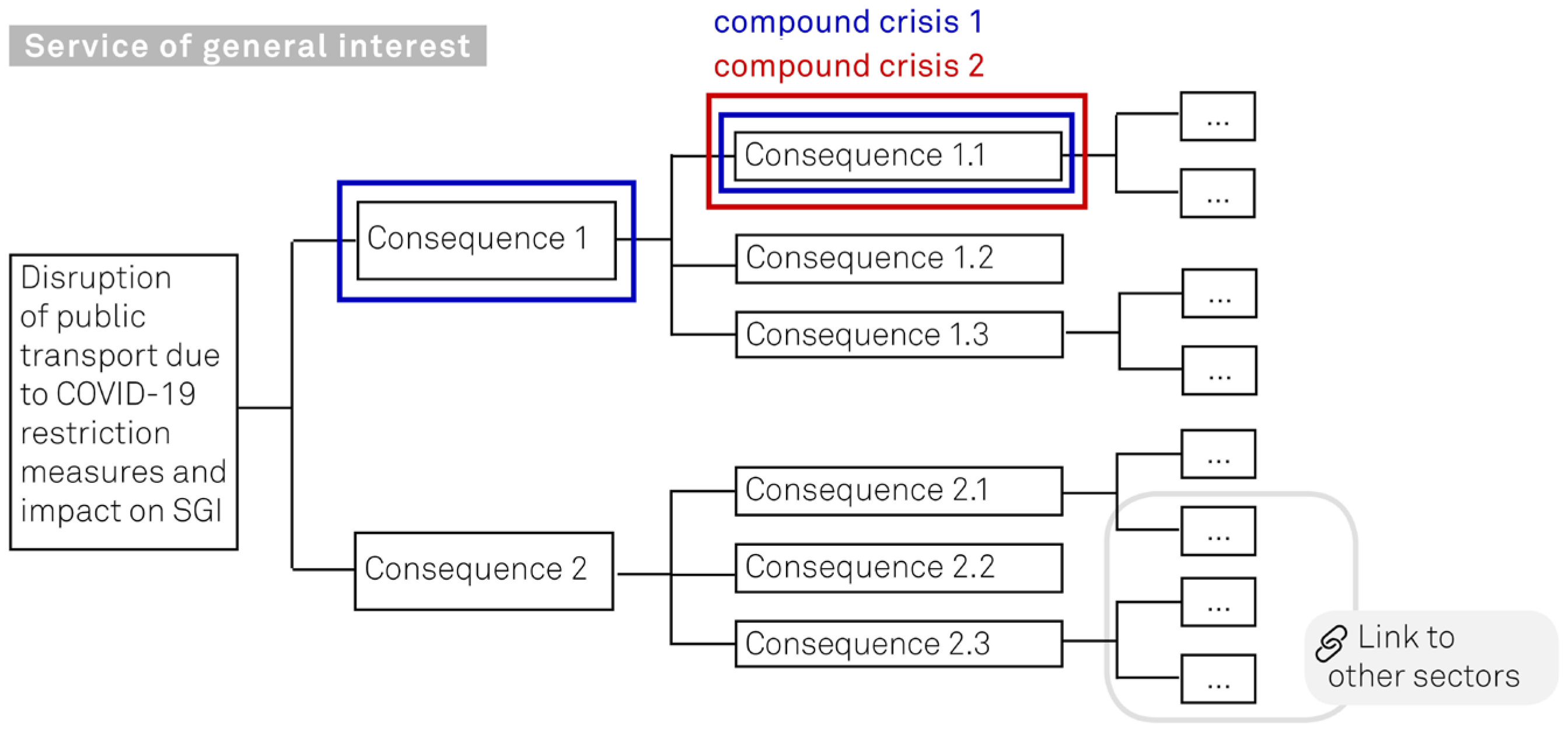
Figure 1 schematically illustrates the basic structure of the cascading effect chains used in the study. Each diagram is composed of three main types of elements: (i) an initial disruption node (e.g., reduction in public transport services); (ii) intermediate nodes describing sector-specific consequences for service provision and staff; and (iii) outcome nodes indicating impacts on different user groups (e.g., low-income households, migrants, people with chronic illnesses). Furthermore, compound effects can be visualized by highlighting the effects of multiple crises (see
Figure 1).
This is particularly evident in the COVID-19 pandemic, which triggered health, economic, social, and infrastructural disruptions, often simultaneously [
28,
29]. The compounding nature of these disruptions requires an approach that recognizes feedback loops and nonlinear effects.
One example is the disruption and sometimes even closure of public transport as one measure undertaken to prevent the spread of COVID-19. This not only affected mobility but also had cascading effects on the accessibility of multiple essential services. Rather than treating infrastructures as static, sectoral units, recent scholars have therefore emphasized their entanglement in socio-technical assemblages [
30,
31]. Infrastructure systems not only carry electricity, water, or people but also reproduce social orders, shape access to resources, and influence everyday life. Their failure, therefore, is not merely technical but also deeply social and political. These entanglements become even more evident when disruptions intersect with spatial inequalities, as seen in the differential access to services during COVID-19-related mobility restrictions. Such spatialized disruptions reveal the importance of mapping not just system nodes, but also the socio-spatial contexts in which cascading effects unfold [
6,
14].
2.2. Criticality and Cascading Effects in Infrastructure Systems
Traditionally, cascading effects and criticality assessments have been applied to technical infrastructures such as energy grids, ICT networks, and water supply systems. These infrastructures are considered critical because of their foundational role in maintaining societal functions, and their failure can result in widespread disruption. At the same time, disaster risk and social vulnerability research has shown that disruptions to essential services such as healthcare, education, childcare, social work, and food and nutrition systems can be equally decisive for how crises are experienced by different population groups [
22,
32,
33]. These sectors are vital to individual and collective well-being, especially for marginalized groups, yet they are often underrepresented in traditional infrastructure assessments. As Fekete [
34] and Boin and Rhinard [
35] argue, the relative importance of infrastructure lies in its systemic position and the consequences of its disruption for society.
Essential service infrastructures—while they are place-based—are not purely infrastructures in the physical sense, but they rely on and are embedded in networks of facilities, staff, funding flows, regulatory frameworks, and technical support. They also differ from technical critical infrastructures in that they are often experienced directly by users and are embedded in social and institutional practices [
30]. A school, a clinic, or a food assistance center is not only a facility reliant on electricity or water but a space of social interaction, care, and support [
36]. While such infrastructures depend on technical systems to operate, they also form their own interconnected systems with unique vulnerabilities. When such facilities are closed, reduced, or made inaccessible, the effects spill over into multiple dimensions of everyday life: learning, nutrition, safety, mental health, and social inclusion. For example, a disruption in public transport does not just delay travel; it may prevent a child from accessing school meals or a patient from receiving time-sensitive care. These effects are not peripheral but central to understanding how infrastructure failures impact livelihoods. In this sense, cascading effects are not just technical chains but are embedded in socio-spatial contexts. Infrastructure systems must be understood as relational and embedded within specific urban settings. Their failure disproportionately affects those already facing precarity, compounding existing inequalities [
28,
37,
38,
39].
By bringing essential service infrastructures into the picture, cascading effects analysis is repositioned as a method that links technical systems (transport, energy, ICT) with social infrastructures and land-based service provision. This helps illuminate how crises unfold across urban space and how access to services is differentiated between neighborhoods, social groups, and cities.
2.3. Relational Perspectives and Complexity: Background Orientation
Conceptually, the approach taken here is broadly informed by relational and complexity-oriented perspectives in urban and infrastructure studies, but its main contribution is methodological rather than theoretical. Relational views of infrastructure, such as assemblage thinking or socio-technical network perspectives, emphasize that systems are not isolated technical assets but socio-technical networks composed of material elements, institutions, practices, and users [
40,
41]. In addition, basic insight is drawn from complexity-oriented approaches, which draw attention to nonlinearity, emergent behavior, and the difficulty of predicting how interventions in one part of a system will play out elsewhere [
42,
43]. Complexity theory helps illuminate the nonlinearity and unpredictability of compound urban crises. This lens underlines the need for adaptive, reflexive approaches to planning and crisis governance that can respond to emergent dynamics and shifting interdependencies [
44,
45].
In practical terms, this orientation informed the construction and reading of the cascading diagrams by allowing for branching chains, multiple endpoints, and context-dependent pathways, rather than assuming a single linear progression. The diagrams are therefore treated as maps of plausible interactions rather than predictive models.
2.4. Methodological Implications
Against this backdrop, cascading effects analysis is employed in this study as a concrete methodological tool to explore and communicate the interdependencies that shape compound urban crises. The approach builds on and adapts techniques from critical infrastructure analysis and disaster risk research, but applies them to a broader set of systems and questions:
It maps chains of disruption across technical and essential service infrastructures,
it links these chains to specific groups, locations and services,
and it visualizes them in diagram form to facilitate discussion among researchers, practitioners and decision-makers.
In doing so, the method supports a shift from sectoral and hazard-specific assessments towards a more integrated understanding of how crises affect urban systems and populations. It offers a way to:
identify overlooked or underestimated impacts (blind spots),
reveal where multiple crises interact or reinforce one another,
and highlight potential points of intervention where cascading effects could be mitigated or interrupted.
The following sections detail how this methodological framework was operationalized in the three case study cities and how it can contribute to ongoing debates on urban planning and crisis governance. If resilience is to be built, it must be informed by recognizing how services of general interest interact with technical systems and everyday life. Planners, policymakers, and researchers must adopt tools that capture these interdependencies, moving beyond siloed assessments and toward more integrated, equity-centered approaches. This also suggests a broader research agenda of developing cascading analysis frameworks that move beyond criticality as a technical designation and instead ask where, for whom, and under what conditions disruptions matter most.
3. Materials and Methodological Approach: Cascading Effects as an Integrative Framework
This paper builds on a previously published empirical study that explored the cascading effects of public transport disruptions on access to services of general interest during the COVID-19 pandemic in three urban case study areas: Cape Town, South Africa, Dortmund, Germany, and São Paulo, Brazil. The study focused on the indirect impacts of mobility restrictions on marginalized communities, particularly in relation to five essential service sectors of healthcare, food and nutrition, education, childcare, and social work. A detailed account of the methodology, case selection, and data collection strategies is provided in the initial publication [
6], and is only briefly summarized here in order to foreground the present paper’s focus on methodological reflection and the added value of cascading effects analysis for urban crisis planning and resilience debates.
The core methodological tool used in the study was the development of cascading effects diagrams, which are visual representations that trace the indirect, often unforeseen consequences of disruptions in one sector across other interlinked systems [
6]. The construction of these diagrams followed an iterative, three-step process that combined literature review, expert interviews, and validation workshops. First, draft chains were developed based on a comprehensive literature review of academic and gray literature on COVID-19, infrastructure disruptions, and inequalities in the three case study contexts. Second, semi-structured expert interviews were conducted to ground and refine these chains. Experts were selected for their professional knowledge and practical experience in public service delivery across the five sectors, and represented a range of perspectives from academia, public administration, non-governmental organizations, and practice-based institutions. Interview data were thematically coded around disruptions, affected groups, and perceived interdependencies. These coded segments were then translated into causal links in the diagrams (e.g., “reduced public transport supply → missed medical appointments → worsening of chronic conditions”). The interviews were guided by a systemic criticality lens, encouraging participants to reflect on how other infrastructures might affect or affected disruptions in their own field. In this way, cascading effects analysis functioned as an integrative framework that structured data collection and interpretation across sectors and cities, rather than as a purely conceptual device.
To validate and refine the draft diagrams, participatory workshops were conducted in each of the three cities. In these sessions, experts were placed in interdisciplinary working groups and invited to critically engage with the diagrams by questioning plausibility, identifying temporal and spatial dynamics, and adding missing links. For each city, approximately fifty experts were invited (with at least ten invitations per sector); the resulting workshops comprised around ten participants, typically two per sector, with an overall composition of roughly 40% practice/administration, 40% academia, and 20% local NGOs. This inevitably introduced elements of self-selection, as participation depended on interest and availability, particularly for resource-constrained actors such as social workers or NGO staff. To mitigate this bias, individual follow-up interviews were conducted with some of these actors who could not attend the workshops, and their insights were subsequently integrated into the diagrams. This collaborative and deliberative process allowed the diagrams to evolve into a more robust representation of shared systemic knowledge.
Importantly, the diagrams did not aim to quantify or rank impacts but to offer a qualitative map of the cascading dynamics as perceived by those working in and across the sectors. Qualitative mapping was chosen because the research goal was to explore and visualize interdependencies and blind spots across infrastructures and services, rather than to estimate probabilities or magnitudes of impact. Given the context-specific nature of the disruptions and the limited availability of comparable quantitative data across sectors and cities, a qualitative approach enabled the integration of knowledge in a structured yet flexible manner. The workshops thus combined methodological validation with cross-sectoral learning, mirroring the kind of integrated crisis governance and coordination that urban planning in times of crisis increasingly aspires to.
Visualization played a central role in both the research and its communication. The cascading effects diagrams served not only as analytical devices but also as boundary objects that facilitated dialog between different disciplinary and professional perspectives. They allowed complexity to be made visible without oversimplifying the relational character of infrastructure disruptions. The diagrams were produced using standard diagramming and vector-graphics software (in this case, Adobe InDesign CS6), which enabled iterative modification during and after the workshops (adding nodes, re-ordering links, or clustering chains by sector). As such, they functioned as a bridge between qualitative insight and systems thinking, making the interconnected nature of essential service provision legible to planners, policymakers, and stakeholders who may otherwise work in silos. This aligns with broader calls in urban crisis research and land-use planning for assessment tools that can translate systemic risk into formats useful for decision-making and integrated crisis management.
By mapping interdependencies and surfacing sectoral blind spots, the diagrams helped shift the conversation from reactive crisis management toward anticipatory thinking. Furthermore, they challenged traditional models of infrastructure resilience that focus predominantly on technical systems such as energy or water. Instead, the method made visible the critical role of services of general interest like schools, shelters, or social service centers, which are deeply embedded in everyday life and whose failure can be just as destabilizing, especially for already vulnerable groups. Compared to cascade chains commonly used in spatial risk modeling, which often rely on quantitative performance indicators for physical infrastructures and are oriented toward hazard scenarios and system reliability, the approach adopted here is qualitative, actor-informed, and explicitly centered on social vulnerability and access to services. It thus operates at a different analytical scale and with different data sources, but remains compatible with more technical tools and could be combined with them in future work (e.g., to prioritize interventions or test alternative scenarios).
In this sense, the methodological approach contributes to a more holistic infrastructure perspective, positioning cascading effects analysis as a practical planning tool rather than a prescriptive model. Given its qualitative and context-specific nature, the method’s robustness lies in triangulation (literature, interviews, workshops), transparency of assumptions, and the possibility of adapting the same procedure to other cities or crises, rather than in statistical reproducibility. The findings are therefore best understood as analytically generalizable insights into types of interdependencies and vulnerability patterns, not as universally applicable causal models. The approach opens up a space where the infrastructural conditions of social reproduction, e.g., education, care, nutrition, and support, can be seen as equally worthy of resilience-building efforts as physical assets like bridges or power plants. As cascading effects analysis gains traction in policy and infrastructure research, this approach offers a grounded, socially attuned contribution that demonstrates how assessment methods can evolve to address compound urban crises, spatial inequality, and systemic risk, in line with current debates on urban planning in times of crisis and integrated land-based resilience strategies.
4. Results: Compound Crises in Three Cities
This chapter explores four thematic compound crises identified across the three case study cities of Cape Town, Dortmund, and São Paulo. Rather than presenting findings city by city, the analysis is structured around thematic clusters that emerged from the empirical research, showcasing how different contexts give rise to overlapping crises. These include (1) COVID-19 and energy insecurity, (2) COVID-19 and trust in governance, (3) COVID-19 and spatial inequality, and (4) COVID-19 and underlying health crises. This thematic organization supports cross-case comparison by highlighting shared mechanisms (such as transport accessibility or digital connectivity) while also tracing how they manifest differently under context-specific conditions. In each case, cascading effects illuminate the socio-technical interdependencies that shape urban vulnerability and resilience, with particular attention to marginalized communities. In each case, cascading effects analysis and the corresponding diagrams are used to trace how specific disruptions propagate across sectors and infrastructures, and how they are experienced by marginalized communities. While the term marginalized communities is used, the analysis acknowledges that these groups are internally heterogeneous, varying, for instance, by gender, age, income, migration history, and neighborhood context.
4.1. COVID-19 and Energy Insecurity
In both Cape Town and Dortmund, the COVID-19 pandemic overlapped with energy-related disruptions, creating cascading effects that significantly impacted marginalized households.
In Cape Town, planned electricity outages (load shedding) have long affected everyday life [
46]. When pandemic restrictions limited movement, the impacts of load shedding became more severe [
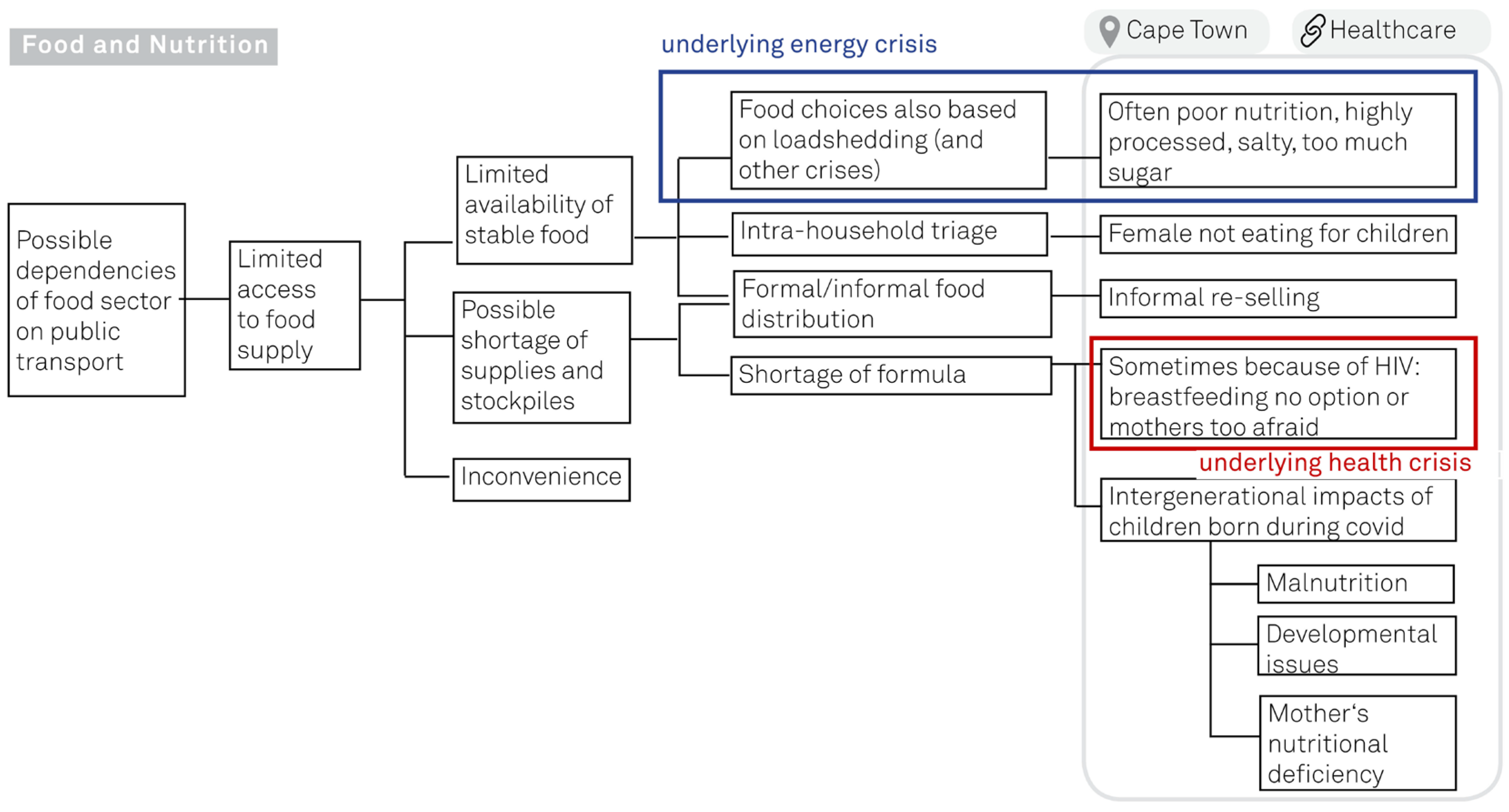
47]. Households already struggling with economic hardship faced increased difficulties storing perishable foods, accessing online education, or maintaining basic hygiene, all of which depend on electricity (see
Figure 2). Power cuts resulted in direct income losses for informal traders, many of whom rely on refrigeration and evening business hours. These disruptions cascaded into the food sector, education, and health care access, particularly for those without backup power solutions.
In Dortmund, energy insecurity manifested differently. While energy prices initially fell during the early lockdown period due to reduced global demand, households were subsequently confronted with sharp increases in residential energy prices in 2022, associated with gas supply disruptions, wholesale market volatility, and policy responses following the Russian–Ukrainian war [
11]. This hit households that were still recovering from the economic impacts of the pandemic, intersecting with prior income losses and increased living expenses, straining household budgets [
48]. While the physical availability of electricity remained stable, the affordability of heating and power became a serious concern, especially for low-income and migrant households. Energy poverty limited digital participation, such as home-schooling or telehealth services, reinforcing pre-existing inequalities. The cascading effects in this context were less about physical disruption and more about economic access, highlighting the multifaceted nature of energy insecurity and capturing how local stakeholders experienced the energy price crises as one important layer within a broader mix of national and municipal policy decisions, welfare provisions, and labor market dynamics.
These findings demonstrate that infrastructural resilience cannot be measured solely by physical robustness. In both cases, access to energy and the essential services it supports was mediated by socio-economic and spatial inequalities, which the cascading diagrams make visible as intersecting branches rather than isolated problems. This reinforces the need for planning frameworks that account for both technical interdependencies and social infrastructures.
4.2. COVID-19 and Trust in Governance
In both Germany and Brazil, the pandemic intensified debates over government legitimacy and the role of public institutions in crisis response. These dynamics shaped not only policy outcomes but also individual behaviors and the accessibility of critical services.
In Germany, the federal system’s layered response led to many regulations, some of which were perceived as inconsistent or unclear. Within this environment, politicized anti-COVID-19 restrictions narratives were often combined with right-wing populist discourse, leading to further distrust in governmental structures [
49]. On the other hand, for marginalized groups, particularly those with limited language proficiency or insecure residency status, navigating changing rules was especially difficult. Social workers reported confusion, misinformation, and mistrust among clients, leading some to withdraw from services altogether. This withdrawal had cascading effects on access to food assistance, social counseling, and housing support. The interviews also indicated differentiated effects within these groups: for example, recent refugees and women heading single-parent households were often more severely affected than longer-settled or better-resourced residents.
In Brazil, where the federal government’s pandemic response was widely criticized for downplaying the virus, state and municipal governments implemented their own measures [
50]. This decentralized approach created regional disparities in pandemic response. In São Paulo, the state government’s implementation of Plano São Paulo attempted to standardize measures, but its technocratic and algorithm-driven design was met with skepticism, particularly in marginalized neighborhoods. Mistrust in the government further discouraged people from seeking support services, vaccinations, or adhering to lockdown measures, exacerbating the health crisis and weakening collective resilience.
This erosion of trust reflects not only a crisis of governance but a breakdown in the socio-institutional infrastructures that enable coordinated responses across sectors. The cascading withdrawal from services reveals how governance structures themselves become fragile infrastructure in times of compound crisis.
4.3. COVID-19 and Spatial Inequality/Underlying Inequalities
Cape Town and São Paulo both exhibit deep spatial divisions rooted in historical inequality. During the pandemic, these spatial inequalities shaped the reach and effectiveness of critical infrastructure services.
In Cape Town, apartheid-era planning has left many townships underserved by public infrastructure [
51]. School closures during lockdowns disrupted not only education but also nutrition and childcare for children dependent on school feeding programs. When public transport was reduced, many caregivers could not reach social service centers or health clinics, deepening isolation and exacerbating child hunger. The physical distance from services, combined with reduced mobility, produced cascading effects across sectors. In the diagrams, this appears as a sequence: reduced transport supply and higher costs → reduced ability to reach schools, clinics, and social work facilities → loss of school meals, delayed treatment, and fewer counseling contacts. Spatial remoteness and poor service location thus function as amplifiers of crisis. Differences between neighborhoods also emerged: residents in informal settlements or peripheral townships without nearby facilities experienced more severe access constraints than those in relatively better-serviced areas.
Similarly, in São Paulo, the concentration of healthcare and social services in central areas left residents in the periphery disproportionately affected. The closure of public transit routes and the loss of income for many informal workers created a compounding crisis with services becoming both physically and financially inaccessible. The state attempted to address this through multipurpose mobility hubs in train and subway stations, which provided health care and support for victims of gender-based violence. While promising, these interventions also mark a shift in social service provision, moving from facility-based support to more mobile and fragmented forms, and were introduced against a backdrop of long-standing shortcomings in the availability and enforcement of protection mechanisms for women and children. Experts stressed that even within peripheral districts, access varied by income, housing situation, and safety concerns, with women and young people often facing heightened mobility risks.
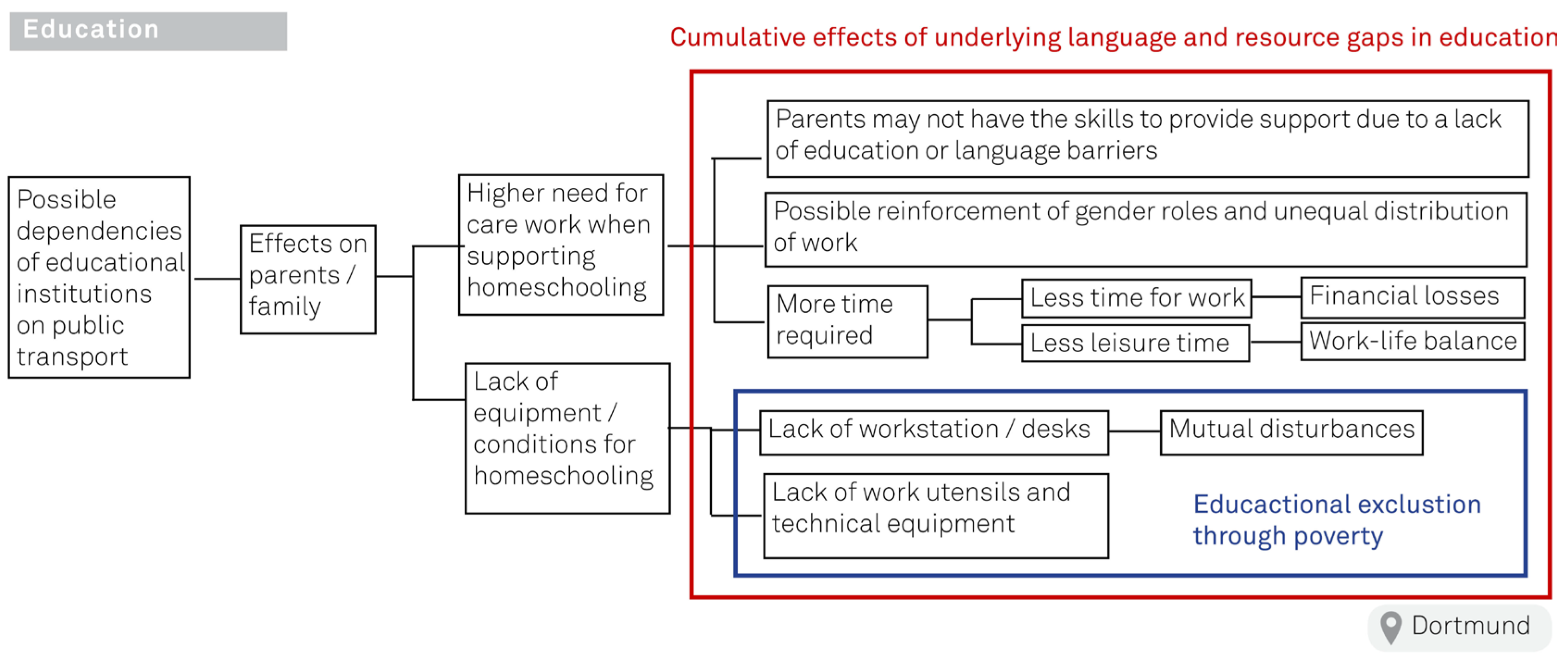
In the German context, many of the marginalized groups impacted by the cascading disruptions during the pandemic were refugees and migrants who had arrived during or after the 2015 European migrant crisis. Interview and workshop participants in Dortmund highlighted that many Syrian families, for instance, already faced barriers related to language, legal status, and access to stable housing or education. The pandemic amplified these challenges. Limited access to digital infrastructure, uncertainty in administrative processes, and the closure of support services disproportionately affected these families, intensifying precarity. This underlines how COVID-19 did not create new vulnerabilities but deepened existing fractures tied to earlier migration waves and integration challenges, e.g., in education, where marginalized families faced bigger challenges due to a lack of resources (see
Figure 3).
Figure 3 shows an excerpt from the empirically derived cascading-effects diagram for the Dortmund case: each box and arrow synthesizes statements from interviews and workshops on how language barriers, homeschooling conditions, and poverty interacted, and should be read as an empirically informed visualization of these cumulative effects rather than as a general schematic of the socio-spatial context.
These dynamics highlight how spatially uneven access to services, layered with migration histories, shapes both the exposure to and the capacity to absorb disruptions. The cascading effects diagrams helped to condense these multi-layered inequalities into recognizable patterns across cities, demonstrating that similar logics of exclusion (distance, cost, language, digital access) recur in different configurations. In planning terms, this calls for territorialized resilience strategies that recognize diverse urban geographies, systemic dependencies, and the embedded nature of vulnerability.
Taken together, the findings from Cape Town, Dortmund, and São Paulo demonstrate how compound crises unfold through locally specific but structurally interconnected systems. Whether rooted in energy, governance, mobility, or spatial inequality, these crises expose how urban resilience hinges on the ability to maintain essential services across social, institutional, and technical infrastructures. The cascading effects observed underscore the importance of integrated, equity-centered planning approaches that anticipate not just direct impacts, but the relational consequences of disruption across sectors and scales.
4.4. COVID-19 and Underlying Health Crises
The pandemic collided with existing health challenges, creating compound crises in all three cities.
In Cape Town, COVID-19 intersected with a longstanding HIV and tuberculosis syndemic rooted in poverty, overcrowded living conditions and unequal access to health services, creating a severe public health strain [
52]. These structural determinants long pre-date COVID-19, but the pandemic and recurrent load shedding intensified existing vulnerabilities rather than creating them anew. Lockdowns and fear of infection disrupted adherence to treatment and regular health checkups, while power cuts complicated clinic operations and medicine storage. Clinics reported lower attendance not only due to movement restrictions but also to stigma and fear. Patients missing ART or TB treatments risked disease progression, creating long-term health risks and reinforcing inequality. Health workers also faced burnout, staff shortages, and logistical barriers due to power cuts and restricted mobility.
In Germany, the intersection of COVID-19 with an aging population and fragile elder care infrastructure became apparent [
53]. Care homes were early epicenters of the pandemic, revealing systemic weaknesses in staffing, hygiene protocols, and emergency planning. Furthermore, the care sector’s reliance on migrant workers, many of whom faced travel restrictions or quarantine requirements, led to acute staff shortages. Disruptions in elder care had ripple effects on families, particularly women, who had to assume caregiving responsibilities, reinforcing gender inequalities.
In Brazil, while HIV/TB were not as prominent, the pandemic overlapped with a growing mental health crisis. Pre-existing high levels of gender-based violence and femicide, particularly against Black and low-income women, were further exacerbated by job loss, income insecurity, and prolonged confinement in precarious housing conditions [
54,
55]. Social isolation, heightened exposure to abusive partners, and economic precarity led to rising rates of depression and anxiety, especially among women and youth [
56]. Public mental health services, already overstretched, struggled to meet demand. The compounding crisis also extended to vector-borne diseases like dengue, as public health campaigns were suspended, leading to localized outbreaks.
Together, these cases underscore that the health impacts of the pandemic were not limited to COVID-19 itself. Pre-existing health burdens, institutional capacity, and social vulnerabilities all contributed to shaping outcomes. Cascading effects analysis helps reveal how disruptions in one domain (e.g., mobility, electricity, staffing) undermine the ability to manage chronic conditions, provide care, and maintain social services, thereby transforming a health emergency into a more enduring crisis of social reproduction.
4.5. Conclusion to the Empirical Chapter
By examining compound crises through the lens of cascading effects, this chapter highlights the interconnectedness of infrastructure systems and the uneven distribution of their failures. The cascading effects approach in each theme enabled a visualization of where disruptions originated, how they spread across sectors, and which groups were most impacted. These patterns are not random but shaped by urban histories, governance structures, and social inequalities. To support comparison across the three cities, the analysis emphasizes recurring mechanisms, particularly constraints in transport and digital access, as well as context-specific factors such as load shedding, energy price shocks, or gender-based violence, which shape how similar types of disruptions are experienced locally and in times of compound crises.
Methodologically, the chapter illustrates how cascading effects diagrams can serve as applied tools for crisis-aware urban planning and resilience strategies: they identify critical nodes, reveal blind spots, and highlight potential intervention points where chains of negative effects can be interrupted. The following chapter will reflect on the implications of these findings for urban planning, resilience strategies, and methodological innovation.
5. Discussion: Methodological and Practical Reflections
The cascading effects methodology proved to be a valuable tool for investigating the complex, multi-layered disruptions that emerged during the COVID-19 pandemic. Particularly in the context of compound urban crises, it facilitated a cross-sectoral analysis that would have been difficult to achieve through traditional, sector-specific approaches. By tracing the ripple effects of disruptions across interconnected systems, the method enabled a more holistic view of the urban fabric, exposing vulnerabilities and entry points for more effective, equity-oriented planning. In doing so, it responds to a growing demand in urban crisis governance for assessment tools that bridge technical infrastructures, essential services and social vulnerability, rather than treating them separately. It addresses a gap also acknowledged in recent European frameworks like the CER Directive (EU/2022/2557), which outlines criteria for “significant disruptive effects” but remains primarily focused on operator-level assessments and technical infrastructures. This study demonstrates the value of extending cascading effects analysis to include essential service infrastructures and the social dependencies embedded within them. The reflections in this section remain grounded in the empirical material from the three case study cities; where concrete policy implications are discussed, they are directly linked to interventions that emerged from workshops or existing practice (e.g., multipurpose mobility hubs in São Paulo), rather than extrapolated as abstract recommendations.
5.1. Cross-Sectoral Insight and Blind Spots
One of the most significant strengths of the cascading effects approach lies in its capacity to uncover cross-sectoral dynamics that are often overlooked. In each of the three case study cities, the analysis helped bring to light indirect consequences that fell between administrative responsibilities or institutional remits. For instance, in Cape Town, while health officials may have focused on the availability of care facilities, the cascading diagram revealed how energy insecurity (load shedding) not only affected medical equipment but also compromised food refrigeration and the operation of early childhood development centers, further intersecting with challenges around nutrition, childcare, and educational continuity.
Similarly, in Dortmund, the overlap of pandemic-related school closures with rising energy costs showed that pressures on the education system could not be understood without acknowledging household energy poverty. Remote learning became inaccessible to low-income families unable to afford internet access or digital devices, exacerbating educational inequality. These indirect but deeply impactful effects only became apparent through a structured mapping of interdependencies between infrastructure sectors and social needs. These blind spots also highlight the mismatch between administrative responsibilities and lived infrastructure realities, reinforcing calls from planning theorists and resilience scholars for place-based systemic risk assessments that can identify not only weak links but misaligned governance logics. In this sense, the diagrams do not generate policy prescriptions on their own but provide an empirically grounded basis that can be linked to specific instruments, such as targeted subsidy schemes, service co-location, or revised accessibility standards.
5.2. The Communicative Power of Visualizations
The visual nature of the cascading effect diagrams proved especially helpful for both research and stakeholder engagement. As boundary objects, the diagrams enabled dialog across disciplinary and institutional silos. During validation workshops, participants from different sectors, including transportation, health, education, and social work, could see how their areas of responsibility were affected by and contributed to disruptions in other domains. This often led to moments of realization and reflection, where sectoral professionals acknowledged dependencies, they had not previously considered.
For example, in the São Paulo workshop, social workers observed that transportation infrastructure affected women’s ability to access shelters or counseling services during the pandemic. Seeing these chains visualized (public transport restrictions → reduced physical access to central service locations → increased dependence on local, often non-specialized support) helps transport planners and social workers to jointly explore options for service outreach in peripheral stations and neighborhood hubs. The visual representation of these chains helped move the conversation beyond abstract systemic thinking into tangible, actionable insights. In this way, cascading diagrams acted as a common language, aligning stakeholders from different backgrounds around a shared understanding of crisis impacts. This communicative function is particularly relevant for urban planning in times of crisis, where decisions must be taken quickly and negotiated among actors operating with different mandates, vocabularies, and temporal horizons. Visual tools, such as cascading diagrams, can support more transparent, participatory, and informed deliberation on trade-offs and priorities.
5.3. Strengths in Identifying Intersectoral Vulnerabilities
By mapping pathways of disruption and their downstream effects, the cascading effects methodology is particularly strong at identifying vulnerabilities arising from systemic interdependencies. This is crucial in the context of compound crises, where disruptions rarely remain isolated. The method not only outlines where systems are weak but also illustrates how failures in one sector, such as public transportation, can compromise others, like healthcare access or food distribution.
Moreover, this approach enables planners and policymakers to identify potential intervention points where cascading effects could be interrupted or mitigated. In São Paulo, for instance, interventions at subway stations that transformed them into multipurpose public service hubs emerged as a concrete strategy to restore access to social services in the face of lockdown-related restrictions. Such examples show how mapping interdependencies can inform innovative, site-specific planning responses. In practical terms, intervention points are identified by looking for nodes in the diagrams where multiple chains converge (e.g., key transport hubs, digital access points, or critical social facilities) or where a single disruption branches into several downstream effects. These bottlenecks and branching nodes indicate locations or functions where targeted measures such as additional services, redundancy, or alternative access routes can have disproportionate benefits in limiting negative cascades. From a methodological perspective, the diagrams provide an intermediate step between qualitative narratives and concrete planning options: they do not prescribe solutions, but highlight intervention points where targeted measures (spatial, organizational, or regulatory) can have benefits.
5.4. Limitations and Challenges
Despite its strengths, the cascading effects approach also presents several methodological and practical challenges. First, there is a tension between comprehensiveness and clarity. Capturing the full range of interconnections inevitably risks oversimplification or ambiguity, especially when complex social dynamics, such as marginalization, mistrust, or informal labor, are reduced to linear diagrams. These risks can be mitigated, but not eliminated, by grounding the analysis in rich qualitative data and treating the diagrams as conversation starters rather than final conclusions.
Another limitation concerns the difficulty of prioritization. The method does not inherently rank the severity of cascading effects nor provide a means to quantify impacts across sectors. This can make it challenging for decision-making processes requiring numeric indicators or cost–benefit analysis. However, its value lies in revealing overlooked dynamics, offering a bird’s-eye view of systemic risk, and enhancing intersectoral understanding. In this respect, cascading effects analysis complements more formalized systemic risk assessment tools, like network analysis or system dynamics models. While those approaches can simulate scenarios and quantify system robustness, they typically require substantial data and technical capacity and may be less accessible for cross-sectoral dialog. Cascading diagrams, on the other hand, focus on expert and practitioner knowledge, emphasize interpretability, and are easier to use in participatory settings. A combined approach, such as using cascading diagrams to identify critical relationships and then testing them with quantitative models, could be a promising avenue for future research and planning practice.
In addition, the cascading diagrams represent perceived interdependencies and pathways as articulated by experts, rather than precise decompositions of causal responsibility (for example, between international energy price shocks and domestic fiscal choices), which means that the analysis is better understood as mapping plausible chains of impact than as establishing definitive causal weights for individual drivers.
5.5. Adapting the Method for Social and Governance Dimensions
A key contribution of this research lies in adapting the cascading effects framework to account not only for technical failures but also for social vulnerabilities and governance breakdowns. Traditional critical infrastructure studies often emphasize hardware systems like power grids or water supply, whereas this study focused on the essential service infrastructures, healthcare, education, childcare, social work, and food systems that are directly experienced by individuals and communities.
These infrastructures rely on technical systems to function, yet their disruption cannot be understood through technical lenses alone. They are embedded in institutional practices, resource allocation decisions, and everyday life. For example, a school is not just a building dependent on electricity; it is also a space of care, learning, nutrition, and social inclusion. Its closure, therefore, triggers multidimensional consequences that extend well beyond the educational realm.
Bringing in these social and institutional dimensions requires methodological flexibility. In this study, the cascading diagrams were not built through abstract modeling but through an iterative, qualitative process involving literature review, expert interviews, and validation workshops. Expert insights were essential in grounding the diagrams in contextual realities, ensuring their relevance and legitimacy across the diverse case study areas. This iterative co-production process is central to the method’s usefulness: it embeds local knowledge, acknowledges uncertainty, and aligns with participatory, context-sensitive approaches to crisis preparedness and urban resilience. In this way, cascading effects analysis moves from abstract systemic modeling toward grounded, participatory tools that reflect local vulnerabilities and institutional complexity. It offers a model for future resilience assessments that bridge qualitative inquiry, planning practice, and systemic risk governance. At the same time, its qualitative, context-specific nature limits the direct generalizability of findings: rather than producing universally transferable parameters, the method generates situated insights and patterns that can inspire, but not mechanically dictate, measures in other contexts.
5.6. Summary of Methodological Insights
Overall, the cascading effects methodology, especially when adapted to include essential service infrastructures, offers a powerful tool for visualizing complexity, uncovering hidden risks, and informing more integrated planning and crisis management. Its communicative potential and ability to bridge qualitative insights with systems thinking make it particularly useful for urban governance in times of compound crises. The reflections in this section have focused on methodological strengths, limitations, and practical lessons drawn from the three case study cities, with an emphasis on how the approach operated in practice as a diagnostic and deliberative tool. The following section moves from these empirically grounded reflections to a broader methodological outlook, considering how cascading effects analysis can be positioned within evolving approaches to urban crisis research and resilience planning.
6. Towards a Methodological Shift in Urban Crisis Research
The cascading effects framework presented in this study offers more than just a tool for crisis diagnosis, as it points towards a methodological orientation that responds to the growing complexity and interdependence of urban governance in an age of compounding risks. As cities face increasingly interlinked challenges, from pandemics and energy crises to structural inequality and institutional fragmentation, planning research must evolve beyond static, sectoral assessment models. Cascading effects analysis pushes toward a more dynamic, relational perspective that foregrounds the interdependence of infrastructure systems, institutional practices, and social realities. This responds directly to current gaps in European and international crisis governance frameworks, which often prioritize physical critical infrastructure while neglecting the social infrastructures and interdependencies that shape lived vulnerability. While the CER Directive (EU/2022/2557) acknowledges cascading effects and systemic risk, its operational scope remains limited to operator-level assessments and sectoral perspectives, underscoring the need for more spatialized, socially attuned methodologies that can inform land-use decisions, service provision, and crisis-ready urban planning.
At its core, this methodology allows researchers and planners to trace how a single disruption, such as reduced mobility or the closure of public schools, can unleash ripple effects across seemingly unrelated domains. This is not just an exercise in complexity for its own sake. Instead, it provides a structured lens to map compounding risks, identify vulnerable nodes, and anticipate secondary impacts before they escalate. As this study has shown, such ripple effects disproportionately burden marginalized groups, who often lack alternative access to essential services or safety nets. Making these differentiated effects visible is crucial for planning and crisis governance that explicitly considers whose resilience is being promoted and whose needs are overlooked. Embedding these dynamics into planning frameworks is not only a matter of analytical precision but also of social justice.
The method can support more integrated resilience planning in policy and governance by providing a shared reference point for cross-sectoral dialog. Infrastructure providers, public health officials, social workers, and education administrators rarely sit at the same table. When they do, they often lack a common language to express how their systems are linked. Cascading effects diagrams can serve as boundary objects that bring these diverse actors into a conversation and help co-identify vulnerabilities and potential intervention points. Particularly in cities experiencing compound crises, this approach can offer practical support for prioritizing responses and allocating resources where cascading harms are most likely to unfold. In practice, its anticipatory potential becomes visible in at least three decision-making domains:
Service continuity planning, where diagrams help identify critical dependencies that must be protected in advance (for example, the chains linking HIV and TB treatment in Cape Town to reliable transport and electricity provision, which can inform contingency plans such as backup power or alternative dispensing sites);
Targeting of support measures, where diagrams highlight which population groups and locations are likely to be hit by multiple, intersecting effects (for instance, peripheral neighborhoods in Dortmund and São Paulo where school closures, income loss and poor digital access coincide, informing the design and spatial targeting of food assistance, learning support or mobile social services);
Strategic investment and land-use decisions, where recurring points of failure across cascades indicate priority areas for strengthening or relocating services (such as co-locating childcare, social work and health facilities in underserved districts, or improving public transport links to existing hubs).
By making these potential chains of impact visible before a crisis hits, cascading diagrams can support a more anticipatory orientation in planning and crisis governance, without replacing other quantitative or model-based tools.
Beyond its analytical and communicative benefits, cascading effects analysis also opens new terrain for both transdisciplinary collaboration and methodological integration. Future research could combine qualitative cascading diagrams with quantitative tools by using the diagrams to identify relevant nodes, links, and scenarios to be parameterized and tested. Conversely, results from quantitative modeling (e.g., criticality scores, failure probabilities or impact magnitudes) could be fed back into the diagrams to support prioritization and scenario comparison. In this study, the focus remained on qualitative, expert-based mapping; however, the framework is designed to enable such extensions when data and capacity are available. Too often, risk assessments remain either too technical to address social dimensions or too qualitative to influence infrastructure planning. The strength of the cascading framework lies in its capacity to mediate between these domains and to bridge systems thinking with lived realities and institutional constraints.
However, as this study has emphasized, cascading effects must be understood not as neutral chains of cause and effect but as embedded within power structures, governance decisions, and socio-political contexts. The same disruption can have vastly different outcomes depending on who is affected, where it occurs, and what alternatives are available. Therefore, future planning methodologies must go beyond describing interdependence and account for differentiated vulnerability, the historical shaping of inequality, and the uneven capacity to respond.
This calls for a new generation of planning tools and research agendas that place interdependence, uncertainty, and justice at their center. Cascading effects analysis, particularly when applied to essential service infrastructures, offers a promising entry point. It helps make the systemic nature of crisis impacts visible and opens up space for rethinking how resilience is imagined, distributed, and practiced across the urban fabric.
7. Conclusions
This paper has examined the value of cascading effects analysis as a methodological and conceptual bridge between complex crisis dynamics and planning practice. In an increasingly interconnected and crisis-prone world, cities are not facing isolated disruptions but compound crises that unfold across temporal, spatial, and institutional boundaries. The empirical cases from Cape Town, Dortmund, and São Paulo, and the four thematic constellations of compound crises (energy insecurity, trust in governance, spatial/underlying inequalities, and overlapping health crises), illustrate how disruptions triggered by COVID-19 intersected with pre-existing challenges such as energy insecurity, public health crises, institutional mistrust, and social inequality, generating ripple effects that extended far beyond the initial point of failure.
Cascading effects analysis provides a structured approach for tracing and visualizing these interdependencies, highlighting how disruptions in one sector, such as public transport, can undermine access to essential services, including healthcare, education, and social support. This method goes beyond traditional infrastructure assessments by making visible not only the functional dependencies between systems but also the uneven consequences experienced by marginalized populations. By systematically mapping who is affected, where, and through which chains of disruption, the diagrams help reveal how existing socio-spatial inequalities are reinforced during crises. In this sense, the approach contributes to a more holistic understanding of urban resilience: one that links critical infrastructures, services of general interest, and social vulnerability, and offers a tool for anticipating indirect impacts and identifying leverage points for intervention.
For planning practice, cascading chain diagrams serve as boundary objects that foster dialog across institutional silos and help communicate complex risks in more accessible ways. They do not, in themselves, determine decisions but provide a common reference point for actors from transport, health, education, social work, and planning to jointly identify critical nodes, recurring bottlenecks, and potential intervention points. This supports a more reflexive and relational mode of planning, one that acknowledges uncertainty, adapts to evolving conditions, and recognizes the social dimensions of infrastructural failure. In practical terms, such visualizations can inform decisions about where to co-locate services, which mobility links are critical for maintaining access to care and support, and which groups require targeted measures during future crises.
Looking forward, future research should further develop the method to include participatory approaches, integrate digital tools, and explore its potential for risk communication and decision-making support. There is also a need to critically reflect on how cascading effects are shaped by power relations, institutional logics, and long-standing spatial injustices. Because the diagrams make visible where chains concentrate in peripheral areas, informal settlements, or among specific groups such as migrants, women, or low-income households, cascading effects analysis can support more socially just crisis governance by informing the prioritization of resources and protective measures. Ultimately, this paper calls for a more visual, reflexive, and cross-disciplinary planning methodology, one that is attuned to the realities of compounding urban crises and capable of informing policy responses that are not only efficient but also socially just.