
Next Article in Journal
Nature-Based Accounting for Urban Real Estate: Traditional Architectural Wisdom and Metrics for Sustainability and Well-Being
Previous Article in Journal
Global Change: Impacts on Traditional Rainwater Harvesting Systems in Campo de Cartagena (Region of Murcia, Spain)
error_outline You can access the new MDPI.com website here. Explore and share your feedback with us.
 
 
Article

Dynamics and Rates of Soil Organic Carbon of Cultivated Land Across the Lower Liaohe River Plain of China over the Past 40 Years


1
College of Land and Environment, Shenyang Agricultural University, Shenyang 110866, China
2
Key Laboratory of Cultivated Land System Protection, Department of Natural Resources of Liaoning Province, Shenyang 110866, China
3
National Engineering Research Center for Efficient Utilization of Soil and Fertilizer, Shenyang 110866, China
4
Liaoning Provincial Rural and Agricultural Development Service Center, Shenyang 110034, China
*
Author to whom correspondence should be addressed.
Land 2026, 15(1), 99; https://doi.org/10.3390/land15010099
Submission received: 21 November 2025 / Revised: 27 December 2025 / Accepted: 29 December 2025 / Published: 4 January 2026

Abstract

The Lower Liaohe River Plain (LLRP) is a core grain production base in Northeast China. Monitoring the dynamics and changing rates of soil organic carbon (SOC) in cultivated lands is essential for regulating soil fertility, safeguarding food production, and maintaining the regional carbon balance. Based on soil survey data from three periods, 1980, 2008, and 2019, this study investigated the spatiotemporal dynamics of SOC content and its changing rate (SOCr) using geospatial analysis. Results showed that SOC content declined significantly from 11.19 g kg−1 to 10.47 g kg−1 during 1980–2008, then recovered slightly to 10.58 g kg−1 in 2019. Moreover, SOCr varied temporally in the period of 2008–2019, exhibiting a positive mean rate of 0.01 g kg−1 yr−1, which was significantly higher than that of the period of 1980–2008 (−0.03 g kg−1 yr−1). A significant negative correlation was examined between the initial SOC content and SOCr, showing an identification of the SOC equilibrium point (SOCep). The SOCep in the period of 2008–2019 was 9.69% higher than that in the period of 1980–2008. These findings provide a scientific basis for formulating regional policies and optimizing spatially differentiated management strategies to improve cropland SOC in the study area.

1. Introduction

The black soil region of Northeast China constitutes a vital grain production base and is pivotal for safeguarding national food security and grain strategy. Therefore, elucidating the spatiotemporal dynamics of soil properties in this region is essential, particularly under the current policies emphasizing cultivated land protection and quality enhancement. The soil organic carbon (SOC), a core component of the soil carbon pool, is a fundamental indicator of cultivated land quality because it directly underpins soil fertility, crop productivity, and soil health [1,2,3,4]. Moreover, as a critical component of the terrestrial carbon cycle, SOC dynamics significantly influence global climate regulation, and its steady accumulation enhances ecosystem stability [5,6]. The changing rate of SOC (SOCr), defined as the mean annual change rate, quantifies the trend and magnitude of SOC variation. Therefore, analyzing SOCr could provide insights into the response of the regional cultivated soil SOC to different agricultural management practices. Consequently, mapping the spatiotemporal distribution patterns of both SOC content and SOCr is crucial for developing effective, spatially targeted conservation and management strategies for cultivated land.
The distribution and spatiotemporal variability of SOC have been extensively quantified across diverse scales. These investigations commonly utilize geospatial interpolation techniques, including kriging, inverse distance weighting, and GIS-based methods, to map SOC patterns in key agricultural regions of the black soils region of Northeast China [7,8,9]. Beyond spatial patterns, temporal changing trend analyses have uncovered a notable dynamic: a widespread decline in the SOCr in recent decades, as documented in major grain-producing areas, such as the North China Plain [10,11]. Furthermore, studies highlight the role of environmental gradients and potential stabilization mechanisms. For instance, SOC changing trends have been shown to vary along moisture gradients [12], while declining rates have been linked to lower initial SOC content, which should be investigated further [13].
This study focuses on the Lower Liaohe River Plain (LLRP), a critical base for commercial grain production in China, located at the southern edge of Northeast China’s black soil region, and an area where soil organic matter deficiency remained a primary constraint on cultivated land quality [14]. Previous studies have documented substantial SOC loss in the LLRP from 1980 to 2010 using data from two periods, primarily driven by changes in agricultural management [15]. Additionally, conservation tillage practices have been widely promoted in the region in recent years, such as balanced fertilization by soil testing, straw returning and reduced/no-till cultivation. These measures have yielded significant agronomic and environmental benefits during the past decades. By 2019, the implemented area exceeded 666,700 ha, resulting in a 14.60% increase in crop yield compared with traditional tillage [16,17,18]. However, the spatiotemporal effects of these practices on SOC remain unclear.
Therefore, based on soil survey data from three periods (1980, 2008, and 2019), this study employed ordinary kriging interpolation and spatial autocorrelation analysis to investigate the following objectives: (1) elucidating 40 years (1980–2019) of spatiotemporal dynamics of SOC content and SOCr; (2) preliminarily assessing the region’s overall SOC retention capacity; (3) comprehensively analyzing the spatial correlation between initial SOC content and SOCr across distinct periods. These findings could be expected to guide the development of spatially targeted soil fertility management strategies, support black soil conservation, and provide a scientific basis for China’s “Dual Carbon” (Carbon Peak and Carbon Neutrality) strategy.

2. Materials and Methods

2.1. Overview of the Study Area

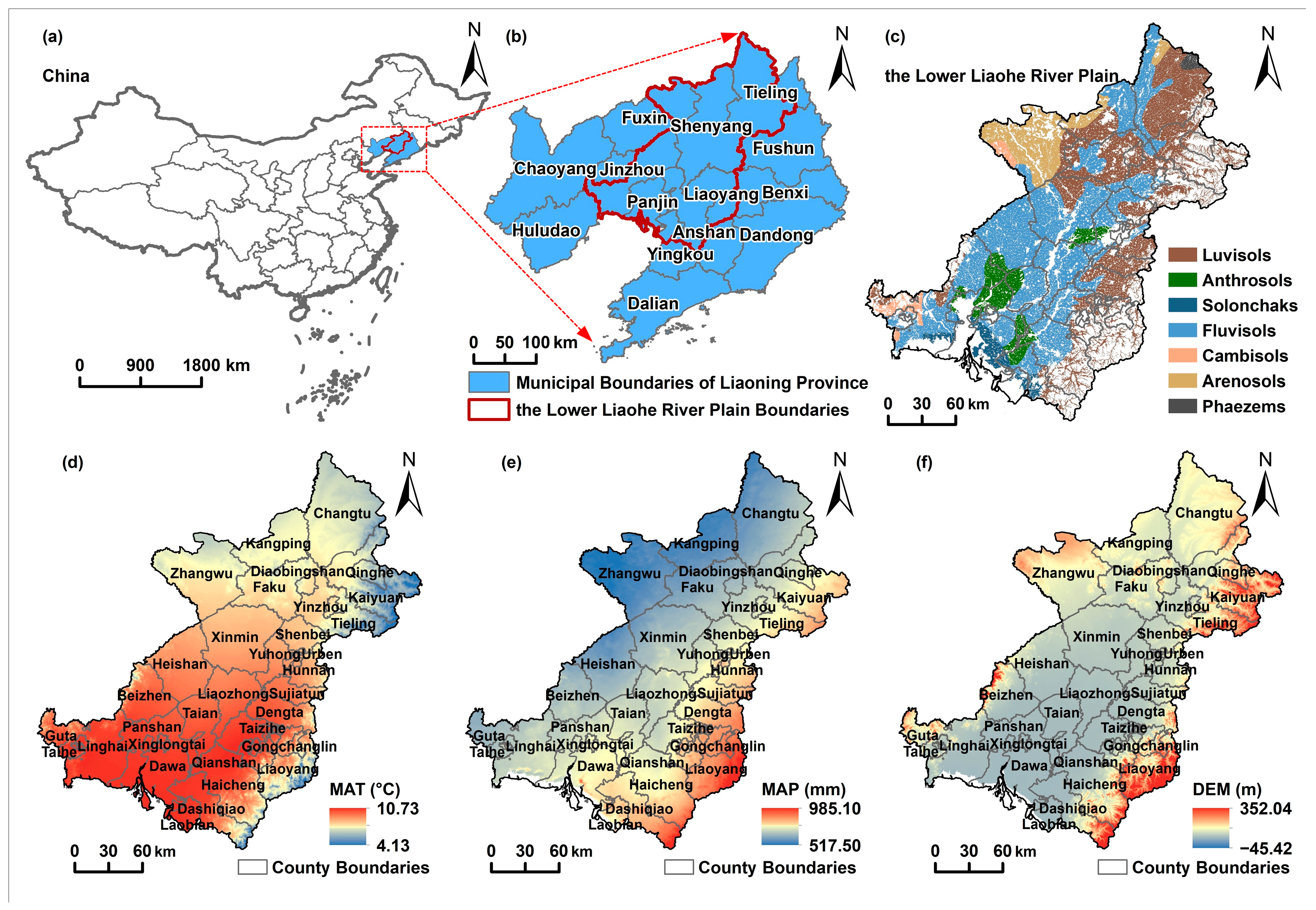
The LLRP is located on the southern edge of the black soil region in Northeast China (40°43′ to 43°27′ N and 120°42′ to 124°45′ E), within central Liaoning Province (Figure 1a,b). It is a transitional climatic zone with a continental monsoon climate, between the semi-arid climate in the west and the semi-humid climate in the east of Liaoning Province. It is hot and humid in the summer and cold and dry in the winter. The mean annual temperature (MAT) ranges from 4.13 to 10.73 °C, decreasing from the southwest to the northeast (Figure 1d). The mean annual precipitation (MAP) ranges from 517.50 to 985.10 mm, increasing from the northwest to the southeast (Figure 1e). It is flat and broad, with elevation generally decreasing from north to south, and averaging below 50 m (Figure 1f). The LLRP comprises 2.37 million ha of cultivated land. The dominant soil types include Fluvisols, Luvisols, and Anthrosols (Figure 1c), supporting its intensive agricultural use. As a vital agricultural region, the LLRP is a key pillar of food security for Liaoning Province, and even for the country.

2.2. Data Sources

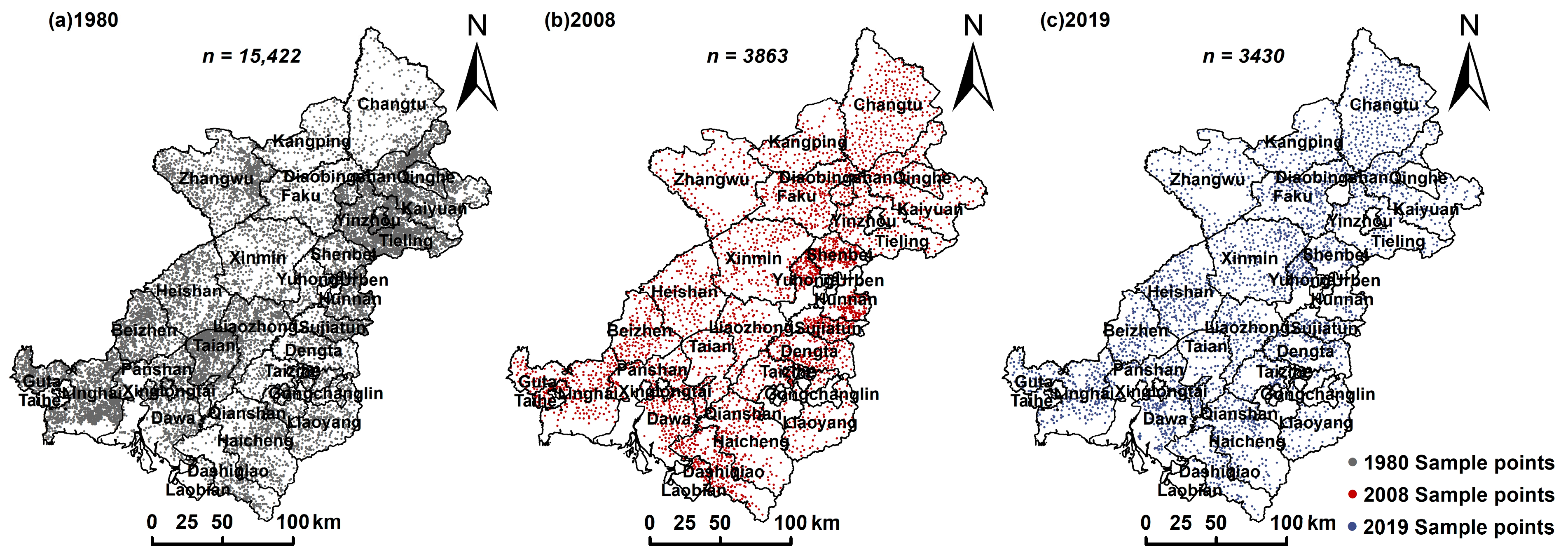
Soil survey data for the LLRP were obtained from three periods: the Second National Soil Survey (1980; 15,422 valid sampling points) and subsequent surveys conducted in 2008 (3863 valid points) and 2019 (3430 valid points). Surface soil samples (0–20 cm depth) were collected, and the dataset in this study included geographic location (city and county) and soil organic matter (SOM) content. SOM content was determined via the heated potassium dichromate oxidation method [19]. Outliers were identified and excluded based on a threshold of the mean ± 3 standard deviations for each survey year. The spatial distribution of sampling points across the three survey years is presented in Figure 2.

2.3. Research Methods

2.3.1. SOC Calculation and Classification Criteria

SOC content was calculated from SOM content, followed by Equation (1), and the criteria for the SOC content range were from the Second National Soil Survey period (Table 1).
S O C = S O M / 1.724
where SOC is soil organic carbon content (g kg−1), SOM is soil organic matter content (g kg−1); 1.724 represents the standard conversion factor from soil organic matter to soil organic carbon.

2.3.2. Ordinary Kriging Interpolation

Spatial interpolation analysis was performed on the calculated SOC sampling point data using the ordinary kriging (OK) method [20].
Z X 0 = i = 1 n λ i Z X i
where Z X 0 was the estimated value at unknown location X 0 , Z X i was the measured value at known location X i , λ i was the kriging weight for the i -th known point, and n was the number of known points used in the estimation.
The interpolated SOC raster was spatially overlaid with the cultivated land plot. Mean SOC values were calculated for each plot to generate spatial distribution statistics and analytical datasets [21,22].

2.3.3. Calculation and Classification of SOCr

SOCr referred to the changing rate of SOC, which was calculated as follows.
S O C r = S O C t S O C 0 / t
where S O C r was the annual SOC changing rate (g kg−1 a−1), S O C t was SOC content at time t (g kg−1), S O C 0 was SOC content at baseline period (g kg−1), t was the time interval between sampling periods (a).
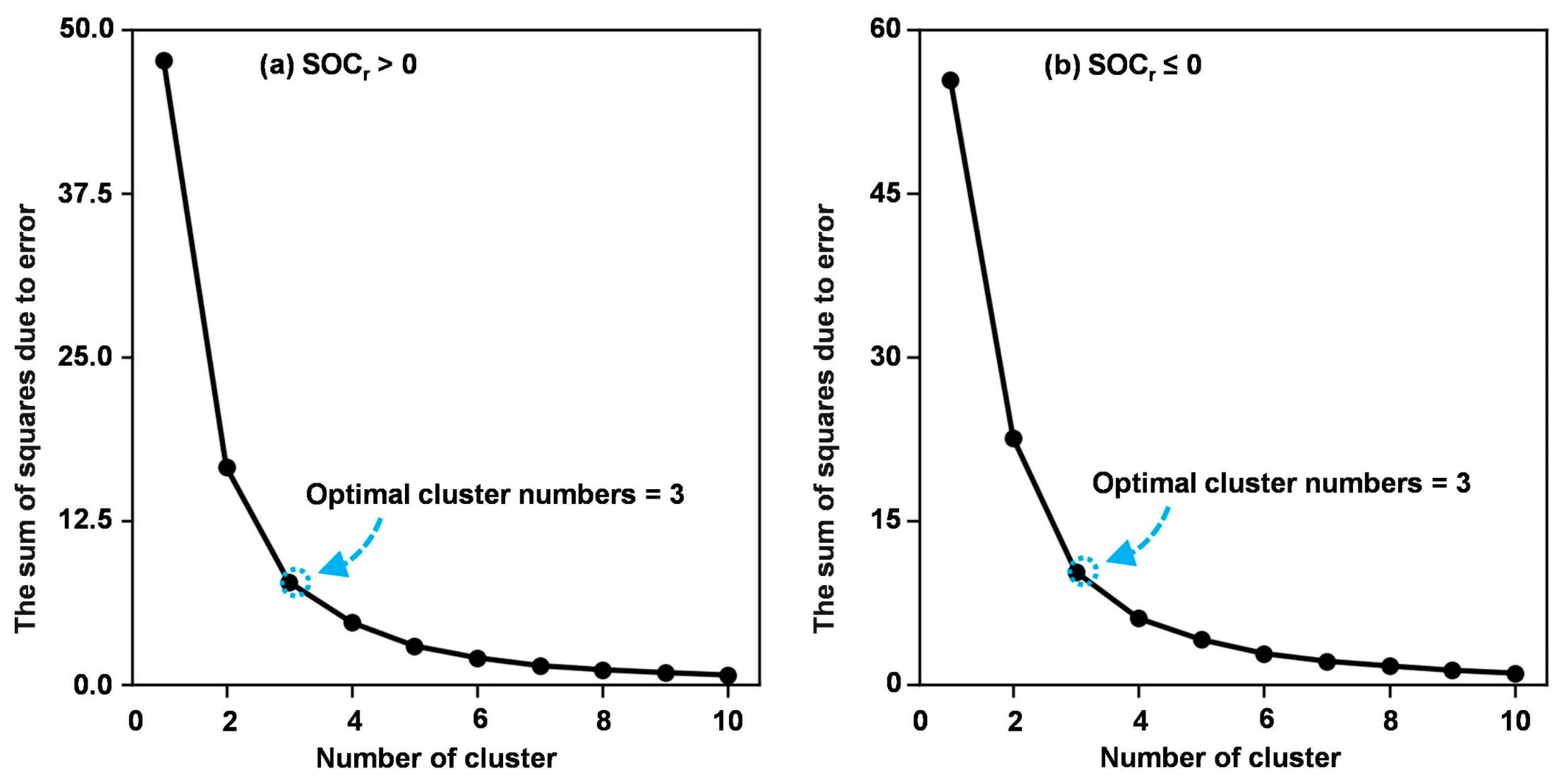
The elbow method and K-means clustering analysis were used to classify the SOCr levels. First, SOCr data from all three periods were combined into a unified database and stratified into two subsets: accumulation (SOCr > 0) and depletion (SOCr ≤ 0). For each subset, the optimal number of clusters (K) was determined using the elbow method. Subsequently, K-means clustering was performed based on the derived K-values. Finally, classification thresholds were established based on the maximum and minimum values within each resultant cluster. The elbow method’s results, rank ranges, sample numbers, and averages were presented in Figure 3 and Table 2.

2.3.4. Spatial Autocorrelation

Spatial autocorrelation analysis quantified the association between attribute values at a location and those at neighboring locations, thereby measuring the degree of spatial clustering or dispersion of attributes. This method was crucial for elucidating the spatial distribution patterns of soil properties [23]. The Moran’s I index comprehensively evaluated spatial aggregation features, reflecting both the overall spatial autocorrelation level of an attribute across the study area (global spatial autocorrelation) and its spatial clustering or discrete distribution patterns within subregions (local spatial autocorrelation) [24,25].
The global Moran’s I index ranged from −1 to 1. Values where I > 0 indicated positive spatial autocorrelation (clustered distribution), I < 0 indicated negative spatial autocorrelation (dispersed distribution), and I = 0 suggested a spatially random distribution. Statistical significance (p < 0.05) was assessed using Z-score, where Z ≥ 1.96 or Z ≤ −1.96 denoted significant spatial correlation [26].
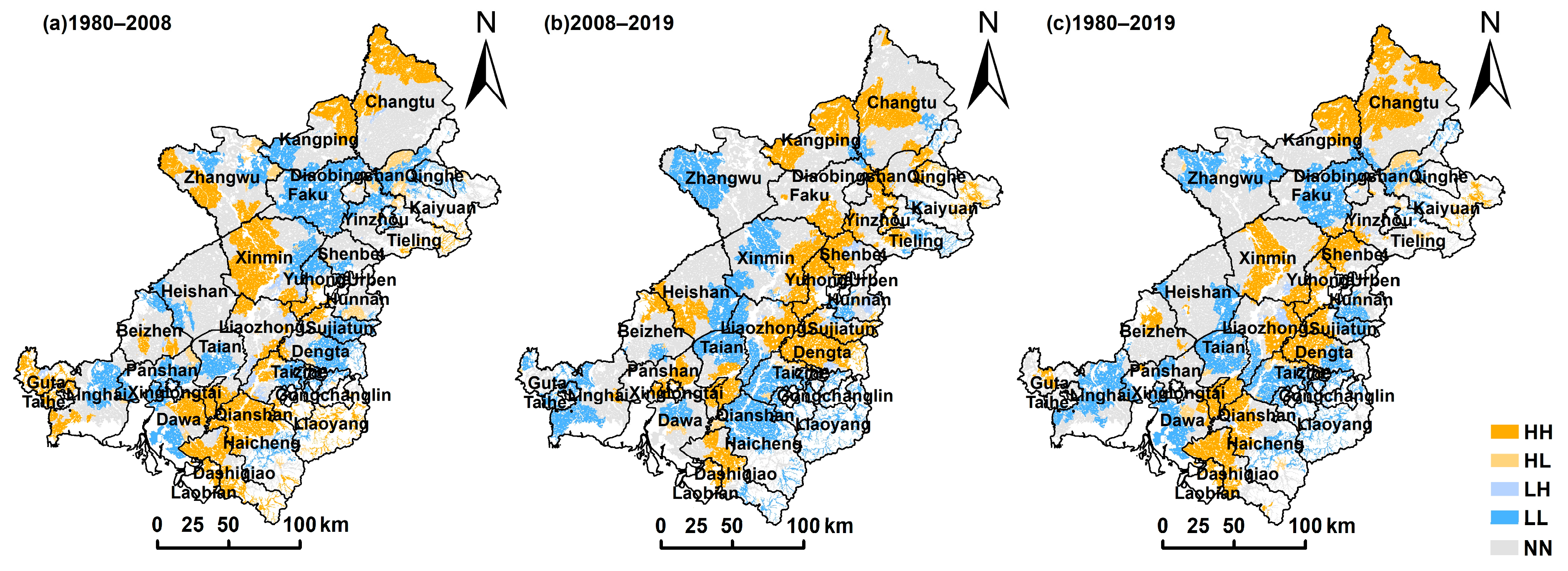
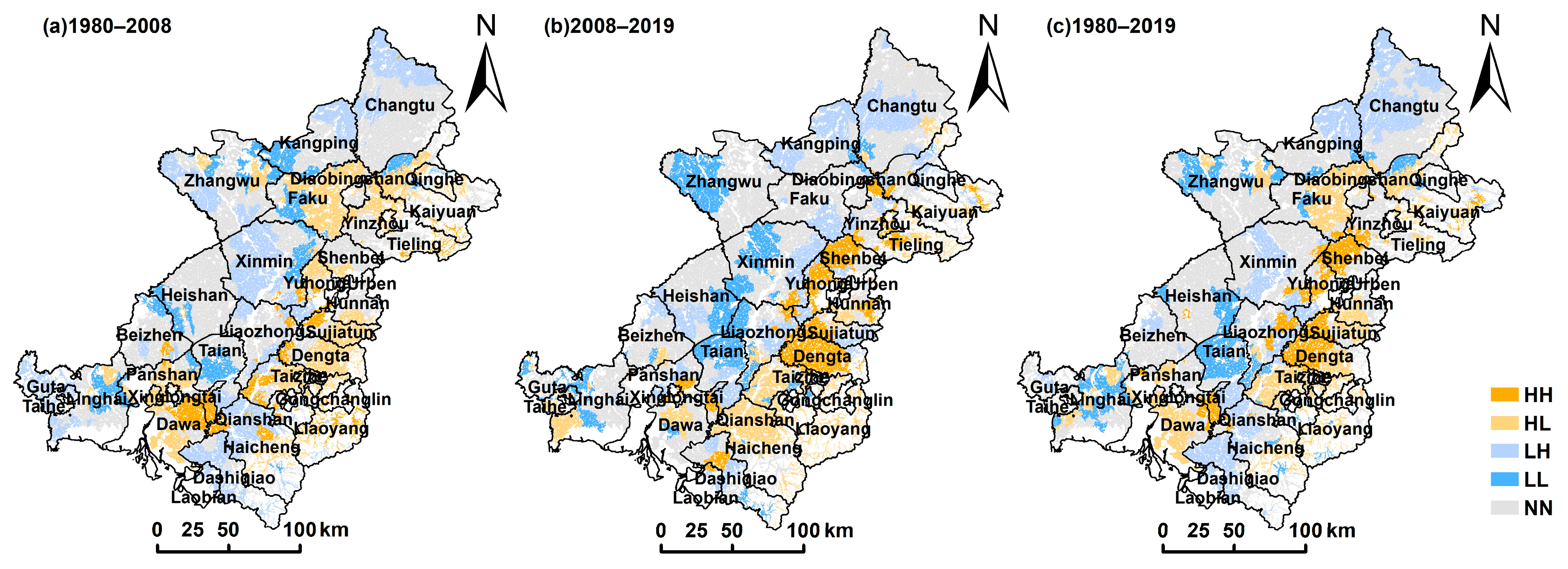
The local Moran’s I index enabled regional visualization through Local Indicators of Spatial Association (LISA) cluster maps, which revealed distinct spatial distribution types. These maps classified SOC spatial autocorrelation into five types [27]: High-High (HH), Low-Low (LL), High-Low (HL), Low-High (LH), and Not Significant (NN). Specifically, HH and LL clusters indicated positive local autocorrelation (high or low values surrounded by similarly high or low values), whereas HL and LH outliers indicated negative local autocorrelation (high values surrounded by low values or vice versa). NN areas showed no significant local spatial association.
Spatial autocorrelation analysis was classified as univariate or bivariate depending on the number of variables analyzed. Specifically, bivariate analysis revealed the spatial interdependencies between two variables. In this study, bivariate local Moran’s I index analysis was applied to examine the spatial relationship between initial SOC content and SOCr, with results visualized in LISA cluster maps. This approach thereby elucidated their spatial association patterns across the study area [28,29].

2.3.5. Foundational Data Processing and Mapping

Microsoft Excel (v2021) and SPSS (v26.0) were used for general data analysis, including classification, summarization, statistical analysis, normality tests, and significance tests of the plot data. Spatial visualization was conducted in ArcGIS (v10.7), where ordinary kriging interpolation generated SOC and SOCr distribution maps. Spatial autocorrelation analysis was implemented in GeoDa (v1.22), with results subsequently visualized in ArcGIS. All graphical representations, including pie charts and violin plots, presented in this study were produced using Origin (v2021).

3. Results and Analysis

3.1. Spatiotemporal Characteristics of Cultivated Land SOC Content

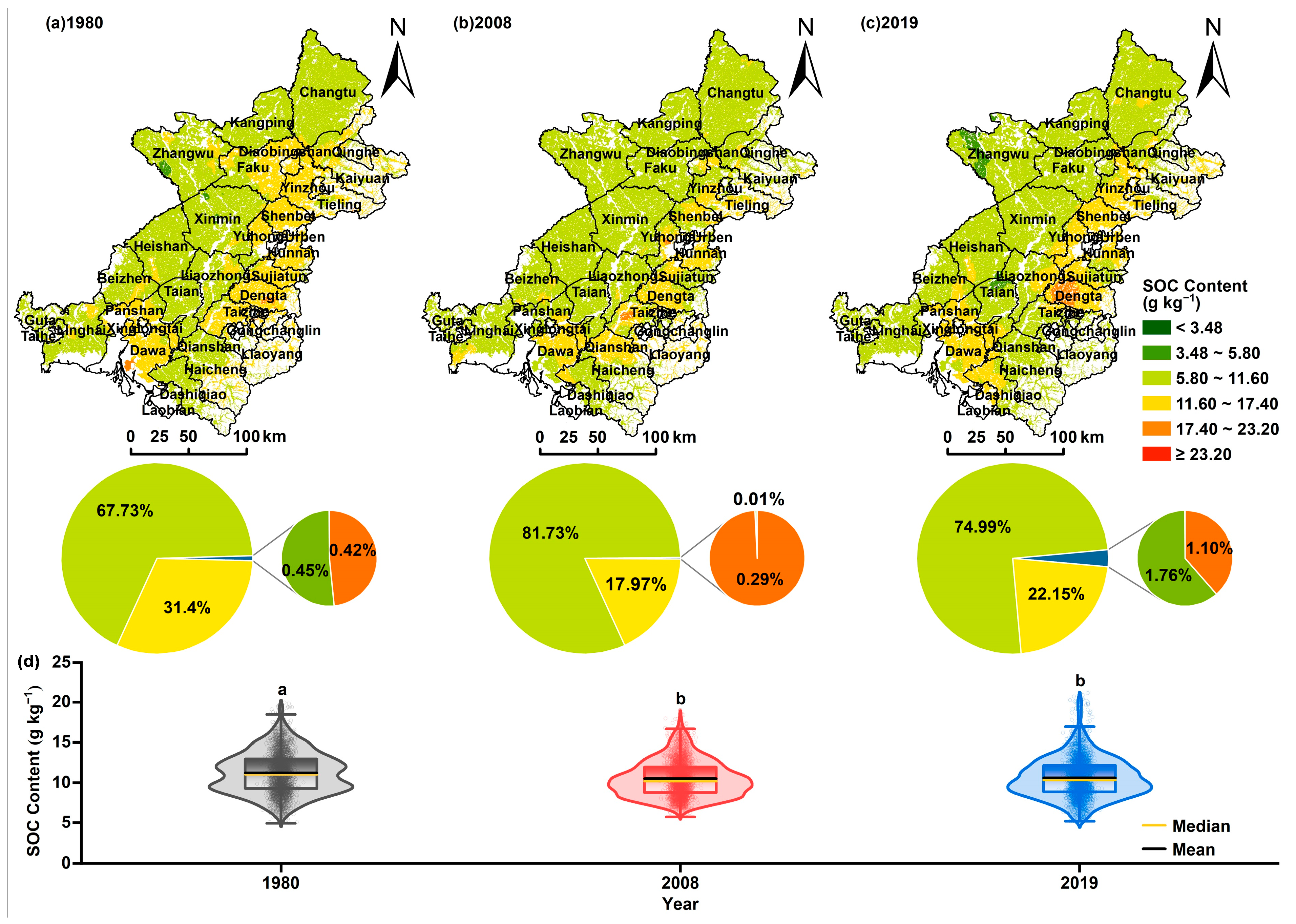
Cultivated land SOC in the LLRP declined significantly from 1980 to 2008, then showed a modest recovery from 2008 to 2019. The mean SOC content was highest in 1980 at 11.19 g kg−1, which was significantly greater (p < 0.05) than the value in 2008 and 2019. While the mean SOC in 2019 (10.58 g kg−1) was slightly higher than in 2008 (10.47 g kg−1), though not statistically different. Compared with the 1980 level, this represented reductions of 0.72 g kg−1 and 0.61 g kg−1 in 2008 and 2019, respectively (Figure 4d). The coefficient of variation (CV) for SOC ranged from 21.44% to 23.49% across the three periods, indicating a consistent and moderate degree of spatial variability [30].
Spatially, the distribution patterns of SOC remained stable over the decades, consistently showing higher SOC in the eastern and southern parts of the LLRP and lower values in the western and northern regions. A distinct north–south-oriented high-value belt was observed in the eastern area (Figure 4a–c). Based on the SOC classification criteria, Class IV accounted for 67.73–81.73% of the total cultivated land area, peaking in 2008. Class III covered 17.97–31.40%, with the highest proportion observed in 1980. Class II and V cultivated lands represented <1% of total area in 1980 and 2008, while in 2019 their shares increased to 1.10% (primarily concentrated in Dengta City) and 1.76% (mainly in Zhangwu County), respectively. No cultivated land was classified as Class I or VI during the study period.
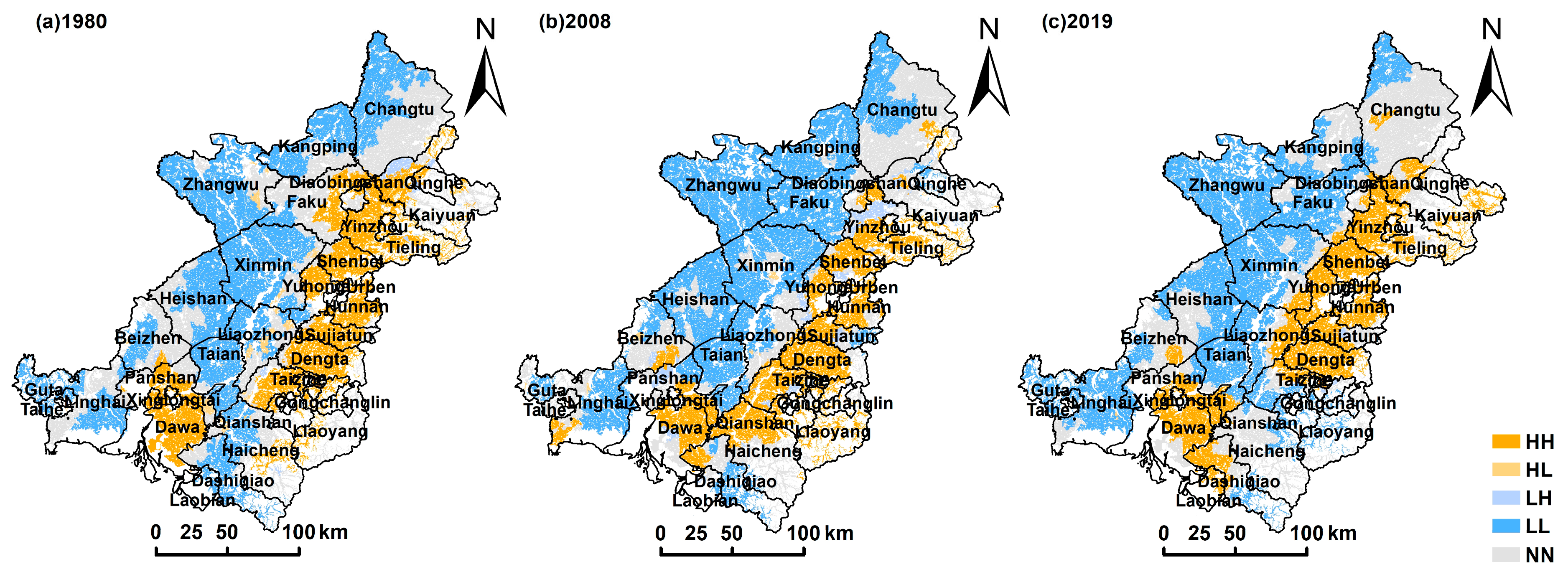
Global spatial autocorrelation analysis revealed significant positive spatial autocorrelation of SOC content in all three study years. Moran’s I values in 1980, 2008, and 2019 were 0.79, 0.77, and 0.88, respectively, with all Z ≥ 1.96 and p < 0.01. In 2019, Moran’s I increased by approximately 0.1 relative to the earlier two periods, indicating an enhancement in spatial agglomeration. LISA cluster mapping showed that HH and LL clusters were the dominant types (Figure 5). LL (cover 43.99–49.50% of area) predominated in western LLRP, while HH (21.93–24.37%) primarily concentrated in the eastern and southern regions. The minimal variation in both the areal proportion and the spatial configurations of all cluster types demonstrated persistent spatial autocorrelation and stable distribution patterns of SOC content in cultivated lands.

3.2. Spatiotemporal Dynamics of SOCr

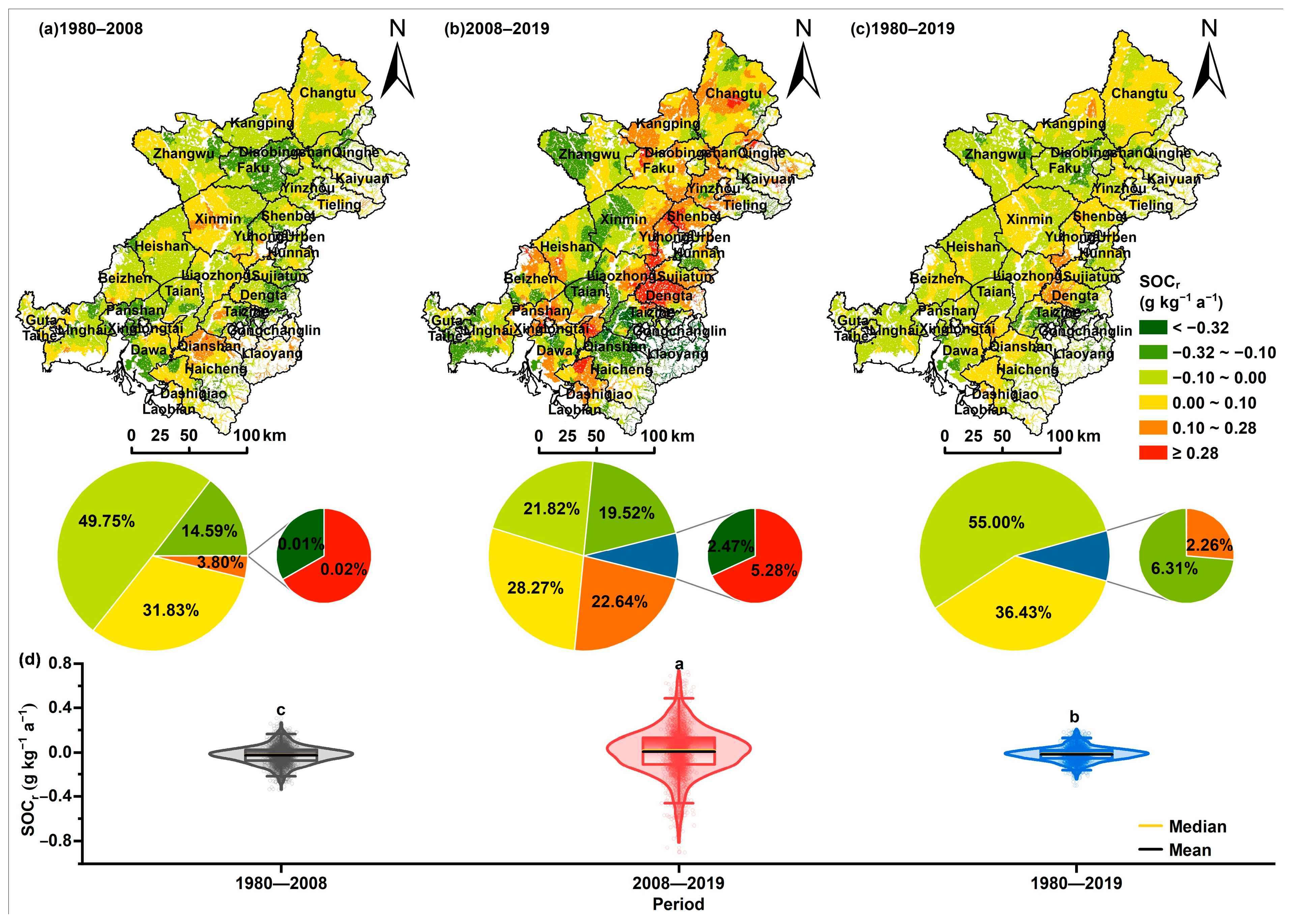
The SOCr was calculated for three periods: early (1980–2008), late (2008–2019), and overall (1980–2019). The mean SOCr was highest in the late period, accounting for 0.01 g kg−1 a−1, which significantly exceeded both of the other periods (p < 0.05). The overall period had an intermediate mean SOCr of −0.02 g kg−1 a−1, a significantly higher value than the early period value of −0.03 g kg−1 a−1 (p < 0.05). Although the overall period SOCr remained negative, it demonstrated significant improvement relative to the early period. This indicated a substantial deceleration in SOC depletion following late management changes (Figure 6d).
Spatially, the distribution of SOCr displayed no stable patterns. The transposition of high- and low-value clusters between the early and late periods led to reduced spatial variability in the overall period, reflecting increased combined proportions of Class III and IV lands (Figure 6a–c).
In the early period, Class III and IV together occupied 81.58% of the total cultivated land area, indicating limited variability and a predominance of slow SOC changes. Concurrently, Class IV and below levels accounted for 64.35% of the area, confirming widespread SOC decline.
In contrast, the late period exhibited heightened variability. SOCr in Class I and VI was 5.28% and 2.47%, respectively. The combined area of the Class III and IV areas decreased by 31.49% compared to the early period. Class III and above levels accounted for 56.19% of the area, indicating a predominant shift toward SOC recovery. However, the Class V area expanded by 4.93% compared with the early period.
In the overall period, no areas for SOCr were classified as Class I or VI. Instead, Class III and IV collectively accounted for 91.43% of the area, an increase of 9.85% compared to the early period. This indicates that the overall variability of SOCr in cultivated land over the past 40 years has decreased relative to the early period alone.
Global spatial autocorrelation analysis revealed significant positive spatial autocorrelation for SOCr in all periods. The Moran’s I indices for the early, late, and overall periods were 0.59, 0.71, and 0.68, respectively (all Z ≥ 1.96 and p < 0.01). These indicated a progressively strengthened spatial dependence of SOCr over the past four decades.
Further, local spatial autocorrelation analysis of SOCr visualized through LISA cluster maps (Figure 7) revealed HH and LL as dominant spatial patterns at the 95% confidence level, with minimal presence of the HL or LH types. HH clusters accounted from 24.31% to 26.48% of the total cultivated land area, while LL clusters covered 23.26% to 24.24%. Although the intensity of spatial autocorrelation and the proportional ranges of major cluster types remained relatively stable across periods, a substantial spatial redistribution of the clusters themselves was observed.

3.3. Spatiotemporal Correlation Between Initial SOC Content and SOCr

Within a specific spatiotemporal scale, assuming constant initial conditions such as climate, topography, parent material, land use patterns, and agricultural management practices, cultivated SOC content changes continuously but might eventually stabilize at a point where further change becomes minimal or negligible. This equilibrium state, where SOC mineralization and accumulation reach a dynamic balance, was defined as the SOCep for a given region and period [31].
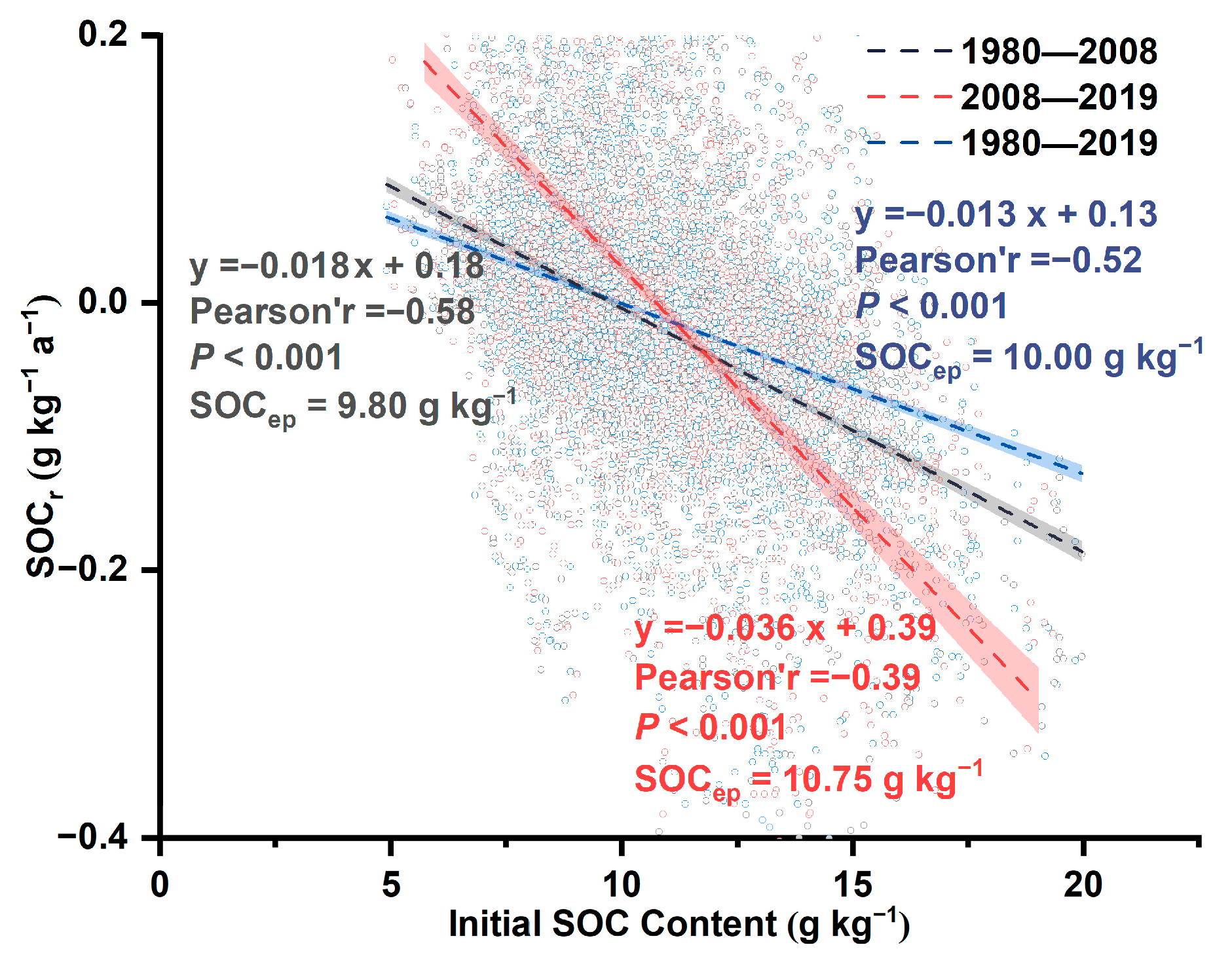
To estimate the SOCep, we integrated data on initial SOC content and SOCr data for three periods: early (1980–2008), late (2008–2019), and overall (1980–2019). Scatter plots were constructed with the initial SOC content (at the start of each period) for individual plots against the corresponding SOCr for that period. The SOC content value corresponding to SOCr = 0 on each curve represented the SOCep for the LLRP cultivated land during that specific period. This indicated that cultivated land with an initial SOC content that exceeded the SOCep was more likely to exhibit a negative SOCr, signifying a declining trend in SOC content. Conversely, cultivated land with an initial SOC content below the SOCep was more likely to exhibit a positive SOCr, indicating an increasing trend. Furthermore, an SOCr close to 0 showed initial SOC content similar to the SOCep, reflecting smaller magnitudes of SOC change.
Significant negative correlations were observed between initial SOC and SOCr across all periods (p < 0.001). The early, late, and overall periods SOCep were 9.80, 10.75, and 10.00 g kg−1, respectively (Figure 8). Compared to the early period, the SOCep in the late and overall period increased by 0.95 and 0.20 g kg−1, respectively. This upward shift demonstrates a gradual improvement in the SOC sequestration capacity of cultivated land in the study area over the past 40 years
To elucidate the spatial correlation between the initial SOC content and the SOCr in the study area, bivariate spatial autocorrelation analysis was conducted. The bivariate global Moran’s I indices were −0.37 (early), −0.21 (late), and −0.31 (overall), with all Z ≤ −1.96 and p < 0.01, confirming a significant negative spatial correlation, which aligned with the results of the Pearson correlation analysis.
Further bivariate local spatial autocorrelation analysis produced LISA cluster maps at the 95% confidence level, depicting the spatial relationship between initial SOC and SOCr (Figure 9). HH clusters represented areas with high initial SOC surrounded by areas also exhibiting high SOCr (indicating a faster rate of SOC increase). LL clusters represented areas with low initial SOC surrounded by areas also exhibiting low SOCr (indicating a faster rate of SOC decrease). The meanings of HL and LH clusters followed analogously.
The dominant bivariate spatial associations varied by period. In the early period, HL and LH clusters accounted for 17.57% and 21.61% of the total cultivated area, respectively, while HH and LL clusters accounted for only 5.39% and 9.52%. In the late period, the dominant types shifted to LH and LL clusters, accounting for 18.55% and 13.02%, respectively, while HH and HL clusters accounted for 9.19% and 11.20%. For the overall period, the pattern resembled the early period, with HL and LH clusters again being dominant. The proportional areas of each cluster type showed no significant changes compared to the earlier phases.
Overall, the spatial relationship between initial SOC and SOCr was predominantly characterized by negative spatial autocorrelation clustering, although localized areas exhibited positive spatial autocorrelation clustering.

4. Discussion

4.1. Spatiotemporal Dynamics of Cultivated Land SOC

Over the past four decades, cultivated land SOC in the study area exhibited a significant decline from 1980 to 2008, followed by a modest recovery from 2008 to 2019. The early period decrease was consistent with findings by Song et al. [15] and reflects historical soil degradation patterns in Northeast China’s black soils region. This trend may be attributed to multiple factors, including climate warming, conventional tillage practices, inadequate organic inputs, and intensified soil erosion due to over-cultivation [14,32,33]. Among these, conventional tillage was likely a primary driver, as it reduces soil structure stability and accelerates the disruption of soil aggregates, thereby exposing previously protected SOC to microbial decomposition and increasing its vulnerability to loss via wind and water erosion [34,35,36]. Concurrently, extensive management practices, such as straw burning and neglect of organic matter, deprived the soil of sufficient organic carbon replenishment, resulting in significant SOC loss.
During the late period, the cultivated land SOCr increased significantly, accompanied by a slight rise in SOC content. This reversal indicates that efforts to enhance cultivated land quality protection in this region over the past 11 years have yielded positive outcomes. The improvement is largely attributed to the widespread promotion and adoption of conservation agricultural practices, including balanced fertilization by soil testing [37], reduced tillage, no-till practices, and straw return [38].
Conservation tillage enhances carbon input while promoting the formation and stabilization of soil aggregates [39]. Reduced mechanical disturbance helps preserve aggregate integrity, thereby slowing the mineralization of SOC [40,41,42]. Furthermore, reasonable application of chemical fertilizers, optimization of fertilization ratios, and the combined application of straw return and organic amendments can not only improve crop yield but also increase the carbon return of crop stubble, straw, and root [43]. This provides sufficient carbon source for the soil, thereby improving soil biodiversity and promoting the formation of binding agents and pores, which is conducive to the formation of soil aggregates and SOC stability [44]. An improved soil environment also enhances microbial activity, accelerating straw decomposition and the accumulation of microbial residues, which significantly increases the rate of SOC sequestration [45,46]. Even though there is no statistically significant difference in SOC content between 2019 and 2008, the continued promotion and application of conservation tillage measures are expected to support further growth in the SOC content of cultivated land in the future.
Spatially, the distribution of SOC content consistently showed higher values in eastern and southern areas of the LLRP—a pattern stable across all periods. Climate is considered the dominant controller of this macro-scale variation [47], with precipitation confirmed as the key driver in the LLRP [48]. Climate change usually alters the fixation and loss of SOC in cultivated land by affecting both plant photosynthesis and soil microbial respiration. Studies have shown that climate change and vegetation growth contribute more than 80% to the dynamics of SOC [49]. Higher rainfall in the humid eastern zone supports greater vegetation productivity and SOC accumulation. Areas adjacent to the Horqin Sandy Land in the western regions exhibit lower clay content and reduced aggregate formation, which limits the adsorption of SOC. The demand for livestock feed results in low straw return rates, further constraining carbon inputs in this arid zone.
Conversely, SOCr displayed no coherent and persistent spatial pattern. The spatial distributions of HH and LL clusters differed significantly between periods. This variability primarily stems from the dynamic interplay between regionally heterogeneous farmland management practices and underlying natural background potential.
Among management measures, fertilization is a key regulator of soil carbon pool dynamics [50]. In the early period, the western region, despite its poorer natural conditions (low precipitation, poor soil texture, and lower soil fertility), exhibited a higher SOCr. This was likely because substantial chemical fertilizer inputs aimed to increase crop yield. The consequent increase in biomass returned more carbon to the soil, temporarily enhancing its sequestration capacity, albeit to a limited extent. Conversely, in the eastern region, the relatively favorable natural conditions (sufficient precipitation, suitable texture, and higher soil fertility), people’s neglected investment in the cultivated land, and extensive management methods led to SOC loss and a lower SOCr.
In the late period, increased awareness of sustainable agriculture prompted a shift in practices. The implementation of measures such as balanced fertilization by soil testing and conservation tillage altered the initial spatial pattern of SOCr. Studies have shown that, under the condition that other factors remain unchanged, the application amount of chemical fertilizers in the LLRP decreased by an average of 24.19 kg ha−1 per year after the implementation of the balance fertilization by soil testing project [51]. This enabled the eastern region, which has better natural background potential, to achieve better results, ultimately forming a differential spatiotemporal pattern of SOCr.
Additionally, the low SOCr and significant SOC content decline in the southeast during the late period may be influenced by topography. Factors such as slope gradient and aspect regulate the redistribution of soil moisture, temperature, and nutrients, thereby affecting SOC accumulation and migration [52]. The southeast region is located in the Liaodong mountainous and hilly area, where the area contains a high proportion of sloping farmland and the problem of soil erosion is serious [53], leading to the loss of surface soil rich in SOC. In addition, the poor water retention capacity of sloping farmland constrains plant growth and carbon input, further depressing SOC levels [54].

4.2. Correlation Between Initial SOC Content and SOCr

Although research on the correlation between initial SOC content and SOCr is currently limited, existing studies consistently indicate that SOCr exhibits a declining trend as the initial SOC content increases [55,56]. Consistent with these findings, our results demonstrate a significantly negative correlation (p < 0.01) between initial SOC content and SOCr in the cultivated land of the LLRP across all periods. This phenomenon may arise from biophysical factor constraints that limit the capacity of soils with high initial SOC content to further sequester SOC [57].
Soils with high initial SOC content typically have a higher proportion of labile carbon fractions, which are readily accessible to microbes. This leads to high microbial carbon use efficiency (CUE), increased microbial abundance and activity, and greater release of extracellular enzymes, accelerating SOC decomposition. Furthermore, when external carbon inputs are insufficient, microbes readily consume the existing labile carbon pool to sustain normal growth and metabolism, accelerating SOC decomposition [58,59]. Simultaneously, the capacity of protection mechanisms against microbial decomposition, such as soil aggregates [60], clay particles, and metal oxides [61], is limited and can become saturated. Frequent disturbances can accelerate the depolymerization of organo-mineral complexes, releasing protected labile carbon and further amplifying decomposition effects. Consequently, the sequestration potential of high initial SOC content soils diminishes, making them not only resistant to further increase but also more susceptible to decline.
Conversely, cultivated land with low initial SOC content responds more markedly to various SOC enhancement measures, meaning it is more likely to accumulate additional SOC [62,63]. It is important to note that the correlation between initial SOC content and SOCr is not solely influenced by a single factor but results from the complex interplay of multiple factors. The above discussion merely explores potential explanations for the observed phenomenon in this study.
Guided by the theory of microbially mediated negative feedback in SOC turnover, future strategies for enhancing and managing SOC in cultivated land must adhere to the principle of suiting measures to local conditions, prioritizing the improvement of carbon sequestration efficiency in land with low initial SOC content, and optimizing protection strategies for land with high initial SOC content is essential. This approach should focus not only on increasing carbon inputs to boost sequestration efficiency but also, crucially, on protecting soil structure and reducing anthropogenic disturbances to alleviate SOC decomposition pressure.
Bivariate global Moran’s I index indicated a significant spatial negative correlation between initial SOC content and SOCr across all periods in the cultivated land of the study area. However, LISA cluster maps revealed that this correlation was not absolute. While negative spatial autocorrelation predominated (i.e., HL and LH), some areas exhibited positive spatial autocorrelation (i.e., HH and LL). This heterogeneous pattern is primarily influenced by regional variations in agricultural management, which significantly affect the SOC retention capacity [32]. These insights are valuable for formulating regional SOC enhancement policies.
Different cluster types imply distinct management priorities: HH clusters represent the most desirable scenario, combining high initial SOC with a positive change rate. These areas should serve as models for sustaining effective practices. HL clusters are warning zones, where high initial SOC is declining. Management practices from neighboring HH clusters could be adopted to prevent further decline. LH clusters are recovery zones, which have low initial SOC content but an increasing trend. Efforts here should focus on moderately increasing carbon inputs and improving soil texture to sustain recovery. LL clusters are critical zones, facing low initial SOC and ongoing decline. The strictest control measures should be implemented here, such as planting green manure, full straw incorporation, and increasing organic fertilizer application to boost carbon input, alongside addressing other limiting factors to prevent accelerated SOC decline.
It is crucial to note that SOC enhancement is a long-term process. Sustained improvement depends on the consistent implementation of management practices that are rationally adapted to local conditions.

4.3. Limitations and Future Perspectives

In this study, we developed a comprehensive analytical framework to assess the spatiotemporal dynamics of SOC in the LLRP’s cultivated lands over 40 years. By integrating multi-period soil surveys with geospatial and spatial autocorrelation analyses, we quantified SOC evolution patterns and equilibrium points. Our findings reveal distinct spatial relationships between initial SOC and SOCr, providing a basis for spatially targeted soil management strategies in black soil regions.
Nevertheless, several limitations should be acknowledged. The reliance on soil survey data from three discrete periods (1980, 2008, and 2019) may not fully capture short-term fluctuations or continuous trends in SOC dynamics. Furthermore, the analysis also could not integrate all potential driving factors, such as detailed seasonal climate data, micro-scale shifts in microbial community composition, land-use change, or socio-economic drivers of farming decisions, which limits a comprehensive attribution of SOC changes. These limitations could be addressed in future work through more intensive temporal monitoring, multi-model comparisons, and the incorporation of process-based mechanistic models.
Future research should prioritize several key directions to build upon these findings. First, integrating remote sensing technologies with more frequent field surveys would enable real-time tracking of SOC changes and enhance the temporal resolution of trend analyses. Second, coupling geospatial analyses with process-based models (e.g., DNDC) would improve the capacity to simulate SOC dynamics under various climate change and land management scenarios, thereby increasing predictive accuracy. Third, expanding the analytical framework to integrate long-term, high-resolution socio-economic data (e.g., farmer behavior, policy incentives), soil microbial properties, land-use change data, and direct carbon flux measurements is crucial for elucidating the complex interactions that govern SOC sequestration. Ultimately, upscaling this research to broader spatial scales, such as the entire Northeast China black soil region, and developing spatially explicit carbon management frameworks will be essential for formulating targeted strategies that support regional land quality enhancement and contribute to national carbon neutrality goals.

5. Conclusions

Over the past four decades, the SOC content in the cultivated lands of the LLRP exhibited an early significant decline followed by a slight recovery. This reversal, accompanied by a notable rise in the SOCep, suggested emerging signs of SOC restoration, coinciding with the widespread implementation of conservation agricultural practices in the region.
Spatially, both SOC content and SOCr showed a significant positive spatial autocorrelation. The spatial distribution of SOC content was stable, declining from the east and south to the west and north. In contrast, SOCr lacked a consistent spatial structure and varied considerably over time.
Across all periods, a significantly negative correlation existed between initial SOC content and SOCr. Bivariate global Moran’s I further confirmed a significant spatial negative correlation clustering between them. However, LISA cluster maps revealed that this spatial negative relationship was not absolute; while negative spatial autocorrelation clustering dominated, local positive spatial autocorrelation clusters also existed. This spatial heterogeneity underscored the strong influence of anthropogenic factors, indicating that divergent agricultural management practices in different regions modulate the core relationship.
These findings provided a scientific basis for formulating future regional policies for SOC enhancement in cultivated land and optimizing zonal management strategies.

Author Contributions

X.S.: conceptualization, methodology, data collection and analysis, writing—original draft, writing—review and editing. J.P.: conceptualization, methodology, resources, writing—review and editing, project administration, funding acquisition. Y.Z.: data curation, investigation, visualization, writing—review and editing. S.W.: validation, resources, software. S.L.: investigation, data collection. M.W.: data curation, data processing. X.Z.: methodology, validation. D.S.: resources, supervision. J.D.: data collection, software, visualization. X.F.: writing—review and editing, visualization. J.W.: supervision, conceptualization, writing—review and editing. All authors have read and agreed to the published version of the manuscript.

Funding

This study was financially supported by the National Key Research and Development Program of China (2021YFD1500204), the Liaoning Revitalization Talents Program (XLYC2203198), and the Excellent Undergraduate Thesis (Design) Cultivation Project of Shenyang Agricultural University (2022049).

Data Availability Statement

The original contributions presented in this study are included in the article. Further inquiries can be directed to the corresponding author.

Conflicts of Interest

The authors declare that they have no known competing financial interests or personal relationships that could have appeared to influence the work reported in this paper.

References

  1. Gou, N.; Li, B.; Wang, C.; Zhong, W.; Wang, K.; Sun, J. Difference of Soil Nutrient and Organic Carbon Pool Stability of Rice-garlic Rotation in Chengdu Plain. Chin. J. Soil Sci. 2024, 55, 1657–1665. [Google Scholar] [CrossRef]
  2. Beillouin, D.; Corbeels, M.; Demenois, J.; Berre, D.; Boyer, A.; Fallot, A.; Feder, F.; Cardinael, R. A global meta-analysis of soil organic carbon in the Anthropocene. Nat. Commun. 2023, 14, 3700. [Google Scholar] [CrossRef]
  3. Li, Q.; Li, A.; Dai, T.; Fan, Z.; Luo, Y.; Li, S.; Yuan, D.; Zhao, B.; Tao, Q.; Wang, C.; et al. Depth-dependent soil organic carbon dynamics of croplands across the Chengdu Plain of China from the 1980s to the 2010s. Glob. Change Biol. 2020, 26, 4134–4146. [Google Scholar] [CrossRef] [PubMed]
  4. Lorenz, K.; Lal, R.; Ehlers, K. Soil organic carbon stock as an indicator for monitoring land and soil degradation in relation to United Nations’ Sustainable Development Goals. Land Degrad. Dev. 2019, 30, 824–838. [Google Scholar] [CrossRef]
  5. Adhikari, K.; Owens, P.R.; Libohova, Z.; Miller, D.M.; Wills, S.A.; Nemecek, J. Assessing soil organic carbon stock of Wisconsin, USA and its fate under future land use and climate change. Sci. Total Environ. 2019, 667, 833–845. [Google Scholar] [CrossRef]
  6. Friedlingstein, P.; Jones, M.W.; O’Sullivan, M.; Andrew, R.M.; Bakker, D.C.E.; Hauck, J.; Le Quéré, C.; Peters, G.P.; Peters, W.; Pongratz, J.; et al. Global Carbon Budget 2021. Earth Syst. Sci. Data 2022, 14, 1917–2005. [Google Scholar] [CrossRef]
  7. Liu, Y.; Pei, J.; Wang, J. Spatial distribution and relationship between organic matter and pH in the typical black soil region of north-east China. J. Agric. Resour. Environ. 2019, 36, 738–743. [Google Scholar] [CrossRef]
  8. Liu, H.; Li, S.; Zhou, Y. Spatial-temporal variability of soil organic matter in urban fringe over 30 years: A case study in Northeast China. Int. J. Environ. Res. Public Health 2020, 17, 292. [Google Scholar] [CrossRef]
  9. Ou, Y.; Rousseau, A.N.; Wang, L.; Yan, B. Spatio-temporal patterns of soil organic carbon and pH in relation to environmental factors—A case study of the Black Soil Region of Northeastern China. Agric. Ecosyst. Environ. 2017, 245, 22–31. [Google Scholar] [CrossRef]
  10. Zhang, J.; Shi, H.; Tian, H.; Lu, F.; Xu, X.; Liu, D.; Gang, C.; Fang, S.; Qin, X.; Pan, N.; et al. Spatial-temporal change in and influencing mechanisms for cropland soil organic carbon storage in the North China Plain from 1981 to 2019. Acta Ecol. Sin. 2022, 42, 9560–9576. [Google Scholar] [CrossRef]
  11. Tong, Y.; Liu, J.; Li, X.; Sun, J.; Herzberger, A.; Wei, D.; Zhang, W.; Dou, Z.; Zhang, F. Cropping System Conversion led to Organic Carbon Change in China’s Mollisols Regions. Sci. Rep. 2017, 7, 18064. [Google Scholar] [CrossRef]
  12. Zhao, W.; Wang, X.; Yang, H.; Yang, R.; Ye, X.; Liu, X.; Zeng, F.; Ma, J.; Li, X.; Gao, Y.; et al. Spatio-temporal patterns of soil carbon and nitrogen characteristics along ariditygradients and their responses to climate change: Based on long-term fieldobservation data of Chinese Ecosystem Research Network. Acta Ecol. Sin. 2023, 43, 3582–3591. [Google Scholar]
  13. Liu, J. Evolution Characteristics and Driving Mechanism of Black Soil Organic Carbon and Nitrogen During the Post 113 Years of Reclamation in Northeastern China. Master’s Thesis, Research Center of Soil and Water Conservation and Ecological Environment, the University of Chinese Academy of Sciences and Ministry of Education, Xianyang, China, 2021. [Google Scholar]
  14. Sun, S.; Pei, J.; Wang, J.; Xu, Z.; Dai, J. Cultivated Quality Evolution and Obstacle Factors Diagnosis in the Lower Liaohe River Plain. Chin. J. Agric. Resour. Reg. Plan. 2023, 44, 92–102. [Google Scholar]
  15. Song, D.; Li, S.; Wang, J. Study of Temporal and Spatial Variation for Soil Organic Carbon in Croplands in Lower reaches of Liaohe river plain. Chin. J. Soil Sci. 2014, 45, 574–578. [Google Scholar] [CrossRef]
  16. Lu, C.; Luo, X.; Li, H.; Zang, Y.; Ou, Y. Progress and Suggestions of Conservation Tillage in China. Strateg. Study CAE 2024, 26, 103–112. [Google Scholar] [CrossRef]
  17. Jiang, F.; Qian, Y.; Guo, Z.; Gao, L.; Zhang, Z.; Cao, Z.; Guo, J.; Liu, F.; Peng, X. Evaluating the Regional Suitability of Conservation Tillage and Deep Tillage Based on Crop Yield in the Black Soil of Northeast China: A Meta-analysis. Acta Pedol. Sin. 2022, 59, 935–952. [Google Scholar]
  18. Wang, S.; Huang, X.; Zhang, Y.; Yin, C.; Richel, A. The effect of corn straw return on corn production in Northeast China: An integrated regional evaluation with meta-analysis and system dynamics. Resour. Conserv. Recycl. 2021, 167, 105402. [Google Scholar] [CrossRef]
  19. Wang, X.; Yu, D.; Wang, C.; Pan, Y.; Pan, J.; Shi, X. Variations in cropland soil organic carbon fractions in the black soil region of China. Soil Tillage Res. 2018, 184, 93–99. [Google Scholar] [CrossRef]
  20. Lian, G.; Guo, X.; Fu, B.; Hu, C. Prediction of the spatial distribution of soil properties based on environmental correlation and geostatistics. Trans. Chin. Soc. Agric. Eng. 2009, 25, 237–242. [Google Scholar]
  21. Liu, Q. Design and Application of Classification Index Assignment Model of Cultivated Land Resources Quality in the Third National Land Survey Based on ArcGIS. Geomat. Spat. Inf. Technol. 2022, 45, 58–62. [Google Scholar]
  22. Zhong, W.; Li, H.; Xie, L.; Sun, J.; He, Y.; Wang, K. Characteristics of Spatiotemporal Variability of Soil Nutrients and pH of Cultivated Land in the Typical West Sichuan Plain. Chin. J. Soil Sci. 2020, 51, 63–70. [Google Scholar] [CrossRef]
  23. Ren, P.; Huang, F.; Li, B. Spatial Differentiation Characteristics of Soil Organic Matter in Dry Farmland in the Huang-Huai-Hai Plain. Acta Pedol. Sin. 2022, 59, 440–450. [Google Scholar]
  24. Yu, J.N.; Zhang, H.C.; Wang, P.X.; Wang, J.Z.; Lu, F. Sequence analysis of local indicators of spatio-temporal association for evolutionary pattern discovery. GISci. Remote Sens. 2025, 62, 2487292. [Google Scholar] [CrossRef]
  25. Zhang, S.; Ge, C.; Chen, X.; Li, Z.; Shen, Q.; Zhang, L.; Nie, C.; Huang, Y. Spatial distribution characteristics and scale effects of regional soil organic carbon. Trans. Chin. Soc. Agric. Eng. 2018, 34, 159–168. [Google Scholar]
  26. Zuo, X.; Lai, J.; Liu, F.; Shi, X. Spatial Heterogeneity and Zoning of Soil Organic Matter Based on Geostatistics and Spatial Autocorrelation: A Perspective from Land Consolidation. Chin. J. Agric. Resour. Reg. Plan. 2022, 43, 240–252. [Google Scholar]
  27. Zhang, H.; Zhao, X.; Ouyang, Z.; Guo, X.; Kuang, L.; Li, W. Spatial Disparity Features and Protection Zoning of Cultivated Land Quality Based on Spatial Autocorrelation. Res. Soil Water Conserv. 2018, 25, 304–312. [Google Scholar] [CrossRef]
  28. Zeng, L.; Yang, Z.; Qin, F.; Guo, J.; Zhang, T. Spatial Heterogeneity of Vegetation Cover Change and Soil Conservation Evolution. Res. Soil Water Conserv. 2023, 37, 178–188. [Google Scholar] [CrossRef]
  29. Marasteanu, I.J.; Jaenicke, E.C. Hot Spots and Spatial Autocorrelation in Certified Organic Operations in the United States. Agric. Resour. Econ. Rev. 2016, 45, 485–521. [Google Scholar] [CrossRef]
  30. Lei, Z.; Yang, S.; Xu, Z.; Vachaud, G. Preliminary Investigation of the Spatial Variability of Soil Properties. J. Hydraul. Eng. 1985, 9, 10–21. [Google Scholar]
  31. Li, H.; Qian, R.; Pei, J.; Li, S.; Wang, J. Estimating soil organic carbon sequestration potential in the Chinese Mollisols region. Agron. J. 2024, 116, 1331–1342. [Google Scholar] [CrossRef]
  32. Xu, Y. Conservation agriculture-mediated soil carbon sequestration: A review. Chin. J. Eco-Agric. 2022, 30, 658–670. [Google Scholar]
  33. Liang, A.; Zhang, Y.; Chen, X.; Zhang, S.; Huang, D.; Yang, X.; Zhang, X.; Li, X.; Tian, C.; McLaughlin, N.B.; et al. Development and effects of conservation tillage in the black soil region of Northeast China. Sci. Geogr. Sin. 2022, 42, 1325–1335. [Google Scholar] [CrossRef]
  34. Yu, Q.; Hu, X.; Ma, J.; Ye, J.; Sun, W.; Wang, Q.; Lin, H. Effects of long-term organic material applications on soil carbon and nitrogen fractions in paddy fields. Soil Tillage Res. 2020, 196, 104483. [Google Scholar] [CrossRef]
  35. Li, C.; Li, Y.; Xie, J.; Liu, Y.; Wang, Y.; Liu, X. Accumulation of organic carbon and its association with macro-aggregates during 100 years of oasis formation. Catena 2019, 172, 770–780. [Google Scholar] [CrossRef]
  36. Lal, R. Digging deeper: A holistic perspective of factors affecting soil organic carbon sequestration in agroecosystems. Glob. Change Biol. 2018, 24, 3285–3301. [Google Scholar] [CrossRef]
  37. Chen, X.; Cui, Z.; Fan, M.; Vitousek, P.; Zhao, M.; Ma, W.; Wang, Z.; Zhang, W.; Yan, X.; Yang, J.; et al. Producing more grain with lower environmental costs. Nature 2014, 514, 486–489. [Google Scholar] [CrossRef] [PubMed]
  38. Li, Y.; Li, Z.; Chang, S.X.; Cui, S.; Jagadamma, S.; Zhang, Q.; Cai, Y. Residue retention promotes soil carbon accumulation in minimum tillage systems: Implications for conservation agriculture. Sci. Total Environ. 2020, 740, 140147. [Google Scholar] [CrossRef]
  39. Ghimire, R.; Lamichhane, S.; Acharya, B.S.; Bista, P.; Sainju, U.M. Tillage, crop residue, and nutrient management effects on soil organic carbon in rice-based cropping systems: A review. J. Integr. Agric. 2017, 16, 1–15. [Google Scholar] [CrossRef]
  40. Liang, B.C.; VandenBygaart, A.J.; MacDonald, J.D.; Cerkowniak, D.; McConkey, B.G.; Desjardins, R.L.; Angers, D.A. Revisiting no-till’s impact on soil organic carbon storage in Canada. Soil Tillage Res. 2020, 198, 104529. [Google Scholar] [CrossRef]
  41. Whitehead, D.; Schipper, L.A.; Pronger, J.; Moinet, G.Y.K.; Mudge, P.L.; Calvelo Pereira, R.; Kirschbaum, M.U.F.; McNally, S.R.; Beare, M.H.; Camps-Arbestain, M. Management practices to reduce losses or increase soil carbon stocks in temperate grazed grasslands: New Zealand as a case study. Agric. Ecosyst. Environ. 2018, 265, 432–443. [Google Scholar] [CrossRef]
  42. Mi, H.; Zhu, L.; Shen, Y.; Li, S. Biochar Effects on Organic Carbon and Nitrogen in Soil Aggregates in Semiarid Farmland. J. Agro-Environ. Sci. 2015, 34, 1550–1556. [Google Scholar]
  43. Han, D.; Wiesmeier, M.; Conant, R.T.; Kühnel, A.; Sun, Z.; Kögel-Knabner, I.; Hou, R.; Cong, P.; Liang, R.; Ouyang, Z. Large soil organic carbon increase due to improved agronomic management in the North China Plain from 1980s to 2010s. Glob. Change Biol. 2017, 24, 987–1000. [Google Scholar] [CrossRef]
  44. Zhang, S.; Li, Q.; Zhang, X.; Wei, K.; Chen, L.; Liang, W. Effects of conservation tillage on soil aggregation and aggregate binding agents in black soil of Northeast China. Soil Tillage Res. 2012, 124, 196–202. [Google Scholar] [CrossRef]
  45. Wang, W.; Shen, P.; Zhang, H.; Mo, F.; Wen, X.; Liao, Y. Study on the Relationship Between Total Nitrogen and Nitrogen Functional Microorganisms in Soil Aggregates under Long-Term Conservation Tillage. Acta Pedol. Sin. 2024, 61, 1653–1667. [Google Scholar]
  46. Liu, H.; Li, R.; Gao, J.; Zhu, P.; Lu, Y.; Gao, H.; Zhang, G.; Zhang, X.; Peng, C.; Yang, D. Research progress on the effects of conservation tillage on soil aggregates and microbiological characteristics. Ecol. Environ. Sci. 2020, 29, 1277–1284. [Google Scholar] [CrossRef]
  47. Li, M.; Han, X.; Du, S.; Li, L.-J. Profile stock of soil organic carbon and distribution in croplands of Northeast China. Catena 2019, 174, 285–292. [Google Scholar] [CrossRef]
  48. Liu, X.; Bian, Z.; Sun, Z.; Wang, C.; Sun, Z.; Wang, S.; Wang, G. Integrating Landscape Pattern Metrics to Map Spatial Distribution of Farmland Soil Organic Carbon on Lower Liaohe Plain of Northeast China. Land 2023, 12, 1344. [Google Scholar] [CrossRef]
  49. Li, H.; Wu, Y.; Liu, S.; Xiao, J.; Zhao, W.; Chen, J.; Alexandrov, G.; Cao, Y. Decipher soil organic carbon dynamics and driving forces across China using machine learning. Glob. Change Biol. 2022, 28, 3394–3410. [Google Scholar] [CrossRef] [PubMed]
  50. Zhang, J.; Wang, G.; Li, Y.; Zhang, W.; Zhang, J.; Zhang, F. Re-thinking the Establishment of the Farmland Soil Health Assessment System. Acta Pedol. Sin. 2024, 61, 879–891. [Google Scholar]
  51. Wang, Z. Study on Environmental and Economic Effects of Soil Measurement and Fertilization Project of Lower Reaches of Liaohe River Plain. Master’s Thesis, Shenyang Agricultural University, Shenyang, China, 2018. [Google Scholar]
  52. Xin, Z.; Qin, Y.; Yu, X. Spatial variability in soil organic carbon and its influencing factors in a hilly watershed of the Loess Plateau, China. Catena 2016, 137, 660–669. [Google Scholar] [CrossRef]
  53. Xu, Y.; Pei, J.; Li, S.; Zou, H.; Wang, J.; Zhang, J. Main Characteristics and Utilization Countermeasures for Black Soils in Different Regions of Northeast China. Chin. J. Soil Sci. 2023, 54, 495–504. [Google Scholar] [CrossRef]
  54. Jakšić, S.; Ninkov, J.; Milić, S.; Vasin, J.; Živanov, M.; Jakšić, D.; Komlen, V. Influence of slope gradient and aspect on soil organic carbon content in the region of Niš, Serbia. Sustainability 2021, 13, 8332. [Google Scholar] [CrossRef]
  55. Huang, S.; Sun, Y.; Zhang, W. Changes in soil organic carbon stocks as affected by cropping systems and cropping duration in China’s paddy fields: A meta-analysis. Clim. Change 2011, 112, 847–858. [Google Scholar] [CrossRef]
  56. Pan, G.; Li, L.; Zhang, X.; Dai, J.; Zhou, Y.; Zhang, P. Soil Organic Carbon Storage of China and the Sequestration Dynamics in Agricultural Lands. Adv. Earth Sci. 2003, 18, 609–618. [Google Scholar]
  57. Slessarev, E.W.; Mayer, A.; Kelly, C.; Georgiou, K.; Pett-Ridge, J.; Nuccio, E.E. Initial soil organic carbon stocks govern changes in soil carbon: Reality or artifact? Glob. Change Biol. 2022, 29, 1239–1247. [Google Scholar] [CrossRef]
  58. Liang, C.; Zhu, X. The soil microbial carbon pump as a new concept for terrestrial carbon sequestration. Sci. China Earth Sci. 2021, 51, 680–695. [Google Scholar] [CrossRef]
  59. Jin, J.; Wood, J.; Franks, A.; Armstrong, R.; Tang, C. Long-term CO2 enrichment alters the diversity and function of the microbial community in soils with high organic carbon. Soil Biol. Biochem. 2020, 144, 107780. [Google Scholar] [CrossRef]
  60. Samson, M.-E.; Chantigny, M.H.; Vanasse, A.; Menasseri-Aubry, S.; Royer, I.; Angers, D.A. Management practices differently affect particulate and mineral-associated organic matter and their precursors in arable soils. Soil Biol. Biochem. 2020, 148, 107867. [Google Scholar] [CrossRef]
  61. McNally, S.R.; Beare, M.H.; Curtin, D.; Meenken, E.D.; Kelliher, F.M.; Calvelo Pereira, R.; Shen, Q.; Baldock, J. Soil carbon sequestration potential of permanent pasture and continuous cropping soils in New Zealand. Glob. Change Biol. 2017, 23, 4544–4555. [Google Scholar] [CrossRef]
  62. Georgiou, K.; Jackson, R.B.; Vindušková, O.; Abramoff, R.Z.; Ahlström, A.; Feng, W.; Harden, J.W.; Pellegrini, A.F.A.; Polley, H.W.; Soong, J.L.; et al. Global stocks and capacity of mineral-associated soil organic carbon. Nat. Commun. 2022, 13, 3797. [Google Scholar] [CrossRef]
  63. Xie, N.; An, T.; Li, S.; Sun, L.; Pei, J.; Ding, F.; Xu, Y.; Fu, S.; Gao, X.; Wang, J. Distribution and Sequestration of Exogenous New Carbon in Soils Different in Fertility. Acta Pedol. Sin. 2016, 53, 942–950. [Google Scholar]
Figure 1. LLRP geographical location (a,b), taxonomic classification of soils (c), MAT (d), MAP (e), DEM (f).
Land 15 00099 g001
Figure 2. Distribution of sampling points.
Land 15 00099 g002
Figure 3. Determination of the optimal number of clusters by the elbow method.
Land 15 00099 g003
Figure 4. Spatiotemporal distribution characteristics of cultivated land SOC in the LLRP over the past 40 years. (ac) show the spatial distribution patterns of SOC and the proportional area of cultivated land in each SOC grade for the years of 1980, 2008, and 2019, respectively. (d) represents the violin plot of SOC content of the cultivated land in the study area during different periods. Different lower-case letters above the violins indicate statistically significant differences based on the least significant difference (LSD) test (p < 0.05).
Land 15 00099 g004
Figure 5. LISA cluster map of SOC content in the cultivated land of the LLRP (1980–2019). The map reveals statistically significant spatial associations (p < 0.05) classified into four types: HH or LL indicate high SOC spatial aggregation (high or low SOC surrounded by correspondingly high or low values), HL or LH demonstrate spatial dispersion (high or low SOC surrounded conversely by low or high values), and NN represents no significant local spatial association.
Land 15 00099 g005
Figure 6. Spatiotemporal distribution characteristics of cultivated land SOCr in the LLRP under different periods. (ac), respectively, represent the spatiotemporal distribution characteristics of SOCr in the study area and the proportion of cultivated land area in each SOCr rank in the different periods. (d) represents the violin plot of SOCr from the cultivated land in the study area during the different periods. Different lower-case letters represent significant differences (least significant difference (LSD) test, p < 0.05).
Land 15 00099 g006
Figure 7. Local spatial autocorrelation LISA cluster map of SOCr. The map reveals statistically significant spatial associations (p < 0.05) classified into four types: HH or LL indicate high SOCr spatial aggregation (high or low SOCr surrounded by correspondingly high or low values), HL or LH demonstrate spatial dispersion (high or low SOCr surrounded conversely by low or high values), and NN represents no significant local spatial association.
Land 15 00099 g007
Figure 8. Correlation between the initial SOC content and the SOCr of cultivated land in different periods. The colorful stripes denotes the 95 % confidence interval.
Land 15 00099 g008
Figure 9. Local spatial autocorrelation LISA maps of initial SOC content and SOCr. The map reveals statistically significant spatial associations (p < 0.05) classified into four types: HH or LL indicate high initial SOC content and SOCr spatial aggregation (high or low initial SOC content surrounded by correspondingly high or low SOCr values), HL or LH demonstrate spatial dispersion (high or low initial SOC content surrounded conversely by low or high SOCr values), NN represents no significant local spatial association.
Land 15 00099 g009
Table 1. Classification of cultivated SOC content.
RankSOC Content
Range (g kg−1)
Level
I≥23.20Very High
II17.40~23.20High
III11.60~17.40Medium
IV5.80~11.60Moderately Low
V3.48~5.80Low
VI<3.48Very Low
Table 2. Classification of cultivated SOCr. Different lower-case letters represent significant differences (least significant difference (LSD) test, p < 0.05).
RankSOCr Range
(g kg−1 a−1)
Number of SampleAverage
(g kg−1 a−1)
I≥0.282690.40 ± 0.10 a
II0.10~0.2811580.16 ± 0.05 b
III0.00~0.1030750.04 ± 0.03 c
IV−0.10~0.004114−0.04 ± 0.03 d
V−0.32~−0.101606−0.16 ± 0.05 e
VI<−0.32194−0.47 ± 0.10 f
Disclaimer/Publisher’s Note: The statements, opinions and data contained in all publications are solely those of the individual author(s) and contributor(s) and not of MDPI and/or the editor(s). MDPI and/or the editor(s) disclaim responsibility for any injury to people or property resulting from any ideas, methods, instructions or products referred to in the content.