Spatial Planning in Paraguay: Between Political Fragmentation and Institutional Challenges

 ,
,  and
and 
Abstract
1. Introduction
- How has the spatial planning system evolved in Paraguay?
- What are the main political and institutional characteristics and challenges of the Paraguayan spatial planning system?
2. Institutional Design and Structure of the Spatial Planning System
3. Materials and Methods
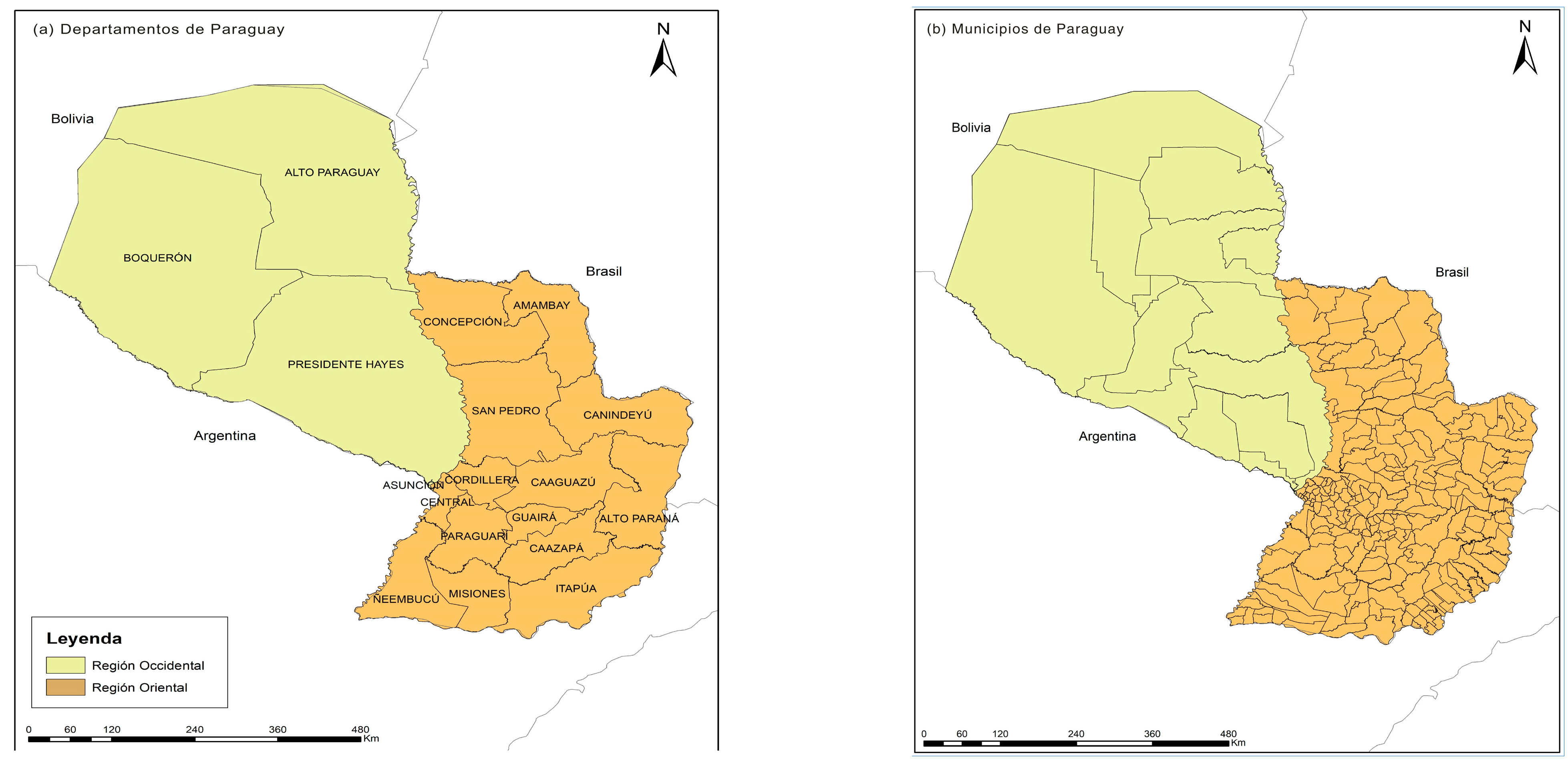
3.1. Study Area
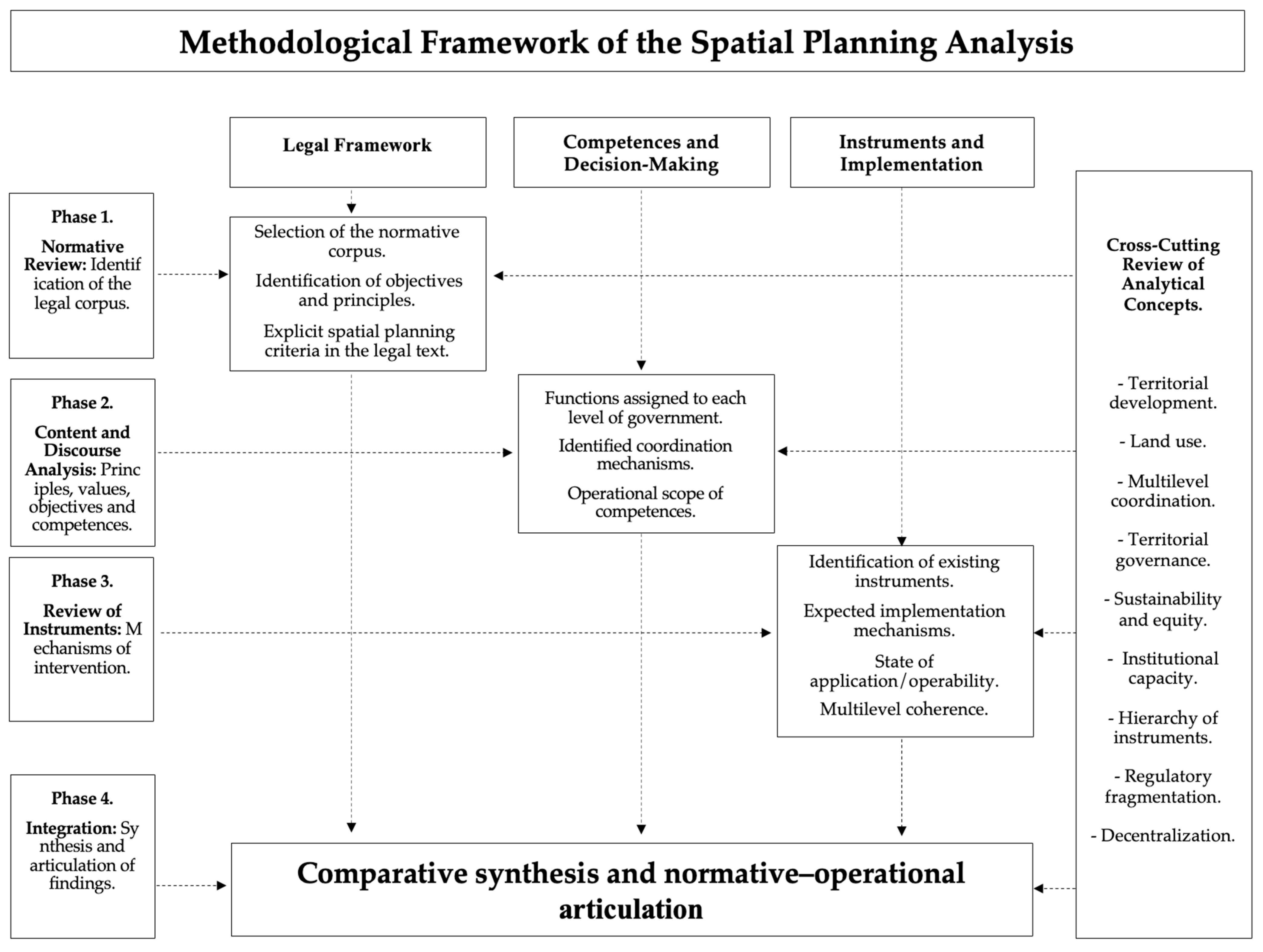
3.2. Methodological Design and Analytical Procedures
4. Results
4.1. Evolution and General Approach to Spatial Planning in Paraguay
4.2. Levels of Government and Competences in Spatial Planning in Paraguay
4.3. Processes of Spatial Planning Implementation and Operationalization
5. Discussion
6. Conclusions
Author Contributions
Funding
Data Availability Statement
Acknowledgments
Conflicts of Interest
Abbreviations
| AMUCA | Association of Municipalities of Caazapá |
| CDD | Departmental Development Council |
| CN | National Constitution |
| EIA | Environmental Impact Assessment |
| FODA | Strengths, Opportunities, Weaknesses, and Threats (SWOT) |
| INDERT | National Institute for Rural and Land Development |
| INFONA | National Forestry Institute |
| JICA | Japan International Cooperation Agency |
| MADES | Ministry of Environment and Sustainable Development |
| MEF | Ministry of Economy and Finance |
| MERCOSUR | Southern Common Market |
| MUVH | Ministry of Urbanism, Housing, and Habitat |
| OECD | Organisation for Economic Co-operation and Development |
| OTAS | Environmentally Sustainable Spatial Planning |
| PAN | National Environmental Policy |
| PDD | Departmental Development Plan |
| PDSM | Municipal Sustainable Development Plan |
| PGA | Environmental Management Plan |
| PLANDETUR | Strategic Tourism Development Plan (Ñeembucú) |
| PMNDyOT | National Framework Plan for Development and Spatial Planning |
| PND | National Development Plan |
| PNPI | National Plan for Indigenous Peoples |
| UNDP | United Nations Development Programme |
| PNUVH | National Policy for Urban Development, Housing, and Habitat |
| POTA | Territorial and Environmental Planning Plan |
| POUT | Urban and Spatial planning Plan |
| SENATUR | National Tourism Secretariat |
| SISNAM | National Environmental System |
| STP | Technical Secretariat for Economic and Social Development Planning |
| USAID | United States Agency for International Development |
Appendix A

| Regulation | Objectives Related to Spatial Planning | Guiding Principles Related to Spatial Planning | Implementation of Objectives |
|---|---|---|---|
| National Constitution (1992) | To promote quality of life, socioeconomic development, environmental preservation, and citizens’ well-being. | Human dignity, freedom, equality, justice, equity, participatory democracy, and social, economic, and cultural welfare and integration. | -PND |
| Law No. 904/1981–Estatuto de Comunidades Indígenas (Statute of Indigenous Communities) | To establish legal mechanisms for the allocation of public or private lands, preserving traditional possession and ensuring the cultural, social, and economic continuity of communities. | Cultural identity, territorial equity, social justice, community participation, and environmental preservation. | -Plan Nacional de Pueblos Indígenas (National Plan for Indigenous Peoples, PNPI 2016–2020). |
| Law No. 294/1993—Evaluación de Impacto Ambiental (Environmental Impact Assessment) | To establish a regulatory framework guiding spatial planning in Paraguay and providing the technical and strategic basis for the deliberation and approval of new development projects and activities. | Transparency and public participation, precautionary principle, and subsidiarity in regulation. | -Política Ambiental Nacional (National Environmental Policy, PAN) *; -Plan de Gestión Ambiental (Environmental Management Plan, PGA) |
| Law No. 426/1994—Ley Orgánica Departamental (Departmental Organic Law) | To coordinate and implement policies, plans, and projects for departmental development in areas such as economy, society, and culture, aligning efforts with the National Development Plan to ensure coherence across government levels. | Equity, transparency, accountability, and citizen participation. | -PDDs. |
| Law No. 1863/2002—Estatuto Agrario (Agrarian Statute) | To promote the adjustment of the agrarian structure, strengthen family farming, and ensure equitable land distribution, thus fostering the economic and physical integration of the territory. | Social and economic function of land, rational use of resources, environmental sustainability, distributive equity, rural rootedness, community participation, institutional cooperation, and food security. | -Land-use and management plans; land surveying and subdivision. -Environmental Impact Studies (EIA). |
| Law No. 3239/2007—Recursos Hídricos del Paraguay (Water Resources of Paraguay) | To integrate water resource management with development planning and territorial organization, using the watershed as the central element for equitable territorial integration. | Human right to water, equality, and participatory management. | -Política Nacional de los Recursos Hídricos ** (National Water Resources Policy). |
| Law No. 3966/2010—Ley Orgánica Municipal (Municipal Organic Law) | To develop and implement municipal spatial planning through two instruments: the PDSMs and the POUTs. The latter aims to guide and reconcile land use and occupation in both urban and rural areas. | Transparency, rationality, social equity, and citizen participation. | -PDSMs. -POUTs. |
| Decree No. 1110/2024—Approval of the Política Nacional de Urbanismo, Vivienda y Hábitat (National Policy for Urbanism, Housing, and Habitat, PNUVH) | To promote sustainable urban planning that fosters orderly city growth and improves quality of life through access to basic services, quality housing, and climate-resilient urban spaces, ensuring efficient land use and prioritizing environmental conservation and development in suitable areas. | Sustainability, participation, transparency, accountability, shared responsibility, and territorial resilience. | -PNUVH (under development). |
| Law No. 7261/2024—Acuerdo sobre Localidades Fronterizas Vinculadas (Agreement on Linked Border Localities) | To formulate Planes Conjuntos de Desarrollo Urbano y Ordenamiento Territorial (Joint Urban Development and Spatial Planning Plans, PCDUyOT) to promote cross-border cooperation, harmonize spatial organization, improve service provision, and strengthen infrastructure, contributing to reducing asymmetries among MERCOSUR border municipalities. | International cooperation, reciprocity, territorial equity, socioeconomic integration, sustainability, and community participation. | -PCDUyOT (not yet implemented). |
| Department | Validity | Articulation with PND 2030 | Incorporation of Spatial Planning | Participation Mechanisms | Observations |
|---|---|---|---|---|---|
| 1. Concepción | 2016–2020 | Partial. Contains social, economic, and environmental objectives compatible with the PND 2030 but does not explicitly adopt its structure of pillars and cross-cutting lines. | Partial (no specific axis on spatial planning, though coordination with municipalities is mentioned). | Multisectoral meeting with public institutions, communities, associations, and NGOs; methodological support from STP. | Broad and documented participation; STP assistance; inclusion of various social sectors. Short validity and no clear linkage with the PND 2030. |
| 2. San Pedro | 2018–2023 | Explicit (adopts the strategic pillars and cross-cutting lines of the PND 2030). | Explicit (includes spatial planning and sustainability as cross-cutting dimensions). | Working meetings, technical talks, and opinion debates with social and institutional actors. | Articulated with the PND 2030; incorporates territorial and environmental dimensions; broad participation with a consultative emphasis. |
| 3. Cordillera | 2016–2018 | Explicit (adopts the strategic pillars and cross-cutting lines of the PND 2030). | Explicit (includes spatial planning and sustainability as cross-cutting lines). | Establishment of sectoral roundtables for diagnosis and the subsequent formulation of objectives and actions. | Aligned with the PND 2030; short validity coinciding with the political government period. |
| 4. Guairá | 2016–2018 | Partial. Contains social, economic, and environmental objectives compatible with the PND 2030 but does not explicitly adopt its structure. | Explicit: includes departmental spatial planning as a strategic objective and agreements with STP. | Multisectoral meeting with representatives of public and private institutions, NGOs, and communities; formal establishment of the Departmental Development Council. | Short validity; highlights the formal creation of the Departmental Council as a governance mechanism. |
| 5. Caaguazú | 2014–2030 | Explicit (adopts the strategic pillars and cross-cutting lines of the PND 2030). | Explicit (includes spatial planning as a strategic dimension and urban improvement). | Working tables with local and departmental actors; District and Departmental Development Councils; Mayors’ Council; coordination with STP and ministries; interaction with the private sector and embassies. | Long-term plan (2014–2030) aligned with the PND 2030; includes indigenous rootedness, youth employment, and family farming; strong emphasis on spatial planning to reduce informal settlements; demonstrates a multi-level participatory approach. |
| 6. Caazapá | 2016–2021 | Explicit (states the relationship with the PND 2030 pillars and coordination with PDMs of 11 districts). | Partial: recognizes the territorial dimension in the diagnosis and SWOT, mentioning forest reserves and environmental management. | Departmental Development Council; working groups and assemblies with public institutions, AMUCA, sectoral councils, and indigenous communities. | Inclusive participatory process; strong focus on health, education, and environment. Medium-term validity and recognized articulation with PND 2030. |
| 7. Itapúa | 2016–2030 | Explicit (adopts the strategic pillars and cross-cutting lines of the PND 2030). | Explicit: incorporates spatial planning as a cross-cutting axis and links it to municipal POUTs and PDSMs. | Participation through the Departmental Development Council; workshops, assemblies, and working groups with social, economic, and environmental actors; methodological assistance from STP. | Long-term horizon (2016–2030) aligned with PND 2030; strong integration of spatial planning in departmental management; broad, well-documented participatory process; one of the most consolidated PDDs in terms of multi-level coherence. |
| 8. Misiones | 2019–2024 | Partial. Contains dimensions aligned with PND 2030 pillars but does not adopt its methodological structure or explicitly mention it. | Implicit. Addresses infrastructure and land-use issues but does not include spatial planning as a strategic axis. | Consultations with the Departmental Board, mayors, municipal councils, business sectors, teachers, livestock producers, health, culture, and youth sectors. | Medium-term validity; broad, multisectoral participation; planning focused on social and productive issues but lacking methodological reference to PND or spatial planning as a structural policy. |
| 9. Paraguarí | 2016–2020 | Explicit (adopts the strategic pillars and cross-cutting lines of the PND 2030). | Explicit (includes environmental sustainability and spatial planning as part of the territorial diagnosis and strategic axes). | Working meetings, technical talks, and opinion debates with social and sectoral actors. | Articulated with PND 2030; strong emphasis on environmental sustainability; short validity coinciding with the departmental government period. |
| 10. Alto Paraná | 2016–2020 | Explicit (adopts the strategic pillars and cross-cutting lines of the PND 2030). | Explicit: incorporates spatial planning in departmental planning and recognizes the need for new urban centers. | Departmental councils and permanent commissions (health, education, economy, public works, agriculture, strategic studies, public–private investment); methodological support from STP. | Reflects the department’s urban and agricultural dynamics; highlights economic diversification and the challenge of border-model restructuring. |
| 11. Central | 2016–2026 | Explicit (adopts the strategic pillars and cross-cutting lines of the PND 2030). | Explicit: promotes orderly territorial development, with emphasis on environmental sustainability and participatory planning. | Participatory process through the Departmental Development Council, sectoral roundtables, and records of citizen initiatives; methodological support from STP. | Medium- to long-term plan (2016–2026); strong articulation with PND 2030; broad program agenda in health, education, and economy; notable for including a political–institutional axis of participatory local development. |
| 12. Ñeembucú | Not identified | Not identified in a PDD. Indirect references are observed in the Strategic Tourism Development Plan of Ñeembucú (PLANDETUR 2020–2024), which incorporates guidelines on accessibility, sustainability, and land use for tourism purposes. | Within the framework of PLANDETUR, workshops were held with the Governor’s Office, municipalities, SENATUR, tourism operators, and community organizations. | The department lacks an identified PDD. However, the PLANDETUR Ñeembucú 2020–2024 is available as a sectoral instrument reflecting efforts in spatial planning within the tourism field, though it does not replace a comprehensive PDD articulated with the PND 2030. | |
| 13. Amambay | 2016–2020 | Explicit (adopts the strategic pillars and cross-cutting lines of the PND 2030). | Explicit. Includes the Territorial and Environmental Planning Plan (POTA) as a tool for urban and rural land management, land regularization, and environmental sustainability. | Formation of the Departmental Development Council (CDD); workshops and participatory diagnostics with institutional, community, and Indigenous representatives. | PDD with a 2016–2020 horizon, articulated with the PND 2030. Integrates objectives in education, health, employment, infrastructure, and environment; incorporates spatial planning through the POTA with a multi-actor participatory approach. |
| 14. Canindeyú | 2016–2020 | Explicit (adopts the strategic pillars and cross-cutting lines of the PND 2030). | Explicit. Foresees the development of a departmental spatial planning plan over five years, with guidelines for land use, infrastructure, and environmental protection. | Official formation and recognition of the Departmental Development Council; diagnostic workshops; participation of public institutions, community organizations, producers, and Indigenous peoples. | PDD with a 2016–2020 horizon, aligned with the PND 2030. Integrates programs in education, health, employment, infrastructure, family farming, and environment. Explicitly includes spatial planning as a strategic goal and features a broad, multisectoral participatory approach. |
| 15. Presidente Hayes | 2017–2020 | Explicit (adopts the strategic pillars and cross-cutting lines of the PND 2030). | Explicit. The plan envisages a spatial planning process defining rural and urban land use, considering economic, social, cultural, and environmental impacts to improve public service provision. | Departmental Development Council with participatory diagnostics, neighborhood committees, and inter-institutional agreements with municipalities and civic associations. | Short-term PDD (2017–2020). Includes objectives in education, health, infrastructure, tourism, and spatial planning. Reflects a participatory local development approach but with a limited horizon and no clear methodological articulation with the PND 2030. |
| 16. Boquerón | 2014–2018 | Explicit (adopts the strategic pillars and cross-cutting lines of the PND 2030). | Explicit. Incorporates spatial planning guidelines for land use, environmental sustainability, agricultural production, and natural resource management. | Developed from the 2014–2018 Strategic Plan of the Governor’s Office. Included diagnostics, workshops with public and private sectors, technical validation, and periodic follow-up through mini workshops. | PDD with a 2014–2018 horizon, aligned with the PND 2030. Integrates goals in education, health, infrastructure, production, and environment. Incorporates spatial planning as a tool for sustainability and reflects a structured, periodic participatory process. |
| 17. Alto Paraguay | Agenda 2010 (in implementation since 2003) | Not explicit, developed before its approval. | Explicit. Departmental and municipal spatial planning projects with ordinances for zoning and sustainable resource use. | Forums and workshops with broad participation (over 600 public, private, Indigenous, and community actors); inter-institutional executive committee. | Plan with distinctive features compared to other PDDs. A pioneering precedent of participatory spatial planning in the Paraguayan Chaco, with a strong environmental and intercultural emphasis. Lacks recent updates and is not methodologically articulated with the PND 2030, although it introduced innovations in territorial governance and aligns with the concept of territorial development as a process of productive and institutional transformation in self-determined rural spaces aimed at poverty reduction and local cooperation strengthening. |
| Department | No. of Municipalities | PDSMs | POUTs | ||||
|---|---|---|---|---|---|---|---|
| Not Available | Expired | Valid (≥2025) | Not Available | In Progress | Approved | ||
| Asunción * | 1 | - | - | 1 | - | - | 1 |
| Concepción | 14 | 3 | 11 | - | 12 | 2 | - |
| San Pedro | 22 | 2 | 18 | 2 | 19 | 1 | 2 |
| Cordillera | 20 | - | 17 | 3 | 18 | - | 2 |
| Guairá | 18 | - | 18 | - | 17 | - | 1 |
| Caaguazú | 22 | - | 21 | 1 | 14 | - | 8 |
| Caazapá | 11 | 1 | 9 | 1 | 9 | 1 | 1 |
| Itapúa | 30 | 2 | 19 | 9 | 22 | 3 | 5 |
| Misiones | 10 | - | 10 | - | 7 | 2 | 1 |
| Paraguarí | 18 | 2 | 15 | 1 | 14 | 2 | 2 |
| Alto Paraná | 22 | - | 11 | 11 | 12 | 3 | 7 |
| Central | 19 | - | 11 | 8 | 7 | 9 | 3 |
| Ñeembucú | 16 | - | 14 | 2 | 15 | 1 | - |
| Amambay | 6 | 1 | 5 | - | 6 | - | - |
| Canindeyú | 16 | 2 | 11 | 3 | 13 | 2 | 1 |
| Presidente Hayes | 10 | 4 | 2 | 4 | 8 | 1 | 1 |
| Boquerón | 4 | 1 | 1 | 2 | - | 3 | 1 |
| Alto Paraguay | 4 | - | 1 | 3 | - | 3 | 1 |
| Totals | 263 | 18 | 194 | 51 | 193 | 33 | 37 |
| 100% | 7% | 74% | 19% | 73% | 13% | 14% | |
References
- Blanc, F.; Cabrera, J.; Cotella, G.; Vecchio, G.; Santelices, N.; Casanova, R.; Saravia, M.; Blanca, M.; Reinheimer, B. Latin American territorial governance and planning systems and the rising judicialisation of planning. Disp Plan. Rev. 2022, 58, 22–39. [Google Scholar] [CrossRef] [Scilit]
- Ruiz Vargas, M.J. Consolidación de los Antiguos Espacios Territoriales de Capacitación y Reincorporación en el Ordenamiento Territorial Municipal de Colombia: De la Norma a la Práctica. Estudio de caso del antiguo ETCR de Filipinas, Municipio de Arauquita, Arauca. Master’s Thesis, Universidad de Barcelona, Barcelona, Spain, 2024. [Google Scholar]
- De Waroux, Y. Frontier constellations: A history of land-use regimes in Paraguay’s Pilcomayo River Basin. Geogr. Rev. 2024, 114, 489–519. [Google Scholar] [CrossRef] [Scilit]
- Zoomers, A.; van der Haar, G. (Eds.) Current Land Policy in Latin America: Regulating Land Tenure Under Neo-Liberalism; KIT Publishers: Amsterdam, The Netherlands, 2000. [Google Scholar]
- Botella-Rodríguez, E.; González-Esteban, Á. Twists and turns of land reform in Latin America: From predatory to intermediate states? J. Agrar. Change 2021, 21, 834–853. [Google Scholar] [CrossRef] [Scilit]
- Picanço, M.; Guimarães, J.; Silva, W.; da Silva, M.; da Cruz, S.; Júnior, R. The historical evolution of land use. Cader. Pedagóg. 2025, 22, 1–35. [Google Scholar] [CrossRef] [Scilit]
- Irazábal, C. Governance, Institutional COORDINATION, and socio-Spatial Justice: Reflections from Latin America and the Caribbean. In Resilient Urban Regeneration in Informal Settlements in the Tropics; Carracedo García-Villalba, O., Ed.; Springer: Singapore, 2021; pp. 151–173. [Google Scholar] [CrossRef] [Scilit]
- Cabrera, J.; Blanc, F.; Cotella, G. Exploring Territorial Governance and Planning in Latin America. In Territorial Governance and Planning in Latin America; Cabrera, J., Blanc, F., Cotella, G., Eds.; Routledge: London, UK, 2024; pp. 1–23. [Google Scholar] [CrossRef] [Scilit]
- Villagómez, M.; Cuesta, R.; Sili, M.; Vieyra, A. Metodología para el análisis de las prácticas y políticas de ordenamiento territorial en América Latina: El caso de Argentina, Ecuador, México y Paraguay. Rev. Geogr. 2020, 160, 57–89. [Google Scholar] [CrossRef] [Scilit]
- Inostroza, L.; Baur, R.; Csaplovics, E. Urban sprawl and fragmentation in Latin America: A dynamic quantification and characterization of spatial patterns. J. Environ. Manag. 2013, 115, 87–97. [Google Scholar] [CrossRef] [Scilit] [PubMed]
- Rocco, R. Introduction to Special Theme Practice Forum: Latin American spatial planning beyond clichés. Plan. Pract. Res. 2019, 34, 365–367. [Google Scholar] [CrossRef] [Scilit]
- González, H. Ordenamiento Territorial en América Latina; EUROsociAL+: Brussels, Belgium, 2021; Available online: https://eurosocial.eu/biblioteca/doc/ordenamiento-territorial-en-america-latina/ (accessed on 7 November 2025).
- Lezcano González, E.; Simeonova, V. Cooperativa y Desarrollo local en Paraguay: Desde los Guaraníes hasta la Modernidad. In América Latina: Paradigmas, Procesos y Desafíos en un Contexto de Cambios (Hiper) Acelerados; Plaza Gutiérrez, J.I., Sánchez Ondoño, I., Moreno Arriba, J., Eds.; Asociación Española de Geografía (AGE): Madrid, Spain, 2025; pp. 323–333. [Google Scholar] [CrossRef] [Scilit]
- Delphin, S.; Snyder, K.; Tanner, S.; Musalem, K.; Marsh, S.; Soto, J. Obstacles to the development of integrated land-use planning in developing countries: The case of Paraguay. Land 2022, 11, 1339. [Google Scholar] [CrossRef] [Scilit]
- Ezquerro-Cañete, A.; Fogel, R. A coup foretold: Fernando Lugo and the lost promise of agrarian reform in Paraguay. J. Agrar. Change 2017, 17, 279–295. [Google Scholar] [CrossRef] [Scilit]
- Tusing, C. The new Guarani reductions: Aftermaths of collective titling in Northern Paraguay. J. Peasant Stud. 2021, 50, 391–410. [Google Scholar] [CrossRef] [Scilit]
- Tusing, C.; Leemann, E. Time as the enemy? Disjointed timelines and uneven rhythms of Indigenous collective land titling in Paraguay and Cambodia. Land 2023, 12, 1620. [Google Scholar] [CrossRef] [Scilit]
- Pioletti, M. The national territorial governance and planning systems in the LAC region: The structure of Brazil, Bolivia, and Cuba. Prog. Plan. 2024, 188, 100853. [Google Scholar] [CrossRef] [Scilit]
- Dallabrida, V.; Büttenbender, P.; Covas, A.; de Mendonça Covas, M.; Costamagna, P.; de Oliveira Menezes, E. State and society in building capabilities to strengthen practices of territorial governance. Rev. Bras. Estud. Urbanos Reg. 2022, 24, e019. [Google Scholar] [CrossRef] [Scilit]
- Sili, M.; Ávila, C.; Sotelo, N. Modelos de acción y desarrollo territorial: Un ensayo de clasificación en el Paraguay. Cuad. Geogr. 2019, 58, 205–228. [Google Scholar] [CrossRef] [Scilit]
- Berisha, E.; Cotella, G.; Rivolin, U.; Solly, A. Territorial governance and planning systems in the public control of spatial development: A European typology. Eur. Plan. Stud. 2020, 29, 181–200. [Google Scholar] [CrossRef] [Scilit]
- Shapoval, D. Legal aspects of spatial planning: Foreign experience. Law Innov. 2024, 2, 68–73. [Google Scholar] [CrossRef] [Scilit] [PubMed]
- Simeonova, V.; Nowak, M. Legal compliance in spatial and urban planning: Myth or reality? A comparative analysis of Bulgaria and Poland. Bol. Asoc. Geógr. Esp. 2024, 102, 3611. [Google Scholar] [CrossRef] [Scilit]
- Nowak, M.; Cotella, G.; Sleszyński, P. The legal, administrative, and governance frameworks of spatial policy, planning, and land use: Interdependencies, barriers, and directions of change. Land 2021, 10, 1119. [Google Scholar] [CrossRef] [Scilit]
- Shchehlyuk, S.D. Institutional Support for Spatial Planning of the Amalgamated Territorial Communities. In Socio-Economic Problems of the Modern Period of Ukraine; National Academy of Sciences of Ukraine: Lviv, Ukraine, 2019; pp. 10–21. [Google Scholar] [CrossRef] [Scilit]
- Farinós-Dasi, J. Guía para una Gobernanza Efectiva del Territorio: Un Decálogo para la Buena Práctica de la Ordenación del Territorio en España; Publicacions de la Universitat de València: Valencia, Spain, 2021; Available online: https://omp.uv.es/index.php/PUV/catalog/book/444 (accessed on 7 November 2025).
- Sorensen, A.; Adams, N. Regulating capital investment in urban property: Towards comparative-historical research in planning history. Plan. Perspect. 2024, 40, 201–221. [Google Scholar] [CrossRef] [Scilit]
- Tewdwr-Jones, M. Cohesion and Competitiveness: The Evolving Context for European Territorial Development. In Territorial Development, Cohesion and Spatial Planning; Adams, N., Cotella, G., Nunes, R., Eds.; Routledge: London, UK, 2011. [Google Scholar] [CrossRef] [Scilit]
- Massiris Cabeza, A. Construcción de Territorialidades y Prácticas de Ordenamiento Territorial en América Latina. In Territorio y Estados: Elementos para la Coordinación de las Políticas de Ordenación del Territorio en el Siglo XXI; Farinósi Dasí, J., Peiró Sánchez-Manjavacas, E., Eds.; Tirant lo Blanch: Valencia, Spain, 2018; pp. 1211–1240. ISBN 978-84-16556-85-4. [Google Scholar]
- Nadin, V.; Stead, D.; Dąbrowski, M.; Fernandez-Maldonado, A. Integrated, adaptive and participatory spatial planning: Trends across Europe. Reg. Stud. 2020, 55, 791–803. [Google Scholar] [CrossRef] [Scilit]
- Borges, L.A.; Falcão, A.O.; do Carmo, M.B. Territorial governance and Institutional Arrangements in Land-Use Planning: A Systematic Review. Land 2023, 12, 936. [Google Scholar] [CrossRef] [Scilit]
- Rivolin, U.J. Planning systems as institutional technologies: A proposed conceptualization and the implications for comparison. Plan. Pract. Res. 2012, 27, 63–85. [Google Scholar] [CrossRef] [Scilit]
- Hillier, J. Plan(e) speaking: A multiplanar theory of spatial planning. Plan. Theory 2008, 7, 24–50. [Google Scholar] [CrossRef] [Scilit]
- Liu, Y.; Zhou, Y. Territory spatial planning and national governance system in China. Land Use Policy 2021, 102, 105288. [Google Scholar] [CrossRef] [Scilit]
- Nadin, V.; Cotella, G.; Schmitt, P. Spatial planning systems: A European perspective. In Spatial Planning Systems in Europe: Comparison and Trajectories; Nadin, V., Cotella, G., Schmitt, P., Eds.; Edward Elgar Publishing: Cheltenham, UK, 2024; pp. 2–27. [Google Scholar] [CrossRef] [Scilit]
- Granqvist, K.; Humer, A.; Mäntysalo, R. Tensions in city-regional spatial planning: The challenge of interpreting layered institutional rules. Reg. Stud. 2020, 55, 844–856. [Google Scholar] [CrossRef] [Scilit]
- Tulumello, S.; Cotella, G.; Othengrafen, F. Spatial planning and territorial governance in Southern Europe between economic crisis and austerity policies. Int. Plan. Stud. 2020, 25, 72–87. [Google Scholar] [CrossRef] [Scilit]
- Cotella, G.; Rivolin, U.; Pede, E.; Pioletti, M. Multi-level regional development governance: A European typology. Eur. Spat. Res. Policy 2021, 28, 11–29. [Google Scholar] [CrossRef] [Scilit]
- Healey, P. Making Strategic Spatial Plans: Innovation in Europe; Routledge: London, UK, 1997. [Google Scholar] [CrossRef] [Scilit]
- Trygg, K.; Wenander, H. Strategic spatial planning for sustainable development: Swedish planners’ institutional capacity. Eur. Plan. Stud. 2021, 30, 1985–2001. [Google Scholar] [CrossRef] [Scilit]
- Jacobs, J. Spatial planning in cross-border regions: A systems-theoretical perspective. Plan. Theory 2016, 15, 68–90. [Google Scholar] [CrossRef] [Scilit]
- Nowak, M.; Petrișor, A.; Mitrea, A.; Kovács, K.; Lukstiņa, G.; Jürgenson, E.; Ladzianska, Z.; Simeonova, V.; Lozynskyy, R.; Řezáč, V.; et al. The role of spatial plans adopted at the local level in the spatial planning systems of Central and Eastern European countries. Land 2022, 11, 1599. [Google Scholar] [CrossRef] [Scilit]
- Asprogerakas, E.; Melissas, D. Reflections on the hierarchy of the spatial planning system in Greece (1999–2020). Int. Plan. Stud. 2023, 28, 332–346. [Google Scholar] [CrossRef] [Scilit]
- Acheampong, R.A. The Concept of Spatial Planning and the Planning System. In Spatial Planning in Ghana; Springer: Cham, Switzerland, 2019. [Google Scholar] [CrossRef] [Scilit]
- Acheampong, R.; Ibrahim, A. One nation, two planning systems? Spatial planning and multi-level policy integration in Ghana: Mechanisms, challenges and the way forward. Urban Forum 2016, 27, 1–18. [Google Scholar] [CrossRef] [Scilit]
- Schmidt, S.; Li, W.; Carruthers, J.; Siedentop, S. Planning institutions and urban spatial patterns: Evidence from a cross-national analysis. J. Plan. Educ. Res. 2021, 44, 1186–1197. [Google Scholar] [CrossRef] [Scilit]
- Buitelaar, E.; Lagendijk, A.; Jacobs, W. A theory of institutional change: Illustrated by Dutch city-provinces and Dutch land policy. Environ. Plan. A 2007, 39, 891–908. [Google Scholar] [CrossRef] [Scilit]
- Instituto Nacional de Estadística. Censo Nacional de Población y Viviendas 2022: Resultados Finales. INE. 2023. Available online: https://www.ine.gov.py/censo2022/ (accessed on 30 August 2025).
- Nadin, V.; Fernández Maldonado, A.M.; Zonneveld, W.; Stead, D.; Dąbrowski, M.; Piskorek, K.; Sarkar, A.; Schmitt, P.; Smas, L.; Cotella, G. COMPASS—Comparative Analysis of Territorial Governance and Spatial Planning Systems in Europe: Applied Research 2016–2018; ESPON: Luxembourg, 2018; Available online: https://archive.espon.eu/sites/default/files/attachments/1.%20COMPASS_Final_Report.pdf (accessed on 30 August 2025).
- Rojas Brítez, G. Los Pueblos Guaraníes en Paraguay: Una Aproximación Socio-Histórica a los Efectos del Desarrollo Dependiente; CLACSO: Buenos Aires, Argentina, 2012; Available online: https://biblioteca.clacso.edu.ar/Paraguay/ceepg/20170404052226/pdf_1026.pdf (accessed on 7 November 2025).
- Fogel, R.; Scappini, G. A Través del don y la Expoliación: Un Repaso Histórico de la Economía Guaraní. In Procesos Históricos de la Economía Paraguaya; Secretaría Nacional de Cultura, Ed.; Secretaría Nacional de Cultura: Asunción, Paraguay, 2012; pp. 19–60. Available online: https://www.cultura.gov.py/wp-content/uploads/2012/06/Proceso-histórico-de-la-economía-paraguaya.pdf (accessed on 7 November 2025).
- Perusset, M. Dinámicas socio-culturales entre los grupos guaraníes frente a la violencia del régimen de encomienda. Paraguay (siglos XVI–XVII). Rev. Eletrônica ANPHLAC 2011, 10, 146–173. [Google Scholar] [CrossRef] [Scilit]
- Duviols, J.-P.; Bareiro Saguier, R.; Roa Bastos, A.A. Tentación de la Utopía: Las Misiones Jesuíticas del Paraguay; Tusquets: Barcelona, España, 1991. [Google Scholar]
- Poenitz, A.; Poenitz, E. Misiones, Provincia Guaranítica: Defensa y Disolución, 2nd ed.; Editorial Universitaria, Universidad Nacional de Misiones: Posadas, Argentina, 1998. [Google Scholar]
- Nacimiento, Z. Orígenes y Evolución del Cooperativismo Paraguayo. In VI Seminario Hispano-Luso de Economía Empresarial; Universidad de Huelva (Coord.): Huelva, Spain, 2004; Available online: https://www.researchgate.net/publication/317039220_Origenes_y_evolucion_del_cooperativismo_paraguayo (accessed on 7 November 2025).
- Sili, M. Repensando el Desarrollo Territorial en América Latina. Una Aproximación al Caso de Paraguay; Documento de Trabajo, N.º 3; Instituto Desarrollo: Asunción, Paraguay, 2012; Available online: https://www.desarrollo.org.py/admin/app/webroot/pdf/publications/08-10-2015-17-34-00-375785660.pdf (accessed on 7 November 2025).
- Constitución Nacional de la República del Paraguay; Biblioteca del Congreso Nacional: Asunción, Paraguay, 1992. Available online: https://www.bacn.gov.py/constitucion-nacional-de-la-republica-del-paraguay (accessed on 29 July 2025).
- Ibarrola Florentín, N.B. Estudio Sobre el Modelo Territorial Paraguayo: Una Mirada Desde la Política Nacional de Urbanismo, Vivienda y Hábitat (PNUVH). Master’s Thesis, Universitat de Barcelona, Barcelona, Spain, 2025. Available online: https://hdl.handle.net/2445/224700 (accessed on 10 December 2025).
- Ley, N. 426/1994. Carta Orgánica del Gobierno Departamental; Senado y Cámara de Diputados: Asunción, Paraguay, 7 December 1994. Available online: https://www.bacn.gov.py/leyes-paraguayas/2533/ley-n-426-establece-la-carta-organica-del-gobierno-departamental (accessed on 29 July 2025).
- Ley, N. 3966/2010. Orgánica Municipal; Senado y Cámara de Diputados: Asunción, Paraguay, 2 June 2010. Available online: https://www.bacn.gov.py/leyes-paraguayas/969/ley-n-3966-organica-municipal (accessed on 29 July 2025).
- Comisión Económica para América Latina y el Caribe (CEPAL). Panorama del Desarrollo Territorial en América Latina y el Caribe, 2015: Pactos para la Igualdad Territorial; Documentos de Proyectos, LC/W.671; CEPAL: Santiago de Chile, Chile, 2015; Available online: https://hdl.handle.net/11362/39223 (accessed on 31 July 2025).
- Secretaría Técnica de Planificación (STP). Plan Marco Nacional de Desarrollo y Ordenamiento Territorial del Paraguay (PMNDyOT); STP: Asunción, Paraguay, 2011; pp. 86–88. Available online: https://observatorioplanificacion.cepal.org/sites/default/files/plan/files/2012.%20PMNDOT-PY-2012.pdf (accessed on 31 July 2025).
- Organización para la Cooperación y el Desarrollo Económicos (OECD). Estudios de la OCDE sobre Gobernanza Pública: Paraguay —Hacia un Desarrollo Nacional Mediante una Gobernanza Pública Integrada; OECD Publishing: Paris, France, 2018; pp. 20–26. Available online: https://www.oecd.org/content/dam/oecd/es/publications/reports/2018/07/oecd-public-governance-reviews-paraguay_g1g8f623/9789264304017-es.pdf (accessed on 31 July 2025).
- Bertrán Sisa, R.; Cartasso, M.; Couchonnal, M.; Schroder, V. De la Política a la Acción: Acceso a la Vivienda y Hábitat para un Futuro Sostenible en Paraguay; Hábitat para la Humanidad Paraguay: Asunción, Paraguay, 2024; Available online: https://ddhh2024.codehupy.org.py/de-la-politica-a-la-accion-acceso-a-la-vivienda-y-habitat-para-un-futuro-sostenible/ (accessed on 31 July 2025).
- Vargas Ferreira, S.; Ruíz Díaz, G.S.; Navarro, F.; Hernández Rivas, G.; Sili, M. Problemáticas, evidencias y propuestas para un nuevo modelo de ordenamiento territorial ambientalmente sustentable (OTAS) en Paraguay. Rev. Científica Multidiscip. Jetypeka 2023, 2, 15. [Google Scholar] [CrossRef]
- Secretaría Técnica de Planificación (STP). Guía Para la Elaboración del Plan de Ordenamiento Urbano y Territorial (POUT); STP: Asunción, Paraguay, 2018. Available online: https://www.mef.gov.py/sites/default/files/2025-07/Guia-POUT.pdf (accessed on 31 July 2025).
- Secretaría Técnica de Planificación del Desarrollo Económico y Social (STP). Guía para la Elaboración de un Plan de Desarrollo Municipal Sustentable; Con apoyo de JICA; STP: Asunción, Paraguay, 2023; Available online: https://www.jica.go.jp/Resource/project/spanish/paraguay/012/materials/c8h0vm0000bowrqr-att/materials_02.pdf (accessed on 31 July 2025).
- Secretaría Técnica de Planificación (STP). National Development Plan Paraguay 2030; STP: Asunción, Paraguay, 2014; Available online: https://observatorioplanificacion.cepal.org/sites/default/files/plan/files/ParaguayPlanNacionaldeDesarrollo2030.pdf (accessed on 4 August 2025).
- Ministerio de Economía y Finanzas (MEF). National Development Plan Paraguay 2050. Marco Estratégico; MEF: Asunción, Paraguay, 2023. Available online: https://www.paraguay2050.gov.py (accessed on 4 August 2025).
- Secretaría Técnica de Planificación del Desarrollo Económico y Social (STP). Planes Departamentales y Municipales. Available online: https://drive.google.com/drive/folders/1T721Gg8-rjg6BnQwCLyGwHbicS--fRAO (accessed on 5 August 2025).
- Gobierno del Paraguay; Portal Unificado de Información Pública. Planes Municipales de Desarrollo y Planes Municipales de Ordenamiento Territorial. Available online: https://informacionpublica.paraguay.gov.py/#!/ciudadano/solicitud/70559 (accessed on 5 August 2025).
- Ministerio de Economía y Finanzas (MEF). Municipios con Planes Aprobados por Ordenanza Posterior a la Ley, N. 3966/2010 y Municipios con POUT en Proceso de Elaboración y Pendientes de Aprobación de Ordenanzas; MEF: Asunción, Paraguay, 2025. Available online: https://ciudadessustentables.vep.gov.py/wp-content/uploads/2025/04/municipios-con-pout-posterior-a-la-ley-n-3966-2010-elaborado-abril-16-2025.pdf (accessed on 5 August 2025).
- Génez Báez, F.; Fleitas Matto, A. Participación de los Pueblos Indígenas en la Gobernanza Ambiental en Paraguay: Análisis del Marco Jurídico e Institucional. Rev. Derecho Ambient. 2025, 1, 3–27. [Google Scholar] [CrossRef]
- Rodríguez-Pose, A.; Wilkie, C. Revamping local and regional development through place-based strategies. Cityscape 2017, 19, 151–170. [Google Scholar]
- Pritchett, L.; Woolcock, M.; Andrews, M. Capability traps? The mechanisms of persistent implementation failure. Cent. Glob. Dev. Work. Pap. 2011, 234, 1–51. [Google Scholar] [CrossRef] [Scilit]
- Da Ponte, E.; García-Calabrese, M.; Kriese, J.; Cabral, N.; Perez de Molas, L.; Alvarenga, M.; Caceres, A.; Gali, A.; García, V.; Morinigo, L.; et al. Understanding 34 Years of Forest Cover Dynamics across the Paraguayan Chaco: Characterizing Annual Changes and Forest Fragmentation Levels between 1987 and 2020. Forests 2022, 13, 25. [Google Scholar] [CrossRef] [Scilit]
- Lezcano, E.; Sanabria, M. Demografía y Desarrollo en Paraguay: Un Enfoque Socioeconómico y Territorial. Población y Desarro. 2025, 31, 60–81. [Google Scholar] [CrossRef] [Scilit]
- Arcia, D.; Massiris, Á.; Rivas, J.; Montero, S. Sistemas de Ordenamiento Territorial en América Latina y el Caribe; Banco Interamericano de Desarrollo (BID): Washington, DC, USA, 2023. [Google Scholar] [CrossRef] [Scilit]


| Regulation | Spatial Planning Scope (Summary) | Core Guiding Principles | Main Instrument(s) |
|---|---|---|---|
| National Constitution (1992) | Establishes the constitutional basis for territorial organization and development planning. | Dignity, equity, participation, welfare, and sustainability. | -PND |
| Law No. 904/1981—Estatuto de Comunidades Indígenas (Statute of Indigenous Communities) | Regulates land allocation and territorial rights of Indigenous peoples. | Cultural identity, territorial equity, social justice, participation, and environmental protection | -PNPI |
| Law No. 294/1993—Evaluación de Impacto Ambiental (Environmental Impact Assessment) | Regulates environmental licensing of projects with territorial effects. | Transparency, participation, precaution, and subsidiarity. | -PAN -PGA |
| Law No. 426/1994—Ley Orgánica Departamental (Departmental Organic Law) | Assigns departmental competencies for development and spatial planning. | Equity, transparency, accountability, and citizen participation. | -PDD |
| Law No. 1863/2002—Estatuto Agrario (Agrarian Statute) | Regulates agrarian structure, land distribution, and rural territorial integration. | Social function of land, sustainability, equity, food security, and citizen participation. | -Land-use plans, EIAs. |
| Law No. 3239/2007—Recursos Hídricos del Paraguay (Water Resources of Paraguay) | Integrated water management with spatial and development planning. | Right to water, equality, and citizen participation. | -National Water Resources Policy |
| Law No. 3966/2010—Ley Orgánica Municipal (Municipal Organic Law) | Regulates municipal spatial planning and land-use management. | Rational land use, equity, transparency, and citizen participation. | -PDSM -POUT |
| Decree No. 1110/2024—Política Nacional de Urbanismo, Vivienda y Hábitat (National Policy for Urbanism, Housing, and Habitat, PNUVH) | Establishes national policy for urban planning, housing, and habitat. | Sustainability, territorial resilience, and citizen participation. | -PNUVH (under development) |
| Law No. 7261/2024—Acuerdo sobre Localidades Fronterizas Vinculadas (Agreement on Linked Border Localities) | Regulates cross-border urban and spatial planning. | Cooperation, territorial equity, integration, and sustainability. | -PCDUyOT (not yet implemented) |
| Level of Government | Main Competences | Reference Regulations |
|---|---|---|
| National | -Formulates, designs, and evaluates national sustainable development planning at territorial and sectoral levels. -Coordinates and updates national (PND) and sectoral plans. -Holds authority over the integrated management of public policies on housing, urbanism, and habitat in Paraguay. -Regulates land use and natural and environmental resources. -Issues methodological guidelines for PDDs and PDSMs/POUTs. | -National Constitution (1992), Art. 177. -Ley 1561/2000 (SISNAM). -Ley 1863/2002 Agrarian Statute. -Ley 294/1993 Environmental Impact Assessment. -Ley 3239/2007 Water Resources of Paraguay. -Ley 7158/2023 Ministerio de Economía y Finanzas (Ministry of Economy and Finance). -Ley 6152/2018 Ministerio de Urbanismo, Vivienda y Hábitat (Ministry of Urban Planning, Housing and Habitat) |
| Regional (Departmental) | -Formulates and implements PDD in accordance with national guidelines. -Coordinates sectoral policies with municipalities and the central government. -Brings together public, private, and social actors through Consejos de Desarrollo Departamental (CDD). -Participates in environmental and regional infrastructure initiatives. | -National Constitution (1992), Arts. 163–165. -Ley 426/1994 Departmental Organic Law. |
| Local (Municipal) | -Formulates and implements the PDSMs and POUTs. -Regulates urban and rural land use and supervises building activities. -Manages cadastre and zoning systems. -Implements Environmental Impact Assessments in coordination with MADES. -Promotes citizen participation and access to public information. | -National Constitution (1992), Arts. 166–168. -Ley 3966/2010 Municipal Organic Law, Arts. 224–226. -Ley 294/1993 Environmental Impact Assessment. -Ley 5282/2014 Acceso a la Información Pública (Access to Public Information). |
| Instrument | Level of Application | Purpose | Regulatory Nature |
|---|---|---|---|
| PMNDyOT * [62] | National | To establish a conceptual and strategic framework, supported by a legal basis, that allows the formulation and implementation of a national plan for the equitable organization and development of the national territory. | Non-binding. |
| PND [68] | To transform Paraguay into a competitive and sustainable country by 2030. This will be achieved by promoting social development, ensuring security, and fostering equal opportunities through a strategic alliance between government, businesses, and civil society. | Binding for the public sector, but non-binding for the private sector. | |
| PNUVH | To define the main priorities and strategies for sustainable urban development and management, with an integrated urban vision emphasizing inclusive, resilient, efficient, and sustainable housing. | Binding for the public sector, but non-binding for the private sector. | |
| PDD ** | Subnational | To articulate the guidelines of the National Development Plan with departmental and municipal priorities through the preparation of regional planning instruments that progressively integrate social, economic, and environmental dimensions, including spatial planning [67]. | Binding for the public sector, but non-binding for the private sector. |
| PDSM *** | Local | To ensure comprehensive local development management by aligning social, economic, and environmental priorities with national and departmental development plans, in accordance with Law No. 3966/2010 Municipal Organic Law and with citizen participation. | Binding. |
| POUT *** | To ensure balanced territorial development through land-use regulation and the planning of sustainable urban expansion, in coherence with national and departmental plans while using participatory processes [66]. | Binding. |
Disclaimer/Publisher’s Note: The statements, opinions and data contained in all publications are solely those of the individual author(s) and contributor(s) and not of MDPI and/or the editor(s). MDPI and/or the editor(s) disclaim responsibility for any injury to people or property resulting from any ideas, methods, instructions or products referred to in the content. |
© 2025 by the authors. Licensee MDPI, Basel, Switzerland. This article is an open access article distributed under the terms and conditions of the Creative Commons Attribution (CC BY) license.
Share and Cite
Lezcano González, E.; Simeonova, V.S.; Ibarrola Florentin, N.B. Spatial Planning in Paraguay: Between Political Fragmentation and Institutional Challenges. Land 2026, 15, 7. https://doi.org/10.3390/land15010007
Lezcano González E, Simeonova VS, Ibarrola Florentin NB. Spatial Planning in Paraguay: Between Political Fragmentation and Institutional Challenges. Land. 2026; 15(1):7. https://doi.org/10.3390/land15010007
Chicago/Turabian StyleLezcano González, Ever, Velislava Simeonova Simeonova, and Nathalia Beatriz Ibarrola Florentin. 2026. "Spatial Planning in Paraguay: Between Political Fragmentation and Institutional Challenges" Land 15, no. 1: 7. https://doi.org/10.3390/land15010007
APA StyleLezcano González, E., Simeonova, V. S., & Ibarrola Florentin, N. B. (2026). Spatial Planning in Paraguay: Between Political Fragmentation and Institutional Challenges. Land, 15(1), 7. https://doi.org/10.3390/land15010007