Impact of Urbanization on Ecosystem Services in the Yangtze River Delta: An Analysis from Explicit and Implicit Perspectives



Abstract
1. Introduction
2. Materials and Methods
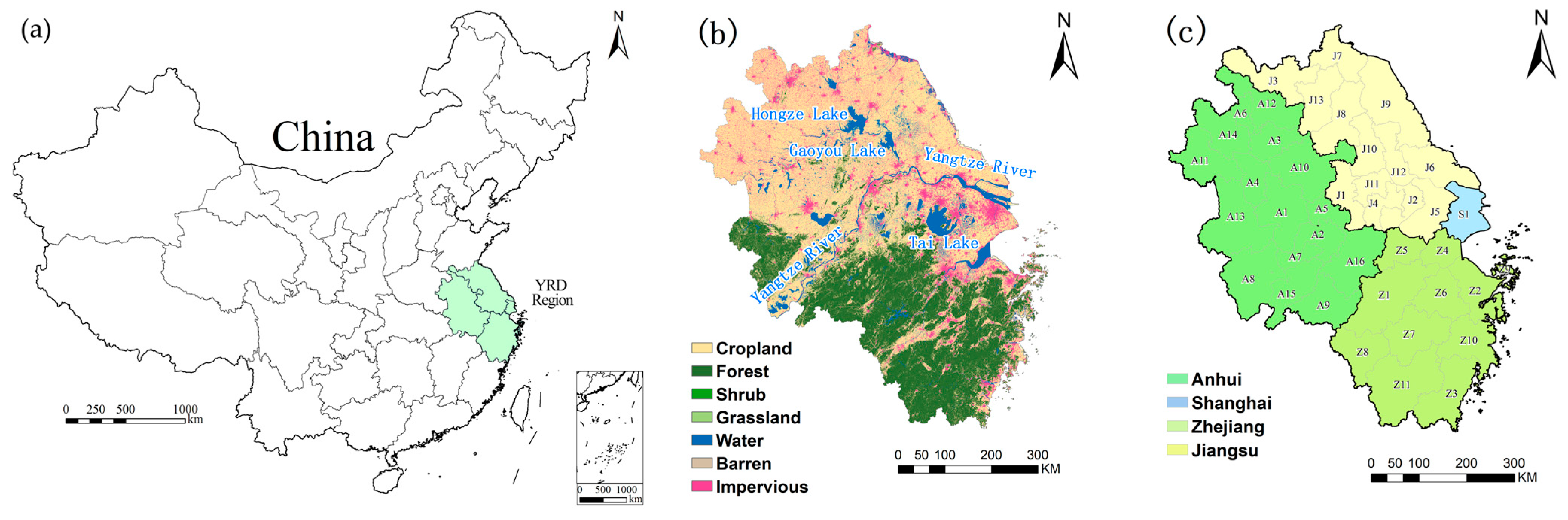
2.1. Study Area
2.2. Data Sources
2.3. Measurement of Urbanization Level
2.3.1. Construction of a Comprehensive Evaluation Index System
- (1)
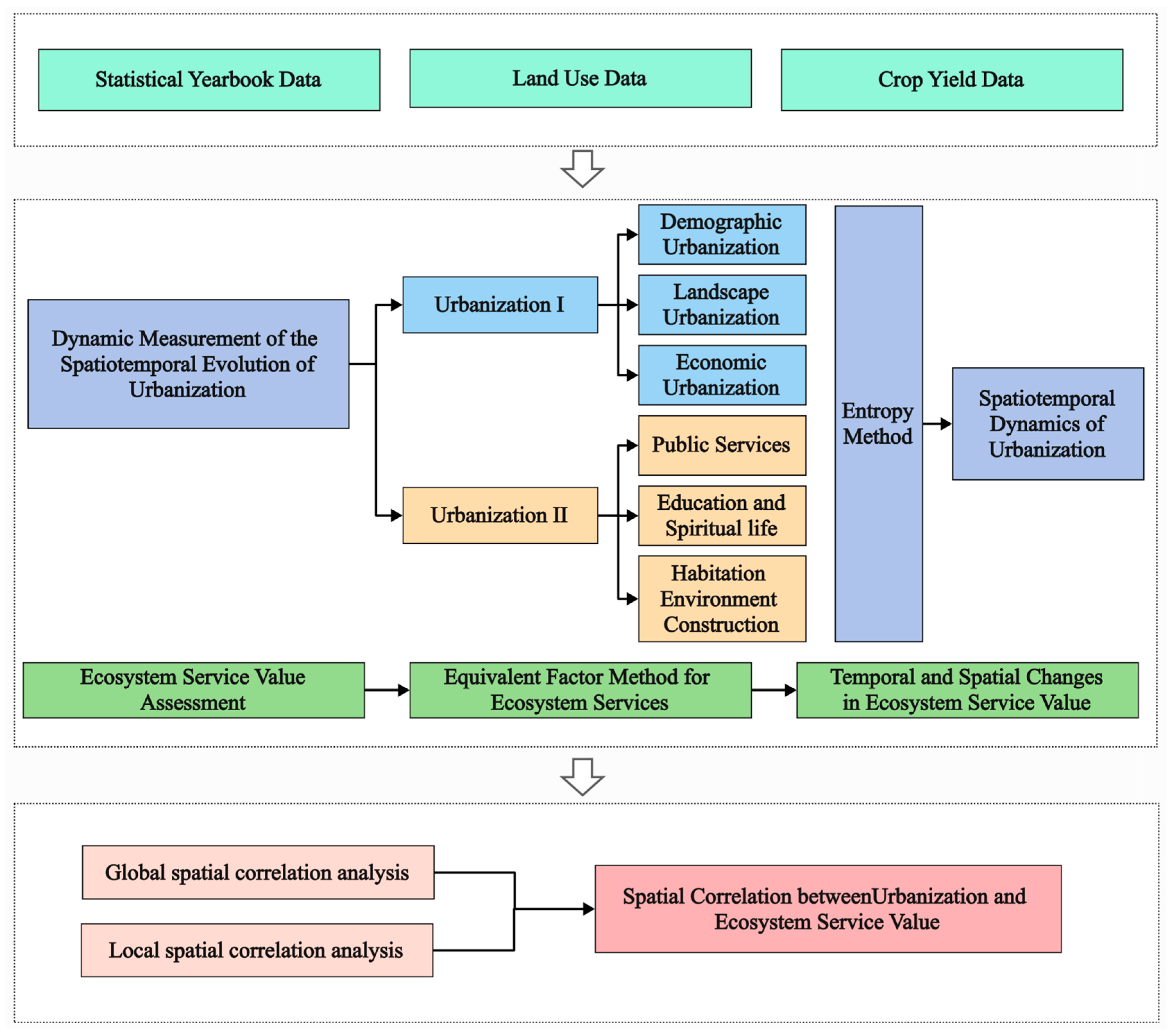
- In the “public services” dimension, we selected “the number of hospitals” and “the number of public buses per 10,000 people”. We believe that these two indicators reflect the city’s ability to provide basic public services, such as health and transportation, and are important cornerstones of modern urban quality of life.
- (2)
- In the dimension of “education and spiritual life”, we adopted “the number of general higher education institutions”, “the number of theaters and cinemas”, and “the number of books in libraries”. The inclusion of these indicators is grounded in the framework of cultural ecosystem services, which posits that physical cultural spaces (e.g., libraries and theaters) are the essential “environmental settings” that enable residents to derive non-material benefits such as spiritual fulfillment, aesthetic experiences, and knowledge acquisition [27]. Furthermore, within the context of China’s “New-type Urbanization” policy, the focus has shifted from mere land expansion to “people-oriented” development. According to Chen et al., the availability of public cultural facilities is a critical metric for assessing the quality of urbanization and the satisfaction of residents’ higher-level spiritual needs [28]. Therefore, these indicators serve as robust proxies for the “implicit” quality of urban life.
- (3)
- In the dimension of “habitation environment construction”, we selected “real estate development investment completed” as a proxy indicator. Theoretically, this choice is grounded in the unique “bundled public goods” characteristic of China’s housing market [29,30]. Unlike in many Western contexts, real estate development in China is the primary vehicle for urban renewal and infrastructure upgrading. High levels of real estate investment typically mandate the simultaneous construction of high-standard community amenities, including green spaces, sanitation facilities, and internal road networks, which directly replace dilapidated urban villages or rural settlements [31]. Therefore, this indicator serves as a robust proxy for the intensity of physical environment improvement and the modernization of living conditions.
2.3.2. Entropy Method
2.4. Measurement of ESV
2.5. Dynamic Measurement of Urbanization and ESV
2.6. Correlation Analysis
3. Results
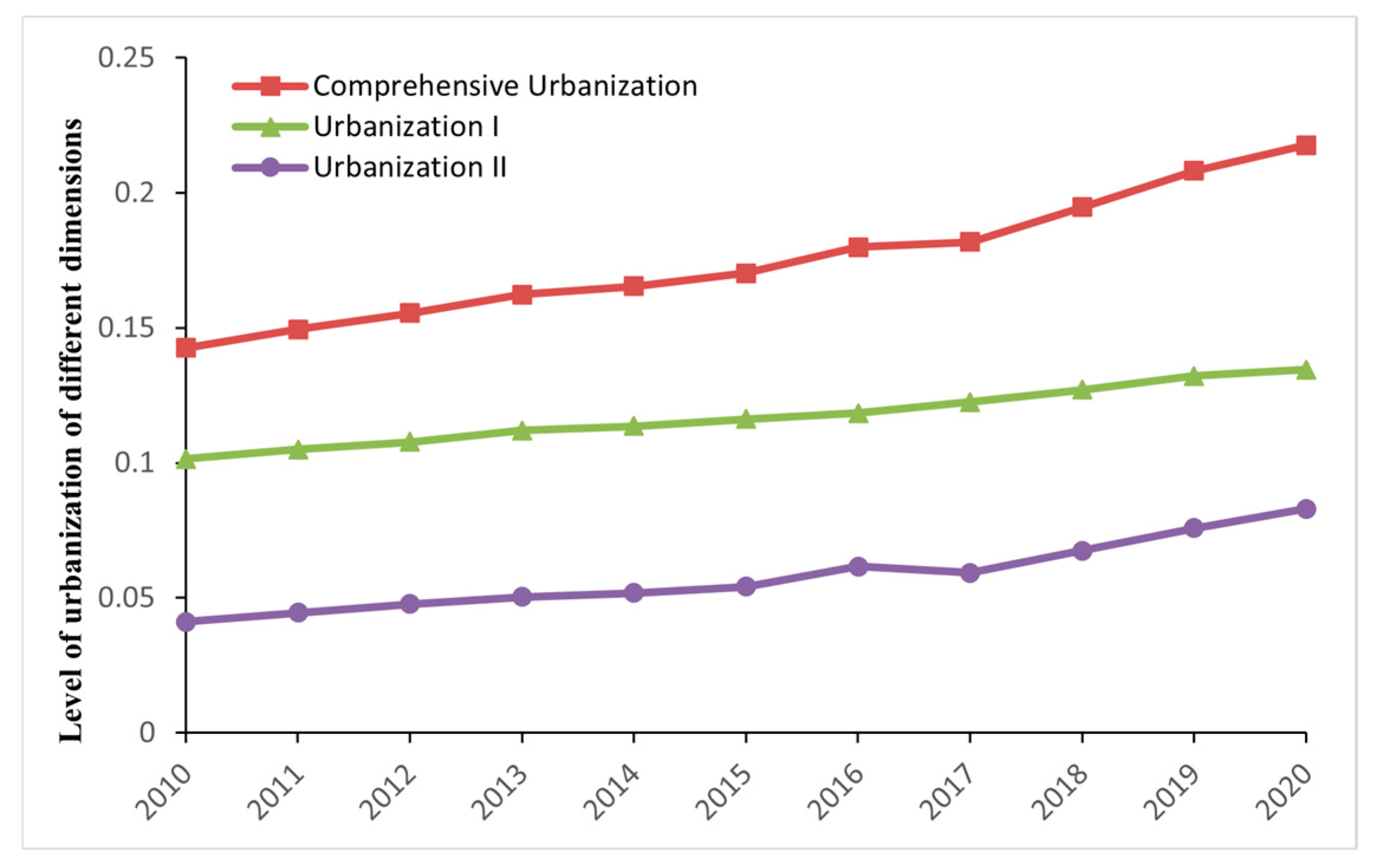
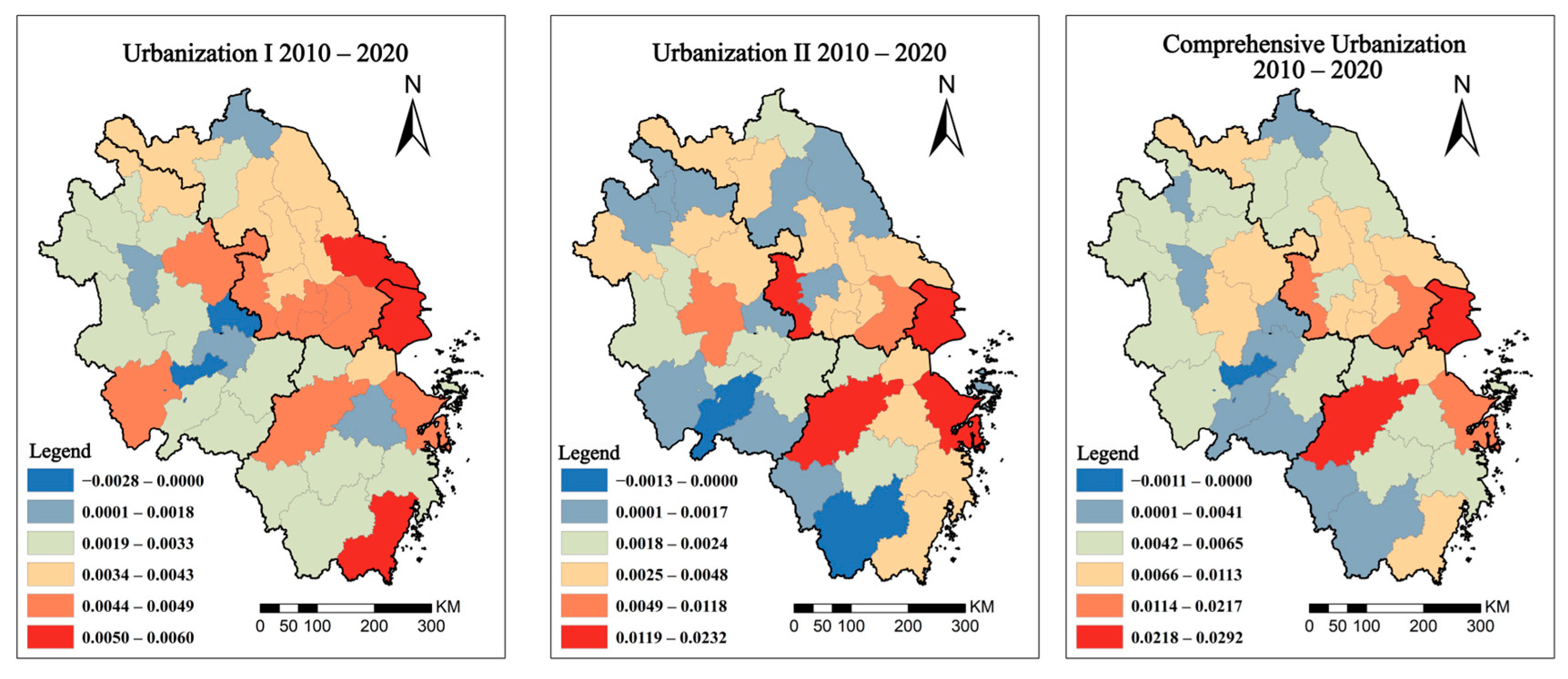
3.1. Spatiotemporal Dynamics of Urbanization
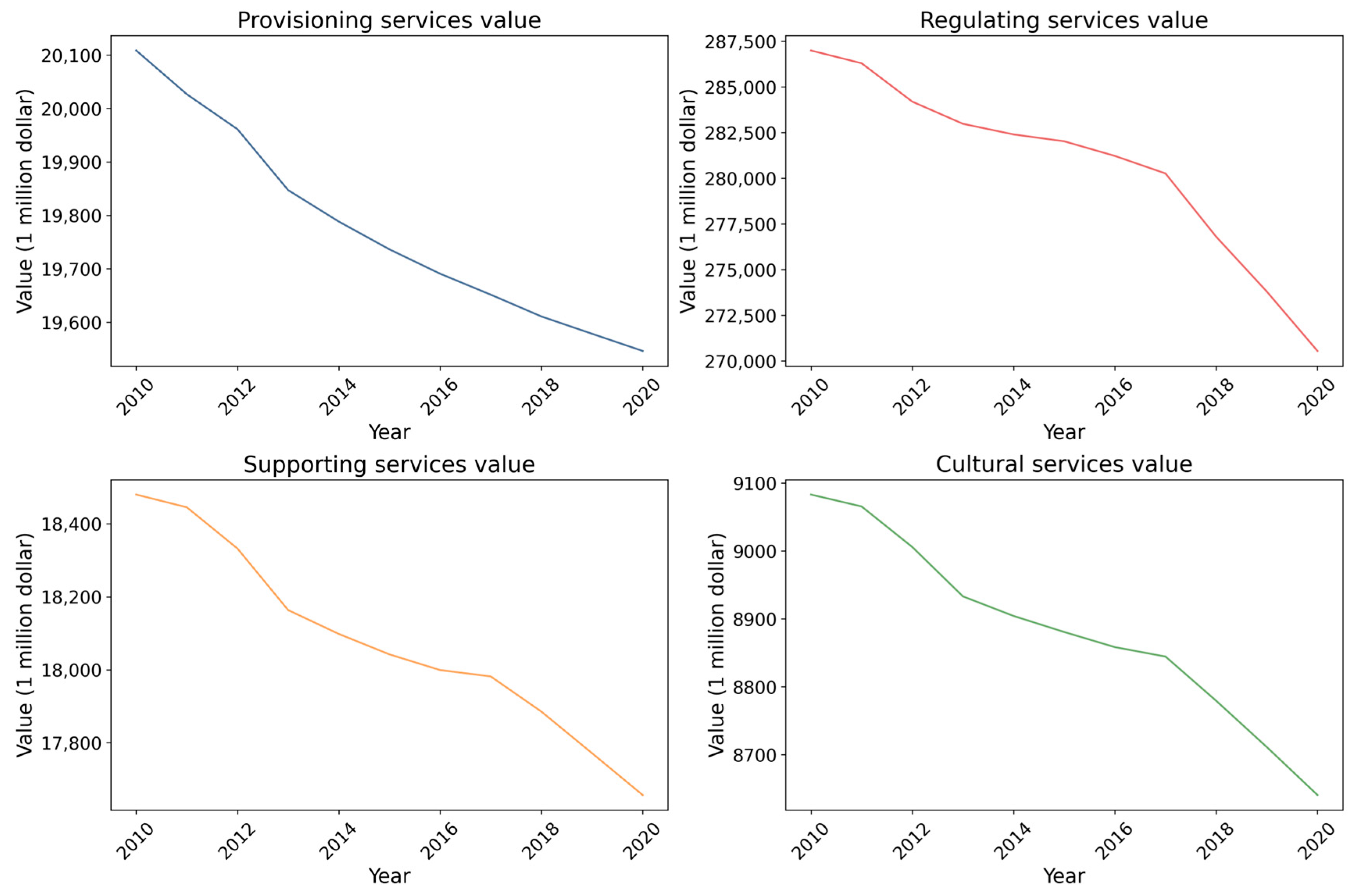
3.2. Temporal and Spatial Changes in ESV
3.3. Spatial Correlation Between Urbanization and ESV
4. Discussion
4.1. Evolution Trends and Differentiation Between Urbanization and ESV
4.2. Impacts of Urbanization on ESV
4.3. Implications
4.4. Limitations
- (1)
- Although the operationalization of the “Urbanization II” index has a theoretical basis, it still relies on proxy variables. For instance, “real estate development investment” was used as a proxy for “habitation environment construction”. Although we have provided a strong argument for this choice in light of China’s development background, this indicator mainly reflects the scale of investment rather than the ecological quality or livability of the built environment. Future research could introduce more direct indicators, such as per capita green space area, public transportation accessibility, or air quality indices, to measure the quality of urbanization more precisely.
- (2)
- The regionalization of the ESV assessment could be further refined. Although we calibrated the standard equivalent factor using local crop data to reflect the region’s agricultural productivity, the weighting coefficients for cultural and regulating services relied on the national average table proposed by Xie et al. [34]. We acknowledge that this may underestimate values in affluent coastal cities where residents’ willingness-to-pay is typically higher. However, to address this concern, we conducted a sensitivity analysis (see Supplementary Materials Figure S4–S6) by adjusting these coefficients upward. The results confirmed that this potential valuation bias does not alter the overall declining trend of ESV in the YRD region.
- (3)
- Using linear regression slopes β1 effectively captures the overall directional trend over the decade. However, we acknowledge this approach assumes a monotonic change and may smooth out short-term inter-annual fluctuations.
- (4)
- This study focused on analyzing the impact of urbanization on ESV, but the feedback of ESV on urbanization remains an issue to be explored. For instance, would a high-quality ecological environment (high ESV) in turn attract investment and high-quality talent, thereby influencing the trajectory of “Urbanization II”? Exploring this reciprocal relationship will be a highly valuable and promising research direction. Future studies can adopt methods such as spatial regression models or panel vector autoregression (PVAR) to reveal these complex feedback mechanisms.
5. Conclusions
Supplementary Materials
Author Contributions
Funding
Data Availability Statement
Acknowledgments
Conflicts of Interest
References
- Haase, D.; Larondelle, N.; Andersson, E.; Artmann, M.; Borgström, S.; Breuste, J.; Gomez-Baggethun, E.; Gren, Å.; Hamstead, Z.; Hansen, R.; et al. A Quantitative Review of Urban Ecosystem Service Assessments: Concepts, Models, and Implementation. AMBIO 2014, 43, 413–433. [Google Scholar] [CrossRef]
- Reid, W.V.; Mooney, H.A.; Cropper, A.; Capistrano, D.; Carpenter, S.R.; Chopra, K.; Dasgupta, P.; Dietz, T.; Duraiappah, A.K.; Hassan, R.; et al. Ecosystems and Human Well-Being-Synthesis: A Report of the Millennium Ecosystem Assessment; Island Press: Washington, DC, USA, 2005; ISBN 978-1-59726-040-4. [Google Scholar]
- Grimm, N.B.; Faeth, S.H.; Golubiewski, N.E.; Redman, C.L.; Wu, J.; Bai, X.; Briggs, J.M. Global Change and the Ecology of Cities. Science 2008, 319, 756–760. [Google Scholar] [CrossRef]
- Seto, K.C.; Güneralp, B.; Hutyra, L.R. Global Forecasts of Urban Expansion to 2030 and Direct Impacts on Biodiversity and Carbon Pools. Proc. Natl. Acad. Sci. USA 2012, 109, 16083–16088. [Google Scholar] [CrossRef]
- Peng, J.; Tian, L.; Liu, Y.; Zhao, M.; Hu, Y.; Wu, J. Ecosystem Services Response to Urbanization in Metropolitan Areas: Thresholds Identification. Sci. Total Environ. 2017, 607–608, 706–714. [Google Scholar] [CrossRef]
- Liu, Y.; Yao, C.; Wang, G.; Bao, S. An Integrated Sustainable Development Approach to Modeling the Eco-Environmental Effects from Urbanization. Ecol. Indic. 2011, 11, 1599–1608. [Google Scholar] [CrossRef]
- Radford, K.G.; James, P. Changes in the Value of Ecosystem Services along a Rural–Urban Gradient: A Case Study of Greater Manchester, UK. Landsc. Urban Plan. 2013, 109, 117–127. [Google Scholar] [CrossRef]
- Zhao, S.; Da, L.; Tang, Z.; Fang, H.; Song, K.; Fang, J. Ecological Consequences of Rapid Urban Expansion: Shanghai, China. Front. Ecol. Environ. 2006, 4, 341–346. [Google Scholar] [CrossRef]
- Costanza, R.; d’Arge, R.; de Groot, R.; Farber, S.; Grasso, M.; Hannon, B.; Limburg, K.; Naeem, S.; O’Neill, R.V.; Paruelo, J.; et al. The Value of the World’s Ecosystem Services and Natural Capital. Nature 1997, 387, 253–260. [Google Scholar] [CrossRef]
- Zhang, F.; Yushanjiang, A.; Jing, Y. Assessing and Predicting Changes of the Ecosystem Service Values Based on Land Use/Cover Change in Ebinur Lake Wetland National Nature Reserve, Xinjiang, China. Sci. Total Environ. 2019, 656, 1133–1144. [Google Scholar] [CrossRef]
- Peng, K.; Jiang, W.; Ling, Z.; Hou, P.; Deng, Y. Evaluating the Potential Impacts of Land Use Changes on Ecosystem Service Value under Multiple Scenarios in Support of SDG Reporting: A Case Study of the Wuhan Urban Agglomeration. J. Clean. Prod. 2021, 307, 127321. [Google Scholar] [CrossRef]
- Hu, M.; Li, Z.; Wang, Y.; Jiao, M.; Li, M.; Xia, B. Spatio-Temporal Changes in Ecosystem Service Value in Response to Land-Use/Cover Changes in the Pearl River Delta. Resour. Conserv. Recycl. 2019, 149, 106–114. [Google Scholar] [CrossRef]
- Cueva, J.; Yakouchenkova, I.A.; Fröhlich, K.; Dermann, A.F.; Dermann, F.; Köhler, M.; Grossmann, J.; Meier, W.; Bauhus, J.; Schröder, D.; et al. Synergies and Trade-Offs in Ecosystem Services from Urban and Peri-urban Forests and Their Implication to Sustainable City Design and Planning. Sustain. Cities Soc. 2022, 82, 103903. [Google Scholar] [CrossRef]
- Chen, S.; Li, G.; Zhuo, Y.; Xu, Z.; Ye, Y.; Thorn, J.P.R.; Marchant, R. Trade-Offs and Synergies of Ecosystem Services in the Yangtze River Delta, China: Response to Urbanizing Variation. Urban Ecosyst. 2022, 25, 313–328. [Google Scholar] [CrossRef]
- Larondelle, N.; Lauf, S. Balancing Demand and Supply of Multiple Urban Ecosystem Services on Different Spatial Scales. Ecosyst. Serv. 2016, 22, 18–31. [Google Scholar] [CrossRef]
- Sun, X.; Ma, Q.; Fang, G. Spatial Scaling of Land Use/Land Cover and Ecosystem Services across Urban Hierarchical Levels: Patterns and Relationships. Landsc. Ecol. 2023, 38, 753–777. [Google Scholar] [CrossRef]
- Wang, Y.; Fu, Q.; Wang, T.; Gao, M.; Chen, J. Multiscale Characteristics and Drivers of the Bundles of Ecosystem Service Budgets in the Su-Xi-Chang Region, China. Int. J. Environ. Res. Public Health 2022, 19, 12910. [Google Scholar] [CrossRef]
- Yan, Y.; Yang, Y.; Yang, M. Unravelling the Non-Linear Response of Ecosystem Services to Urban-Rural Transformation in the Beijing-Tianjin-Hebei Region, China. Ecol. Inform. 2024, 81, 102633. [Google Scholar] [CrossRef]
- Ai, M.; Chen, X.; Yu, Q. Spatial Correlation Analysis between Human Disturbance Intensity (HDI) and Ecosystem Services Value (ESV) in the Chengdu-Chongqing Urban Agglomeration. Ecol. Indic. 2024, 158, 111555. [Google Scholar] [CrossRef]
- Zhang, X.; Liu, Y.; Wang, Y.; Yuan, X. Interactive Relationship and Zoning Management between County Urbanization and Ecosystem Services in the Loess Plateau. Ecol. Indic. 2023, 156, 111021. [Google Scholar] [CrossRef]
- Friedmann, J. The World City Hypothesis. Dev. Change 1986, 17, 69–83. [Google Scholar] [CrossRef]
- Burkhard, B.; Kroll, F.; Müller, F.; Windhorst, W. Landscapes’ Capacities to Provide Ecosystem Services—A Concept for Land-Cover Based Assessments. Landsc. Online 2009, 15, 1–22. [Google Scholar] [CrossRef]
- Li, R.; Xu, Q.; Yu, J.; Chen, L.; Peng, Y. Multiscale Assessment of the Spatiotemporal Coupling Relationship between Urbanization and Ecosystem Service Value along an Urban–Rural Gradient: A Case Study of the Yangtze River Delta Urban Agglomeration, China. Ecol. Indic. 2024, 160, 111864. [Google Scholar] [CrossRef]
- Mao, C.; Niu, J. Quantitative Analysis of Ecological Compensation in the Yangtze River Delta Region Based on the Value of Ecosystem Services and Ecological Footprint. Front. Ecol. Evol. 2024, 12, 1335761. [Google Scholar] [CrossRef]
- Yang, Y.; Zheng, H.; Kong, L.; Huang, B.; Xu, W.; Ouyang, Z. Mapping Ecosystem Services Bundles to Detect High- and Low-Value Ecosystem Services Areas for Land Use Management. J. Clean. Prod. 2019, 225, 11–17. [Google Scholar] [CrossRef]
- Yang, Z.; Hu, J.; Wang, Z.; Chen, S. A New Model Based on Coupling Coordination Analysis Incorporates the Development Rate for Urbanization and Ecosystem Services Assessment: A Case of the Yangtze River Delta. Ecol. Indic. 2024, 159, 111596. [Google Scholar] [CrossRef]
- Fish, R.; Church, A.; Winter, M. Conceptualising Cultural Ecosystem Services: A Novel Framework for Research and Critical Engagement. Ecosyst. Serv. 2016, 21, 208–217. [Google Scholar] [CrossRef]
- Chen, M.; Zhou, Y.; Huang, X.; Ye, C. The Integration of New-Type Urbanization and Rural Revitalization Strategies in China: Origin, Reality and Future Trends. Land 2021, 10, 207. [Google Scholar] [CrossRef]
- Zhu, X.; Gao, W.; Zhou, N.; Kammen, D.M.; Wu, Y.; Zhang, Y.; Chen, W. The Inhabited Environment, Infrastructure Development and Advanced Urbanization in China’s Yangtze River Delta Region. Environ. Res. Lett. 2016, 11, 124020. [Google Scholar] [CrossRef]
- Xu, A.Z. Segregation and the Spatial Externalities of Inequality: A Theory of Interdependence and Public Goods in Cities. Am. Political Sci. Rev. 2024, 118, 1431–1448. [Google Scholar] [CrossRef]
- Cai, Z.; Liu, Q.; Cao, S. Real Estate Supports Rapid Development of China’s Urbanization. Land Use Policy 2020, 95, 104582. [Google Scholar] [CrossRef]
- Shannon, C.E. A Mathematical Theory of Communication. Bell Syst. Tech. J. 1948, 27, 379–423. [Google Scholar] [CrossRef]
- Theil, H. Economics and Information Theory; Nort-Holland: Amsterdam, The Netherlands, 1967. [Google Scholar]
- Xie, G.; Zhang, C.; Zhen, L.; Zhang, L. Dynamic Changes in the Value of China’s Ecosystem Services. Ecosyst. Serv. 2017, 26, 146–154. [Google Scholar] [CrossRef]
- Xie, G.; Zhang, C.; Zhang, L.; Chen, W.; Li, S. Improvement of the Evaluation Method for Ecosystem Service Value Based on Per Unit Area. J. Nat. Resour. 2015, 30, 1243–1254. [Google Scholar] [CrossRef]
- Anselin, L. Local Indicators of Spatial Association—LISA. Geogr. Anal. 1995, 27, 93–115. [Google Scholar] [CrossRef]
- Stamatiadou, V.; Mazaris, A.D.; Katsanevakis, S. Meta-Analysis and Mapping of the Monetary Value of Mediterranean Seagrass Ecosystem Services. Ecosyst. Serv. 2025, 72, 101704. [Google Scholar] [CrossRef]
- Polasky, S.; Nelson, E.; Pennington, D.; Johnson, K.A. The Impact of Land-Use Change on Ecosystem Services, Biodiversity and Returns to Landowners: A Case Study in the State of Minnesota. Environ. Resour. Econ. 2011, 48, 219–242. [Google Scholar] [CrossRef]
- Shoyama, K.; Yamagata, Y. Predicting Land-Use Change for Biodiversity Conservation and Climate-Change Mitigation and Its Effect on Ecosystem Services in a Watershed in Japan. Ecosyst. Serv. 2014, 8, 25–34. [Google Scholar] [CrossRef]
- Hysa, A.; Löwe, R.; Geist, J. Ecosystem Services Potential Is Declining across European Capital Metropolitan Areas. Sci. Rep. 2024, 14, 8903. [Google Scholar] [CrossRef]
- Zhang, W.; Wang, F.-F.; Shan, W. Spatial and Temporal Changes in Ecosystem Services Value and Analysis of Driving Factors in the Yangtze River Delta Region. Open Geosci. 2024, 16, 20220604. [Google Scholar] [CrossRef]
- Li, J.; Xie, B.; Dong, H.; Zhou, K.; Zhang, X. The Impact of Urbanization on Ecosystem Services: Both Time and Space Are Important to Identify Driving Forces. J. Environ. Manag. 2023, 347, 119161. [Google Scholar] [CrossRef] [PubMed]
- Luo, Q.; Zhou, J.; Zhang, Y.; Yu, B.; Zhu, Z. What Is the Spatiotemporal Relationship between Urbanization and Ecosystem Services? A Case from 110 Cities in the Yangtze River Economic Belt, China. J. Environ. Manag. 2022, 321, 115709. [Google Scholar] [CrossRef]
- Lapointe, M.; Gurney, G.G.; Cumming, G.S. Urbanization Affects How People Perceive and Benefit from Ecosystem Service Bundles in Coastal Communities of the Global South. Ecosyst. People 2021, 17, 57–68. [Google Scholar] [CrossRef]
- Nelson, A.C.; Moore, T. Assessing Urban Growth Management: The Case of Portland, Oregon, the USA’s Largest Urban Growth Boundary. Land Use Policy 1993, 10, 293–302. [Google Scholar] [CrossRef]
- Rall, E.L.; Haase, D. Creative Intervention in a Dynamic City: A Sustainability Assessment of an Interim Use Strategy for Brownfields in Leipzig, Germany. Landsc. Urban Plan. 2011, 100, 189–201. [Google Scholar] [CrossRef]
- Wang, L.; Zheng, H.; Chen, Y.; Ouyang, Z.; Hu, X. Systematic Review of Ecosystem Services Flow Measurement: Main Concepts, Methods, Applications and Future Directions. Ecosyst. Serv. 2022, 58, 101479. [Google Scholar] [CrossRef]
- Xia, S.; Ji, X.; Meng, L.; Zhou, L. Functional Diversity of Wintering Waterbird Enhanced by Restored Wetland in the Lakeshore of Chaohu Lake. Ecol. Evol. 2025, 15, e71751. [Google Scholar] [CrossRef]




| Province | City | Code | Population in 2020 (One Thousand) | Area (km2) |
|---|---|---|---|---|
| Anhui | Hefei | A1 | 8005 | 11,434 |
| Wuhu | A2 | 3740 | 6188 | |
| Bengbu | A3 | 3164 | 5952 | |
| Huainan | A4 | 2334 | 2536 | |
| Maanshan | A5 | 1366 | 1702 | |
| Huaibei | A6 | 1900 | 2737 | |
| Tongling | A7 | 716 | 1113 | |
| Anqing | A8 | 4580 | 15,440 | |
| Huangshan | A9 | 1470 | 9807 | |
| Chuzhou | A10 | 3937 | 13,400 | |
| Fuyang | A11 | 7599 | 9887 | |
| Suzhou (AH) | A12 | 6633 | 9606 | |
| Lu’an | A13 | 4967 | 18,286 | |
| Bozhou | A14 | 4850 | 8394 | |
| Chizhou | A15 | 1430 | 8285 | |
| Xuancheng | A16 | 2815 | 12,340 | |
| Jiangsu | Nanjing | J1 | 9314 | 6587 |
| Wuxi | J2 | 7636 | 4628 | |
| Xuzhou | J3 | 8580 | 11,258 | |
| Changzhou | J4 | 4592 | 4375 | |
| Suzhou (JS) | J5 | 10,721 | 8488 | |
| Nantong | J6 | 7283 | 8001 | |
| Lianyungang | J7 | 4393 | 7777 | |
| Huaian | J8 | 4787 | 10,072 | |
| Yancheng | J9 | 7260 | 17,000 | |
| Yangzhou | J10 | 4459 | 6663 | |
| Zhenjiang | J11 | 3113 | 3844 | |
| Taizhou (JS) | J12 | 4618 | 5793 | |
| Suqian | J13 | 4808 | 8555 | |
| Zhejiang | Hangzhou | Z1 | 10,360 | 16,847 |
| Ningbo | Z2 | 8202 | 9816 | |
| Wenzhou | Z3 | 9122 | 11,784 | |
| Jiaxing | Z4 | 4501 | 4223 | |
| Huzhou | Z5 | 2893 | 5818 | |
| Shaoxing | Z6 | 4912 | 8256 | |
| Jinhua | Z7 | 5361 | 10,926 | |
| Quzhou | Z8 | 2176 | 8844 | |
| Zhoushan | Z9 | 1121 | 1440 | |
| Taizhou (ZJ) | Z10 | 5968 | 9411 | |
| Lishui | Z11 | 2122 | 17,298 | |
| Shanghai | Shanghai | S1 | 24,870 | 6341 |
| Data Name | Data Source URL |
|---|---|
| China Statistical Yearbook | https://www.stats.gov.cn/sj/ndsj/, accessed on 20 March 2025 |
| China Urban Statistical Yearbook | https://www.stats.gov.cn/zs/tjwh/tjkw/tjzl/202302/t20230220_1913734.html, accessed on 22 March 2025 |
| Jiangsu Provincial Statistical Yearbook | http://www.jiangsu.gov.cn/col/col84736/, accessed on 2 April 2025 |
| Zhejiang Provincial Statistical Yearbook | http://tjj.zj.gov.cn/col/col1525563/index.html, accessed on 5 April 2025 |
| Anhui Provincial Statistical Yearbook | http://tjj.ah.gov.cn/ssah/qwfbjd/tjnj/index.html, accessed on 8 April 2025 |
| Shanghai Municipal Statistical Yearbook | https://tjj.sh.gov.cn/tjnj/index.html, accessed on 10 April 2025 |
| 30 m annual land cover datasets and their dynamics in China from 1990 to 2020 | https://zenodo.org/records/5210928#.YeqApch1Mvd, accessed on 15 April 2025 |
| Category | Dimension | Indicator | Unit | |
|---|---|---|---|---|
| Comprehensive urbanization | Urbanization I (Explicit perspective) | Population | Population density | persons/hm2 |
| Proportion of urban population | % | |||
| Landscape | Proportion of urban construction land | % | ||
| Actual road area at the end of the year | hm2 | |||
| Economy | Per capita GDP | CNY | ||
| Proportion of secondary industry in regional GDP | % | |||
| Proportion of tertiary industry in regional GDP | % | |||
| Urbanization II (Implicit perspective) | Public services | Number of hospitals | Unit | |
| Number of public buses per 10,000 people | Unit | |||
| Education and spiritual life | Number of general higher education institutions | Unit | ||
| Number of theaters and cinemas | Unit | |||
| Number of books in libraries | Unit | |||
| Habitation environment construction | Real estate development investment completed | 100 million CNY |
Disclaimer/Publisher’s Note: The statements, opinions and data contained in all publications are solely those of the individual author(s) and contributor(s) and not of MDPI and/or the editor(s). MDPI and/or the editor(s) disclaim responsibility for any injury to people or property resulting from any ideas, methods, instructions or products referred to in the content. |
© 2025 by the authors. Licensee MDPI, Basel, Switzerland. This article is an open access article distributed under the terms and conditions of the Creative Commons Attribution (CC BY) license.
Share and Cite
Fu, Q.; Zhang, J.; Wang, B.; Chen, J. Impact of Urbanization on Ecosystem Services in the Yangtze River Delta: An Analysis from Explicit and Implicit Perspectives. Land 2026, 15, 55. https://doi.org/10.3390/land15010055
Fu Q, Zhang J, Wang B, Chen J. Impact of Urbanization on Ecosystem Services in the Yangtze River Delta: An Analysis from Explicit and Implicit Perspectives. Land. 2026; 15(1):55. https://doi.org/10.3390/land15010055
Chicago/Turabian StyleFu, Qi, Jimin Zhang, Bo Wang, and Jinhua Chen. 2026. "Impact of Urbanization on Ecosystem Services in the Yangtze River Delta: An Analysis from Explicit and Implicit Perspectives" Land 15, no. 1: 55. https://doi.org/10.3390/land15010055
APA StyleFu, Q., Zhang, J., Wang, B., & Chen, J. (2026). Impact of Urbanization on Ecosystem Services in the Yangtze River Delta: An Analysis from Explicit and Implicit Perspectives. Land, 15(1), 55. https://doi.org/10.3390/land15010055