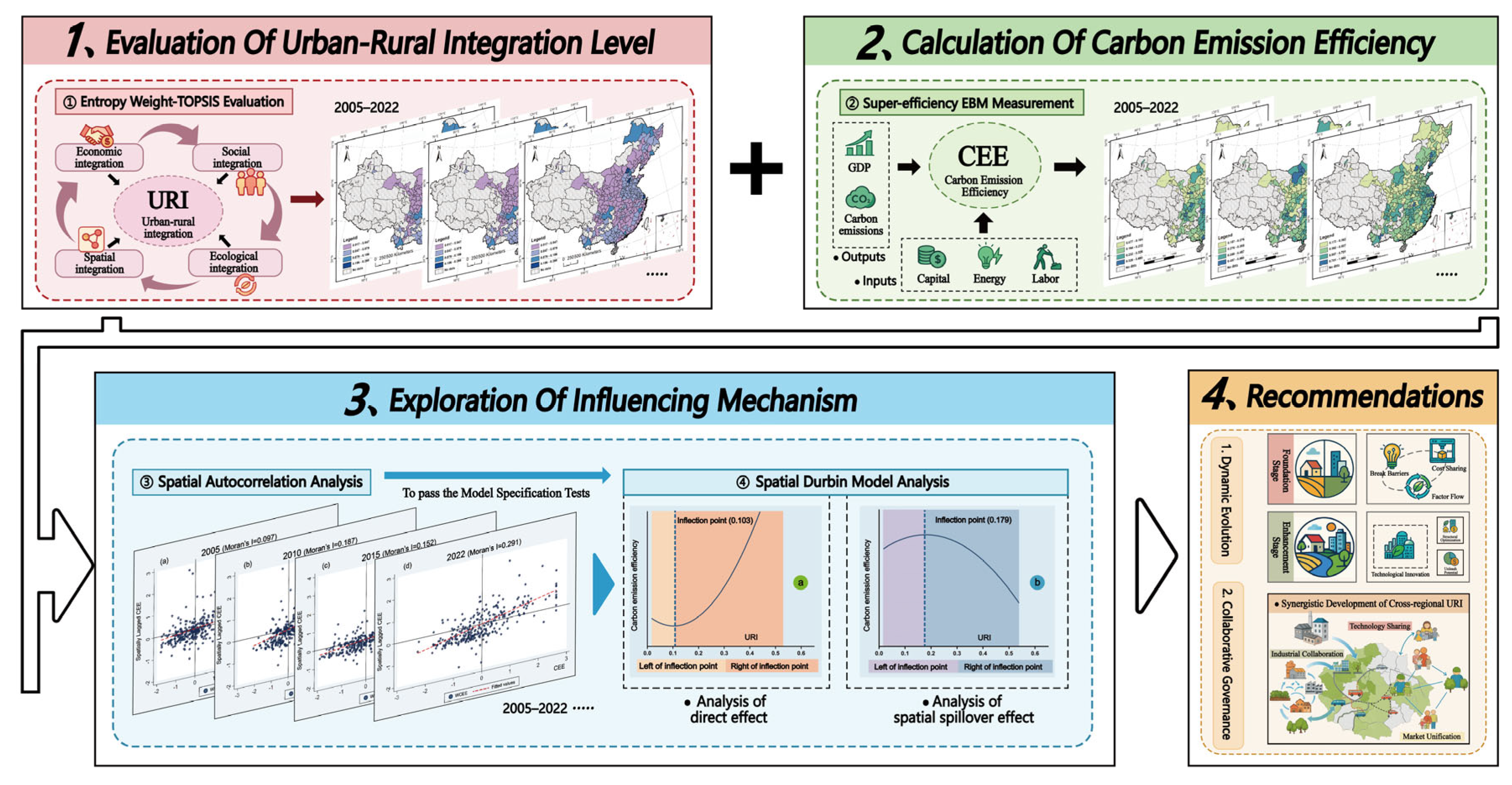
Promoting or Inhibiting? The Nonlinear Impact of Urban–Rural Integration on Carbon Emission Efficiency: Evidence from 283 Chinese Cities

Abstract
1. Introduction
2. Theoretical Framework and Hypotheses Development
2.1. Local Impact Mechanisms of URI on Carbon Emission Efficiency
2.2. Spatial Spillover Effects of URI on Carbon Emission Efficiency
3. Materials and Methods
3.1. Data Sources
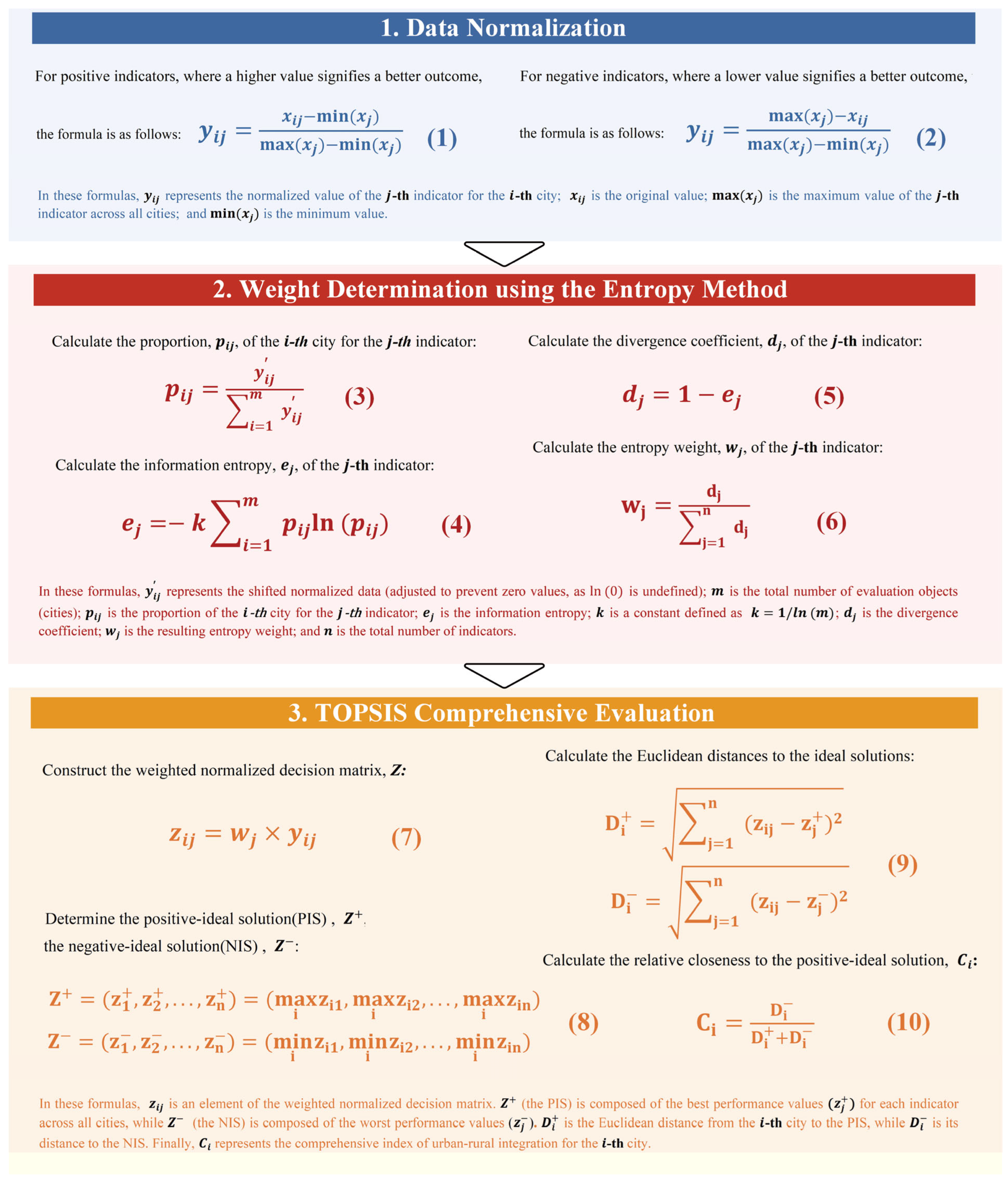
3.1.1. Explanatory Variable: Urban–Rural Integration (URI) Index
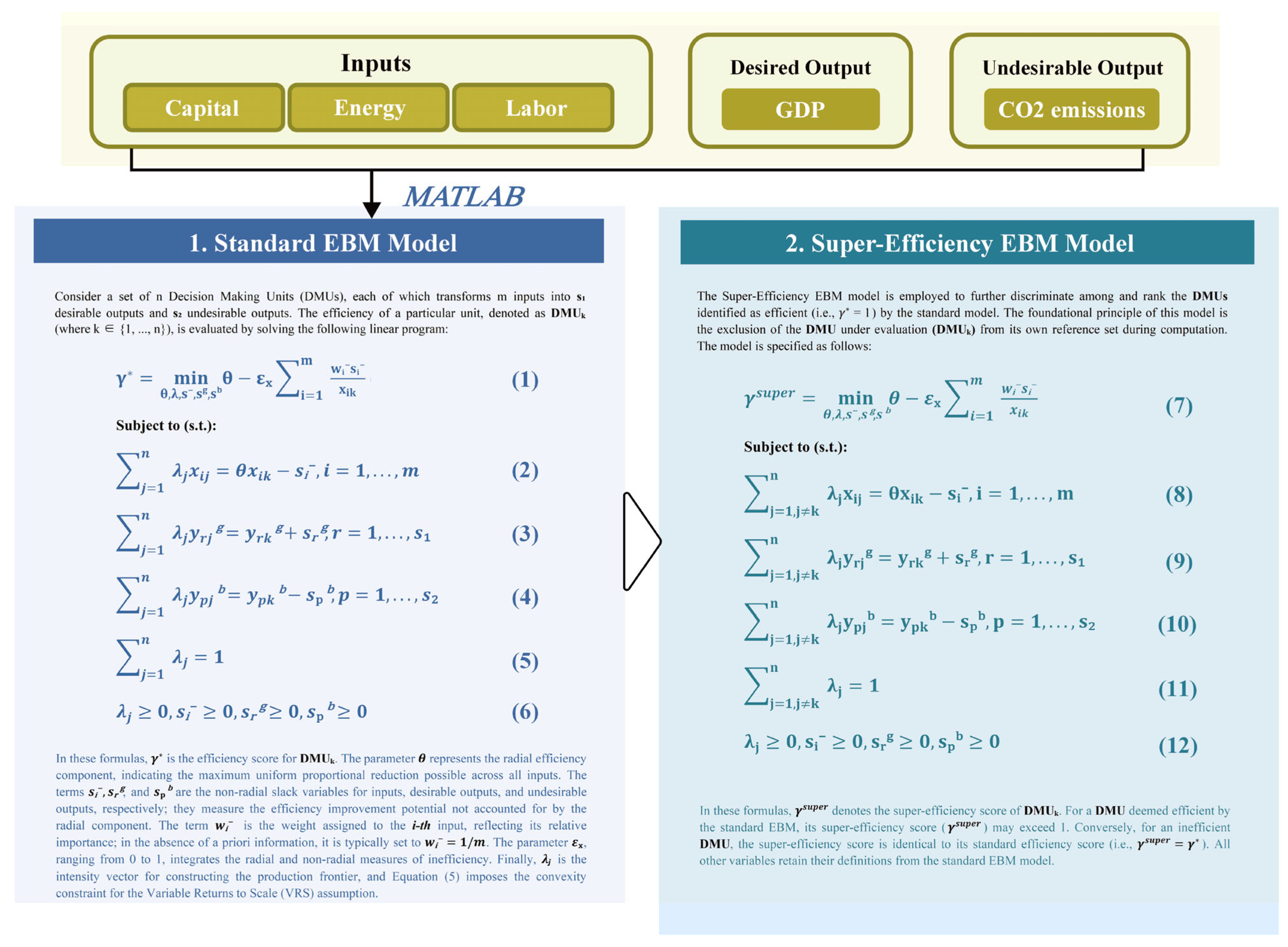
3.1.2. Dependent Variable: Carbon Emission Efficiency (CEE) Measurement
3.1.3. Control Variables
3.2. Methods
3.2.1. Spatial Autocorrelation Analysis
3.2.2. Spatial Durbin Model (SDM) Construction
4. Results
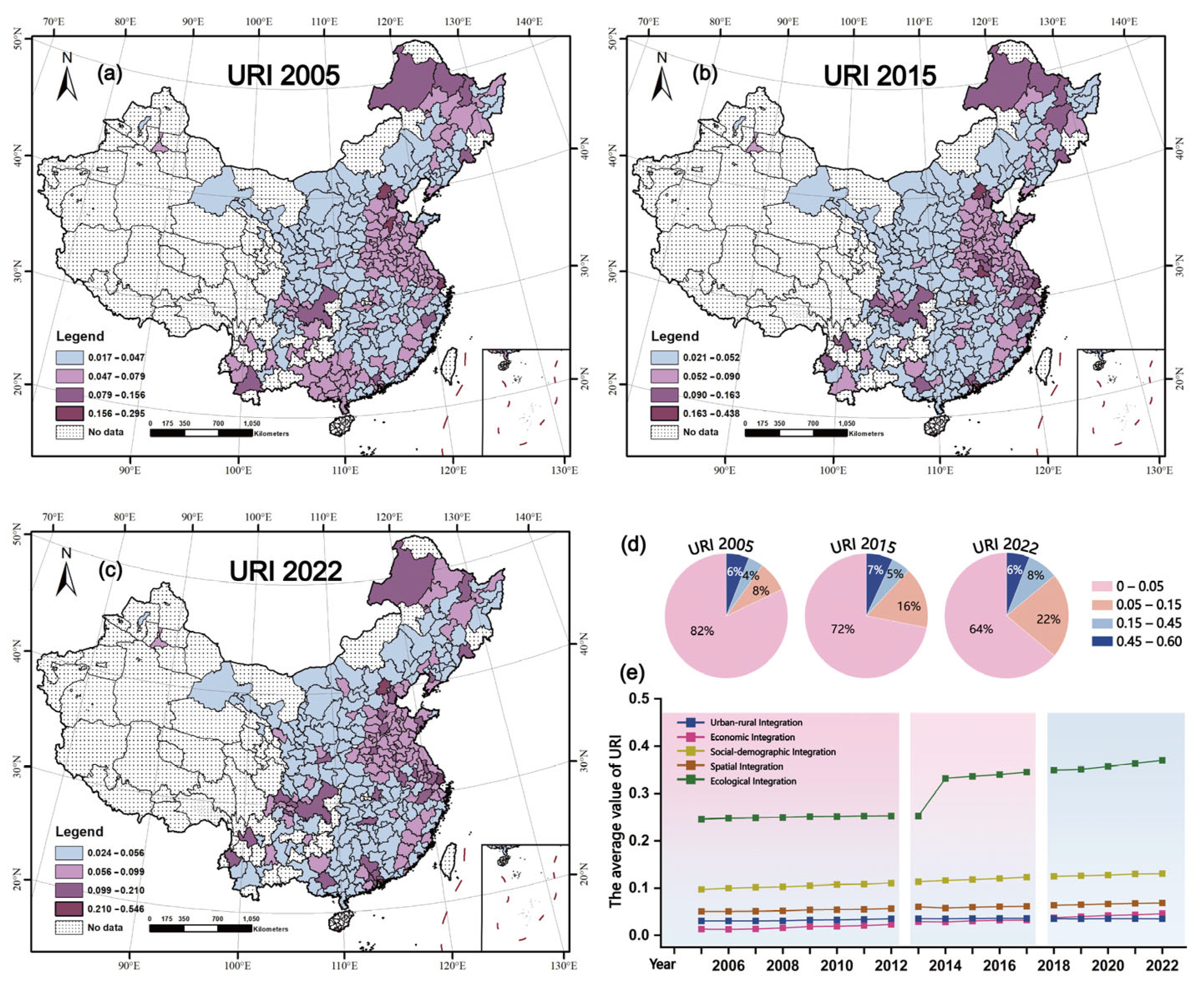
4.1. Spatio-Temporal Pattern of Urban–Rural Integration
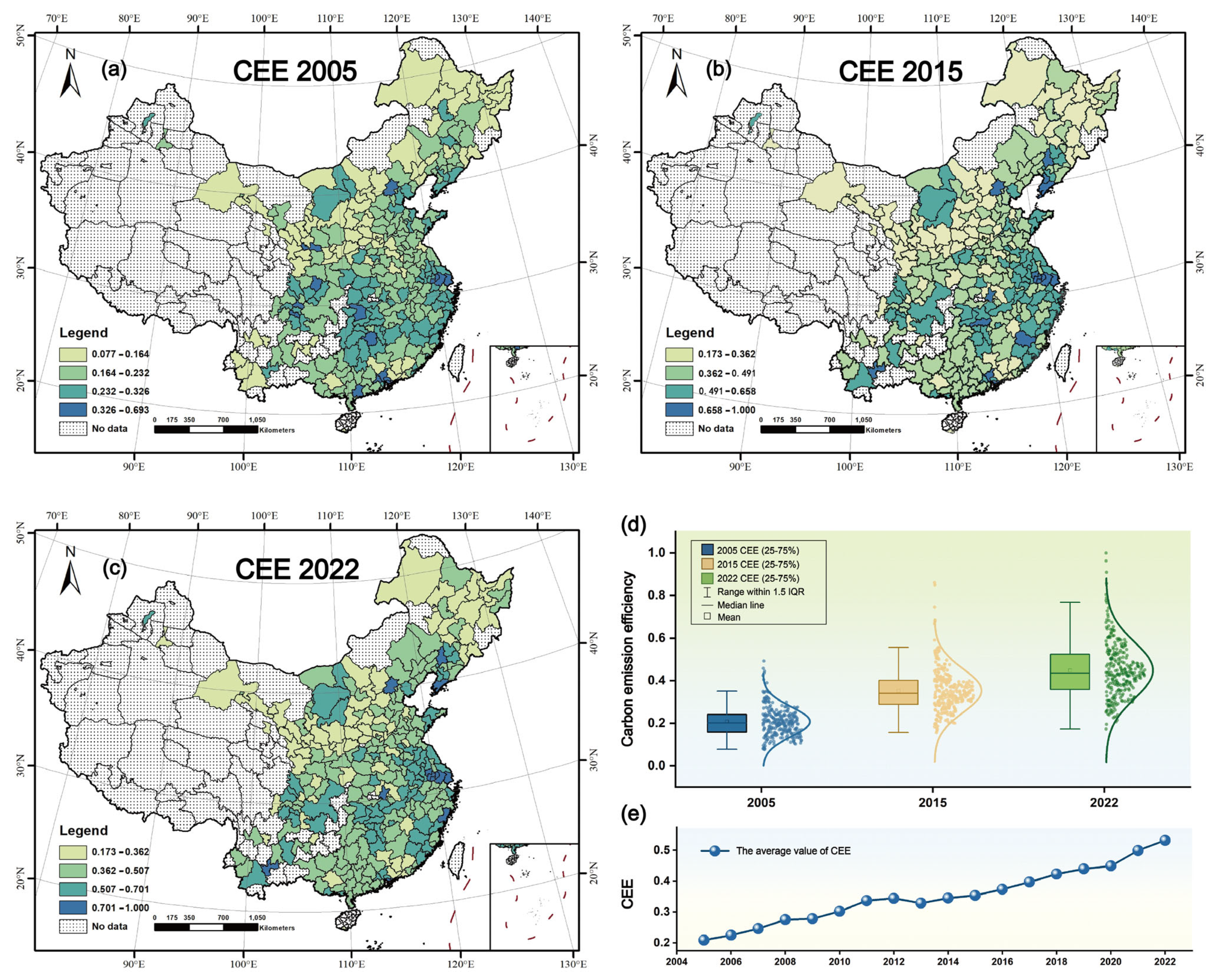
4.2. Spatio-Temporal Pattern of Carbon Emission Efficiency
4.3. Analysis of Spatial Effect Mechanisms Based on SDM
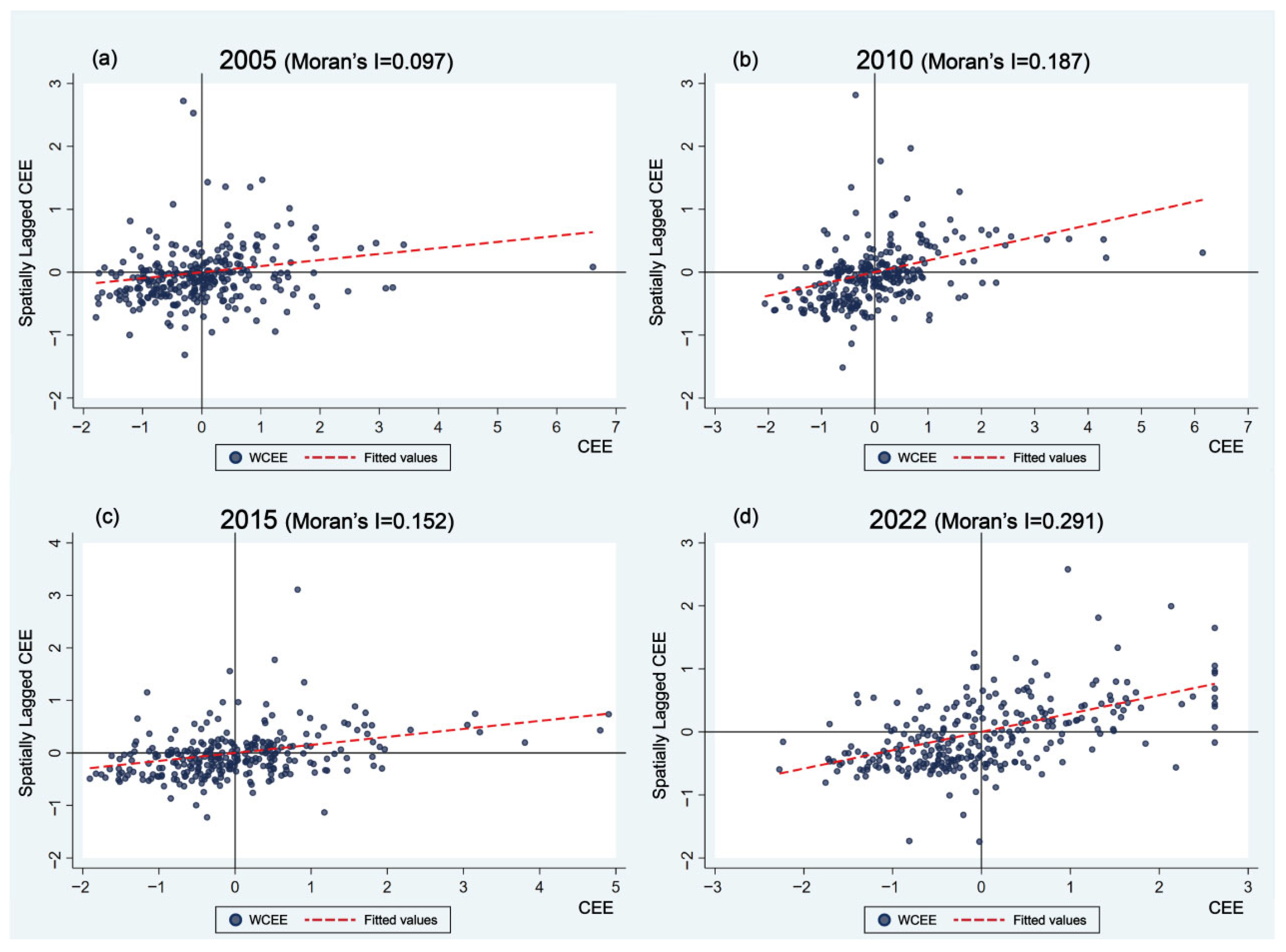
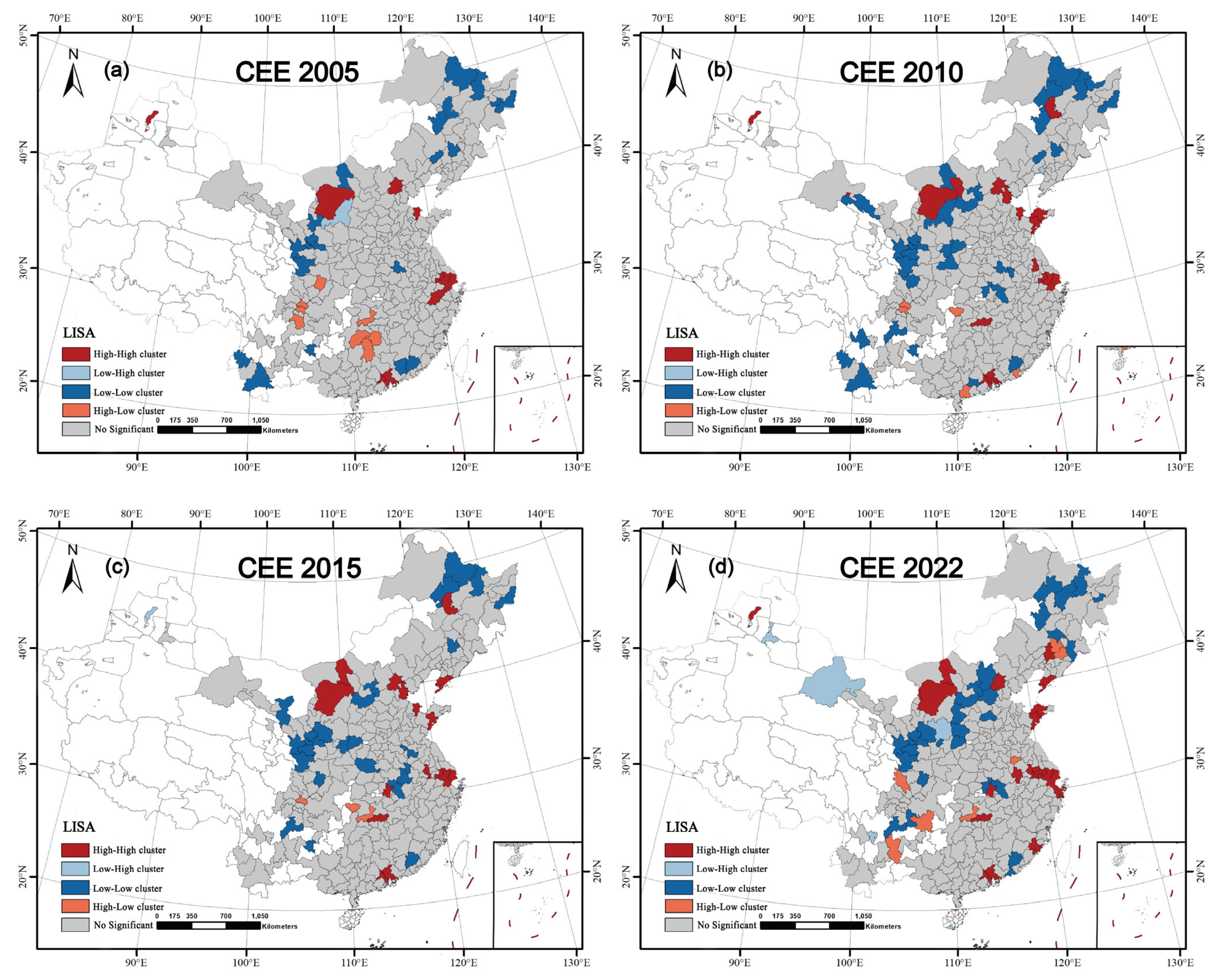
4.3.1. Spatial Autocorrelation Test
4.3.2. Spatial Model Specification Tests
4.3.3. Model Regression Results and Analysis
4.3.4. Analysis of Decomposed Spatial Effects
4.4. Endogeneity Analysis
4.5. Robustness Analysis
4.6. Heterogeneity Analysis
4.6.1. Regional Heterogeneity Results
4.6.2. Dimensional Decomposition Results
5. Discussion
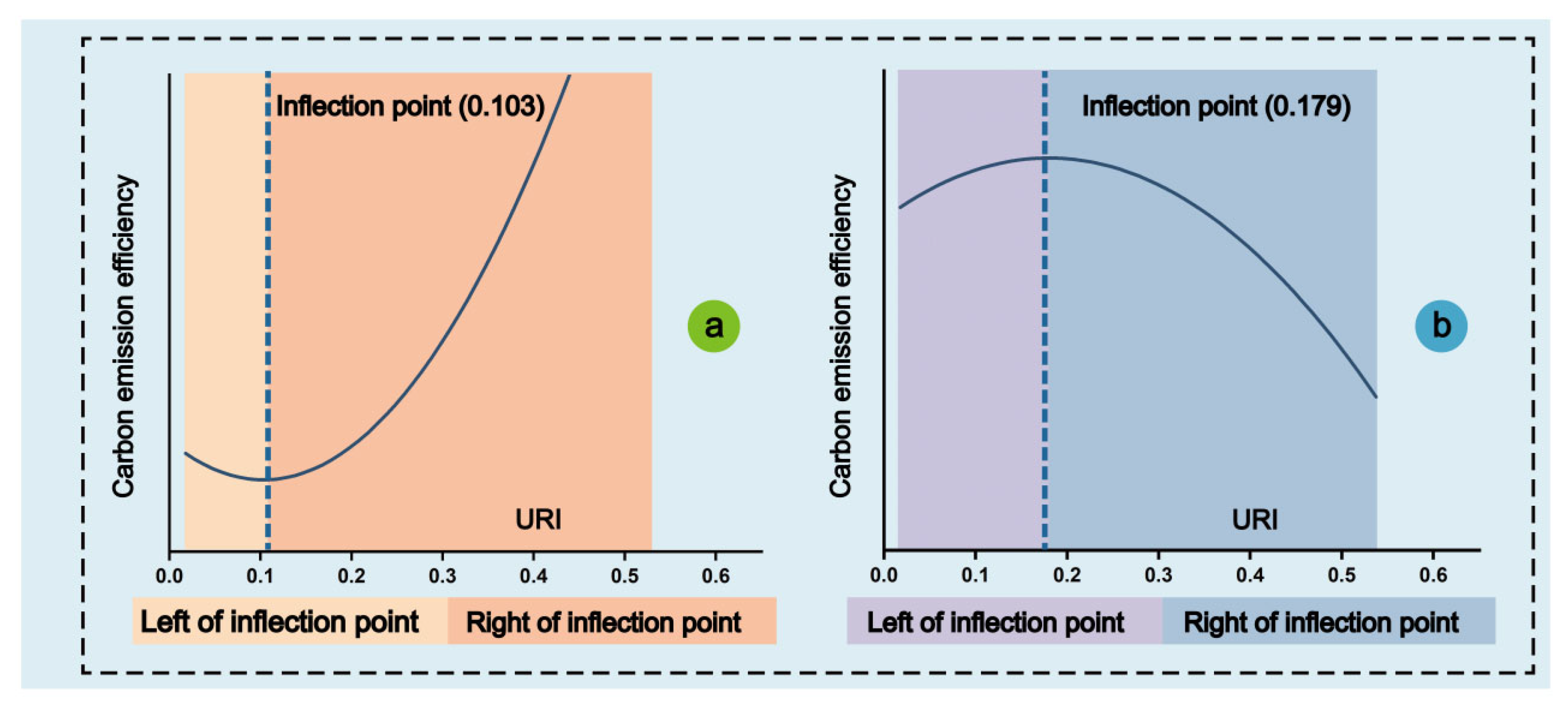
5.1. The “U-Shaped” Direct Impact of URI on Local CEE
5.2. The Inverted U-Shaped Spatial Spillover Effect of URI on Neighboring Regions
6. Conclusions
6.1. Main Research Conclusions
6.2. Policy Implications
- (1)
- Design dynamic, differentiated policy frameworks to navigate the nonlinear threshold effects of URI. In regions positioned below the critical threshold (nascent integration stages), policymakers should prioritize “preemptive greening” to avert long-term carbon lock-in. It is imperative for local governments to catalyze green infrastructure investment through targeted fiscal incentives—for instance, by incorporating photovoltaic arrays into rural transport networks and deploying distributed renewable energy microgrids [110]. Such measures facilitate sustainable cost-sharing mechanisms, preventing nascent developments from being tethered to high-carbon trajectories while streamlining the bidirectional flow of green production factors across the urban–rural interface.
- (2)
- Develop differentiated carbon-reduction pathways based on regional heterogeneity. For the pioneer zones of URI in Eastern China, policy should prioritize institutional innovation and technological spillovers, channeling high-end factors into the agricultural and rural sectors to promote the green transformation of urban–rural industrial chains, thereby enhancing overall regional carbon efficiency [47,112]. For regions with high URI potential, such as those in the northeast, central, and west of China, strategies should involve the deployment of new green infrastructure, the development of distinctive low-carbon industries based on local resource endowments (e.g., smart agriculture, ecotourism), and targeted policy interventions to support areas that are lagging [113,114,115].
- (3)
- Strengthen regional collaborative governance to mitigate negative spatial spillovers. This requires establishing urban–rural technology-sharing platforms to reduce barriers to green innovation in rural areas and accelerate the diffusion of advanced technologies. It also involves fostering cross-regional industrial collaboration networks to optimize overall abatement costs through economies of scale and scope. Crucially, a harmonized environmental regulatory framework must be institutionalized across the urban–rural divide to thwart the leakage of pollution-intensive industries and prevent the formation of “pollution havens.”
6.3. Research Limitations and Future Outlook
Author Contributions
Funding
Data Availability Statement
Conflicts of Interest
References
- Dawson, B.; Spannagle, M. United Nations framework convention on climate change (Unfccc). In The Complete Guide to Climate Change; Routledge: New York, NY, USA, 2008; pp. 392–403. [Google Scholar]
- IPCC. Climate Change 2021: The Physical Science Basis. In Contribution of Working Group I to the Sixth Assessment Report of the Intergovernmental Panel on Climate Change; Masson-Delmotte, V., Zhai, P., Pirani, A., Conners, S., Péan, C., Berger, S., Caud, N., Chen, Y., Goldfarb, L., Gomis, M., et al., Eds.; Cambridge University Press: Cambridge, UK, 2021. [Google Scholar]
- Iram, R.; Zhang, J.; Erdogan, S.; Abbas, Q.; Mohsin, M. Economics of energy and environmental efficiency: Evidence from OECD countries. Environ. Sci. Pollut. Res. 2020, 27, 3858–3870. [Google Scholar] [CrossRef] [Scilit]
- Wang, G.; Deng, X.; Wang, J.; Zhang, F.; Liang, S. Carbon emission efficiency in China: A spatial panel data analysis. China Econ. Rev. 2019, 56, 101313. [Google Scholar] [CrossRef] [Scilit]
- State Council Information Office of the People’s Republic of China. China’s Policies and Actions for Addressing Climate Change; State Council Information Office of the People’s Republic of China: Beijing, China, 2021. [Google Scholar]
- Hu, A. China’s realization of the carbon peak target before 2030 and its main approaches. Soc. Sci. Ed. 2021, 21, 1–15. [Google Scholar]
- Liu, M.; Li, Q.; Bai, Y.; Fang, C. A novel framework to evaluate urban-rural coordinated development: A case study in Shanxi Province, China. Habitat Int. 2024, 144, 103013. [Google Scholar] [CrossRef] [Scilit]
- Lu, Y.; Zhang, Y.; Cao, X.; Wang, C.; Wang, Y.; Zhang, M.; Ferrier, R.C.; Jenkins, A.; Yuan, J.; Bailey, M.J.; et al. Forty years of reform and opening up: China’s progress toward a sustainable path. Sci. Adv. 2019, 5, eaau9413. [Google Scholar] [CrossRef] [Scilit]
- Ji, X.; Ren, J.; Ulgiati, S. Towards urban-rural sustainable cooperation: Models and policy implication. J. Clean. Prod. 2019, 213, 892–898. [Google Scholar] [CrossRef] [Scilit]
- Selod, H.; Shilpi, F. Rural-urban migration in developing countries: Lessons from the literature. Reg. Sci. Urban Econ. 2021, 91, 103713. [Google Scholar] [CrossRef] [Scilit]
- Kasuga, H.; Takaya, M. Does inequality affect environmental quality? Evidence from major Japanese cities. J. Clean. Prod. 2017, 142, 3689–3701. [Google Scholar] [CrossRef] [Scilit]
- Kusumawardani, D.; Dewi, A.K. The effect of income inequality on carbon dioxide emissions: A case study of Indonesia. Heliyon 2020, 6, e04663. [Google Scholar] [CrossRef] [Scilit]
- Gao, M.; Ma, K.; Yu, J. The characteristics and drivers of China’s city-level urban-rural activity sectors’ carbon intensity gap during urban land expansion. Energy Policy 2023, 181, 113725. [Google Scholar] [CrossRef] [Scilit]
- Xu, C. Towards balanced low-carbon development: Driver and complex network of urban-rural energy-carbon performance gap in China. Appl. Energy 2023, 333, 120663. [Google Scholar] [CrossRef] [Scilit]
- Wang, L.; Zhang, M. Exploring the impact of narrowing urban-rural income gap on carbon emission reduction and pollution control. PLoS ONE 2021, 16, e0259390. [Google Scholar] [CrossRef] [Scilit] [PubMed]
- Wang, Y.; Liu, Y.; Li, Y.; Li, T. The spatio-temporal patterns of urban–rural development transformation in China since 1990. Habitat Int. 2016, 53, 178–187. [Google Scholar] [CrossRef] [Scilit]
- Liu, Y. Urban-rural integration and rural vitalization in the new era in China. Acta Geogr. Sin. 2018, 73, 637–650. [Google Scholar]
- Zhu, J.; Zhu, M.; Xiao, Y. Urbanization for rural development: Spatial paradigm shifts toward inclusive urban-rural integrated development in China. J. Rural Stud. 2019, 71, 94–103. [Google Scholar] [CrossRef] [Scilit]
- He, R. Urban-rural integration and rural vitalization: Theoretical exploration, mechanism interpretation and realization path. Geogr. Res. 2018, 37, 2127–2140. [Google Scholar]
- Liu, Y. Urban-Rural Transformation Geography; Springer: Singapore, 2021. [Google Scholar]
- Ma, L.; Liu, S.; Fang, F.; Che, X.; Chen, M. Evaluation of urban-rural difference and integration based on quality of life. Sustain. Cities Soc. 2020, 54, 101877. [Google Scholar] [CrossRef] [Scilit]
- Liu, Y.; Zhang, X.; Xu, M.; Zhang, X.; Shan, B.; Wang, A. Spatial patterns and driving factors of rural population loss under urban–rural integration development. Land 2022, 11, 99. [Google Scholar] [CrossRef] [Scilit]
- Zhou, Y.; Liu, Y.; Wu, W.; Li, Y. Effects of rural–urban development transformation on energy consumption and CO2 emissions: A regional analysis in China. Renew. Sust. Energy Rev. 2015, 52, 863–875. [Google Scholar] [CrossRef] [Scilit]
- Gutierrez-Velez, V.H.; Gilbert, M.R.; Kinsey, D.; Behm, J.E. Beyond the ‘urban’ and the ‘rural’: Conceptualizing a new generation of infrastructure systems to enable rural–urban sustainability. Curr. Opin. Environ. Sustain. 2022, 56, 101177. [Google Scholar] [CrossRef] [Scilit]
- Zhu, H.; Xi, W.; Chen, P. The theoretical mechanism and effects of urban-rural economic integration driven by rural revitalization. J. Anhui Univ. Philos. Soc. Sci. Ed. 2024, 48, 177–188. [Google Scholar]
- Chen, K.; Long, H.; Liao, L.; Tu, S.; Li, T. Land use transitions and urban-rural integrated development: Theoretical framework and China’s evidence. Land Use Policy 2020, 92, 104465. [Google Scholar] [CrossRef] [Scilit]
- Peng, L.; Sun, N.; Jiang, Z.; Yan, Z.; Xu, J. The impact of urban–rural integration on carbon emissions of rural household energy consumption: Evidence from China. Environ. Dev. Sustain. 2025, 27, 1799–1827. [Google Scholar] [CrossRef] [Scilit]
- Xie, H.; Wu, X. The impact and mechanism of urban-rural integration on China’s agricultural carbon emission efficiency. Resour. Sci. 2023, 45, 48–61. [Google Scholar]
- Li, X.; Zhou, G.; Cui, S. The impact of urban-rural integrated development on the carbon emission intensity of land use: A case study of the Chang-Zhu-Tan urban agglomeration. Trop. Geogr. 2025, 45, 874. [Google Scholar]
- Wang, Z.; Sun, Y.; Wang, B. How does the new-type urbanisation affect CO2 emissions in China? An empirical analysis from the perspective of technological progress. Energy Econ. 2019, 80, 917–927. [Google Scholar] [CrossRef] [Scilit]
- Tobler, W.R. A computer movie simulating urban growth in the Detroit region. Econ. Geogr. 1970, 46, 234–240. [Google Scholar] [CrossRef] [Scilit]
- Zhou, K.; Yang, J.; Yang, T.; Ding, T. Spatial and temporal evolution characteristics and spillover effects of China’s regional carbon emissions. J. Environ. Manag. 2023, 325, 116423. [Google Scholar] [CrossRef] [Scilit]
- Wang, S.; Huang, Y.; Zhou, Y. Spatial spillover effect and driving forces of carbon emission intensity at the city level in China. J. Geogr. Sci. 2019, 29, 231–252. [Google Scholar] [CrossRef] [Scilit]
- LeSage, J.; Pace, R.K. Introduction to Spatial Econometrics; Chapman and Hall/CRC: Boca Raton, FL, USA, 2009. [Google Scholar]
- Luo, H.; Hu, Q. A re-examination of the influence of human capital on urban-rural income gap in China: College enrollment expansion, digital economy and spatial spillover. Econ. Anal. Policy 2024, 81, 494–519. [Google Scholar] [CrossRef] [Scilit]
- Stern, D.I. The environmental Kuznets curve. In Companion to Environmental Studies; Castree, N., Hulme, M., Proctor, J.D., Eds.; Routledge: New York, NY, USA, 2018; pp. 49–54. [Google Scholar]
- Verbič, M.; Satrovic, E.; Muslija, A. Environmental Kuznets curve in Southeastern Europe: The role of urbanization and energy consumption. Environ. Sci. Pollut. Res. 2021, 28, 57807–57817. [Google Scholar] [CrossRef] [Scilit] [PubMed]
- Wang, Q.; Wang, X.; Li, R. Does urbanization redefine the environmental Kuznets curve? An empirical analysis of 134 Countries. Sustain. Cities Soc. 2022, 76, 103382. [Google Scholar] [CrossRef] [Scilit]
- Zhang, Q.; Zhuang, J.; Li, S.; Kong, M. Scientific connotation, internal relationship and strategic points of rural revitalization under the goal of common prosperity. J. Northwest Univ. Philos. Soc. Sci. Ed. 2022, 52, 44–53. [Google Scholar]
- Seto, K.C.; Davis, S.J.; Mitchell, R.B.; Stokes, E.C.; Unruh, G.; Ürge-Vorsatz, D. Carbon lock-in: Types, causes, and policy implications. Annu. Rev. Environ. Resour. 2016, 41, 425–452. [Google Scholar] [CrossRef] [Scilit]
- Liu, Y.S. Rural transformation development and new countryside construction in eastern coastal area of China. Acta Geogr. Sin. 2007, 62, 563–570. [Google Scholar]
- Liu, B.; Lu, C.; Yi, C. Research on green and low-carbon rural development in China: A scientometric analysis using citespace (1979–2021). Sustainability 2023, 15, 1907. [Google Scholar] [CrossRef] [Scilit]
- Harlan, T. Rural utility to low-carbon industry: Small hydropower and the industrialization of renewable energy in China. Geoforum 2018, 95, 59–69. [Google Scholar] [CrossRef] [Scilit]
- Liu, X.; Jin, X.; Luo, X. Spatial effects of urban-rural integration on the efficiency of low-carbon land use: A case study of the Yangtze River Delta region. J. Nat. Resour. 2024, 39, 1299–1319. [Google Scholar] [CrossRef] [Scilit]
- Song, Q.; Li, C.; Chen, J. Spatial network structure of carbon emissions in the Yangtze River Delta and its synergistic emission reduction effect. Environ. Sci. Technol. 2024, 47, 183–194. [Google Scholar]
- Jiang, P.; Yang, Y.; Ye, W.; Liu, L.; Gu, X.; Chen, H.; Zhang, Y. Study on the efficiency, evolutionary trend, and influencing factors of rural–urban integration development in Sichuan and Chongqing Regions under the background of dual carbon. Land 2024, 13, 696. [Google Scholar] [CrossRef] [Scilit]
- Zhao, W.; Jiang, C. Analysis of the spatial and temporal characteristics and dynamic effects of urban-rural integration development in the Yangtze River Delta region. Land 2022, 11, 1054. [Google Scholar] [CrossRef] [Scilit]
- Li, X.; Xu, H. Effect of local government decision-making competition on carbon emissions: Evidence from China’s three urban agglomerations. Bus. Strategy Environ. 2020, 29, 2418–2431. [Google Scholar] [CrossRef] [Scilit]
- Neghad, H.N.; Hosseine, M.; Mostafazadeh, R. Assessment of changes in Landuse connectivity and pattern using landscape metrics in the Zolachai Watershed. Salmas. Geogr. Plan. Space 2020, 9, 53–66. [Google Scholar]
- Li, F.; Wang, F.; Liu, H.; Huang, K.; Yu, Y.; Huang, B. A comparative analysis of ecosystem service valuation methods: Taking Beijing, China as a case. Ecol. Indic. 2023, 154, 110872. [Google Scholar] [CrossRef] [Scilit]
- Niu, K.; Xu, H. Urban–rural integration and poverty: Different roles of urban–rural integration in reducing rural and urban poverty in China. Soc. Indic. Res. 2023, 165, 737–757. [Google Scholar] [CrossRef] [Scilit]
- Niu, K.; Xu, H. Does urban–rural integration reduce rural poverty? Agribusiness 2024, 42, 78–103. [Google Scholar] [CrossRef] [Scilit]
- Shen, C.; Shi, L.; Wu, X.; Ding, J.; Wen, Q. Exploring the coupling coordination and key factors between urban–rural integrated development and land-use efficiency in the Yellow River Basin. Land 2023, 12, 1583. [Google Scholar] [CrossRef] [Scilit]
- Sun, L.Y.; Miao, C.L.; Yang, L. Ecological-economic efficiency evaluation of green technology innovation in strategic emerging industries based on entropy weighted TOPSIS method. Ecol. Indic. 2017, 73, 554–558. [Google Scholar] [CrossRef] [Scilit]
- Banadkouki, M.R.Z. Selection of strategies to improve energy efficiency in industry: A hybrid approach using entropy weight method and fuzzy TOPSIS. Energy 2023, 279, 128070. [Google Scholar] [CrossRef] [Scilit]
- Xing, P.; Wang, Y.; Ye, T.; Sun, Y.; Li, Q.; Li, X.; Li, M.; Chen, W. Carbon emission efficiency of 284 cities in China based on machine learning approach: Driving factors and regional heterogeneity. Energy Econ. 2024, 129, 107222. [Google Scholar] [CrossRef] [Scilit]
- Yang, L.; He, Y.; Pan, Y.J. Can artificial intelligence improve carbon emission efficiency by promoting industrial intelligence? Evidence from Chinese provincial panel data. Econ. Anal. Policy 2025, 88, 1983–1994. [Google Scholar] [CrossRef] [Scilit]
- Tone, K.; Tsutsui, M. An epsilon-based measure of efficiency in DEA–a third pole of technical efficiency. Eur. J. Oper. Res. 2010, 207, 1554–1563. [Google Scholar] [CrossRef] [Scilit]
- Song, W.; Zhang, H. Research on the measurement and influencing factors of carbon emission efficiency in China’s transportation sector based on EBM-Tobit model. Front. Environ. Sci. 2025, 13, 1565476. [Google Scholar] [CrossRef] [Scilit]
- Zhao, P.; Zeng, L.; Li, P.; Lu, H.; Hu, H.; Li, C.; Zheng, M.; Li, H.; Yu, Z.; Yuan, D.; et al. China’s transportation sector carbon dioxide emissions efficiency and its influencing factors based on the EBM DEA model with undesirable outputs and spatial Durbin model. Energy 2022, 238, 121934. [Google Scholar] [CrossRef] [Scilit]
- Song, C.; Liu, Q.; Song, J.; Ma, W. Impact path of digital economy on carbon emission efficiency: Mediating effect based on technological innovation. J. Environ. Manag. 2024, 358, 120940. [Google Scholar] [CrossRef] [Scilit]
- Xia, W.; Ruan, Z.; Ma, S.; Zhao, J.; Yan, J. Can the digital economy enhance carbon emission efficiency? Evidence from 269 cities in China. Int. Rev. Econ. Financ. 2025, 97, 103815. [Google Scholar] [CrossRef] [Scilit]
- Lin, Y.; Xu, S.; Xu, S.; Zhu, W.; Xiong, L. Spatiotemporal evolution, driving factors and prediction of carbon emission in Yangtze River Delta urban agglomeration: A comprehensive and improved application framework. Sustain. Energy Technol. Assess. 2025, 83, 104657. [Google Scholar] [CrossRef] [Scilit]
- Li, Y.; Yang, X.; Ran, Q.; Wu, H.; Irfan, M.; Ahmad, M. Energy structure, digital economy, and carbon emissions: Evidence from China. Environ. Sci. Pollut. Res. 2021, 28, 64606–64629. [Google Scholar] [CrossRef] [Scilit]
- Xu, L.; Fan, M.; Yang, L.; Shao, S. Heterogeneous green innovations and carbon emission performance: Evidence at China’s city level. Energy Econ. 2021, 99, 105269. [Google Scholar] [CrossRef] [Scilit]
- Liu, Q.; Wang, S.; Zhang, W.; Li, J. Income distribution and environmental quality in China: A spatial econometric perspective. J. Clean. Prod. 2018, 205, 14–26. [Google Scholar] [CrossRef] [Scilit]
- Liu, C.; Nie, F.; Ren, D. Temporal and spatial evolution of China’s human development Index and its determinants: An extended study based on five new development concepts. Soc. Indic. Res. 2021, 157, 247–282. [Google Scholar] [CrossRef] [Scilit] [PubMed]
- Zhao, C.; Wang, B. How does new-type urbanization affect air pollution? Empirical evidence based on spatial spillover effect and spatial Durbin model. Environ. Int. 2022, 165, 107304. [Google Scholar] [CrossRef] [Scilit] [PubMed]
- Lei, P.; Li, X.; Yuan, M. The consequence of the digital economy on energy efficiency in Chinese provincial and regional contexts: Unleashing the potential. Energy 2024, 311, 133371. [Google Scholar] [CrossRef] [Scilit]
- Wei, Q.; Xue, L.; Zhang, H.; Chen, P.; Yang, J.; Niu, B. Spatiotemporal analysis of carbon emission efficiency across economic development stages and synergistic emission reduction in the Beijing-Tianjin-Hebei region. J. Environ. Manag. 2025, 377, 124609. [Google Scholar] [CrossRef] [Scilit]
- Elhorst, J.P. Spatial Econometrics: From Cross-Sectional Data to Spatial Panels; Springer: Berlin/Heidelberg, Germany, 2014. [Google Scholar]
- Cao, J.; Law, S.H.; Samad, A.R.B.A.; Mohamad, W.N.B.W.; Wang, J.; Yang, X. Effect of financial development and technological innovation on green growth—Analysis based on spatial Durbin model. J. Clean. Prod. 2022, 365, 132865. [Google Scholar] [CrossRef] [Scilit]
- LeSage, J.P.; Pace, R.K. Spatial econometric models. In Handbook of Applied Spatial Analysis: Software Tools, Methods and Applications; Fischer, M.M., Getis, A., Eds.; Springer: Berlin/Heidelberg, Germany, 2009; pp. 355–376. [Google Scholar]
- Elhorst, J.P. Spatial panel data models. In Spatial Econometrics: From Cross-Sectional Data to Spatial Panels; Springer: Berlin/Heidelberg, Germany, 2013; pp. 37–93. [Google Scholar]
- Ye, Y.; Lai, M.; Dong, M.; Li, Z.; Yuan, J.; Lyu, J. Coupling the PLUS-InVEST Model for Multi-Scenario Land Use Simulation and Carbon Storage Assessment in Northern Anhui, China. Sustainability 2025, 17, 4185. [Google Scholar] [CrossRef] [Scilit]
- Bi, J.; Zhu, P.; Zhang, M.; Lin, S. Research on the impact of land urbanization on ecological environment quality: An analysis based on the perspective of “local-neighboring”. Progr. Geogr. 2023, 42, 2033–2046. [Google Scholar] [CrossRef] [Scilit]
- Li, G.; Zeng, S.; Li, T.; Peng, Q.; Irfan, M. Analysing the effect of energy intensity on carbon emission reduction in Beijing. Int. J. Environ. Res. Public Health 2023, 20, 1379. [Google Scholar] [CrossRef] [Scilit]
- Xie, Z.; Wu, R.; Wang, S. How technological progress affects the carbon emission efficiency? Evidence from national panel quantile regression. J. Clean. Prod. 2021, 307, 127133. [Google Scholar] [CrossRef] [Scilit]
- Liu, J.; Yuan, Y.; Lin, C.; Chen, L. Do agricultural technical efficiency and technical progress drive agricultural carbon productivity? based on spatial spillovers and threshold effects. Environ. Dev. Sustain. 2025, 27, 7701–7725. [Google Scholar] [CrossRef] [Scilit]
- Liu, L.; Zhang, Y.; Gong, X.; Li, M.; Li, X.; Ren, D.; Jiang, P. Impact of digital economy development on carbon emission efficiency: A spatial econometric analysis based on Chinese provinces and cities. Int. J. Environ. Res. Public Health 2022, 19, 14838. [Google Scholar] [CrossRef] [Scilit] [PubMed]
- Xia, Y.; Wu, Y.; Qin, Y.; Fu, C. Mechanism and spatial spillover effect of the digital economy on carbon emission efficiency in Chinese provinces. Sci. Rep. 2025, 15, 19025. [Google Scholar] [CrossRef] [Scilit] [PubMed]
- Hu, C.; Ma, X.; Liu, J. Research on the impact of urban-rural integration on agricultural carbon emission intensity. Res. Agric. Mod. 2023, 44, 668–679. [Google Scholar]
- Wang, K.; Liu, M.; Gan, C. The impact of urban-rural integration on carbon emission performance. Resour. Environ. Yangtze Basin 2025, 34, 1278–1290. [Google Scholar]
- Zhou, Q.; Liu, Y.; Qu, S. Emission effects of China’s rural revitalization: The nexus of infrastructure investment, household income, and direct residential CO2 emissions. Renew. Sust. Energy Rev. 2022, 167, 112829. [Google Scholar] [CrossRef] [Scilit]
- Zhang, G.; Zheng, D.; Wu, H.; Wang, J.; Li, S. Assessing the role of high-speed rail in shaping the spatial patterns of urban and rural development: A case of the Middle Reaches of the Yangtze River, China. Sci. Total Environ. 2020, 704, 135399. [Google Scholar] [CrossRef] [Scilit]
- Chu, C.L.; Yang, Y.F.; Bai, X.; Peng, Q.; Ju, M.T. Time series analysis of energy consumption and carbon emission for Binhai new area of Tianjin. Appl. Mech. Mater. 2012, 174, 3571–3575. [Google Scholar] [CrossRef] [Scilit]
- Li, A. The process, problems and paths of urban-rural integrated development in China. Macroecon. Manag. 2019, 2, 35–42. [Google Scholar]
- Liu, A.; Gong, Y.; Tong, D.; Liu, Y. Commuting Distance of Low-Income Groups Living in Urbanizing Villages: A Case Study of Shenzhen, China. J. Urban Plan. Dev. 2026, 152, 04025094. [Google Scholar] [CrossRef] [Scilit]
- He, Y.; She, S.; Yang, C. Problems and paths of urban-rural integrated development in the new era. J. Southwest Minzu Univ. Humanit. Soc. Sci. 2020, 41, 186–190. [Google Scholar]
- Yang, W.; Xia, B.; Li, Y.; Qi, X.; Zhang, J. Prediction and Scenario Simulation of Carbon Emissions Peak of Resource-Based Urban Agglomeration with Industrial Clusters—Case of Hubaoe Urban Agglomeration Inner Mongolia Autonomous Region, China. Energies 2024, 17, 5521. [Google Scholar] [CrossRef] [Scilit]
- Yang, B.; Wang, Y.; Yang, H.; Chen, F. How does regional economic integration affect carbon emission efficiency? Evidence from the Yangtze River Delta, China. Environ. Sci. Pollut. Res. 2024, 31, 23766–23779. [Google Scholar] [CrossRef] [Scilit] [PubMed]
- Wang, X.; Li, X.; Shen, L.; Wang, Y. Spatial effect analysis of urban-rural integration on energy efficiency in the Yangtze River Economic Belt. J. Geo-inf. Sci. 2020, 22, 2188–2198. [Google Scholar]
- Gebre, T.; Gebremedhin, B. The mutual benefits of promoting rural-urban interdependence through linked ecosystem services. Global Ecol. Conserv. 2019, 20, e00707. [Google Scholar] [CrossRef] [Scilit]
- Liu, Z. The high-quality integrated development of the Yangtze River Delta and the innovation of governance mechanism. In Integration Development in the China Yangtze River Delta; Routledge: New York, NY, USA, 2023; pp. 61–73. [Google Scholar]
- Wu, B.; Zhang, J.; Meng, B.; Zhang, Y.; Zhang, B.; Huang, X. Beijing Urban-Rural Integrated Development Report (2019); Social Sciences Academic Press: Beijing, China, 2019. [Google Scholar]
- Álvarez, I.C.; Prieto, Á.M.; Zofío, J.L. Cost efficiency, urban patterns and population density when providing public infrastructure: A stochastic frontier approach. Eur. Plan. Stud. 2014, 22, 1235–1258. [Google Scholar] [CrossRef] [Scilit]
- Wu, L.; Zhang, Y.; Luo, G.; Chen, D.; Yang, D.; Yang, Y.; Tian, F. Characteristics of vegetation carbon sink carrying capacity and restoration potential of China in recent 40 years. Front. For. Glob. Change 2023, 6, 1266688. [Google Scholar] [CrossRef] [Scilit]
- Zhang, P. End-of-pipe or process-integrated: Evidence from LMDI decomposition of China’s SO2 emission density reduction. Front. Environ. Sci. Eng. 2013, 7, 867–874. [Google Scholar] [CrossRef] [Scilit]
- Cheng, X.; Yu, Z.; Gao, J.; Liu, Y.; Jiang, S. Governance effects of pollution reduction and carbon mitigation of carbon emission trading policy in China. Environ. Res. 2024, 252, 119074. [Google Scholar] [CrossRef] [Scilit]
- Cheng, J.; Yi, J.; Dai, S.; Xiong, Y. Can low-carbon city construction facilitate green growth? Evidence from China’s pilot low-carbon city initiative. J. Clean. Prod. 2019, 231, 1158–1170. [Google Scholar] [CrossRef] [Scilit]
- Xiong, Y.; Xu, Y. Measurements and influencing factors of the efficiency of environmentally-friendly agricultural production in Sichuan Province based on SE-DEA and spatial panel STIRPAT models. Chin. J. Eco-Agric. 2019, 27, 1134–1146. [Google Scholar]
- Liang, S. Process-based step-by-step empowerment: Research on the mechanism of ecological product value realization to promote common prosperity. J. Zhengzhou Univ. Philos. Soc. Sci. Ed. 2026, 1–6. Available online: https://link.cnki.net/urlid/41.1027.C.20251204.1412.002 (accessed on 14 January 2026).
- Zhang, R. Research on the Coupling and Coordination of Digital Empowerment of Digital Countryside and Urban Rural Integration Development. In Proceedings of the 10th International Conference on Advanced Intelligent Systems and Informatics 2024; Springer: Cham, Switzerland, 2024; pp. 184–195. [Google Scholar]
- Jin, X.; Ye, C.; Yue, W.; Ma, L.; Luo, Z.; Yang, R.; Ge, D.; Chen, J.; Zhou, Y.; Qiao, J.; et al. Urban-rural integrated development in China in the New Era: Challenges and paths. J. Nat. Resour. 2024, 39, 1–28. [Google Scholar] [CrossRef] [Scilit]
- Yan, D.; Li, P. Can regional integration reduce urban carbon emission? An empirical study based on the Yangtze River Delta, China. Int. J. Environ. Res. Public Health 2023, 20, 1395. [Google Scholar] [CrossRef] [Scilit] [PubMed]
- Wang, Y.; Ren, H.; Dong, L.; Park, H.S.; Zhang, Y.; Xu, Y. Smart solutions shape for sustainable low-carbon future: A review on smart cities and industrial parks in China. Technol. Forecast. Soc. Change 2019, 144, 103–117. [Google Scholar] [CrossRef] [Scilit]
- Yu, Z.; Wang, Z.; Ma, M.; Ma, L. The impact of carbon leakage from energy-saving targets: A moderating effect based on new-energy model cities. Appl. Energy 2024, 375, 124113. [Google Scholar] [CrossRef] [Scilit]
- Ren, Y.; Liu, Y. Green siphon or green spillover: Analyzing the spatial implications of industrial relocation on green development. Energy Strategy Rev. 2024, 55, 101536. [Google Scholar] [CrossRef] [Scilit]
- Yu, Q.; Hou, H.; Lyu, L.; Zhou, Y.; Tian, J.; Li, F. Industrial relocation and its implications for contaminated site management: A case study of Beijing and Chongqing. Urban Dev. Stud. 2010, 17, 95–100. [Google Scholar]
- Duan, X.; Hu, Z. Urban-rural integration development: Exploration of China’s path under the mirror of European and American experience. World Agric. 2025, 12, 5–16. [Google Scholar]
- Liang, H.; Sun, Y.; Fan, Y. Spatial correlation network characteristics and influencing factors of energy carbon emission efficiency in the Yangtze River Delta urban agglomeration. Environ. Sci. 2026, 45, 6806–6817. [Google Scholar]
- Cao, Y.; Wan, N.; Zhang, H.; Zhang, X.; Zhou, Q. Linking environmental regulation and economic growth through technological innovation and resource consumption: Analysis of spatial interaction patterns of urban agglomerations. Ecol. Indic. 2020, 112, 106062. [Google Scholar] [CrossRef] [Scilit]
- Guo, L.; Guo, J. Urban-rural integration: The differentiation in Western China. J. Xi’an Univ. Financ. Econ. 2019, 32, 62–68. [Google Scholar]
- Sun, Y.; Yang, Q. Study on spatial–temporal evolution characteristics and restrictive factors of urban–rural integration in Northeast China from 2000 to 2019. Land 2022, 11, 1195. [Google Scholar] [CrossRef] [Scilit]
- Wang, Z.; Sun, C.; Wang, Q. Spatio-temporal characteristics and driving mechanism of urban-rural integrated development in the central agricultural region of China. Geogr. Sci. 2021, 41, 1341–1350. [Google Scholar]



| Sub-Dimension | Serial Number | Indicator | Calculation | Unit | Expected Impact |
|---|---|---|---|---|---|
| A. Economic Integration | A1 | Urban–Rural Income Gap | Ratio of per capita disposable income of urban residents to that of rural residents | Ratio | − |
| A2 | Economic Duality Index | Ratio of labor productivity between primary and non-primary (secondary and tertiary) industries | % | + | |
| A3 | Urban–Rural Consumption Gap | Ratio of per capita consumption expenditure of urban residents to that of rural residents | Ratio | − | |
| A4 | Agricultural Modernization Level | Total power of agricultural machinery (kW) per unit of cultivated land area (ha) | kW/ha | + | |
| A5 | Rural–Urban Fixed Asset Investment Ratio | Ratio of fixed asset investment in rural areas to that in urban areas | % | + | |
| B. Social–Demographic Integration | B1 | Urbanization Rate | Proportion of urban population in the total population | % | + |
| B2 | Non-agricultural Employment Rate | Proportion of the labor force in secondary and tertiary industries in the total labor force | % | + | |
| B3 | Overall Population Density | Total population per unit of total administrative area | Capita/ km2 | + | |
| B4 | Urban–Rural Infrastructure Disparity | Ratio of per capita expenditure on transport and communication by urban residents to that by rural residents | Ratio | − | |
| B5 | Ratio of Rural to Urban Education Investment | Ratio of total investment in rural basic education to that in urban basic education | % | + | |
| C. Spatial Integration | C1 | Cultivated Land Proportion | Proportion of cultivated land in the total administrative area | % | − |
| C2 | Public Transport Provision | Number of public transport vehicles per 10,000 persons | Vehicles/10 k pop. | + | |
| C3 | Road Network Density | Total length of roads and railways per unit of administrative area | km/km2 | + | |
| C4 | Information Accessibility | Proportion of internet users in the total population | % | + | |
| D. Ecological Integration | D1 | Ecosystem Service Value to GDP Ratio | Ratio of the monetized value of ecosystem services to the Gross Domestic Product (GDP) | % | + |
| D2 | Landscape Connectivity | Index of landscape connectivity (e.g., calculated via landscape pattern analysis) | Index | + | |
| D3 | Urban Greening Rate | Proportion of green space coverage within the built-up area | % | + | |
| D4 | Environmental Governance Investment | Proportion of total investment in environmental pollution control in GDP | % | + |
| Variable | Indicator | Calculation | Unit |
|---|---|---|---|
| Inputs | Capital | Real capital stock estimated via the Perpetual Inventory Method (PIM) | 104 CNY |
| Labor | Annual average number of employees | Persons | |
| Energy | Total energy consumption, converted into standard coal equivalent | tce | |
| Desirable Output | GDP | Gross Domestic Product at the city level (at constant prices) | 104 CNY |
| Undesirable Output | CO2 Emissions | The 0.1° × 0.1° gridded data of global carbon emissions provided by the EDGAR database (https://edgar.jrc.ec.europa.eu/; accessed on 3 June 2025) is processed by ArcGIS 10.8. | 104 tons |
| Variable | Calculation | Unit | Obs. | Max. | Min. | Mean. | Std. Deviation |
|---|---|---|---|---|---|---|---|
| ECI | Energy consumption per unit of GDP | tce/104 CNY | 5094 | 8.98 | 0.06 | 1.01 | 0.71 |
| ILV | Share of secondary industry value added in GDP | % | 5094 | 88.73 | 1.04 | 39.92 | 12.42 |
| LUL | Ratio of built-up area to total administrative area | % | 5094 | 55 | 0.21 | 5.5 | 6.47 |
| TIL | Per capita expenditure on Research and Development (R&D) | 102 CNY/capita | 5094 | 258.94 | 0.23 | 36.97 | 73.99 |
| EDL | Gross Domestic Product (GDP) per capita | 104 CNY/capita | 5094 | 24.77 | 2.4 | 8.59 | 3.48 |
| Year | Moran’s I | Year | Moran’s I |
|---|---|---|---|
| 2005 | 0.097 *** | 2014 | 0.142 *** |
| 2006 | 0.123 *** | 2015 | 0.152 *** |
| 2007 | 0.146 *** | 2016 | 0.175 *** |
| 2008 | 0.153 *** | 2017 | 0.242 *** |
| 2009 | 0.197 *** | 2018 | 0.264 *** |
| 2010 | 0.187 *** | 2019 | 0.236 *** |
| 2011 | 0.171 *** | 2020 | 0.217 *** |
| 2012 | 0.173 *** | 2021 | 0.210 *** |
| 2013 | 0.202 *** | 2022 | 0.291 *** |
| Test | Statistic | p-Value | Test | Statistic | p-Value |
|---|---|---|---|---|---|
| Tests for Spatial Dependence | Tests for Model Simplification (SDM vs. SAR/SEM) | ||||
| LM test (lag) | 429.209 | <0.001 *** | Wald test (lag) | 13.99 | 0.016 ** |
| LM test (error) | 315.531 | <0.001 *** | Wald test (error) | 28.9 | <0.001 *** |
| Robust LM test (lag) | 130.094 | <0.001 *** | LR test (lag) | 19.15 | <0.001 *** |
| Robust LM test (error) | 16.416 | <0.001 *** | LR test (error) | 28.8 | <0.001 *** |
| Test for Fixed vs. Random Effects | |||||
| Hausman test | 45.073 | ||||
| Variables | OLS Model (Fixed Effects) | Spatial Durbin Model (Fixed Effects) |
|---|---|---|
| Main Variables | ||
| URI | −0.485 ** (−2.03) | −0.554 *** (−6.57) |
| URI 2 | 1.226 *** (2.96) | 1.748 *** (10.52) |
| Control Variables | ||
| ECI | −0.023 *** (−3.50) | −0.065 *** (−14.39) |
| ILV | 0.026 (0.55) | 0.036 (0.65) |
| LUL | −0.006 * (−1.74) | −0.004 ** (−2.21) |
| TIL | 0.101 * (1.93) | 0.157 *** (5.32) |
| EDL | 0.002 *** (6.62) | 0.001 *** (19.5) |
| Spatial Lag Terms | ||
| W × URI | −0.662 ** (−2.52) | |
| W × URI 2 | 0.866 * (1.86) | |
| W × ECI | −0.058 *** (−4.66) | |
| W × ILV | 0.088 (0.65) | |
| W × LUL | −0.010 ** (−2.21) | |
| W × TIL | 0.415 *** (2.72) | |
| W × EDL | 0.002 *** (7.40) | |
| Model Diagnostics | ||
| Constant | 0.282 *** (6.55) | |
| sigma2_e | 0.003 *** (66.39) | 0.003 *** (50.44) |
| Observations | 5094 | 5094 |
| R2 | 0.3742 | 0.4342 |
| Log-likelihood | 7823.8307 | |
| City FE | YES | YES |
| Year FE | YES | YES |
| Variable | Direct Effects | Indirect Effects | Total Effects |
|---|---|---|---|
| URI | −0.506 *** (−6.26) | 0.456 ** (2.31) | −0.05 (−0.34) |
| URI2 | 2.447 *** (10.20) | −1.267 *** (−3.71) | 1.180 * (1.80) |
| ECI | −0.065 *** (−15.20) | −0.070 *** (−5.75) | −0.135 *** (−10.59) |
| ILV | 0.044 (0.99) | 0.094 (0.62) | 0.138 ** (2.32) |
| LUL | −0.003 ** (−2.20) | 0.011 (1.20) | 0.008 (1.45) |
| TIL | 0.359 *** (5.41) | 0.497 *** (3.12) | 0.856 *** (4.53) |
| EDL | 0.000 *** (18.69) | 0.001 *** (6.76) | 0.001 (0.35) |
| Variables | (1) URI | (2) URI2 | (3) CEE |
|---|---|---|---|
| L.URI | 0.856 *** (20.15) | 0.156 ** (2.21) | |
| (L.URI)2 | 0.102 ** (2.34) | 0.765 *** (15.40) | |
| URI | −0.318 ** (−2.24) | ||
| URI2 | 1.825 ** (2.08) | ||
| Control Variables | YES | YES | YES |
| Constant | YES | YES | YES |
| Observations | 4811 | 4811 | 4811 |
| R2 | 0.885 | 0.842 | 0.450 |
| First-stage F-statistic | 125.40 | 110.15 | |
| Kleibergen–Paap rk LM | 40.390 *** | ||
| Kleibergen–Paap rk Wald F | 45.180 {16.38} | ||
| Model (1) | Model (2) | |||||
|---|---|---|---|---|---|---|
| Variable | Direct Effects | Indirect Effects | Total Effects | Direct Effects | Indirect Effects | Total Effects |
| URI | −0.447 *** (−4.74) | 0.316 * (1.76) | −0.131 ** (−2.41) | −0.463 *** (−5.24) | 0.130 * (1.93) | −0.333 *** (−6.24) |
| URI2 | 1.938 *** (5.43) | −1.594 *** (−3.00) | 0.344 *** (5.79) | 2.542 *** (8.78) | −0.802 ** (−1.96) | 1.740 *** (7.78) |
| Control Variables | YES | YES | ||||
| R2 | 0.4212 | 0.3832 | ||||
| Observations | 5094 | 4536 | ||||
| Eastern Region | Central Region | Western Region | |||||||
|---|---|---|---|---|---|---|---|---|---|
| Variable | Direct Effects | Indirect Effects | Total Effects | Direct Effects | Indirect Effects | Total Effects | Direct Effects | Indirect Effects | Total Effects |
| URI | −0.460 *** (−2.96) | 1.071 ** (2.44) | 0.611 (1.32) | −0.174 * (−1.80) | −1.310 * (−1.68) | −1.484 (−1.42) | −4.839 *** (−5.51) | 3.104 *** (2.79) | −1.735 * (−1.73) |
| URI2 | 1.617 *** (7.05) | −1.465 ** (−2.46) | 0.152 (0.34) | 0.336 (0.56) | −3.013 (−0.75) | −2.677 (−0.72) | 6.397 *** (7.13) | −4.990 *** (−3.71) | 1.407 (1.23) |
| Control Variables | YES | YES | YES | ||||||
| Observations | 1782 | 1800 | 1512 | ||||||
| R2 | 0.3745 | 0.2932 | 0.3541 | ||||||
| Variable | Direct Effects | Indirect (Spillover) Effects | Total Effects |
|---|---|---|---|
| A. Economic Integration | |||
| ECON | −0.559 *** (−3.60) | 1.263 *** (2.68) | 0.705 ** (1.42) |
| ECON2 | 1.982 *** (8.44) | −1.581 *** (−2.59) | 0.401 (0.61) |
| B. Social-Demographic Integration | |||
| SOC | −0.052 * (−1.72) | −0.103 *** (−4.01) | −0.155 *** (−5.80) |
| SOC2 | 0.006 * (1.66) | 0.016 *** (3.70) | 0.022 *** (4.99) |
| C. Spatial Integration | |||
| SPA | −0.250 * (−1.88) | −0.491 * (−1.82) | −0.741 ** (−2.54) |
| SPA2 | 0.390 ** (2.52) | 0.593 * (1.78) | 0.983 *** (2.72) |
| D. Ecological Integration | |||
| ECO | −0.010 (−1.43) | 0.033 *** (4.71) | 0.023 *** (3.01) |
| ECO2 | −0.000 (−1.42) | −0.000 * (−1.73) | −0.000 *** (−4.88) |
| Control Variables | YES | ||
| Observations | 5094 | ||
| R2 | 0.2974 | ||
Disclaimer/Publisher’s Note: The statements, opinions and data contained in all publications are solely those of the individual author(s) and contributor(s) and not of MDPI and/or the editor(s). MDPI and/or the editor(s) disclaim responsibility for any injury to people or property resulting from any ideas, methods, instructions or products referred to in the content. |
© 2026 by the authors. Licensee MDPI, Basel, Switzerland. This article is an open access article distributed under the terms and conditions of the Creative Commons Attribution (CC BY) license.
Share and Cite
Jiang, H.; Lu, J.; Zhang, R.; Liu, Y.; Li, P.; Xiao, X. Promoting or Inhibiting? The Nonlinear Impact of Urban–Rural Integration on Carbon Emission Efficiency: Evidence from 283 Chinese Cities. Land 2026, 15, 185. https://doi.org/10.3390/land15010185
Jiang H, Lu J, Zhang R, Liu Y, Li P, Xiao X. Promoting or Inhibiting? The Nonlinear Impact of Urban–Rural Integration on Carbon Emission Efficiency: Evidence from 283 Chinese Cities. Land. 2026; 15(1):185. https://doi.org/10.3390/land15010185
Chicago/Turabian StyleJiang, Haiyan, Jiaxi Lu, Ruidong Zhang, Yali Liu, Peng Li, and Xi Xiao. 2026. "Promoting or Inhibiting? The Nonlinear Impact of Urban–Rural Integration on Carbon Emission Efficiency: Evidence from 283 Chinese Cities" Land 15, no. 1: 185. https://doi.org/10.3390/land15010185
APA StyleJiang, H., Lu, J., Zhang, R., Liu, Y., Li, P., & Xiao, X. (2026). Promoting or Inhibiting? The Nonlinear Impact of Urban–Rural Integration on Carbon Emission Efficiency: Evidence from 283 Chinese Cities. Land, 15(1), 185. https://doi.org/10.3390/land15010185